

Hope Without Hope in Rojava
The Kurdish movement’s radical response to death may hold lessons for those offering up resistance in other parts of the world.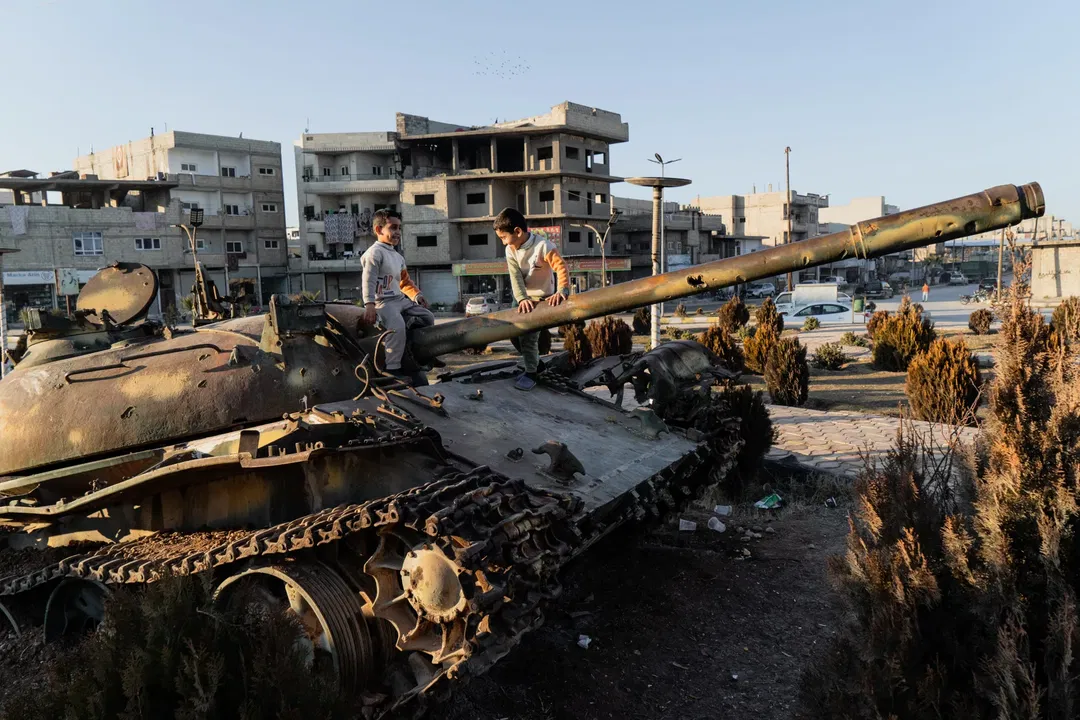 Children play on a tank on a roundabout in Kobane in Syrian Kurdistan. (Angéline Desdevises)
This is Part of the "Rojava’s Embattled Revolution" Dig series
Children play on a tank on a roundabout in Kobane in Syrian Kurdistan. (Angéline Desdevises)
This is Part of the "Rojava’s Embattled Revolution" Dig series
Journalist and Truthdig contributor Matt Broomfield spent three years living and working in Rojava (north and east Syria), covering the region’s unique, direct-democratic, women-led revolution. These experiences inspired his new book “Hope Without Hope: Rojava and Revolutionary Commitment” (AK Press), in which he explores the psychological and organizational lessons the militant Kurdish political movement can offer Western movements struggling for social and political change. In this chapter, which has been adapted for publication by Truthdig, Broomfield delves into the Kurdish movement’s radical understanding of death, sacrifice and mourning, and asks whether this political culture could help us rethink our own approach to loss and defeat.
The local communes that are the building blocks of the direct-democratic political system in Rojava (Syrian Kurdistan) are not normally hives of political engagement. But when Turkey’s 2019 invasion of the autonomous region loomed, attendance was more universal than ever. The air was filled with palpable urgency and defiant pride. Old women brandished weapons in packed meeting halls in poor neighborhoods and proudly dared the Turkish Armed Forces to eradicate them, as they surely could have. Comrades raced throughout Rojava, electrified by nervous energy, frantically organizing on a dozen fronts at once. Knowing their various efforts could never prove sufficient to hold back the coming storm, they nonetheless felt bound together in a spirit of defiant comradeship the enemy could never eradicate, could never even really understand.
When people face ethnic cleansing and state violence, moments of solidarity and rebellion will always occur. These moments can even become charged by a radical sense that absolute suffering precludes any political response short of utopia.

Yet in Rojava as throughout centuries of state violence, this spirit of resistance in extremis has often failed to overcome state might. Hard times will certainly sometimes produce instances of neighborly solidarity, what has been called “crisis socialism.” But in extremis, humans are just as likely to succumb to corruption, self-preservation or even suicide. Civilians flee as best they can. The frontlines eventually buckle under the onslaught. Hunger and torture break defiant spirits.
This is where resistance begins. Resistance implies an intractable, pig-headed refusal to give in, pushing back rather than yielding. Resistance does not deny or justify present suffering but wrestles with it, dwells with it. Resistance is not revolt, still less victory. It’s closer to what the Palestinians call sumud, their steadfast endurance and refusal to yield before Israeli state violence. Resistance is ugly, dogged, unreasonable, demanding a pointless commitment we can demand of no one save ourselves, expect of no one save our comrades.
Yet as we can learn from the example of the revolutionary Kurdish movement, there’s a curious alliance between this seemingly wild, irrational resistance and strategic, rational organization. Disciplined organization enables us to resist, trusting in our comrades’ ability to endure with us what we cannot endure alone. And in turn, a wild, irrational commitment to revolutionary change prepares us for the sacrifices that organizing requires. Perhaps, then, our own political culture could do with rather less reason and more organization.
Organizing in a pandemic
The strange relationship between irrational resistance and strategic organization can be understood if we consider the Western Left’s generally muted, apolitical response to the coronavirus crisis. This response was marked by chaotic political individualism and its necessary counterpart — political despair.
There were brave early efforts at grassroots, community-level organization — a General Electric walkout where workers demanded the right to manufacture ventilators, a fast food restaurant occupied to redistribute food, scattered rent strikes. All point to directions that a left alternative could have taken. Important demands were made over emergency relief payments, protection for the working-class laboring unseen throughout the pandemic and globally unequal vaccine distribution.
But these rapidly faded as the state admonished us to stay home, leaving many convinced the sole contribution we could make was to hide in our bedrooms until it was all over. A window of opportunity closed. And indeed, it would have been foolhardy and selfish to defy government orders on an individual basis, absent an organized alternative. Yet a truly organized mass movement could have offered material support to those who suffered most in the pandemic. In turn, this organized alternative would have fostered a spirit of unreasonable, irrational resistance, of comradeship and compassion.
In such a crisis, no one should seriously dispute the need for social measures aimed at combating the virus’s deadly spread, quarantine, or top-down, government-led management. But it is nonetheless possible to imagine a Left with the courage and organizational depth to step up where the state consistently failed. Could we have managed to help workers forced to keep laboring in contaminated warehouses to demand their fundamental rights? To save some of those who died of loneliness? And ultimately to have forced systemic change in response to a self-evidently generational crisis?
The pandemic laid bare the nervous system of contemporary capitalism. It made it easy to identify its pressure points, the clusters of clearly indispensable workers still fundamental to society’s operation. But, scattered and divided, we lost the opportunity to exert that crucial pressure.
The pandemic laid bare the nervous system of contemporary capitalism.
At some point, most of us made small decisions that deviated from public health orders, knowing that there are values worth considering beyond the R number, recognizing the need to cheer up our own grandmothers or give our struggling neighbor a much-needed break. This wasn’t wrong. But how much better it would have been to make those decisions together, as a movement. We could have explored tactics perhaps unjustifiable on the basis of day-to-day statistics but nonetheless ethically right. We could have collectively decided to accept measures of personal or collective risk, as part of a broader alternative that would justify certain sacrifices.
Ultimately, therefore, we would have challenged the profoundly ideological claim that average life expectancy is the only possible metric of a life well lived. We might even have fallen sick ourselves, while minimizing risks to others, as monks and nuns once risked their lives tending to lepers, the diseased and unloved, knowing there are forms of solidarity that cannot be quantified.
Perhaps there’s a paradox here. Only existential crisis can push us to the desperate hope without hope needed to underpin committed organization. But by the time that crisis arrives, it’s already too late for the prior organization that is required to mount a response. If the Kurdish movement’s example can help us prepare for a coming revolutionary crisis, perhaps the Left’s dereliction of duty during the pandemic can help us imagine how to react as best we can when a potentially revolutionary crisis thrusts itself on a scattered, unprepared and disorganized Left.
Living with death
That particular catastrophe may have passed. But revolutionary duties continue long after the moment of crisis.
Comrades in Rojava often felt themselves prepared for martyrdom. When the opportunity arose to join a humanitarian convoy into a city besieged by Turkey, for example, Kurdish and internationalist comrades argued passionately for the opportunity to participate. Who would want to remain safe and outside?
But for many of those comrades, it proved harder yet to stay alive; to recognize that the long-anticipated airstrike did not in fact have their name on it; to remain motivated through those endless, dreary months after the war when fresh invasion was always threatened but never arrived; or, for the internationalist volunteers, to travel back to their own countries, where absolute crisis and absolute redemption seemed even farther away.
You cannot live in the state of emergency all the time. The hardest days were those when the war faded away, when danger seemed distant and previously tight-knit groups of comrades fell back into infighting or depression. I met one veteran comrade who slept peacefully through barrages yet woke suddenly in the night when there was no shelling, finding the world eerily calm.
The hardest days were those when the war faded away.
This is one reason for the Kurdish movement’s political focus on commemorating its fallen comrades as secular martyrs, in what critics would describe as a “martyr cult.” In theory if not always in practice, these martyrs are memorialized not for their death but for their life and struggle. In other words, they symbolize a paradoxical revolutionary ability to find life in the very moment of death.
These martyrs serve to bring past crises into day-to-day civilian life. They make suffering unavoidable, ever-present, animating comrades as though their own lives were already on the line. When individuals join the Kurdish movement and leave their birth-name behind, they assume a martyr’s name as a nom de guerre, instigating their struggle for a free life by assuming the mantle of those who never lived to see a free Kurdistan.
In the same spirit, we might seek to restore an urgent sense of crisis to the heart of our own political culture. A sensitive yet serious understanding of catastrophe can productively lead us beyond pessimistic reformism. Indeed, the rapidly approaching climate catastrophe is furnishing many of us with just such a sensibility.
This certainly doesn’t mean we all need to suffer violence to prove our revolutionary worth, or before we can conceive of a better alternative. That would be an ugly insult to those who have suffered and died. It would also delegitimize many ordinary contributions, made by ordinary people, far from the front lines of visible, violent or radical struggle. If we seek out suffering for its own sake, we run the risk of adventurism or voyeurism, and in extreme cases even risk becoming anarcho-tourists or conflict tourists. There were certainly some of these in Rojava, seeking out death and hardship for the thrill of it, rather than accepting unavoidable risks as part of a broader internationalist duty.
Related Rojava on the Brink
Similarly, internationalist volunteers (or committed Kurdish revolutionaries) might find cause for hope-against-hope in the Kurds’ noble resistance, or through their personal experiences in Rojava. But many ordinary Syrians never asked to be on the frontlines of Rojava’s existential war. Many would give everything for the chance at a new life in the “hopeless,” “individualistic” West. Any personal spirit of justification revolutionaries might feel does not imply ordinary locals’ suffering was a price worth paying. On the contrary, the lessons learned from suffering are useful only insofar as they renew political commitment aimed at alleviating that suffering.
In general, privileged Western activists and organizers should bear in mind that our crisis is never personal but always collective and global. Doom-laden posturing over the supposedly imminent collapse of our own still-hegemonic capitalist states as a result of runaway climate change can easily prove insulting to those on the real front-lines of climate catastrophe. Conversely, an understanding of our global struggles as disparate yet linked can help Western comrades feel a motivating sense of incipient catastrophe while nonetheless remaining alert to our relative security.
A renewed internationalist sensibility can contribute here. As post-colonial scholars and activists observed long ago, the admonition “there are children starving in Africa” essentializes, Orientalizes and obscures the structural causes of malnutrition in Africa. In themselves, these critiques are important and logically sound.
But the well-meaning criticism of the “starving children in Africa” truism has become a liberal truism in turn. Albeit they should impel Westerners toward more thoughtful, structural or transformative forms of solidarity, these criticisms just as frequently serve to exculpate Westerners from caring about Africans at all.
Western activists all too happily seize on the opportunity to retreat into individuality and insularity, justifying inactivity as activity, just as we did during the coronavirus crisis. We either hold international struggles at an aestheticized, fetishized distance or simply ignore them altogether. The “think global, act local” rhetoric becomes an excuse to avoid finding ways to stand in meaningful solidarity with people and movements in Africa and throughout the Global South.
It’s thus most often activists based in the West who urge against sharing disturbing images of conflict and famine in Syria, Gaza and elsewhere. These admonitions may partially stem from reasonable doubts over the political function served by an endless stream of social media images: but also partially from less noble desires to preserve our own equanimity by ignoring the slaughter, frequently citing mental health concerns. But as anyone who uses WhatsApp to stay in contact with activists, friends or comrades on the ground in these sites of global conflict will know, the stream of ghastly images never stops.
Even if it’s distasteful to us, even if these images don’t achieve their perhaps intended effect of influencing Western policy, they are vital because they keep us from looking away. White guilt isn’t enough — but that doesn’t mean we shouldn’t feel bad.
These martyrs serve to bring past crises into day-to-day civilian life.
When Turkey used banned phosphorous munitions against Kurdish civilians, for example, the Kurdish movement’s media activists rapidly broadcast images of a shrieking, maimed child as widely as possible. They were not only seeking institutional attention but locking eyes with the West, challenging us to turn our shock, horror and revulsion to political use. Journalists in Gaza adopt much the same approach to documenting Israel’s genocide. They do not have the luxury of squeamishness or a social media detox. They know it’s worth being reminded of horror, even if we can do nothing to change it.
Like a nun kissing a leper’s sores, we sometimes have a responsibility beyond reason. We’re told such images desensitize us to violence: perhaps. But is that the fault of the real victims of the violence? Or is it our fault, a fault born of our knowledge we can do nothing to help these victims, and which we then seek to cover up by blaming our desensitization on social media?
We don’t need to pointlessly defy lockdowns or ogle images of starving children every time we order takeout. But we do need to find ways to bear witness to suffering we cannot change, to remain angry at our own comfort, bitter at our own survival, accepting the ugly and uncomfortable in order to motivate our own struggle.
The Kurdish movement constantly reminds its followers that triumph is inextricable from agony, despair from hope, that the path to a free life often leads to nothing but martyrdom. Alongside the mothers of the martyrs, the war-wounded always lead political demonstrations in Rojava, maimed limbs and DIY prosthetics displayed as proudly as the rainbow of political flags overhead. The Kurdish movement refers to these disabled comrades as its “living martyrs.” They are an incarnate reminder of all that is visceral, catastrophic and brutal about the movement’s struggle. Nothing less than victory can begin to atone for such losses. And even then, we should not consider their suffering automatically, tritely justified. On the contrary, the living martyrs embody the need to remain permanently dissatisfied, permanently striving toward a revolutionary goal.
Making sense of suicide
In distinction to squeamish Western culture, which confines death to private, annual or funereal rituals of commemoration, life in Rojava is necessarily saturated with death. Each meeting starts with a minute’s silence; photos of the martyrs are as omnipresent as advertisements in the West; every comrade, commune and institution bears the name of one of the dead.
Internationalist comrades, including those who traveled to Rojava to seek closure and understanding after one of their own friends was killed in a Turkish airstrike, have described the new perspectives on death that they found in the revolutionary context. As a friend of mine has written, formal expressions of grief that at first appeared stiff or morbid were gradually understood to “mean that the pain and sense of loss gets distributed across thousands — even millions — of people, and so does the responsibility to continue the work that our loved ones died for.”
Amid these celebrations of sacrifice, it’s unsurprising to find many young Kurds are all too ready to throw themselves in front of a bullet. As internationalist comrades serving in frontline medical units have lamented, even carrying basic medical supplies has long been unfashionable among the revolutionary vanguard. Again, we might carefully critique aspects of the Kurdish movement’s relationship to death and martyrdom, which can both tend to encourage reckless sacrifice and be misused to justify present-day strictures or abuses.
Life in Rojava is necessarily saturated with death.
Yet it’s clear that a Middle Eastern political culture that makes a virtue of death and loss, coupled with a strong revolutionary culture of comradeship superseding the individual self, often does better than our case-by-case efforts to rescue our comrades from depression or suicide. Rojava has many “houses of the wounded,” where the “living martyrs” recuperate, study and learn new skills. Visiting these inspiring sites of revolutionary self-defense and care, it’s impossible not to be moved by the dogged hope-against-hope that this political culture can inspire, undergirded by broader Kurdish and Islamic cultures of holistic care and mutual responsibility.
In the same spirit, we ourselves can learn from the Kurdish movement’s concept of death by paying more respect to our own martyrs, from the distant and not-so-distant past of our various national liberation, socialist, queer and ecological struggles. The U.S. has already witnessed the first instances of political self-immolation in response to the climate crisis, with David Buckel (2018) and Wynn Alan Bruce (2022) choosing a form of protest whose imagery has particular relevance to runaway global warming. As I write these words, U.S. Air Force serviceman Aaron Bushnell has just set himself alight in front of the Israeli Embassy in Washington in protest at the genocide in Gaza. They join the select and desperate ranks of Kurdish militants, monks, refugees and activists who have put themselves to the torch in a final, silent shriek of protest.
Beyond these extreme examples, we all have our own fallen friends and comrades to commemorate. We might think also of the millions of communists, anarchists and anti-colonial militants slaughtered throughout the 20th century; of those lost to the opioid epidemic, drowned crossing the Mediterranean, starved in a climate crisis drought, worked to death in a sweatshop; and ultimately everyone who has died too soon, too painfully, or too alone as a result of our extractive capitalist culture.
Enzo Traverso, a theorist of the left’s contemporary impasse, calls for a left culture that can overcome our self-image as the victims of 20th-century history. He suggests we rather think of ourselves as a once triumphant but currently vanquished Left, in an alternative self-conception more capable of politicizing and redirecting our melancholy. A renewed, organized martyr culture could directly assist our diverse movements in answering this call.
One famed Kurdish militant, who died during a prison hunger-strike, is remembered for defying his captors with the phrase: “There are those who love life so much they’re willing to die for it.” By the same token, there are those who love the dead so much they are willing to keep on living.
This article is an excerpt adapted from “Hope Without Hope: Rojava and Revolutionary Commitment” by Matt Broomfield. Published by AK Press. Copyright 2025 by Matt Broomfield. Used with permission.
TRUTHDIG’S JOURNALISM REMAINS CLEARThe storytellers of chaos tried to manipulate the political and media narrative in 2025, but independent journalism exposed what they tried to hide.
When you read Truthdig, you see through the illusion.
Support Independent Journalism.
 Editorial Cartoons
 Women
From a protest encampment in Islamabad, hundreds of women from Balochistan are demanding the return of their missing loved ones and an end to the killing.
Women
From a protest encampment in Islamabad, hundreds of women from Balochistan are demanding the return of their missing loved ones and an end to the killing.
 Opinion
How can a person make up for seven decades of misrepresentation and willful distortion in the time allotted to a sound bite?
Opinion
How can a person make up for seven decades of misrepresentation and willful distortion in the time allotted to a sound bite?
 The White House says Turkey is planning to invade the Kurdish-majority region of northern Syria to establish what Ankara calls a “security zone.”
 Dina Gilio-Whitaker’s book is a primer on the Native American environmental movement and a chronicle of fighting government and corporate power.
 Ethnic cleansing against a minority group was helped by social media.


You need to be a supporter to comment.
There are currently no responses to this article.
Be the first to respond.