
News
Updates for StringEncrypt: engine releases, new or expanded programming language support, and changes to the website, API, and desktop tools.
Updates for StringEncrypt: engine releases, new or expanded programming language support, and changes to the website, API, and desktop tools.
Encryption engine updated to v1.5.0 with major algorithmic improvements.
Support for new programming languages added:
Nested polymorphic encryption loops (matryoshka-style)
Available only for paying customers. The decryption loop can now contain randomly generated inner loops (up to 3 levels deep), each with 1–3 encryption commands. This dramatically increases the complexity of the generated polymorphic code, making static analysis significantly harder. Supported in all languages except Haskell. Assembly languages (MASM/FASM/NASM) use push/pop with randomly generated named labels for inner loop nesting.
Related to the nested loops, the C/C++ loop constructs are now using volatile keyword to prevent compiler loop unrolling, and it makes advanced string extraction tools unusable.
Bugfixes
6 new encryption VM instructions:
neg — two's complement negation (self-inverse)swap — nibble swap for 8-bit / byte swap for 16-bit values (self-inverse)c_rol / c_ror — counter-dependent bit rotation, shift amount varies per character making frequency analysis nearly impossiblexor_shr / xor_shl — hash-like self-XOR mixing functions inspired by algorithms such as MurmurHash and SplitMix (self-inverse)The total number of encryption VM instructions is now 17 (up from 11), providing a vastly larger space of possible encryption combinations.
New syntax highlighting
Legacy Syntax Highlighter library was replaced with modern Prism highlighter.
SDKs
A Python 3 module (with usage examples) has been published to make string encryption automation easier (along with its sources at GitHub).
An extension for Visual Studio Code IDE has been published.
You can now easily encrypt strings and files directly from the Visual Studio Code editor.
All binaries were digitally re-signed using Thawte digital certificate.
Long story short - our previous certification company StartCOM was banned first from the major web browsers and now in 2019 from Microsoft Windows because of their shady business practices (issuing back dated certificates) and their main CA certificate was revoked, which resulted in blocking any software signed with their digital code signing certificates (even if it was valid till the end of 2019 like in our case).
We had huge problems to get a new one with COMODO / Sectigo because of their dumb policies, that required us to be listed in commercial business DUNS directory (1600 USD for a listing) or to have a blue shield of verification on Google Maps (even if this program was discontinued because it required to have a Google Business and now defunct Google+ accounts linked together...).
I've been trying to get this new certificate for more than 3 weeks with COMODO without a result and with tons of legal, notary signed company papers, utility bills send to them for verification, they didn't want to issue a code signing certificate no matter what.
Finally I have tried to get it from Thawte, and after a simple business verification process, they granted us a new certificate after 2 days.
I would like to apologize to all the customers for all the inconvenience in those days when you couldn't use our software.
Windows clients updated to v1.5. Added Visual Basic .NET to the supported languages list.
Windows client updated to v1.4. Added PowerShell to the supported languages list.
Java UNICODE characters encoding fixed (special characters), now encrypted Java strings are stored as an hex array instead of UNICODE string literal. Bug reported by Gareth Barnby - thank you.
Windows client updated to v1.3. Added AutoIt to the supported languages list & fixed incompatibility with Windows 10 (x64).
Encryption module added for the AutoIt script programming language.
Encryption module added for the Ruby programming language.
Small UI improvements for mobile and tablets, updated SSL certificate.
An anonymous user created an objective version of our Web API interface.
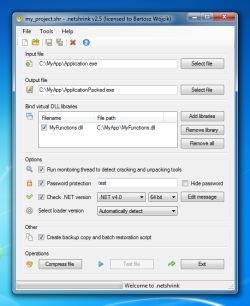
.netshrink features:
Download demo version: