The document explains the Y-combinator in the Scheme programming language as a mechanism for defining recursive functions in pure lambda calculus. It demonstrates how recursion can be achieved without naming functions by using constructs like the Y-combinator and provides several examples, including implementations of recursive length and factorial functions. The document concludes by asserting that all recursive functions can be expressed using pure lambda calculus, demonstrating the Turing completeness of lambda calculus.
![We need a recursive function to work with. We could use almost
anything, but a particularly simple target is the recursive length
function. In Scheme this is
(define length (lambda (lat)
(cond
[(null? lat) 0]
[else (+ 1 (length (cdr lat)))])))
We are looking for a way to write this in the lambda-calculus without
assigning names to anything.](https://image.slidesharecdn.com/y-combinatornotes-240804081454-aabfda1f/75/Y-Combinator-In-Scheme-Recursion-in-Lambda-Calcul-3-2048.jpg)
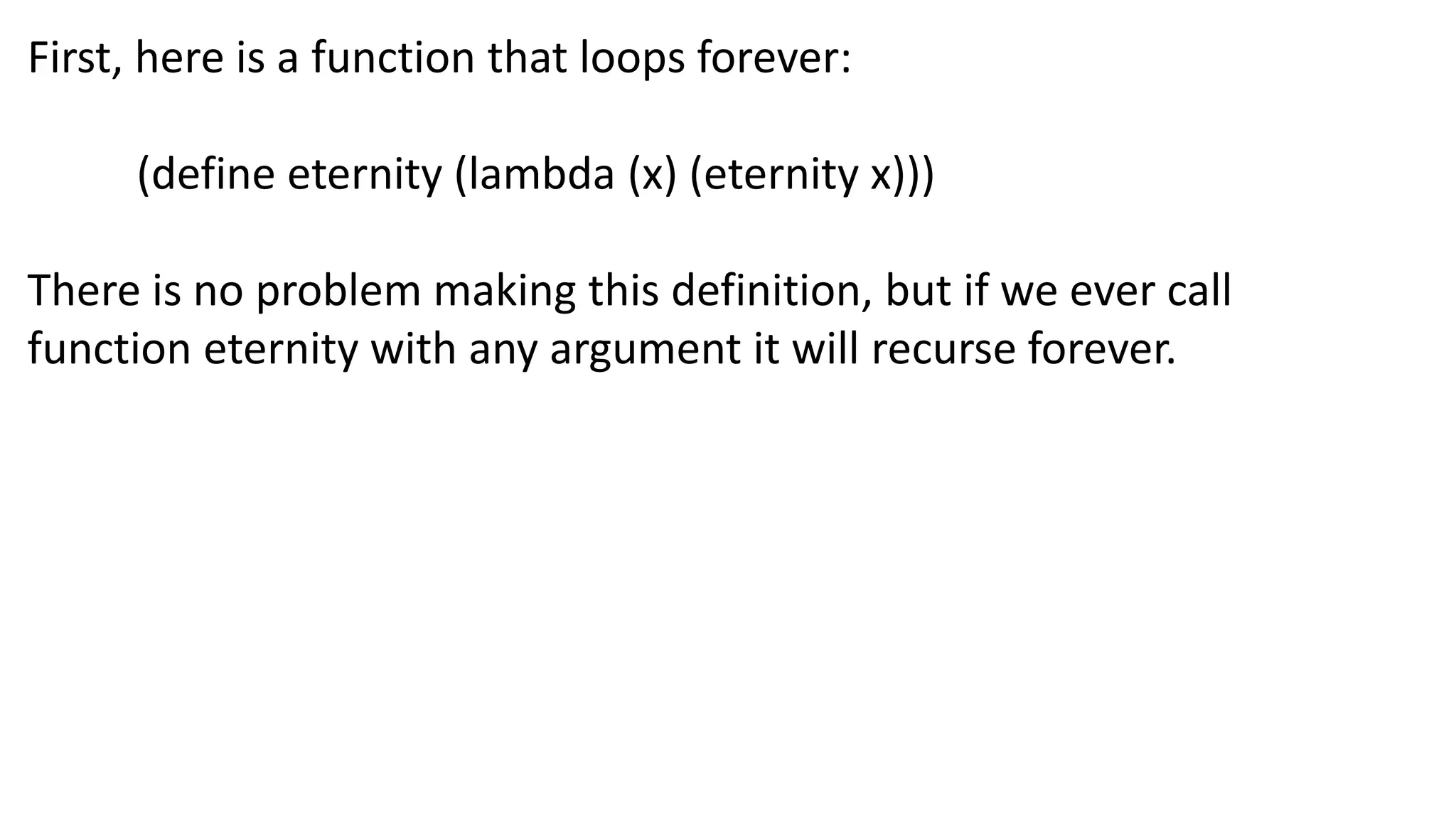
![Here is a function related to the length function:
(define L (lambda (f)
(lambda (lat)
(cond
[(null? lat) 0]
[else (+ 1 (f (cdr lat)))]))))
Here are some functions we can get from L:
(define L0 (L eternity))
(L0 null) is 0; (L0 lat) runs forever if lat isn't null](https://image.slidesharecdn.com/y-combinatornotes-240804081454-aabfda1f/75/Y-Combinator-In-Scheme-Recursion-in-Lambda-Calcul-5-2048.jpg)
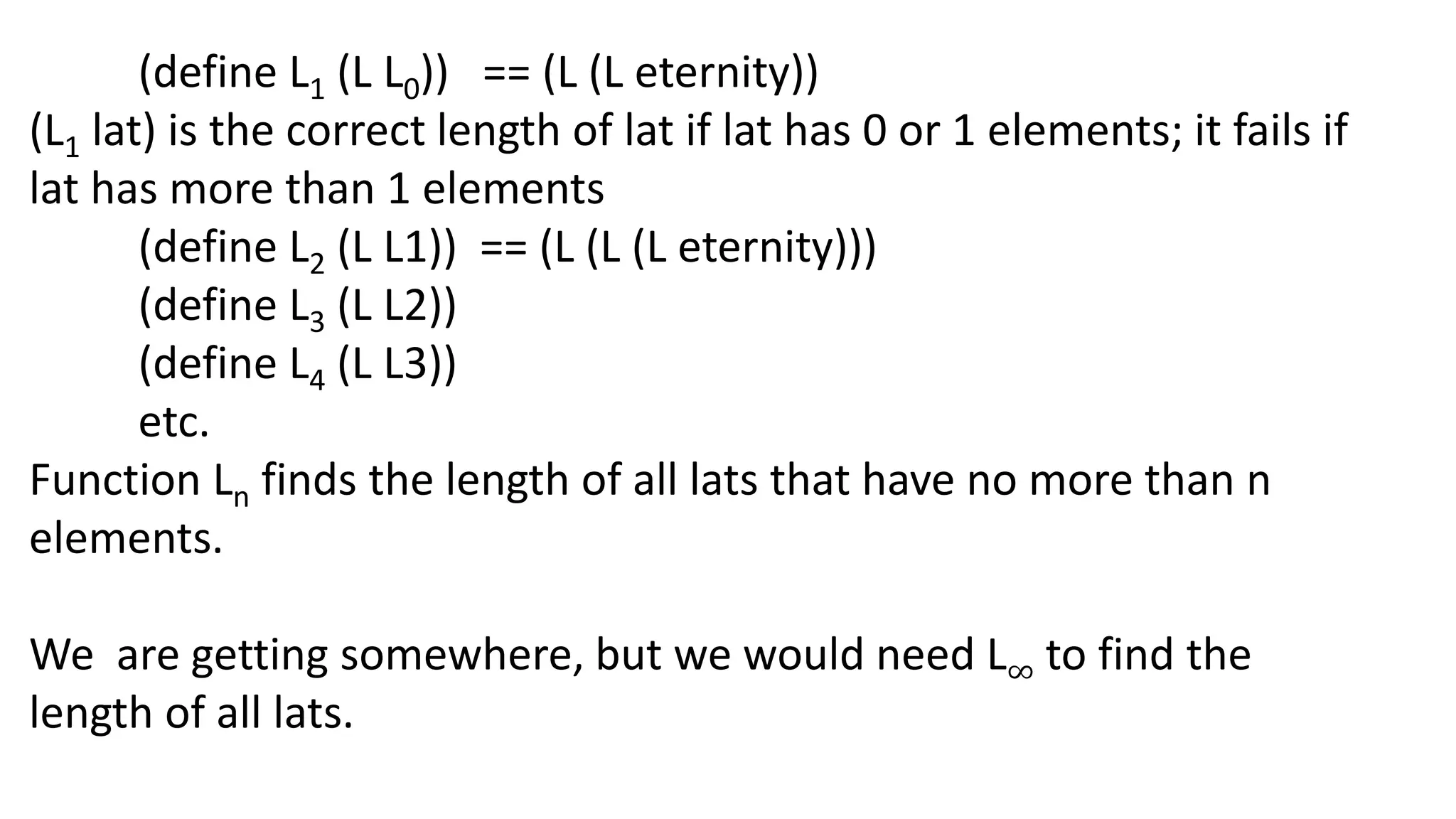
![Here is a slightly more complicated approach:
(define M1
(let ([g (lambda (f)
(lambda (lat)
(cond
[(null? lat) 0]
[else (+ 1 ((f eternity) (cdr lat)))])))])
( g g)))
Note that (g eternity) is
(lambda (lat)
(cond
[(null? lat) 0]
[else (+ 1 ((eternity eternity) (cdr lat)))]))
which is functionally the same as L0](https://image.slidesharecdn.com/y-combinatornotes-240804081454-aabfda1f/75/Y-Combinator-In-Scheme-Recursion-in-Lambda-Calcul-7-2048.jpg)
![and (g g) is
(lambda (lat)
(cond
[(null? lat) 0]
[else (+ 1 ((g eternity) (cdr lat)))]))
This is the same as (L L0). So M1 is a stand-alone function that is
equivalent to L1. We are getting somewhere.](https://image.slidesharecdn.com/y-combinatornotes-240804081454-aabfda1f/75/Y-Combinator-In-Scheme-Recursion-in-Lambda-Calcul-8-2048.jpg)
![(define N
(let ([h (lambda (f)
(lambda (lat)
(cond
[(null? lat) 0]
[else (+ 1 ( (f f) (cdr lat)))])))])
(h h)))
N is (h h), which is
(lambda (lat)
(cond
[(null? lat) 0]
[else (+ 1 ( (h h) (cdr lat)))]))
That last line could be written [else (+ 1 (N (cdr lat)))]))
so N is exactly the recursive length function.](https://image.slidesharecdn.com/y-combinatornotes-240804081454-aabfda1f/75/Y-Combinator-In-Scheme-Recursion-in-Lambda-Calcul-9-2048.jpg)
![Don't allow the let-expression in the definition of N throw you off.
(let ([a b]) exp) is completely equivalent to ( (lambda (a) exp) b) so we
could rewrite N as a pure lambda-expression:
(define N
( (lambda (h) (h h))
(lambda (f)
(lambda (lat)
(cond
[(null? lat) 0]
[else (+ 1 ( (f f) (cdr lat)))])))))](https://image.slidesharecdn.com/y-combinatornotes-240804081454-aabfda1f/75/Y-Combinator-In-Scheme-Recursion-in-Lambda-Calcul-10-2048.jpg)
![We can write other recursive functions in this style:
The member? function is
(define member?
(let ([e (lambda (f)
(lambda (a lat)
(cond
[(null? lat) #f]
[(eq? a (car latl)) #t]
[else ( (f f) a (cdr lat))])))])
(e e)))](https://image.slidesharecdn.com/y-combinatornotes-240804081454-aabfda1f/75/Y-Combinator-In-Scheme-Recursion-in-Lambda-Calcul-11-2048.jpg)
![The factorial function is
(define Factorial
(let ([c (lambda (f)
(lambda (n)
(cond
[(= 0 n) 1]
[else (* n ( (f f) (- n 1)))] ))))])
(c c)))](https://image.slidesharecdn.com/y-combinatornotes-240804081454-aabfda1f/75/Y-Combinator-In-Scheme-Recursion-in-Lambda-Calcul-12-2048.jpg)
![There is a pattern to coding like this. Consider the following which is
an encoding of the Y-Combinator:
(define Y (lambda (exp)
(let ([a (lambda (f)
(exp (lambda (x) ( (f f) x)))))])
(a a))))
Then (Y (lambda(s)
(lambda (lat)
(cond
[(null? lat) 0]
[else (+ 1 (s (cdr lat)))]))))
is the length function](https://image.slidesharecdn.com/y-combinatornotes-240804081454-aabfda1f/75/Y-Combinator-In-Scheme-Recursion-in-Lambda-Calcul-13-2048.jpg)
![To see why, note that
(Y (lambda(s)
(lambda (lat)
(cond
[(null? lat) 0]
[else (+ 1 (s (cdr lat)))]))))
is
(let ([a (lambda (f)
(lambda (lat)
(cond
[(null? lat) 0]
[else (+ 1 (lambda (x) ((f f) x))(cdr lat))))
(a a)
which is equivalent to
(let ([a (lambda (f)
(lambda (lat)
(cond
[(null? lat) 0]
[else (+ 1 ((f f) (cdr lat))))
(a a)](https://image.slidesharecdn.com/y-combinatornotes-240804081454-aabfda1f/75/Y-Combinator-In-Scheme-Recursion-in-Lambda-Calcul-14-2048.jpg)
![Similarly,
(Y (lambda (s)
(lambda (n)
(cond
[(= 0 n) 1]
[else (* n (s (- n 1)))]))))
is the factorial function.
In general, if you take the definition of any recursive function of one
variable, wrap a (lambda (s) ...) around it and use s as the name of the
function for the recursive call, Y takes this expression and turns it into
a recursive function.](https://image.slidesharecdn.com/y-combinatornotes-240804081454-aabfda1f/75/Y-Combinator-In-Scheme-Recursion-in-Lambda-Calcul-16-2048.jpg)
![Y converts expressions into recursive functions of 1 variable.
If we define Y2 as
(define Y2 (lambda (name)
(let ([a (lambda (f)
(name (lambda (x y) ((f f) x y))))])
(a a))))
then Y2 makes recursive functions of 2 variables.](https://image.slidesharecdn.com/y-combinatornotes-240804081454-aabfda1f/75/Y-Combinator-In-Scheme-Recursion-in-Lambda-Calcul-17-2048.jpg)
![For example
(Y2 (lambda (s)
(lambda (a lat)
(cond
[(null? lat) null]
[(eq? a (car lat)) (cdr lat)]
[else (cons (car lat) (s a (cdr lat)))]))))
is the rember function and
(Y2 (lambda (s)
(lambda (a lat)
(cond
[(null? lat) null]
[(eq? a (car lat)) (s a (cdr lat))]
[else (cons (car lat) (s a (cdr lat)))]))))
is the rember-all function](https://image.slidesharecdn.com/y-combinatornotes-240804081454-aabfda1f/75/Y-Combinator-In-Scheme-Recursion-in-Lambda-Calcul-18-2048.jpg)