Writing bullet proof Javascript

        (by using CoffeeScript)
              April 2010


             @SusanPotter
Outline

1. Javascript lifecycle:
      copy-n-paste (mid/late-90s)
      coarse-grained translation layers (mid-00s)
      (unobtrusive) pure Javascript (late-00s)
2. What is CoffeeScript?
3. Why use CoffeeScript?
4. CoffeeScript Examples
5. CoffeeScript Tools
6. Resources
Copy-n-paste (mid/late-90s)

  Used mostly for:
     preloading images
     image hover-overs
     alerts/confirms
  Lots of dreadful Dreamweaver snippets
  Wild west era of Javascript
  Nobody really understood Javascript
  Bad Javascript snippets spread like wild fire!
Coarse-grained translation layers (mid-00s)

 Ruby on Rails popularized this with RJS & JS helpers.
 "AJAX-friendly" frameworks started appearing in other languages:
 Python, Groovy, Erlang, PHP, etc.
 RJS-style good for specific coarse-grained functionality.
 RJS-style bad when you need more flexibility & control.
 RJS-style promotes bad code smells:
    long templates, methods
    inline Javascript (inflexible & non-reusable)
    hard to debug and troubleshoot
Pure Javascript (late-00s)
  Everyone wanted to be a Javascript ninja & unobtrusive Javascript
  (UJS) became cool with rise of libraries.
  Pro: most control and flexibility
  Pro: libraries made UJS and better JS style easier and more
  accessible.
  Con: common Javascript pitfalls:
     devs still consider it secondary or tertiary language
     easy to pollute global space accidentally
     large "falsey" values can cause problems
     unintuitive prototypal object-oriented
     many others too numerous to list
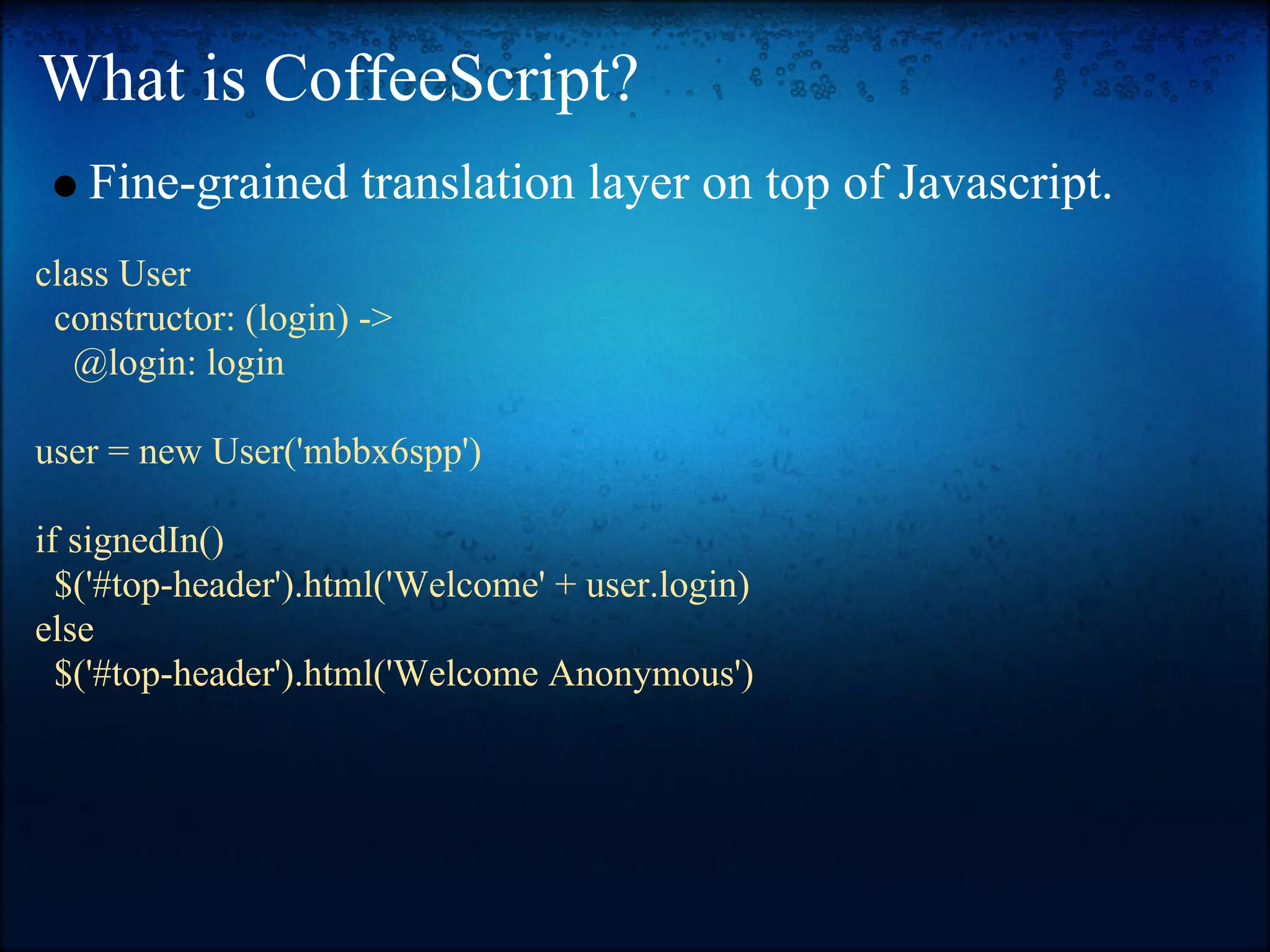
What is CoffeeScript?
   Fine-grained translation layer on top of Javascript.
class User
 constructor: (login) ->
   @login: login

user = new User('mbbx6spp')

if signedIn()
  $('#top-header').html('Welcome' + user.login)
else
  $('#top-header').html('Welcome Anonymous')
Why use CoffeeScript?

  Prevents common mistakes using different syntax.
  More terse & expressive.
  More readable.
  Generates Javascript without any JSLint warnings.
Why not use CoffeeScript?

  Adds another level of indirection.
  Another syntax to learn.
  Already know Javascript (the good parts) well.
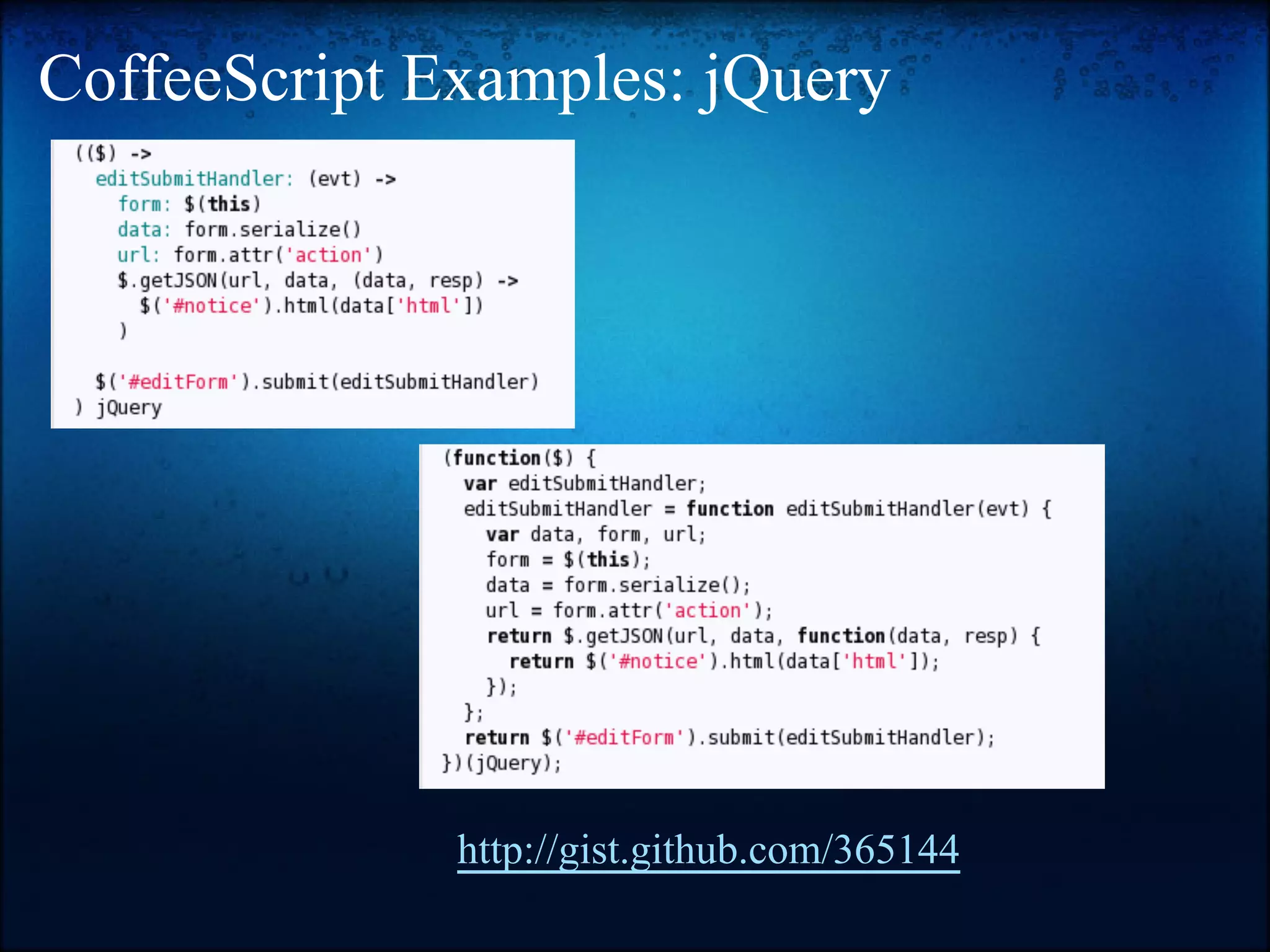
CoffeeScript Examples: jQuery


              http://gist.github.com/365144
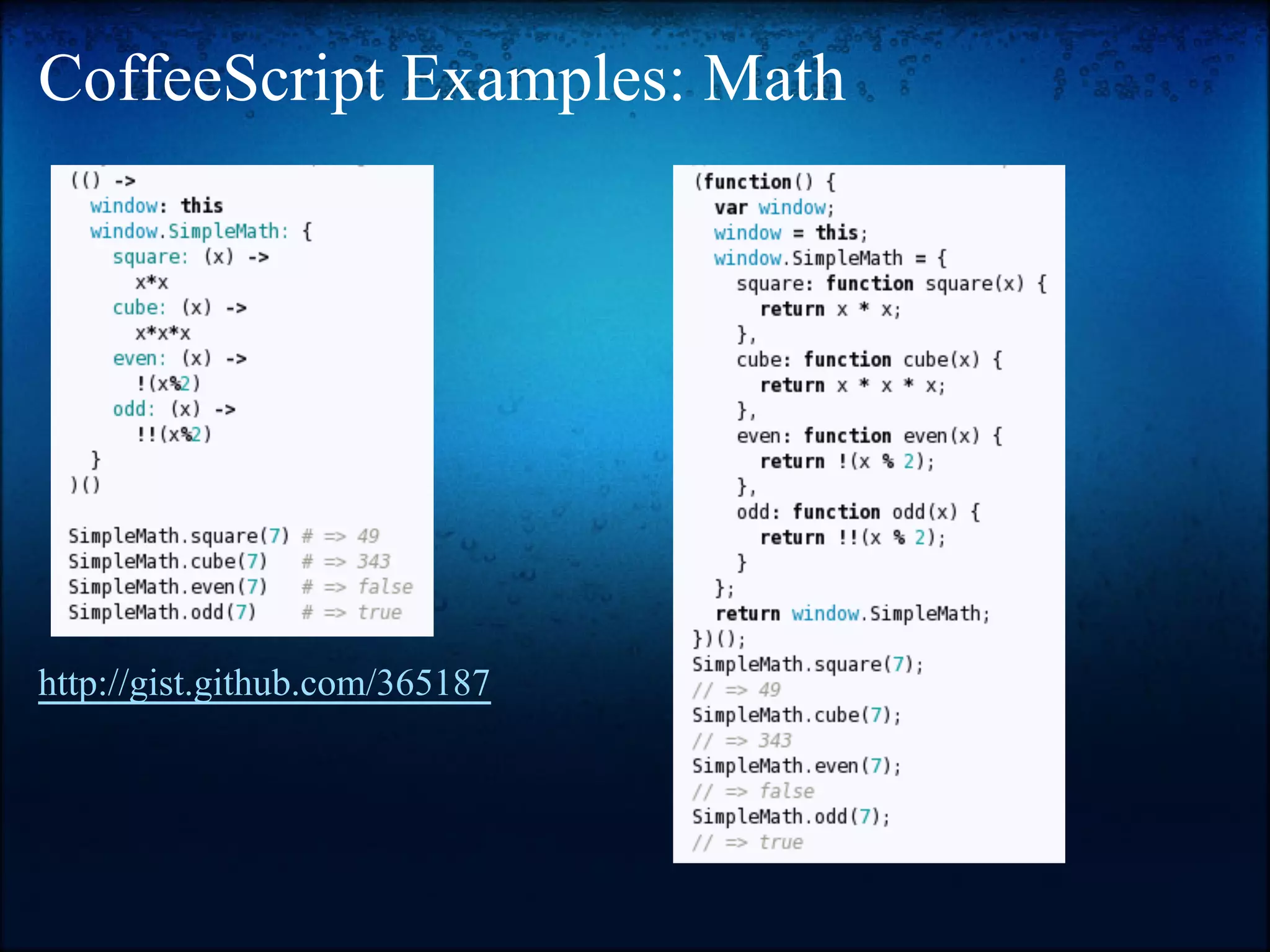
CoffeeScript Examples: Math


http://gist.github.com/365187
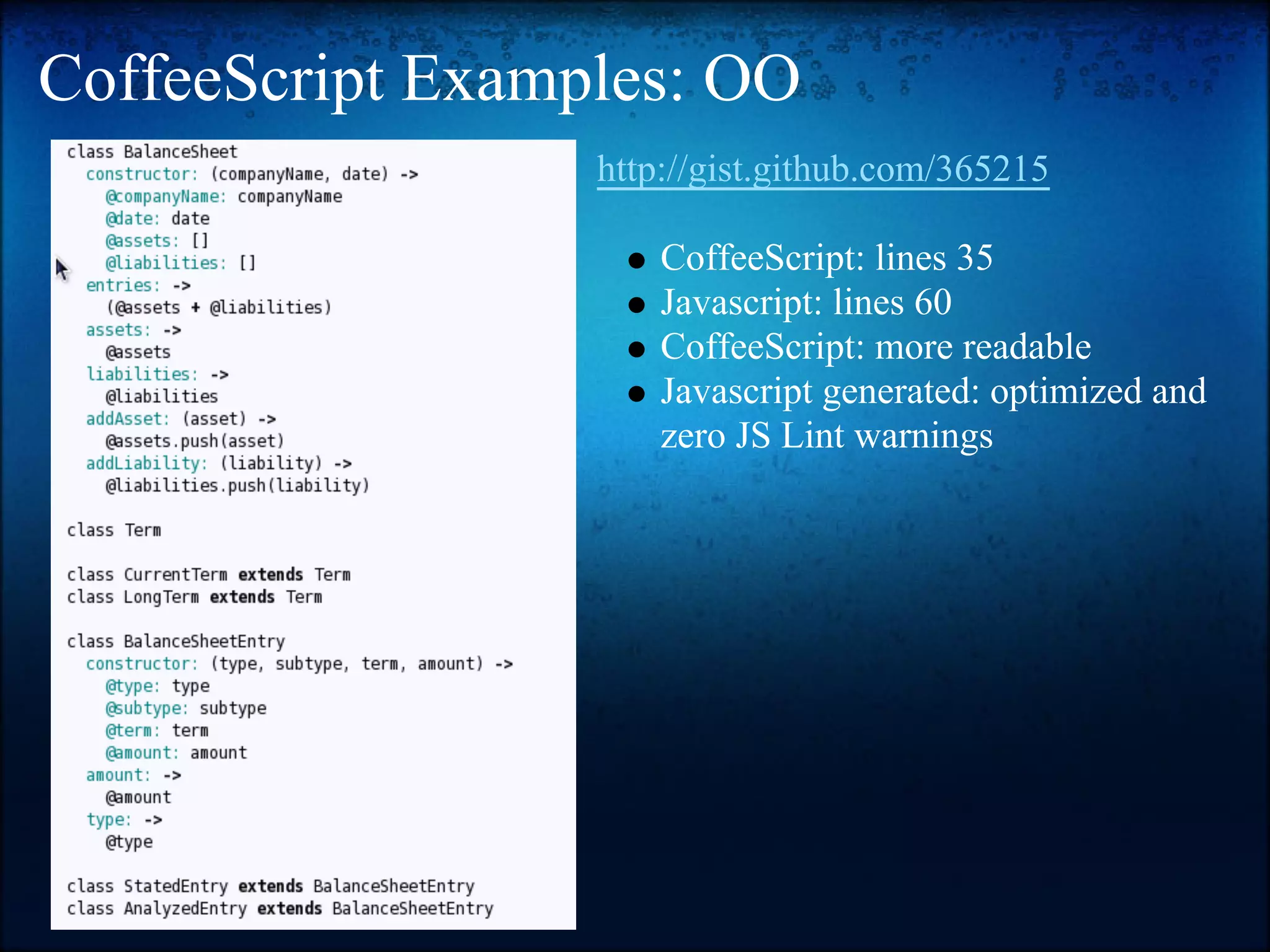
CoffeeScript Examples: OO
                  http://gist.github.com/365215

                      CoffeeScript: lines 35
                      Javascript: lines 60
                      CoffeeScript: more readable
                      Javascript generated: optimized and
                      zero JS Lint warnings
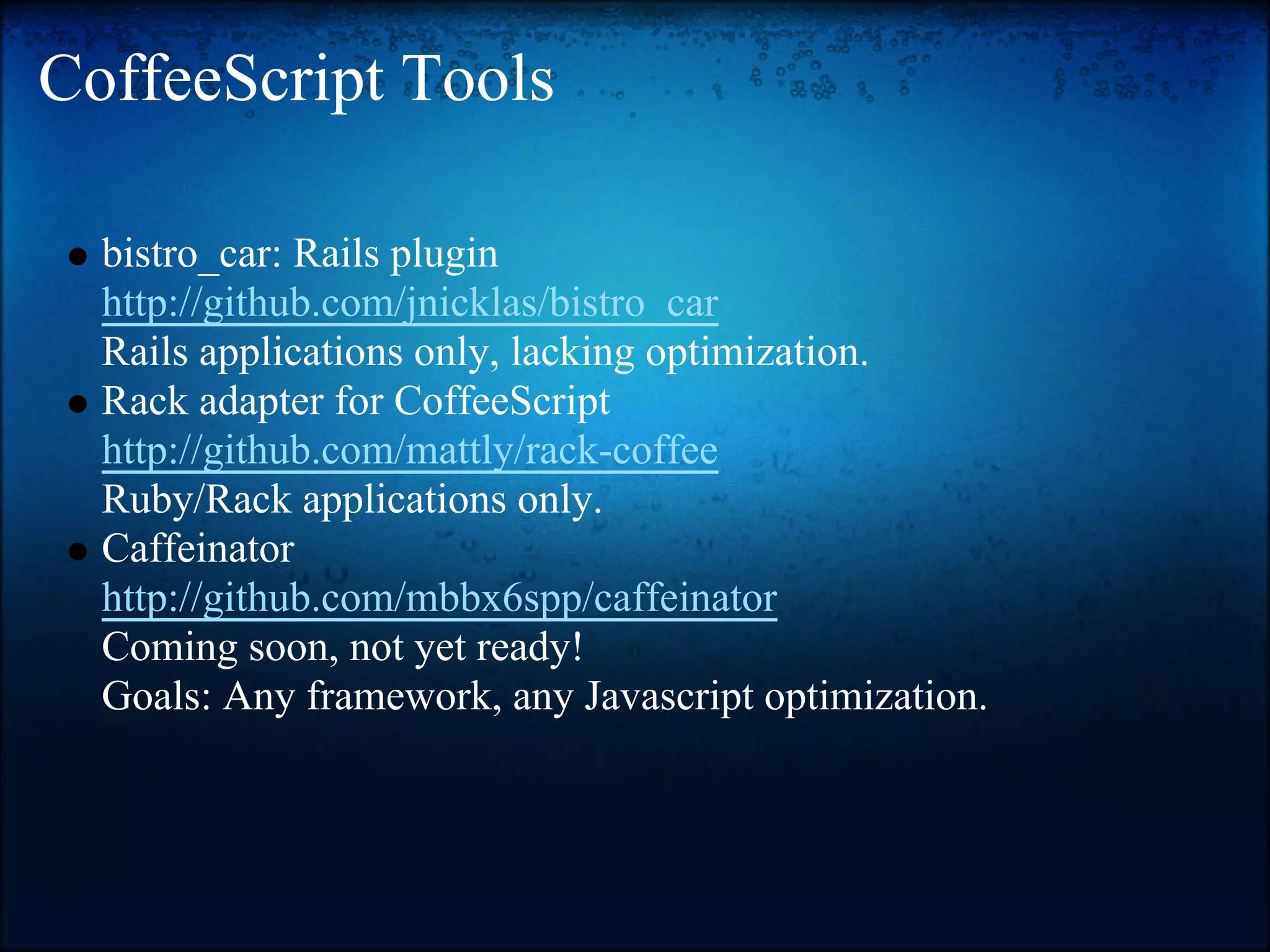
CoffeeScript Tools

  bistro_car: Rails plugin
  http://github.com/jnicklas/bistro_car
  Rails applications only, lacking optimization.
  Rack adapter for CoffeeScript
  http://github.com/mattly/rack-coffee
  Ruby/Rack applications only.
  Caffeinator
  http://github.com/mbbx6spp/caffeinator
  Coming soon, not yet ready!
  Goals: Any framework, any Javascript optimization.
Resources
http://coffeescript.org
IRC: freenode #coffeescript
http://github.com/jashkenas/coffee-script/issues

Twitter:
  use #coffeescript hashtag on questions/queries
  @SusanPotter for pointers :)

Writing Bullet-Proof Javascript: By Using CoffeeScript

  • 1.
    Writing bullet proofJavascript (by using CoffeeScript) April 2010 @SusanPotter
  • 2.
    Outline 1. Javascript lifecycle: copy-n-paste (mid/late-90s) coarse-grained translation layers (mid-00s) (unobtrusive) pure Javascript (late-00s) 2. What is CoffeeScript? 3. Why use CoffeeScript? 4. CoffeeScript Examples 5. CoffeeScript Tools 6. Resources
  • 3.
    Copy-n-paste (mid/late-90s) Used mostly for: preloading images image hover-overs alerts/confirms Lots of dreadful Dreamweaver snippets Wild west era of Javascript Nobody really understood Javascript Bad Javascript snippets spread like wild fire!
  • 4.
    Coarse-grained translation layers(mid-00s) Ruby on Rails popularized this with RJS & JS helpers. "AJAX-friendly" frameworks started appearing in other languages: Python, Groovy, Erlang, PHP, etc. RJS-style good for specific coarse-grained functionality. RJS-style bad when you need more flexibility & control. RJS-style promotes bad code smells: long templates, methods inline Javascript (inflexible & non-reusable) hard to debug and troubleshoot
  • 5.
    Pure Javascript (late-00s) Everyone wanted to be a Javascript ninja & unobtrusive Javascript (UJS) became cool with rise of libraries. Pro: most control and flexibility Pro: libraries made UJS and better JS style easier and more accessible. Con: common Javascript pitfalls: devs still consider it secondary or tertiary language easy to pollute global space accidentally large "falsey" values can cause problems unintuitive prototypal object-oriented many others too numerous to list
  • 6.
    What is CoffeeScript? Fine-grained translation layer on top of Javascript. class User constructor: (login) -> @login: login user = new User('mbbx6spp') if signedIn() $('#top-header').html('Welcome' + user.login) else $('#top-header').html('Welcome Anonymous')
  • 7.
    Why use CoffeeScript? Prevents common mistakes using different syntax. More terse & expressive. More readable. Generates Javascript without any JSLint warnings.
  • 8.
    Why not useCoffeeScript? Adds another level of indirection. Another syntax to learn. Already know Javascript (the good parts) well.
  • 9.
    CoffeeScript Examples: jQuery http://gist.github.com/365144
  • 10.
  • 11.
    CoffeeScript Examples: OO http://gist.github.com/365215 CoffeeScript: lines 35 Javascript: lines 60 CoffeeScript: more readable Javascript generated: optimized and zero JS Lint warnings
  • 12.
    CoffeeScript Tools bistro_car: Rails plugin http://github.com/jnicklas/bistro_car Rails applications only, lacking optimization. Rack adapter for CoffeeScript http://github.com/mattly/rack-coffee Ruby/Rack applications only. Caffeinator http://github.com/mbbx6spp/caffeinator Coming soon, not yet ready! Goals: Any framework, any Javascript optimization.
  • 13.