Why Haskell?
   Susan Potter


   March 2012
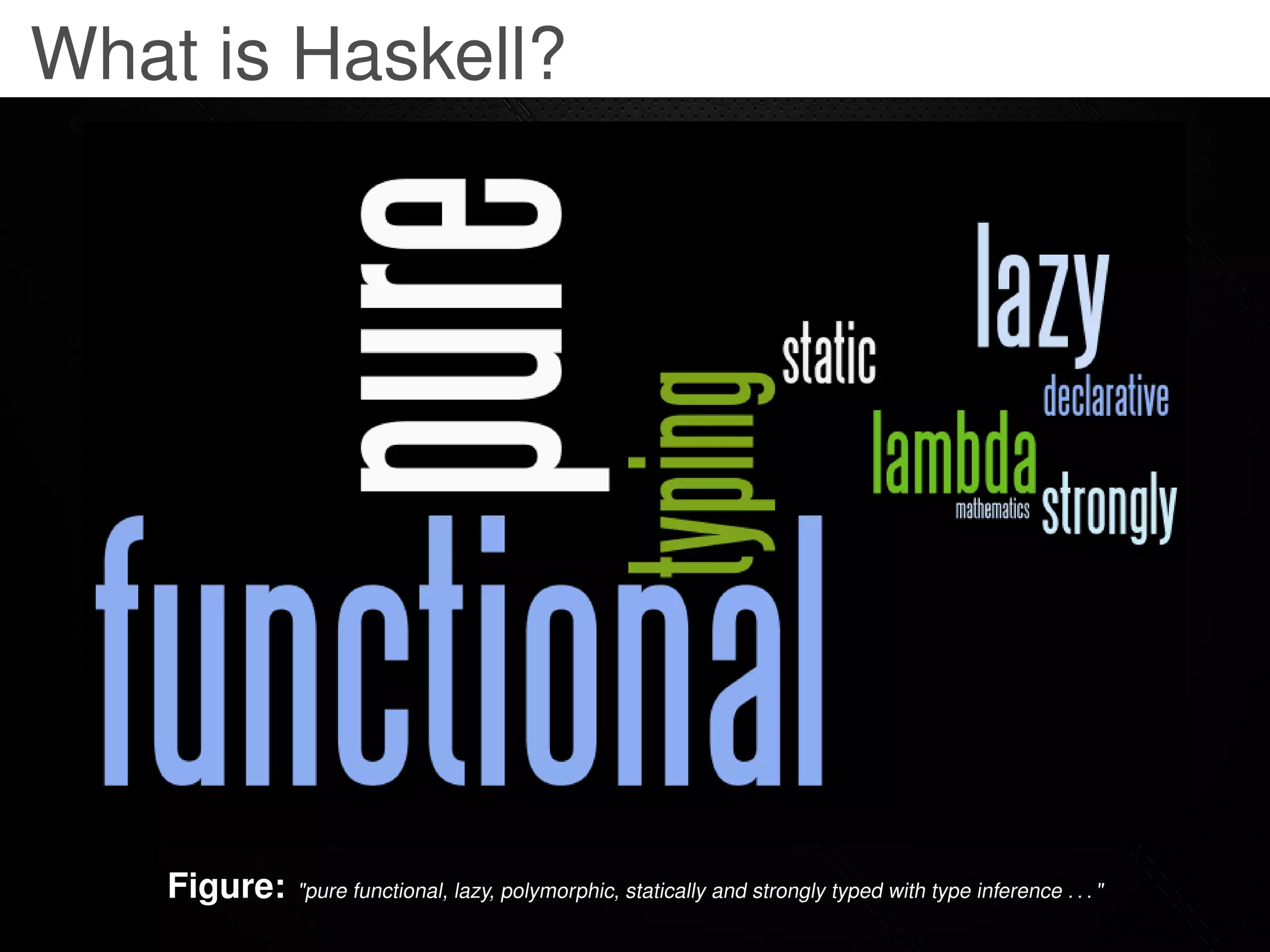
What is Haskell?


    Figure:   "pure functional, lazy, polymorphic, statically and strongly typed with type inference . . . "
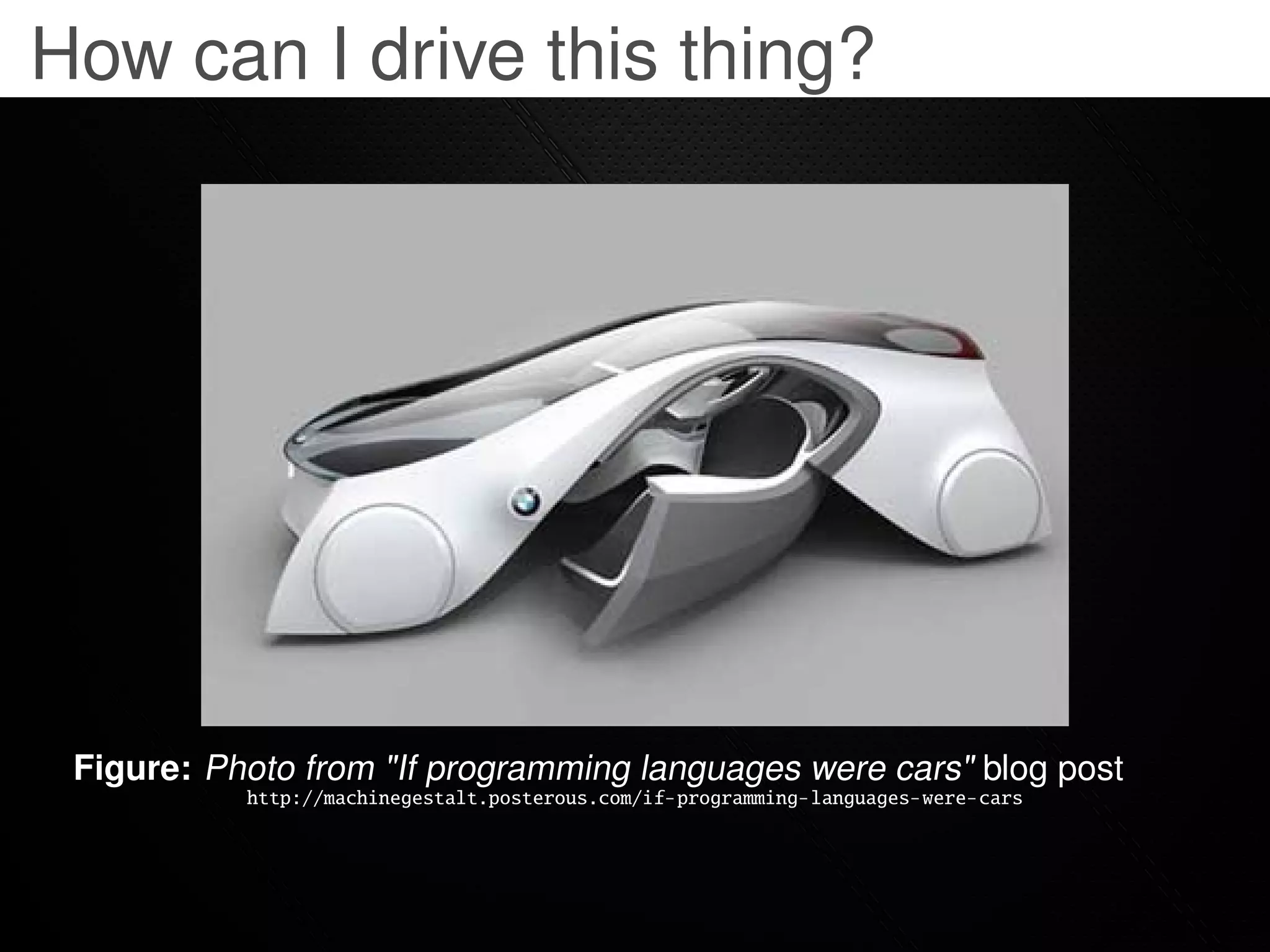
How can I drive this thing?


 Figure: Photo from "If programming languages were cars" blog post
           http://machinegestalt.posterous.com/if-programming-languages-were-cars
Can I drive Haskell without all this?


 Figure: No need to know Category Theory proofs, just some intuitions!
# finger $(whoami)

Login: susan               Name: Susan Potter
Directory: /home/susan     Shell: /bin/zsh
Practicing since 1997-09-29 21:18 (GMT) on tty1 from :0
Too much unread mail on me@susanpotter.net
Now working at Desk.com! Looking for smart developers!;)
Plan:
  github: mbbx6spp
  twitter: @SusanPotter
Are we "doing it wrong"?


         Figure: Maybe! ;)
          http://absolutelymadness.tumblr.com/post/17567574522
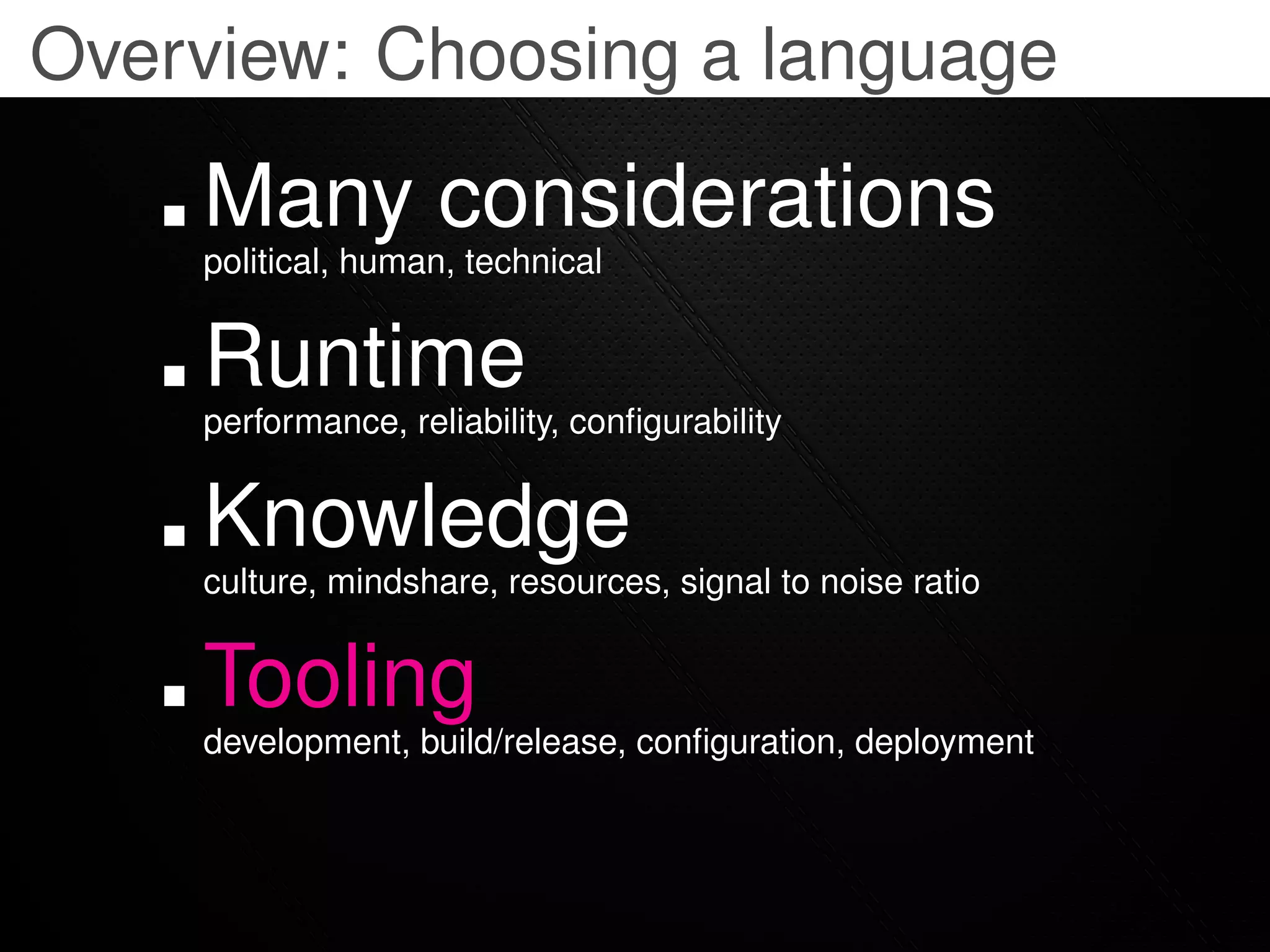
Overview: Choosing a language

    Many considerations
    political, human, technical


    Runtime
    performance, reliability, configurability


    Knowledge
    culture, mindshare, resources, signal to noise ratio


    Tooling
    development, build/release, configuration, deployment
Overview: Choosing a language

    Many considerations
    political, human, technical


    Runtime
    performance, reliability, configurability


    Knowledge
    culture, mindshare, resources, signal to noise ratio


    Tooling
    development, build/release, configuration, deployment
Overview: Choosing a language

    Many considerations
    political, human, technical


    Runtime
    performance, reliability, configurability


    Knowledge
    culture, mindshare, resources, signal to noise ratio


    Tooling
    development, build/release, configuration, deployment
Overview: Choosing a language

    Many considerations
    political, human, technical


    Runtime
    performance, reliability, configurability


    Knowledge
    culture, mindshare, resources, signal to noise ratio


    Tooling
    development, build/release, configuration, deployment
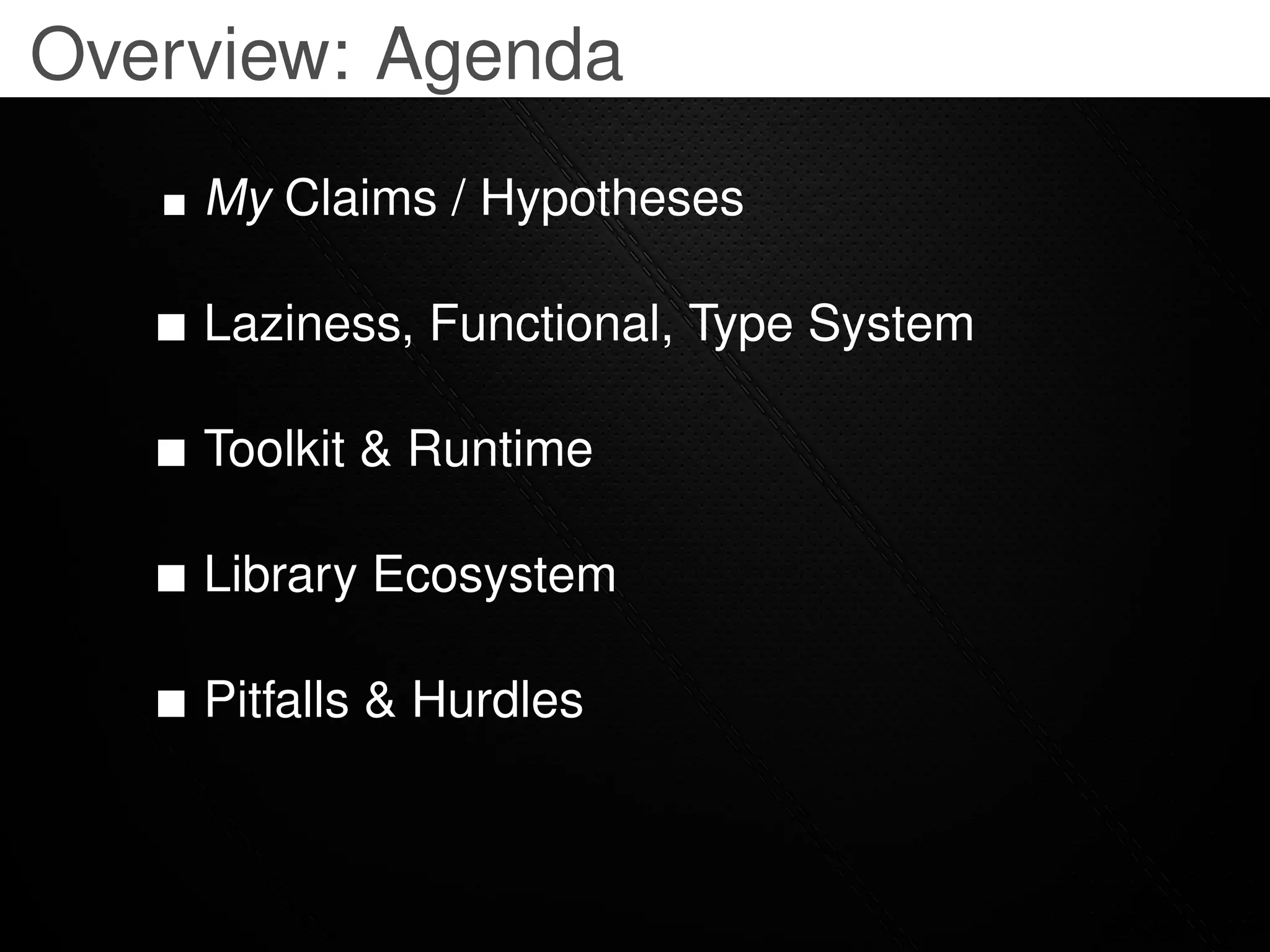
Overview: Agenda
    My Claims / Hypotheses

    Laziness, Functional, Type System

    Toolkit & Runtime

    Library Ecosystem

    Pitfalls & Hurdles
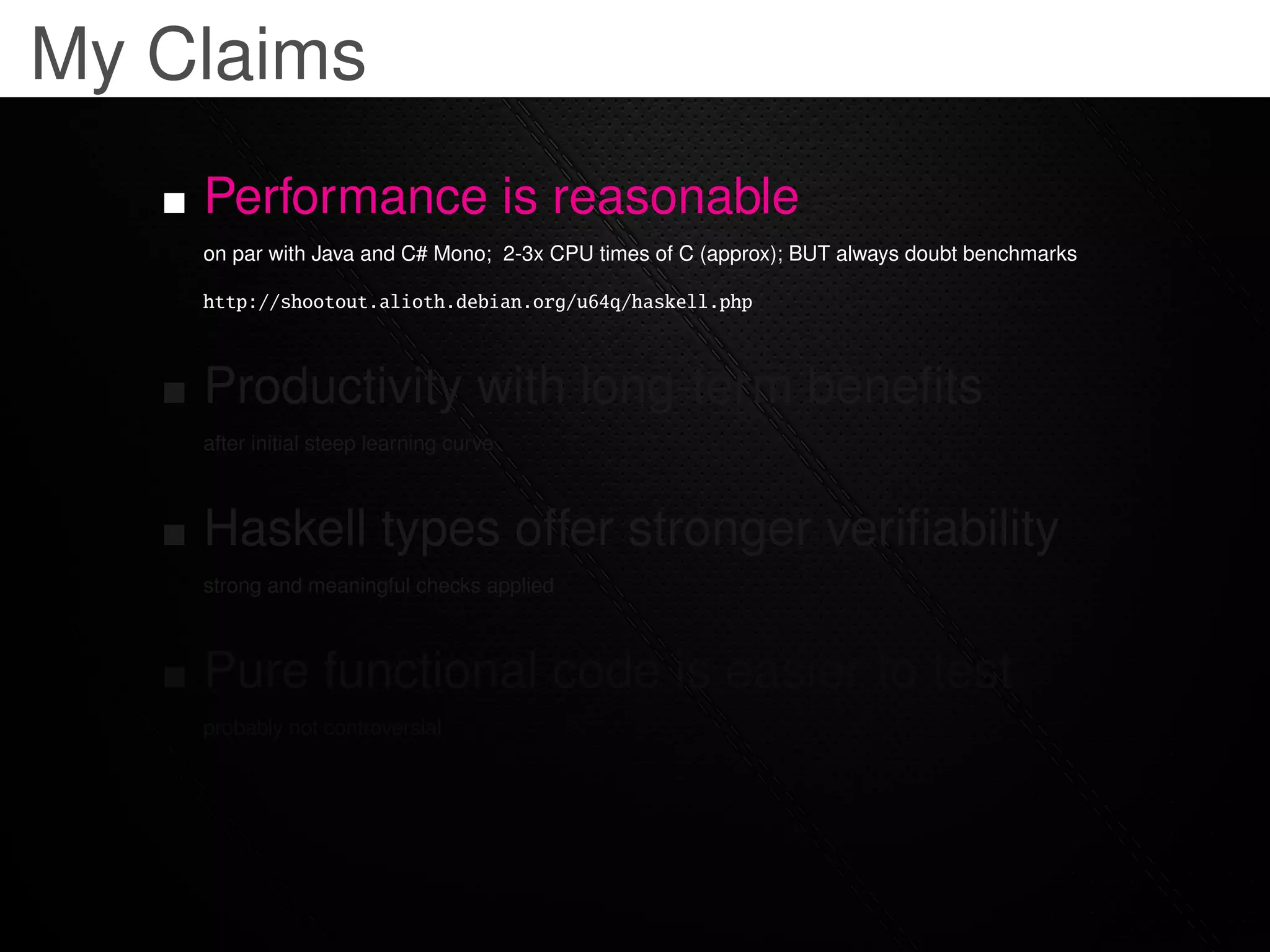
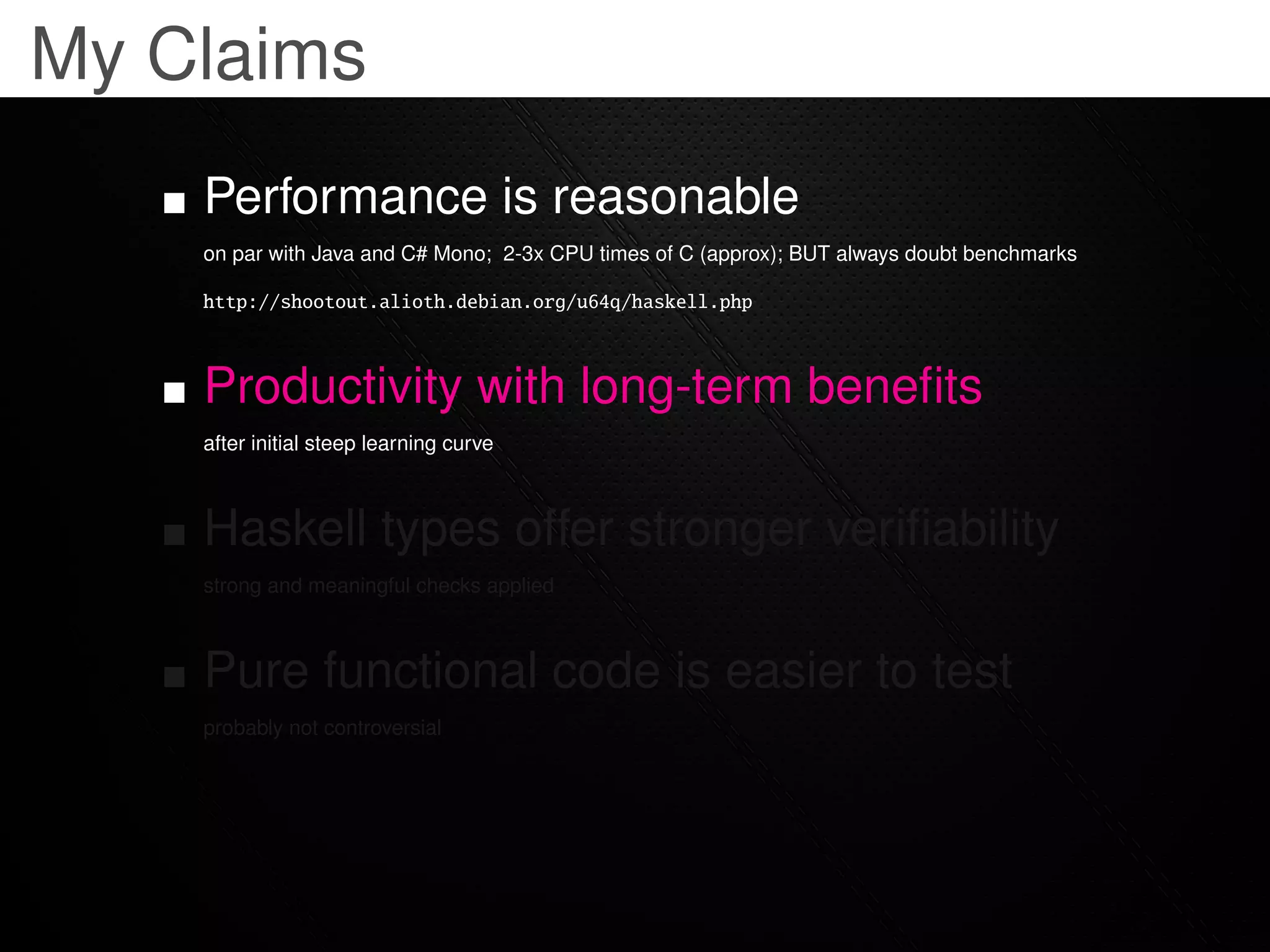
My Claims
    Performance is reasonable
    on par with Java and C# Mono; 2-3x CPU times of C (approx); BUT always doubt benchmarks

    http://shootout.alioth.debian.org/u64q/haskell.php


    Productivity with long-term benefits
    after initial steep learning curve


    Haskell types offer stronger verifiability
    strong and meaningful checks applied


    Pure functional code is easier to test
    probably not controversial
My Claims
    Performance is reasonable
    on par with Java and C# Mono; 2-3x CPU times of C (approx); BUT always doubt benchmarks

    http://shootout.alioth.debian.org/u64q/haskell.php


    Productivity with long-term benefits
    after initial steep learning curve


    Haskell types offer stronger verifiability
    strong and meaningful checks applied


    Pure functional code is easier to test
    probably not controversial
My Claims
    Performance is reasonable
    on par with Java and C# Mono; 2-3x CPU times of C (approx); BUT always doubt benchmarks

    http://shootout.alioth.debian.org/u64q/haskell.php


    Productivity with long-term benefits
    after initial steep learning curve


    Haskell types offer stronger verifiability
    strong and meaningful checks applied


    Pure functional code is easier to test
    probably not controversial
My Claims
    Performance is reasonable
    on par with Java and C# Mono; 2-3x CPU times of C (approx); BUT always doubt benchmarks

    http://shootout.alioth.debian.org/u64q/haskell.php


    Productivity with long-term benefits
    after initial steep learning curve


    Haskell types offer stronger verifiability
    strong and meaningful checks applied


    Pure functional code is easier to test
    probably not controversial
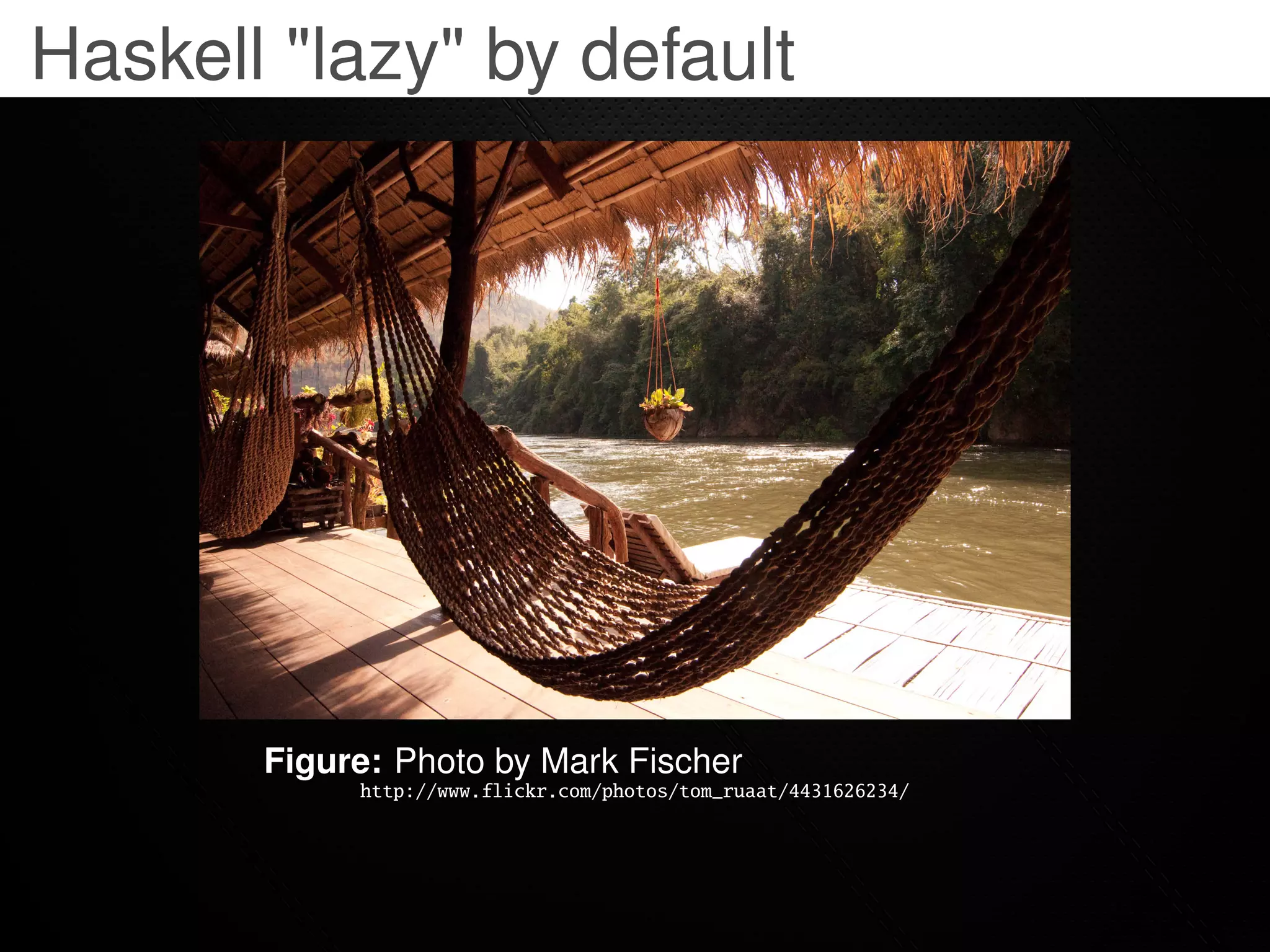
Haskell "lazy" by default


       Figure: Photo by Mark Fischer
            http://www.flickr.com/photos/tom_ruaat/4431626234/
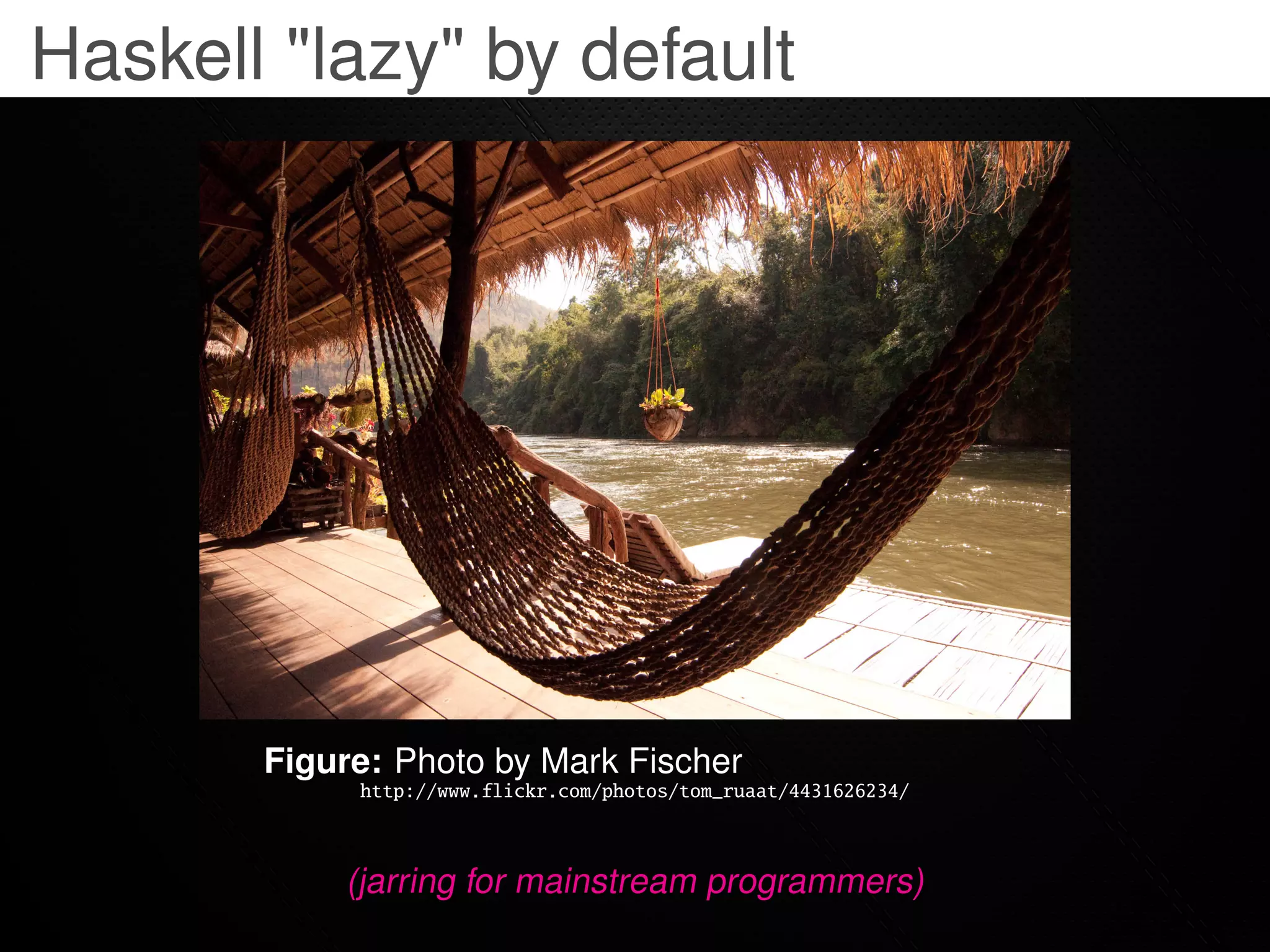
Haskell "lazy" by default


       Figure: Photo by Mark Fischer
            http://www.flickr.com/photos/tom_ruaat/4431626234/


           (jarring for mainstream programmers)
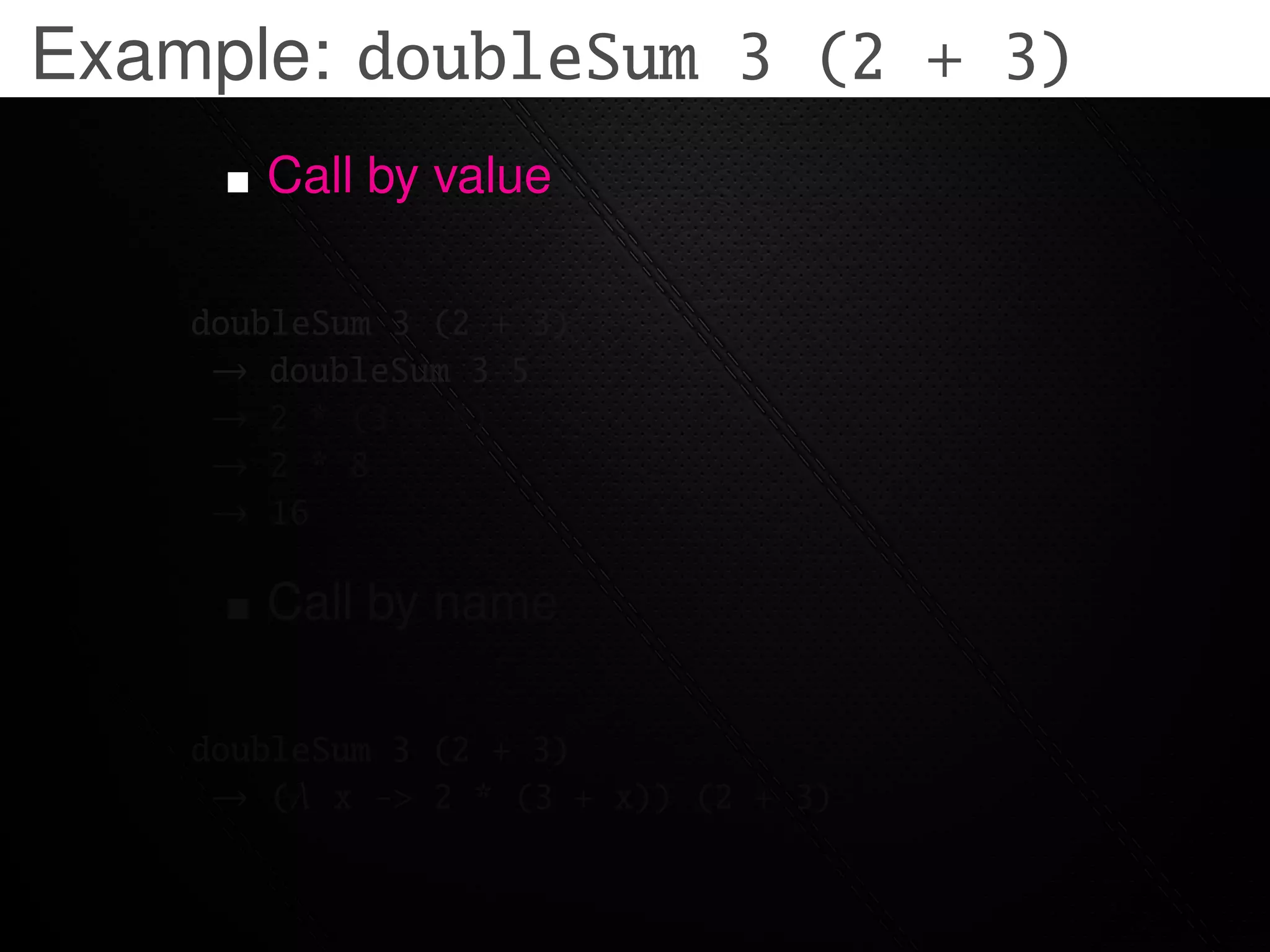
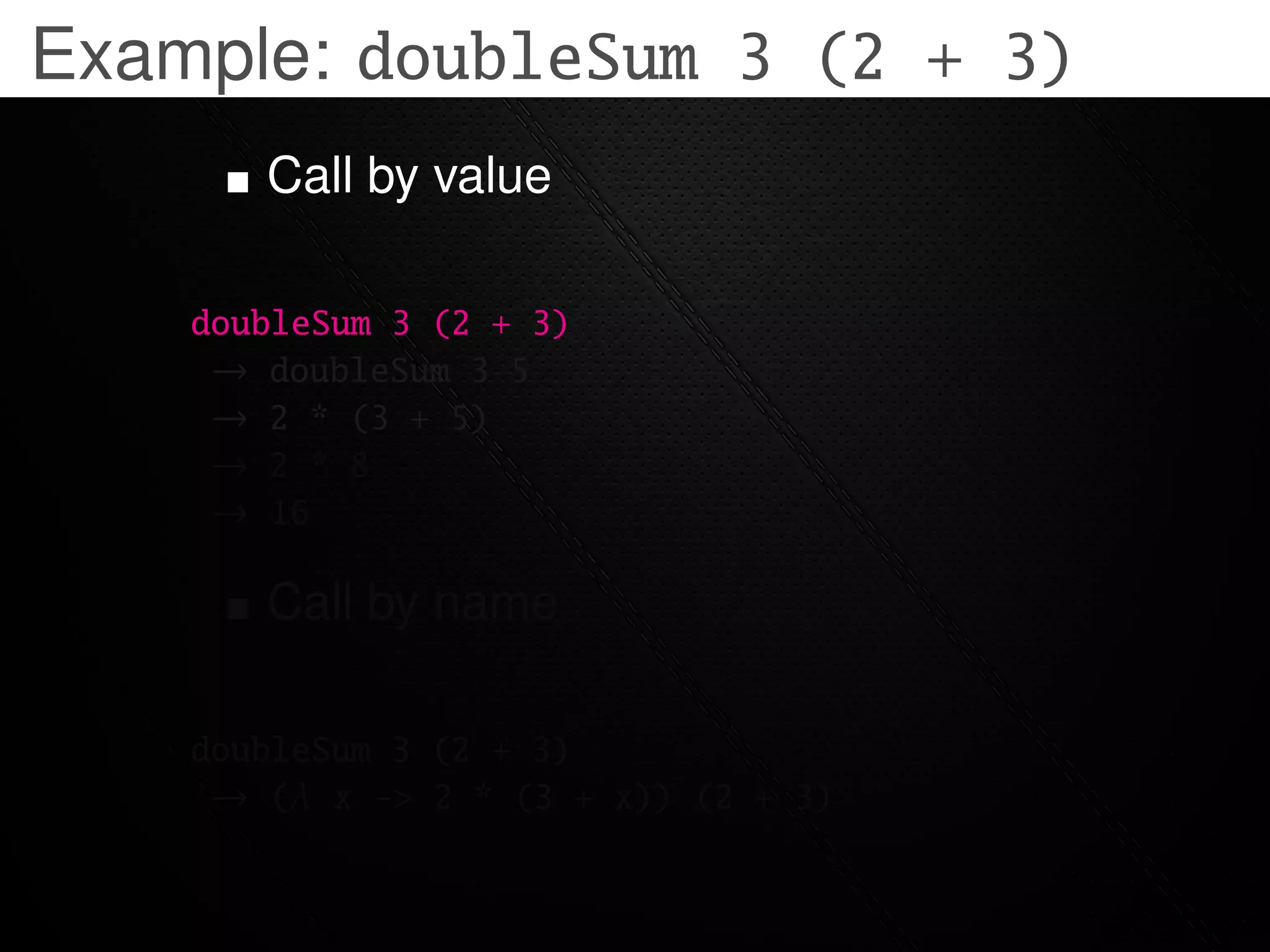
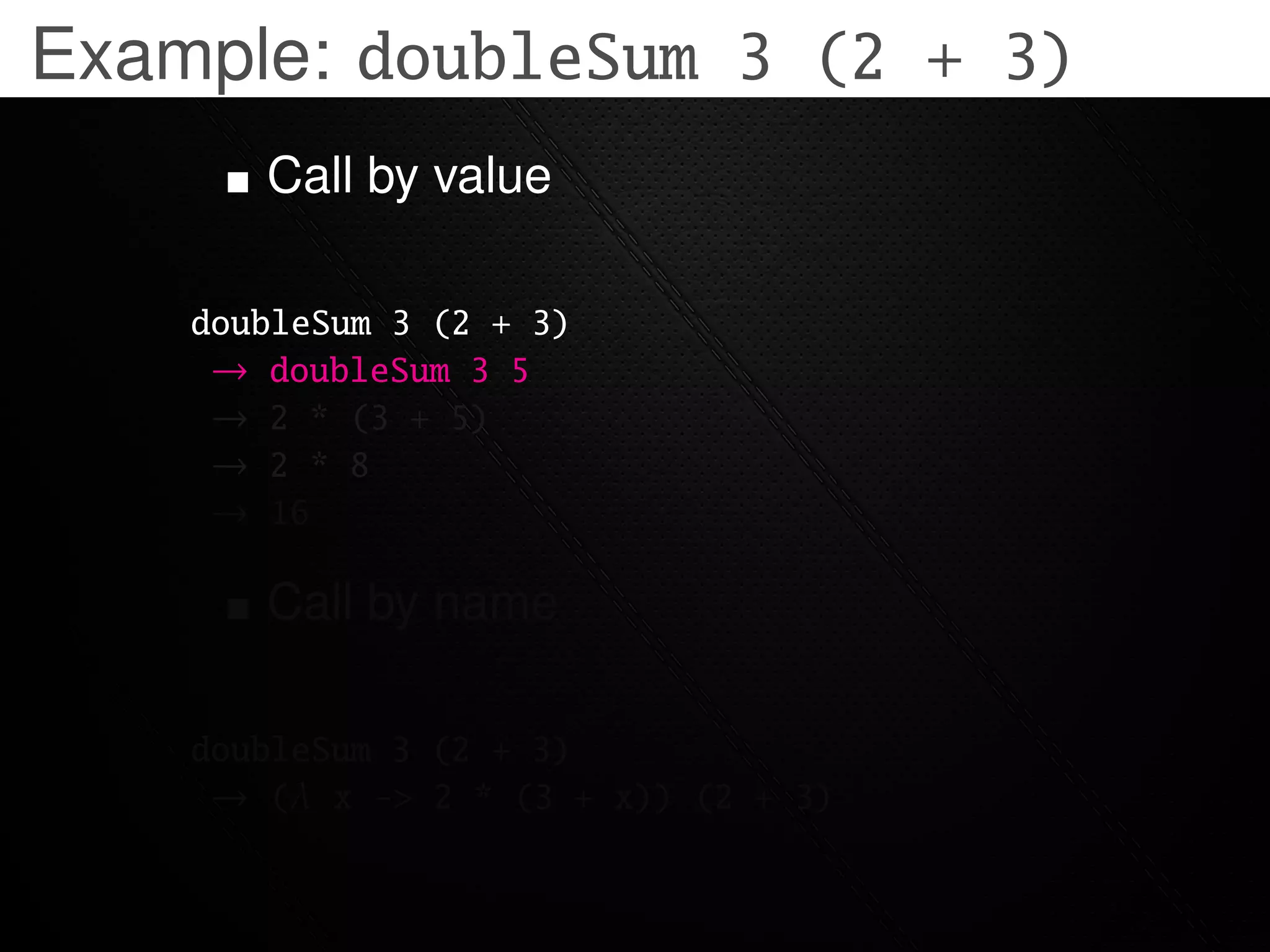
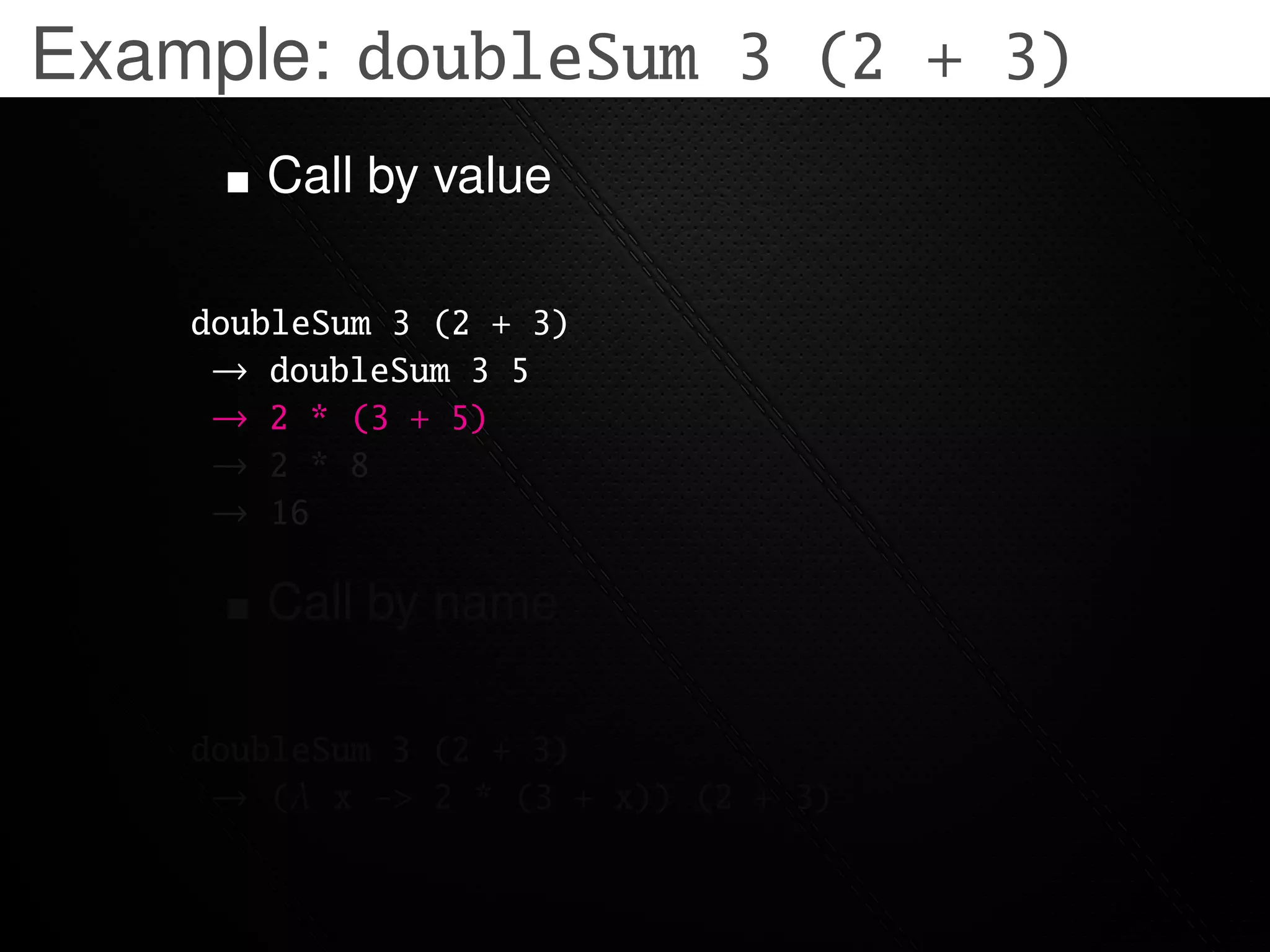
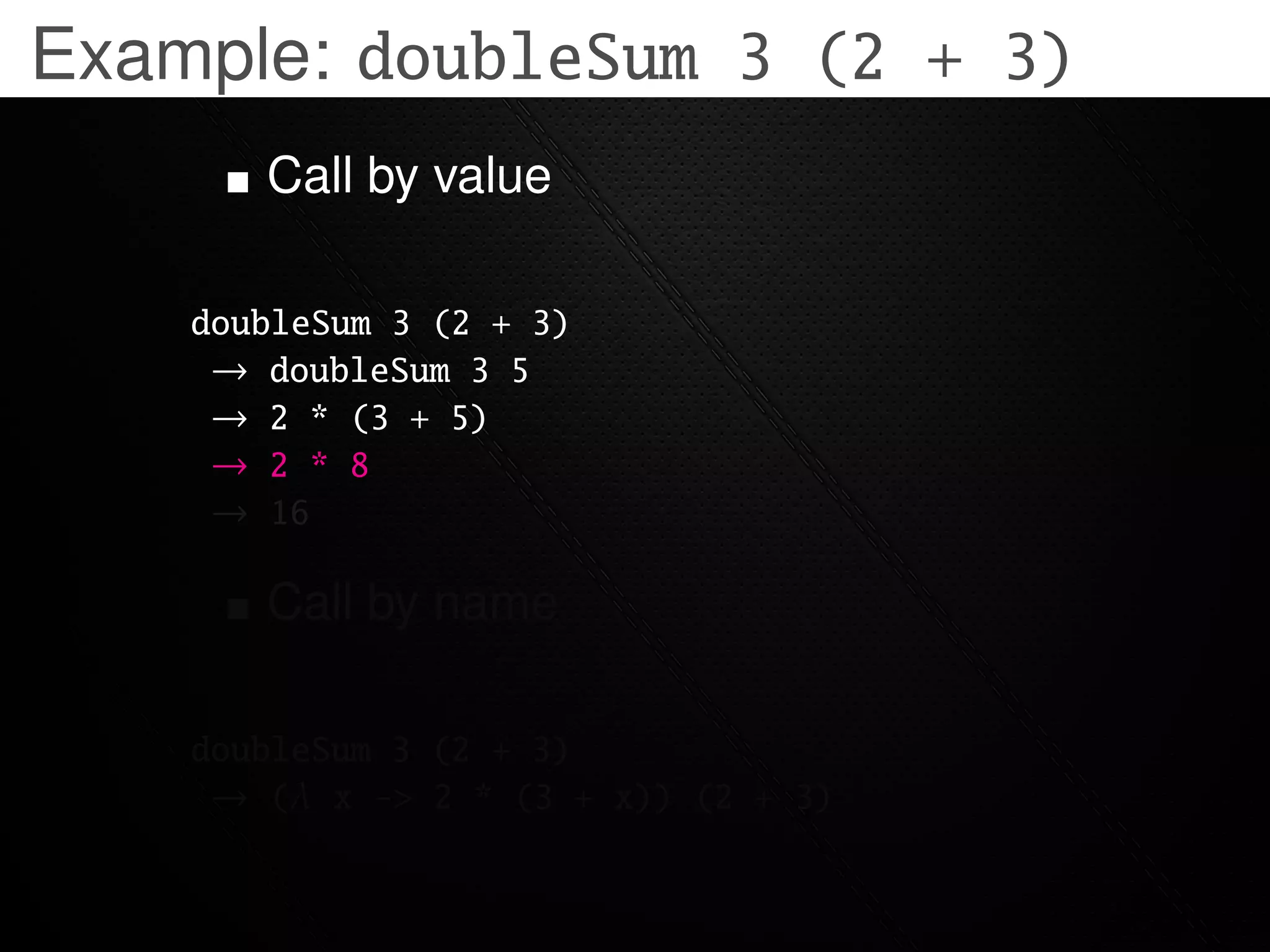
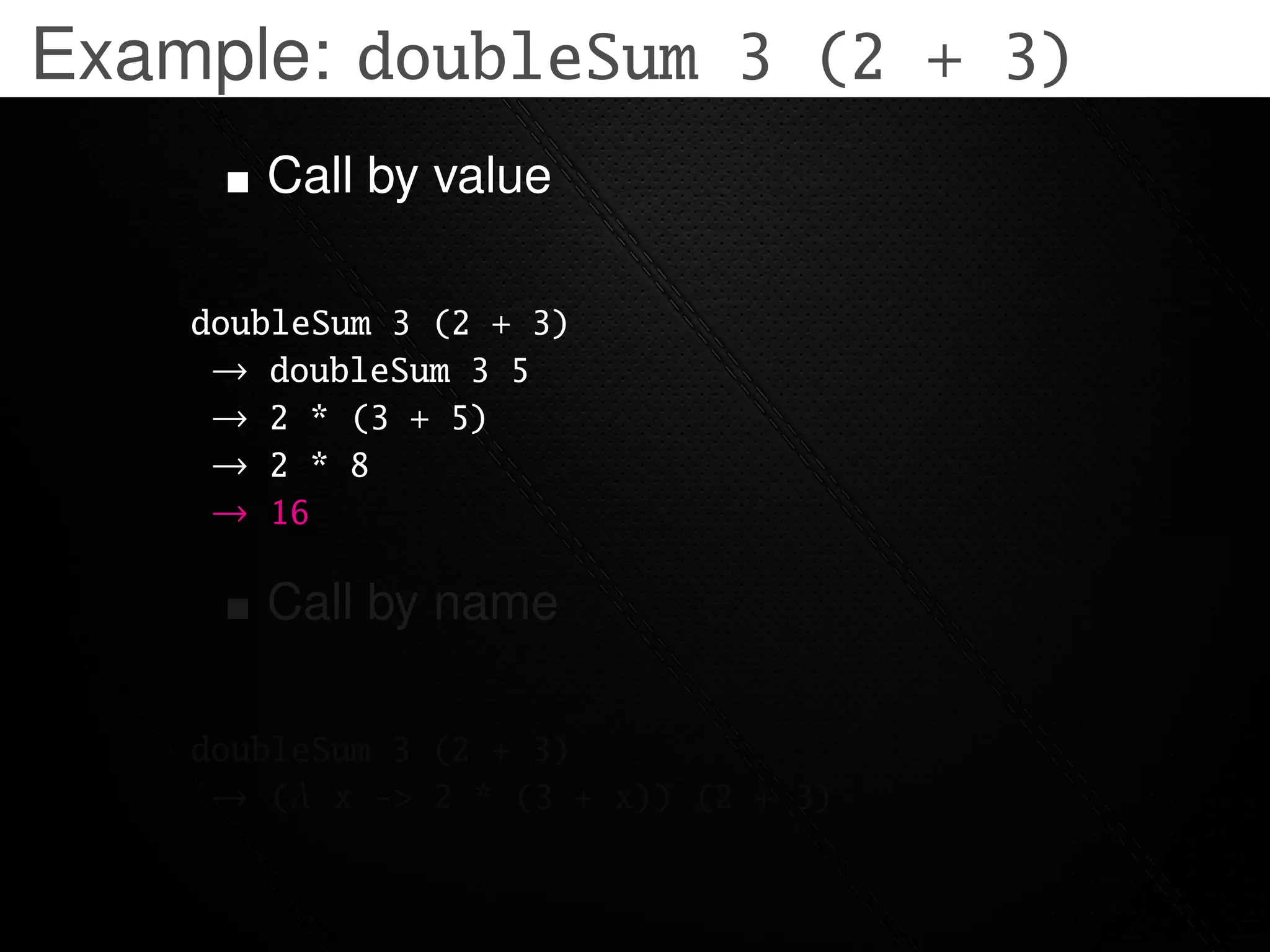
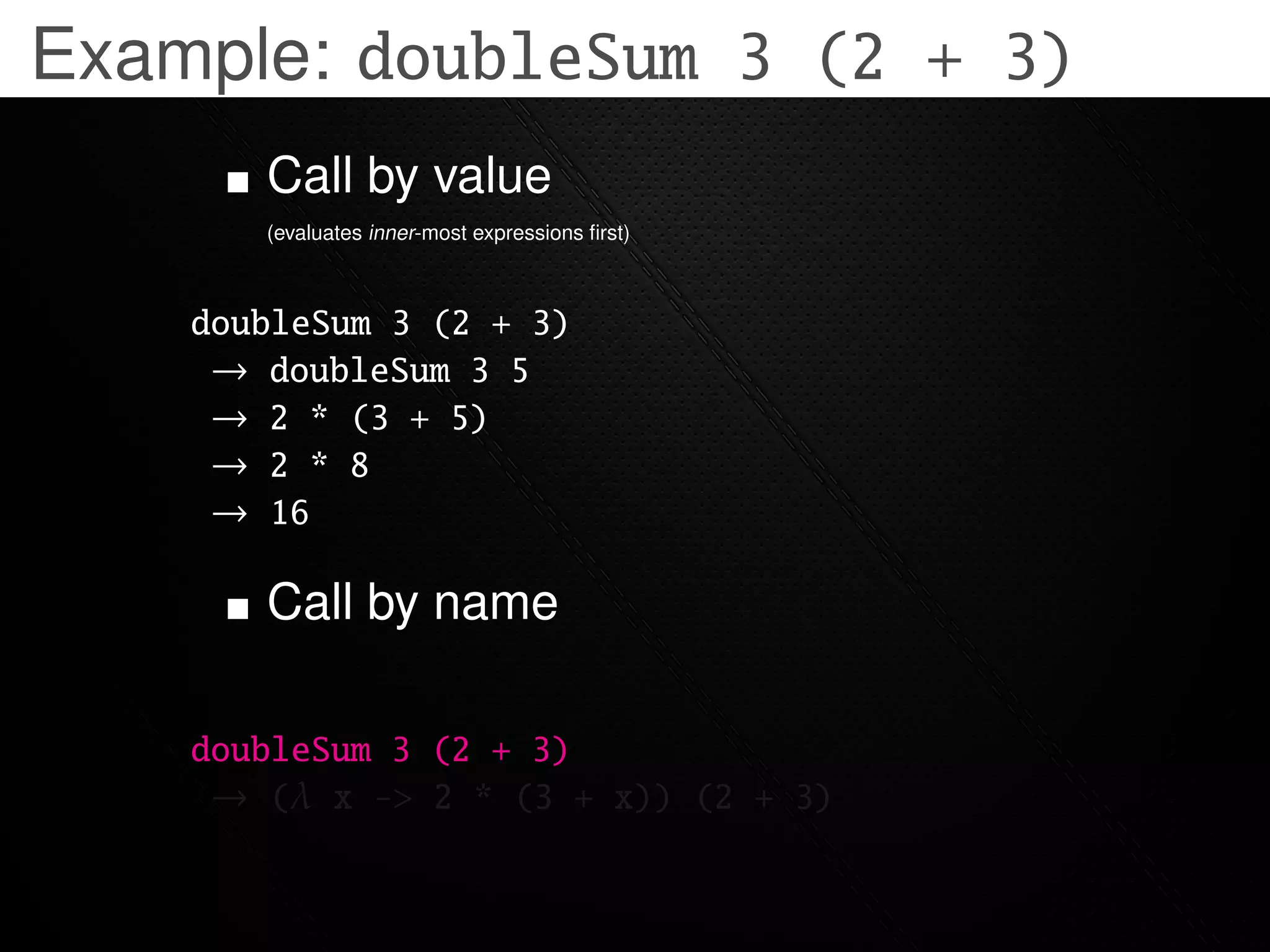
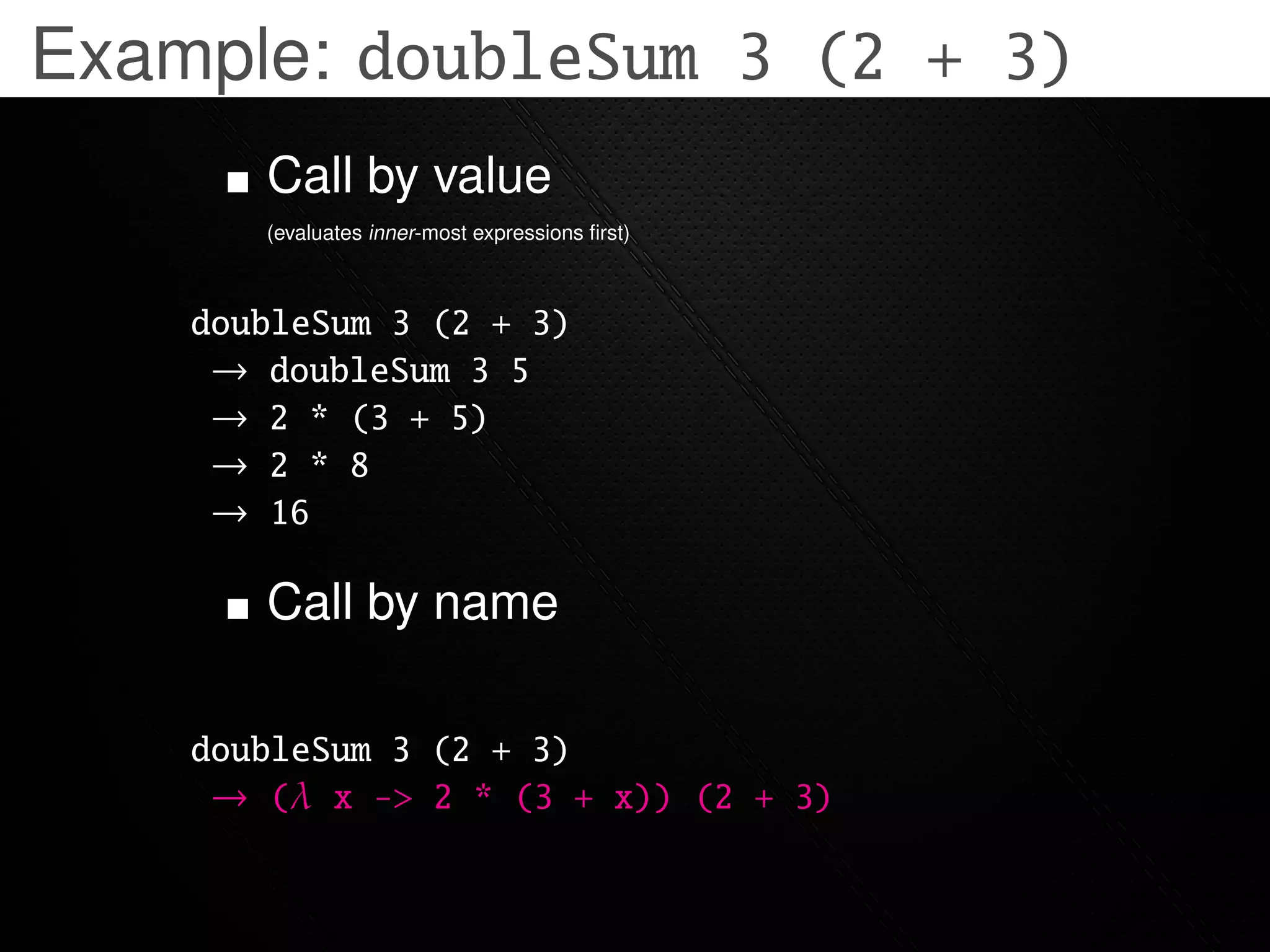
Example: doubleSum 3 (2 + 3)
       Call by value

    doubleSum 3 (2 + 3)
     → doubleSum 3 5
     → 2 * (3 + 5)
     → 2 * 8
     → 16

       Call by name

    doubleSum 3 (2 + 3)
     → (λ x -> 2 * (3 + x)) (2 + 3)
Example: doubleSum 3 (2 + 3)
       Call by value

    doubleSum 3 (2 + 3)
     → doubleSum 3 5
     → 2 * (3 + 5)
     → 2 * 8
     → 16

       Call by name

    doubleSum 3 (2 + 3)
     → (λ x -> 2 * (3 + x)) (2 + 3)
Example: doubleSum 3 (2 + 3)
       Call by value

    doubleSum 3 (2 + 3)
     → doubleSum 3 5
     → 2 * (3 + 5)
     → 2 * 8
     → 16

       Call by name

    doubleSum 3 (2 + 3)
     → (λ x -> 2 * (3 + x)) (2 + 3)
Example: doubleSum 3 (2 + 3)
       Call by value

    doubleSum 3 (2 + 3)
     → doubleSum 3 5
     → 2 * (3 + 5)
     → 2 * 8
     → 16

       Call by name

    doubleSum 3 (2 + 3)
     → (λ x -> 2 * (3 + x)) (2 + 3)
Example: doubleSum 3 (2 + 3)
       Call by value

    doubleSum 3 (2 + 3)
     → doubleSum 3 5
     → 2 * (3 + 5)
     → 2 * 8
     → 16

       Call by name

    doubleSum 3 (2 + 3)
     → (λ x -> 2 * (3 + x)) (2 + 3)
Example: doubleSum 3 (2 + 3)
       Call by value

    doubleSum 3 (2 + 3)
     → doubleSum 3 5
     → 2 * (3 + 5)
     → 2 * 8
     → 16

       Call by name

    doubleSum 3 (2 + 3)
     → (λ x -> 2 * (3 + x)) (2 + 3)
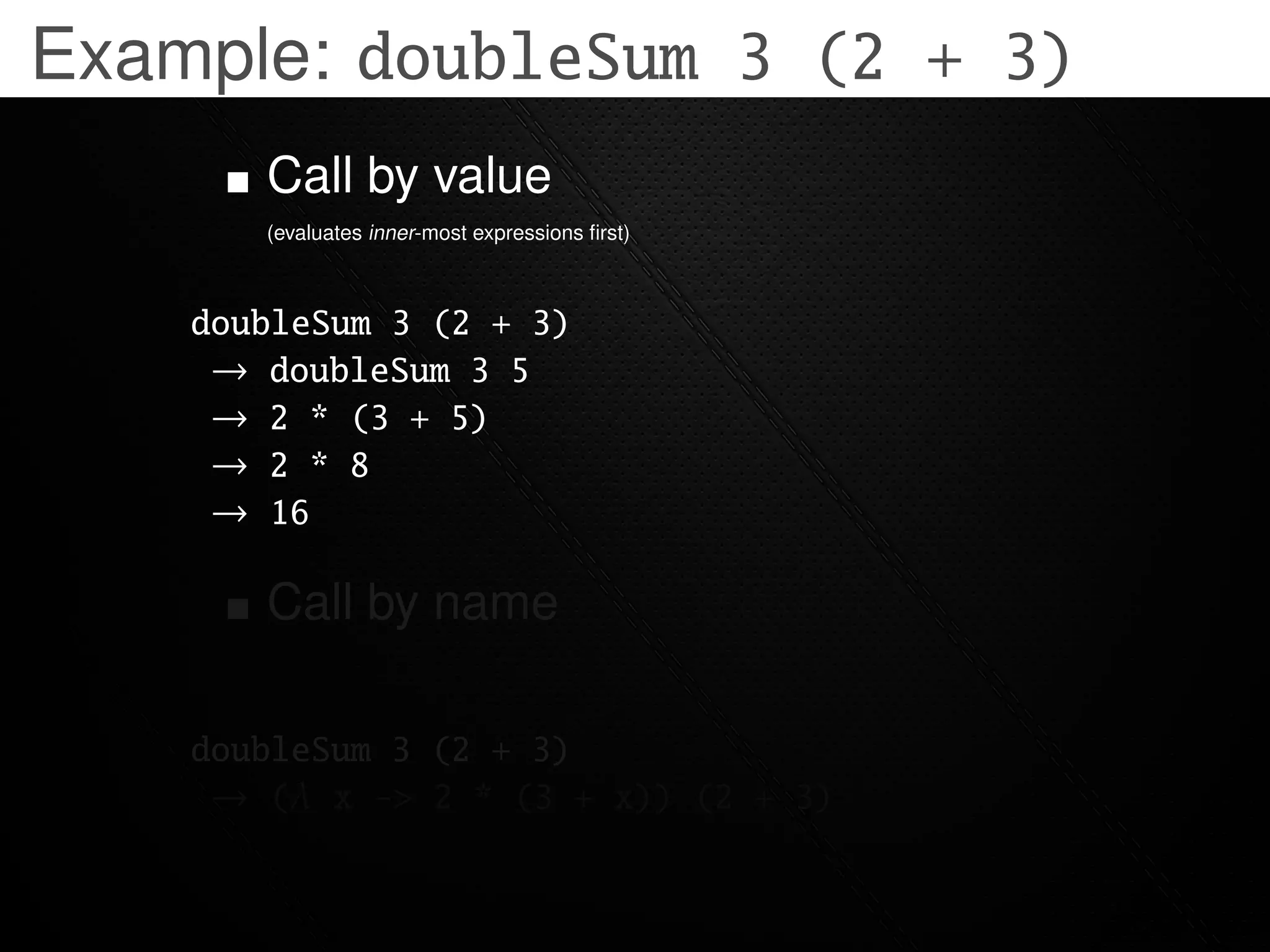
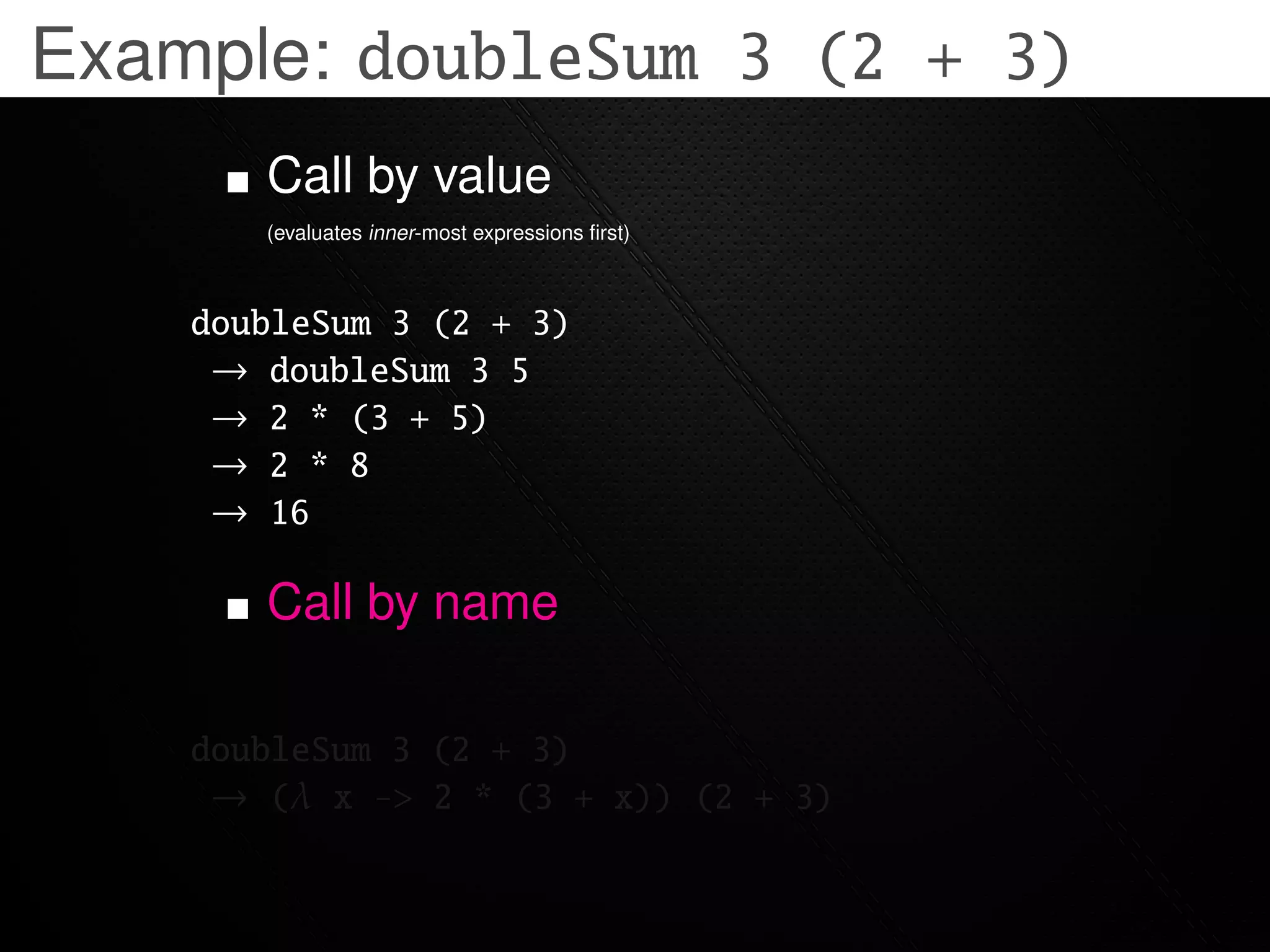
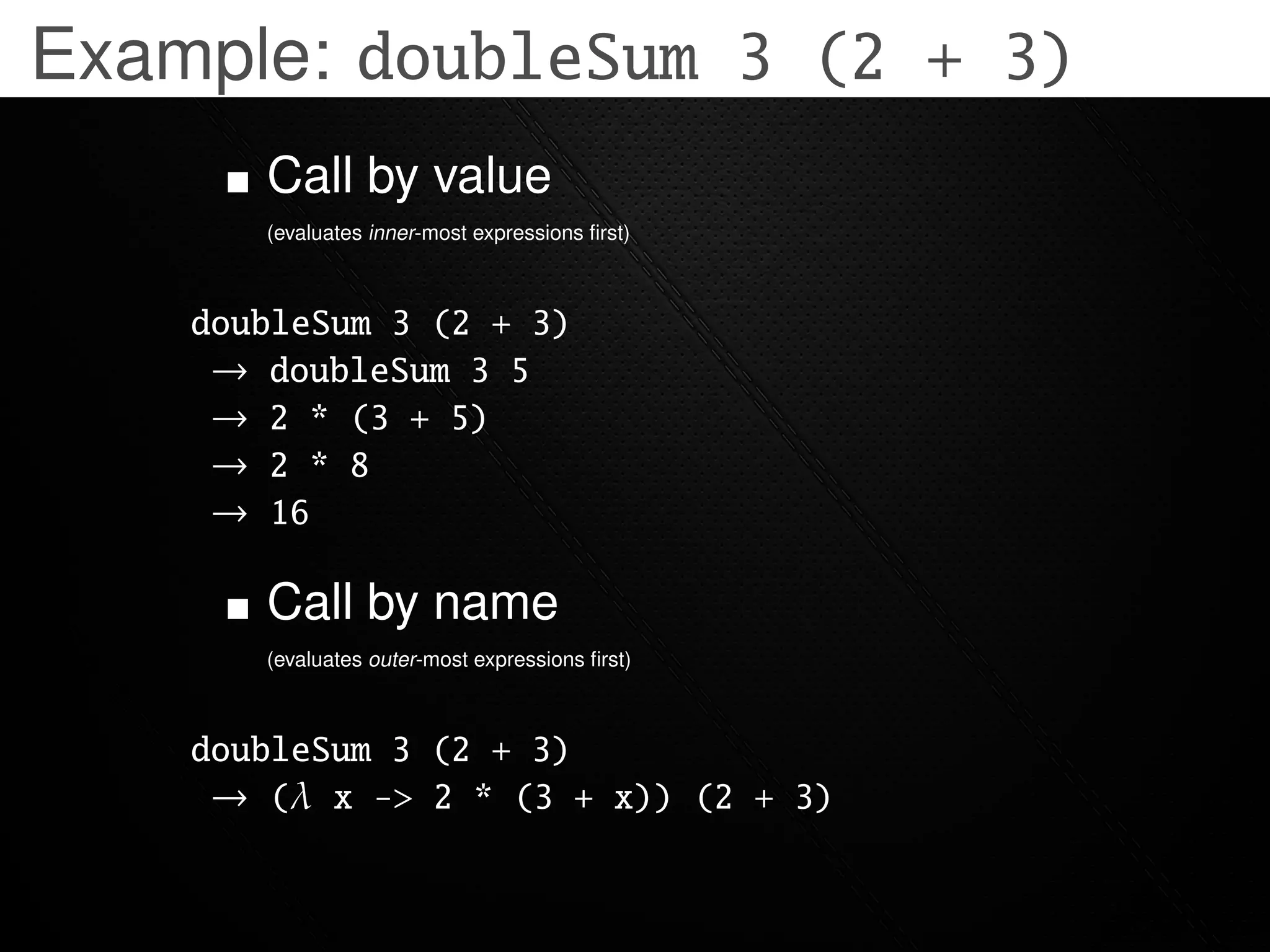
Example: doubleSum 3 (2 + 3)
       Call by value
       (evaluates inner-most expressions first)


    doubleSum 3 (2 + 3)
     → doubleSum 3 5
     → 2 * (3 + 5)
     → 2 * 8
     → 16

       Call by name

    doubleSum 3 (2 + 3)
     → (λ x -> 2 * (3 + x)) (2 + 3)
Example: doubleSum 3 (2 + 3)
       Call by value
       (evaluates inner-most expressions first)


    doubleSum 3 (2 + 3)
     → doubleSum 3 5
     → 2 * (3 + 5)
     → 2 * 8
     → 16

       Call by name

    doubleSum 3 (2 + 3)
     → (λ x -> 2 * (3 + x)) (2 + 3)
Example: doubleSum 3 (2 + 3)
       Call by value
       (evaluates inner-most expressions first)


    doubleSum 3 (2 + 3)
     → doubleSum 3 5
     → 2 * (3 + 5)
     → 2 * 8
     → 16

       Call by name

    doubleSum 3 (2 + 3)
     → (λ x -> 2 * (3 + x)) (2 + 3)
Example: doubleSum 3 (2 + 3)
       Call by value
       (evaluates inner-most expressions first)


    doubleSum 3 (2 + 3)
     → doubleSum 3 5
     → 2 * (3 + 5)
     → 2 * 8
     → 16

       Call by name

    doubleSum 3 (2 + 3)
     → (λ x -> 2 * (3 + x)) (2 + 3)
Example: doubleSum 3 (2 + 3)
       Call by value
       (evaluates inner-most expressions first)


    doubleSum 3 (2 + 3)
     → doubleSum 3 5
     → 2 * (3 + 5)
     → 2 * 8
     → 16

       Call by name
       (evaluates outer-most expressions first)


    doubleSum 3 (2 + 3)
     → (λ x -> 2 * (3 + x)) (2 + 3)
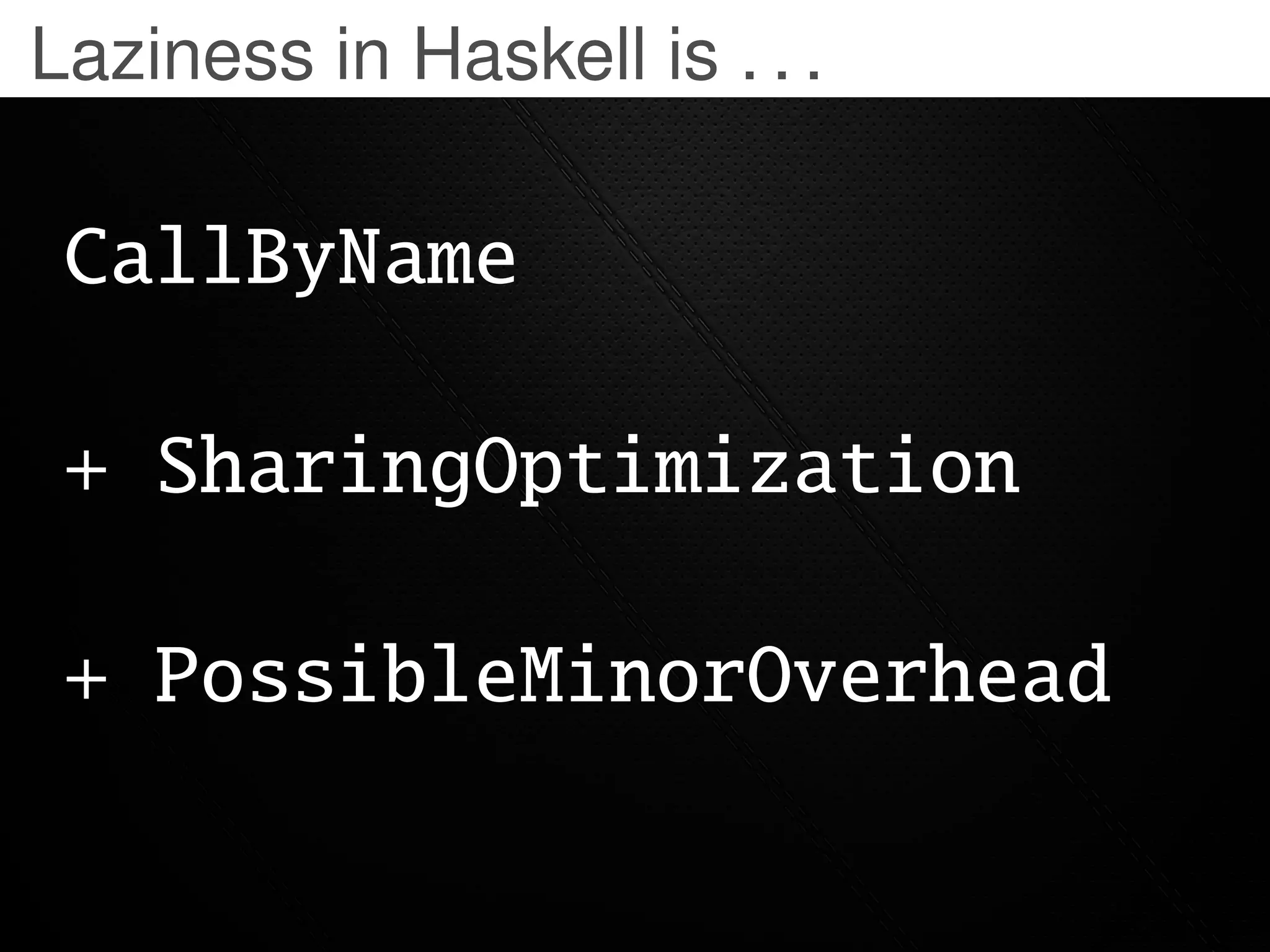
Laziness in Haskell is . . .

 CallByName

 + SharingOptimization

 + PossibleMinorOverhead
Laziness: Buyer Beware
    filter (λ x → x < 6) [1..]
    (never terminates)


    takeWhile (λ x → x < 6) [1..]
    (does terminate)


    dropWhile (λ x → x >= 6) [1..]
    (does not terminate)


    Need to understand implications
    of laziness on functions


    Laziness with I/O implications
    lazy I/O with handles is problematic, but iteratee idiom solves most of these. There are a number of libraries

    available to help with this: enumerator, pipes, . . .
Laziness: Buyer Beware
    filter (λ x → x < 6) [1..]
    (never terminates)


    takeWhile (λ x → x < 6) [1..]
    (does terminate)


    dropWhile (λ x → x >= 6) [1..]
    (does not terminate)


    Need to understand implications
    of laziness on functions


    Laziness with I/O implications
    lazy I/O with handles is problematic, but iteratee idiom solves most of these. There are a number of libraries

    available to help with this: enumerator, pipes, . . .
Laziness: Buyer Beware
    filter (λ x → x < 6) [1..]
    (never terminates)


    takeWhile (λ x → x < 6) [1..]
    (does terminate)


    dropWhile (λ x → x >= 6) [1..]
    (does not terminate)


    Need to understand implications
    of laziness on functions


    Laziness with I/O implications
    lazy I/O with handles is problematic, but iteratee idiom solves most of these. There are a number of libraries

    available to help with this: enumerator, pipes, . . .
Laziness: Buyer Beware
    filter (λ x → x < 6) [1..]
    (never terminates)


    takeWhile (λ x → x < 6) [1..]
    (does terminate)


    dropWhile (λ x → x >= 6) [1..]
    (does not terminate)


    Need to understand implications
    of laziness on functions


    Laziness with I/O implications
    lazy I/O with handles is problematic, but iteratee idiom solves most of these. There are a number of libraries

    available to help with this: enumerator, pipes, . . .
Laziness: Buyer Beware
    filter (λ x → x < 6) [1..]
    (never terminates)


    takeWhile (λ x → x < 6) [1..]
    (does terminate)


    dropWhile (λ x → x >= 6) [1..]
    (does not terminate)


    Need to understand implications
    of laziness on functions


    Laziness with I/O implications
    lazy I/O with handles is problematic, but iteratee idiom solves most of these. There are a number of libraries

    available to help with this: enumerator, pipes, . . .
Laziness: Also Pretty Suuweeeet!

     Infinite sequences/lists
     made possible


     Recursive functions
     become practical


     Recursive types
     become simple


     Much more as well ...
Laziness: Also Pretty Suuweeeet!

     Infinite sequences/lists
     made possible


     Recursive functions
     become practical


     Recursive types
     become simple


     Much more as well ...
Laziness: Also Pretty Suuweeeet!

     Infinite sequences/lists
     made possible


     Recursive functions
     become practical


     Recursive types
     become simple


     Much more as well ...
Laziness: Also Pretty Suuweeeet!

     Infinite sequences/lists
     made possible


     Recursive functions
     become practical


     Recursive types
     become simple


     Much more as well ...
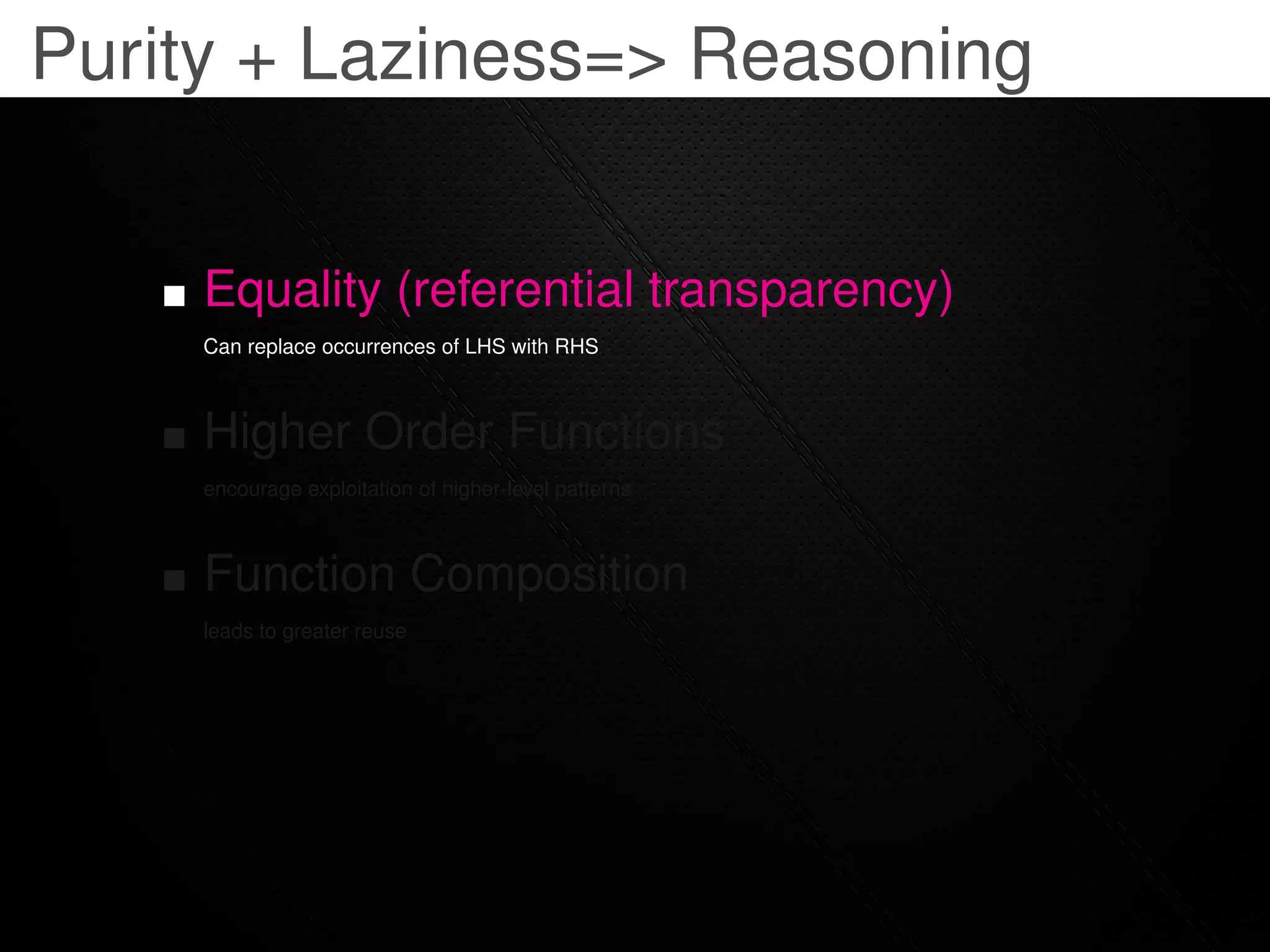
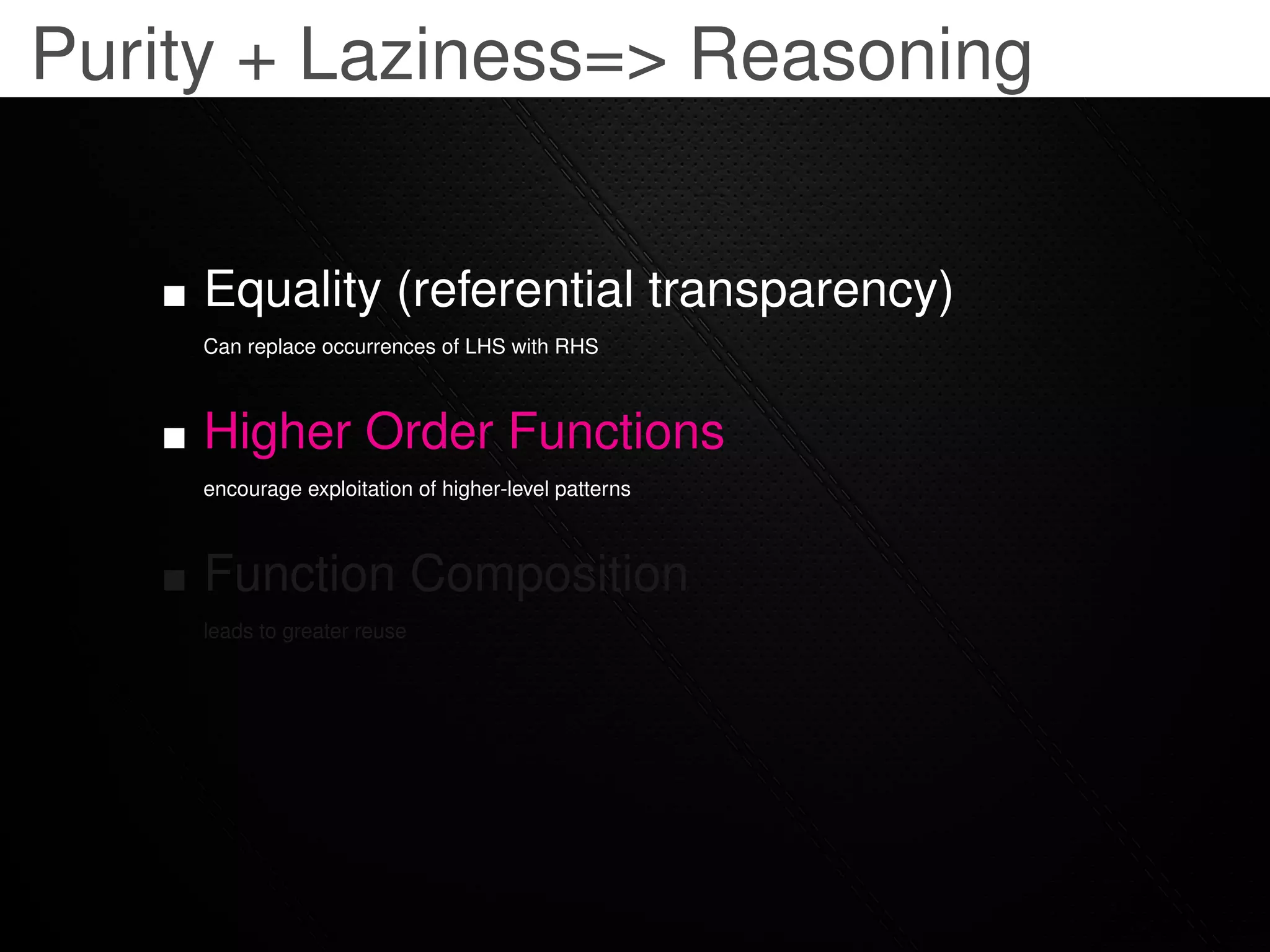
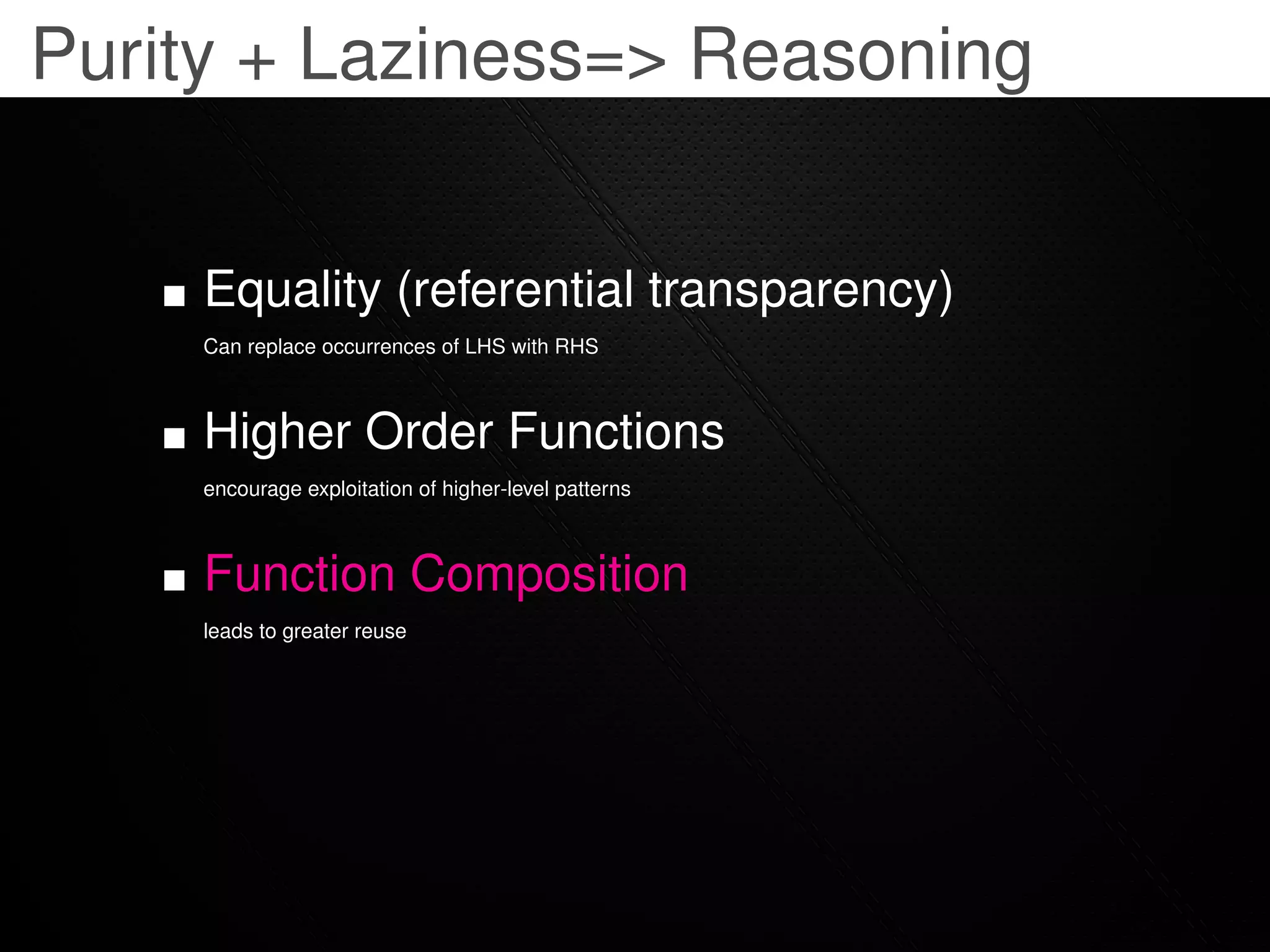
Purity + Laziness=> Reasoning


     Equality (referential transparency)
     Can replace occurrences of LHS with RHS


     Higher Order Functions
     encourage exploitation of higher-level patterns


     Function Composition
     leads to greater reuse
Purity + Laziness=> Reasoning


     Equality (referential transparency)
     Can replace occurrences of LHS with RHS


     Higher Order Functions
     encourage exploitation of higher-level patterns


     Function Composition
     leads to greater reuse
Purity + Laziness=> Reasoning


     Equality (referential transparency)
     Can replace occurrences of LHS with RHS


     Higher Order Functions
     encourage exploitation of higher-level patterns


     Function Composition
     leads to greater reuse
mysum :: Num a => [a] -> a
mysum xs = foldr (+) 0 xs

myproduct :: Num a => [a] -> a
myproduct xs = foldr (*) 1 xs

myany :: (a -> Bool) -> [a] -> Bool
myany pred xs = foldr ( x b -> b || pred x) False xs

myall :: (a -> Bool) -> [a] -> Bool
myall pred xs = foldr ( x b -> b && pred x) True xs
mysum :: Num a => [a] -> a
mysum xs = foldr (+) 0 xs

myproduct :: Num a => [a] -> a
myproduct xs = foldr (*) 1 xs

myany :: (a -> Bool) -> [a] -> Bool
myany pred xs = foldr ( x b -> b || pred x) False xs

myall :: (a -> Bool) -> [a] -> Bool
myall pred xs = foldr ( x b -> b && pred x) True xs
mysum :: Num a => [a] -> a
mysum xs = foldr (+) 0 xs

myproduct :: Num a => [a] -> a
myproduct xs = foldr (*) 1 xs

myany :: (a -> Bool) -> [a] -> Bool
myany pred xs = foldr ( x b -> b || pred x) False xs

myall :: (a -> Bool) -> [a] -> Bool
myall pred xs = foldr ( x b -> b && pred x) True xs
mysum :: Num a => [a] -> a
mysum xs = foldr (+) 0 xs

myproduct :: Num a => [a] -> a
myproduct xs = foldr (*) 1 xs

myany :: (a -> Bool) -> [a] -> Bool
myany pred xs = foldr ( x b -> b || pred x) False xs

myall :: (a -> Bool) -> [a] -> Bool
myall pred xs = foldr ( x b -> b && pred x) True xs
mysum :: Num a => [a] -> a
mysum xs = foldr (+) 0 xs

myproduct :: Num a => [a] -> a
myproduct xs = foldr (*) 1 xs

myany :: (a -> Bool) -> [a] -> Bool
myany pred xs = foldr ( x b -> b || pred x) False xs

myall :: (a -> Bool) -> [a] -> Bool
myall pred xs = foldr ( x b -> b && pred x) True xs
mysum :: Num a => [a] -> a
mysum xs = foldr (+) 0 xs

myproduct :: Num a => [a] -> a
myproduct xs = foldr (*) 1 xs

myany :: (a -> Bool) -> [a] -> Bool
myany pred xs = foldr ( x b -> b || pred x) False xs

myall :: (a -> Bool) -> [a] -> Bool
myall pred xs = foldr ( x b -> b && pred x) True xs
mysum :: Num a => [a] -> a
mysum xs = foldr (+) 0 xs

myproduct :: Num a => [a] -> a
myproduct xs = foldr (*) 1 xs

myany :: (a -> Bool) -> [a] -> Bool
myany pred xs = foldr ( x b -> b || pred x) False xs

myall :: (a -> Bool) -> [a] -> Bool
myall pred xs = foldr ( x b -> b && pred x) True xs
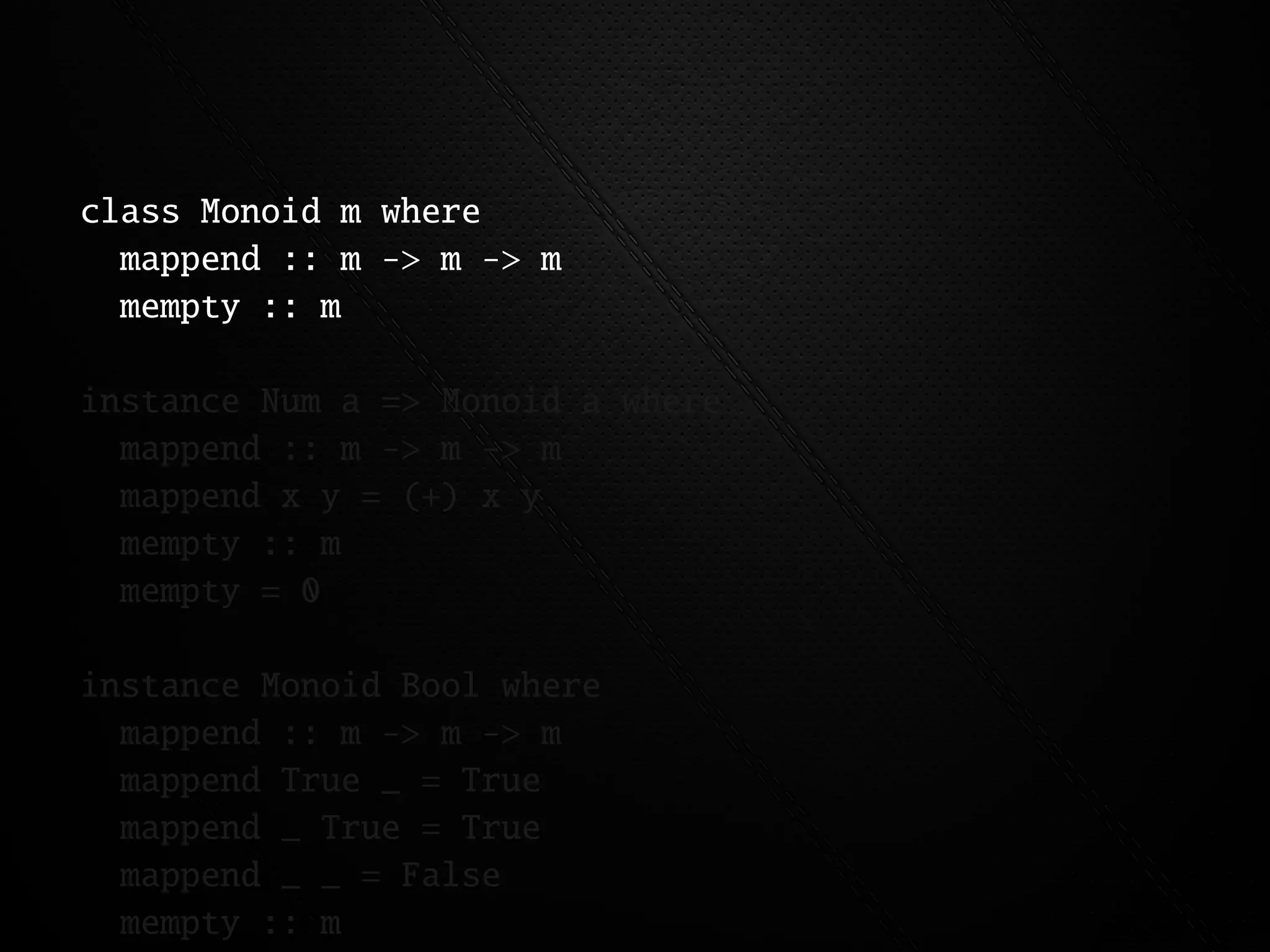
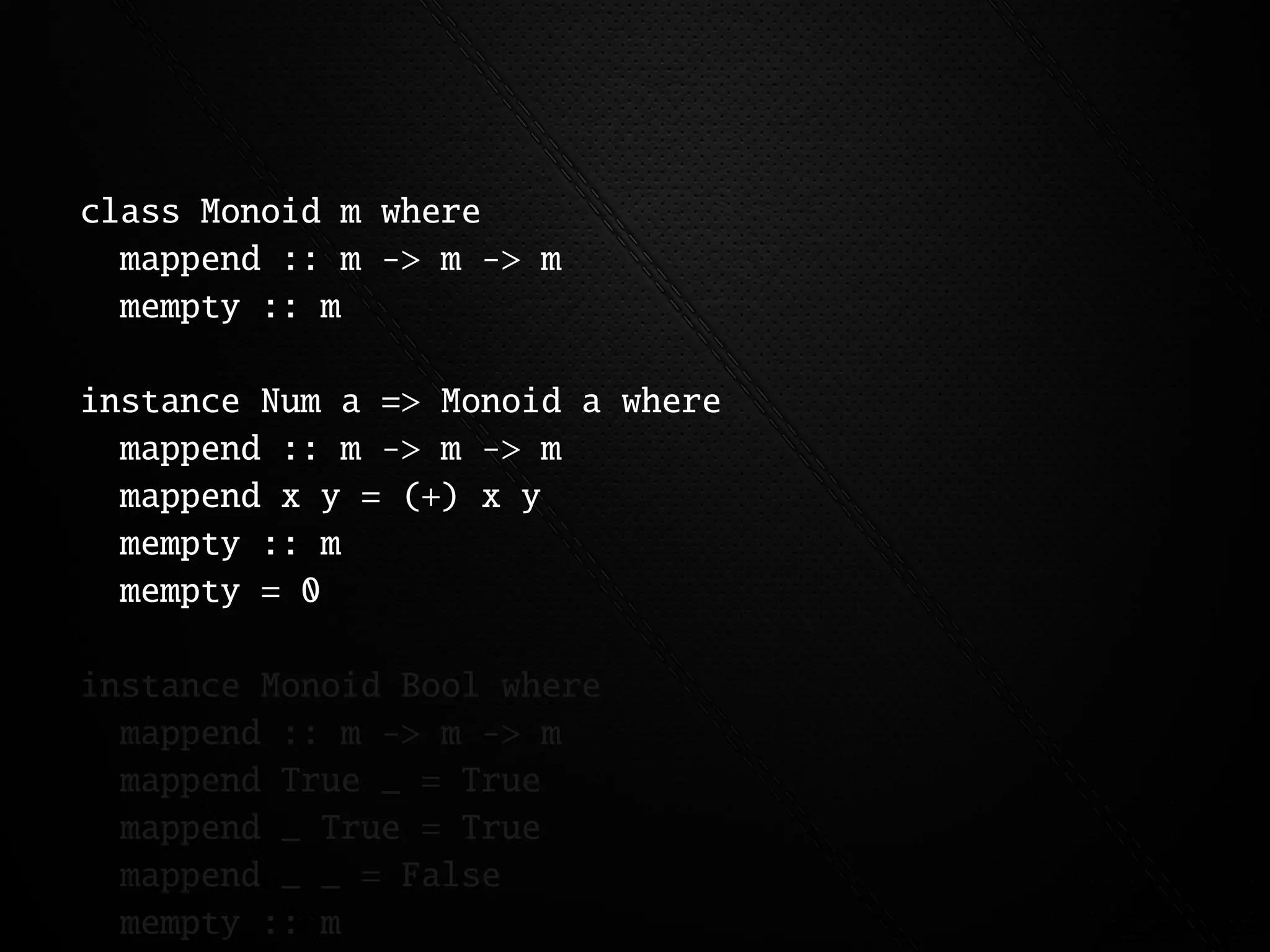
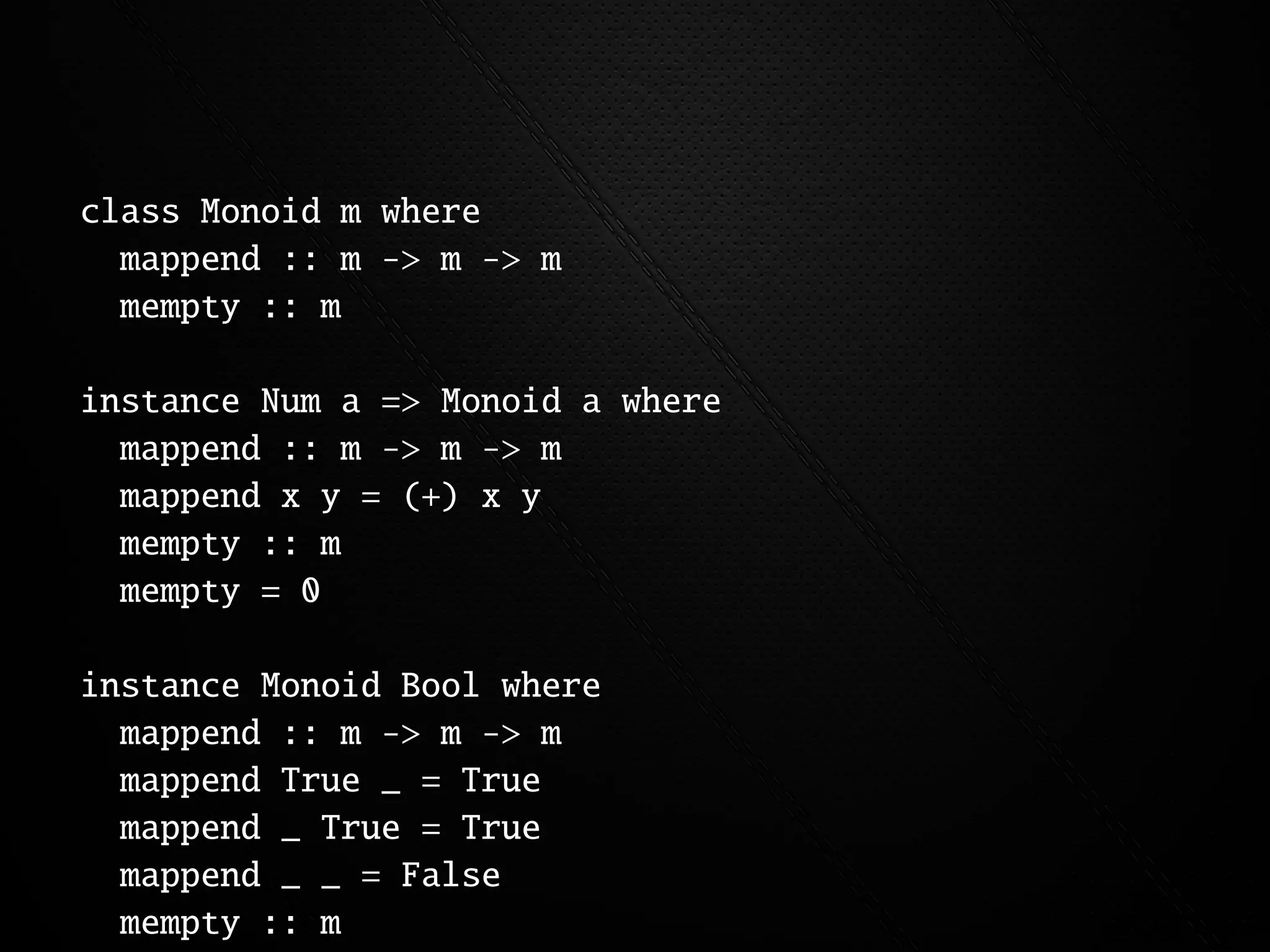
class Monoid m where
  mappend :: m -> m -> m
  mempty :: m

instance Num a => Monoid a where
  mappend :: m -> m -> m
  mappend x y = (+) x y
  mempty :: m
  mempty = 0

instance Monoid Bool where
  mappend :: m -> m -> m
  mappend True _ = True
  mappend _ True = True
  mappend _ _ = False
  mempty :: m
class Monoid m where
  mappend :: m -> m -> m
  mempty :: m

instance Num a => Monoid a where
  mappend :: m -> m -> m
  mappend x y = (+) x y
  mempty :: m
  mempty = 0

instance Monoid Bool where
  mappend :: m -> m -> m
  mappend True _ = True
  mappend _ True = True
  mappend _ _ = False
  mempty :: m
class Monoid m where
  mappend :: m -> m -> m
  mempty :: m

instance Num a => Monoid a where
  mappend :: m -> m -> m
  mappend x y = (+) x y
  mempty :: m
  mempty = 0

instance Monoid Bool where
  mappend :: m -> m -> m
  mappend True _ = True
  mappend _ True = True
  mappend _ _ = False
  mempty :: m
Haskell type signatures can . . .
     express side effects
     e.g. String -> IO Int

     declare computational strategies
     e.g. Num a => [a] -> Sum a

     impose constraints
     e.g. Num a => a -> a

     question value availability
     e.g. String -> Maybe Int

     verify client-server protocol dialogs?
     an exercise for reader ;)
Haskell type signatures can . . .
     express side effects
     e.g. String -> IO Int

     declare computational strategies
     e.g. Num a => [a] -> Sum a

     impose constraints
     e.g. Num a => a -> a

     question value availability
     e.g. String -> Maybe Int

     verify client-server protocol dialogs?
     an exercise for reader ;)
Haskell type signatures can . . .
     express side effects
     e.g. String -> IO Int

     declare computational strategies
     e.g. Num a => [a] -> Sum a

     impose constraints
     e.g. Num a => a -> a

     question value availability
     e.g. String -> Maybe Int

     verify client-server protocol dialogs?
     an exercise for reader ;)
Haskell type signatures can . . .
     express side effects
     e.g. String -> IO Int

     declare computational strategies
     e.g. Num a => [a] -> Sum a

     impose constraints
     e.g. Num a => a -> a

     question value availability
     e.g. String -> Maybe Int

     verify client-server protocol dialogs?
     an exercise for reader ;)
Haskell type signatures can . . .
     express side effects
     e.g. String -> IO Int

     declare computational strategies
     e.g. Num a => [a] -> Sum a

     impose constraints
     e.g. Num a => a -> a

     question value availability
     e.g. String -> Maybe Int

     verify client-server protocol dialogs?
     an exercise for reader ;)
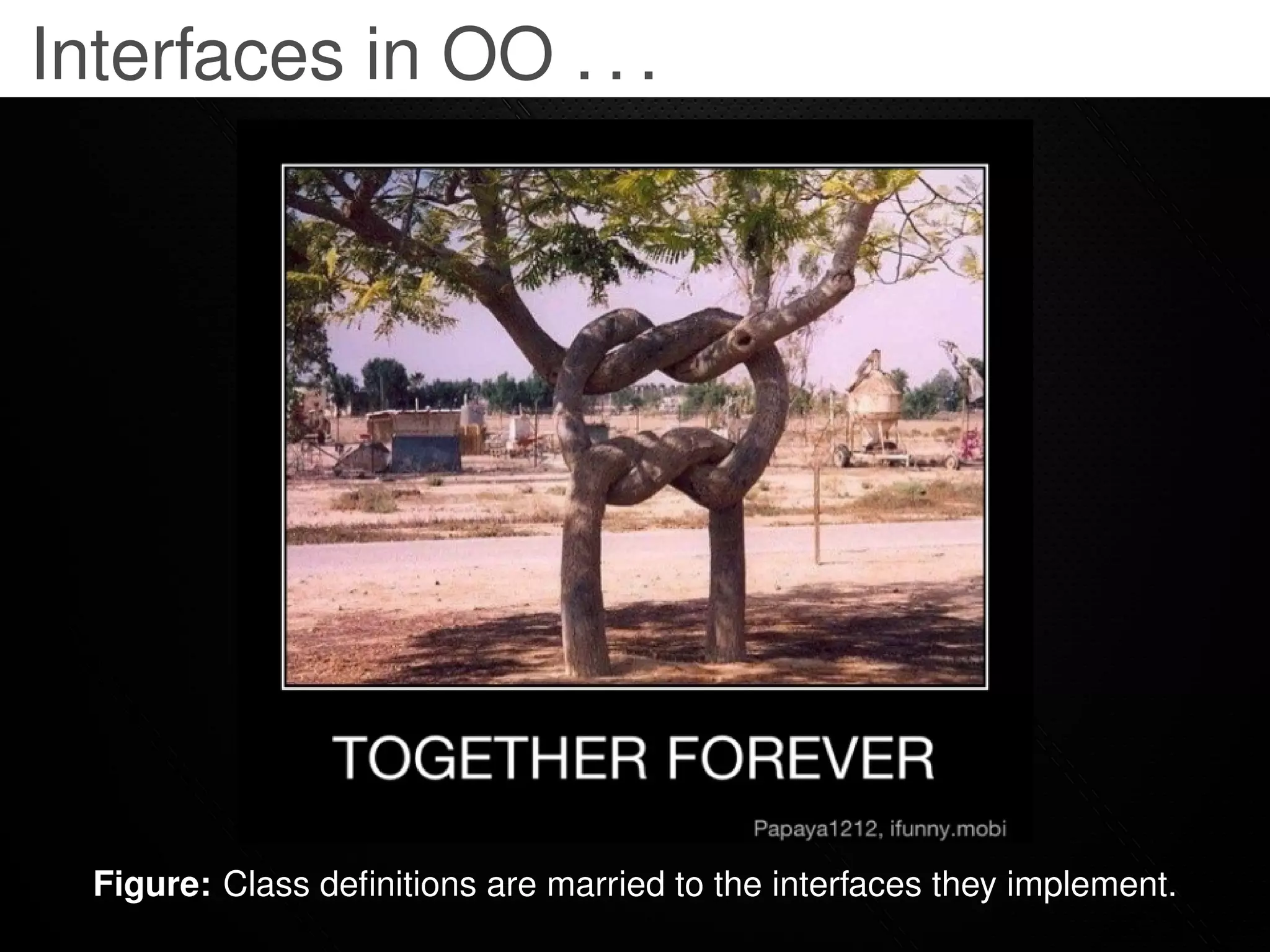
Interfaces in OO . . .


  Figure: Class definitions are married to the interfaces they implement.
Interfaces in Haskell: Typeclasses. . .

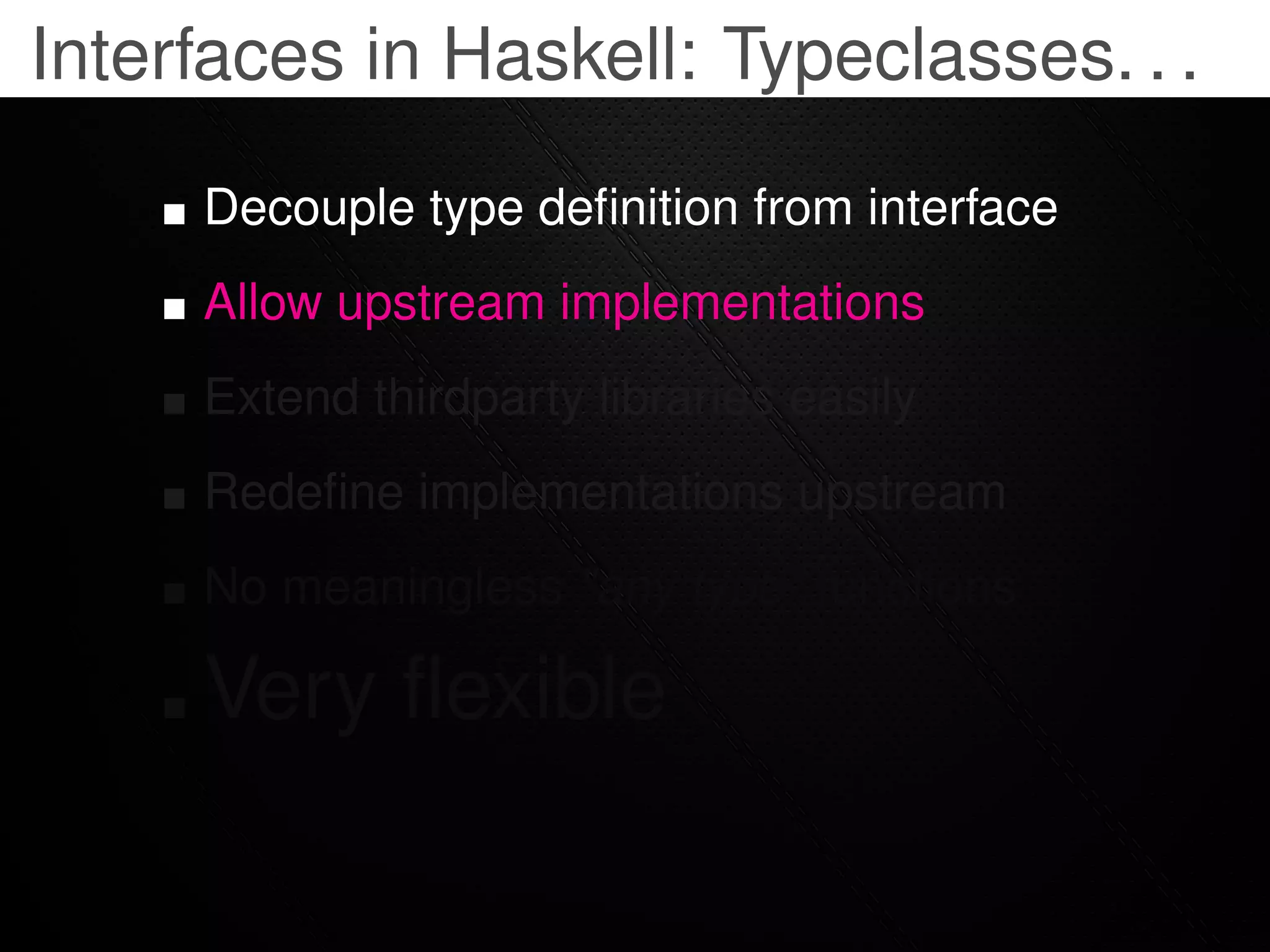
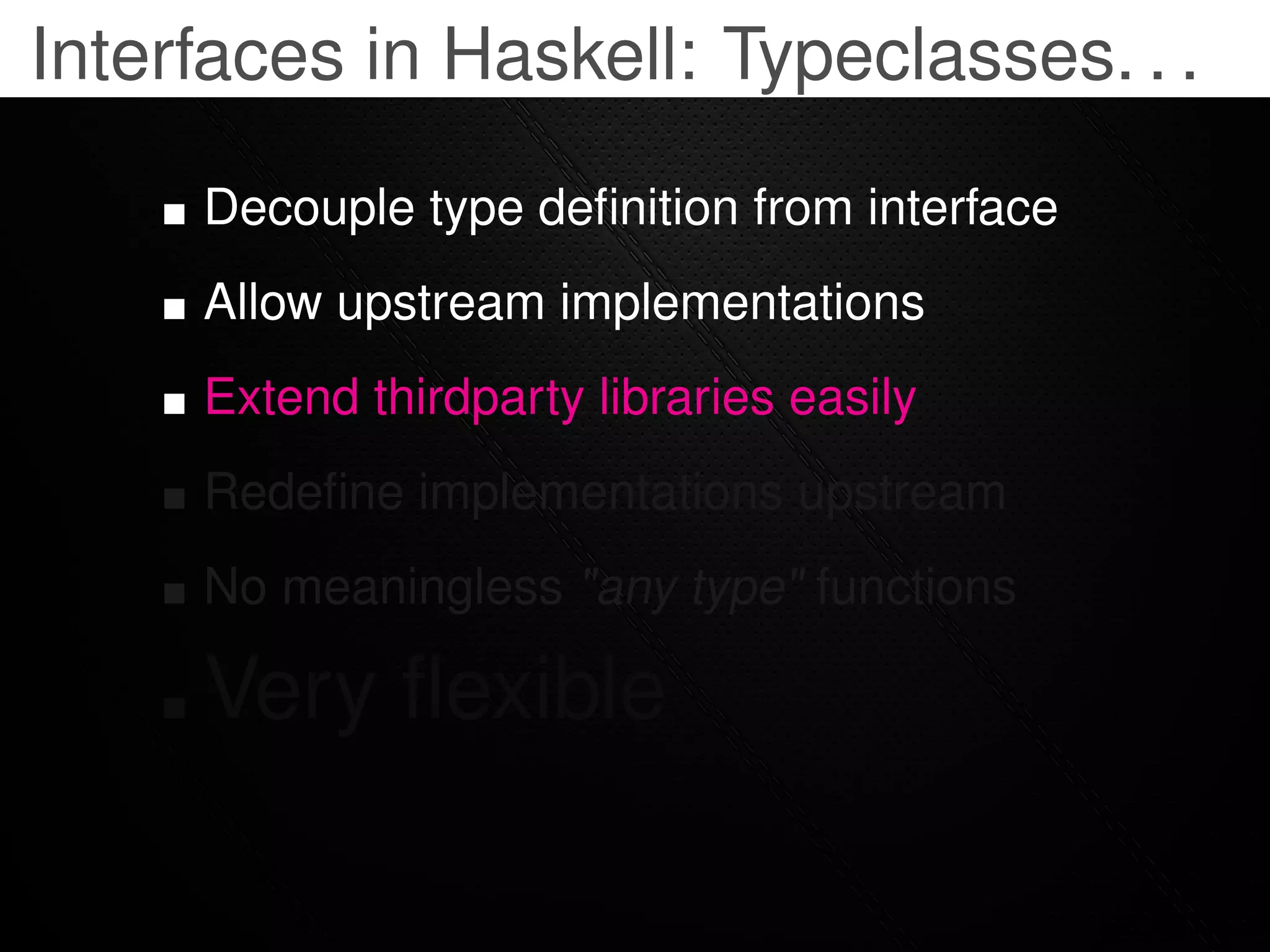
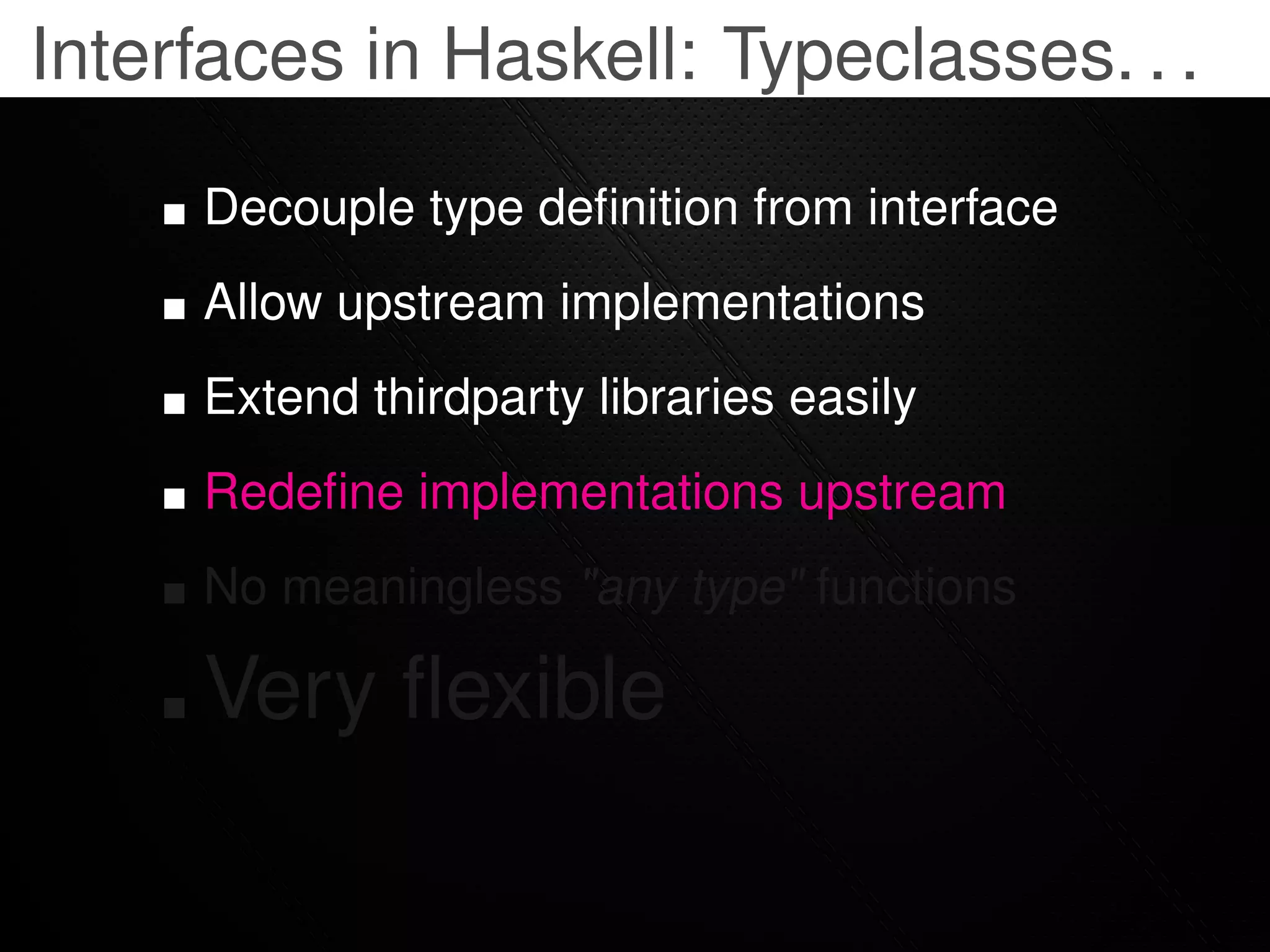
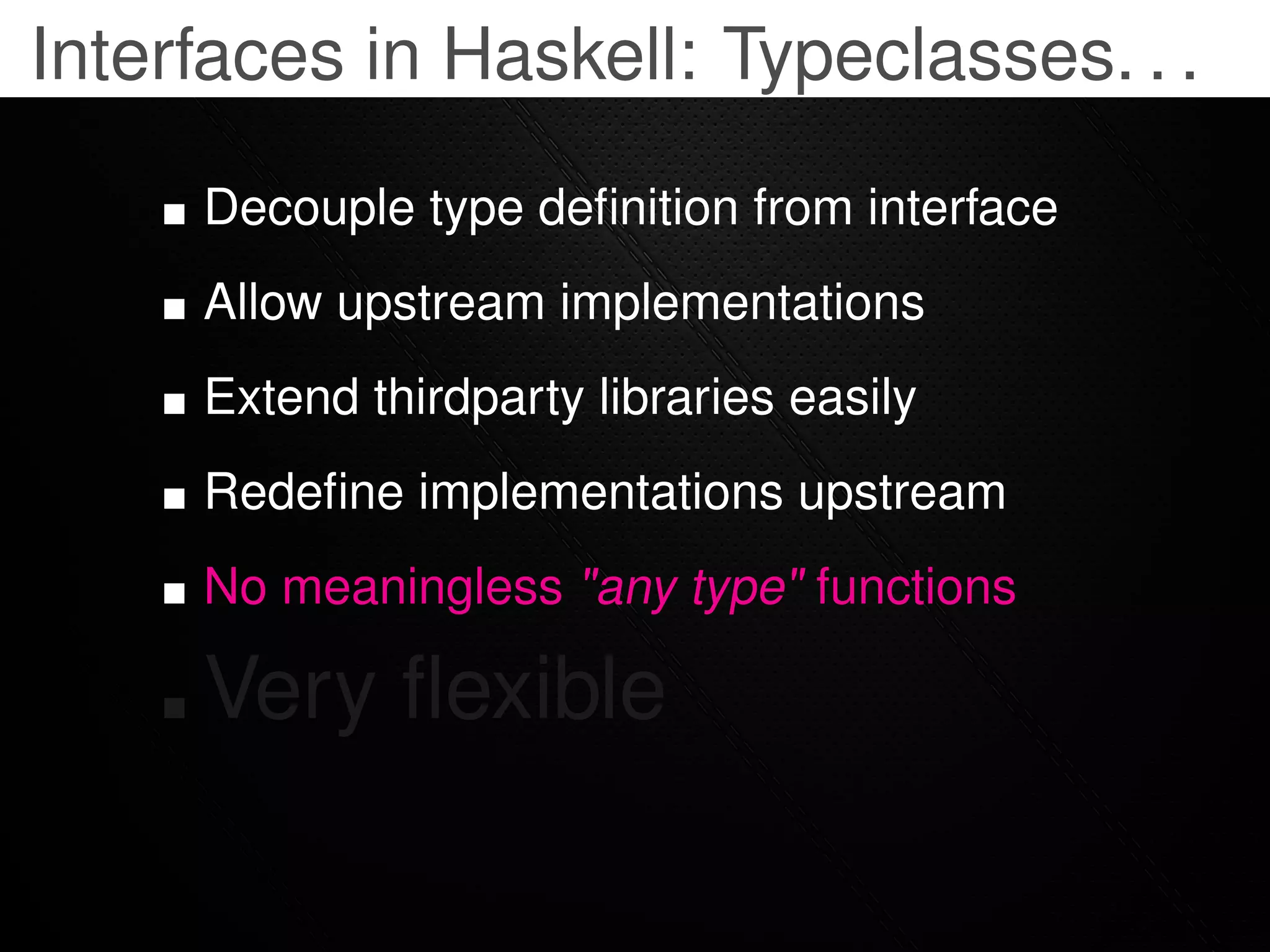
     Decouple type definition from interface
     Allow upstream implementations
     Extend thirdparty libraries easily
     Redefine implementations upstream
     No meaningless "any type" functions

     Very flexible
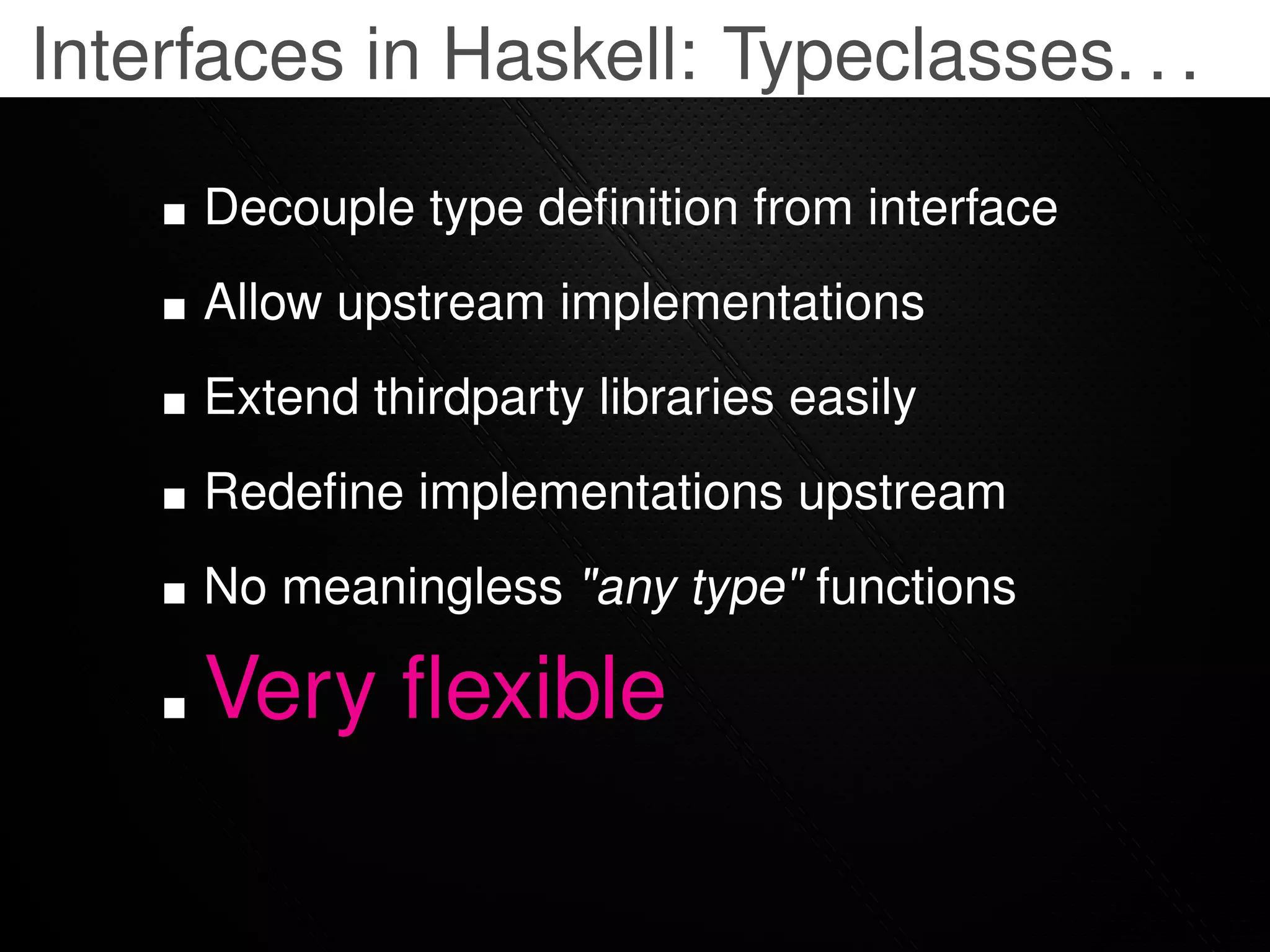
Interfaces in Haskell: Typeclasses. . .

     Decouple type definition from interface
     Allow upstream implementations
     Extend thirdparty libraries easily
     Redefine implementations upstream
     No meaningless "any type" functions

     Very flexible
Interfaces in Haskell: Typeclasses. . .

     Decouple type definition from interface
     Allow upstream implementations
     Extend thirdparty libraries easily
     Redefine implementations upstream
     No meaningless "any type" functions

     Very flexible
Interfaces in Haskell: Typeclasses. . .

     Decouple type definition from interface
     Allow upstream implementations
     Extend thirdparty libraries easily
     Redefine implementations upstream
     No meaningless "any type" functions

     Very flexible
Interfaces in Haskell: Typeclasses. . .

     Decouple type definition from interface
     Allow upstream implementations
     Extend thirdparty libraries easily
     Redefine implementations upstream
     No meaningless "any type" functions

     Very flexible
Interfaces in Haskell: Typeclasses. . .

     Decouple type definition from interface
     Allow upstream implementations
     Extend thirdparty libraries easily
     Redefine implementations upstream
     No meaningless "any type" functions

     Very flexible
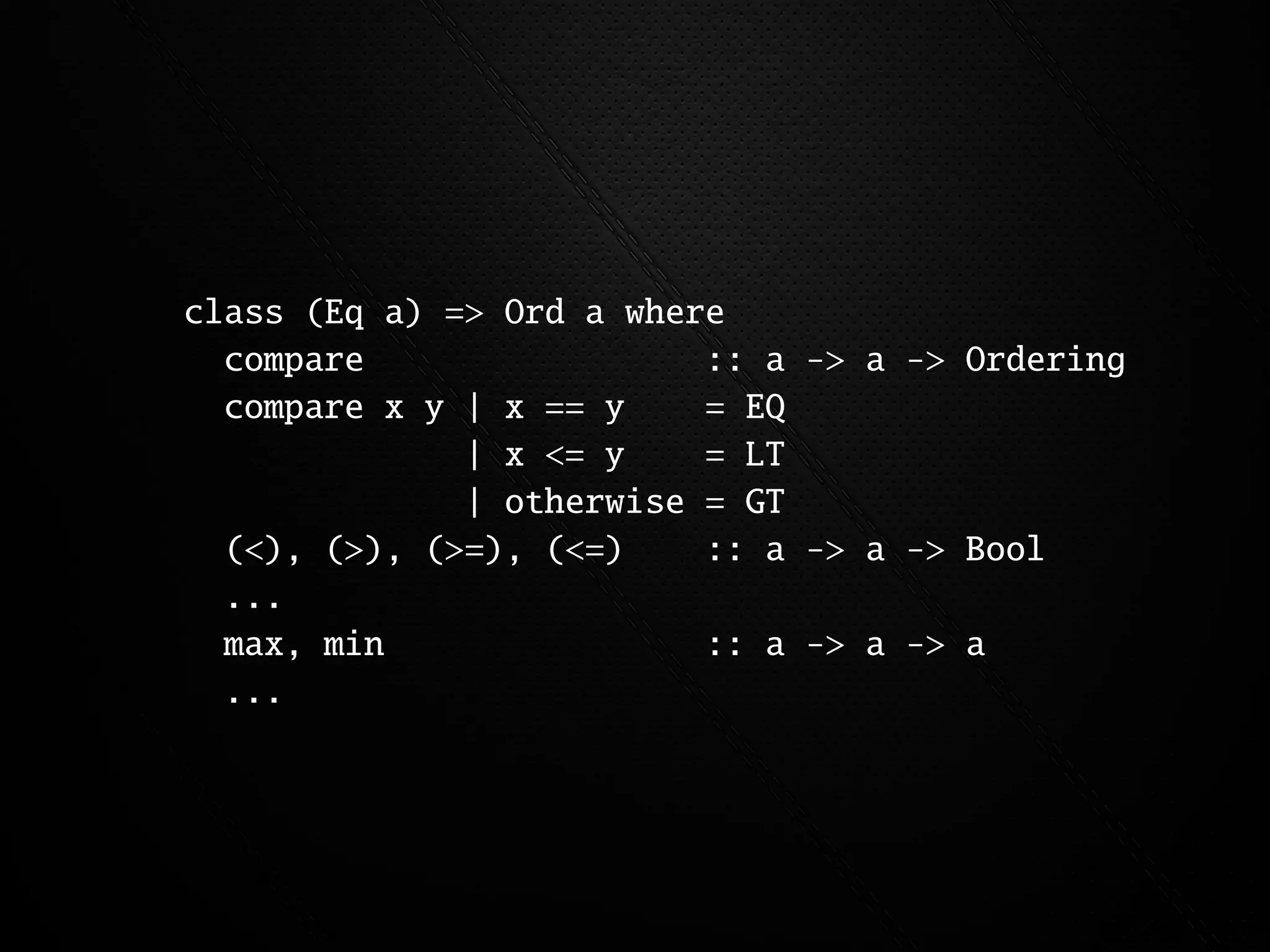
class (Eq a) => Ord a where
  compare                 :: a -> a -> Ordering
  compare x y | x == y    = EQ
              | x <= y    = LT
              | otherwise = GT
  (<), (>), (>=), (<=)    :: a -> a -> Bool
  ...
  max, min                :: a -> a -> a
  ...
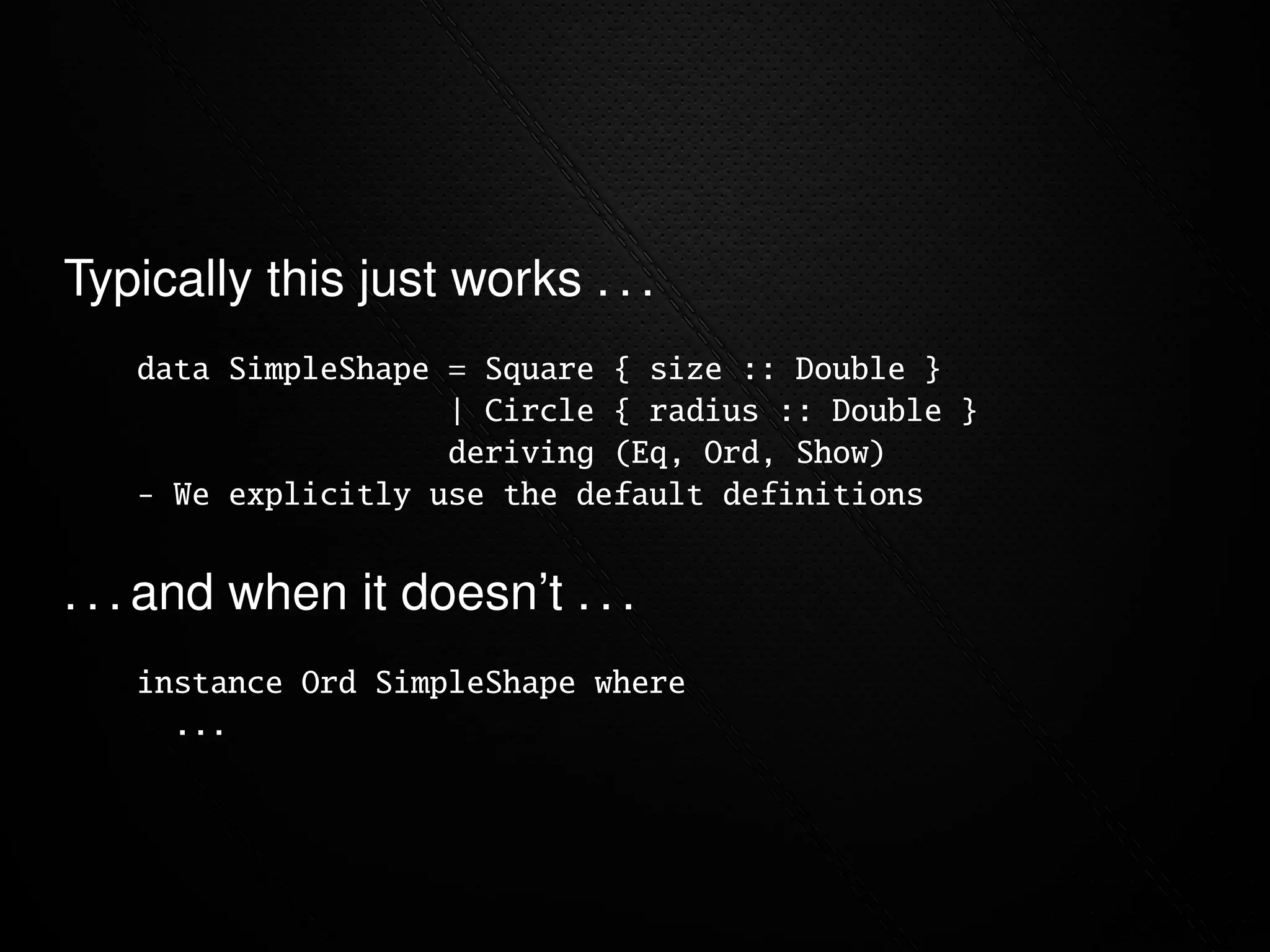
Typically this just works . . .
   data SimpleShape = Square { size :: Double }
                    | Circle { radius :: Double }
                    deriving (Eq, Ord, Show)
     We explicitly use the default definitions


. . . and when it doesn’t . . .
   instance Ord SimpleShape where
     ...
Are you awake?


 Figure: http://absolutelymadness.tumblr.com/post/18126913457
Haskell Tooling: Libraries


         Quite a few
         Practical libraries
         Often freely available
         Permissive OSS licenses
Haskell Tooling: Libraries


         Quite a few
         Practical libraries
         Often freely available
         Permissive OSS licenses
Haskell Tooling: Libraries


         Quite a few
         Practical libraries
         Often freely available
         Permissive OSS licenses
Haskell Tooling: Libraries


         Quite a few
         Practical libraries
         Often freely available
         Permissive OSS licenses
Haskell Tooling: Runtime


         Reasonably performant
         between JVM 7 and C# Mono performance


         GC settings easily customized
         Numerous other runtime options
Haskell Tooling: Runtime


         Reasonably performant
         between JVM 7 and C# Mono performance


         GC settings easily customized
         Numerous other runtime options
Haskell Tooling: Runtime


         Reasonably performant
         between JVM 7 and C# Mono performance


         GC settings easily customized
         Numerous other runtime options
Haskell Tooling: Tools

         Testing tools
         QuickCheck, HUnit


         Documentation tools
         Haddock, Hoogle (lookup documentation)


         Build tools
         Cabal, cabal-dev, cabal-nirvana, see "next slide"
Haskell Tooling: Tools

         Testing tools
         QuickCheck, HUnit


         Documentation tools
         Haddock, Hoogle (lookup documentation)


         Build tools
         Cabal, cabal-dev, cabal-nirvana, see "next slide"
Haskell Tooling: Tools

         Testing tools
         QuickCheck, HUnit


         Documentation tools
         Haddock, Hoogle (lookup documentation)


         Build tools
         Cabal, cabal-dev, cabal-nirvana, see "next slide"
Haskell Tooling: Dependency
Management
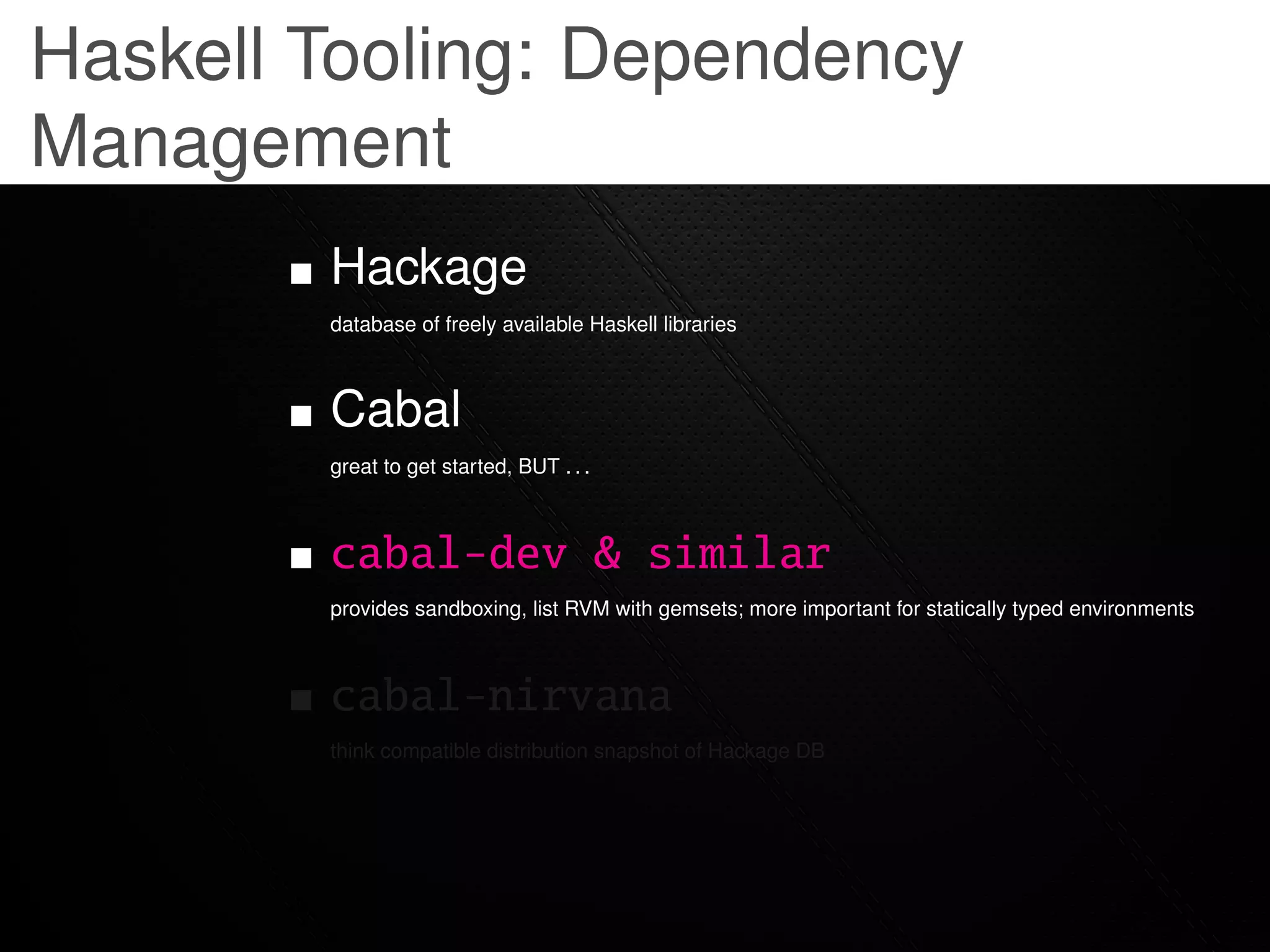
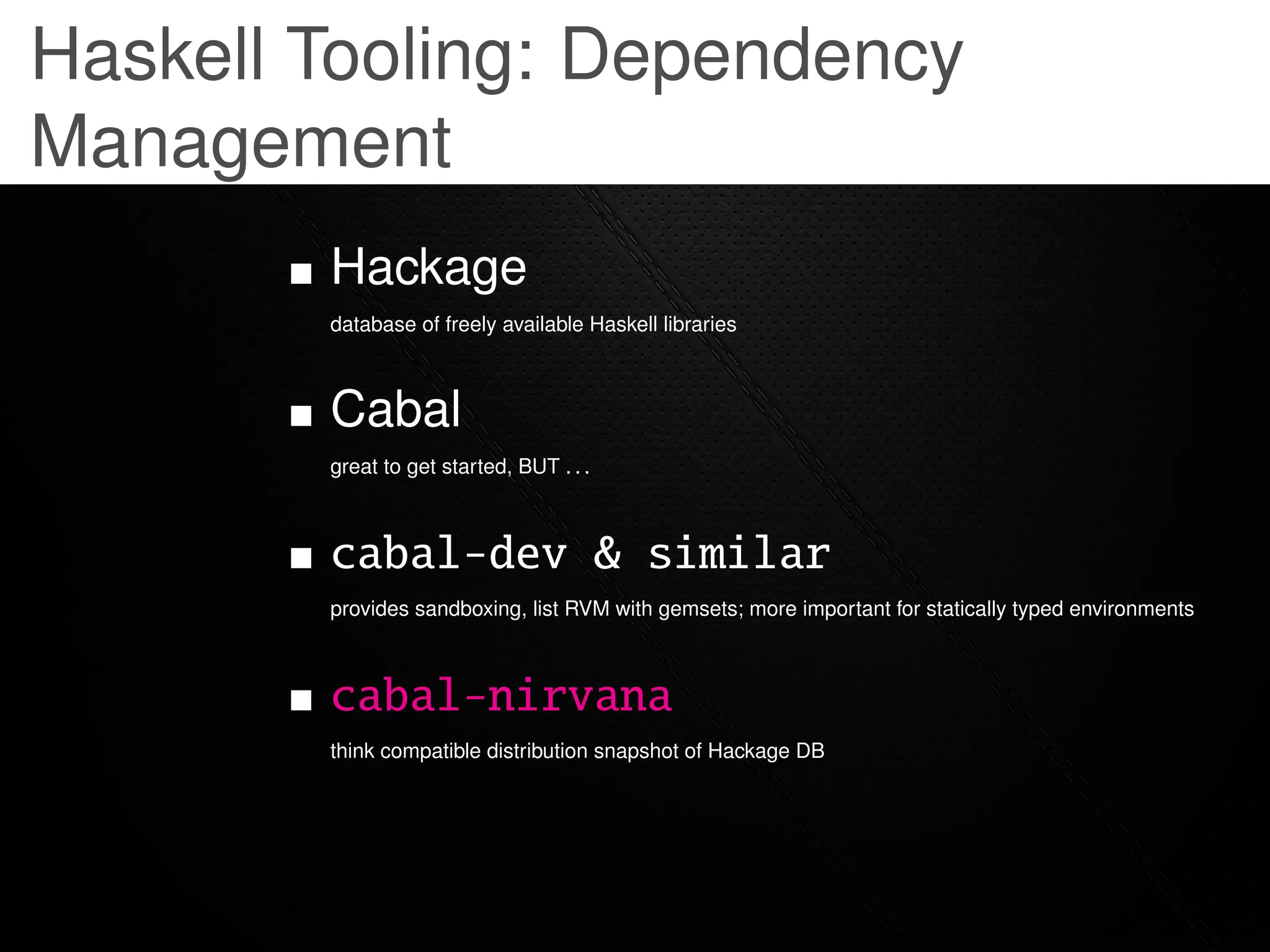
        Hackage
        database of freely available Haskell libraries


        Cabal
        great to get started, BUT . . .


        cabal-dev & similar
        provides sandboxing, list RVM with gemsets; more important for statically typed environments


        cabal-nirvana
        think compatible distribution snapshot of Hackage DB
Haskell Tooling: Dependency
Management
        Hackage
        database of freely available Haskell libraries


        Cabal
        great to get started, BUT . . .


        cabal-dev & similar
        provides sandboxing, list RVM with gemsets; more important for statically typed environments


        cabal-nirvana
        think compatible distribution snapshot of Hackage DB
Haskell Tooling: Dependency
Management
        Hackage
        database of freely available Haskell libraries


        Cabal
        great to get started, BUT . . .


        cabal-dev & similar
        provides sandboxing, list RVM with gemsets; more important for statically typed environments


        cabal-nirvana
        think compatible distribution snapshot of Hackage DB
Haskell Tooling: Dependency
Management
        Hackage
        database of freely available Haskell libraries


        Cabal
        great to get started, BUT . . .


        cabal-dev & similar
        provides sandboxing, list RVM with gemsets; more important for statically typed environments


        cabal-nirvana
        think compatible distribution snapshot of Hackage DB
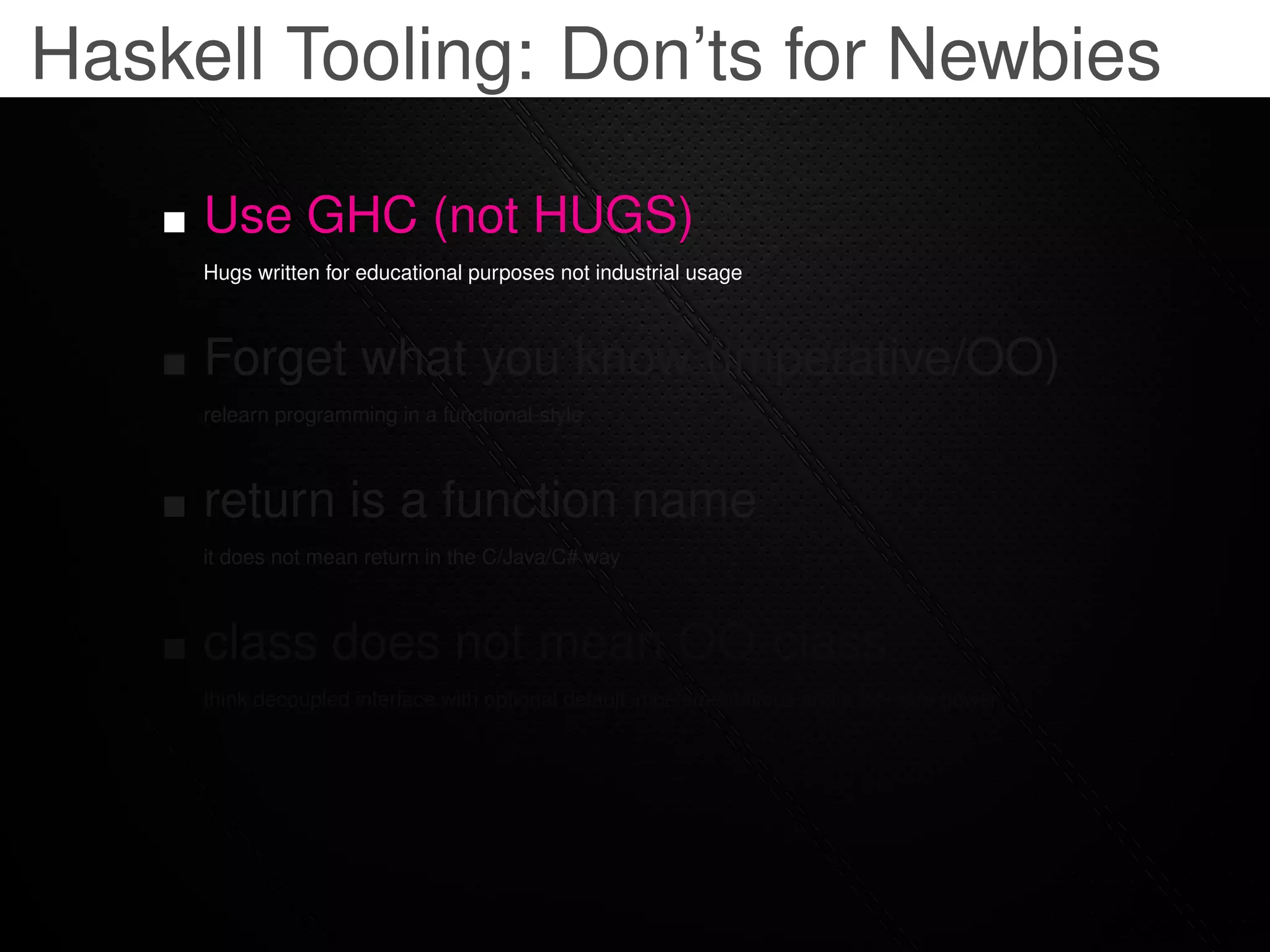
Haskell Tooling: Don’ts for Newbies

     Use GHC (not HUGS)
     Hugs written for educational purposes not industrial usage


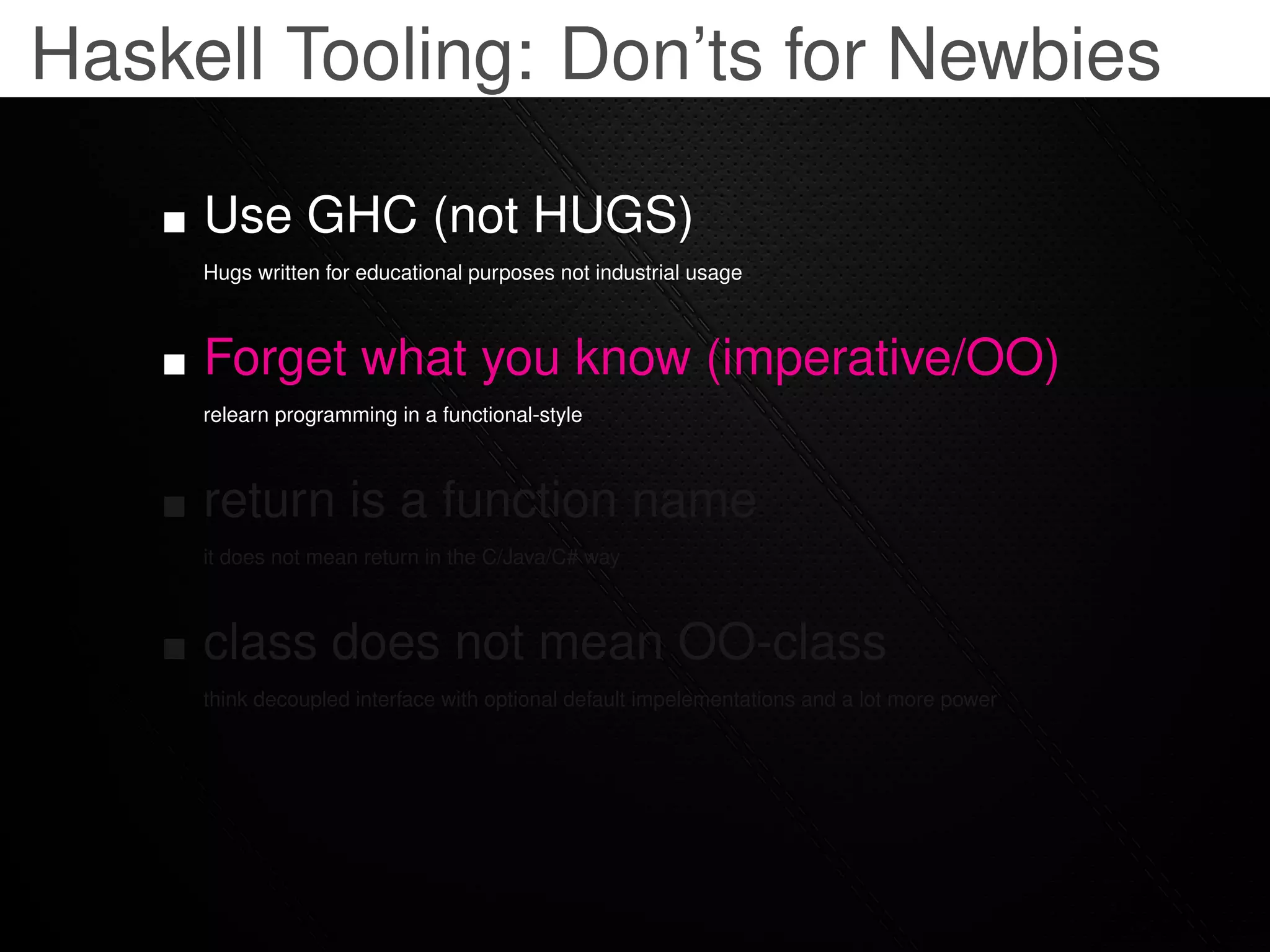
     Forget what you know (imperative/OO)
     relearn programming in a functional-style


     return is a function name
     it does not mean return in the C/Java/C# way


     class does not mean OO-class
     think decoupled interface with optional default impelementations and a lot more power
Haskell Tooling: Don’ts for Newbies

     Use GHC (not HUGS)
     Hugs written for educational purposes not industrial usage


     Forget what you know (imperative/OO)
     relearn programming in a functional-style


     return is a function name
     it does not mean return in the C/Java/C# way


     class does not mean OO-class
     think decoupled interface with optional default impelementations and a lot more power
Haskell Tooling: Don’ts for Newbies

     Use GHC (not HUGS)
     Hugs written for educational purposes not industrial usage


     Forget what you know (imperative/OO)
     relearn programming in a functional-style


     return is a function name
     it does not mean return in the C/Java/C# way


     class does not mean OO-class
     think decoupled interface with optional default impelementations and a lot more power
Haskell Tooling: Don’ts for Newbies

     Use GHC (not HUGS)
     Hugs written for educational purposes not industrial usage


     Forget what you know (imperative/OO)
     relearn programming in a functional-style


     return is a function name
     it does not mean return in the C/Java/C# way


     class does not mean OO-class
     think decoupled interface with optional default impelementations and a lot more power
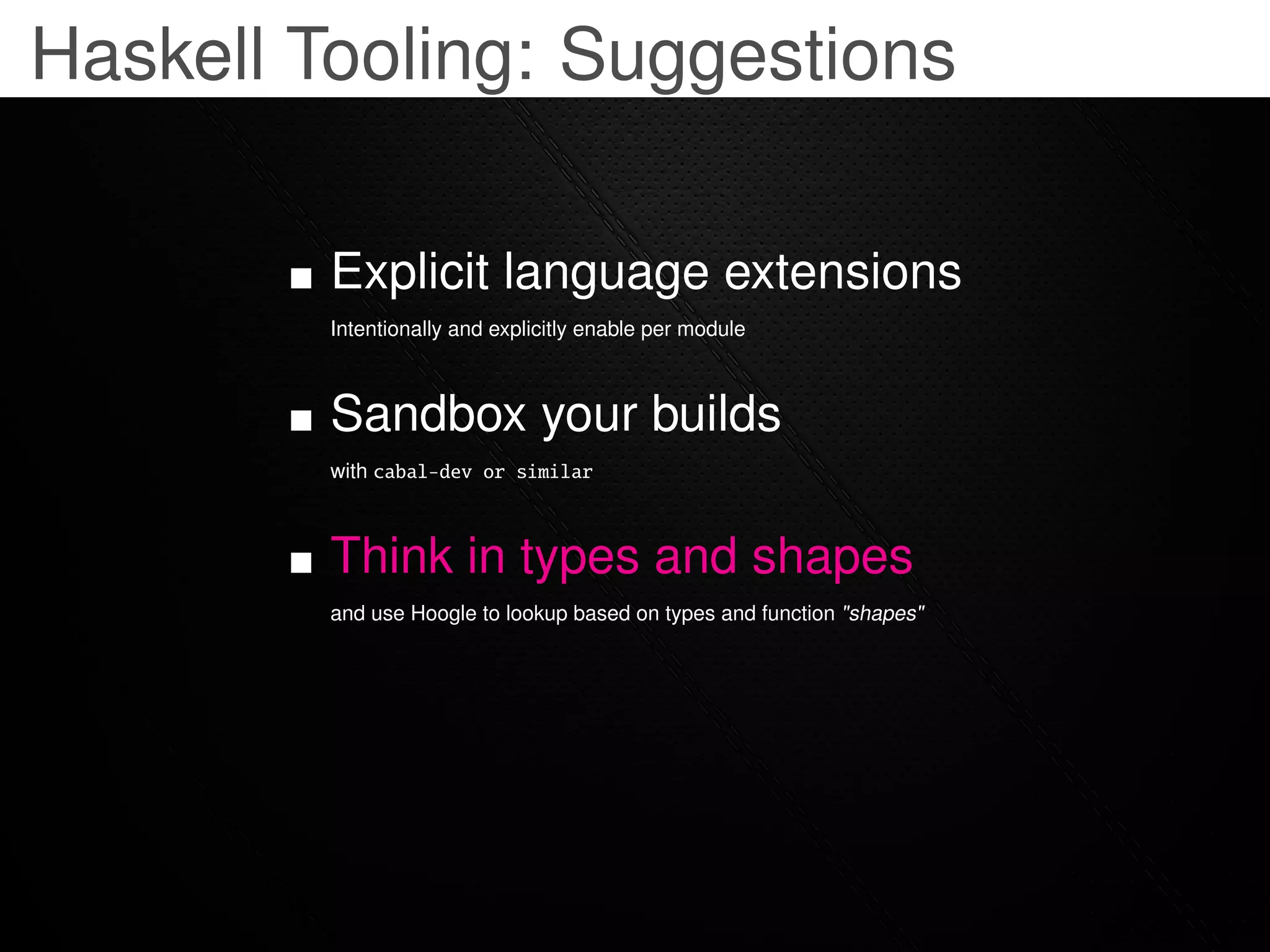
Haskell Tooling: Suggestions

         Explicit language extensions
         Intentionally and explicitly enable per module


         Sandbox your builds
         with cabal-dev or similar


         Think in types and shapes
         and use Hoogle to lookup based on types and function "shapes"
Haskell Tooling: Suggestions

         Explicit language extensions
         Intentionally and explicitly enable per module


         Sandbox your builds
         with cabal-dev or similar


         Think in types and shapes
         and use Hoogle to lookup based on types and function "shapes"
Haskell Tooling: Suggestions

         Explicit language extensions
         Intentionally and explicitly enable per module


         Sandbox your builds
         with cabal-dev or similar


         Think in types and shapes
         and use Hoogle to lookup based on types and function "shapes"
Oh, the possibilities!
     Parallel / Concurrency Options
     threads, dataflow, par, seq


     "Cloud" Haskell
     A kind of Erlang/OTP clone in Haskell


     Data Parallel Haskell
     GHC extensions to support nested data parallelism accounting, "Nepal"


     Haskell’s Foreign Function Interface (FFI)
     Interface with native code from Haskell


     GPU Programming in Haskell
     Obsidian, Nikola, GpuGen, numerous papers on this too


     Much more. . .
     Research meeting industrial application
Oh, the possibilities!
     Parallel / Concurrency Options
     threads, dataflow, par, seq


     "Cloud" Haskell
     A kind of Erlang/OTP clone in Haskell


     Data Parallel Haskell
     GHC extensions to support nested data parallelism accounting, "Nepal"


     Haskell’s Foreign Function Interface (FFI)
     Interface with native code from Haskell


     GPU Programming in Haskell
     Obsidian, Nikola, GpuGen, numerous papers on this too


     Much more. . .
     Research meeting industrial application
Oh, the possibilities!
     Parallel / Concurrency Options
     threads, dataflow, par, seq


     "Cloud" Haskell
     A kind of Erlang/OTP clone in Haskell


     Data Parallel Haskell
     GHC extensions to support nested data parallelism accounting, "Nepal"


     Haskell’s Foreign Function Interface (FFI)
     Interface with native code from Haskell


     GPU Programming in Haskell
     Obsidian, Nikola, GpuGen, numerous papers on this too


     Much more. . .
     Research meeting industrial application
Oh, the possibilities!
     Parallel / Concurrency Options
     threads, dataflow, par, seq


     "Cloud" Haskell
     A kind of Erlang/OTP clone in Haskell


     Data Parallel Haskell
     GHC extensions to support nested data parallelism accounting, "Nepal"


     Haskell’s Foreign Function Interface (FFI)
     Interface with native code from Haskell


     GPU Programming in Haskell
     Obsidian, Nikola, GpuGen, numerous papers on this too


     Much more. . .
     Research meeting industrial application
Oh, the possibilities!
     Parallel / Concurrency Options
     threads, dataflow, par, seq


     "Cloud" Haskell
     A kind of Erlang/OTP clone in Haskell


     Data Parallel Haskell
     GHC extensions to support nested data parallelism accounting, "Nepal"


     Haskell’s Foreign Function Interface (FFI)
     Interface with native code from Haskell


     GPU Programming in Haskell
     Obsidian, Nikola, GpuGen, numerous papers on this too


     Much more. . .
     Research meeting industrial application
Oh, the possibilities!
     Parallel / Concurrency Options
     threads, dataflow, par, seq


     "Cloud" Haskell
     A kind of Erlang/OTP clone in Haskell


     Data Parallel Haskell
     GHC extensions to support nested data parallelism accounting, "Nepal"


     Haskell’s Foreign Function Interface (FFI)
     Interface with native code from Haskell


     GPU Programming in Haskell
     Obsidian, Nikola, GpuGen, numerous papers on this too


     Much more. . .
     Research meeting industrial application
Questions?


        Figure:   http://www.flickr.com/photos/42682395@N04/


         @SusanPotter
Questions?


        Figure:   http://www.flickr.com/photos/42682395@N04/


         @SusanPotter
Bonus: References / Resources
    Channel 9 Lectures (Erik Meijer)
    http://channel9.msdn.com/Shows/Going+Deep/

    Lecture-Series-Erik-Meijer-Functional-Programming-Fundamentals-Chapter-1


    Learn You A Haskell
    http://learnyouahaskell.com


    Haskell Reddit
    http://www.reddit.com/r/haskell/


    Haskell Cafe
    http://www.haskell.org/mailman/listinfo/haskell-cafe


    Real World Haskell
    http://book.realworldhaskell.org/
Bonus: References / Resources
    Channel 9 Lectures (Erik Meijer)
    http://channel9.msdn.com/Shows/Going+Deep/

    Lecture-Series-Erik-Meijer-Functional-Programming-Fundamentals-Chapter-1


    Learn You A Haskell
    http://learnyouahaskell.com


    Haskell Reddit
    http://www.reddit.com/r/haskell/


    Haskell Cafe
    http://www.haskell.org/mailman/listinfo/haskell-cafe


    Real World Haskell
    http://book.realworldhaskell.org/
Bonus: References / Resources
    Channel 9 Lectures (Erik Meijer)
    http://channel9.msdn.com/Shows/Going+Deep/

    Lecture-Series-Erik-Meijer-Functional-Programming-Fundamentals-Chapter-1


    Learn You A Haskell
    http://learnyouahaskell.com


    Haskell Reddit
    http://www.reddit.com/r/haskell/


    Haskell Cafe
    http://www.haskell.org/mailman/listinfo/haskell-cafe


    Real World Haskell
    http://book.realworldhaskell.org/
Bonus: References / Resources
    Channel 9 Lectures (Erik Meijer)
    http://channel9.msdn.com/Shows/Going+Deep/

    Lecture-Series-Erik-Meijer-Functional-Programming-Fundamentals-Chapter-1


    Learn You A Haskell
    http://learnyouahaskell.com


    Haskell Reddit
    http://www.reddit.com/r/haskell/


    Haskell Cafe
    http://www.haskell.org/mailman/listinfo/haskell-cafe


    Real World Haskell
    http://book.realworldhaskell.org/
Bonus: References / Resources
    Channel 9 Lectures (Erik Meijer)
    http://channel9.msdn.com/Shows/Going+Deep/

    Lecture-Series-Erik-Meijer-Functional-Programming-Fundamentals-Chapter-1


    Learn You A Haskell
    http://learnyouahaskell.com


    Haskell Reddit
    http://www.reddit.com/r/haskell/


    Haskell Cafe
    http://www.haskell.org/mailman/listinfo/haskell-cafe


    Real World Haskell
    http://book.realworldhaskell.org/
Bonus: Brief QuickCheck Example

module Tests where


import Test.QuickCheck (quickCheck)


propReverseReverse :: [Char] -> Bool
propReverseReverse s = (reverse . reverse) s == s


  excuse the weird syntax form, indenting didn’t show up ;(
main = do {quickCheck propReverseReverse }

Why Haskell

  • 1.
    Why Haskell? Susan Potter March 2012
  • 2.
    What is Haskell? Figure: "pure functional, lazy, polymorphic, statically and strongly typed with type inference . . . "
  • 3.
    How can Idrive this thing? Figure: Photo from "If programming languages were cars" blog post http://machinegestalt.posterous.com/if-programming-languages-were-cars
  • 4.
    Can I driveHaskell without all this? Figure: No need to know Category Theory proofs, just some intuitions!
  • 5.
    # finger $(whoami) Login:susan Name: Susan Potter Directory: /home/susan Shell: /bin/zsh Practicing since 1997-09-29 21:18 (GMT) on tty1 from :0 Too much unread mail on me@susanpotter.net Now working at Desk.com! Looking for smart developers!;) Plan: github: mbbx6spp twitter: @SusanPotter
  • 6.
    Are we "doingit wrong"? Figure: Maybe! ;) http://absolutelymadness.tumblr.com/post/17567574522
  • 7.
    Overview: Choosing alanguage Many considerations political, human, technical Runtime performance, reliability, configurability Knowledge culture, mindshare, resources, signal to noise ratio Tooling development, build/release, configuration, deployment
  • 8.
    Overview: Choosing alanguage Many considerations political, human, technical Runtime performance, reliability, configurability Knowledge culture, mindshare, resources, signal to noise ratio Tooling development, build/release, configuration, deployment
  • 9.
    Overview: Choosing alanguage Many considerations political, human, technical Runtime performance, reliability, configurability Knowledge culture, mindshare, resources, signal to noise ratio Tooling development, build/release, configuration, deployment
  • 10.
    Overview: Choosing alanguage Many considerations political, human, technical Runtime performance, reliability, configurability Knowledge culture, mindshare, resources, signal to noise ratio Tooling development, build/release, configuration, deployment
  • 11.
    Overview: Agenda My Claims / Hypotheses Laziness, Functional, Type System Toolkit & Runtime Library Ecosystem Pitfalls & Hurdles
  • 12.
    My Claims Performance is reasonable on par with Java and C# Mono; 2-3x CPU times of C (approx); BUT always doubt benchmarks http://shootout.alioth.debian.org/u64q/haskell.php Productivity with long-term benefits after initial steep learning curve Haskell types offer stronger verifiability strong and meaningful checks applied Pure functional code is easier to test probably not controversial
  • 13.
    My Claims Performance is reasonable on par with Java and C# Mono; 2-3x CPU times of C (approx); BUT always doubt benchmarks http://shootout.alioth.debian.org/u64q/haskell.php Productivity with long-term benefits after initial steep learning curve Haskell types offer stronger verifiability strong and meaningful checks applied Pure functional code is easier to test probably not controversial
  • 14.
    My Claims Performance is reasonable on par with Java and C# Mono; 2-3x CPU times of C (approx); BUT always doubt benchmarks http://shootout.alioth.debian.org/u64q/haskell.php Productivity with long-term benefits after initial steep learning curve Haskell types offer stronger verifiability strong and meaningful checks applied Pure functional code is easier to test probably not controversial
  • 15.
    My Claims Performance is reasonable on par with Java and C# Mono; 2-3x CPU times of C (approx); BUT always doubt benchmarks http://shootout.alioth.debian.org/u64q/haskell.php Productivity with long-term benefits after initial steep learning curve Haskell types offer stronger verifiability strong and meaningful checks applied Pure functional code is easier to test probably not controversial
  • 16.
    Haskell "lazy" bydefault Figure: Photo by Mark Fischer http://www.flickr.com/photos/tom_ruaat/4431626234/
  • 17.
    Haskell "lazy" bydefault Figure: Photo by Mark Fischer http://www.flickr.com/photos/tom_ruaat/4431626234/ (jarring for mainstream programmers)
  • 18.
    Example: doubleSum 3(2 + 3) Call by value doubleSum 3 (2 + 3) → doubleSum 3 5 → 2 * (3 + 5) → 2 * 8 → 16 Call by name doubleSum 3 (2 + 3) → (λ x -> 2 * (3 + x)) (2 + 3)
  • 19.
    Example: doubleSum 3(2 + 3) Call by value doubleSum 3 (2 + 3) → doubleSum 3 5 → 2 * (3 + 5) → 2 * 8 → 16 Call by name doubleSum 3 (2 + 3) → (λ x -> 2 * (3 + x)) (2 + 3)
  • 20.
    Example: doubleSum 3(2 + 3) Call by value doubleSum 3 (2 + 3) → doubleSum 3 5 → 2 * (3 + 5) → 2 * 8 → 16 Call by name doubleSum 3 (2 + 3) → (λ x -> 2 * (3 + x)) (2 + 3)
  • 21.
    Example: doubleSum 3(2 + 3) Call by value doubleSum 3 (2 + 3) → doubleSum 3 5 → 2 * (3 + 5) → 2 * 8 → 16 Call by name doubleSum 3 (2 + 3) → (λ x -> 2 * (3 + x)) (2 + 3)
  • 22.
    Example: doubleSum 3(2 + 3) Call by value doubleSum 3 (2 + 3) → doubleSum 3 5 → 2 * (3 + 5) → 2 * 8 → 16 Call by name doubleSum 3 (2 + 3) → (λ x -> 2 * (3 + x)) (2 + 3)
  • 23.
    Example: doubleSum 3(2 + 3) Call by value doubleSum 3 (2 + 3) → doubleSum 3 5 → 2 * (3 + 5) → 2 * 8 → 16 Call by name doubleSum 3 (2 + 3) → (λ x -> 2 * (3 + x)) (2 + 3)
  • 24.
    Example: doubleSum 3(2 + 3) Call by value (evaluates inner-most expressions first) doubleSum 3 (2 + 3) → doubleSum 3 5 → 2 * (3 + 5) → 2 * 8 → 16 Call by name doubleSum 3 (2 + 3) → (λ x -> 2 * (3 + x)) (2 + 3)
  • 25.
    Example: doubleSum 3(2 + 3) Call by value (evaluates inner-most expressions first) doubleSum 3 (2 + 3) → doubleSum 3 5 → 2 * (3 + 5) → 2 * 8 → 16 Call by name doubleSum 3 (2 + 3) → (λ x -> 2 * (3 + x)) (2 + 3)
  • 26.
    Example: doubleSum 3(2 + 3) Call by value (evaluates inner-most expressions first) doubleSum 3 (2 + 3) → doubleSum 3 5 → 2 * (3 + 5) → 2 * 8 → 16 Call by name doubleSum 3 (2 + 3) → (λ x -> 2 * (3 + x)) (2 + 3)
  • 27.
    Example: doubleSum 3(2 + 3) Call by value (evaluates inner-most expressions first) doubleSum 3 (2 + 3) → doubleSum 3 5 → 2 * (3 + 5) → 2 * 8 → 16 Call by name doubleSum 3 (2 + 3) → (λ x -> 2 * (3 + x)) (2 + 3)
  • 28.
    Example: doubleSum 3(2 + 3) Call by value (evaluates inner-most expressions first) doubleSum 3 (2 + 3) → doubleSum 3 5 → 2 * (3 + 5) → 2 * 8 → 16 Call by name (evaluates outer-most expressions first) doubleSum 3 (2 + 3) → (λ x -> 2 * (3 + x)) (2 + 3)
  • 29.
    Laziness in Haskellis . . . CallByName + SharingOptimization + PossibleMinorOverhead
  • 30.
    Laziness: Buyer Beware filter (λ x → x < 6) [1..] (never terminates) takeWhile (λ x → x < 6) [1..] (does terminate) dropWhile (λ x → x >= 6) [1..] (does not terminate) Need to understand implications of laziness on functions Laziness with I/O implications lazy I/O with handles is problematic, but iteratee idiom solves most of these. There are a number of libraries available to help with this: enumerator, pipes, . . .
  • 31.
    Laziness: Buyer Beware filter (λ x → x < 6) [1..] (never terminates) takeWhile (λ x → x < 6) [1..] (does terminate) dropWhile (λ x → x >= 6) [1..] (does not terminate) Need to understand implications of laziness on functions Laziness with I/O implications lazy I/O with handles is problematic, but iteratee idiom solves most of these. There are a number of libraries available to help with this: enumerator, pipes, . . .
  • 32.
    Laziness: Buyer Beware filter (λ x → x < 6) [1..] (never terminates) takeWhile (λ x → x < 6) [1..] (does terminate) dropWhile (λ x → x >= 6) [1..] (does not terminate) Need to understand implications of laziness on functions Laziness with I/O implications lazy I/O with handles is problematic, but iteratee idiom solves most of these. There are a number of libraries available to help with this: enumerator, pipes, . . .
  • 33.
    Laziness: Buyer Beware filter (λ x → x < 6) [1..] (never terminates) takeWhile (λ x → x < 6) [1..] (does terminate) dropWhile (λ x → x >= 6) [1..] (does not terminate) Need to understand implications of laziness on functions Laziness with I/O implications lazy I/O with handles is problematic, but iteratee idiom solves most of these. There are a number of libraries available to help with this: enumerator, pipes, . . .
  • 34.
    Laziness: Buyer Beware filter (λ x → x < 6) [1..] (never terminates) takeWhile (λ x → x < 6) [1..] (does terminate) dropWhile (λ x → x >= 6) [1..] (does not terminate) Need to understand implications of laziness on functions Laziness with I/O implications lazy I/O with handles is problematic, but iteratee idiom solves most of these. There are a number of libraries available to help with this: enumerator, pipes, . . .
  • 35.
    Laziness: Also PrettySuuweeeet! Infinite sequences/lists made possible Recursive functions become practical Recursive types become simple Much more as well ...
  • 36.
    Laziness: Also PrettySuuweeeet! Infinite sequences/lists made possible Recursive functions become practical Recursive types become simple Much more as well ...
  • 37.
    Laziness: Also PrettySuuweeeet! Infinite sequences/lists made possible Recursive functions become practical Recursive types become simple Much more as well ...
  • 38.
    Laziness: Also PrettySuuweeeet! Infinite sequences/lists made possible Recursive functions become practical Recursive types become simple Much more as well ...
  • 39.
    Purity + Laziness=>Reasoning Equality (referential transparency) Can replace occurrences of LHS with RHS Higher Order Functions encourage exploitation of higher-level patterns Function Composition leads to greater reuse
  • 40.
    Purity + Laziness=>Reasoning Equality (referential transparency) Can replace occurrences of LHS with RHS Higher Order Functions encourage exploitation of higher-level patterns Function Composition leads to greater reuse
  • 41.
    Purity + Laziness=>Reasoning Equality (referential transparency) Can replace occurrences of LHS with RHS Higher Order Functions encourage exploitation of higher-level patterns Function Composition leads to greater reuse
  • 42.
    mysum :: Numa => [a] -> a mysum xs = foldr (+) 0 xs myproduct :: Num a => [a] -> a myproduct xs = foldr (*) 1 xs myany :: (a -> Bool) -> [a] -> Bool myany pred xs = foldr ( x b -> b || pred x) False xs myall :: (a -> Bool) -> [a] -> Bool myall pred xs = foldr ( x b -> b && pred x) True xs
  • 43.
    mysum :: Numa => [a] -> a mysum xs = foldr (+) 0 xs myproduct :: Num a => [a] -> a myproduct xs = foldr (*) 1 xs myany :: (a -> Bool) -> [a] -> Bool myany pred xs = foldr ( x b -> b || pred x) False xs myall :: (a -> Bool) -> [a] -> Bool myall pred xs = foldr ( x b -> b && pred x) True xs
  • 44.
    mysum :: Numa => [a] -> a mysum xs = foldr (+) 0 xs myproduct :: Num a => [a] -> a myproduct xs = foldr (*) 1 xs myany :: (a -> Bool) -> [a] -> Bool myany pred xs = foldr ( x b -> b || pred x) False xs myall :: (a -> Bool) -> [a] -> Bool myall pred xs = foldr ( x b -> b && pred x) True xs
  • 45.
    mysum :: Numa => [a] -> a mysum xs = foldr (+) 0 xs myproduct :: Num a => [a] -> a myproduct xs = foldr (*) 1 xs myany :: (a -> Bool) -> [a] -> Bool myany pred xs = foldr ( x b -> b || pred x) False xs myall :: (a -> Bool) -> [a] -> Bool myall pred xs = foldr ( x b -> b && pred x) True xs
  • 46.
    mysum :: Numa => [a] -> a mysum xs = foldr (+) 0 xs myproduct :: Num a => [a] -> a myproduct xs = foldr (*) 1 xs myany :: (a -> Bool) -> [a] -> Bool myany pred xs = foldr ( x b -> b || pred x) False xs myall :: (a -> Bool) -> [a] -> Bool myall pred xs = foldr ( x b -> b && pred x) True xs
  • 47.
    mysum :: Numa => [a] -> a mysum xs = foldr (+) 0 xs myproduct :: Num a => [a] -> a myproduct xs = foldr (*) 1 xs myany :: (a -> Bool) -> [a] -> Bool myany pred xs = foldr ( x b -> b || pred x) False xs myall :: (a -> Bool) -> [a] -> Bool myall pred xs = foldr ( x b -> b && pred x) True xs
  • 48.
    mysum :: Numa => [a] -> a mysum xs = foldr (+) 0 xs myproduct :: Num a => [a] -> a myproduct xs = foldr (*) 1 xs myany :: (a -> Bool) -> [a] -> Bool myany pred xs = foldr ( x b -> b || pred x) False xs myall :: (a -> Bool) -> [a] -> Bool myall pred xs = foldr ( x b -> b && pred x) True xs
  • 49.
    class Monoid mwhere mappend :: m -> m -> m mempty :: m instance Num a => Monoid a where mappend :: m -> m -> m mappend x y = (+) x y mempty :: m mempty = 0 instance Monoid Bool where mappend :: m -> m -> m mappend True _ = True mappend _ True = True mappend _ _ = False mempty :: m
  • 50.
    class Monoid mwhere mappend :: m -> m -> m mempty :: m instance Num a => Monoid a where mappend :: m -> m -> m mappend x y = (+) x y mempty :: m mempty = 0 instance Monoid Bool where mappend :: m -> m -> m mappend True _ = True mappend _ True = True mappend _ _ = False mempty :: m
  • 51.
    class Monoid mwhere mappend :: m -> m -> m mempty :: m instance Num a => Monoid a where mappend :: m -> m -> m mappend x y = (+) x y mempty :: m mempty = 0 instance Monoid Bool where mappend :: m -> m -> m mappend True _ = True mappend _ True = True mappend _ _ = False mempty :: m
  • 52.
    Haskell type signaturescan . . . express side effects e.g. String -> IO Int declare computational strategies e.g. Num a => [a] -> Sum a impose constraints e.g. Num a => a -> a question value availability e.g. String -> Maybe Int verify client-server protocol dialogs? an exercise for reader ;)
  • 53.
    Haskell type signaturescan . . . express side effects e.g. String -> IO Int declare computational strategies e.g. Num a => [a] -> Sum a impose constraints e.g. Num a => a -> a question value availability e.g. String -> Maybe Int verify client-server protocol dialogs? an exercise for reader ;)
  • 54.
    Haskell type signaturescan . . . express side effects e.g. String -> IO Int declare computational strategies e.g. Num a => [a] -> Sum a impose constraints e.g. Num a => a -> a question value availability e.g. String -> Maybe Int verify client-server protocol dialogs? an exercise for reader ;)
  • 55.
    Haskell type signaturescan . . . express side effects e.g. String -> IO Int declare computational strategies e.g. Num a => [a] -> Sum a impose constraints e.g. Num a => a -> a question value availability e.g. String -> Maybe Int verify client-server protocol dialogs? an exercise for reader ;)
  • 56.
    Haskell type signaturescan . . . express side effects e.g. String -> IO Int declare computational strategies e.g. Num a => [a] -> Sum a impose constraints e.g. Num a => a -> a question value availability e.g. String -> Maybe Int verify client-server protocol dialogs? an exercise for reader ;)
  • 57.
    Interfaces in OO. . . Figure: Class definitions are married to the interfaces they implement.
  • 58.
    Interfaces in Haskell:Typeclasses. . . Decouple type definition from interface Allow upstream implementations Extend thirdparty libraries easily Redefine implementations upstream No meaningless "any type" functions Very flexible
  • 59.
    Interfaces in Haskell:Typeclasses. . . Decouple type definition from interface Allow upstream implementations Extend thirdparty libraries easily Redefine implementations upstream No meaningless "any type" functions Very flexible
  • 60.
    Interfaces in Haskell:Typeclasses. . . Decouple type definition from interface Allow upstream implementations Extend thirdparty libraries easily Redefine implementations upstream No meaningless "any type" functions Very flexible
  • 61.
    Interfaces in Haskell:Typeclasses. . . Decouple type definition from interface Allow upstream implementations Extend thirdparty libraries easily Redefine implementations upstream No meaningless "any type" functions Very flexible
  • 62.
    Interfaces in Haskell:Typeclasses. . . Decouple type definition from interface Allow upstream implementations Extend thirdparty libraries easily Redefine implementations upstream No meaningless "any type" functions Very flexible
  • 63.
    Interfaces in Haskell:Typeclasses. . . Decouple type definition from interface Allow upstream implementations Extend thirdparty libraries easily Redefine implementations upstream No meaningless "any type" functions Very flexible
  • 64.
    class (Eq a)=> Ord a where compare :: a -> a -> Ordering compare x y | x == y = EQ | x <= y = LT | otherwise = GT (<), (>), (>=), (<=) :: a -> a -> Bool ... max, min :: a -> a -> a ...
  • 65.
    Typically this justworks . . . data SimpleShape = Square { size :: Double } | Circle { radius :: Double } deriving (Eq, Ord, Show) We explicitly use the default definitions . . . and when it doesn’t . . . instance Ord SimpleShape where ...
  • 66.
    Are you awake? Figure: http://absolutelymadness.tumblr.com/post/18126913457
  • 67.
    Haskell Tooling: Libraries Quite a few Practical libraries Often freely available Permissive OSS licenses
  • 68.
    Haskell Tooling: Libraries Quite a few Practical libraries Often freely available Permissive OSS licenses
  • 69.
    Haskell Tooling: Libraries Quite a few Practical libraries Often freely available Permissive OSS licenses
  • 70.
    Haskell Tooling: Libraries Quite a few Practical libraries Often freely available Permissive OSS licenses
  • 71.
    Haskell Tooling: Runtime Reasonably performant between JVM 7 and C# Mono performance GC settings easily customized Numerous other runtime options
  • 72.
    Haskell Tooling: Runtime Reasonably performant between JVM 7 and C# Mono performance GC settings easily customized Numerous other runtime options
  • 73.
    Haskell Tooling: Runtime Reasonably performant between JVM 7 and C# Mono performance GC settings easily customized Numerous other runtime options
  • 74.
    Haskell Tooling: Tools Testing tools QuickCheck, HUnit Documentation tools Haddock, Hoogle (lookup documentation) Build tools Cabal, cabal-dev, cabal-nirvana, see "next slide"
  • 75.
    Haskell Tooling: Tools Testing tools QuickCheck, HUnit Documentation tools Haddock, Hoogle (lookup documentation) Build tools Cabal, cabal-dev, cabal-nirvana, see "next slide"
  • 76.
    Haskell Tooling: Tools Testing tools QuickCheck, HUnit Documentation tools Haddock, Hoogle (lookup documentation) Build tools Cabal, cabal-dev, cabal-nirvana, see "next slide"
  • 77.
    Haskell Tooling: Dependency Management Hackage database of freely available Haskell libraries Cabal great to get started, BUT . . . cabal-dev & similar provides sandboxing, list RVM with gemsets; more important for statically typed environments cabal-nirvana think compatible distribution snapshot of Hackage DB
  • 78.
    Haskell Tooling: Dependency Management Hackage database of freely available Haskell libraries Cabal great to get started, BUT . . . cabal-dev & similar provides sandboxing, list RVM with gemsets; more important for statically typed environments cabal-nirvana think compatible distribution snapshot of Hackage DB
  • 79.
    Haskell Tooling: Dependency Management Hackage database of freely available Haskell libraries Cabal great to get started, BUT . . . cabal-dev & similar provides sandboxing, list RVM with gemsets; more important for statically typed environments cabal-nirvana think compatible distribution snapshot of Hackage DB
  • 80.
    Haskell Tooling: Dependency Management Hackage database of freely available Haskell libraries Cabal great to get started, BUT . . . cabal-dev & similar provides sandboxing, list RVM with gemsets; more important for statically typed environments cabal-nirvana think compatible distribution snapshot of Hackage DB
  • 81.
    Haskell Tooling: Don’tsfor Newbies Use GHC (not HUGS) Hugs written for educational purposes not industrial usage Forget what you know (imperative/OO) relearn programming in a functional-style return is a function name it does not mean return in the C/Java/C# way class does not mean OO-class think decoupled interface with optional default impelementations and a lot more power
  • 82.
    Haskell Tooling: Don’tsfor Newbies Use GHC (not HUGS) Hugs written for educational purposes not industrial usage Forget what you know (imperative/OO) relearn programming in a functional-style return is a function name it does not mean return in the C/Java/C# way class does not mean OO-class think decoupled interface with optional default impelementations and a lot more power
  • 83.
    Haskell Tooling: Don’tsfor Newbies Use GHC (not HUGS) Hugs written for educational purposes not industrial usage Forget what you know (imperative/OO) relearn programming in a functional-style return is a function name it does not mean return in the C/Java/C# way class does not mean OO-class think decoupled interface with optional default impelementations and a lot more power
  • 84.
    Haskell Tooling: Don’tsfor Newbies Use GHC (not HUGS) Hugs written for educational purposes not industrial usage Forget what you know (imperative/OO) relearn programming in a functional-style return is a function name it does not mean return in the C/Java/C# way class does not mean OO-class think decoupled interface with optional default impelementations and a lot more power
  • 85.
    Haskell Tooling: Suggestions Explicit language extensions Intentionally and explicitly enable per module Sandbox your builds with cabal-dev or similar Think in types and shapes and use Hoogle to lookup based on types and function "shapes"
  • 86.
    Haskell Tooling: Suggestions Explicit language extensions Intentionally and explicitly enable per module Sandbox your builds with cabal-dev or similar Think in types and shapes and use Hoogle to lookup based on types and function "shapes"
  • 87.
    Haskell Tooling: Suggestions Explicit language extensions Intentionally and explicitly enable per module Sandbox your builds with cabal-dev or similar Think in types and shapes and use Hoogle to lookup based on types and function "shapes"
  • 88.
    Oh, the possibilities! Parallel / Concurrency Options threads, dataflow, par, seq "Cloud" Haskell A kind of Erlang/OTP clone in Haskell Data Parallel Haskell GHC extensions to support nested data parallelism accounting, "Nepal" Haskell’s Foreign Function Interface (FFI) Interface with native code from Haskell GPU Programming in Haskell Obsidian, Nikola, GpuGen, numerous papers on this too Much more. . . Research meeting industrial application
  • 89.
    Oh, the possibilities! Parallel / Concurrency Options threads, dataflow, par, seq "Cloud" Haskell A kind of Erlang/OTP clone in Haskell Data Parallel Haskell GHC extensions to support nested data parallelism accounting, "Nepal" Haskell’s Foreign Function Interface (FFI) Interface with native code from Haskell GPU Programming in Haskell Obsidian, Nikola, GpuGen, numerous papers on this too Much more. . . Research meeting industrial application
  • 90.
    Oh, the possibilities! Parallel / Concurrency Options threads, dataflow, par, seq "Cloud" Haskell A kind of Erlang/OTP clone in Haskell Data Parallel Haskell GHC extensions to support nested data parallelism accounting, "Nepal" Haskell’s Foreign Function Interface (FFI) Interface with native code from Haskell GPU Programming in Haskell Obsidian, Nikola, GpuGen, numerous papers on this too Much more. . . Research meeting industrial application
  • 91.
    Oh, the possibilities! Parallel / Concurrency Options threads, dataflow, par, seq "Cloud" Haskell A kind of Erlang/OTP clone in Haskell Data Parallel Haskell GHC extensions to support nested data parallelism accounting, "Nepal" Haskell’s Foreign Function Interface (FFI) Interface with native code from Haskell GPU Programming in Haskell Obsidian, Nikola, GpuGen, numerous papers on this too Much more. . . Research meeting industrial application
  • 92.
    Oh, the possibilities! Parallel / Concurrency Options threads, dataflow, par, seq "Cloud" Haskell A kind of Erlang/OTP clone in Haskell Data Parallel Haskell GHC extensions to support nested data parallelism accounting, "Nepal" Haskell’s Foreign Function Interface (FFI) Interface with native code from Haskell GPU Programming in Haskell Obsidian, Nikola, GpuGen, numerous papers on this too Much more. . . Research meeting industrial application
  • 93.
    Oh, the possibilities! Parallel / Concurrency Options threads, dataflow, par, seq "Cloud" Haskell A kind of Erlang/OTP clone in Haskell Data Parallel Haskell GHC extensions to support nested data parallelism accounting, "Nepal" Haskell’s Foreign Function Interface (FFI) Interface with native code from Haskell GPU Programming in Haskell Obsidian, Nikola, GpuGen, numerous papers on this too Much more. . . Research meeting industrial application
  • 94.
    Questions? Figure: http://www.flickr.com/photos/42682395@N04/ @SusanPotter
  • 95.
    Questions? Figure: http://www.flickr.com/photos/42682395@N04/ @SusanPotter
  • 96.
    Bonus: References /Resources Channel 9 Lectures (Erik Meijer) http://channel9.msdn.com/Shows/Going+Deep/ Lecture-Series-Erik-Meijer-Functional-Programming-Fundamentals-Chapter-1 Learn You A Haskell http://learnyouahaskell.com Haskell Reddit http://www.reddit.com/r/haskell/ Haskell Cafe http://www.haskell.org/mailman/listinfo/haskell-cafe Real World Haskell http://book.realworldhaskell.org/
  • 97.
    Bonus: References /Resources Channel 9 Lectures (Erik Meijer) http://channel9.msdn.com/Shows/Going+Deep/ Lecture-Series-Erik-Meijer-Functional-Programming-Fundamentals-Chapter-1 Learn You A Haskell http://learnyouahaskell.com Haskell Reddit http://www.reddit.com/r/haskell/ Haskell Cafe http://www.haskell.org/mailman/listinfo/haskell-cafe Real World Haskell http://book.realworldhaskell.org/
  • 98.
    Bonus: References /Resources Channel 9 Lectures (Erik Meijer) http://channel9.msdn.com/Shows/Going+Deep/ Lecture-Series-Erik-Meijer-Functional-Programming-Fundamentals-Chapter-1 Learn You A Haskell http://learnyouahaskell.com Haskell Reddit http://www.reddit.com/r/haskell/ Haskell Cafe http://www.haskell.org/mailman/listinfo/haskell-cafe Real World Haskell http://book.realworldhaskell.org/
  • 99.
    Bonus: References /Resources Channel 9 Lectures (Erik Meijer) http://channel9.msdn.com/Shows/Going+Deep/ Lecture-Series-Erik-Meijer-Functional-Programming-Fundamentals-Chapter-1 Learn You A Haskell http://learnyouahaskell.com Haskell Reddit http://www.reddit.com/r/haskell/ Haskell Cafe http://www.haskell.org/mailman/listinfo/haskell-cafe Real World Haskell http://book.realworldhaskell.org/
  • 100.
    Bonus: References /Resources Channel 9 Lectures (Erik Meijer) http://channel9.msdn.com/Shows/Going+Deep/ Lecture-Series-Erik-Meijer-Functional-Programming-Fundamentals-Chapter-1 Learn You A Haskell http://learnyouahaskell.com Haskell Reddit http://www.reddit.com/r/haskell/ Haskell Cafe http://www.haskell.org/mailman/listinfo/haskell-cafe Real World Haskell http://book.realworldhaskell.org/
  • 101.
    Bonus: Brief QuickCheckExample module Tests where import Test.QuickCheck (quickCheck) propReverseReverse :: [Char] -> Bool propReverseReverse s = (reverse . reverse) s == s excuse the weird syntax form, indenting didn’t show up ;( main = do {quickCheck propReverseReverse }