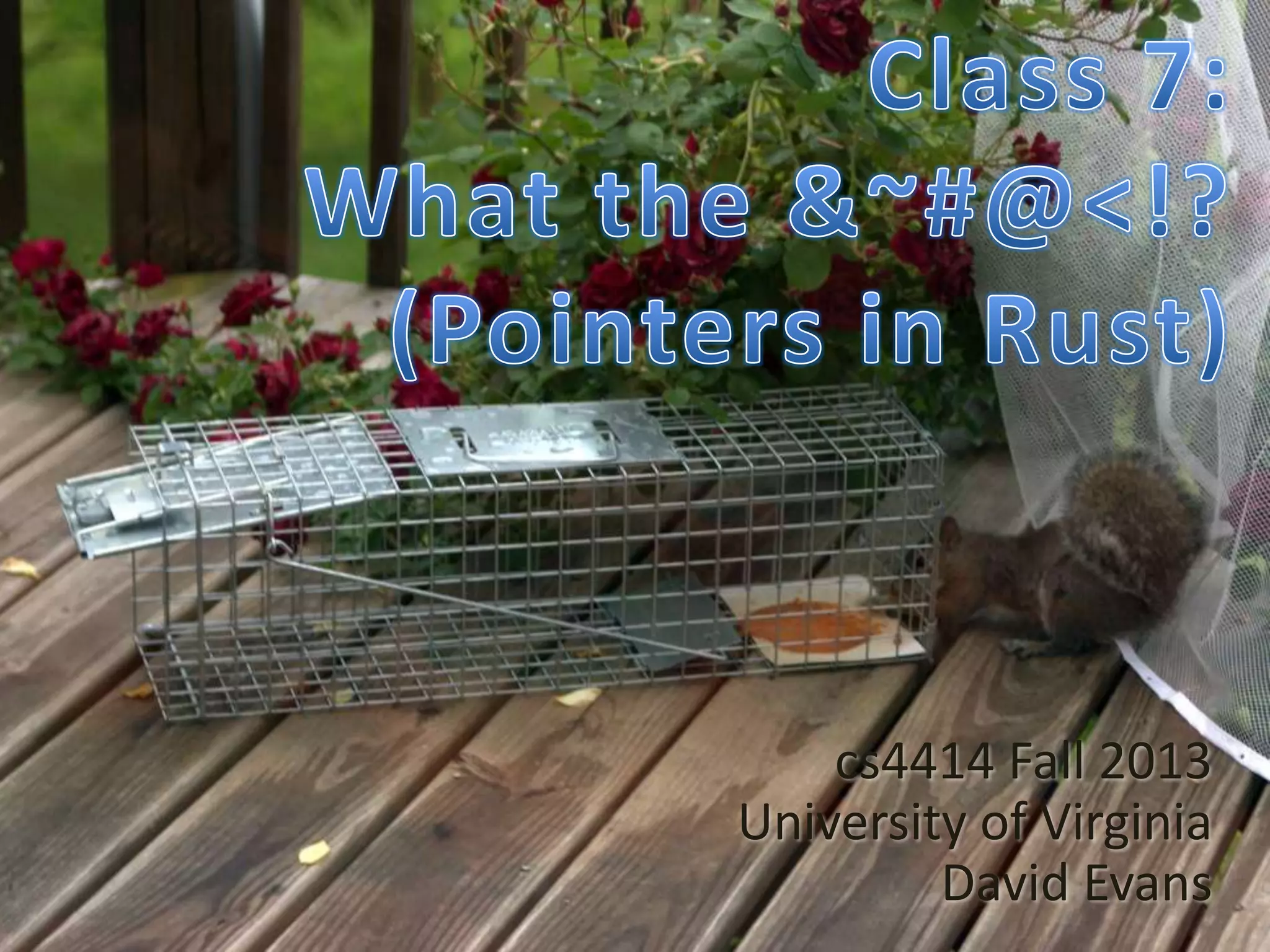





cs4414 Fall 2013
University of Virginia
David Evans
Plan for Today
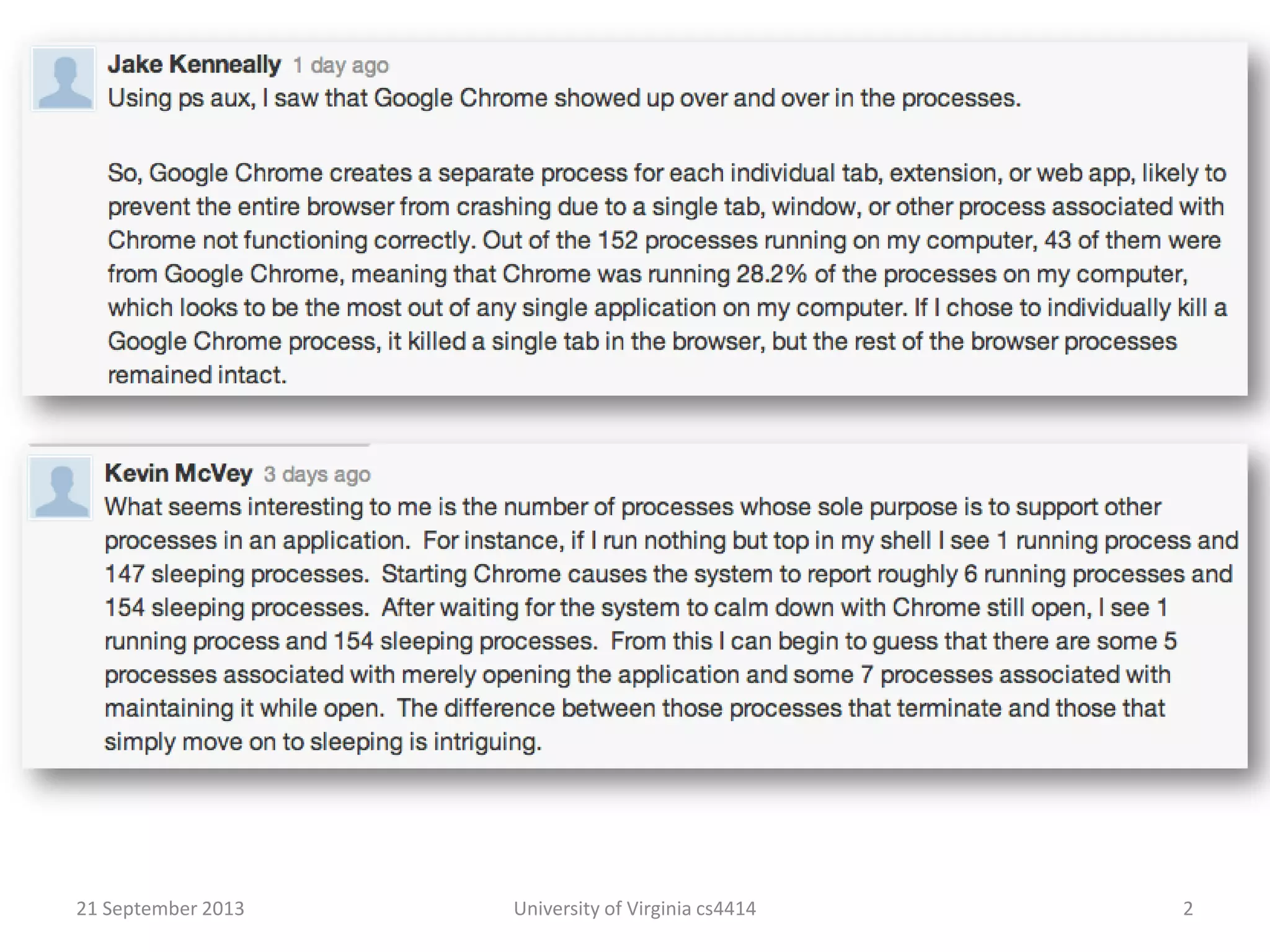
Some early comments on PS2 (how many
processes?)
Explicit vs. implicit memory management
Pointers in Rust
21 September 2013 University of Virginia cs4414 1
Notes for today will be posted later today.
21 September 2013 University of Virginia cs4414 2
How many processes should a
browser create?
21 September 2013 University of Virginia cs4414 3
New challenge for Exercise 1 & 2: what is the fewest number of processes you can
have running on your machine?
21 September 2013 University of Virginia cs4414 4
1990’s answer:
1 process since
processes waste
memory and CPU
which are expensive
and limited
21 September 2013 University of Virginia cs4414 5
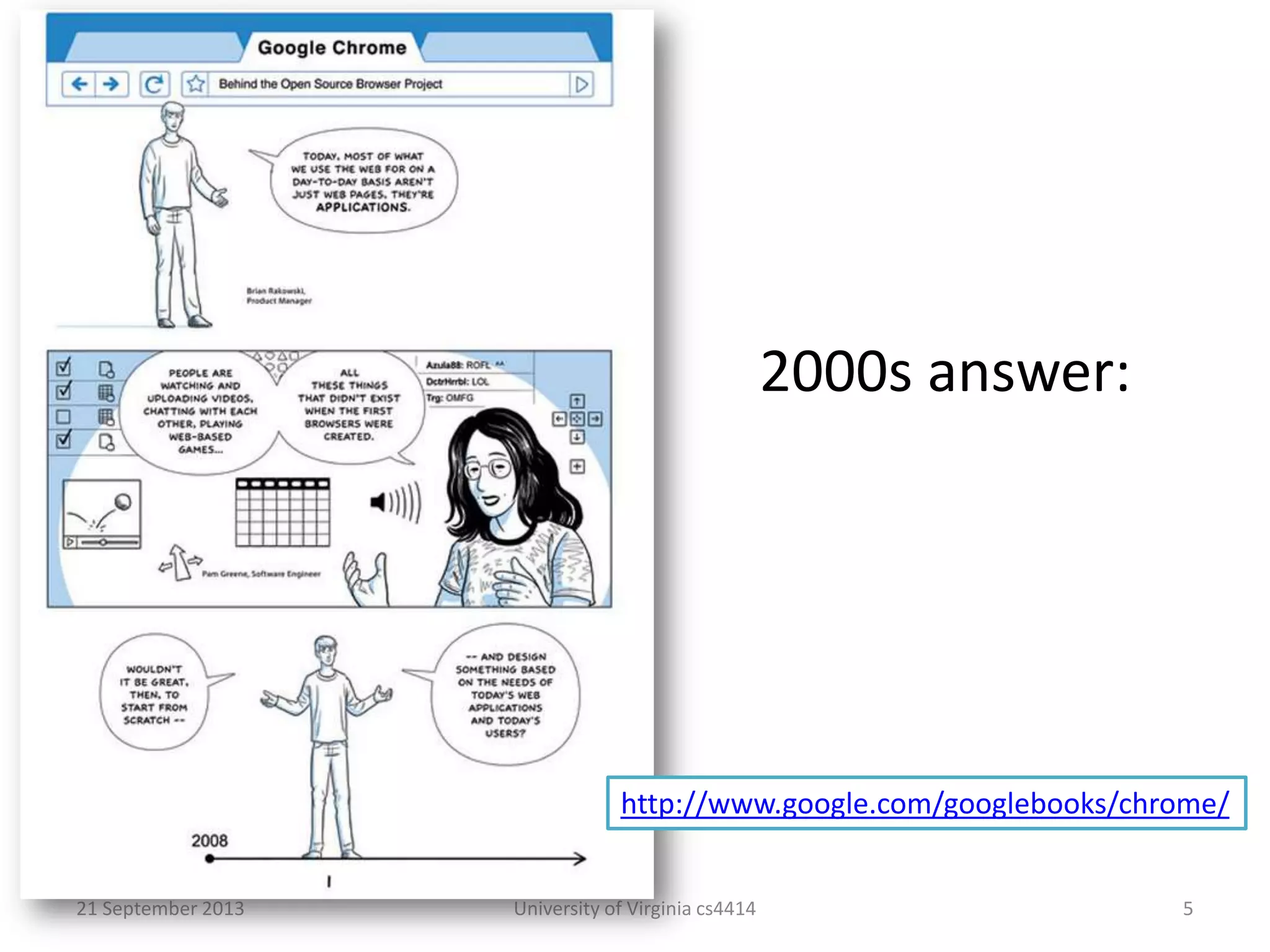
2000s answer:
http://www.google.com/googlebooks/chrome/
21 September 2013 University of Virginia cs4414 6
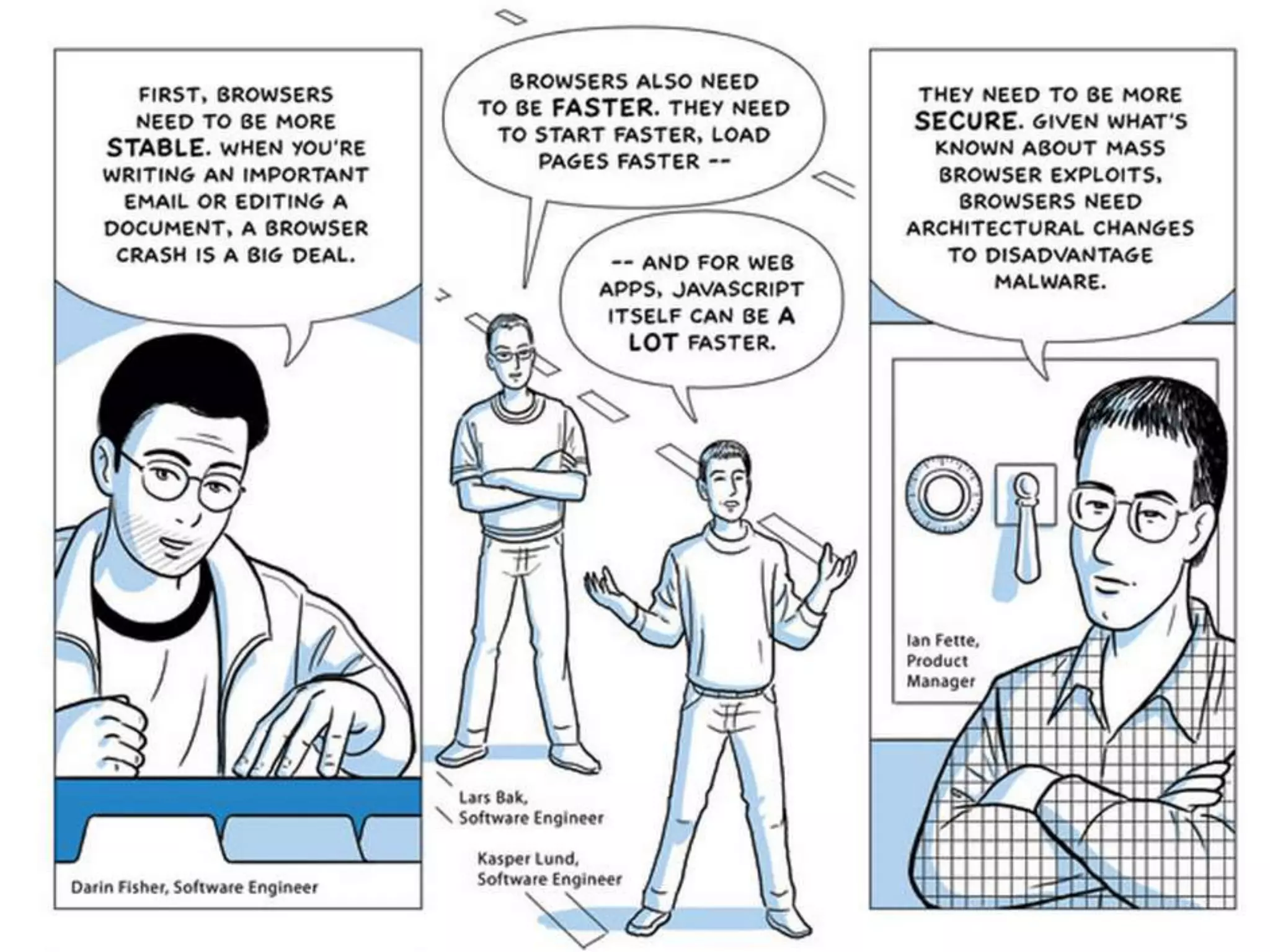
21 September 2013 University of Virginia cs4414 7
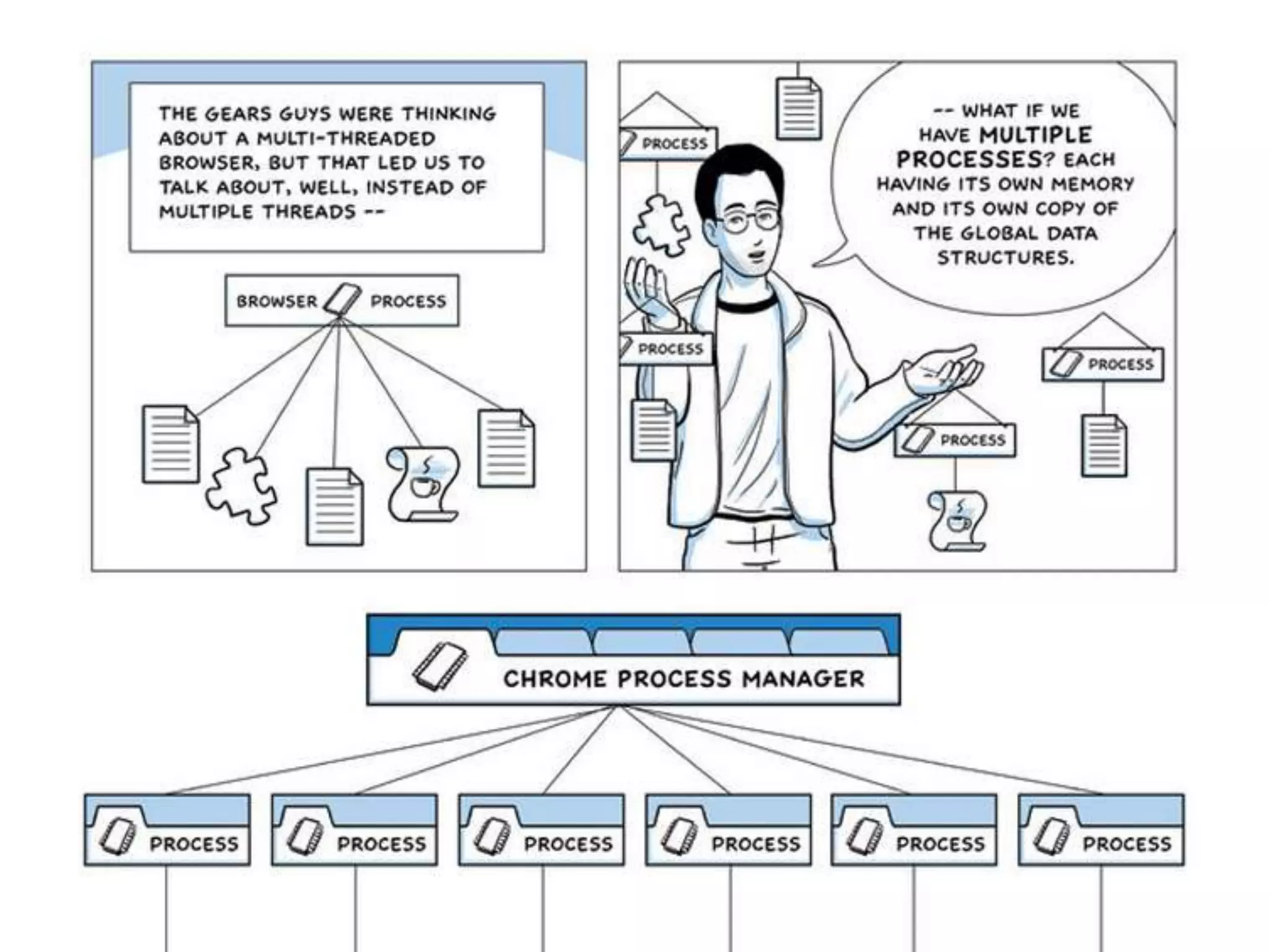
21 September 2013 University of Virginia cs4414 8
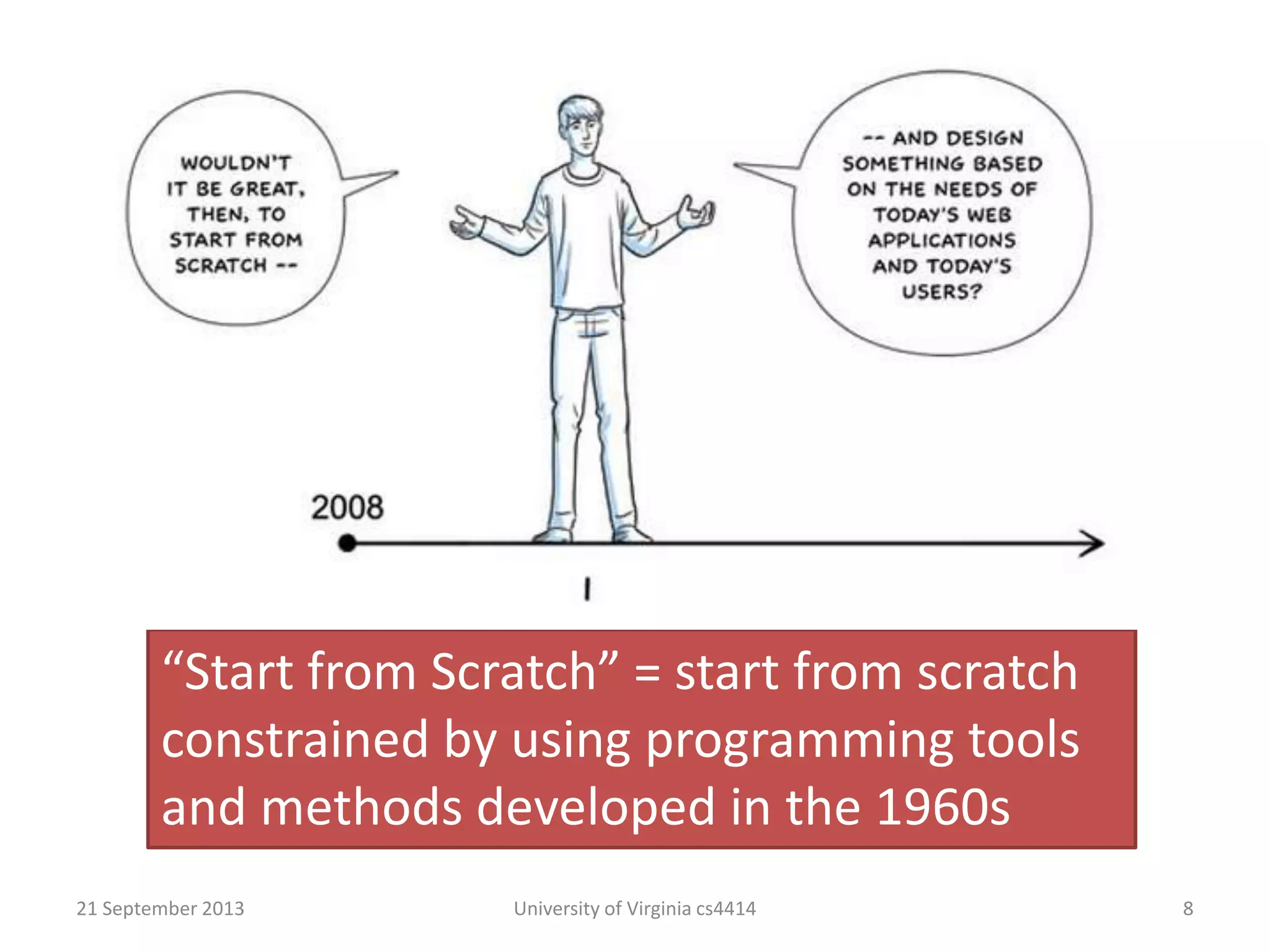
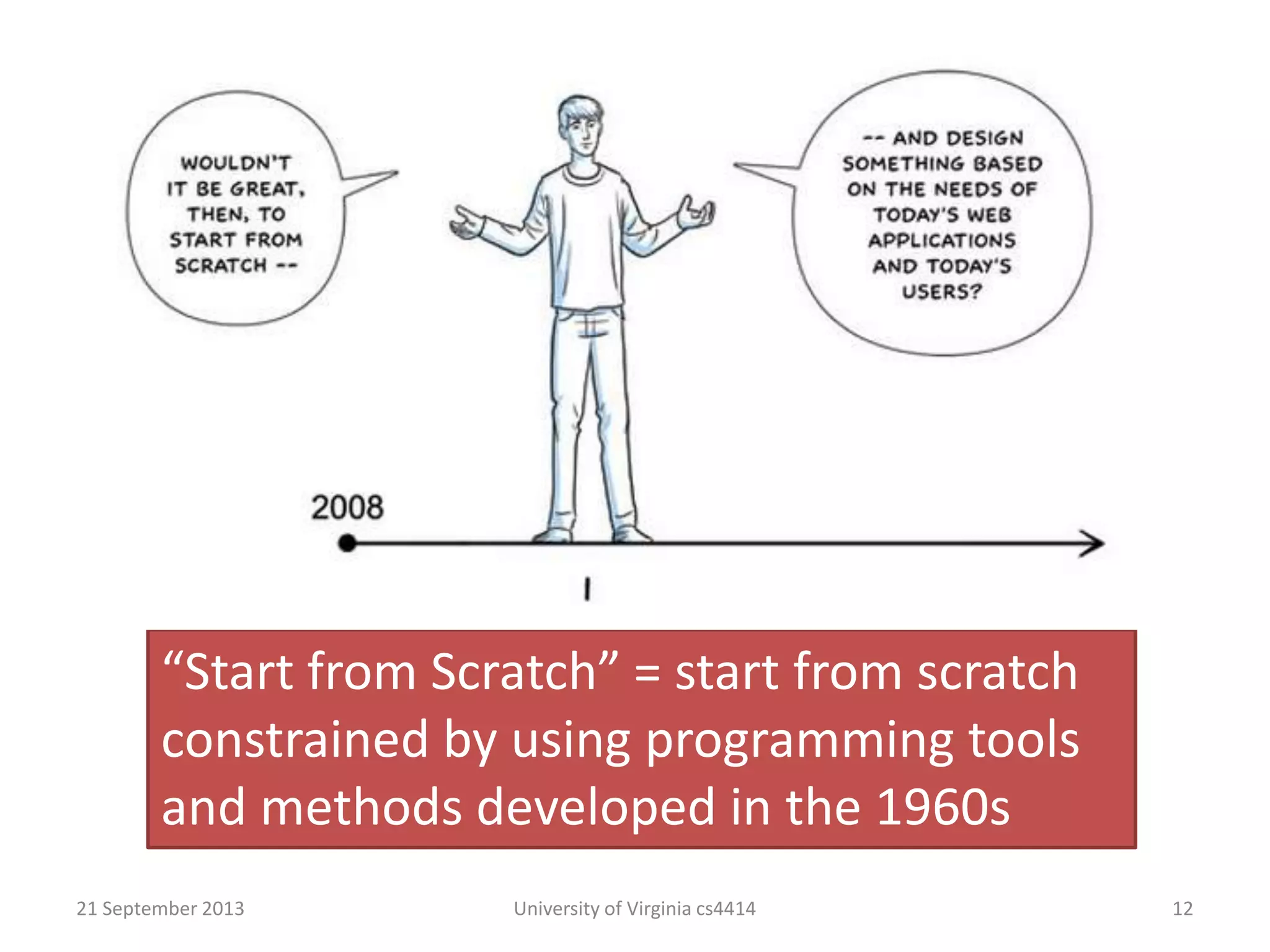
“Start from Scratch” = start from scratch
constrained by using programming tools
and methods developed in the 1960s
What should the 2010s answer be?
21 September 2013 University of Virginia cs4414 9
21 September 2013 University of Virginia cs4414 10
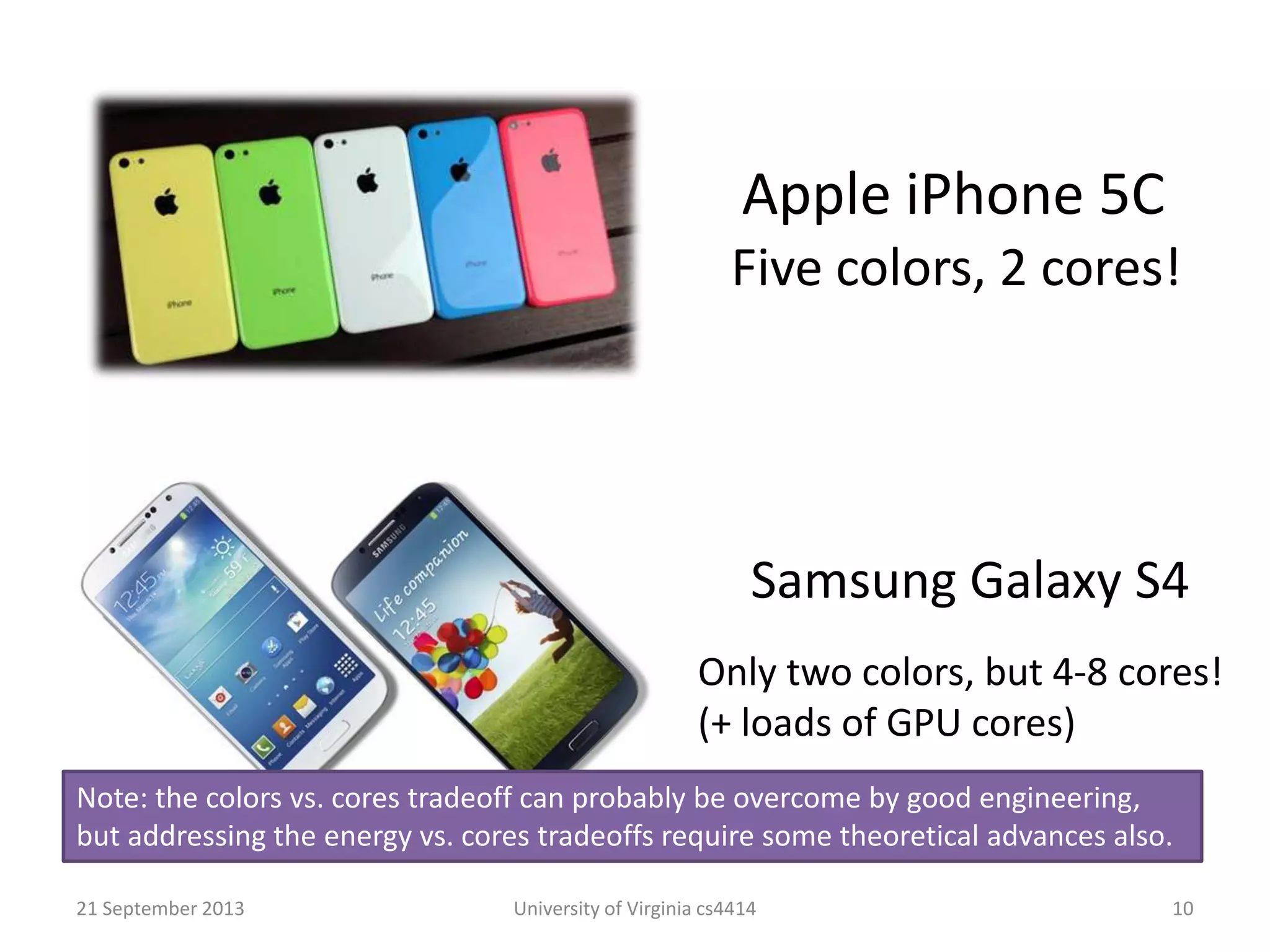
Only two colors, but 4-8 cores!
(+ loads of GPU cores)
Samsung Galaxy S4
Apple iPhone 5C
Five colors, 2 cores!
Note: the colors vs. cores tradeoff can probably be overcome by good engineering,
but addressing the energy vs. cores tradeoffs require some theoretical advances also.
21 September 2013 University of Virginia cs4414 11
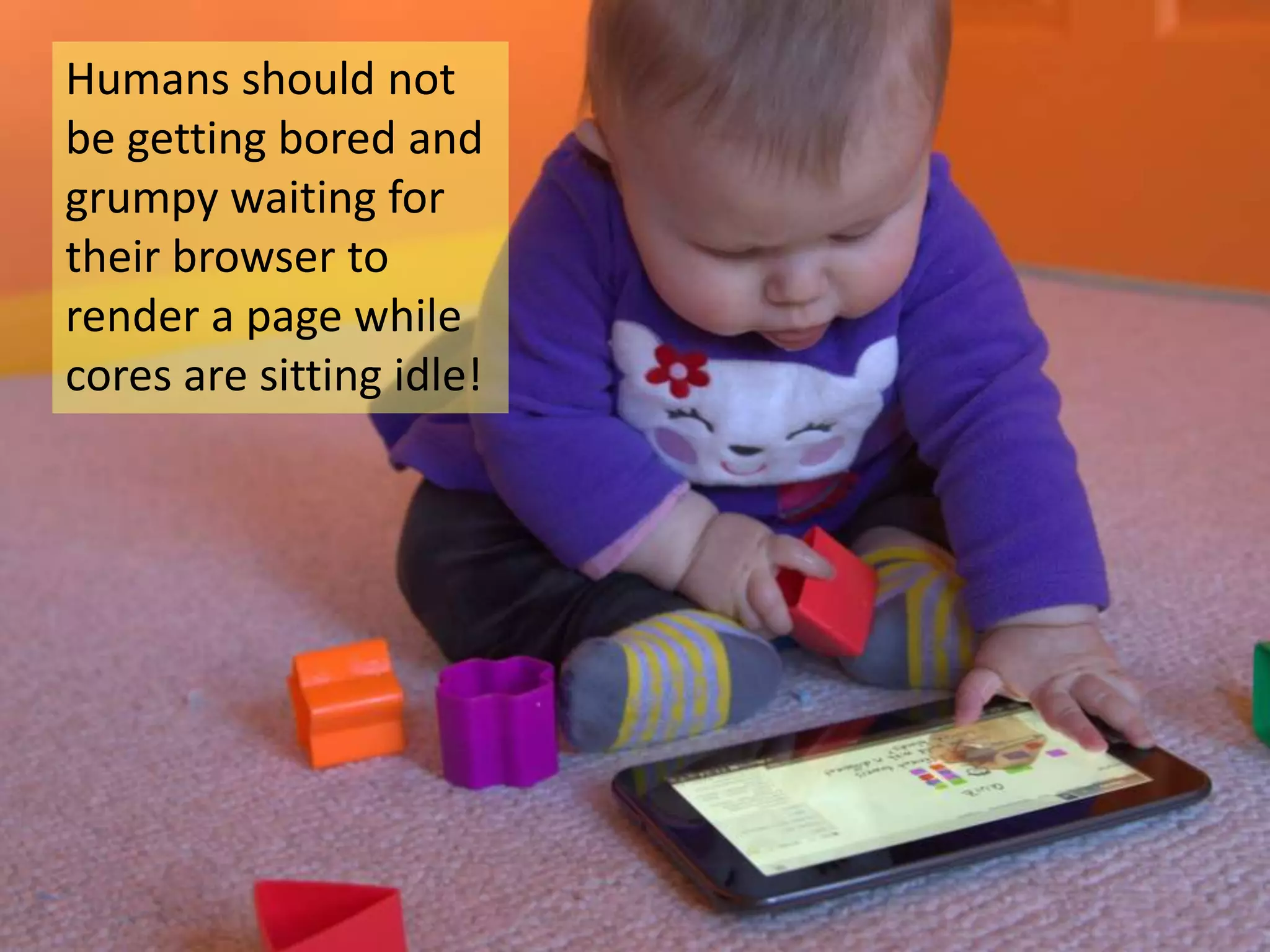
Humans should not
be getting bored and
grumpy waiting for
their browser to
render a page while
cores are sitting idle!
21 September 2013 University of Virginia cs4414 12
“Start from Scratch” = start from scratch
constrained by using programming tools
and methods developed in the 1960s
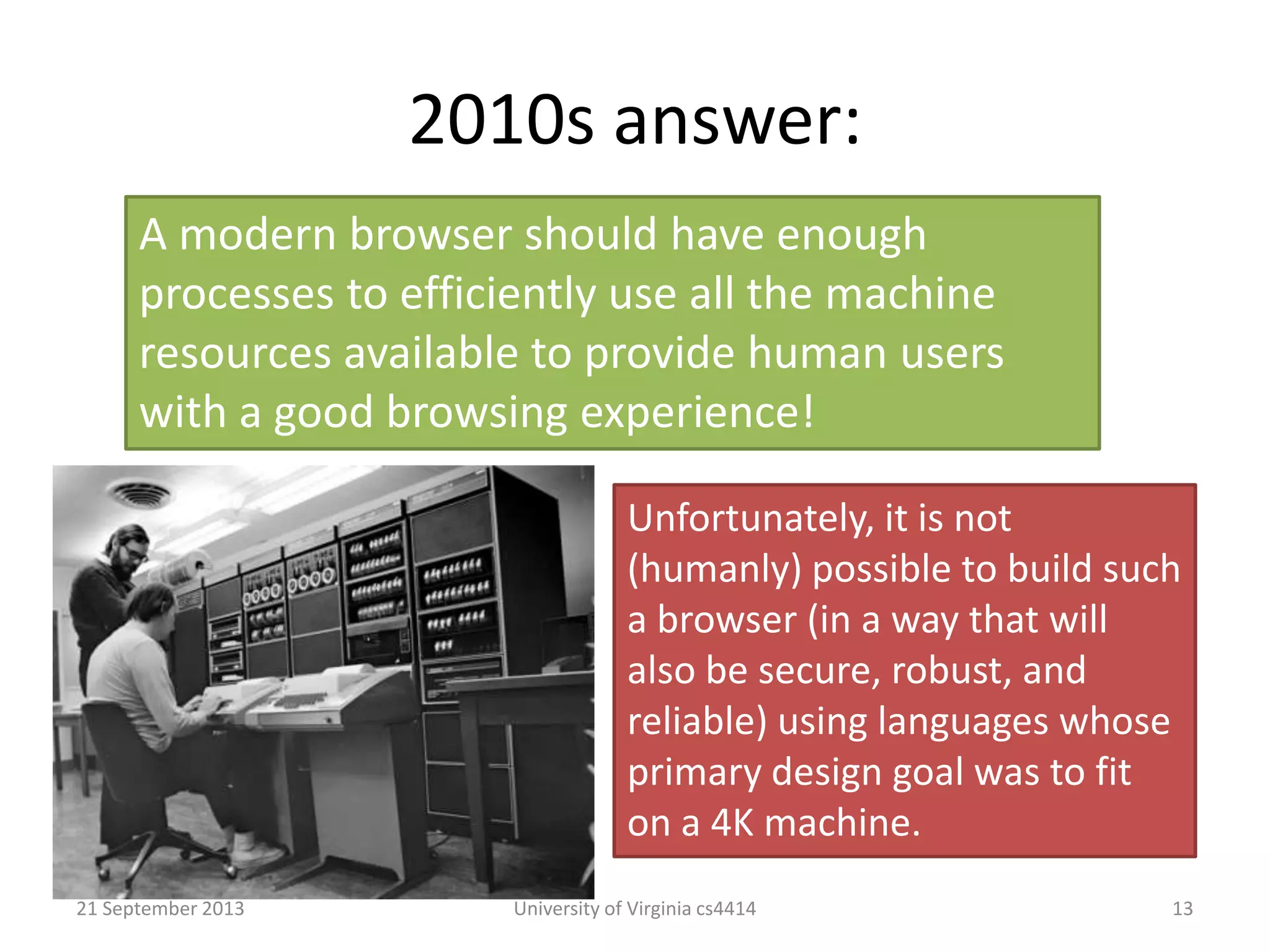
2010s answer:
21 September 2013 University of Virginia cs4414 13
A modern browser should have enough
processes to efficiently use all the machine
resources available to provide human users
with a good browsing experience!
Unfortunately, it is not
(humanly) possible to build such
a browser (in a way that will
also be secure, robust, and
reliable) using languages whose
primary design goal was to fit
on a 4K machine.
21 September 2013 University of Virginia cs4414 14
Why do our
Rust stickers
have a gear
on them?
Servo: the main reason
Rust is being developed is
so Mozilla can build a
better browser!
21 September 2013 University of Virginia cs4414 15
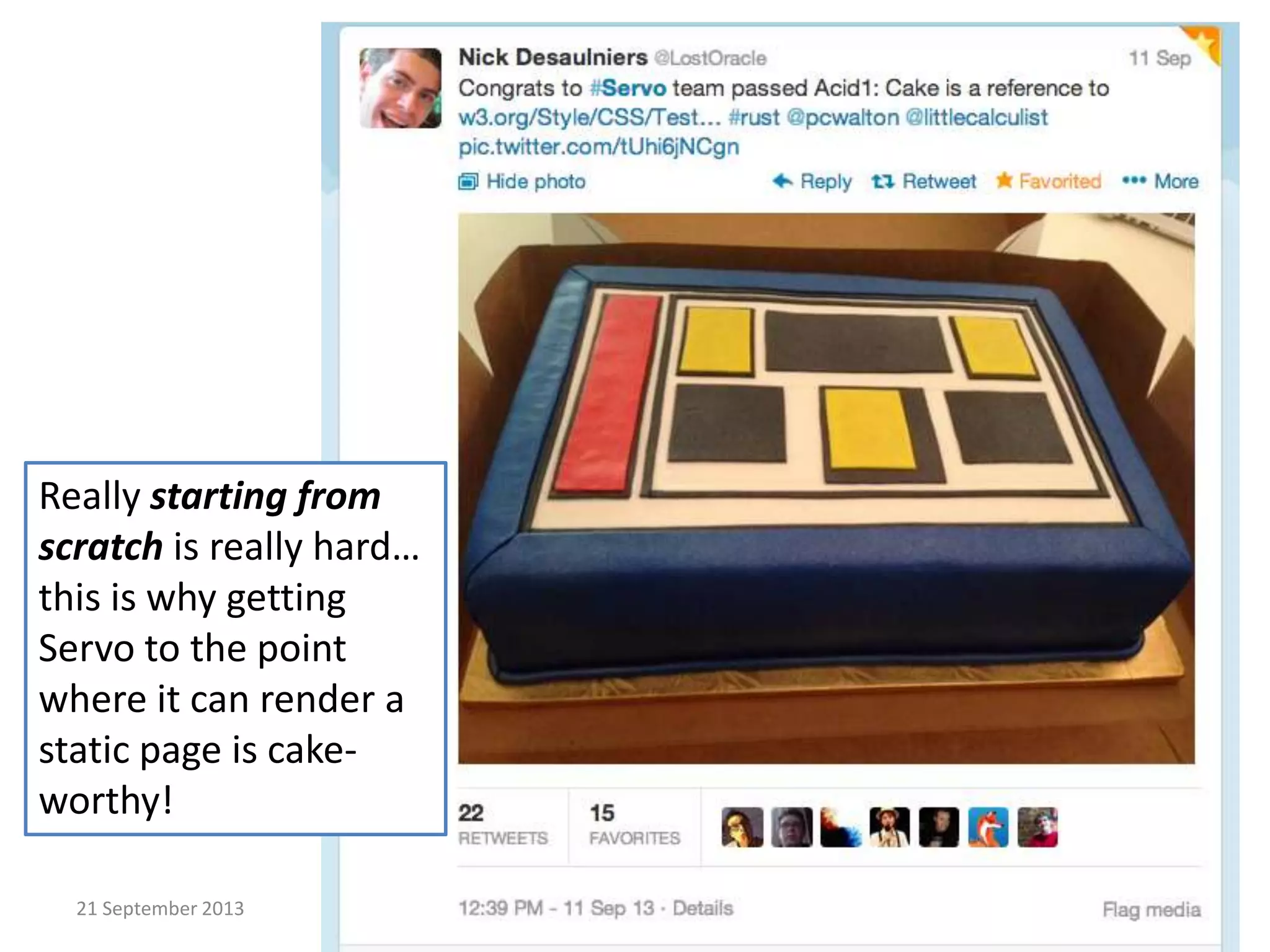
Really starting from
scratch is really hard…
this is why getting
Servo to the point
where it can render a
static page is cake-
worthy!
What Dave was doing when you
were learning to crawl…
21 September 2013 University of Virginia cs4414 16
21 September 2013 University of Virginia cs4414 17
ACM Foundations in Software Engineering, 1994
21 September 2013 University of Virginia cs4414 18
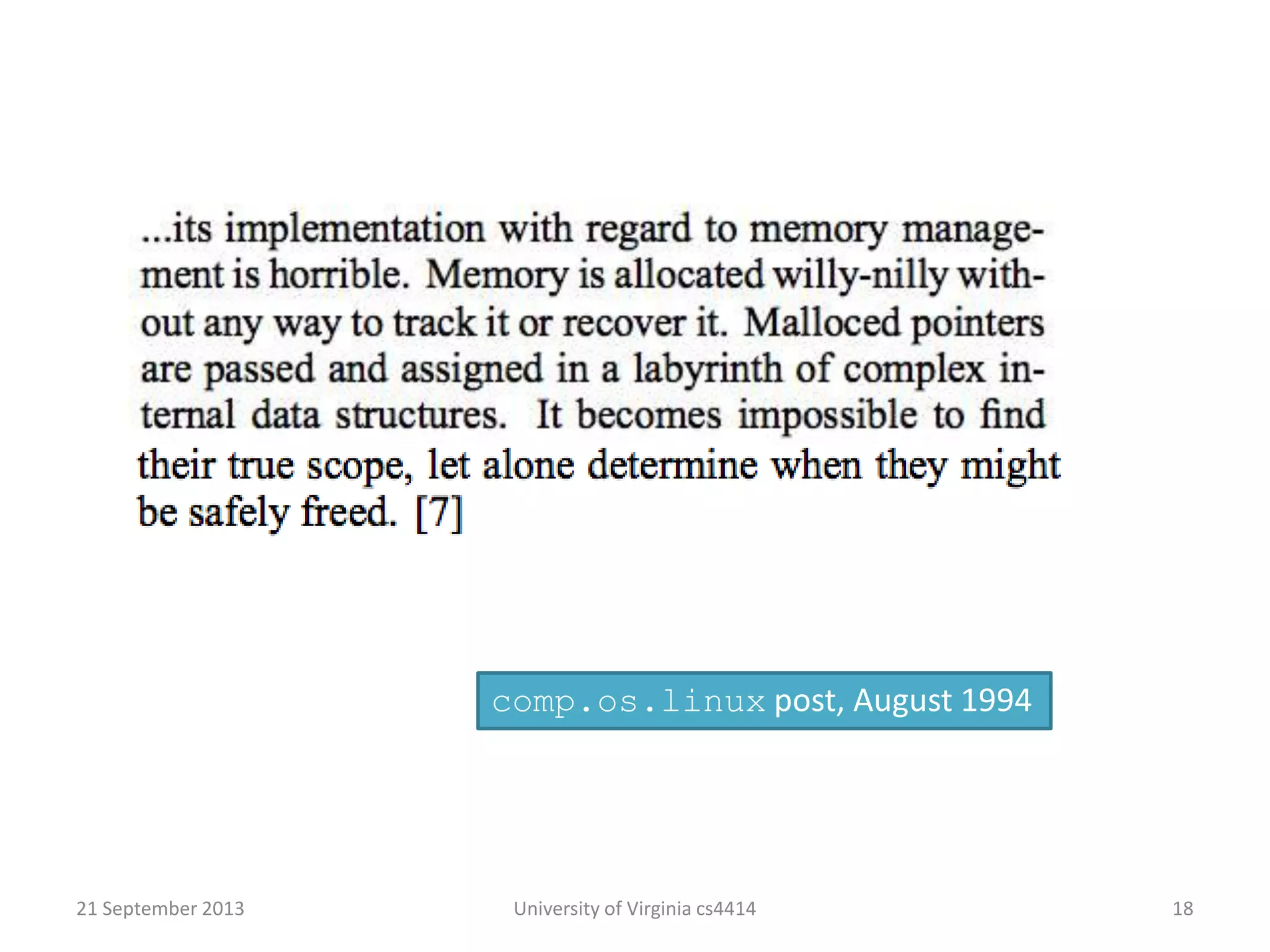
comp.os.linux post, August 1994
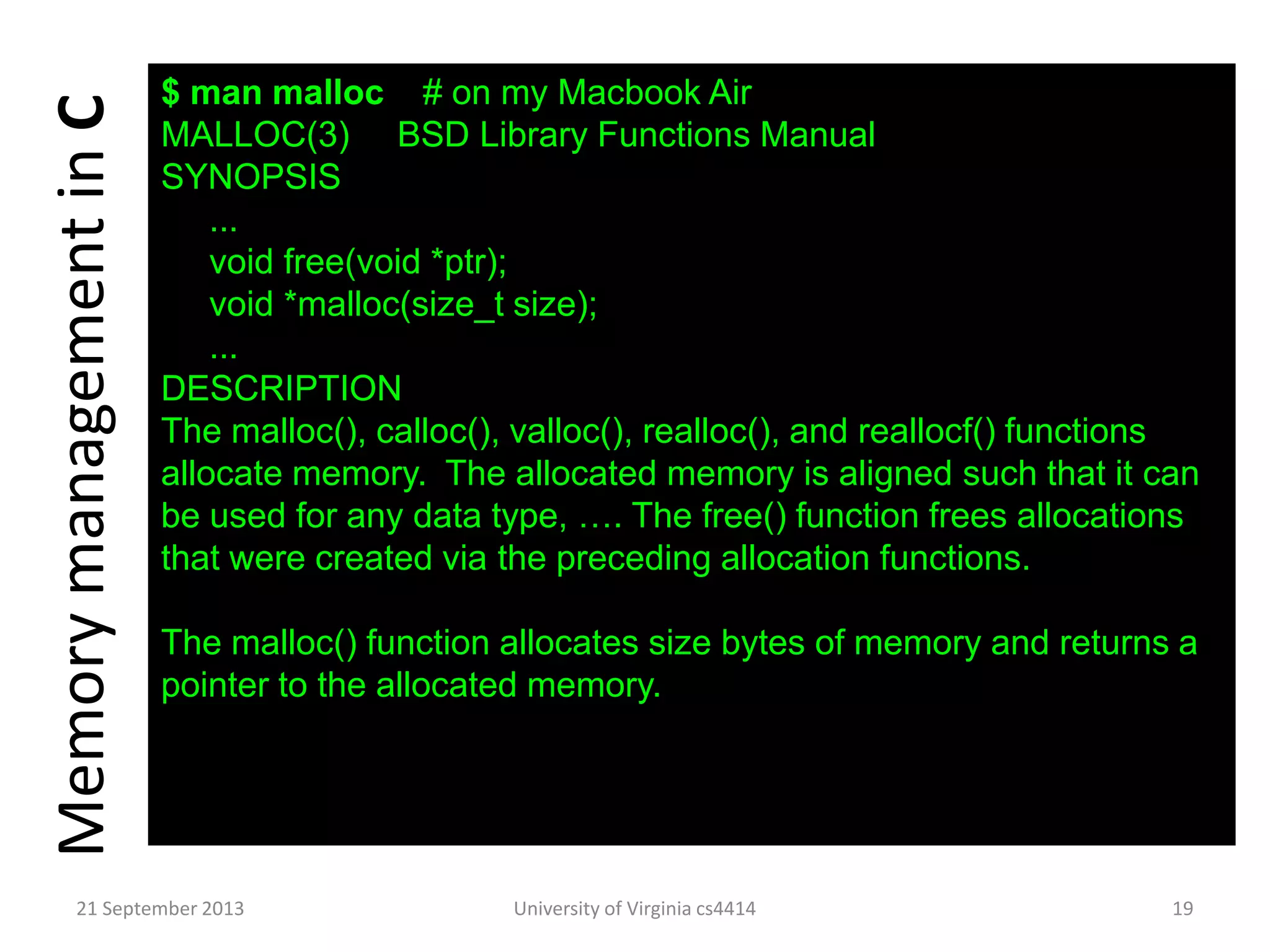
$ man malloc # on my Macbook Air
MALLOC(3) BSD Library Functions Manual
SYNOPSIS
...
void free(void *ptr);
void *malloc(size_t size);
...
DESCRIPTION
The malloc(), calloc(), valloc(), realloc(), and reallocf() functions
allocate memory. The allocated memory is aligned such that it can
be used for any data type, …. The free() function frees allocations
that were created via the preceding allocation functions.
The malloc() function allocates size bytes of memory and returns a
pointer to the allocated memory.
MemorymanagementinC
21 September 2013 University of Virginia cs4414 19
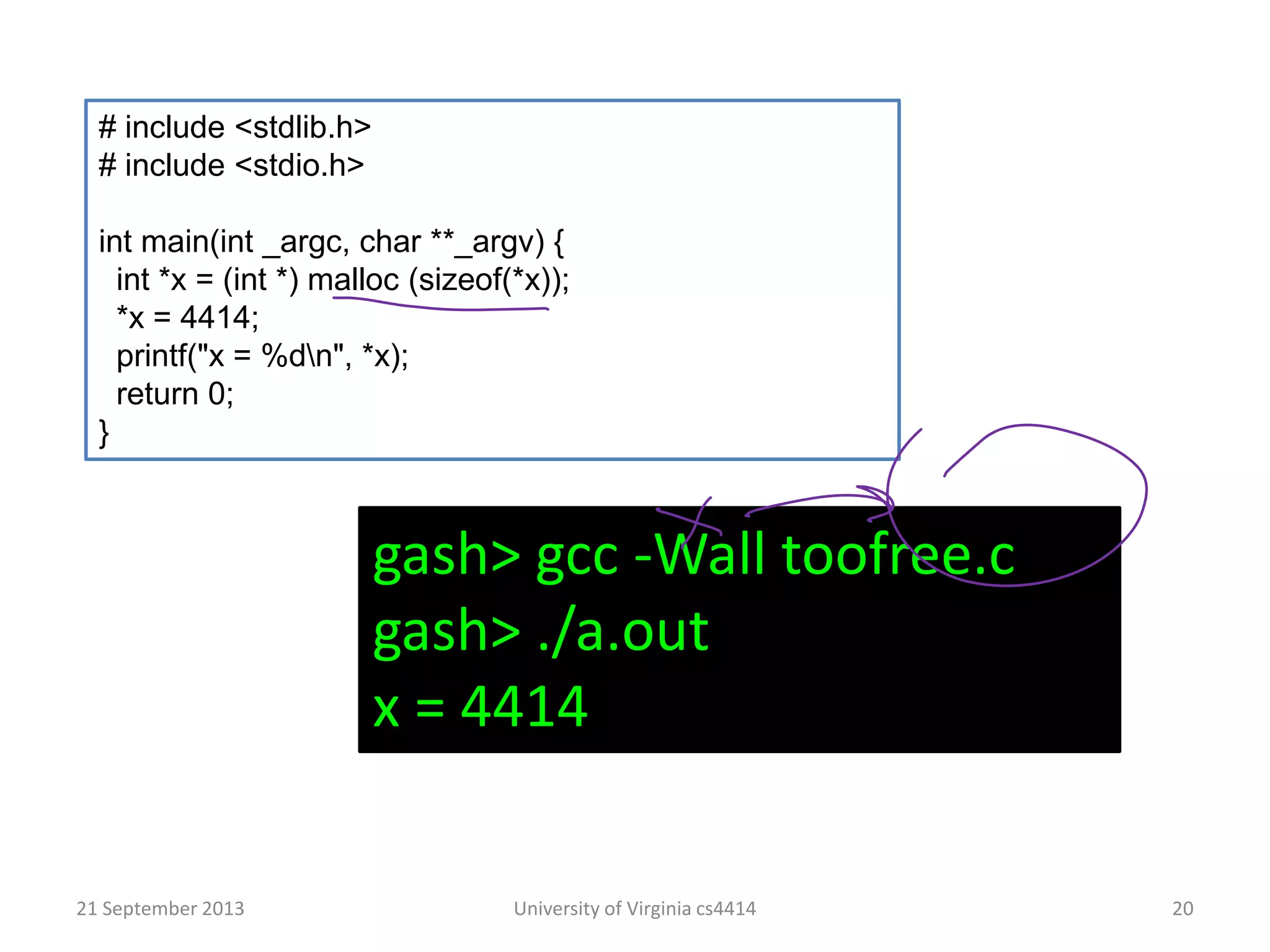
21 September 2013 University of Virginia cs4414 20
# include <stdlib.h>
# include <stdio.h>
int main(int _argc, char **_argv) {
int *x = (int *) malloc (sizeof(*x));
*x = 4414;
printf("x = %dn", *x);
return 0;
}
gash> gcc -Wall toofree.c
gash> ./a.out
x = 4414
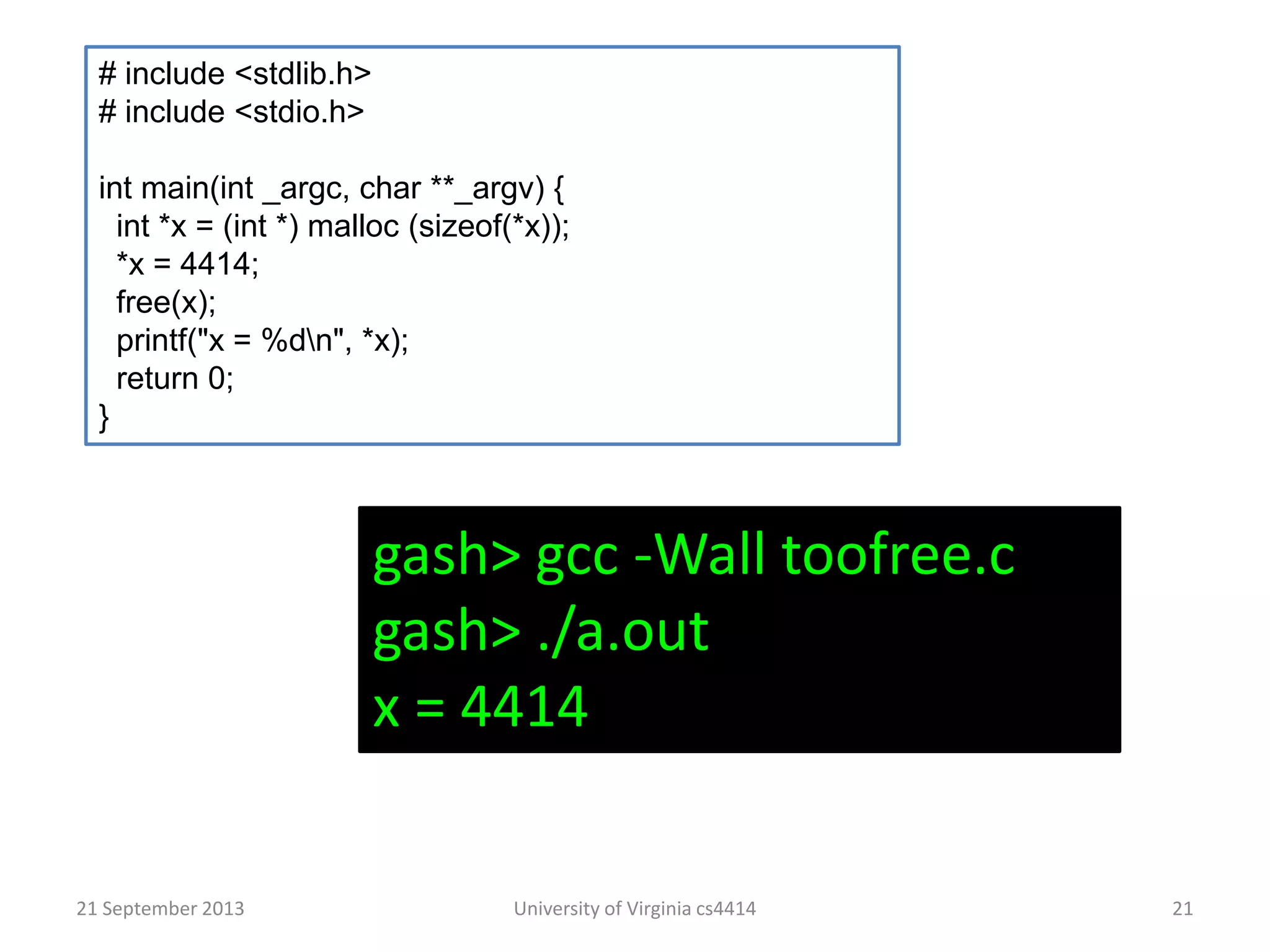
21 September 2013 University of Virginia cs4414 21
# include <stdlib.h>
# include <stdio.h>
int main(int _argc, char **_argv) {
int *x = (int *) malloc (sizeof(*x));
*x = 4414;
free(x);
printf("x = %dn", *x);
return 0;
}
gash> gcc -Wall toofree.c
gash> ./a.out
x = 4414
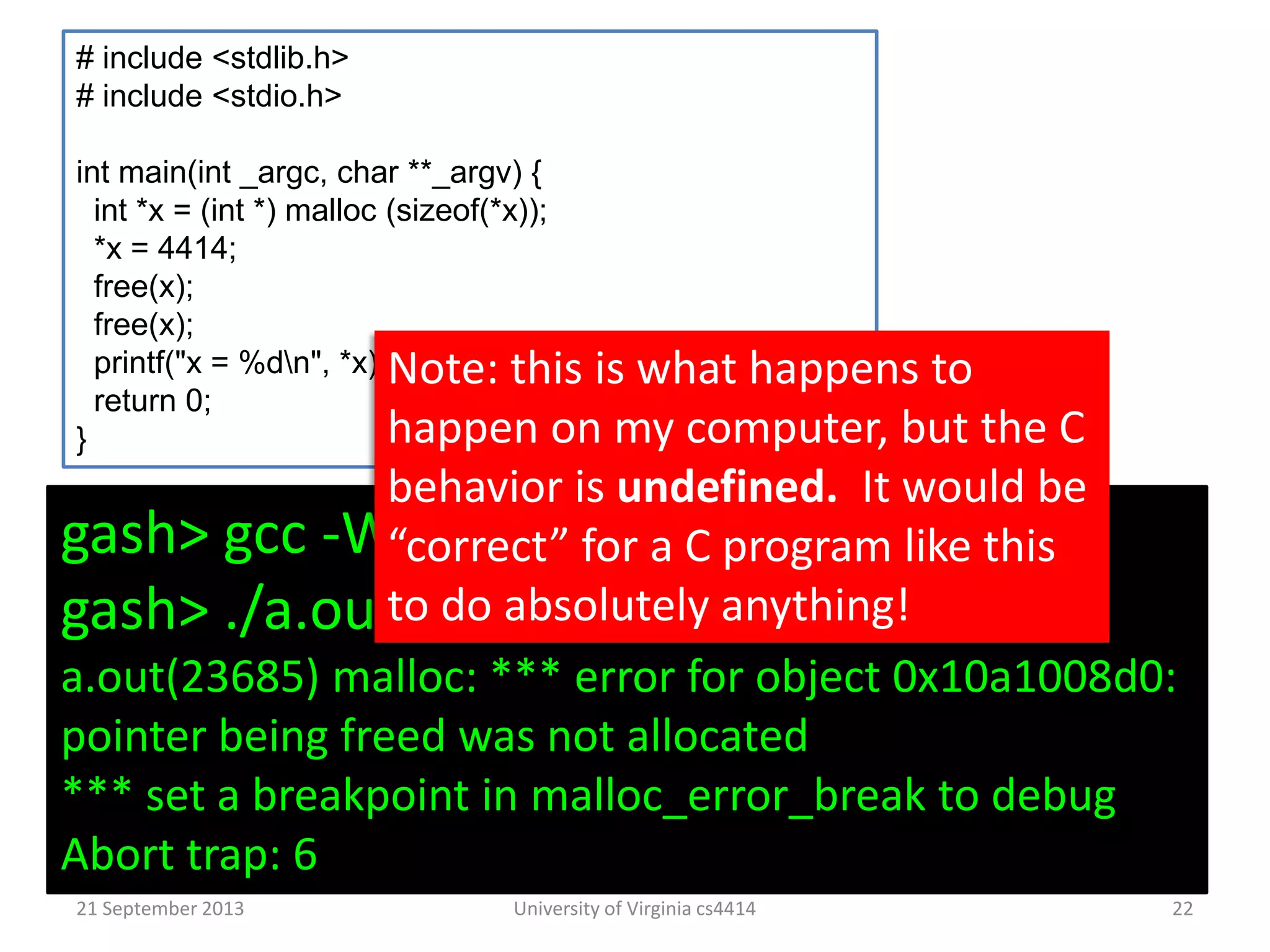
21 September 2013 University of Virginia cs4414 22
# include <stdlib.h>
# include <stdio.h>
int main(int _argc, char **_argv) {
int *x = (int *) malloc (sizeof(*x));
*x = 4414;
free(x);
free(x);
printf("x = %dn", *x);
return 0;
}
gash> gcc -Wall toofree.c
gash> ./a.out
a.out(23685) malloc: *** error for object 0x10a1008d0:
pointer being freed was not allocated
*** set a breakpoint in malloc_error_break to debug
Abort trap: 6
Note: this is what happens to
happen on my computer, but the C
behavior is undefined. It would be
“correct” for a C program like this
to do absolutely anything!
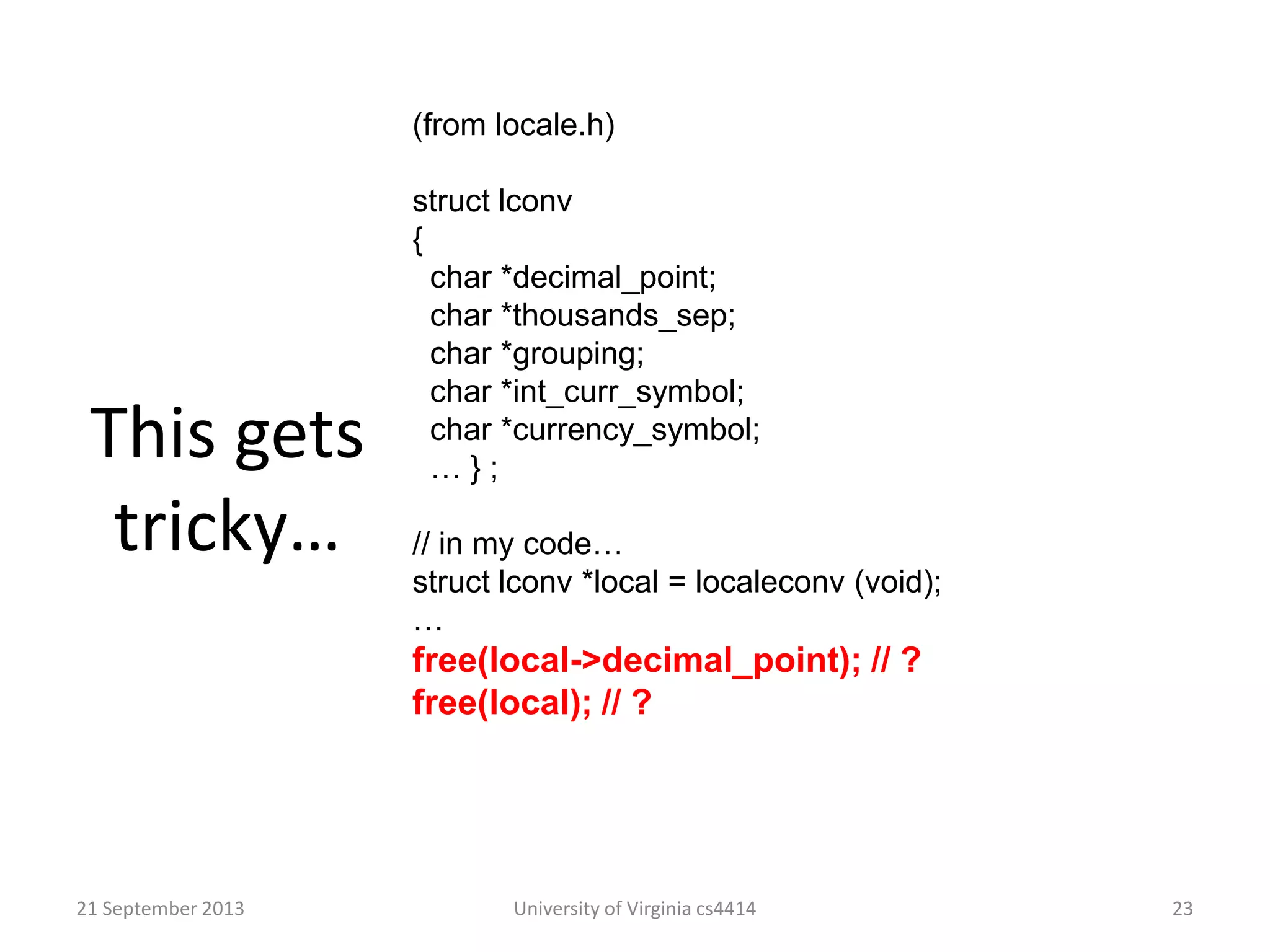
This gets
tricky…
21 September 2013 University of Virginia cs4414 23
(from locale.h)
struct lconv
{
char *decimal_point;
char *thousands_sep;
char *grouping;
char *int_curr_symbol;
char *currency_symbol;
… } ;
// in my code…
struct lconv *local = localeconv (void);
…
free(local->decimal_point); // ?
free(local); // ?
Should we really care?
21 September 2013 University of Virginia cs4414 24
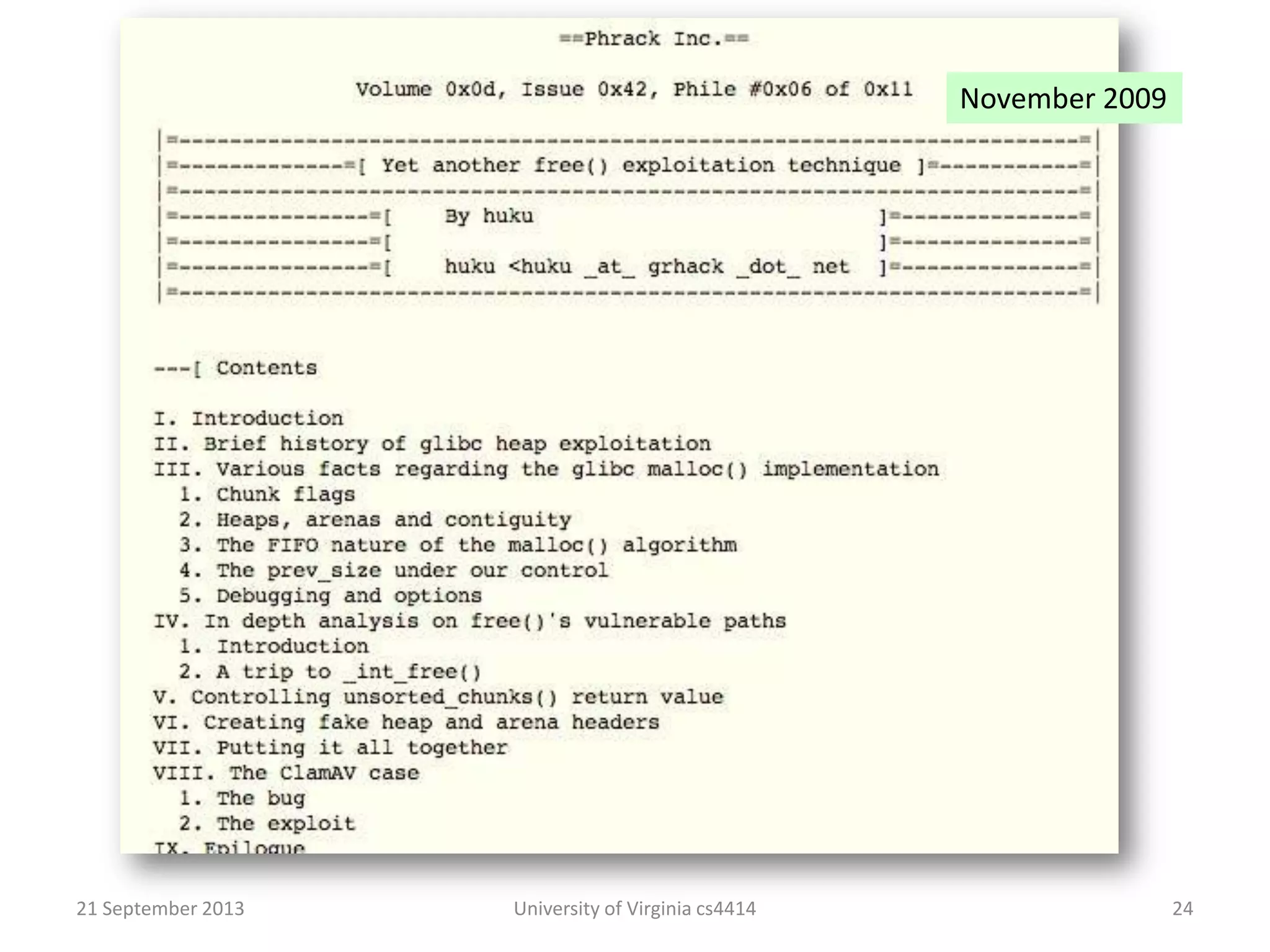
November 2009
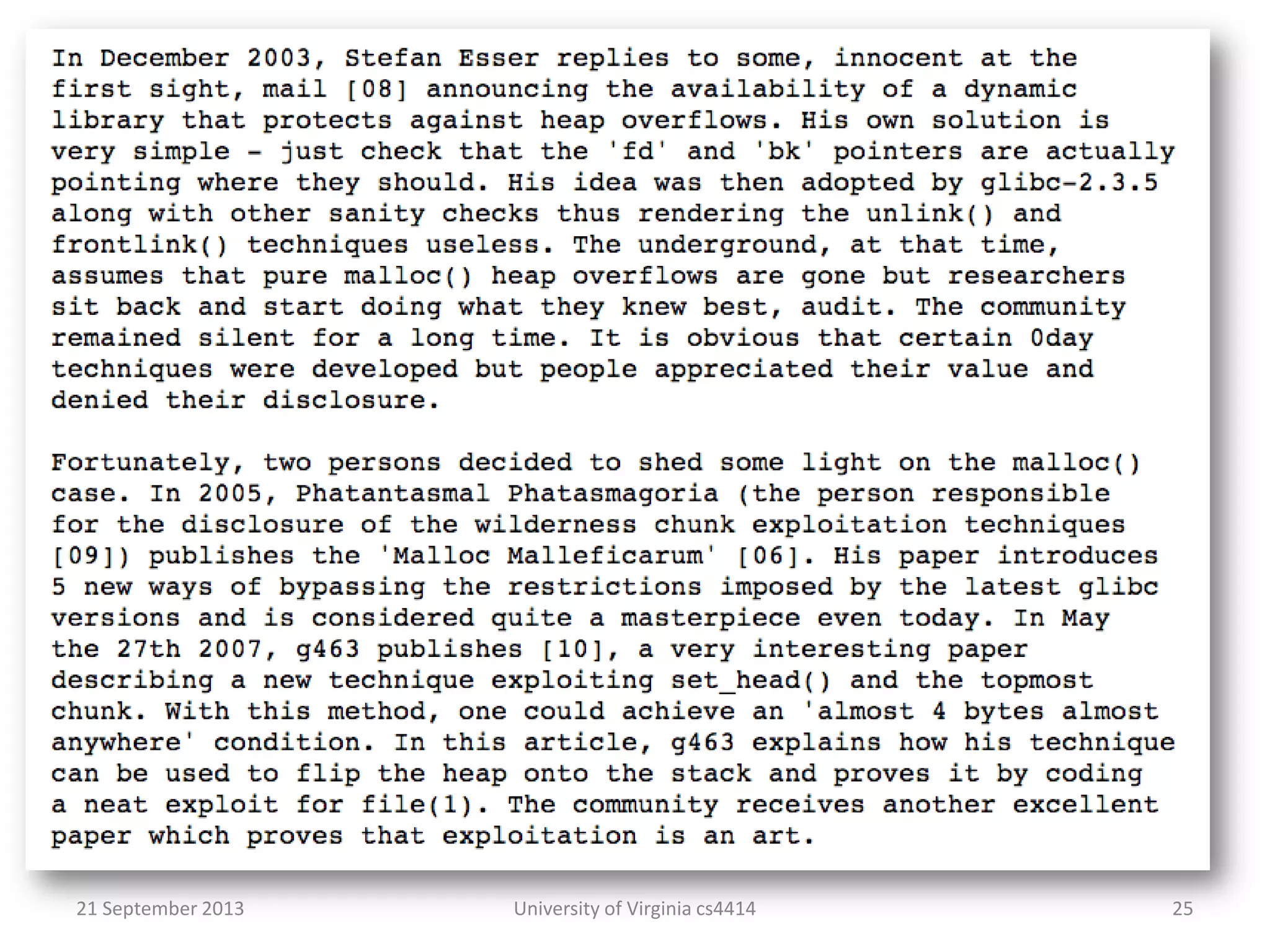
21 September 2013 University of Virginia cs4414 25
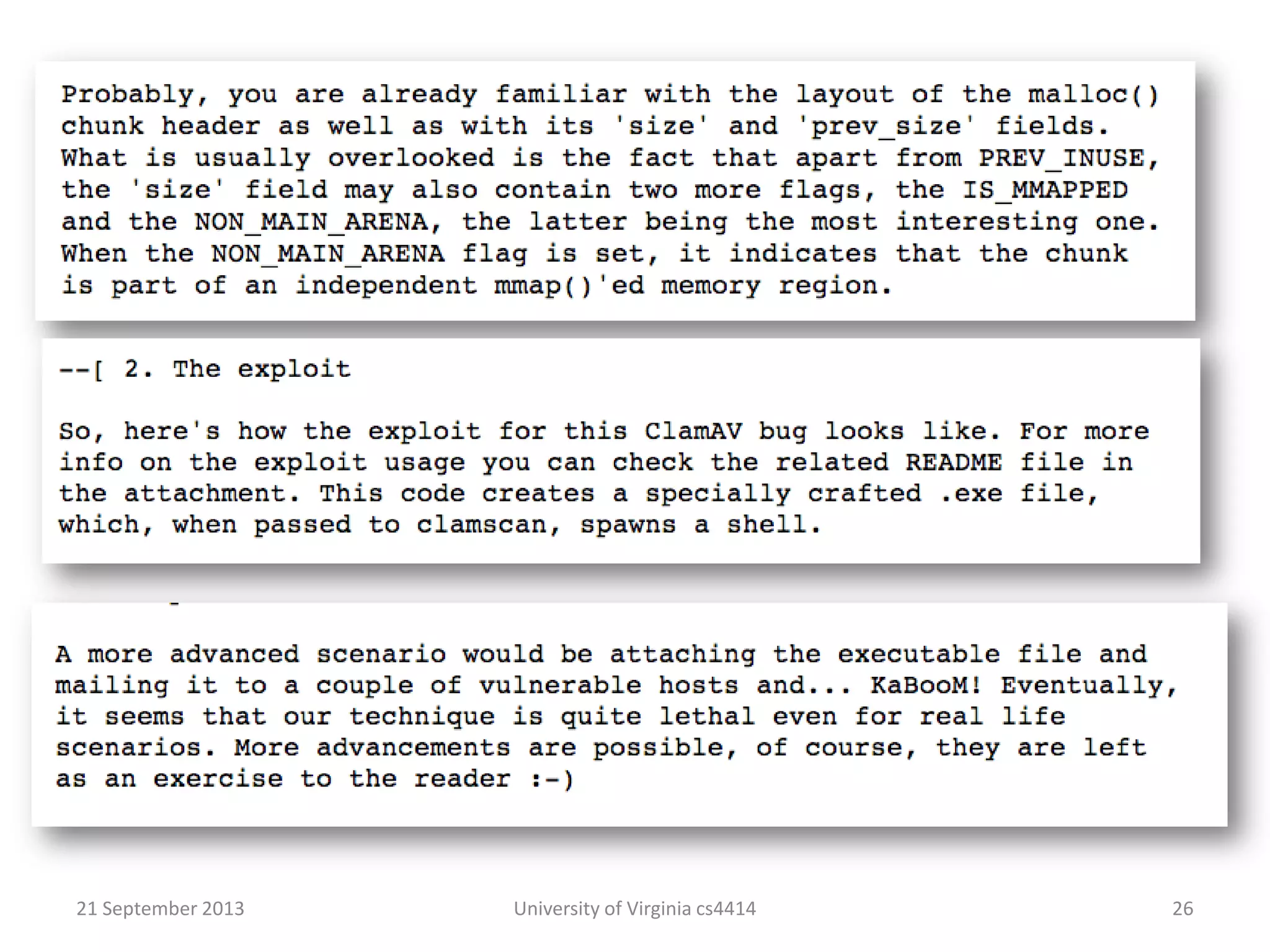
21 September 2013 University of Virginia cs4414 26
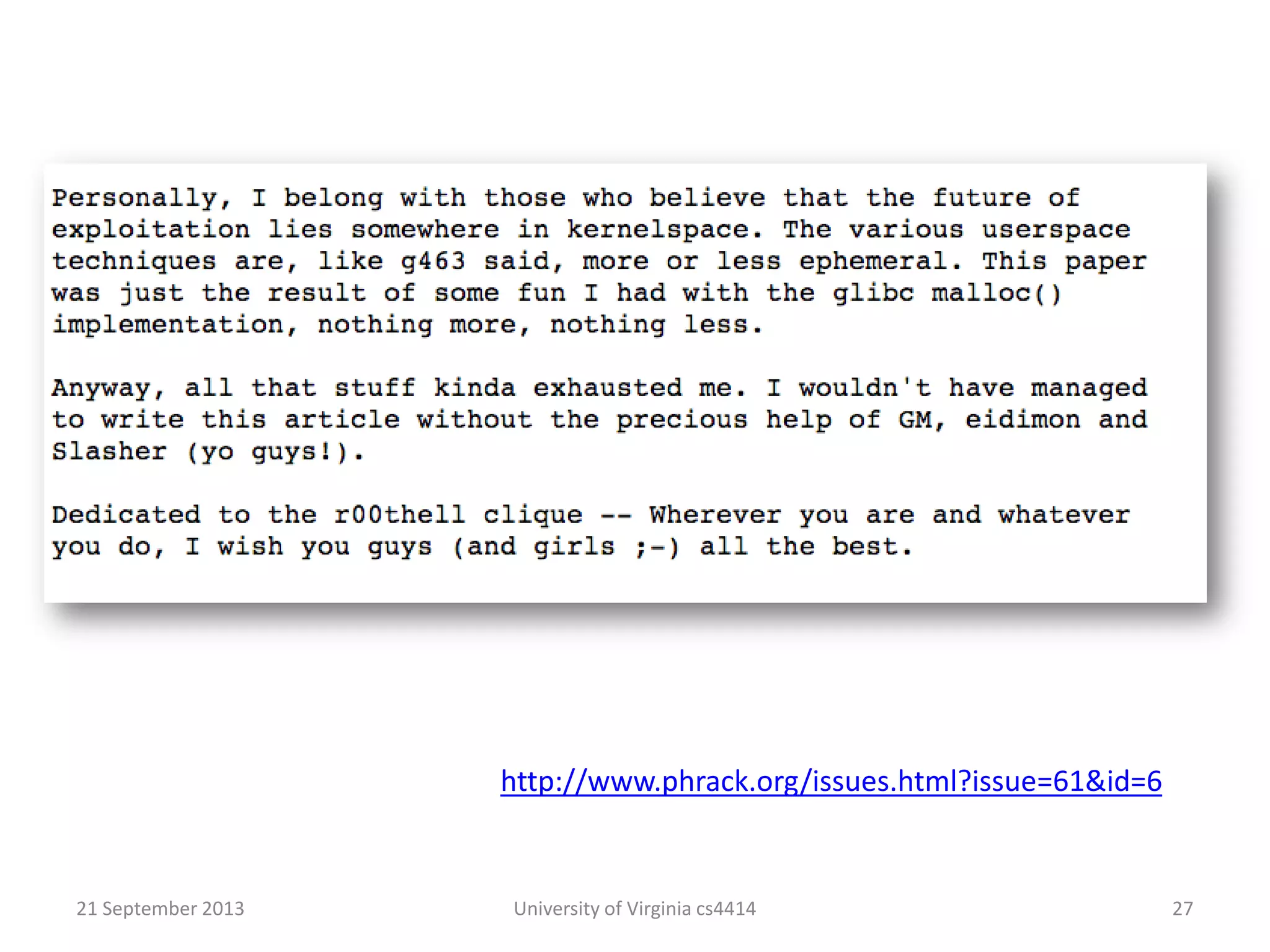
21 September 2013 University of Virginia cs4414 27
http://www.phrack.org/issues.html?issue=61&id=6
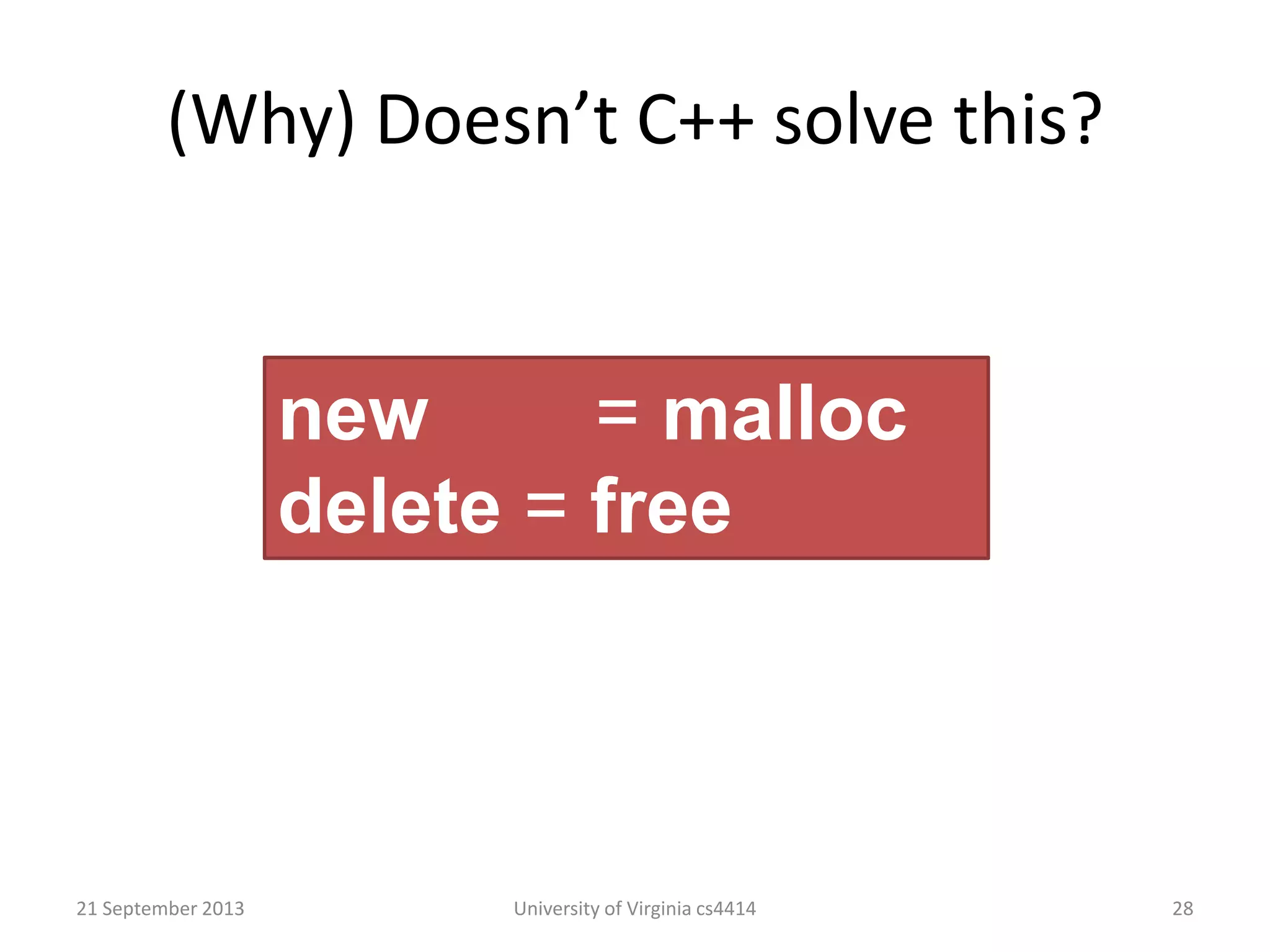
(Why) Doesn’t C++ solve this?
21 September 2013 University of Virginia cs4414 28
new = malloc
delete = free
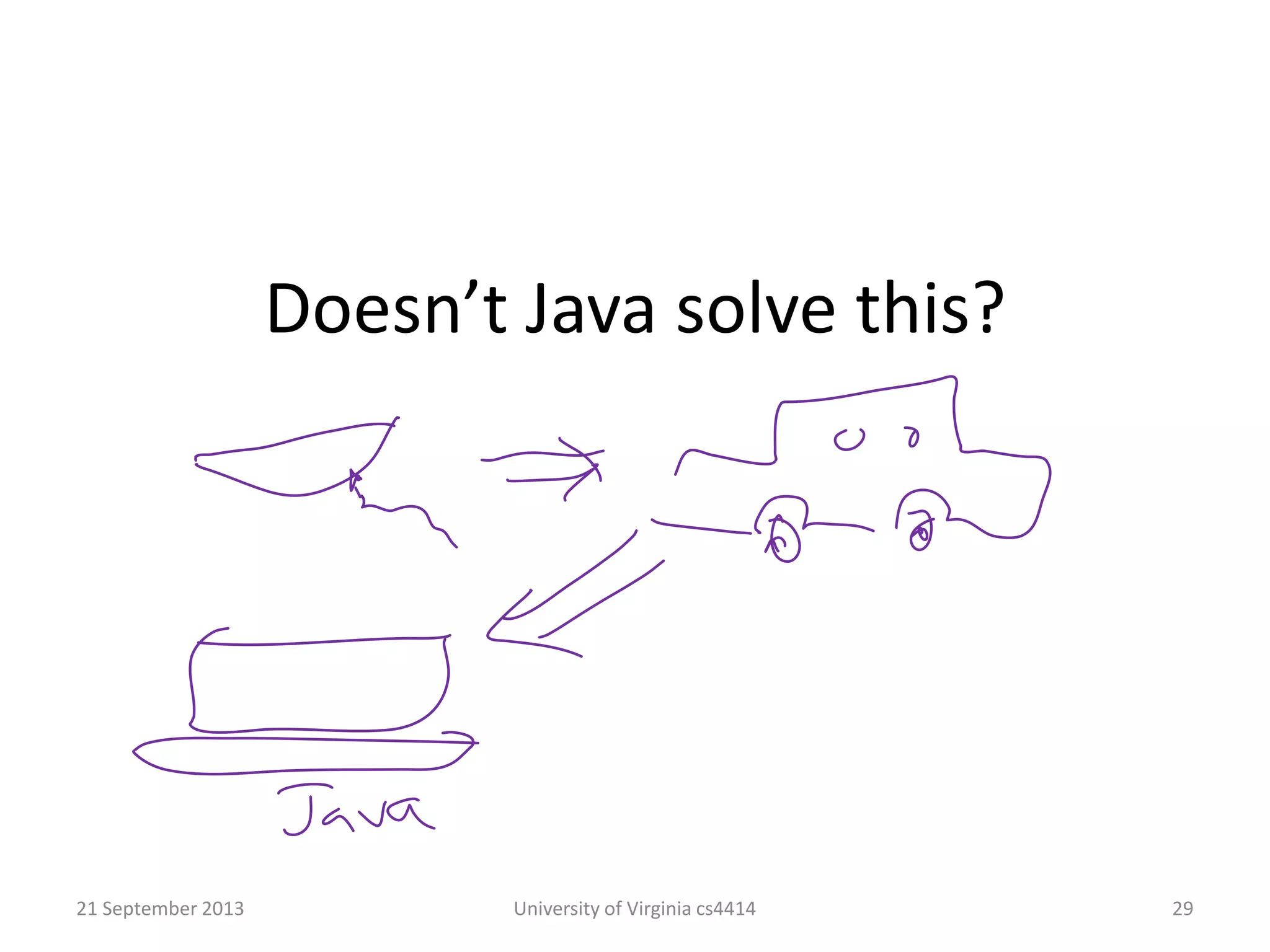
Doesn’t Java solve this?
21 September 2013 University of Virginia cs4414 29
21 September 2013 University of Virginia cs4414 30
21 September 2013 University of Virginia cs4414 31
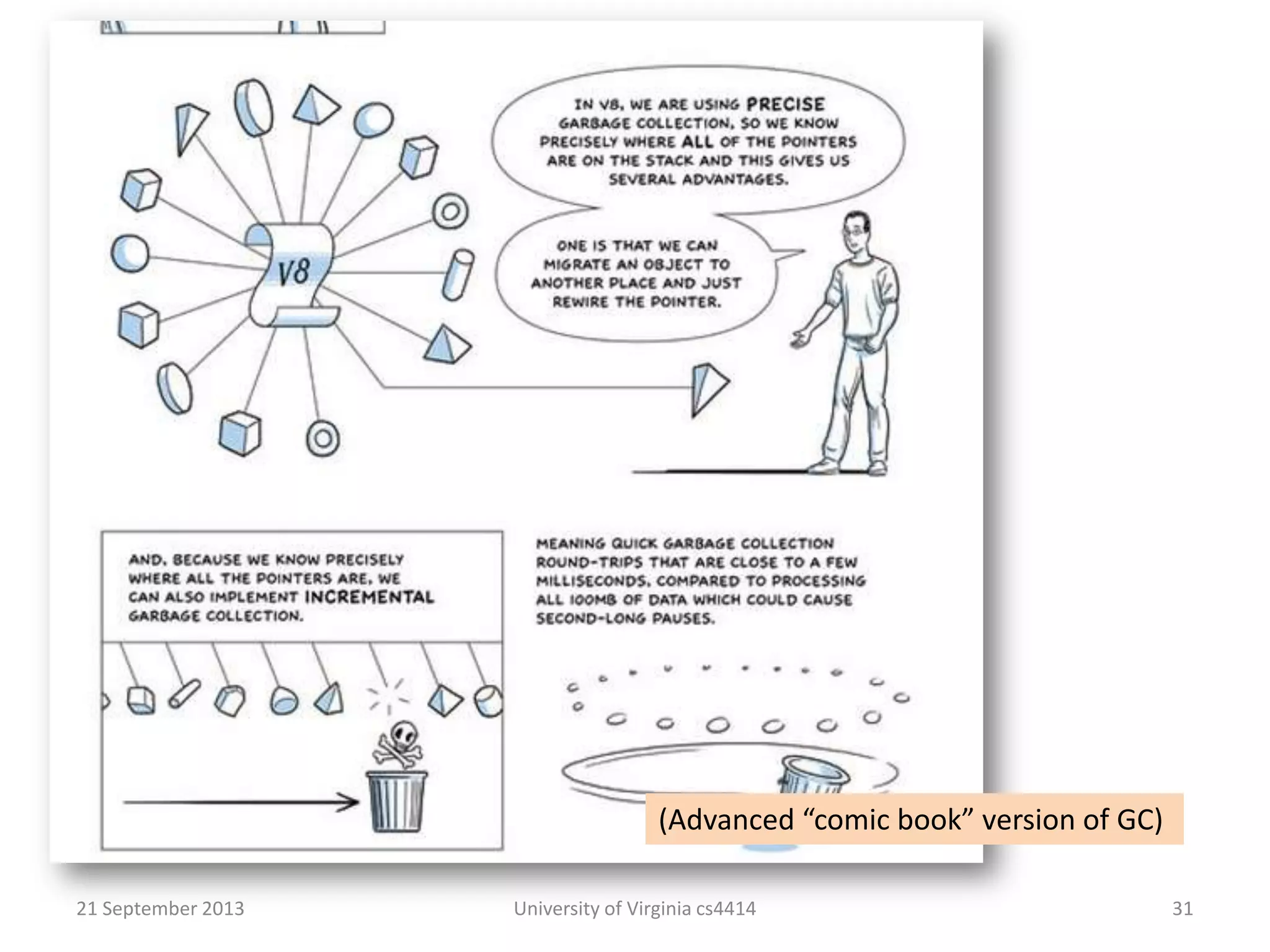
(Advanced “comic book” version of GC)
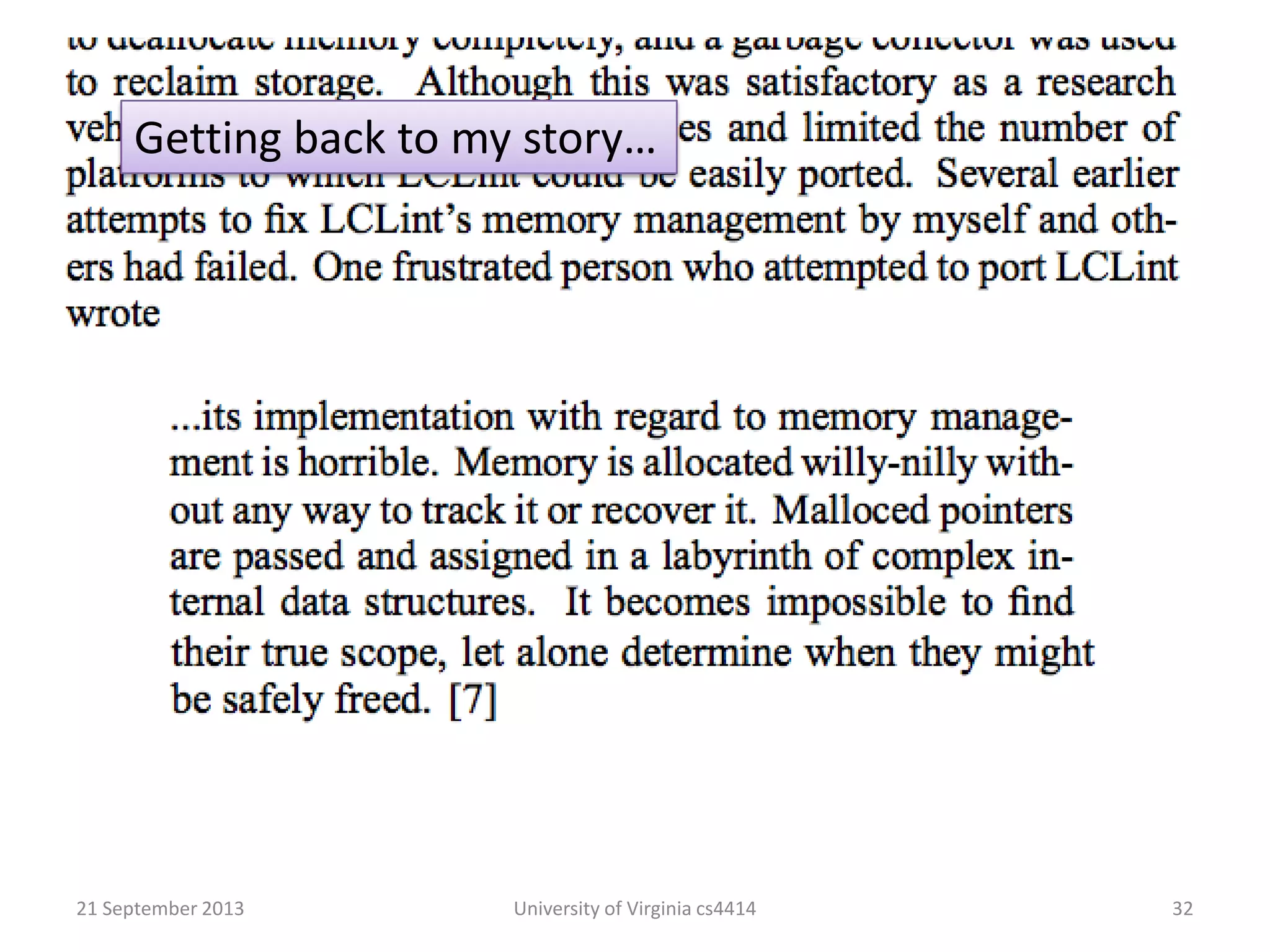
21 September 2013 University of Virginia cs4414 32
Getting back to my story…
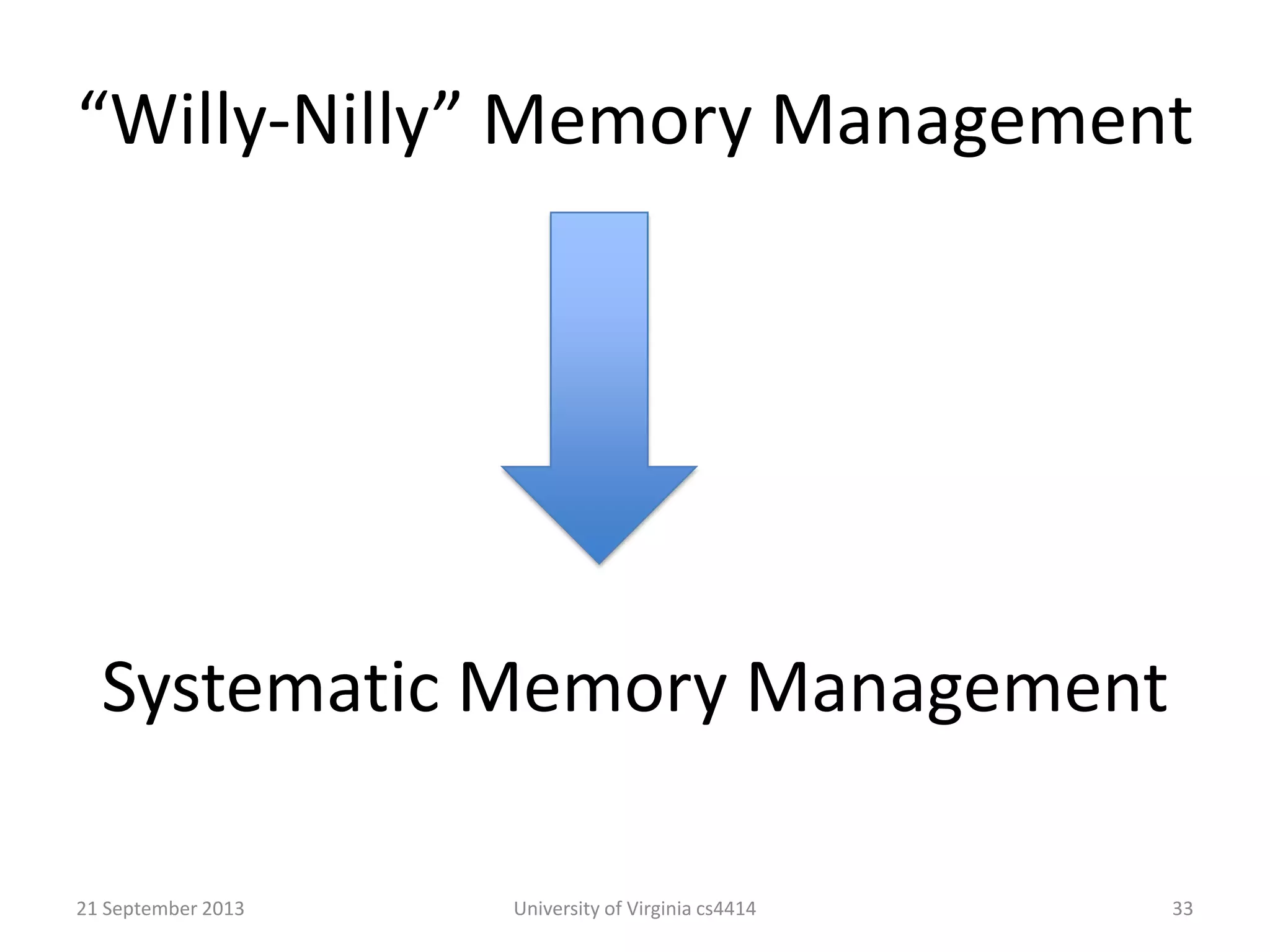
“Willy-Nilly” Memory Management
21 September 2013 University of Virginia cs4414 33
Systematic Memory Management
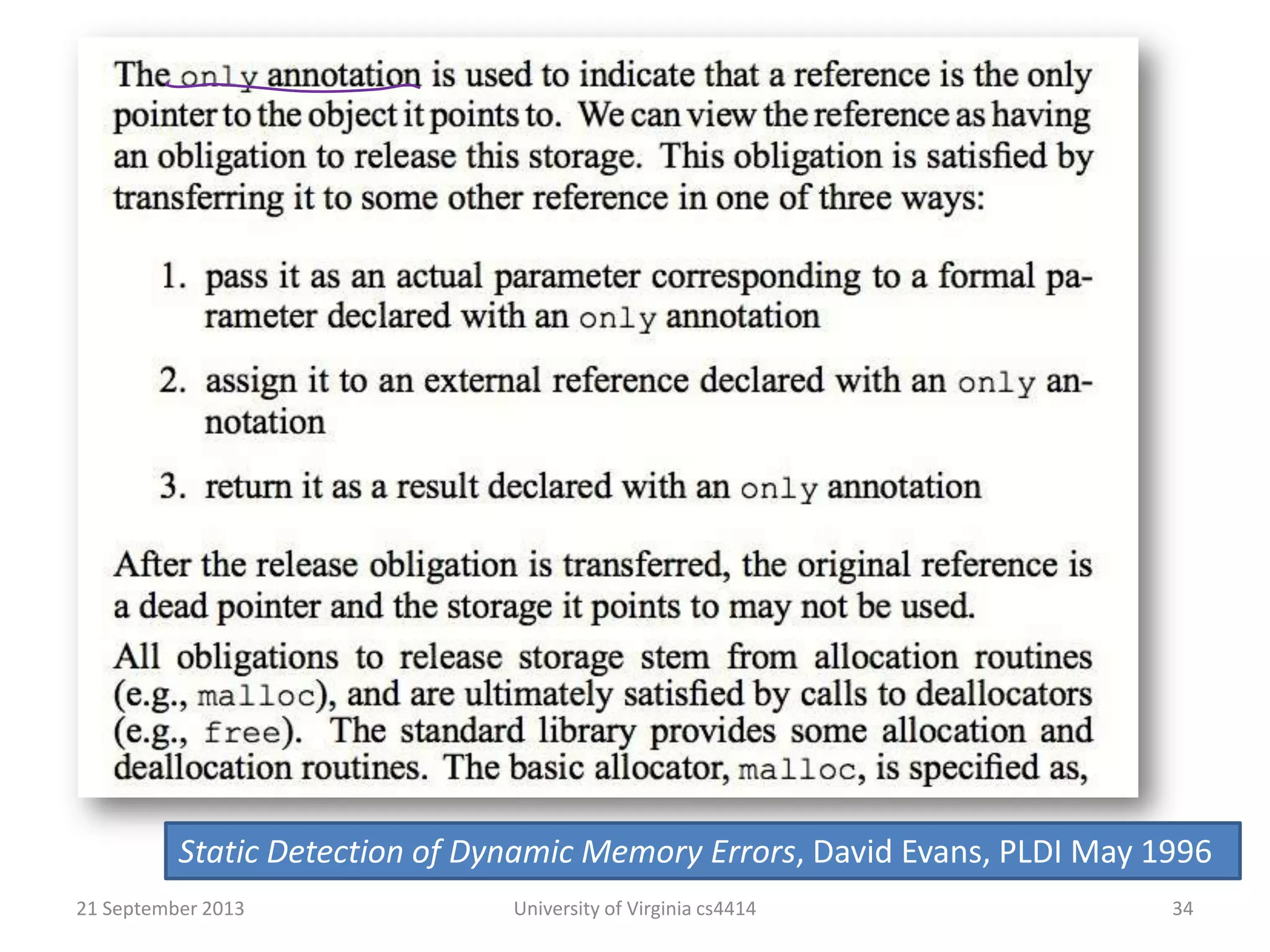
21 September 2013 University of Virginia cs4414 34
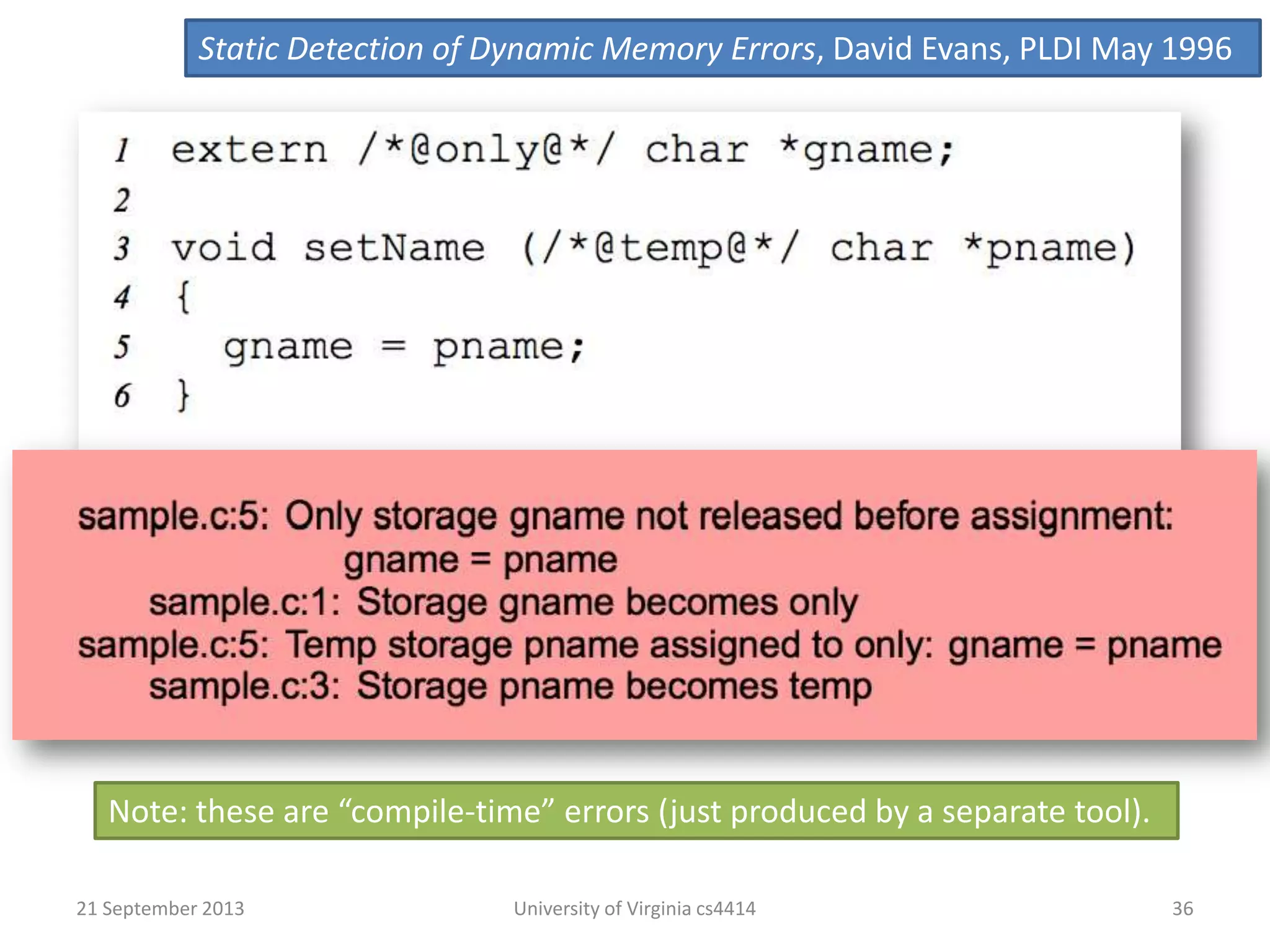
Static Detection of Dynamic Memory Errors, David Evans, PLDI May 1996
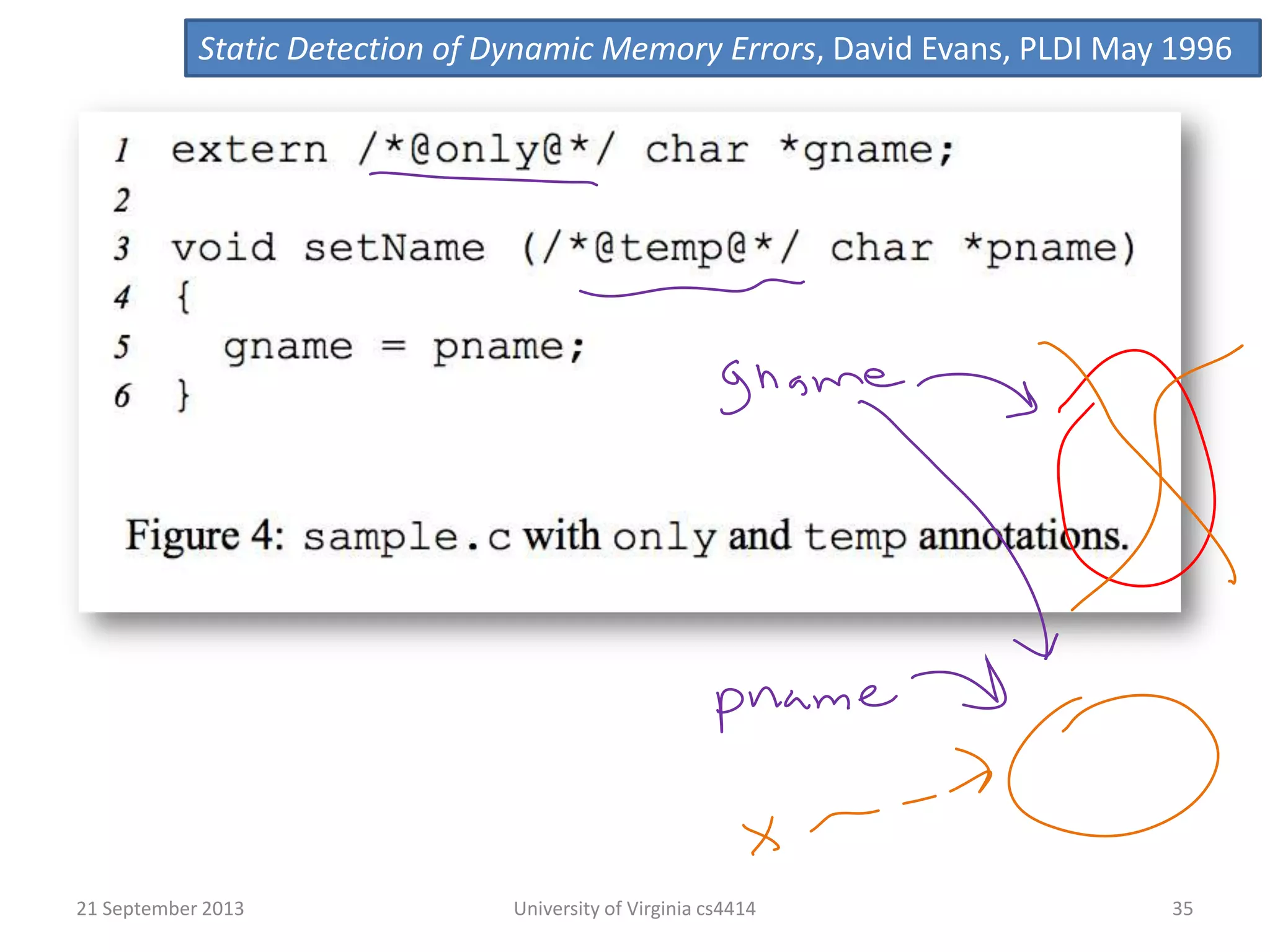
21 September 2013 University of Virginia cs4414 35
Static Detection of Dynamic Memory Errors, David Evans, PLDI May 1996
21 September 2013 University of Virginia cs4414 36
Note: these are “compile-time” errors (just produced by a separate tool).
Static Detection of Dynamic Memory Errors, David Evans, PLDI May 1996
21 September 2013 University of Virginia cs4414 37
Annotations?
Where we are going,
we don’t need
annotations!
21 September 2013 University of Virginia cs4414 38
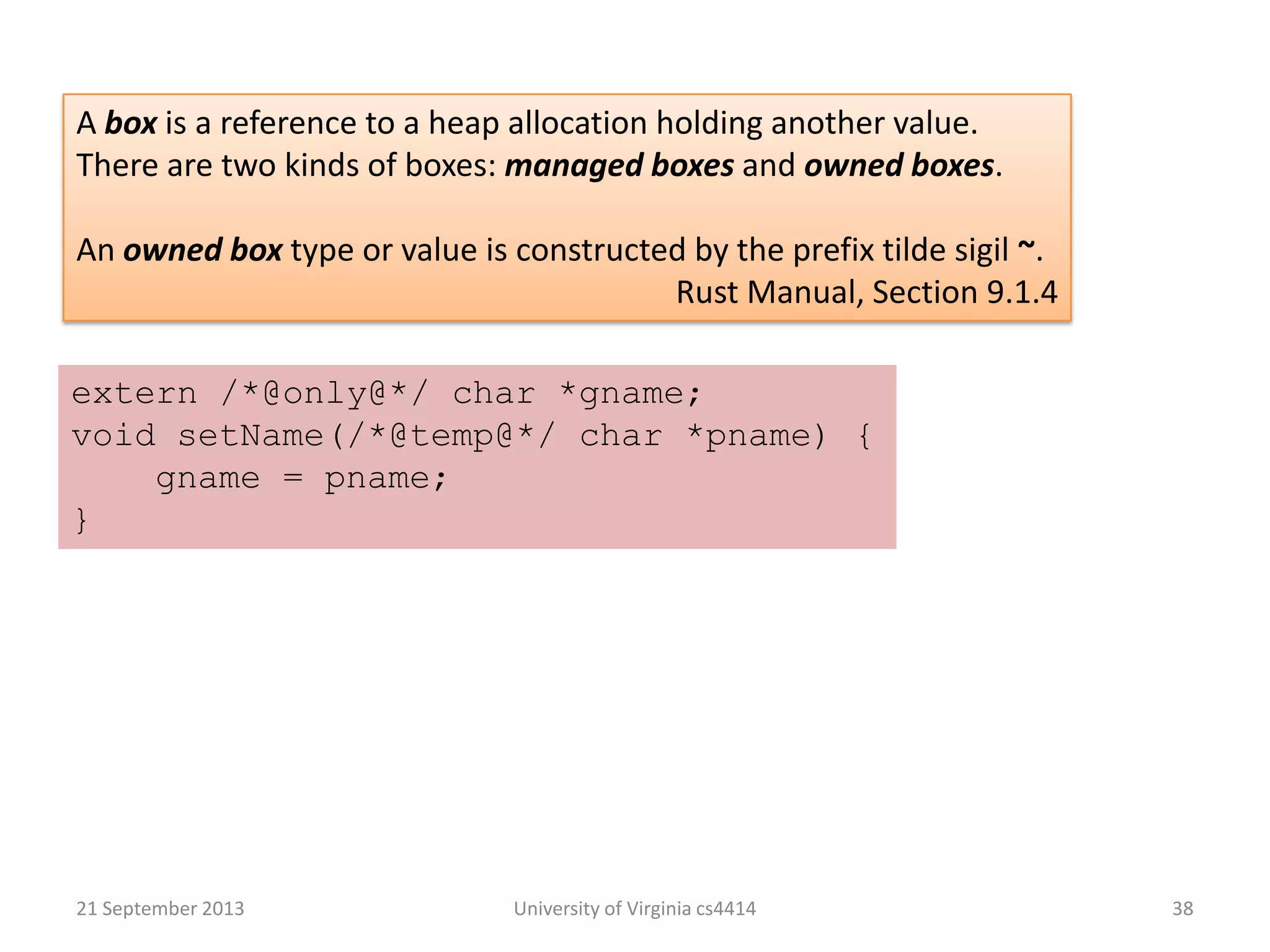
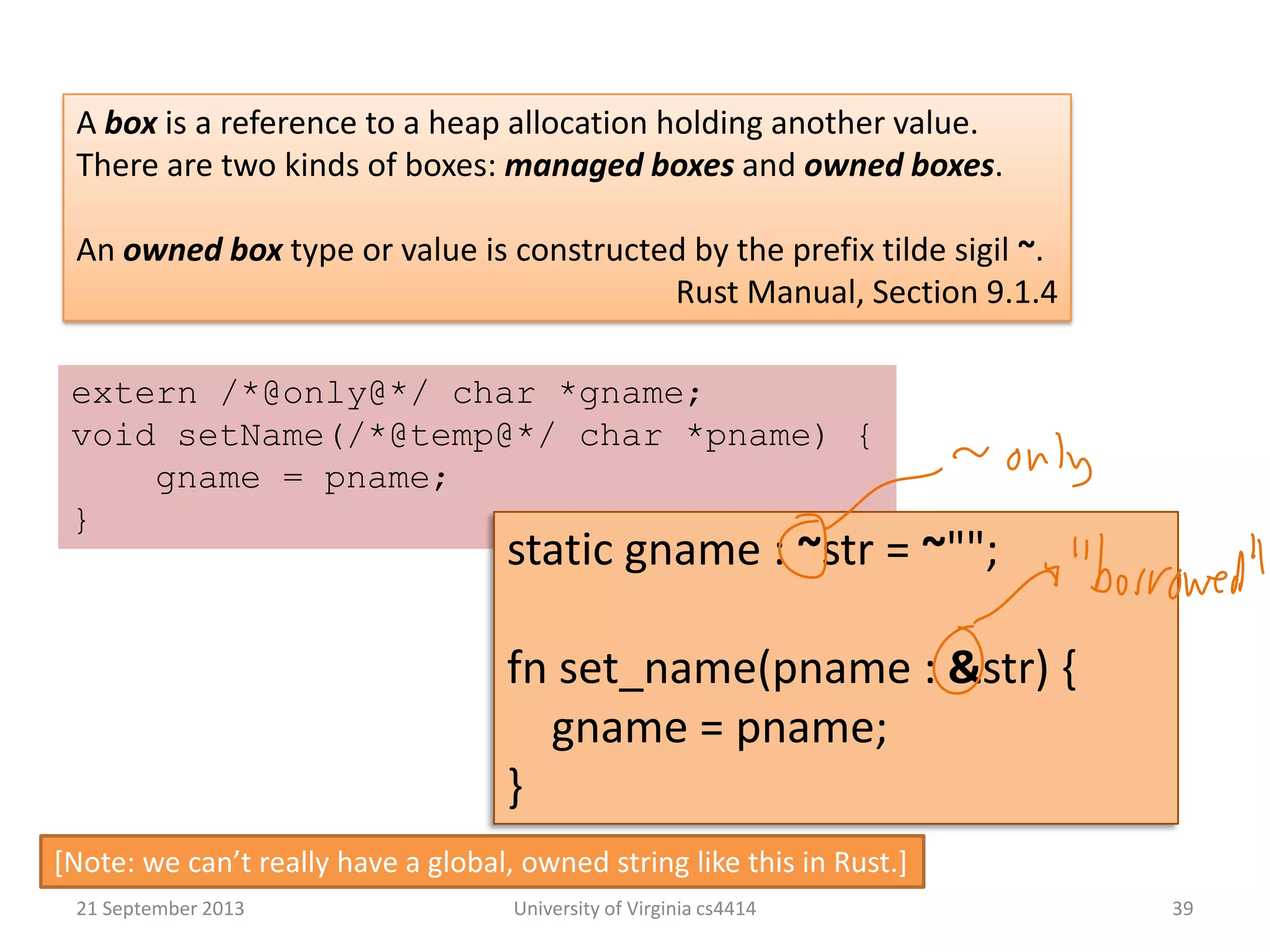
A box is a reference to a heap allocation holding another value.
There are two kinds of boxes: managed boxes and owned boxes.
An owned box type or value is constructed by the prefix tilde sigil ~.
Rust Manual, Section 9.1.4
extern /*@only@*/ char *gname;
void setName(/*@temp@*/ char *pname) {
gname = pname;
}
21 September 2013 University of Virginia cs4414 39
A box is a reference to a heap allocation holding another value.
There are two kinds of boxes: managed boxes and owned boxes.
An owned box type or value is constructed by the prefix tilde sigil ~.
Rust Manual, Section 9.1.4
extern /*@only@*/ char *gname;
void setName(/*@temp@*/ char *pname) {
gname = pname;
}
static gname : ~str = ~"";
fn set_name(pname : &str) {
gname = pname;
}
*Note: we can’t really have a global, owned string like this in Rust.+
21 September 2013 University of Virginia cs4414 40
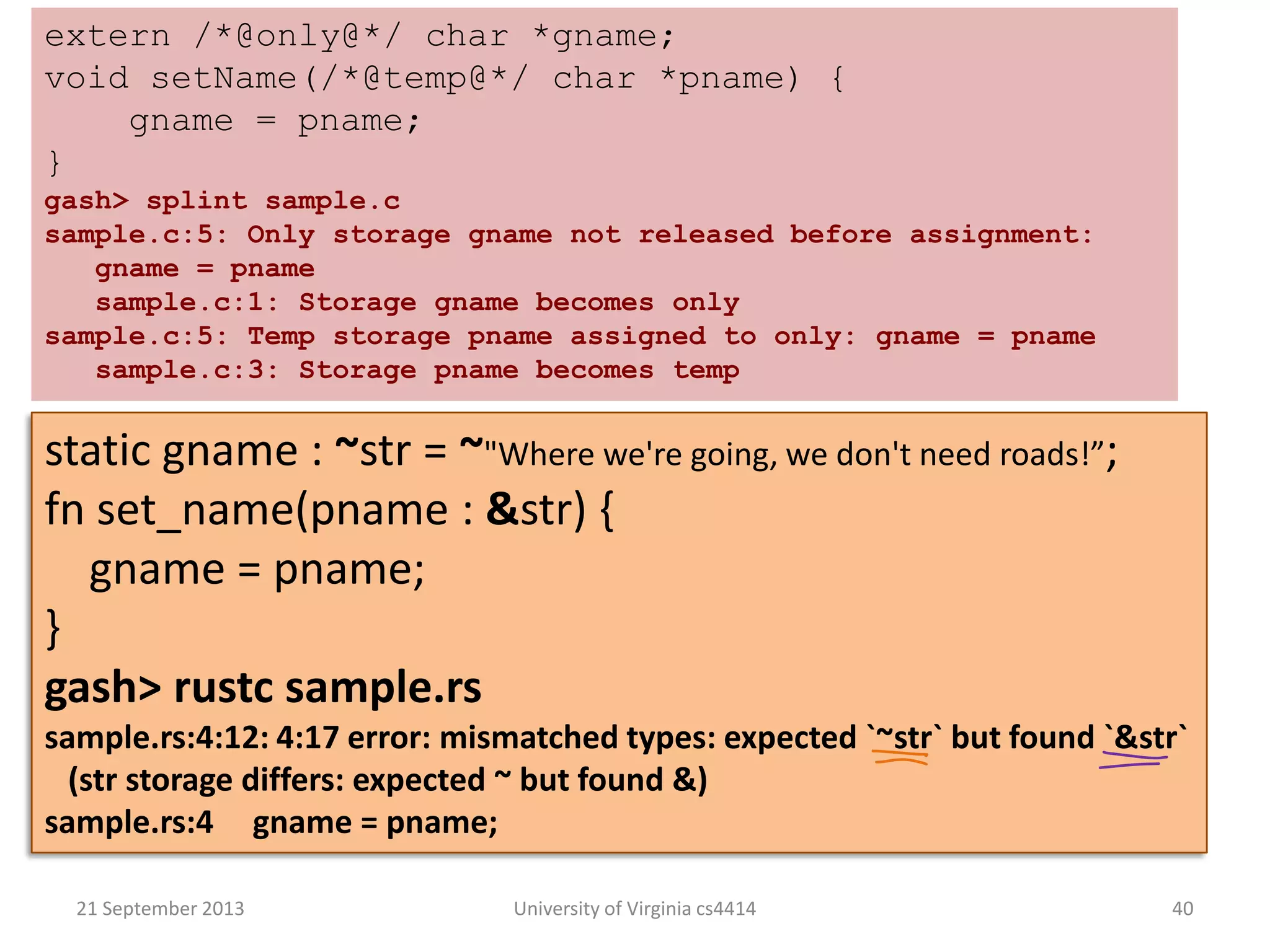
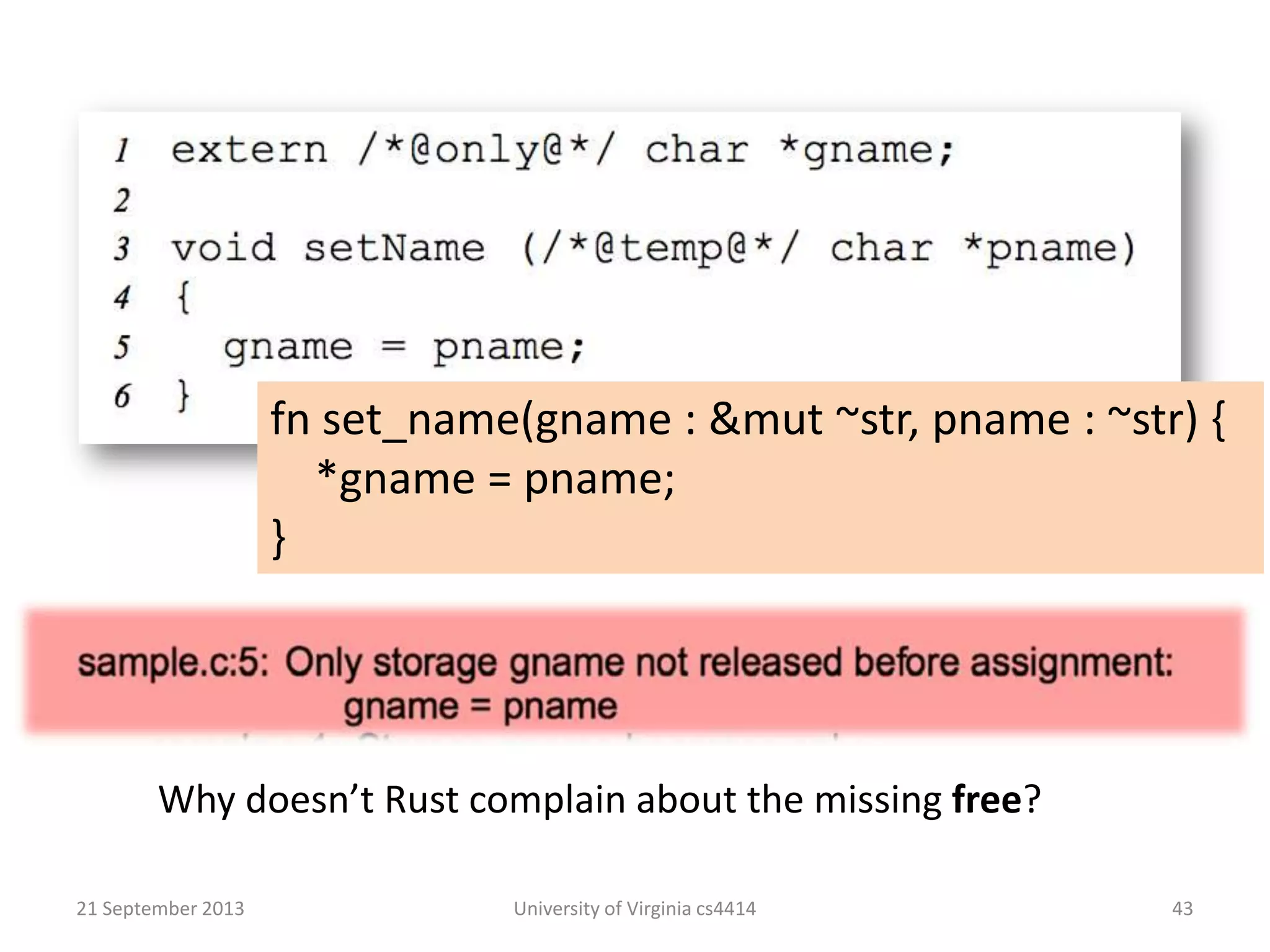
extern /*@only@*/ char *gname;
void setName(/*@temp@*/ char *pname) {
gname = pname;
}
gash> splint sample.c
sample.c:5: Only storage gname not released before assignment:
gname = pname
sample.c:1: Storage gname becomes only
sample.c:5: Temp storage pname assigned to only: gname = pname
sample.c:3: Storage pname becomes temp
static gname : ~str = ~"Where we're going, we don't need roads!”;
fn set_name(pname : &str) {
gname = pname;
}
gash> rustc sample.rs
sample.rs:4:12: 4:17 error: mismatched types: expected `~str` but found `&str`
(str storage differs: expected ~ but found &)
sample.rs:4 gname = pname;
21 September 2013 University of Virginia cs4414 41
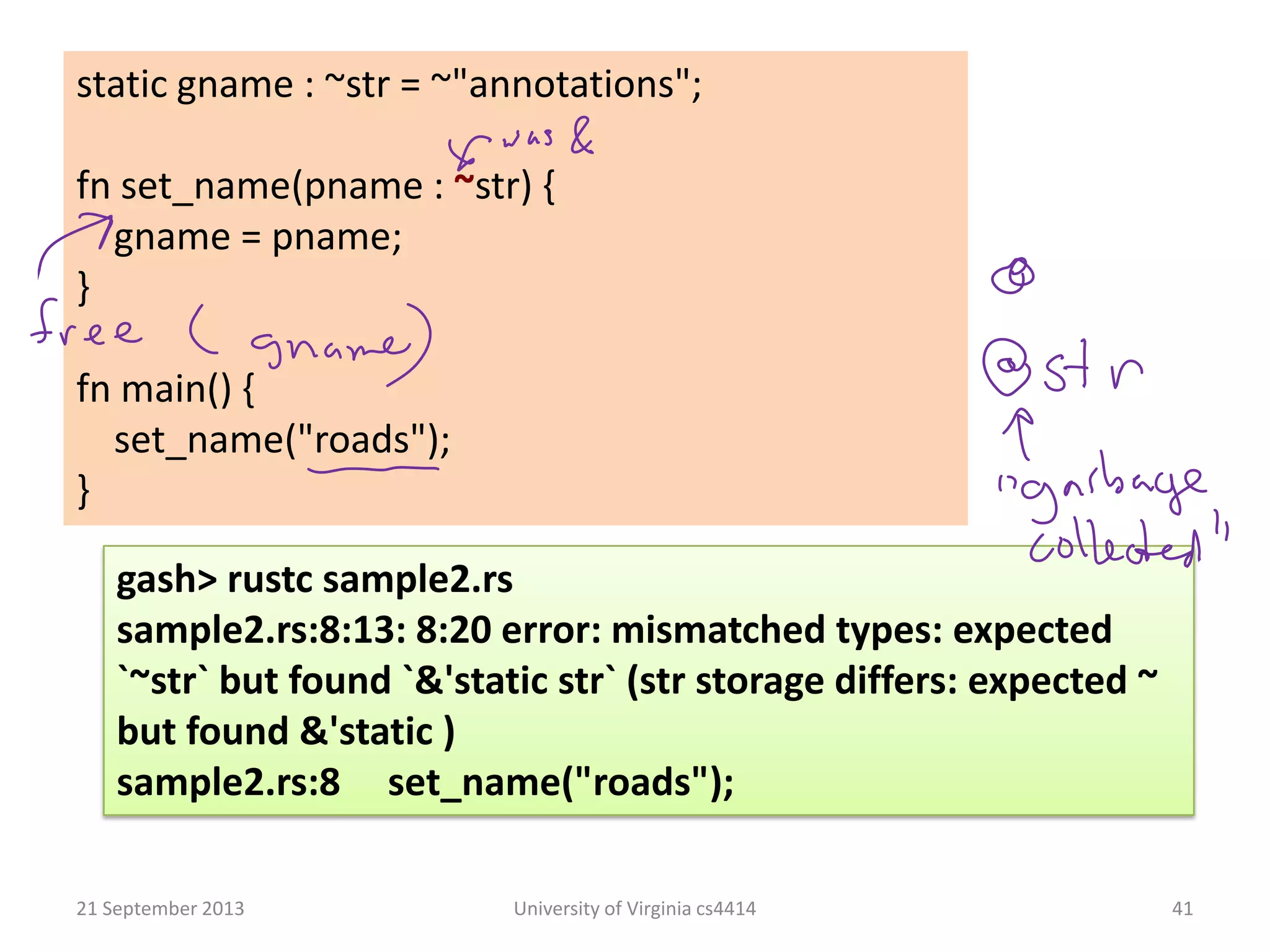
static gname : ~str = ~"annotations";
fn set_name(pname : ~str) {
gname = pname;
}
fn main() {
set_name("roads");
}
gash> rustc sample2.rs
sample2.rs:8:13: 8:20 error: mismatched types: expected
`~str` but found `&'static str` (str storage differs: expected ~
but found &'static )
sample2.rs:8 set_name("roads");
21 September 2013 University of Virginia cs4414 42
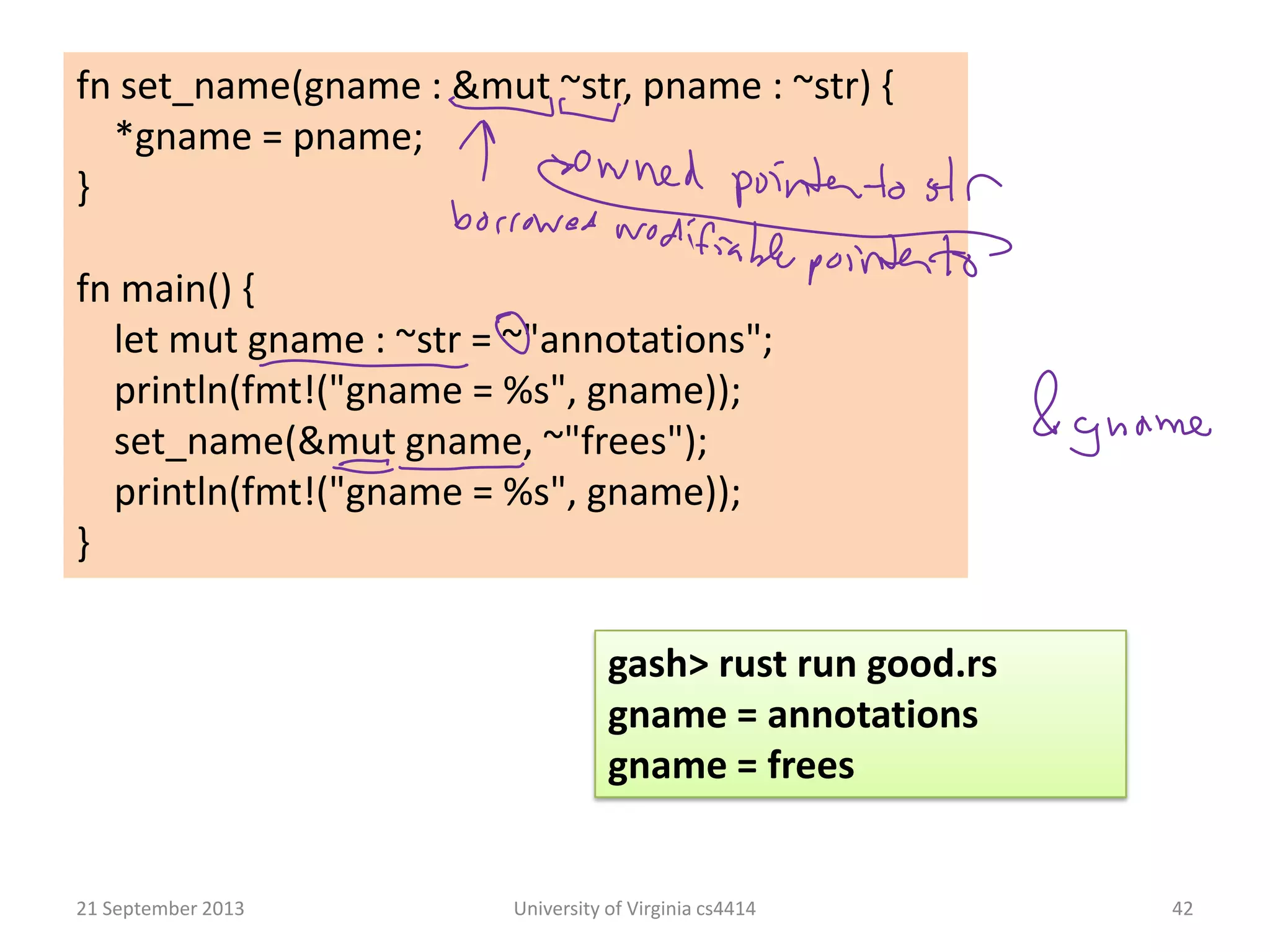
fn set_name(gname : &mut ~str, pname : ~str) {
*gname = pname;
}
fn main() {
let mut gname : ~str = ~"annotations";
println(fmt!("gname = %s", gname));
set_name(&mut gname, ~"frees");
println(fmt!("gname = %s", gname));
}
gash> rust run good.rs
gname = annotations
gname = frees
21 September 2013 University of Virginia cs4414 43
Why doesn’t Rust complain about the missing free?
fn set_name(gname : &mut ~str, pname : ~str) {
*gname = pname;
}
21 September 2013 University of Virginia cs4414 44
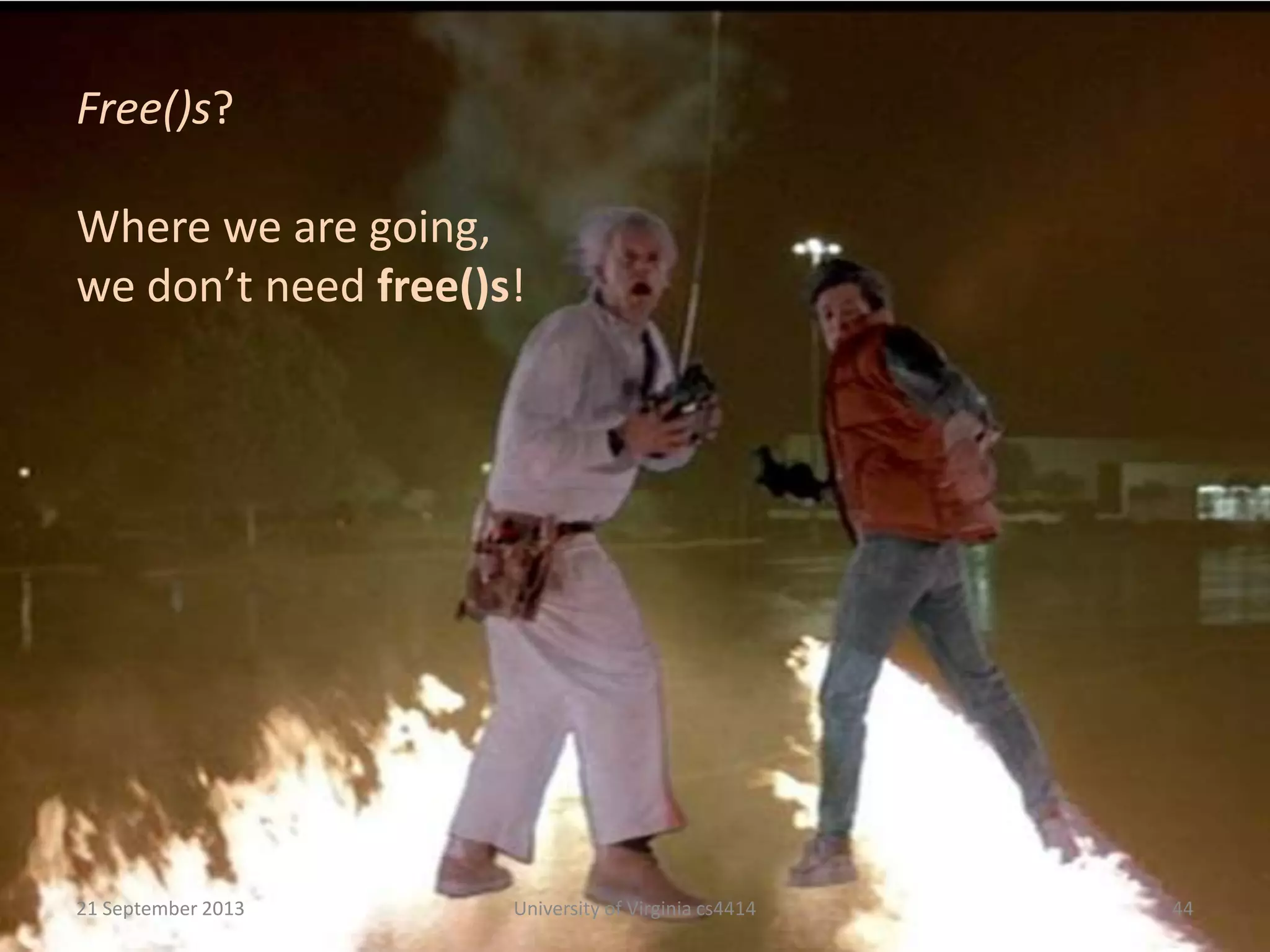
Free()s?
Where we are going,
we don’t need free()s!
21 September 2013 University of Virginia cs4414 45
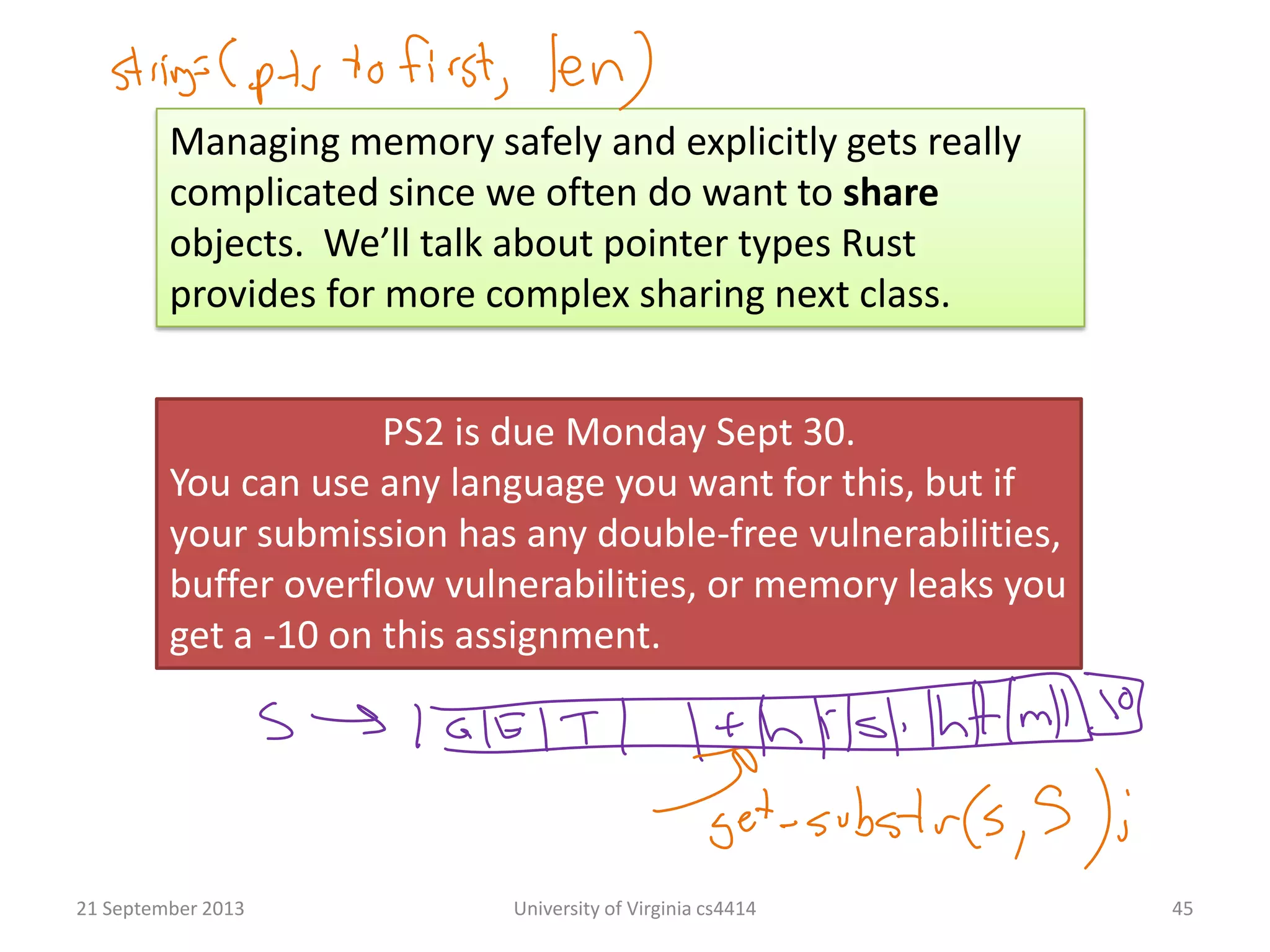
PS2 is due Monday Sept 30.
You can use any language you want for this, but if
your submission has any double-free vulnerabilities,
buffer overflow vulnerabilities, or memory leaks you
get a -10 on this assignment.
Managing memory safely and explicitly gets really
complicated since we often do want to share
objects. We’ll talk about pointer types Rust
provides for more complex sharing next class.
Charge
Next class: complexities of memory
management
PS2 is due Monday, 30 September
21 September 2013 University of Virginia cs4414 46
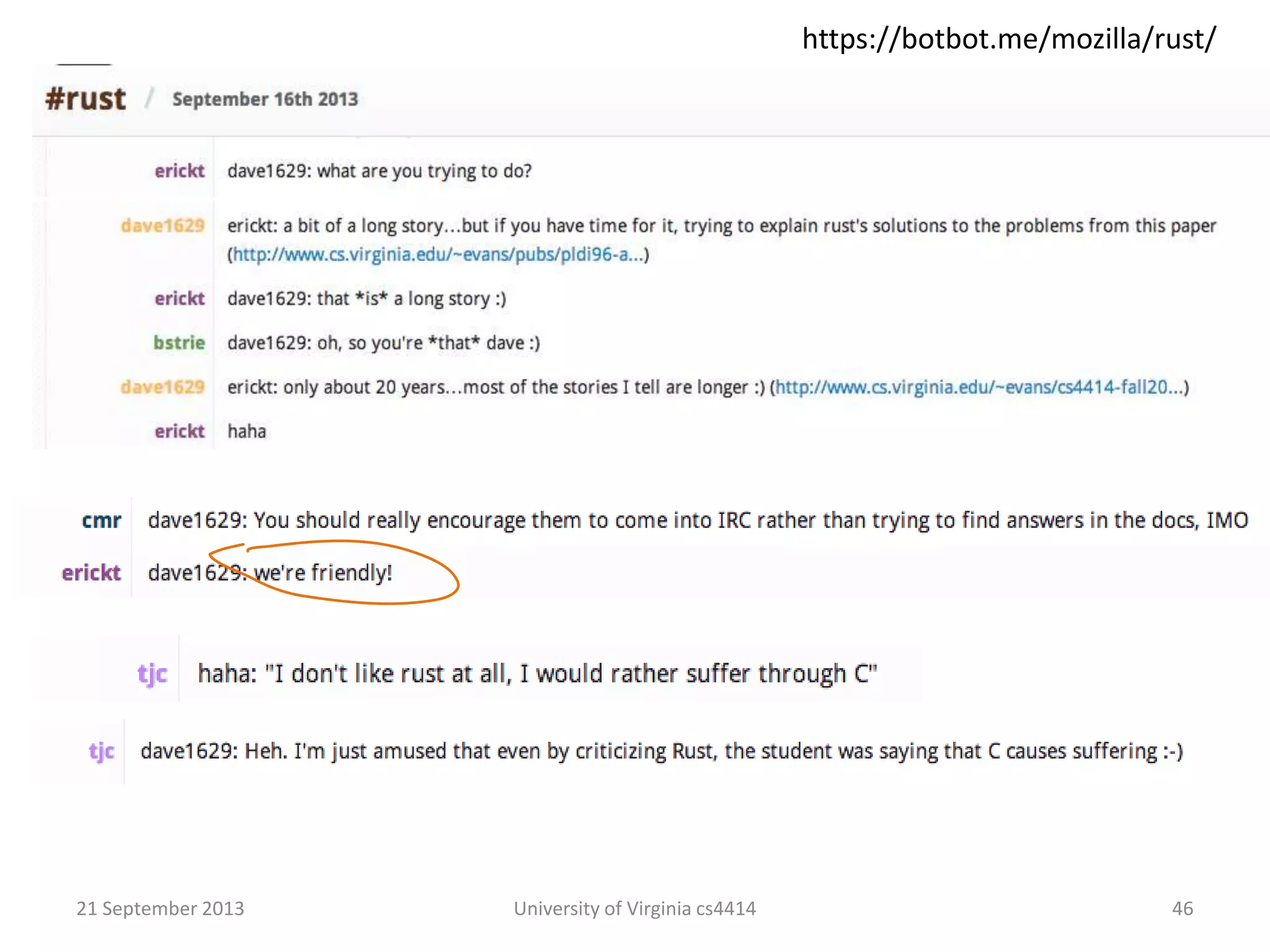
https://botbot.me/mozilla/rust/

What the &~#@&lt;!? (Memory Management in Rust)

  • 1.
    cs4414 Fall 2013 Universityof Virginia David Evans
  • 2.
    Plan for Today Someearly comments on PS2 (how many processes?) Explicit vs. implicit memory management Pointers in Rust 21 September 2013 University of Virginia cs4414 1 Notes for today will be posted later today.
  • 3.
    21 September 2013University of Virginia cs4414 2
  • 4.
    How many processesshould a browser create? 21 September 2013 University of Virginia cs4414 3 New challenge for Exercise 1 & 2: what is the fewest number of processes you can have running on your machine?
  • 5.
    21 September 2013University of Virginia cs4414 4 1990’s answer: 1 process since processes waste memory and CPU which are expensive and limited
  • 6.
    21 September 2013University of Virginia cs4414 5 2000s answer: http://www.google.com/googlebooks/chrome/
  • 7.
    21 September 2013University of Virginia cs4414 6
  • 8.
    21 September 2013University of Virginia cs4414 7
  • 9.
    21 September 2013University of Virginia cs4414 8 “Start from Scratch” = start from scratch constrained by using programming tools and methods developed in the 1960s
  • 10.
    What should the2010s answer be? 21 September 2013 University of Virginia cs4414 9
  • 11.
    21 September 2013University of Virginia cs4414 10 Only two colors, but 4-8 cores! (+ loads of GPU cores) Samsung Galaxy S4 Apple iPhone 5C Five colors, 2 cores! Note: the colors vs. cores tradeoff can probably be overcome by good engineering, but addressing the energy vs. cores tradeoffs require some theoretical advances also.
  • 12.
    21 September 2013University of Virginia cs4414 11 Humans should not be getting bored and grumpy waiting for their browser to render a page while cores are sitting idle!
  • 13.
    21 September 2013University of Virginia cs4414 12 “Start from Scratch” = start from scratch constrained by using programming tools and methods developed in the 1960s
  • 14.
    2010s answer: 21 September2013 University of Virginia cs4414 13 A modern browser should have enough processes to efficiently use all the machine resources available to provide human users with a good browsing experience! Unfortunately, it is not (humanly) possible to build such a browser (in a way that will also be secure, robust, and reliable) using languages whose primary design goal was to fit on a 4K machine.
  • 15.
    21 September 2013University of Virginia cs4414 14 Why do our Rust stickers have a gear on them? Servo: the main reason Rust is being developed is so Mozilla can build a better browser!
  • 16.
    21 September 2013University of Virginia cs4414 15 Really starting from scratch is really hard… this is why getting Servo to the point where it can render a static page is cake- worthy!
  • 17.
    What Dave wasdoing when you were learning to crawl… 21 September 2013 University of Virginia cs4414 16
  • 18.
    21 September 2013University of Virginia cs4414 17 ACM Foundations in Software Engineering, 1994
  • 19.
    21 September 2013University of Virginia cs4414 18 comp.os.linux post, August 1994
  • 20.
    $ man malloc# on my Macbook Air MALLOC(3) BSD Library Functions Manual SYNOPSIS ... void free(void *ptr); void *malloc(size_t size); ... DESCRIPTION The malloc(), calloc(), valloc(), realloc(), and reallocf() functions allocate memory. The allocated memory is aligned such that it can be used for any data type, …. The free() function frees allocations that were created via the preceding allocation functions. The malloc() function allocates size bytes of memory and returns a pointer to the allocated memory. MemorymanagementinC 21 September 2013 University of Virginia cs4414 19
  • 21.
    21 September 2013University of Virginia cs4414 20 # include <stdlib.h> # include <stdio.h> int main(int _argc, char **_argv) { int *x = (int *) malloc (sizeof(*x)); *x = 4414; printf("x = %dn", *x); return 0; } gash> gcc -Wall toofree.c gash> ./a.out x = 4414
  • 22.
    21 September 2013University of Virginia cs4414 21 # include <stdlib.h> # include <stdio.h> int main(int _argc, char **_argv) { int *x = (int *) malloc (sizeof(*x)); *x = 4414; free(x); printf("x = %dn", *x); return 0; } gash> gcc -Wall toofree.c gash> ./a.out x = 4414
  • 23.
    21 September 2013University of Virginia cs4414 22 # include <stdlib.h> # include <stdio.h> int main(int _argc, char **_argv) { int *x = (int *) malloc (sizeof(*x)); *x = 4414; free(x); free(x); printf("x = %dn", *x); return 0; } gash> gcc -Wall toofree.c gash> ./a.out a.out(23685) malloc: *** error for object 0x10a1008d0: pointer being freed was not allocated *** set a breakpoint in malloc_error_break to debug Abort trap: 6 Note: this is what happens to happen on my computer, but the C behavior is undefined. It would be “correct” for a C program like this to do absolutely anything!
  • 24.
    This gets tricky… 21 September2013 University of Virginia cs4414 23 (from locale.h) struct lconv { char *decimal_point; char *thousands_sep; char *grouping; char *int_curr_symbol; char *currency_symbol; … } ; // in my code… struct lconv *local = localeconv (void); … free(local->decimal_point); // ? free(local); // ?
  • 25.
    Should we reallycare? 21 September 2013 University of Virginia cs4414 24 November 2009
  • 26.
    21 September 2013University of Virginia cs4414 25
  • 27.
    21 September 2013University of Virginia cs4414 26
  • 28.
    21 September 2013University of Virginia cs4414 27 http://www.phrack.org/issues.html?issue=61&id=6
  • 29.
    (Why) Doesn’t C++solve this? 21 September 2013 University of Virginia cs4414 28 new = malloc delete = free
  • 30.
    Doesn’t Java solvethis? 21 September 2013 University of Virginia cs4414 29
  • 31.
    21 September 2013University of Virginia cs4414 30
  • 32.
    21 September 2013University of Virginia cs4414 31 (Advanced “comic book” version of GC)
  • 33.
    21 September 2013University of Virginia cs4414 32 Getting back to my story…
  • 34.
    “Willy-Nilly” Memory Management 21September 2013 University of Virginia cs4414 33 Systematic Memory Management
  • 35.
    21 September 2013University of Virginia cs4414 34 Static Detection of Dynamic Memory Errors, David Evans, PLDI May 1996
  • 36.
    21 September 2013University of Virginia cs4414 35 Static Detection of Dynamic Memory Errors, David Evans, PLDI May 1996
  • 37.
    21 September 2013University of Virginia cs4414 36 Note: these are “compile-time” errors (just produced by a separate tool). Static Detection of Dynamic Memory Errors, David Evans, PLDI May 1996
  • 38.
    21 September 2013University of Virginia cs4414 37 Annotations? Where we are going, we don’t need annotations!
  • 39.
    21 September 2013University of Virginia cs4414 38 A box is a reference to a heap allocation holding another value. There are two kinds of boxes: managed boxes and owned boxes. An owned box type or value is constructed by the prefix tilde sigil ~. Rust Manual, Section 9.1.4 extern /*@only@*/ char *gname; void setName(/*@temp@*/ char *pname) { gname = pname; }
  • 40.
    21 September 2013University of Virginia cs4414 39 A box is a reference to a heap allocation holding another value. There are two kinds of boxes: managed boxes and owned boxes. An owned box type or value is constructed by the prefix tilde sigil ~. Rust Manual, Section 9.1.4 extern /*@only@*/ char *gname; void setName(/*@temp@*/ char *pname) { gname = pname; } static gname : ~str = ~""; fn set_name(pname : &str) { gname = pname; } *Note: we can’t really have a global, owned string like this in Rust.+
  • 41.
    21 September 2013University of Virginia cs4414 40 extern /*@only@*/ char *gname; void setName(/*@temp@*/ char *pname) { gname = pname; } gash> splint sample.c sample.c:5: Only storage gname not released before assignment: gname = pname sample.c:1: Storage gname becomes only sample.c:5: Temp storage pname assigned to only: gname = pname sample.c:3: Storage pname becomes temp static gname : ~str = ~"Where we're going, we don't need roads!”; fn set_name(pname : &str) { gname = pname; } gash> rustc sample.rs sample.rs:4:12: 4:17 error: mismatched types: expected `~str` but found `&str` (str storage differs: expected ~ but found &) sample.rs:4 gname = pname;
  • 42.
    21 September 2013University of Virginia cs4414 41 static gname : ~str = ~"annotations"; fn set_name(pname : ~str) { gname = pname; } fn main() { set_name("roads"); } gash> rustc sample2.rs sample2.rs:8:13: 8:20 error: mismatched types: expected `~str` but found `&'static str` (str storage differs: expected ~ but found &'static ) sample2.rs:8 set_name("roads");
  • 43.
    21 September 2013University of Virginia cs4414 42 fn set_name(gname : &mut ~str, pname : ~str) { *gname = pname; } fn main() { let mut gname : ~str = ~"annotations"; println(fmt!("gname = %s", gname)); set_name(&mut gname, ~"frees"); println(fmt!("gname = %s", gname)); } gash> rust run good.rs gname = annotations gname = frees
  • 44.
    21 September 2013University of Virginia cs4414 43 Why doesn’t Rust complain about the missing free? fn set_name(gname : &mut ~str, pname : ~str) { *gname = pname; }
  • 45.
    21 September 2013University of Virginia cs4414 44 Free()s? Where we are going, we don’t need free()s!
  • 46.
    21 September 2013University of Virginia cs4414 45 PS2 is due Monday Sept 30. You can use any language you want for this, but if your submission has any double-free vulnerabilities, buffer overflow vulnerabilities, or memory leaks you get a -10 on this assignment. Managing memory safely and explicitly gets really complicated since we often do want to share objects. We’ll talk about pointer types Rust provides for more complex sharing next class.
  • 47.
    Charge Next class: complexitiesof memory management PS2 is due Monday, 30 September 21 September 2013 University of Virginia cs4414 46 https://botbot.me/mozilla/rust/