Design Principles for the Web Connectivity
Web Communication
protocols
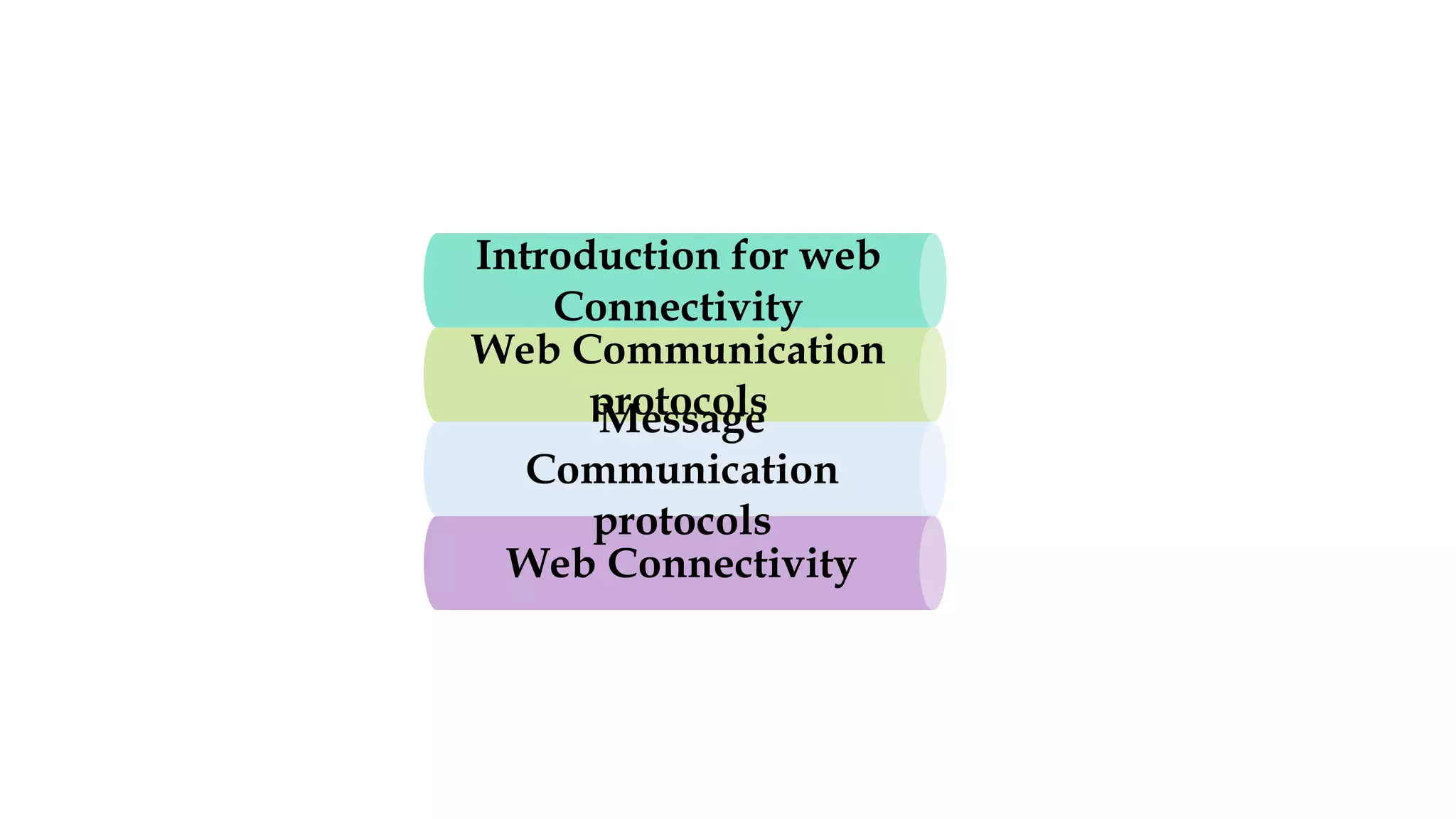
Introduction for web
Connectivity
Web Connectivity
Message
Communication
protocols
Web Communication protocols
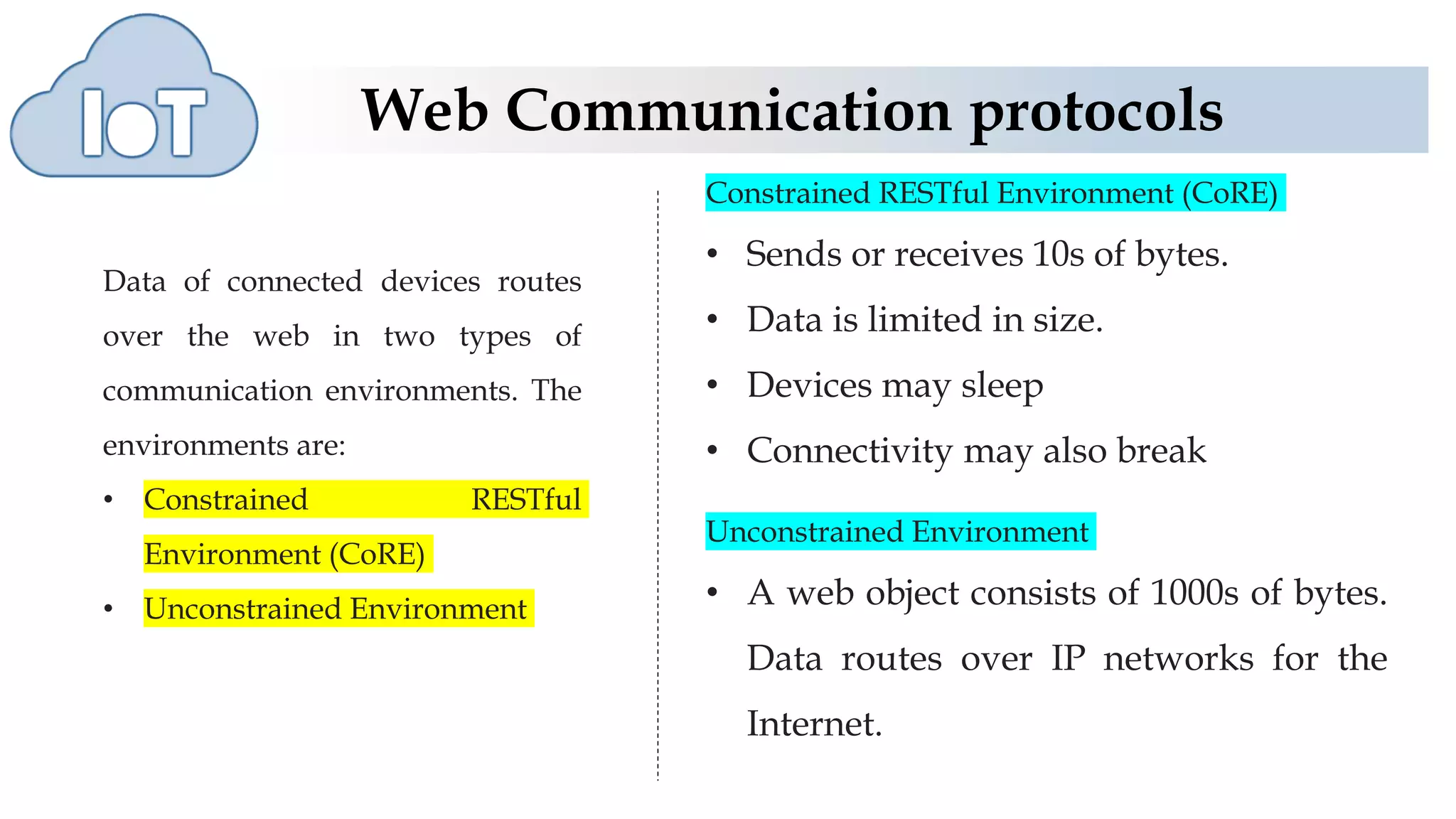
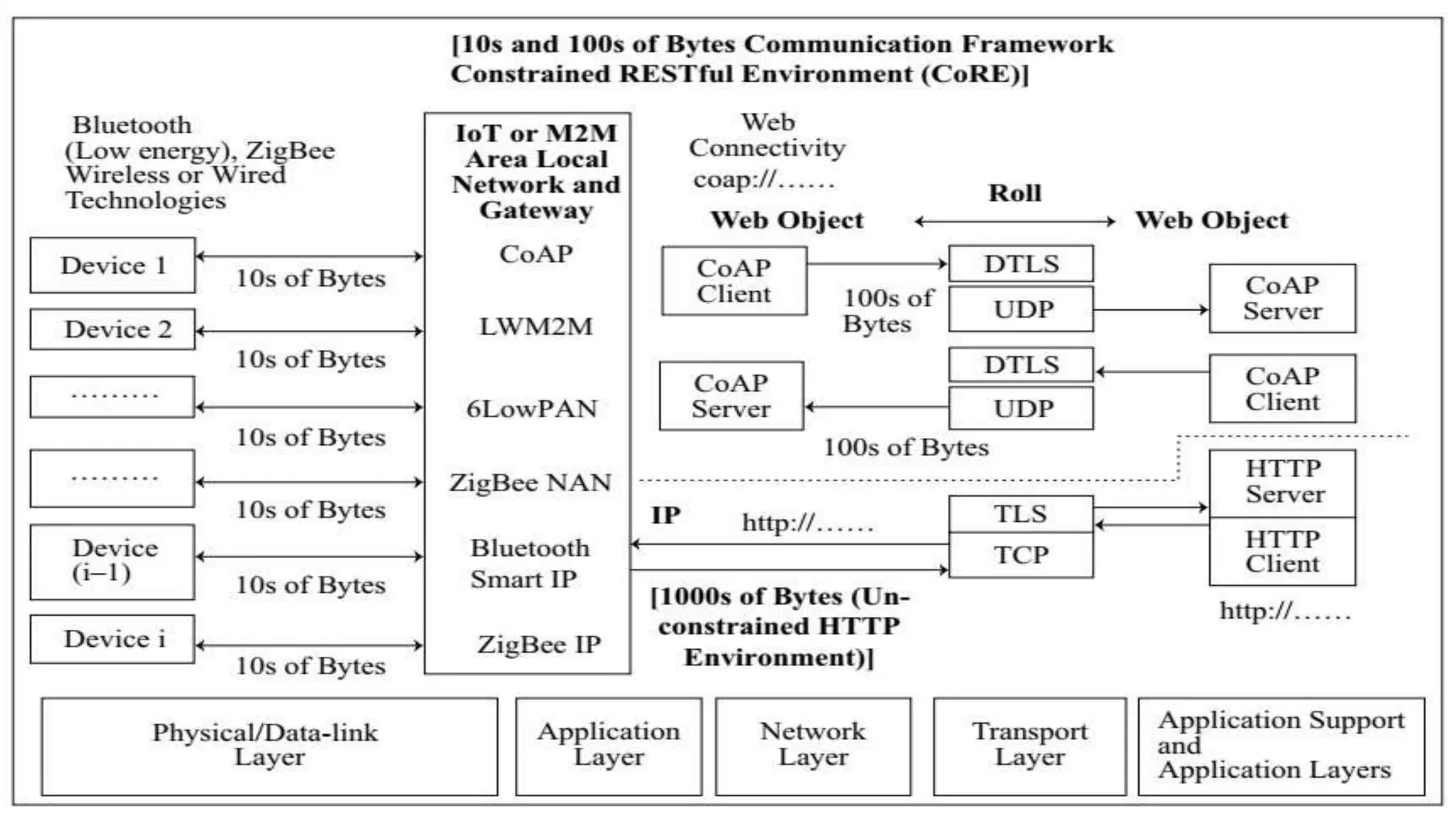
Data of connected devices routes
over the web in two types of
communication environments. The
environments are:
• Constrained RESTful
Environment (CoRE)
• Unconstrained Environment
Constrained RESTful Environment (CoRE)
• Sends or receives 10s of bytes.
• Data is limited in size.
• Devices may sleep
• Connectivity may also break
Unconstrained Environment
• A web object consists of 1000s of bytes.
Data routes over IP networks for the
Internet.
Web Communication protocols
1. Constrained Application Protocol
1.1. CoAP Client Web Connectivity
1.2. Secured Use of a Key for Client Authentication
2. Lightweight Machine-to-Machine Communication Protocol
3. JSON Format
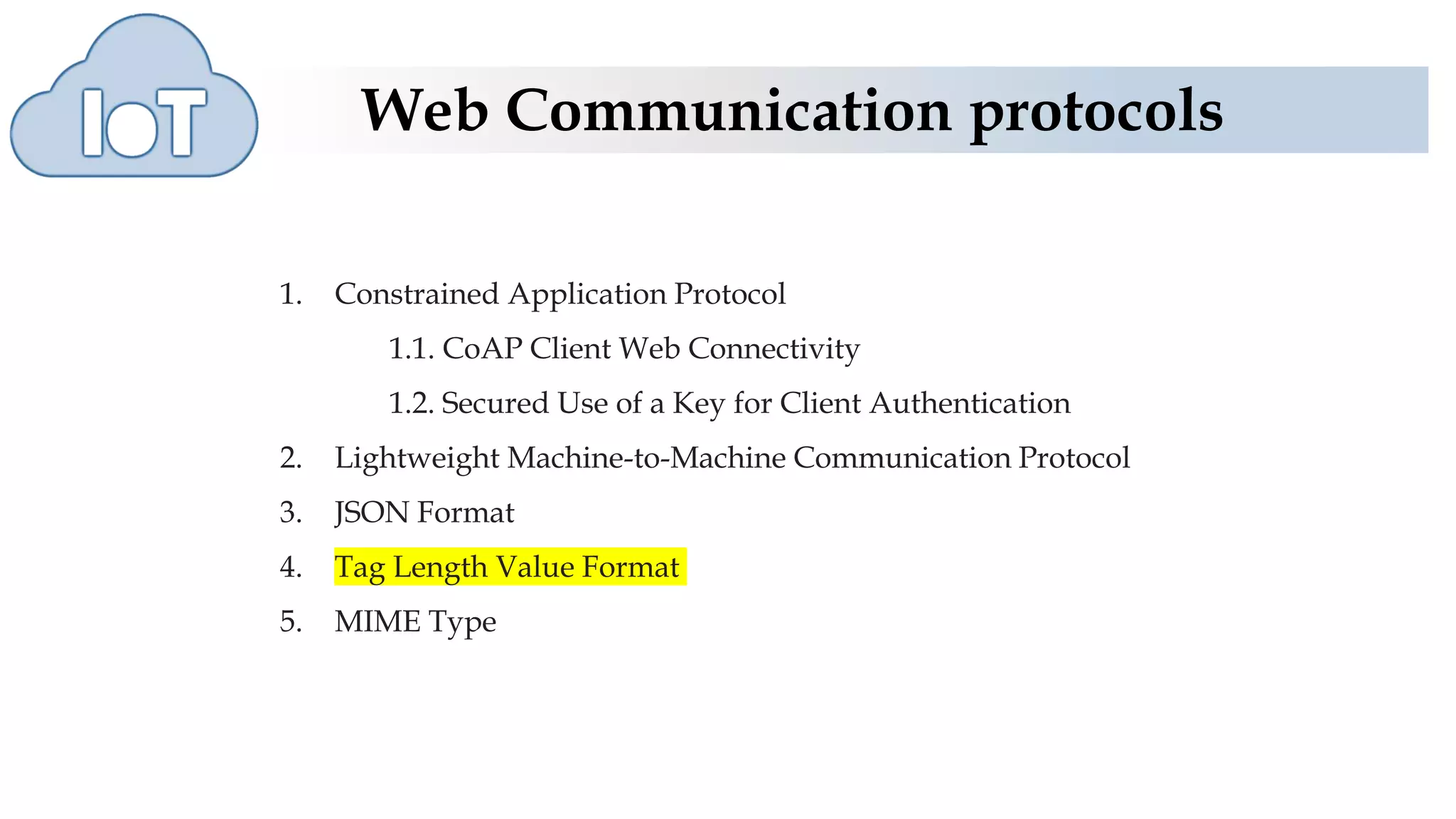
4. Tag Length Value Format
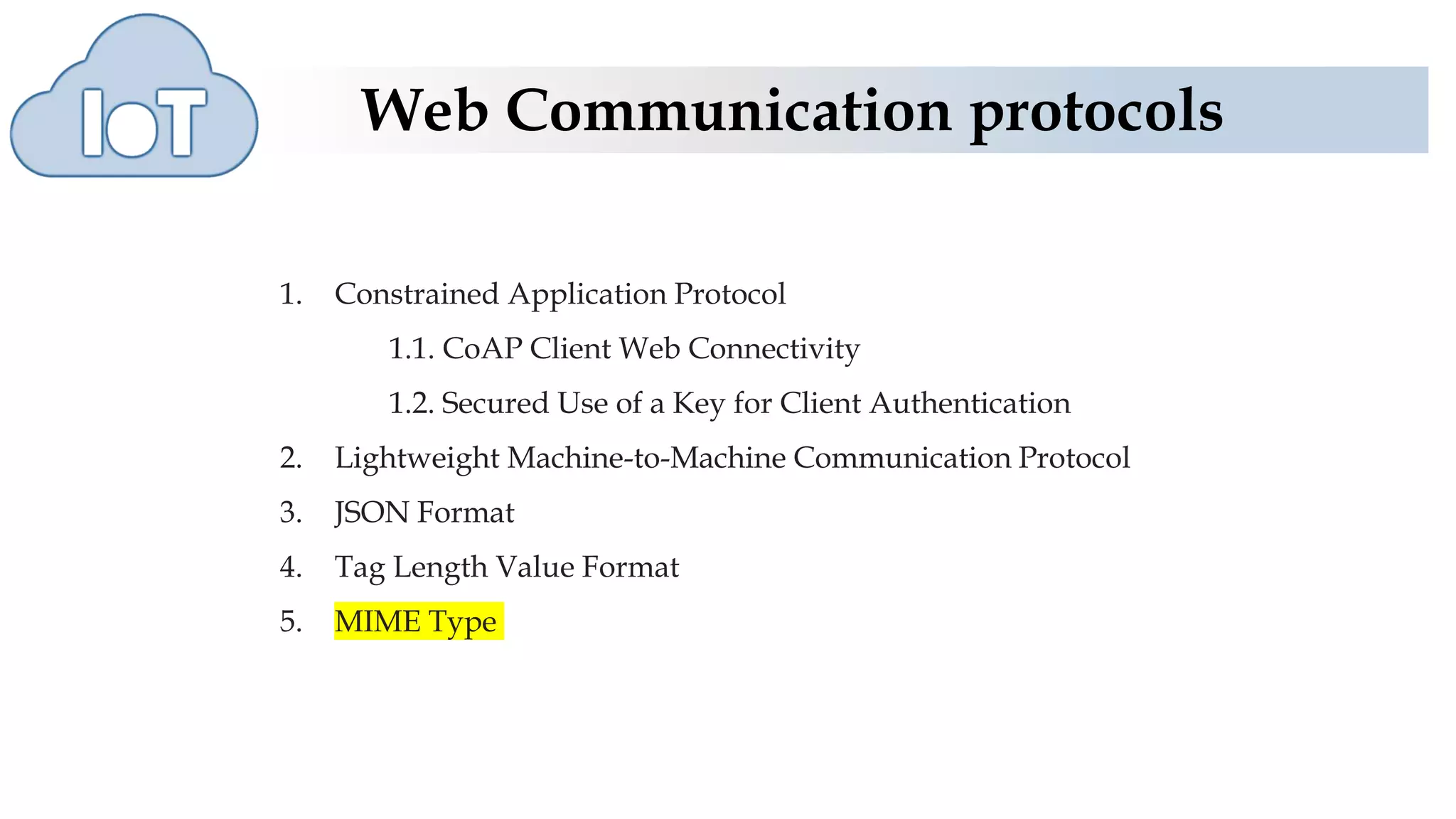
5. MIME Type
Web Communication protocols
1. Constrained Application Protocol
1.1. CoAP Client Web Connectivity
1.2. Secured Use of a Key for Client Authentication
2. Lightweight Machine-to-Machine Communication Protocol
3. JSON Format
4. Tag Length Value Format
5. MIME Type
Web Communication protocols
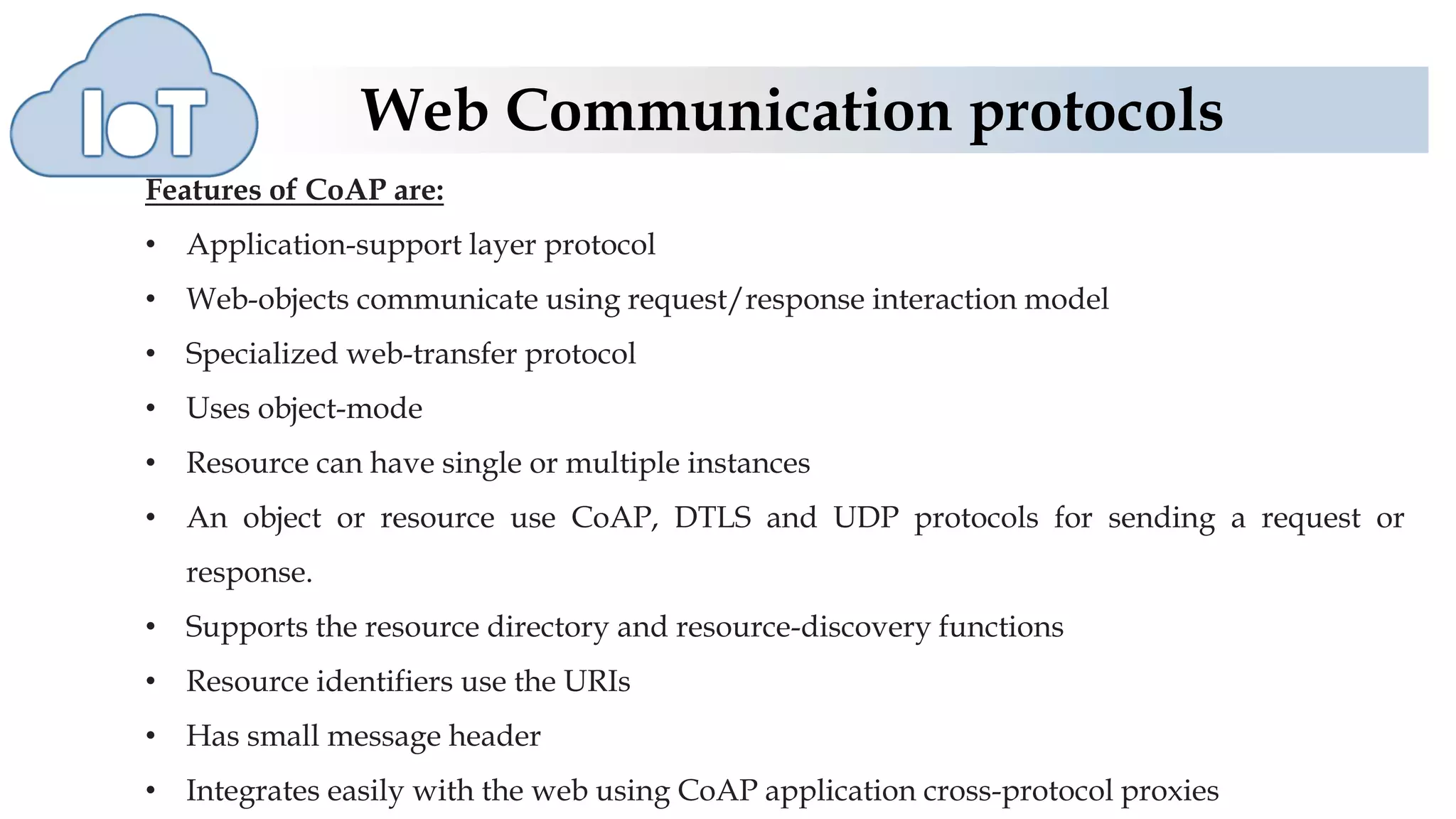
Features of CoAP are:
• Application-support layer protocol
• Web-objects communicate using request/response interaction model
• Specialized web-transfer protocol
• Uses object-mode
• Resource can have single or multiple instances
• An object or resource use CoAP, DTLS and UDP protocols for sending a request or
response.
• Supports the resource directory and resource-discovery functions
• Resource identifiers use the URIs
• Has small message header
• Integrates easily with the web using CoAP application cross-protocol proxies
Web Communication protocols
1. Constrained Application Protocol
1.1. CoAP Client Web Connectivity
1.2. Secured Use of a Key for Client Authentication
2. Lightweight Machine-to-Machine Communication Protocol
3. JSON Format
4. Tag Length Value Format
5. MIME Type
Web Communication protocols
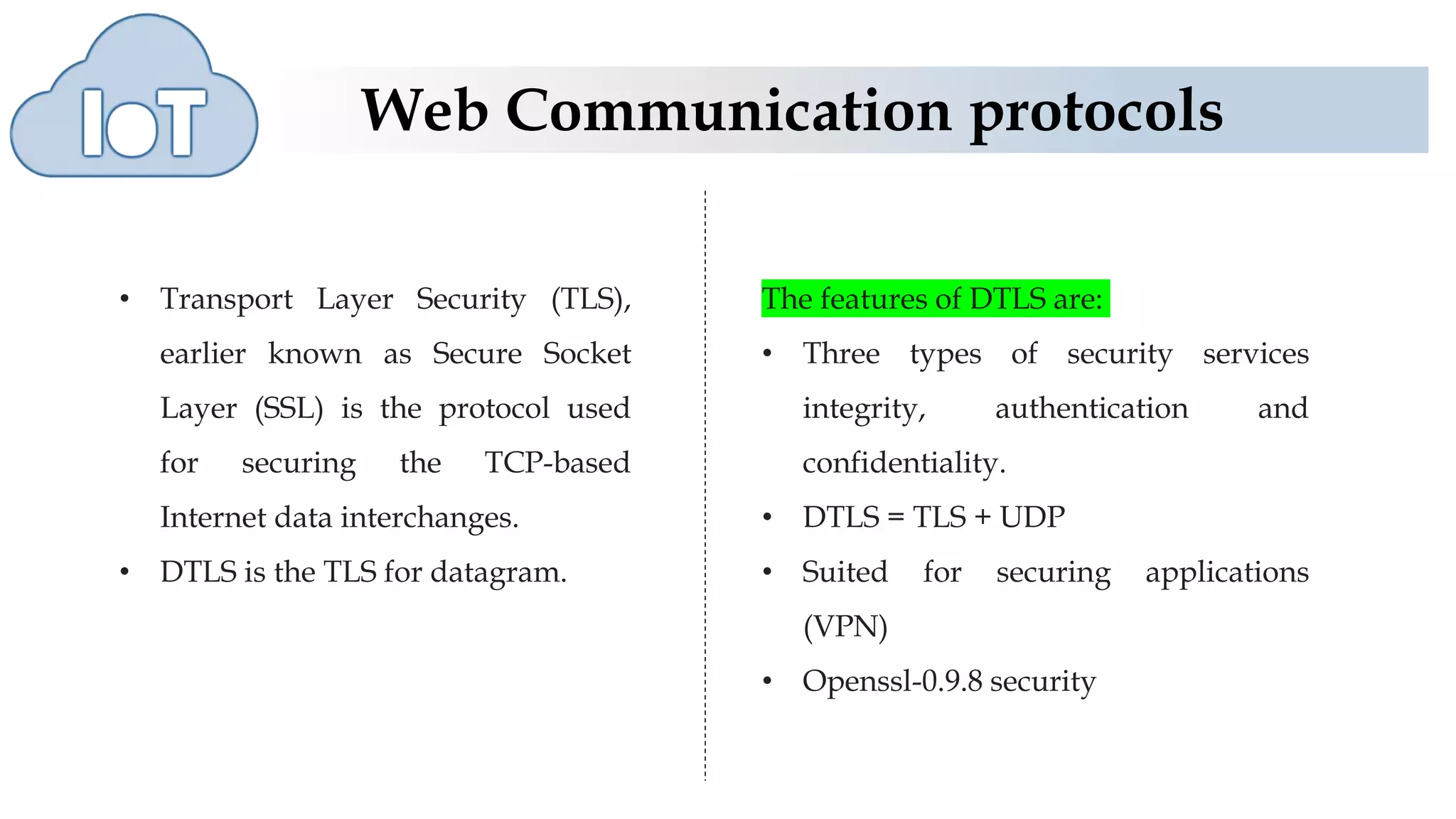
• A proxy is an intermediate server,
which accepts a request from a
client and sends the response to
the client using a protocol. It also
passes the request to the server
and accepts a response from the
server using the same or another
protocol
Web Communication protocols
• Transport Layer Security (TLS),
earlier known as Secure Socket
Layer (SSL) is the protocol used
for securing the TCP-based
Internet data interchanges.
• DTLS is the TLS for datagram.
The features of DTLS are:
• Three types of security services
integrity, authentication and
confidentiality.
• DTLS = TLS + UDP
• Suited for securing applications
(VPN)
• Openssl-0.9.8 security
Web Communication protocols
1. Constrained Application Protocol
1.1. CoAP Client Web Connectivity
1.2. Secured Use of a Key for Client Authentication
2. Lightweight Machine-to-Machine Communication Protocol
3. JSON Format
4. Tag Length Value Format
5. MIME Type
Web Communication protocols
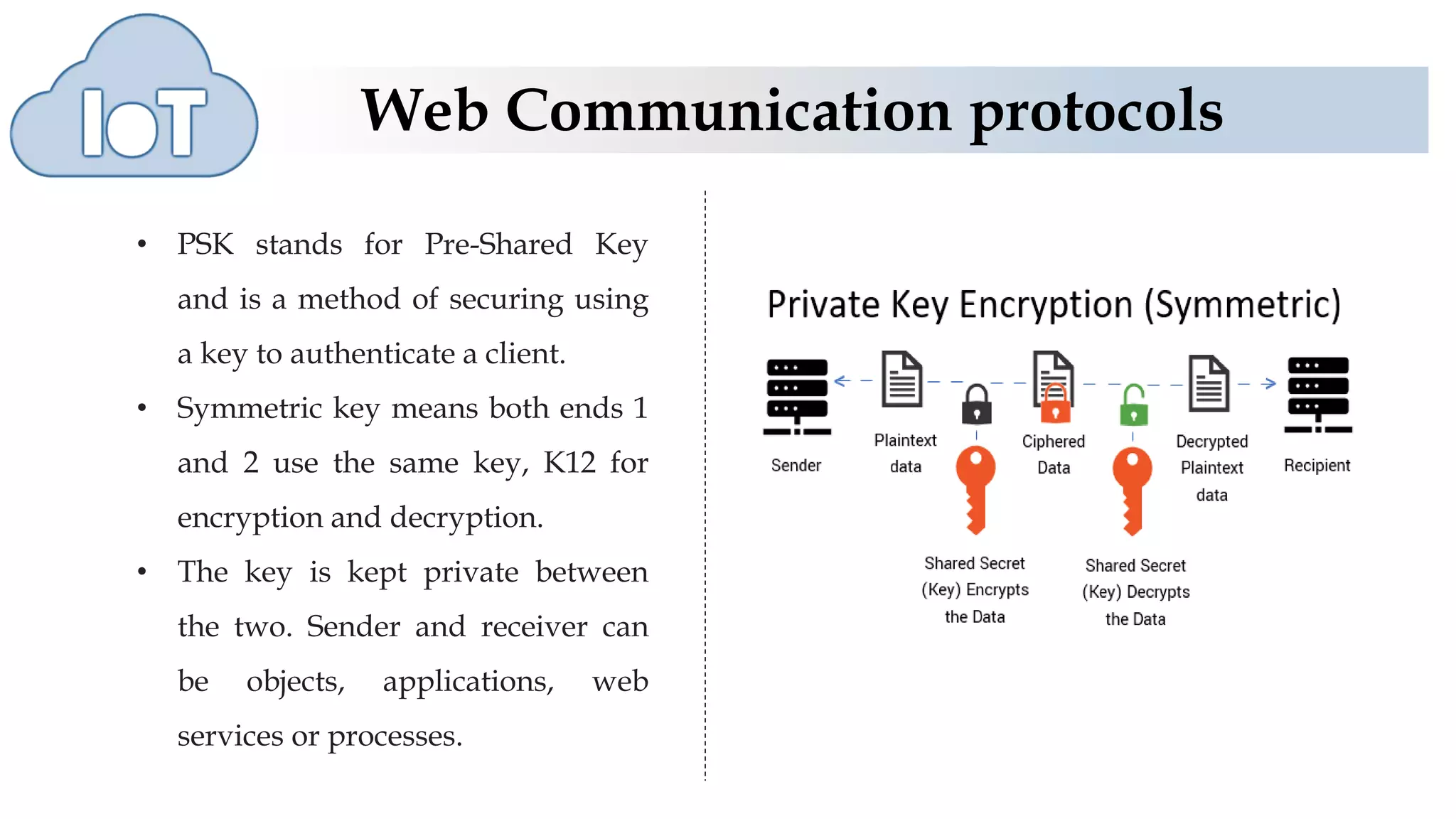
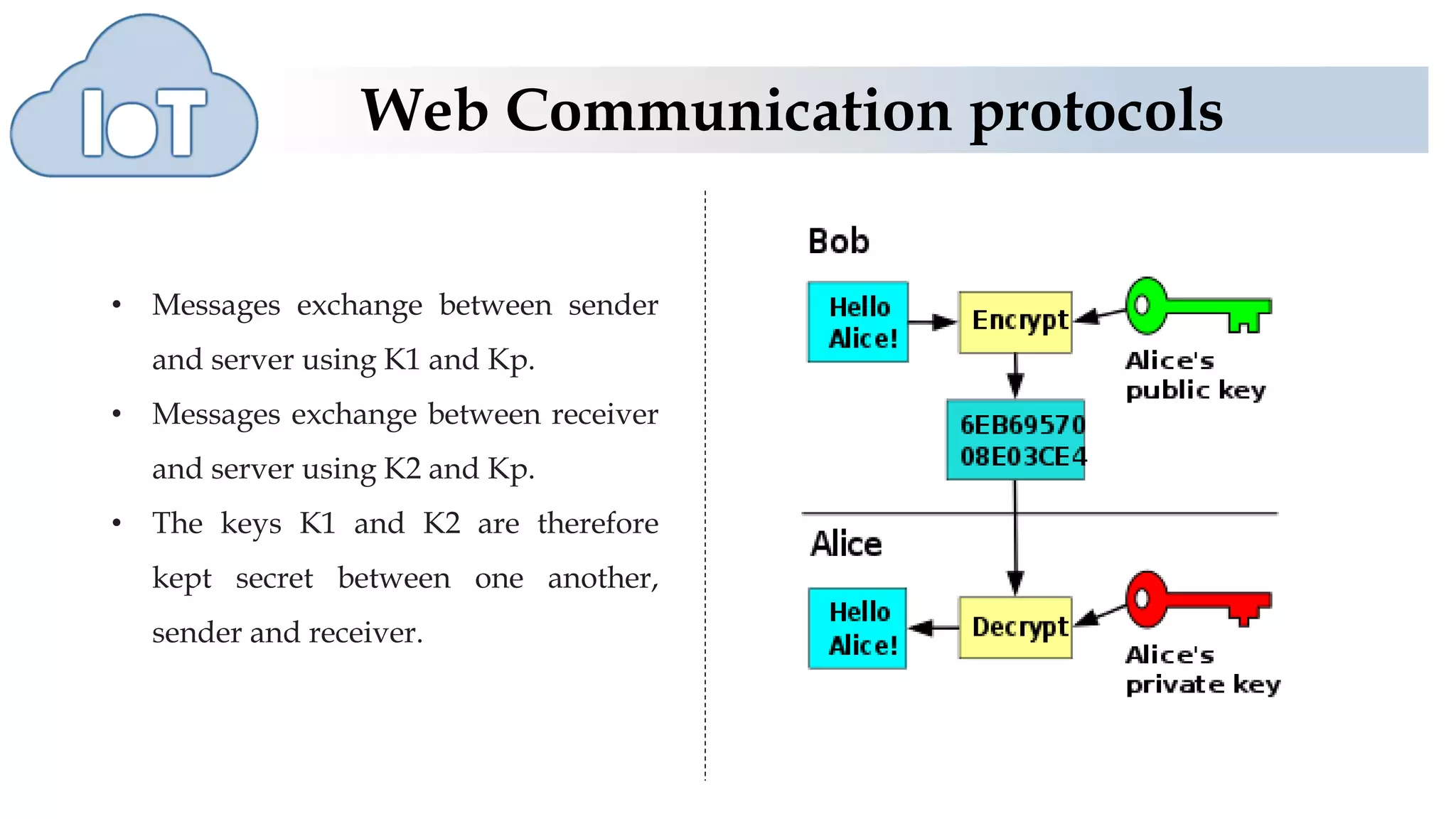
• PSK stands for Pre-Shared Key
and is a method of securing using
a key to authenticate a client.
• Symmetric key means both ends 1
and 2 use the same key, K12 for
encryption and decryption.
• The key is kept private between
the two. Sender and receiver can
be objects, applications, web
services or processes.
Web Communication protocols
• Messages exchange between sender
and server using K1 and Kp.
• Messages exchange between receiver
and server using K2 and Kp.
• The keys K1 and K2 are therefore
kept secret between one another,
sender and receiver.
Web Communication protocols
1. Constrained Application Protocol
1.1. CoAP Client Web Connectivity
1.2. Secured Use of a Key for Client Authentication
2. Lightweight Machine-to-Machine Communication Protocol
3. JSON Format
4. Tag Length Value Format
5. MIME Type
Web Communication protocols
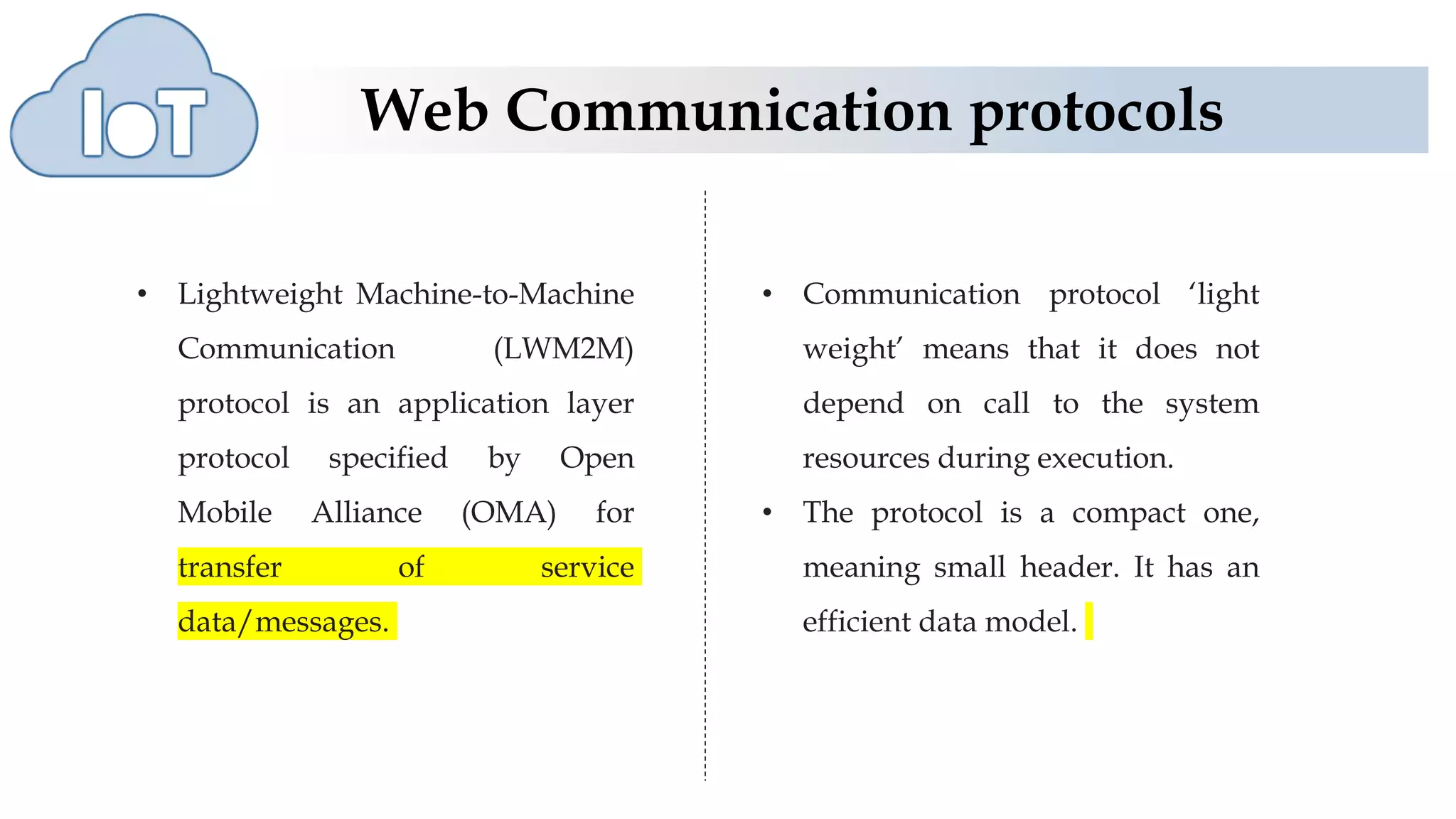
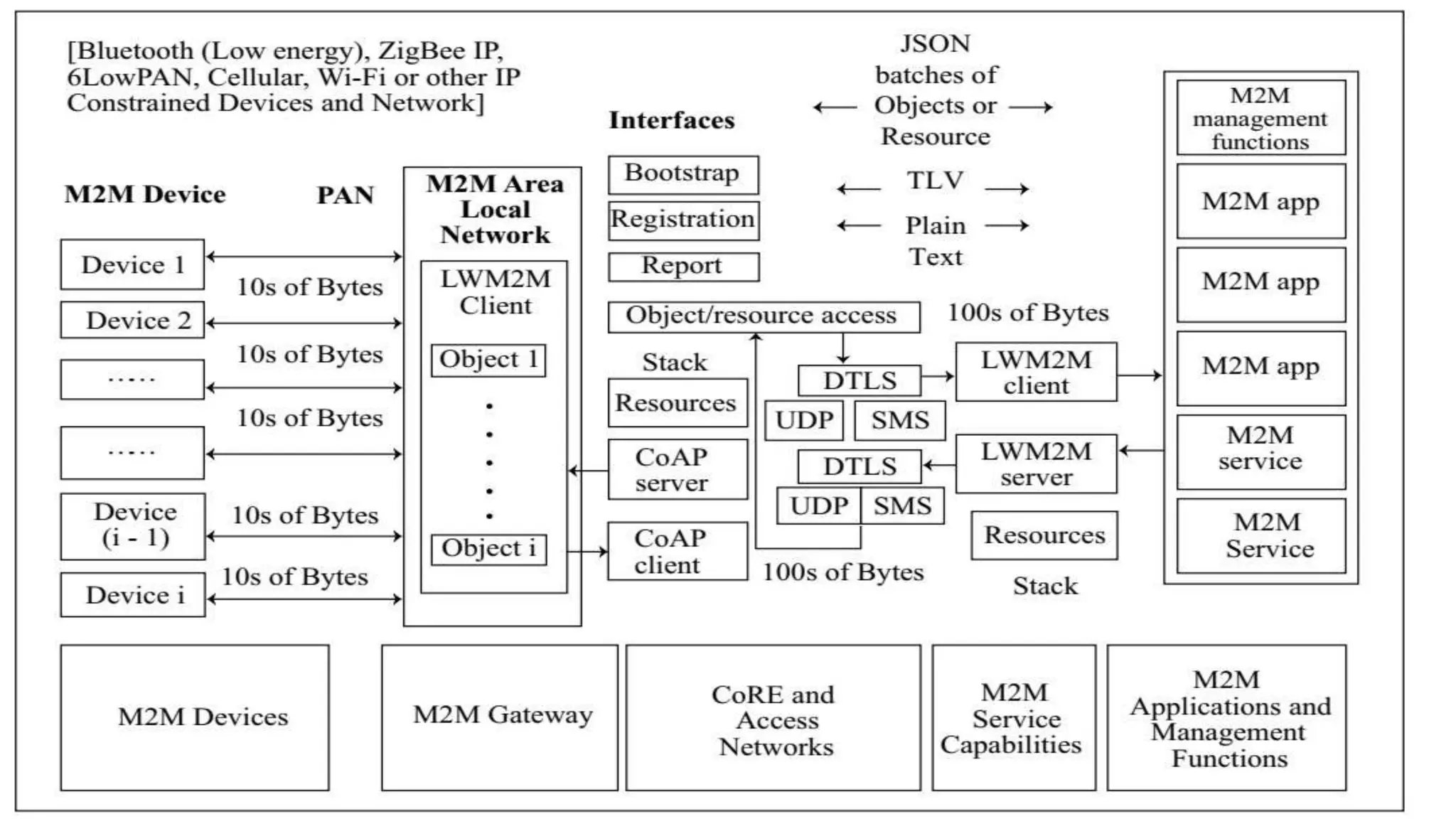
• Lightweight Machine-to-Machine
Communication (LWM2M)
protocol is an application layer
protocol specified by Open
Mobile Alliance (OMA) for
transfer of service
data/messages.
• Communication protocol ‘light
weight’ means that it does not
depend on call to the system
resources during execution.
• The protocol is a compact one,
meaning small header. It has an
efficient data model.
Web Communication protocols
1. Constrained Application Protocol
1.1. CoAP Client Web Connectivity
1.2. Secured Use of a Key for Client Authentication
2. Lightweight Machine-to-Machine Communication Protocol
3. JSON Format
4. Tag Length Value Format
5. MIME Type
Web Communication protocols
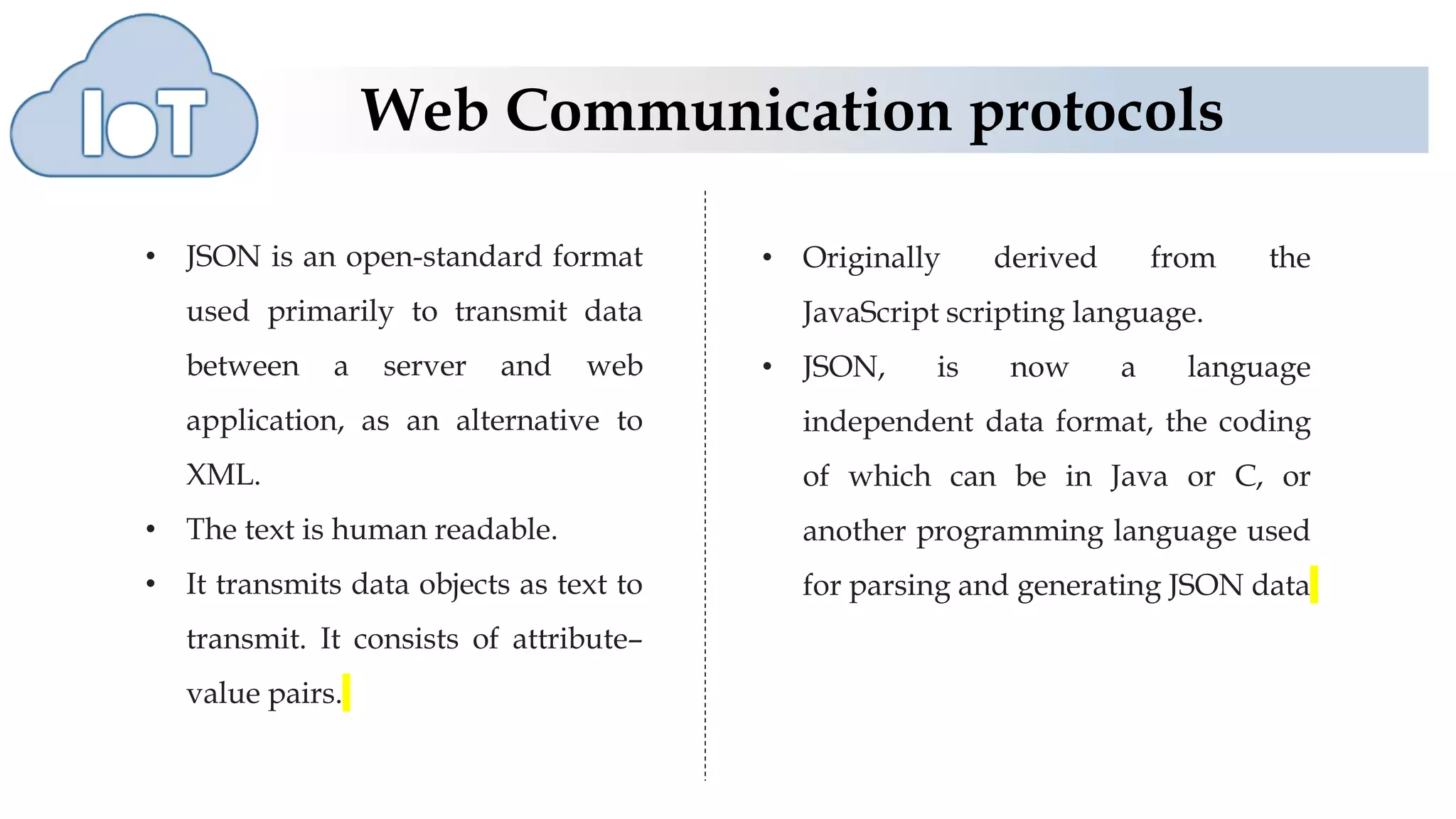
• JSON is an open-standard format
used primarily to transmit data
between a server and web
application, as an alternative to
XML.
• The text is human readable.
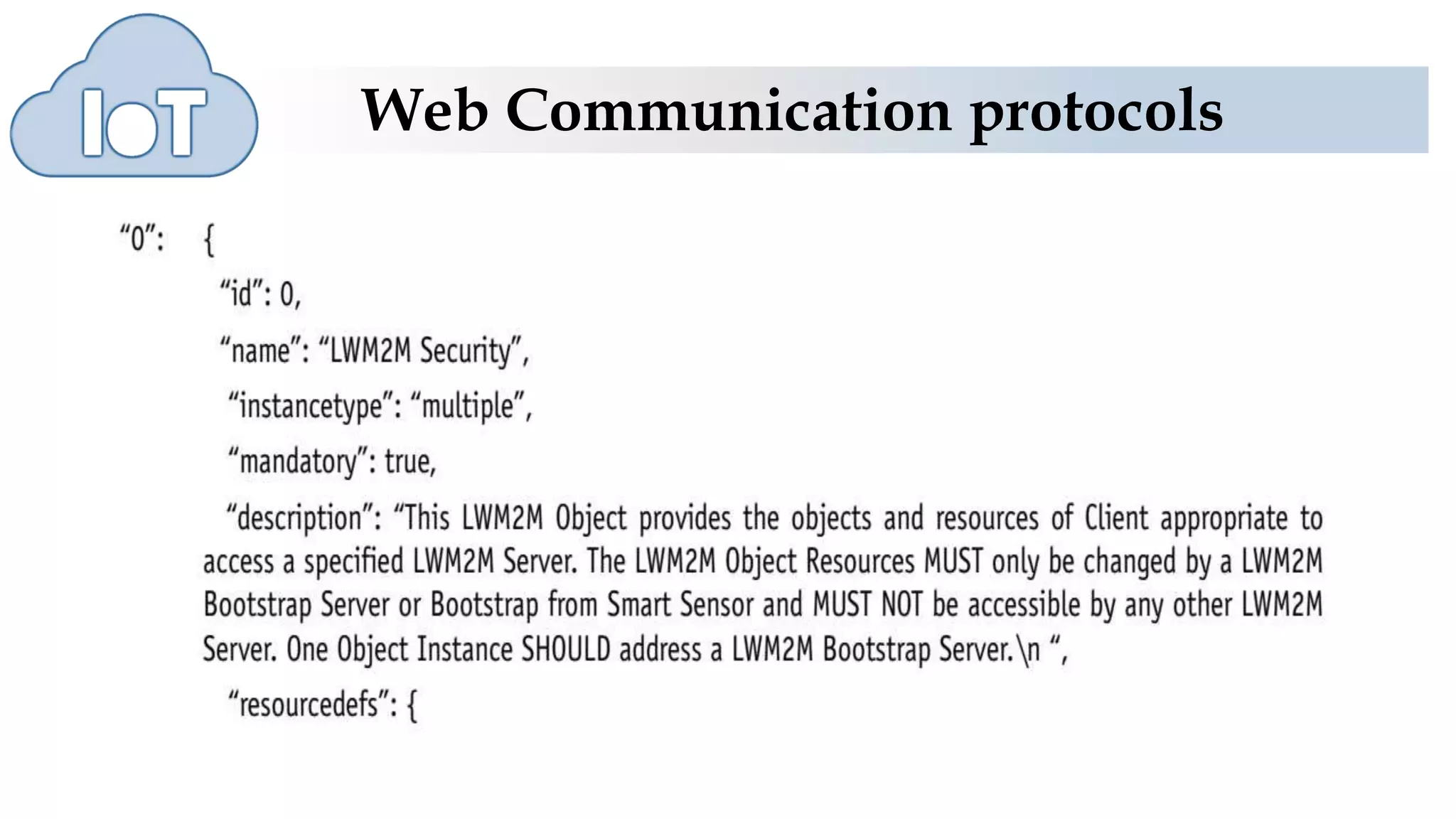
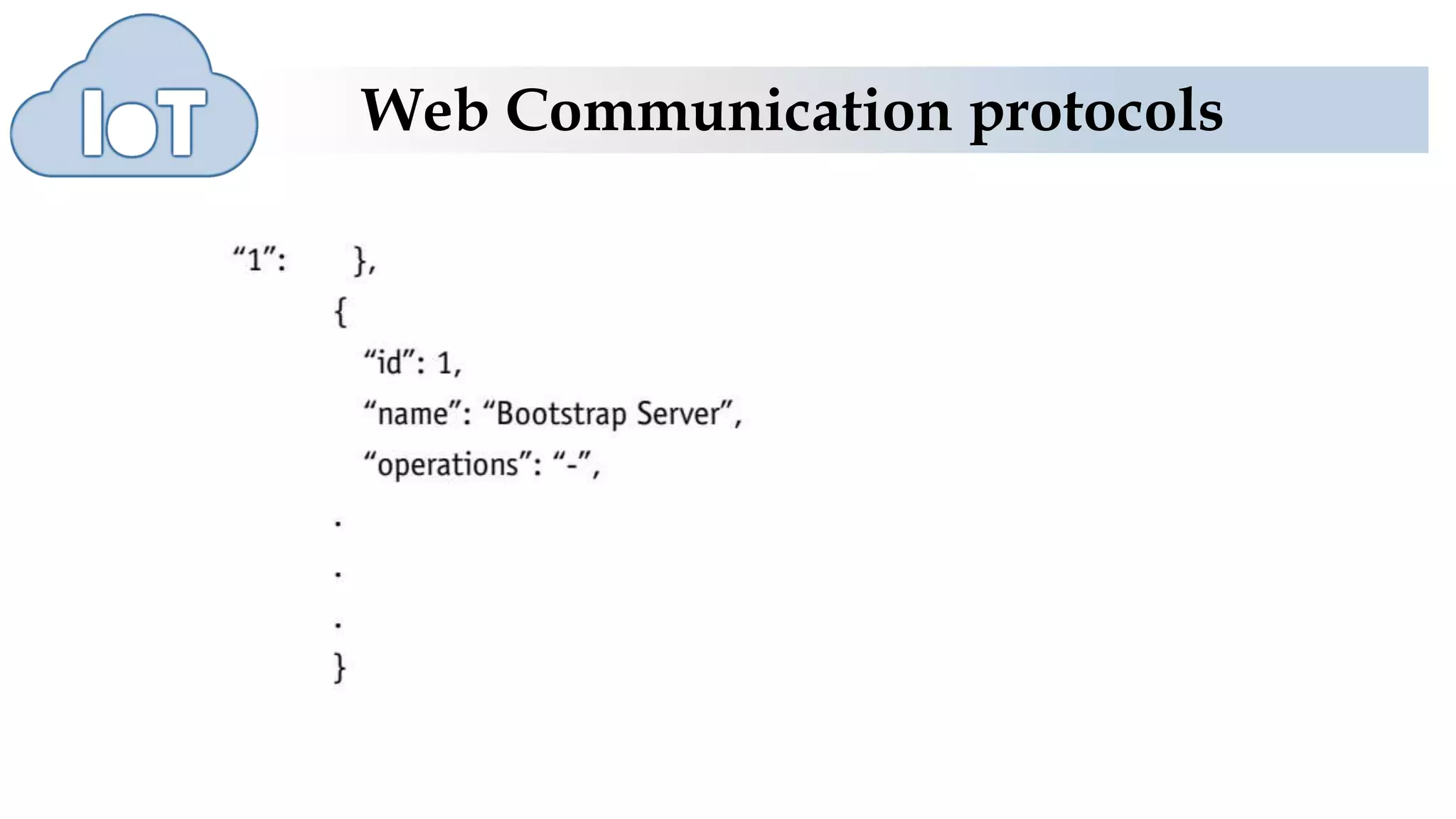
• It transmits data objects as text to
transmit. It consists of attribute–
value pairs.
• Originally derived from the
JavaScript scripting language.
• JSON, is now a language
independent data format, the coding
of which can be in Java or C, or
another programming language used
for parsing and generating JSON data
Web Communication protocols
1. Constrained Application Protocol
1.1. CoAP Client Web Connectivity
1.2. Secured Use of a Key for Client Authentication
2. Lightweight Machine-to-Machine Communication Protocol
3. JSON Format
4. Tag Length Value Format
5. MIME Type
Web Communication protocols
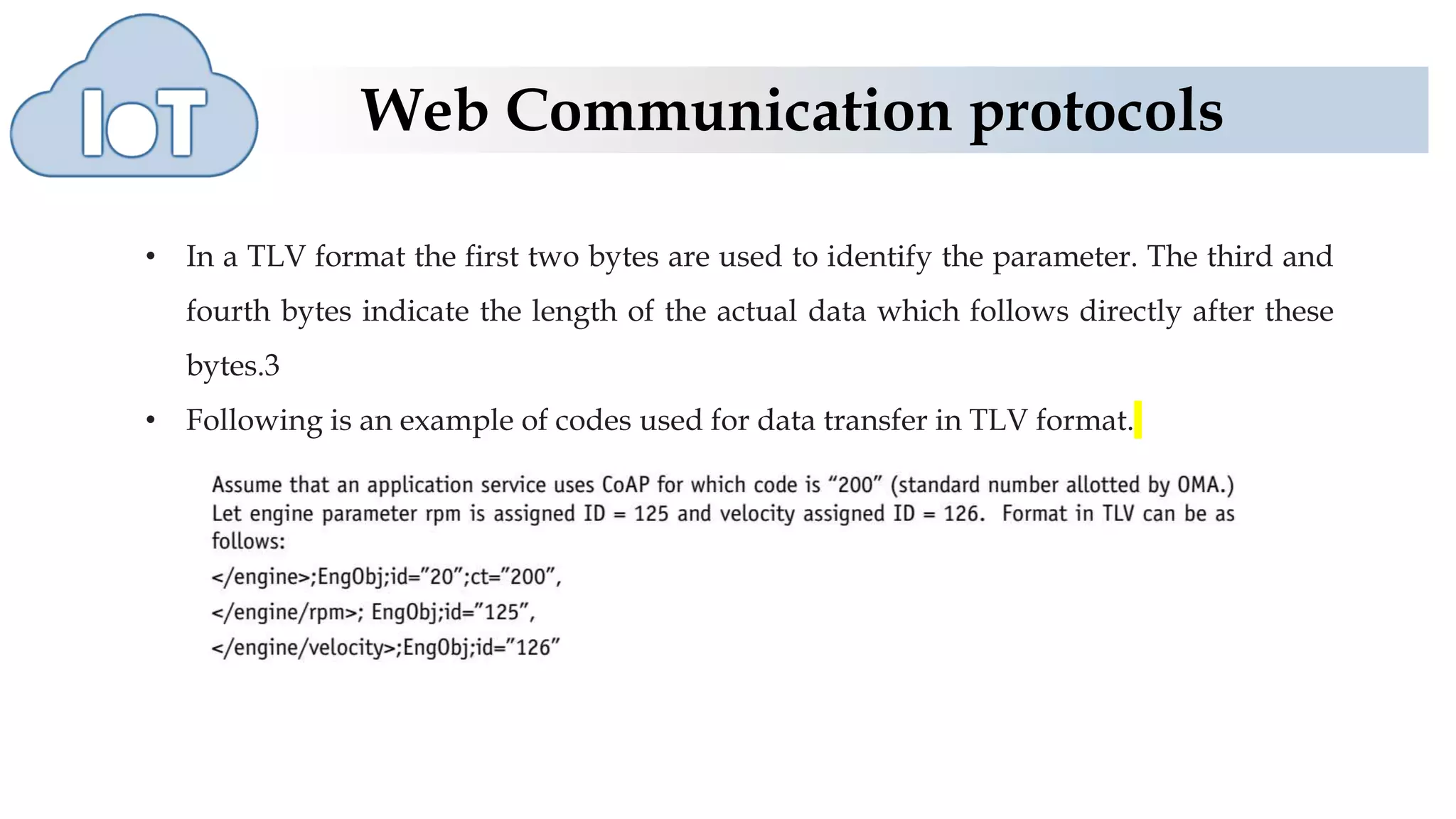
• In a TLV format the first two bytes are used to identify the parameter. The third and
fourth bytes indicate the length of the actual data which follows directly after these
bytes.3
• Following is an example of codes used for data transfer in TLV format.
Web Communication protocols
1. Constrained Application Protocol
1.1. CoAP Client Web Connectivity
1.2. Secured Use of a Key for Client Authentication
2. Lightweight Machine-to-Machine Communication Protocol
3. JSON Format
4. Tag Length Value Format
5. MIME Type
Web Communication protocols
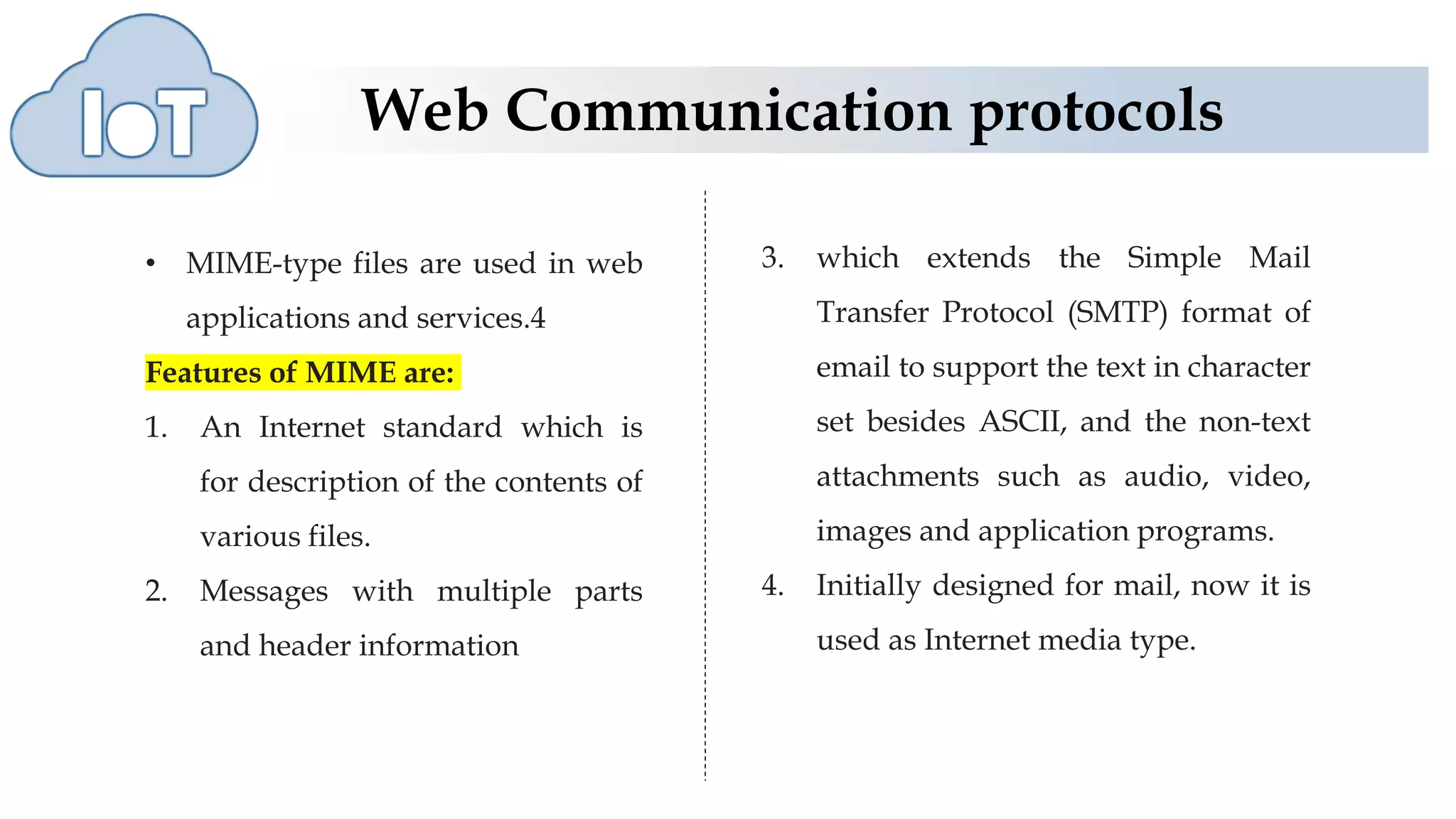
• MIME-type files are used in web
applications and services.4
Features of MIME are:
1. An Internet standard which is
for description of the contents of
various files.
2. Messages with multiple parts
and header information
3. which extends the Simple Mail
Transfer Protocol (SMTP) format of
email to support the text in character
set besides ASCII, and the non-text
attachments such as audio, video,
images and application programs.
4. Initially designed for mail, now it is
used as Internet media type.
Web Communication protocols
• List of MIME type files is exhaustive.
• Few examples of MIME type files are—doc (application/msword), html
(text/html), htm (text/htm), gif (image/gif), js (application/ x-javascript), css
(Application is text/css), mpeg (video/mpeg), pdf (application/pdf) and exe
(application/octet-stream).
• HTML links, objects, and script and style tags, each has a type attribute the
value of which can be set equal to a MIME type.
Web Communication
protocols
Introduction for web
Connectivity
Web Connectivity
Message
Communication
protocols

web communication protocols in IoT

  • 2.
    Design Principles forthe Web Connectivity Web Communication protocols Introduction for web Connectivity Web Connectivity Message Communication protocols
  • 3.
    Web Communication protocols Dataof connected devices routes over the web in two types of communication environments. The environments are: • Constrained RESTful Environment (CoRE) • Unconstrained Environment Constrained RESTful Environment (CoRE) • Sends or receives 10s of bytes. • Data is limited in size. • Devices may sleep • Connectivity may also break Unconstrained Environment • A web object consists of 1000s of bytes. Data routes over IP networks for the Internet.
  • 4.
  • 5.
    Web Communication protocols 1.Constrained Application Protocol 1.1. CoAP Client Web Connectivity 1.2. Secured Use of a Key for Client Authentication 2. Lightweight Machine-to-Machine Communication Protocol 3. JSON Format 4. Tag Length Value Format 5. MIME Type
  • 6.
    Web Communication protocols 1.Constrained Application Protocol 1.1. CoAP Client Web Connectivity 1.2. Secured Use of a Key for Client Authentication 2. Lightweight Machine-to-Machine Communication Protocol 3. JSON Format 4. Tag Length Value Format 5. MIME Type
  • 7.
    Web Communication protocols Featuresof CoAP are: • Application-support layer protocol • Web-objects communicate using request/response interaction model • Specialized web-transfer protocol • Uses object-mode • Resource can have single or multiple instances • An object or resource use CoAP, DTLS and UDP protocols for sending a request or response. • Supports the resource directory and resource-discovery functions • Resource identifiers use the URIs • Has small message header • Integrates easily with the web using CoAP application cross-protocol proxies
  • 8.
    Web Communication protocols 1.Constrained Application Protocol 1.1. CoAP Client Web Connectivity 1.2. Secured Use of a Key for Client Authentication 2. Lightweight Machine-to-Machine Communication Protocol 3. JSON Format 4. Tag Length Value Format 5. MIME Type
  • 9.
    Web Communication protocols •A proxy is an intermediate server, which accepts a request from a client and sends the response to the client using a protocol. It also passes the request to the server and accepts a response from the server using the same or another protocol
  • 10.
    Web Communication protocols •Transport Layer Security (TLS), earlier known as Secure Socket Layer (SSL) is the protocol used for securing the TCP-based Internet data interchanges. • DTLS is the TLS for datagram. The features of DTLS are: • Three types of security services integrity, authentication and confidentiality. • DTLS = TLS + UDP • Suited for securing applications (VPN) • Openssl-0.9.8 security
  • 11.
    Web Communication protocols 1.Constrained Application Protocol 1.1. CoAP Client Web Connectivity 1.2. Secured Use of a Key for Client Authentication 2. Lightweight Machine-to-Machine Communication Protocol 3. JSON Format 4. Tag Length Value Format 5. MIME Type
  • 12.
    Web Communication protocols •PSK stands for Pre-Shared Key and is a method of securing using a key to authenticate a client. • Symmetric key means both ends 1 and 2 use the same key, K12 for encryption and decryption. • The key is kept private between the two. Sender and receiver can be objects, applications, web services or processes.
  • 13.
    Web Communication protocols •Messages exchange between sender and server using K1 and Kp. • Messages exchange between receiver and server using K2 and Kp. • The keys K1 and K2 are therefore kept secret between one another, sender and receiver.
  • 14.
    Web Communication protocols 1.Constrained Application Protocol 1.1. CoAP Client Web Connectivity 1.2. Secured Use of a Key for Client Authentication 2. Lightweight Machine-to-Machine Communication Protocol 3. JSON Format 4. Tag Length Value Format 5. MIME Type
  • 15.
    Web Communication protocols •Lightweight Machine-to-Machine Communication (LWM2M) protocol is an application layer protocol specified by Open Mobile Alliance (OMA) for transfer of service data/messages. • Communication protocol ‘light weight’ means that it does not depend on call to the system resources during execution. • The protocol is a compact one, meaning small header. It has an efficient data model.
  • 16.
  • 17.
    Web Communication protocols 1.Constrained Application Protocol 1.1. CoAP Client Web Connectivity 1.2. Secured Use of a Key for Client Authentication 2. Lightweight Machine-to-Machine Communication Protocol 3. JSON Format 4. Tag Length Value Format 5. MIME Type
  • 18.
    Web Communication protocols •JSON is an open-standard format used primarily to transmit data between a server and web application, as an alternative to XML. • The text is human readable. • It transmits data objects as text to transmit. It consists of attribute– value pairs. • Originally derived from the JavaScript scripting language. • JSON, is now a language independent data format, the coding of which can be in Java or C, or another programming language used for parsing and generating JSON data
  • 19.
  • 20.
  • 21.
    Web Communication protocols 1.Constrained Application Protocol 1.1. CoAP Client Web Connectivity 1.2. Secured Use of a Key for Client Authentication 2. Lightweight Machine-to-Machine Communication Protocol 3. JSON Format 4. Tag Length Value Format 5. MIME Type
  • 22.
    Web Communication protocols •In a TLV format the first two bytes are used to identify the parameter. The third and fourth bytes indicate the length of the actual data which follows directly after these bytes.3 • Following is an example of codes used for data transfer in TLV format.
  • 23.
    Web Communication protocols 1.Constrained Application Protocol 1.1. CoAP Client Web Connectivity 1.2. Secured Use of a Key for Client Authentication 2. Lightweight Machine-to-Machine Communication Protocol 3. JSON Format 4. Tag Length Value Format 5. MIME Type
  • 24.
    Web Communication protocols •MIME-type files are used in web applications and services.4 Features of MIME are: 1. An Internet standard which is for description of the contents of various files. 2. Messages with multiple parts and header information 3. which extends the Simple Mail Transfer Protocol (SMTP) format of email to support the text in character set besides ASCII, and the non-text attachments such as audio, video, images and application programs. 4. Initially designed for mail, now it is used as Internet media type.
  • 25.
    Web Communication protocols •List of MIME type files is exhaustive. • Few examples of MIME type files are—doc (application/msword), html (text/html), htm (text/htm), gif (image/gif), js (application/ x-javascript), css (Application is text/css), mpeg (video/mpeg), pdf (application/pdf) and exe (application/octet-stream). • HTML links, objects, and script and style tags, each has a type attribute the value of which can be set equal to a MIME type.
  • 26.
    Web Communication protocols Introduction forweb Connectivity Web Connectivity Message Communication protocols