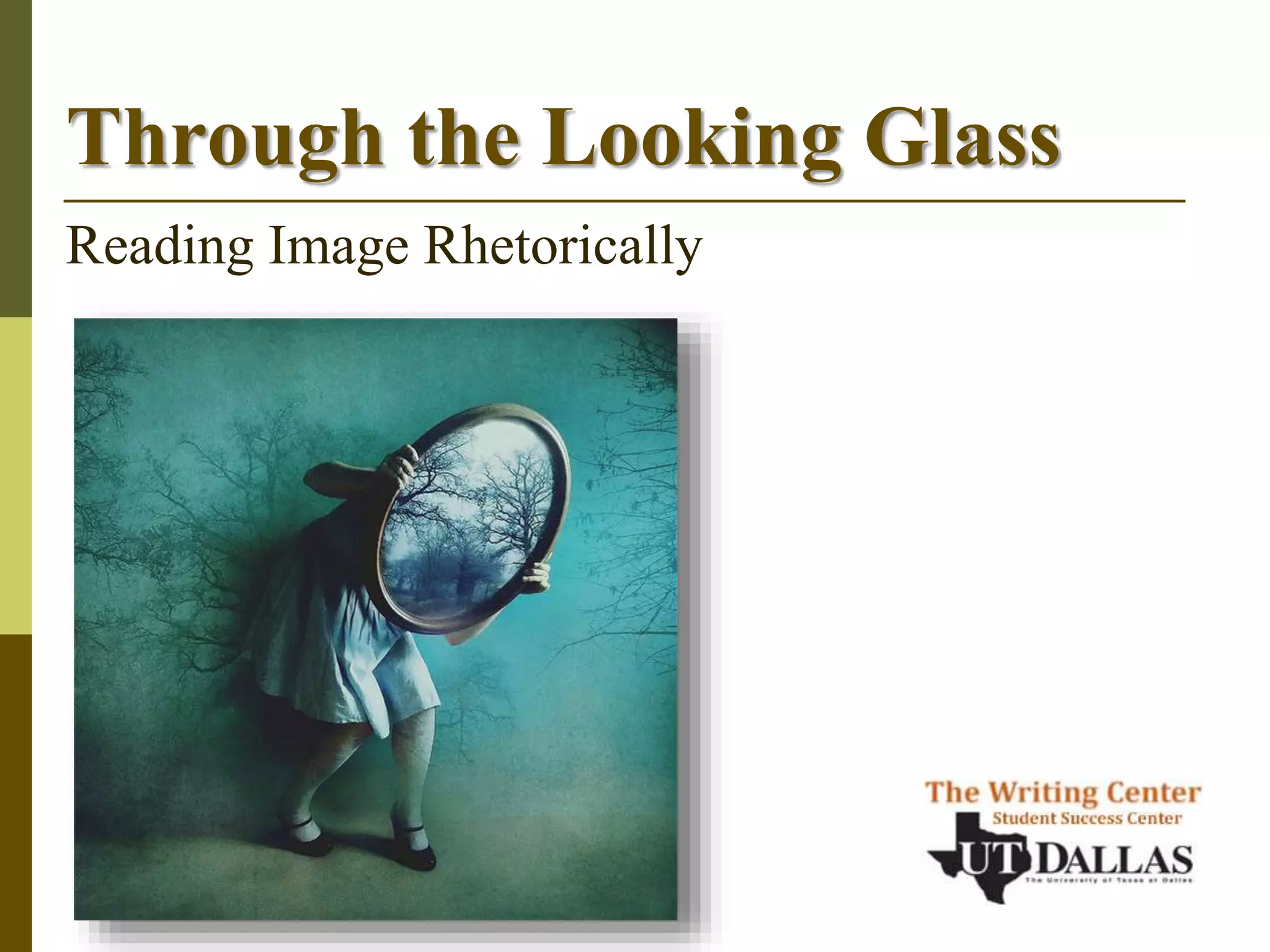
Through the Looking Glass
Reading Image Rhetorically
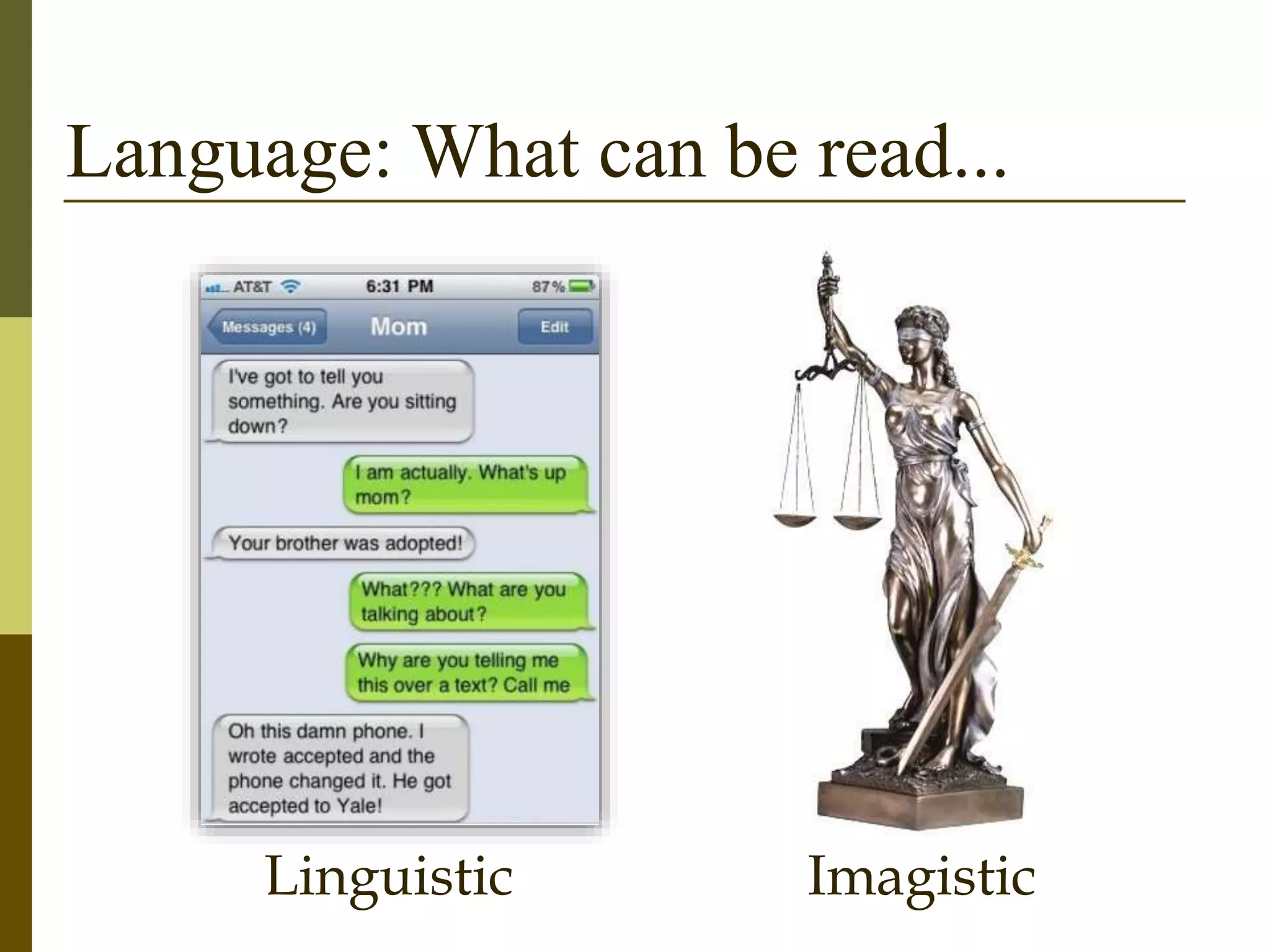
Language: What can be read...
Linguistic Imagistic
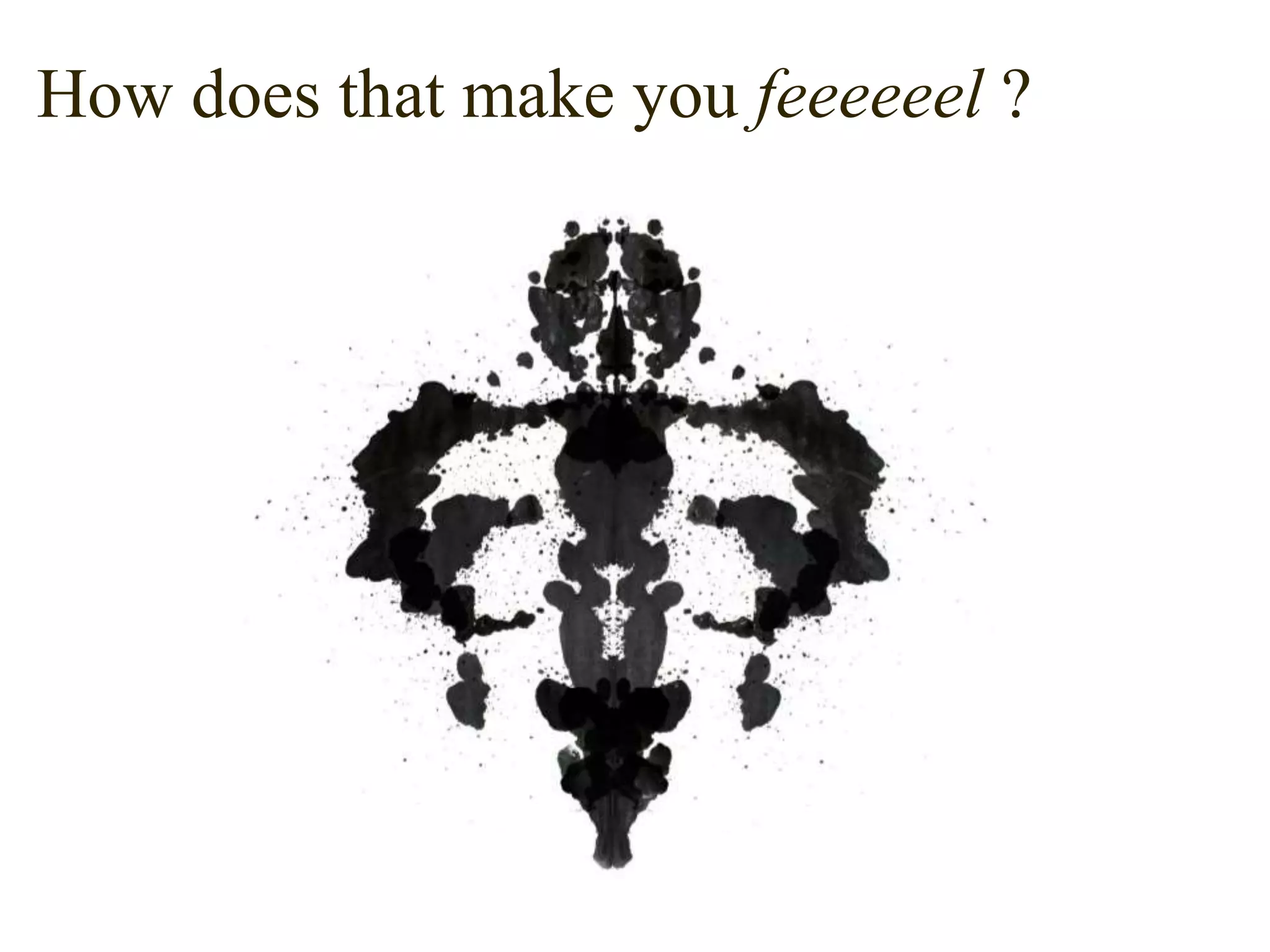
How does that make you feeeeeel ?
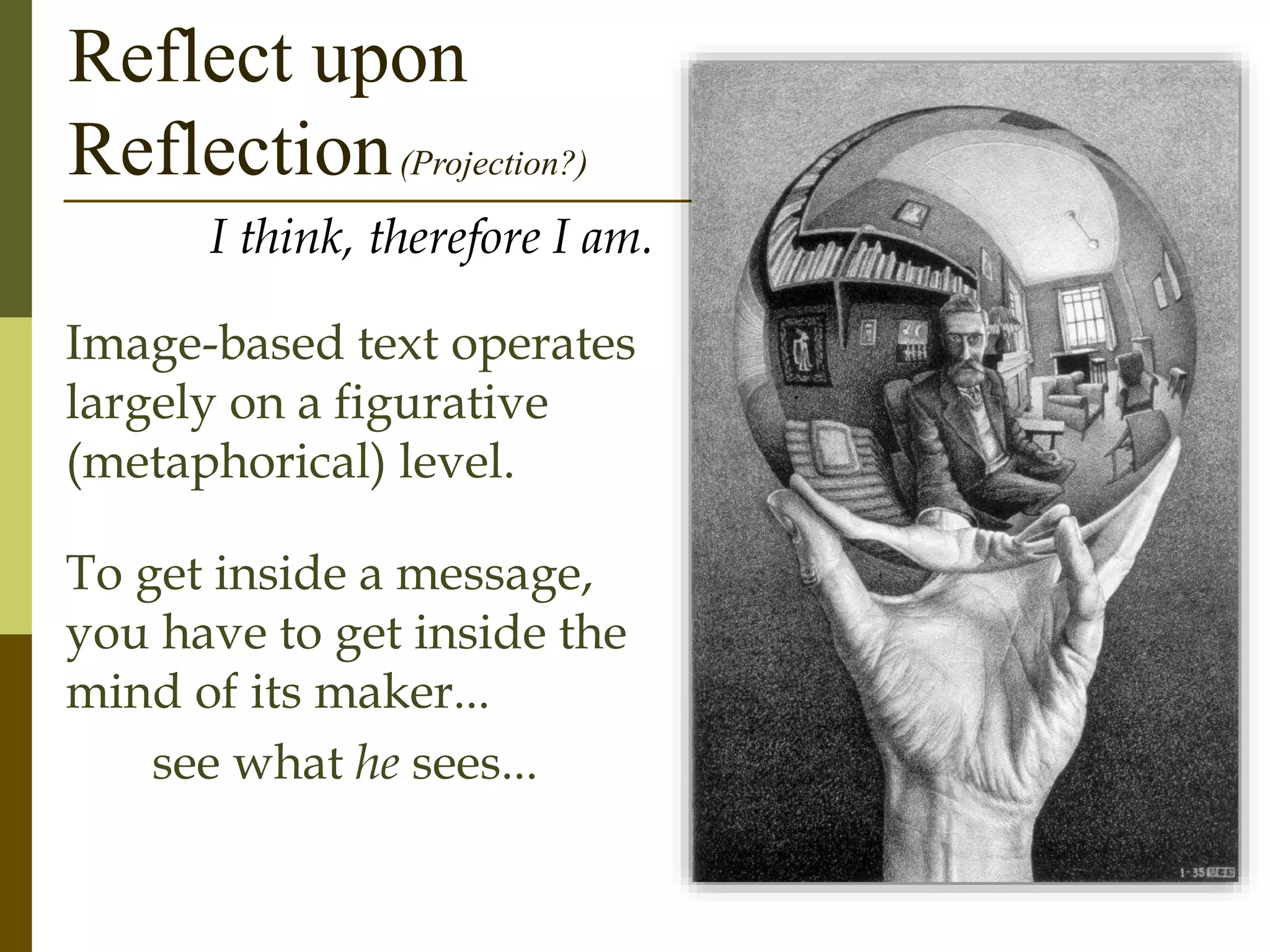
Reflect upon
Reflection(Projection?)
I think, therefore I am.
Image-based text operates
largely on a figurative
(metaphorical) level.
To get inside a message,
you have to get inside the
mind of its maker...
see what he sees...
Workshop Goal
 Formulate a strong, insightful
thesis statement
 Main Claim & Exigence
 Think critically about a visual
text
 Breakdown the part to whole
relationship
 Assess it success/failure
 Select supporting evidence to
back up a working thesis
 Examples in context
The Process
1) Observe
What is the image?
What is the rhetorical situation?
2) Analyze & Infer
What are the main parts?
What is the message & goal?
3) ID the Rhetorical Appeals
Ethos, Pathos, Logos
4) Combine 1-3 & Evaluate
Is the image rhetorically effective?
The Writing Center
Student Success Center
Step 1: Observation
Get a general sense of the
situation and the image
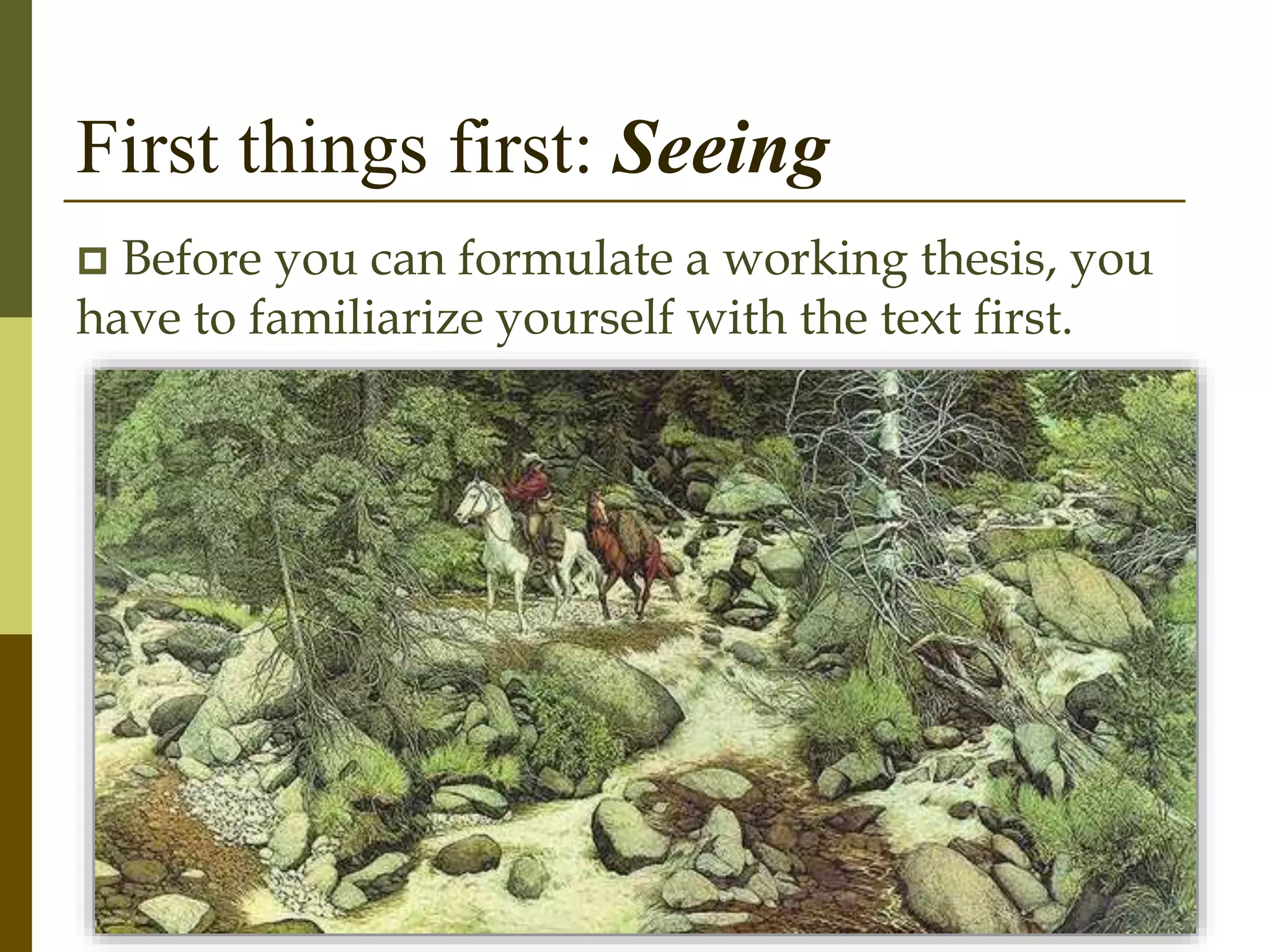
First things first: Seeing
 Before you can formulate a working thesis, you
have to familiarize yourself with the text first.
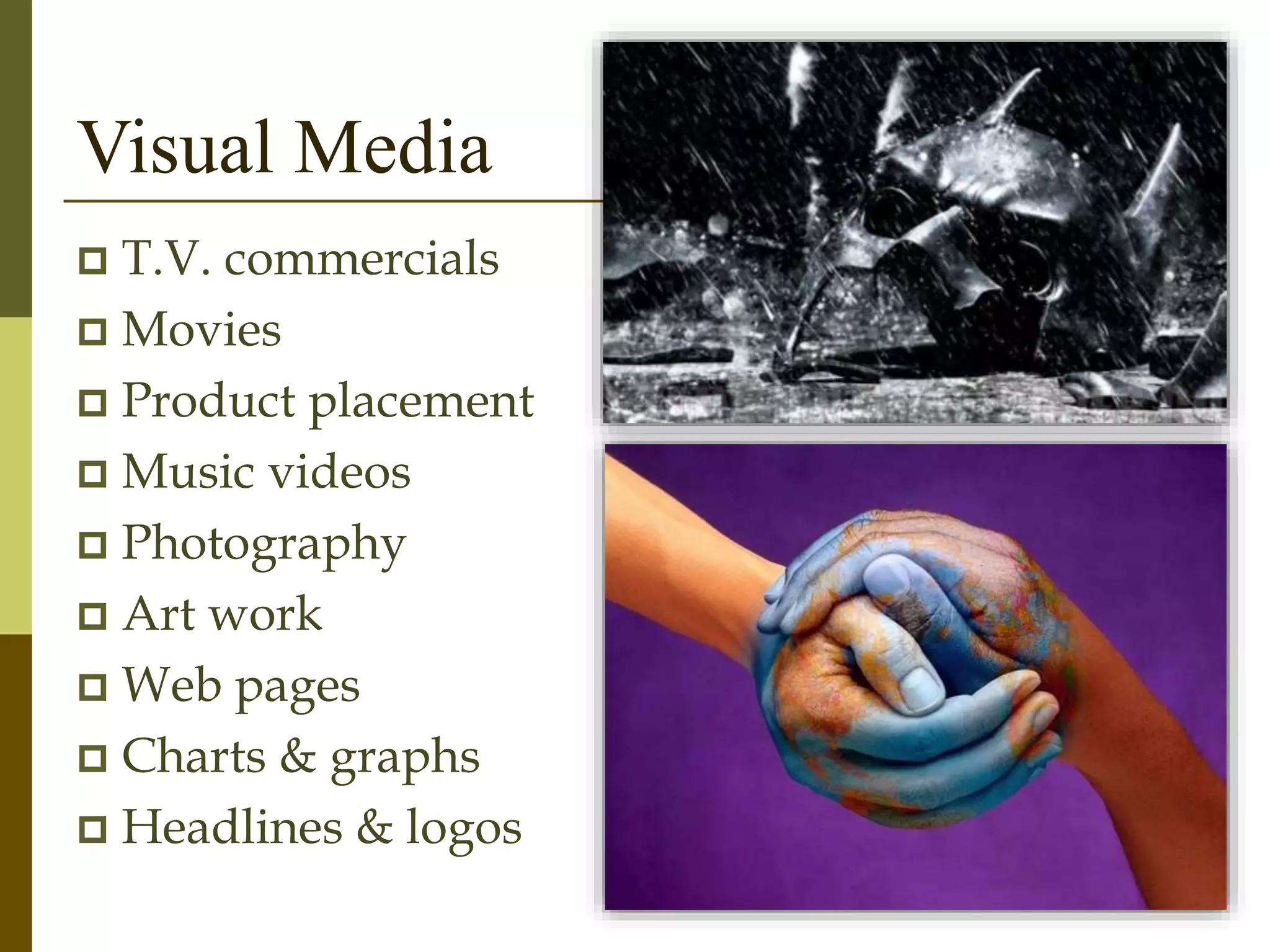
Visual Media
 T.V. commercials
 Movies
 Product placement
 Music videos
 Photography
 Art work
 Web pages
 Charts & graphs
 Headlines & logos
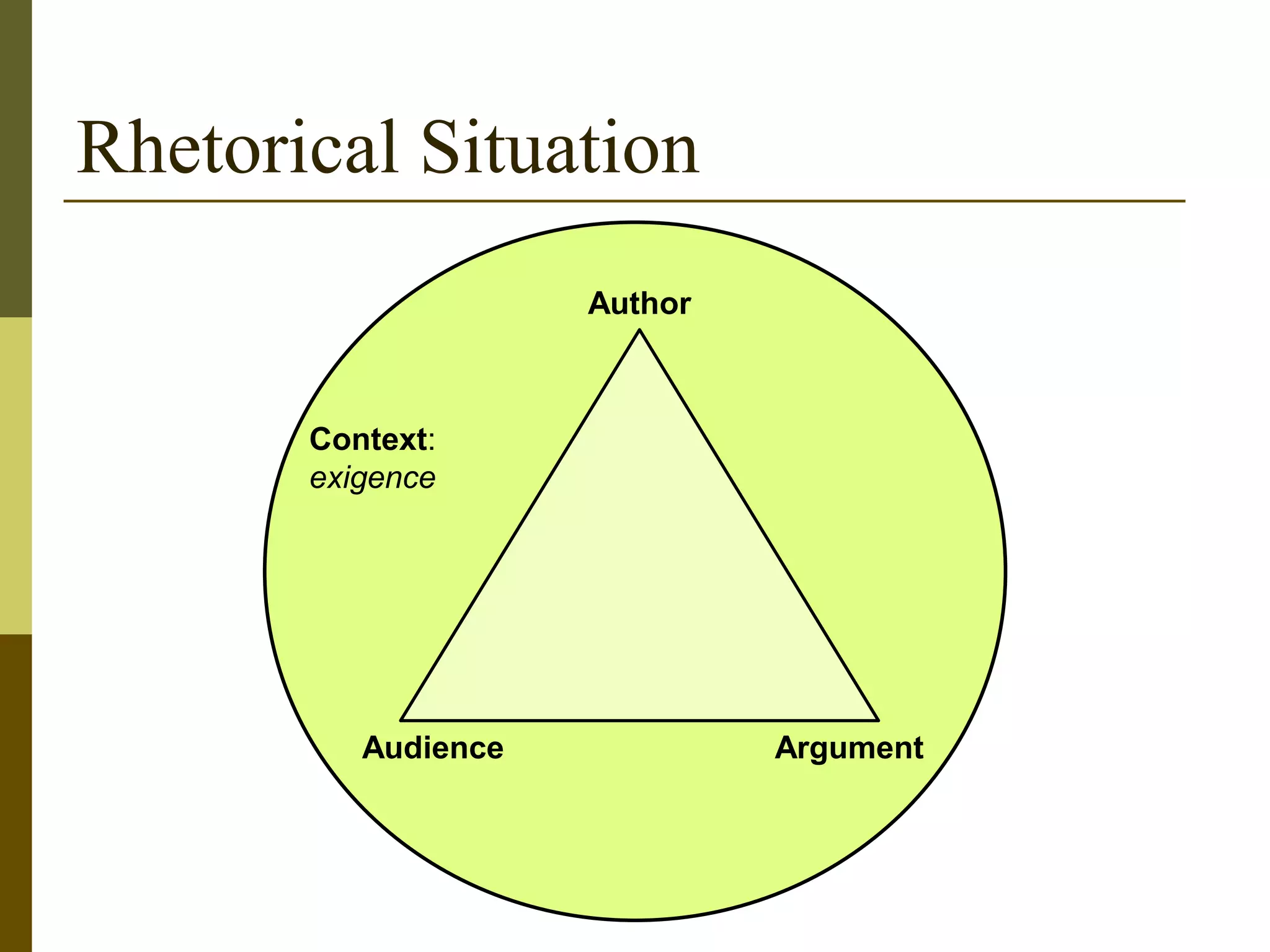
Rhetorical Situation
Author
Audience Argument
Context:
exigence
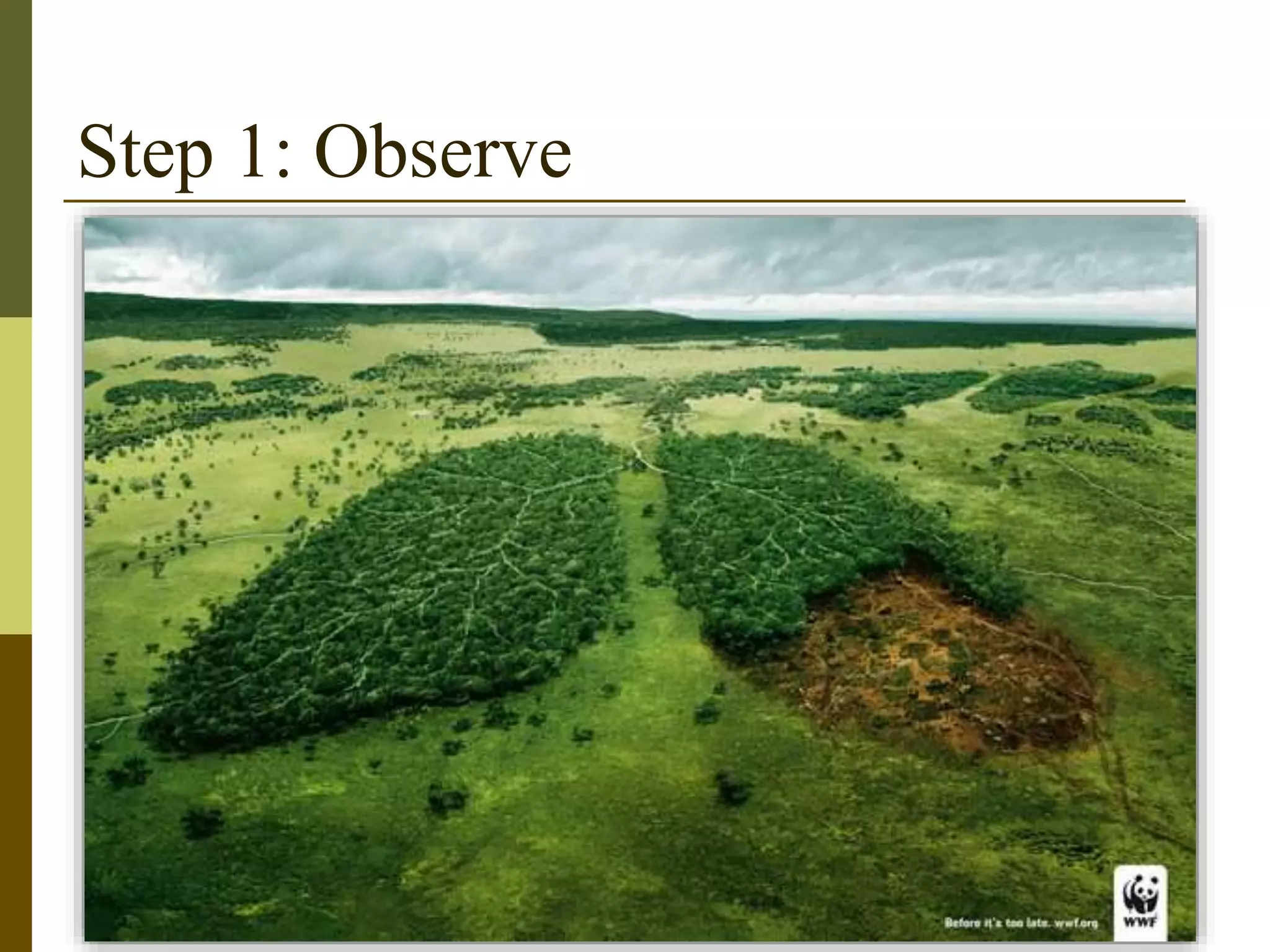
Step 1: Observe
Step 1: Observe
Step 1: Observe
The Writing Center
Student Success Center
Step 2: Analyze & Infer
Break the image down and
formulate an interpretation
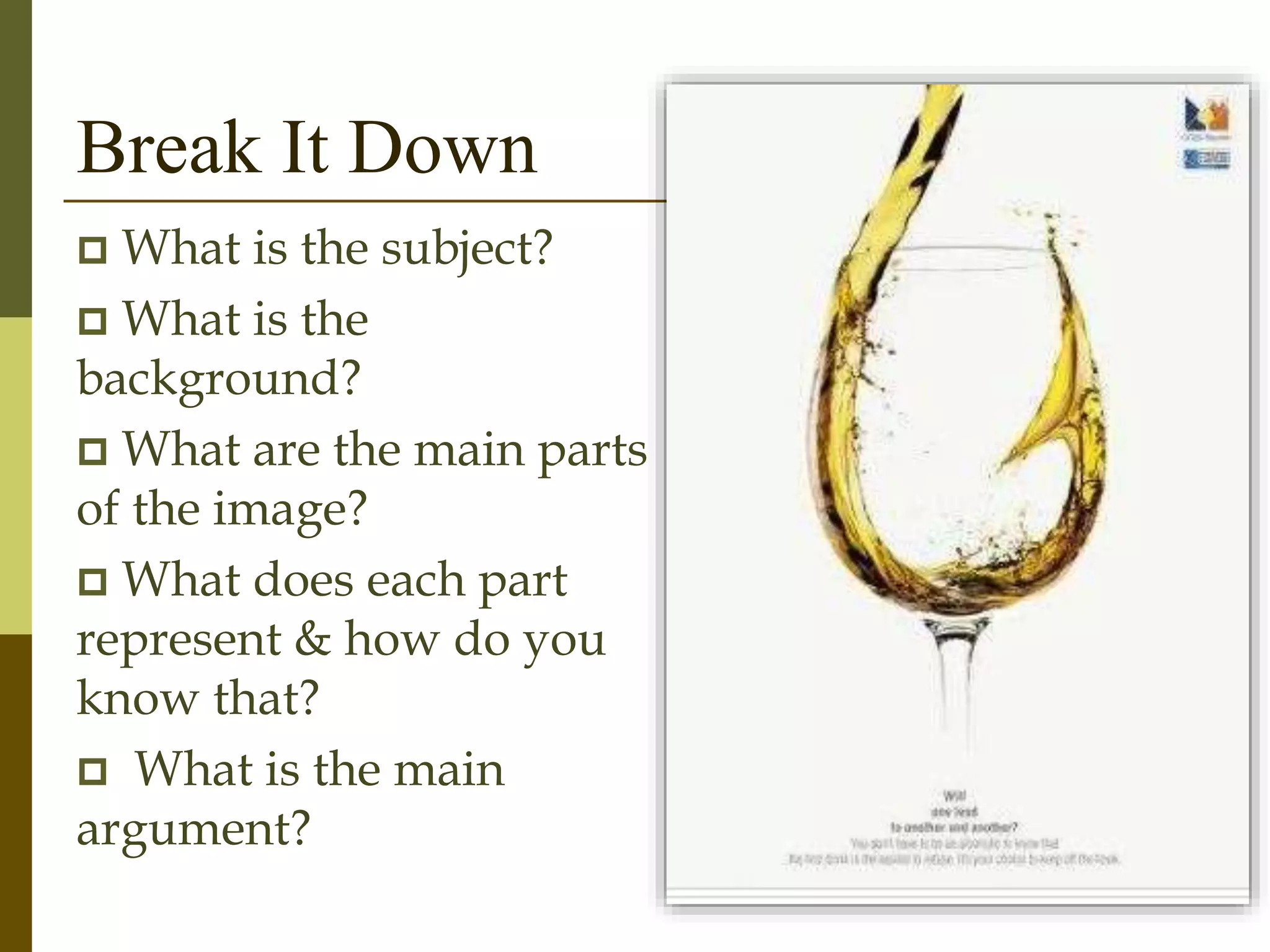
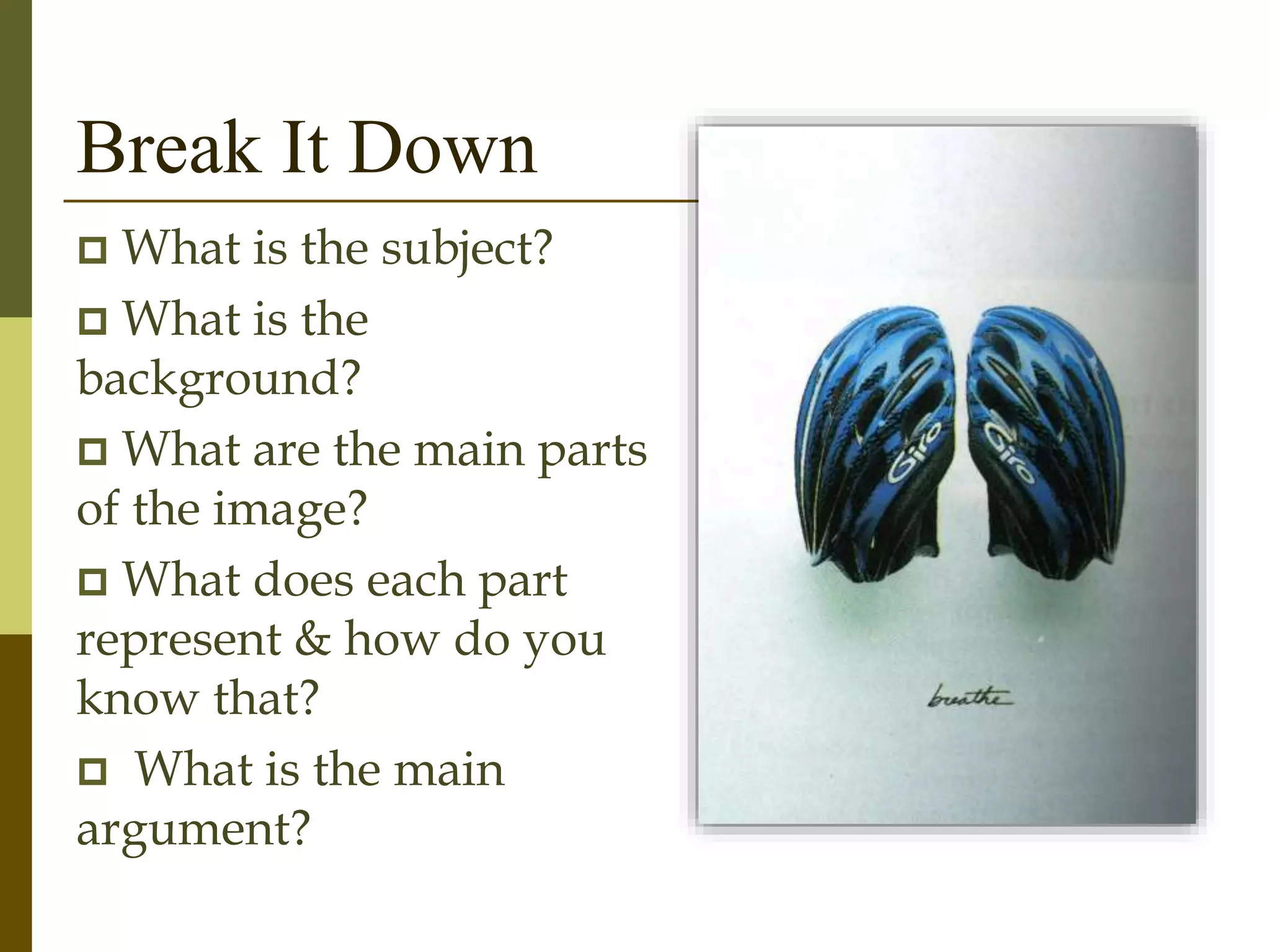
Break It Down
 What is the subject?
 What is the
background?
 What are the main parts
of the image?
 What does each part
represent & how do you
know that?
 What is the main
argument?
Break It Down
 What is the subject?
 What is the
background?
 What are the main parts
of the image?
 What does each part
represent & how do you
know that?
 What is the main
argument?
Break It Down
 Subject?
 Background?
 Parts?
 What does
each part
represent?
 How do you
know that?
 What is the
argument?
The Writing Center
Student Success Center
Step 3: Rhetorical Appeals
Modes of Persuasion
Ethos
Pathos
Logos
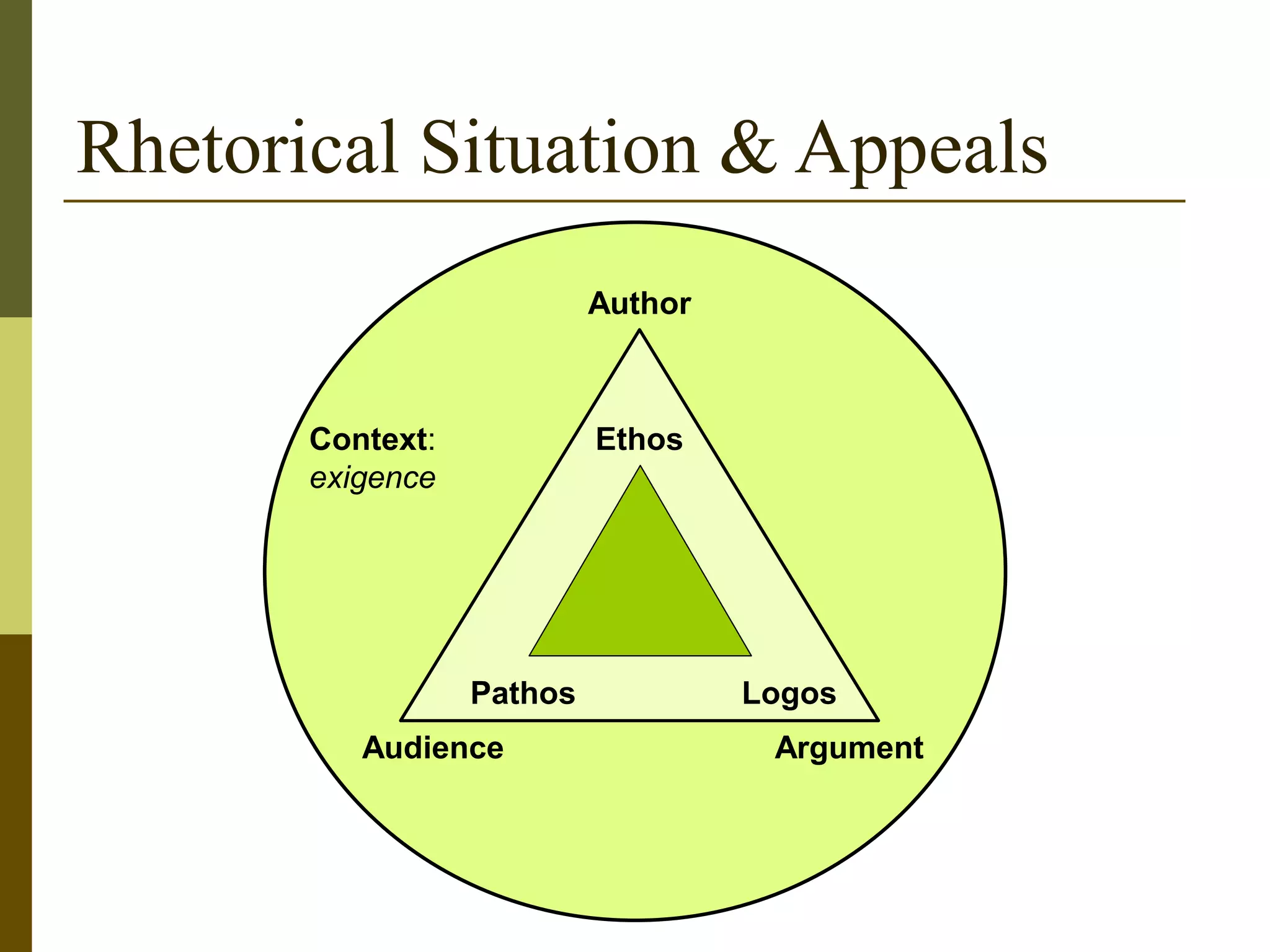
Rhetorical Situation & Appeals
Author
Audience Argument
Context:
exigence
Ethos
Pathos Logos
The Writing Center
Student Success Center
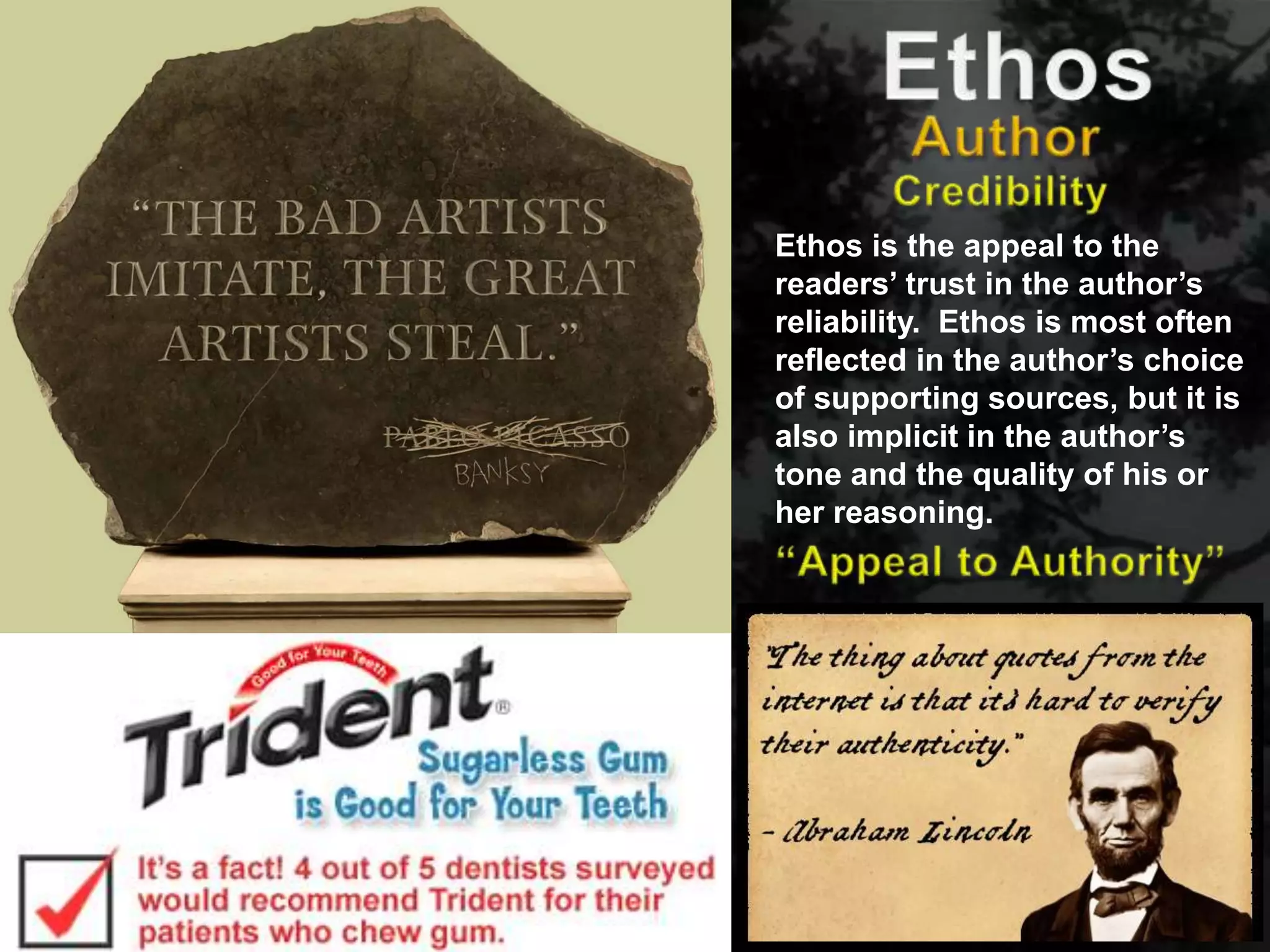
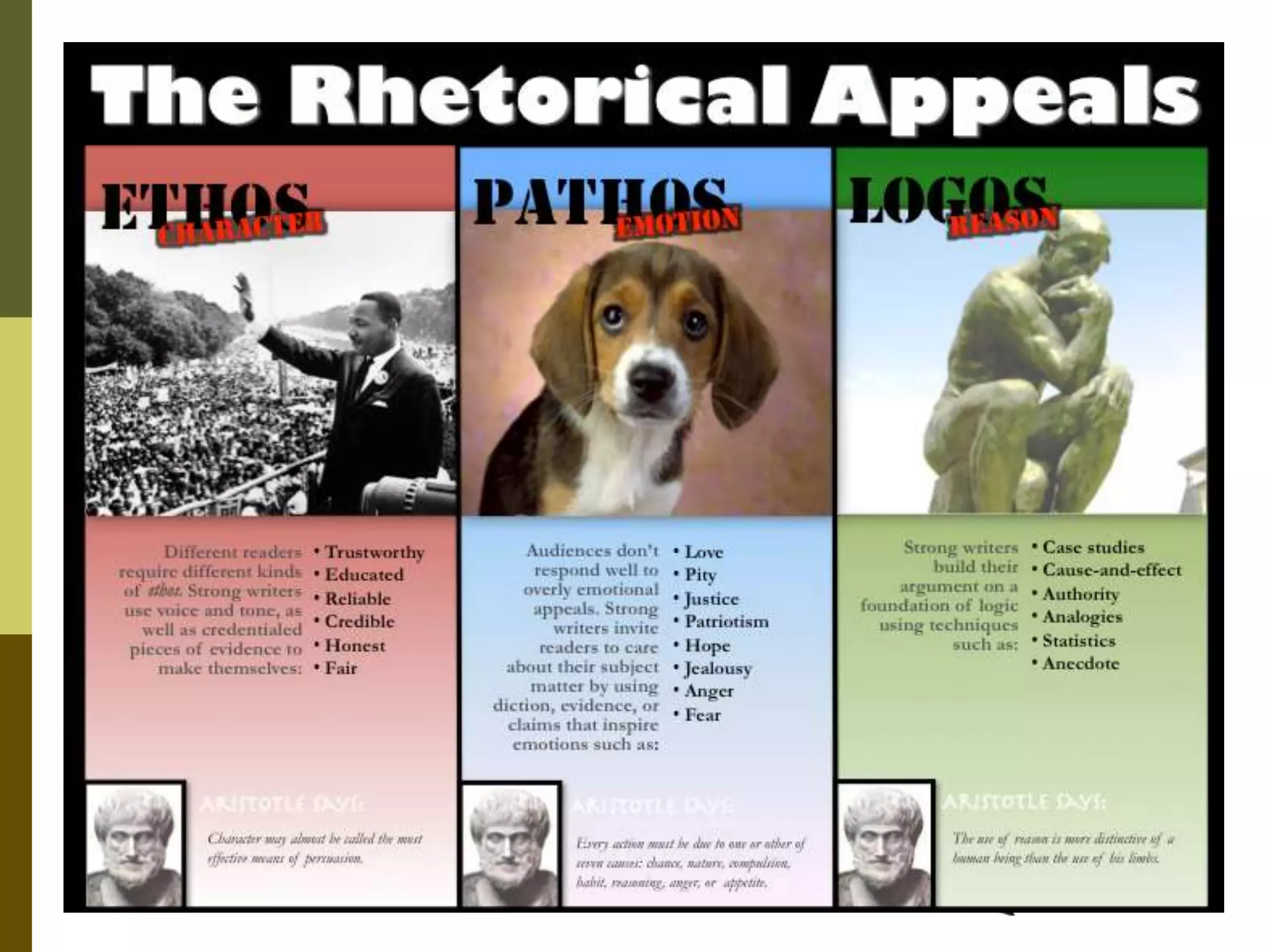
Ethos is the appeal to the
readers’ trust in the author’s
reliability. Ethos is most often
reflected in the author’s choice
of supporting sources, but it is
also implicit in the author’s
tone and the quality of his or
her reasoning.
The Writing Center
Student Success Center
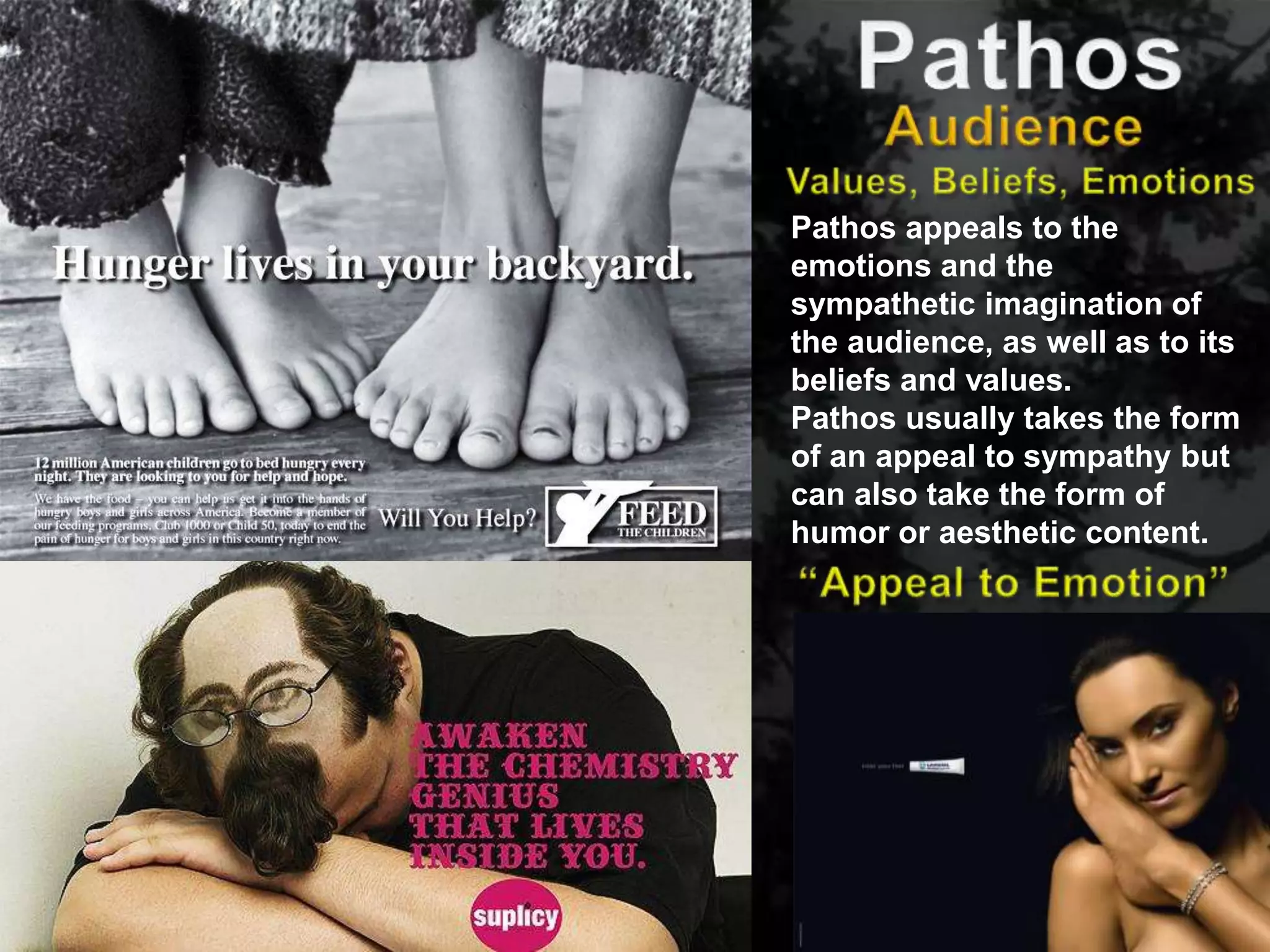
Pathos appeals to the
emotions and the
sympathetic imagination of
the audience, as well as to its
beliefs and values.
Pathos usually takes the form
of an appeal to sympathy but
can also take the form of
humor or aesthetic content.
The Writing Center
Student Success Center
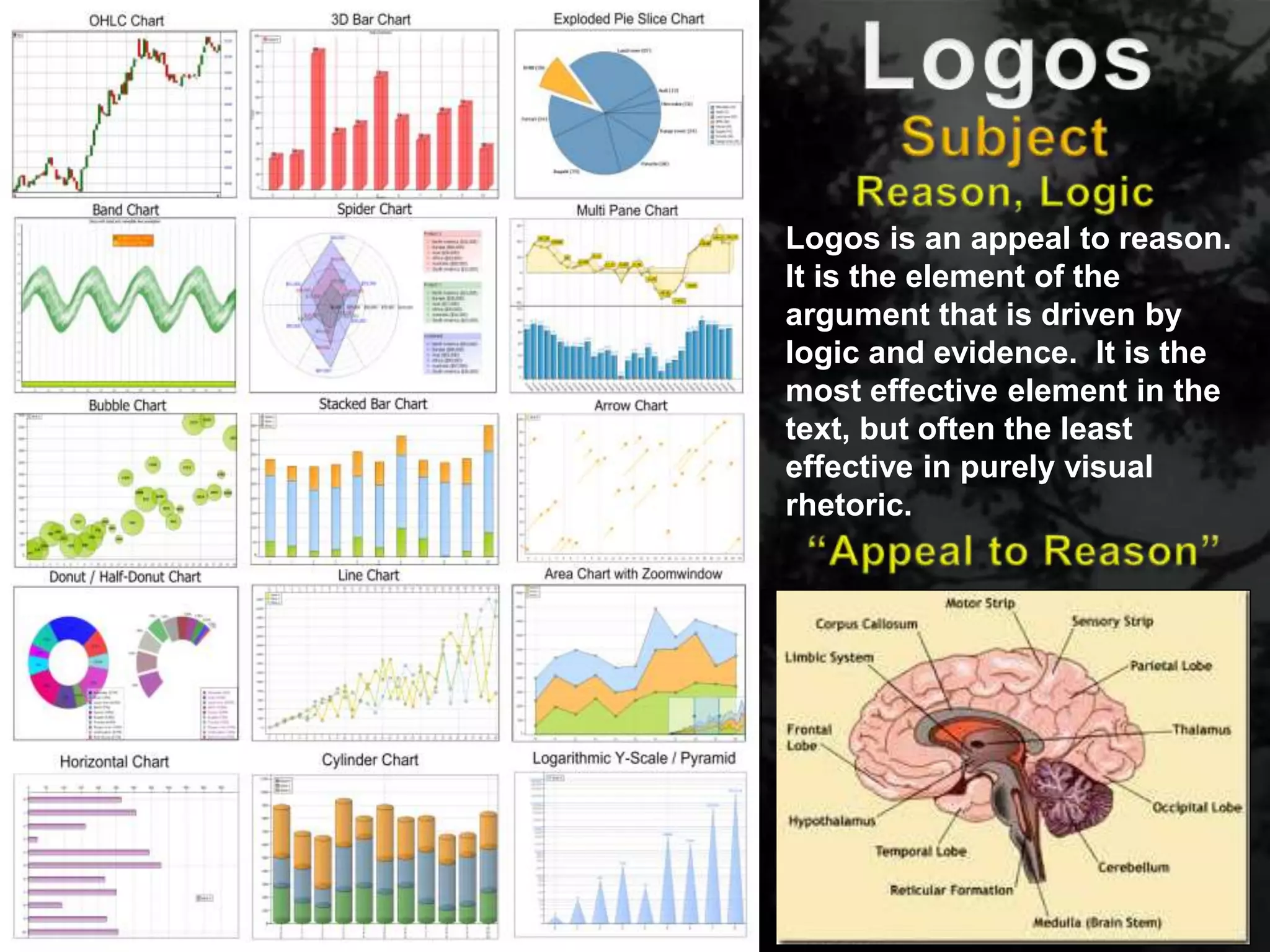
Logos is an appeal to reason.
It is the element of the
argument that is driven by
logic and evidence. It is the
most effective element in the
text, but often the least
effective in purely visual
rhetoric.
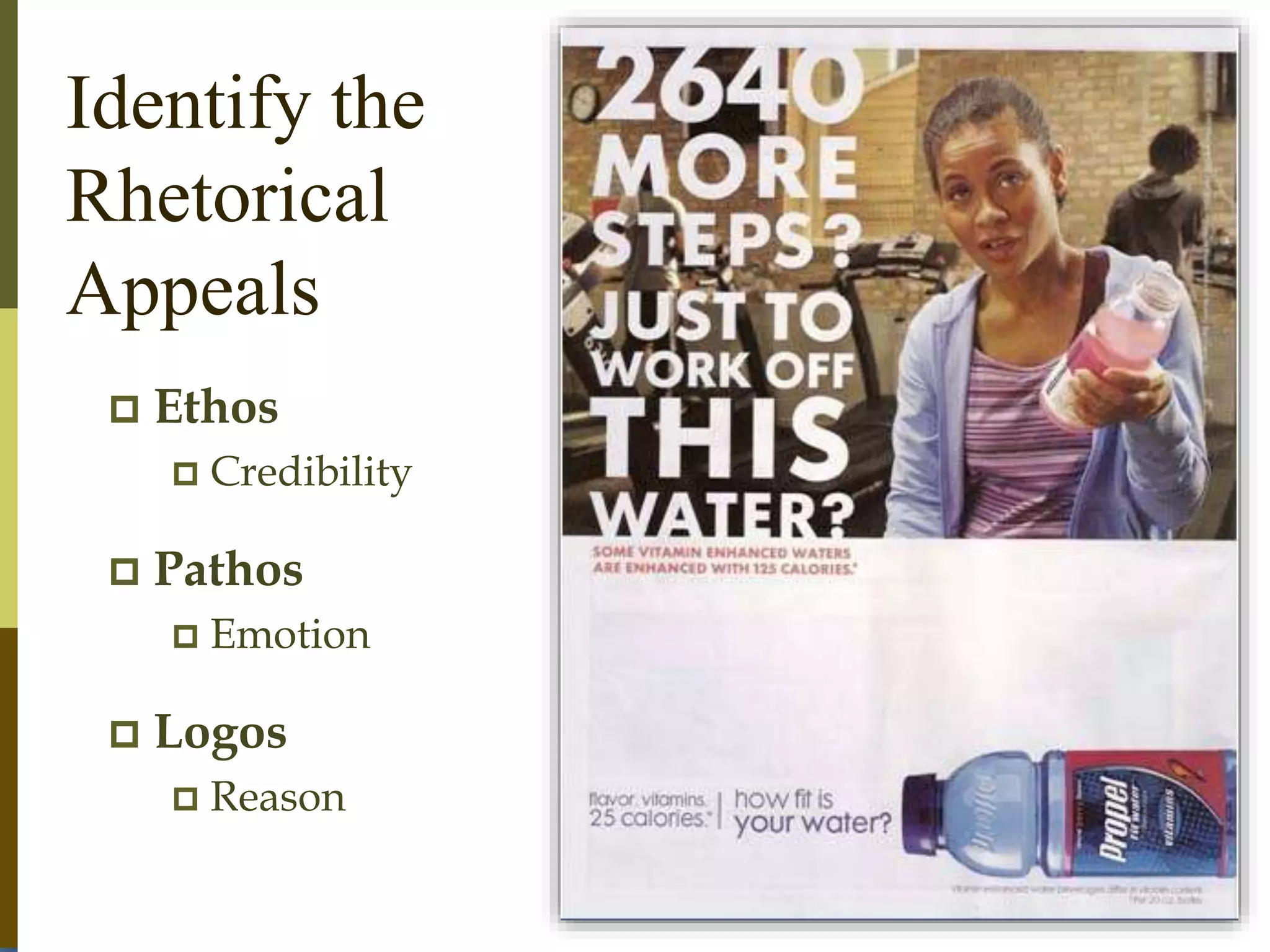
Identify the
Rhetorical
Appeals
 Ethos
 Credibility
 Pathos
 Emotion
 Logos
 Reason
Identify the
Rhetorical
Appeals
 Ethos
 Credibility
 Pathos
 Emotion
 Values
 Logos
 Reason
Identify the
Rhetorical
Appeals
 Ethos
Credibility
 Pathos
Emotion
Values
 Logos
Reason
Identify the
Rhetorical
Appeals
 Ethos
Credibility
 Pathos
Emotion
Values
 Logos
Reason
Identify the Rhetorical Appeals
 Ethos
 Credibility
 Pathos
 Emotion
 Values
 Logos
 Reason
The Writing Center
Student Success Center
Step 4: Combine & Evaluate
Considering steps 1 – 3, how
effect is the image?
Evaluate the Rhetoric
 How effective is
this image?
 Does it get its
point across?
 Are you
convinced?
 How does it get
your attention?
Explain both
how & why.
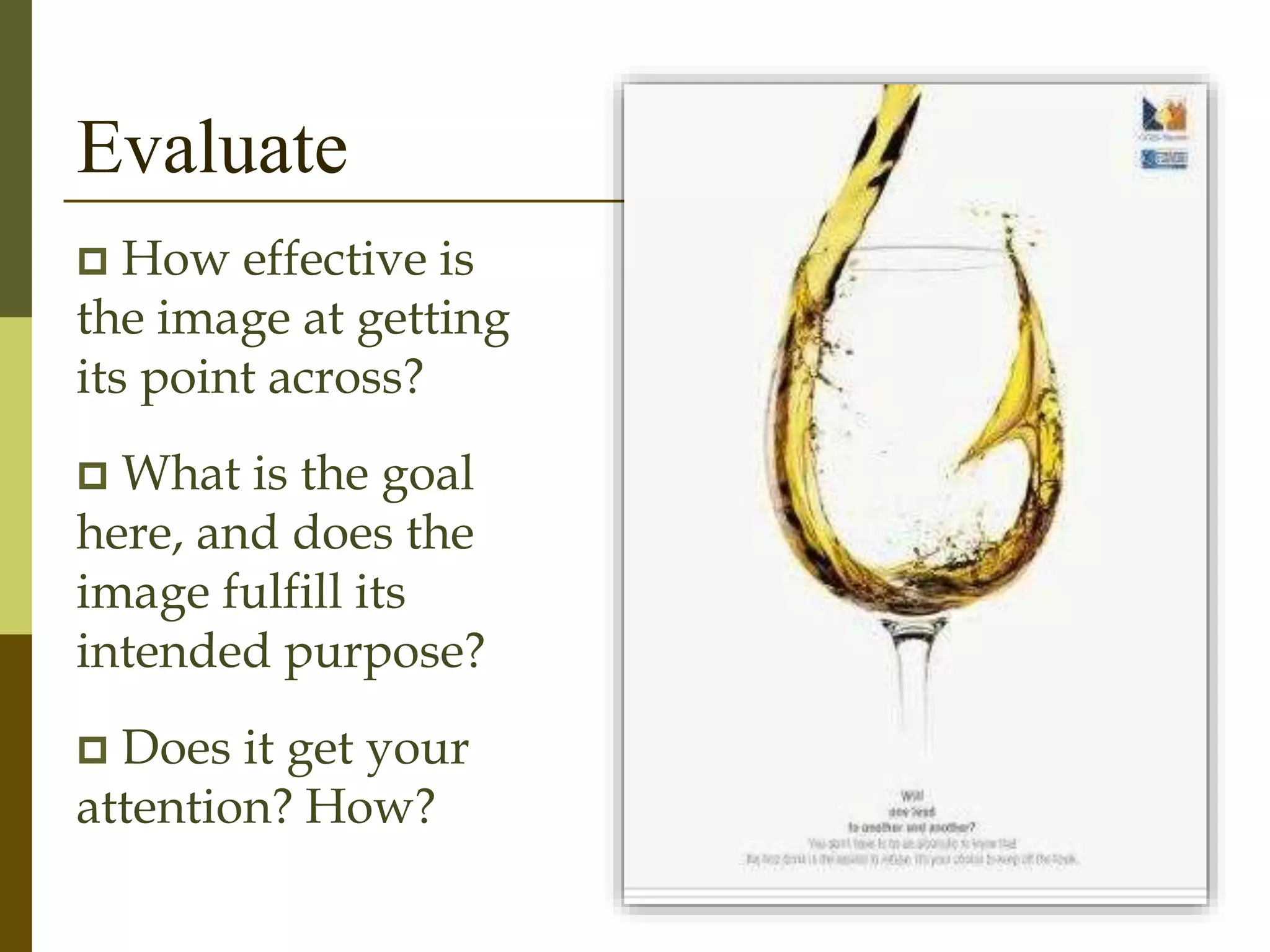
Evaluate
 How effective is
the image at getting
its point across?
 What is the goal
here, and does the
image fulfill its
intended purpose?
 Does it get your
attention? How?
Evaluate
 How effective is
the image at getting
its point across?
 What is the goal
here, and does the
image fulfill its
intended purpose?
 Does it get your
attention? How?
The Writing Center
Student Success Center
Putting it All Together
Composing a thesis statement for
visual analysis
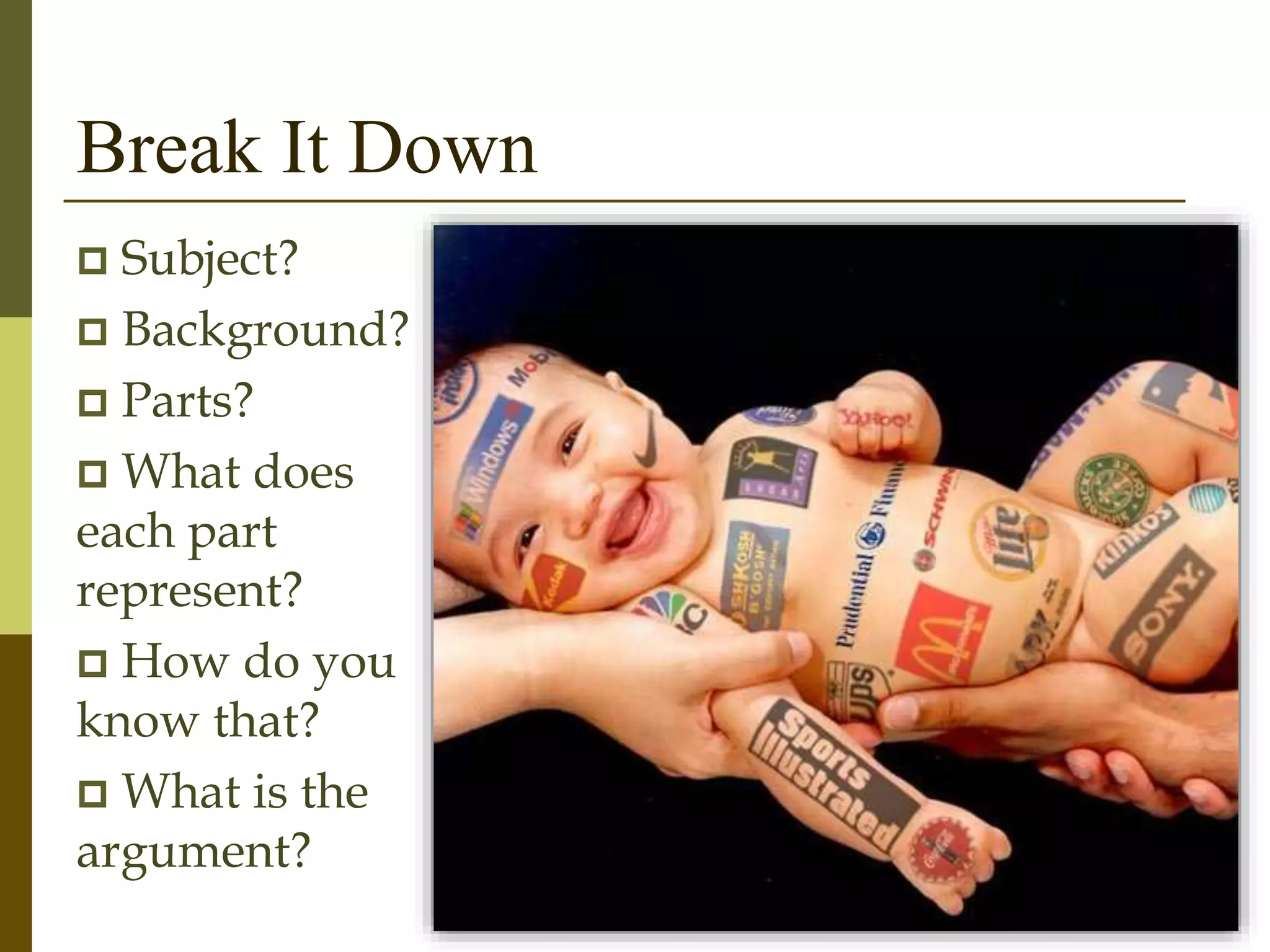
Exegesis: Making a Claim
THESIS:
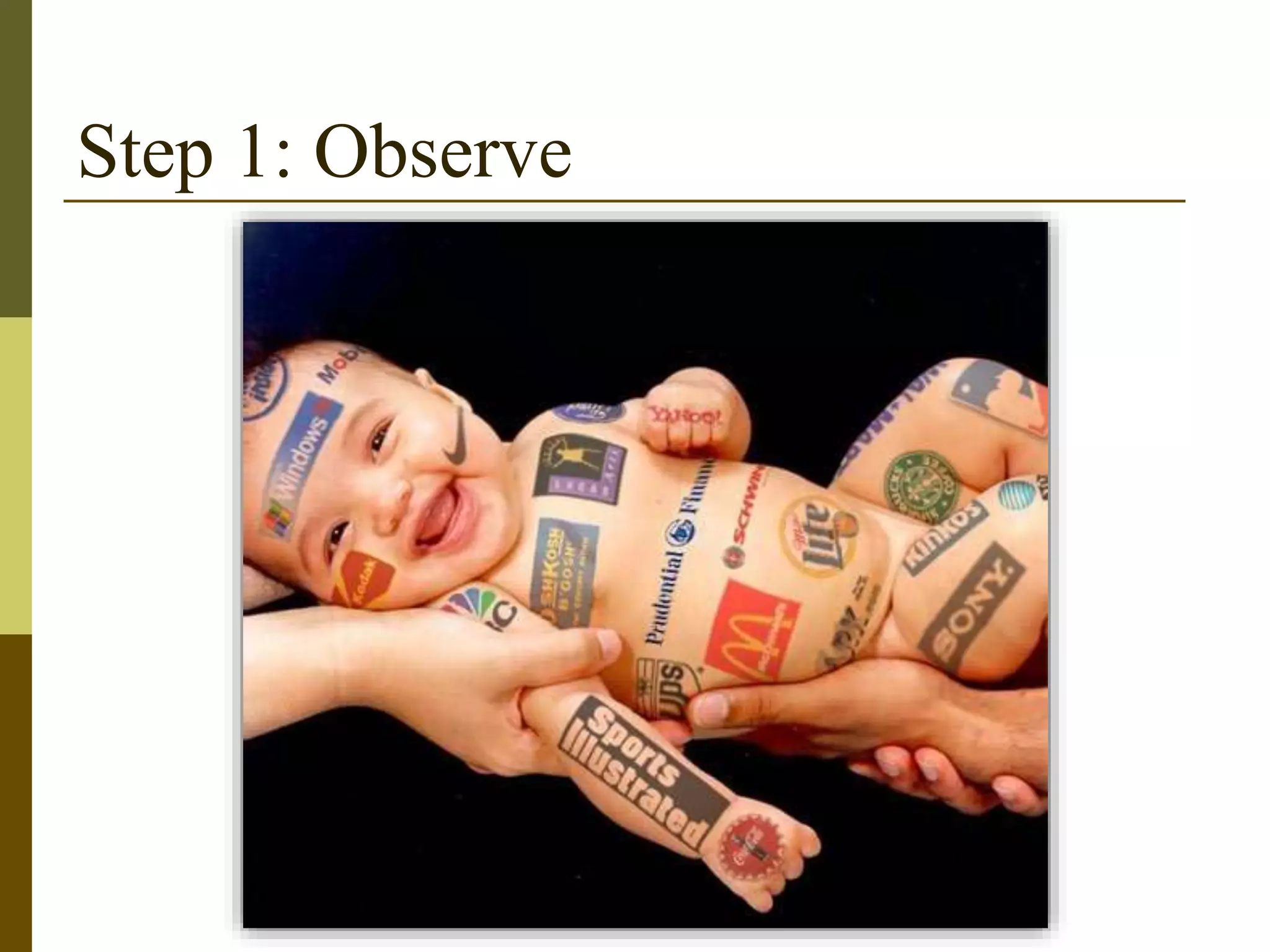
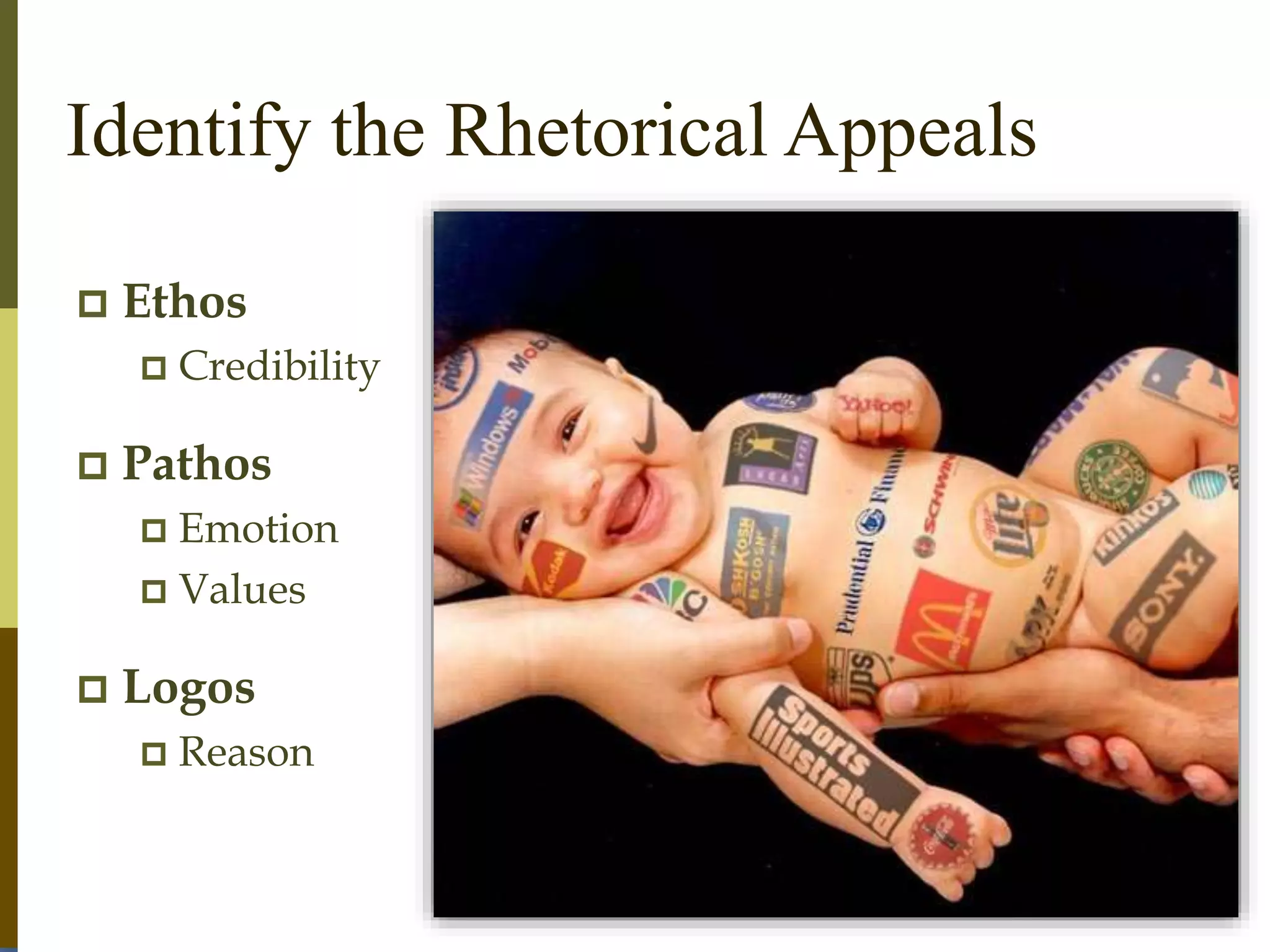
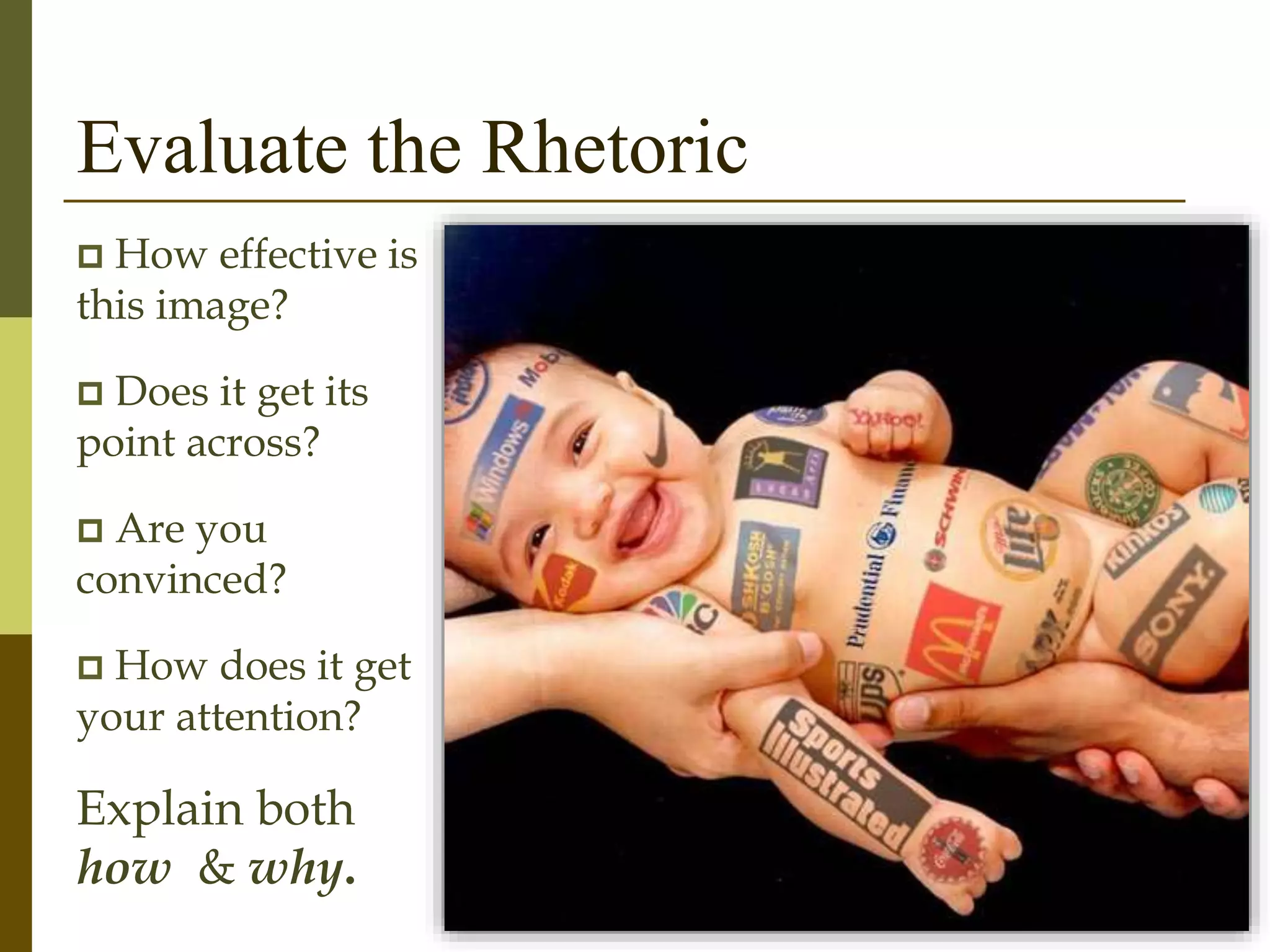
By using popular
business brands as
tattoos on the baby’s
body, this image relies
heavily on pathos and
ethos to suggest that
corporate Capitalism
is a tyrannical and
seductive force that
leaves U.S. citizens
vulnerable and
impressionable from
birth.
Exegesis: Making a Claim.
Step 1: Observe
Step 2: Analyze &
Infer
Step 3: Find the
rhetorical appeals
Step 4: Evaluate
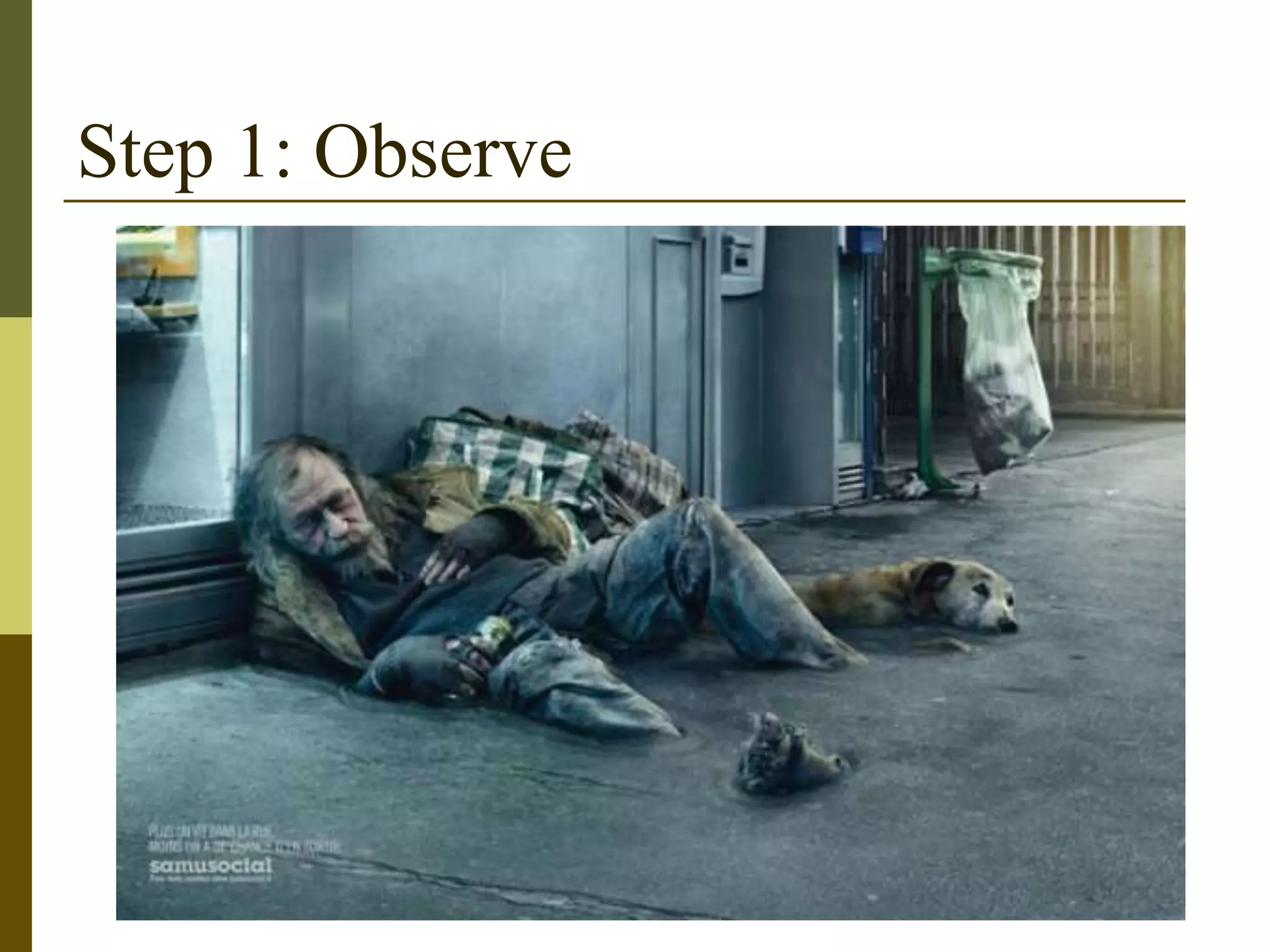
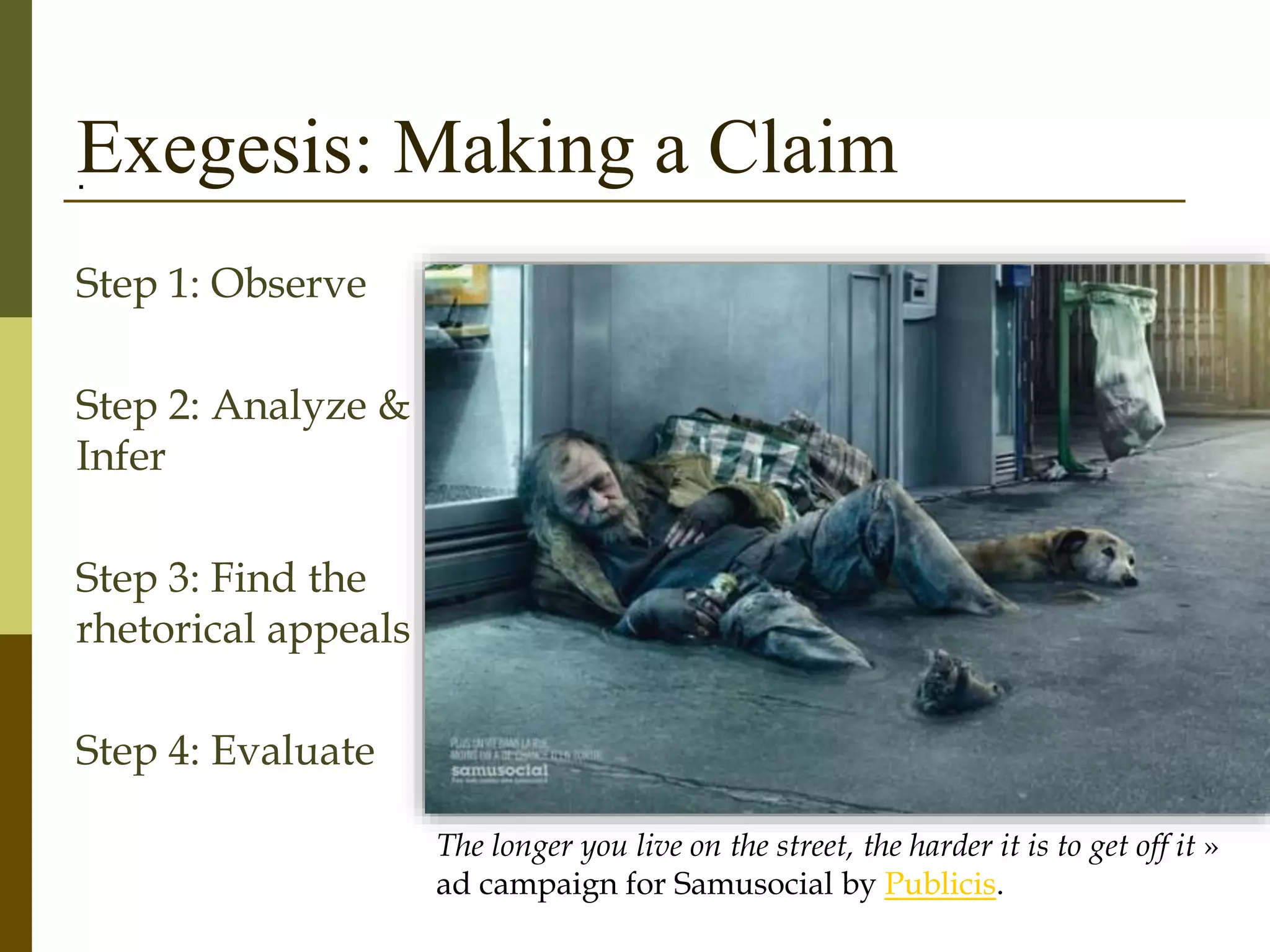
The longer you live on the street, the harder it is to get off it »
ad campaign for Samusocial by Publicis.
FOR MORE INFORMATION
If you need additional help, you can always visit the Writing Center,
located on the first floor of McDermott Library. Consultants can
help you with all stages of the writing process: prewriting, drafting,
revising, and editing.
Our Hours of Operation
McDermott Library, MC 1.206
Monday - Thursday 10am - 8pm
Friday & Saturday 10am - 4pm
Sunday Drop-In Sessions
McDermott Library, MC 2.524
2pm - 5pm
Make an appointment
Call: 972.883.6736
Stop-by: MC 1.206
writingcenter@utdallas.edu
The University of Texas at Dallas
This presentation was created for the Writing Center at the University of
Texas at Dallas. It is licensed under the Creative Commons Attribution-
NonCommercial-NoDerivs 3.0 Unported License. To view a copy of this
license, visit http://creativecommons.org/licenses/by-nc-nd/3.0.
CREDITS
Presenter: Your Name
Content Author: Amanda Preston & Minnie Tao
Revisions: Your Name
Graphics: Amanda Preston & Minnie Tao
Design: Amanda Preston & Minnie Tao
Writing Center Coordinator: Thomasina Hickmann

Visual Rhetoric and Analysis (Workshop for UTD Writing Center)

  • 1.
    Through the LookingGlass Reading Image Rhetorically
  • 2.
    Language: What canbe read... Linguistic Imagistic
  • 3.
    How does thatmake you feeeeeel ?
  • 5.
    Reflect upon Reflection(Projection?) I think,therefore I am. Image-based text operates largely on a figurative (metaphorical) level. To get inside a message, you have to get inside the mind of its maker... see what he sees...
  • 6.
    Workshop Goal  Formulatea strong, insightful thesis statement  Main Claim & Exigence  Think critically about a visual text  Breakdown the part to whole relationship  Assess it success/failure  Select supporting evidence to back up a working thesis  Examples in context
  • 7.
    The Process 1) Observe Whatis the image? What is the rhetorical situation? 2) Analyze & Infer What are the main parts? What is the message & goal? 3) ID the Rhetorical Appeals Ethos, Pathos, Logos 4) Combine 1-3 & Evaluate Is the image rhetorically effective?
  • 8.
    The Writing Center StudentSuccess Center Step 1: Observation Get a general sense of the situation and the image
  • 9.
    First things first:Seeing  Before you can formulate a working thesis, you have to familiarize yourself with the text first.
  • 10.
    Visual Media  T.V.commercials  Movies  Product placement  Music videos  Photography  Art work  Web pages  Charts & graphs  Headlines & logos
  • 11.
  • 12.
  • 13.
  • 14.
  • 15.
    The Writing Center StudentSuccess Center Step 2: Analyze & Infer Break the image down and formulate an interpretation
  • 16.
    Break It Down What is the subject?  What is the background?  What are the main parts of the image?  What does each part represent & how do you know that?  What is the main argument?
  • 17.
    Break It Down What is the subject?  What is the background?  What are the main parts of the image?  What does each part represent & how do you know that?  What is the main argument?
  • 18.
    Break It Down Subject?  Background?  Parts?  What does each part represent?  How do you know that?  What is the argument?
  • 19.
    The Writing Center StudentSuccess Center Step 3: Rhetorical Appeals Modes of Persuasion Ethos Pathos Logos
  • 20.
    Rhetorical Situation &Appeals Author Audience Argument Context: exigence Ethos Pathos Logos
  • 21.
    The Writing Center StudentSuccess Center Ethos is the appeal to the readers’ trust in the author’s reliability. Ethos is most often reflected in the author’s choice of supporting sources, but it is also implicit in the author’s tone and the quality of his or her reasoning.
  • 22.
    The Writing Center StudentSuccess Center Pathos appeals to the emotions and the sympathetic imagination of the audience, as well as to its beliefs and values. Pathos usually takes the form of an appeal to sympathy but can also take the form of humor or aesthetic content.
  • 23.
    The Writing Center StudentSuccess Center Logos is an appeal to reason. It is the element of the argument that is driven by logic and evidence. It is the most effective element in the text, but often the least effective in purely visual rhetoric.
  • 24.
    Identify the Rhetorical Appeals  Ethos Credibility  Pathos  Emotion  Logos  Reason
  • 25.
    Identify the Rhetorical Appeals  Ethos Credibility  Pathos  Emotion  Values  Logos  Reason
  • 26.
    Identify the Rhetorical Appeals  Ethos Credibility Pathos Emotion Values  Logos Reason
  • 27.
    Identify the Rhetorical Appeals  Ethos Credibility Pathos Emotion Values  Logos Reason
  • 29.
    Identify the RhetoricalAppeals  Ethos  Credibility  Pathos  Emotion  Values  Logos  Reason
  • 30.
    The Writing Center StudentSuccess Center Step 4: Combine & Evaluate Considering steps 1 – 3, how effect is the image?
  • 31.
    Evaluate the Rhetoric How effective is this image?  Does it get its point across?  Are you convinced?  How does it get your attention? Explain both how & why.
  • 32.
    Evaluate  How effectiveis the image at getting its point across?  What is the goal here, and does the image fulfill its intended purpose?  Does it get your attention? How?
  • 33.
    Evaluate  How effectiveis the image at getting its point across?  What is the goal here, and does the image fulfill its intended purpose?  Does it get your attention? How?
  • 34.
    The Writing Center StudentSuccess Center Putting it All Together Composing a thesis statement for visual analysis
  • 35.
    Exegesis: Making aClaim THESIS: By using popular business brands as tattoos on the baby’s body, this image relies heavily on pathos and ethos to suggest that corporate Capitalism is a tyrannical and seductive force that leaves U.S. citizens vulnerable and impressionable from birth.
  • 36.
    Exegesis: Making aClaim. Step 1: Observe Step 2: Analyze & Infer Step 3: Find the rhetorical appeals Step 4: Evaluate The longer you live on the street, the harder it is to get off it » ad campaign for Samusocial by Publicis.
  • 37.
    FOR MORE INFORMATION Ifyou need additional help, you can always visit the Writing Center, located on the first floor of McDermott Library. Consultants can help you with all stages of the writing process: prewriting, drafting, revising, and editing. Our Hours of Operation McDermott Library, MC 1.206 Monday - Thursday 10am - 8pm Friday & Saturday 10am - 4pm Sunday Drop-In Sessions McDermott Library, MC 2.524 2pm - 5pm Make an appointment Call: 972.883.6736 Stop-by: MC 1.206 writingcenter@utdallas.edu
  • 38.
    The University ofTexas at Dallas This presentation was created for the Writing Center at the University of Texas at Dallas. It is licensed under the Creative Commons Attribution- NonCommercial-NoDerivs 3.0 Unported License. To view a copy of this license, visit http://creativecommons.org/licenses/by-nc-nd/3.0. CREDITS Presenter: Your Name Content Author: Amanda Preston & Minnie Tao Revisions: Your Name Graphics: Amanda Preston & Minnie Tao Design: Amanda Preston & Minnie Tao Writing Center Coordinator: Thomasina Hickmann