•
•
•
•
•
•
•
•
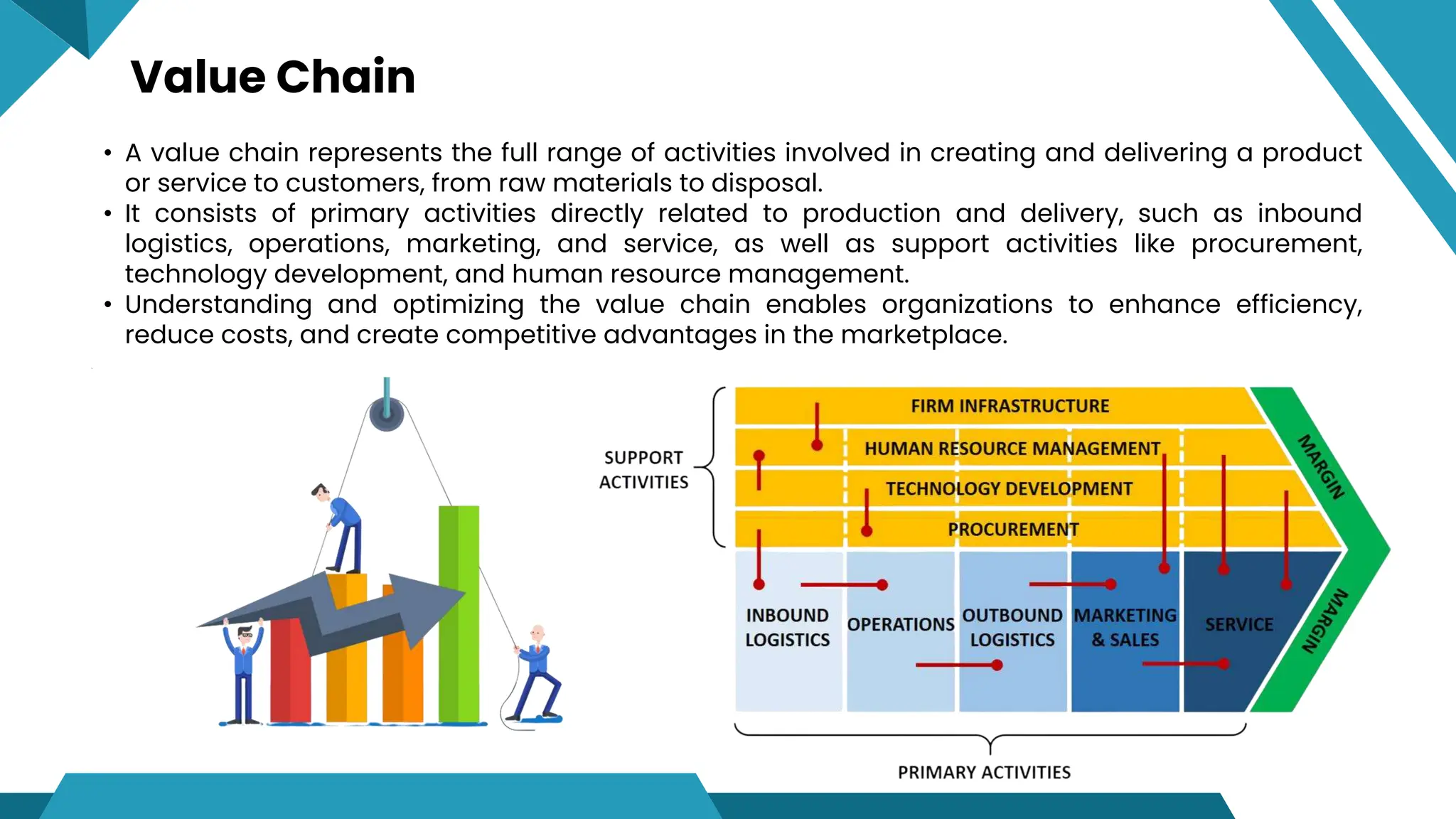
• A value chain represents the full range of activities involved in creating and delivering a product
or service to customers, from raw materials to disposal.
• It consists of primary activities directly related to production and delivery, such as inbound
logistics, operations, marketing, and service, as well as support activities like procurement,
technology development, and human resource management.
• Understanding and optimizing the value chain enables organizations to enhance efficiency,
reduce costs, and create competitive advantages in the marketplace.
Value Chain
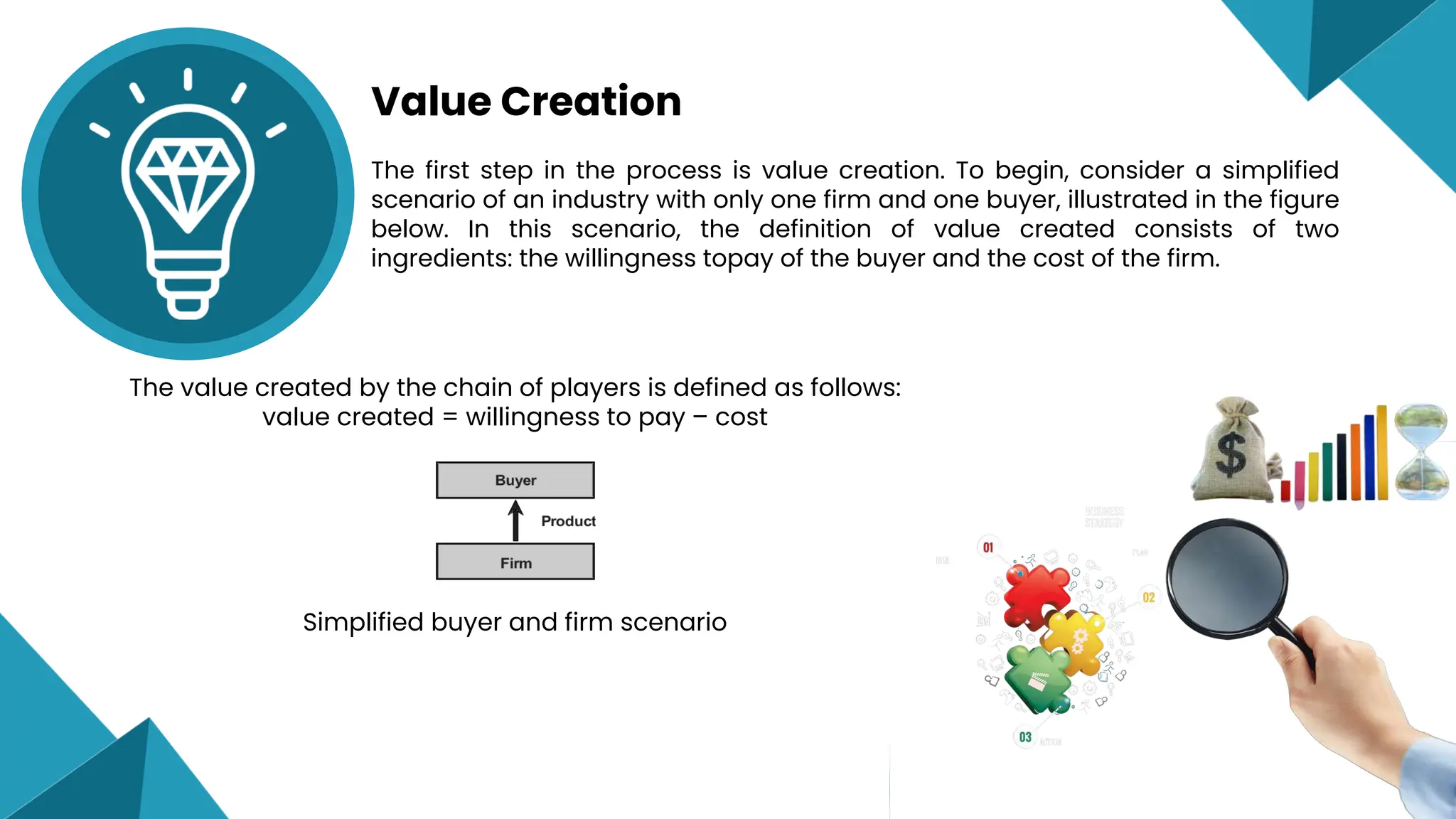
The value created by the chain of players is defined as follows:
value created = willingness to pay – cost
Simplified buyer and firm scenario
The first step in the process is value creation. To begin, consider a simplified
scenario of an industry with only one firm and one buyer, illustrated in the figure
below. In this scenario, the definition of value created consists of two
ingredients: the willingness topay of the buyer and the cost of the firm.
Value Creation
Value Creation Strategies
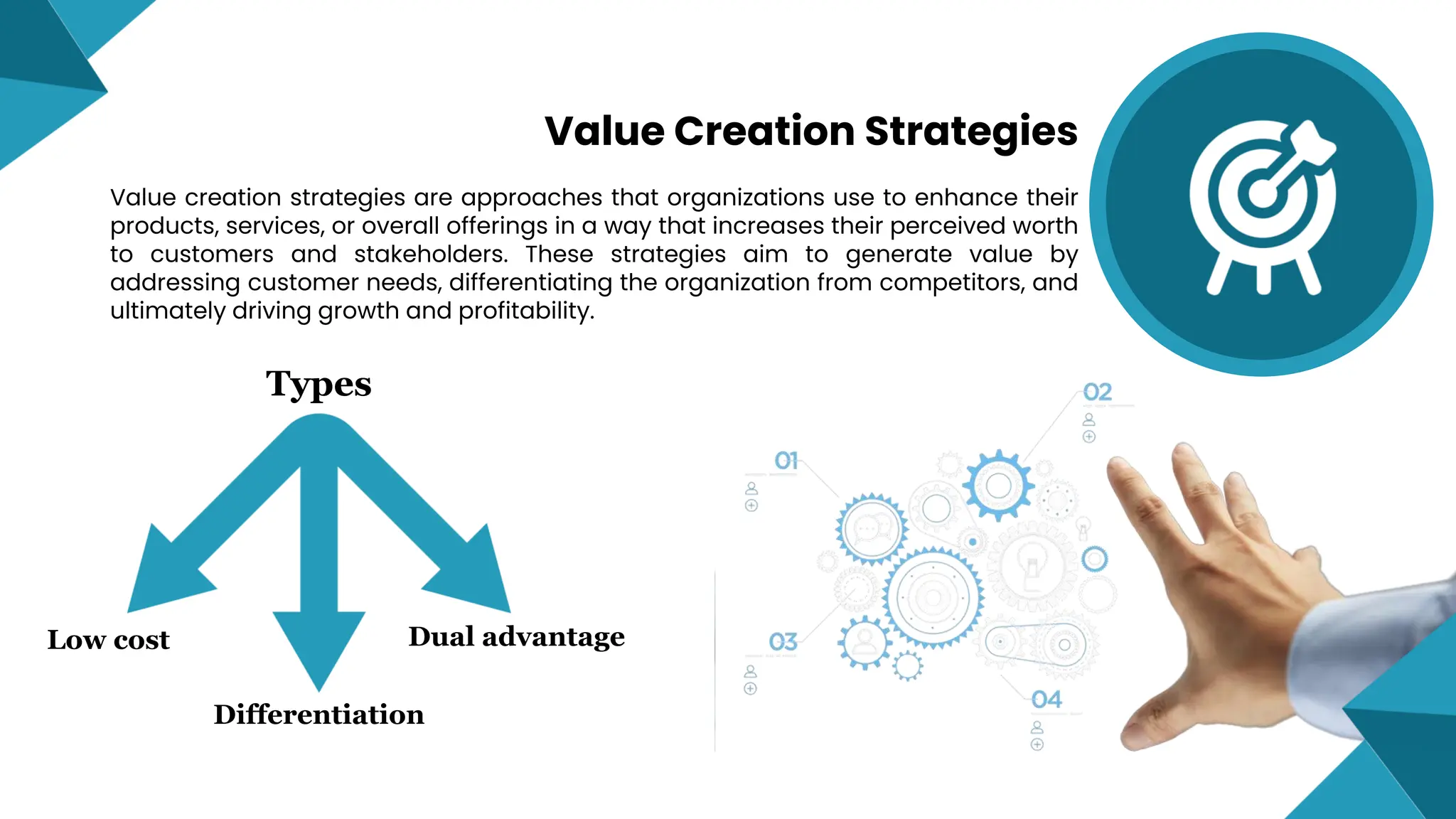
Value creation strategies are approaches that organizations use to enhance their
products, services, or overall offerings in a way that increases their perceived worth
to customers and stakeholders. These strategies aim to generate value by
addressing customer needs, differentiating the organization from competitors, and
ultimately driving growth and profitability.
Low cost
Differentiation
Dual advantage
Types
Examples of value-creation strategies:
Differentiation:
Example: Apple Inc.
• Apple differentiates itself in the consumer electronics market through unique design, innovative features, and a focus on user
experience.
• Their products, such as the iPhone, iPad, and MacBook, stand out due to their sleek design, intuitive interface, and ecosystem
integration.
• Apple's emphasis on premium quality, branding, and customer loyalty sets it apart from competitors, allowing the company to
command higher prices and maintain strong profitability.
Low-Cost Leadership:
Example: Walmart
• Walmart is known for its low-cost leadership strategy in the retail industry.
• By leveraging economies of scale, efficient supply chain management, and operational excellence, Walmart offers a wide range
of products at competitive prices.
• The company's ability to negotiate favourable terms with suppliers and streamline distribution processes enables it to pass cost
savings onto customers, making Walmart a preferred destination for budget-conscious shoppers.
Dual Advantage:
Example: Toyota
• Toyota has achieved a dual advantage by combining elements of differentiation and low-cost leadership in the automotive
industry.
• Through continuous innovation, Toyota produces reliable, fuel-efficient vehicles with advanced features and cutting-edge
technology, distinguishing its brand from competitors.
• At the same time, Toyota maintains a lean production system, minimizing waste and maximizing efficiency in manufacturing
processes to keep costs low and prices competitive in the market.
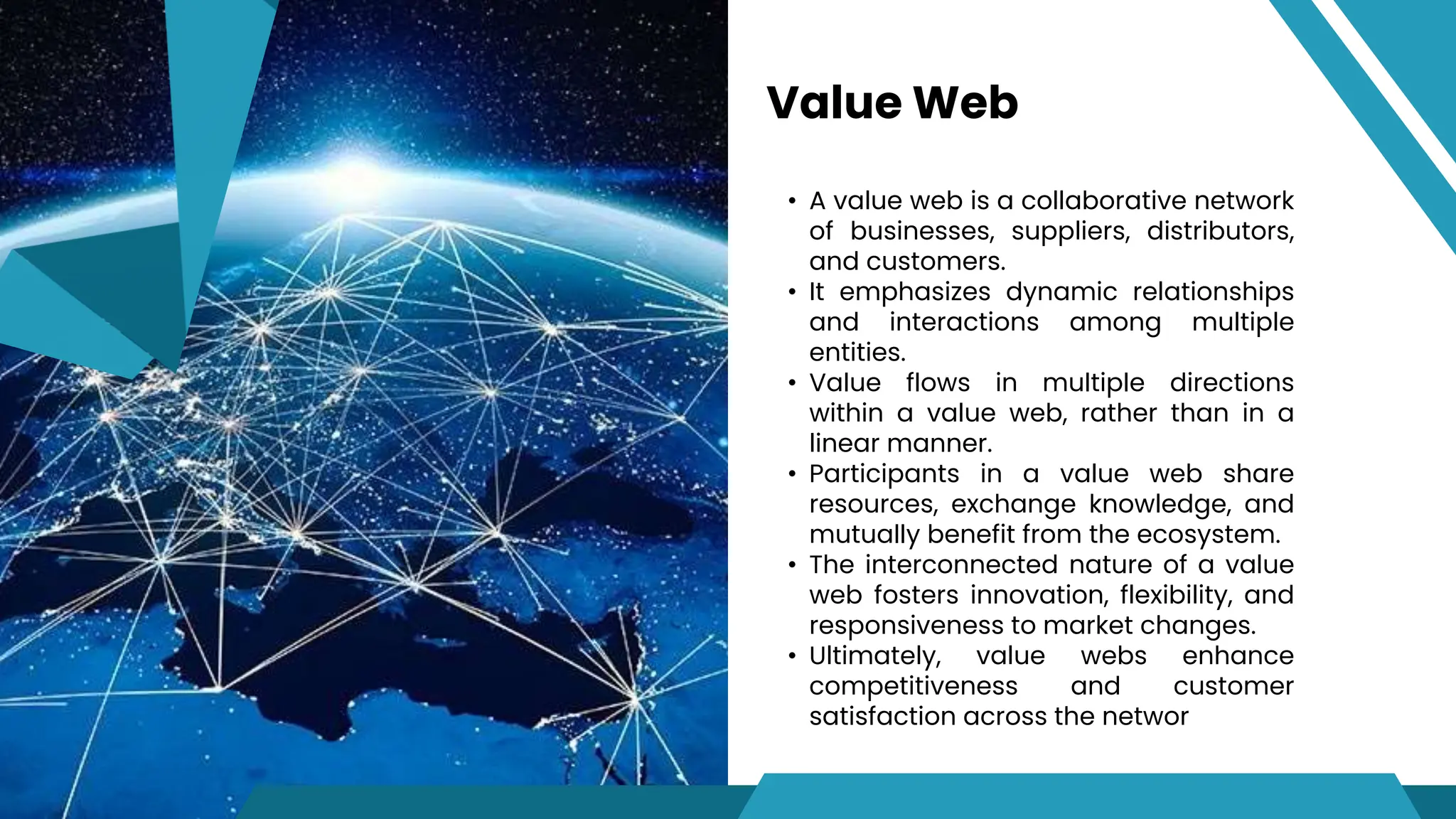
• A value web is a collaborative network
of businesses, suppliers, distributors,
and customers.
• It emphasizes dynamic relationships
and interactions among multiple
entities.
• Value flows in multiple directions
within a value web, rather than in a
linear manner.
• Participants in a value web share
resources, exchange knowledge, and
mutually benefit from the ecosystem.
• The interconnected nature of a value
web fosters innovation, flexibility, and
responsiveness to market changes.
• Ultimately, value webs enhance
competitiveness and customer
satisfaction across the networ
Value Web
Value Web Components
Stakeholder
Identification
Interconnected
Relationships
Value Co-Creation
Key Components of the
value web, including
suppliers, firms, buyers
and other stakeholders
and identified.
Visual representation of
the interconnected
relationships within the
value web is showcased.
Emphasises the
collaborative nature of
value creation and
capture within the value
web.
Iterative Expansion
Illustrates how concentric innovation unfolds within the
value web, expanding the scope of innovation iteratively.
Value Proposition Evolution
The evolution of the value proposition across
interconnected stakeholders is showcased.
Adaptive Business Models
Examples of adaptive business models driven by
concentric innovation are presented
Concentric Innovation Overview
• Concentric innovation fosters a culture of continuous
enhancement, allowing businesses to iterate and
expand upon existing products or services.
• Within value webs, this iterative process is amplified
through collaboration among network members.
Feedback and insights from diverse perspectives
refine and evolve offerings to better meet market
demands.
Linkage of Concentric Innovation
and value web
• Concentric innovation leverages this collaborative ecosystem
by enabling participants to contribute and build upon each
other's ideas, resulting in a richer and more comprehensive
value proposition for customers.
• Both concentric innovation and value webs prioritize adaptability
and responsiveness to changing market conditions. The iterative
nature of concentric innovation allows for quick adjustments and
improvements to products or services based on emerging trends
and customer feedback.
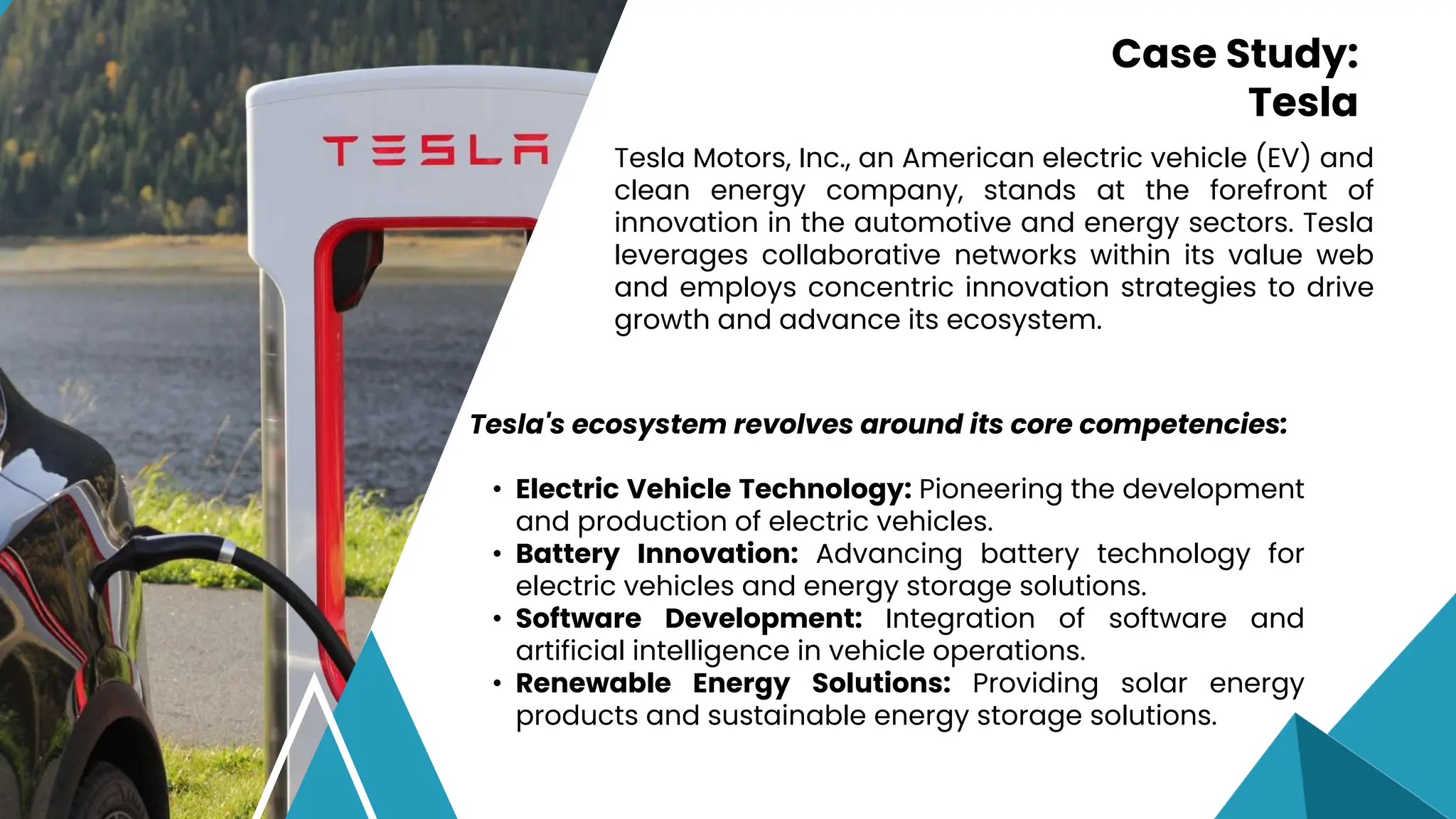
Tesla Motors, Inc., an American electric vehicle (EV) and
clean energy company, stands at the forefront of
innovation in the automotive and energy sectors. Tesla
leverages collaborative networks within its value web
and employs concentric innovation strategies to drive
growth and advance its ecosystem.
Case Study:
Tesla
Tesla's ecosystem revolves around its core competencies:
• Electric Vehicle Technology: Pioneering the development
and production of electric vehicles.
• Battery Innovation: Advancing battery technology for
electric vehicles and energy storage solutions.
• Software Development: Integration of software and
artificial intelligence in vehicle operations.
• Renewable Energy Solutions: Providing solar energy
products and sustainable energy storage solutions.
Tesla employs concentric innovation strategies to
expand its ecosystem:
Expansion of Energy Products: Introduction of
Powerwall, Powerpack, Solar Roof, and Solar Panels.
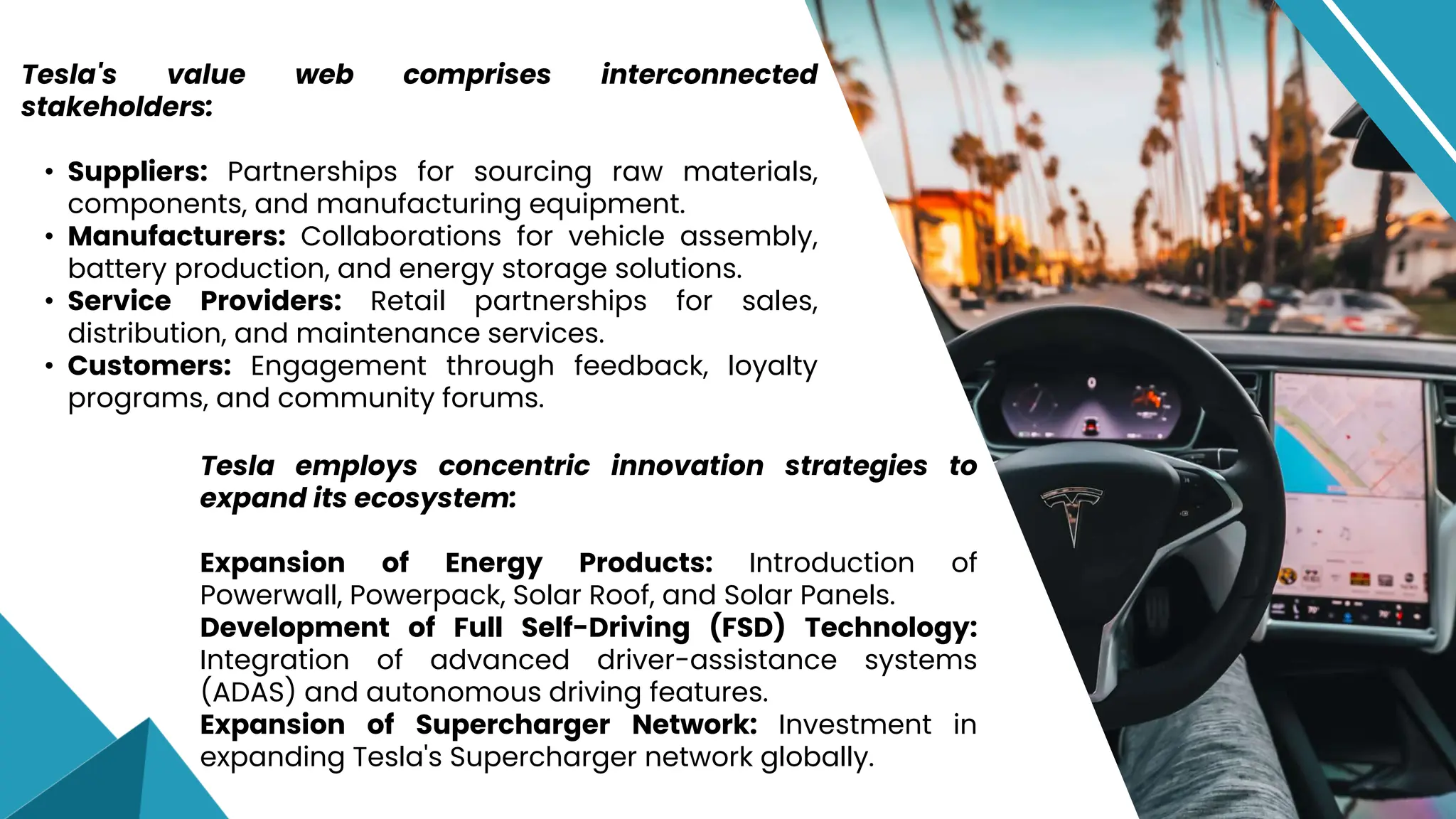
Development of Full Self-Driving (FSD) Technology:
Integration of advanced driver-assistance systems
(ADAS) and autonomous driving features.
Expansion of Supercharger Network: Investment in
expanding Tesla's Supercharger network globally.
Tesla's value web comprises interconnected
stakeholders:
• Suppliers: Partnerships for sourcing raw materials,
components, and manufacturing equipment.
• Manufacturers: Collaborations for vehicle assembly,
battery production, and energy storage solutions.
• Service Providers: Retail partnerships for sales,
distribution, and maintenance services.
• Customers: Engagement through feedback, loyalty
programs, and community forums.
• Enhanced Customer Value: Tesla's concentric
innovation initiatives enhance customer
experiences and address evolving market
demands.
• Competitive Advantage: Tesla's ecosystem
strengthens its competitive position in the
automotive and energy sectors.
• Sustainable Growth: Tesla's collaborative networks
and concentric innovation strategies drive
sustainable growth and innovation.
Benefits and Outcomes
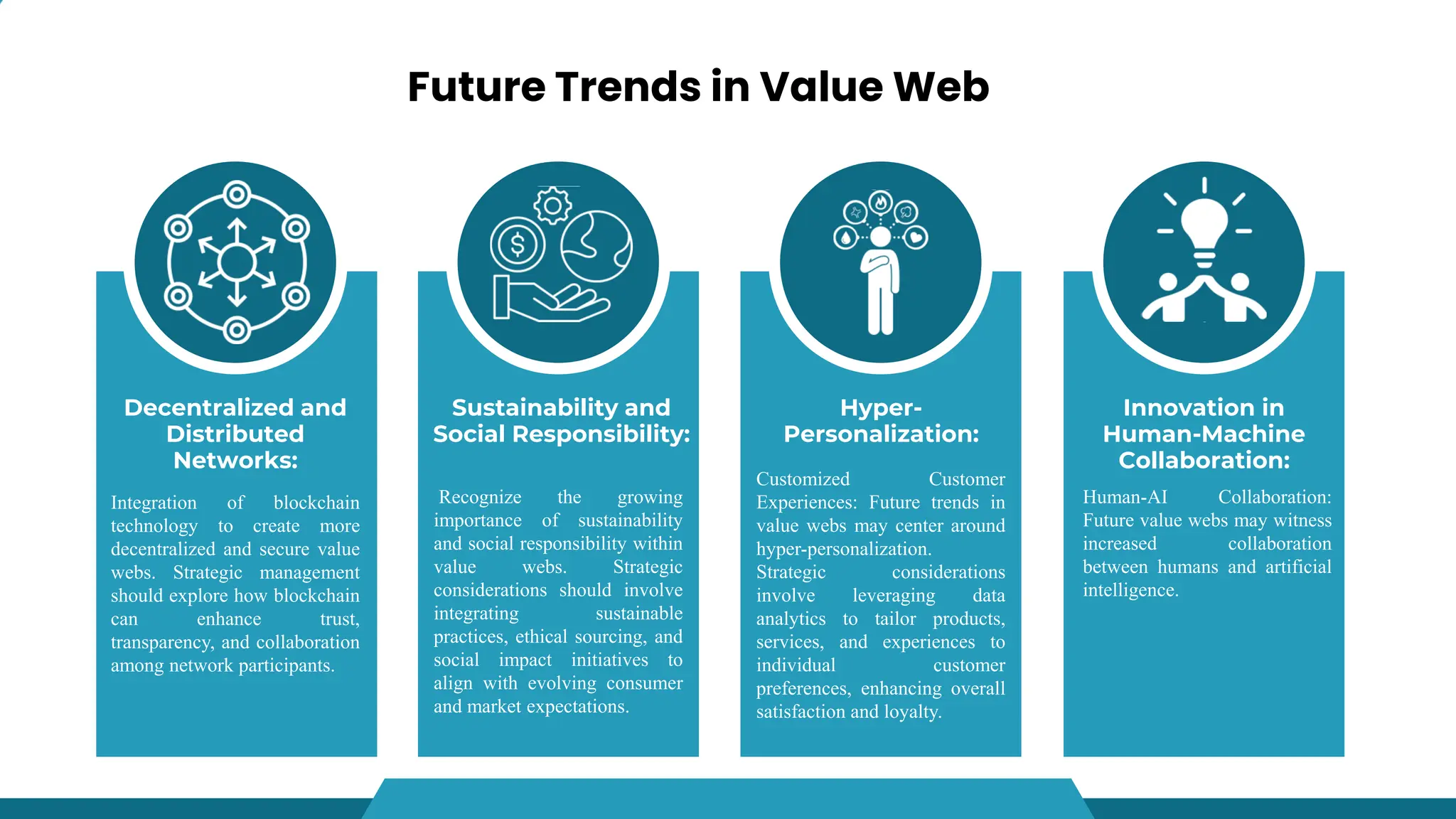
Future Trends in Value Web
Decentralized and
Distributed
Networks:
Sustainability and
Social Responsibility:
Hyper-
Personalization:
Innovation in
Human-Machine
Collaboration:
Integration of blockchain
technology to create more
decentralized and secure value
webs. Strategic management
should explore how blockchain
can enhance trust,
transparency, and collaboration
among network participants.
Recognize the growing
importance of sustainability
and social responsibility within
value webs. Strategic
considerations should involve
integrating sustainable
practices, ethical sourcing, and
social impact initiatives to
align with evolving consumer
and market expectations.
Customized Customer
Experiences: Future trends in
value webs may center around
hyper-personalization.
Strategic considerations
involve leveraging data
analytics to tailor products,
services, and experiences to
individual customer
preferences, enhancing overall
satisfaction and loyalty.
Human-AI Collaboration:
Future value webs may witness
increased collaboration
between humans and artificial
intelligence.
• https://eujournalfuturesresearch.springeropen.com/articles/10.1007/s40309-013-0025-2
• https://www.sciencedirect.com/science/article/pii/S0167811618300284
• https://www.mindhatchllc.com/key-to-doing-innovation-right/
• https://www.researchgate.net/publication/328334610_Service-
Dominant_Business_Model_Design_for_Digital_Innovation_in_Smart_Mobility
• https://link.springer.com/article/10.1007/s12525-018-0304-7
• https://www.sciencedirect.com/science/article/pii/S1029313220300336
• https://www.researchgate.net/publication/314197860_Concentric_diversification_based_
on_technological_capabilities_Link_analysis_of_products_and_technologies
• https://www.jstor.org/stable/26634929
• https://link.springer.com/article/10.1007/s12599-018-0565-x
THANK YOU
FOR YOUR ATTENTION
STRATEGIC MANAGEMENT 1

Value web with concentric innovation.pptx

  • 1.
  • 2.
    • A valuechain represents the full range of activities involved in creating and delivering a product or service to customers, from raw materials to disposal. • It consists of primary activities directly related to production and delivery, such as inbound logistics, operations, marketing, and service, as well as support activities like procurement, technology development, and human resource management. • Understanding and optimizing the value chain enables organizations to enhance efficiency, reduce costs, and create competitive advantages in the marketplace. Value Chain
  • 3.
    The value createdby the chain of players is defined as follows: value created = willingness to pay – cost Simplified buyer and firm scenario The first step in the process is value creation. To begin, consider a simplified scenario of an industry with only one firm and one buyer, illustrated in the figure below. In this scenario, the definition of value created consists of two ingredients: the willingness topay of the buyer and the cost of the firm. Value Creation
  • 4.
    Value Creation Strategies Valuecreation strategies are approaches that organizations use to enhance their products, services, or overall offerings in a way that increases their perceived worth to customers and stakeholders. These strategies aim to generate value by addressing customer needs, differentiating the organization from competitors, and ultimately driving growth and profitability. Low cost Differentiation Dual advantage Types
  • 5.
    Examples of value-creationstrategies: Differentiation: Example: Apple Inc. • Apple differentiates itself in the consumer electronics market through unique design, innovative features, and a focus on user experience. • Their products, such as the iPhone, iPad, and MacBook, stand out due to their sleek design, intuitive interface, and ecosystem integration. • Apple's emphasis on premium quality, branding, and customer loyalty sets it apart from competitors, allowing the company to command higher prices and maintain strong profitability. Low-Cost Leadership: Example: Walmart • Walmart is known for its low-cost leadership strategy in the retail industry. • By leveraging economies of scale, efficient supply chain management, and operational excellence, Walmart offers a wide range of products at competitive prices. • The company's ability to negotiate favourable terms with suppliers and streamline distribution processes enables it to pass cost savings onto customers, making Walmart a preferred destination for budget-conscious shoppers. Dual Advantage: Example: Toyota • Toyota has achieved a dual advantage by combining elements of differentiation and low-cost leadership in the automotive industry. • Through continuous innovation, Toyota produces reliable, fuel-efficient vehicles with advanced features and cutting-edge technology, distinguishing its brand from competitors. • At the same time, Toyota maintains a lean production system, minimizing waste and maximizing efficiency in manufacturing processes to keep costs low and prices competitive in the market.
  • 6.
    • A valueweb is a collaborative network of businesses, suppliers, distributors, and customers. • It emphasizes dynamic relationships and interactions among multiple entities. • Value flows in multiple directions within a value web, rather than in a linear manner. • Participants in a value web share resources, exchange knowledge, and mutually benefit from the ecosystem. • The interconnected nature of a value web fosters innovation, flexibility, and responsiveness to market changes. • Ultimately, value webs enhance competitiveness and customer satisfaction across the networ Value Web
  • 7.
    Value Web Components Stakeholder Identification Interconnected Relationships ValueCo-Creation Key Components of the value web, including suppliers, firms, buyers and other stakeholders and identified. Visual representation of the interconnected relationships within the value web is showcased. Emphasises the collaborative nature of value creation and capture within the value web.
  • 8.
    Iterative Expansion Illustrates howconcentric innovation unfolds within the value web, expanding the scope of innovation iteratively. Value Proposition Evolution The evolution of the value proposition across interconnected stakeholders is showcased. Adaptive Business Models Examples of adaptive business models driven by concentric innovation are presented Concentric Innovation Overview
  • 9.
    • Concentric innovationfosters a culture of continuous enhancement, allowing businesses to iterate and expand upon existing products or services. • Within value webs, this iterative process is amplified through collaboration among network members. Feedback and insights from diverse perspectives refine and evolve offerings to better meet market demands. Linkage of Concentric Innovation and value web • Concentric innovation leverages this collaborative ecosystem by enabling participants to contribute and build upon each other's ideas, resulting in a richer and more comprehensive value proposition for customers. • Both concentric innovation and value webs prioritize adaptability and responsiveness to changing market conditions. The iterative nature of concentric innovation allows for quick adjustments and improvements to products or services based on emerging trends and customer feedback.
  • 10.
    Tesla Motors, Inc.,an American electric vehicle (EV) and clean energy company, stands at the forefront of innovation in the automotive and energy sectors. Tesla leverages collaborative networks within its value web and employs concentric innovation strategies to drive growth and advance its ecosystem. Case Study: Tesla Tesla's ecosystem revolves around its core competencies: • Electric Vehicle Technology: Pioneering the development and production of electric vehicles. • Battery Innovation: Advancing battery technology for electric vehicles and energy storage solutions. • Software Development: Integration of software and artificial intelligence in vehicle operations. • Renewable Energy Solutions: Providing solar energy products and sustainable energy storage solutions.
  • 11.
    Tesla employs concentricinnovation strategies to expand its ecosystem: Expansion of Energy Products: Introduction of Powerwall, Powerpack, Solar Roof, and Solar Panels. Development of Full Self-Driving (FSD) Technology: Integration of advanced driver-assistance systems (ADAS) and autonomous driving features. Expansion of Supercharger Network: Investment in expanding Tesla's Supercharger network globally. Tesla's value web comprises interconnected stakeholders: • Suppliers: Partnerships for sourcing raw materials, components, and manufacturing equipment. • Manufacturers: Collaborations for vehicle assembly, battery production, and energy storage solutions. • Service Providers: Retail partnerships for sales, distribution, and maintenance services. • Customers: Engagement through feedback, loyalty programs, and community forums.
  • 12.
    • Enhanced CustomerValue: Tesla's concentric innovation initiatives enhance customer experiences and address evolving market demands. • Competitive Advantage: Tesla's ecosystem strengthens its competitive position in the automotive and energy sectors. • Sustainable Growth: Tesla's collaborative networks and concentric innovation strategies drive sustainable growth and innovation. Benefits and Outcomes
  • 13.
    Future Trends inValue Web Decentralized and Distributed Networks: Sustainability and Social Responsibility: Hyper- Personalization: Innovation in Human-Machine Collaboration: Integration of blockchain technology to create more decentralized and secure value webs. Strategic management should explore how blockchain can enhance trust, transparency, and collaboration among network participants. Recognize the growing importance of sustainability and social responsibility within value webs. Strategic considerations should involve integrating sustainable practices, ethical sourcing, and social impact initiatives to align with evolving consumer and market expectations. Customized Customer Experiences: Future trends in value webs may center around hyper-personalization. Strategic considerations involve leveraging data analytics to tailor products, services, and experiences to individual customer preferences, enhancing overall satisfaction and loyalty. Human-AI Collaboration: Future value webs may witness increased collaboration between humans and artificial intelligence.
  • 14.
    • https://eujournalfuturesresearch.springeropen.com/articles/10.1007/s40309-013-0025-2 • https://www.sciencedirect.com/science/article/pii/S0167811618300284 •https://www.mindhatchllc.com/key-to-doing-innovation-right/ • https://www.researchgate.net/publication/328334610_Service- Dominant_Business_Model_Design_for_Digital_Innovation_in_Smart_Mobility • https://link.springer.com/article/10.1007/s12525-018-0304-7 • https://www.sciencedirect.com/science/article/pii/S1029313220300336 • https://www.researchgate.net/publication/314197860_Concentric_diversification_based_ on_technological_capabilities_Link_analysis_of_products_and_technologies • https://www.jstor.org/stable/26634929 • https://link.springer.com/article/10.1007/s12599-018-0565-x
  • 15.
    THANK YOU FOR YOURATTENTION STRATEGIC MANAGEMENT 1