Unity is Strength:
The Power of Collaboration
Kevin Warren
President/CEO
Texas Health Care Association
Melody Malone, PT, CPHQ, MHA
Quality Improvement Consultant
TMF Health Quality Institute
Objectives
At the conclusion of the session, participants
should be able to:
 Recognize the benefits of forming coalitions for
a common purpose.
 Apply a plan to form a successful coalition.
 Form project teams focused on achieving
specific outcomes.
 Implement a project team focused on achieving
a specific outcome.
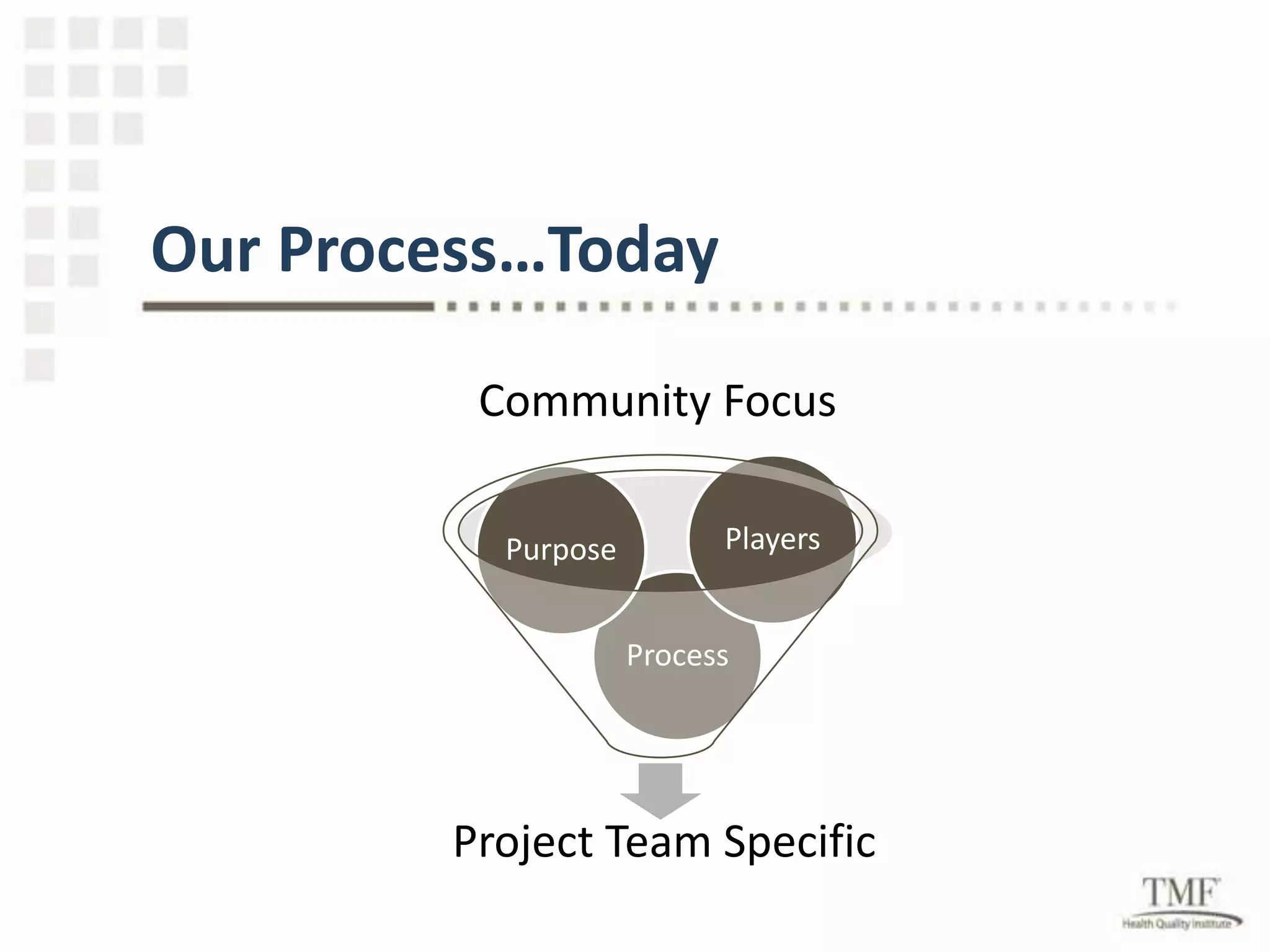
Our Process…Today
Project Team Specific
Process
Purpose Players
Community Focus
Benefits
 Resource Sharing
 Knowledge / Expertise
 Community Presence and Trust
 Opportunities for community cohesion
 Shared Responsibility (and Risk)
 Collective Leverage / Bargaining
 Mitigate “Group Think”
“Knowledge is of two kinds. We know a
subject ourselves, or we know where we can
find information upon it.”
Samuel Johnson, 1775
What’s the Goal?
Improvement of some components, processes,
or outcomes?
OR
Complete system transformation to ensure
success every time?
Purpose(s) of External Coalition
Building?
 Census Growth?
 Clinical Improvement?
 Reducing Rehospitalizations?
 Specialized service delivery?
 Staff retention/recruitment?
 Policy development?
 Community Involvement / Outreach?
Determining the Need (“Reflection”)
Consider This…
Organizational Description: Environment, Service Offerings, workforce profile,
Assets, Regulatory Requirements, M/V
Key Customers: Their requirements and how do you know?
Competitive Environment: Organizational Position, Success Factors, Data
Sources
Strategic Planning: Your Strategic Challenges / Advantages and why
are they important?
Performance Improvement: How do you measure success/opportunity?
Source: AHCA/NCAL National Quality Award
Bronze Application Criteria
Being Effective
 Be specific (purpose, timeline, structure)
 Have a Plan
 Make it Measurable
 Take Ownership
 Open Communication
 Feedback
“What endures is your effect on other
people and the kind of world, organization
and culture that you've helped to create.”
Jeffrey Pfeffer
Stanford University
Building organizational
momentum through
meaningful relationships
with front-line staff as
daily problem solvers
What we want is to:
 Maximize efficiency and effectiveness
 Retain staff
 Ensure that employees are fully engaged on
a daily basis
 Avoid harm
 Be successful
Questions:
 When did you learn how to be on a team?
• Red Rover, Red Rover
• Sports
• School
• Did everyone pull their weight?
More Questions:
 Do you have teamwork now?
• On the floor?
• In a QI team/PIP team?
• In your leadership team?
More Questions:
 What’s the barrier to teamwork?
• Hierarchy
• Language
• Education/knowledge (formal/informal)
• Shared purpose
• Hidden agendas
• Turnover
First Things First
 We have to create a culture of teamwork.
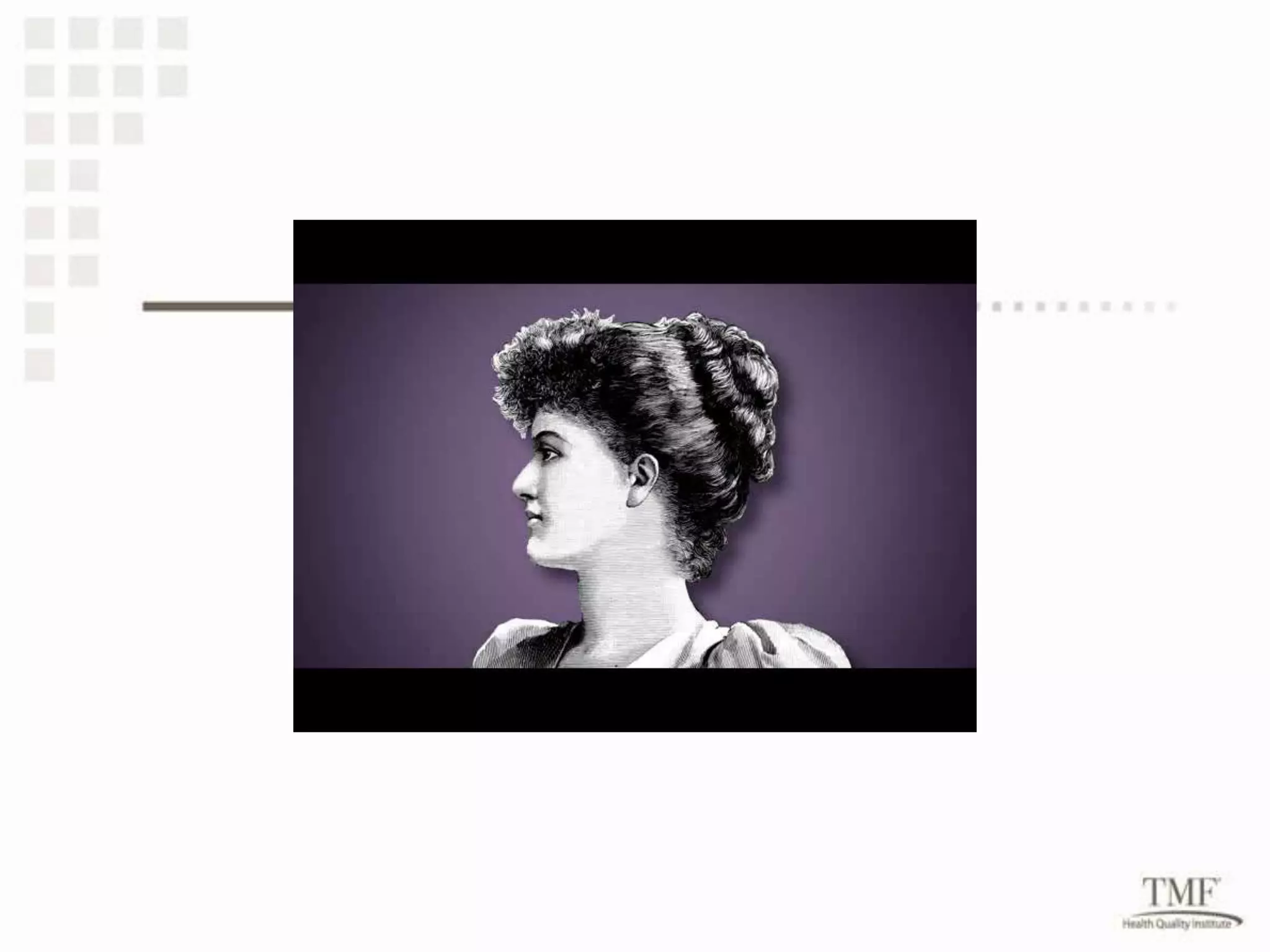
Let’s watch a movie
17
So…
 How easy is it to connect to:
• Individuals
Empathy
 Fuels connection
 Perspective taking
 Staying out of judgment
 Recognizing emotion in others and
communicating that
Empathy
 Feeling WITH people
 A vulnerable choice
 I have to connect within myself to a similar
experience
– Dr. Brené Brown
So…
 How easy is it to connect to:
• Individuals
• Teams
Culture of Teamwork
 To be understood, you must first
understand
 Investing Inside the Nursing
Home Walls
First Things First
 Create a culture of teamwork
• We can’t eat our young – use empathy
• We have to break down barriers
• We have to forgive
• We have to ask for forgiveness
Successful QI Project Teams
 Need an organizational culture of quality
 Need a shared mental model
 Have accountability
 Have a blame-free environment
Blame-Free Environment
 Human error is not the cause of accidents, it
is a symptom of deeper trouble.
 Human error is not random.
 Human error is not the conclusion of an
investigation, it is the beginning.
26
Human Factors
“Human Factors” is about how features of our
tools, tasks and work environments continually
influence what we do and how we do it.
27
Three Categories of Performance
Gaps
 The plan itself was inadequate to achieve
desired outcome (planning error).
 The plan is not executed properly
(execution error).
 There was a deliberate departure from “safe”
practice (violation).
28
Moving to a team culture
 Fuel connections – empathy
 Grow knowledge, skills and abilities
 Develop a shared mental model
 Be a learning organization
 Coach and mentor daily
One caution!
 Avoid Group Think
• Desire for harmony or conformity in the
group results in an irrational or dysfunctional
decision-making outcome.
 Watch out for:
• Suppression of individual opinions, and
• Creative thought
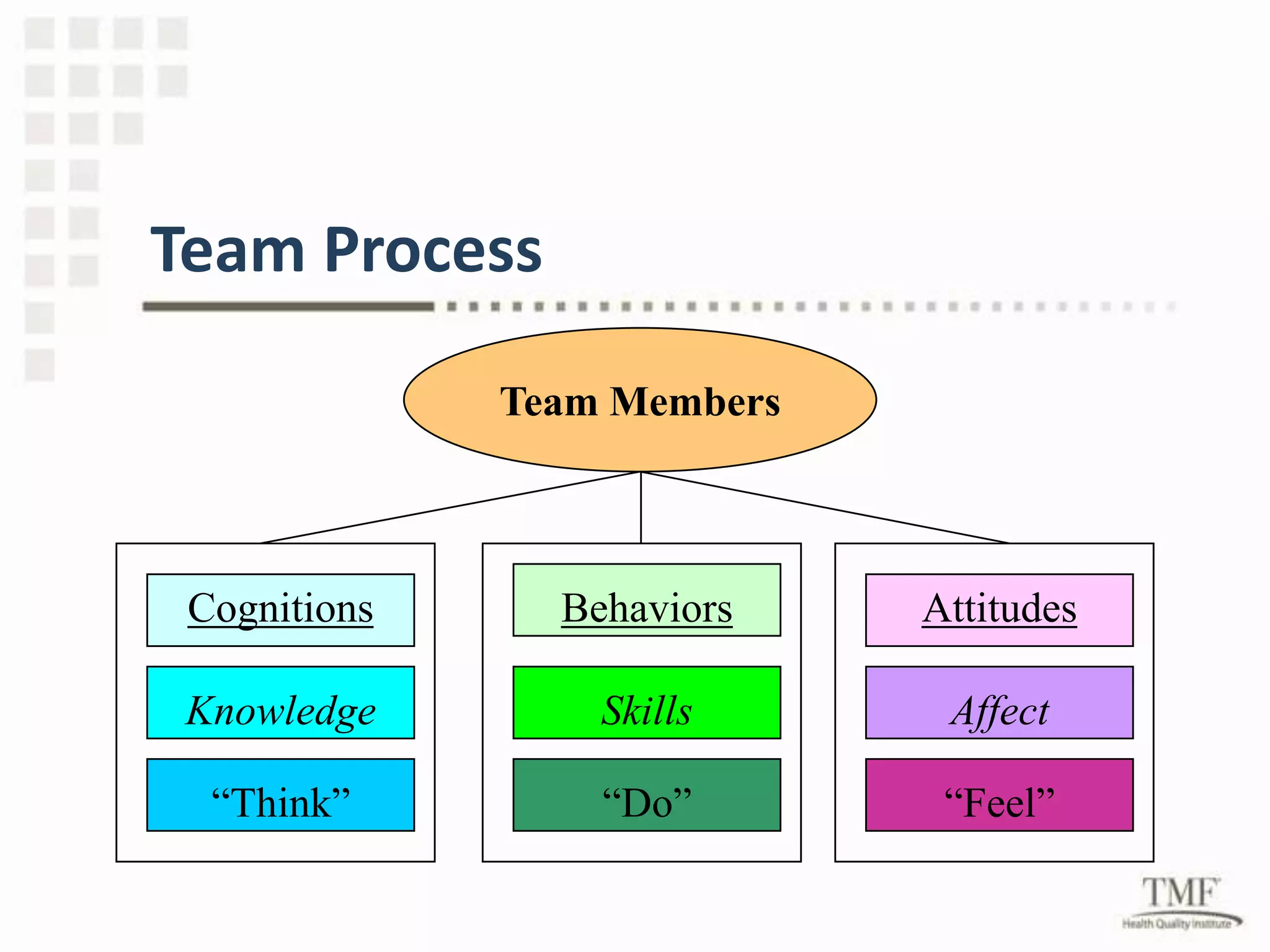
Team Process
Team Members
Cognitions
Knowledge
“Think”
Behaviors
Skills
“Do”
Attitudes
Affect
“Feel”
Team Conflict
 Is it a bad thing?
 NO!
 Constructive conflict is a component of high-
functioning teams
Resolving Team Conflict
 Understand and appreciate various
viewpoints
 Acknowledge the conflict
 Discuss the impact
 Agree to a cooperative process
 Agree to communicate
The Social Age
Requires us to be:
 More strategic
 More creative and innovative
 More solutions-oriented
 And, do it faster!
PIP Team Charter
 Serves as a catalyst
 Gives direction to the team
 Gives protection the team needs to succeed
 Communicates to non-team members what
is going on
PIP Team Charter
 Brings the team together for a common:
• Mission
• Scope of operation
• Objectives
• Timeframe
• Consequences
PIP Team Charter
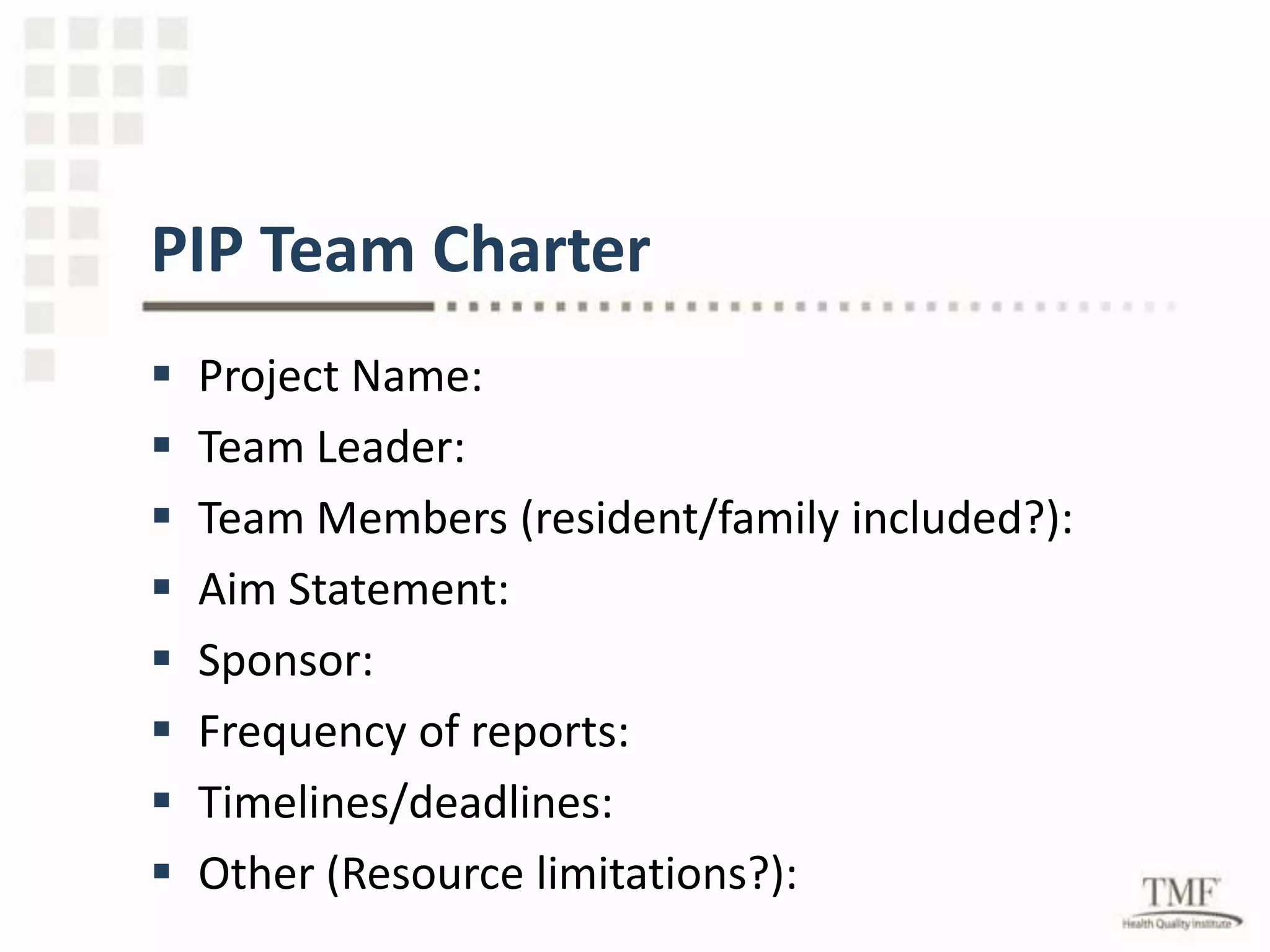
 Project Name:
 Team Leader:
 Team Members (resident/family included?):
 Aim Statement:
 Sponsor:
 Frequency of reports:
 Timelines/deadlines:
 Other (Resource limitations?):
Let’s Build a Team
Let’s Build an Action Period
“It's not whether your glass is empty or full, it's
what you do with it that really matters.”
– Sue Nelson Buckley
About TMF
TMF Health Quality Institute focuses on
improving lives by improving the quality
of health care through contracts with federal,
state and local governments, as well as private
organizations. For more than 40 years, TMF has
helped health care providers and practitioners
in a variety of settings improve care for their
patients.
41
About the QIO Program
Leading rapid, large-scale change in health
quality:
 Goals are bolder.
 The patient is at the center.
 All improvers are welcome.
 Everyone teaches and learns.
 Greater value is fostered.
42
Contact
Melody Malone, PT, CPHQ, MHA
Quality Improvement Consultant
TMF Health Quality Institute
214-632-2238
Melody.malone@hcqis.org
43
Patient Safety: Nursing Home Team
nhnetwork@tmf.org
1-866-439-5863
http://texasqio.tmf.org
This material was prepared by TMF Health Quality Institute, the Medicare Quality Improvement
Organization for Texas, under contract with the Centers for Medicare & Medicaid Services (CMS), an
agency of the U.S. Department of Health and Human Services. The contents do not necessarily reflect
CMS policy. 10SOW-TX-C7-14-52

Unity is strength presentation slides

  • 1.
    Unity is Strength: ThePower of Collaboration Kevin Warren President/CEO Texas Health Care Association Melody Malone, PT, CPHQ, MHA Quality Improvement Consultant TMF Health Quality Institute
  • 2.
    Objectives At the conclusionof the session, participants should be able to:  Recognize the benefits of forming coalitions for a common purpose.  Apply a plan to form a successful coalition.  Form project teams focused on achieving specific outcomes.  Implement a project team focused on achieving a specific outcome.
  • 3.
    Our Process…Today Project TeamSpecific Process Purpose Players Community Focus
  • 4.
    Benefits  Resource Sharing Knowledge / Expertise  Community Presence and Trust  Opportunities for community cohesion  Shared Responsibility (and Risk)  Collective Leverage / Bargaining  Mitigate “Group Think”
  • 5.
    “Knowledge is oftwo kinds. We know a subject ourselves, or we know where we can find information upon it.” Samuel Johnson, 1775
  • 6.
    What’s the Goal? Improvementof some components, processes, or outcomes? OR Complete system transformation to ensure success every time?
  • 7.
    Purpose(s) of ExternalCoalition Building?  Census Growth?  Clinical Improvement?  Reducing Rehospitalizations?  Specialized service delivery?  Staff retention/recruitment?  Policy development?  Community Involvement / Outreach?
  • 8.
    Determining the Need(“Reflection”) Consider This… Organizational Description: Environment, Service Offerings, workforce profile, Assets, Regulatory Requirements, M/V Key Customers: Their requirements and how do you know? Competitive Environment: Organizational Position, Success Factors, Data Sources Strategic Planning: Your Strategic Challenges / Advantages and why are they important? Performance Improvement: How do you measure success/opportunity? Source: AHCA/NCAL National Quality Award Bronze Application Criteria
  • 9.
    Being Effective  Bespecific (purpose, timeline, structure)  Have a Plan  Make it Measurable  Take Ownership  Open Communication  Feedback
  • 10.
    “What endures isyour effect on other people and the kind of world, organization and culture that you've helped to create.” Jeffrey Pfeffer Stanford University
  • 11.
    Building organizational momentum through meaningfulrelationships with front-line staff as daily problem solvers
  • 12.
    What we wantis to:  Maximize efficiency and effectiveness  Retain staff  Ensure that employees are fully engaged on a daily basis  Avoid harm  Be successful
  • 13.
    Questions:  When didyou learn how to be on a team? • Red Rover, Red Rover • Sports • School • Did everyone pull their weight?
  • 14.
    More Questions:  Doyou have teamwork now? • On the floor? • In a QI team/PIP team? • In your leadership team?
  • 15.
    More Questions:  What’sthe barrier to teamwork? • Hierarchy • Language • Education/knowledge (formal/informal) • Shared purpose • Hidden agendas • Turnover
  • 16.
    First Things First We have to create a culture of teamwork.
  • 17.
  • 19.
    So…  How easyis it to connect to: • Individuals
  • 20.
    Empathy  Fuels connection Perspective taking  Staying out of judgment  Recognizing emotion in others and communicating that
  • 21.
    Empathy  Feeling WITHpeople  A vulnerable choice  I have to connect within myself to a similar experience – Dr. Brené Brown
  • 22.
    So…  How easyis it to connect to: • Individuals • Teams
  • 23.
    Culture of Teamwork To be understood, you must first understand  Investing Inside the Nursing Home Walls
  • 24.
    First Things First Create a culture of teamwork • We can’t eat our young – use empathy • We have to break down barriers • We have to forgive • We have to ask for forgiveness
  • 25.
    Successful QI ProjectTeams  Need an organizational culture of quality  Need a shared mental model  Have accountability  Have a blame-free environment
  • 26.
    Blame-Free Environment  Humanerror is not the cause of accidents, it is a symptom of deeper trouble.  Human error is not random.  Human error is not the conclusion of an investigation, it is the beginning. 26
  • 27.
    Human Factors “Human Factors”is about how features of our tools, tasks and work environments continually influence what we do and how we do it. 27
  • 28.
    Three Categories ofPerformance Gaps  The plan itself was inadequate to achieve desired outcome (planning error).  The plan is not executed properly (execution error).  There was a deliberate departure from “safe” practice (violation). 28
  • 29.
    Moving to ateam culture  Fuel connections – empathy  Grow knowledge, skills and abilities  Develop a shared mental model  Be a learning organization  Coach and mentor daily
  • 30.
    One caution!  AvoidGroup Think • Desire for harmony or conformity in the group results in an irrational or dysfunctional decision-making outcome.  Watch out for: • Suppression of individual opinions, and • Creative thought
  • 31.
  • 32.
    Team Conflict  Isit a bad thing?  NO!  Constructive conflict is a component of high- functioning teams
  • 33.
    Resolving Team Conflict Understand and appreciate various viewpoints  Acknowledge the conflict  Discuss the impact  Agree to a cooperative process  Agree to communicate
  • 34.
    The Social Age Requiresus to be:  More strategic  More creative and innovative  More solutions-oriented  And, do it faster!
  • 35.
    PIP Team Charter Serves as a catalyst  Gives direction to the team  Gives protection the team needs to succeed  Communicates to non-team members what is going on
  • 36.
    PIP Team Charter Brings the team together for a common: • Mission • Scope of operation • Objectives • Timeframe • Consequences
  • 37.
    PIP Team Charter Project Name:  Team Leader:  Team Members (resident/family included?):  Aim Statement:  Sponsor:  Frequency of reports:  Timelines/deadlines:  Other (Resource limitations?):
  • 38.
  • 39.
    Let’s Build anAction Period
  • 40.
    “It's not whetheryour glass is empty or full, it's what you do with it that really matters.” – Sue Nelson Buckley
  • 41.
    About TMF TMF HealthQuality Institute focuses on improving lives by improving the quality of health care through contracts with federal, state and local governments, as well as private organizations. For more than 40 years, TMF has helped health care providers and practitioners in a variety of settings improve care for their patients. 41
  • 42.
    About the QIOProgram Leading rapid, large-scale change in health quality:  Goals are bolder.  The patient is at the center.  All improvers are welcome.  Everyone teaches and learns.  Greater value is fostered. 42
  • 43.
    Contact Melody Malone, PT,CPHQ, MHA Quality Improvement Consultant TMF Health Quality Institute 214-632-2238 Melody.malone@hcqis.org 43
  • 44.
    Patient Safety: NursingHome Team nhnetwork@tmf.org 1-866-439-5863 http://texasqio.tmf.org This material was prepared by TMF Health Quality Institute, the Medicare Quality Improvement Organization for Texas, under contract with the Centers for Medicare & Medicaid Services (CMS), an agency of the U.S. Department of Health and Human Services. The contents do not necessarily reflect CMS policy. 10SOW-TX-C7-14-52