Unit 4-System Dynamics
• What is a system?
• A set of elements that is coherently organized and
interconnected in a structure that produces a characteristic
set of behaviors.
• Static system:
• The output of the system depends only on the current
input.
• The output does not change with the time if the input is
held constant (time-invariant)
• Dynamic system
• The output of the system depends on the current and the
previous input.
• The output changes with the time even if the input is
constant (time varying)
Systems Thinking
Definition: Systems thinking is a holistic approach to analysis
that focuses on the way that a system's constituent parts
interrelate and how systems work over time and within the
context of larger systems
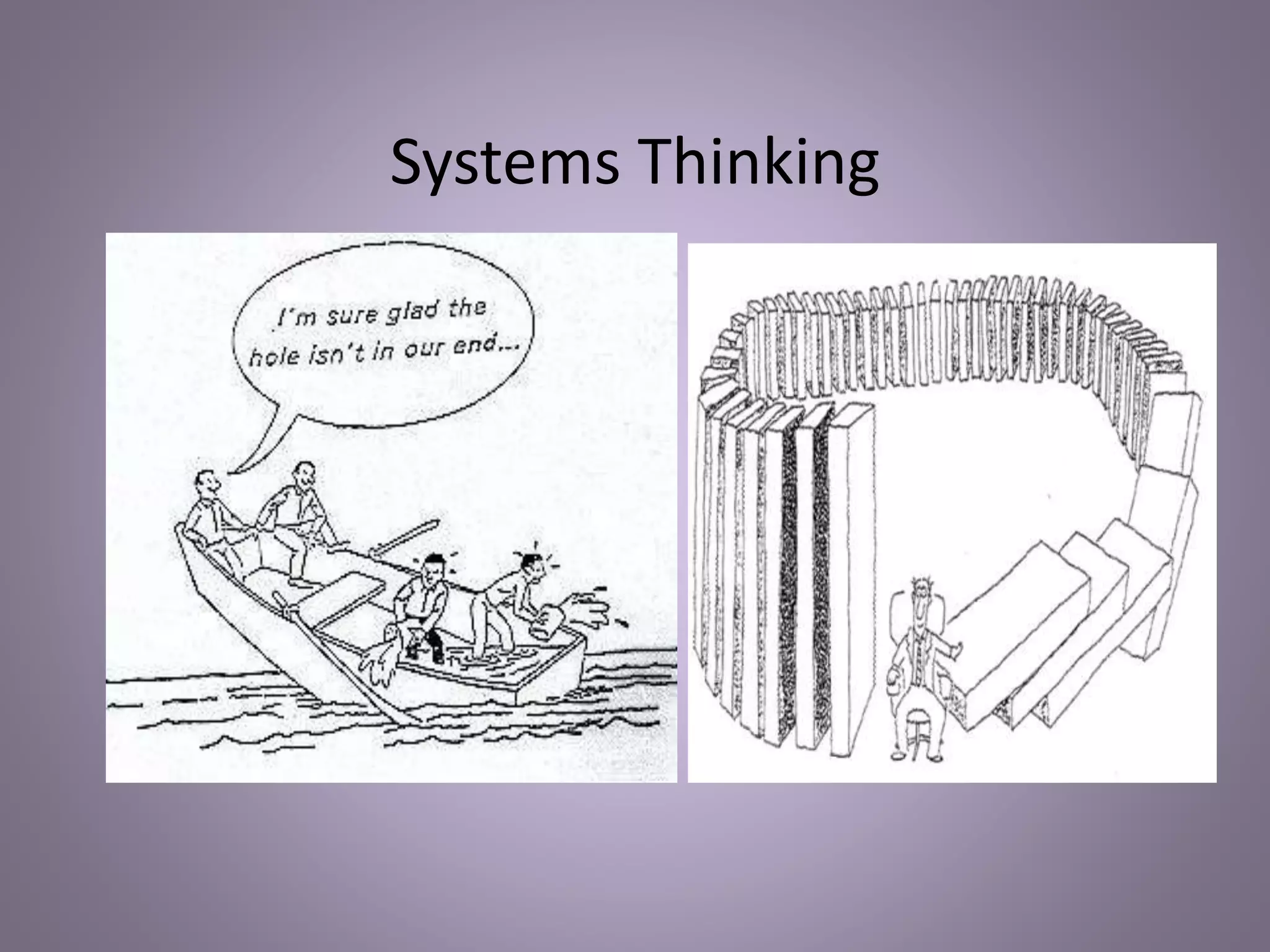
• We quickly determine a cause for any event that we think is
a problem. Usually we conclude that the cause is another
event.
• –Example: Sales are poor (event) because staff are
insufficient motivated (cause); staff are insufficient
motivated (event) because ...
•Difficulty: You can always find yet another event that caused
the one that you thought was the cause. This makes it very
difficult to determine what to do to improve performance.
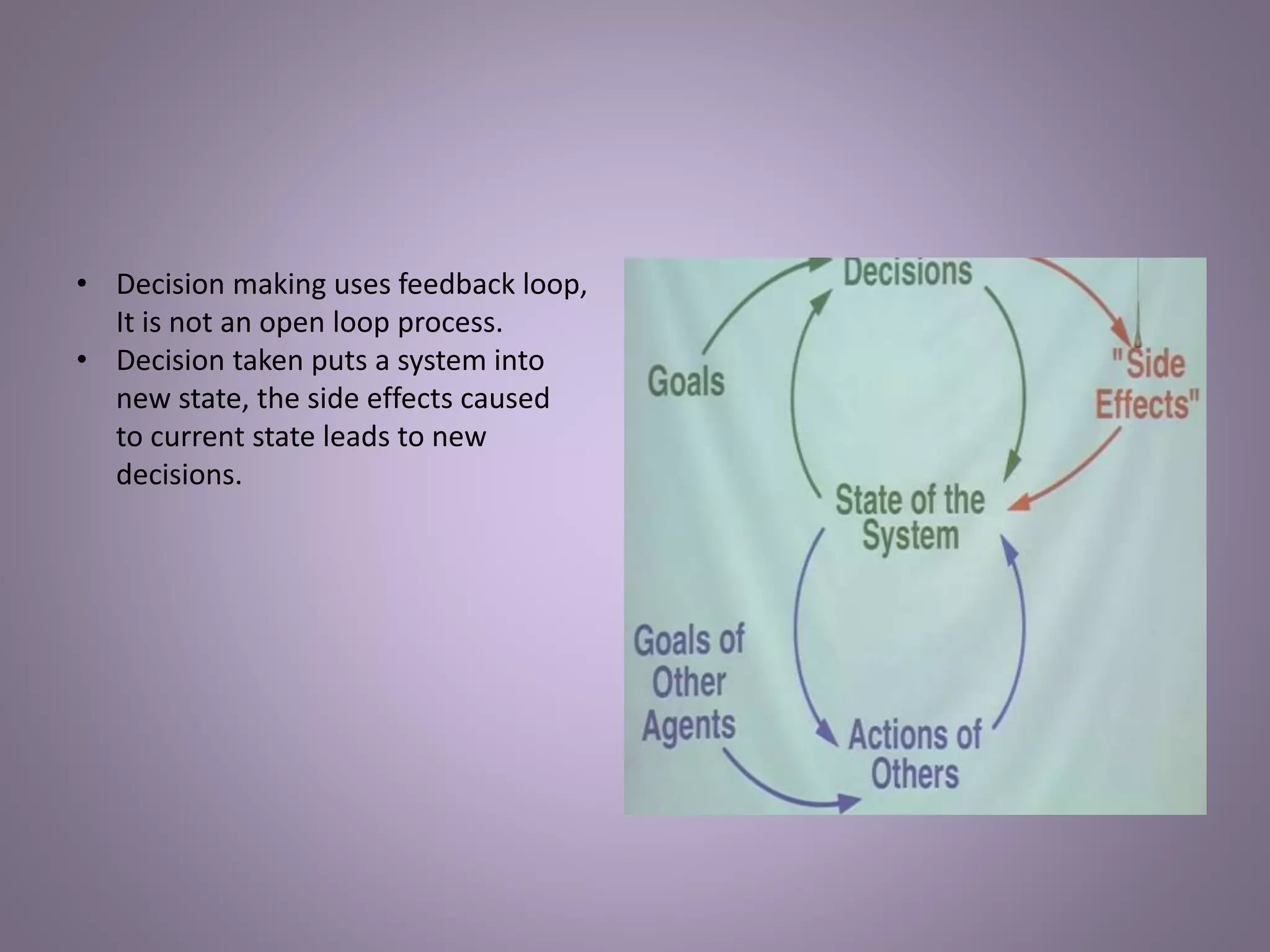
• Decision making uses feedback loop,
It is not an open loop process.
• Decision taken puts a system into
new state, the side effects caused
to current state leads to new
decisions.
Systems Thinking
Systems Thinking
•Idea of Systems Thinking:
–Move away from looking at isolated events and their causes .
–Look at the organization as a system made up of interacting parts
–Internal structure of the system is often more important than
external events in generating the problem
–If we shift from the event orientation to focusing on the internal
system structure
--we improve our possibility of improving system performance as the
system structure is often the underlying source of the difficulty.
•Systems Thinking: The process of understanding how things influence
one another within a whole
WHAT IS SYSTEM DYNAMIC
SIMULATION?
• Systemdynamics(SD)is a methodology to explore complexity,
Interconnectedness,and change in a system overtime.
• It deals with internal feedback loops and time delays that
affect the behavior of the entire system.
• The basis of the methodology is the recognition that the
structure of any system (relationships amongst its
components) is just as important in determining its behaviour
as the individual components themselves.
• Developed in the late 1950s by MIT Professor Jay Forrester.
• SD is an extension of systems thinking.
• With SD we can analyze the possible effects of our models,
given different assumptions, policies, constraints, etc.
• System dynamics focuses on the structure and
behavior of systems composed of interacting
feedback loops.
• System Dynamics helps in designing the
interconnections and structures to give more
confidence and predictability in behavior of
the systems.
WHAT IS THE DIFFERENCE BETWEEN
ST AND SD?
• Systems thinking and system dynamics are two sides of the
same coin.
• Systems thinking focuses on exploring interrelationships,
including creating causal loop diagrams and behavior over
time graphs, without the need for computer software.
• System dynamics employs systems thinking outputs such
as causal loop diagrams to focus on building and analyzing
stock and flow
• System dynamics -which incorporates systems thinking-
teaches us better thinking. It results in better analysis and
greater understanding.
• 1st step: How to think? ST
• 2nd step: How to model? SD
SYSTEM DYNAMICS MODELING
Conceptualization
–Define the purpose of the model
–Define the model boundaries and identify key variables
–Describe the behavior of the key variables
–Diagram the basic mechanisms (feedback loops) of the system
Formulation
–Convert diagrams to stock and flow equations
–Estimate and select parameter values
–Create the simulation model
Testing
• –Test the dynamic hypothesis (the potential explanation of how structure
is causing observed behavior)
• –Test model behavior and sensitivity to perturbations
Implementation
• –Test model's responses to different policies
• –Translate study insight to an accessible form
• CRITICAL ASPECTS:
• Thinking in terms of cause-and-effect
relationships
• Focusing on the feedback linkages among
components of a system
• Determining the appropriate boundaries for
defining what is to be included within a system
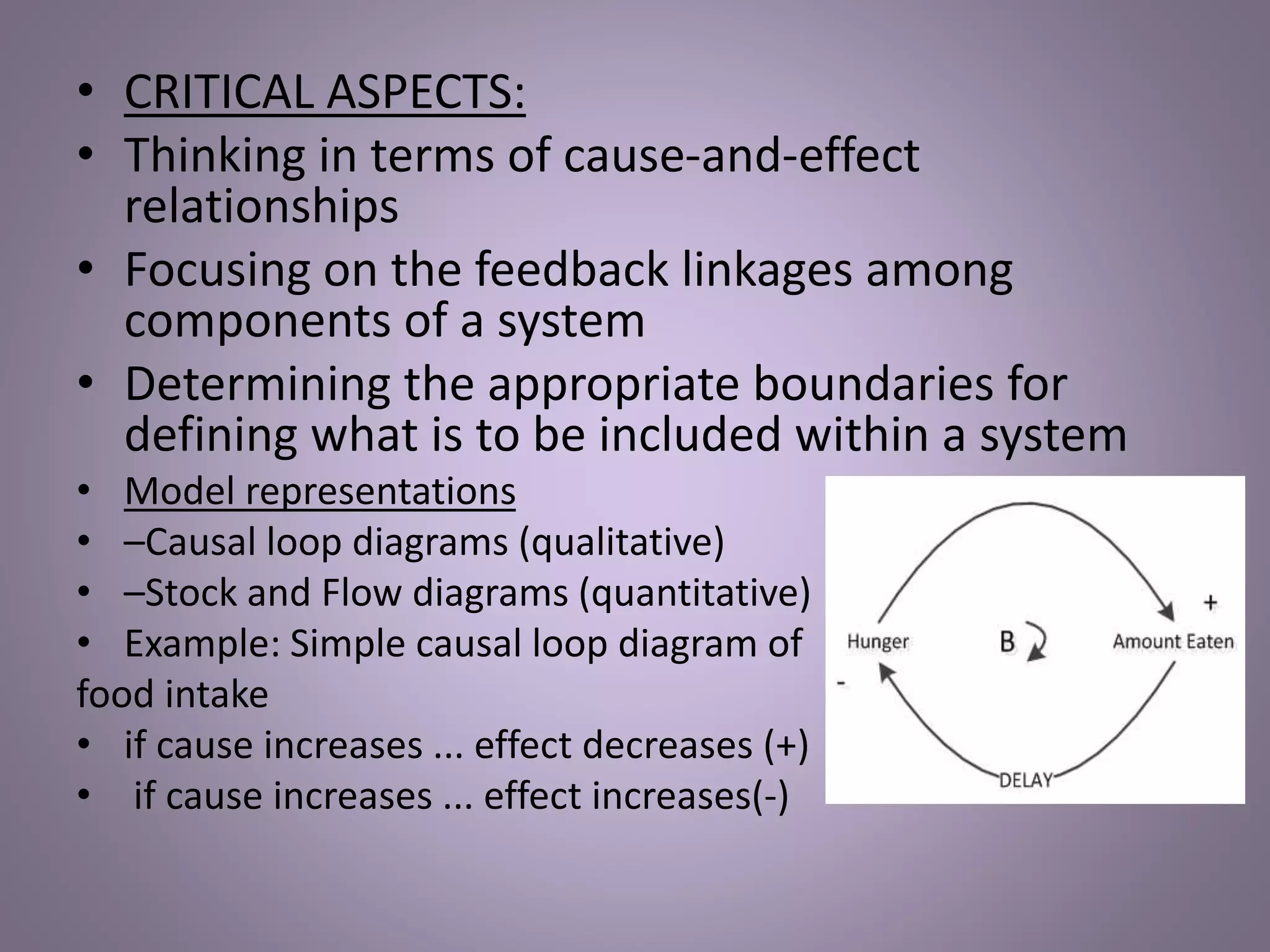
• Model representations
• –Causal loop diagrams (qualitative)
• –Stock and Flow diagrams (quantitative)
• Example: Simple causal loop diagram of
food intake
• if cause increases ... effect decreases (+)
• if cause increases ... effect increases(-)
Assumptions in SD
System Dynamics modeling is predicated on a number of assumptions
• The feedback loops are sufficient to explain complex system
behavior
• The SD is modeled through a process of direct or indirect
engagement of domain experts through following approaches.
1.Interviews
2.Group model building workshops
3.Analysis of written document
• Reference model of behavior can be used for prediction
• To improve the outcome feedback paths can be introduced or
removed.
UNDERSTAND CAUSE & EFFECT
• Some are logical
• Food intake-> weight
• Money -> betterlife
• Fire -> smoke
• Some are not
• Use of seatbelts ->reduced highway fatalities
FEEDBACK LOOP STRUCTURES
• Thinking in terms of “cause and effect” is not enough
• ocean -> evaporation ->cloud -> rain -> ocean -> …
• Feedback: an initial cause ripples through a chain of
• causation ultimately to re-affect itself
• Search to identify closed, causal feedback loops is one
key element of System Dynamics
• The most important causal influences will be exactly
those that are enclosed within feedback loop
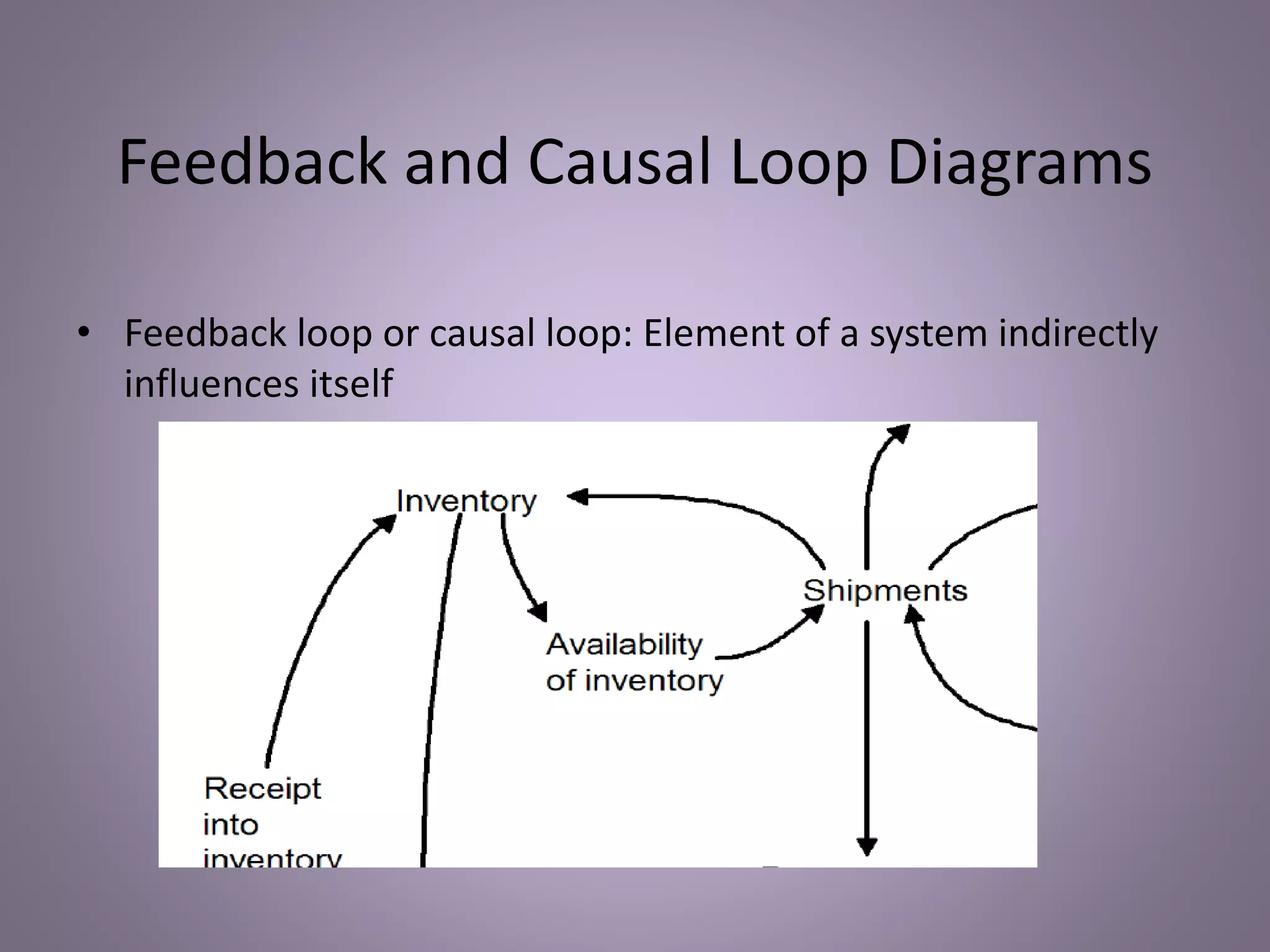
Feedback and Causal Loop Diagrams
• Feedback loop or causal loop: Element of a system indirectly
influences itself
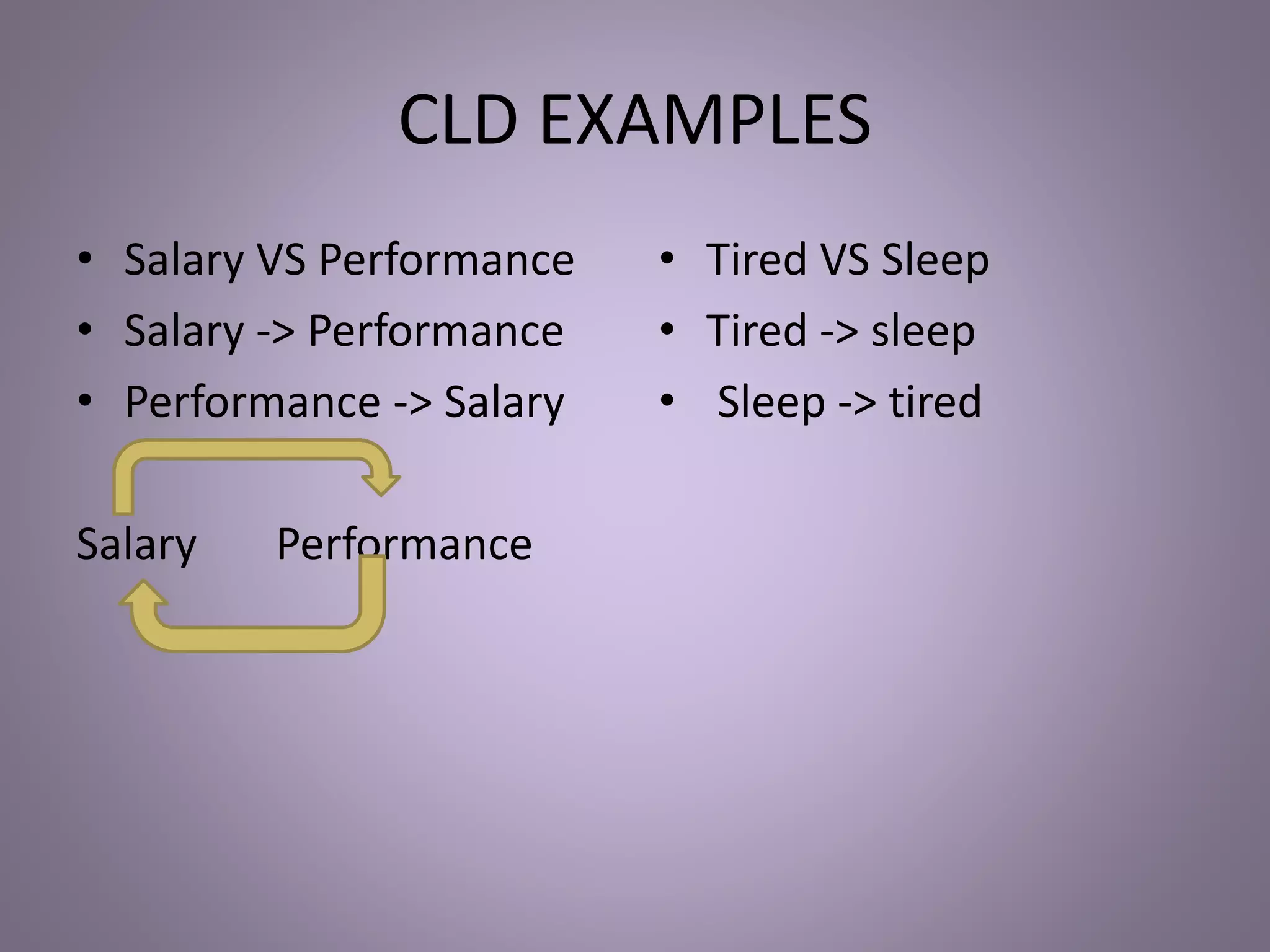
CLD EXAMPLES
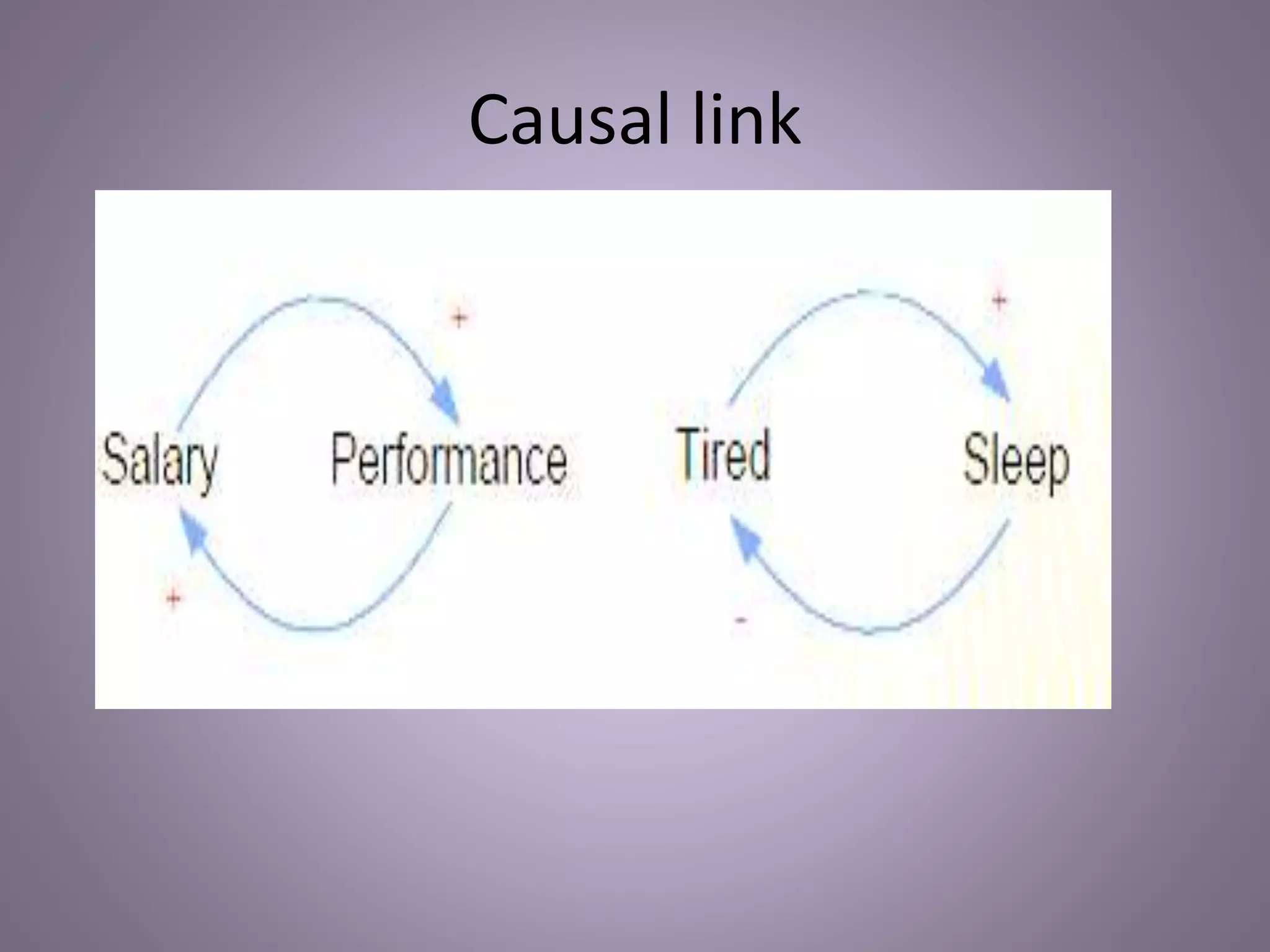
• Salary VS Performance
• Salary -> Performance
• Performance -> Salary
Salary Performance
• Tired VS Sleep
• Tired -> sleep
• Sleep -> tired
AUGMENTING CLD 1
(LABELING LINK POLARITY)
• Signing: Add a ‘+’ or a ‘–’ sign at each arrowhead to
convey more information-Causal link
• A ‘+’ is used if the cause increase, the effect increases
and if the cause decrease, the effect decreases (or)
Causal link from element A to B is positive (+ or s) if
either A adds to B or a change in A produces a change
in B in the same direction
• A ‘-’ is used if the cause increases, the effect
decreases and if the cause decreases, the effect
Increases (or) Causal link from element A to B is negative
(- or o) if either A subtracts from B or a change in A
produces a change in B in the opposite direction
Causal link
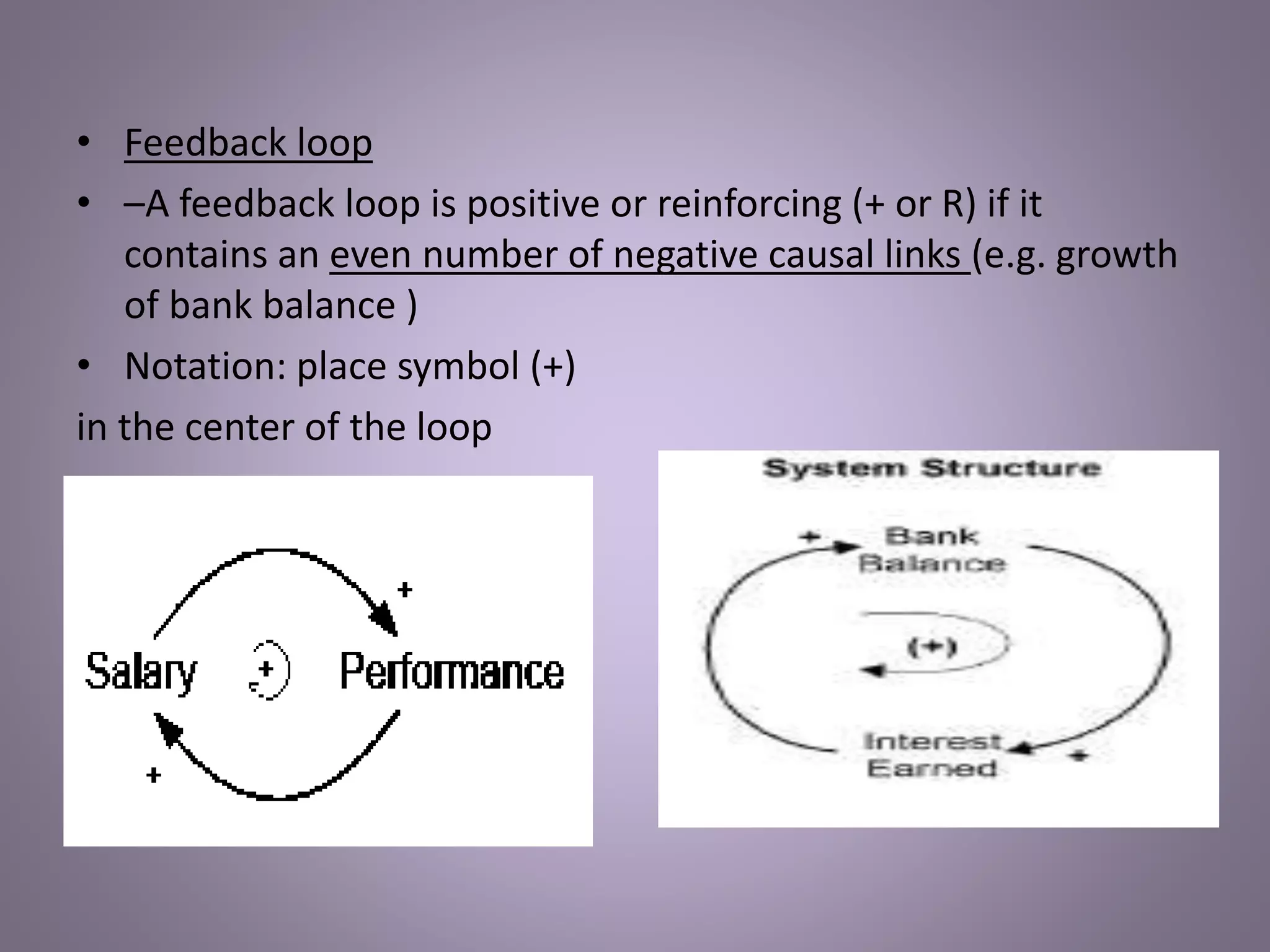
• Feedback loop
• –A feedback loop is positive or reinforcing (+ or R) if it
contains an even number of negative causal links (e.g. growth
of bank balance )
• Notation: place symbol (+)
in the center of the loop
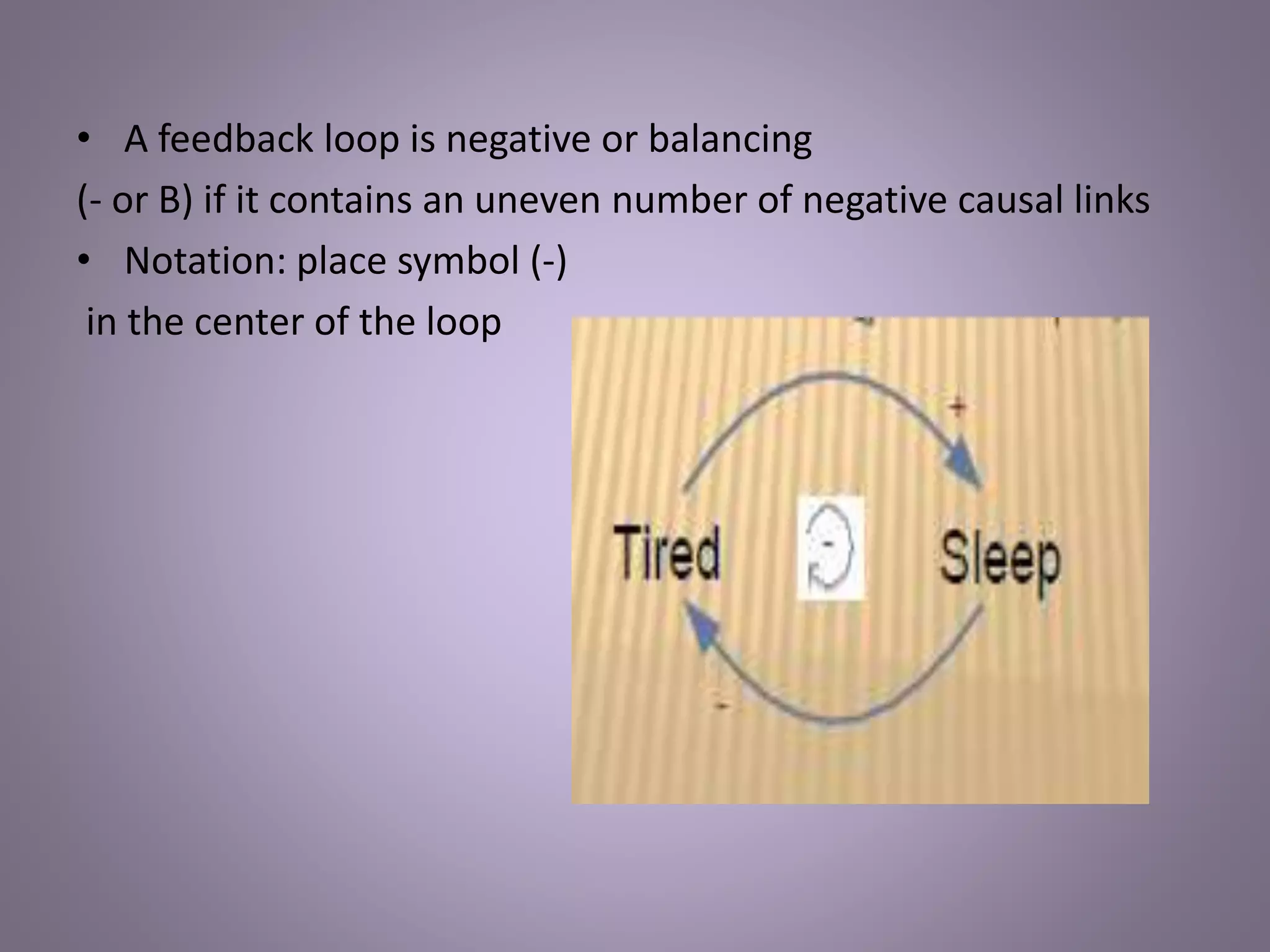
• A feedback loop is negative or balancing
(- or B) if it contains an uneven number of negative causal links
• Notation: place symbol (-)
in the center of the loop
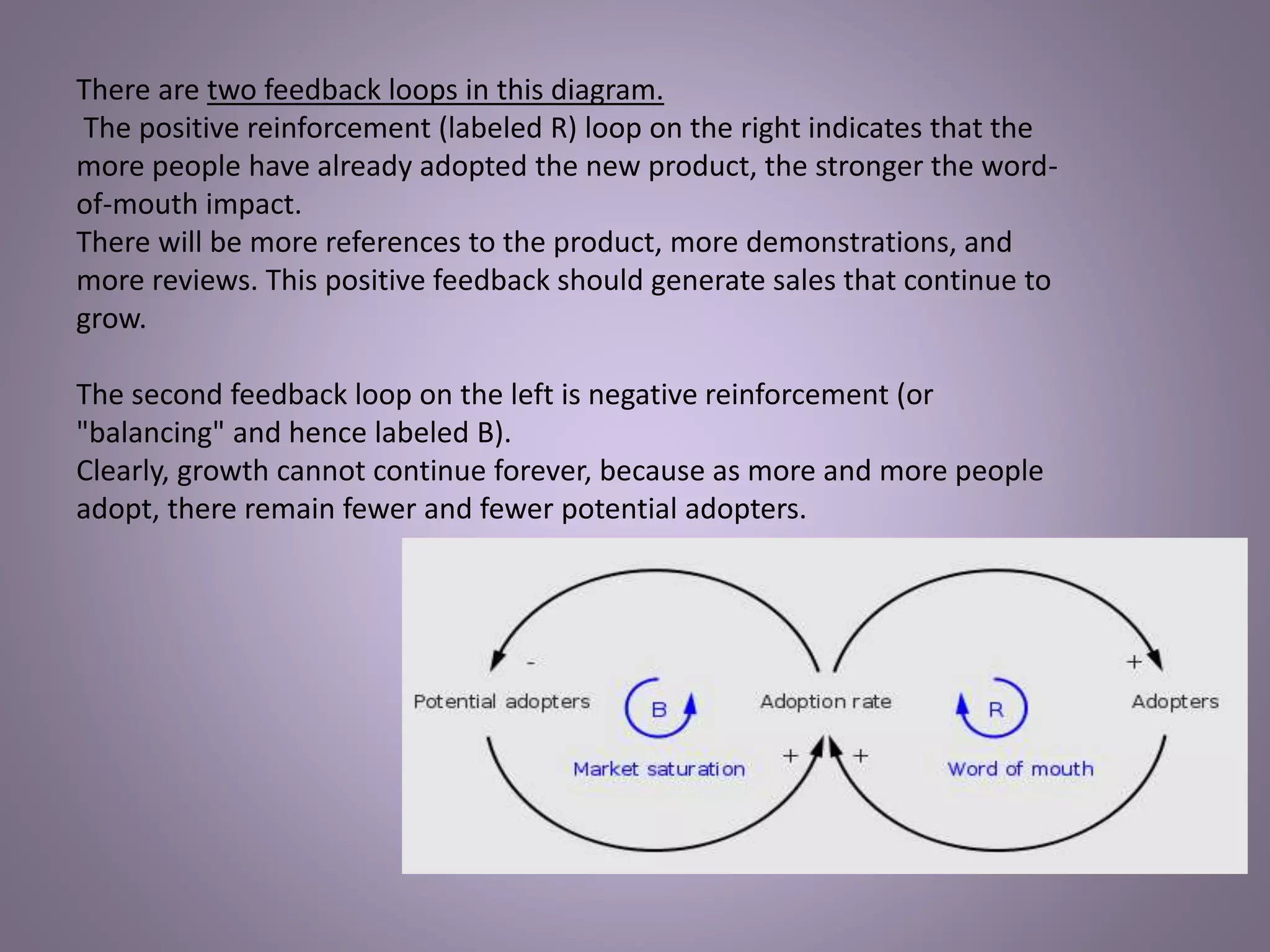
• Combination of positive and negative loop
[e.g. sales growth]
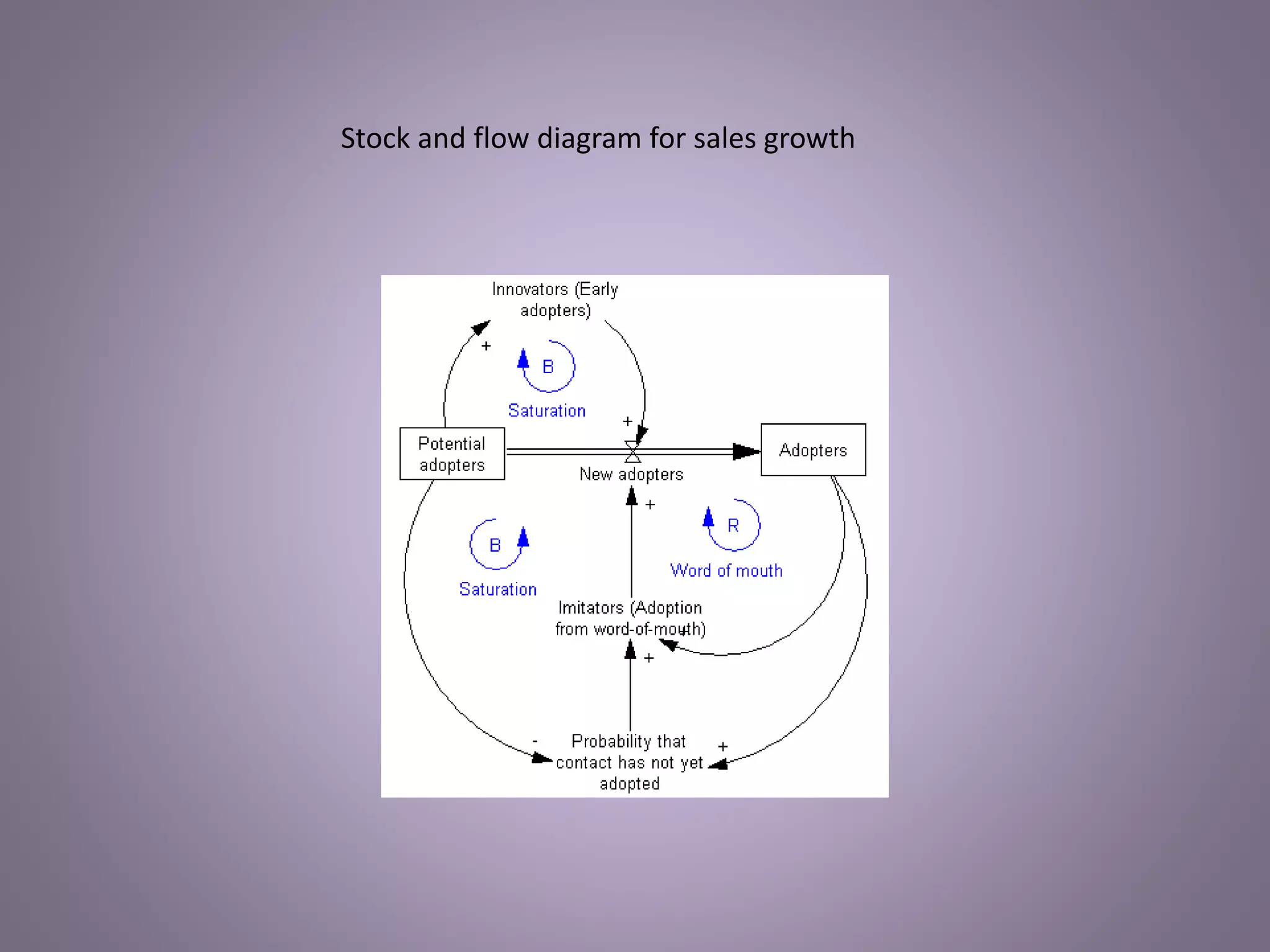
There are two feedback loops in this diagram.
The positive reinforcement (labeled R) loop on the right indicates that the
more people have already adopted the new product, the stronger the word-
of-mouth impact.
There will be more references to the product, more demonstrations, and
more reviews. This positive feedback should generate sales that continue to
grow.
The second feedback loop on the left is negative reinforcement (or
"balancing" and hence labeled B).
Clearly, growth cannot continue forever, because as more and more people
adopt, there remain fewer and fewer potential adopters.
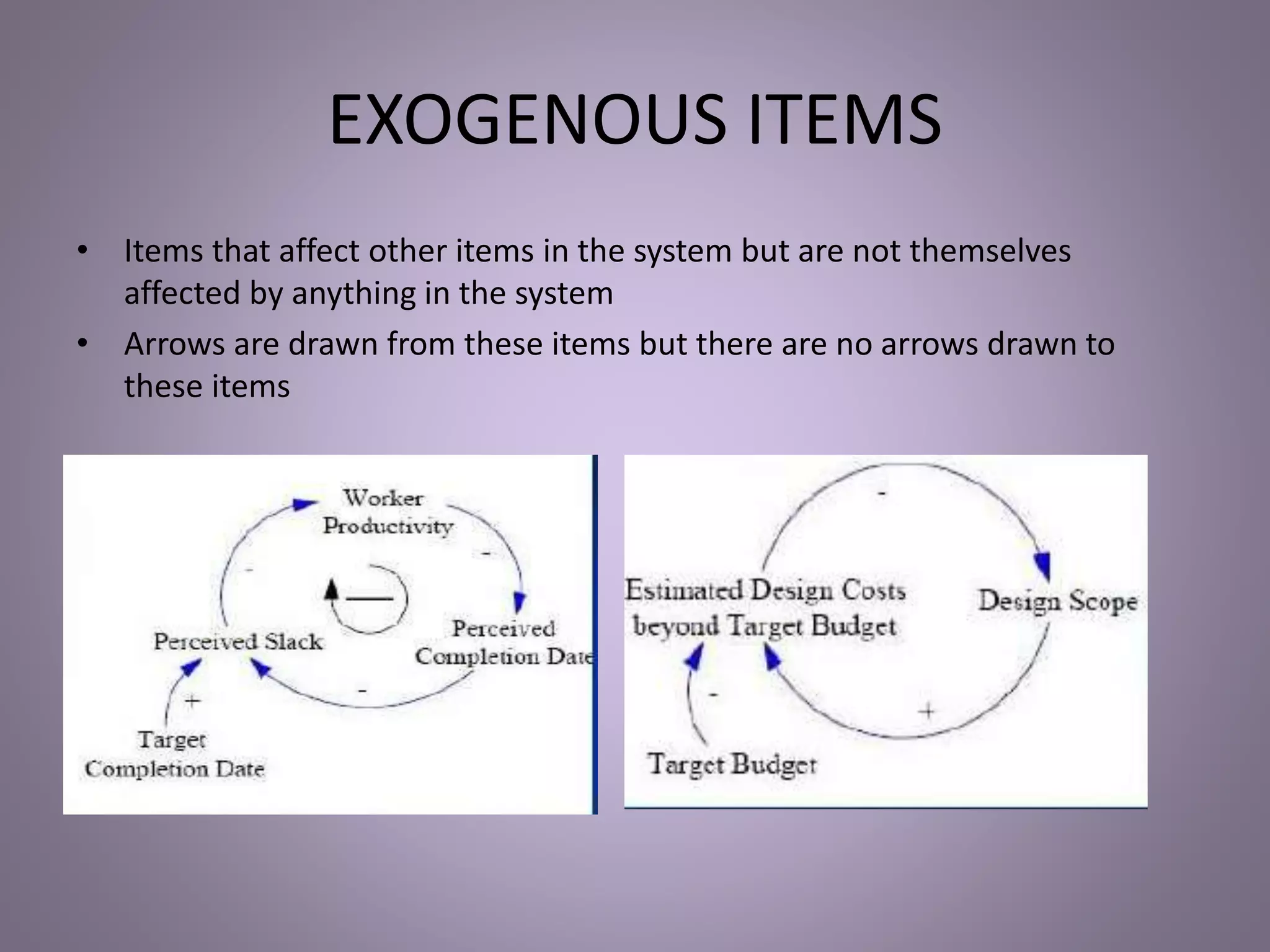
EXOGENOUS ITEMS
• Items that affect other items in the system but are not themselves
affected by anything in the system
• Arrows are drawn from these items but there are no arrows drawn to
these items
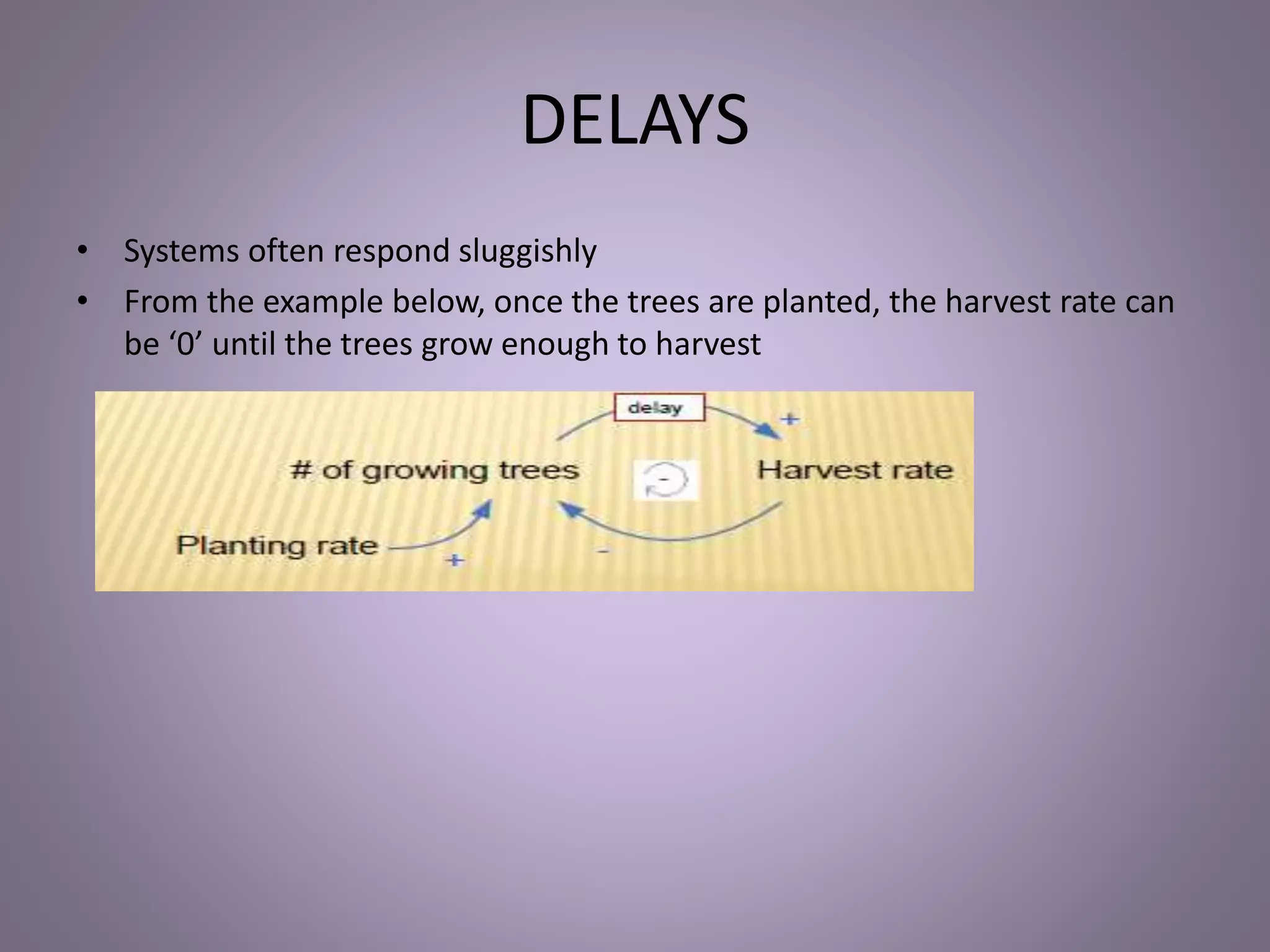
DELAYS
• Systems often respond sluggishly
• From the example below, once the trees are planted, the harvest rate can
be ‘0’ until the trees grow enough to harvest
Stock and flow diagrams
• Stock and flow diagram:
–Shows relationships among variables which have the potential to
change over time (like causal loop diagrams)
–Distinguishes between different types of variables (unlike causal loop
diagrams
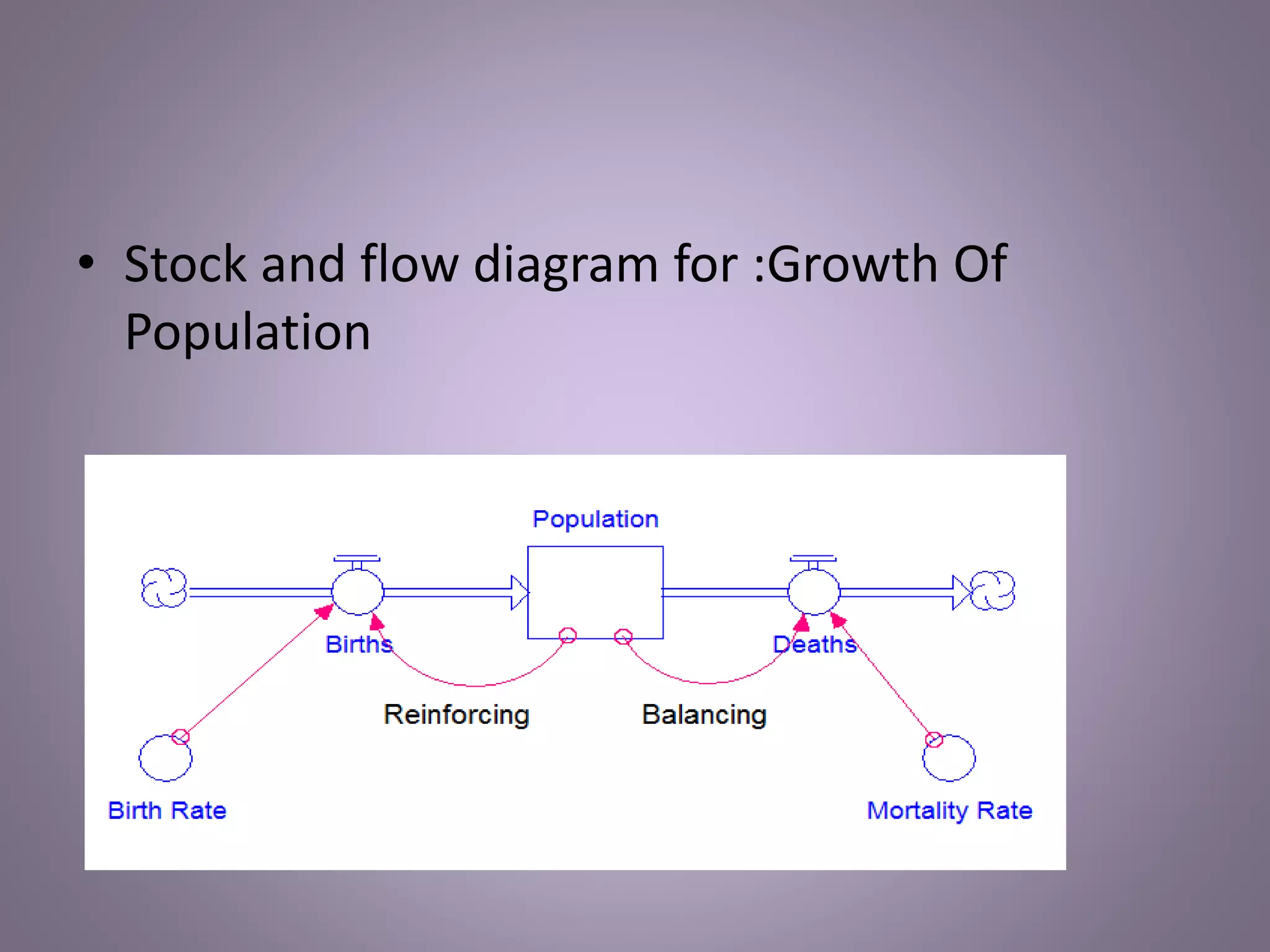
• Stocks (also known as levels, accumulations, or state variables)
{Symbol: Box} are the foundation of any system and are the elements
that you can see, feel, count, or measure.
• Stocks do not have to be physical
• Value of stock changes by accumulating or integrating flows
• Physical entities which can accumulate and move around (e.g.
materials, personnel, capital equipment, orders, stocks of money)
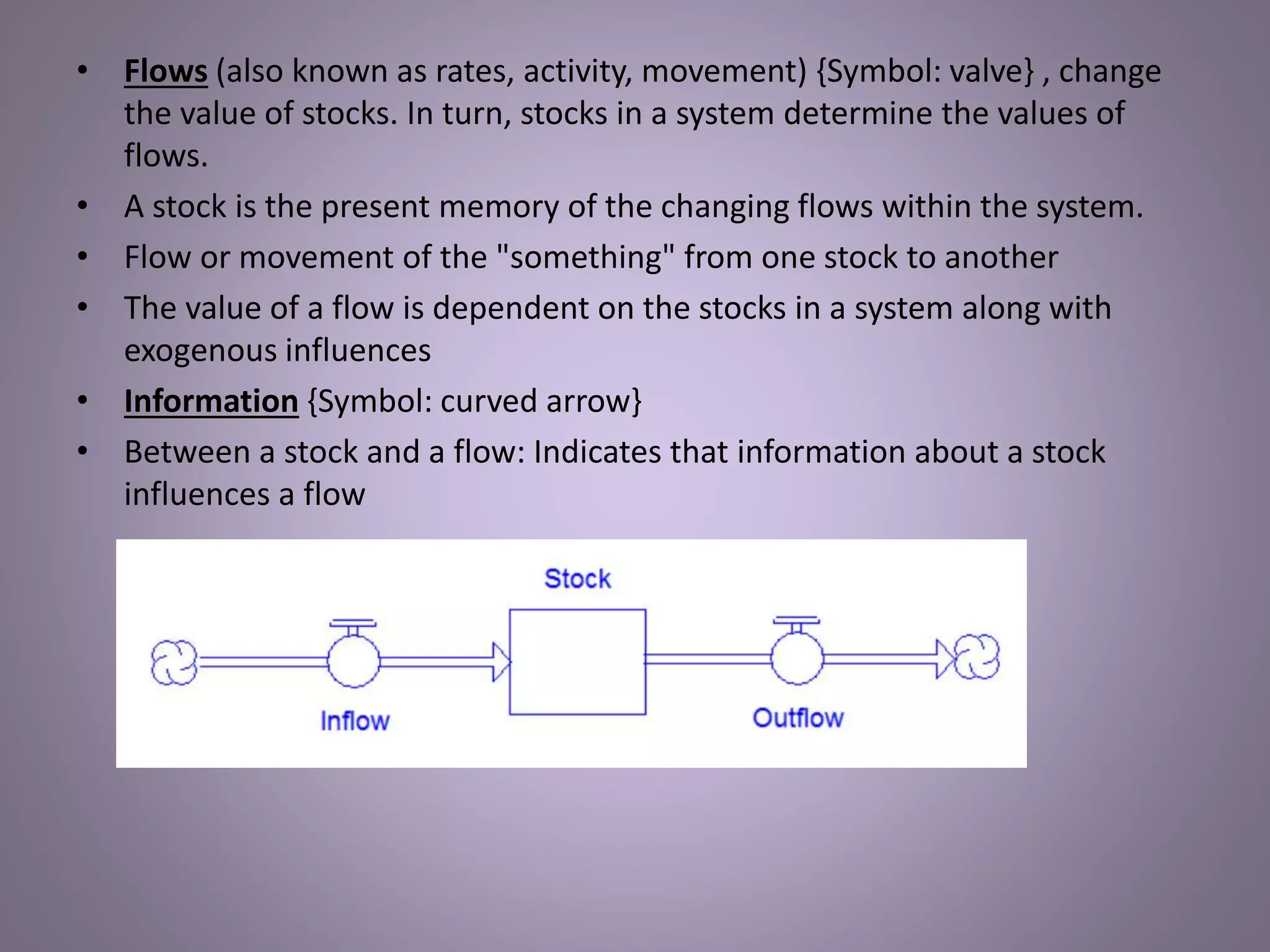
• Flows (also known as rates, activity, movement) {Symbol: valve} , change
the value of stocks. In turn, stocks in a system determine the values of
flows.
• A stock is the present memory of the changing flows within the system.
• Flow or movement of the "something" from one stock to another
• The value of a flow is dependent on the stocks in a system along with
exogenous influences
• Information {Symbol: curved arrow}
• Between a stock and a flow: Indicates that information about a stock
influences a flow
• Stock and flow diagram for :Growth Of
Population
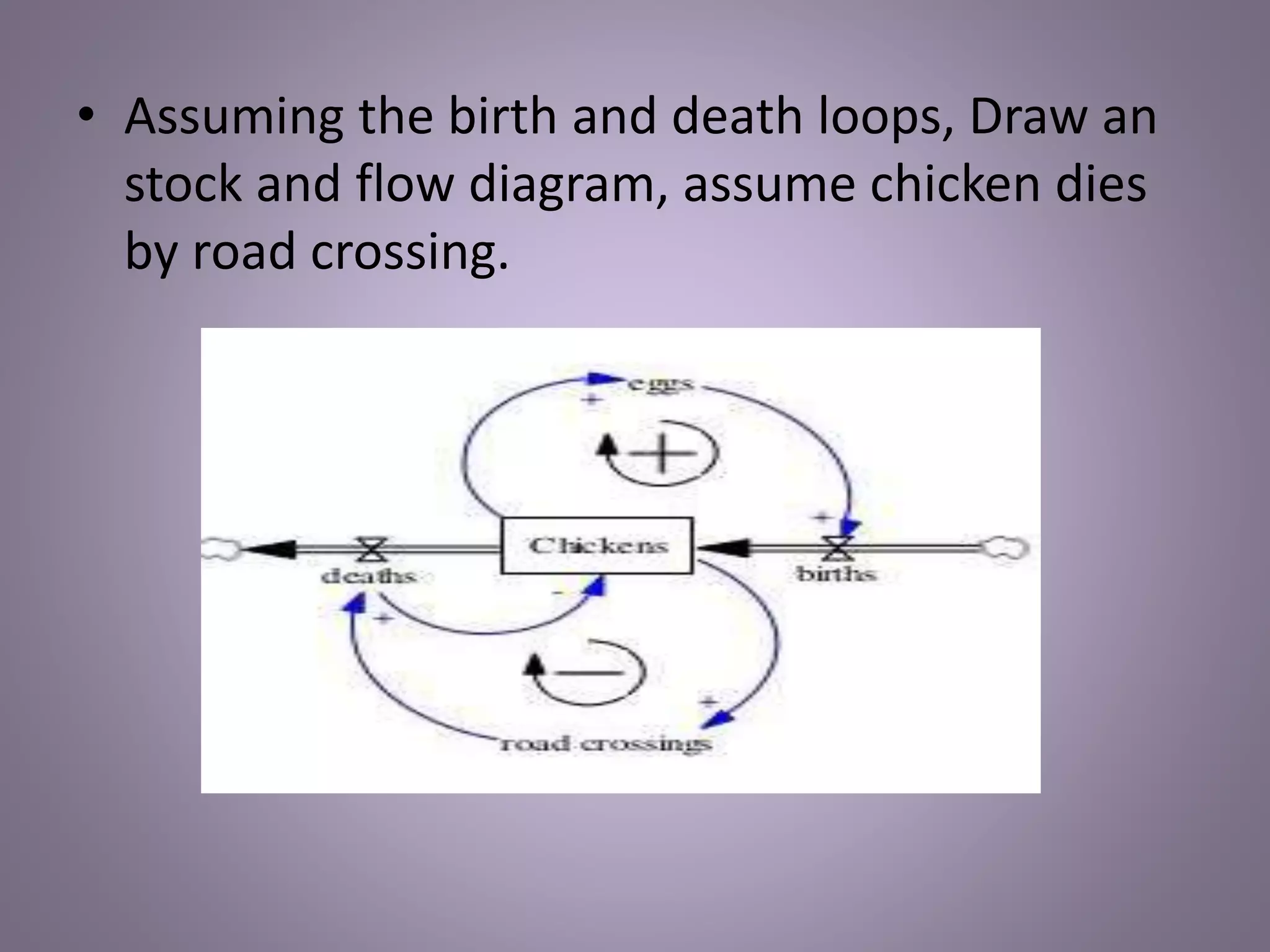
• Assuming the birth and death loops, Draw an
stock and flow diagram, assume chicken dies
by road crossing.
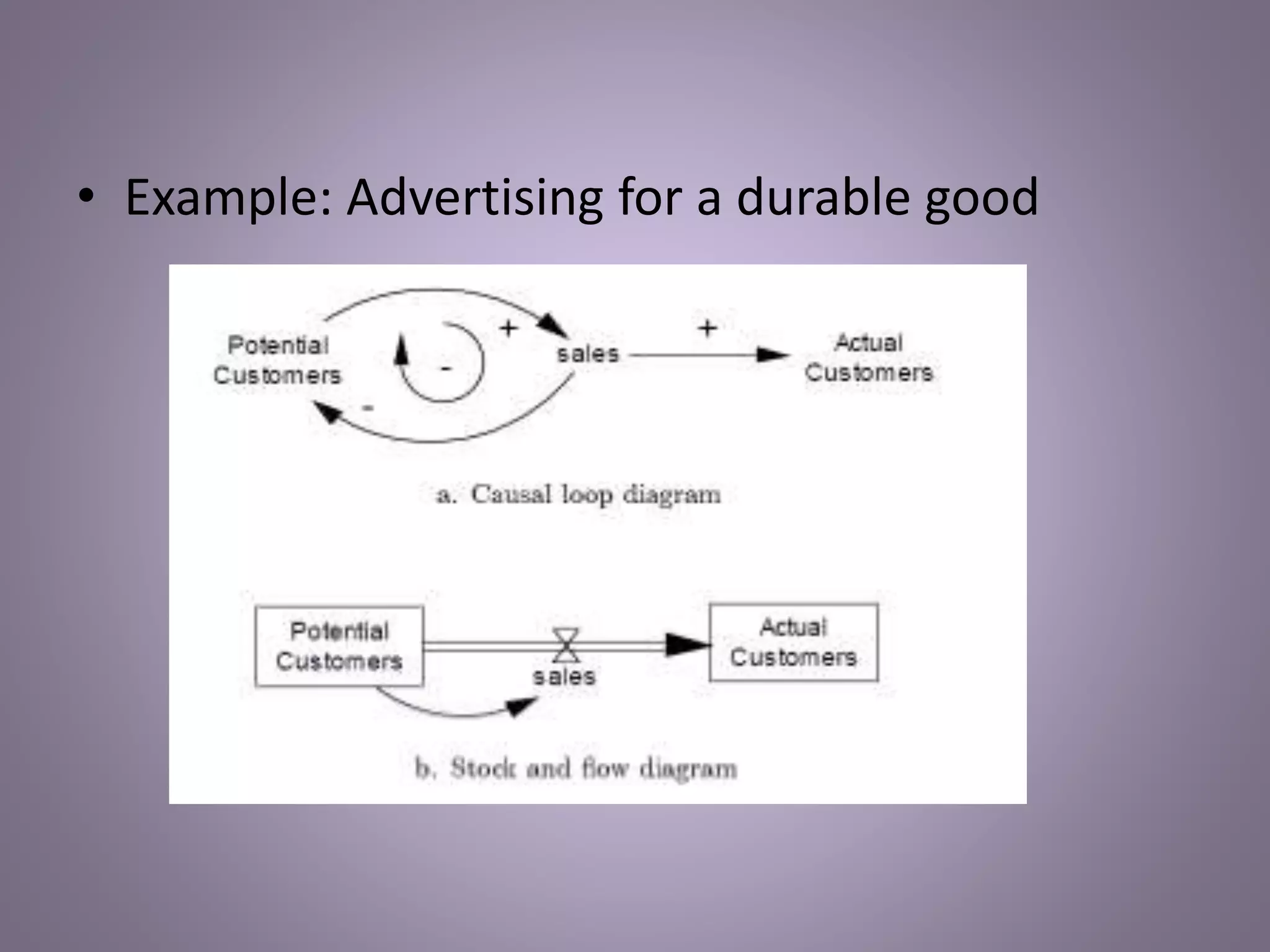
• Example: Advertising for a durable good
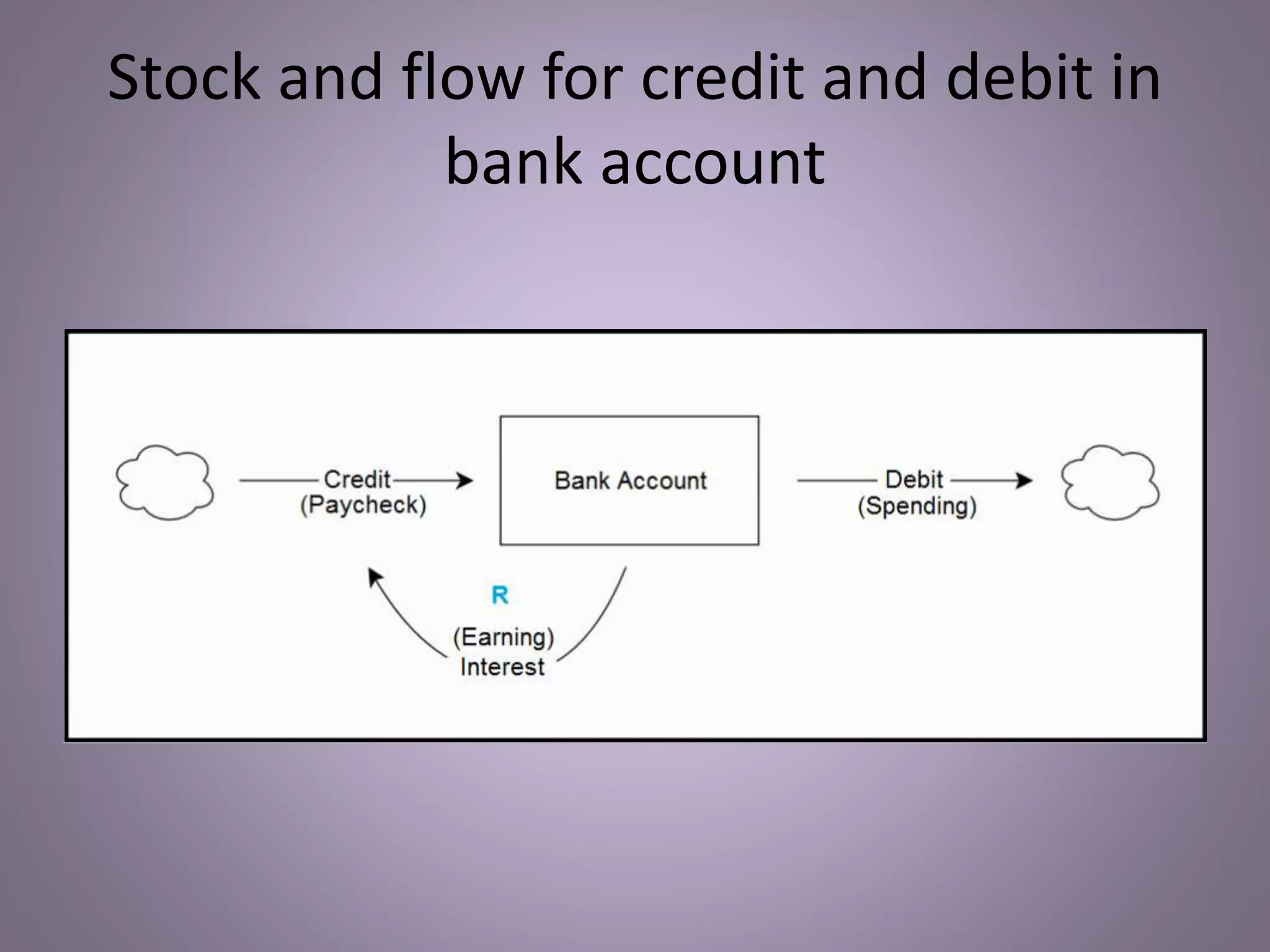
Stock and flow for credit and debit in
bank account
Stock and flow diagram for sales growth
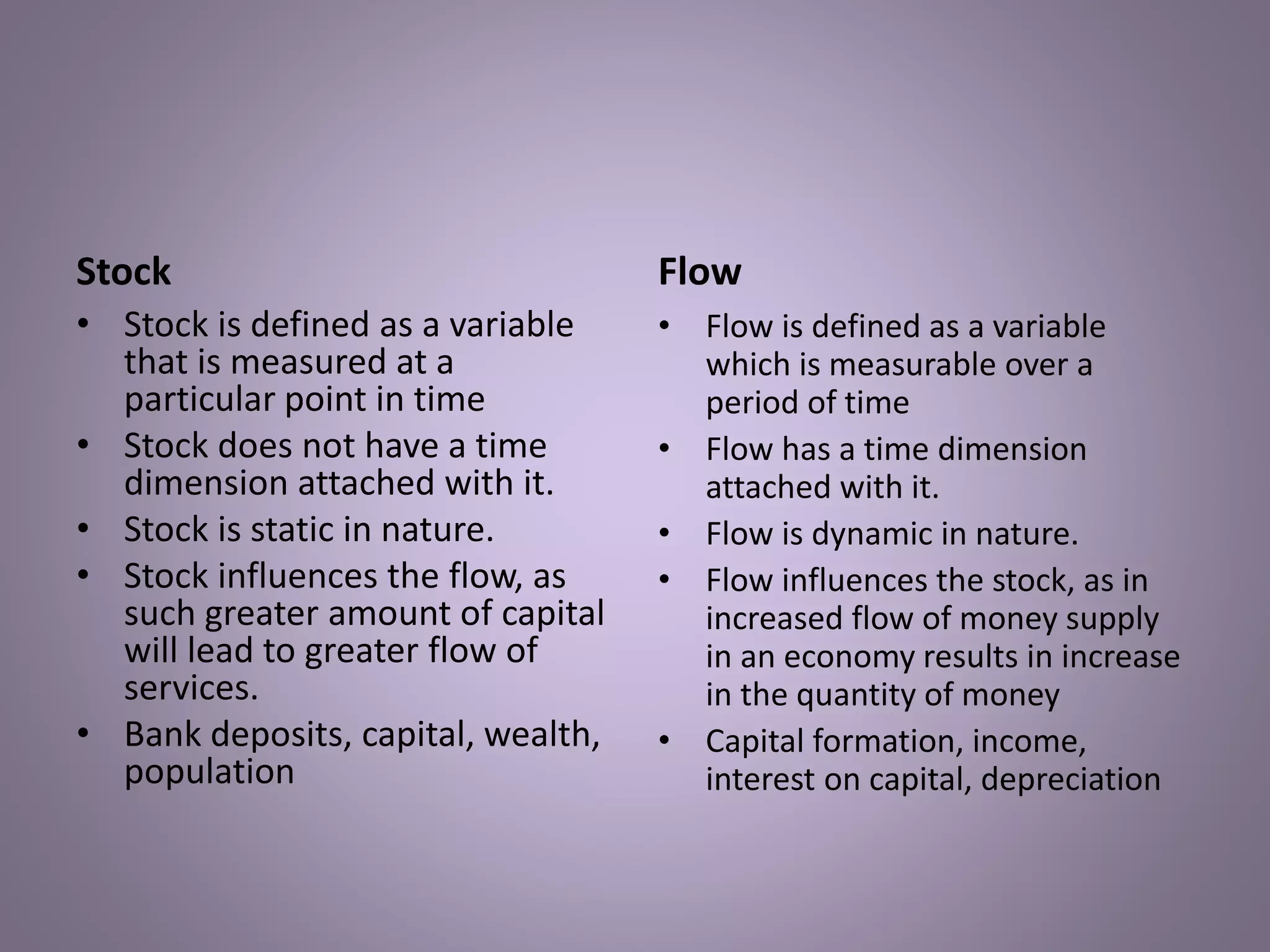
Stock
• Stock is defined as a variable
that is measured at a
particular point in time
• Stock does not have a time
dimension attached with it.
• Stock is static in nature.
• Stock influences the flow, as
such greater amount of capital
will lead to greater flow of
services.
• Bank deposits, capital, wealth,
population
Flow
• Flow is defined as a variable
which is measurable over a
period of time
• Flow has a time dimension
attached with it.
• Flow is dynamic in nature.
• Flow influences the stock, as in
increased flow of money supply
in an economy results in increase
in the quantity of money
• Capital formation, income,
interest on capital, depreciation
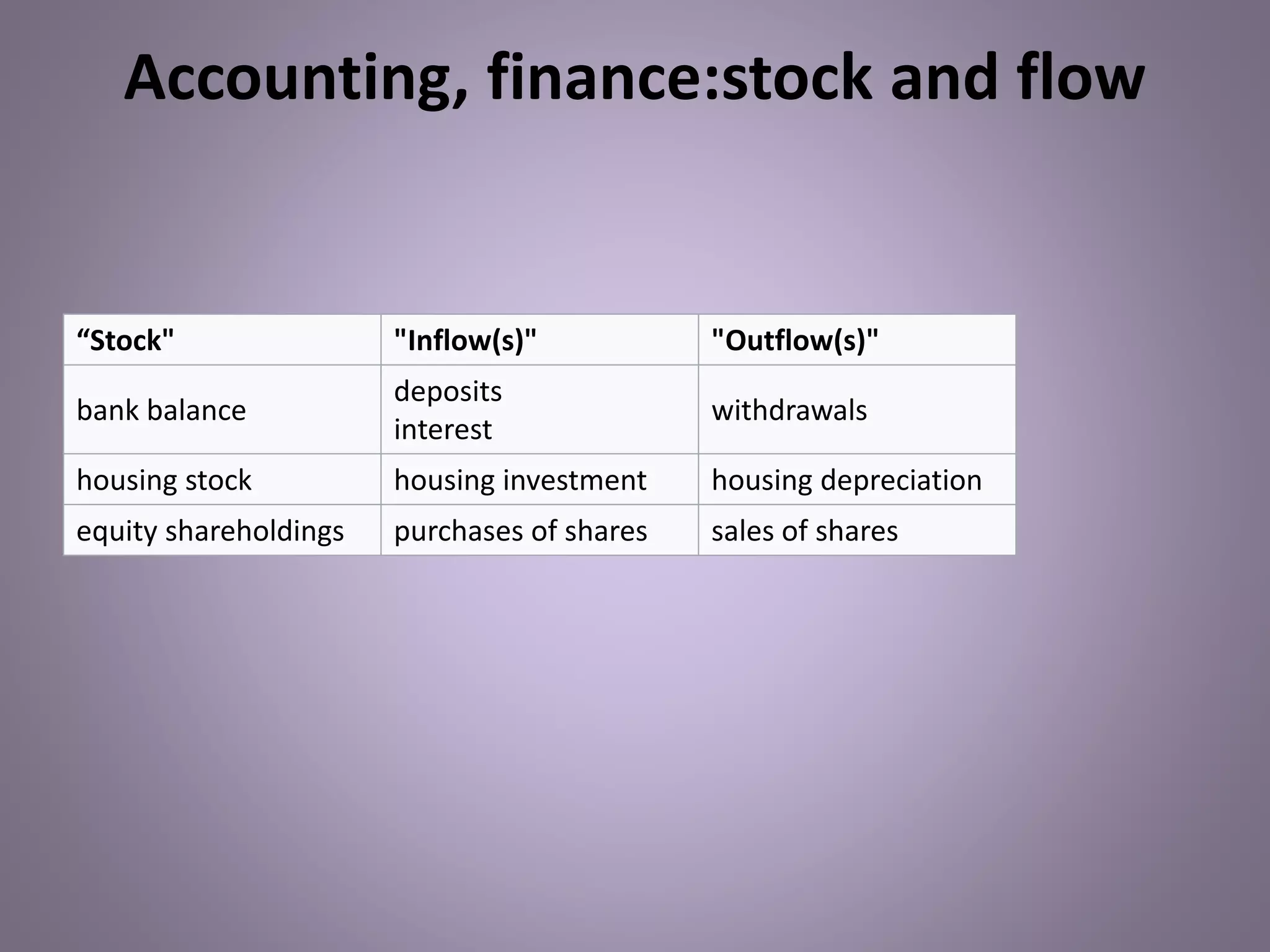
Accounting, finance:stock and flow
“Stock" "Inflow(s)" "Outflow(s)"
bank balance
deposits
interest
withdrawals
housing stock housing investment housing depreciation
equity shareholdings purchases of shares sales of shares

Unit4 systemdynamics

  • 1.
  • 2.
    • What isa system? • A set of elements that is coherently organized and interconnected in a structure that produces a characteristic set of behaviors. • Static system: • The output of the system depends only on the current input. • The output does not change with the time if the input is held constant (time-invariant) • Dynamic system • The output of the system depends on the current and the previous input. • The output changes with the time even if the input is constant (time varying)
  • 3.
    Systems Thinking Definition: Systemsthinking is a holistic approach to analysis that focuses on the way that a system's constituent parts interrelate and how systems work over time and within the context of larger systems • We quickly determine a cause for any event that we think is a problem. Usually we conclude that the cause is another event. • –Example: Sales are poor (event) because staff are insufficient motivated (cause); staff are insufficient motivated (event) because ... •Difficulty: You can always find yet another event that caused the one that you thought was the cause. This makes it very difficult to determine what to do to improve performance.
  • 4.
    • Decision makinguses feedback loop, It is not an open loop process. • Decision taken puts a system into new state, the side effects caused to current state leads to new decisions.
  • 5.
  • 6.
    Systems Thinking •Idea ofSystems Thinking: –Move away from looking at isolated events and their causes . –Look at the organization as a system made up of interacting parts –Internal structure of the system is often more important than external events in generating the problem –If we shift from the event orientation to focusing on the internal system structure --we improve our possibility of improving system performance as the system structure is often the underlying source of the difficulty. •Systems Thinking: The process of understanding how things influence one another within a whole
  • 7.
    WHAT IS SYSTEMDYNAMIC SIMULATION? • Systemdynamics(SD)is a methodology to explore complexity, Interconnectedness,and change in a system overtime. • It deals with internal feedback loops and time delays that affect the behavior of the entire system. • The basis of the methodology is the recognition that the structure of any system (relationships amongst its components) is just as important in determining its behaviour as the individual components themselves. • Developed in the late 1950s by MIT Professor Jay Forrester. • SD is an extension of systems thinking. • With SD we can analyze the possible effects of our models, given different assumptions, policies, constraints, etc.
  • 8.
    • System dynamicsfocuses on the structure and behavior of systems composed of interacting feedback loops. • System Dynamics helps in designing the interconnections and structures to give more confidence and predictability in behavior of the systems.
  • 9.
    WHAT IS THEDIFFERENCE BETWEEN ST AND SD? • Systems thinking and system dynamics are two sides of the same coin. • Systems thinking focuses on exploring interrelationships, including creating causal loop diagrams and behavior over time graphs, without the need for computer software. • System dynamics employs systems thinking outputs such as causal loop diagrams to focus on building and analyzing stock and flow • System dynamics -which incorporates systems thinking- teaches us better thinking. It results in better analysis and greater understanding. • 1st step: How to think? ST • 2nd step: How to model? SD
  • 10.
    SYSTEM DYNAMICS MODELING Conceptualization –Definethe purpose of the model –Define the model boundaries and identify key variables –Describe the behavior of the key variables –Diagram the basic mechanisms (feedback loops) of the system Formulation –Convert diagrams to stock and flow equations –Estimate and select parameter values –Create the simulation model Testing • –Test the dynamic hypothesis (the potential explanation of how structure is causing observed behavior) • –Test model behavior and sensitivity to perturbations Implementation • –Test model's responses to different policies • –Translate study insight to an accessible form
  • 11.
    • CRITICAL ASPECTS: •Thinking in terms of cause-and-effect relationships • Focusing on the feedback linkages among components of a system • Determining the appropriate boundaries for defining what is to be included within a system • Model representations • –Causal loop diagrams (qualitative) • –Stock and Flow diagrams (quantitative) • Example: Simple causal loop diagram of food intake • if cause increases ... effect decreases (+) • if cause increases ... effect increases(-)
  • 12.
    Assumptions in SD SystemDynamics modeling is predicated on a number of assumptions • The feedback loops are sufficient to explain complex system behavior • The SD is modeled through a process of direct or indirect engagement of domain experts through following approaches. 1.Interviews 2.Group model building workshops 3.Analysis of written document • Reference model of behavior can be used for prediction • To improve the outcome feedback paths can be introduced or removed.
  • 13.
    UNDERSTAND CAUSE &EFFECT • Some are logical • Food intake-> weight • Money -> betterlife • Fire -> smoke • Some are not • Use of seatbelts ->reduced highway fatalities
  • 14.
    FEEDBACK LOOP STRUCTURES •Thinking in terms of “cause and effect” is not enough • ocean -> evaporation ->cloud -> rain -> ocean -> … • Feedback: an initial cause ripples through a chain of • causation ultimately to re-affect itself • Search to identify closed, causal feedback loops is one key element of System Dynamics • The most important causal influences will be exactly those that are enclosed within feedback loop
  • 15.
    Feedback and CausalLoop Diagrams • Feedback loop or causal loop: Element of a system indirectly influences itself
  • 16.
    CLD EXAMPLES • SalaryVS Performance • Salary -> Performance • Performance -> Salary Salary Performance • Tired VS Sleep • Tired -> sleep • Sleep -> tired
  • 17.
    AUGMENTING CLD 1 (LABELINGLINK POLARITY) • Signing: Add a ‘+’ or a ‘–’ sign at each arrowhead to convey more information-Causal link • A ‘+’ is used if the cause increase, the effect increases and if the cause decrease, the effect decreases (or) Causal link from element A to B is positive (+ or s) if either A adds to B or a change in A produces a change in B in the same direction • A ‘-’ is used if the cause increases, the effect decreases and if the cause decreases, the effect Increases (or) Causal link from element A to B is negative (- or o) if either A subtracts from B or a change in A produces a change in B in the opposite direction
  • 18.
  • 19.
    • Feedback loop •–A feedback loop is positive or reinforcing (+ or R) if it contains an even number of negative causal links (e.g. growth of bank balance ) • Notation: place symbol (+) in the center of the loop
  • 20.
    • A feedbackloop is negative or balancing (- or B) if it contains an uneven number of negative causal links • Notation: place symbol (-) in the center of the loop
  • 21.
    • Combination ofpositive and negative loop [e.g. sales growth]
  • 22.
    There are twofeedback loops in this diagram. The positive reinforcement (labeled R) loop on the right indicates that the more people have already adopted the new product, the stronger the word- of-mouth impact. There will be more references to the product, more demonstrations, and more reviews. This positive feedback should generate sales that continue to grow. The second feedback loop on the left is negative reinforcement (or "balancing" and hence labeled B). Clearly, growth cannot continue forever, because as more and more people adopt, there remain fewer and fewer potential adopters.
  • 23.
    EXOGENOUS ITEMS • Itemsthat affect other items in the system but are not themselves affected by anything in the system • Arrows are drawn from these items but there are no arrows drawn to these items
  • 24.
    DELAYS • Systems oftenrespond sluggishly • From the example below, once the trees are planted, the harvest rate can be ‘0’ until the trees grow enough to harvest
  • 25.
    Stock and flowdiagrams • Stock and flow diagram: –Shows relationships among variables which have the potential to change over time (like causal loop diagrams) –Distinguishes between different types of variables (unlike causal loop diagrams • Stocks (also known as levels, accumulations, or state variables) {Symbol: Box} are the foundation of any system and are the elements that you can see, feel, count, or measure. • Stocks do not have to be physical • Value of stock changes by accumulating or integrating flows • Physical entities which can accumulate and move around (e.g. materials, personnel, capital equipment, orders, stocks of money)
  • 26.
    • Flows (alsoknown as rates, activity, movement) {Symbol: valve} , change the value of stocks. In turn, stocks in a system determine the values of flows. • A stock is the present memory of the changing flows within the system. • Flow or movement of the "something" from one stock to another • The value of a flow is dependent on the stocks in a system along with exogenous influences • Information {Symbol: curved arrow} • Between a stock and a flow: Indicates that information about a stock influences a flow
  • 27.
    • Stock andflow diagram for :Growth Of Population
  • 28.
    • Assuming thebirth and death loops, Draw an stock and flow diagram, assume chicken dies by road crossing.
  • 29.
    • Example: Advertisingfor a durable good
  • 30.
    Stock and flowfor credit and debit in bank account
  • 31.
    Stock and flowdiagram for sales growth
  • 32.
    Stock • Stock isdefined as a variable that is measured at a particular point in time • Stock does not have a time dimension attached with it. • Stock is static in nature. • Stock influences the flow, as such greater amount of capital will lead to greater flow of services. • Bank deposits, capital, wealth, population Flow • Flow is defined as a variable which is measurable over a period of time • Flow has a time dimension attached with it. • Flow is dynamic in nature. • Flow influences the stock, as in increased flow of money supply in an economy results in increase in the quantity of money • Capital formation, income, interest on capital, depreciation
  • 33.
    Accounting, finance:stock andflow “Stock" "Inflow(s)" "Outflow(s)" bank balance deposits interest withdrawals housing stock housing investment housing depreciation equity shareholdings purchases of shares sales of shares