System: The physical process of interest
Model: Mathematical representation of the system
◦ Models are a fundamental tool of science, engineering, business,
etc.
◦ Models always have limits of credibility
Simulation: A type of model where the computer is used to
imitate the behavior of the system
Monte Carlo simulation: Simulation that makes use of
internally generated (pseudo) random numbers
Random Number:Random numbers are numbers that occur in a
sequence such that two conditions are met: (1) the values are
uniformly distributed over a defined interval or set, and (2) it is
not impossible to predict future values based on past or present
ones.
2
3
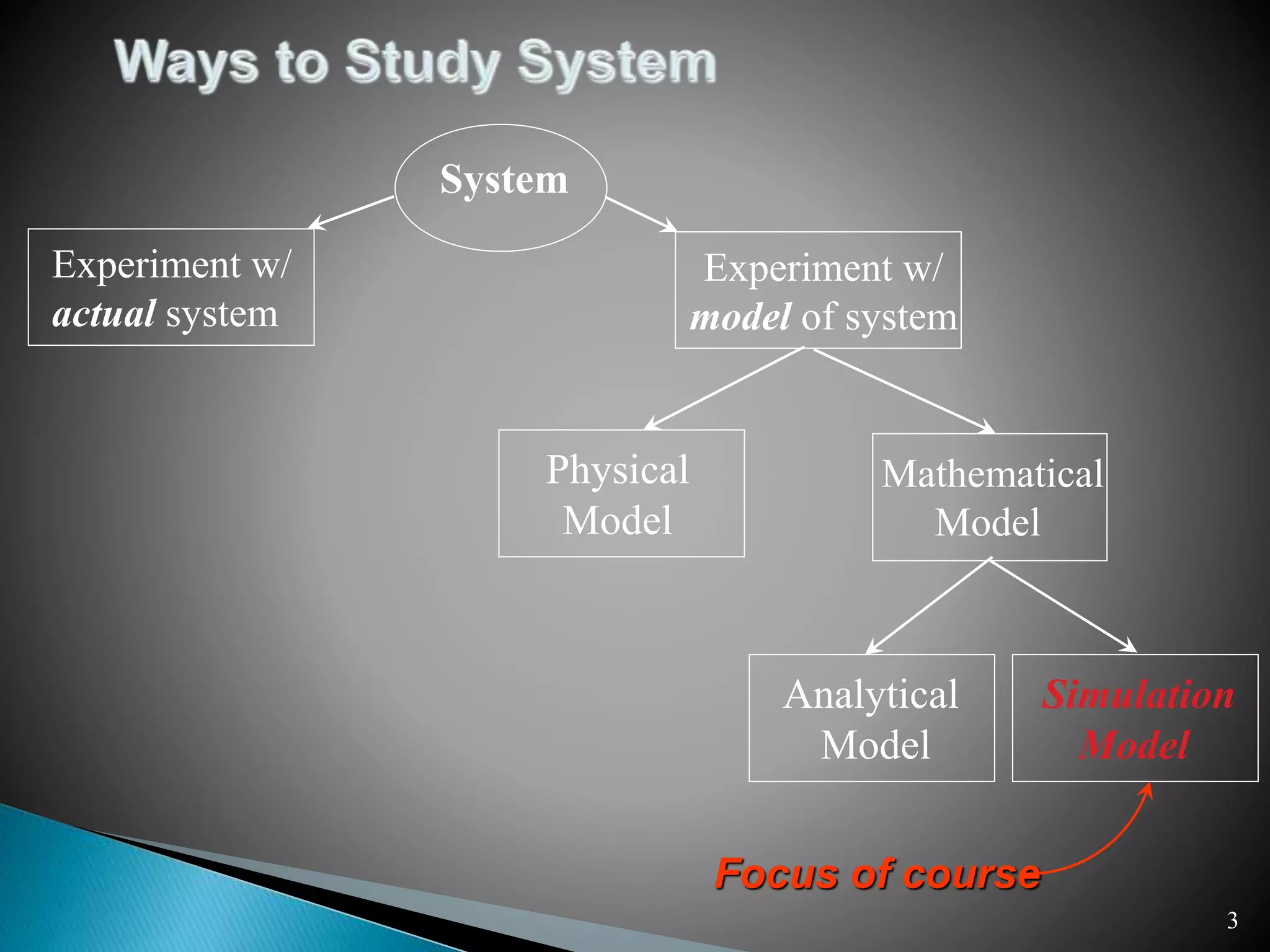
Focus of course
System
Experiment w/
actual system
Experiment w/
model of system
Physical
Model
Mathematical
Model
Analytical
Model
Simulation
Model
 “The Monte Carlo method is a numerical solution to a problem
that models objects interacting with other objects .
 A Monte Carlo simulation is a model used to predict the
probability of different outcomes when the intervention of
random variables is present.
 Monte Carlo simulations help to explain the impact of risk and
uncertainty in prediction and forecasting models.
 A variety of fields utilize Monte Carlo simulations, including
finance, engineering, supply chain, and science.
 The basis of a Monte Carlo simulation involves assigning
multiple values to an uncertain variable to achieve multiple
results and then to average the results to obtain an estimate.
 It represents an attempt to model nature through direct
simulation of the essential dynamics of the system in question.
 In this sense the Monte Carlo method is essentially simple in its
approach.
4
 Business and finance are plagued by random
variables, Monte Carlo simulations have a vast
array of potential applications in these fields.
 Monte Carlo Method:
 A Monte Carlo simulation takes the variable that
has uncertainty and assigns it a random value.
 The model is then run and a result is provided.
 This process is repeated again and again while
assigning the variable in question with many
different values.
 Once the simulation is complete, the results are
averaged together to provide an estimate.
5
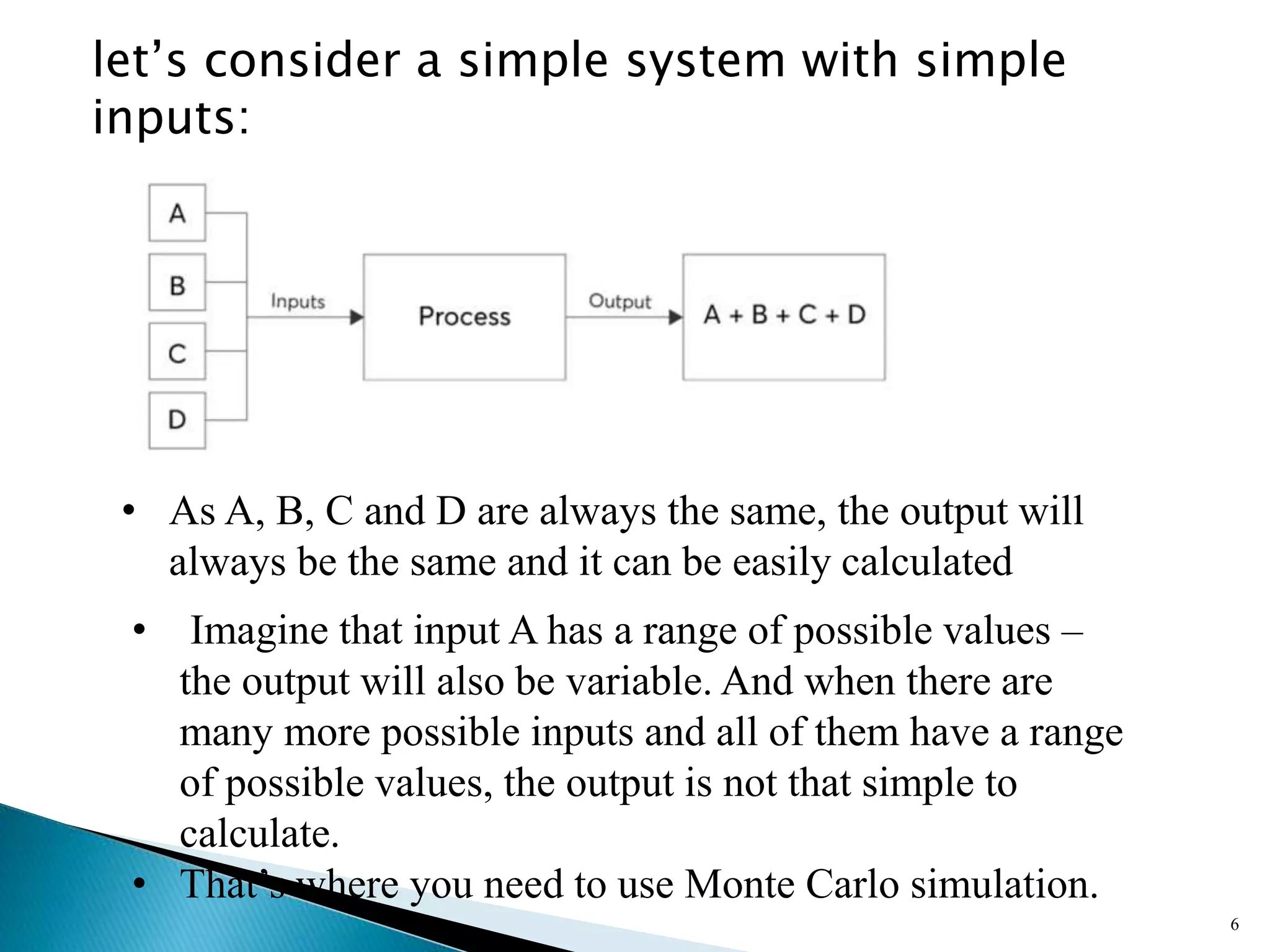
let’s consider a simple system with simple
inputs:
6
• As A, B, C and D are always the same, the output will
always be the same and it can be easily calculated
• Imagine that input A has a range of possible values –
the output will also be variable. And when there are
many more possible inputs and all of them have a range
of possible values, the output is not that simple to
calculate.
• That’s where you need to use Monte Carlo simulation.
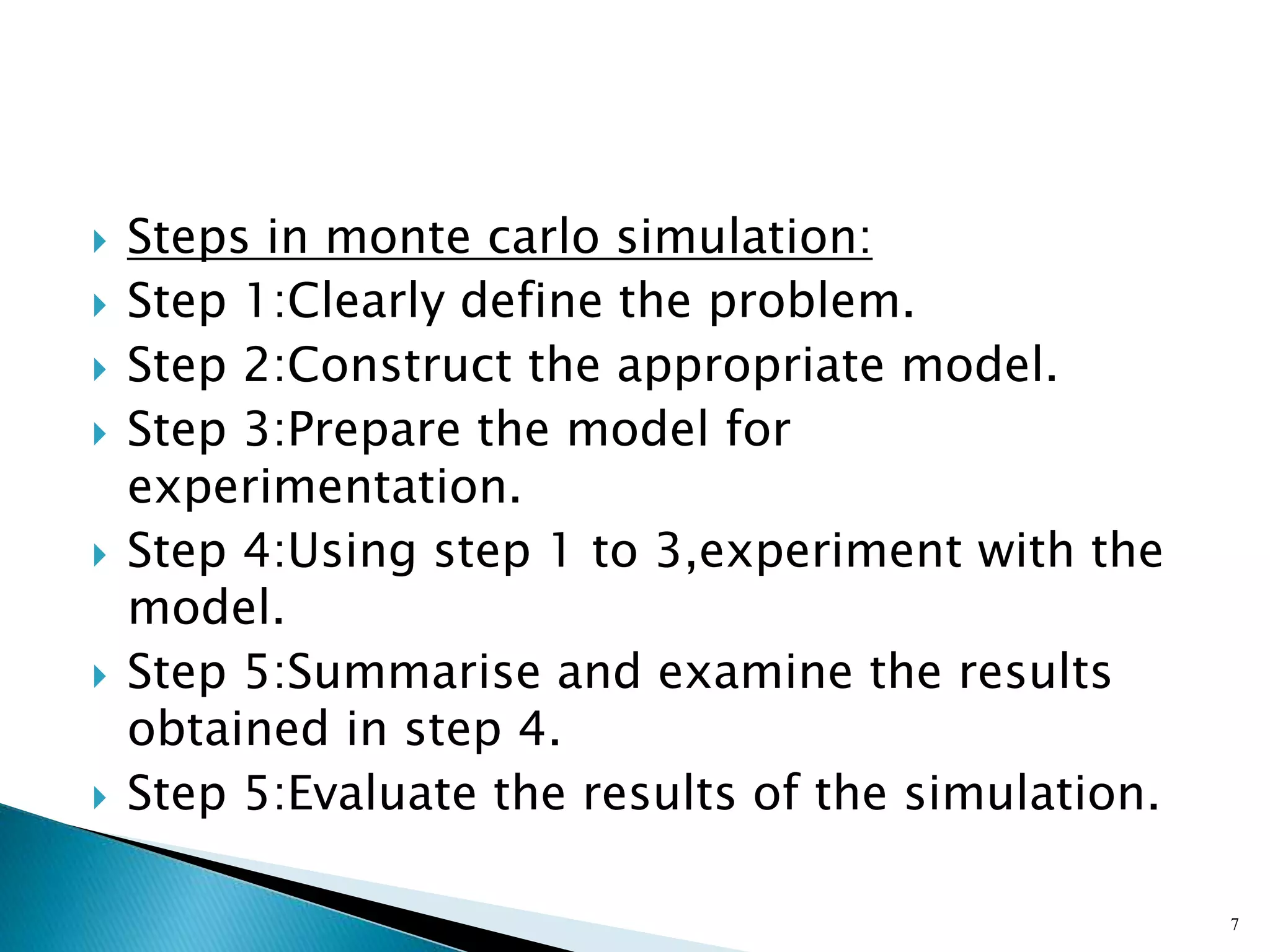
 Steps in monte carlo simulation:
 Step 1:Clearly define the problem.
 Step 2:Construct the appropriate model.
 Step 3:Prepare the model for
experimentation.
 Step 4:Using step 1 to 3,experiment with the
model.
 Step 5:Summarise and examine the results
obtained in step 4.
 Step 5:Evaluate the results of the simulation.
7
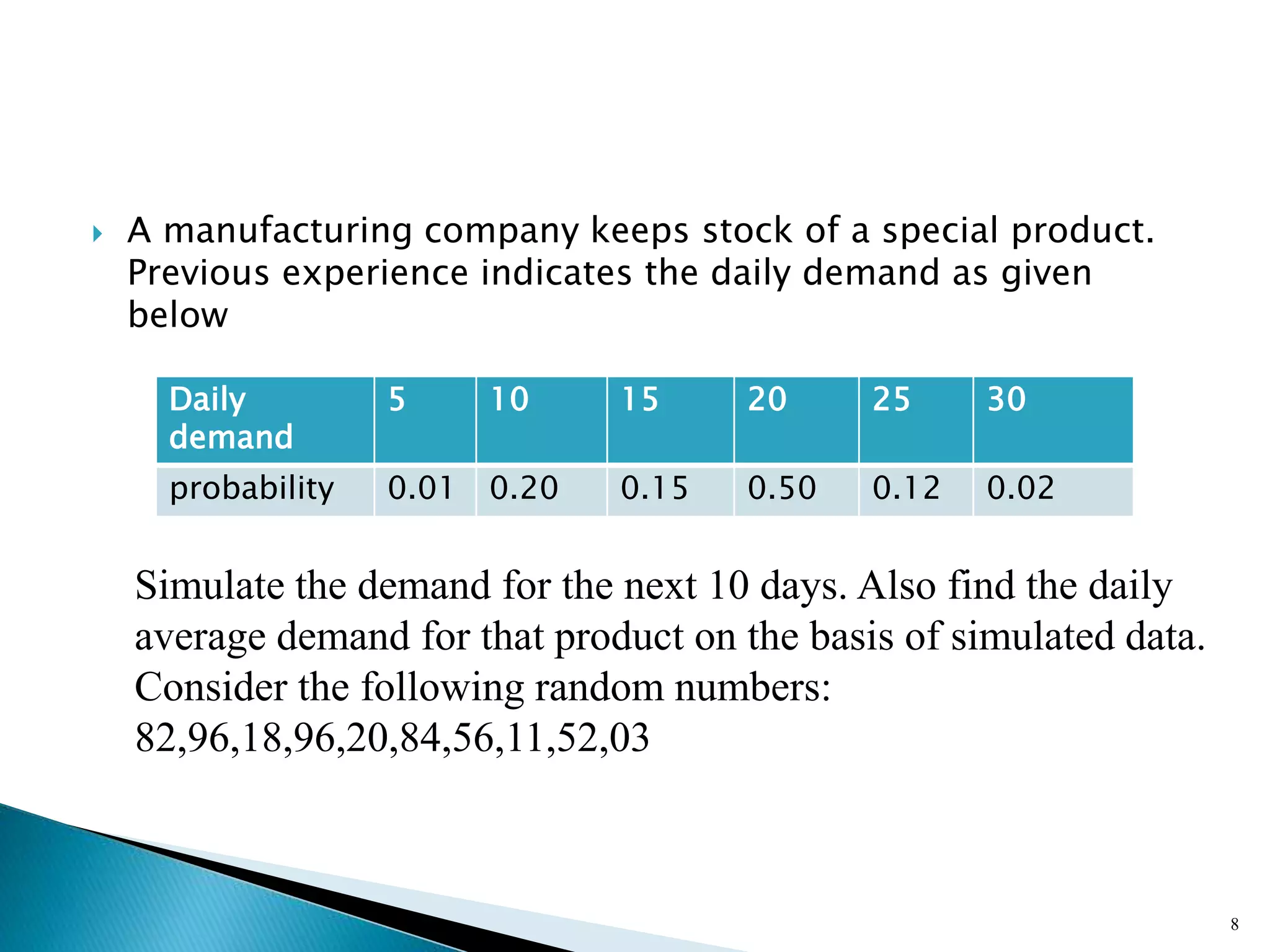
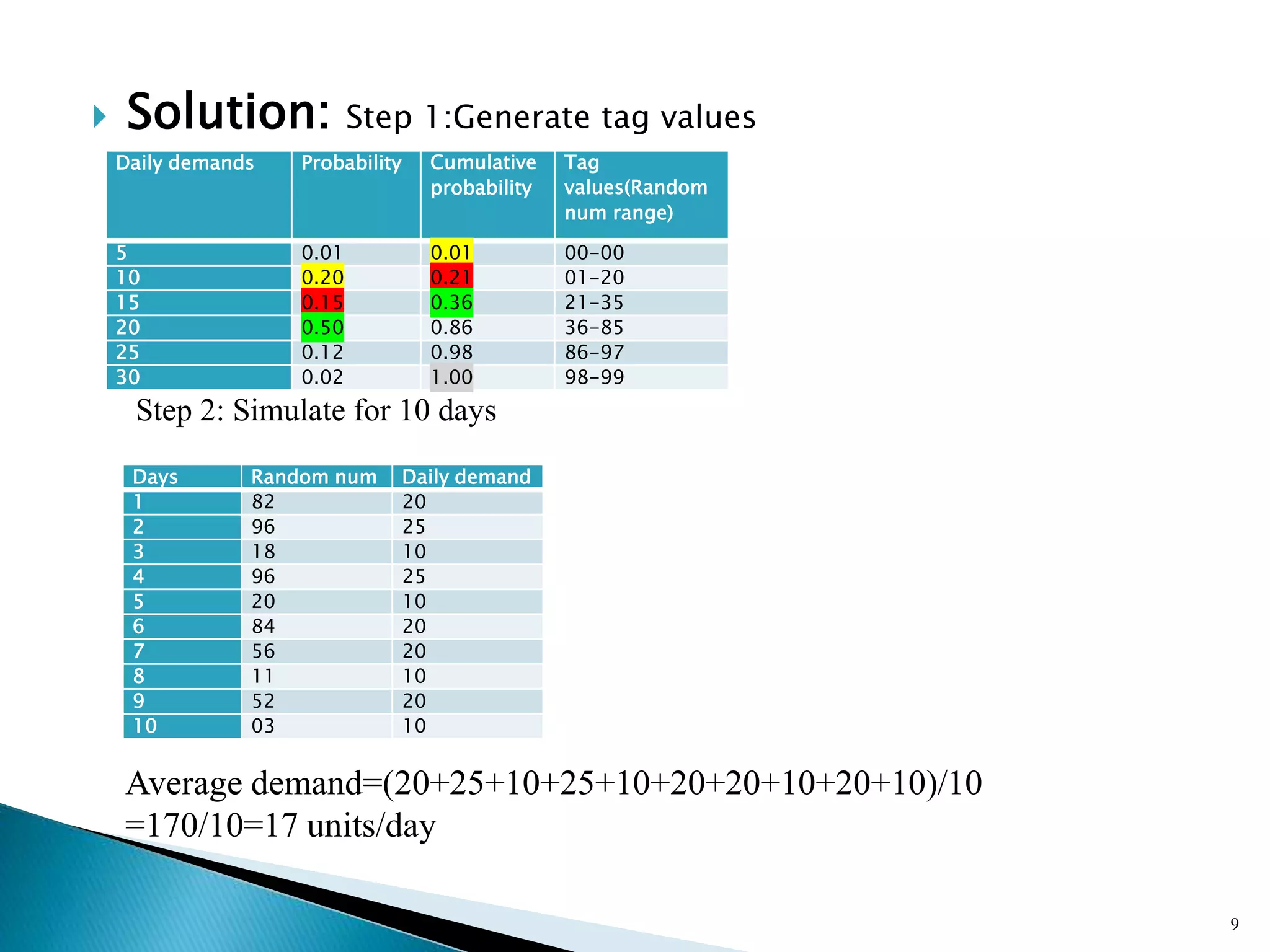
 A manufacturing company keeps stock of a special product.
Previous experience indicates the daily demand as given
below
8
Daily
demand
5 10 15 20 25 30
probability 0.01 0.20 0.15 0.50 0.12 0.02
Simulate the demand for the next 10 days. Also find the daily
average demand for that product on the basis of simulated data.
Consider the following random numbers:
82,96,18,96,20,84,56,11,52,03
 Solution: Step 1:Generate tag values
9
Daily demands Probability Cumulative
probability
Tag
values(Random
num range)
5 0.01 0.01 00-00
10 0.20 0.21 01-20
15 0.15 0.36 21-35
20 0.50 0.86 36-85
25 0.12 0.98 86-97
30 0.02 1.00 98-99
Step 2: Simulate for 10 days
Days Random num Daily demand
1 82 20
2 96 25
3 18 10
4 96 25
5 20 10
6 84 20
7 56 20
8 11 10
9 52 20
10 03 10
Average demand=(20+25+10+25+10+20+20+10+20+10)/10
=170/10=17 units/day
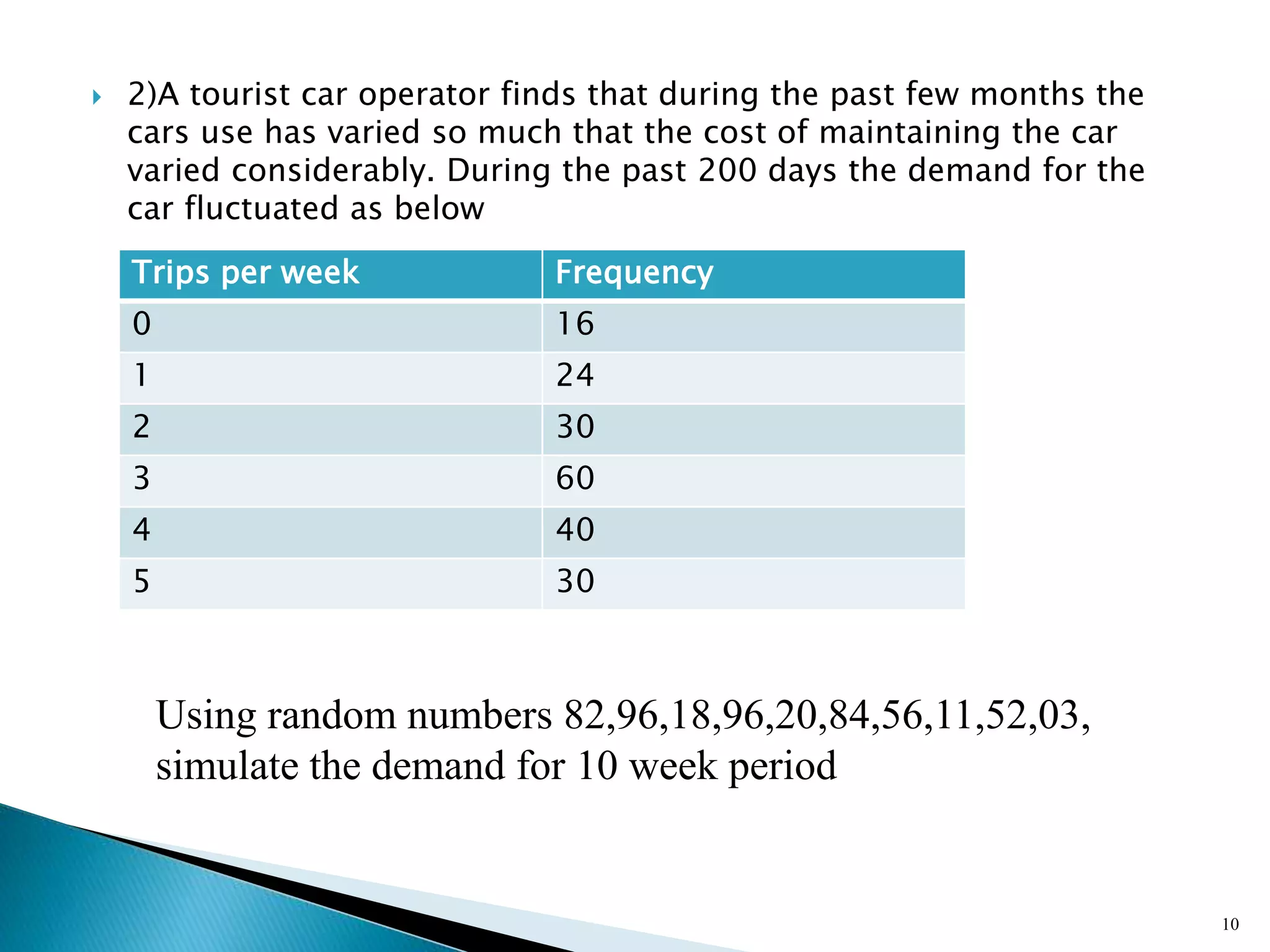
 2)A tourist car operator finds that during the past few months the
cars use has varied so much that the cost of maintaining the car
varied considerably. During the past 200 days the demand for the
car fluctuated as below
10
Trips per week Frequency
0 16
1 24
2 30
3 60
4 40
5 30
Using random numbers 82,96,18,96,20,84,56,11,52,03,
simulate the demand for 10 week period
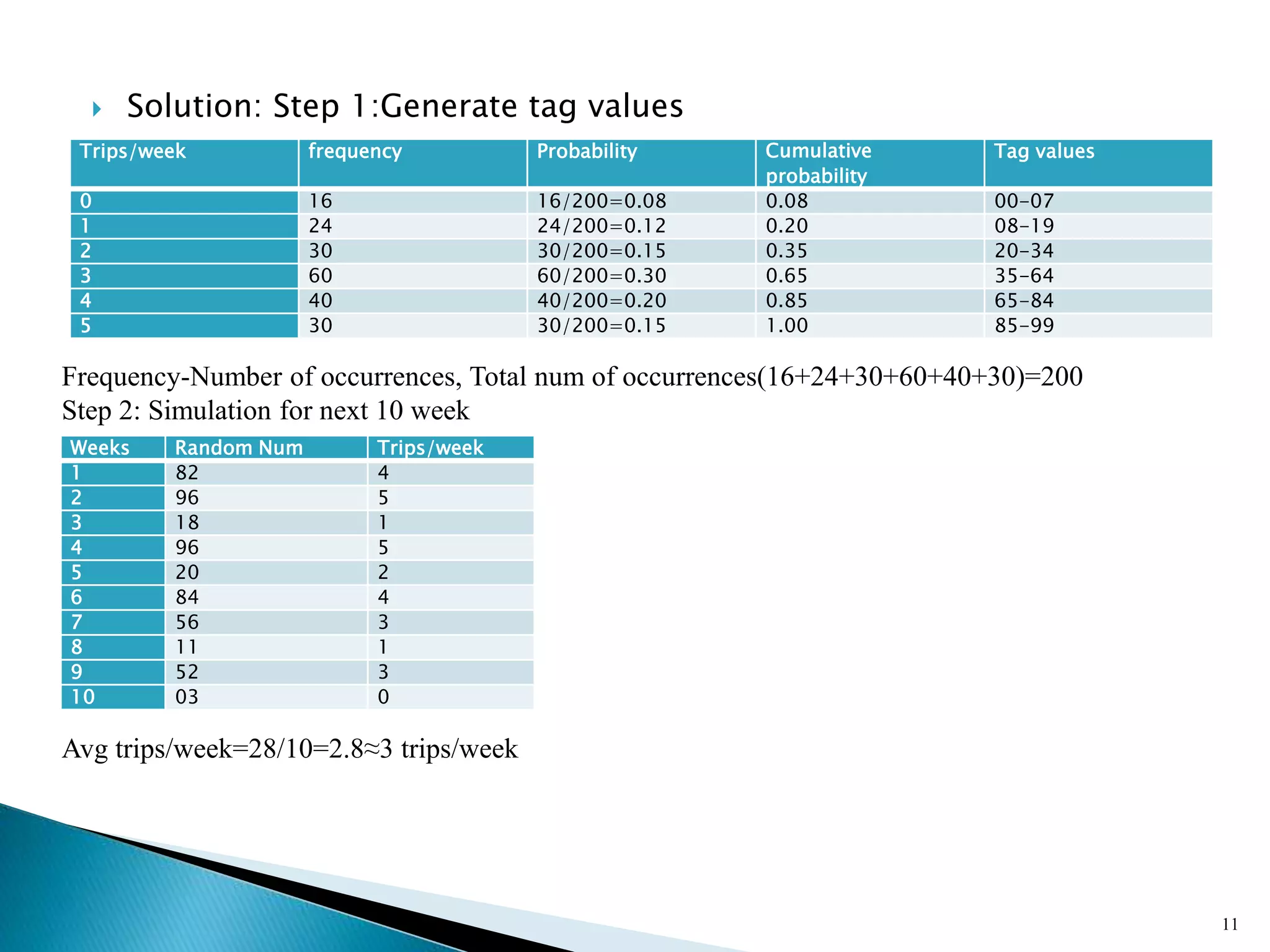
 Solution: Step 1:Generate tag values
11
Trips/week frequency Probability Cumulative
probability
Tag values
0 16 16/200=0.08 0.08 00-07
1 24 24/200=0.12 0.20 08-19
2 30 30/200=0.15 0.35 20-34
3 60 60/200=0.30 0.65 35-64
4 40 40/200=0.20 0.85 65-84
5 30 30/200=0.15 1.00 85-99
Frequency-Number of occurrences, Total num of occurrences(16+24+30+60+40+30)=200
Step 2: Simulation for next 10 week
Weeks Random Num Trips/week
1 82 4
2 96 5
3 18 1
4 96 5
5 20 2
6 84 4
7 56 3
8 11 1
9 52 3
10 03 0
Avg trips/week=28/10=2.8≈3 trips/week
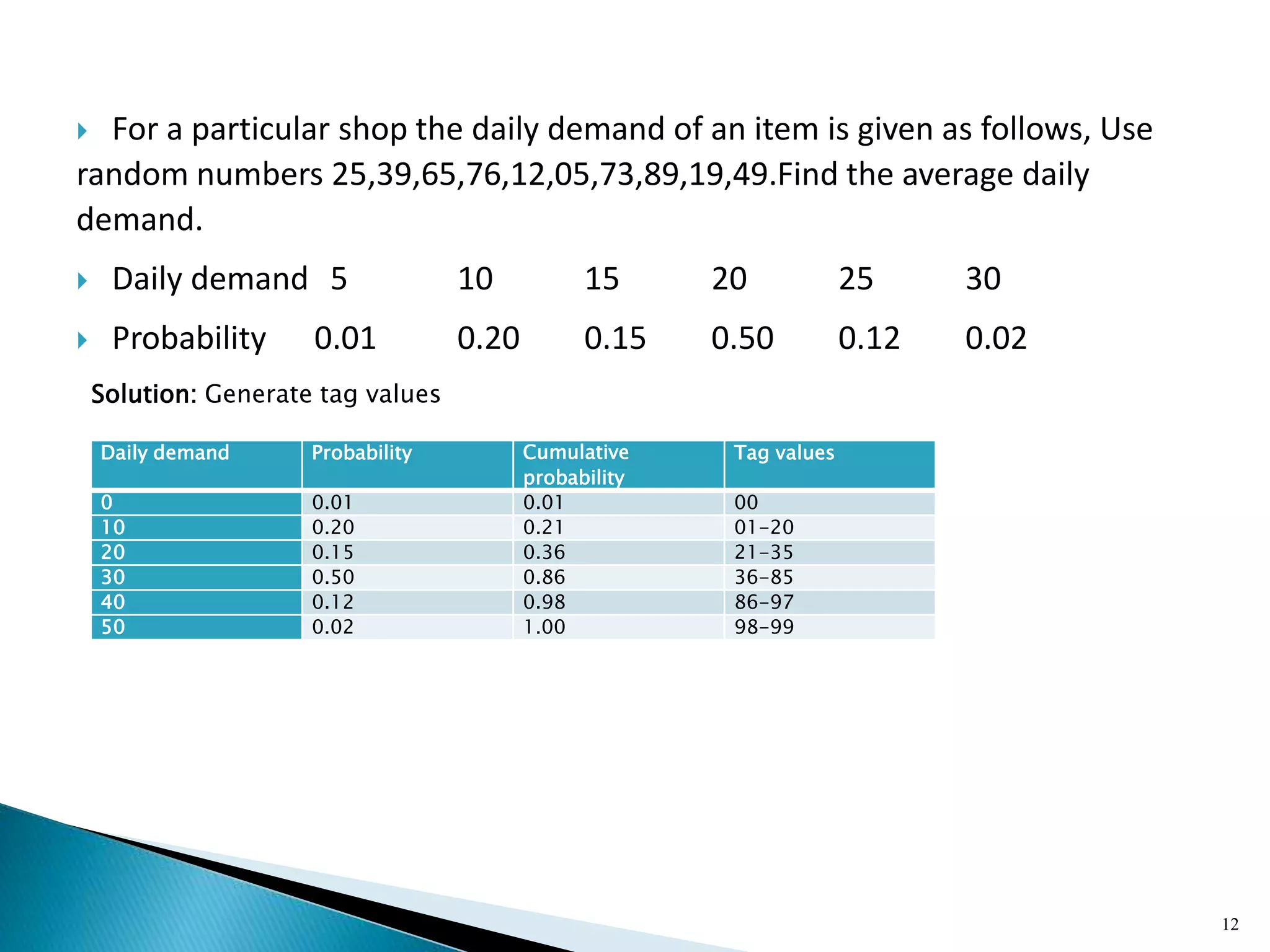
 For a particular shop the daily demand of an item is given as follows, Use
random numbers 25,39,65,76,12,05,73,89,19,49.Find the average daily
demand.
 Daily demand 5 10 15 20 25 30
 Probability 0.01 0.20 0.15 0.50 0.12 0.02
Solution: Generate tag values
12
Daily demand Probability Cumulative
probability
Tag values
0 0.01 0.01 00
10 0.20 0.21 01-20
20 0.15 0.36 21-35
30 0.50 0.86 36-85
40 0.12 0.98 86-97
50 0.02 1.00 98-99
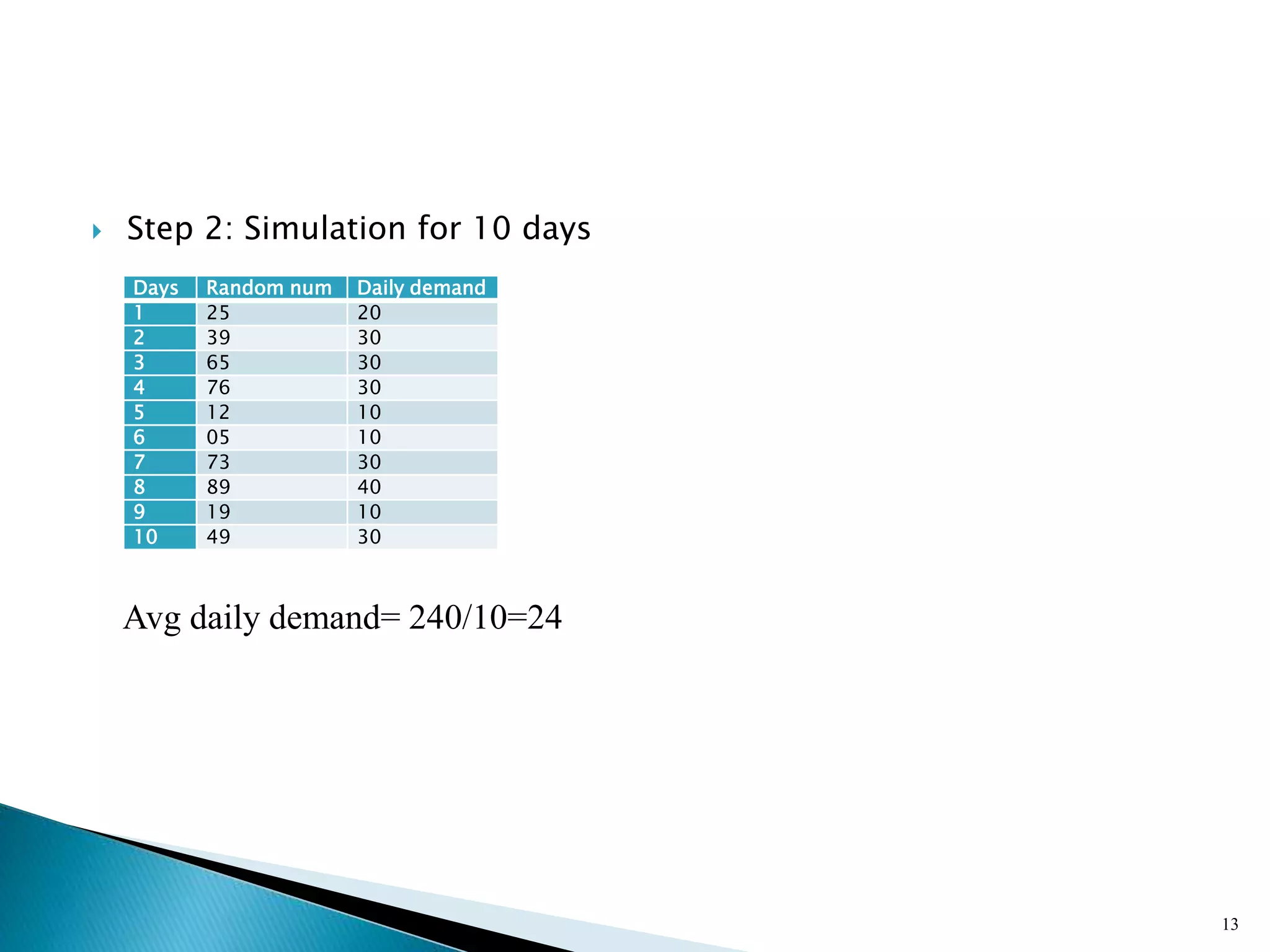
 Step 2: Simulation for 10 days
13
Days Random num Daily demand
1 25 20
2 39 30
3 65 30
4 76 30
5 12 10
6 05 10
7 73 30
8 89 40
9 19 10
10 49 30
Avg daily demand= 240/10=24
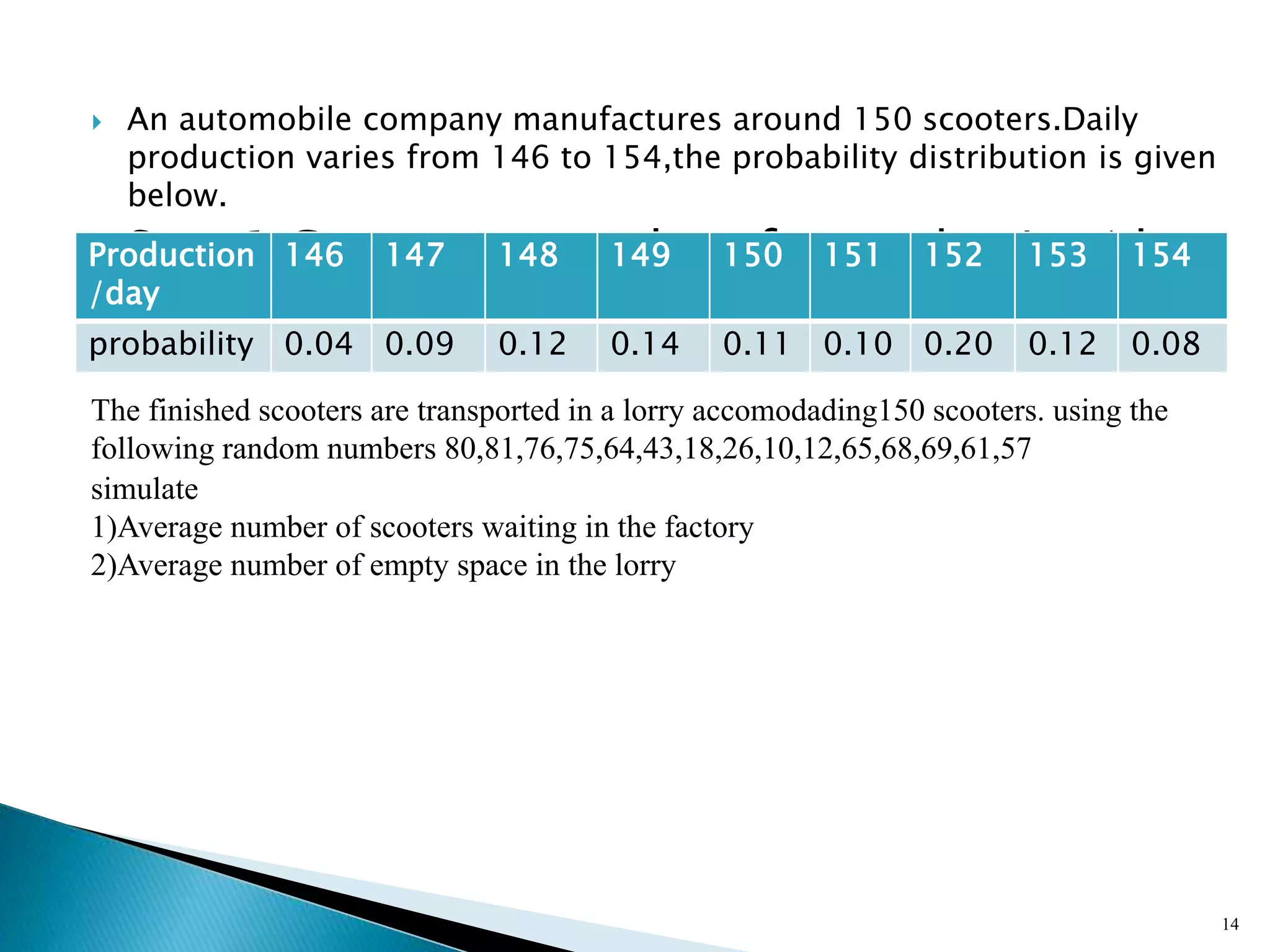
 An automobile company manufactures around 150 scooters.Daily
production varies from 146 to 154,the probability distribution is given
below.
 Step 1:Generate tag values for production/day
14
Production
/day
146 147 148 149 150 151 152 153 154
probability 0.04 0.09 0.12 0.14 0.11 0.10 0.20 0.12 0.08
The finished scooters are transported in a lorry accomodading150 scooters. using the
following random numbers 80,81,76,75,64,43,18,26,10,12,65,68,69,61,57
simulate
1)Average number of scooters waiting in the factory
2)Average number of empty space in the lorry
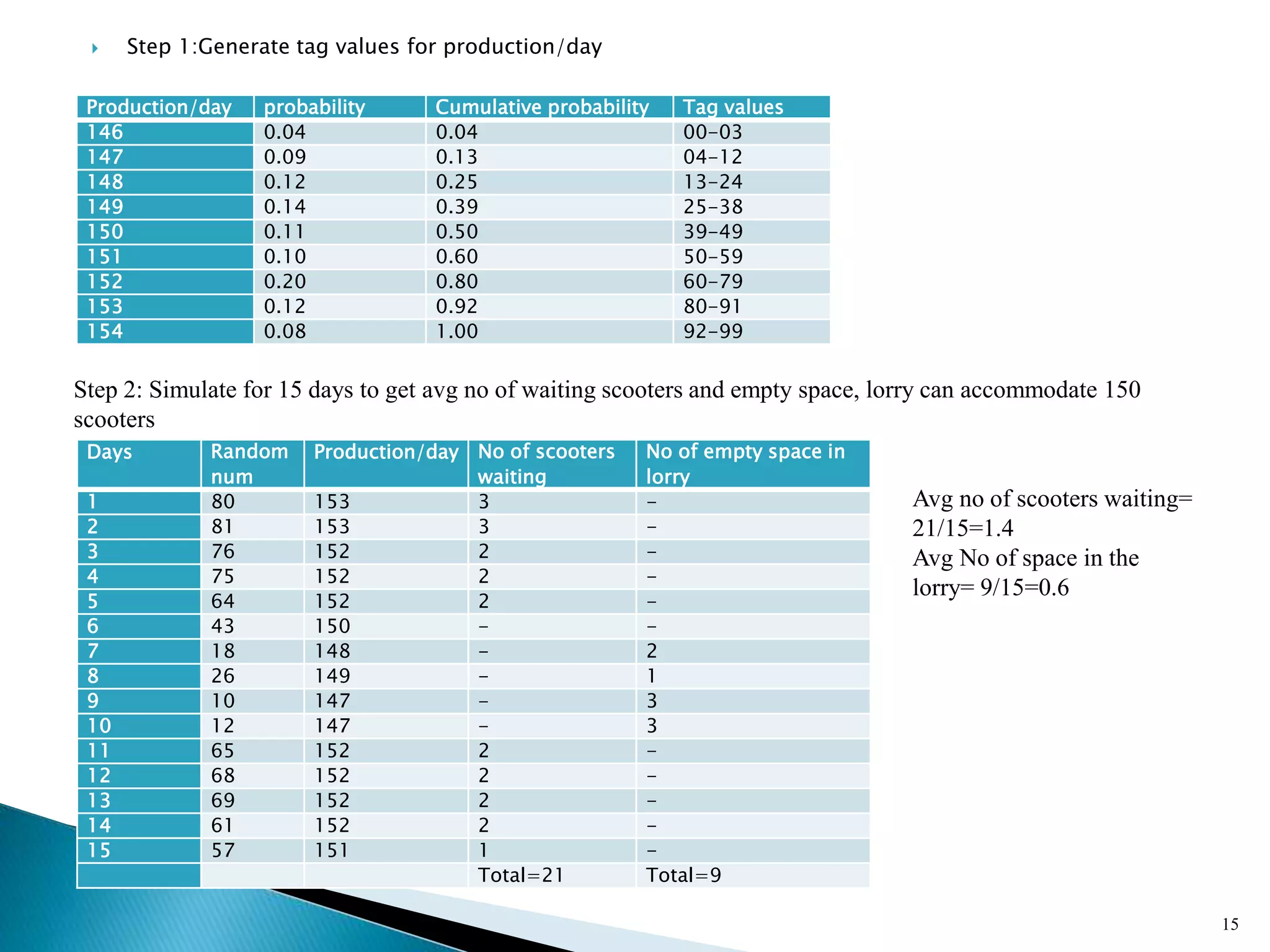
 Step 1:Generate tag values for production/day
15
Production/day probability Cumulative probability Tag values
146 0.04 0.04 00-03
147 0.09 0.13 04-12
148 0.12 0.25 13-24
149 0.14 0.39 25-38
150 0.11 0.50 39-49
151 0.10 0.60 50-59
152 0.20 0.80 60-79
153 0.12 0.92 80-91
154 0.08 1.00 92-99
Step 2: Simulate for 15 days to get avg no of waiting scooters and empty space, lorry can accommodate 150
scooters
Days Random
num
Production/day No of scooters
waiting
No of empty space in
lorry
1 80 153 3 -
2 81 153 3 -
3 76 152 2 -
4 75 152 2 -
5 64 152 2 -
6 43 150 - -
7 18 148 - 2
8 26 149 - 1
9 10 147 - 3
10 12 147 - 3
11 65 152 2 -
12 68 152 2 -
13 69 152 2 -
14 61 152 2 -
15 57 151 1 -
Total=21 Total=9
Avg no of scooters waiting=
21/15=1.4
Avg No of space in the
lorry= 9/15=0.6
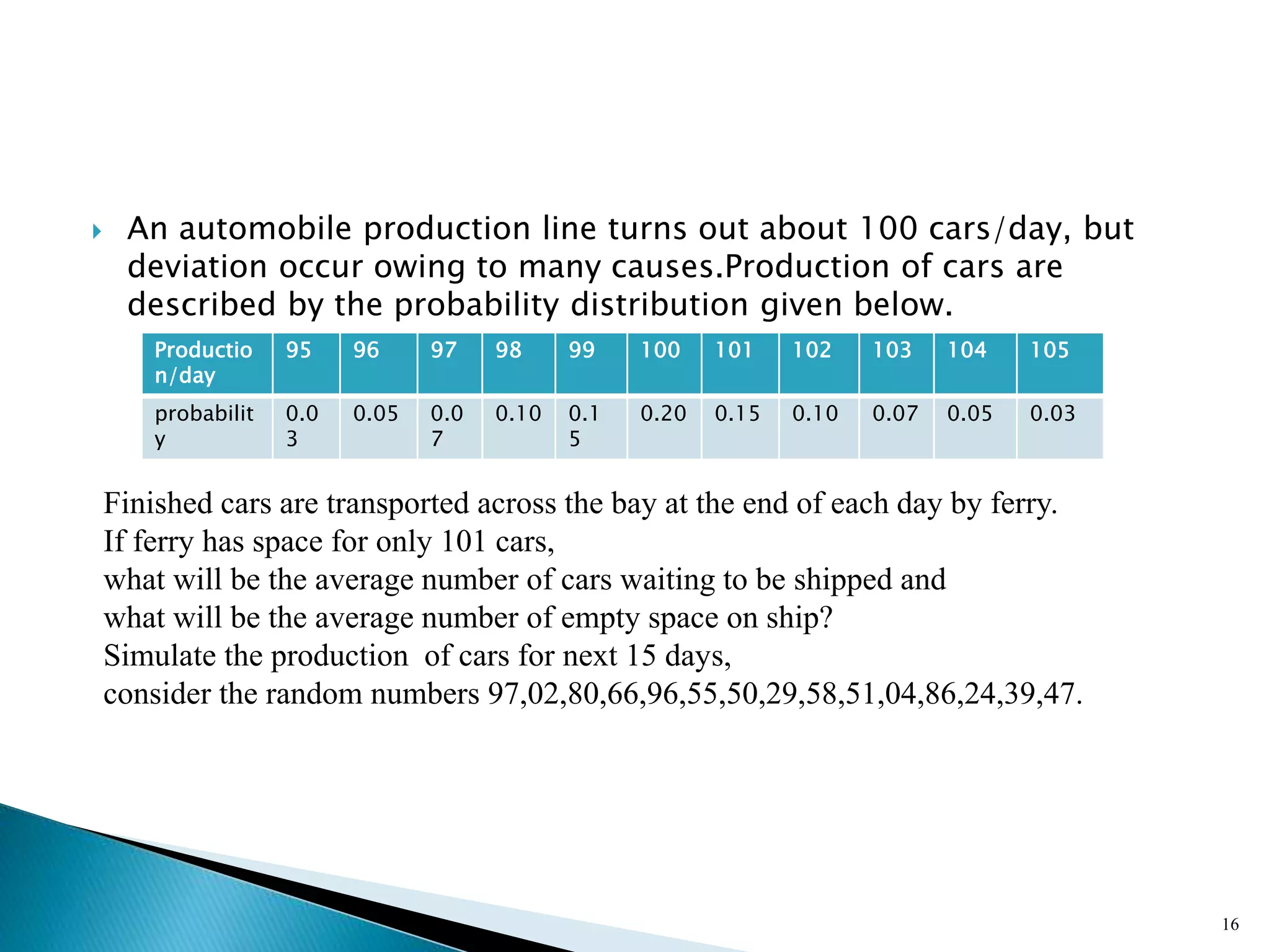
 An automobile production line turns out about 100 cars/day, but
deviation occur owing to many causes.Production of cars are
described by the probability distribution given below.
16
Productio
n/day
95 96 97 98 99 100 101 102 103 104 105
probabilit
y
0.0
3
0.05 0.0
7
0.10 0.1
5
0.20 0.15 0.10 0.07 0.05 0.03
Finished cars are transported across the bay at the end of each day by ferry.
If ferry has space for only 101 cars,
what will be the average number of cars waiting to be shipped and
what will be the average number of empty space on ship?
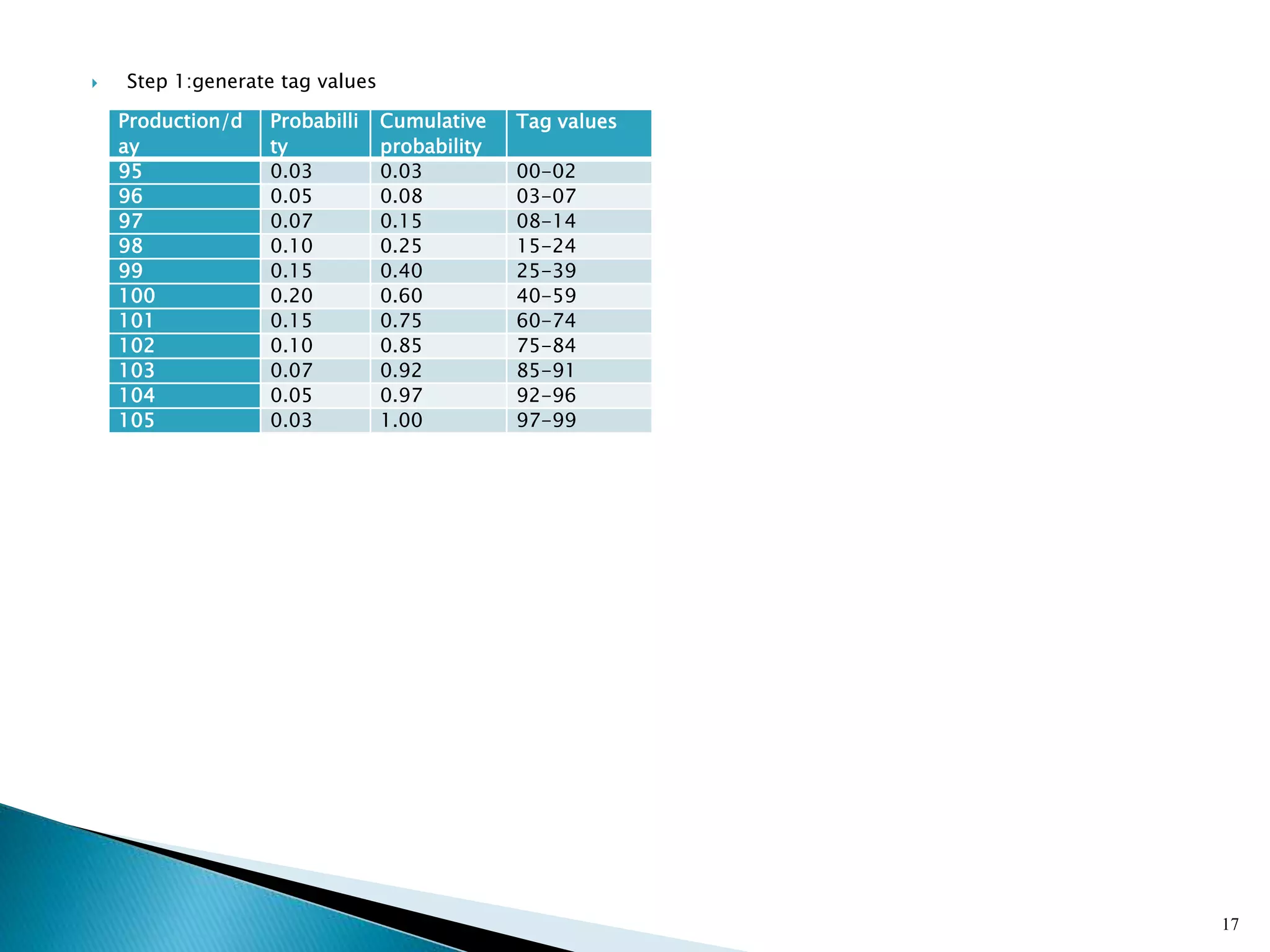
Simulate the production of cars for next 15 days,
consider the random numbers 97,02,80,66,96,55,50,29,58,51,04,86,24,39,47.
 Step 1:generate tag values
17
Production/d
ay
Probabilli
ty
Cumulative
probability
Tag values
95 0.03 0.03 00-02
96 0.05 0.08 03-07
97 0.07 0.15 08-14
98 0.10 0.25 15-24
99 0.15 0.40 25-39
100 0.20 0.60 40-59
101 0.15 0.75 60-74
102 0.10 0.85 75-84
103 0.07 0.92 85-91
104 0.05 0.97 92-96
105 0.03 1.00 97-99
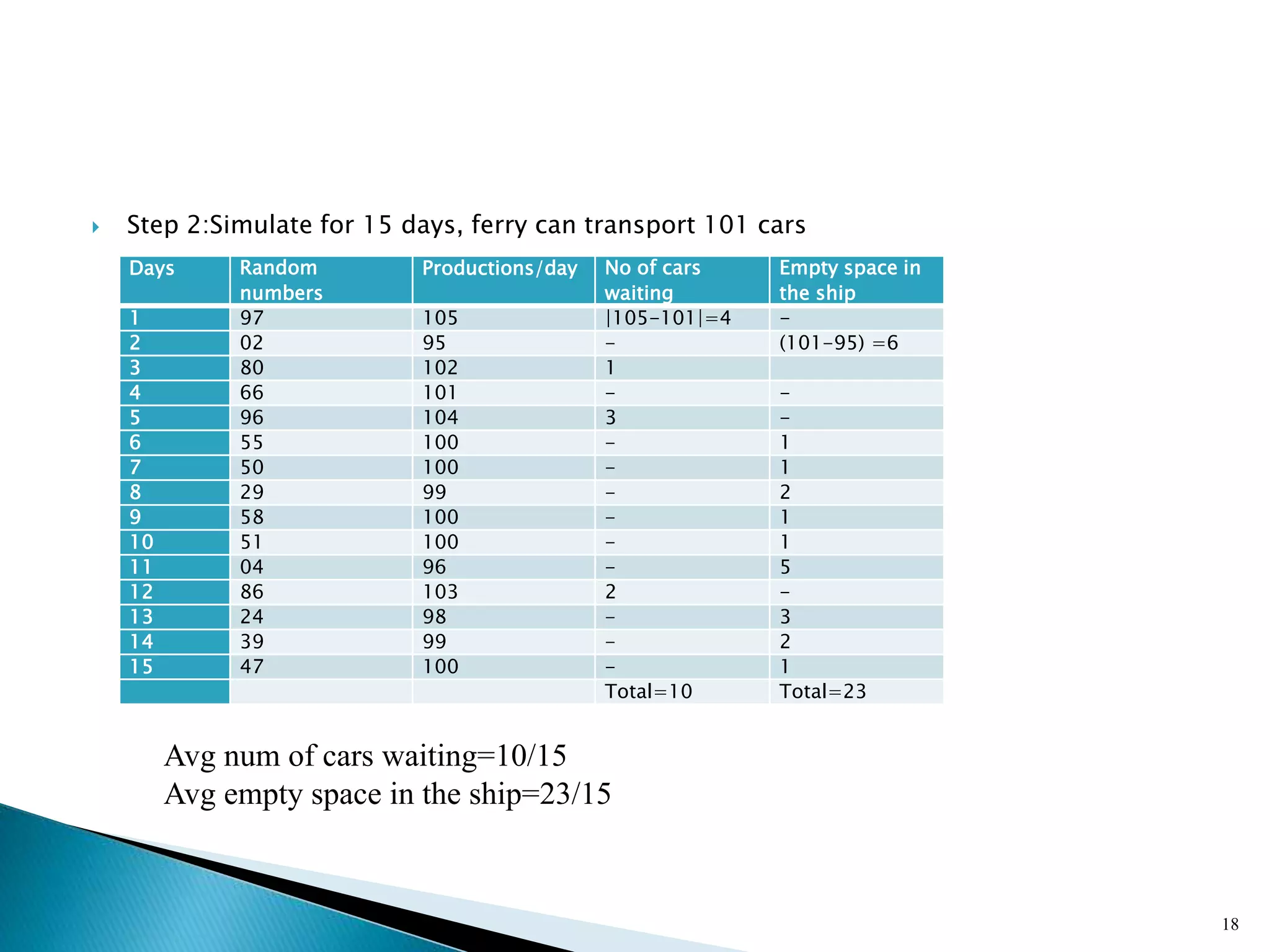
 Step 2:Simulate for 15 days, ferry can transport 101 cars
18
Days Random
numbers
Productions/day No of cars
waiting
Empty space in
the ship
1 97 105 |105-101|=4 -
2 02 95 - (101-95) =6
3 80 102 1
4 66 101 - -
5 96 104 3 -
6 55 100 - 1
7 50 100 - 1
8 29 99 - 2
9 58 100 - 1
10 51 100 - 1
11 04 96 - 5
12 86 103 2 -
13 24 98 - 3
14 39 99 - 2
15 47 100 - 1
Total=10 Total=23
Avg num of cars waiting=10/15
Avg empty space in the ship=23/15
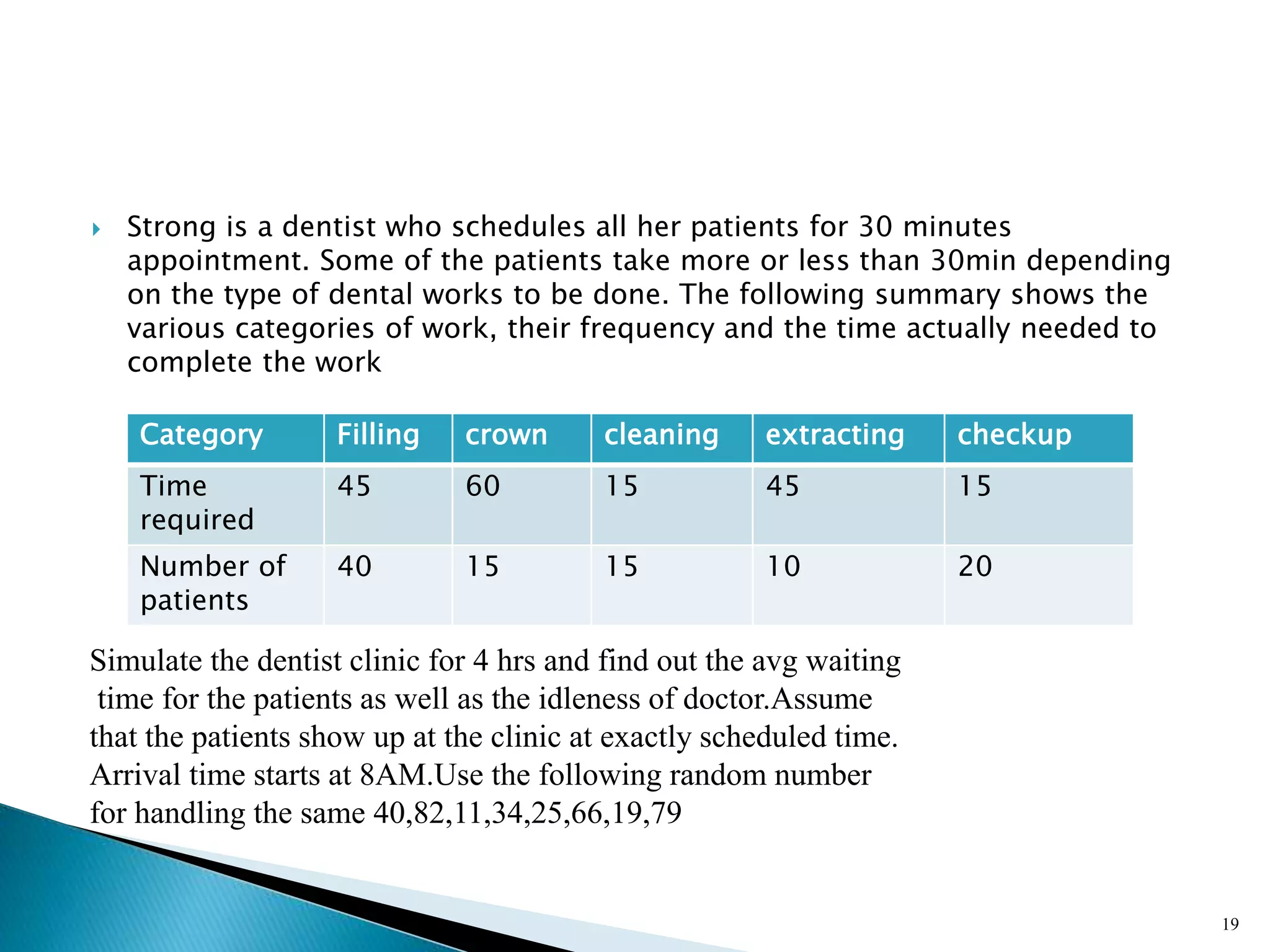
 Strong is a dentist who schedules all her patients for 30 minutes
appointment. Some of the patients take more or less than 30min depending
on the type of dental works to be done. The following summary shows the
various categories of work, their frequency and the time actually needed to
complete the work
19
Category Filling crown cleaning extracting checkup
Time
required
45 60 15 45 15
Number of
patients
40 15 15 10 20
Simulate the dentist clinic for 4 hrs and find out the avg waiting
time for the patients as well as the idleness of doctor.Assume
that the patients show up at the clinic at exactly scheduled time.
Arrival time starts at 8AM.Use the following random number
for handling the same 40,82,11,34,25,66,19,79
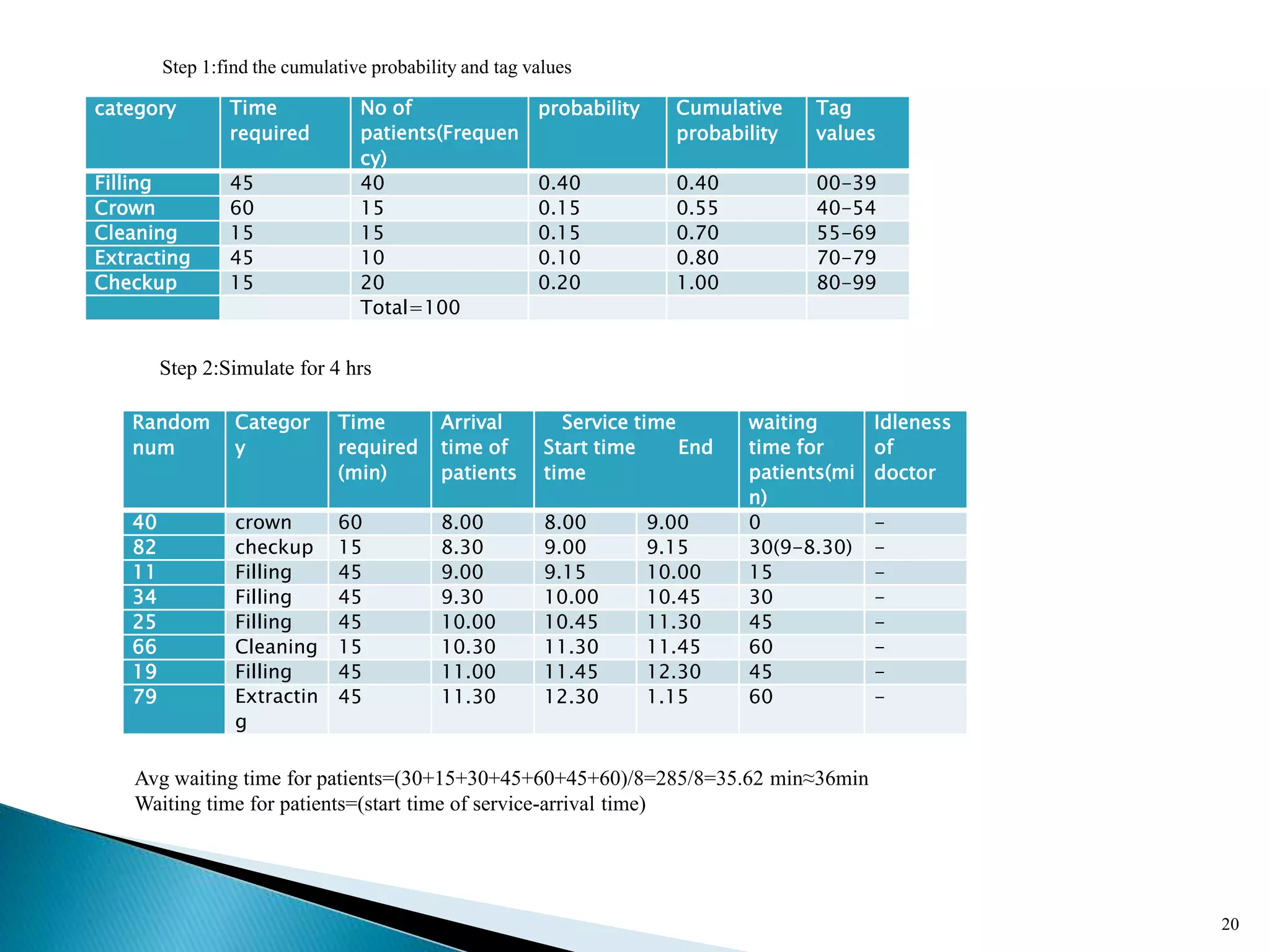
category Time
required
No of
patients(Frequen
cy)
probability Cumulative
probability
Tag
values
Filling 45 40 0.40 0.40 00-39
Crown 60 15 0.15 0.55 40-54
Cleaning 15 15 0.15 0.70 55-69
Extracting 45 10 0.10 0.80 70-79
Checkup 15 20 0.20 1.00 80-99
Total=100
20
Random
num
Categor
y
Time
required
(min)
Arrival
time of
patients
Service time
Start time End
time
waiting
time for
patients(mi
n)
Idleness
of
doctor
40 crown 60 8.00 8.00 9.00 0 -
82 checkup 15 8.30 9.00 9.15 30(9-8.30) -
11 Filling 45 9.00 9.15 10.00 15 -
34 Filling 45 9.30 10.00 10.45 30 -
25 Filling 45 10.00 10.45 11.30 45 -
66 Cleaning 15 10.30 11.30 11.45 60 -
19 Filling 45 11.00 11.45 12.30 45 -
79 Extractin
g
45 11.30 12.30 1.15 60 -
Step 1:find the cumulative probability and tag values
Step 2:Simulate for 4 hrs
Avg waiting time for patients=(30+15+30+45+60+45+60)/8=285/8=35.62 min≈36min
Waiting time for patients=(start time of service-arrival time)
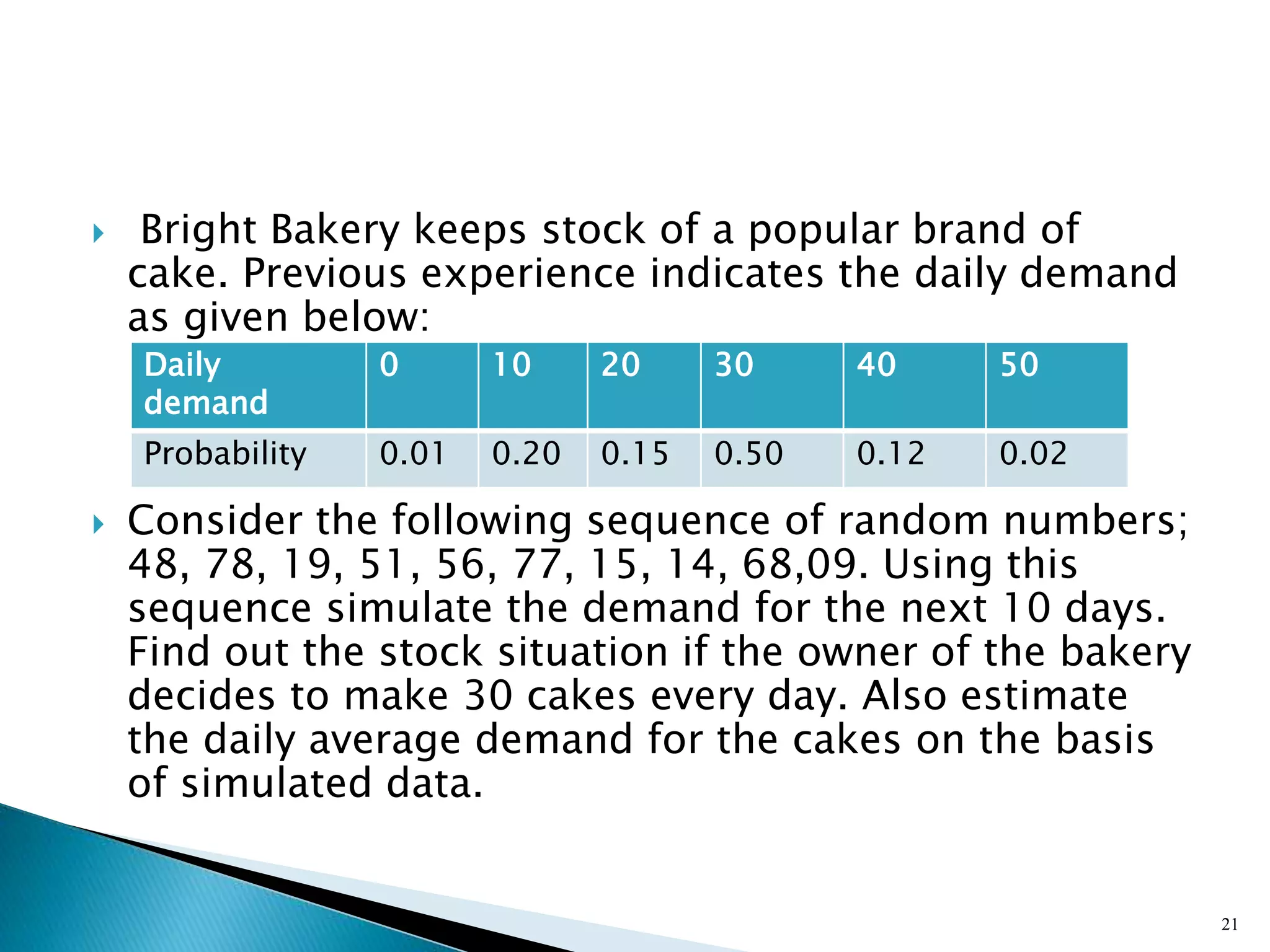
 Bright Bakery keeps stock of a popular brand of
cake. Previous experience indicates the daily demand
as given below:
 Consider the following sequence of random numbers;
48, 78, 19, 51, 56, 77, 15, 14, 68,09. Using this
sequence simulate the demand for the next 10 days.
Find out the stock situation if the owner of the bakery
decides to make 30 cakes every day. Also estimate
the daily average demand for the cakes on the basis
of simulated data.
21
Daily
demand
0 10 20 30 40 50
Probability 0.01 0.20 0.15 0.50 0.12 0.02
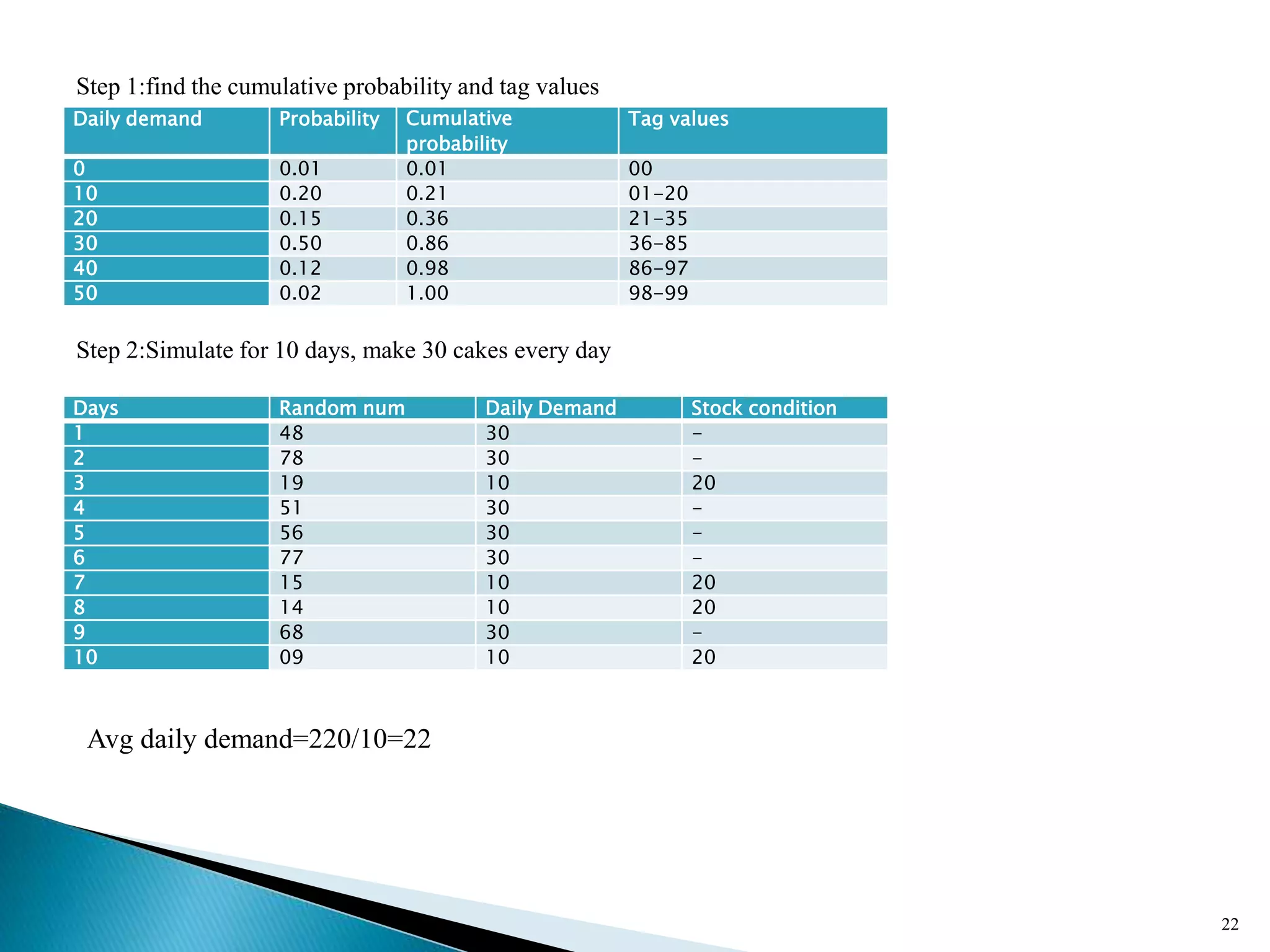
Daily demand Probability Cumulative
probability
Tag values
0 0.01 0.01 00
10 0.20 0.21 01-20
20 0.15 0.36 21-35
30 0.50 0.86 36-85
40 0.12 0.98 86-97
50 0.02 1.00 98-99
22
Step 1:find the cumulative probability and tag values
Step 2:Simulate for 10 days, make 30 cakes every day
Days Random num Daily Demand Stock condition
1 48 30 -
2 78 30 -
3 19 10 20
4 51 30 -
5 56 30 -
6 77 30 -
7 15 10 20
8 14 10 20
9 68 30 -
10 09 10 20
Avg daily demand=220/10=22
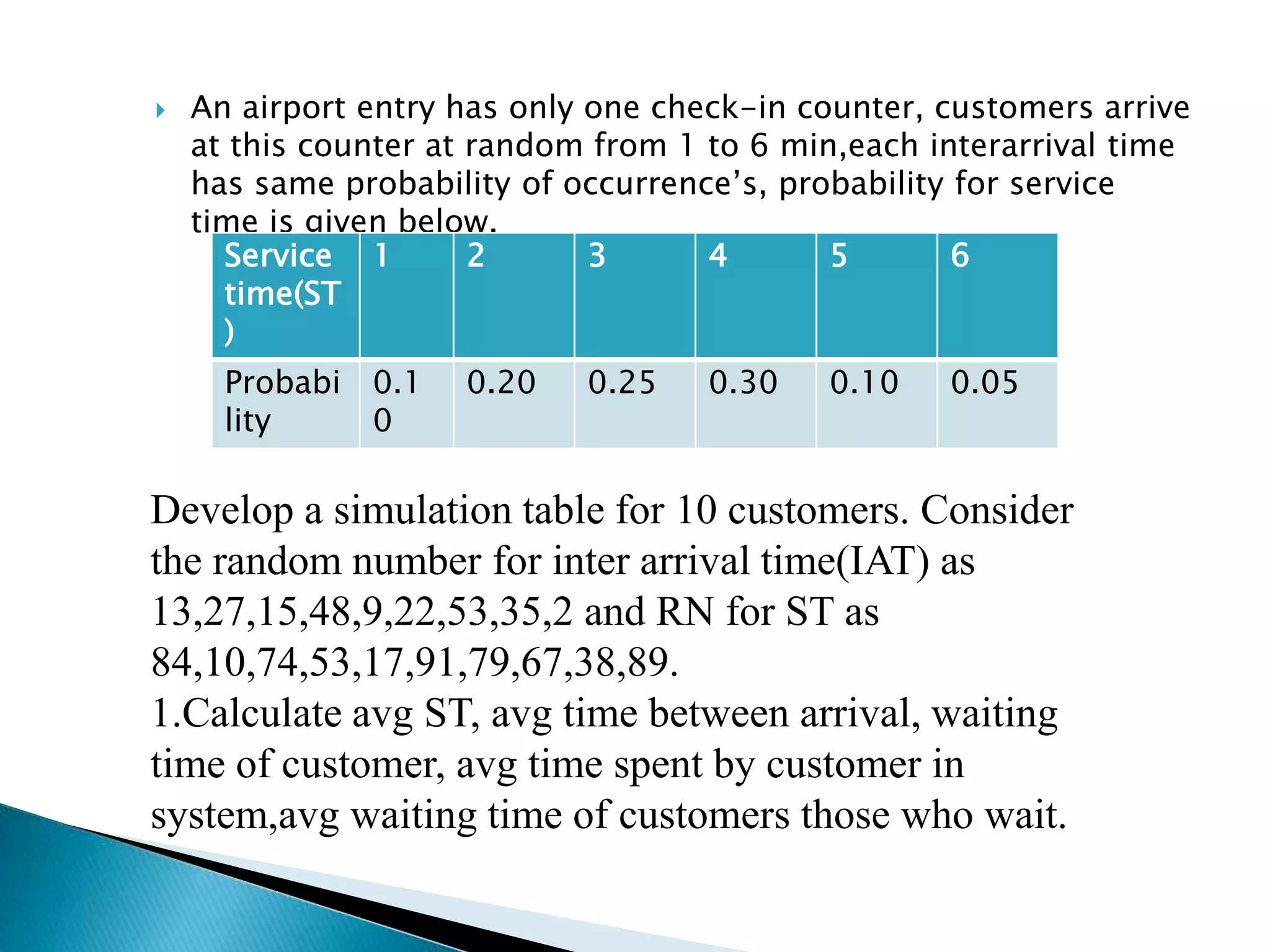
 An airport entry has only one check-in counter, customers arrive
at this counter at random from 1 to 6 min,each interarrival time
has same probability of occurrence’s, probability for service
time is given below.
Service
time(ST
)
1 2 3 4 5 6
Probabi
lity
0.1
0
0.20 0.25 0.30 0.10 0.05
Develop a simulation table for 10 customers. Consider
the random number for inter arrival time(IAT) as
13,27,15,48,9,22,53,35,2 and RN for ST as
84,10,74,53,17,91,79,67,38,89.
1.Calculate avg ST, avg time between arrival, waiting
time of customer, avg time spent by customer in
system,avg waiting time of customers those who wait.
 step 1:tag values for service time
Service time probability Cumulative
probability
Tag values
1 0.10 0.10 00-09
2 0.20 0.30 10-29
3 0.25 0.55 30-54
4 0.30 0.85 55-84
5 0.10 0.95 85-94
6 0.05 1.00 95-99
Step 2: tag values for IAT, equal probability of occurance[out
of 6 option any one can occur,
1/6=0.166666667=0.17(approx.)]
Inter arrival time probability Cumulative
probability
Tag values
1 1/6=0.17 0.17 00-16
2 0.17 0.34 17-33
3 0.17 0.51 34-50
4 0.17 0.68 51-67
5 0.17 0.85 68-84
6 0.17 1.00 85-99
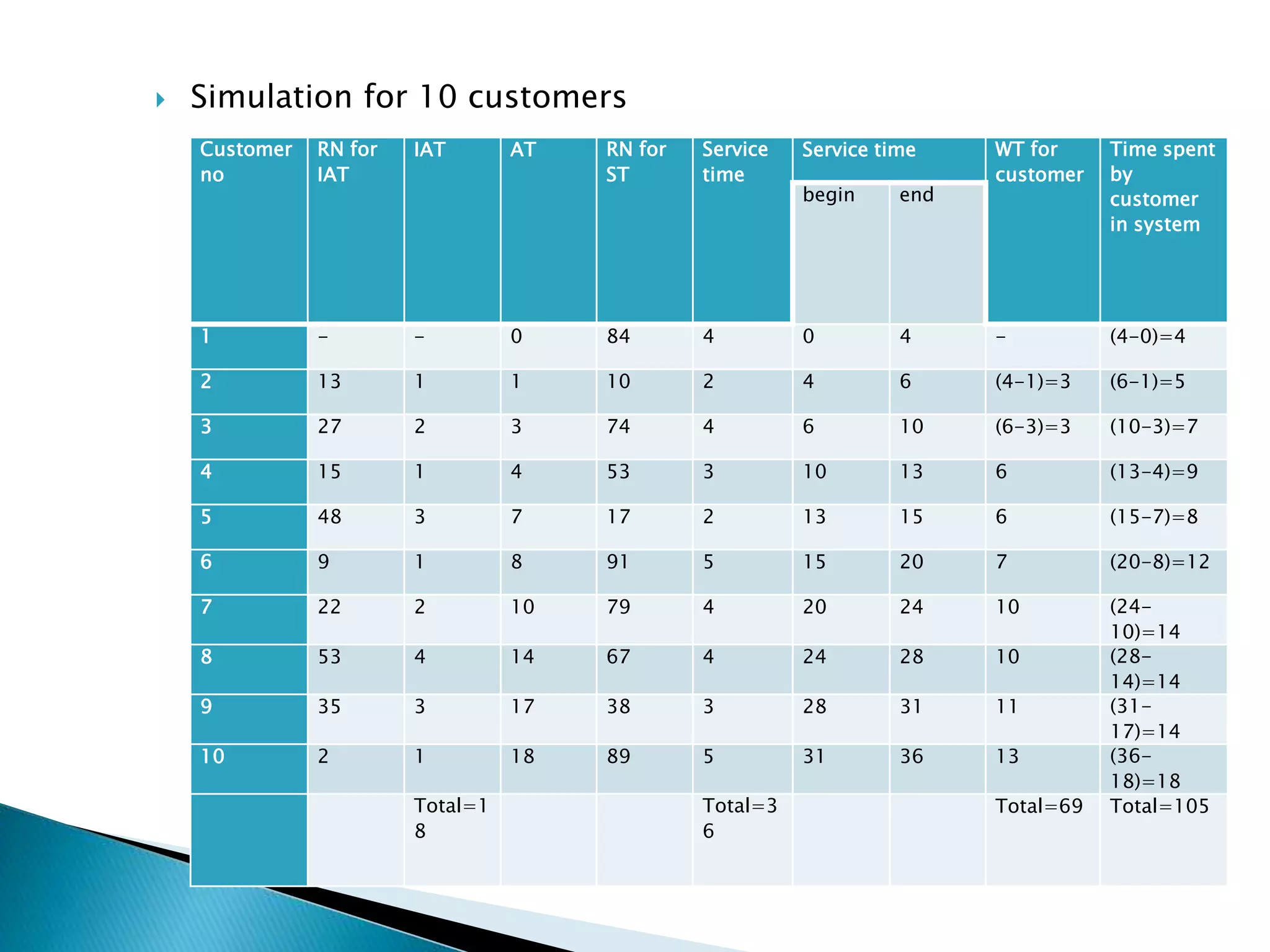
 Simulation for 10 customers
Customer
no
RN for
IAT
IAT AT RN for
ST
Service
time
Service time WT for
customer
Time spent
by
customer
in system
begin end
1 - - 0 84 4 0 4 - (4-0)=4
2 13 1 1 10 2 4 6 (4-1)=3 (6-1)=5
3 27 2 3 74 4 6 10 (6-3)=3 (10-3)=7
4 15 1 4 53 3 10 13 6 (13-4)=9
5 48 3 7 17 2 13 15 6 (15-7)=8
6 9 1 8 91 5 15 20 7 (20-8)=12
7 22 2 10 79 4 20 24 10 (24-
10)=14
8 53 4 14 67 4 24 28 10 (28-
14)=14
9 35 3 17 38 3 28 31 11 (31-
17)=14
10 2 1 18 89 5 31 36 13 (36-
18)=18
Total=1
8
Total=3
6
Total=69 Total=105
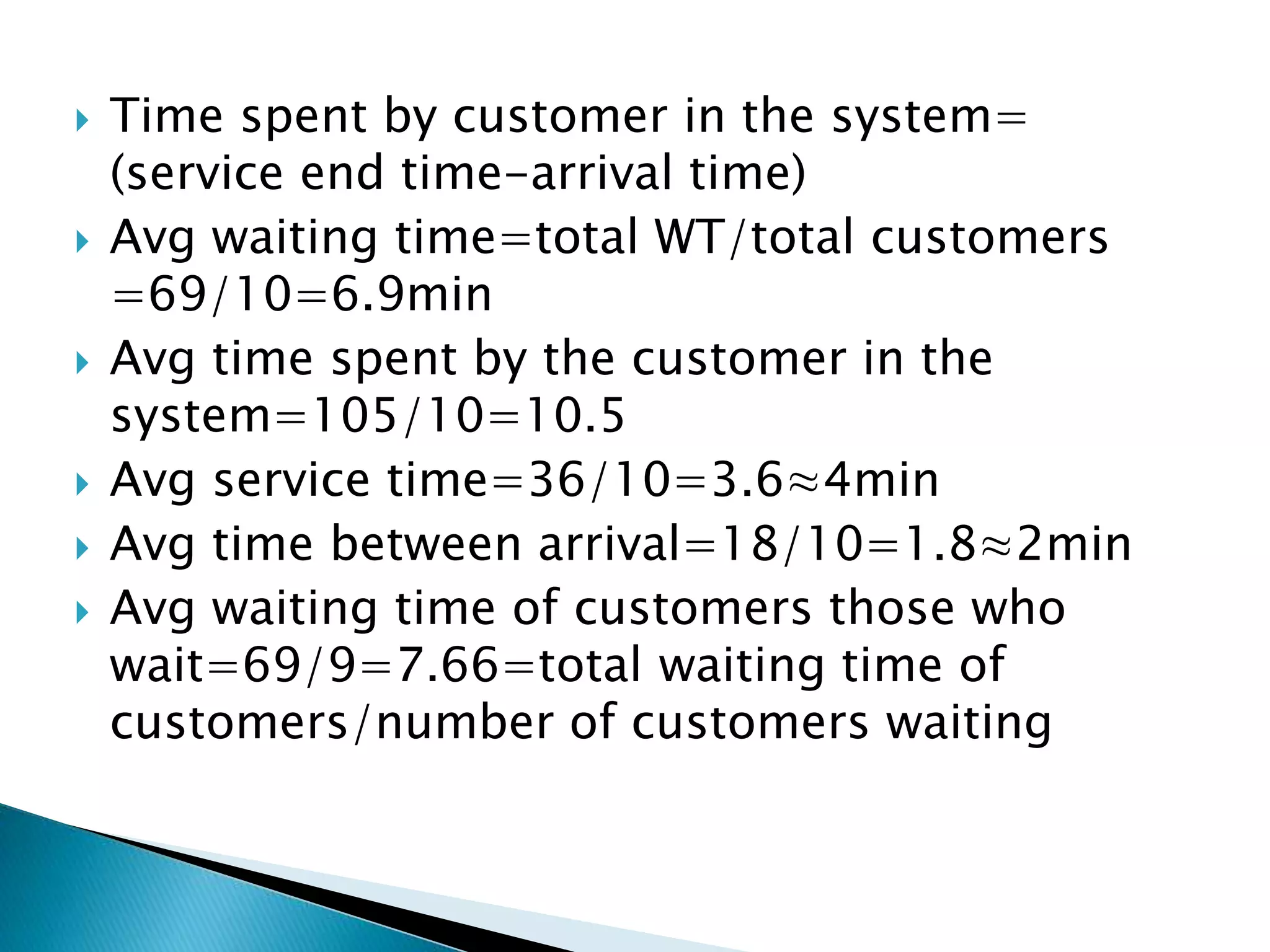
 Time spent by customer in the system=
(service end time-arrival time)
 Avg waiting time=total WT/total customers
=69/10=6.9min
 Avg time spent by the customer in the
system=105/10=10.5
 Avg service time=36/10=3.6≈4min
 Avg time between arrival=18/10=1.8≈2min
 Avg waiting time of customers those who
wait=69/9=7.66=total waiting time of
customers/number of customers waiting
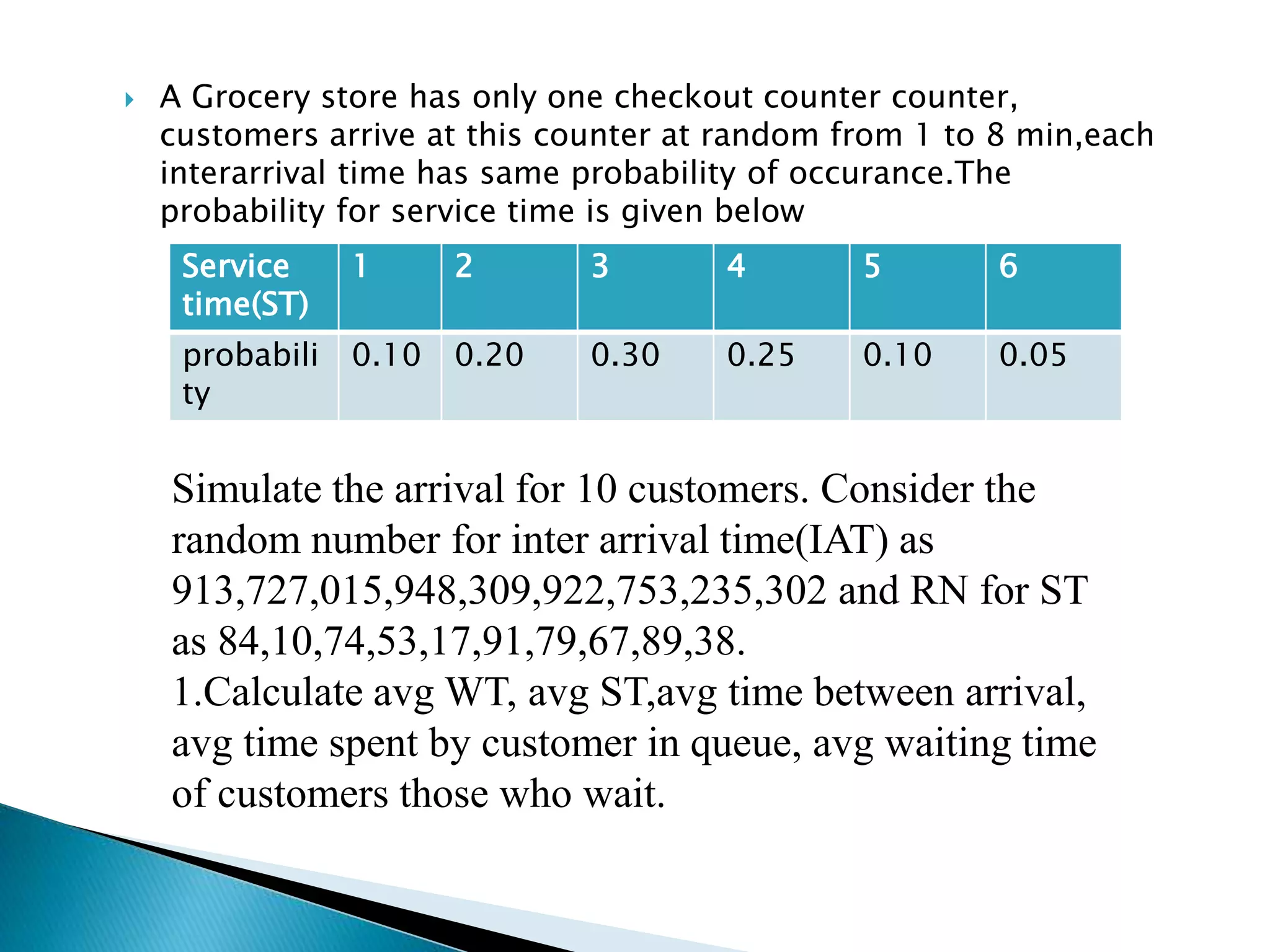
 A Grocery store has only one checkout counter counter,
customers arrive at this counter at random from 1 to 8 min,each
interarrival time has same probability of occurance.The
probability for service time is given below
Service
time(ST)
1 2 3 4 5 6
probabili
ty
0.10 0.20 0.30 0.25 0.10 0.05
Simulate the arrival for 10 customers. Consider the
random number for inter arrival time(IAT) as
913,727,015,948,309,922,753,235,302 and RN for ST
as 84,10,74,53,17,91,79,67,89,38.
1.Calculate avg WT, avg ST,avg time between arrival,
avg time spent by customer in queue, avg waiting time
of customers those who wait.
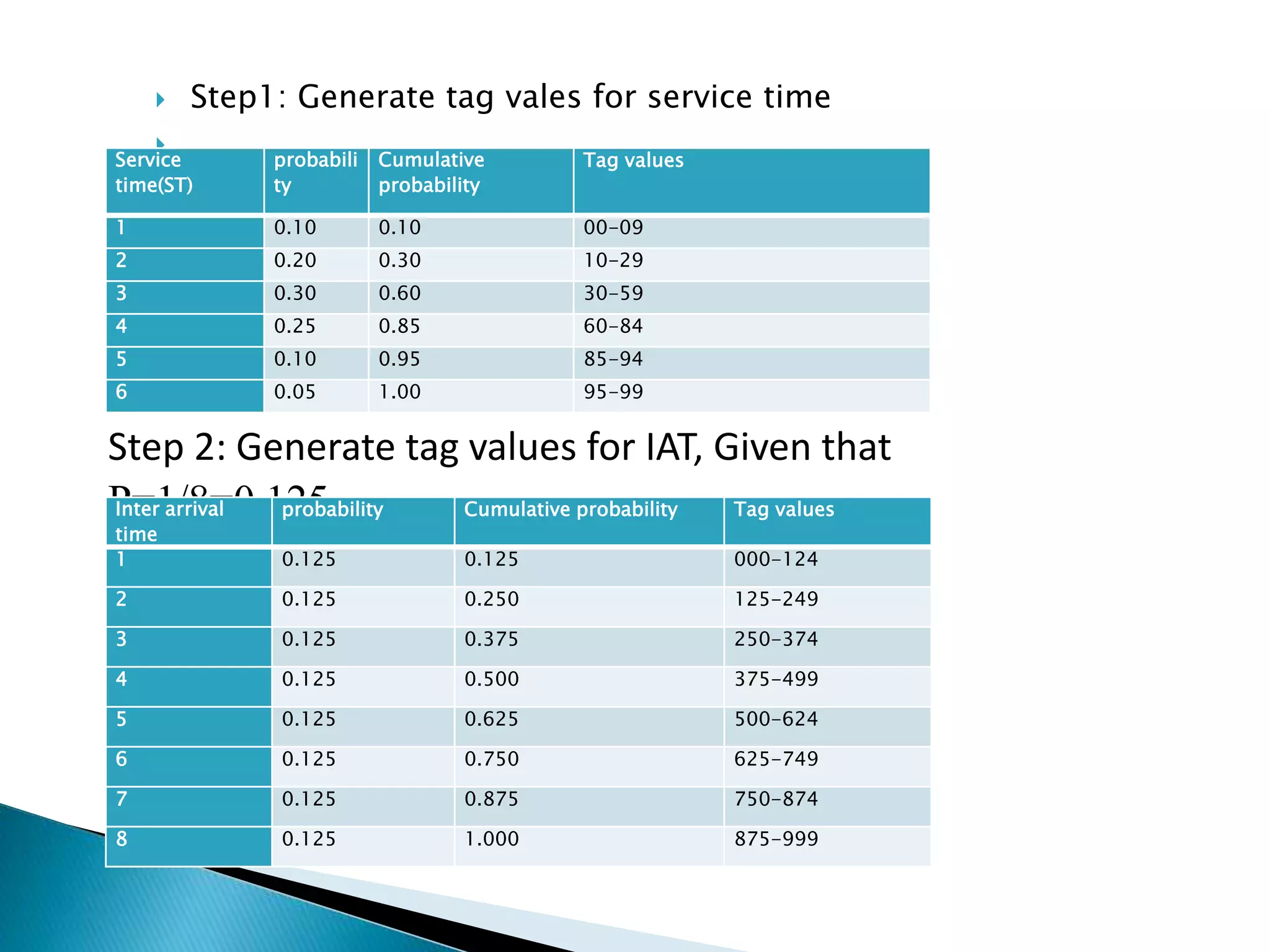
 Step1: Generate tag vales for service time
 ,
Service
time(ST)
probabili
ty
Cumulative
probability
Tag values
1 0.10 0.10 00-09
2 0.20 0.30 10-29
3 0.30 0.60 30-59
4 0.25 0.85 60-84
5 0.10 0.95 85-94
6 0.05 1.00 95-99
Step 2: Generate tag values for IAT, Given that
P=1/8=0.125
Inter arrival
time
probability Cumulative probability Tag values
1 0.125 0.125 000-124
2 0.125 0.250 125-249
3 0.125 0.375 250-374
4 0.125 0.500 375-499
5 0.125 0.625 500-624
6 0.125 0.750 625-749
7 0.125 0.875 750-874
8 0.125 1.000 875-999
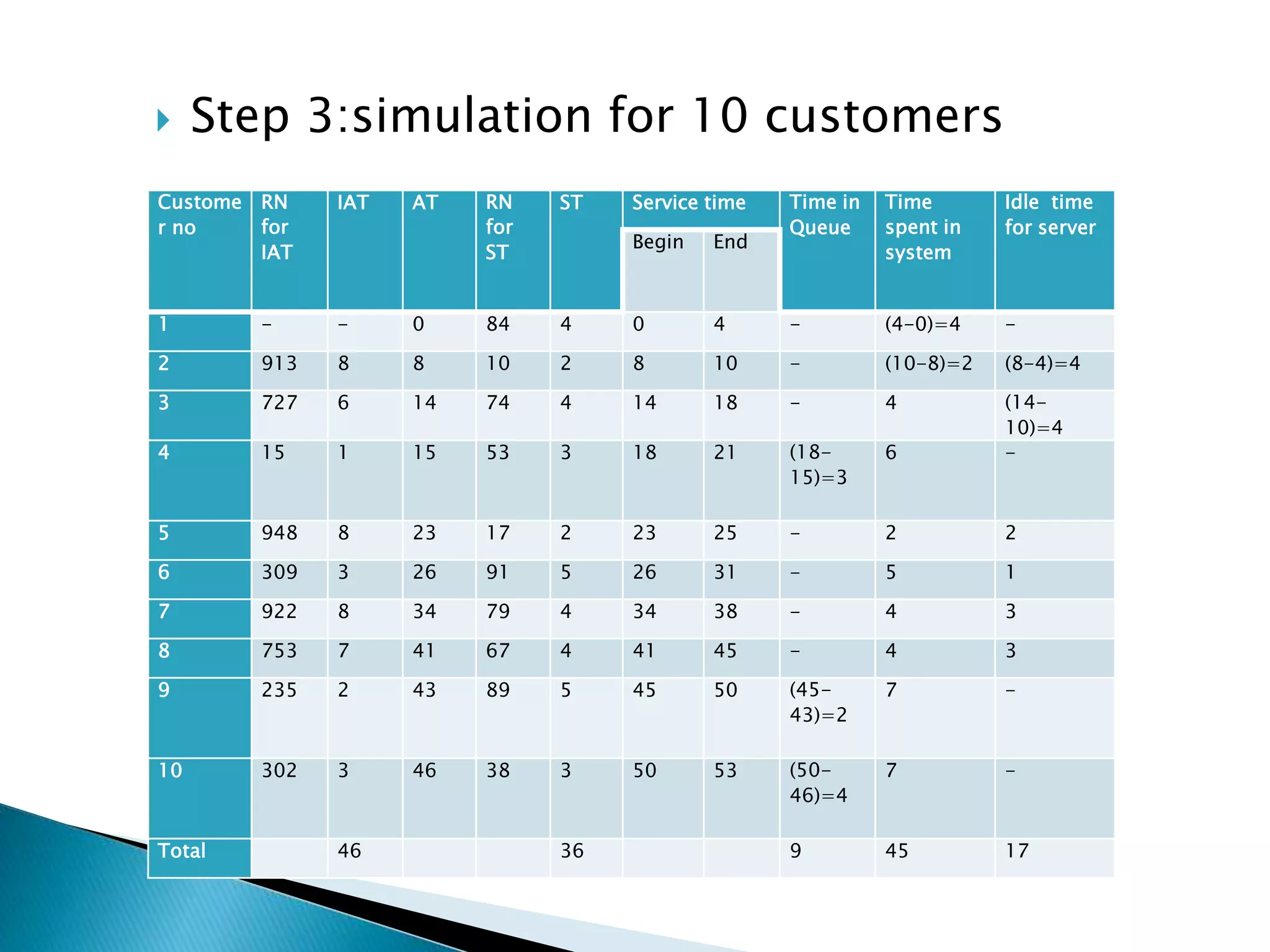
 Step 3:simulation for 10 customers
Custome
r no
RN
for
IAT
IAT AT RN
for
ST
ST Service time Time in
Queue
Time
spent in
system
Idle time
for server
Begin End
1 - - 0 84 4 0 4 - (4-0)=4 -
2 913 8 8 10 2 8 10 - (10-8)=2 (8-4)=4
3 727 6 14 74 4 14 18 - 4 (14-
10)=4
4 15 1 15 53 3 18 21 (18-
15)=3
6 -
5 948 8 23 17 2 23 25 - 2 2
6 309 3 26 91 5 26 31 - 5 1
7 922 8 34 79 4 34 38 - 4 3
8 753 7 41 67 4 41 45 - 4 3
9 235 2 43 89 5 45 50 (45-
43)=2
7 -
10 302 3 46 38 3 50 53 (50-
46)=4
7 -
Total 46 36 9 45 17
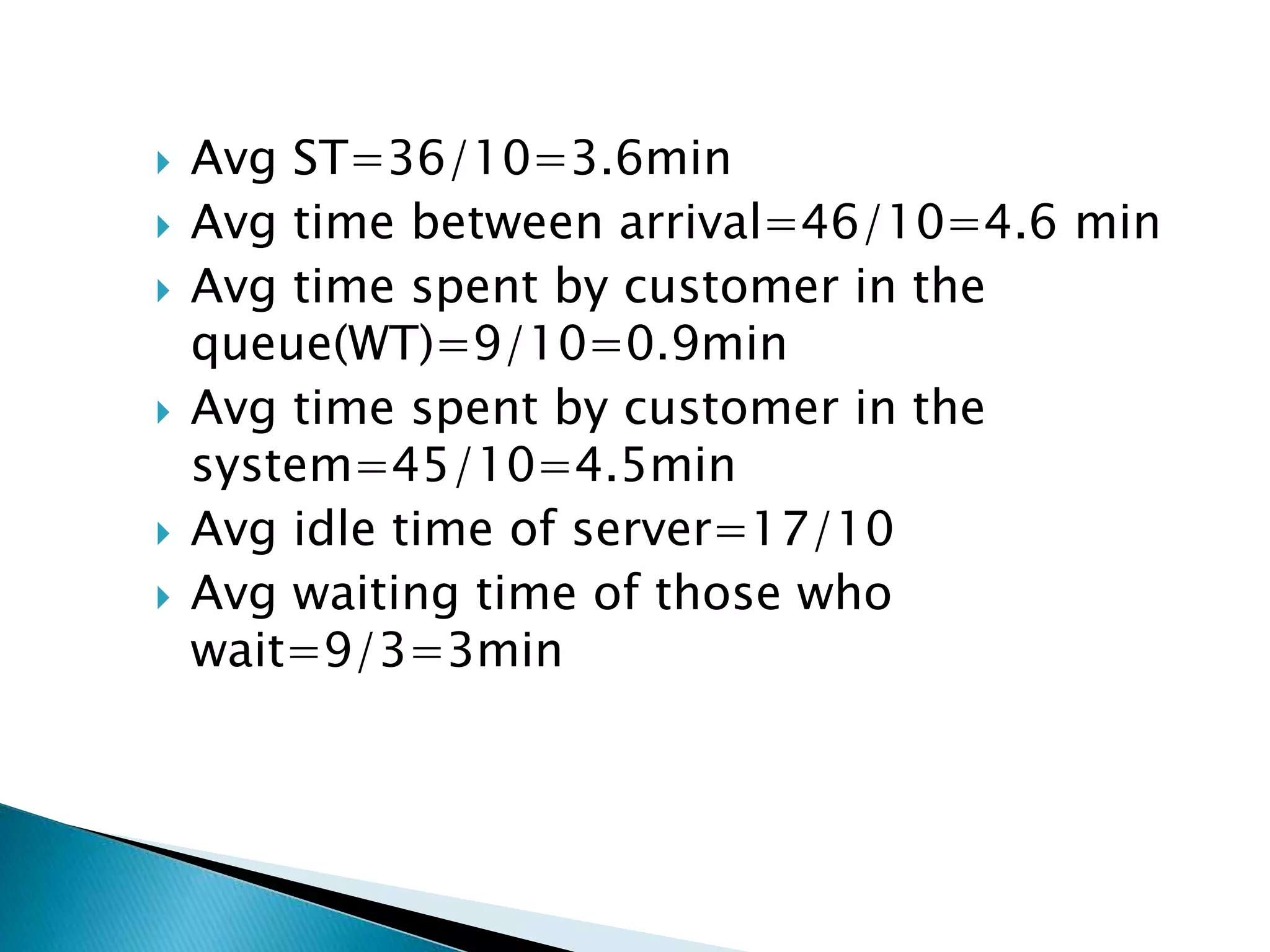
 Avg ST=36/10=3.6min
 Avg time between arrival=46/10=4.6 min
 Avg time spent by customer in the
queue(WT)=9/10=0.9min
 Avg time spent by customer in the
system=45/10=4.5min
 Avg idle time of server=17/10
 Avg waiting time of those who
wait=9/3=3min
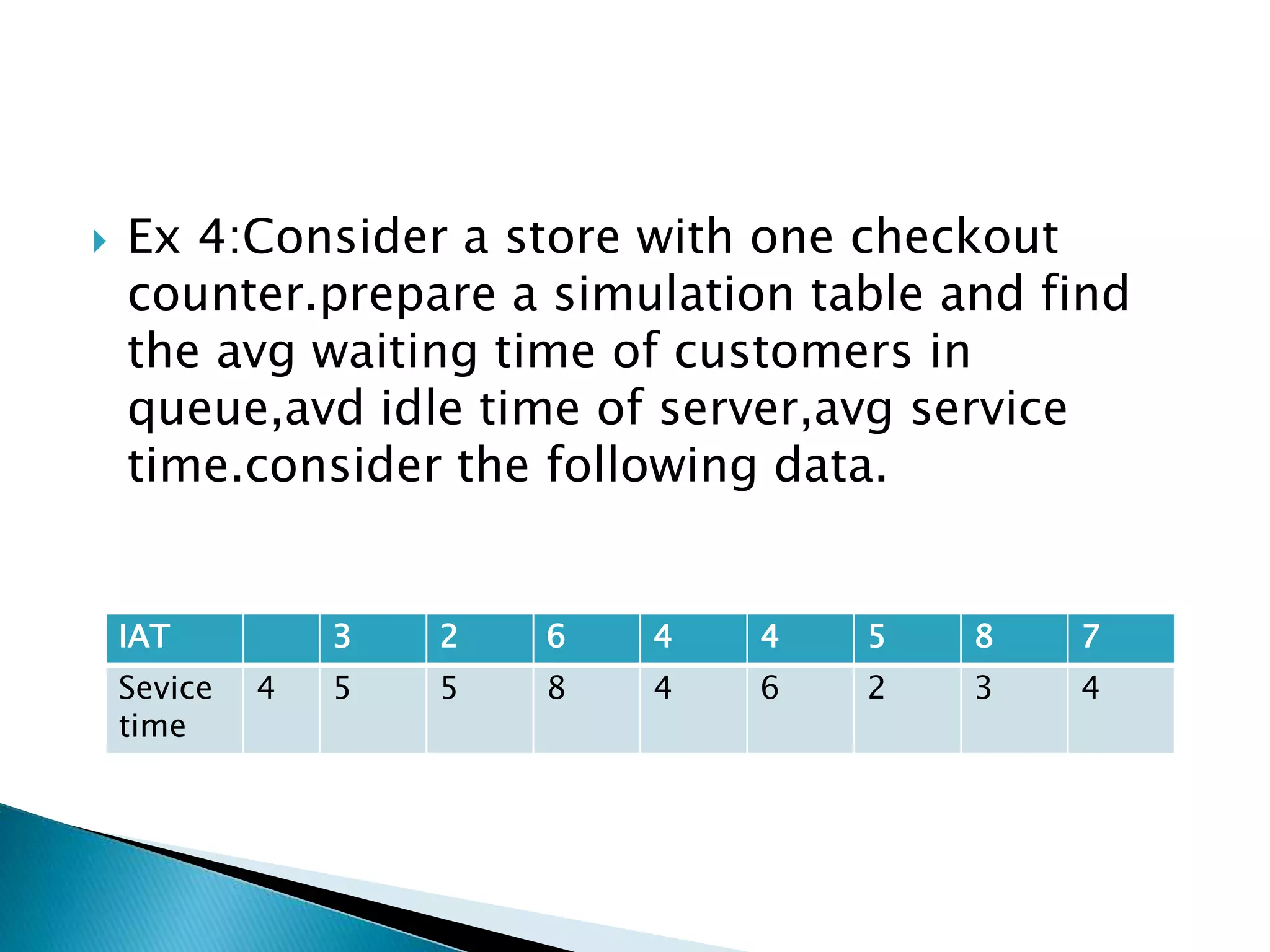
 Ex 4:Consider a store with one checkout
counter.prepare a simulation table and find
the avg waiting time of customers in
queue,avd idle time of server,avg service
time.consider the following data.
IAT 3 2 6 4 4 5 8 7
Sevice
time
4 5 5 8 4 6 2 3 4
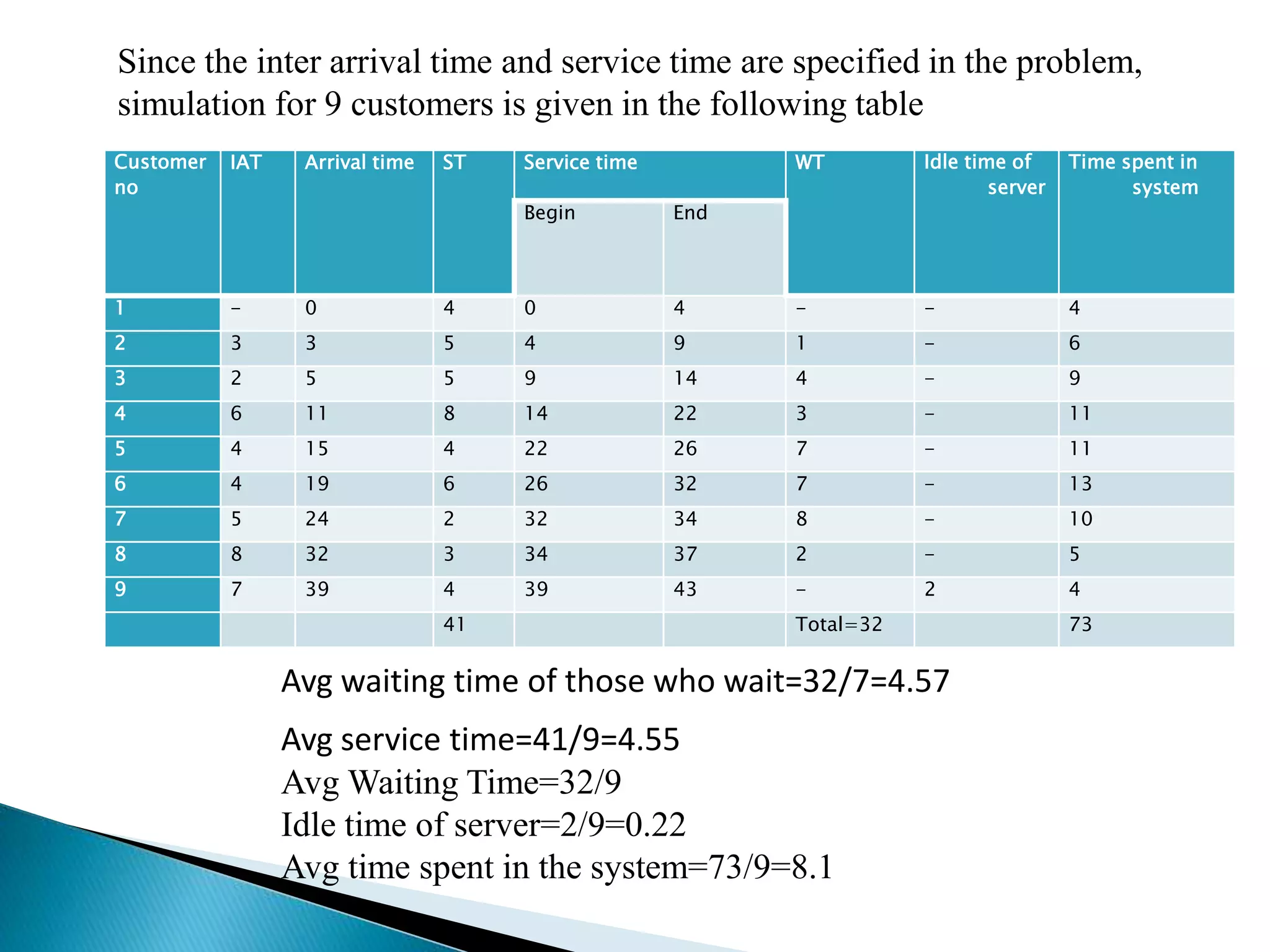
Customer
no
IAT Arrival time ST Service time WT Idle time of
server
Time spent in
system
Begin End
1 - 0 4 0 4 - - 4
2 3 3 5 4 9 1 - 6
3 2 5 5 9 14 4 - 9
4 6 11 8 14 22 3 - 11
5 4 15 4 22 26 7 - 11
6 4 19 6 26 32 7 - 13
7 5 24 2 32 34 8 - 10
8 8 32 3 34 37 2 - 5
9 7 39 4 39 43 - 2 4
41 Total=32 73
Since the inter arrival time and service time are specified in the problem,
simulation for 9 customers is given in the following table
Avg waiting time of those who wait=32/7=4.57
Avg service time=41/9=4.55
Avg Waiting Time=32/9
Idle time of server=2/9=0.22
Avg time spent in the system=73/9=8.1
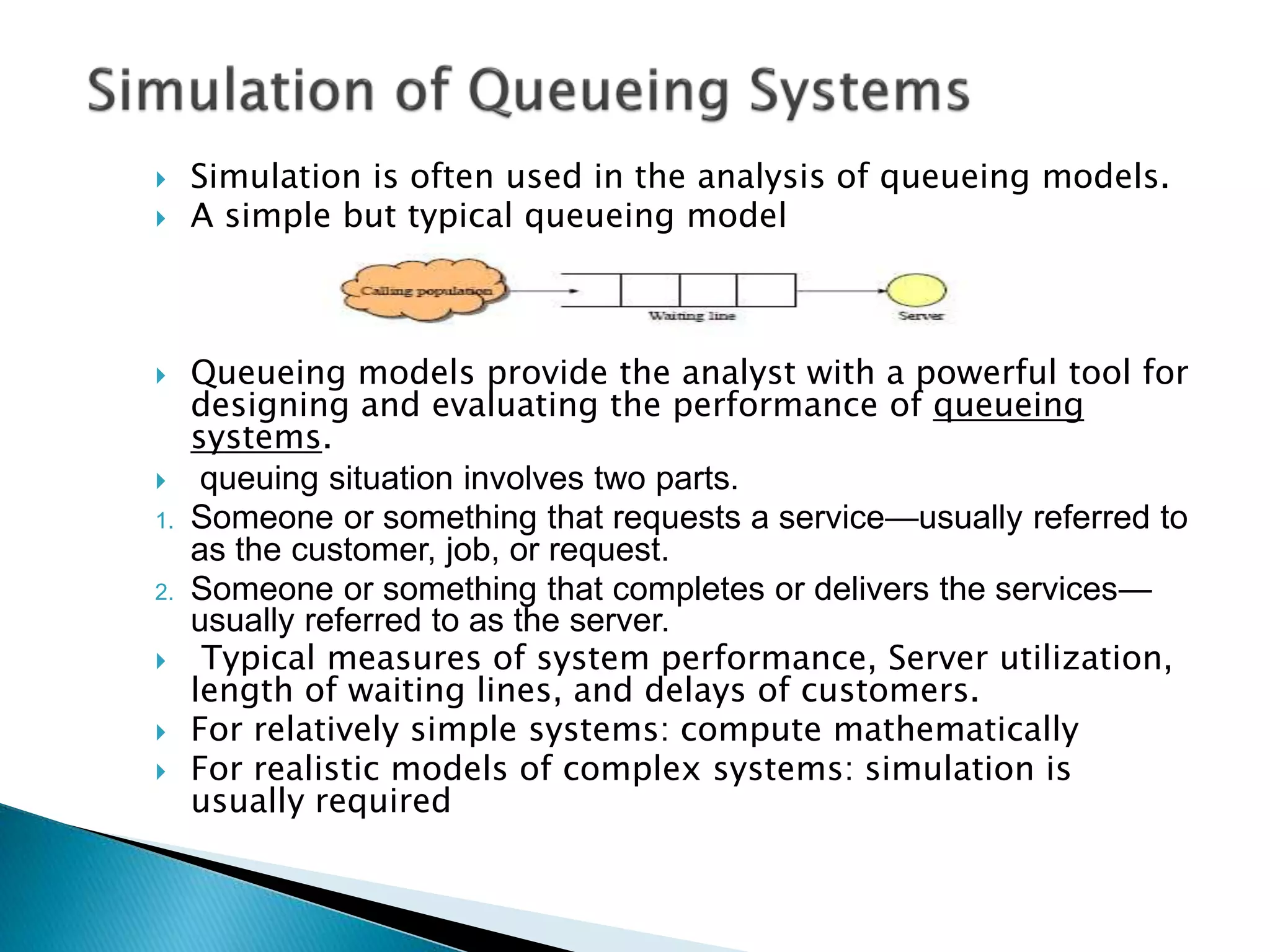
 Simulation is often used in the analysis of queueing models.
 A simple but typical queueing model
 Queueing models provide the analyst with a powerful tool for
designing and evaluating the performance of queueing
systems.
 queuing situation involves two parts.
1. Someone or something that requests a service—usually referred to
as the customer, job, or request.
2. Someone or something that completes or delivers the services—
usually referred to as the server.
 Typical measures of system performance, Server utilization,
length of waiting lines, and delays of customers.
 For relatively simple systems: compute mathematically
 For realistic models of complex systems: simulation is
usually required
 A queueing system is described by
 Calling population
 Arrival rate
 Service mechanism
 System capacity
 Queueing discipline
 Calling population: the population of potential
customers, may be assumed to be finite or
infinite.
 Finite population model: if arrival rate depends
on the number of customers being served and
waiting, e.g., model of corporate jet, if it is being
repaired, the repair arrival rate becomes zero.
 Infinite population model: if arrival rate is not
affected by the number of customers being
served and waiting, e.g., systems with large
population of potential customers.
 System Capacity: A limit on the number of
customers that may be in the waiting line
or system.
 Limited capacity, e.g., an automatic car
wash only has room for 10,cars to wait in
line to enter the mechanism.
 If system is full no customers are accepted
anymore
 Unlimited capacity, e.g., concert ticket
sales with no limit on the number of
people allowed to wait to purchase tickets.
 For infinite-population models:
 • In terms of interarrival times of successive
customers.
 • Arrival types:
 Random arrivals: interarrival times usually
characterized by a probability distribution.
 Scheduled arrivals: interarrival times can be constant
or constant plus or minus a small random amount to
represent early or late arrivals.
 • Example: patients to a physician or scheduled
airline flight arrivals to an airport
 At least one customer is assumed to always be
present,so the server is never idle, e.g., sufficient raw
material for a machine.
 Queue behavior: the actions of customers while in a queue waiting for
service to begin, for example: leave when they see that the line is too
long, leave after being in the line when its moving too slowly , move
from one line to a shorter line
 Most queuing formula assume that all arrivals stay until service is
completed
 Balking refers to customers who do not join the queue
 Reneging refers to customers who join the queue but give up and leave
before completing service.
 Jockeying: refers to waiting customers move from one queue to another.
 Queue discipline: the logical ordering of customers in a queue that
determines which customer is chosen for service when a server becomes
free, for example:
 • First-in-first-out (FIFO)
 • Last-in-first-out (LIFO)
 • Service in random order (SIRO)
 • Shortest processing time first (SPT)
 • Service according to priority (PR)
 In queuing system, service time is defines as the time required to
serve a custom.May be constant or random.
 The service mechanism is the way that customers
receive service once they are selected from the front of a queue.
• service mechanism:
• a description of the resources needed for service to begin
• how long the service will take (the service time distribution)
• the number of servers available
• whether the servers are in series (each server has a separate queue) or in
parallel (one queue for all servers)
• whether pre-emption is allowed (a server can stop processing a customer to deal
with another "emergency" customer)
 Assuming that the service times for customers are independent and do
not depend upon the arrival process is common.
 Service mechanism in a queuing system is characterized by Server’s
behavior.
 A = Arrival distribution
(M for Poisson, D for deterministic, and G for
general)
 B = Service time distribution
(M for exponential, D for deterministic, and G
for general)
 S = number of servers
 c=calling population
 d=service discipline
40
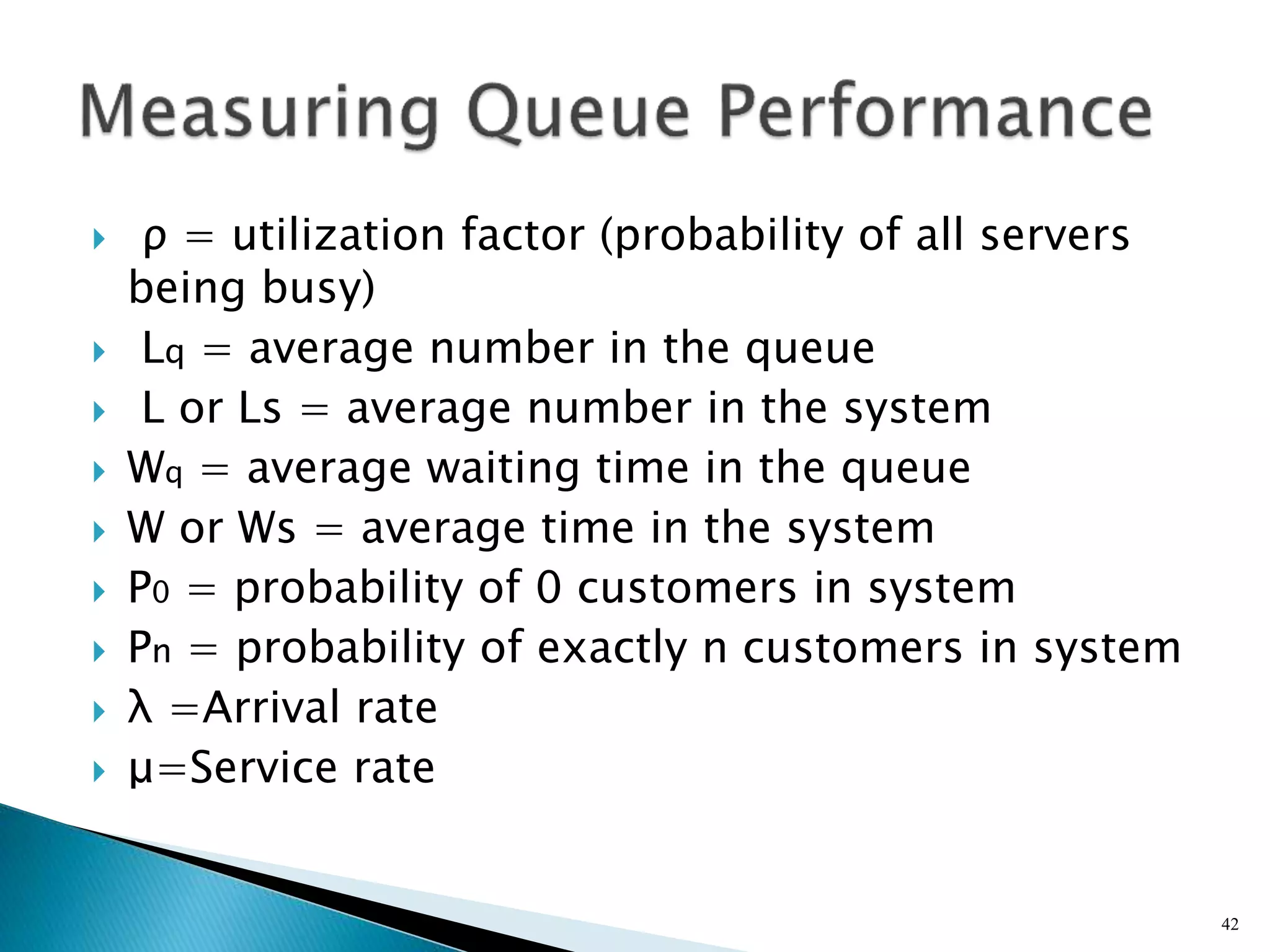
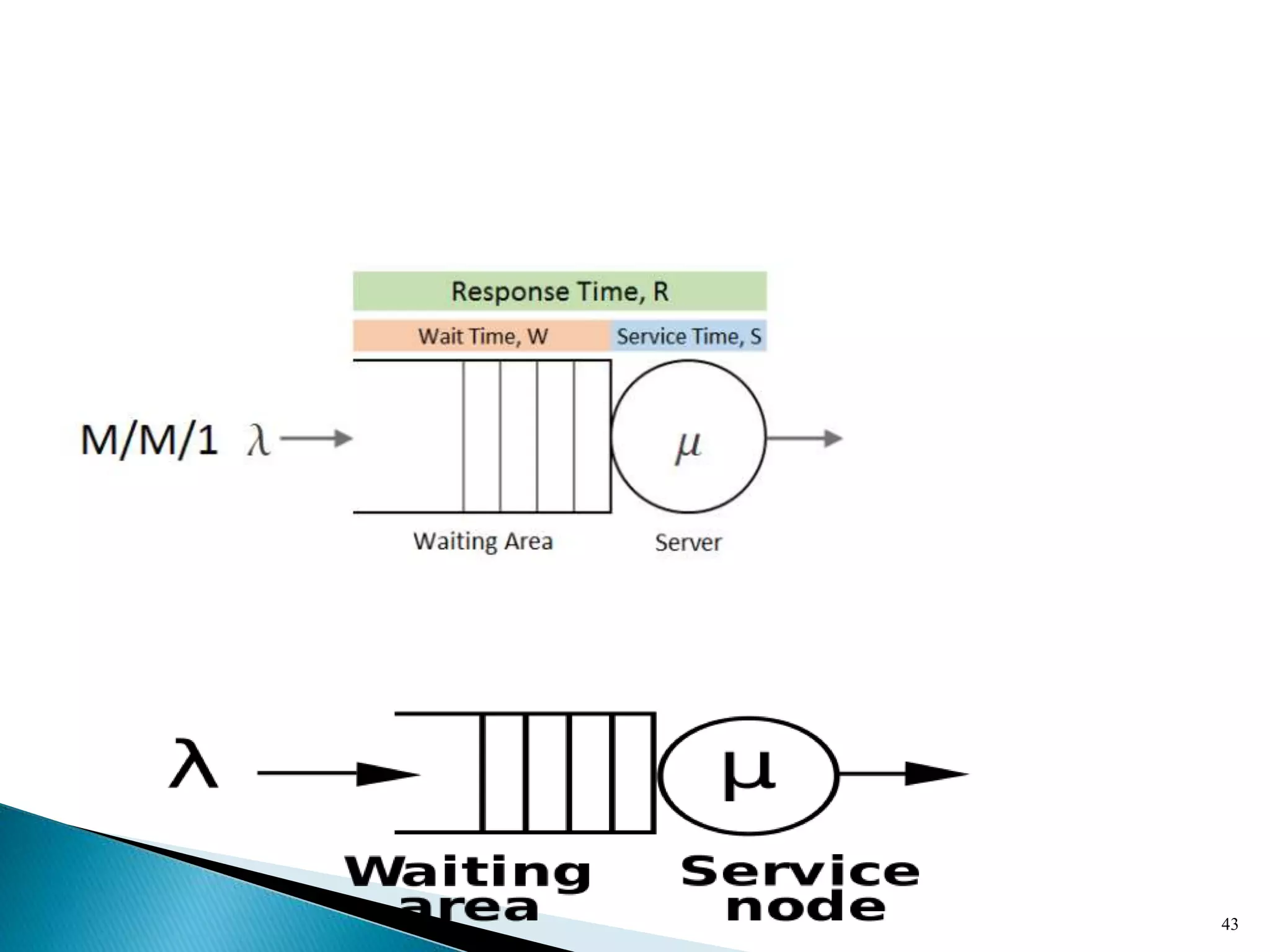
 An M/M/1 queue is a stochastic process whose state space(set
of all possible combination of system) is the set {0,1,2,3,...}
where the value corresponds to the number of customers in the
system, including any currently in service.
• Arrivals occur at rate λ according to a Poisson process and move
the process from state i to i + 1.
• Service times have an exponential distribution with rate
parameter μ in the M/M/1 queue, where 1/μ is the mean service
time.
• A single server serves customers one at a time from the front of
the queue, according to a first-come, first-served discipline.
When the service is complete the customer leaves the queue
and the number of customers in the system reduces by one.
• The buffer is of infinite size, so there is no limit on the number of
customers it can contain.
41
 ρ = utilization factor (probability of all servers
being busy)
 Lq = average number in the queue
 L or Ls = average number in the system
 Wq = average waiting time in the queue
 W or Ws = average time in the system
 P0 = probability of 0 customers in system
 Pn = probability of exactly n customers in system
 λ =Arrival rate
 μ=Service rate
42
43
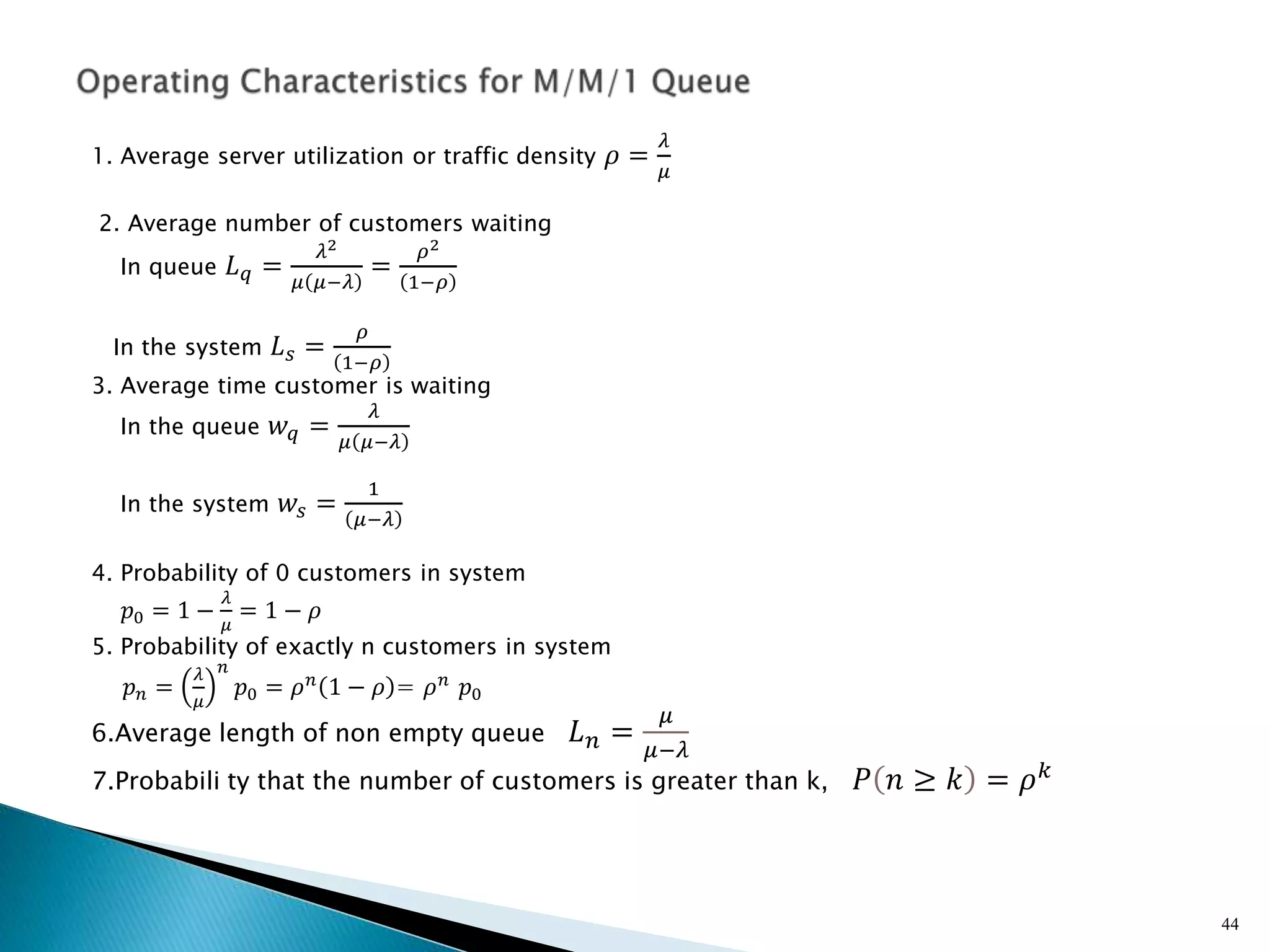
1. Average server utilization or traffic density 𝜌 =
𝜆
𝜇
2. Average number of customers waiting
In queue 𝐿𝑞 =
𝜆2
𝜇 𝜇−𝜆
=
𝜌2
1−𝜌
In the system 𝐿𝑠 =
𝜌
1−𝜌
3. Average time customer is waiting
In the queue 𝑤𝑞 =
𝜆
𝜇 𝜇−𝜆
In the system 𝑤𝑠 =
1
𝜇−𝜆
4. Probability of 0 customers in system
𝑝0 = 1 −
𝜆
𝜇
= 1 − 𝜌
5. Probability of exactly n customers in system
𝑝𝑛 =
𝜆
𝜇
𝑛
𝑝0 = 𝜌𝑛
1 − 𝜌 = 𝜌𝑛
𝑝0
6.Average length of non empty queue 𝐿𝑛 =
𝜇
𝜇−𝜆
7.Probabili ty that the number of customers is greater than k, 𝑃 𝑛 ≥ 𝑘 = 𝜌𝑘
44
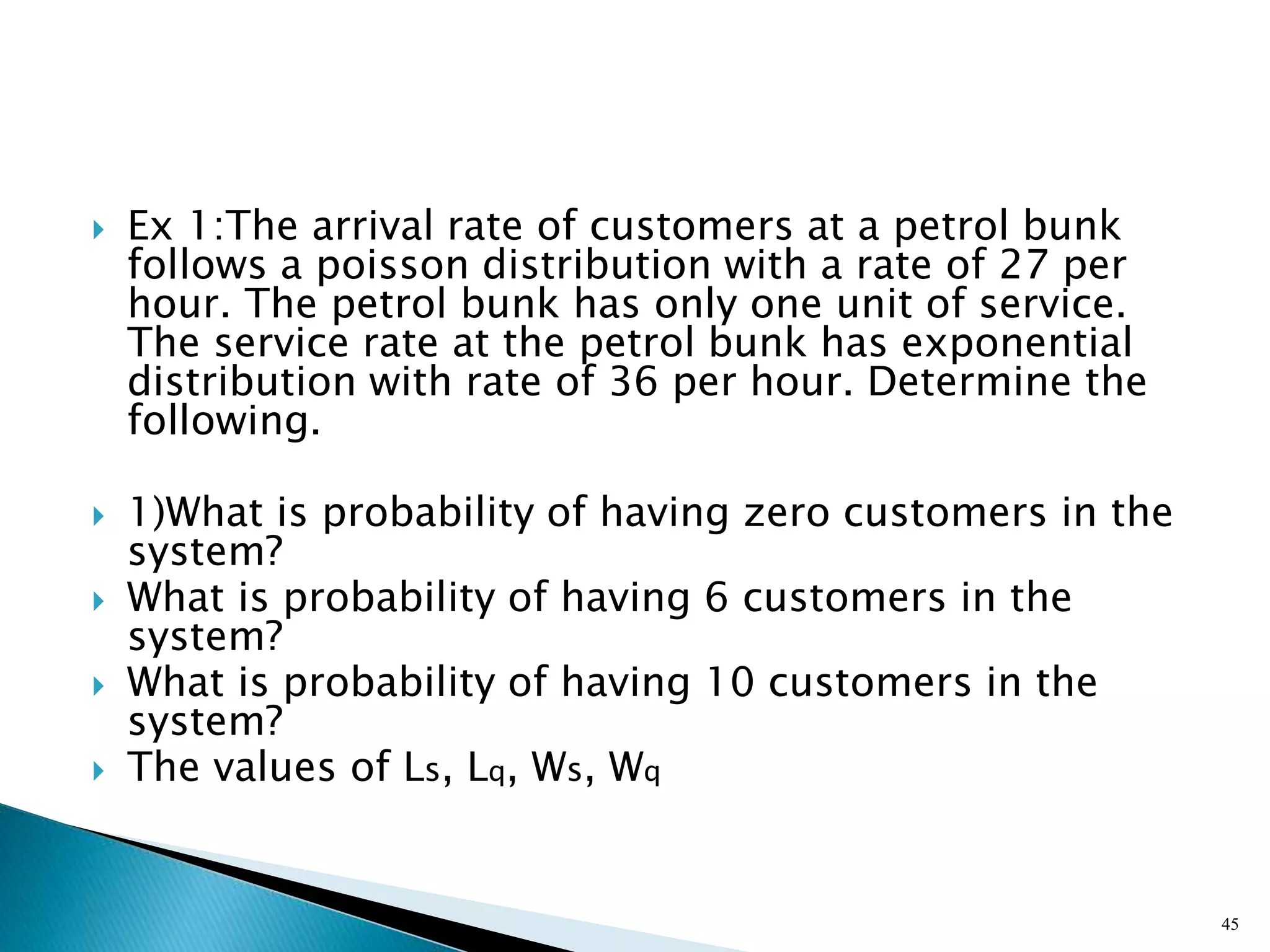
 Ex 1:The arrival rate of customers at a petrol bunk
follows a poisson distribution with a rate of 27 per
hour. The petrol bunk has only one unit of service.
The service rate at the petrol bunk has exponential
distribution with rate of 36 per hour. Determine the
following.
 1)What is probability of having zero customers in the
system?
 What is probability of having 6 customers in the
system?
 What is probability of having 10 customers in the
system?
 The values of Ls, Lq, Ws, Wq
45
 Solution:
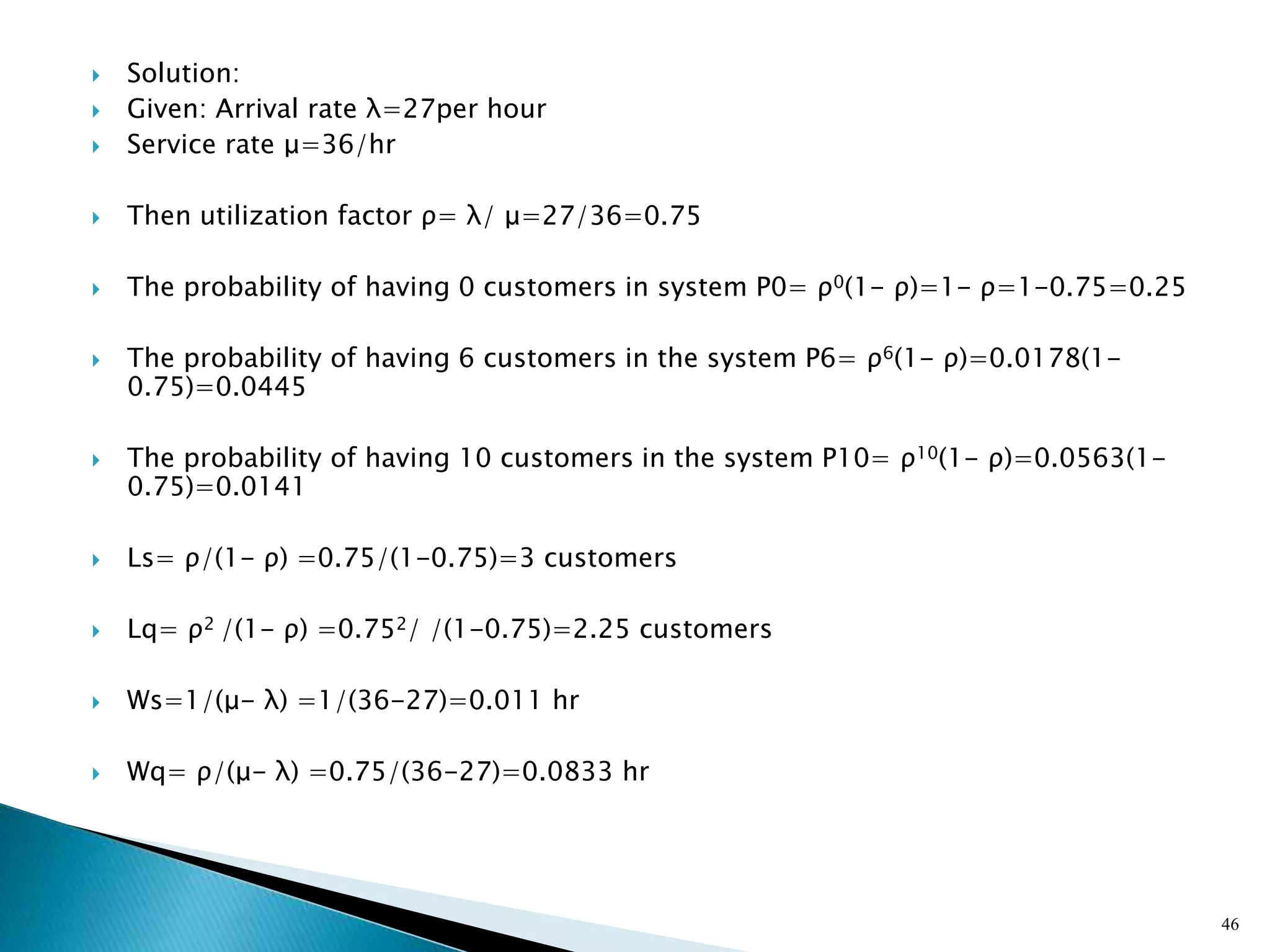
 Given: Arrival rate λ=27per hour
 Service rate μ=36/hr
 Then utilization factor ρ= λ/ μ=27/36=0.75
 The probability of having 0 customers in system P0= ρ0(1- ρ)=1- ρ=1-0.75=0.25
 The probability of having 6 customers in the system P6= ρ6(1- ρ)=0.0178(1-
0.75)=0.0445
 The probability of having 10 customers in the system P10= ρ10(1- ρ)=0.0563(1-
0.75)=0.0141
 Ls= ρ/(1- ρ) =0.75/(1-0.75)=3 customers
 Lq= ρ2 /(1- ρ) =0.752/ /(1-0.75)=2.25 customers
 Ws=1/(μ- λ) =1/(36-27)=0.011 hr
 Wq= ρ/(μ- λ) =0.75/(36-27)=0.0833 hr
46
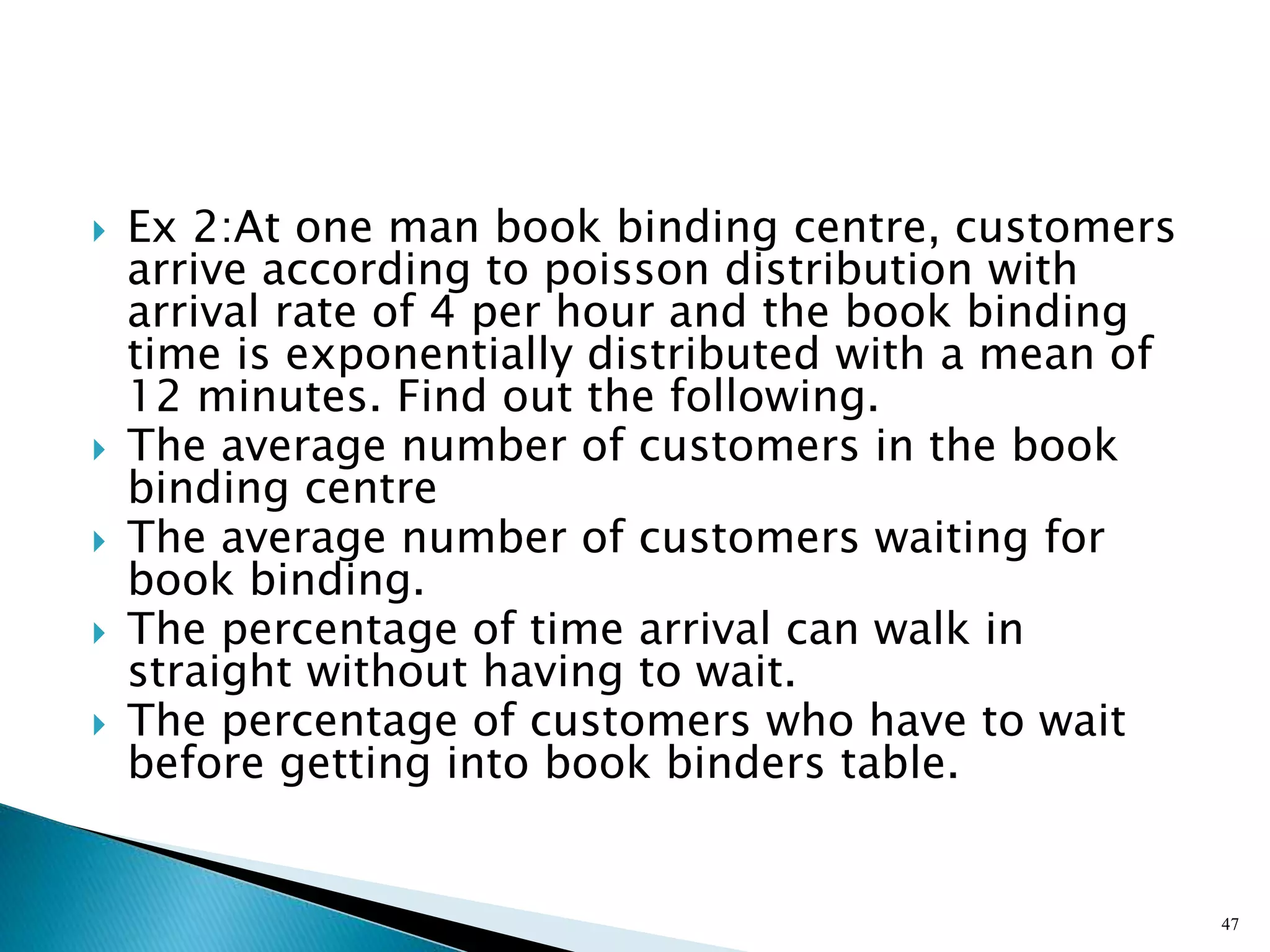
 Ex 2:At one man book binding centre, customers
arrive according to poisson distribution with
arrival rate of 4 per hour and the book binding
time is exponentially distributed with a mean of
12 minutes. Find out the following.
 The average number of customers in the book
binding centre
 The average number of customers waiting for
book binding.
 The percentage of time arrival can walk in
straight without having to wait.
 The percentage of customers who have to wait
before getting into book binders table.
47
 Solution:
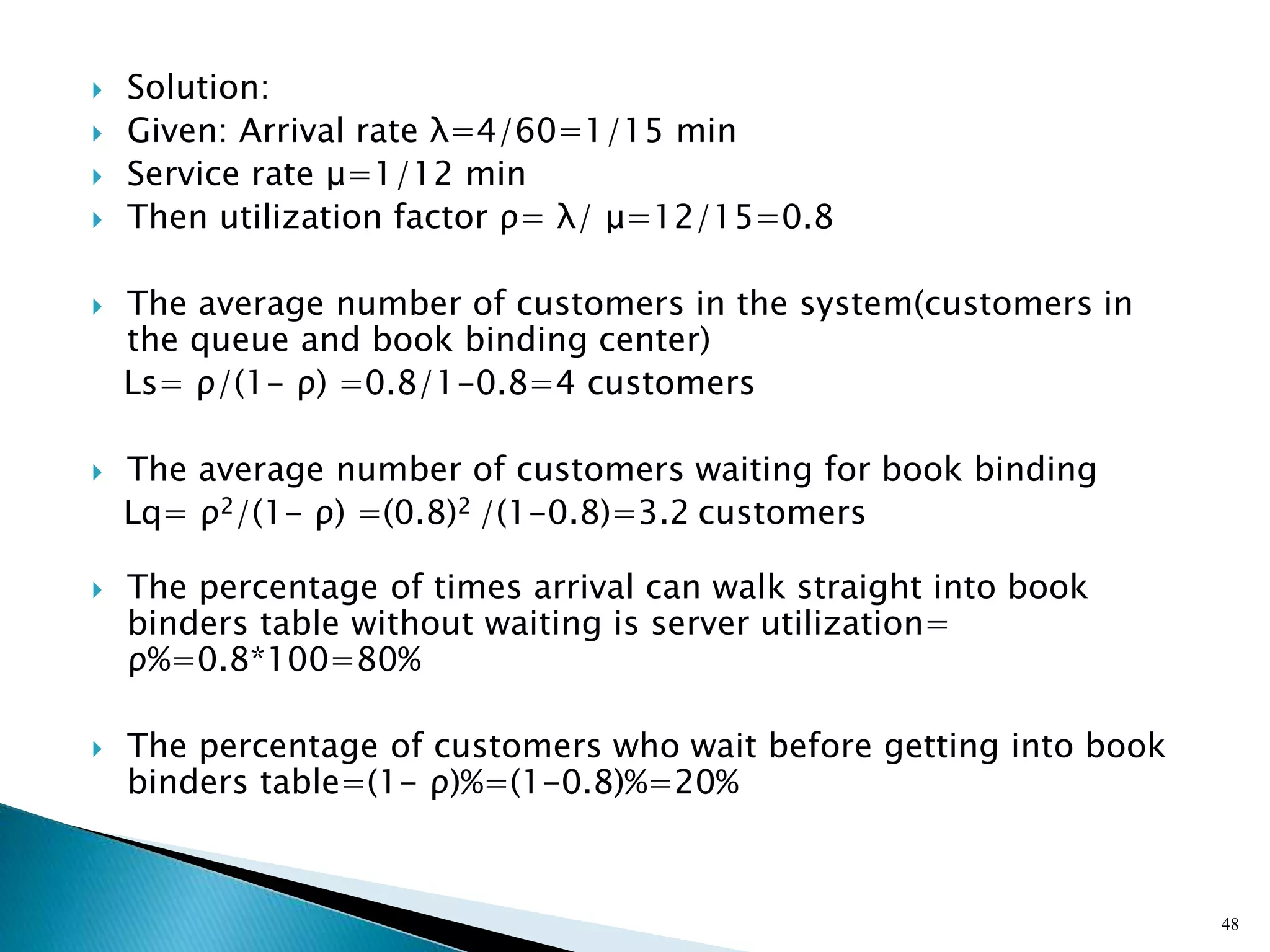
 Given: Arrival rate λ=4/60=1/15 min
 Service rate μ=1/12 min
 Then utilization factor ρ= λ/ μ=12/15=0.8
 The average number of customers in the system(customers in
the queue and book binding center)
Ls= ρ/(1- ρ) =0.8/1-0.8=4 customers
 The average number of customers waiting for book binding
Lq= ρ2/(1- ρ) =(0.8)2 /(1-0.8)=3.2 customers
 The percentage of times arrival can walk straight into book
binders table without waiting is server utilization=
ρ%=0.8*100=80%
 The percentage of customers who wait before getting into book
binders table=(1- ρ)%=(1-0.8)%=20%
48
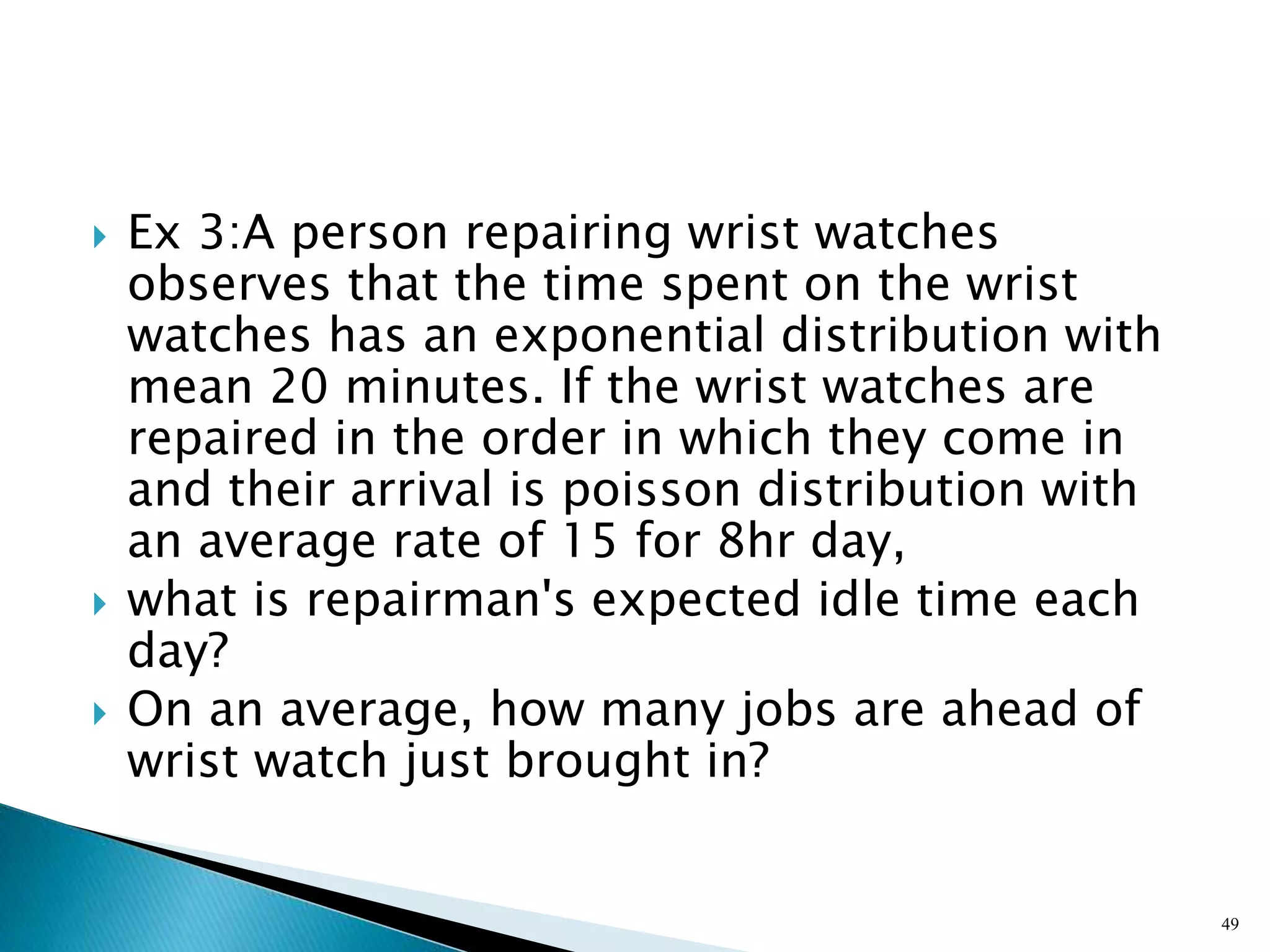
 Ex 3:A person repairing wrist watches
observes that the time spent on the wrist
watches has an exponential distribution with
mean 20 minutes. If the wrist watches are
repaired in the order in which they come in
and their arrival is poisson distribution with
an average rate of 15 for 8hr day,
 what is repairman's expected idle time each
day?
 On an average, how many jobs are ahead of
wrist watch just brought in?
49
 Solution:
 Given: Arrival rate λ=15/(8*60)=1/32 units/min
 Service rate μ=1/20 units/min
 Then utilization factor ρ= λ/ μ=20/32=5/8
 The number of jobs ahead of the wrist watch just
brought in=average number of jobs in the system
Ls= ρ/(1- ρ) =(5/8)/(1-(5/8))=5/3
 The number of hours for which the repairman
remains busy in an 8hr day=8* ρ=8*(5/8)=5hr
 Hence the time for which repairman remains idle in
an 8hr day=8-5=3hrs
50
 Example 4:In a s supermarket, the arrival rate
of customer is 10 every 30 minutes following
poisson process. The average time taken by a
cashier to list and calculate the customers
purchase is 2.5minutes following exponential
distribution.
 A)What is the probability that the queue
length exceeds 6.
 B)What is the expected time spent by
customer in system.
51
 Solution:
 Given: Arrival rate λ=10/30 min=1/3
customers/min
 Service rate μ=1/2.5 customers/min
 Then utilization factor ρ= λ/ μ=3/2.5
 A)Probability that queue length is > 6= ρ6 =0.3348
 B) Expected time spent by the customer in the
system Ws=1/(μ- λ) =1/(0.4-0.33)=14.28minutes
52
 Example 5:In a public telephone booth the
arrival are at the rate 15 per hour. A call on
an average takes 3 minute. If there is just one
phone, find
 A)The expected number of callers in the
booth at any time.
 B)The probability of time the booth is
expected to be idle.
53
 Solution:
 Given: Arrival rate λ=15/60 calls/min=1/4
 Service rate μ=1/3 per min
 Then utilization factor ρ= λ/ μ=3/4
 The expected number of callers in the booth at any
time(Average length of non empty queue)
Ln= μ/(μ- λ)=4 callers
 Probability of busy server is ρ,Hence the probability
of server being idle is (booth expected to be
idle)(1- ρ) =1-(3/4)=1/4=0.25
54
 Example 6:Customers arrive at random at one
window drive in a bunk according to poisson
distribution with 10 per hr. Service time per customer
exponential with mean 5 min. The space in front of
the window including that for serviced car can
accommodate a maximum of 3 cars
 1)what is the probability that an arriving customer
can drive directly to the space in the front of the
window?
 2)what is the probability that an arriving customer
will have to wait outside the indicated space?
 3)How long is an arriving customer expected to wait
before starting service?
55
 Solution:
 Given: Arrival rate λ=10/hr=10/60=1/6 cars/min
 Service rate μ=1/5 cars per min
 Then utilization factor ρ= 5/6
 1)p0+p1+p2=p0+ ρpo+ ρ2p0
=p0(1+ ρ+ ρ2) where po=(1- ρ)
=0.42
2)Probability that arriving customer wait(1-0.42)=0.58
3)Time for which arriving customers wait before
getting service( average waiting time in queue)
Wq=
𝜆
𝜇 𝜇−𝜆
=0.417
56
 In a railway marshalling yard, goods train
arrive at the rate of 30 trains per day.
Assuming that service time follow
exponential distribution with a mean of 36
minutes.calculate the following.
 1)The mean queue size
 The probability that queue size exceeds 10
57
 Solution:
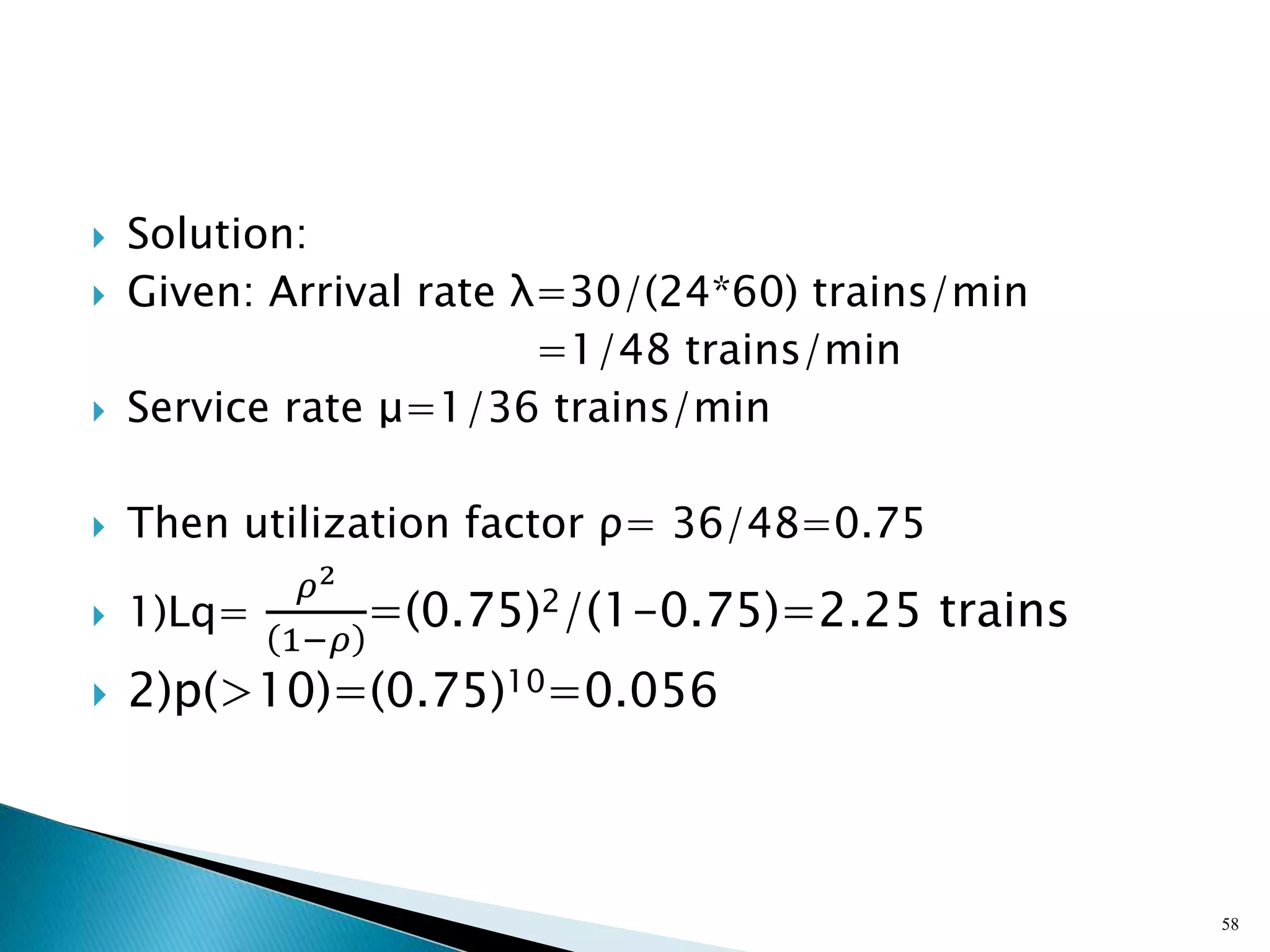
 Given: Arrival rate λ=30/(24*60) trains/min
=1/48 trains/min
 Service rate μ=1/36 trains/min
 Then utilization factor ρ= 36/48=0.75
 1)Lq=
𝜌2
1−𝜌
=(0.75)2/(1-0.75)=2.25 trains
 2)p(>10)=(0.75)10=0.056
58
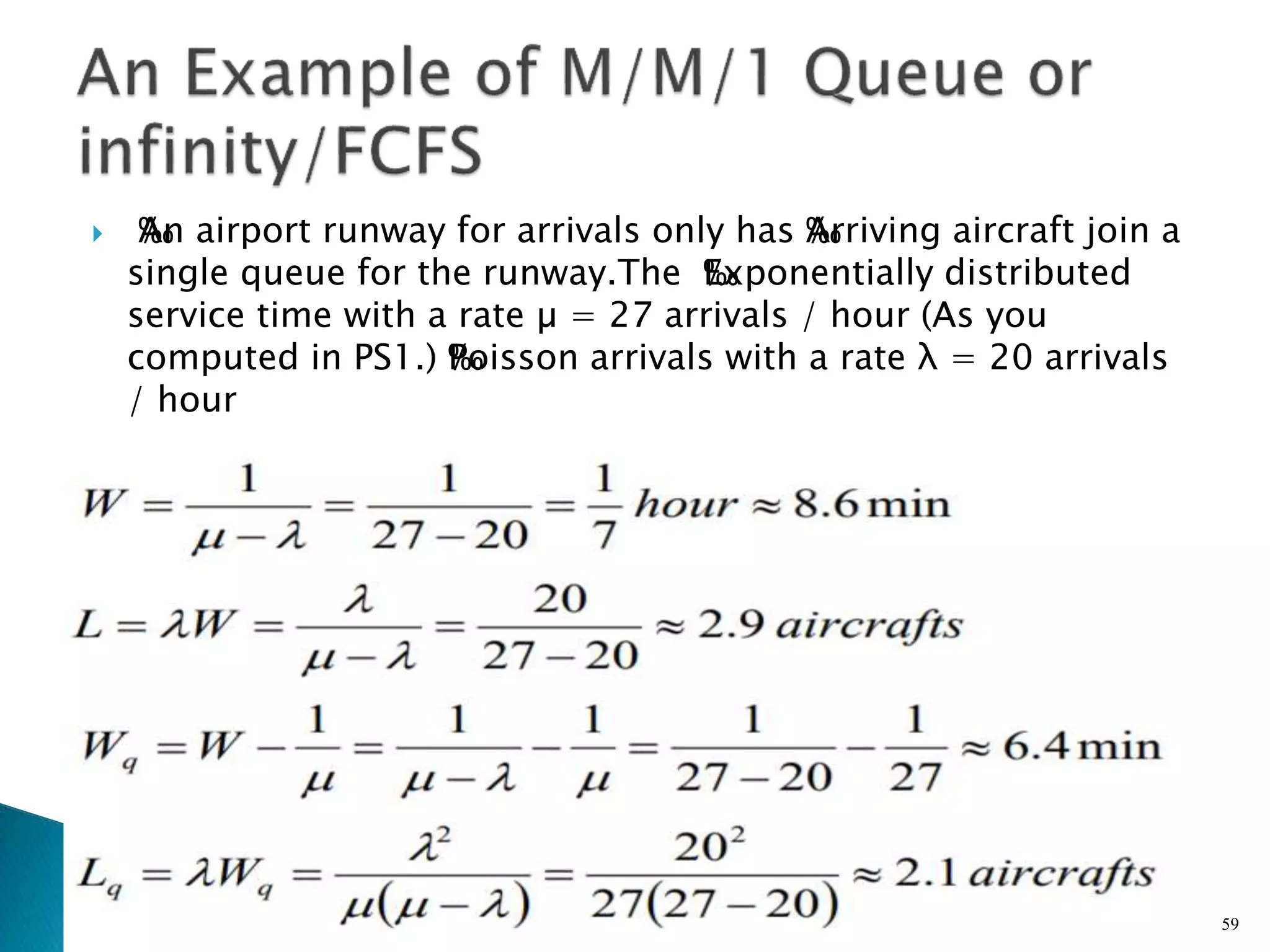
 ‰
An airport runway for arrivals only has ‰
Arriving aircraft join a
single queue for the runway.The ‰
Exponentially distributed
service time with a rate µ = 27 arrivals / hour (As you
computed in PS1.) ‰
Poisson arrivals with a rate λ = 20 arrivals
/ hour
59
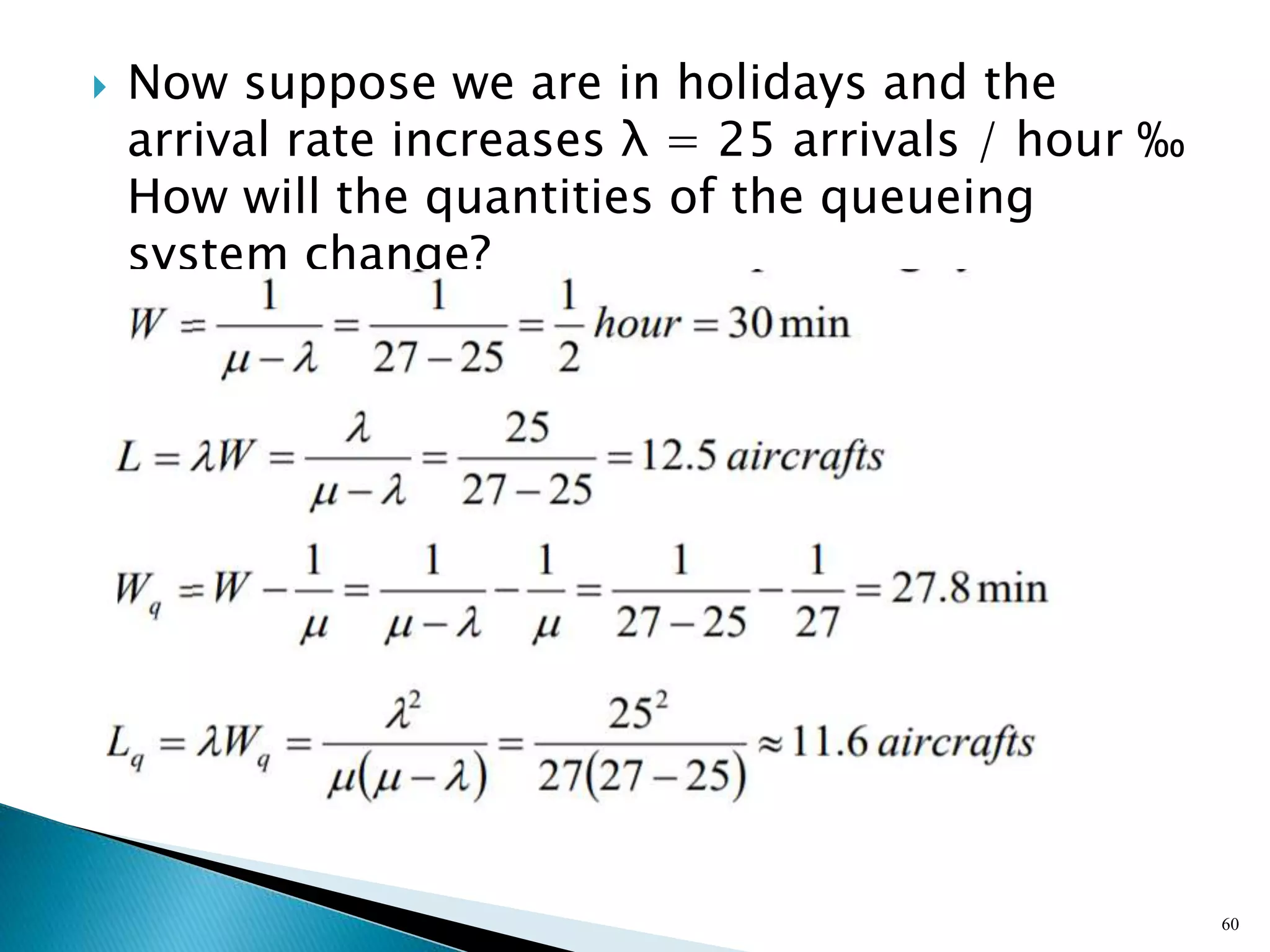
 Now suppose we are in holidays and the
arrival rate increases λ = 25 arrivals / hour ‰
How will the quantities of the queueing
system change?
60
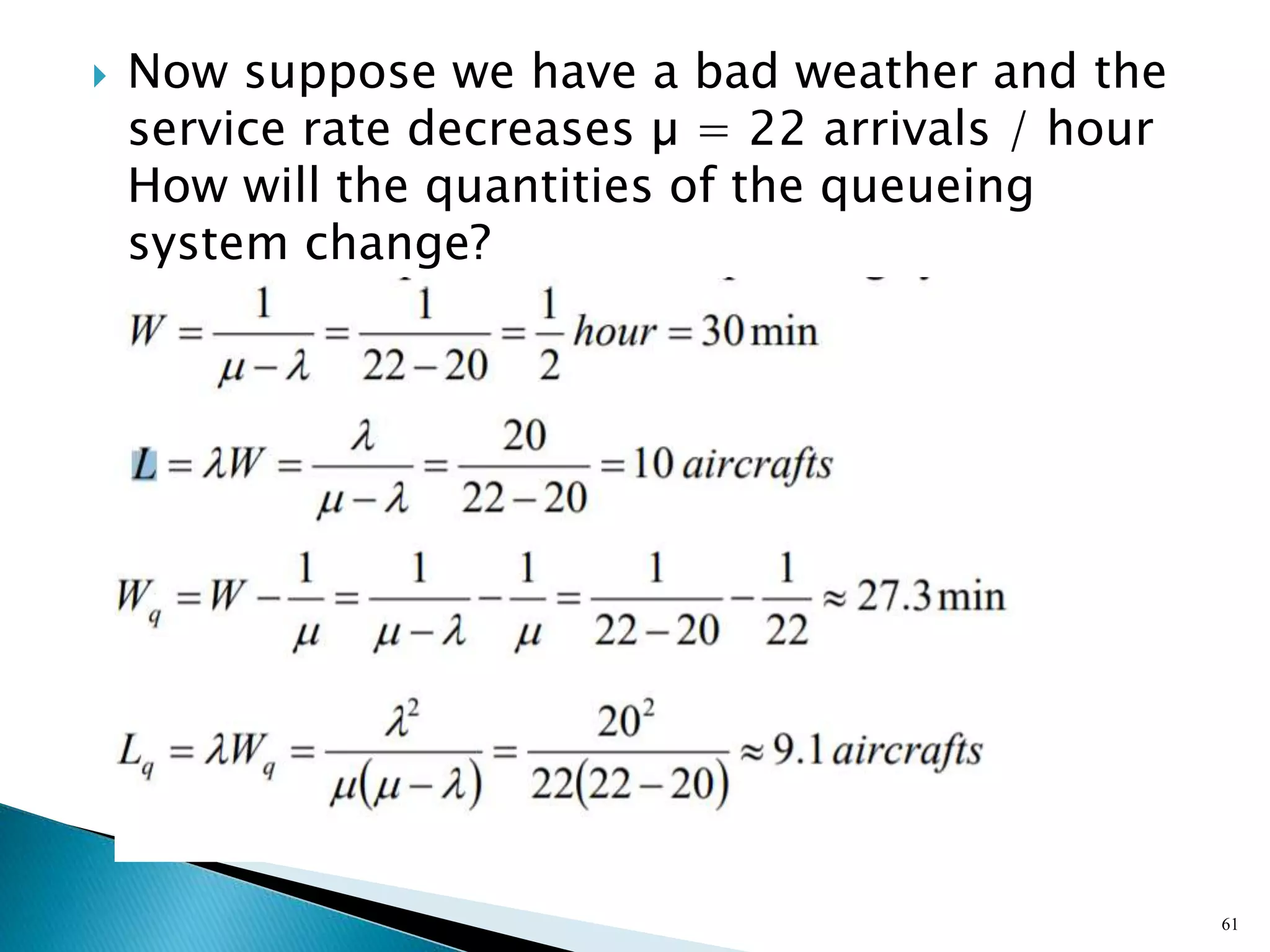
 Now suppose we have a bad weather and the
service rate decreases µ = 22 arrivals / hour
How will the quantities of the queueing
system change?
61
 Codification is used to properly classify equipment's, raw
materials, components and spares to suit the particular
needs of any organisation.
 Codification is helpful to prevent duplication and
multiplicity of stores and the mistakes which are caused by
the normal practice of describing the material.
 Objectives of Codification
• Bringing all similar items together.
• To enable putting up of any future item in its proper place.
• To classify an item according to its characteristics.
• To give a unique code number to each item to avoid
duplication and ambiguity.
62
 A database is a data structure that stores organized
information. Most databases contain multiple tables,
which may each include several different fields.
For example, a company database may include
tables for products, employees, and financial records.
 Databases are used just about everywhere including
banks, retail, websites and warehouses. Banks
use databases to keep track of customer accounts,
balances and deposits.
 Retail stores can use databases to store prices,
customer information, sales information and quantity
on hand.
63

Unit 4 simulation and queing theory(m/m/1)

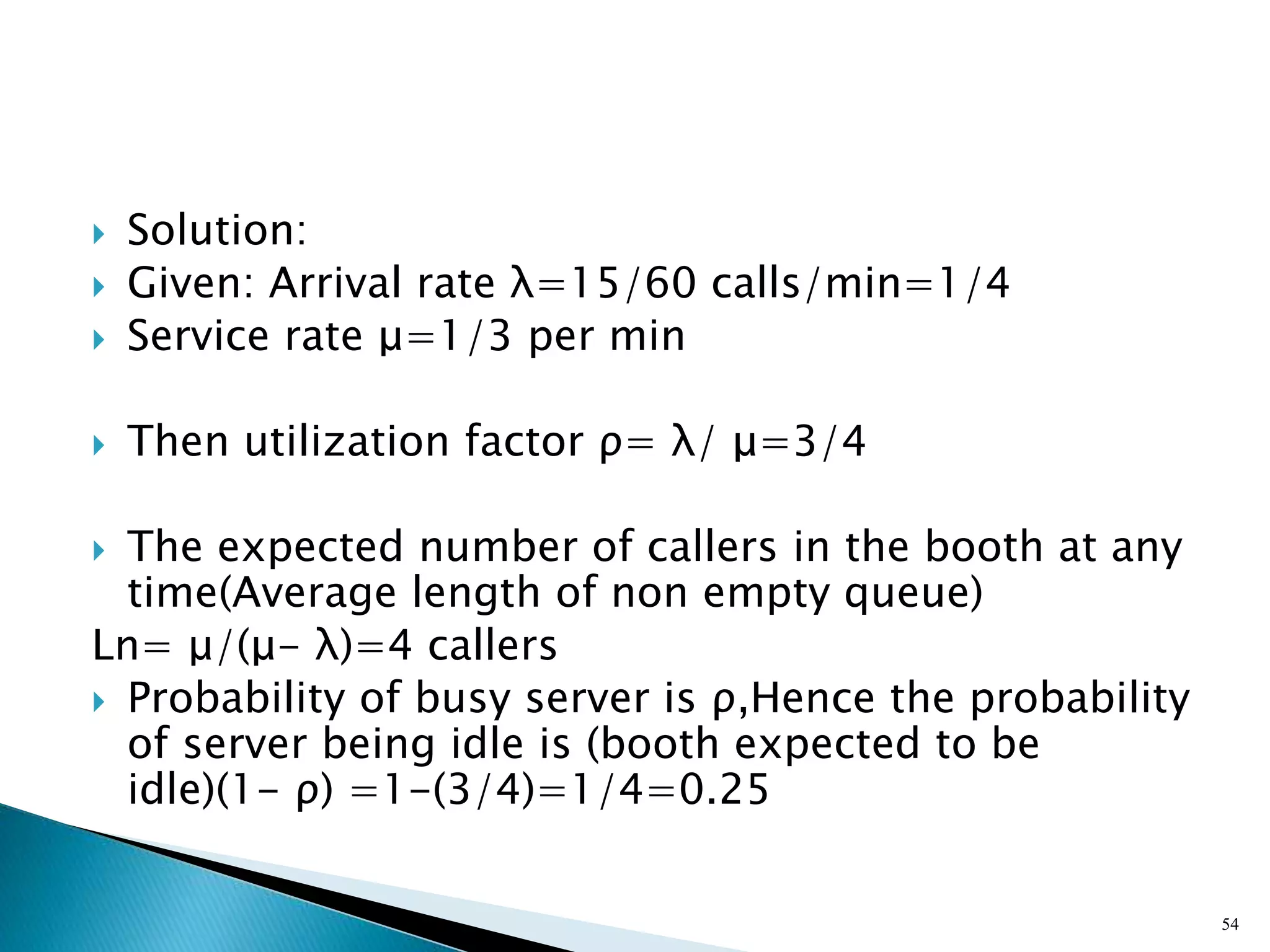
  • 2.
    System: The physicalprocess of interest Model: Mathematical representation of the system ◦ Models are a fundamental tool of science, engineering, business, etc. ◦ Models always have limits of credibility Simulation: A type of model where the computer is used to imitate the behavior of the system Monte Carlo simulation: Simulation that makes use of internally generated (pseudo) random numbers Random Number:Random numbers are numbers that occur in a sequence such that two conditions are met: (1) the values are uniformly distributed over a defined interval or set, and (2) it is not impossible to predict future values based on past or present ones. 2
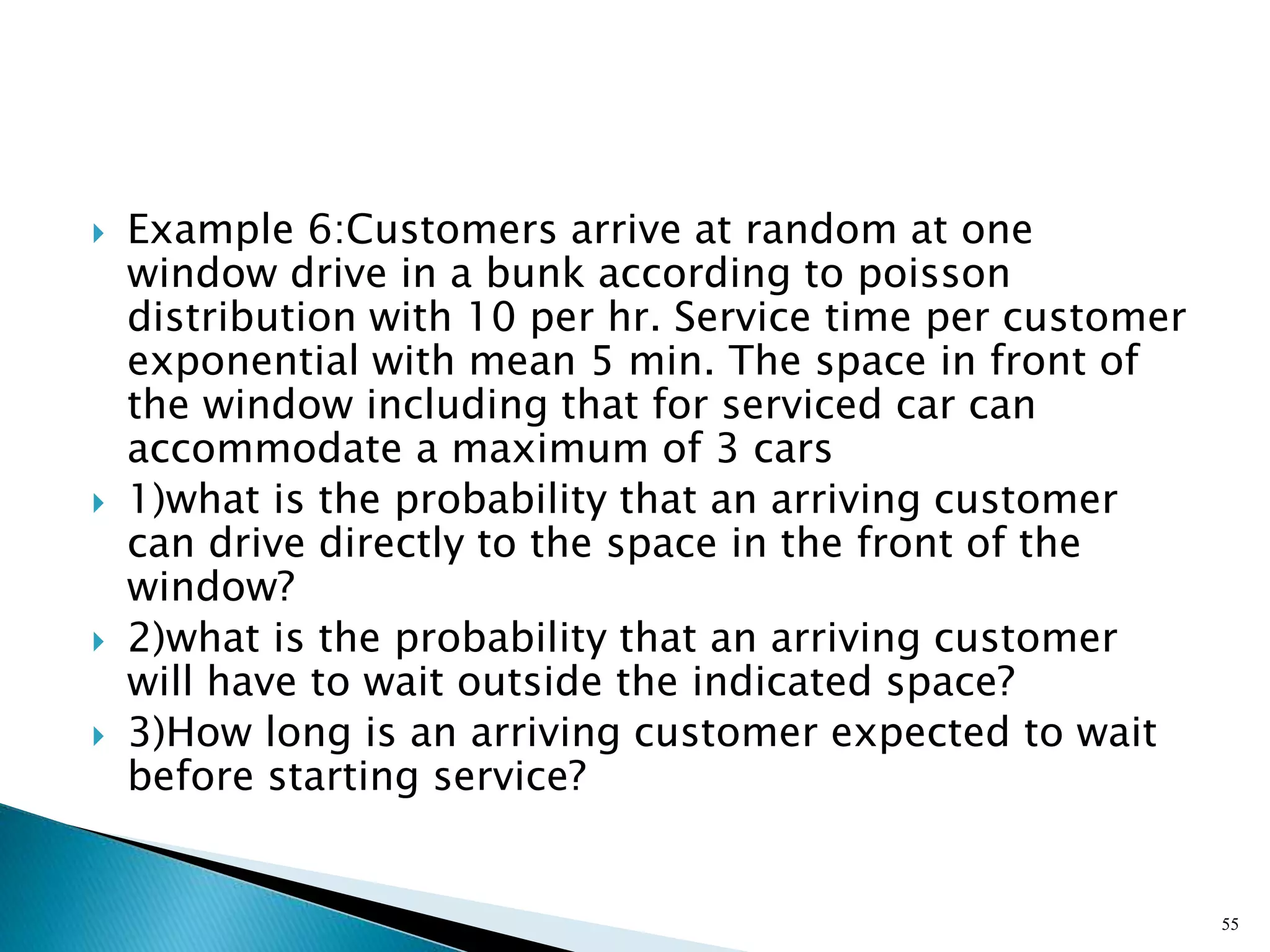
  • 3.
    3 Focus of course System Experimentw/ actual system Experiment w/ model of system Physical Model Mathematical Model Analytical Model Simulation Model
  • 4.
     “The MonteCarlo method is a numerical solution to a problem that models objects interacting with other objects .  A Monte Carlo simulation is a model used to predict the probability of different outcomes when the intervention of random variables is present.  Monte Carlo simulations help to explain the impact of risk and uncertainty in prediction and forecasting models.  A variety of fields utilize Monte Carlo simulations, including finance, engineering, supply chain, and science.  The basis of a Monte Carlo simulation involves assigning multiple values to an uncertain variable to achieve multiple results and then to average the results to obtain an estimate.  It represents an attempt to model nature through direct simulation of the essential dynamics of the system in question.  In this sense the Monte Carlo method is essentially simple in its approach. 4
  • 5.
     Business andfinance are plagued by random variables, Monte Carlo simulations have a vast array of potential applications in these fields.  Monte Carlo Method:  A Monte Carlo simulation takes the variable that has uncertainty and assigns it a random value.  The model is then run and a result is provided.  This process is repeated again and again while assigning the variable in question with many different values.  Once the simulation is complete, the results are averaged together to provide an estimate. 5
  • 6.
    let’s consider asimple system with simple inputs: 6 • As A, B, C and D are always the same, the output will always be the same and it can be easily calculated • Imagine that input A has a range of possible values – the output will also be variable. And when there are many more possible inputs and all of them have a range of possible values, the output is not that simple to calculate. • That’s where you need to use Monte Carlo simulation.
  • 7.
     Steps inmonte carlo simulation:  Step 1:Clearly define the problem.  Step 2:Construct the appropriate model.  Step 3:Prepare the model for experimentation.  Step 4:Using step 1 to 3,experiment with the model.  Step 5:Summarise and examine the results obtained in step 4.  Step 5:Evaluate the results of the simulation. 7
  • 8.
     A manufacturingcompany keeps stock of a special product. Previous experience indicates the daily demand as given below 8 Daily demand 5 10 15 20 25 30 probability 0.01 0.20 0.15 0.50 0.12 0.02 Simulate the demand for the next 10 days. Also find the daily average demand for that product on the basis of simulated data. Consider the following random numbers: 82,96,18,96,20,84,56,11,52,03
  • 9.
     Solution: Step1:Generate tag values 9 Daily demands Probability Cumulative probability Tag values(Random num range) 5 0.01 0.01 00-00 10 0.20 0.21 01-20 15 0.15 0.36 21-35 20 0.50 0.86 36-85 25 0.12 0.98 86-97 30 0.02 1.00 98-99 Step 2: Simulate for 10 days Days Random num Daily demand 1 82 20 2 96 25 3 18 10 4 96 25 5 20 10 6 84 20 7 56 20 8 11 10 9 52 20 10 03 10 Average demand=(20+25+10+25+10+20+20+10+20+10)/10 =170/10=17 units/day
  • 10.
     2)A touristcar operator finds that during the past few months the cars use has varied so much that the cost of maintaining the car varied considerably. During the past 200 days the demand for the car fluctuated as below 10 Trips per week Frequency 0 16 1 24 2 30 3 60 4 40 5 30 Using random numbers 82,96,18,96,20,84,56,11,52,03, simulate the demand for 10 week period
  • 11.
     Solution: Step1:Generate tag values 11 Trips/week frequency Probability Cumulative probability Tag values 0 16 16/200=0.08 0.08 00-07 1 24 24/200=0.12 0.20 08-19 2 30 30/200=0.15 0.35 20-34 3 60 60/200=0.30 0.65 35-64 4 40 40/200=0.20 0.85 65-84 5 30 30/200=0.15 1.00 85-99 Frequency-Number of occurrences, Total num of occurrences(16+24+30+60+40+30)=200 Step 2: Simulation for next 10 week Weeks Random Num Trips/week 1 82 4 2 96 5 3 18 1 4 96 5 5 20 2 6 84 4 7 56 3 8 11 1 9 52 3 10 03 0 Avg trips/week=28/10=2.8≈3 trips/week
  • 12.
     For aparticular shop the daily demand of an item is given as follows, Use random numbers 25,39,65,76,12,05,73,89,19,49.Find the average daily demand.  Daily demand 5 10 15 20 25 30  Probability 0.01 0.20 0.15 0.50 0.12 0.02 Solution: Generate tag values 12 Daily demand Probability Cumulative probability Tag values 0 0.01 0.01 00 10 0.20 0.21 01-20 20 0.15 0.36 21-35 30 0.50 0.86 36-85 40 0.12 0.98 86-97 50 0.02 1.00 98-99
  • 13.
     Step 2:Simulation for 10 days 13 Days Random num Daily demand 1 25 20 2 39 30 3 65 30 4 76 30 5 12 10 6 05 10 7 73 30 8 89 40 9 19 10 10 49 30 Avg daily demand= 240/10=24
  • 14.
     An automobilecompany manufactures around 150 scooters.Daily production varies from 146 to 154,the probability distribution is given below.  Step 1:Generate tag values for production/day  Step 1:Generate tag values for production/day 14 Production /day 146 147 148 149 150 151 152 153 154 probability 0.04 0.09 0.12 0.14 0.11 0.10 0.20 0.12 0.08 The finished scooters are transported in a lorry accomodading150 scooters. using the following random numbers 80,81,76,75,64,43,18,26,10,12,65,68,69,61,57 simulate 1)Average number of scooters waiting in the factory 2)Average number of empty space in the lorry
  • 15.
     Step 1:Generatetag values for production/day 15 Production/day probability Cumulative probability Tag values 146 0.04 0.04 00-03 147 0.09 0.13 04-12 148 0.12 0.25 13-24 149 0.14 0.39 25-38 150 0.11 0.50 39-49 151 0.10 0.60 50-59 152 0.20 0.80 60-79 153 0.12 0.92 80-91 154 0.08 1.00 92-99 Step 2: Simulate for 15 days to get avg no of waiting scooters and empty space, lorry can accommodate 150 scooters Days Random num Production/day No of scooters waiting No of empty space in lorry 1 80 153 3 - 2 81 153 3 - 3 76 152 2 - 4 75 152 2 - 5 64 152 2 - 6 43 150 - - 7 18 148 - 2 8 26 149 - 1 9 10 147 - 3 10 12 147 - 3 11 65 152 2 - 12 68 152 2 - 13 69 152 2 - 14 61 152 2 - 15 57 151 1 - Total=21 Total=9 Avg no of scooters waiting= 21/15=1.4 Avg No of space in the lorry= 9/15=0.6
  • 16.
     An automobileproduction line turns out about 100 cars/day, but deviation occur owing to many causes.Production of cars are described by the probability distribution given below. 16 Productio n/day 95 96 97 98 99 100 101 102 103 104 105 probabilit y 0.0 3 0.05 0.0 7 0.10 0.1 5 0.20 0.15 0.10 0.07 0.05 0.03 Finished cars are transported across the bay at the end of each day by ferry. If ferry has space for only 101 cars, what will be the average number of cars waiting to be shipped and what will be the average number of empty space on ship? Simulate the production of cars for next 15 days, consider the random numbers 97,02,80,66,96,55,50,29,58,51,04,86,24,39,47.
  • 17.
     Step 1:generatetag values 17 Production/d ay Probabilli ty Cumulative probability Tag values 95 0.03 0.03 00-02 96 0.05 0.08 03-07 97 0.07 0.15 08-14 98 0.10 0.25 15-24 99 0.15 0.40 25-39 100 0.20 0.60 40-59 101 0.15 0.75 60-74 102 0.10 0.85 75-84 103 0.07 0.92 85-91 104 0.05 0.97 92-96 105 0.03 1.00 97-99
  • 18.
     Step 2:Simulatefor 15 days, ferry can transport 101 cars 18 Days Random numbers Productions/day No of cars waiting Empty space in the ship 1 97 105 |105-101|=4 - 2 02 95 - (101-95) =6 3 80 102 1 4 66 101 - - 5 96 104 3 - 6 55 100 - 1 7 50 100 - 1 8 29 99 - 2 9 58 100 - 1 10 51 100 - 1 11 04 96 - 5 12 86 103 2 - 13 24 98 - 3 14 39 99 - 2 15 47 100 - 1 Total=10 Total=23 Avg num of cars waiting=10/15 Avg empty space in the ship=23/15
  • 19.
     Strong isa dentist who schedules all her patients for 30 minutes appointment. Some of the patients take more or less than 30min depending on the type of dental works to be done. The following summary shows the various categories of work, their frequency and the time actually needed to complete the work 19 Category Filling crown cleaning extracting checkup Time required 45 60 15 45 15 Number of patients 40 15 15 10 20 Simulate the dentist clinic for 4 hrs and find out the avg waiting time for the patients as well as the idleness of doctor.Assume that the patients show up at the clinic at exactly scheduled time. Arrival time starts at 8AM.Use the following random number for handling the same 40,82,11,34,25,66,19,79
  • 20.
    category Time required No of patients(Frequen cy) probabilityCumulative probability Tag values Filling 45 40 0.40 0.40 00-39 Crown 60 15 0.15 0.55 40-54 Cleaning 15 15 0.15 0.70 55-69 Extracting 45 10 0.10 0.80 70-79 Checkup 15 20 0.20 1.00 80-99 Total=100 20 Random num Categor y Time required (min) Arrival time of patients Service time Start time End time waiting time for patients(mi n) Idleness of doctor 40 crown 60 8.00 8.00 9.00 0 - 82 checkup 15 8.30 9.00 9.15 30(9-8.30) - 11 Filling 45 9.00 9.15 10.00 15 - 34 Filling 45 9.30 10.00 10.45 30 - 25 Filling 45 10.00 10.45 11.30 45 - 66 Cleaning 15 10.30 11.30 11.45 60 - 19 Filling 45 11.00 11.45 12.30 45 - 79 Extractin g 45 11.30 12.30 1.15 60 - Step 1:find the cumulative probability and tag values Step 2:Simulate for 4 hrs Avg waiting time for patients=(30+15+30+45+60+45+60)/8=285/8=35.62 min≈36min Waiting time for patients=(start time of service-arrival time)
  • 21.
     Bright Bakerykeeps stock of a popular brand of cake. Previous experience indicates the daily demand as given below:  Consider the following sequence of random numbers; 48, 78, 19, 51, 56, 77, 15, 14, 68,09. Using this sequence simulate the demand for the next 10 days. Find out the stock situation if the owner of the bakery decides to make 30 cakes every day. Also estimate the daily average demand for the cakes on the basis of simulated data. 21 Daily demand 0 10 20 30 40 50 Probability 0.01 0.20 0.15 0.50 0.12 0.02
  • 22.
    Daily demand ProbabilityCumulative probability Tag values 0 0.01 0.01 00 10 0.20 0.21 01-20 20 0.15 0.36 21-35 30 0.50 0.86 36-85 40 0.12 0.98 86-97 50 0.02 1.00 98-99 22 Step 1:find the cumulative probability and tag values Step 2:Simulate for 10 days, make 30 cakes every day Days Random num Daily Demand Stock condition 1 48 30 - 2 78 30 - 3 19 10 20 4 51 30 - 5 56 30 - 6 77 30 - 7 15 10 20 8 14 10 20 9 68 30 - 10 09 10 20 Avg daily demand=220/10=22
  • 23.
     An airportentry has only one check-in counter, customers arrive at this counter at random from 1 to 6 min,each interarrival time has same probability of occurrence’s, probability for service time is given below. Service time(ST ) 1 2 3 4 5 6 Probabi lity 0.1 0 0.20 0.25 0.30 0.10 0.05 Develop a simulation table for 10 customers. Consider the random number for inter arrival time(IAT) as 13,27,15,48,9,22,53,35,2 and RN for ST as 84,10,74,53,17,91,79,67,38,89. 1.Calculate avg ST, avg time between arrival, waiting time of customer, avg time spent by customer in system,avg waiting time of customers those who wait.
  • 24.
     step 1:tagvalues for service time Service time probability Cumulative probability Tag values 1 0.10 0.10 00-09 2 0.20 0.30 10-29 3 0.25 0.55 30-54 4 0.30 0.85 55-84 5 0.10 0.95 85-94 6 0.05 1.00 95-99 Step 2: tag values for IAT, equal probability of occurance[out of 6 option any one can occur, 1/6=0.166666667=0.17(approx.)] Inter arrival time probability Cumulative probability Tag values 1 1/6=0.17 0.17 00-16 2 0.17 0.34 17-33 3 0.17 0.51 34-50 4 0.17 0.68 51-67 5 0.17 0.85 68-84 6 0.17 1.00 85-99
  • 25.
     Simulation for10 customers Customer no RN for IAT IAT AT RN for ST Service time Service time WT for customer Time spent by customer in system begin end 1 - - 0 84 4 0 4 - (4-0)=4 2 13 1 1 10 2 4 6 (4-1)=3 (6-1)=5 3 27 2 3 74 4 6 10 (6-3)=3 (10-3)=7 4 15 1 4 53 3 10 13 6 (13-4)=9 5 48 3 7 17 2 13 15 6 (15-7)=8 6 9 1 8 91 5 15 20 7 (20-8)=12 7 22 2 10 79 4 20 24 10 (24- 10)=14 8 53 4 14 67 4 24 28 10 (28- 14)=14 9 35 3 17 38 3 28 31 11 (31- 17)=14 10 2 1 18 89 5 31 36 13 (36- 18)=18 Total=1 8 Total=3 6 Total=69 Total=105
  • 26.
     Time spentby customer in the system= (service end time-arrival time)  Avg waiting time=total WT/total customers =69/10=6.9min  Avg time spent by the customer in the system=105/10=10.5  Avg service time=36/10=3.6≈4min  Avg time between arrival=18/10=1.8≈2min  Avg waiting time of customers those who wait=69/9=7.66=total waiting time of customers/number of customers waiting
  • 27.
     A Grocerystore has only one checkout counter counter, customers arrive at this counter at random from 1 to 8 min,each interarrival time has same probability of occurance.The probability for service time is given below Service time(ST) 1 2 3 4 5 6 probabili ty 0.10 0.20 0.30 0.25 0.10 0.05 Simulate the arrival for 10 customers. Consider the random number for inter arrival time(IAT) as 913,727,015,948,309,922,753,235,302 and RN for ST as 84,10,74,53,17,91,79,67,89,38. 1.Calculate avg WT, avg ST,avg time between arrival, avg time spent by customer in queue, avg waiting time of customers those who wait.
  • 28.
     Step1: Generatetag vales for service time  , Service time(ST) probabili ty Cumulative probability Tag values 1 0.10 0.10 00-09 2 0.20 0.30 10-29 3 0.30 0.60 30-59 4 0.25 0.85 60-84 5 0.10 0.95 85-94 6 0.05 1.00 95-99 Step 2: Generate tag values for IAT, Given that P=1/8=0.125 Inter arrival time probability Cumulative probability Tag values 1 0.125 0.125 000-124 2 0.125 0.250 125-249 3 0.125 0.375 250-374 4 0.125 0.500 375-499 5 0.125 0.625 500-624 6 0.125 0.750 625-749 7 0.125 0.875 750-874 8 0.125 1.000 875-999
  • 29.
     Step 3:simulationfor 10 customers Custome r no RN for IAT IAT AT RN for ST ST Service time Time in Queue Time spent in system Idle time for server Begin End 1 - - 0 84 4 0 4 - (4-0)=4 - 2 913 8 8 10 2 8 10 - (10-8)=2 (8-4)=4 3 727 6 14 74 4 14 18 - 4 (14- 10)=4 4 15 1 15 53 3 18 21 (18- 15)=3 6 - 5 948 8 23 17 2 23 25 - 2 2 6 309 3 26 91 5 26 31 - 5 1 7 922 8 34 79 4 34 38 - 4 3 8 753 7 41 67 4 41 45 - 4 3 9 235 2 43 89 5 45 50 (45- 43)=2 7 - 10 302 3 46 38 3 50 53 (50- 46)=4 7 - Total 46 36 9 45 17
  • 30.
     Avg ST=36/10=3.6min Avg time between arrival=46/10=4.6 min  Avg time spent by customer in the queue(WT)=9/10=0.9min  Avg time spent by customer in the system=45/10=4.5min  Avg idle time of server=17/10  Avg waiting time of those who wait=9/3=3min
  • 31.
     Ex 4:Considera store with one checkout counter.prepare a simulation table and find the avg waiting time of customers in queue,avd idle time of server,avg service time.consider the following data. IAT 3 2 6 4 4 5 8 7 Sevice time 4 5 5 8 4 6 2 3 4
  • 32.
    Customer no IAT Arrival timeST Service time WT Idle time of server Time spent in system Begin End 1 - 0 4 0 4 - - 4 2 3 3 5 4 9 1 - 6 3 2 5 5 9 14 4 - 9 4 6 11 8 14 22 3 - 11 5 4 15 4 22 26 7 - 11 6 4 19 6 26 32 7 - 13 7 5 24 2 32 34 8 - 10 8 8 32 3 34 37 2 - 5 9 7 39 4 39 43 - 2 4 41 Total=32 73 Since the inter arrival time and service time are specified in the problem, simulation for 9 customers is given in the following table Avg waiting time of those who wait=32/7=4.57 Avg service time=41/9=4.55 Avg Waiting Time=32/9 Idle time of server=2/9=0.22 Avg time spent in the system=73/9=8.1
  • 33.
     Simulation isoften used in the analysis of queueing models.  A simple but typical queueing model  Queueing models provide the analyst with a powerful tool for designing and evaluating the performance of queueing systems.  queuing situation involves two parts. 1. Someone or something that requests a service—usually referred to as the customer, job, or request. 2. Someone or something that completes or delivers the services— usually referred to as the server.  Typical measures of system performance, Server utilization, length of waiting lines, and delays of customers.  For relatively simple systems: compute mathematically  For realistic models of complex systems: simulation is usually required
  • 34.
     A queueingsystem is described by  Calling population  Arrival rate  Service mechanism  System capacity  Queueing discipline
  • 35.
     Calling population:the population of potential customers, may be assumed to be finite or infinite.  Finite population model: if arrival rate depends on the number of customers being served and waiting, e.g., model of corporate jet, if it is being repaired, the repair arrival rate becomes zero.  Infinite population model: if arrival rate is not affected by the number of customers being served and waiting, e.g., systems with large population of potential customers.
  • 36.
     System Capacity:A limit on the number of customers that may be in the waiting line or system.  Limited capacity, e.g., an automatic car wash only has room for 10,cars to wait in line to enter the mechanism.  If system is full no customers are accepted anymore  Unlimited capacity, e.g., concert ticket sales with no limit on the number of people allowed to wait to purchase tickets.
  • 37.
     For infinite-populationmodels:  • In terms of interarrival times of successive customers.  • Arrival types:  Random arrivals: interarrival times usually characterized by a probability distribution.  Scheduled arrivals: interarrival times can be constant or constant plus or minus a small random amount to represent early or late arrivals.  • Example: patients to a physician or scheduled airline flight arrivals to an airport  At least one customer is assumed to always be present,so the server is never idle, e.g., sufficient raw material for a machine.
  • 38.
     Queue behavior:the actions of customers while in a queue waiting for service to begin, for example: leave when they see that the line is too long, leave after being in the line when its moving too slowly , move from one line to a shorter line  Most queuing formula assume that all arrivals stay until service is completed  Balking refers to customers who do not join the queue  Reneging refers to customers who join the queue but give up and leave before completing service.  Jockeying: refers to waiting customers move from one queue to another.  Queue discipline: the logical ordering of customers in a queue that determines which customer is chosen for service when a server becomes free, for example:  • First-in-first-out (FIFO)  • Last-in-first-out (LIFO)  • Service in random order (SIRO)  • Shortest processing time first (SPT)  • Service according to priority (PR)
  • 39.
     In queuingsystem, service time is defines as the time required to serve a custom.May be constant or random.  The service mechanism is the way that customers receive service once they are selected from the front of a queue. • service mechanism: • a description of the resources needed for service to begin • how long the service will take (the service time distribution) • the number of servers available • whether the servers are in series (each server has a separate queue) or in parallel (one queue for all servers) • whether pre-emption is allowed (a server can stop processing a customer to deal with another "emergency" customer)  Assuming that the service times for customers are independent and do not depend upon the arrival process is common.  Service mechanism in a queuing system is characterized by Server’s behavior.
  • 40.
     A =Arrival distribution (M for Poisson, D for deterministic, and G for general)  B = Service time distribution (M for exponential, D for deterministic, and G for general)  S = number of servers  c=calling population  d=service discipline 40
  • 41.
     An M/M/1queue is a stochastic process whose state space(set of all possible combination of system) is the set {0,1,2,3,...} where the value corresponds to the number of customers in the system, including any currently in service. • Arrivals occur at rate λ according to a Poisson process and move the process from state i to i + 1. • Service times have an exponential distribution with rate parameter μ in the M/M/1 queue, where 1/μ is the mean service time. • A single server serves customers one at a time from the front of the queue, according to a first-come, first-served discipline. When the service is complete the customer leaves the queue and the number of customers in the system reduces by one. • The buffer is of infinite size, so there is no limit on the number of customers it can contain. 41
  • 42.
     ρ =utilization factor (probability of all servers being busy)  Lq = average number in the queue  L or Ls = average number in the system  Wq = average waiting time in the queue  W or Ws = average time in the system  P0 = probability of 0 customers in system  Pn = probability of exactly n customers in system  λ =Arrival rate  μ=Service rate 42
  • 43.
  • 44.
    1. Average serverutilization or traffic density 𝜌 = 𝜆 𝜇 2. Average number of customers waiting In queue 𝐿𝑞 = 𝜆2 𝜇 𝜇−𝜆 = 𝜌2 1−𝜌 In the system 𝐿𝑠 = 𝜌 1−𝜌 3. Average time customer is waiting In the queue 𝑤𝑞 = 𝜆 𝜇 𝜇−𝜆 In the system 𝑤𝑠 = 1 𝜇−𝜆 4. Probability of 0 customers in system 𝑝0 = 1 − 𝜆 𝜇 = 1 − 𝜌 5. Probability of exactly n customers in system 𝑝𝑛 = 𝜆 𝜇 𝑛 𝑝0 = 𝜌𝑛 1 − 𝜌 = 𝜌𝑛 𝑝0 6.Average length of non empty queue 𝐿𝑛 = 𝜇 𝜇−𝜆 7.Probabili ty that the number of customers is greater than k, 𝑃 𝑛 ≥ 𝑘 = 𝜌𝑘 44
  • 45.
     Ex 1:Thearrival rate of customers at a petrol bunk follows a poisson distribution with a rate of 27 per hour. The petrol bunk has only one unit of service. The service rate at the petrol bunk has exponential distribution with rate of 36 per hour. Determine the following.  1)What is probability of having zero customers in the system?  What is probability of having 6 customers in the system?  What is probability of having 10 customers in the system?  The values of Ls, Lq, Ws, Wq 45
  • 46.
     Solution:  Given:Arrival rate λ=27per hour  Service rate μ=36/hr  Then utilization factor ρ= λ/ μ=27/36=0.75  The probability of having 0 customers in system P0= ρ0(1- ρ)=1- ρ=1-0.75=0.25  The probability of having 6 customers in the system P6= ρ6(1- ρ)=0.0178(1- 0.75)=0.0445  The probability of having 10 customers in the system P10= ρ10(1- ρ)=0.0563(1- 0.75)=0.0141  Ls= ρ/(1- ρ) =0.75/(1-0.75)=3 customers  Lq= ρ2 /(1- ρ) =0.752/ /(1-0.75)=2.25 customers  Ws=1/(μ- λ) =1/(36-27)=0.011 hr  Wq= ρ/(μ- λ) =0.75/(36-27)=0.0833 hr 46
  • 47.
     Ex 2:Atone man book binding centre, customers arrive according to poisson distribution with arrival rate of 4 per hour and the book binding time is exponentially distributed with a mean of 12 minutes. Find out the following.  The average number of customers in the book binding centre  The average number of customers waiting for book binding.  The percentage of time arrival can walk in straight without having to wait.  The percentage of customers who have to wait before getting into book binders table. 47
  • 48.
     Solution:  Given:Arrival rate λ=4/60=1/15 min  Service rate μ=1/12 min  Then utilization factor ρ= λ/ μ=12/15=0.8  The average number of customers in the system(customers in the queue and book binding center) Ls= ρ/(1- ρ) =0.8/1-0.8=4 customers  The average number of customers waiting for book binding Lq= ρ2/(1- ρ) =(0.8)2 /(1-0.8)=3.2 customers  The percentage of times arrival can walk straight into book binders table without waiting is server utilization= ρ%=0.8*100=80%  The percentage of customers who wait before getting into book binders table=(1- ρ)%=(1-0.8)%=20% 48
  • 49.
     Ex 3:Aperson repairing wrist watches observes that the time spent on the wrist watches has an exponential distribution with mean 20 minutes. If the wrist watches are repaired in the order in which they come in and their arrival is poisson distribution with an average rate of 15 for 8hr day,  what is repairman's expected idle time each day?  On an average, how many jobs are ahead of wrist watch just brought in? 49
  • 50.
     Solution:  Given:Arrival rate λ=15/(8*60)=1/32 units/min  Service rate μ=1/20 units/min  Then utilization factor ρ= λ/ μ=20/32=5/8  The number of jobs ahead of the wrist watch just brought in=average number of jobs in the system Ls= ρ/(1- ρ) =(5/8)/(1-(5/8))=5/3  The number of hours for which the repairman remains busy in an 8hr day=8* ρ=8*(5/8)=5hr  Hence the time for which repairman remains idle in an 8hr day=8-5=3hrs 50
  • 51.
     Example 4:Ina s supermarket, the arrival rate of customer is 10 every 30 minutes following poisson process. The average time taken by a cashier to list and calculate the customers purchase is 2.5minutes following exponential distribution.  A)What is the probability that the queue length exceeds 6.  B)What is the expected time spent by customer in system. 51
  • 52.
     Solution:  Given:Arrival rate λ=10/30 min=1/3 customers/min  Service rate μ=1/2.5 customers/min  Then utilization factor ρ= λ/ μ=3/2.5  A)Probability that queue length is > 6= ρ6 =0.3348  B) Expected time spent by the customer in the system Ws=1/(μ- λ) =1/(0.4-0.33)=14.28minutes 52
  • 53.
     Example 5:Ina public telephone booth the arrival are at the rate 15 per hour. A call on an average takes 3 minute. If there is just one phone, find  A)The expected number of callers in the booth at any time.  B)The probability of time the booth is expected to be idle. 53
  • 54.
     Solution:  Given:Arrival rate λ=15/60 calls/min=1/4  Service rate μ=1/3 per min  Then utilization factor ρ= λ/ μ=3/4  The expected number of callers in the booth at any time(Average length of non empty queue) Ln= μ/(μ- λ)=4 callers  Probability of busy server is ρ,Hence the probability of server being idle is (booth expected to be idle)(1- ρ) =1-(3/4)=1/4=0.25 54
  • 55.
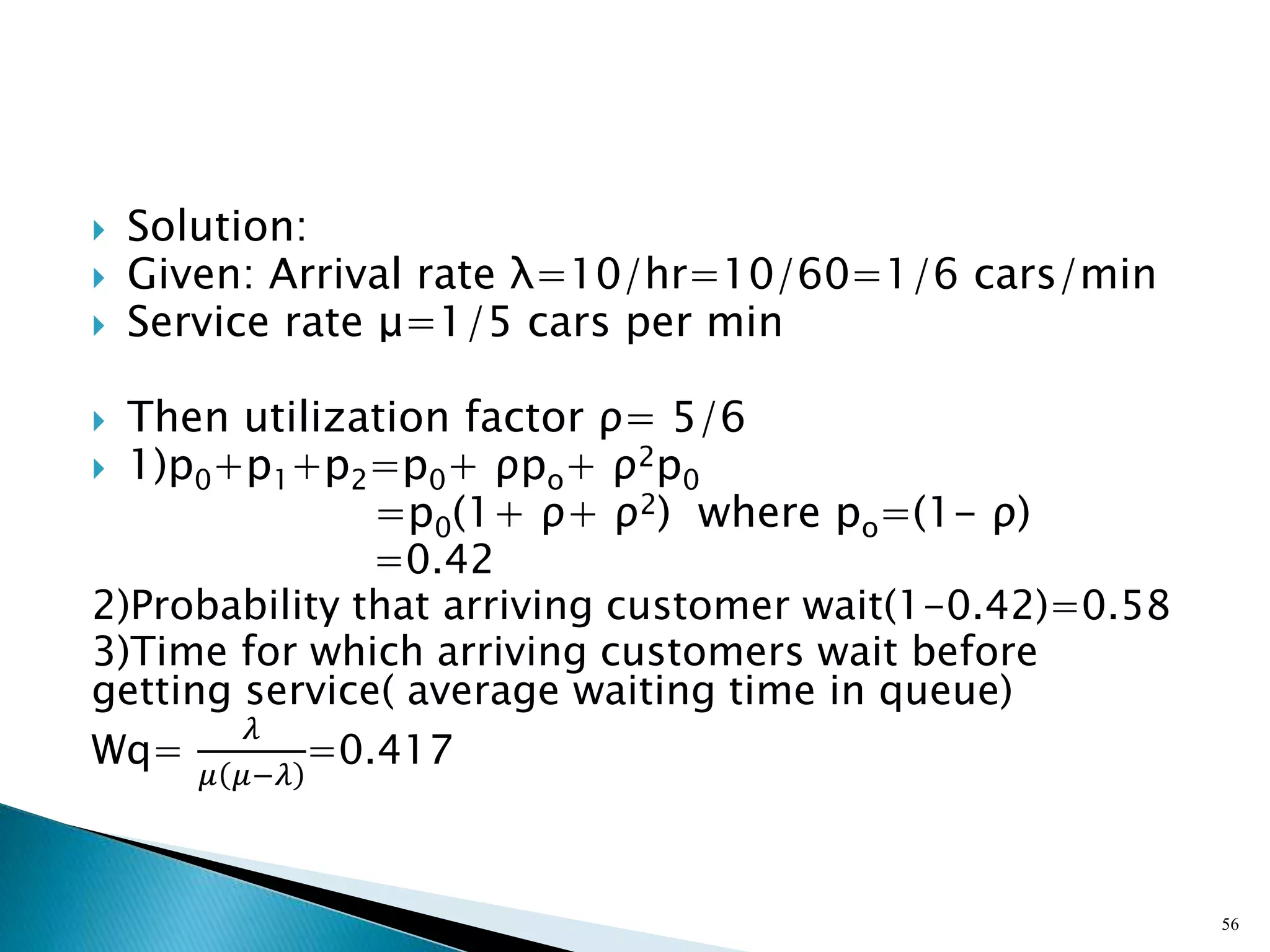
     Example 6:Customersarrive at random at one window drive in a bunk according to poisson distribution with 10 per hr. Service time per customer exponential with mean 5 min. The space in front of the window including that for serviced car can accommodate a maximum of 3 cars  1)what is the probability that an arriving customer can drive directly to the space in the front of the window?  2)what is the probability that an arriving customer will have to wait outside the indicated space?  3)How long is an arriving customer expected to wait before starting service? 55
  • 56.
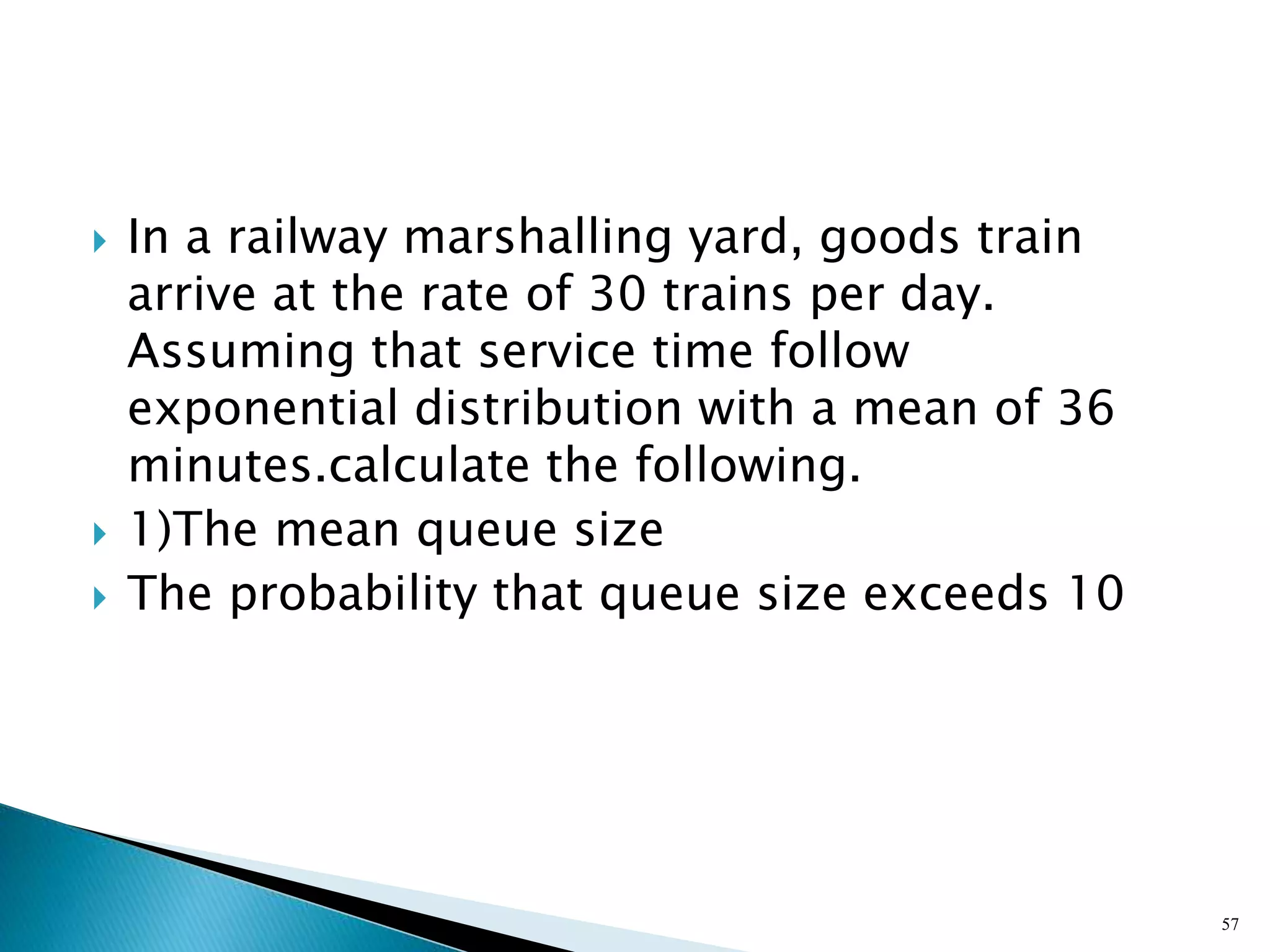
     Solution:  Given:Arrival rate λ=10/hr=10/60=1/6 cars/min  Service rate μ=1/5 cars per min  Then utilization factor ρ= 5/6  1)p0+p1+p2=p0+ ρpo+ ρ2p0 =p0(1+ ρ+ ρ2) where po=(1- ρ) =0.42 2)Probability that arriving customer wait(1-0.42)=0.58 3)Time for which arriving customers wait before getting service( average waiting time in queue) Wq= 𝜆 𝜇 𝜇−𝜆 =0.417 56
  • 57.
     In arailway marshalling yard, goods train arrive at the rate of 30 trains per day. Assuming that service time follow exponential distribution with a mean of 36 minutes.calculate the following.  1)The mean queue size  The probability that queue size exceeds 10 57
  • 58.
     Solution:  Given:Arrival rate λ=30/(24*60) trains/min =1/48 trains/min  Service rate μ=1/36 trains/min  Then utilization factor ρ= 36/48=0.75  1)Lq= 𝜌2 1−𝜌 =(0.75)2/(1-0.75)=2.25 trains  2)p(>10)=(0.75)10=0.056 58
  • 59.
     ‰ An airportrunway for arrivals only has ‰ Arriving aircraft join a single queue for the runway.The ‰ Exponentially distributed service time with a rate µ = 27 arrivals / hour (As you computed in PS1.) ‰ Poisson arrivals with a rate λ = 20 arrivals / hour 59
  • 60.
     Now supposewe are in holidays and the arrival rate increases λ = 25 arrivals / hour ‰ How will the quantities of the queueing system change? 60
  • 61.
     Now supposewe have a bad weather and the service rate decreases µ = 22 arrivals / hour How will the quantities of the queueing system change? 61
  • 62.
     Codification isused to properly classify equipment's, raw materials, components and spares to suit the particular needs of any organisation.  Codification is helpful to prevent duplication and multiplicity of stores and the mistakes which are caused by the normal practice of describing the material.  Objectives of Codification • Bringing all similar items together. • To enable putting up of any future item in its proper place. • To classify an item according to its characteristics. • To give a unique code number to each item to avoid duplication and ambiguity. 62
  • 63.
     A databaseis a data structure that stores organized information. Most databases contain multiple tables, which may each include several different fields. For example, a company database may include tables for products, employees, and financial records.  Databases are used just about everywhere including banks, retail, websites and warehouses. Banks use databases to keep track of customer accounts, balances and deposits.  Retail stores can use databases to store prices, customer information, sales information and quantity on hand. 63