Unit-1 Game Core Design &
Initial Design
Deptt. of Info. Tech.
KDK College of Engineering Nagpur
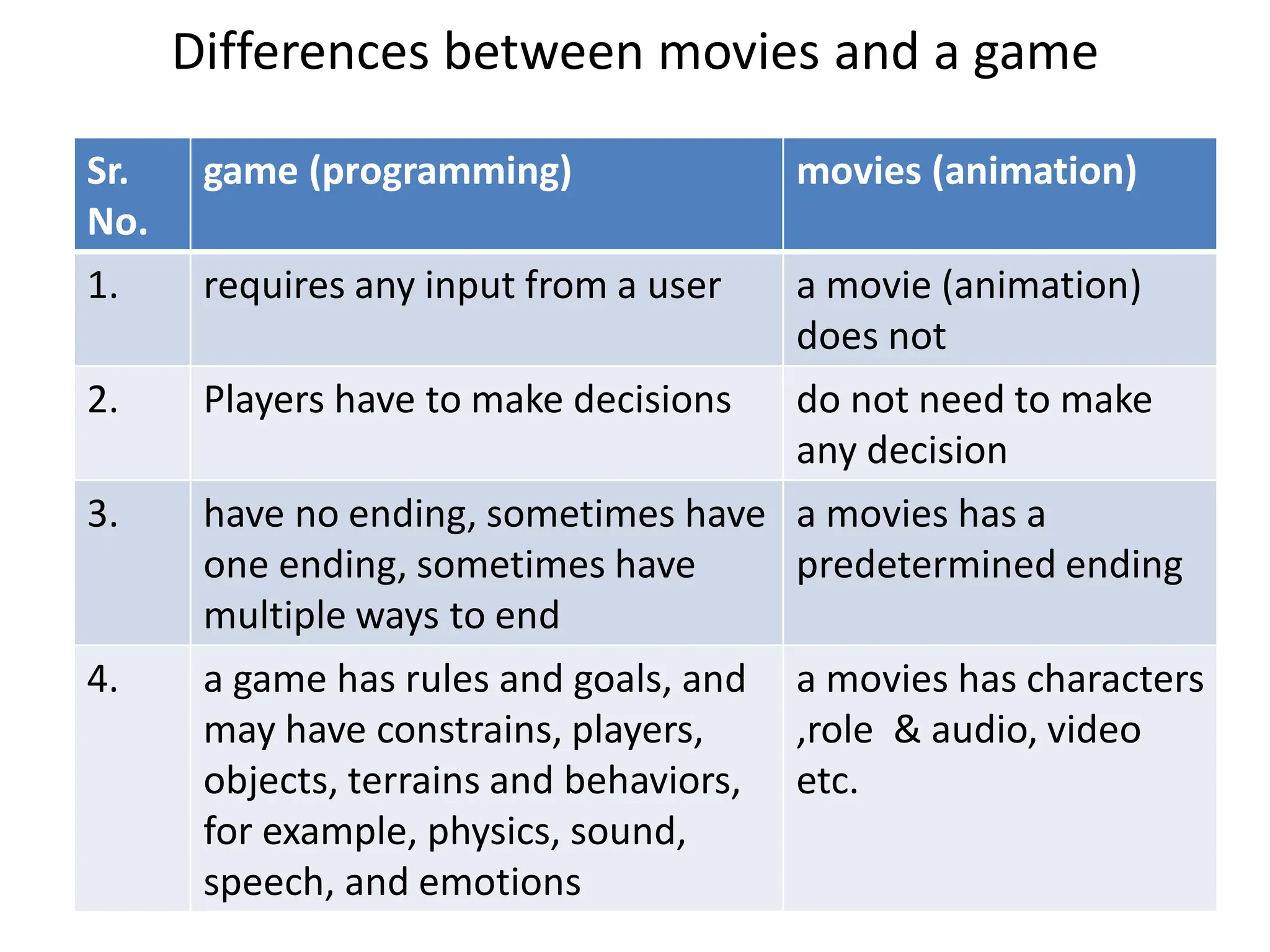
Differences between movies and a game
Sr.
No.
game (programming) movies (animation)
1. requires any input from a user a movie (animation)
does not
2. Players have to make decisions do not need to make
any decision
3. have no ending, sometimes have
one ending, sometimes have
multiple ways to end
a movies has a
predetermined ending
4. a game has rules and goals, and
may have constrains, players,
objects, terrains and behaviors,
for example, physics, sound,
speech, and emotions
a movies has characters
,role & audio, video
etc.
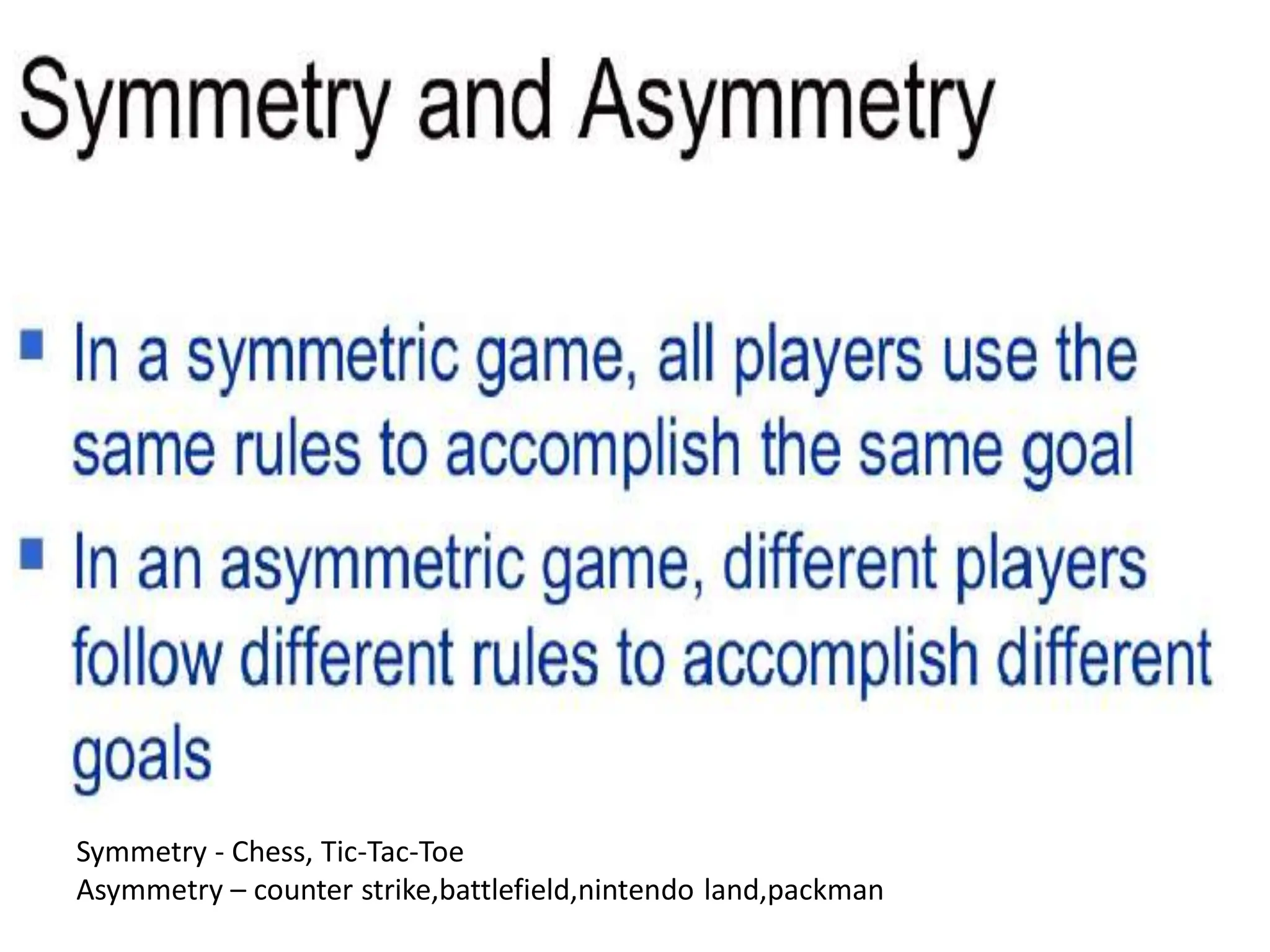
Symmetry - Chess, Tic-Tac-Toe
Asymmetry – counter strike,battlefield,nintendo land,packman
Intelligent behaviour
Game design principles
The basic principles of game design include the following:
• The game design should be kept simple.
• Every game should be unique.
• There should be effective representation to bring out the
real- life environment.
• It should include social factors, like it takes two to play a
game.
• Playing the game should be fun.
Game design Process
The basic steps of the Game design Process :
Step 1 : Build the concept
1. Get an idea.
2. Build the game concept.
3. Create a goal.
4. Create an emotional experience for the player.
Step 2 : Creating the game specification
1. Write the design document.
2. Build the prototype.
3. Iterate, that is, choose lifecycle model.
A. Build the concept
1. Getting an idea
- Dreams and inspirations can create ideas.
- come up with a unique and unusual idea for a game.
- brainstorm sessions for creating an idea.
- Pen down ideas.
- evaluate ideas based on parameters such as
originality, potential audience.
selected ideas are then subjected to synergy check and
the concept is created.
2. Build the game concept
• A game is good if the player can win by doing unexpected
things.
• surprise and delight factor almost make the gameplay,
which encourages the player to employ strategies.
• The broad genres of games are
action (use many buttons/keys),
adventure (story is important),
puzzle (analytical thinking),
educational (learning by doing) and
strategies (non-trivial choice making).
Games like movies can combine genres: for example, an
adventure game can combine action and puzzle.
3. Create a goal
• Every game has a goal.
• All aspects of the game must focus the player
towards achieving the goal.
All games have one or more of the following goals:
• To collect points (do not have a visible objective.
• To gain power.
• To reach the destination/target first.(racing game)
• To overcome obstacles.
• To discover something.
• To eliminate opponents.
Point-Scoring Vs. Racing and Conquest-type game
• The point-scoring games , rewards are given in the form of points -
do not have a visible objective,
• In racing and conquest-type game, both involve visible objective. For
instance.
• In racing, the player knows what is his/her position compared to other participants
at any point of time.-Mario cart, crazy taxi, need for speed,
• In role-playing games (RPGs), the points earned can be spent on improving the
attributes.- Dungeons & Dragons,World of Warcraft, Final Fantasy
• In strategy games, the gathered resources are used on units.-Packman,Age of
Empire,Civilization,Poker,Chess,Go
• In adventure games; the collected items are used to solve something later. –Heavy
rain,Myst(93),The walking dead(2012),broken age(2014),Fahrenheit(2005)Kings
Quest I(83)The WITNESS(2016),Real Myst etc.
4. Create emotional experience for player
• If the emotional experience does not match the game goal, the player
would not enjoy the game.
• The programmer needs to design the game in such a way that player
get addicted to the game.
• For this purpose, cool graphics, fast actions, stimulating steps or
complex strategies could be added to the game.
• The features of the games such as score, moves, and levels could be
designed as follows;
• Score: In fighting, racings, sports or any competition games, Players
expect more from a game experience than a mere score.
• Moves: Controlling virtual athletes’ in sports and vehicles in racing
requires a steady practiced hand players must master all those tricky
moves to almost devastate their opponents.
• Explore levels: exploration can be encouraged by - hiding some of
the game levels. As the player moves through the levels he/she finds
ways to unlock or realize the hidden areas. A racing game can have
additional cars as the players acquire trophies a particular number of
times. Similarly, a FreeCell game gets tougher as the player wins the
first few games.
B. Creating the game specification
Steps
• Create Plan first
 First create a plan answering following Questions-
1. What type (genre) of game it is?
2. What is the objective?
3. How will player achieve the objective?
4. What are the features that will constitute the gameplay?
a) Identify the players. b) Identify the genre and corresponding constraints.
c) Identify the universe and landscape. d)constraints and goals of the games.
• Determine the criteria for success. How does the player win? How does he/she
lose?
• Determine the rules of interaction. Is it through controls or interaction with
character or by putting the player in some environment.
• How are the constraints explained to the player? Is a story told to the player?
• What are the operational issues (in production/maintenance)?
Creating the game specification - Test the concept
• The concept is put down on paper,
• writing the concept down exposes the issues and the complex
interfaces.
• This treatment forms the outline of the concept and the
sketch of game design.
• This ensures the potential of game and helps in deciding
whether to go ahead or give up.
• At this stage, the technical constraints are not seen.
• Only the game’s unique features are considered and other
details are ignored.
Creating the game specification - Feature- based description
• Feature- based description of the game is easy to
understand.
• Features are emergent from rules and most of the rules
keep on changing as we detail the game.
• The reason for the changes is that several rules interact
with each other.
• Feature is emergent if new categories must be used to
describe it, and are not required to describe the
underlying rules.
Creating the game specification - Feature- based description
There are three types of features:
• Vital / integral features - make the game work properly. For
example, in football, the formation is selected first, and then the
choices of the players are made accordingly.
• chrome features - Some features have no effect on the game
played, but enhance the enjoyment of the game. These features
help one draw the story and convey the look and feel of the game.
For example, in football, the player chooses the stadium; or in a
game like StarCraft, the interface is customized to reflect the alien
species that are chosen for playing.
• Gameplay substitutes -Some features do not enhance the game in
any way, but merely give an equivalent choice (the choice makes no
difference in achieving the objective). For example, the player can
play one on one with computer or choose a multiplayer mode in
LAN.
Creating the game specification - Feature- based description
The purpose of the gameplay is to -
• explain the developers how the game works;
• provide the vision statement referred
throughout development;
• identify features that are integral and that are
chrome.
Creating the game specification - Interface design
• A good interface design makes the player feel
that there are no restrictions on the control of
the game.
• Interface should efficiently handle a large
number of simultaneous tasks in a
complicated strategy game.
• Use the list (with scroll bars, if necessary) for
selection.
• Multiple section facility should also be
available, if necessary.
Creating the game specification - Rules
• At initial stage for creating a game, the rules have to be
guessed.
• As the game development evolves iteratively, more rules
are added and these rules interact with the previous
ones, thereby making changes to them.
• The rules must serve the features.
• Share damage through the formation.
• If one member is hurt, the damage would be split to all
units in the formation.
• Size and type of formation would increase the
toughness.
Creating the game specification -Level design
• Level design affects the core gameplay.
• Levels depend on the storyline and can enhance the inherent
gameplay or detract from it.
• Issues related to level design have to be addressed in the game
specification itself.
• At its simplest level, low interactivity is given, which is reactive
in entertainment software, which involves watching more than
playing .
• In the more story-oriented genres that evolve out of adventure
games, More flexible narratives are given so that the viewer can
delve into it with as much interactivity as he/she wants.
• Level should not be used to cover deficiencies in the gameplay.
Creating the game specification -Level design
• Choices related to that level only should be visible in that level.
• An accurate specification for each level is given to the level designers,
who understand the rules.
• Best level design is not linear, it allows multiple approaches.
• A good game should allow the player to make strategies (long-term
and tactics (short term)
• The primary goals of a game design are to create interest in the
reader and to convey the design aspects without ambiguity.
• The interest of the reader should sustain from beginning to end of
the document.
• Reader should have a clear understanding of the design and nuance
of the game in the genre.
Creating the game specification - Design document
General Information about brief description of the game
• Basic concept: The basic concept describes the basic idea in
one or two pages. The idea should be concise, informative
and interesting.
• Background story: This is necessary for adventure kind of
games and nor for puzzle kind of games.
• Objective: The objective of the game is described. The reader
should have a clear understanding of the gameplay , therefore
as much detail as possible is given in the design document.
• Gameplay: The way the game works from beginning to end is
described. After loading the game, a title screen or an option
screen has to be shown. The choice that have to be provided
in the option screen and can any of the option be bypassed,
etc have to be decided.
Creating the game specification - Design document
• The result of choosing a particular option should be
known to the player.
• The method of providing the result can be through Help
option in the menu.
• The player’s assumption of the character (Hero) and his
enemy/opponent (controlled by computer) have to be
kept in mind.
• The computerized opponent is described by artificial
intelligence. (AI)
Creating the game specification - Design document
The detailed description of the following are decided.
• Interfaces that are to be defined.
• The different perspectives to be planned
• The basic interactive structure in terms of sections and levels.
• The genre of gameplay, if it needs speed and whether it has
to be continuous as in racing or turn-based RPG, etc, to be
noted.
• The game has to be written for single or multiplayer PC-based
game or LAN game.
• The difficulty levels that are required. The targeted are group
for the game.
• The duration for the gameplay that any average player will
take.
Creating the game specification - Game design- the
other aspects
Characters: For all the characters in the game, mention their
personality, capability and role/action in the game.
World: All different scenes where action takes place have to be
described. Design documents of RPGs are primarily organized by
location, characters, objects and the events that happen in that
location. If locations are visited in any sequence or by travelling
through any shortest path, then
the optimum order is also mentioned.
Controls: The controls that have to be provided in the user interface
are described. For any action to take place, buttons can be
provided on the controller in the user interface. The state of the
game is conveyed to the player though the user interface. For
example, the player should know his/her scores, the resources left
or life gauge, etc. The navigation through the game has to be well
described. The player should be aware of the alternate ways of
moving through the game . Wherever applicable, on-screen text
message can be given.
Creating the game specification - Game design- the
other aspects
• Graphics: The choice in the graphics mode if required has to
be stated as choice for the player, the corresponding style to
be chosen. For example. In the game of tennis-hard court,
clay court, grass, etc, climatic conditions/weather options
should be there. Pictures of major scenes in the game can be
presented to visualize the game . Character sketches can be
done to show how they will look.
• Sounds and music: Where and when (specific action
performed by the player/occurrence offend event) the sound
effect is required in order to create an impact in the game.
The general music and at the opening of any new level.
different sounds can be played. The laughing track, the
spectators’ reactions, noise made by animals, ghosts army
weapons, etc are added to give a real-time effect.
Creating the game specification - Build prototype
• Prototype are built first, in order to minimize the risk;
• get the client feedback in development process early;
• help to visualize the end product;
• find the feasibility
Typical Game Sections
• Game Section -1
• The environment is set up for the game and initialized.
• Option to play or exit is entered.
• User is requested to enter input.
• User input is stored and viewed.
Game section -2
• Game state is changed according to user’s last input.
• AI is applied on player’s action, Then, background animation, music, sound
effect are performed.
• Finally, housekeeping is done.
Game Section-3
• Current animation frame is drawn to virtual first, and then displayed on the
screen.
• Frame display rate is specified and locked.
• In the exit routine, resources are released.
• System settings are restored.
• Control is given back t
Life cycle model
• Rapid prototyping phase before specification is a very
popular technique.
• Building of game in increments (repeated loop) through
merge design, implementation and integration phases into
a repeated block.
• Agile –extreme programming involves
team-based and very collaborative approach;
hardly any documentation;
integration of testing into the development process
(instead of testing everything at the end, testing is done
at certain milestones).
Life cycle model continued …
Development process involves :
• building a prototype;
• playing the game for a while and getting the
basics right;
• asking other people to look at the game;
• meticulously observing the player;
• constantly rewarding the player in the game;
• using new testers;
• taking the game to next level of complexity;
Life cycle model continued …
Good designs are both
• high level (architectural level) and
• low level (detail design).
Even when changes are made in the detail design,
the high-level architectural design is intact and
so the final goal of the game remains unaffected.
The “chrome” elements add to the look, and the
feel of the game has to be coherent to give an
aesthetic appeal.
Gameplay
Definition : The Strategies that are required to reach
various end points are collectively termed as gameplay.
Rules interact with other rules of the environment to
produce a result.
Implementing gameplay
A game is a set of a series of interesting non-trivial choices.
A decision has gameplay value when it has an upside and a
downside, and the overall payoffs also depend on other
factors.
Each decision affects the next. The decisions include choosing
the correct option in the circumstances and looking out for
better tactics to apply.
Gameplay
• There is a dominated and dominant strategy problem in
gameplay which are defined as follows;
Implementing gameplay
• The option which is not worth using under any circumstance is called a
dominated strategy. - waste of time
• The option which is so appropriate that is not worth using any other option
is called a dominant strategy.
• a dominant option even worse is a better options . Hence, a near-dominant
option is the only one that is useful. It is used in narrow circumstance and
it is the one that the player will use most often.
• An example of near dominated option is given as follows;
Ask the following question ;
• What is the most common feature?
• What should I do to make the most of it?
• If this facility is used only once in the game. How much of the development
time has to be allocated for it?
• How much special effects and efforts for building the interface should be
spend?
Gameplay Strategies
• A game has to be interesting even if the player knows all the
tricks/tactics.
• If a careless player over looks a near-dominated option then
the opponents can exploit the situation.
• However, near-dominance will show which options will get
used most, and logically for those options more effort in
terms of graphics, effects, etc, are spent.
• The programmer should ensure to include interesting choices
in the game.
Different kinds of options a gameplay involves are as follows.
• Option may or may not be taken depending upon certain
factors.
• Option can have time constraints and is context-dependent.
• Option does not affect the game much whether taken or not.
• Option that is worth being taken
• Option that is never being taken.
Toolbox to assist with choices
• There is no particular method for making the choice that are left to
the creativity of the player.
• Ensuring gameplay choices are non-trivial, make the game
interesting.
• Strategic choices are made for long term and tactical choices for the
current or short term.
• However, strategic choices will affect the range of tactical choices
that are made later.
• Player who selects options according to a set plan will not do as well
as the player who adapts to the circumstances.
• There should be enough scope for good judgment, and this gives a
better payoff.
• The payoffs for choosing different investments in strategic plan may
alter the decision that the player will take at different levels.
Toolbox to assist with choices
• Speed is a kind of versatility feature.
• A unit that normally moves fast need not be having other best
factors too.
• The compensating factors could be that we could make the unit
weak or we could make the unit expensive to buy.
• If the unit is made expensive, then the player may or may not buy it.
Once he/she has made the decision, he/she has committed to it.
Hence the choice whether to buy or not may be strategically
interesting but it is tactically not.
• It does not oblige the player to use the unit in any interesting way.
The player has to understand what are the compensating factors.
• If the expensive unit is more powerful and would produce an
impact, he/she might still go for it. The choice is entirely the player’s
and it is a well-informed choice.
Impermanence
In some decision, the payoff leads are long lasting.
The advantage can be impermanent, because of the following factors;
• They can be destroyed, injured or stolen.
• They can last only for some times or can have limited use.
• They are of no use in certain circumstances
Impermanence can also be a kind of choice the player has to make.
While doing so, he/she has to understand the cost and trade-offs.
• The cost does not mean only money and points gained;
• it also means the time, efforts, attention and alternate resource
required at that point.
Gameplay allows you to interact and enrich your experience. This
interaction can be done in following ways.
• By changing the setting or game itself.
• By directly controlling the character.
Gameplay specification
Definition :
The gameplay specification is a “vision
document” that describes the final product and serves
as a goal for all developers.
When the code strictly adheres to gameplay
specifications, then the product is ready for release.
The designer notes explaining the reasons for
all assumptions is required along with specification,
since this will help others to verify/challenges the
assumptions at the initial stage itself.
Responsibility of the designer
• Process of good creative design is to filter and clarify the
designer’s ideas, which he has taken from many sources,
and bring them to a structure that will best suit the
game.
• designer has to discuss or arrange for a brainstorming
session with the team and accept inputs from them.
• This will lead to gathering of more ideas and also
reinforce/verify the ideas stated by the designer in the
first instance.
• Apart from the development team, the product in view
has to be presented to the marketing team to solicit their
guidance of the commercial aspects so that the features
in the game take care of the expectations of the clients at
least for the next two years.
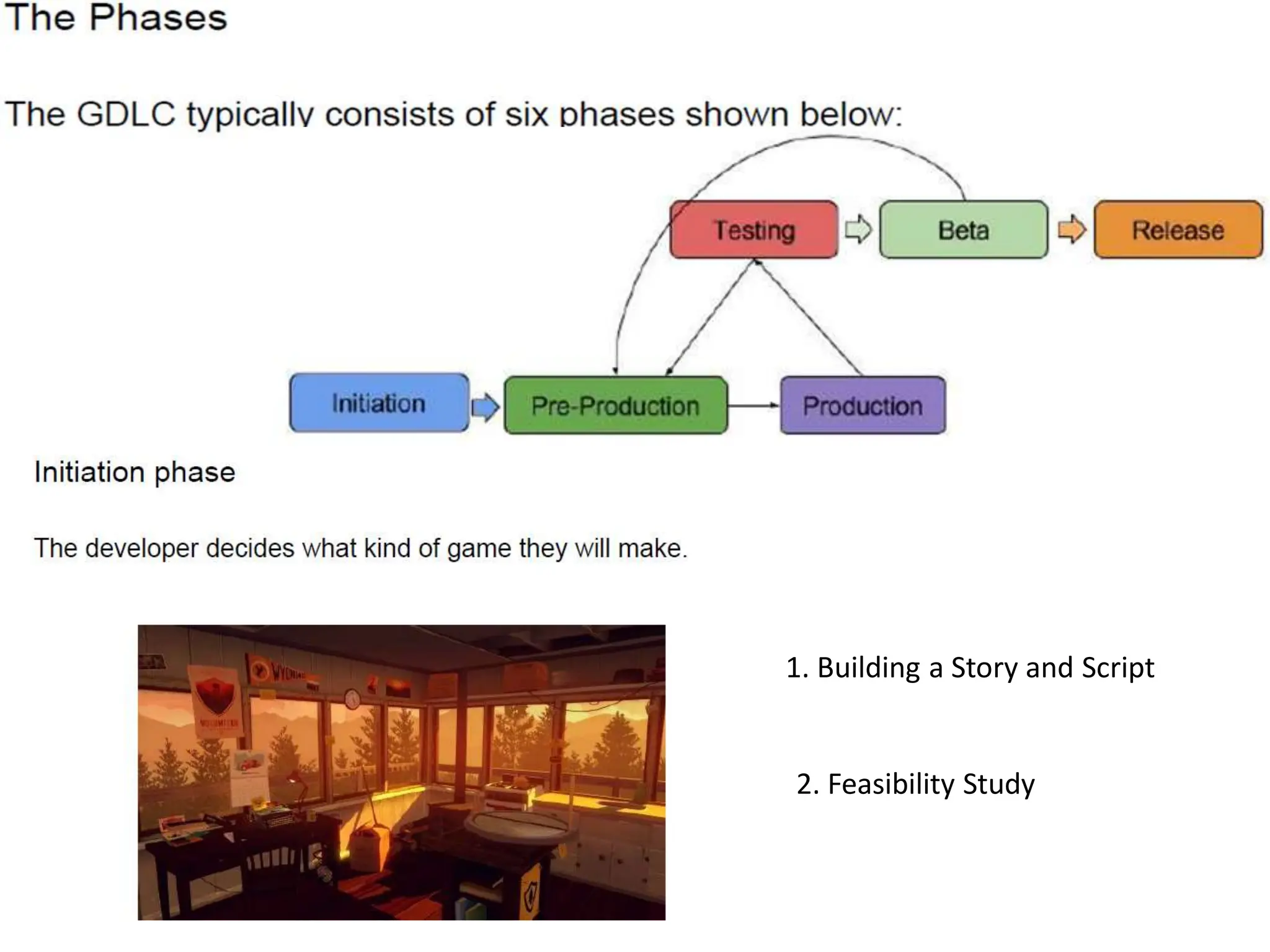
1. Building a Story and Script
2. Feasibility Study
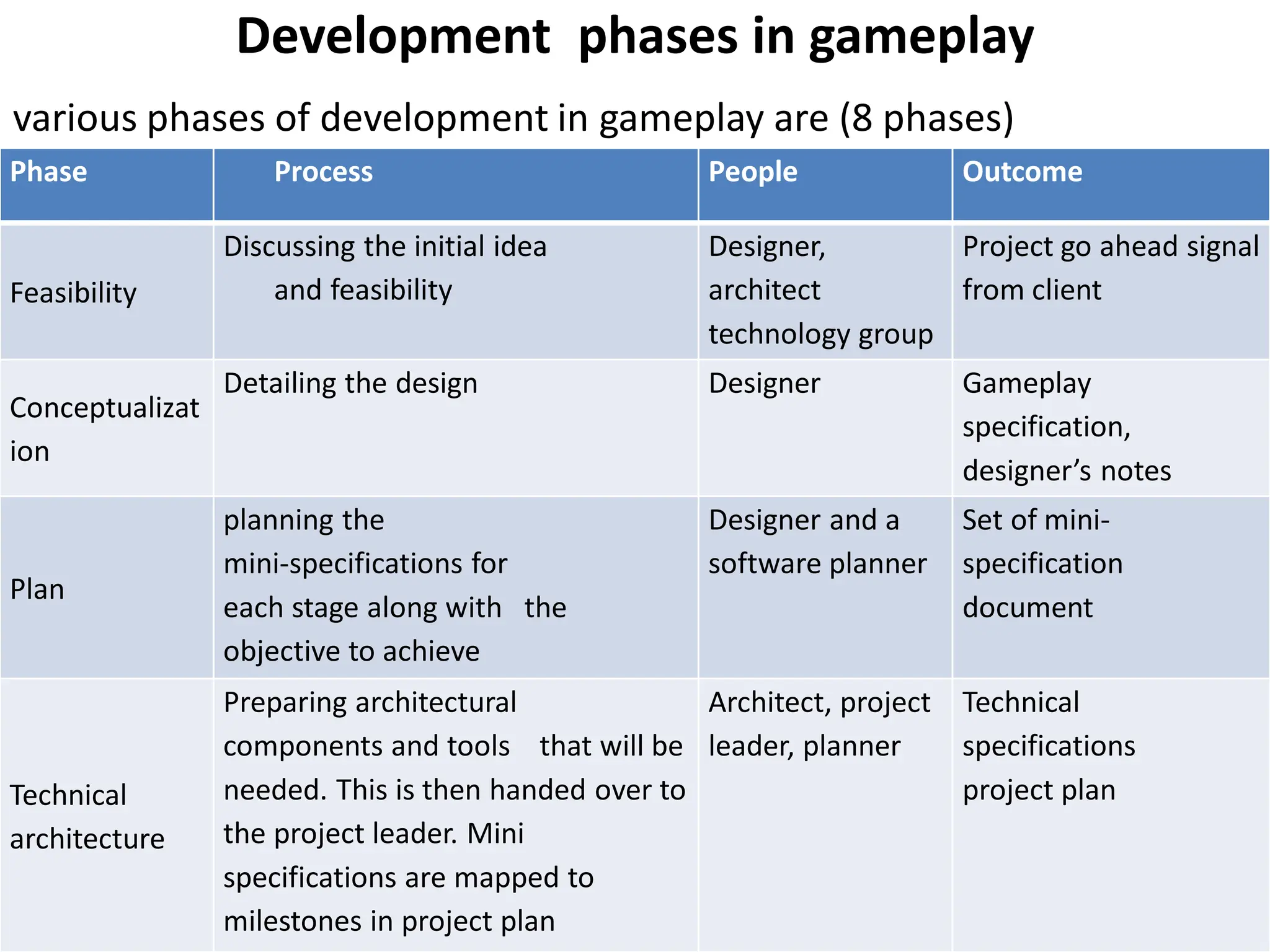
Development phases in gameplay
various phases of development in gameplay are (8 phases)
Phase Process People Outcome
Feasibility
Discussing the initial idea
and feasibility
Designer,
architect
technology group
Project go ahead signal
from client
Conceptualizat
ion
Detailing the design Designer Gameplay
specification,
designer’s notes
Plan
planning the
mini-specifications for
each stage along with the
objective to achieve
Designer and a
software planner
Set of mini-
specification
document
Technical
architecture
Preparing architectural
components and tools that will be
needed. This is then handed over to
the project leader. Mini
specifications are mapped to
milestones in project plan
Architect, project
leader, planner
Technical
specifications
project plan
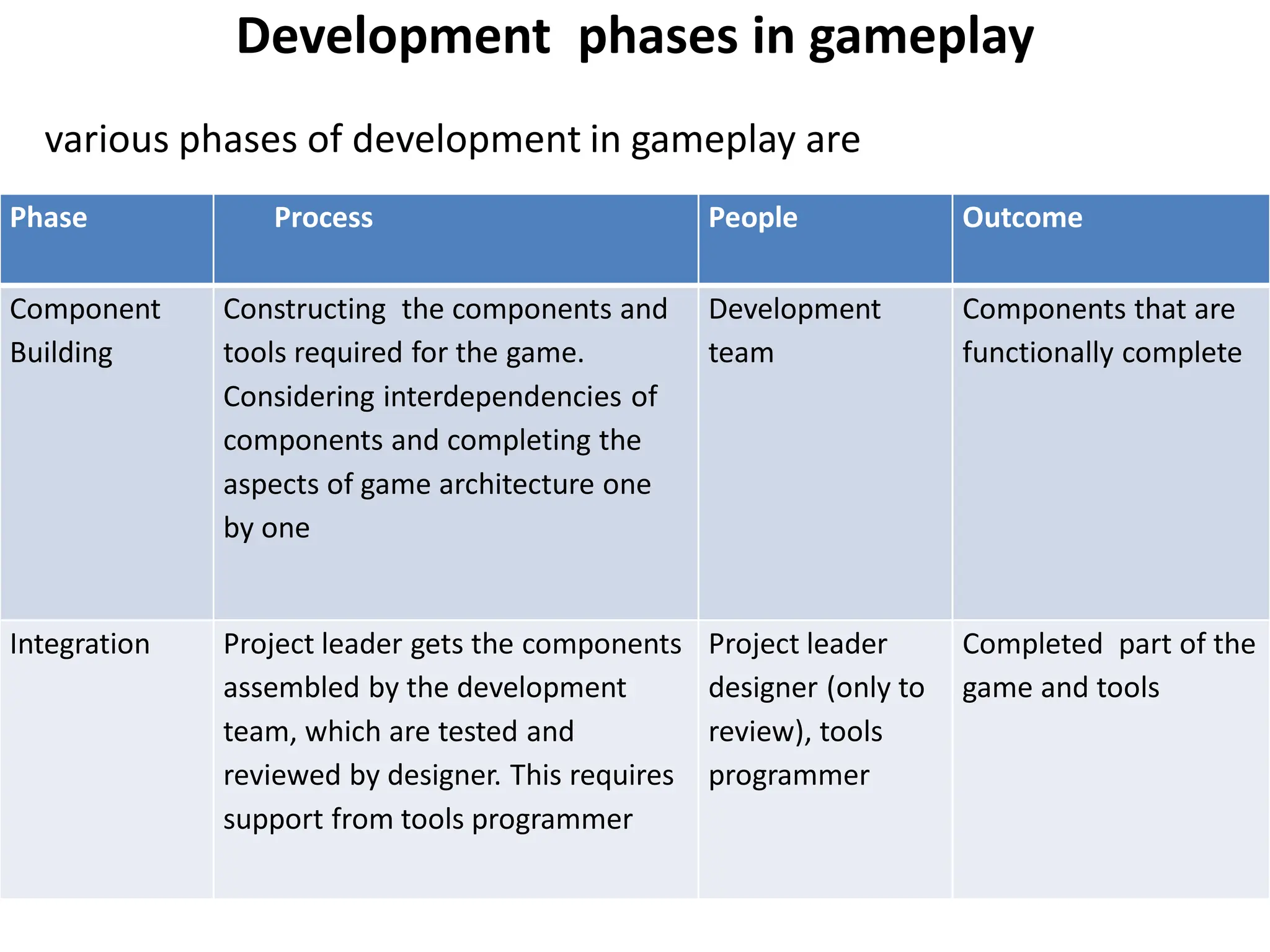
Development phases in gameplay
various phases of development in gameplay are
Phase Process People Outcome
Component
Building
Constructing the components and
tools required for the game.
Considering interdependencies of
components and completing the
aspects of game architecture one
by one
Development
team
Components that are
functionally complete
Integration Project leader gets the components
assembled by the development
team, which are tested and
reviewed by designer. This requires
support from tools programmer
Project leader
designer (only to
review), tools
programmer
Completed part of the
game and tools
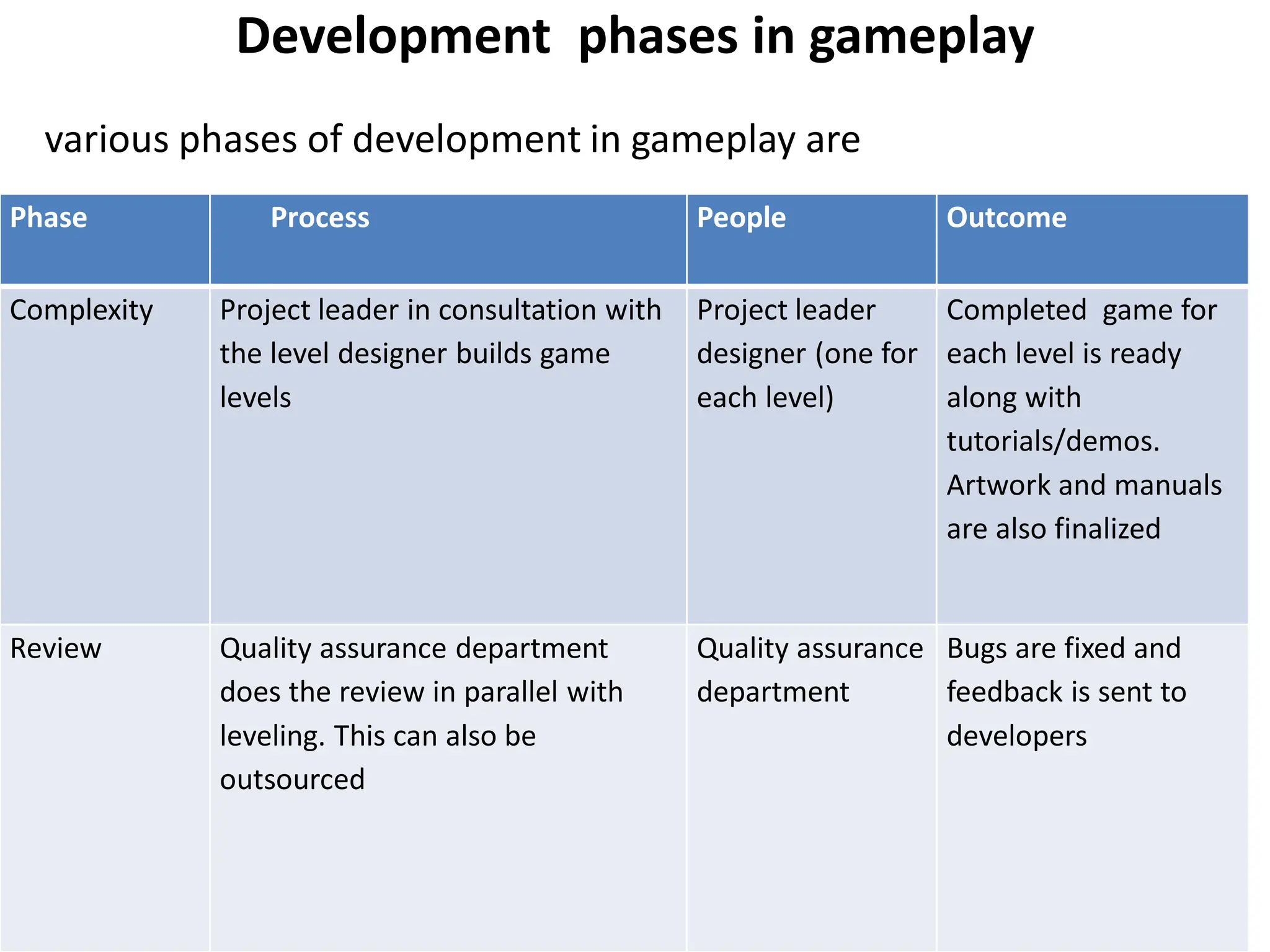
Development phases in gameplay
various phases of development in gameplay are
Phase Process People Outcome
Complexity Project leader in consultation with
the level designer builds game
levels
Project leader
designer (one for
each level)
Completed game for
each level is ready
along with
tutorials/demos.
Artwork and manuals
are also finalized
Review Quality assurance department
does the review in parallel with
leveling. This can also be
outsourced
Quality assurance
department
Bugs are fixed and
feedback is sent to
developers
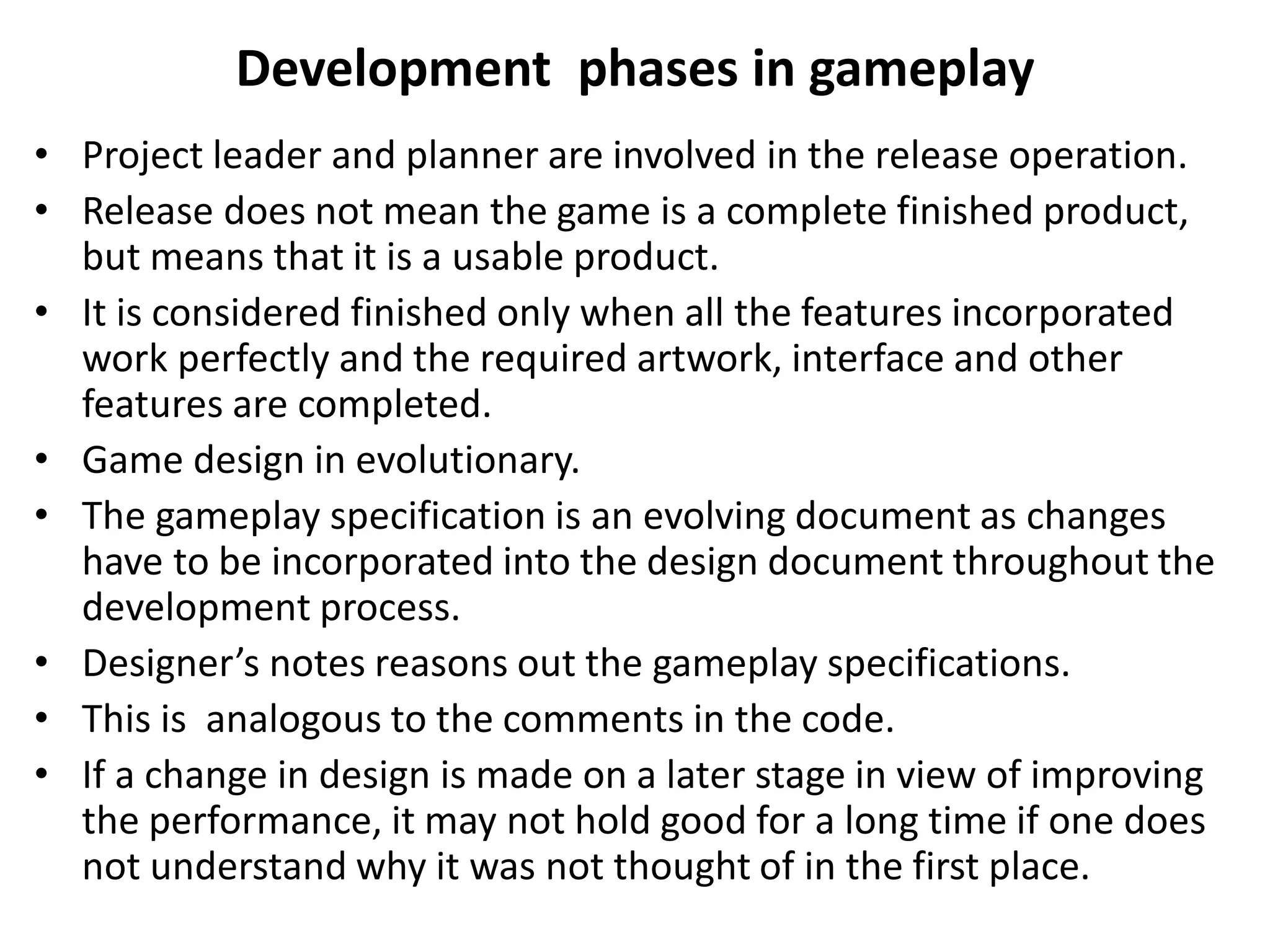
Development phases in gameplay
• Project leader and planner are involved in the release operation.
• Release does not mean the game is a complete finished product,
but means that it is a usable product.
• It is considered finished only when all the features incorporated
work perfectly and the required artwork, interface and other
features are completed.
• Game design in evolutionary.
• The gameplay specification is an evolving document as changes
have to be incorporated into the design document throughout the
development process.
• Designer’s notes reasons out the gameplay specifications.
• This is analogous to the comments in the code.
• If a change in design is made on a later stage in view of improving
the performance, it may not hold good for a long time if one does
not understand why it was not thought of in the first place.
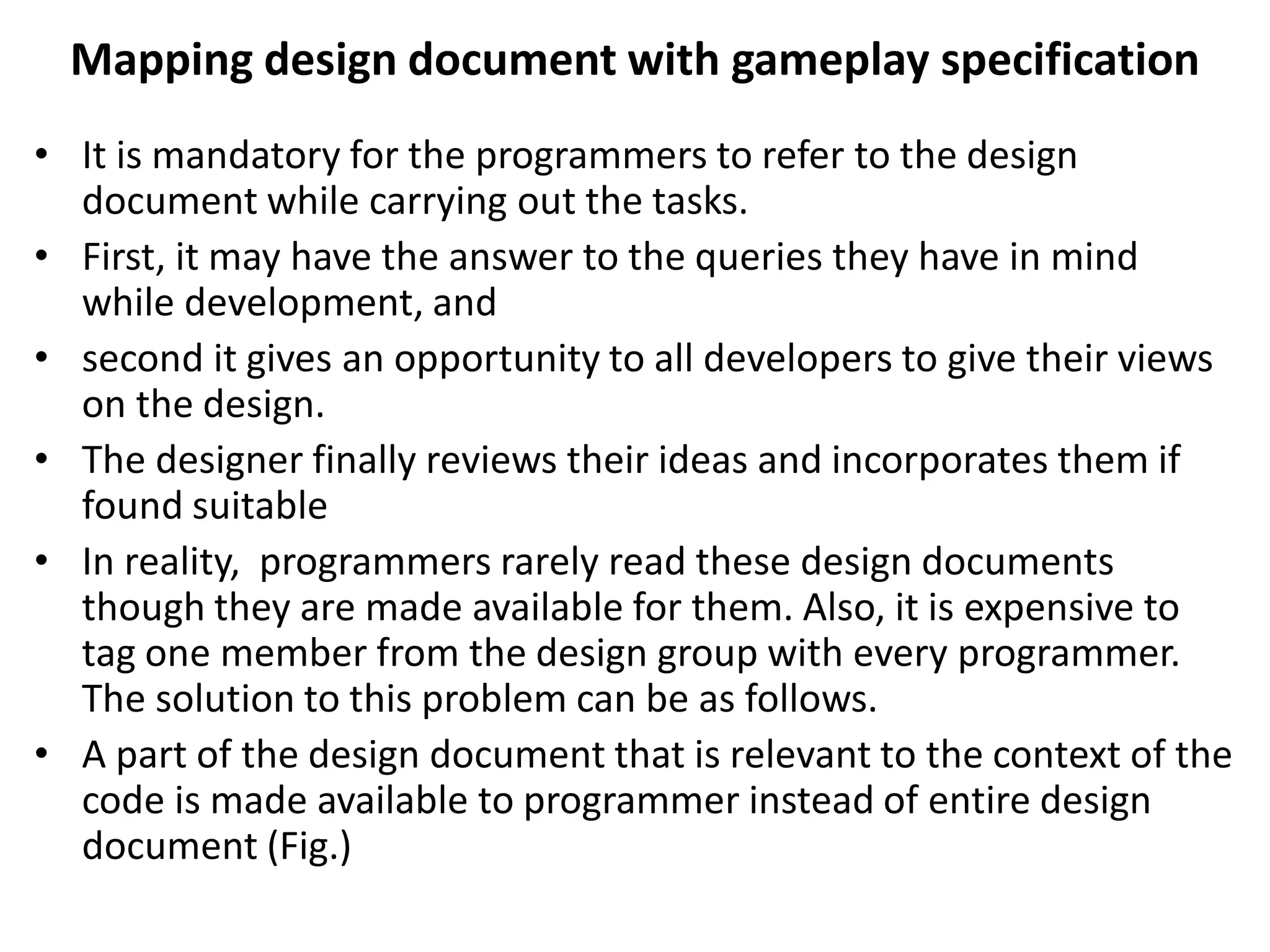
Mapping design document with gameplay specification
• It is mandatory for the programmers to refer to the design
document while carrying out the tasks.
• First, it may have the answer to the queries they have in mind
while development, and
• second it gives an opportunity to all developers to give their views
on the design.
• The designer finally reviews their ideas and incorporates them if
found suitable
• In reality, programmers rarely read these design documents
though they are made available for them. Also, it is expensive to
tag one member from the design group with every programmer.
The solution to this problem can be as follows.
• A part of the design document that is relevant to the context of the
code is made available to programmer instead of entire design
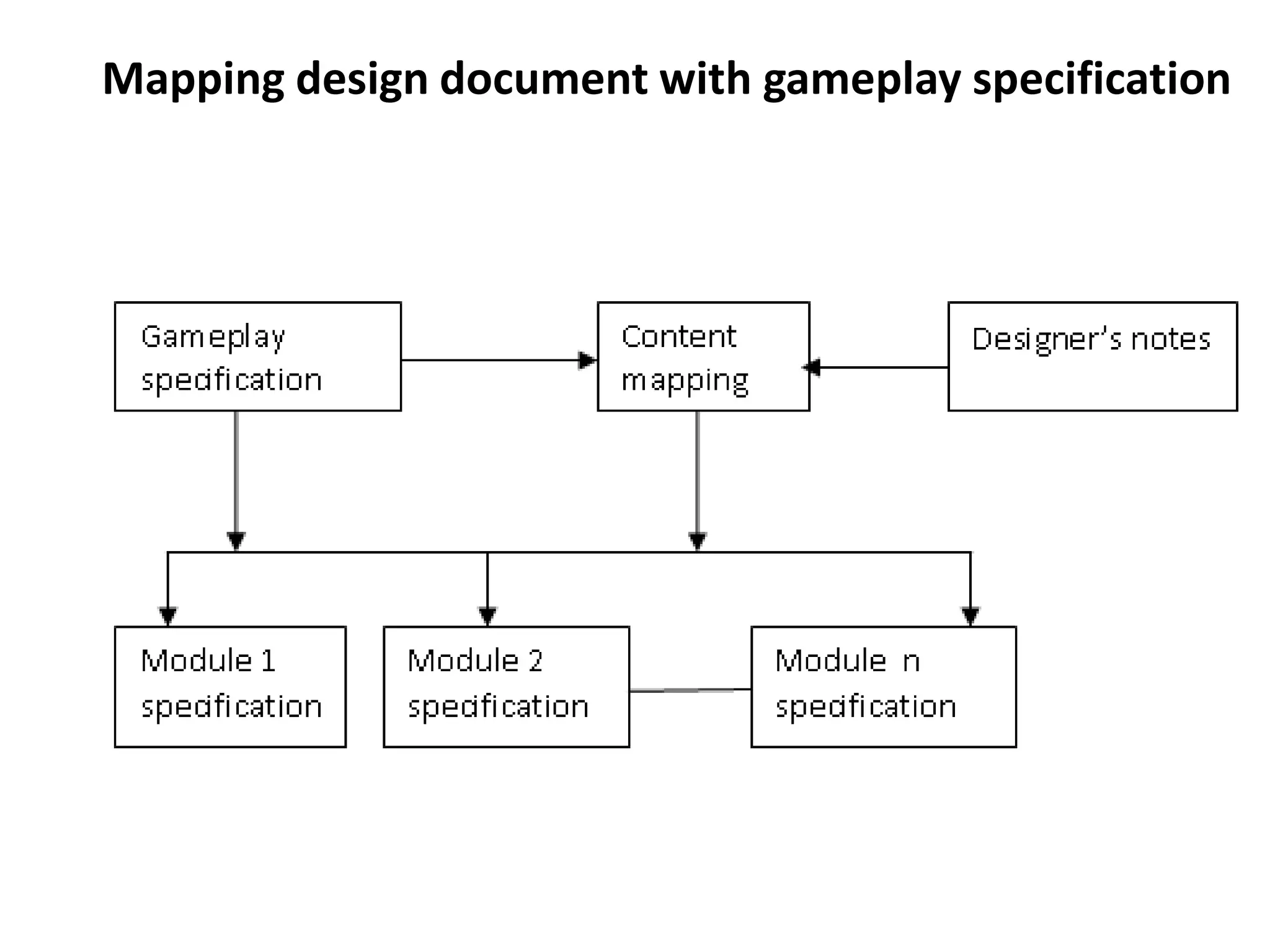
document (Fig.)
Mapping design document with gameplay specification
• Content mapping uses the work breakdown structure of the
Gameplay specification, maps it to the design document and
extracts the relevant part of the document.
• Therefore, to every module the corresponding designer’s notes is
attached. The mapping can be in the from of hypertext links also,
so that the developer can view the notes whenever he/she wants.
• Modularizing helps in making changes independently in each part
of the design and test.
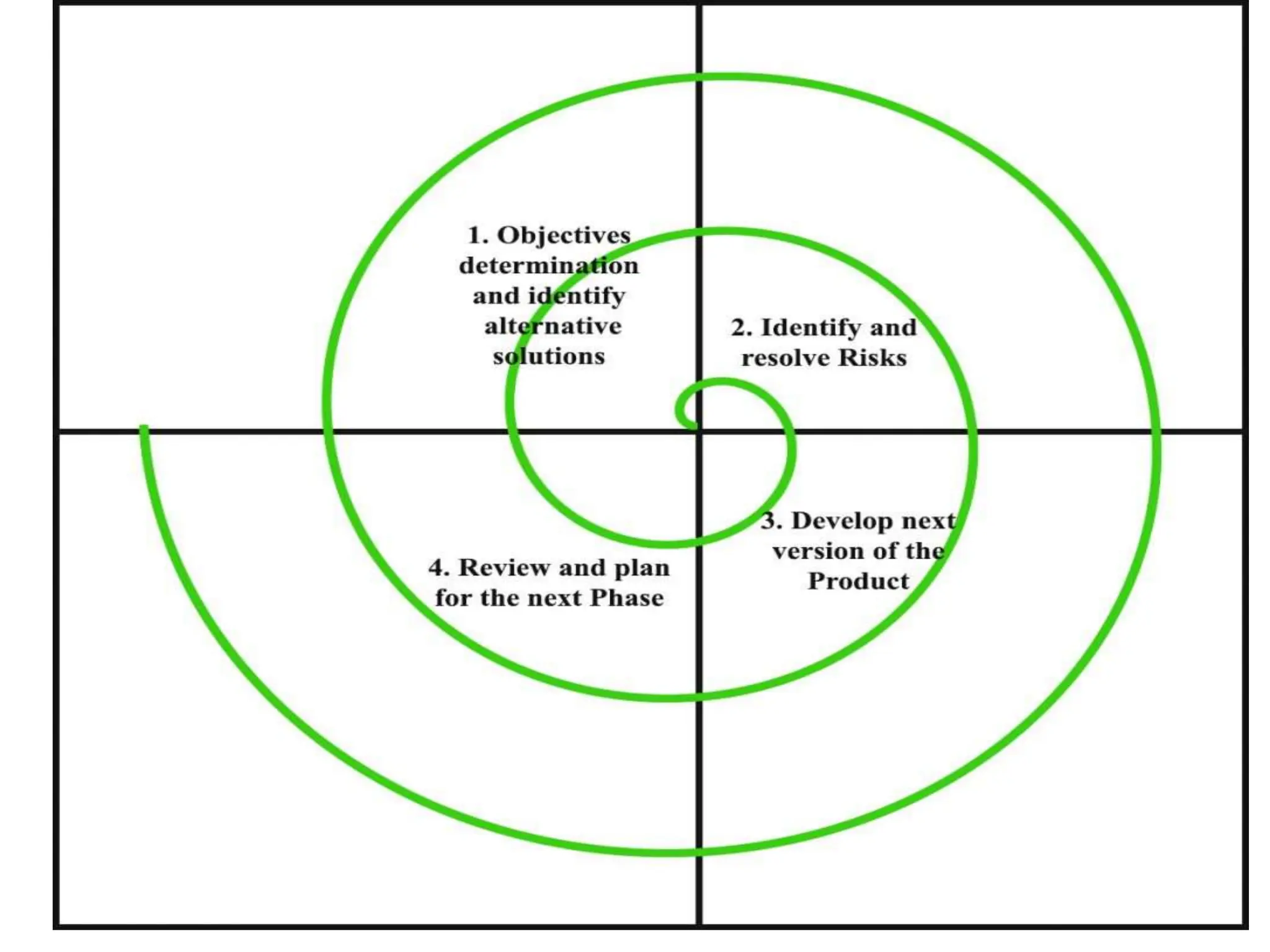
• Games are developed in an iterative manner, since the risk is high
and so spiral process model is chosen most of the times.
• Most of the rules that the gameplay specifications document
contains have to be tried out so as to find out how they work in
practice.
• If the prime key functions have to be tried out, then a
prototype or test-bed model is used.
• In this model, the designer has the opportunity to improve
the model as he proceeds with the specification.
• Any creative designer can produce an excellent game by using
cannot track the task in the critical path, cannot estimate the
time for completion, etc.
• Hence it is used only if the game is of an entirely new category
which has not been tried before.
• In the iterative development, the gameplay specification is
divided into a group of mini-specifications that defines a level.
• Each mini-specification (level) is developed and tested.
Each level has the following design items;
• Goal to design the features to be implement in that level.
• Philosophy to find what this level intends to do
• Expected results as to what the outcomes is at a particular
stage.
• Alternatives or other ideas suggested during the
brainstorming sessions.
• It is easy to develop the game architecture with these mini-
specifications or level document.
2. Initial Design
• Game playing is enjoyed by Children as well as adult
• The way of looking at game is different.
• Children will appreciate the fun aspects of the game, but an
adult too can enjoy entertainment software.
• Many adults play game like Age of Empires because they like
ordering those little men around to build a city.
• What annoys them is when the enemy players storm in,
destroy it and spoil the fun.
• I think adults like to have gameplay just to make what we are
doing seem respectable and do not play just for fun.
• Many people who do not play games ; think that Playing
game just kills the time, but it is not so.
• More awareness of entertainment software is needed to de-
stress people.
Adv of game playing :
• Play can educate the mind,
• stimulate the imagination
• the creativity sharpens the wits,
• lightens the heart and enriches the soul.
In the future, we can see more individuals such as screenwriters,
artists, novelists and board-game designers entering
computer game design, which will revolutionize the world of
entertainment software. What makes it truly entertaining is
that many of these people will have no idea of the limitations
of the technology (the designer need not worry about that, at
least in the initial design phase.)They will demand the
challenge; will deliver games astoundingly different from
what we have already seen.
• Software architecture in general uses certain
rules, heuristics and patterns;
• The problem is partitioned so that the system
built can be easily maintained.
• The interfaces are created between these
partitions.
• The overall structure is managed and the flow is
made easy.
• Techniques are used to interface the system to its
environment.
• Development and delivery approaches,
techniques and tools can be properly planned
and executed.
Architecture is important because of the following
reasons:
• It controls complexity.
• It ensures best practices are followed.
• It takes care of consistency and uniformity.
• It increases predictability.
• It allows reuse.
Need for good architecture design
The advantage of a good architecture design is that,
• It describes and plan for the expected gameplay features,
• also gives us a rational framework within which we can make
any required changes.
• If we do not have a design, we may find ourselves frantically
gameplay the day before shipping which is never a good idea.
Architectural Design can be
An iterative or
tier-based design -more vital for any product that has to
incorporate new or untried futures.
If we have to stick to a deadline and positively have to ship by a
certain date, the tier system will let us fit the design to that
date. If development is slipping, we can trim some features (or
even drop them entirely), but the modularity inherent in the
design will allow us to do so while still keeping the project under
control.
• The architectural design in gaming evolves slowly and care
has to be taken in keeping the documentation up to date.
• Game design has to satisfy many stakeholders, such as
high-level management, marketing department and peers
of the game designer.
• To ensure it is worth developing , the design has to go
through a number of iterations and refinements
throughout the development process.
• The game design had to be converted to technical
specification in a way that the implementer can understand
and code.
• The technical design acts as a roadmap and also increases
projects visibility to generate an overall idea of how to work
with project plan.
• The order will realize where his/her module will fit in the
overall picture (class diagram).
Game and hardware abstraction
• The architecture design has to deal with both
• Game abstraction and
• Hardware abstraction interface.
• Abstraction emphasizes on the idea properties rather than how it
works.
• It greatly reduces the complexity in large programs by hiding the
irrelevant details.
Game abstraction
Game abstraction
• It is the way by which the game objects interact.
• Many gaming software objects are designed- communicated via APIs
so that the logic in many of the gaming software modules may be
designed independently of each other
• Modular gaming software architecture allows a game-flow software
module developed for similar group of games.
• Game presentation software modules may be different to change the
look and feel of the game.
Adv . Of Game abstraction approach
• simplifies the design
• ensures easy maintenance of the gaming software.
• software factory methodology provides the reusable objects for
common functionalities.
• Hardware abstraction
Hardware abstraction
• Deals with the platform on which the software will be running.
• For every platform of different hardware configuration with different
graphics card, sound card etc, and its codes have to be written and
linked through the common interface.
• Hardware abstraction interface is not difficult since they already exist.
Graphics hardware abstraction
• Direct X - set of APIs that will call the appropriate driver in the
hardware and also handle all the multimedia tasks.
• A graphical surface in DirectX can be created in either system (local)
memory or video memory.
• surface initialization member takes parameters that indicate the
height, width, bit depth of the surface and where it has to be located
in the memory.
• The private members of the surface object provide error reporting,
restore and release methods.
Graphics hardware abstraction
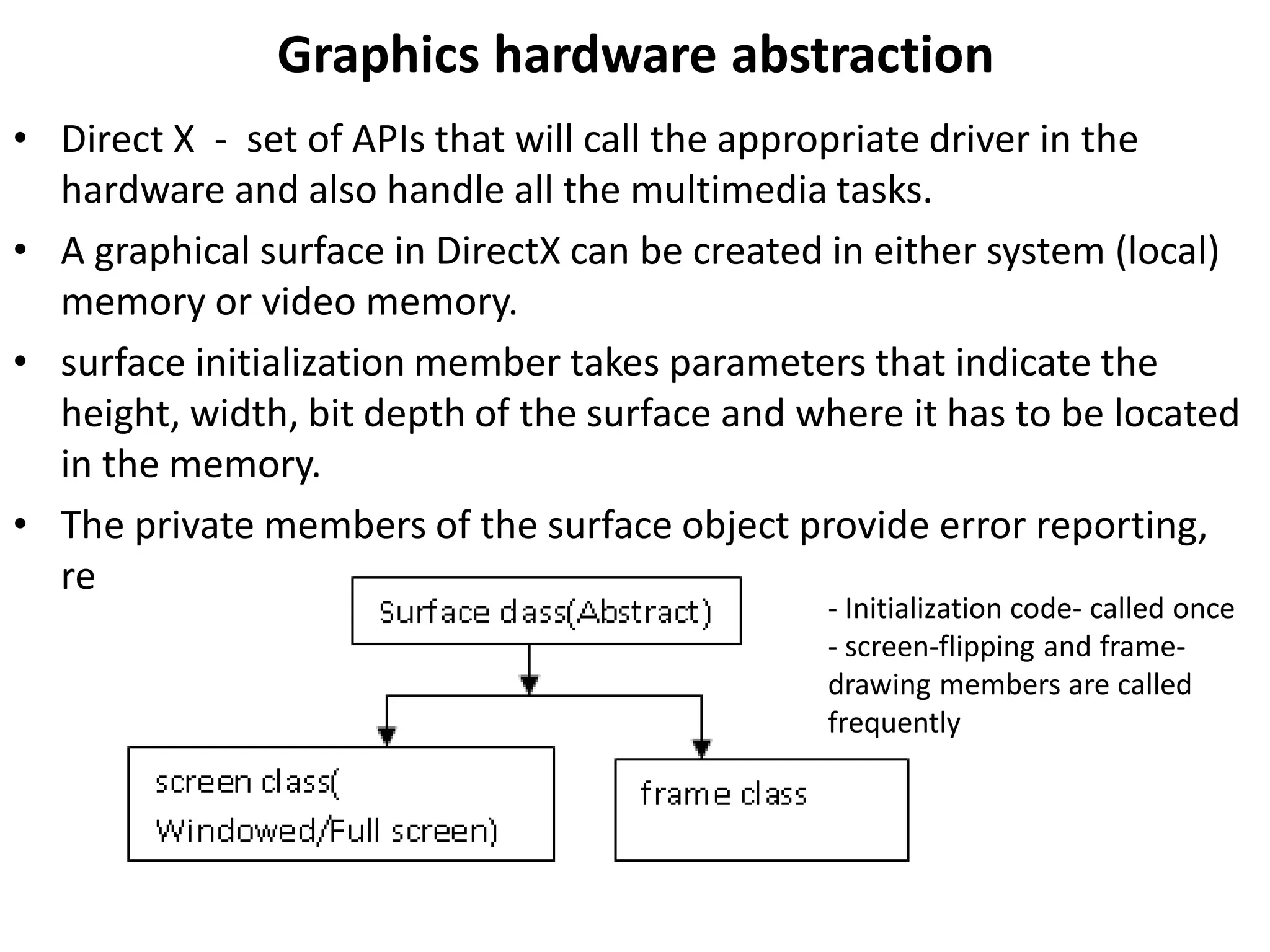
• Direct X - set of APIs that will call the appropriate driver in the
hardware and also handle all the multimedia tasks.
• A graphical surface in DirectX can be created in either system (local)
memory or video memory.
• surface initialization member takes parameters that indicate the
height, width, bit depth of the surface and where it has to be located
in the memory.
• The private members of the surface object provide error reporting,
restore and release methods.
- Initialization code- called once
- screen-flipping and frame-
drawing members are called
frequently
Graphics hardware abstraction
• OpenGL which provides extensive cross-platform
graphics library. For example, screen-handling library
can support a common range of resolutions, double or
triple buffering, bitmapped and True Type fonts, and
sprites.
• graphics library translates the programmer’s
commands into device-specific commands. These
commands specific are used to draw the graphical
elements and object. Also, these commands are
different for different devices, for example, commands
for a plotter are different from that of a console.
Sound hardware abstraction
• sound card object is a single object accessed through
an initialization function.
• The member functions of the sound card object are:
• playing, pausing, and stopping ;
• changing volume and frequency;
• specifying the position of the sound in three-
dimensional space.
• The parameters can be enabled through the
initialization function.
• No duplicate sound is made, and any new objects
created refer to original data.
•
COTS- Components Off The Shelf
• All the basic functionalities- the sound system.
graphics engine, music, saving of game. AI,
artwork,etc. are available as components off-
the shelf (COTS)
• COTS reduces the burden on programmers.
• Allow the game developers to concentrate
more on gameplay.
Architectural design
• The objective of a good architectural design is to
choose the best way of doing things from among the
alternative designs.
• For proper game development, the game
architecture should be understood properly.
• Without a proper architecture, the game is likely to
result in high coupling.
• This will end up in procedural entanglement where
the game loop does a million and one things.
• It is better to think about how things should work as
a whole before starting the coding straight away.
The following point applies to larger games where there are
programmers, artists and designers all working on a game.
• Simple feature: A simple feature with a good tool that
allows the developer to experiment and to iterate rapidly
than out of a complex feature with no editor support.
• Iteration for good results: It should be easy for the people
building the game to test the iterations while designing a
feature.
• Simple runtime code: If major chunk of code is only
required when editing a level, then it should be kept out of
the game code. This mean a smaller code footprint, easier
porting and less testing.
Characteristics of good Architectural design
• Data –driven code: Anything that might need to be adjusted
should be a parameter that comes from data, not hard coded.
Constants should be avoided and designers should not be
allowed to set up complex gameplay conditions in scripts or
using a visual scripting language. Designing your code around
data also helps when trying to multi-thread systems for taking
advantage of the console hardware.
• Hard to debug data-driven engines: Though using data-
driven engines has its advantages, one major disadvantage of
using them is that when a problem arises, these engines are
hard to debug. To overcome any such problem that might
inevitably arise, some extra functionality needs to be added.
To have true data-driven architecture, a game engine must
contain reusability, structured scripting language,
scripting/editing tools, and essentially a friendly architecture.
Characteristics of good Architectural design
• Scripting language is created to control AI.
• Script is required to be translated to C++ or
bytecode.
• Vocabulary is required for interacting with the game
engine.
• To connect scripting vocabulary to game engine
internals, a “glue layer” is added. This allows
pluggable AI modules, even after the release of the
game.
Characteristics of good Architectural design
• Game engines and graphic system: There are
number of free game engine or graphic systems
that can be used to begin with designing the game.
• Writing a 3D game engine or similar engine takes a
long time and requires many people to get it done.
• Using a different game engine and just coding
those parts is much simpler.
Characteristics of good Architectural design
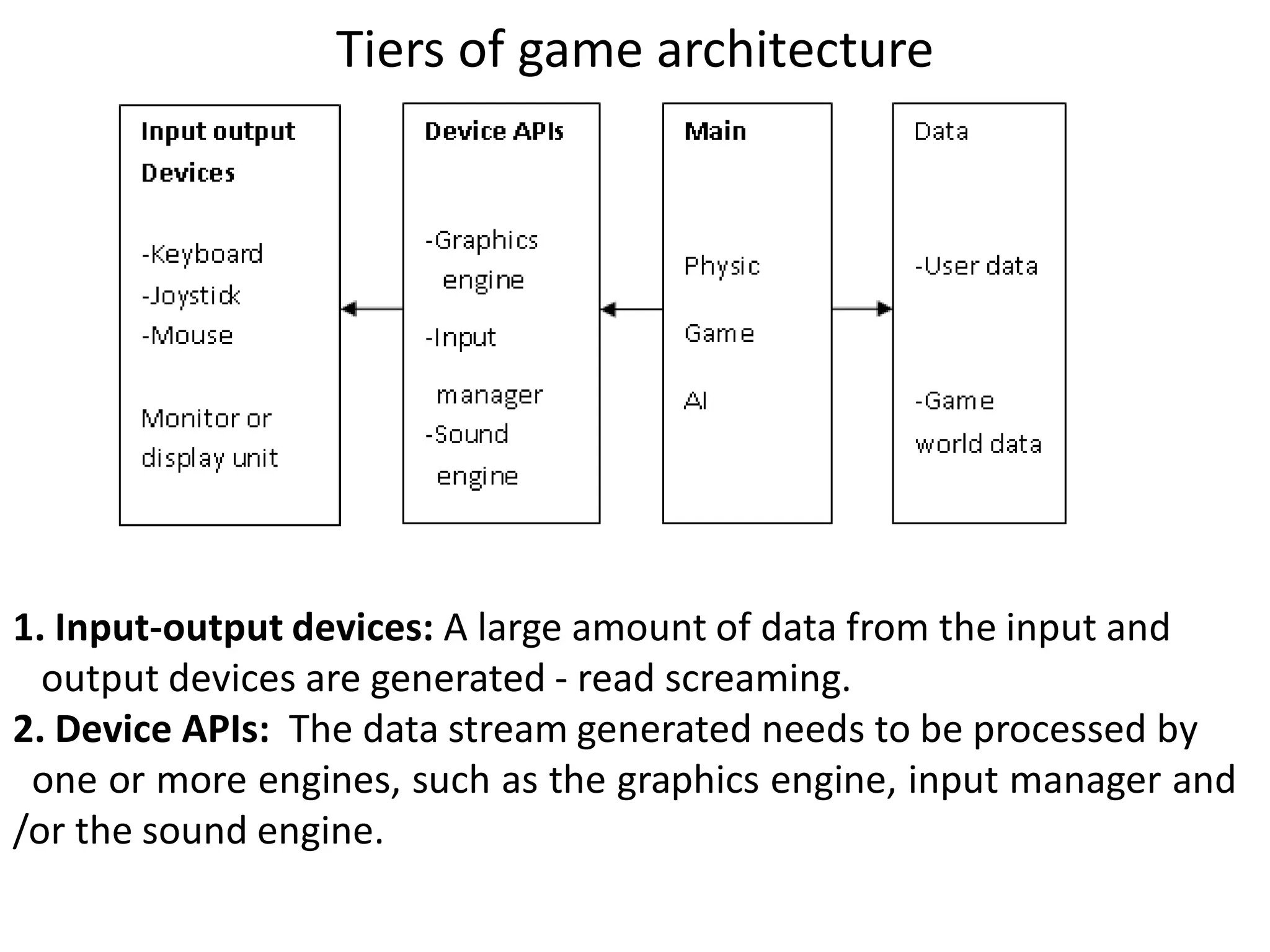
Tiers of game architecture
1. Input-output devices: A large amount of data from the input and
output devices are generated - read screaming.
2. Device APIs: The data stream generated needs to be processed by
one or more engines, such as the graphics engine, input manager and
/or the sound engine.
3. Main - The CPU’s processing time is mostly spent on marshalling
(assemble and arrange in order) the processed data from the game
engines and performing general purpose logic. Smaller portions of
the frame are used, as they are mostly devoted to physics,
animation or graphics.
The AI and the gameplay code pose a great challenge in the form of
numerous exceptions, tunable parameters, indirections, etc. These
are responsible to incorporate distinguishing features for each
game.
4. Data : The data that has been processed by various engines,
marshaled by the CPU and incorporated with distinguishing features
by the API and gameplay code, has to be streamed out to the video
display console for creating colorful graphics and giving a visual
appeal. This process is called write streaming or rendering. In other
words, it also refers to the transfer of data from the CPU to the GPU,
to the frame buffer, which contains a small fraction of the frame.
The other reusable components are as follows:
• Setup programs (if required) for loading, saving
and restoring of games and data.
• Menu system that helps in configuring the game
settings, such as sound or music volume, and for
redefining control and screen resolutions.
• Frameworks like DirectX that support the internal
structures required to implement these features .
Use of good middleware
• Middleware is written to support the most common APIs
used for physics, audio, animation, facial animation, network
transport and various other systems.
• Middleware vendors can keep the cost lower than the
developers themselves making the same code.
• Vendors can afford to keep larger, more experienced teams
working on a given piece of functionality as compared to
independent game developers because the vendors can sell
the piece of code to many developers. It is wise to use a
middleware unless these are specific needs that differ from
the normal conditions.
• Middleware offers structure. It draws a line between the
things that you have to worry about and the things that you
do not need to worry about. When we use a middleware, we
need to accept that technology’s inflexibility, and modify our
game design to suit it.
Tokenization
• Tokens are discrete elements that are directly or
indirectly controlled and manipulated by the
player.
• All the game scan is described interim of players
and tokens.
• The tokens are conceptual objects which will
eventually be translated into programming
language objects.
• These might include a player’s avatar, weapons,
cards, counters metal figures, poker chips and
letters of the alphabet (in a word game.)
Tokenization
• Tokens can be arranged in a form of hierarchy
with the game world (play area) at its top.
• Every token has to be part of the game world
token.
• For example, the player’s avatar token acts as
a user interface between the player and the
game.
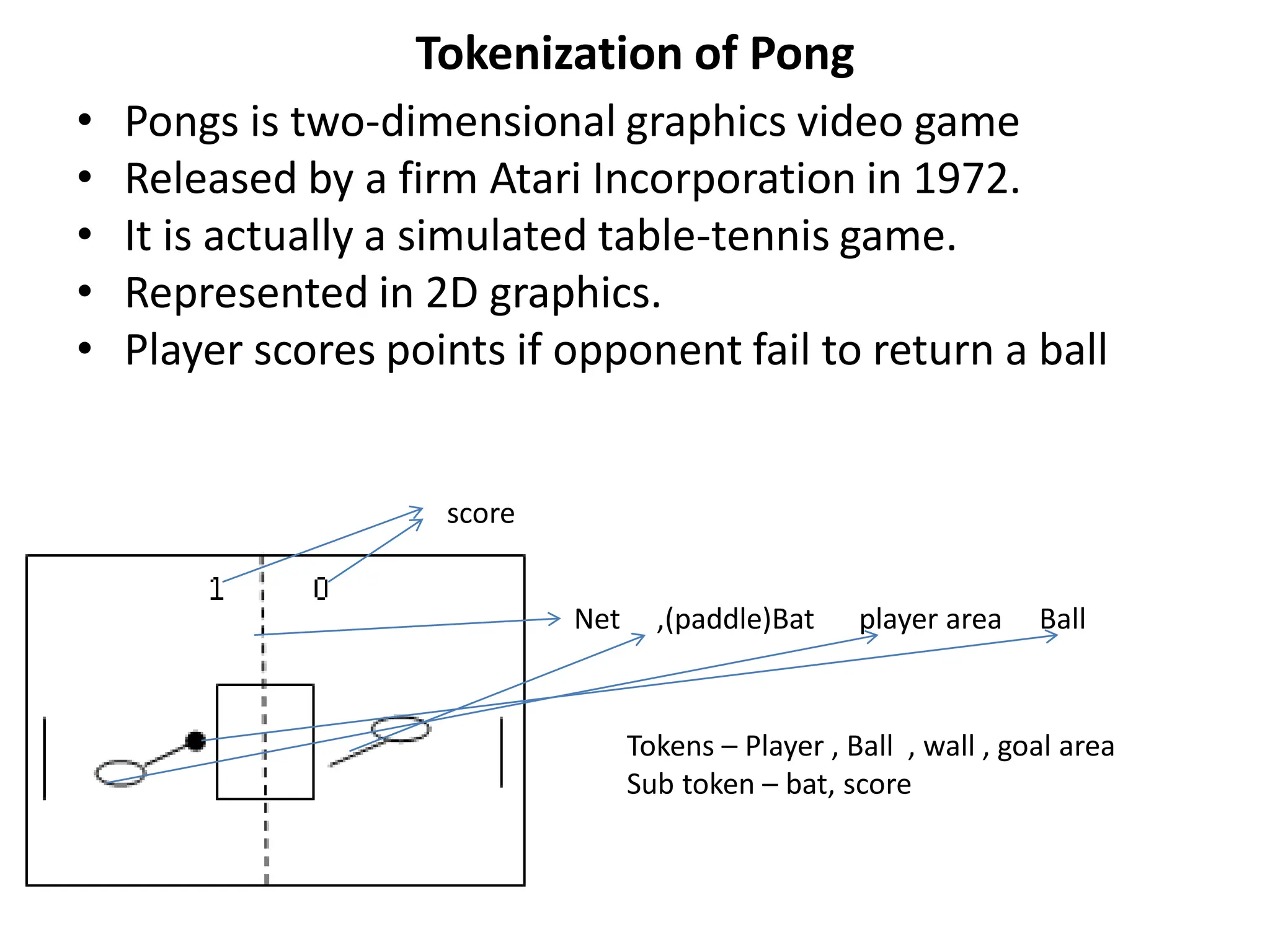
Tokenization of Pong
• Pongs is two-dimensional graphics video game
• Released by a firm Atari Incorporation in 1972.
• It is actually a simulated table-tennis game.
• Represented in 2D graphics.
• Player scores points if opponent fail to return a ball
Net ,(paddle)Bat player area Ball
score
Tokens – Player , Ball , wall , goal area
Sub token – bat, score
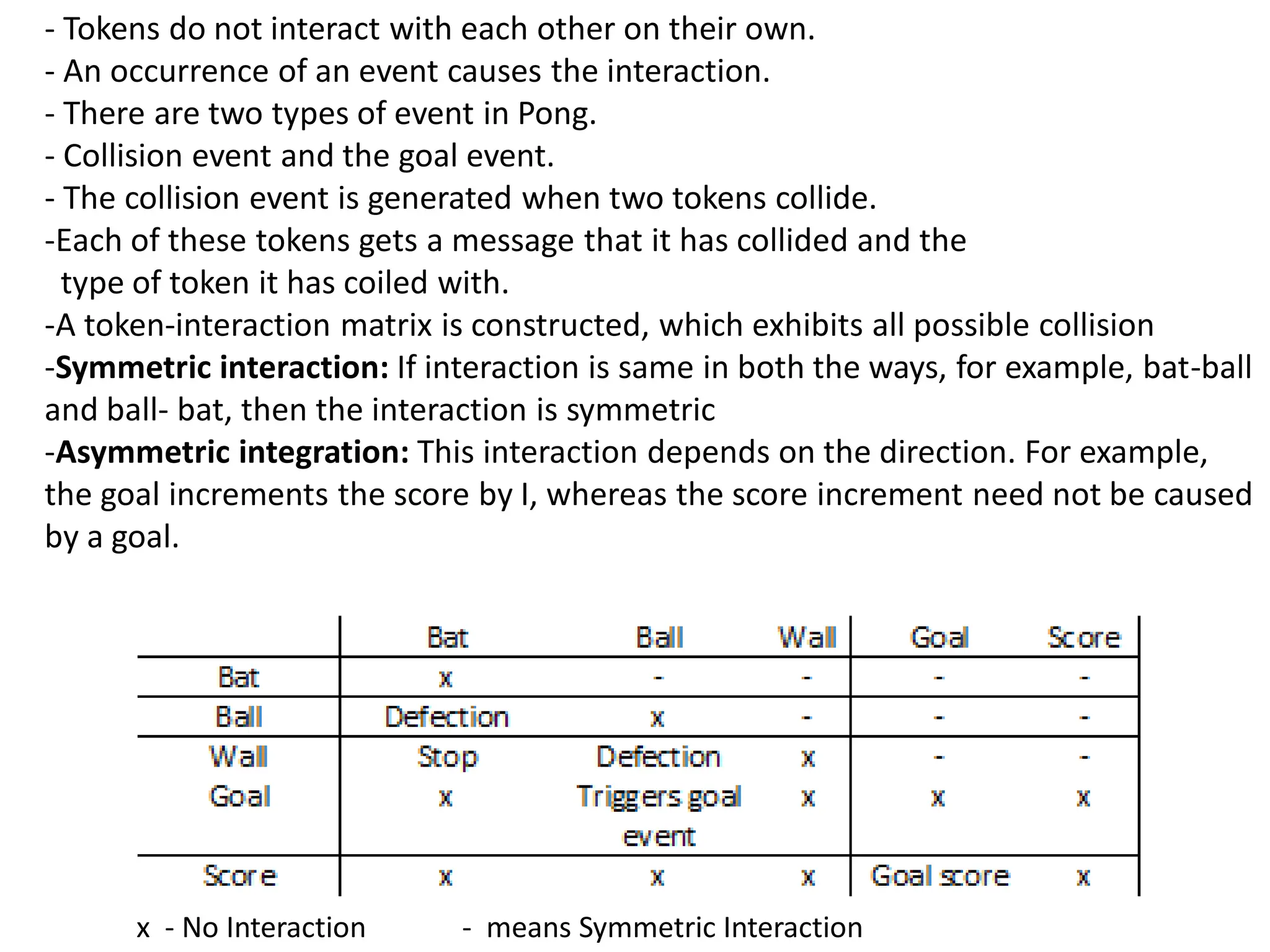
- Tokens do not interact with each other on their own.
- An occurrence of an event causes the interaction.
- There are two types of event in Pong.
- Collision event and the goal event.
- The collision event is generated when two tokens collide.
-Each of these tokens gets a message that it has collided and the
type of token it has coiled with.
-A token-interaction matrix is constructed, which exhibits all possible collision
-Symmetric interaction: If interaction is same in both the ways, for example, bat-ball
and ball- bat, then the interaction is symmetric
-Asymmetric integration: This interaction depends on the direction. For example,
the goal increments the score by I, whereas the score increment need not be caused
by a goal.
x - No Interaction - means Symmetric Interaction
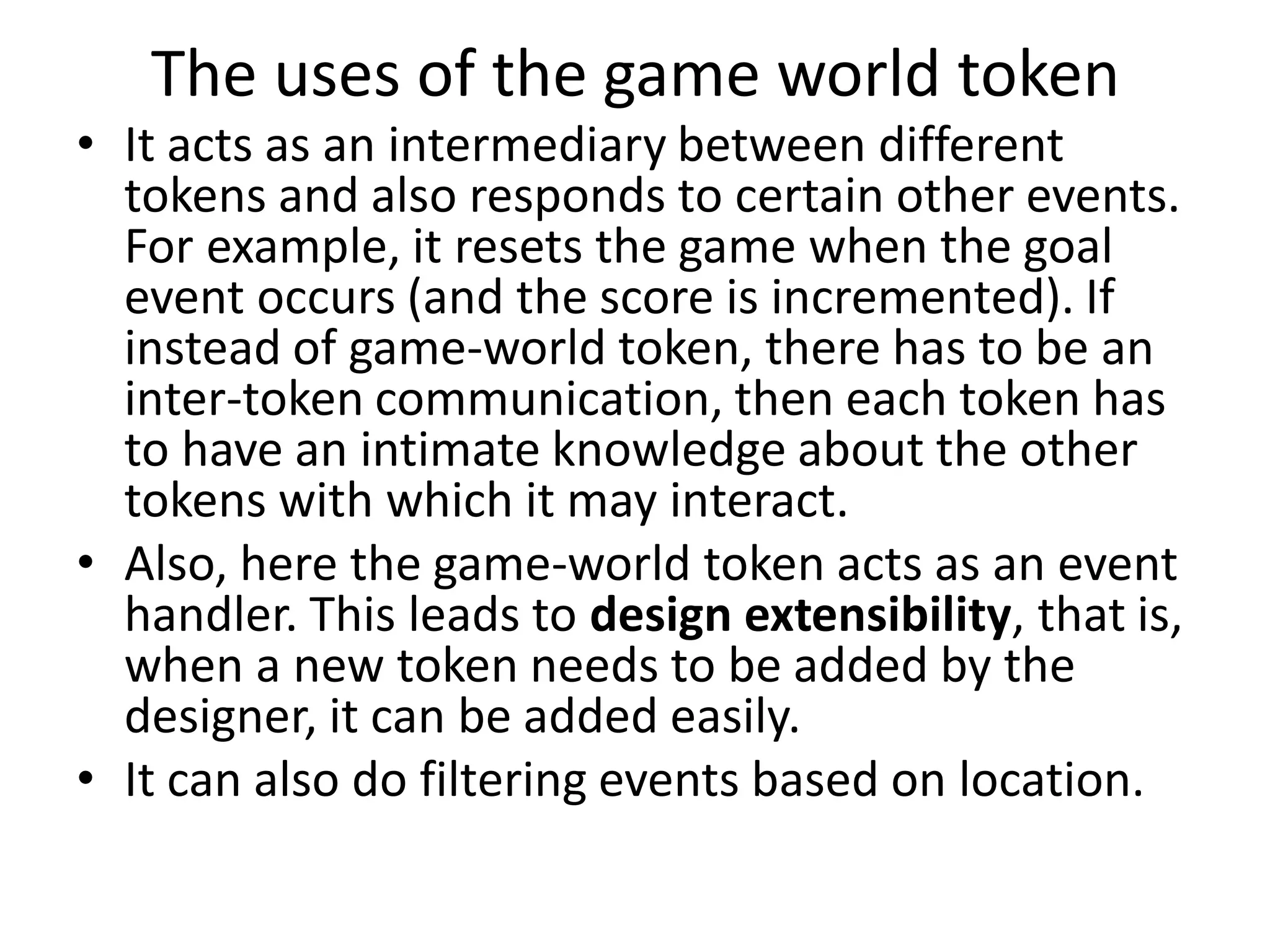
The uses of the game world token
• It acts as an intermediary between different
tokens and also responds to certain other events.
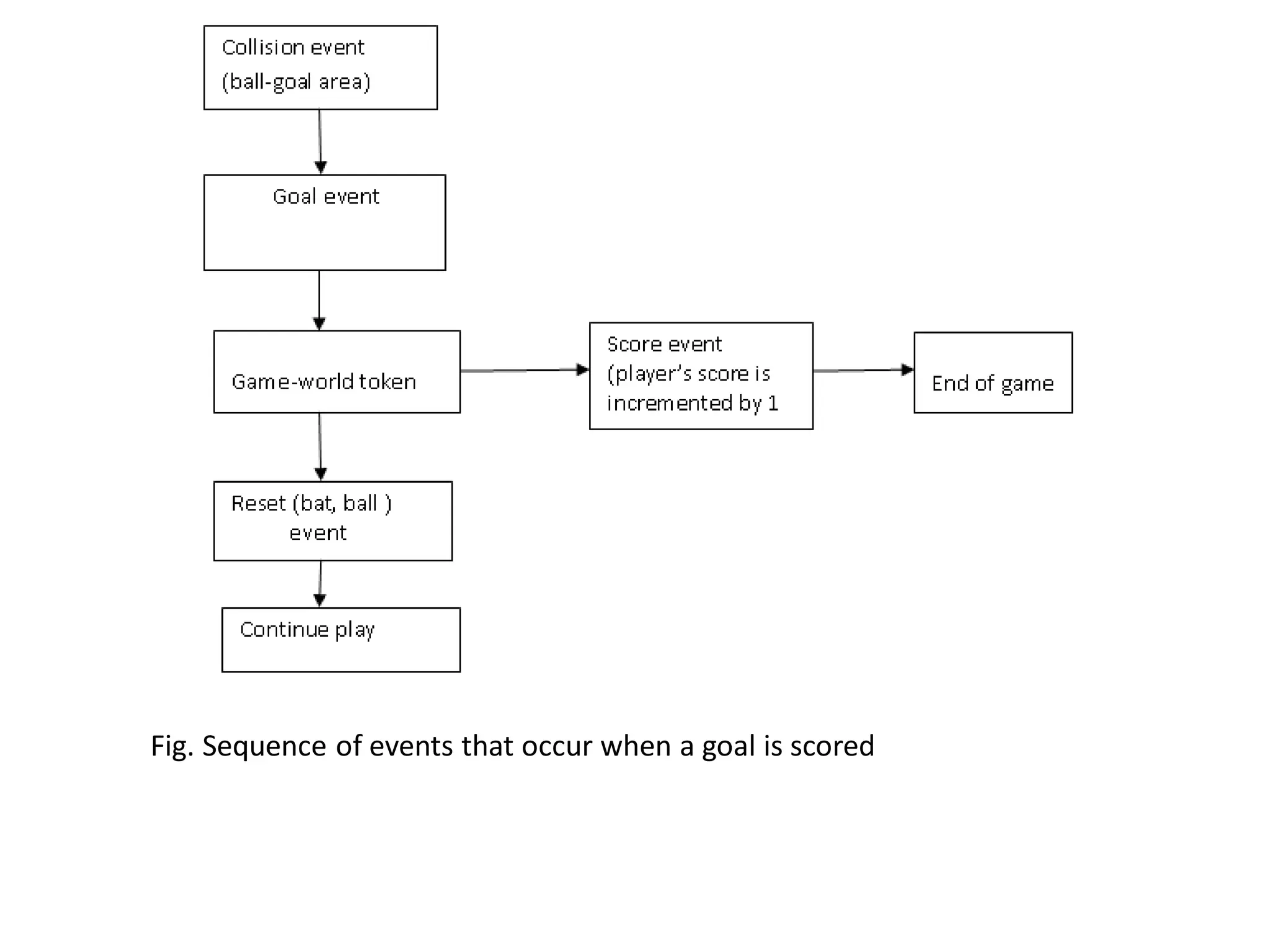
For example, it resets the game when the goal
event occurs (and the score is incremented). If
instead of game-world token, there has to be an
inter-token communication, then each token has
to have an intimate knowledge about the other
tokens with which it may interact.
• Also, here the game-world token acts as an event
handler. This leads to design extensibility, that is,
when a new token needs to be added by the
designer, it can be added easily.
• It can also do filtering events based on location.
Fig. Sequence of events that occur when a goal is scored
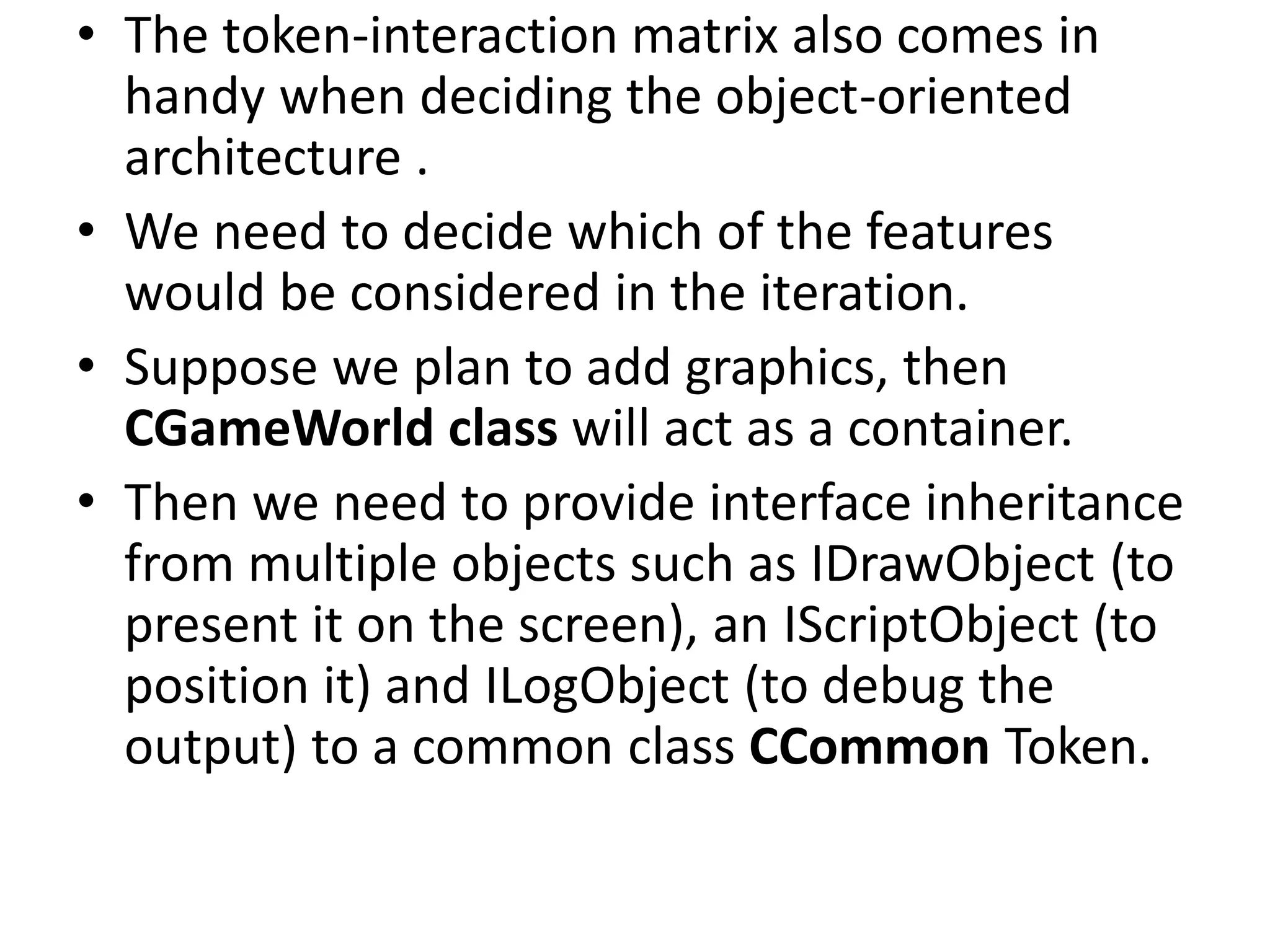
• The token-interaction matrix also comes in
handy when deciding the object-oriented
architecture .
• We need to decide which of the features
would be considered in the iteration.
• Suppose we plan to add graphics, then
CGameWorld class will act as a container.
• Then we need to provide interface inheritance
from multiple objects such as IDrawObject (to
present it on the screen), an IScriptObject (to
position it) and ILogObject (to debug the
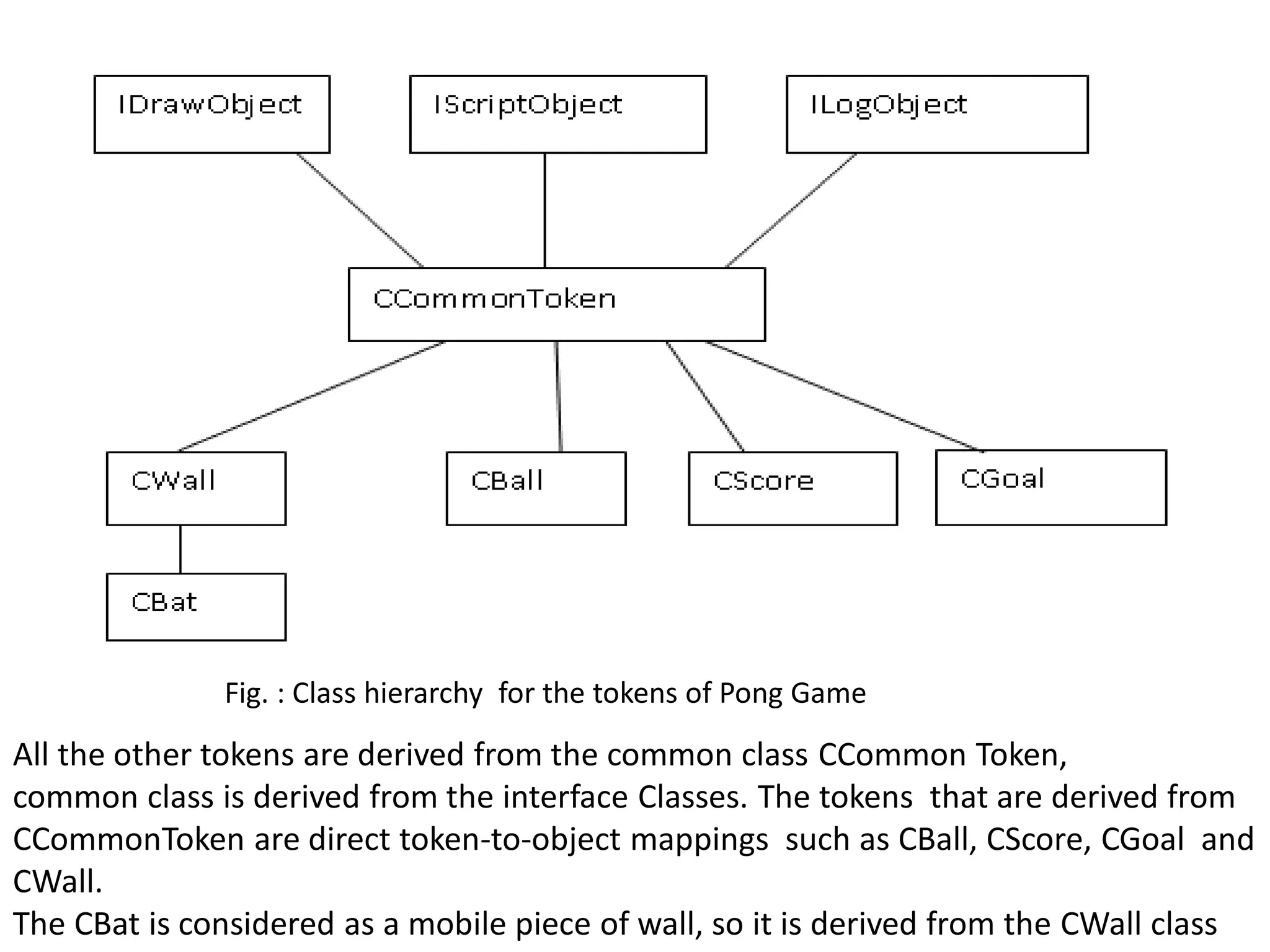
output) to a common class CCommon Token.
All the other tokens are derived from the common class CCommon Token,
common class is derived from the interface Classes. The tokens that are derived from
CCommonToken are direct token-to-object mappings such as CBall, CScore, CGoal and
CWall.
The CBat is considered as a mobile piece of wall, so it is derived from the CWall class
Fig. : Class hierarchy for the tokens of Pong Game
Unit 1-NEW - game game Game Core Design.pdf

Unit 1-NEW - game game Game Core Design.pdf

  • 1.
    Unit-1 Game CoreDesign & Initial Design Deptt. of Info. Tech. KDK College of Engineering Nagpur
  • 5.
    Differences between moviesand a game Sr. No. game (programming) movies (animation) 1. requires any input from a user a movie (animation) does not 2. Players have to make decisions do not need to make any decision 3. have no ending, sometimes have one ending, sometimes have multiple ways to end a movies has a predetermined ending 4. a game has rules and goals, and may have constrains, players, objects, terrains and behaviors, for example, physics, sound, speech, and emotions a movies has characters ,role & audio, video etc.
  • 14.
    Symmetry - Chess,Tic-Tac-Toe Asymmetry – counter strike,battlefield,nintendo land,packman
  • 19.
  • 25.
    Game design principles Thebasic principles of game design include the following: • The game design should be kept simple. • Every game should be unique. • There should be effective representation to bring out the real- life environment. • It should include social factors, like it takes two to play a game. • Playing the game should be fun.
  • 26.
    Game design Process Thebasic steps of the Game design Process : Step 1 : Build the concept 1. Get an idea. 2. Build the game concept. 3. Create a goal. 4. Create an emotional experience for the player. Step 2 : Creating the game specification 1. Write the design document. 2. Build the prototype. 3. Iterate, that is, choose lifecycle model.
  • 27.
    A. Build theconcept 1. Getting an idea - Dreams and inspirations can create ideas. - come up with a unique and unusual idea for a game. - brainstorm sessions for creating an idea. - Pen down ideas. - evaluate ideas based on parameters such as originality, potential audience. selected ideas are then subjected to synergy check and the concept is created.
  • 28.
    2. Build thegame concept • A game is good if the player can win by doing unexpected things. • surprise and delight factor almost make the gameplay, which encourages the player to employ strategies. • The broad genres of games are action (use many buttons/keys), adventure (story is important), puzzle (analytical thinking), educational (learning by doing) and strategies (non-trivial choice making). Games like movies can combine genres: for example, an adventure game can combine action and puzzle.
  • 29.
    3. Create agoal • Every game has a goal. • All aspects of the game must focus the player towards achieving the goal. All games have one or more of the following goals: • To collect points (do not have a visible objective. • To gain power. • To reach the destination/target first.(racing game) • To overcome obstacles. • To discover something. • To eliminate opponents.
  • 30.
    Point-Scoring Vs. Racingand Conquest-type game • The point-scoring games , rewards are given in the form of points - do not have a visible objective, • In racing and conquest-type game, both involve visible objective. For instance. • In racing, the player knows what is his/her position compared to other participants at any point of time.-Mario cart, crazy taxi, need for speed, • In role-playing games (RPGs), the points earned can be spent on improving the attributes.- Dungeons & Dragons,World of Warcraft, Final Fantasy • In strategy games, the gathered resources are used on units.-Packman,Age of Empire,Civilization,Poker,Chess,Go • In adventure games; the collected items are used to solve something later. –Heavy rain,Myst(93),The walking dead(2012),broken age(2014),Fahrenheit(2005)Kings Quest I(83)The WITNESS(2016),Real Myst etc.
  • 31.
    4. Create emotionalexperience for player • If the emotional experience does not match the game goal, the player would not enjoy the game. • The programmer needs to design the game in such a way that player get addicted to the game. • For this purpose, cool graphics, fast actions, stimulating steps or complex strategies could be added to the game. • The features of the games such as score, moves, and levels could be designed as follows; • Score: In fighting, racings, sports or any competition games, Players expect more from a game experience than a mere score. • Moves: Controlling virtual athletes’ in sports and vehicles in racing requires a steady practiced hand players must master all those tricky moves to almost devastate their opponents. • Explore levels: exploration can be encouraged by - hiding some of the game levels. As the player moves through the levels he/she finds ways to unlock or realize the hidden areas. A racing game can have additional cars as the players acquire trophies a particular number of times. Similarly, a FreeCell game gets tougher as the player wins the first few games.
  • 32.
    B. Creating thegame specification Steps • Create Plan first  First create a plan answering following Questions- 1. What type (genre) of game it is? 2. What is the objective? 3. How will player achieve the objective? 4. What are the features that will constitute the gameplay? a) Identify the players. b) Identify the genre and corresponding constraints. c) Identify the universe and landscape. d)constraints and goals of the games. • Determine the criteria for success. How does the player win? How does he/she lose? • Determine the rules of interaction. Is it through controls or interaction with character or by putting the player in some environment. • How are the constraints explained to the player? Is a story told to the player? • What are the operational issues (in production/maintenance)?
  • 33.
    Creating the gamespecification - Test the concept • The concept is put down on paper, • writing the concept down exposes the issues and the complex interfaces. • This treatment forms the outline of the concept and the sketch of game design. • This ensures the potential of game and helps in deciding whether to go ahead or give up. • At this stage, the technical constraints are not seen. • Only the game’s unique features are considered and other details are ignored.
  • 34.
    Creating the gamespecification - Feature- based description • Feature- based description of the game is easy to understand. • Features are emergent from rules and most of the rules keep on changing as we detail the game. • The reason for the changes is that several rules interact with each other. • Feature is emergent if new categories must be used to describe it, and are not required to describe the underlying rules.
  • 35.
    Creating the gamespecification - Feature- based description There are three types of features: • Vital / integral features - make the game work properly. For example, in football, the formation is selected first, and then the choices of the players are made accordingly. • chrome features - Some features have no effect on the game played, but enhance the enjoyment of the game. These features help one draw the story and convey the look and feel of the game. For example, in football, the player chooses the stadium; or in a game like StarCraft, the interface is customized to reflect the alien species that are chosen for playing. • Gameplay substitutes -Some features do not enhance the game in any way, but merely give an equivalent choice (the choice makes no difference in achieving the objective). For example, the player can play one on one with computer or choose a multiplayer mode in LAN.
  • 36.
    Creating the gamespecification - Feature- based description The purpose of the gameplay is to - • explain the developers how the game works; • provide the vision statement referred throughout development; • identify features that are integral and that are chrome.
  • 37.
    Creating the gamespecification - Interface design • A good interface design makes the player feel that there are no restrictions on the control of the game. • Interface should efficiently handle a large number of simultaneous tasks in a complicated strategy game. • Use the list (with scroll bars, if necessary) for selection. • Multiple section facility should also be available, if necessary.
  • 38.
    Creating the gamespecification - Rules • At initial stage for creating a game, the rules have to be guessed. • As the game development evolves iteratively, more rules are added and these rules interact with the previous ones, thereby making changes to them. • The rules must serve the features. • Share damage through the formation. • If one member is hurt, the damage would be split to all units in the formation. • Size and type of formation would increase the toughness.
  • 39.
    Creating the gamespecification -Level design • Level design affects the core gameplay. • Levels depend on the storyline and can enhance the inherent gameplay or detract from it. • Issues related to level design have to be addressed in the game specification itself. • At its simplest level, low interactivity is given, which is reactive in entertainment software, which involves watching more than playing . • In the more story-oriented genres that evolve out of adventure games, More flexible narratives are given so that the viewer can delve into it with as much interactivity as he/she wants. • Level should not be used to cover deficiencies in the gameplay.
  • 40.
    Creating the gamespecification -Level design • Choices related to that level only should be visible in that level. • An accurate specification for each level is given to the level designers, who understand the rules. • Best level design is not linear, it allows multiple approaches. • A good game should allow the player to make strategies (long-term and tactics (short term) • The primary goals of a game design are to create interest in the reader and to convey the design aspects without ambiguity. • The interest of the reader should sustain from beginning to end of the document. • Reader should have a clear understanding of the design and nuance of the game in the genre.
  • 41.
    Creating the gamespecification - Design document General Information about brief description of the game • Basic concept: The basic concept describes the basic idea in one or two pages. The idea should be concise, informative and interesting. • Background story: This is necessary for adventure kind of games and nor for puzzle kind of games. • Objective: The objective of the game is described. The reader should have a clear understanding of the gameplay , therefore as much detail as possible is given in the design document. • Gameplay: The way the game works from beginning to end is described. After loading the game, a title screen or an option screen has to be shown. The choice that have to be provided in the option screen and can any of the option be bypassed, etc have to be decided.
  • 42.
    Creating the gamespecification - Design document • The result of choosing a particular option should be known to the player. • The method of providing the result can be through Help option in the menu. • The player’s assumption of the character (Hero) and his enemy/opponent (controlled by computer) have to be kept in mind. • The computerized opponent is described by artificial intelligence. (AI)
  • 43.
    Creating the gamespecification - Design document The detailed description of the following are decided. • Interfaces that are to be defined. • The different perspectives to be planned • The basic interactive structure in terms of sections and levels. • The genre of gameplay, if it needs speed and whether it has to be continuous as in racing or turn-based RPG, etc, to be noted. • The game has to be written for single or multiplayer PC-based game or LAN game. • The difficulty levels that are required. The targeted are group for the game. • The duration for the gameplay that any average player will take.
  • 44.
    Creating the gamespecification - Game design- the other aspects Characters: For all the characters in the game, mention their personality, capability and role/action in the game. World: All different scenes where action takes place have to be described. Design documents of RPGs are primarily organized by location, characters, objects and the events that happen in that location. If locations are visited in any sequence or by travelling through any shortest path, then the optimum order is also mentioned. Controls: The controls that have to be provided in the user interface are described. For any action to take place, buttons can be provided on the controller in the user interface. The state of the game is conveyed to the player though the user interface. For example, the player should know his/her scores, the resources left or life gauge, etc. The navigation through the game has to be well described. The player should be aware of the alternate ways of moving through the game . Wherever applicable, on-screen text message can be given.
  • 45.
    Creating the gamespecification - Game design- the other aspects • Graphics: The choice in the graphics mode if required has to be stated as choice for the player, the corresponding style to be chosen. For example. In the game of tennis-hard court, clay court, grass, etc, climatic conditions/weather options should be there. Pictures of major scenes in the game can be presented to visualize the game . Character sketches can be done to show how they will look. • Sounds and music: Where and when (specific action performed by the player/occurrence offend event) the sound effect is required in order to create an impact in the game. The general music and at the opening of any new level. different sounds can be played. The laughing track, the spectators’ reactions, noise made by animals, ghosts army weapons, etc are added to give a real-time effect.
  • 46.
    Creating the gamespecification - Build prototype • Prototype are built first, in order to minimize the risk; • get the client feedback in development process early; • help to visualize the end product; • find the feasibility
  • 47.
    Typical Game Sections •Game Section -1 • The environment is set up for the game and initialized. • Option to play or exit is entered. • User is requested to enter input. • User input is stored and viewed. Game section -2 • Game state is changed according to user’s last input. • AI is applied on player’s action, Then, background animation, music, sound effect are performed. • Finally, housekeeping is done. Game Section-3 • Current animation frame is drawn to virtual first, and then displayed on the screen. • Frame display rate is specified and locked. • In the exit routine, resources are released. • System settings are restored. • Control is given back t
  • 48.
    Life cycle model •Rapid prototyping phase before specification is a very popular technique. • Building of game in increments (repeated loop) through merge design, implementation and integration phases into a repeated block. • Agile –extreme programming involves team-based and very collaborative approach; hardly any documentation; integration of testing into the development process (instead of testing everything at the end, testing is done at certain milestones).
  • 49.
    Life cycle modelcontinued … Development process involves : • building a prototype; • playing the game for a while and getting the basics right; • asking other people to look at the game; • meticulously observing the player; • constantly rewarding the player in the game; • using new testers; • taking the game to next level of complexity;
  • 50.
    Life cycle modelcontinued … Good designs are both • high level (architectural level) and • low level (detail design). Even when changes are made in the detail design, the high-level architectural design is intact and so the final goal of the game remains unaffected. The “chrome” elements add to the look, and the feel of the game has to be coherent to give an aesthetic appeal.
  • 51.
    Gameplay Definition : TheStrategies that are required to reach various end points are collectively termed as gameplay. Rules interact with other rules of the environment to produce a result. Implementing gameplay A game is a set of a series of interesting non-trivial choices. A decision has gameplay value when it has an upside and a downside, and the overall payoffs also depend on other factors. Each decision affects the next. The decisions include choosing the correct option in the circumstances and looking out for better tactics to apply.
  • 52.
    Gameplay • There isa dominated and dominant strategy problem in gameplay which are defined as follows; Implementing gameplay • The option which is not worth using under any circumstance is called a dominated strategy. - waste of time • The option which is so appropriate that is not worth using any other option is called a dominant strategy. • a dominant option even worse is a better options . Hence, a near-dominant option is the only one that is useful. It is used in narrow circumstance and it is the one that the player will use most often. • An example of near dominated option is given as follows; Ask the following question ; • What is the most common feature? • What should I do to make the most of it? • If this facility is used only once in the game. How much of the development time has to be allocated for it? • How much special effects and efforts for building the interface should be spend?
  • 53.
    Gameplay Strategies • Agame has to be interesting even if the player knows all the tricks/tactics. • If a careless player over looks a near-dominated option then the opponents can exploit the situation. • However, near-dominance will show which options will get used most, and logically for those options more effort in terms of graphics, effects, etc, are spent. • The programmer should ensure to include interesting choices in the game. Different kinds of options a gameplay involves are as follows. • Option may or may not be taken depending upon certain factors. • Option can have time constraints and is context-dependent. • Option does not affect the game much whether taken or not. • Option that is worth being taken • Option that is never being taken.
  • 54.
    Toolbox to assistwith choices • There is no particular method for making the choice that are left to the creativity of the player. • Ensuring gameplay choices are non-trivial, make the game interesting. • Strategic choices are made for long term and tactical choices for the current or short term. • However, strategic choices will affect the range of tactical choices that are made later. • Player who selects options according to a set plan will not do as well as the player who adapts to the circumstances. • There should be enough scope for good judgment, and this gives a better payoff. • The payoffs for choosing different investments in strategic plan may alter the decision that the player will take at different levels.
  • 55.
    Toolbox to assistwith choices • Speed is a kind of versatility feature. • A unit that normally moves fast need not be having other best factors too. • The compensating factors could be that we could make the unit weak or we could make the unit expensive to buy. • If the unit is made expensive, then the player may or may not buy it. Once he/she has made the decision, he/she has committed to it. Hence the choice whether to buy or not may be strategically interesting but it is tactically not. • It does not oblige the player to use the unit in any interesting way. The player has to understand what are the compensating factors. • If the expensive unit is more powerful and would produce an impact, he/she might still go for it. The choice is entirely the player’s and it is a well-informed choice.
  • 56.
    Impermanence In some decision,the payoff leads are long lasting. The advantage can be impermanent, because of the following factors; • They can be destroyed, injured or stolen. • They can last only for some times or can have limited use. • They are of no use in certain circumstances Impermanence can also be a kind of choice the player has to make. While doing so, he/she has to understand the cost and trade-offs. • The cost does not mean only money and points gained; • it also means the time, efforts, attention and alternate resource required at that point. Gameplay allows you to interact and enrich your experience. This interaction can be done in following ways. • By changing the setting or game itself. • By directly controlling the character.
  • 57.
    Gameplay specification Definition : Thegameplay specification is a “vision document” that describes the final product and serves as a goal for all developers. When the code strictly adheres to gameplay specifications, then the product is ready for release. The designer notes explaining the reasons for all assumptions is required along with specification, since this will help others to verify/challenges the assumptions at the initial stage itself.
  • 58.
    Responsibility of thedesigner • Process of good creative design is to filter and clarify the designer’s ideas, which he has taken from many sources, and bring them to a structure that will best suit the game. • designer has to discuss or arrange for a brainstorming session with the team and accept inputs from them. • This will lead to gathering of more ideas and also reinforce/verify the ideas stated by the designer in the first instance. • Apart from the development team, the product in view has to be presented to the marketing team to solicit their guidance of the commercial aspects so that the features in the game take care of the expectations of the clients at least for the next two years.
  • 62.
    1. Building aStory and Script 2. Feasibility Study
  • 68.
    Development phases ingameplay various phases of development in gameplay are (8 phases) Phase Process People Outcome Feasibility Discussing the initial idea and feasibility Designer, architect technology group Project go ahead signal from client Conceptualizat ion Detailing the design Designer Gameplay specification, designer’s notes Plan planning the mini-specifications for each stage along with the objective to achieve Designer and a software planner Set of mini- specification document Technical architecture Preparing architectural components and tools that will be needed. This is then handed over to the project leader. Mini specifications are mapped to milestones in project plan Architect, project leader, planner Technical specifications project plan
  • 69.
    Development phases ingameplay various phases of development in gameplay are Phase Process People Outcome Component Building Constructing the components and tools required for the game. Considering interdependencies of components and completing the aspects of game architecture one by one Development team Components that are functionally complete Integration Project leader gets the components assembled by the development team, which are tested and reviewed by designer. This requires support from tools programmer Project leader designer (only to review), tools programmer Completed part of the game and tools
  • 70.
    Development phases ingameplay various phases of development in gameplay are Phase Process People Outcome Complexity Project leader in consultation with the level designer builds game levels Project leader designer (one for each level) Completed game for each level is ready along with tutorials/demos. Artwork and manuals are also finalized Review Quality assurance department does the review in parallel with leveling. This can also be outsourced Quality assurance department Bugs are fixed and feedback is sent to developers
  • 71.
    Development phases ingameplay • Project leader and planner are involved in the release operation. • Release does not mean the game is a complete finished product, but means that it is a usable product. • It is considered finished only when all the features incorporated work perfectly and the required artwork, interface and other features are completed. • Game design in evolutionary. • The gameplay specification is an evolving document as changes have to be incorporated into the design document throughout the development process. • Designer’s notes reasons out the gameplay specifications. • This is analogous to the comments in the code. • If a change in design is made on a later stage in view of improving the performance, it may not hold good for a long time if one does not understand why it was not thought of in the first place.
  • 72.
    Mapping design documentwith gameplay specification • It is mandatory for the programmers to refer to the design document while carrying out the tasks. • First, it may have the answer to the queries they have in mind while development, and • second it gives an opportunity to all developers to give their views on the design. • The designer finally reviews their ideas and incorporates them if found suitable • In reality, programmers rarely read these design documents though they are made available for them. Also, it is expensive to tag one member from the design group with every programmer. The solution to this problem can be as follows. • A part of the design document that is relevant to the context of the code is made available to programmer instead of entire design document (Fig.)
  • 73.
    Mapping design documentwith gameplay specification
  • 74.
    Mapping design documentwith gameplay specification • Content mapping uses the work breakdown structure of the Gameplay specification, maps it to the design document and extracts the relevant part of the document. • Therefore, to every module the corresponding designer’s notes is attached. The mapping can be in the from of hypertext links also, so that the developer can view the notes whenever he/she wants. • Modularizing helps in making changes independently in each part of the design and test. • Games are developed in an iterative manner, since the risk is high and so spiral process model is chosen most of the times. • Most of the rules that the gameplay specifications document contains have to be tried out so as to find out how they work in practice.
  • 76.
    • If theprime key functions have to be tried out, then a prototype or test-bed model is used. • In this model, the designer has the opportunity to improve the model as he proceeds with the specification. • Any creative designer can produce an excellent game by using cannot track the task in the critical path, cannot estimate the time for completion, etc. • Hence it is used only if the game is of an entirely new category which has not been tried before.
  • 77.
    • In theiterative development, the gameplay specification is divided into a group of mini-specifications that defines a level. • Each mini-specification (level) is developed and tested. Each level has the following design items; • Goal to design the features to be implement in that level. • Philosophy to find what this level intends to do • Expected results as to what the outcomes is at a particular stage. • Alternatives or other ideas suggested during the brainstorming sessions. • It is easy to develop the game architecture with these mini- specifications or level document.
  • 78.
    2. Initial Design •Game playing is enjoyed by Children as well as adult • The way of looking at game is different. • Children will appreciate the fun aspects of the game, but an adult too can enjoy entertainment software. • Many adults play game like Age of Empires because they like ordering those little men around to build a city. • What annoys them is when the enemy players storm in, destroy it and spoil the fun. • I think adults like to have gameplay just to make what we are doing seem respectable and do not play just for fun.
  • 79.
    • Many peoplewho do not play games ; think that Playing game just kills the time, but it is not so. • More awareness of entertainment software is needed to de- stress people. Adv of game playing : • Play can educate the mind, • stimulate the imagination • the creativity sharpens the wits, • lightens the heart and enriches the soul. In the future, we can see more individuals such as screenwriters, artists, novelists and board-game designers entering computer game design, which will revolutionize the world of entertainment software. What makes it truly entertaining is that many of these people will have no idea of the limitations of the technology (the designer need not worry about that, at least in the initial design phase.)They will demand the challenge; will deliver games astoundingly different from what we have already seen.
  • 80.
    • Software architecturein general uses certain rules, heuristics and patterns; • The problem is partitioned so that the system built can be easily maintained. • The interfaces are created between these partitions. • The overall structure is managed and the flow is made easy. • Techniques are used to interface the system to its environment. • Development and delivery approaches, techniques and tools can be properly planned and executed.
  • 81.
    Architecture is importantbecause of the following reasons: • It controls complexity. • It ensures best practices are followed. • It takes care of consistency and uniformity. • It increases predictability. • It allows reuse.
  • 82.
    Need for goodarchitecture design The advantage of a good architecture design is that, • It describes and plan for the expected gameplay features, • also gives us a rational framework within which we can make any required changes. • If we do not have a design, we may find ourselves frantically gameplay the day before shipping which is never a good idea. Architectural Design can be An iterative or tier-based design -more vital for any product that has to incorporate new or untried futures. If we have to stick to a deadline and positively have to ship by a certain date, the tier system will let us fit the design to that date. If development is slipping, we can trim some features (or even drop them entirely), but the modularity inherent in the design will allow us to do so while still keeping the project under control.
  • 83.
    • The architecturaldesign in gaming evolves slowly and care has to be taken in keeping the documentation up to date. • Game design has to satisfy many stakeholders, such as high-level management, marketing department and peers of the game designer. • To ensure it is worth developing , the design has to go through a number of iterations and refinements throughout the development process. • The game design had to be converted to technical specification in a way that the implementer can understand and code. • The technical design acts as a roadmap and also increases projects visibility to generate an overall idea of how to work with project plan. • The order will realize where his/her module will fit in the overall picture (class diagram).
  • 84.
    Game and hardwareabstraction • The architecture design has to deal with both • Game abstraction and • Hardware abstraction interface. • Abstraction emphasizes on the idea properties rather than how it works. • It greatly reduces the complexity in large programs by hiding the irrelevant details. Game abstraction
  • 85.
    Game abstraction • Itis the way by which the game objects interact. • Many gaming software objects are designed- communicated via APIs so that the logic in many of the gaming software modules may be designed independently of each other • Modular gaming software architecture allows a game-flow software module developed for similar group of games. • Game presentation software modules may be different to change the look and feel of the game. Adv . Of Game abstraction approach • simplifies the design • ensures easy maintenance of the gaming software. • software factory methodology provides the reusable objects for common functionalities. • Hardware abstraction
  • 86.
    Hardware abstraction • Dealswith the platform on which the software will be running. • For every platform of different hardware configuration with different graphics card, sound card etc, and its codes have to be written and linked through the common interface. • Hardware abstraction interface is not difficult since they already exist. Graphics hardware abstraction • Direct X - set of APIs that will call the appropriate driver in the hardware and also handle all the multimedia tasks. • A graphical surface in DirectX can be created in either system (local) memory or video memory. • surface initialization member takes parameters that indicate the height, width, bit depth of the surface and where it has to be located in the memory. • The private members of the surface object provide error reporting, restore and release methods.
  • 87.
    Graphics hardware abstraction •Direct X - set of APIs that will call the appropriate driver in the hardware and also handle all the multimedia tasks. • A graphical surface in DirectX can be created in either system (local) memory or video memory. • surface initialization member takes parameters that indicate the height, width, bit depth of the surface and where it has to be located in the memory. • The private members of the surface object provide error reporting, restore and release methods. - Initialization code- called once - screen-flipping and frame- drawing members are called frequently
  • 88.
    Graphics hardware abstraction •OpenGL which provides extensive cross-platform graphics library. For example, screen-handling library can support a common range of resolutions, double or triple buffering, bitmapped and True Type fonts, and sprites. • graphics library translates the programmer’s commands into device-specific commands. These commands specific are used to draw the graphical elements and object. Also, these commands are different for different devices, for example, commands for a plotter are different from that of a console.
  • 89.
    Sound hardware abstraction •sound card object is a single object accessed through an initialization function. • The member functions of the sound card object are: • playing, pausing, and stopping ; • changing volume and frequency; • specifying the position of the sound in three- dimensional space. • The parameters can be enabled through the initialization function. • No duplicate sound is made, and any new objects created refer to original data. •
  • 90.
    COTS- Components OffThe Shelf • All the basic functionalities- the sound system. graphics engine, music, saving of game. AI, artwork,etc. are available as components off- the shelf (COTS) • COTS reduces the burden on programmers. • Allow the game developers to concentrate more on gameplay.
  • 91.
    Architectural design • Theobjective of a good architectural design is to choose the best way of doing things from among the alternative designs. • For proper game development, the game architecture should be understood properly. • Without a proper architecture, the game is likely to result in high coupling. • This will end up in procedural entanglement where the game loop does a million and one things. • It is better to think about how things should work as a whole before starting the coding straight away.
  • 92.
    The following pointapplies to larger games where there are programmers, artists and designers all working on a game. • Simple feature: A simple feature with a good tool that allows the developer to experiment and to iterate rapidly than out of a complex feature with no editor support. • Iteration for good results: It should be easy for the people building the game to test the iterations while designing a feature. • Simple runtime code: If major chunk of code is only required when editing a level, then it should be kept out of the game code. This mean a smaller code footprint, easier porting and less testing. Characteristics of good Architectural design
  • 93.
    • Data –drivencode: Anything that might need to be adjusted should be a parameter that comes from data, not hard coded. Constants should be avoided and designers should not be allowed to set up complex gameplay conditions in scripts or using a visual scripting language. Designing your code around data also helps when trying to multi-thread systems for taking advantage of the console hardware. • Hard to debug data-driven engines: Though using data- driven engines has its advantages, one major disadvantage of using them is that when a problem arises, these engines are hard to debug. To overcome any such problem that might inevitably arise, some extra functionality needs to be added. To have true data-driven architecture, a game engine must contain reusability, structured scripting language, scripting/editing tools, and essentially a friendly architecture. Characteristics of good Architectural design
  • 94.
    • Scripting languageis created to control AI. • Script is required to be translated to C++ or bytecode. • Vocabulary is required for interacting with the game engine. • To connect scripting vocabulary to game engine internals, a “glue layer” is added. This allows pluggable AI modules, even after the release of the game. Characteristics of good Architectural design
  • 95.
    • Game enginesand graphic system: There are number of free game engine or graphic systems that can be used to begin with designing the game. • Writing a 3D game engine or similar engine takes a long time and requires many people to get it done. • Using a different game engine and just coding those parts is much simpler. Characteristics of good Architectural design
  • 96.
    Tiers of gamearchitecture 1. Input-output devices: A large amount of data from the input and output devices are generated - read screaming. 2. Device APIs: The data stream generated needs to be processed by one or more engines, such as the graphics engine, input manager and /or the sound engine.
  • 97.
    3. Main -The CPU’s processing time is mostly spent on marshalling (assemble and arrange in order) the processed data from the game engines and performing general purpose logic. Smaller portions of the frame are used, as they are mostly devoted to physics, animation or graphics. The AI and the gameplay code pose a great challenge in the form of numerous exceptions, tunable parameters, indirections, etc. These are responsible to incorporate distinguishing features for each game. 4. Data : The data that has been processed by various engines, marshaled by the CPU and incorporated with distinguishing features by the API and gameplay code, has to be streamed out to the video display console for creating colorful graphics and giving a visual appeal. This process is called write streaming or rendering. In other words, it also refers to the transfer of data from the CPU to the GPU, to the frame buffer, which contains a small fraction of the frame.
  • 98.
    The other reusablecomponents are as follows: • Setup programs (if required) for loading, saving and restoring of games and data. • Menu system that helps in configuring the game settings, such as sound or music volume, and for redefining control and screen resolutions. • Frameworks like DirectX that support the internal structures required to implement these features .
  • 99.
    Use of goodmiddleware • Middleware is written to support the most common APIs used for physics, audio, animation, facial animation, network transport and various other systems. • Middleware vendors can keep the cost lower than the developers themselves making the same code. • Vendors can afford to keep larger, more experienced teams working on a given piece of functionality as compared to independent game developers because the vendors can sell the piece of code to many developers. It is wise to use a middleware unless these are specific needs that differ from the normal conditions. • Middleware offers structure. It draws a line between the things that you have to worry about and the things that you do not need to worry about. When we use a middleware, we need to accept that technology’s inflexibility, and modify our game design to suit it.
  • 100.
    Tokenization • Tokens arediscrete elements that are directly or indirectly controlled and manipulated by the player. • All the game scan is described interim of players and tokens. • The tokens are conceptual objects which will eventually be translated into programming language objects. • These might include a player’s avatar, weapons, cards, counters metal figures, poker chips and letters of the alphabet (in a word game.)
  • 101.
    Tokenization • Tokens canbe arranged in a form of hierarchy with the game world (play area) at its top. • Every token has to be part of the game world token. • For example, the player’s avatar token acts as a user interface between the player and the game.
  • 102.
    Tokenization of Pong •Pongs is two-dimensional graphics video game • Released by a firm Atari Incorporation in 1972. • It is actually a simulated table-tennis game. • Represented in 2D graphics. • Player scores points if opponent fail to return a ball Net ,(paddle)Bat player area Ball score Tokens – Player , Ball , wall , goal area Sub token – bat, score
  • 103.
    - Tokens donot interact with each other on their own. - An occurrence of an event causes the interaction. - There are two types of event in Pong. - Collision event and the goal event. - The collision event is generated when two tokens collide. -Each of these tokens gets a message that it has collided and the type of token it has coiled with. -A token-interaction matrix is constructed, which exhibits all possible collision -Symmetric interaction: If interaction is same in both the ways, for example, bat-ball and ball- bat, then the interaction is symmetric -Asymmetric integration: This interaction depends on the direction. For example, the goal increments the score by I, whereas the score increment need not be caused by a goal. x - No Interaction - means Symmetric Interaction
  • 104.
    The uses ofthe game world token • It acts as an intermediary between different tokens and also responds to certain other events. For example, it resets the game when the goal event occurs (and the score is incremented). If instead of game-world token, there has to be an inter-token communication, then each token has to have an intimate knowledge about the other tokens with which it may interact. • Also, here the game-world token acts as an event handler. This leads to design extensibility, that is, when a new token needs to be added by the designer, it can be added easily. • It can also do filtering events based on location.
  • 105.
    Fig. Sequence ofevents that occur when a goal is scored
  • 106.
    • The token-interactionmatrix also comes in handy when deciding the object-oriented architecture . • We need to decide which of the features would be considered in the iteration. • Suppose we plan to add graphics, then CGameWorld class will act as a container. • Then we need to provide interface inheritance from multiple objects such as IDrawObject (to present it on the screen), an IScriptObject (to position it) and ILogObject (to debug the output) to a common class CCommon Token.
  • 107.
    All the othertokens are derived from the common class CCommon Token, common class is derived from the interface Classes. The tokens that are derived from CCommonToken are direct token-to-object mappings such as CBall, CScore, CGoal and CWall. The CBat is considered as a mobile piece of wall, so it is derived from the CWall class Fig. : Class hierarchy for the tokens of Pong Game