Unit 1-Introduction to simulation
Definition
• A simulation is the imitation of the operation of real-world
process or system over time.
• …
Generation of artificial history and observation of that
observation history
• „A model construct a conceptual framework that
describes a system.
• „The behavior of a system that evolves over time is
studied by developing a simulation model.
• „The model takes a set of expressed assumptions:
 …
Mathematical, logical
 …
Symbolic relationship between the entities
Goal of modeling and simulation
• A model can be used to investigate a wide verity of
“what if” questions about real-world system.
 …
Potential changes to the system can be simulated and
predicate their impact on the system.
 …
Find adequate parameters before implementation
• „So simulation can be used as
 …
Analysis tool for predicating the effect of changes
 …
Design tool to predicate the performance of new
system
• „It is better to do simulation before Implementation.
How a model can be developed?
• Mathematical Methods
…
Probability theory, algebraic method ,…
…
Their results are accurate
…
They have a few Number of parameters
…
It is impossible for complex systems
• „Numerical computer-based simulation
…
It is simple
…
It is useful for complex system
When Simulation Is the Appropriate Tool
• Simulation enable the study of internal interaction of a subsystem with complex
system
• „Informational, organizational and environmental changes can be simulated and
find their effects
• „A simulation model help us to gain knowledge about improvement of system
• „Finding important input parameters with changing simulation inputs
• „Simulation can be used with new design and policies before implementation
• „Simulating different capabilities for a machine can help determine the
requirement
• „Simulation models designed for training make learning possible without the cost
disruption
• „A plan can be visualized with animated simulation
• „The modern system (factory, wafer fabrication plant, service organization) is too
complex that its internal interaction can be treated only by simulation
When Simulation Is Not Appropriate
• When the problem can be solved by common
sense.
• „When the problem can be solved analytically.
• „If it is easier to perform direct experiments.
• „If cost exceed savings.
• „If resource or time are not available.
• „If system behavior is too complex.
…
Like human behavior
Advantages and disadvantages of
simulation
• „In contrast to optimization models, simulation
models are “run” rather than solved. …
Given as a set of inputs and model
characteristics the model is run and the
simulated behavior is observed
Advantages of simulation
• New policies, operating procedures, information flows and soon can
be explored without disrupting ongoing operation of the real
system.
• New hardware designs, physical layouts, transportation systems and
… can be tested without committing resources for their acquisition.
• Time can be compressed or expanded to allow for a speed-up or
slow-down of the phenomenon( clock is self-control).
• Insight can be obtained about interaction of variables and
important variables to the performance.
• Bottleneck analysis can be performed to discover where work in
process, the system is delayed.
• A simulation study can help in understanding how the system
operates.
• “What if” questions can be answered.
Disadvantages of simulation
• Model building requires special training.
… Vendors of simulation software have been
actively developing packages that contain
models that only need input (templates).
• Simulation results can be difficult to interpret.
• Simulation modeling and analysis can be time
consuming and expensive.
… Many simulation software have output-
analysis.
Areas of application
• Manufacturing Applications
• Construction Engineering and project
management
• Military application
• Logistics, Supply chain and distribution
application
• Transportation modes and Traffic
• Business Process Simulation
• Risk analysis
… Insurance, portfolio,...
Application of Simulation in Business
• Process Improvement
• Predicting Outcomes
• Managing Risk
• Deciding on Actions
• Improving Forecasts
• Exploring Possible Scenarios
Business simulation (game)
• Used for business training, education or analysis.
• It includes strategic thinking, decision making,
problem solving, financial analysis, market
analysis, and operations.
• It can be scenario-based or numeric-based.
Significance
Risk-free decision making
A way to mimic on-the-job learning
Realism
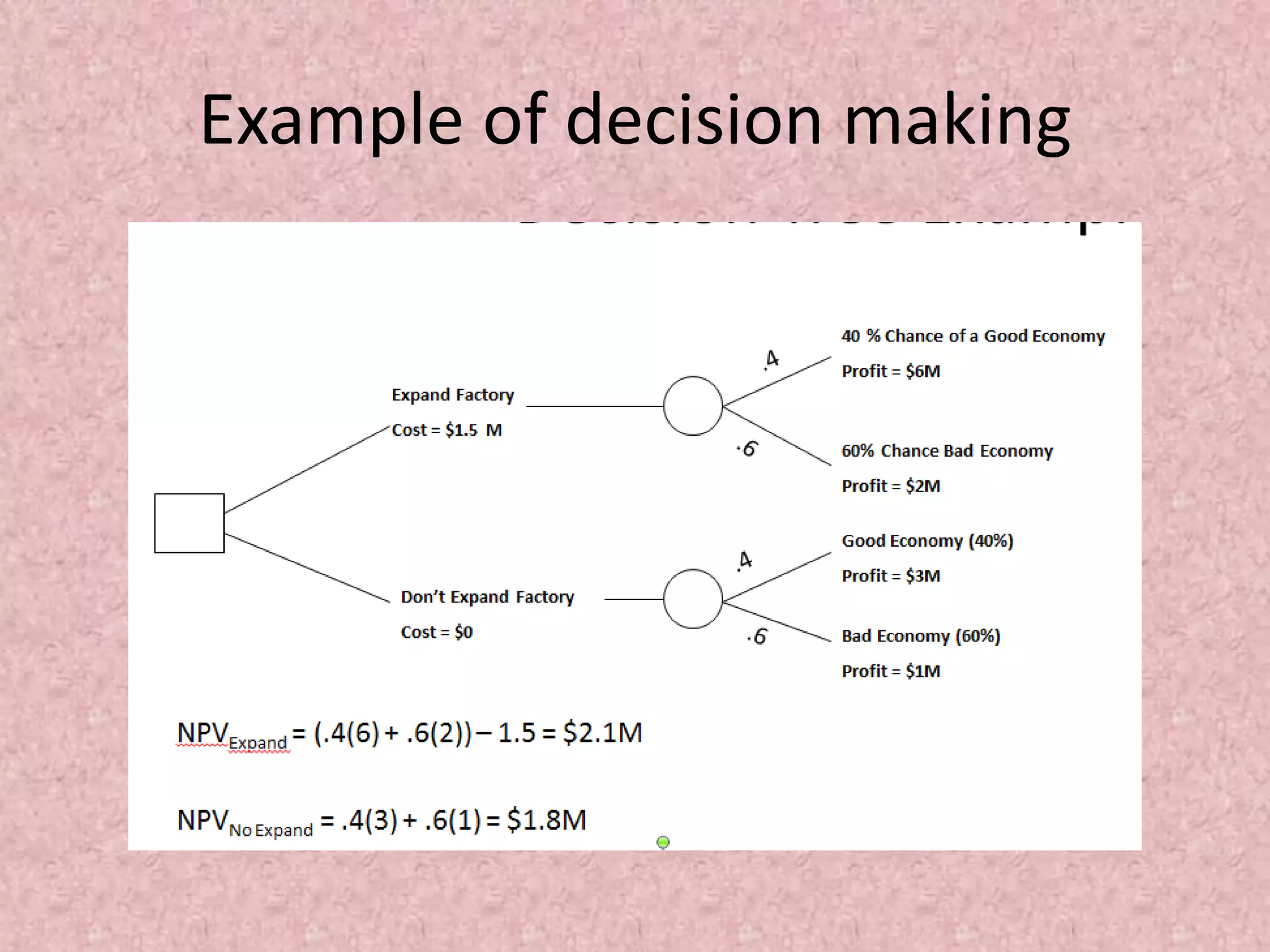
Example of decision making
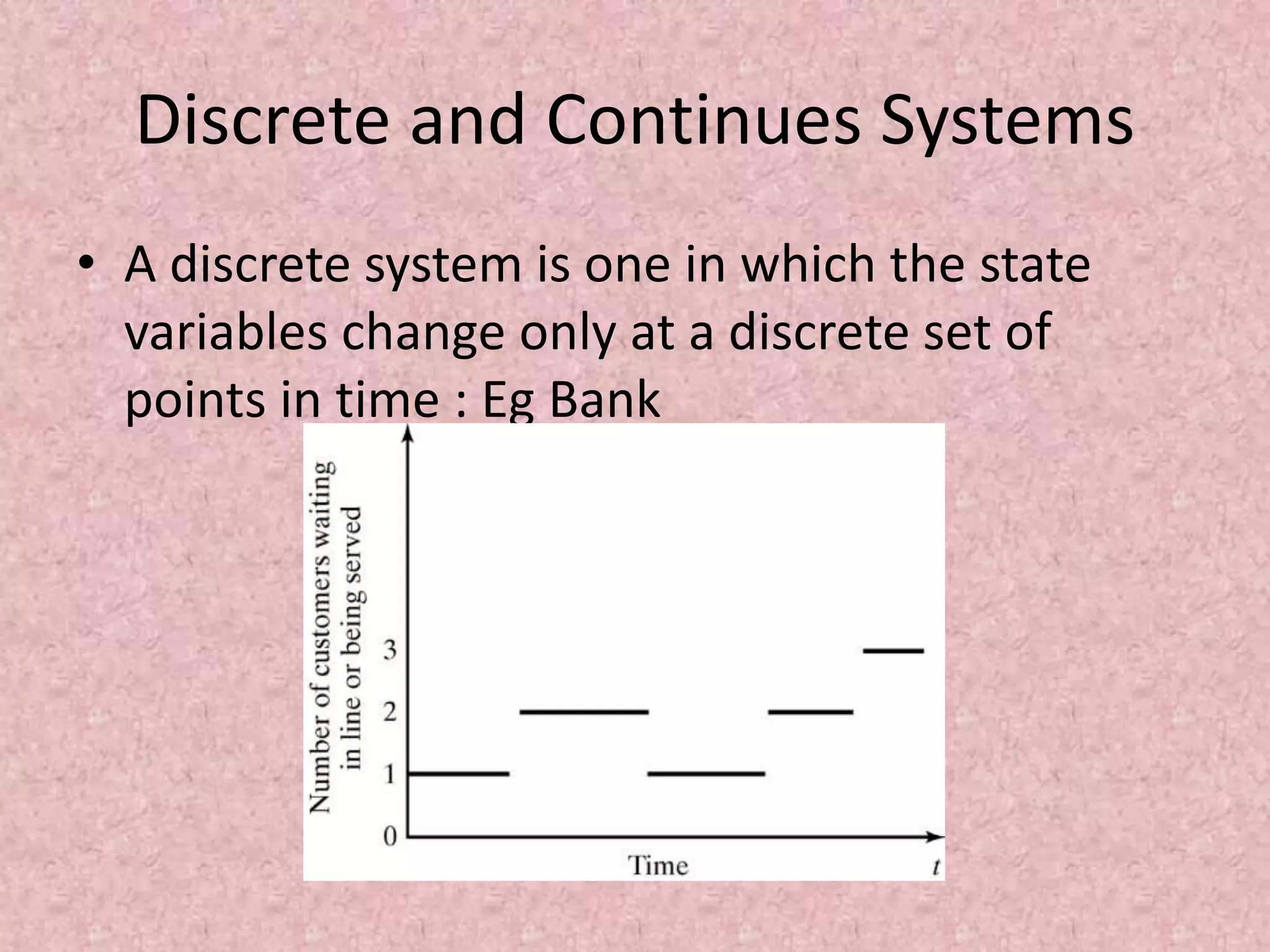
Discrete and Continues Systems
• A discrete system is one in which the state
variables change only at a discrete set of
points in time : Eg Bank
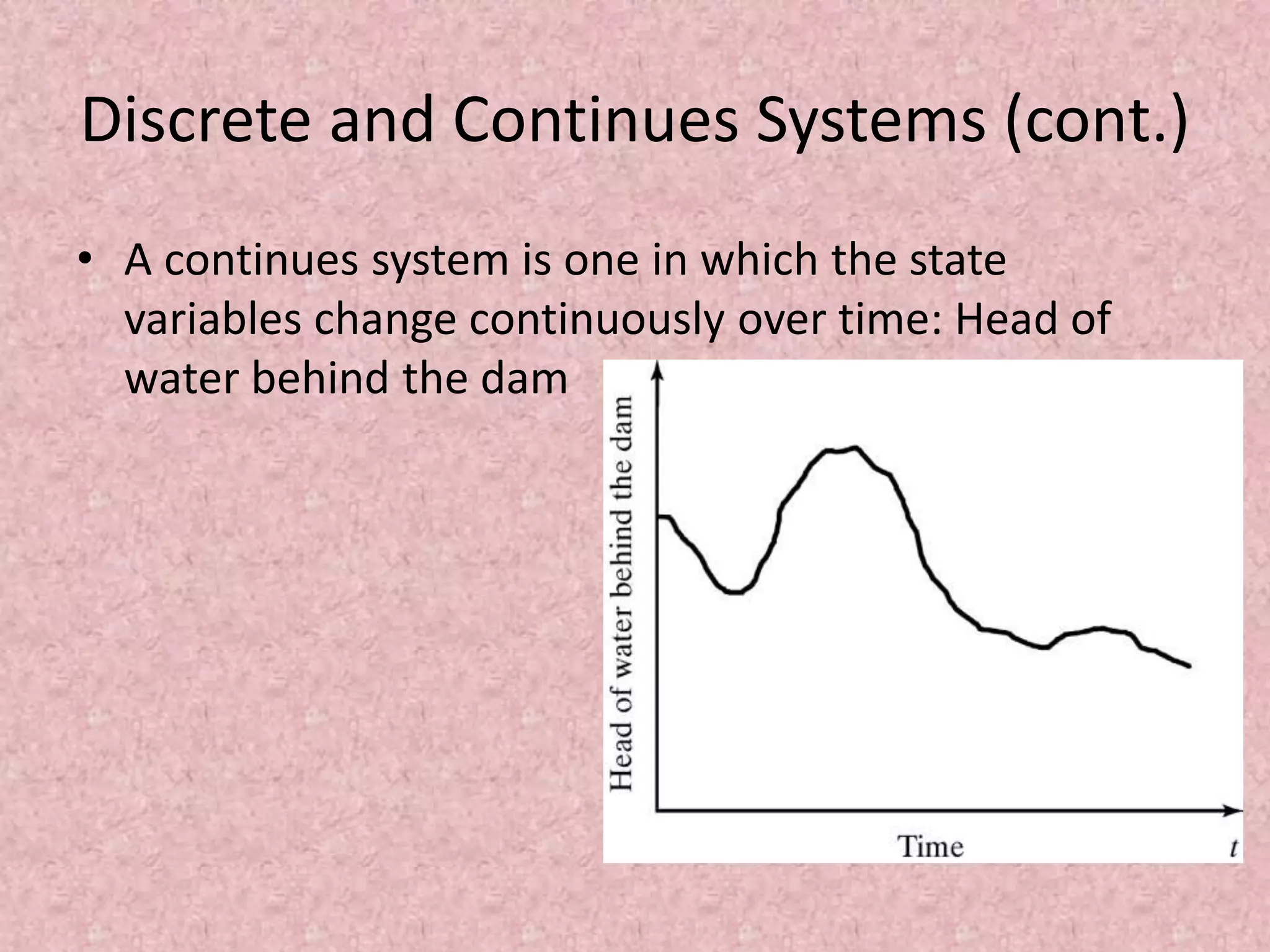
Discrete and Continues Systems (cont.)
• A continues system is one in which the state
variables change continuously over time: Head of
water behind the dam
Model of a System
• To study the system
… it is sometimes possible to experiments with system
… This is not always possible (bank, factory,…)
… A new system may not yet exist
• Model: construct a conceptual framework that
describes a system
… It is necessary to consider those accepts of systems
that affect the problem under investigation (unnecessary
details must remove)
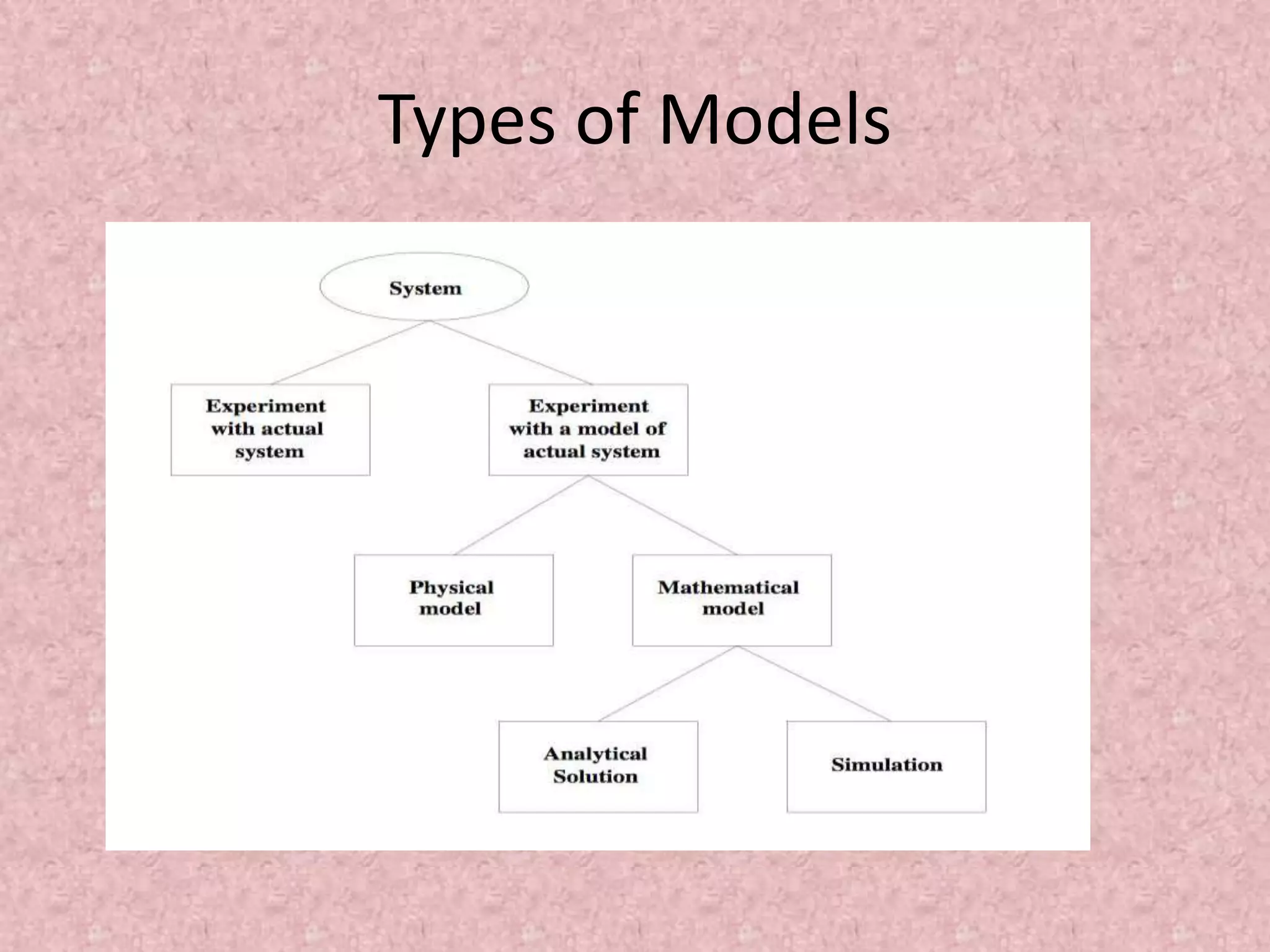
Types of Models
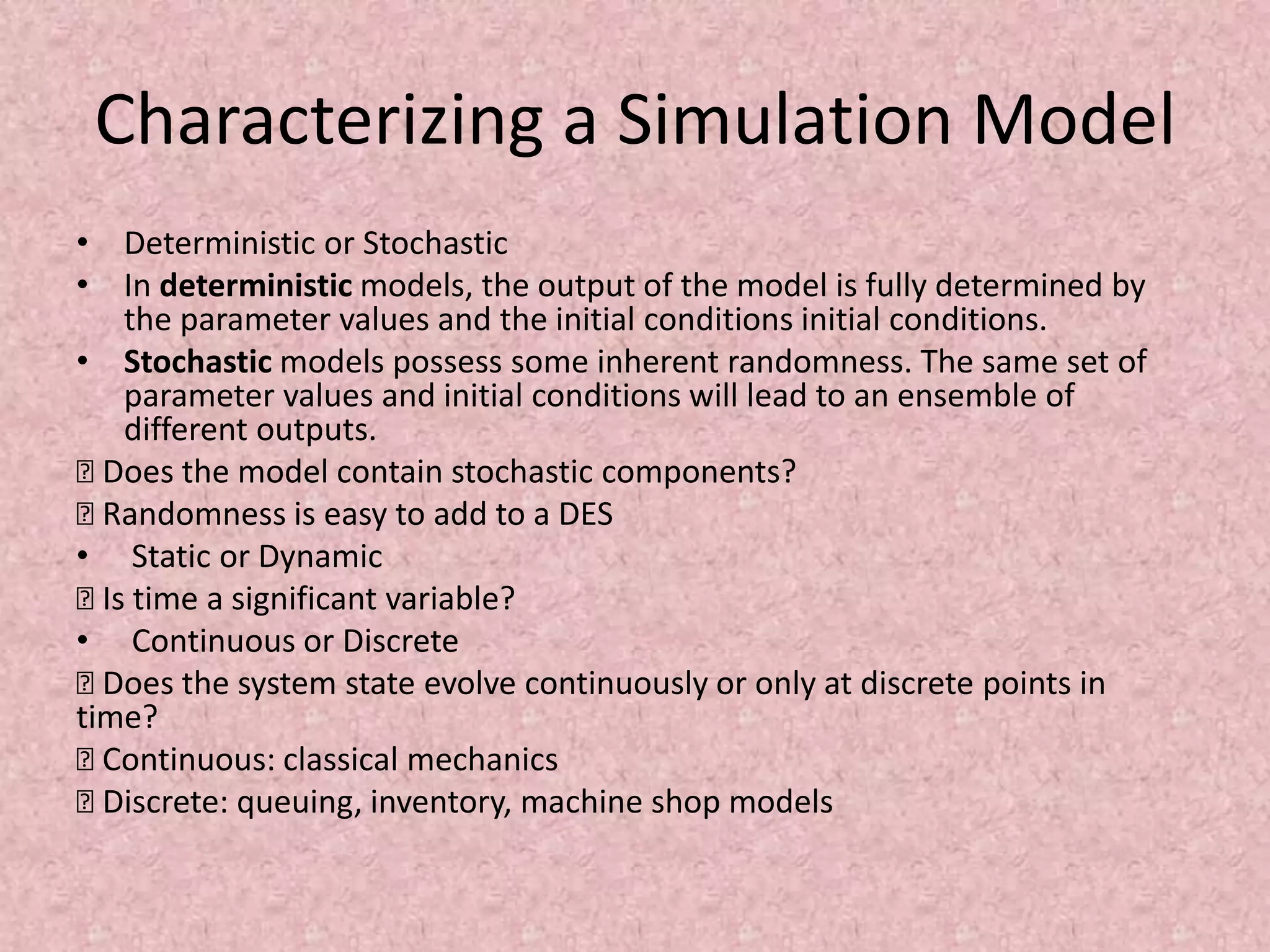
Characterizing a Simulation Model
• Deterministic or Stochastic
• In deterministic models, the output of the model is fully determined by
the parameter values and the initial conditions initial conditions.
• Stochastic models possess some inherent randomness. The same set of
parameter values and initial conditions will lead to an ensemble of
different outputs.
… Does the model contain stochastic components?
… Randomness is easy to add to a DES
• Static or Dynamic
… Is time a significant variable?
• Continuous or Discrete
… Does the system state evolve continuously or only at discrete points in
time?
… Continuous: classical mechanics
… Discrete: queuing, inventory, machine shop models
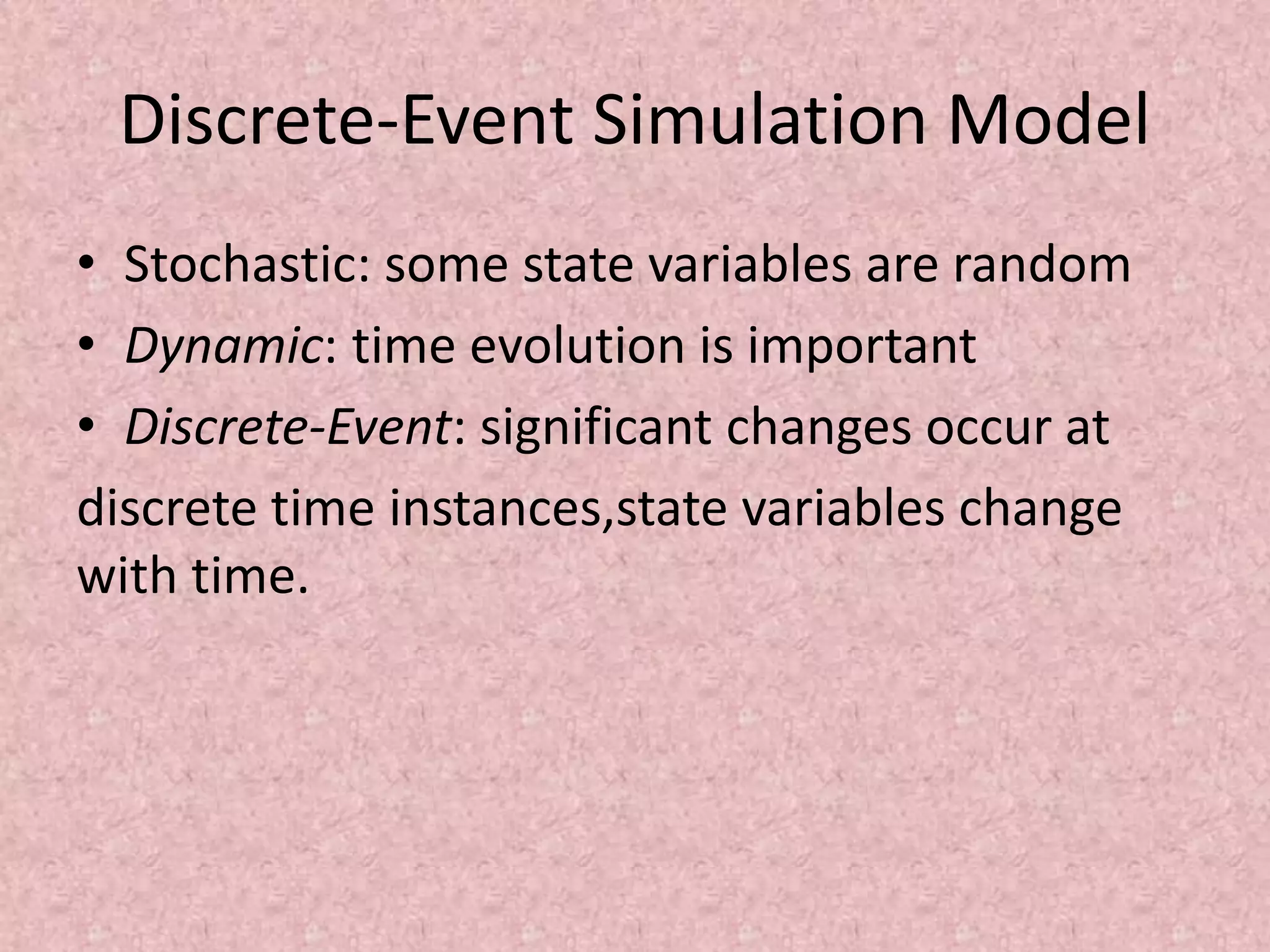
Discrete-Event Simulation Model
• Stochastic: some state variables are random
• Dynamic: time evolution is important
• Discrete-Event: significant changes occur at
discrete time instances,state variables change
with time.
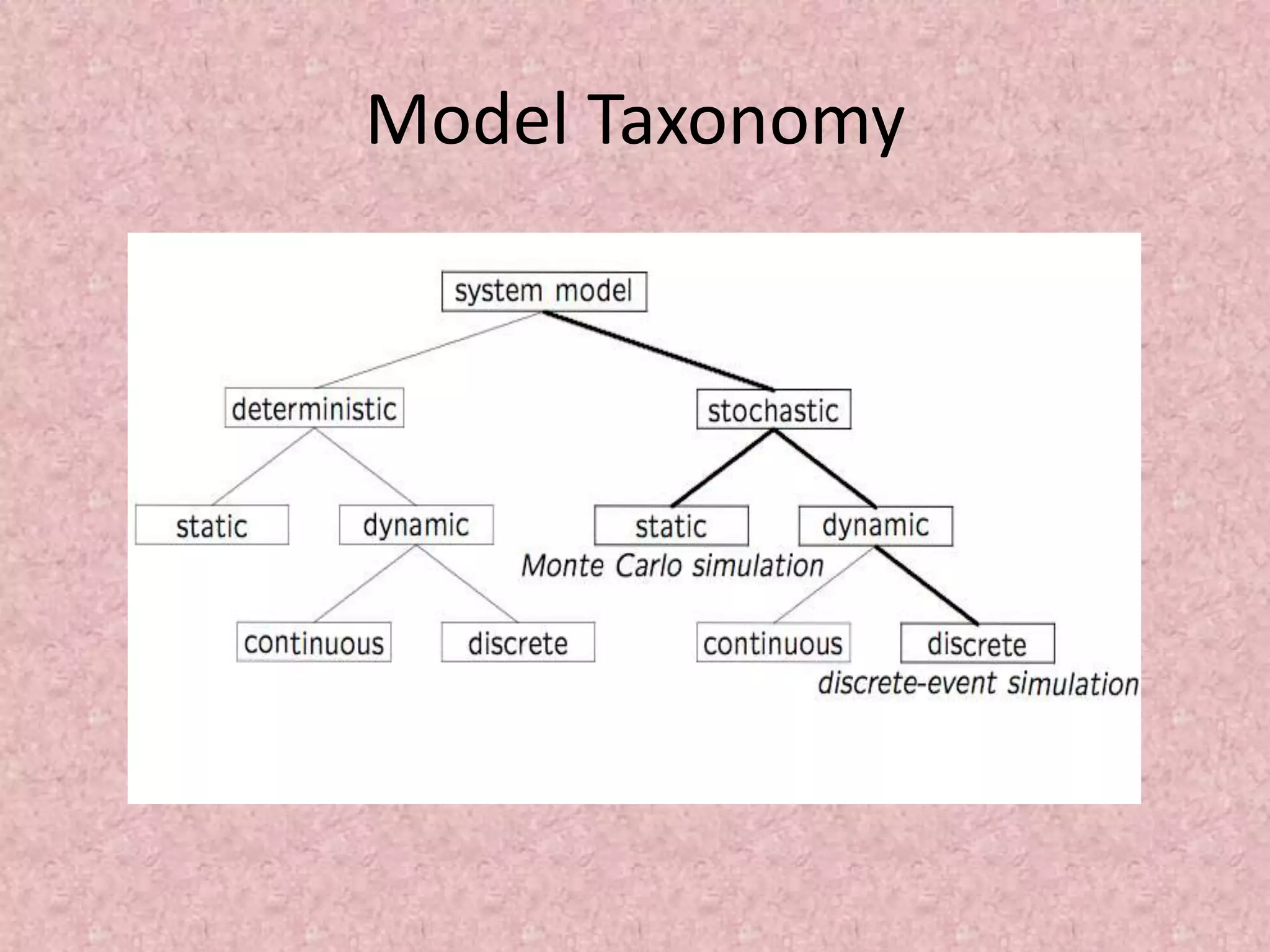
Model Taxonomy
Verification vs. Validation
• Verification
… Computational model should be consistent with
specification model
… Did we build the model right?
• Validation
… Computational model should be consistent with
the system being analyzed
… Did we build the right model?
… Can an expert distinguish simulation output from
system output?
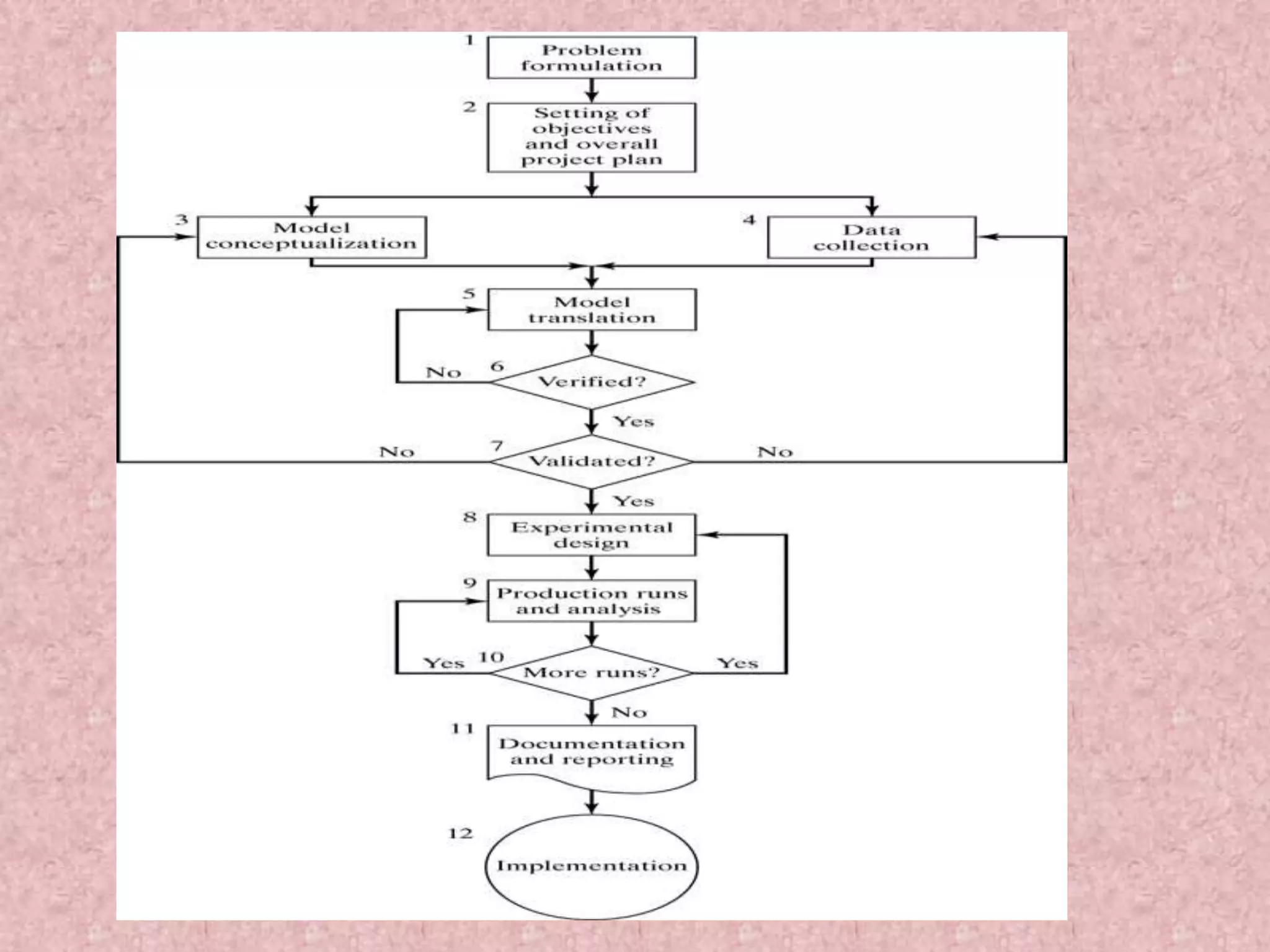
• Problem formulation: Problem is understood by simulation analyst and formulation is understood
by client.
• Setting the objective and project plan:
 Determine the questions that are to be answered
 Identify scenarios to be investigated
 Decision criteria
 Determine the end user
 Determine data requirement
 Determine hardware, software
 Prepare a time plan
 Cost plan and billing procedure
• Conceptual model:
 Abstract essential features-events,activities,entities,attribtes,resources,variables and their
relationships
 Performance measure
 Data requirements
• Assumptions-clearly to be specified
• Experimental design
 Number of simulation runs
 Length of each run
 Manner of initialization
• Analysis of results
 Statistical test(point estimation)
 Interpretation of results
 More runs?
• Documentation and reporting
• Progress report
• Frequent report
• Result of experiments
• Recommendations.
Various simulation Techniques
• Monte Carlo / Risk Analysis Simulation
Businesses use it prior to implementing a major project or
change in a process, such as a manufacturing assembly line.
• Agent-Based Modeling & Simulation
An agent-based simulation is a model that examines the
impact of an ‘agent’ on the ‘system’ or ‘environment.’
• Discrete Event Simulation
A discrete event simulation model enables you to observe the
specific events that result in your business processes.
• System Dynamics Simulation Solutions
This is a very abstract form of simulation modeling, system
dynamics does not include specific details about the system

Unit 1 introduction to simulation

  • 1.
  • 2.
    Definition • A simulationis the imitation of the operation of real-world process or system over time. • … Generation of artificial history and observation of that observation history • „A model construct a conceptual framework that describes a system. • „The behavior of a system that evolves over time is studied by developing a simulation model. • „The model takes a set of expressed assumptions:  … Mathematical, logical  … Symbolic relationship between the entities
  • 3.
    Goal of modelingand simulation • A model can be used to investigate a wide verity of “what if” questions about real-world system.  … Potential changes to the system can be simulated and predicate their impact on the system.  … Find adequate parameters before implementation • „So simulation can be used as  … Analysis tool for predicating the effect of changes  … Design tool to predicate the performance of new system • „It is better to do simulation before Implementation.
  • 4.
    How a modelcan be developed? • Mathematical Methods … Probability theory, algebraic method ,… … Their results are accurate … They have a few Number of parameters … It is impossible for complex systems • „Numerical computer-based simulation … It is simple … It is useful for complex system
  • 5.
    When Simulation Isthe Appropriate Tool • Simulation enable the study of internal interaction of a subsystem with complex system • „Informational, organizational and environmental changes can be simulated and find their effects • „A simulation model help us to gain knowledge about improvement of system • „Finding important input parameters with changing simulation inputs • „Simulation can be used with new design and policies before implementation • „Simulating different capabilities for a machine can help determine the requirement • „Simulation models designed for training make learning possible without the cost disruption • „A plan can be visualized with animated simulation • „The modern system (factory, wafer fabrication plant, service organization) is too complex that its internal interaction can be treated only by simulation
  • 6.
    When Simulation IsNot Appropriate • When the problem can be solved by common sense. • „When the problem can be solved analytically. • „If it is easier to perform direct experiments. • „If cost exceed savings. • „If resource or time are not available. • „If system behavior is too complex. … Like human behavior
  • 7.
    Advantages and disadvantagesof simulation • „In contrast to optimization models, simulation models are “run” rather than solved. … Given as a set of inputs and model characteristics the model is run and the simulated behavior is observed
  • 8.
    Advantages of simulation •New policies, operating procedures, information flows and soon can be explored without disrupting ongoing operation of the real system. • New hardware designs, physical layouts, transportation systems and … can be tested without committing resources for their acquisition. • Time can be compressed or expanded to allow for a speed-up or slow-down of the phenomenon( clock is self-control). • Insight can be obtained about interaction of variables and important variables to the performance. • Bottleneck analysis can be performed to discover where work in process, the system is delayed. • A simulation study can help in understanding how the system operates. • “What if” questions can be answered.
  • 9.
    Disadvantages of simulation •Model building requires special training. … Vendors of simulation software have been actively developing packages that contain models that only need input (templates). • Simulation results can be difficult to interpret. • Simulation modeling and analysis can be time consuming and expensive. … Many simulation software have output- analysis.
  • 10.
    Areas of application •Manufacturing Applications • Construction Engineering and project management • Military application • Logistics, Supply chain and distribution application • Transportation modes and Traffic • Business Process Simulation • Risk analysis … Insurance, portfolio,...
  • 11.
    Application of Simulationin Business • Process Improvement • Predicting Outcomes • Managing Risk • Deciding on Actions • Improving Forecasts • Exploring Possible Scenarios
  • 12.
    Business simulation (game) •Used for business training, education or analysis. • It includes strategic thinking, decision making, problem solving, financial analysis, market analysis, and operations. • It can be scenario-based or numeric-based. Significance Risk-free decision making A way to mimic on-the-job learning Realism
  • 13.
  • 14.
    Discrete and ContinuesSystems • A discrete system is one in which the state variables change only at a discrete set of points in time : Eg Bank
  • 15.
    Discrete and ContinuesSystems (cont.) • A continues system is one in which the state variables change continuously over time: Head of water behind the dam
  • 16.
    Model of aSystem • To study the system … it is sometimes possible to experiments with system … This is not always possible (bank, factory,…) … A new system may not yet exist • Model: construct a conceptual framework that describes a system … It is necessary to consider those accepts of systems that affect the problem under investigation (unnecessary details must remove)
  • 17.
  • 18.
    Characterizing a SimulationModel • Deterministic or Stochastic • In deterministic models, the output of the model is fully determined by the parameter values and the initial conditions initial conditions. • Stochastic models possess some inherent randomness. The same set of parameter values and initial conditions will lead to an ensemble of different outputs. … Does the model contain stochastic components? … Randomness is easy to add to a DES • Static or Dynamic … Is time a significant variable? • Continuous or Discrete … Does the system state evolve continuously or only at discrete points in time? … Continuous: classical mechanics … Discrete: queuing, inventory, machine shop models
  • 19.
    Discrete-Event Simulation Model •Stochastic: some state variables are random • Dynamic: time evolution is important • Discrete-Event: significant changes occur at discrete time instances,state variables change with time.
  • 20.
  • 21.
    Verification vs. Validation •Verification … Computational model should be consistent with specification model … Did we build the model right? • Validation … Computational model should be consistent with the system being analyzed … Did we build the right model? … Can an expert distinguish simulation output from system output?
  • 23.
    • Problem formulation:Problem is understood by simulation analyst and formulation is understood by client. • Setting the objective and project plan:  Determine the questions that are to be answered  Identify scenarios to be investigated  Decision criteria  Determine the end user  Determine data requirement  Determine hardware, software  Prepare a time plan  Cost plan and billing procedure • Conceptual model:  Abstract essential features-events,activities,entities,attribtes,resources,variables and their relationships  Performance measure  Data requirements • Assumptions-clearly to be specified
  • 24.
    • Experimental design Number of simulation runs  Length of each run  Manner of initialization • Analysis of results  Statistical test(point estimation)  Interpretation of results  More runs? • Documentation and reporting • Progress report • Frequent report • Result of experiments • Recommendations.
  • 25.
    Various simulation Techniques •Monte Carlo / Risk Analysis Simulation Businesses use it prior to implementing a major project or change in a process, such as a manufacturing assembly line. • Agent-Based Modeling & Simulation An agent-based simulation is a model that examines the impact of an ‘agent’ on the ‘system’ or ‘environment.’ • Discrete Event Simulation A discrete event simulation model enables you to observe the specific events that result in your business processes. • System Dynamics Simulation Solutions This is a very abstract form of simulation modeling, system dynamics does not include specific details about the system