Understanding
                                JavaScript


Thursday, September 20, 12
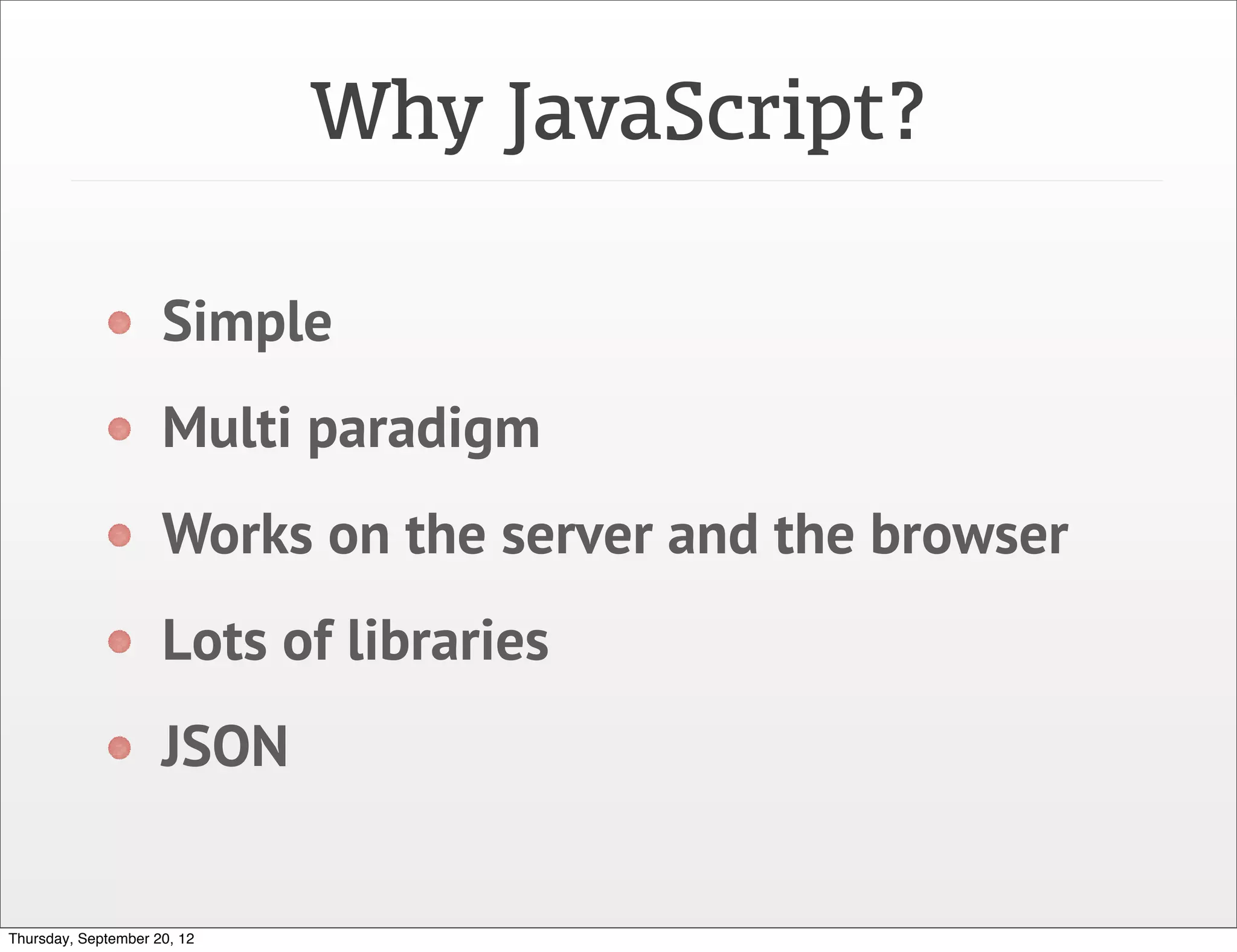
Why JavaScript?

                     Simple
                     Multi paradigm
                     Works on the server and the browser
                     Lots of libraries
                     JSON


Thursday, September 20, 12
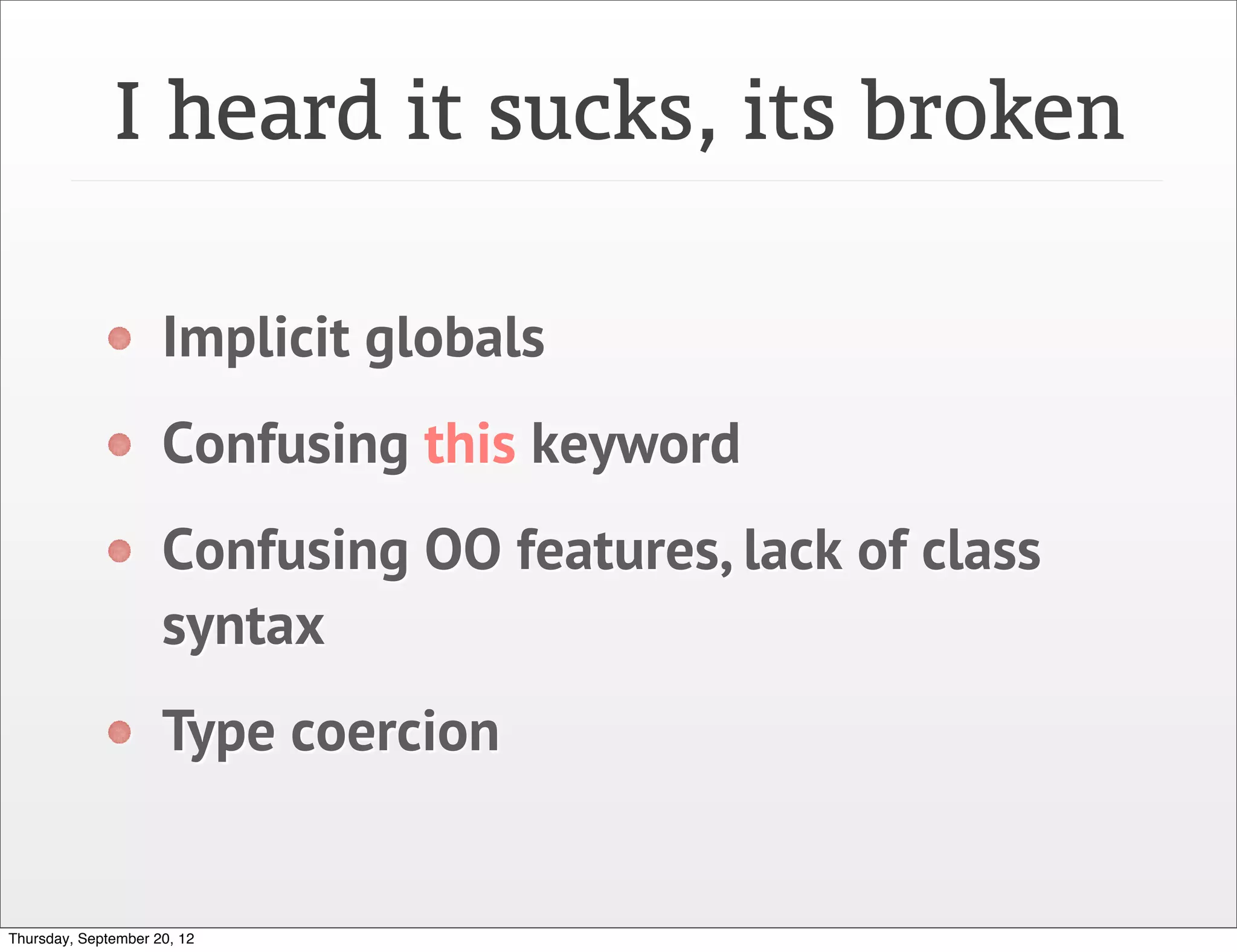
I heard it sucks, its broken

                     Implicit globals
                     Confusing this keyword
                     Confusing OO features, lack of class
                     syntax
                     Type coercion


Thursday, September 20, 12
The good parts


Thursday, September 20, 12
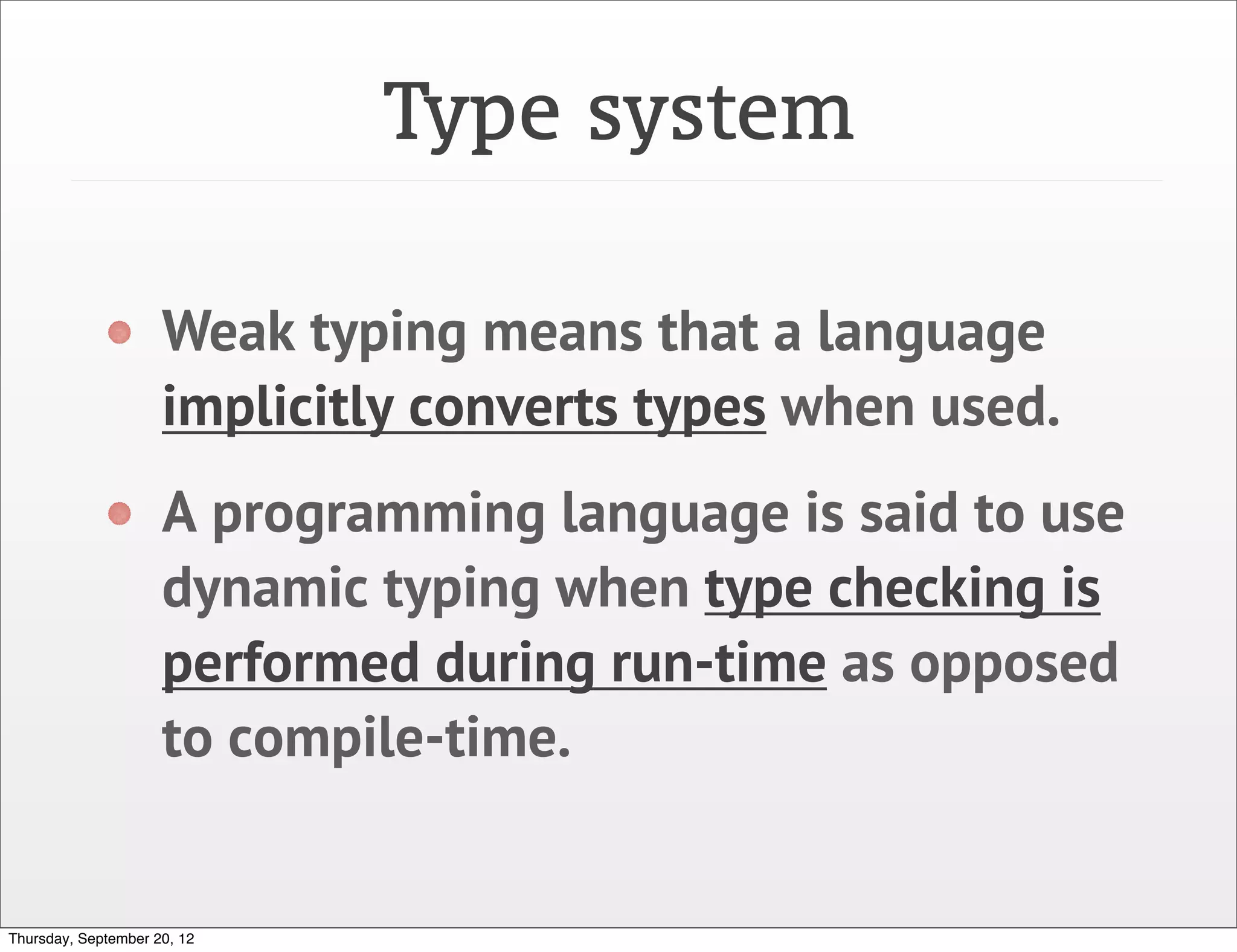
Type system

                     Weak typing means that a language
                     implicitly converts types when used.
                     A programming language is said to use
                     dynamic typing when type checking is
                     performed during run-time as opposed
                     to compile-time.


Thursday, September 20, 12
Type system
                     Constructors              Literals            typeof
                Object()                       {a: ‘b’}           ‘object’

                    Array()                [0, 1, ‘foo’, 3]       ‘object’

                    RegExp()                   /foo.*/            ‘object’

                    Date()                           -            ‘object’

                    -                            null             ‘object’

                Boolean()                    true        false    ‘boolean’

                String()                     “foo”       ‘bar’     string’

                Number()              30     0.5 Infinity NaN     ‘number’

                Function()             function foo() {}         ‘function’

                -                             undefined          ‘undefined’

Thursday, September 20, 12
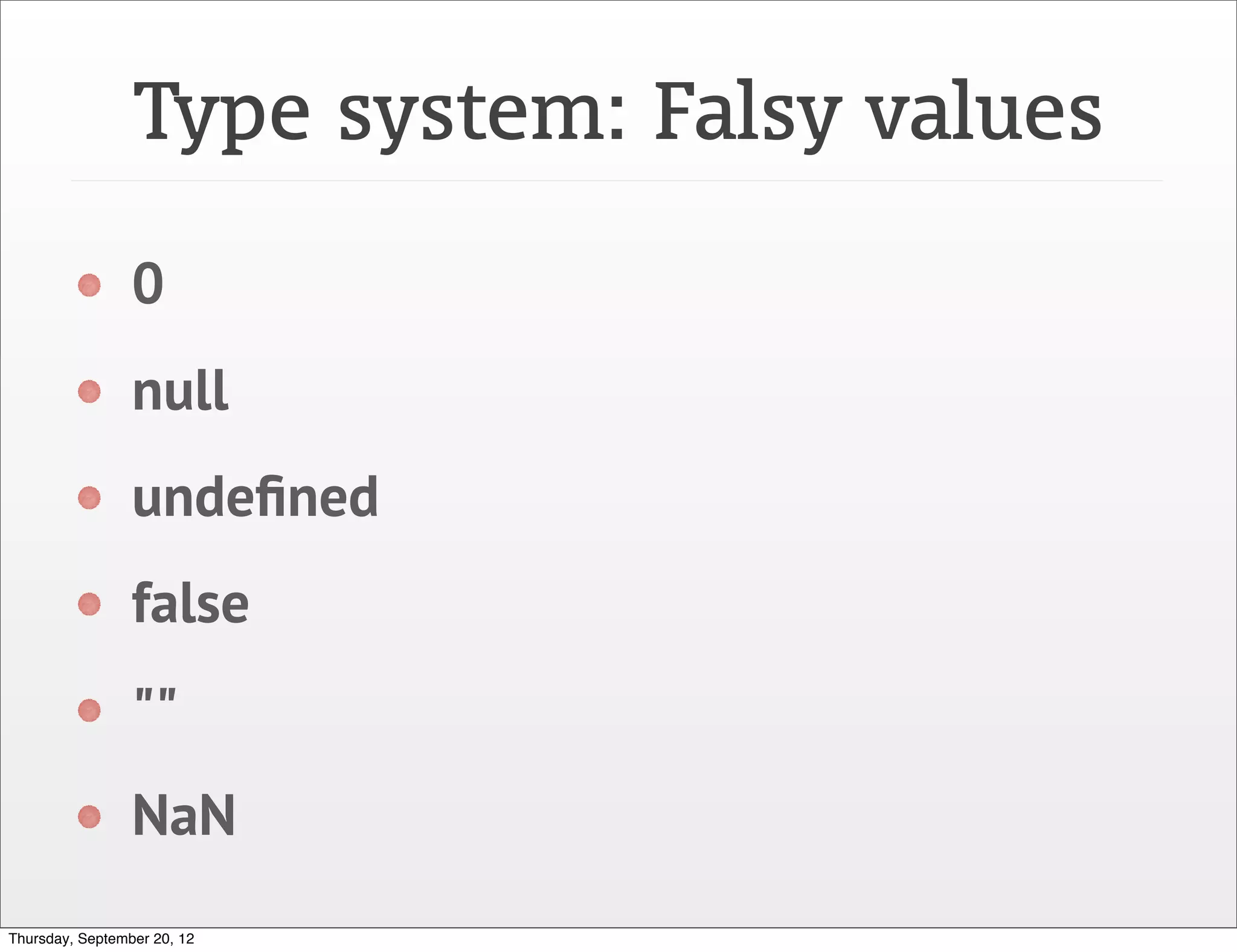
Type system: Falsy values

                 0
                 null
                 undefined
                 false
                 ""
                 NaN
Thursday, September 20, 12
Type system: Coercion
                 undefined == undefined
                 ",,," == new Array(4)
                 NaN != NaN
                 "wat" - 1 == NaN
                 {} + {} == NaN
                 [] + [] == “”
                 [] + {} == “[object Object]”


Thursday, September 20, 12
Type system


Thursday, September 20, 12
Type system

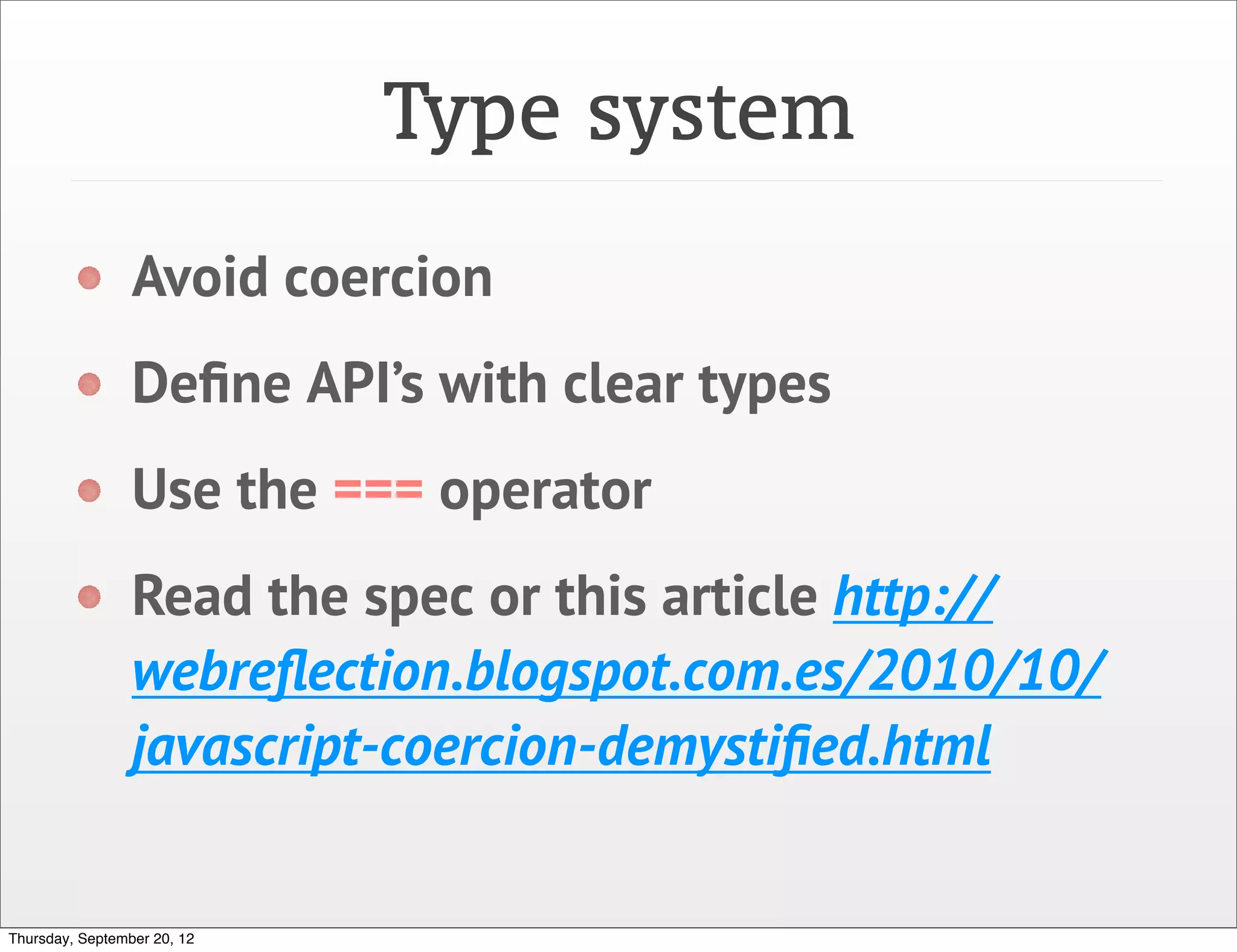
                 Avoid coercion
                 Define API’s with clear types
                 Use the === operator
                 Read the spec or this article http://
                 webreflection.blogspot.com.es/2010/10/
                 javascript-coercion-demystified.html


Thursday, September 20, 12
Type system
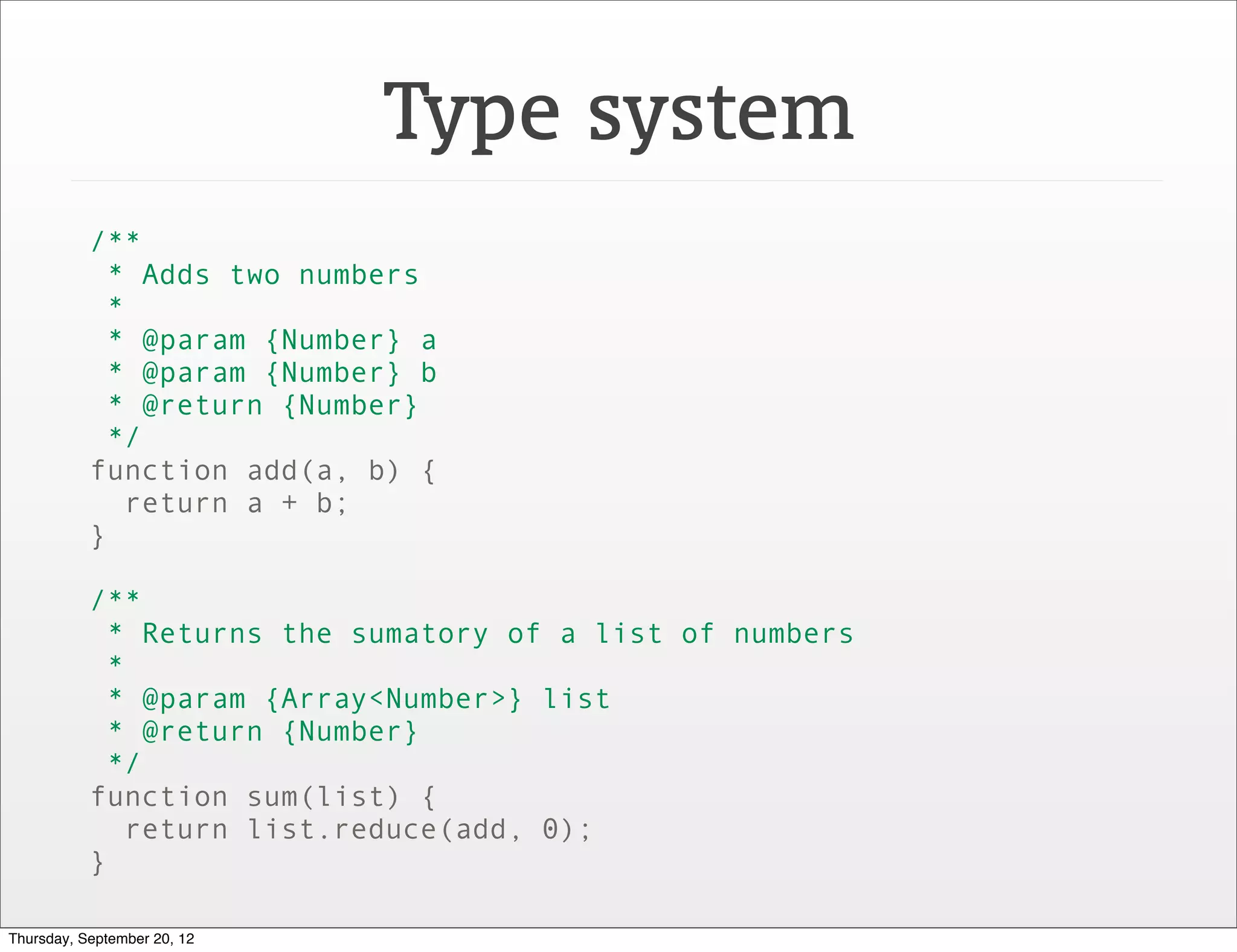
           /**
             * Adds two numbers
             *
             * @param {Number} a
             * @param {Number} b
             * @return {Number}
             */
           function add(a, b) {
               return a + b;
           }

           /**
             * Returns the sumatory of a list of numbers
             *
             * @param {Array<Number>} list
             * @return {Number}
             */
           function sum(list) {
               return list.reduce(add, 0);
           }

Thursday, September 20, 12
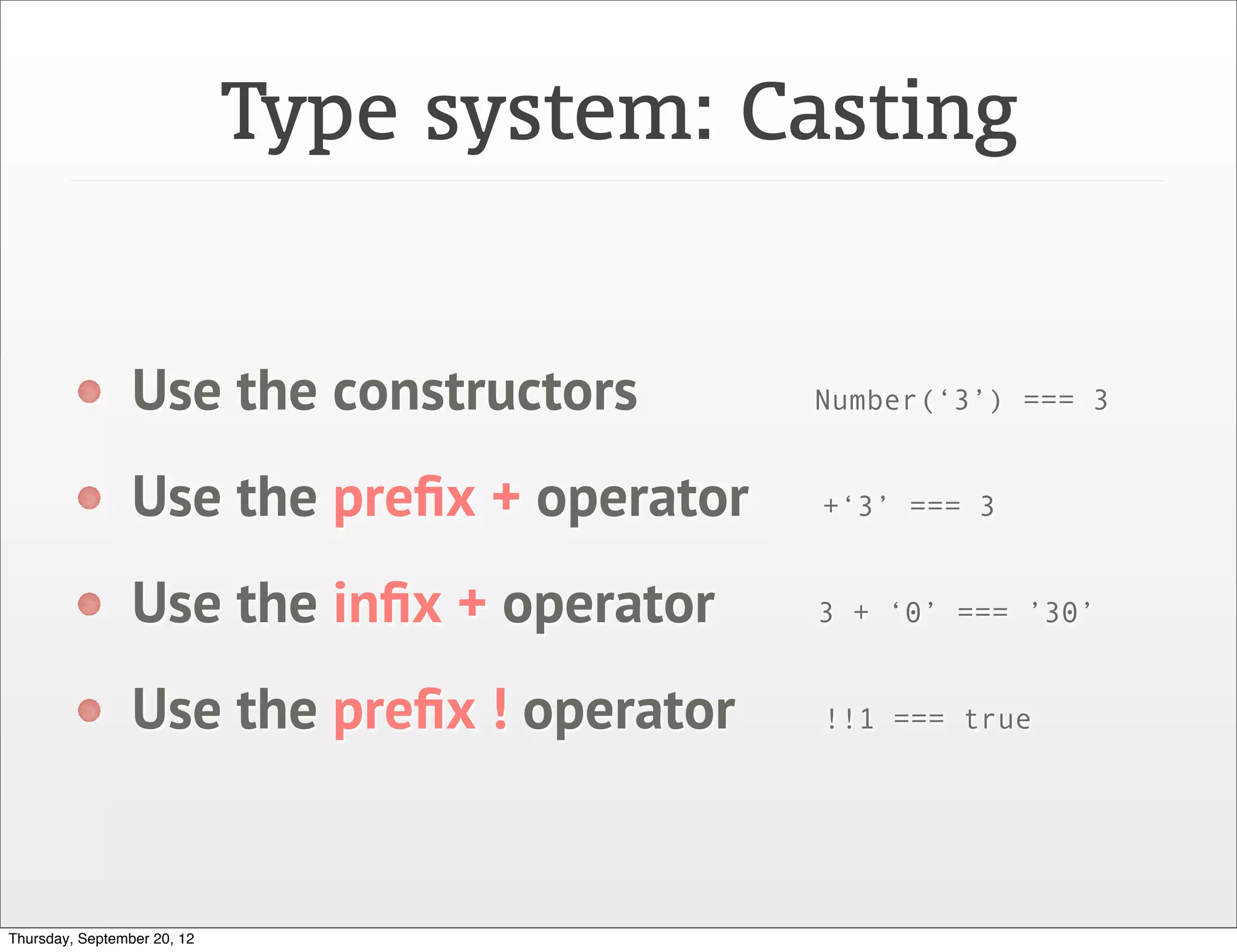
Type system: Casting


                 Use the constructors       Number(‘3’) === 3


                 Use the prefix + operator   +‘3’ === 3


                 Use the infix + operator    3 + ‘0’ === ’30’


                 Use the prefix ! operator   !!1 === true


Thursday, September 20, 12
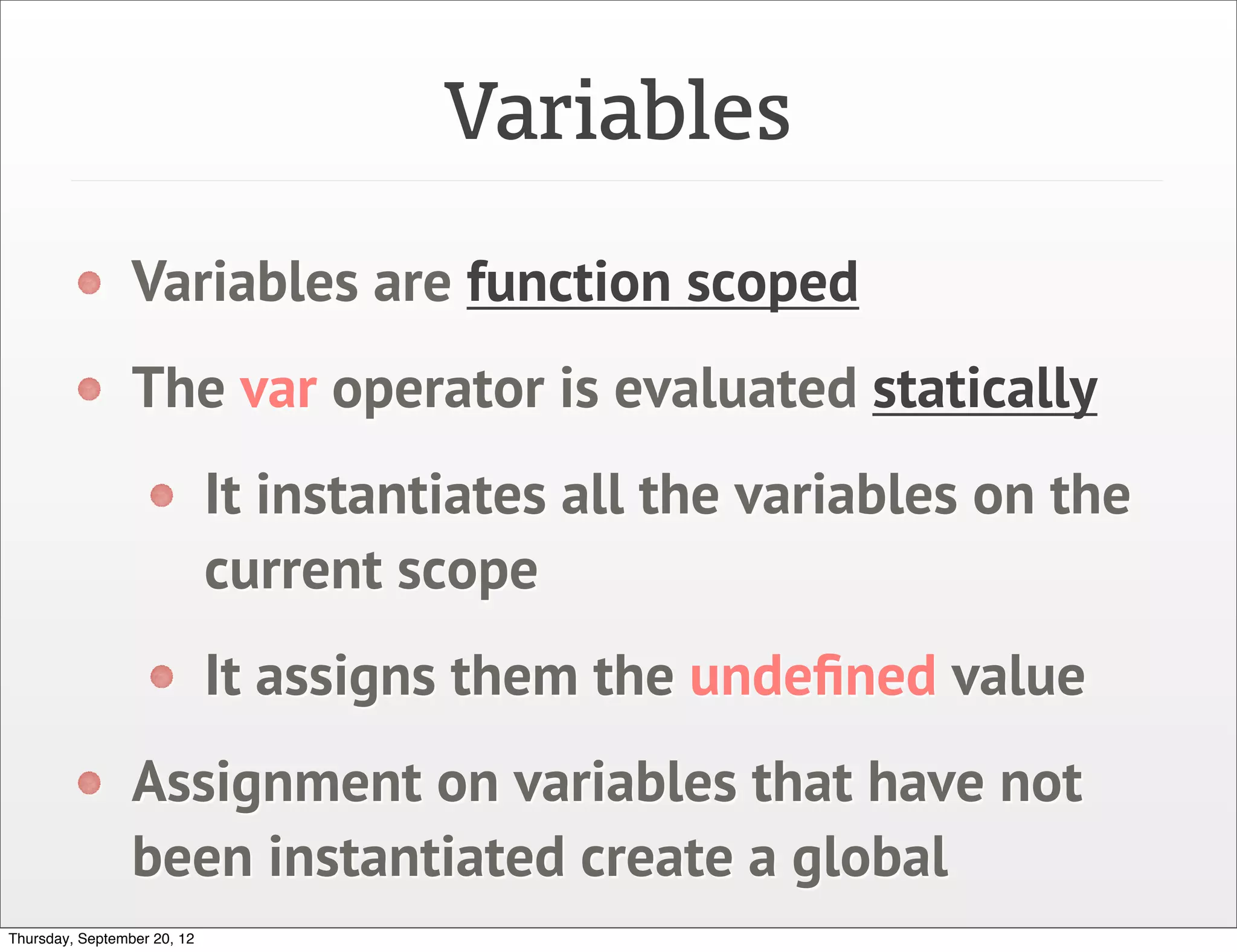
Variables

                 Variables are function scoped
                 The var operator is evaluated statically
                             It instantiates all the variables on the
                             current scope
                             It assigns them the undefined value
                 Assignment on variables that have not
                 been instantiated create a global
Thursday, September 20, 12
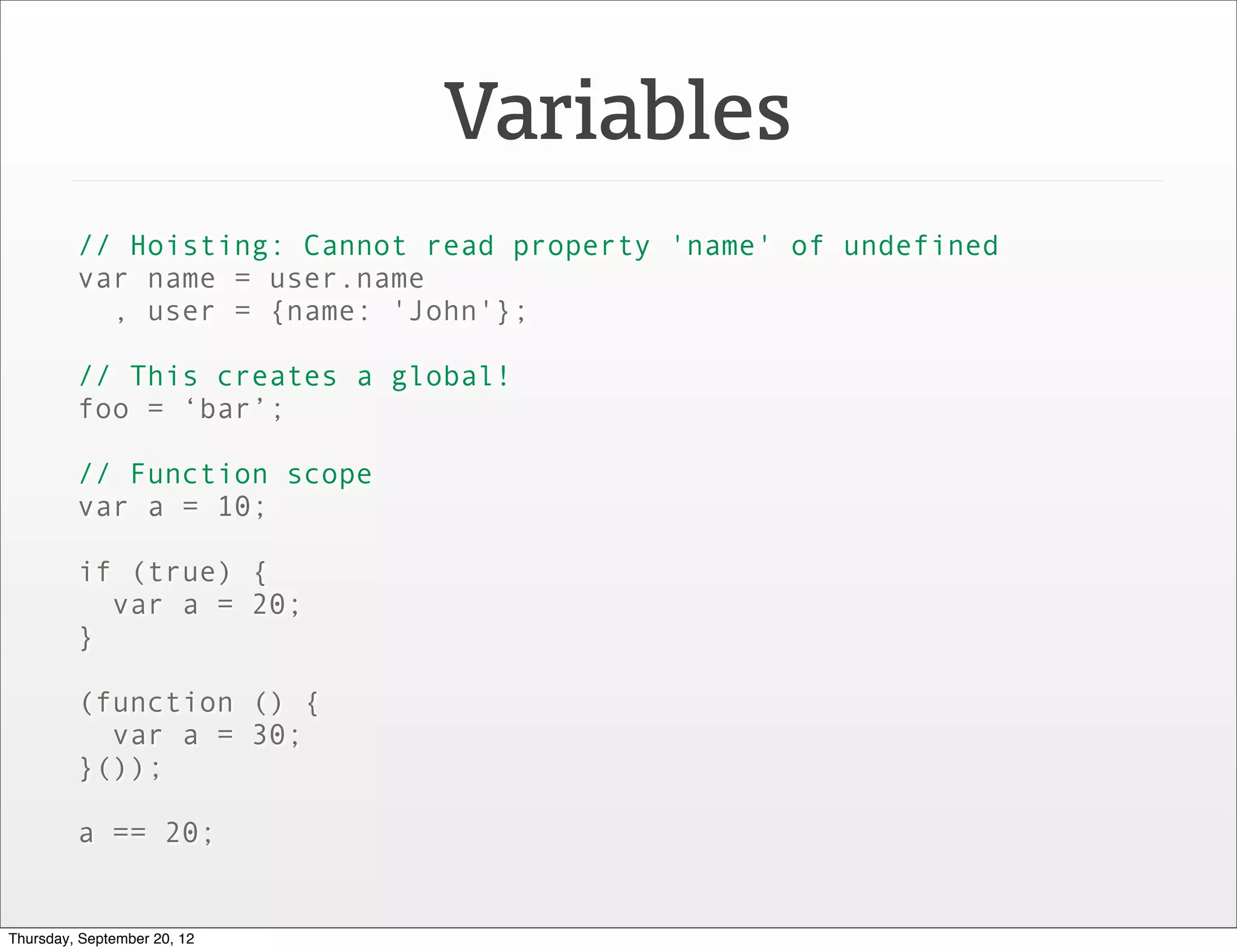
Variables
         // Hoisting: Cannot read property 'name' of undefined
         var name = user.name
           , user = {name: 'John'};

         // This creates a global!
         foo = ‘bar’;

         // Function scope
         var a = 10;

         if (true) {
           var a = 20;
         }

         (function () {
           var a = 30;
         }());

         a == 20;


Thursday, September 20, 12
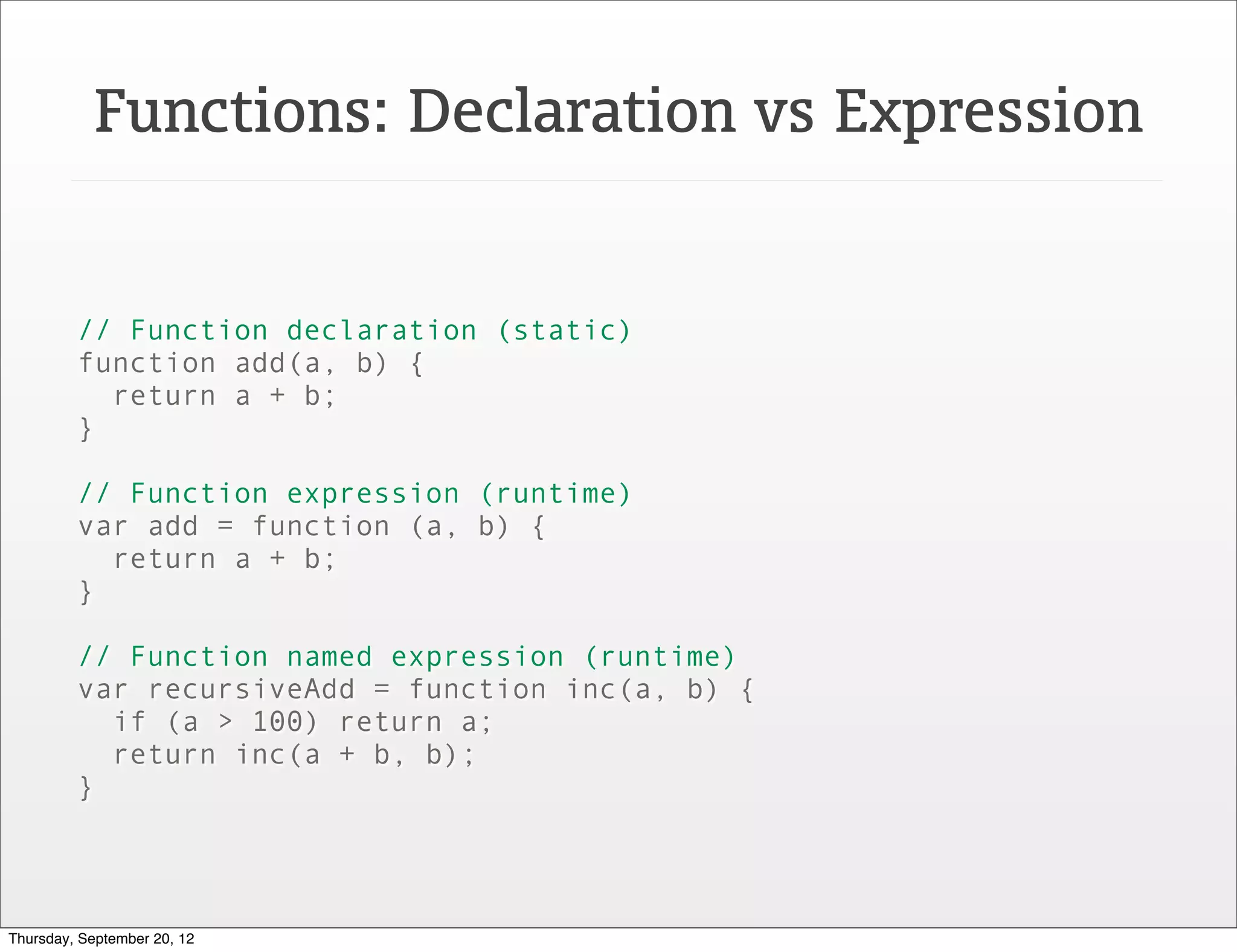
Functions: Declaration vs Expression


         // Function declaration (static)
         function add(a, b) {
           return a + b;
         }

         // Function expression (runtime)
         var add = function (a, b) {
           return a + b;
         }

         // Function named expression (runtime)
         var recursiveAdd = function inc(a, b) {
           if (a > 100) return a;
           return inc(a + b, b);
         }


Thursday, September 20, 12
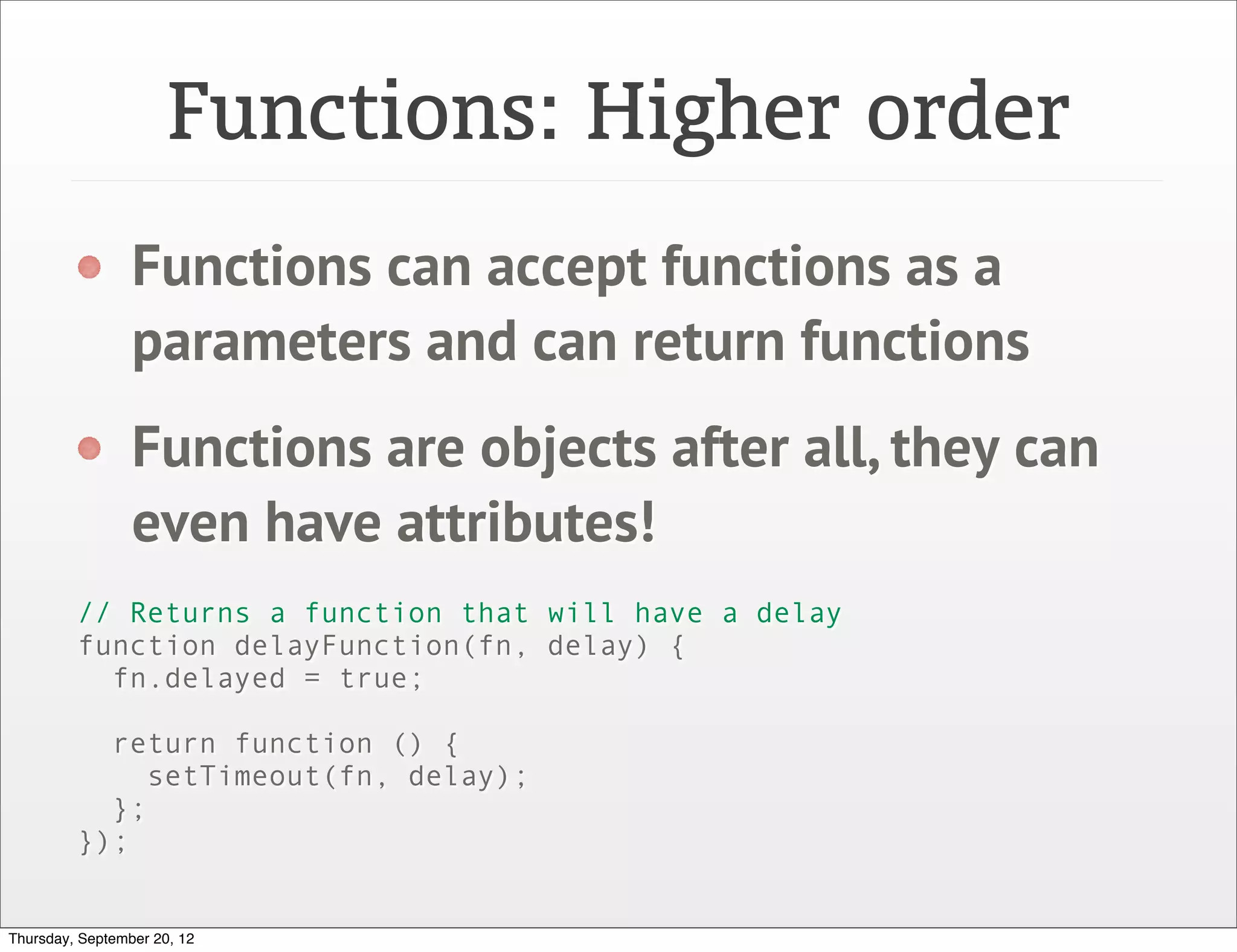
Functions: Higher order
                 Functions can accept functions as a
                 parameters and can return functions
                 Functions are objects after all, they can
                 even have attributes!
         // Returns a function that will have a delay
         function delayFunction(fn, delay) {
           fn.delayed = true;

           return function () {
              setTimeout(fn, delay);
           };
         });


Thursday, September 20, 12
Functions: Closures

                 Closures are function that “remember”
                 the variables on their scope
         // Gets a function to inspect the given object
         function getInspector(obj) {
            return function (attr) {
               return obj[attr];
            };
         };

         var inspect = getInspector({name: ‘john’, age: 21});
         [‘name’, ‘age’].map(inspect) == [‘john’, 21];


Thursday, September 20, 12
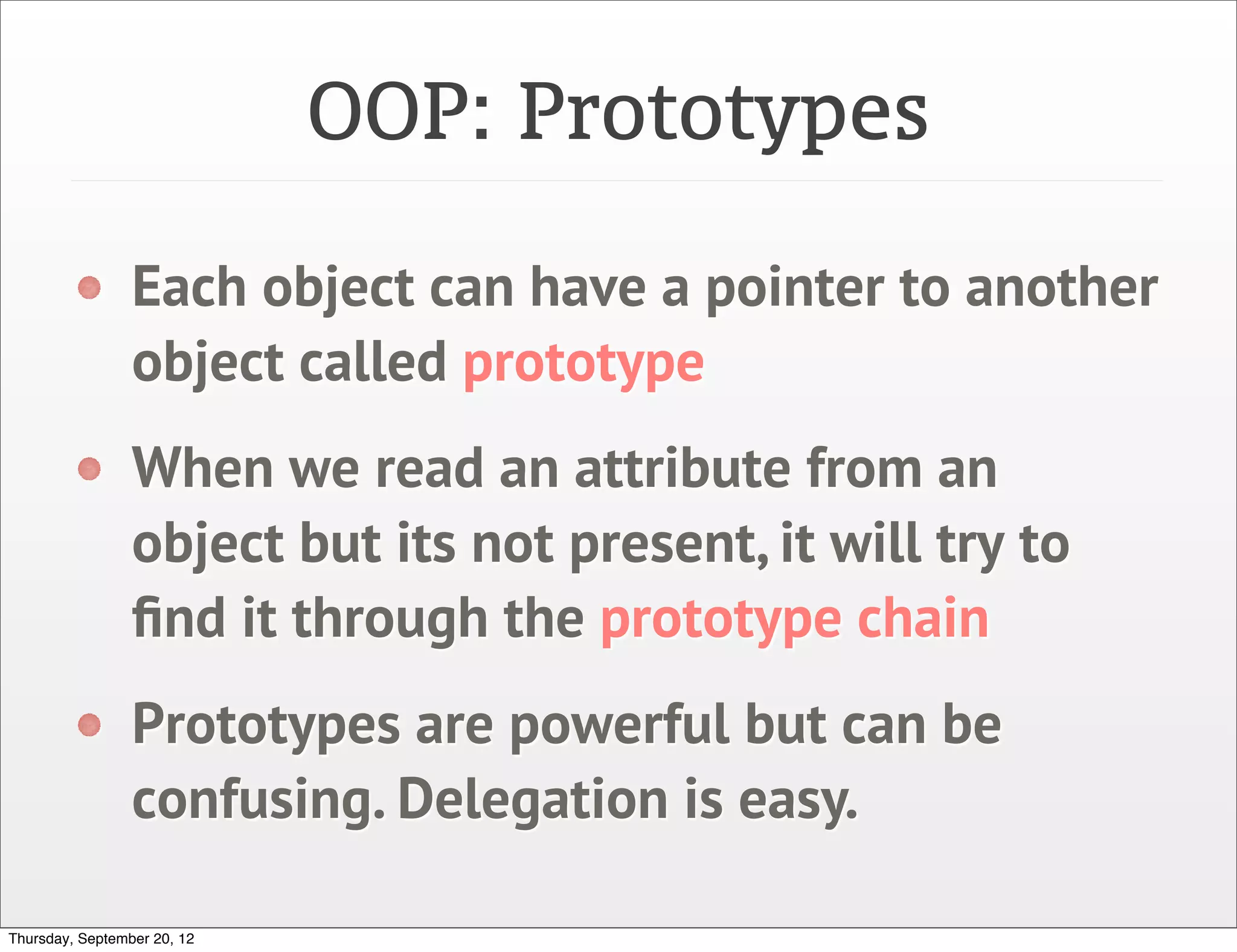
OOP: Prototypes

                 Each object can have a pointer to another
                 object called prototype
                 When we read an attribute from an
                 object but its not present, it will try to
                 find it through the prototype chain
                 Prototypes are powerful but can be
                 confusing. Delegation is easy.

Thursday, September 20, 12
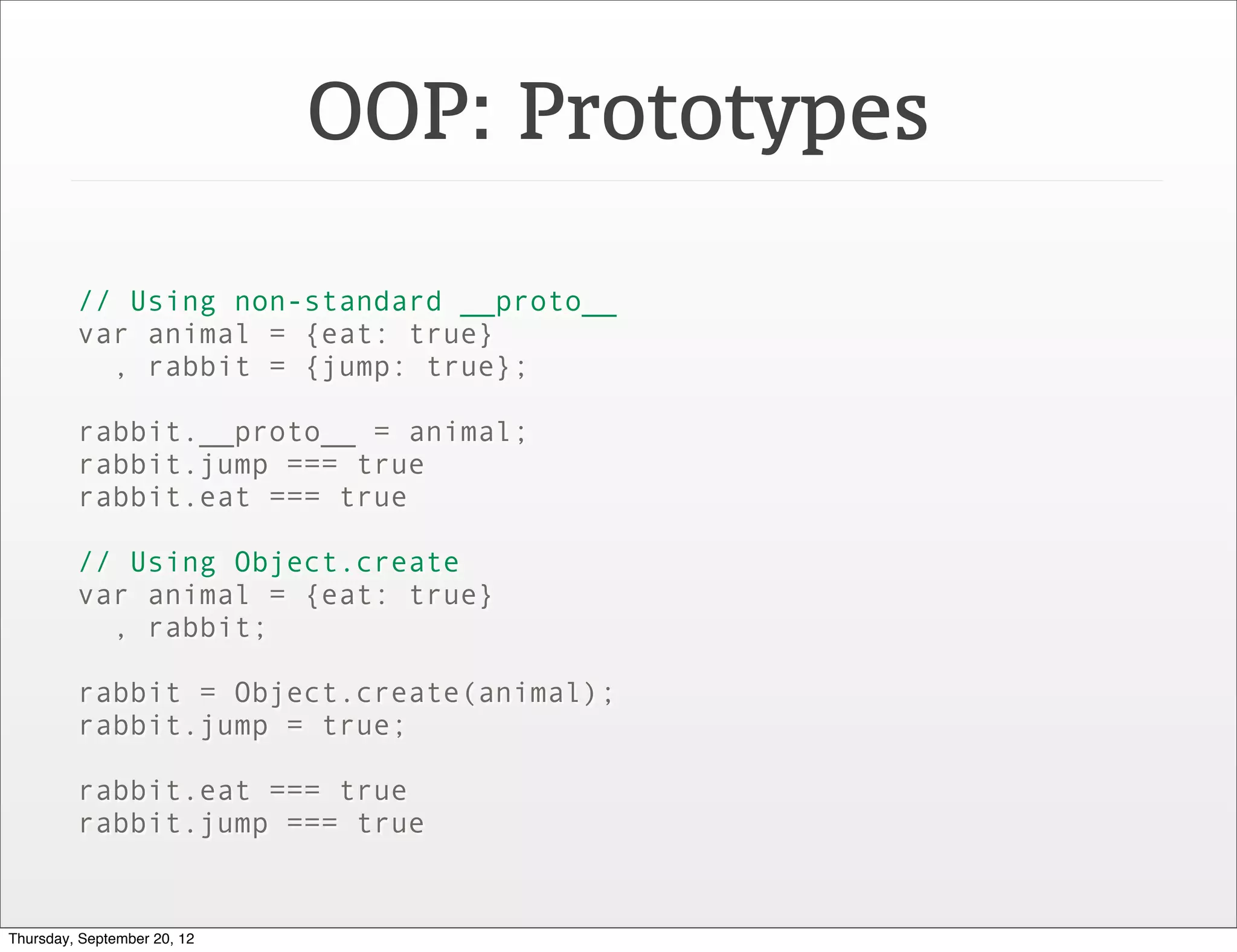
OOP: Prototypes

         // Using non-standard __proto__
         var animal = {eat: true}
           , rabbit = {jump: true};

         rabbit.__proto__ = animal;
         rabbit.jump === true
         rabbit.eat === true

         // Using Object.create
         var animal = {eat: true}
           , rabbit;

         rabbit = Object.create(animal);
         rabbit.jump = true;

         rabbit.eat === true
         rabbit.jump === true


Thursday, September 20, 12
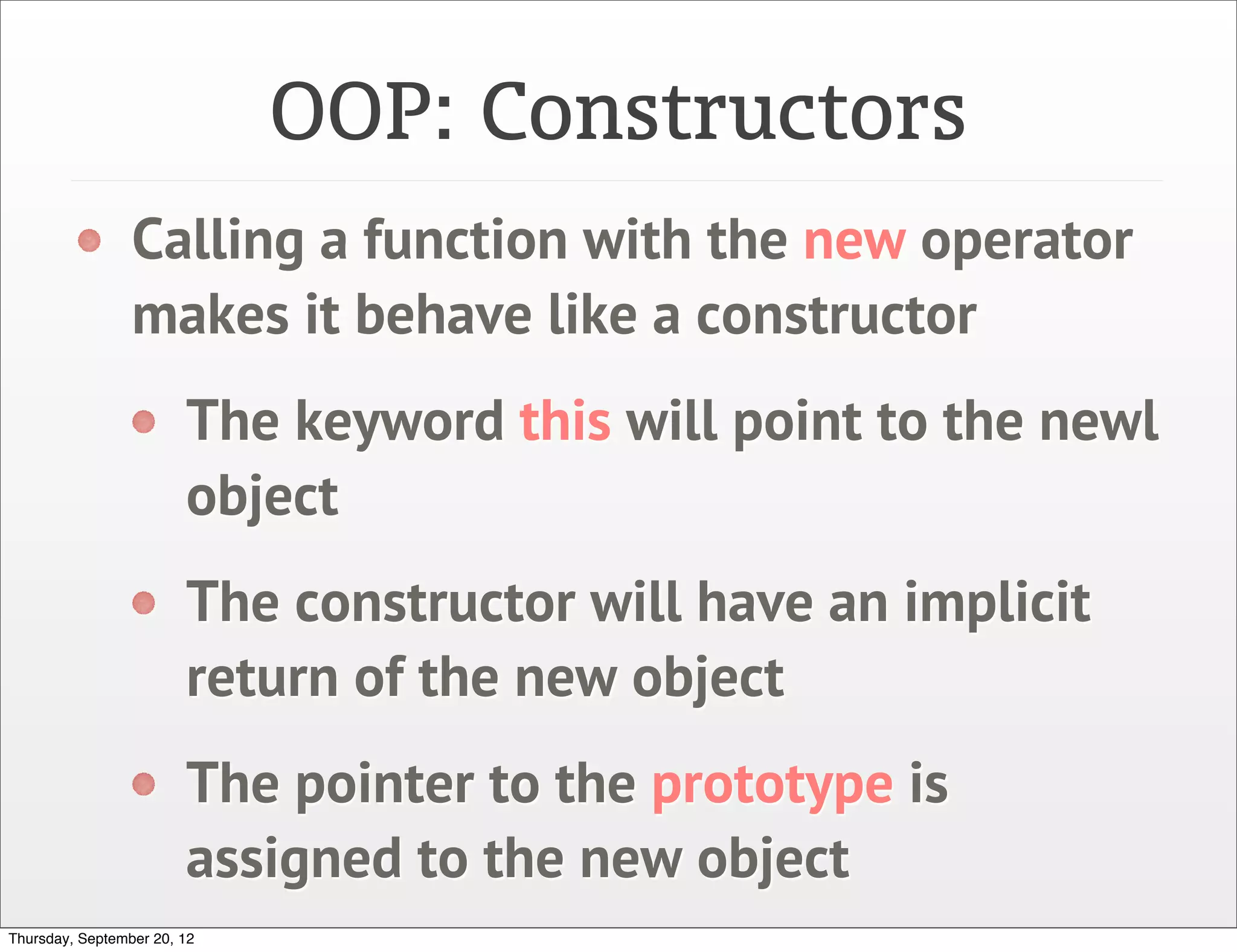
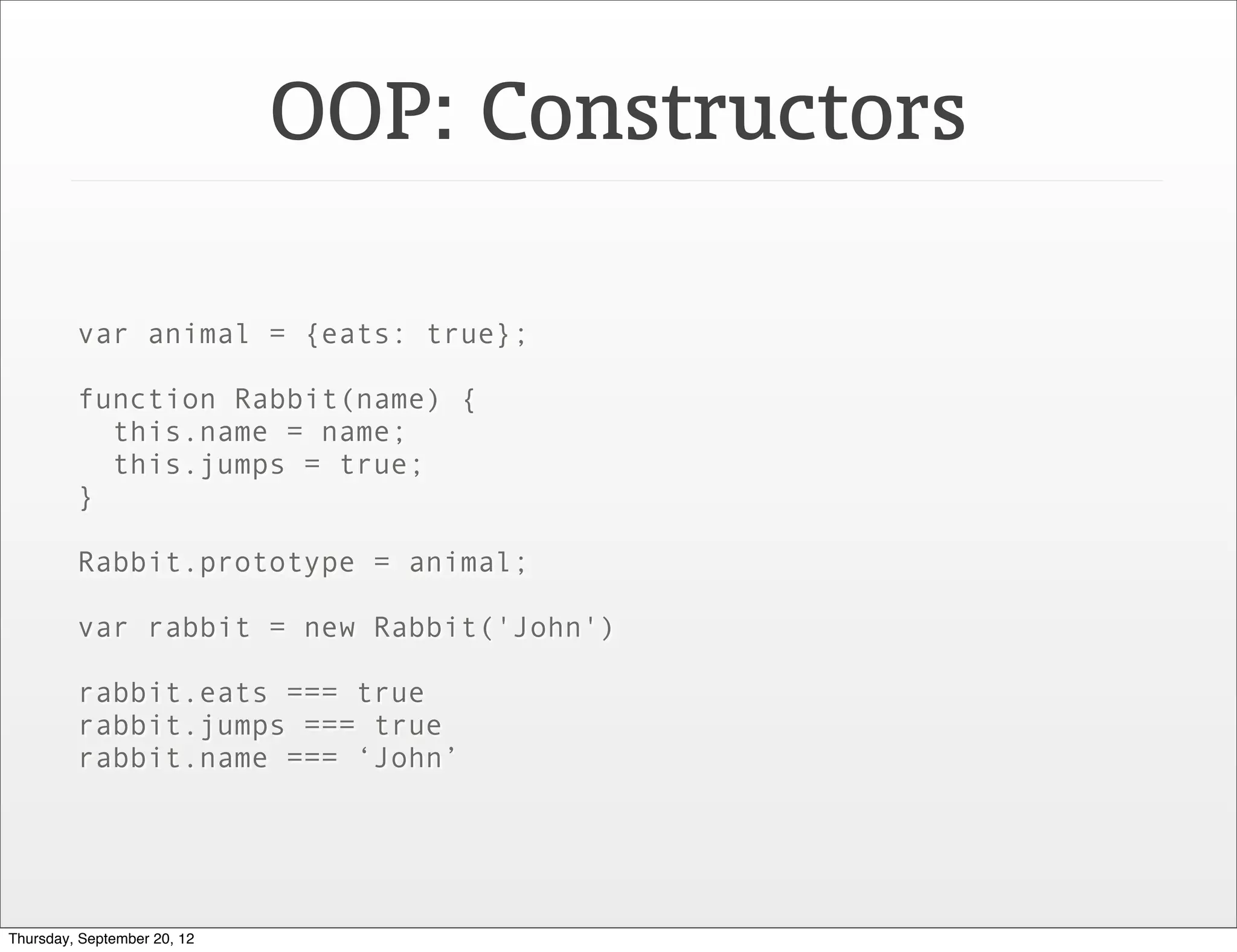
OOP: Constructors
                 Calling a function with the new operator
                 makes it behave like a constructor
                        The keyword this will point to the newl
                        object
                        The constructor will have an implicit
                        return of the new object
                        The pointer to the prototype is
                        assigned to the new object
Thursday, September 20, 12
OOP: Constructors

         var animal = {eats: true};

         function Rabbit(name) {
           this.name = name;
           this.jumps = true;
         }

         Rabbit.prototype = animal;

         var rabbit = new Rabbit('John')

         rabbit.eats === true
         rabbit.jumps === true
         rabbit.name === ‘John’


Thursday, September 20, 12
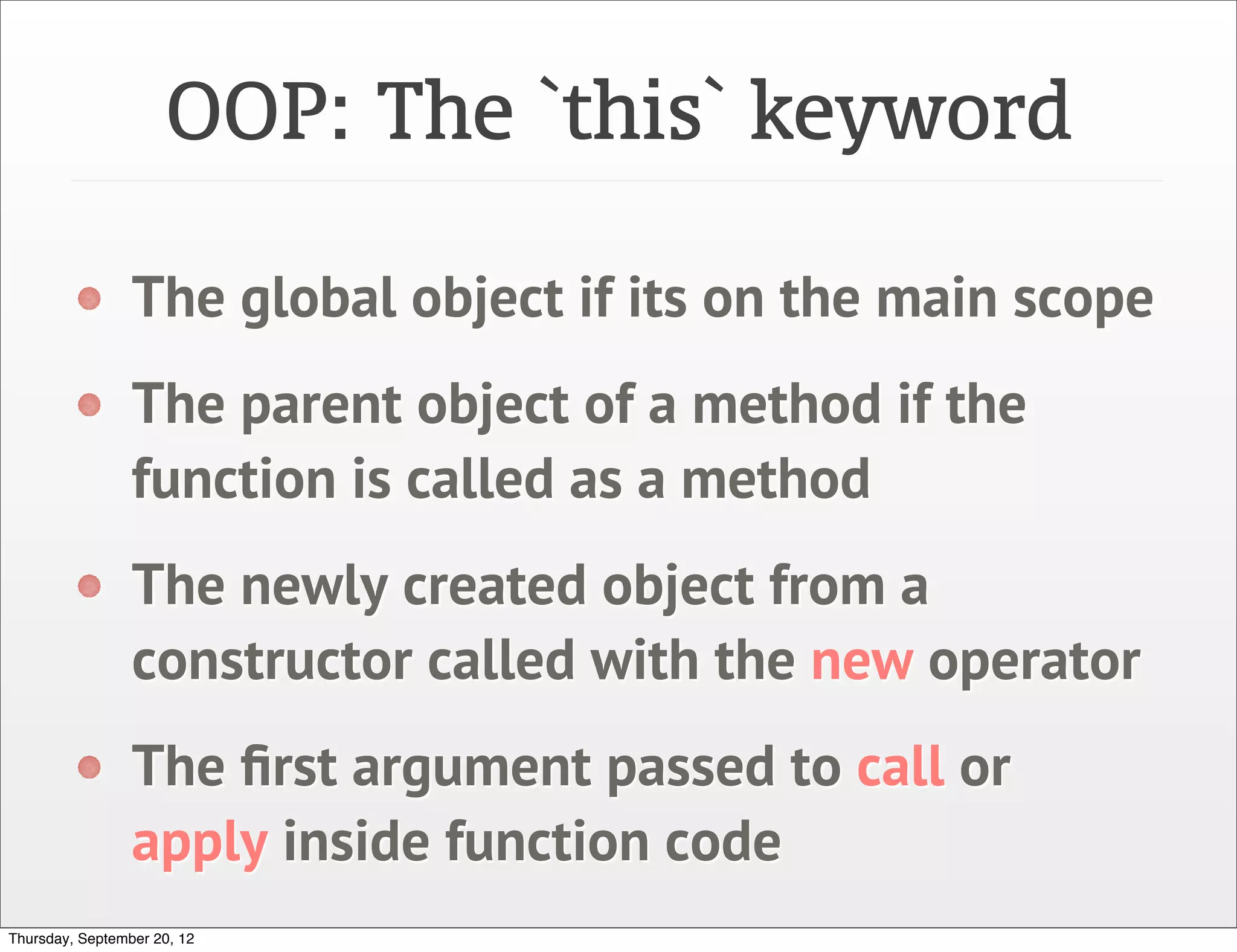
OOP: The `this` keyword

                 The global object if its on the main scope
                 The parent object of a method if the
                 function is called as a method
                 The newly created object from a
                 constructor called with the new operator
                 The first argument passed to call or
                 apply inside function code
Thursday, September 20, 12
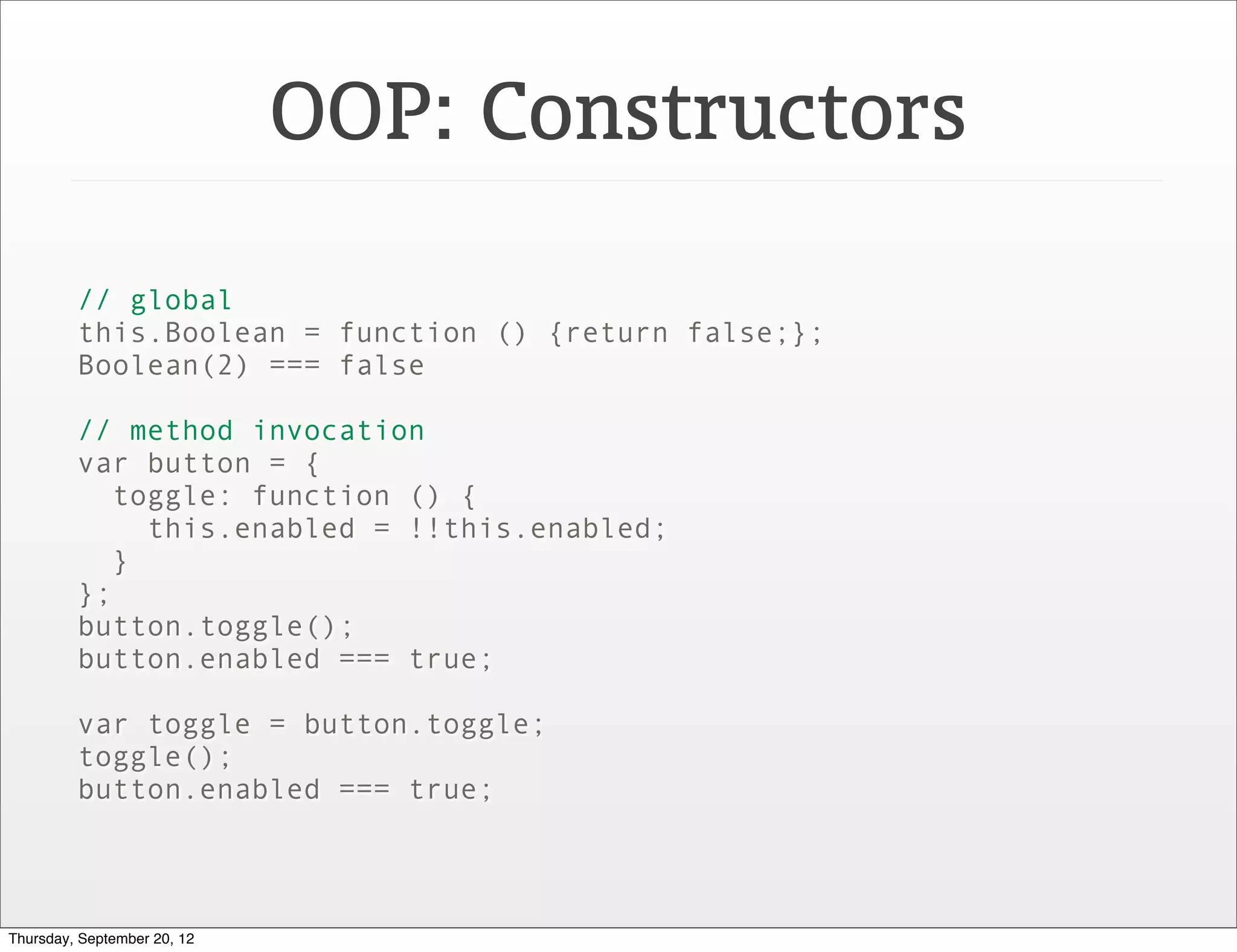
OOP: Constructors

         // global
         this.Boolean = function () {return false;};
         Boolean(2) === false

         // method invocation
         var button = {
            toggle: function () {
              this.enabled = !!this.enabled;
            }
         };
         button.toggle();
         button.enabled === true;

         var toggle = button.toggle;
         toggle();
         button.enabled === true;


Thursday, September 20, 12
OOP: Constructors
         // Constructors
         function Rabbit(name) {
           this.name = name;
         }
         var rabbit = new Rabbit('John')
         rabbit.name === ‘John’;

         var rabbit = Rabbit(‘John’);
         rabbit.name === undefined;
         window.name === ‘John’;

         // call or apply
         [].reduce.call(
            "Javascript is cool!"
         , function (memo, a) {
              return a + memo;
            }
         );


Thursday, September 20, 12
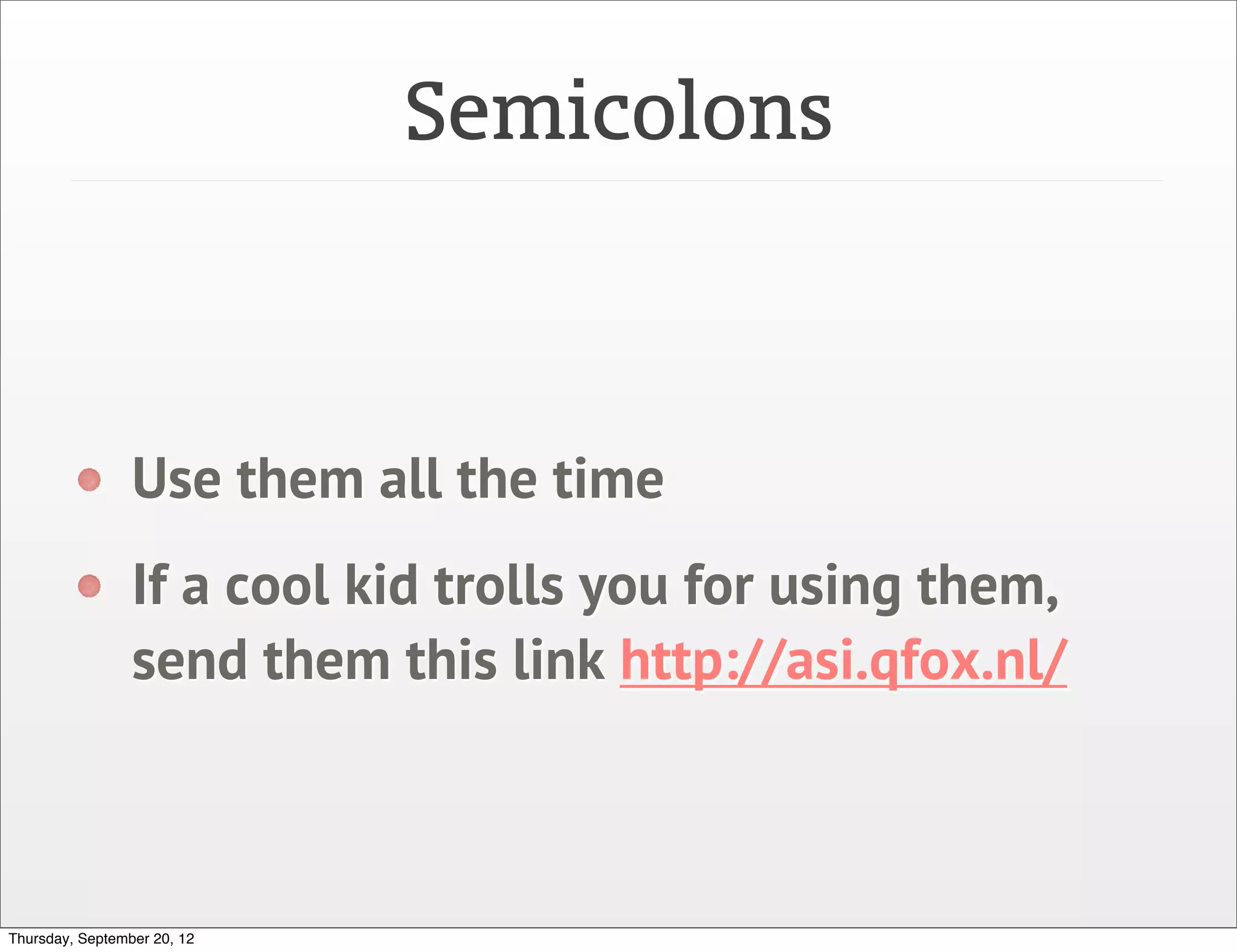
Semicolons


                 Use them all the time
                 If a cool kid trolls you for using them,
                 send them this link http://asi.qfox.nl/


Thursday, September 20, 12

Understanding JavaScript

  • 1.
    Understanding JavaScript Thursday, September 20, 12
  • 2.
    Why JavaScript? Simple Multi paradigm Works on the server and the browser Lots of libraries JSON Thursday, September 20, 12
  • 3.
    I heard itsucks, its broken Implicit globals Confusing this keyword Confusing OO features, lack of class syntax Type coercion Thursday, September 20, 12
  • 4.
    The good parts Thursday,September 20, 12
  • 5.
    Type system Weak typing means that a language implicitly converts types when used. A programming language is said to use dynamic typing when type checking is performed during run-time as opposed to compile-time. Thursday, September 20, 12
  • 6.
    Type system Constructors Literals typeof Object() {a: ‘b’} ‘object’ Array() [0, 1, ‘foo’, 3] ‘object’ RegExp() /foo.*/ ‘object’ Date() - ‘object’ - null ‘object’ Boolean() true false ‘boolean’ String() “foo” ‘bar’ string’ Number() 30 0.5 Infinity NaN ‘number’ Function() function foo() {} ‘function’ - undefined ‘undefined’ Thursday, September 20, 12
  • 7.
    Type system: Falsyvalues 0 null undefined false "" NaN Thursday, September 20, 12
  • 8.
    Type system: Coercion undefined == undefined ",,," == new Array(4) NaN != NaN "wat" - 1 == NaN {} + {} == NaN [] + [] == “” [] + {} == “[object Object]” Thursday, September 20, 12
  • 9.
  • 10.
    Type system Avoid coercion Define API’s with clear types Use the === operator Read the spec or this article http:// webreflection.blogspot.com.es/2010/10/ javascript-coercion-demystified.html Thursday, September 20, 12
  • 11.
    Type system /** * Adds two numbers * * @param {Number} a * @param {Number} b * @return {Number} */ function add(a, b) { return a + b; } /** * Returns the sumatory of a list of numbers * * @param {Array<Number>} list * @return {Number} */ function sum(list) { return list.reduce(add, 0); } Thursday, September 20, 12
  • 12.
    Type system: Casting Use the constructors Number(‘3’) === 3 Use the prefix + operator +‘3’ === 3 Use the infix + operator 3 + ‘0’ === ’30’ Use the prefix ! operator !!1 === true Thursday, September 20, 12
  • 13.
    Variables Variables are function scoped The var operator is evaluated statically It instantiates all the variables on the current scope It assigns them the undefined value Assignment on variables that have not been instantiated create a global Thursday, September 20, 12
  • 14.
    Variables // Hoisting: Cannot read property 'name' of undefined var name = user.name , user = {name: 'John'}; // This creates a global! foo = ‘bar’; // Function scope var a = 10; if (true) { var a = 20; } (function () { var a = 30; }()); a == 20; Thursday, September 20, 12
  • 15.
    Functions: Declaration vsExpression // Function declaration (static) function add(a, b) { return a + b; } // Function expression (runtime) var add = function (a, b) { return a + b; } // Function named expression (runtime) var recursiveAdd = function inc(a, b) { if (a > 100) return a; return inc(a + b, b); } Thursday, September 20, 12
  • 16.
    Functions: Higher order Functions can accept functions as a parameters and can return functions Functions are objects after all, they can even have attributes! // Returns a function that will have a delay function delayFunction(fn, delay) { fn.delayed = true; return function () { setTimeout(fn, delay); }; }); Thursday, September 20, 12
  • 17.
    Functions: Closures Closures are function that “remember” the variables on their scope // Gets a function to inspect the given object function getInspector(obj) { return function (attr) { return obj[attr]; }; }; var inspect = getInspector({name: ‘john’, age: 21}); [‘name’, ‘age’].map(inspect) == [‘john’, 21]; Thursday, September 20, 12
  • 18.
    OOP: Prototypes Each object can have a pointer to another object called prototype When we read an attribute from an object but its not present, it will try to find it through the prototype chain Prototypes are powerful but can be confusing. Delegation is easy. Thursday, September 20, 12
  • 19.
    OOP: Prototypes // Using non-standard __proto__ var animal = {eat: true} , rabbit = {jump: true}; rabbit.__proto__ = animal; rabbit.jump === true rabbit.eat === true // Using Object.create var animal = {eat: true} , rabbit; rabbit = Object.create(animal); rabbit.jump = true; rabbit.eat === true rabbit.jump === true Thursday, September 20, 12
  • 20.
    OOP: Constructors Calling a function with the new operator makes it behave like a constructor The keyword this will point to the newl object The constructor will have an implicit return of the new object The pointer to the prototype is assigned to the new object Thursday, September 20, 12
  • 21.
    OOP: Constructors var animal = {eats: true}; function Rabbit(name) { this.name = name; this.jumps = true; } Rabbit.prototype = animal; var rabbit = new Rabbit('John') rabbit.eats === true rabbit.jumps === true rabbit.name === ‘John’ Thursday, September 20, 12
  • 22.
    OOP: The `this`keyword The global object if its on the main scope The parent object of a method if the function is called as a method The newly created object from a constructor called with the new operator The first argument passed to call or apply inside function code Thursday, September 20, 12
  • 23.
    OOP: Constructors // global this.Boolean = function () {return false;}; Boolean(2) === false // method invocation var button = { toggle: function () { this.enabled = !!this.enabled; } }; button.toggle(); button.enabled === true; var toggle = button.toggle; toggle(); button.enabled === true; Thursday, September 20, 12
  • 24.
    OOP: Constructors // Constructors function Rabbit(name) { this.name = name; } var rabbit = new Rabbit('John') rabbit.name === ‘John’; var rabbit = Rabbit(‘John’); rabbit.name === undefined; window.name === ‘John’; // call or apply [].reduce.call( "Javascript is cool!" , function (memo, a) { return a + memo; } ); Thursday, September 20, 12
  • 25.
    Semicolons Use them all the time If a cool kid trolls you for using them, send them this link http://asi.qfox.nl/ Thursday, September 20, 12