Typesafe stack

Scala, Akka and Play
      Luka Zakrajšek
        @bancek

      December 2012
The Typesafe Stack

• development platform
• easy to build scalable software applications
• seamless integration with existing Java
  infrastructure
The Typesafe Stack
• Java Virtual Machine
• Scala core
• Akka middleware
• Play web framework
• Tools
• Horizontal scalability
Scala
• general purpose programming language
• object-oriented and functional
• statically typed
• full interoperability with Java
• Twitter, Foursquare, Amazon, LinkedIn
• active community
Object-Oriented

• familiar design patterns from Java
• traits
• mixin-based composition
Functional


• based on the functional principles of
  Haskell and ML
• avoid shared state
Statically Typed

• expressive type system
• detects and avoids many kinds of
  application errors at compile time
• no boilerplate code
Extensible


• easy to add new language constructs
• domain-specific languages (DSLs)
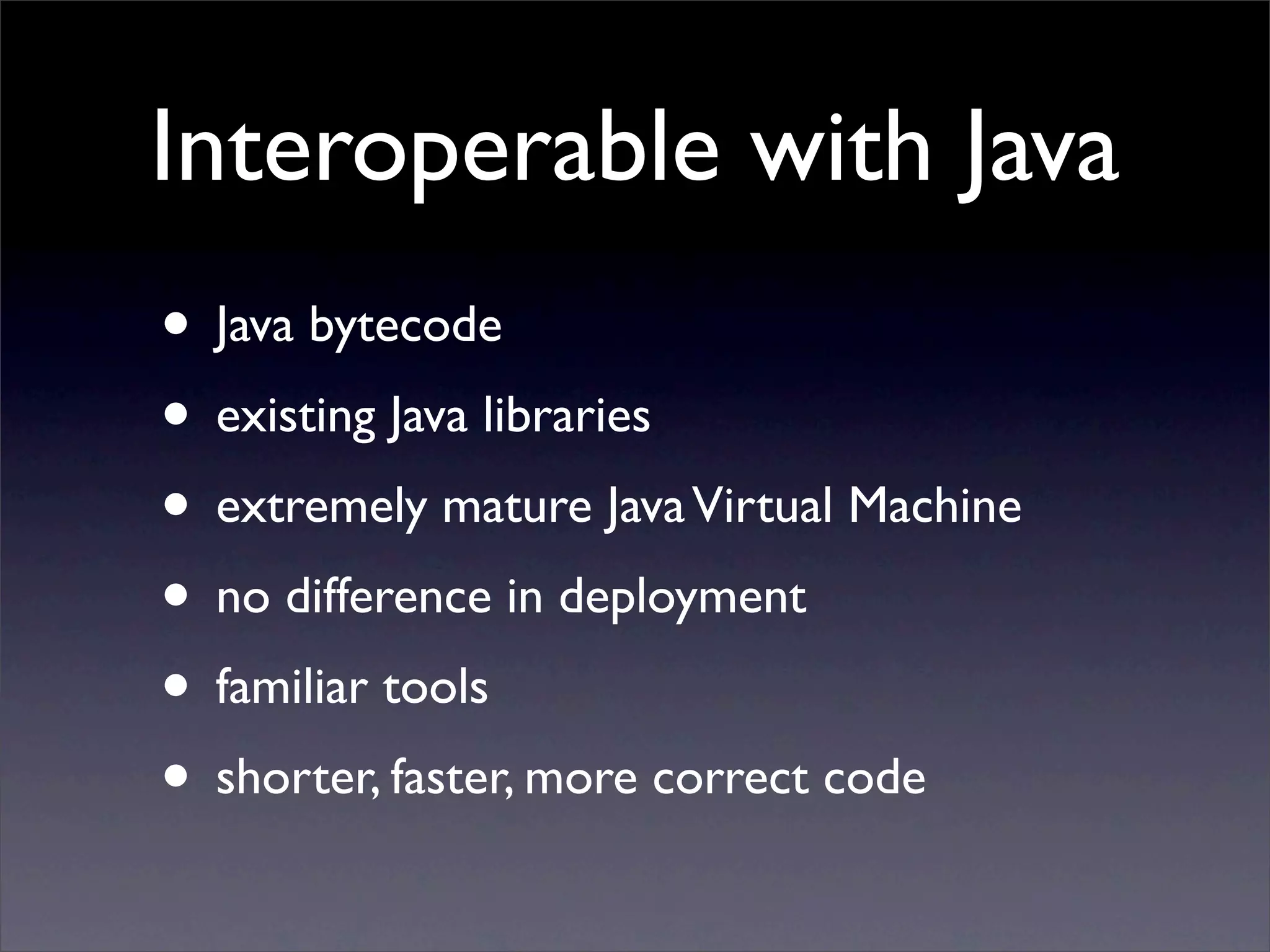
Interoperable with Java
• Java bytecode
• existing Java libraries
• extremely mature Java Virtual Machine
• no difference in deployment
• familiar tools
• shorter, faster, more correct code
Type inference
val   a = 5
val   b = 4.5
val   c = "foo"
val   error = a * c

def actOn[T](x: T) = x.toString

actOn(a)
actOn(c)
Type aliases, closures,
first class functions and
   comprehensions
type UnaryOp[T, R] = T => R

def run[R](gen: UnaryOp[Int, R]) {
    for (x <- 1 to 5) println(gen(x))
}

run(x => -x)
run(x => Array.fill(x)("*").mkString)
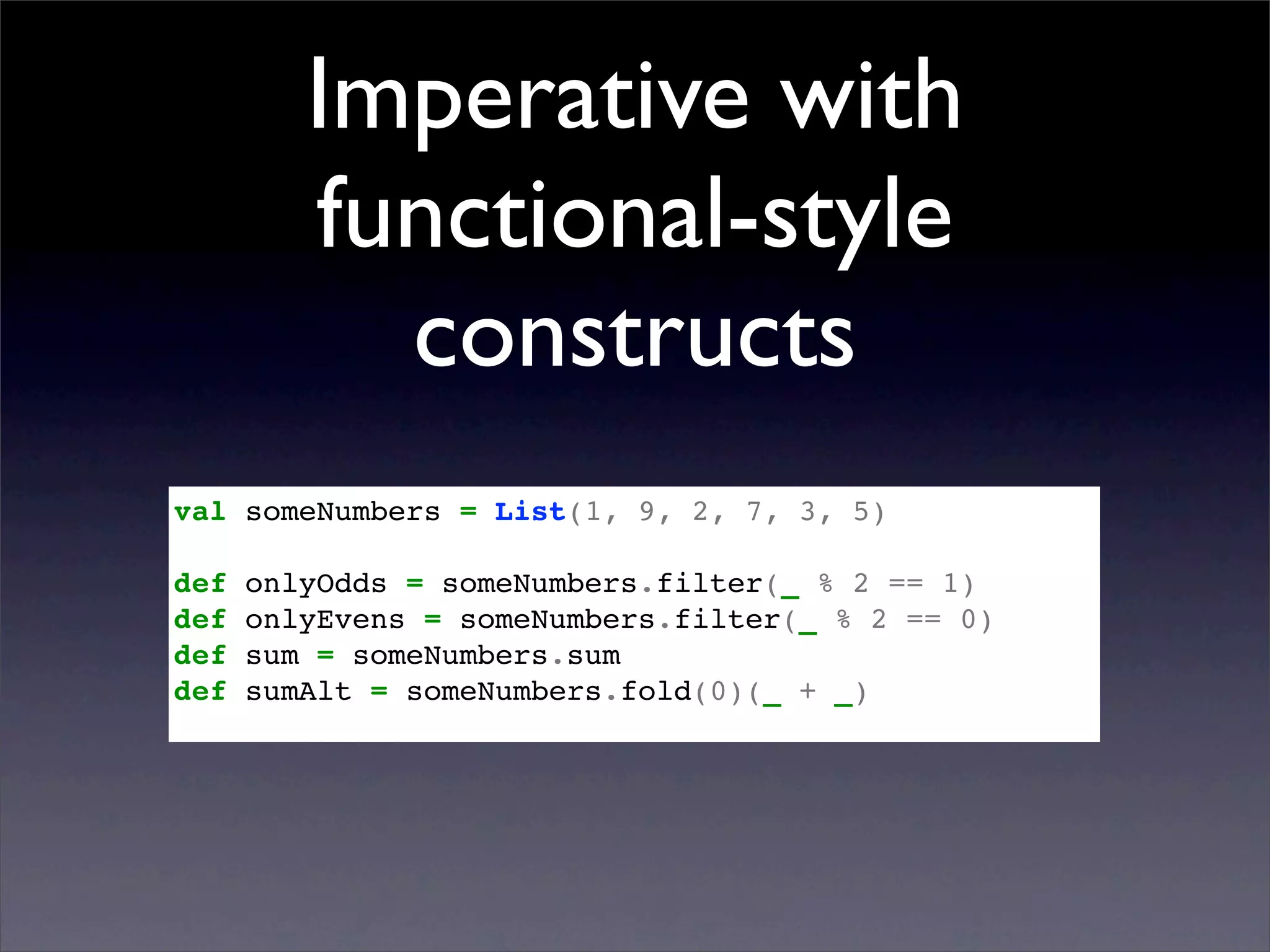
Imperative with
         functional-style
           constructs
val someNumbers = List(1, 9, 2, 7, 3, 5)

def   onlyOdds = someNumbers.filter(_ % 2 == 1)
def   onlyEvens = someNumbers.filter(_ % 2 == 0)
def   sum = someNumbers.sum
def   sumAlt = someNumbers.fold(0)(_ + _)
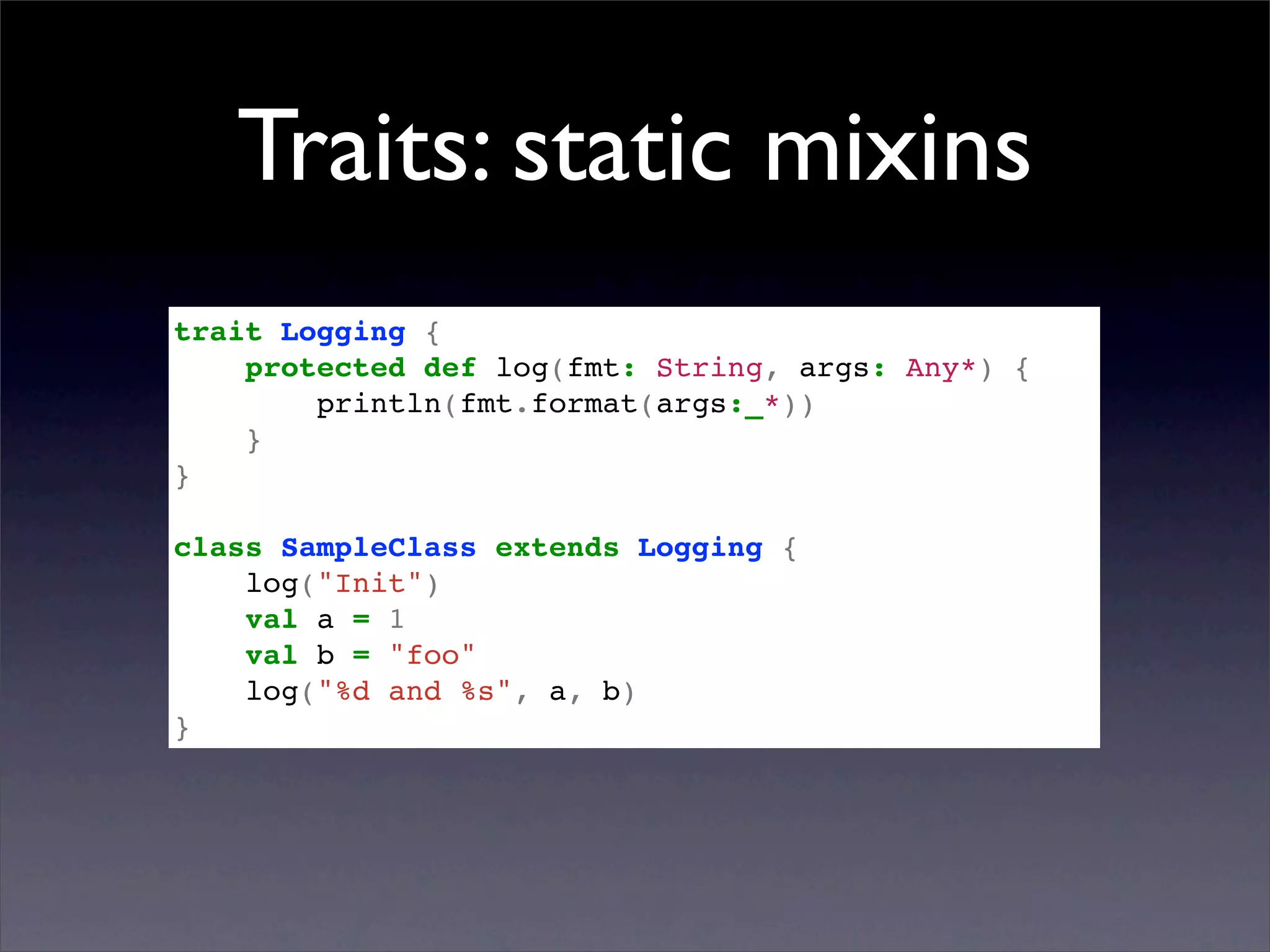
Traits: static mixins
trait Logging {
    protected def log(fmt: String, args: Any*) {
        println(fmt.format(args:_*))
    }
}

class SampleClass extends Logging {
    log("Init")
    val a = 1
    val b = "foo"
    log("%d and %s", a, b)
}
Pattern matching
def act: Either[Any, Exception] //...

act match {
    case Left(message: String) =>
        println(message)
    case Left(count: Int) =>
        counter += count
    case Left(fallback: Any) =>
        println("Error")
    case Right(e) =>
        e.printStackTrace()
}
Akka
• event-driven middleware framework
• high performance and reliable distributed
  applications
• decouples business logic from low-level
  mechanisms
• easily configurable
Simpler Concurrency


• Threads and nonblocking IO are complex
  and error-prone
• Actor concurrency model
Transactions

• software transactional memory (STM)
• atomically modify the state of many objects
  at once
• revert all your changes if the transaction
  fails
Event-driven


• platform for asynchronous event-driven
  architectures
• non-blocking IO frameworks
Scalability


• multicore servers and multiple nodes
• several million Actors on single machine
Fault-tolerance


• supervisor hierarchies
• Let It Crash
Transparent Remoting

• Remote Actors
• distributed programming model
• unified programming model
Scala & Java APIs

• smooth interoperability
• Spring and Guice integrations
• deploy in your existing Java application
  server or run stand-alone
Actors

• every actor has a message queue
• actors accepts and choose what to do with
  messages
• lightweight and asynchronous
Actors

• actors tend to remain bound to single
  thread
• actors rarely block, thread can remain
  active for a long duration
• Akka actors occupy 650 bytes
class GreetingActor extends Actor {
  private var counter = 0
  def receive = {
    case message => {
      counter += 1
      // 1) Hello, Juliet
      log.info(counter + ") Hello, " + message)
    }
  }
}

val greetingActor = actorOf[GreetingActor].start

greetingActor ! "Juliet"
Play Framework
• painless web development for Java and
  Scala
• developer productivity
• RESTful architectures
• clean alternative to bloated Enterprise Java
  stacks
Live reload


• fix the bug and hit reload
• no need to restart the server
Stateless MVC
         architecture
• shared-nothing architecture
• use Ajax or offline storage to solve the
  state problems client-side
• easier to render portions of the page in
  parallel
Type-safe templating
        engine
• Scala-based template engine
• syntax and type errors detected by
  compiler
• routing system is also fully type-checked
Full-stack application
       framework
• relational database support and object-
  relational mapping
• integrated cache support
• straightforward RESTful web services
• flexible deployment options
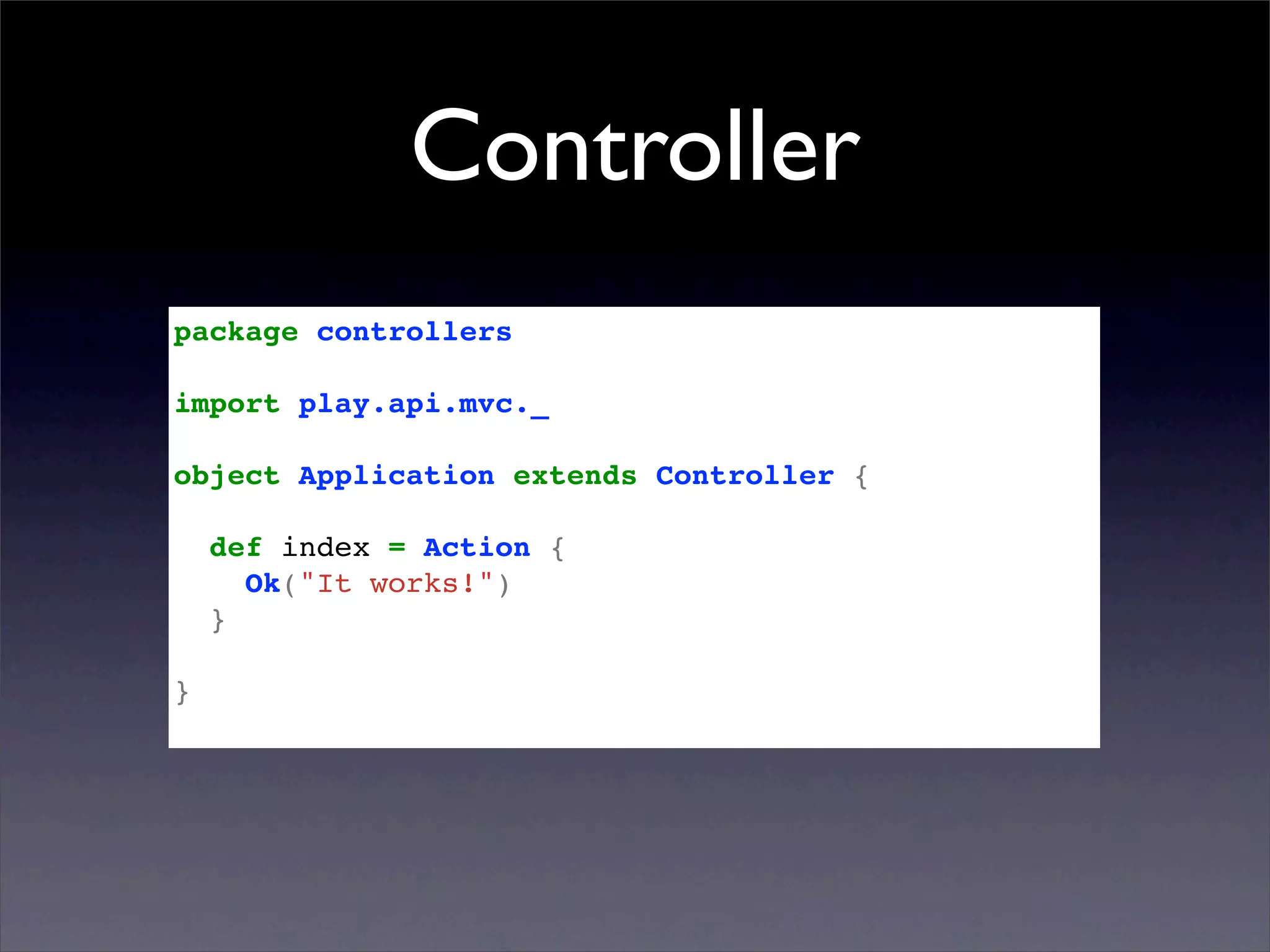
Controller
package controllers

import play.api.mvc._

object Application extends Controller {

    def index = Action {
      Ok("It works!")
    }

}
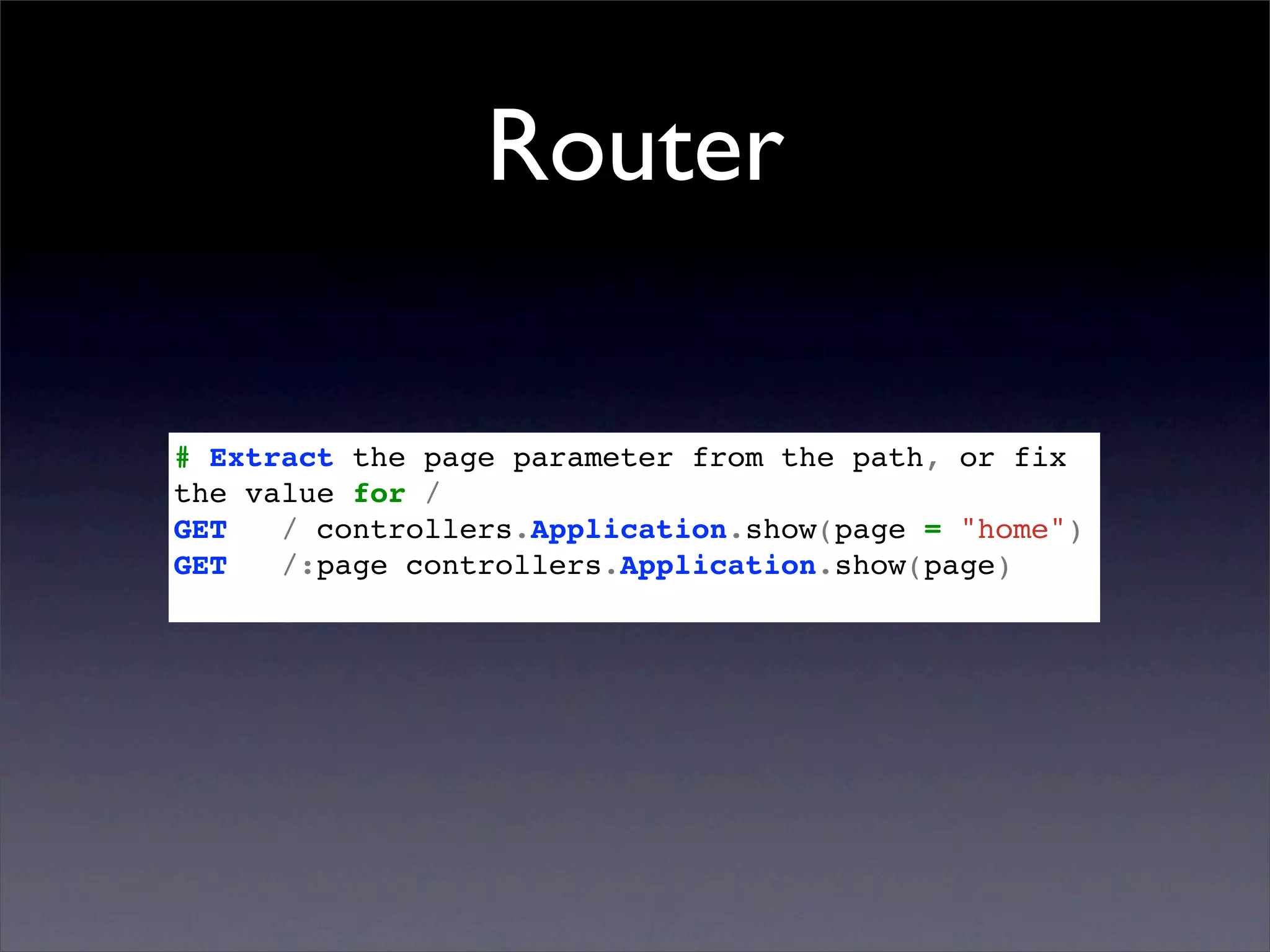
Router

# Extract the page parameter from the path, or fix
the value for /
GET   / controllers.Application.show(page = "home")
GET   /:page controllers.Application.show(page)
Scala IDE for Eclipse

• syntax highlighting, code completion,
  inferred type hovers...
• mixed Scala/Java projects
• incremental compilation
• 3rd party support for IntelliJ and NetBeans
Simple Build Tool (sbt)

• compile code
• run tests
• package jars
• manages dependencies
When not to use it


• developers familiar with Python or Ruby
• already have big codebase
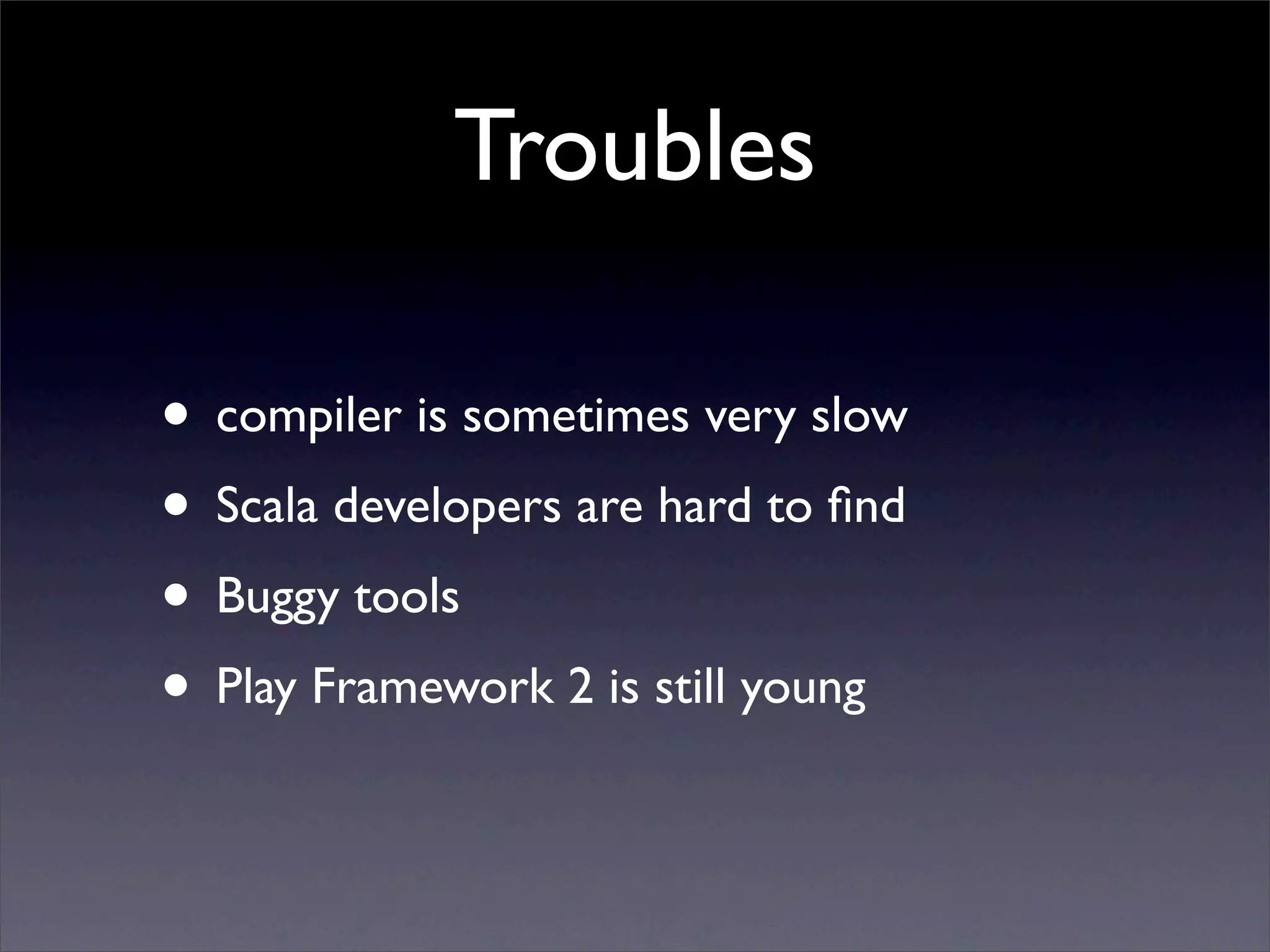
Troubles

• compiler is sometimes very slow
• Scala developers are hard to find
• Buggy tools
• Play Framework 2 is still young
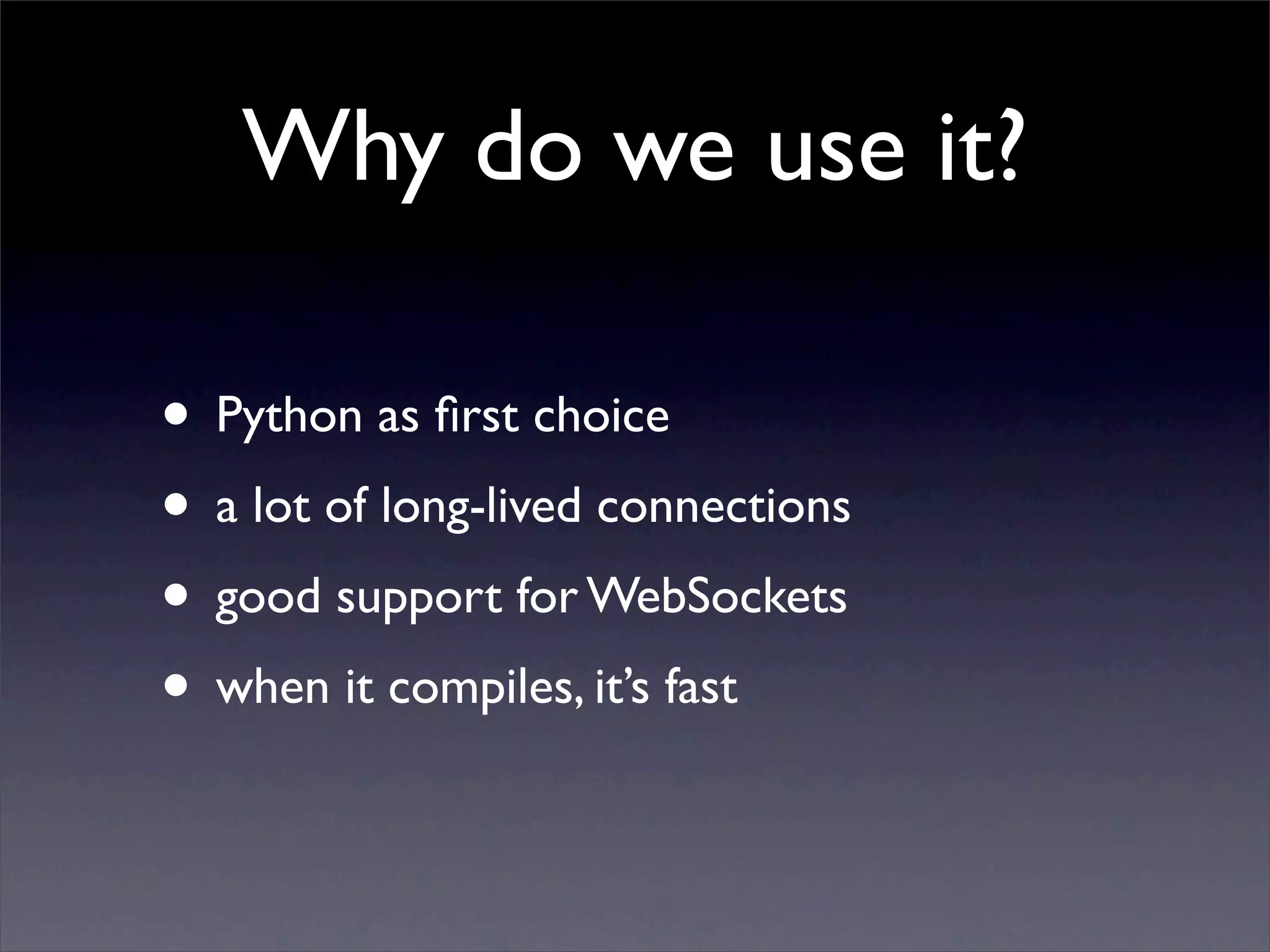
Why do we use it?

• Python as first choice
• a lot of long-lived connections
• good support for WebSockets
• when it compiles, it’s fast
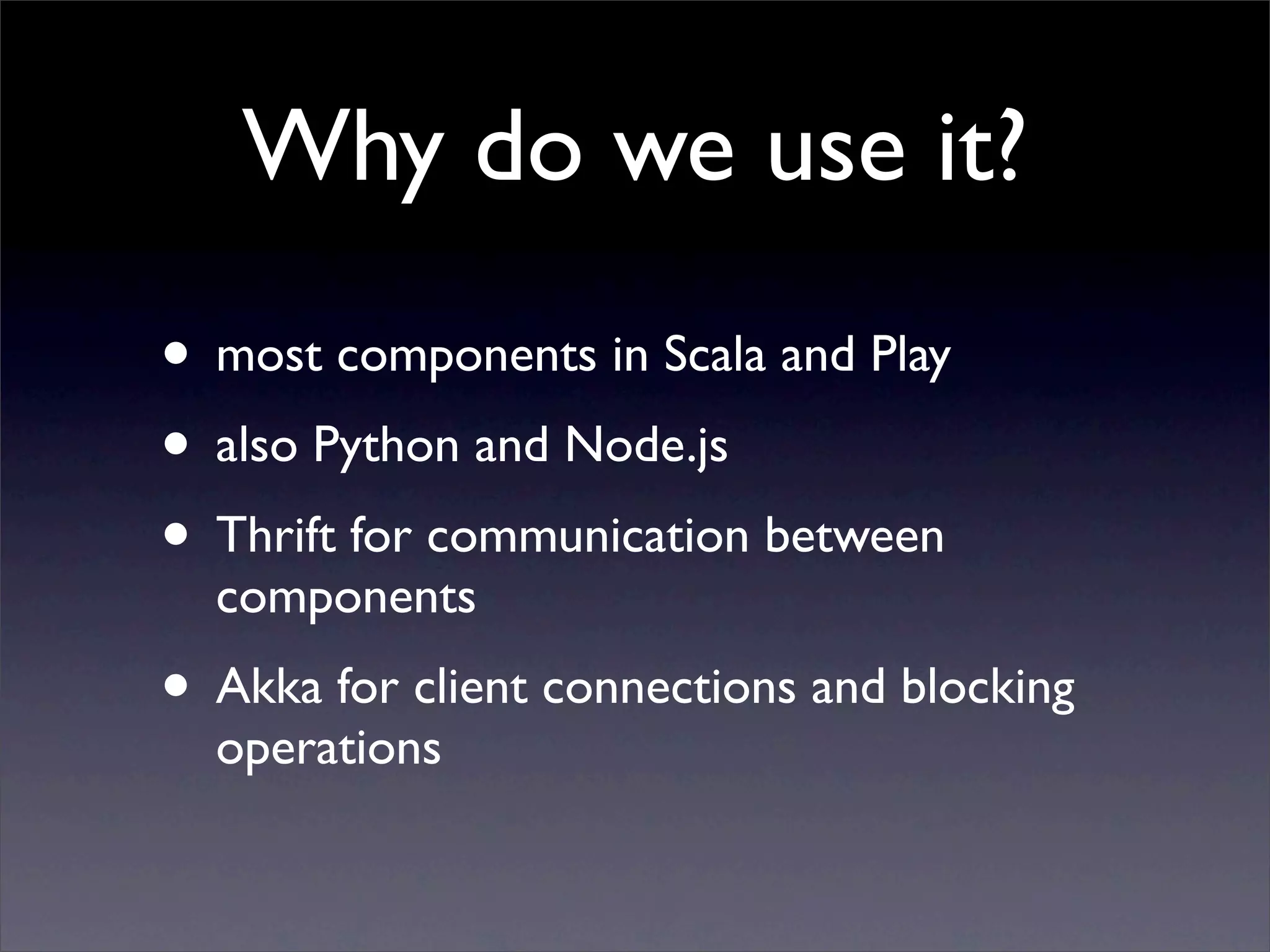
Why do we use it?
• most components in Scala and Play
• also Python and Node.js
• Thrift for communication between
  components
• Akka for client connections and blocking
  operations
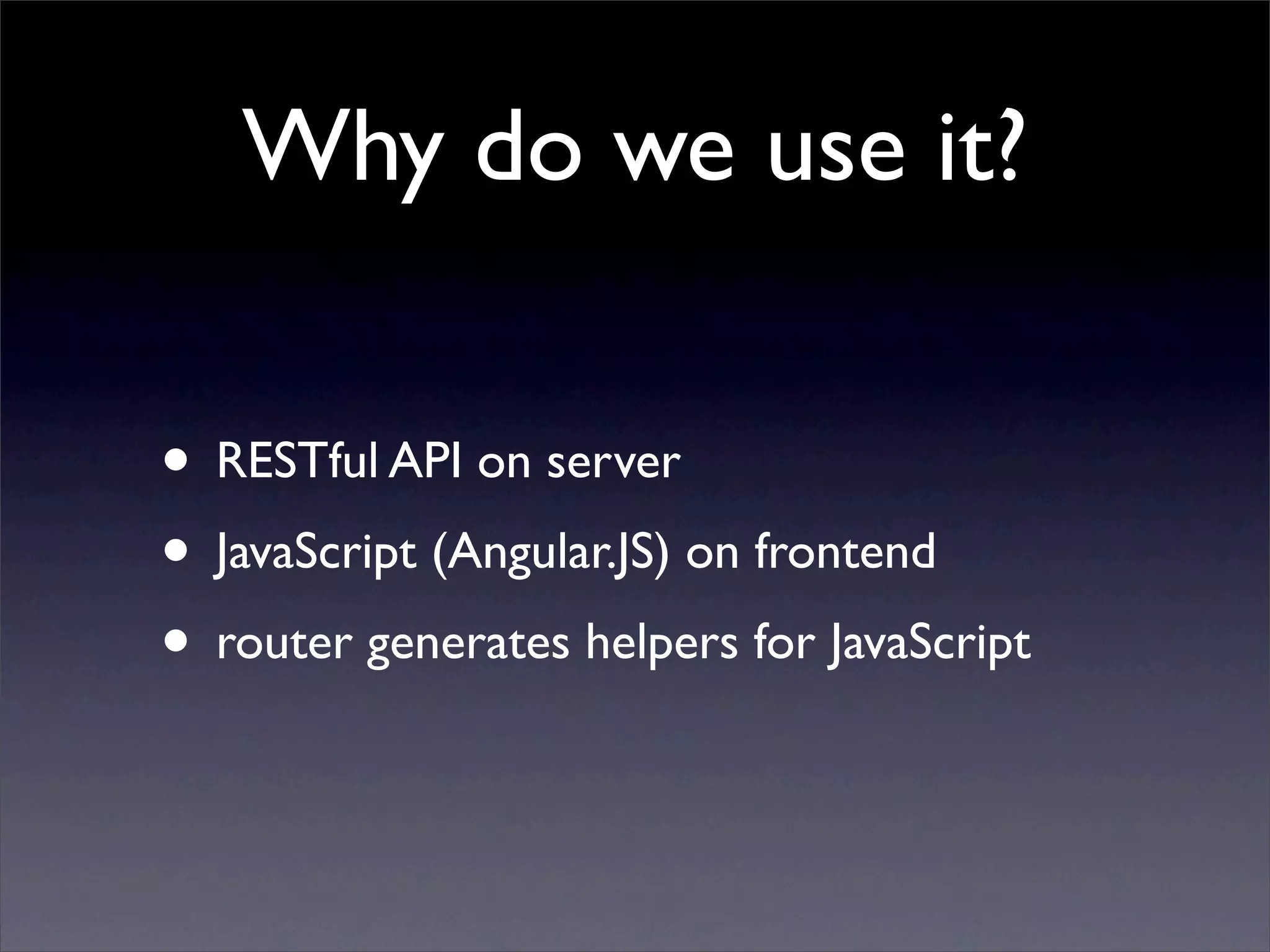
Why do we use it?

• RESTful API on server
• JavaScript (Angular.JS) on frontend
• router generates helpers for JavaScript
Questions?

Typesafe stack - Scala, Akka and Play

  • 1.
    Typesafe stack Scala, Akkaand Play Luka Zakrajšek @bancek December 2012
  • 2.
    The Typesafe Stack •development platform • easy to build scalable software applications • seamless integration with existing Java infrastructure
  • 4.
    The Typesafe Stack •Java Virtual Machine • Scala core • Akka middleware • Play web framework • Tools • Horizontal scalability
  • 5.
    Scala • general purposeprogramming language • object-oriented and functional • statically typed • full interoperability with Java • Twitter, Foursquare, Amazon, LinkedIn • active community
  • 6.
    Object-Oriented • familiar designpatterns from Java • traits • mixin-based composition
  • 7.
    Functional • based onthe functional principles of Haskell and ML • avoid shared state
  • 8.
    Statically Typed • expressivetype system • detects and avoids many kinds of application errors at compile time • no boilerplate code
  • 9.
    Extensible • easy toadd new language constructs • domain-specific languages (DSLs)
  • 10.
    Interoperable with Java •Java bytecode • existing Java libraries • extremely mature Java Virtual Machine • no difference in deployment • familiar tools • shorter, faster, more correct code
  • 11.
    Type inference val a = 5 val b = 4.5 val c = "foo" val error = a * c def actOn[T](x: T) = x.toString actOn(a) actOn(c)
  • 12.
    Type aliases, closures, firstclass functions and comprehensions type UnaryOp[T, R] = T => R def run[R](gen: UnaryOp[Int, R]) { for (x <- 1 to 5) println(gen(x)) } run(x => -x) run(x => Array.fill(x)("*").mkString)
  • 13.
    Imperative with functional-style constructs val someNumbers = List(1, 9, 2, 7, 3, 5) def onlyOdds = someNumbers.filter(_ % 2 == 1) def onlyEvens = someNumbers.filter(_ % 2 == 0) def sum = someNumbers.sum def sumAlt = someNumbers.fold(0)(_ + _)
  • 14.
    Traits: static mixins traitLogging { protected def log(fmt: String, args: Any*) { println(fmt.format(args:_*)) } } class SampleClass extends Logging { log("Init") val a = 1 val b = "foo" log("%d and %s", a, b) }
  • 15.
    Pattern matching def act:Either[Any, Exception] //... act match { case Left(message: String) => println(message) case Left(count: Int) => counter += count case Left(fallback: Any) => println("Error") case Right(e) => e.printStackTrace() }
  • 16.
    Akka • event-driven middlewareframework • high performance and reliable distributed applications • decouples business logic from low-level mechanisms • easily configurable
  • 17.
    Simpler Concurrency • Threadsand nonblocking IO are complex and error-prone • Actor concurrency model
  • 18.
    Transactions • software transactionalmemory (STM) • atomically modify the state of many objects at once • revert all your changes if the transaction fails
  • 19.
    Event-driven • platform forasynchronous event-driven architectures • non-blocking IO frameworks
  • 20.
    Scalability • multicore serversand multiple nodes • several million Actors on single machine
  • 21.
  • 22.
    Transparent Remoting • RemoteActors • distributed programming model • unified programming model
  • 23.
    Scala & JavaAPIs • smooth interoperability • Spring and Guice integrations • deploy in your existing Java application server or run stand-alone
  • 24.
    Actors • every actorhas a message queue • actors accepts and choose what to do with messages • lightweight and asynchronous
  • 25.
    Actors • actors tendto remain bound to single thread • actors rarely block, thread can remain active for a long duration • Akka actors occupy 650 bytes
  • 26.
    class GreetingActor extendsActor { private var counter = 0 def receive = { case message => { counter += 1 // 1) Hello, Juliet log.info(counter + ") Hello, " + message) } } } val greetingActor = actorOf[GreetingActor].start greetingActor ! "Juliet"
  • 27.
    Play Framework • painlessweb development for Java and Scala • developer productivity • RESTful architectures • clean alternative to bloated Enterprise Java stacks
  • 28.
    Live reload • fixthe bug and hit reload • no need to restart the server
  • 29.
    Stateless MVC architecture • shared-nothing architecture • use Ajax or offline storage to solve the state problems client-side • easier to render portions of the page in parallel
  • 30.
    Type-safe templating engine • Scala-based template engine • syntax and type errors detected by compiler • routing system is also fully type-checked
  • 31.
    Full-stack application framework • relational database support and object- relational mapping • integrated cache support • straightforward RESTful web services • flexible deployment options
  • 32.
    Controller package controllers import play.api.mvc._ objectApplication extends Controller { def index = Action { Ok("It works!") } }
  • 33.
    Router # Extract thepage parameter from the path, or fix the value for / GET / controllers.Application.show(page = "home") GET /:page controllers.Application.show(page)
  • 34.
    Scala IDE forEclipse • syntax highlighting, code completion, inferred type hovers... • mixed Scala/Java projects • incremental compilation • 3rd party support for IntelliJ and NetBeans
  • 35.
    Simple Build Tool(sbt) • compile code • run tests • package jars • manages dependencies
  • 36.
    When not touse it • developers familiar with Python or Ruby • already have big codebase
  • 37.
    Troubles • compiler issometimes very slow • Scala developers are hard to find • Buggy tools • Play Framework 2 is still young
  • 38.
    Why do weuse it? • Python as first choice • a lot of long-lived connections • good support for WebSockets • when it compiles, it’s fast
  • 39.
    Why do weuse it? • most components in Scala and Play • also Python and Node.js • Thrift for communication between components • Akka for client connections and blocking operations
  • 40.
    Why do weuse it? • RESTful API on server • JavaScript (Angular.JS) on frontend • router generates helpers for JavaScript
  • 41.