Tools for Making
Machine Learning
more Reactive
Jeff Smith
@jeffksmithjr
jeffsmith.tech
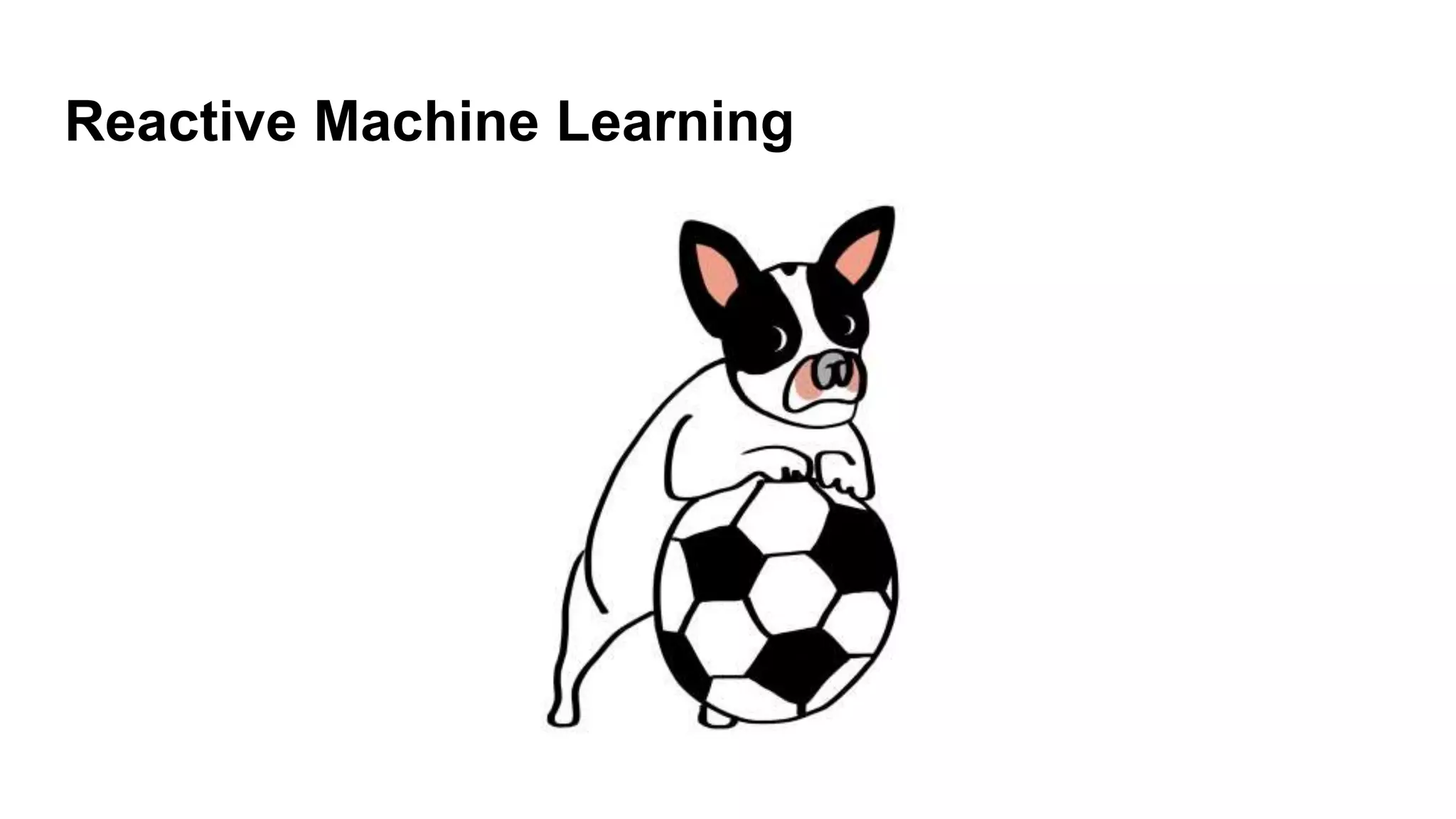
Reactive Machine Learning
Background Survey
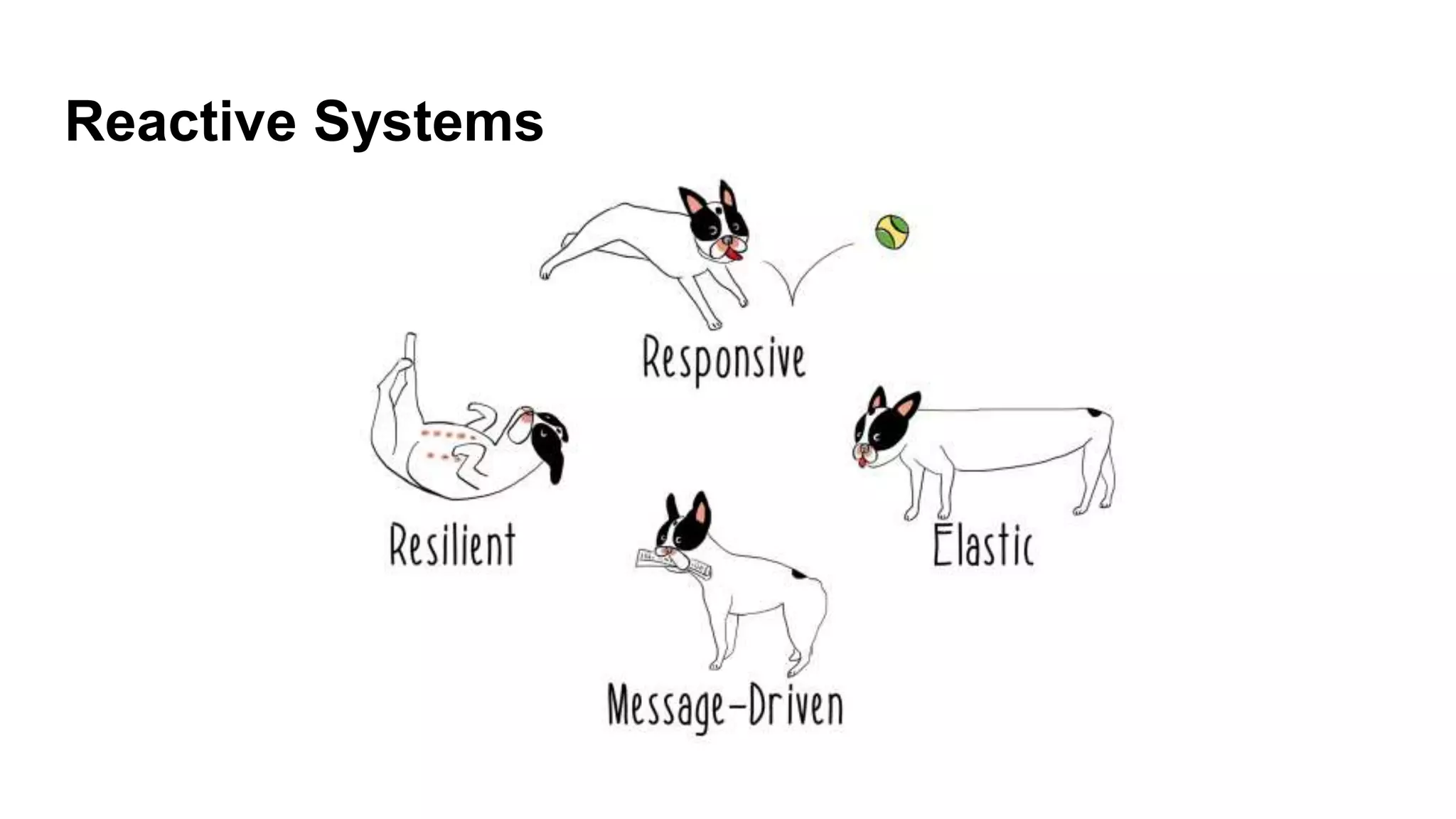
Reactive Systems
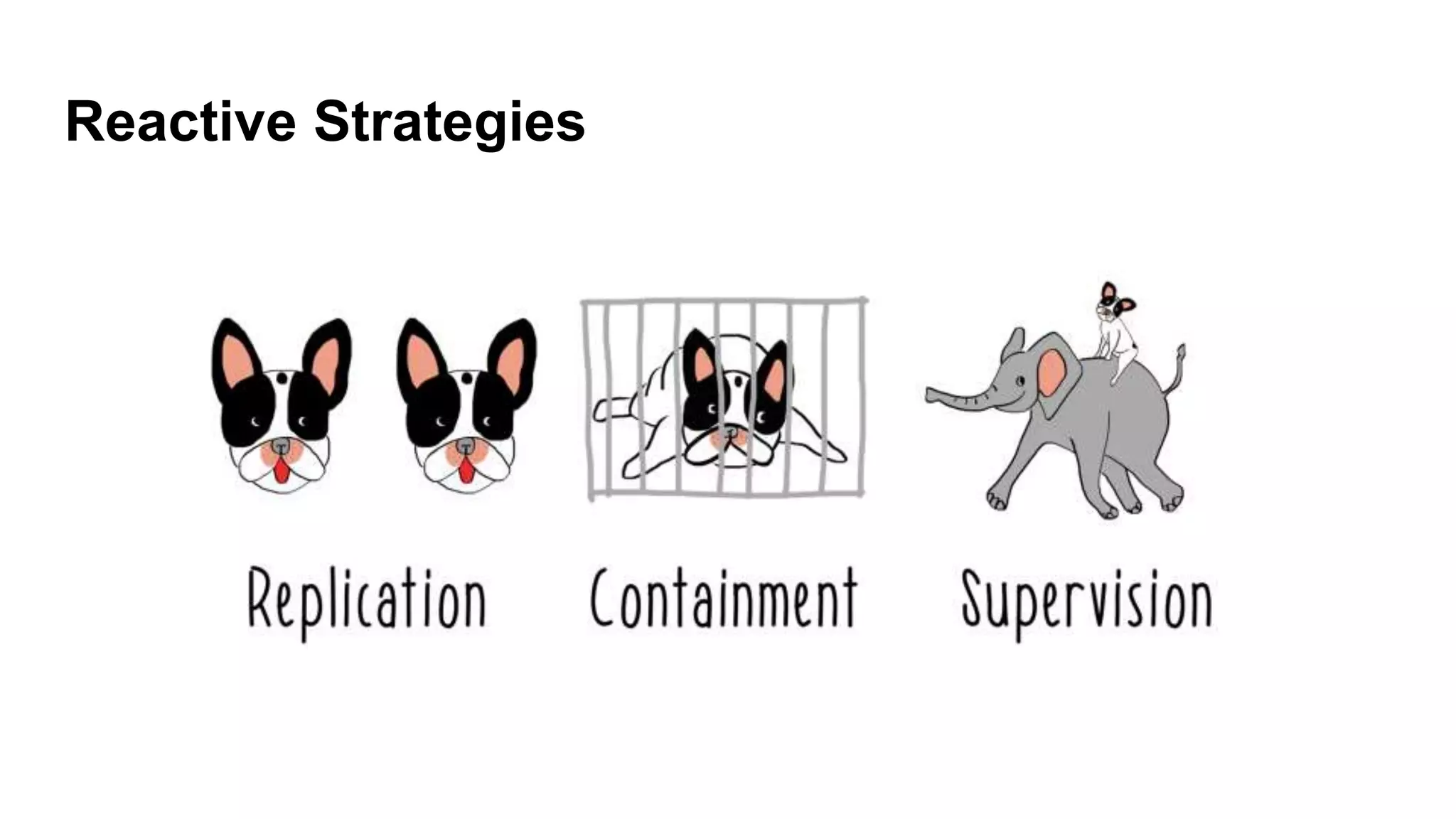
Reactive Strategies
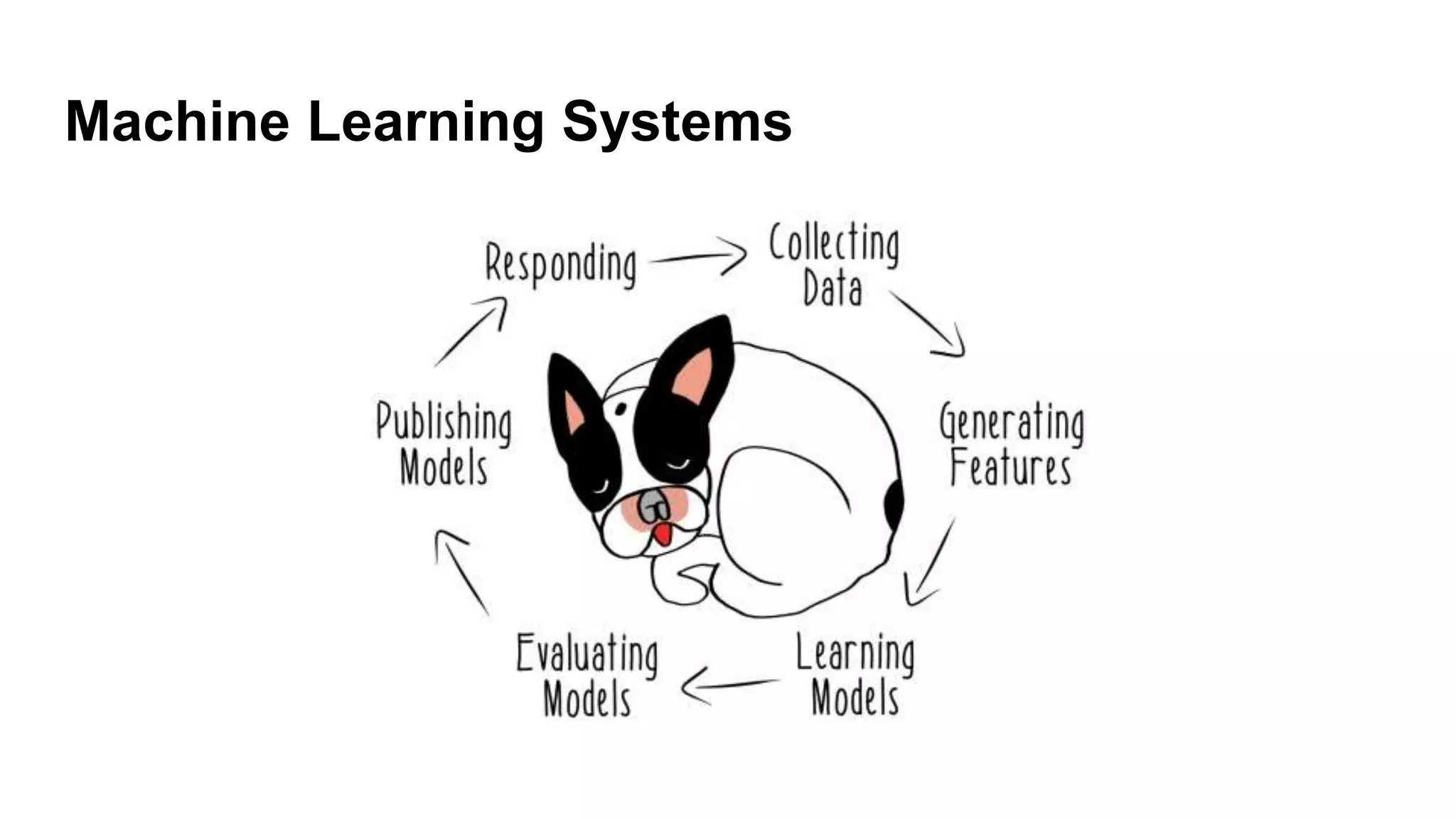
Machine Learning Systems
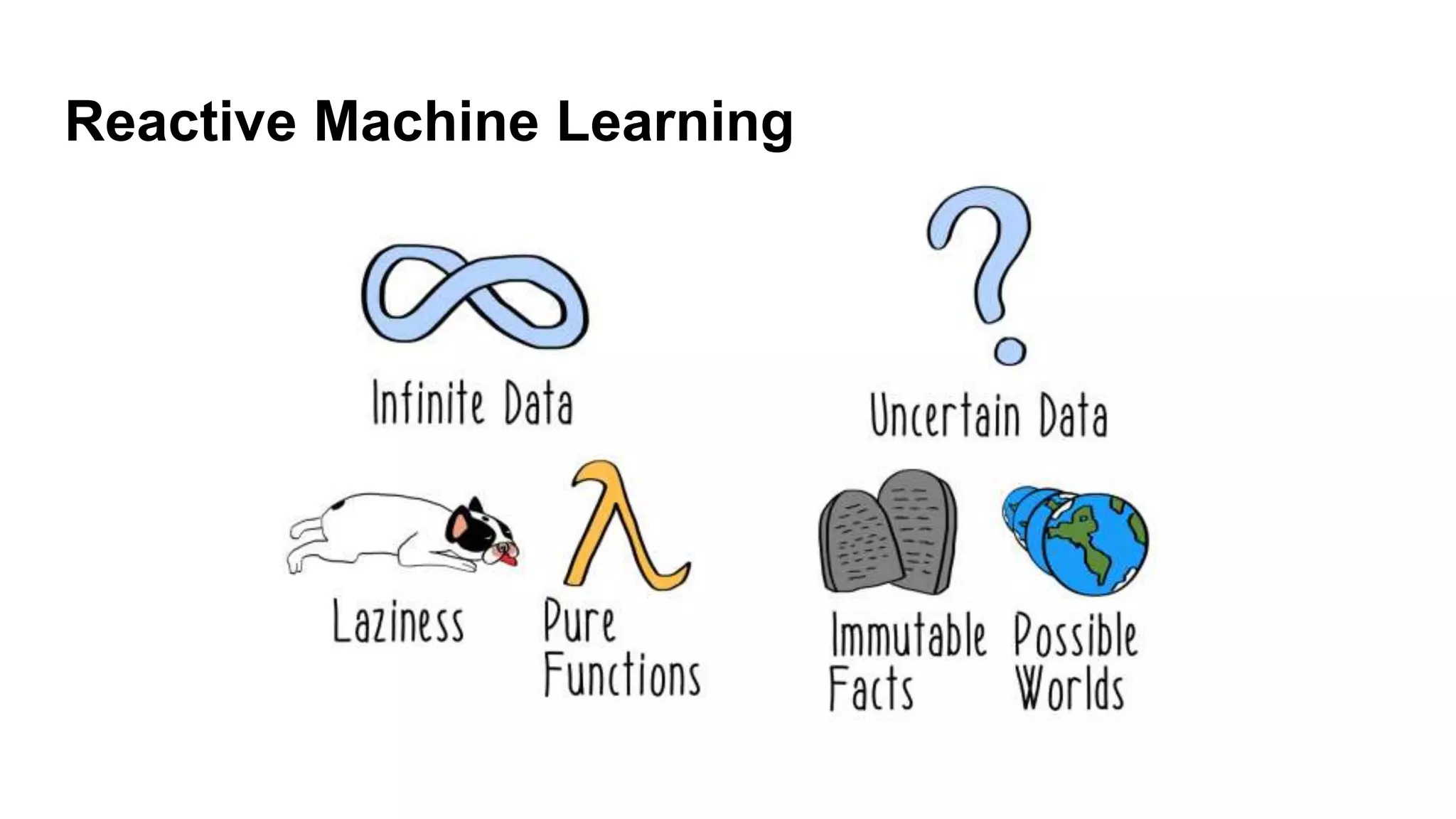
Reactive Machine Learning
Reactive at Intent Media
Language Survey
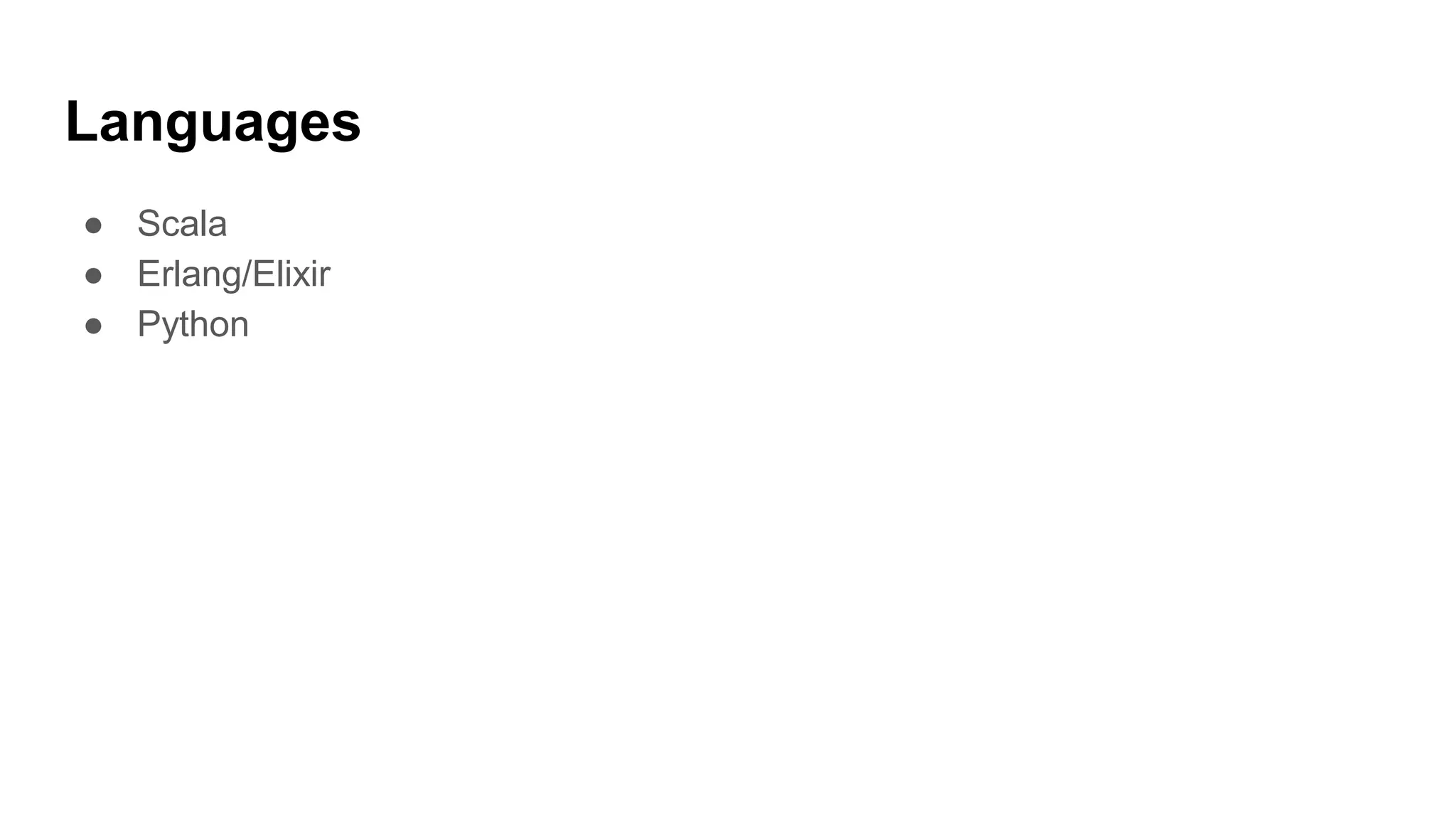
Languages
● Scala
● Erlang/Elixir
● Python
Responding
Agriculture
Akka
● Scala & Java
● Actor model
● Concurrency
● Distribution
● Supervision
Model Microservices
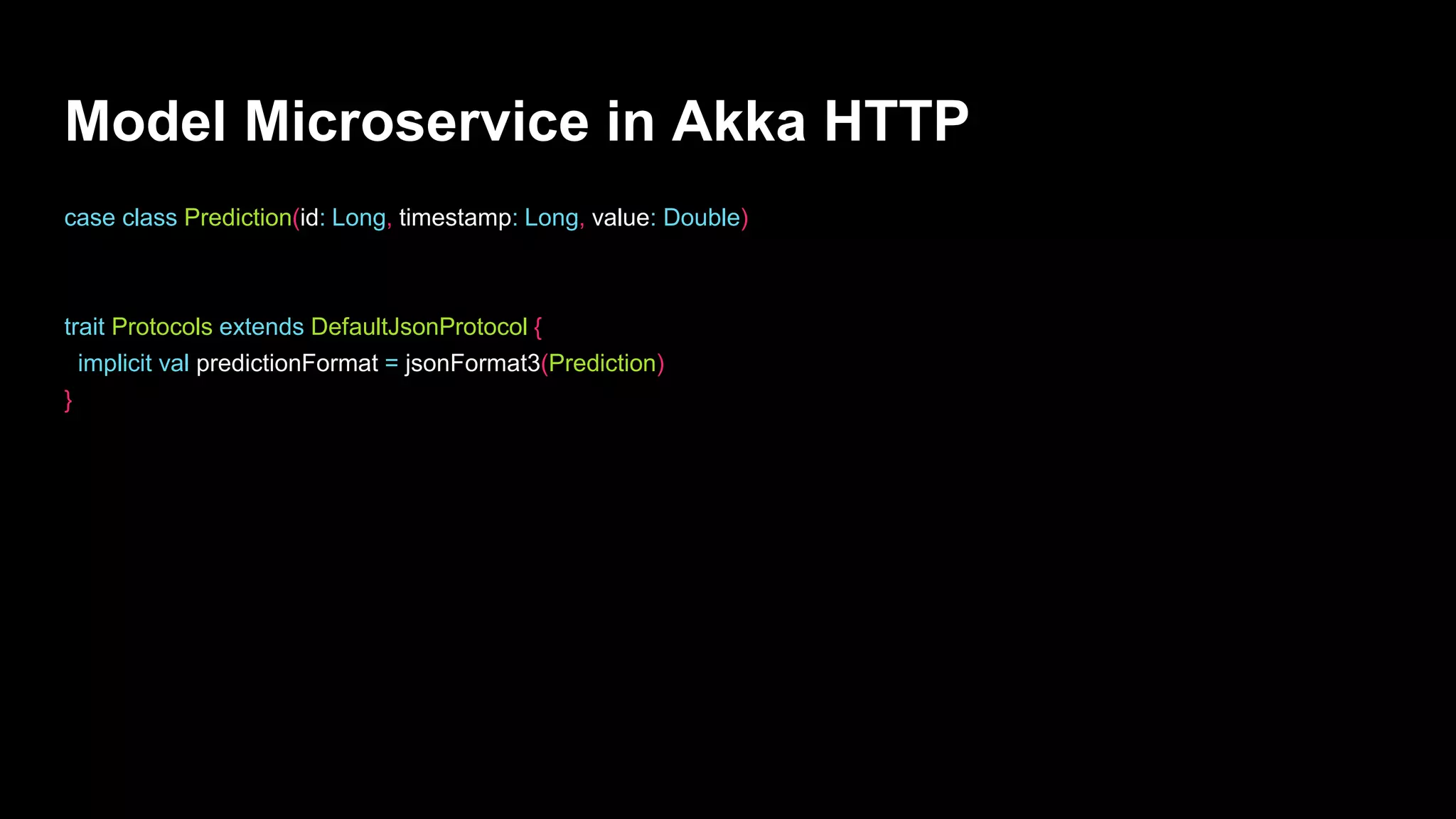
Model Microservice in Akka HTTP
case class Prediction(id: Long, timestamp: Long, value: Double)
trait Protocols extends DefaultJsonProtocol {
implicit val predictionFormat = jsonFormat3(Prediction)
}
Model Microservice in Akka HTTP
def model(features: Map[Char, Double]) = {
val coefficients = ('a' to 'z').zip(1 to 26).toMap
val predictionValue = features.map {
case (identifier, value) =>
coefficients.getOrElse(identifier, 0) * value
}.sum / features.size
Prediction(Random.nextLong(), System.currentTimeMillis(), predictionValue)
}
def parseFeatures(features: String): Map[String, Double] = {
features.parseJson.convertTo[Map[Char, Double]]
}
def predict(features: String): Prediction = {
model(parseFeatures(features))
}
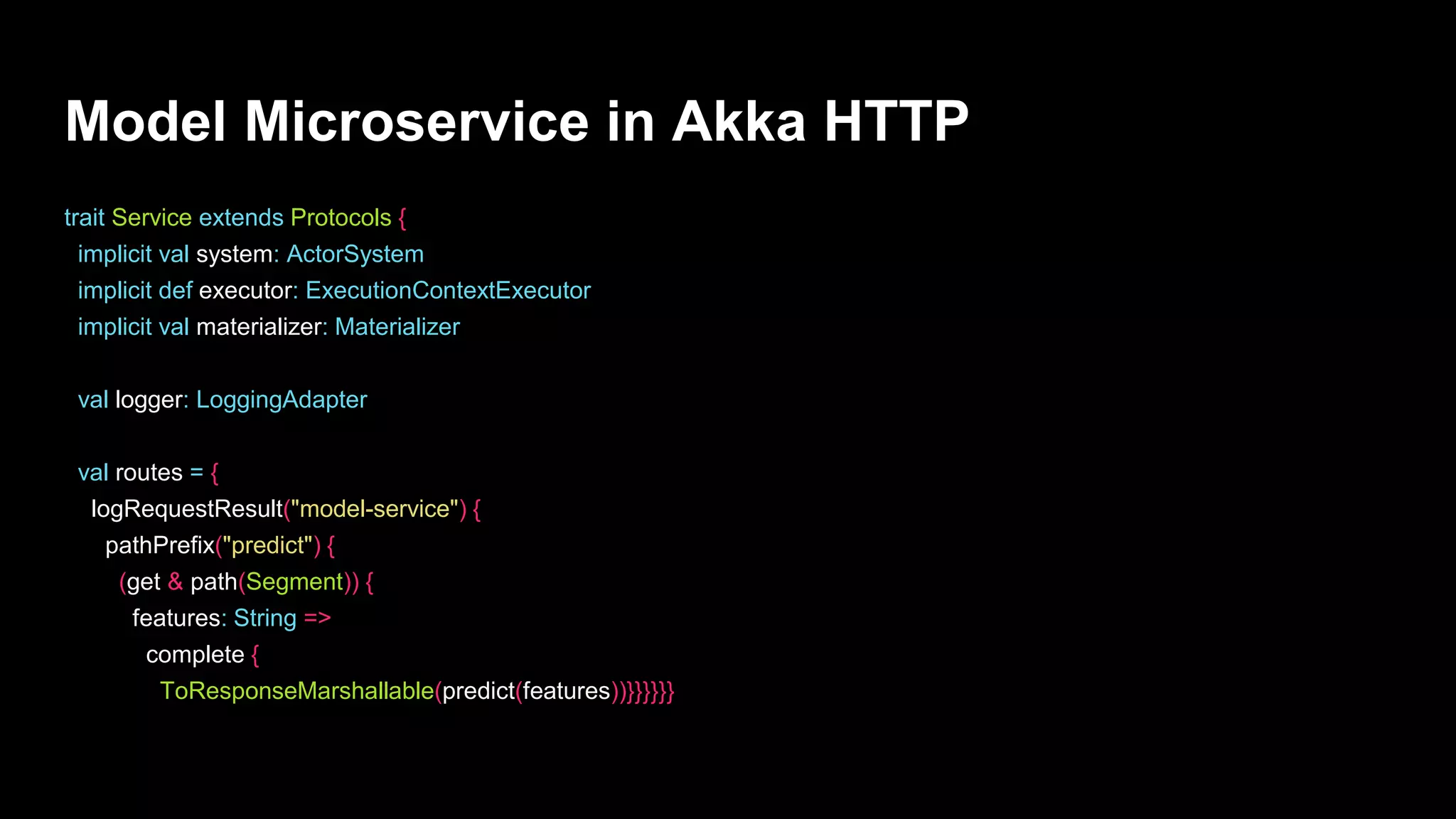
Model Microservice in Akka HTTP
trait Service extends Protocols {
implicit val system: ActorSystem
implicit def executor: ExecutionContextExecutor
implicit val materializer: Materializer
val logger: LoggingAdapter
val routes = {
logRequestResult("model-service") {
pathPrefix("predict") {
(get & path(Segment)) {
features: String =>
complete {
ToResponseMarshallable(predict(features))}}}}}}
Model Serialization
Random Forest in Spark MLlib
MLlib Model Serialization
{
"class": "org.apache.spark.ml.PipelineModel",
"timestamp": 1467653845388,
"sparkVersion": "2.0.0-preview",
"uid": "pipeline_6b4fb08e8fb0",
"paramMap": {
"stageUids": ["quantileDiscretizer_d3996173db25",
"vecAssembler_2bdcd79fe1cf",
"logreg_9d559ca7e208"]
}
}
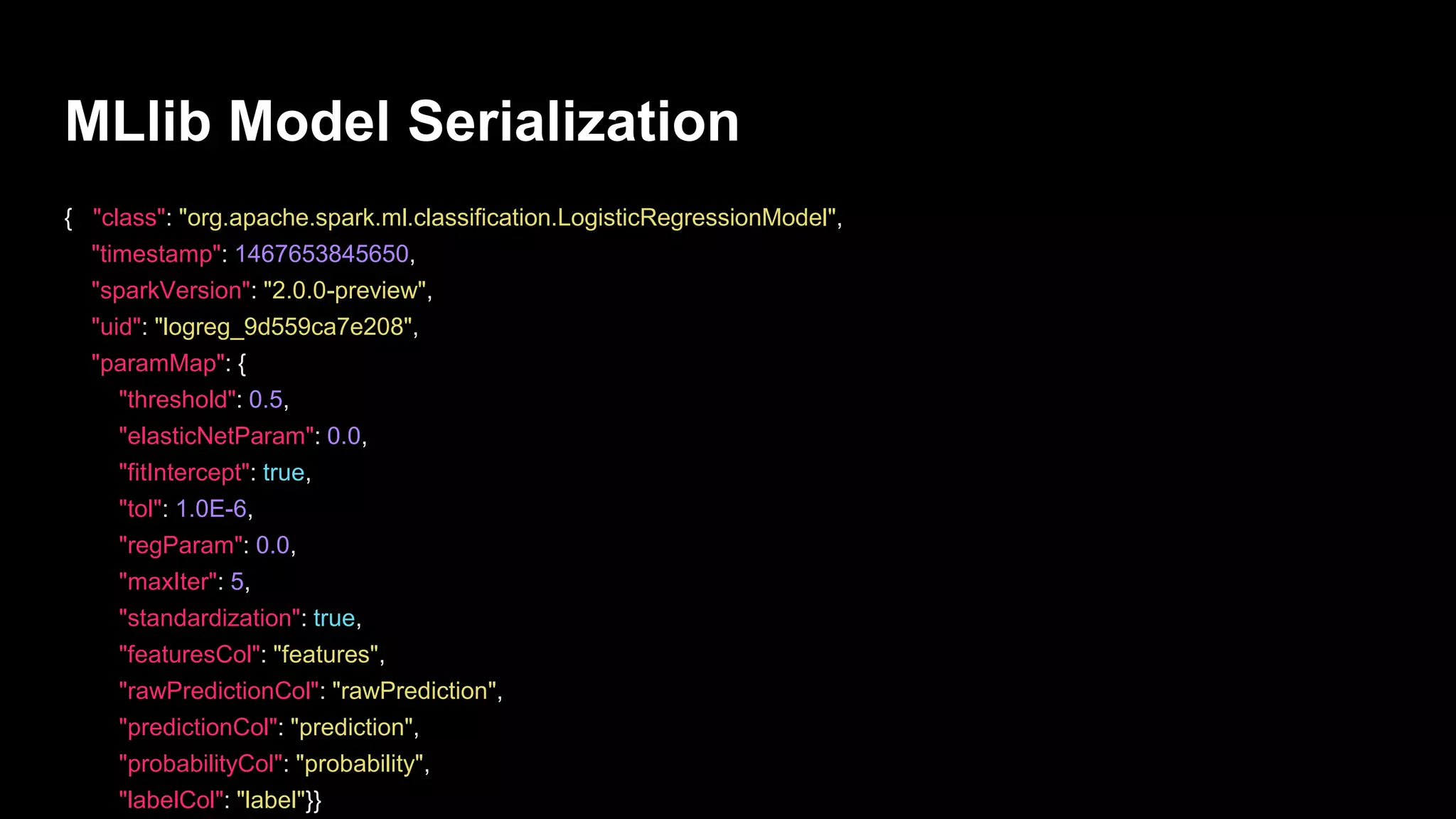
MLlib Model Serialization
{ "class": "org.apache.spark.ml.classification.LogisticRegressionModel",
"timestamp": 1467653845650,
"sparkVersion": "2.0.0-preview",
"uid": "logreg_9d559ca7e208",
"paramMap": {
"threshold": 0.5,
"elasticNetParam": 0.0,
"fitIntercept": true,
"tol": 1.0E-6,
"regParam": 0.0,
"maxIter": 5,
"standardization": true,
"featuresCol": "features",
"rawPredictionCol": "rawPrediction",
"predictionCol": "prediction",
"probabilityCol": "probability",
"labelCol": "label"}}
Parquet
Packaging
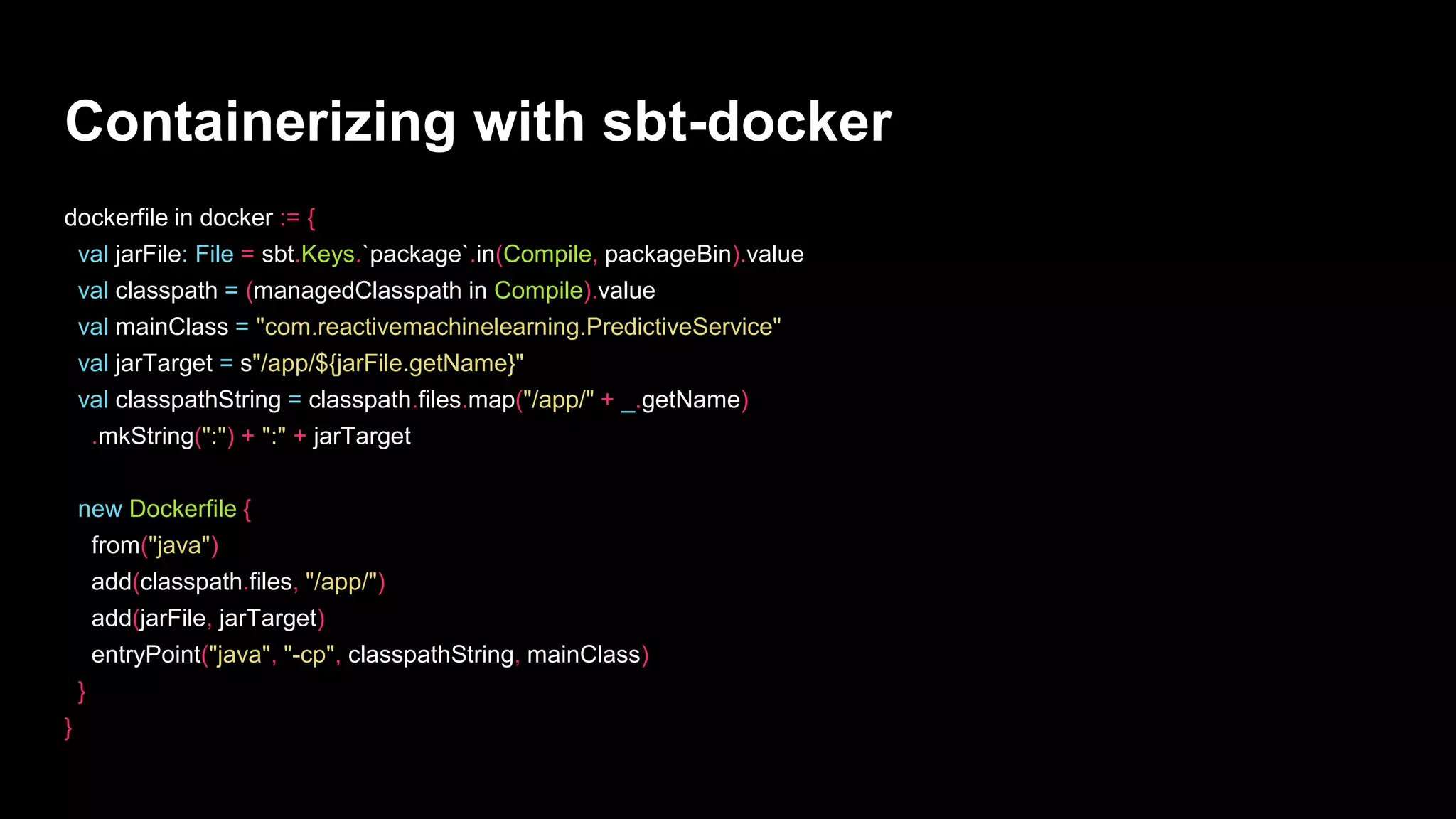
Containerizing with sbt-docker
dockerfile in docker := {
val jarFile: File = sbt.Keys.`package`.in(Compile, packageBin).value
val classpath = (managedClasspath in Compile).value
val mainClass = "com.reactivemachinelearning.PredictiveService"
val jarTarget = s"/app/${jarFile.getName}"
val classpathString = classpath.files.map("/app/" + _.getName)
.mkString(":") + ":" + jarTarget
new Dockerfile {
from("java")
add(classpath.files, "/app/")
add(jarFile, jarTarget)
entryPoint("java", "-cp", classpathString, mainClass)
}
}
Containerizing with sbt-docker
FROM java
ADD 0/spark-core_2.11-2.0.0-preview.jar 1/avro-mapred-1.7.7-hadoop2.jar ...
ADD 166/chapter-7_2.11-1.0.jar /app/chapter-7_2.11-1.0.jar
ENTRYPOINT ["java", "-cp", "/app/spark-core_2.11-2.0.0-preview.jar ...
"com.reactivemachinelearning.PredictiveService"]
Model Servers
Transportation
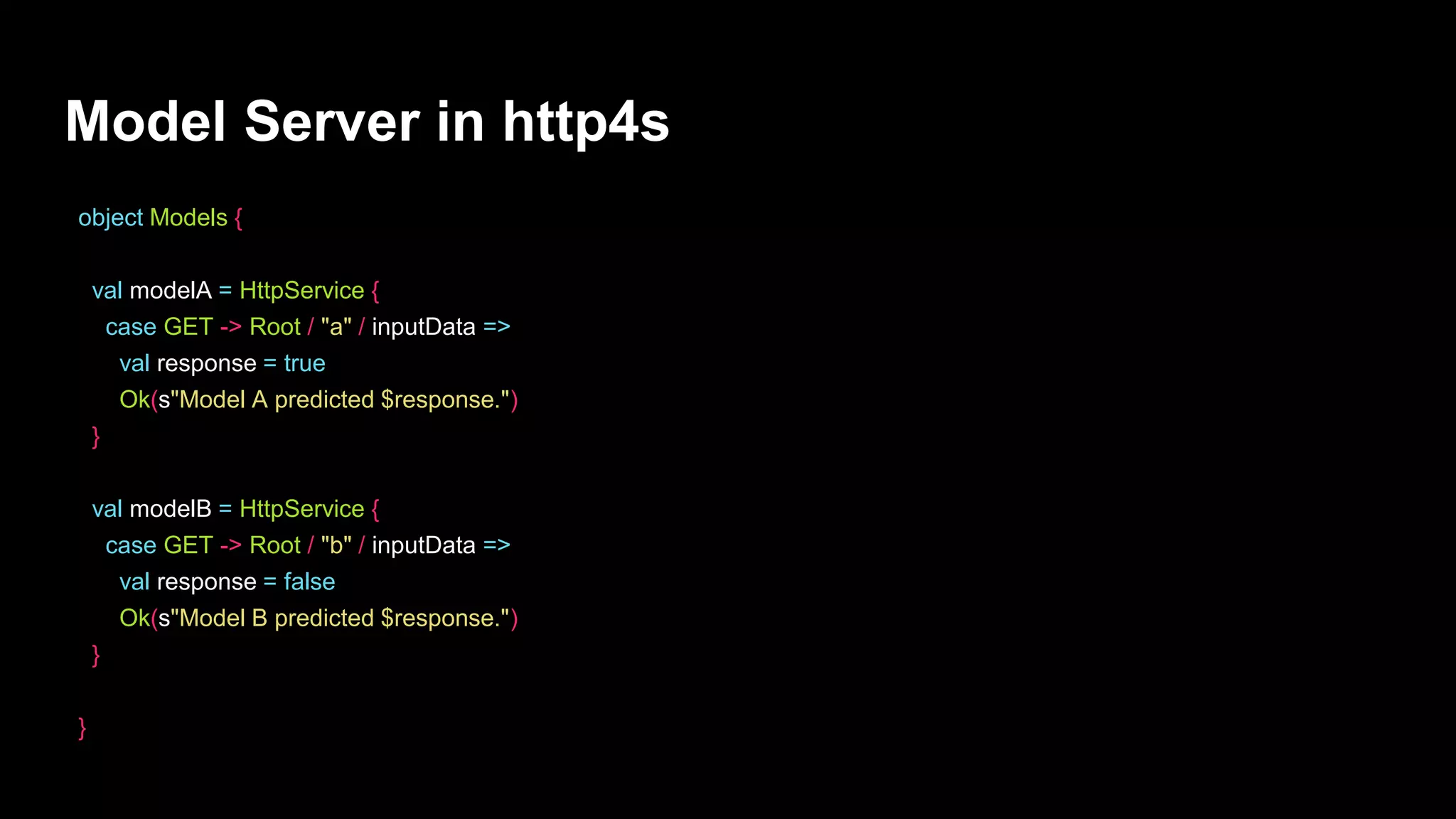
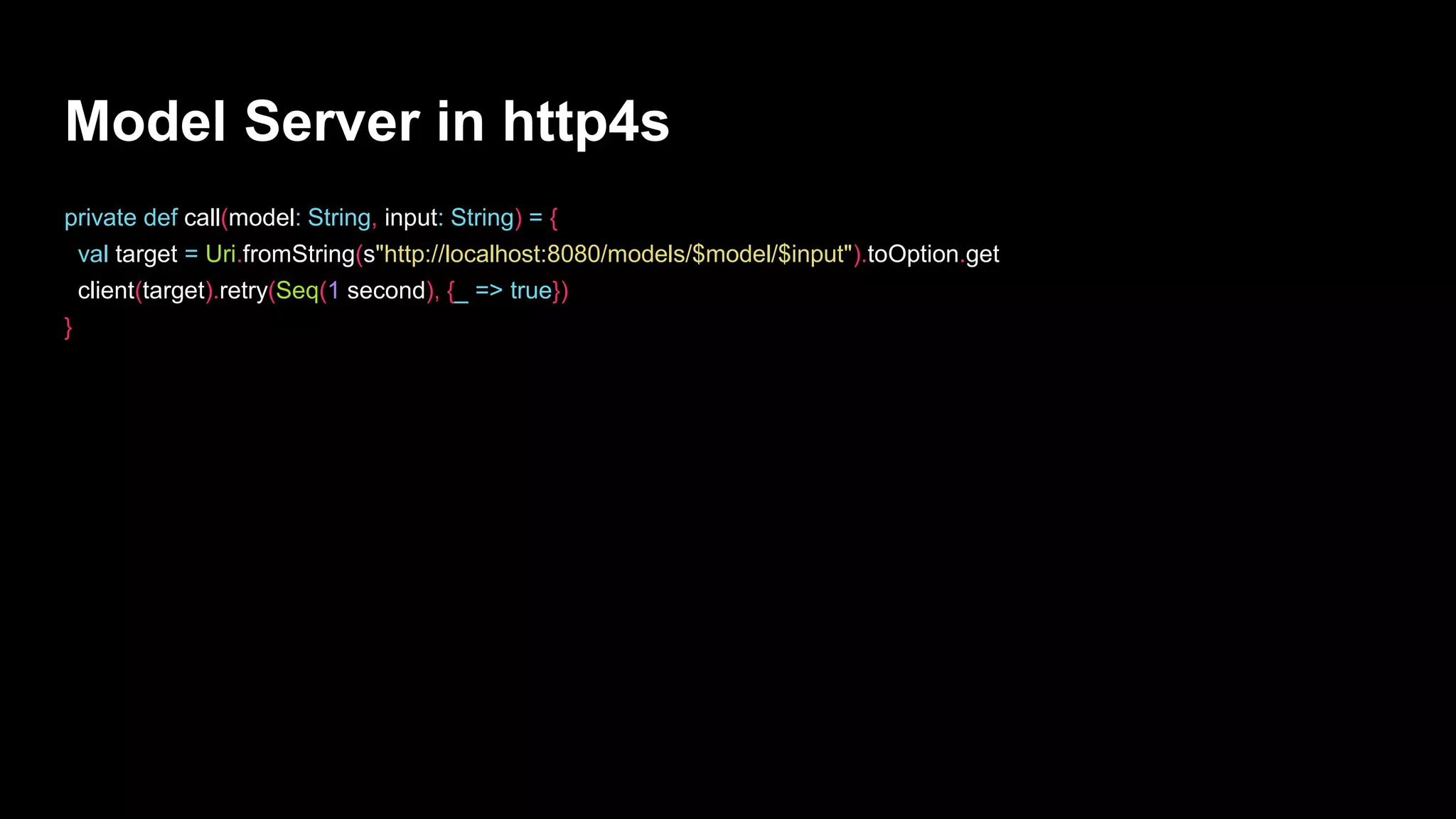
Model Server in http4s
object Models {
val modelA = HttpService {
case GET -> Root / "a" / inputData =>
val response = true
Ok(s"Model A predicted $response.")
}
val modelB = HttpService {
case GET -> Root / "b" / inputData =>
val response = false
Ok(s"Model B predicted $response.")
}
}
Model Server in http4s
object Client {
val client = PooledHttp1Client()
private def call(model: String, input: String) = {
val target = Uri.fromString(s"http://localhost:8080/models/$model/$input").toOption.get
client.expect[String](target)
}
def callA(input: String) = call("a", input)
def callB(input: String) = call("b", input)
}
Model Server in http4s
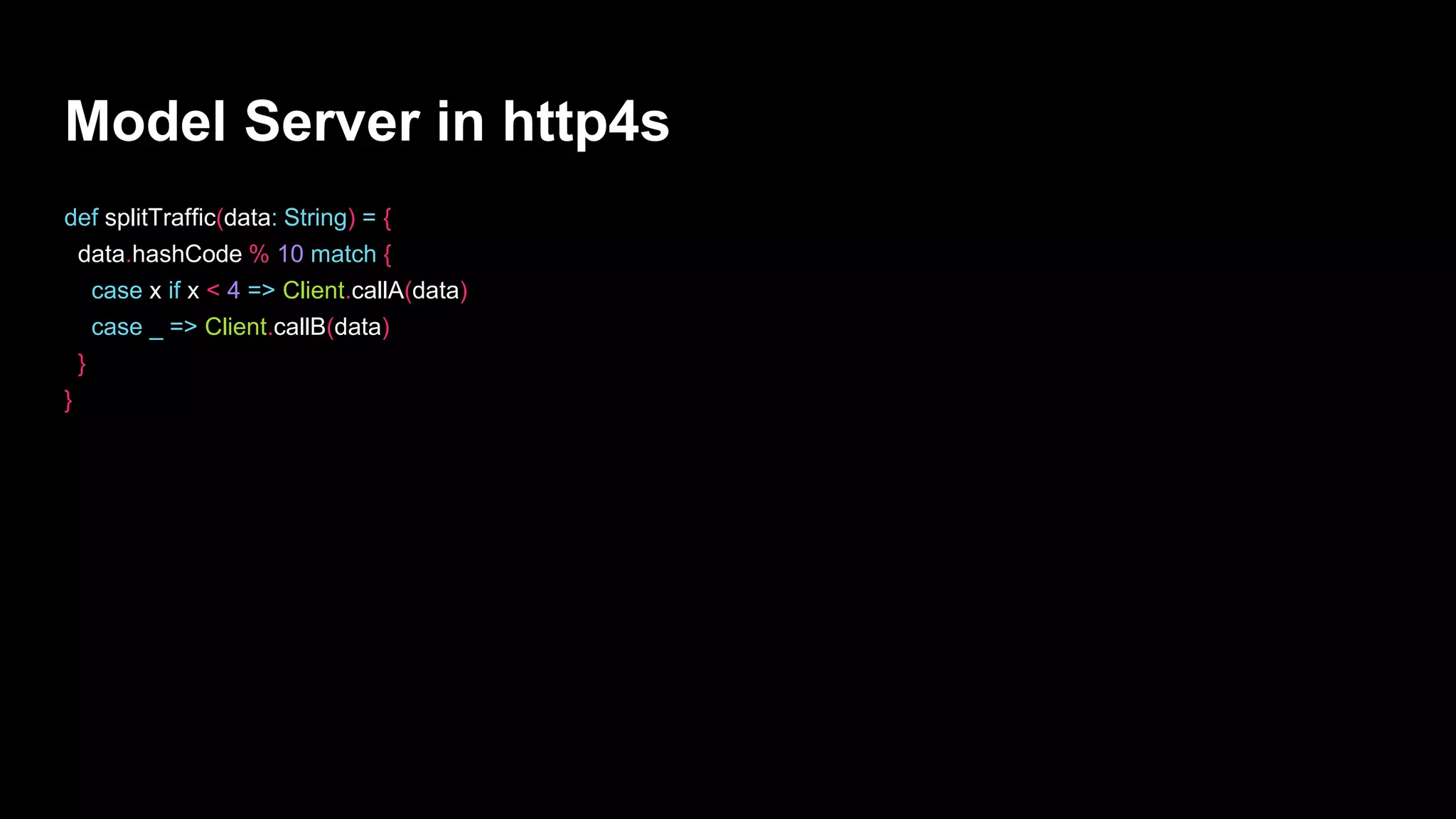
def splitTraffic(data: String) = {
data.hashCode % 10 match {
case x if x < 4 => Client.callA(data)
case _ => Client.callB(data)
}
}
Model Server in http4s
object ModelServer extends ServerApp {
val apiService = HttpService {
case GET -> Root / "predict" / inputData =>
val response = splitTraffic(inputData).run
Ok(response)
}
override def server(args: List[String]): Task[Server] = {
BlazeBuilder
.bindLocal(8080)
.mountService(apiService, "/api")
.mountService(Models.modelA, "/models")
.mountService(Models.modelB, "/models")
.start
}
}
Model Server in http4s
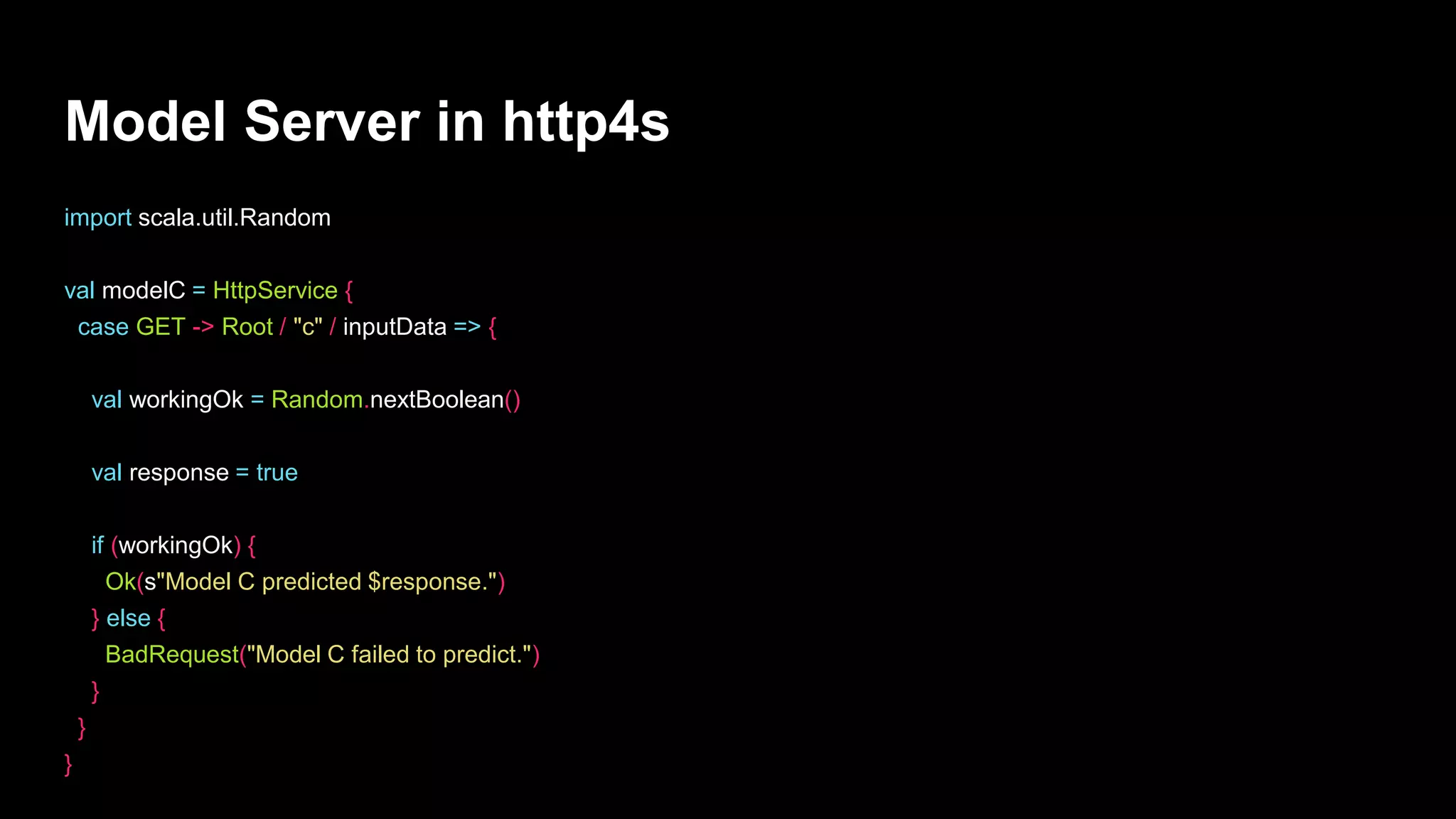
import scala.util.Random
val modelC = HttpService {
case GET -> Root / "c" / inputData => {
val workingOk = Random.nextBoolean()
val response = true
if (workingOk) {
Ok(s"Model C predicted $response.")
} else {
BadRequest("Model C failed to predict.")
}
}
}
Model Server in http4s
private def call(model: String, input: String): Task[Response] = {
val target = Uri.fromString(
s"http://localhost:8080/models/$model/$input"
).toOption.get
client(target)
}
def callC(input: String) = call("c", input)
Model Server in http4s
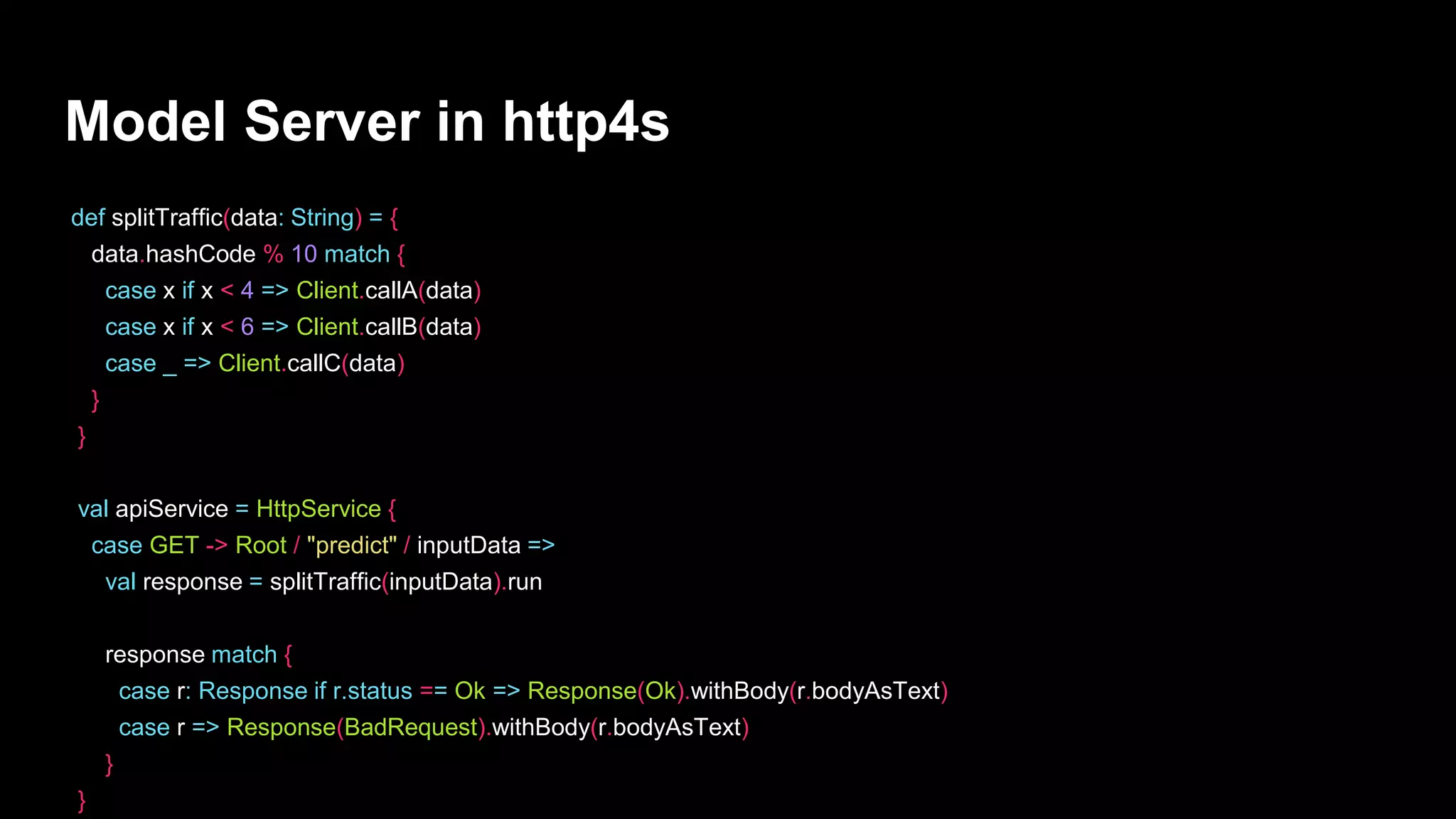
def splitTraffic(data: String) = {
data.hashCode % 10 match {
case x if x < 4 => Client.callA(data)
case x if x < 6 => Client.callB(data)
case _ => Client.callC(data)
}
}
val apiService = HttpService {
case GET -> Root / "predict" / inputData =>
val response = splitTraffic(inputData).run
response match {
case r: Response if r.status == Ok => Response(Ok).withBody(r.bodyAsText)
case r => Response(BadRequest).withBody(r.bodyAsText)
}
}
Model Server in http4s
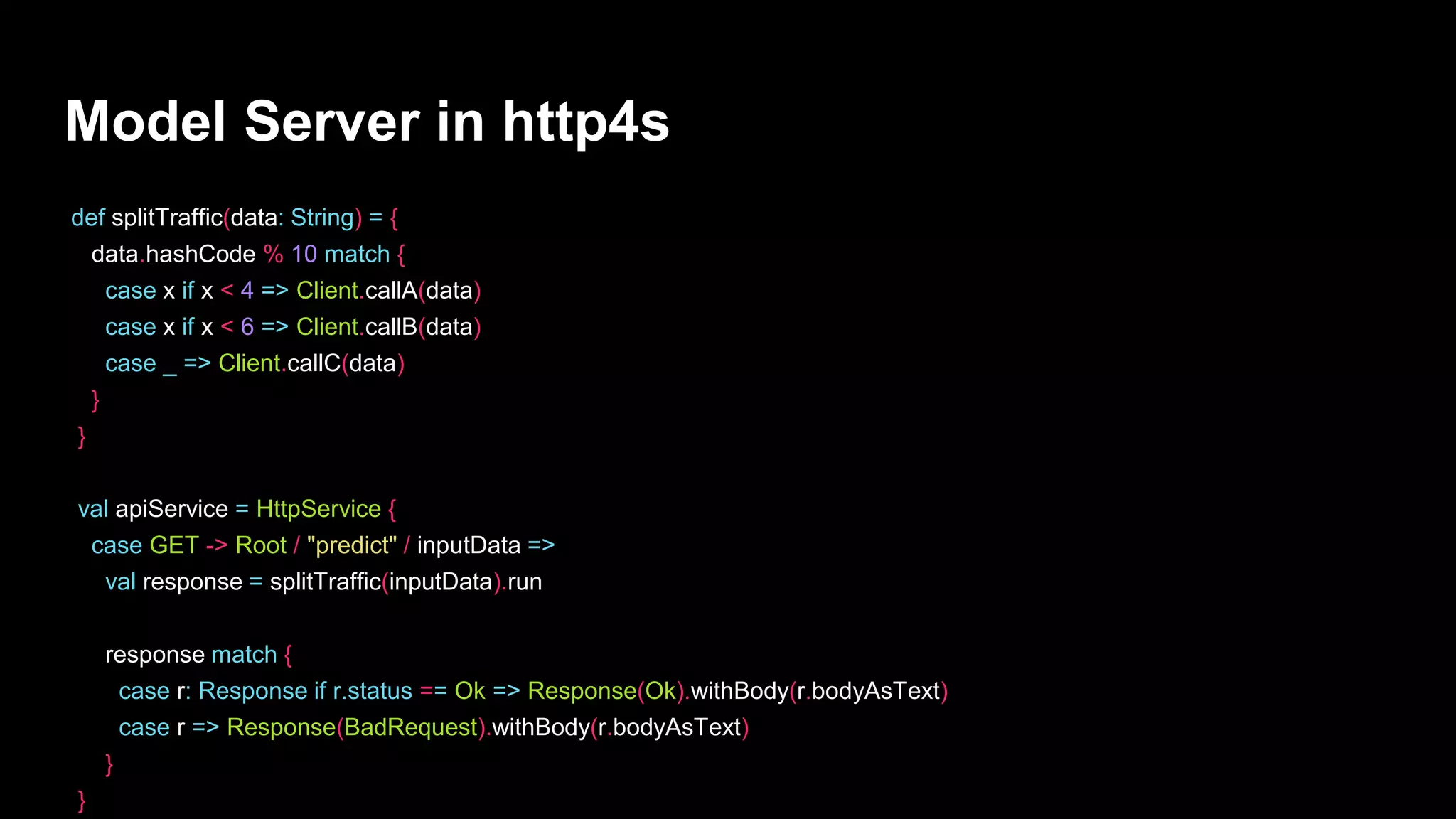
def splitTraffic(data: String) = {
data.hashCode % 10 match {
case x if x < 4 => Client.callA(data)
case x if x < 6 => Client.callB(data)
case _ => Client.callC(data)
}
}
val apiService = HttpService {
case GET -> Root / "predict" / inputData =>
val response = splitTraffic(inputData).run
response match {
case r: Response if r.status == Ok => Response(Ok).withBody(r.bodyAsText)
case r => Response(BadRequest).withBody(r.bodyAsText)
}
}
Model Server in http4s
private def call(model: String, input: String) = {
val target = Uri.fromString(s"http://localhost:8080/models/$model/$input").toOption.get
client(target).retry(Seq(1 second), {_ => true})
}
BEAM
Erlang
Elixir
Knowledge Maintenance
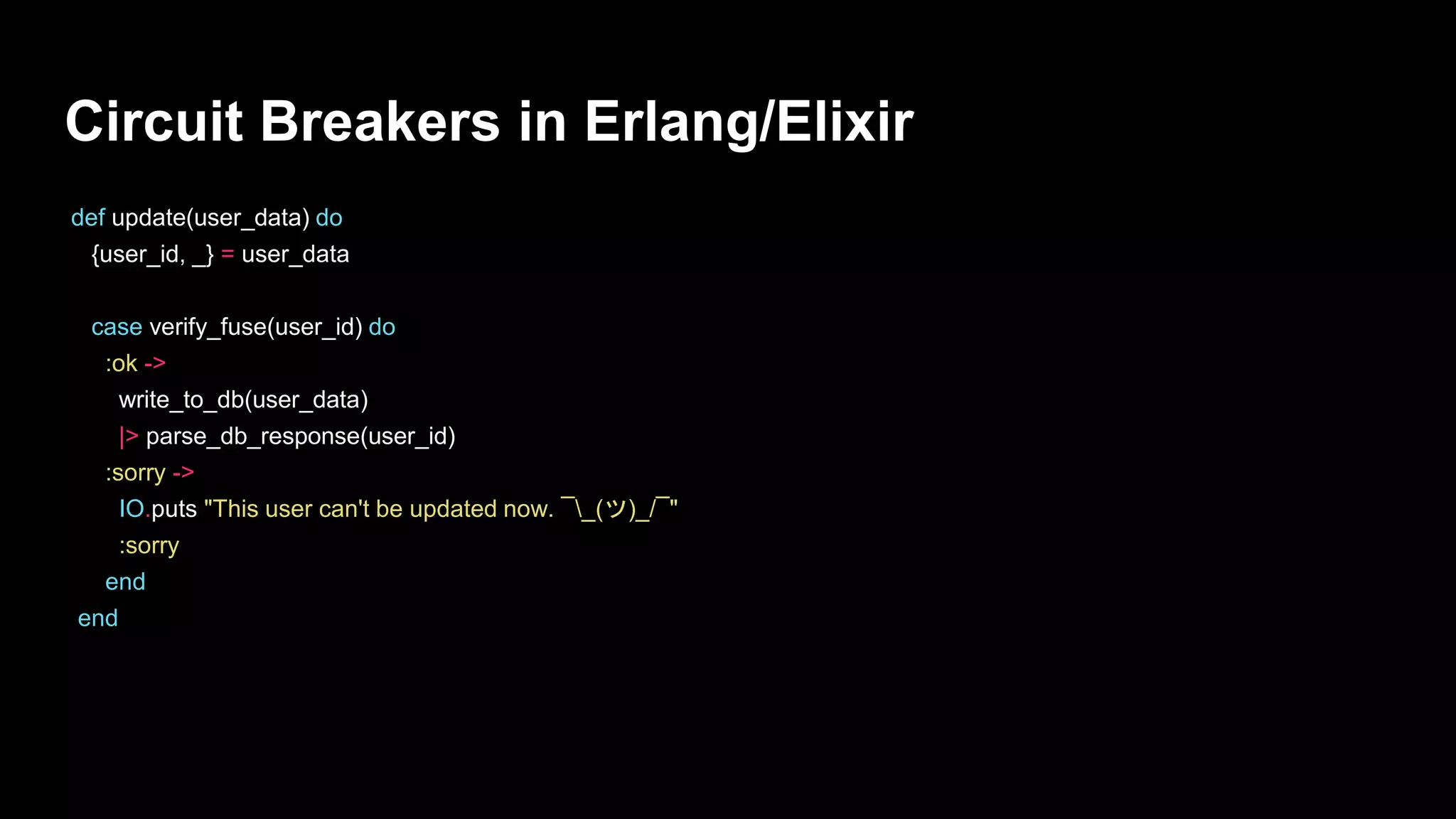
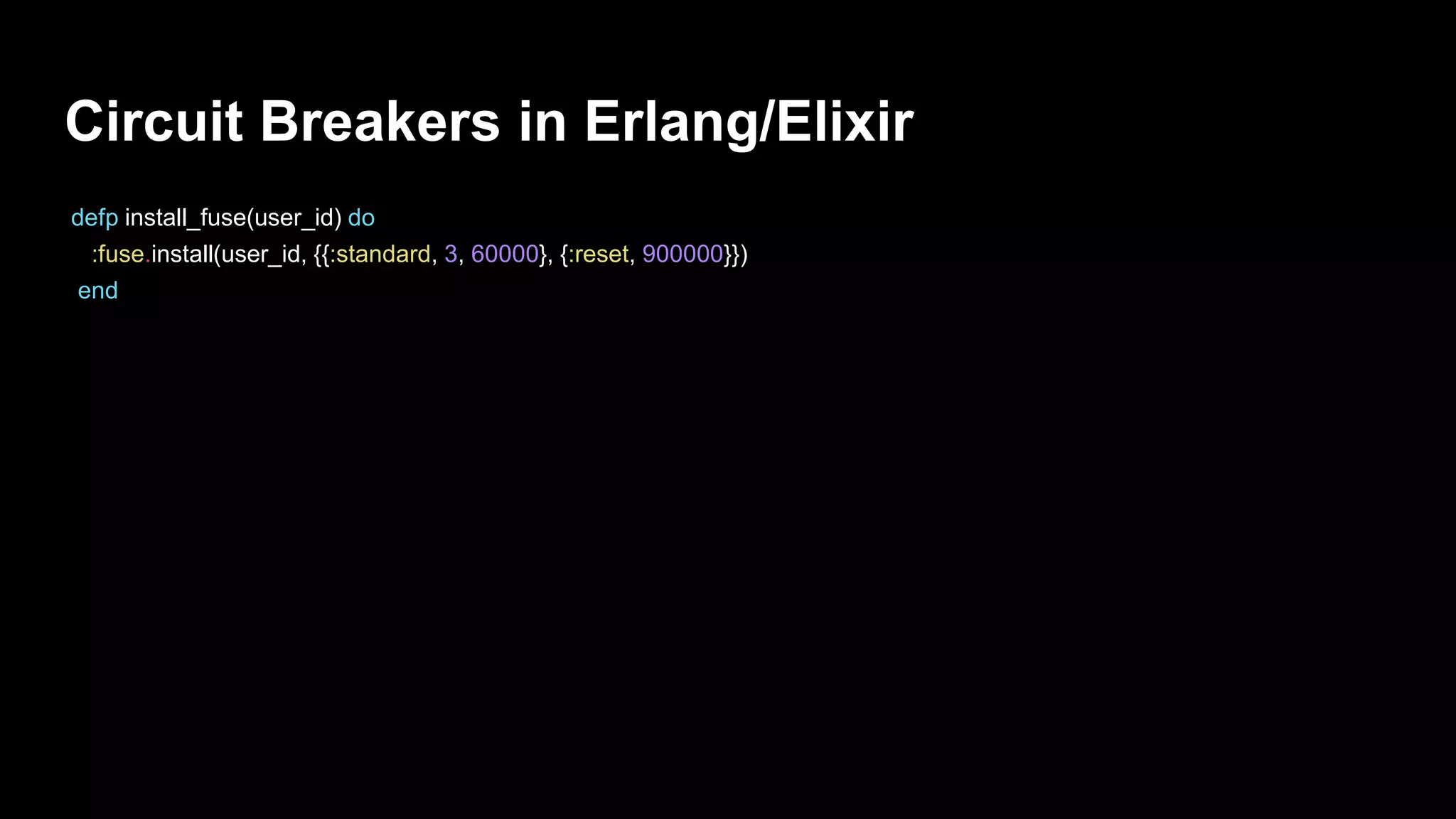
Circuit Breakers in Erlang/Elixir
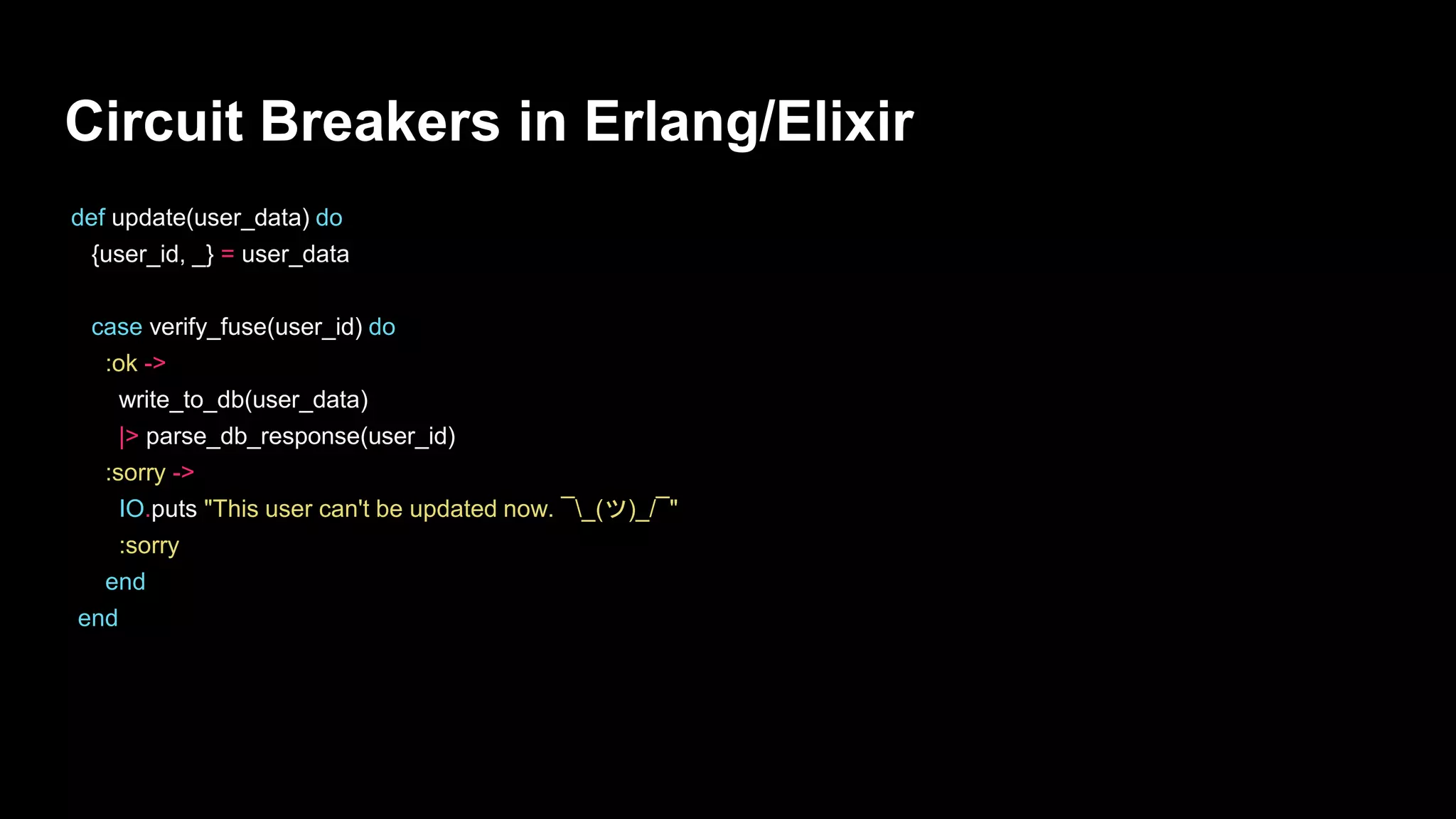
def update(user_data) do
{user_id, _} = user_data
case verify_fuse(user_id) do
:ok ->
write_to_db(user_data)
|> parse_db_response(user_id)
:sorry ->
IO.puts "This user can't be updated now. ¯_(ツ)_/¯"
:sorry
end
end
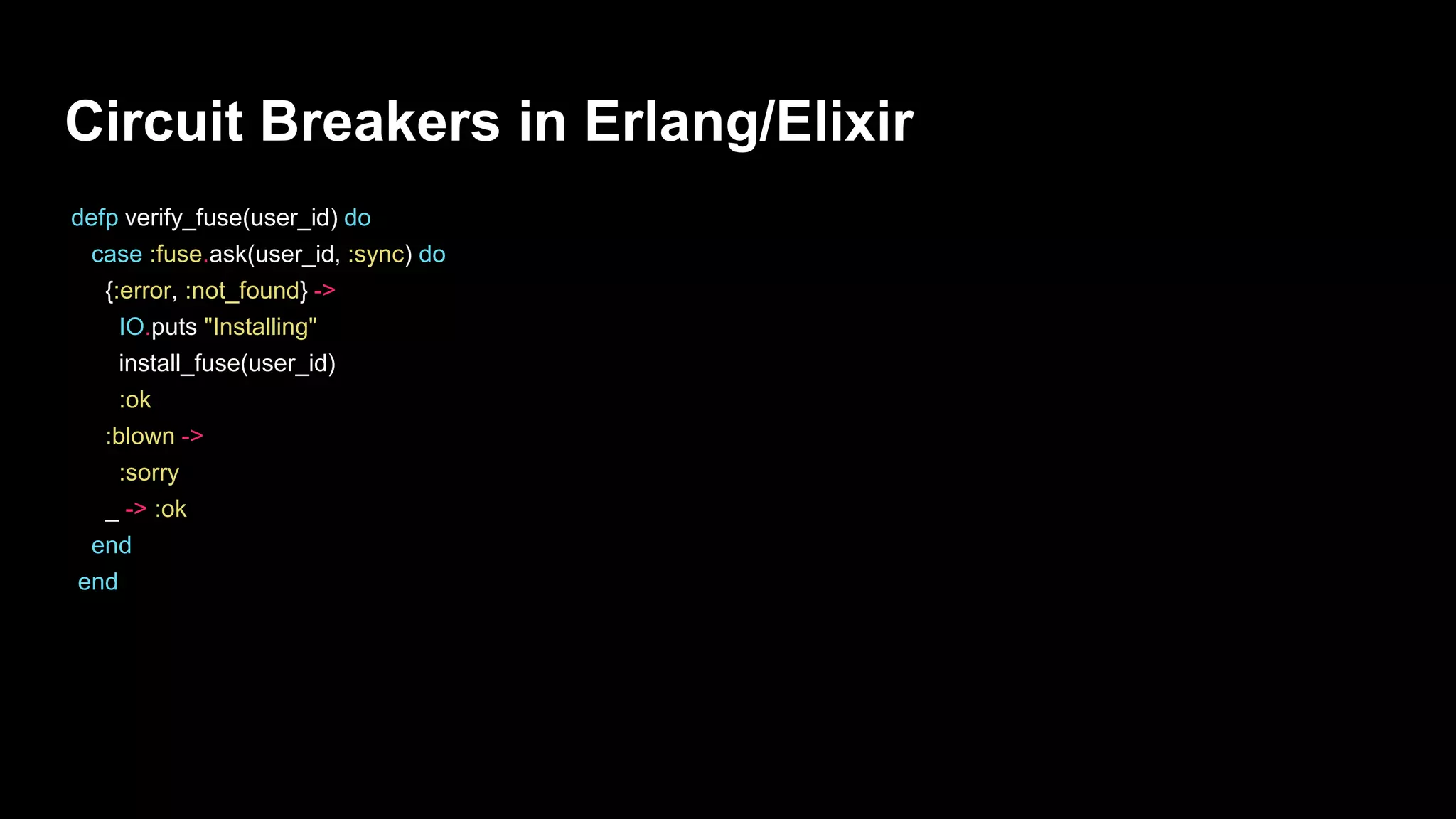
Circuit Breakers in Erlang/Elixir
defp verify_fuse(user_id) do
case :fuse.ask(user_id, :sync) do
{:error, :not_found} ->
IO.puts "Installing"
install_fuse(user_id)
:ok
:blown ->
:sorry
_ -> :ok
end
end
Circuit Breakers in Erlang/Elixir
defp install_fuse(user_id) do
:fuse.install(user_id, {{:standard, 3, 60000}, {:reset, 900000}})
end
Circuit Breakers in Erlang/Elixir
defp write_to_db({_user_id, _data}) do
Enum.random([{:ok, ""}, {:error, "The DB dropped the ball. ಠ_ಠ"}])
end
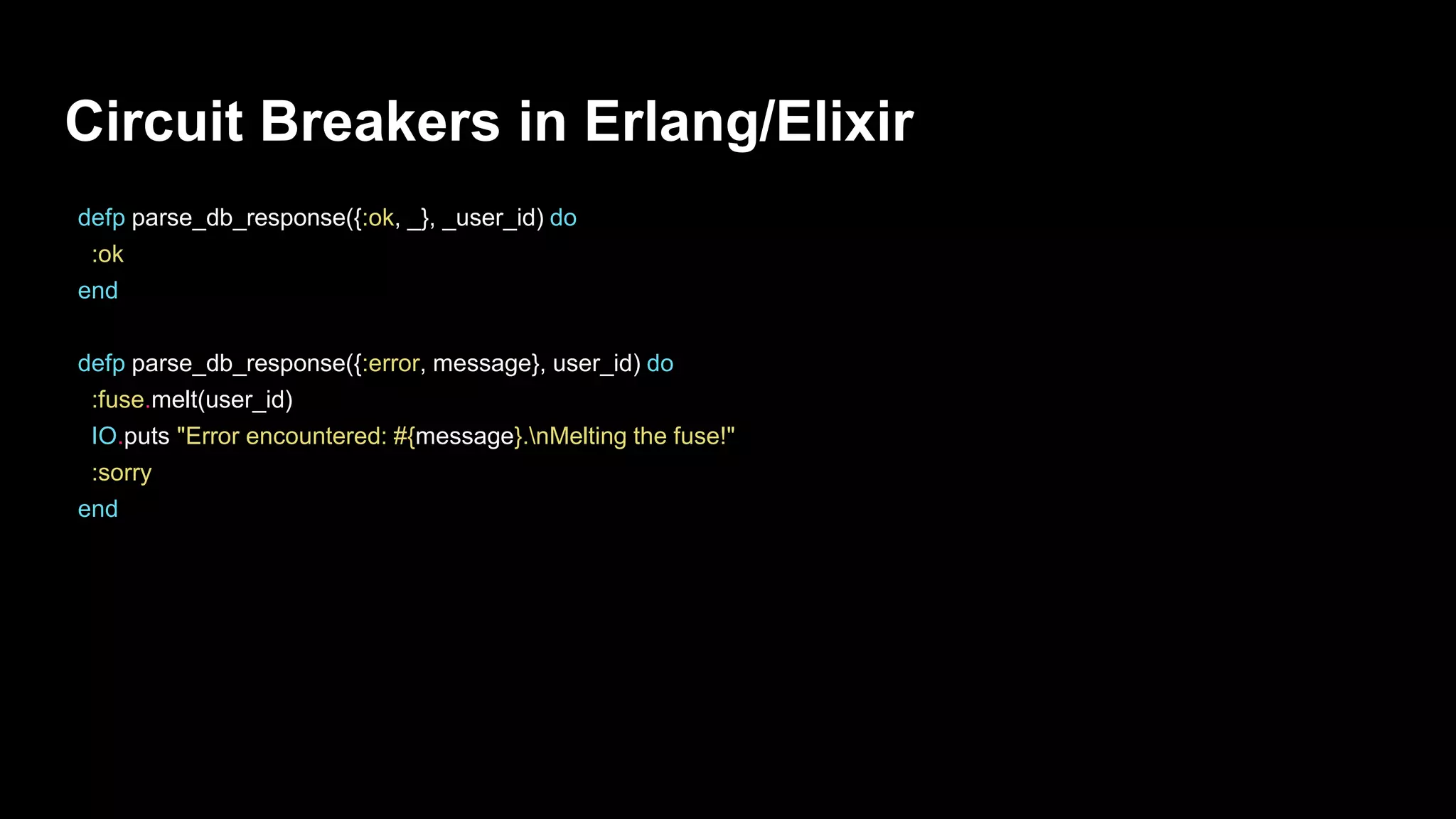
Circuit Breakers in Erlang/Elixir
defp parse_db_response({:ok, _}, _user_id) do
:ok
end
defp parse_db_response({:error, message}, user_id) do
:fuse.melt(user_id)
IO.puts "Error encountered: #{message}.nMelting the fuse!"
:sorry
end
Circuit Breakers in Erlang/Elixir
def update(user_data) do
{user_id, _} = user_data
case verify_fuse(user_id) do
:ok ->
write_to_db(user_data)
|> parse_db_response(user_id)
:sorry ->
IO.puts "This user can't be updated now. ¯_(ツ)_/¯"
:sorry
end
end
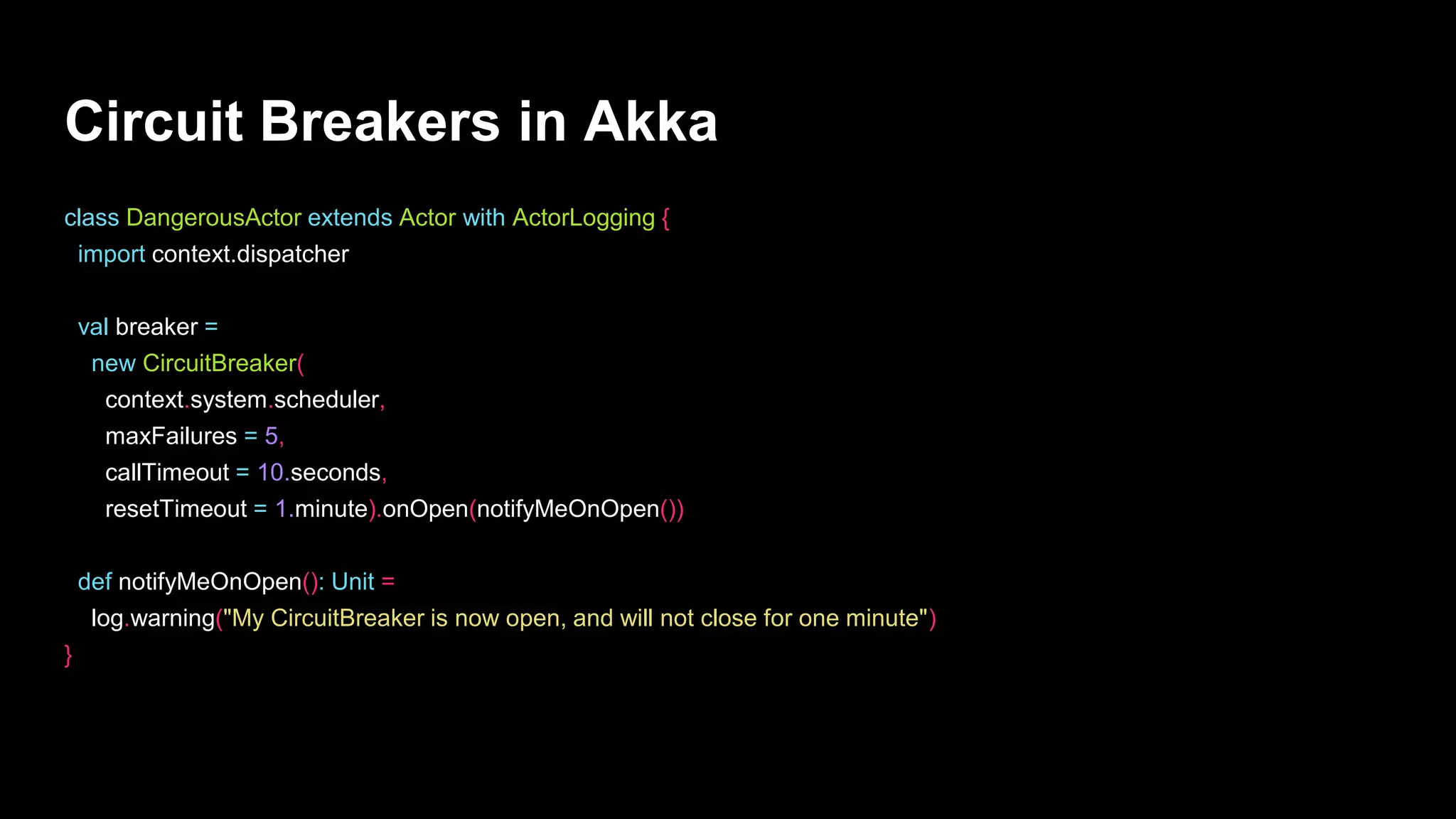
Circuit Breakers in Akka
class DangerousActor extends Actor with ActorLogging {
import context.dispatcher
val breaker =
new CircuitBreaker(
context.system.scheduler,
maxFailures = 5,
callTimeout = 10.seconds,
resetTimeout = 1.minute).onOpen(notifyMeOnOpen())
def notifyMeOnOpen(): Unit =
log.warning("My CircuitBreaker is now open, and will not close for one minute")
}
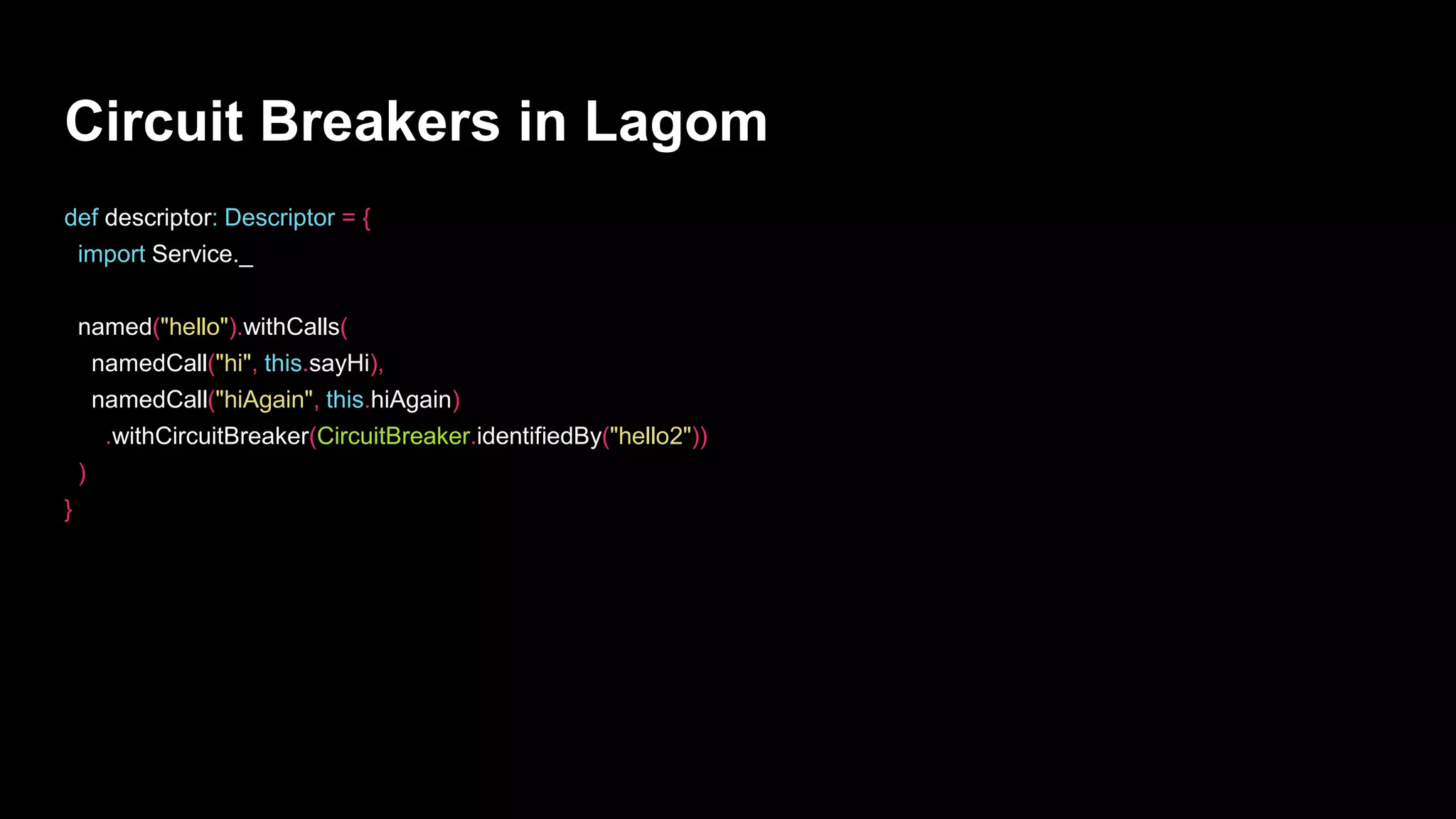
Circuit Breakers in Lagom
def descriptor: Descriptor = {
import Service._
named("hello").withCalls(
namedCall("hi", this.sayHi),
namedCall("hiAgain", this.hiAgain)
.withCircuitBreaker(CircuitBreaker.identifiedBy("hello2"))
)
}
Deep Learning
Python
Galápagos Nǎo
Diversity in Ecosystems
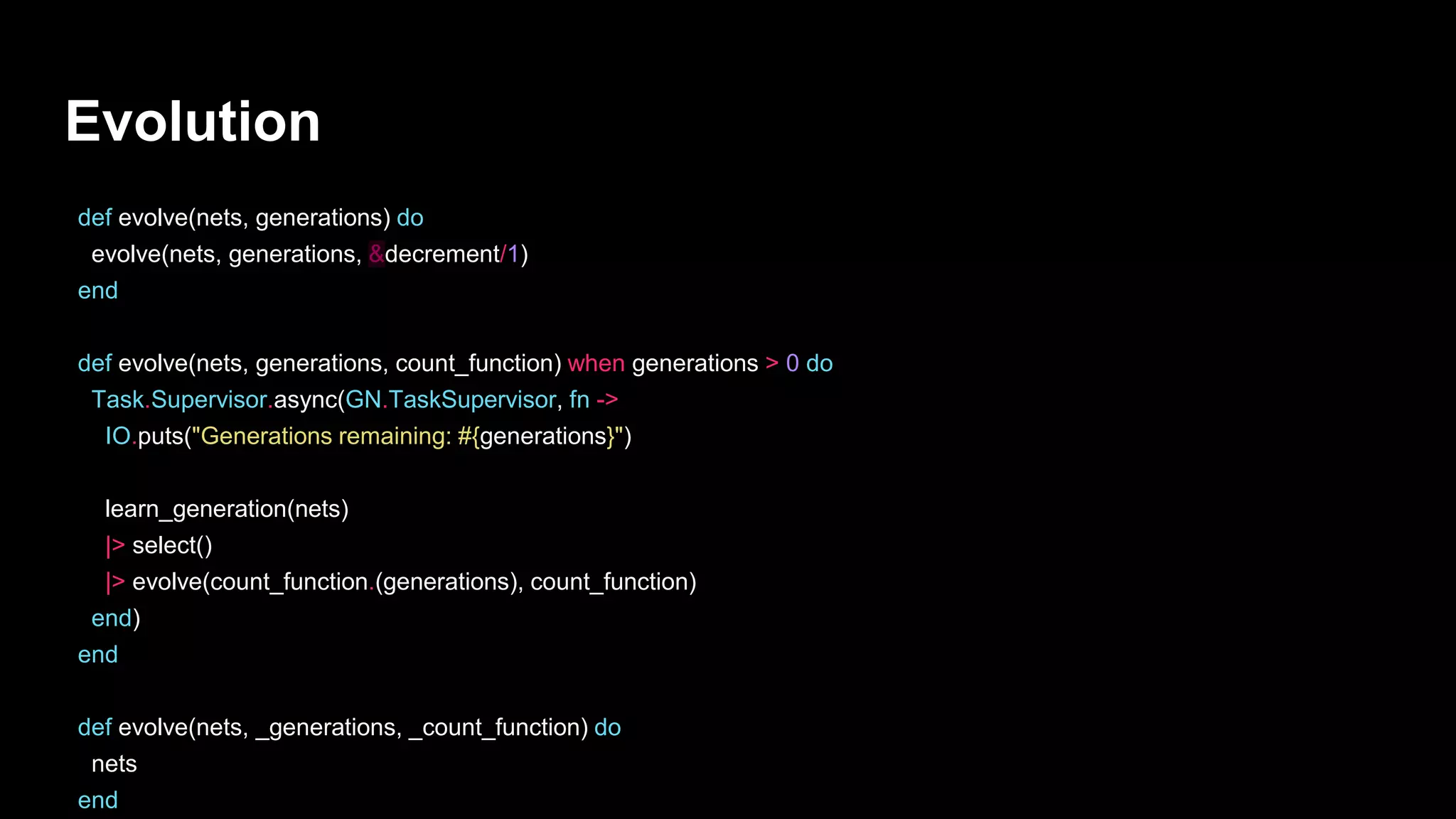
Evolution
def evolve(nets, generations) do
evolve(nets, generations, &decrement/1)
end
def evolve(nets, generations, count_function) when generations > 0 do
Task.Supervisor.async(GN.TaskSupervisor, fn ->
IO.puts("Generations remaining: #{generations}")
learn_generation(nets)
|> select()
|> evolve(count_function.(generations), count_function)
end)
end
def evolve(nets, _generations, _count_function) do
nets
end
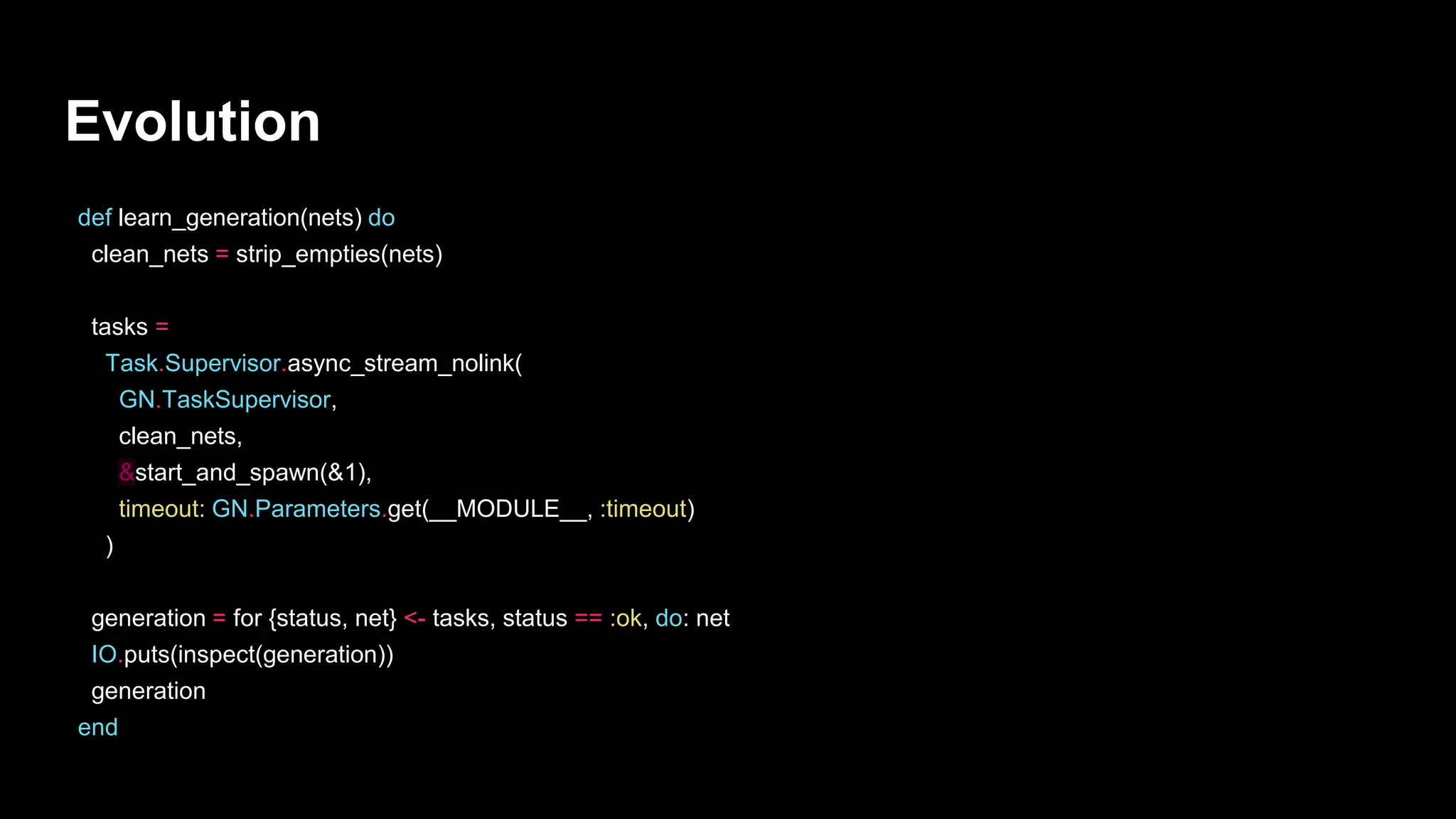
Evolution
def learn_generation(nets) do
clean_nets = strip_empties(nets)
tasks =
Task.Supervisor.async_stream_nolink(
GN.TaskSupervisor,
clean_nets,
&start_and_spawn(&1),
timeout: GN.Parameters.get(__MODULE__, :timeout)
)
generation = for {status, net} <- tasks, status == :ok, do: net
IO.puts(inspect(generation))
generation
end
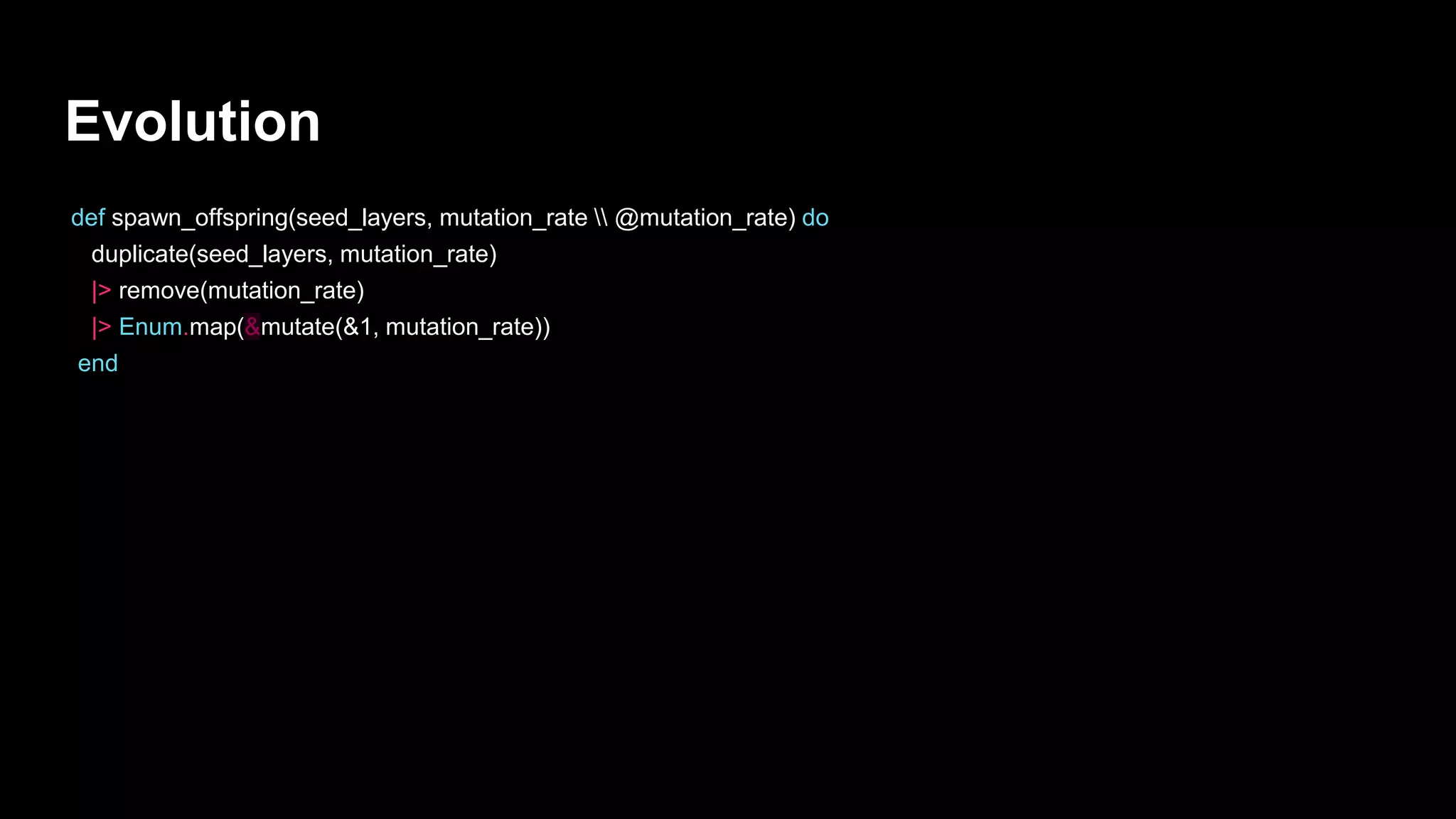
Evolution
def spawn_offspring(seed_layers, mutation_rate  @mutation_rate) do
duplicate(seed_layers, mutation_rate)
|> remove(mutation_rate)
|> Enum.map(&mutate(&1, mutation_rate))
end
Evolution
def select(pid  __MODULE__, nets) do
cutoffs = cutoffs(nets)
for net <- nets do
complexity = length(net.layers)
level = Enum.min(
[Enum.find_index(cutoffs, &(&1 >= complexity)) + 1,
complexity_levels()])
net_acc = net.test_acc
elite_acc = Map.get(get(level), :test_acc)
if is_nil(elite_acc) or net_acc > elite_acc do
put(pid, level, net)
end
end
Evolution
iex(1)> GN.Selection.get_all()
%{
1 => %GN.Network{
id: "0c2020ad-8944-4f2c-80bd-1d92c9d26535",
layers: [
dense: [64, :softrelu],
batch_norm: [],
activation: [:relu],
dropout: [0.5],
dense: [63, :relu]
],
test_acc: 0.8553
},
2 => %GN.Network{
id: "58229333-a05d-4371-8f23-e8e55c37a2ec",
layers: [
dense: [64, :relu],
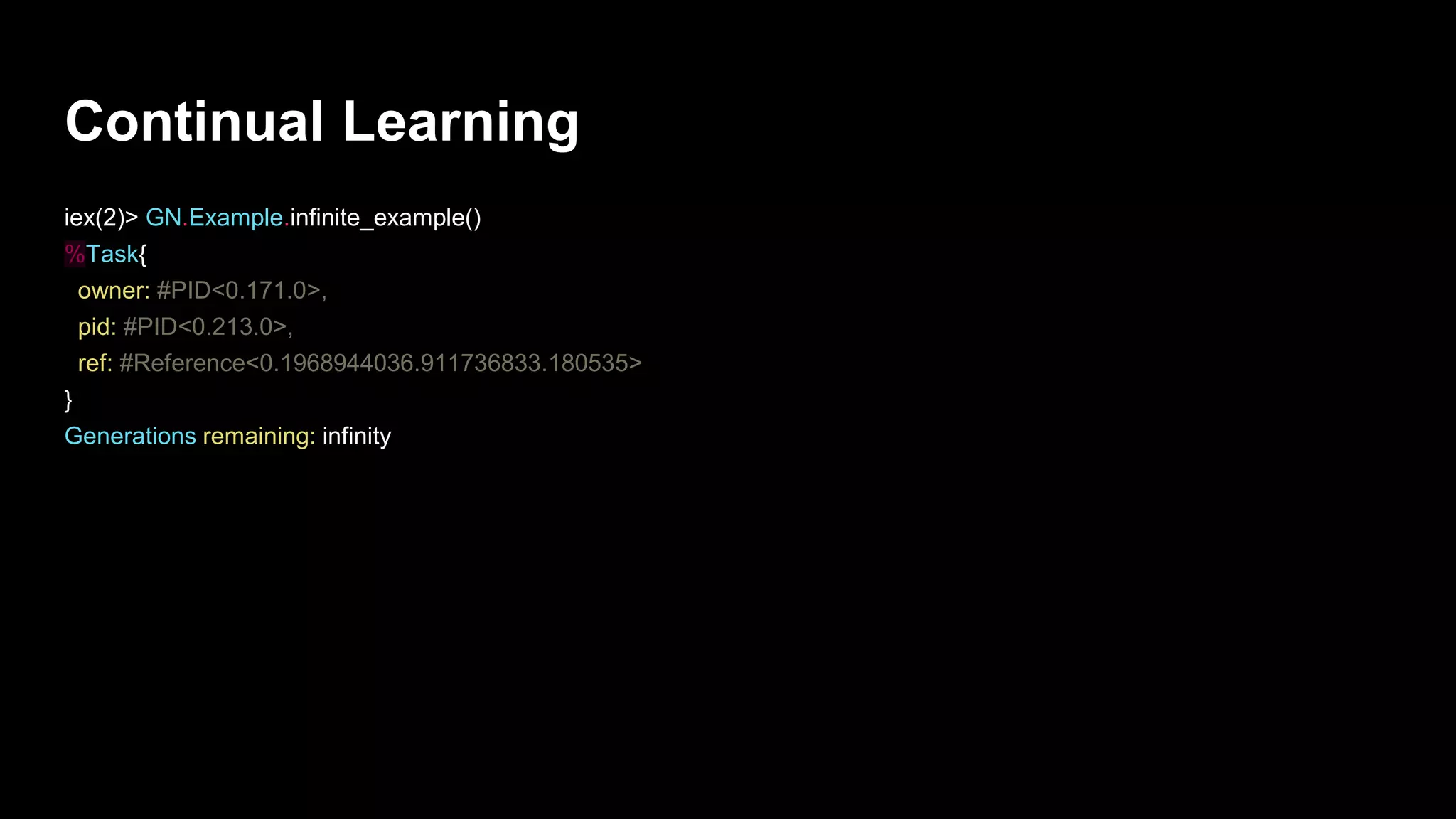
Continual Learning
iex(2)> GN.Example.infinite_example()
%Task{
owner: #PID<0.171.0>,
pid: #PID<0.213.0>,
ref: #Reference<0.1968944036.911736833.180535>
}
Generations remaining: infinity
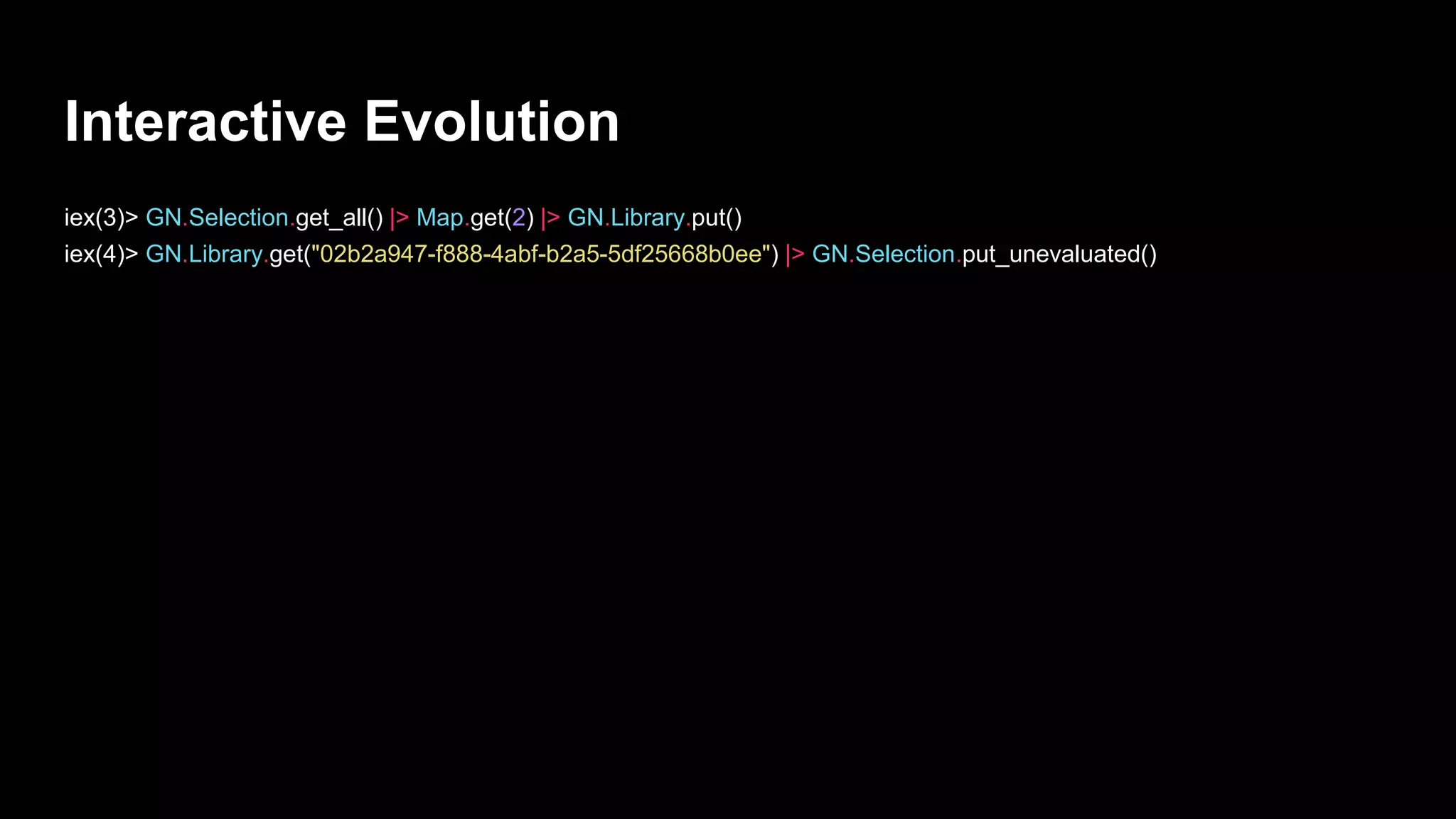
Interactive Evolution
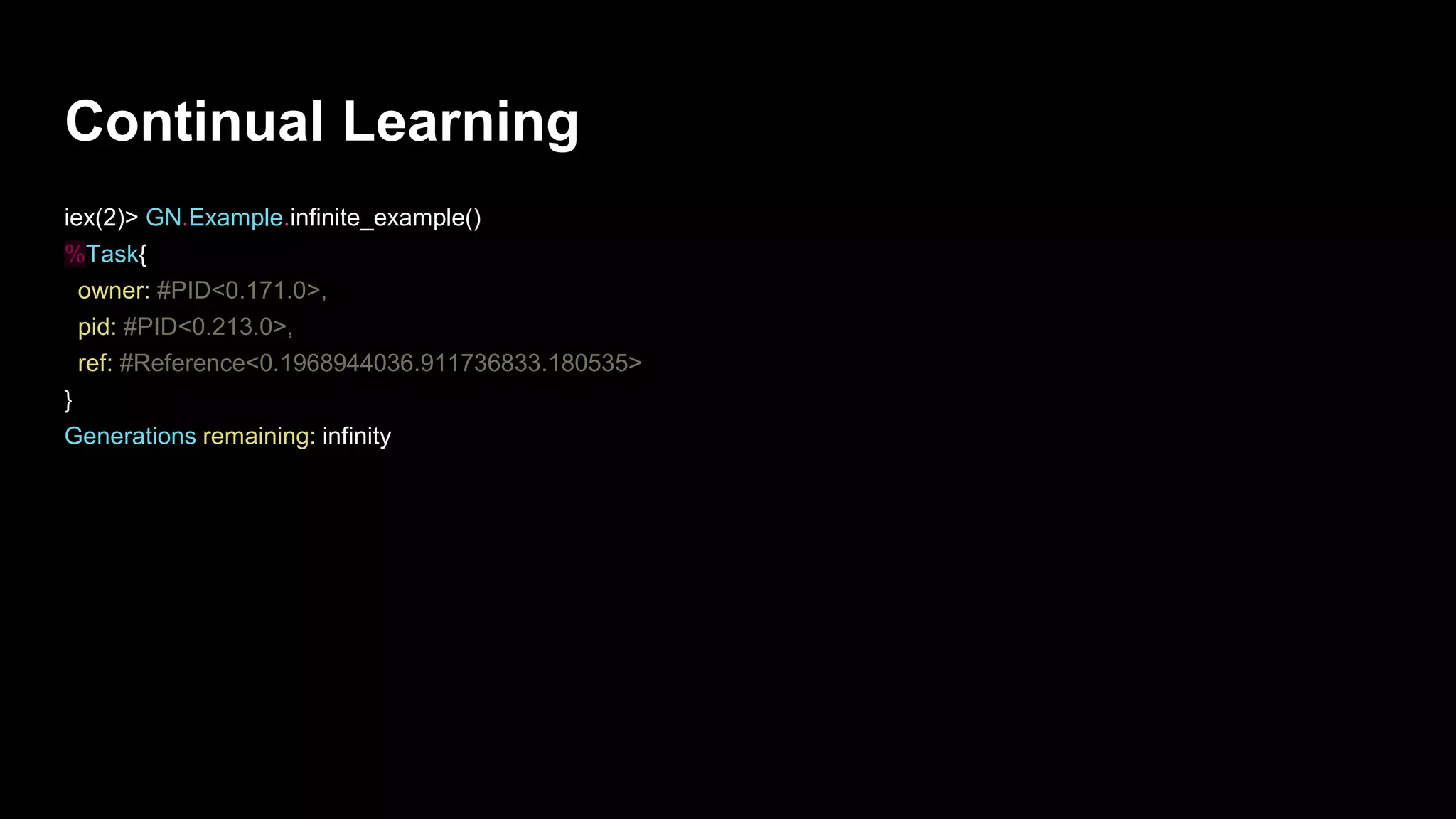
Continual Learning
iex(2)> GN.Example.infinite_example()
%Task{
owner: #PID<0.171.0>,
pid: #PID<0.213.0>,
ref: #Reference<0.1968944036.911736833.180535>
}
Generations remaining: infinity
Interactive Evolution
iex(3)> GN.Selection.get_all() |> Map.get(2) |> GN.Library.put()
iex(4)> GN.Library.get("02b2a947-f888-4abf-b2a5-5df25668b0ee") |> GN.Selection.put_unevaluated()
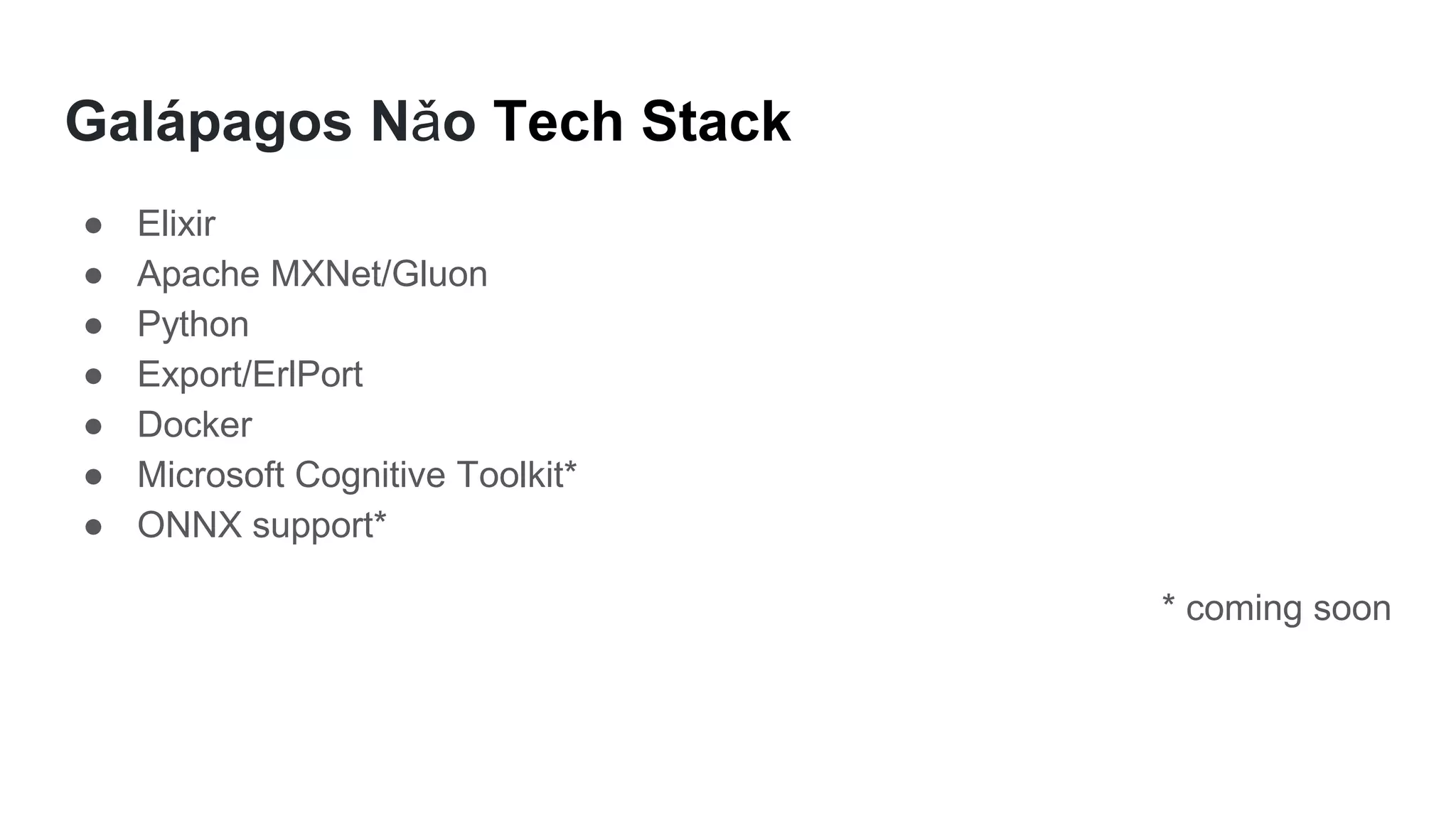
Galápagos Nǎo Tech Stack
● Elixir
● Apache MXNet/Gluon
● Python
● Export/ErlPort
● Docker
● Microsoft Cognitive Toolkit*
● ONNX support*
* coming soon
Model Serialization Revisited
ONNX
● Open interchange format
● Focused on inference
● Broad and growing support
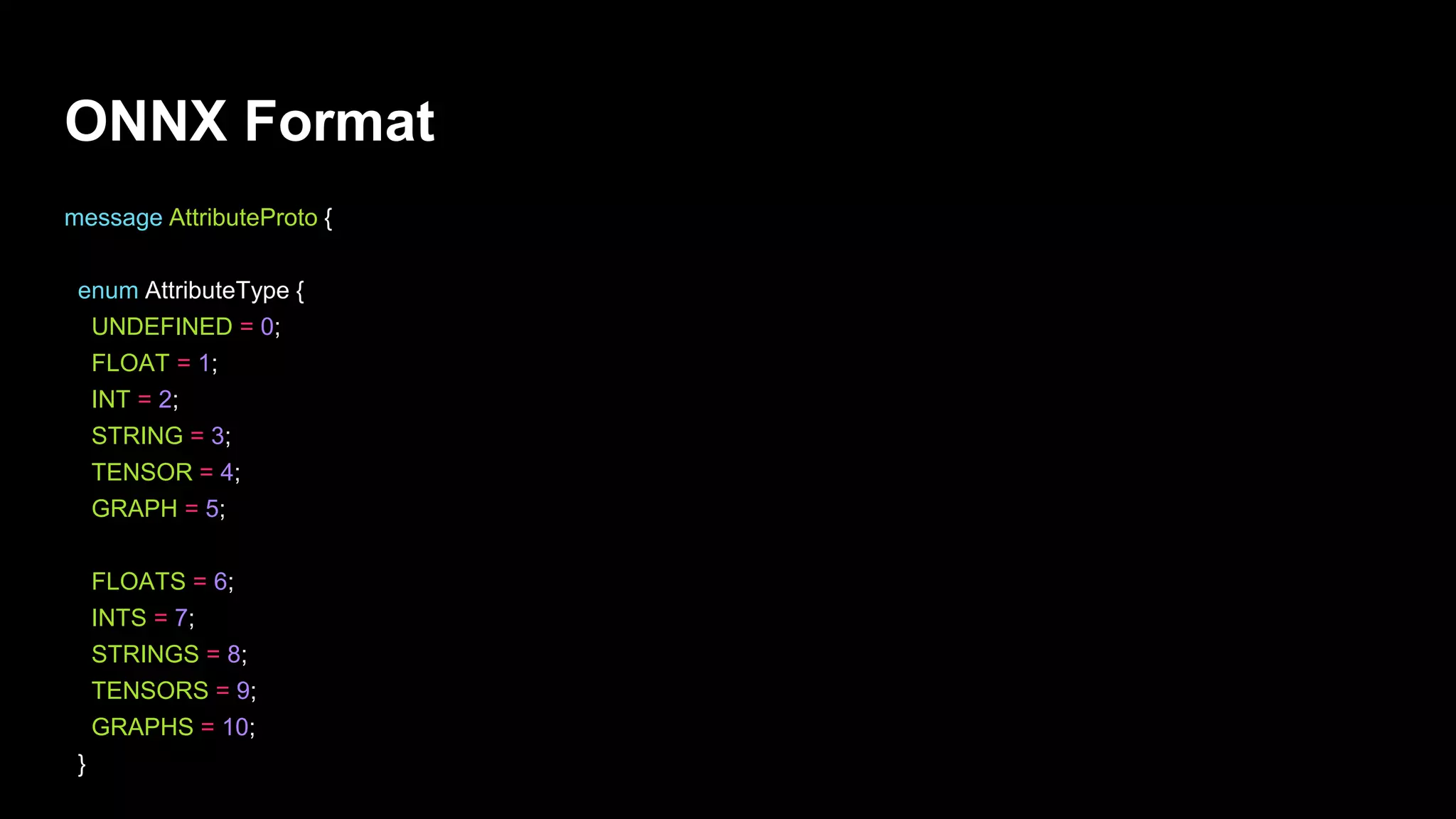
ONNX Format
message AttributeProto {
enum AttributeType {
UNDEFINED = 0;
FLOAT = 1;
INT = 2;
STRING = 3;
TENSOR = 4;
GRAPH = 5;
FLOATS = 6;
INTS = 7;
STRINGS = 8;
TENSORS = 9;
GRAPHS = 10;
}
ONNXS
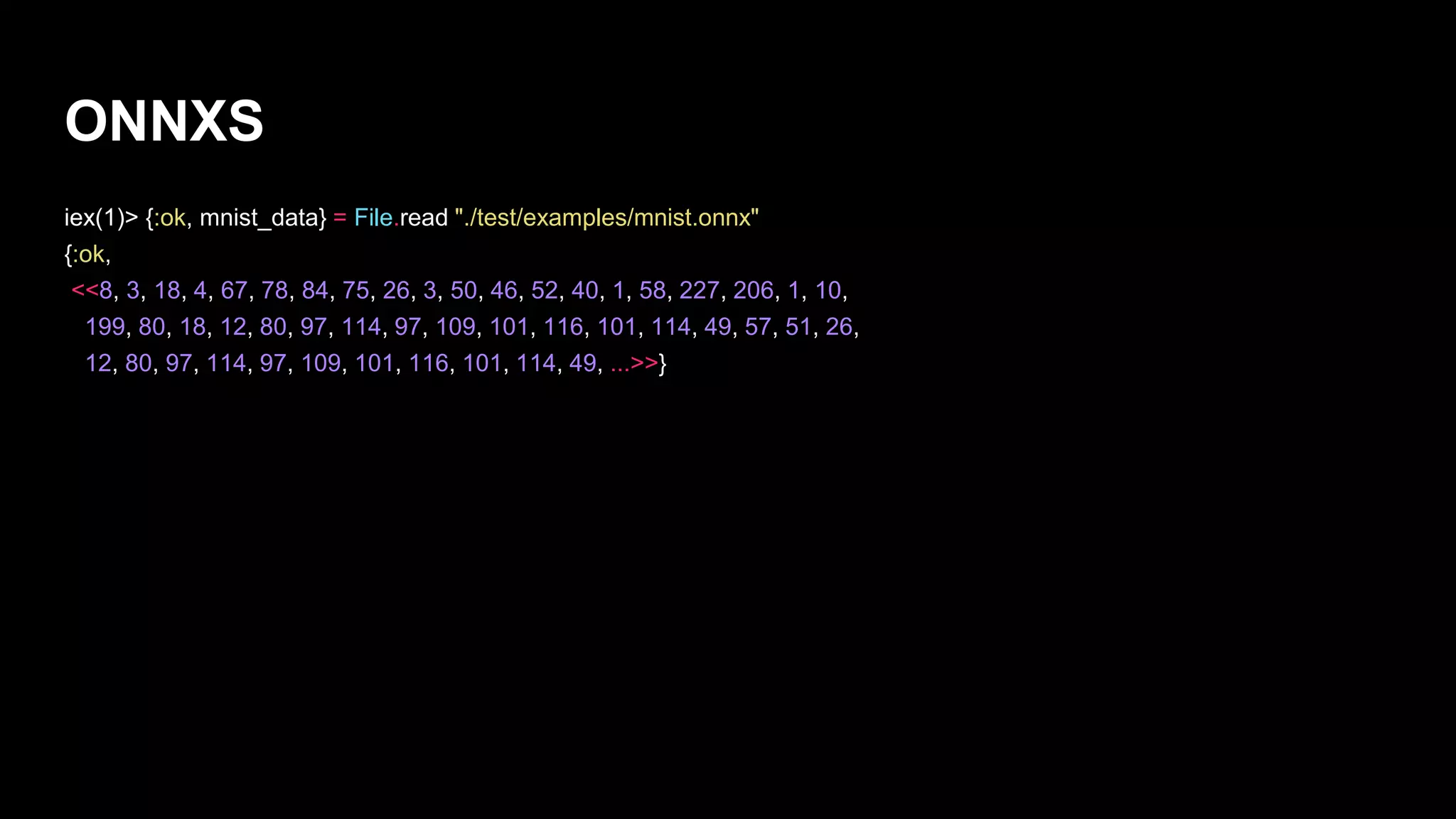
iex(1)> {:ok, mnist_data} = File.read "./test/examples/mnist.onnx"
{:ok,
<<8, 3, 18, 4, 67, 78, 84, 75, 26, 3, 50, 46, 52, 40, 1, 58, 227, 206, 1, 10,
199, 80, 18, 12, 80, 97, 114, 97, 109, 101, 116, 101, 114, 49, 57, 51, 26,
12, 80, 97, 114, 97, 109, 101, 116, 101, 114, 49, ...>>}
ONNXS
iex(2)> mnist_struct = Onnx.ModelProto.decode(mnist_data)
%Onnx.ModelProto{
doc_string: nil,
domain: nil,
graph: %Onnx.GraphProto{
doc_string: nil,
initializer: [],
input: [
%Onnx.ValueInfoProto{
doc_string: nil,
name: "Input3",
type: %Onnx.TypeProto{
value: {:tensor_type,
%Onnx.TypeProto.Tensor{
elem_type: 1,
shape: %Onnx.TensorShapeProto
...
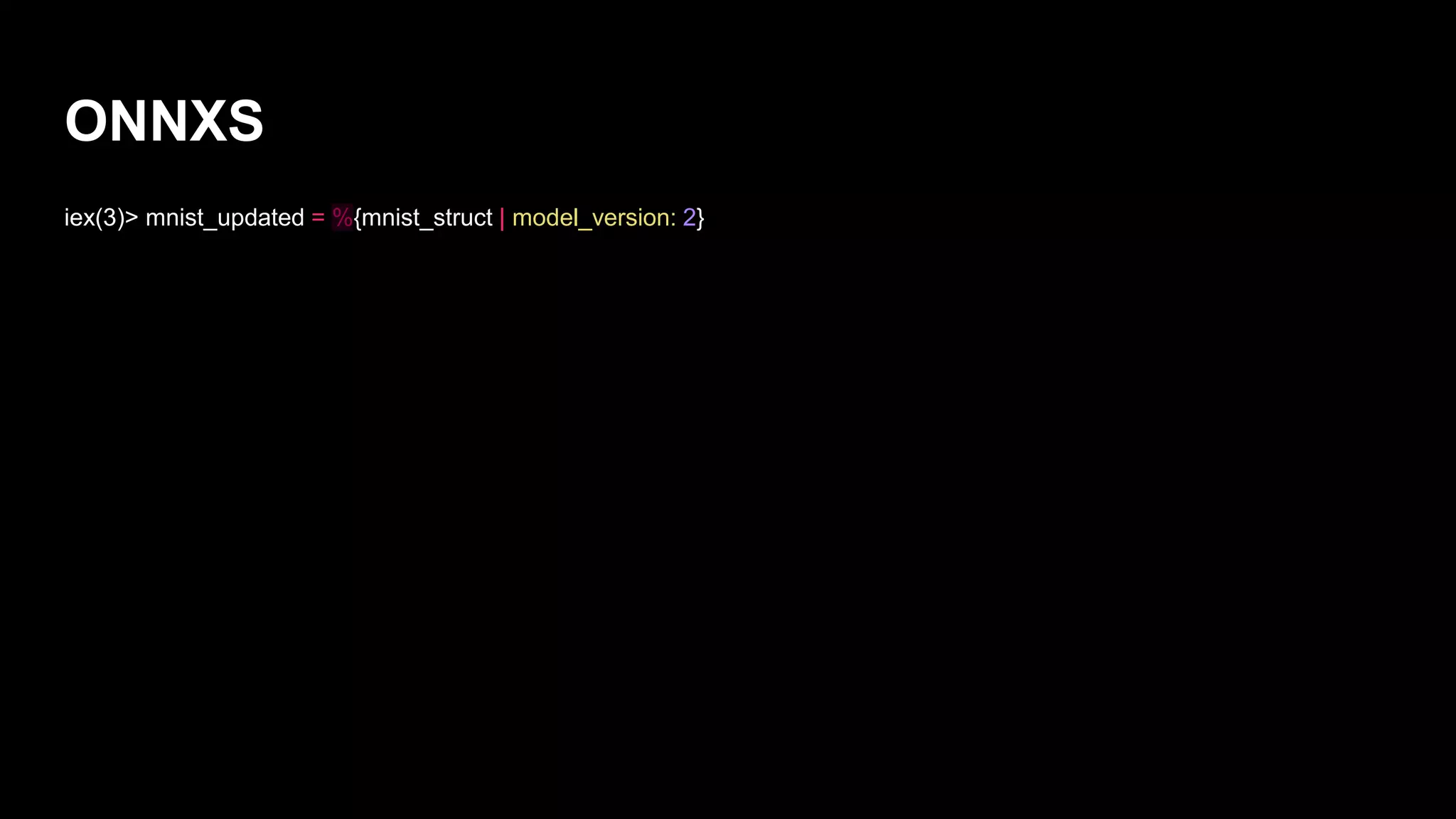
ONNXS
iex(3)> mnist_updated = %{mnist_struct | model_version: 2}
Thoughts
Model publishing and
serving are hard
problems.
Not all reactive
technologies look like
Erlang.
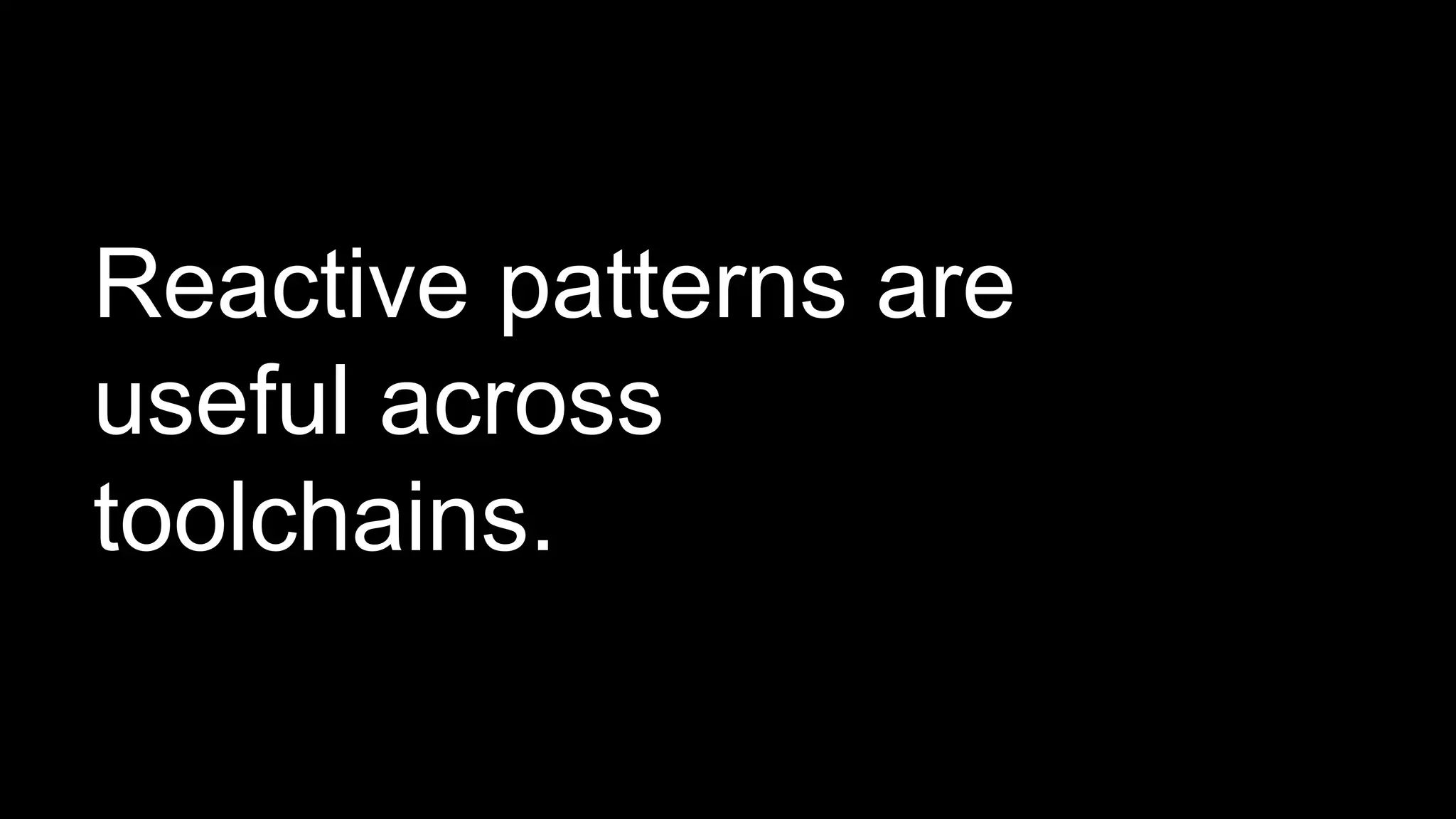
Reactive patterns are
useful across
toolchains.
Hard problems require
diverse sets of
solutions.
Open standards foster
rich ecosystems.
Wrapping Up
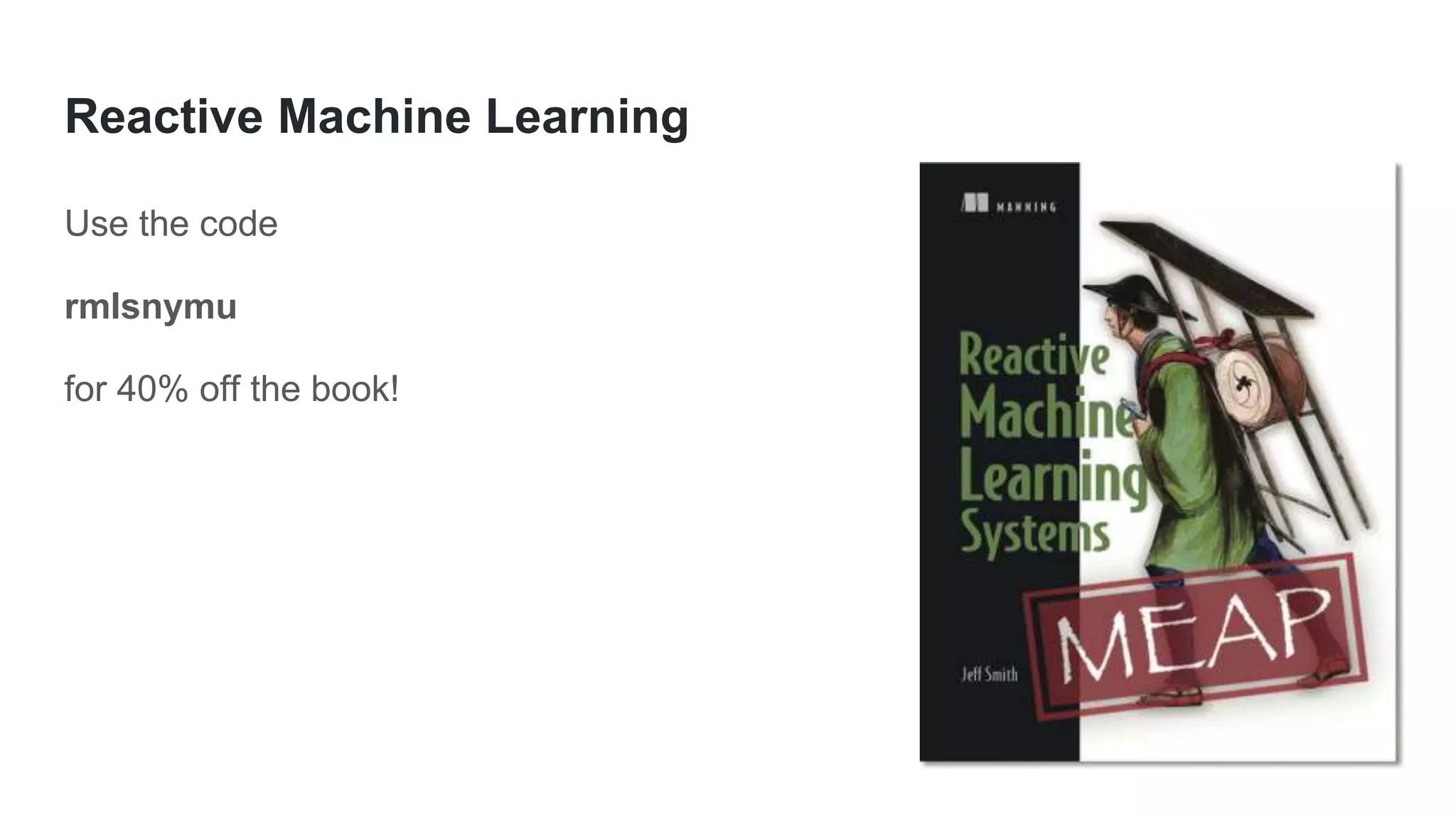
Reactive Machine Learning
Use the code
rmlsnymu
for 40% off the book!
Thanks
Questions
Tools for Making
Machine Learning
more Reactive
Jeff Smith
@jeffksmithjr
jeffsmith.tech

Tools for Making Machine Learning more Reactive

  • 1.
    Tools for Making MachineLearning more Reactive Jeff Smith @jeffksmithjr jeffsmith.tech
  • 2.
  • 3.
  • 4.
  • 5.
  • 6.
  • 7.
  • 8.
  • 9.
  • 10.
  • 11.
  • 12.
  • 13.
    Akka ● Scala &Java ● Actor model ● Concurrency ● Distribution ● Supervision
  • 14.
  • 15.
    Model Microservice inAkka HTTP case class Prediction(id: Long, timestamp: Long, value: Double) trait Protocols extends DefaultJsonProtocol { implicit val predictionFormat = jsonFormat3(Prediction) }
  • 16.
    Model Microservice inAkka HTTP def model(features: Map[Char, Double]) = { val coefficients = ('a' to 'z').zip(1 to 26).toMap val predictionValue = features.map { case (identifier, value) => coefficients.getOrElse(identifier, 0) * value }.sum / features.size Prediction(Random.nextLong(), System.currentTimeMillis(), predictionValue) } def parseFeatures(features: String): Map[String, Double] = { features.parseJson.convertTo[Map[Char, Double]] } def predict(features: String): Prediction = { model(parseFeatures(features)) }
  • 17.
    Model Microservice inAkka HTTP trait Service extends Protocols { implicit val system: ActorSystem implicit def executor: ExecutionContextExecutor implicit val materializer: Materializer val logger: LoggingAdapter val routes = { logRequestResult("model-service") { pathPrefix("predict") { (get & path(Segment)) { features: String => complete { ToResponseMarshallable(predict(features))}}}}}}
  • 18.
  • 19.
    Random Forest inSpark MLlib
  • 20.
    MLlib Model Serialization { "class":"org.apache.spark.ml.PipelineModel", "timestamp": 1467653845388, "sparkVersion": "2.0.0-preview", "uid": "pipeline_6b4fb08e8fb0", "paramMap": { "stageUids": ["quantileDiscretizer_d3996173db25", "vecAssembler_2bdcd79fe1cf", "logreg_9d559ca7e208"] } }
  • 21.
    MLlib Model Serialization {"class": "org.apache.spark.ml.classification.LogisticRegressionModel", "timestamp": 1467653845650, "sparkVersion": "2.0.0-preview", "uid": "logreg_9d559ca7e208", "paramMap": { "threshold": 0.5, "elasticNetParam": 0.0, "fitIntercept": true, "tol": 1.0E-6, "regParam": 0.0, "maxIter": 5, "standardization": true, "featuresCol": "features", "rawPredictionCol": "rawPrediction", "predictionCol": "prediction", "probabilityCol": "probability", "labelCol": "label"}}
  • 22.
  • 23.
  • 24.
    Containerizing with sbt-docker dockerfilein docker := { val jarFile: File = sbt.Keys.`package`.in(Compile, packageBin).value val classpath = (managedClasspath in Compile).value val mainClass = "com.reactivemachinelearning.PredictiveService" val jarTarget = s"/app/${jarFile.getName}" val classpathString = classpath.files.map("/app/" + _.getName) .mkString(":") + ":" + jarTarget new Dockerfile { from("java") add(classpath.files, "/app/") add(jarFile, jarTarget) entryPoint("java", "-cp", classpathString, mainClass) } }
  • 25.
    Containerizing with sbt-docker FROMjava ADD 0/spark-core_2.11-2.0.0-preview.jar 1/avro-mapred-1.7.7-hadoop2.jar ... ADD 166/chapter-7_2.11-1.0.jar /app/chapter-7_2.11-1.0.jar ENTRYPOINT ["java", "-cp", "/app/spark-core_2.11-2.0.0-preview.jar ... "com.reactivemachinelearning.PredictiveService"]
  • 26.
  • 27.
  • 28.
    Model Server inhttp4s object Models { val modelA = HttpService { case GET -> Root / "a" / inputData => val response = true Ok(s"Model A predicted $response.") } val modelB = HttpService { case GET -> Root / "b" / inputData => val response = false Ok(s"Model B predicted $response.") } }
  • 29.
    Model Server inhttp4s object Client { val client = PooledHttp1Client() private def call(model: String, input: String) = { val target = Uri.fromString(s"http://localhost:8080/models/$model/$input").toOption.get client.expect[String](target) } def callA(input: String) = call("a", input) def callB(input: String) = call("b", input) }
  • 30.
    Model Server inhttp4s def splitTraffic(data: String) = { data.hashCode % 10 match { case x if x < 4 => Client.callA(data) case _ => Client.callB(data) } }
  • 31.
    Model Server inhttp4s object ModelServer extends ServerApp { val apiService = HttpService { case GET -> Root / "predict" / inputData => val response = splitTraffic(inputData).run Ok(response) } override def server(args: List[String]): Task[Server] = { BlazeBuilder .bindLocal(8080) .mountService(apiService, "/api") .mountService(Models.modelA, "/models") .mountService(Models.modelB, "/models") .start } }
  • 32.
    Model Server inhttp4s import scala.util.Random val modelC = HttpService { case GET -> Root / "c" / inputData => { val workingOk = Random.nextBoolean() val response = true if (workingOk) { Ok(s"Model C predicted $response.") } else { BadRequest("Model C failed to predict.") } } }
  • 33.
    Model Server inhttp4s private def call(model: String, input: String): Task[Response] = { val target = Uri.fromString( s"http://localhost:8080/models/$model/$input" ).toOption.get client(target) } def callC(input: String) = call("c", input)
  • 34.
    Model Server inhttp4s def splitTraffic(data: String) = { data.hashCode % 10 match { case x if x < 4 => Client.callA(data) case x if x < 6 => Client.callB(data) case _ => Client.callC(data) } } val apiService = HttpService { case GET -> Root / "predict" / inputData => val response = splitTraffic(inputData).run response match { case r: Response if r.status == Ok => Response(Ok).withBody(r.bodyAsText) case r => Response(BadRequest).withBody(r.bodyAsText) } }
  • 35.
    Model Server inhttp4s def splitTraffic(data: String) = { data.hashCode % 10 match { case x if x < 4 => Client.callA(data) case x if x < 6 => Client.callB(data) case _ => Client.callC(data) } } val apiService = HttpService { case GET -> Root / "predict" / inputData => val response = splitTraffic(inputData).run response match { case r: Response if r.status == Ok => Response(Ok).withBody(r.bodyAsText) case r => Response(BadRequest).withBody(r.bodyAsText) } }
  • 36.
    Model Server inhttp4s private def call(model: String, input: String) = { val target = Uri.fromString(s"http://localhost:8080/models/$model/$input").toOption.get client(target).retry(Seq(1 second), {_ => true}) }
  • 37.
  • 38.
  • 39.
  • 40.
  • 41.
    Circuit Breakers inErlang/Elixir def update(user_data) do {user_id, _} = user_data case verify_fuse(user_id) do :ok -> write_to_db(user_data) |> parse_db_response(user_id) :sorry -> IO.puts "This user can't be updated now. ¯_(ツ)_/¯" :sorry end end
  • 42.
    Circuit Breakers inErlang/Elixir defp verify_fuse(user_id) do case :fuse.ask(user_id, :sync) do {:error, :not_found} -> IO.puts "Installing" install_fuse(user_id) :ok :blown -> :sorry _ -> :ok end end
  • 43.
    Circuit Breakers inErlang/Elixir defp install_fuse(user_id) do :fuse.install(user_id, {{:standard, 3, 60000}, {:reset, 900000}}) end
  • 44.
    Circuit Breakers inErlang/Elixir defp write_to_db({_user_id, _data}) do Enum.random([{:ok, ""}, {:error, "The DB dropped the ball. ಠ_ಠ"}]) end
  • 45.
    Circuit Breakers inErlang/Elixir defp parse_db_response({:ok, _}, _user_id) do :ok end defp parse_db_response({:error, message}, user_id) do :fuse.melt(user_id) IO.puts "Error encountered: #{message}.nMelting the fuse!" :sorry end
  • 46.
    Circuit Breakers inErlang/Elixir def update(user_data) do {user_id, _} = user_data case verify_fuse(user_id) do :ok -> write_to_db(user_data) |> parse_db_response(user_id) :sorry -> IO.puts "This user can't be updated now. ¯_(ツ)_/¯" :sorry end end
  • 47.
    Circuit Breakers inAkka class DangerousActor extends Actor with ActorLogging { import context.dispatcher val breaker = new CircuitBreaker( context.system.scheduler, maxFailures = 5, callTimeout = 10.seconds, resetTimeout = 1.minute).onOpen(notifyMeOnOpen()) def notifyMeOnOpen(): Unit = log.warning("My CircuitBreaker is now open, and will not close for one minute") }
  • 48.
    Circuit Breakers inLagom def descriptor: Descriptor = { import Service._ named("hello").withCalls( namedCall("hi", this.sayHi), namedCall("hiAgain", this.hiAgain) .withCircuitBreaker(CircuitBreaker.identifiedBy("hello2")) ) }
  • 49.
  • 50.
  • 51.
  • 52.
  • 53.
    Evolution def evolve(nets, generations)do evolve(nets, generations, &decrement/1) end def evolve(nets, generations, count_function) when generations > 0 do Task.Supervisor.async(GN.TaskSupervisor, fn -> IO.puts("Generations remaining: #{generations}") learn_generation(nets) |> select() |> evolve(count_function.(generations), count_function) end) end def evolve(nets, _generations, _count_function) do nets end
  • 54.
    Evolution def learn_generation(nets) do clean_nets= strip_empties(nets) tasks = Task.Supervisor.async_stream_nolink( GN.TaskSupervisor, clean_nets, &start_and_spawn(&1), timeout: GN.Parameters.get(__MODULE__, :timeout) ) generation = for {status, net} <- tasks, status == :ok, do: net IO.puts(inspect(generation)) generation end
  • 55.
    Evolution def spawn_offspring(seed_layers, mutation_rate @mutation_rate) do duplicate(seed_layers, mutation_rate) |> remove(mutation_rate) |> Enum.map(&mutate(&1, mutation_rate)) end
  • 56.
    Evolution def select(pid __MODULE__, nets) do cutoffs = cutoffs(nets) for net <- nets do complexity = length(net.layers) level = Enum.min( [Enum.find_index(cutoffs, &(&1 >= complexity)) + 1, complexity_levels()]) net_acc = net.test_acc elite_acc = Map.get(get(level), :test_acc) if is_nil(elite_acc) or net_acc > elite_acc do put(pid, level, net) end end
  • 57.
    Evolution iex(1)> GN.Selection.get_all() %{ 1 =>%GN.Network{ id: "0c2020ad-8944-4f2c-80bd-1d92c9d26535", layers: [ dense: [64, :softrelu], batch_norm: [], activation: [:relu], dropout: [0.5], dense: [63, :relu] ], test_acc: 0.8553 }, 2 => %GN.Network{ id: "58229333-a05d-4371-8f23-e8e55c37a2ec", layers: [ dense: [64, :relu],
  • 58.
    Continual Learning iex(2)> GN.Example.infinite_example() %Task{ owner:#PID<0.171.0>, pid: #PID<0.213.0>, ref: #Reference<0.1968944036.911736833.180535> } Generations remaining: infinity
  • 59.
  • 60.
    Continual Learning iex(2)> GN.Example.infinite_example() %Task{ owner:#PID<0.171.0>, pid: #PID<0.213.0>, ref: #Reference<0.1968944036.911736833.180535> } Generations remaining: infinity
  • 61.
    Interactive Evolution iex(3)> GN.Selection.get_all()|> Map.get(2) |> GN.Library.put() iex(4)> GN.Library.get("02b2a947-f888-4abf-b2a5-5df25668b0ee") |> GN.Selection.put_unevaluated()
  • 62.
    Galápagos Nǎo TechStack ● Elixir ● Apache MXNet/Gluon ● Python ● Export/ErlPort ● Docker ● Microsoft Cognitive Toolkit* ● ONNX support* * coming soon
  • 63.
  • 64.
    ONNX ● Open interchangeformat ● Focused on inference ● Broad and growing support
  • 65.
    ONNX Format message AttributeProto{ enum AttributeType { UNDEFINED = 0; FLOAT = 1; INT = 2; STRING = 3; TENSOR = 4; GRAPH = 5; FLOATS = 6; INTS = 7; STRINGS = 8; TENSORS = 9; GRAPHS = 10; }
  • 66.
    ONNXS iex(1)> {:ok, mnist_data}= File.read "./test/examples/mnist.onnx" {:ok, <<8, 3, 18, 4, 67, 78, 84, 75, 26, 3, 50, 46, 52, 40, 1, 58, 227, 206, 1, 10, 199, 80, 18, 12, 80, 97, 114, 97, 109, 101, 116, 101, 114, 49, 57, 51, 26, 12, 80, 97, 114, 97, 109, 101, 116, 101, 114, 49, ...>>}
  • 67.
    ONNXS iex(2)> mnist_struct =Onnx.ModelProto.decode(mnist_data) %Onnx.ModelProto{ doc_string: nil, domain: nil, graph: %Onnx.GraphProto{ doc_string: nil, initializer: [], input: [ %Onnx.ValueInfoProto{ doc_string: nil, name: "Input3", type: %Onnx.TypeProto{ value: {:tensor_type, %Onnx.TypeProto.Tensor{ elem_type: 1, shape: %Onnx.TensorShapeProto ...
  • 68.
    ONNXS iex(3)> mnist_updated =%{mnist_struct | model_version: 2}
  • 69.
  • 70.
    Model publishing and servingare hard problems.
  • 71.
  • 72.
    Reactive patterns are usefulacross toolchains.
  • 73.
  • 74.
  • 75.
  • 76.
    Reactive Machine Learning Usethe code rmlsnymu for 40% off the book!
  • 77.
  • 78.
  • 79.
    Tools for Making MachineLearning more Reactive Jeff Smith @jeffksmithjr jeffsmith.tech