Threads : Java
Prepared By Tuhin Kundu
What is a Thread?
facility to allow multiple activities to coexist within a
single process.
Represents a separate path of execution of a group of
statements
Java is the first language to include threading within the
language, rather than treating it as a facility of the OS
 Video Game example
1.one thread for graphics
2.one thread for user interaction
3.one thread for networking
 Server Example
1.Do various jobs
2.Handle Several Clients
Main Thread
Default Thread in any Java Program
JVM uses to execute program statements
o Program To Find the Main Thread
Class Current
{
public static void main(String args[])
{
Thread t=Thread.currentThread();
System.out.println(“Current Thread: “+t);
System.out.println(“Name is: “+t.getName());
}
}
Threads in Java
Creating threads in Java:
Extend java.lang.Thread class
run() method must be overridden (similar to main method
of sequential program)
run() is called when execution of the thread begins
A thread terminates when run() returns
start() method invokes run()
OR
Implement java.lang.Runnable interface
4
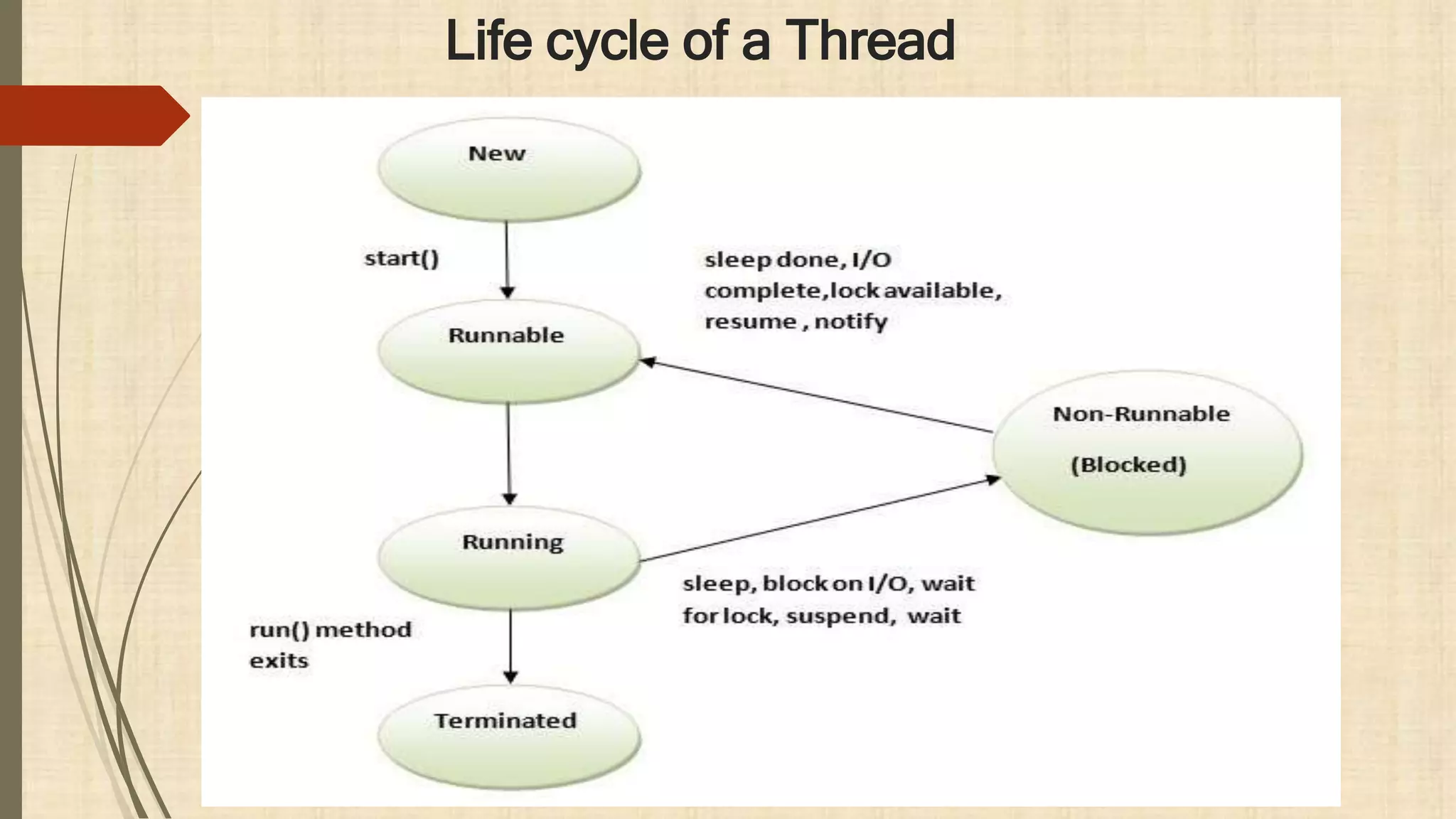
Life cycle of a Thread
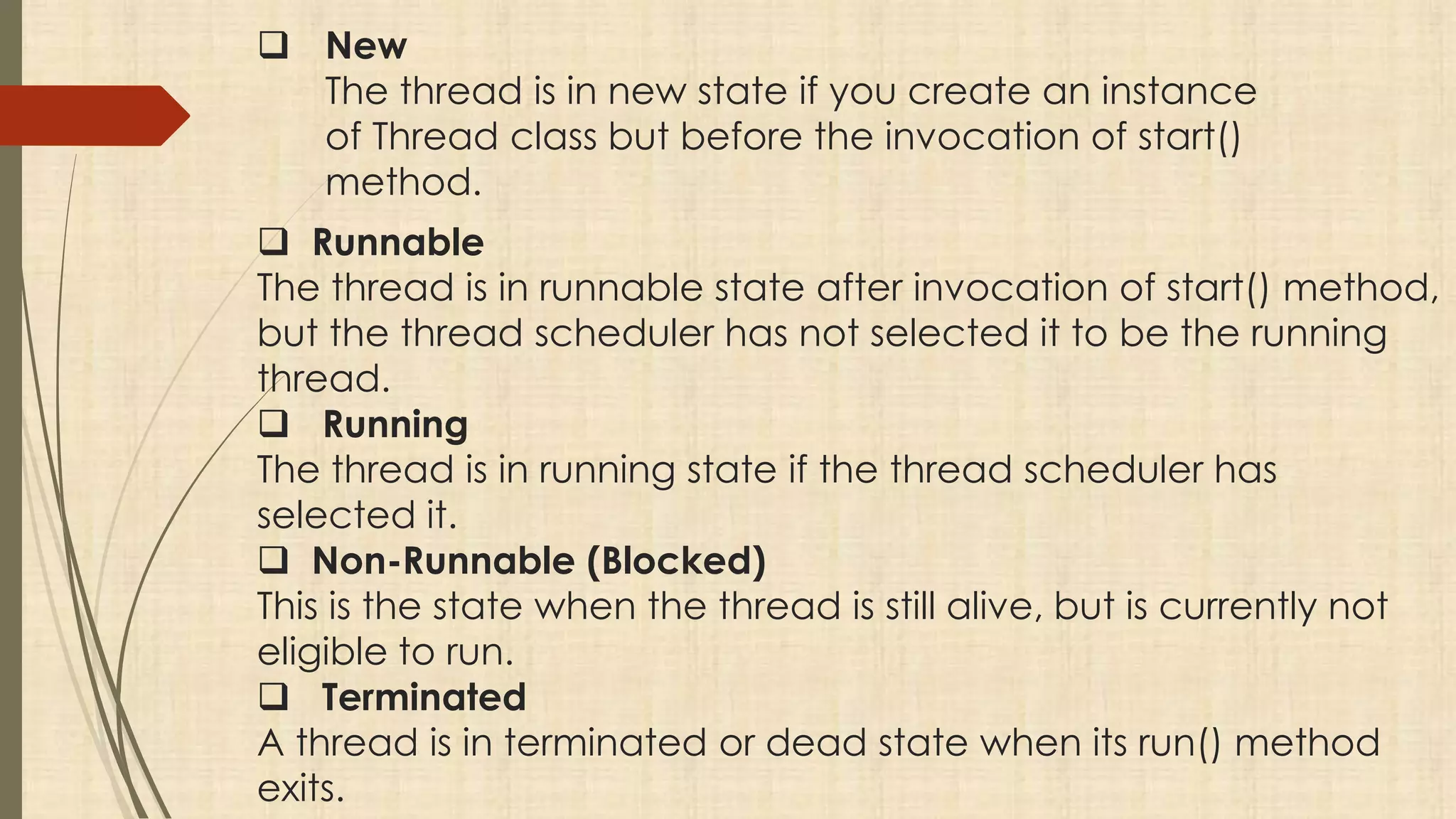
 New
The thread is in new state if you create an instance
of Thread class but before the invocation of start()
method.
 Runnable
The thread is in runnable state after invocation of start() method,
but the thread scheduler has not selected it to be the running
thread.
 Running
The thread is in running state if the thread scheduler has
selected it.
 Non-Runnable (Blocked)
This is the state when the thread is still alive, but is currently not
eligible to run.
 Terminated
A thread is in terminated or dead state when its run() method
exits.
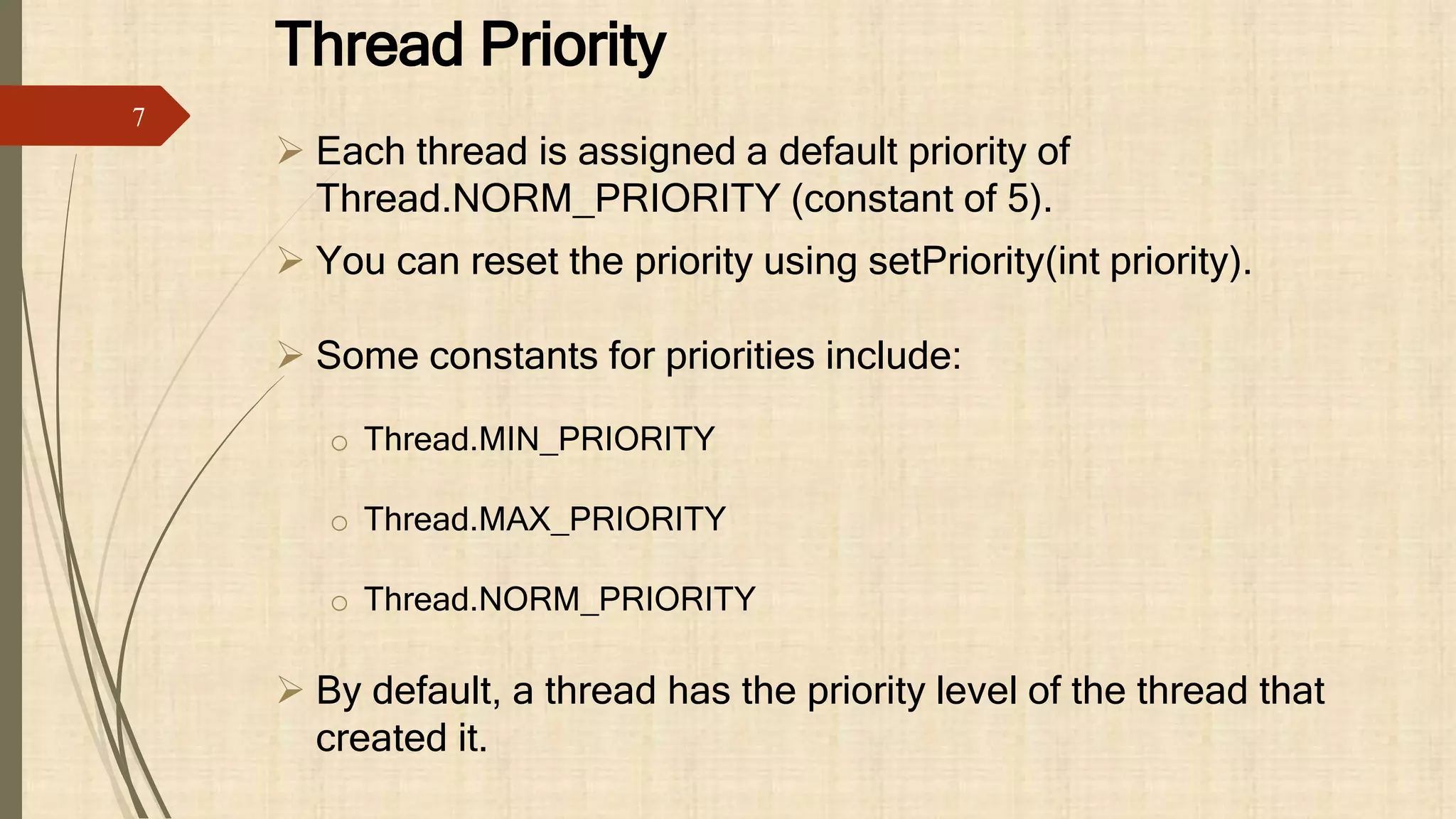
Thread Priority
 Each thread is assigned a default priority of
Thread.NORM_PRIORITY (constant of 5).
 You can reset the priority using setPriority(int priority).
 Some constants for priorities include:
o Thread.MIN_PRIORITY
o Thread.MAX_PRIORITY
o Thread.NORM_PRIORITY
 By default, a thread has the priority level of the thread that
created it.
7
 Thread Synchronization8
A shared resource may be corrupted if it is accessed
simultaneously by multiple threads.
Example: two unsynchronized threads accessing the same
bank account may cause conflict.
 Known as a race condition in multithreaded programs.
A thread-safe class does not cause a race condition in the
presence of multiple threads.
Synchronized
Problem : race conditions
Solution : give exclusive access to one thread at a time to code
that manipulates a shared object.
Synchronization keeps other threads waiting until the object is
available.
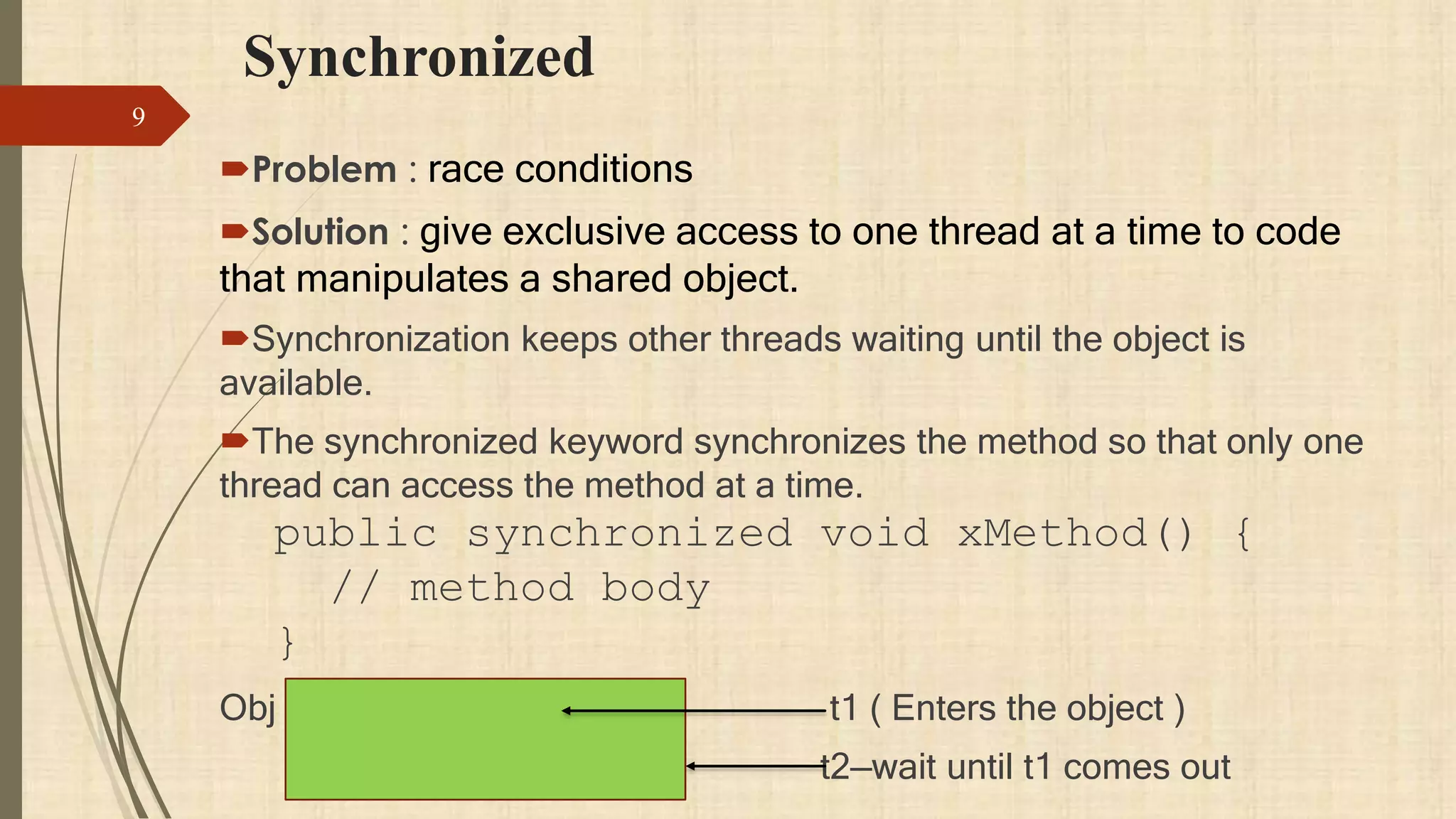
The synchronized keyword synchronizes the method so that only one
thread can access the method at a time.
public synchronized void xMethod() {
// method body
}
Obj t1 ( Enters the object )
t2—wait until t1 comes out
9
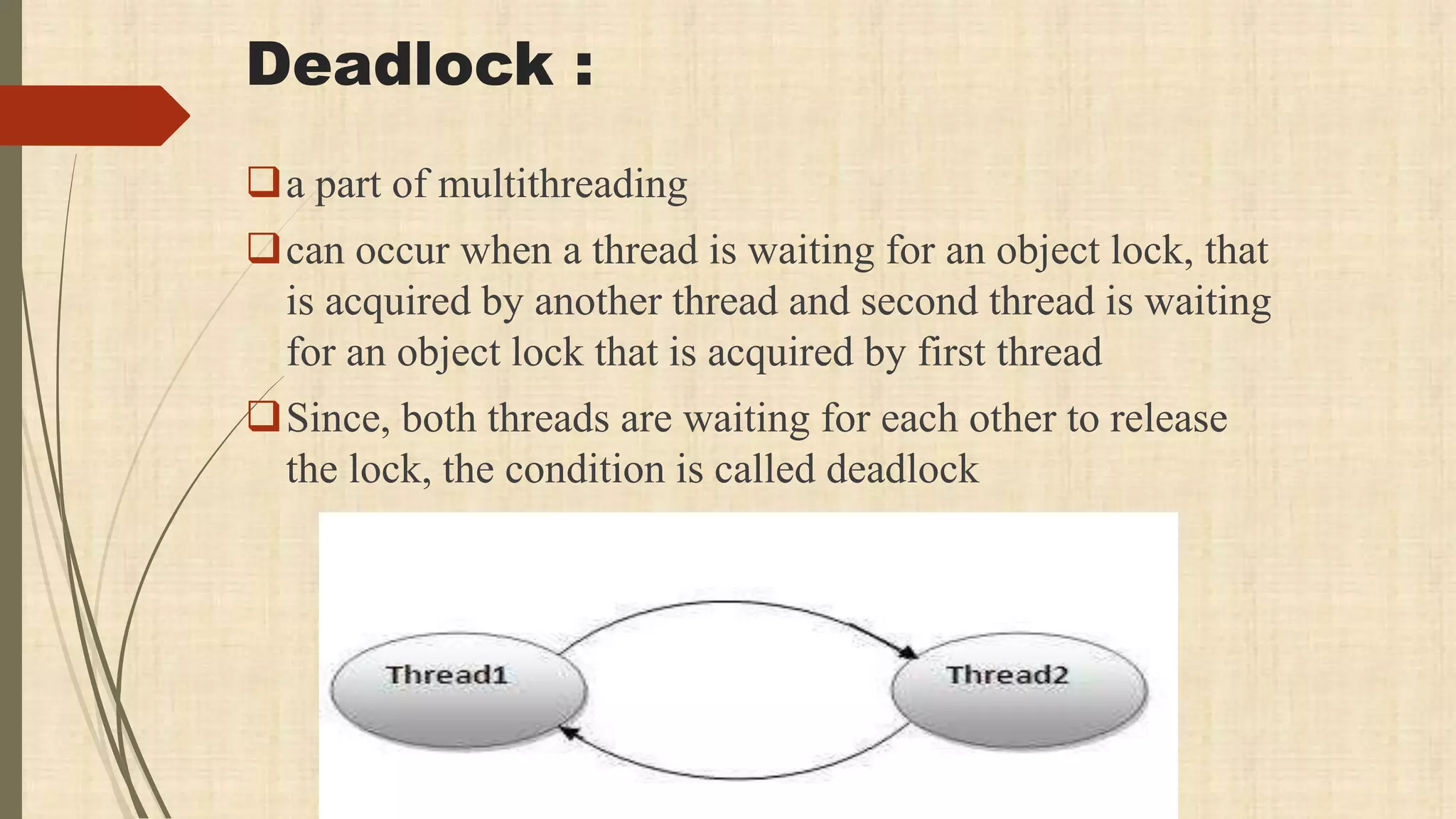
Deadlock :
a part of multithreading
can occur when a thread is waiting for an object lock, that
is acquired by another thread and second thread is waiting
for an object lock that is acquired by first thread
Since, both threads are waiting for each other to release
the lock, the condition is called deadlock
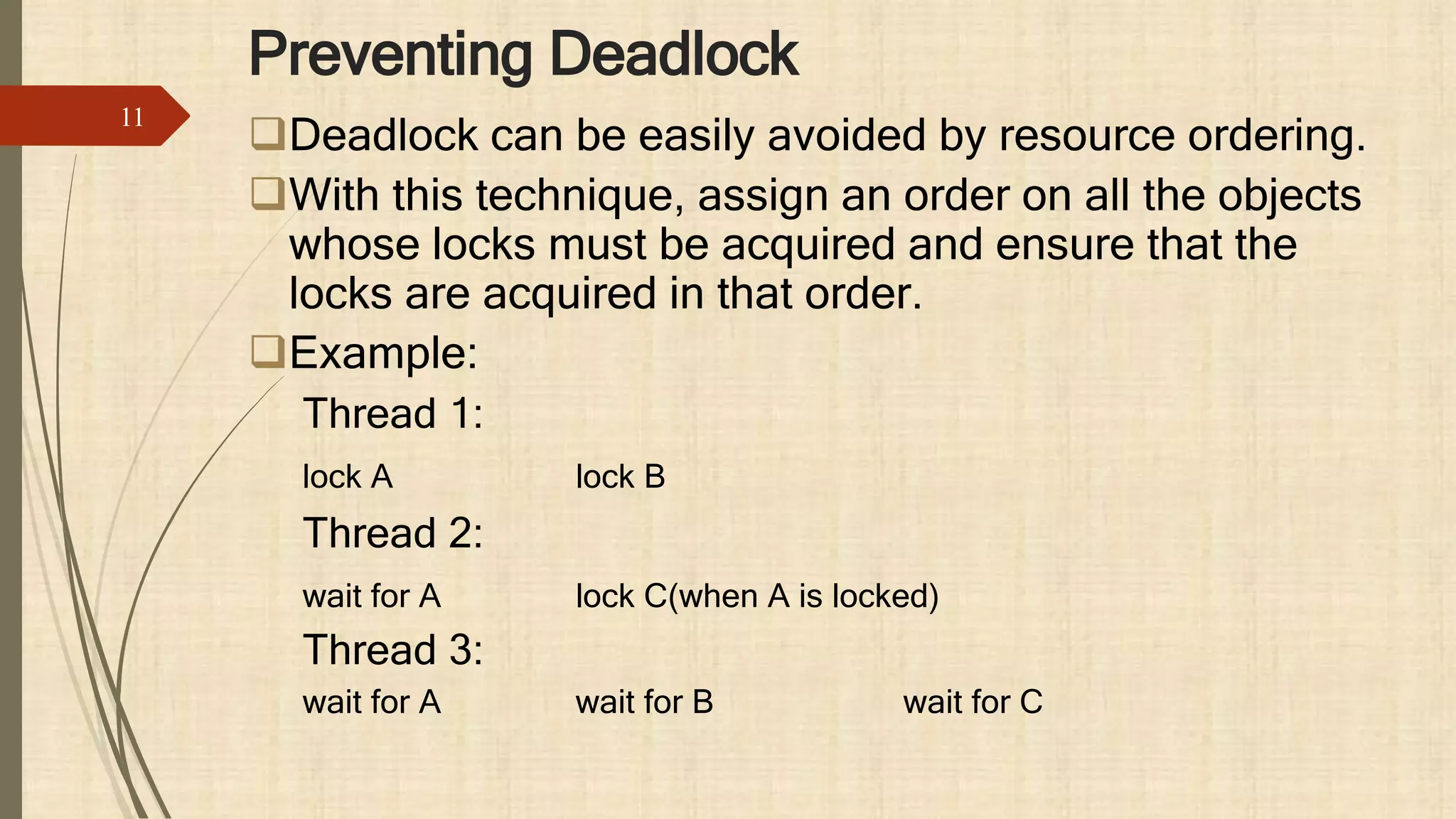
Preventing Deadlock
Deadlock can be easily avoided by resource ordering.
With this technique, assign an order on all the objects
whose locks must be acquired and ensure that the
locks are acquired in that order.
Example:
Thread 1:
lock A lock B
Thread 2:
wait for A lock C(when A is locked)
Thread 3:
wait for A wait for B wait for C
11
Advantages of Threads:
easier to program
provide better performance
allow any program to perform multiple tasks at once.
multiple threads can share resources
an Internet-aware language such as Java, this is a very
important tool
References
 http://www.slideshare.net/parag/multithreading-in-java
 https://code.google.com/p/googleappengine/wiki/SdkForJavaReleaseNotes
 http://stackoverflow.com/questions/2213340/what-is-daemon-thread-in-java
 https://github.com/orientechnologies/orientdb/wiki/Java-Multi-Threading
 http://www.javatpoint.com/creating-thread
 http://www.tutorialspoint.com/java/java_multithreading.htm
 http://tutorials.jenkov.com/java-concurrency/creating-and-starting-threads.html
 http://docs.oracle.com/javase/tutorial/essential/concurrency/runthread.html
 http://www.javabeginner.com/learn-java/java-threads-tutorial
 http://www.geeksforgeeks.org/java/
 http://www.javacodegeeks.com/2014/08/java-concurrency-tutorial-visibility-between-
threads.html
End of Module
Thank You

Threads in JAVA

  • 1.
  • 2.
    What is aThread? facility to allow multiple activities to coexist within a single process. Represents a separate path of execution of a group of statements Java is the first language to include threading within the language, rather than treating it as a facility of the OS  Video Game example 1.one thread for graphics 2.one thread for user interaction 3.one thread for networking  Server Example 1.Do various jobs 2.Handle Several Clients
  • 3.
    Main Thread Default Threadin any Java Program JVM uses to execute program statements o Program To Find the Main Thread Class Current { public static void main(String args[]) { Thread t=Thread.currentThread(); System.out.println(“Current Thread: “+t); System.out.println(“Name is: “+t.getName()); } }
  • 4.
    Threads in Java Creatingthreads in Java: Extend java.lang.Thread class run() method must be overridden (similar to main method of sequential program) run() is called when execution of the thread begins A thread terminates when run() returns start() method invokes run() OR Implement java.lang.Runnable interface 4
  • 5.
    Life cycle ofa Thread
  • 6.
     New The threadis in new state if you create an instance of Thread class but before the invocation of start() method.  Runnable The thread is in runnable state after invocation of start() method, but the thread scheduler has not selected it to be the running thread.  Running The thread is in running state if the thread scheduler has selected it.  Non-Runnable (Blocked) This is the state when the thread is still alive, but is currently not eligible to run.  Terminated A thread is in terminated or dead state when its run() method exits.
  • 7.
    Thread Priority  Eachthread is assigned a default priority of Thread.NORM_PRIORITY (constant of 5).  You can reset the priority using setPriority(int priority).  Some constants for priorities include: o Thread.MIN_PRIORITY o Thread.MAX_PRIORITY o Thread.NORM_PRIORITY  By default, a thread has the priority level of the thread that created it. 7
  • 8.
     Thread Synchronization8 Ashared resource may be corrupted if it is accessed simultaneously by multiple threads. Example: two unsynchronized threads accessing the same bank account may cause conflict.  Known as a race condition in multithreaded programs. A thread-safe class does not cause a race condition in the presence of multiple threads.
  • 9.
    Synchronized Problem : raceconditions Solution : give exclusive access to one thread at a time to code that manipulates a shared object. Synchronization keeps other threads waiting until the object is available. The synchronized keyword synchronizes the method so that only one thread can access the method at a time. public synchronized void xMethod() { // method body } Obj t1 ( Enters the object ) t2—wait until t1 comes out 9
  • 10.
    Deadlock : a partof multithreading can occur when a thread is waiting for an object lock, that is acquired by another thread and second thread is waiting for an object lock that is acquired by first thread Since, both threads are waiting for each other to release the lock, the condition is called deadlock
  • 11.
    Preventing Deadlock Deadlock canbe easily avoided by resource ordering. With this technique, assign an order on all the objects whose locks must be acquired and ensure that the locks are acquired in that order. Example: Thread 1: lock A lock B Thread 2: wait for A lock C(when A is locked) Thread 3: wait for A wait for B wait for C 11
  • 12.
    Advantages of Threads: easierto program provide better performance allow any program to perform multiple tasks at once. multiple threads can share resources an Internet-aware language such as Java, this is a very important tool
  • 13.
    References  http://www.slideshare.net/parag/multithreading-in-java  https://code.google.com/p/googleappengine/wiki/SdkForJavaReleaseNotes http://stackoverflow.com/questions/2213340/what-is-daemon-thread-in-java  https://github.com/orientechnologies/orientdb/wiki/Java-Multi-Threading  http://www.javatpoint.com/creating-thread  http://www.tutorialspoint.com/java/java_multithreading.htm  http://tutorials.jenkov.com/java-concurrency/creating-and-starting-threads.html  http://docs.oracle.com/javase/tutorial/essential/concurrency/runthread.html  http://www.javabeginner.com/learn-java/java-threads-tutorial  http://www.geeksforgeeks.org/java/  http://www.javacodegeeks.com/2014/08/java-concurrency-tutorial-visibility-between- threads.html
  • 14.