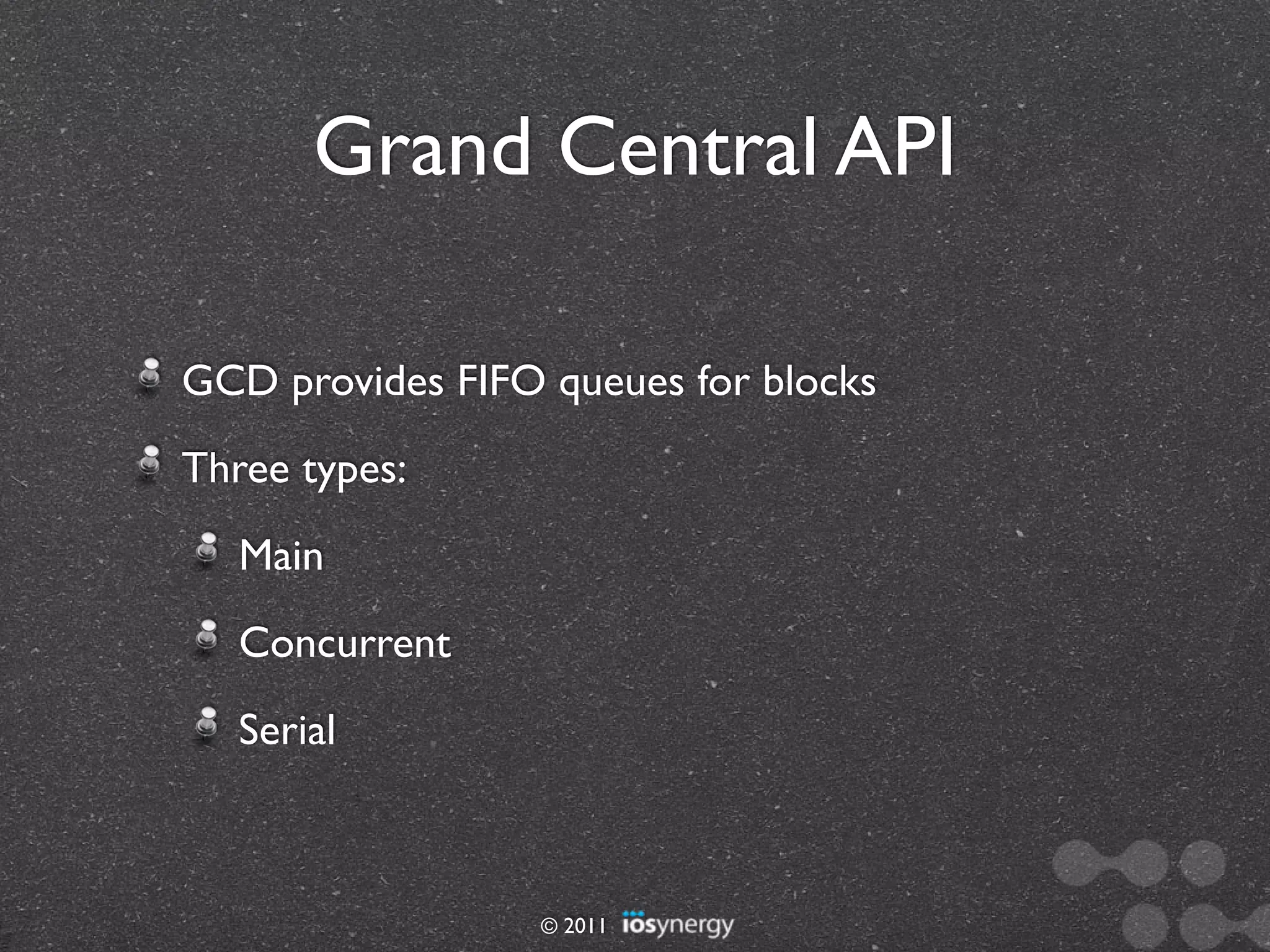
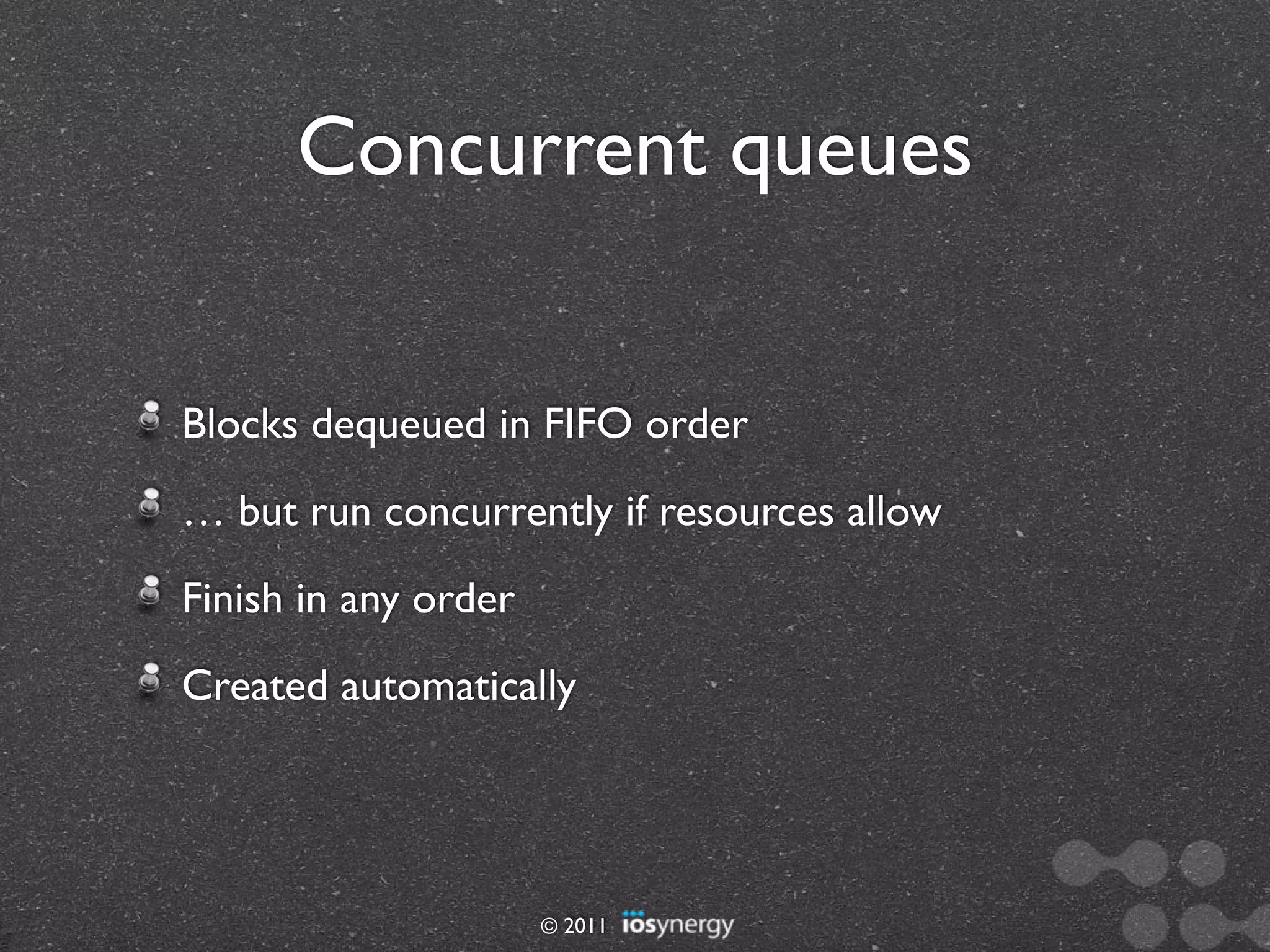
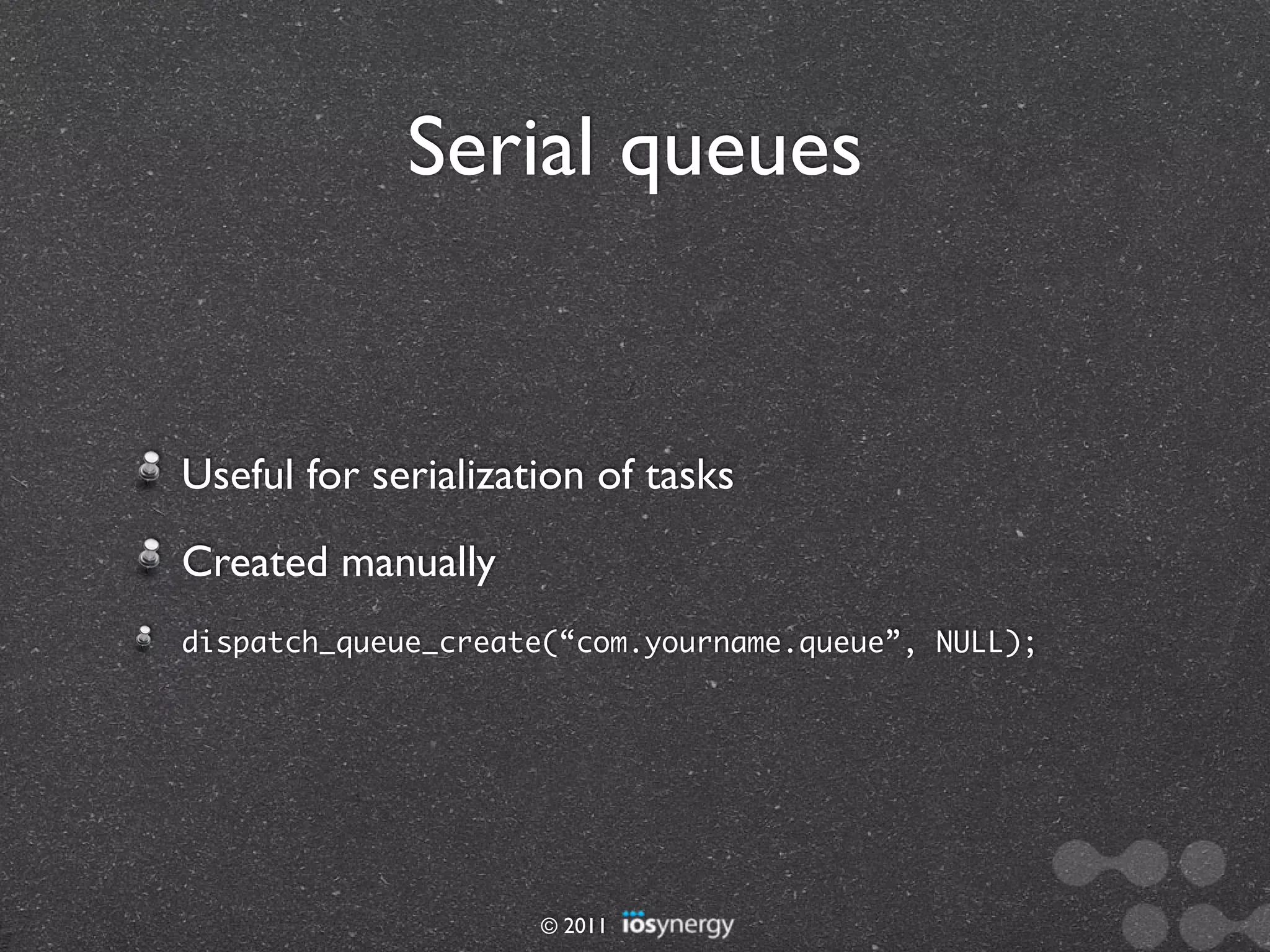
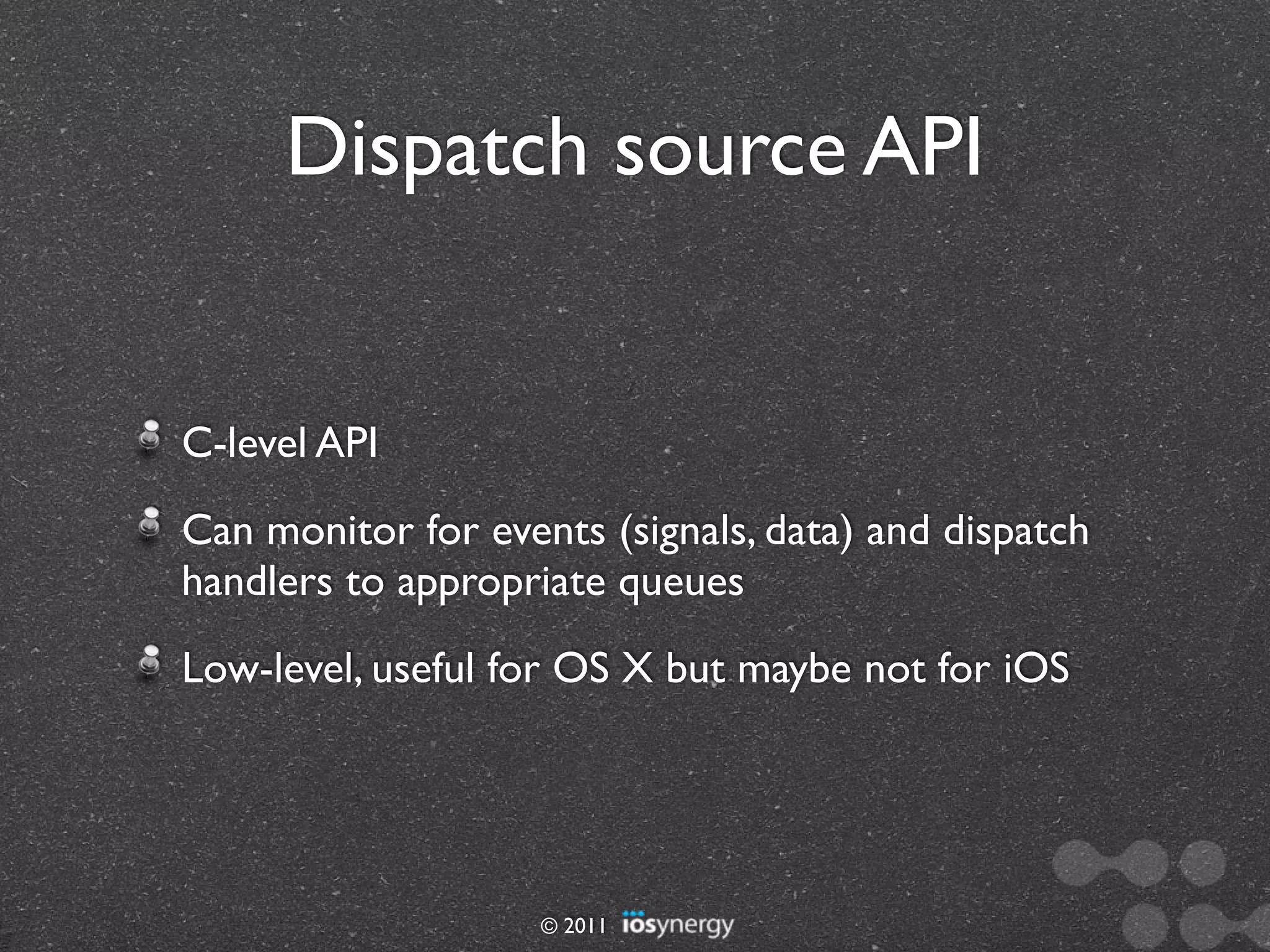
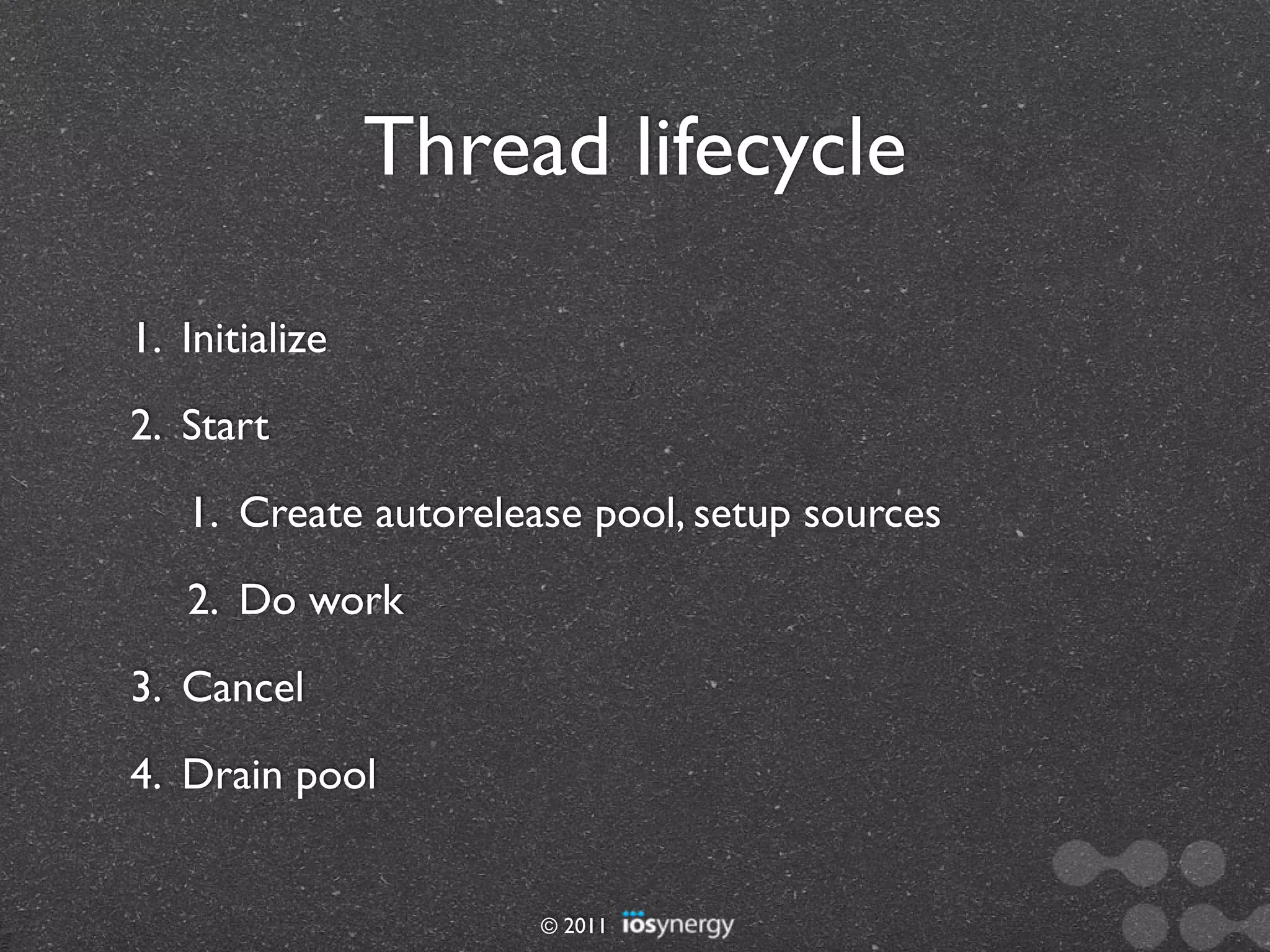
The document discusses threads and concurrency in iOS development. It begins by introducing threads and their downsides, such as overhead and difficulty of management. It then introduces Grand Central Dispatch (GCD) and blocks as higher-level solutions for concurrency. GCD automates thread management and uses blocks to encapsulate units of work. The document also discusses using NSThread as a last resort for scenarios where GCD is not sufficient.

![Example
- (void)blink:(UIColor *)color
{
self.view.backgroundColor = color;
[UIView animateWithDuration:1.0
animations:^{self.view.backgroundColor = [UIColor
darkGrayColor];}];
}
© 2011](https://image.slidesharecdn.com/cracow-mobi-120102095232-phpapp01/75/Threading-in-iOS-Cocoa-Touch-26-2048.jpg)
![Thread init
newThread = [[NSThread alloc] initWithTarget:self
selector:@selector(newThreadEntryPoint:) object:nil];
© 2011](https://image.slidesharecdn.com/cracow-mobi-120102095232-phpapp01/75/Threading-in-iOS-Cocoa-Touch-39-2048.jpg)
![Thread start
[newThread start];
© 2011](https://image.slidesharecdn.com/cracow-mobi-120102095232-phpapp01/75/Threading-in-iOS-Cocoa-Touch-41-2048.jpg)
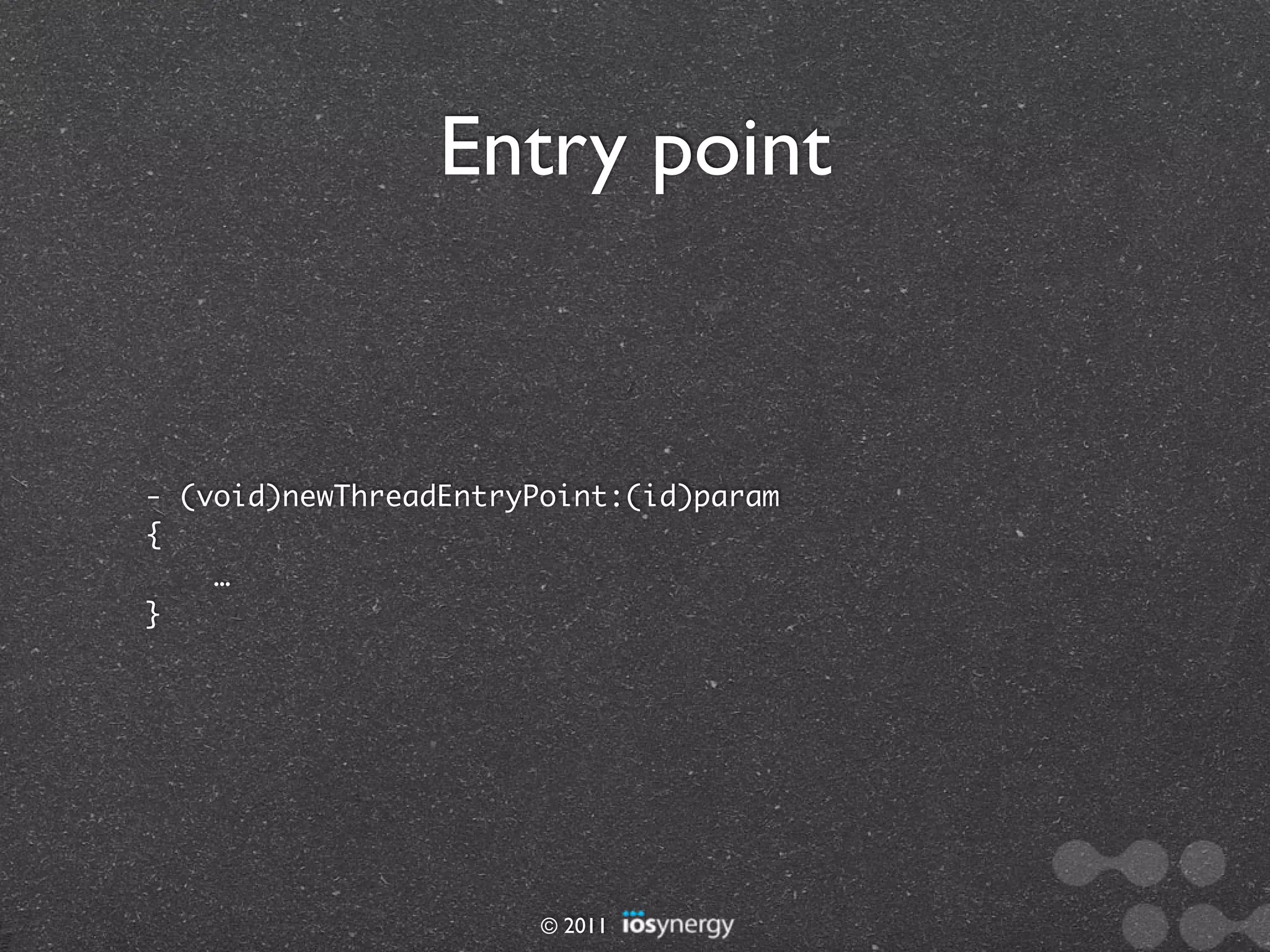
![Housekeeping
- (void)newThreadEntryPoint:(id)param
{
NSAutoreleasePool *pool = [[NSAutoreleasePool alloc]
init];
…
}
© 2011](https://image.slidesharecdn.com/cracow-mobi-120102095232-phpapp01/75/Threading-in-iOS-Cocoa-Touch-42-2048.jpg)
![Event sources
NSInputStream *catnipStream;
[catnipStream setDelegate:self];
[catnipStream scheduleInRunLoop:[NSRunLoop currentRunLoop]
forMode:NSDefaultRunLoopMode];
[catnipStream open];
© 2011](https://image.slidesharecdn.com/cracow-mobi-120102095232-phpapp01/75/Threading-in-iOS-Cocoa-Touch-44-2048.jpg)
![Running the loop
do {
[[NSRunLoop currentRunLoop] runMode:NSDefaultRunLoopMode
beforeDate:[NSDate distantFuture]];
} while (!done);
© 2011](https://image.slidesharecdn.com/cracow-mobi-120102095232-phpapp01/75/Threading-in-iOS-Cocoa-Touch-45-2048.jpg)
![The whole package
- (void)runThread
{
newThread = [[NSThread alloc] initWithTarget:self selector:@selector(newThreadEntryPoint:)
object:nil];
[newThread start];
}
- (void)newThreadEntryPoint:(id)param
{
NSAutoreleasePool *pool = [[NSAutoreleasePool alloc] init];
[catnipStream setDelegate:self];
[catnipStream scheduleInRunLoop:[NSRunLoop currentRunLoop] forMode:NSDefaultRunLoopMode];
[catnipStream open];
do {
[[NSRunLoop currentRunLoop] runMode:NSDefaultRunLoopMode beforeDate:[NSDate distantFuture]];
} while (!done);
}
© 2011](https://image.slidesharecdn.com/cracow-mobi-120102095232-phpapp01/75/Threading-in-iOS-Cocoa-Touch-46-2048.jpg)
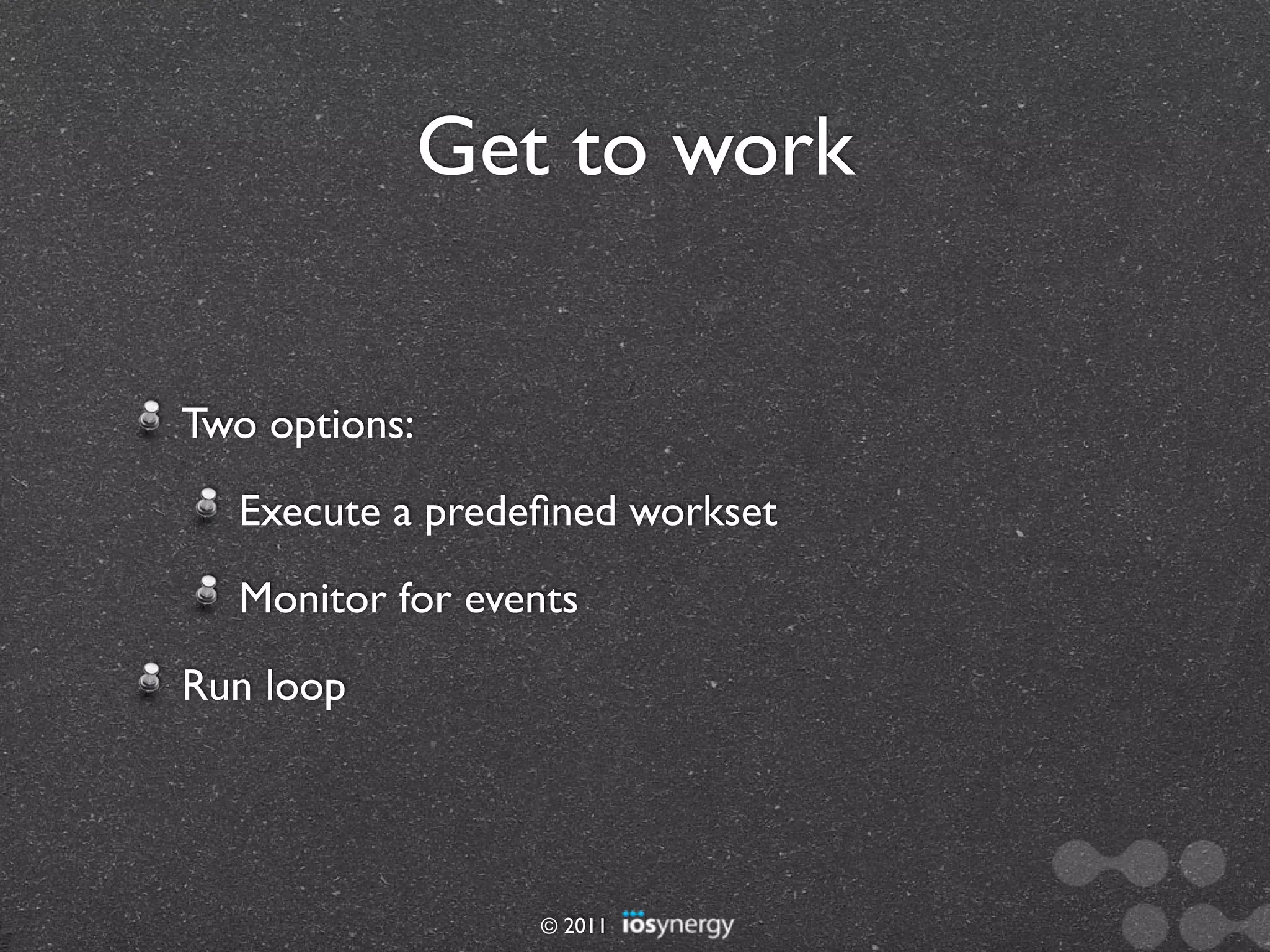
![Run loop maintenance
do {
[[NSRunLoop currentRunLoop] runMode:NSDefaultRunLoopMode
beforeDate:[NSDate distantFuture]];
} while (!done);
© 2011](https://image.slidesharecdn.com/cracow-mobi-120102095232-phpapp01/75/Threading-in-iOS-Cocoa-Touch-48-2048.jpg)
![Run loop maintenance
do {
[[NSRunLoop currentRunLoop] runMode:NSDefaultRunLoopMode
beforeDate:[NSDate distantFuture]];
} while ([[NSThread currentThread] isCancelled] == NO);
© 2011](https://image.slidesharecdn.com/cracow-mobi-120102095232-phpapp01/75/Threading-in-iOS-Cocoa-Touch-49-2048.jpg)
![Run loop maintenance
do {
[[NSRunLoop currentRunLoop] runMode:NSDefaultRunLoopMode
beforeDate:[NSDate dateWithTimeIntervalSinceNow:5]];
} while ([[NSThread currentThread] isCancelled] == NO);
© 2011](https://image.slidesharecdn.com/cracow-mobi-120102095232-phpapp01/75/Threading-in-iOS-Cocoa-Touch-50-2048.jpg)
![Clean up!
[catnipStream close];
[catnipStream removeFromRunLoop:[NSRunLoop currentRunLoop]
forMode:NSDefaultRunLoopMode];
[catnipStream setDelegate:nil];
© 2011](https://image.slidesharecdn.com/cracow-mobi-120102095232-phpapp01/75/Threading-in-iOS-Cocoa-Touch-51-2048.jpg)
![A lot of code?
- (void)runThread
{
newThread = [[NSThread alloc] initWithTarget:self selector:@selector(newThreadEntryPoint:)
object:nil];
[newThread start];
}
- (void)newThreadEntryPoint:(id)param
{
NSAutoreleasePool *pool = [[NSAutoreleasePool alloc] init];
[catnipStream setDelegate:self];
[catnipStream scheduleInRunLoop:[NSRunLoop currentRunLoop] forMode:NSDefaultRunLoopMode];
[catnipStream open];
do {
[[NSRunLoop currentRunLoop] runMode:NSDefaultRunLoopMode beforeDate:[NSDate
dateWithTimeIntervalSinceNow:5]];
} while ([[NSThread currentThread] isCancelled] == NO);
[catnipStream close];
[catnipStream removeFromRunLoop:[NSRunLoop currentRunLoop] forMode:NSDefaultRunLoopMode];
[catnipStream setDelegate:nil];
[pool drain];
}
© 2011](https://image.slidesharecdn.com/cracow-mobi-120102095232-phpapp01/75/Threading-in-iOS-Cocoa-Touch-52-2048.jpg)
![More maintenance
Consider draining the autorelease pool from within
the loop if the thread will be running for a long time
do {
[[NSRunLoop currentRunLoop] runMode:NSDefaultRunLoopMode beforeDate:[NSDate
dateWithTimeIntervalSinceNow:5]];
[pool drain];
pool = [[NSAutoreleasePool alloc] init];
} while ([[NSThread currentThread] isCancelled] == NO);
© 2011](https://image.slidesharecdn.com/cracow-mobi-120102095232-phpapp01/75/Threading-in-iOS-Cocoa-Touch-53-2048.jpg)
![How to quit?
[newThread cancel];
Safe to use from any thread
© 2011](https://image.slidesharecdn.com/cracow-mobi-120102095232-phpapp01/75/Threading-in-iOS-Cocoa-Touch-54-2048.jpg)
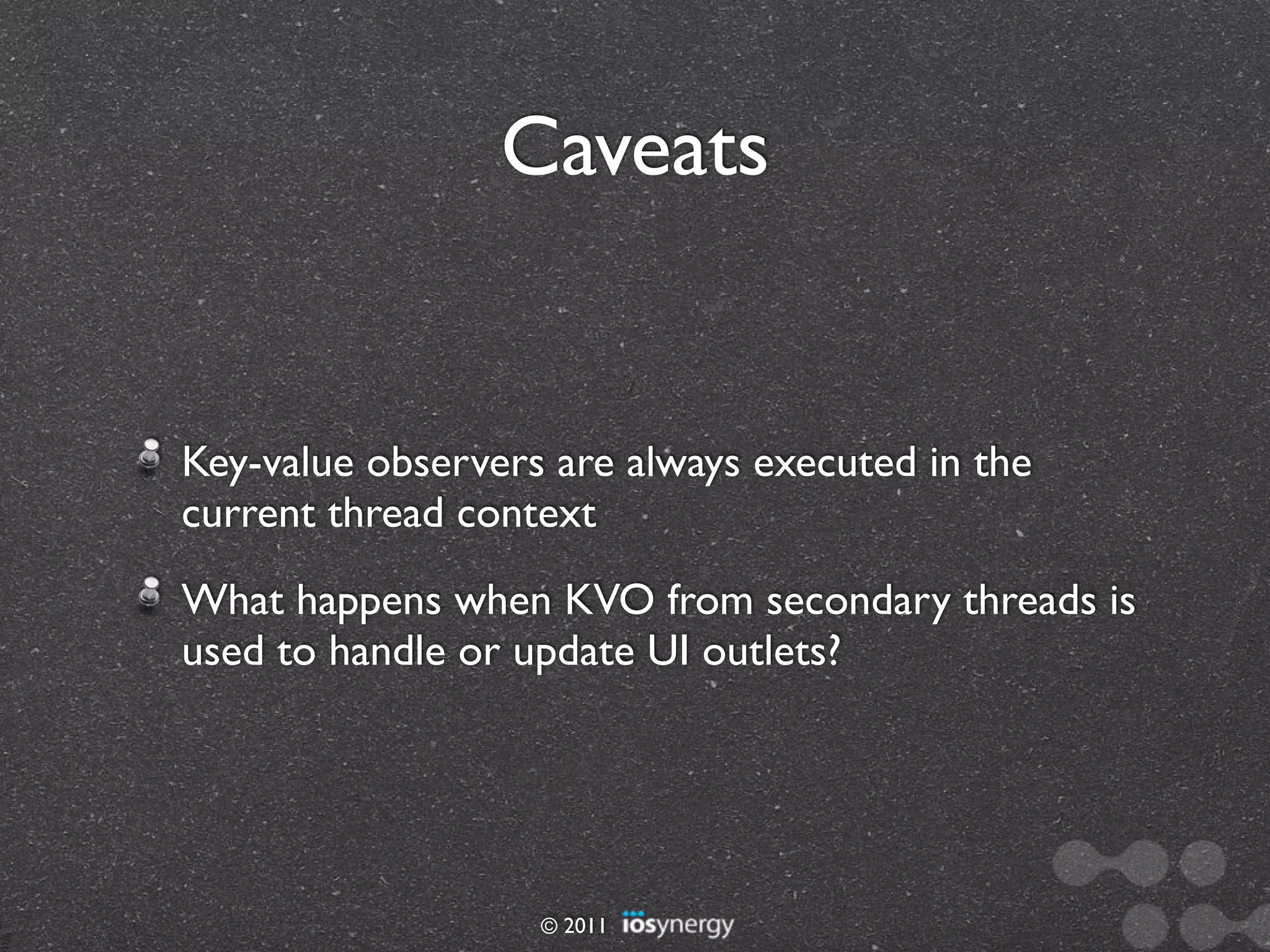

![Solution
performSelectorOnMainThread:(SEL)aSelector
withObject:(id)arg waitUntilDone:(BOOL)wait
(on secondary thread)
[self
performSelectorOnMainThread:@selector(updateField
s:) withObject:data waitUntilDone:YES];
© 2011](https://image.slidesharecdn.com/cracow-mobi-120102095232-phpapp01/75/Threading-in-iOS-Cocoa-Touch-58-2048.jpg)

![Multithreading and Parallelism on iOS [MobOS 2013]](https://cdn.slidesharecdn.com/ss_thumbnails/mobos2013-131122085438-phpapp02-thumbnail.jpg?width=640&height=640&fit=bounds)


![Grand Central Dispatch and multi-threading [iCONdev 2014]](https://cdn.slidesharecdn.com/ss_thumbnails/icondev-gcd-140326100357-phpapp01-thumbnail.jpg?width=640&height=640&fit=bounds)


![[iOS] Multiple Background Threads](https://cdn.slidesharecdn.com/ss_thumbnails/nikmetrainingioslecture4-150129213731-conversion-gate02-thumbnail.jpg?width=640&height=640&fit=bounds)


