Teaching and Learning
Framework in Mathematics
Carlo Magno, PhD
De La Salle University, Manila
• What do you think are the important skills that
students needs to learn in mathematics?
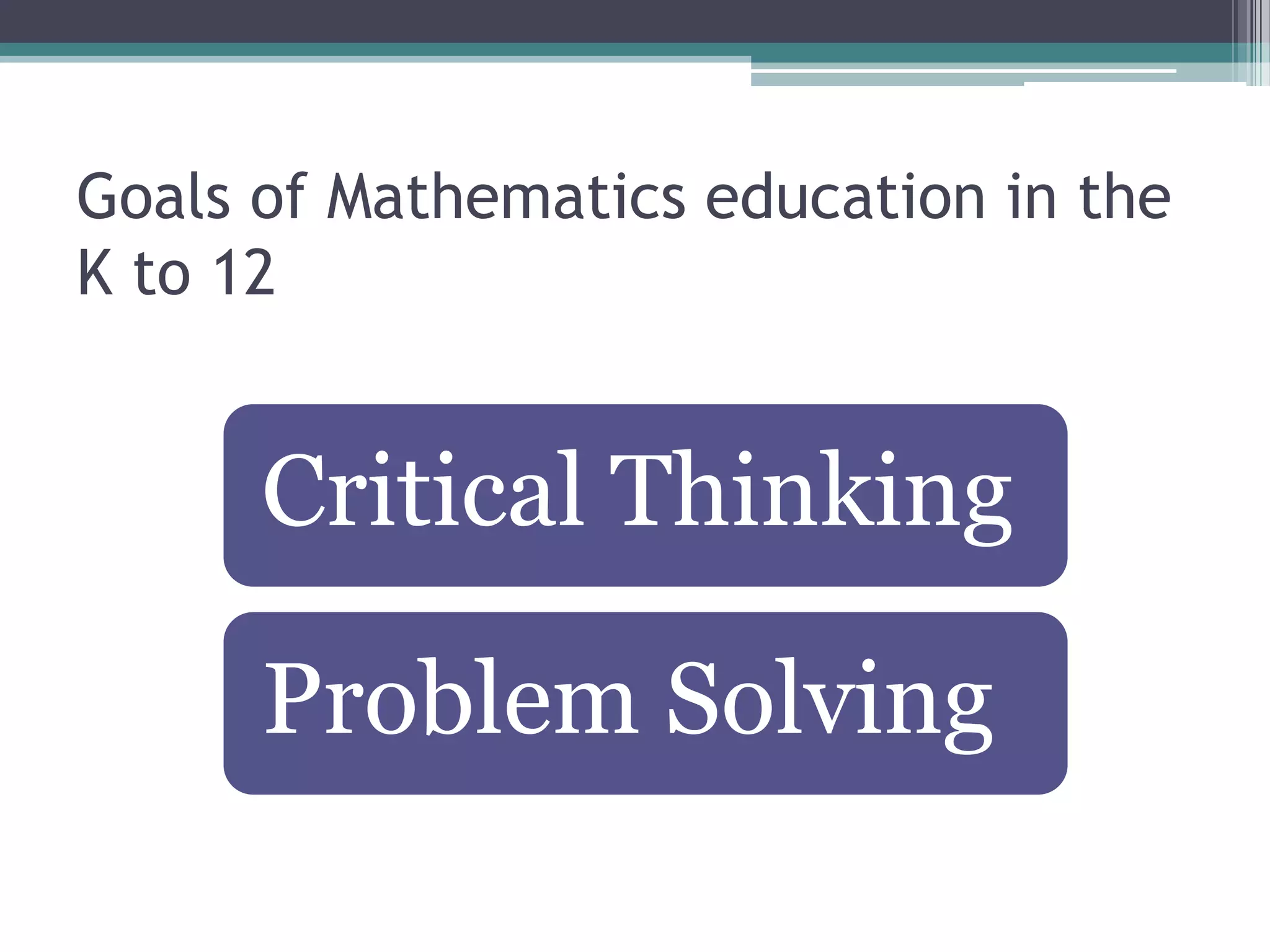
Goals of Mathematics education in the
K to 12
Critical Thinking
Problem Solving
Critical Thinking
• Intellectually disciplined process of actively and
skillfully
conceptualizing, applying, analyzing, synthesizin
g, and/or evaluating information gathered
from, or generated
by, observation, experience, reflection, reasoning
, or communication, as a guide to belief and
action (Scriven & Paul, 1987).
Problem solving
• Finding a way around a difficulty, around an
obstacle, and finding a solution to a problem
that is unknown (Polya, 1945 & 1962).
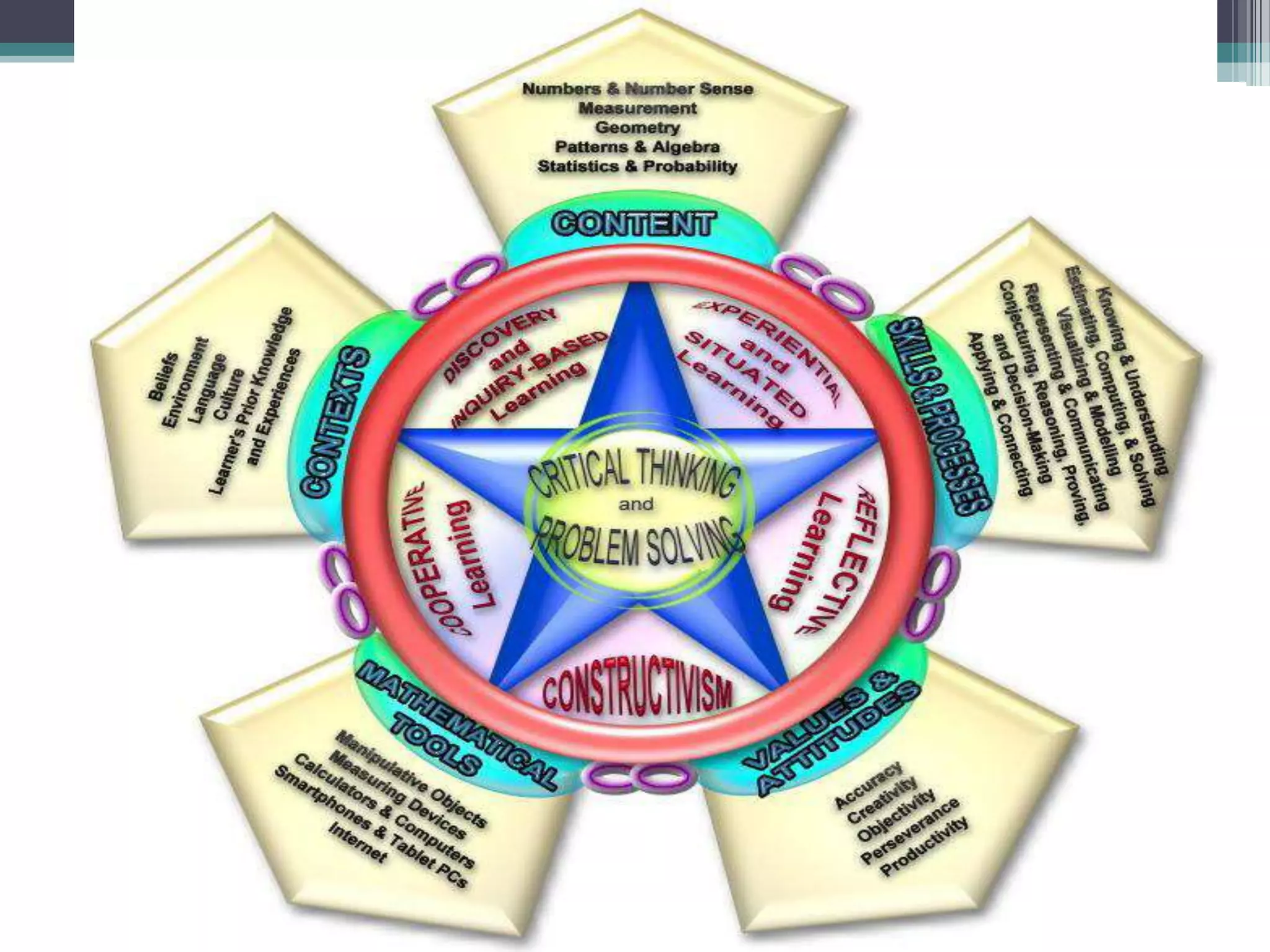
Content areas in the curriculum
• Numbers and Number Sense
• Measurement
• Geometry
• Patterns and Algebra
• Probability and Statistics
Skills and processes to be developed
• Knowing and Understanding
• Estimating
• Computing and Solving
• Visualizing and Modelling
• Representing and Communicating
• Conjecturing
• Reasoning
• Proving and Decision-making
• Applying and Connecting
values and attitudes
• Accuracy
• Creativity
• Objectivity
• Perseverance
• Productivity
Tools in teaching mathematics
• manipulative objects
• measuring devices
• calculators and computers
• Smartphones and tablet PCs
• Internet
Teaching Principles in Mathematics
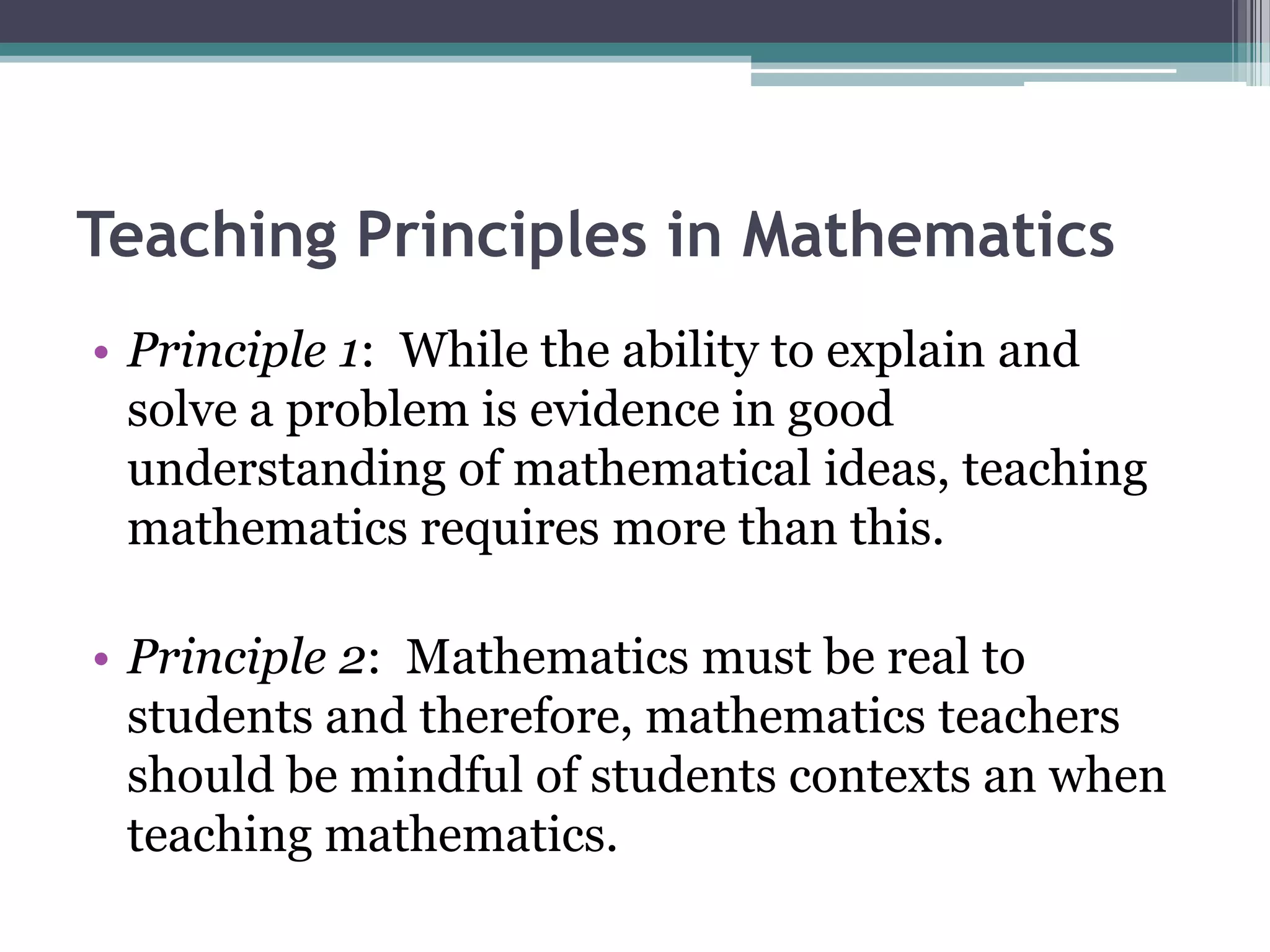
• Principle 1: While the ability to explain and
solve a problem is evidence in good
understanding of mathematical ideas, teaching
mathematics requires more than this.
• Principle 2: Mathematics must be real to
students and therefore, mathematics teachers
should be mindful of students contexts an when
teaching mathematics.
Teaching Principles in Mathematics
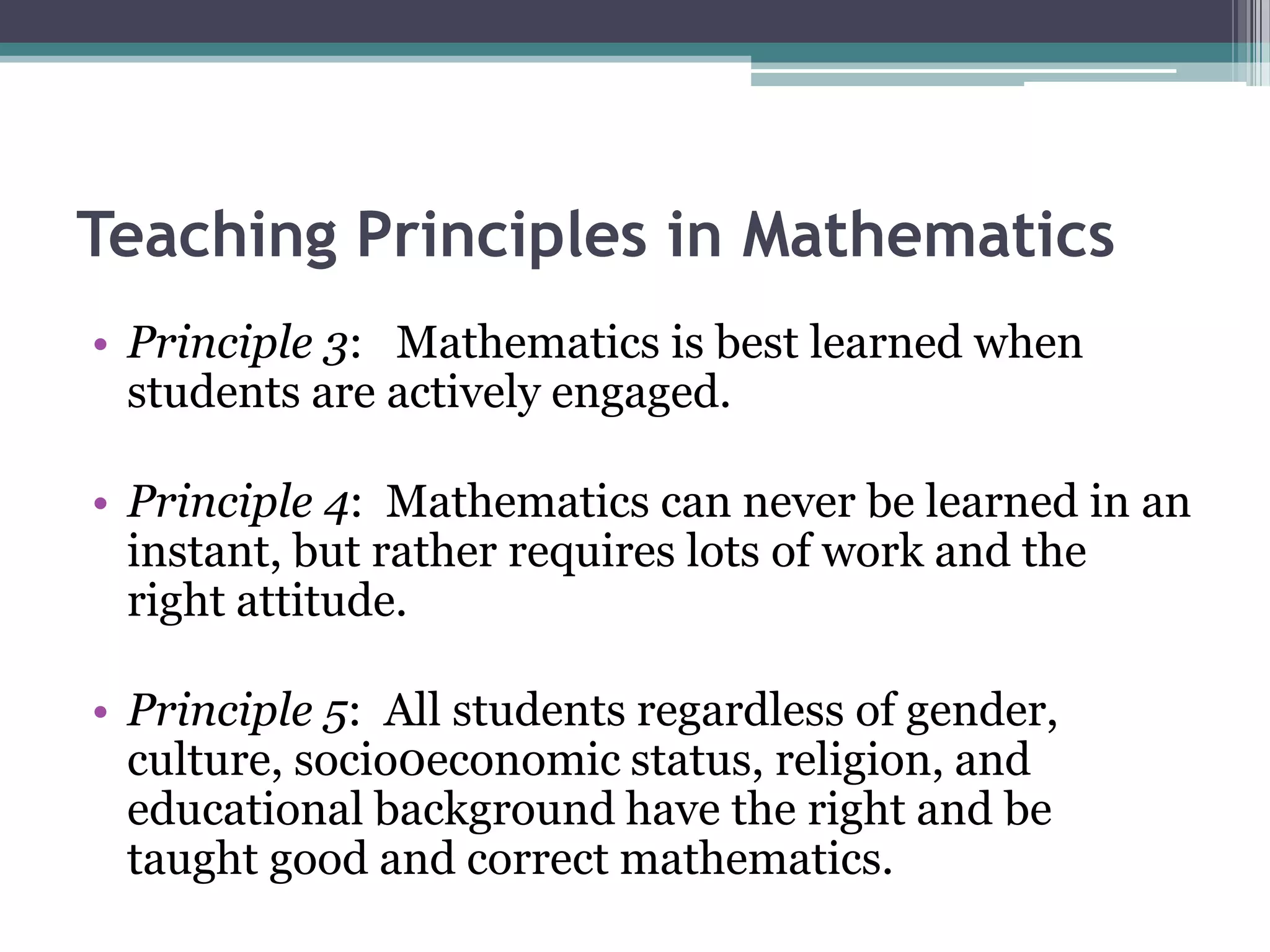
• Principle 3: Mathematics is best learned when
students are actively engaged.
• Principle 4: Mathematics can never be learned in an
instant, but rather requires lots of work and the
right attitude.
• Principle 5: All students regardless of gender,
culture, socio0economic status, religion, and
educational background have the right and be
taught good and correct mathematics.
Teaching Principles in Mathematics
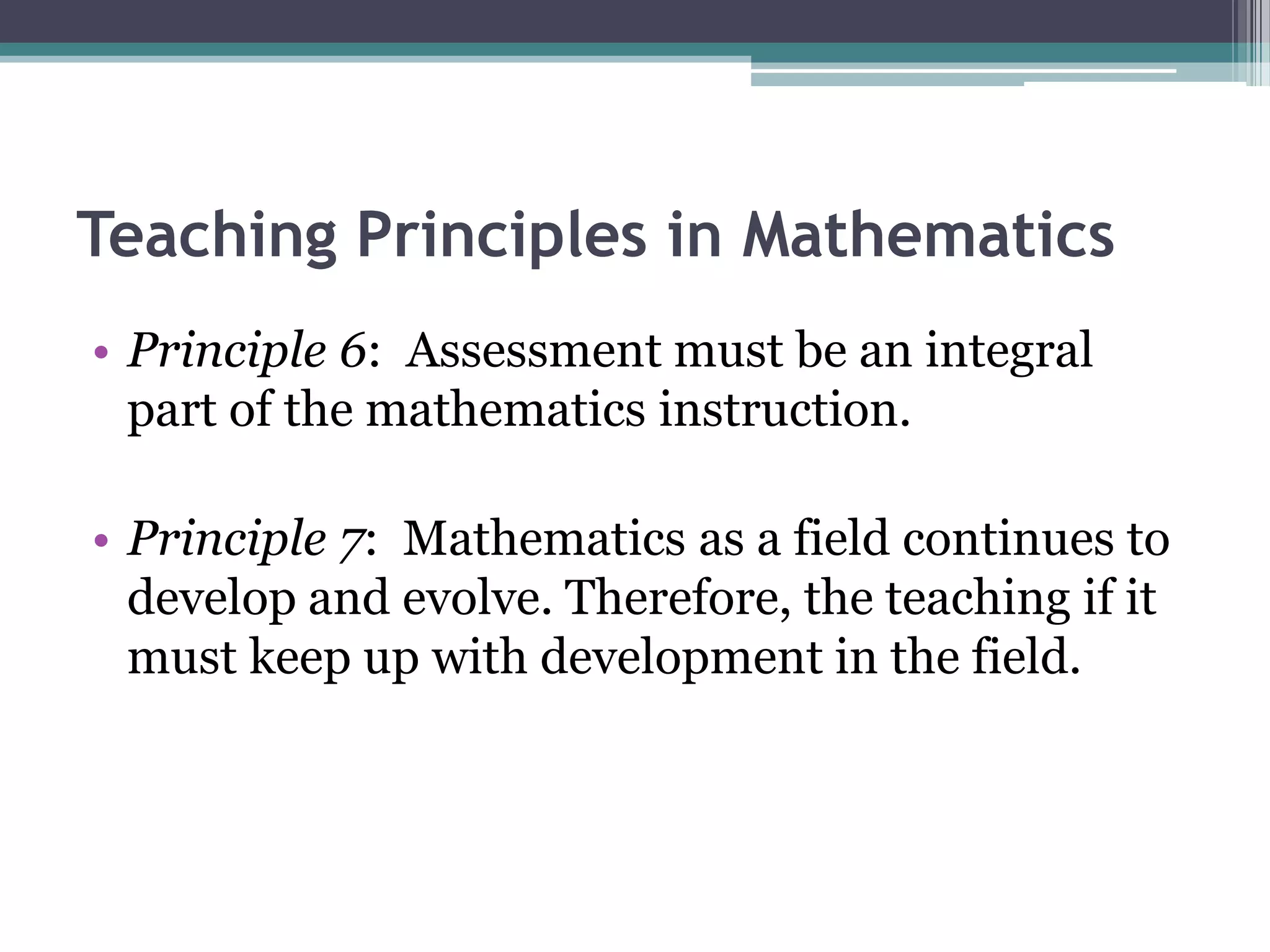
• Principle 6: Assessment must be an integral
part of the mathematics instruction.
• Principle 7: Mathematics as a field continues to
develop and evolve. Therefore, the teaching if it
must keep up with development in the field.
Teaching Principles in Mathematics
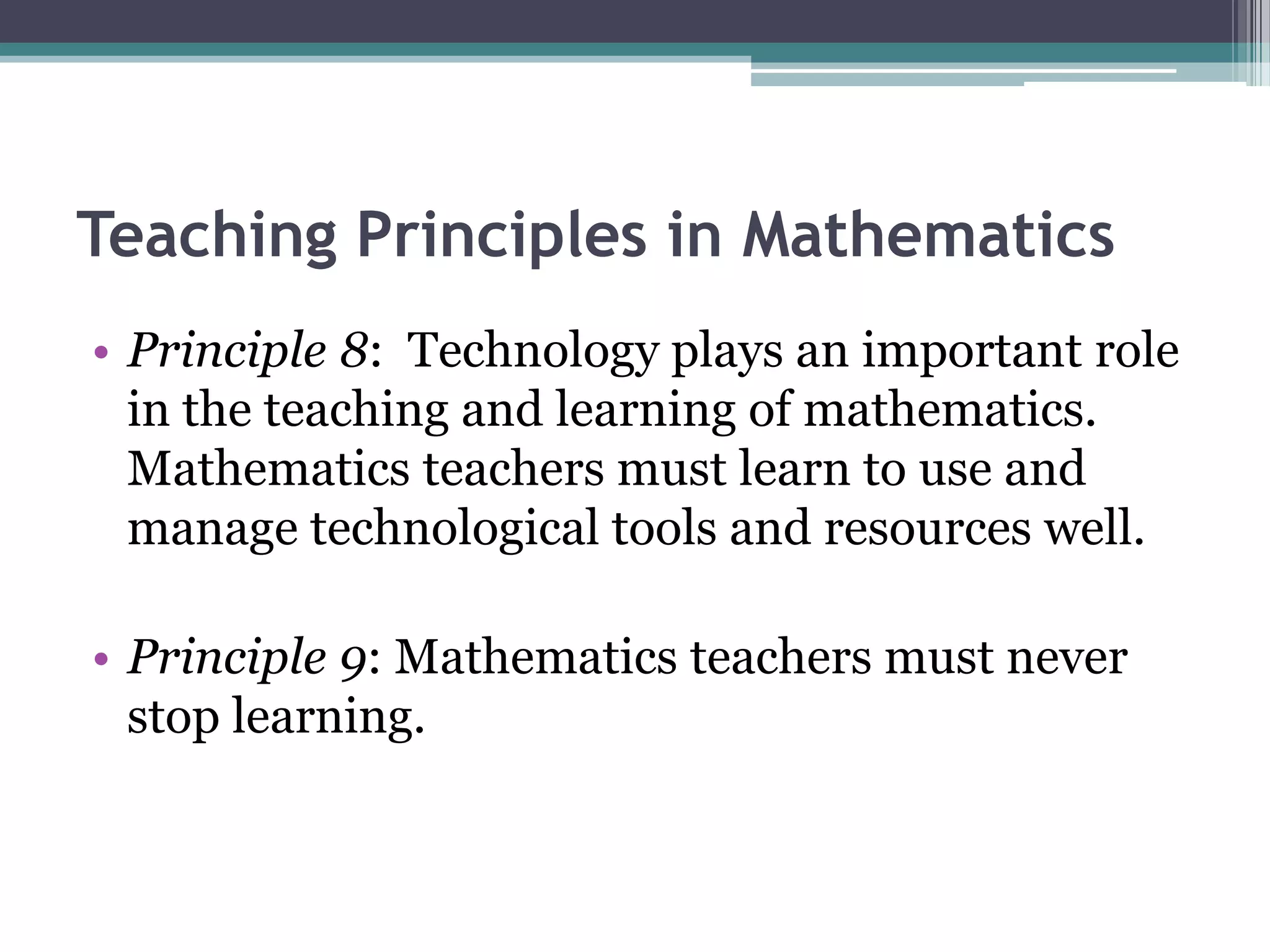
• Principle 8: Technology plays an important role
in the teaching and learning of mathematics.
Mathematics teachers must learn to use and
manage technological tools and resources well.
• Principle 9: Mathematics teachers must never
stop learning.
Learning Principles in Mathematics
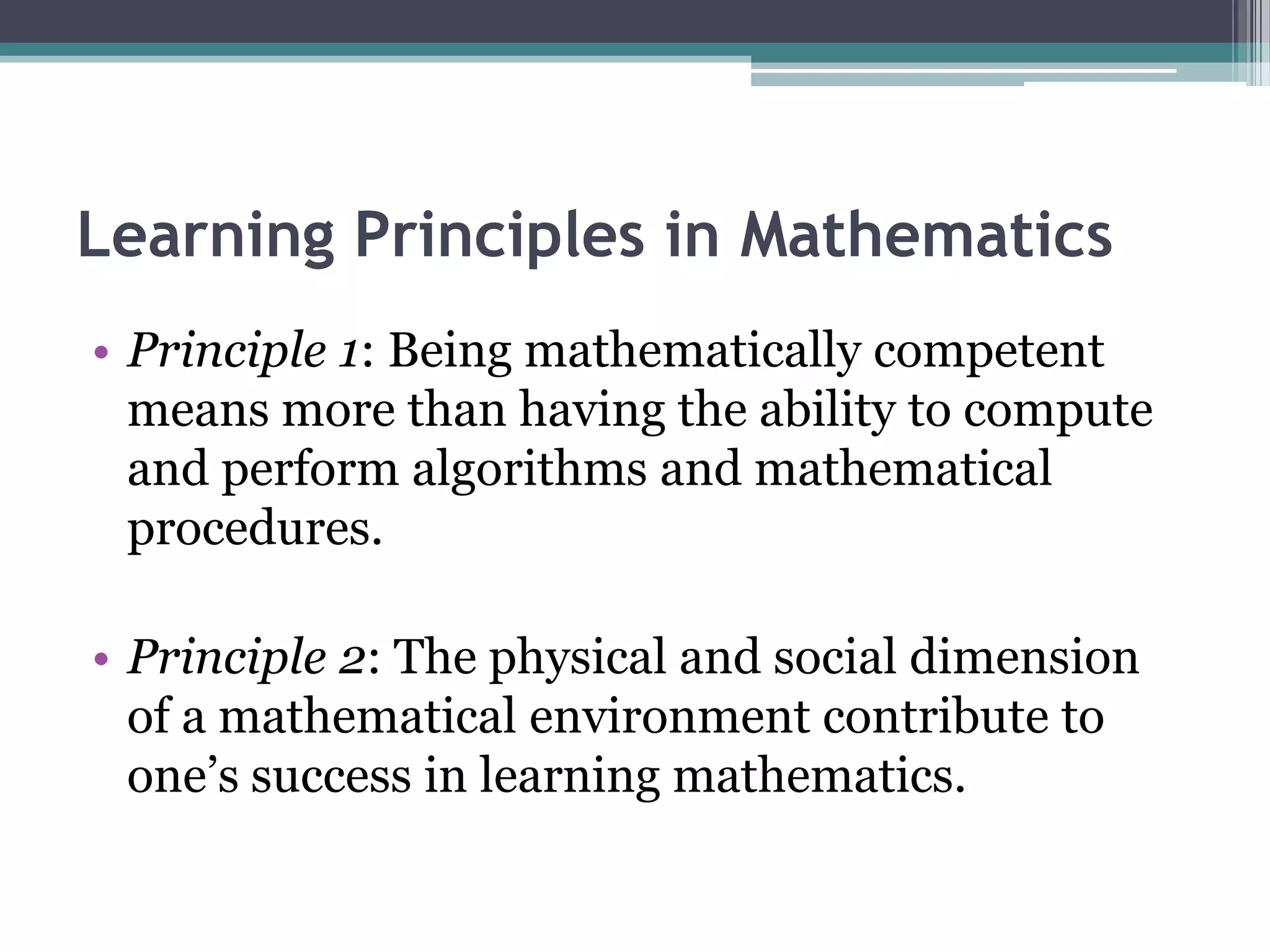
• Principle 1: Being mathematically competent
means more than having the ability to compute
and perform algorithms and mathematical
procedures.
• Principle 2: The physical and social dimension
of a mathematical environment contribute to
one’s success in learning mathematics.
Learning Principles in Mathematics
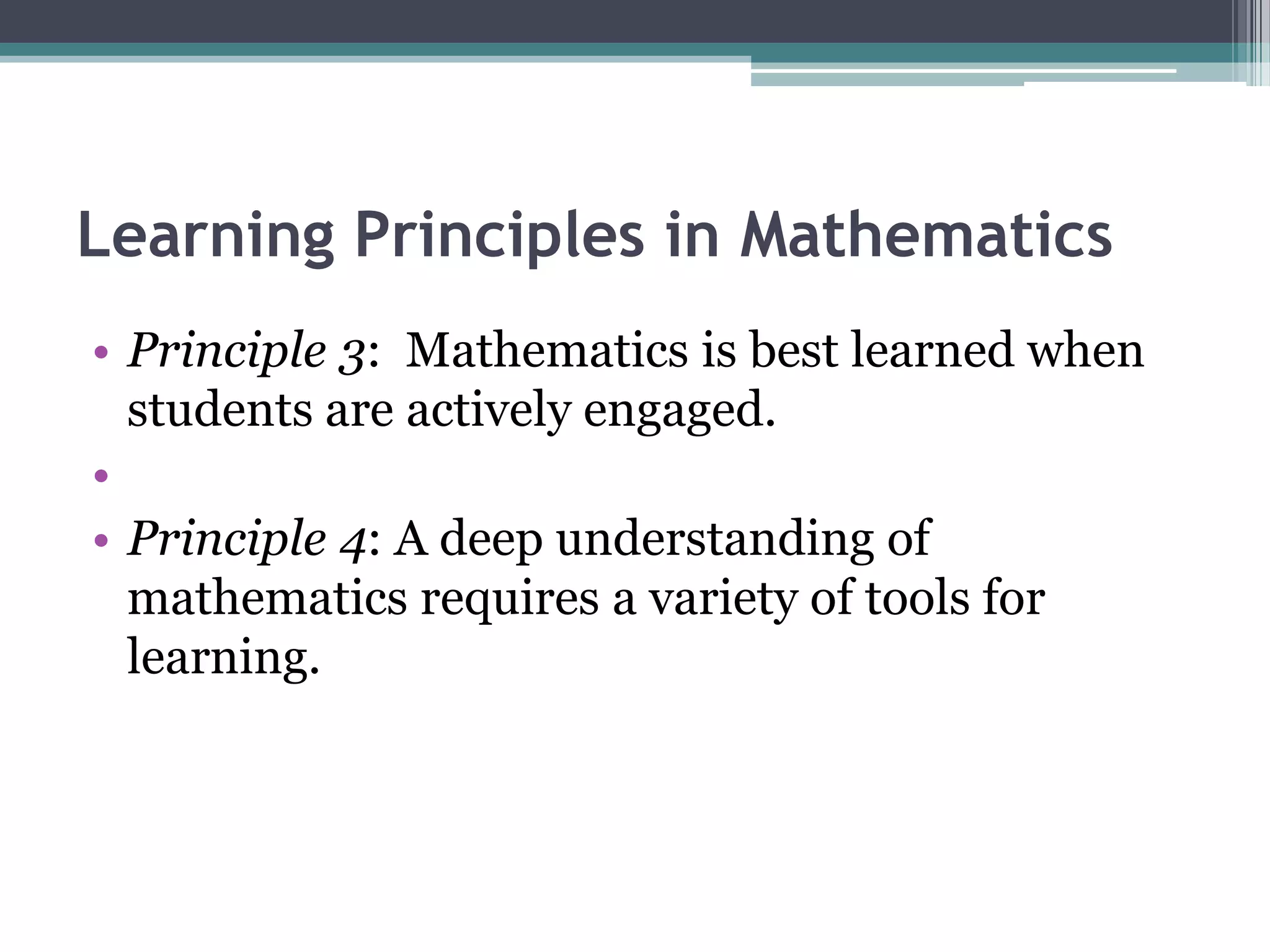
• Principle 3: Mathematics is best learned when
students are actively engaged.
•
• Principle 4: A deep understanding of
mathematics requires a variety of tools for
learning.
Learning Principles in Mathematics
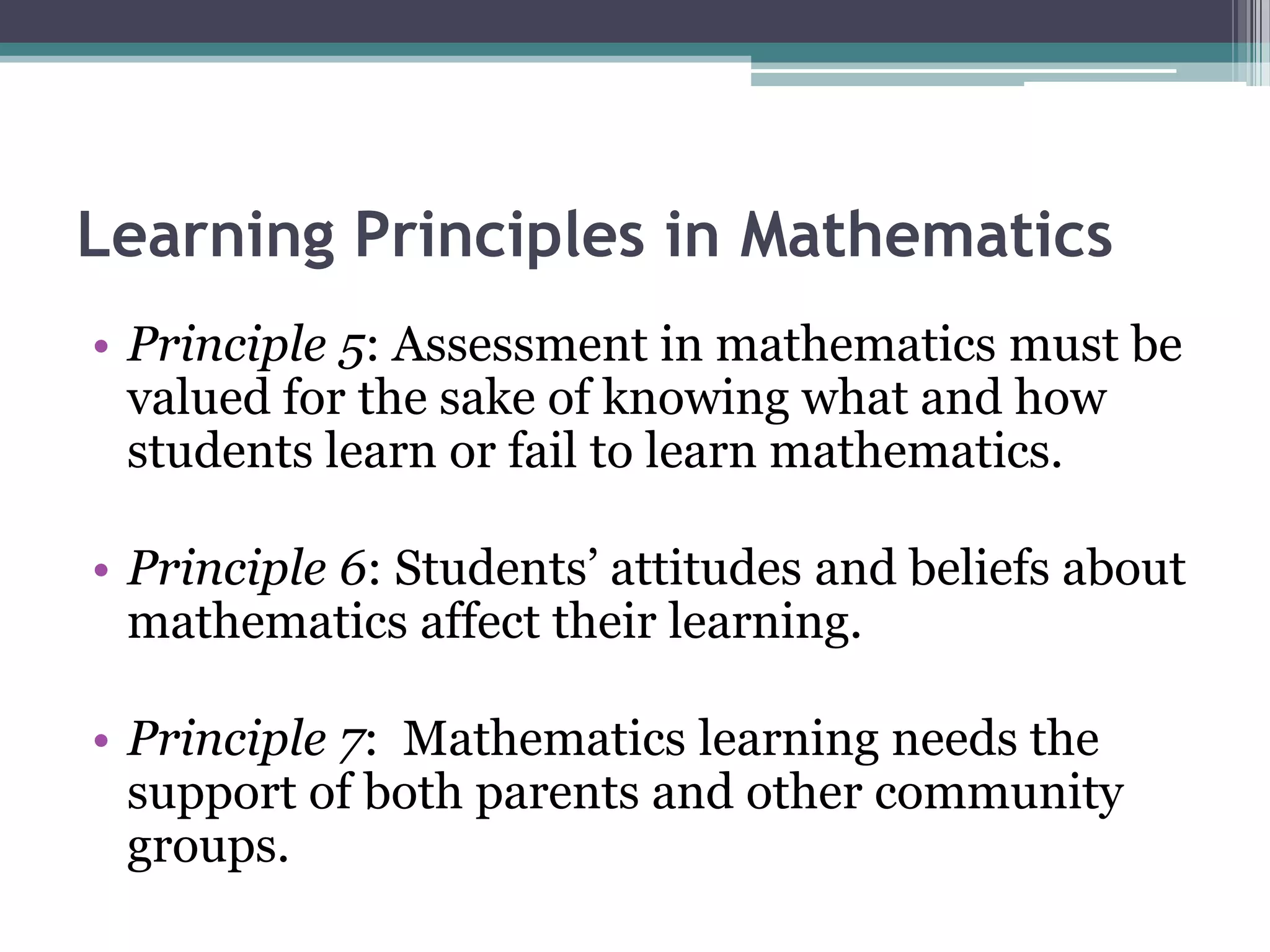
• Principle 5: Assessment in mathematics must be
valued for the sake of knowing what and how
students learn or fail to learn mathematics.
• Principle 6: Students’ attitudes and beliefs about
mathematics affect their learning.
• Principle 7: Mathematics learning needs the
support of both parents and other community
groups.
Learning Principles and Theories
• Experiential and Situated Learning
• Reflective Learning
• Constructivism
• Cooperative Learning
• Discovery and Inquiry-based Learning
Experiential and Situated Learning
• Experiential learning as advocated by David
Kolb is learning that occurs by making sense of
direct everyday experiences.
• Experiential learning theory defines learning as
"the process whereby knowledge is created
through the transformation of experience. “
• Knowledge results from the combination of
grasping and transforming experience"
(Kolb, 1984, p. 41).
Experiential and Situated Learning
• Situated learning, theorized by Lave and
Wenger, is learning in the same context on
which concepts and theories are applied.
Reflective Learning
• Reflective learning refers to learning that is
facilitated by reflective thinking.
• It is not enough that learners encounter real-life
situations.
• Deeper learning occurs when learners are able to
think about their experiences and process these
allowing them the opportunity to make sense
and meaning of their experiences.
Constructivism
• Constructivism is the theory that argues that
knowledge is constructed when the learner is
able to draw ideas from his own experiences and
connects them to new ideas that are
encountered.
Cooperative Learning
• Cooperative Learning puts premium on active
learning achieved by working with fellow
learners as they all engage in a shared task.
Discovery and Inquiry-based learning
• The mathematics curriculum allows for students
to learn by asking relevant questions and
discovering new ideas.
• Discovery and Inquiry-based learning (Bruner,
1961) support the idea that students learn when
they make use of personal experiences to
discover facts, relationships and concepts.
Experiential and Situated learning
• Ask students to record the time it takes them to
travel from home to school in minutes for one week.
• Tabulate the results
• Ask students to make interpretation
▫ Which days took the longest time? Why is this so?
▫ Which days took the shortest time? Why is this so?
• Open google maps and see how many kilometers is
the distance from your house to school.
• What is the average time required to get to school?
• How many minutes per kilometer does it take you to
travel?
Experiential and Situated learning
• Watch your favorite cartoons.
▫ Count all the words being said in the cartoons.
▫ How long is the cartoon in minutes?
▫ If the time of the cartoon is doubled, can you predict
the number of words that can be mentioned?
• If you talk in the telephone for a 10 minutes, what is
the estimated number if words you can use?
• If you need to tell your friend an important message
with 50 words, how much time will it require you to
tell him/her?
Experiential and Situated learning
• Measure how much volume can your bathroom
pail contain water.
• Determine the time it takes you to fill the pail.
• If you double the size of your pail, how much
time will you fill it?
• Take the time in consuming the one pail of water
when taking a bath. How many pails do you
consume?
• Given the pails of water you consume, estimate
how long you take a bath.
Experiential and Situated learning
• Ask students to collect their own data such as:
▫ weight of children in their barangay,
▫ number of people working in the community
▫ Students who had fever over the last month
▫ Number of households where things are stolen
• Summarize the data by reporting the:
▫ Histogram, line graph
▫ Mean, Median, mode
▫ Standard deviation, range, quartile deviation
• Ask students to make interpretation
Experiential and Situated learning
• Count the number of people who joined
“hueteng” in your community.
• Compute the chance of winning for each person.
• Judge whether there is a big chance of winning.
• Estimate the number of people who joins the
lotto each day.
• Compute the chance of winning for each person.
• Which game will give you a greater chance of
winning?
Experiential and Situated learning
• Count the set of pants and set of shirts you have at
home.
• Compute the number of combinations that you can
make each?
• Report how many days can you wear each
combination.
• Take a picture of each combination and put it in a
portfolio. Plan when you will wear each pair.
• When you ran out of combination how many pairs
do you still need to buy for the rest of the occasion
you need to wear a new set.
Experiential and Situated learning
• Participants will give their own example
Reflective Learning
• Use google maps and estimate the kilometers
from your house to where your father is working.
• Ask for the total amount spent when
commuting.
• Ask for the total amount spent when driving
your won car.
• Show your data to your father and recommend
which mode of transportation is better.
Reflective Learning
• Get the weight of each of your family members.
• Determine their ages and check who is
underweight and overweight.
• Given your data make recommendations on the
following:
▫ Money spent on food
▫ Menu for the week
▫ Exercise activities for the family
Reflective Learning
• Keep a journal and take note of all your travels
via plane.
• Jot down in the journal the time you spent in the
plane and the places you went.
• Summarize the following:
▫ What places took the longest plane ride? Why?
▫ What places took the shorted plane ride? Why?
▫ What is the relationship between time and
distance?
Reflective Learning
• Get the square meter of your land area.
• How much does your land cost?
• Get the square meter of other land areas.
• How much do they cost?
• Get the square meter of residential lands in the city.
How much do they cost.
• Compare the cost of equal land areas in the city and
in the province?
• Is there a difference? Why is this so?
• What do you need to do if you want to live in the
city?
Reflective Learning
• Count the total number of days your parents
played for the lotto. Compute how much money
did they spend for it?
• If they have not won anything, how much could
they have saved if they had not joined?
• Where could this money be spent?
• Provide a set of recommendations for your
parents given your predictions.
Reflective Learning
• Get a graph of the Philippine’s GDP from 2000
until 2013.
• What years is the GDP high? Years it is low?
• What inferences can you make about the present
situation compared to the past years?
• What events made the GDP high in those years?
• What events made the GDP low in those years?
• What projects should be engaged in order to
increase the GDP again?
Reflective Learning
• Participants will give their own example
Constructivism
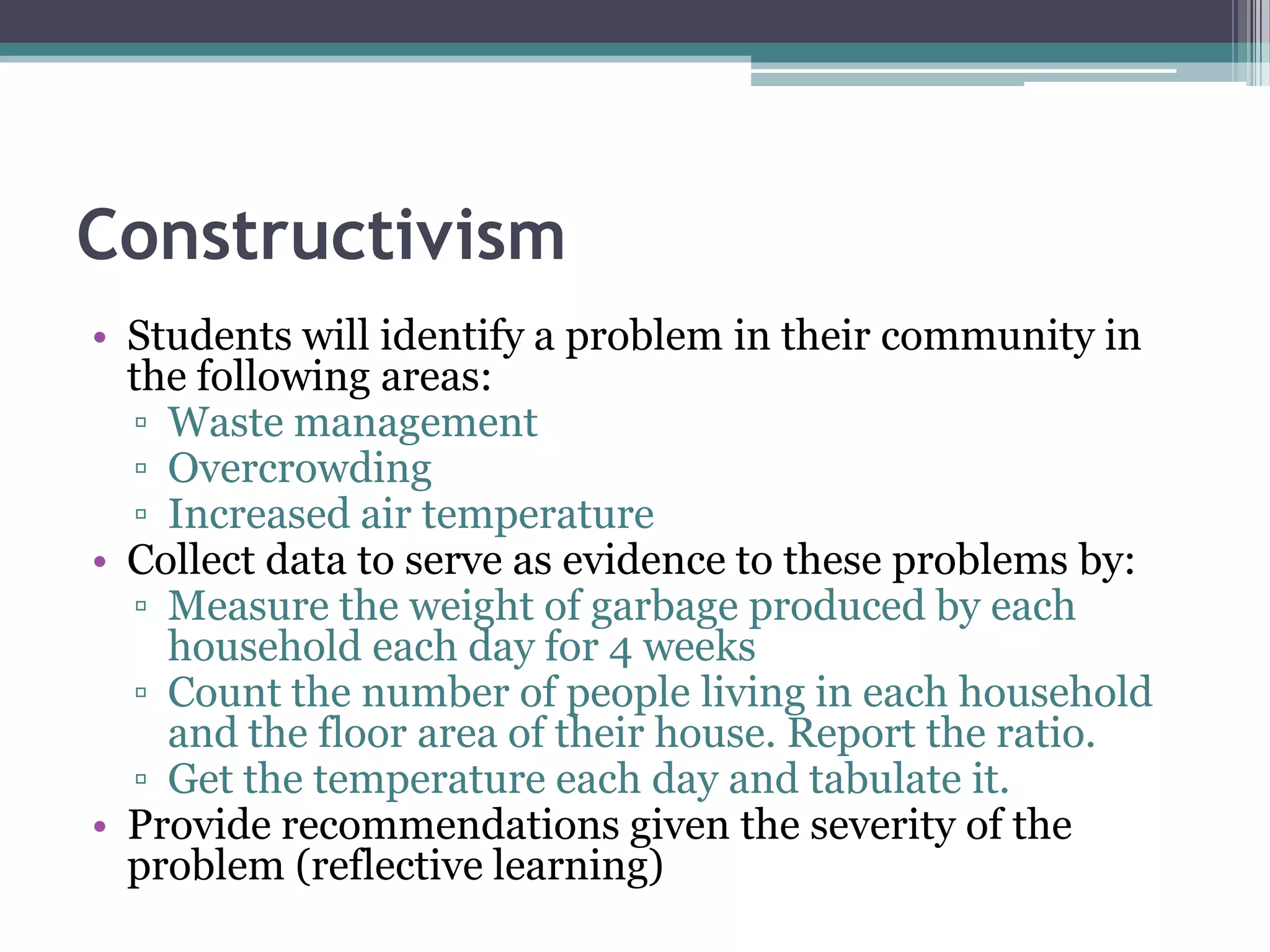
• Students will identify a problem in their community in
the following areas:
▫ Waste management
▫ Overcrowding
▫ Increased air temperature
• Collect data to serve as evidence to these problems by:
▫ Measure the weight of garbage produced by each
household each day for 4 weeks
▫ Count the number of people living in each household
and the floor area of their house. Report the ratio.
▫ Get the temperature each day and tabulate it.
• Provide recommendations given the severity of the
problem (reflective learning)
Constructivism
• What type of body pains did you experience as the
most painful? Why did you had such pain?
• List them down.
• For each pain indicate how painful it is using a scale
from 0 (no pain) to 10 (very painful)
• Ask your classmates to rate the list of pain you have.
• Get the average of the rating for each pain.
• Report the standard deviation.
• Given the SD are you all having a similar feeling for
each pain? (reflective learning)
Constructivism
• Measure the temperature for the months of April
and May.
• Go to the malls and ask some sales person which
types of clothes are bought and the quantity.
• Tabulate the number of purchases for each type
of clothes for each day and the temperature?
• What does the temperature got to do with the
type of clothes sold?
Constructivism
• What type of body pains did you experience as the
most painful? Why did you had such pain?
• List them down.
• For each pain indicate how painful it is using a scale
from 0 (no pain) to 10 (very painful)
• Ask your classmates to rate the list of pain you have.
• Get the average of the rating for each pain.
• Report the standard deviation.
• Given the SD are you all having a similar feeling for
each pain? (reflective learning)
Constructivism
• Make your own portfolio of the clothes you will
wear this summer.
• Which of these clothes is your favorite?
• Go to the malls and ask some sales person which
types of clothes are bought and the quantity.
• Tabulate the number of purchases for each type
of clothes. Report into percentage.
• Make a pie chart.
Constructivism
• Which model of cell phone do you have?
• What do you think is the best cell phone model?
• List down different cell phone models and count
the number of people in your community who
has it.
• Make a bar graph for each model of cell phone?
• Which one is the most in demand?
Constructivism
• Participants will provide their own example.
Cooperative Learning
• Form a group and each one will be assigned to a
place to take the air temperature for 7 days.
• Compare the temperature for each person.
• Why is there variation in the temperature?
• Report the findings.
Cooperative Learning
• Students form three groups and are assigned to
measure the floor area of the classroom.
• One group will only use a one inch paper clip.
• One group will use an 8 inches pencil.
• One group will use a 15 inches long stick.
• Which group do you think will measure the floor
area the fastest? Why?
Cooperative Learning
• Participants will provide their own example
Discovery and Inquiry-based
• Students will ask their parents at home the
different tools they use to measure length of
objects.
• The students will bring this material and
demonstrate to their classmates how the tools
are used.
Discovery and Inquiry-based
• Self-study on the procedure to convert oC to oF.
• Show how it is done in class
Discovery and Inquiry-based
• Self-study on the procedure to compute for the
mean, median and mode.
• Show how it is done in class
Discovery and Inquiry-based
• Participants will provide their own example
Insights

Teaching and learning framework in mathematics

  • 1.
    Teaching and Learning Frameworkin Mathematics Carlo Magno, PhD De La Salle University, Manila
  • 2.
    • What doyou think are the important skills that students needs to learn in mathematics?
  • 3.
    Goals of Mathematicseducation in the K to 12 Critical Thinking Problem Solving
  • 4.
    Critical Thinking • Intellectuallydisciplined process of actively and skillfully conceptualizing, applying, analyzing, synthesizin g, and/or evaluating information gathered from, or generated by, observation, experience, reflection, reasoning , or communication, as a guide to belief and action (Scriven & Paul, 1987).
  • 5.
    Problem solving • Findinga way around a difficulty, around an obstacle, and finding a solution to a problem that is unknown (Polya, 1945 & 1962).
  • 6.
    Content areas inthe curriculum • Numbers and Number Sense • Measurement • Geometry • Patterns and Algebra • Probability and Statistics
  • 7.
    Skills and processesto be developed • Knowing and Understanding • Estimating • Computing and Solving • Visualizing and Modelling • Representing and Communicating • Conjecturing • Reasoning • Proving and Decision-making • Applying and Connecting
  • 8.
    values and attitudes •Accuracy • Creativity • Objectivity • Perseverance • Productivity
  • 9.
    Tools in teachingmathematics • manipulative objects • measuring devices • calculators and computers • Smartphones and tablet PCs • Internet
  • 11.
    Teaching Principles inMathematics • Principle 1: While the ability to explain and solve a problem is evidence in good understanding of mathematical ideas, teaching mathematics requires more than this. • Principle 2: Mathematics must be real to students and therefore, mathematics teachers should be mindful of students contexts an when teaching mathematics.
  • 12.
    Teaching Principles inMathematics • Principle 3: Mathematics is best learned when students are actively engaged. • Principle 4: Mathematics can never be learned in an instant, but rather requires lots of work and the right attitude. • Principle 5: All students regardless of gender, culture, socio0economic status, religion, and educational background have the right and be taught good and correct mathematics.
  • 13.
    Teaching Principles inMathematics • Principle 6: Assessment must be an integral part of the mathematics instruction. • Principle 7: Mathematics as a field continues to develop and evolve. Therefore, the teaching if it must keep up with development in the field.
  • 14.
    Teaching Principles inMathematics • Principle 8: Technology plays an important role in the teaching and learning of mathematics. Mathematics teachers must learn to use and manage technological tools and resources well. • Principle 9: Mathematics teachers must never stop learning.
  • 15.
    Learning Principles inMathematics • Principle 1: Being mathematically competent means more than having the ability to compute and perform algorithms and mathematical procedures. • Principle 2: The physical and social dimension of a mathematical environment contribute to one’s success in learning mathematics.
  • 16.
    Learning Principles inMathematics • Principle 3: Mathematics is best learned when students are actively engaged. • • Principle 4: A deep understanding of mathematics requires a variety of tools for learning.
  • 17.
    Learning Principles inMathematics • Principle 5: Assessment in mathematics must be valued for the sake of knowing what and how students learn or fail to learn mathematics. • Principle 6: Students’ attitudes and beliefs about mathematics affect their learning. • Principle 7: Mathematics learning needs the support of both parents and other community groups.
  • 18.
    Learning Principles andTheories • Experiential and Situated Learning • Reflective Learning • Constructivism • Cooperative Learning • Discovery and Inquiry-based Learning
  • 19.
    Experiential and SituatedLearning • Experiential learning as advocated by David Kolb is learning that occurs by making sense of direct everyday experiences. • Experiential learning theory defines learning as "the process whereby knowledge is created through the transformation of experience. “ • Knowledge results from the combination of grasping and transforming experience" (Kolb, 1984, p. 41).
  • 20.
    Experiential and SituatedLearning • Situated learning, theorized by Lave and Wenger, is learning in the same context on which concepts and theories are applied.
  • 21.
    Reflective Learning • Reflectivelearning refers to learning that is facilitated by reflective thinking. • It is not enough that learners encounter real-life situations. • Deeper learning occurs when learners are able to think about their experiences and process these allowing them the opportunity to make sense and meaning of their experiences.
  • 22.
    Constructivism • Constructivism isthe theory that argues that knowledge is constructed when the learner is able to draw ideas from his own experiences and connects them to new ideas that are encountered.
  • 23.
    Cooperative Learning • CooperativeLearning puts premium on active learning achieved by working with fellow learners as they all engage in a shared task.
  • 24.
    Discovery and Inquiry-basedlearning • The mathematics curriculum allows for students to learn by asking relevant questions and discovering new ideas. • Discovery and Inquiry-based learning (Bruner, 1961) support the idea that students learn when they make use of personal experiences to discover facts, relationships and concepts.
  • 25.
    Experiential and Situatedlearning • Ask students to record the time it takes them to travel from home to school in minutes for one week. • Tabulate the results • Ask students to make interpretation ▫ Which days took the longest time? Why is this so? ▫ Which days took the shortest time? Why is this so? • Open google maps and see how many kilometers is the distance from your house to school. • What is the average time required to get to school? • How many minutes per kilometer does it take you to travel?
  • 26.
    Experiential and Situatedlearning • Watch your favorite cartoons. ▫ Count all the words being said in the cartoons. ▫ How long is the cartoon in minutes? ▫ If the time of the cartoon is doubled, can you predict the number of words that can be mentioned? • If you talk in the telephone for a 10 minutes, what is the estimated number if words you can use? • If you need to tell your friend an important message with 50 words, how much time will it require you to tell him/her?
  • 27.
    Experiential and Situatedlearning • Measure how much volume can your bathroom pail contain water. • Determine the time it takes you to fill the pail. • If you double the size of your pail, how much time will you fill it? • Take the time in consuming the one pail of water when taking a bath. How many pails do you consume? • Given the pails of water you consume, estimate how long you take a bath.
  • 28.
    Experiential and Situatedlearning • Ask students to collect their own data such as: ▫ weight of children in their barangay, ▫ number of people working in the community ▫ Students who had fever over the last month ▫ Number of households where things are stolen • Summarize the data by reporting the: ▫ Histogram, line graph ▫ Mean, Median, mode ▫ Standard deviation, range, quartile deviation • Ask students to make interpretation
  • 29.
    Experiential and Situatedlearning • Count the number of people who joined “hueteng” in your community. • Compute the chance of winning for each person. • Judge whether there is a big chance of winning. • Estimate the number of people who joins the lotto each day. • Compute the chance of winning for each person. • Which game will give you a greater chance of winning?
  • 30.
    Experiential and Situatedlearning • Count the set of pants and set of shirts you have at home. • Compute the number of combinations that you can make each? • Report how many days can you wear each combination. • Take a picture of each combination and put it in a portfolio. Plan when you will wear each pair. • When you ran out of combination how many pairs do you still need to buy for the rest of the occasion you need to wear a new set.
  • 31.
    Experiential and Situatedlearning • Participants will give their own example
  • 32.
    Reflective Learning • Usegoogle maps and estimate the kilometers from your house to where your father is working. • Ask for the total amount spent when commuting. • Ask for the total amount spent when driving your won car. • Show your data to your father and recommend which mode of transportation is better.
  • 33.
    Reflective Learning • Getthe weight of each of your family members. • Determine their ages and check who is underweight and overweight. • Given your data make recommendations on the following: ▫ Money spent on food ▫ Menu for the week ▫ Exercise activities for the family
  • 34.
    Reflective Learning • Keepa journal and take note of all your travels via plane. • Jot down in the journal the time you spent in the plane and the places you went. • Summarize the following: ▫ What places took the longest plane ride? Why? ▫ What places took the shorted plane ride? Why? ▫ What is the relationship between time and distance?
  • 35.
    Reflective Learning • Getthe square meter of your land area. • How much does your land cost? • Get the square meter of other land areas. • How much do they cost? • Get the square meter of residential lands in the city. How much do they cost. • Compare the cost of equal land areas in the city and in the province? • Is there a difference? Why is this so? • What do you need to do if you want to live in the city?
  • 36.
    Reflective Learning • Countthe total number of days your parents played for the lotto. Compute how much money did they spend for it? • If they have not won anything, how much could they have saved if they had not joined? • Where could this money be spent? • Provide a set of recommendations for your parents given your predictions.
  • 37.
    Reflective Learning • Geta graph of the Philippine’s GDP from 2000 until 2013. • What years is the GDP high? Years it is low? • What inferences can you make about the present situation compared to the past years? • What events made the GDP high in those years? • What events made the GDP low in those years? • What projects should be engaged in order to increase the GDP again?
  • 38.
    Reflective Learning • Participantswill give their own example
  • 39.
    Constructivism • Students willidentify a problem in their community in the following areas: ▫ Waste management ▫ Overcrowding ▫ Increased air temperature • Collect data to serve as evidence to these problems by: ▫ Measure the weight of garbage produced by each household each day for 4 weeks ▫ Count the number of people living in each household and the floor area of their house. Report the ratio. ▫ Get the temperature each day and tabulate it. • Provide recommendations given the severity of the problem (reflective learning)
  • 40.
    Constructivism • What typeof body pains did you experience as the most painful? Why did you had such pain? • List them down. • For each pain indicate how painful it is using a scale from 0 (no pain) to 10 (very painful) • Ask your classmates to rate the list of pain you have. • Get the average of the rating for each pain. • Report the standard deviation. • Given the SD are you all having a similar feeling for each pain? (reflective learning)
  • 41.
    Constructivism • Measure thetemperature for the months of April and May. • Go to the malls and ask some sales person which types of clothes are bought and the quantity. • Tabulate the number of purchases for each type of clothes for each day and the temperature? • What does the temperature got to do with the type of clothes sold?
  • 42.
    Constructivism • What typeof body pains did you experience as the most painful? Why did you had such pain? • List them down. • For each pain indicate how painful it is using a scale from 0 (no pain) to 10 (very painful) • Ask your classmates to rate the list of pain you have. • Get the average of the rating for each pain. • Report the standard deviation. • Given the SD are you all having a similar feeling for each pain? (reflective learning)
  • 43.
    Constructivism • Make yourown portfolio of the clothes you will wear this summer. • Which of these clothes is your favorite? • Go to the malls and ask some sales person which types of clothes are bought and the quantity. • Tabulate the number of purchases for each type of clothes. Report into percentage. • Make a pie chart.
  • 44.
    Constructivism • Which modelof cell phone do you have? • What do you think is the best cell phone model? • List down different cell phone models and count the number of people in your community who has it. • Make a bar graph for each model of cell phone? • Which one is the most in demand?
  • 45.
    Constructivism • Participants willprovide their own example.
  • 46.
    Cooperative Learning • Forma group and each one will be assigned to a place to take the air temperature for 7 days. • Compare the temperature for each person. • Why is there variation in the temperature? • Report the findings.
  • 47.
    Cooperative Learning • Studentsform three groups and are assigned to measure the floor area of the classroom. • One group will only use a one inch paper clip. • One group will use an 8 inches pencil. • One group will use a 15 inches long stick. • Which group do you think will measure the floor area the fastest? Why?
  • 48.
    Cooperative Learning • Participantswill provide their own example
  • 49.
    Discovery and Inquiry-based •Students will ask their parents at home the different tools they use to measure length of objects. • The students will bring this material and demonstrate to their classmates how the tools are used.
  • 50.
    Discovery and Inquiry-based •Self-study on the procedure to convert oC to oF. • Show how it is done in class
  • 51.
    Discovery and Inquiry-based •Self-study on the procedure to compute for the mean, median and mode. • Show how it is done in class
  • 52.
    Discovery and Inquiry-based •Participants will provide their own example
  • 53.