TCP/IP MODEL
TCP/IP MODEL
• The TCP/IP model is a framework for computer network
communication protocols. It was developed in the 1970s by
DARPA (Defense Advanced Research Projects Agency),(‫آژانس‬
‫دفاعی‬ ‫پیشرفتۀ‬ ‫‌های‬
‫ه‬‫)پروژ‬ a branch of the U.S. Department of Defense.
This model provided the foundation for ARPANET, the world’s first
wide area network (WAN), which later evolved into the modern
Internet.
What Does TCP/IP Do?
• The main purpose of TCP/IP is to allow data to be sent from one
computer (or device) to another across a network.
• To make sure this process is reliable and accurate, TCP/IP
ensures that:
• The receiver gets exactly the same information as the sender
transmitted.
• The data is divided into small packets before transmission.
• These packets travel independently through the network and are
reassembled at the destination in the correct order
Layers in the TCP/IP Model
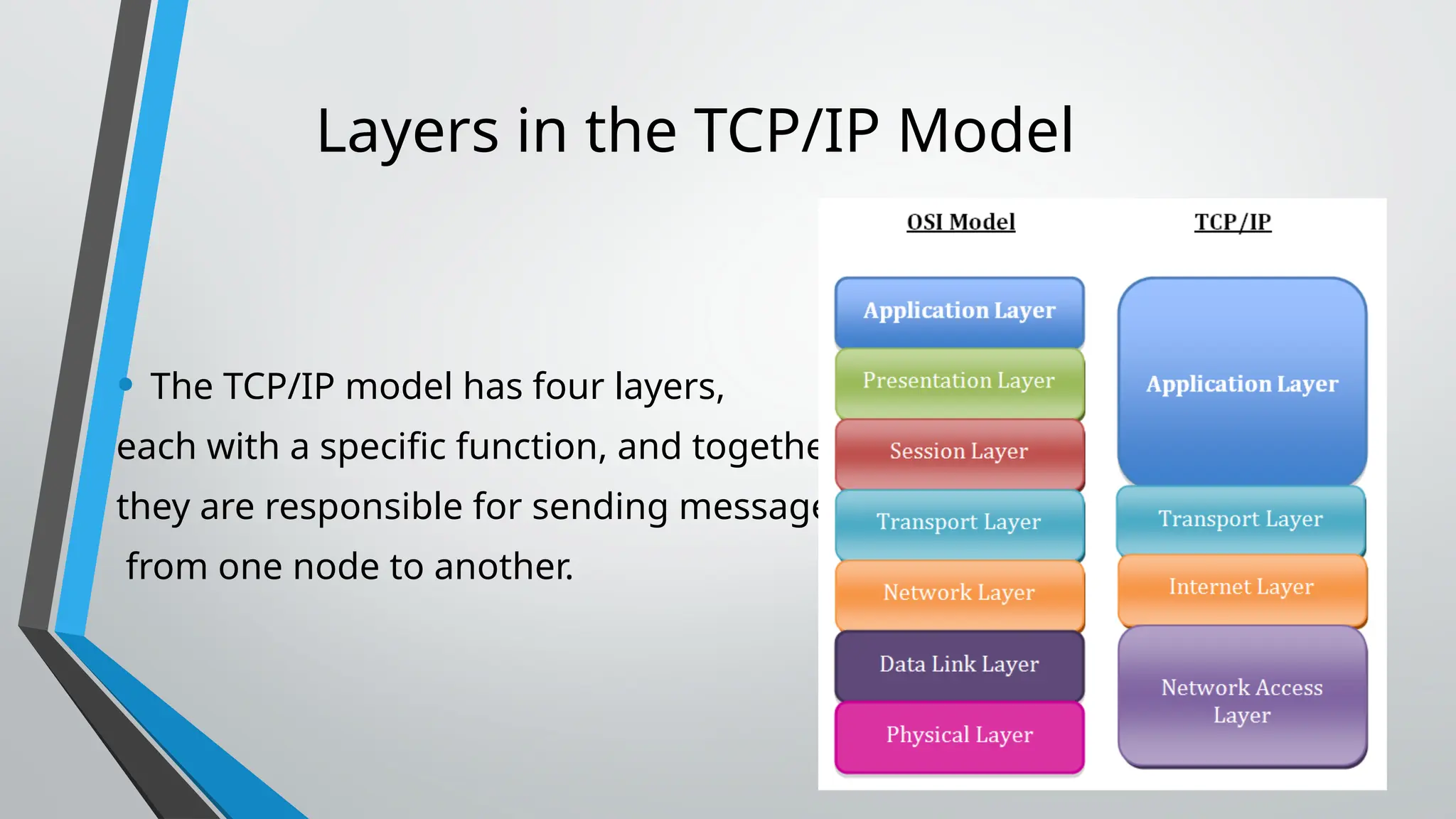
• The TCP/IP model has four layers,
each with a specific function, and together
they are responsible for sending messages
from one node to another.
TCP/IP Application Layer
• The Application Layer provides services to application software
running on a computer.
• It helps applications (like Email, Web, FTP) communicate over the
network.
• Applications are identified using Port Numbers (e.g., HTTP Port
→
80, HTTPS Port 443).
→
Cont.…
• The various protocols that are used at the Application Layer are:
• FTP (File Transfer Protocol):
• A protocol used for exchanging files over the Internet
• Commonly used to download files from a server or upload files
to a server.
• HTTP (HyperText Transfer Protocol):
• The main protocol used by the World Wide Web.
• Function: Defines how messages are formatted, transmitted,
and how web servers and browsers respond to commands.
• Example: Entering a URL in the browser sends an HTTP request to
the web server to fetch the web page.
• Port Number: 80
Cont.…
• HTTPS (HTTP Secure):
• Secure version of HTTP; encrypts data for safe web communication.
• Port Number: 443
• SMTP (Simple Mail Transfer Protocol):
• Sends email messages between servers or from a mail client to a
server.
• Port Number: 25
• POP3 (Post Office Protocol 3):
• Retrieves emails from a mail server to a client’s computer.
• Port Number: 110
Transport Layer
• Responsible for end-to-end communication, ensuring packets arrive in
order and without errors.
• Acknowledgments are exchanged, and missing packets are
retransmitted.
• Protocols at this layer: TCP and UDP.
The two most important protocols employed at this layer are the
• TCP
• UDP
Cont..
• TCP (Transmission Control Protocol):
• Provides reliable, full-duplex connections between hosts.
• Ensures data is retransmitted if transmission errors occur (end-to-
end error detection and correction).
• 2. UDP (User Datagram Protocol):
• Provides unreliable, connectionless service when error correction
is not required.
• Increases network throughput at the host-to-host transport layer.
• Primarily used for broadcasting messages over a network or real-
time applications like video streaming and online gaming.
Internet Layer
• The Internet Layer is responsible for packet delivery across
TCP/IP networks.
• Uses logical host addresses (IP addresses) to identify devices.
• All data in TCP/IP flows through IP to reach its destination.
Cont..
• IP (Internet Protocol):
Delivers data packets from the source host to the destination host.
Uses IP addresses to identify devices and determine the route for the packets.
• ARP (Address Resolution Protocol):
Converts a known IP address into a physical (MAC) address.
Ensures data is sent to the correct device on the local network.
• RARP (Reverse Address Resolution Protocol):
Converts a physical (MAC) address into an IP address.
Helps devices determine their IP address when only the hardware address is known.
• ICMP (Internet Control Message Protocol)
Sends error and control messages in the network.
Destination unreachable, Time exceeded , Network congestion or routing issues
Network Access Layer
• Lowest layer in the TCP/IP model.
• Purpose: Contains protocols that allow a computer to deliver
data to other devices on the network.
• Data exchange: Handles data exchange between the computer
and the physical network.
• Device-to-device delivery: Delivers data between two devices on
the same network using the physical (MAC) address.
END

TCPipmodel.pptx Layers in the TCP/IP Model

  • 1.
  • 2.
    TCP/IP MODEL • TheTCP/IP model is a framework for computer network communication protocols. It was developed in the 1970s by DARPA (Defense Advanced Research Projects Agency),(‫آژانس‬ ‫دفاعی‬ ‫پیشرفتۀ‬ ‫‌های‬ ‫ه‬‫)پروژ‬ a branch of the U.S. Department of Defense. This model provided the foundation for ARPANET, the world’s first wide area network (WAN), which later evolved into the modern Internet.
  • 3.
    What Does TCP/IPDo? • The main purpose of TCP/IP is to allow data to be sent from one computer (or device) to another across a network. • To make sure this process is reliable and accurate, TCP/IP ensures that: • The receiver gets exactly the same information as the sender transmitted. • The data is divided into small packets before transmission. • These packets travel independently through the network and are reassembled at the destination in the correct order
  • 4.
    Layers in theTCP/IP Model • The TCP/IP model has four layers, each with a specific function, and together they are responsible for sending messages from one node to another.
  • 5.
    TCP/IP Application Layer •The Application Layer provides services to application software running on a computer. • It helps applications (like Email, Web, FTP) communicate over the network. • Applications are identified using Port Numbers (e.g., HTTP Port → 80, HTTPS Port 443). →
  • 6.
    Cont.… • The variousprotocols that are used at the Application Layer are: • FTP (File Transfer Protocol): • A protocol used for exchanging files over the Internet • Commonly used to download files from a server or upload files to a server. • HTTP (HyperText Transfer Protocol): • The main protocol used by the World Wide Web. • Function: Defines how messages are formatted, transmitted, and how web servers and browsers respond to commands. • Example: Entering a URL in the browser sends an HTTP request to the web server to fetch the web page. • Port Number: 80
  • 7.
    Cont.… • HTTPS (HTTPSecure): • Secure version of HTTP; encrypts data for safe web communication. • Port Number: 443 • SMTP (Simple Mail Transfer Protocol): • Sends email messages between servers or from a mail client to a server. • Port Number: 25 • POP3 (Post Office Protocol 3): • Retrieves emails from a mail server to a client’s computer. • Port Number: 110
  • 8.
    Transport Layer • Responsiblefor end-to-end communication, ensuring packets arrive in order and without errors. • Acknowledgments are exchanged, and missing packets are retransmitted. • Protocols at this layer: TCP and UDP. The two most important protocols employed at this layer are the • TCP • UDP
  • 9.
    Cont.. • TCP (TransmissionControl Protocol): • Provides reliable, full-duplex connections between hosts. • Ensures data is retransmitted if transmission errors occur (end-to- end error detection and correction). • 2. UDP (User Datagram Protocol): • Provides unreliable, connectionless service when error correction is not required. • Increases network throughput at the host-to-host transport layer. • Primarily used for broadcasting messages over a network or real- time applications like video streaming and online gaming.
  • 10.
    Internet Layer • TheInternet Layer is responsible for packet delivery across TCP/IP networks. • Uses logical host addresses (IP addresses) to identify devices. • All data in TCP/IP flows through IP to reach its destination.
  • 11.
    Cont.. • IP (InternetProtocol): Delivers data packets from the source host to the destination host. Uses IP addresses to identify devices and determine the route for the packets. • ARP (Address Resolution Protocol): Converts a known IP address into a physical (MAC) address. Ensures data is sent to the correct device on the local network. • RARP (Reverse Address Resolution Protocol): Converts a physical (MAC) address into an IP address. Helps devices determine their IP address when only the hardware address is known. • ICMP (Internet Control Message Protocol) Sends error and control messages in the network. Destination unreachable, Time exceeded , Network congestion or routing issues
  • 12.
    Network Access Layer •Lowest layer in the TCP/IP model. • Purpose: Contains protocols that allow a computer to deliver data to other devices on the network. • Data exchange: Handles data exchange between the computer and the physical network. • Device-to-device delivery: Delivers data between two devices on the same network using the physical (MAC) address.
  • 13.