Synchronization problem with Threads
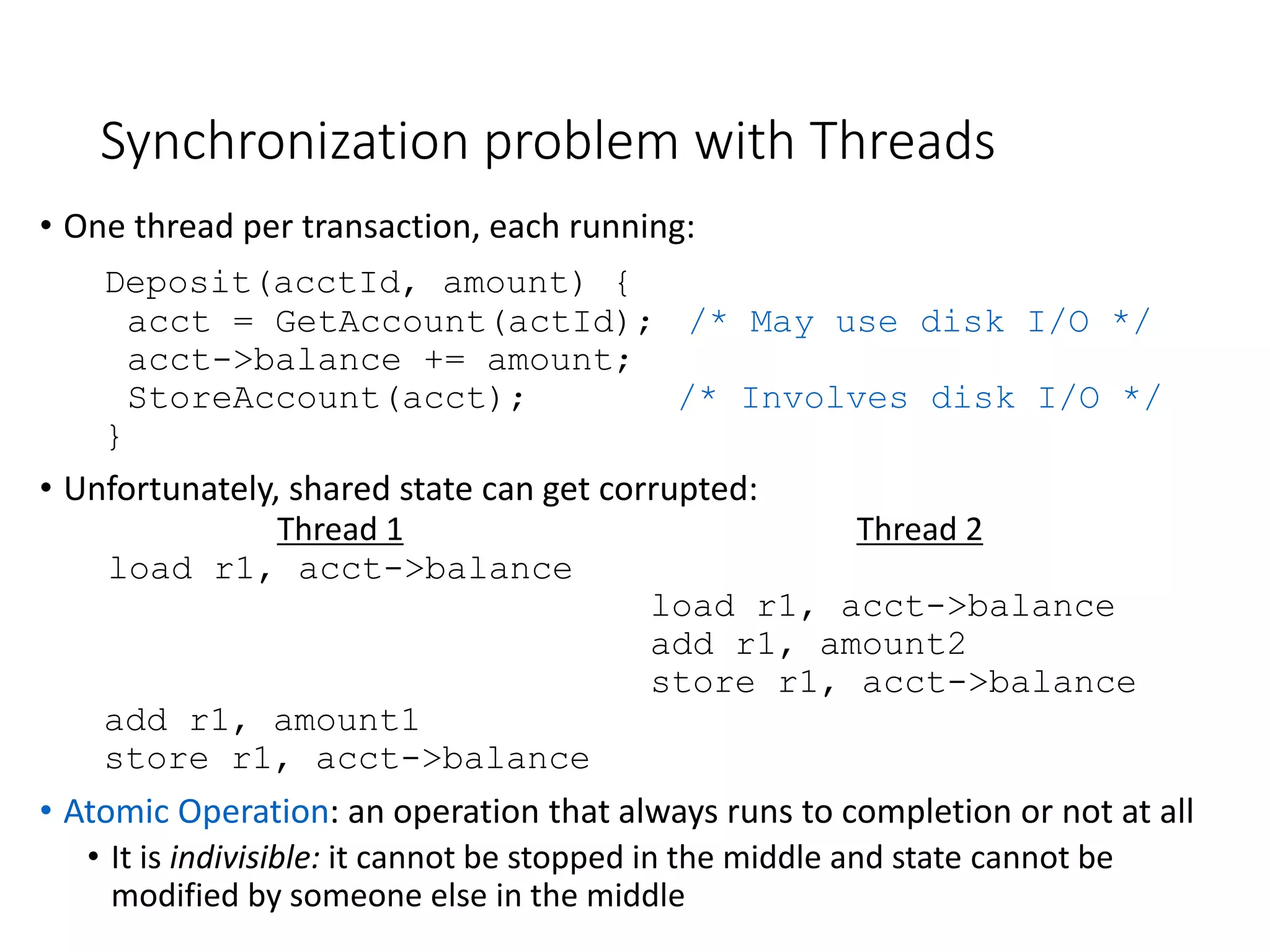
• One thread per transaction, each running:
Deposit(acctId, amount) {
acct = GetAccount(actId); /* May use disk I/O */
acct->balance += amount;
StoreAccount(acct); /* Involves disk I/O */
}
• Unfortunately, shared state can get corrupted:
Thread 1 Thread 2
load r1, acct->balance
add r1, amount2
store r1, acct->balance
add r1, amount1
store r1, acct->balance
• Atomic Operation: an operation that always runs to completion or not at all
• It is indivisible: it cannot be stopped in the middle and state cannot be
modified by someone else in the middle
Review: Too Much Milk Solution #3
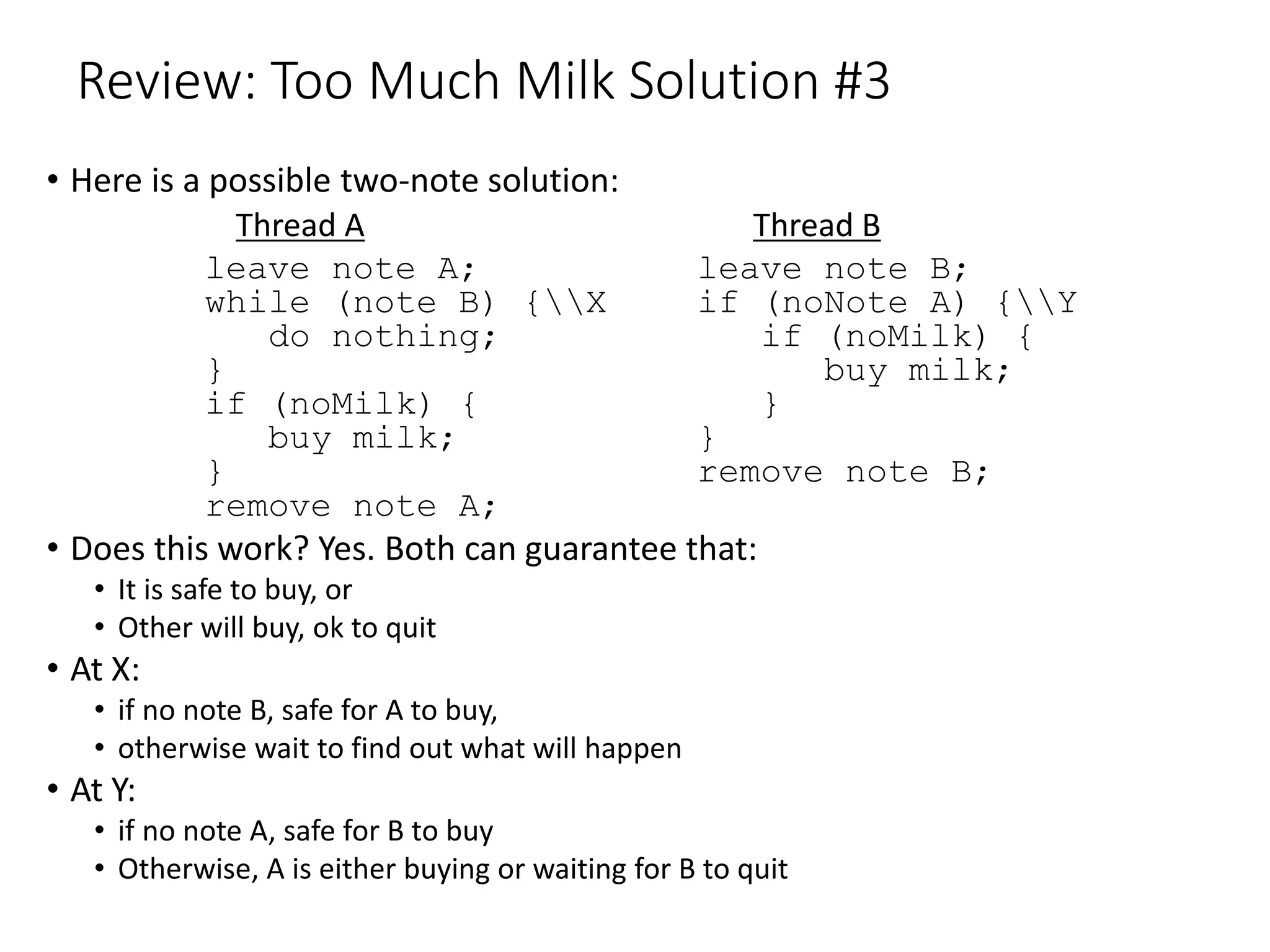
• Here is a possible two-note solution:
Thread A Thread B
leave note A; leave note B;
while (note B) {X if (noNote A) {Y
do nothing; if (noMilk) {
} buy milk;
if (noMilk) { }
buy milk; }
} remove note B;
remove note A;
• Does this work? Yes. Both can guarantee that:
• It is safe to buy, or
• Other will buy, ok to quit
• At X:
• if no note B, safe for A to buy,
• otherwise wait to find out what will happen
• At Y:
• if no note A, safe for B to buy
• Otherwise, A is either buying or waiting for B to quit
Goals for Today
• Hardware Support for Synchronization
• Higher-level Synchronization Abstractions
• Semaphores, monitors, and condition variables
• Programming paradigms for concurrent programs
Note: Some slides and/or pictures in the following are
adapted from slides ©2005 Silberschatz, Galvin, and Gagne
Note: Some slides and/or pictures in the following are
adapted from slides ©2005 Silberschatz, Galvin, and Gagne. Many slides
generated from my lecture notes by Prof. John Kubiatowicz of MIT.
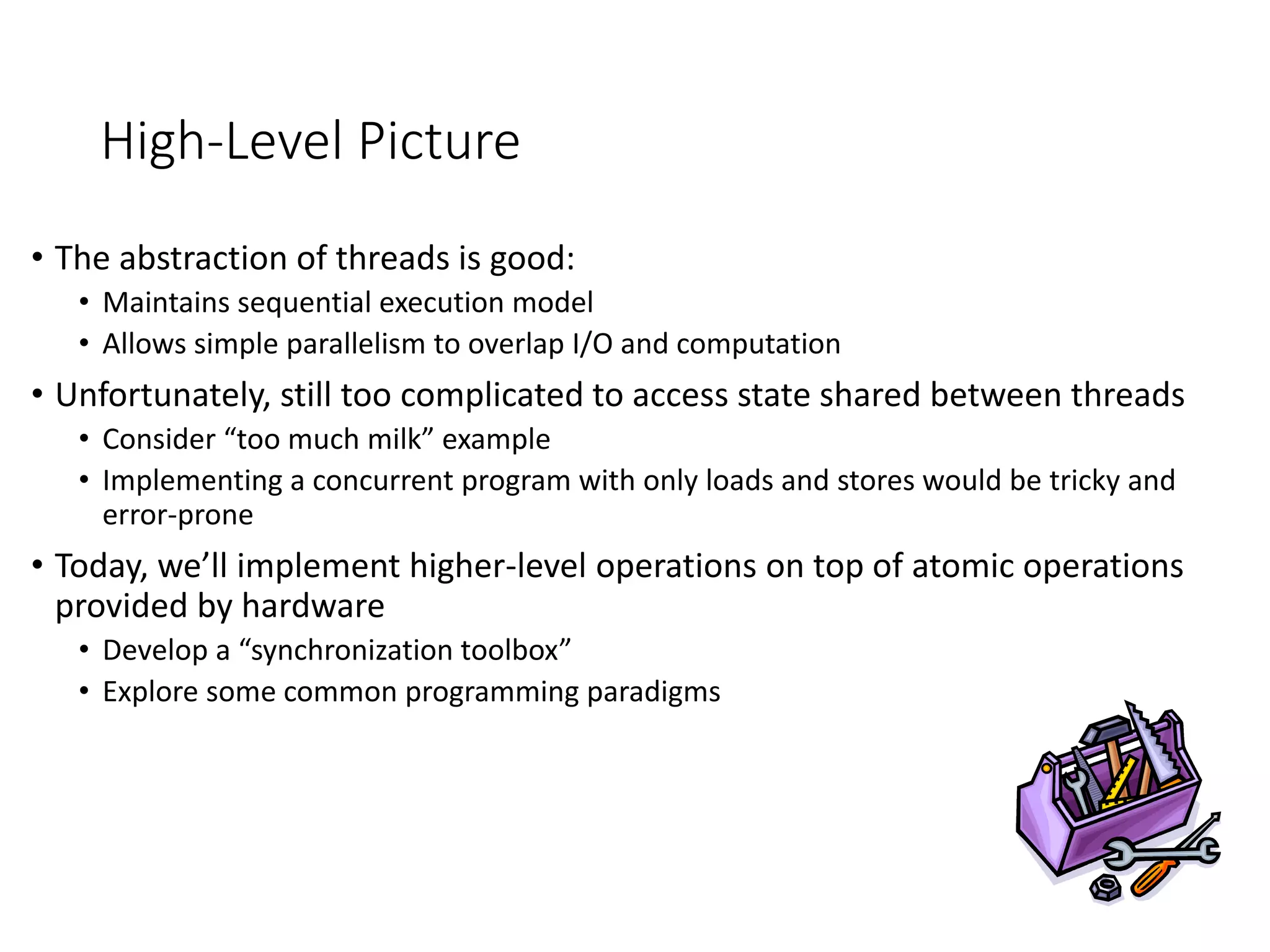
High-Level Picture
• The abstraction of threads is good:
• Maintains sequential execution model
• Allows simple parallelism to overlap I/O and computation
• Unfortunately, still too complicated to access state shared between threads
• Consider “too much milk” example
• Implementing a concurrent program with only loads and stores would be tricky and
error-prone
• Today, we’ll implement higher-level operations on top of atomic operations
provided by hardware
• Develop a “synchronization toolbox”
• Explore some common programming paradigms
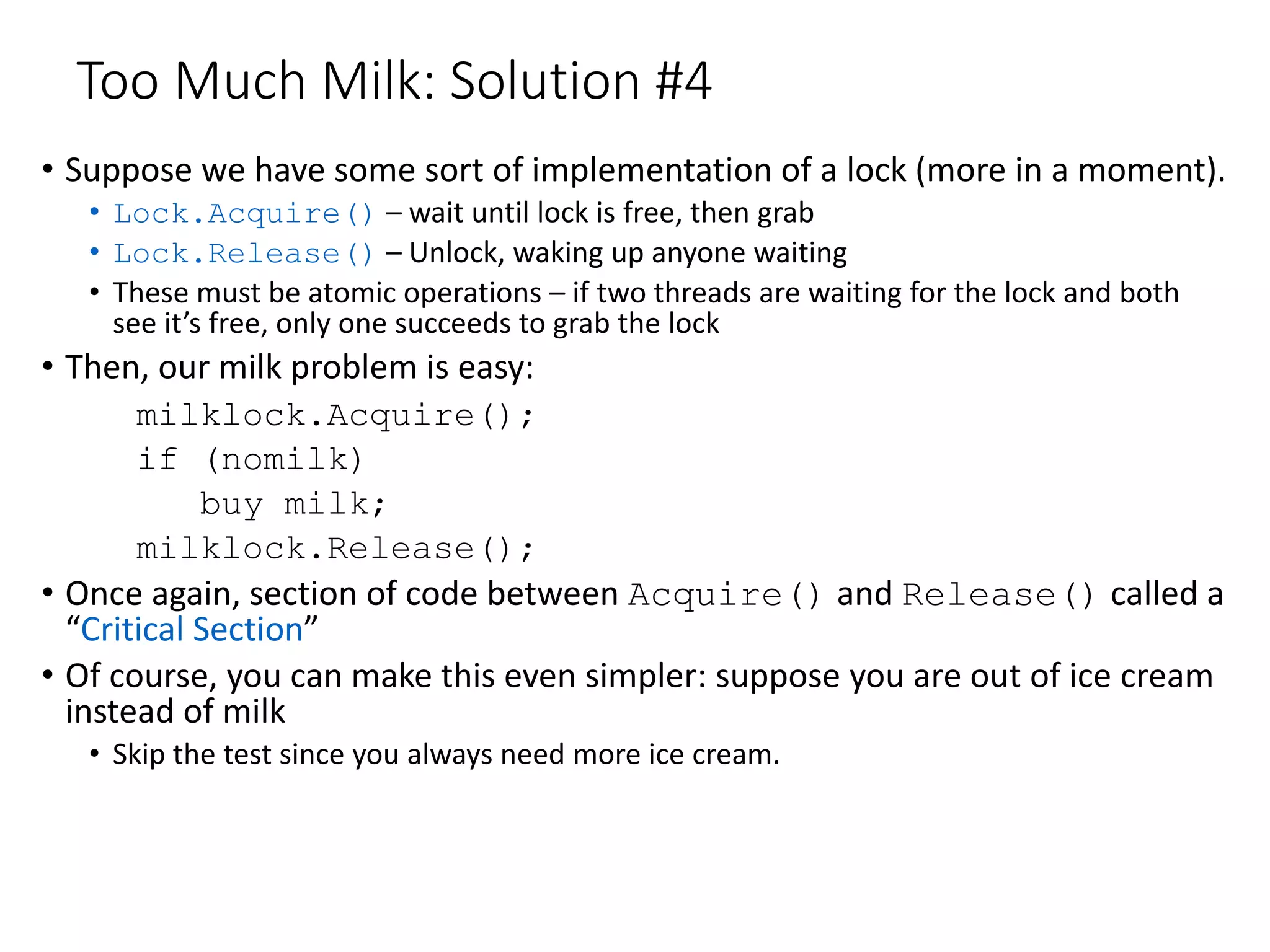
Too Much Milk: Solution #4
• Suppose we have some sort of implementation of a lock (more in a moment).
• Lock.Acquire() – wait until lock is free, then grab
• Lock.Release() – Unlock, waking up anyone waiting
• These must be atomic operations – if two threads are waiting for the lock and both
see it’s free, only one succeeds to grab the lock
• Then, our milk problem is easy:
milklock.Acquire();
if (nomilk)
buy milk;
milklock.Release();
• Once again, section of code between Acquire() and Release() called a
“Critical Section”
• Of course, you can make this even simpler: suppose you are out of ice cream
instead of milk
• Skip the test since you always need more ice cream.
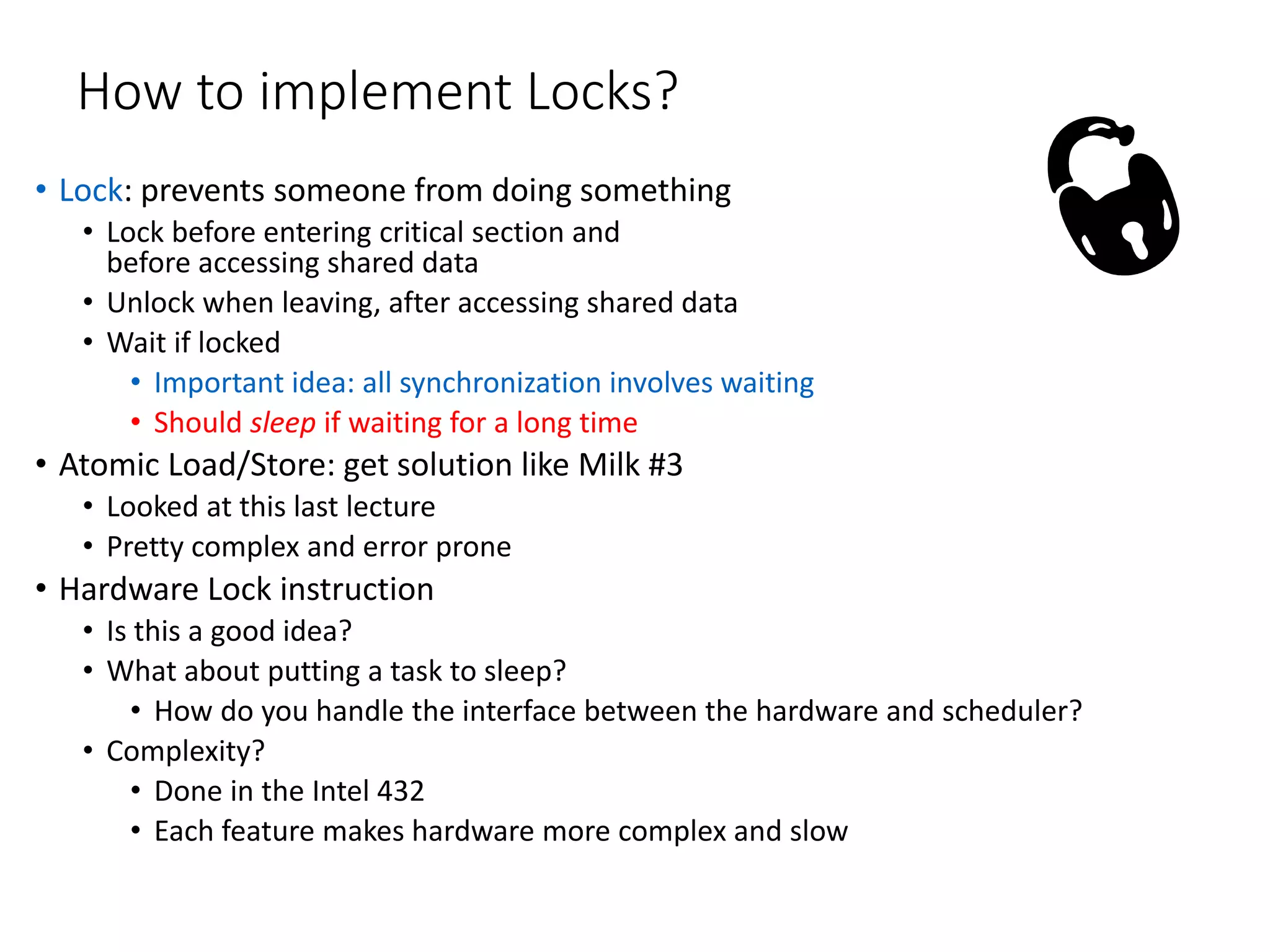
How to implement Locks?
• Lock: prevents someone from doing something
• Lock before entering critical section and
before accessing shared data
• Unlock when leaving, after accessing shared data
• Wait if locked
• Important idea: all synchronization involves waiting
• Should sleep if waiting for a long time
• Atomic Load/Store: get solution like Milk #3
• Looked at this last lecture
• Pretty complex and error prone
• Hardware Lock instruction
• Is this a good idea?
• What about putting a task to sleep?
• How do you handle the interface between the hardware and scheduler?
• Complexity?
• Done in the Intel 432
• Each feature makes hardware more complex and slow
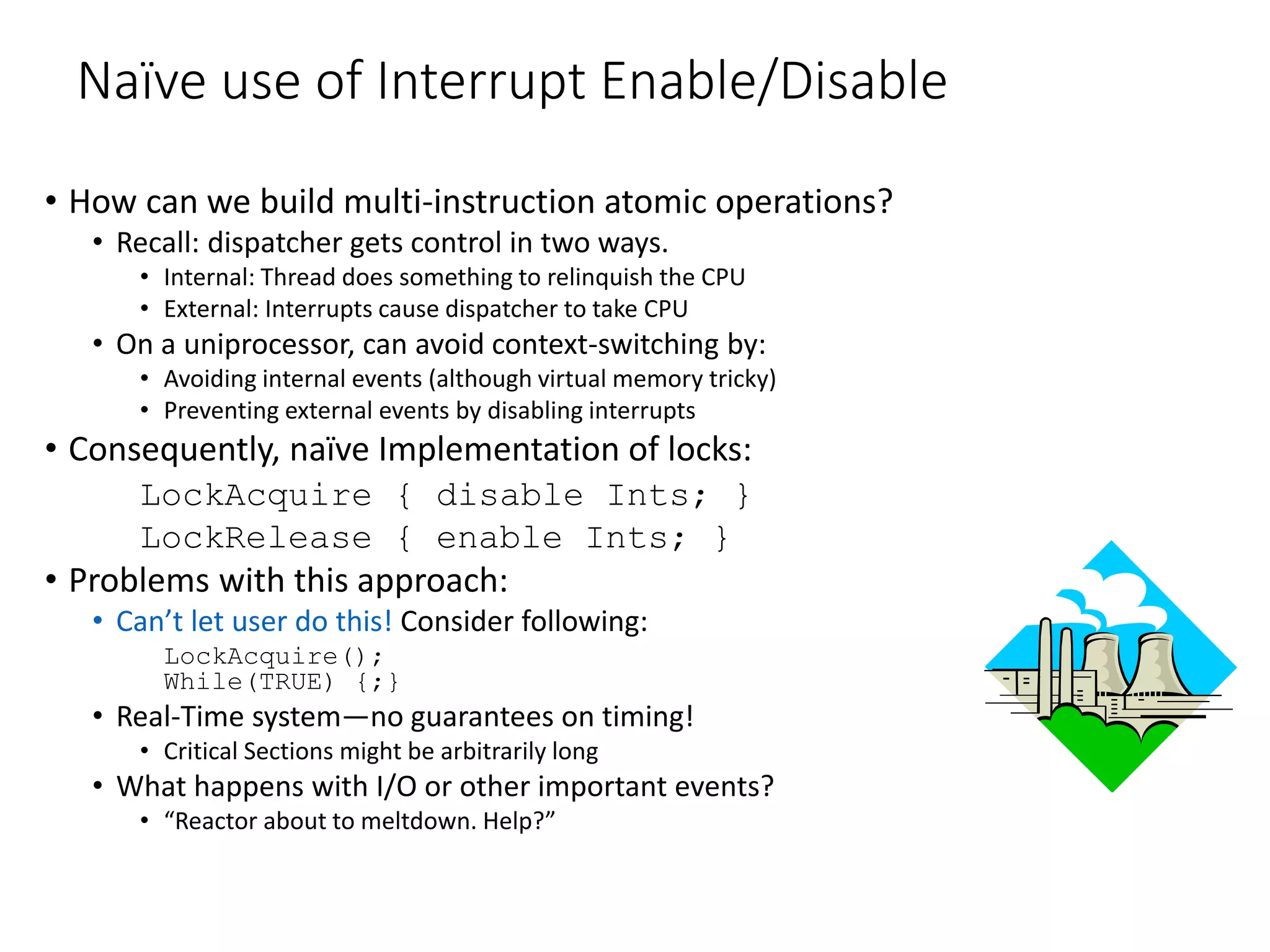
Naïve use of Interrupt Enable/Disable
• How can we build multi-instruction atomic operations?
• Recall: dispatcher gets control in two ways.
• Internal: Thread does something to relinquish the CPU
• External: Interrupts cause dispatcher to take CPU
• On a uniprocessor, can avoid context-switching by:
• Avoiding internal events (although virtual memory tricky)
• Preventing external events by disabling interrupts
• Consequently, naïve Implementation of locks:
LockAcquire { disable Ints; }
LockRelease { enable Ints; }
• Problems with this approach:
• Can’t let user do this! Consider following:
LockAcquire();
While(TRUE) {;}
• Real-Time system—no guarantees on timing!
• Critical Sections might be arbitrarily long
• What happens with I/O or other important events?
• “Reactor about to meltdown. Help?”
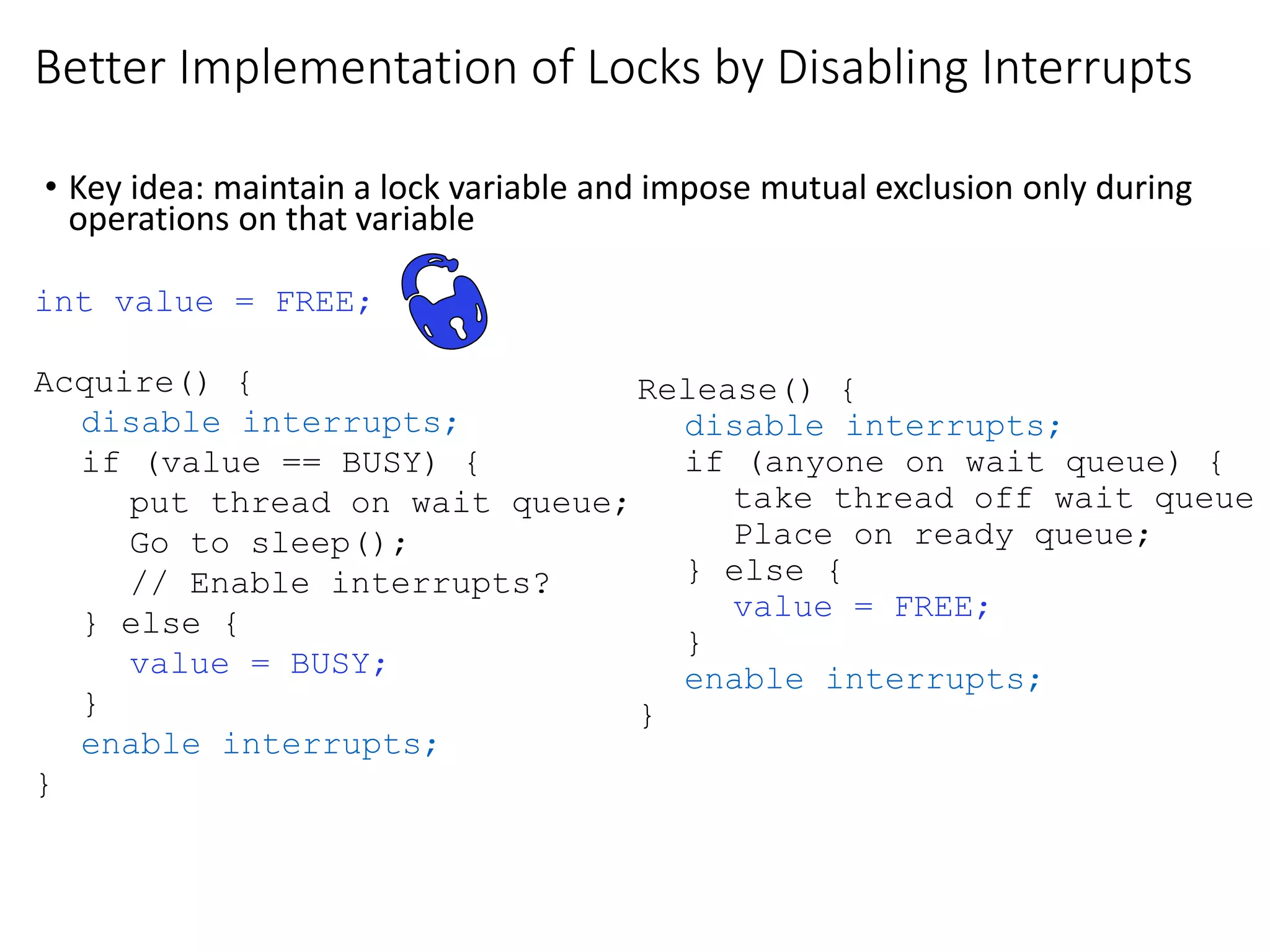
Better Implementation of Locks by Disabling Interrupts
• Key idea: maintain a lock variable and impose mutual exclusion only during
operations on that variable
int value = FREE;
Acquire() {
disable interrupts;
if (value == BUSY) {
put thread on wait queue;
Go to sleep();
// Enable interrupts?
} else {
value = BUSY;
}
enable interrupts;
}
Release() {
disable interrupts;
if (anyone on wait queue) {
take thread off wait queue
Place on ready queue;
} else {
value = FREE;
}
enable interrupts;
}
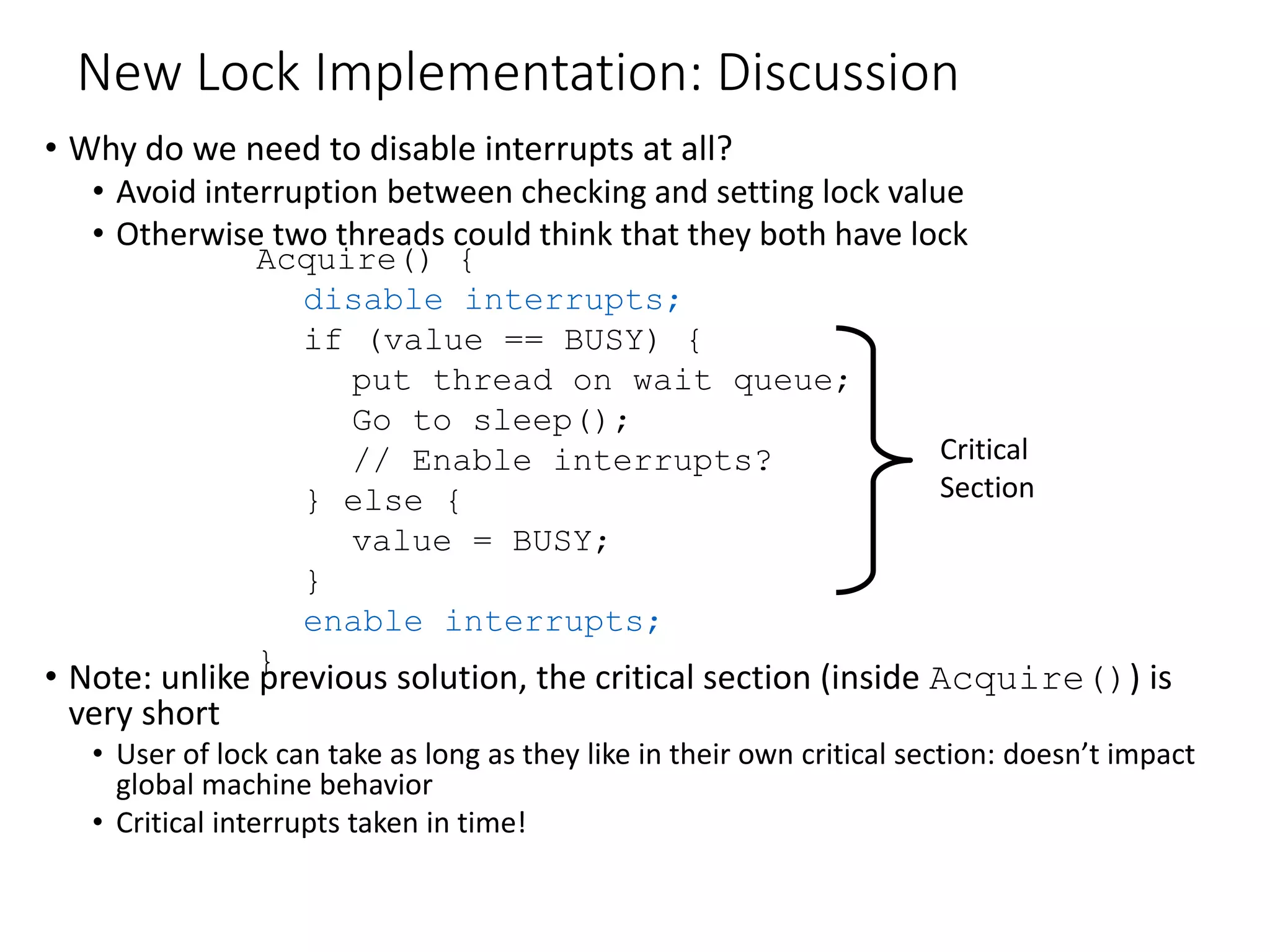
New Lock Implementation: Discussion
• Why do we need to disable interrupts at all?
• Avoid interruption between checking and setting lock value
• Otherwise two threads could think that they both have lock
• Note: unlike previous solution, the critical section (inside Acquire()) is
very short
• User of lock can take as long as they like in their own critical section: doesn’t impact
global machine behavior
• Critical interrupts taken in time!
Acquire() {
disable interrupts;
if (value == BUSY) {
put thread on wait queue;
Go to sleep();
// Enable interrupts?
} else {
value = BUSY;
}
enable interrupts;
}
Critical
Section
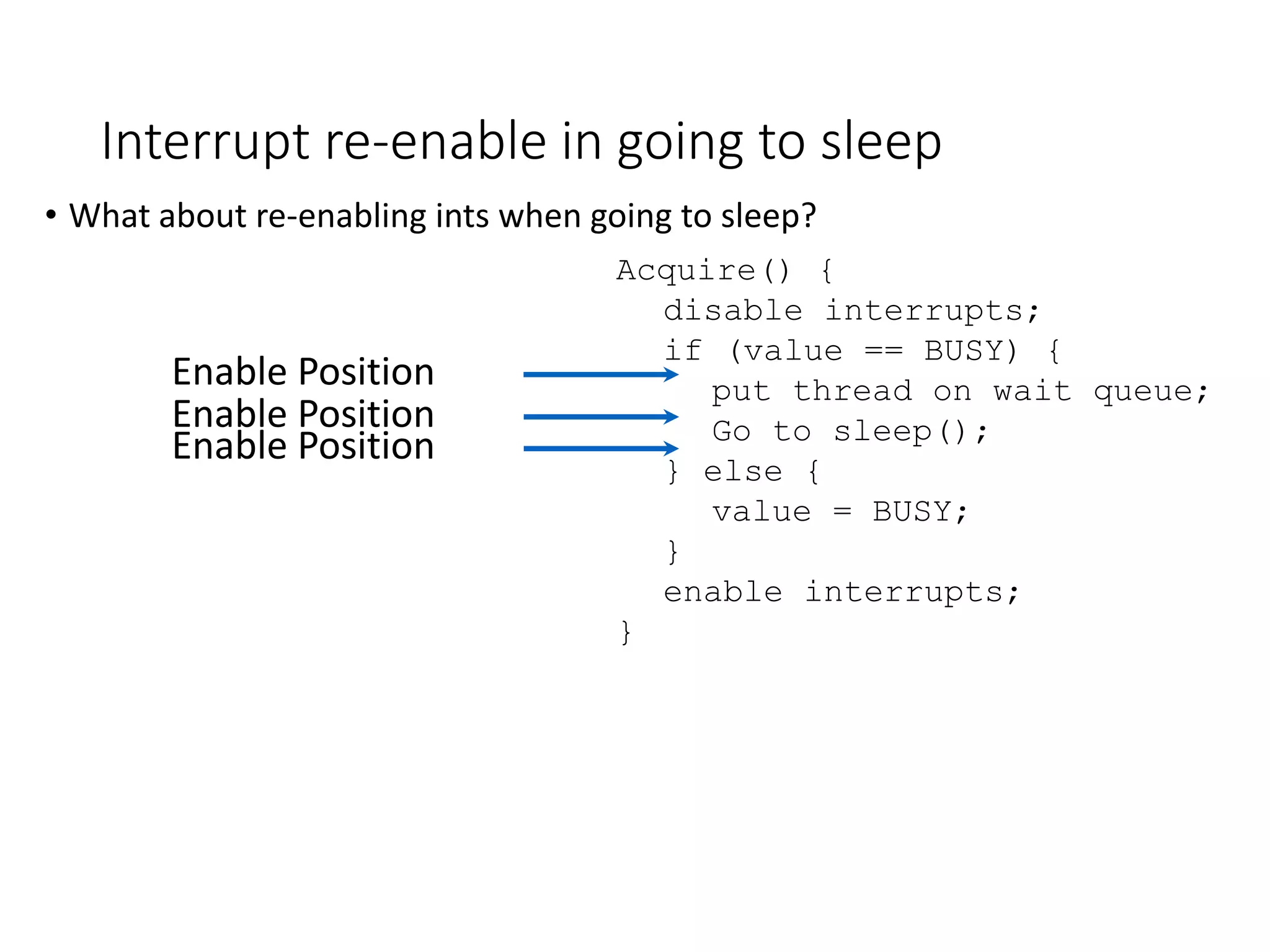
Interrupt re-enable in going to sleep
• What about re-enabling ints when going to sleep?
Acquire() {
disable interrupts;
if (value == BUSY) {
put thread on wait queue;
Go to sleep();
} else {
value = BUSY;
}
enable interrupts;
}
Enable Position
Enable Position
Enable Position
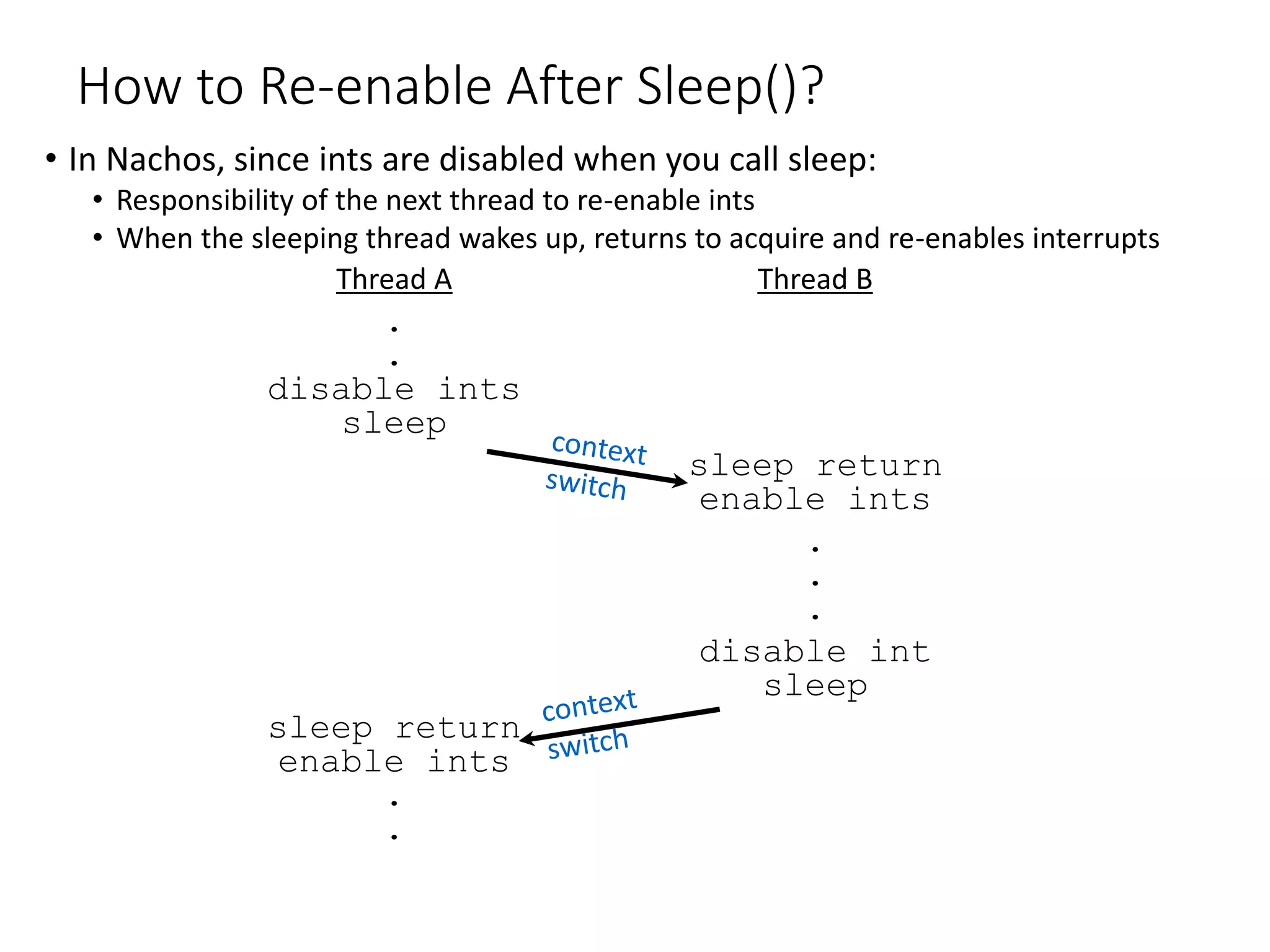
How to Re-enable After Sleep()?
• In Nachos, since ints are disabled when you call sleep:
• Responsibility of the next thread to re-enable ints
• When the sleeping thread wakes up, returns to acquire and re-enables interrupts
Thread A Thread B
.
.
disable ints
sleep
sleep return
enable ints
.
.
.
disable int
sleep
sleep return
enable ints
.
.
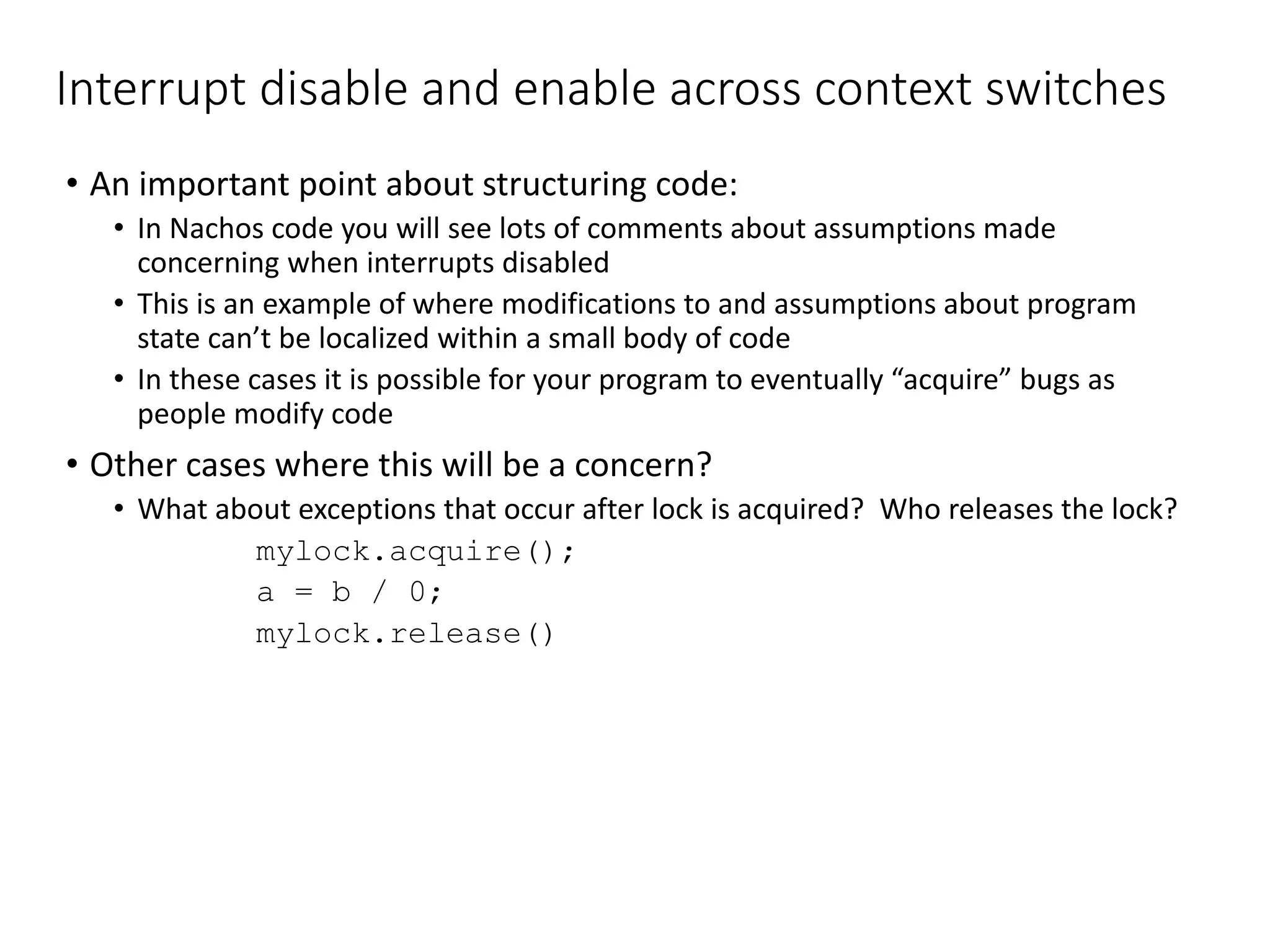
Interrupt disable and enable across context switches
• An important point about structuring code:
• In Nachos code you will see lots of comments about assumptions made
concerning when interrupts disabled
• This is an example of where modifications to and assumptions about program
state can’t be localized within a small body of code
• In these cases it is possible for your program to eventually “acquire” bugs as
people modify code
• Other cases where this will be a concern?
• What about exceptions that occur after lock is acquired? Who releases the lock?
mylock.acquire();
a = b / 0;
mylock.release()
Atomic Read-Modify-Write instructions
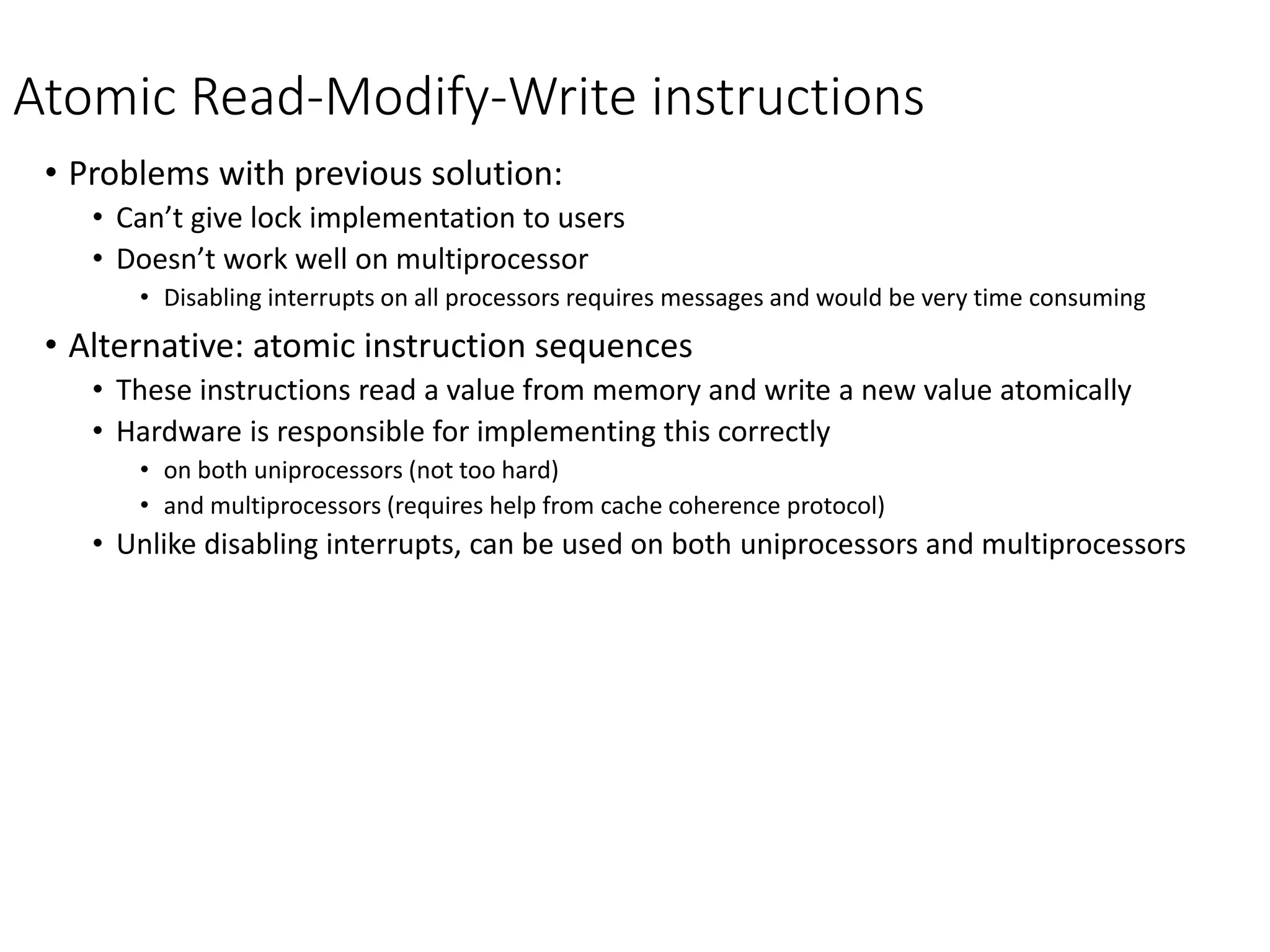
• Problems with previous solution:
• Can’t give lock implementation to users
• Doesn’t work well on multiprocessor
• Disabling interrupts on all processors requires messages and would be very time consuming
• Alternative: atomic instruction sequences
• These instructions read a value from memory and write a new value atomically
• Hardware is responsible for implementing this correctly
• on both uniprocessors (not too hard)
• and multiprocessors (requires help from cache coherence protocol)
• Unlike disabling interrupts, can be used on both uniprocessors and multiprocessors
Examples of Read-Modify-Write
• test&set (&address) { /* most architectures */
result = M[address];
M[address] = 1;
return result;
}
• swap (&address, register) { /* x86 */
temp = M[address];
M[address] = register;
register = temp;
}
• compare&swap (&address, reg1, reg2) { /* 68000 */
if (reg1 == M[address]) {
M[address] = reg2;
return success;
} else {
return failure;
}
}
• load-linked&store conditional(&address) {
/* R4000, alpha */
loop:
ll r1, M[address];
movi r2, 1; /* Can do arbitrary comp */
sc r2, M[address];
beqz r2, loop;
}
Implementing Locks with test&set
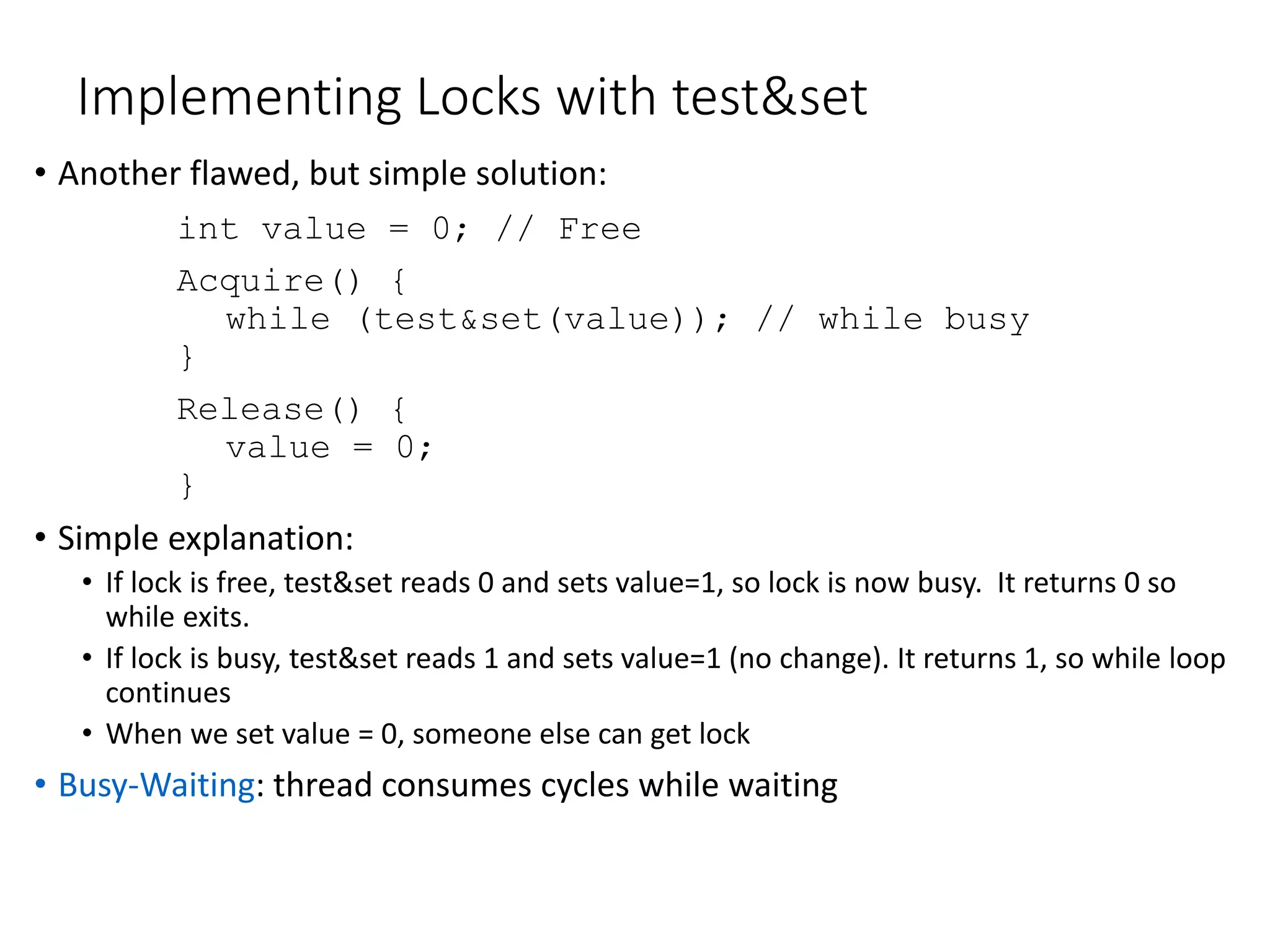
• Another flawed, but simple solution:
int value = 0; // Free
Acquire() {
while (test&set(value)); // while busy
}
Release() {
value = 0;
}
• Simple explanation:
• If lock is free, test&set reads 0 and sets value=1, so lock is now busy. It returns 0 so
while exits.
• If lock is busy, test&set reads 1 and sets value=1 (no change). It returns 1, so while loop
continues
• When we set value = 0, someone else can get lock
• Busy-Waiting: thread consumes cycles while waiting
Problem: Busy-Waiting for Lock
• Positives for this solution
• Machine can receive interrupts
• User code can use this lock
• Works on a multiprocessor
• Negatives
• This is very inefficient because the busy-waiting thread will consume cycles waiting
• Waiting thread may take cycles away from thread holding lock (no one wins!)
• Priority Inversion: If busy-waiting thread has higher priority than thread holding lock
 no progress!
• For semaphores and monitors, waiting thread may wait for an arbitrary
length of time!
• Thus even if busy-waiting was OK for locks, definitely not ok for other primitives
• Homework/exam solutions should not have busy-waiting!
Better Locks using test&set
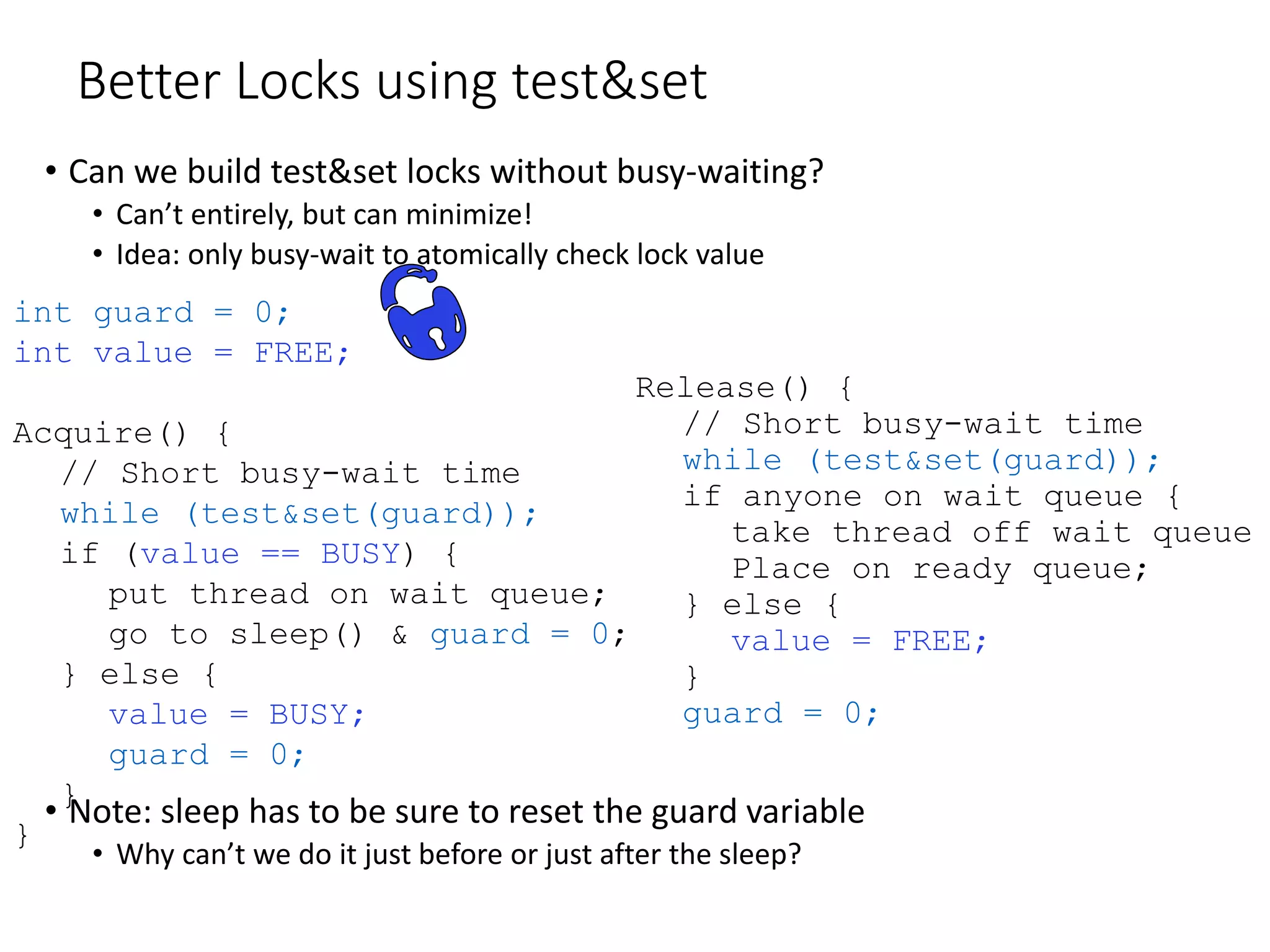
• Can we build test&set locks without busy-waiting?
• Can’t entirely, but can minimize!
• Idea: only busy-wait to atomically check lock value
• Note: sleep has to be sure to reset the guard variable
• Why can’t we do it just before or just after the sleep?
Release() {
// Short busy-wait time
while (test&set(guard));
if anyone on wait queue {
take thread off wait queue
Place on ready queue;
} else {
value = FREE;
}
guard = 0;
int guard = 0;
int value = FREE;
Acquire() {
// Short busy-wait time
while (test&set(guard));
if (value == BUSY) {
put thread on wait queue;
go to sleep() & guard = 0;
} else {
value = BUSY;
guard = 0;
}
}
Higher-level Primitives than Locks
• Goal of last couple of lectures:
• What is the right abstraction for synchronizing threads that share memory?
• Want as high a level primitive as possible
• Good primitives and practices important!
• Since execution is not entirely sequential, really hard to find bugs, since they happen
rarely
• UNIX is pretty stable now, but up until about mid-80s (10 years after started), systems
running UNIX would crash every week or so – concurrency bugs
• Synchronization is a way of coordinating multiple concurrent activities that
are using shared state
• This lecture presents a couple of ways of structuring the sharing
Semaphores
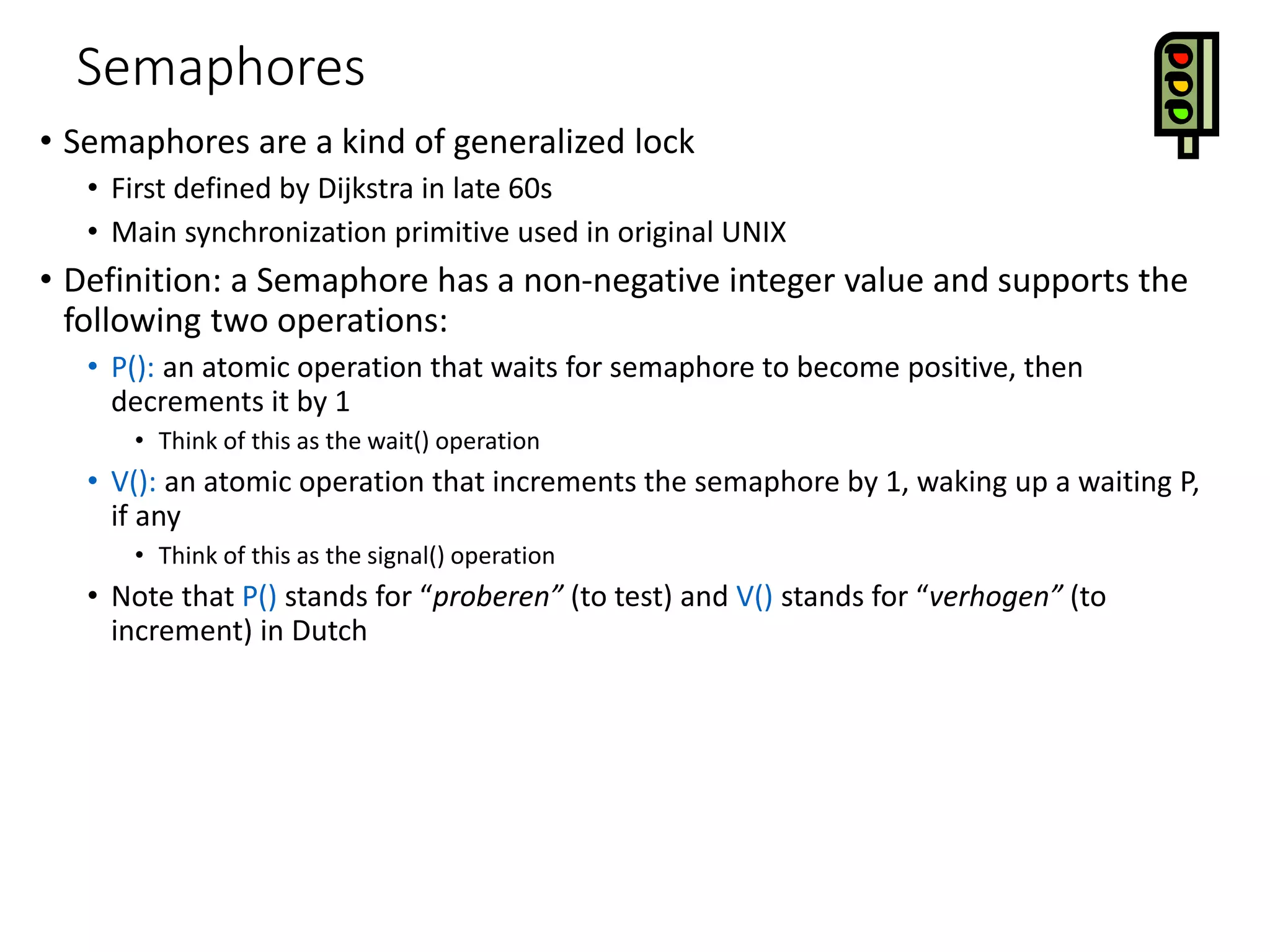
• Semaphores are a kind of generalized lock
• First defined by Dijkstra in late 60s
• Main synchronization primitive used in original UNIX
• Definition: a Semaphore has a non-negative integer value and supports the
following two operations:
• P(): an atomic operation that waits for semaphore to become positive, then
decrements it by 1
• Think of this as the wait() operation
• V(): an atomic operation that increments the semaphore by 1, waking up a waiting P,
if any
• Think of this as the signal() operation
• Note that P() stands for “proberen” (to test) and V() stands for “verhogen” (to
increment) in Dutch
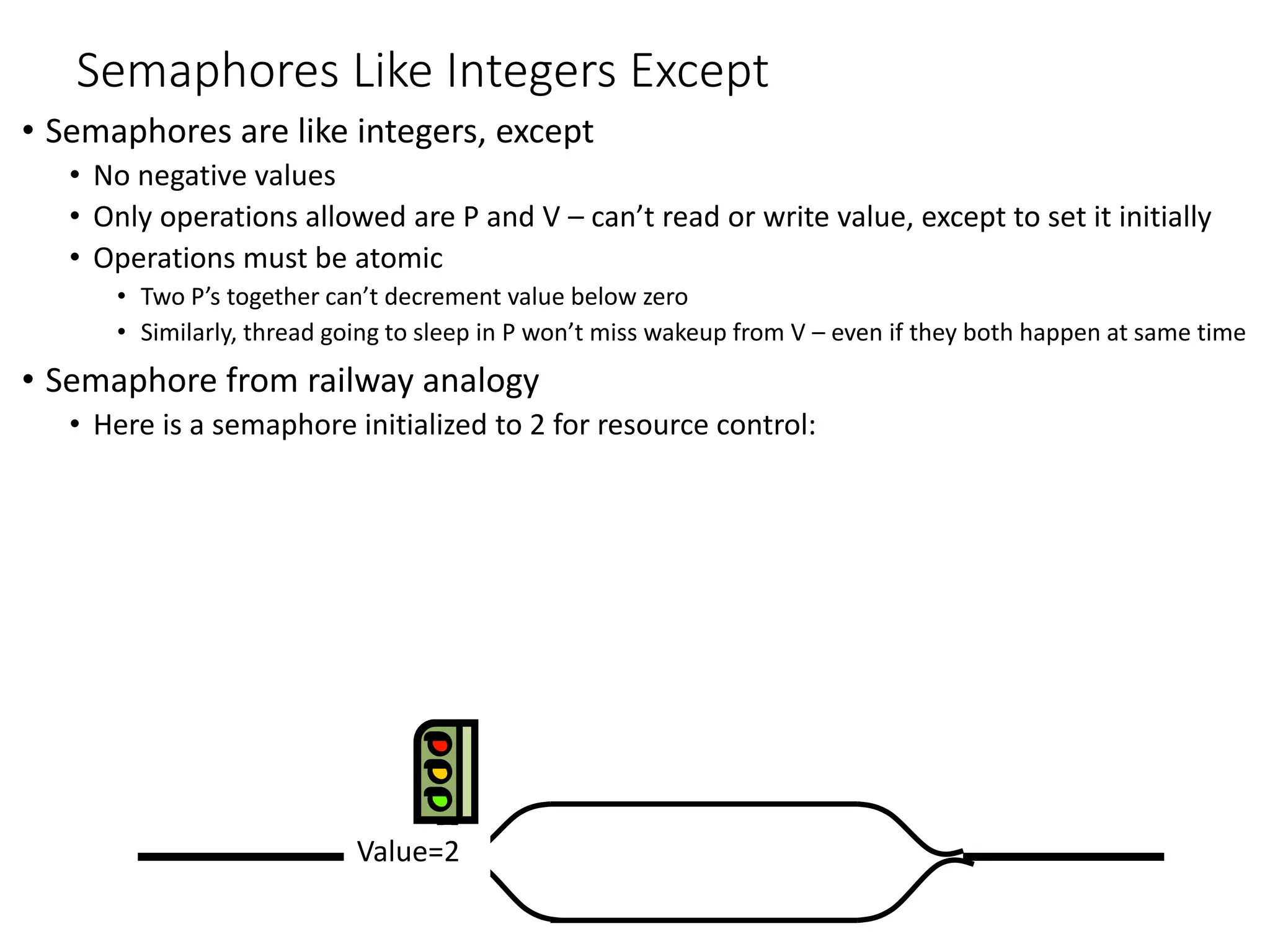
Value=2Value=1Value=0
Semaphores Like Integers Except
• Semaphores are like integers, except
• No negative values
• Only operations allowed are P and V – can’t read or write value, except to set it initially
• Operations must be atomic
• Two P’s together can’t decrement value below zero
• Similarly, thread going to sleep in P won’t miss wakeup from V – even if they both happen at same time
• Semaphore from railway analogy
• Here is a semaphore initialized to 2 for resource control:
Value=1Value=0Value=2
Two Uses of Semaphores
• Mutual Exclusion (initial value = 1)
• Also called “Binary Semaphore”.
• Can be used for mutual exclusion:
semaphore.P();
// Critical section goes here
semaphore.V();
• Scheduling Constraints (initial value = 0)
• Locks are fine for mutual exclusion, but what if you want a thread to wait for
something?
• Example: suppose you had to implement ThreadJoin which must wait for thread to
terminiate:
Initial value of semaphore = 0
ThreadJoin {
semaphore.P();
}
ThreadFinish {
semaphore.V();
}
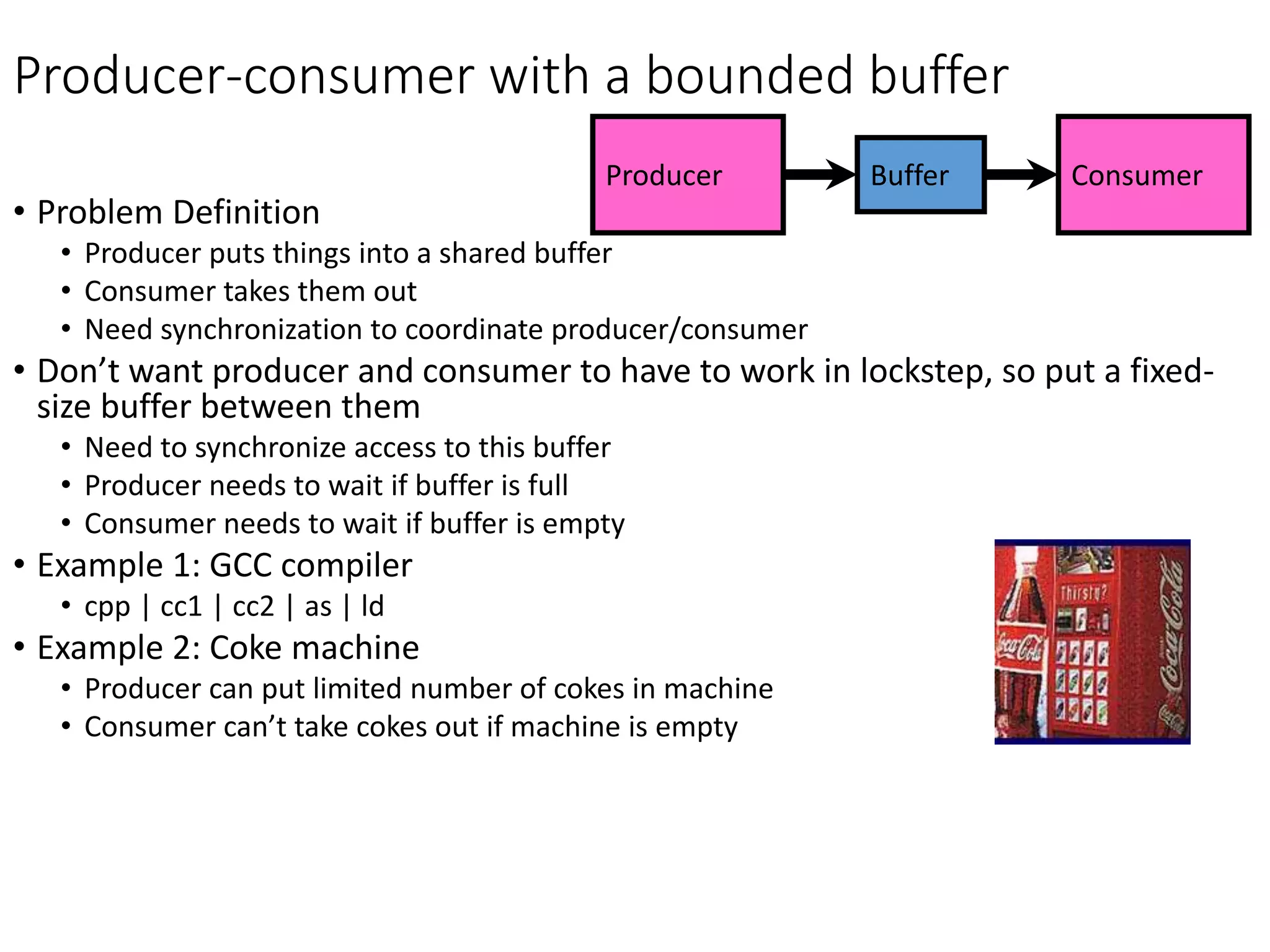
Producer-consumer with a bounded buffer
• Problem Definition
• Producer puts things into a shared buffer
• Consumer takes them out
• Need synchronization to coordinate producer/consumer
• Don’t want producer and consumer to have to work in lockstep, so put a fixed-
size buffer between them
• Need to synchronize access to this buffer
• Producer needs to wait if buffer is full
• Consumer needs to wait if buffer is empty
• Example 1: GCC compiler
• cpp | cc1 | cc2 | as | ld
• Example 2: Coke machine
• Producer can put limited number of cokes in machine
• Consumer can’t take cokes out if machine is empty
Producer ConsumerBuffer
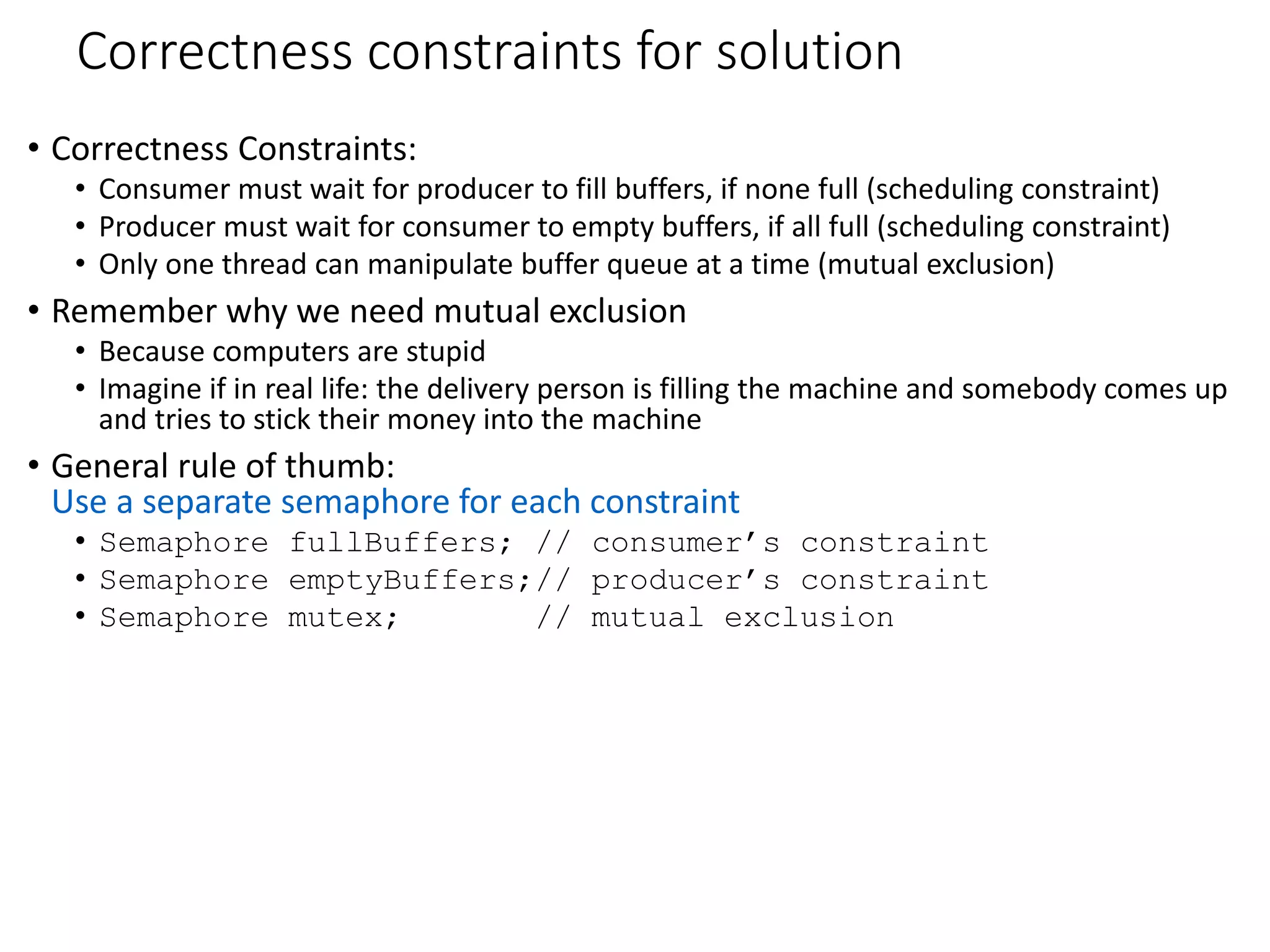
Correctness constraints for solution
• Correctness Constraints:
• Consumer must wait for producer to fill buffers, if none full (scheduling constraint)
• Producer must wait for consumer to empty buffers, if all full (scheduling constraint)
• Only one thread can manipulate buffer queue at a time (mutual exclusion)
• Remember why we need mutual exclusion
• Because computers are stupid
• Imagine if in real life: the delivery person is filling the machine and somebody comes up
and tries to stick their money into the machine
• General rule of thumb:
Use a separate semaphore for each constraint
• Semaphore fullBuffers; // consumer’s constraint
• Semaphore emptyBuffers;// producer’s constraint
• Semaphore mutex; // mutual exclusion
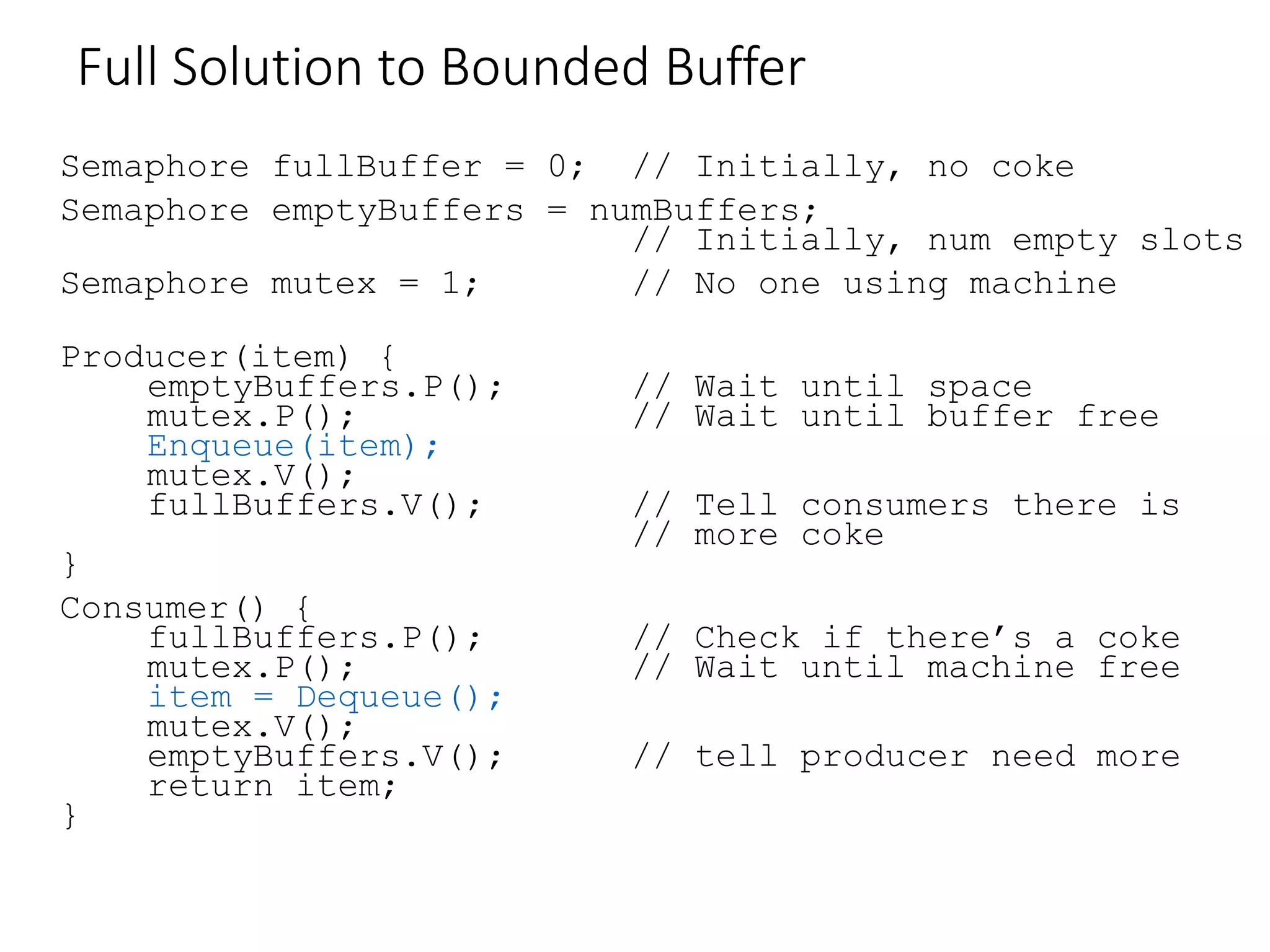
Full Solution to Bounded Buffer
Semaphore fullBuffer = 0; // Initially, no coke
Semaphore emptyBuffers = numBuffers;
// Initially, num empty slots
Semaphore mutex = 1; // No one using machine
Producer(item) {
emptyBuffers.P(); // Wait until space
mutex.P(); // Wait until buffer free
Enqueue(item);
mutex.V();
fullBuffers.V(); // Tell consumers there is
// more coke
}
Consumer() {
fullBuffers.P(); // Check if there’s a coke
mutex.P(); // Wait until machine free
item = Dequeue();
mutex.V();
emptyBuffers.V(); // tell producer need more
return item;
}
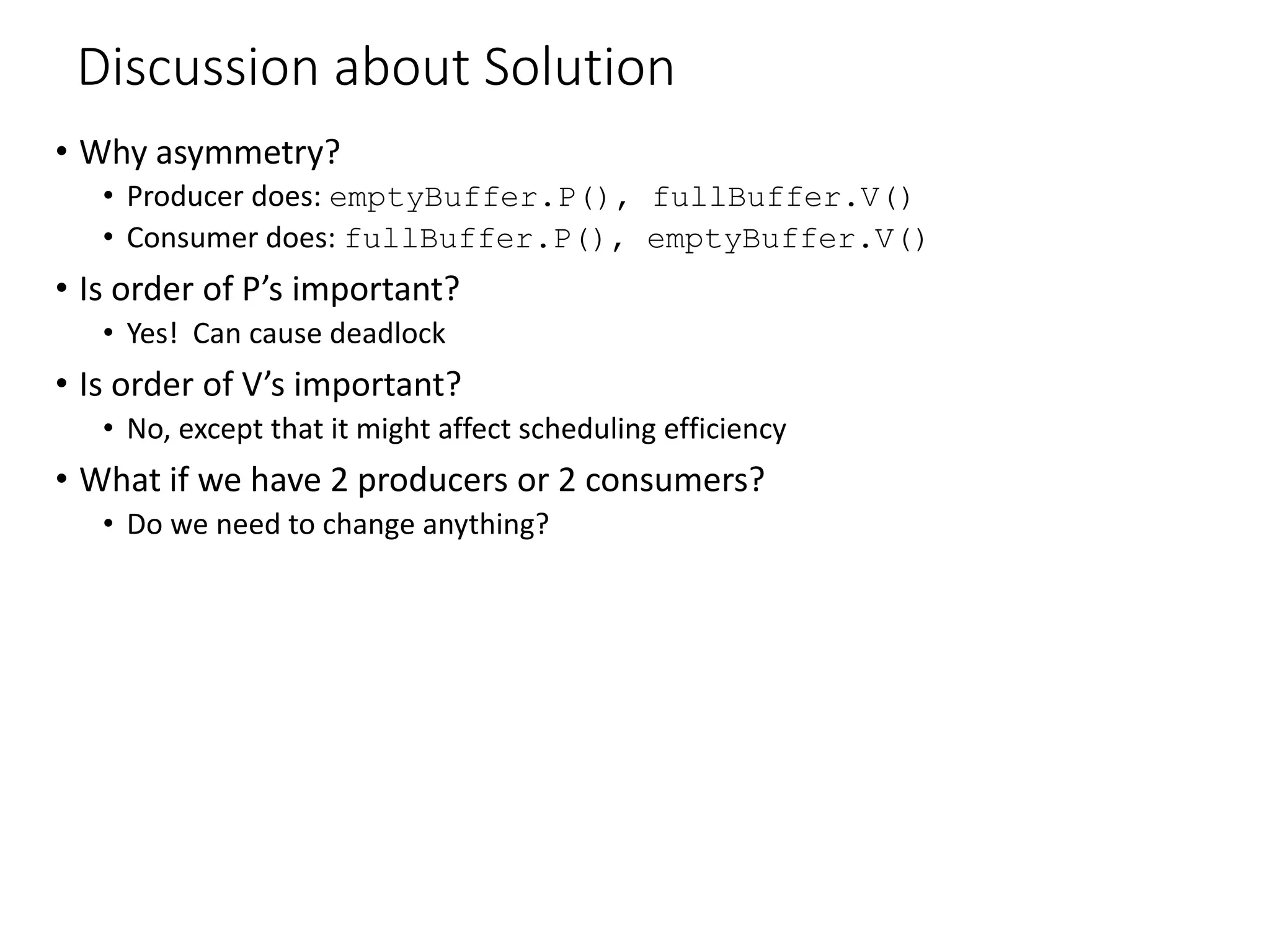
Discussion about Solution
• Why asymmetry?
• Producer does: emptyBuffer.P(), fullBuffer.V()
• Consumer does: fullBuffer.P(), emptyBuffer.V()
• Is order of P’s important?
• Yes! Can cause deadlock
• Is order of V’s important?
• No, except that it might affect scheduling efficiency
• What if we have 2 producers or 2 consumers?
• Do we need to change anything?
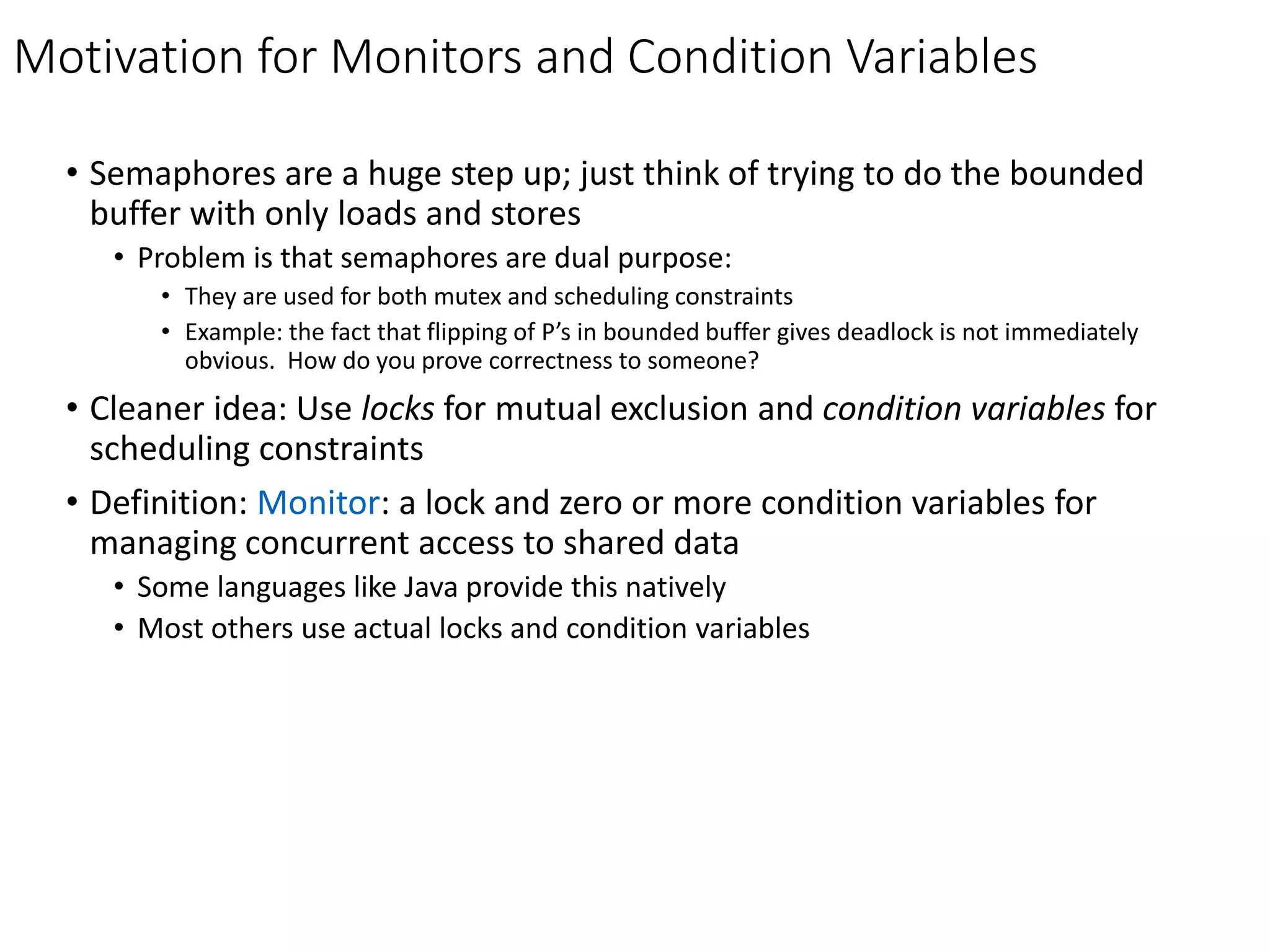
Motivation for Monitors and Condition Variables
• Semaphores are a huge step up; just think of trying to do the bounded
buffer with only loads and stores
• Problem is that semaphores are dual purpose:
• They are used for both mutex and scheduling constraints
• Example: the fact that flipping of P’s in bounded buffer gives deadlock is not immediately
obvious. How do you prove correctness to someone?
• Cleaner idea: Use locks for mutual exclusion and condition variables for
scheduling constraints
• Definition: Monitor: a lock and zero or more condition variables for
managing concurrent access to shared data
• Some languages like Java provide this natively
• Most others use actual locks and condition variables
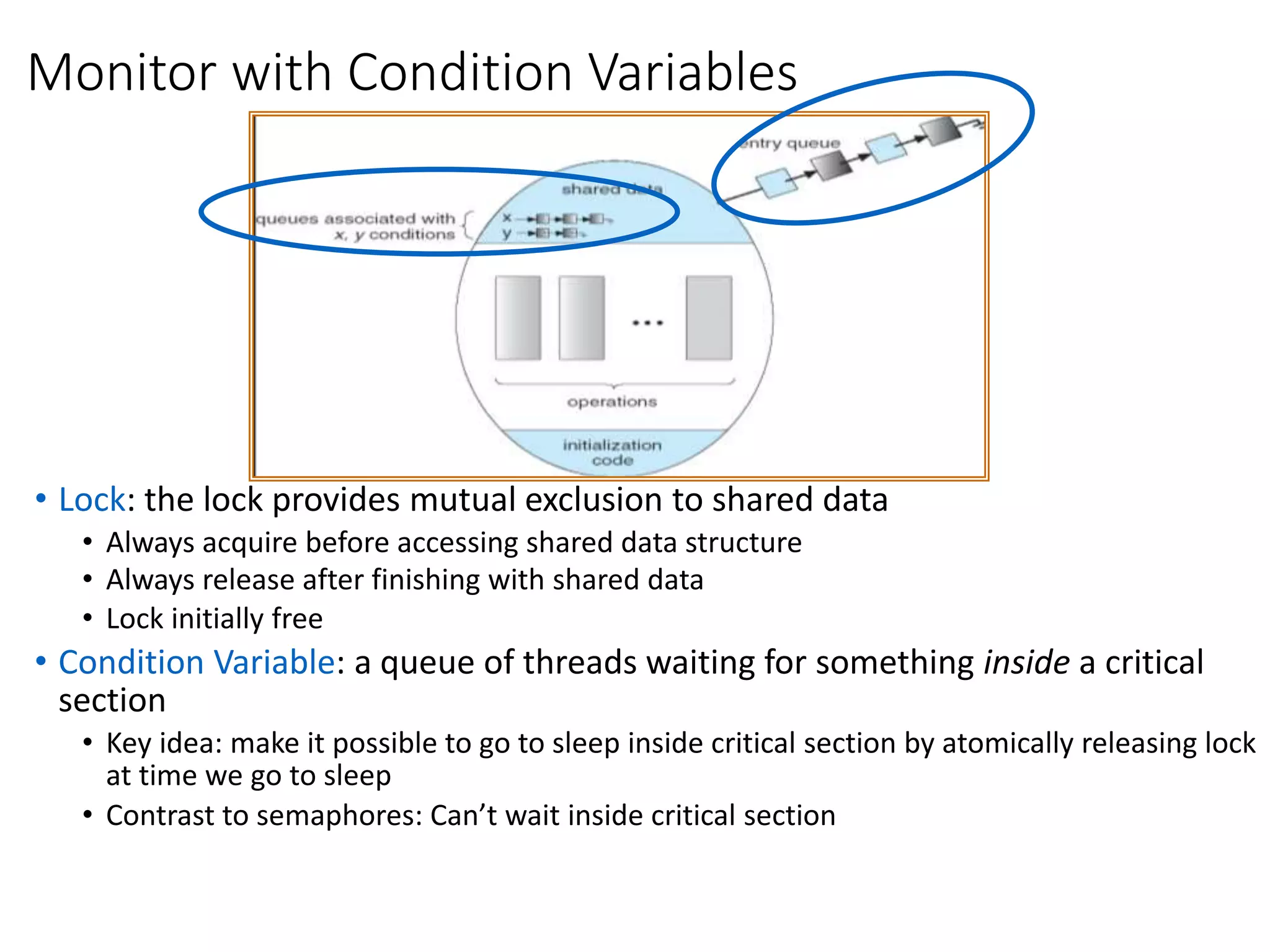
Monitor with Condition Variables
• Lock: the lock provides mutual exclusion to shared data
• Always acquire before accessing shared data structure
• Always release after finishing with shared data
• Lock initially free
• Condition Variable: a queue of threads waiting for something inside a critical
section
• Key idea: make it possible to go to sleep inside critical section by atomically releasing lock
at time we go to sleep
• Contrast to semaphores: Can’t wait inside critical section
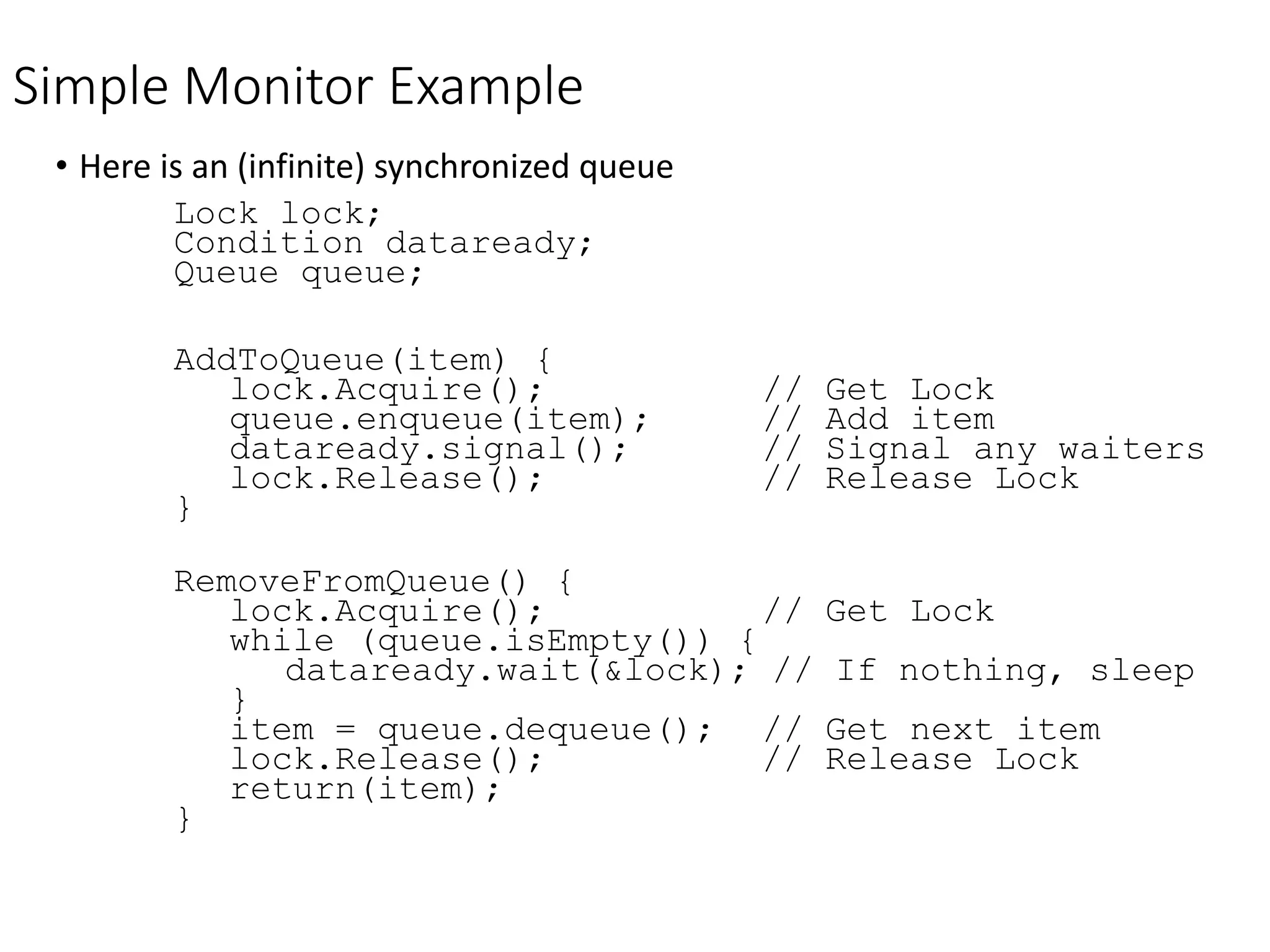
Simple Monitor Example
• Here is an (infinite) synchronized queue
Lock lock;
Condition dataready;
Queue queue;
AddToQueue(item) {
lock.Acquire(); // Get Lock
queue.enqueue(item); // Add item
dataready.signal(); // Signal any waiters
lock.Release(); // Release Lock
}
RemoveFromQueue() {
lock.Acquire(); // Get Lock
while (queue.isEmpty()) {
dataready.wait(&lock); // If nothing, sleep
}
item = queue.dequeue(); // Get next item
lock.Release(); // Release Lock
return(item);
}

Synchronization problem with threads

  • 1.
    Synchronization problem withThreads • One thread per transaction, each running: Deposit(acctId, amount) { acct = GetAccount(actId); /* May use disk I/O */ acct->balance += amount; StoreAccount(acct); /* Involves disk I/O */ } • Unfortunately, shared state can get corrupted: Thread 1 Thread 2 load r1, acct->balance load r1, acct->balance add r1, amount2 store r1, acct->balance add r1, amount1 store r1, acct->balance • Atomic Operation: an operation that always runs to completion or not at all • It is indivisible: it cannot be stopped in the middle and state cannot be modified by someone else in the middle
  • 2.
    Review: Too MuchMilk Solution #3 • Here is a possible two-note solution: Thread A Thread B leave note A; leave note B; while (note B) {X if (noNote A) {Y do nothing; if (noMilk) { } buy milk; if (noMilk) { } buy milk; } } remove note B; remove note A; • Does this work? Yes. Both can guarantee that: • It is safe to buy, or • Other will buy, ok to quit • At X: • if no note B, safe for A to buy, • otherwise wait to find out what will happen • At Y: • if no note A, safe for B to buy • Otherwise, A is either buying or waiting for B to quit
  • 3.
    Goals for Today •Hardware Support for Synchronization • Higher-level Synchronization Abstractions • Semaphores, monitors, and condition variables • Programming paradigms for concurrent programs Note: Some slides and/or pictures in the following are adapted from slides ©2005 Silberschatz, Galvin, and Gagne Note: Some slides and/or pictures in the following are adapted from slides ©2005 Silberschatz, Galvin, and Gagne. Many slides generated from my lecture notes by Prof. John Kubiatowicz of MIT.
  • 4.
    High-Level Picture • Theabstraction of threads is good: • Maintains sequential execution model • Allows simple parallelism to overlap I/O and computation • Unfortunately, still too complicated to access state shared between threads • Consider “too much milk” example • Implementing a concurrent program with only loads and stores would be tricky and error-prone • Today, we’ll implement higher-level operations on top of atomic operations provided by hardware • Develop a “synchronization toolbox” • Explore some common programming paradigms
  • 5.
    Too Much Milk:Solution #4 • Suppose we have some sort of implementation of a lock (more in a moment). • Lock.Acquire() – wait until lock is free, then grab • Lock.Release() – Unlock, waking up anyone waiting • These must be atomic operations – if two threads are waiting for the lock and both see it’s free, only one succeeds to grab the lock • Then, our milk problem is easy: milklock.Acquire(); if (nomilk) buy milk; milklock.Release(); • Once again, section of code between Acquire() and Release() called a “Critical Section” • Of course, you can make this even simpler: suppose you are out of ice cream instead of milk • Skip the test since you always need more ice cream.
  • 6.
    How to implementLocks? • Lock: prevents someone from doing something • Lock before entering critical section and before accessing shared data • Unlock when leaving, after accessing shared data • Wait if locked • Important idea: all synchronization involves waiting • Should sleep if waiting for a long time • Atomic Load/Store: get solution like Milk #3 • Looked at this last lecture • Pretty complex and error prone • Hardware Lock instruction • Is this a good idea? • What about putting a task to sleep? • How do you handle the interface between the hardware and scheduler? • Complexity? • Done in the Intel 432 • Each feature makes hardware more complex and slow
  • 7.
    Naïve use ofInterrupt Enable/Disable • How can we build multi-instruction atomic operations? • Recall: dispatcher gets control in two ways. • Internal: Thread does something to relinquish the CPU • External: Interrupts cause dispatcher to take CPU • On a uniprocessor, can avoid context-switching by: • Avoiding internal events (although virtual memory tricky) • Preventing external events by disabling interrupts • Consequently, naïve Implementation of locks: LockAcquire { disable Ints; } LockRelease { enable Ints; } • Problems with this approach: • Can’t let user do this! Consider following: LockAcquire(); While(TRUE) {;} • Real-Time system—no guarantees on timing! • Critical Sections might be arbitrarily long • What happens with I/O or other important events? • “Reactor about to meltdown. Help?”
  • 8.
    Better Implementation ofLocks by Disabling Interrupts • Key idea: maintain a lock variable and impose mutual exclusion only during operations on that variable int value = FREE; Acquire() { disable interrupts; if (value == BUSY) { put thread on wait queue; Go to sleep(); // Enable interrupts? } else { value = BUSY; } enable interrupts; } Release() { disable interrupts; if (anyone on wait queue) { take thread off wait queue Place on ready queue; } else { value = FREE; } enable interrupts; }
  • 9.
    New Lock Implementation:Discussion • Why do we need to disable interrupts at all? • Avoid interruption between checking and setting lock value • Otherwise two threads could think that they both have lock • Note: unlike previous solution, the critical section (inside Acquire()) is very short • User of lock can take as long as they like in their own critical section: doesn’t impact global machine behavior • Critical interrupts taken in time! Acquire() { disable interrupts; if (value == BUSY) { put thread on wait queue; Go to sleep(); // Enable interrupts? } else { value = BUSY; } enable interrupts; } Critical Section
  • 10.
    Interrupt re-enable ingoing to sleep • What about re-enabling ints when going to sleep? Acquire() { disable interrupts; if (value == BUSY) { put thread on wait queue; Go to sleep(); } else { value = BUSY; } enable interrupts; } Enable Position Enable Position Enable Position
  • 11.
    How to Re-enableAfter Sleep()? • In Nachos, since ints are disabled when you call sleep: • Responsibility of the next thread to re-enable ints • When the sleeping thread wakes up, returns to acquire and re-enables interrupts Thread A Thread B . . disable ints sleep sleep return enable ints . . . disable int sleep sleep return enable ints . .
  • 12.
    Interrupt disable andenable across context switches • An important point about structuring code: • In Nachos code you will see lots of comments about assumptions made concerning when interrupts disabled • This is an example of where modifications to and assumptions about program state can’t be localized within a small body of code • In these cases it is possible for your program to eventually “acquire” bugs as people modify code • Other cases where this will be a concern? • What about exceptions that occur after lock is acquired? Who releases the lock? mylock.acquire(); a = b / 0; mylock.release()
  • 13.
    Atomic Read-Modify-Write instructions •Problems with previous solution: • Can’t give lock implementation to users • Doesn’t work well on multiprocessor • Disabling interrupts on all processors requires messages and would be very time consuming • Alternative: atomic instruction sequences • These instructions read a value from memory and write a new value atomically • Hardware is responsible for implementing this correctly • on both uniprocessors (not too hard) • and multiprocessors (requires help from cache coherence protocol) • Unlike disabling interrupts, can be used on both uniprocessors and multiprocessors
  • 14.
    Examples of Read-Modify-Write •test&set (&address) { /* most architectures */ result = M[address]; M[address] = 1; return result; } • swap (&address, register) { /* x86 */ temp = M[address]; M[address] = register; register = temp; } • compare&swap (&address, reg1, reg2) { /* 68000 */ if (reg1 == M[address]) { M[address] = reg2; return success; } else { return failure; } } • load-linked&store conditional(&address) { /* R4000, alpha */ loop: ll r1, M[address]; movi r2, 1; /* Can do arbitrary comp */ sc r2, M[address]; beqz r2, loop; }
  • 15.
    Implementing Locks withtest&set • Another flawed, but simple solution: int value = 0; // Free Acquire() { while (test&set(value)); // while busy } Release() { value = 0; } • Simple explanation: • If lock is free, test&set reads 0 and sets value=1, so lock is now busy. It returns 0 so while exits. • If lock is busy, test&set reads 1 and sets value=1 (no change). It returns 1, so while loop continues • When we set value = 0, someone else can get lock • Busy-Waiting: thread consumes cycles while waiting
  • 16.
    Problem: Busy-Waiting forLock • Positives for this solution • Machine can receive interrupts • User code can use this lock • Works on a multiprocessor • Negatives • This is very inefficient because the busy-waiting thread will consume cycles waiting • Waiting thread may take cycles away from thread holding lock (no one wins!) • Priority Inversion: If busy-waiting thread has higher priority than thread holding lock  no progress! • For semaphores and monitors, waiting thread may wait for an arbitrary length of time! • Thus even if busy-waiting was OK for locks, definitely not ok for other primitives • Homework/exam solutions should not have busy-waiting!
  • 17.
    Better Locks usingtest&set • Can we build test&set locks without busy-waiting? • Can’t entirely, but can minimize! • Idea: only busy-wait to atomically check lock value • Note: sleep has to be sure to reset the guard variable • Why can’t we do it just before or just after the sleep? Release() { // Short busy-wait time while (test&set(guard)); if anyone on wait queue { take thread off wait queue Place on ready queue; } else { value = FREE; } guard = 0; int guard = 0; int value = FREE; Acquire() { // Short busy-wait time while (test&set(guard)); if (value == BUSY) { put thread on wait queue; go to sleep() & guard = 0; } else { value = BUSY; guard = 0; } }
  • 18.
    Higher-level Primitives thanLocks • Goal of last couple of lectures: • What is the right abstraction for synchronizing threads that share memory? • Want as high a level primitive as possible • Good primitives and practices important! • Since execution is not entirely sequential, really hard to find bugs, since they happen rarely • UNIX is pretty stable now, but up until about mid-80s (10 years after started), systems running UNIX would crash every week or so – concurrency bugs • Synchronization is a way of coordinating multiple concurrent activities that are using shared state • This lecture presents a couple of ways of structuring the sharing
  • 19.
    Semaphores • Semaphores area kind of generalized lock • First defined by Dijkstra in late 60s • Main synchronization primitive used in original UNIX • Definition: a Semaphore has a non-negative integer value and supports the following two operations: • P(): an atomic operation that waits for semaphore to become positive, then decrements it by 1 • Think of this as the wait() operation • V(): an atomic operation that increments the semaphore by 1, waking up a waiting P, if any • Think of this as the signal() operation • Note that P() stands for “proberen” (to test) and V() stands for “verhogen” (to increment) in Dutch
  • 20.
    Value=2Value=1Value=0 Semaphores Like IntegersExcept • Semaphores are like integers, except • No negative values • Only operations allowed are P and V – can’t read or write value, except to set it initially • Operations must be atomic • Two P’s together can’t decrement value below zero • Similarly, thread going to sleep in P won’t miss wakeup from V – even if they both happen at same time • Semaphore from railway analogy • Here is a semaphore initialized to 2 for resource control: Value=1Value=0Value=2
  • 21.
    Two Uses ofSemaphores • Mutual Exclusion (initial value = 1) • Also called “Binary Semaphore”. • Can be used for mutual exclusion: semaphore.P(); // Critical section goes here semaphore.V(); • Scheduling Constraints (initial value = 0) • Locks are fine for mutual exclusion, but what if you want a thread to wait for something? • Example: suppose you had to implement ThreadJoin which must wait for thread to terminiate: Initial value of semaphore = 0 ThreadJoin { semaphore.P(); } ThreadFinish { semaphore.V(); }
  • 22.
    Producer-consumer with abounded buffer • Problem Definition • Producer puts things into a shared buffer • Consumer takes them out • Need synchronization to coordinate producer/consumer • Don’t want producer and consumer to have to work in lockstep, so put a fixed- size buffer between them • Need to synchronize access to this buffer • Producer needs to wait if buffer is full • Consumer needs to wait if buffer is empty • Example 1: GCC compiler • cpp | cc1 | cc2 | as | ld • Example 2: Coke machine • Producer can put limited number of cokes in machine • Consumer can’t take cokes out if machine is empty Producer ConsumerBuffer
  • 23.
    Correctness constraints forsolution • Correctness Constraints: • Consumer must wait for producer to fill buffers, if none full (scheduling constraint) • Producer must wait for consumer to empty buffers, if all full (scheduling constraint) • Only one thread can manipulate buffer queue at a time (mutual exclusion) • Remember why we need mutual exclusion • Because computers are stupid • Imagine if in real life: the delivery person is filling the machine and somebody comes up and tries to stick their money into the machine • General rule of thumb: Use a separate semaphore for each constraint • Semaphore fullBuffers; // consumer’s constraint • Semaphore emptyBuffers;// producer’s constraint • Semaphore mutex; // mutual exclusion
  • 24.
    Full Solution toBounded Buffer Semaphore fullBuffer = 0; // Initially, no coke Semaphore emptyBuffers = numBuffers; // Initially, num empty slots Semaphore mutex = 1; // No one using machine Producer(item) { emptyBuffers.P(); // Wait until space mutex.P(); // Wait until buffer free Enqueue(item); mutex.V(); fullBuffers.V(); // Tell consumers there is // more coke } Consumer() { fullBuffers.P(); // Check if there’s a coke mutex.P(); // Wait until machine free item = Dequeue(); mutex.V(); emptyBuffers.V(); // tell producer need more return item; }
  • 25.
    Discussion about Solution •Why asymmetry? • Producer does: emptyBuffer.P(), fullBuffer.V() • Consumer does: fullBuffer.P(), emptyBuffer.V() • Is order of P’s important? • Yes! Can cause deadlock • Is order of V’s important? • No, except that it might affect scheduling efficiency • What if we have 2 producers or 2 consumers? • Do we need to change anything?
  • 26.
    Motivation for Monitorsand Condition Variables • Semaphores are a huge step up; just think of trying to do the bounded buffer with only loads and stores • Problem is that semaphores are dual purpose: • They are used for both mutex and scheduling constraints • Example: the fact that flipping of P’s in bounded buffer gives deadlock is not immediately obvious. How do you prove correctness to someone? • Cleaner idea: Use locks for mutual exclusion and condition variables for scheduling constraints • Definition: Monitor: a lock and zero or more condition variables for managing concurrent access to shared data • Some languages like Java provide this natively • Most others use actual locks and condition variables
  • 27.
    Monitor with ConditionVariables • Lock: the lock provides mutual exclusion to shared data • Always acquire before accessing shared data structure • Always release after finishing with shared data • Lock initially free • Condition Variable: a queue of threads waiting for something inside a critical section • Key idea: make it possible to go to sleep inside critical section by atomically releasing lock at time we go to sleep • Contrast to semaphores: Can’t wait inside critical section
  • 28.
    Simple Monitor Example •Here is an (infinite) synchronized queue Lock lock; Condition dataready; Queue queue; AddToQueue(item) { lock.Acquire(); // Get Lock queue.enqueue(item); // Add item dataready.signal(); // Signal any waiters lock.Release(); // Release Lock } RemoveFromQueue() { lock.Acquire(); // Get Lock while (queue.isEmpty()) { dataready.wait(&lock); // If nothing, sleep } item = queue.dequeue(); // Get next item lock.Release(); // Release Lock return(item); }