Swift Rocks!
Anton Mironov Software Engineer at
1
Everything started with
Low Level Virtual Machine
2
Recent Objective-C
features
• Blocks (closures)
• Automatic Reference Counting
• Literals
3
Swift is a next next step
4
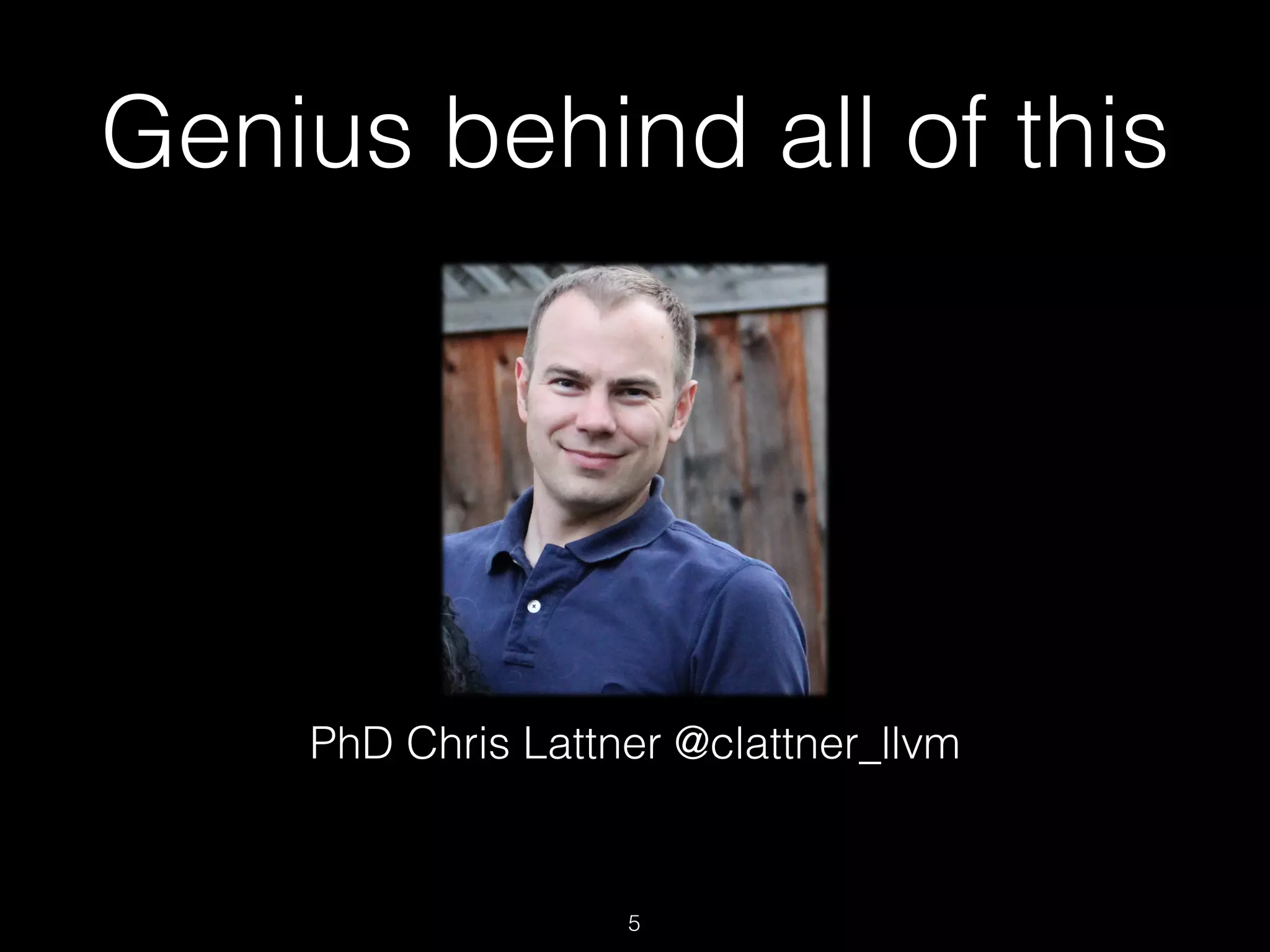
Genius behind all of this
PhD Chris Lattner @clattner_llvm
5
Swift is based on
• Objective-C
• Haskel
• Ruby
• Python
• C#
• and many others
6
First Lines of Code
print("Hello World!")
7
First Lines of Code
print("(name), I am your father")
8
First Lines of Code
var name = "Luke"
print("(name), I am your father")
9
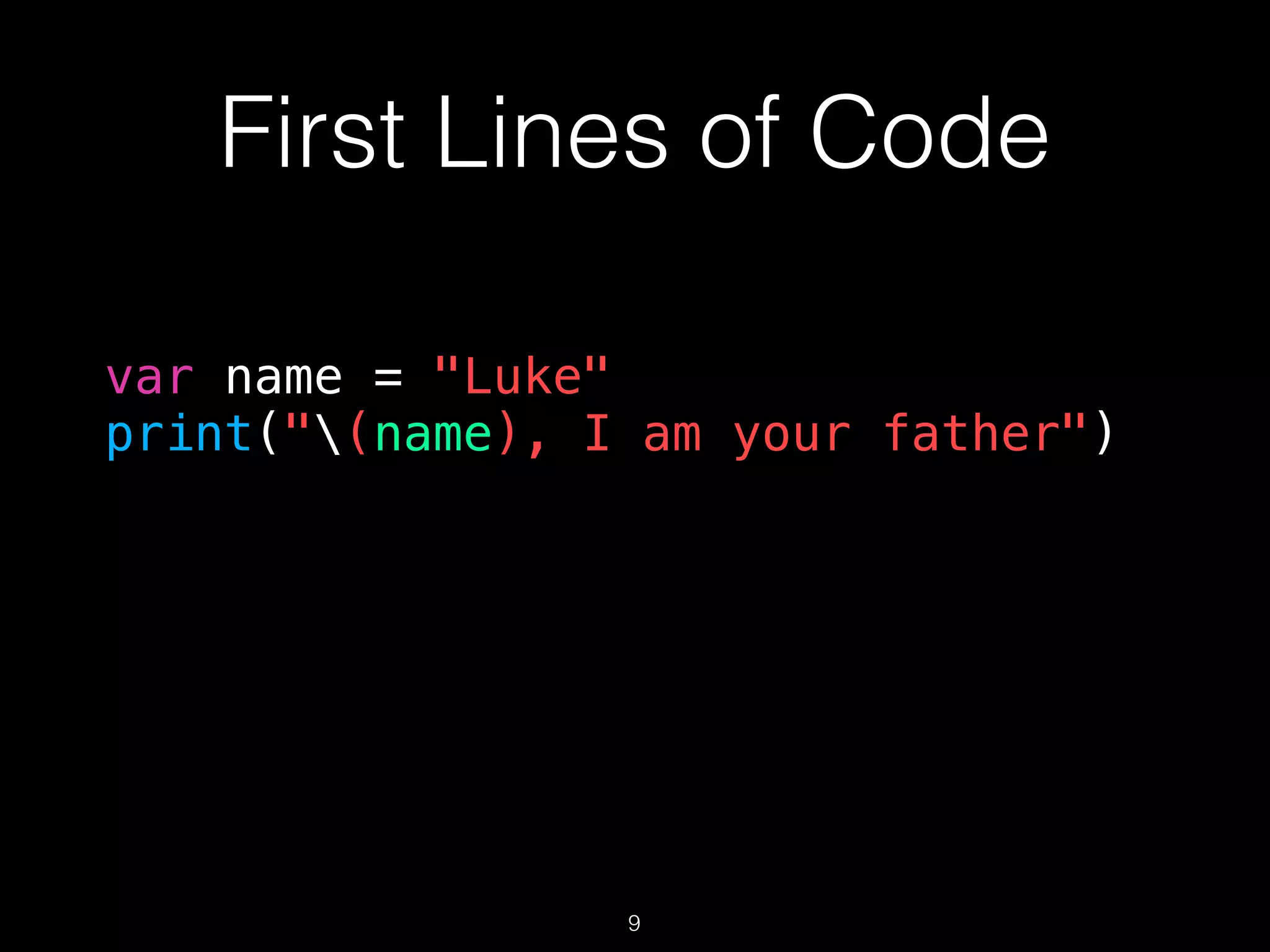
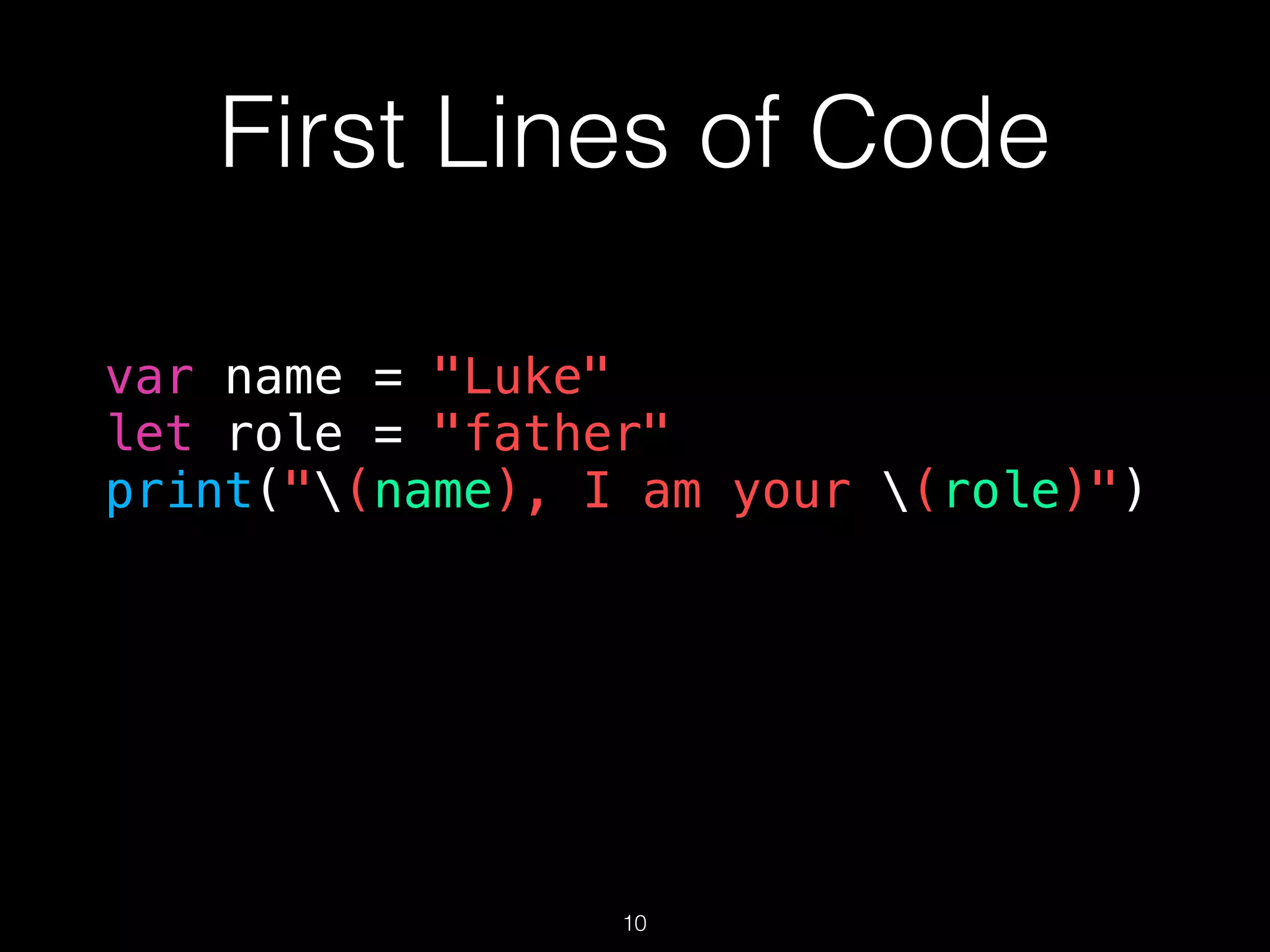
First Lines of Code
var name = "Luke"
let role = "father"
print("(name), I am your (role)")
10
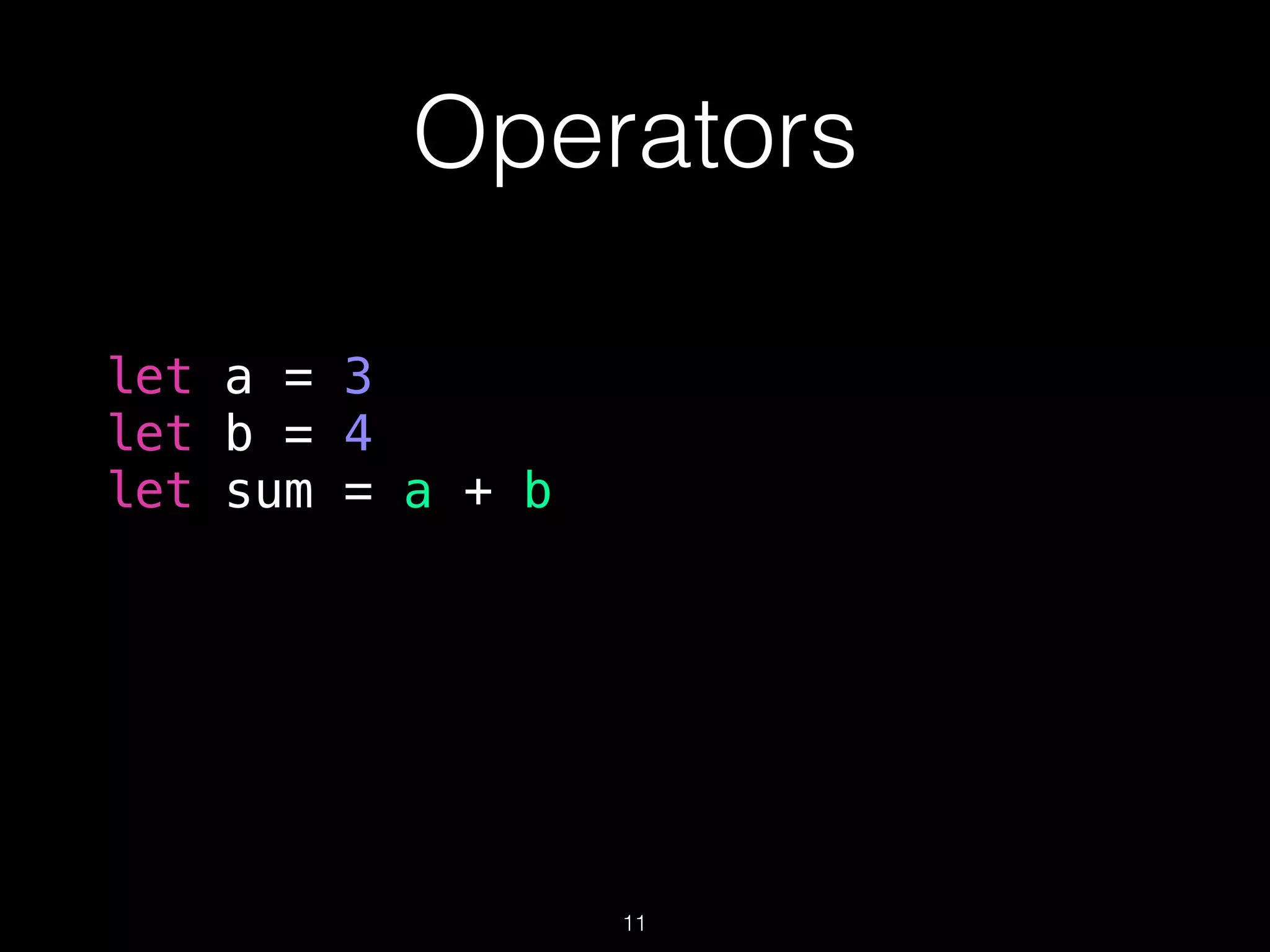
Operators
let a = 3
let b = 4
let sum = a + b
11
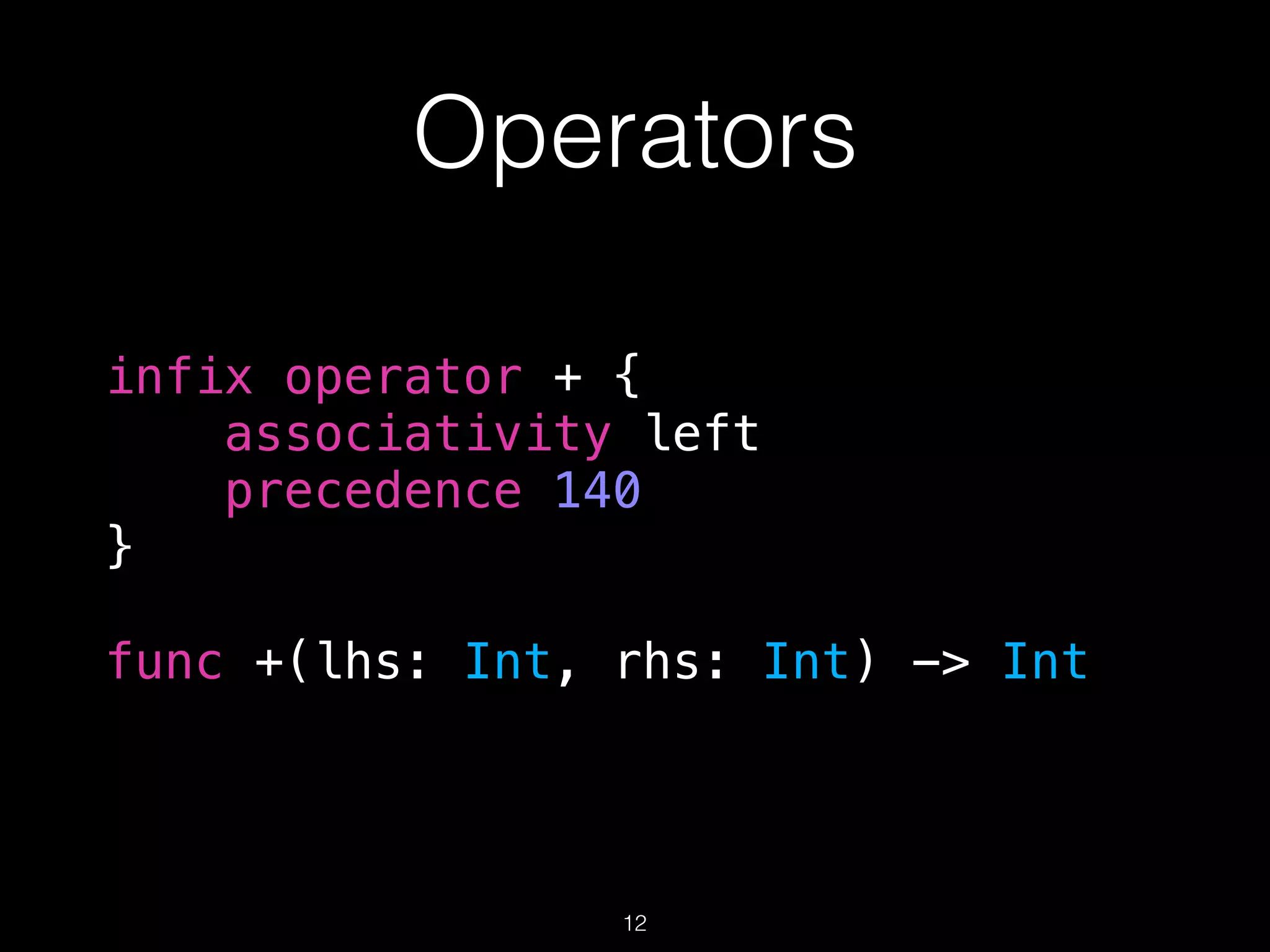
Operators
infix operator + {
associativity left
precedence 140
}
func +(lhs: Int, rhs: Int) -> Int
12
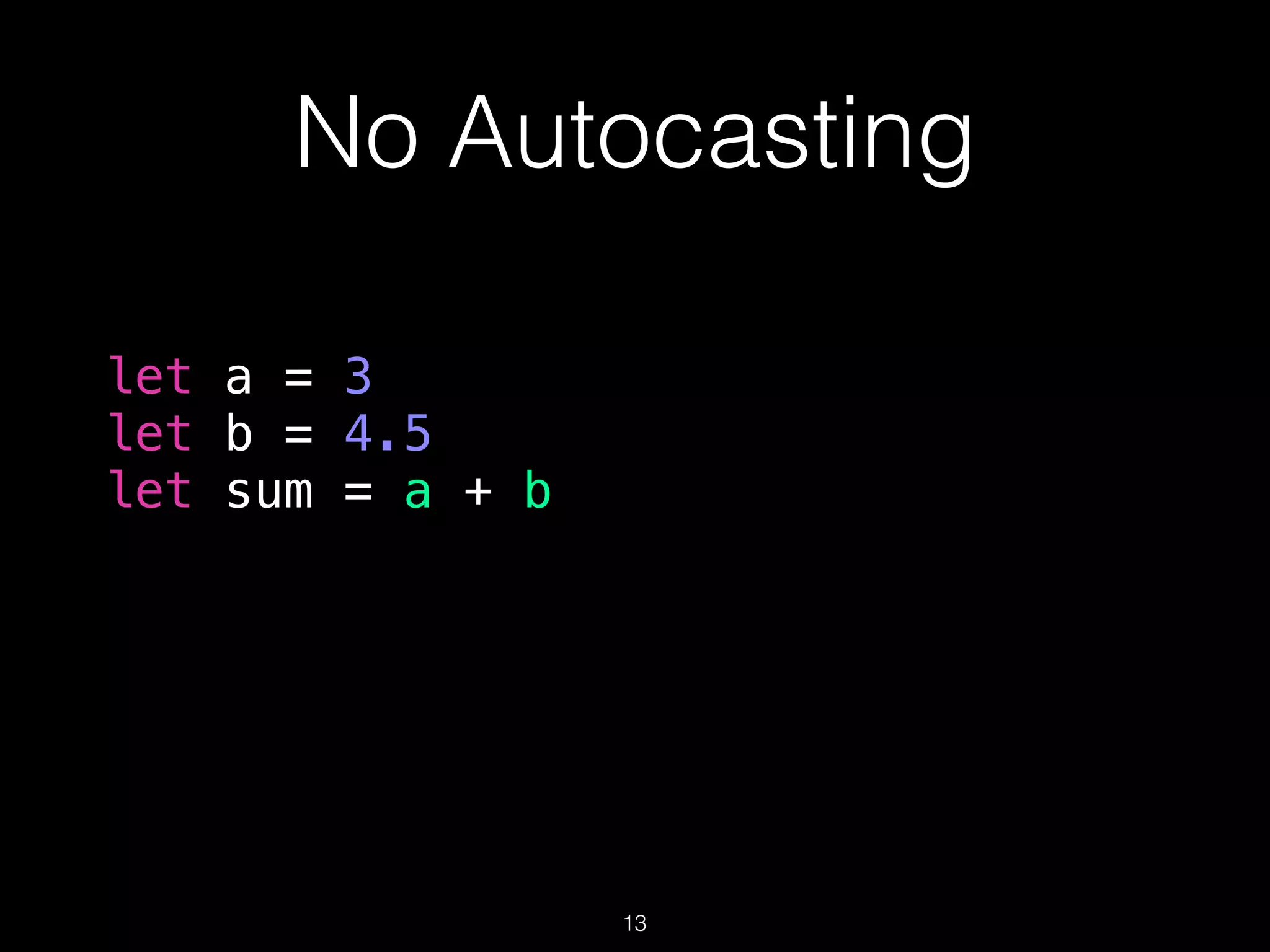
No Autocasting
let a = 3
let b = 4.5
let sum = a + b
13
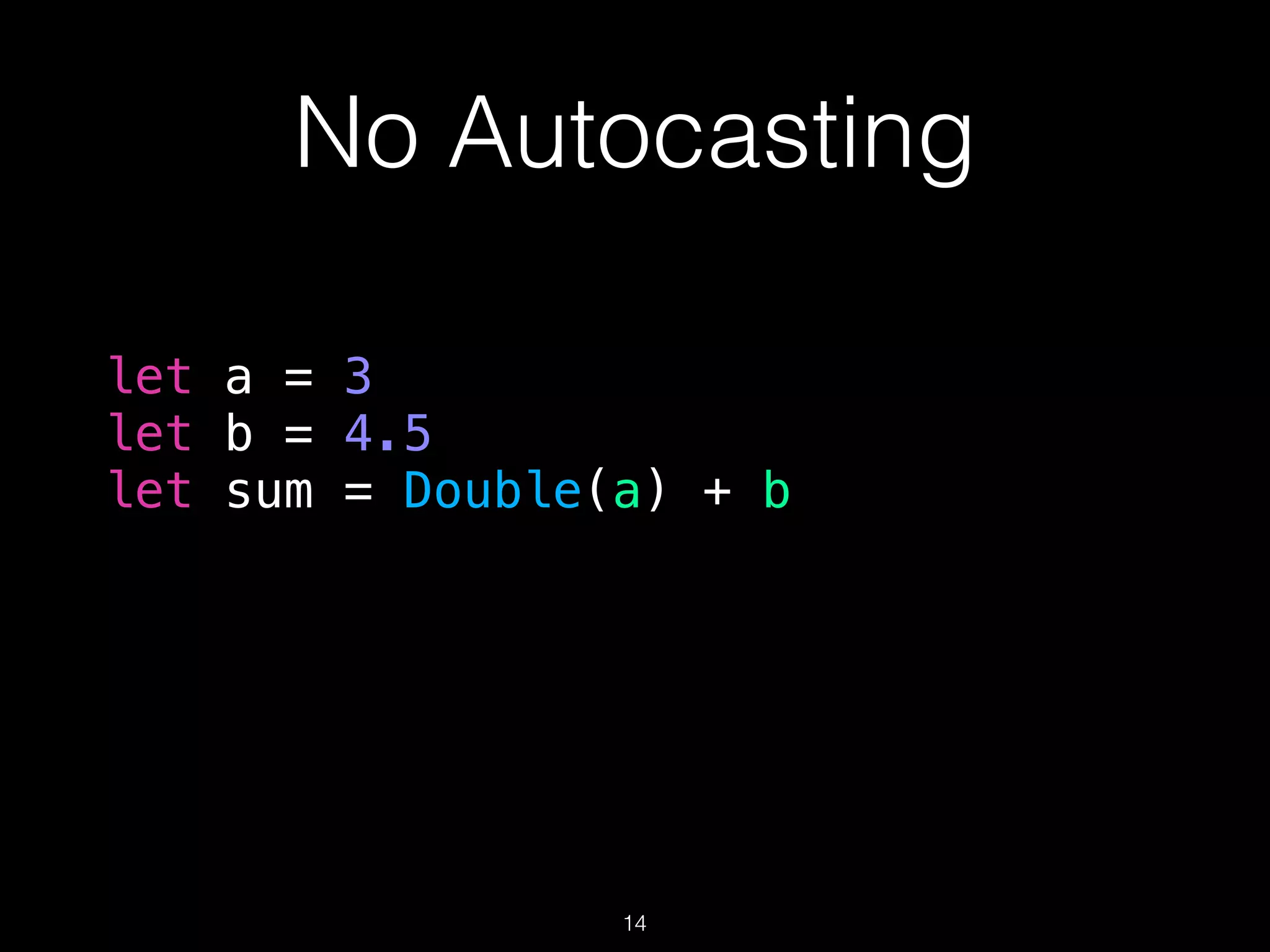
No Autocasting
let a = 3
let b = 4.5
let sum = Double(a) + b
14
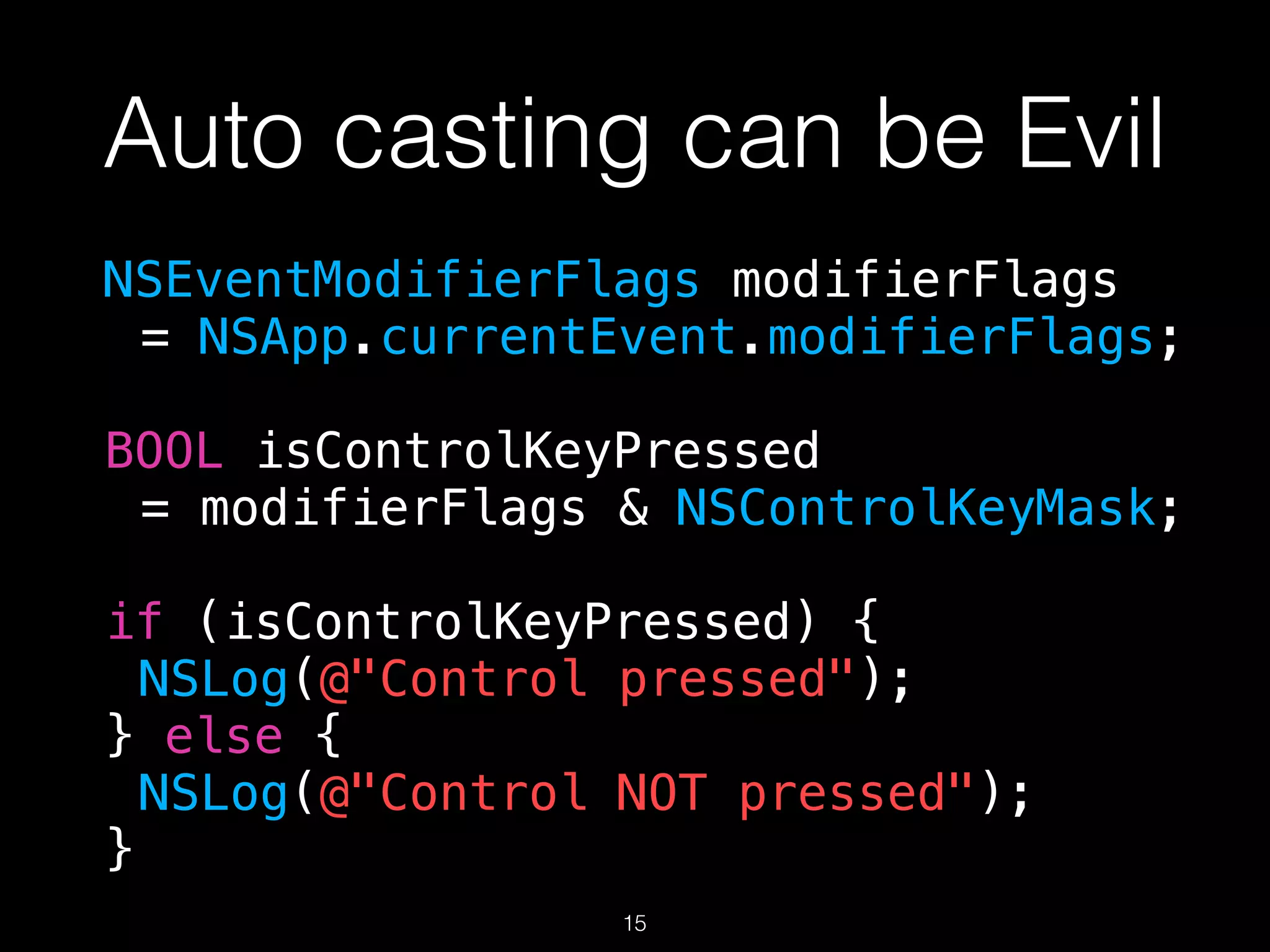
Auto casting can be Evil
NSEventModifierFlags modifierFlags
= NSApp.currentEvent.modifierFlags;
BOOL isControlKeyPressed
= modifierFlags & NSControlKeyMask;
if (isControlKeyPressed) {
NSLog(@"Control pressed");
} else {
NSLog(@"Control NOT pressed");
}
15
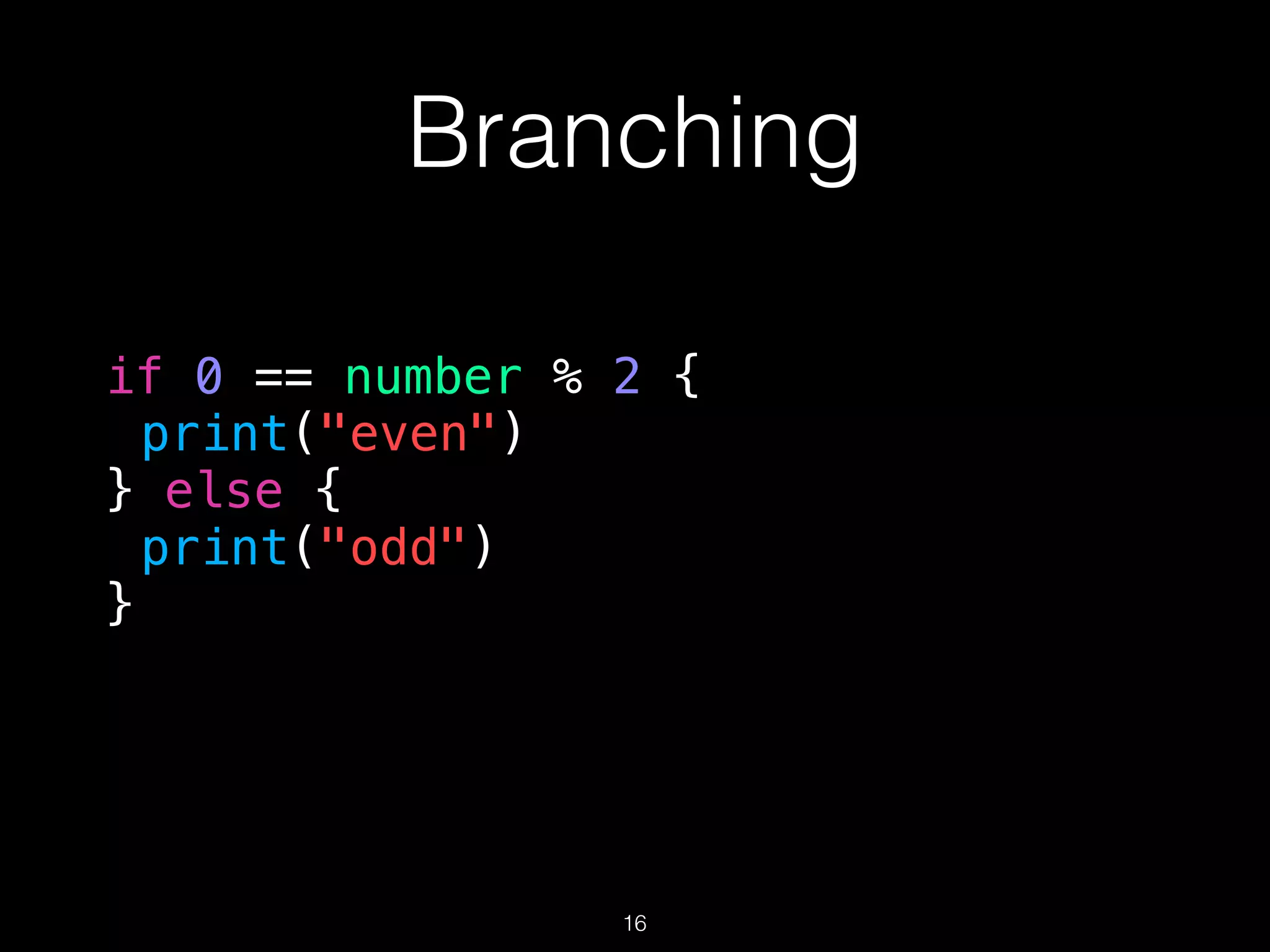
Branching
if 0 == number % 2 {
print("even")
} else {
print("odd")
}
16
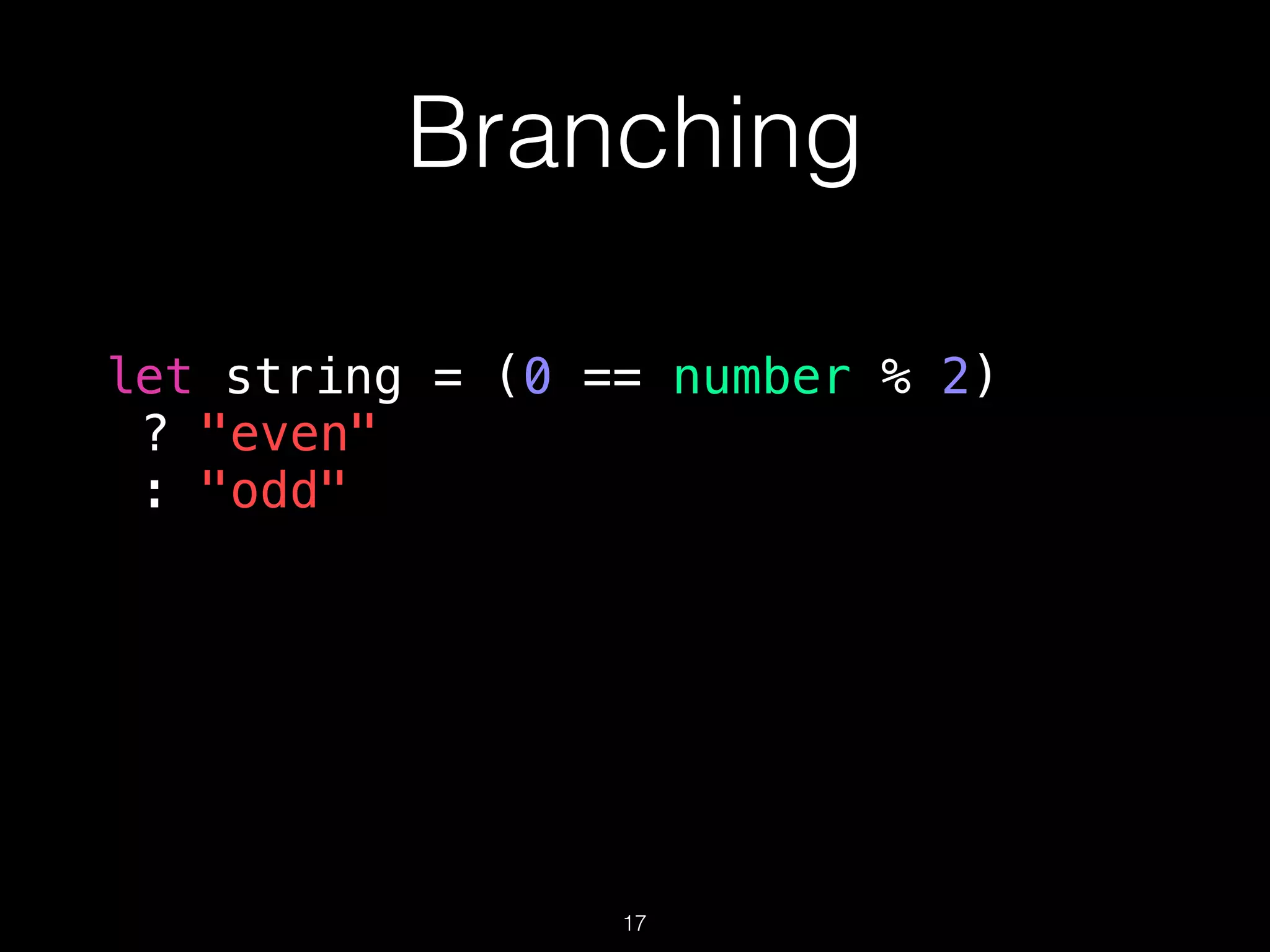
Branching
let string = (0 == number % 2)
? "even"
: "odd"
17
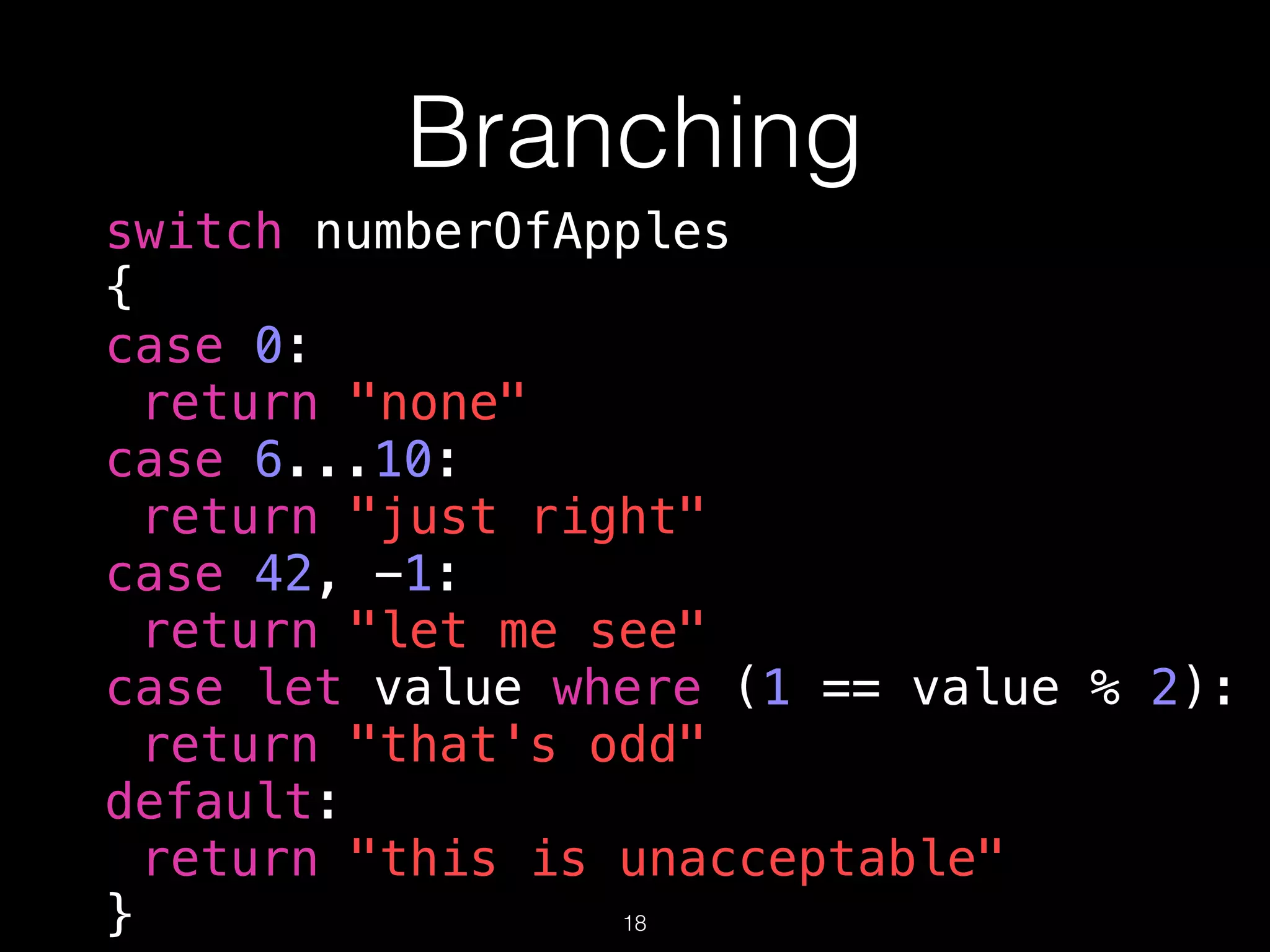
Branching
switch numberOfApples
{
case 0:
return "none"
case 6...10:
return "just right"
case 42, -1:
return "let me see"
case let value where (1 == value % 2):
return "that's odd"
default:
return "this is unacceptable"
} 18
Collections: Array
let arrayOfInts = [5, 4, 3, 2, 1]
19
Collections: Set
let setOfInts: Set<Int> = [
5, 4, 3, 2, 1
]
20
Collections: Dictionary
let dictionaryOfNamesByDigit = [
5: "five",
4: "four",
3: "three",
2: "two",
1: "one"
]
21
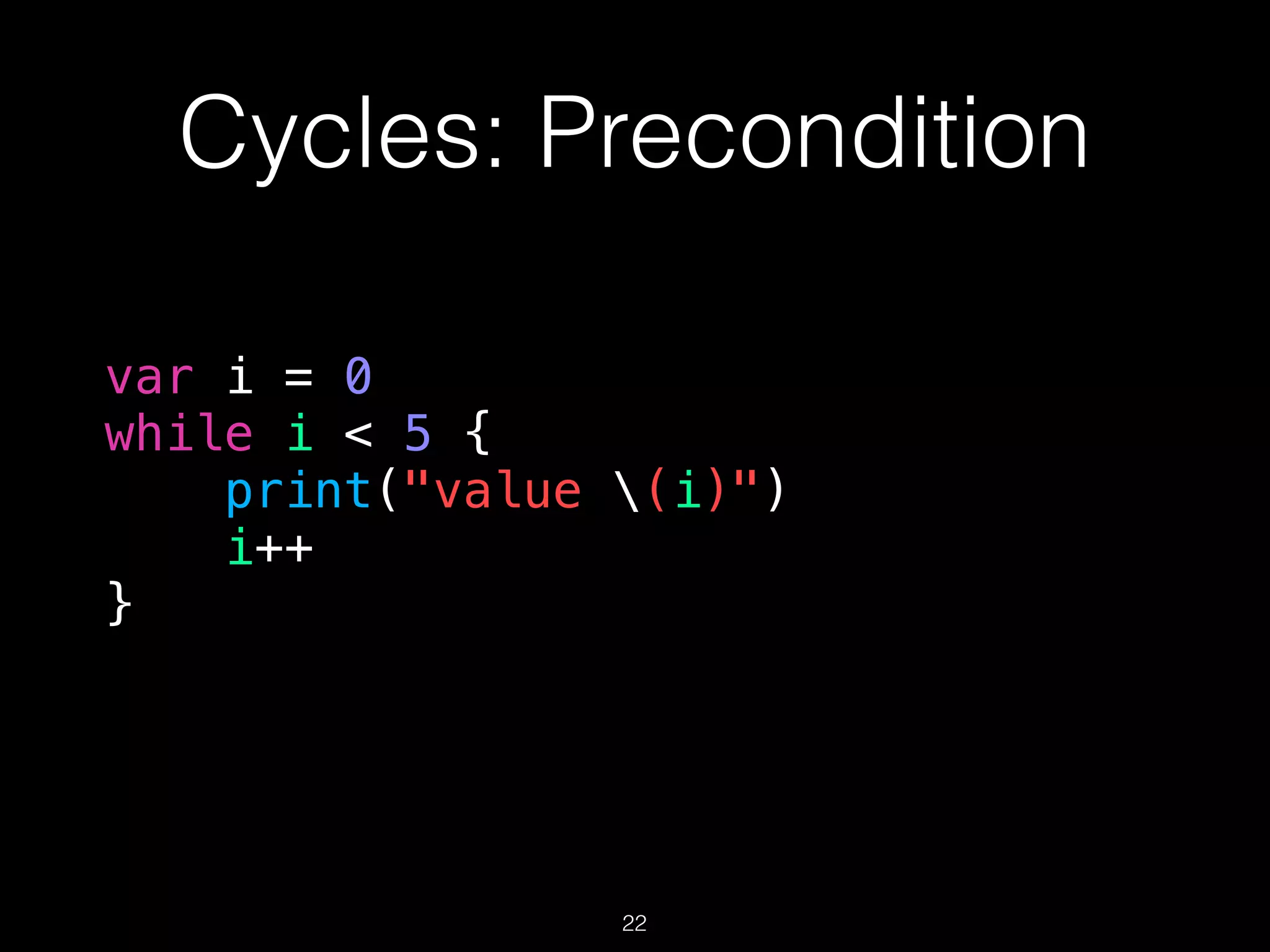
Cycles: Precondition
var i = 0
while i < 5 {
print("value (i)")
i++
}
22
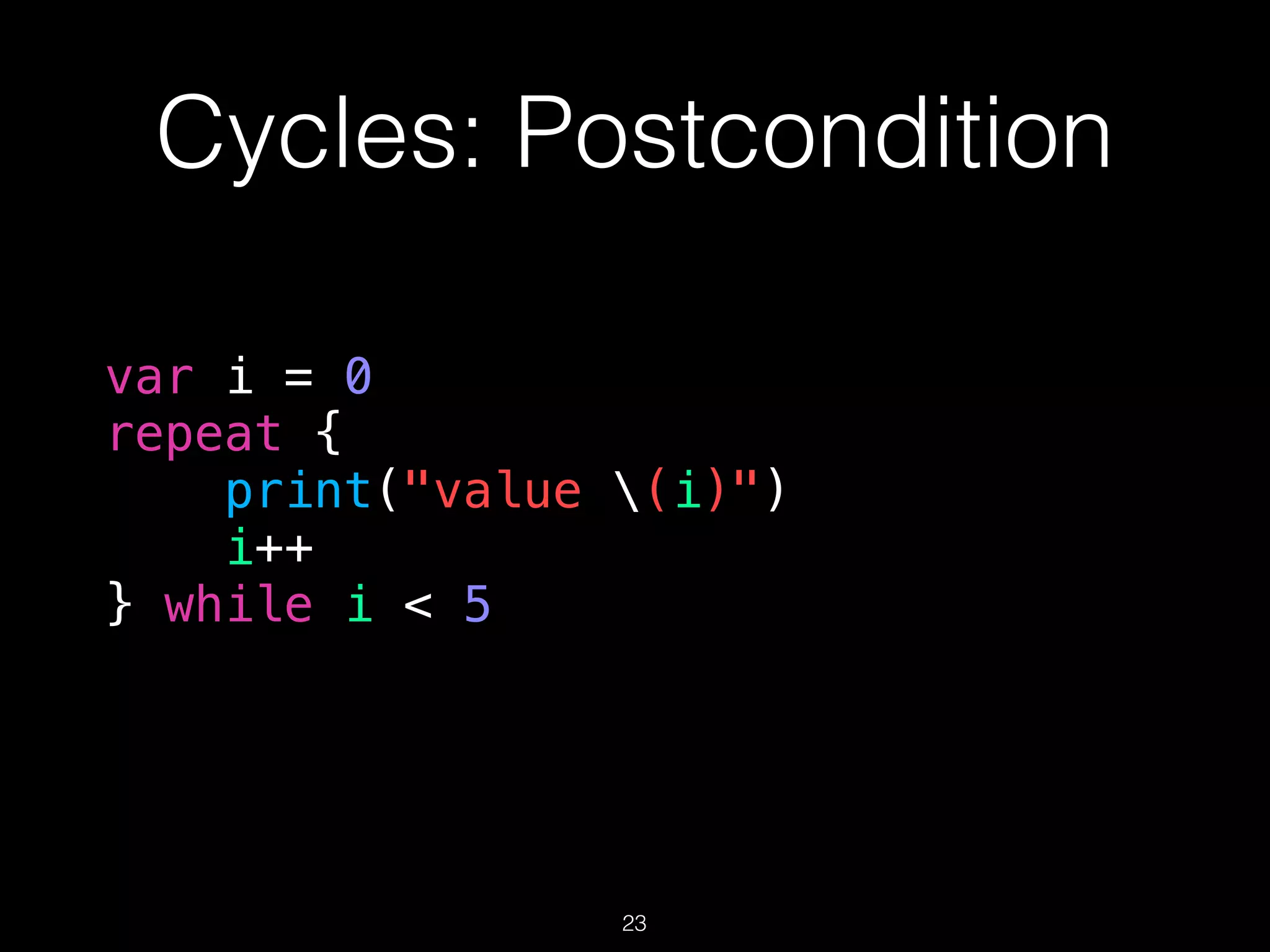
Cycles: Postcondition
var i = 0
repeat {
print("value (i)")
i++
} while i < 5
23
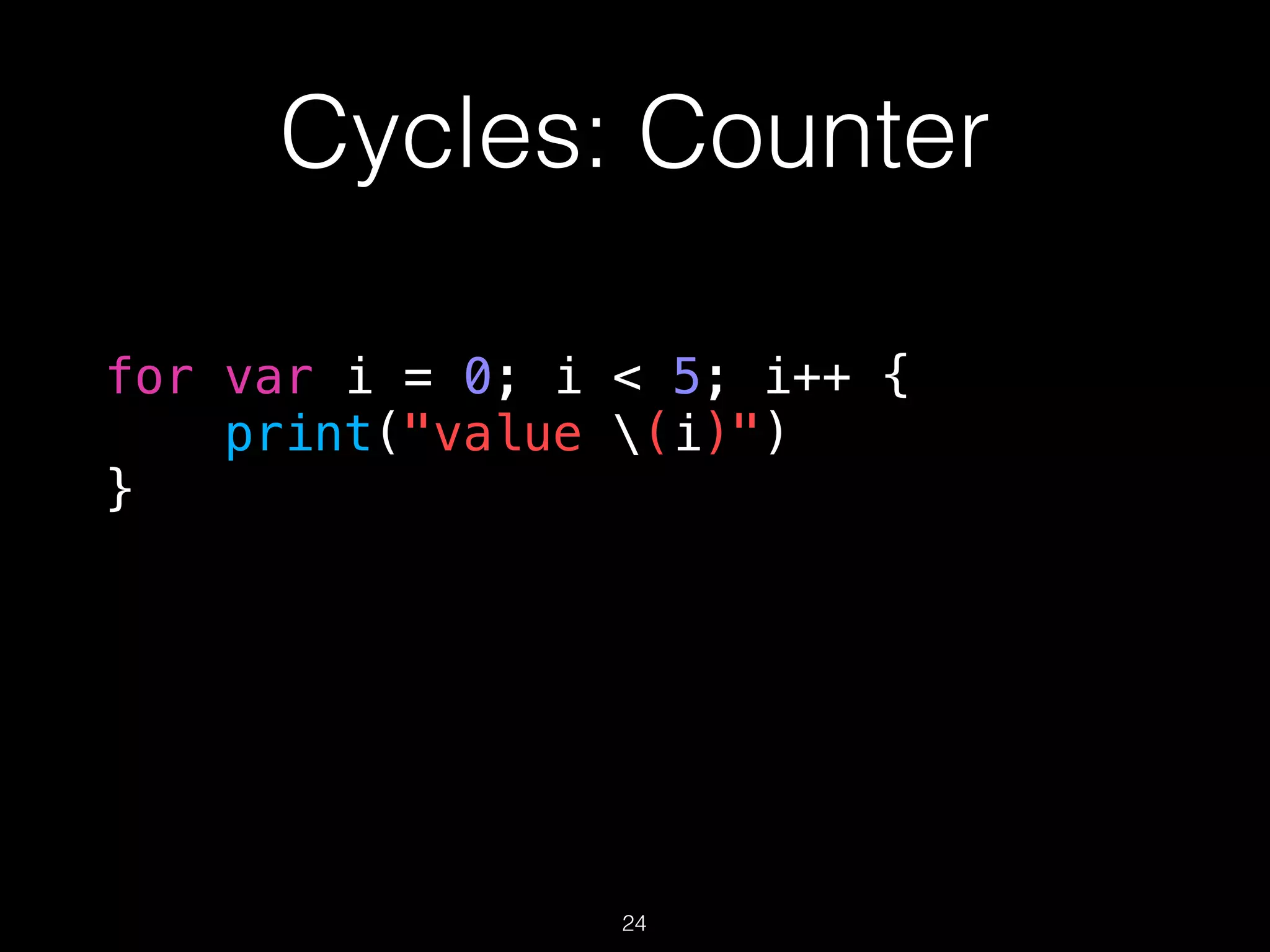
Cycles: Counter
for var i = 0; i < 5; i++ {
print("value (i)")
}
24
Cycles: Enumeration
let arrayOfInts = [5, 4, 3, 2, 1]
for value in arrayOfInts {
print("(value)")
}
25
Objective-C: Null Object
Pattern
id operation = nil;
[operation start];
26
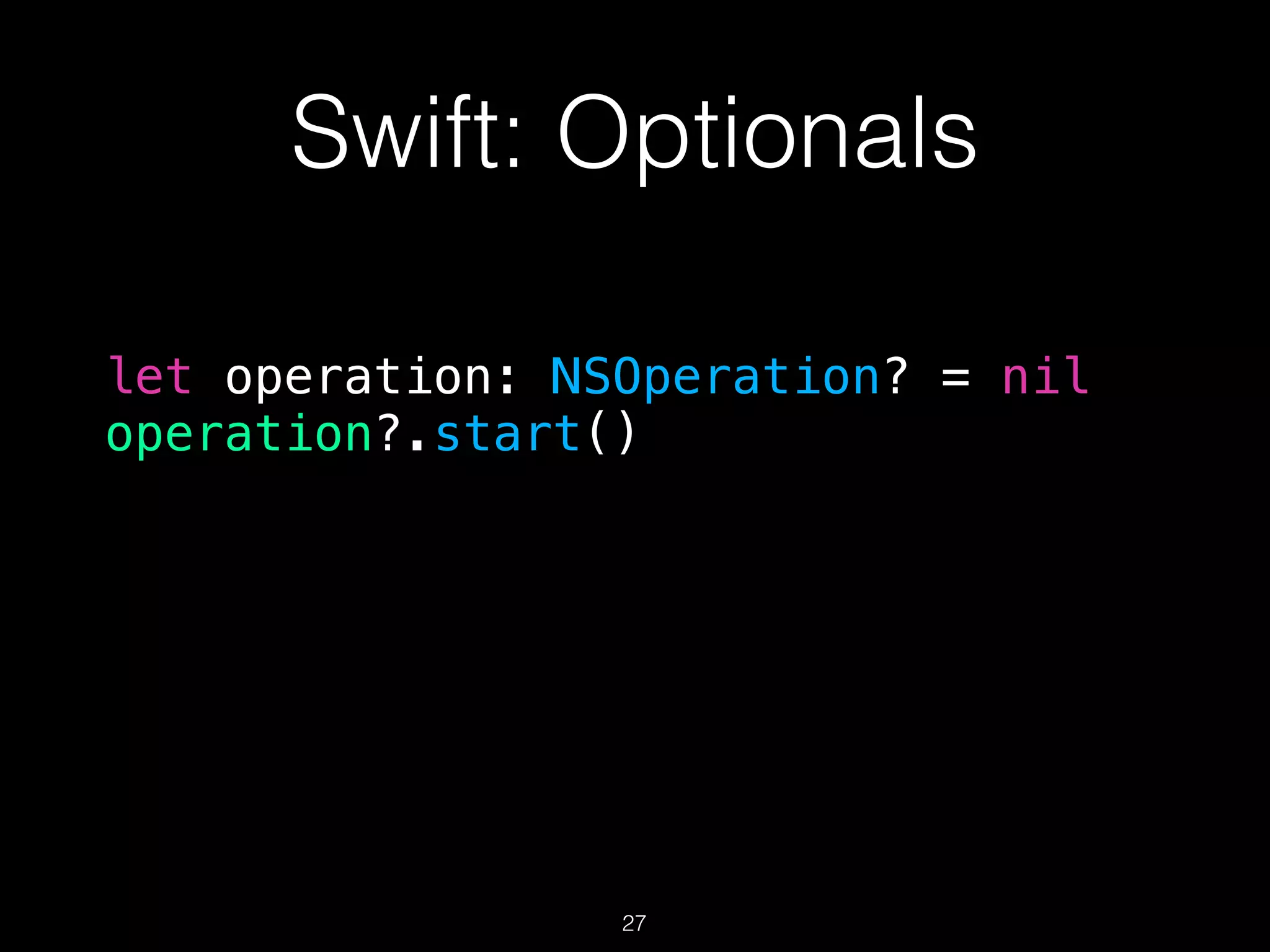
Swift: Optionals
let operation: NSOperation? = nil
operation?.start()
27
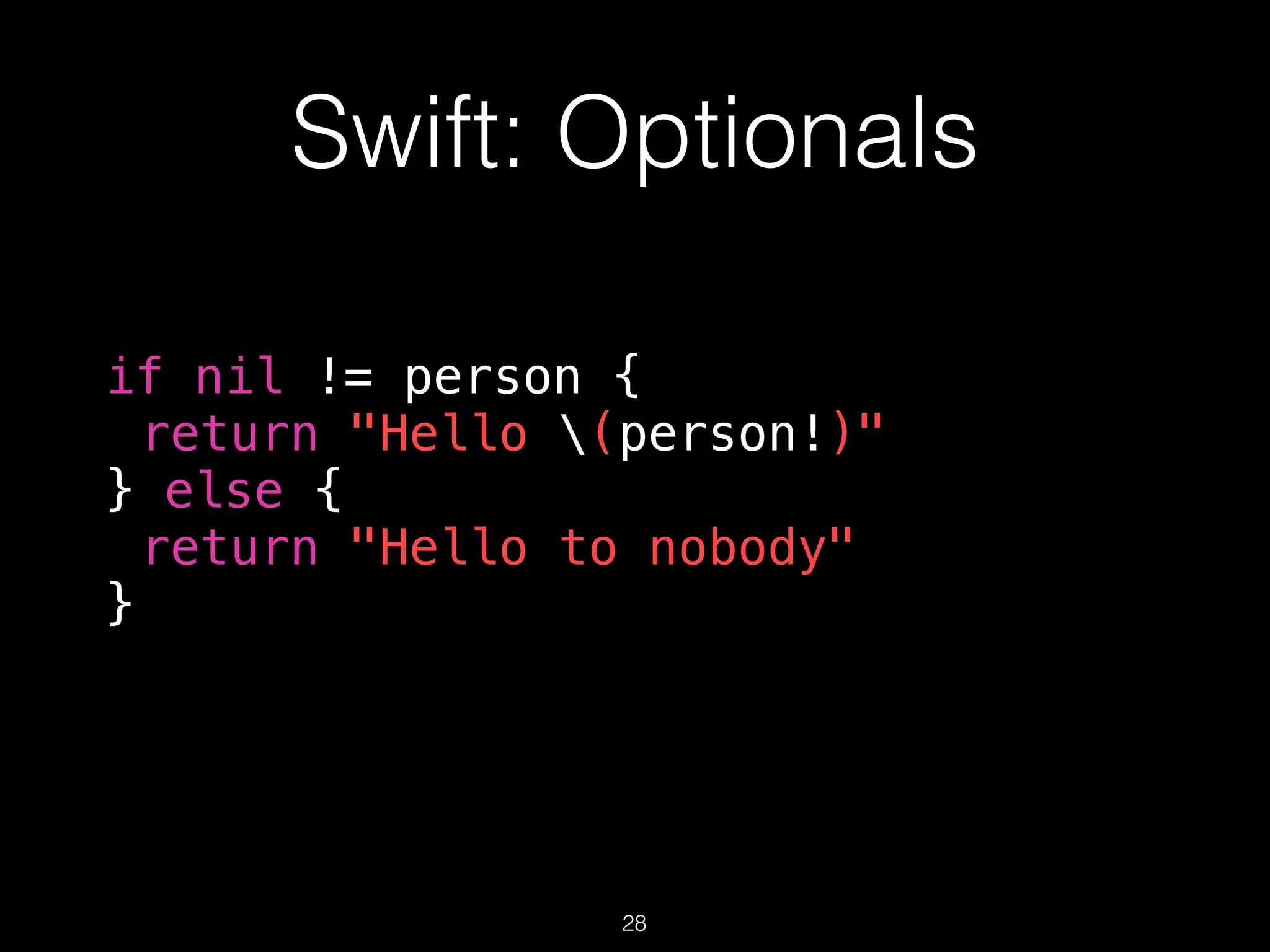
Swift: Optionals
if nil != person {
return "Hello (person!)"
} else {
return "Hello to nobody"
}
28
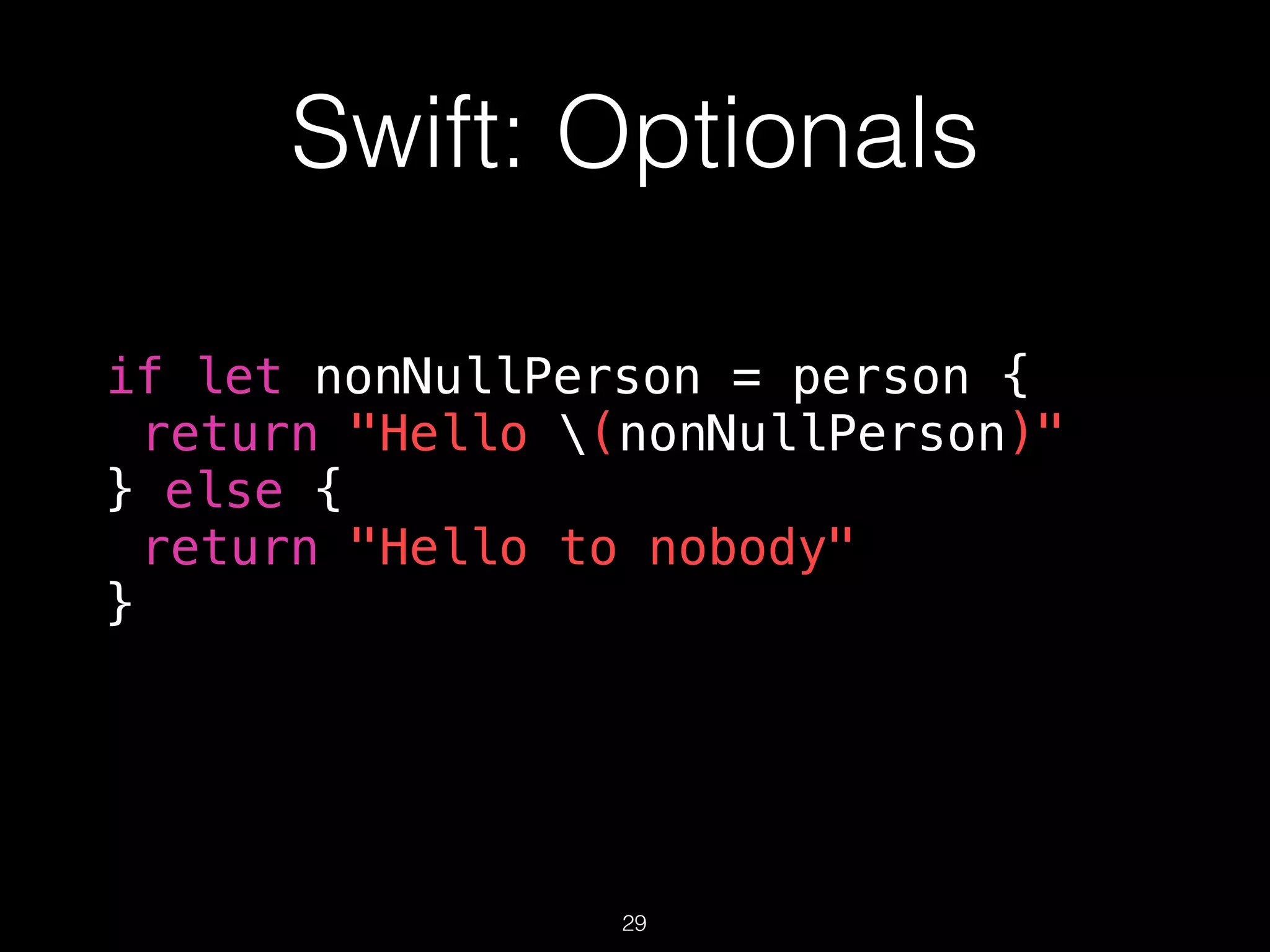
Swift: Optionals
if let nonNullPerson = person {
return "Hello (nonNullPerson)"
} else {
return "Hello to nobody"
}
29
Swift is Great for
Imperative Programming
30
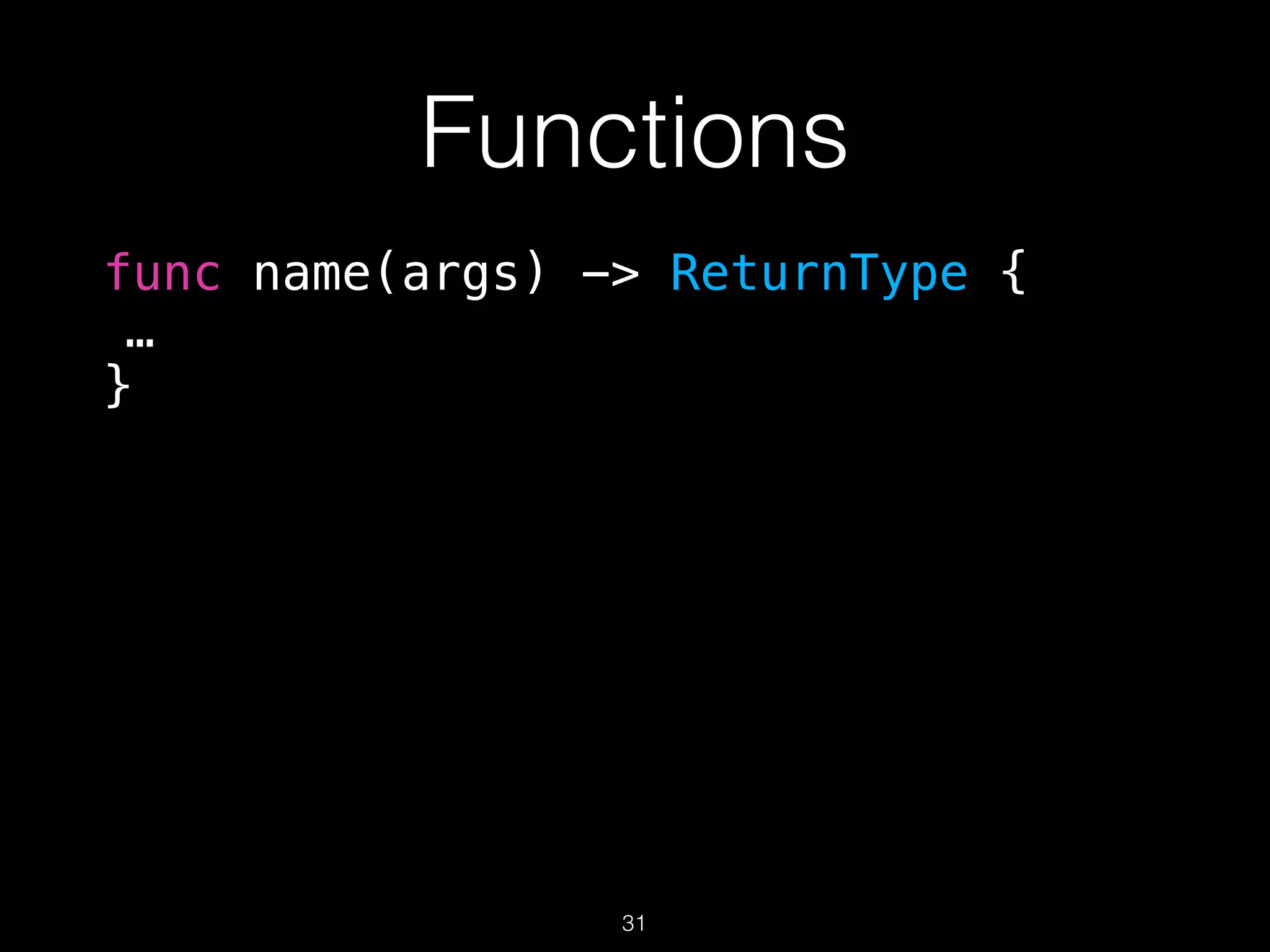
Functions
func name(args) -> ReturnType {
…
}
31
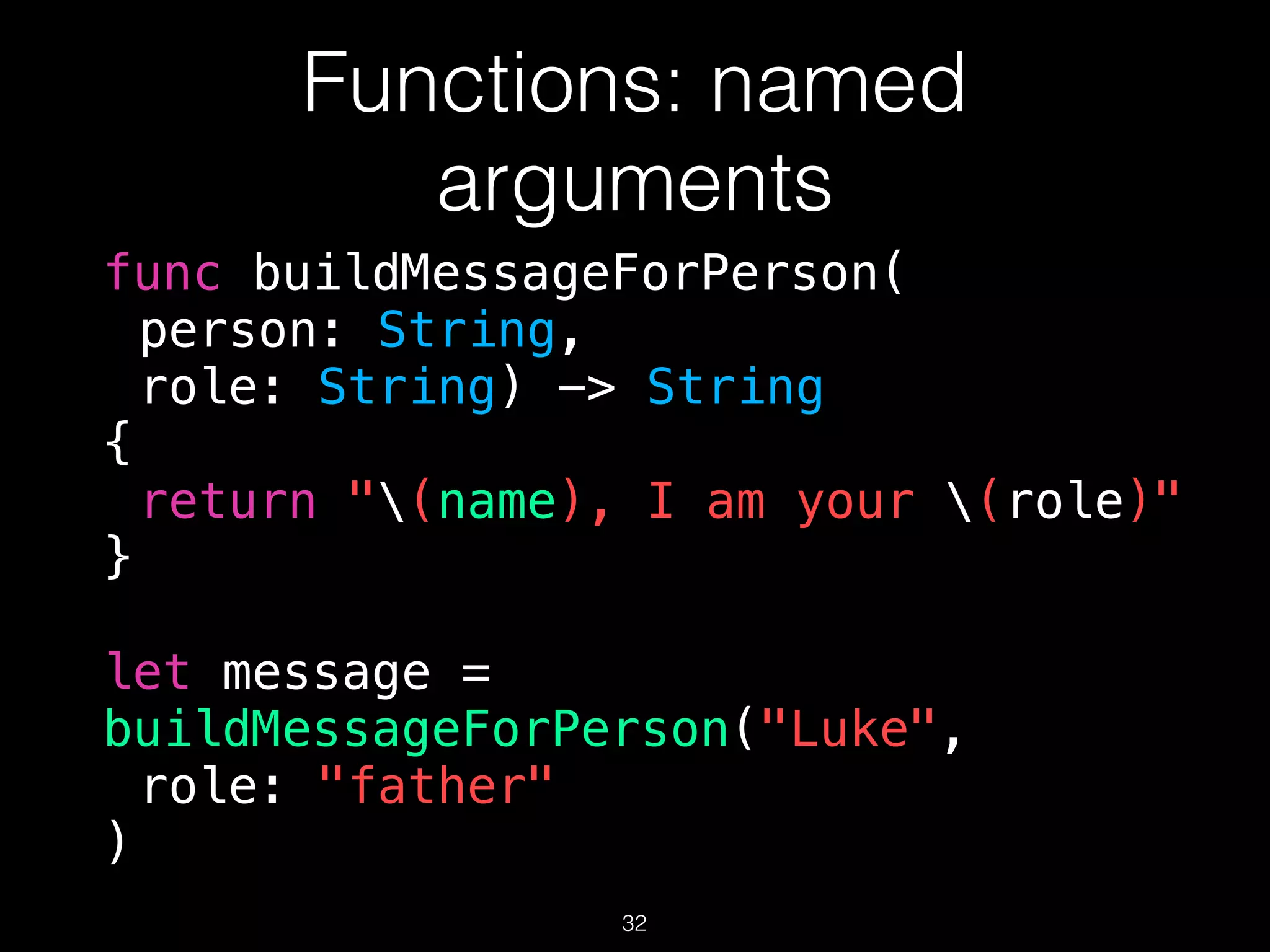
Functions: named
arguments
func buildMessageForPerson(
person: String,
role: String) -> String
{
return "(name), I am your (role)"
}
let message =
buildMessageForPerson("Luke",
role: "father"
)
32
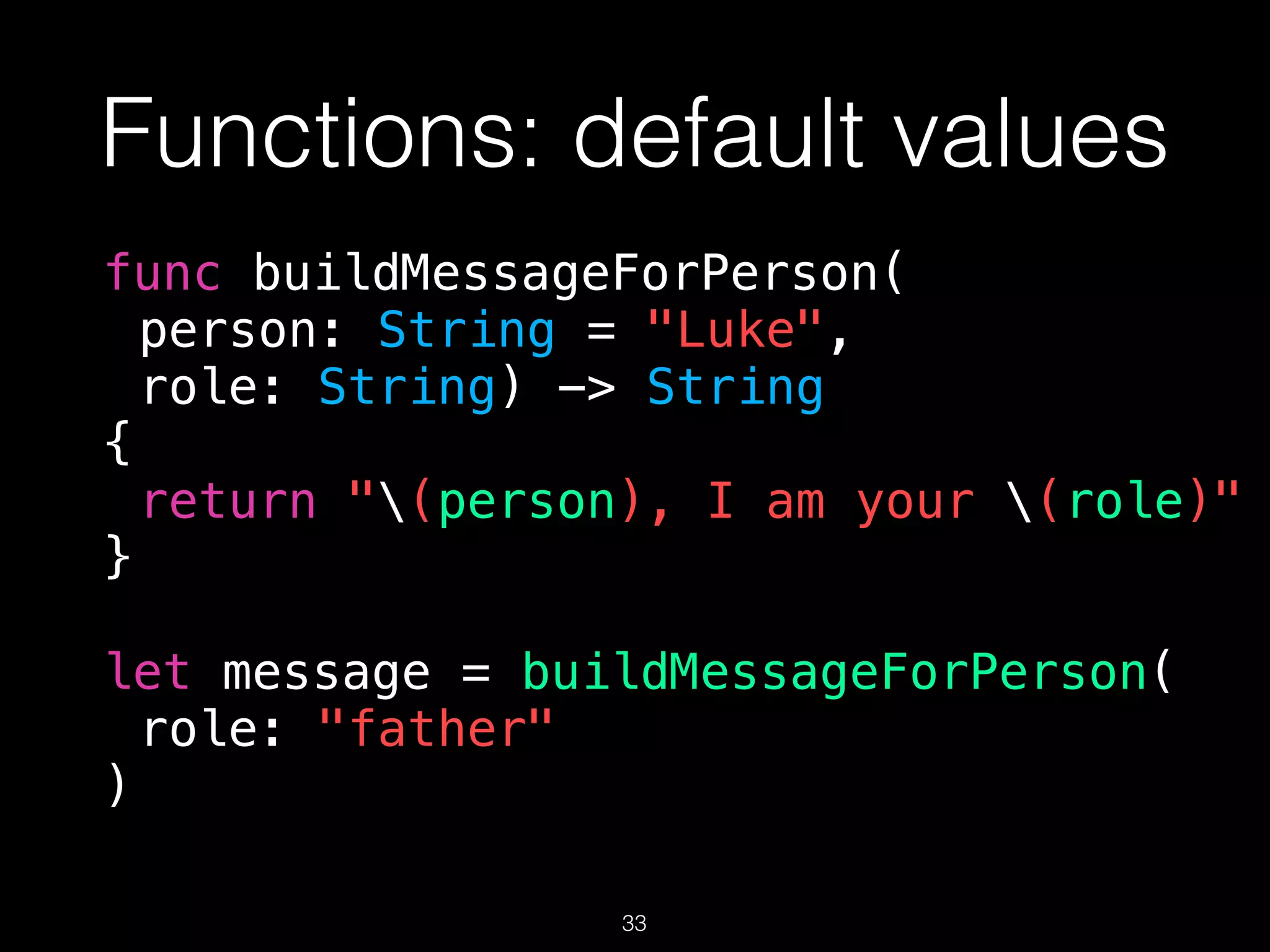
Functions: default values
func buildMessageForPerson(
person: String = "Luke",
role: String) -> String
{
return "(person), I am your (role)"
}
let message = buildMessageForPerson(
role: "father"
)
33
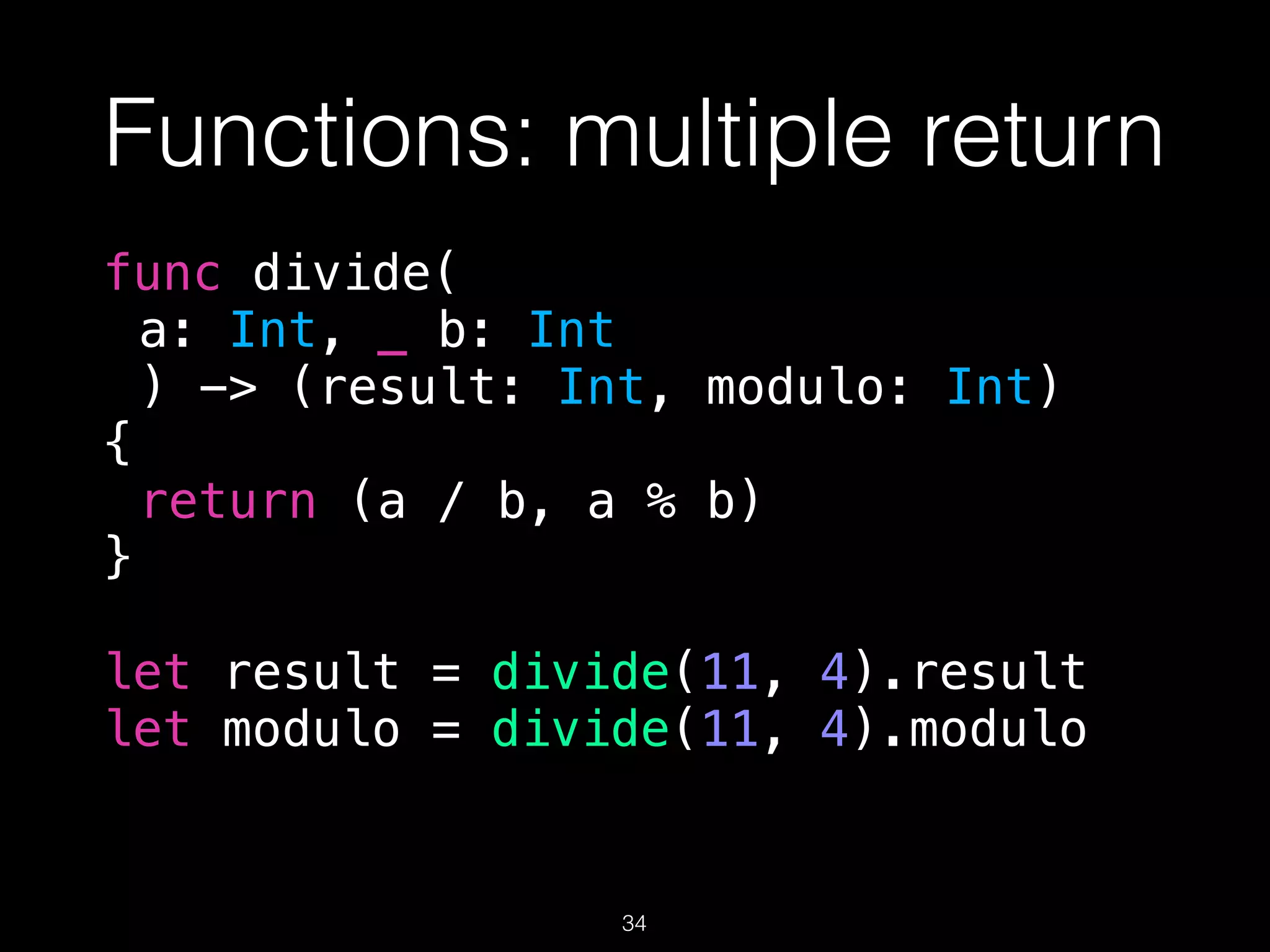
Functions: multiple return
func divide(
a: Int, _ b: Int
) -> (result: Int, modulo: Int)
{
return (a / b, a % b)
}
let result = divide(11, 4).result
let modulo = divide(11, 4).modulo
34
Functions are First
Class Citizen
35
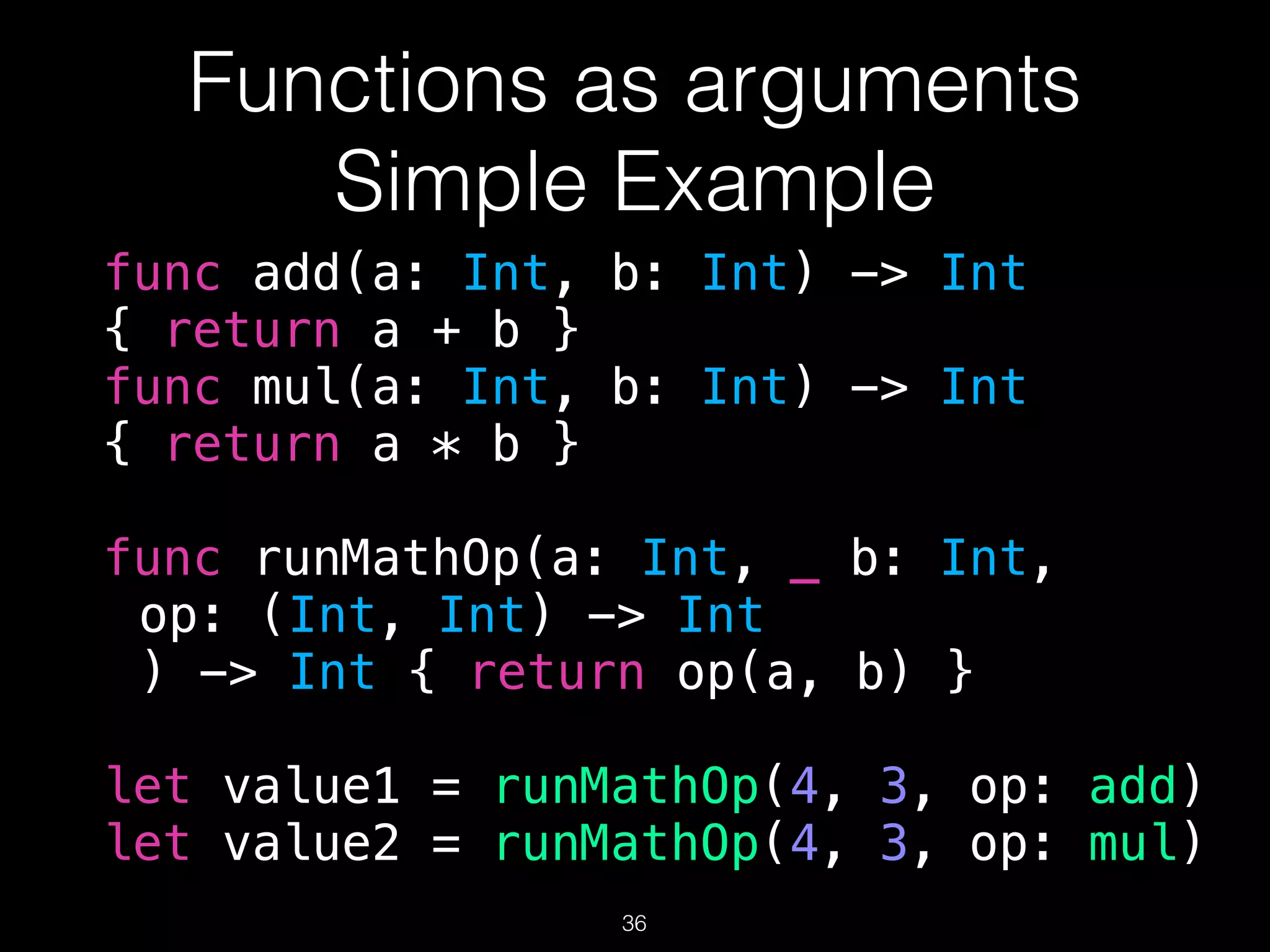
Functions as arguments
Simple Example
func add(a: Int, b: Int) -> Int
{ return a + b }
func mul(a: Int, b: Int) -> Int
{ return a * b }
func runMathOp(a: Int, _ b: Int,
op: (Int, Int) -> Int
) -> Int { return op(a, b) }
let value1 = runMathOp(4, 3, op: add)
let value2 = runMathOp(4, 3, op: mul)
36
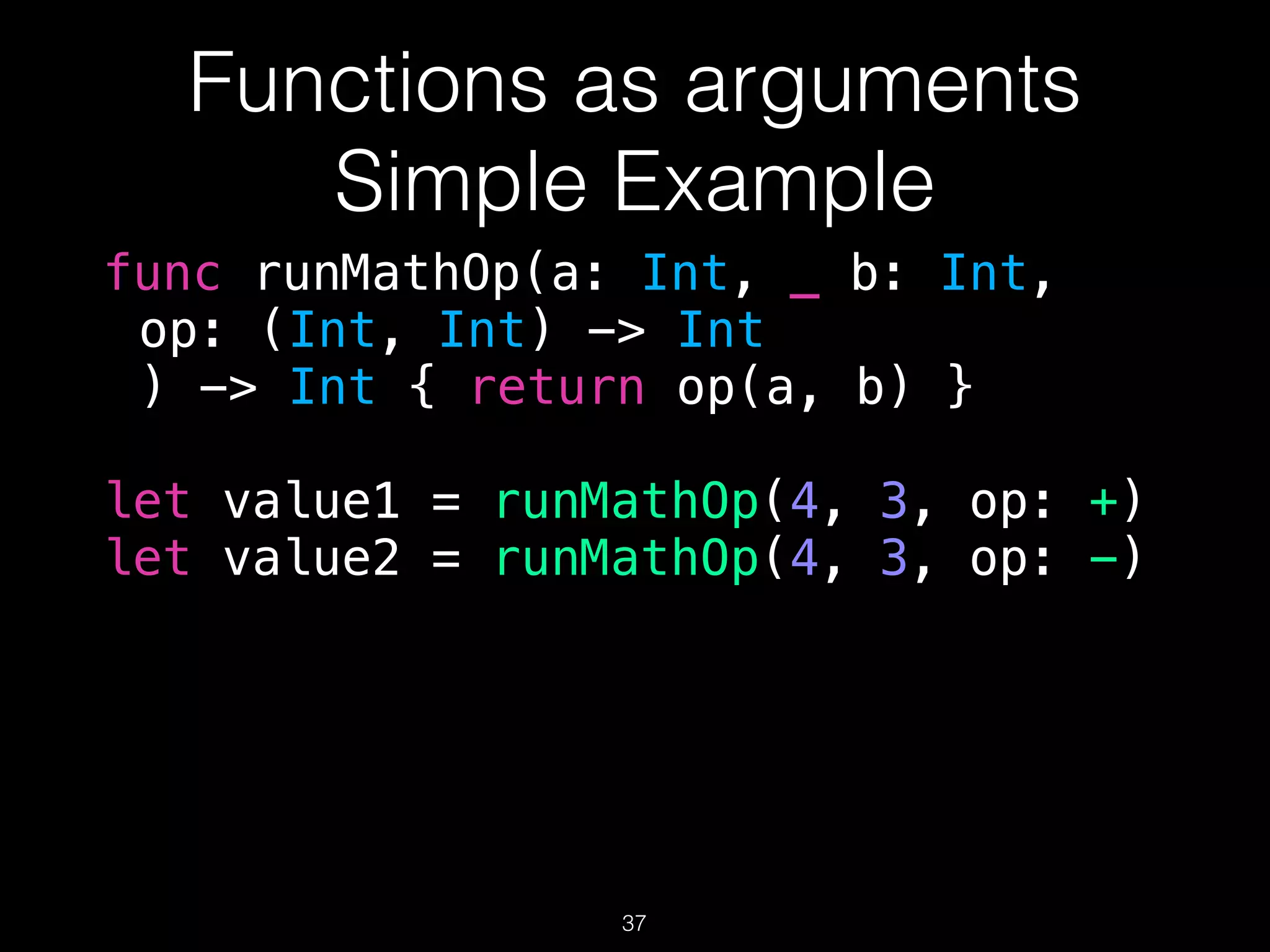
Functions as arguments
Simple Example
func runMathOp(a: Int, _ b: Int,
op: (Int, Int) -> Int
) -> Int { return op(a, b) }
let value1 = runMathOp(4, 3, op: +)
let value2 = runMathOp(4, 3, op: -)
37
Swift is Functional
Language
38
Imperative Style
let names = ["Luke", "Chuwy", "Baker"]
var messages = [String]()
for name in names {
let message =
buildMessageForPerson(name, "father")
messages.append(message)
}
print("(messages)")
39
Functional Style
let names = ["Luke", "Chuwy", "Baker"]
let messages = names.map {
buildMessageForPerson($0, "father")
}
print("(messages)")
40
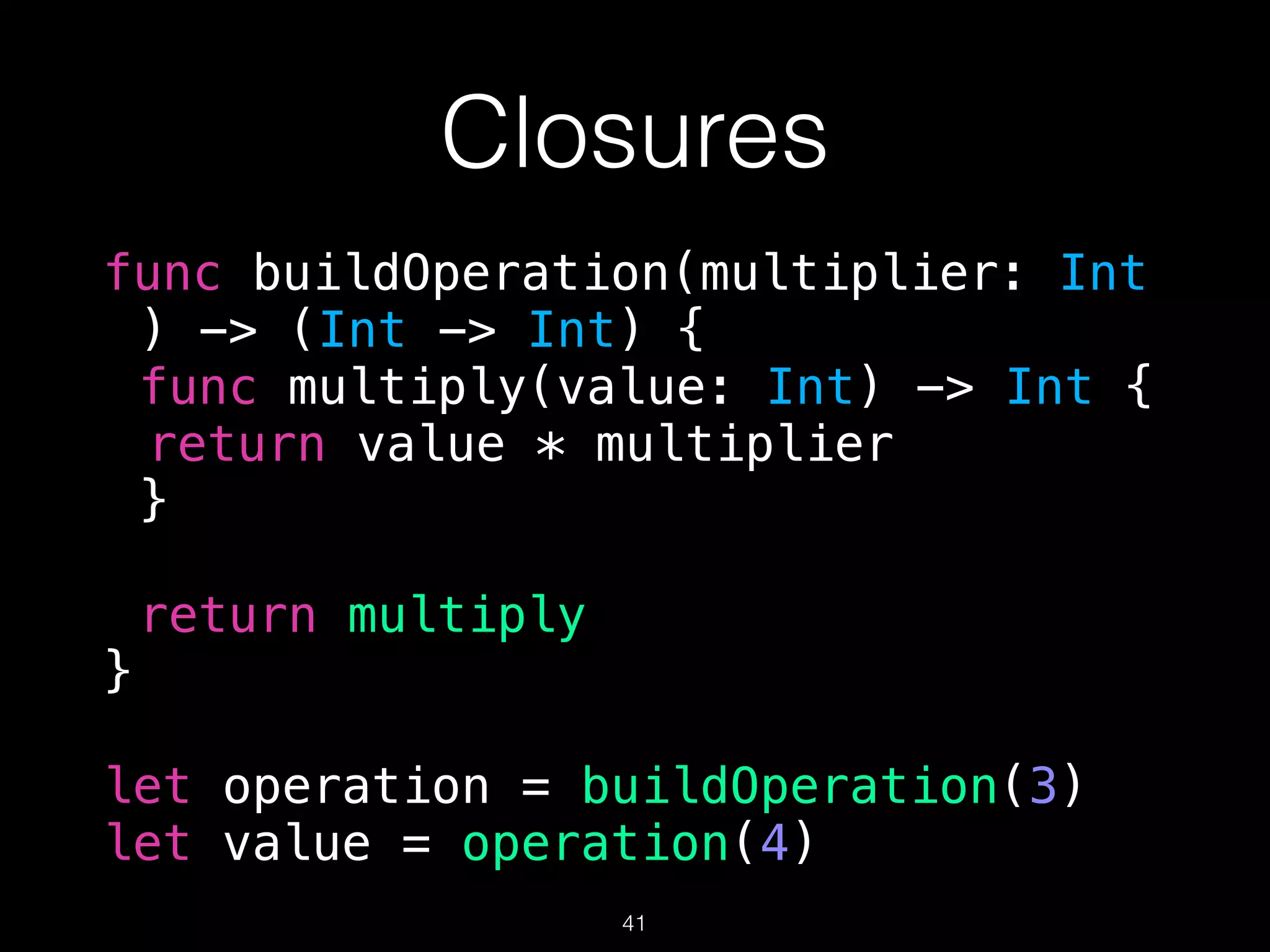
Closures
func buildOperation(multiplier: Int
) -> (Int -> Int) {
func multiply(value: Int) -> Int {
return value * multiplier
}
return multiply
}
let operation = buildOperation(3)
let value = operation(4)
41
Just use Functional
Paradigm
42
Type System
43
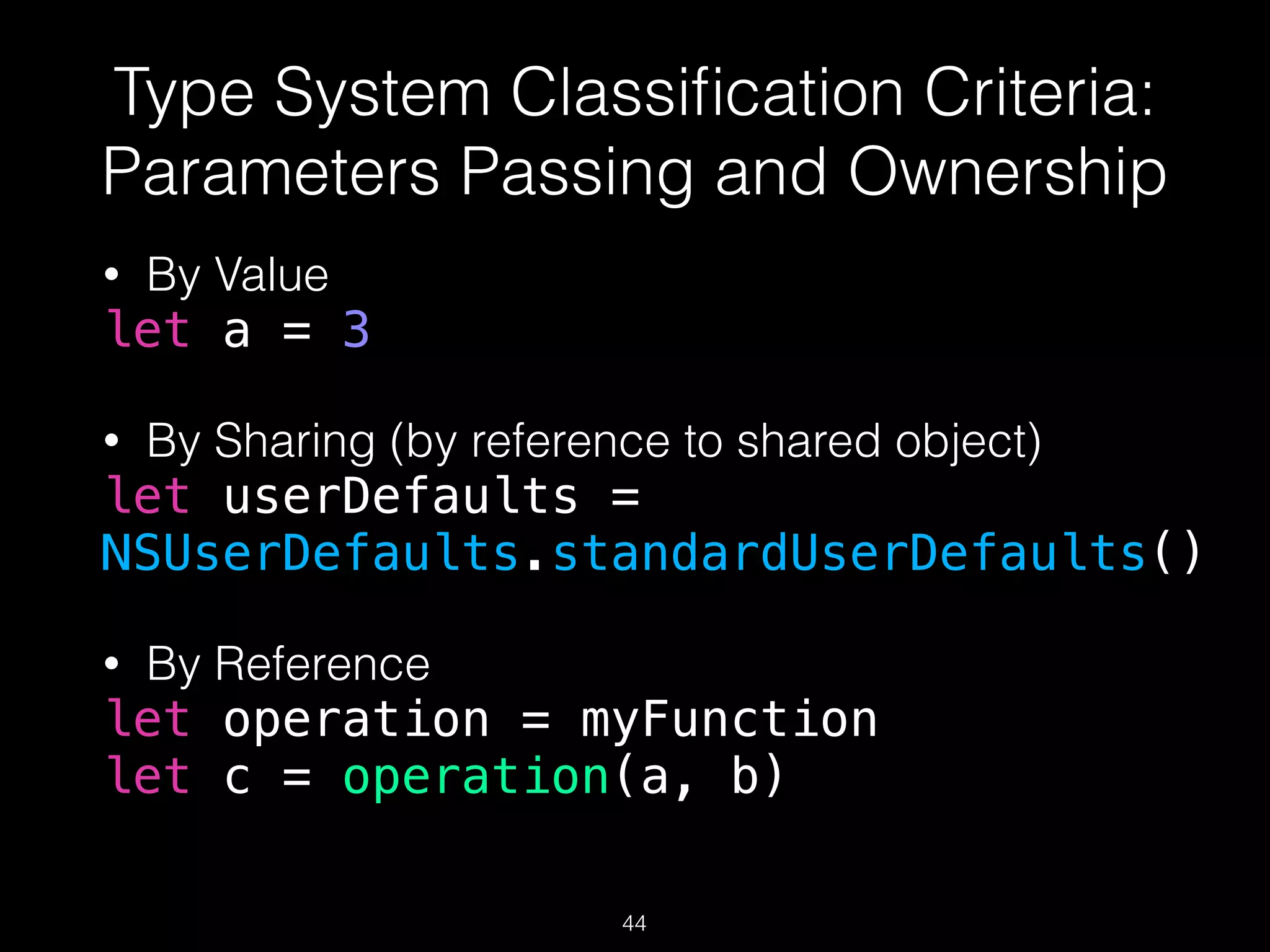
Type System Classification Criteria:
Parameters Passing and Ownership
• By Value
let a = 3
• By Sharing (by reference to shared object)
let userDefaults =
NSUserDefaults.standardUserDefaults()
• By Reference
let operation = myFunction
let c = operation(a, b)
44
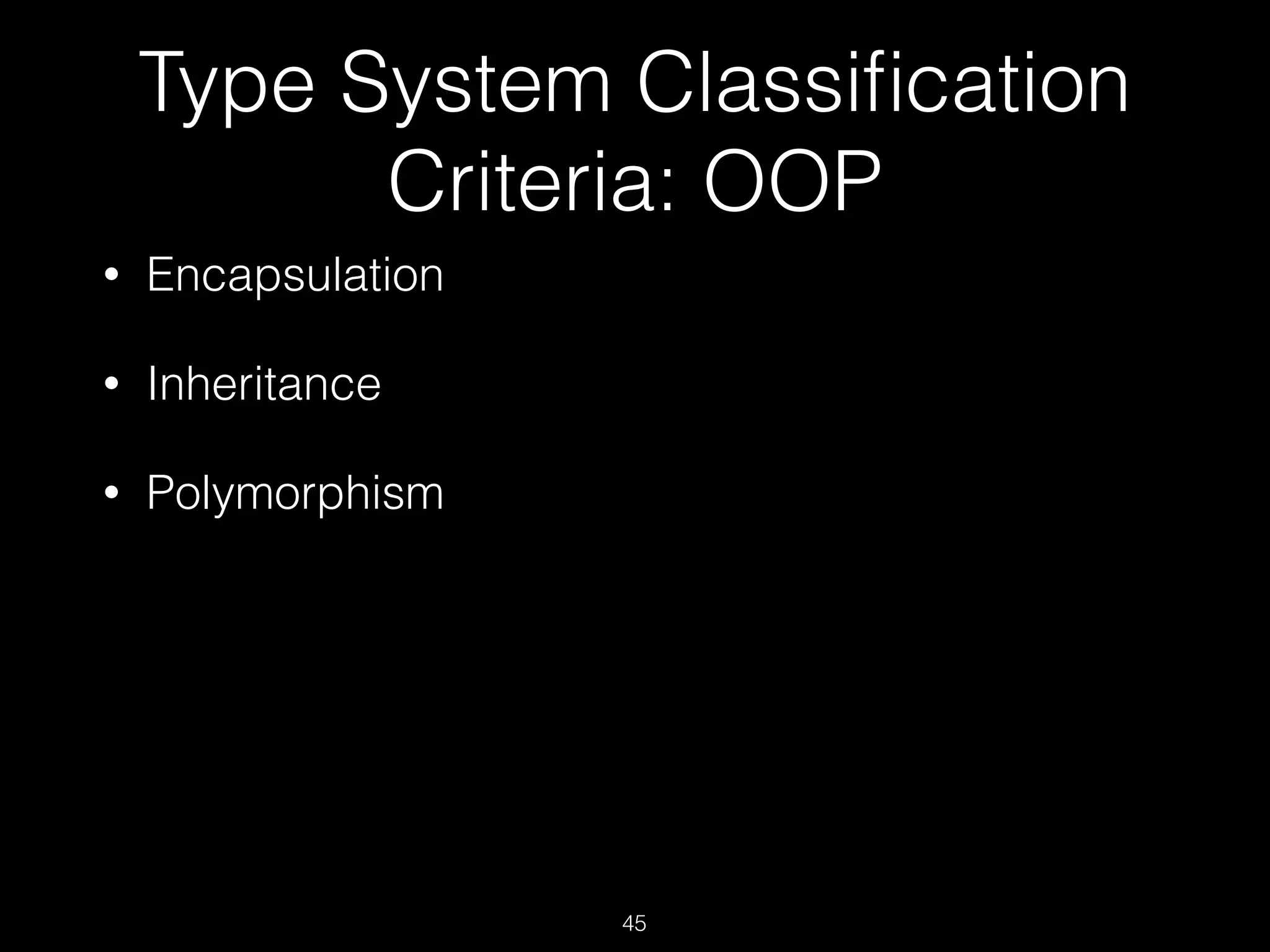
Type System Classification
Criteria: OOP
• Encapsulation
• Inheritance
• Polymorphism
45
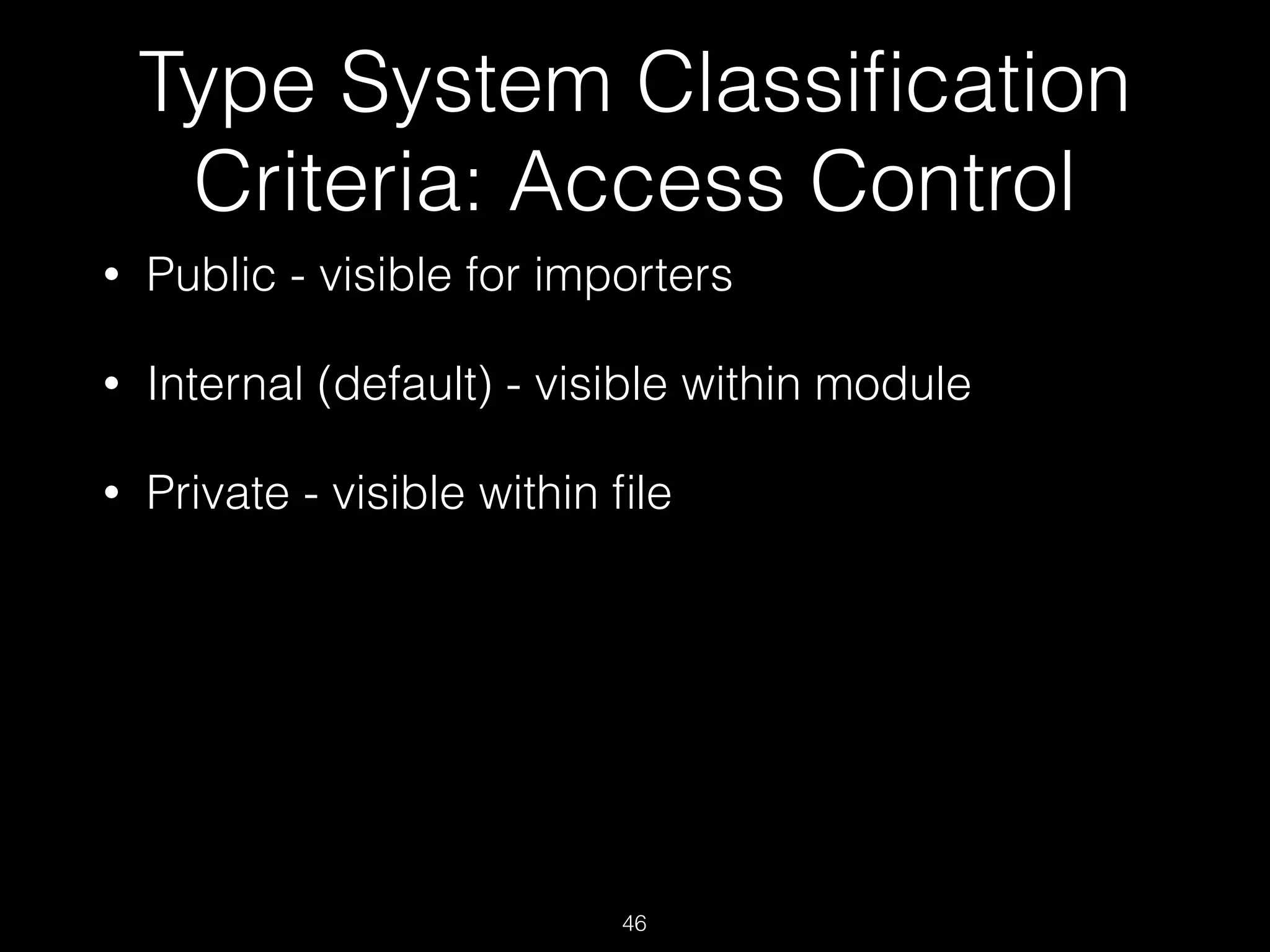
Type System Classification
Criteria: Access Control
• Public - visible for importers
• Internal (default) - visible within module
• Private - visible within file
46
Type System Classification
Criteria: Objective-C compatibility
• partial
• none
47
Types
• tuple
48
Types
• tuple
• function
49
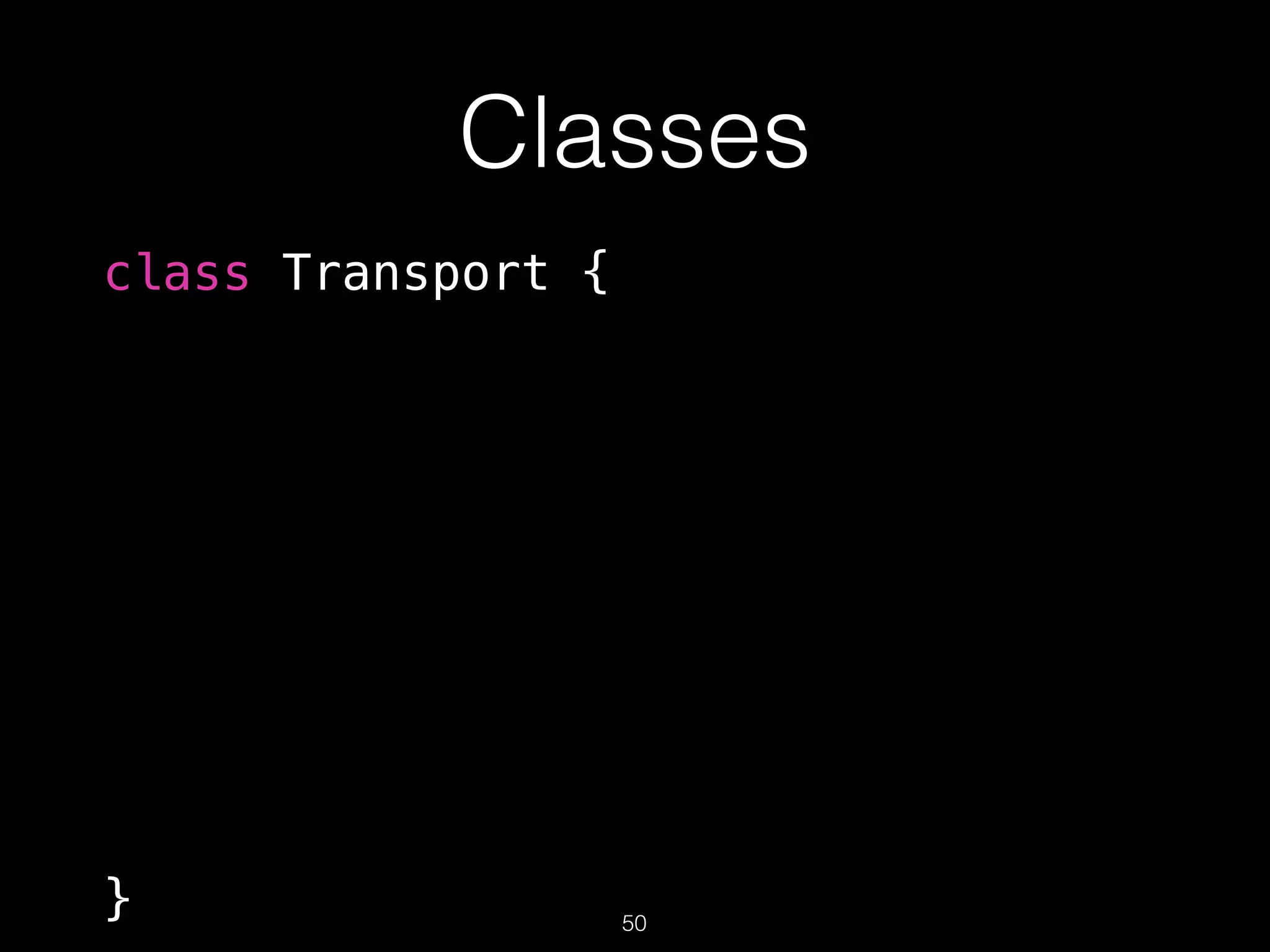
Classes
class Transport {
} 50
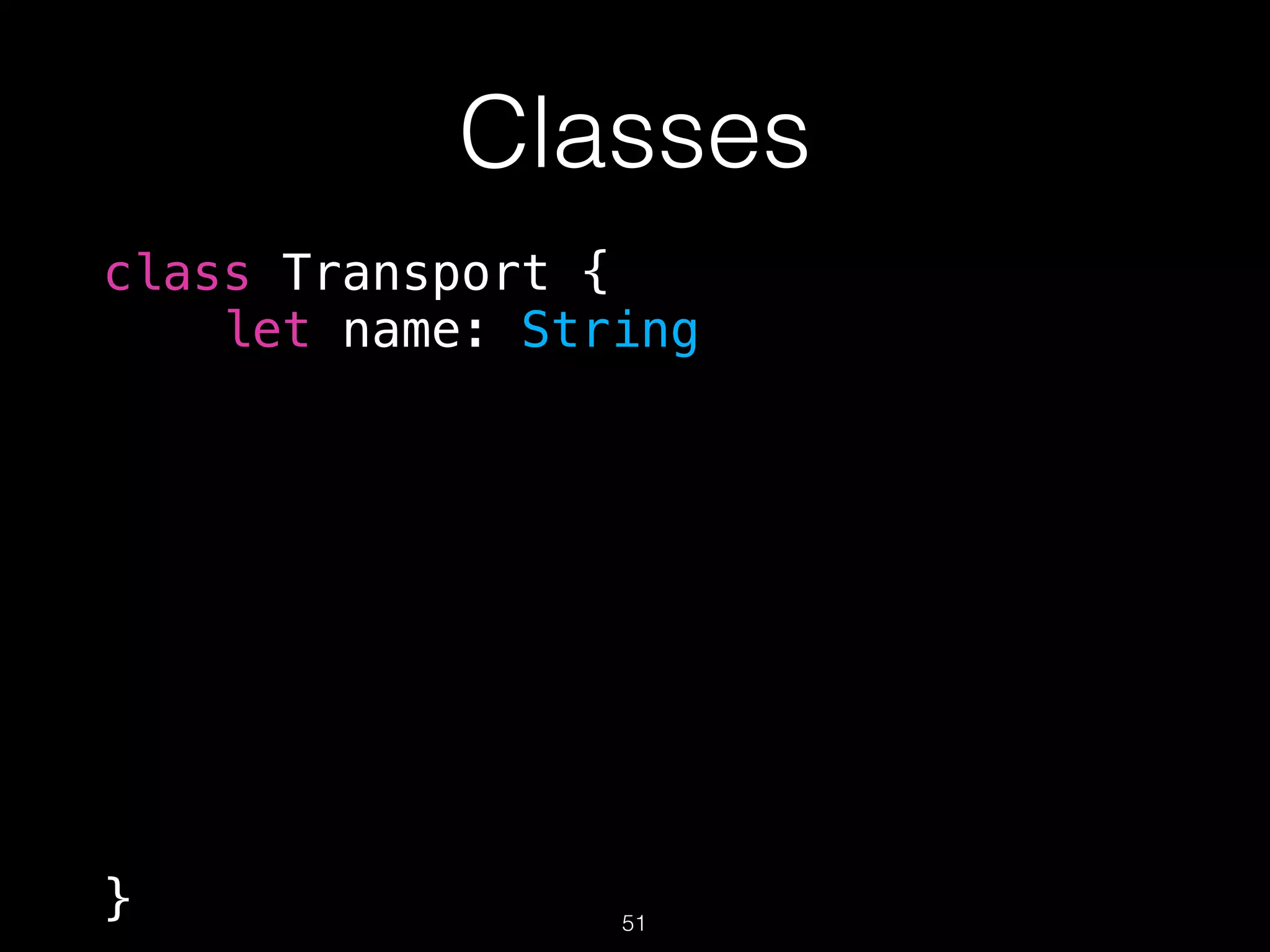
Classes
class Transport {
let name: String
} 51
Classes
class Transport {
let name: String
private var velocity: Double = 0.0
} 52
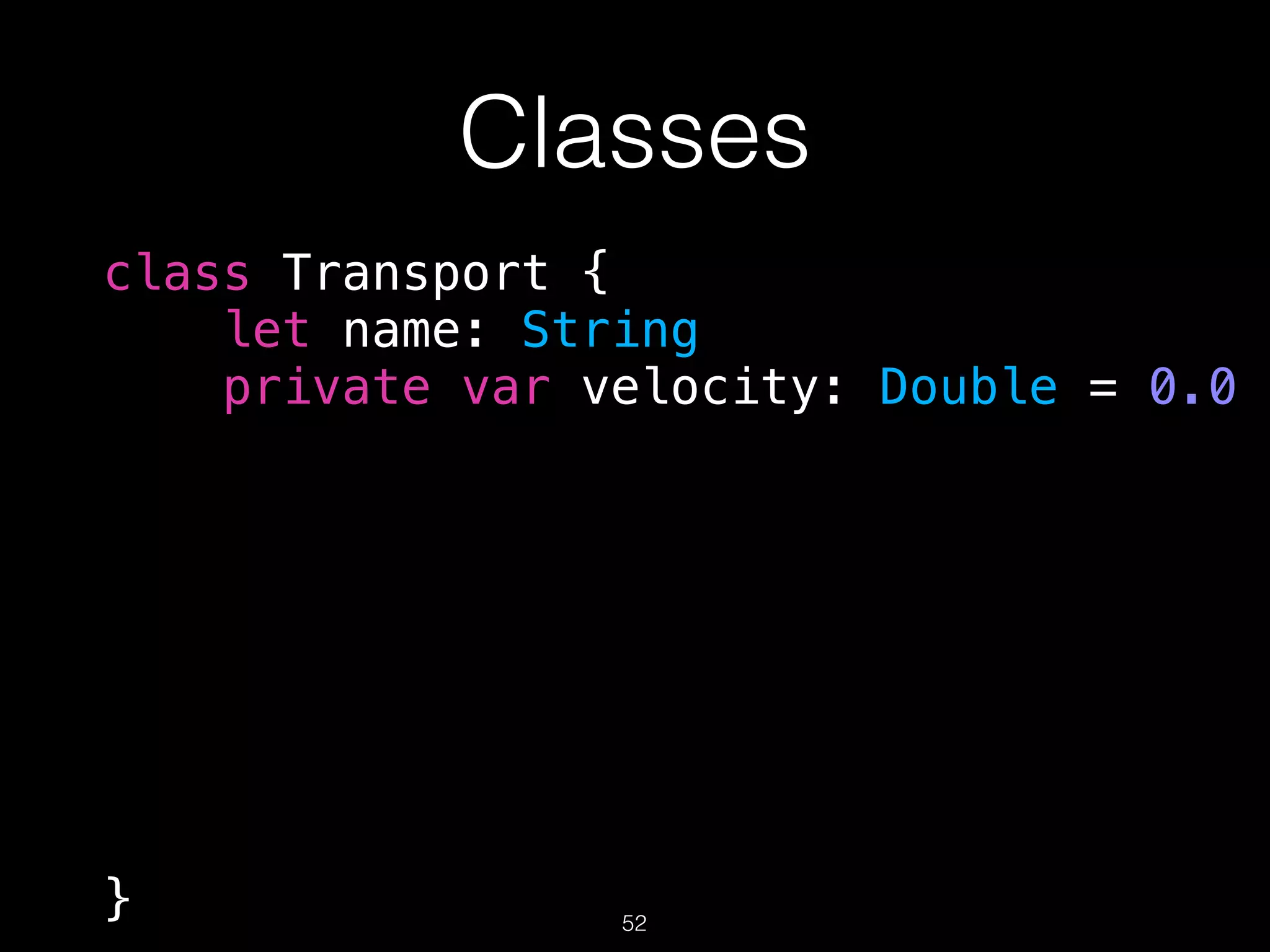
Classes
class Transport {
let name: String
private var velocity: Double = 0.0
init(name: String) {
self.name = name
}
} 53
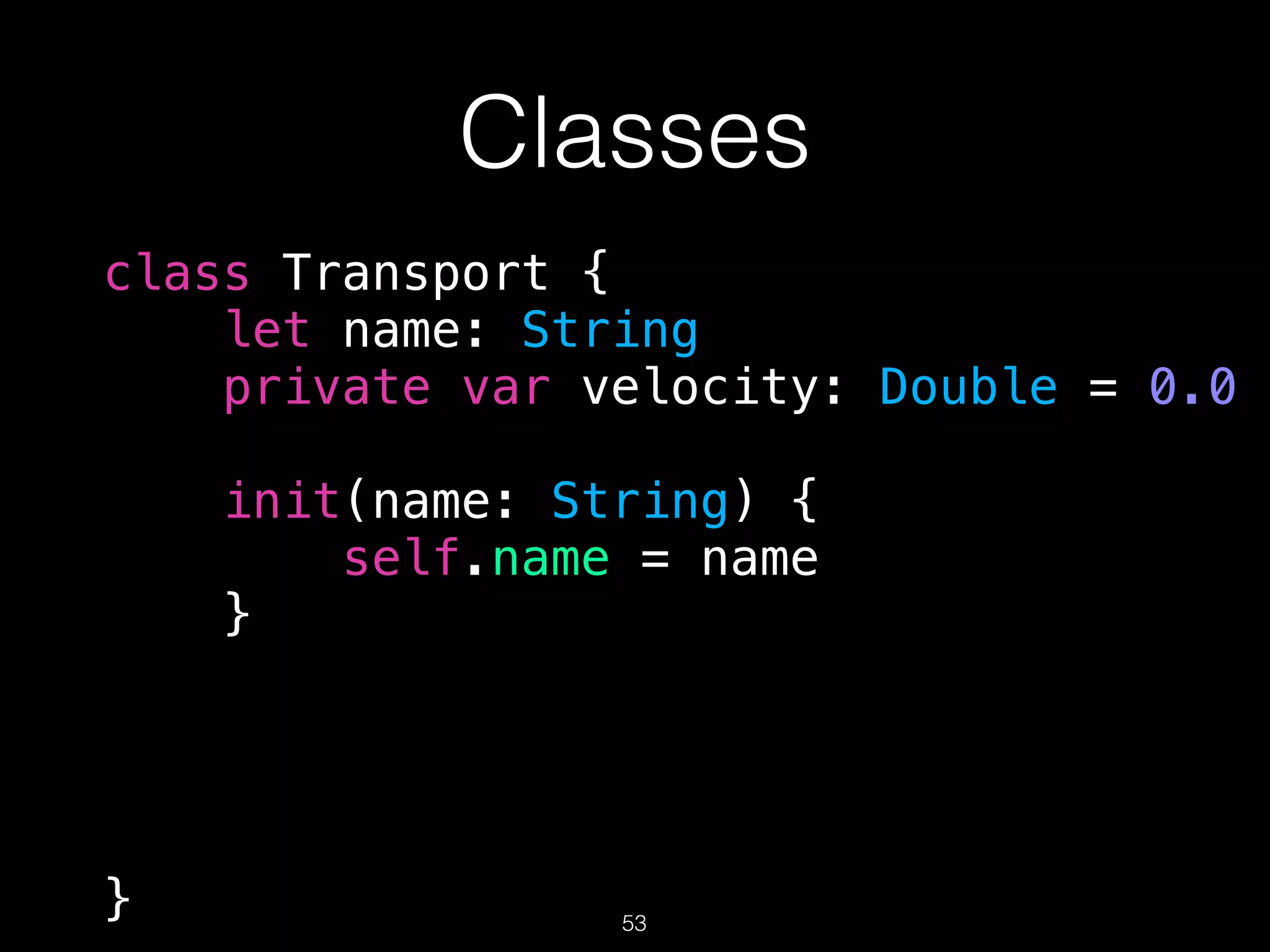
Classes
class Transport {
let name: String
private var velocity: Double = 0.0
init(name: String) {
self.name = name
}
func beep() {
print("Beep!")
}
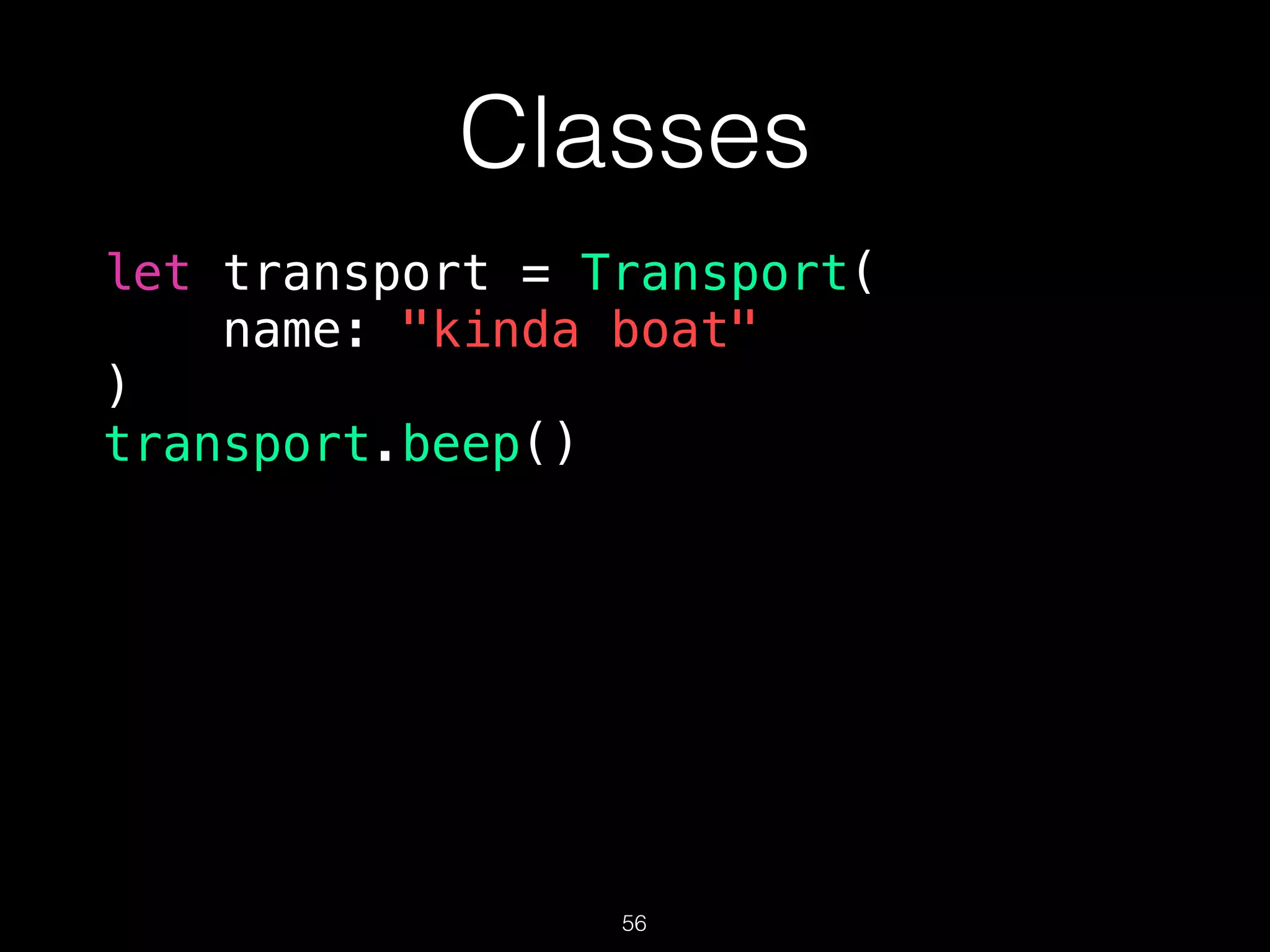
} 54
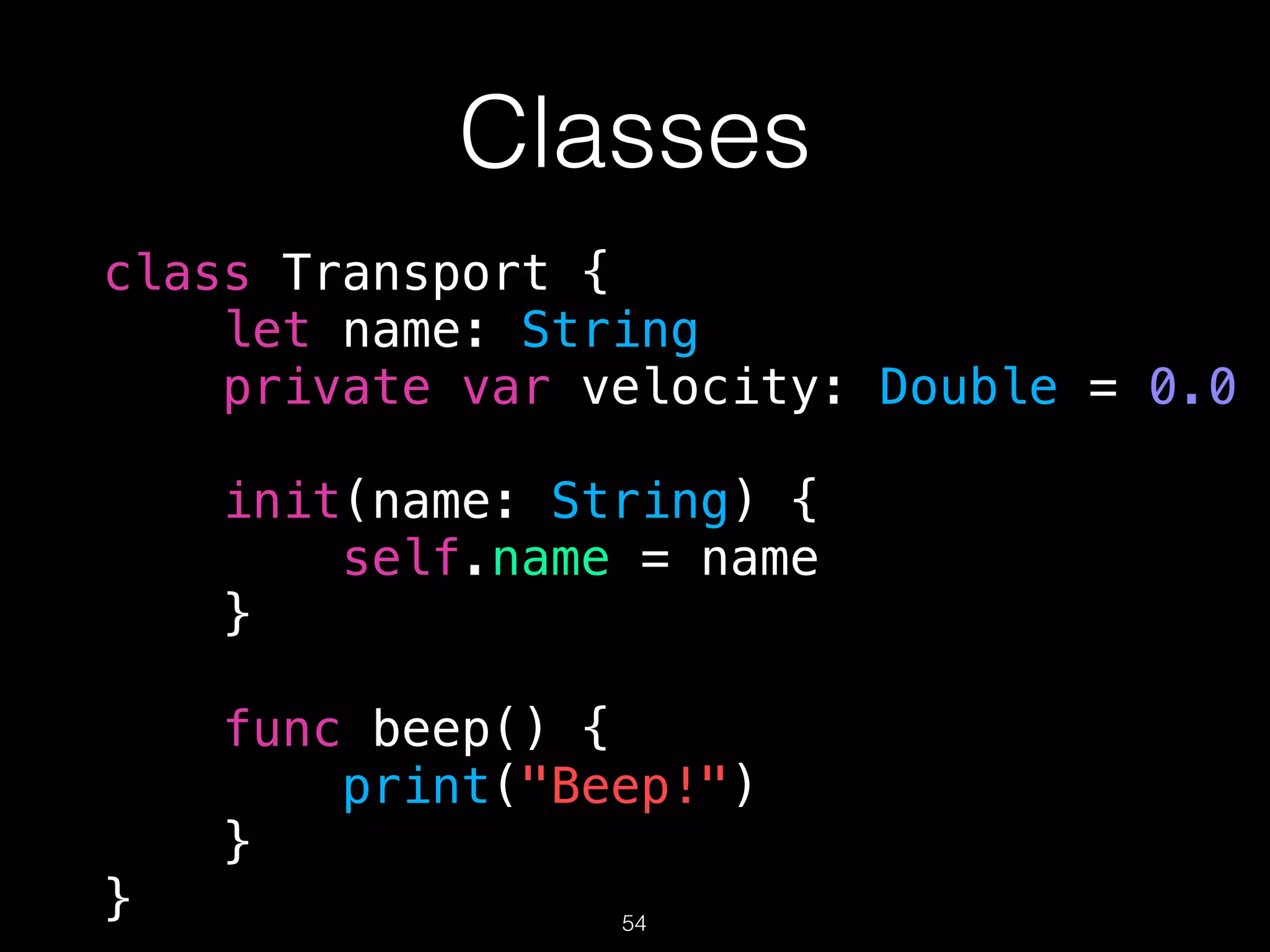
Classes
let transport = Transport(
name: "kinda boat"
)
55
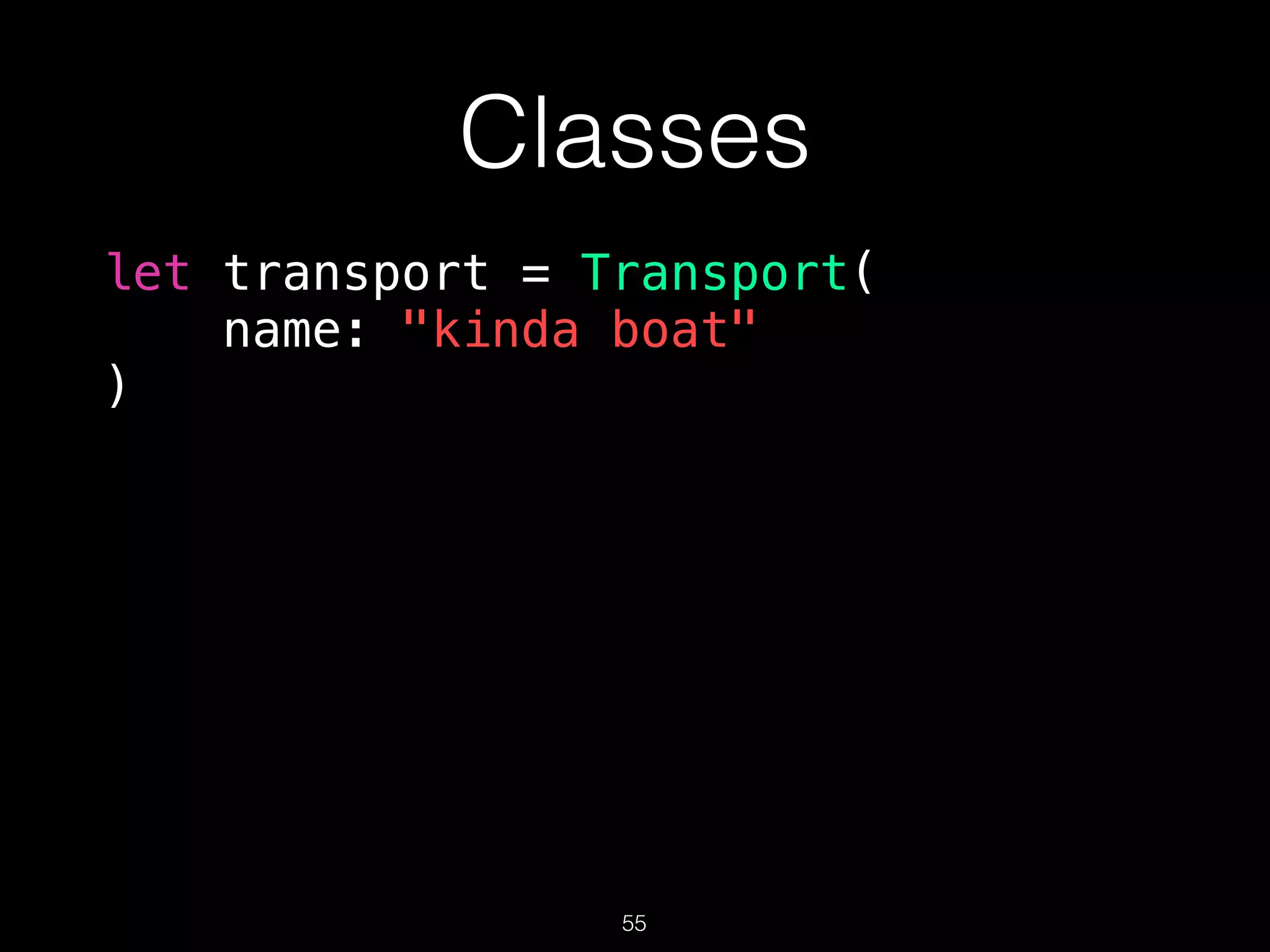
Classes
let transport = Transport(
name: "kinda boat"
)
transport.beep()
56
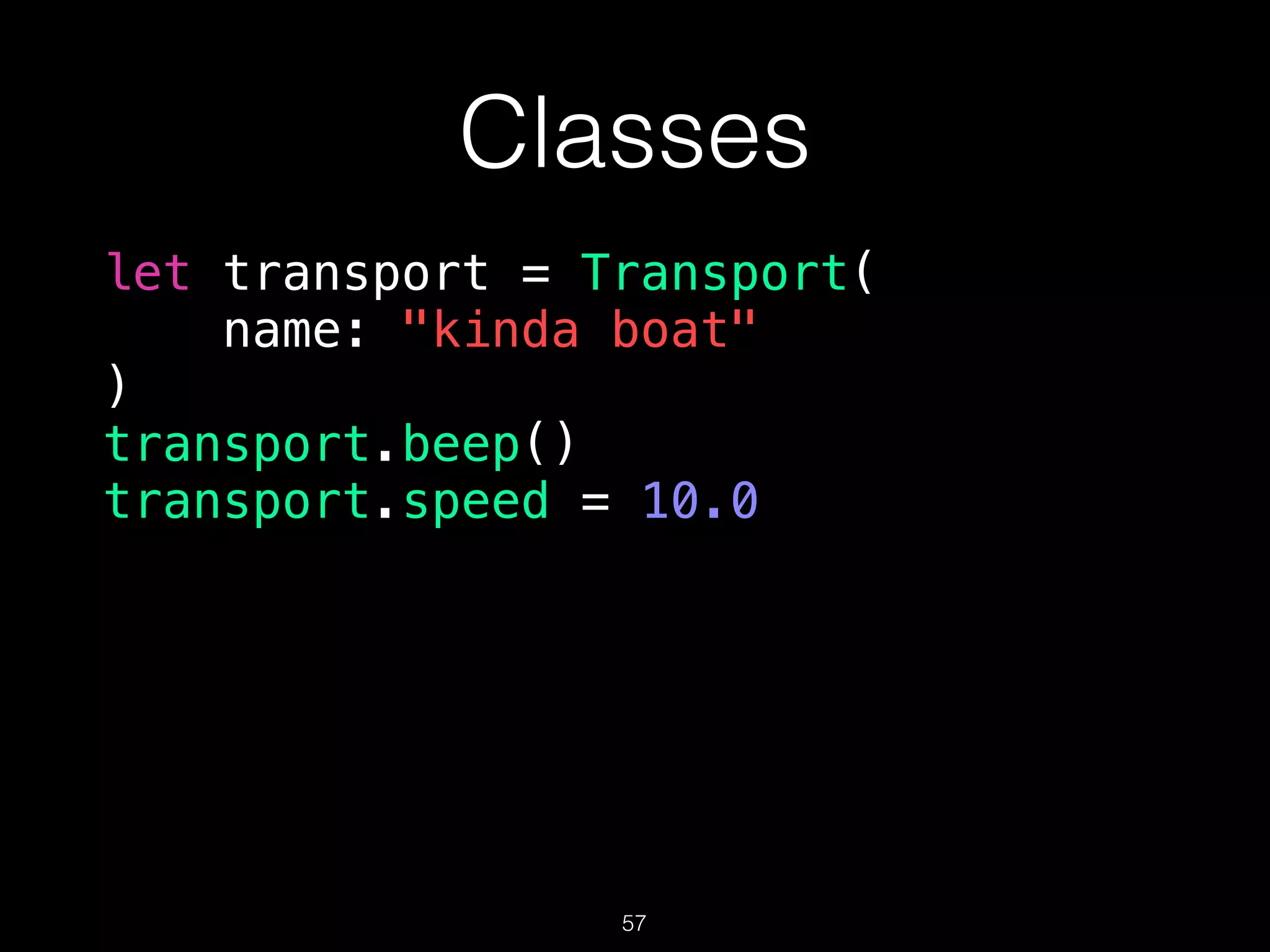
Classes
let transport = Transport(
name: "kinda boat"
)
transport.beep()
transport.speed = 10.0
57
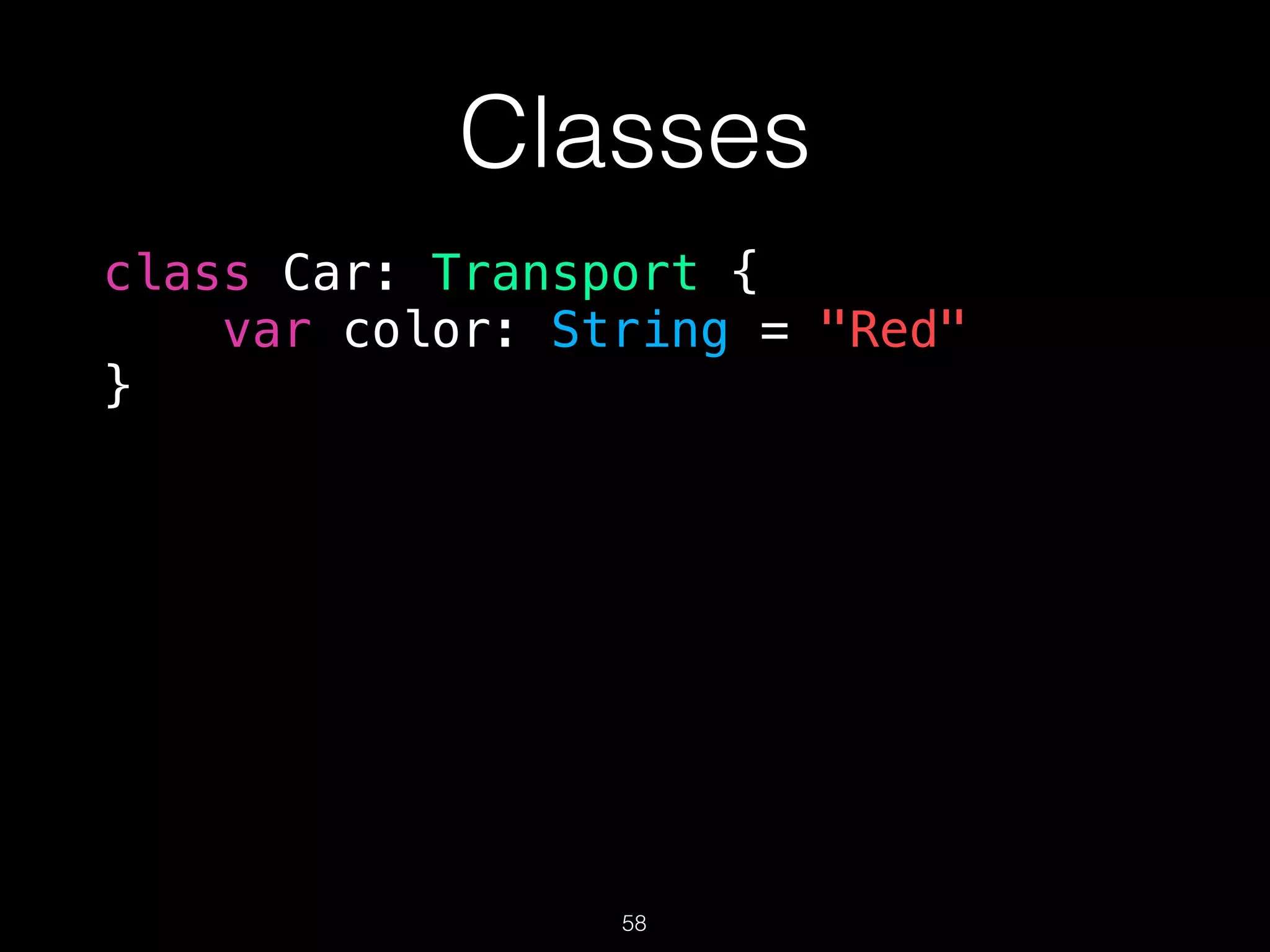
Classes
class Car: Transport {
var color: String = "Red"
}
58
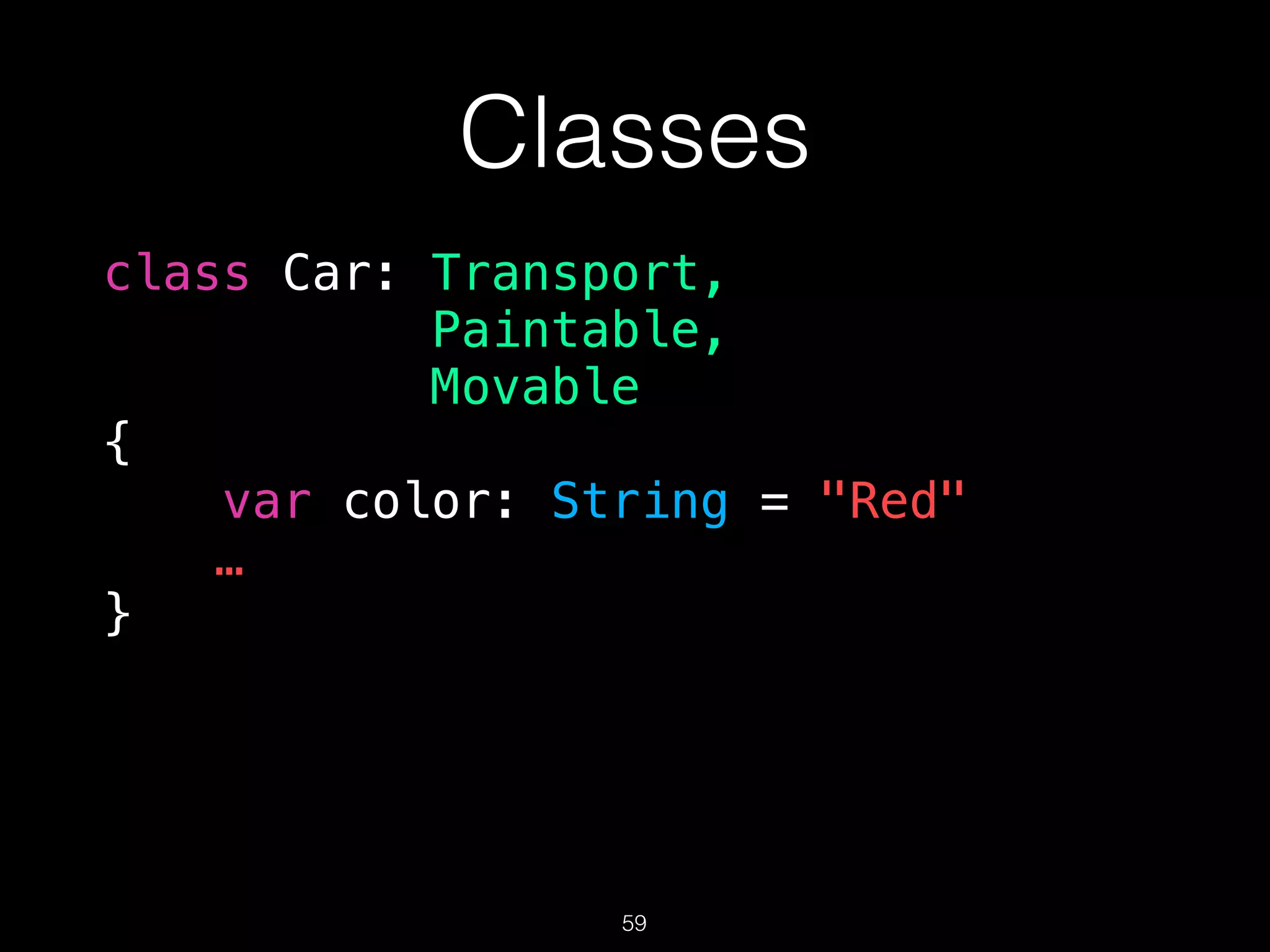
Classes
class Car: Transport,
Paintable,
Movable
{
var color: String = "Red"
…
}
59
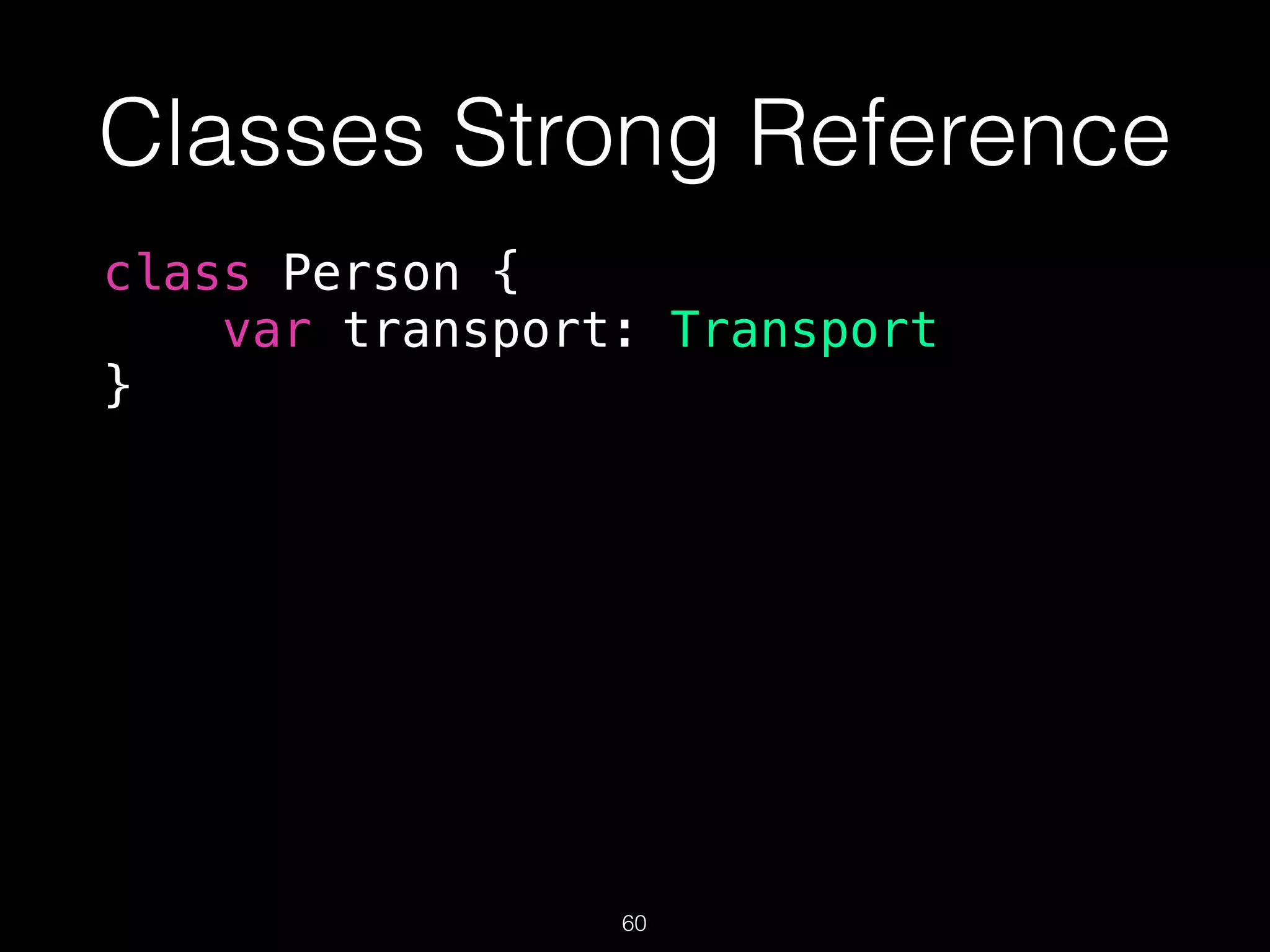
Classes Strong Reference
class Person {
var transport: Transport
}
60
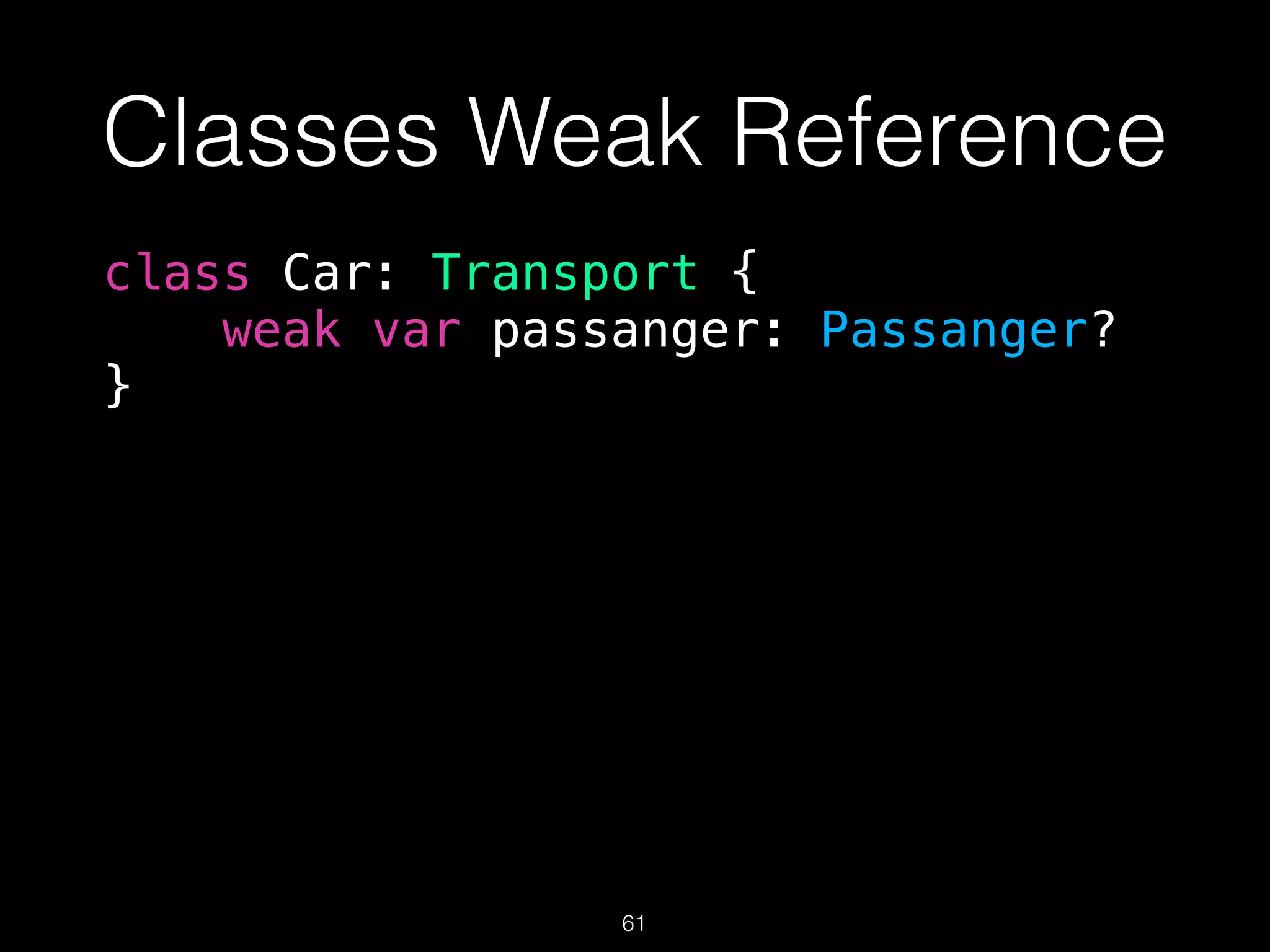
Classes Weak Reference
class Car: Transport {
weak var passanger: Passanger?
}
61
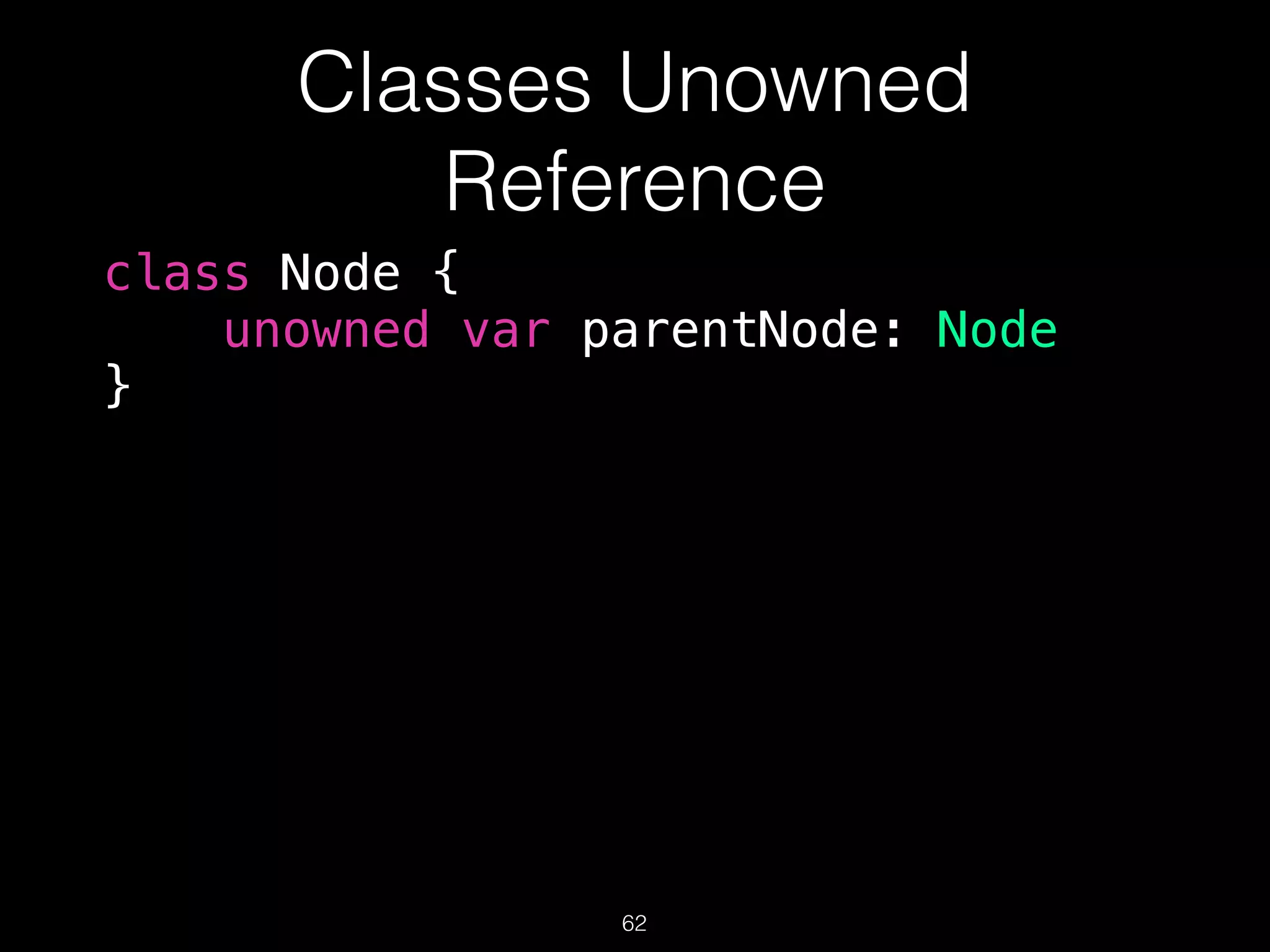
Classes Unowned
Reference
class Node {
unowned var parentNode: Node
}
62
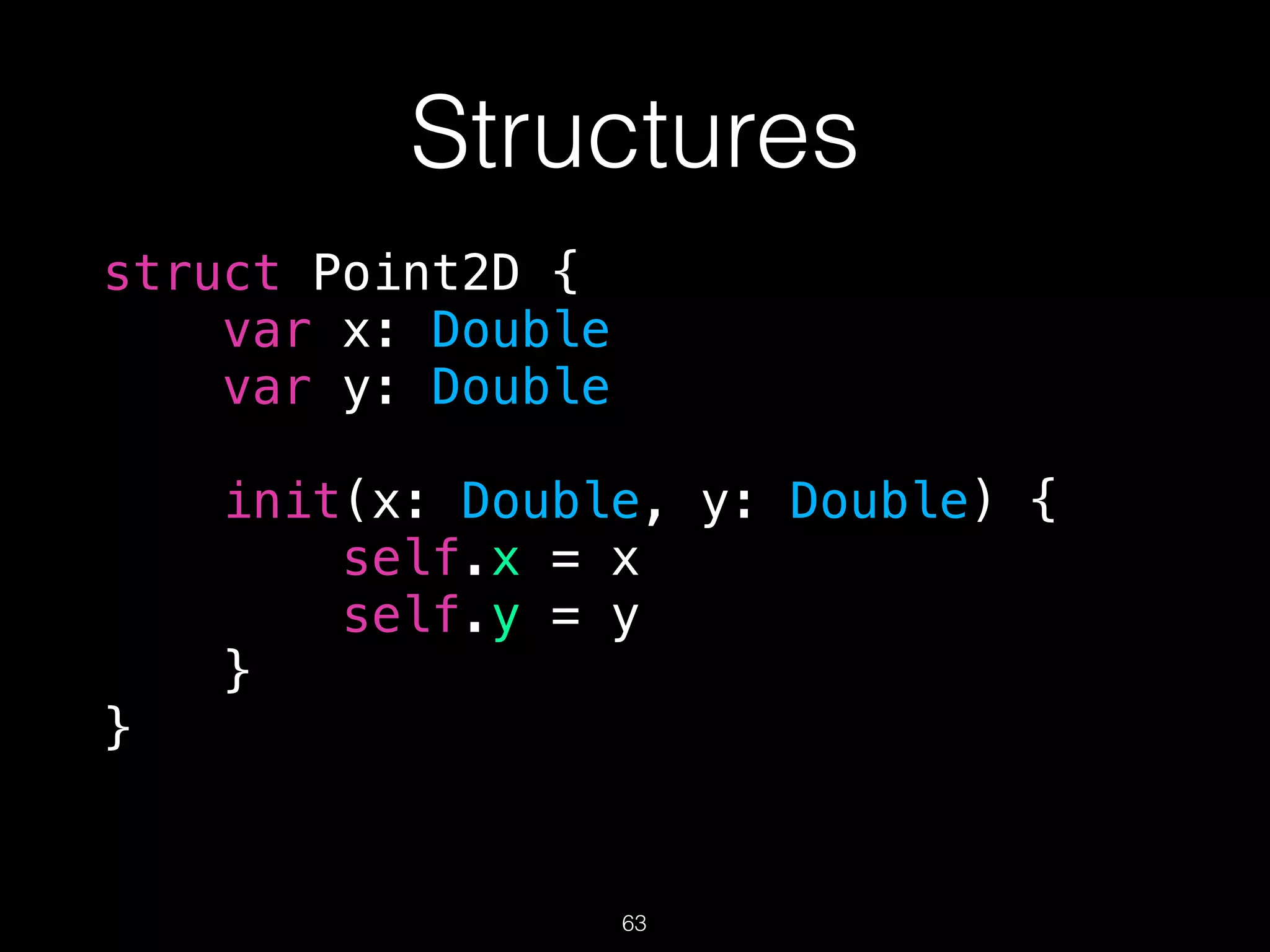
Structures
struct Point2D {
var x: Double
var y: Double
init(x: Double, y: Double) {
self.x = x
self.y = y
}
}
63
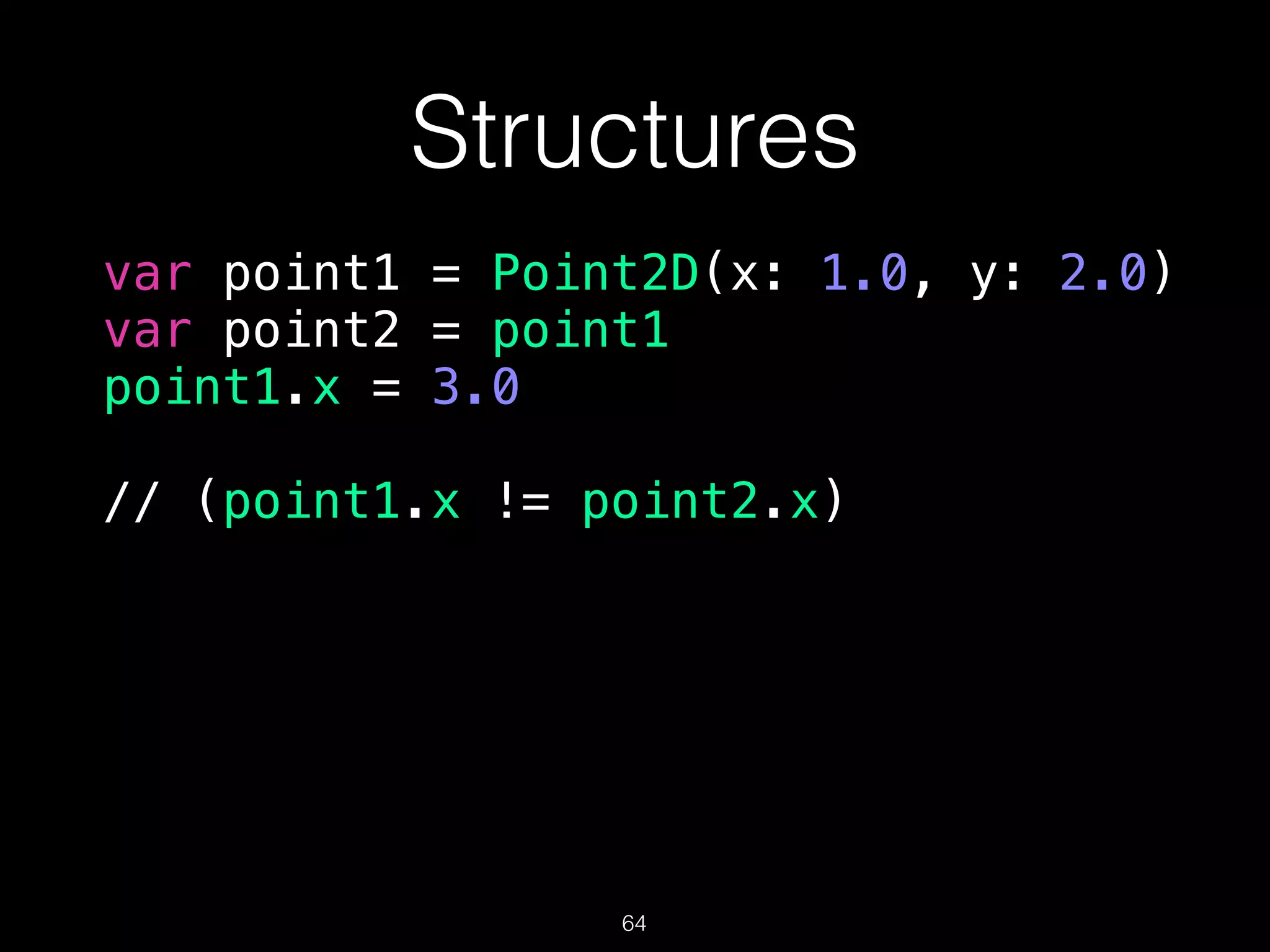
Structures
var point1 = Point2D(x: 1.0, y: 2.0)
var point2 = point1
point1.x = 3.0
// (point1.x != point2.x)
64
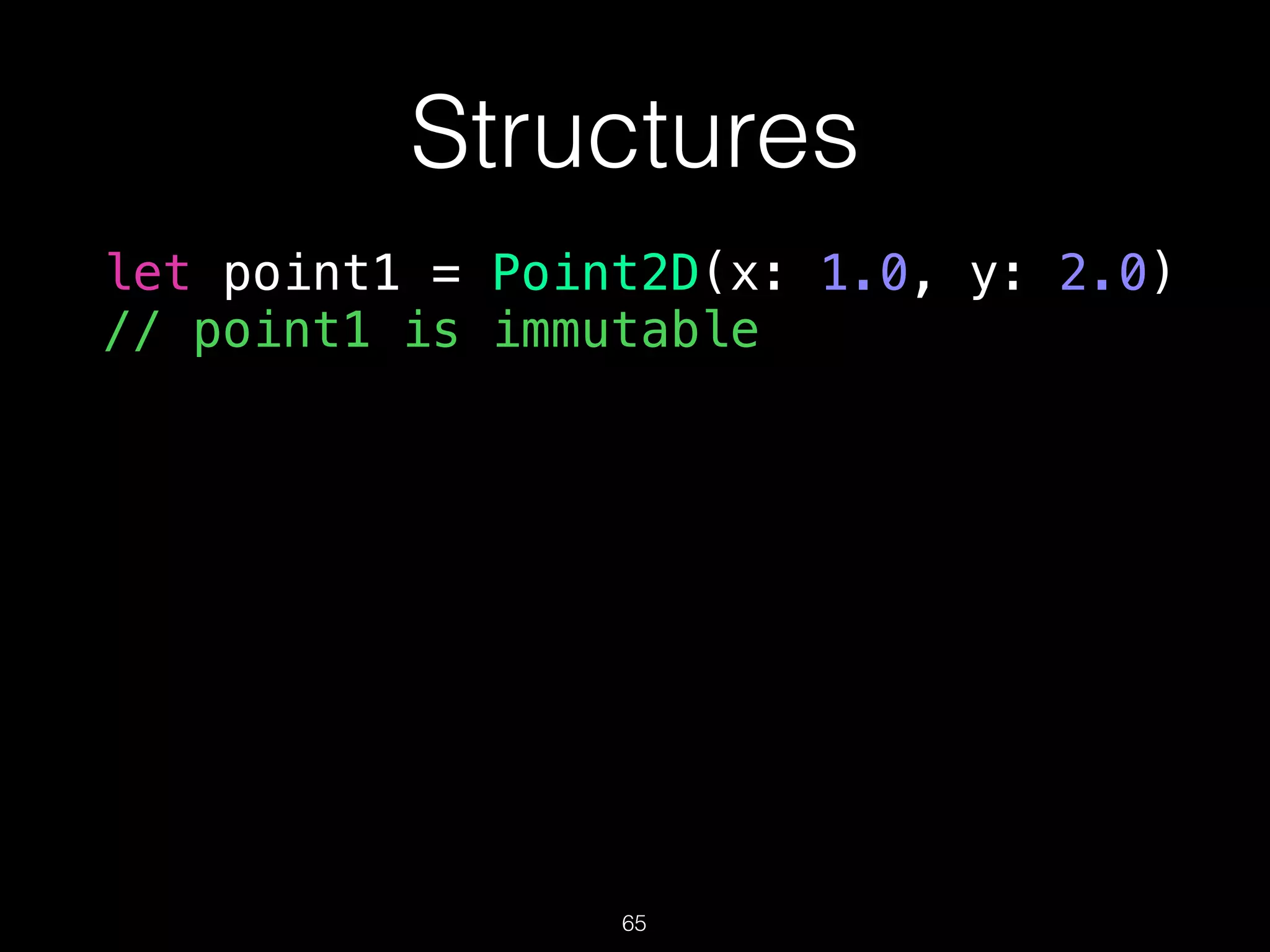
Structures
let point1 = Point2D(x: 1.0, y: 2.0)
// point1 is immutable
65
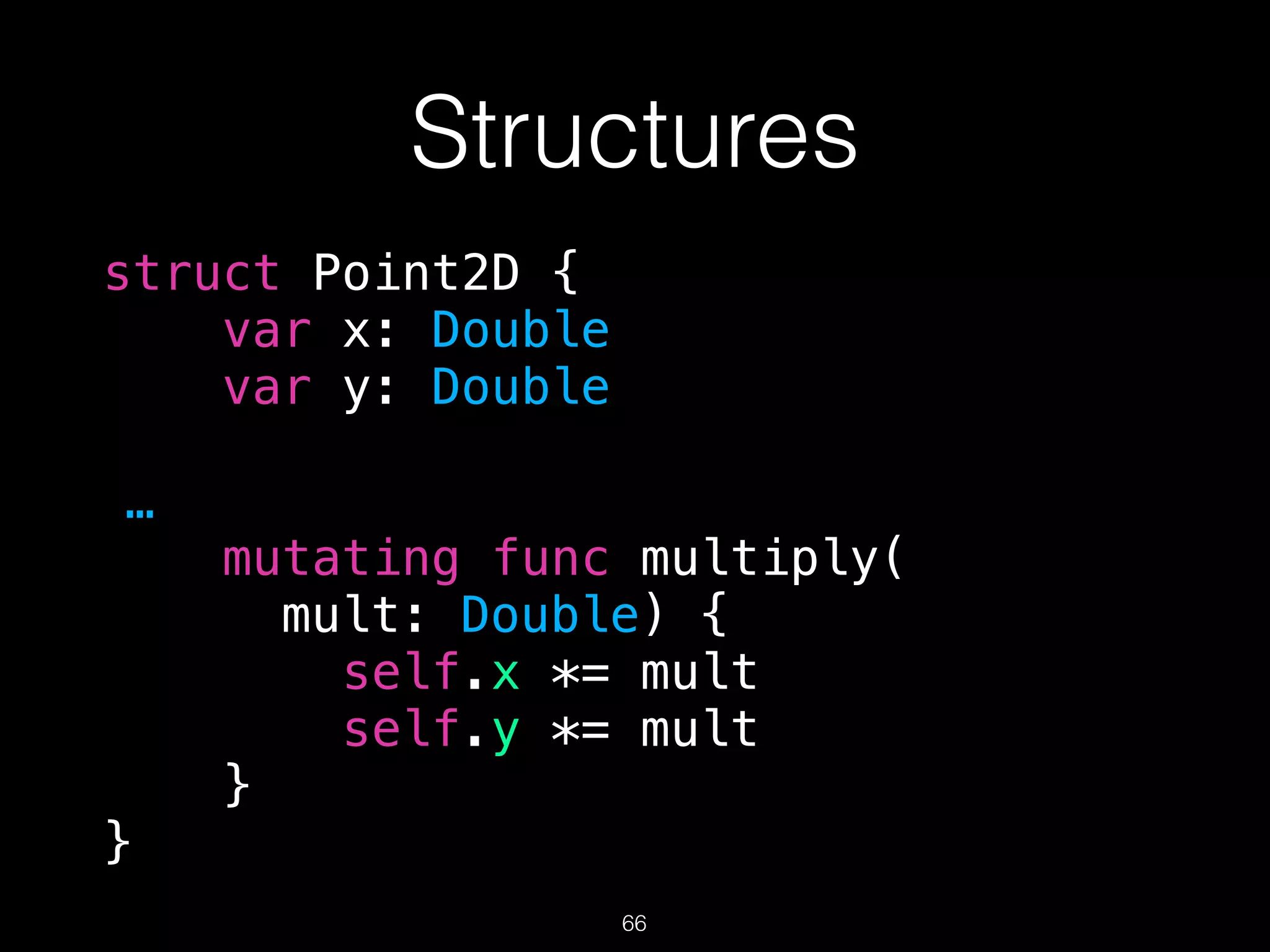
Structures
struct Point2D {
var x: Double
var y: Double
…
mutating func multiply(
mult: Double) {
self.x *= mult
self.y *= mult
}
}
66
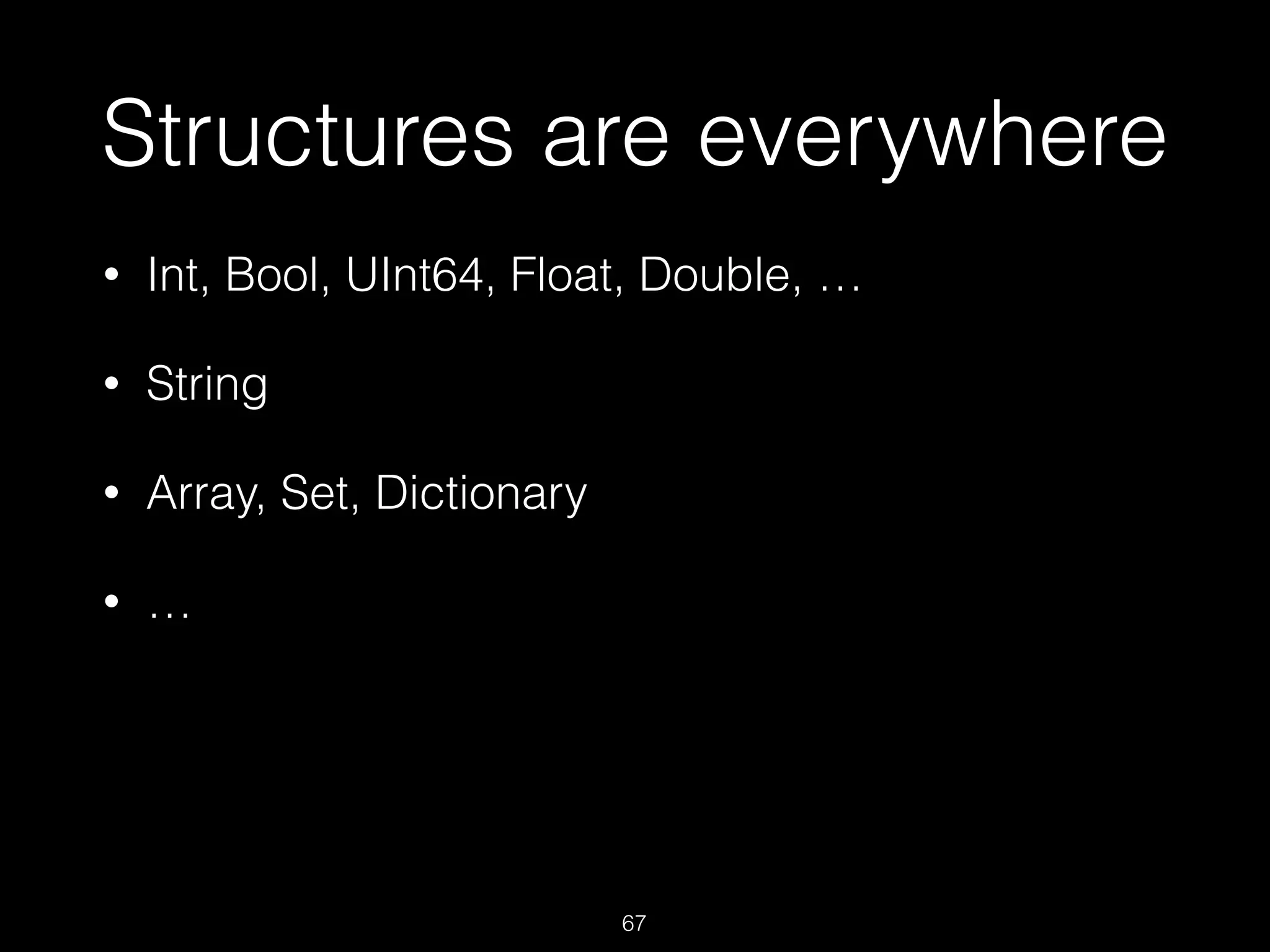
Structures are everywhere
• Int, Bool, UInt64, Float, Double, …
• String
• Array, Set, Dictionary
• …
67
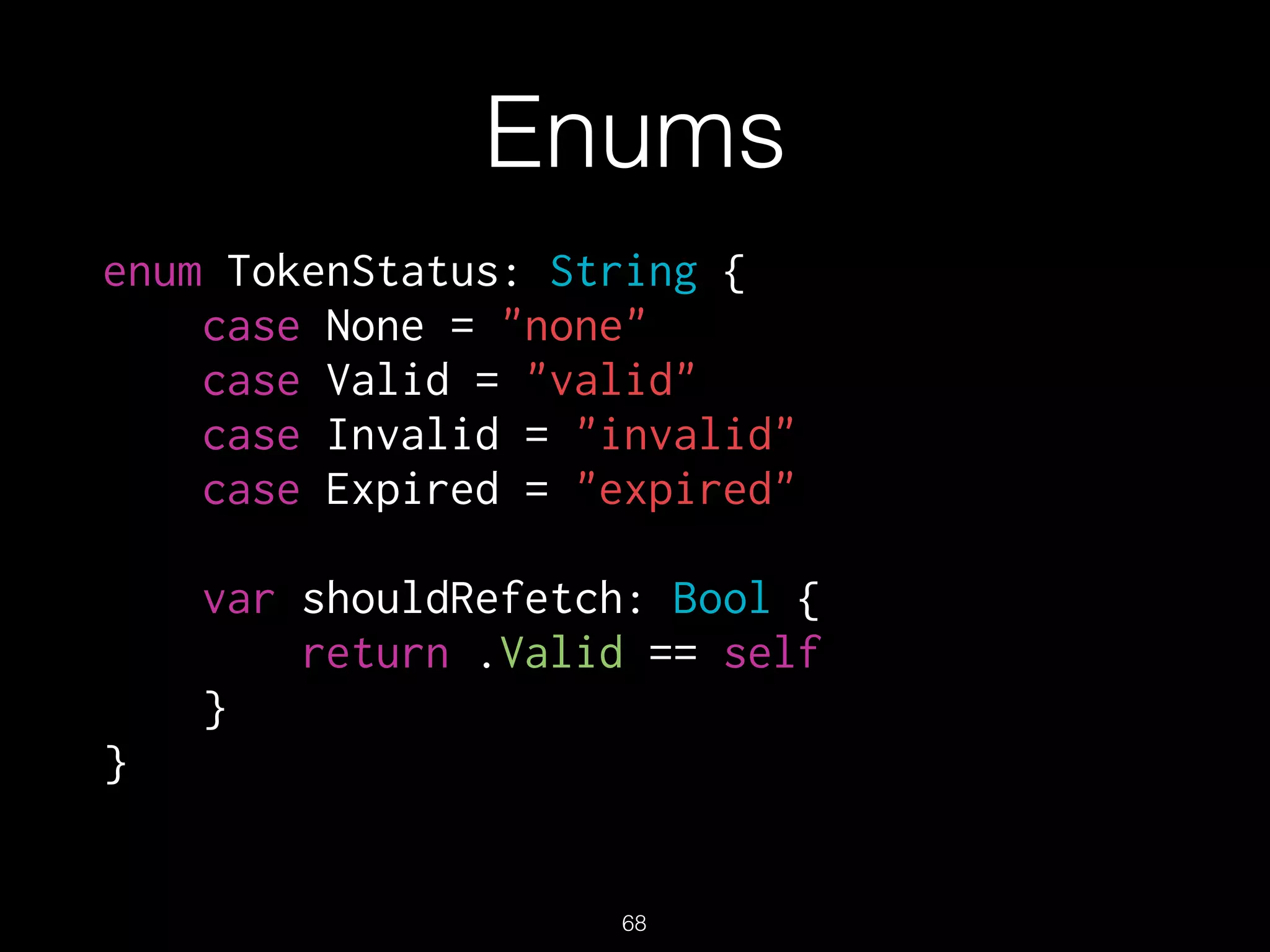
Enums
enum TokenStatus: String {
case None = "none"
case Valid = "valid"
case Invalid = "invalid"
case Expired = "expired"
var shouldRefetch: Bool {
return .Valid == self
}
}
68
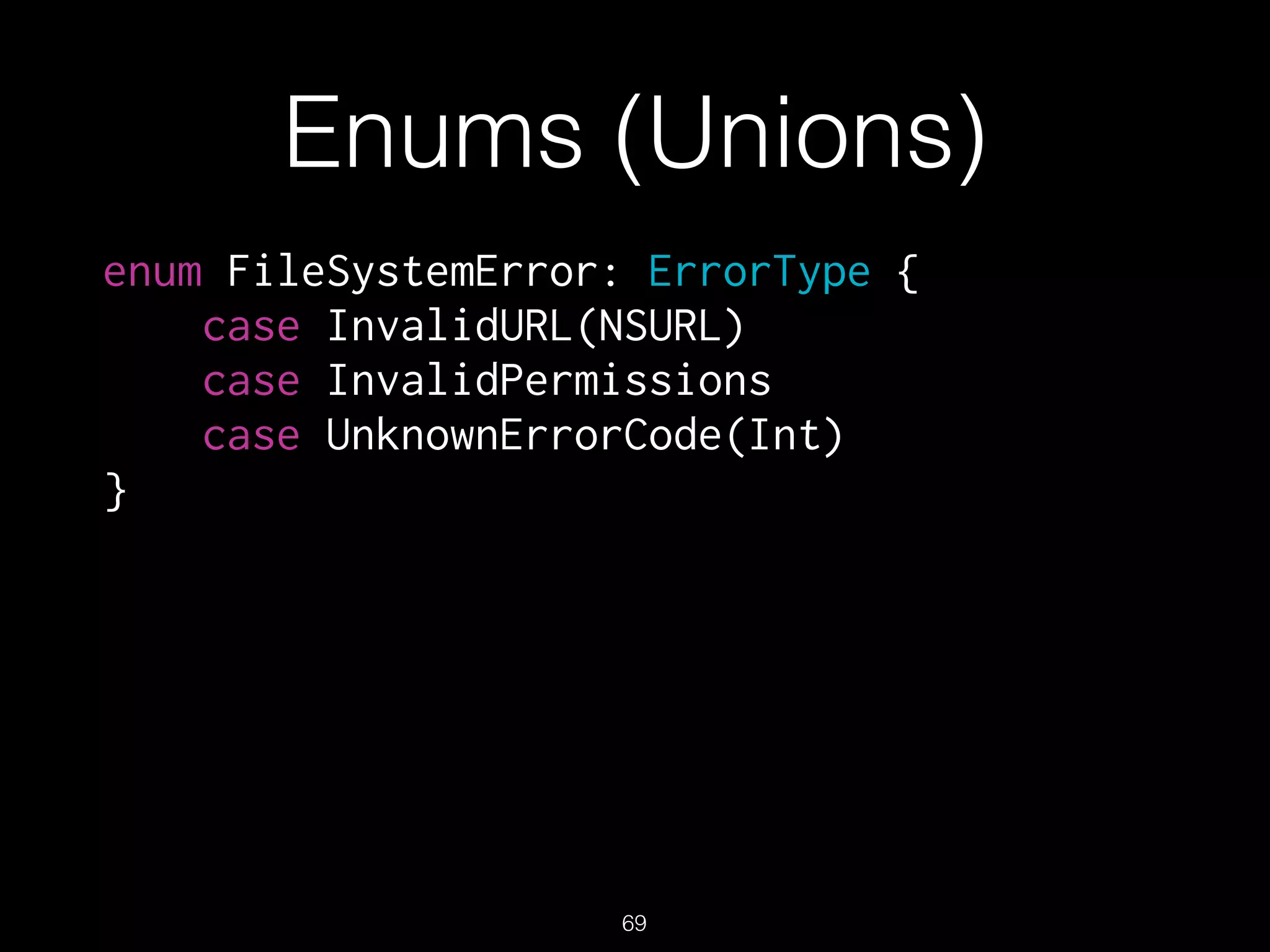
Enums (Unions)
enum FileSystemError: ErrorType {
case InvalidURL(NSURL)
case InvalidPermissions
case UnknownErrorCode(Int)
}
69
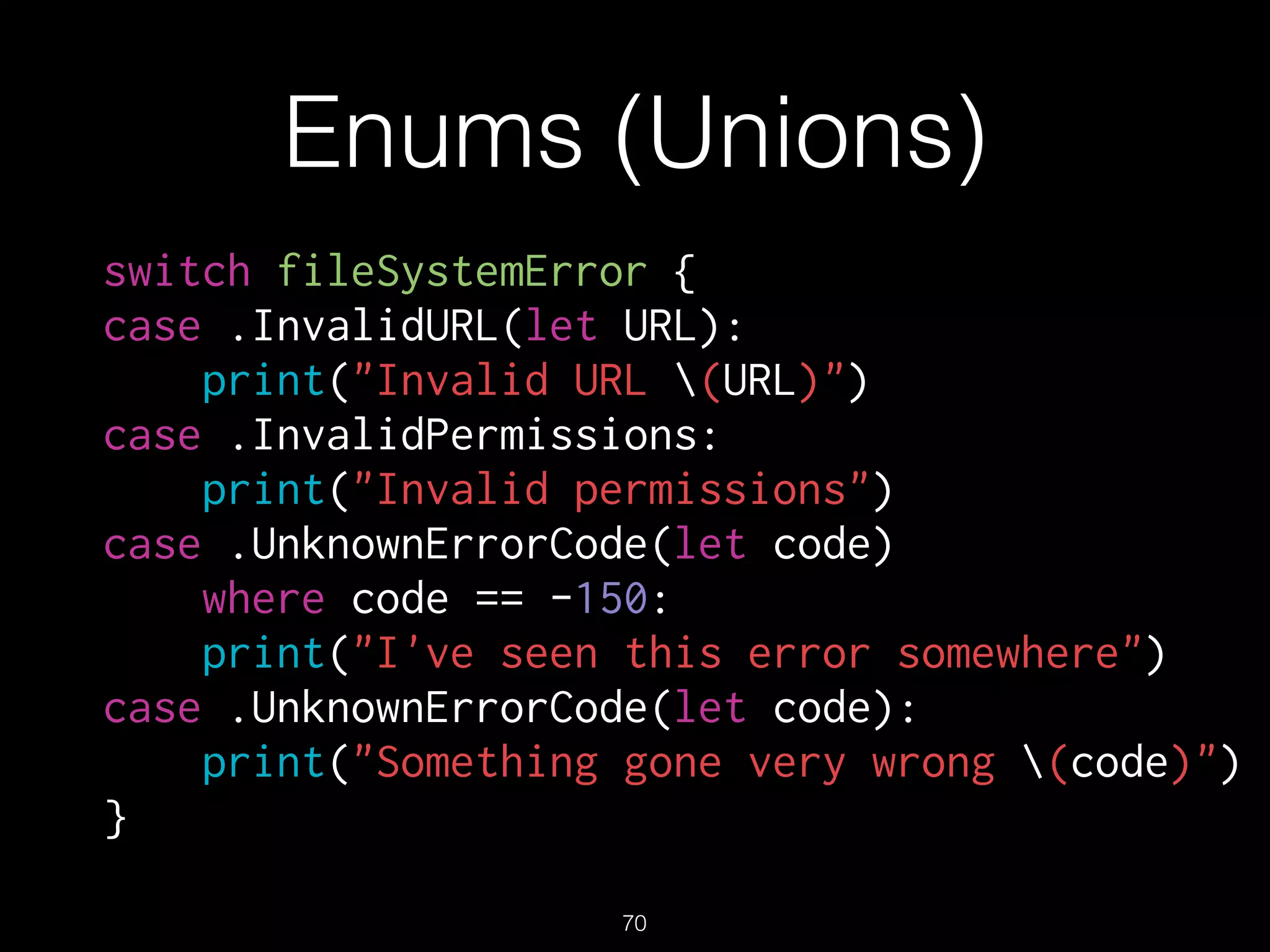
Enums (Unions)
switch fileSystemError {
case .InvalidURL(let URL):
print("Invalid URL (URL)")
case .InvalidPermissions:
print("Invalid permissions")
case .UnknownErrorCode(let code)
where code == -150:
print("I've seen this error somewhere")
case .UnknownErrorCode(let code):
print("Something gone very wrong (code)")
}
70
Protocols
protocol Drawable {
var boundingRect: NSRect { get }
func draw()
}
struct Polygon: Drawable
{
var points = [NSPoint]()
//MARK: Drawable
var boundingRect: NSRect? { ... }
func draw() { ... }
} 71
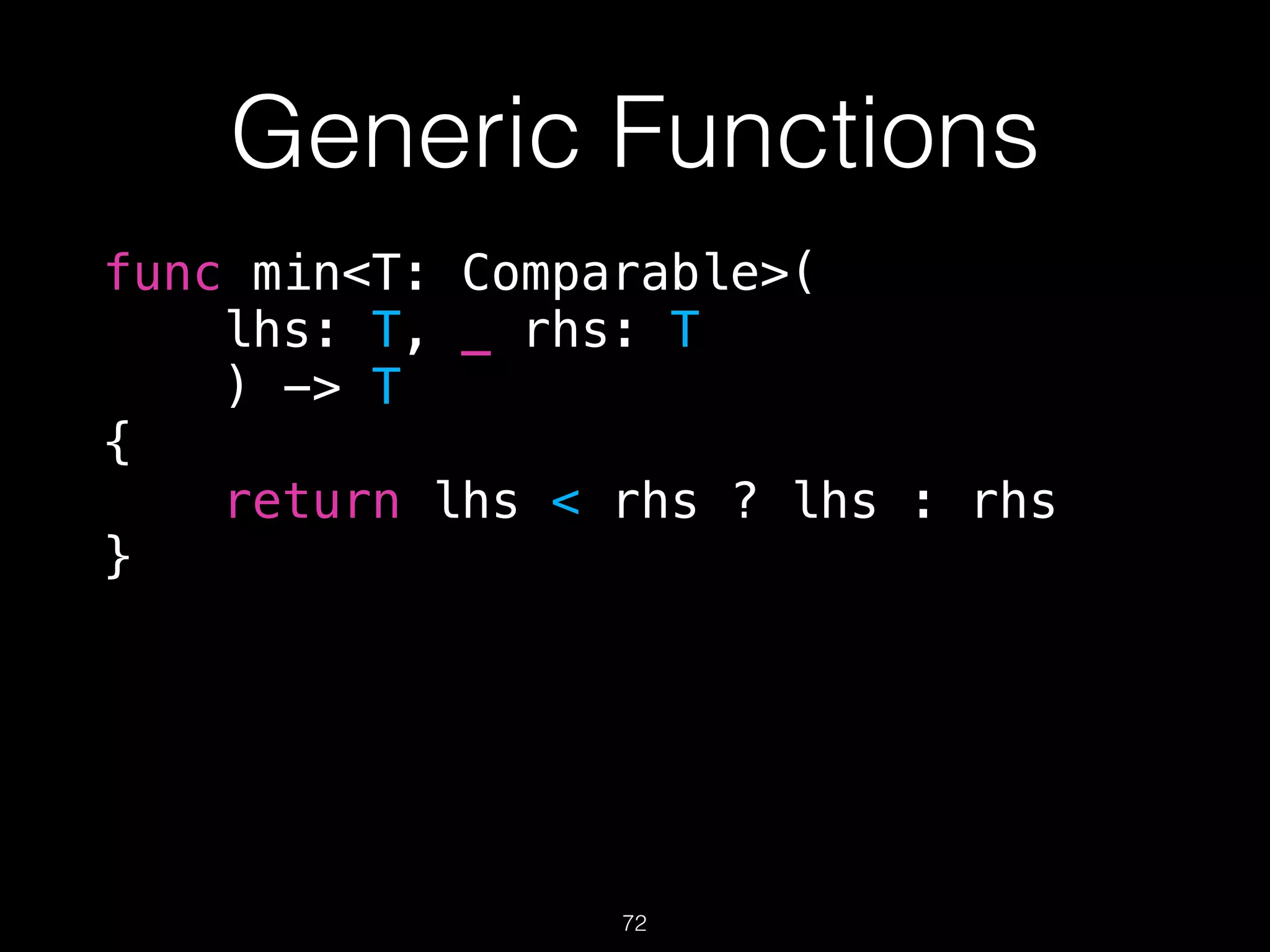
Generic Functions
func min<T: Comparable>(
lhs: T, _ rhs: T
) -> T
{
return lhs < rhs ? lhs : rhs
}
72
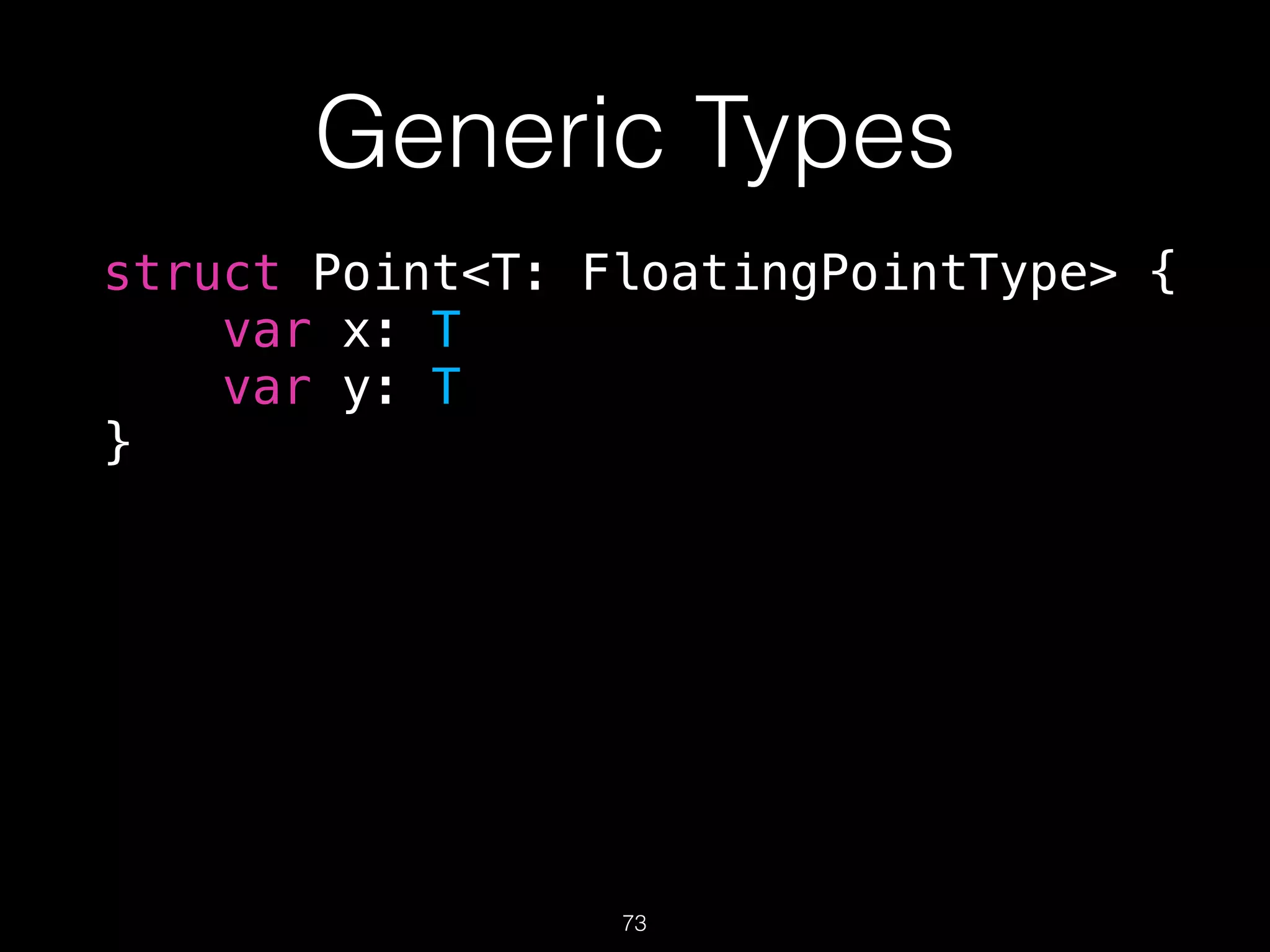
Generic Types
struct Point<T: FloatingPointType> {
var x: T
var y: T
}
73
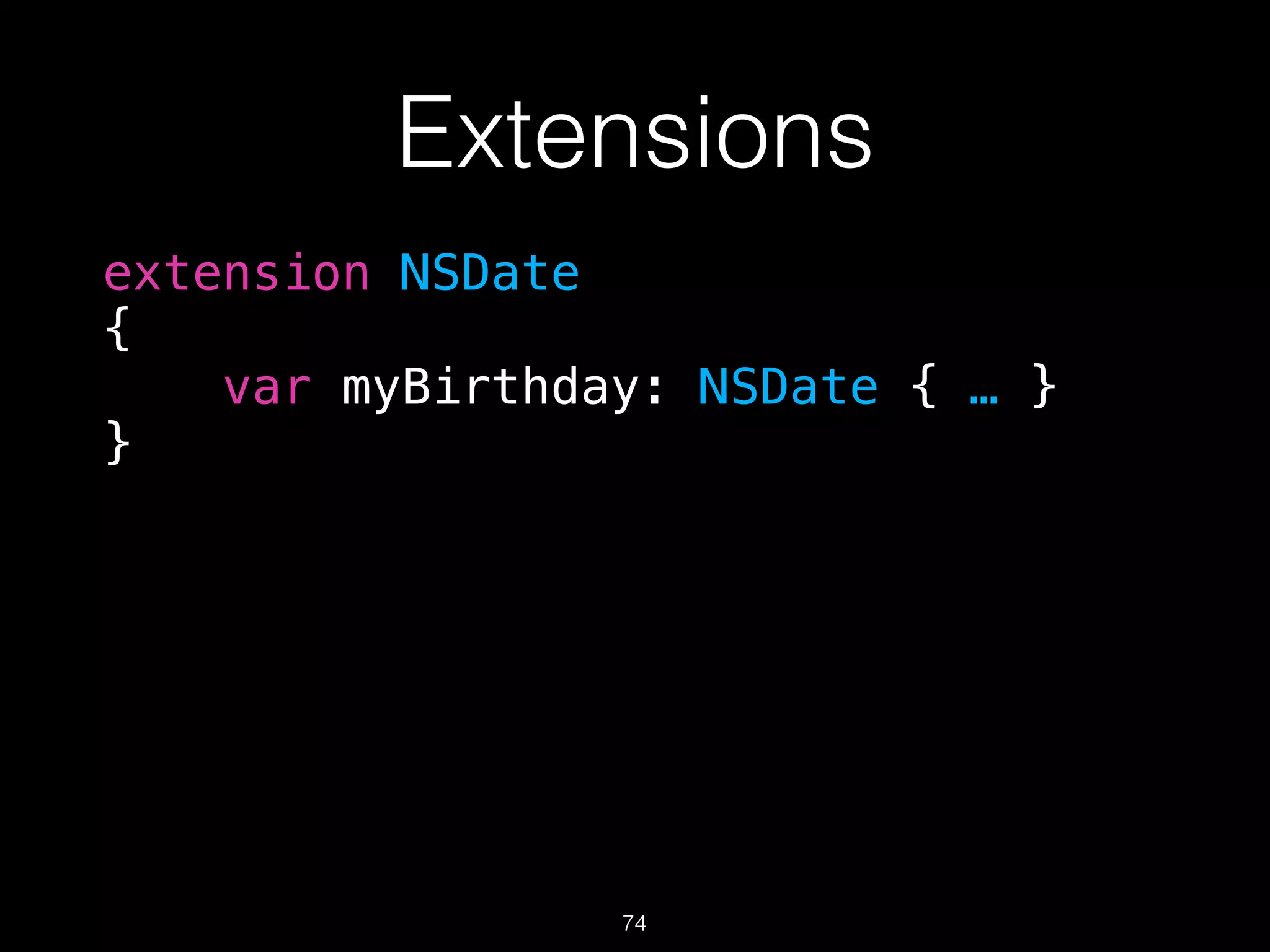
Extensions
extension NSDate
{
var myBirthday: NSDate { … }
}
74
Protocols + Extensions
+ Generics = ❤
75
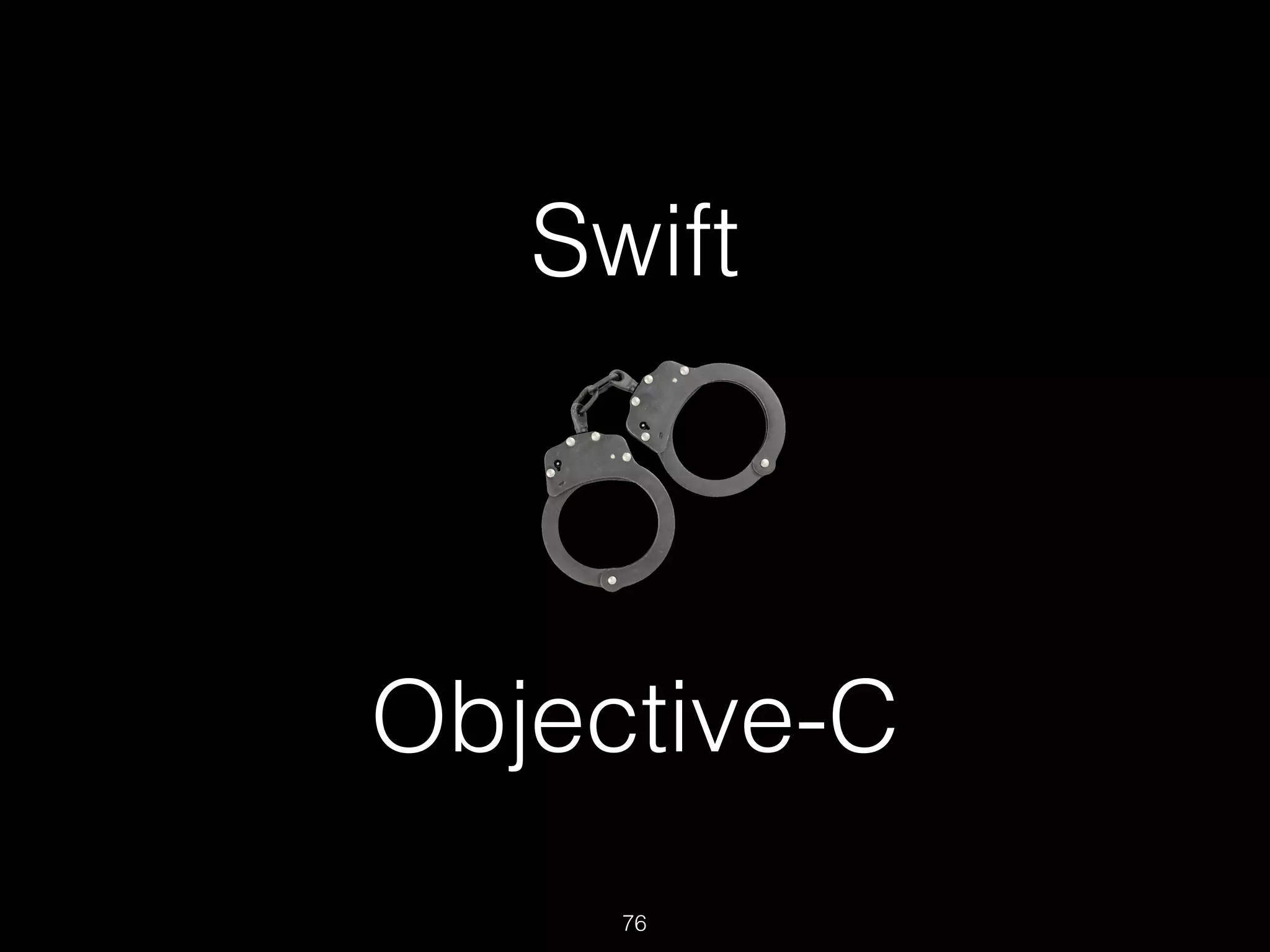
Swift
Objective-C
76
Simple or Complex?
77
Swift on Prod
78
Just use It!
79
Thank you!
Anton Mironov Software Engineer at
amironov@macpaw.com
80

Swift rocks! #1