SWIFT AS AN OOP LANGUAGE 
iOS Development using Swift 
Ahmed Ali
TODAY TOPICS 
• Classes and Structures 
• Properties 
• Methods 
• Access Control 
• Inheritance 
• Initialization 
• Deinitialization 
• Protocols 
• Transitions and View Controller Lifecycle Demo 
Ahmed Ali
CLASSES AND STRUCTURES 
• Both can: 
• Define properties to store values 
• Define methods to provide functionality 
• Define subscripts 
• Define initializers 
• Can be extended (not subclassed, only a class can have a subclass) 
• Conform to protocols 
Ahmed Ali 
ref["key”] anotherRef[1]
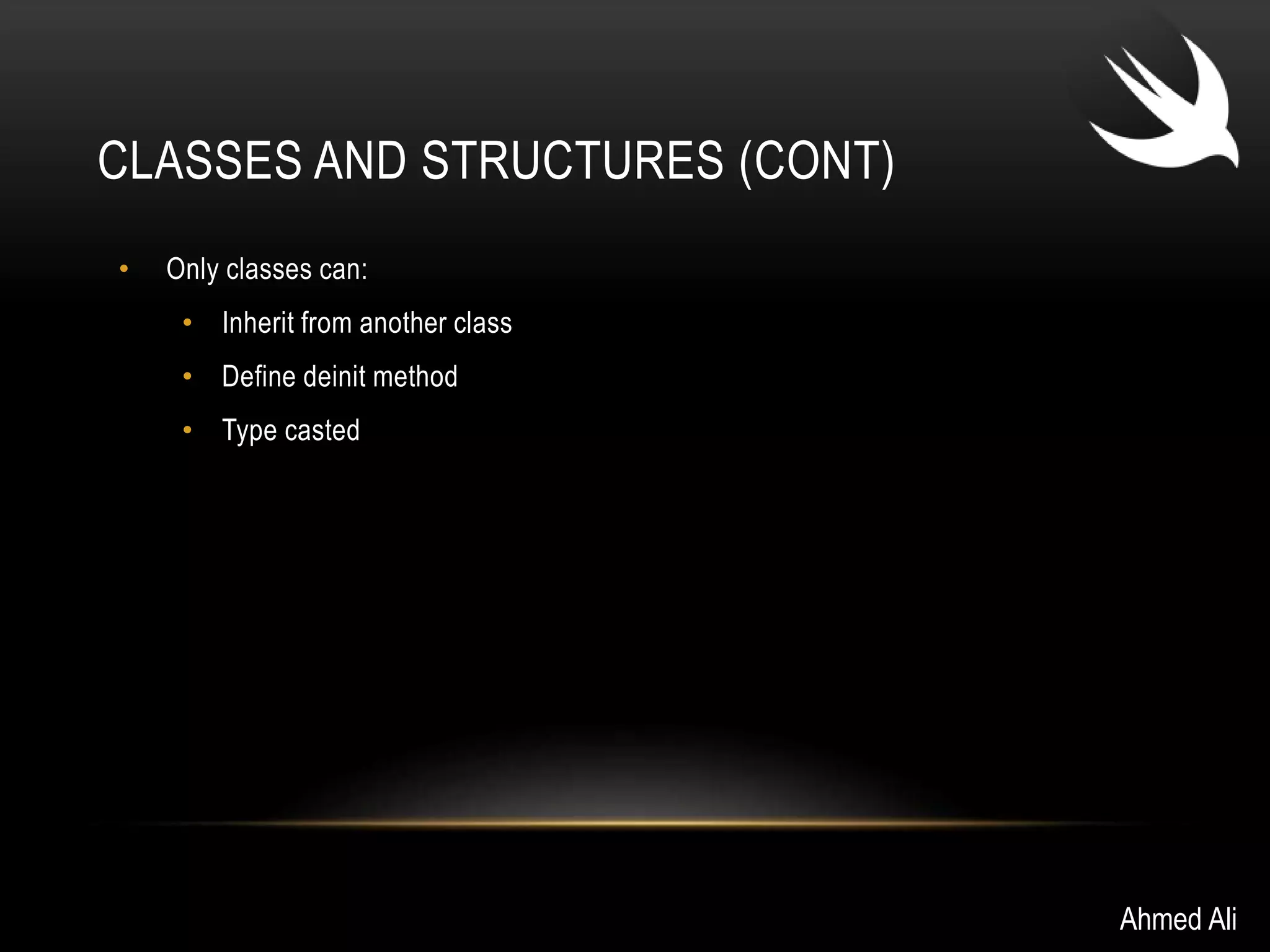
CLASSES AND STRUCTURES (CONT) 
• Only classes can: 
• Inherit from another class 
• Define deinit method 
• Type casted 
Ahmed Ali
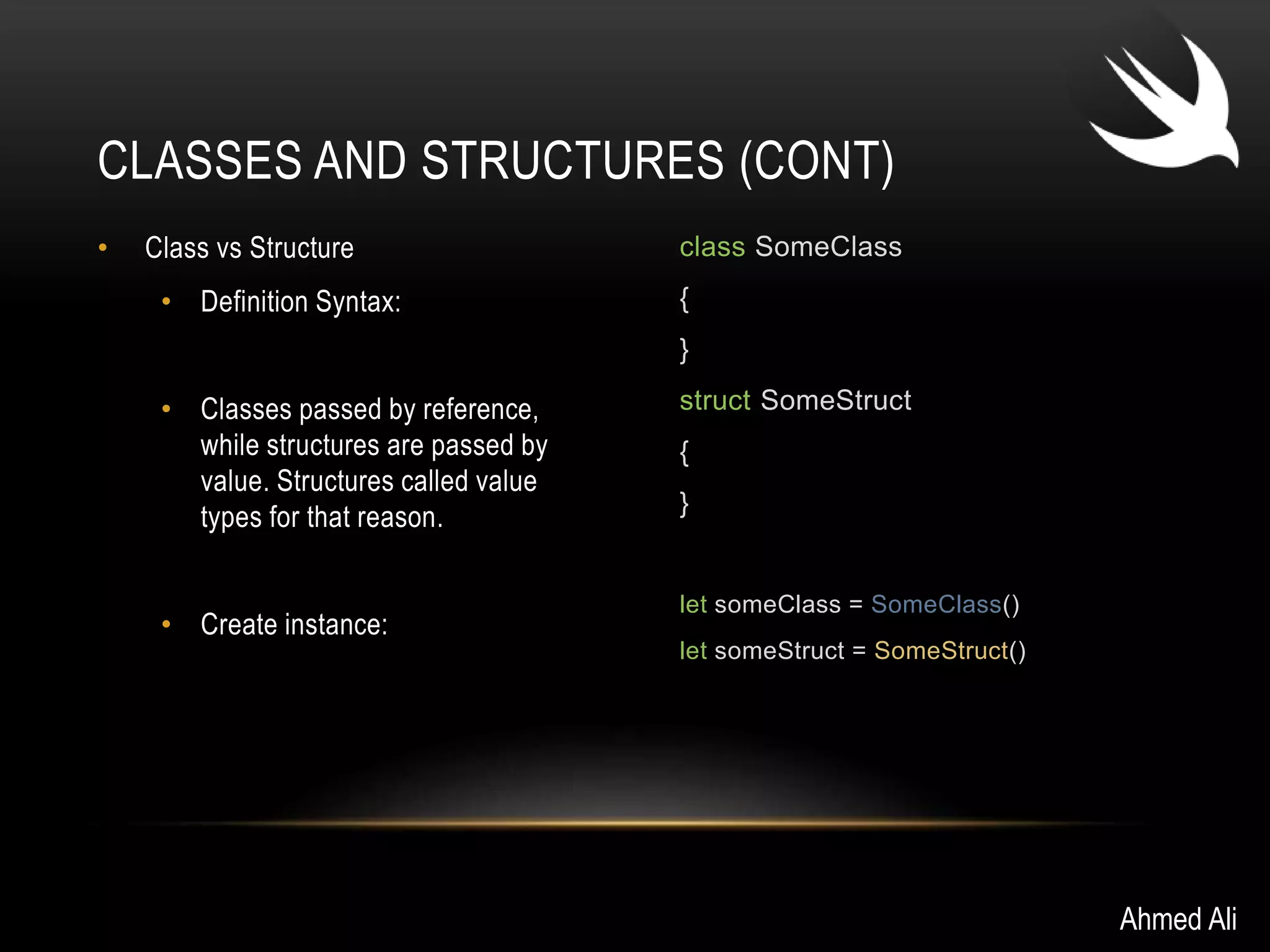
CLASSES AND STRUCTURES (CONT) 
• Class vs Structure 
• Definition Syntax: 
• Classes passed by reference, 
while structures are passed by 
value. Structures called value 
types for that reason. 
• Create instance: 
class SomeClass 
{ 
} 
struct SomeStruct 
{ 
} 
let someClass = SomeClass() 
let someStruct = SomeStruct() 
Ahmed Ali
PROPERTIES 
• Properties associate values with particular type’s instances. 
• Properties can be a variable or a constant 
• There are two main types of properties: 
• Stored Properties 
• Computed Properties 
Ahmed Ali
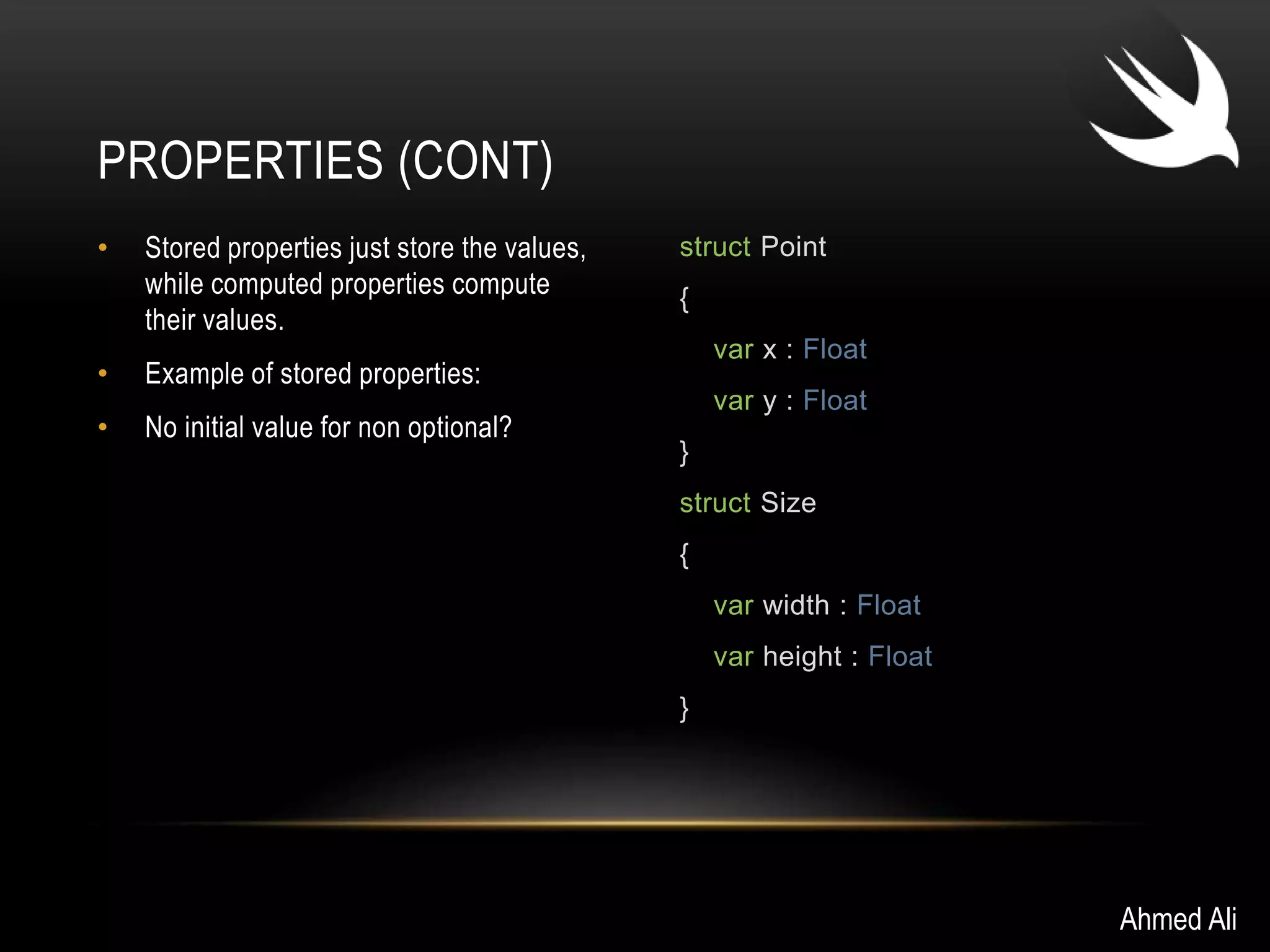
• Stored properties just store the values, 
while computed properties compute 
their values. 
• Example of stored properties: 
• No initial value for non optional? 
struct Point 
{ 
var x : Float 
var y : Float 
} 
struct Size 
{ 
var width : Float 
var height : Float 
} 
PROPERTIES (CONT) 
Ahmed Ali
PROPERTIES (CONT) 
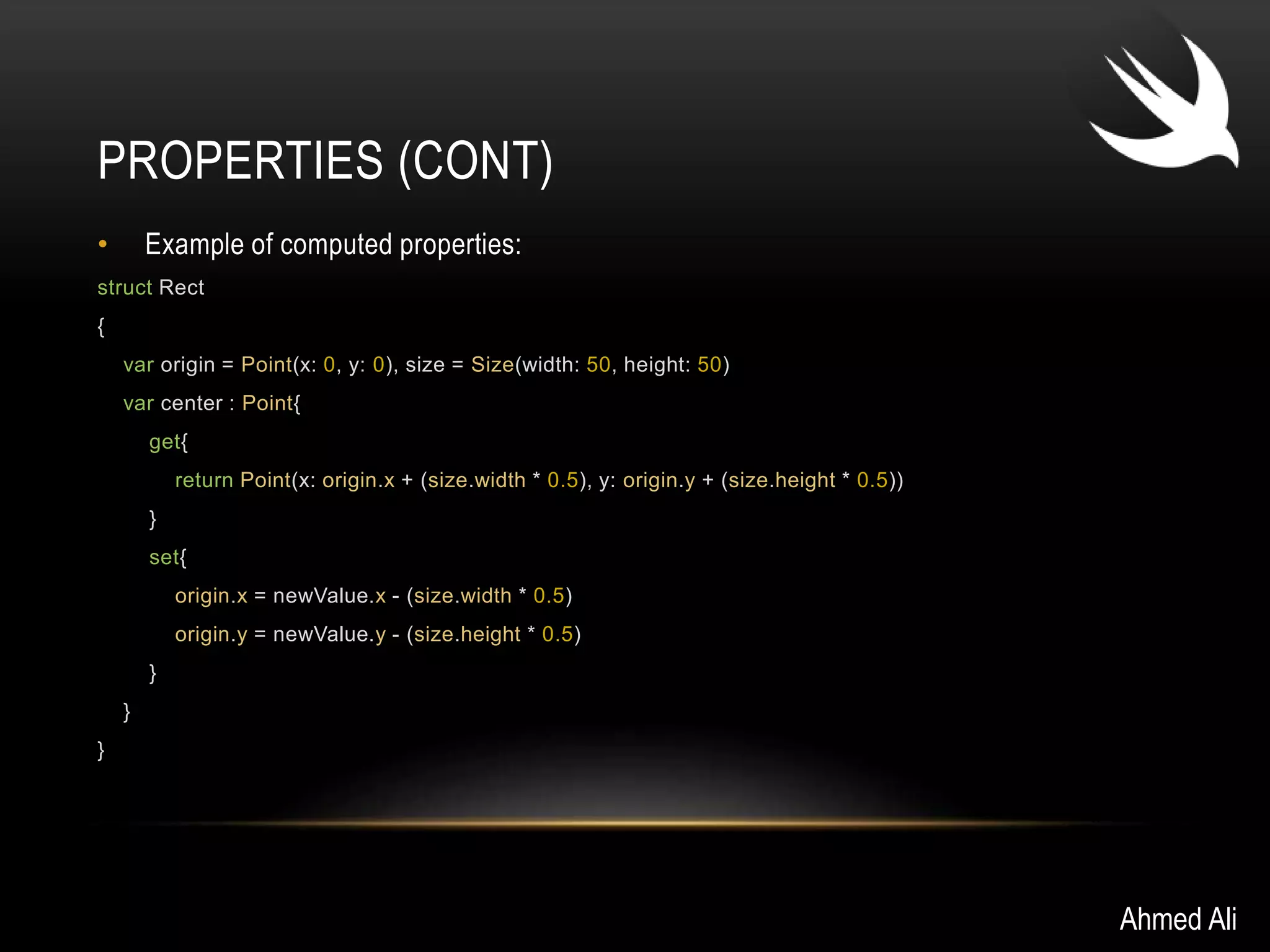
• Example of computed properties: 
struct Rect 
{ 
var origin = Point(x: 0, y: 0), size = Size(width: 50, height: 50) 
var center : Point{ 
get{ 
return Point(x: origin.x + (size.width * 0.5), y: origin.y + (size.height * 0.5)) 
} 
set{ 
origin.x = newValue.x - (size.width * 0.5) 
origin.y = newValue.y - (size.height * 0.5) 
} 
} 
} 
Ahmed Ali
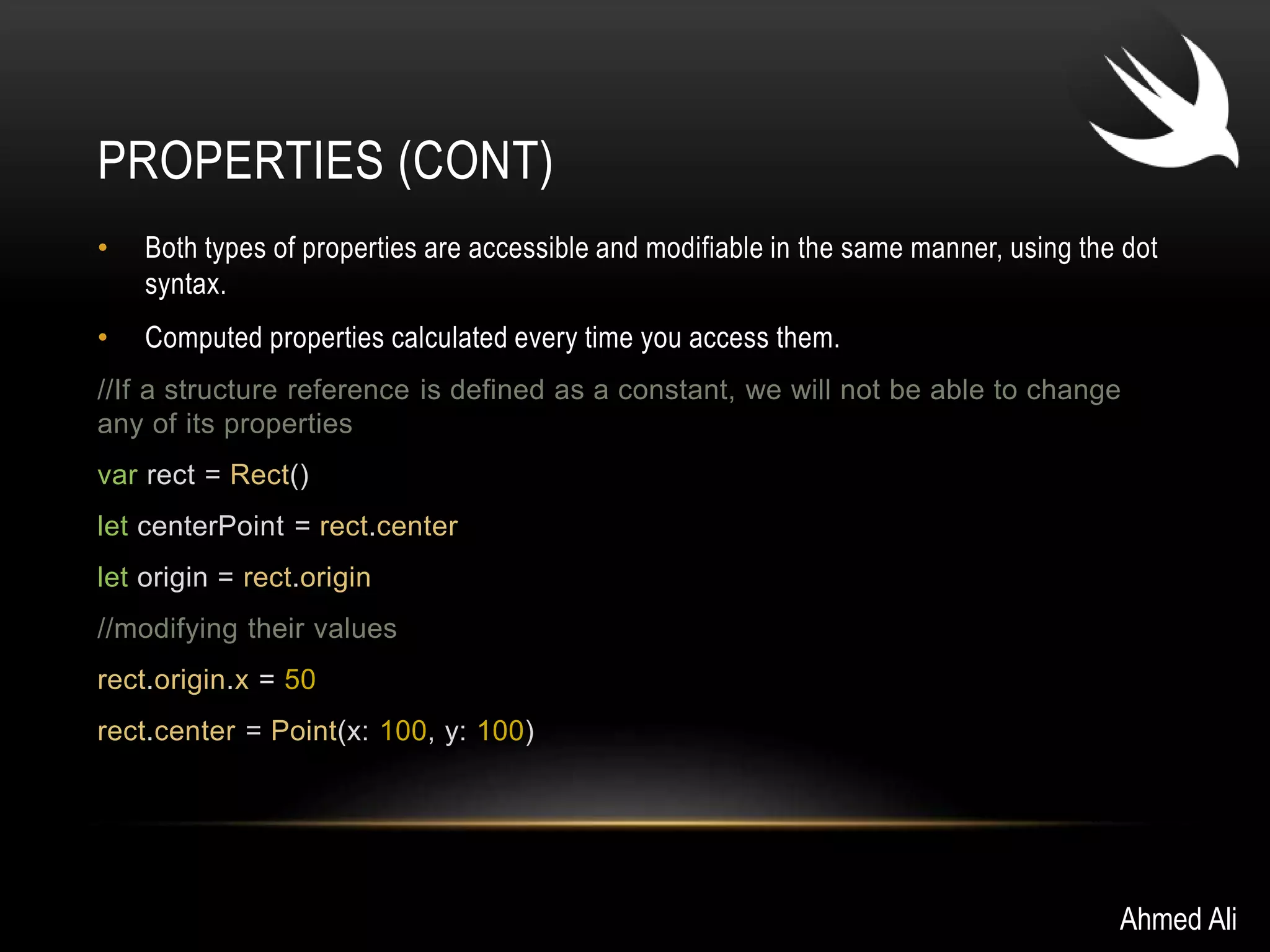
PROPERTIES (CONT) 
• Both types of properties are accessible and modifiable in the same manner, using the dot 
syntax. 
• Computed properties calculated every time you access them. 
//If a structure reference is defined as a constant, we will not be able to change 
any of its properties 
var rect = Rect() 
let centerPoint = rect.center 
let origin = rect.origin 
//modifying their values 
rect.origin.x = 50 
rect.center = Point(x: 100, y: 100) 
Ahmed Ali
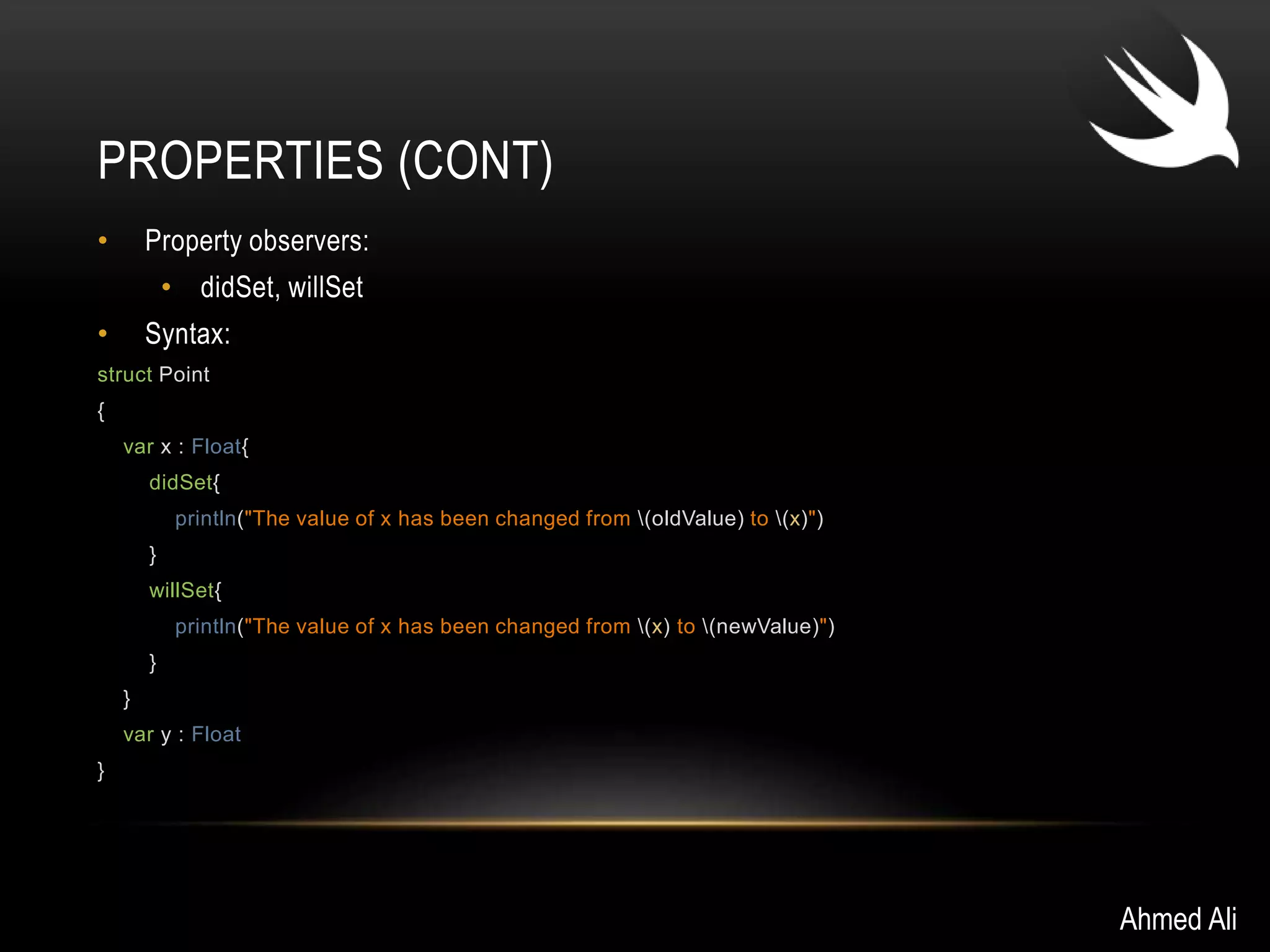
PROPERTIES (CONT) 
• Property observers: 
• didSet, willSet 
• Syntax: 
struct Point 
{ 
var x : Float{ 
didSet{ 
println("The value of x has been changed from (oldValue) to (x)") 
} 
willSet{ 
println("The value of x has been changed from (x) to (newValue)") 
} 
} 
var y : Float 
} 
Ahmed Ali
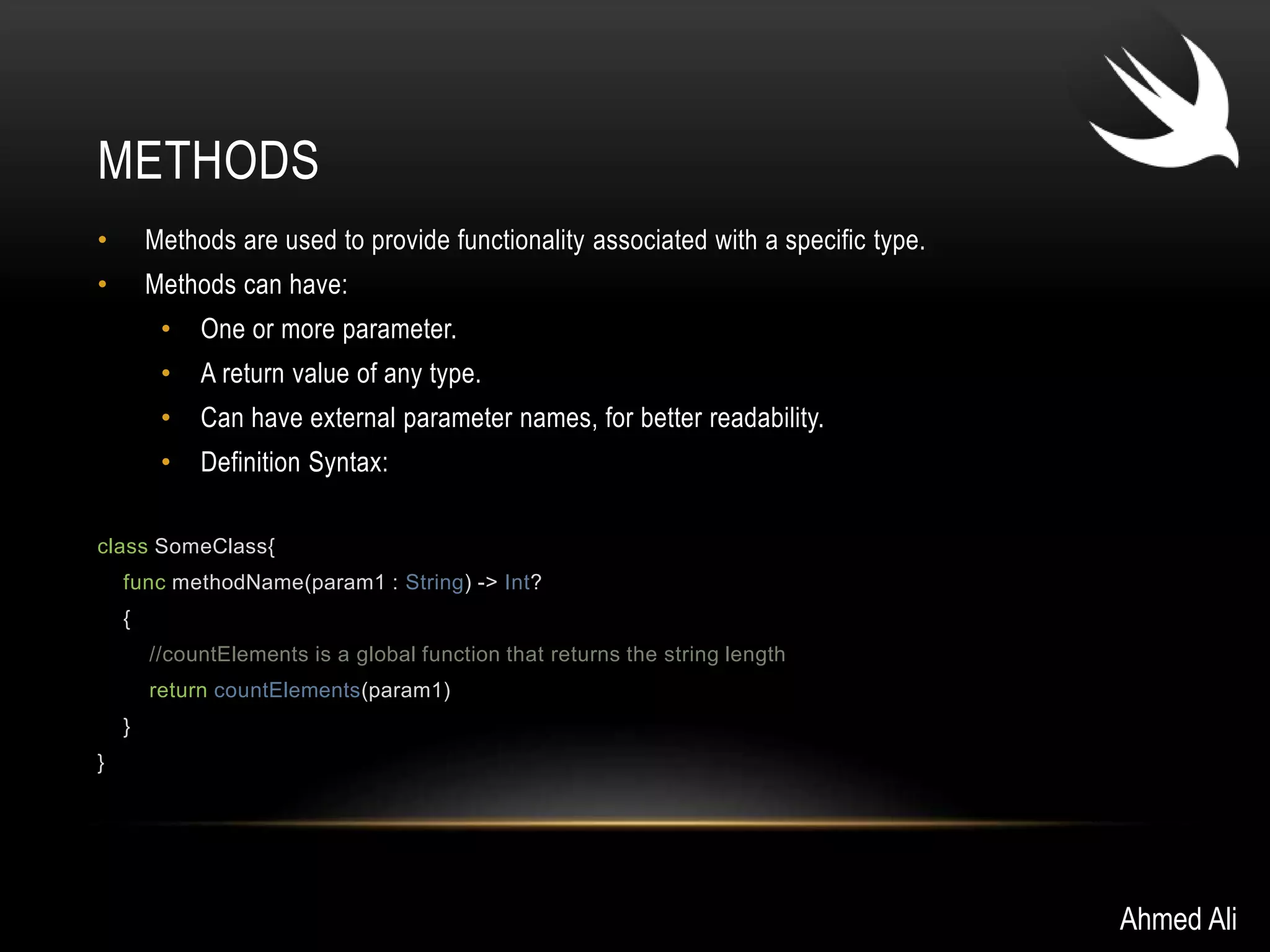
METHODS 
• Methods are used to provide functionality associated with a specific type. 
• Methods can have: 
• One or more parameter. 
• A return value of any type. 
• Can have external parameter names, for better readability. 
• Definition Syntax: 
class SomeClass{ 
func methodName(param1 : String) -> Int? 

{ 
//countElements is a global function that returns the string length 
return countElements(param1) 
} 
} 
Ahmed Ali
METHODS (CONT) 
• External parameter name, promising better readability for your method users. 
• Method call without external parameter names: 
let view = View() 
Animator.moveView(view, Point(0, 0), Point(50, 50)) 
Ahmed Ali
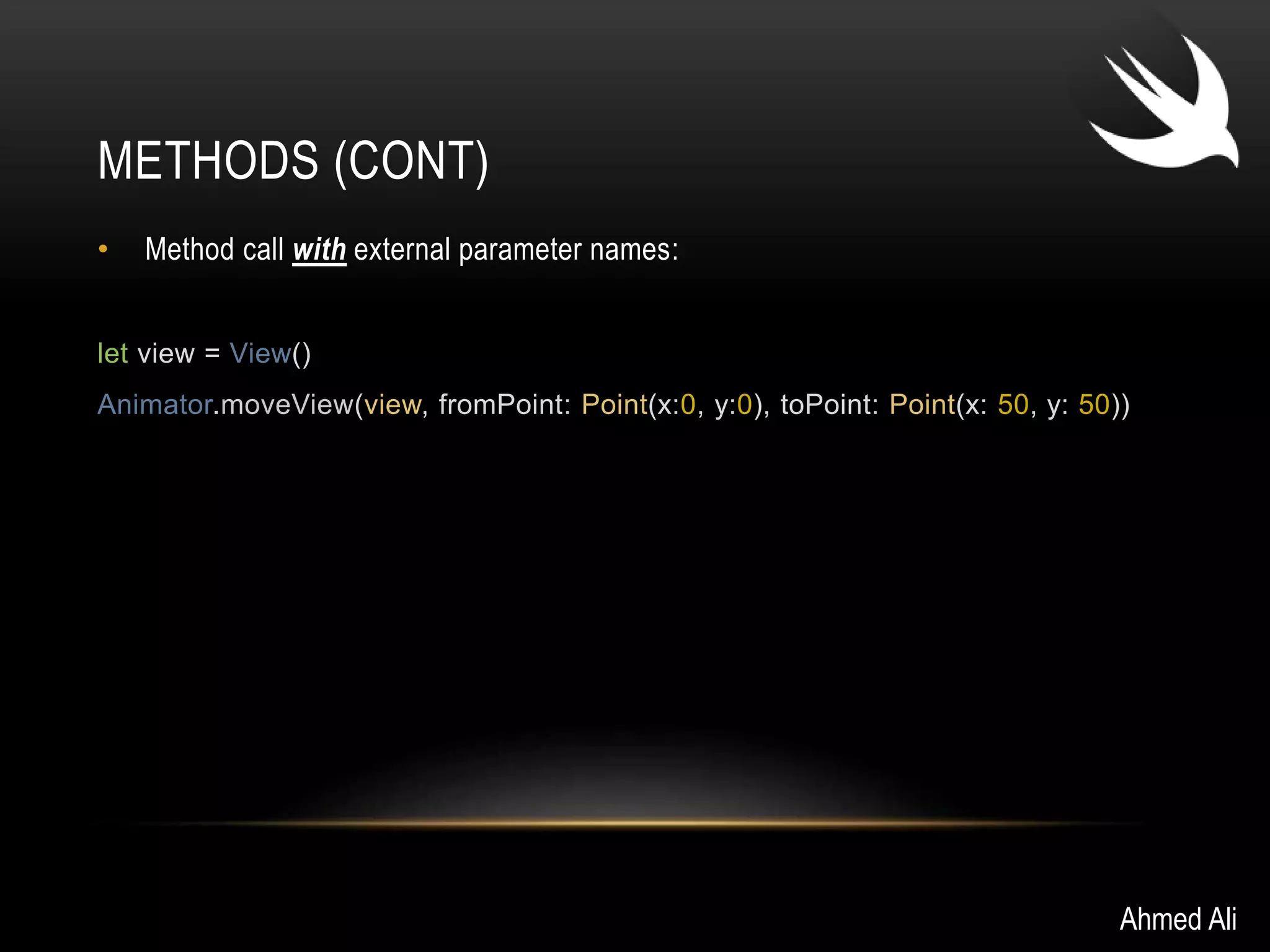
METHODS (CONT) 
• Method call with external parameter names: 
let view = View() 
Animator.moveView(view, fromPoint: Point(x:0, y:0), toPoint: Point(x: 50, y: 50)) 
Ahmed Ali
METHODS (CONT) 
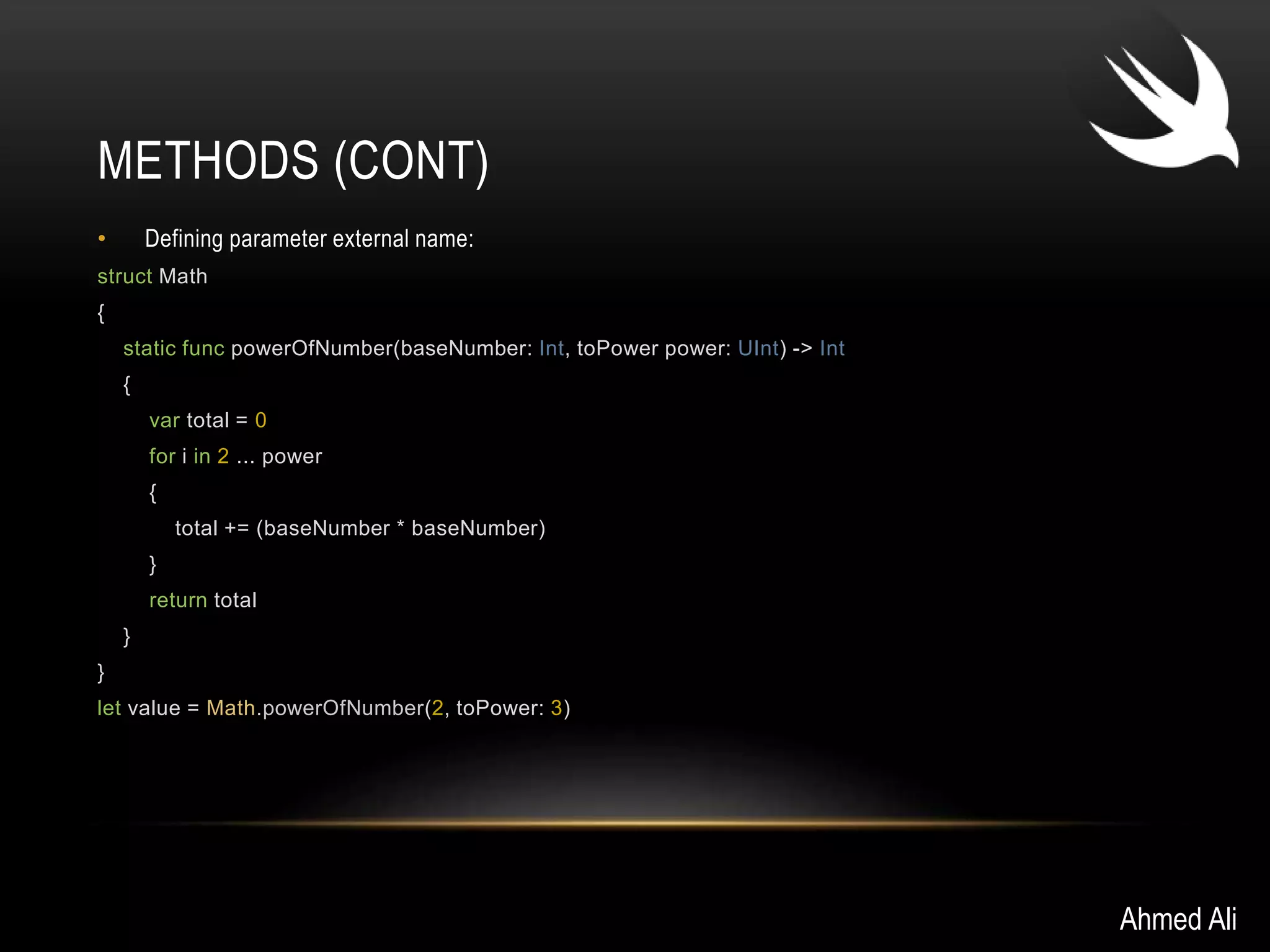
• Defining parameter external name: 
struct Math 
{ 
static func powerOfNumber(baseNumber: Int, toPower power: UInt) -> Int 
{ 
var total = 0 
for i in 2 ... power 
{ 
total += (baseNumber * baseNumber) 
} 
return total 
} 
} 
let value = Math.powerOfNumber(2, toPower: 3) 
Ahmed Ali
METHODS (CONT) 
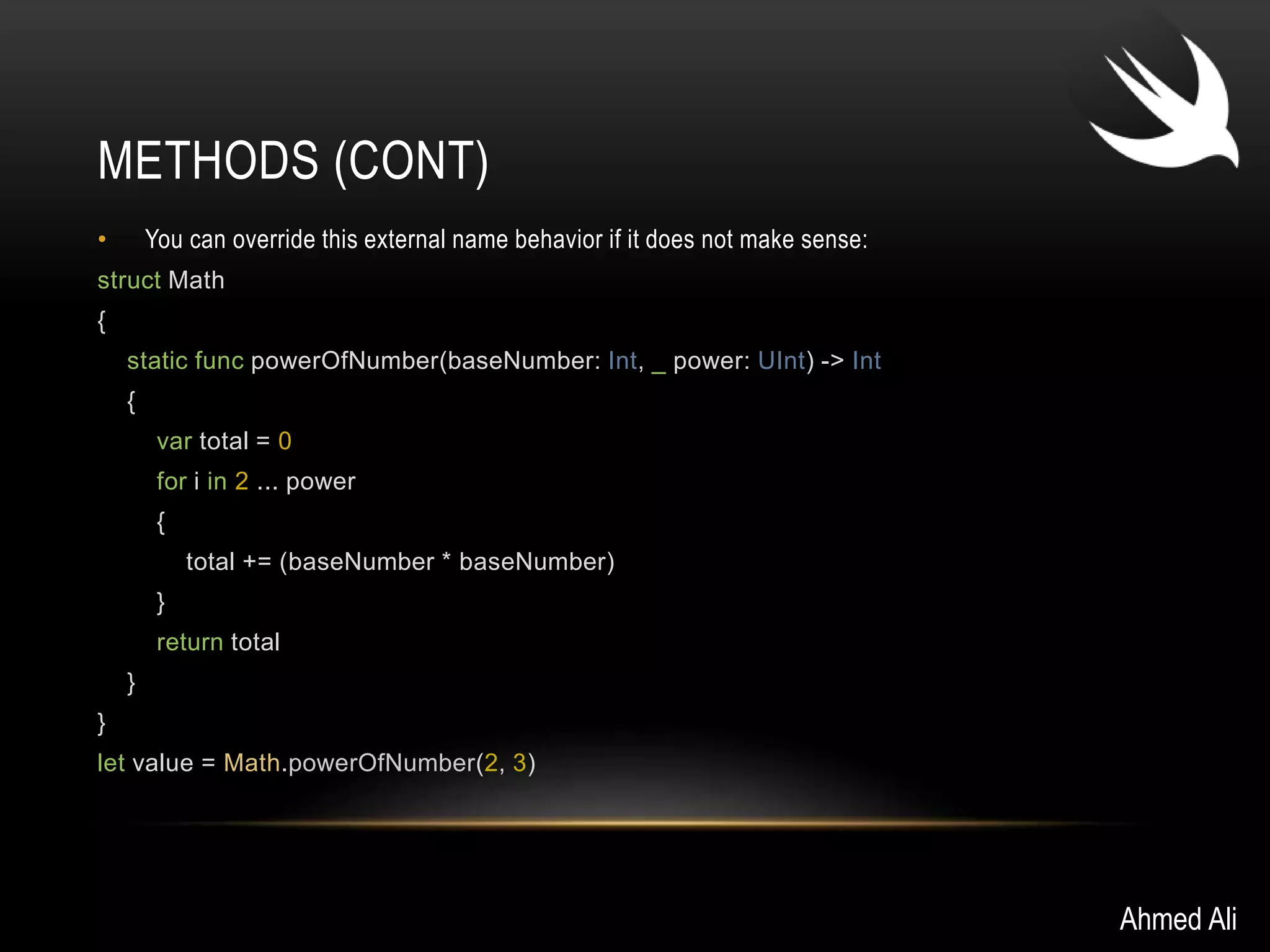
• You can override this external name behavior if it does not make sense: 
struct Math 
{ 
static func powerOfNumber(baseNumber: Int, _ power: UInt) -> Int 
{ 
var total = 0 
for i in 2 ... power 
{ 
total += (baseNumber * baseNumber) 
} 
return total 
} 
} 
let value = Math.powerOfNumber(2, 3) 
Ahmed Ali
METHODS (CONT) 
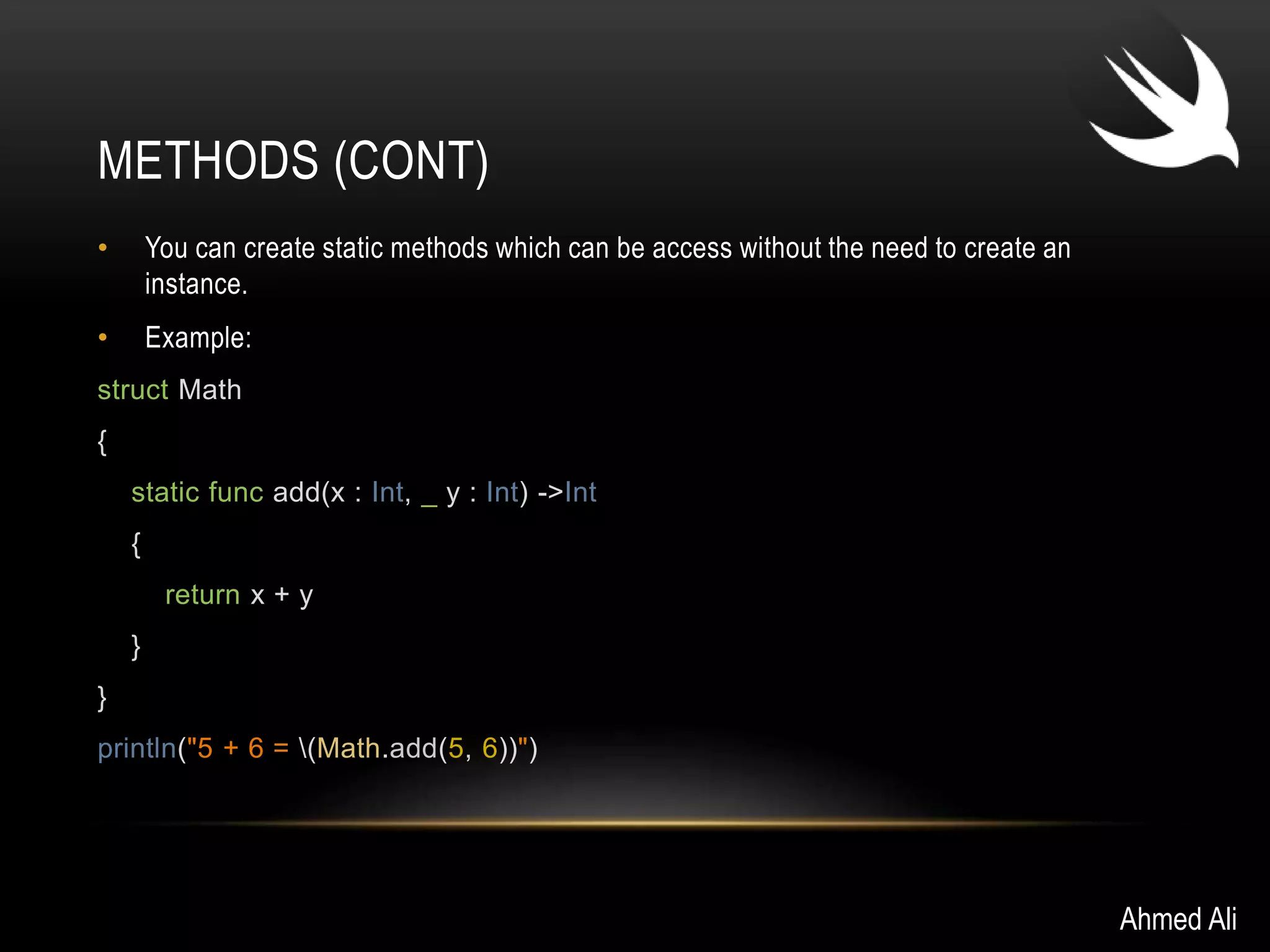
• You can create static methods which can be access without the need to create an 
instance. 
• Example: 
struct Math 
{ 
static func add(x : Int, _ y : Int) ->Int 
{ 
return x + y 
} 
} 
println("5 + 6 = (Math.add(5, 6))") 
Ahmed Ali
METHODS (CONT) 
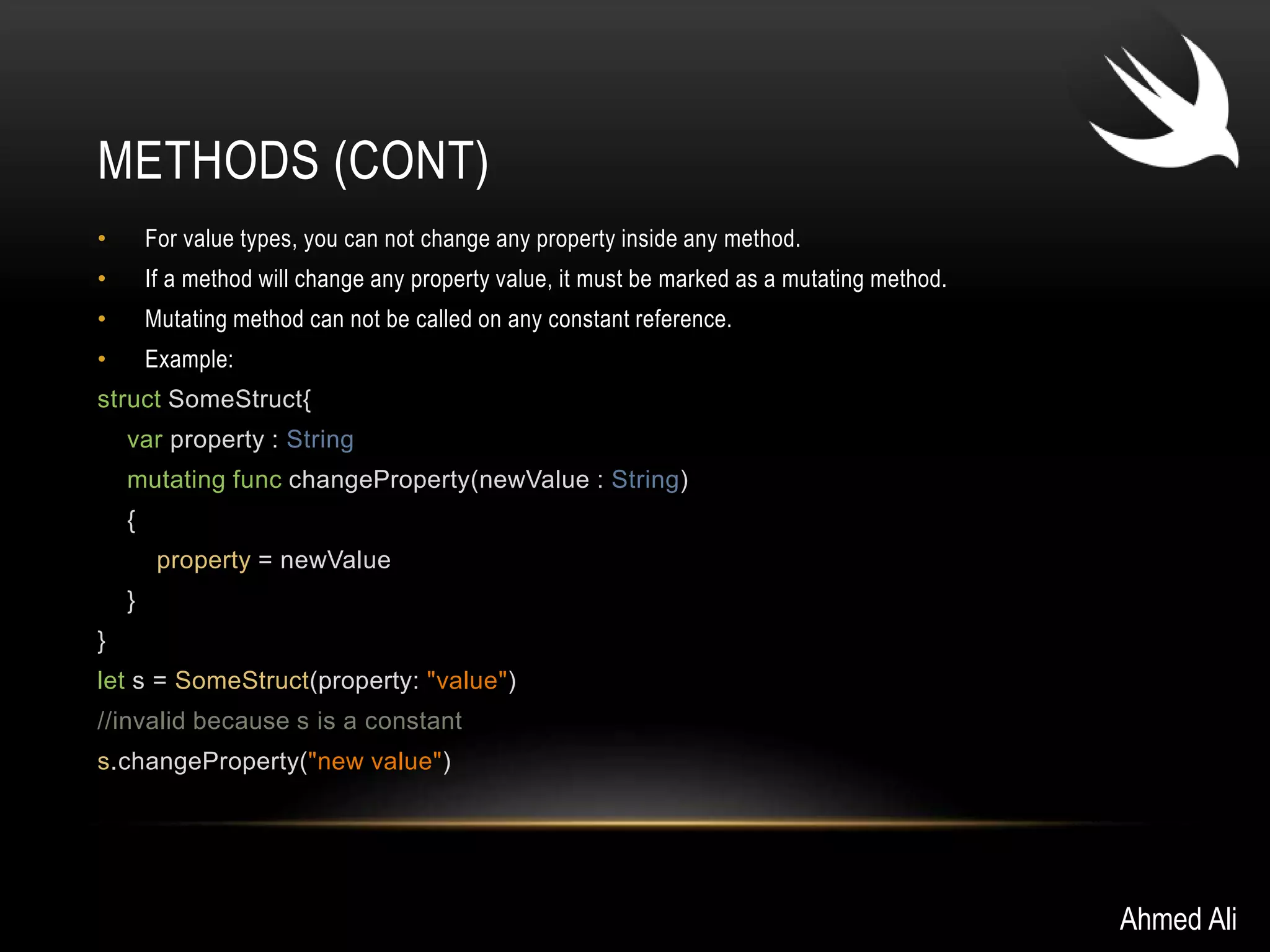
• For value types, you can not change any property inside any method. 
• If a method will change any property value, it must be marked as a mutating method. 
• Mutating method can not be called on any constant reference. 
• Example: 
struct SomeStruct{ 
var property : String 
mutating func changeProperty(newValue : String) 
{ 
property = newValue 
} 
} 
let s = SomeStruct(property: "value") 
//invalid because s is a constant 
s.changeProperty("new value") 
Ahmed Ali
ACCESS CONTROL 
Modules vs Source Files 
Ahmed Ali
ACCESS CONTROL (CONT) 
• Access Levels 
• Public: Accessible everywhere. 
• Internal: Accessible for any source code file in defining module. 
• Private: Accessible only in the same source code file. 
• Internal is the default access level. 
Ahmed Ali
ACCESS CONTROL (CONT) 
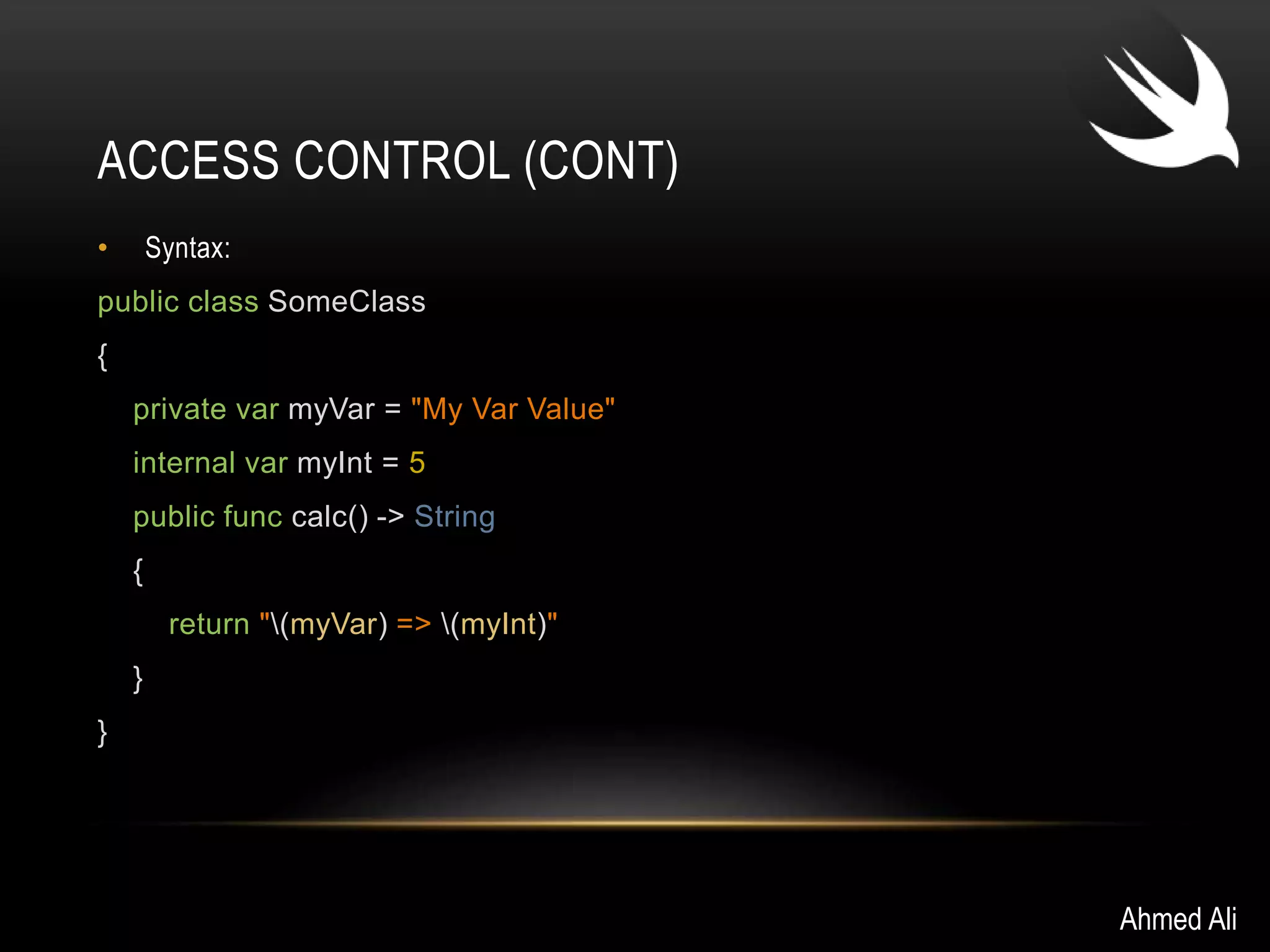
• Syntax: 
public class SomeClass 
{ 
private var myVar = "My Var Value" 
internal var myInt = 5 
public func calc() -> String 
{ 
return "(myVar) => (myInt)" 
} 
} 
Ahmed Ali
INHERITANCE 
• No universal base class that all other classes inherit from. 
• Any class who has no super class, is known to be a base class. 
• You can override super class methods and computed properties using the override 
keyword. 
• You can not override stored properties of super class, but you can observe them. 
Ahmed Ali
INHERITANCE (CONT) 
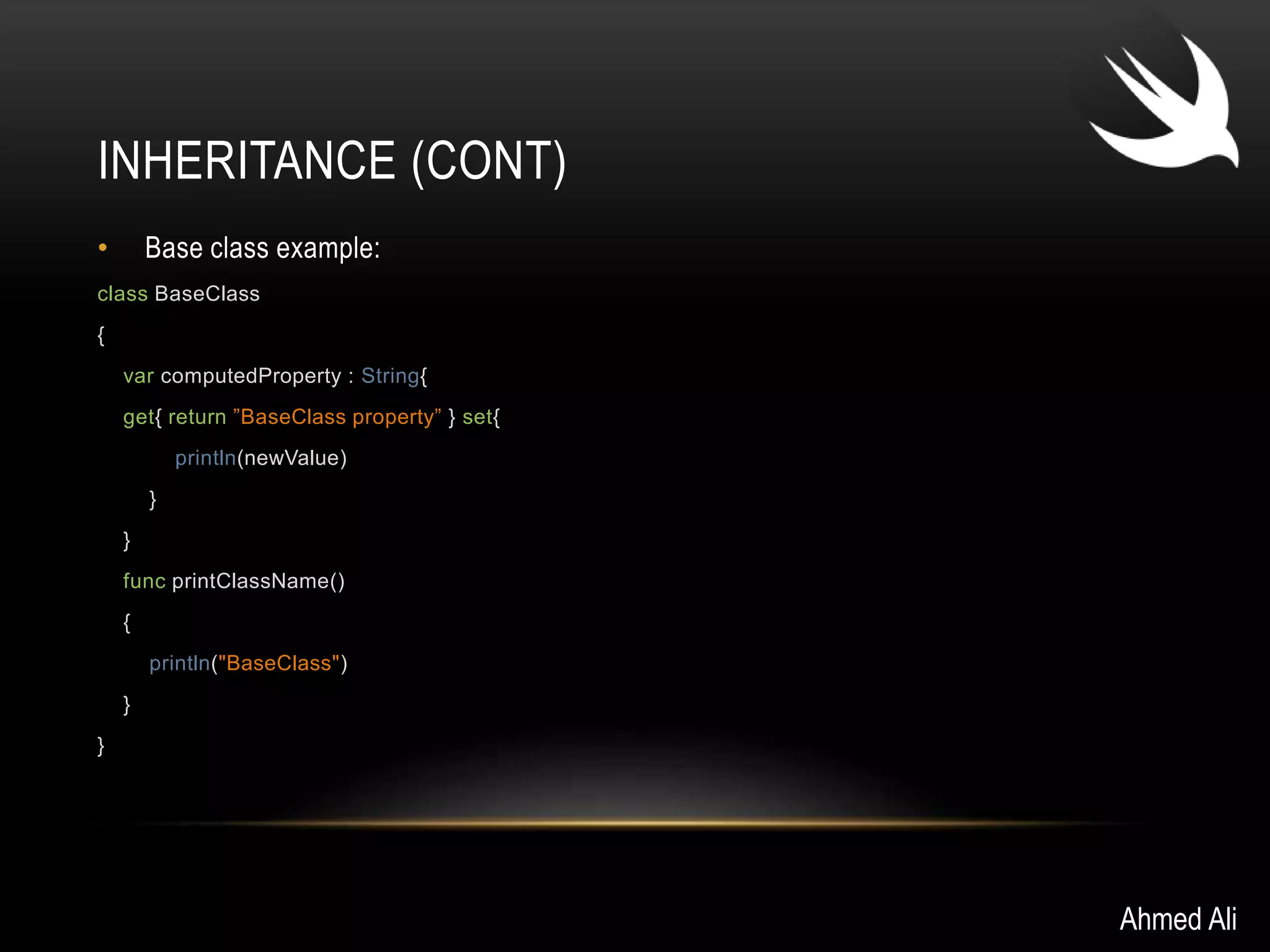
• Base class example: 
class BaseClass 
{ 
var computedProperty : String{ 
get{ return ”BaseClass property” } set{ 
println(newValue) 
} 
} 
func printClassName() 
{ 
println("BaseClass") 
} 
} 
Ahmed Ali
INHERITANCE (CONT) 
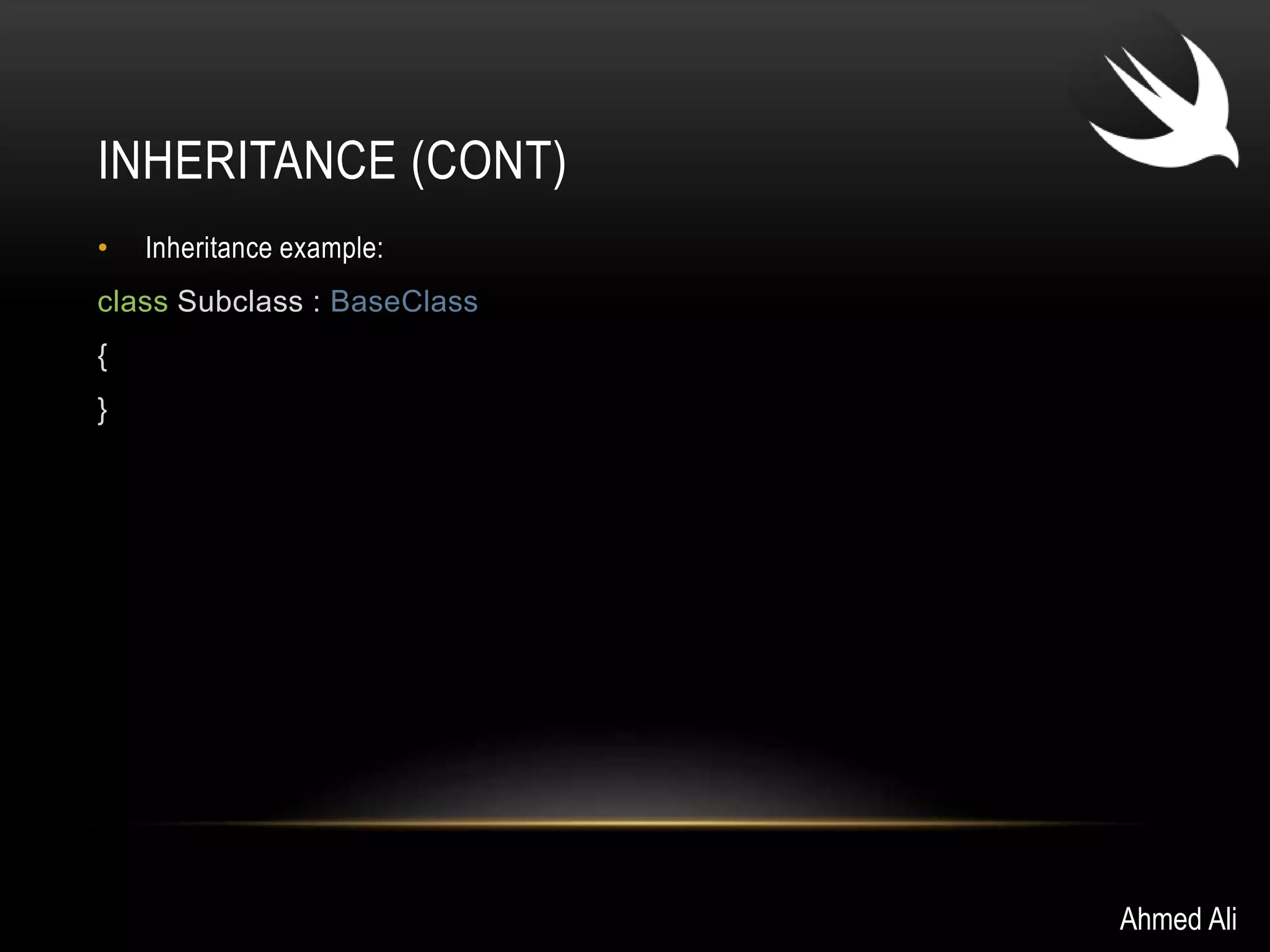
• Inheritance example: 
class Subclass : BaseClass 
{ 
} 
Ahmed Ali
INHERITANCE (CONT) 
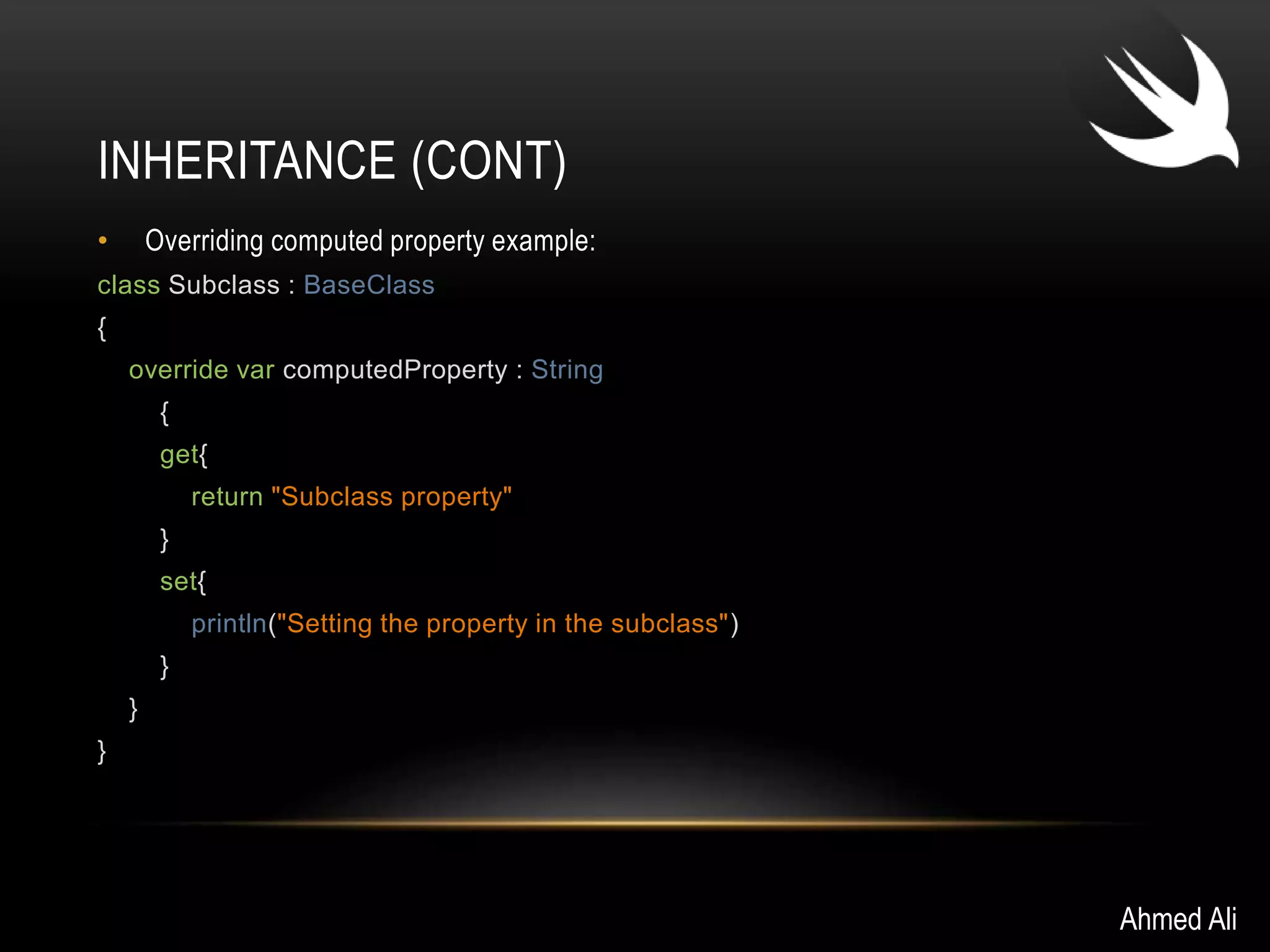
• Overriding computed property example: 
class Subclass : BaseClass 
{ 
override var computedProperty : String 
{ 
get{ 
return "Subclass property" 
} 
set{ 
println("Setting the property in the subclass") 
} 
} 
} 
Ahmed Ali
INHERITANCE (CONT) 
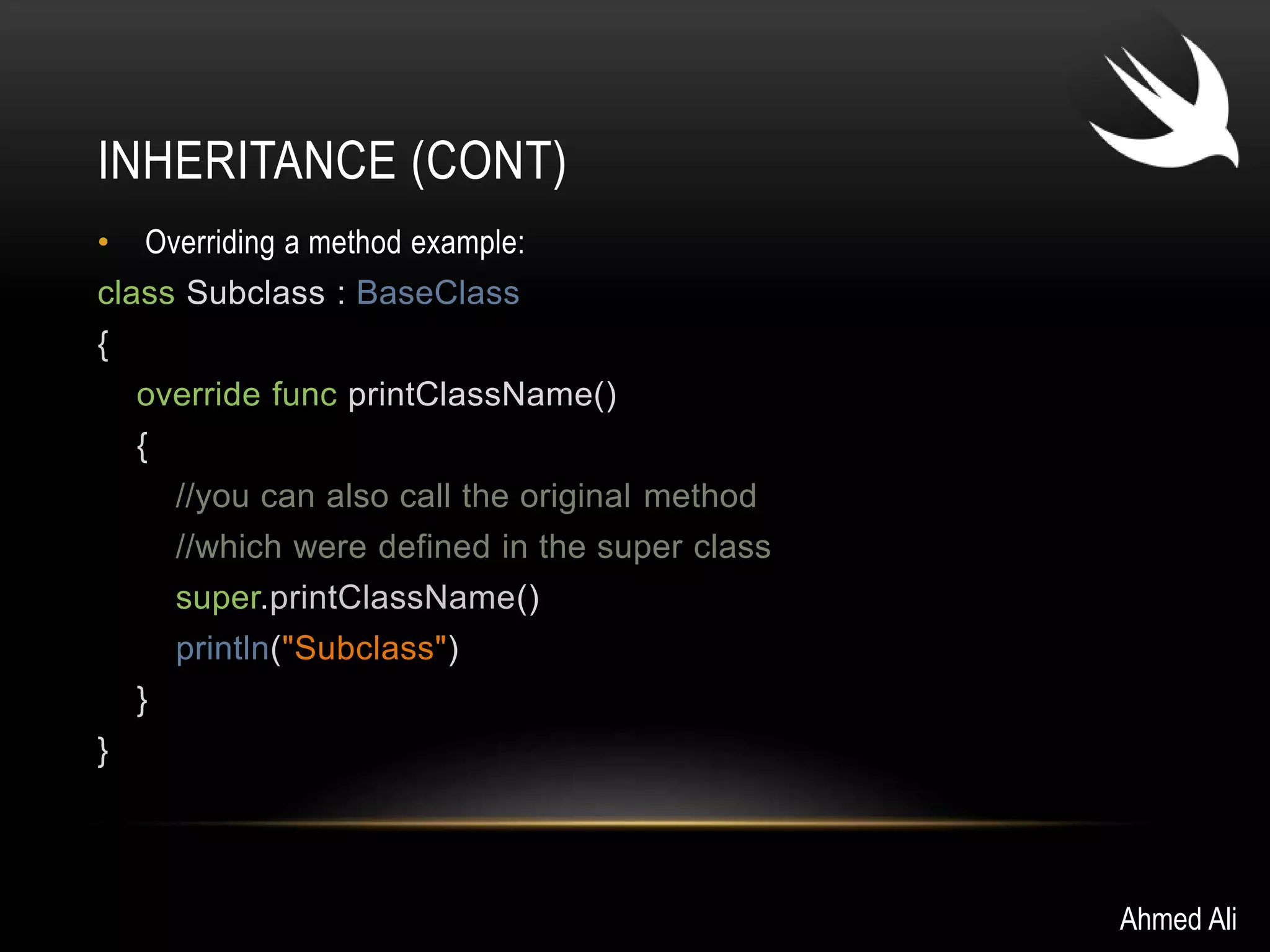
• Overriding a method example: 
class Subclass : BaseClass 
{ 
override func printClassName() 
{ 
//you can also call the original method 
//which were defined in the super class 
super.printClassName() 
println("Subclass") 
} 
} 
Ahmed Ali
INITIALIZATION 
• Initialization is the process of creating a new instance. 
• Mainly used to set non-optional properties’ values and any initial setup. 
• The initialization process can not be completed while any non-optional properties still 
have no value. 
• Implementation is done through special methods called initializers. 
Ahmed Ali
INITIALIZATION - INITIALIZERS 
• An initializer is a normal method, with little different syntax. 
• Initializer method is always called “init” 
• You don’t write the “func” keyword before the initializer. 
• Initializers always return nothing. 
• Can take zero or more parameters. 
• Class can have zero or more initializers. 
• An initializer is required if any of your non-optional properties have no default value. 
Ahmed Ali
INITIALIZATION – INITIALIZERS (CONT) 
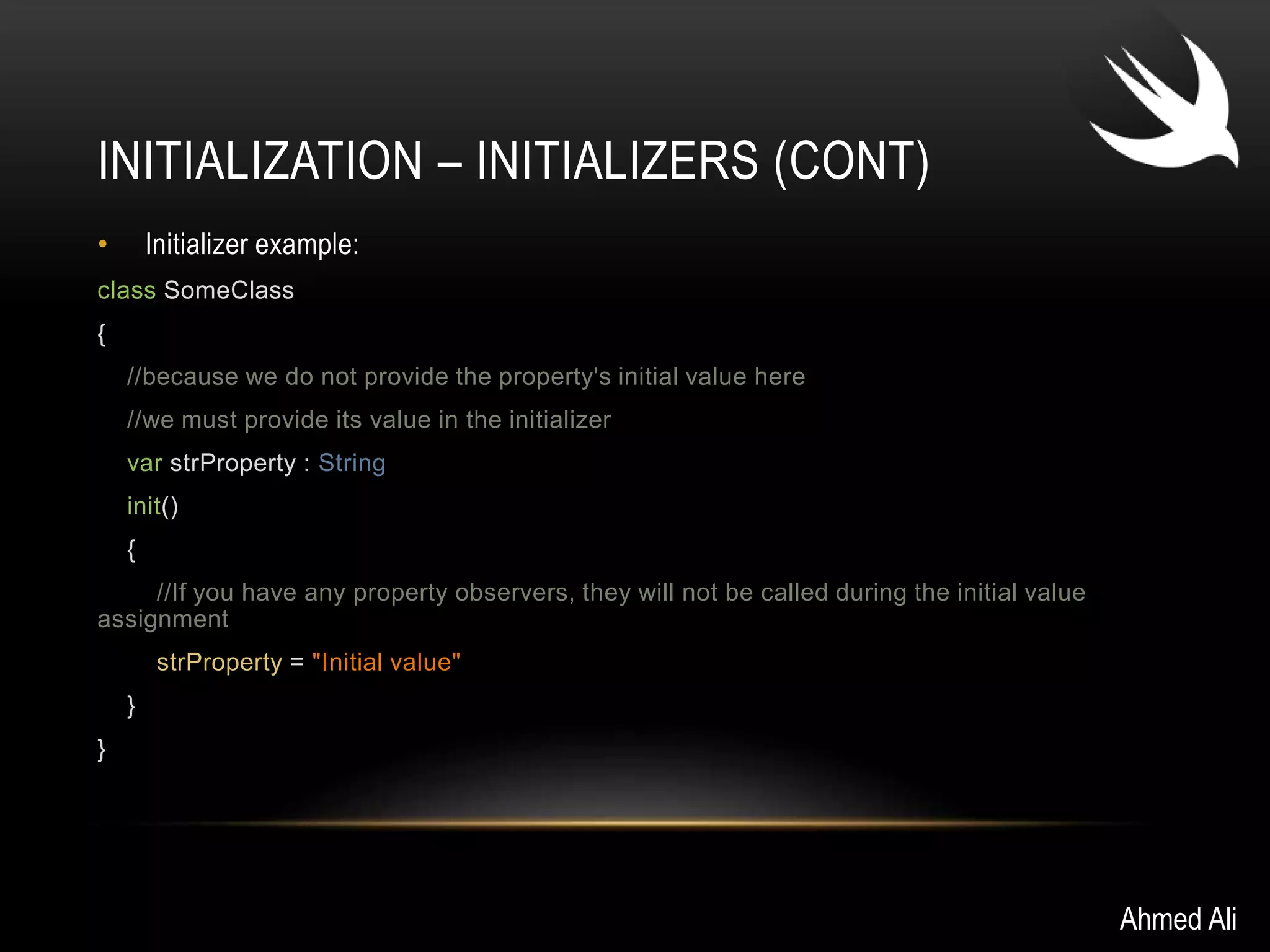
• Initializer example: 
class SomeClass 
{ 
//because we do not provide the property's initial value here 
//we must provide its value in the initializer 
var strProperty : String 
init() 
{ 
//If you have any property observers, they will not be called during the initial value 
assignment 
strProperty = "Initial value" 
} 
} 
Ahmed Ali
INITIALIZATION – INITIALIZERS (CONT) 
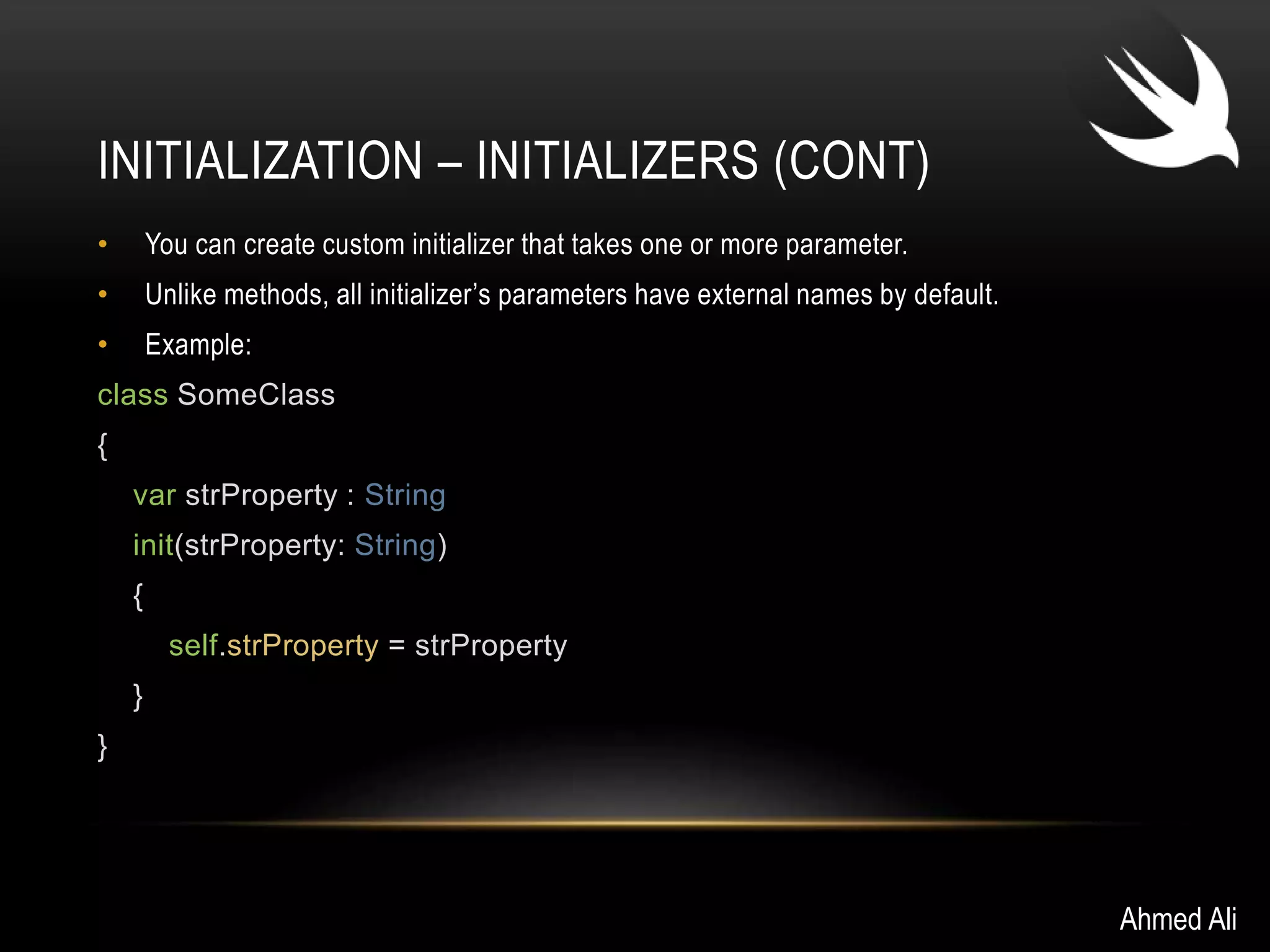
• You can create custom initializer that takes one or more parameter. 
• Unlike methods, all initializer’s parameters have external names by default. 
• Example: 
class SomeClass 
{ 
var strProperty : String 
init(strProperty: String) 
{ 
self.strProperty = strProperty 
} 
} 
Ahmed Ali
INITIALIZATION – INITIALIZERS (CONT) 
• Default initializer (that takes no parameters) is automatically available if and only if: 
1. All your non-optional properties have default values and you did not create any 
initializers at all. 
• Constant property value can be modified in any initializer. However, you can not modify 
super class’s constant property in a subclass initializer. 
Ahmed Ali
INITIALIZATION – INITIALIZERS (CONT) 
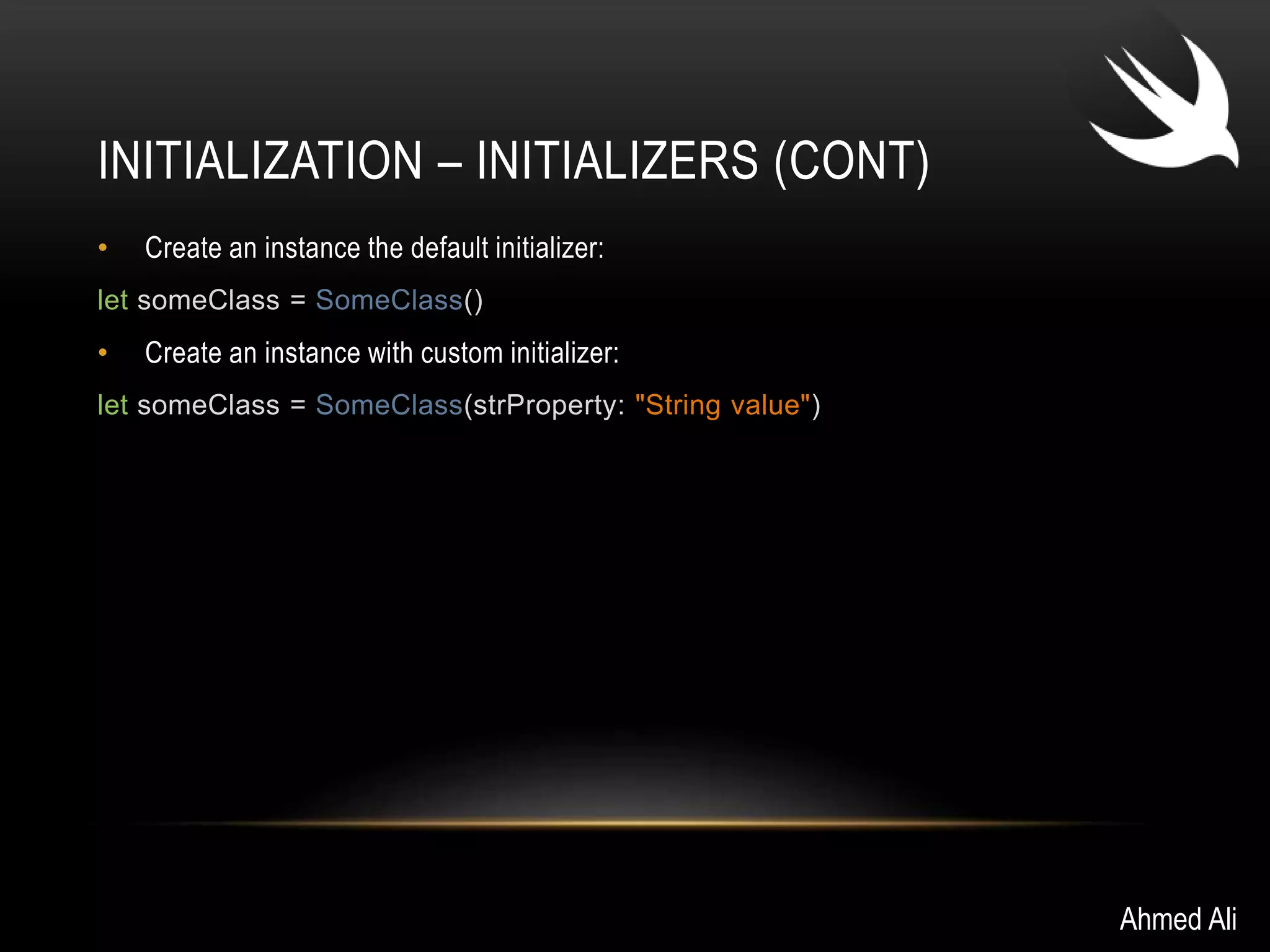
• Create an instance the default initializer: 
let someClass = SomeClass() 
• Create an instance with custom initializer: 
let someClass = SomeClass(strProperty: "String value") 
Ahmed Ali
INITIALIZATION – INITIALIZERS (CONT) 
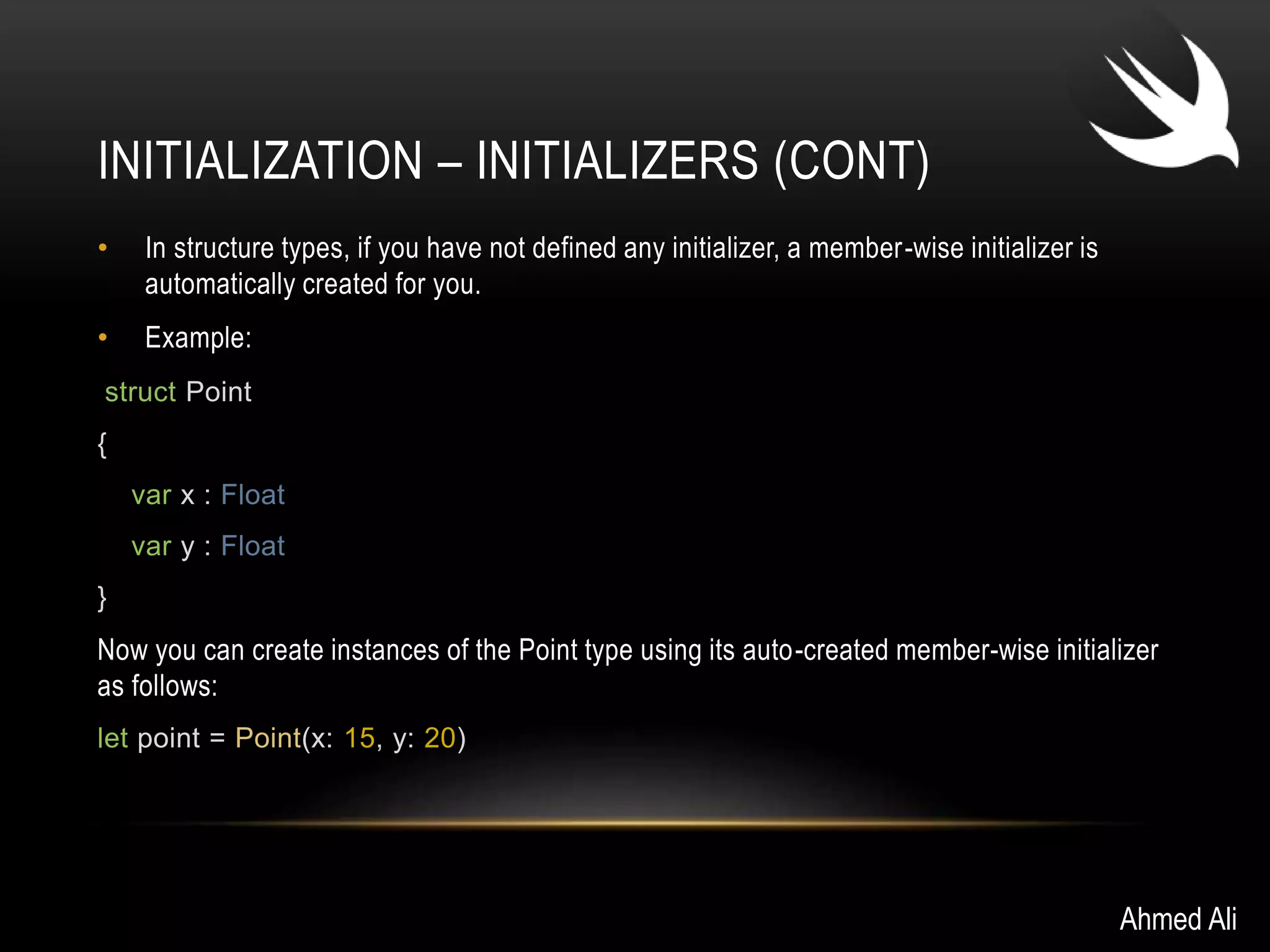
• In structure types, if you have not defined any initializer, a member -wise initializer is 
automatically created for you. 
• Example: 
struct Point 
{ 
var x : Float 
var y : Float 
} 
Now you can create instances of the Point type using its auto-created member-wise initializer 
as follows: 
let point = Point(x: 15, y: 20) 
Ahmed Ali
INITIALIZATION – INITIALIZERS (CONT) 
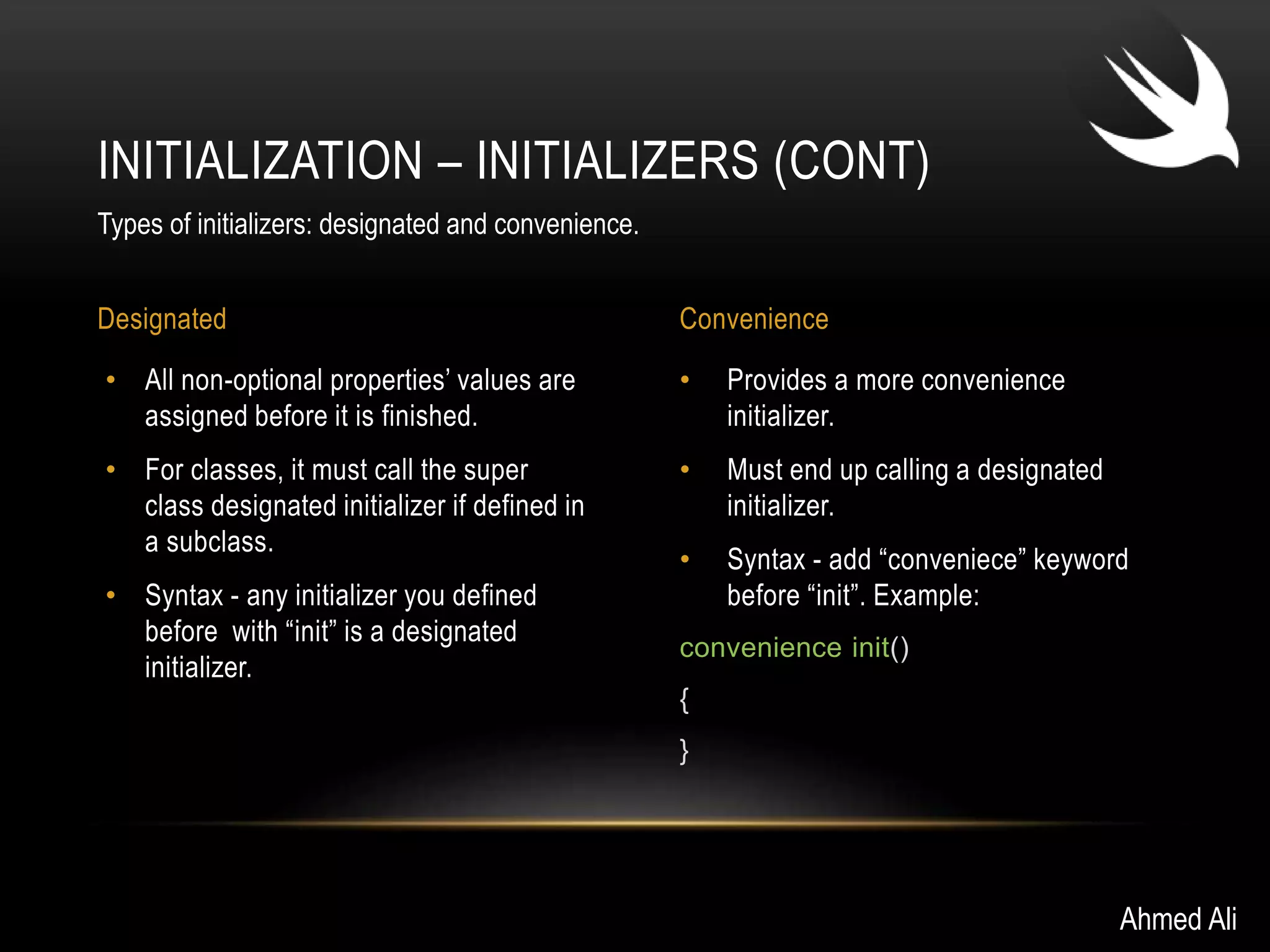
Designated Convenience 
• Provides a more convenience 
initializer. 
• Must end up calling a designated 
initializer. 
• Syntax - add “conveniece” keyword 
before “init”. Example: 
convenience init() 
{ 
} 
• All non-optional properties’ values are 
assigned before it is finished. 
• For classes, it must call the super 
class designated initializer if defined in 
a subclass. 
• Syntax - any initializer you defined 
before with “init” is a designated 
initializer. 
Ahmed Ali 
Types of initializers: designated and convenience.
INITIALIZATION – INITIALIZERS (CONT) 
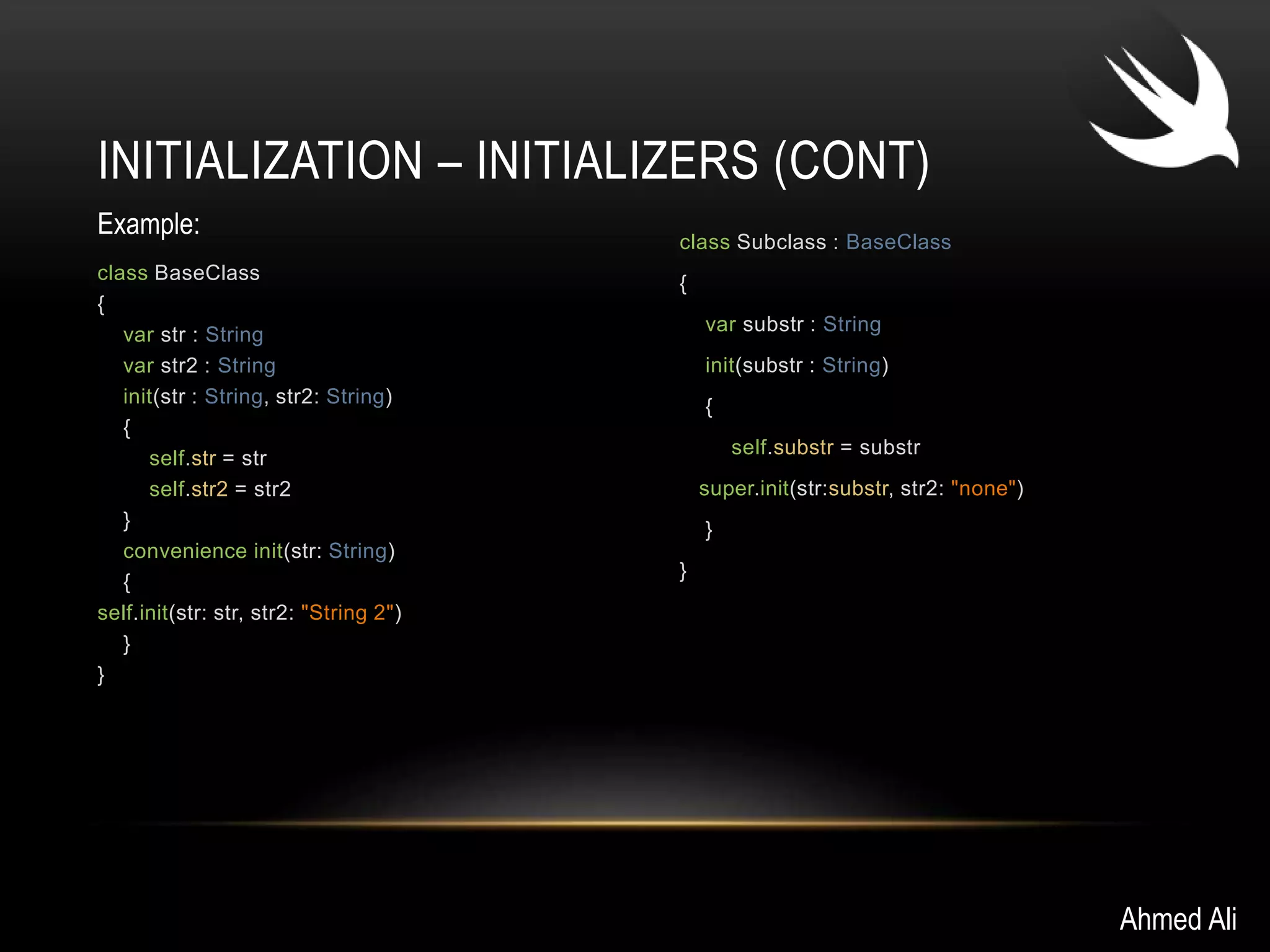
class BaseClass 
{ 
var str : String 
var str2 : String 
init(str : String, str2: String) 
{ 
self.str = str 
self.str2 = str2 
} 
convenience init(str: String) 
{ 
self.init(str: str, str2: "String 2") 
} 
} 
class Subclass : BaseClass 
{ 
var substr : String 
init(substr : String) 
{ 
self.substr = substr 
super.init(str:substr, str2: "none") 
} 
} 
Ahmed Ali 
Example:
DEINITIALIZATION 
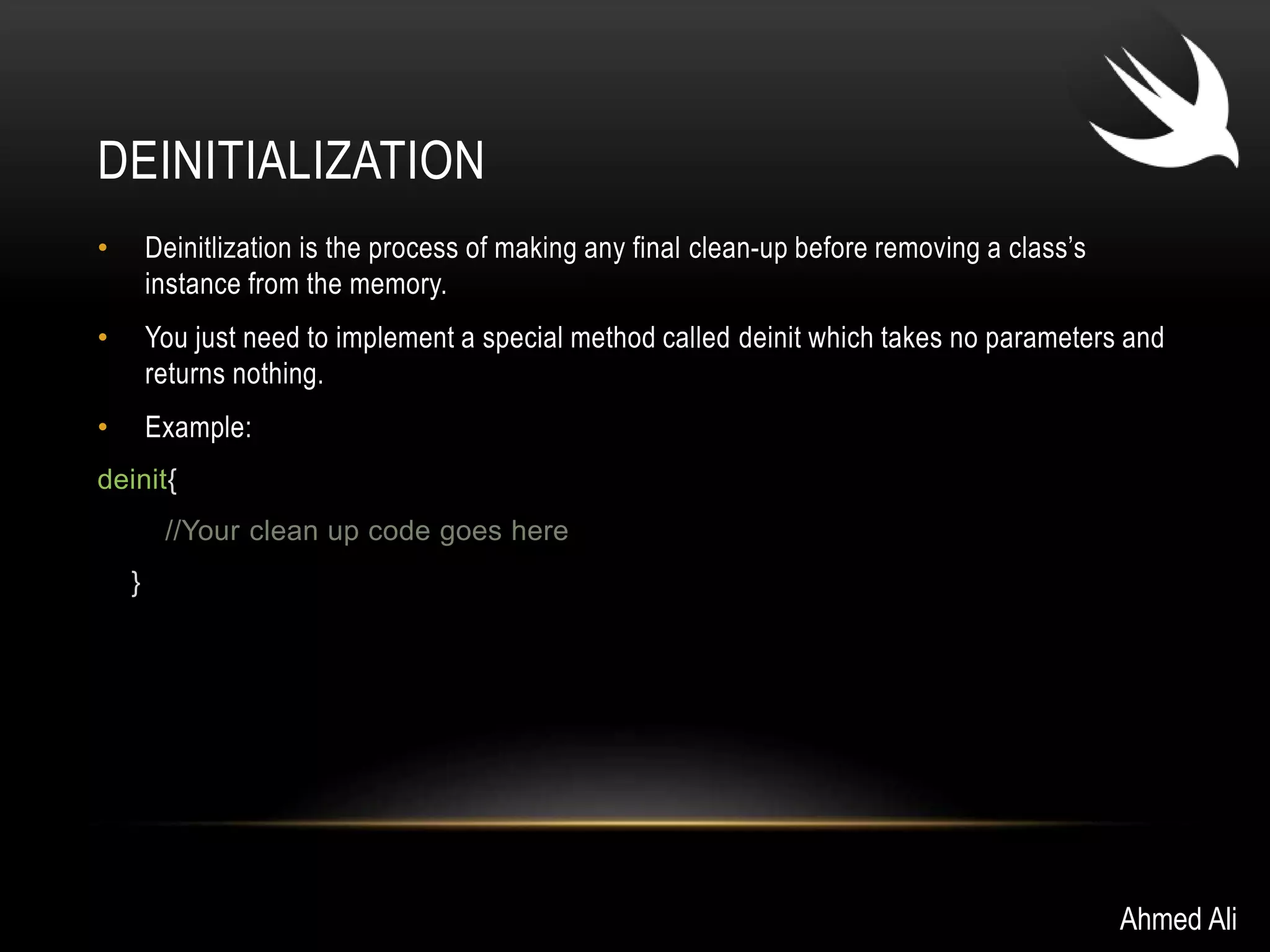
• Deinitlization is the process of making any final clean-up before removing a class’s 
instance from the memory. 
• You just need to implement a special method called deinit which takes no parameters and 
returns nothing. 
• Example: 
deinit{ 
//Your clean up code goes here 
} 
Ahmed Ali
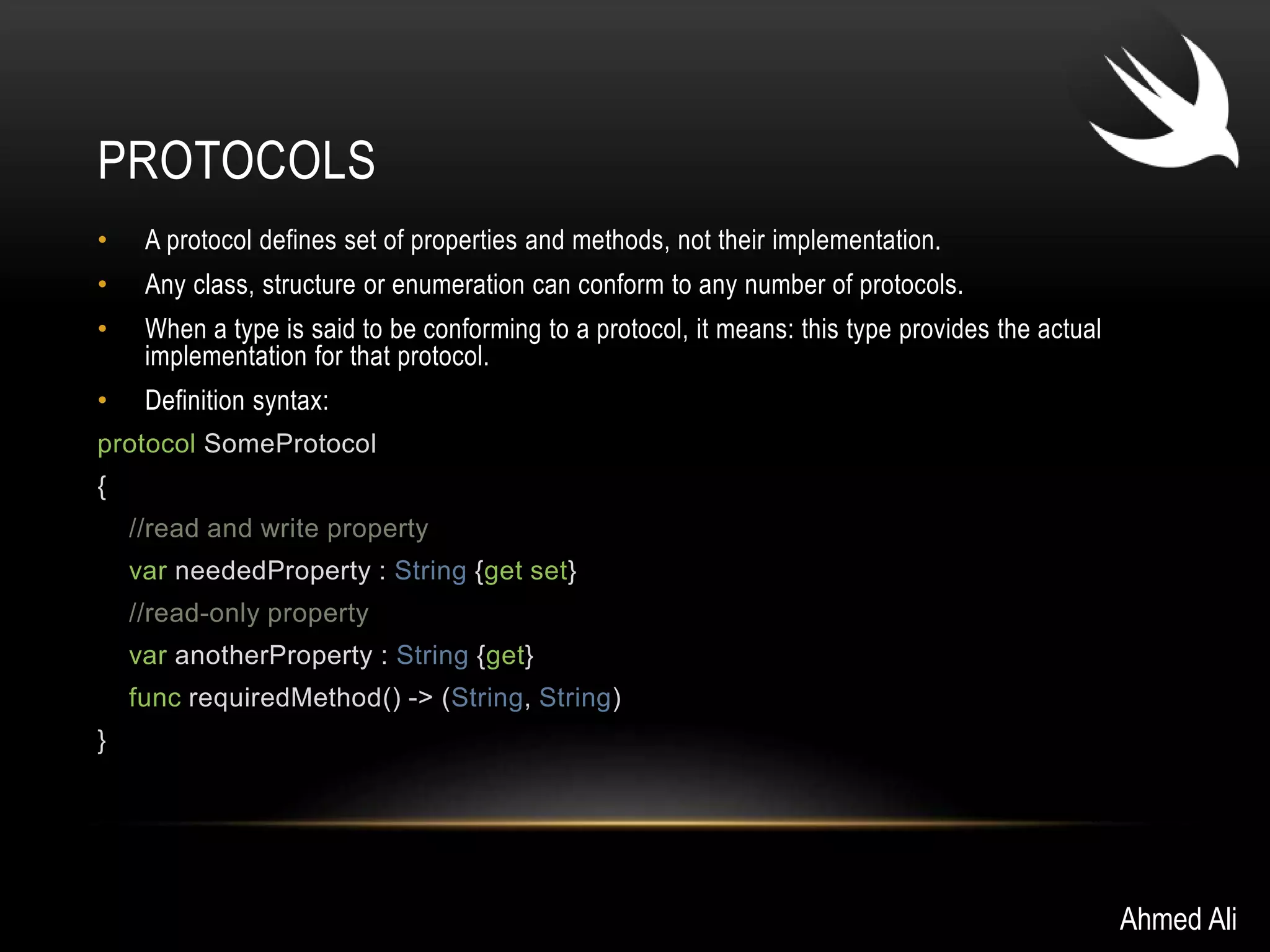
PROTOCOLS 
• A protocol defines set of properties and methods, not their implementation. 
• Any class, structure or enumeration can conform to any number of protocols. 
• When a type is said to be conforming to a protocol, it means: this type provides the actual 
implementation for that protocol. 
• Definition syntax: 
protocol SomeProtocol 
{ 
//read and write property 
var neededProperty : String {get set} 
//read-only property 
var anotherProperty : String {get} 
func requiredMethod() -> (String, String) 
} 
Ahmed Ali
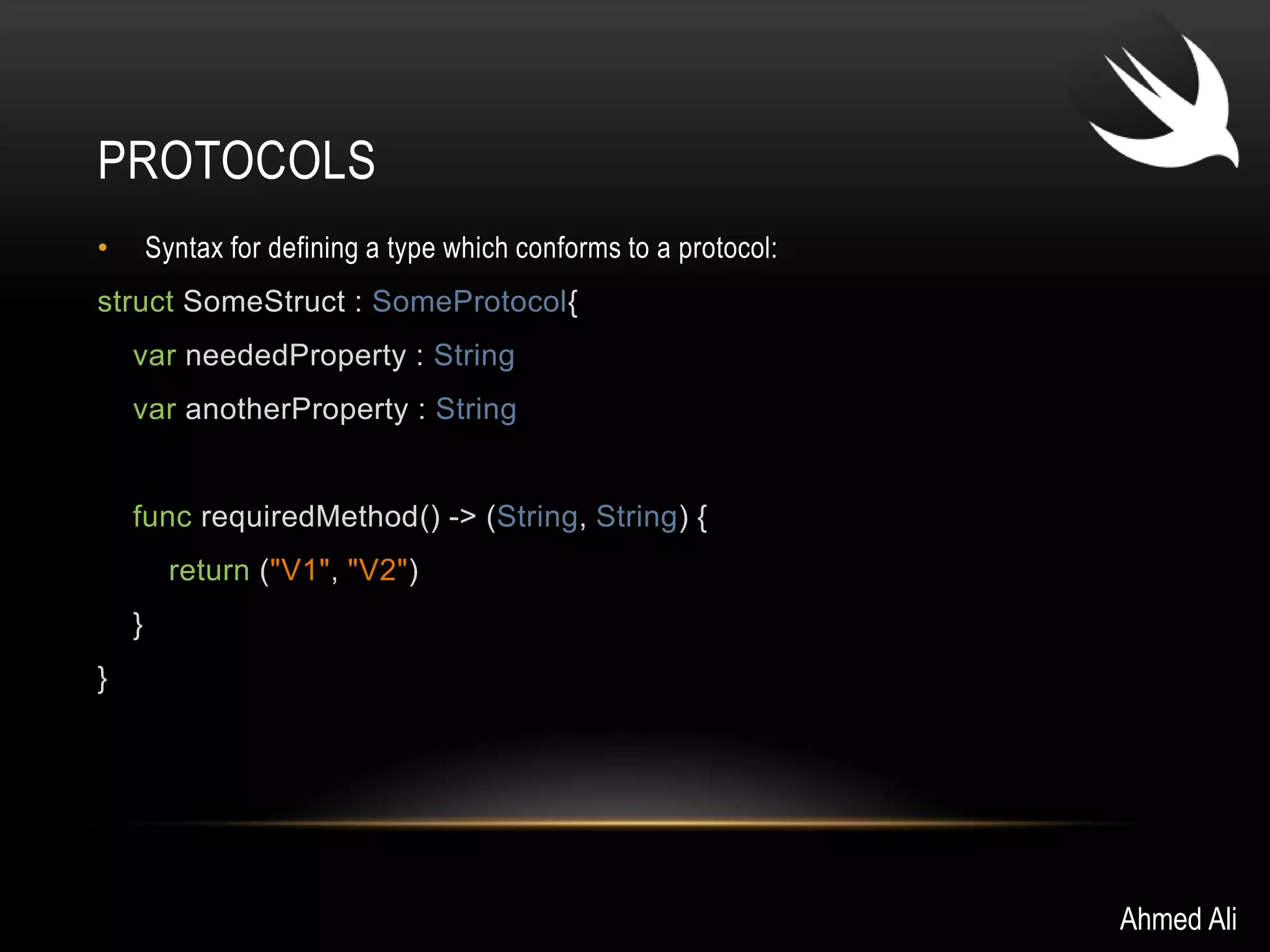
PROTOCOLS 
• Syntax for defining a type which conforms to a protocol: 
struct SomeStruct : SomeProtocol{ 
var neededProperty : String 
var anotherProperty : String 
func requiredMethod() -> (String, String) { 
return ("V1", "V2") 
} 
} 
Ahmed Ali
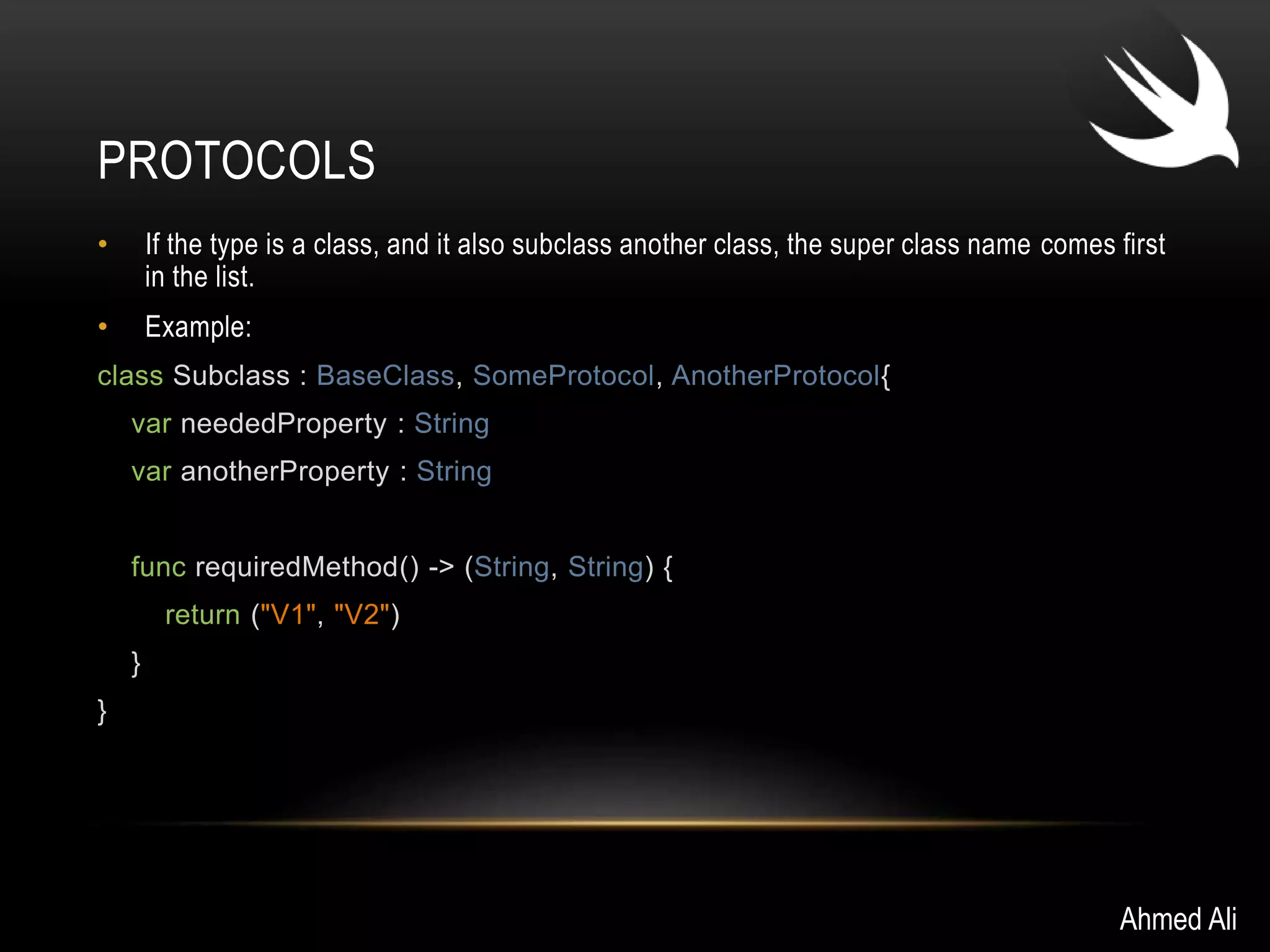
PROTOCOLS 
• If the type is a class, and it also subclass another class, the super class name comes first 
in the list. 
• Example: 
class Subclass : BaseClass, SomeProtocol, AnotherProtocol{ 
var neededProperty : String 
var anotherProperty : String 
func requiredMethod() -> (String, String) { 
return ("V1", "V2") 
} 
} 
Ahmed Ali
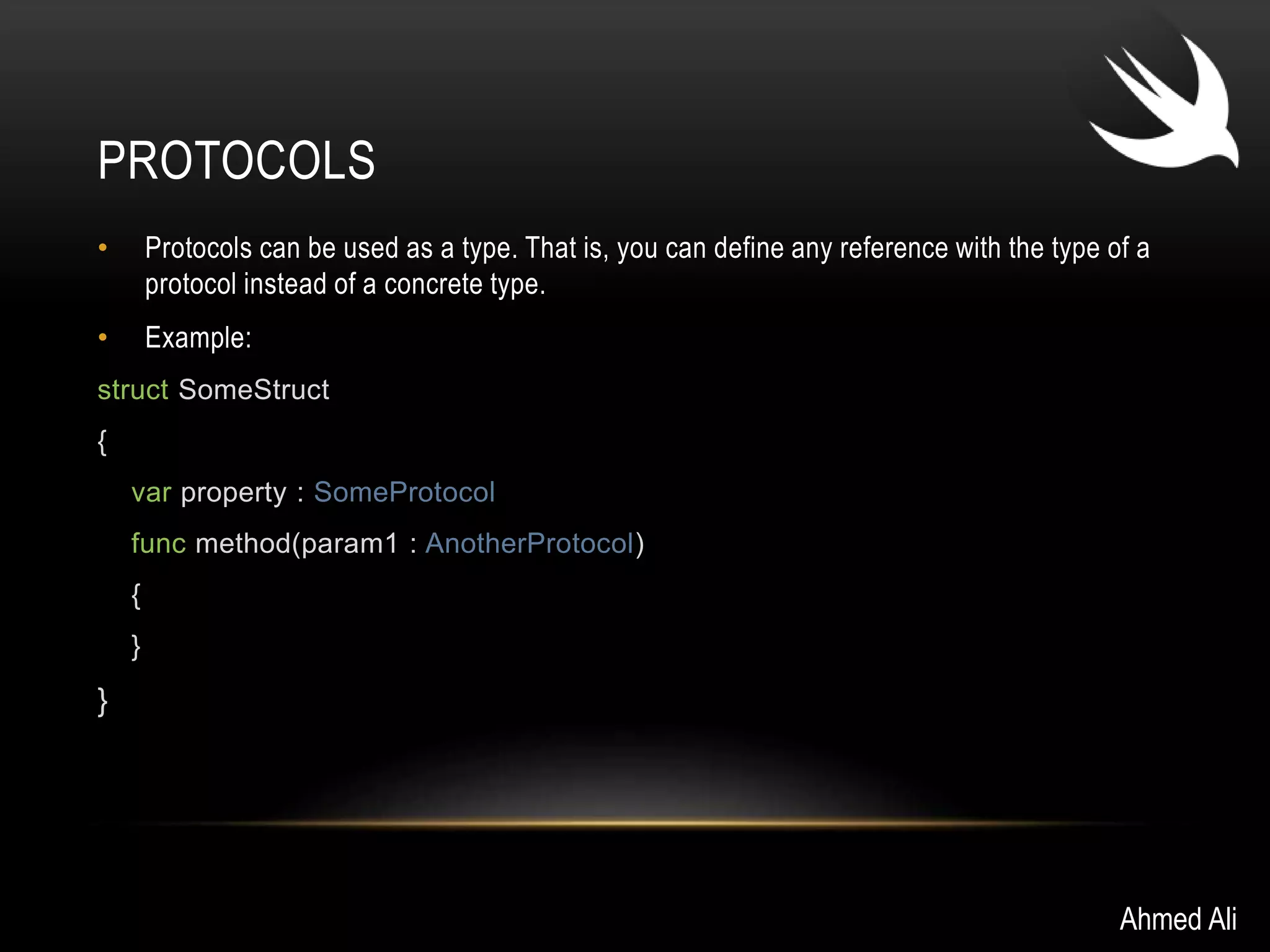
PROTOCOLS 
• Protocols can be used as a type. That is, you can define any reference with the type of a 
protocol instead of a concrete type. 
• Example: 
struct SomeStruct 
{ 
var property : SomeProtocol 
func method(param1 : AnotherProtocol) 
{ 
} 
} 
Ahmed Ali
PROTOCOLS 
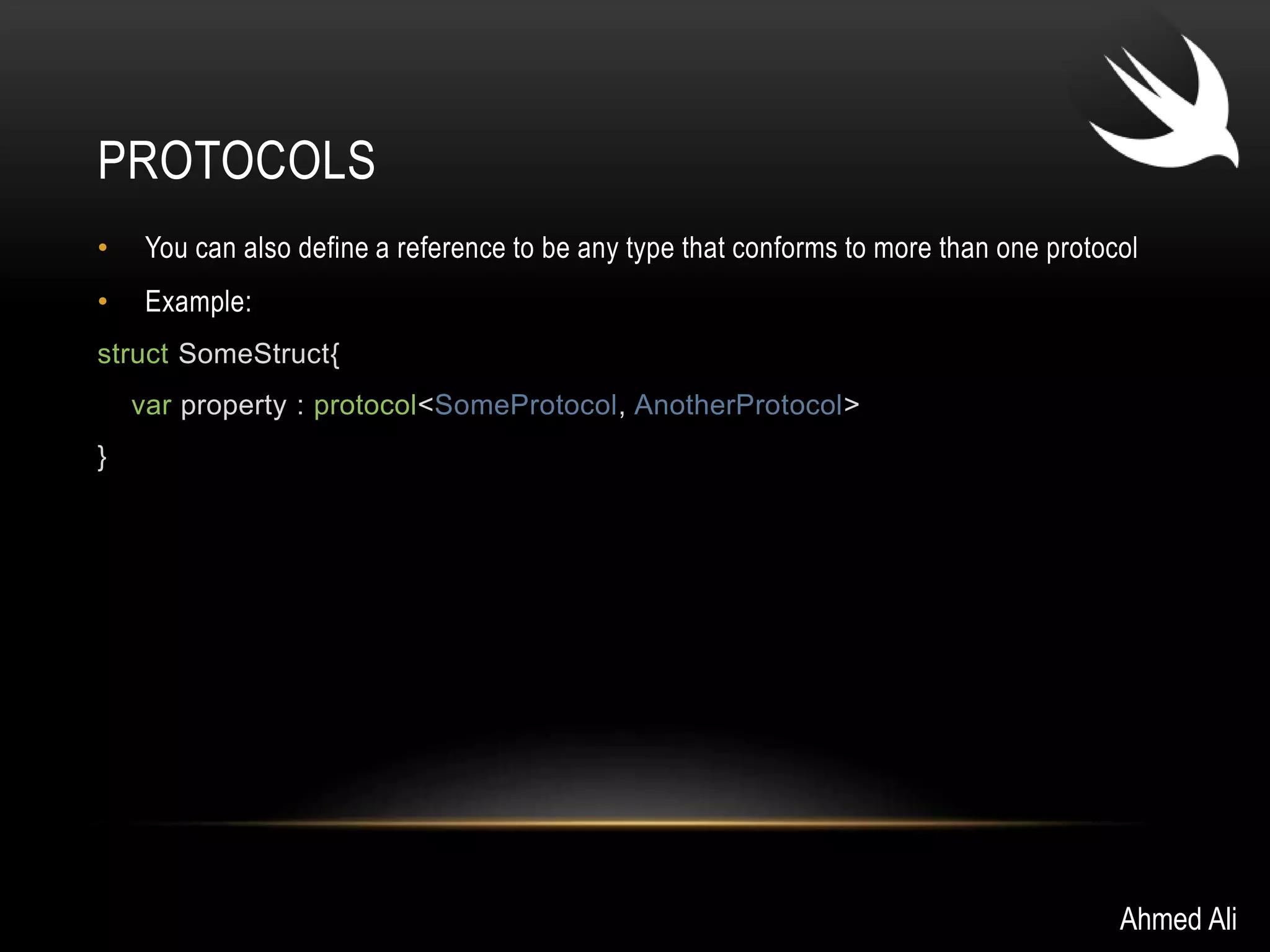
• You can also define a reference to be any type that conforms to more than one protocol 
• Example: 
struct SomeStruct{ 
var property : protocol<SomeProtocol, AnotherProtocol> 
} 
Ahmed Ali
Ahmed Ali 
Transitions and View Controller Lifecycle Demo

Swift as an OOP Language

  • 1.
    SWIFT AS ANOOP LANGUAGE iOS Development using Swift Ahmed Ali
  • 2.
    TODAY TOPICS •Classes and Structures • Properties • Methods • Access Control • Inheritance • Initialization • Deinitialization • Protocols • Transitions and View Controller Lifecycle Demo Ahmed Ali
  • 3.
    CLASSES AND STRUCTURES • Both can: • Define properties to store values • Define methods to provide functionality • Define subscripts • Define initializers • Can be extended (not subclassed, only a class can have a subclass) • Conform to protocols Ahmed Ali ref["key”] anotherRef[1]
  • 4.
    CLASSES AND STRUCTURES(CONT) • Only classes can: • Inherit from another class • Define deinit method • Type casted Ahmed Ali
  • 5.
    CLASSES AND STRUCTURES(CONT) • Class vs Structure • Definition Syntax: • Classes passed by reference, while structures are passed by value. Structures called value types for that reason. • Create instance: class SomeClass { } struct SomeStruct { } let someClass = SomeClass() let someStruct = SomeStruct() Ahmed Ali
  • 6.
    PROPERTIES • Propertiesassociate values with particular type’s instances. • Properties can be a variable or a constant • There are two main types of properties: • Stored Properties • Computed Properties Ahmed Ali
  • 7.
    • Stored propertiesjust store the values, while computed properties compute their values. • Example of stored properties: • No initial value for non optional? struct Point { var x : Float var y : Float } struct Size { var width : Float var height : Float } PROPERTIES (CONT) Ahmed Ali
  • 8.
    PROPERTIES (CONT) •Example of computed properties: struct Rect { var origin = Point(x: 0, y: 0), size = Size(width: 50, height: 50) var center : Point{ get{ return Point(x: origin.x + (size.width * 0.5), y: origin.y + (size.height * 0.5)) } set{ origin.x = newValue.x - (size.width * 0.5) origin.y = newValue.y - (size.height * 0.5) } } } Ahmed Ali
  • 9.
    PROPERTIES (CONT) •Both types of properties are accessible and modifiable in the same manner, using the dot syntax. • Computed properties calculated every time you access them. //If a structure reference is defined as a constant, we will not be able to change any of its properties var rect = Rect() let centerPoint = rect.center let origin = rect.origin //modifying their values rect.origin.x = 50 rect.center = Point(x: 100, y: 100) Ahmed Ali
  • 10.
    PROPERTIES (CONT) •Property observers: • didSet, willSet • Syntax: struct Point { var x : Float{ didSet{ println("The value of x has been changed from (oldValue) to (x)") } willSet{ println("The value of x has been changed from (x) to (newValue)") } } var y : Float } Ahmed Ali
  • 11.
    METHODS • Methodsare used to provide functionality associated with a specific type. • Methods can have: • One or more parameter. • A return value of any type. • Can have external parameter names, for better readability. • Definition Syntax: class SomeClass{ func methodName(param1 : String) -> Int? { //countElements is a global function that returns the string length return countElements(param1) } } Ahmed Ali
  • 12.
    METHODS (CONT) •External parameter name, promising better readability for your method users. • Method call without external parameter names: let view = View() Animator.moveView(view, Point(0, 0), Point(50, 50)) Ahmed Ali
  • 13.
    METHODS (CONT) •Method call with external parameter names: let view = View() Animator.moveView(view, fromPoint: Point(x:0, y:0), toPoint: Point(x: 50, y: 50)) Ahmed Ali
  • 14.
    METHODS (CONT) •Defining parameter external name: struct Math { static func powerOfNumber(baseNumber: Int, toPower power: UInt) -> Int { var total = 0 for i in 2 ... power { total += (baseNumber * baseNumber) } return total } } let value = Math.powerOfNumber(2, toPower: 3) Ahmed Ali
  • 15.
    METHODS (CONT) •You can override this external name behavior if it does not make sense: struct Math { static func powerOfNumber(baseNumber: Int, _ power: UInt) -> Int { var total = 0 for i in 2 ... power { total += (baseNumber * baseNumber) } return total } } let value = Math.powerOfNumber(2, 3) Ahmed Ali
  • 16.
    METHODS (CONT) •You can create static methods which can be access without the need to create an instance. • Example: struct Math { static func add(x : Int, _ y : Int) ->Int { return x + y } } println("5 + 6 = (Math.add(5, 6))") Ahmed Ali
  • 17.
    METHODS (CONT) •For value types, you can not change any property inside any method. • If a method will change any property value, it must be marked as a mutating method. • Mutating method can not be called on any constant reference. • Example: struct SomeStruct{ var property : String mutating func changeProperty(newValue : String) { property = newValue } } let s = SomeStruct(property: "value") //invalid because s is a constant s.changeProperty("new value") Ahmed Ali
  • 18.
    ACCESS CONTROL Modulesvs Source Files Ahmed Ali
  • 19.
    ACCESS CONTROL (CONT) • Access Levels • Public: Accessible everywhere. • Internal: Accessible for any source code file in defining module. • Private: Accessible only in the same source code file. • Internal is the default access level. Ahmed Ali
  • 20.
    ACCESS CONTROL (CONT) • Syntax: public class SomeClass { private var myVar = "My Var Value" internal var myInt = 5 public func calc() -> String { return "(myVar) => (myInt)" } } Ahmed Ali
  • 21.
    INHERITANCE • Nouniversal base class that all other classes inherit from. • Any class who has no super class, is known to be a base class. • You can override super class methods and computed properties using the override keyword. • You can not override stored properties of super class, but you can observe them. Ahmed Ali
  • 22.
    INHERITANCE (CONT) •Base class example: class BaseClass { var computedProperty : String{ get{ return ”BaseClass property” } set{ println(newValue) } } func printClassName() { println("BaseClass") } } Ahmed Ali
  • 23.
    INHERITANCE (CONT) •Inheritance example: class Subclass : BaseClass { } Ahmed Ali
  • 24.
    INHERITANCE (CONT) •Overriding computed property example: class Subclass : BaseClass { override var computedProperty : String { get{ return "Subclass property" } set{ println("Setting the property in the subclass") } } } Ahmed Ali
  • 25.
    INHERITANCE (CONT) •Overriding a method example: class Subclass : BaseClass { override func printClassName() { //you can also call the original method //which were defined in the super class super.printClassName() println("Subclass") } } Ahmed Ali
  • 26.
    INITIALIZATION • Initializationis the process of creating a new instance. • Mainly used to set non-optional properties’ values and any initial setup. • The initialization process can not be completed while any non-optional properties still have no value. • Implementation is done through special methods called initializers. Ahmed Ali
  • 27.
    INITIALIZATION - INITIALIZERS • An initializer is a normal method, with little different syntax. • Initializer method is always called “init” • You don’t write the “func” keyword before the initializer. • Initializers always return nothing. • Can take zero or more parameters. • Class can have zero or more initializers. • An initializer is required if any of your non-optional properties have no default value. Ahmed Ali
  • 28.
    INITIALIZATION – INITIALIZERS(CONT) • Initializer example: class SomeClass { //because we do not provide the property's initial value here //we must provide its value in the initializer var strProperty : String init() { //If you have any property observers, they will not be called during the initial value assignment strProperty = "Initial value" } } Ahmed Ali
  • 29.
    INITIALIZATION – INITIALIZERS(CONT) • You can create custom initializer that takes one or more parameter. • Unlike methods, all initializer’s parameters have external names by default. • Example: class SomeClass { var strProperty : String init(strProperty: String) { self.strProperty = strProperty } } Ahmed Ali
  • 30.
    INITIALIZATION – INITIALIZERS(CONT) • Default initializer (that takes no parameters) is automatically available if and only if: 1. All your non-optional properties have default values and you did not create any initializers at all. • Constant property value can be modified in any initializer. However, you can not modify super class’s constant property in a subclass initializer. Ahmed Ali
  • 31.
    INITIALIZATION – INITIALIZERS(CONT) • Create an instance the default initializer: let someClass = SomeClass() • Create an instance with custom initializer: let someClass = SomeClass(strProperty: "String value") Ahmed Ali
  • 32.
    INITIALIZATION – INITIALIZERS(CONT) • In structure types, if you have not defined any initializer, a member -wise initializer is automatically created for you. • Example: struct Point { var x : Float var y : Float } Now you can create instances of the Point type using its auto-created member-wise initializer as follows: let point = Point(x: 15, y: 20) Ahmed Ali
  • 33.
    INITIALIZATION – INITIALIZERS(CONT) Designated Convenience • Provides a more convenience initializer. • Must end up calling a designated initializer. • Syntax - add “conveniece” keyword before “init”. Example: convenience init() { } • All non-optional properties’ values are assigned before it is finished. • For classes, it must call the super class designated initializer if defined in a subclass. • Syntax - any initializer you defined before with “init” is a designated initializer. Ahmed Ali Types of initializers: designated and convenience.
  • 34.
    INITIALIZATION – INITIALIZERS(CONT) class BaseClass { var str : String var str2 : String init(str : String, str2: String) { self.str = str self.str2 = str2 } convenience init(str: String) { self.init(str: str, str2: "String 2") } } class Subclass : BaseClass { var substr : String init(substr : String) { self.substr = substr super.init(str:substr, str2: "none") } } Ahmed Ali Example:
  • 35.
    DEINITIALIZATION • Deinitlizationis the process of making any final clean-up before removing a class’s instance from the memory. • You just need to implement a special method called deinit which takes no parameters and returns nothing. • Example: deinit{ //Your clean up code goes here } Ahmed Ali
  • 36.
    PROTOCOLS • Aprotocol defines set of properties and methods, not their implementation. • Any class, structure or enumeration can conform to any number of protocols. • When a type is said to be conforming to a protocol, it means: this type provides the actual implementation for that protocol. • Definition syntax: protocol SomeProtocol { //read and write property var neededProperty : String {get set} //read-only property var anotherProperty : String {get} func requiredMethod() -> (String, String) } Ahmed Ali
  • 37.
    PROTOCOLS • Syntaxfor defining a type which conforms to a protocol: struct SomeStruct : SomeProtocol{ var neededProperty : String var anotherProperty : String func requiredMethod() -> (String, String) { return ("V1", "V2") } } Ahmed Ali
  • 38.
    PROTOCOLS • Ifthe type is a class, and it also subclass another class, the super class name comes first in the list. • Example: class Subclass : BaseClass, SomeProtocol, AnotherProtocol{ var neededProperty : String var anotherProperty : String func requiredMethod() -> (String, String) { return ("V1", "V2") } } Ahmed Ali
  • 39.
    PROTOCOLS • Protocolscan be used as a type. That is, you can define any reference with the type of a protocol instead of a concrete type. • Example: struct SomeStruct { var property : SomeProtocol func method(param1 : AnotherProtocol) { } } Ahmed Ali
  • 40.
    PROTOCOLS • Youcan also define a reference to be any type that conforms to more than one protocol • Example: struct SomeStruct{ var property : protocol<SomeProtocol, AnotherProtocol> } Ahmed Ali
  • 41.
    Ahmed Ali Transitionsand View Controller Lifecycle Demo