Software
Programming with
Python II
Harnessing the Power of Python for Software Development
By
Gevita Chinnaiah
Agenda
• Introduction to Python
• Python Data Structures
• Python Libraries and Frameworks
• Object-Oriented Programming (OOP) in Python
• Error Handling and Testing in Python
• Python for Web Development
• Python for Data Science and Machine Learning
• Best Practices in Python Development
• Conclusion
Introduction to Python
• Python is a high-level, interpreted programming language
known for its simplicity, readability, and versatility.
• Created by Guido van Rossum and first released in 1991,
Python has since become one of the most popular
programming languages worldwide
Why Python is Popular for
Software Development
• Simplicity
• Python's syntax is designed to be straightforward and easy to
understand
• Readability
• Python code is highly readable, thanks to its use of meaningful
whitespace and English-like syntax
• Versatility
• Python's versatility allows it to be used in various domains,
including web development, data science, machine learning,
artificial intelligence, scientific computing, automation, and
more
Examples of Python's
Versatility
• Web Development
• Django, flask
• Data Science and Machine Learning
• Numpy, pandas, ,matplotlib,
• Scripting and Automation
• Scientific Computing
Python Data Structures
• Python provides a rich set of built-in data structures
• 1. Lists
• 2. Tuples
• 3. Dictionaries
Lists
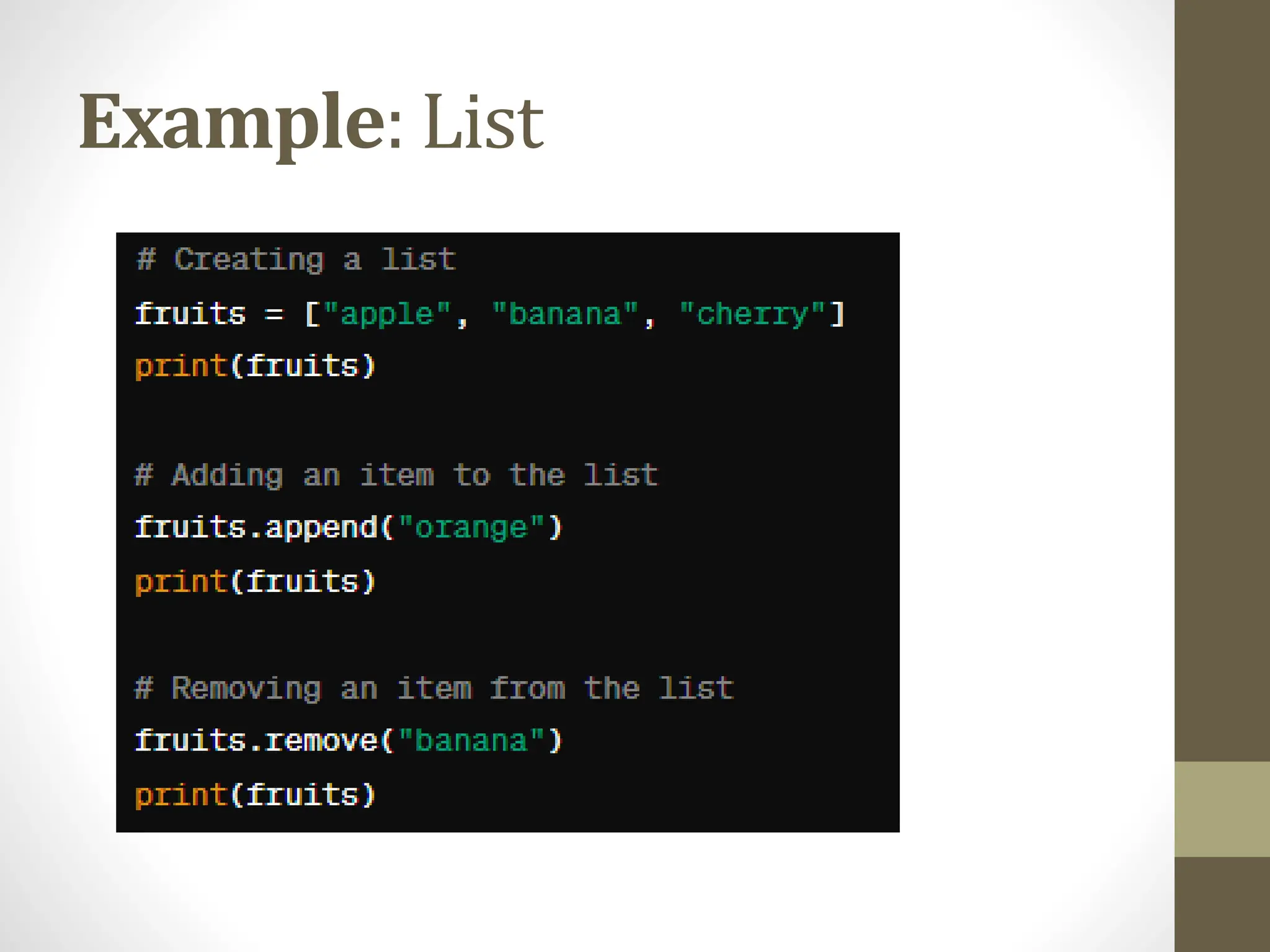
• A list in Python is an ordered collection of items which can be
of mixed types.
• Lists are mutable.
• Storing a series of items, iterating over data for processing, or
keeping elements for later processing
Example: List
Tuples
• A tuple in Python is similar to a list in that it is an ordered
collection of items
• Tuples are immutable
• Tuples can contain mixed data types
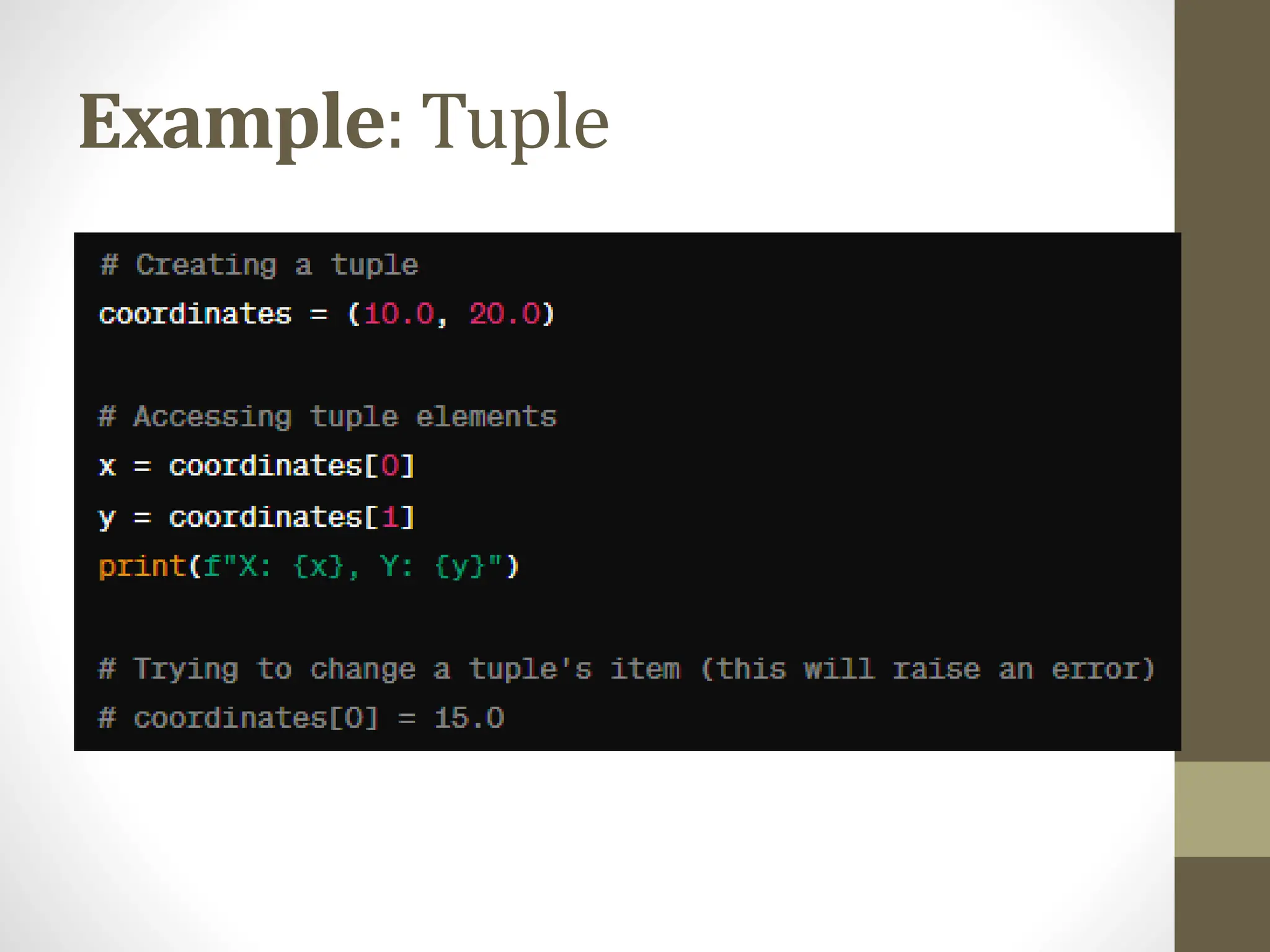
Example: Tuple
Dictionaries
• A dictionary in Python is an unordered collection of items
• Each item in a dictionary is stored as a key-value pair
• Dictionaries are mutable
• Dictionaries are incredibly useful for mappings
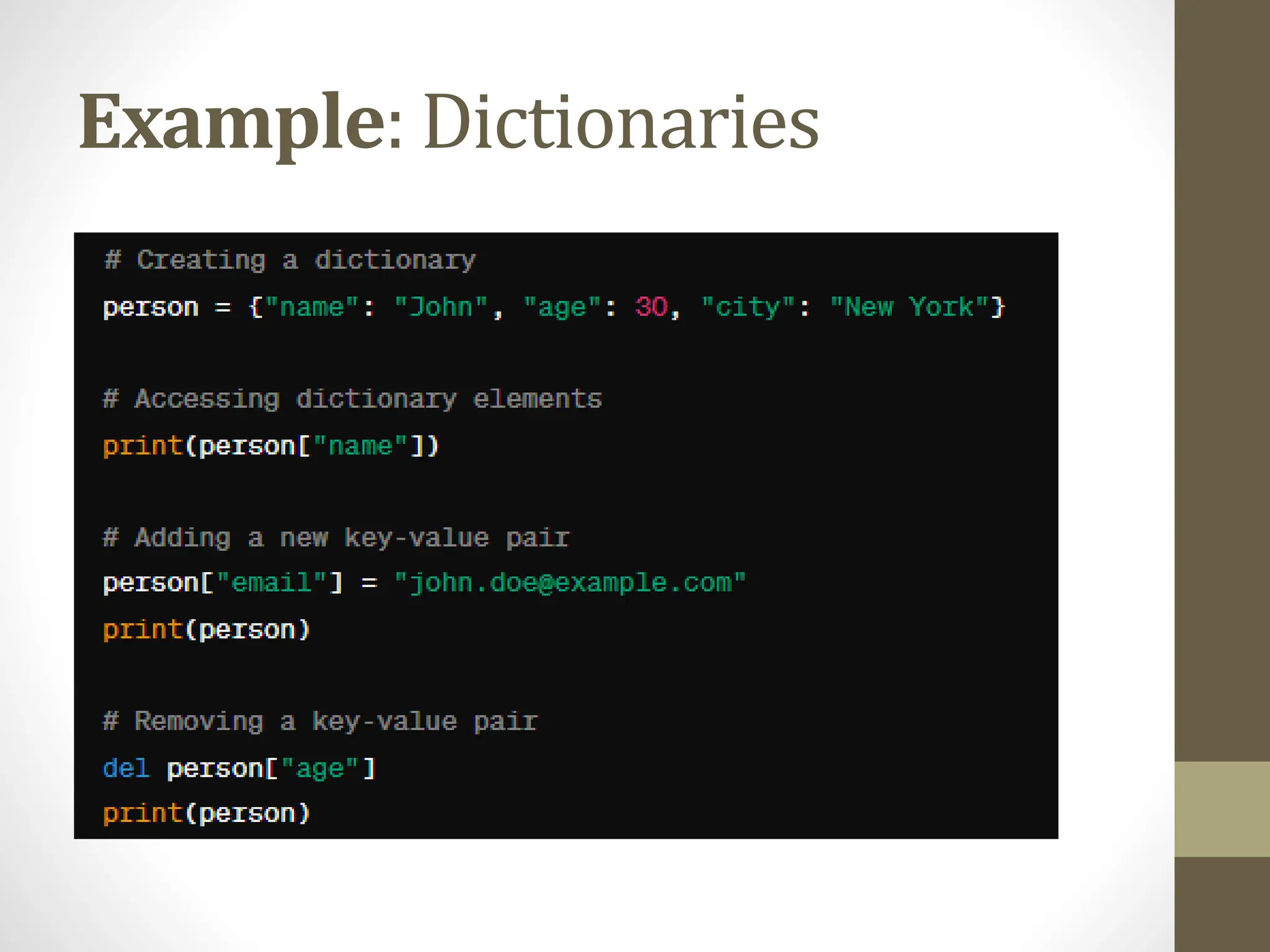
Example: Dictionaries
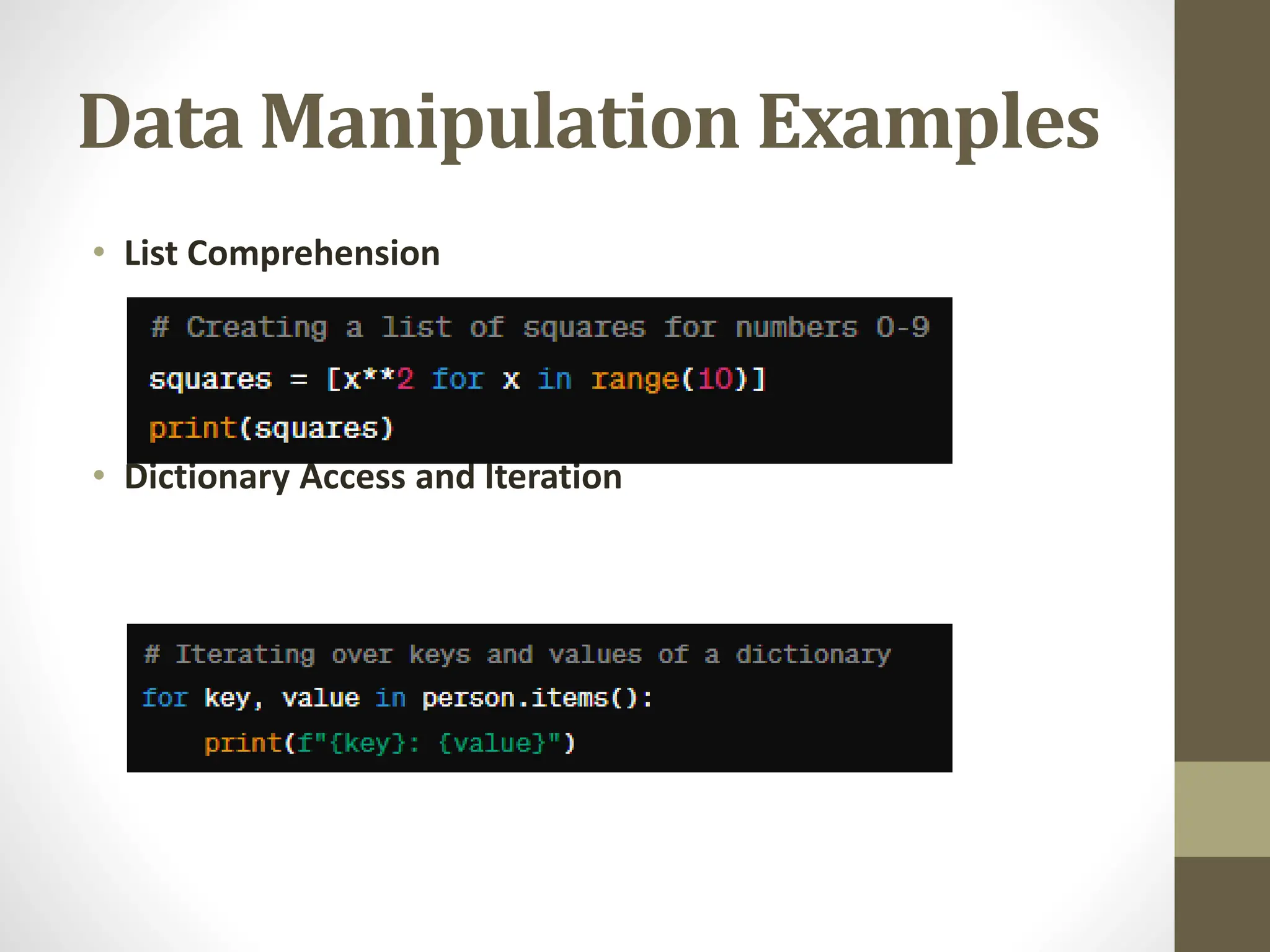
Data Manipulation Examples
• List Comprehension
• Dictionary Access and Iteration
Python Libraries and
Frameworks
• Python, with its vast ecosystem, hosts an array of libraries and
frameworks designed to streamline software development
across various domains such as web development, data
analysis, machine learning, and more
• Popular Python libraries and frameworks
• e.g., NumPy, Pandas, Django
NumPy
• NumPy is the cornerstone library for numerical computing in
Python.
• It provides support for large, multi-dimensional arrays and
matrices
• Collection of mathematical functions to operate on these
arrays
Pandas
• Pandas is a powerful, flexible data manipulation and analysis
library.
• It offers data structures like DataFrame and Series, making it
easy to clean, analyze, and visualize data
Django
• Django is a high-level Python web framework that encourages
rapid development and clean, pragmatic design.
• It follows the DRY (Don't Repeat Yourself) principle and comes
with many features to handle common web development
tasks.
Streamlining Software
Development Tasks
• Libraries and frameworks greatly reduce the time and effort
required for developing software by providing pre-written
code that developers can use to solve common programming
tasks.
• Helps in maintaining a high level of code quality and reliability
• Efficiency
• Security
• Scalability
Real-World Applications
• Finance
• Pandas and NumPy are used for quantitative analysis, algorithmic
trading, and risk management
• Science and Engineering
• Scientific research and engineering projects leverage NumPy for
its mathematical capabilities
• Web Development
• Django and Flask (another popular Python web framework)
power many web applications
Object-Oriented Programming
(OOP) in Python
• Object-Oriented Programming (OOP) is a programming
paradigm that organizes software design around objects and
data, rather than actions and logic.
• OOP concepts
• (classes, objects, inheritance, polymorphism)
Classes and Objects
• A class is a blueprint for creating objects. It defines attributes
(data) and methods (functions) that operate on those
attributes.
• An object is an instance of a class. It represents a specific
instance of the class, with its own unique data.
Inheritance
• Inheritance allows a class (child class) to inherit attributes and
methods from another class (parent class).
• It promotes code reusability and establishes an "is-a"
relationship between classes.
Polymorphism
• Polymorphism allows objects of different classes to be treated
as objects of a common superclass.
• It enables flexibility and code extensibility by using a unified
interface.
How Python Supports OOP
Principles
• Built-in features such as classes, inheritance, polymorphism,
encapsulation (data hiding), and abstraction
• It has a clear and readable syntax
• Python's dynamic typing and flexibility allow for dynamic
object creation and modification during runtime.
Benefits of Using OOP in
Software Development
• Modularity
• Code Reusability
• Encapsulation
• Flexibility and Scalability
• Abstraction
Error Handling Techniques in
Python
• Try-Except Blocks
• Raising Exceptions
• Handling Specific Exceptions
Importance of Testing in Software
Development
• Quality Assurance
• Reliability and Robustness
• Regression Testing
• Customer Satisfaction
Python Testing Frameworks
• unittest:
• This is Python's built-in testing framework, inspired by Java's
JUnit.
• pytest:
• pytest is a popular third-party testing framework that simplifies
writing and executing tests.
• nose2:
• nose2 is a successor to the nose testing framework. It provides an
extended feature set and improved test discovery mechanisms.
Best Practices in Python
Development
• Coding conventions and style guides
• (e.g., PEP 8)
• Writing clean, maintainable code
• Importance of documentation and code comments
Coding Conventions and Style
Guides
• Follow PEP 8
• Use descriptive names
• Maintain consistent indentation
• Limit line length
• Use blank lines sparingly
Writing Clean, Maintainable
Code
• Keep functions small and focused
• Avoid unnecessary complexity
• Use meaningful comments
• Write modular and reusable code
Importance of Documentation
and Code Comments
• Write docstrings
• Comment where necessary
• Update documentation and comments
Conclusion
• In conclusion, we have covered several key points in today's
presentation about Python in software development. We
discussed Python's versatility as a programming language, its
readability and simplicity which make it ideal for both
beginners and experienced developers, as well as its extensive
library support and community-driven ecosystem.
• I want to encourage you all to further explore Python in your
software development journey. Whether you are interested in
web development, data science, machine learning, or
automation, Python has a wide range of applications that can
benefit your projects and career growth.
THANK YOU

Software Programming with Python II.pptx

  • 1.
    Software Programming with Python II Harnessingthe Power of Python for Software Development By Gevita Chinnaiah
  • 2.
    Agenda • Introduction toPython • Python Data Structures • Python Libraries and Frameworks • Object-Oriented Programming (OOP) in Python • Error Handling and Testing in Python • Python for Web Development • Python for Data Science and Machine Learning • Best Practices in Python Development • Conclusion
  • 3.
    Introduction to Python •Python is a high-level, interpreted programming language known for its simplicity, readability, and versatility. • Created by Guido van Rossum and first released in 1991, Python has since become one of the most popular programming languages worldwide
  • 4.
    Why Python isPopular for Software Development • Simplicity • Python's syntax is designed to be straightforward and easy to understand • Readability • Python code is highly readable, thanks to its use of meaningful whitespace and English-like syntax • Versatility • Python's versatility allows it to be used in various domains, including web development, data science, machine learning, artificial intelligence, scientific computing, automation, and more
  • 5.
    Examples of Python's Versatility •Web Development • Django, flask • Data Science and Machine Learning • Numpy, pandas, ,matplotlib, • Scripting and Automation • Scientific Computing
  • 6.
    Python Data Structures •Python provides a rich set of built-in data structures • 1. Lists • 2. Tuples • 3. Dictionaries
  • 7.
    Lists • A listin Python is an ordered collection of items which can be of mixed types. • Lists are mutable. • Storing a series of items, iterating over data for processing, or keeping elements for later processing
  • 8.
  • 9.
    Tuples • A tuplein Python is similar to a list in that it is an ordered collection of items • Tuples are immutable • Tuples can contain mixed data types
  • 10.
  • 11.
    Dictionaries • A dictionaryin Python is an unordered collection of items • Each item in a dictionary is stored as a key-value pair • Dictionaries are mutable • Dictionaries are incredibly useful for mappings
  • 12.
  • 13.
    Data Manipulation Examples •List Comprehension • Dictionary Access and Iteration
  • 14.
    Python Libraries and Frameworks •Python, with its vast ecosystem, hosts an array of libraries and frameworks designed to streamline software development across various domains such as web development, data analysis, machine learning, and more • Popular Python libraries and frameworks • e.g., NumPy, Pandas, Django
  • 15.
    NumPy • NumPy isthe cornerstone library for numerical computing in Python. • It provides support for large, multi-dimensional arrays and matrices • Collection of mathematical functions to operate on these arrays
  • 16.
    Pandas • Pandas isa powerful, flexible data manipulation and analysis library. • It offers data structures like DataFrame and Series, making it easy to clean, analyze, and visualize data
  • 17.
    Django • Django isa high-level Python web framework that encourages rapid development and clean, pragmatic design. • It follows the DRY (Don't Repeat Yourself) principle and comes with many features to handle common web development tasks.
  • 18.
    Streamlining Software Development Tasks •Libraries and frameworks greatly reduce the time and effort required for developing software by providing pre-written code that developers can use to solve common programming tasks. • Helps in maintaining a high level of code quality and reliability • Efficiency • Security • Scalability
  • 19.
    Real-World Applications • Finance •Pandas and NumPy are used for quantitative analysis, algorithmic trading, and risk management • Science and Engineering • Scientific research and engineering projects leverage NumPy for its mathematical capabilities • Web Development • Django and Flask (another popular Python web framework) power many web applications
  • 20.
    Object-Oriented Programming (OOP) inPython • Object-Oriented Programming (OOP) is a programming paradigm that organizes software design around objects and data, rather than actions and logic. • OOP concepts • (classes, objects, inheritance, polymorphism)
  • 21.
    Classes and Objects •A class is a blueprint for creating objects. It defines attributes (data) and methods (functions) that operate on those attributes. • An object is an instance of a class. It represents a specific instance of the class, with its own unique data.
  • 22.
    Inheritance • Inheritance allowsa class (child class) to inherit attributes and methods from another class (parent class). • It promotes code reusability and establishes an "is-a" relationship between classes.
  • 23.
    Polymorphism • Polymorphism allowsobjects of different classes to be treated as objects of a common superclass. • It enables flexibility and code extensibility by using a unified interface.
  • 24.
    How Python SupportsOOP Principles • Built-in features such as classes, inheritance, polymorphism, encapsulation (data hiding), and abstraction • It has a clear and readable syntax • Python's dynamic typing and flexibility allow for dynamic object creation and modification during runtime.
  • 25.
    Benefits of UsingOOP in Software Development • Modularity • Code Reusability • Encapsulation • Flexibility and Scalability • Abstraction
  • 26.
    Error Handling Techniquesin Python • Try-Except Blocks • Raising Exceptions • Handling Specific Exceptions
  • 27.
    Importance of Testingin Software Development • Quality Assurance • Reliability and Robustness • Regression Testing • Customer Satisfaction
  • 28.
    Python Testing Frameworks •unittest: • This is Python's built-in testing framework, inspired by Java's JUnit. • pytest: • pytest is a popular third-party testing framework that simplifies writing and executing tests. • nose2: • nose2 is a successor to the nose testing framework. It provides an extended feature set and improved test discovery mechanisms.
  • 29.
    Best Practices inPython Development • Coding conventions and style guides • (e.g., PEP 8) • Writing clean, maintainable code • Importance of documentation and code comments
  • 30.
    Coding Conventions andStyle Guides • Follow PEP 8 • Use descriptive names • Maintain consistent indentation • Limit line length • Use blank lines sparingly
  • 31.
    Writing Clean, Maintainable Code •Keep functions small and focused • Avoid unnecessary complexity • Use meaningful comments • Write modular and reusable code
  • 32.
    Importance of Documentation andCode Comments • Write docstrings • Comment where necessary • Update documentation and comments
  • 33.
    Conclusion • In conclusion,we have covered several key points in today's presentation about Python in software development. We discussed Python's versatility as a programming language, its readability and simplicity which make it ideal for both beginners and experienced developers, as well as its extensive library support and community-driven ecosystem. • I want to encourage you all to further explore Python in your software development journey. Whether you are interested in web development, data science, machine learning, or automation, Python has a wide range of applications that can benefit your projects and career growth.
  • 34.