SOFT SKILLS SERIES
Employability Skills that will set you up for Career Success
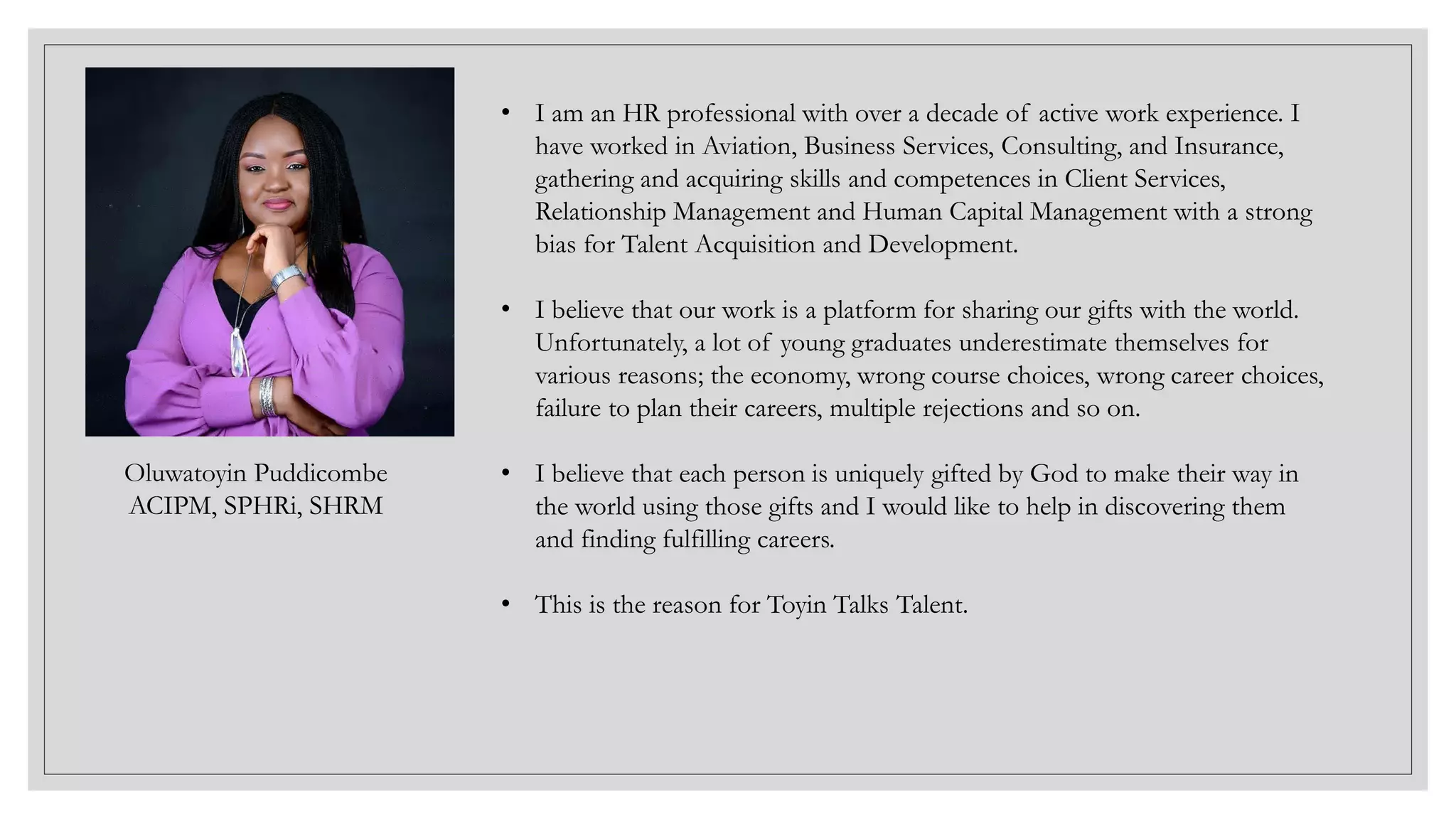
Oluwatoyin Puddicombe
Toyin Talks Talent
• I am an HR professional with over a decade of active work experience. I
have worked in Aviation, Business Services, Consulting, and Insurance,
gathering and acquiring skills and competences in Client Services,
Relationship Management and Human Capital Management with a strong
bias for Talent Acquisition and Development.
• I believe that our work is a platform for sharing our gifts with the world.
Unfortunately, a lot of young graduates underestimate themselves for
various reasons; the economy, wrong course choices, wrong career choices,
failure to plan their careers, multiple rejections and so on.
• I believe that each person is uniquely gifted by God to make their way in
the world using those gifts and I would like to help in discovering them
and finding fulfilling careers.
• This is the reason for Toyin Talks Talent.
Oluwatoyin Puddicombe
ACIPM, SPHRi, SHRM
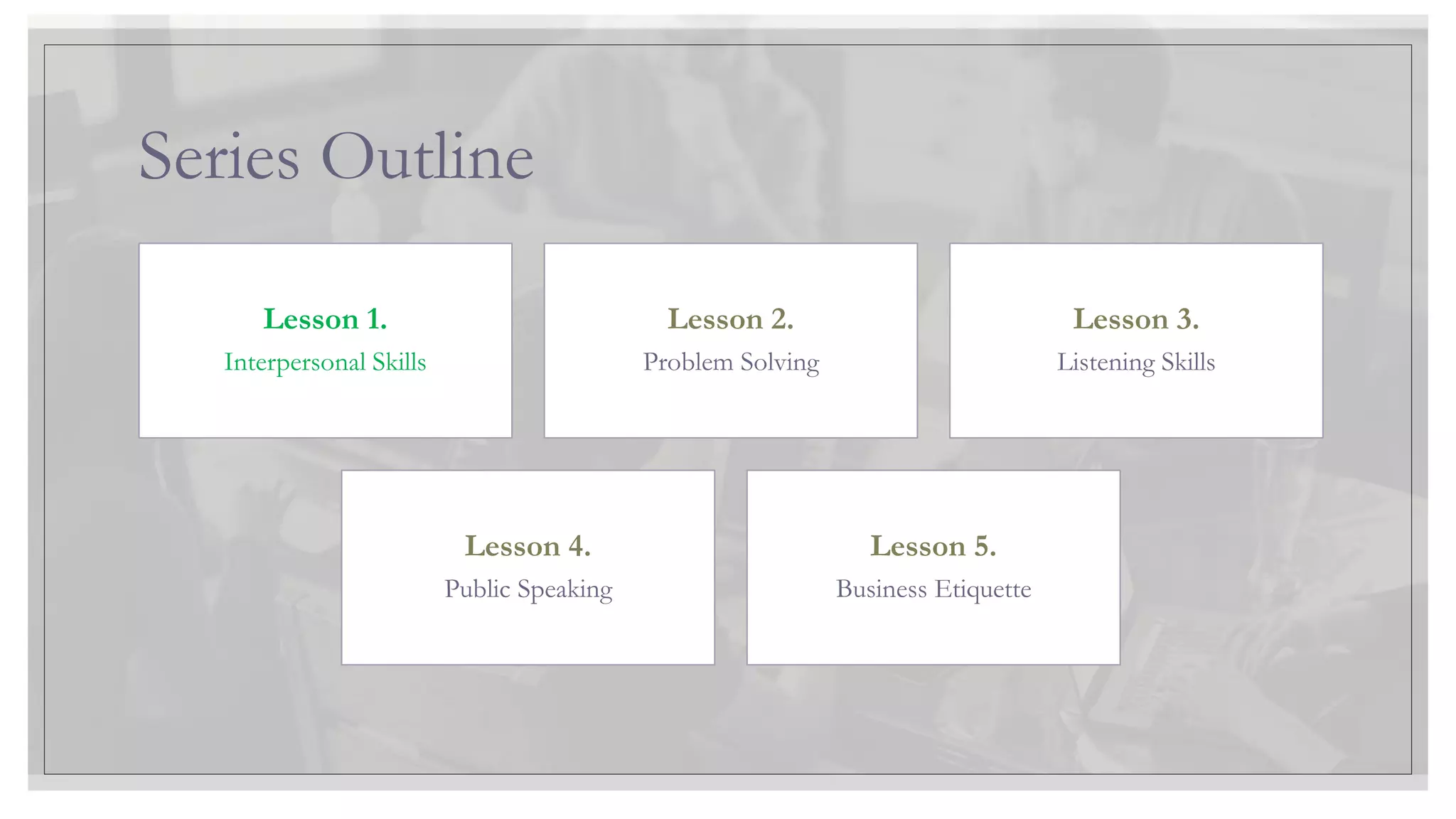
Series Outline
Lesson 1.
Interpersonal Skills
Lesson 2.
Problem Solving
Lesson 3.
Listening Skills
Lesson 4.
Public Speaking
Lesson 5.
Business Etiquette
DEFINING SOFT SKILLS
Soft skills are a combination of skills that enable people to navigate their environment,
work well with others, perform well, and achieve their goals with complementing hard
skills.
The Collins English Dictionary defines the term "soft skills" as "desirable qualities for
certain forms of employment that do not depend on acquired knowledge: they include
common sense, the ability to deal with people, and a positive flexible attitude."
In Deloitte’s 2016 Global Human Capital Trends
Report, 92% of respondents rated soft skills as a
critical priority.
A recent study in the UK
determined that “Soft Skills” are
worth £88bn ($186bn CDN) to
the UK economy. A business
group, including, believe it or not,
McDonalds is doing a three-
month study on how government
can introduce policies that will
help employees and employers
develop soft skills.
Whitehead 2020
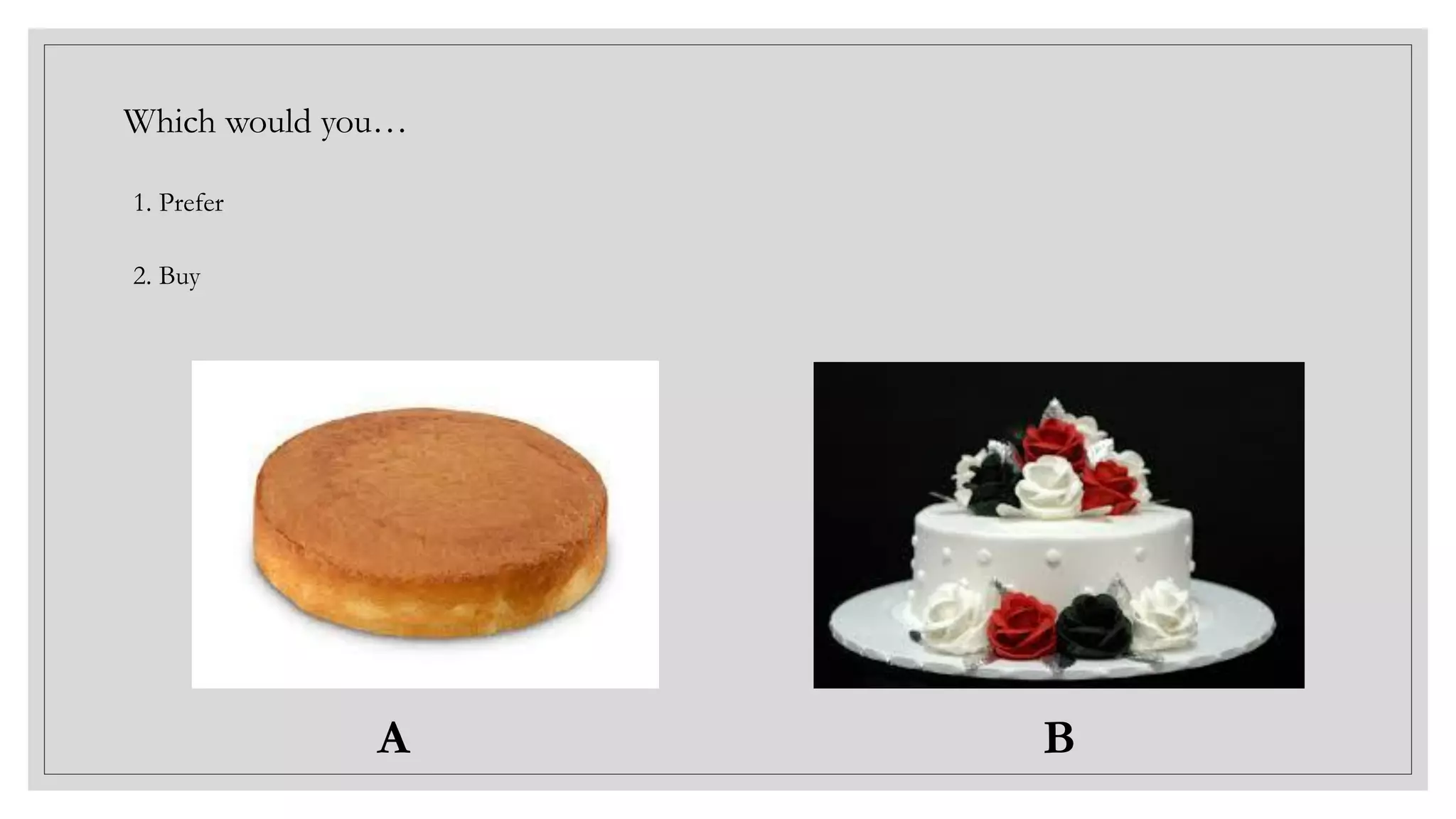
A B
Which would you…
1. Prefer
2. Buy
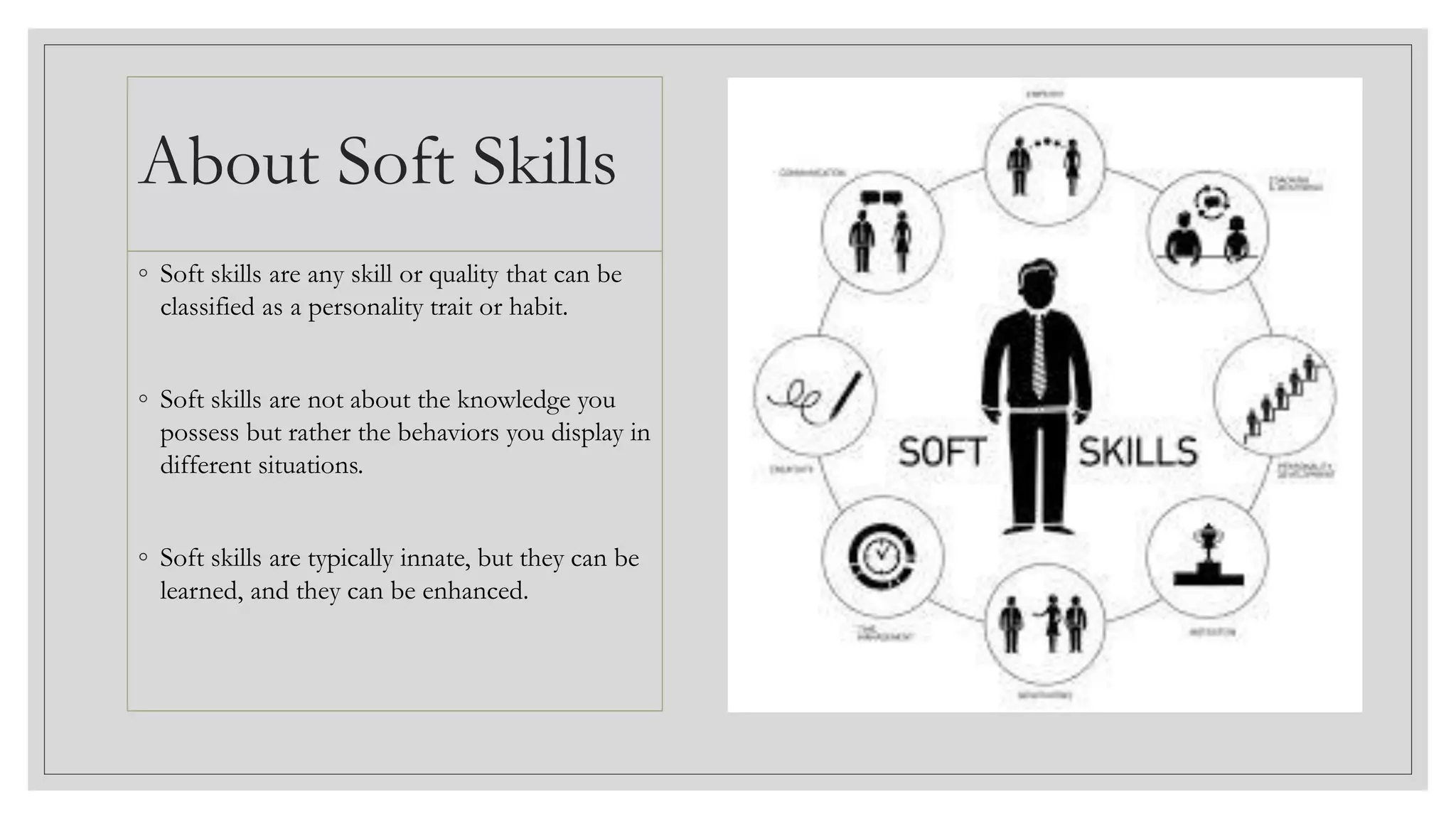
About Soft Skills
◦ Soft skills are any skill or quality that can be
classified as a personality trait or habit.
◦ Soft skills are not about the knowledge you
possess but rather the behaviors you display in
different situations.
◦ Soft skills are typically innate, but they can be
learned, and they can be enhanced.
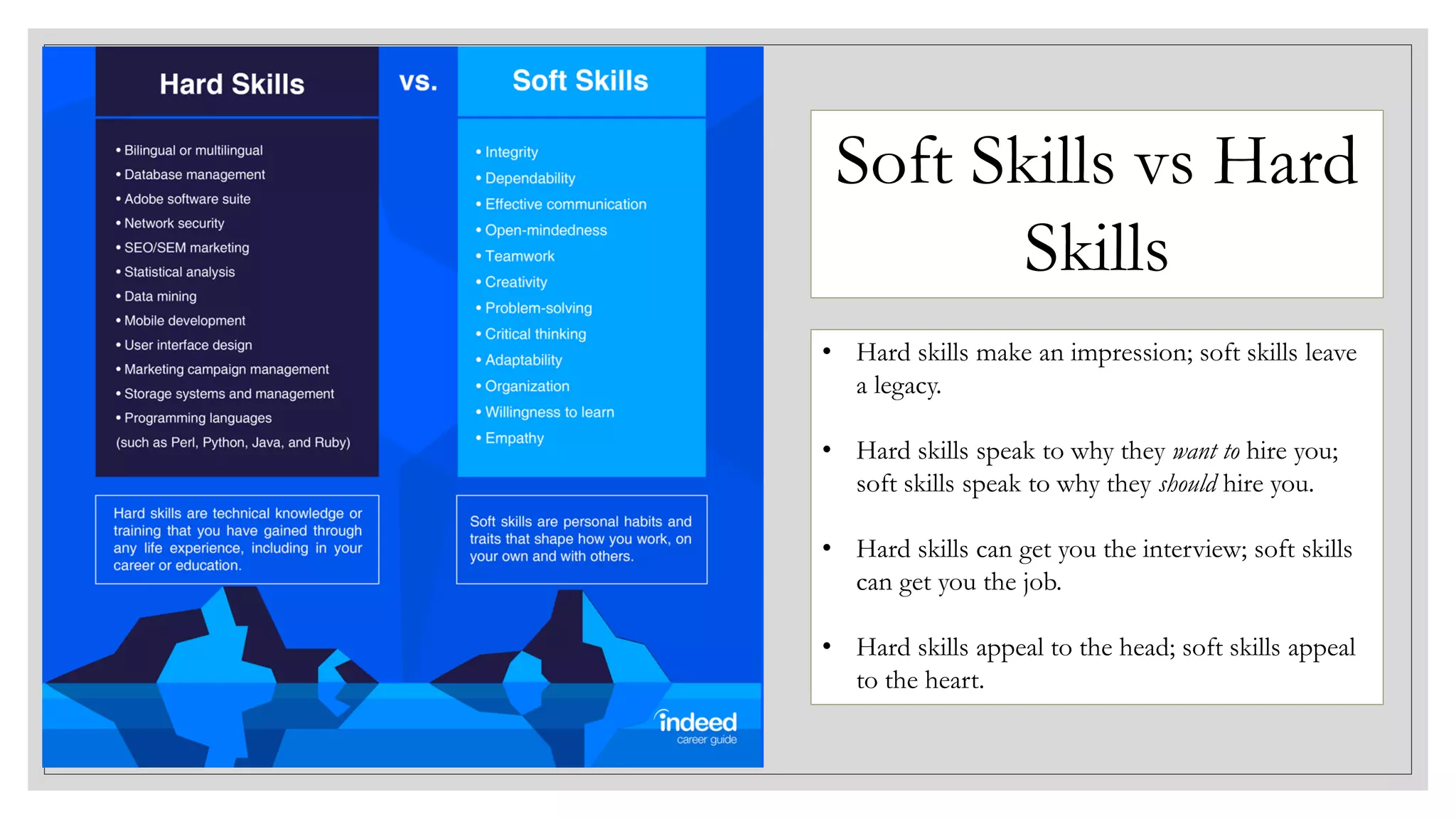
Soft Skills vs Hard
Skills
• Hard skills make an impression; soft skills leave
a legacy.
• Hard skills speak to why they want to hire you;
soft skills speak to why they should hire you.
• Hard skills can get you the interview; soft skills
can get you the job.
• Hard skills appeal to the head; soft skills appeal
to the heart.
Why are Soft
Skills
Important?
• Human interactions cannot
always be defined empirically.
• That two people were
exposed to the same scenarios
with the same factors does
not mean they will react in the
same way.
• Soft skills are the answers to
those indefinable
“somethings” that are deal
breakers in certain business
situations.
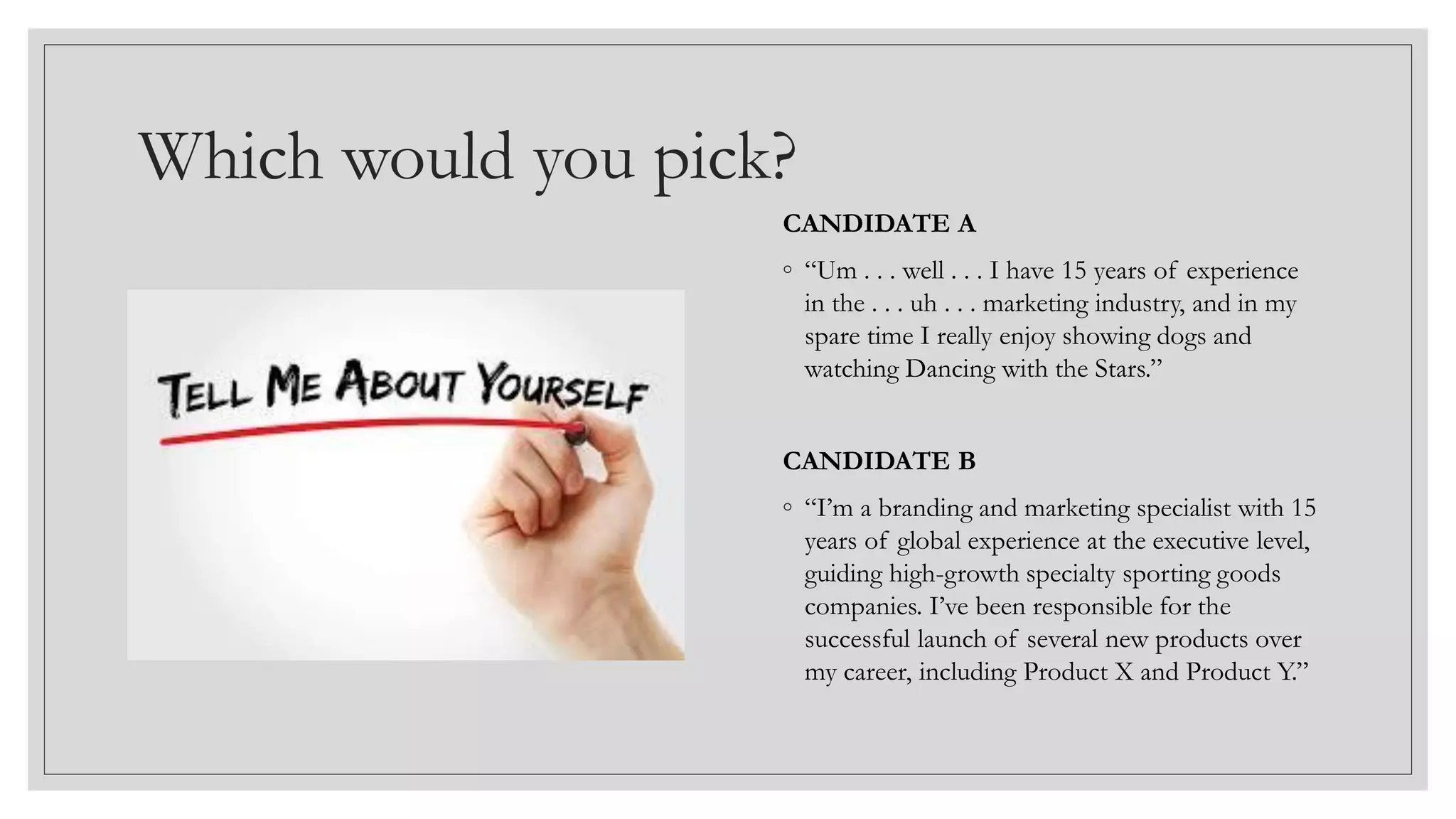
Which would you pick?
CANDIDATE A
◦ “Um . . . well . . . I have 15 years of experience
in the . . . uh . . . marketing industry, and in my
spare time I really enjoy showing dogs and
watching Dancing with the Stars.”
CANDIDATE B
◦ “I’m a branding and marketing specialist with 15
years of global experience at the executive level,
guiding high-growth specialty sporting goods
companies. I’ve been responsible for the
successful launch of several new products over
my career, including Product X and Product Y.”
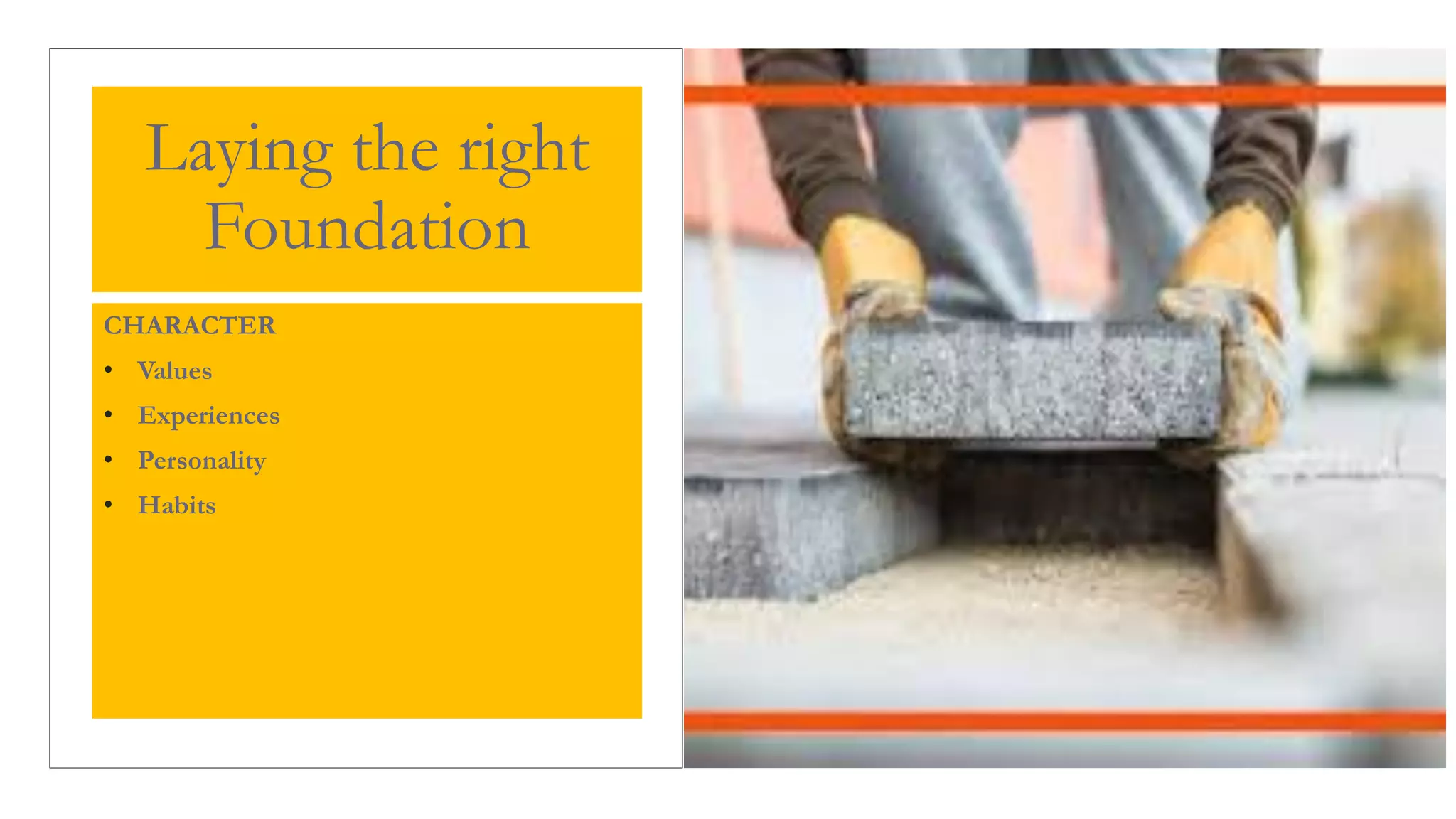
Laying the right
Foundation
CHARACTER
• Values
• Experiences
• Personality
• Habits
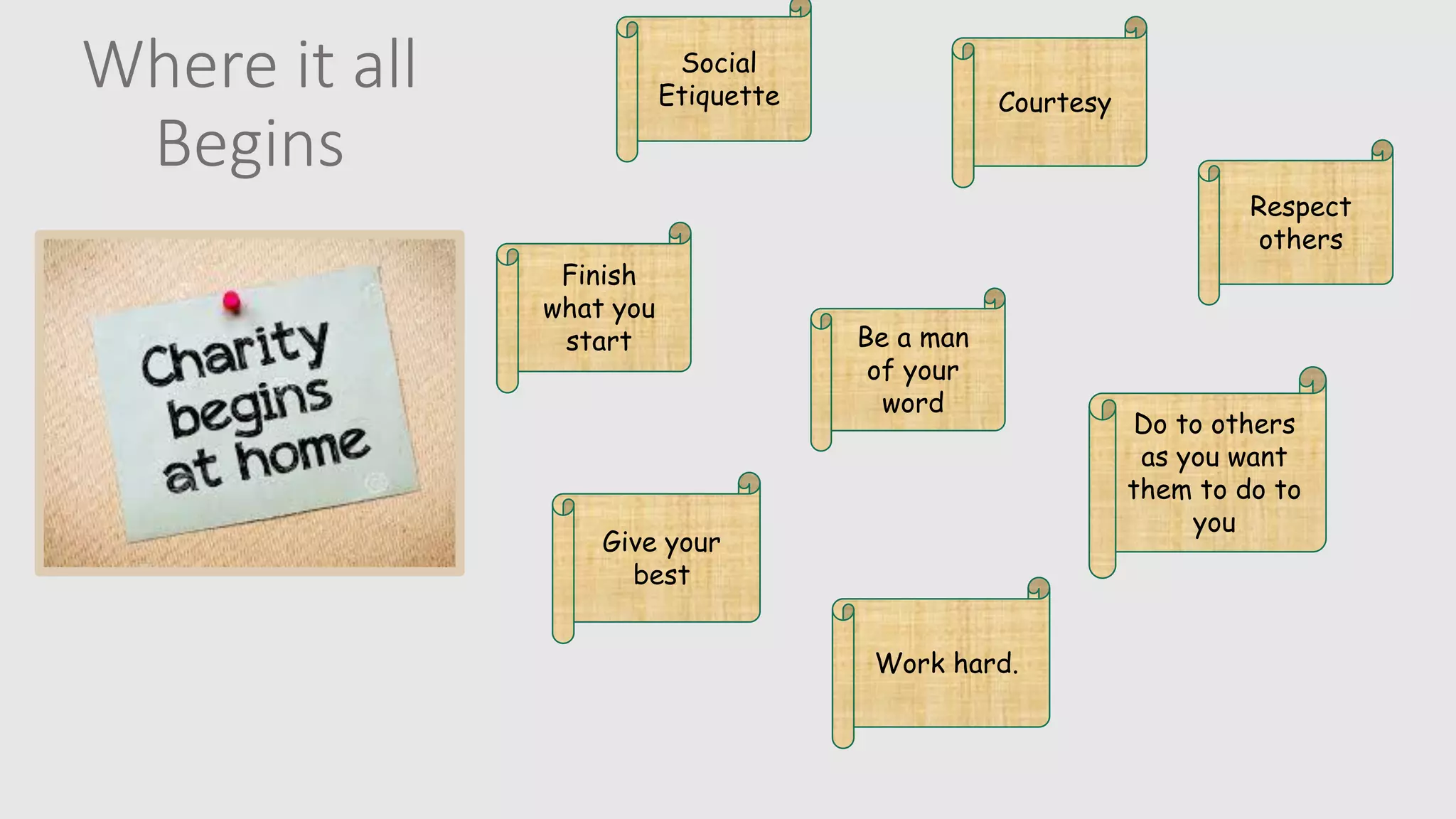
Courtesy
Finish
what you
start
Give your
best
Social
Etiquette
Respect
others
Be a man
of your
word
Do to others
as you want
them to do to
you
Work hard.
Where it all
Begins
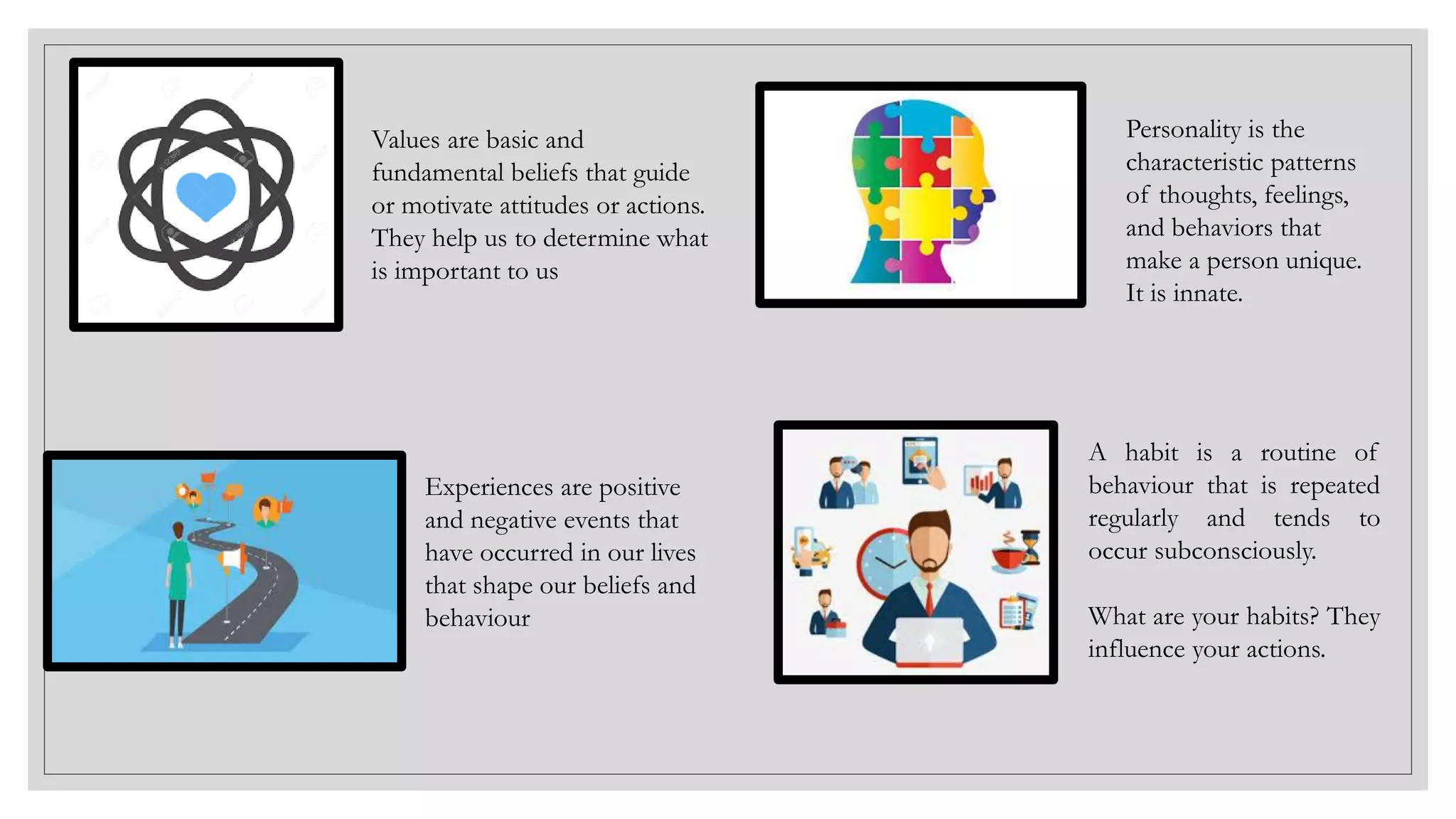
A habit is a routine of
behaviour that is repeated
regularly and tends to
occur subconsciously.
What are your habits? They
influence your actions.
Experiences are positive
and negative events that
have occurred in our lives
that shape our beliefs and
behaviour
Personality is the
characteristic patterns
of thoughts, feelings,
and behaviors that
make a person unique.
It is innate.
Values are basic and
fundamental beliefs that guide
or motivate attitudes or actions.
They help us to determine what
is important to us
SELF MASTERY AND THE
“EXCELLENCE” HABIT
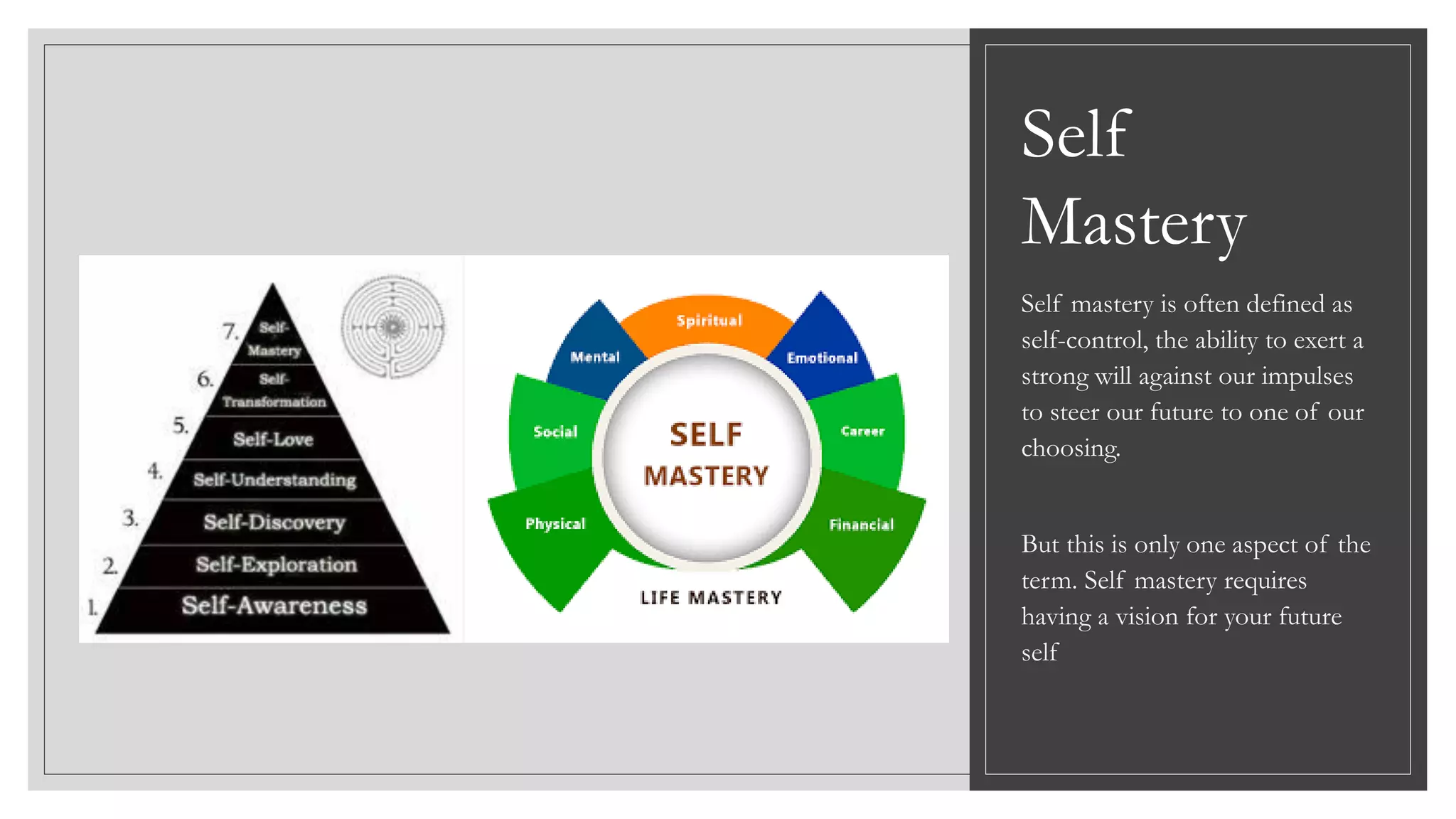
Self
Mastery
Self mastery is often defined as
self-control, the ability to exert a
strong will against our impulses
to steer our future to one of our
choosing.
But this is only one aspect of the
term. Self mastery requires
having a vision for your future
self
What does “Excellence” mean to
you?
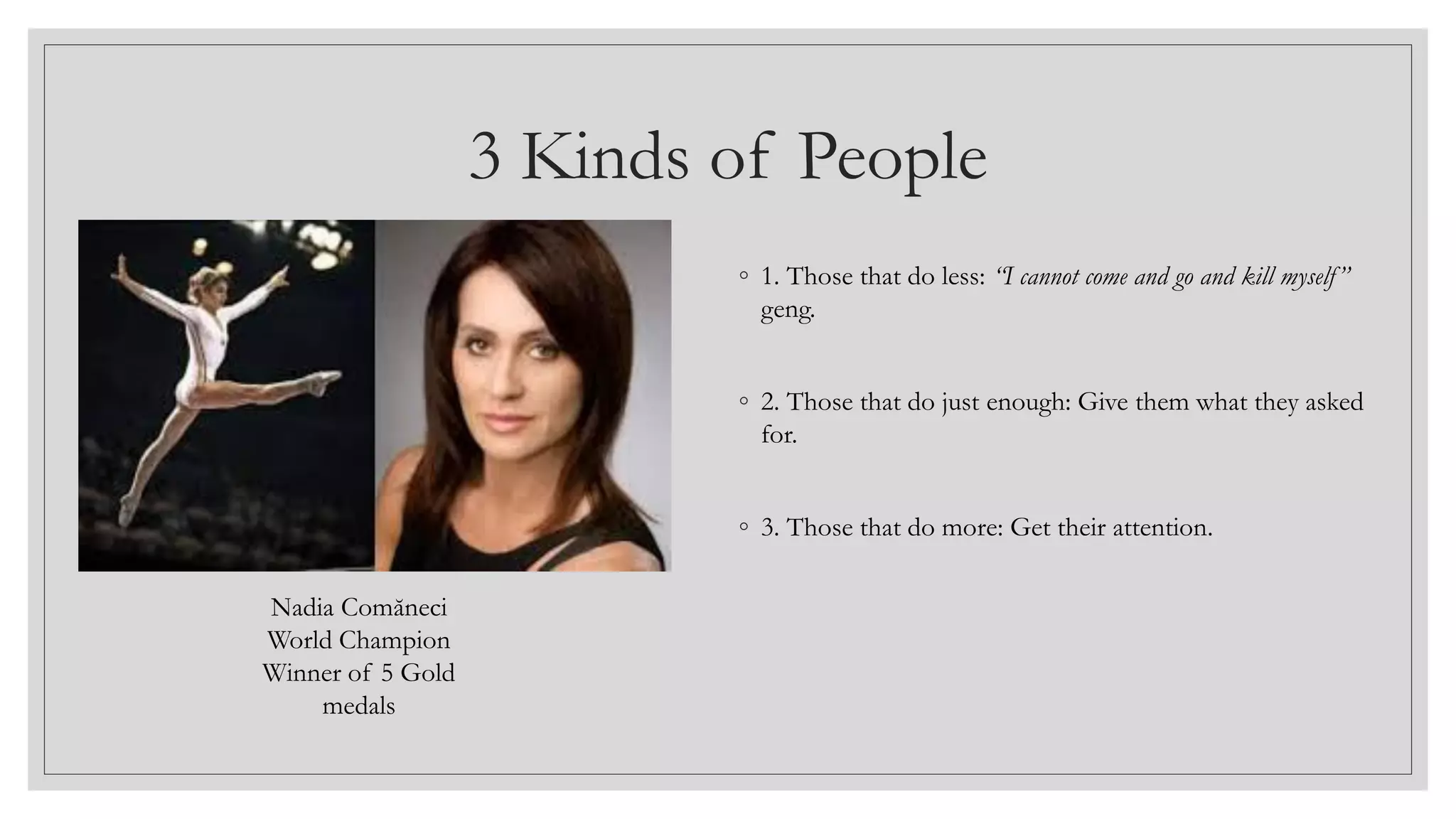
3 Kinds of People
◦ 1. Those that do less: “I cannot come and go and kill myself”
geng.
◦ 2. Those that do just enough: Give them what they asked
for.
◦ 3. Those that do more: Get their attention.
Nadia Comăneci
World Champion
Winner of 5 Gold
medals
Defining Excellence
◦ “The quality of being outstanding or extremely good.”
◦ Sometimes, it’s not about being the best…
◦ It’s about being the MOST MEMORABLE
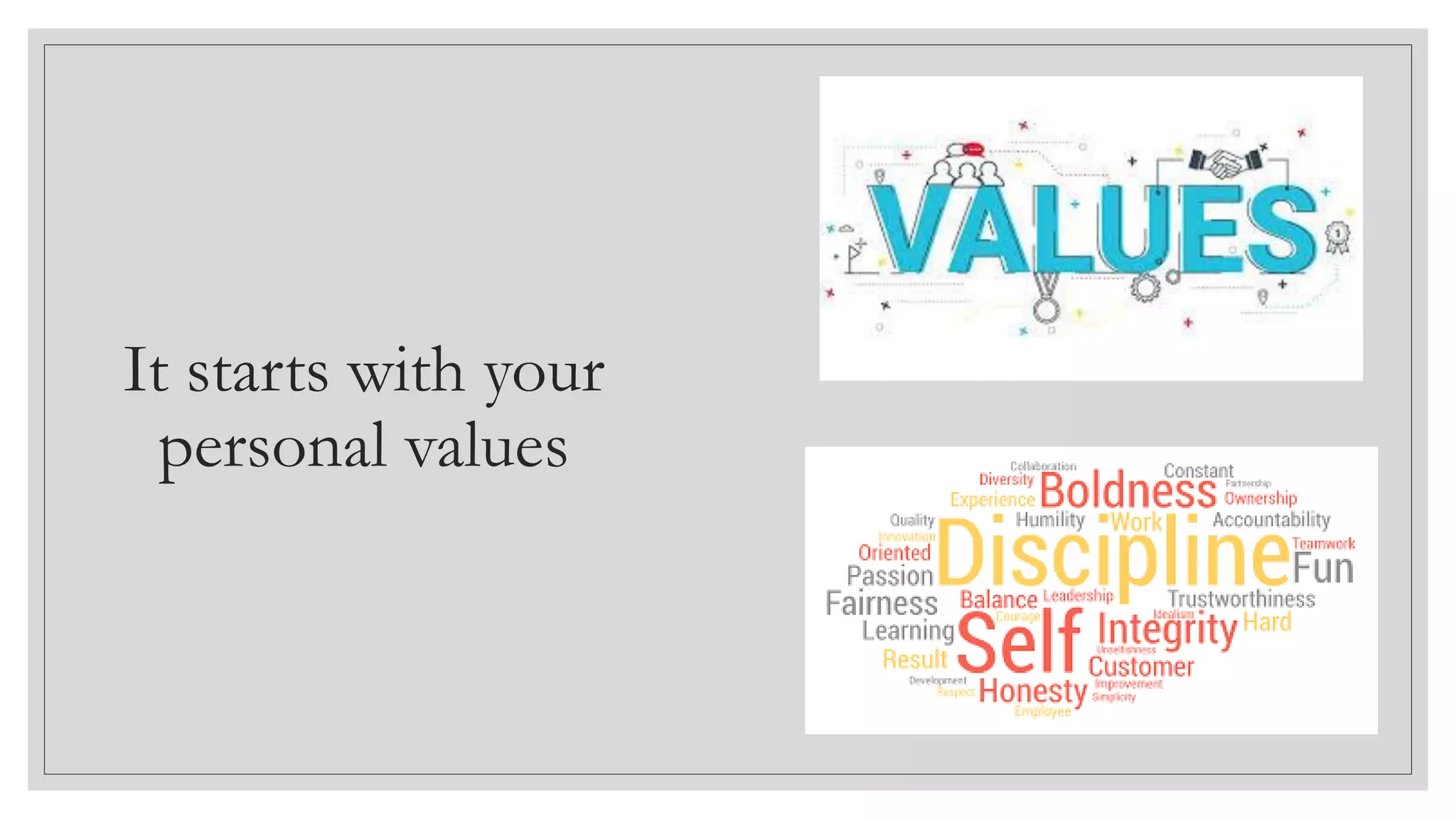
It starts with your
personal values
What are your values?
What standards do you set for
yourself?
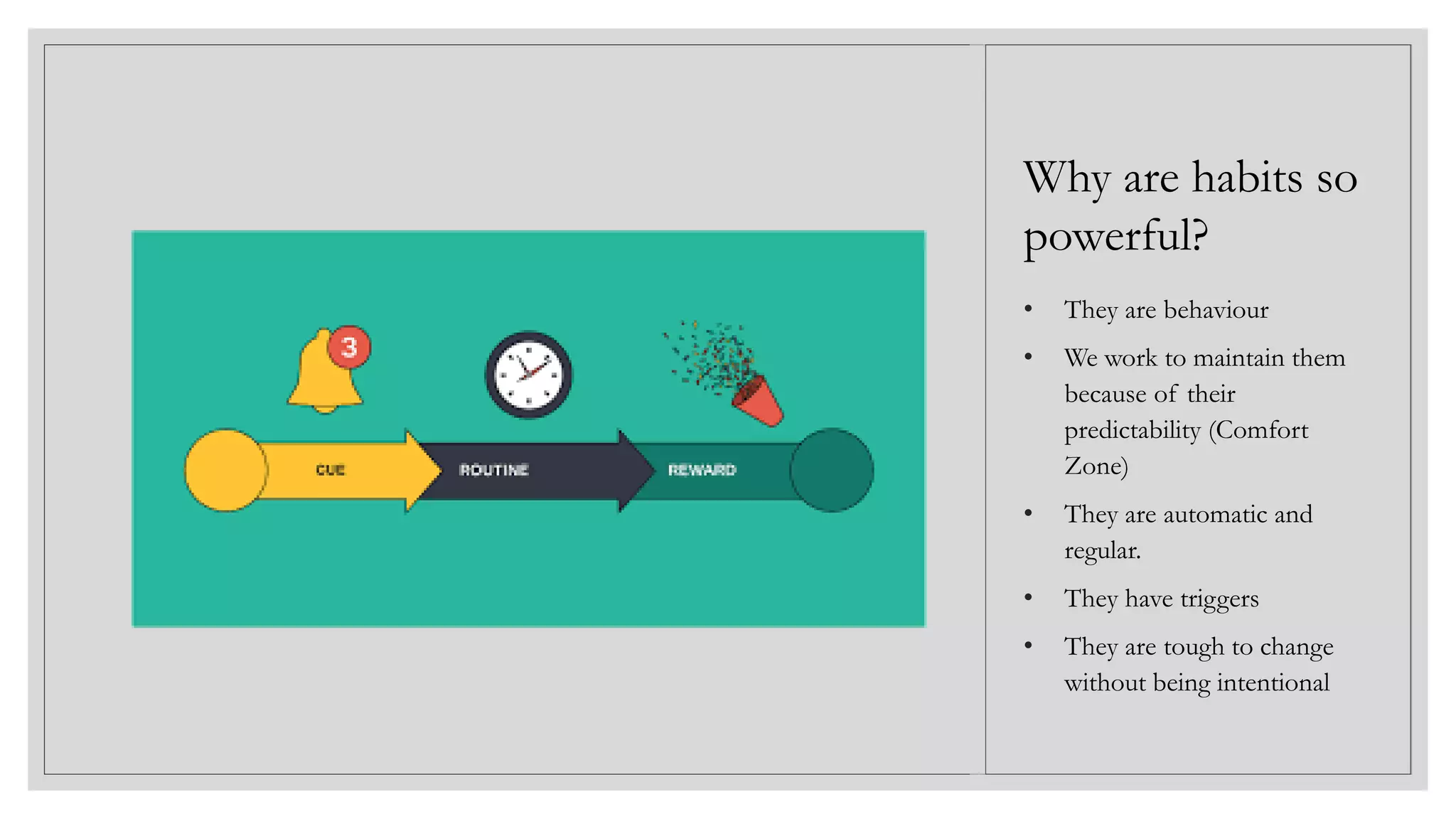
• They are behaviour
• We work to maintain them
because of their
predictability (Comfort
Zone)
• They are automatic and
regular.
• They have triggers
• They are tough to change
without being intentional
Why are habits so
powerful?
◦ Interview
• Coming late
• Not communicating with the recruiter
• Checking your phone during the
interview
• Not preparing for the interview
Sending Applications
• Send CV without writing anything in
the email body.
• Not reading over emails before sending.
• Not reading through the job ad for
proper guidance
Some Bad Habits
that affect your
career
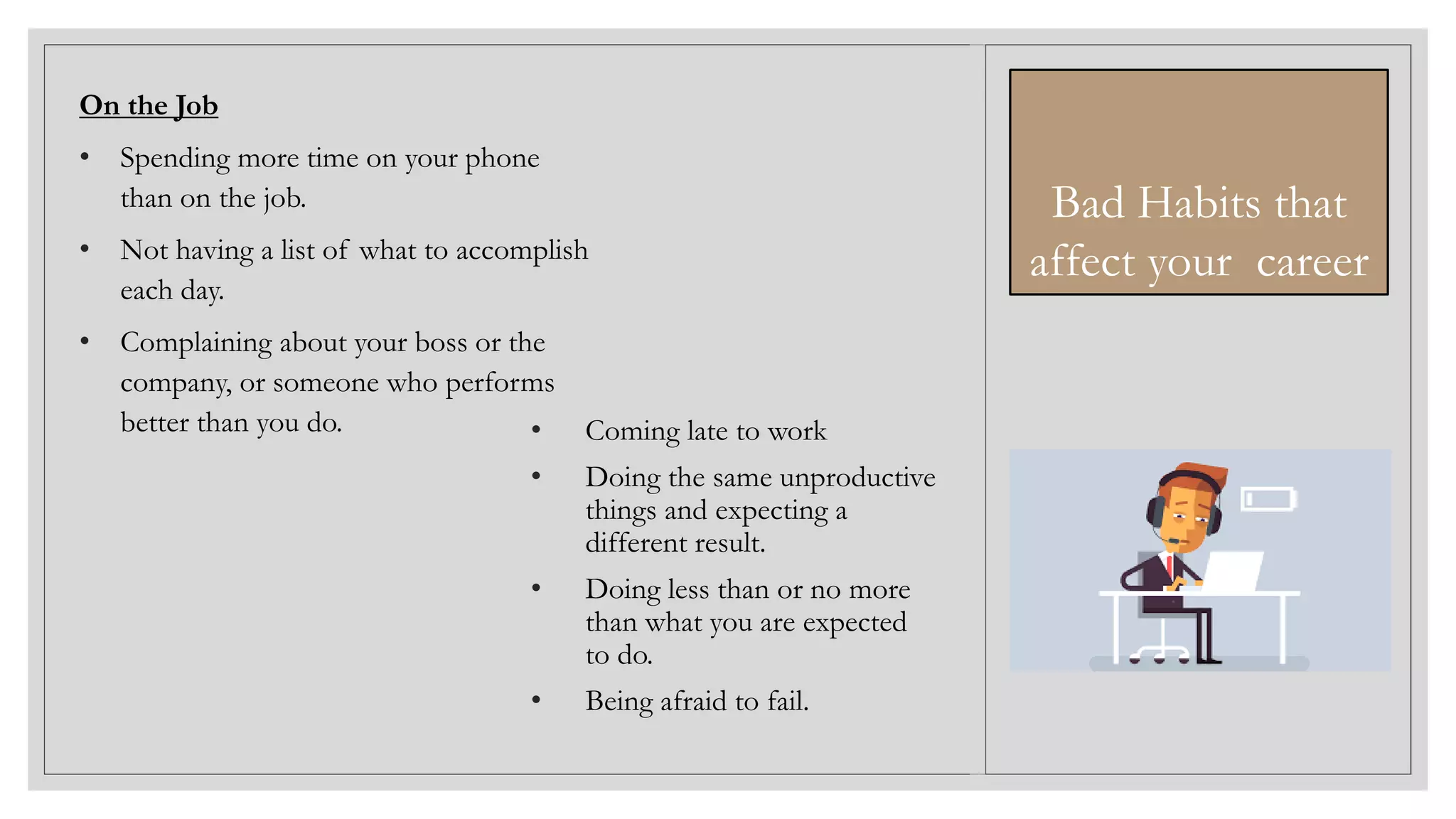
• Coming late to work
• Doing the same unproductive
things and expecting a
different result.
• Doing less than or no more
than what you are expected
to do.
• Being afraid to fail.
On the Job
• Spending more time on your phone
than on the job.
• Not having a list of what to accomplish
each day.
• Complaining about your boss or the
company, or someone who performs
better than you do.
Bad Habits that
affect your career
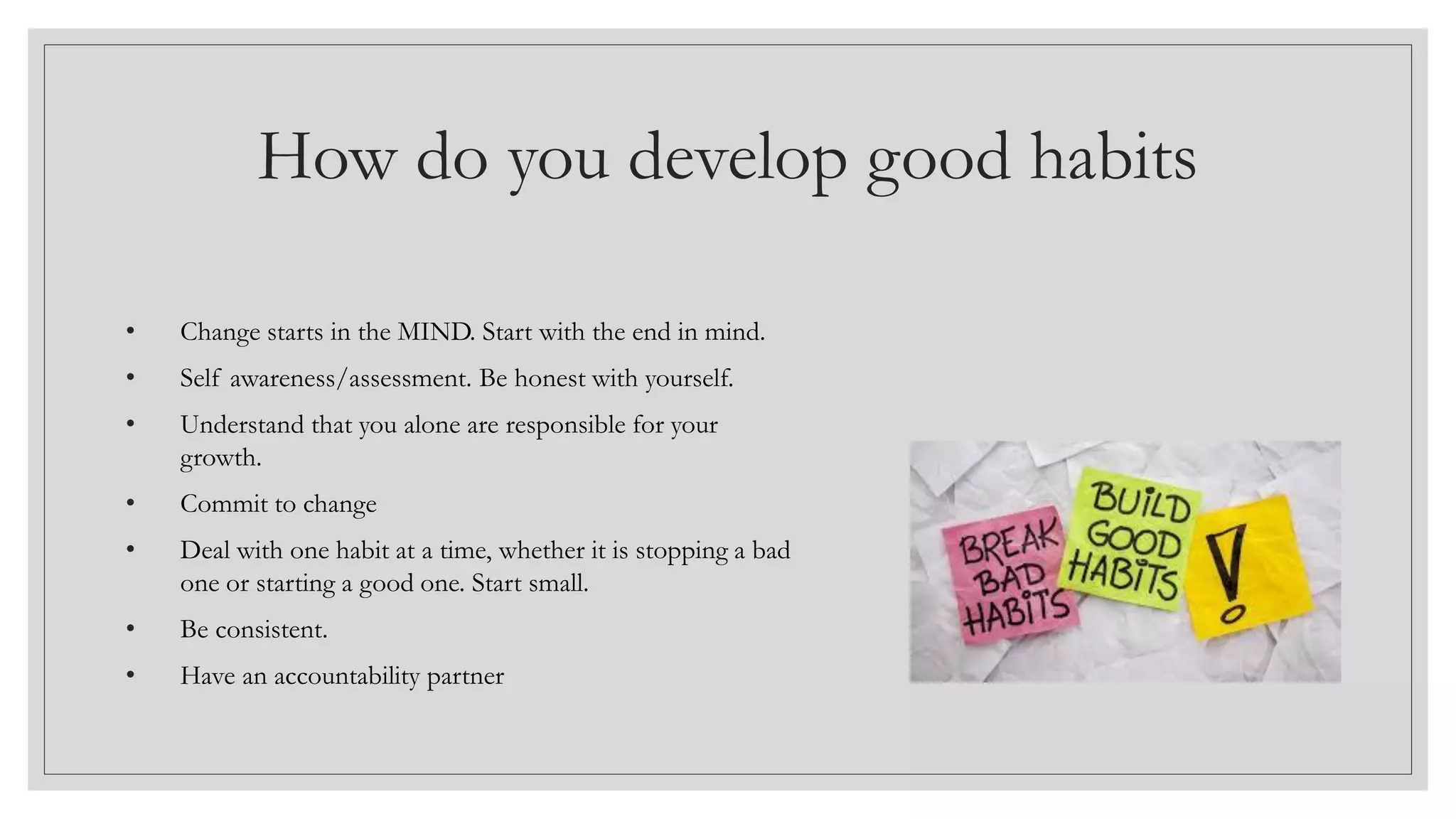
How do you develop good habits
• Change starts in the MIND. Start with the end in mind.
• Self awareness/assessment. Be honest with yourself.
• Understand that you alone are responsible for your
growth.
• Commit to change
• Deal with one habit at a time, whether it is stopping a bad
one or starting a good one. Start small.
• Be consistent.
• Have an accountability partner
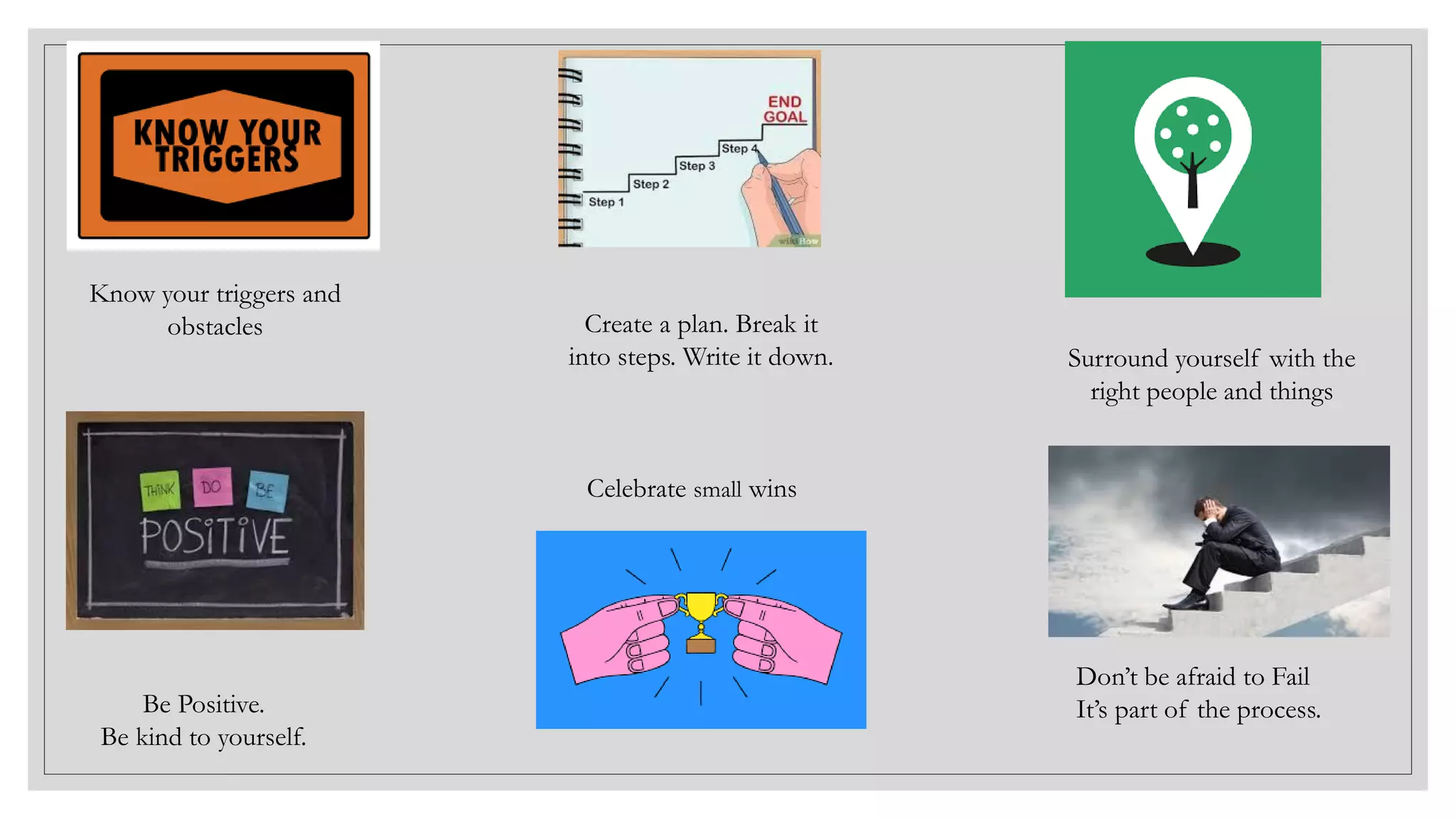
Know your triggers and
obstacles Create a plan. Break it
into steps. Write it down. Surround yourself with the
right people and things
Be Positive.
Be kind to yourself.
Celebrate small wins
Don’t be afraid to Fail
It’s part of the process.
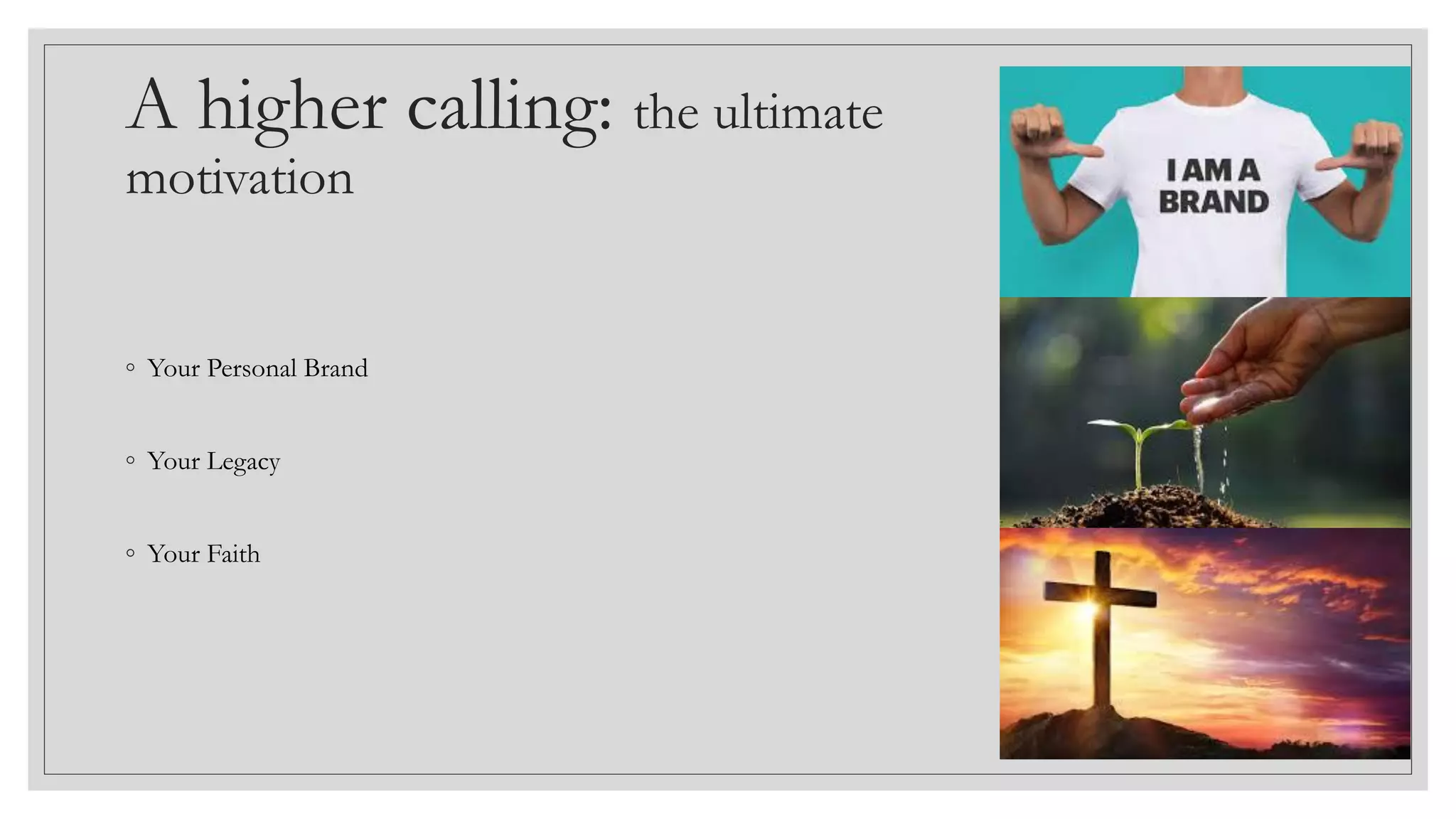
A higher calling: the ultimate
motivation
◦ Your Personal Brand
◦ Your Legacy
◦ Your Faith
SOFT SKILLS FOR
CAREER EXCELLENCE
Interpersonal
Skills
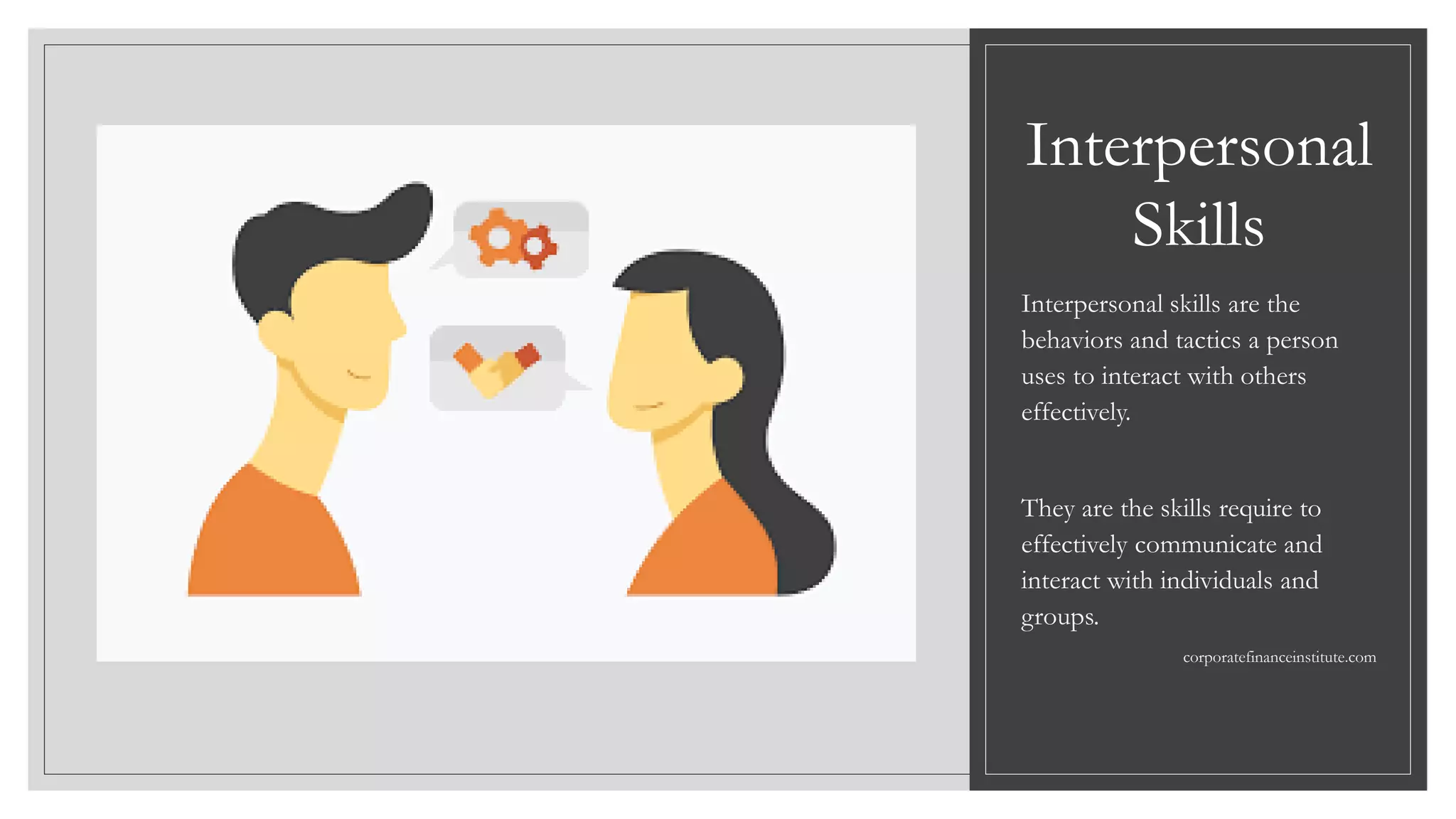
Interpersonal skills are the
behaviors and tactics a person
uses to interact with others
effectively.
They are the skills require to
effectively communicate and
interact with individuals and
groups.
corporatefinanceinstitute.com
Interpersonal Skills…
◦ Help employees develop and foster strong working relationships with each other and with their
clients,
◦ Contribute to increasing team and organizational productivity
◦ Create an overall positive work environment.
◦ Greater employee satisfaction.
◦ Better decision-making.
◦ Make it easier to communicate difficult business decisions.
◦ Can foster a healthy workplace culture
◦ Can be used as a value proposition either individually or corporately.
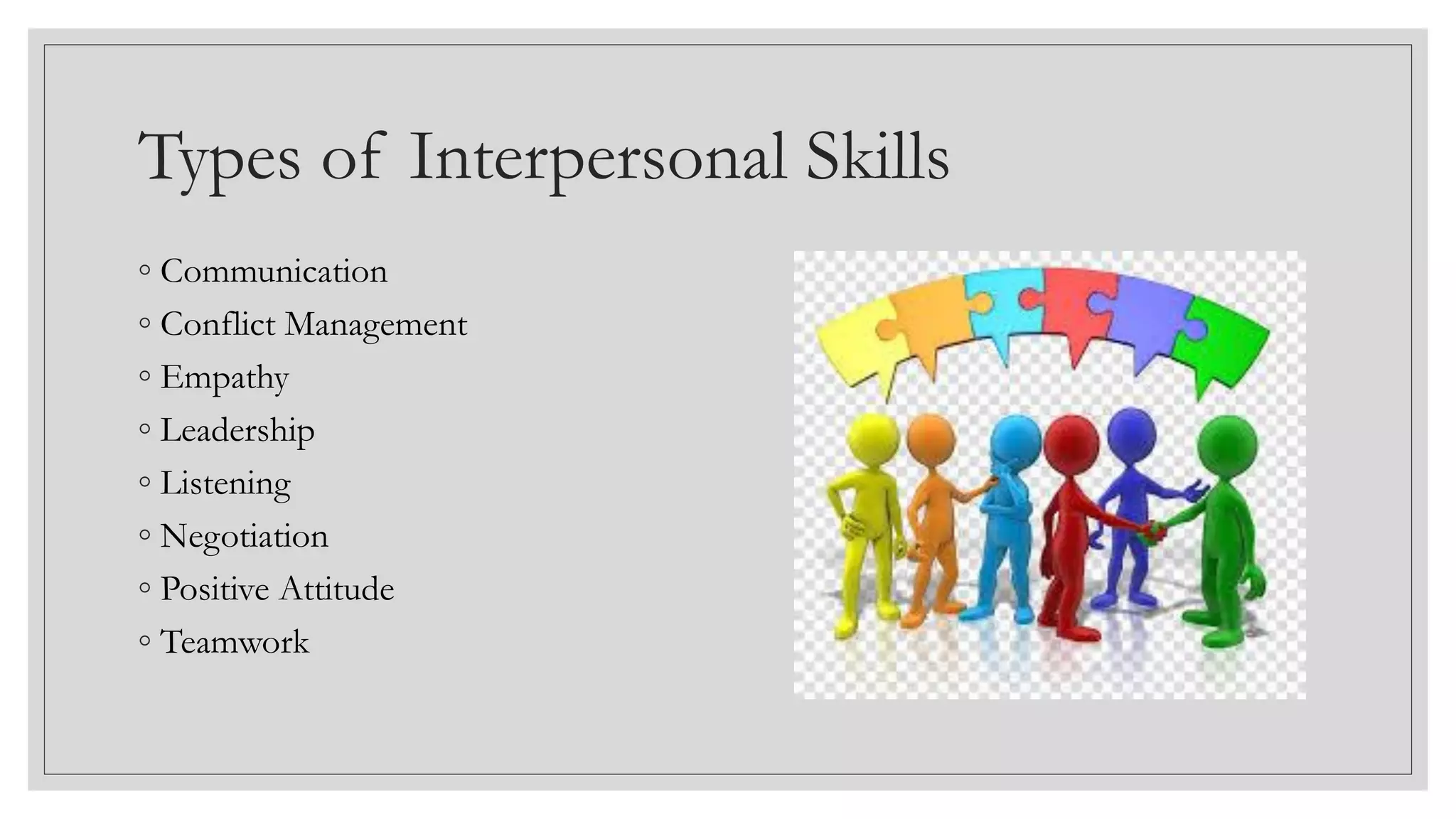
Types of Interpersonal Skills
◦ Communication
◦ Conflict Management
◦ Empathy
◦ Leadership
◦ Listening
◦ Negotiation
◦ Positive Attitude
◦ Teamwork
Are interpersonal skills Taught or
Natural?
Communication
◦ The level of one’s interpersonal communication skills is measured through the effectiveness of
transferring messages to others.
◦ Communication has taken place when the message received by the receiver is the message intended by the
sender.
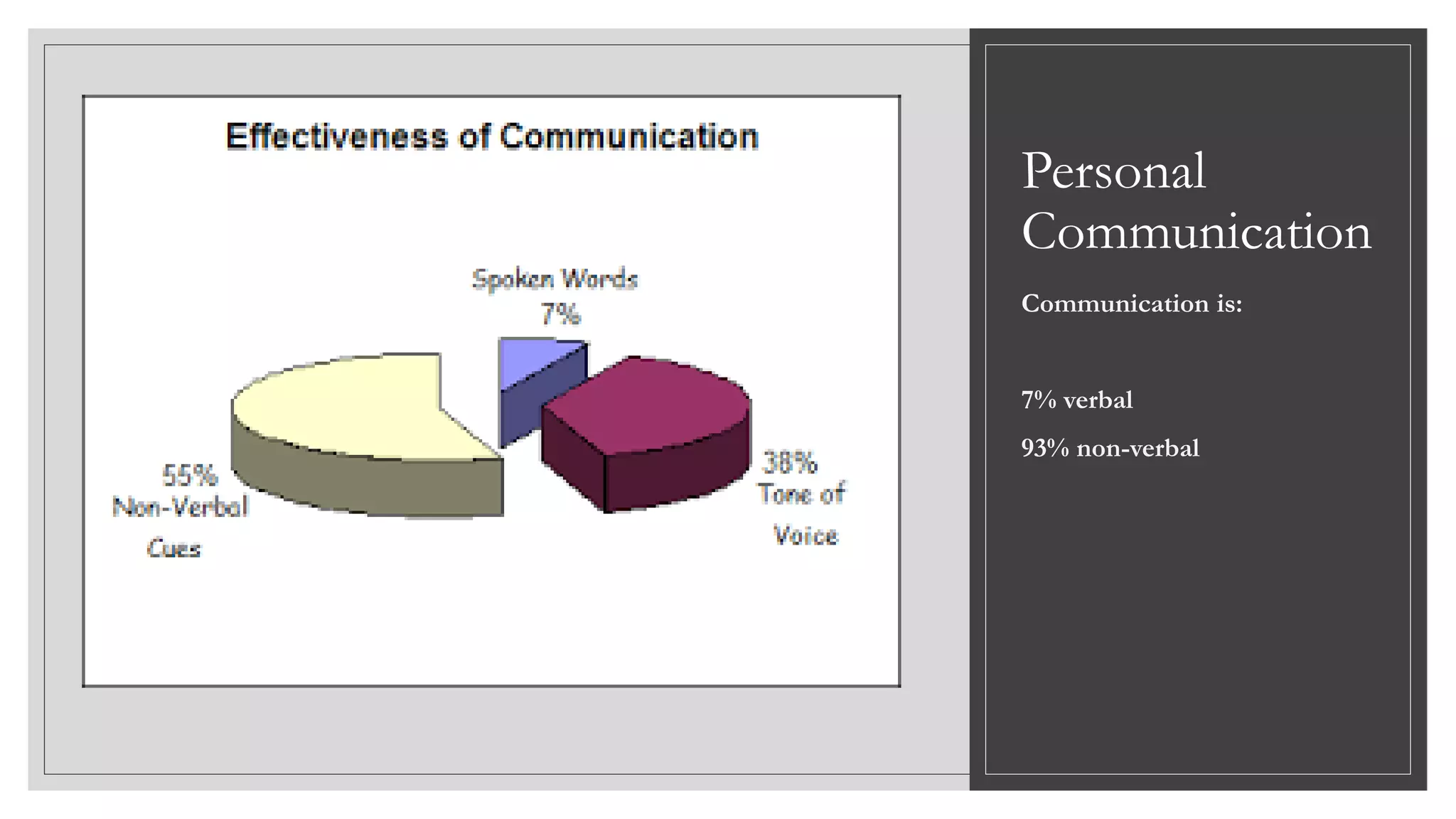
Personal
Communication
Communication is:
7% verbal
93% non-verbal
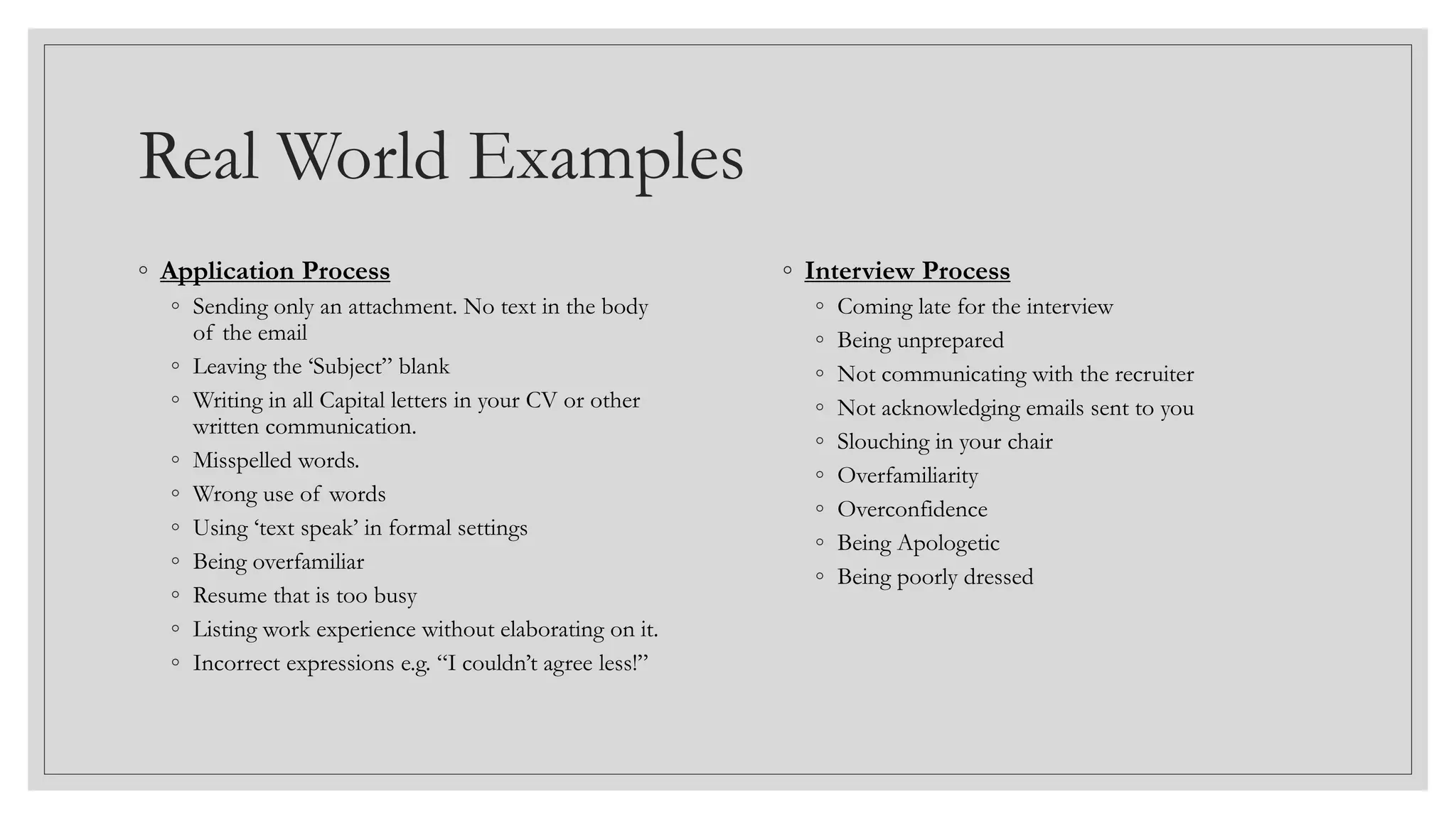
Real World Examples
◦ Application Process
◦ Sending only an attachment. No text in the body
of the email
◦ Leaving the ‘Subject” blank
◦ Writing in all Capital letters in your CV or other
written communication.
◦ Misspelled words.
◦ Wrong use of words
◦ Using ‘text speak’ in formal settings
◦ Being overfamiliar
◦ Resume that is too busy
◦ Listing work experience without elaborating on it.
◦ Incorrect expressions e.g. “I couldn’t agree less!”
◦ Interview Process
◦ Coming late for the interview
◦ Being unprepared
◦ Not communicating with the recruiter
◦ Not acknowledging emails sent to you
◦ Slouching in your chair
◦ Overfamiliarity
◦ Overconfidence
◦ Being Apologetic
◦ Being poorly dressed

Soft skills series introduction to soft skills

  • 1.
    SOFT SKILLS SERIES EmployabilitySkills that will set you up for Career Success Oluwatoyin Puddicombe Toyin Talks Talent
  • 2.
    • I aman HR professional with over a decade of active work experience. I have worked in Aviation, Business Services, Consulting, and Insurance, gathering and acquiring skills and competences in Client Services, Relationship Management and Human Capital Management with a strong bias for Talent Acquisition and Development. • I believe that our work is a platform for sharing our gifts with the world. Unfortunately, a lot of young graduates underestimate themselves for various reasons; the economy, wrong course choices, wrong career choices, failure to plan their careers, multiple rejections and so on. • I believe that each person is uniquely gifted by God to make their way in the world using those gifts and I would like to help in discovering them and finding fulfilling careers. • This is the reason for Toyin Talks Talent. Oluwatoyin Puddicombe ACIPM, SPHRi, SHRM
  • 3.
    Series Outline Lesson 1. InterpersonalSkills Lesson 2. Problem Solving Lesson 3. Listening Skills Lesson 4. Public Speaking Lesson 5. Business Etiquette
  • 4.
    DEFINING SOFT SKILLS Softskills are a combination of skills that enable people to navigate their environment, work well with others, perform well, and achieve their goals with complementing hard skills. The Collins English Dictionary defines the term "soft skills" as "desirable qualities for certain forms of employment that do not depend on acquired knowledge: they include common sense, the ability to deal with people, and a positive flexible attitude."
  • 5.
    In Deloitte’s 2016Global Human Capital Trends Report, 92% of respondents rated soft skills as a critical priority. A recent study in the UK determined that “Soft Skills” are worth £88bn ($186bn CDN) to the UK economy. A business group, including, believe it or not, McDonalds is doing a three- month study on how government can introduce policies that will help employees and employers develop soft skills. Whitehead 2020
  • 6.
    A B Which wouldyou… 1. Prefer 2. Buy
  • 7.
    About Soft Skills ◦Soft skills are any skill or quality that can be classified as a personality trait or habit. ◦ Soft skills are not about the knowledge you possess but rather the behaviors you display in different situations. ◦ Soft skills are typically innate, but they can be learned, and they can be enhanced.
  • 9.
    Soft Skills vsHard Skills • Hard skills make an impression; soft skills leave a legacy. • Hard skills speak to why they want to hire you; soft skills speak to why they should hire you. • Hard skills can get you the interview; soft skills can get you the job. • Hard skills appeal to the head; soft skills appeal to the heart.
  • 10.
    Why are Soft Skills Important? •Human interactions cannot always be defined empirically. • That two people were exposed to the same scenarios with the same factors does not mean they will react in the same way. • Soft skills are the answers to those indefinable “somethings” that are deal breakers in certain business situations.
  • 11.
    Which would youpick? CANDIDATE A ◦ “Um . . . well . . . I have 15 years of experience in the . . . uh . . . marketing industry, and in my spare time I really enjoy showing dogs and watching Dancing with the Stars.” CANDIDATE B ◦ “I’m a branding and marketing specialist with 15 years of global experience at the executive level, guiding high-growth specialty sporting goods companies. I’ve been responsible for the successful launch of several new products over my career, including Product X and Product Y.”
  • 12.
    Laying the right Foundation CHARACTER •Values • Experiences • Personality • Habits
  • 13.
    Courtesy Finish what you start Give your best Social Etiquette Respect others Bea man of your word Do to others as you want them to do to you Work hard. Where it all Begins
  • 14.
    A habit isa routine of behaviour that is repeated regularly and tends to occur subconsciously. What are your habits? They influence your actions. Experiences are positive and negative events that have occurred in our lives that shape our beliefs and behaviour Personality is the characteristic patterns of thoughts, feelings, and behaviors that make a person unique. It is innate. Values are basic and fundamental beliefs that guide or motivate attitudes or actions. They help us to determine what is important to us
  • 15.
    SELF MASTERY ANDTHE “EXCELLENCE” HABIT
  • 16.
    Self Mastery Self mastery isoften defined as self-control, the ability to exert a strong will against our impulses to steer our future to one of our choosing. But this is only one aspect of the term. Self mastery requires having a vision for your future self
  • 17.
  • 18.
    3 Kinds ofPeople ◦ 1. Those that do less: “I cannot come and go and kill myself” geng. ◦ 2. Those that do just enough: Give them what they asked for. ◦ 3. Those that do more: Get their attention. Nadia Comăneci World Champion Winner of 5 Gold medals
  • 19.
    Defining Excellence ◦ “Thequality of being outstanding or extremely good.” ◦ Sometimes, it’s not about being the best… ◦ It’s about being the MOST MEMORABLE
  • 20.
    It starts withyour personal values
  • 21.
    What are yourvalues? What standards do you set for yourself?
  • 23.
    • They arebehaviour • We work to maintain them because of their predictability (Comfort Zone) • They are automatic and regular. • They have triggers • They are tough to change without being intentional Why are habits so powerful?
  • 24.
    ◦ Interview • Cominglate • Not communicating with the recruiter • Checking your phone during the interview • Not preparing for the interview Sending Applications • Send CV without writing anything in the email body. • Not reading over emails before sending. • Not reading through the job ad for proper guidance Some Bad Habits that affect your career
  • 25.
    • Coming lateto work • Doing the same unproductive things and expecting a different result. • Doing less than or no more than what you are expected to do. • Being afraid to fail. On the Job • Spending more time on your phone than on the job. • Not having a list of what to accomplish each day. • Complaining about your boss or the company, or someone who performs better than you do. Bad Habits that affect your career
  • 26.
    How do youdevelop good habits • Change starts in the MIND. Start with the end in mind. • Self awareness/assessment. Be honest with yourself. • Understand that you alone are responsible for your growth. • Commit to change • Deal with one habit at a time, whether it is stopping a bad one or starting a good one. Start small. • Be consistent. • Have an accountability partner
  • 27.
    Know your triggersand obstacles Create a plan. Break it into steps. Write it down. Surround yourself with the right people and things Be Positive. Be kind to yourself. Celebrate small wins Don’t be afraid to Fail It’s part of the process.
  • 28.
    A higher calling:the ultimate motivation ◦ Your Personal Brand ◦ Your Legacy ◦ Your Faith
  • 29.
  • 31.
    Interpersonal Skills Interpersonal skills arethe behaviors and tactics a person uses to interact with others effectively. They are the skills require to effectively communicate and interact with individuals and groups. corporatefinanceinstitute.com
  • 32.
    Interpersonal Skills… ◦ Helpemployees develop and foster strong working relationships with each other and with their clients, ◦ Contribute to increasing team and organizational productivity ◦ Create an overall positive work environment. ◦ Greater employee satisfaction. ◦ Better decision-making. ◦ Make it easier to communicate difficult business decisions. ◦ Can foster a healthy workplace culture ◦ Can be used as a value proposition either individually or corporately.
  • 33.
    Types of InterpersonalSkills ◦ Communication ◦ Conflict Management ◦ Empathy ◦ Leadership ◦ Listening ◦ Negotiation ◦ Positive Attitude ◦ Teamwork
  • 34.
    Are interpersonal skillsTaught or Natural?
  • 35.
    Communication ◦ The levelof one’s interpersonal communication skills is measured through the effectiveness of transferring messages to others. ◦ Communication has taken place when the message received by the receiver is the message intended by the sender.
  • 36.
  • 37.
    Real World Examples ◦Application Process ◦ Sending only an attachment. No text in the body of the email ◦ Leaving the ‘Subject” blank ◦ Writing in all Capital letters in your CV or other written communication. ◦ Misspelled words. ◦ Wrong use of words ◦ Using ‘text speak’ in formal settings ◦ Being overfamiliar ◦ Resume that is too busy ◦ Listing work experience without elaborating on it. ◦ Incorrect expressions e.g. “I couldn’t agree less!” ◦ Interview Process ◦ Coming late for the interview ◦ Being unprepared ◦ Not communicating with the recruiter ◦ Not acknowledging emails sent to you ◦ Slouching in your chair ◦ Overfamiliarity ◦ Overconfidence ◦ Being Apologetic ◦ Being poorly dressed