Shoulders of Giants
Andrey Breslav
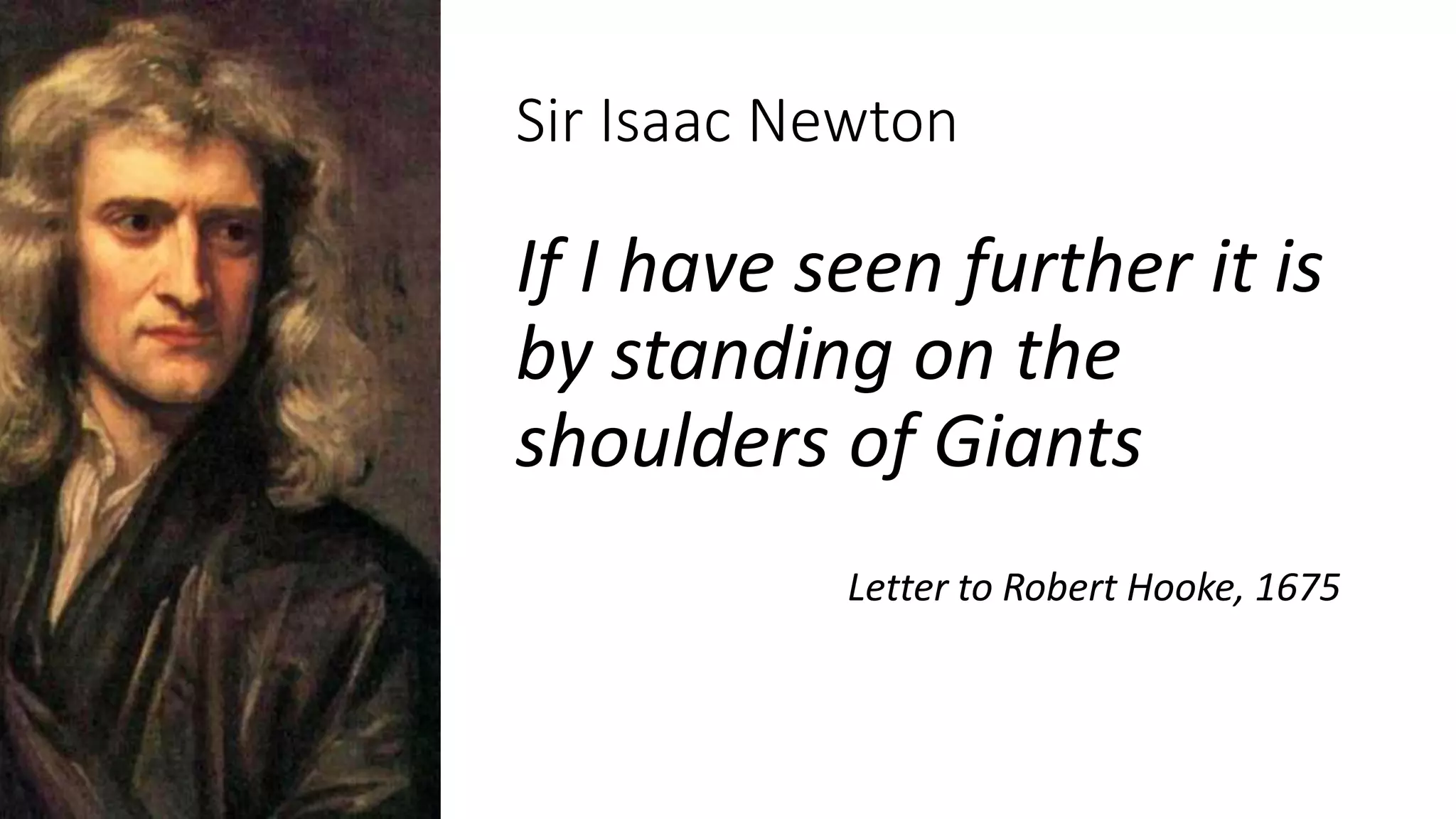
Sir Isaac Newton
If I have seen further it is
by standing on the
shoulders of Giants
Letter to Robert Hooke, 1675
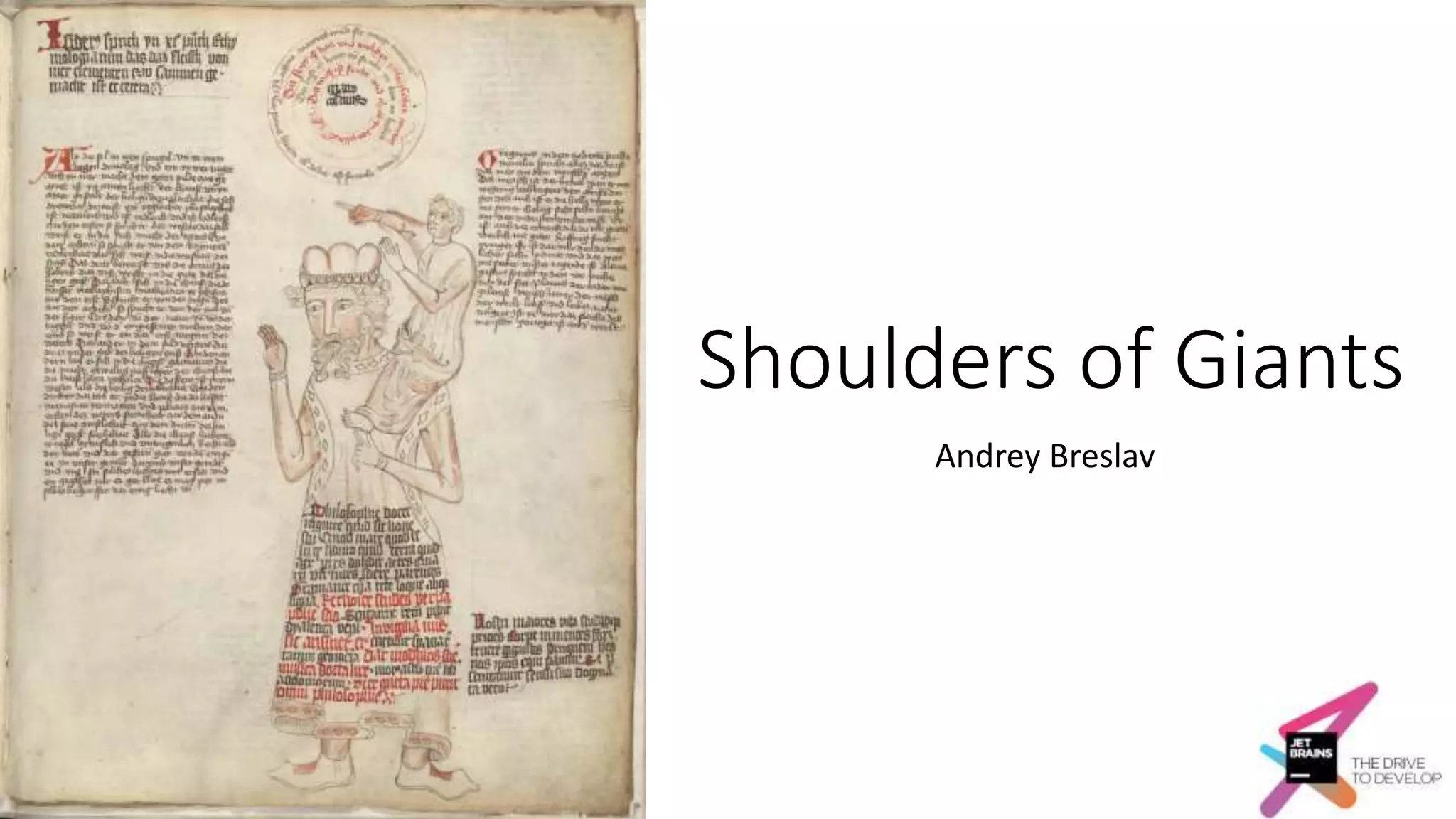
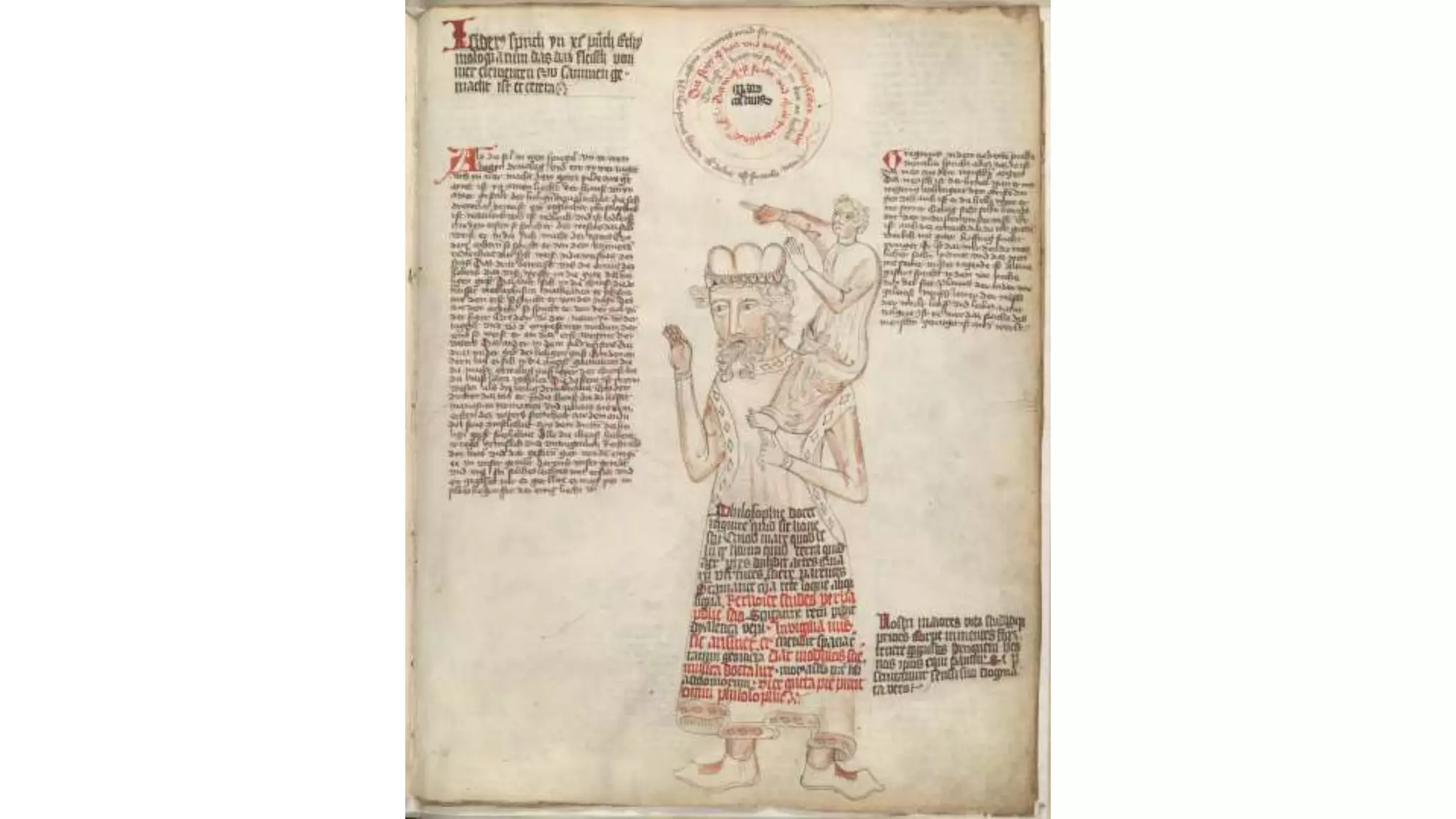
Bernard of Charters
[Dicebat Bernardus Carnotensis nos esse quasi]
nanos gigantium
humeris incidentes.
XII c.
Why I’m giving this talk
The right question
Why don’t all language designers give such talks?
Every language has learned from others
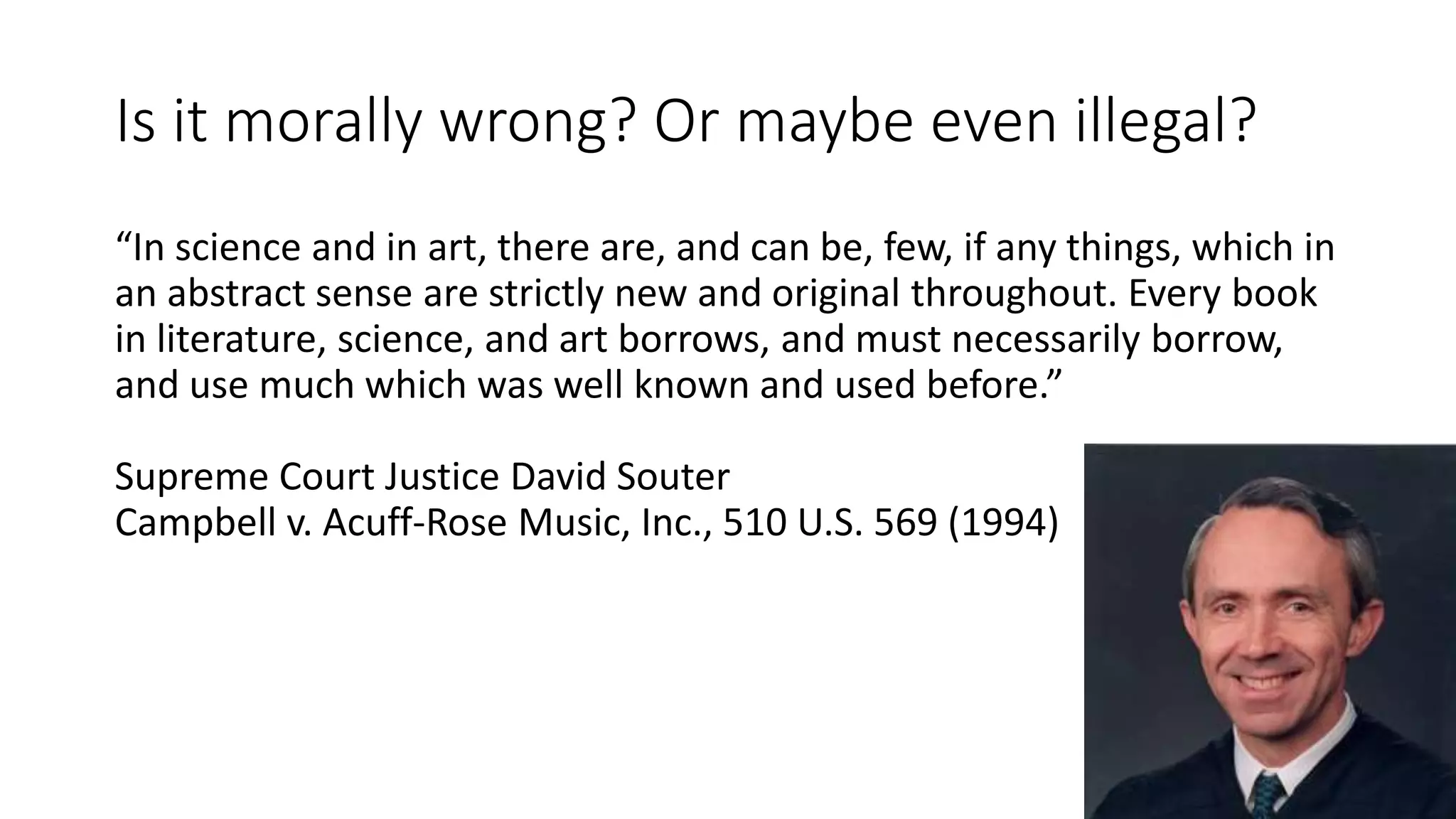
Is it morally wrong? Or maybe even illegal?
“In science and in art, there are, and can be, few, if any things, which in
an abstract sense are strictly new and original throughout. Every book
in literature, science, and art borrows, and must necessarily borrow,
and use much which was well known and used before.”
Supreme Court Justice David Souter
Campbell v. Acuff-Rose Music, Inc., 510 U.S. 569 (1994)
Does it make them worse?
• Is originality what really matters to you as a developer?
• Put in on the scale with productivity and maintainability 
• But I want to
• … stand out
• … be proud of my language (and its authors)
• ... win arguments with fans of other languages
• … write awesome software, maybe? 
What do language designers think?
• The Kotlin team had productive discussions with
• Brian Goetz
• Martin Odersky
• Erik Meijer
• Chris Lattner
• … looking forward to having more!
My ideal world
• Everyone builds on top of others’ ideas
• Everyone openly admits it and says thank you
• Difference from academia: it’s OK to not look at some prior work 
So, what languages has Kotlin
learned from?
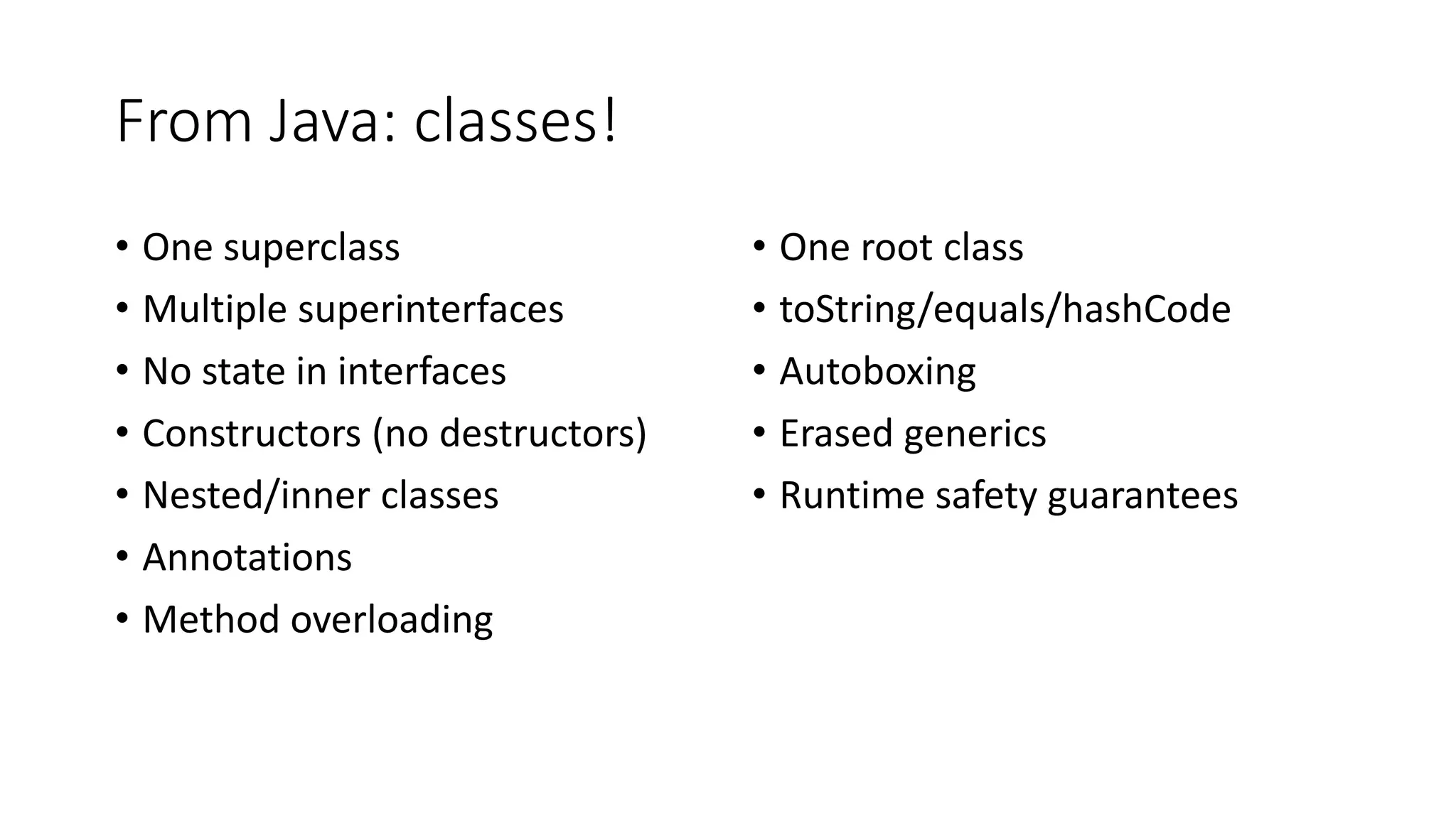
From Java: classes!
• One superclass
• Multiple superinterfaces
• No state in interfaces
• Constructors (no destructors)
• Nested/inner classes
• Annotations
• Method overloading
• One root class
• toString/equals/hashCode
• Autoboxing
• Erased generics
• Runtime safety guarantees
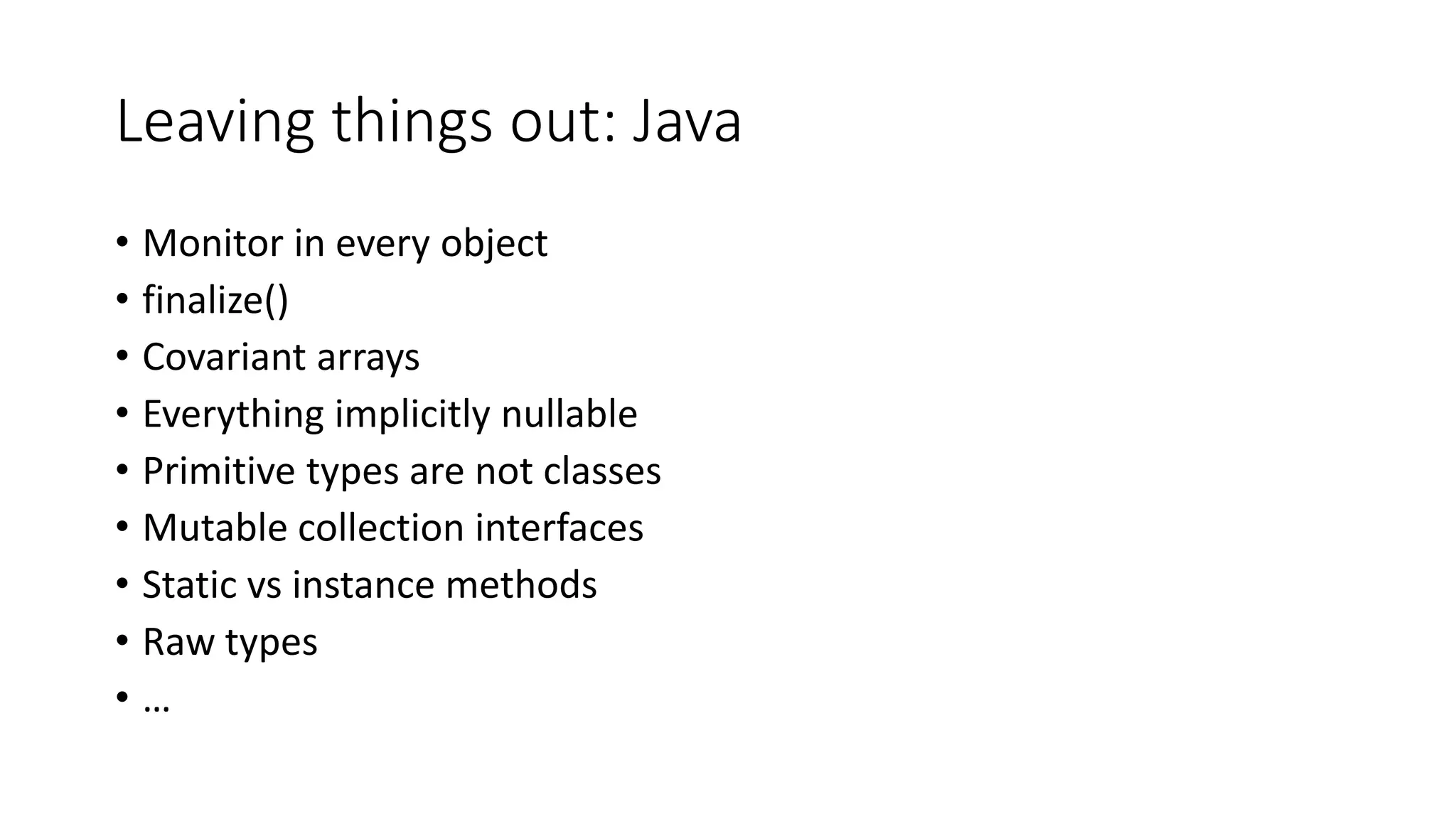
Leaving things out: Java
• Monitor in every object
• finalize()
• Covariant arrays
• Everything implicitly nullable
• Primitive types are not classes
• Mutable collection interfaces
• Static vs instance methods
• Raw types
• …
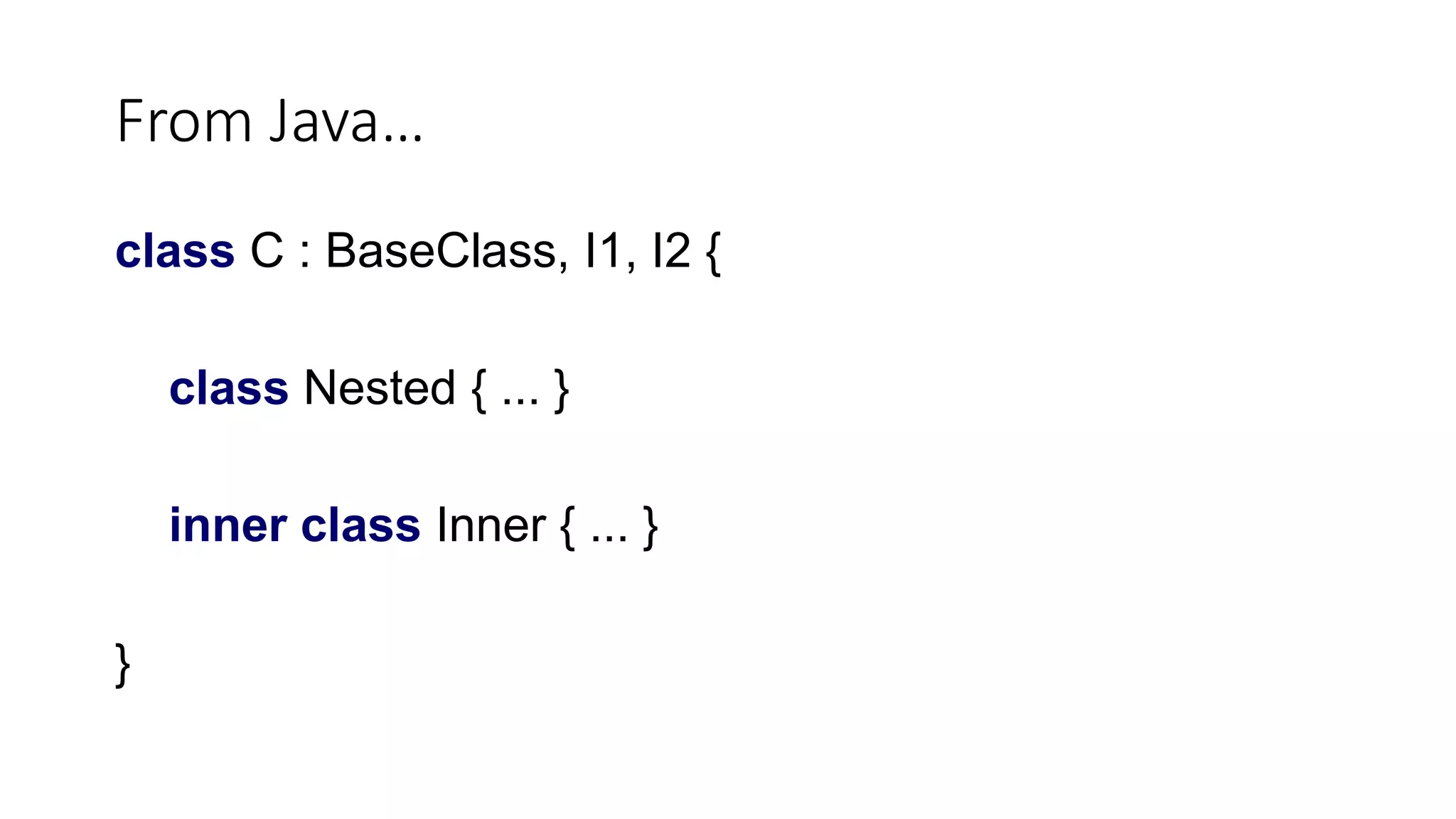
From Java…
class C : BaseClass, I1, I2 {
class Nested { ... }
inner class Inner { ... }
}
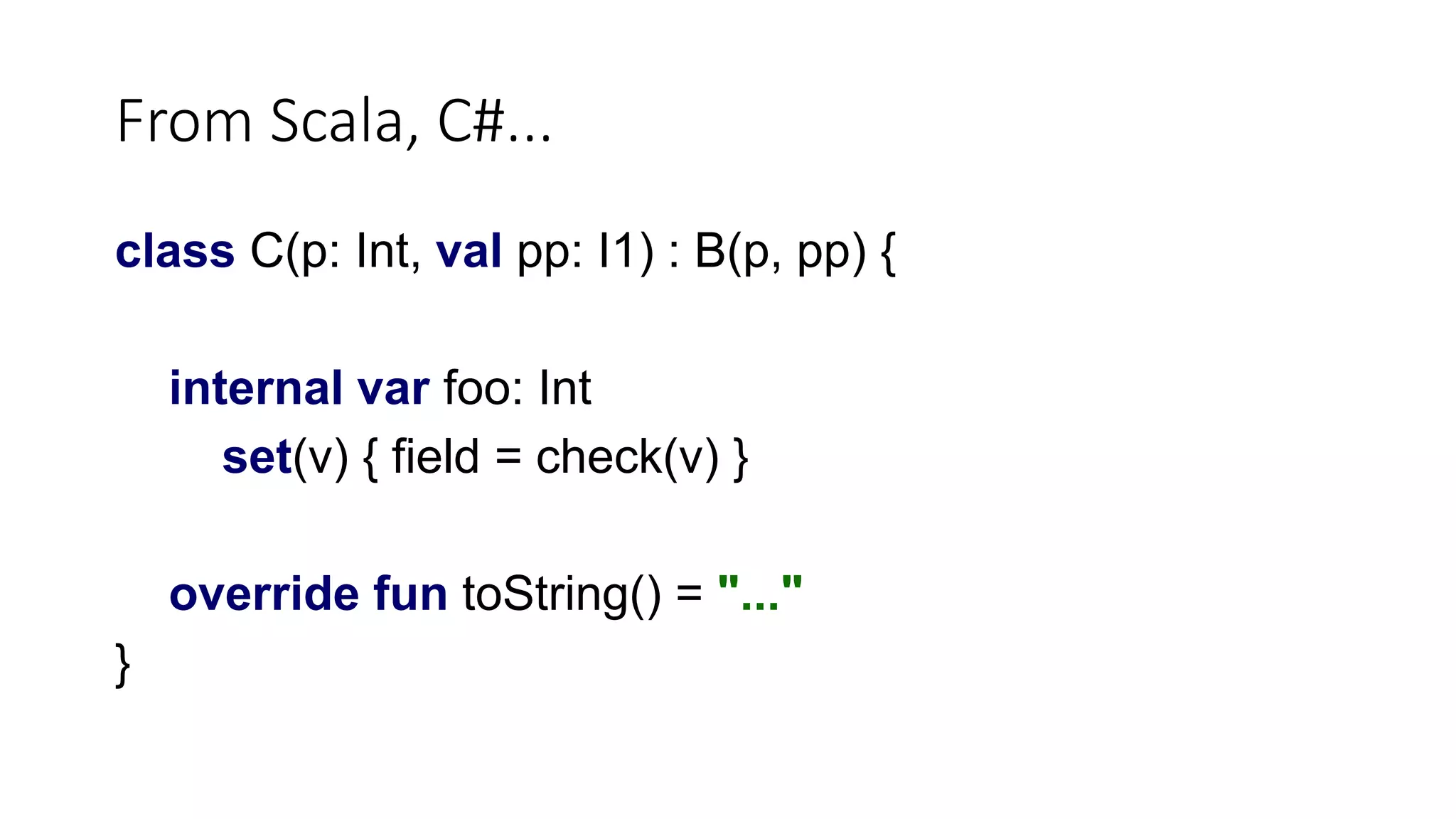
From Scala, C#...
class C(p: Int, val pp: I1) : B(p, pp) {
internal var foo: Int
set(v) { field = check(v) }
override fun toString() = "..."
}
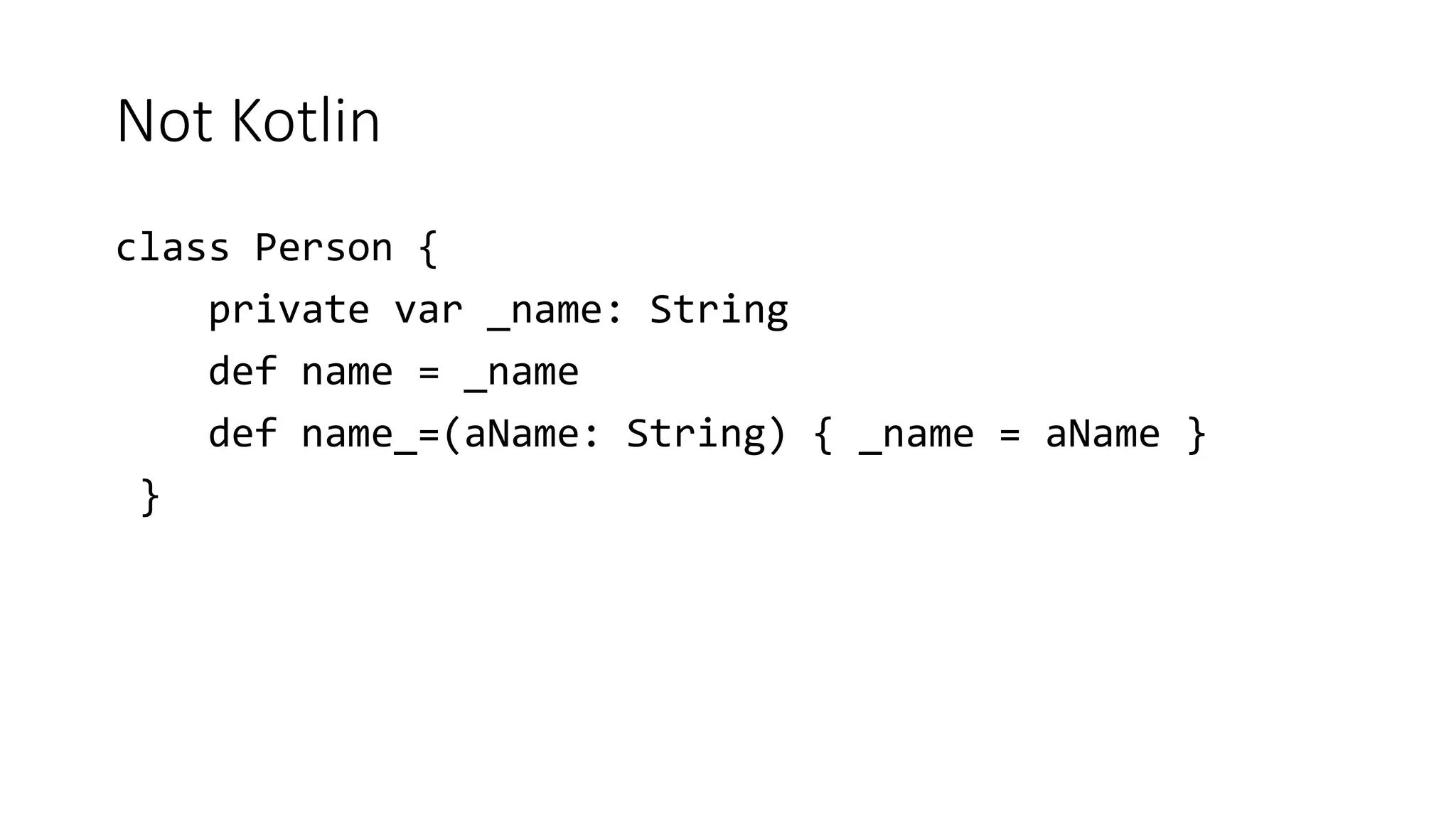
Not Kotlin
class Person {
private var _name: String
def name = _name
def name_=(aName: String) { _name = aName }
}
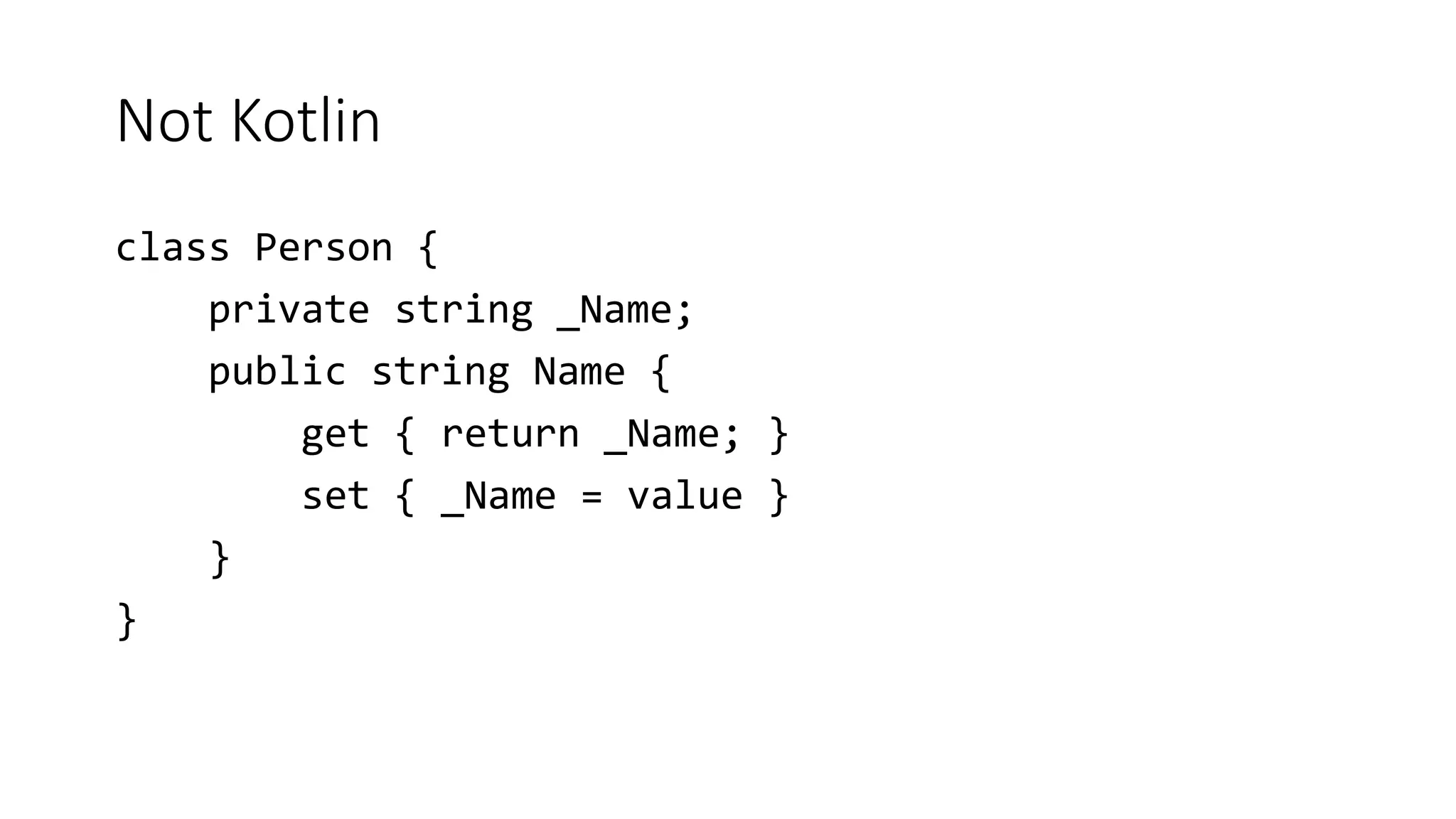
Not Kotlin
class Person {
private string _Name;
public string Name {
get { return _Name; }
set { _Name = value }
}
}
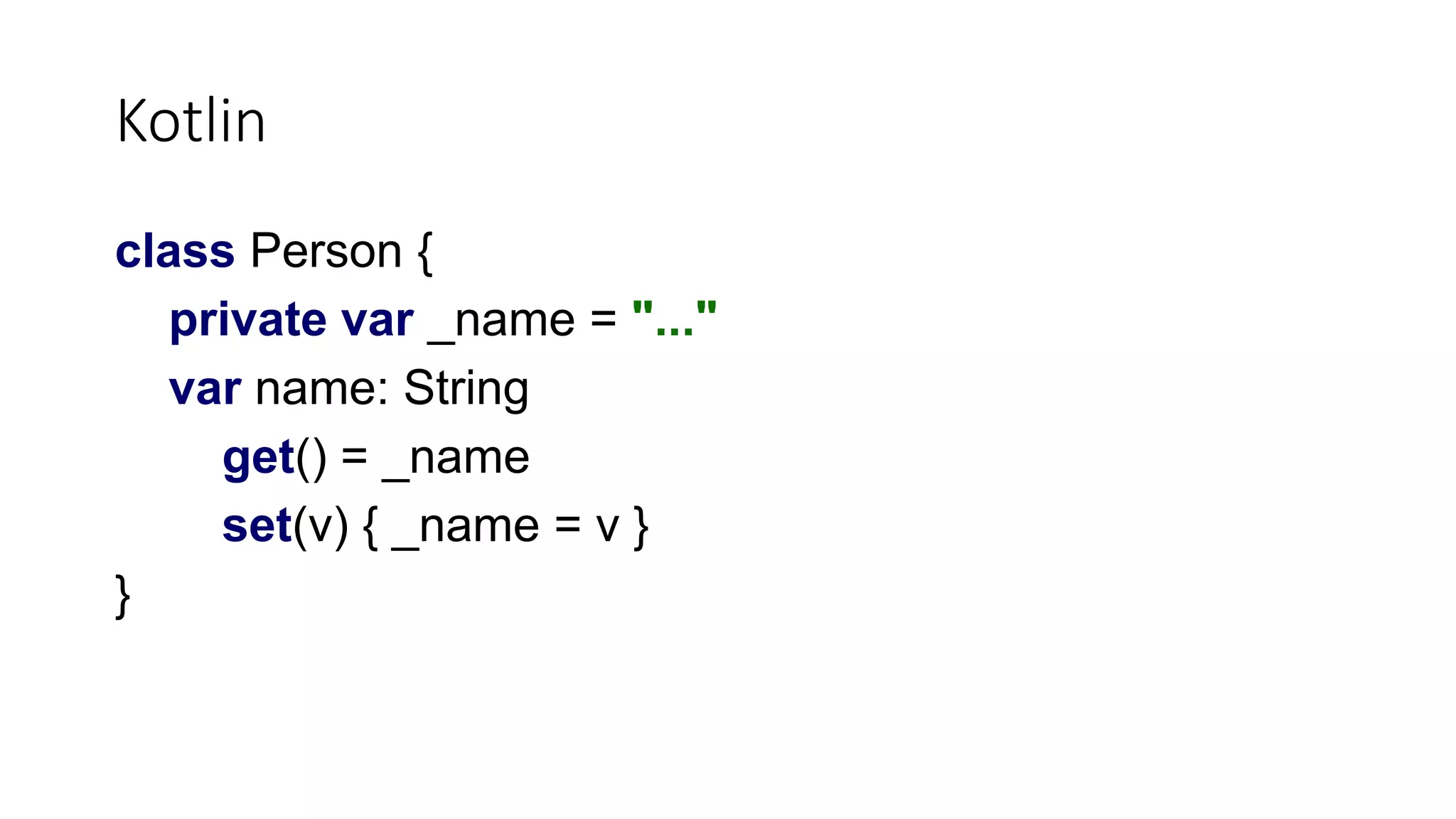
Kotlin
class Person {
private var _name = "..."
var name: String
get() = _name
set(v) { _name = v }
}
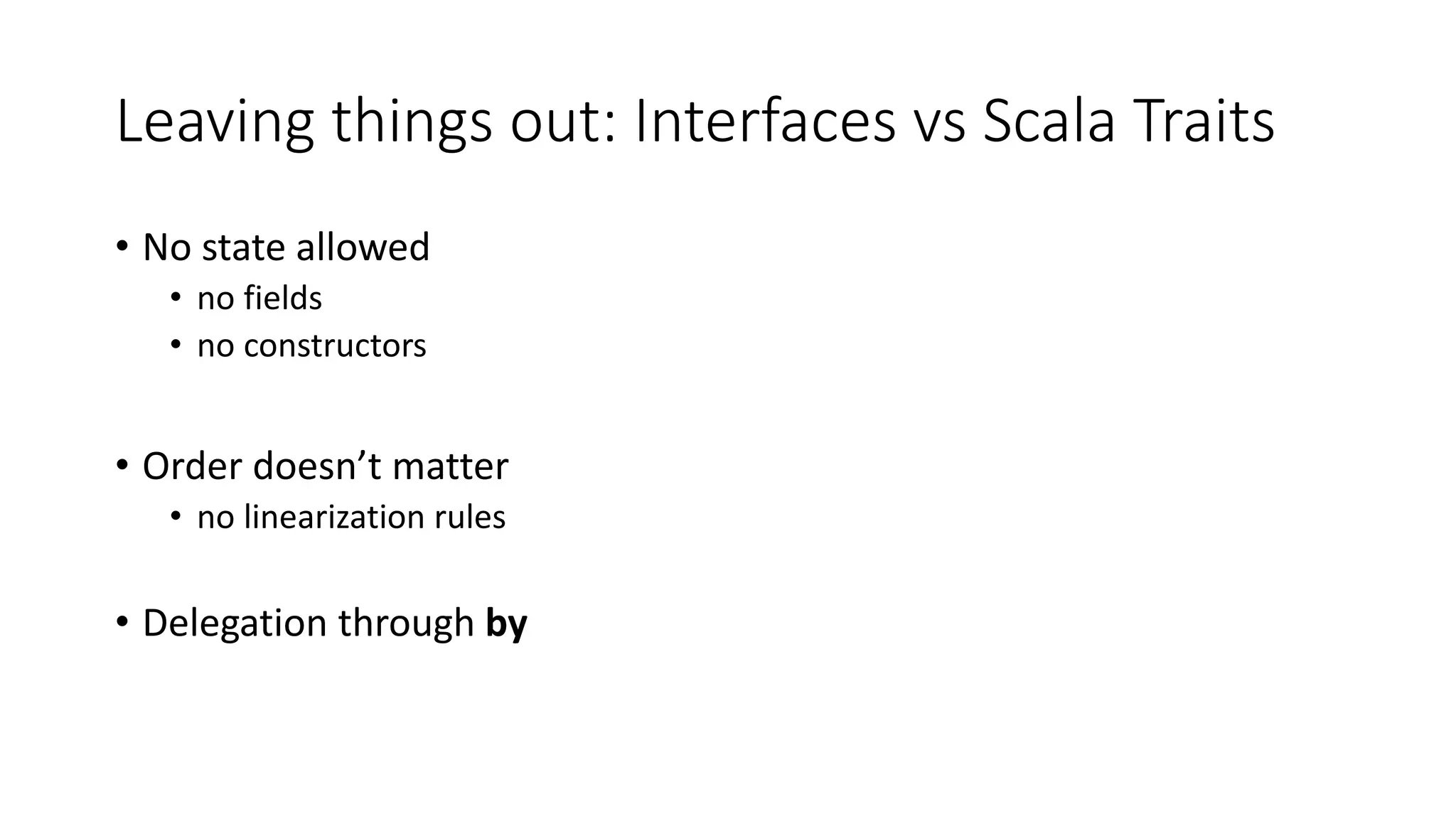
Leaving things out: Interfaces vs Scala Traits
• No state allowed
• no fields
• no constructors
• Order doesn’t matter
• no linearization rules
• Delegation through by
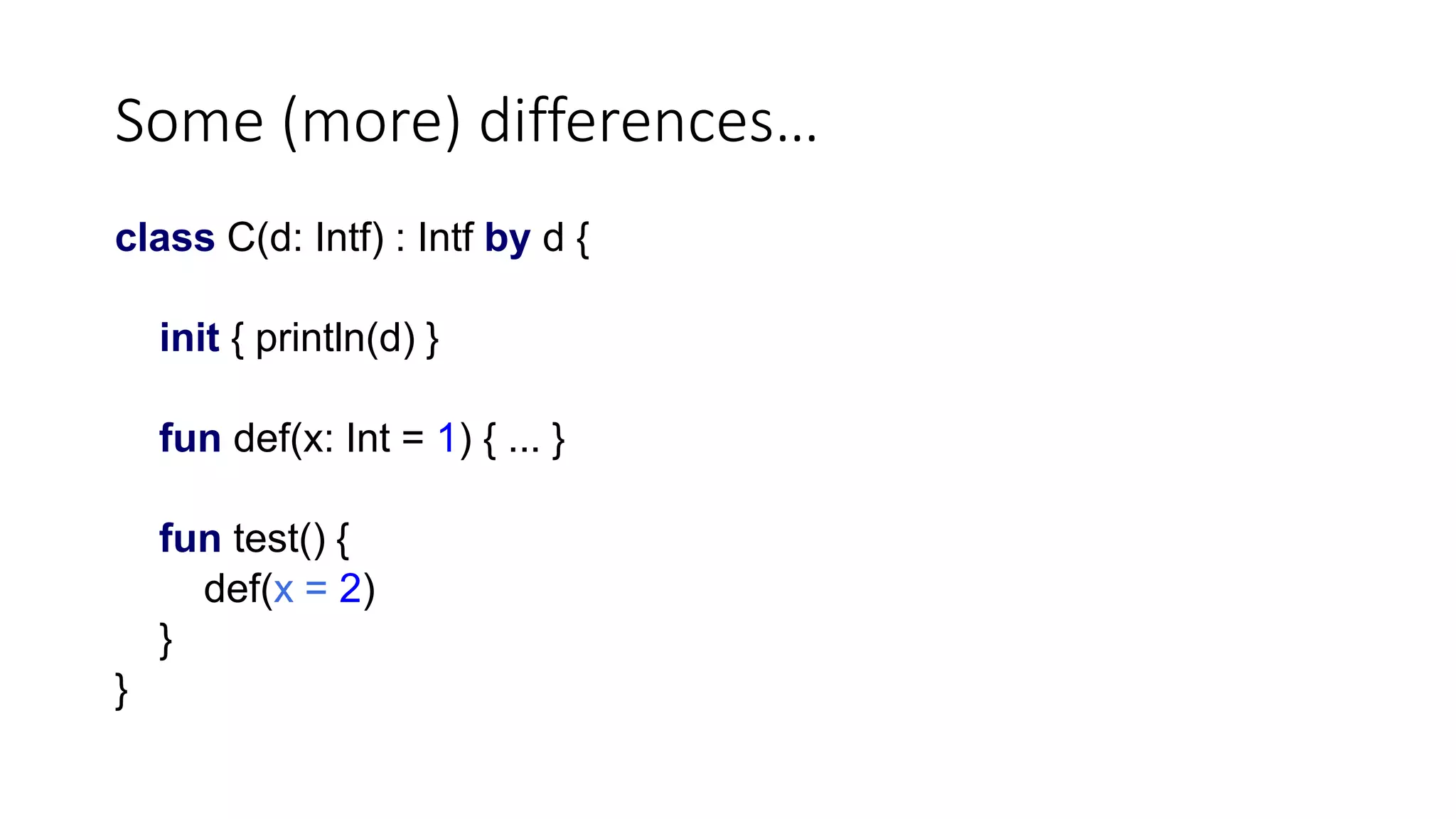
Some (more) differences…
class C(d: Intf) : Intf by d {
init { println(d) }
fun def(x: Int = 1) { ... }
fun test() {
def(x = 2)
}
}
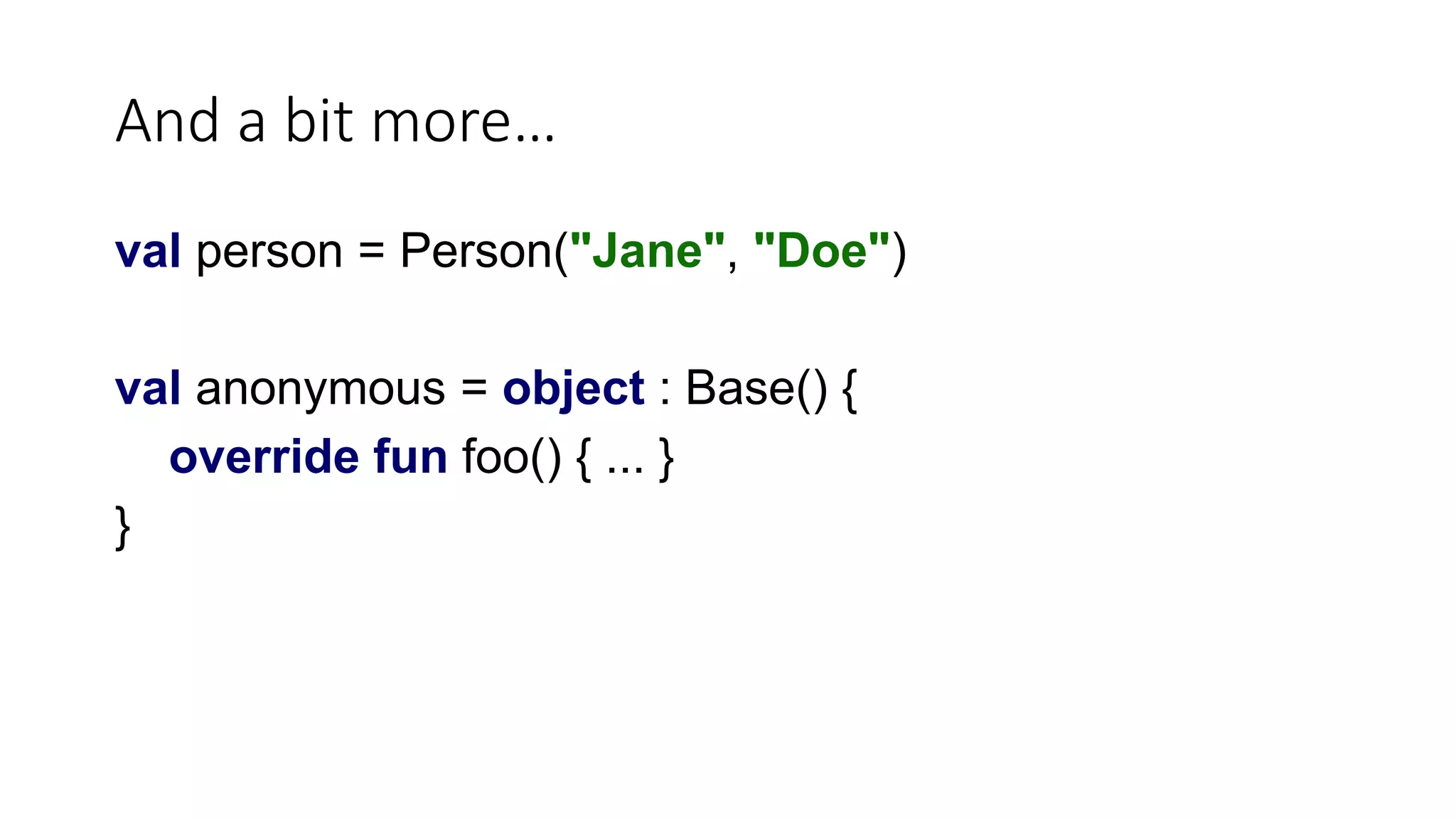
And a bit more…
val person = Person("Jane", "Doe")
val anonymous = object : Base() {
override fun foo() { ... }
}
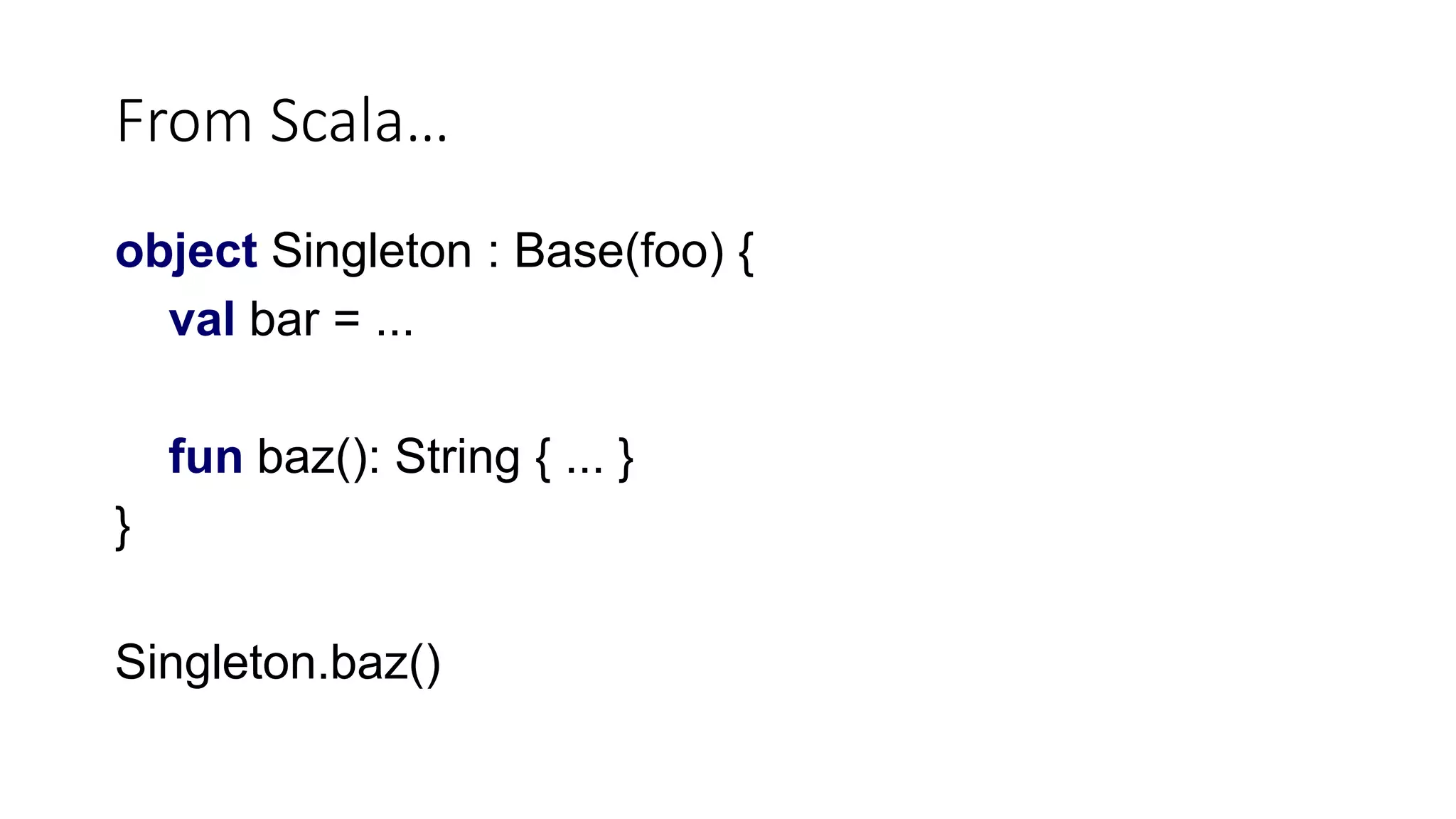
From Scala…
object Singleton : Base(foo) {
val bar = ...
fun baz(): String { ... }
}
Singleton.baz()
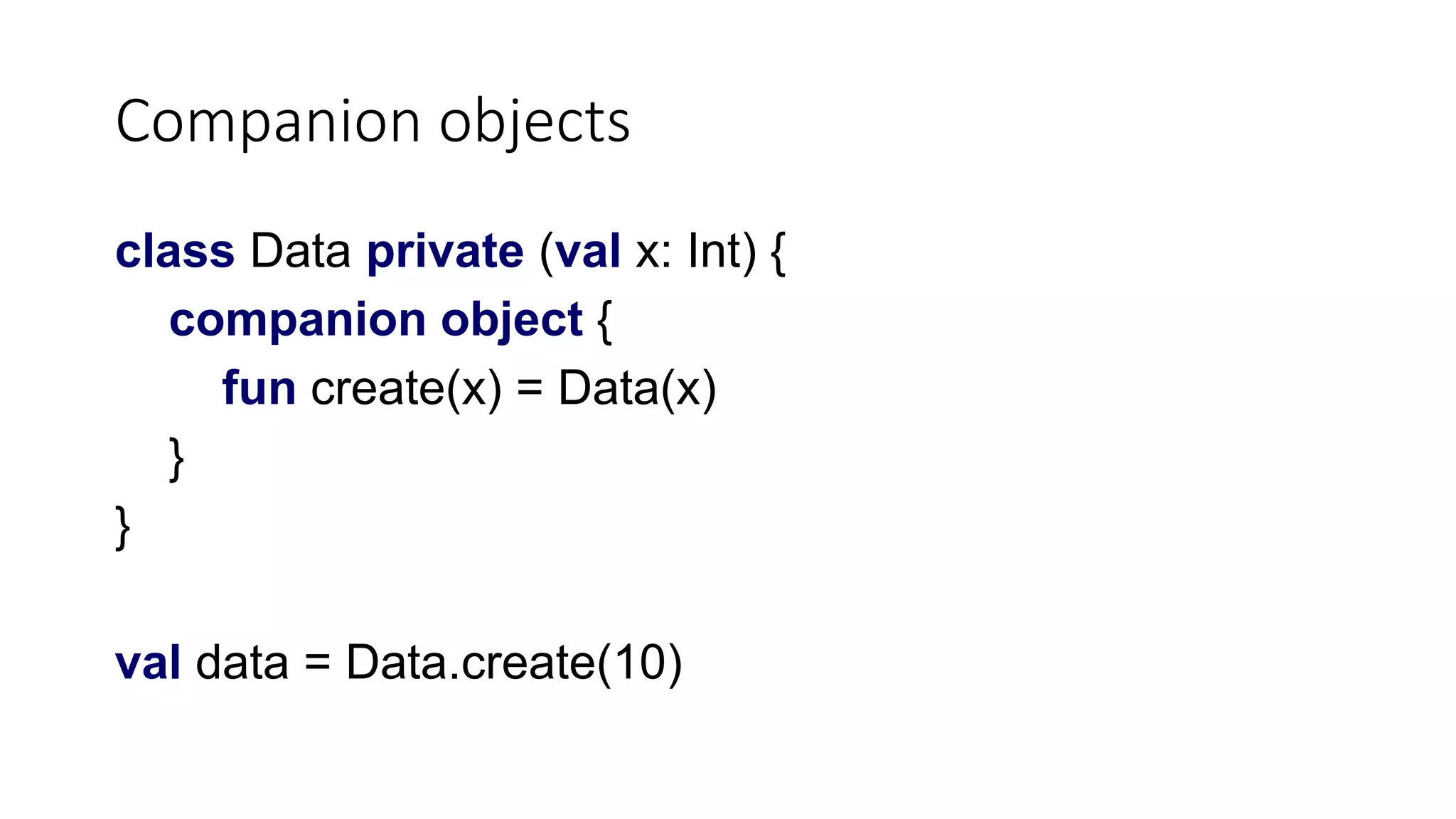
Companion objects
class Data private (val x: Int) {
companion object {
fun create(x) = Data(x)
}
}
val data = Data.create(10)
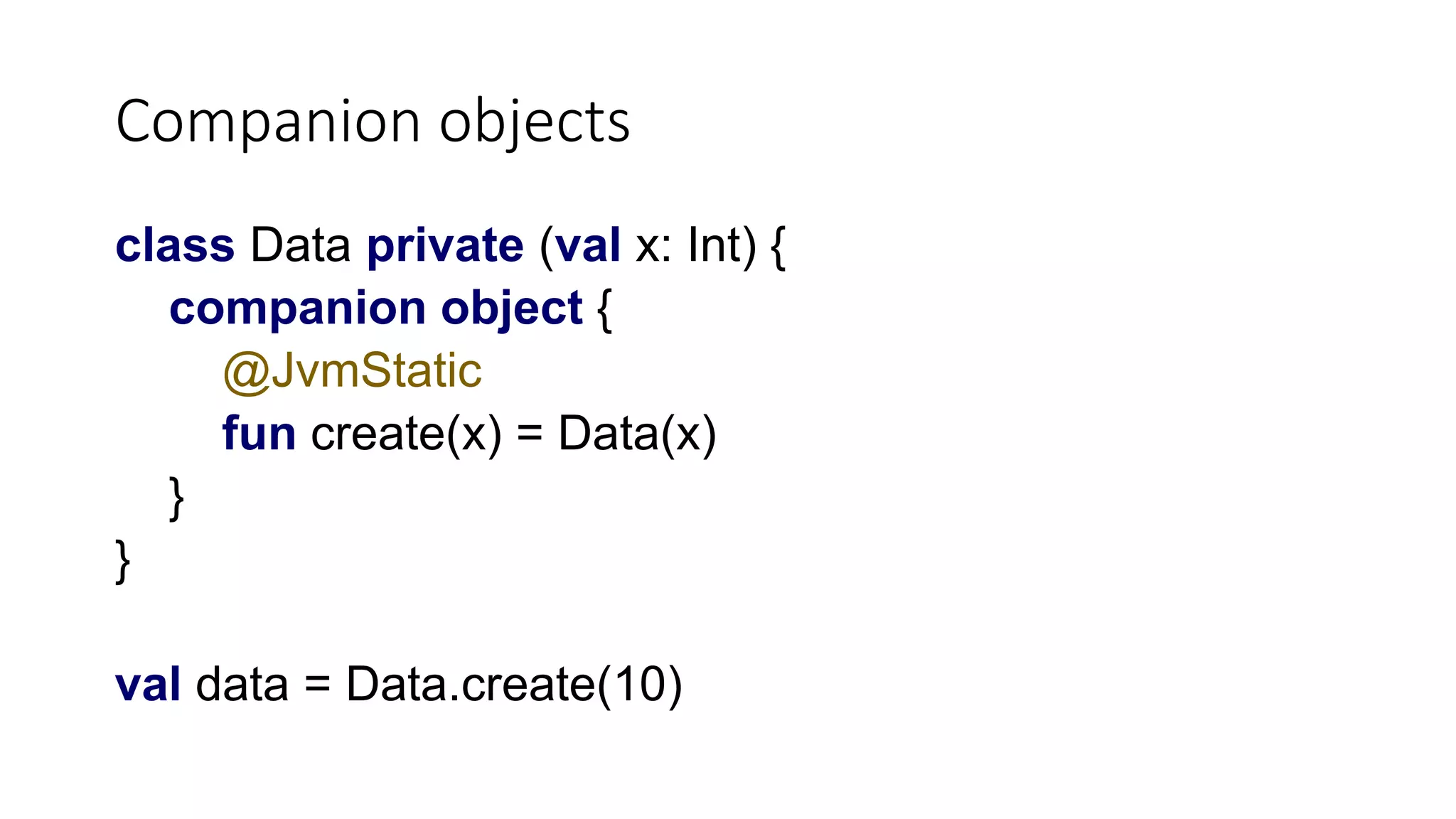
Companion objects
class Data private (val x: Int) {
companion object {
@JvmStatic
fun create(x) = Data(x)
}
}
val data = Data.create(10)
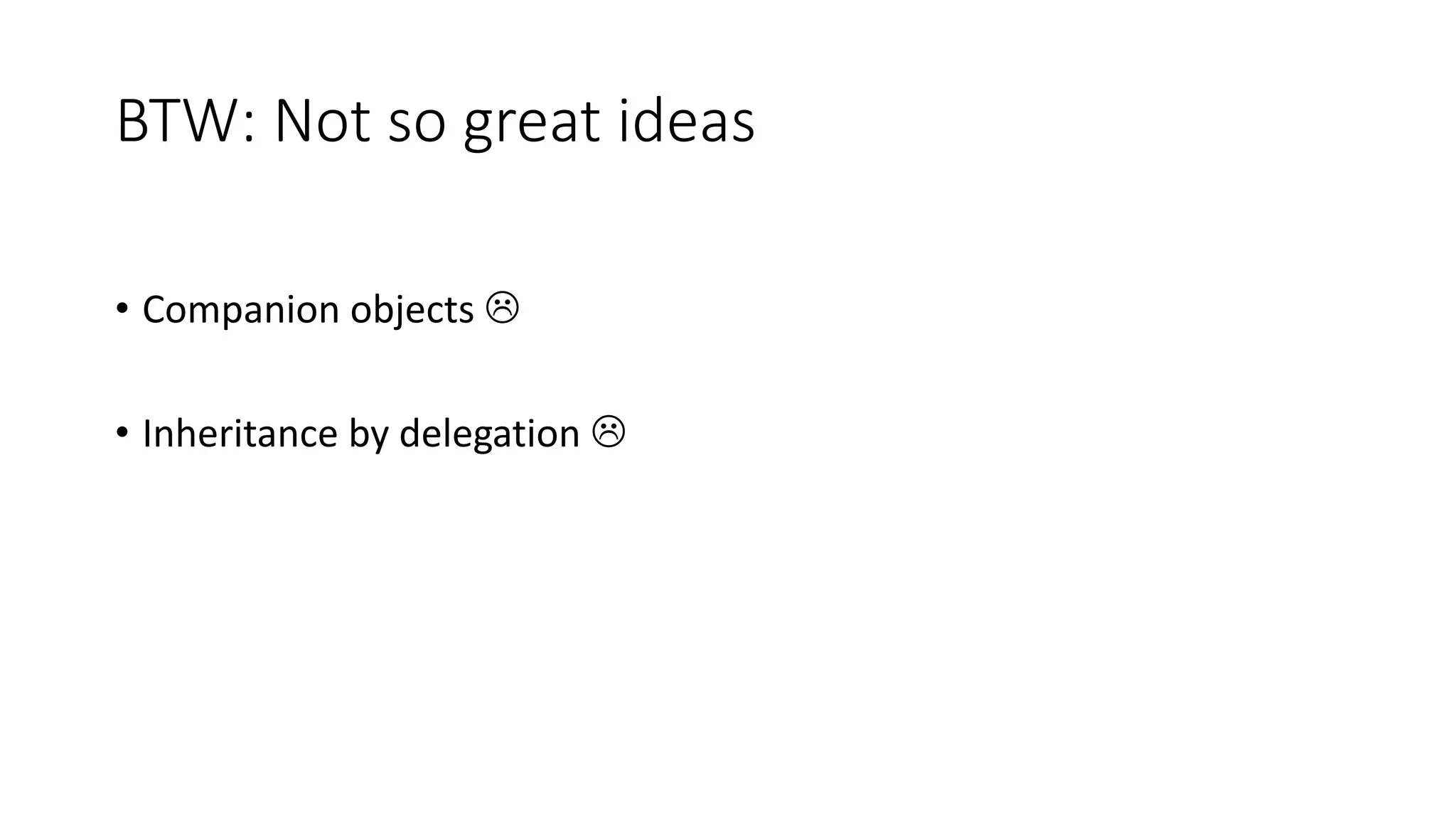
BTW: Not so great ideas
• Companion objects 
• Inheritance by delegation 
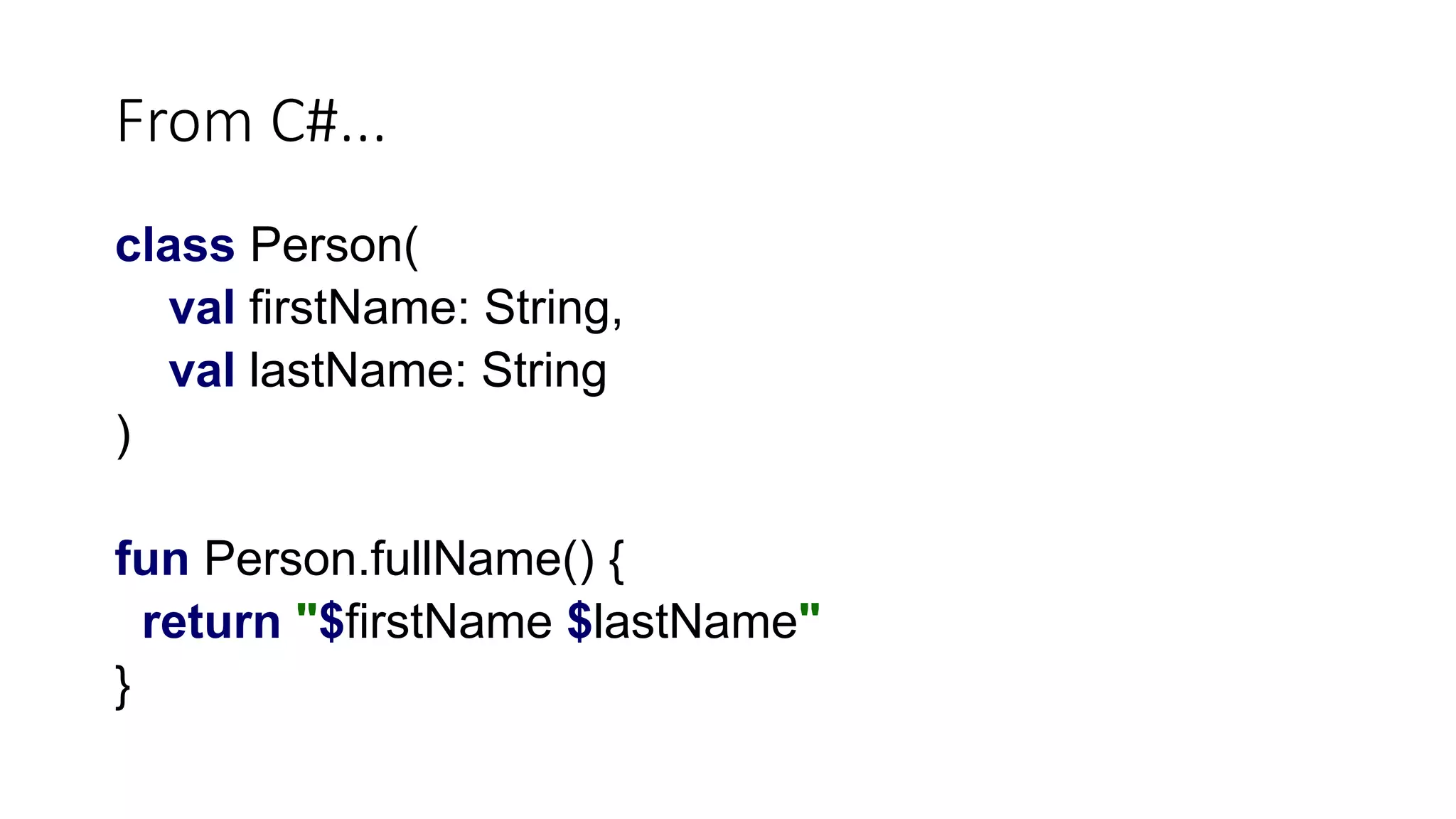
From C#...
class Person(
val firstName: String,
val lastName: String
)
fun Person.fullName() {
return "$firstName $lastName"
}
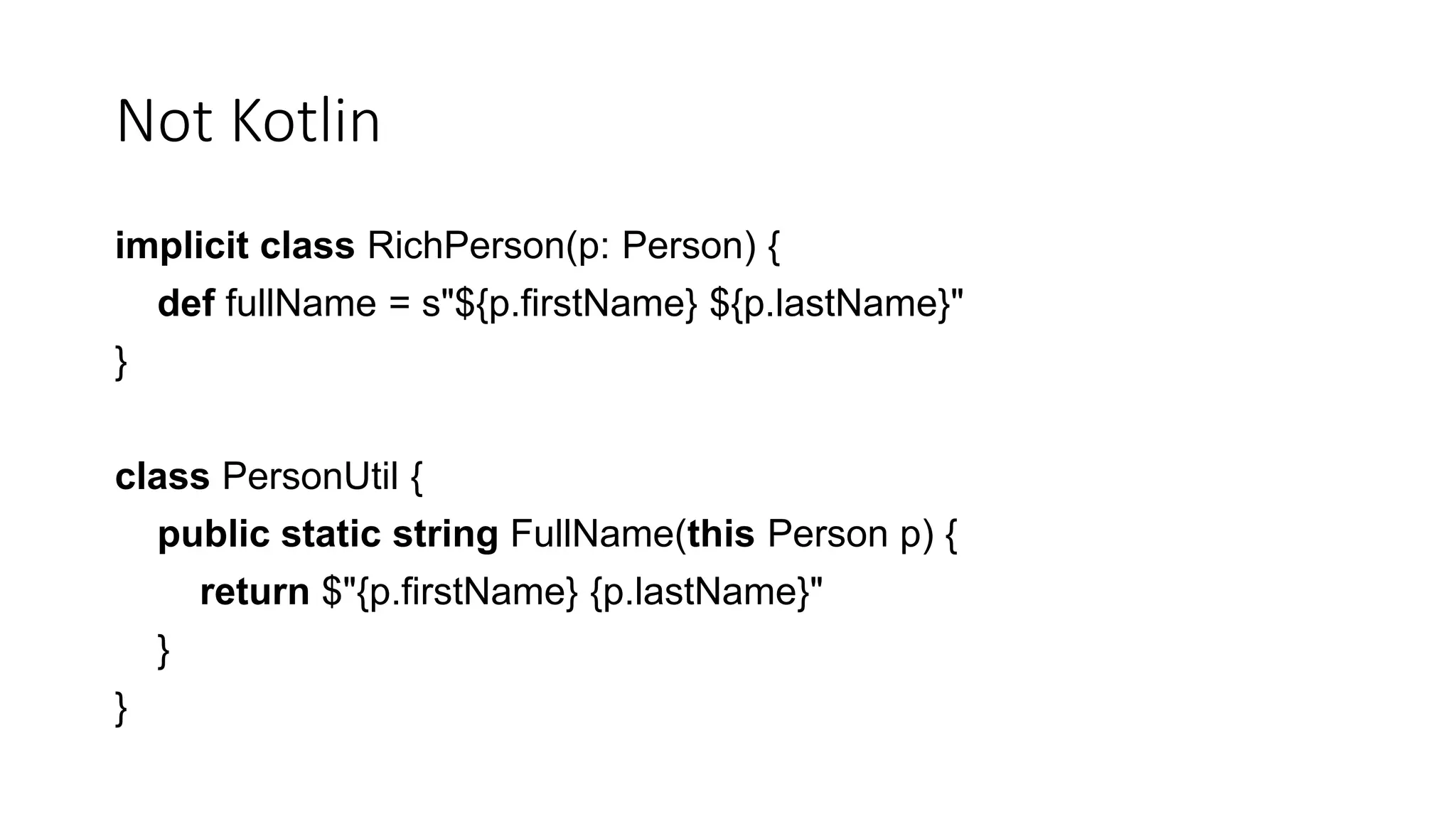
Not Kotlin
implicit class RichPerson(p: Person) {
def fullName = s"${p.firstName} ${p.lastName}"
}
class PersonUtil {
public static string FullName(this Person p) {
return $"{p.firstName} {p.lastName}"
}
}
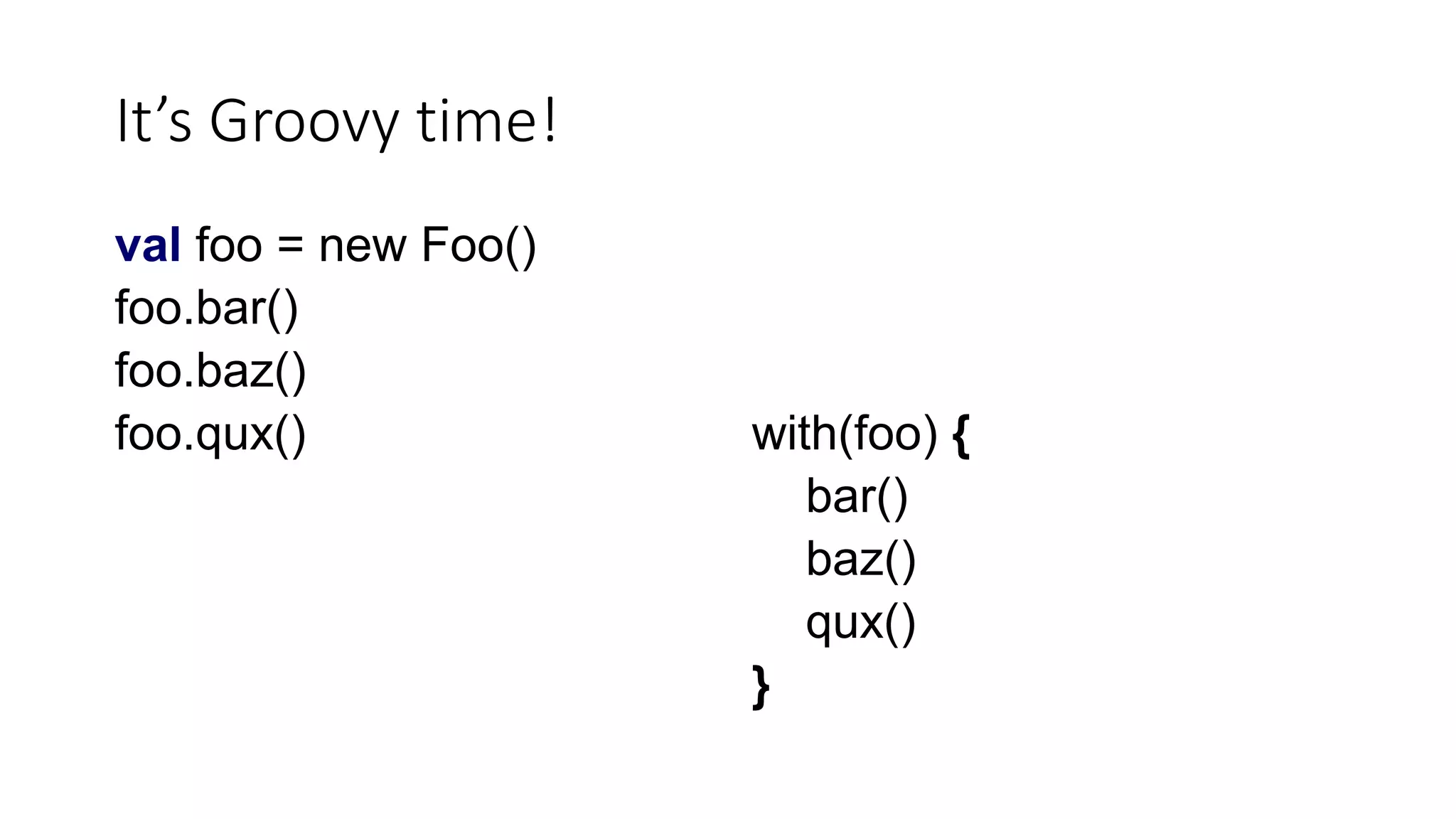
It’s Groovy time!
mylist
.filter { it.foo }
.map { it.bar }
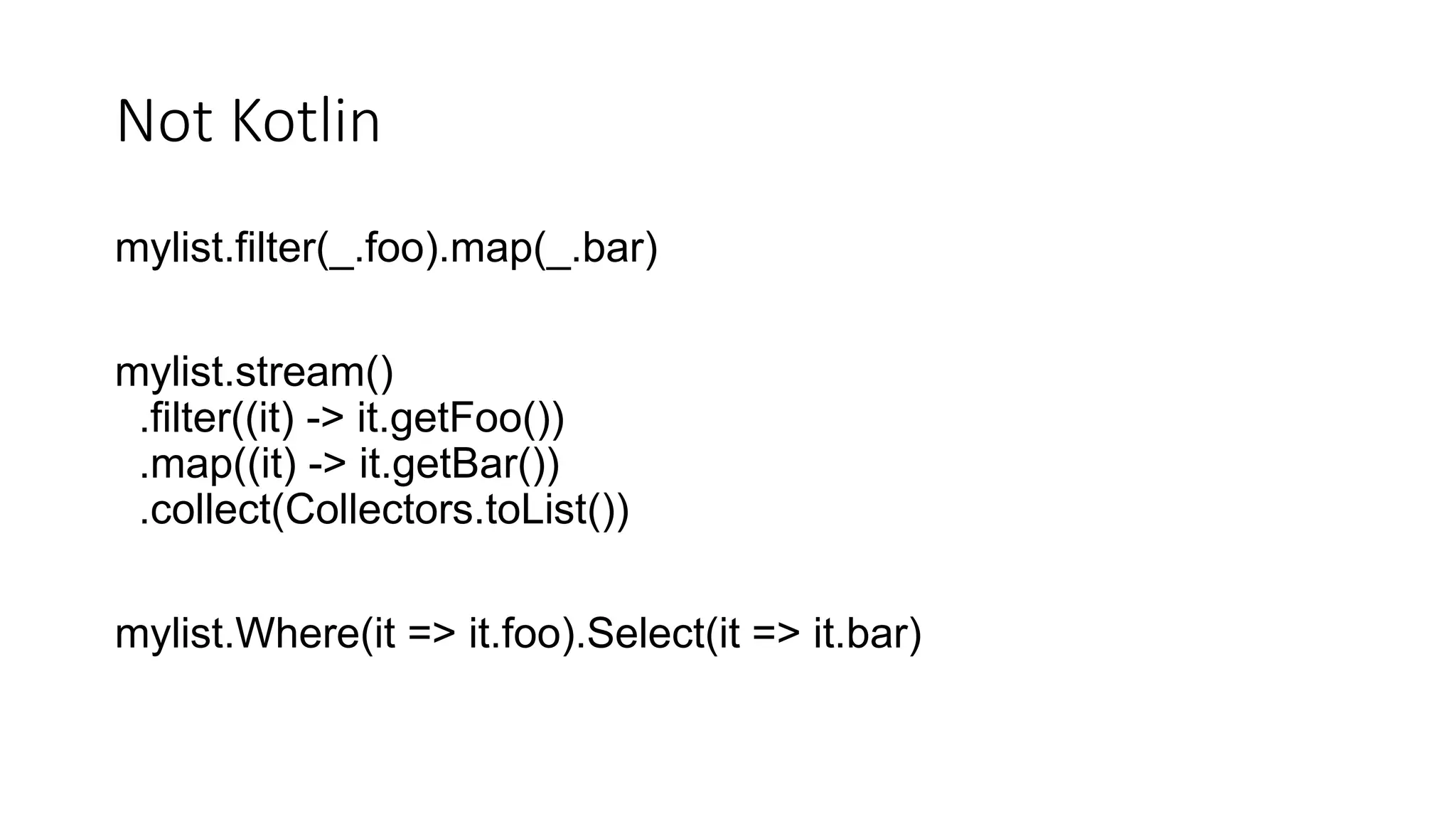
Not Kotlin
mylist.filter(_.foo).map(_.bar)
mylist.stream()
.filter((it) -> it.getFoo())
.map((it) -> it.getBar())
.collect(Collectors.toList())
mylist.Where(it => it.foo).Select(it => it.bar)
Not Kotlin (yet…)
for (it <- mylist if it.foo)
yield it.bar
from it in mylist where it.foo select it.bar
[it.bar for it in mylist if it.foo]
It’s Groovy time!
val foo = new Foo()
foo.bar()
foo.baz()
foo.qux() with(foo) {
bar()
baz()
qux()
}
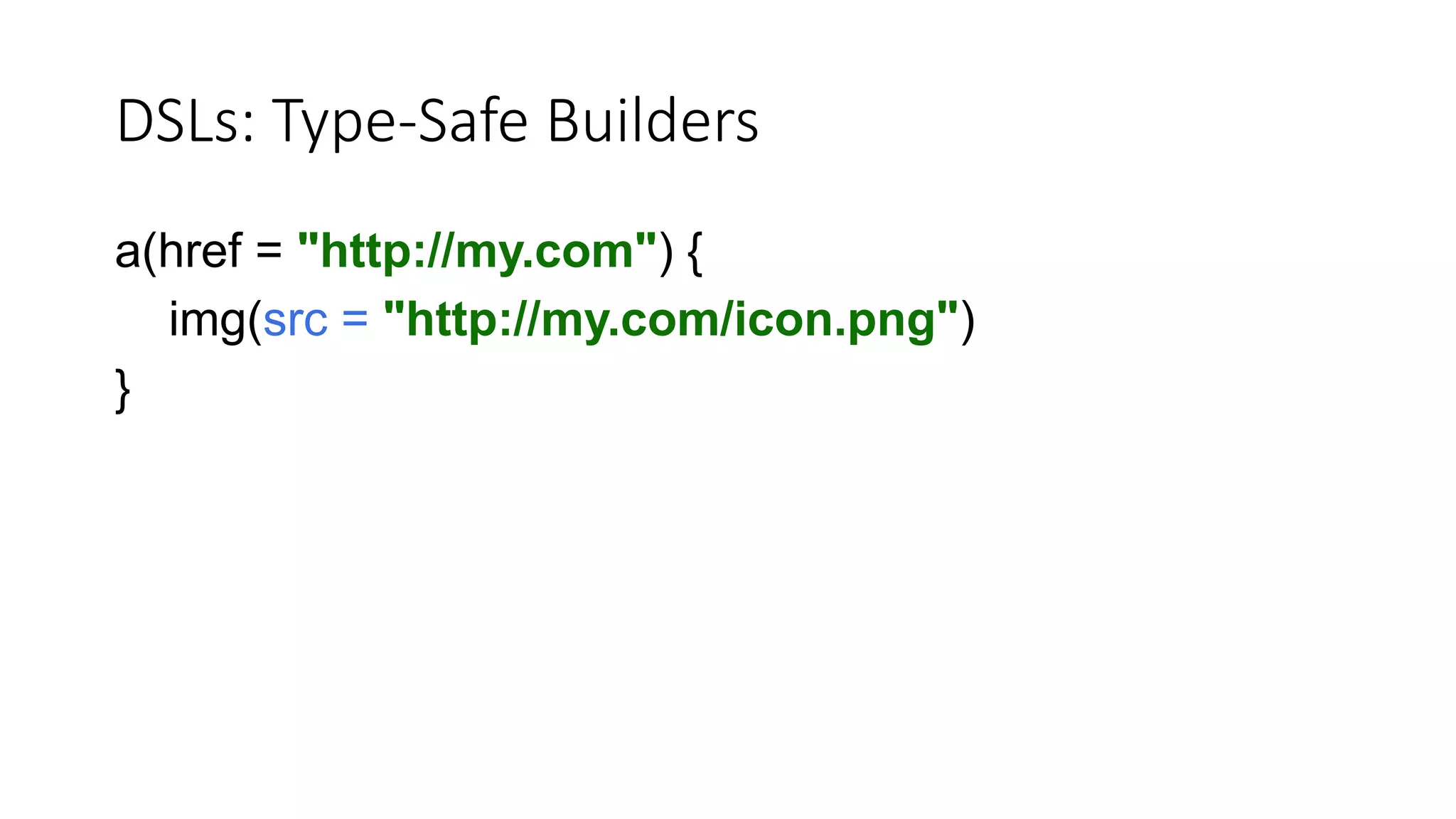
DSLs: Type-Safe Builders
a(href = "http://my.com") {
img(src = "http://my.com/icon.png")
}
Not Kotlin 
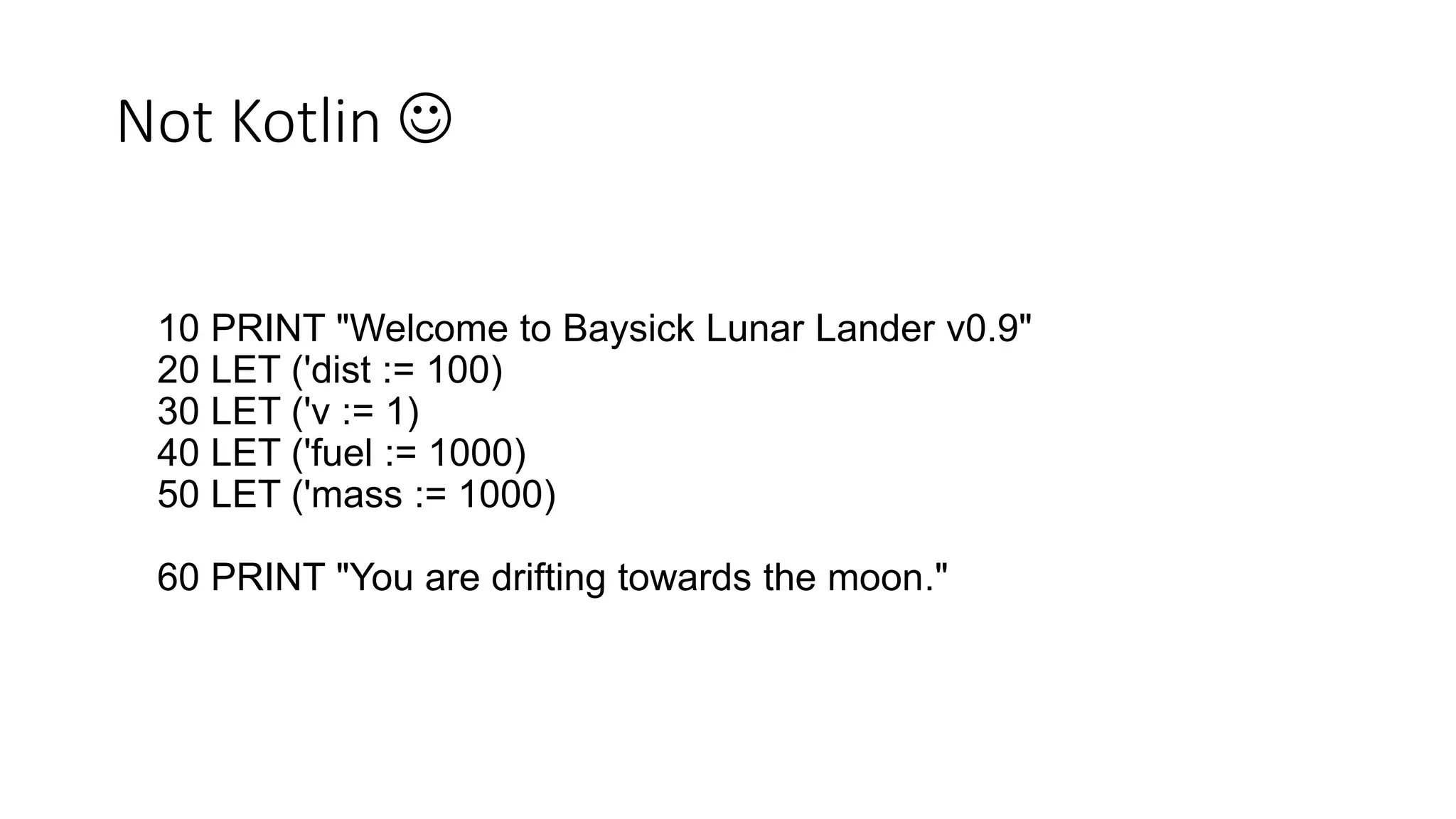
10 PRINT "Welcome to Baysick Lunar Lander v0.9"
20 LET ('dist := 100)
30 LET ('v := 1)
40 LET ('fuel := 1000)
50 LET ('mass := 1000)
60 PRINT "You are drifting towards the moon."
Not Kotlin 
object Lunar extends Baysick {
def main(args:Array[String]) = {
10 PRINT "Welcome to Baysick Lunar Lander v0.9"
20 LET ('dist := 100)
30 LET ('v := 1)
40 LET ('fuel := 1000)
50 LET ('mass := 1000)
60 PRINT "You are drifting towards the moon."
}
}
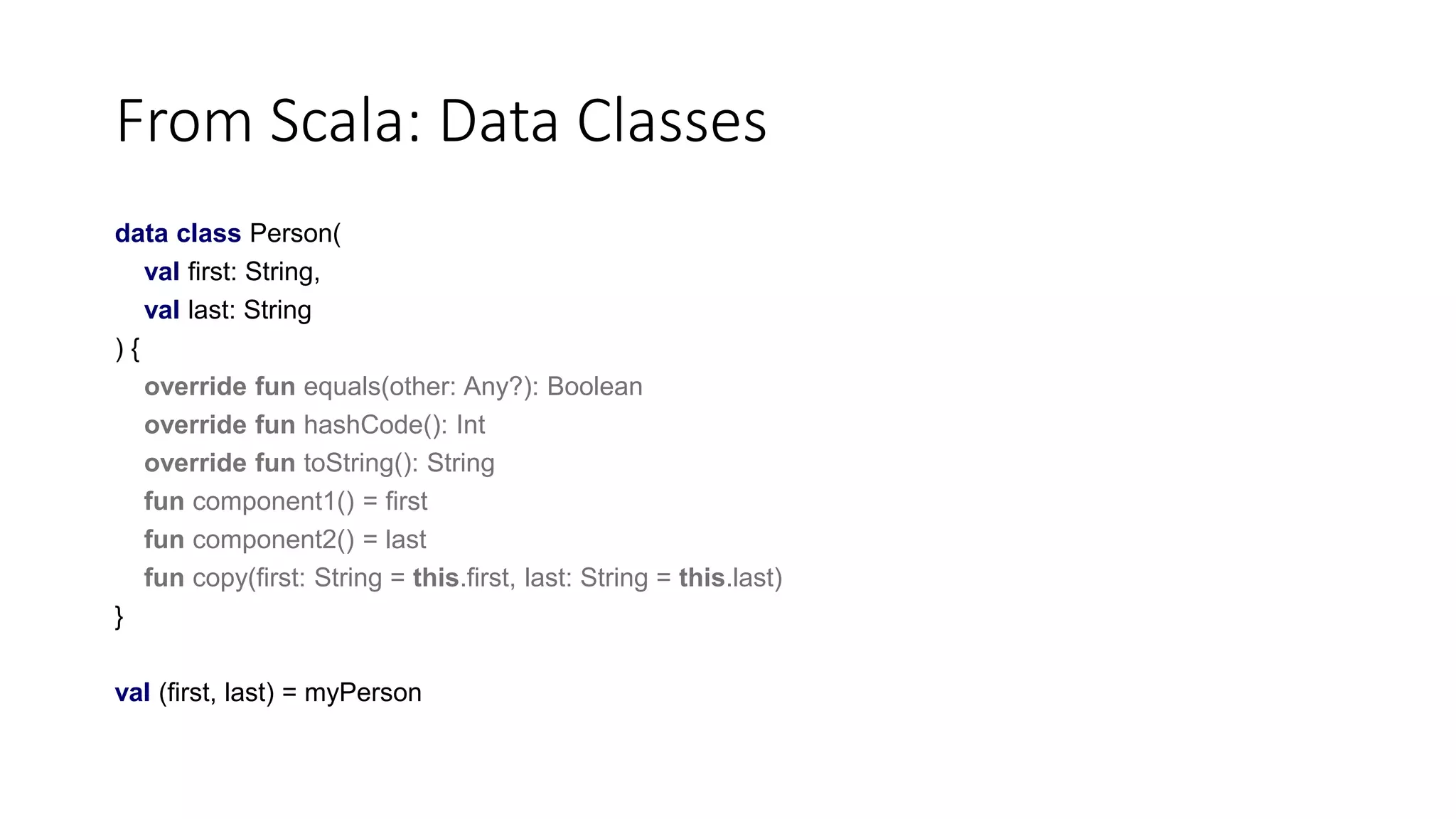
From Scala: Data Classes
data class Person(
val first: String,
val last: String
) {
override fun equals(other: Any?): Boolean
override fun hashCode(): Int
override fun toString(): String
fun component1() = first
fun component2() = last
fun copy(first: String = this.first, last: String = this.last)
}
val (first, last) = myPerson
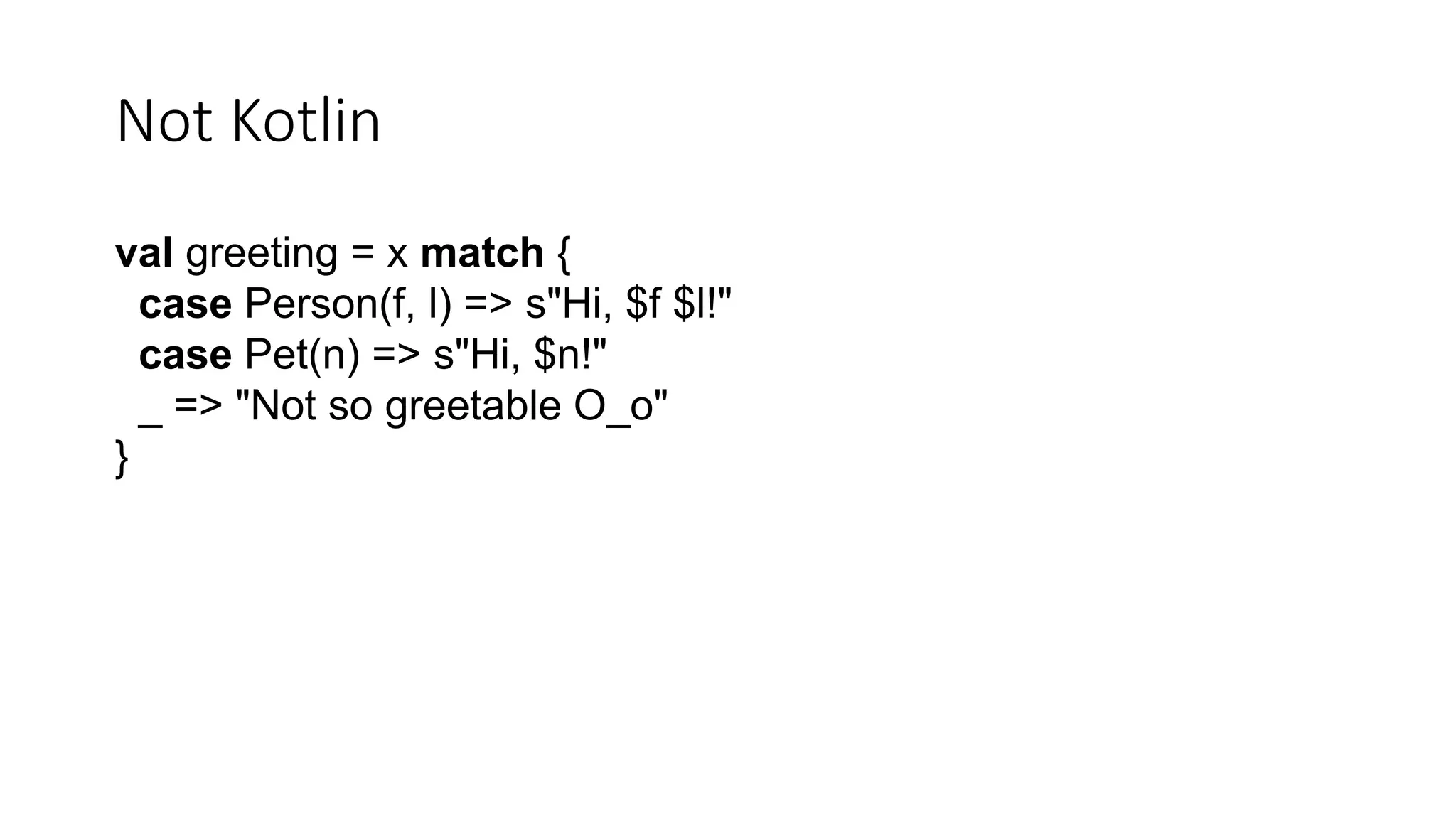
Not Kotlin
val greeting = x match {
case Person(f, l) => s"Hi, $f $l!"
case Pet(n) => s"Hi, $n!"
_ => "Not so greetable O_o"
}
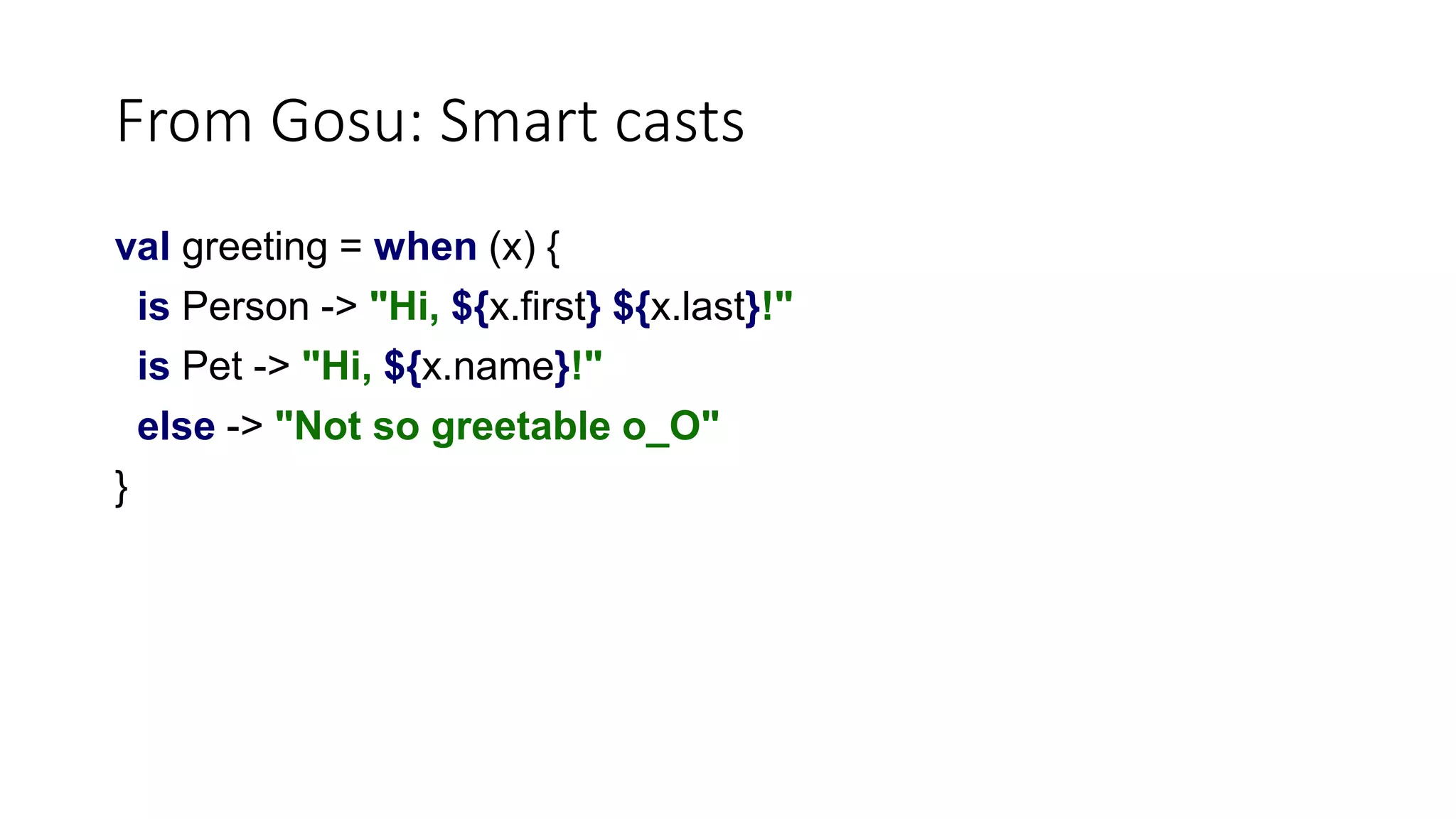
From Gosu: Smart casts
val greeting = when (x) {
is Person -> "Hi, ${x.first} ${x.last}!"
is Pet -> "Hi, ${x.name}!"
else -> "Not so greetable o_O"
}
From Groovy, C#: Elvis and friends
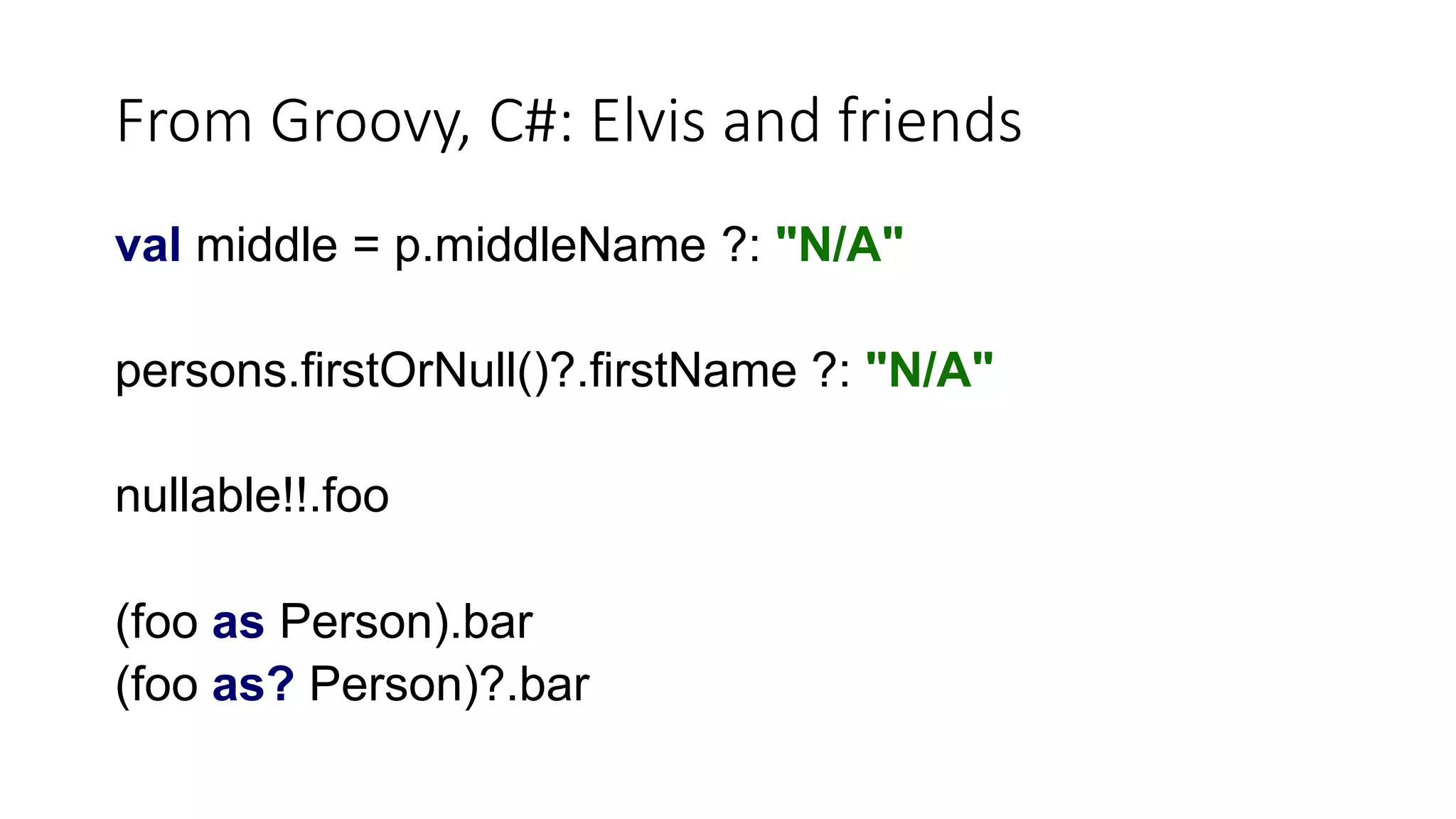
val middle = p.middleName ?: "N/A"
persons.firstOrNull()?.firstName ?: "N/A"
nullable!!.foo
(foo as Person).bar
(foo as? Person)?.bar
Java/Scala/C#: Generics
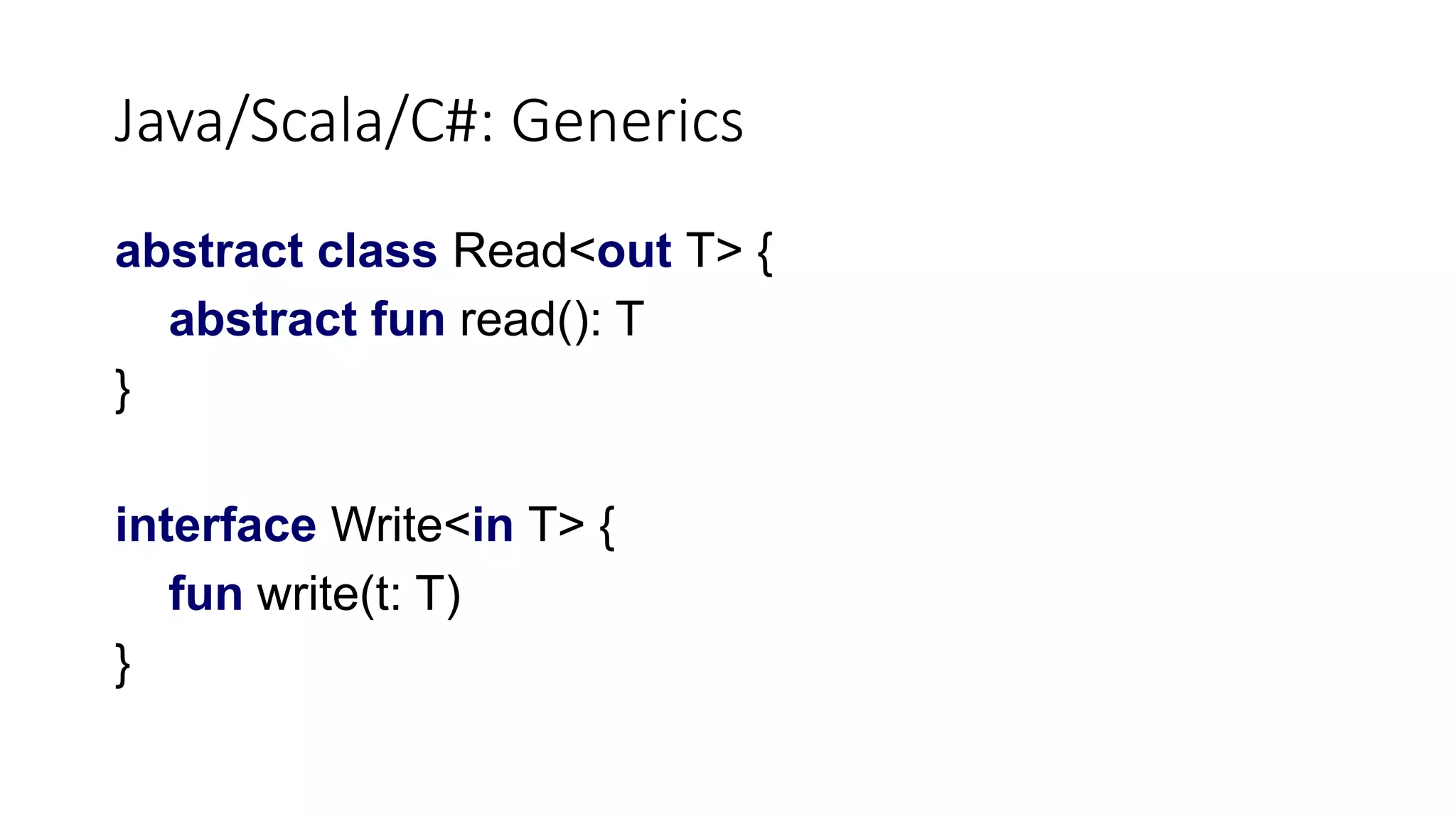
abstract class Read<out T> {
abstract fun read(): T
}
interface Write<in T> {
fun write(t: T)
}
Java/Scala/C#: Generics
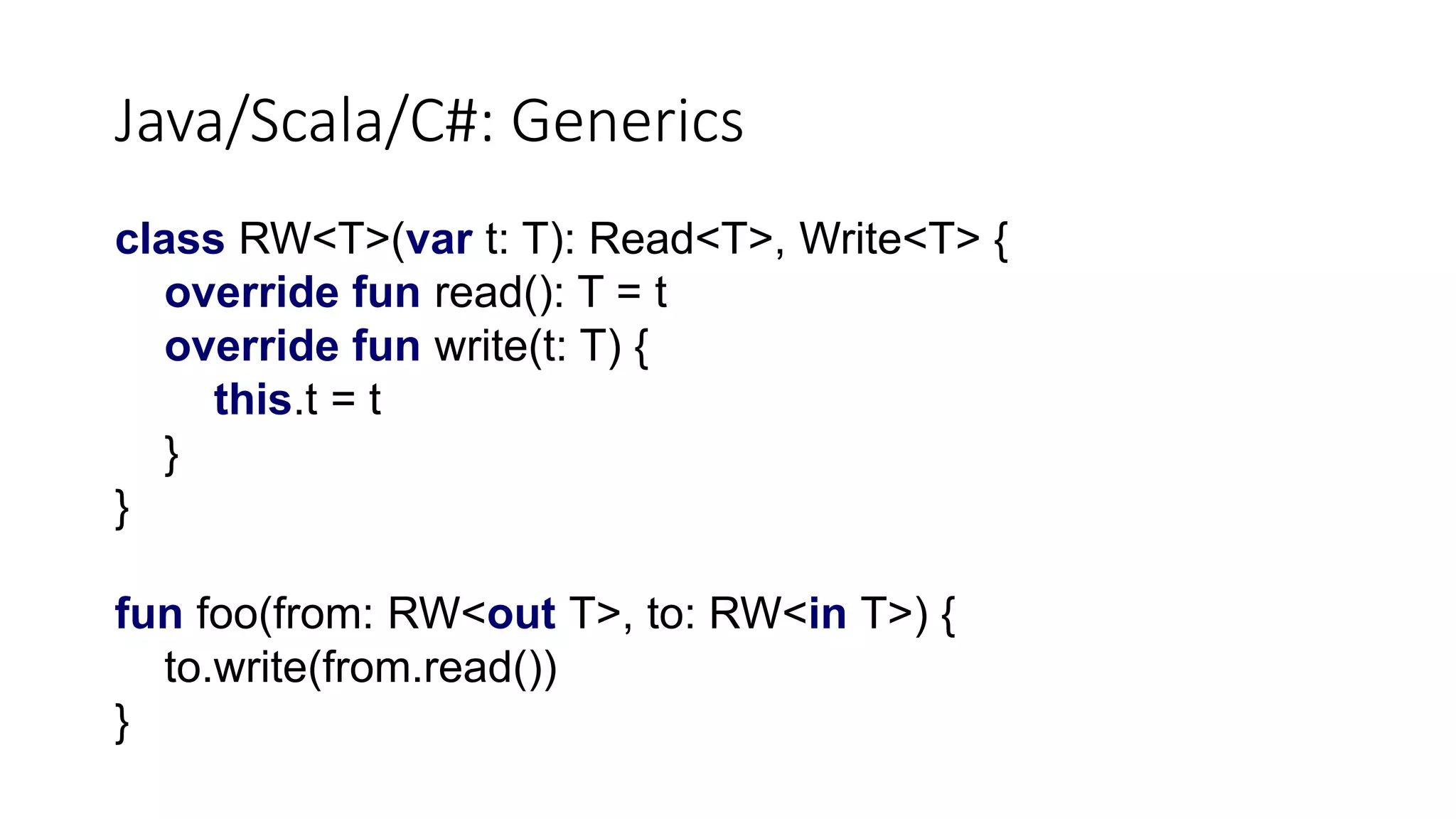
class RW<T>(var t: T): Read<T>, Write<T> {
override fun read(): T = t
override fun write(t: T) {
this.t = t
}
}
fun foo(from: RW<out T>, to: RW<in T>) {
to.write(from.read())
}
Do other languages learn from Kotlin?
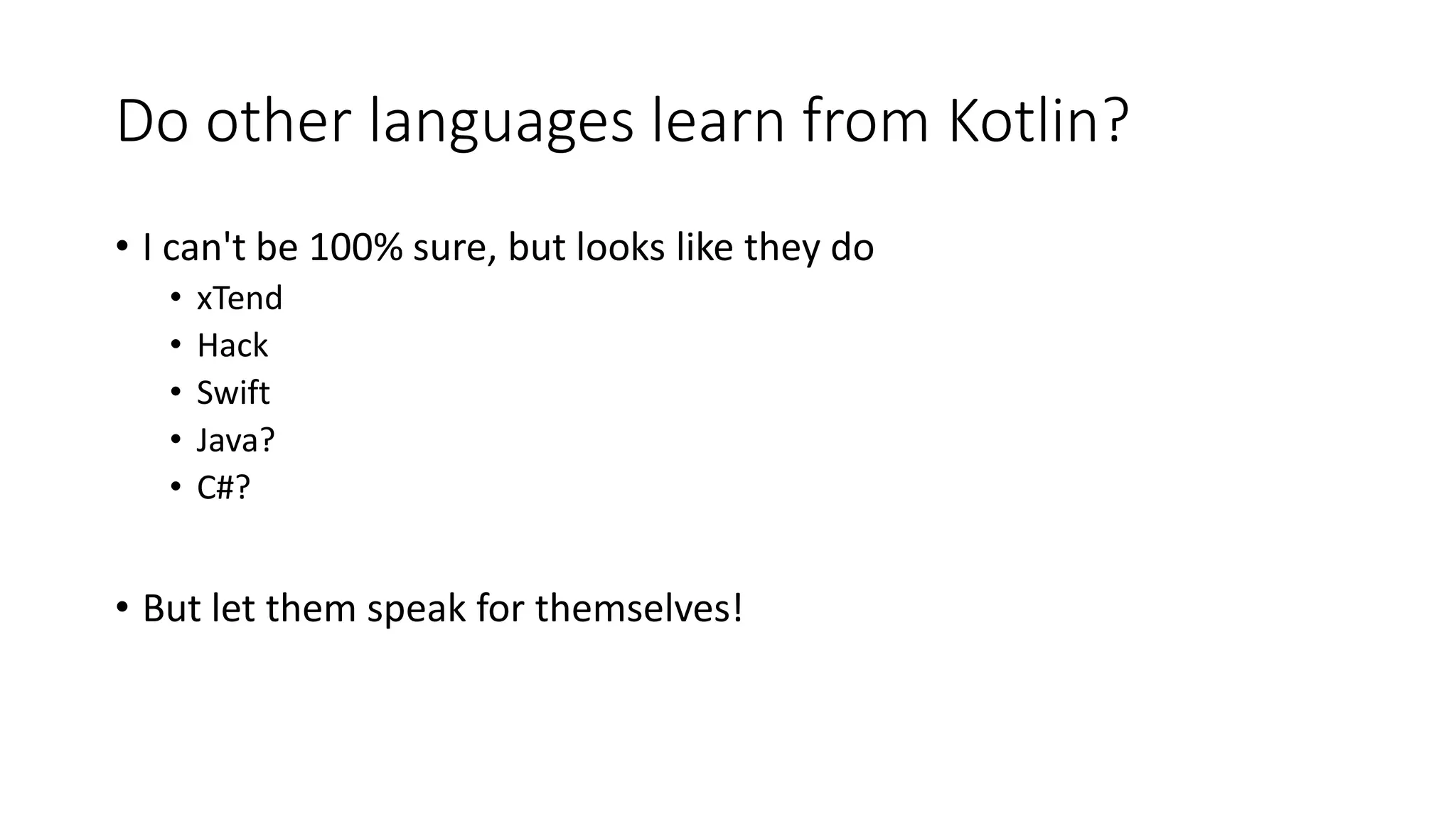
• I can't be 100% sure, but looks like they do
• xTend
• Hack
• Swift
• Java?
• C#?
• But let them speak for themselves!
My ideal world
• Everyone builds on top of others’ ideas
• Everyone openly admits it and says thank you
• Difference from academia: it’s OK to not look at some prior work 
P.S. My Personal Workaround
In practice, languages are often
selected by passion, not reason.
Much as I’d like it to be the other way around,
I see no way of changing that.
So, I’m trying to make Kotlin a
language that is loved for a reason 

Shoulders of giants: Languages Kotlin learned from

  • 1.
  • 2.
    Sir Isaac Newton IfI have seen further it is by standing on the shoulders of Giants Letter to Robert Hooke, 1675
  • 3.
    Bernard of Charters [DicebatBernardus Carnotensis nos esse quasi] nanos gigantium humeris incidentes. XII c.
  • 5.
  • 7.
    The right question Whydon’t all language designers give such talks? Every language has learned from others
  • 8.
    Is it morallywrong? Or maybe even illegal? “In science and in art, there are, and can be, few, if any things, which in an abstract sense are strictly new and original throughout. Every book in literature, science, and art borrows, and must necessarily borrow, and use much which was well known and used before.” Supreme Court Justice David Souter Campbell v. Acuff-Rose Music, Inc., 510 U.S. 569 (1994)
  • 9.
    Does it makethem worse? • Is originality what really matters to you as a developer? • Put in on the scale with productivity and maintainability  • But I want to • … stand out • … be proud of my language (and its authors) • ... win arguments with fans of other languages • … write awesome software, maybe? 
  • 10.
    What do languagedesigners think? • The Kotlin team had productive discussions with • Brian Goetz • Martin Odersky • Erik Meijer • Chris Lattner • … looking forward to having more!
  • 11.
    My ideal world •Everyone builds on top of others’ ideas • Everyone openly admits it and says thank you • Difference from academia: it’s OK to not look at some prior work 
  • 12.
    So, what languageshas Kotlin learned from?
  • 13.
    From Java: classes! •One superclass • Multiple superinterfaces • No state in interfaces • Constructors (no destructors) • Nested/inner classes • Annotations • Method overloading • One root class • toString/equals/hashCode • Autoboxing • Erased generics • Runtime safety guarantees
  • 14.
    Leaving things out:Java • Monitor in every object • finalize() • Covariant arrays • Everything implicitly nullable • Primitive types are not classes • Mutable collection interfaces • Static vs instance methods • Raw types • …
  • 15.
    From Java… class C: BaseClass, I1, I2 { class Nested { ... } inner class Inner { ... } }
  • 16.
    From Scala, C#... classC(p: Int, val pp: I1) : B(p, pp) { internal var foo: Int set(v) { field = check(v) } override fun toString() = "..." }
  • 17.
    Not Kotlin class Person{ private var _name: String def name = _name def name_=(aName: String) { _name = aName } }
  • 18.
    Not Kotlin class Person{ private string _Name; public string Name { get { return _Name; } set { _Name = value } } }
  • 19.
    Kotlin class Person { privatevar _name = "..." var name: String get() = _name set(v) { _name = v } }
  • 20.
    Leaving things out:Interfaces vs Scala Traits • No state allowed • no fields • no constructors • Order doesn’t matter • no linearization rules • Delegation through by
  • 21.
    Some (more) differences… classC(d: Intf) : Intf by d { init { println(d) } fun def(x: Int = 1) { ... } fun test() { def(x = 2) } }
  • 22.
    And a bitmore… val person = Person("Jane", "Doe") val anonymous = object : Base() { override fun foo() { ... } }
  • 23.
    From Scala… object Singleton: Base(foo) { val bar = ... fun baz(): String { ... } } Singleton.baz()
  • 24.
    Companion objects class Dataprivate (val x: Int) { companion object { fun create(x) = Data(x) } } val data = Data.create(10)
  • 25.
    Companion objects class Dataprivate (val x: Int) { companion object { @JvmStatic fun create(x) = Data(x) } } val data = Data.create(10)
  • 26.
    BTW: Not sogreat ideas • Companion objects  • Inheritance by delegation 
  • 27.
    From C#... class Person( valfirstName: String, val lastName: String ) fun Person.fullName() { return "$firstName $lastName" }
  • 28.
    Not Kotlin implicit classRichPerson(p: Person) { def fullName = s"${p.firstName} ${p.lastName}" } class PersonUtil { public static string FullName(this Person p) { return $"{p.firstName} {p.lastName}" } }
  • 29.
    It’s Groovy time! mylist .filter{ it.foo } .map { it.bar }
  • 30.
    Not Kotlin mylist.filter(_.foo).map(_.bar) mylist.stream() .filter((it) ->it.getFoo()) .map((it) -> it.getBar()) .collect(Collectors.toList()) mylist.Where(it => it.foo).Select(it => it.bar)
  • 31.
    Not Kotlin (yet…) for(it <- mylist if it.foo) yield it.bar from it in mylist where it.foo select it.bar [it.bar for it in mylist if it.foo]
  • 32.
    It’s Groovy time! valfoo = new Foo() foo.bar() foo.baz() foo.qux() with(foo) { bar() baz() qux() }
  • 33.
    DSLs: Type-Safe Builders a(href= "http://my.com") { img(src = "http://my.com/icon.png") }
  • 34.
    Not Kotlin  10PRINT "Welcome to Baysick Lunar Lander v0.9" 20 LET ('dist := 100) 30 LET ('v := 1) 40 LET ('fuel := 1000) 50 LET ('mass := 1000) 60 PRINT "You are drifting towards the moon."
  • 35.
    Not Kotlin  objectLunar extends Baysick { def main(args:Array[String]) = { 10 PRINT "Welcome to Baysick Lunar Lander v0.9" 20 LET ('dist := 100) 30 LET ('v := 1) 40 LET ('fuel := 1000) 50 LET ('mass := 1000) 60 PRINT "You are drifting towards the moon." } }
  • 36.
    From Scala: DataClasses data class Person( val first: String, val last: String ) { override fun equals(other: Any?): Boolean override fun hashCode(): Int override fun toString(): String fun component1() = first fun component2() = last fun copy(first: String = this.first, last: String = this.last) } val (first, last) = myPerson
  • 37.
    Not Kotlin val greeting= x match { case Person(f, l) => s"Hi, $f $l!" case Pet(n) => s"Hi, $n!" _ => "Not so greetable O_o" }
  • 38.
    From Gosu: Smartcasts val greeting = when (x) { is Person -> "Hi, ${x.first} ${x.last}!" is Pet -> "Hi, ${x.name}!" else -> "Not so greetable o_O" }
  • 39.
    From Groovy, C#:Elvis and friends val middle = p.middleName ?: "N/A" persons.firstOrNull()?.firstName ?: "N/A" nullable!!.foo (foo as Person).bar (foo as? Person)?.bar
  • 40.
    Java/Scala/C#: Generics abstract classRead<out T> { abstract fun read(): T } interface Write<in T> { fun write(t: T) }
  • 41.
    Java/Scala/C#: Generics class RW<T>(vart: T): Read<T>, Write<T> { override fun read(): T = t override fun write(t: T) { this.t = t } } fun foo(from: RW<out T>, to: RW<in T>) { to.write(from.read()) }
  • 42.
    Do other languageslearn from Kotlin? • I can't be 100% sure, but looks like they do • xTend • Hack • Swift • Java? • C#? • But let them speak for themselves!
  • 43.
    My ideal world •Everyone builds on top of others’ ideas • Everyone openly admits it and says thank you • Difference from academia: it’s OK to not look at some prior work 
  • 44.
    P.S. My PersonalWorkaround In practice, languages are often selected by passion, not reason. Much as I’d like it to be the other way around, I see no way of changing that. So, I’m trying to make Kotlin a language that is loved for a reason 

Editor's Notes

  • #2 https://upload.wikimedia.org/wikipedia/commons/4/4a/Library_of_Congress%2C_Rosenwald_4%2C_Bl._5r.jpg
  • #3 https://upload.wikimedia.org/wikipedia/commons/3/39/GodfreyKneller-IsaacNewton-1689.jpg
  • #4 https://upload.wikimedia.org/wikipedia/commons/3/39/GodfreyKneller-IsaacNewton-1689.jpg
  • #5 https://upload.wikimedia.org/wikipedia/commons/4/4a/Library_of_Congress%2C_Rosenwald_4%2C_Bl._5r.jpg
  • #7 https://upload.wikimedia.org/wikipedia/commons/thumb/6/66/Warsaw_Pillow_Fight_2010_%284488607206%29.jpg/1280px-Warsaw_Pillow_Fight_2010_%284488607206%29.jpg
  • #9 https://en.wikipedia.org/wiki/David_Souter#/media/File:DavidSouter.jpg