Shortest Path
Algorithm
 DIJIKSTRA ALGORITHM
 BELLMEN ALGORITHM
 FLOYED WARSHALL ALGORITHM
Shortest Path Algorithm
 An algorithm that is designed essentially to
find a path of minimum length between two
specified vertices of a connected weighted
graph.
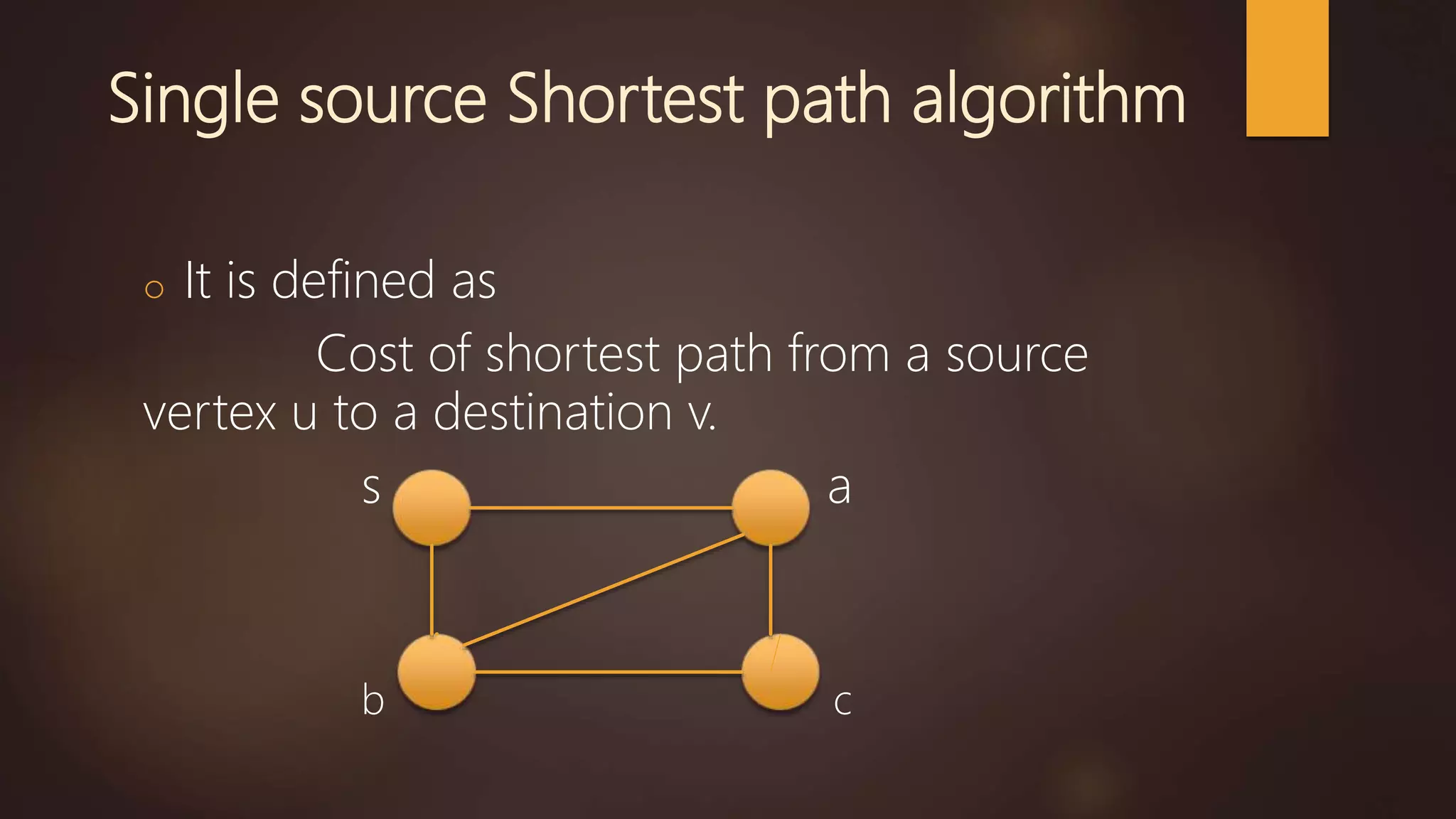
Single source Shortest path algorithm
o It is defined as
Cost of shortest path from a source
vertex u to a destination v.
s a
b c
Dijkstra’s Algorithm
Dijkstra’s algorithm is a greedy algorithm for
solving single source shortest path problem
that provide us with the shortest path from one
particular source node to all other nodes in the
given graph .
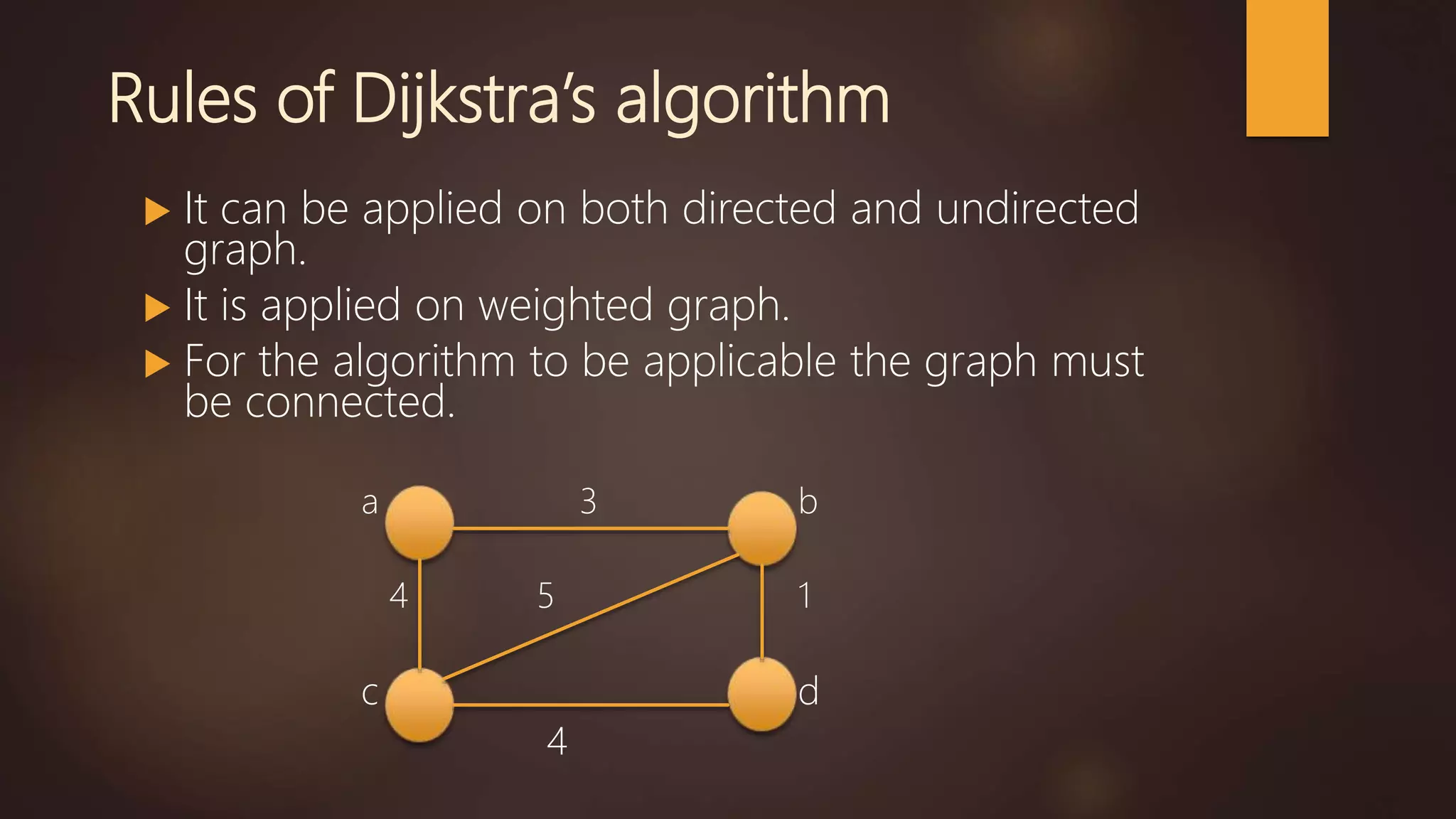
Rules of Dijkstra’s algorithm
 It can be applied on both directed and undirected
graph.
 It is applied on weighted graph.
 For the algorithm to be applicable the graph must
be connected.
a 3 b
4 5 1
c d
4
Cont…
 Dijkstra’s algorithm does not work for graphs with
negative weight edges. For graphs with negative
weight edges, Bellman_ford algorithm can be used.
 In Dijkstra’s algorithm always assign source vertex to
zero distance.
 Assign every other node a tentative distance.
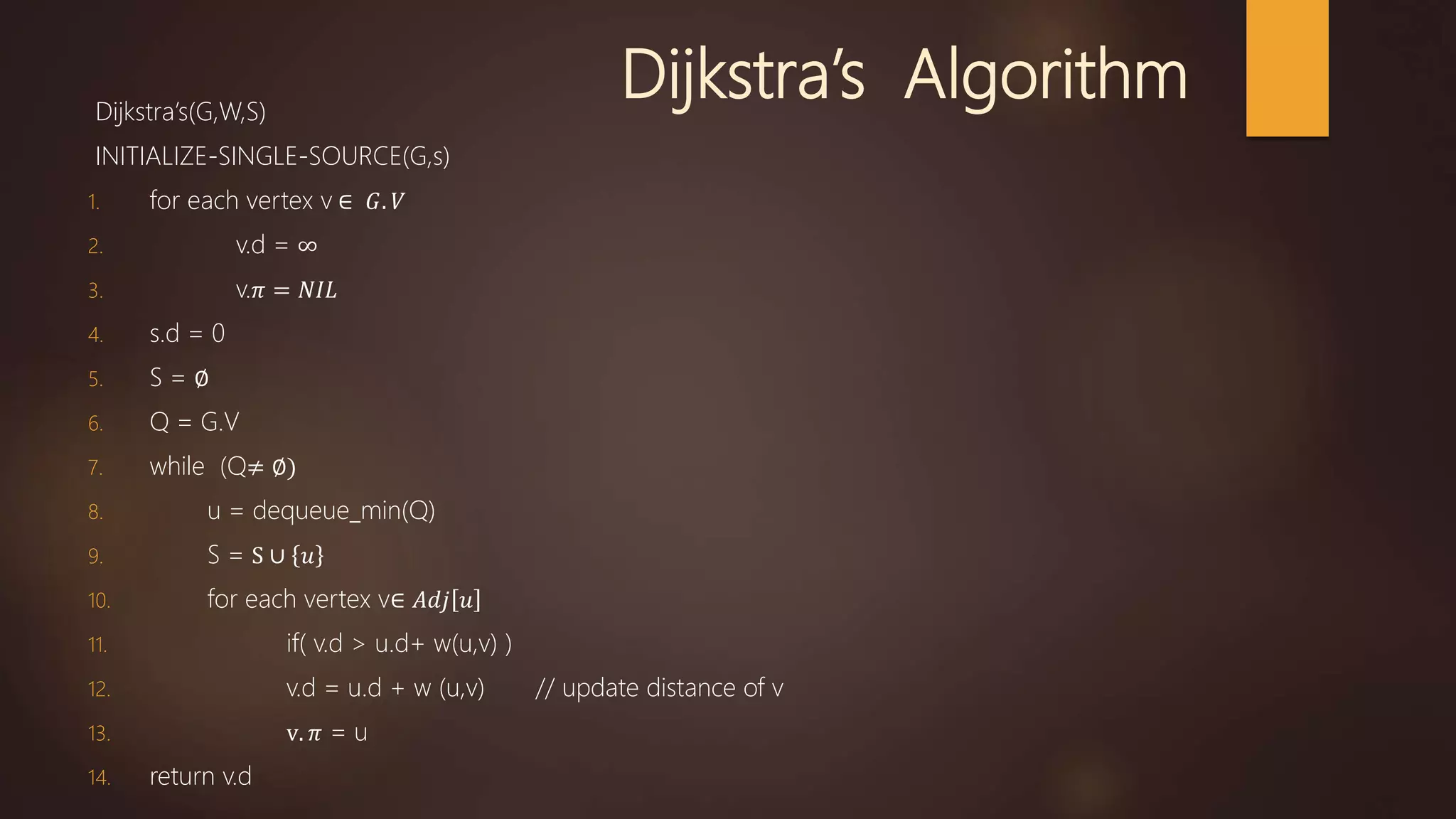
Dijkstra’s AlgorithmDijkstra’s(G,W,S)
INITIALIZE-SINGLE-SOURCE(G,s)
1. for each vertex v ∈ 𝐺. 𝑉
2. v.d = ∞
3. v.𝜋 = 𝑁𝐼𝐿
4. s.d = 0
5. S = ∅
6. Q = G.V
7. while (Q≠ ∅)
8. u = dequeue_min(Q)
9. S = S ∪ 𝑢
10. for each vertex v∈ 𝐴𝑑𝑗 𝑢
11. if( v.d > u.d+ w(u,v) )
12. v.d = u.d + w (u,v) // update distance of v
13. v. 𝜋 = u
14. return v.d
BellMan-Algorithm
 Bellman–Ford algorithm. The Bellman–Ford
algorithm is an algorithm that computes shortest
paths from a single source vertex to all of the other
vertices in a weighted digraph. ... Negative edge
weights are found in various applications of graphs,
hence the usefulness of this algorithm.
Cont..
 It is similar to Dijkstra's algorithm but it can work
with graphs in which edges can have negative
weights.
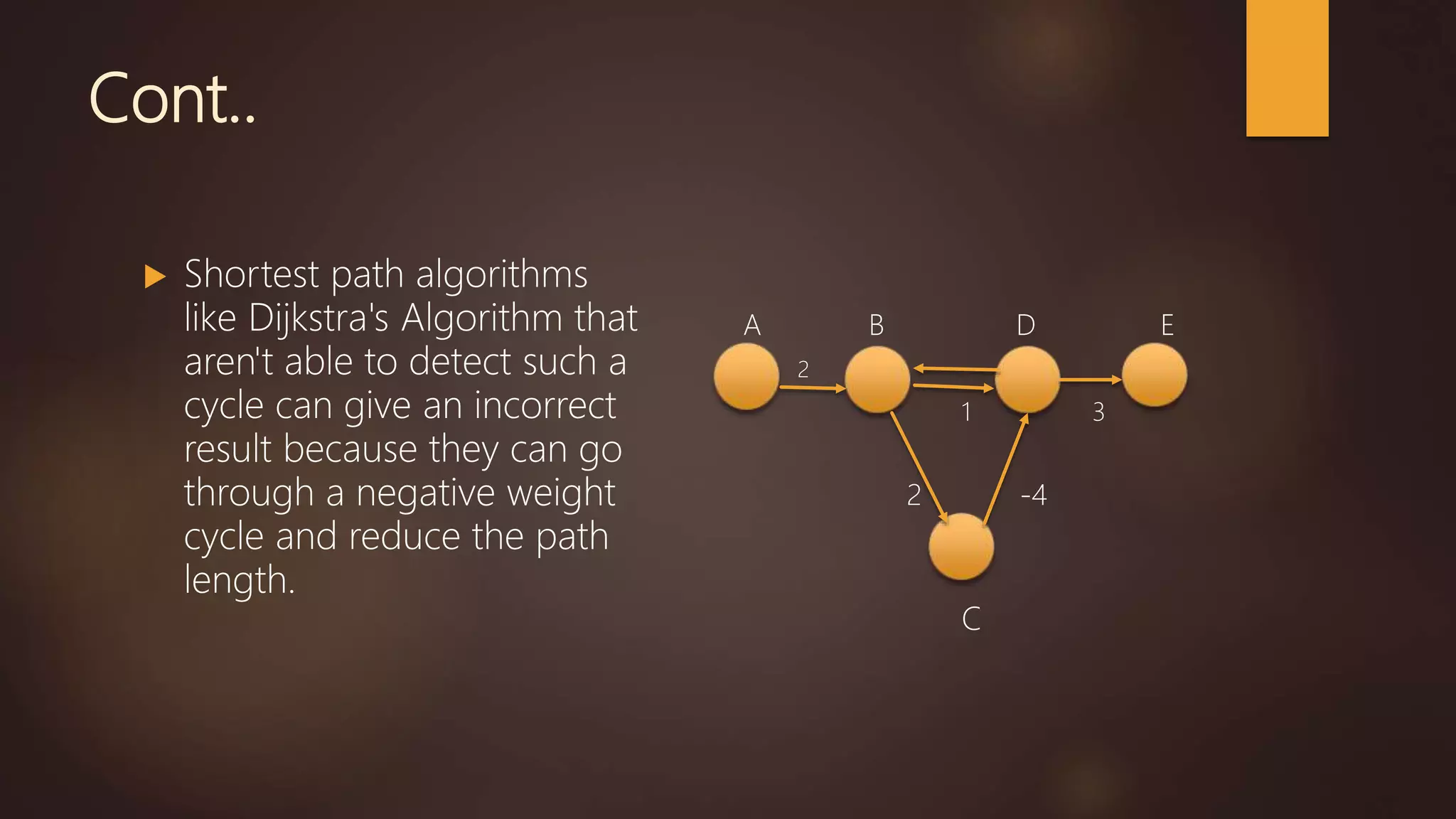
 Negative weight edges can create negative weight
cycles i.e. a cycle which will reduce the total path
distance by coming back to the same point.
Cont..
 Shortest path algorithms
like Dijkstra's Algorithm that
aren't able to detect such a
cycle can give an incorrect
result because they can go
through a negative weight
cycle and reduce the path
length.
A B D E
2
1 3
2 -4
C
Uses of Algorithm
 This algorithm can be used on both weighted and
unweighted graphs.
 Like Dijkstra's shortest path algorithm, the Bellman-Ford
algorithm is guaranteed to find the shortest path in a graph.
 Though it is slower than Dijkstra's algorithm, Bellman-Ford is
capable of handling graphs that contain negative edge
weights, so it is more versatile.
ALGORITHM
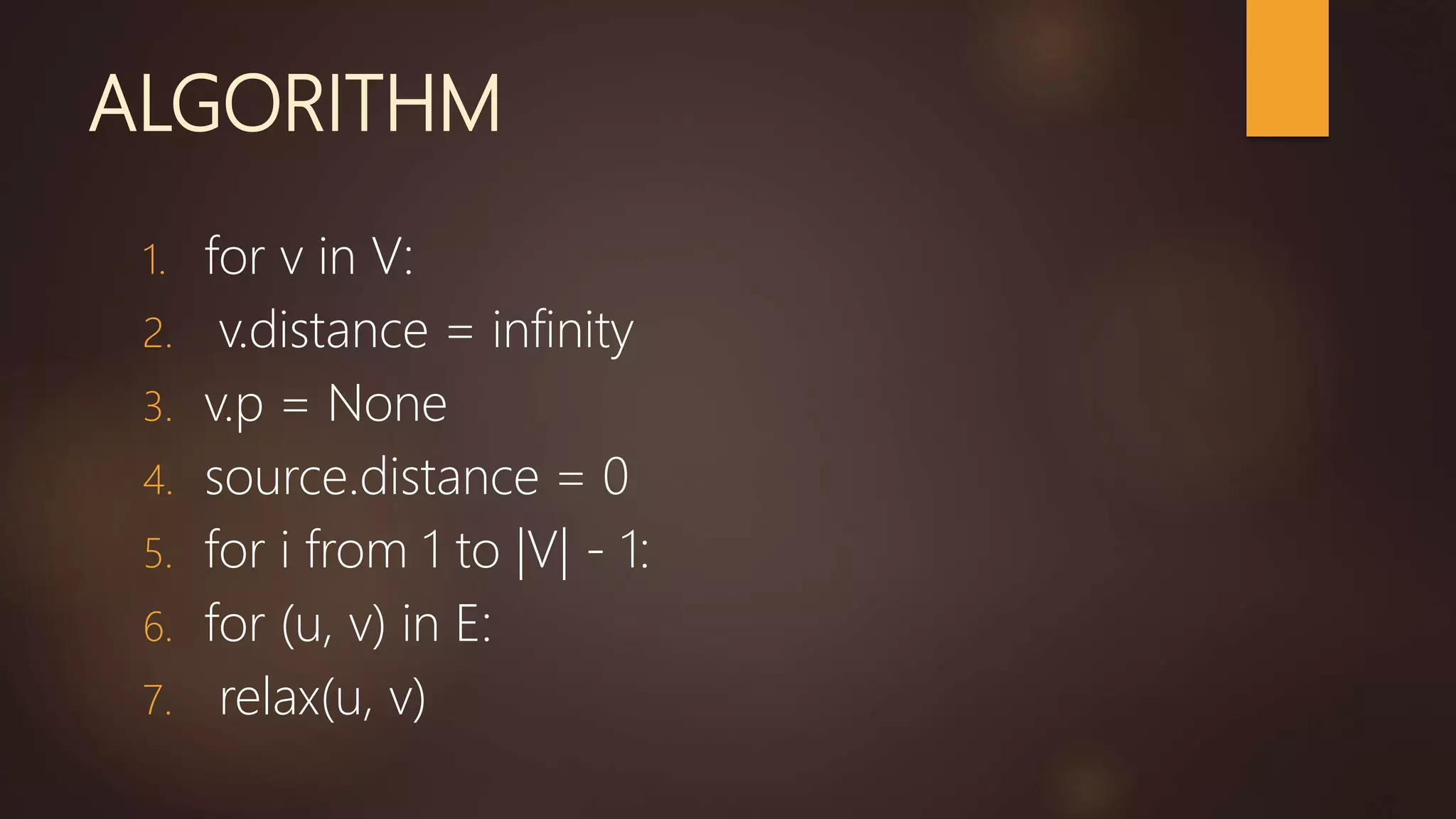
1. for v in V:
2. v.distance = infinity
3. v.p = None
4. source.distance = 0
5. for i from 1 to |V| - 1:
6. for (u, v) in E:
7. relax(u, v)
Explanation
 The first for loop sets the distance to each vertex in
the graph to infinity. This is later changed for the
source vertex to equal zero. Also in that first for loop,
the p value for each vertex is set to nothing. This
value is a pointer to a predecessor vertex so that we
can create a path later.
 The next for loop simply goes through each edge (u,
v) in E and relaxes it. This process is done |V| - 1 times.
Relaxation Equation
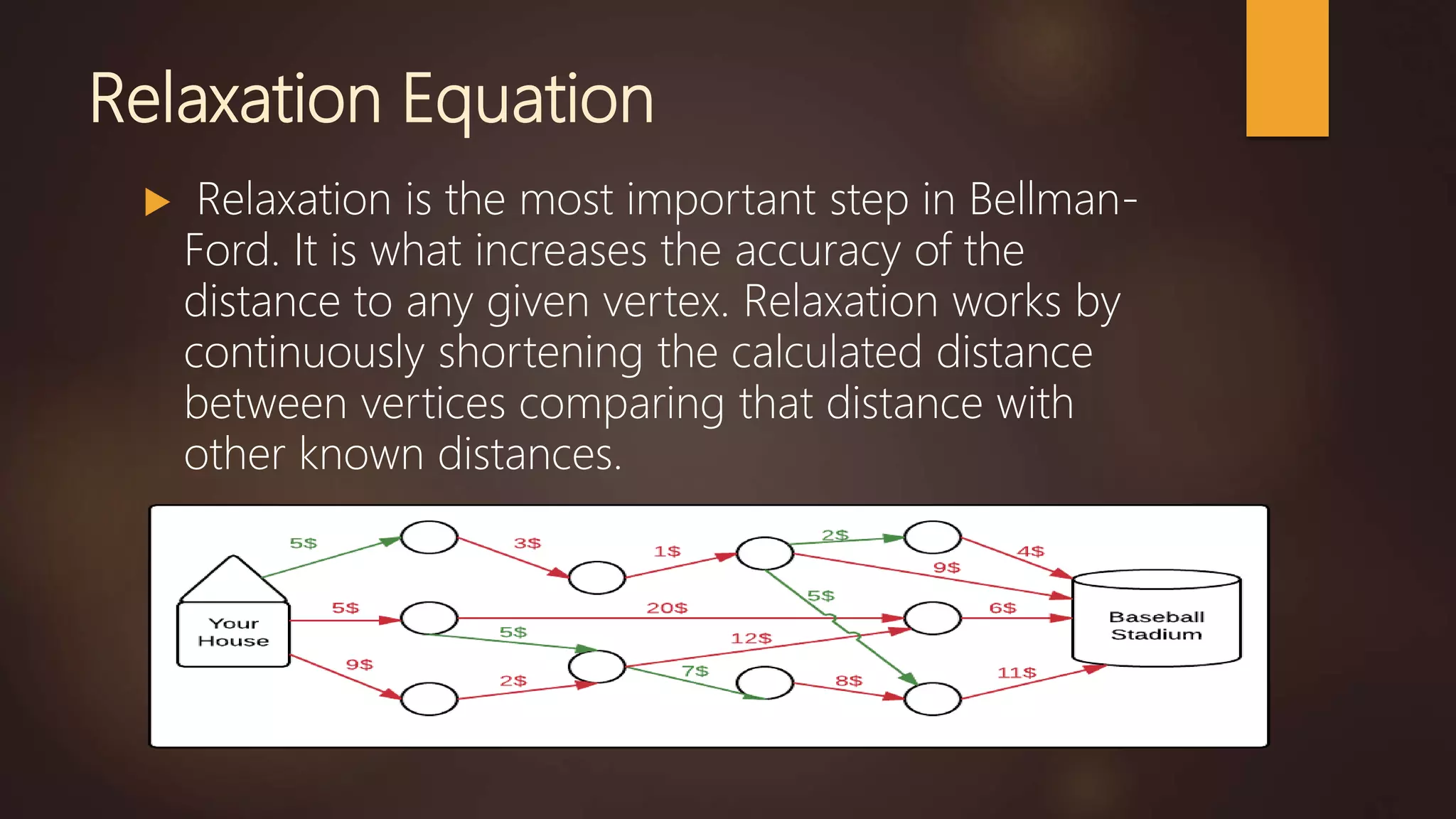
 Relaxation is the most important step in Bellman-
Ford. It is what increases the accuracy of the
distance to any given vertex. Relaxation works by
continuously shortening the calculated distance
between vertices comparing that distance with
other known distances.
Example
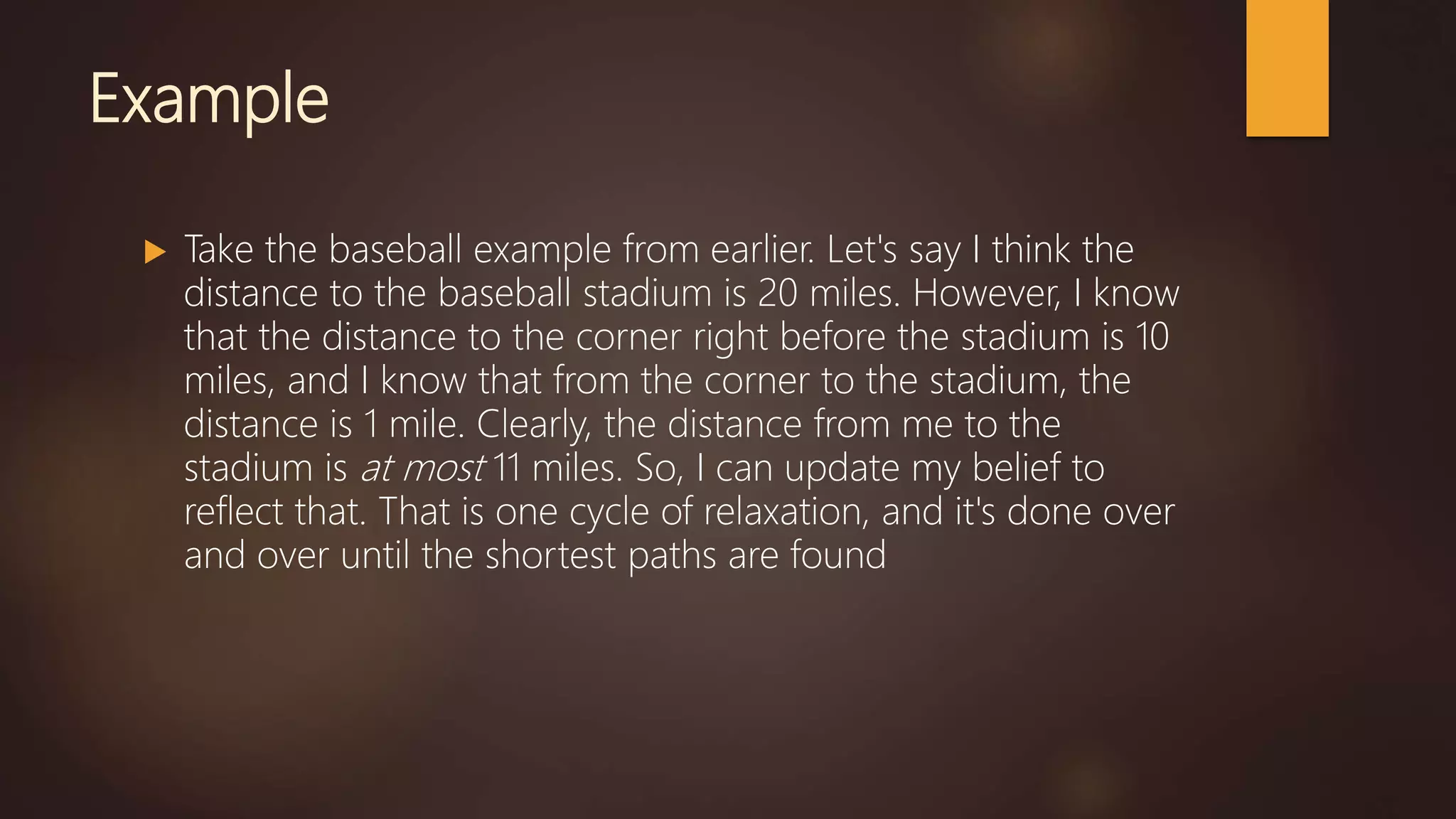
 Take the baseball example from earlier. Let's say I think the
distance to the baseball stadium is 20 miles. However, I know
that the distance to the corner right before the stadium is 10
miles, and I know that from the corner to the stadium, the
distance is 1 mile. Clearly, the distance from me to the
stadium is at most 11 miles. So, I can update my belief to
reflect that. That is one cycle of relaxation, and it's done over
and over until the shortest paths are found
Relax Equation
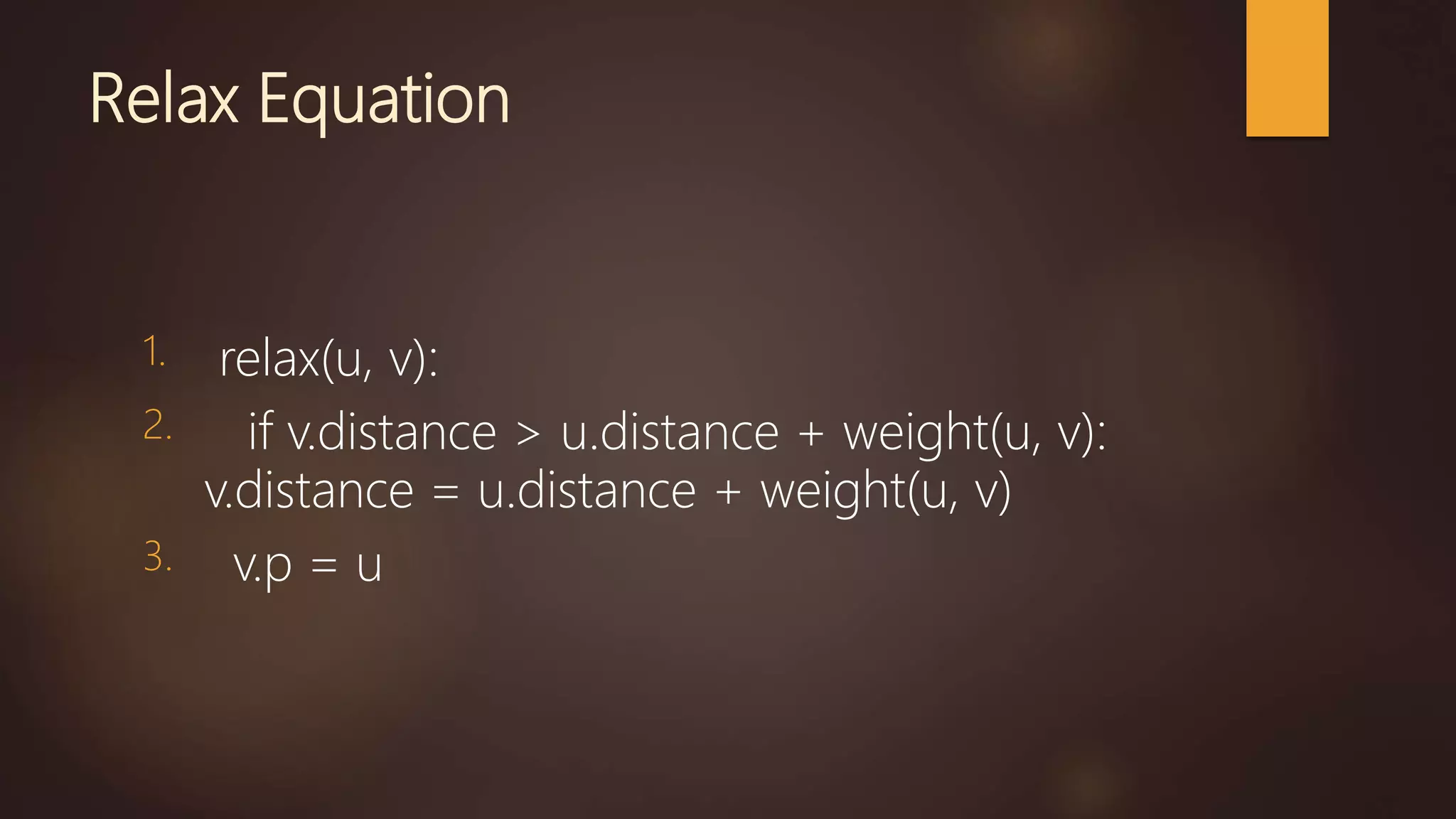
1. relax(u, v):
2. if v.distance > u.distance + weight(u, v):
v.distance = u.distance + weight(u, v)
3. v.p = u
Negative Cycle
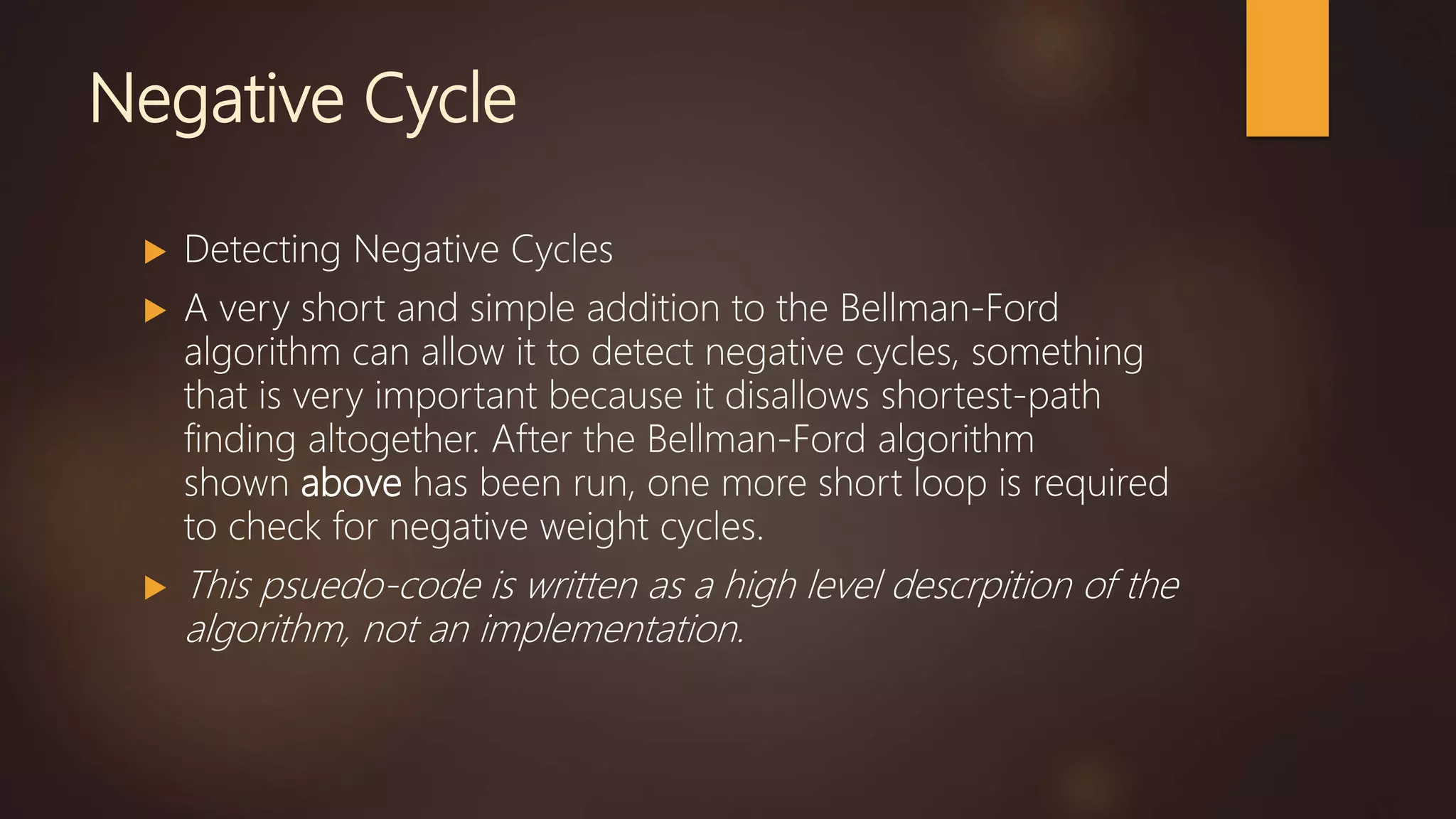
 Detecting Negative Cycles
 A very short and simple addition to the Bellman-Ford
algorithm can allow it to detect negative cycles, something
that is very important because it disallows shortest-path
finding altogether. After the Bellman-Ford algorithm
shown above has been run, one more short loop is required
to check for negative weight cycles.
 This psuedo-code is written as a high level descrpition of the
algorithm, not an implementation.
Cont..
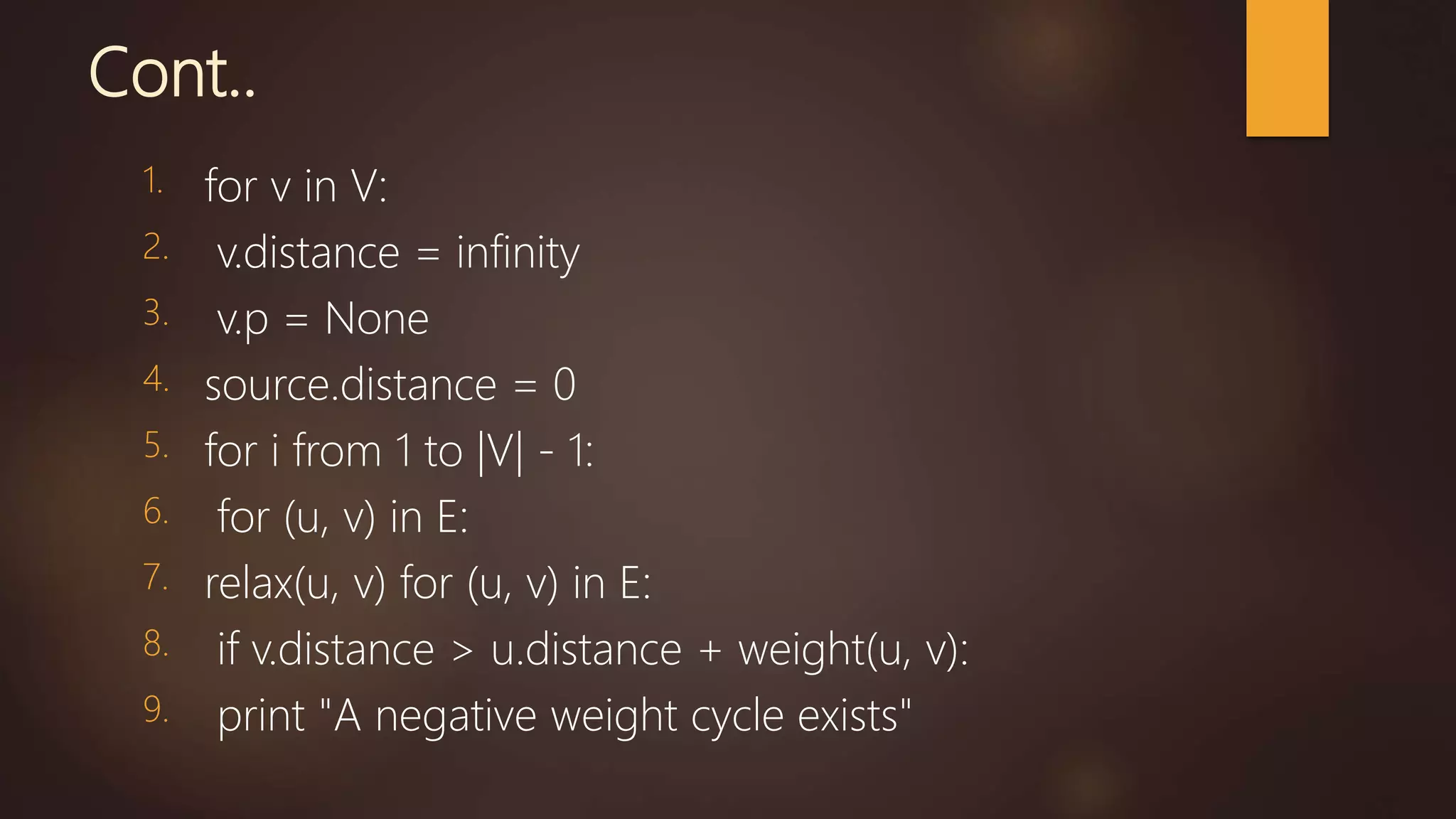
1. for v in V:
2. v.distance = infinity
3. v.p = None
4. source.distance = 0
5. for i from 1 to |V| - 1:
6. for (u, v) in E:
7. relax(u, v) for (u, v) in E:
8. if v.distance > u.distance + weight(u, v):
9. print "A negative weight cycle exists"
Floyed Warshall ALgorithm
 Floyd–Warshall algorithm is an algorithm for
finding shortest paths in a weighted graph
 The Graph may be weighted with positive or
negative edge weights .
 The Graph may be directed or undirected.
Cont..
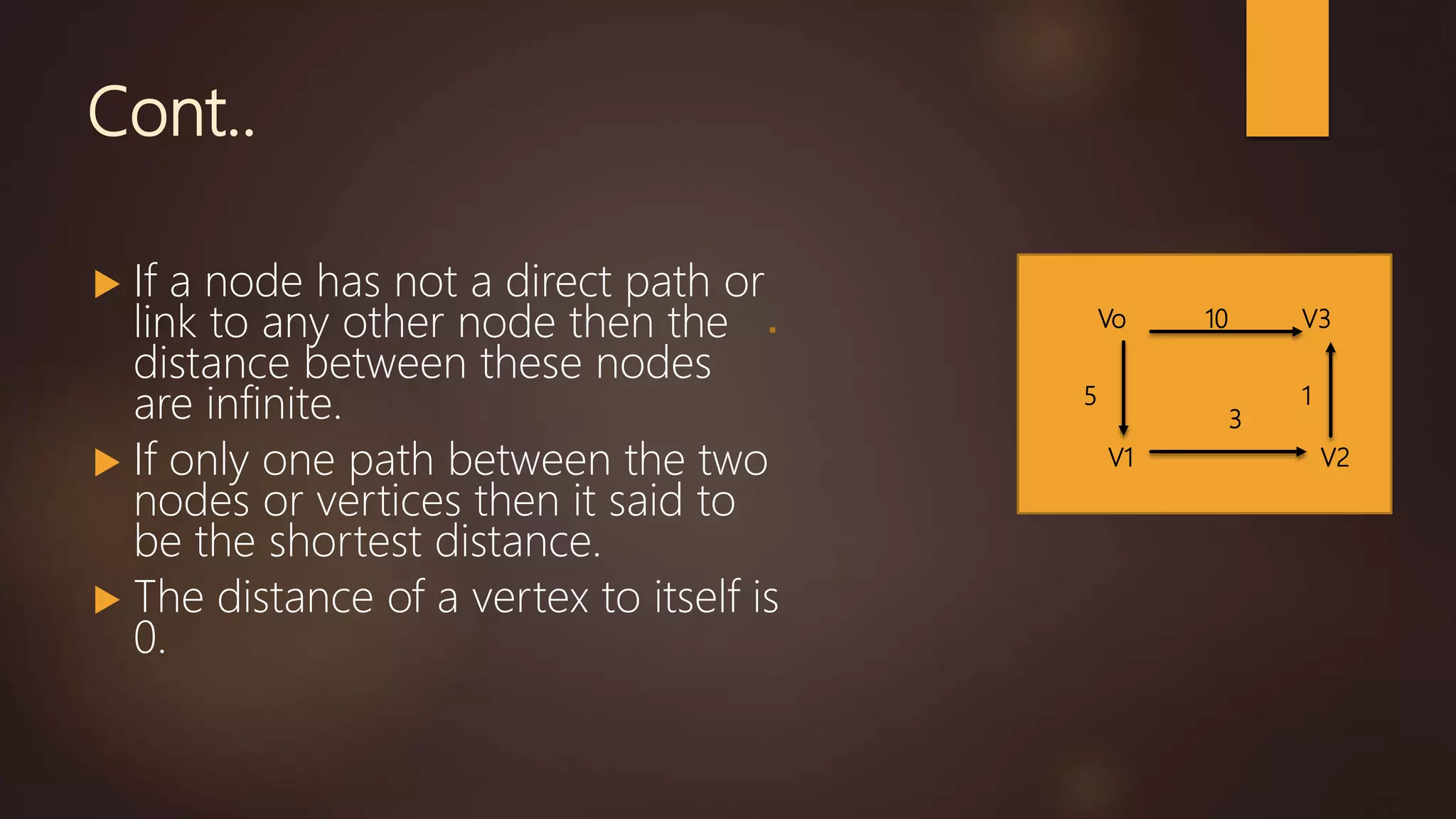
 If a node has not a direct path or
link to any other node then the
distance between these nodes
are infinite.
 If only one path between the two
nodes or vertices then it said to
be the shortest distance.
 The distance of a vertex to itself is
0.
Vo 10 V3
5 1
3
V1 V2
Example
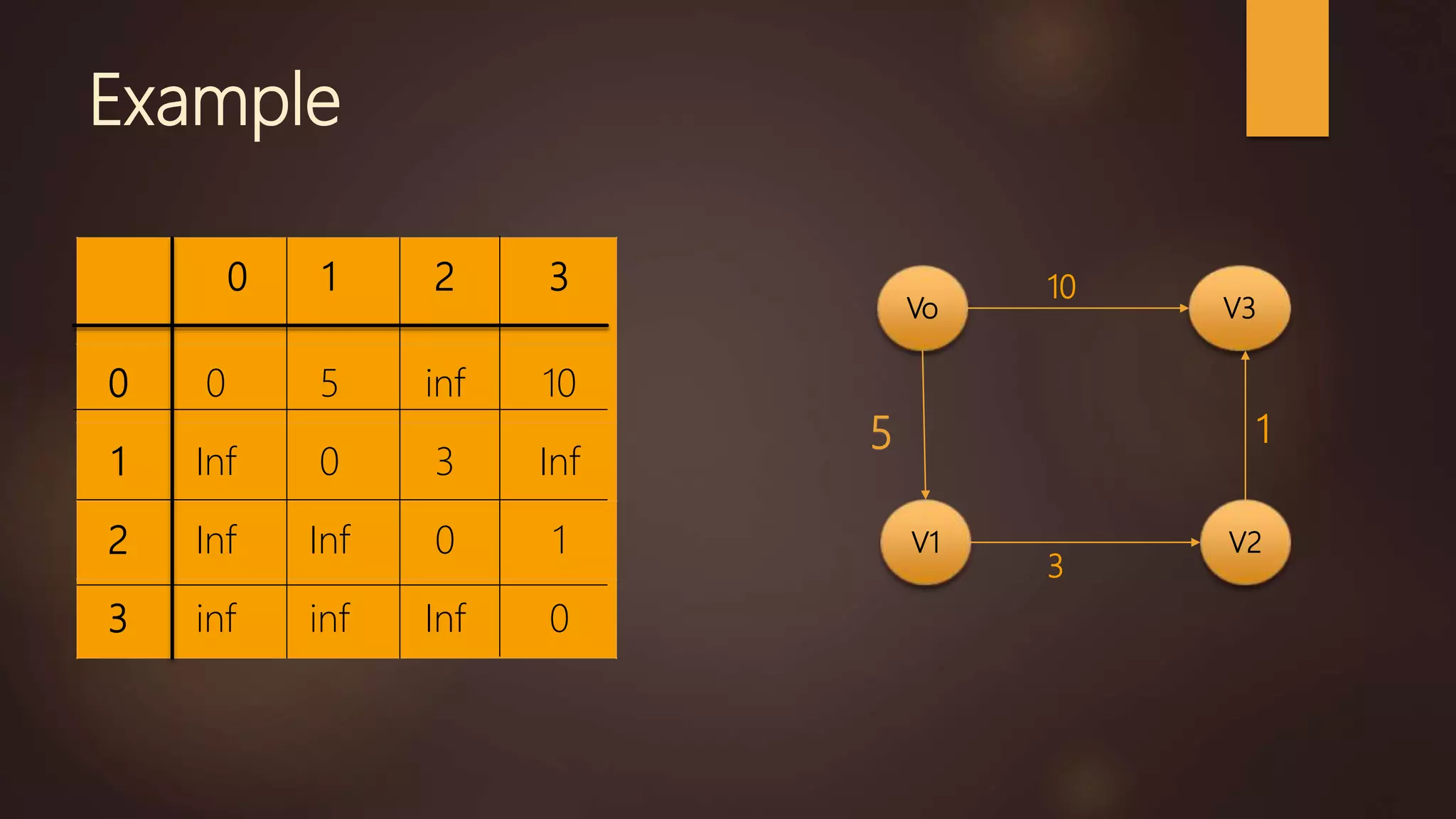
0 1 2 3
0 0 5 inf 10
1 Inf 0 3 Inf
2 Inf Inf 0 1
3 inf inf Inf 0
Vo V3
V1 V2
5
10
1
3
Uses Of Shortest Path Algorithm
 Weighted graph
 Distance function or array
 Priority Queue
 Relaxation
Applications of Shortest Path Algorithm
 It is used in Google Map.
 It is used in finding Shortest Path.
 It is used in geographical Maps.
 To find locations of Map which refers to vertices of
graph.
 Distance between the location refers to edges.
 It is used in IP routing to find Open shortest Path First.
 It is used in the telephone network.

Shortest path algorithm

  • 1.
    Shortest Path Algorithm  DIJIKSTRAALGORITHM  BELLMEN ALGORITHM  FLOYED WARSHALL ALGORITHM
  • 2.
    Shortest Path Algorithm An algorithm that is designed essentially to find a path of minimum length between two specified vertices of a connected weighted graph.
  • 3.
    Single source Shortestpath algorithm o It is defined as Cost of shortest path from a source vertex u to a destination v. s a b c
  • 4.
    Dijkstra’s Algorithm Dijkstra’s algorithmis a greedy algorithm for solving single source shortest path problem that provide us with the shortest path from one particular source node to all other nodes in the given graph .
  • 5.
    Rules of Dijkstra’salgorithm  It can be applied on both directed and undirected graph.  It is applied on weighted graph.  For the algorithm to be applicable the graph must be connected. a 3 b 4 5 1 c d 4
  • 6.
    Cont…  Dijkstra’s algorithmdoes not work for graphs with negative weight edges. For graphs with negative weight edges, Bellman_ford algorithm can be used.  In Dijkstra’s algorithm always assign source vertex to zero distance.  Assign every other node a tentative distance.
  • 7.
    Dijkstra’s AlgorithmDijkstra’s(G,W,S) INITIALIZE-SINGLE-SOURCE(G,s) 1. foreach vertex v ∈ 𝐺. 𝑉 2. v.d = ∞ 3. v.𝜋 = 𝑁𝐼𝐿 4. s.d = 0 5. S = ∅ 6. Q = G.V 7. while (Q≠ ∅) 8. u = dequeue_min(Q) 9. S = S ∪ 𝑢 10. for each vertex v∈ 𝐴𝑑𝑗 𝑢 11. if( v.d > u.d+ w(u,v) ) 12. v.d = u.d + w (u,v) // update distance of v 13. v. 𝜋 = u 14. return v.d
  • 8.
    BellMan-Algorithm  Bellman–Ford algorithm.The Bellman–Ford algorithm is an algorithm that computes shortest paths from a single source vertex to all of the other vertices in a weighted digraph. ... Negative edge weights are found in various applications of graphs, hence the usefulness of this algorithm.
  • 9.
    Cont..  It issimilar to Dijkstra's algorithm but it can work with graphs in which edges can have negative weights.  Negative weight edges can create negative weight cycles i.e. a cycle which will reduce the total path distance by coming back to the same point.
  • 10.
    Cont..  Shortest pathalgorithms like Dijkstra's Algorithm that aren't able to detect such a cycle can give an incorrect result because they can go through a negative weight cycle and reduce the path length. A B D E 2 1 3 2 -4 C
  • 11.
    Uses of Algorithm This algorithm can be used on both weighted and unweighted graphs.  Like Dijkstra's shortest path algorithm, the Bellman-Ford algorithm is guaranteed to find the shortest path in a graph.  Though it is slower than Dijkstra's algorithm, Bellman-Ford is capable of handling graphs that contain negative edge weights, so it is more versatile.
  • 12.
    ALGORITHM 1. for vin V: 2. v.distance = infinity 3. v.p = None 4. source.distance = 0 5. for i from 1 to |V| - 1: 6. for (u, v) in E: 7. relax(u, v)
  • 13.
    Explanation  The firstfor loop sets the distance to each vertex in the graph to infinity. This is later changed for the source vertex to equal zero. Also in that first for loop, the p value for each vertex is set to nothing. This value is a pointer to a predecessor vertex so that we can create a path later.  The next for loop simply goes through each edge (u, v) in E and relaxes it. This process is done |V| - 1 times.
  • 14.
    Relaxation Equation  Relaxationis the most important step in Bellman- Ford. It is what increases the accuracy of the distance to any given vertex. Relaxation works by continuously shortening the calculated distance between vertices comparing that distance with other known distances.
  • 15.
    Example  Take thebaseball example from earlier. Let's say I think the distance to the baseball stadium is 20 miles. However, I know that the distance to the corner right before the stadium is 10 miles, and I know that from the corner to the stadium, the distance is 1 mile. Clearly, the distance from me to the stadium is at most 11 miles. So, I can update my belief to reflect that. That is one cycle of relaxation, and it's done over and over until the shortest paths are found
  • 16.
    Relax Equation 1. relax(u,v): 2. if v.distance > u.distance + weight(u, v): v.distance = u.distance + weight(u, v) 3. v.p = u
  • 17.
    Negative Cycle  DetectingNegative Cycles  A very short and simple addition to the Bellman-Ford algorithm can allow it to detect negative cycles, something that is very important because it disallows shortest-path finding altogether. After the Bellman-Ford algorithm shown above has been run, one more short loop is required to check for negative weight cycles.  This psuedo-code is written as a high level descrpition of the algorithm, not an implementation.
  • 18.
    Cont.. 1. for vin V: 2. v.distance = infinity 3. v.p = None 4. source.distance = 0 5. for i from 1 to |V| - 1: 6. for (u, v) in E: 7. relax(u, v) for (u, v) in E: 8. if v.distance > u.distance + weight(u, v): 9. print "A negative weight cycle exists"
  • 19.
    Floyed Warshall ALgorithm Floyd–Warshall algorithm is an algorithm for finding shortest paths in a weighted graph  The Graph may be weighted with positive or negative edge weights .  The Graph may be directed or undirected.
  • 20.
    Cont..  If anode has not a direct path or link to any other node then the distance between these nodes are infinite.  If only one path between the two nodes or vertices then it said to be the shortest distance.  The distance of a vertex to itself is 0. Vo 10 V3 5 1 3 V1 V2
  • 21.
    Example 0 1 23 0 0 5 inf 10 1 Inf 0 3 Inf 2 Inf Inf 0 1 3 inf inf Inf 0 Vo V3 V1 V2 5 10 1 3
  • 22.
    Uses Of ShortestPath Algorithm  Weighted graph  Distance function or array  Priority Queue  Relaxation
  • 23.
    Applications of ShortestPath Algorithm  It is used in Google Map.  It is used in finding Shortest Path.  It is used in geographical Maps.  To find locations of Map which refers to vertices of graph.  Distance between the location refers to edges.  It is used in IP routing to find Open shortest Path First.  It is used in the telephone network.