A Guide for the Perplexed
Sanjiv Augustine
Sanjiv.Augustine@LitheSpeed.com
@saugustine, @lithespeed
About Me
• President of LitheSpeed, LLC
• Experience:
• 25 years industry
• 15 years of Agile
• 12 years of Lean
• Specialties: Agile, Lean,
Innovation
• Practitioner, entrepreneur,
consultant, trainer, author,
speaker and community
organizer
Sanjiv
Augustine
2
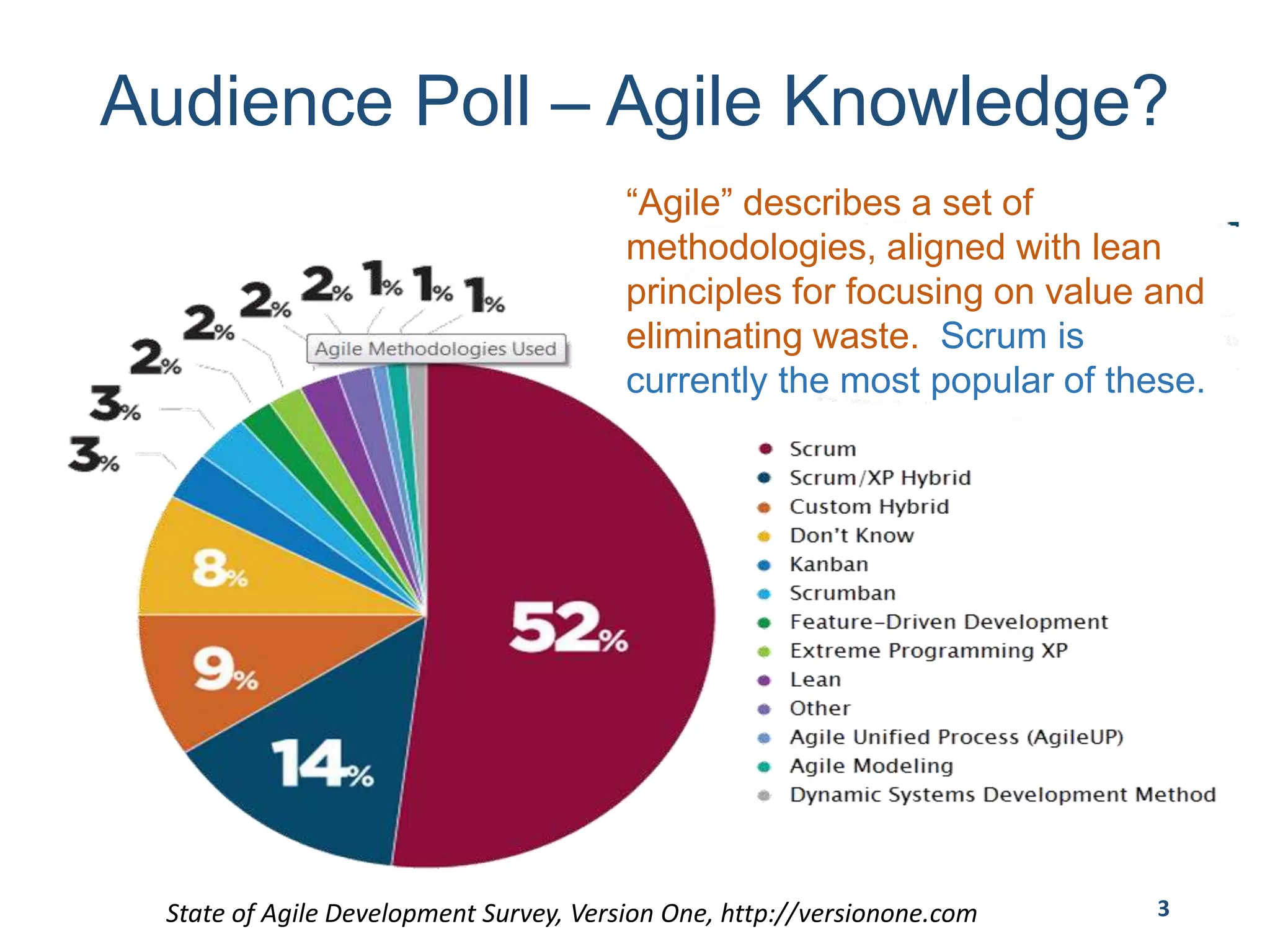
Audience Poll – Agile Knowledge?
“Agile” describes a set of
methodologies, aligned with lean
principles for focusing on value and
eliminating waste. Scrum is
currently the most popular of these.
3State of Agile Development Survey, Version One, http://versionone.com
Agenda
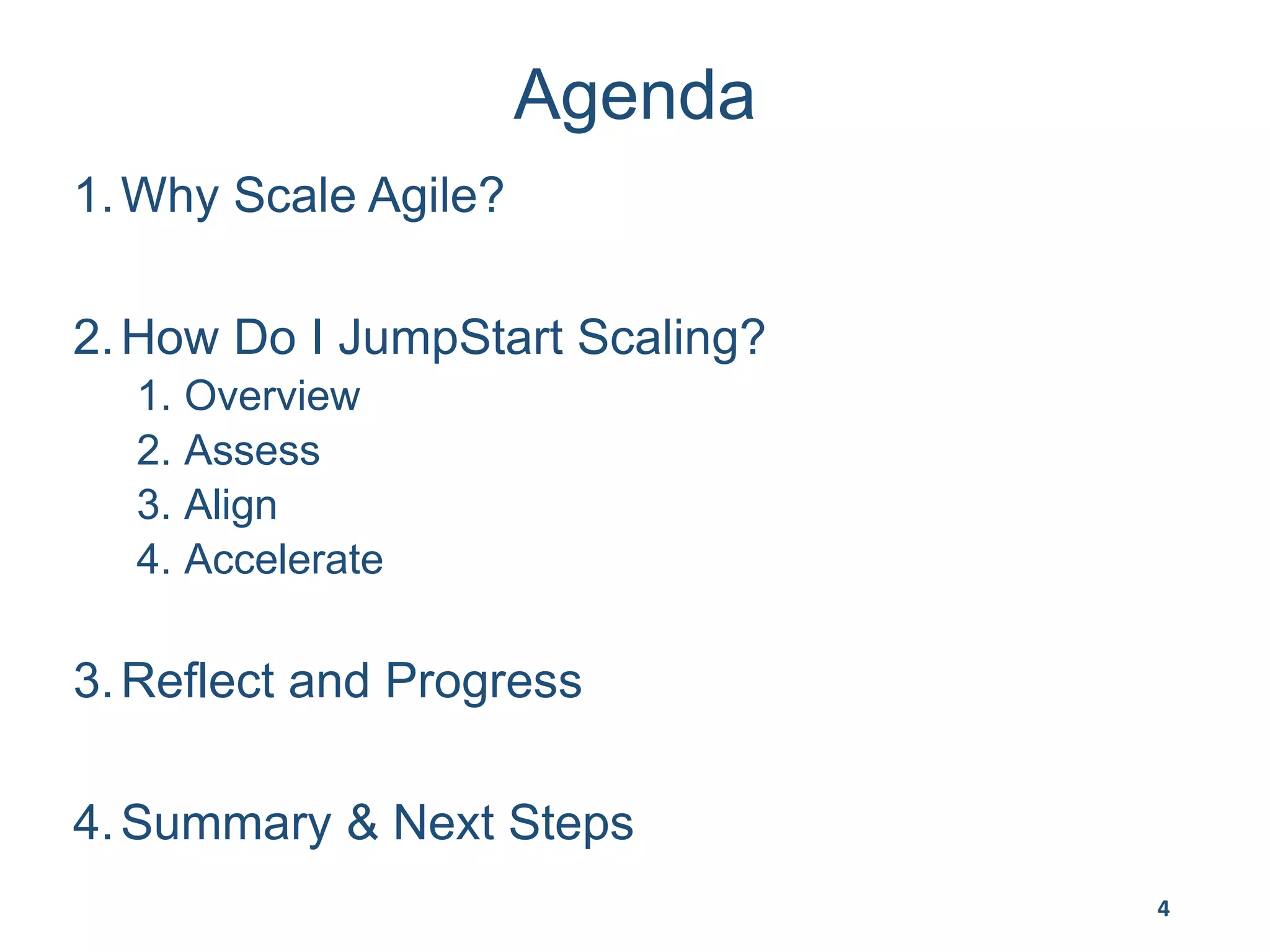
1.Why Scale Agile?
2.How Do I JumpStart Scaling?
1. Overview
2. Assess
3. Align
4. Accelerate
3.Reflect and Progress
4.Summary & Next Steps
4
WHY SCALE
AGILE?
5
6
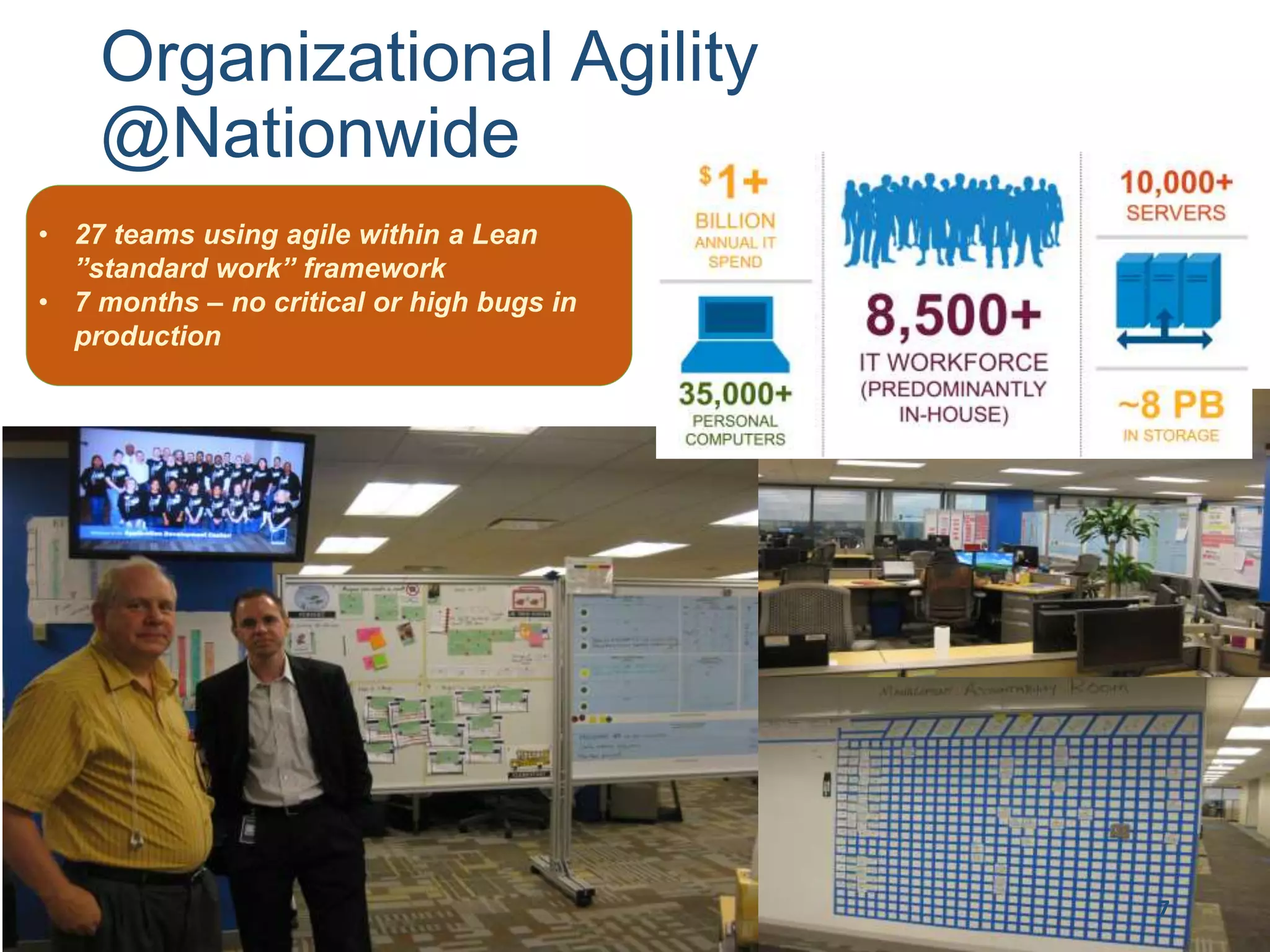
Organizational Agility
@Nationwide
• 27 teams using agile within a Lean
”standard work” framework
• 7 months – no critical or high bugs in
production
7
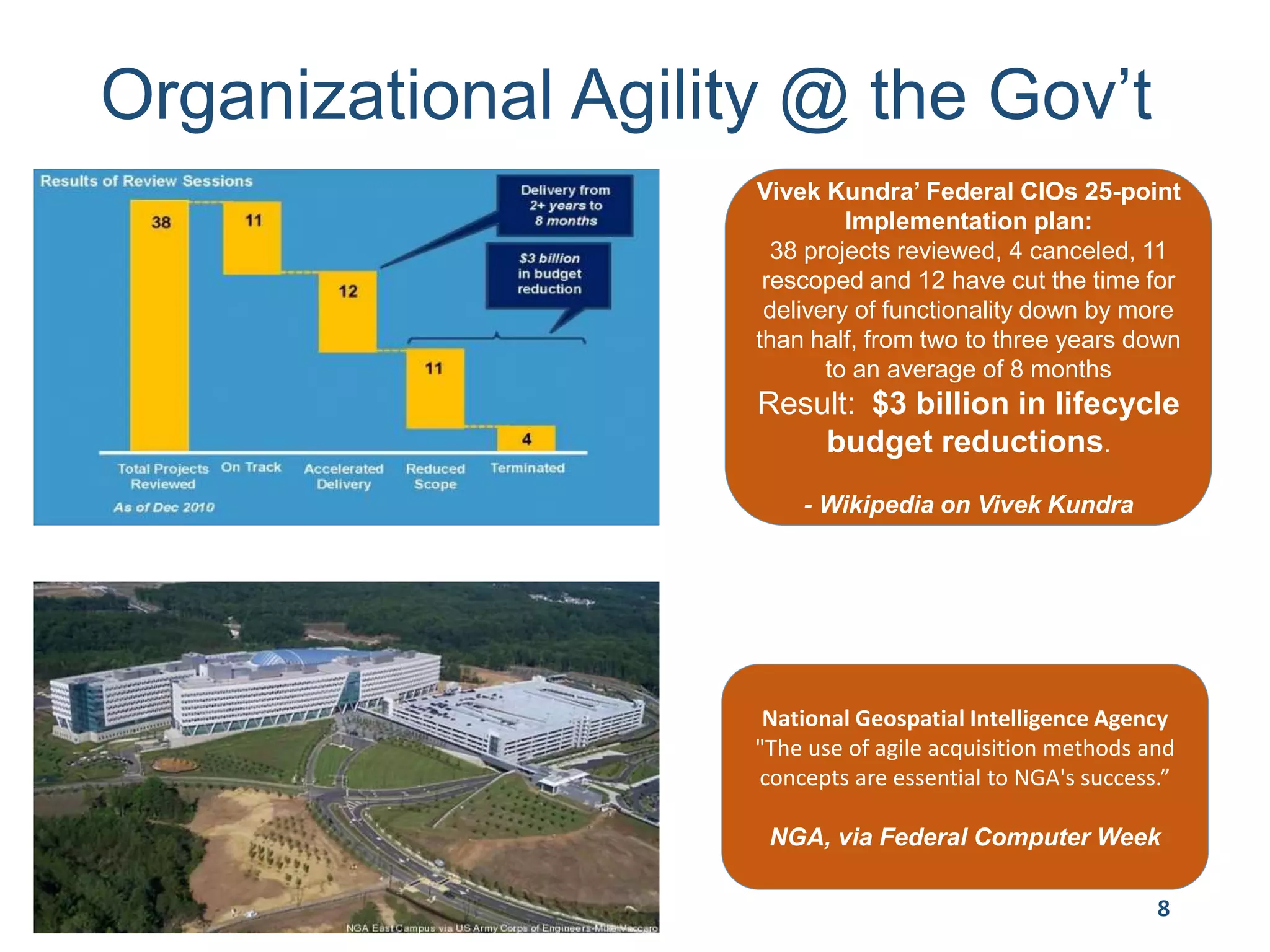
Vivek Kundra’ Federal CIOs 25-point
Implementation plan:
38 projects reviewed, 4 canceled, 11
rescoped and 12 have cut the time for
delivery of functionality down by more
than half, from two to three years down
to an average of 8 months
Result: $3 billion in lifecycle
budget reductions.
- Wikipedia on Vivek Kundra
Organizational Agility @ the Gov’t
8
National Geospatial Intelligence Agency
"The use of agile acquisition methods and
concepts are essential to NGA's success.”
NGA, via Federal Computer Week
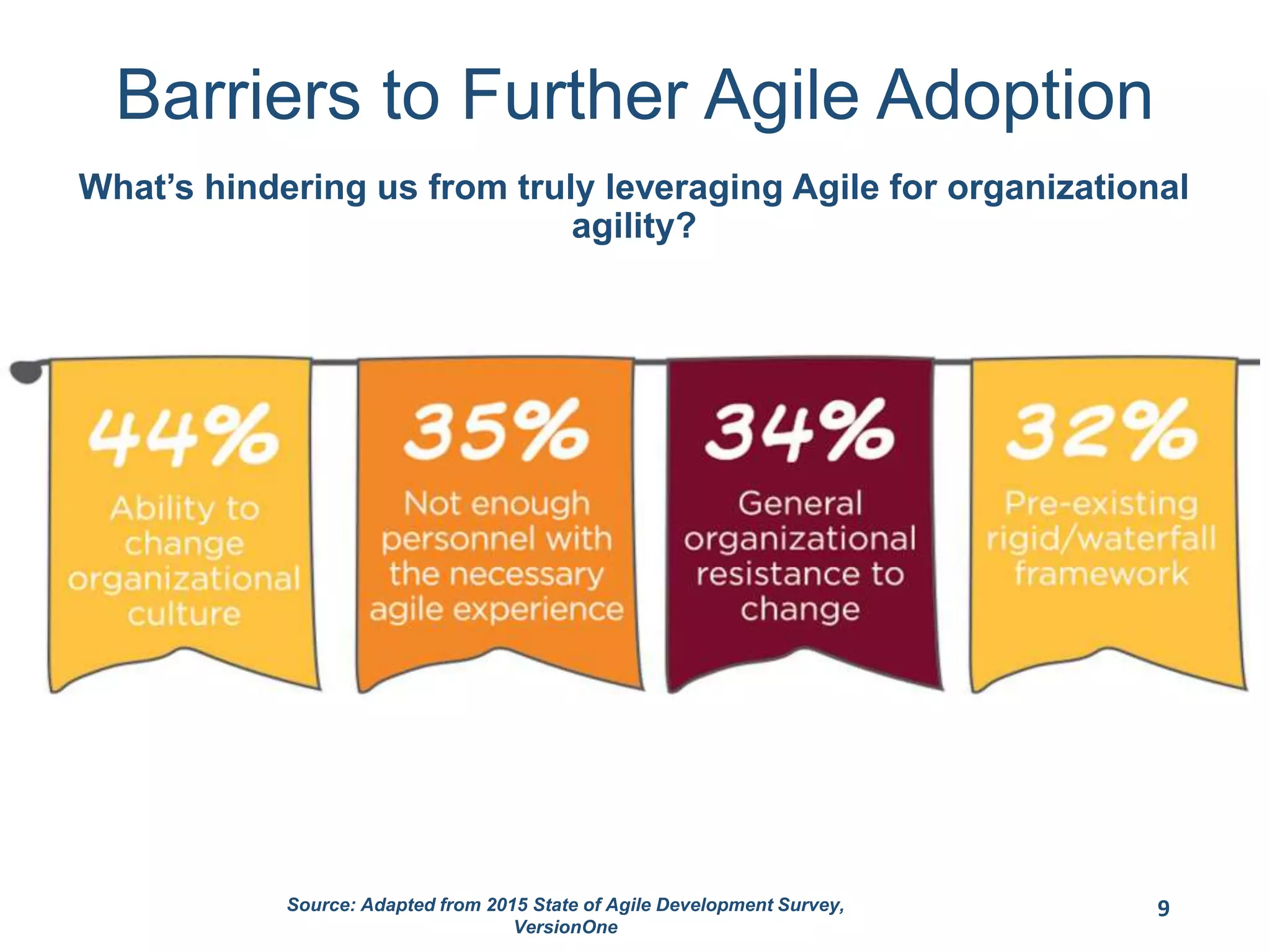
Barriers to Further Agile Adoption
What’s hindering us from truly leveraging Agile for organizational
agility?
Source: Adapted from 2015 State of Agile Development Survey,
VersionOne
9
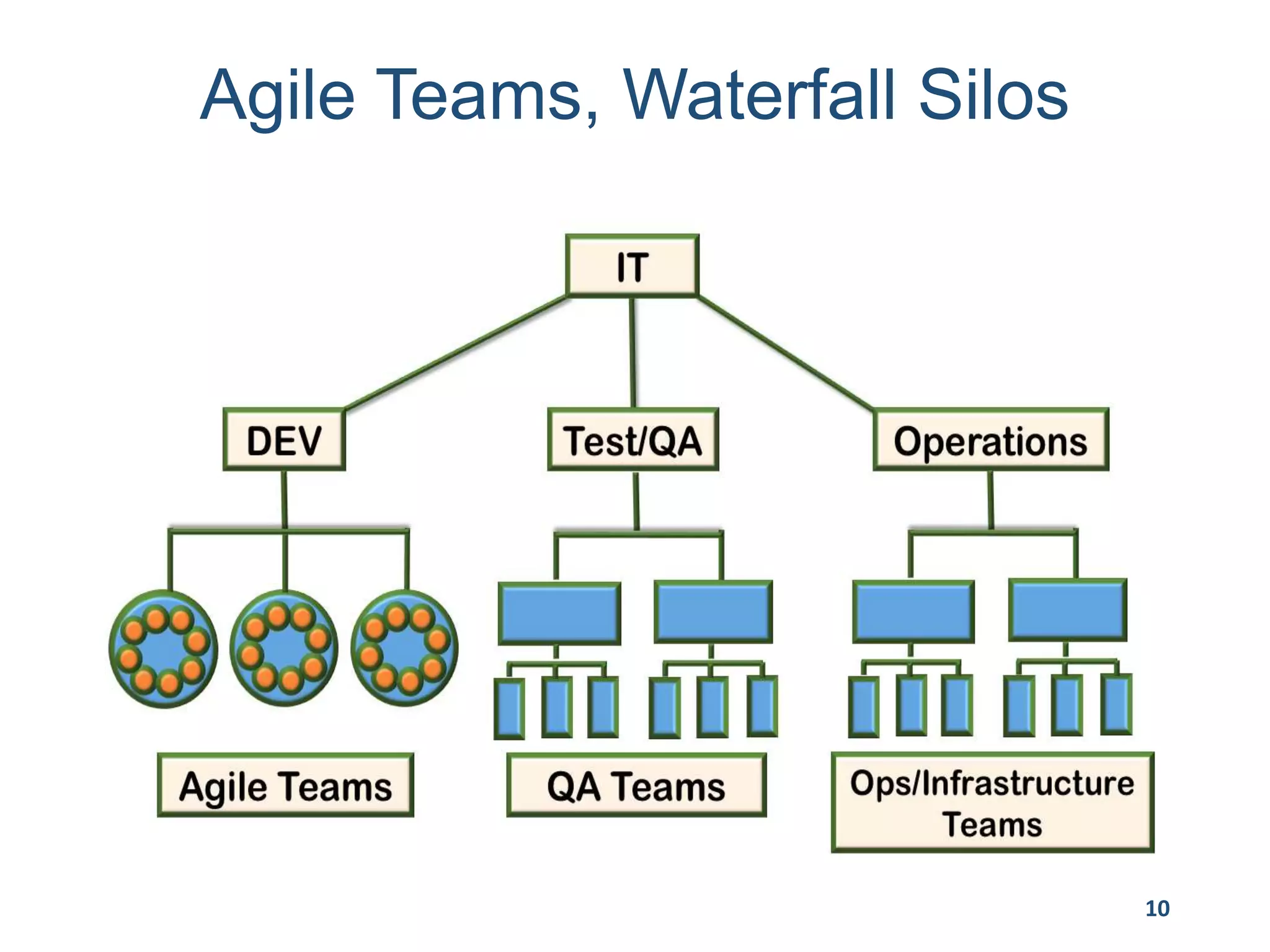
Agile Teams, Waterfall Silos
10
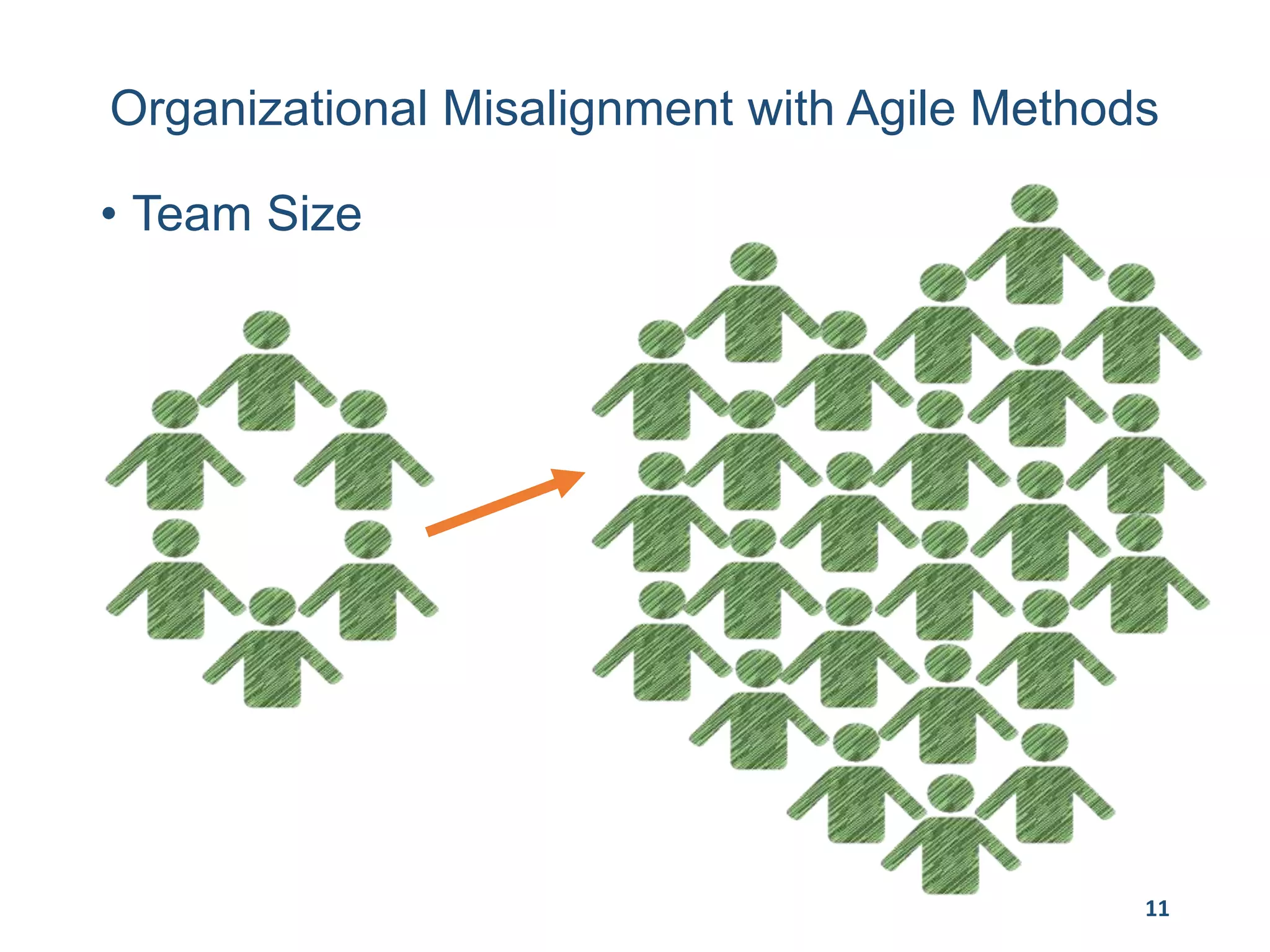
Organizational Misalignment with Agile Methods
• Team Size
11
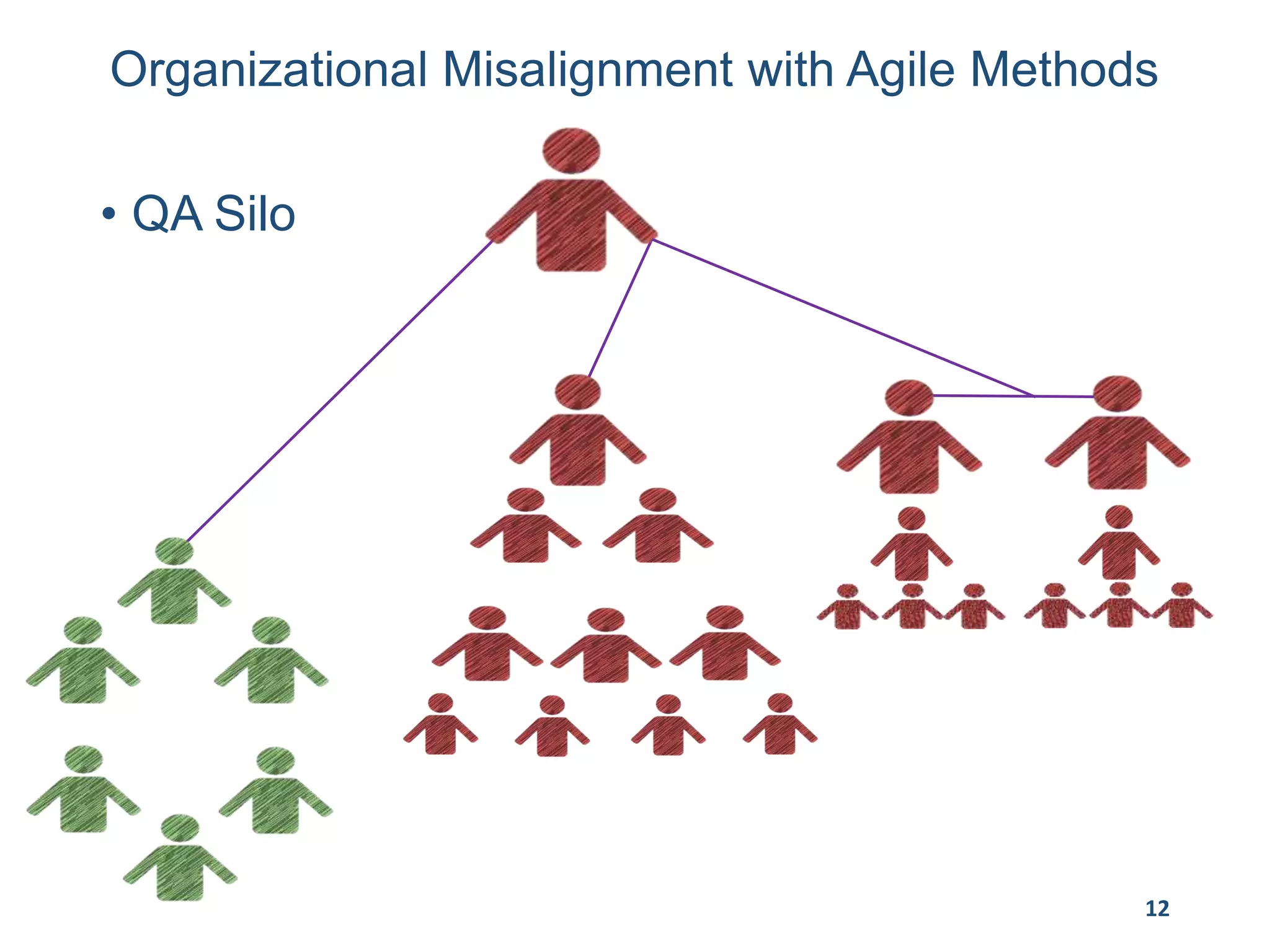
Organizational Misalignment with Agile Methods
• QA Silo
12
Organizational Misalignment with Agile Methods
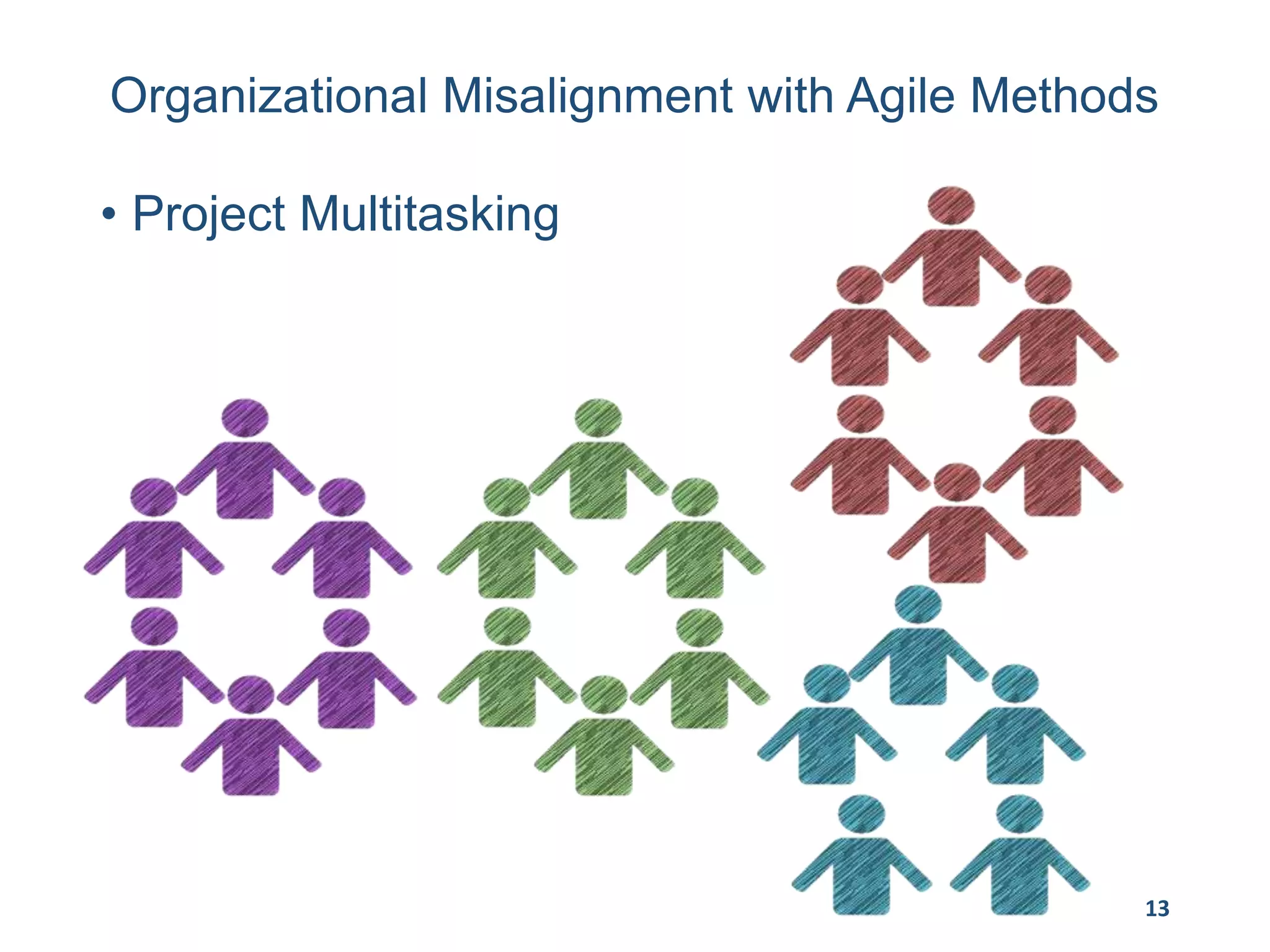
• Project Multitasking
13
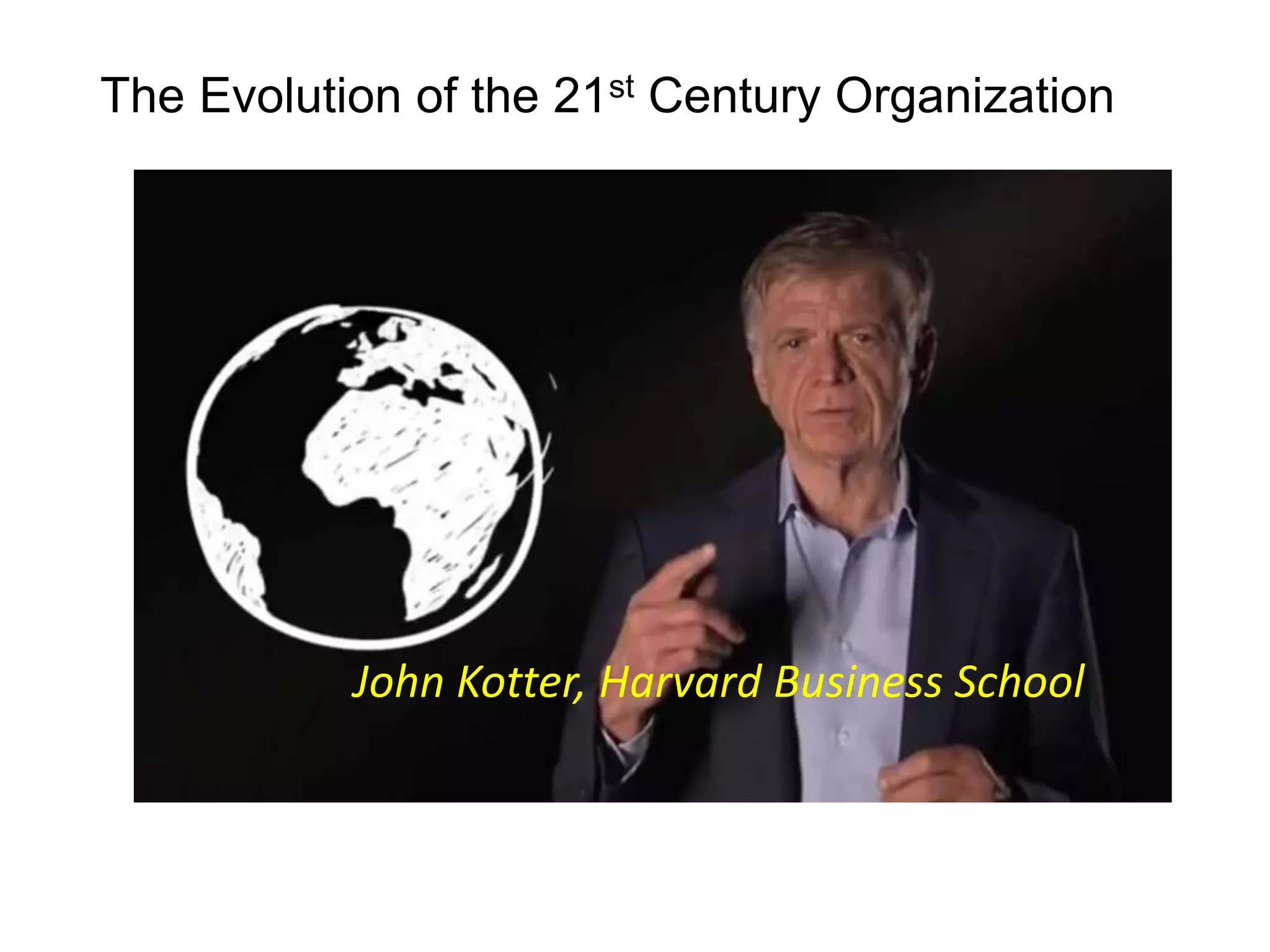
The Evolution of the 21st Century Organization
John Kotter, Harvard Business School
HOW DO I
JUMPSTART
SCALING?
15
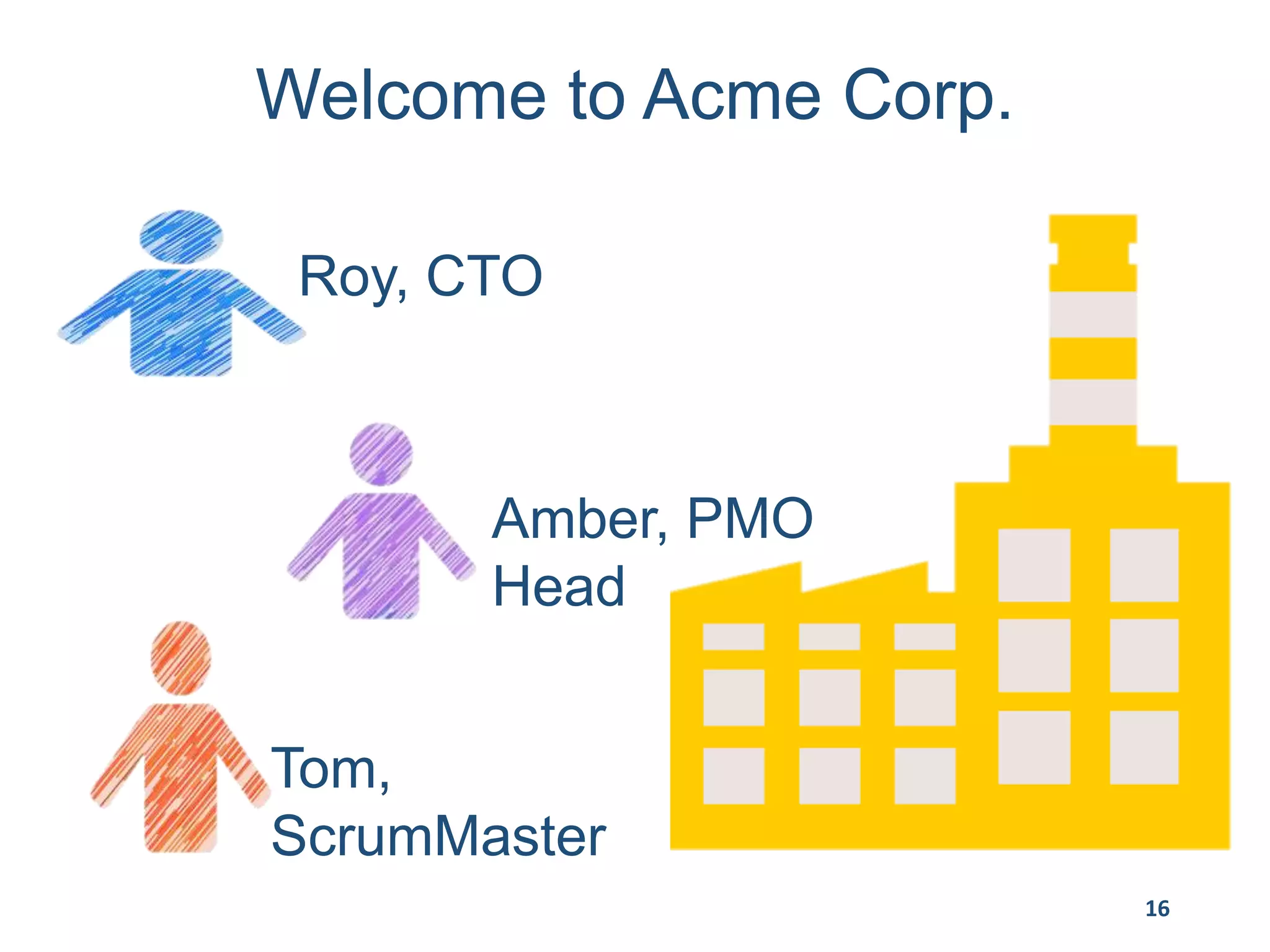
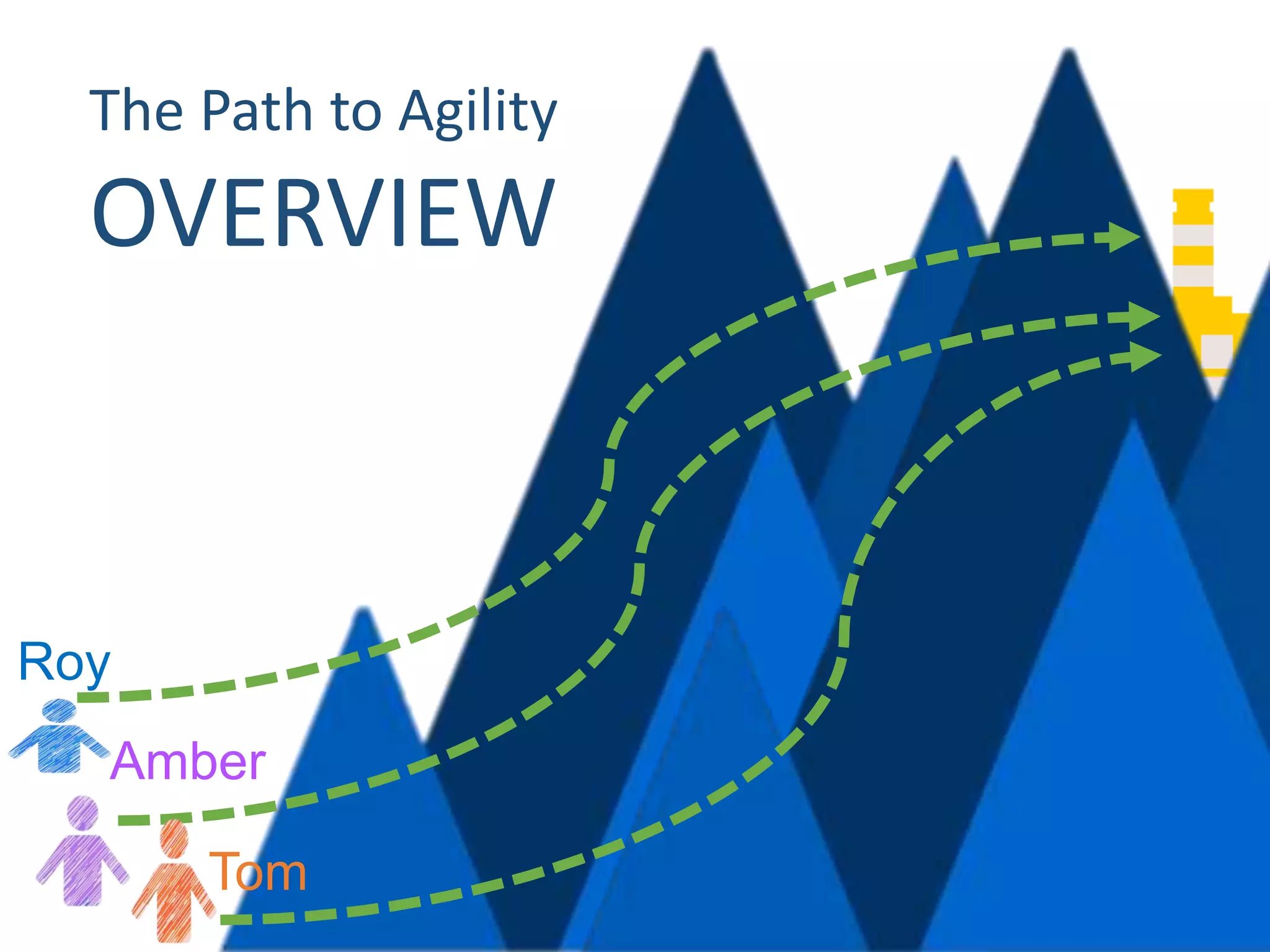
Welcome to Acme Corp.
Roy, CTO
Amber, PMO
Head
Tom,
ScrumMaster
16
Roy
Amber
Tom
The Path to Agility
OVERVIEW
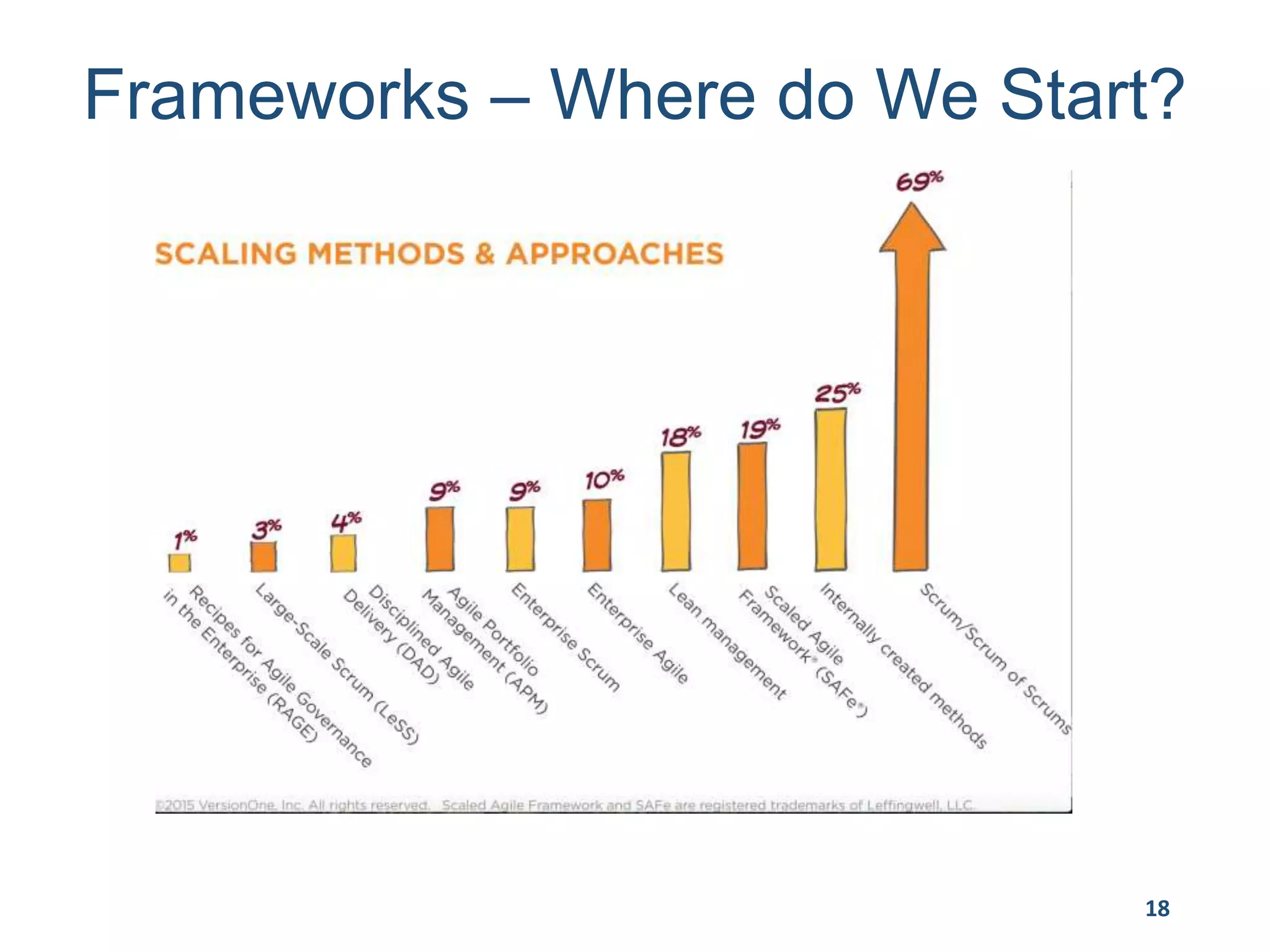
Frameworks – Where do We Start?
18
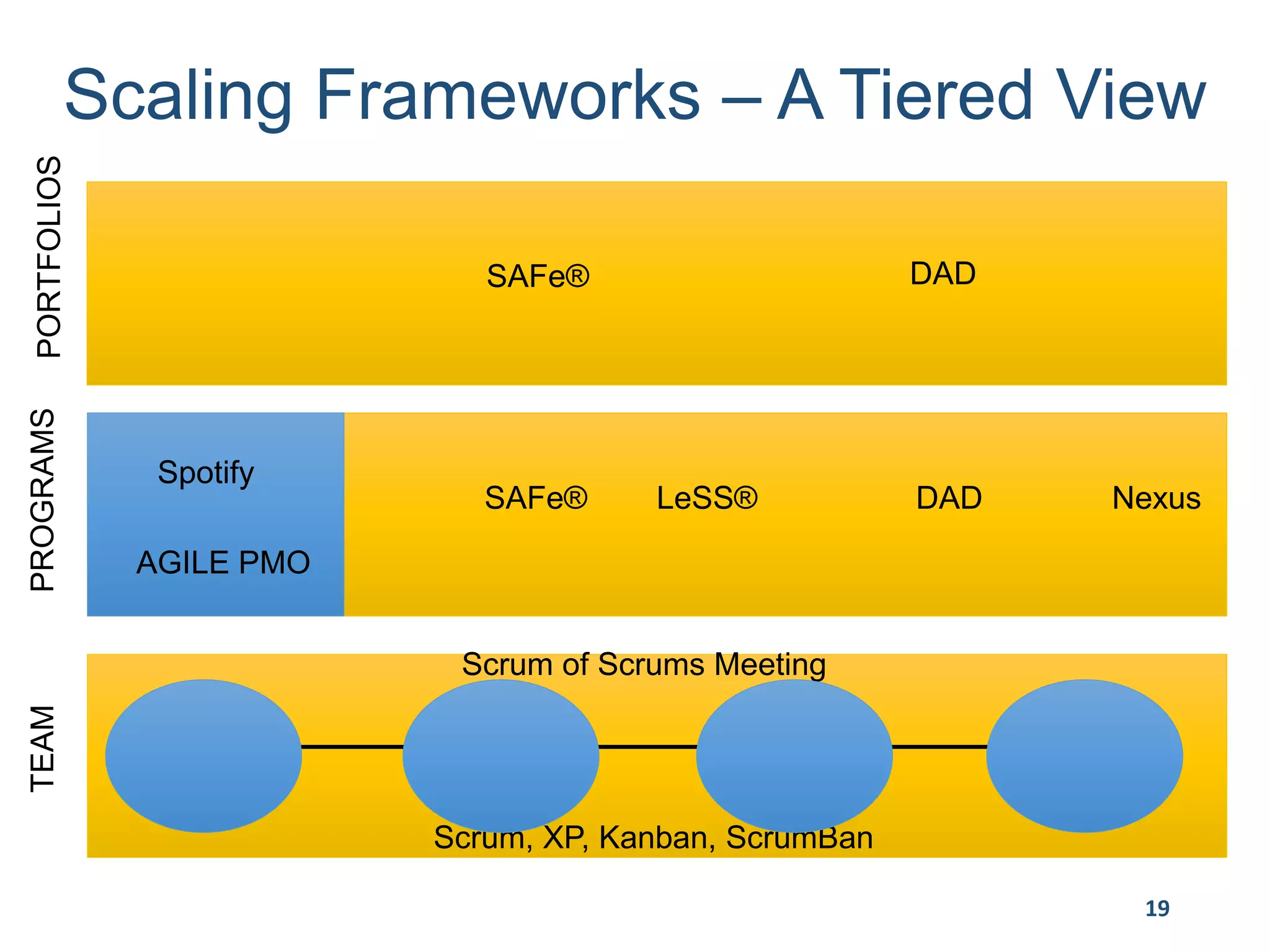
Scaling Frameworks – A Tiered View
Scrum of Scrums Meeting
TEAMPROGRAMSPORTFOLIOS
Scrum, XP, Kanban, ScrumBan
SAFe® LeSS® DAD Nexus
SAFe®
19
DAD
AGILE PMO
Spotify
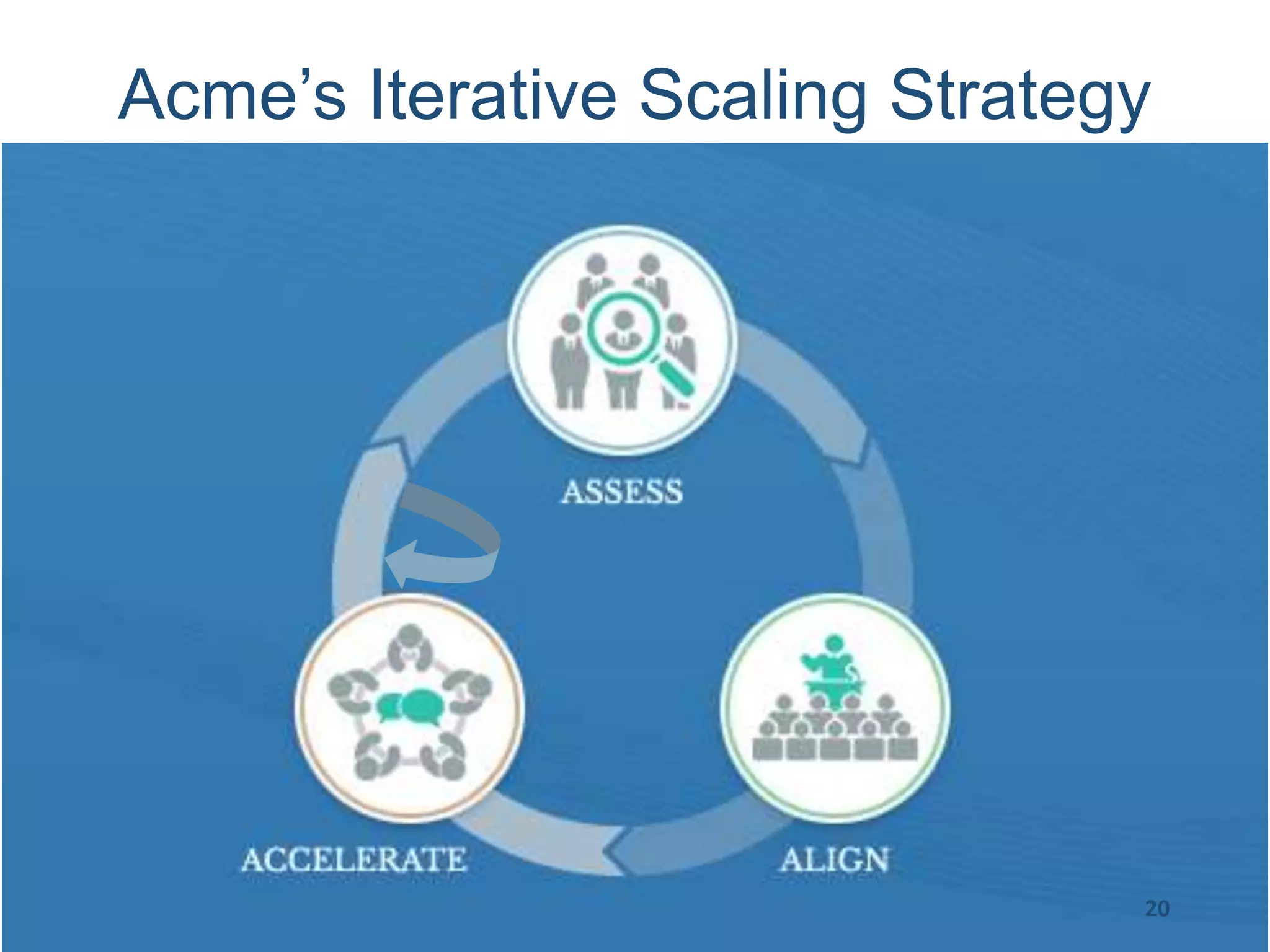
Acme’s Iterative Scaling Strategy
20
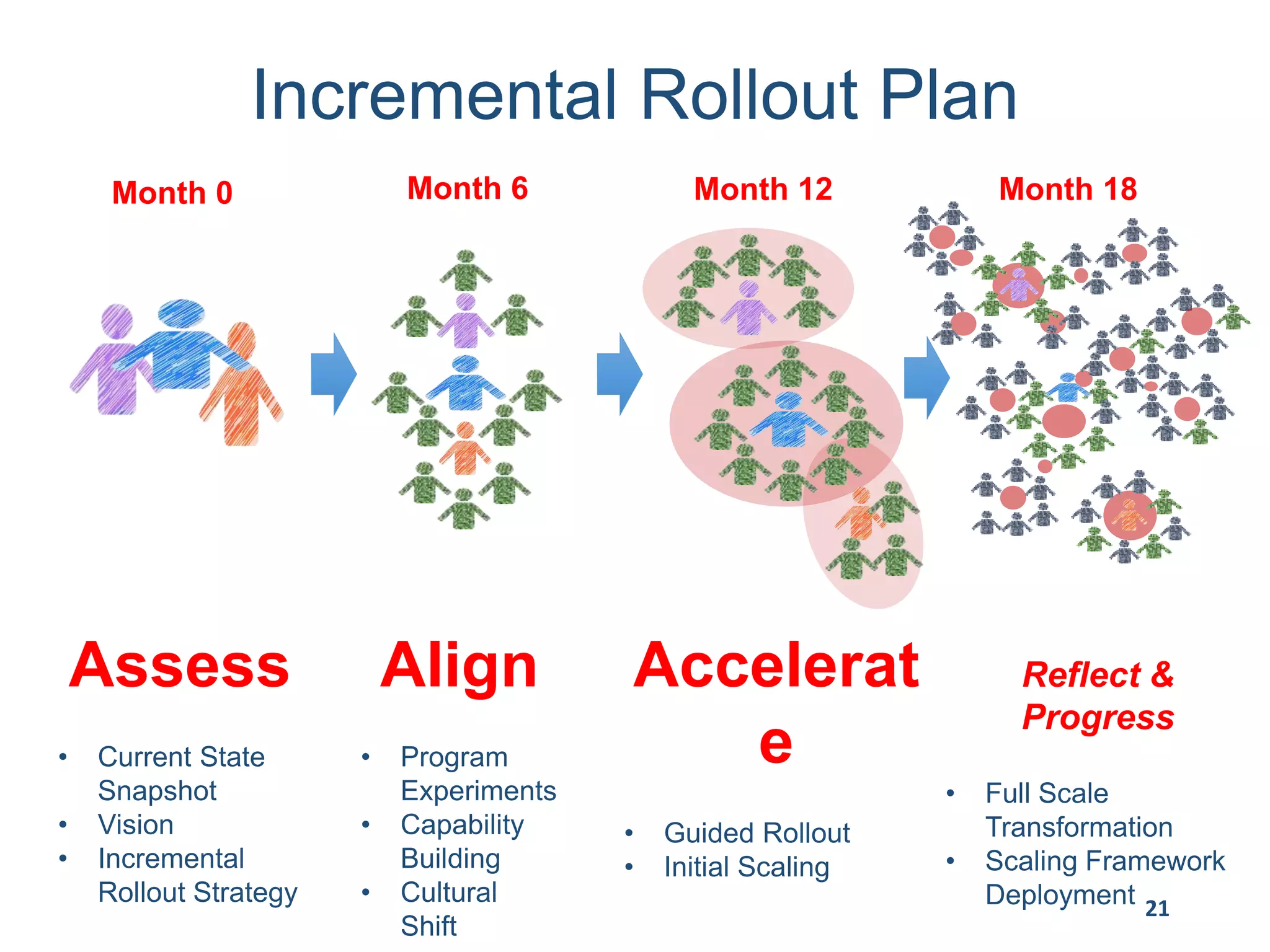
Incremental Rollout Plan
Month 0 Month 6 Month 12 Month 18
Assess
• Current State
Snapshot
• Vision
• Incremental
Rollout Strategy
Align
• Program
Experiments
• Capability
Building
• Cultural
Shift
Accelerat
e
• Guided Rollout
• Initial Scaling
Reflect &
Progress
• Full Scale
Transformation
• Scaling Framework
Deployment 21
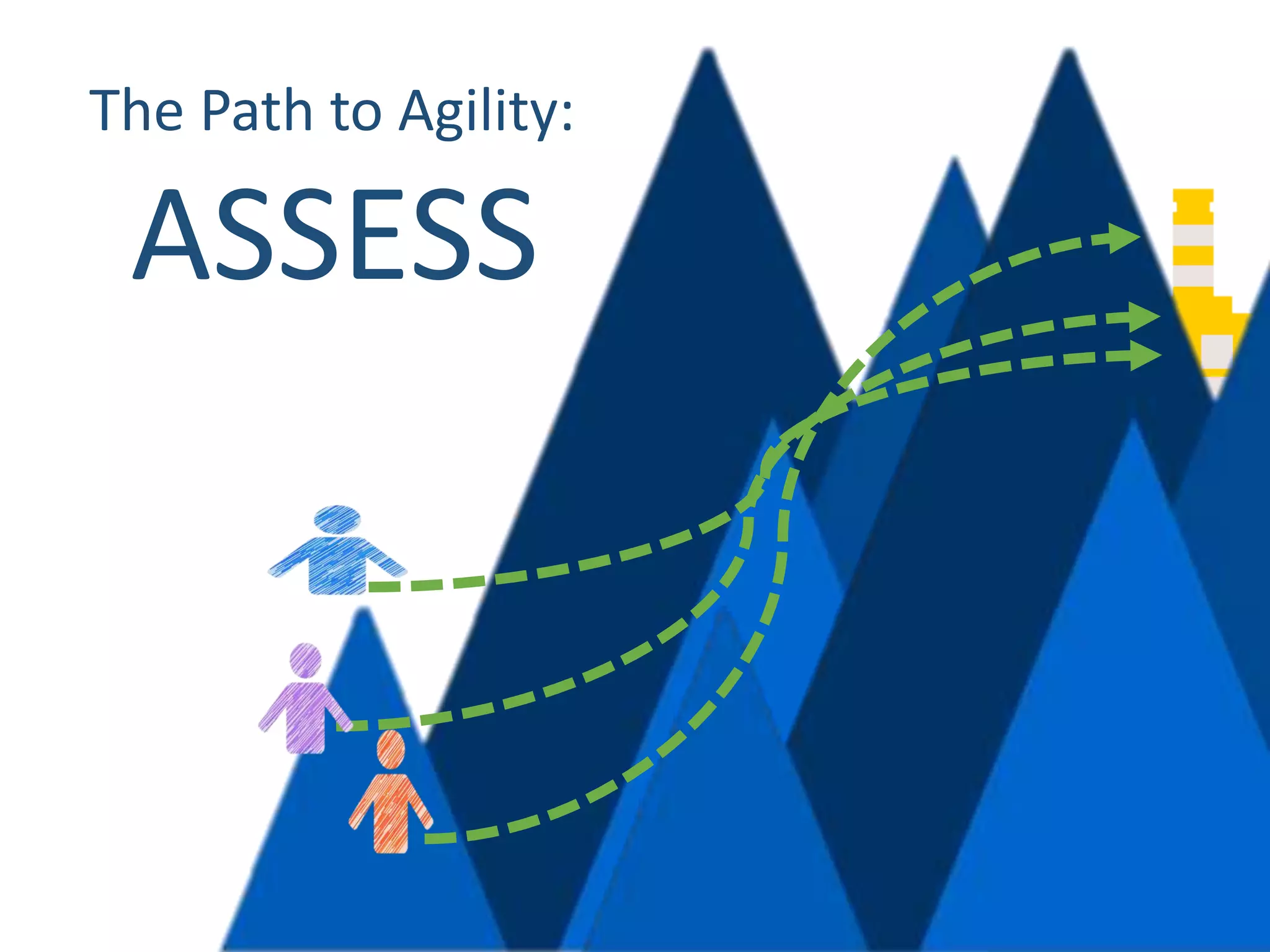
The Path to Agility:
ASSESS
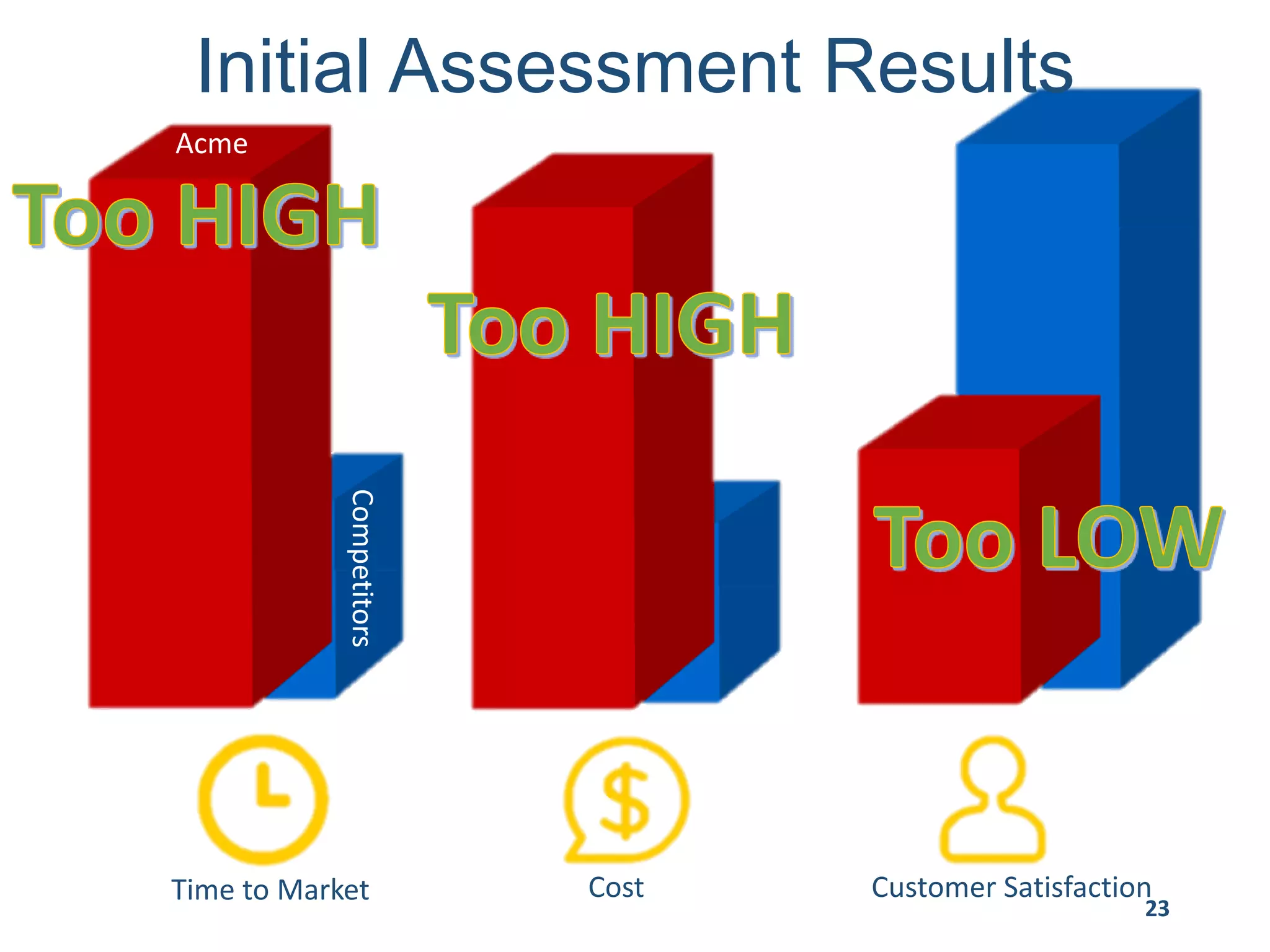
Initial Assessment Results
Time to Market Cost Customer Satisfaction
Acme
Competitors
23
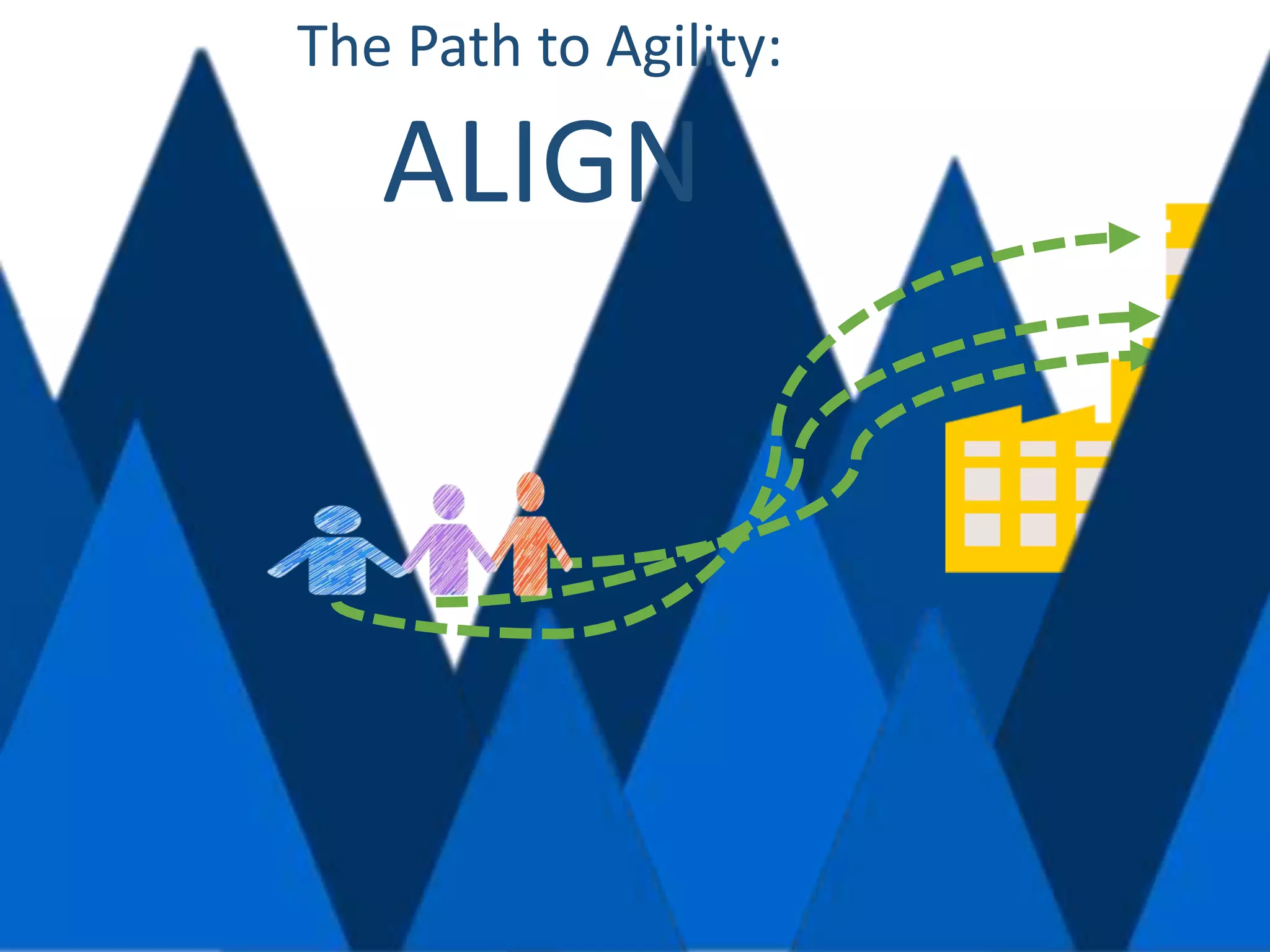
The Path to Agility:
ALIGN
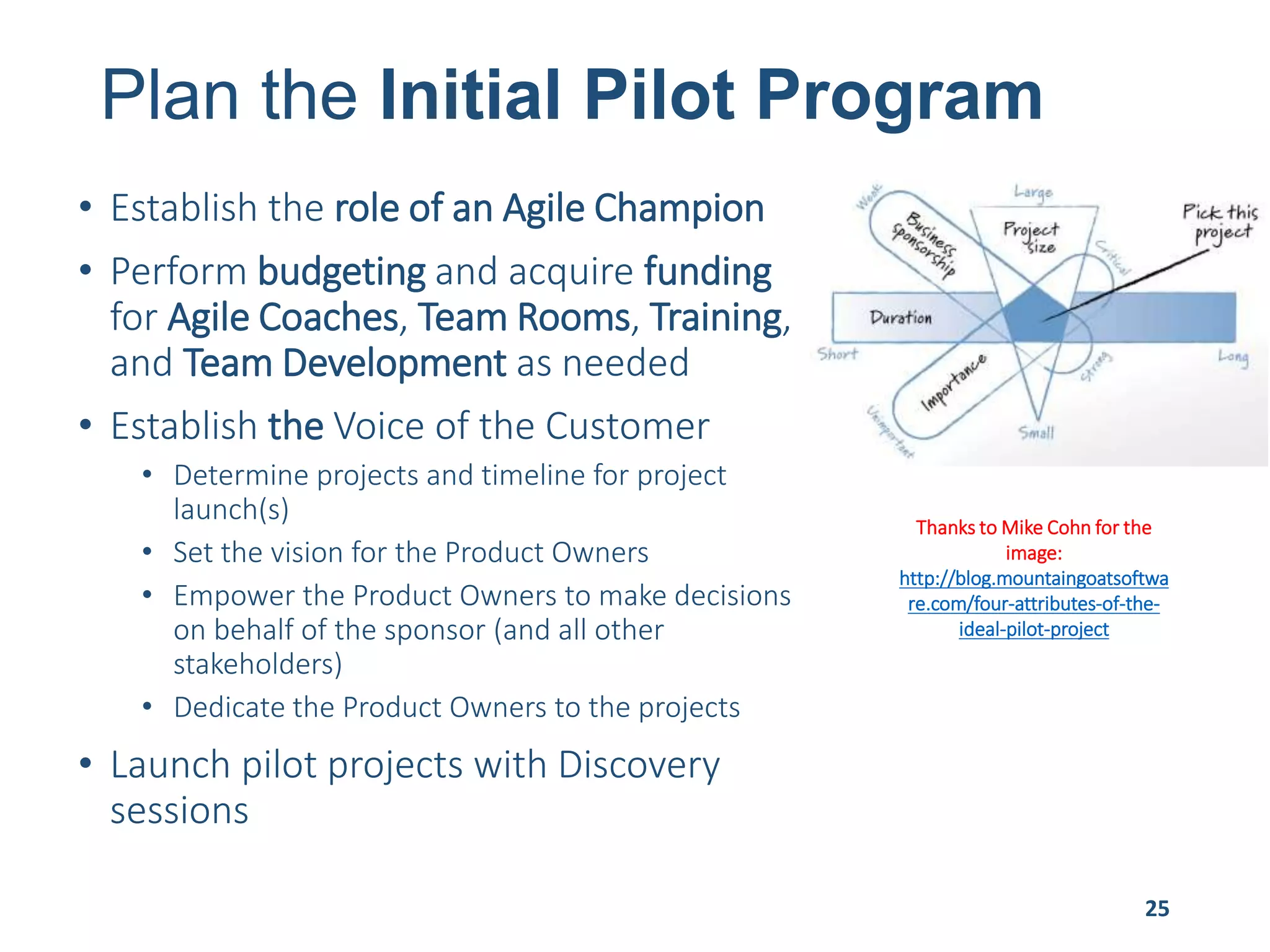
Plan the Initial Pilot Program
• Establish the role of an Agile Champion
• Perform budgeting and acquire funding
for Agile Coaches, Team Rooms, Training,
and Team Development as needed
• Establish the Voice of the Customer
• Determine projects and timeline for project
launch(s)
• Set the vision for the Product Owners
• Empower the Product Owners to make decisions
on behalf of the sponsor (and all other
stakeholders)
• Dedicate the Product Owners to the projects
• Launch pilot projects with Discovery
sessions
25
Thanks to Mike Cohn for the
image:
http://blog.mountaingoatsoftwa
re.com/four-attributes-of-the-
ideal-pilot-project
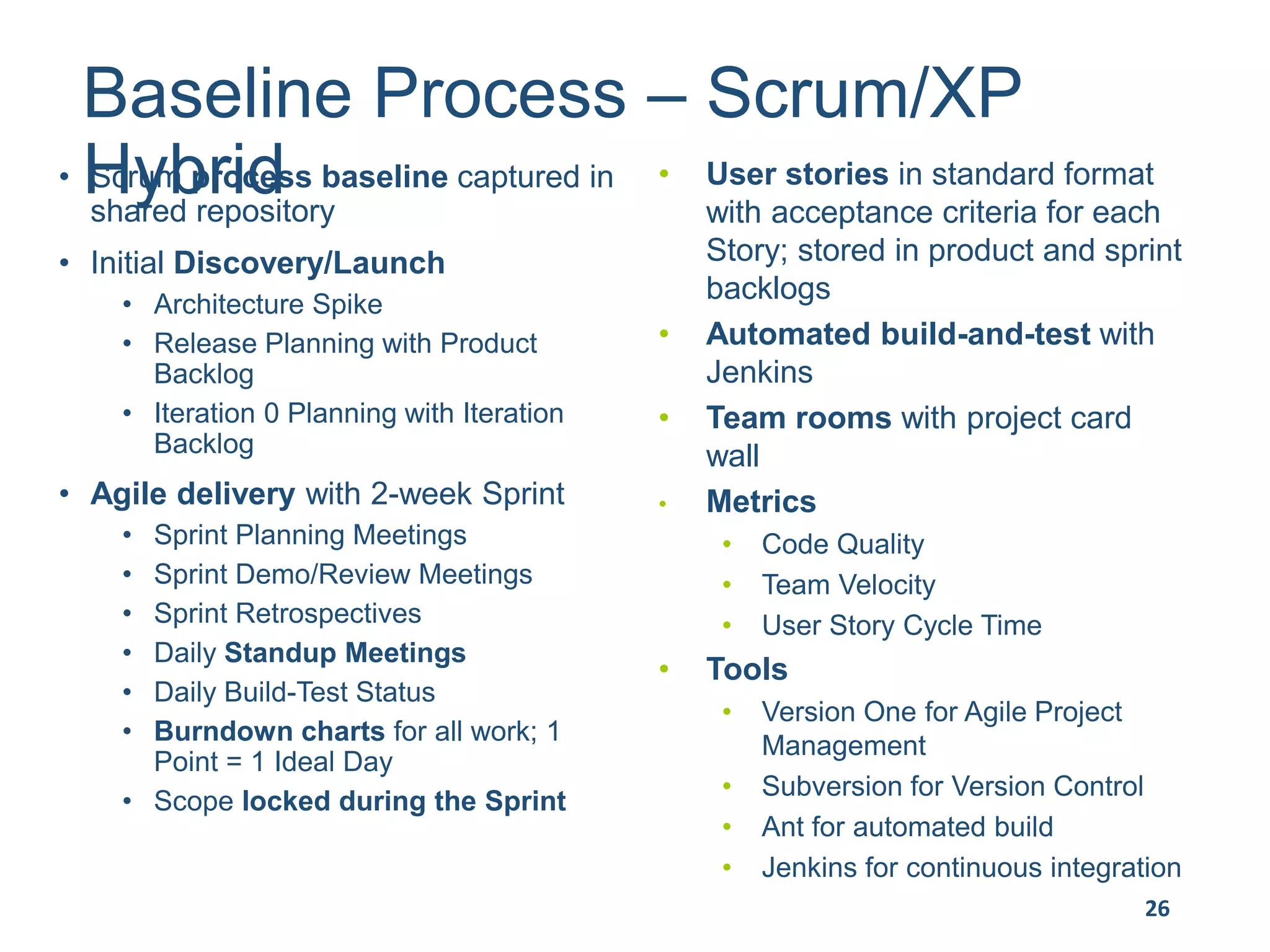
Baseline Process – Scrum/XP
Hybrid• Scrum process baseline captured in
shared repository
• Initial Discovery/Launch
• Architecture Spike
• Release Planning with Product
Backlog
• Iteration 0 Planning with Iteration
Backlog
• Agile delivery with 2-week Sprint
• Sprint Planning Meetings
• Sprint Demo/Review Meetings
• Sprint Retrospectives
• Daily Standup Meetings
• Daily Build-Test Status
• Burndown charts for all work; 1
Point = 1 Ideal Day
• Scope locked during the Sprint
• User stories in standard format
with acceptance criteria for each
Story; stored in product and sprint
backlogs
• Automated build-and-test with
Jenkins
• Team rooms with project card
wall
• Metrics
• Code Quality
• Team Velocity
• User Story Cycle Time
• Tools
• Version One for Agile Project
Management
• Subversion for Version Control
• Ant for automated build
• Jenkins for continuous integration
26
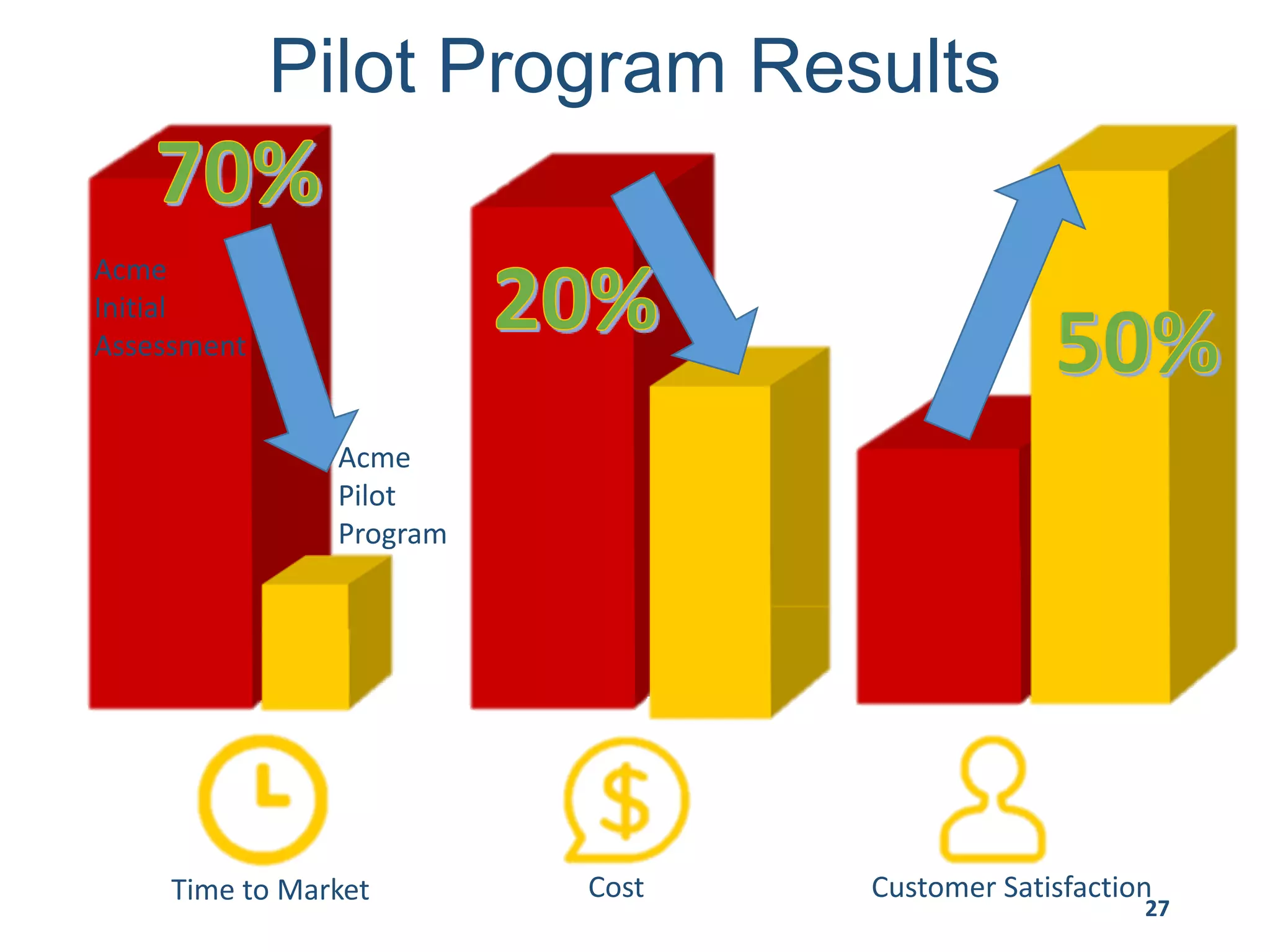
Pilot Program Results
Time to Market Cost Customer Satisfaction
Acme
Initial
Assessment
Acme
Pilot
Program
27
The Path to Agility:
ACCELERATE
Key Scaling Fundamentals
1. Limit Work in Process (WIP) for high
quality and maximum throughput.
1. Grow Small, Stable Teams to reduce
thrashing and create predictable
delivery.
2. Build a Network of Small Teams to
scale teams in organic fashion.
3. Manage the Flow to detect and
eliminate bottlenecks.
29
Limit WIP
30
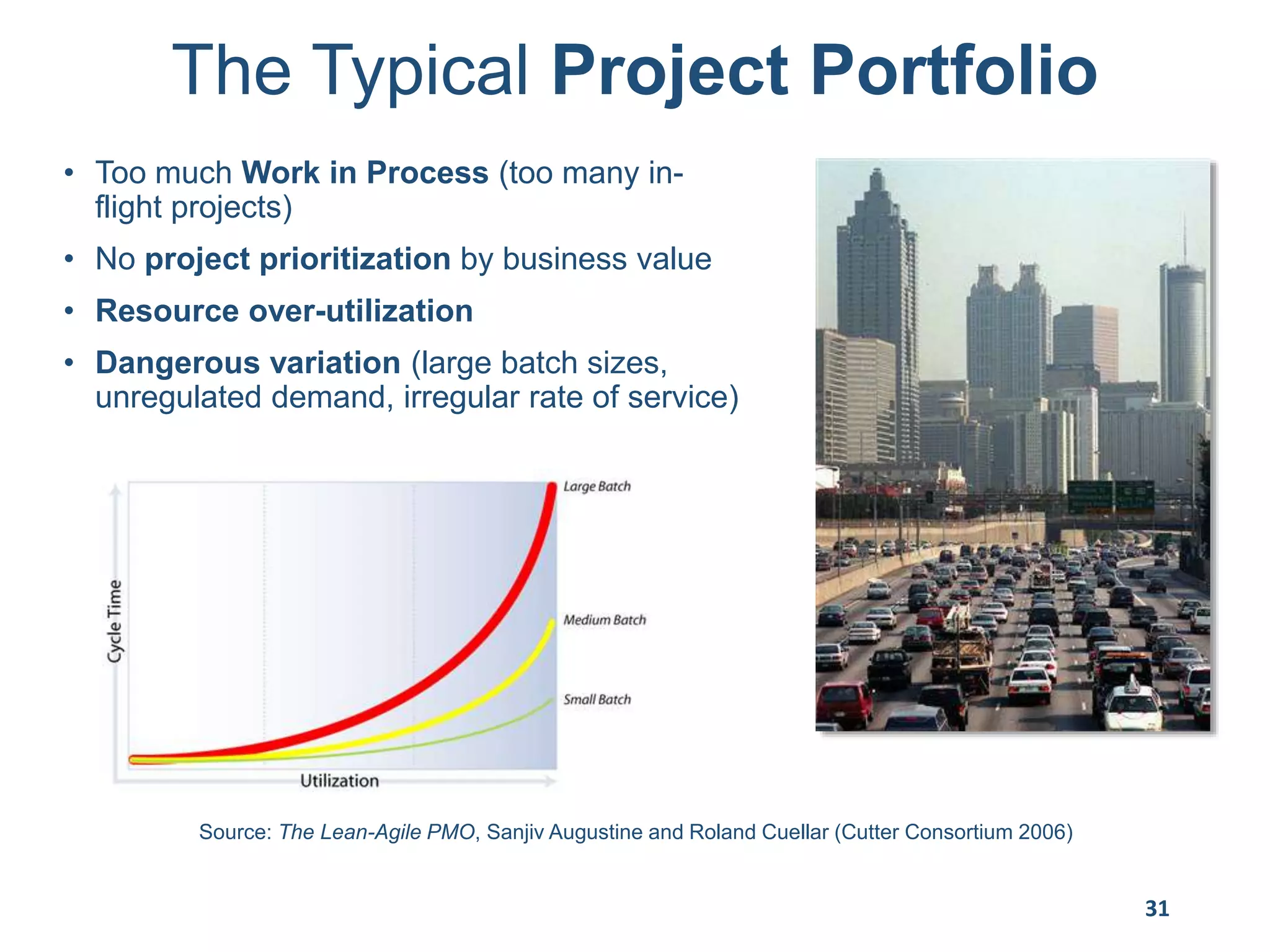
The Typical Project Portfolio
• Too much Work in Process (too many in-
flight projects)
• No project prioritization by business value
• Resource over-utilization
• Dangerous variation (large batch sizes,
unregulated demand, irregular rate of service)
Source: The Lean-Agile PMO, Sanjiv Augustine and Roland Cuellar (Cutter Consortium 2006)
31
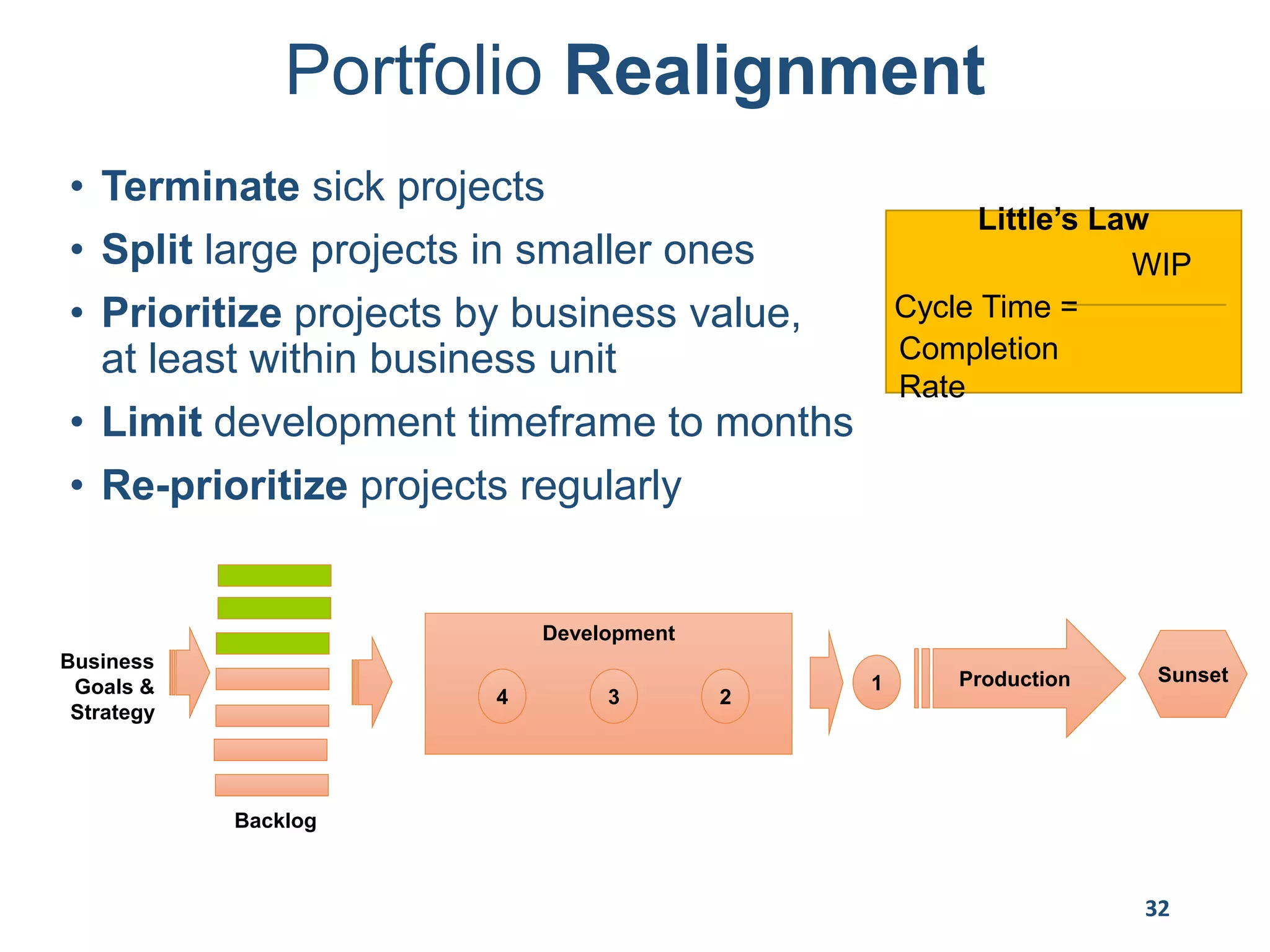
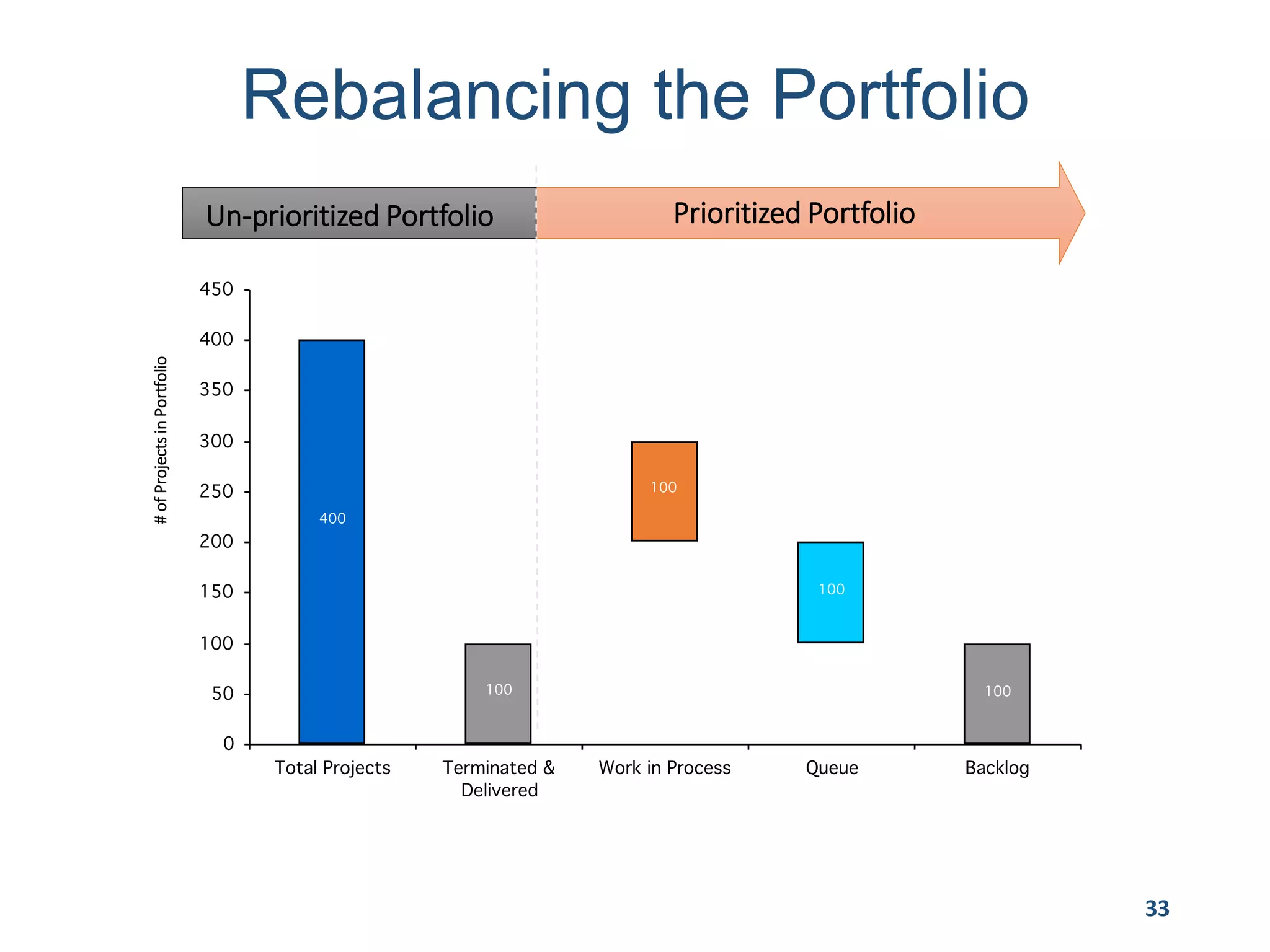
Portfolio Realignment
• Terminate sick projects
• Split large projects in smaller ones
• Prioritize projects by business value,
at least within business unit
• Limit development timeframe to months
• Re-prioritize projects regularly
1
Development
3 24
Little’s Law
WIP
Completion
Rate
Business
Goals &
Strategy
Production Sunset
Cycle Time =
Backlog
32
Rebalancing the Portfolio
#ofProjectsinPortfolio
Un-prioritized Portfolio Prioritized Portfolio
33
Grow Small, Stable
Teams
34
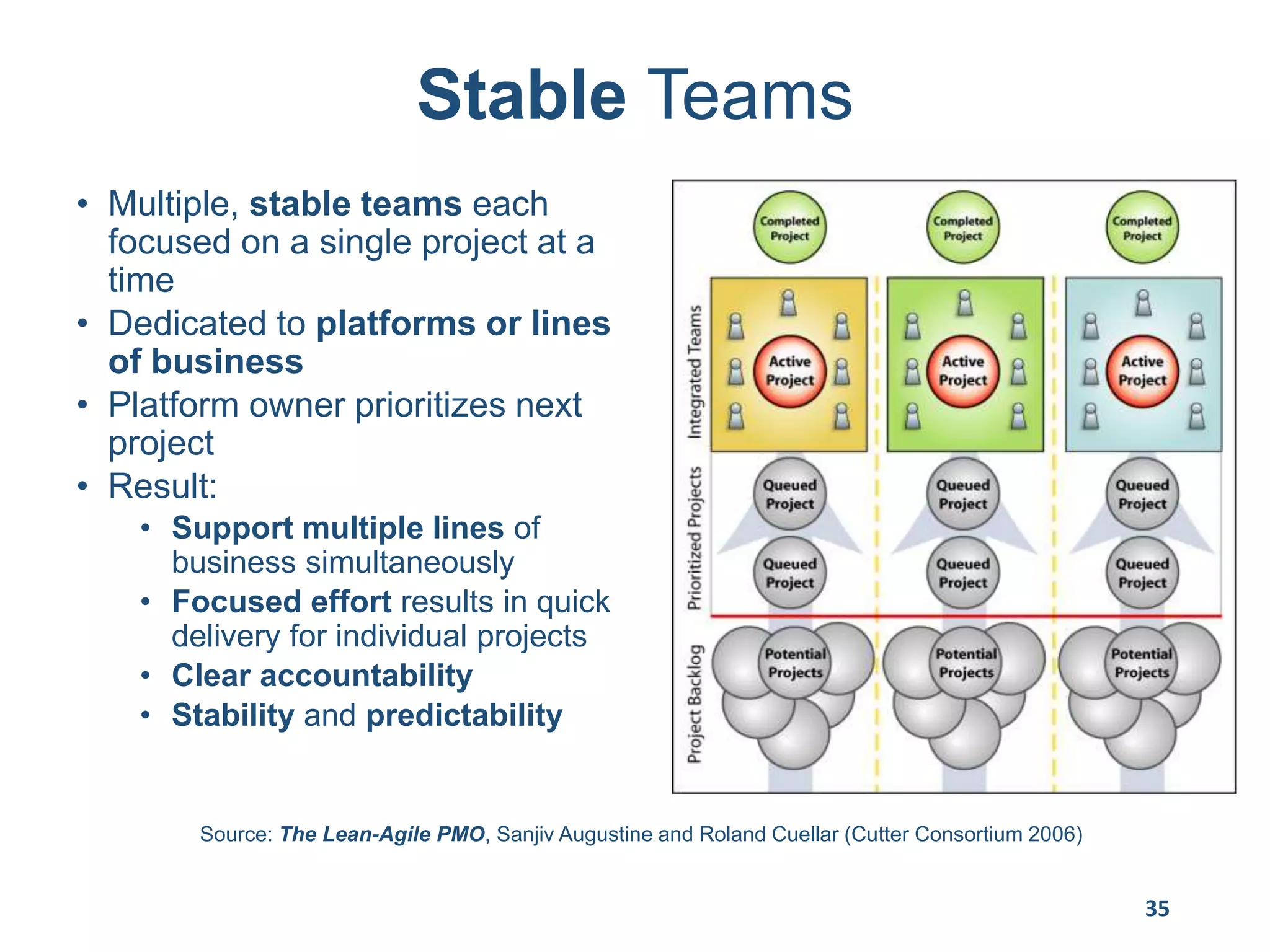
Stable Teams
• Multiple, stable teams each
focused on a single project at a
time
• Dedicated to platforms or lines
of business
• Platform owner prioritizes next
project
• Result:
• Support multiple lines of
business simultaneously
• Focused effort results in quick
delivery for individual projects
• Clear accountability
• Stability and predictability
Source: The Lean-Agile PMO, Sanjiv Augustine and Roland Cuellar (Cutter Consortium 2006)
35
Network of Small Teams
36
Network of Small Teams
“…for a large organization to work it must
behave like a related group of small
organizations.”
- E. F. Schumacher , Small is Beautiful
Scaling may require, at certain levels:
• Chief ScrumMasters
• Strategic Product Owners
• Tactical Product Owners
• Lightweight Agile PMOs serving as a
“guiding coalition”
Accelerate! By John Kotter, HBR, November 201237
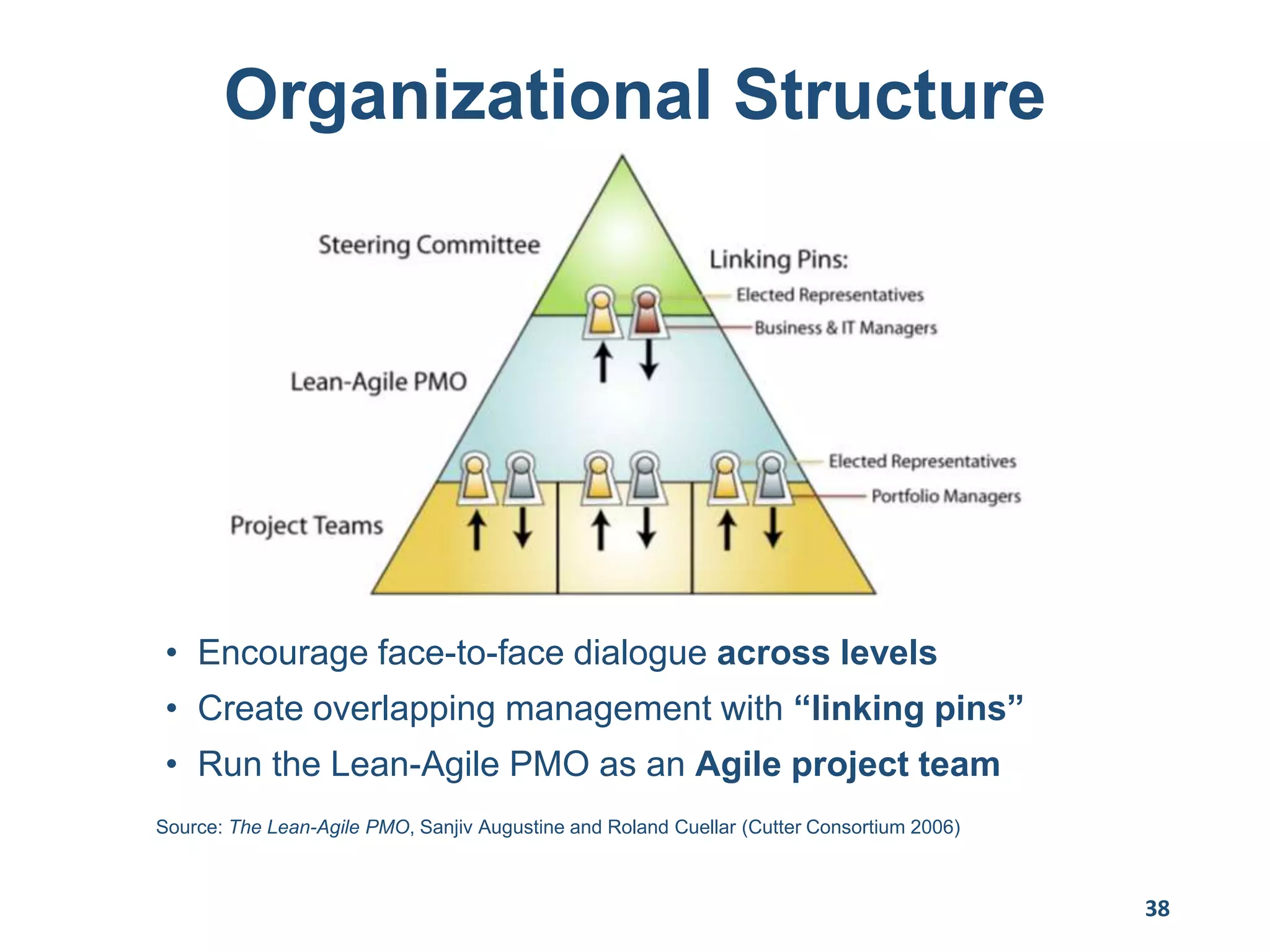
Organizational Structure
• Encourage face-to-face dialogue across levels
• Create overlapping management with “linking pins”
• Run the Lean-Agile PMO as an Agile project team
Source: The Lean-Agile PMO, Sanjiv Augustine and Roland Cuellar (Cutter Consortium 2006)
38
Manage the Flow
39
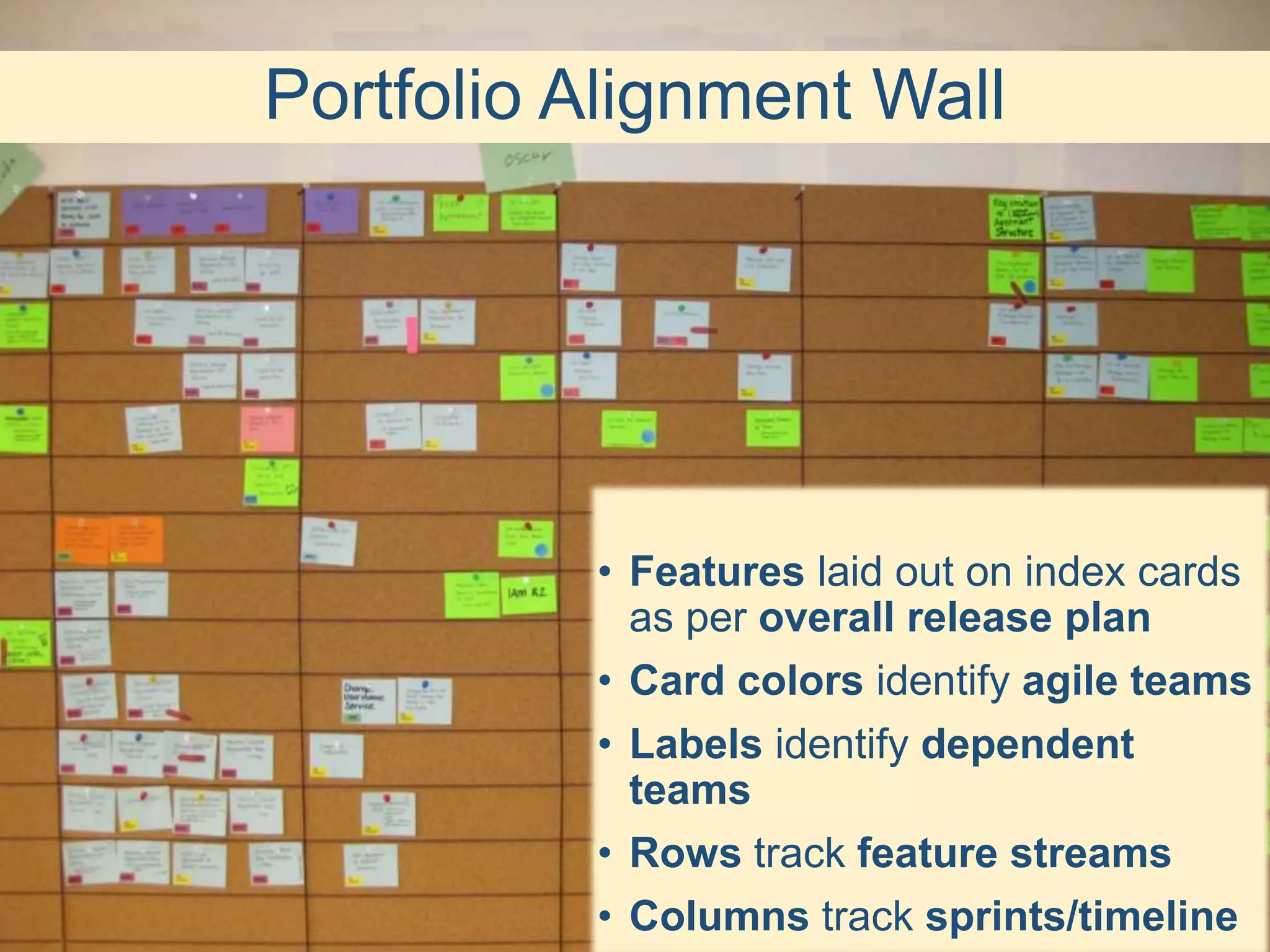
Portfolio Alignment Wall
40
• Features laid out on index cards
as per overall release plan
• Card colors identify agile teams
• Labels identify dependent
teams
• Rows track feature streams
• Columns track sprints/timeline
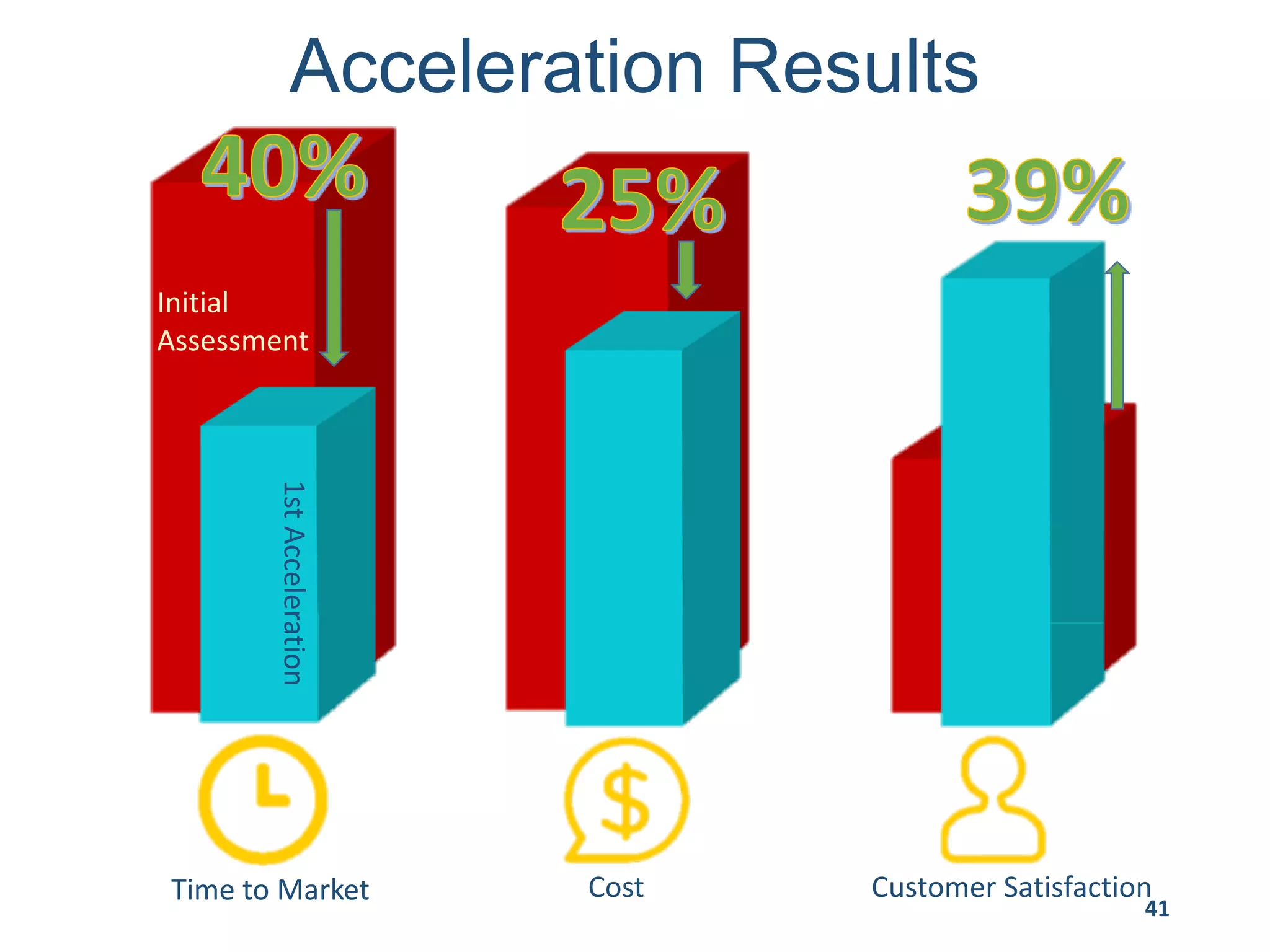
Acceleration Results
Time to Market Cost Customer Satisfaction
Initial
Assessment
1stAcceleration
41
The Path to Agility:
REFLECT &
PROGRESS
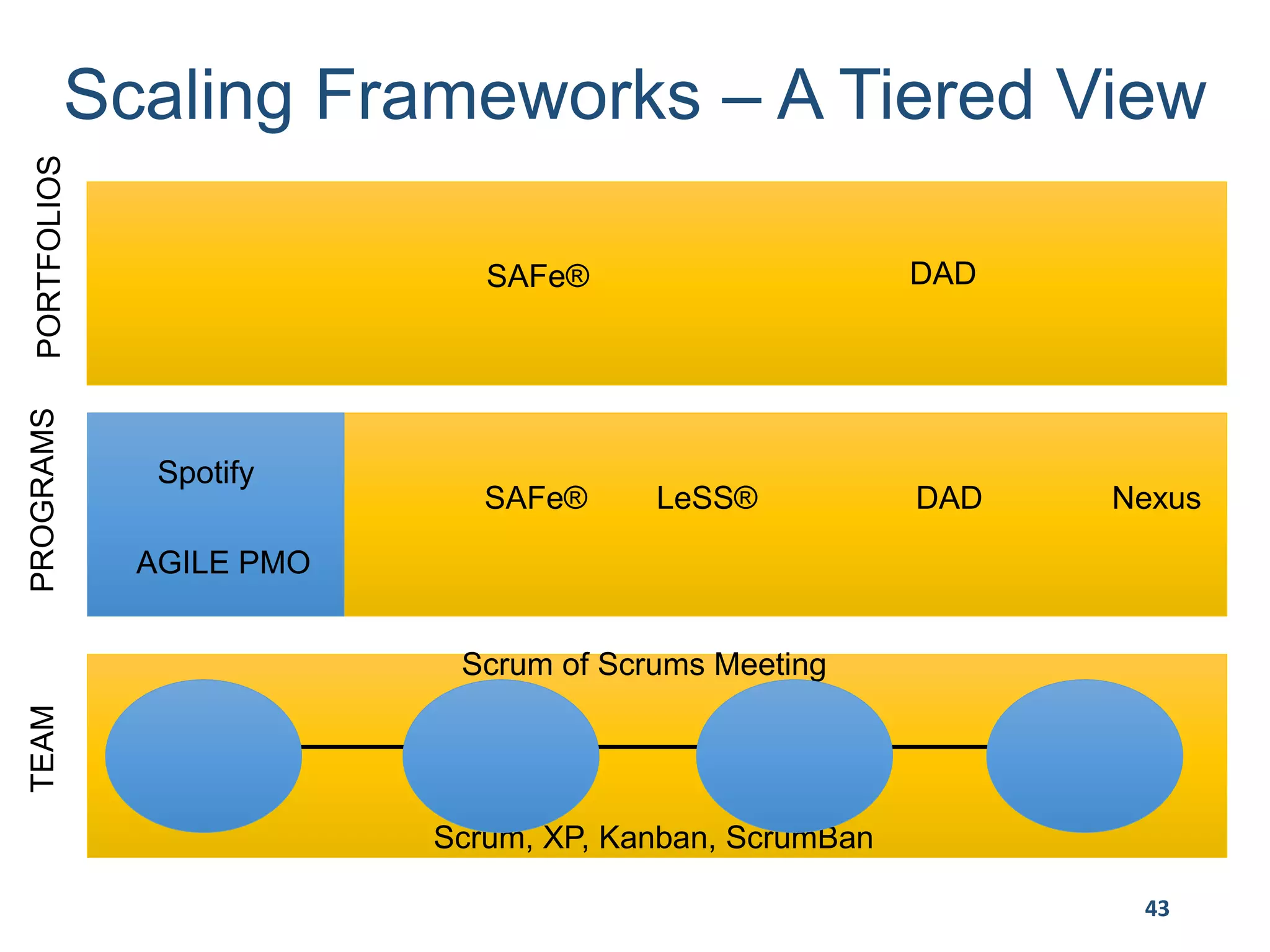
Scaling Frameworks – A Tiered View
Scrum of Scrums Meeting
TEAMPROGRAMSPORTFOLIOS
Scrum, XP, Kanban, ScrumBan
SAFe® LeSS® DAD Nexus
SAFe®
43
DAD
AGILE PMO
Spotify
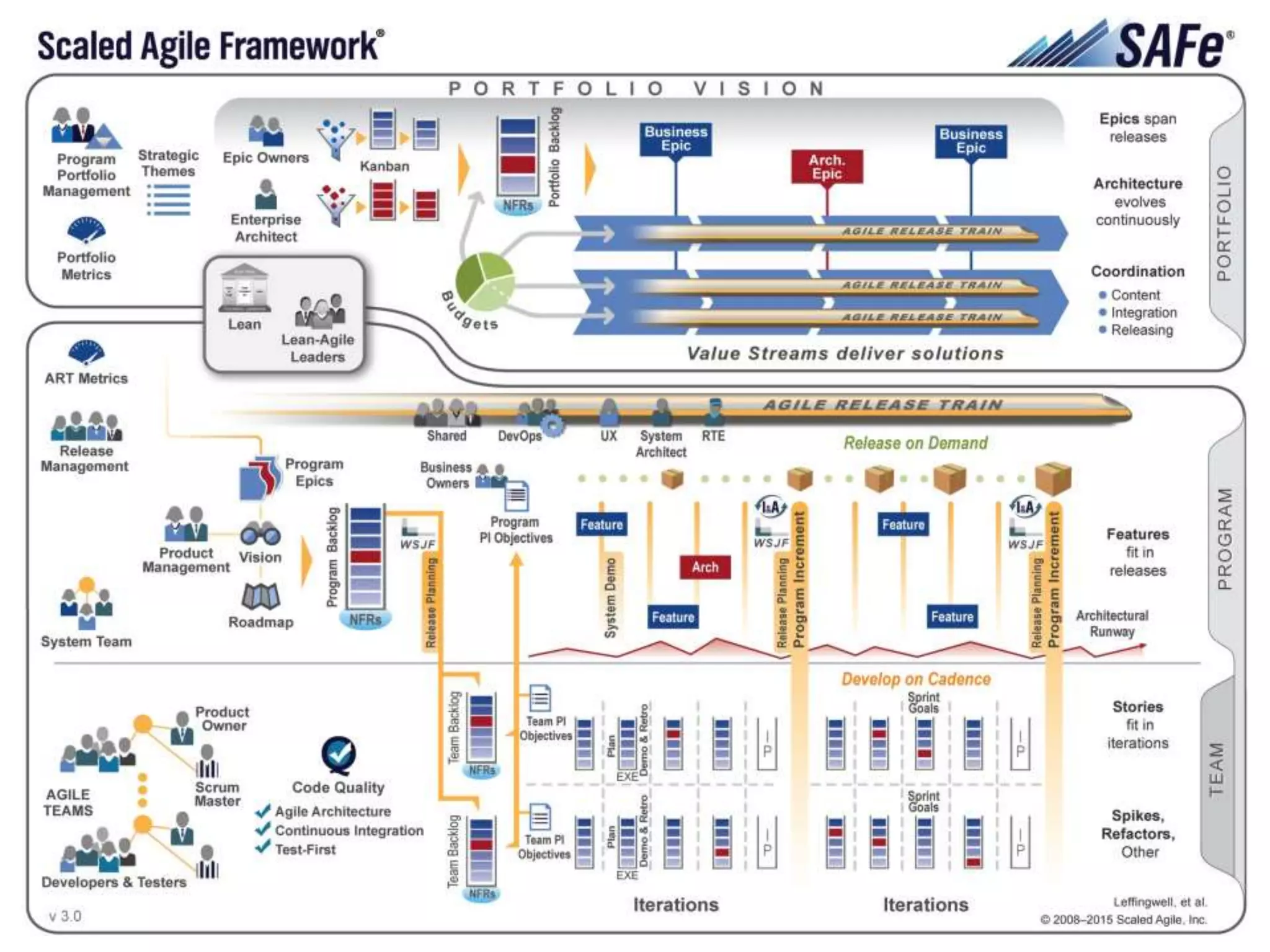
Scaled Agile Framework™ Big
Picture
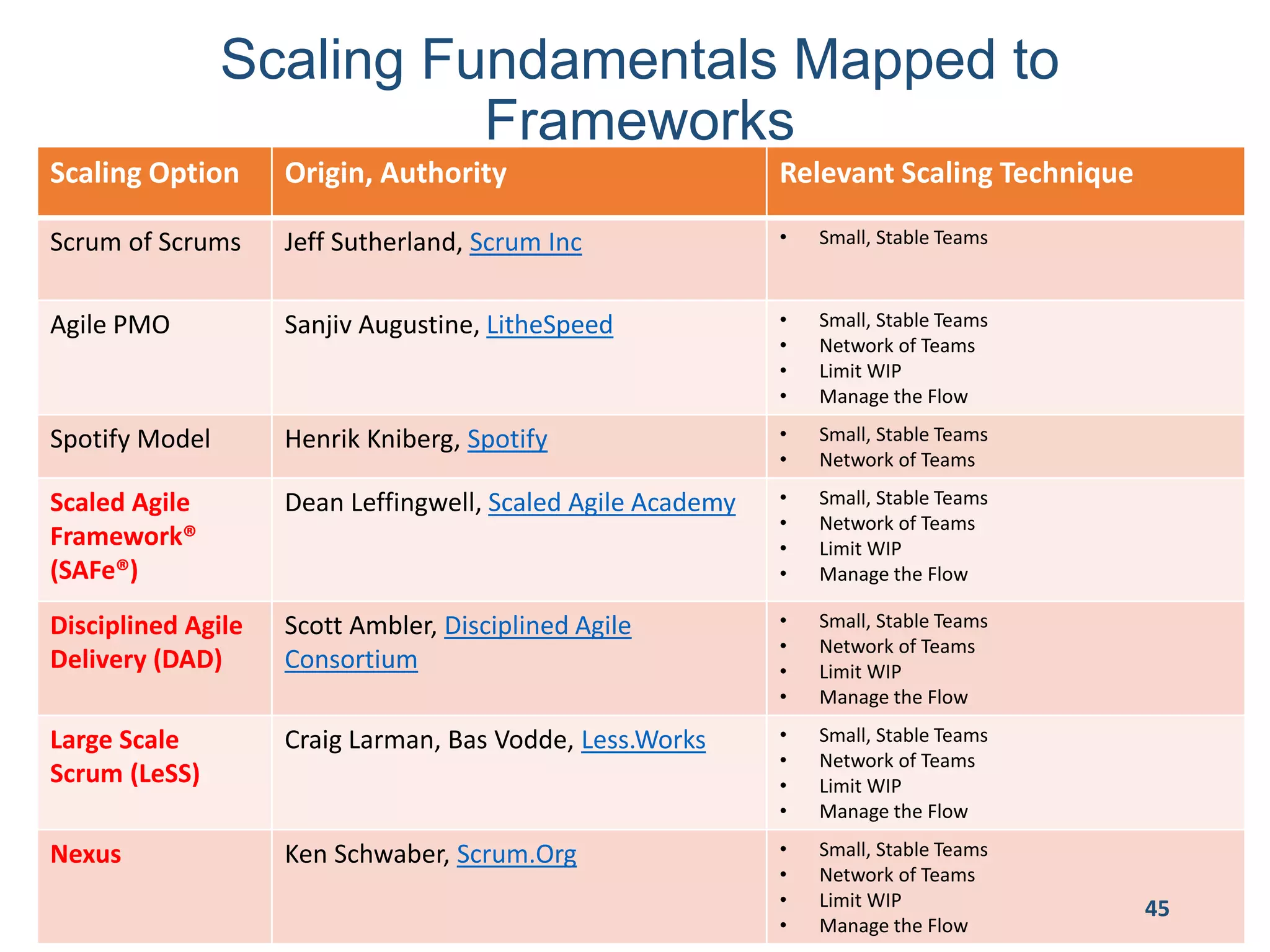
Scaling Fundamentals Mapped to
Frameworks
Scaling Option Origin, Authority Relevant Scaling Technique
Scrum of Scrums Jeff Sutherland, Scrum Inc • Small, Stable Teams
Agile PMO Sanjiv Augustine, LitheSpeed • Small, Stable Teams
• Network of Teams
• Limit WIP
• Manage the Flow
Spotify Model Henrik Kniberg, Spotify • Small, Stable Teams
• Network of Teams
Scaled Agile
Framework®
(SAFe®)
Dean Leffingwell, Scaled Agile Academy • Small, Stable Teams
• Network of Teams
• Limit WIP
• Manage the Flow
Disciplined Agile
Delivery (DAD)
Scott Ambler, Disciplined Agile
Consortium
• Small, Stable Teams
• Network of Teams
• Limit WIP
• Manage the Flow
Large Scale
Scrum (LeSS)
Craig Larman, Bas Vodde, Less.Works • Small, Stable Teams
• Network of Teams
• Limit WIP
• Manage the Flow
Nexus Ken Schwaber, Scrum.Org • Small, Stable Teams
• Network of Teams
• Limit WIP
• Manage the Flow
45
SUMMARY & NEXT
STEPS
46
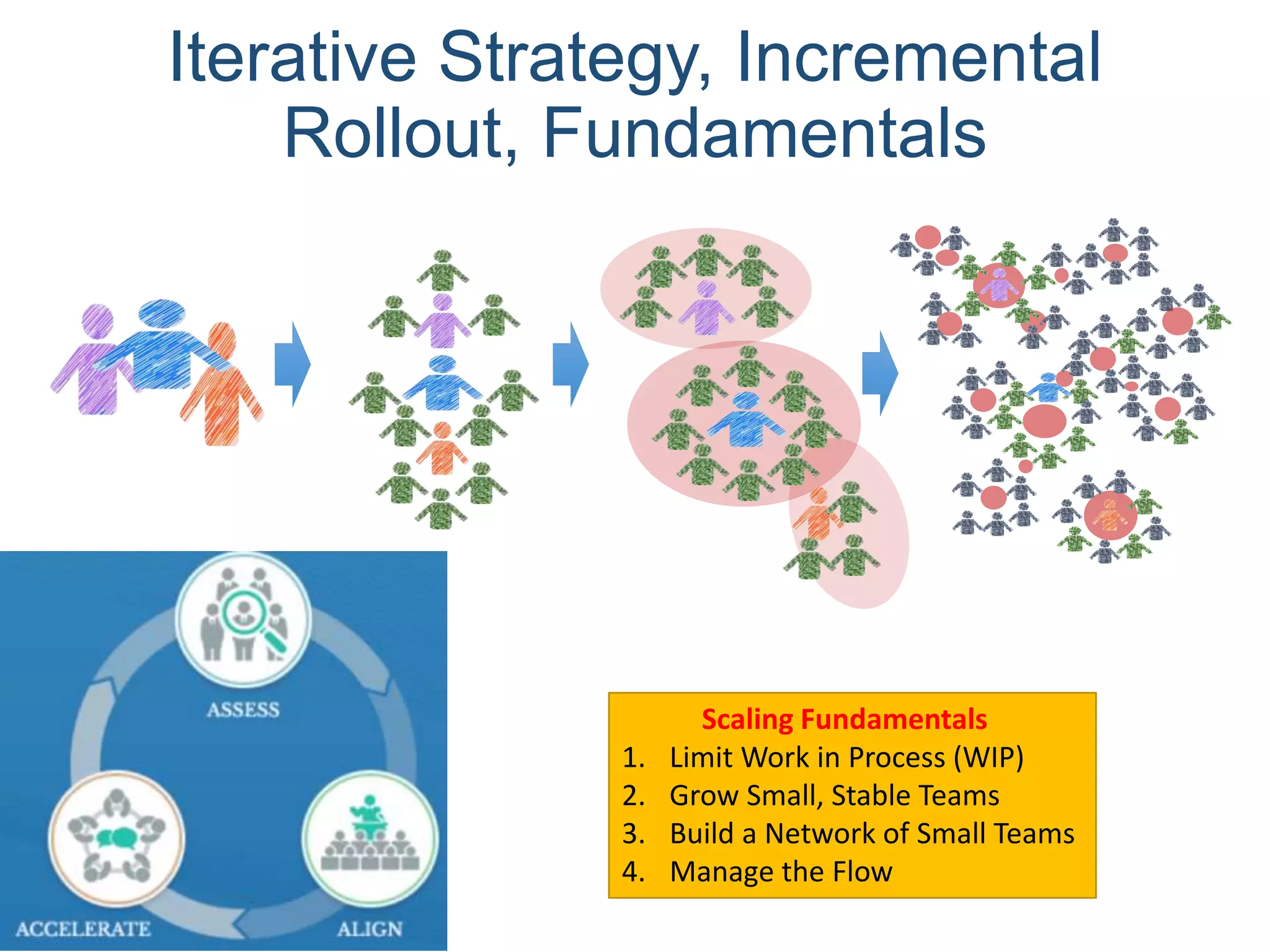
Iterative Strategy, Incremental
Rollout, Fundamentals
Scaling Fundamentals
1. Limit Work in Process (WIP)
2. Grow Small, Stable Teams
3. Build a Network of Small Teams
4. Manage the Flow
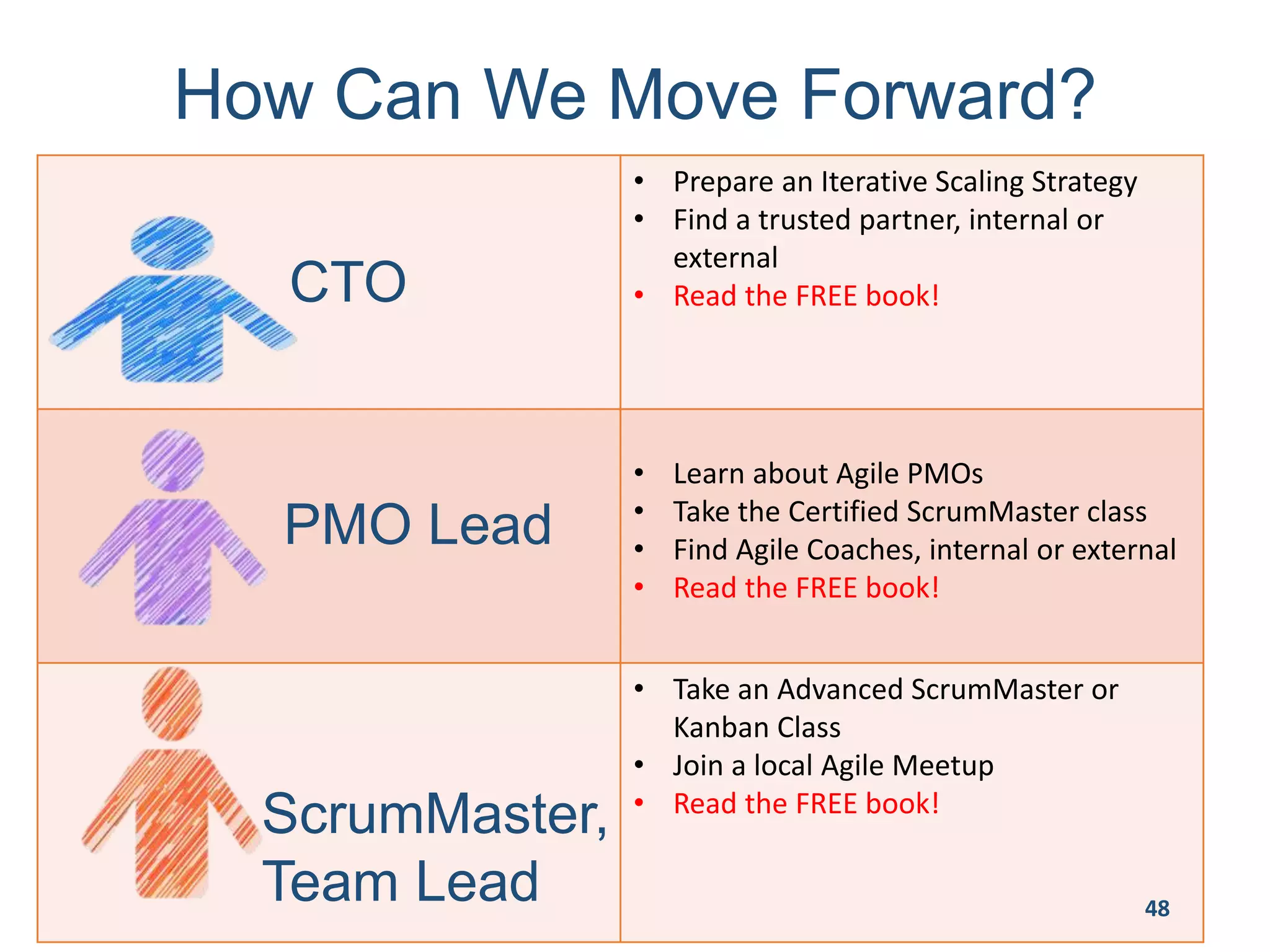
• Prepare an Iterative Scaling Strategy
• Find a trusted partner, internal or
external
• Read the FREE book!
• Learn about Agile PMOs
• Take the Certified ScrumMaster class
• Find Agile Coaches, internal or external
• Read the FREE book!
• Take an Advanced ScrumMaster or
Kanban Class
• Join a local Agile Meetup
• Read the FREE book!
How Can We Move Forward?
CTO
PMO Lead
ScrumMaster,
Team Lead 48
49
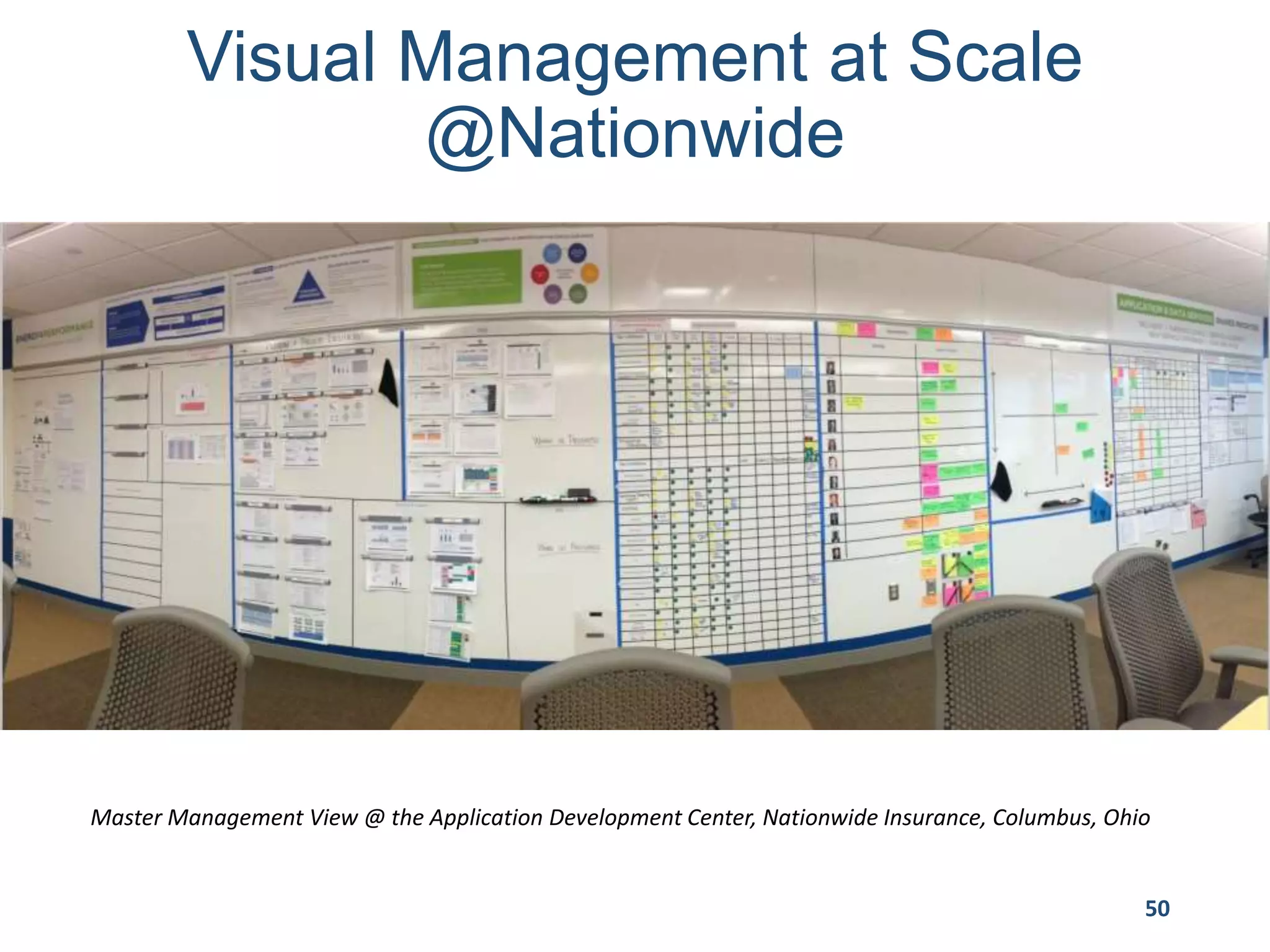
Visual Management at Scale
@Nationwide
50
Master Management View @ the Application Development Center, Nationwide Insurance, Columbus, Ohio
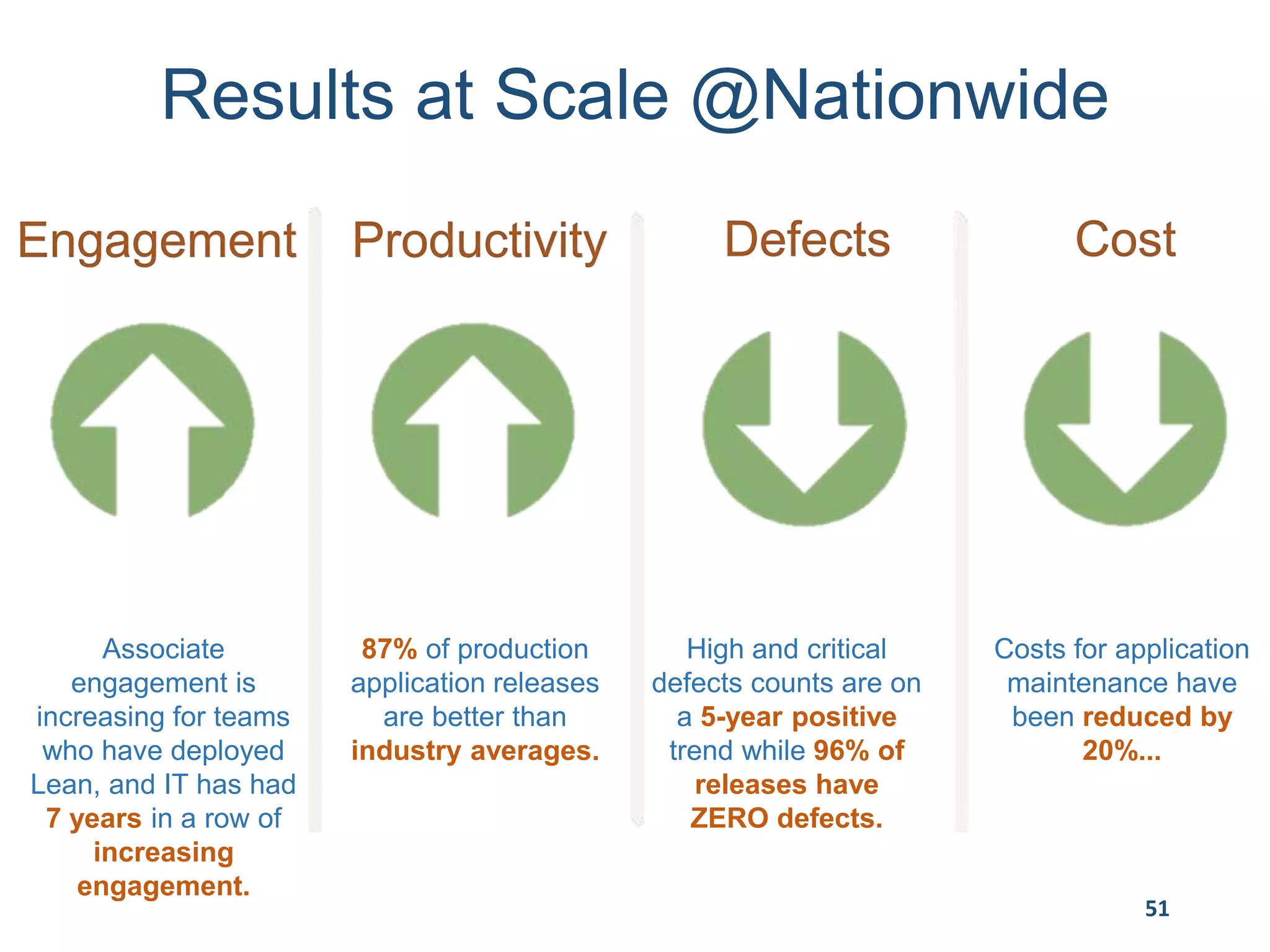
Results at Scale @Nationwide
Engagement Productivity Defects Cost
Associate
engagement is
increasing for teams
who have deployed
Lean, and IT has had
7 years in a row of
increasing
engagement.
87% of production
application releases
are better than
industry averages.
High and critical
defects counts are on
a 5-year positive
trend while 96% of
releases have
ZERO defects.
Costs for application
maintenance have
been reduced by
20%...
51
Contact Us for Further Information
Sanjiv Augustine
President
Sanjiv.Augustine@LitheSpeed.com
Twitter: @saugustine, @lithespeed
On the Web:
http://www.lithespeed.com
http://www.senseitool.com
Please stop by our
booth to learn more.
52

Scaling Agile: A Guide for the Perplexed

  • 1.
    A Guide forthe Perplexed Sanjiv Augustine Sanjiv.Augustine@LitheSpeed.com @saugustine, @lithespeed
  • 2.
    About Me • Presidentof LitheSpeed, LLC • Experience: • 25 years industry • 15 years of Agile • 12 years of Lean • Specialties: Agile, Lean, Innovation • Practitioner, entrepreneur, consultant, trainer, author, speaker and community organizer Sanjiv Augustine 2
  • 3.
    Audience Poll –Agile Knowledge? “Agile” describes a set of methodologies, aligned with lean principles for focusing on value and eliminating waste. Scrum is currently the most popular of these. 3State of Agile Development Survey, Version One, http://versionone.com
  • 4.
    Agenda 1.Why Scale Agile? 2.HowDo I JumpStart Scaling? 1. Overview 2. Assess 3. Align 4. Accelerate 3.Reflect and Progress 4.Summary & Next Steps 4
  • 5.
  • 6.
  • 7.
    Organizational Agility @Nationwide • 27teams using agile within a Lean ”standard work” framework • 7 months – no critical or high bugs in production 7
  • 8.
    Vivek Kundra’ FederalCIOs 25-point Implementation plan: 38 projects reviewed, 4 canceled, 11 rescoped and 12 have cut the time for delivery of functionality down by more than half, from two to three years down to an average of 8 months Result: $3 billion in lifecycle budget reductions. - Wikipedia on Vivek Kundra Organizational Agility @ the Gov’t 8 National Geospatial Intelligence Agency "The use of agile acquisition methods and concepts are essential to NGA's success.” NGA, via Federal Computer Week
  • 9.
    Barriers to FurtherAgile Adoption What’s hindering us from truly leveraging Agile for organizational agility? Source: Adapted from 2015 State of Agile Development Survey, VersionOne 9
  • 10.
  • 11.
    Organizational Misalignment withAgile Methods • Team Size 11
  • 12.
    Organizational Misalignment withAgile Methods • QA Silo 12
  • 13.
    Organizational Misalignment withAgile Methods • Project Multitasking 13
  • 14.
    The Evolution ofthe 21st Century Organization John Kotter, Harvard Business School
  • 15.
  • 16.
    Welcome to AcmeCorp. Roy, CTO Amber, PMO Head Tom, ScrumMaster 16
  • 17.
    Roy Amber Tom The Path toAgility OVERVIEW
  • 18.
    Frameworks – Wheredo We Start? 18
  • 19.
    Scaling Frameworks –A Tiered View Scrum of Scrums Meeting TEAMPROGRAMSPORTFOLIOS Scrum, XP, Kanban, ScrumBan SAFe® LeSS® DAD Nexus SAFe® 19 DAD AGILE PMO Spotify
  • 20.
  • 21.
    Incremental Rollout Plan Month0 Month 6 Month 12 Month 18 Assess • Current State Snapshot • Vision • Incremental Rollout Strategy Align • Program Experiments • Capability Building • Cultural Shift Accelerat e • Guided Rollout • Initial Scaling Reflect & Progress • Full Scale Transformation • Scaling Framework Deployment 21
  • 22.
    The Path toAgility: ASSESS
  • 23.
    Initial Assessment Results Timeto Market Cost Customer Satisfaction Acme Competitors 23
  • 24.
    The Path toAgility: ALIGN
  • 25.
    Plan the InitialPilot Program • Establish the role of an Agile Champion • Perform budgeting and acquire funding for Agile Coaches, Team Rooms, Training, and Team Development as needed • Establish the Voice of the Customer • Determine projects and timeline for project launch(s) • Set the vision for the Product Owners • Empower the Product Owners to make decisions on behalf of the sponsor (and all other stakeholders) • Dedicate the Product Owners to the projects • Launch pilot projects with Discovery sessions 25 Thanks to Mike Cohn for the image: http://blog.mountaingoatsoftwa re.com/four-attributes-of-the- ideal-pilot-project
  • 26.
    Baseline Process –Scrum/XP Hybrid• Scrum process baseline captured in shared repository • Initial Discovery/Launch • Architecture Spike • Release Planning with Product Backlog • Iteration 0 Planning with Iteration Backlog • Agile delivery with 2-week Sprint • Sprint Planning Meetings • Sprint Demo/Review Meetings • Sprint Retrospectives • Daily Standup Meetings • Daily Build-Test Status • Burndown charts for all work; 1 Point = 1 Ideal Day • Scope locked during the Sprint • User stories in standard format with acceptance criteria for each Story; stored in product and sprint backlogs • Automated build-and-test with Jenkins • Team rooms with project card wall • Metrics • Code Quality • Team Velocity • User Story Cycle Time • Tools • Version One for Agile Project Management • Subversion for Version Control • Ant for automated build • Jenkins for continuous integration 26
  • 27.
    Pilot Program Results Timeto Market Cost Customer Satisfaction Acme Initial Assessment Acme Pilot Program 27
  • 28.
    The Path toAgility: ACCELERATE
  • 29.
    Key Scaling Fundamentals 1.Limit Work in Process (WIP) for high quality and maximum throughput. 1. Grow Small, Stable Teams to reduce thrashing and create predictable delivery. 2. Build a Network of Small Teams to scale teams in organic fashion. 3. Manage the Flow to detect and eliminate bottlenecks. 29
  • 30.
  • 31.
    The Typical ProjectPortfolio • Too much Work in Process (too many in- flight projects) • No project prioritization by business value • Resource over-utilization • Dangerous variation (large batch sizes, unregulated demand, irregular rate of service) Source: The Lean-Agile PMO, Sanjiv Augustine and Roland Cuellar (Cutter Consortium 2006) 31
  • 32.
    Portfolio Realignment • Terminatesick projects • Split large projects in smaller ones • Prioritize projects by business value, at least within business unit • Limit development timeframe to months • Re-prioritize projects regularly 1 Development 3 24 Little’s Law WIP Completion Rate Business Goals & Strategy Production Sunset Cycle Time = Backlog 32
  • 33.
  • 34.
  • 35.
    Stable Teams • Multiple,stable teams each focused on a single project at a time • Dedicated to platforms or lines of business • Platform owner prioritizes next project • Result: • Support multiple lines of business simultaneously • Focused effort results in quick delivery for individual projects • Clear accountability • Stability and predictability Source: The Lean-Agile PMO, Sanjiv Augustine and Roland Cuellar (Cutter Consortium 2006) 35
  • 36.
  • 37.
    Network of SmallTeams “…for a large organization to work it must behave like a related group of small organizations.” - E. F. Schumacher , Small is Beautiful Scaling may require, at certain levels: • Chief ScrumMasters • Strategic Product Owners • Tactical Product Owners • Lightweight Agile PMOs serving as a “guiding coalition” Accelerate! By John Kotter, HBR, November 201237
  • 38.
    Organizational Structure • Encourageface-to-face dialogue across levels • Create overlapping management with “linking pins” • Run the Lean-Agile PMO as an Agile project team Source: The Lean-Agile PMO, Sanjiv Augustine and Roland Cuellar (Cutter Consortium 2006) 38
  • 39.
  • 40.
    Portfolio Alignment Wall 40 •Features laid out on index cards as per overall release plan • Card colors identify agile teams • Labels identify dependent teams • Rows track feature streams • Columns track sprints/timeline
  • 41.
    Acceleration Results Time toMarket Cost Customer Satisfaction Initial Assessment 1stAcceleration 41
  • 42.
    The Path toAgility: REFLECT & PROGRESS
  • 43.
    Scaling Frameworks –A Tiered View Scrum of Scrums Meeting TEAMPROGRAMSPORTFOLIOS Scrum, XP, Kanban, ScrumBan SAFe® LeSS® DAD Nexus SAFe® 43 DAD AGILE PMO Spotify
  • 44.
  • 45.
    Scaling Fundamentals Mappedto Frameworks Scaling Option Origin, Authority Relevant Scaling Technique Scrum of Scrums Jeff Sutherland, Scrum Inc • Small, Stable Teams Agile PMO Sanjiv Augustine, LitheSpeed • Small, Stable Teams • Network of Teams • Limit WIP • Manage the Flow Spotify Model Henrik Kniberg, Spotify • Small, Stable Teams • Network of Teams Scaled Agile Framework® (SAFe®) Dean Leffingwell, Scaled Agile Academy • Small, Stable Teams • Network of Teams • Limit WIP • Manage the Flow Disciplined Agile Delivery (DAD) Scott Ambler, Disciplined Agile Consortium • Small, Stable Teams • Network of Teams • Limit WIP • Manage the Flow Large Scale Scrum (LeSS) Craig Larman, Bas Vodde, Less.Works • Small, Stable Teams • Network of Teams • Limit WIP • Manage the Flow Nexus Ken Schwaber, Scrum.Org • Small, Stable Teams • Network of Teams • Limit WIP • Manage the Flow 45
  • 46.
  • 47.
    Iterative Strategy, Incremental Rollout,Fundamentals Scaling Fundamentals 1. Limit Work in Process (WIP) 2. Grow Small, Stable Teams 3. Build a Network of Small Teams 4. Manage the Flow
  • 48.
    • Prepare anIterative Scaling Strategy • Find a trusted partner, internal or external • Read the FREE book! • Learn about Agile PMOs • Take the Certified ScrumMaster class • Find Agile Coaches, internal or external • Read the FREE book! • Take an Advanced ScrumMaster or Kanban Class • Join a local Agile Meetup • Read the FREE book! How Can We Move Forward? CTO PMO Lead ScrumMaster, Team Lead 48
  • 49.
  • 50.
    Visual Management atScale @Nationwide 50 Master Management View @ the Application Development Center, Nationwide Insurance, Columbus, Ohio
  • 51.
    Results at Scale@Nationwide Engagement Productivity Defects Cost Associate engagement is increasing for teams who have deployed Lean, and IT has had 7 years in a row of increasing engagement. 87% of production application releases are better than industry averages. High and critical defects counts are on a 5-year positive trend while 96% of releases have ZERO defects. Costs for application maintenance have been reduced by 20%... 51
  • 52.
    Contact Us forFurther Information Sanjiv Augustine President Sanjiv.Augustine@LitheSpeed.com Twitter: @saugustine, @lithespeed On the Web: http://www.lithespeed.com http://www.senseitool.com Please stop by our booth to learn more. 52