Scalable Data Science in
Python and R on
Apache Spark
Felix Cheung
Principal Engineer & Apache Spark Committer
Disclaimer:
Apache Spark community contributions
Agenda
• Intro to Spark, PySpark, SparkR
• ML with Spark
• Data Science PySpark
– ML Pipeline API
– Integrating with packages (tensorframe, BigDL, …)
• Data Science SparkR
– ML API
– Integrating with packages (svm, randomForest,
tensorflow…)
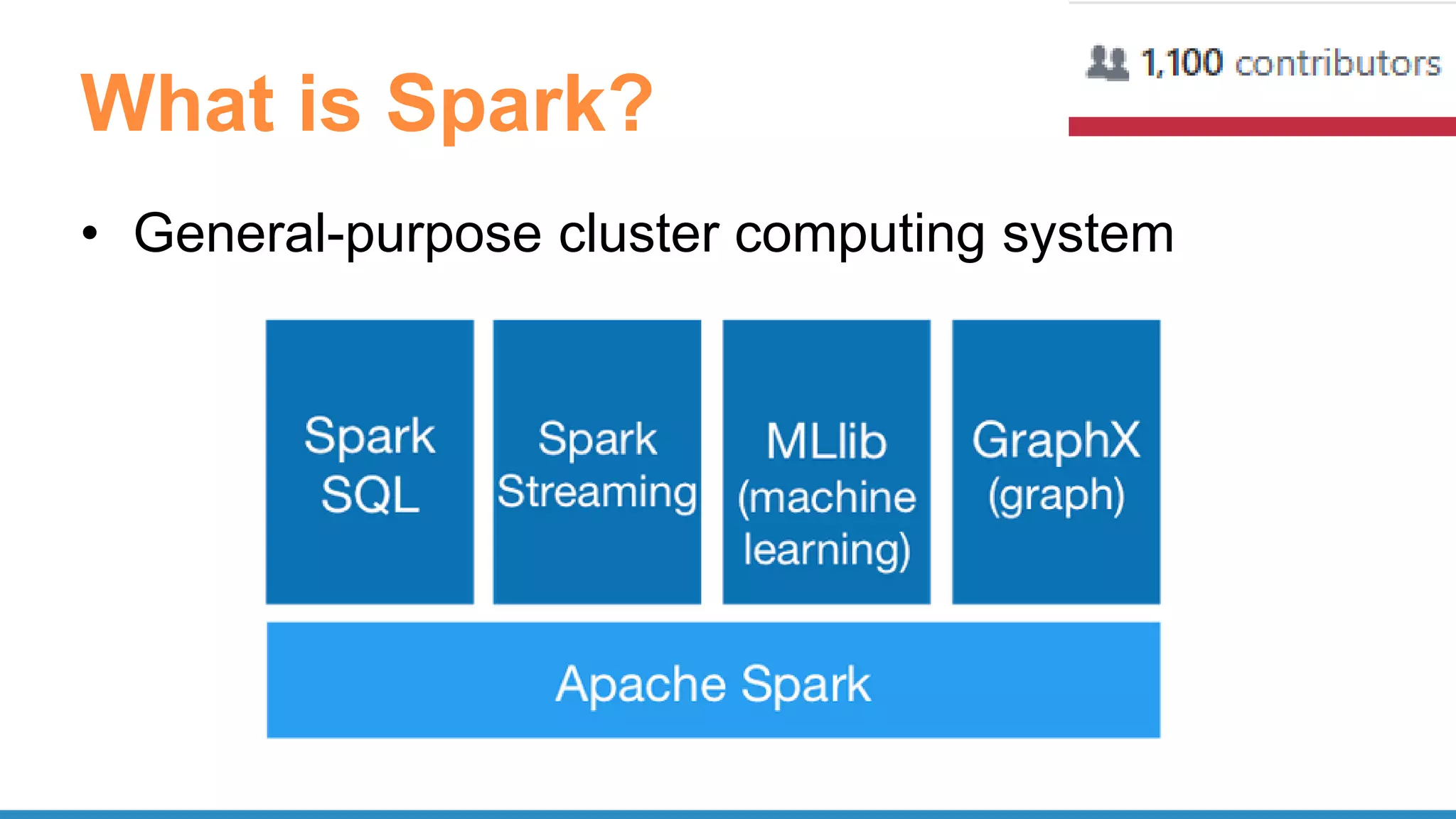
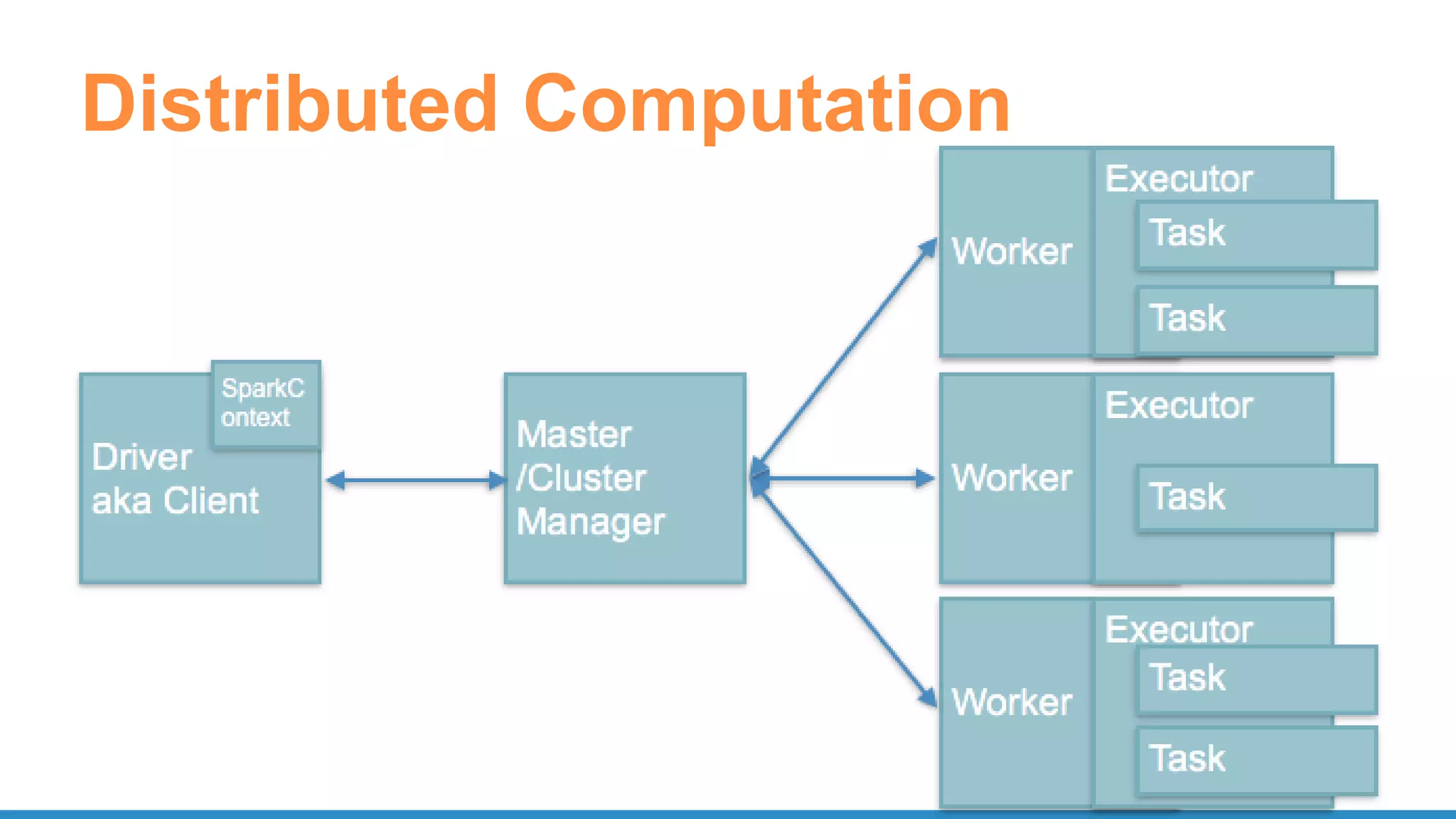
What is Spark?
• General-purpose cluster computing system
Distributed Computation
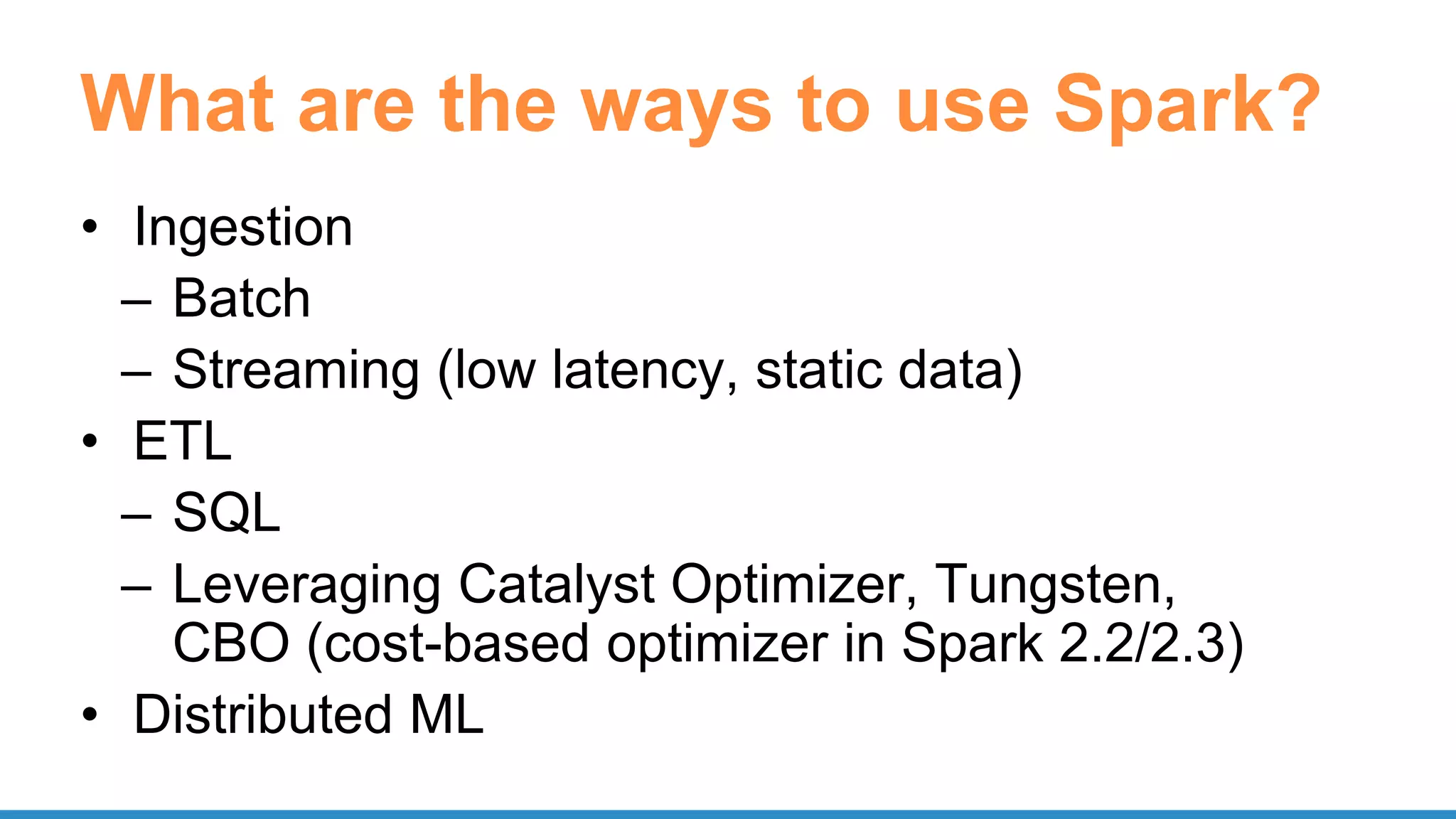
What are the ways to use Spark?
• Ingestion
– Batch
– Streaming (low latency, static data)
• ETL
– SQL
– Leveraging Catalyst Optimizer, Tungsten,
CBO (cost-based optimizer in Spark 2.2/2.3)
• Distributed ML
Language Bindings
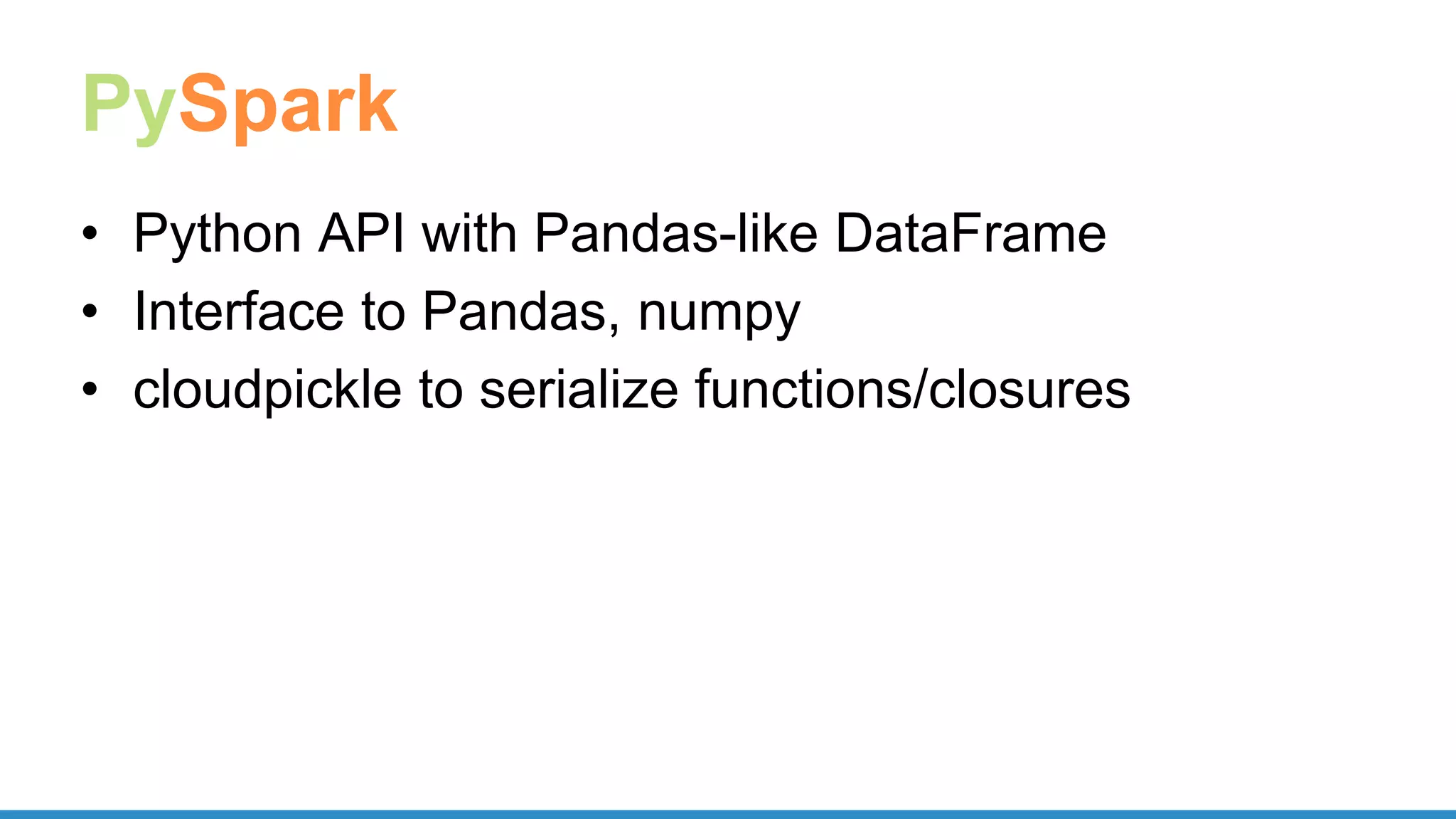
PySpark
• Python API with Pandas-like DataFrame
• Interface to Pandas, numpy
• cloudpickle to serialize functions/closures
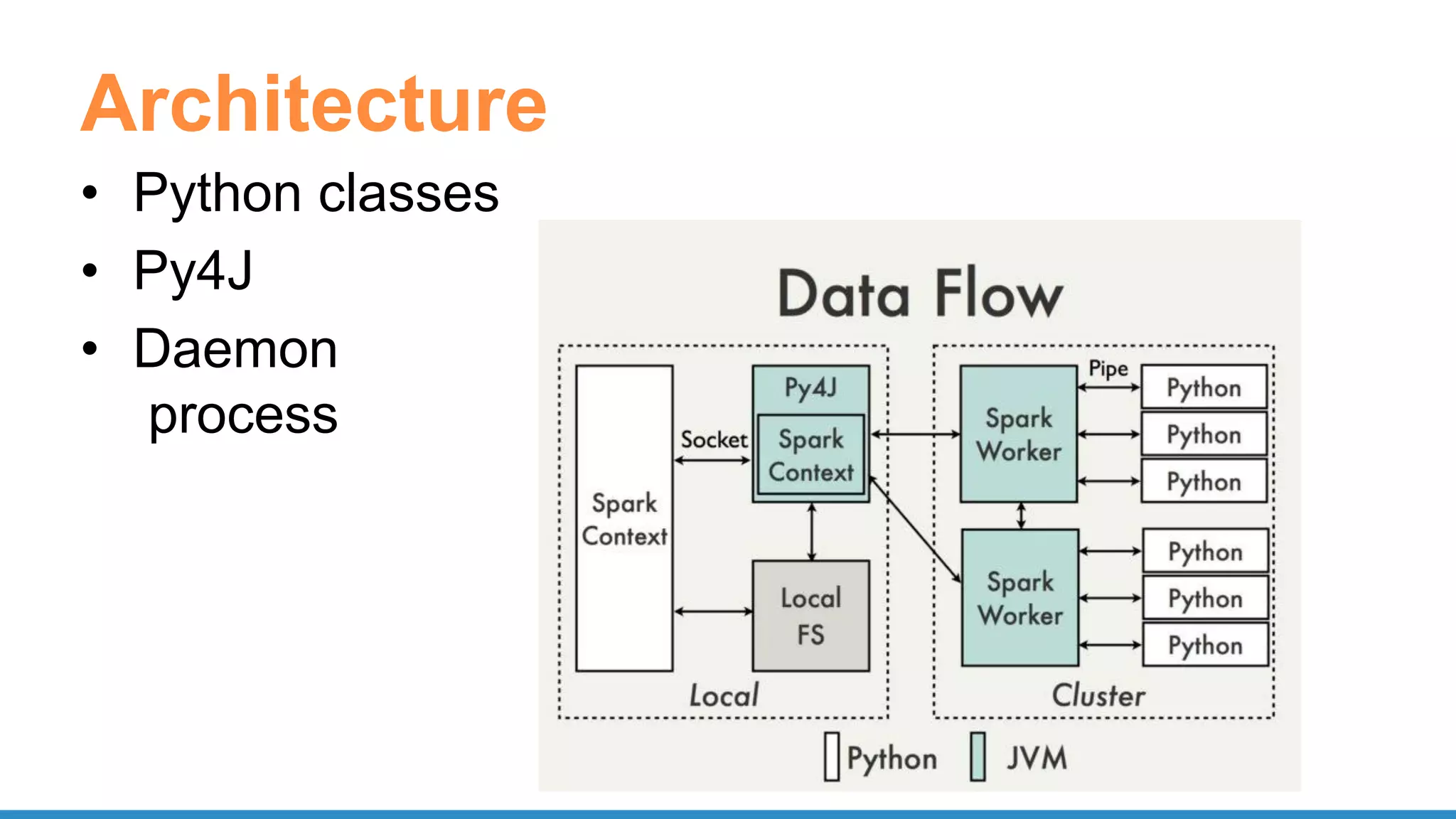
Architecture
• Python classes
• Py4J
• Daemon
process
SparkR
• R language APIs for Spark
• Exposes Spark functionality in a R dplyr-like APIs
• Runs as its own REPL sparkR
• or as a R package loaded in IDEs like RStudio
library(SparkR)
sparkR.session()
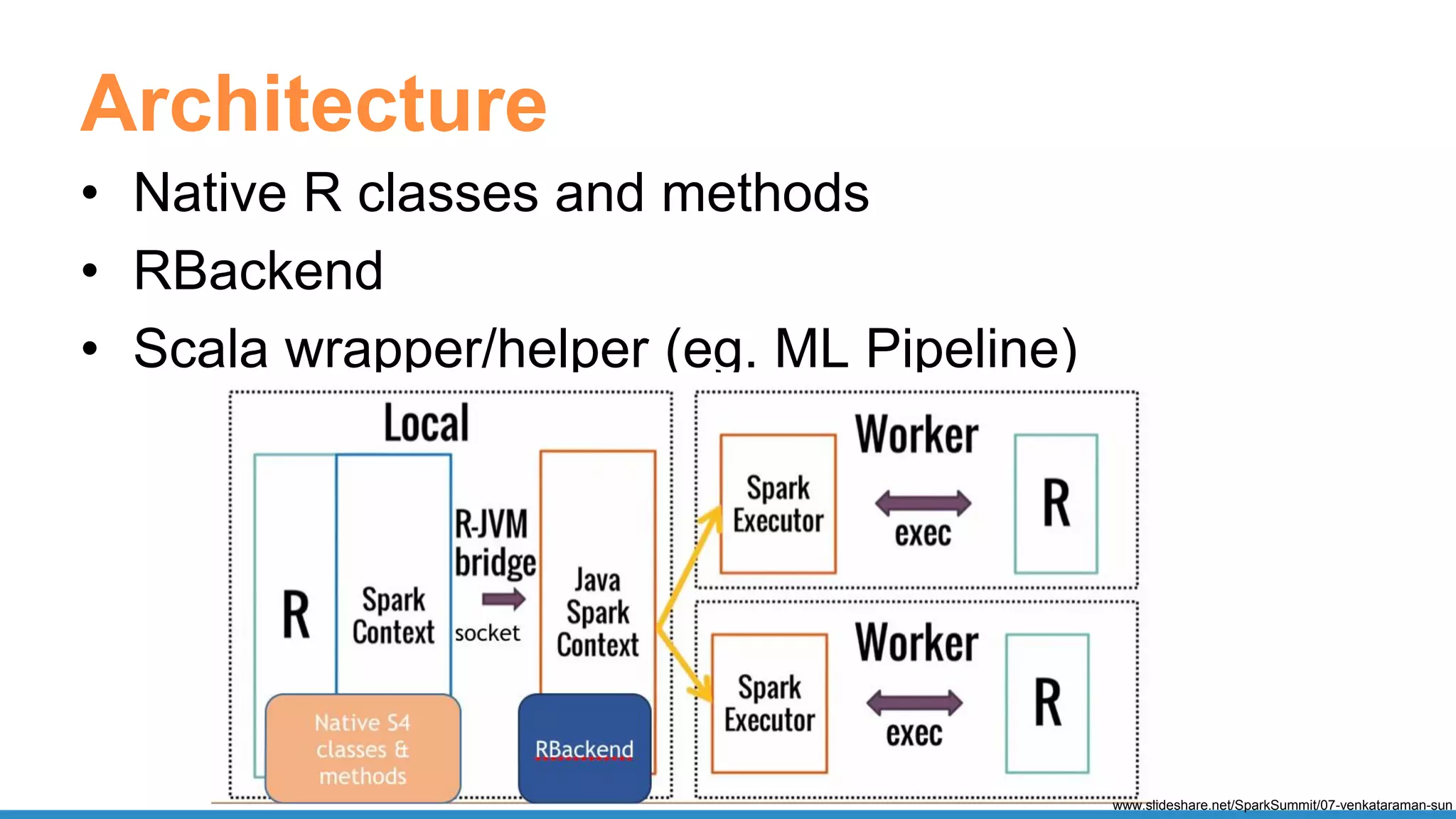
Architecture
• Native R classes and methods
• RBackend
• Scala wrapper/helper (eg. ML Pipeline)
www.slideshare.net/SparkSummit/07-venkataraman-sun
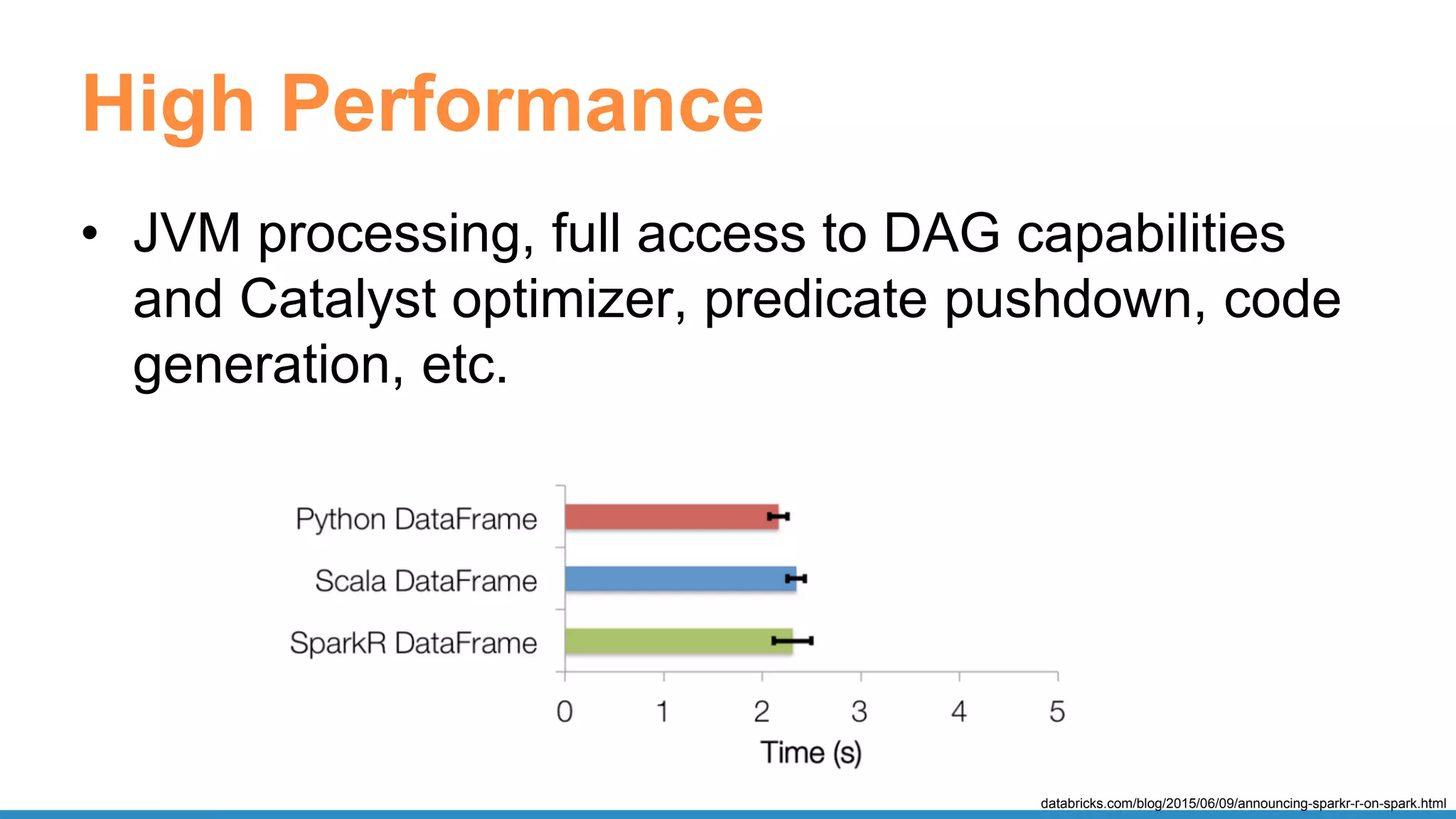
High Performance
• JVM processing, full access to DAG capabilities
and Catalyst optimizer, predicate pushdown, code
generation, etc.
databricks.com/blog/2015/06/09/announcing-sparkr-r-on-spark.html
ML/DL on Spark
End-to-End Data-Machine Learning
Pipeline
• Ingestion
• Data preprocessing, cleaning, ETL
• Machine Learning – models, predictions
• Serving
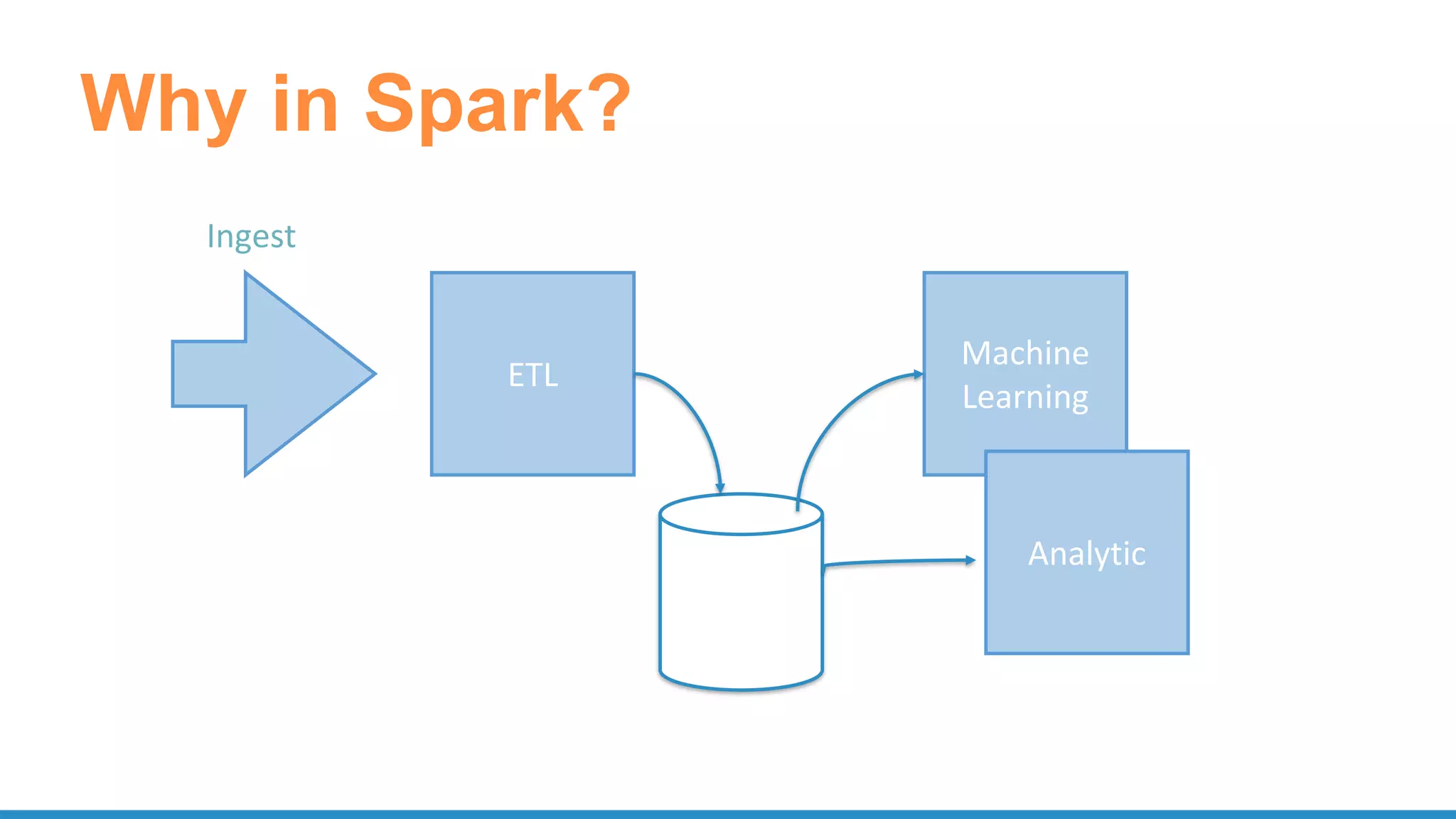
Why in Spark?
ETL
Ingest
Machine
Learning
Analytic
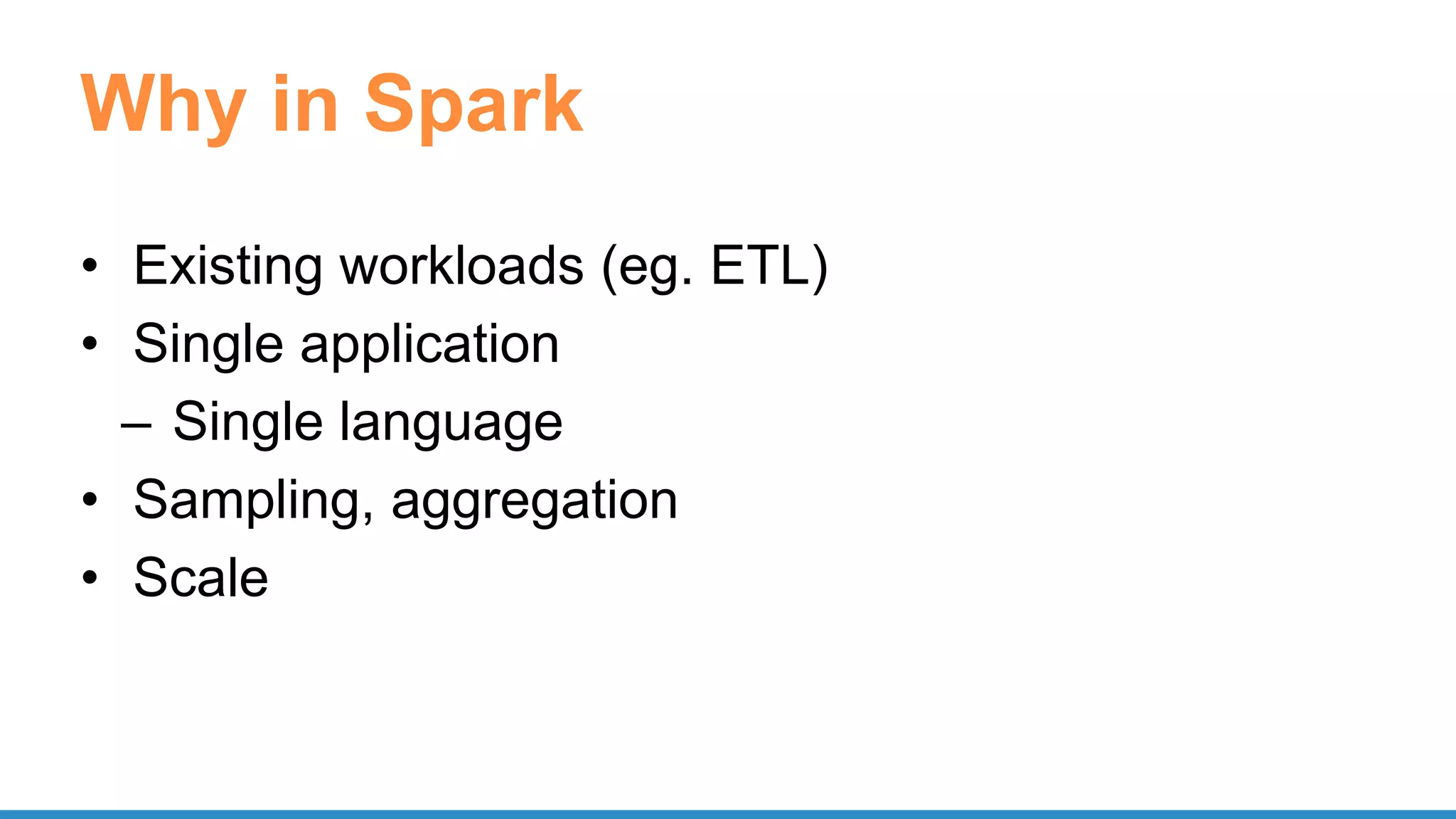
Why in Spark
• Existing workloads (eg. ETL)
• Single application
– Single language
• Sampling, aggregation
• Scale
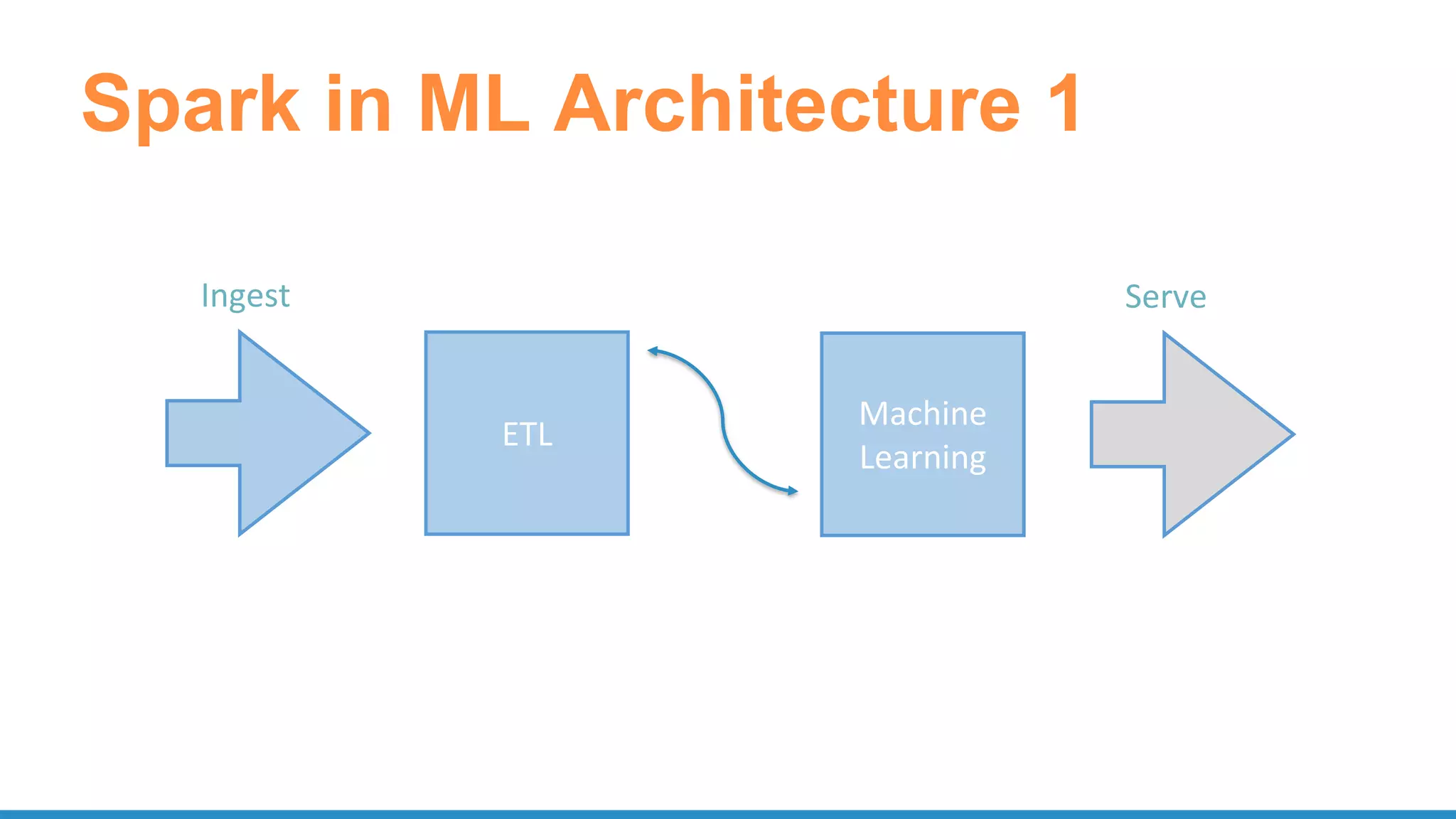
Spark in ML Architecture 1
ETL
Ingest
Machine
Learning
Serve
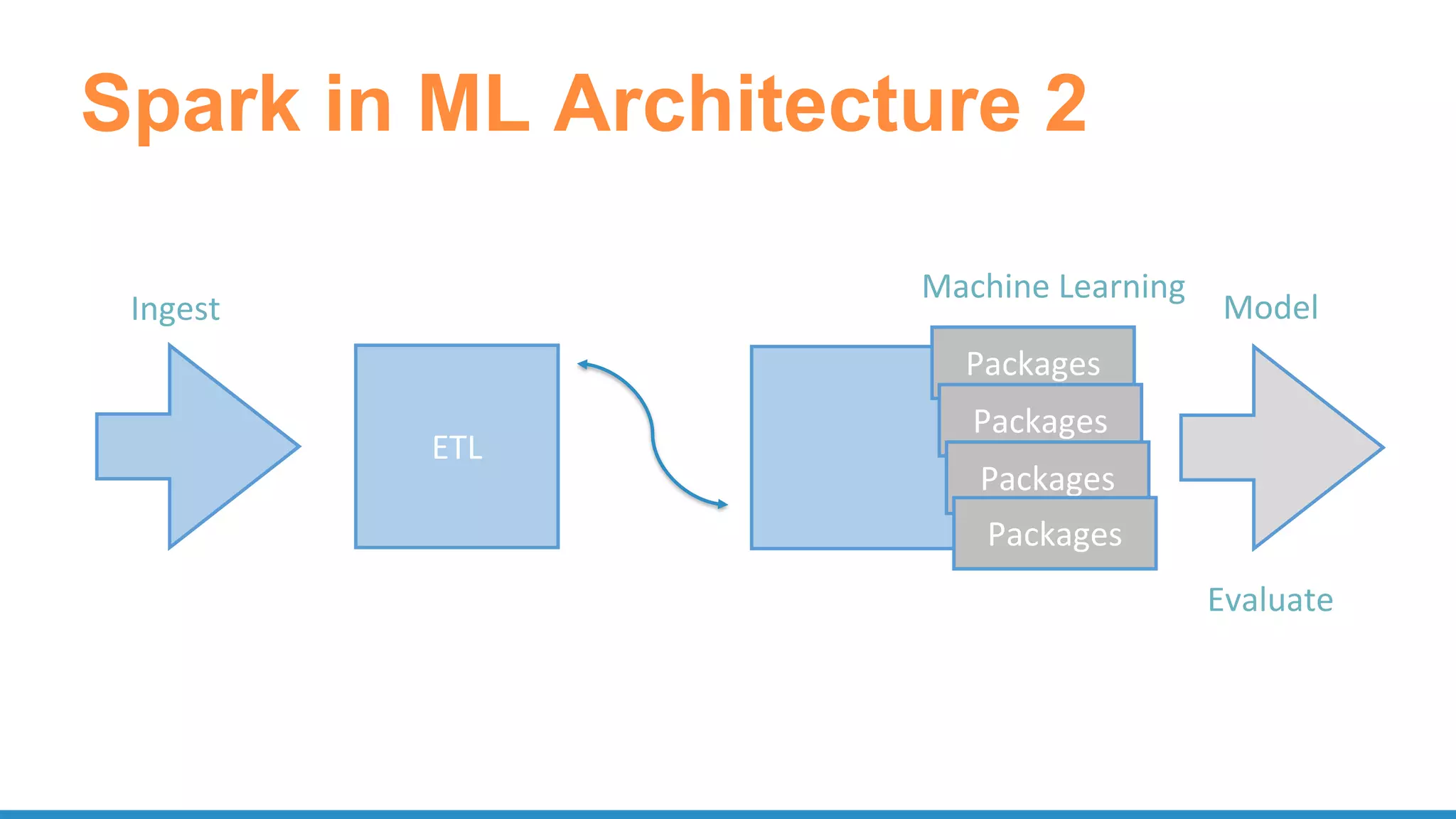
Spark in ML Architecture 2
ETL
Ingest Model
Packages
Packages
Packages
Packages
Machine Learning
Evaluate
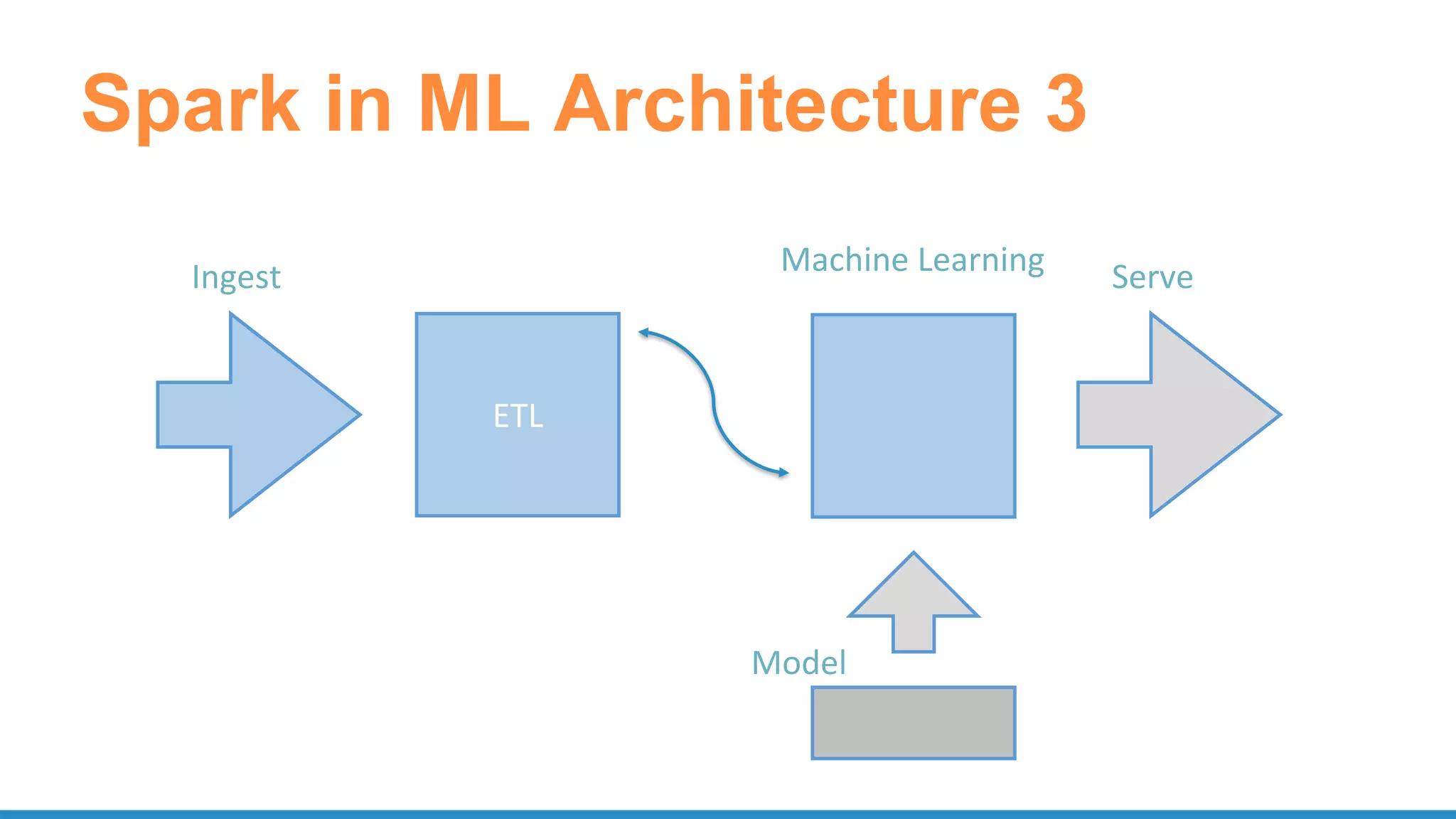
Spark in ML Architecture 3
ETL
Ingest
Model
Machine Learning Serve
PySpark for Data Science
Spark ML Pipeline
• Inspired by scikit-learn
• Pre-processing, feature extraction, model fitting,
validation stages
• Transformer
• Estimator
• Evaluator
• Cross-validation/hyperparameter tuning
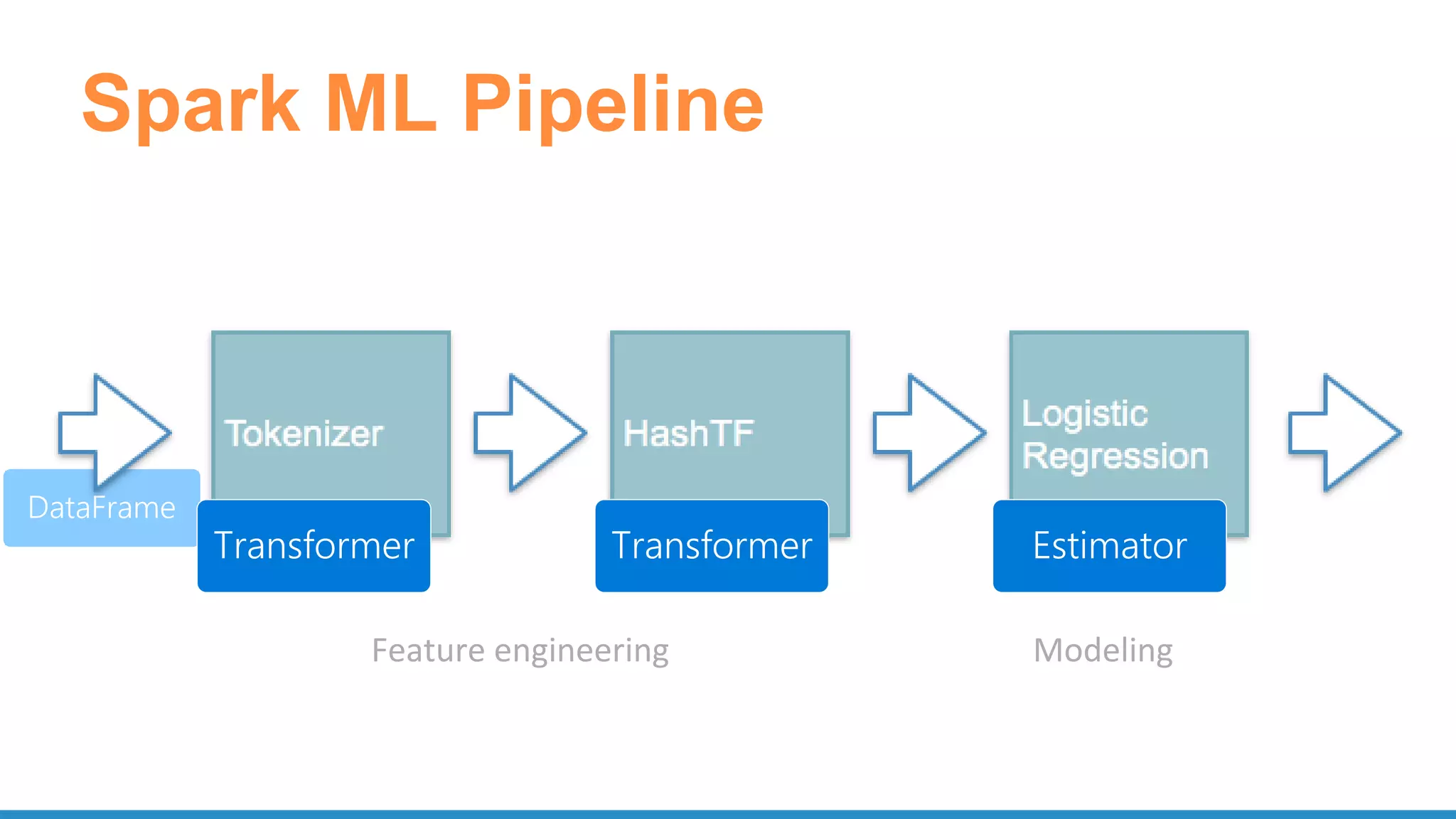
DataFrame
Spark ML Pipeline
Transformer EstimatorTransformer
Feature engineering Modeling
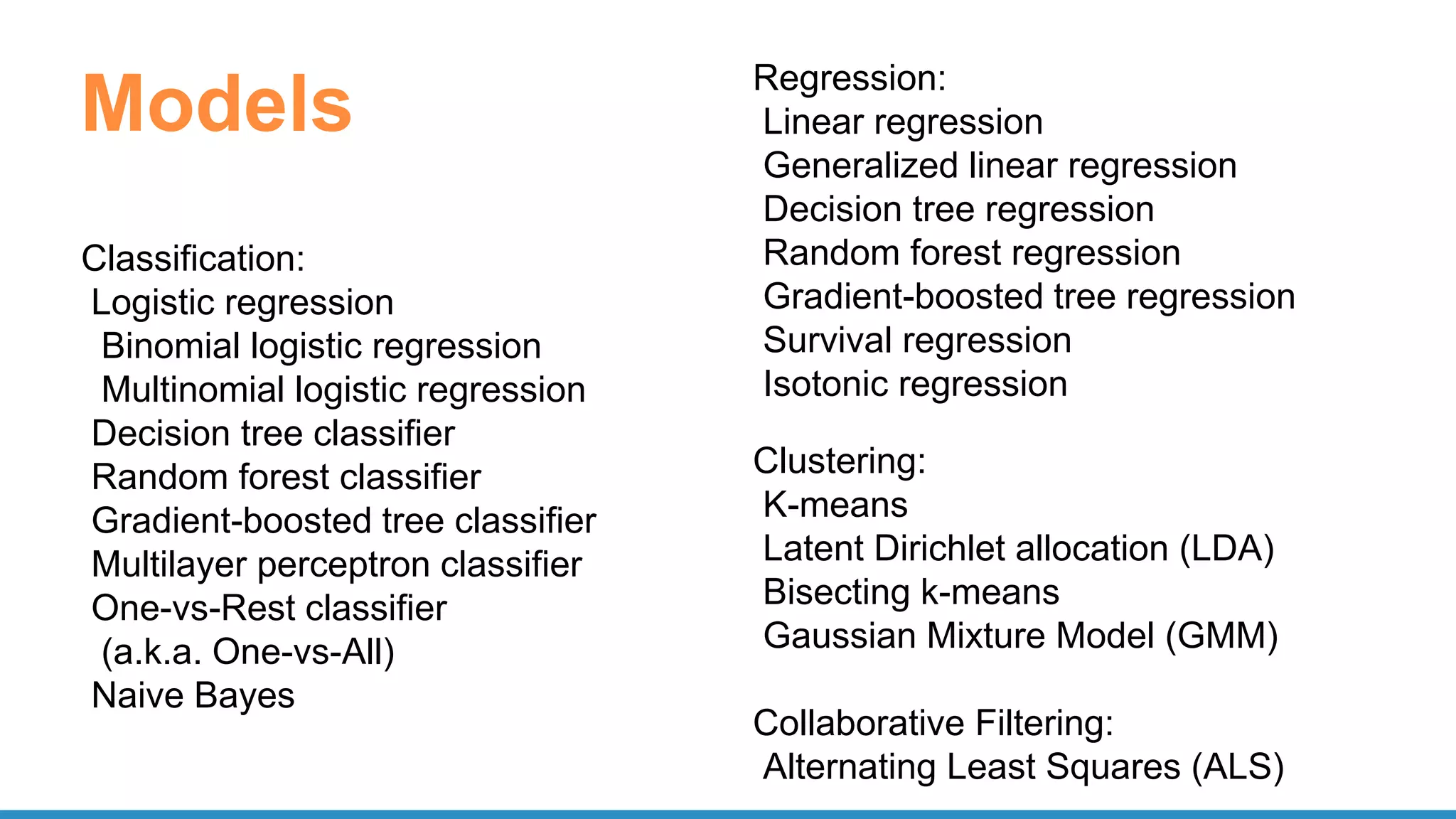
Classification:
Logistic regression
Binomial logistic regression
Multinomial logistic regression
Decision tree classifier
Random forest classifier
Gradient-boosted tree classifier
Multilayer perceptron classifier
One-vs-Rest classifier
(a.k.a. One-vs-All)
Naive Bayes
Models
Clustering:
K-means
Latent Dirichlet allocation (LDA)
Bisecting k-means
Gaussian Mixture Model (GMM)
Collaborative Filtering:
Alternating Least Squares (ALS)
Regression:
Linear regression
Generalized linear regression
Decision tree regression
Random forest regression
Gradient-boosted tree regression
Survival regression
Isotonic regression
PySpark ML Pipline Model
tokenizer = Tokenizer(inputCol="text", outputCol="words")
hashingTF = HashingTF(inputCol=tokenizer.getOutputCol(),
outputCol="features")
lr = LogisticRegression(maxIter=10, regParam=0.001)
pipeline = Pipeline(stages=[tokenizer, hashingTF, lr])
# Fit the pipeline to training documents.
model = pipeline.fit(training)
prediction = model.transform(test)
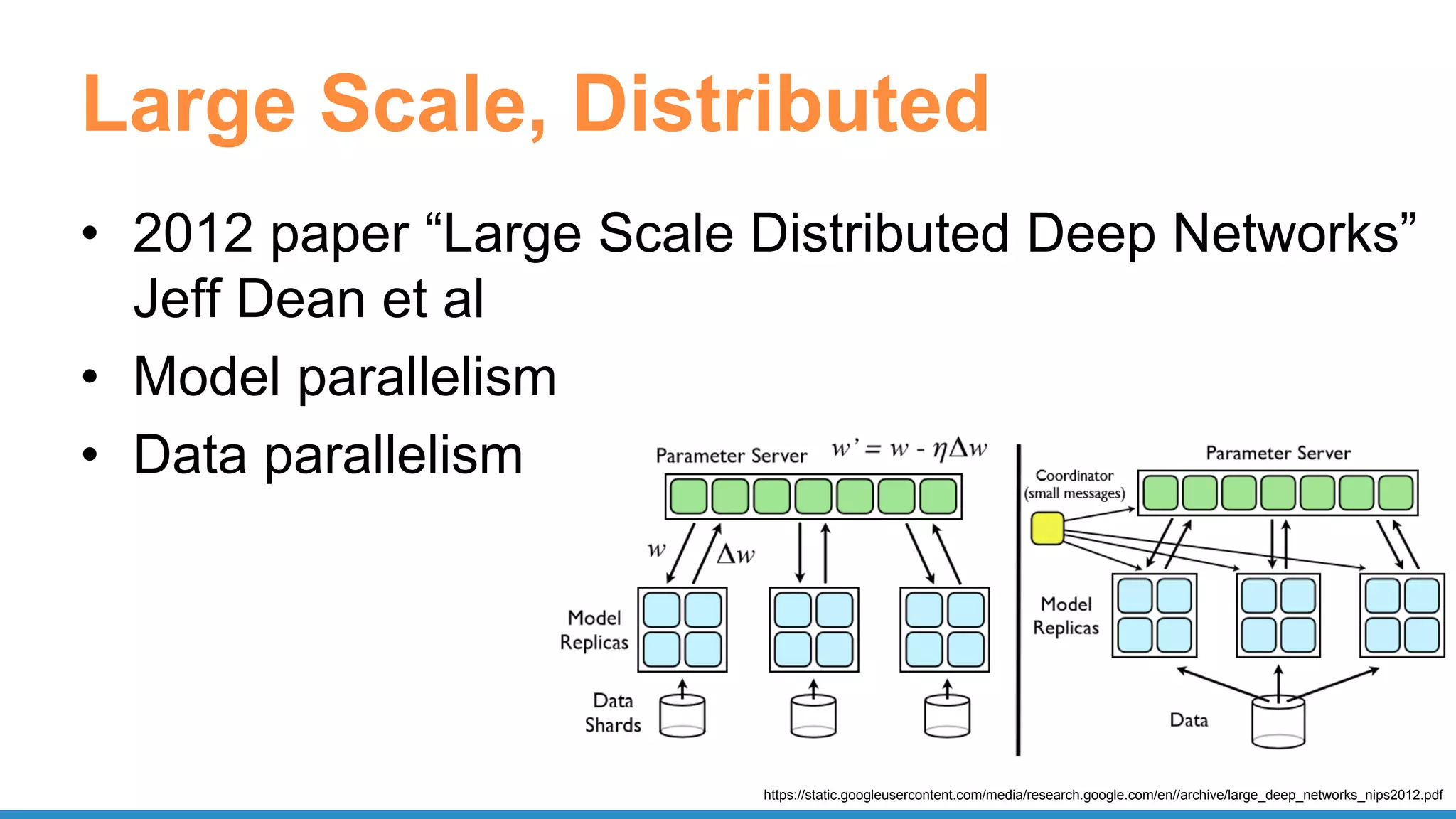
Large Scale, Distributed
• 2012 paper “Large Scale Distributed Deep Networks”
Jeff Dean et al
• Model parallelism
• Data parallelism
https://static.googleusercontent.com/media/research.google.com/en//archive/large_deep_networks_nips2012.pdf
Spark as a Scheduler
• Run external, often native packages
• Data-parallel tasks
• Distributed execution external data
UDF
• Register function to use in SQL
– spark.udf.register("stringLengthInt", lambda x:
len(x), IntegerType())
spark.sql("SELECT stringLengthInt('test')")
• Function on RDD
– rdd.map(lambda l: str(l.e)[:7])
– rdd.mapPartitions(lambda x: [(1,), (2,), (3,)])
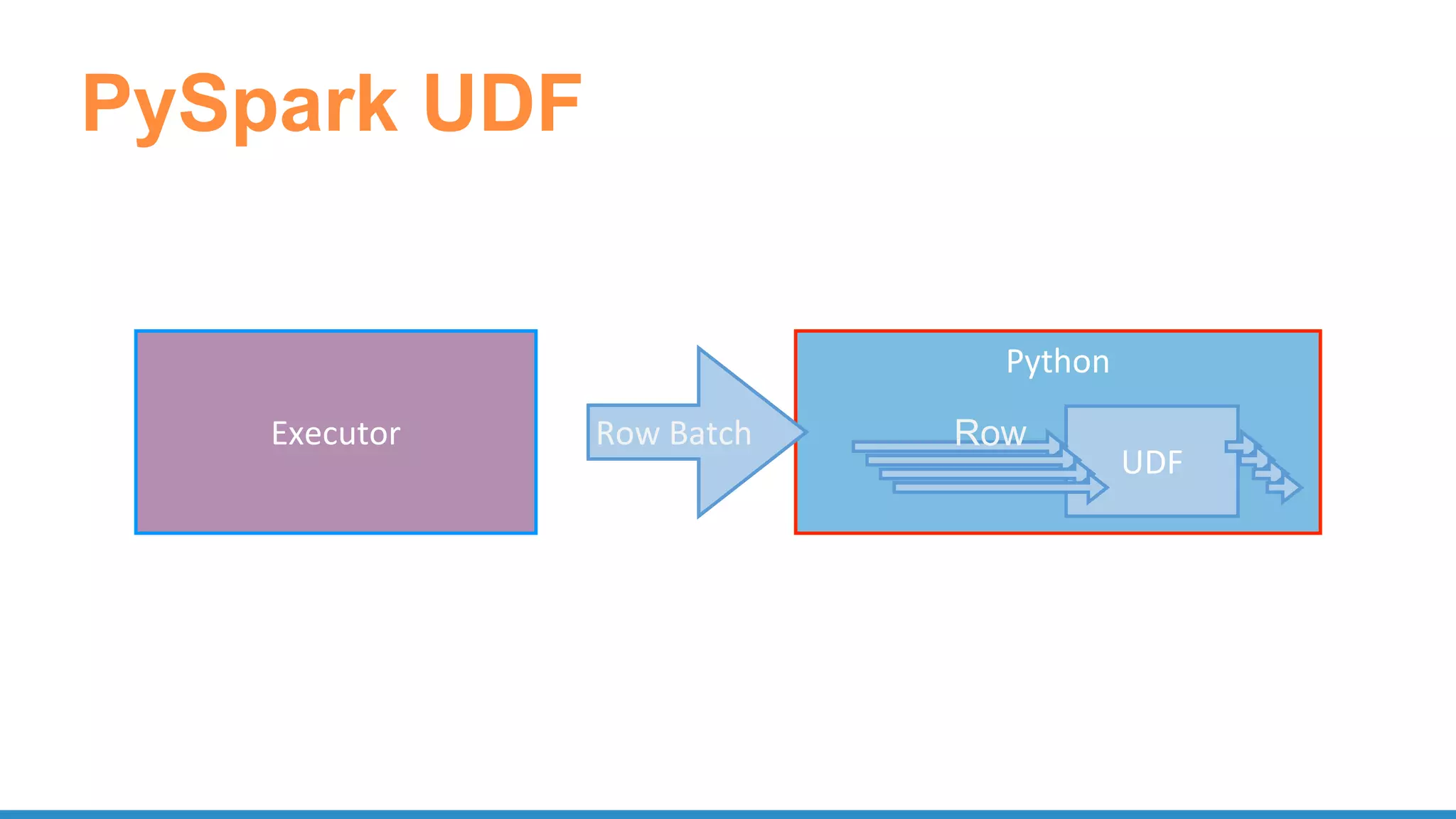
PySpark UDF
Python
Executor
UDF
Row Batch Row
Considerations
• Data transfer overhead
(serialization/deserialization, network)
• Native language (boxing, interpreted)
• Lambda – one row at a time
PySpark Vectorized UDF
• Apache Arrow – in-memory columnar
– Row batch
– Zero copy
– Future: IPC
• SPARK-21190
spark-sklearn
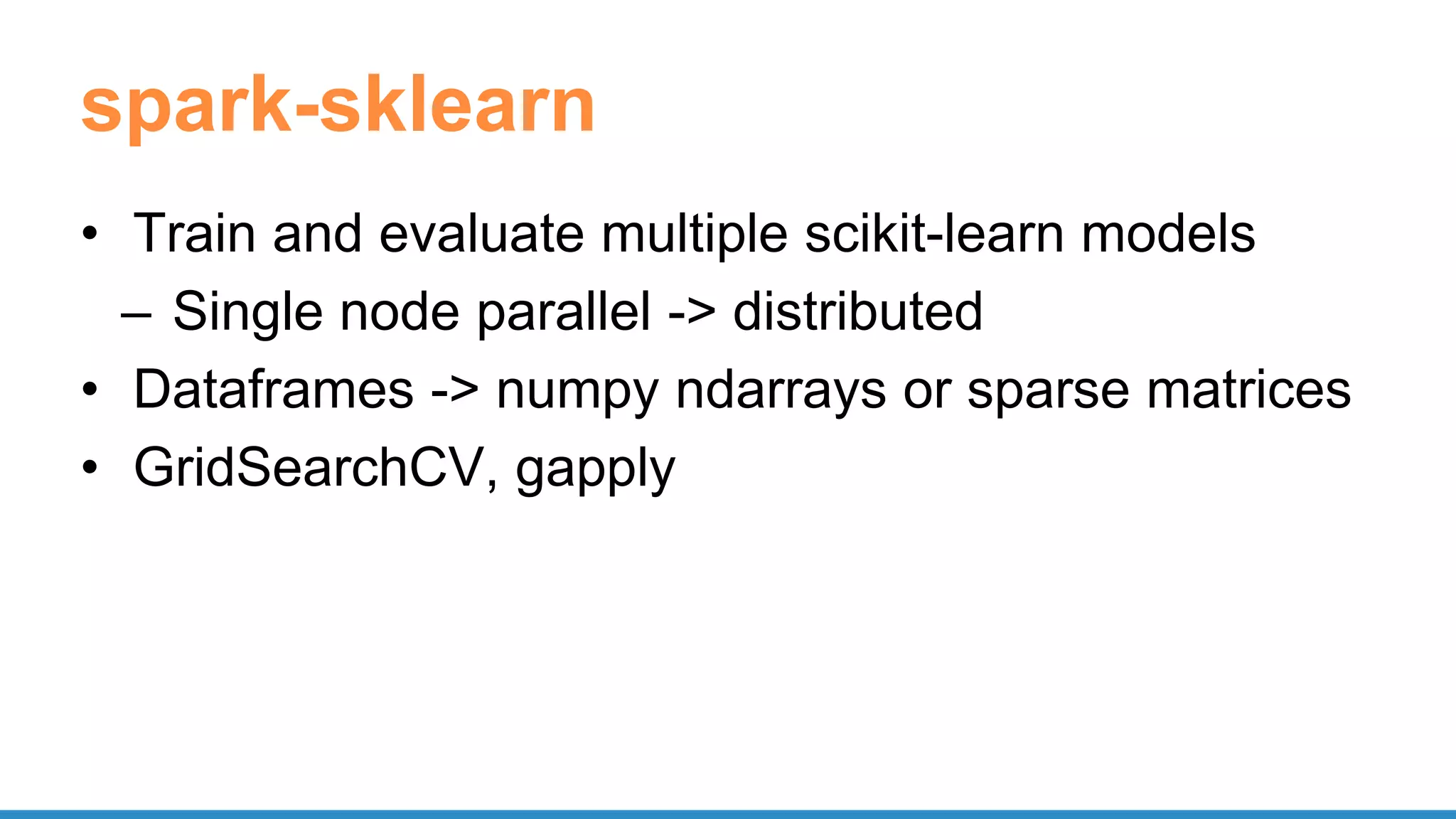
• Train and evaluate multiple scikit-learn models
– Single node parallel -> distributed
• Dataframes -> numpy ndarrays or sparse matrices
• GridSearchCV, gapply
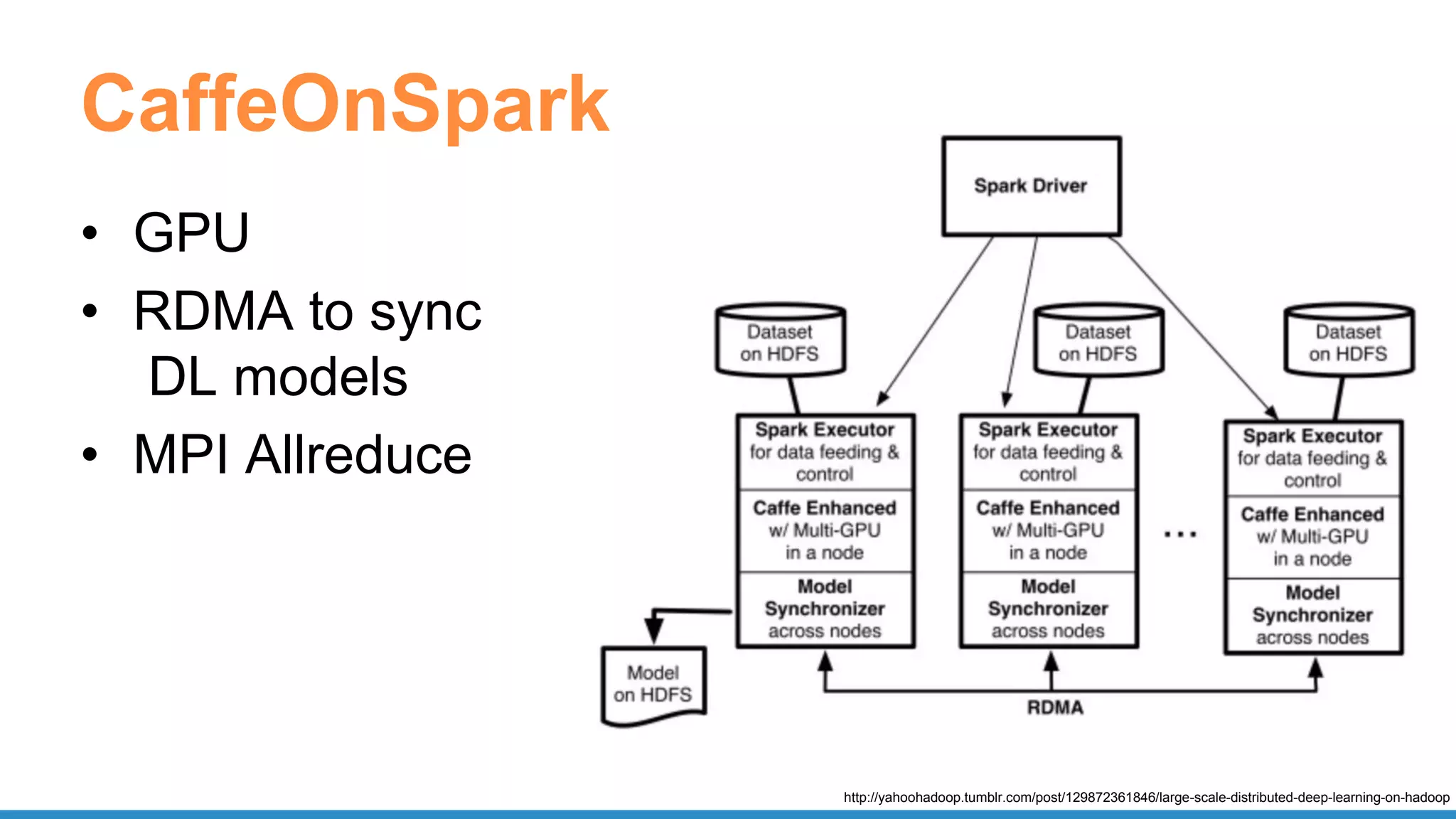
CaffeOnSpark
• GPU
• RDMA to sync
DL models
• MPI Allreduce
http://yahoohadoop.tumblr.com/post/129872361846/large-scale-distributed-deep-learning-on-hadoop
CaffeOnSpark
def get_predictions(sqlContext, images, model, imagenet, lstmnet, vocab):
rdd = images.mapPartitions(lambda im: predict_caption(im, model, imagenet,
lstmnet, vocab))
...
return sqlContext.createDataFrame(rdd, schema).select("result.id",
"result.prediction")
def predict_caption(list_of_images, model, imagenet, lstmnet, vocab):
out_iterator = []
ce = CaptionExperiment(str(model),str(imagenet),str(lstmnet),str(vocab))
for image in list_of_images:
out_iterator.append(ce.getCaption(image))
return iter(out_iterator)
https://github.com/yahoo/CaffeOnSpark/blob/master/caffe-grid/src/main/python/examples/ImageCaption.py
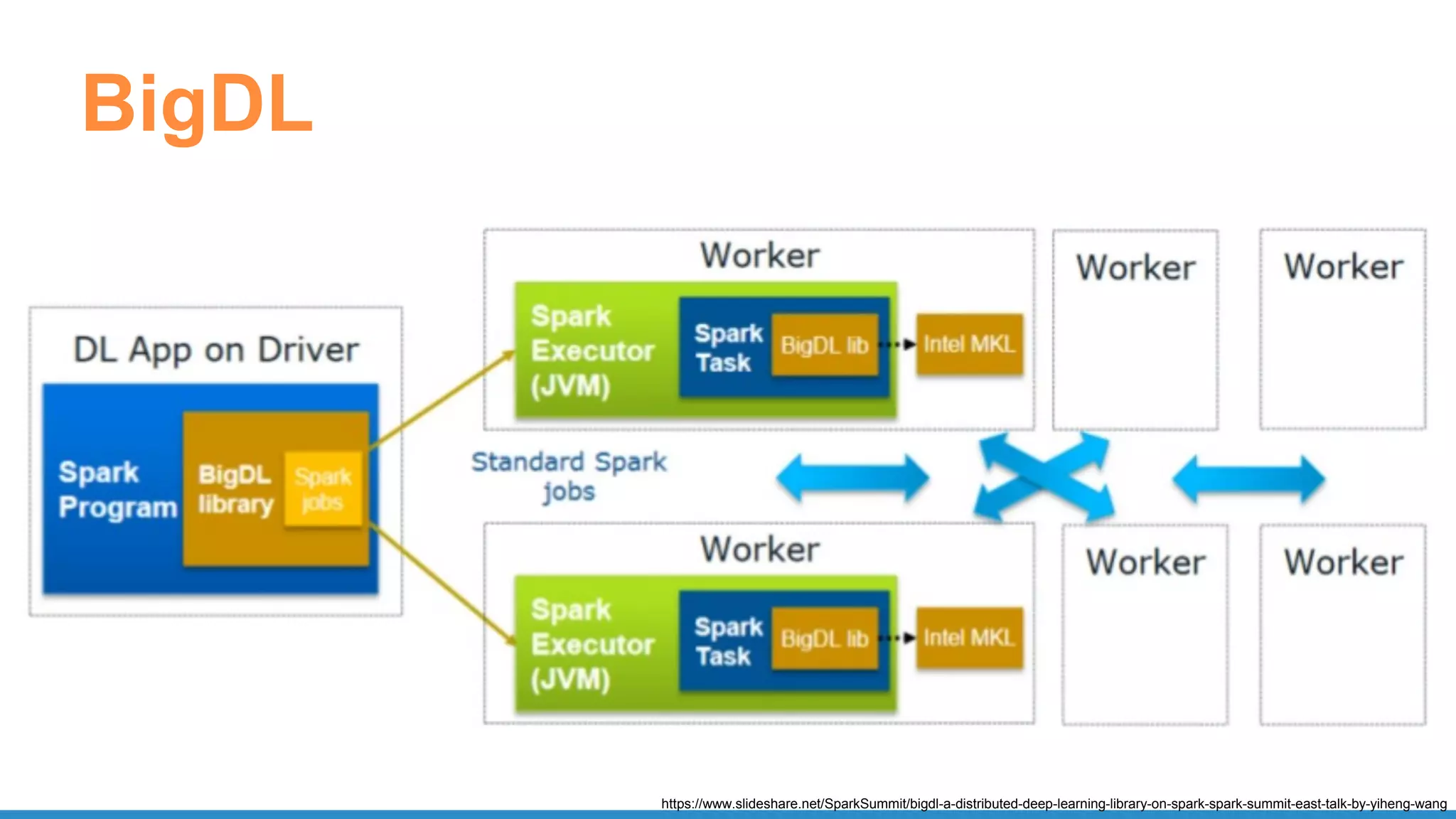
BigDL
https://www.slideshare.net/SparkSummit/bigdl-a-distributed-deep-learning-library-on-spark-spark-summit-east-talk-by-yiheng-wang
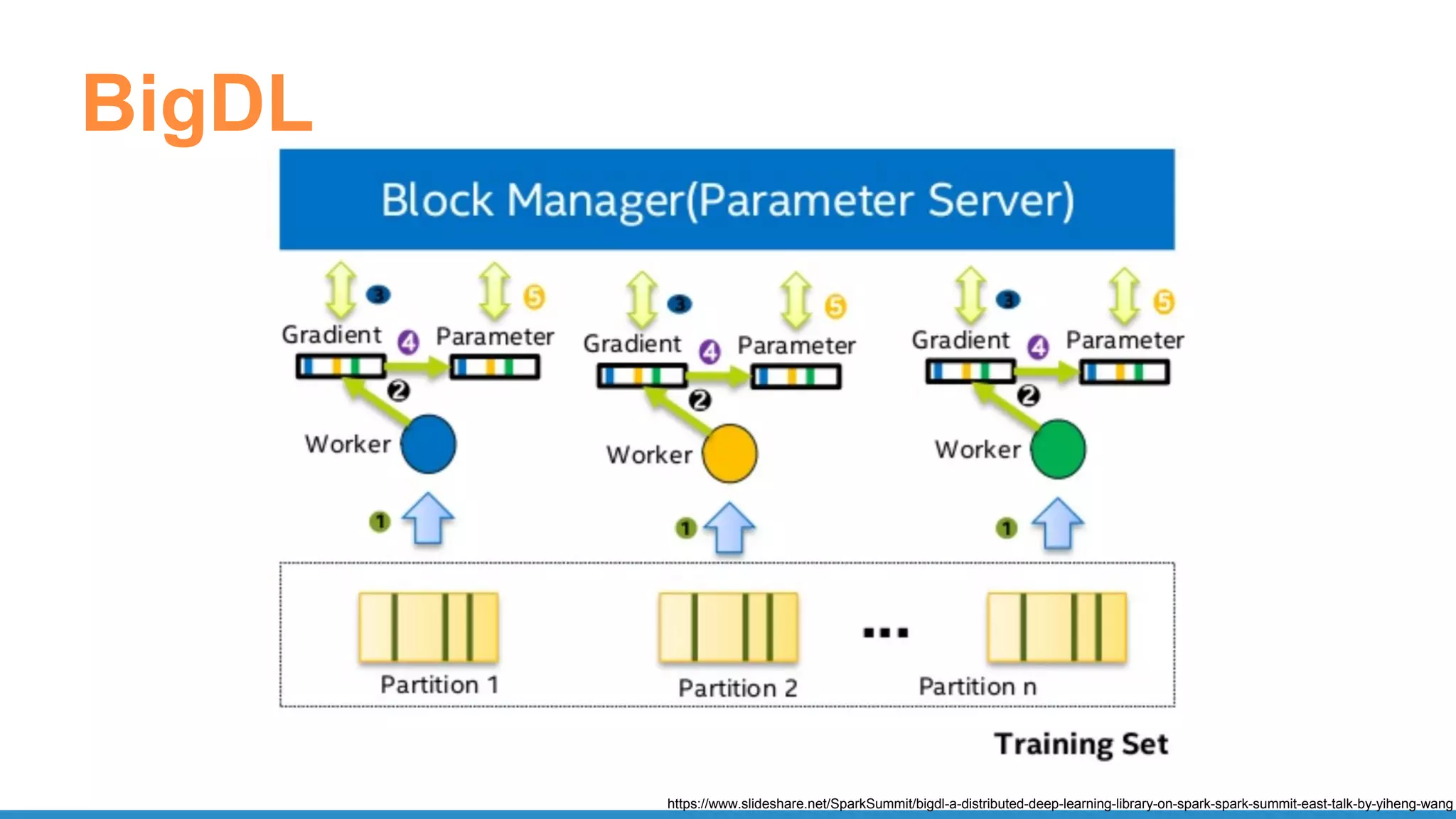
BigDL
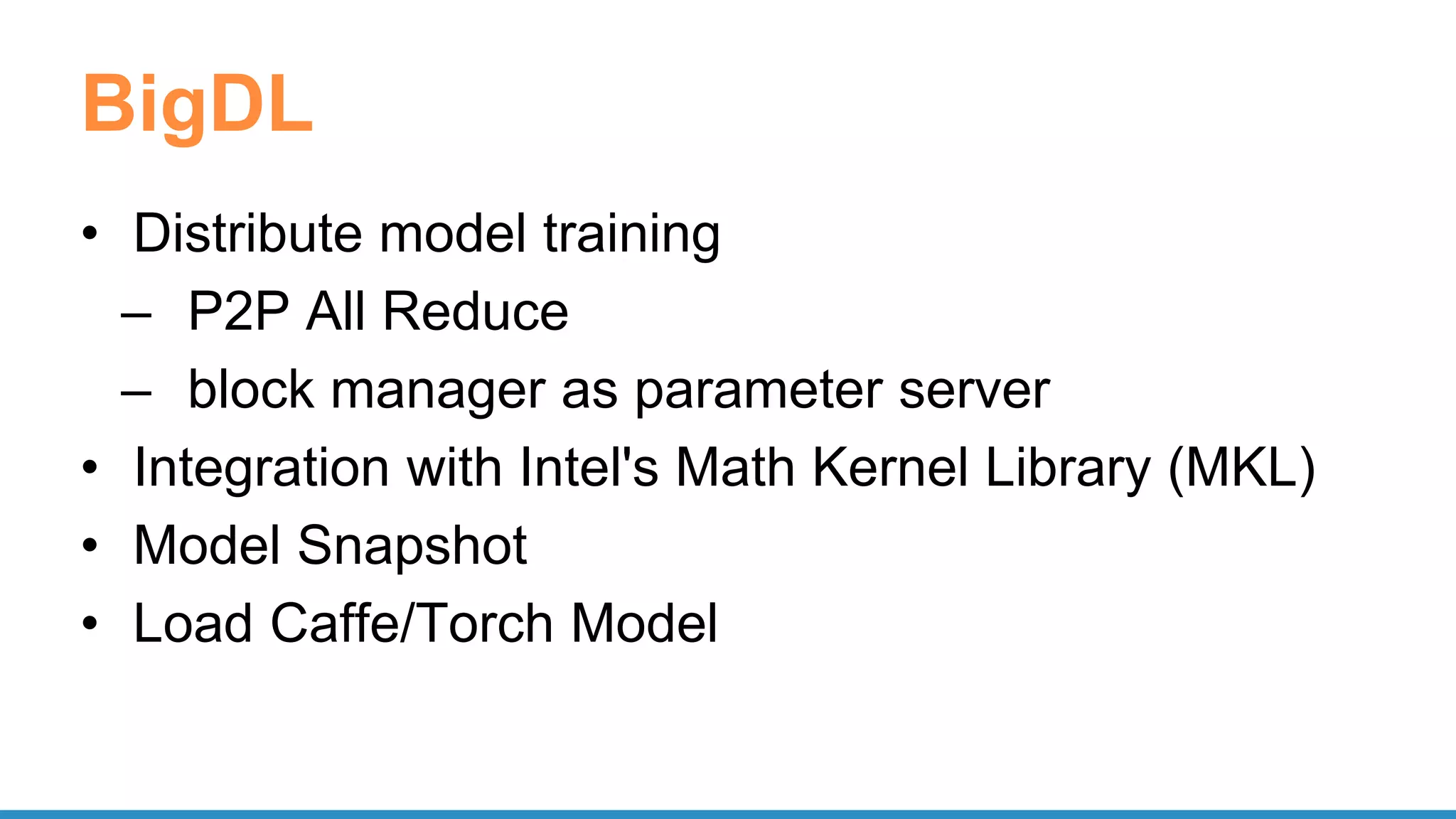
• Distribute model training
– P2P All Reduce
– block manager as parameter server
• Integration with Intel's Math Kernel Library (MKL)
• Model Snapshot
• Load Caffe/Torch Model
BigDL
https://www.slideshare.net/SparkSummit/bigdl-a-distributed-deep-learning-library-on-spark-spark-summit-east-talk-by-yiheng-wang
BigDL - CNN MNIST
def build_model(class_num):
model = Sequential() # Create a LeNet model
model.add(Reshape([1, 28, 28]))
model.add(SpatialConvolution(1, 6, 5, 5).set_name('conv1'))
model.add(Tanh())
model.add(SpatialMaxPooling(2, 2, 2, 2).set_name('pool1'))
model.add(Tanh())
model.add(SpatialConvolution(6, 12, 5, 5).set_name('conv2'))
model.add(SpatialMaxPooling(2, 2, 2, 2).set_name('pool2'))
model.add(Reshape([12 * 4 * 4]))
model.add(Linear(12 * 4 * 4, 100).set_name('fc1'))
model.add(Tanh())
model.add(Linear(100, class_num).set_name('score'))
model.add(LogSoftMax())
return model
https://github.com/intel-analytics/BigDL-Tutorials/blob/master/notebooks/neural_networks/cnn.ipynb
lenet_model = build_model(10)
state = {"learningRate": 0.4,
"learningRateDecay": 0.0002}
optimizer = Optimizer(
model=lenet_model,
training_rdd=train_data,
criterion=ClassNLLCriterion(),
optim_method="SGD",
state=state,
end_trigger=MaxEpoch(20),
batch_size=2048)
trained_model = optimizer.optimize()
predictions = trained_model.predict(test_data)
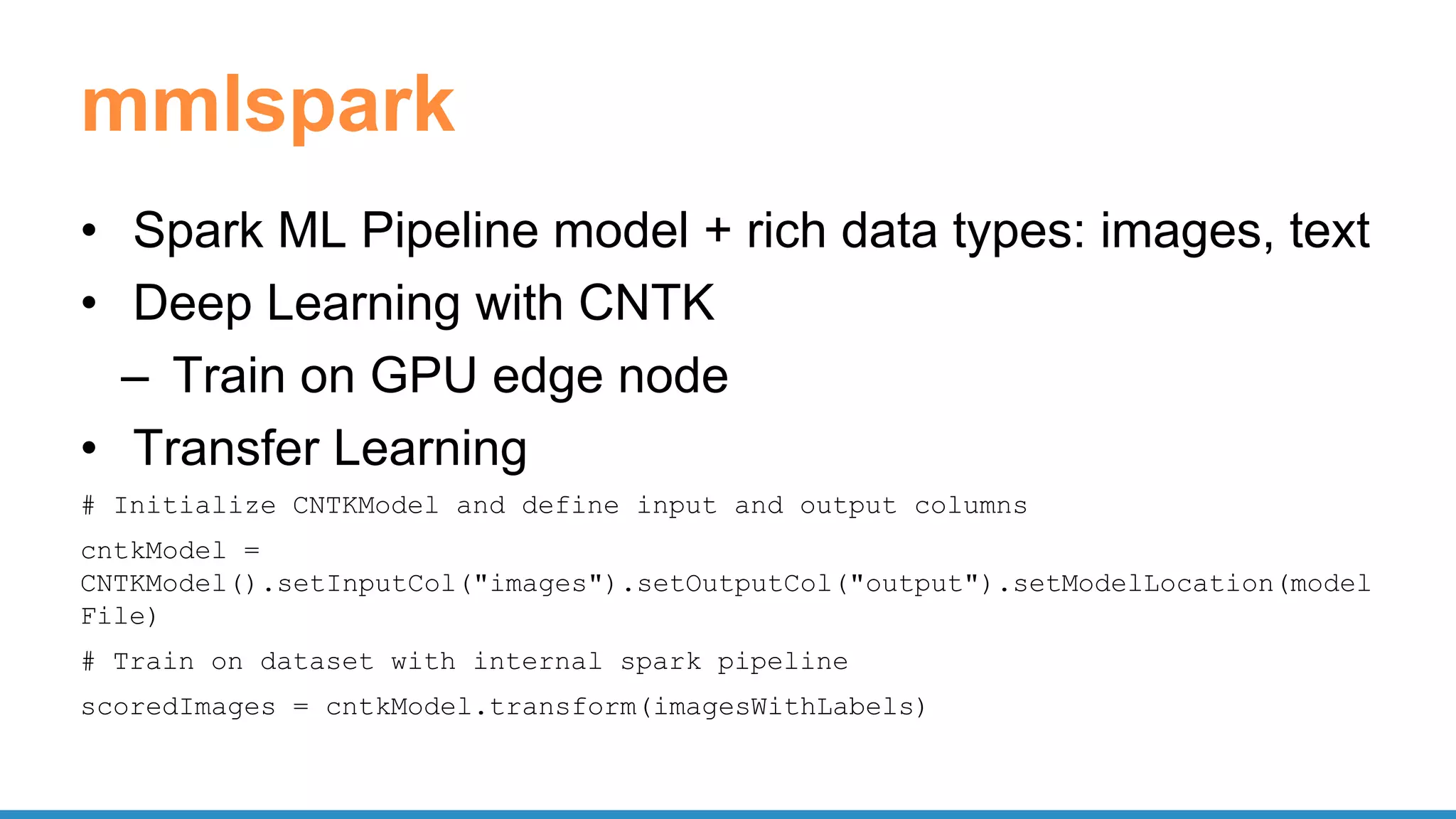
mmlspark
• Spark ML Pipeline model + rich data types: images, text
• Deep Learning with CNTK
– Train on GPU edge node
• Transfer Learning
# Initialize CNTKModel and define input and output columns
cntkModel =
CNTKModel().setInputCol("images").setOutputCol("output").setModelLocation(model
File)
# Train on dataset with internal spark pipeline
scoredImages = cntkModel.transform(imagesWithLabels)
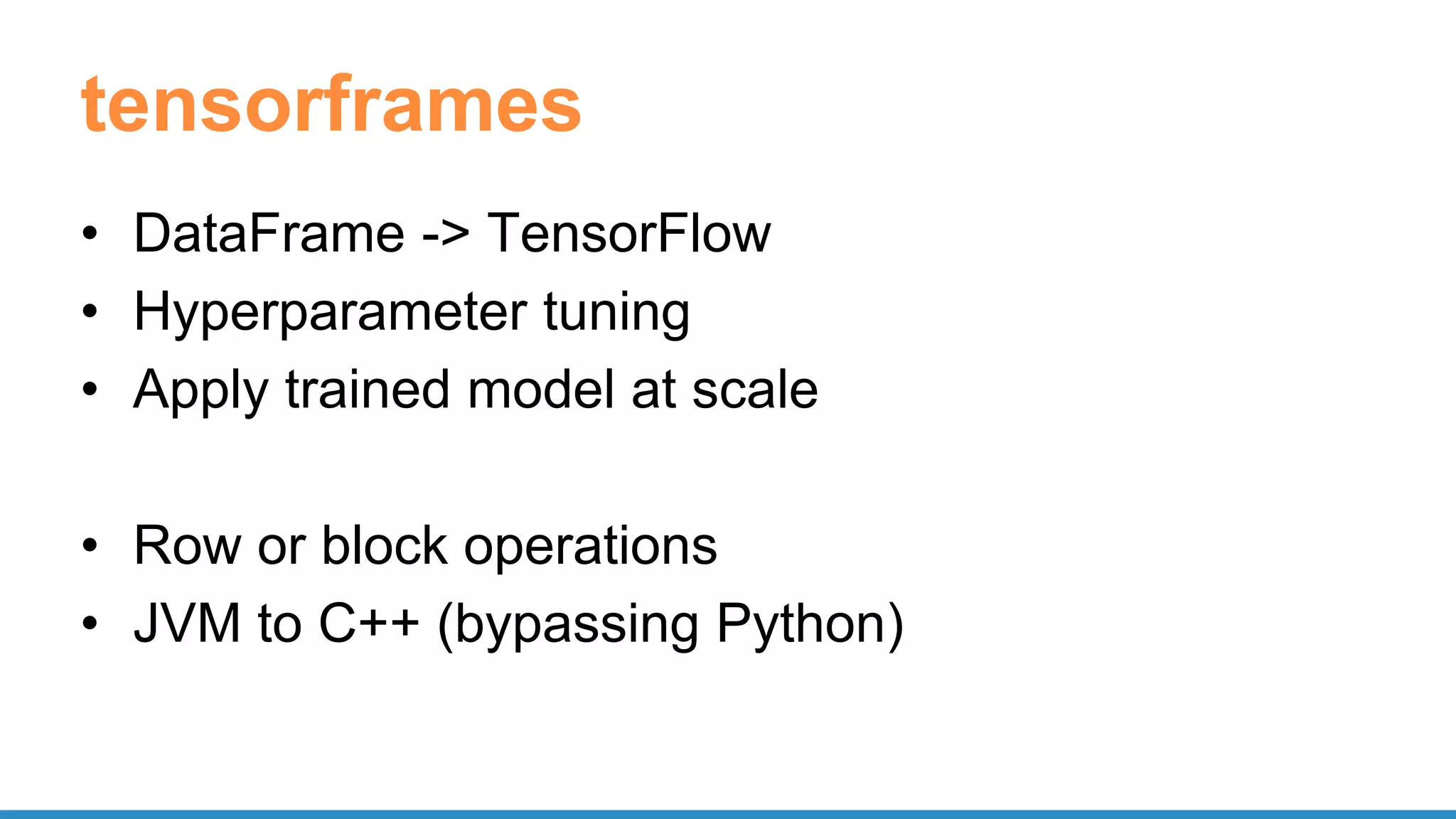
tensorframes
• DataFrame -> TensorFlow
• Hyperparameter tuning
• Apply trained model at scale
• Row or block operations
• JVM to C++ (bypassing Python)
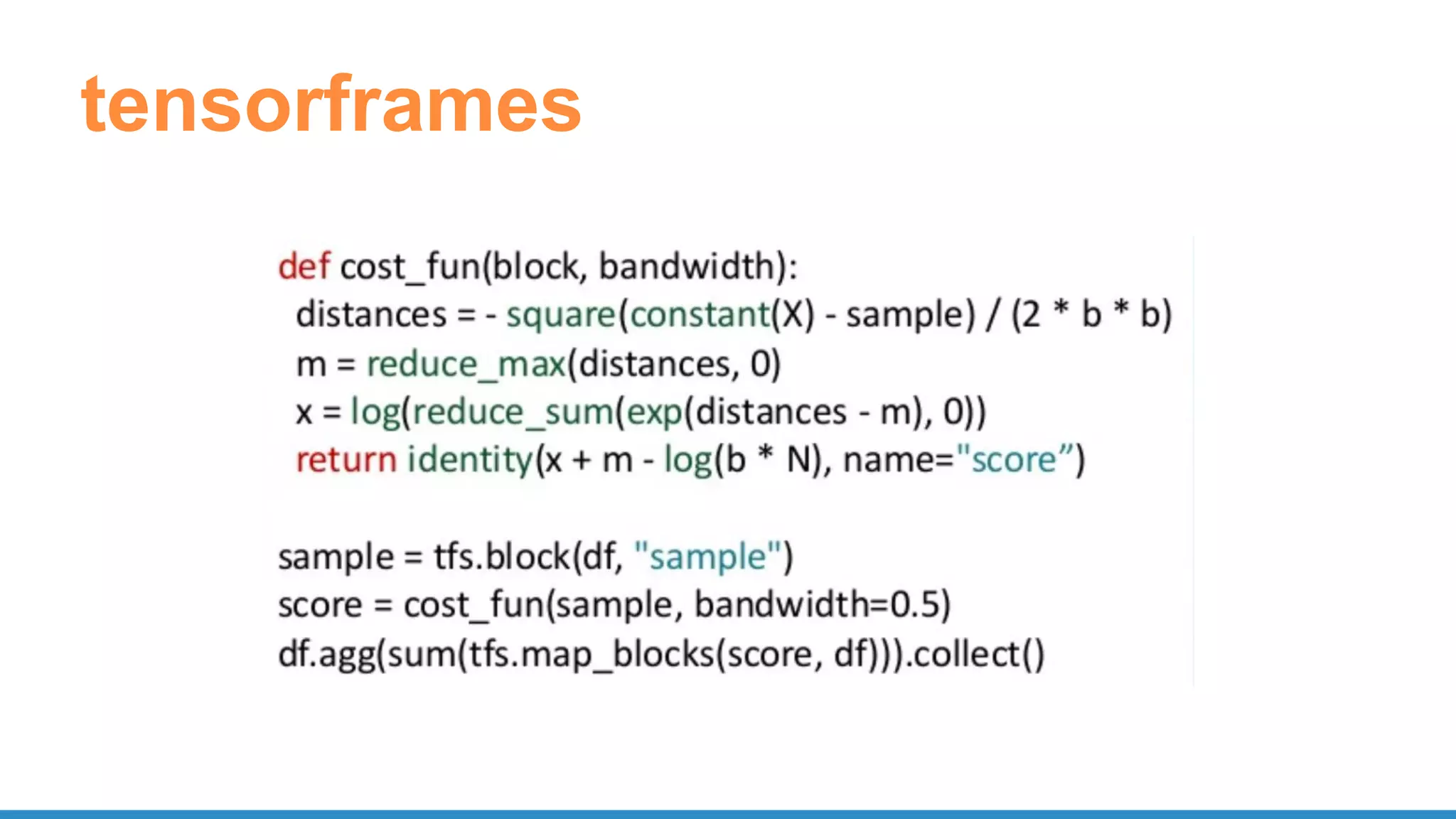
tensorframes
spark-deep-learning
• Spark ML Pipeline model + complex data: image
– Transformer
• DL featurization
• Transfer Learning
• Model as SQL UDF
• Later : hyperparameter tuning
spark-deep-learning
predictor = DeepImagePredictor(inputCol="image",
outputCol="predicted_labels", modelName="InceptionV3")
predictions_df = predictor.transform(df)
featurizer = DeepImageFeaturizer(modelName="InceptionV3")
p = Pipeline(stages=[featurizer, lr])
sparkdl.registerKerasUDF("img_classify",
"/mymodels/dogmodel.h5")
SELECT image, img_classify(image) label FROM images
Ecosystem
• DeepDist
• CaffeOnSpark, TensorFlowOnSpark
• Elephas (Keras)
• Apache SystemML
• Apache Hivemall (incubating)
• Apache MxNet (incubating)
SparkR for Data Science
Spark ML Pipeline
• Pre-processing, feature extraction, model fitting,
validation stages
• Transformer
• Estimator
• Cross-validation/hyperparameter tuning
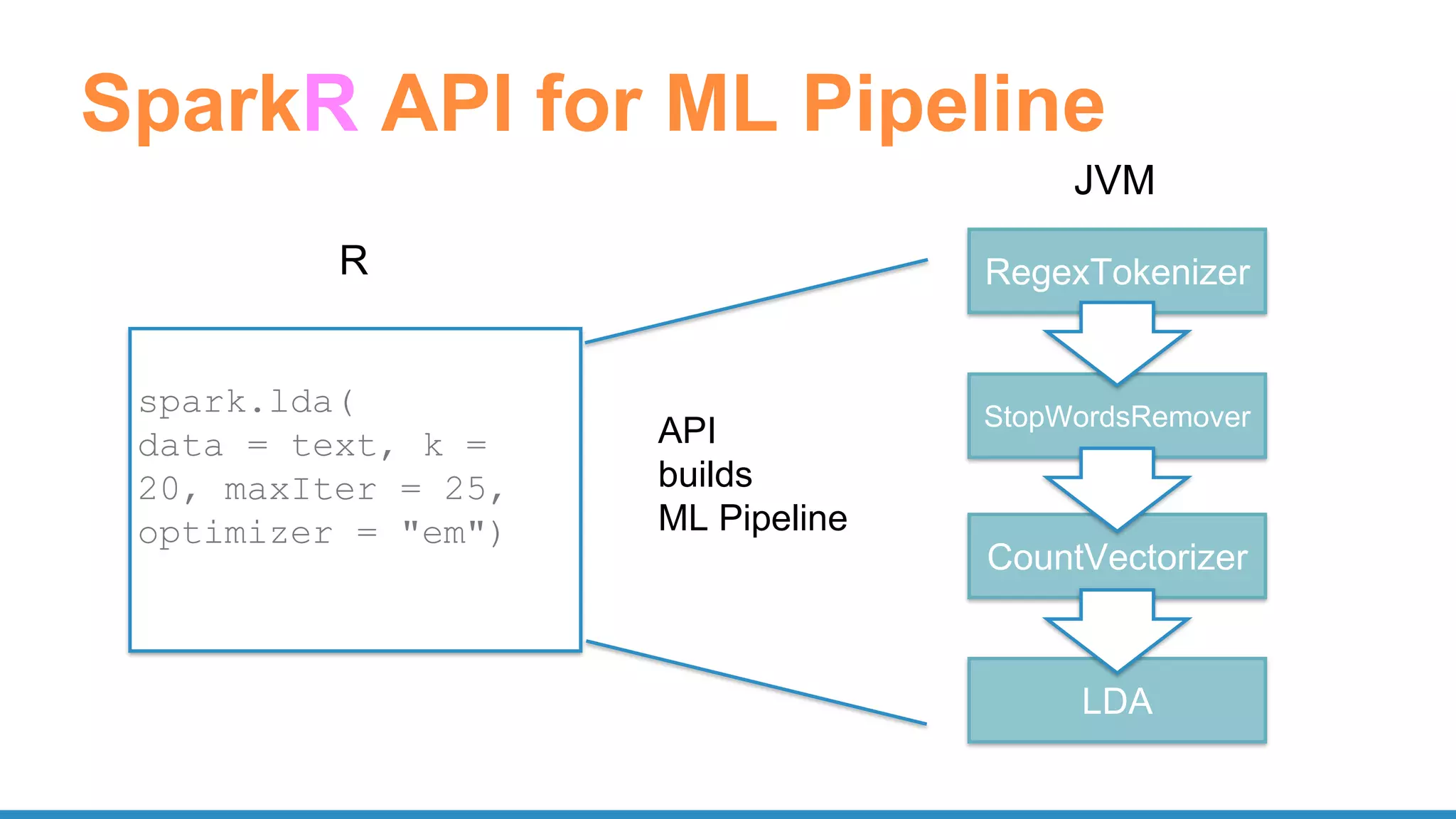
SparkR API for ML Pipeline
spark.lda(
data = text, k =
20, maxIter = 25,
optimizer = "em")
RegexTokenizer
StopWordsRemover
CountVectorizer
R
JVM
LDA
API
builds
ML Pipeline
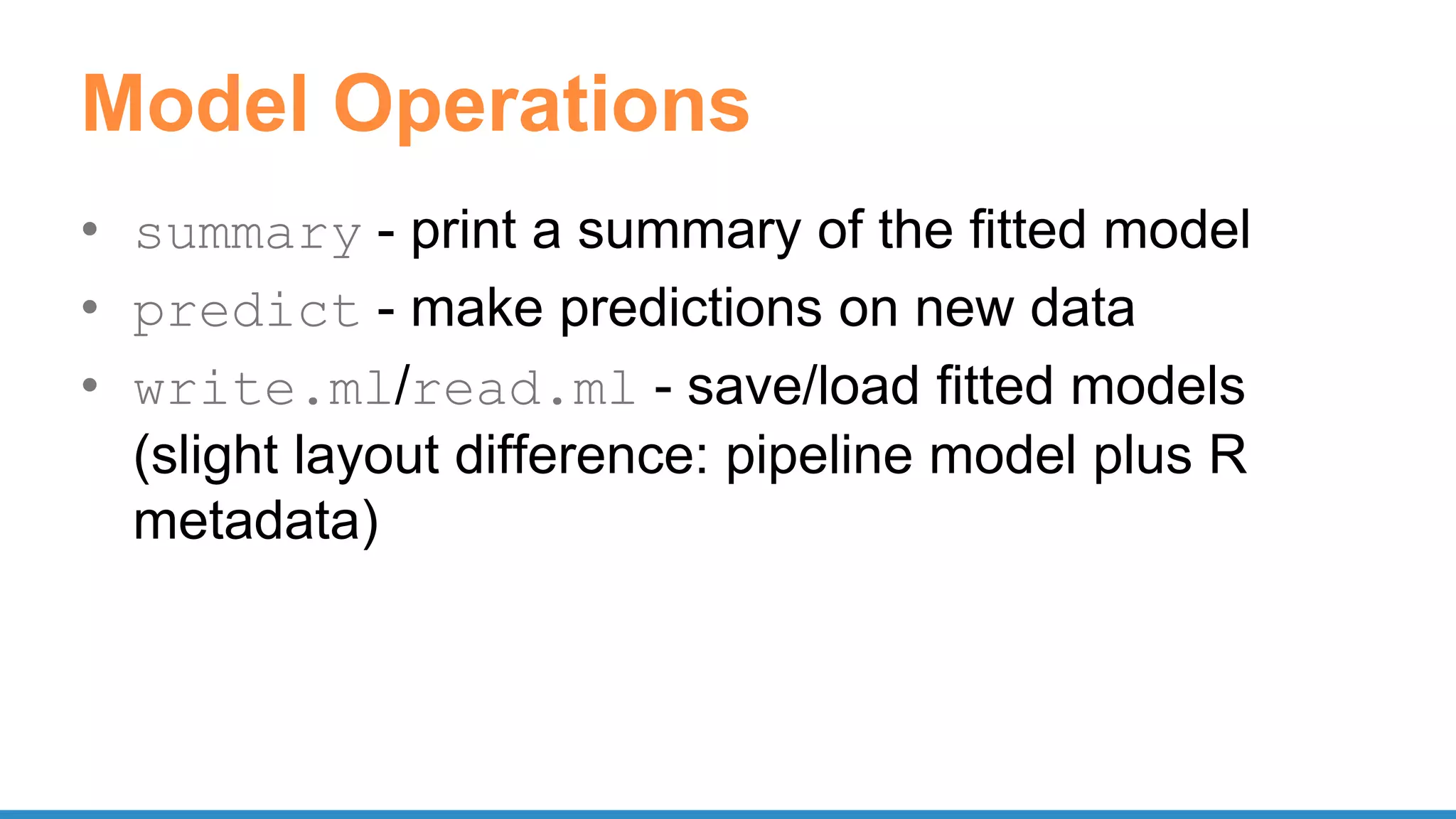
Model Operations
• summary - print a summary of the fitted model
• predict - make predictions on new data
• write.ml/read.ml - save/load fitted models
(slight layout difference: pipeline model plus R
metadata)
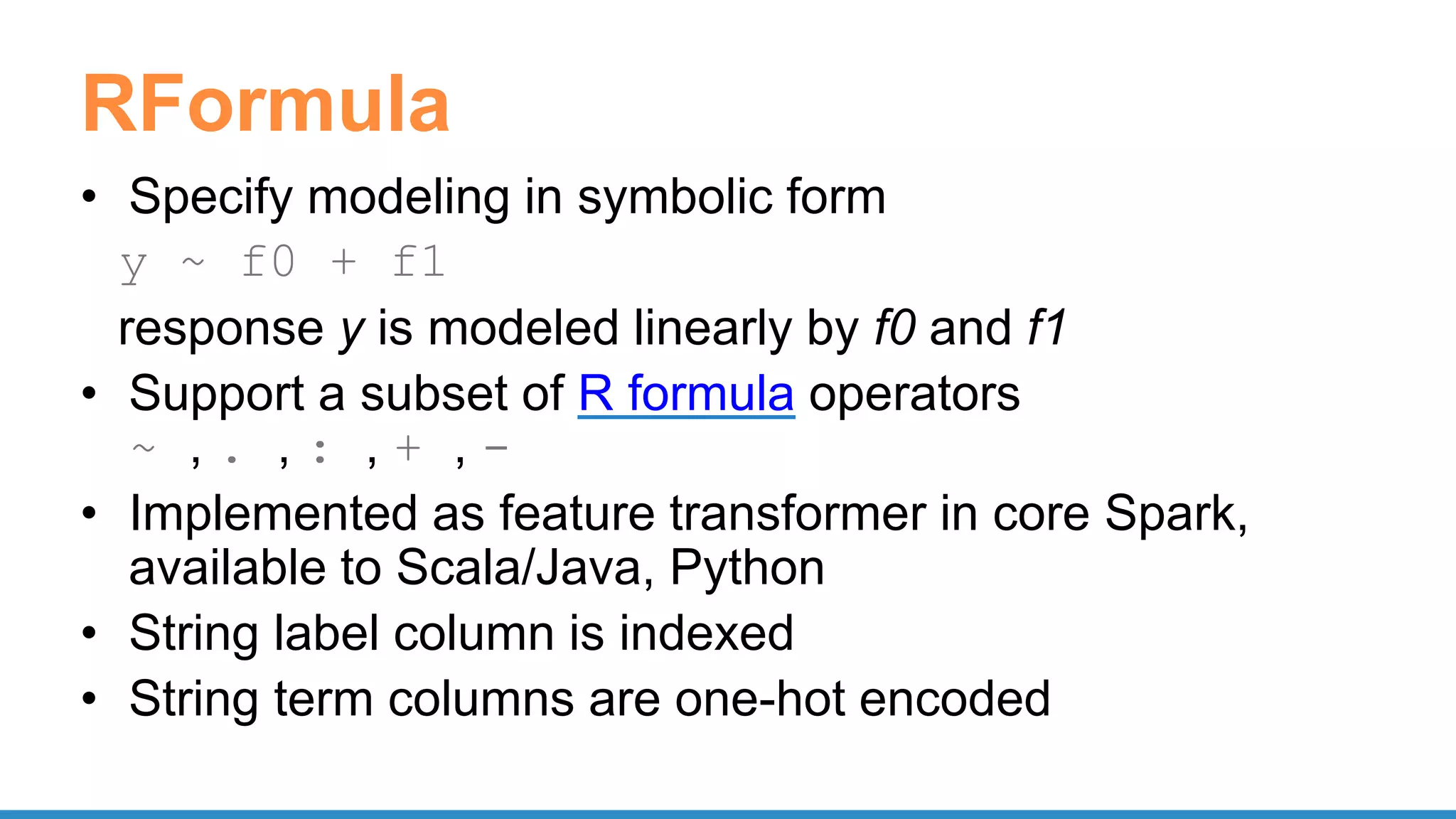
RFormula
• Specify modeling in symbolic form
y ~ f0 + f1
response y is modeled linearly by f0 and f1
• Support a subset of R formula operators
~ , . , : , + , -
• Implemented as feature transformer in core Spark,
available to Scala/Java, Python
• String label column is indexed
• String term columns are one-hot encoded
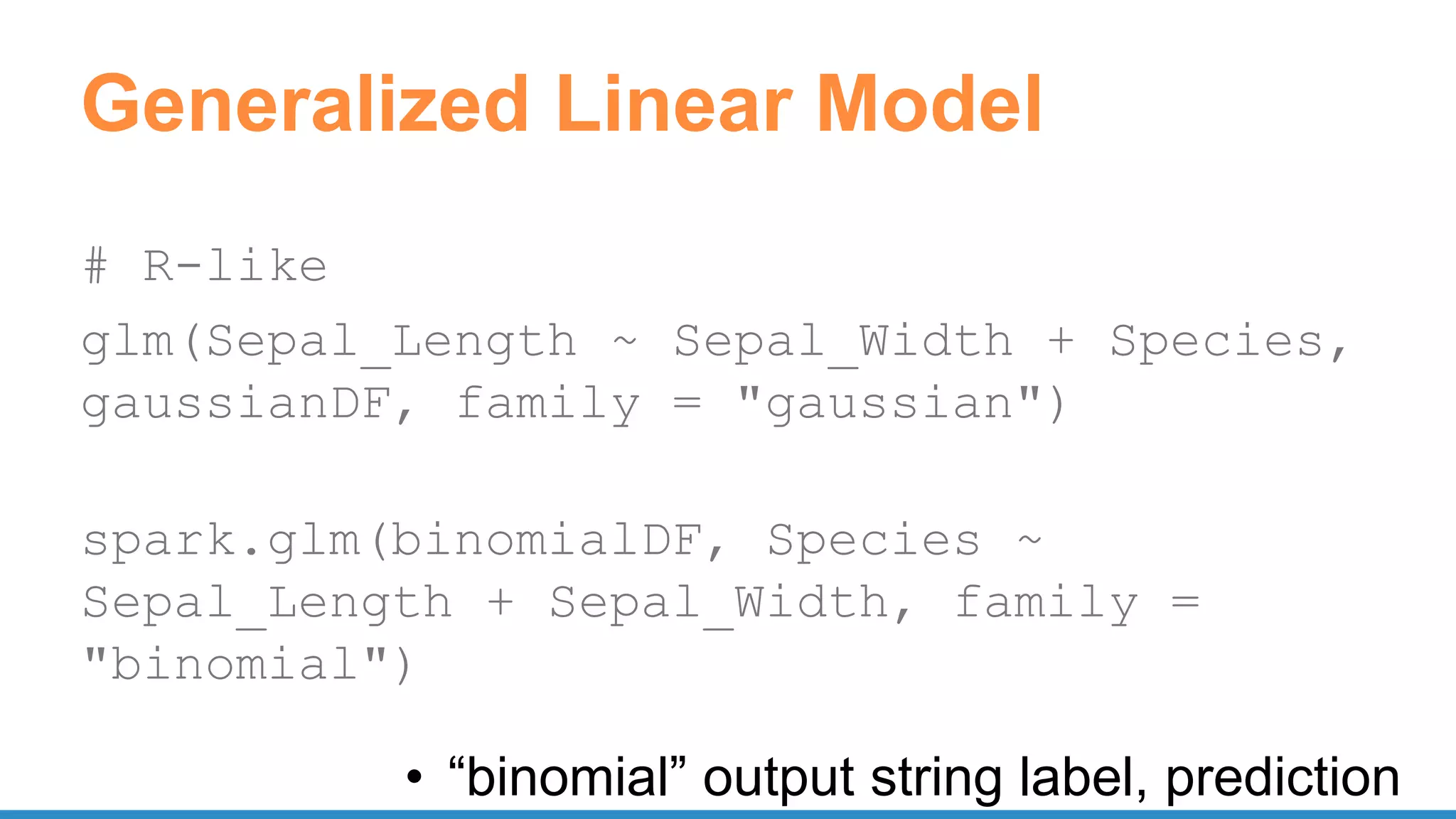
Generalized Linear Model
# R-like
glm(Sepal_Length ~ Sepal_Width + Species,
gaussianDF, family = "gaussian")
spark.glm(binomialDF, Species ~
Sepal_Length + Sepal_Width, family =
"binomial")
• “binomial” output string label, prediction
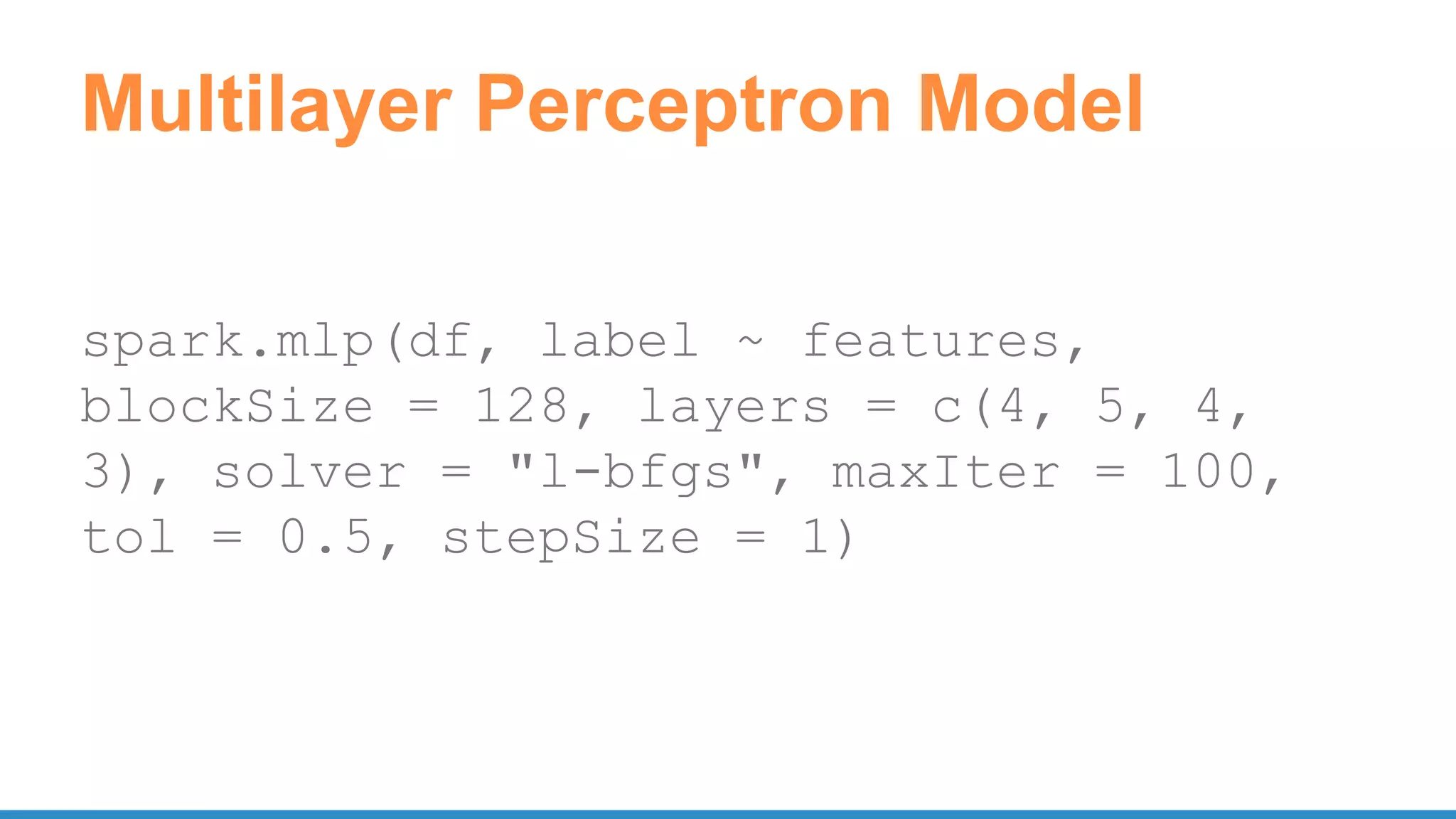
Multilayer Perceptron Model
spark.mlp(df, label ~ features,
blockSize = 128, layers = c(4, 5, 4,
3), solver = "l-bfgs", maxIter = 100,
tol = 0.5, stepSize = 1)
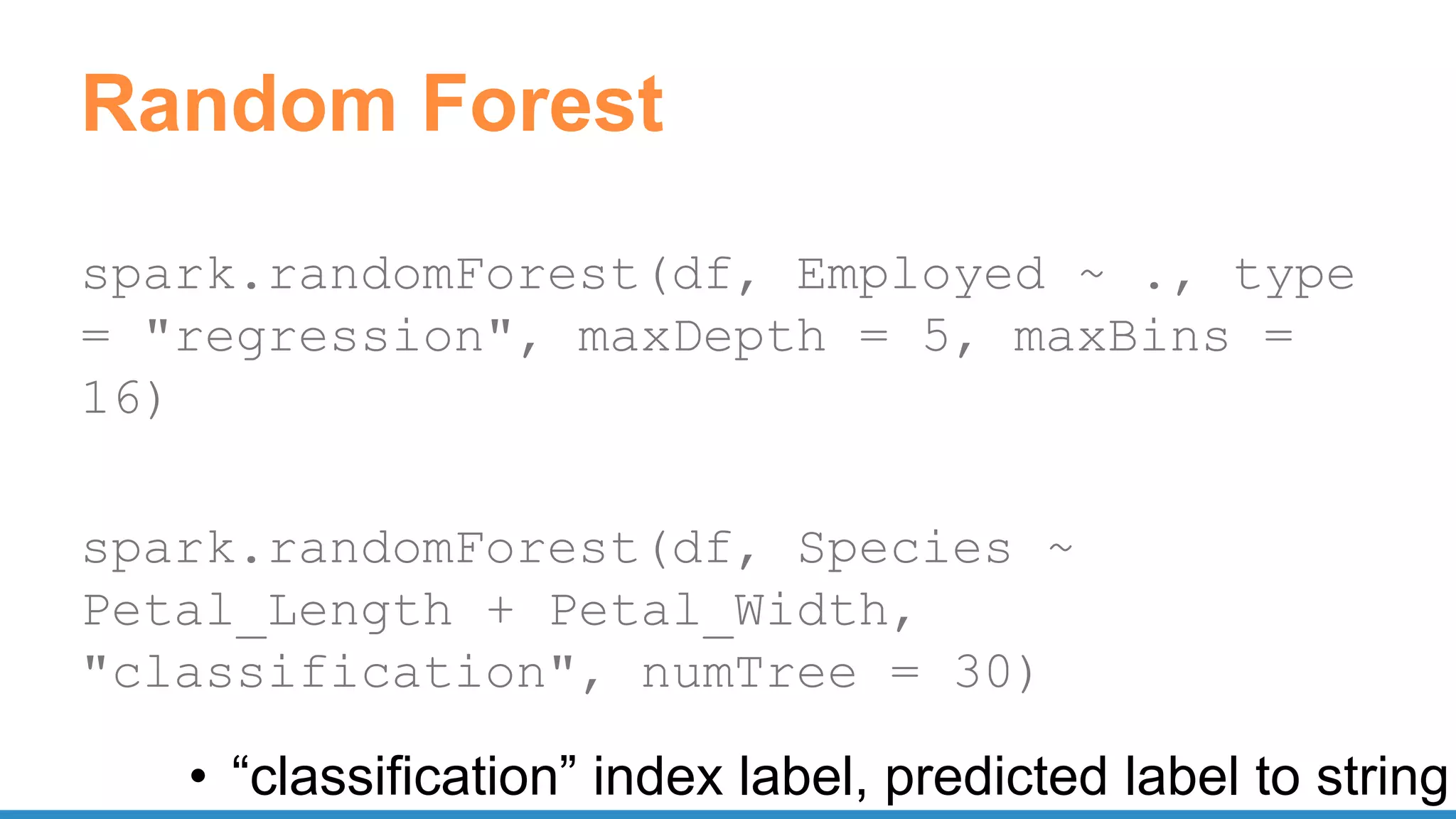
Random Forest
spark.randomForest(df, Employed ~ ., type
= "regression", maxDepth = 5, maxBins =
16)
spark.randomForest(df, Species ~
Petal_Length + Petal_Width,
"classification", numTree = 30)
• “classification” index label, predicted label to string
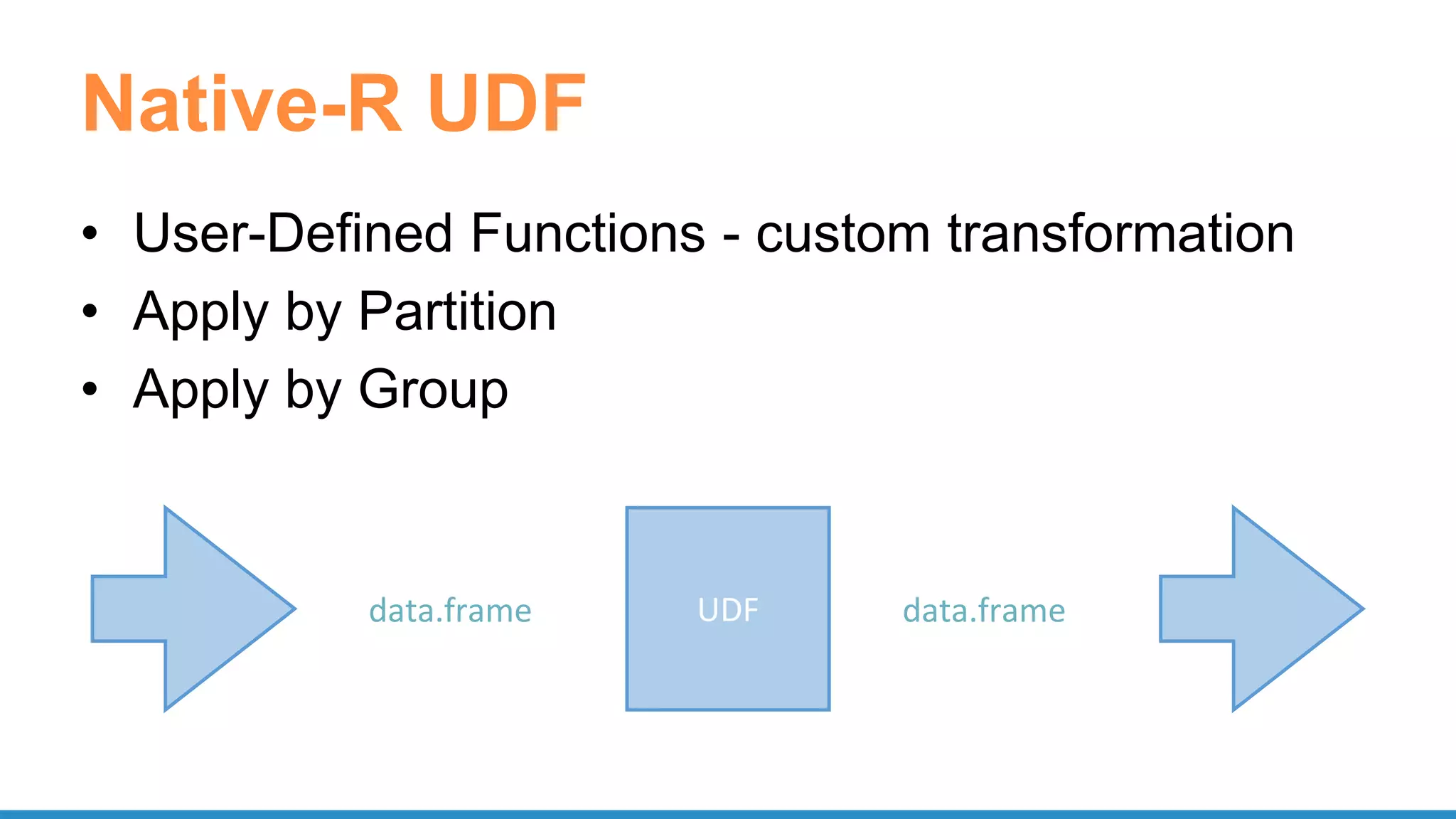
Native-R UDF
• User-Defined Functions - custom transformation
• Apply by Partition
• Apply by Group
UDFdata.frame data.frame
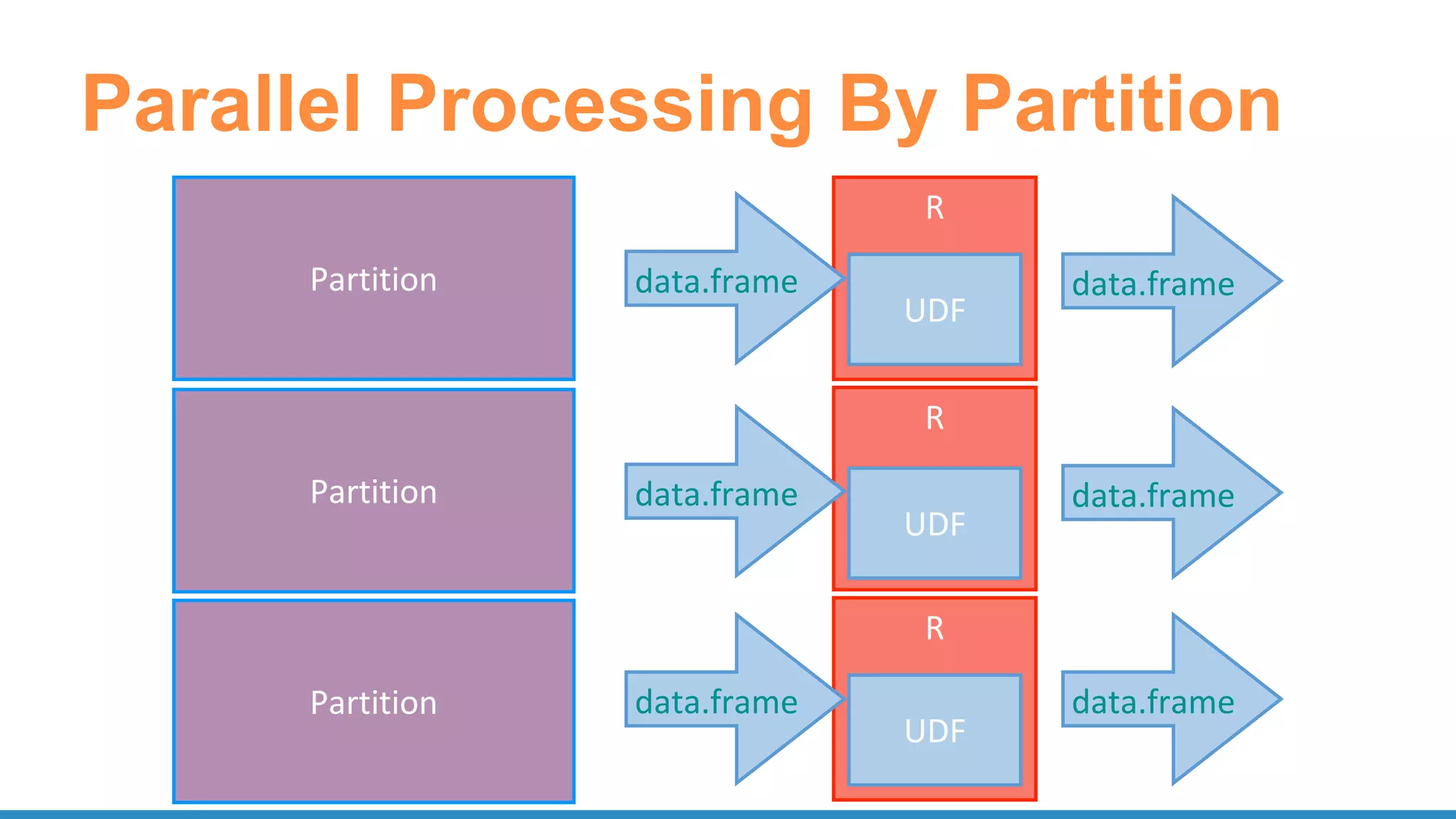
Parallel Processing By Partition
R
R
R
Partition
Partition
Partition
UDF
UDF
UDF
data.frame
data.frame
data.frame
data.frame
data.frame
data.frame
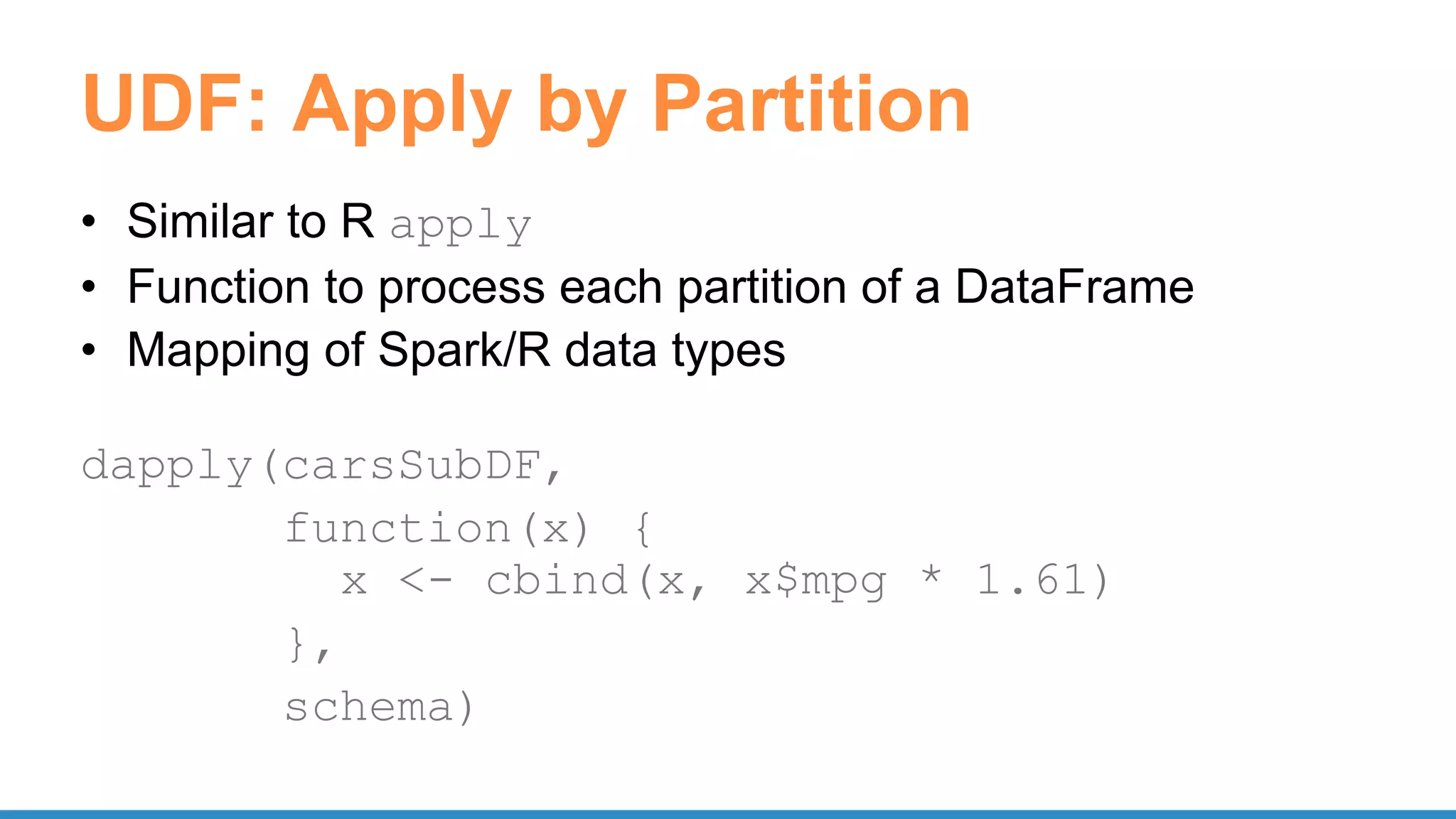
UDF: Apply by Partition
• Similar to R apply
• Function to process each partition of a DataFrame
• Mapping of Spark/R data types
dapply(carsSubDF,
function(x) {
x <- cbind(x, x$mpg * 1.61)
},
schema)
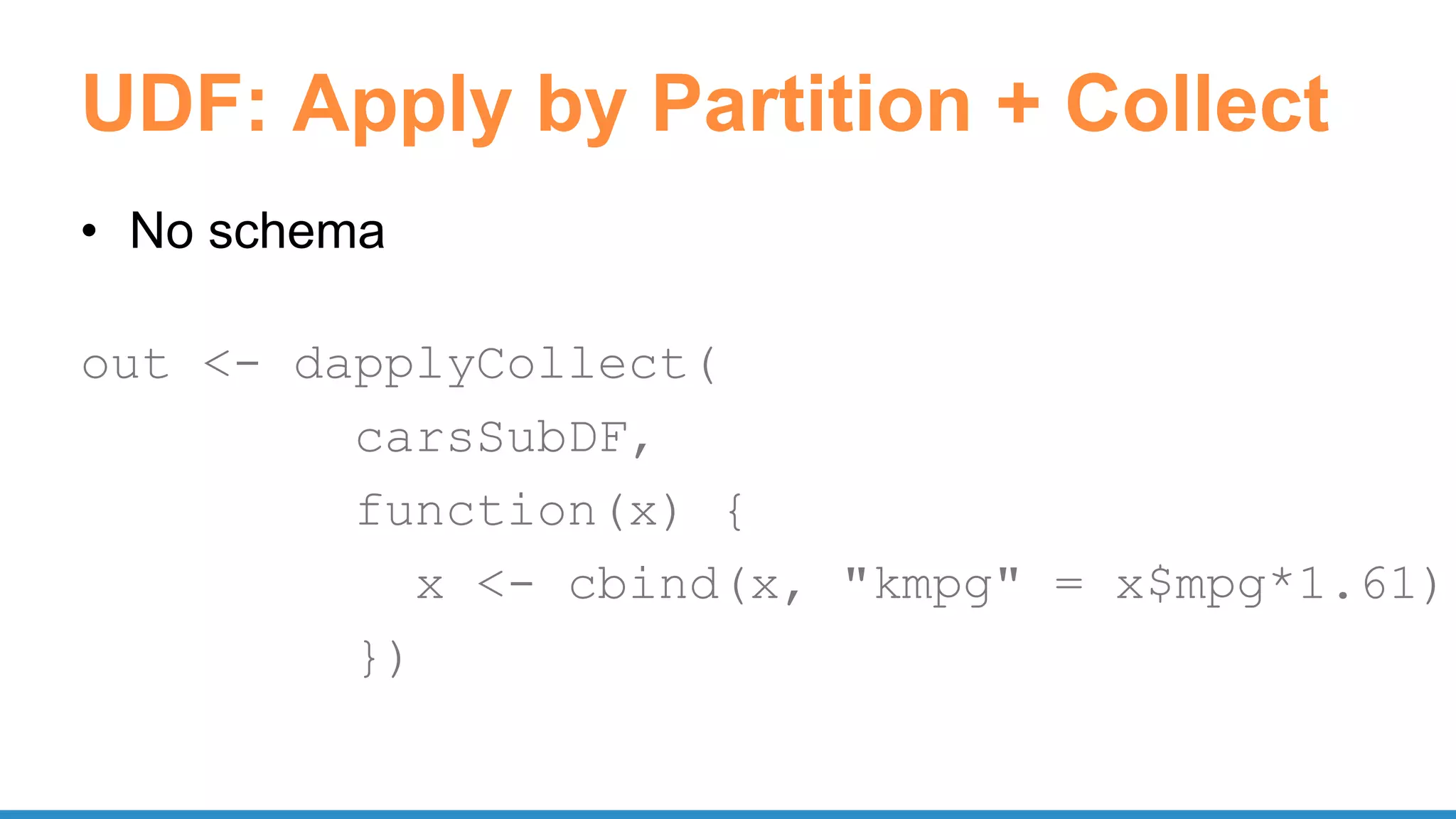
UDF: Apply by Partition + Collect
• No schema
out <- dapplyCollect(
carsSubDF,
function(x) {
x <- cbind(x, "kmpg" = x$mpg*1.61)
})
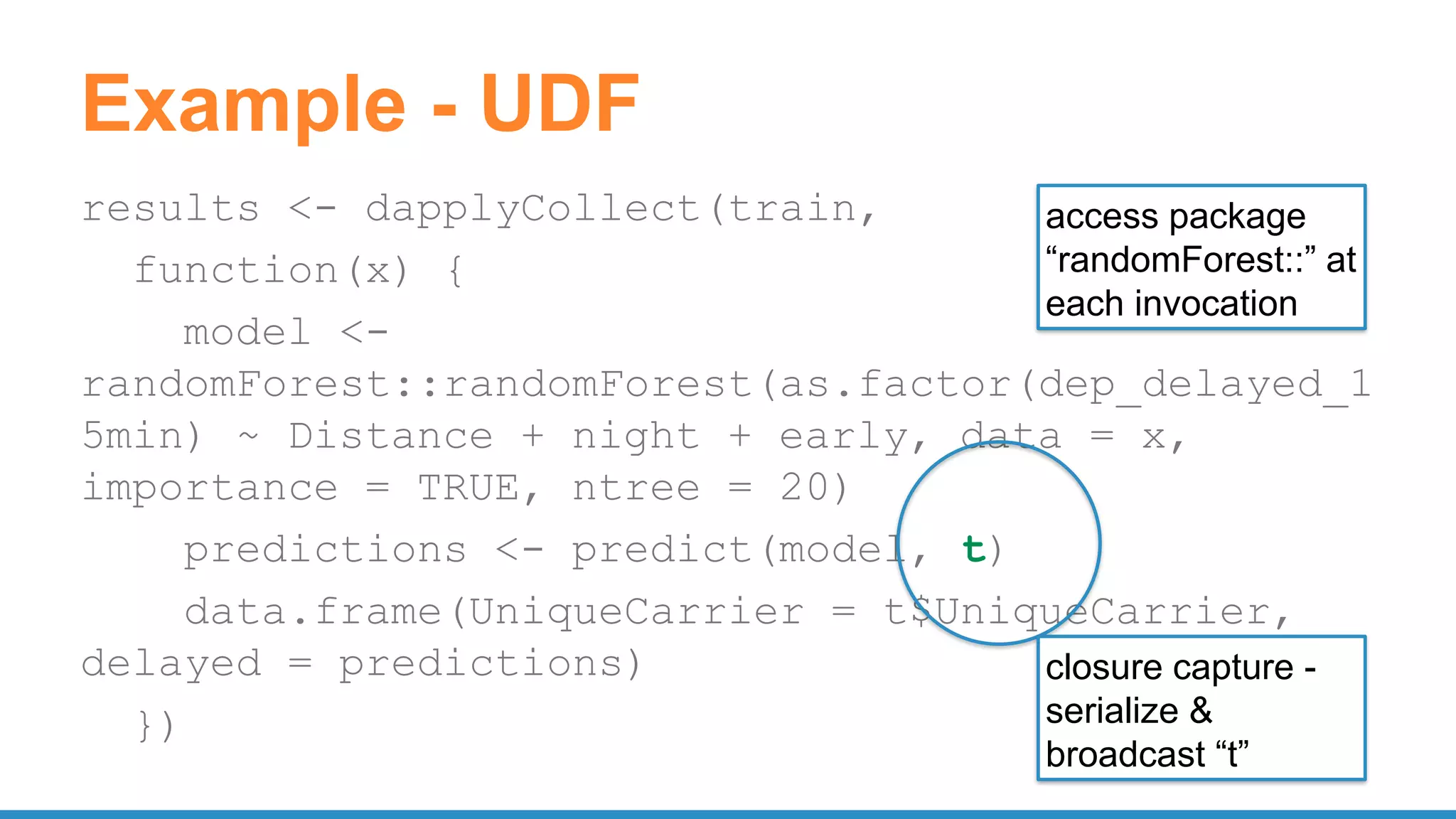
Example - UDF
results <- dapplyCollect(train,
function(x) {
model <-
randomForest::randomForest(as.factor(dep_delayed_1
5min) ~ Distance + night + early, data = x,
importance = TRUE, ntree = 20)
predictions <- predict(model, t)
data.frame(UniqueCarrier = t$UniqueCarrier,
delayed = predictions)
})
closure capture -
serialize &
broadcast “t”
access package
“randomForest::” at
each invocation
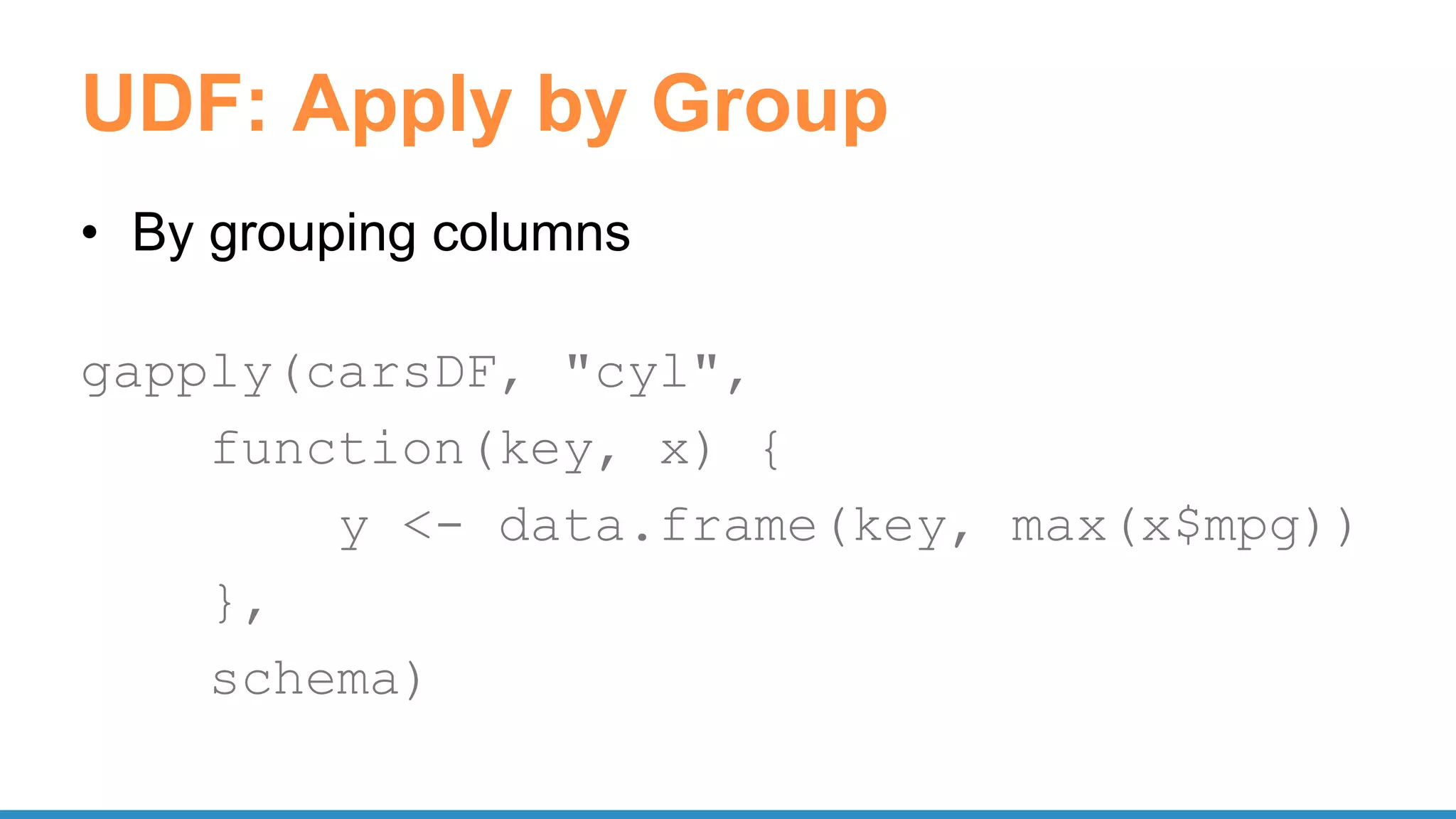
UDF: Apply by Group
• By grouping columns
gapply(carsDF, "cyl",
function(key, x) {
y <- data.frame(key, max(x$mpg))
},
schema)
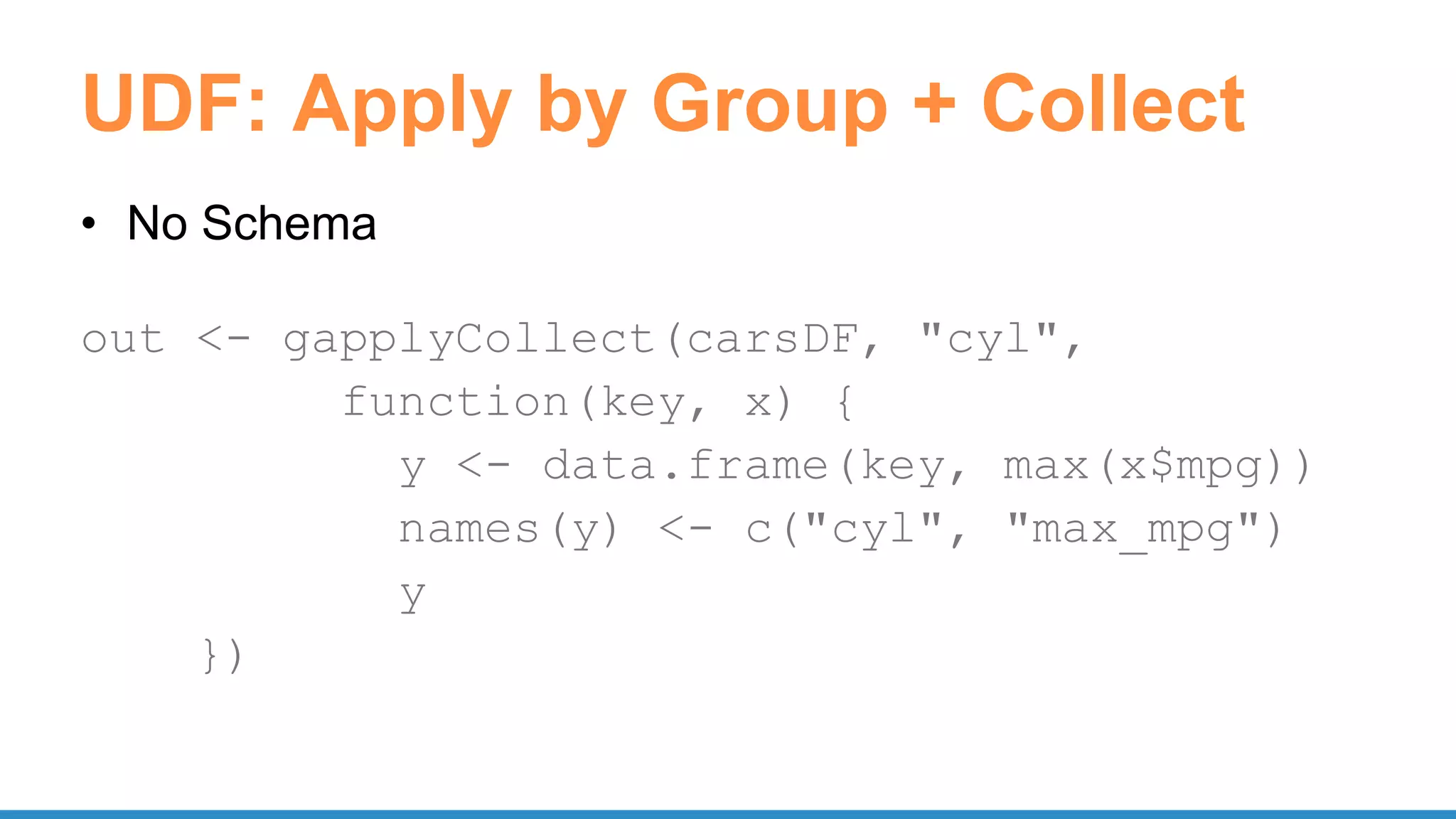
UDF: Apply by Group + Collect
• No Schema
out <- gapplyCollect(carsDF, "cyl",
function(key, x) {
y <- data.frame(key, max(x$mpg))
names(y) <- c("cyl", "max_mpg")
y
})
UDF Considerations
• No support for nested structures as columns
• Scaling up / data skew
• Data variety
• Performance costs
• Serialization/deserialization, data transfer
• Package management
UDF: lapply
• Like R lapply or doParallel
• Good for “embarrassingly parallel” tasks
• Such as hyperparameter tuning
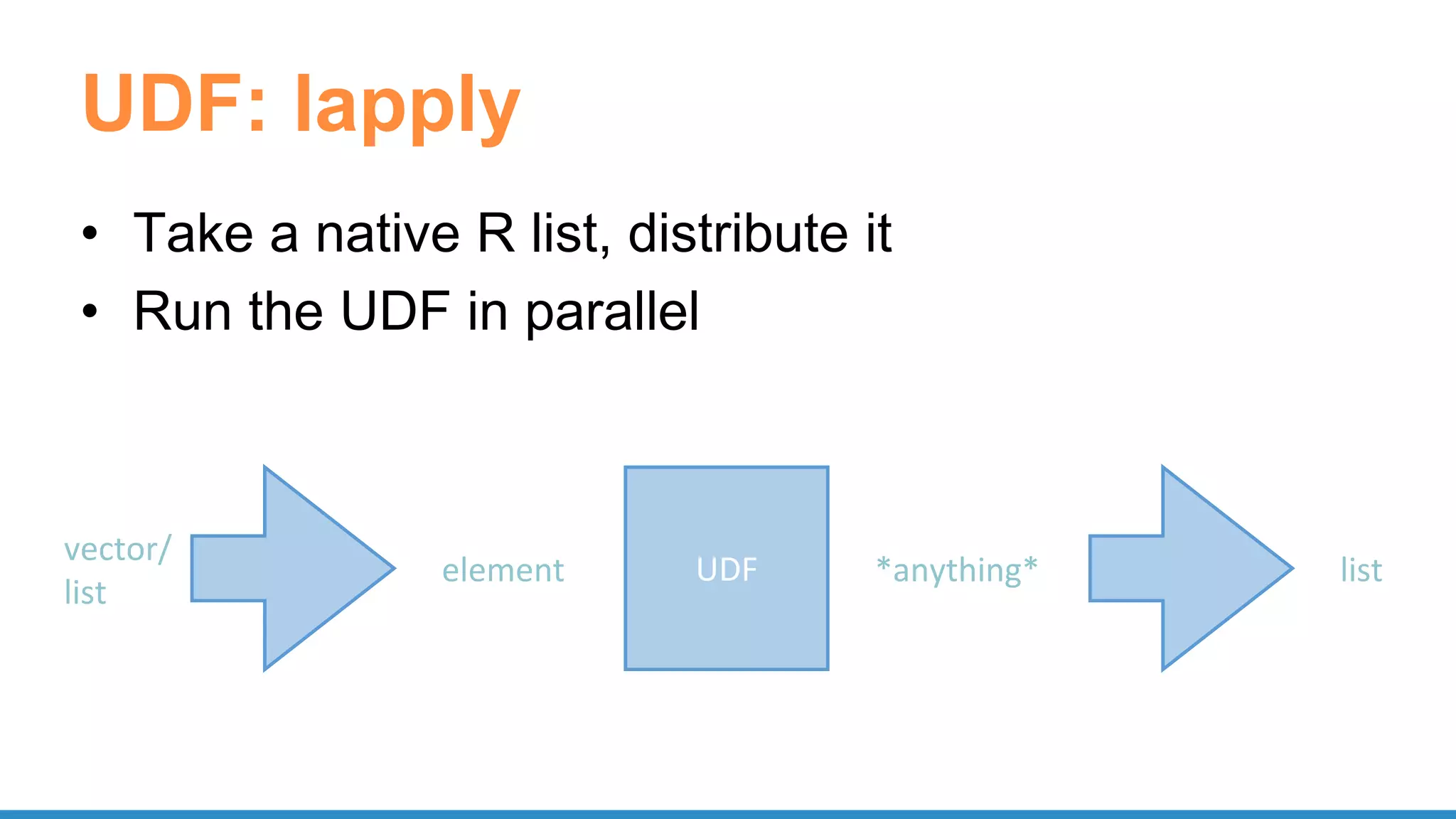
UDF: lapply
• Take a native R list, distribute it
• Run the UDF in parallel
UDFelement *anything*
vector/
list
list
UDF: parallel distributed processing
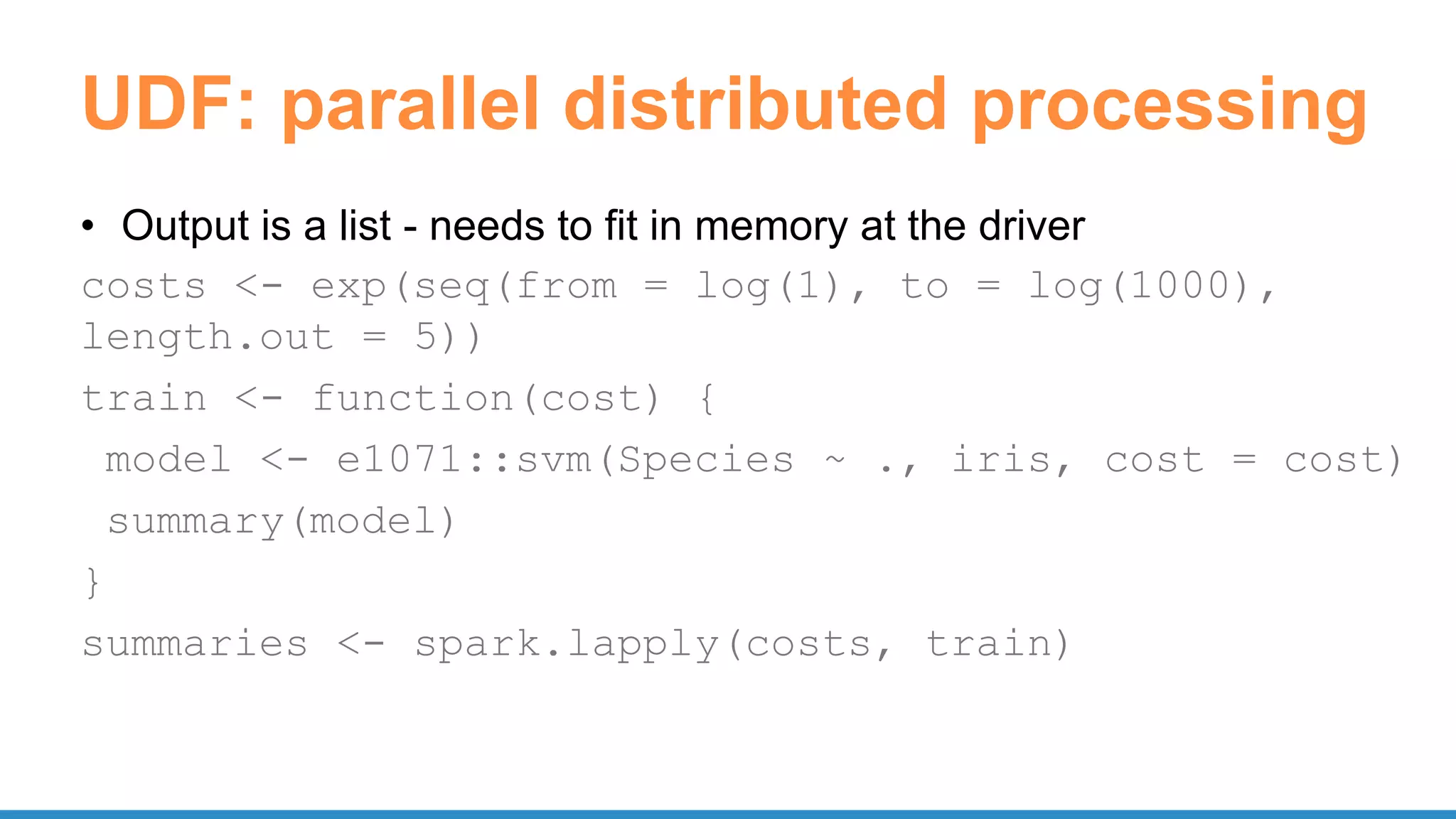
• Output is a list - needs to fit in memory at the driver
costs <- exp(seq(from = log(1), to = log(1000),
length.out = 5))
train <- function(cost) {
model <- e1071::svm(Species ~ ., iris, cost = cost)
summary(model)
}
summaries <- spark.lapply(costs, train)
UDF: model training tensorflow
train <- function(step) {
library(tensorflow)
sess <- tf$InteractiveSession()
...
result <- sess$run(list(merged, train_step),
feed_dict = feed_dict(TRUE))
summary <- result[[1]]
train_writer$add_summary(summary, step)
step
}
spark.lapply(1:20000, train)
SparkR as a Package (target:2.2)
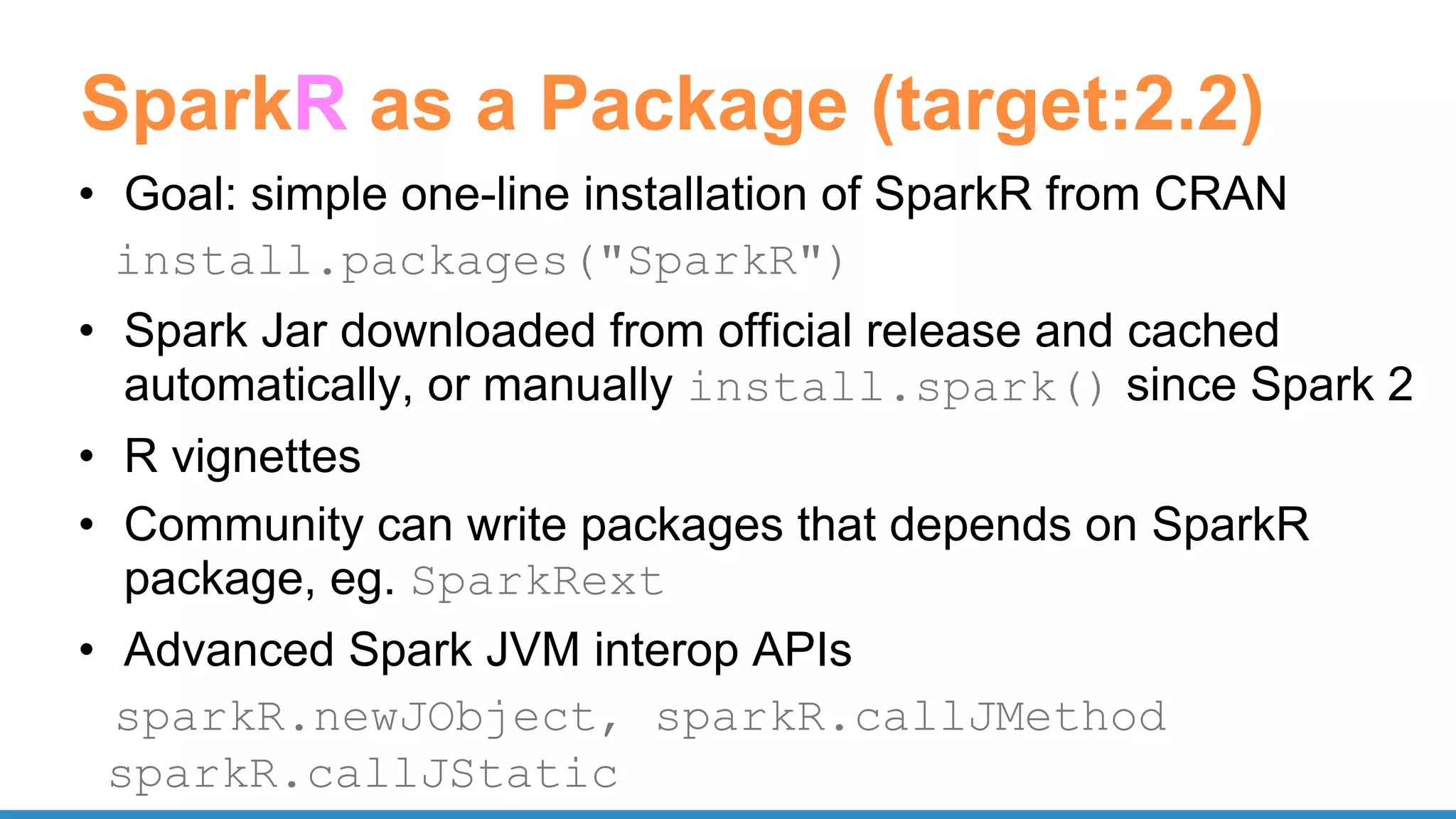
• Goal: simple one-line installation of SparkR from CRAN
install.packages("SparkR")
• Spark Jar downloaded from official release and cached
automatically, or manually install.spark() since Spark 2
• R vignettes
• Community can write packages that depends on SparkR
package, eg. SparkRext
• Advanced Spark JVM interop APIs
sparkR.newJObject, sparkR.callJMethod
sparkR.callJStatic
Ecosystem
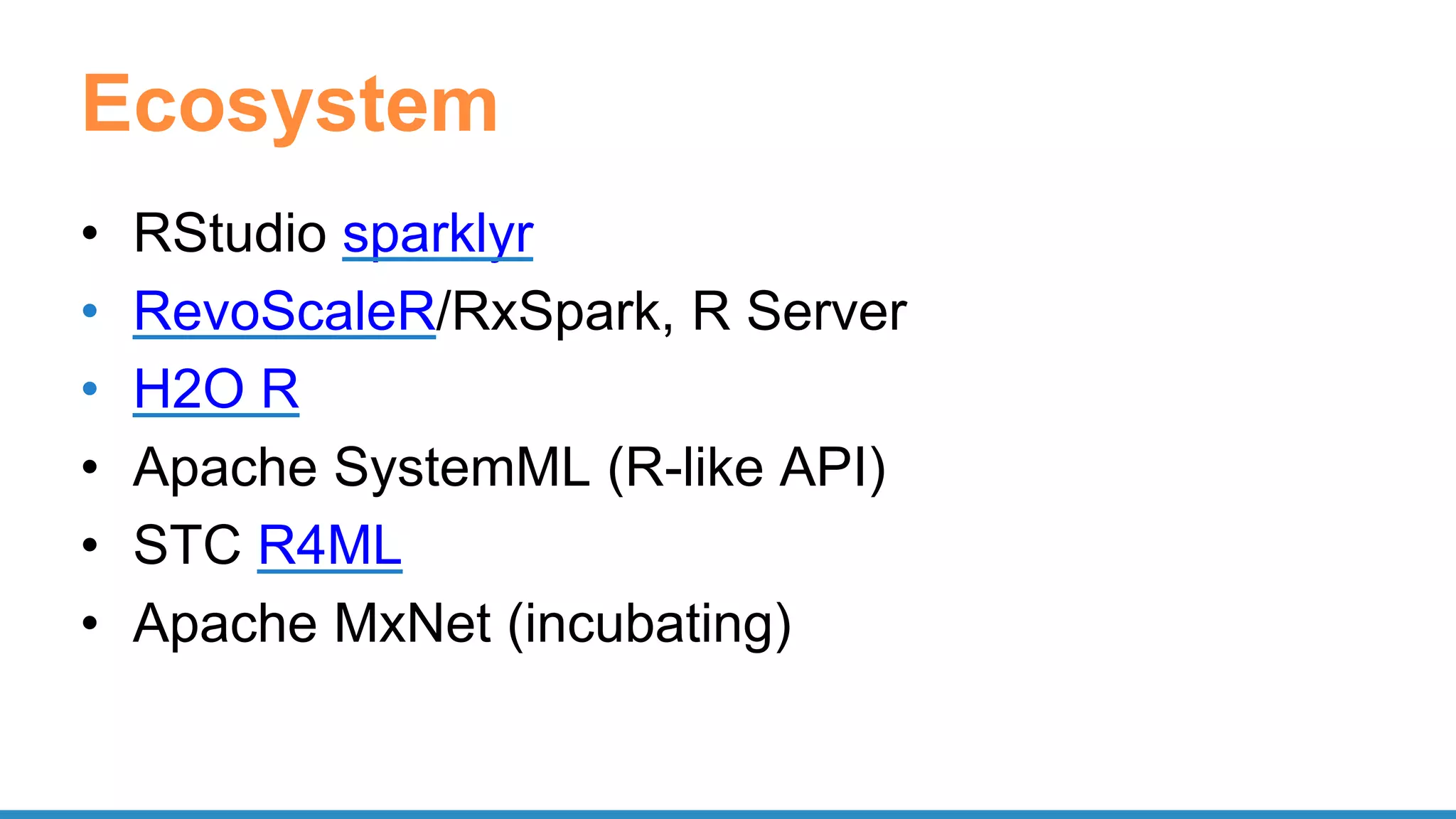
• RStudio sparklyr
• RevoScaleR/RxSpark, R Server
• H2O R
• Apache SystemML (R-like API)
• STC R4ML
• Apache MxNet (incubating)
Recap
• Let Spark take care of things or call into packages
• Be aware of your partitions!
• Many efforts to make that seamless and efficient
Thank You.
https://github.com/felixcheung
linkedin: http://linkd.in/1OeZDb7

Scalable Data Science in Python and R on Apache Spark

  • 1.
    Scalable Data Sciencein Python and R on Apache Spark Felix Cheung Principal Engineer & Apache Spark Committer
  • 2.
  • 3.
    Agenda • Intro toSpark, PySpark, SparkR • ML with Spark • Data Science PySpark – ML Pipeline API – Integrating with packages (tensorframe, BigDL, …) • Data Science SparkR – ML API – Integrating with packages (svm, randomForest, tensorflow…)
  • 5.
    What is Spark? •General-purpose cluster computing system
  • 6.
  • 7.
    What are theways to use Spark? • Ingestion – Batch – Streaming (low latency, static data) • ETL – SQL – Leveraging Catalyst Optimizer, Tungsten, CBO (cost-based optimizer in Spark 2.2/2.3) • Distributed ML
  • 8.
  • 9.
    PySpark • Python APIwith Pandas-like DataFrame • Interface to Pandas, numpy • cloudpickle to serialize functions/closures
  • 10.
    Architecture • Python classes •Py4J • Daemon process
  • 11.
    SparkR • R languageAPIs for Spark • Exposes Spark functionality in a R dplyr-like APIs • Runs as its own REPL sparkR • or as a R package loaded in IDEs like RStudio library(SparkR) sparkR.session()
  • 12.
    Architecture • Native Rclasses and methods • RBackend • Scala wrapper/helper (eg. ML Pipeline) www.slideshare.net/SparkSummit/07-venkataraman-sun
  • 13.
    High Performance • JVMprocessing, full access to DAG capabilities and Catalyst optimizer, predicate pushdown, code generation, etc. databricks.com/blog/2015/06/09/announcing-sparkr-r-on-spark.html
  • 14.
  • 15.
    End-to-End Data-Machine Learning Pipeline •Ingestion • Data preprocessing, cleaning, ETL • Machine Learning – models, predictions • Serving
  • 16.
  • 17.
    Why in Spark •Existing workloads (eg. ETL) • Single application – Single language • Sampling, aggregation • Scale
  • 18.
    Spark in MLArchitecture 1 ETL Ingest Machine Learning Serve
  • 19.
    Spark in MLArchitecture 2 ETL Ingest Model Packages Packages Packages Packages Machine Learning Evaluate
  • 20.
    Spark in MLArchitecture 3 ETL Ingest Model Machine Learning Serve
  • 21.
  • 22.
    Spark ML Pipeline •Inspired by scikit-learn • Pre-processing, feature extraction, model fitting, validation stages • Transformer • Estimator • Evaluator • Cross-validation/hyperparameter tuning
  • 23.
    DataFrame Spark ML Pipeline TransformerEstimatorTransformer Feature engineering Modeling
  • 24.
    Classification: Logistic regression Binomial logisticregression Multinomial logistic regression Decision tree classifier Random forest classifier Gradient-boosted tree classifier Multilayer perceptron classifier One-vs-Rest classifier (a.k.a. One-vs-All) Naive Bayes Models Clustering: K-means Latent Dirichlet allocation (LDA) Bisecting k-means Gaussian Mixture Model (GMM) Collaborative Filtering: Alternating Least Squares (ALS) Regression: Linear regression Generalized linear regression Decision tree regression Random forest regression Gradient-boosted tree regression Survival regression Isotonic regression
  • 25.
    PySpark ML PiplineModel tokenizer = Tokenizer(inputCol="text", outputCol="words") hashingTF = HashingTF(inputCol=tokenizer.getOutputCol(), outputCol="features") lr = LogisticRegression(maxIter=10, regParam=0.001) pipeline = Pipeline(stages=[tokenizer, hashingTF, lr]) # Fit the pipeline to training documents. model = pipeline.fit(training) prediction = model.transform(test)
  • 26.
    Large Scale, Distributed •2012 paper “Large Scale Distributed Deep Networks” Jeff Dean et al • Model parallelism • Data parallelism https://static.googleusercontent.com/media/research.google.com/en//archive/large_deep_networks_nips2012.pdf
  • 27.
    Spark as aScheduler • Run external, often native packages • Data-parallel tasks • Distributed execution external data
  • 28.
    UDF • Register functionto use in SQL – spark.udf.register("stringLengthInt", lambda x: len(x), IntegerType()) spark.sql("SELECT stringLengthInt('test')") • Function on RDD – rdd.map(lambda l: str(l.e)[:7]) – rdd.mapPartitions(lambda x: [(1,), (2,), (3,)])
  • 29.
  • 30.
    Considerations • Data transferoverhead (serialization/deserialization, network) • Native language (boxing, interpreted) • Lambda – one row at a time
  • 31.
    PySpark Vectorized UDF •Apache Arrow – in-memory columnar – Row batch – Zero copy – Future: IPC • SPARK-21190
  • 32.
    spark-sklearn • Train andevaluate multiple scikit-learn models – Single node parallel -> distributed • Dataframes -> numpy ndarrays or sparse matrices • GridSearchCV, gapply
  • 33.
    CaffeOnSpark • GPU • RDMAto sync DL models • MPI Allreduce http://yahoohadoop.tumblr.com/post/129872361846/large-scale-distributed-deep-learning-on-hadoop
  • 34.
    CaffeOnSpark def get_predictions(sqlContext, images,model, imagenet, lstmnet, vocab): rdd = images.mapPartitions(lambda im: predict_caption(im, model, imagenet, lstmnet, vocab)) ... return sqlContext.createDataFrame(rdd, schema).select("result.id", "result.prediction") def predict_caption(list_of_images, model, imagenet, lstmnet, vocab): out_iterator = [] ce = CaptionExperiment(str(model),str(imagenet),str(lstmnet),str(vocab)) for image in list_of_images: out_iterator.append(ce.getCaption(image)) return iter(out_iterator) https://github.com/yahoo/CaffeOnSpark/blob/master/caffe-grid/src/main/python/examples/ImageCaption.py
  • 35.
  • 36.
    BigDL • Distribute modeltraining – P2P All Reduce – block manager as parameter server • Integration with Intel's Math Kernel Library (MKL) • Model Snapshot • Load Caffe/Torch Model
  • 37.
  • 38.
    BigDL - CNNMNIST def build_model(class_num): model = Sequential() # Create a LeNet model model.add(Reshape([1, 28, 28])) model.add(SpatialConvolution(1, 6, 5, 5).set_name('conv1')) model.add(Tanh()) model.add(SpatialMaxPooling(2, 2, 2, 2).set_name('pool1')) model.add(Tanh()) model.add(SpatialConvolution(6, 12, 5, 5).set_name('conv2')) model.add(SpatialMaxPooling(2, 2, 2, 2).set_name('pool2')) model.add(Reshape([12 * 4 * 4])) model.add(Linear(12 * 4 * 4, 100).set_name('fc1')) model.add(Tanh()) model.add(Linear(100, class_num).set_name('score')) model.add(LogSoftMax()) return model https://github.com/intel-analytics/BigDL-Tutorials/blob/master/notebooks/neural_networks/cnn.ipynb lenet_model = build_model(10) state = {"learningRate": 0.4, "learningRateDecay": 0.0002} optimizer = Optimizer( model=lenet_model, training_rdd=train_data, criterion=ClassNLLCriterion(), optim_method="SGD", state=state, end_trigger=MaxEpoch(20), batch_size=2048) trained_model = optimizer.optimize() predictions = trained_model.predict(test_data)
  • 39.
    mmlspark • Spark MLPipeline model + rich data types: images, text • Deep Learning with CNTK – Train on GPU edge node • Transfer Learning # Initialize CNTKModel and define input and output columns cntkModel = CNTKModel().setInputCol("images").setOutputCol("output").setModelLocation(model File) # Train on dataset with internal spark pipeline scoredImages = cntkModel.transform(imagesWithLabels)
  • 40.
    tensorframes • DataFrame ->TensorFlow • Hyperparameter tuning • Apply trained model at scale • Row or block operations • JVM to C++ (bypassing Python)
  • 41.
  • 42.
    spark-deep-learning • Spark MLPipeline model + complex data: image – Transformer • DL featurization • Transfer Learning • Model as SQL UDF • Later : hyperparameter tuning
  • 43.
    spark-deep-learning predictor = DeepImagePredictor(inputCol="image", outputCol="predicted_labels",modelName="InceptionV3") predictions_df = predictor.transform(df) featurizer = DeepImageFeaturizer(modelName="InceptionV3") p = Pipeline(stages=[featurizer, lr]) sparkdl.registerKerasUDF("img_classify", "/mymodels/dogmodel.h5") SELECT image, img_classify(image) label FROM images
  • 44.
    Ecosystem • DeepDist • CaffeOnSpark,TensorFlowOnSpark • Elephas (Keras) • Apache SystemML • Apache Hivemall (incubating) • Apache MxNet (incubating)
  • 45.
  • 46.
    Spark ML Pipeline •Pre-processing, feature extraction, model fitting, validation stages • Transformer • Estimator • Cross-validation/hyperparameter tuning
  • 47.
    SparkR API forML Pipeline spark.lda( data = text, k = 20, maxIter = 25, optimizer = "em") RegexTokenizer StopWordsRemover CountVectorizer R JVM LDA API builds ML Pipeline
  • 48.
    Model Operations • summary- print a summary of the fitted model • predict - make predictions on new data • write.ml/read.ml - save/load fitted models (slight layout difference: pipeline model plus R metadata)
  • 49.
    RFormula • Specify modelingin symbolic form y ~ f0 + f1 response y is modeled linearly by f0 and f1 • Support a subset of R formula operators ~ , . , : , + , - • Implemented as feature transformer in core Spark, available to Scala/Java, Python • String label column is indexed • String term columns are one-hot encoded
  • 50.
    Generalized Linear Model #R-like glm(Sepal_Length ~ Sepal_Width + Species, gaussianDF, family = "gaussian") spark.glm(binomialDF, Species ~ Sepal_Length + Sepal_Width, family = "binomial") • “binomial” output string label, prediction
  • 51.
    Multilayer Perceptron Model spark.mlp(df,label ~ features, blockSize = 128, layers = c(4, 5, 4, 3), solver = "l-bfgs", maxIter = 100, tol = 0.5, stepSize = 1)
  • 52.
    Random Forest spark.randomForest(df, Employed~ ., type = "regression", maxDepth = 5, maxBins = 16) spark.randomForest(df, Species ~ Petal_Length + Petal_Width, "classification", numTree = 30) • “classification” index label, predicted label to string
  • 53.
    Native-R UDF • User-DefinedFunctions - custom transformation • Apply by Partition • Apply by Group UDFdata.frame data.frame
  • 54.
    Parallel Processing ByPartition R R R Partition Partition Partition UDF UDF UDF data.frame data.frame data.frame data.frame data.frame data.frame
  • 55.
    UDF: Apply byPartition • Similar to R apply • Function to process each partition of a DataFrame • Mapping of Spark/R data types dapply(carsSubDF, function(x) { x <- cbind(x, x$mpg * 1.61) }, schema)
  • 56.
    UDF: Apply byPartition + Collect • No schema out <- dapplyCollect( carsSubDF, function(x) { x <- cbind(x, "kmpg" = x$mpg*1.61) })
  • 57.
    Example - UDF results<- dapplyCollect(train, function(x) { model <- randomForest::randomForest(as.factor(dep_delayed_1 5min) ~ Distance + night + early, data = x, importance = TRUE, ntree = 20) predictions <- predict(model, t) data.frame(UniqueCarrier = t$UniqueCarrier, delayed = predictions) }) closure capture - serialize & broadcast “t” access package “randomForest::” at each invocation
  • 58.
    UDF: Apply byGroup • By grouping columns gapply(carsDF, "cyl", function(key, x) { y <- data.frame(key, max(x$mpg)) }, schema)
  • 59.
    UDF: Apply byGroup + Collect • No Schema out <- gapplyCollect(carsDF, "cyl", function(key, x) { y <- data.frame(key, max(x$mpg)) names(y) <- c("cyl", "max_mpg") y })
  • 60.
    UDF Considerations • Nosupport for nested structures as columns • Scaling up / data skew • Data variety • Performance costs • Serialization/deserialization, data transfer • Package management
  • 61.
    UDF: lapply • LikeR lapply or doParallel • Good for “embarrassingly parallel” tasks • Such as hyperparameter tuning
  • 62.
    UDF: lapply • Takea native R list, distribute it • Run the UDF in parallel UDFelement *anything* vector/ list list
  • 63.
    UDF: parallel distributedprocessing • Output is a list - needs to fit in memory at the driver costs <- exp(seq(from = log(1), to = log(1000), length.out = 5)) train <- function(cost) { model <- e1071::svm(Species ~ ., iris, cost = cost) summary(model) } summaries <- spark.lapply(costs, train)
  • 64.
    UDF: model trainingtensorflow train <- function(step) { library(tensorflow) sess <- tf$InteractiveSession() ... result <- sess$run(list(merged, train_step), feed_dict = feed_dict(TRUE)) summary <- result[[1]] train_writer$add_summary(summary, step) step } spark.lapply(1:20000, train)
  • 65.
    SparkR as aPackage (target:2.2) • Goal: simple one-line installation of SparkR from CRAN install.packages("SparkR") • Spark Jar downloaded from official release and cached automatically, or manually install.spark() since Spark 2 • R vignettes • Community can write packages that depends on SparkR package, eg. SparkRext • Advanced Spark JVM interop APIs sparkR.newJObject, sparkR.callJMethod sparkR.callJStatic
  • 66.
    Ecosystem • RStudio sparklyr •RevoScaleR/RxSpark, R Server • H2O R • Apache SystemML (R-like API) • STC R4ML • Apache MxNet (incubating)
  • 67.
    Recap • Let Sparktake care of things or call into packages • Be aware of your partitions! • Many efforts to make that seamless and efficient
  • 68.