Chapter 4
SC161: Principles of Information Technology
Communication and Network
Part 1: Data Communication
Thiti Theerathean
Center for Teaching Excellence
University of the Thai Chamber of Commerce
E-mail : thiti_the@utcc.ac.th
2
• Introduction to Data Communication.
- Data Communicationand Telecommunication
- Type of Signals
- The Basic Components of Communication
• Data Transmission.
- Line configurations
- Directionof Transmisssion
- TransmissionMode
• Communication Channel.
- Guided Media
- Unguided Media
• Wireless Technology.
- Long-distance wireless communication
- Short-range wirelesscommunication
SC161: Principlesof Information Technology
3SC161: Principlesof Information Technology
Data Communications is any transfer of data within a computer, between a computer
and another device, or between two computers.
Telecommunication is communications over a distance.
Tele- distance
4SC161: Principlesof Information Technology
Data and Information travels through a communication system in the form of
eletromagnetic signals. Signals are represented in two ways
• Continuous waveform.
• Three basic components :
- Amplitude (Volt)
- Frequency (Hz)
- Phase (Radian)
• Infinite number of points between minimum and maximum amplitude.
• Use an Amplifier to increase power for transmission over long distances and
reduce noise by Filter.
• Used for Voice Communication.
5SC161: Principlesof Information Technology
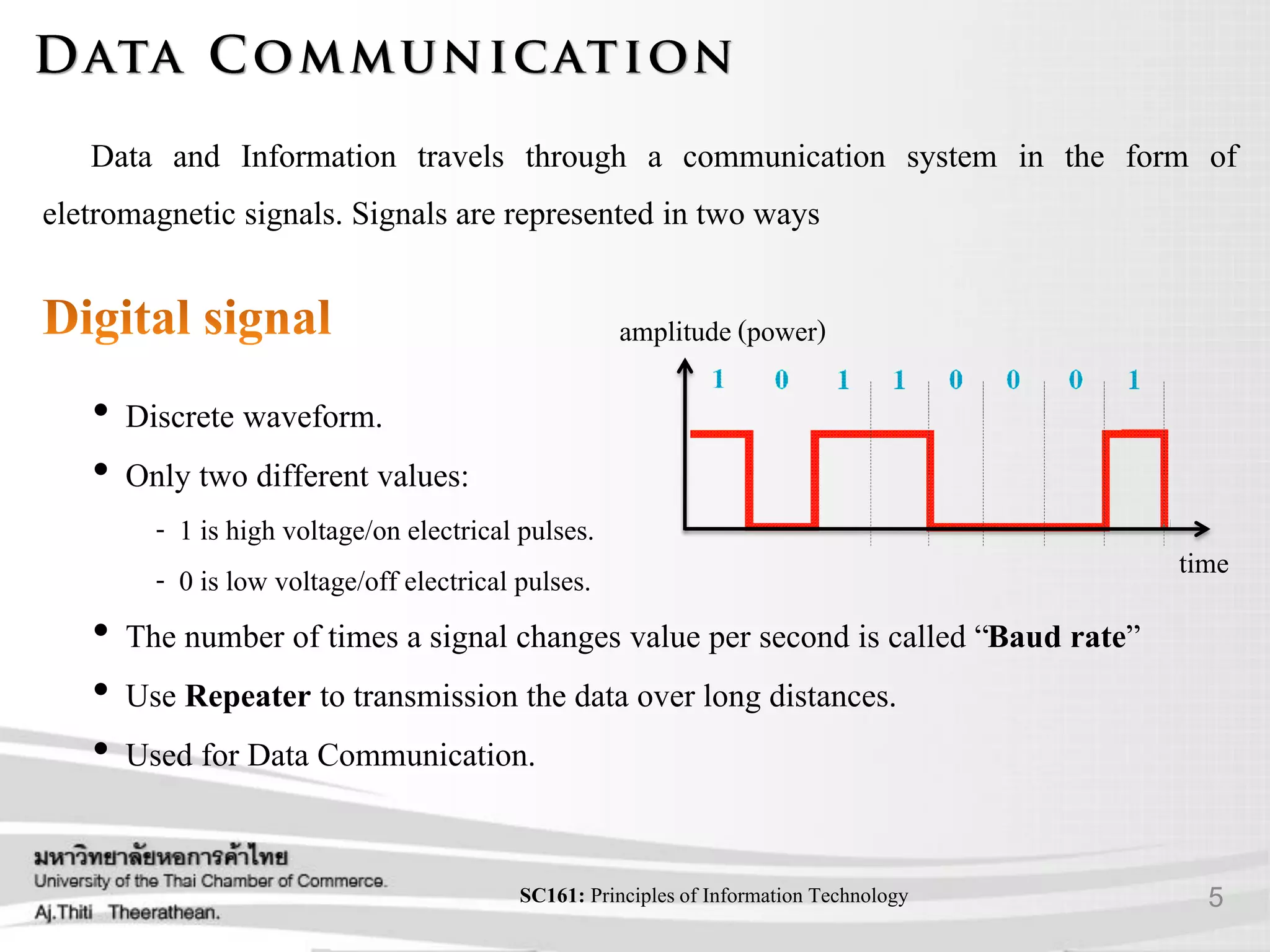
Data and Information travels through a communication system in the form of
eletromagnetic signals. Signals are represented in two ways
• Discrete waveform.
• Only two different values:
- 1 is high voltage/on electrical pulses.
- 0 is low voltage/off electrical pulses.
• The number of times a signal changes value per second is called “Baud rate”
• Use Repeater to transmission the data over long distances.
• Used for Data Communication.
time
amplitude(power)
6SC161: Principlesof Information Technology
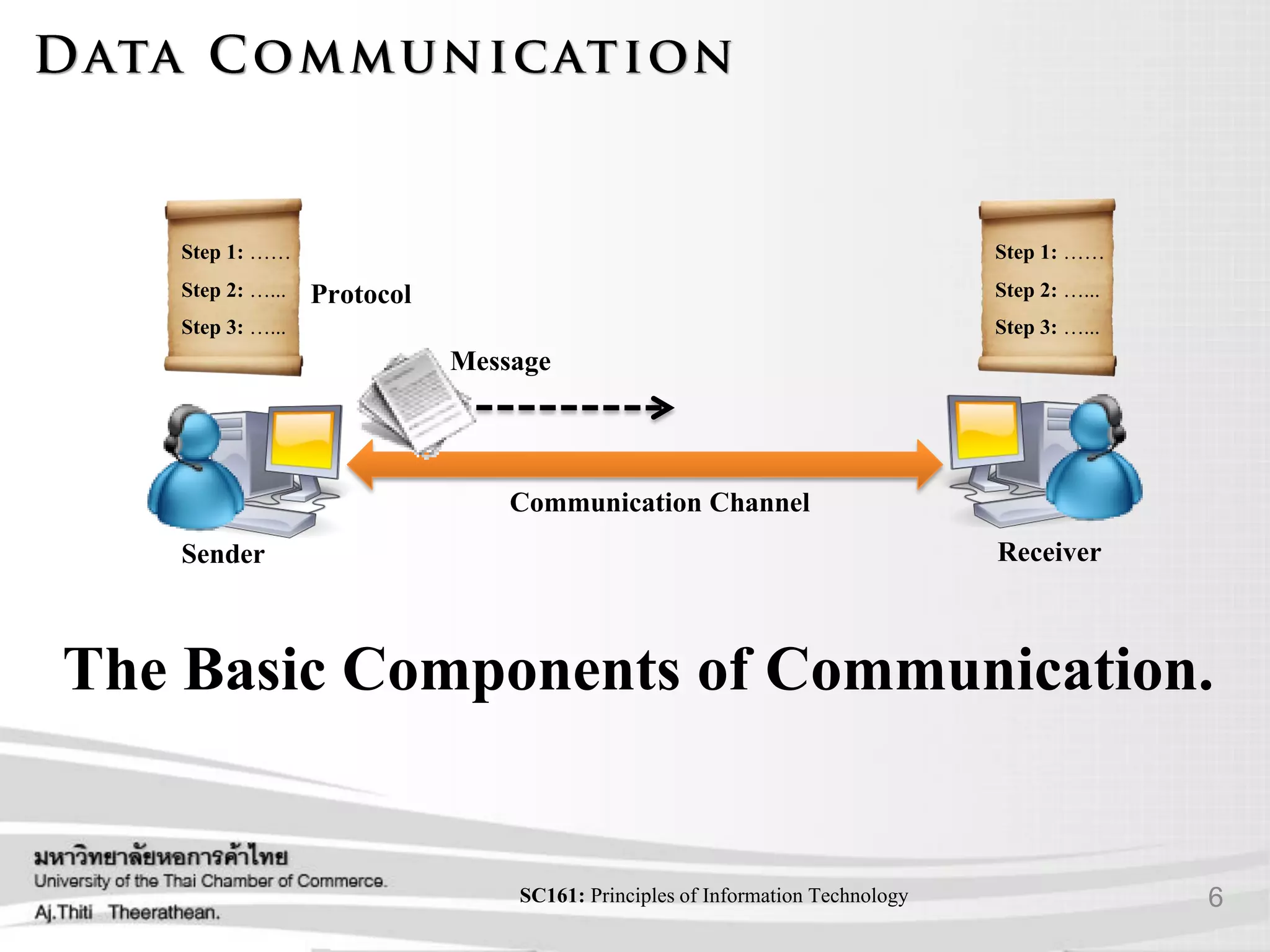
Sender
Communication Channel
Receiver
Step 1: ……
Step 2: …...
Step 3: …...
Step 1: ……
Step 2: …...
Step 3: …...
Protocol
Message
The Basic Components of Communication.
7SC161: Principlesof Information Technology
8SC161: Principlesof Information Technology
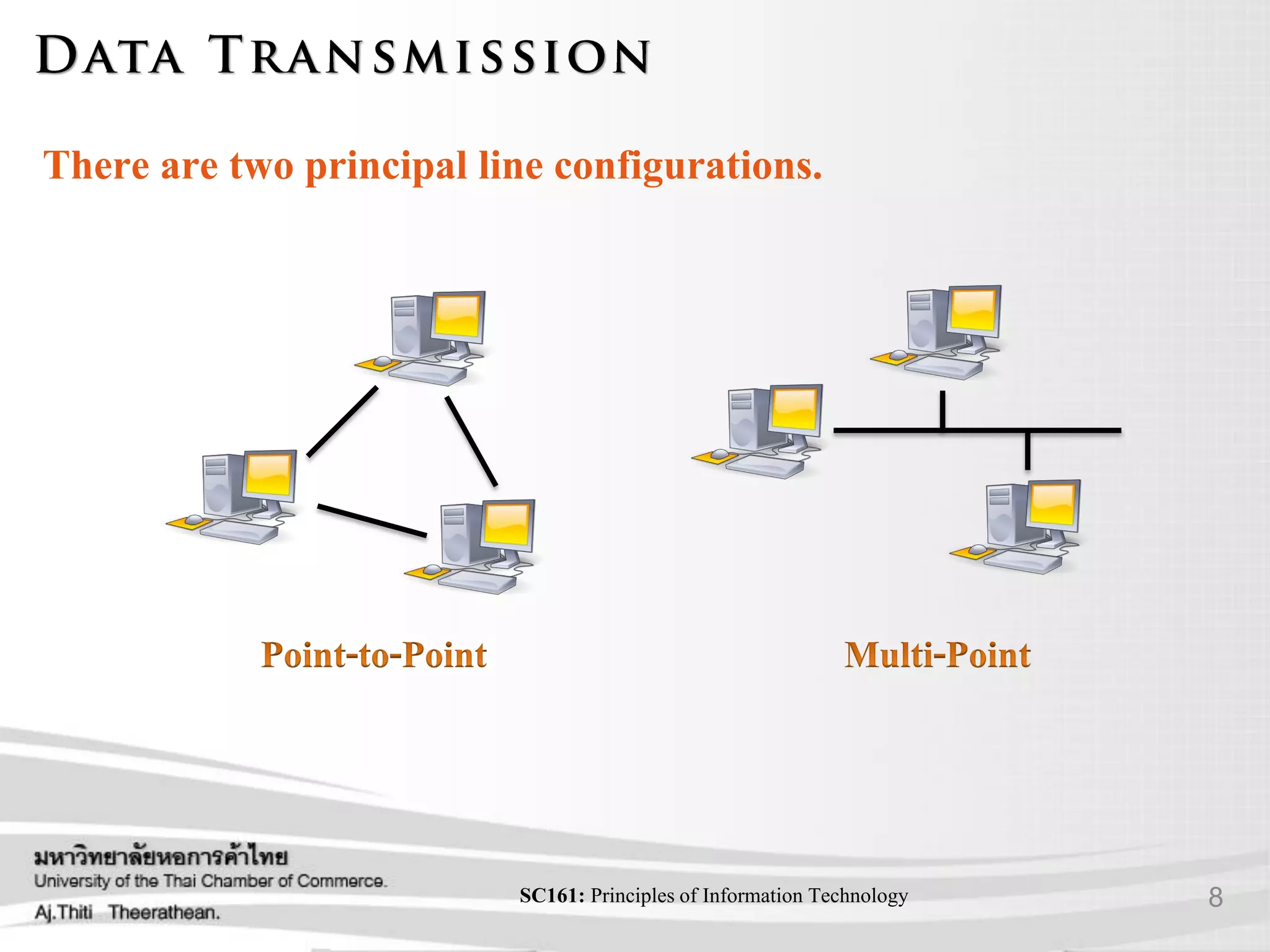
There are two principal line configurations.
9SC161: Principlesof Information Technology
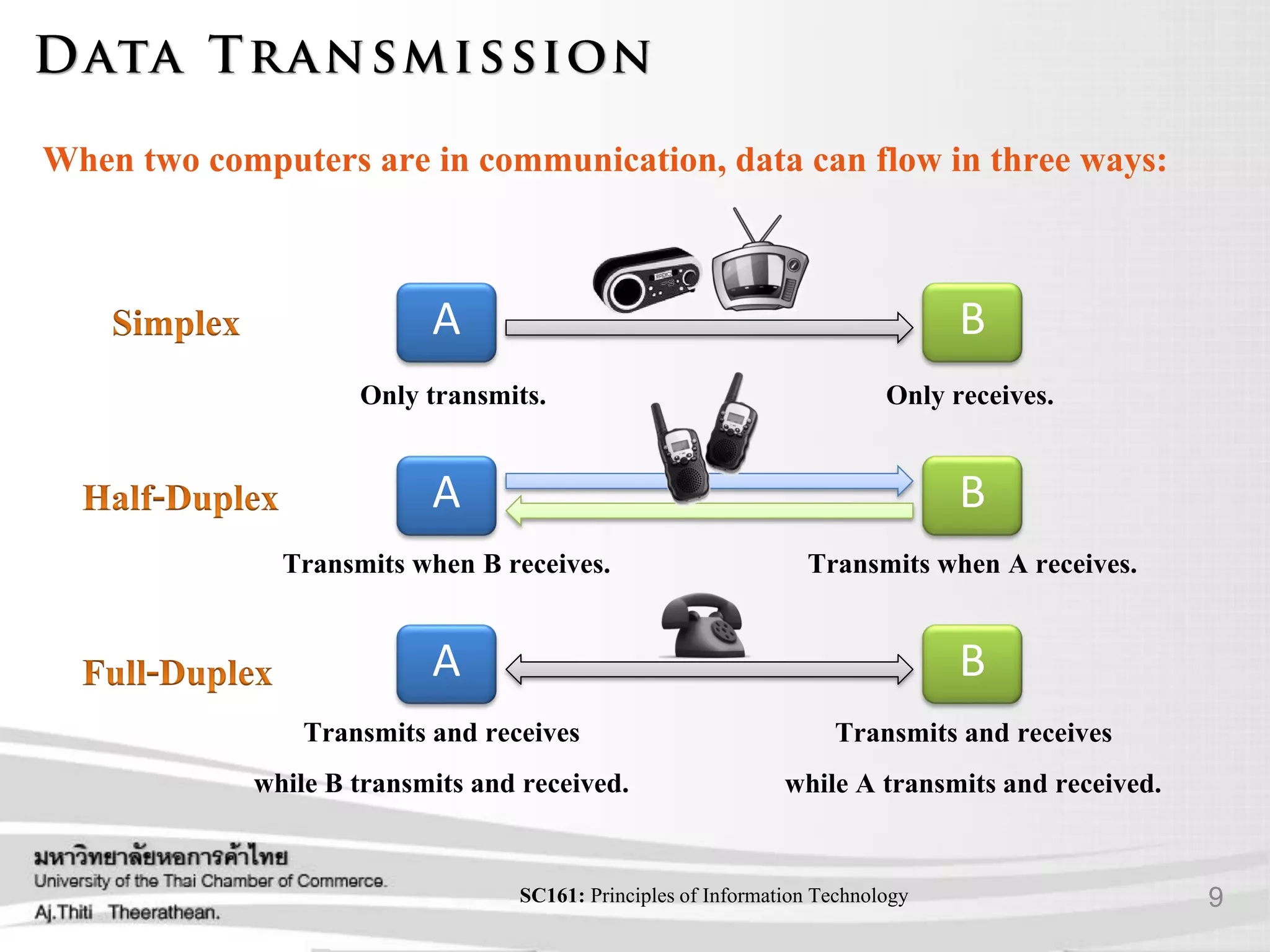
When two computers are in communication, data can flow in three ways:
A B
Only transmits. Only receives.
A B
Transmits when B receives. Transmits when A receives.
A B
Transmits and receives
while B transmits and received.
Transmits and receives
while A transmits and received.
10SC161: Principlesof Information Technology
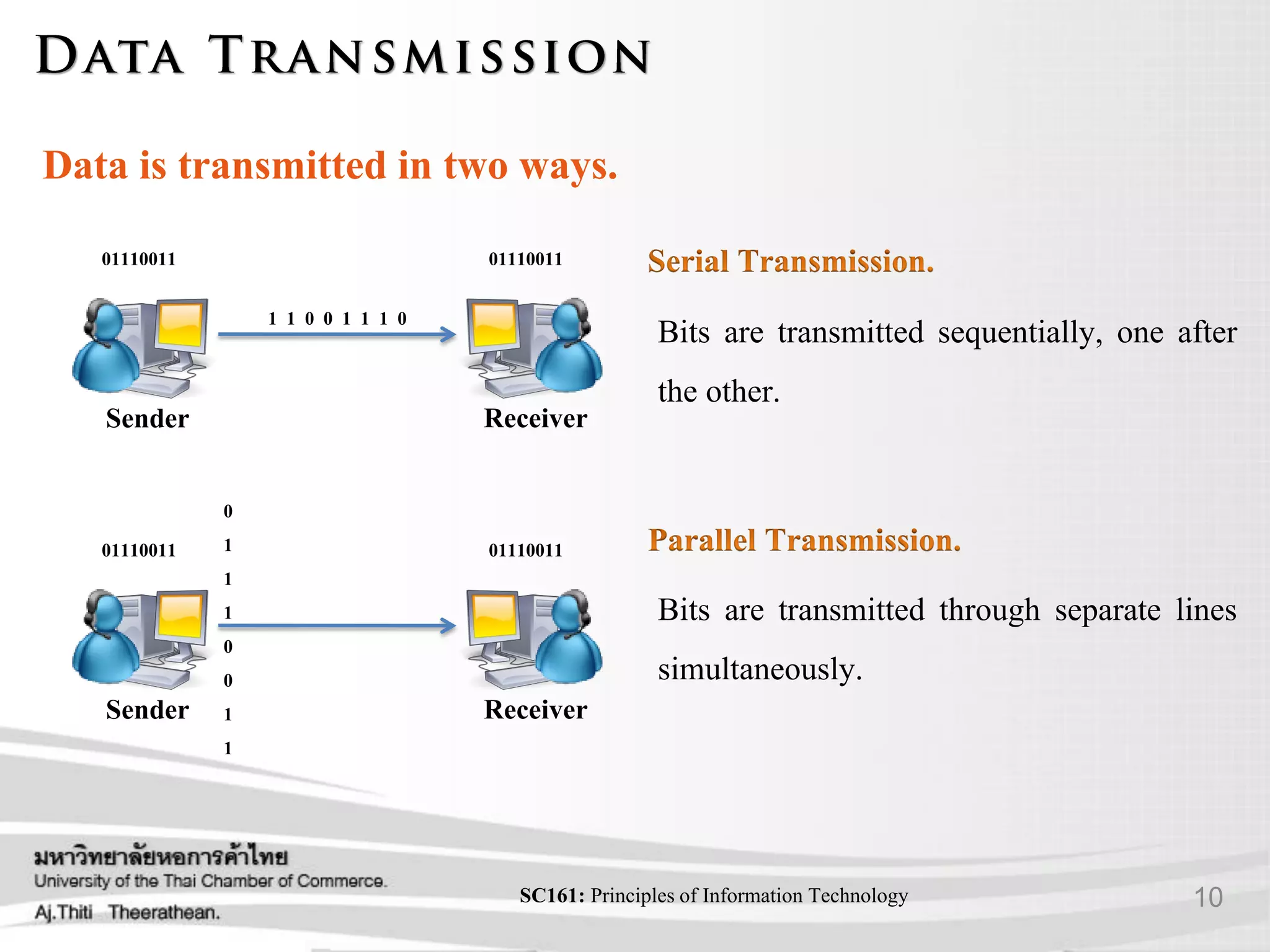
Data is transmitted in two ways.
Sender Receiver
01110011 01110011
1 1 0 0 1 1 1 0
Sender Receiver
01110011 01110011
0
1
1
1
0
0
1
1
Bits are transmitted sequentially, one after
the other.
Bits are transmitted through separate lines
simultaneously.
11SC161: Principlesof Information Technology
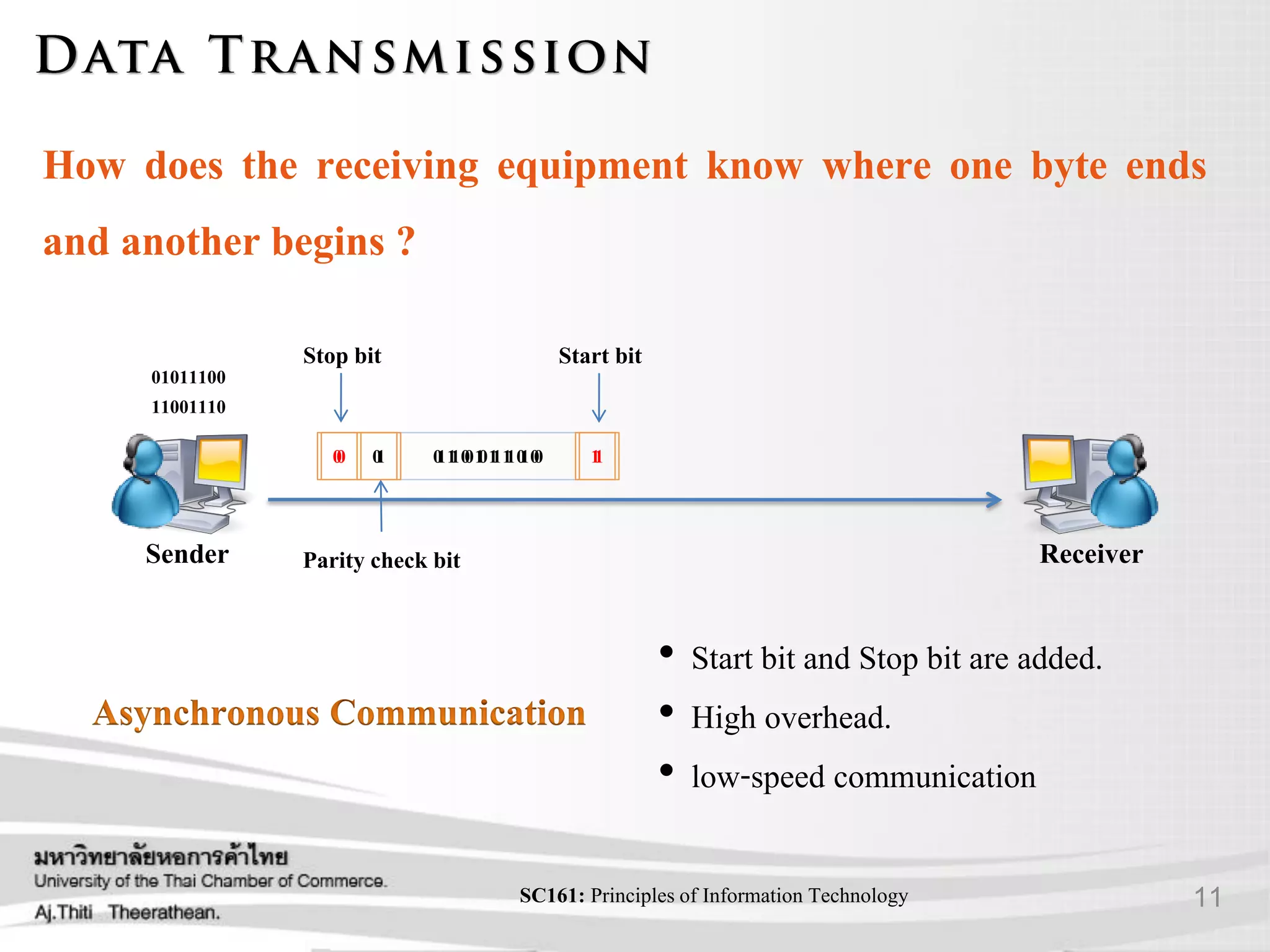
How does the receiving equipment know where one byte ends
and another begins ?
Sender Receiver
1 1 0 0 1 1 1 0
11001110
01011100
0 1 0 1 1 1 0 0 100 1
Start bit
0
Stop bit
1
Parity check bit
• Start bit and Stop bit are added.
• High overhead.
• low-speed communication
12SC161: Principlesof Information Technology
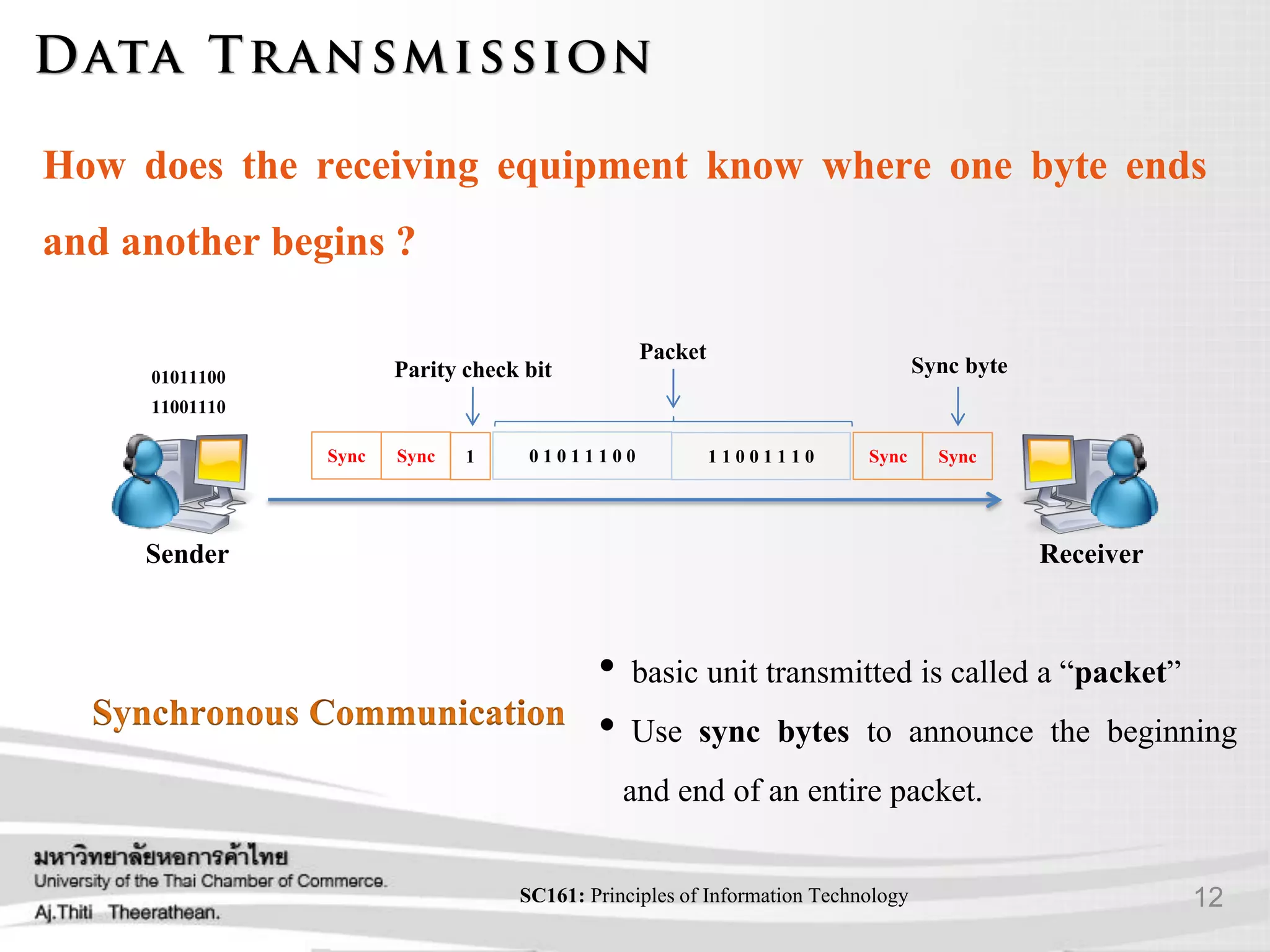
How does the receiving equipment know where one byte ends
and another begins ?
Sender Receiver
Parity check bit
1
• basic unit transmitted is called a “packet”
• Use sync bytes to announce the beginning
and end of an entire packet.
SyncSyncSync Sync
Sync byte
1 1 0 0 1 1 1 00 1 0 1 1 1 0 0
Packet
11001110
01011100
13SC161: Principlesof Information Technology
14SC161: Principlesof Information Technology
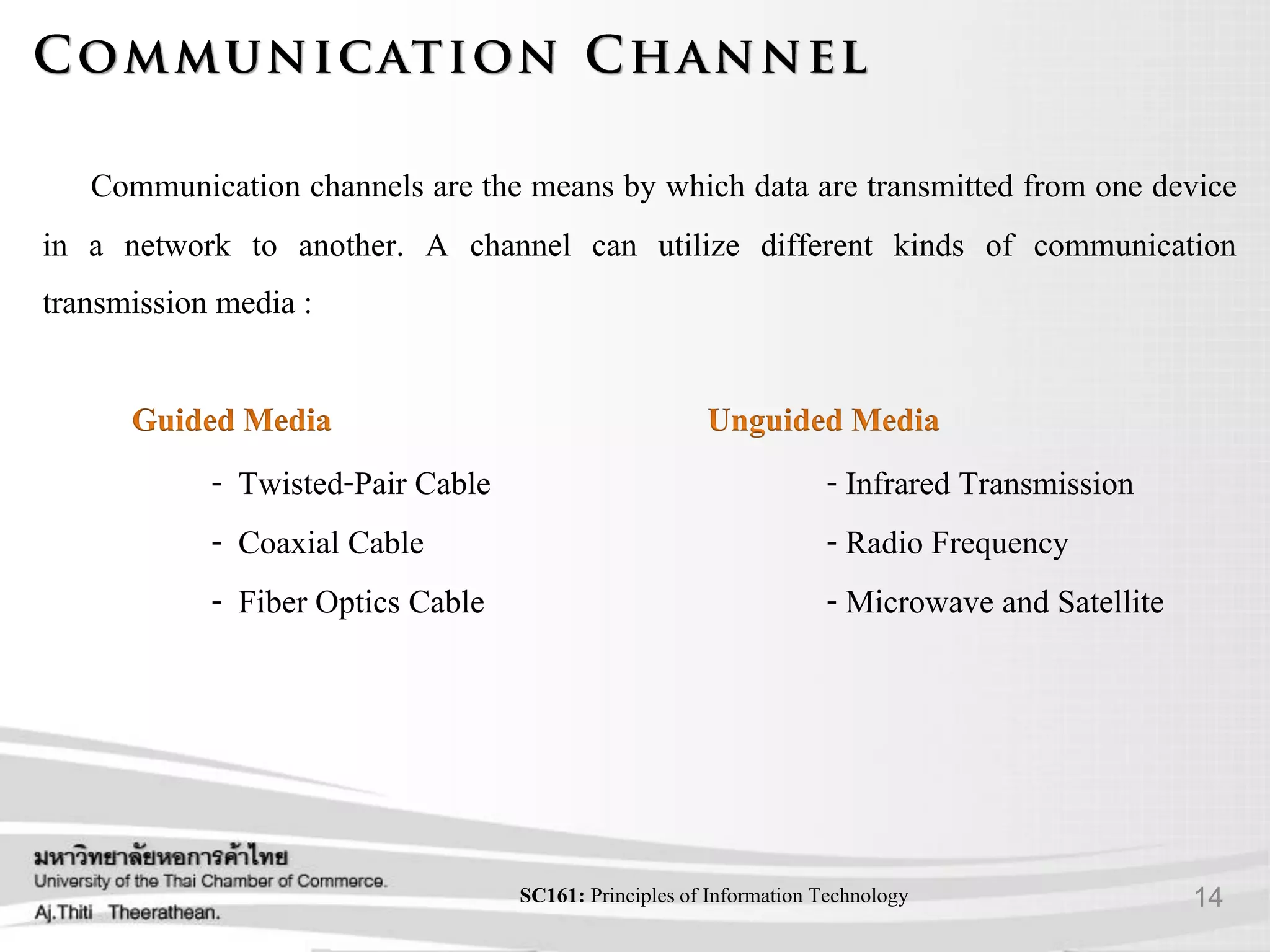
Communication channels are the means by which data are transmitted from one device
in a network to another. A channel can utilize different kinds of communication
transmission media :
- Twisted-Pair Cable
- Coaxial Cable
- Fiber Optics Cable
- Infrared Transmission
- Radio Frequency
- Microwave and Satellite
15SC161: Principlesof Information Technology
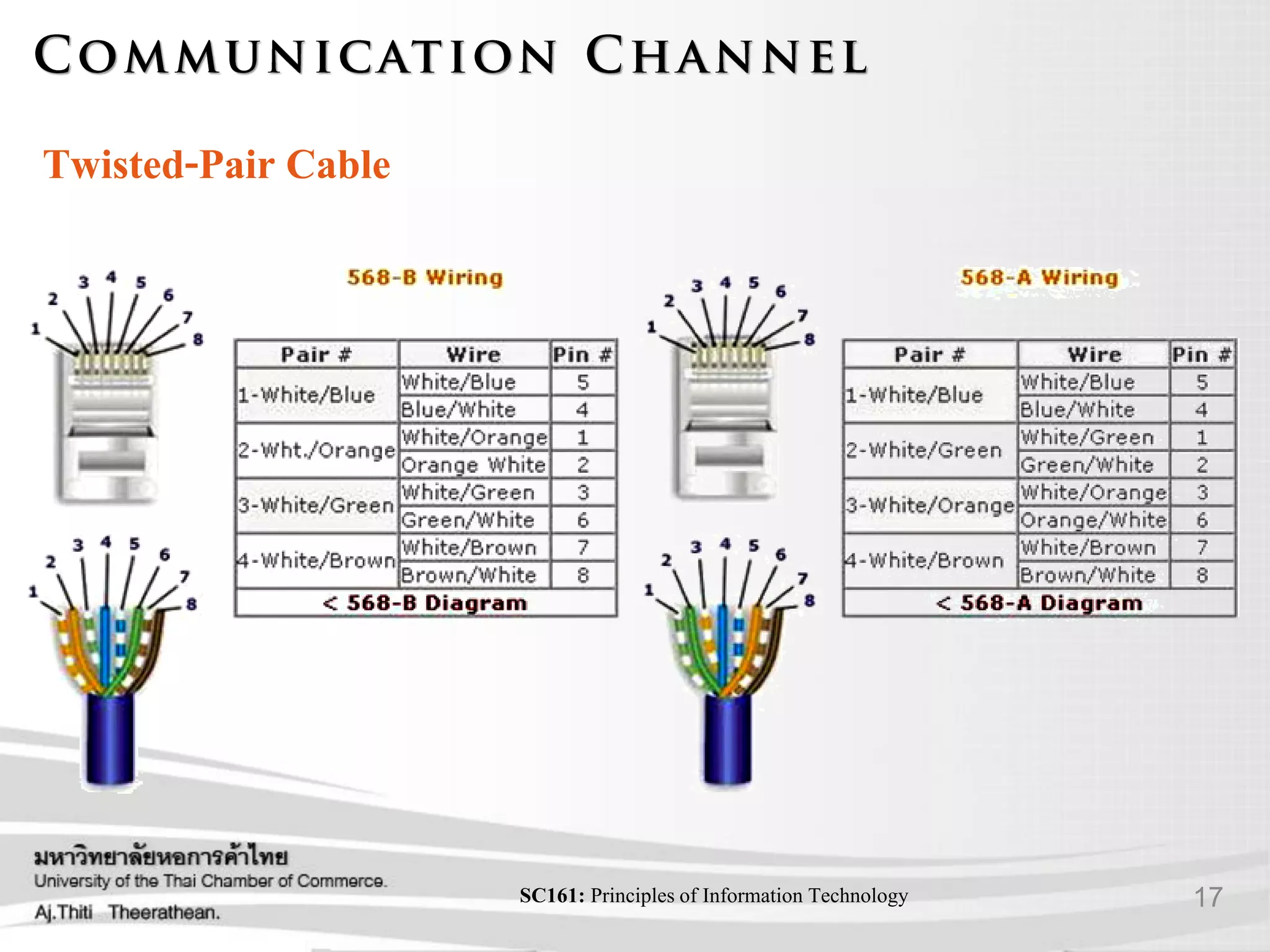
Twisted-Pair Cable
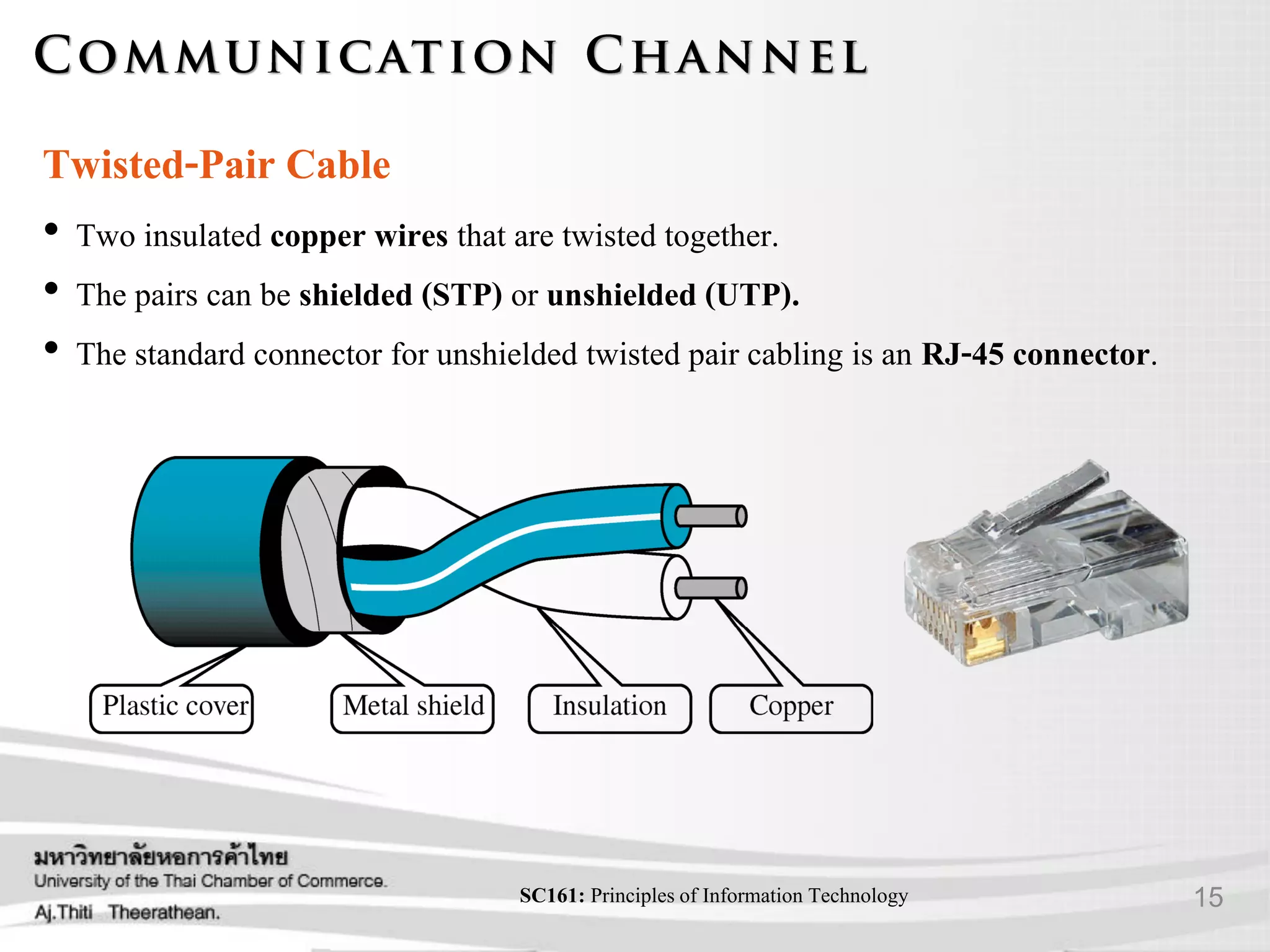
• Two insulated copper wires that are twisted together.
• The pairs can be shielded (STP) or unshielded (UTP).
• The standard connector for unshielded twisted pair cabling is an RJ-45 connector.
16SC161: Principlesof Information Technology
Advantages:
• High availability.
• Low installation cost.
Disadvantages:
• Limited data rates.
• Limited range.
• High susceptibility to electromagnetic and
radio frequency interference.
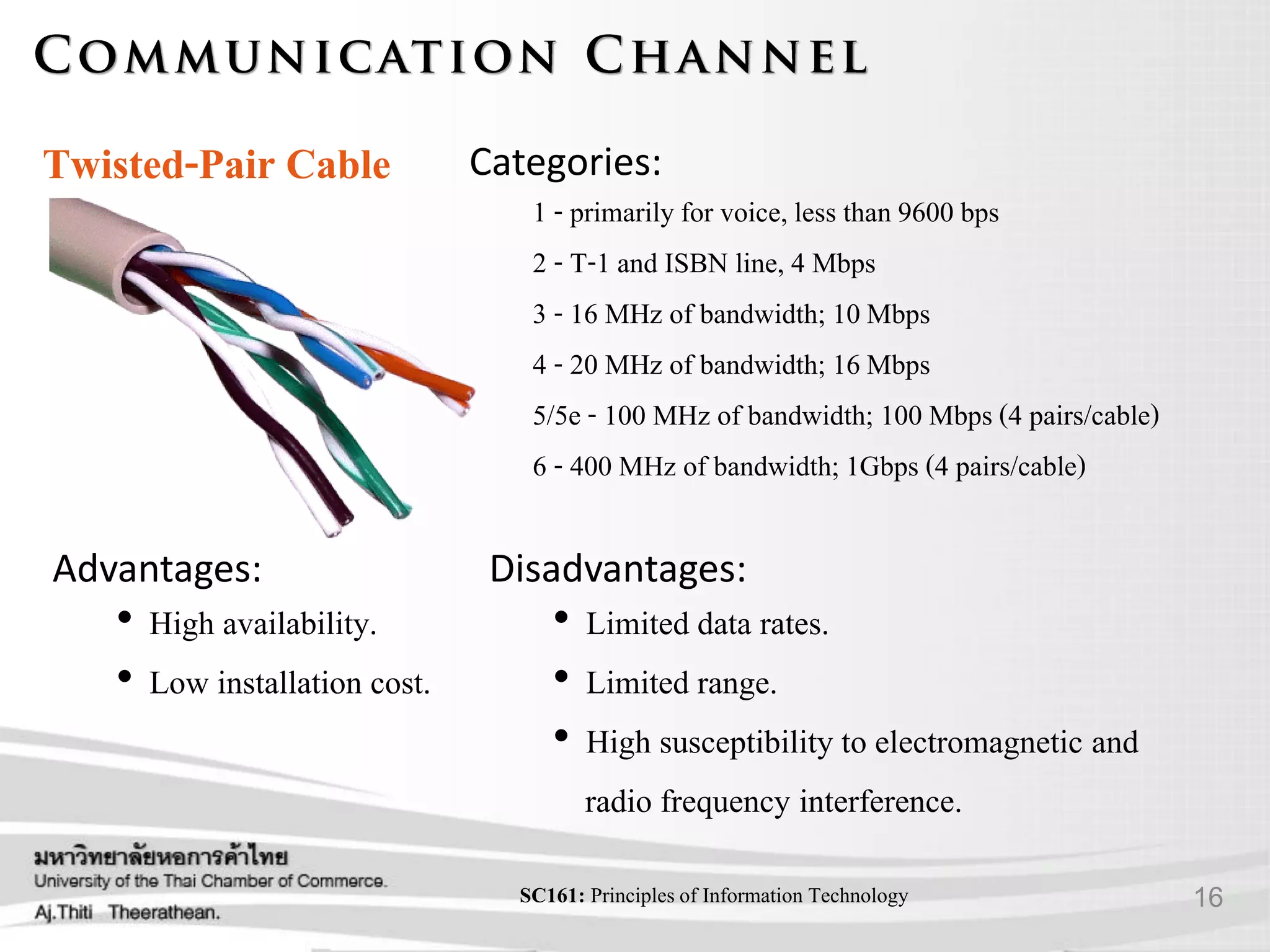
Twisted-Pair Cable Categories:
1 - primarily for voice, less than 9600 bps
2 - T-1 and ISBN line, 4 Mbps
3 - 16 MHz of bandwidth; 10Mbps
4 - 20 MHz of bandwidth; 16Mbps
5/5e - 100 MHz of bandwidth; 100 Mbps (4 pairs/cable)
6 - 400 MHz of bandwidth; 1Gbps (4 pairs/cable)
17SC161: Principlesof Information Technology
Twisted-Pair Cable
18SC161: Principlesof Information Technology
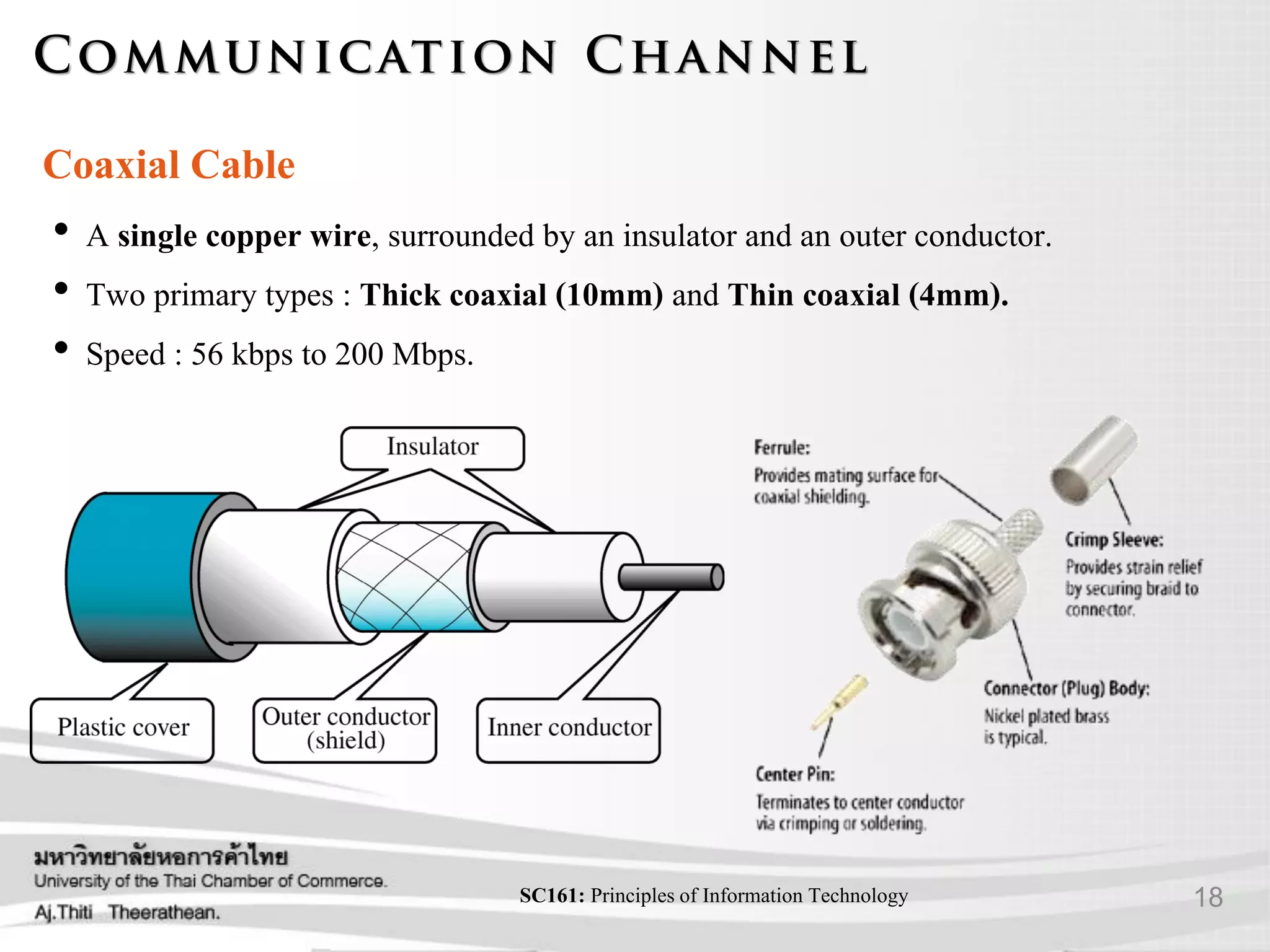
Coaxial Cable
• A single copper wire, surrounded by an insulator and an outer conductor.
• Two primary types : Thick coaxial (10mm) and Thin coaxial (4mm).
• Speed : 56 kbps to 200 Mbps.
19SC161: Principlesof Information Technology
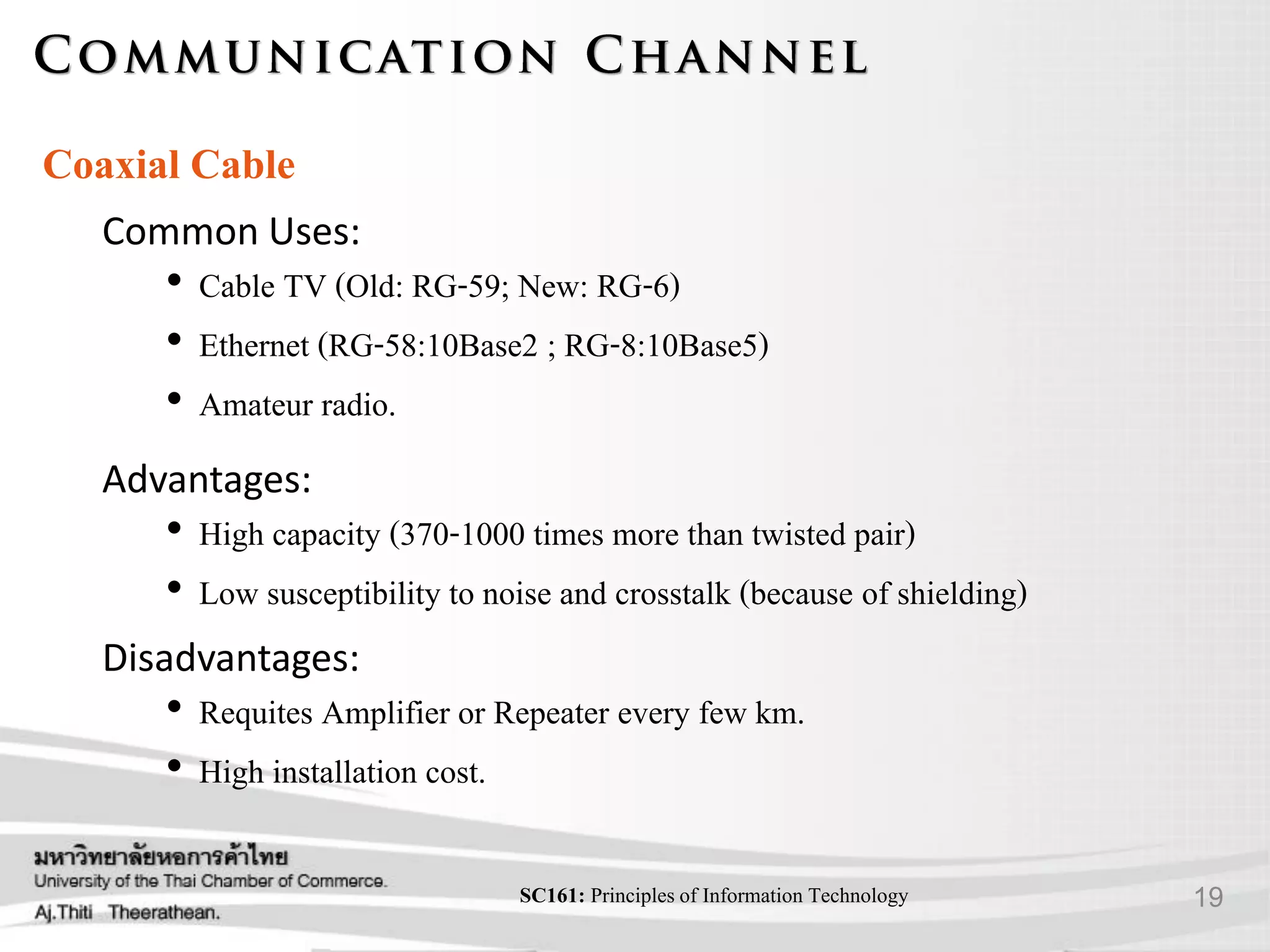
Coaxial Cable
Advantages:
• High capacity (370-1000 times more than twisted pair)
• Low susceptibility to noise and crosstalk (because of shielding)
Disadvantages:
• Requites Amplifier or Repeater every few km.
• High installation cost.
Common Uses:
• Cable TV (Old: RG-59; New: RG-6)
• Ethernet (RG-58:10Base2 ; RG-8:10Base5)
• Amateur radio.
20SC161: Principlesof Information Technology
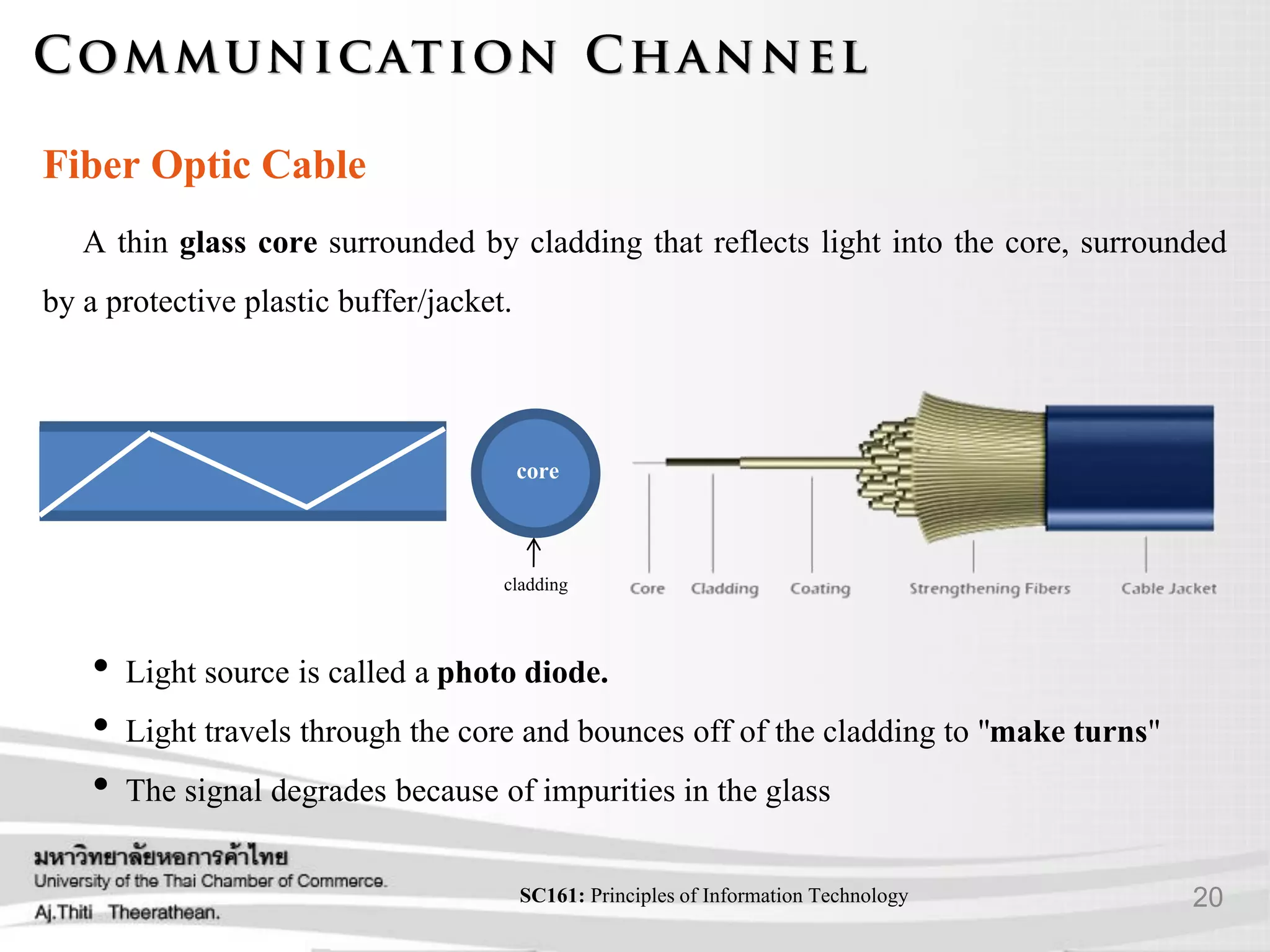
Fiber Optic Cable
A thin glass core surrounded by cladding that reflects light into the core, surrounded
by a protective plastic buffer/jacket.
• Light source is called a photo diode.
• Light travels through the core and bounces off of the cladding to "make turns"
• The signal degrades because of impurities in the glass
cladding
core
21SC161: Principlesof Information Technology
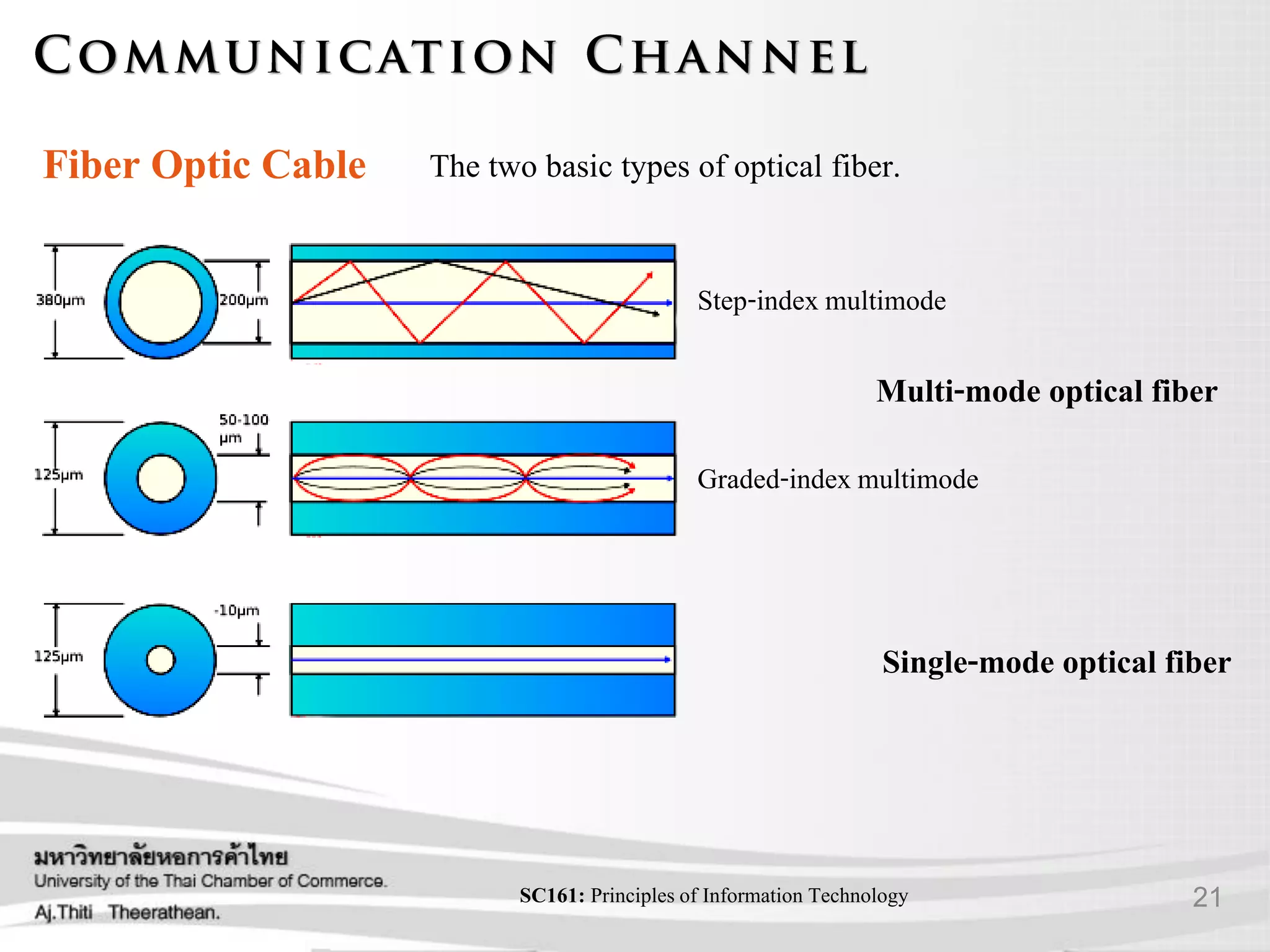
Fiber Optic Cable The two basic types of optical fiber.
Multi-mode optical fiber
Single-mode optical fiber
Step-indexmultimode
Graded-indexmultimode
22SC161: Principlesof Information Technology
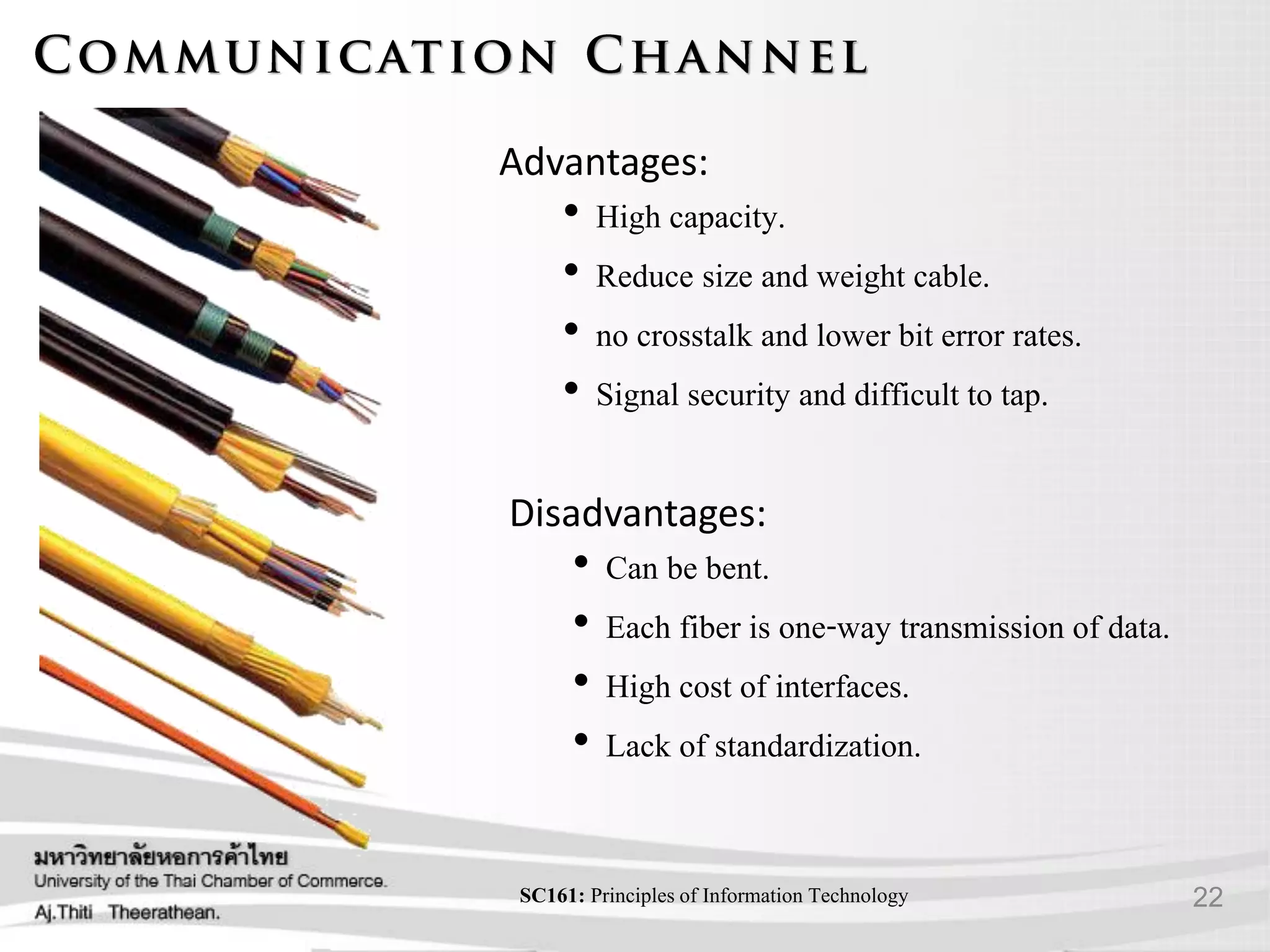
Advantages:
• High capacity.
• Reduce size and weight cable.
• no crosstalk and lower bit error rates.
• Signal security and difficult to tap.
Disadvantages:
• Can be bent.
• Each fiber is one-way transmission of data.
• High cost of interfaces.
• Lack of standardization.
23SC161: Principlesof Information Technology
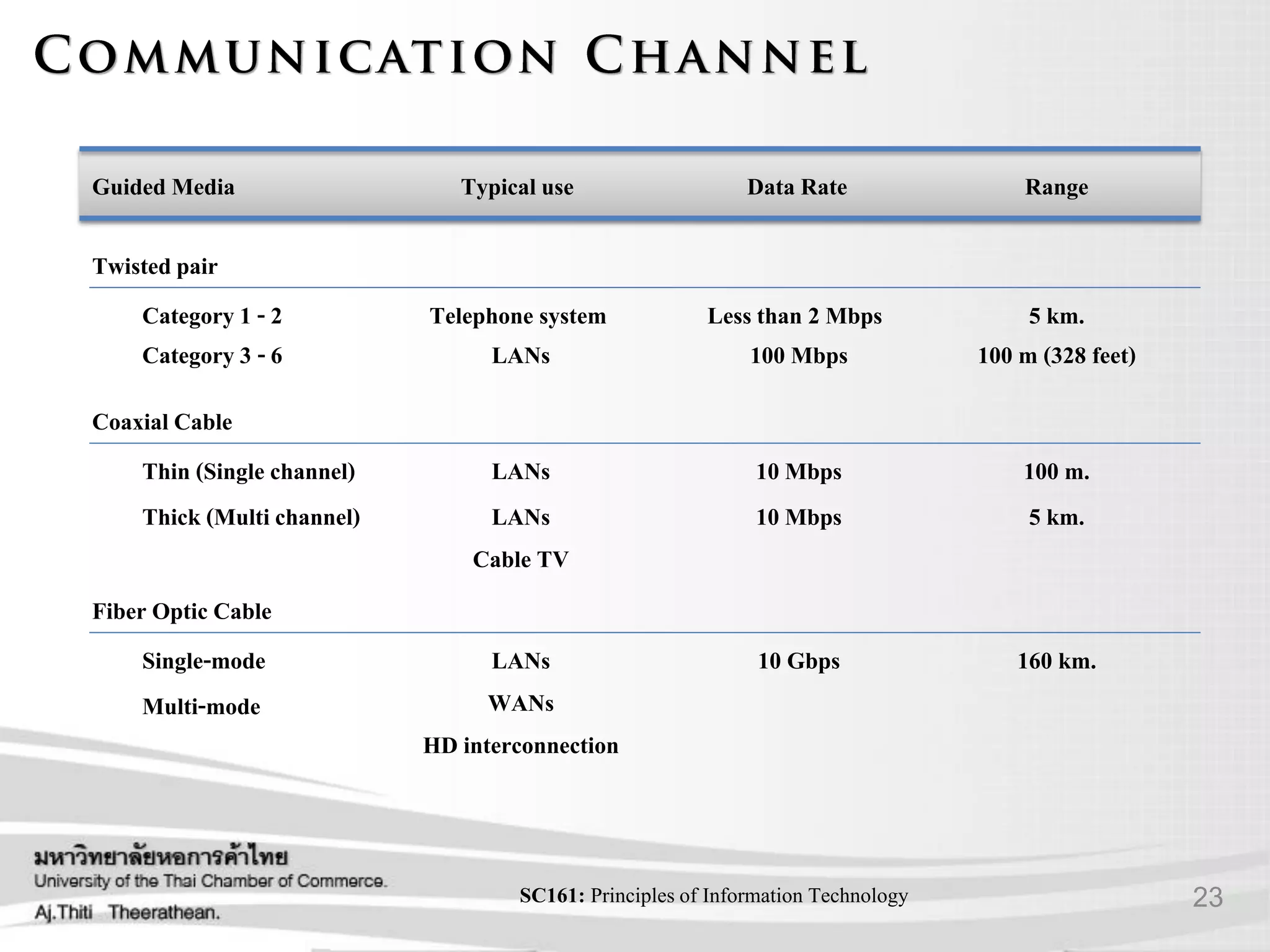
Guided Media Typical use Data Rate Range
Twistedpair
Category 1 - 2
Category 3 - 6
Telephone system
LANs
Less than 2 Mbps
100 Mbps
5 km.
100 m (328 feet)
Coaxial Cable
Thin (Single channel)
Thick (Multi channel)
LANs
LANs
Cable TV
10 Mbps
10 Mbps
100 m.
5 km.
Fiber Optic Cable
Single-mode
Multi-mode
LANs
WANs
HD interconnection
10 Gbps 160 km.
24SC161: Principlesof Information Technology
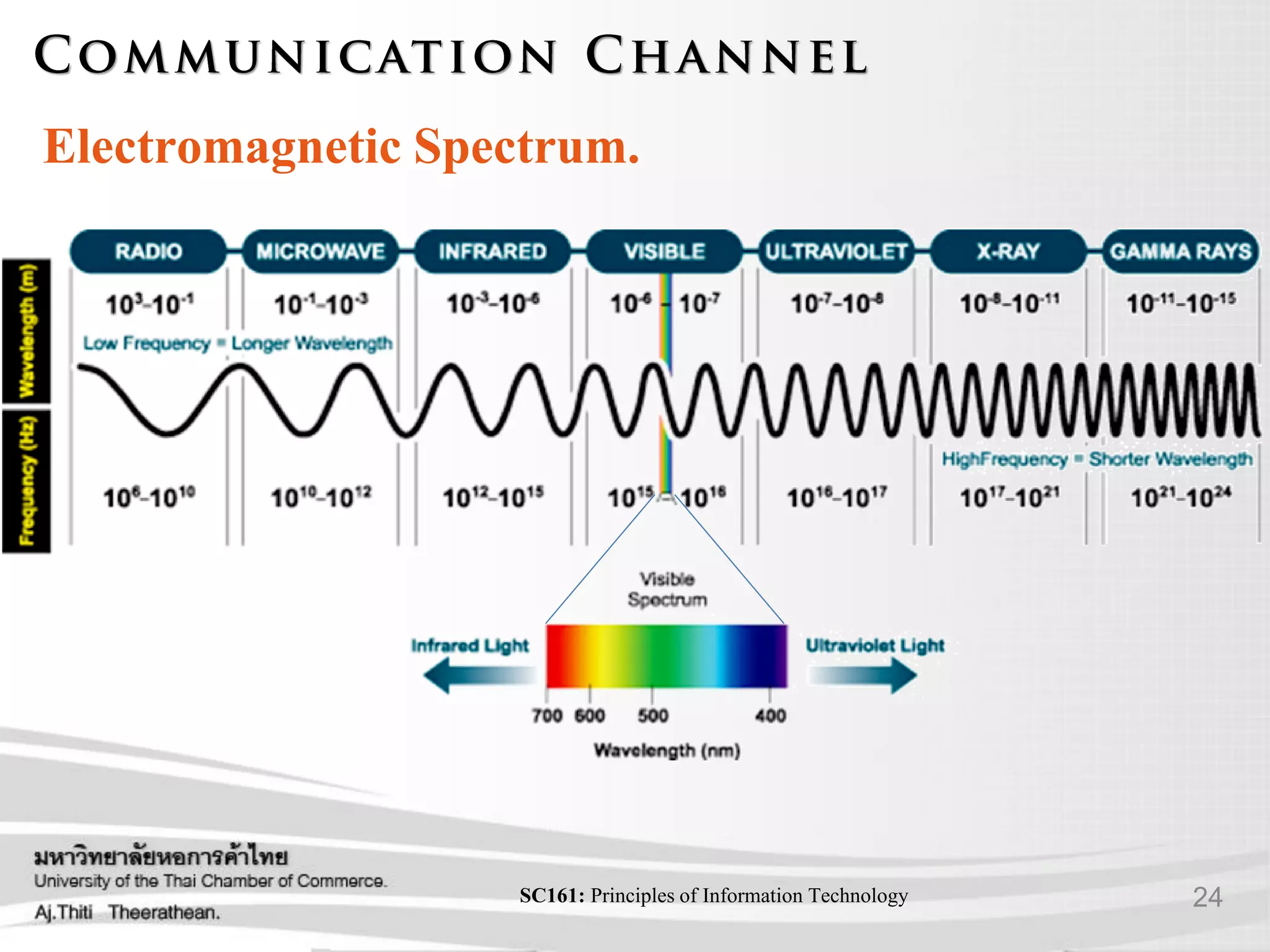
Electromagnetic Spectrum.
25SC161: Principlesof Information Technology
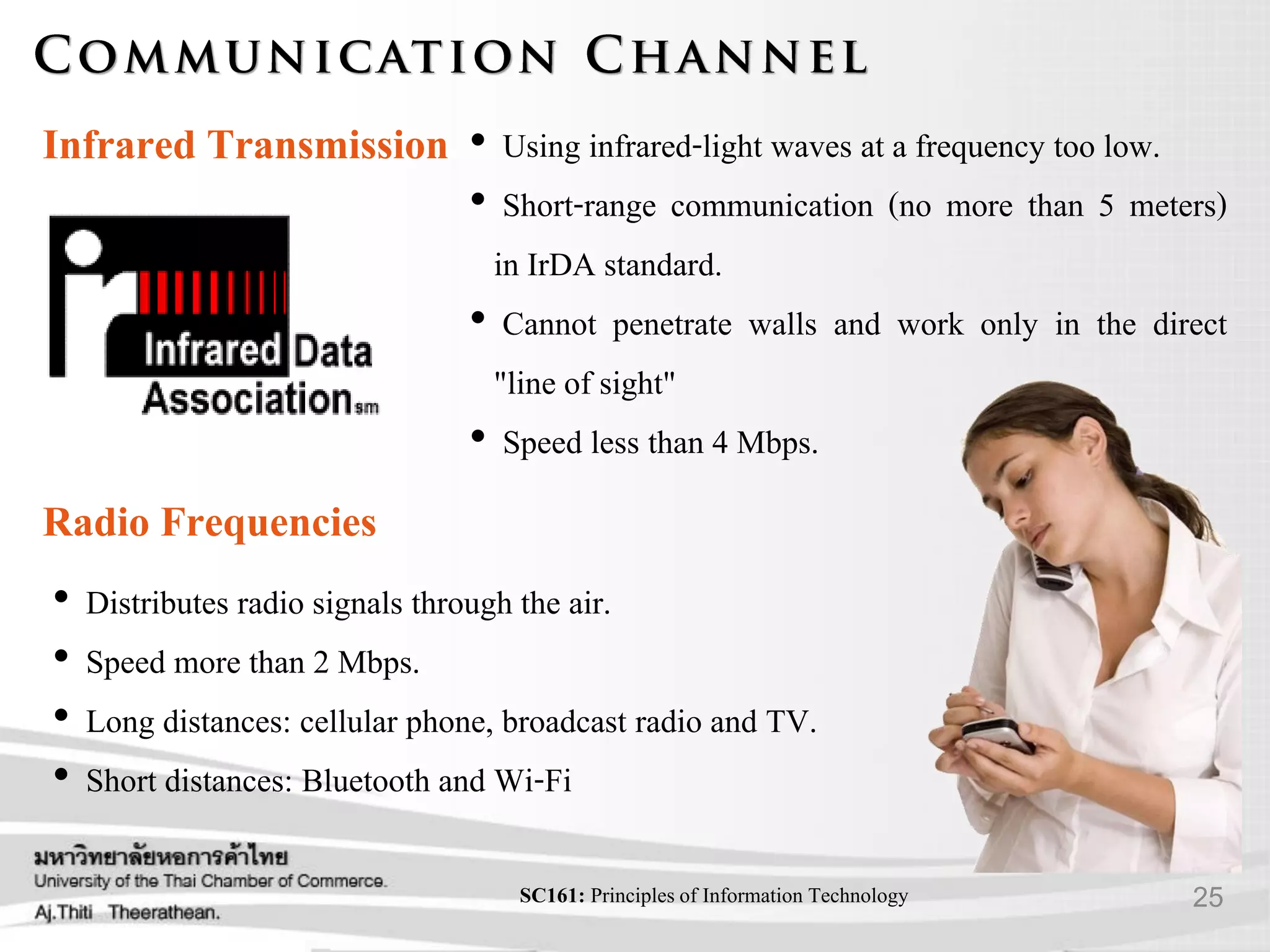
Infrared Transmission • Using infrared-light waves at a frequency too low.
• Short-range communication (no more than 5 meters)
in IrDA standard.
• Cannot penetrate walls and work only in the direct
"line of sight"
• Speed less than 4 Mbps.
Radio Frequencies
• Distributes radio signals through the air.
• Speed more than 2 Mbps.
• Long distances: cellular phone, broadcast radio and TV.
• Short distances: Bluetooth and Wi-Fi
26SC161: Principlesof Information Technology
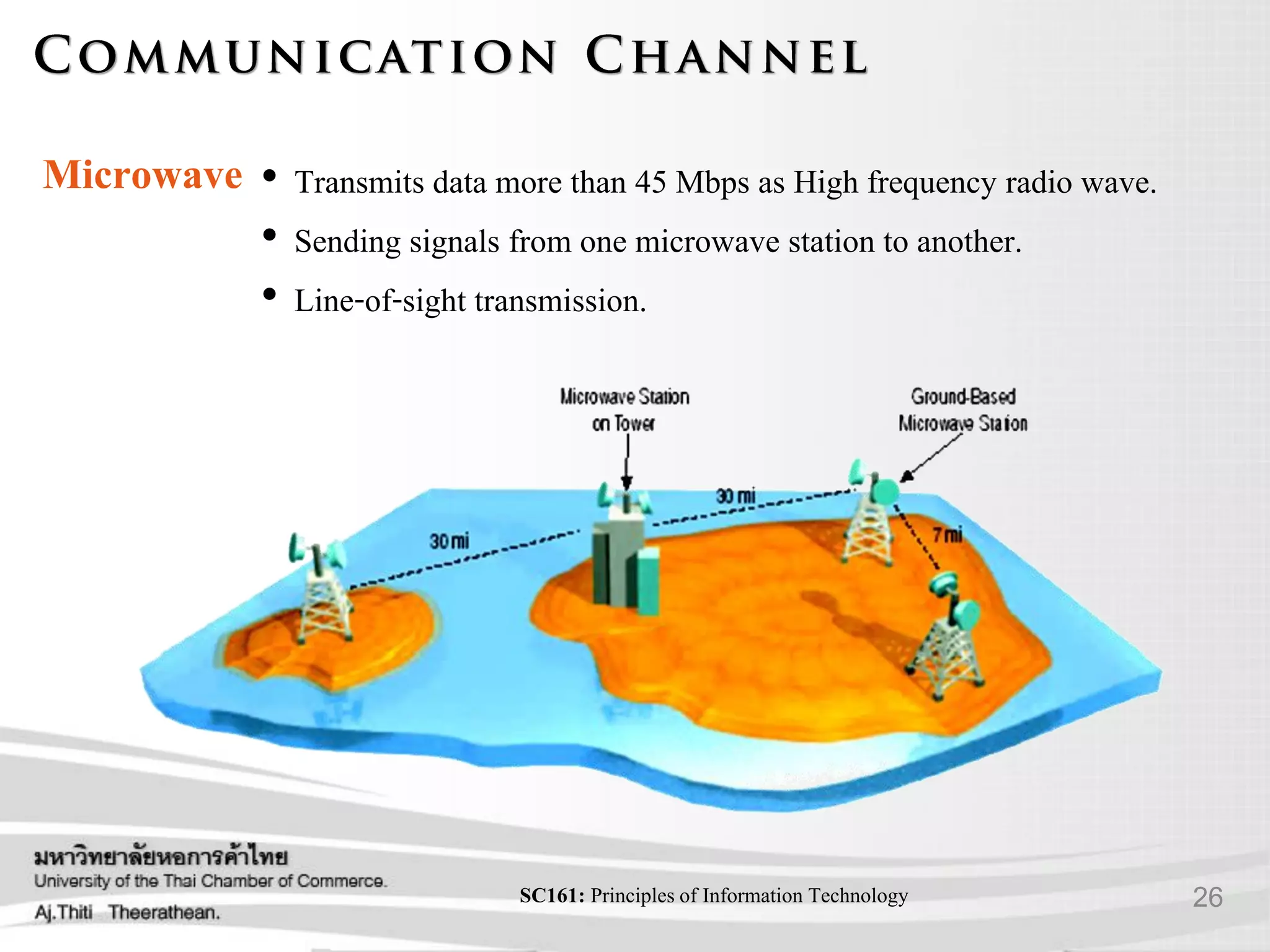
Microwave • Transmits data more than 45 Mbps as High frequency radio wave.
• Sending signals from one microwave station to another.
• Line-of-sight transmission.
27SC161: Principlesof Information Technology
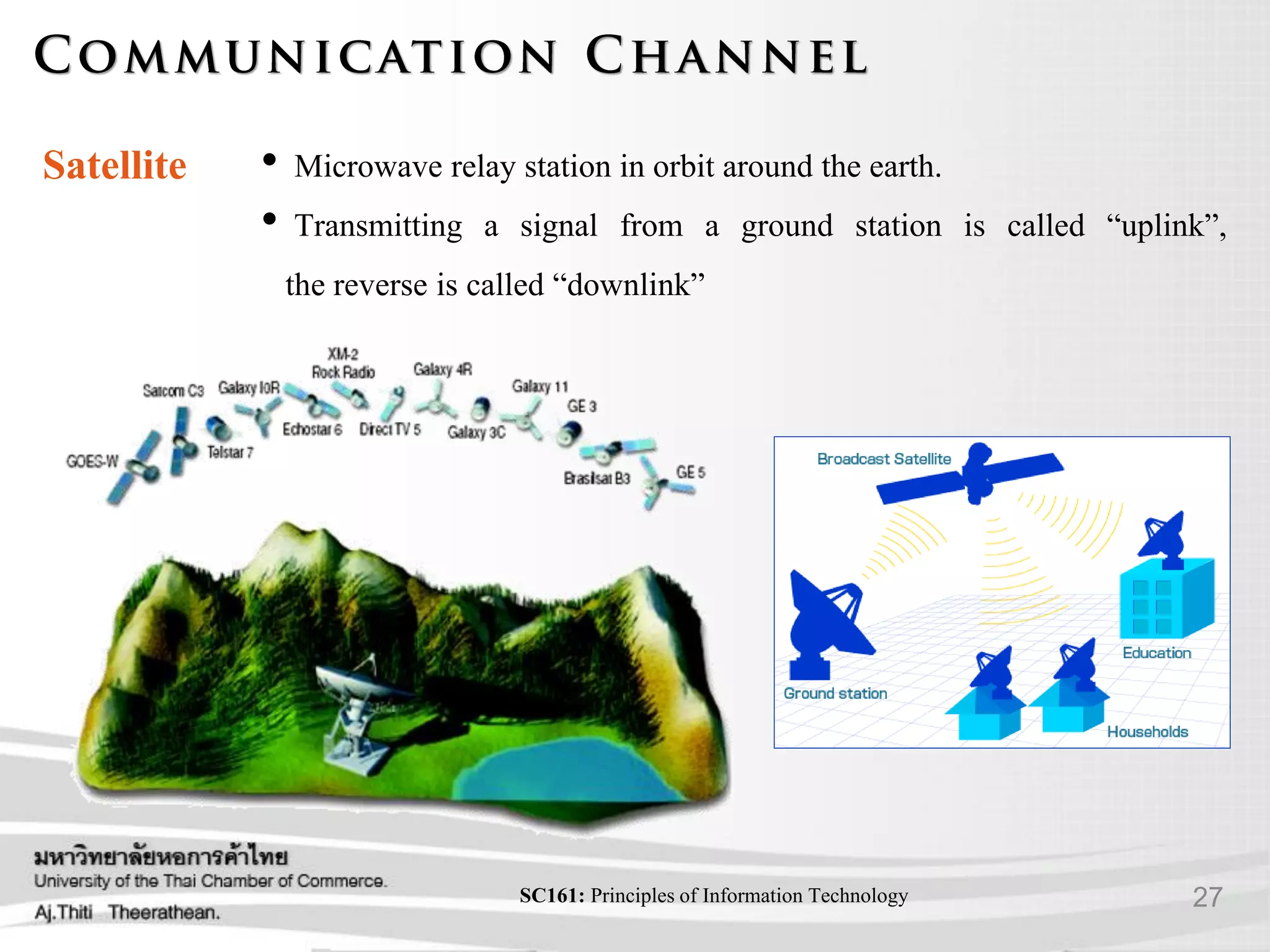
Satellite • Microwave relay station in orbit around the earth.
• Transmitting a signal from a ground station is called “uplink”,
the reverse is called “downlink”
28SC161: Principlesof Information Technology
29SC161: Principlesof Information Technology
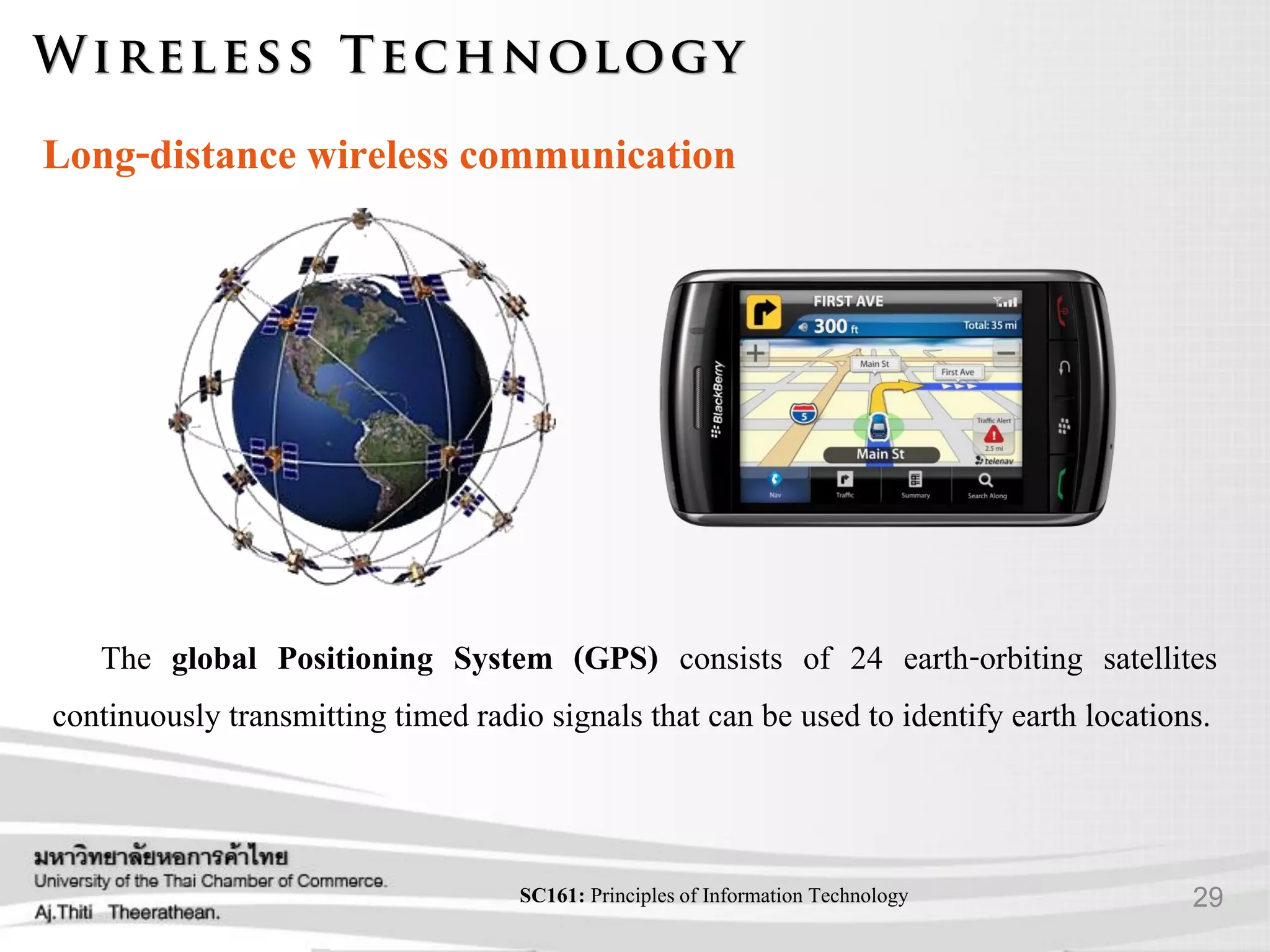
Long-distance wireless communication
The global Positioning System (GPS) consists of 24 earth-orbiting satellites
continuously transmitting timed radio signals that can be used to identify earth locations.
30SC161: Principlesof Information Technology
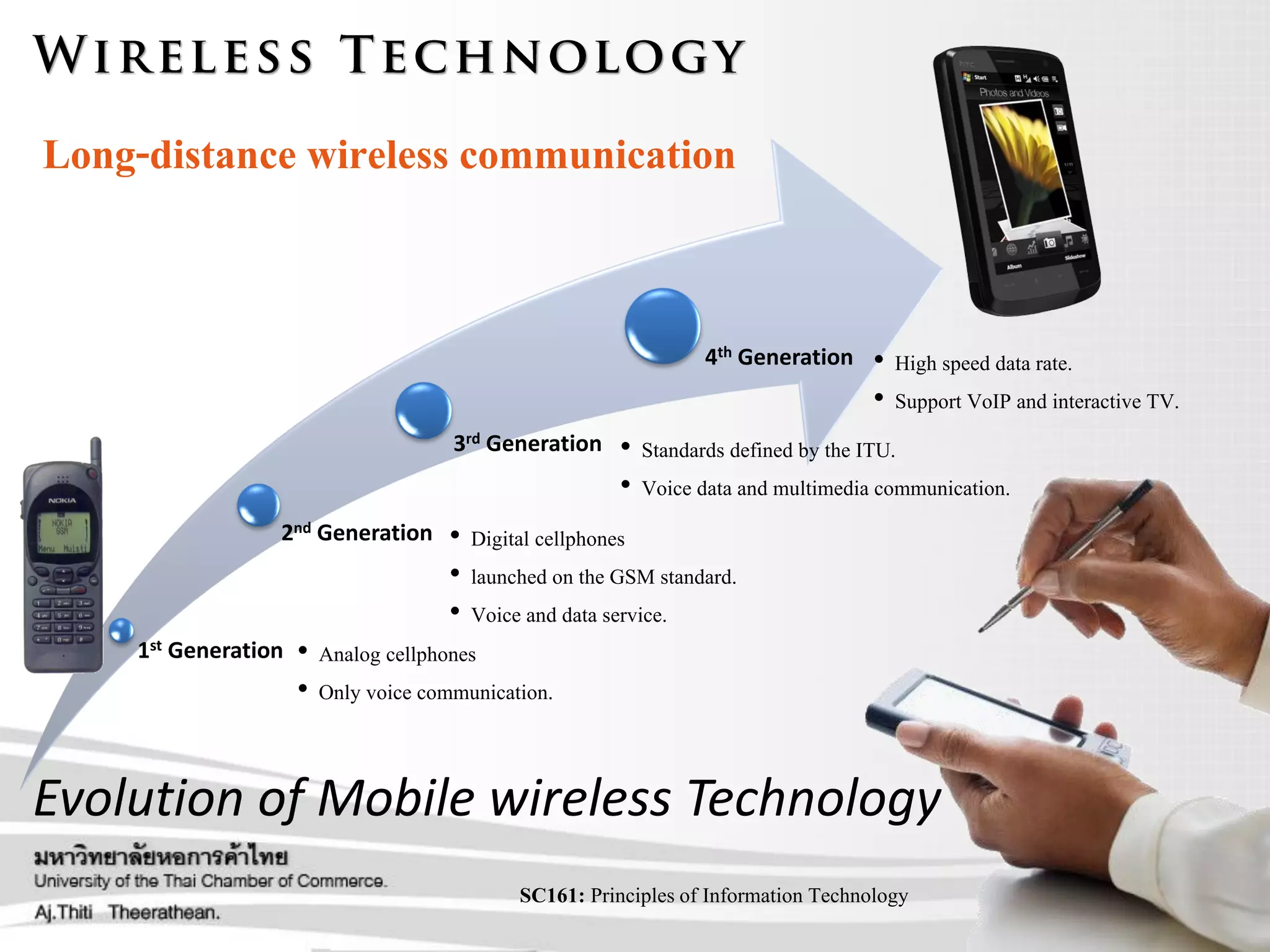
Long-distance wireless communication
Evolution of Mobile wireless Technology
1st Generation
2nd Generation
3rd Generation
4th Generation
• Analog cellphones
• Only voice communication.
• Digital cellphones
• launched on the GSM standard.
• Voice and data service.
• Standards defined by the ITU.
• Voice data and multimedia communication.
• High speed data rate.
• Support VoIP and interactive TV.
31SC161: Principlesof Information Technology
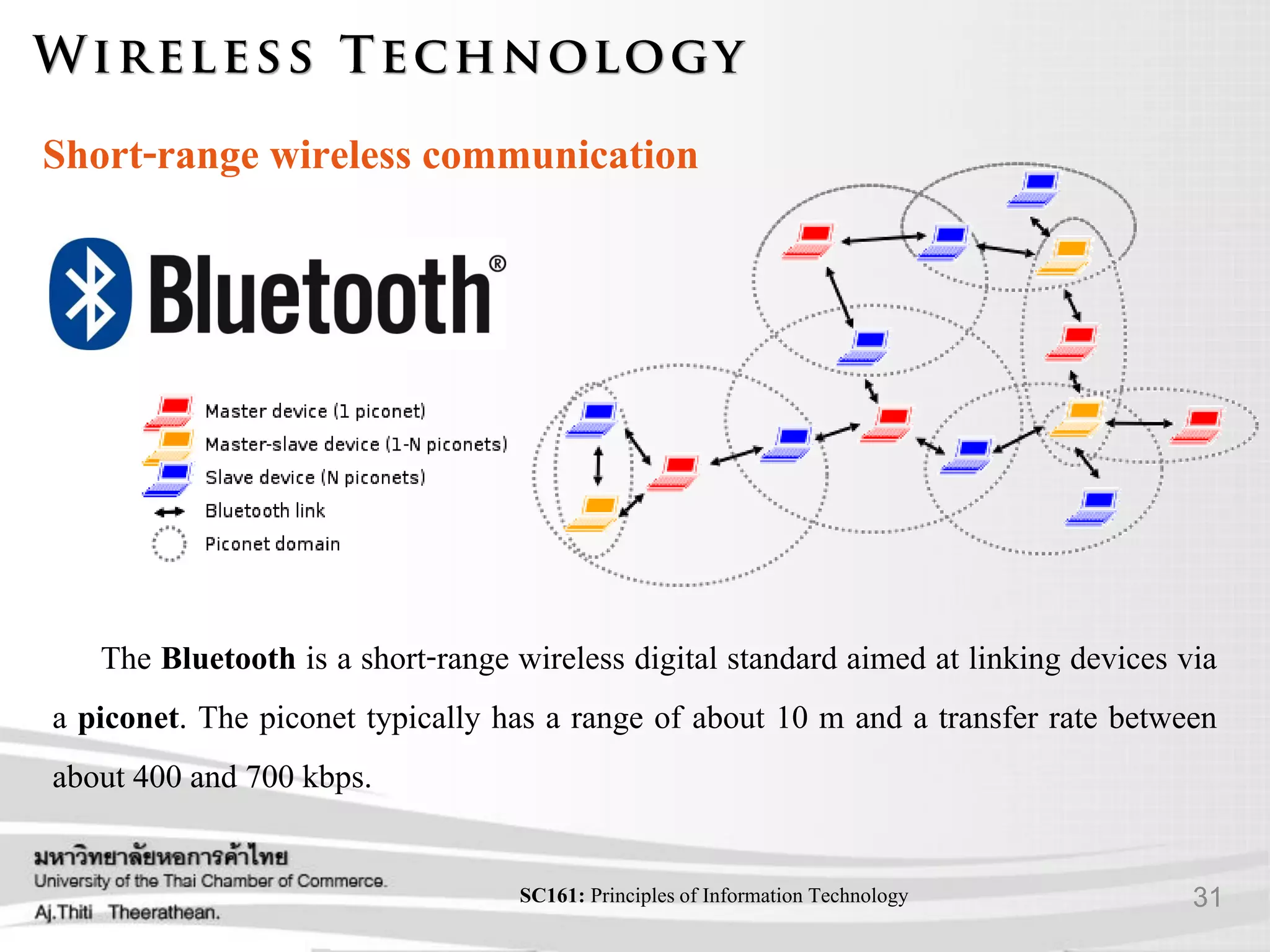
Short-range wireless communication
The Bluetooth is a short-range wireless digital standard aimed at linking devices via
a piconet. The piconet typically has a range of about 10 m and a transfer rate between
about 400 and 700 kbps.
32SC161: Principlesof Information Technology
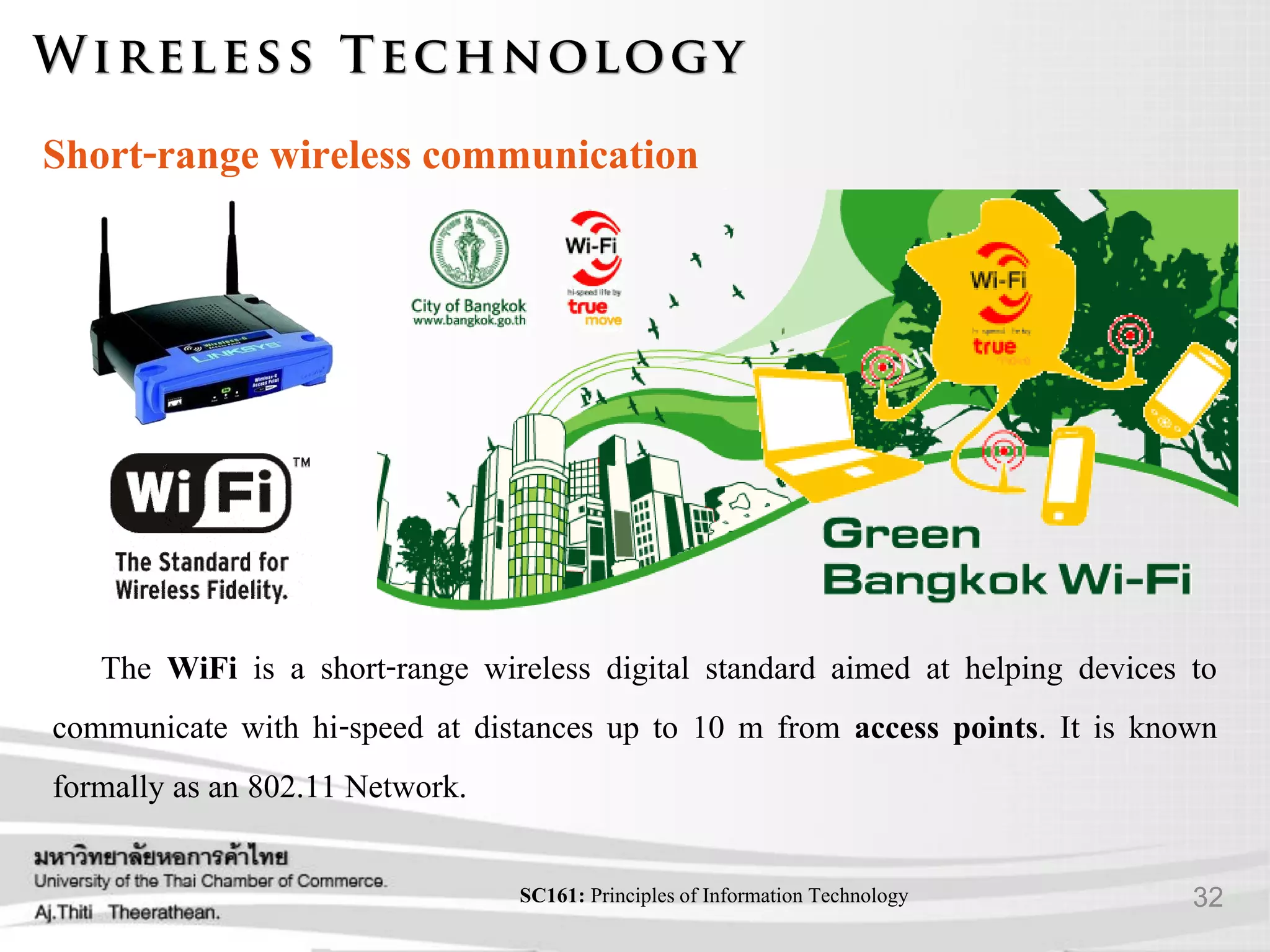
Short-range wireless communication
The WiFi is a short-range wireless digital standard aimed at helping devices to
communicate with hi-speed at distances up to 10 m from access points. It is known
formally as an 802.11 Network.
33SC161: Principlesof Information Technology

SC161-Lecture4-1

  • 1.
    Chapter 4 SC161: Principlesof Information Technology Communication and Network Part 1: Data Communication Thiti Theerathean Center for Teaching Excellence University of the Thai Chamber of Commerce E-mail : thiti_the@utcc.ac.th
  • 2.
    2 • Introduction toData Communication. - Data Communicationand Telecommunication - Type of Signals - The Basic Components of Communication • Data Transmission. - Line configurations - Directionof Transmisssion - TransmissionMode • Communication Channel. - Guided Media - Unguided Media • Wireless Technology. - Long-distance wireless communication - Short-range wirelesscommunication SC161: Principlesof Information Technology
  • 3.
    3SC161: Principlesof InformationTechnology Data Communications is any transfer of data within a computer, between a computer and another device, or between two computers. Telecommunication is communications over a distance. Tele- distance
  • 4.
    4SC161: Principlesof InformationTechnology Data and Information travels through a communication system in the form of eletromagnetic signals. Signals are represented in two ways • Continuous waveform. • Three basic components : - Amplitude (Volt) - Frequency (Hz) - Phase (Radian) • Infinite number of points between minimum and maximum amplitude. • Use an Amplifier to increase power for transmission over long distances and reduce noise by Filter. • Used for Voice Communication.
  • 5.
    5SC161: Principlesof InformationTechnology Data and Information travels through a communication system in the form of eletromagnetic signals. Signals are represented in two ways • Discrete waveform. • Only two different values: - 1 is high voltage/on electrical pulses. - 0 is low voltage/off electrical pulses. • The number of times a signal changes value per second is called “Baud rate” • Use Repeater to transmission the data over long distances. • Used for Data Communication. time amplitude(power)
  • 6.
    6SC161: Principlesof InformationTechnology Sender Communication Channel Receiver Step 1: …… Step 2: …... Step 3: …... Step 1: …… Step 2: …... Step 3: …... Protocol Message The Basic Components of Communication.
  • 7.
  • 8.
    8SC161: Principlesof InformationTechnology There are two principal line configurations.
  • 9.
    9SC161: Principlesof InformationTechnology When two computers are in communication, data can flow in three ways: A B Only transmits. Only receives. A B Transmits when B receives. Transmits when A receives. A B Transmits and receives while B transmits and received. Transmits and receives while A transmits and received.
  • 10.
    10SC161: Principlesof InformationTechnology Data is transmitted in two ways. Sender Receiver 01110011 01110011 1 1 0 0 1 1 1 0 Sender Receiver 01110011 01110011 0 1 1 1 0 0 1 1 Bits are transmitted sequentially, one after the other. Bits are transmitted through separate lines simultaneously.
  • 11.
    11SC161: Principlesof InformationTechnology How does the receiving equipment know where one byte ends and another begins ? Sender Receiver 1 1 0 0 1 1 1 0 11001110 01011100 0 1 0 1 1 1 0 0 100 1 Start bit 0 Stop bit 1 Parity check bit • Start bit and Stop bit are added. • High overhead. • low-speed communication
  • 12.
    12SC161: Principlesof InformationTechnology How does the receiving equipment know where one byte ends and another begins ? Sender Receiver Parity check bit 1 • basic unit transmitted is called a “packet” • Use sync bytes to announce the beginning and end of an entire packet. SyncSyncSync Sync Sync byte 1 1 0 0 1 1 1 00 1 0 1 1 1 0 0 Packet 11001110 01011100
  • 13.
  • 14.
    14SC161: Principlesof InformationTechnology Communication channels are the means by which data are transmitted from one device in a network to another. A channel can utilize different kinds of communication transmission media : - Twisted-Pair Cable - Coaxial Cable - Fiber Optics Cable - Infrared Transmission - Radio Frequency - Microwave and Satellite
  • 15.
    15SC161: Principlesof InformationTechnology Twisted-Pair Cable • Two insulated copper wires that are twisted together. • The pairs can be shielded (STP) or unshielded (UTP). • The standard connector for unshielded twisted pair cabling is an RJ-45 connector.
  • 16.
    16SC161: Principlesof InformationTechnology Advantages: • High availability. • Low installation cost. Disadvantages: • Limited data rates. • Limited range. • High susceptibility to electromagnetic and radio frequency interference. Twisted-Pair Cable Categories: 1 - primarily for voice, less than 9600 bps 2 - T-1 and ISBN line, 4 Mbps 3 - 16 MHz of bandwidth; 10Mbps 4 - 20 MHz of bandwidth; 16Mbps 5/5e - 100 MHz of bandwidth; 100 Mbps (4 pairs/cable) 6 - 400 MHz of bandwidth; 1Gbps (4 pairs/cable)
  • 17.
    17SC161: Principlesof InformationTechnology Twisted-Pair Cable
  • 18.
    18SC161: Principlesof InformationTechnology Coaxial Cable • A single copper wire, surrounded by an insulator and an outer conductor. • Two primary types : Thick coaxial (10mm) and Thin coaxial (4mm). • Speed : 56 kbps to 200 Mbps.
  • 19.
    19SC161: Principlesof InformationTechnology Coaxial Cable Advantages: • High capacity (370-1000 times more than twisted pair) • Low susceptibility to noise and crosstalk (because of shielding) Disadvantages: • Requites Amplifier or Repeater every few km. • High installation cost. Common Uses: • Cable TV (Old: RG-59; New: RG-6) • Ethernet (RG-58:10Base2 ; RG-8:10Base5) • Amateur radio.
  • 20.
    20SC161: Principlesof InformationTechnology Fiber Optic Cable A thin glass core surrounded by cladding that reflects light into the core, surrounded by a protective plastic buffer/jacket. • Light source is called a photo diode. • Light travels through the core and bounces off of the cladding to "make turns" • The signal degrades because of impurities in the glass cladding core
  • 21.
    21SC161: Principlesof InformationTechnology Fiber Optic Cable The two basic types of optical fiber. Multi-mode optical fiber Single-mode optical fiber Step-indexmultimode Graded-indexmultimode
  • 22.
    22SC161: Principlesof InformationTechnology Advantages: • High capacity. • Reduce size and weight cable. • no crosstalk and lower bit error rates. • Signal security and difficult to tap. Disadvantages: • Can be bent. • Each fiber is one-way transmission of data. • High cost of interfaces. • Lack of standardization.
  • 23.
    23SC161: Principlesof InformationTechnology Guided Media Typical use Data Rate Range Twistedpair Category 1 - 2 Category 3 - 6 Telephone system LANs Less than 2 Mbps 100 Mbps 5 km. 100 m (328 feet) Coaxial Cable Thin (Single channel) Thick (Multi channel) LANs LANs Cable TV 10 Mbps 10 Mbps 100 m. 5 km. Fiber Optic Cable Single-mode Multi-mode LANs WANs HD interconnection 10 Gbps 160 km.
  • 24.
    24SC161: Principlesof InformationTechnology Electromagnetic Spectrum.
  • 25.
    25SC161: Principlesof InformationTechnology Infrared Transmission • Using infrared-light waves at a frequency too low. • Short-range communication (no more than 5 meters) in IrDA standard. • Cannot penetrate walls and work only in the direct "line of sight" • Speed less than 4 Mbps. Radio Frequencies • Distributes radio signals through the air. • Speed more than 2 Mbps. • Long distances: cellular phone, broadcast radio and TV. • Short distances: Bluetooth and Wi-Fi
  • 26.
    26SC161: Principlesof InformationTechnology Microwave • Transmits data more than 45 Mbps as High frequency radio wave. • Sending signals from one microwave station to another. • Line-of-sight transmission.
  • 27.
    27SC161: Principlesof InformationTechnology Satellite • Microwave relay station in orbit around the earth. • Transmitting a signal from a ground station is called “uplink”, the reverse is called “downlink”
  • 28.
  • 29.
    29SC161: Principlesof InformationTechnology Long-distance wireless communication The global Positioning System (GPS) consists of 24 earth-orbiting satellites continuously transmitting timed radio signals that can be used to identify earth locations.
  • 30.
    30SC161: Principlesof InformationTechnology Long-distance wireless communication Evolution of Mobile wireless Technology 1st Generation 2nd Generation 3rd Generation 4th Generation • Analog cellphones • Only voice communication. • Digital cellphones • launched on the GSM standard. • Voice and data service. • Standards defined by the ITU. • Voice data and multimedia communication. • High speed data rate. • Support VoIP and interactive TV.
  • 31.
    31SC161: Principlesof InformationTechnology Short-range wireless communication The Bluetooth is a short-range wireless digital standard aimed at linking devices via a piconet. The piconet typically has a range of about 10 m and a transfer rate between about 400 and 700 kbps.
  • 32.
    32SC161: Principlesof InformationTechnology Short-range wireless communication The WiFi is a short-range wireless digital standard aimed at helping devices to communicate with hi-speed at distances up to 10 m from access points. It is known formally as an 802.11 Network.
  • 33.