2023-02-23 Gerald Scharitzer @ Rust Vienna Meetup 1
Rust Type Layout
Size, Alignment, Endianess, and Representations
vs
Input, Output, and Foreign Functions
2023-02-23 Gerald Scharitzer @ Rust Vienna Meetup 2
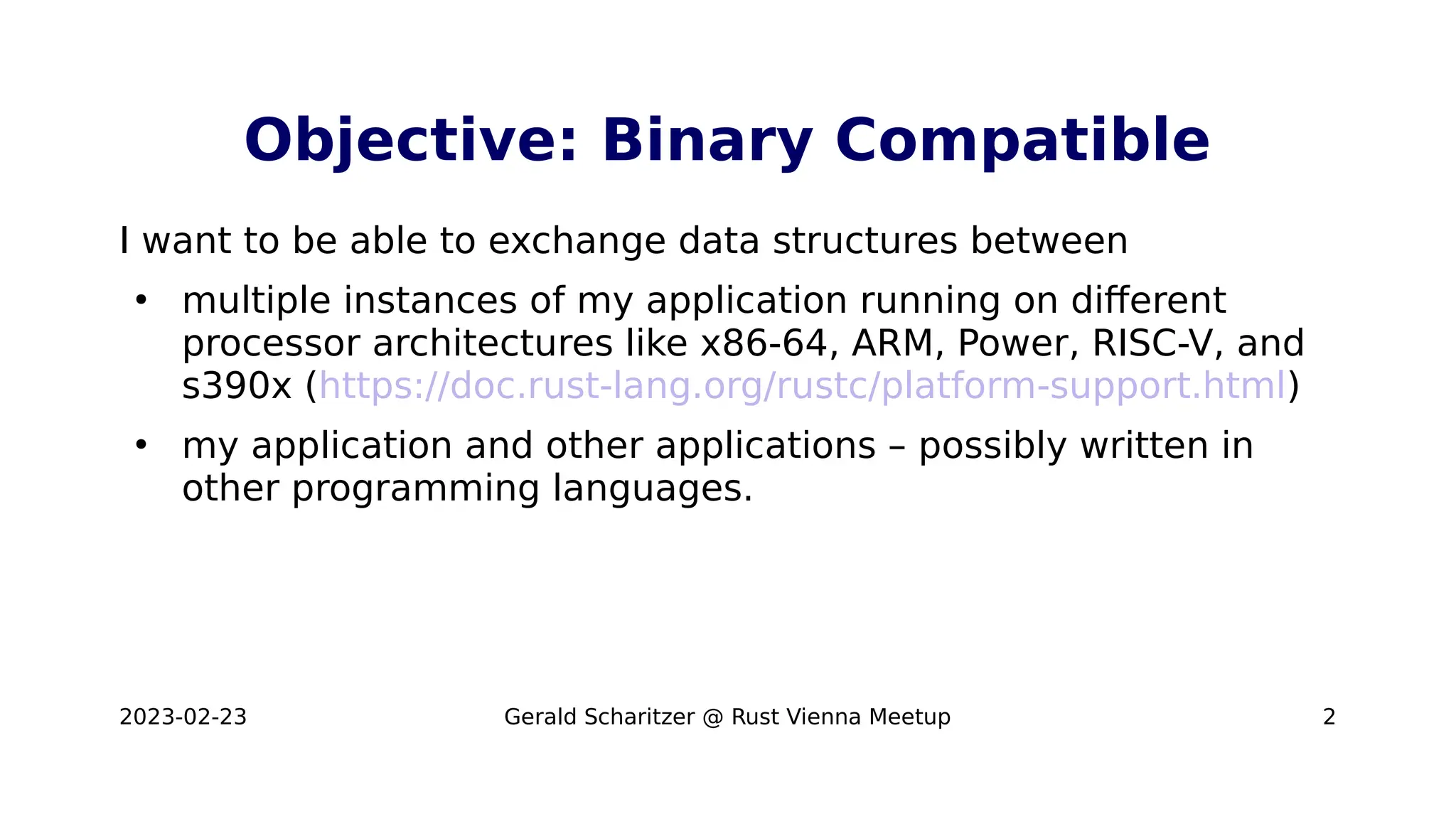
Objective: Binary Compatible
I want to be able to exchange data structures between
●
multiple instances of my application running on different
processor architectures like x86-64, ARM, Power, RISC-V, and
s390x (https://doc.rust-lang.org/rustc/platform-support.html)
●
my application and other applications – possibly written in
other programming languages.
2023-02-23 Gerald Scharitzer @ Rust Vienna Meetup 3
Size depends on the Platform
2023-02-23 Gerald Scharitzer @ Rust Vienna Meetup 4
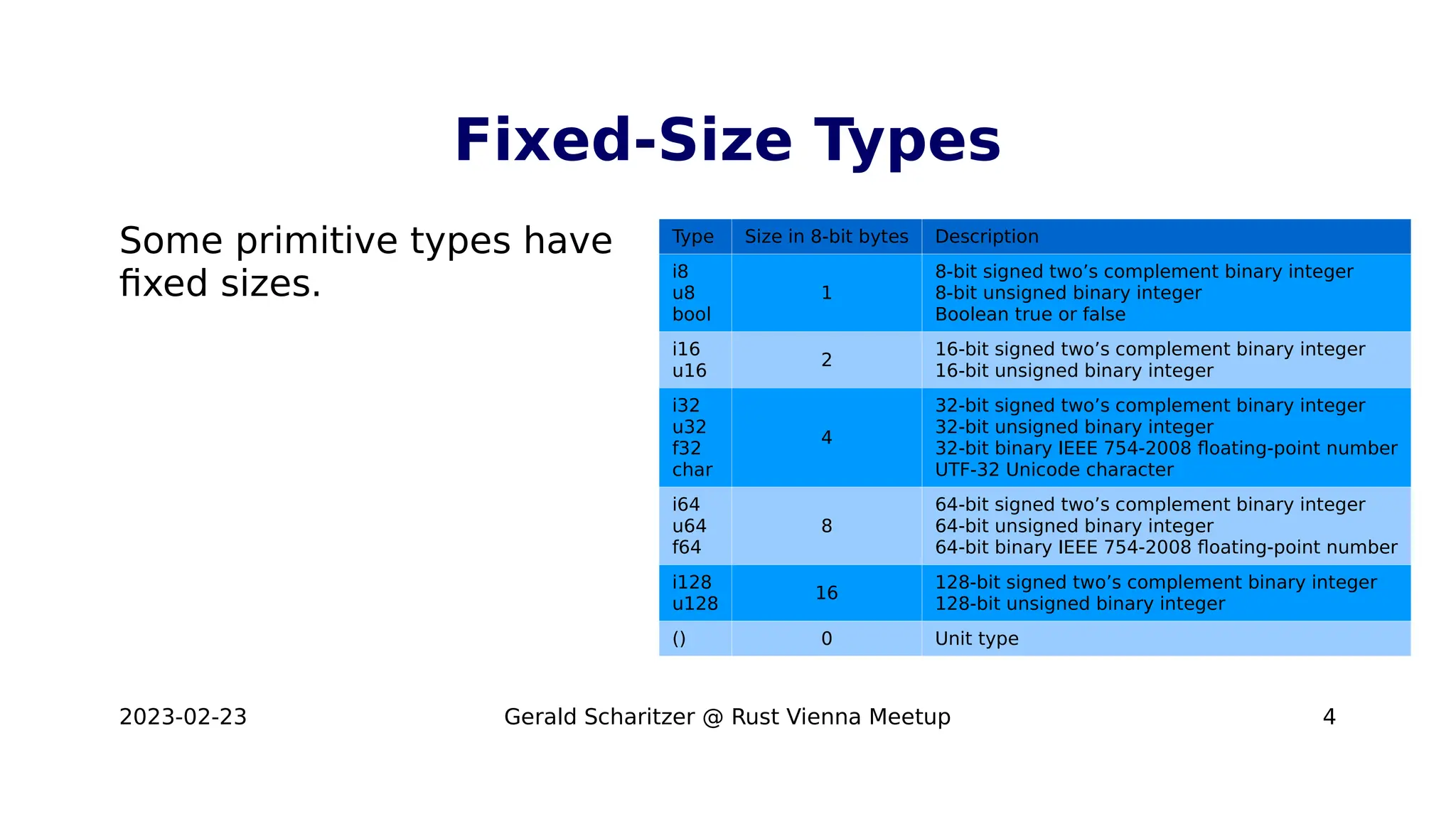
Fixed-Size Types
Some primitive types have
fixed sizes.
Type Size in 8-bit bytes Description
i8
u8
bool
1
8-bit signed two’s complement binary integer
8-bit unsigned binary integer
Boolean true or false
i16
u16
2
16-bit signed two’s complement binary integer
16-bit unsigned binary integer
i32
u32
f32
char
4
32-bit signed two’s complement binary integer
32-bit unsigned binary integer
32-bit binary IEEE 754-2008 floating-point number
UTF-32 Unicode character
i64
u64
f64
8
64-bit signed two’s complement binary integer
64-bit unsigned binary integer
64-bit binary IEEE 754-2008 floating-point number
i128
u128
16
128-bit signed two’s complement binary integer
128-bit unsigned binary integer
() 0 Unit type
2023-02-23 Gerald Scharitzer @ Rust Vienna Meetup 5
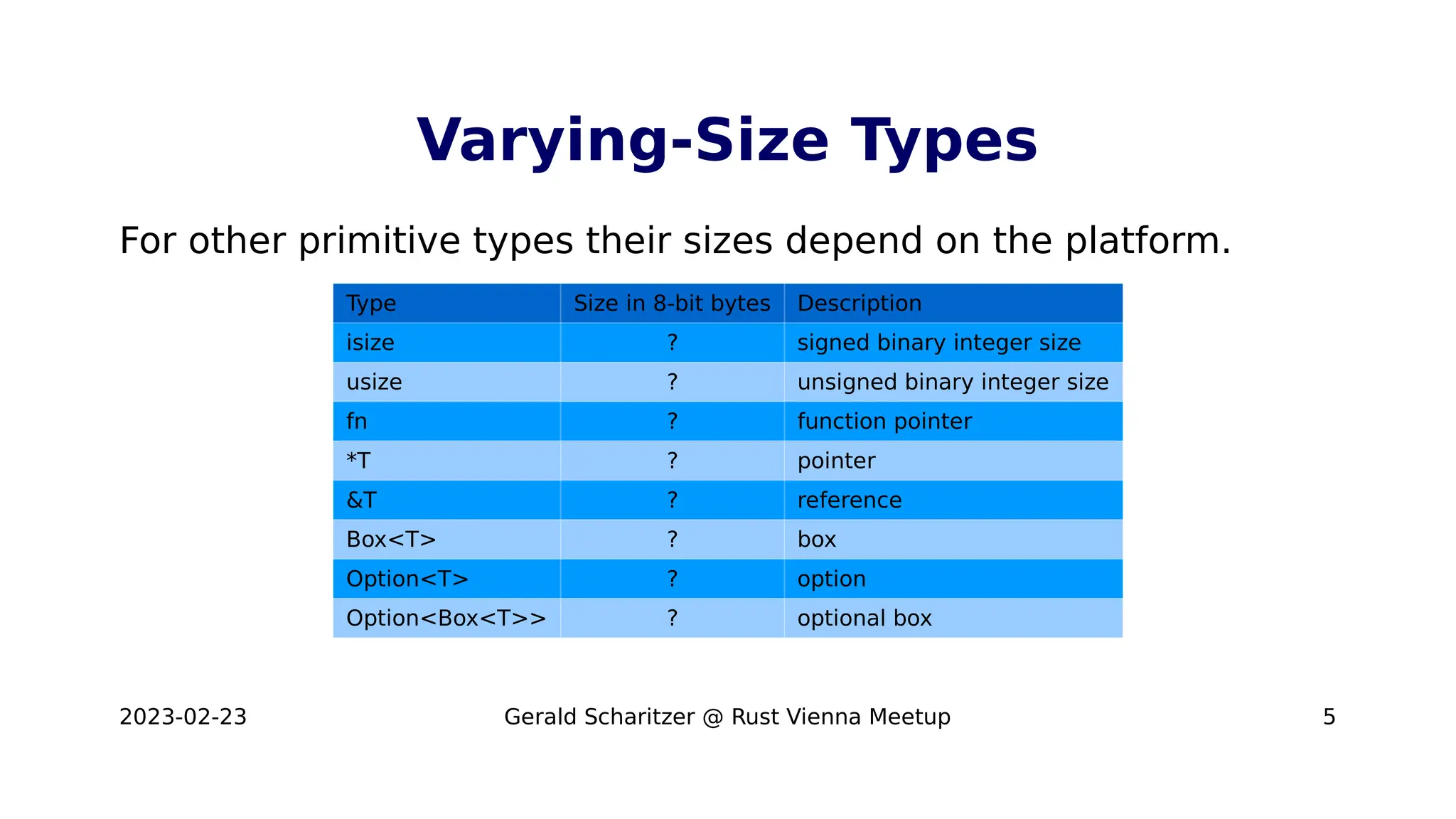
Varying-Size Types
For other primitive types their sizes depend on the platform.
Type Size in 8-bit bytes Description
isize ? signed binary integer size
usize ? unsigned binary integer size
fn ? function pointer
*T ? pointer
&T ? reference
Box<T> ? box
Option<T> ? option
Option<Box<T>> ? optional box
2023-02-23 Gerald Scharitzer @ Rust Vienna Meetup 6
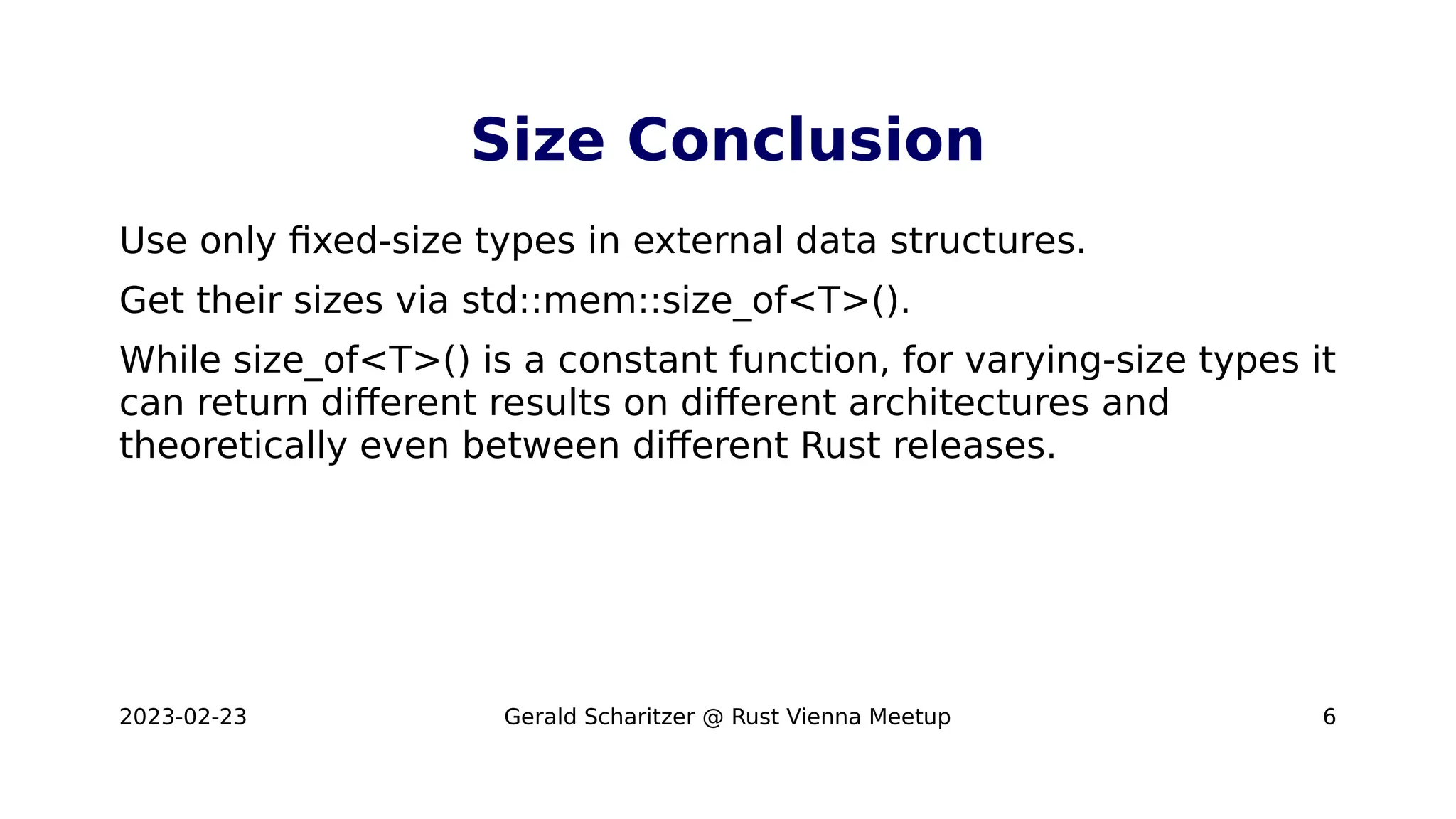
Size Conclusion
Use only fixed-size types in external data structures.
Get their sizes via std::mem::size_of<T>().
While size_of<T>() is a constant function, for varying-size types it
can return different results on different architectures and
theoretically even between different Rust releases.
2023-02-23 Gerald Scharitzer @ Rust Vienna Meetup 7
Alignment depends on the Platform
2023-02-23 Gerald Scharitzer @ Rust Vienna Meetup 8
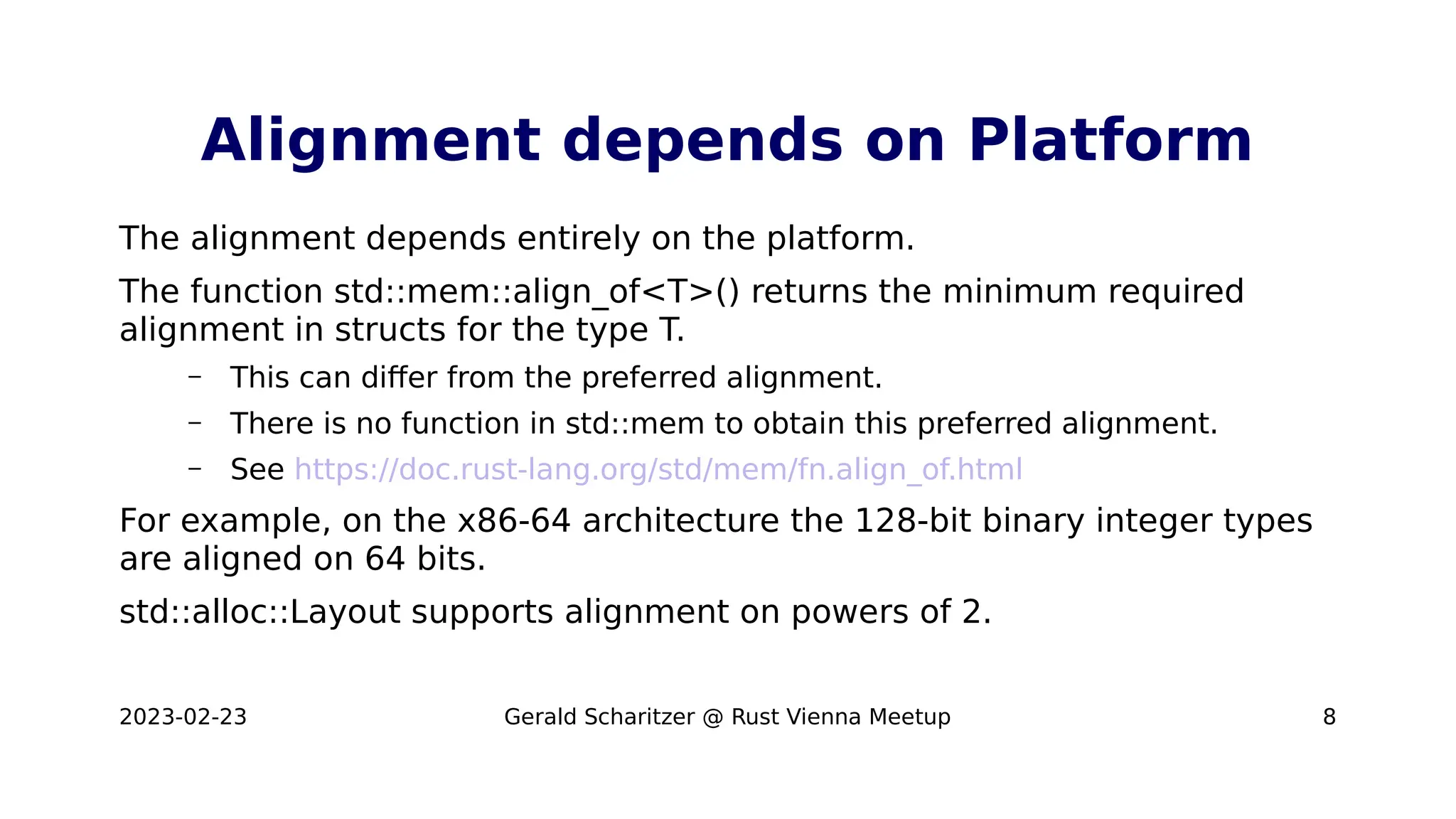
Alignment depends on Platform
The alignment depends entirely on the platform.
The function std::mem::align_of<T>() returns the minimum required
alignment in structs for the type T.
– This can differ from the preferred alignment.
– There is no function in std::mem to obtain this preferred alignment.
– See https://doc.rust-lang.org/std/mem/fn.align_of.html
For example, on the x86-64 architecture the 128-bit binary integer types
are aligned on 64 bits.
std::alloc::Layout supports alignment on powers of 2.
2023-02-23 Gerald Scharitzer @ Rust Vienna Meetup 9
Alignment Conclusions
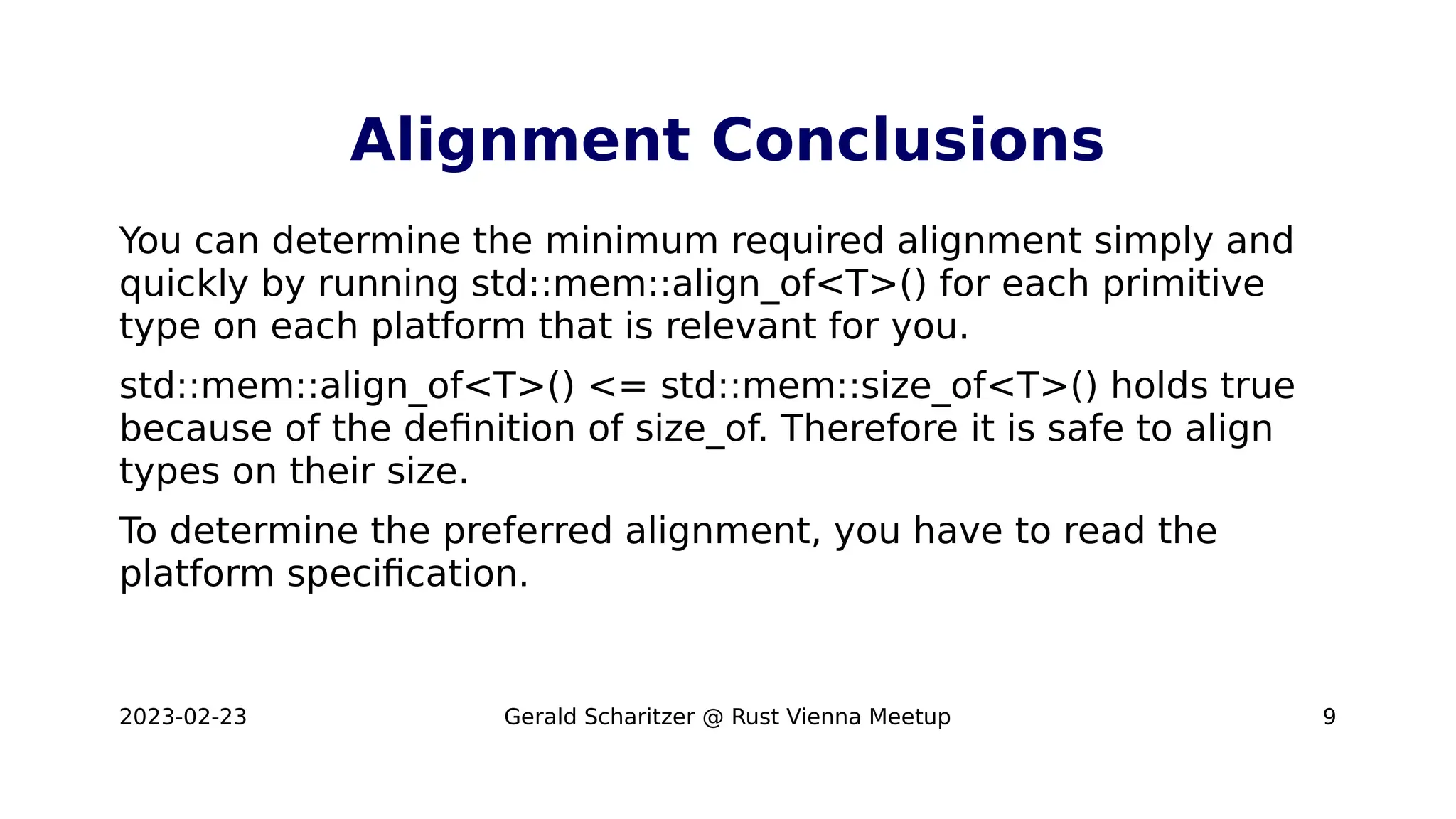
You can determine the minimum required alignment simply and
quickly by running std::mem::align_of<T>() for each primitive
type on each platform that is relevant for you.
std::mem::align_of<T>() <= std::mem::size_of<T>() holds true
because of the definition of size_of. Therefore it is safe to align
types on their size.
To determine the preferred alignment, you have to read the
platform specification.
2023-02-23 Gerald Scharitzer @ Rust Vienna Meetup 10
Endianess depends on the Platform
2023-02-23 Gerald Scharitzer @ Rust Vienna Meetup 11
Endianess depends on Platform
Integer primitive types longer than 1 byte can be big or little
endian. So far Rust does not list any mixed-endian platforms.
The methods from_be(x), from_le(x), to_be(), and to_le() make
the endianess explicit, but work on the same integer type only.
The methods from_be_bytes(x), from_le_bytes(x), to_be_bytes(),
and to_le_bytes() are defined for byte arrays ([u8; n]) only.
There are no endianess functions that work on byte slices ([u8]).
2023-02-23 Gerald Scharitzer @ Rust Vienna Meetup 12
Endianess Conclusions
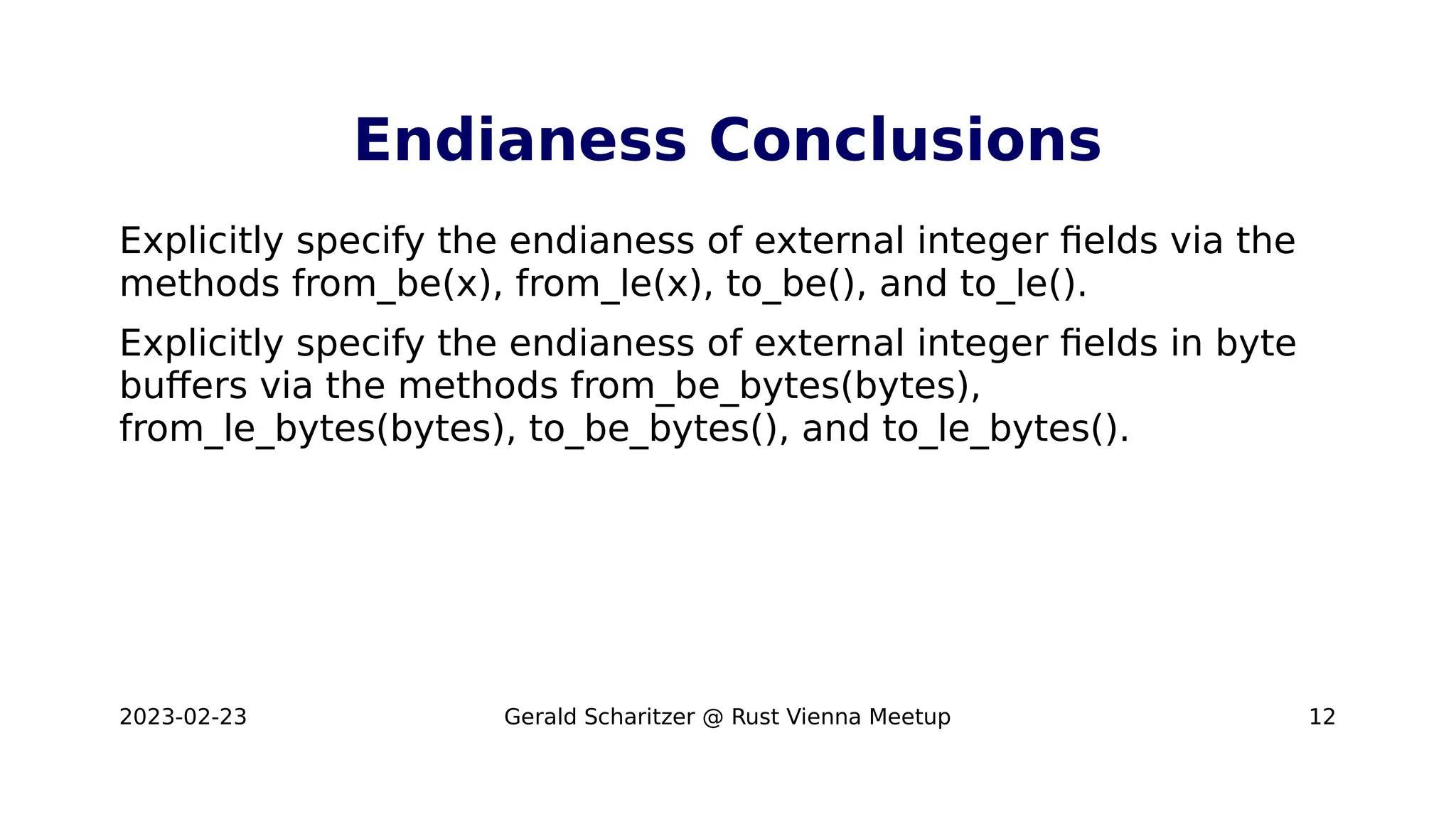
Explicitly specify the endianess of external integer fields via the
methods from_be(x), from_le(x), to_be(), and to_le().
Explicitly specify the endianess of external integer fields in byte
buffers via the methods from_be_bytes(bytes),
from_le_bytes(bytes), to_be_bytes(), and to_le_bytes().
2023-02-23 Gerald Scharitzer @ Rust Vienna Meetup 13
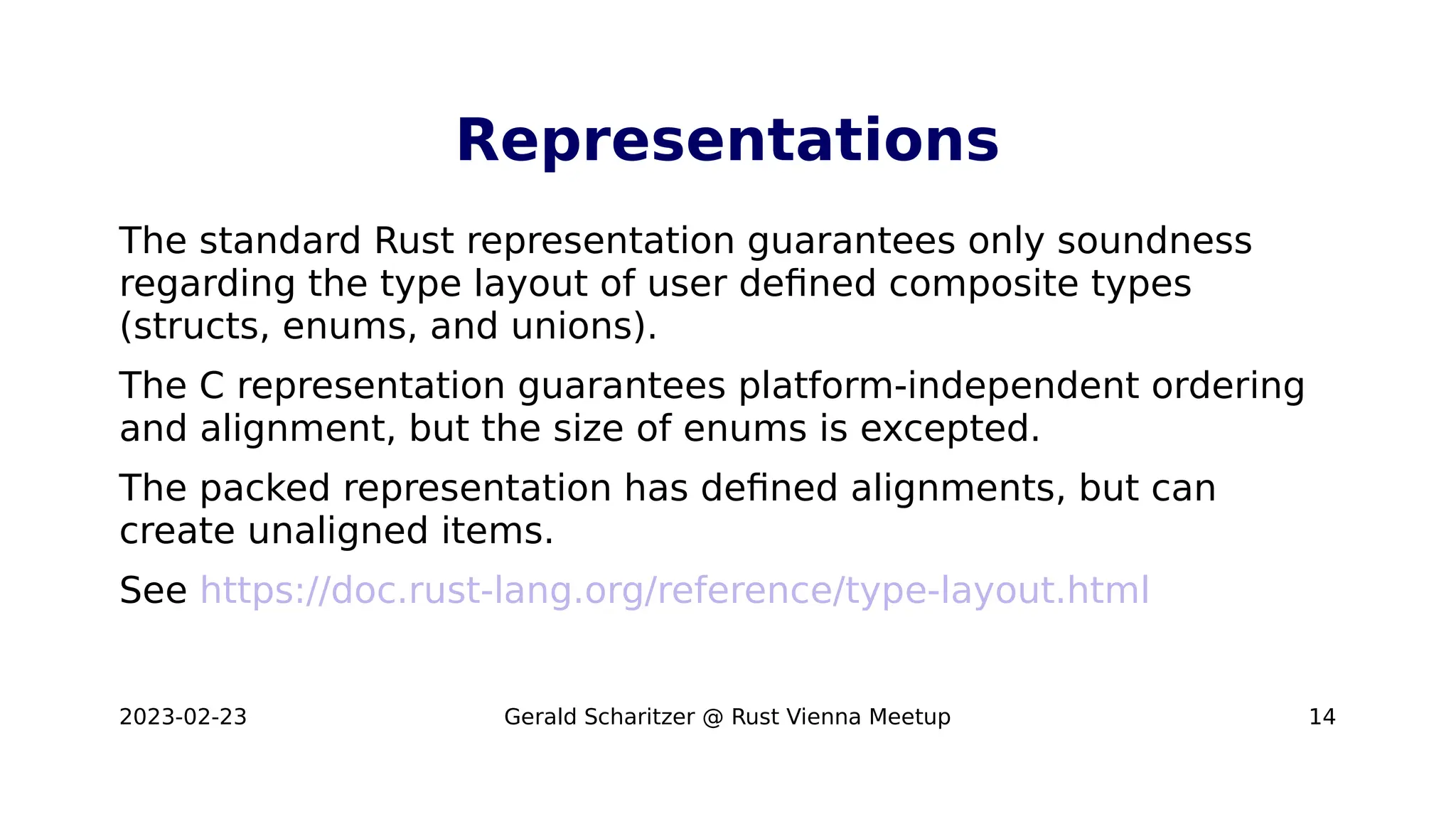
Representations
2023-02-23 Gerald Scharitzer @ Rust Vienna Meetup 14
Representations
The standard Rust representation guarantees only soundness
regarding the type layout of user defined composite types
(structs, enums, and unions).
The C representation guarantees platform-independent ordering
and alignment, but the size of enums is excepted.
The packed representation has defined alignments, but can
create unaligned items.
See https://doc.rust-lang.org/reference/type-layout.html
2023-02-23 Gerald Scharitzer @ Rust Vienna Meetup 15
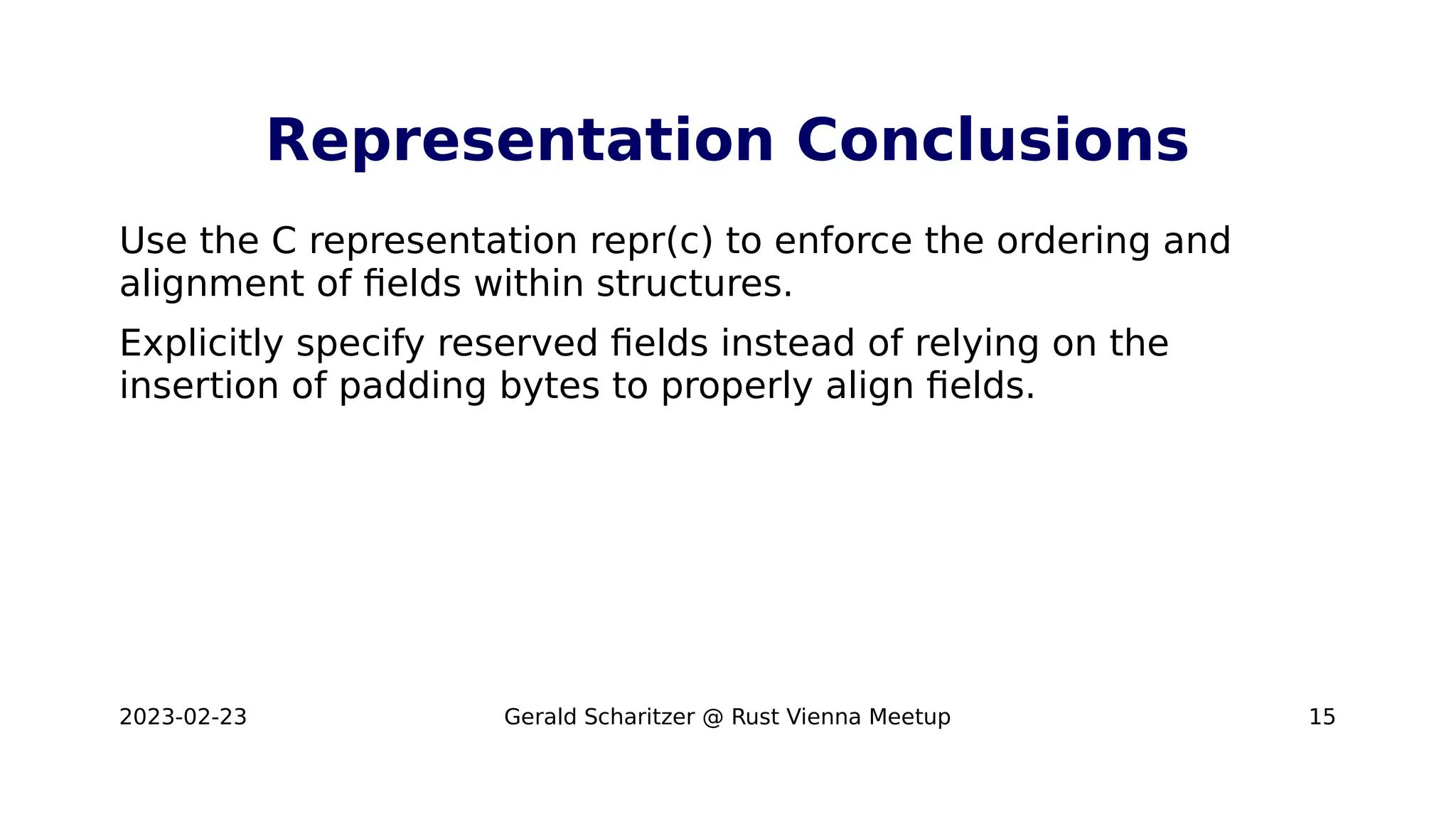
Representation Conclusions
Use the C representation repr(c) to enforce the ordering and
alignment of fields within structures.
Explicitly specify reserved fields instead of relying on the
insertion of padding bytes to properly align fields.
2023-02-23 Gerald Scharitzer @ Rust Vienna Meetup 16
Input and Output of Bytes only
2023-02-23 Gerald Scharitzer @ Rust Vienna Meetup 17
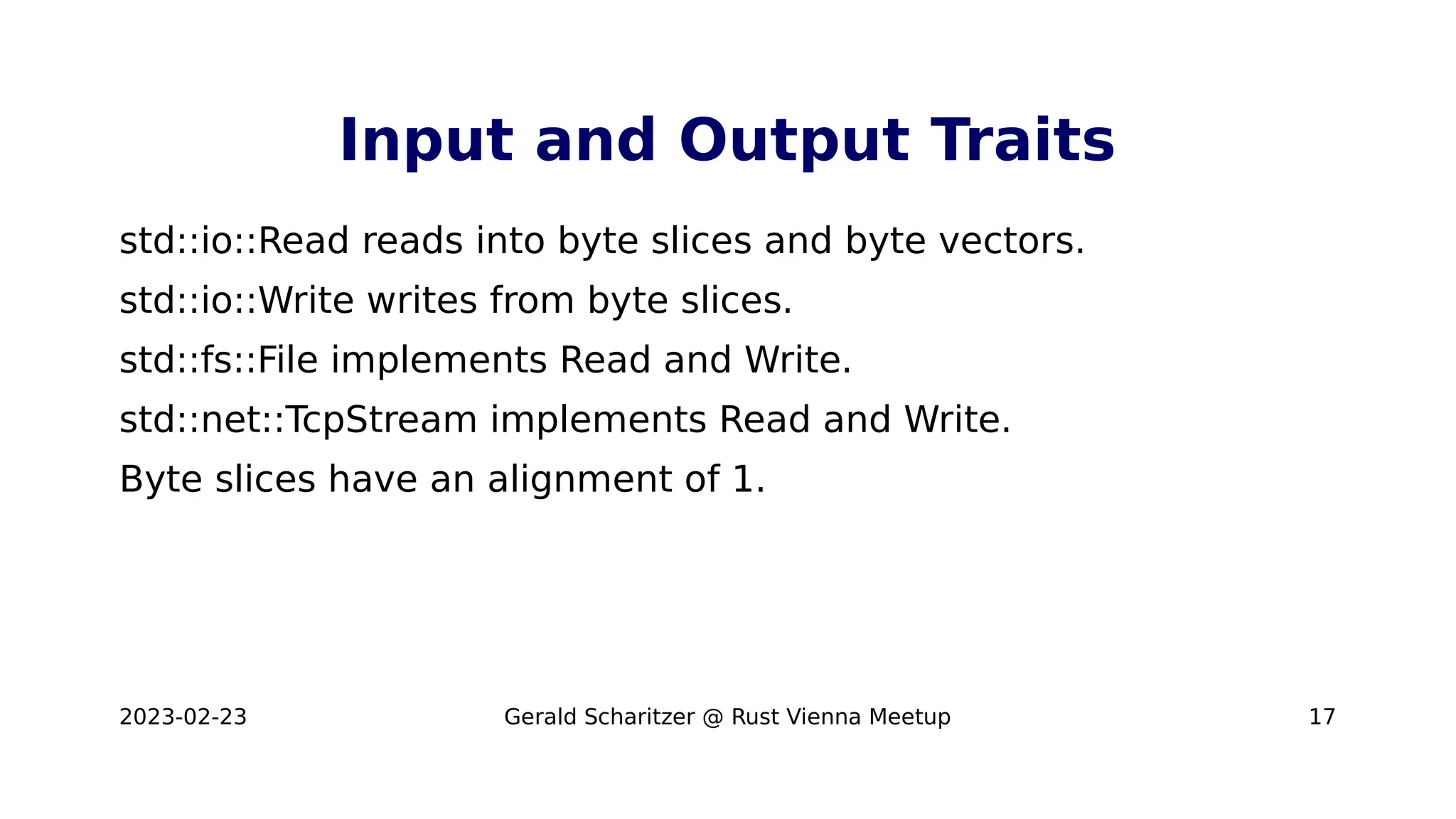
Input and Output Traits
std::io::Read reads into byte slices and byte vectors.
std::io::Write writes from byte slices.
std::fs::File implements Read and Write.
std::net::TcpStream implements Read and Write.
Byte slices have an alignment of 1.
2023-02-23 Gerald Scharitzer @ Rust Vienna Meetup 18
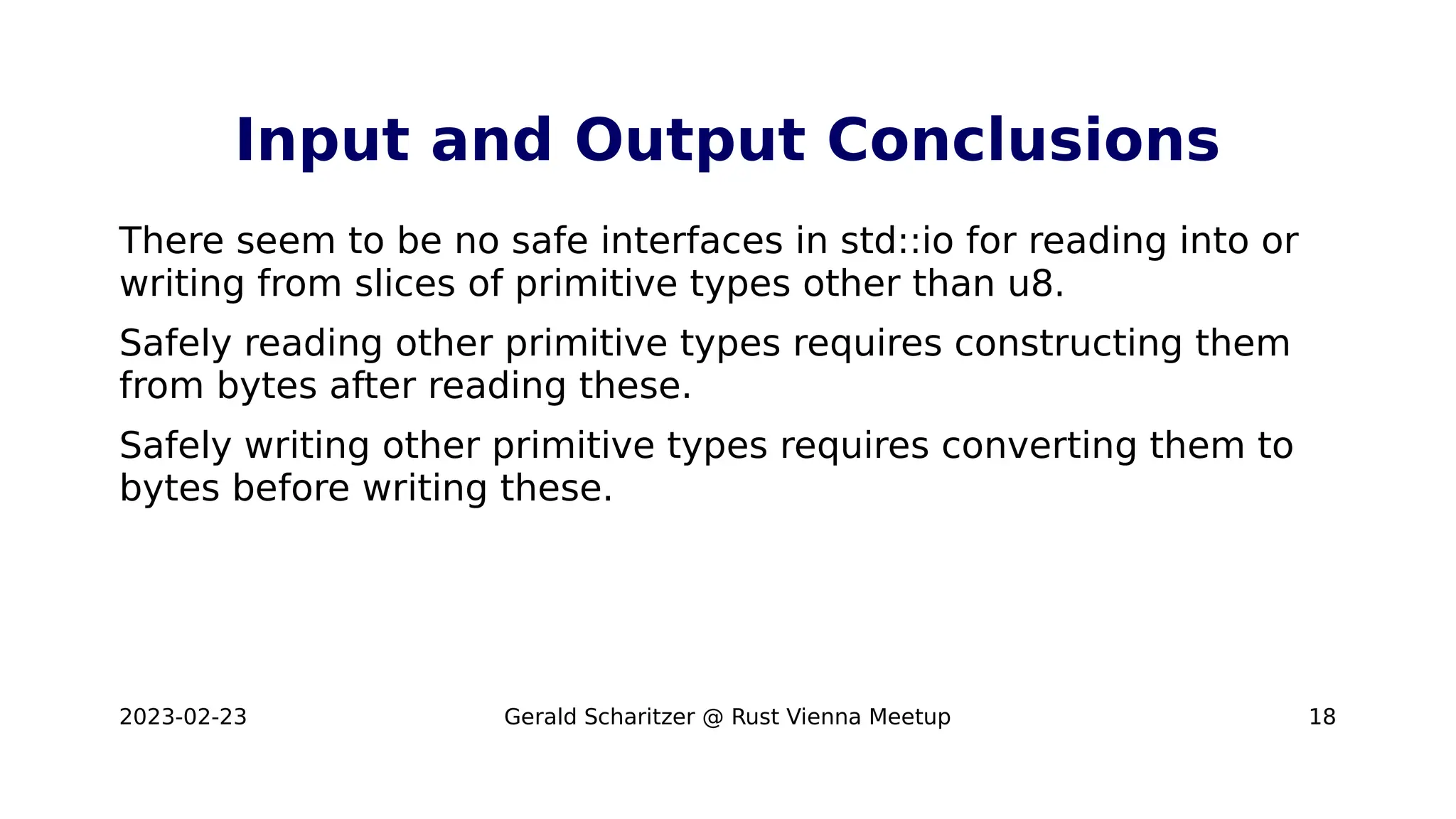
Input and Output Conclusions
There seem to be no safe interfaces in std::io for reading into or
writing from slices of primitive types other than u8.
Safely reading other primitive types requires constructing them
from bytes after reading these.
Safely writing other primitive types requires converting them to
bytes before writing these.
2023-02-23 Gerald Scharitzer @ Rust Vienna Meetup 19
Foreign Function Interface
2023-02-23 Gerald Scharitzer @ Rust Vienna Meetup 20
External Functions
Calls from Rust to non-Rust call functions declared in "extern"
blocks with the specified ABI (e.g. "C"). Functions in "extern"
blocks are always "unsafe", because the Rust compiler could not
check them.
Calls from non-Rust to Rust call "extern" functions with the
specified ABI. Extern functions are safe by default, but require
the attribute #[no_mangle] to get stable external symbols.
See https://doc.rust-lang.org/book/ch19-01-unsafe-rust.html
2023-02-23 Gerald Scharitzer @ Rust Vienna Meetup 21
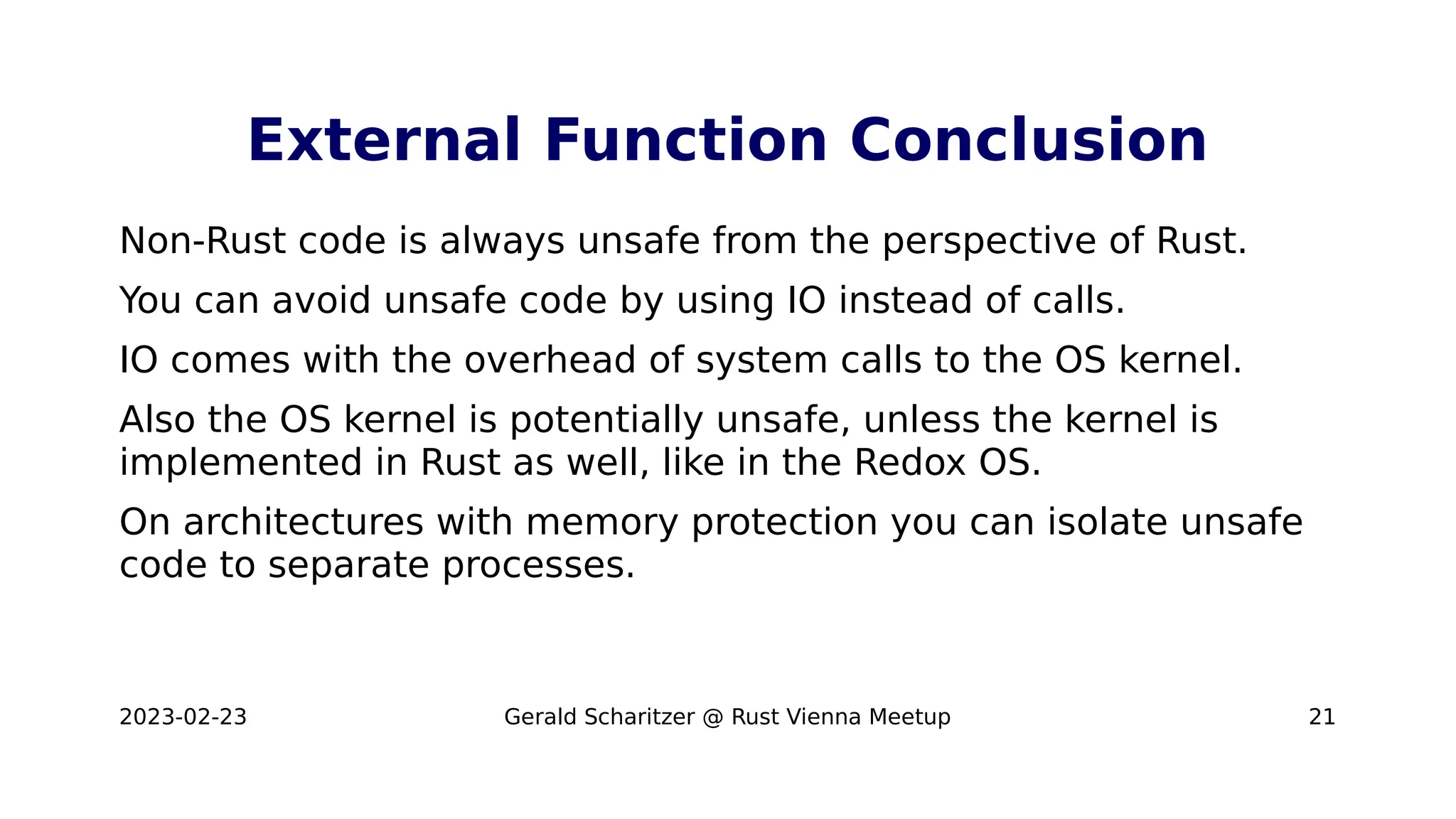
External Function Conclusion
Non-Rust code is always unsafe from the perspective of Rust.
You can avoid unsafe code by using IO instead of calls.
IO comes with the overhead of system calls to the OS kernel.
Also the OS kernel is potentially unsafe, unless the kernel is
implemented in Rust as well, like in the Redox OS.
On architectures with memory protection you can isolate unsafe
code to separate processes.
2023-02-23 Gerald Scharitzer @ Rust Vienna Meetup 22
End of Story
Comments or Questions?

Rust Type Layout - Binary Compatibility 2023-02-23

  • 1.
    2023-02-23 Gerald Scharitzer@ Rust Vienna Meetup 1 Rust Type Layout Size, Alignment, Endianess, and Representations vs Input, Output, and Foreign Functions
  • 2.
    2023-02-23 Gerald Scharitzer@ Rust Vienna Meetup 2 Objective: Binary Compatible I want to be able to exchange data structures between ● multiple instances of my application running on different processor architectures like x86-64, ARM, Power, RISC-V, and s390x (https://doc.rust-lang.org/rustc/platform-support.html) ● my application and other applications – possibly written in other programming languages.
  • 3.
    2023-02-23 Gerald Scharitzer@ Rust Vienna Meetup 3 Size depends on the Platform
  • 4.
    2023-02-23 Gerald Scharitzer@ Rust Vienna Meetup 4 Fixed-Size Types Some primitive types have fixed sizes. Type Size in 8-bit bytes Description i8 u8 bool 1 8-bit signed two’s complement binary integer 8-bit unsigned binary integer Boolean true or false i16 u16 2 16-bit signed two’s complement binary integer 16-bit unsigned binary integer i32 u32 f32 char 4 32-bit signed two’s complement binary integer 32-bit unsigned binary integer 32-bit binary IEEE 754-2008 floating-point number UTF-32 Unicode character i64 u64 f64 8 64-bit signed two’s complement binary integer 64-bit unsigned binary integer 64-bit binary IEEE 754-2008 floating-point number i128 u128 16 128-bit signed two’s complement binary integer 128-bit unsigned binary integer () 0 Unit type
  • 5.
    2023-02-23 Gerald Scharitzer@ Rust Vienna Meetup 5 Varying-Size Types For other primitive types their sizes depend on the platform. Type Size in 8-bit bytes Description isize ? signed binary integer size usize ? unsigned binary integer size fn ? function pointer *T ? pointer &T ? reference Box<T> ? box Option<T> ? option Option<Box<T>> ? optional box
  • 6.
    2023-02-23 Gerald Scharitzer@ Rust Vienna Meetup 6 Size Conclusion Use only fixed-size types in external data structures. Get their sizes via std::mem::size_of<T>(). While size_of<T>() is a constant function, for varying-size types it can return different results on different architectures and theoretically even between different Rust releases.
  • 7.
    2023-02-23 Gerald Scharitzer@ Rust Vienna Meetup 7 Alignment depends on the Platform
  • 8.
    2023-02-23 Gerald Scharitzer@ Rust Vienna Meetup 8 Alignment depends on Platform The alignment depends entirely on the platform. The function std::mem::align_of<T>() returns the minimum required alignment in structs for the type T. – This can differ from the preferred alignment. – There is no function in std::mem to obtain this preferred alignment. – See https://doc.rust-lang.org/std/mem/fn.align_of.html For example, on the x86-64 architecture the 128-bit binary integer types are aligned on 64 bits. std::alloc::Layout supports alignment on powers of 2.
  • 9.
    2023-02-23 Gerald Scharitzer@ Rust Vienna Meetup 9 Alignment Conclusions You can determine the minimum required alignment simply and quickly by running std::mem::align_of<T>() for each primitive type on each platform that is relevant for you. std::mem::align_of<T>() <= std::mem::size_of<T>() holds true because of the definition of size_of. Therefore it is safe to align types on their size. To determine the preferred alignment, you have to read the platform specification.
  • 10.
    2023-02-23 Gerald Scharitzer@ Rust Vienna Meetup 10 Endianess depends on the Platform
  • 11.
    2023-02-23 Gerald Scharitzer@ Rust Vienna Meetup 11 Endianess depends on Platform Integer primitive types longer than 1 byte can be big or little endian. So far Rust does not list any mixed-endian platforms. The methods from_be(x), from_le(x), to_be(), and to_le() make the endianess explicit, but work on the same integer type only. The methods from_be_bytes(x), from_le_bytes(x), to_be_bytes(), and to_le_bytes() are defined for byte arrays ([u8; n]) only. There are no endianess functions that work on byte slices ([u8]).
  • 12.
    2023-02-23 Gerald Scharitzer@ Rust Vienna Meetup 12 Endianess Conclusions Explicitly specify the endianess of external integer fields via the methods from_be(x), from_le(x), to_be(), and to_le(). Explicitly specify the endianess of external integer fields in byte buffers via the methods from_be_bytes(bytes), from_le_bytes(bytes), to_be_bytes(), and to_le_bytes().
  • 13.
    2023-02-23 Gerald Scharitzer@ Rust Vienna Meetup 13 Representations
  • 14.
    2023-02-23 Gerald Scharitzer@ Rust Vienna Meetup 14 Representations The standard Rust representation guarantees only soundness regarding the type layout of user defined composite types (structs, enums, and unions). The C representation guarantees platform-independent ordering and alignment, but the size of enums is excepted. The packed representation has defined alignments, but can create unaligned items. See https://doc.rust-lang.org/reference/type-layout.html
  • 15.
    2023-02-23 Gerald Scharitzer@ Rust Vienna Meetup 15 Representation Conclusions Use the C representation repr(c) to enforce the ordering and alignment of fields within structures. Explicitly specify reserved fields instead of relying on the insertion of padding bytes to properly align fields.
  • 16.
    2023-02-23 Gerald Scharitzer@ Rust Vienna Meetup 16 Input and Output of Bytes only
  • 17.
    2023-02-23 Gerald Scharitzer@ Rust Vienna Meetup 17 Input and Output Traits std::io::Read reads into byte slices and byte vectors. std::io::Write writes from byte slices. std::fs::File implements Read and Write. std::net::TcpStream implements Read and Write. Byte slices have an alignment of 1.
  • 18.
    2023-02-23 Gerald Scharitzer@ Rust Vienna Meetup 18 Input and Output Conclusions There seem to be no safe interfaces in std::io for reading into or writing from slices of primitive types other than u8. Safely reading other primitive types requires constructing them from bytes after reading these. Safely writing other primitive types requires converting them to bytes before writing these.
  • 19.
    2023-02-23 Gerald Scharitzer@ Rust Vienna Meetup 19 Foreign Function Interface
  • 20.
    2023-02-23 Gerald Scharitzer@ Rust Vienna Meetup 20 External Functions Calls from Rust to non-Rust call functions declared in "extern" blocks with the specified ABI (e.g. "C"). Functions in "extern" blocks are always "unsafe", because the Rust compiler could not check them. Calls from non-Rust to Rust call "extern" functions with the specified ABI. Extern functions are safe by default, but require the attribute #[no_mangle] to get stable external symbols. See https://doc.rust-lang.org/book/ch19-01-unsafe-rust.html
  • 21.
    2023-02-23 Gerald Scharitzer@ Rust Vienna Meetup 21 External Function Conclusion Non-Rust code is always unsafe from the perspective of Rust. You can avoid unsafe code by using IO instead of calls. IO comes with the overhead of system calls to the OS kernel. Also the OS kernel is potentially unsafe, unless the kernel is implemented in Rust as well, like in the Redox OS. On architectures with memory protection you can isolate unsafe code to separate processes.
  • 22.
    2023-02-23 Gerald Scharitzer@ Rust Vienna Meetup 22 End of Story Comments or Questions?