RUST IS FOR ROBOTS
Building an autonomous vehicle with
Rust and the Raspberry Pi
Andy Grove - Boulder/Denver Rust Meetup - 9/21/16
PLEASE ASK QUESTIONS!
ABOUT ME
• Co-Founder & Chief Architect @ AgilData
• Started in C++, then 20 years Java, now Scala & Rust
• AgilData is building its next product in Rust
• Also offering Rust consultancy and project kick-start
services
• I enjoy being a “Maker” in my spare time
• Digital electronics, robotics, 3D printing, woodworking,
etc, etc.
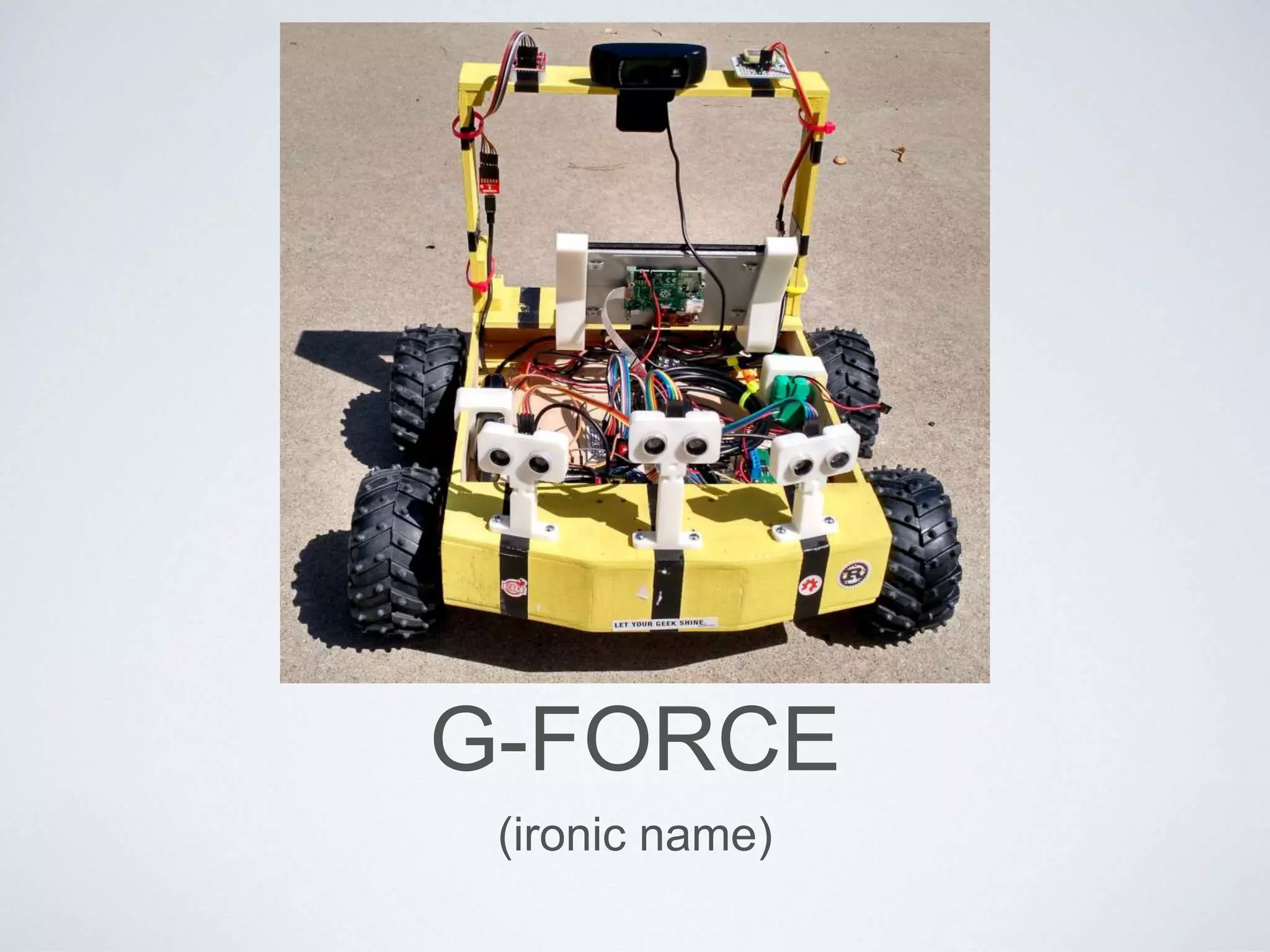
G-FORCE
(ironic name)
WHY THIS PROJECT?
• I was inspired by the last Rust meetup and I agreed
to give a talk at this one
• Sparkfun Autonomous Vehicle Competition (AVC)
was coming up
• This was a great opportunity for me to learn about
using Rust on the Raspberry Pi and get to share that
knowledge
• And four weeks was plenty of time, right?
OBJECTIVES
• Navigate to pre-determined waypoints (GPS co-ordinates)
• Using GPS and compass to determine location and heading
• Change speed of left/right motors to control movement
• Avoid obstacles
• Using ultra-sonic sensors to detect distance to objects
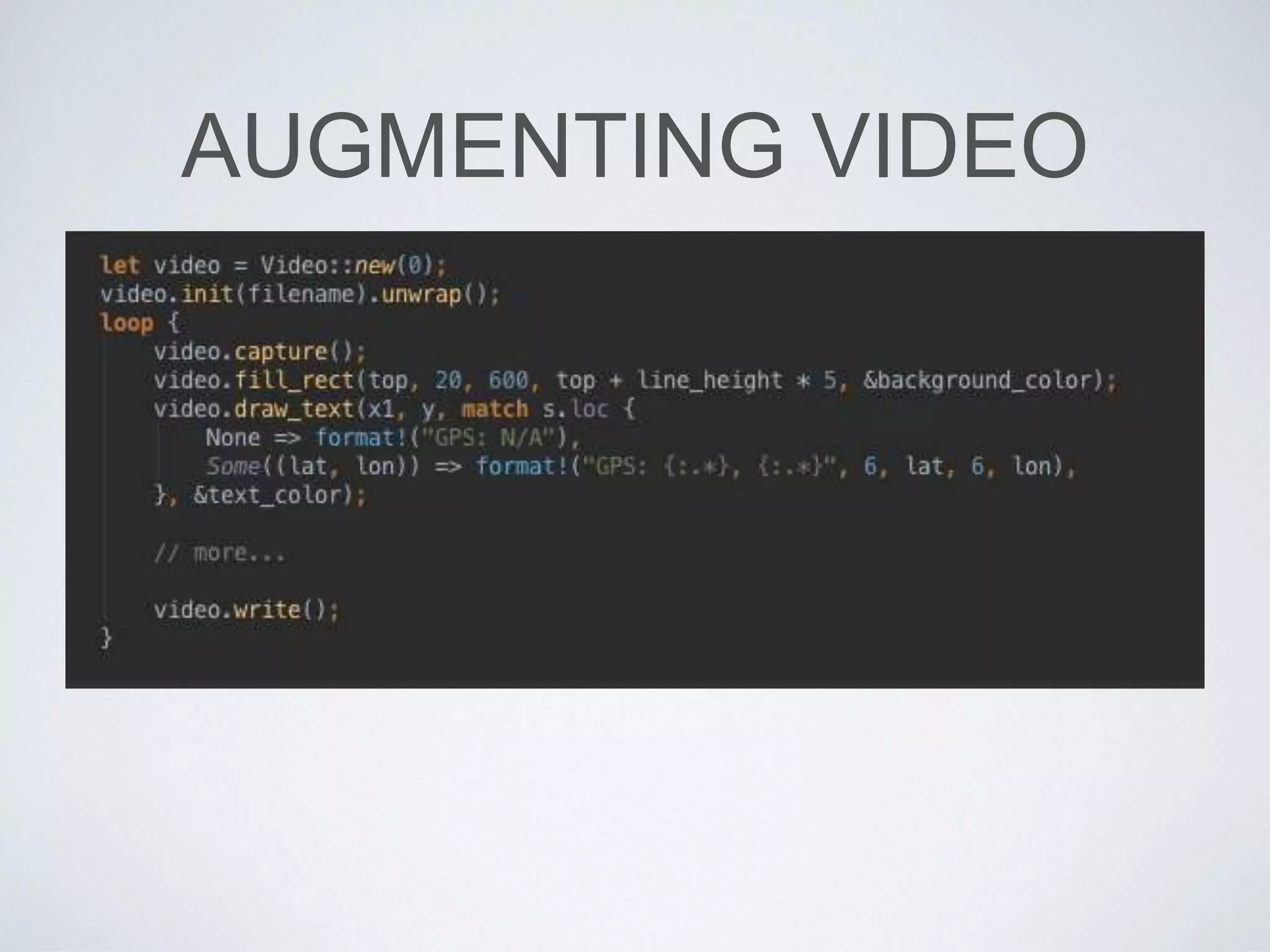
• Record instrumented video
• Essential for debugging
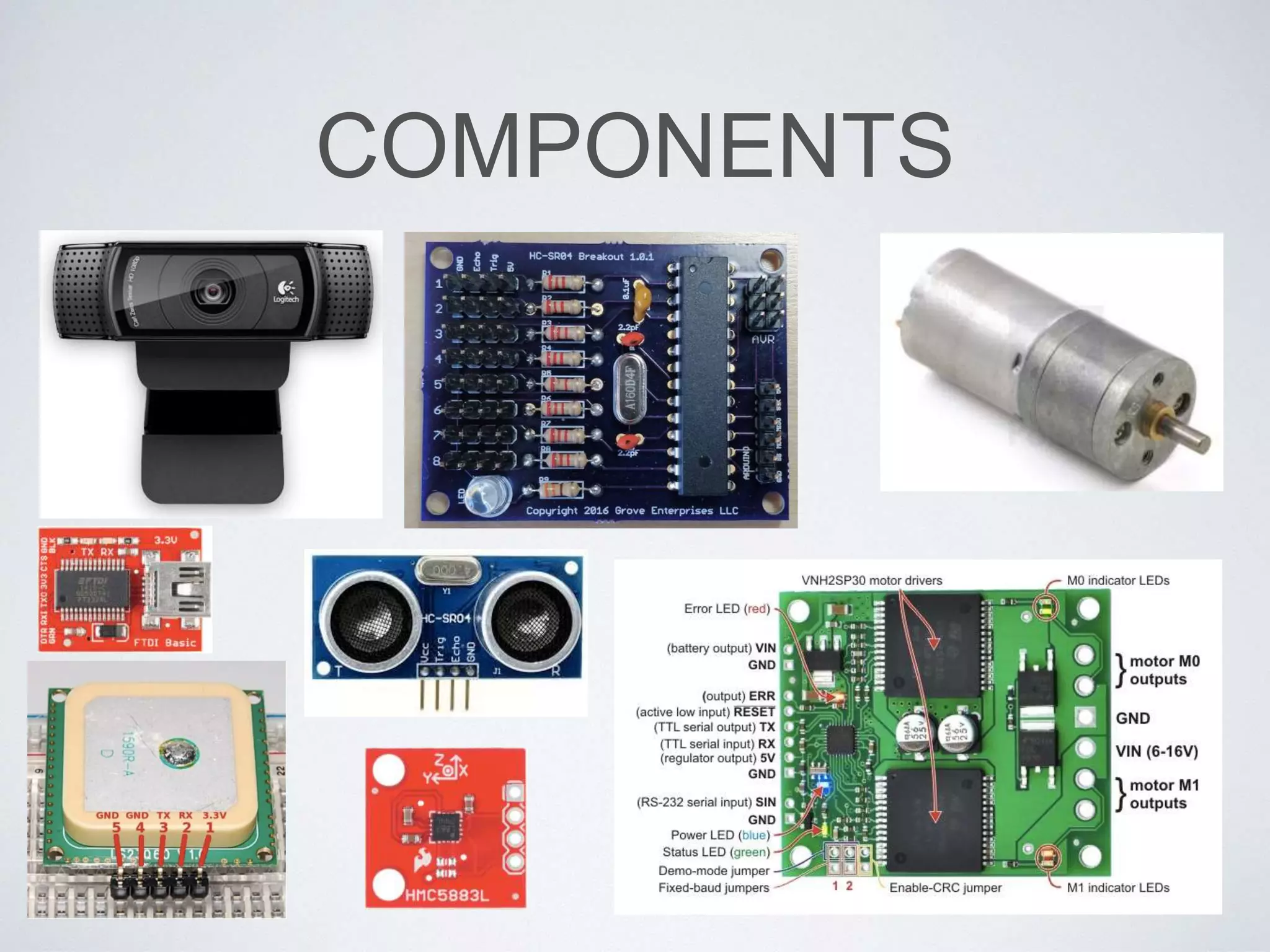
COMPONENTS
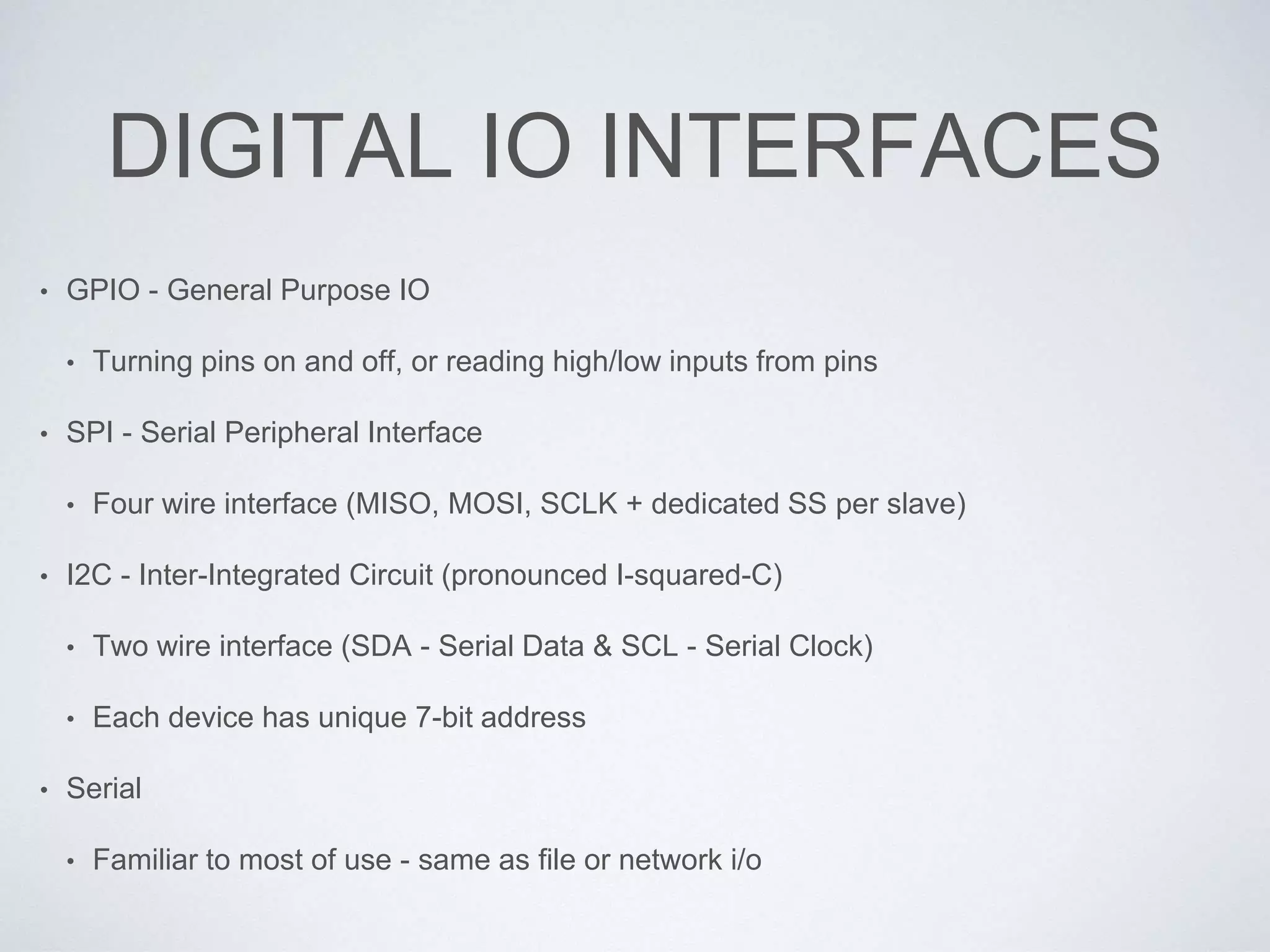
DIGITAL IO INTERFACES
• GPIO - General Purpose IO
• Turning pins on and off, or reading high/low inputs from pins
• SPI - Serial Peripheral Interface
• Four wire interface (MISO, MOSI, SCLK + dedicated SS per slave)
• I2C - Inter-Integrated Circuit (pronounced I-squared-C)
• Two wire interface (SDA - Serial Data & SCL - Serial Clock)
• Each device has unique 7-bit address
• Serial
• Familiar to most of use - same as file or network i/o
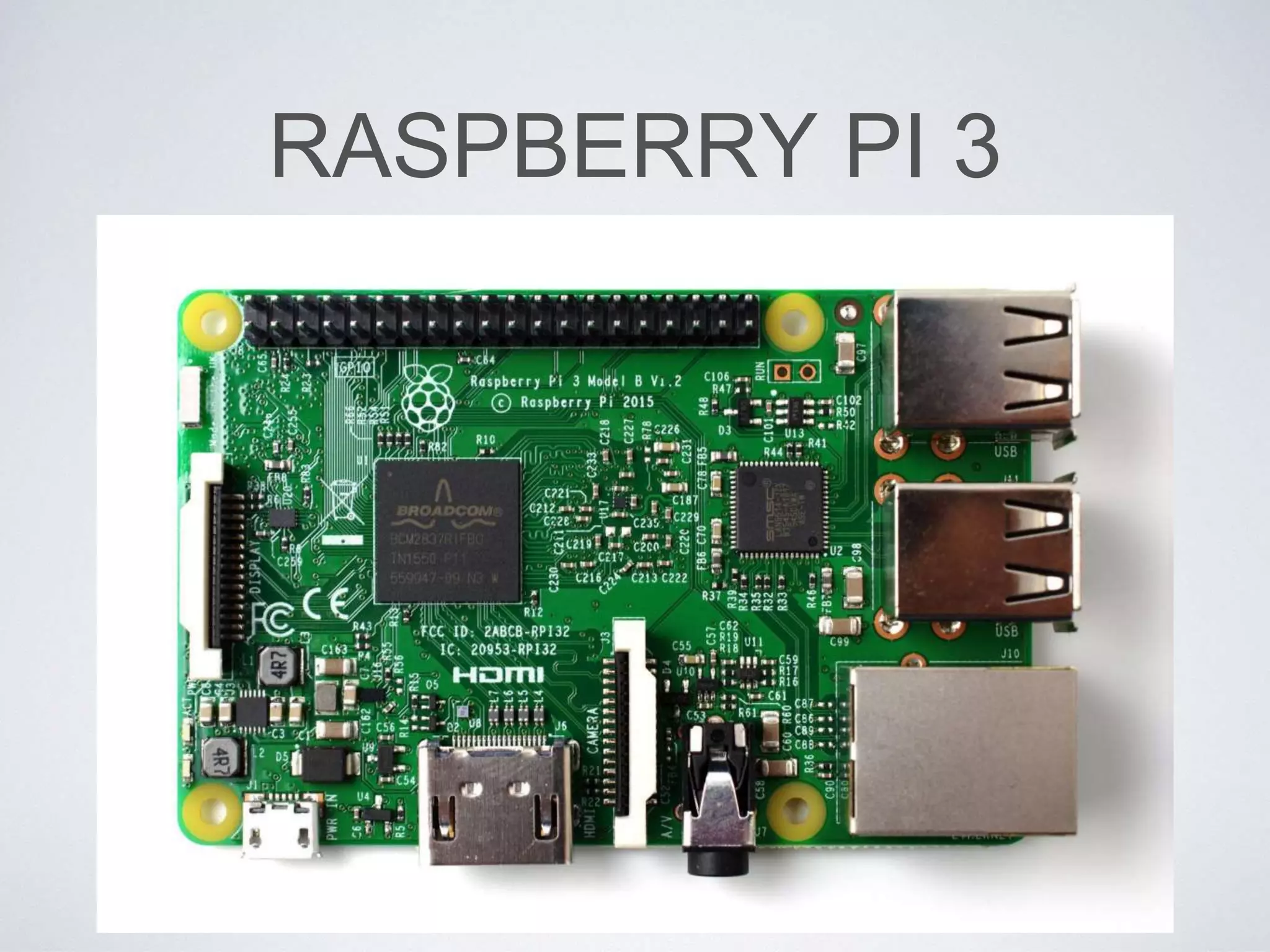
WHY RASPBERRY PI?
• Great support for Linux (Raspbian)
• Designed for hacking hardware
• Hardware support for GPIO, SPI, and I2C
• Support for webcams and video processing (with GPU
acceleration)
• USB makes it easy to connect to serial devices
• Built-in WiFi
• All this for $35 !
RASPBERRY PI 3
WHY RUST?• Better performance than Java or scripting languages
(assumption)
• Safe language - nobody wants their robot to fail with a
segmentation fault or null pointer exception
• Crates already exist for interfacing with GPIO, SPI, I2C and
Serial
• Rust is natively supported on the Pi using rustup.rs
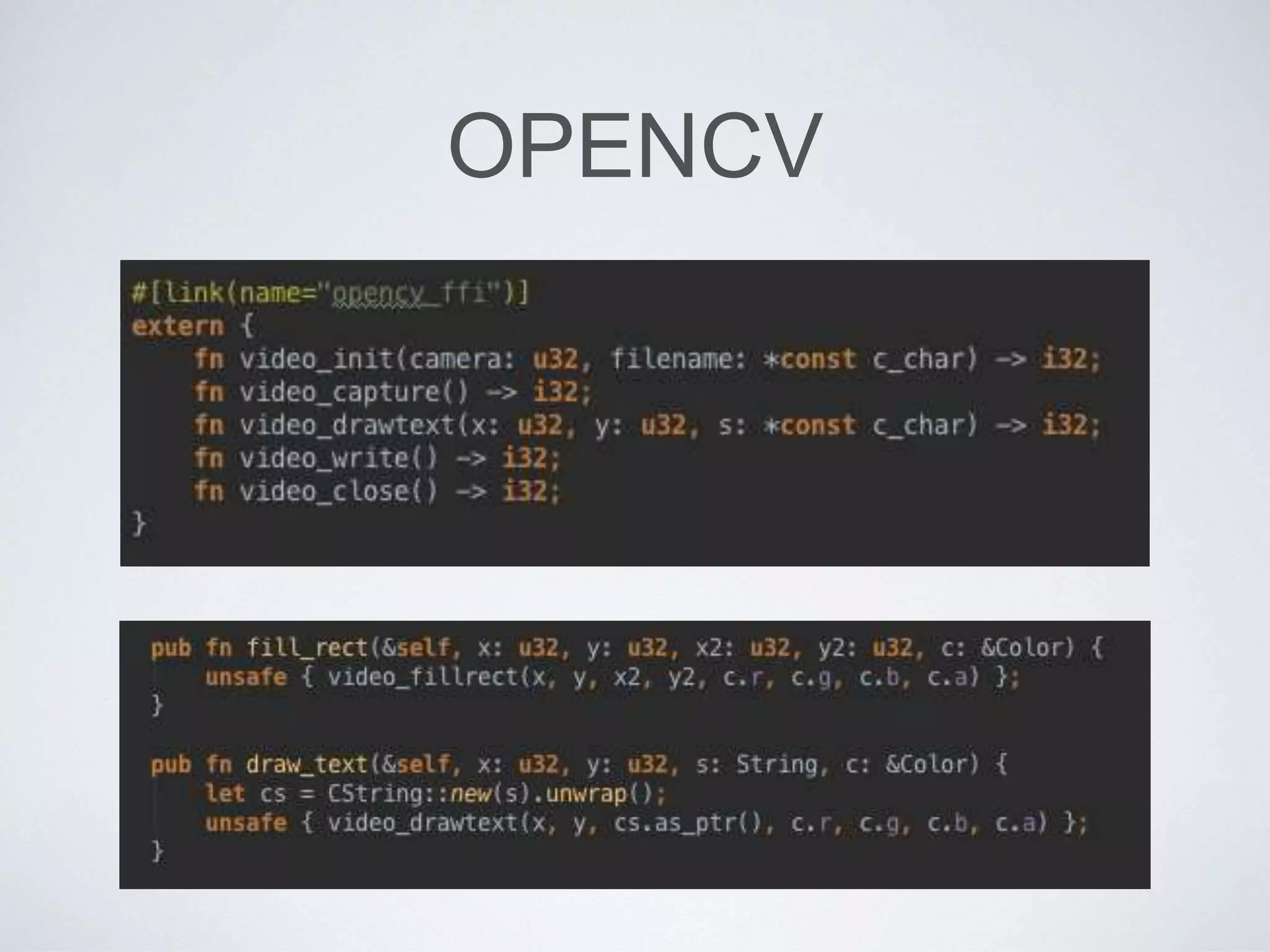
• Easy to call existing C libraries such as OpenCV with zero
overhead
SERIAL IO
• Linux presents serial IO devices as files e.g.
/dev/ttyUSB0
• Use udev rules to map to convenient names e.g.
/dev/gps
• USB-Serial adapter required to connect to serial devices
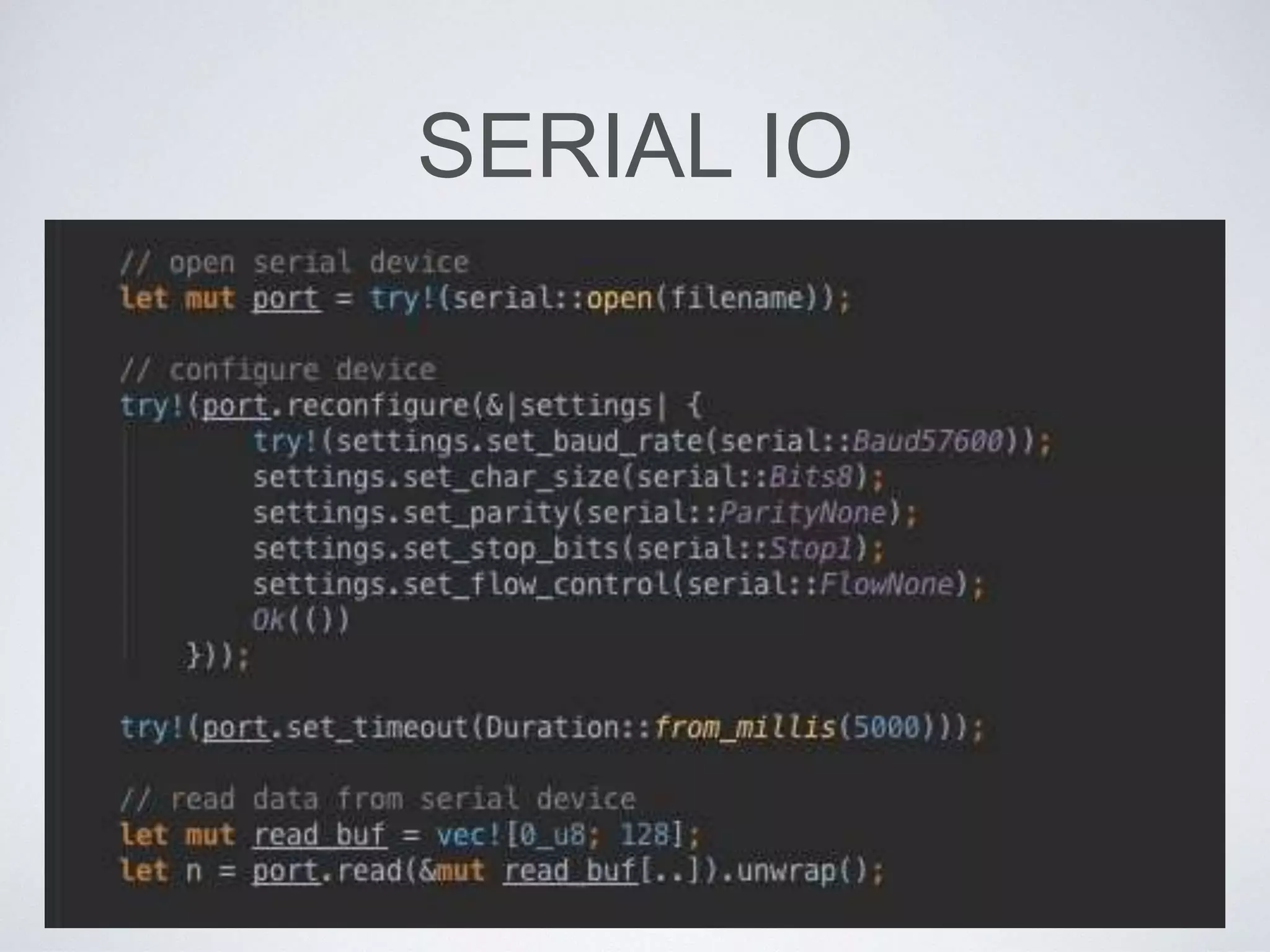
• serial-rs crate makes it easy to configure baud rate,
parity, etc
• Use std::io::Read and std::io::Write to interact with
device
SERIAL IO
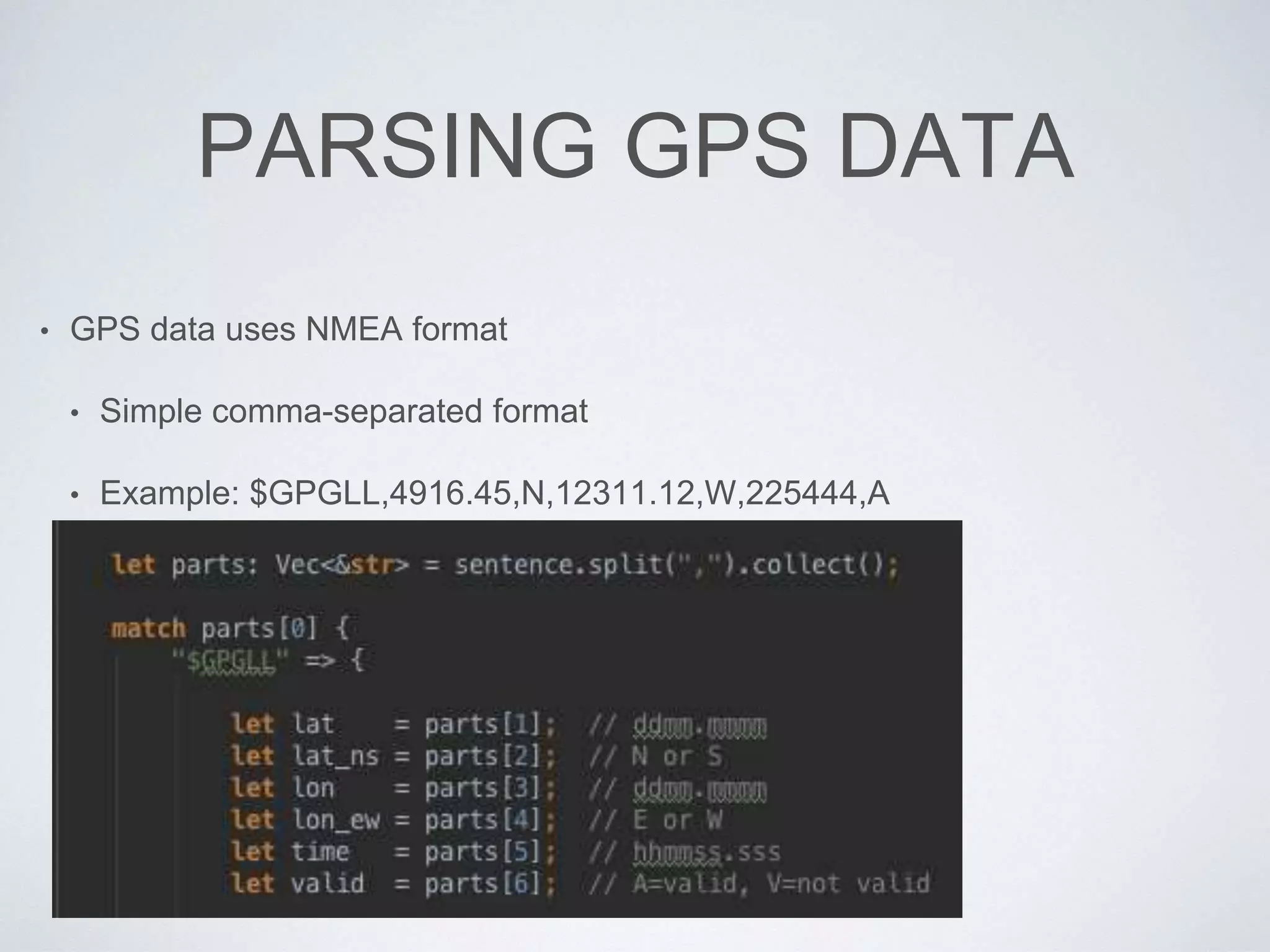
PARSING GPS DATA
• GPS data uses NMEA format
• Simple comma-separated format
• Example: $GPGLL,4916.45,N,12311.12,W,225444,A
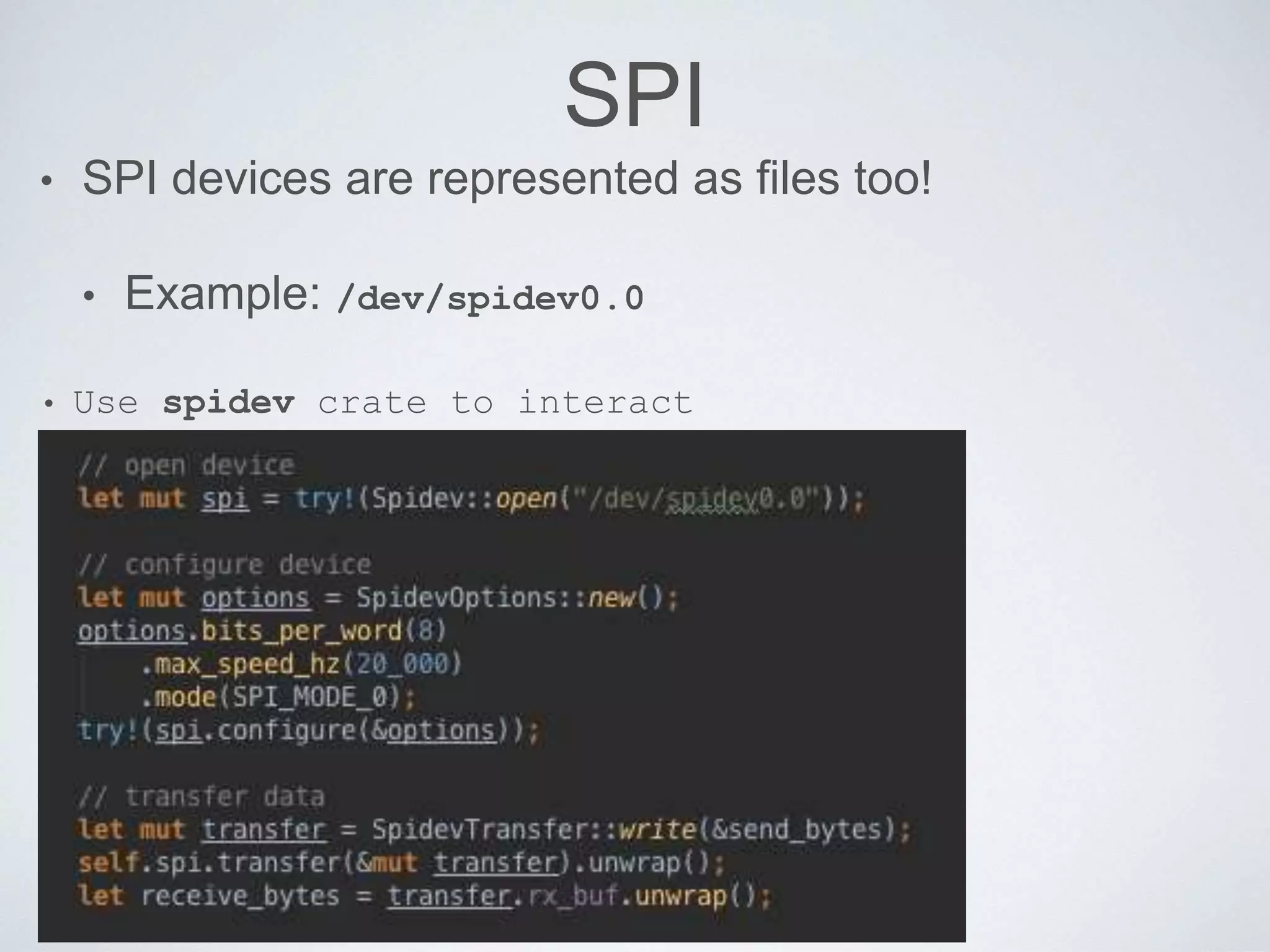
SPI
• SPI devices are represented as files too!
• Example: /dev/spidev0.0
• Use spidev crate to interact
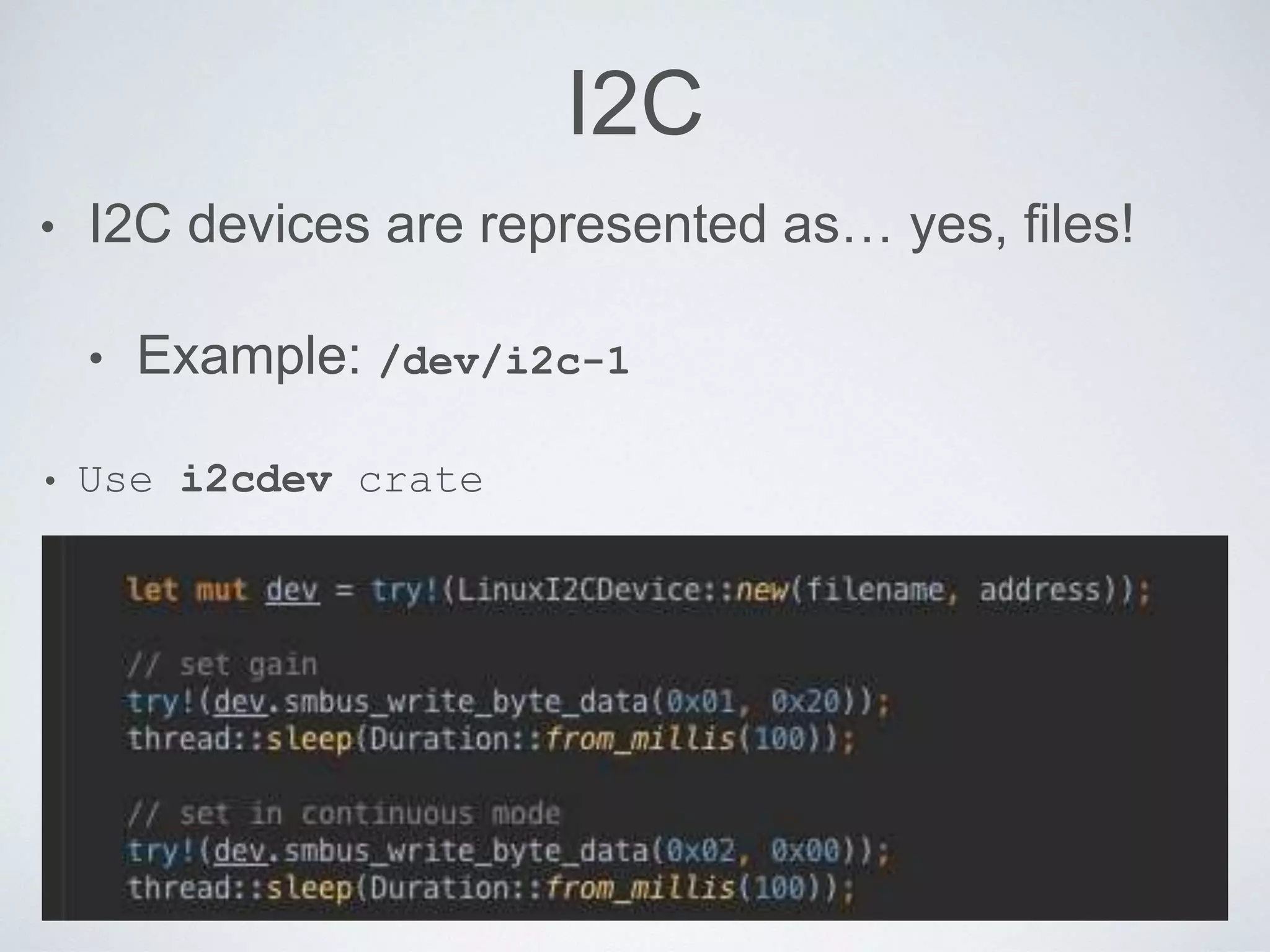
I2C
• I2C devices are represented as… yes, files!
• Example: /dev/i2c-1
• Use i2cdev crate
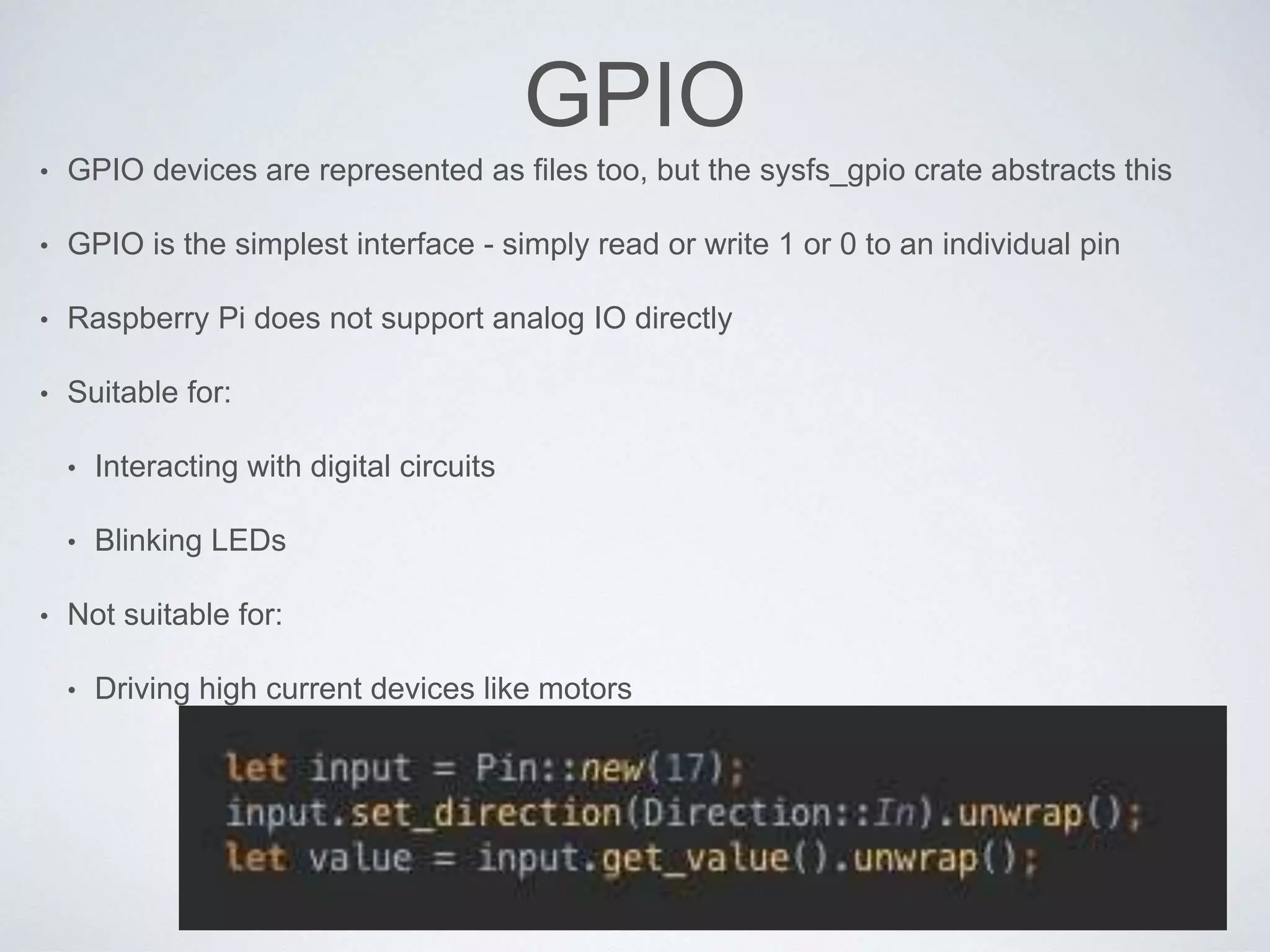
GPIO
• GPIO devices are represented as files too, but the sysfs_gpio crate abstracts this
• GPIO is the simplest interface - simply read or write 1 or 0 to an individual pin
• Raspberry Pi does not support analog IO directly
• Suitable for:
• Interacting with digital circuits
• Blinking LEDs
• Not suitable for:
• Driving high current devices like motors
CALLING C CODE
USING FFI
OPENCV
AUGMENTING VIDEO
DEMO
SPARKFUN AVC PRACTICE
https://www.youtube.com/watch?v=IaBiMtyEZOs
WHAT WENT WRONG?
• Ultrasonic sensors aren’t fantastic at detecting hay bales,
especially at an oblique angle
• LIDAR would have been better, but also more $$
• Magnetometer (compass) was not correctly calibrated and
I also hadn’t accounted for magnetic declination (8
degrees!)
• Four weeks wasn’t quite long enough for this project
• But I learned a lot!
RUST/PI CHALLENGES
• Compilation is SLOW on the Pi
• Splitting project into multiple crates helps a lot
• Incremental compilation will be here soon
• Compilation on the Mac natively is not possible since the libraries are
Linux-specific
• Cross-compiling is a pain to set up, but probably worth the investment
• Docker can help
• Severe lack of sample code or existing libraries in Rust for any sensors,
so you have to write your own (using Arduino libraries as a reference)
RESOURCES
WEB SITES
• For inspiration, tutorials, blogs, parts, visit these sites:
• sparkfun.com
• adafruit.com
• instructables.com
• hackaday.com
• make.com
• tindie.com
MAKER COMMUNITY
• Local maker spaces
• Solid State Depot (Boulder)
• The Gizmo Dojo (Broomfield)
• Tinkermill (Longmont)
• Mini Maker Faires
• NoCo Mini Maker Faire (Loveland) - October 8/9
• Denver Mini Maker Faire - Summer 2017
QUESTIONS?
• Source code
• https://github.com/andygrove/rust-avc
• Contact
• Twitter: @andygrove73
• Email: andy.grove@agildata.com
• Blog: http://theotherandygrove.com

Rust is for Robots!

  • 1.
    RUST IS FORROBOTS Building an autonomous vehicle with Rust and the Raspberry Pi Andy Grove - Boulder/Denver Rust Meetup - 9/21/16
  • 2.
  • 3.
    ABOUT ME • Co-Founder& Chief Architect @ AgilData • Started in C++, then 20 years Java, now Scala & Rust • AgilData is building its next product in Rust • Also offering Rust consultancy and project kick-start services • I enjoy being a “Maker” in my spare time • Digital electronics, robotics, 3D printing, woodworking, etc, etc.
  • 4.
  • 5.
    WHY THIS PROJECT? •I was inspired by the last Rust meetup and I agreed to give a talk at this one • Sparkfun Autonomous Vehicle Competition (AVC) was coming up • This was a great opportunity for me to learn about using Rust on the Raspberry Pi and get to share that knowledge • And four weeks was plenty of time, right?
  • 6.
    OBJECTIVES • Navigate topre-determined waypoints (GPS co-ordinates) • Using GPS and compass to determine location and heading • Change speed of left/right motors to control movement • Avoid obstacles • Using ultra-sonic sensors to detect distance to objects • Record instrumented video • Essential for debugging
  • 7.
  • 8.
    DIGITAL IO INTERFACES •GPIO - General Purpose IO • Turning pins on and off, or reading high/low inputs from pins • SPI - Serial Peripheral Interface • Four wire interface (MISO, MOSI, SCLK + dedicated SS per slave) • I2C - Inter-Integrated Circuit (pronounced I-squared-C) • Two wire interface (SDA - Serial Data & SCL - Serial Clock) • Each device has unique 7-bit address • Serial • Familiar to most of use - same as file or network i/o
  • 9.
    WHY RASPBERRY PI? •Great support for Linux (Raspbian) • Designed for hacking hardware • Hardware support for GPIO, SPI, and I2C • Support for webcams and video processing (with GPU acceleration) • USB makes it easy to connect to serial devices • Built-in WiFi • All this for $35 !
  • 10.
  • 11.
    WHY RUST?• Betterperformance than Java or scripting languages (assumption) • Safe language - nobody wants their robot to fail with a segmentation fault or null pointer exception • Crates already exist for interfacing with GPIO, SPI, I2C and Serial • Rust is natively supported on the Pi using rustup.rs • Easy to call existing C libraries such as OpenCV with zero overhead
  • 12.
    SERIAL IO • Linuxpresents serial IO devices as files e.g. /dev/ttyUSB0 • Use udev rules to map to convenient names e.g. /dev/gps • USB-Serial adapter required to connect to serial devices • serial-rs crate makes it easy to configure baud rate, parity, etc • Use std::io::Read and std::io::Write to interact with device
  • 13.
  • 14.
    PARSING GPS DATA •GPS data uses NMEA format • Simple comma-separated format • Example: $GPGLL,4916.45,N,12311.12,W,225444,A
  • 15.
    SPI • SPI devicesare represented as files too! • Example: /dev/spidev0.0 • Use spidev crate to interact
  • 16.
    I2C • I2C devicesare represented as… yes, files! • Example: /dev/i2c-1 • Use i2cdev crate
  • 17.
    GPIO • GPIO devicesare represented as files too, but the sysfs_gpio crate abstracts this • GPIO is the simplest interface - simply read or write 1 or 0 to an individual pin • Raspberry Pi does not support analog IO directly • Suitable for: • Interacting with digital circuits • Blinking LEDs • Not suitable for: • Driving high current devices like motors
  • 18.
  • 19.
  • 20.
  • 21.
  • 22.
  • 23.
    WHAT WENT WRONG? •Ultrasonic sensors aren’t fantastic at detecting hay bales, especially at an oblique angle • LIDAR would have been better, but also more $$ • Magnetometer (compass) was not correctly calibrated and I also hadn’t accounted for magnetic declination (8 degrees!) • Four weeks wasn’t quite long enough for this project • But I learned a lot!
  • 24.
    RUST/PI CHALLENGES • Compilationis SLOW on the Pi • Splitting project into multiple crates helps a lot • Incremental compilation will be here soon • Compilation on the Mac natively is not possible since the libraries are Linux-specific • Cross-compiling is a pain to set up, but probably worth the investment • Docker can help • Severe lack of sample code or existing libraries in Rust for any sensors, so you have to write your own (using Arduino libraries as a reference)
  • 25.
  • 26.
    WEB SITES • Forinspiration, tutorials, blogs, parts, visit these sites: • sparkfun.com • adafruit.com • instructables.com • hackaday.com • make.com • tindie.com
  • 27.
    MAKER COMMUNITY • Localmaker spaces • Solid State Depot (Boulder) • The Gizmo Dojo (Broomfield) • Tinkermill (Longmont) • Mini Maker Faires • NoCo Mini Maker Faire (Loveland) - October 8/9 • Denver Mini Maker Faire - Summer 2017
  • 28.
    QUESTIONS? • Source code •https://github.com/andygrove/rust-avc • Contact • Twitter: @andygrove73 • Email: andy.grove@agildata.com • Blog: http://theotherandygrove.com