Rust Intro
by Artur Gavkaliuk
Mozilla
The language grew out of a personal project by Mozilla employee Graydon Hoare.
Mozilla began sponsoring the project in 2009 and announced it in 2010. The same
year, work shifted from the initial compiler (written in OCaml) to the self-hosting
compiler written in Rust. Known as rustc, it successfully compiled itself in 2011.
rustc uses LLVM as its back end.
Safe, concurrent, practical language
Rust is a general-purpose, multi-paradigm, compiled programming language.
It is designed to be a "safe, concurrent, practical language", supporting pure-
functional, imperative-procedural, and object-oriented styles.
Object oriented
Structs
Enums
Method Syntax
Generics
Traits
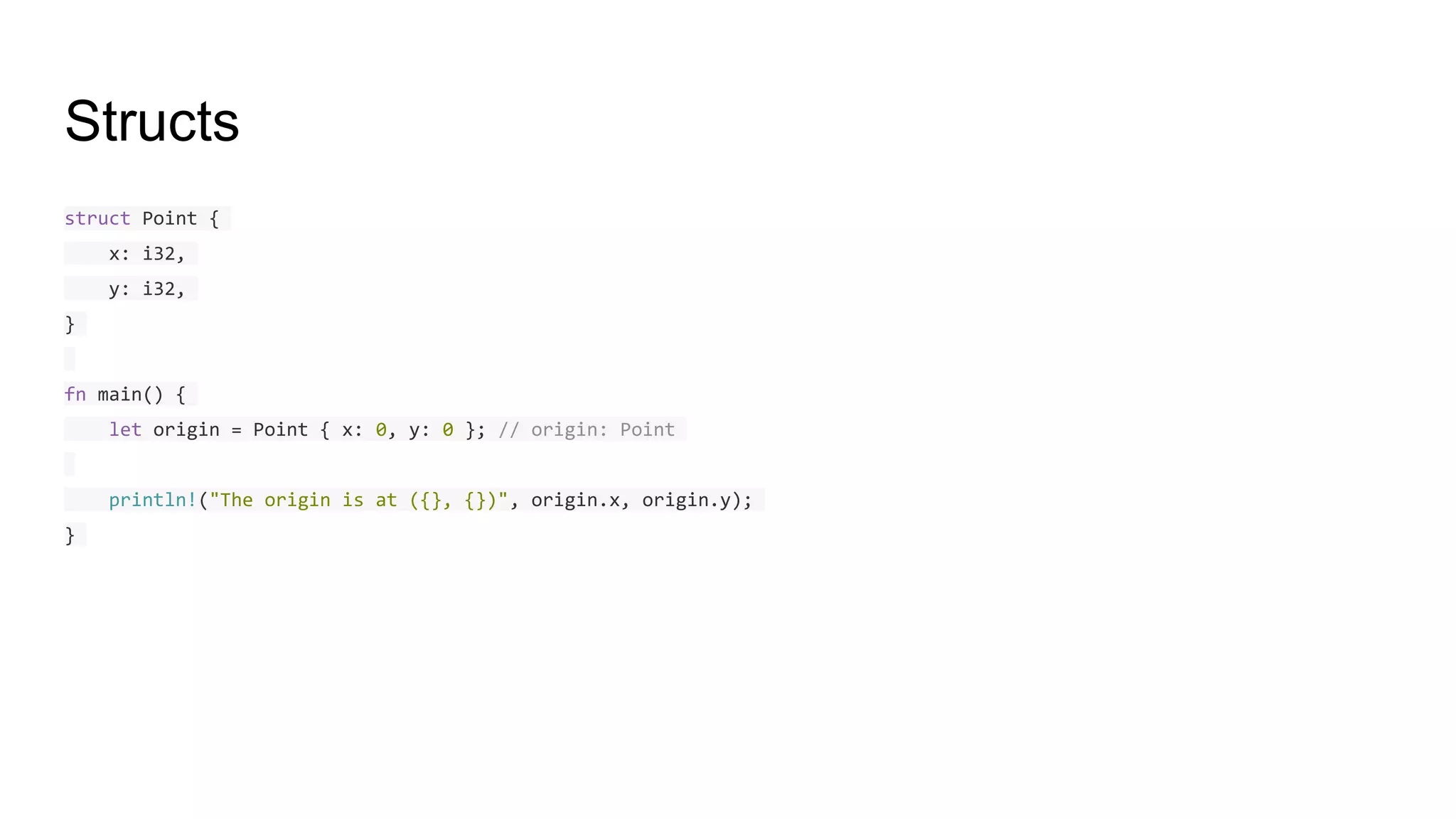
Structs
struct Point {
x: i32,
y: i32,
}
fn main() {
let origin = Point { x: 0, y: 0 }; // origin: Point
println!("The origin is at ({}, {})", origin.x, origin.y);
}
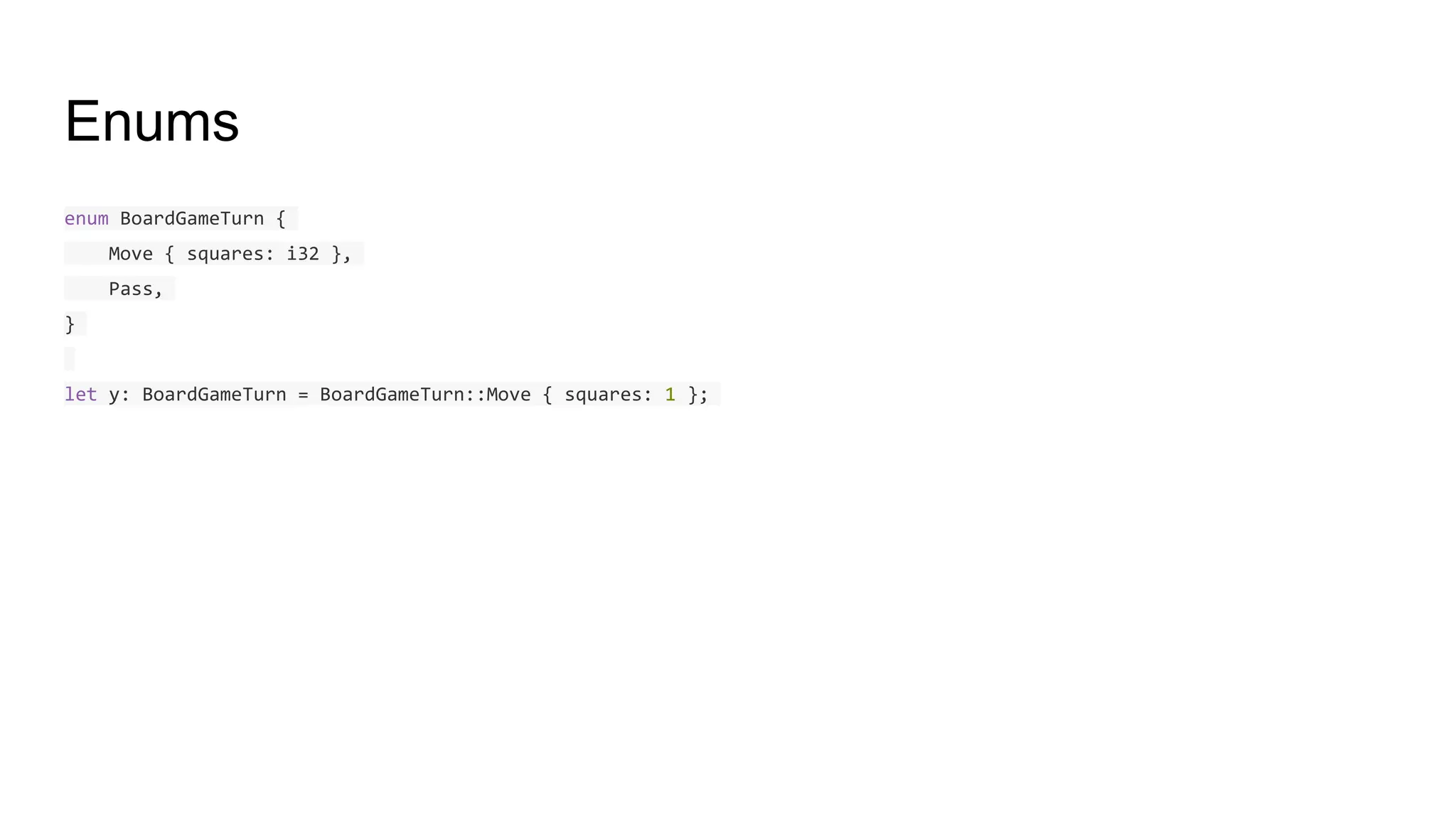
Enums
enum BoardGameTurn {
Move { squares: i32 },
Pass,
}
let y: BoardGameTurn = BoardGameTurn::Move { squares: 1 };
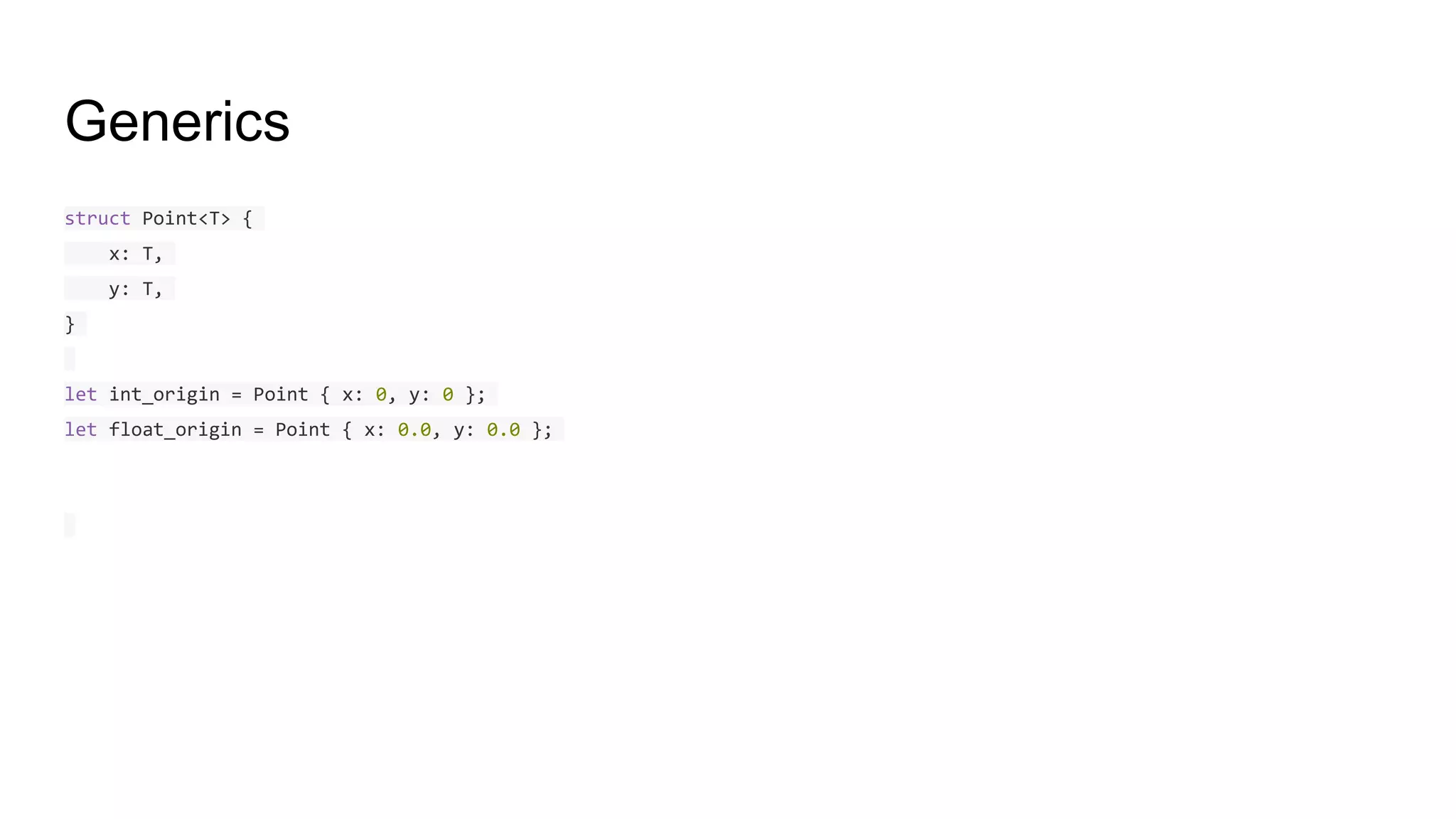
Generics
struct Point<T> {
x: T,
y: T,
}
let int_origin = Point { x: 0, y: 0 };
let float_origin = Point { x: 0.0, y: 0.0 };
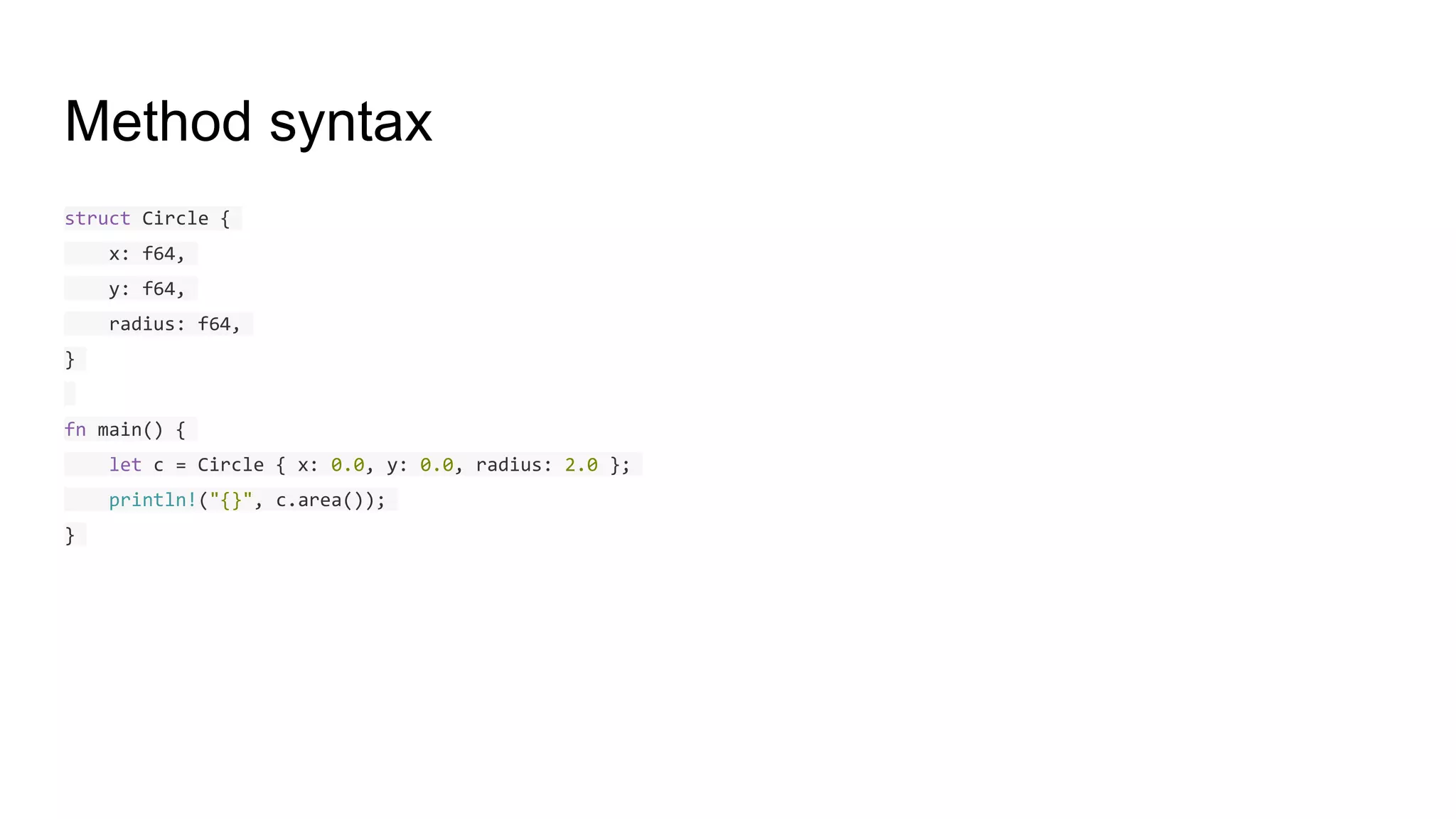
Method syntax
struct Circle {
x: f64,
y: f64,
radius: f64,
}
fn main() {
let c = Circle { x: 0.0, y: 0.0, radius: 2.0 };
println!("{}", c.area());
}
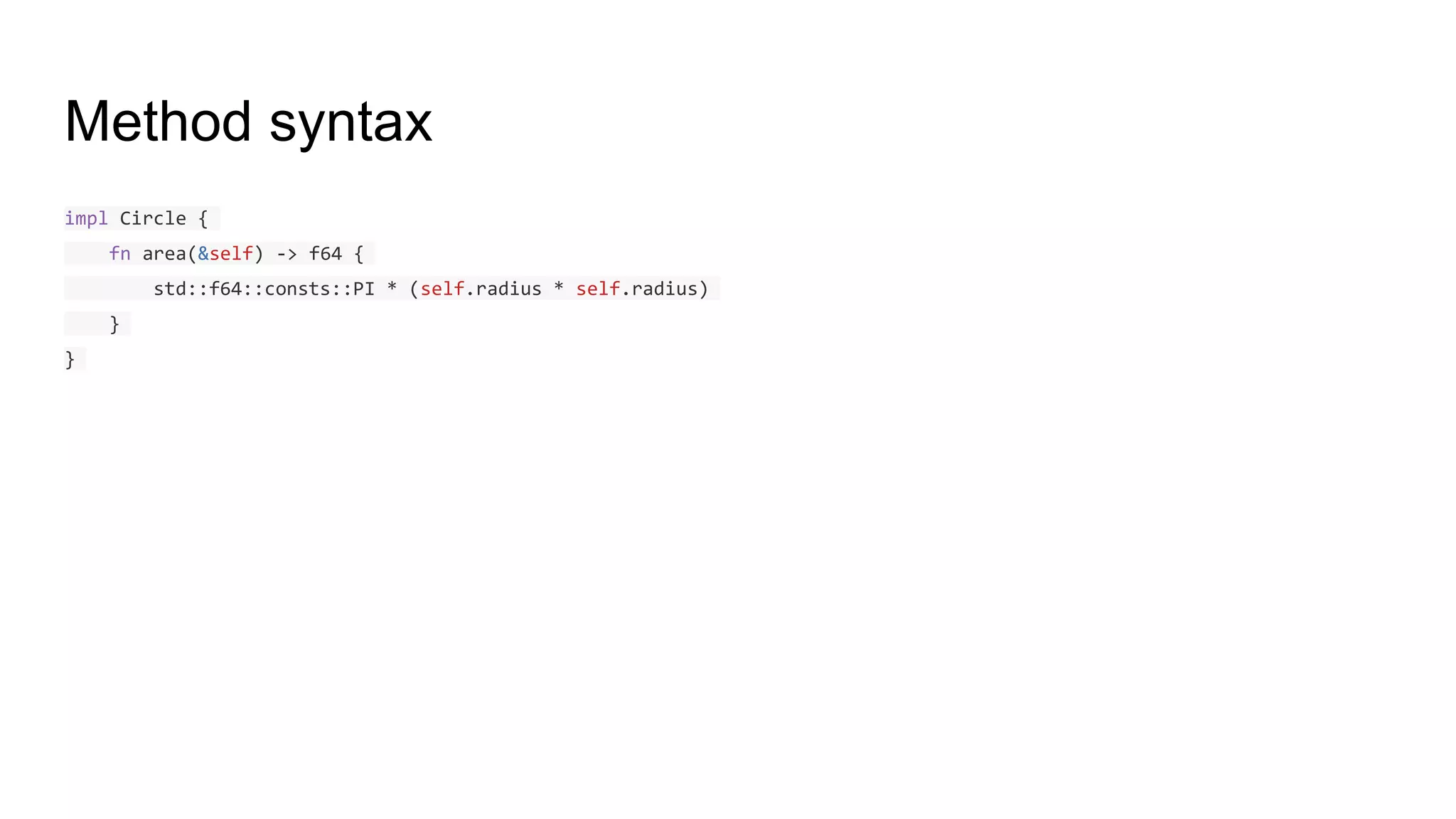
Method syntax
impl Circle {
fn area(&self) -> f64 {
std::f64::consts::PI * (self.radius * self.radius)
}
}
Traits
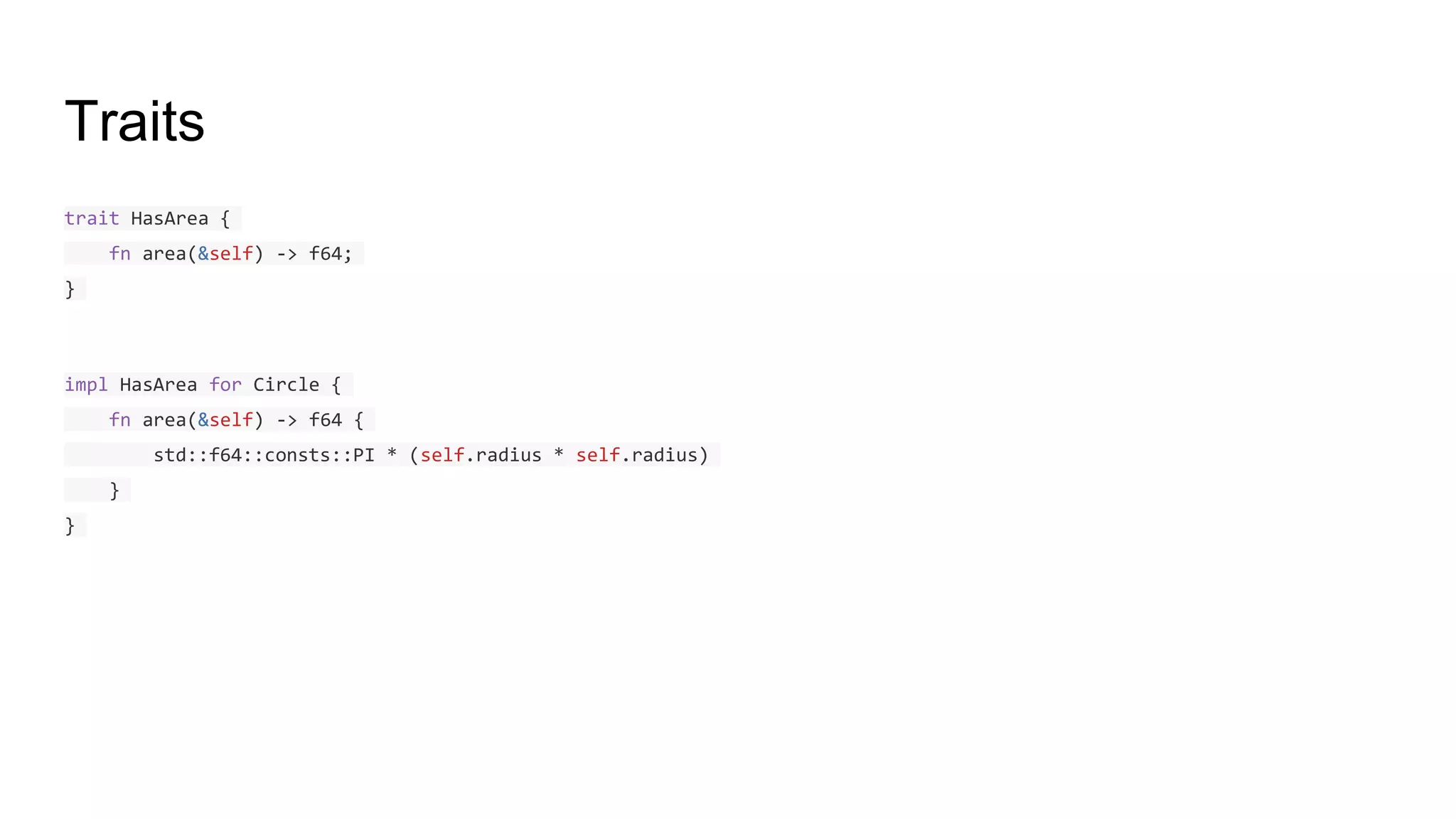
trait HasArea {
fn area(&self) -> f64;
}
impl HasArea for Circle {
fn area(&self) -> f64 {
std::f64::consts::PI * (self.radius * self.radius)
}
}
Traits
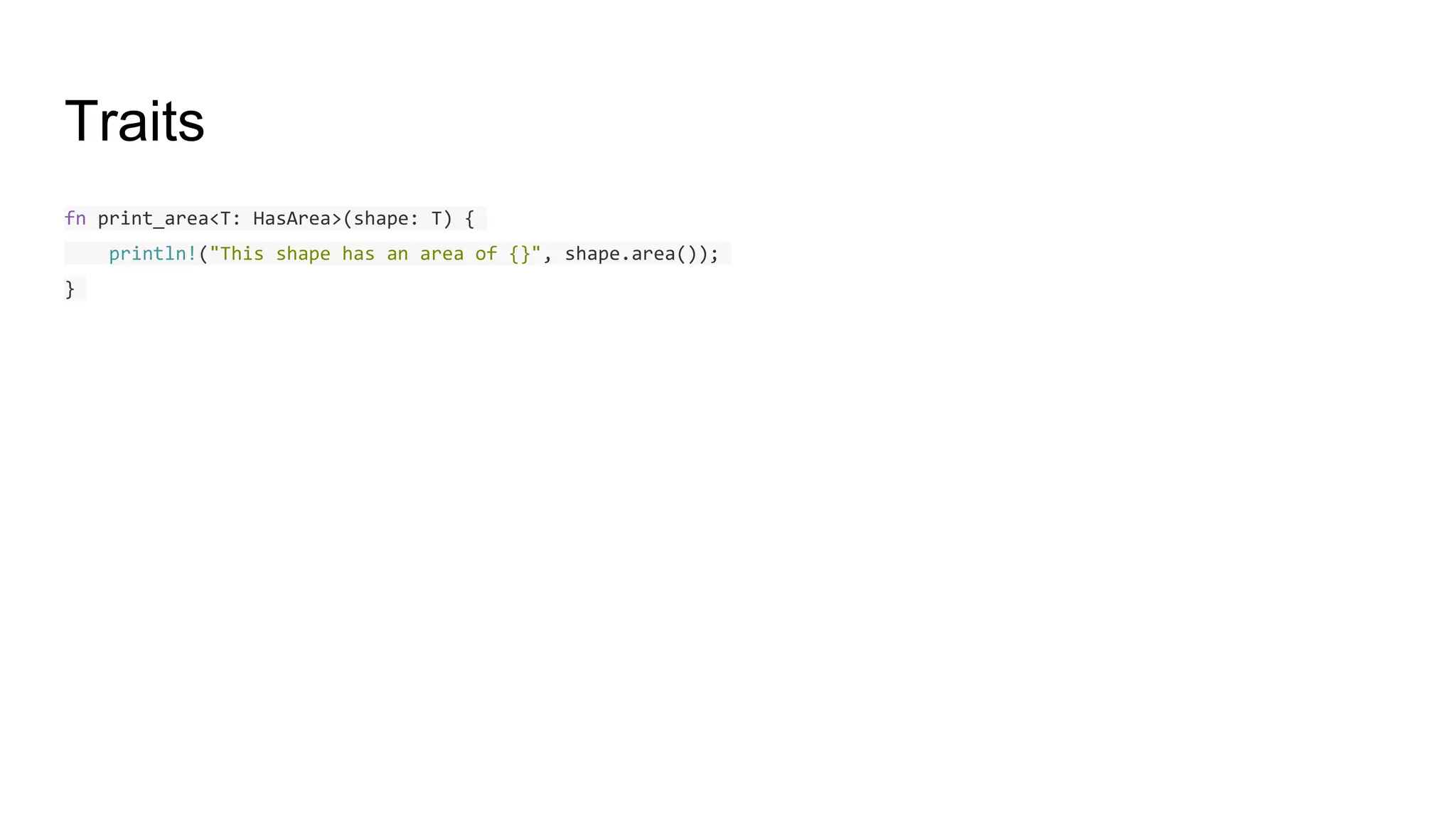
fn print_area<T: HasArea>(shape: T) {
println!("This shape has an area of {}", shape.area());
}
Functional
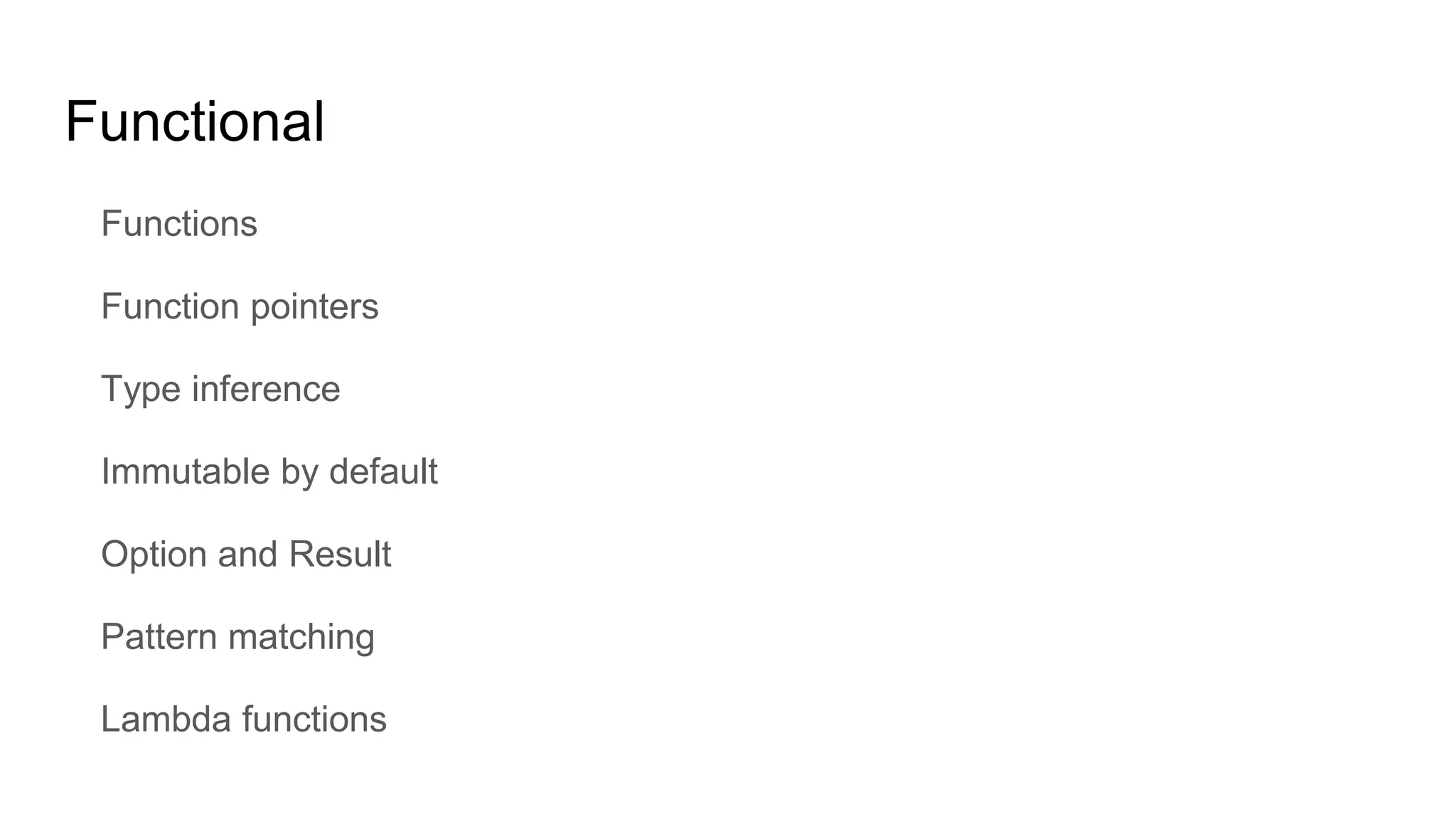
Functions
Function pointers
Type inference
Immutable by default
Option and Result
Pattern matching
Lambda functions
Functions
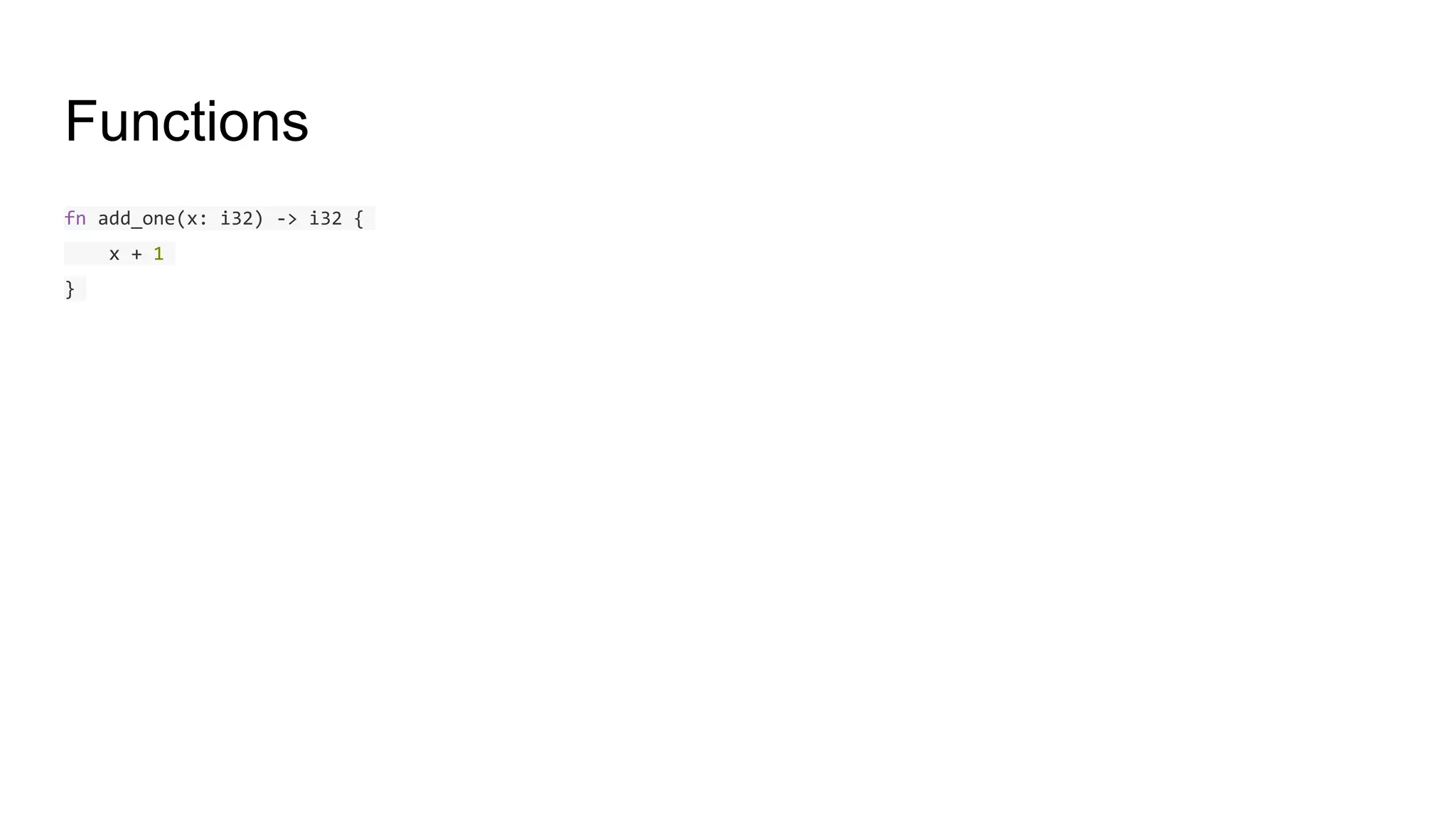
fn add_one(x: i32) -> i32 {
x + 1
}
Functions
fn add_one(x: i32) -> i32 {
x + 1;
}
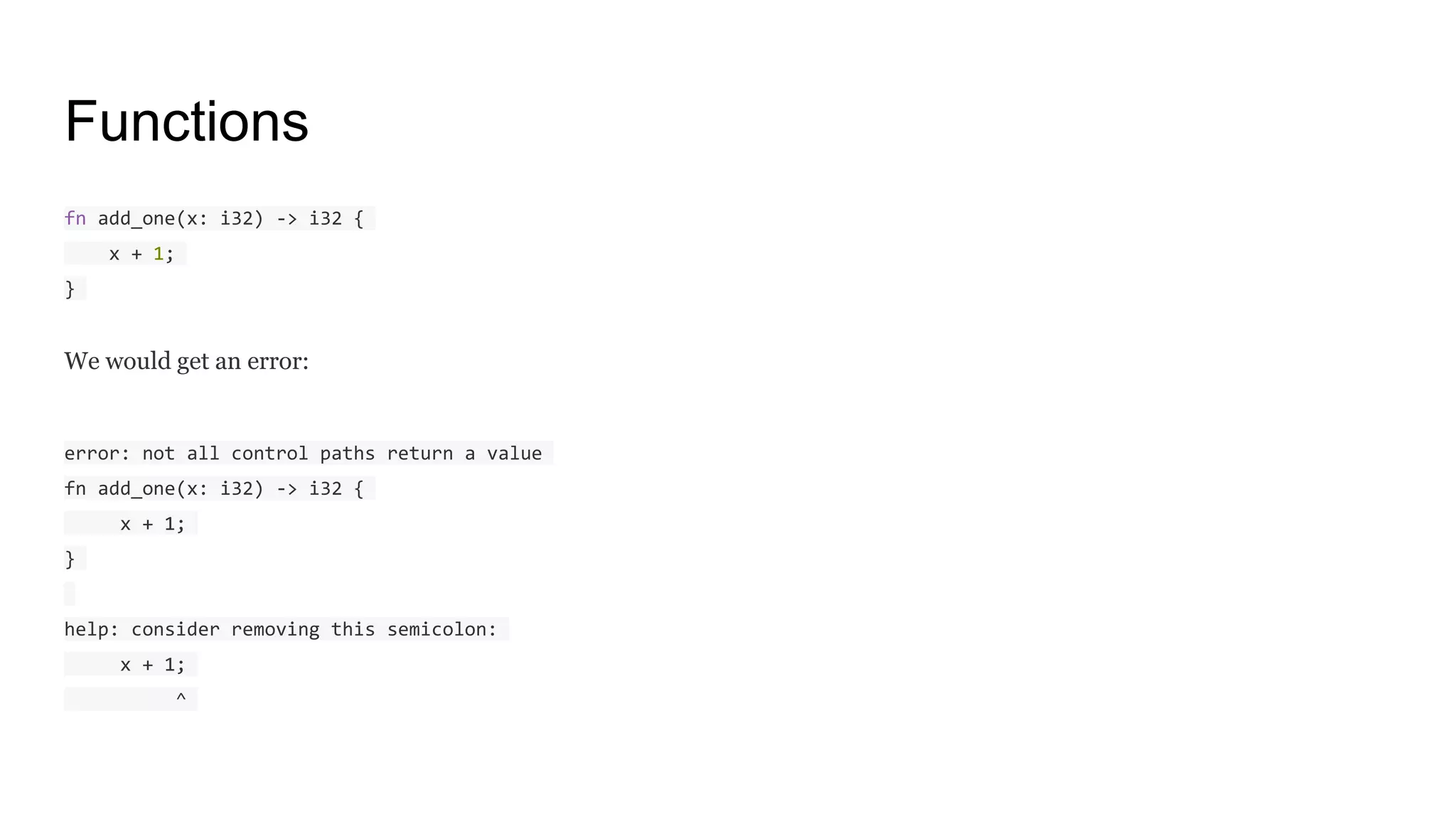
We would get an error:
error: not all control paths return a value
fn add_one(x: i32) -> i32 {
x + 1;
}
help: consider removing this semicolon:
x + 1;
^
Functions
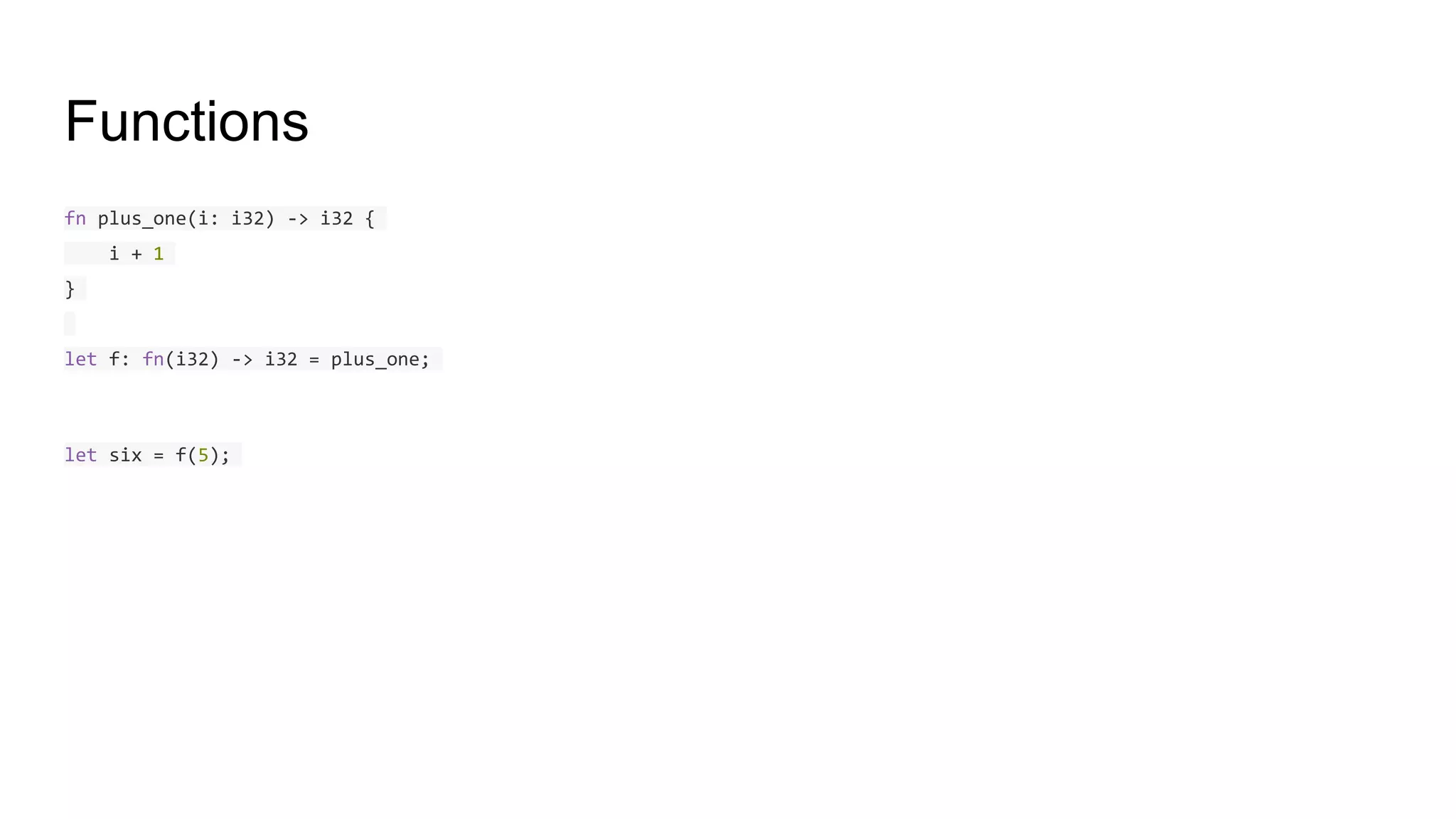
fn plus_one(i: i32) -> i32 {
i + 1
}
let f: fn(i32) -> i32 = plus_one;
let six = f(5);
Type inference
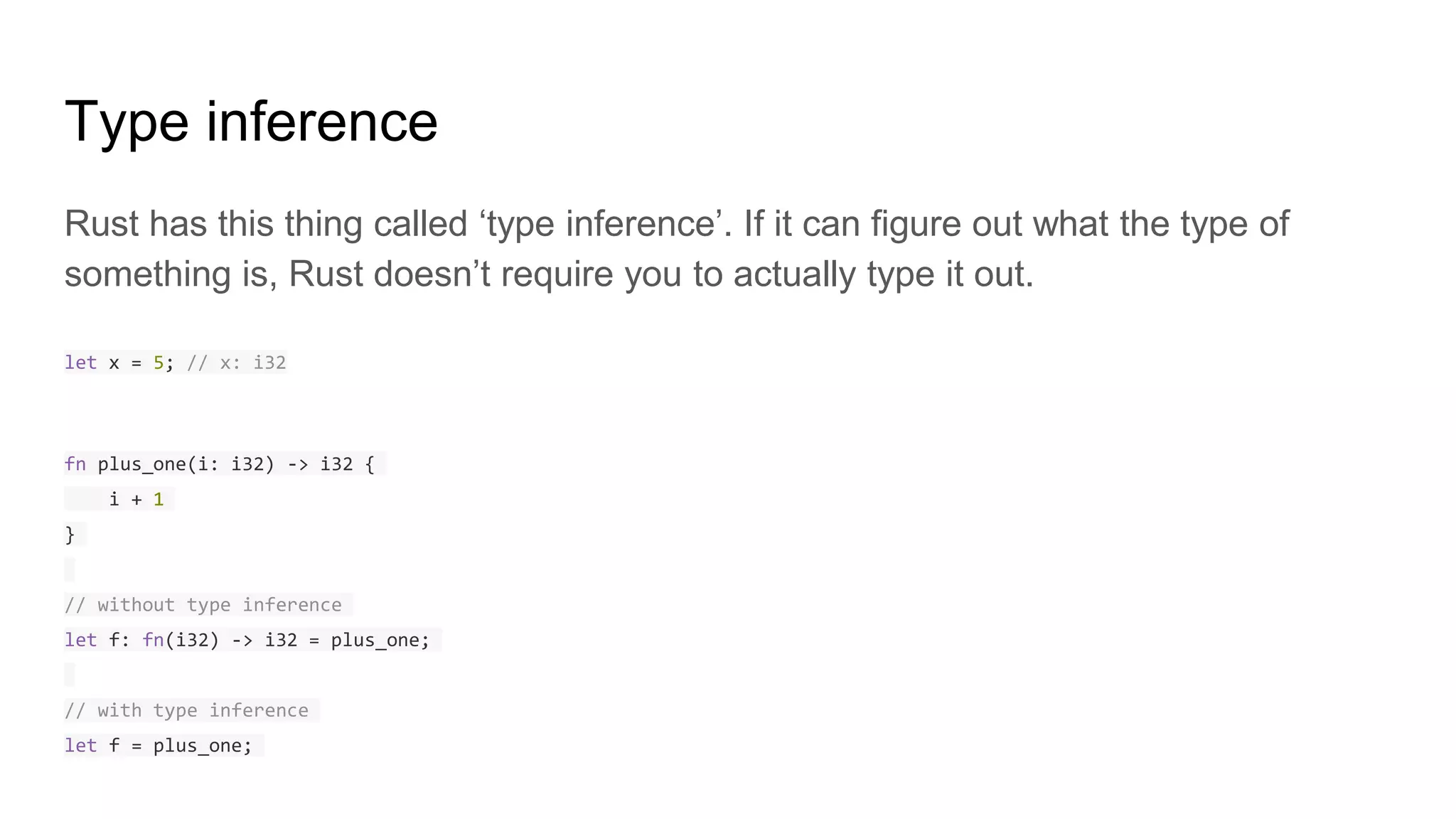
Rust has this thing called ‘type inference’. If it can figure out what the type of
something is, Rust doesn’t require you to actually type it out.
let x = 5; // x: i32
fn plus_one(i: i32) -> i32 {
i + 1
}
// without type inference
let f: fn(i32) -> i32 = plus_one;
// with type inference
let f = plus_one;
Mutability
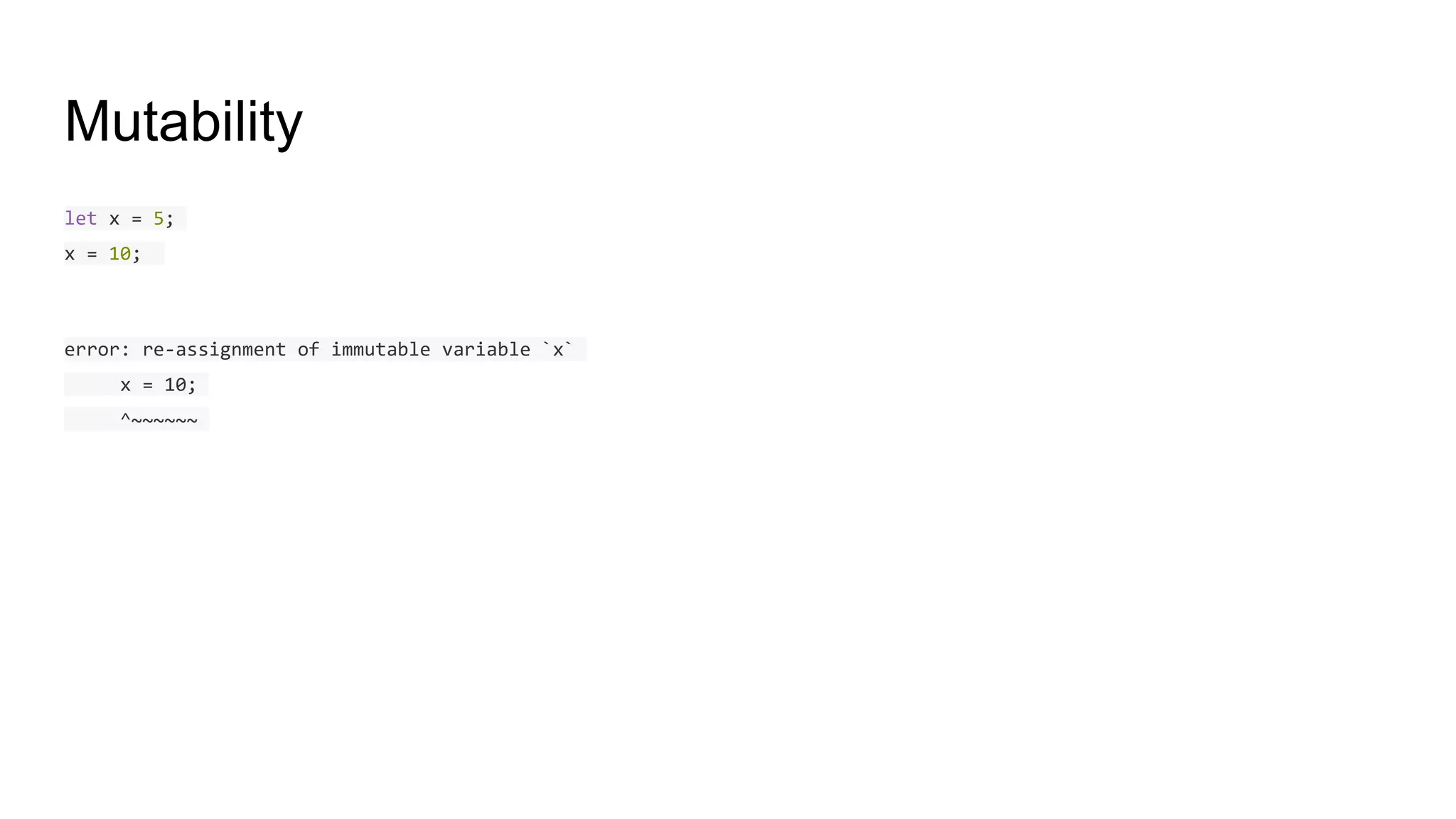
let x = 5;
x = 10;
error: re-assignment of immutable variable `x`
x = 10;
^~~~~~~
Mutability
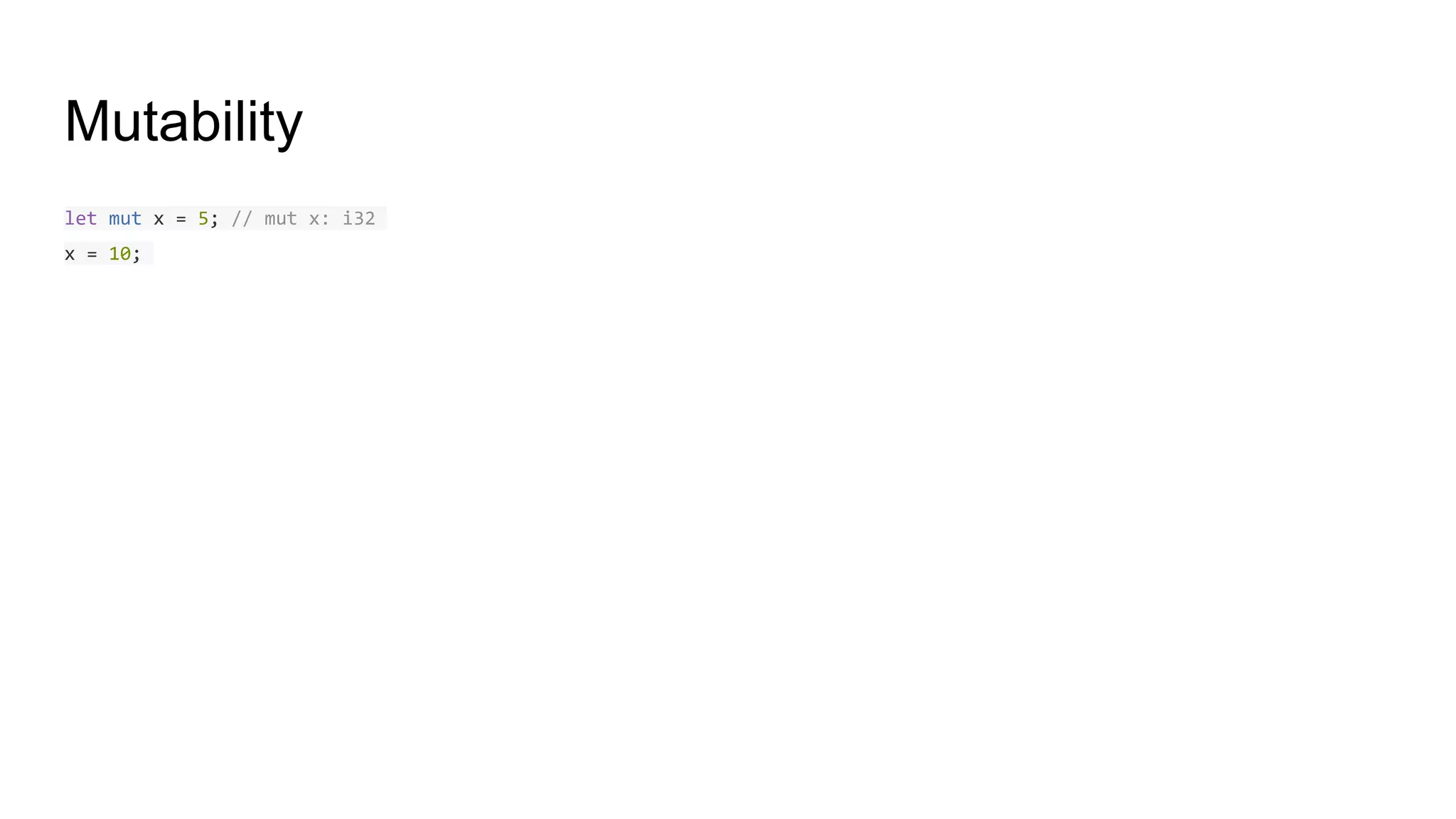
let mut x = 5; // mut x: i32
x = 10;
Option
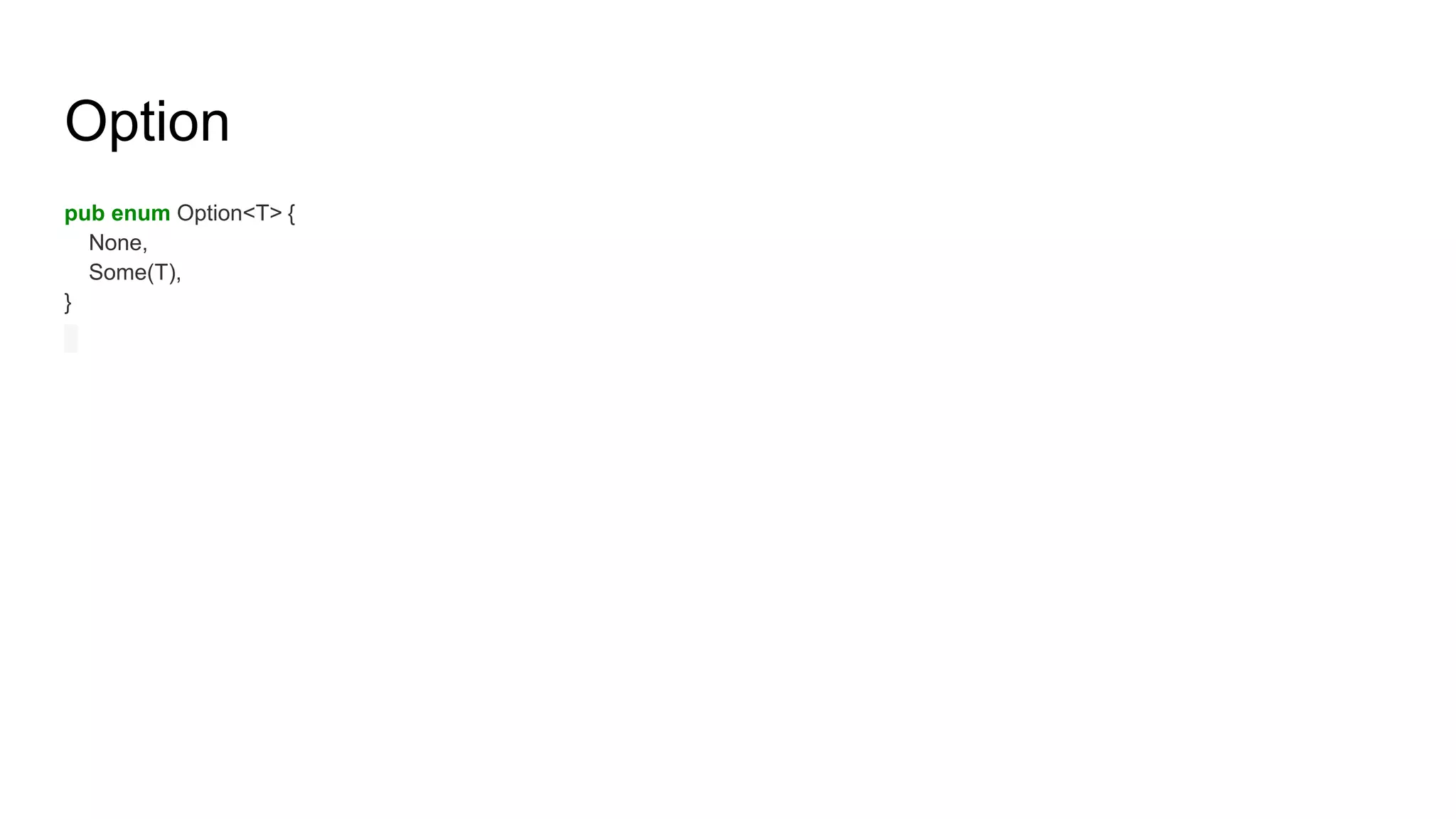
pub enum Option<T> {
None,
Some(T),
}
Option
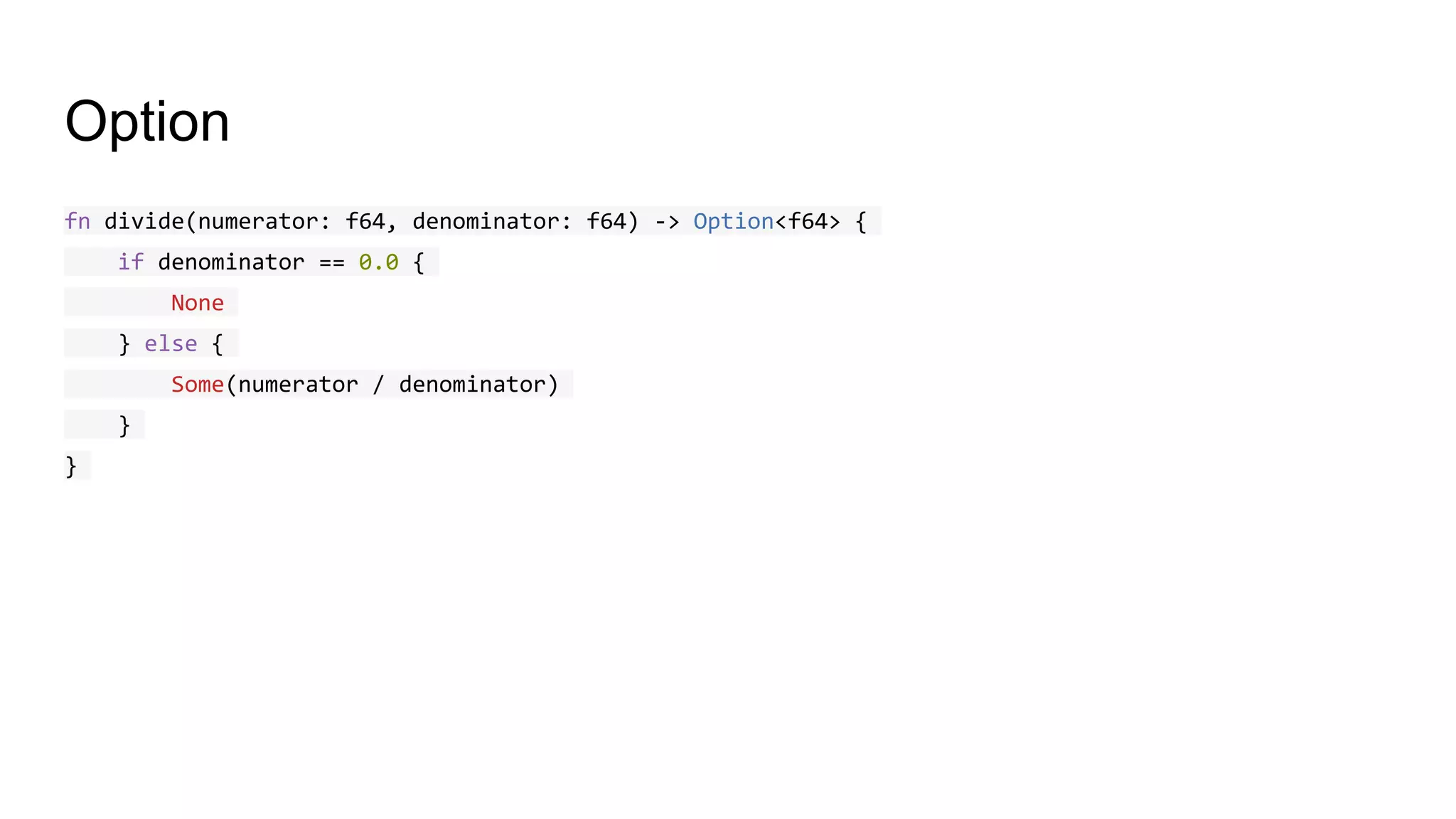
fn divide(numerator: f64, denominator: f64) -> Option<f64> {
if denominator == 0.0 {
None
} else {
Some(numerator / denominator)
}
}
Result
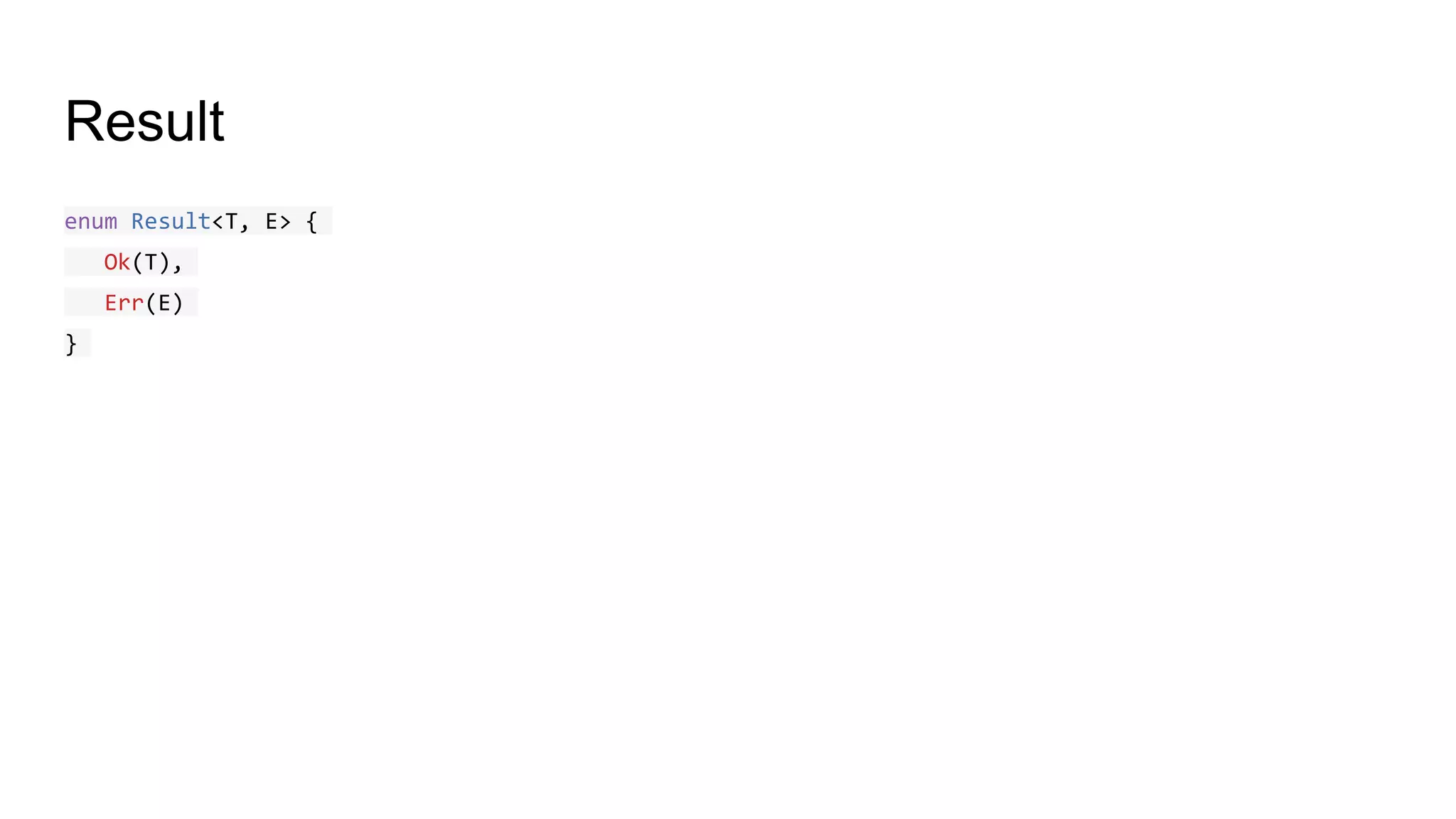
enum Result<T, E> {
Ok(T),
Err(E)
}
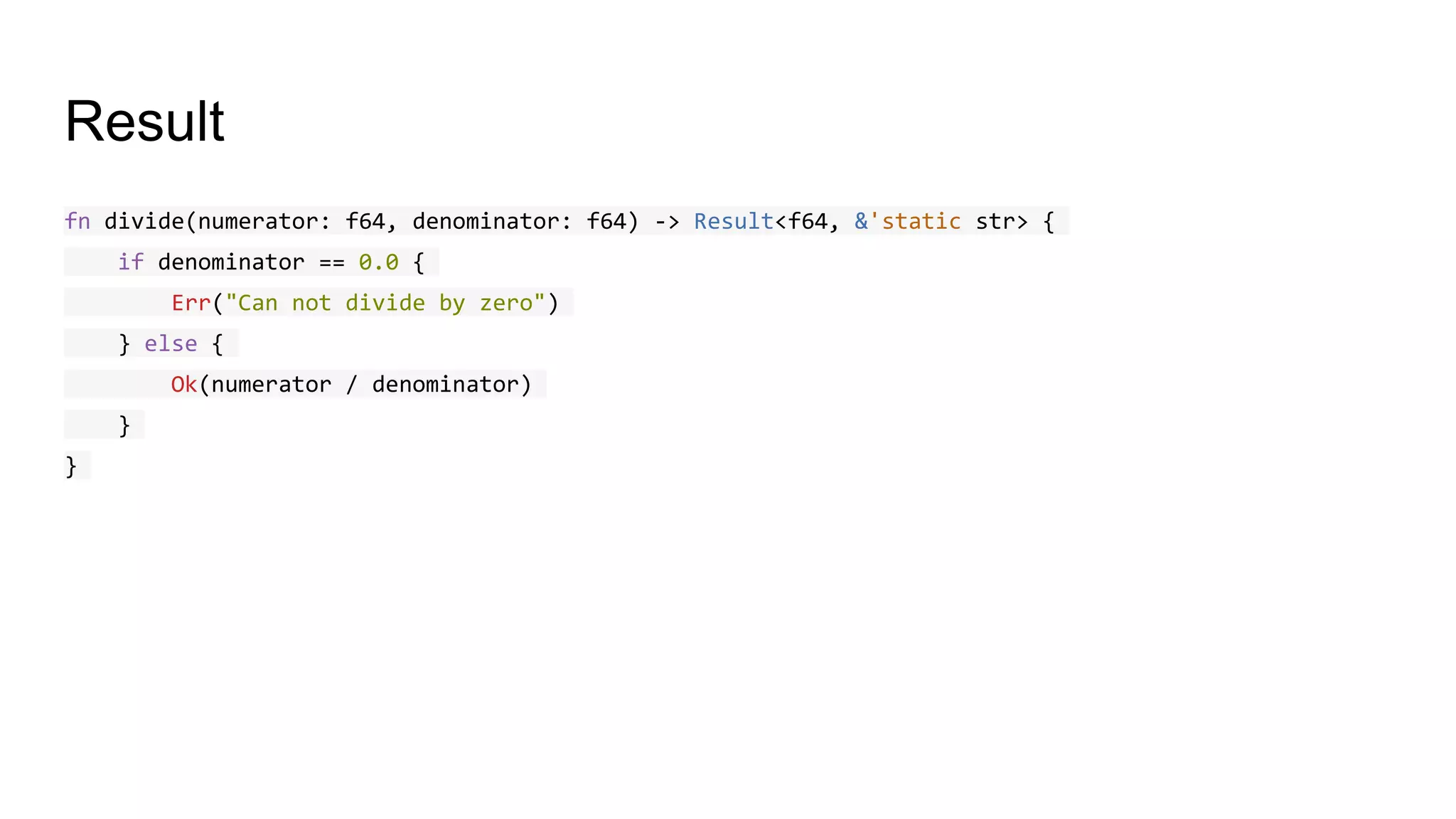
fn divide(numerator: f64, denominator: f64) -> Result<f64, &'static str> {
if denominator == 0.0 {
Err("Can not divide by zero")
} else {
Ok(numerator / denominator)
}
}
Result
Pattern matching
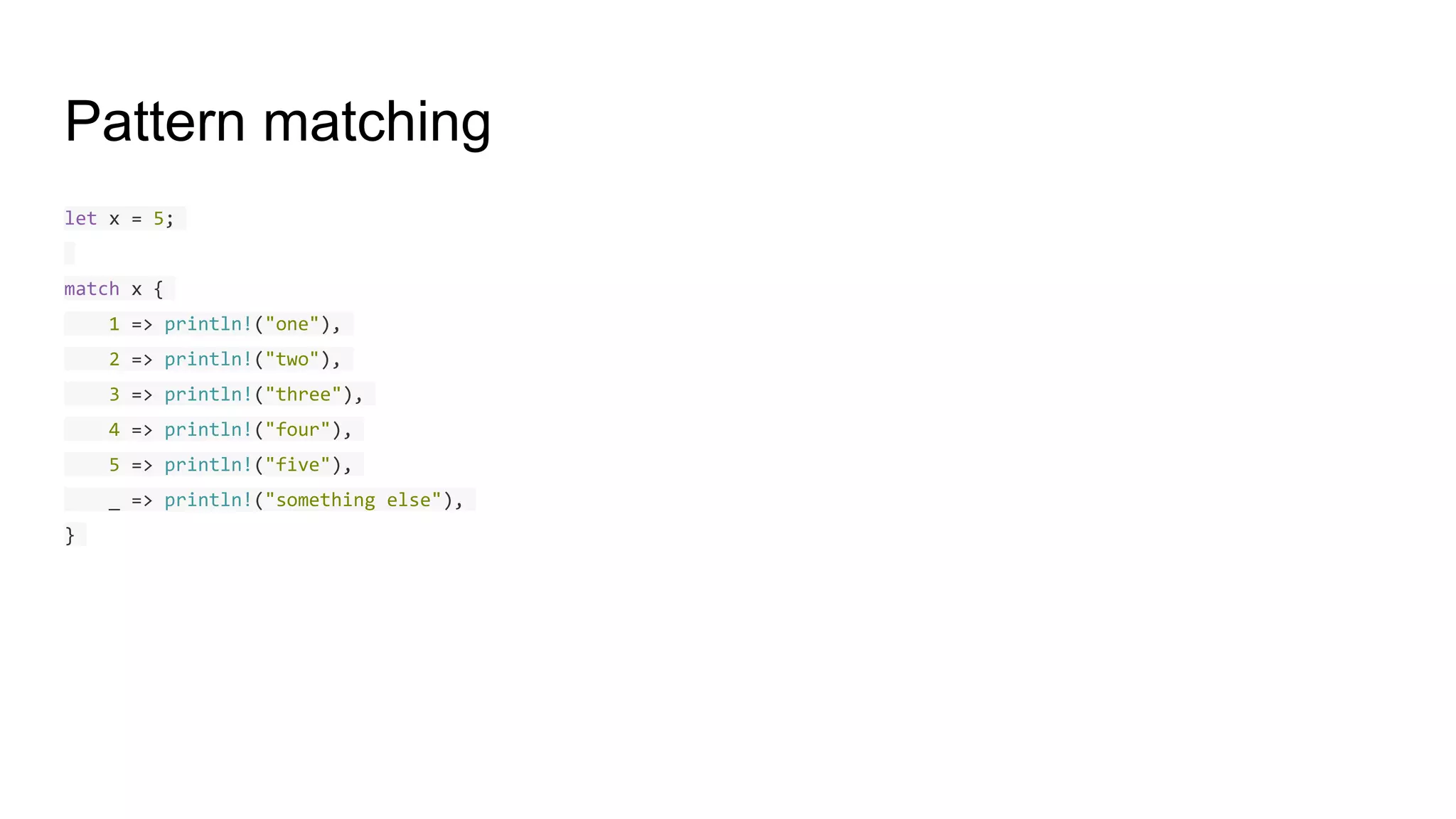
let x = 5;
match x {
1 => println!("one"),
2 => println!("two"),
3 => println!("three"),
4 => println!("four"),
5 => println!("five"),
_ => println!("something else"),
}
Pattern matching
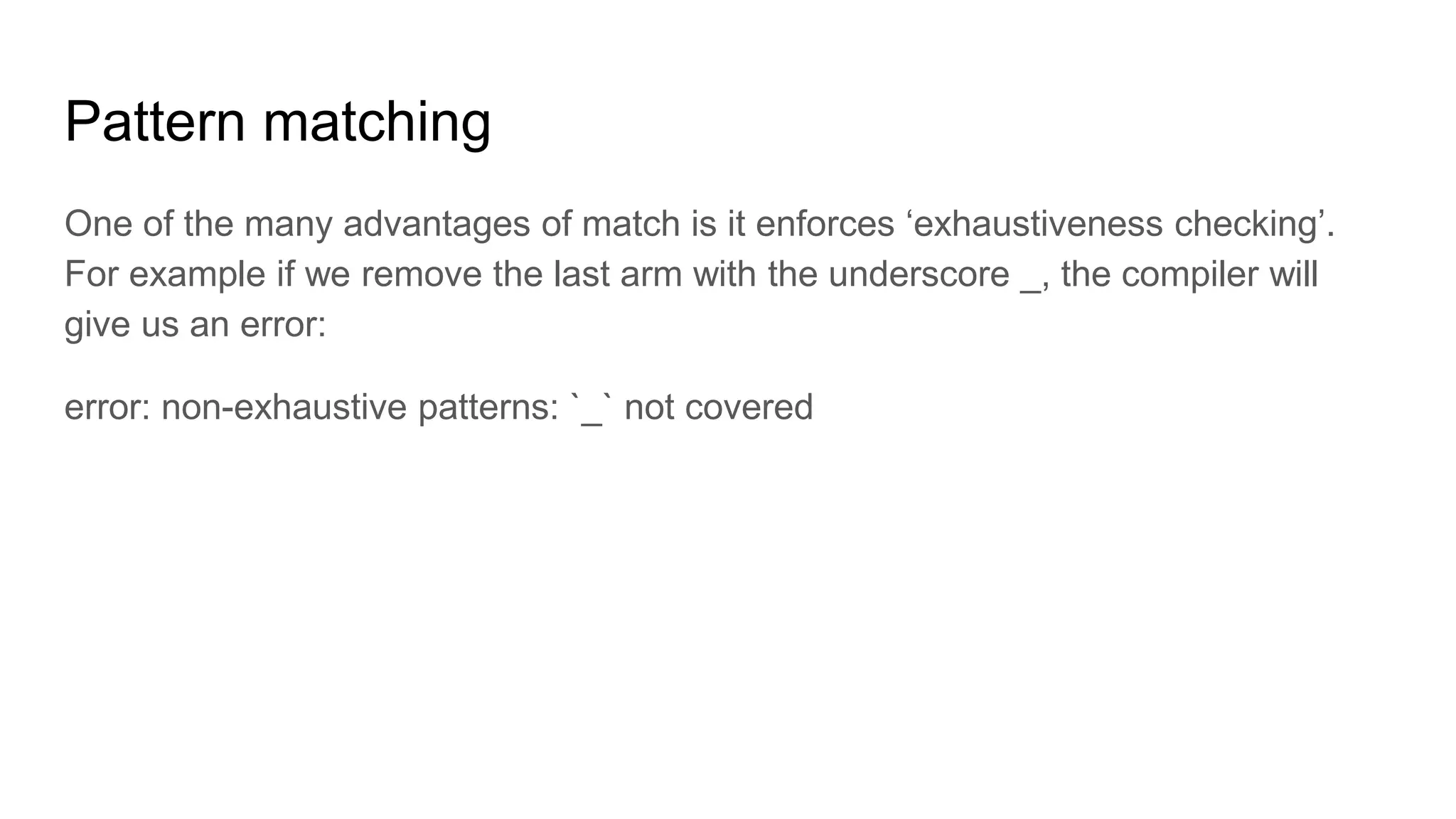
One of the many advantages of match is it enforces ‘exhaustiveness checking’.
For example if we remove the last arm with the underscore _, the compiler will
give us an error:
error: non-exhaustive patterns: `_` not covered
Pattern matching
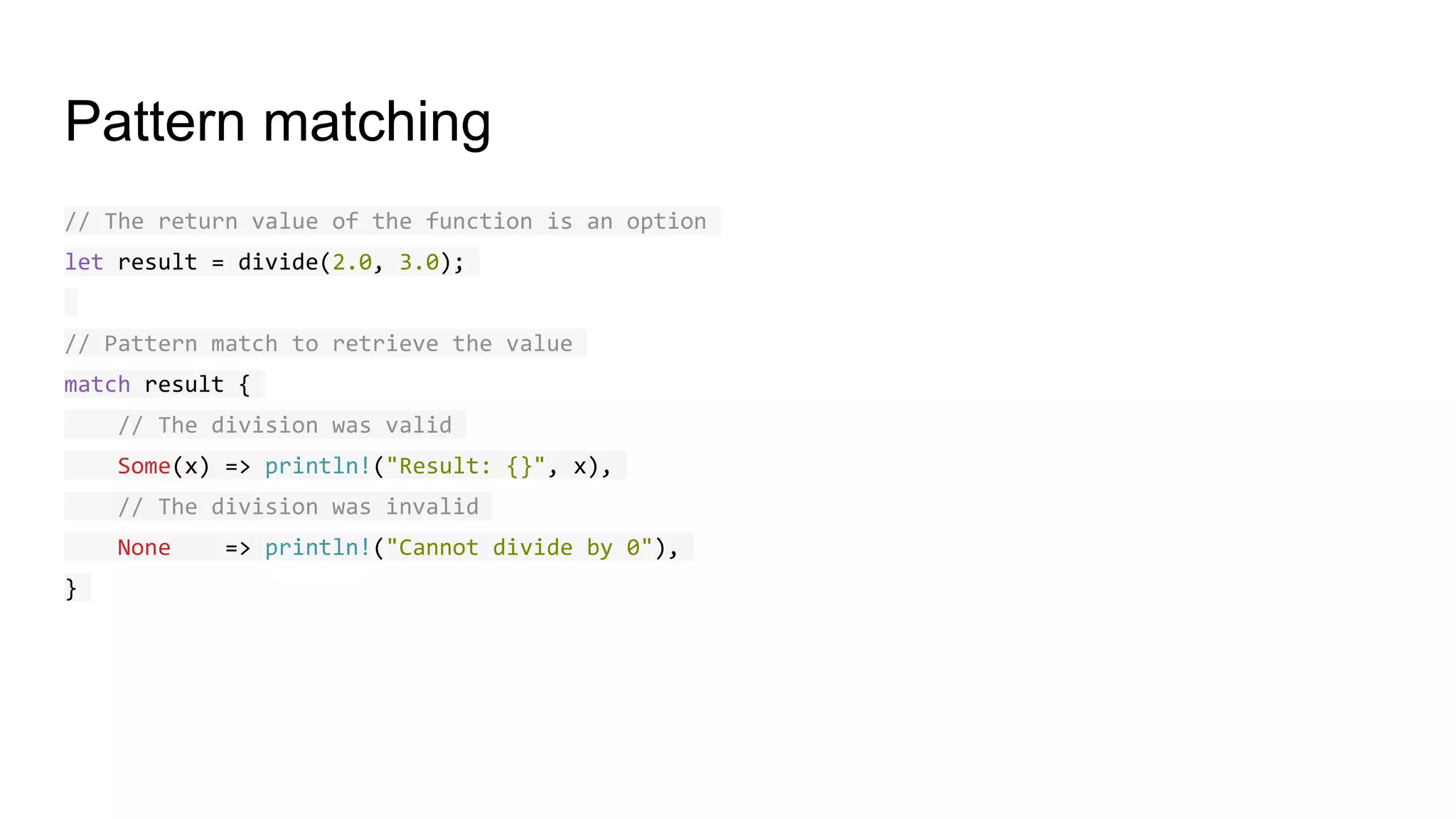
// The return value of the function is an option
let result = divide(2.0, 3.0);
// Pattern match to retrieve the value
match result {
// The division was valid
Some(x) => println!("Result: {}", x),
// The division was invalid
None => println!("Cannot divide by 0"),
}
Pattern matching
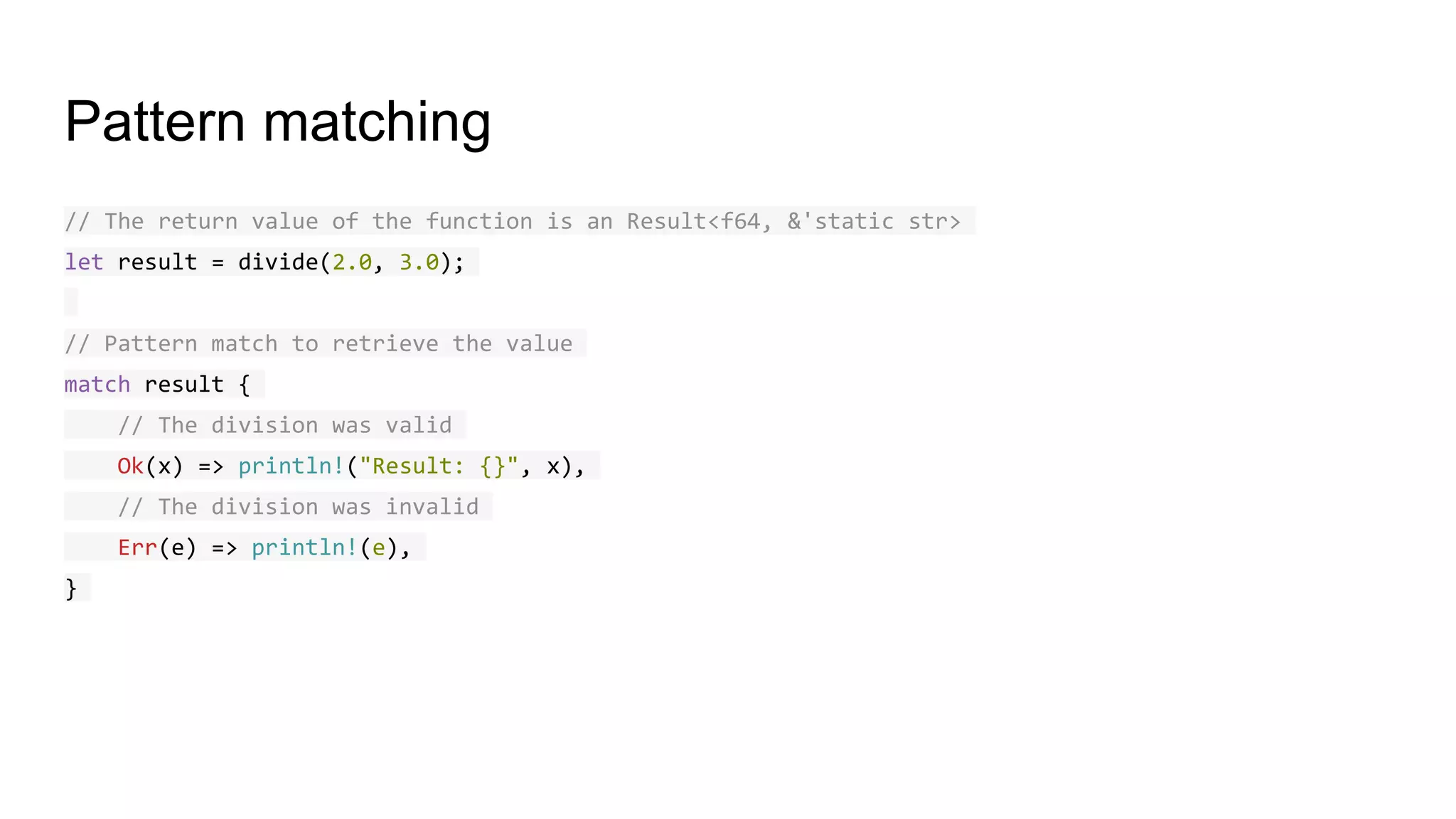
// The return value of the function is an Result<f64, &'static str>
let result = divide(2.0, 3.0);
// Pattern match to retrieve the value
match result {
// The division was valid
Ok(x) => println!("Result: {}", x),
// The division was invalid
Err(e) => println!(e),
}
Pattern matching
Again, the Rust compiler checks exhaustiveness, so it demands that you have a
match arm for every variant of the enum. If you leave one off, it will give you a
compile-time error unless you use _ or provide all possible arms.
Lambda functions
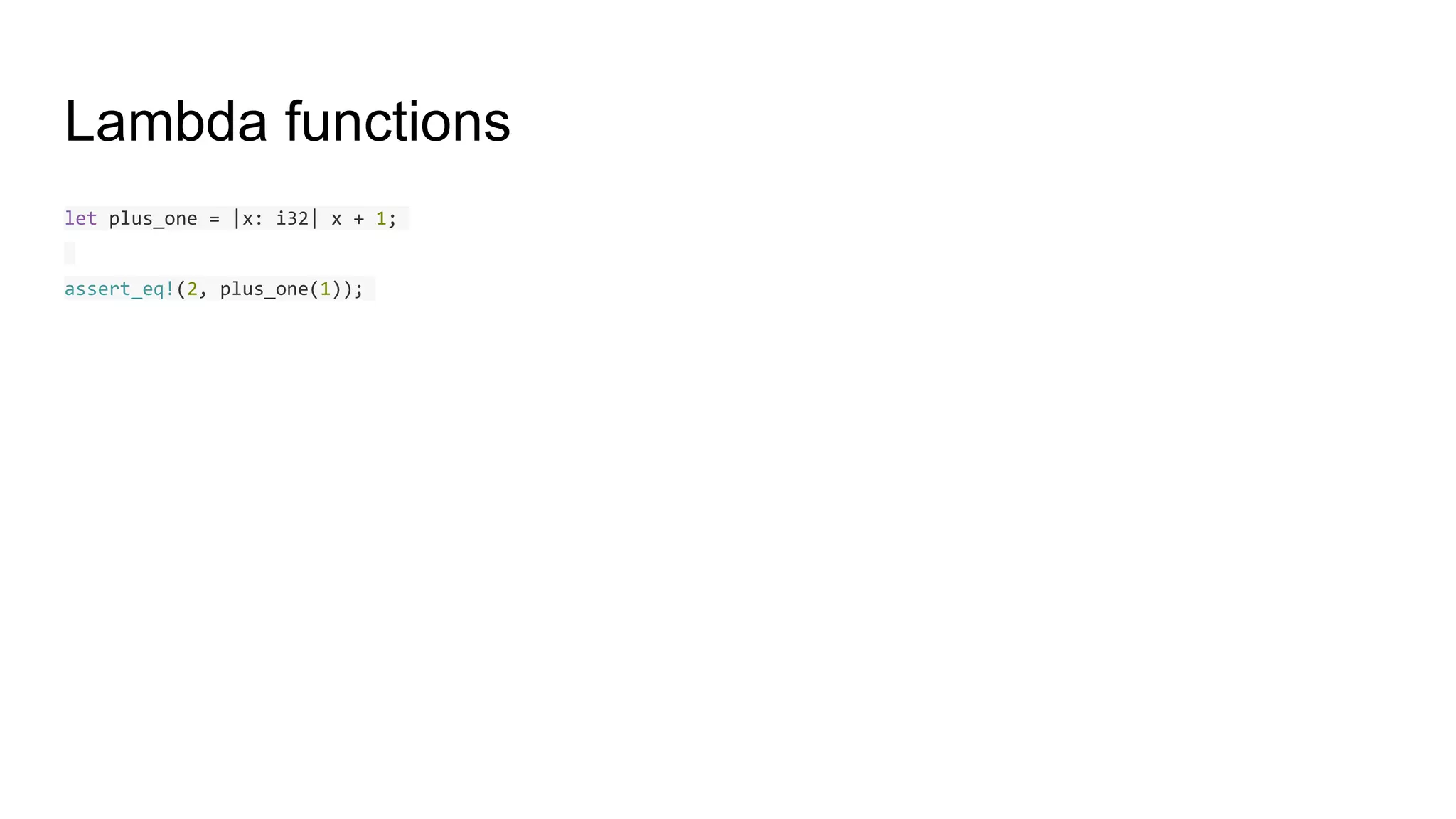
let plus_one = |x: i32| x + 1;
assert_eq!(2, plus_one(1));
Closures
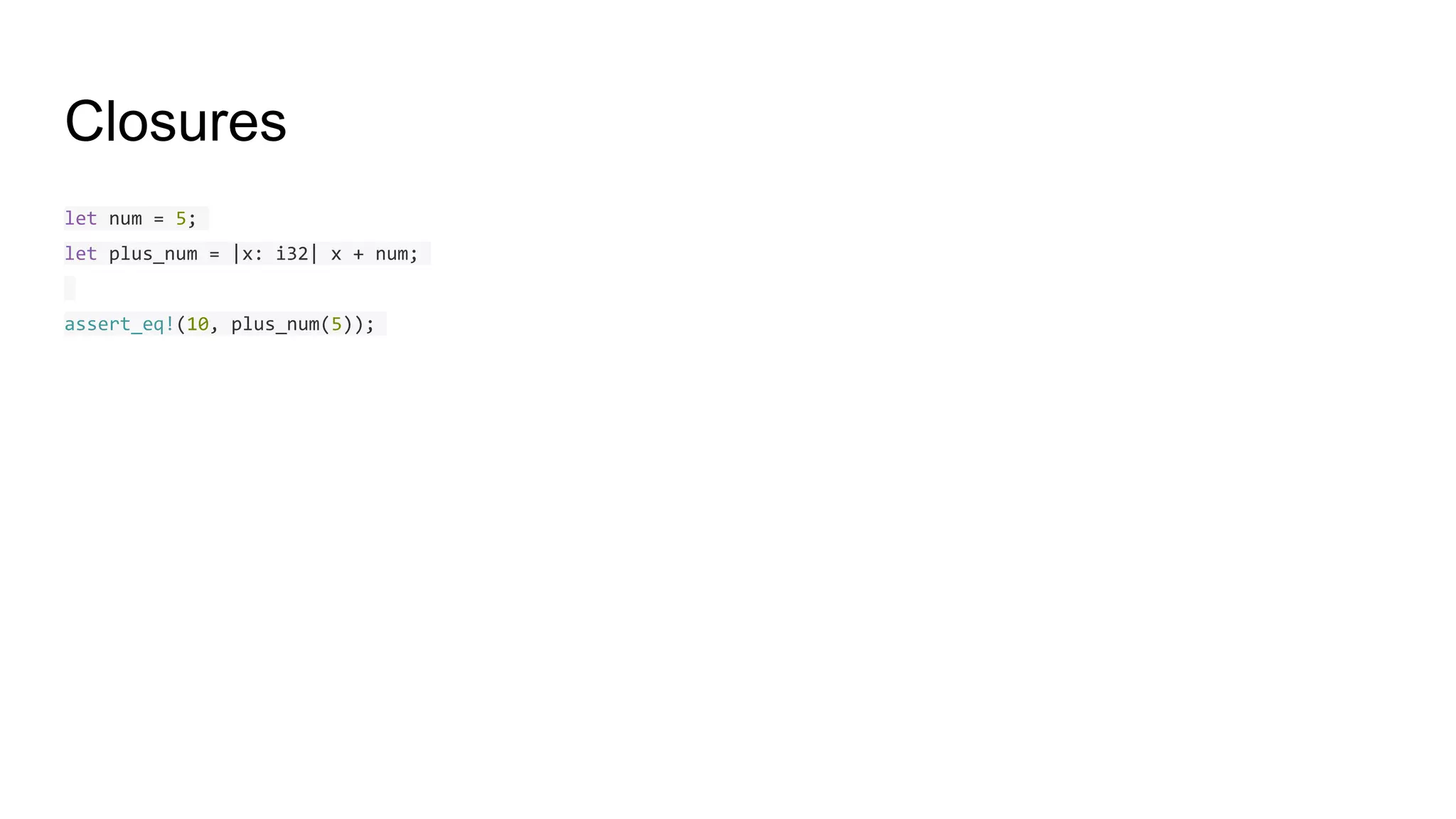
let num = 5;
let plus_num = |x: i32| x + num;
assert_eq!(10, plus_num(5));
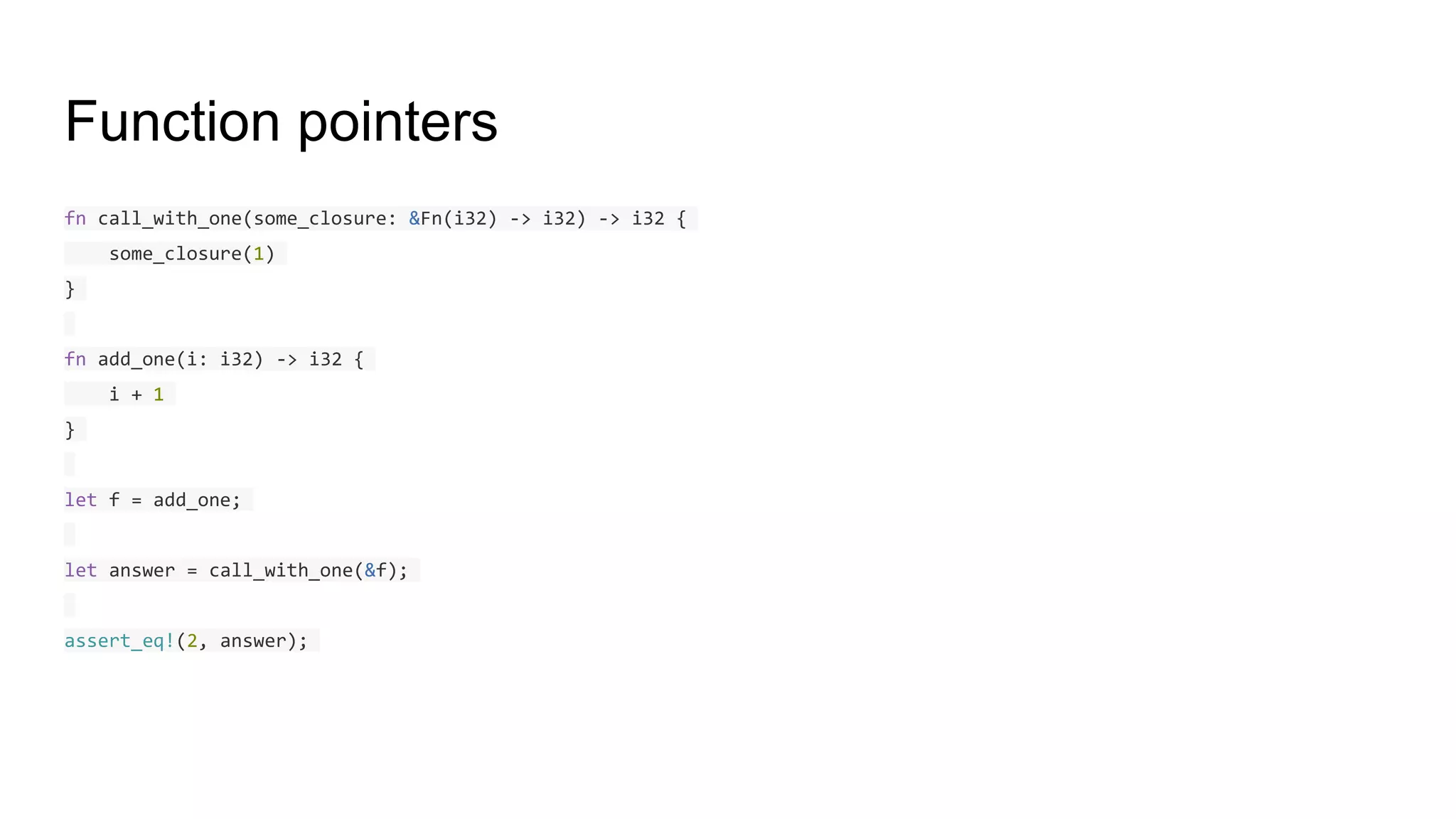
Function pointers
fn call_with_one(some_closure: &Fn(i32) -> i32) -> i32 {
some_closure(1)
}
fn add_one(i: i32) -> i32 {
i + 1
}
let f = add_one;
let answer = call_with_one(&f);
assert_eq!(2, answer);
Memory Safe
The Stack and the Heap
Ownership
Borrowing
Lifetimes
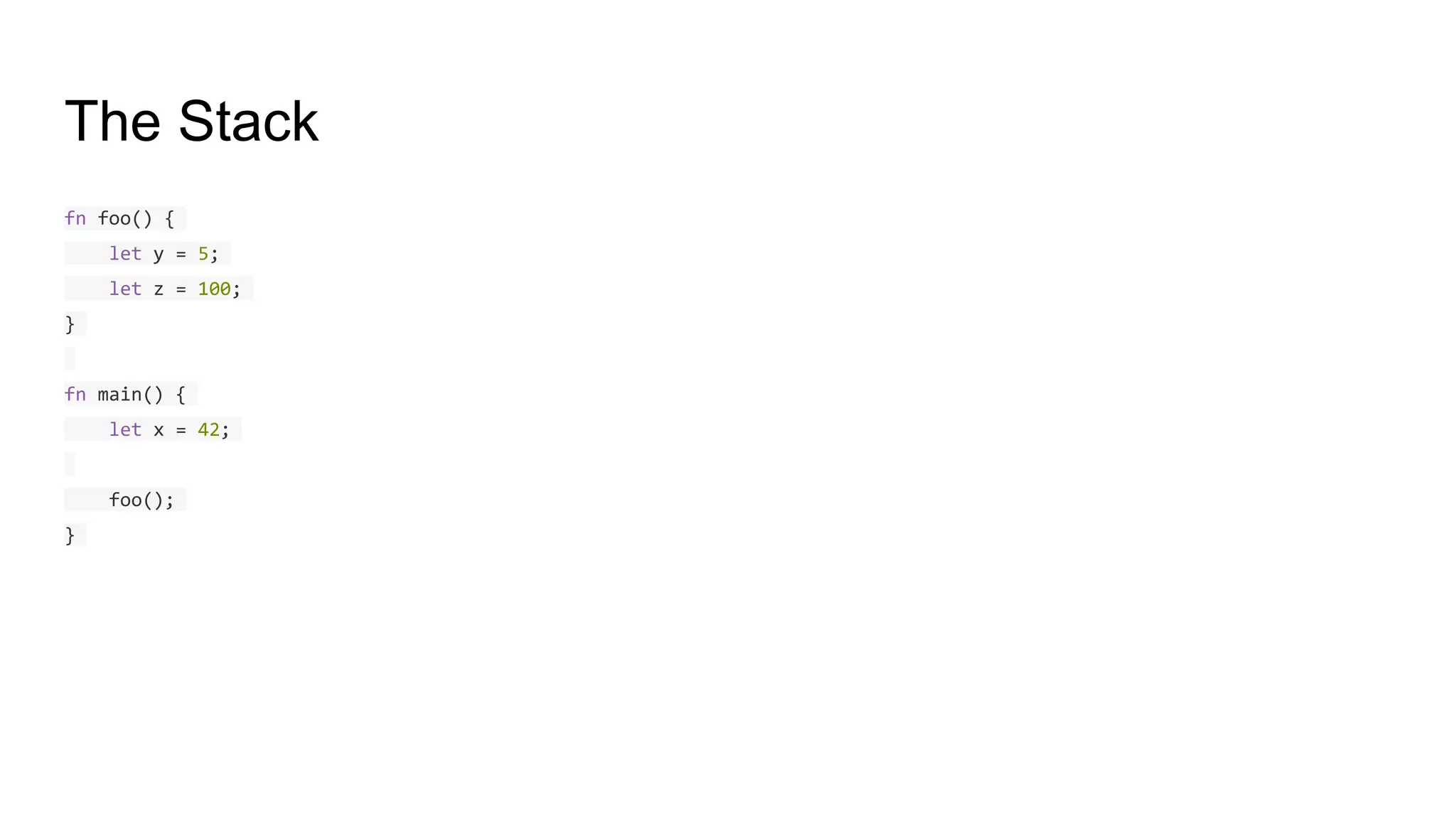
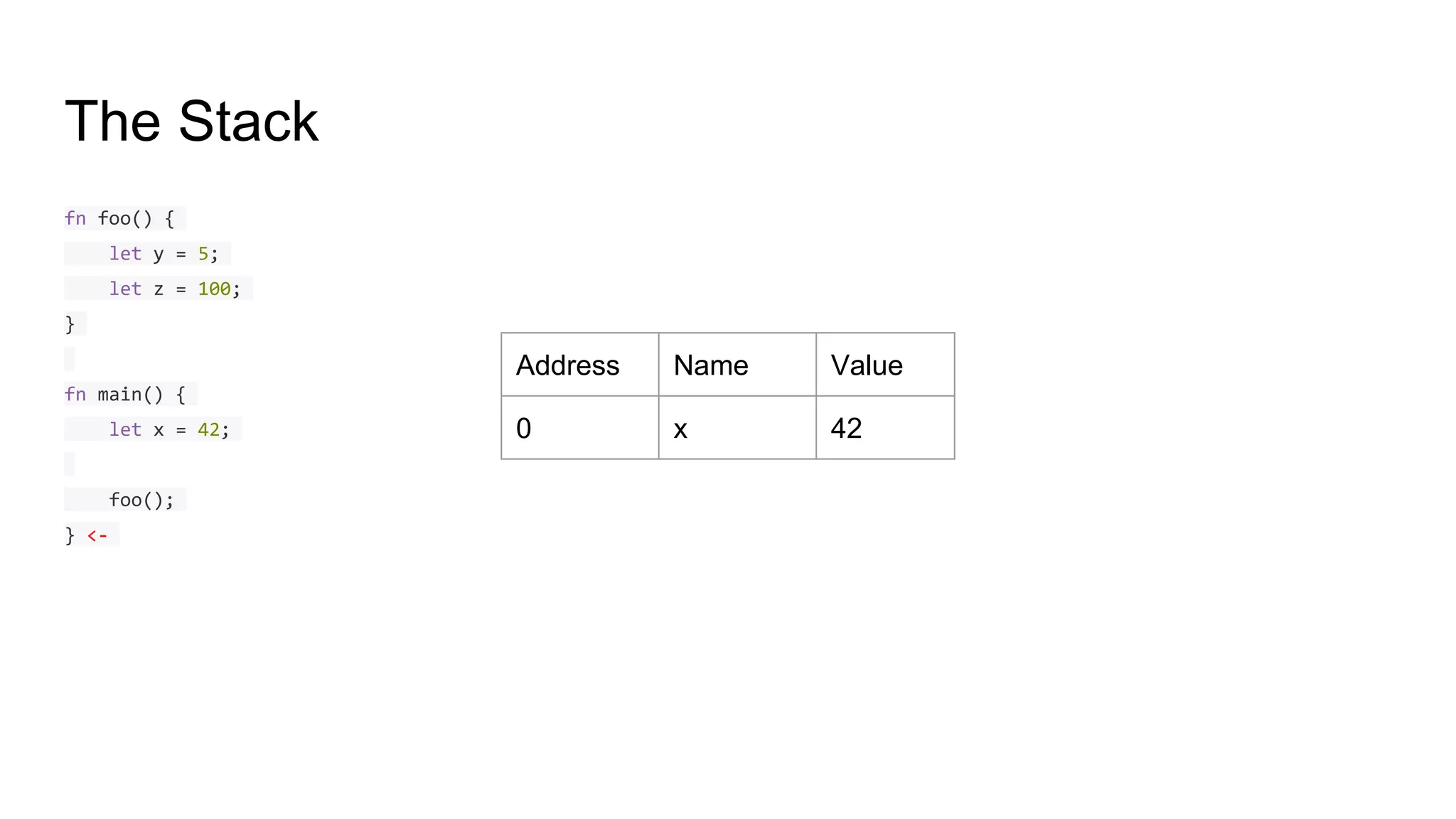
The Stack
fn foo() {
let y = 5;
let z = 100;
}
fn main() {
let x = 42;
foo();
}
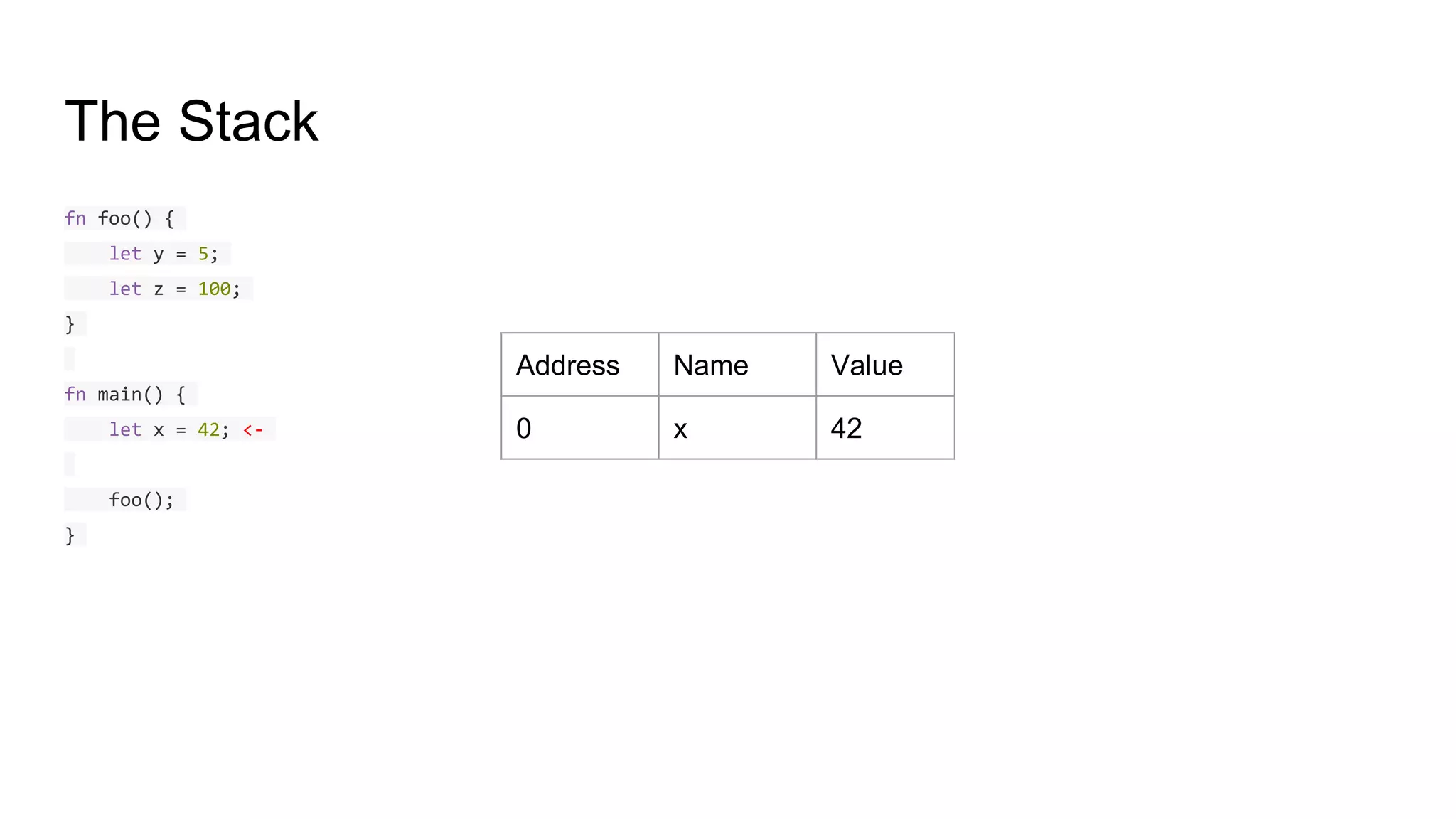
The Stack
fn foo() {
let y = 5;
let z = 100;
}
fn main() {
let x = 42; <-
foo();
}
Address Name Value
0 x 42
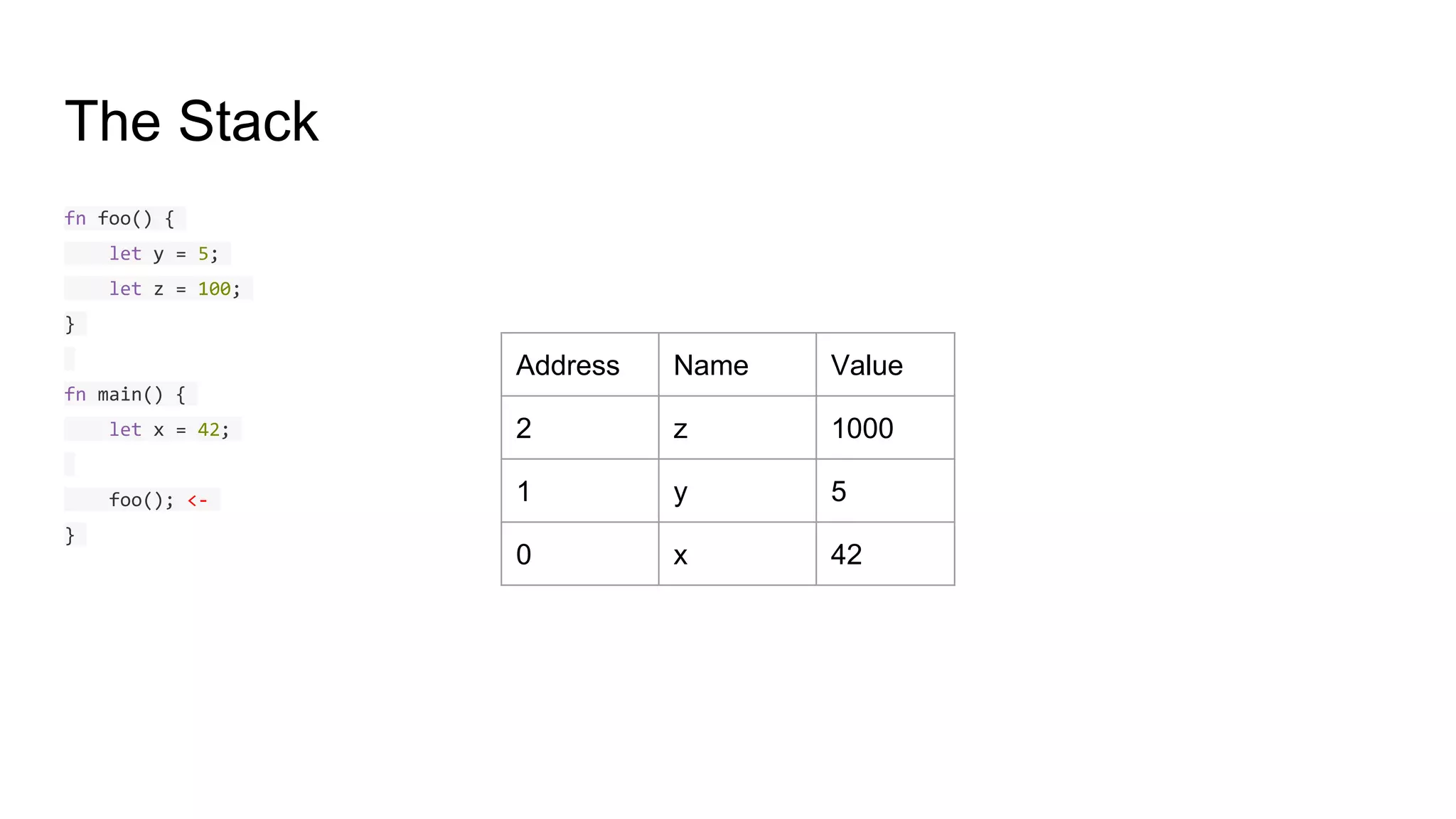
The Stack
fn foo() {
let y = 5;
let z = 100;
}
fn main() {
let x = 42;
foo(); <-
}
Address Name Value
2 z 1000
1 y 5
0 x 42
The Stack
fn foo() {
let y = 5;
let z = 100;
}
fn main() {
let x = 42;
foo();
} <-
Address Name Value
0 x 42
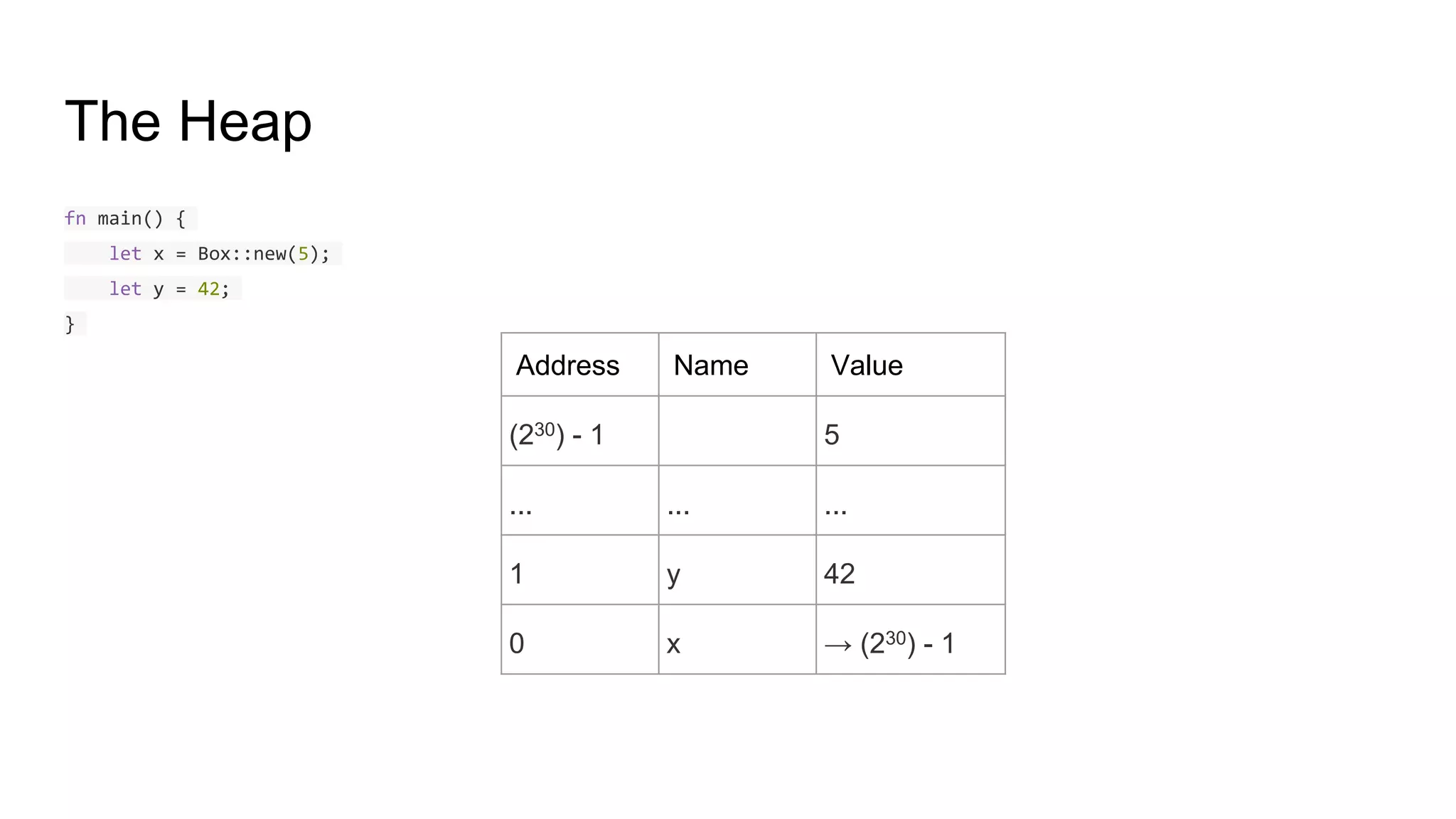
The Heap
fn main() {
let x = Box::new(5);
let y = 42;
}
Address Name Value
(230) - 1 5
... ... ...
1 y 42
0 x → (230) - 1
Ownership
let v = vec![1, 2, 3];
let v2 = v;
println!("v[0] is: {}", v[0]);
error: use of moved value: `v`
println!("v[0] is: {}", v[0]);
^
Ownership
fn take(v: Vec<i32>) {
// what happens here isn’t important.
}
let v = vec![1, 2, 3];
take(v);
println!("v[0] is: {}", v[0]);
Same error: ‘use of moved value’.
Borrowing
fn foo(v1: Vec<i32>, v2: Vec<i32>) -> (Vec<i32>, Vec<i32>, i32) {
// do stuff with v1 and v2
// hand back ownership, and the result of our function
(v1, v2, 42)
}
let v1 = vec![1, 2, 3];
let v2 = vec![1, 2, 3];
let (v1, v2, answer) = foo(v1, v2);
Borrowing
fn foo(v1: &Vec<i32>, v2: &Vec<i32>) -> i32 {
// do stuff with v1 and v2
// return the answer
42
}
let v1 = vec![1, 2, 3];
let v2 = vec![1, 2, 3];
let answer = foo(&v1, &v2);
// we can use v1 and v2 here!
&mut references
fn foo(v: &Vec<i32>) {
v.push(5);
}
let v = vec![];
foo(&v);
errors with:
error: cannot borrow immutable borrowed content `*v` as mutable
v.push(5);
^
&mut references
fn foo(v: &mut Vec<i32>) {
v.push(5);
}
let mut v = vec![];
foo(&mut v);
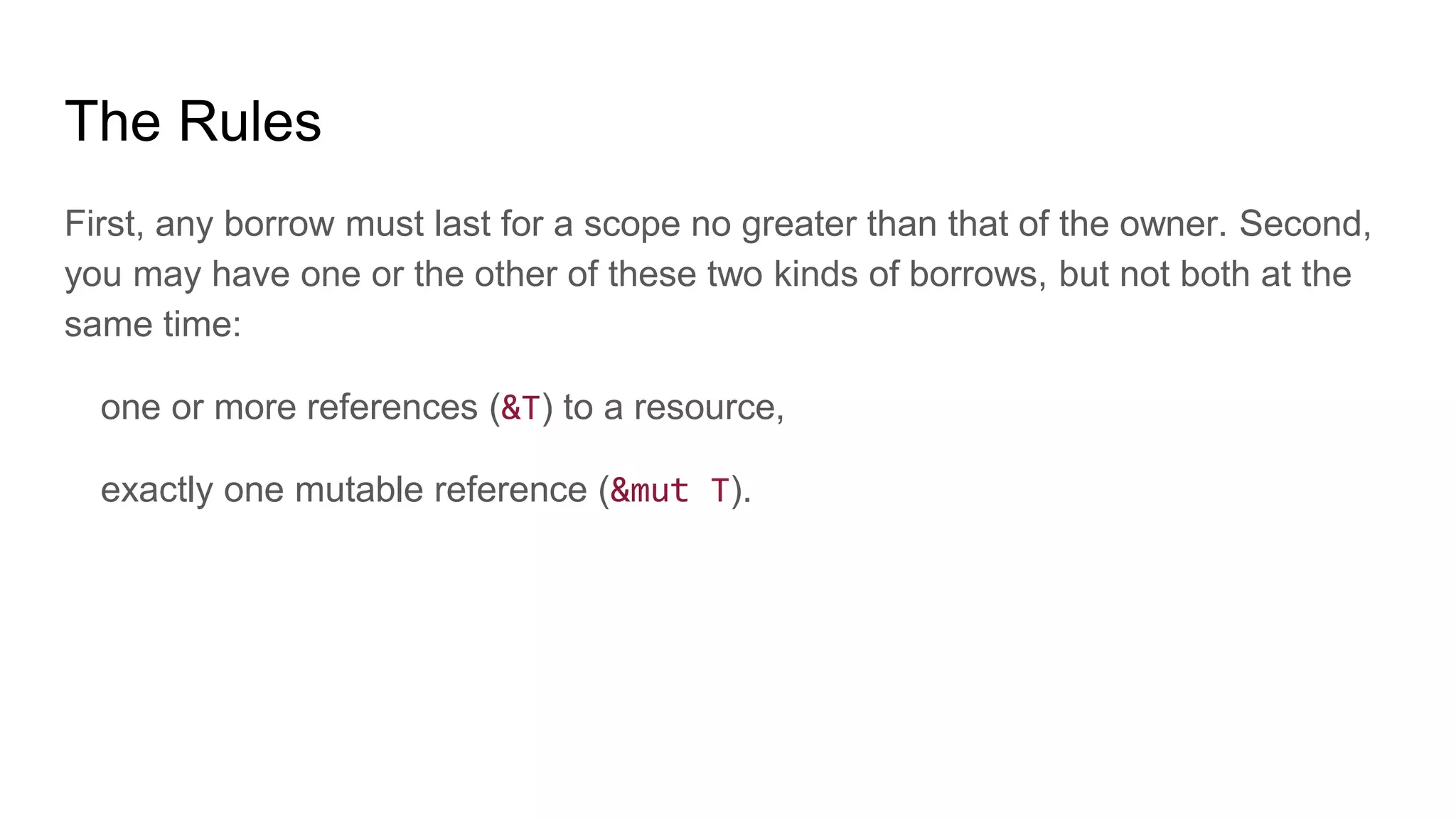
The Rules
First, any borrow must last for a scope no greater than that of the owner. Second,
you may have one or the other of these two kinds of borrows, but not both at the
same time:
one or more references (&T) to a resource,
exactly one mutable reference (&mut T).
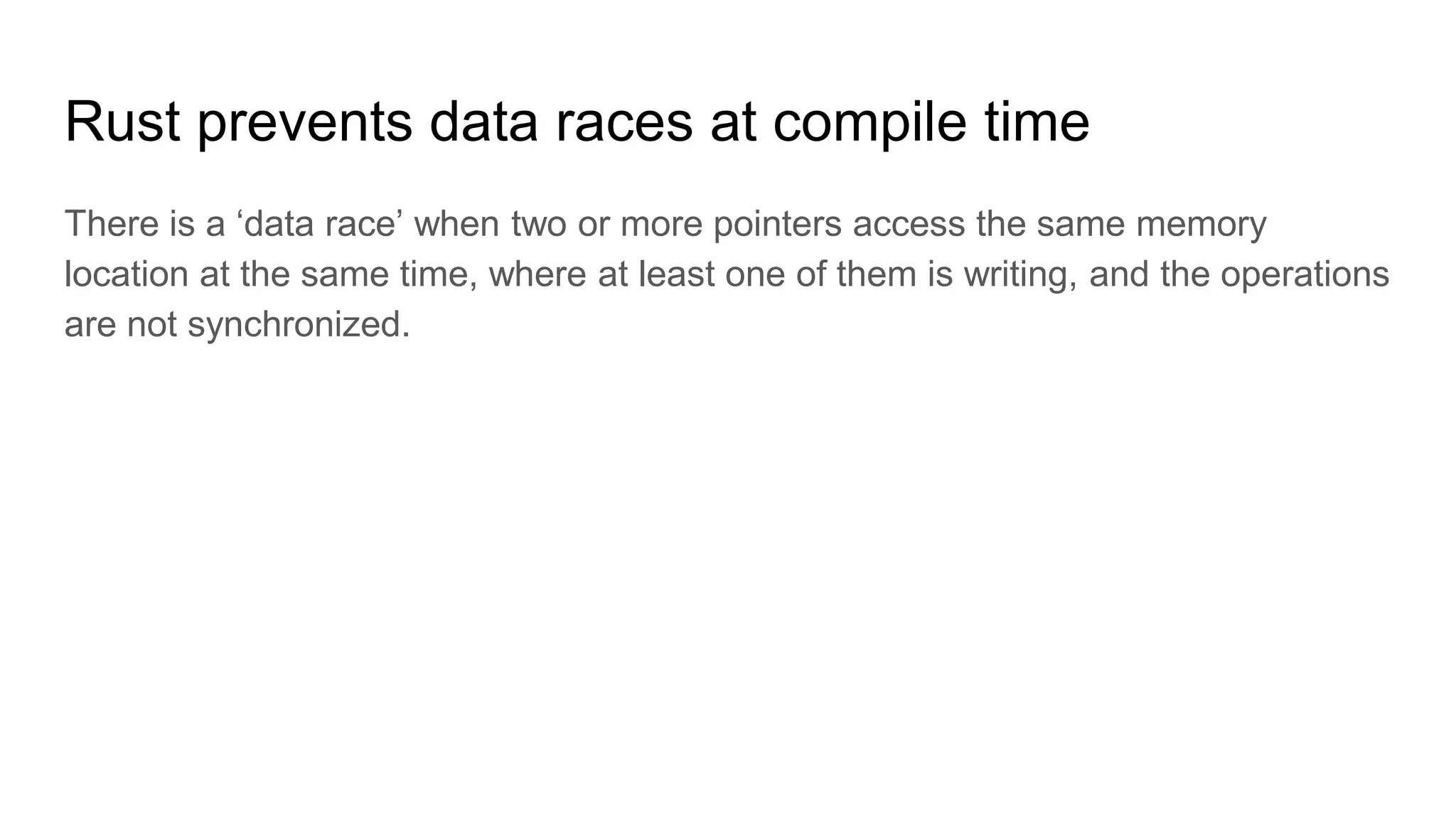
Rust prevents data races at compile time
There is a ‘data race’ when two or more pointers access the same memory
location at the same time, where at least one of them is writing, and the operations
are not synchronized.
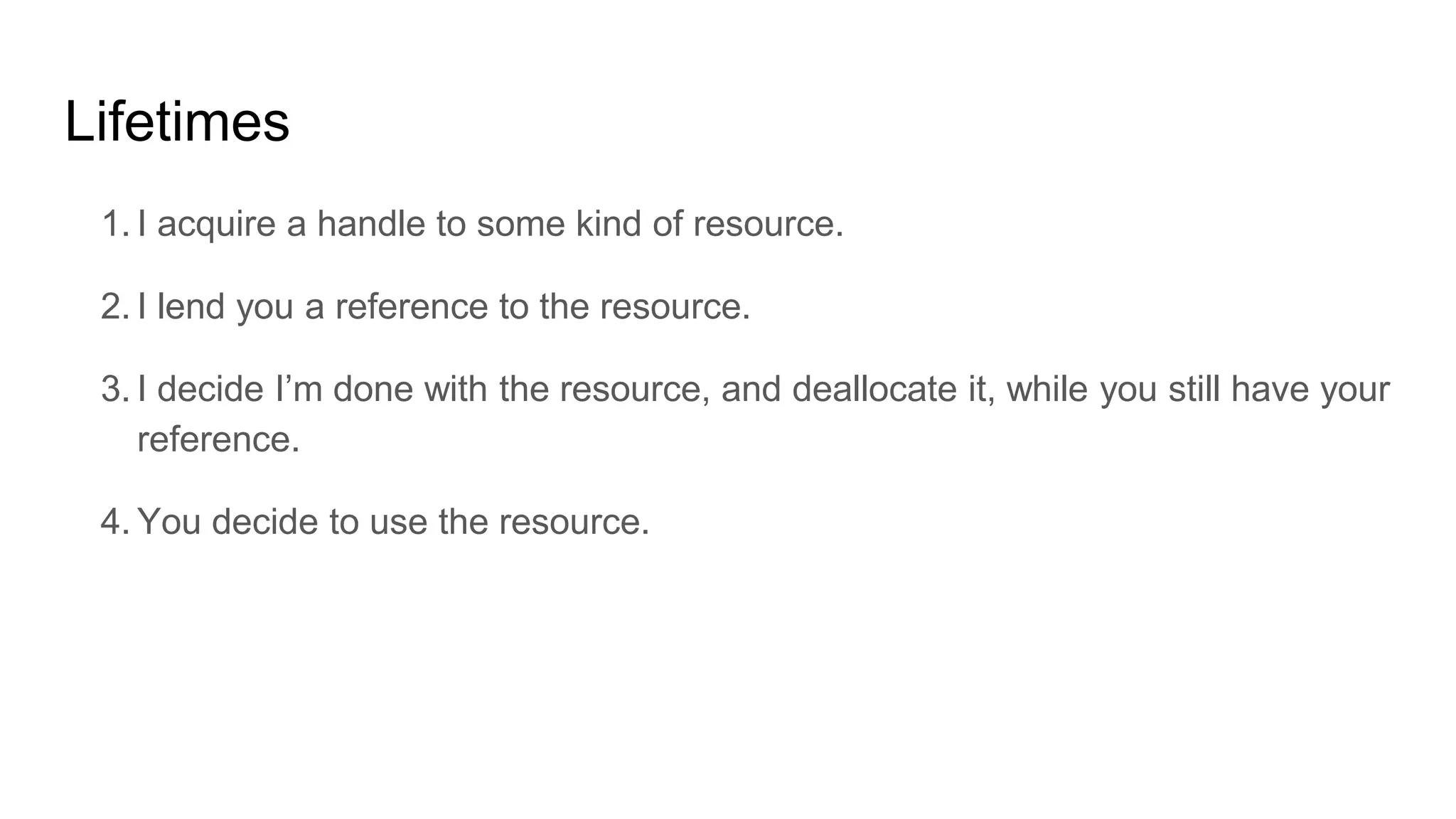
Lifetimes
1. I acquire a handle to some kind of resource.
2. I lend you a reference to the resource.
3. I decide I’m done with the resource, and deallocate it, while you still have your
reference.
4. You decide to use the resource.
Lifetimes
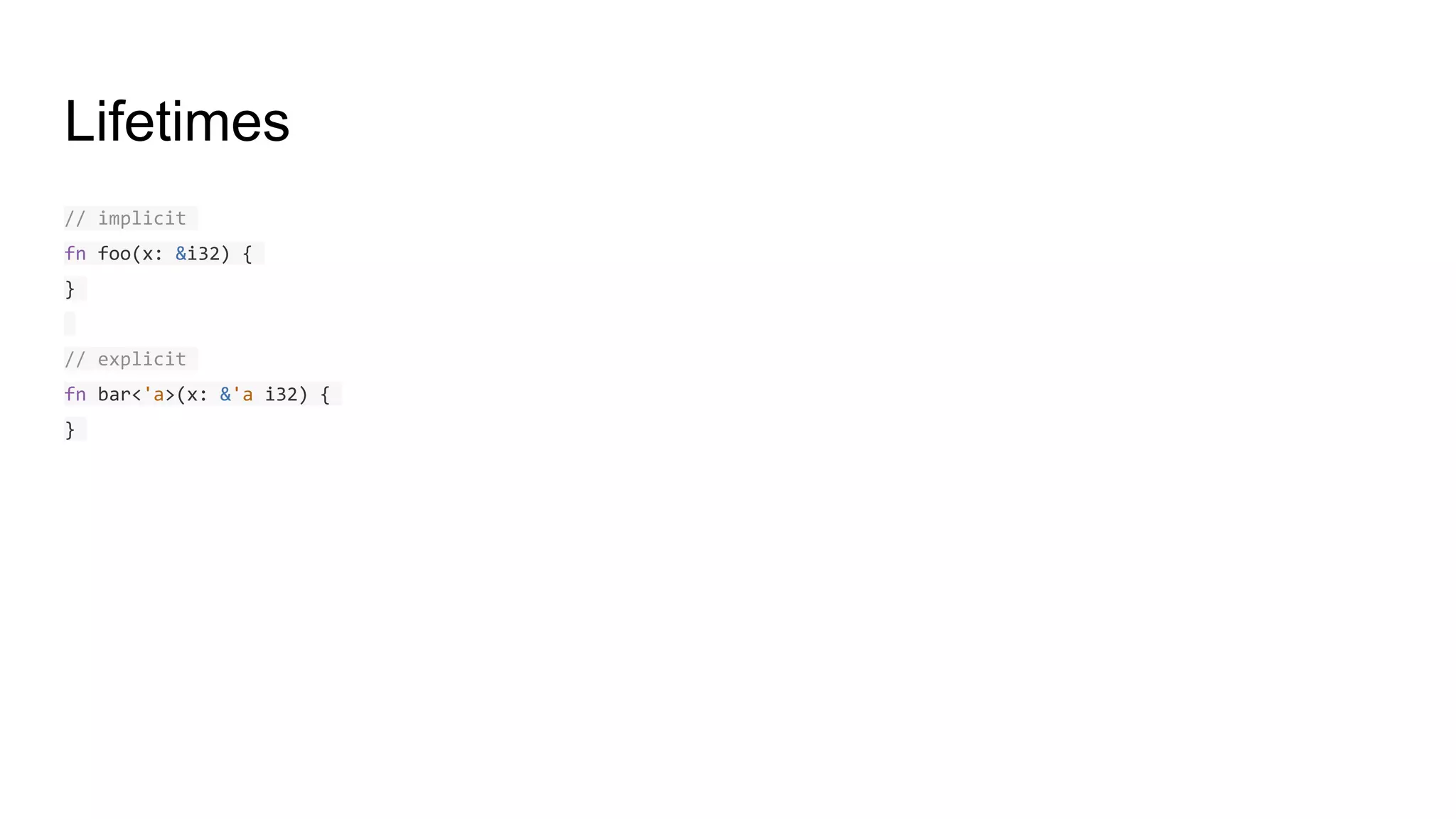
// implicit
fn foo(x: &i32) {
}
// explicit
fn bar<'a>(x: &'a i32) {
}
Lifetimes
You’ll also need explicit lifetimes when working with structs that contain
references.
Lifetimes
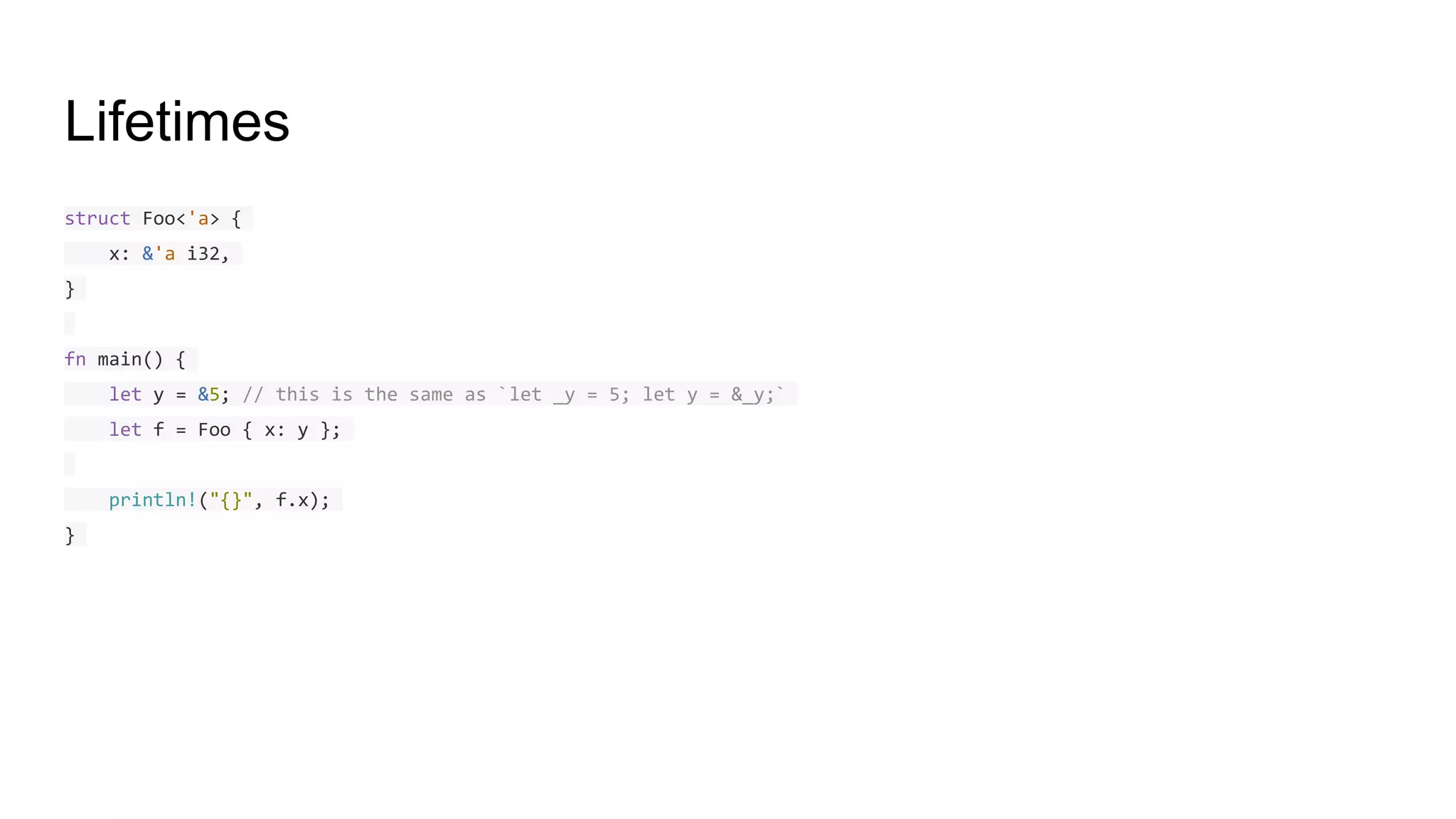
struct Foo<'a> {
x: &'a i32,
}
fn main() {
let y = &5; // this is the same as `let _y = 5; let y = &_y;`
let f = Foo { x: y };
println!("{}", f.x);
}
Lifetimes
We need to ensure that any reference to a Foo cannot outlive the reference to an
i32 it contains.
Thinking in scopes
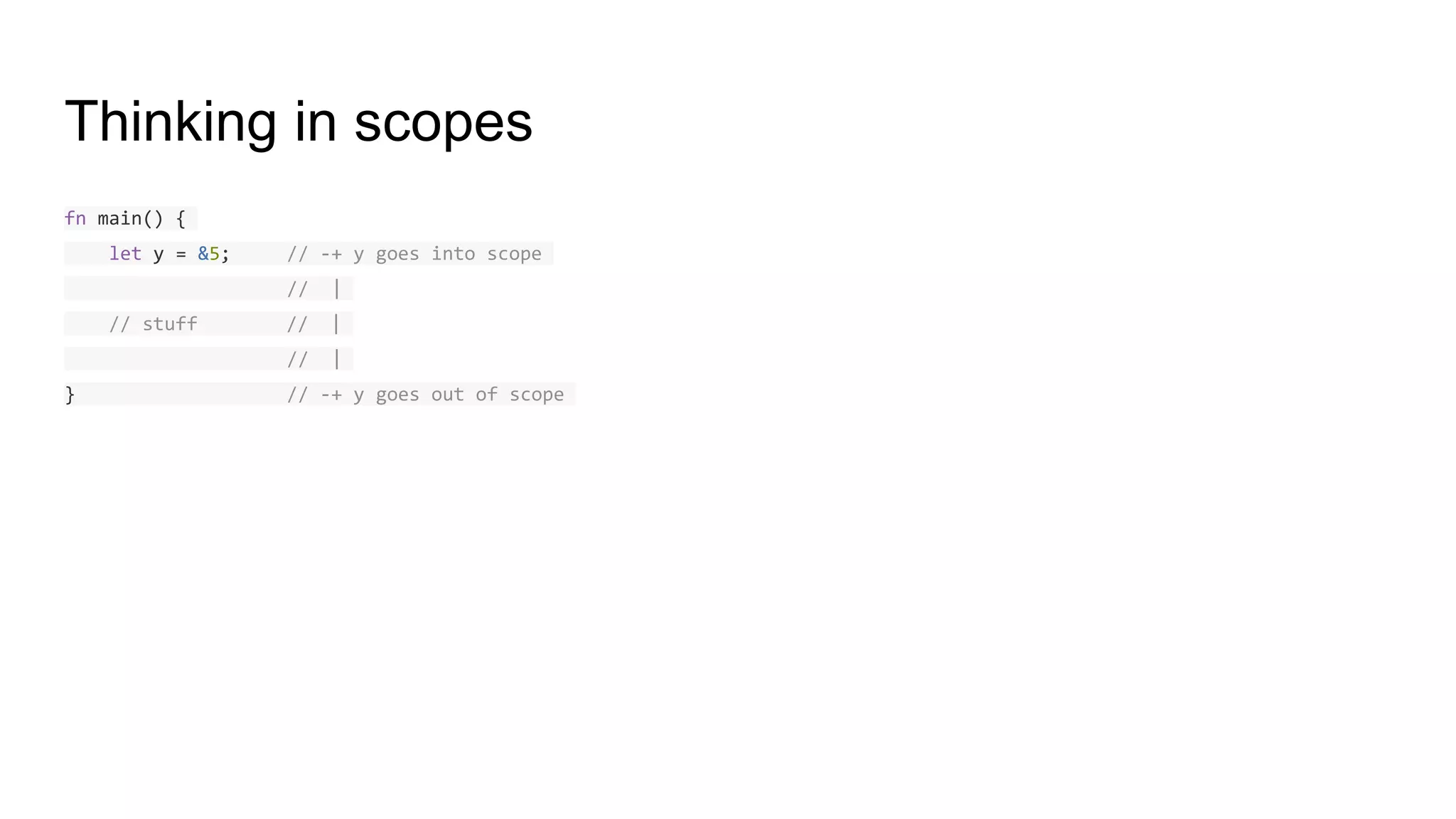
fn main() {
let y = &5; // -+ y goes into scope
// |
// stuff // |
// |
} // -+ y goes out of scope
Thinking in scopes
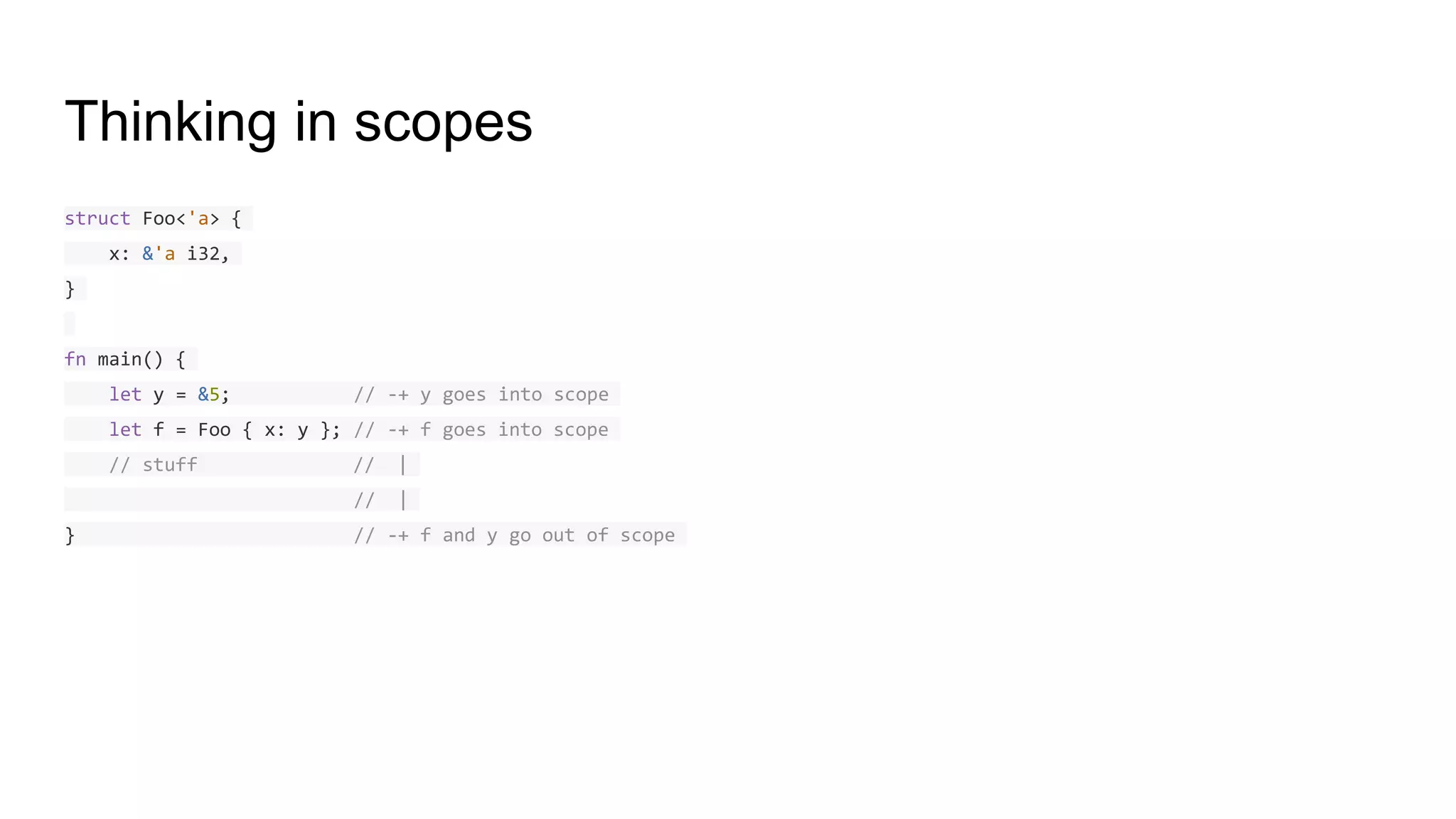
struct Foo<'a> {
x: &'a i32,
}
fn main() {
let y = &5; // -+ y goes into scope
let f = Foo { x: y }; // -+ f goes into scope
// stuff // |
// |
} // -+ f and y go out of scope
Thinking in scopes
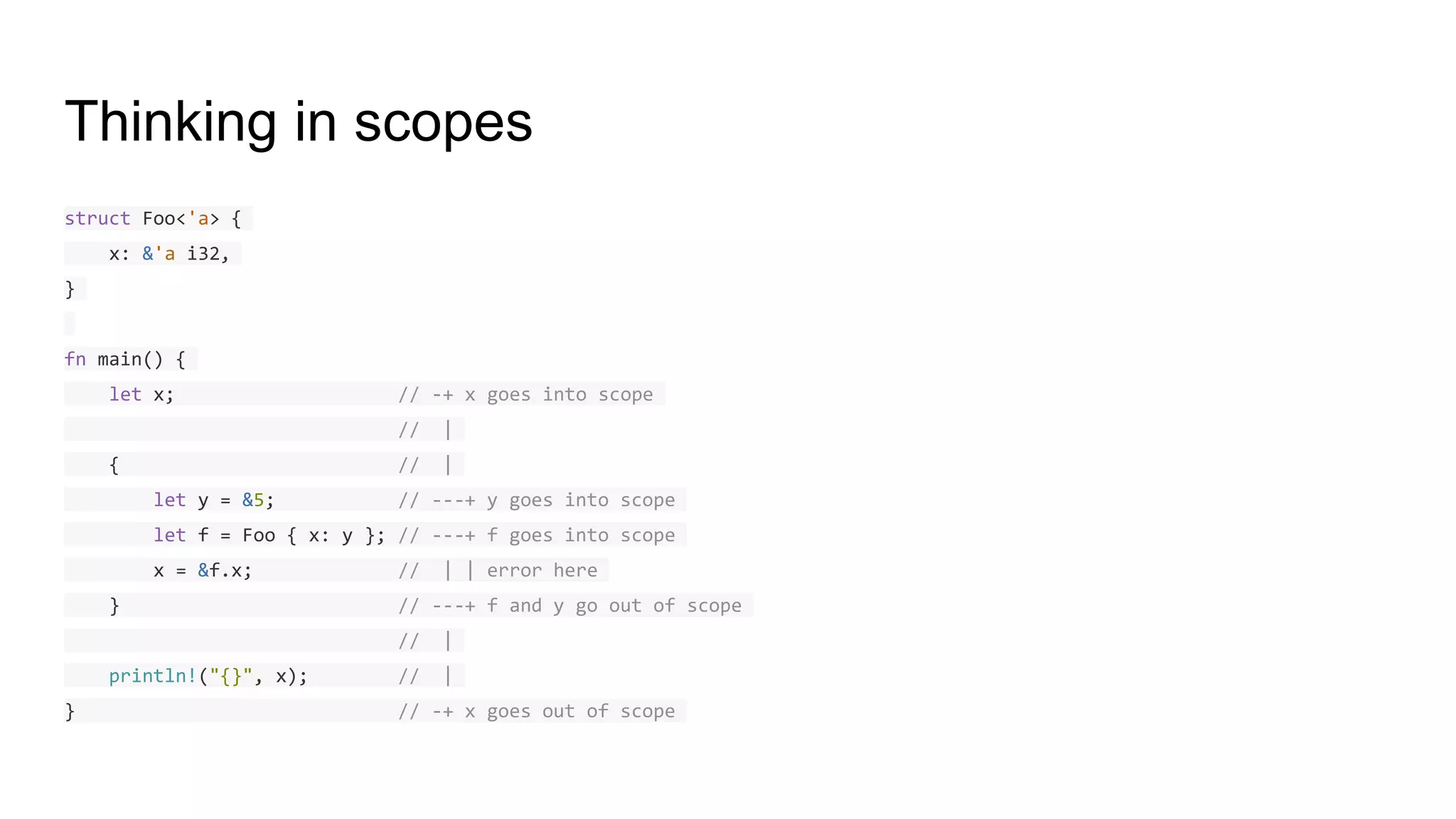
struct Foo<'a> {
x: &'a i32,
}
fn main() {
let x; // -+ x goes into scope
// |
{ // |
let y = &5; // ---+ y goes into scope
let f = Foo { x: y }; // ---+ f goes into scope
x = &f.x; // | | error here
} // ---+ f and y go out of scope
// |
println!("{}", x); // |
} // -+ x goes out of scope
Not Covered
Macros
Tests
Concurrency
Foreign Function Interface
Cargo
and much much more
Resources
The Rust Programming Language. Also known as “The Book”, The Rust Programming Language is the
most comprehensive resource for all topics related to Rust, and is the primary official document of the
language.
Rust by Example. A collection of self-contained Rust examples on a variety of topics, executable in-
browser.
Frequently asked questions.
The Rustonomicon. An entire book dedicated to explaining how to write unsafe Rust code. It is for
advanced Rust programmers.
rust-learning. A community-maintained collection of resources for learning Rust.
Thank You!

Rust Intro

  • 1.
  • 2.
    Mozilla The language grewout of a personal project by Mozilla employee Graydon Hoare. Mozilla began sponsoring the project in 2009 and announced it in 2010. The same year, work shifted from the initial compiler (written in OCaml) to the self-hosting compiler written in Rust. Known as rustc, it successfully compiled itself in 2011. rustc uses LLVM as its back end.
  • 3.
    Safe, concurrent, practicallanguage Rust is a general-purpose, multi-paradigm, compiled programming language. It is designed to be a "safe, concurrent, practical language", supporting pure- functional, imperative-procedural, and object-oriented styles.
  • 4.
  • 5.
    Structs struct Point { x:i32, y: i32, } fn main() { let origin = Point { x: 0, y: 0 }; // origin: Point println!("The origin is at ({}, {})", origin.x, origin.y); }
  • 6.
    Enums enum BoardGameTurn { Move{ squares: i32 }, Pass, } let y: BoardGameTurn = BoardGameTurn::Move { squares: 1 };
  • 7.
    Generics struct Point<T> { x:T, y: T, } let int_origin = Point { x: 0, y: 0 }; let float_origin = Point { x: 0.0, y: 0.0 };
  • 8.
    Method syntax struct Circle{ x: f64, y: f64, radius: f64, } fn main() { let c = Circle { x: 0.0, y: 0.0, radius: 2.0 }; println!("{}", c.area()); }
  • 9.
    Method syntax impl Circle{ fn area(&self) -> f64 { std::f64::consts::PI * (self.radius * self.radius) } }
  • 10.
    Traits trait HasArea { fnarea(&self) -> f64; } impl HasArea for Circle { fn area(&self) -> f64 { std::f64::consts::PI * (self.radius * self.radius) } }
  • 11.
    Traits fn print_area<T: HasArea>(shape:T) { println!("This shape has an area of {}", shape.area()); }
  • 12.
    Functional Functions Function pointers Type inference Immutableby default Option and Result Pattern matching Lambda functions
  • 13.
  • 14.
    Functions fn add_one(x: i32)-> i32 { x + 1; } We would get an error: error: not all control paths return a value fn add_one(x: i32) -> i32 { x + 1; } help: consider removing this semicolon: x + 1; ^
  • 15.
    Functions fn plus_one(i: i32)-> i32 { i + 1 } let f: fn(i32) -> i32 = plus_one; let six = f(5);
  • 16.
    Type inference Rust hasthis thing called ‘type inference’. If it can figure out what the type of something is, Rust doesn’t require you to actually type it out. let x = 5; // x: i32 fn plus_one(i: i32) -> i32 { i + 1 } // without type inference let f: fn(i32) -> i32 = plus_one; // with type inference let f = plus_one;
  • 17.
    Mutability let x =5; x = 10; error: re-assignment of immutable variable `x` x = 10; ^~~~~~~
  • 18.
    Mutability let mut x= 5; // mut x: i32 x = 10;
  • 19.
    Option pub enum Option<T>{ None, Some(T), }
  • 20.
    Option fn divide(numerator: f64,denominator: f64) -> Option<f64> { if denominator == 0.0 { None } else { Some(numerator / denominator) } }
  • 21.
    Result enum Result<T, E>{ Ok(T), Err(E) }
  • 22.
    fn divide(numerator: f64,denominator: f64) -> Result<f64, &'static str> { if denominator == 0.0 { Err("Can not divide by zero") } else { Ok(numerator / denominator) } } Result
  • 23.
    Pattern matching let x= 5; match x { 1 => println!("one"), 2 => println!("two"), 3 => println!("three"), 4 => println!("four"), 5 => println!("five"), _ => println!("something else"), }
  • 24.
    Pattern matching One ofthe many advantages of match is it enforces ‘exhaustiveness checking’. For example if we remove the last arm with the underscore _, the compiler will give us an error: error: non-exhaustive patterns: `_` not covered
  • 25.
    Pattern matching // Thereturn value of the function is an option let result = divide(2.0, 3.0); // Pattern match to retrieve the value match result { // The division was valid Some(x) => println!("Result: {}", x), // The division was invalid None => println!("Cannot divide by 0"), }
  • 26.
    Pattern matching // Thereturn value of the function is an Result<f64, &'static str> let result = divide(2.0, 3.0); // Pattern match to retrieve the value match result { // The division was valid Ok(x) => println!("Result: {}", x), // The division was invalid Err(e) => println!(e), }
  • 27.
    Pattern matching Again, theRust compiler checks exhaustiveness, so it demands that you have a match arm for every variant of the enum. If you leave one off, it will give you a compile-time error unless you use _ or provide all possible arms.
  • 28.
    Lambda functions let plus_one= |x: i32| x + 1; assert_eq!(2, plus_one(1));
  • 29.
    Closures let num =5; let plus_num = |x: i32| x + num; assert_eq!(10, plus_num(5));
  • 30.
    Function pointers fn call_with_one(some_closure:&Fn(i32) -> i32) -> i32 { some_closure(1) } fn add_one(i: i32) -> i32 { i + 1 } let f = add_one; let answer = call_with_one(&f); assert_eq!(2, answer);
  • 31.
    Memory Safe The Stackand the Heap Ownership Borrowing Lifetimes
  • 32.
    The Stack fn foo(){ let y = 5; let z = 100; } fn main() { let x = 42; foo(); }
  • 33.
    The Stack fn foo(){ let y = 5; let z = 100; } fn main() { let x = 42; <- foo(); } Address Name Value 0 x 42
  • 34.
    The Stack fn foo(){ let y = 5; let z = 100; } fn main() { let x = 42; foo(); <- } Address Name Value 2 z 1000 1 y 5 0 x 42
  • 35.
    The Stack fn foo(){ let y = 5; let z = 100; } fn main() { let x = 42; foo(); } <- Address Name Value 0 x 42
  • 36.
    The Heap fn main(){ let x = Box::new(5); let y = 42; } Address Name Value (230) - 1 5 ... ... ... 1 y 42 0 x → (230) - 1
  • 37.
    Ownership let v =vec![1, 2, 3]; let v2 = v; println!("v[0] is: {}", v[0]); error: use of moved value: `v` println!("v[0] is: {}", v[0]); ^
  • 38.
    Ownership fn take(v: Vec<i32>){ // what happens here isn’t important. } let v = vec![1, 2, 3]; take(v); println!("v[0] is: {}", v[0]); Same error: ‘use of moved value’.
  • 39.
    Borrowing fn foo(v1: Vec<i32>,v2: Vec<i32>) -> (Vec<i32>, Vec<i32>, i32) { // do stuff with v1 and v2 // hand back ownership, and the result of our function (v1, v2, 42) } let v1 = vec![1, 2, 3]; let v2 = vec![1, 2, 3]; let (v1, v2, answer) = foo(v1, v2);
  • 40.
    Borrowing fn foo(v1: &Vec<i32>,v2: &Vec<i32>) -> i32 { // do stuff with v1 and v2 // return the answer 42 } let v1 = vec![1, 2, 3]; let v2 = vec![1, 2, 3]; let answer = foo(&v1, &v2); // we can use v1 and v2 here!
  • 41.
    &mut references fn foo(v:&Vec<i32>) { v.push(5); } let v = vec![]; foo(&v); errors with: error: cannot borrow immutable borrowed content `*v` as mutable v.push(5); ^
  • 42.
    &mut references fn foo(v:&mut Vec<i32>) { v.push(5); } let mut v = vec![]; foo(&mut v);
  • 43.
    The Rules First, anyborrow must last for a scope no greater than that of the owner. Second, you may have one or the other of these two kinds of borrows, but not both at the same time: one or more references (&T) to a resource, exactly one mutable reference (&mut T).
  • 44.
    Rust prevents dataraces at compile time There is a ‘data race’ when two or more pointers access the same memory location at the same time, where at least one of them is writing, and the operations are not synchronized.
  • 45.
    Lifetimes 1. I acquirea handle to some kind of resource. 2. I lend you a reference to the resource. 3. I decide I’m done with the resource, and deallocate it, while you still have your reference. 4. You decide to use the resource.
  • 46.
    Lifetimes // implicit fn foo(x:&i32) { } // explicit fn bar<'a>(x: &'a i32) { }
  • 47.
    Lifetimes You’ll also needexplicit lifetimes when working with structs that contain references.
  • 48.
    Lifetimes struct Foo<'a> { x:&'a i32, } fn main() { let y = &5; // this is the same as `let _y = 5; let y = &_y;` let f = Foo { x: y }; println!("{}", f.x); }
  • 49.
    Lifetimes We need toensure that any reference to a Foo cannot outlive the reference to an i32 it contains.
  • 50.
    Thinking in scopes fnmain() { let y = &5; // -+ y goes into scope // | // stuff // | // | } // -+ y goes out of scope
  • 51.
    Thinking in scopes structFoo<'a> { x: &'a i32, } fn main() { let y = &5; // -+ y goes into scope let f = Foo { x: y }; // -+ f goes into scope // stuff // | // | } // -+ f and y go out of scope
  • 52.
    Thinking in scopes structFoo<'a> { x: &'a i32, } fn main() { let x; // -+ x goes into scope // | { // | let y = &5; // ---+ y goes into scope let f = Foo { x: y }; // ---+ f goes into scope x = &f.x; // | | error here } // ---+ f and y go out of scope // | println!("{}", x); // | } // -+ x goes out of scope
  • 53.
  • 54.
    Resources The Rust ProgrammingLanguage. Also known as “The Book”, The Rust Programming Language is the most comprehensive resource for all topics related to Rust, and is the primary official document of the language. Rust by Example. A collection of self-contained Rust examples on a variety of topics, executable in- browser. Frequently asked questions. The Rustonomicon. An entire book dedicated to explaining how to write unsafe Rust code. It is for advanced Rust programmers. rust-learning. A community-maintained collection of resources for learning Rust.
  • 55.