Ruby on Embedded
Devices
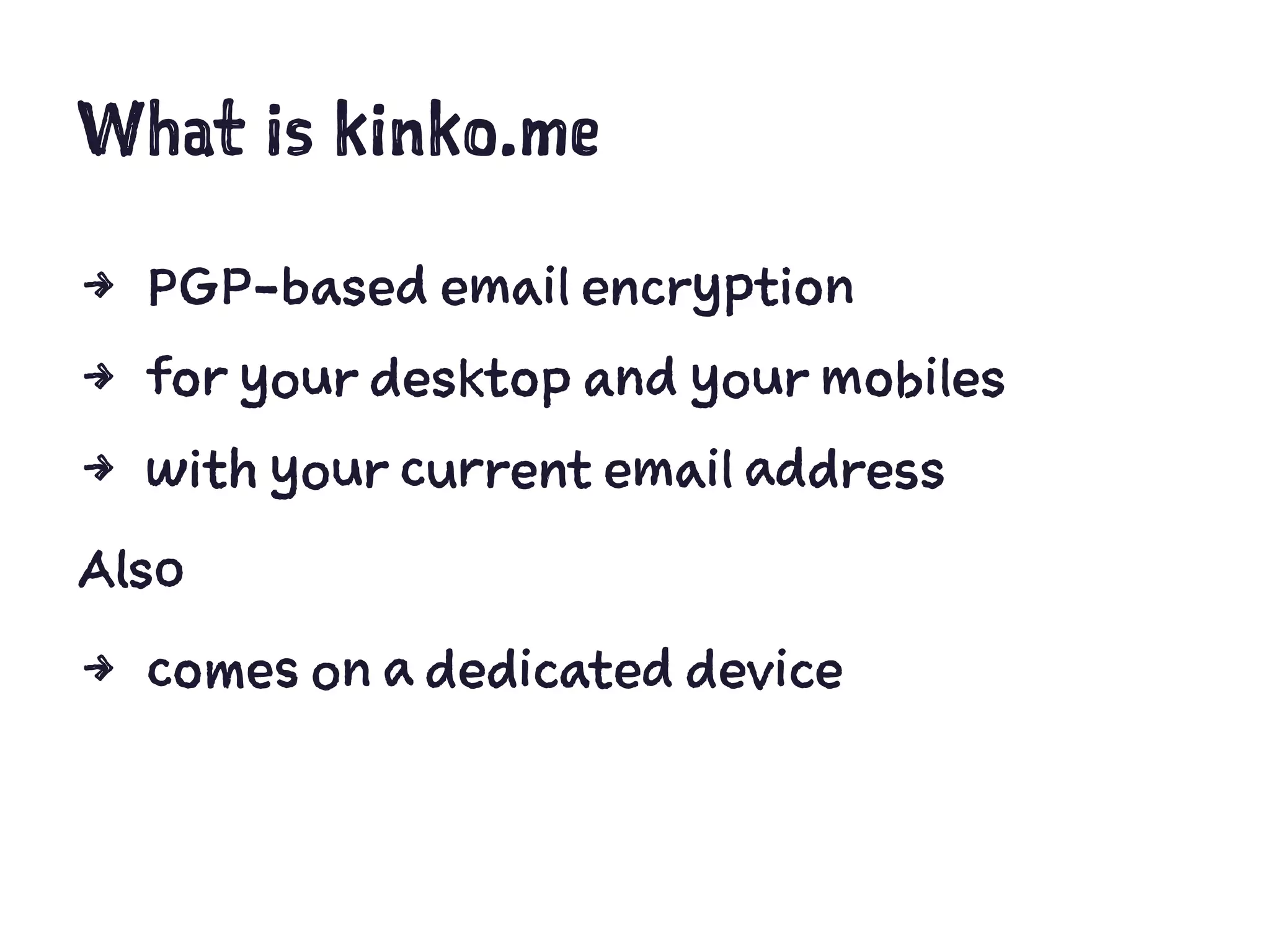
What is kinko.me
4 PGP-based email encryption
4 for your desktop and your mobiles
4 with your current email address
Also
4 comes on a dedicated device
ssshhh...
as of this afternoon we are crowdfunding.
Feel invited to check https://getkinko.com
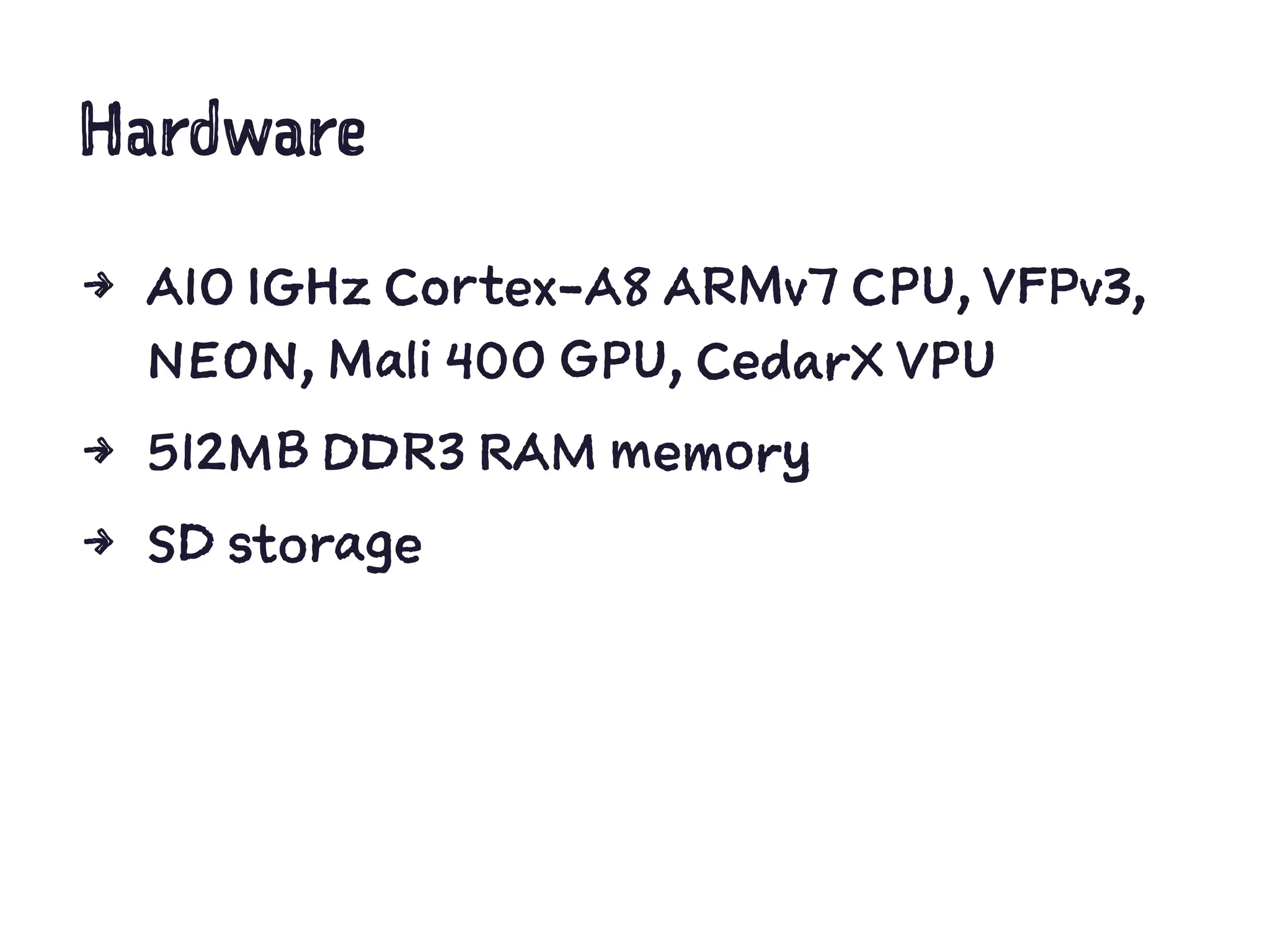
Hardware
4 A10 1GHz Cortex-A8 ARMv7 CPU, VFPv3,
NEON, Mali 400 GPU, CedarX VPU
4 512MB DDR3 RAM memory
4 SD storage
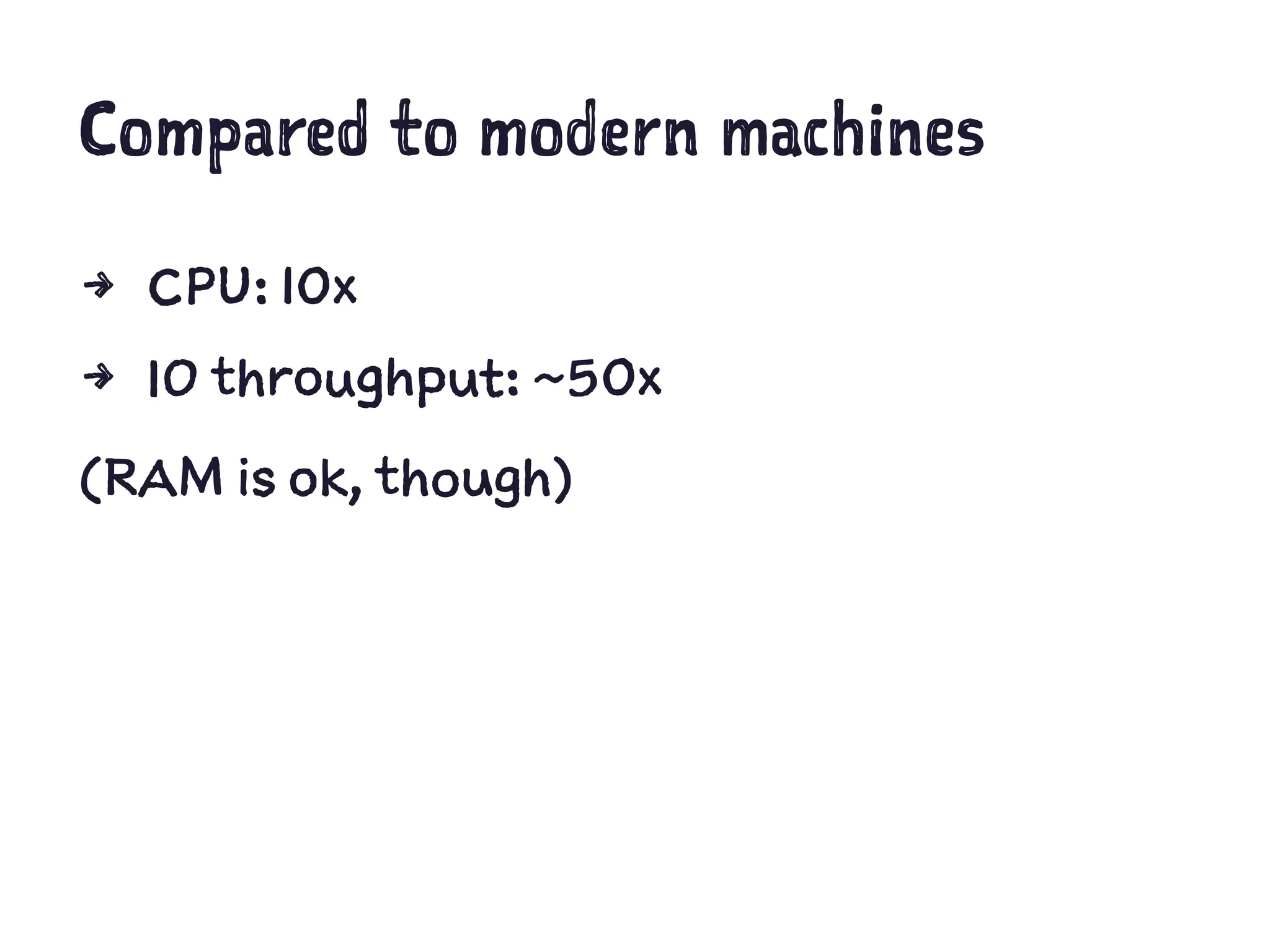
Compared to modern machines
4 CPU: 10x
4 IO throughput: ~50x
(RAM is ok, though)
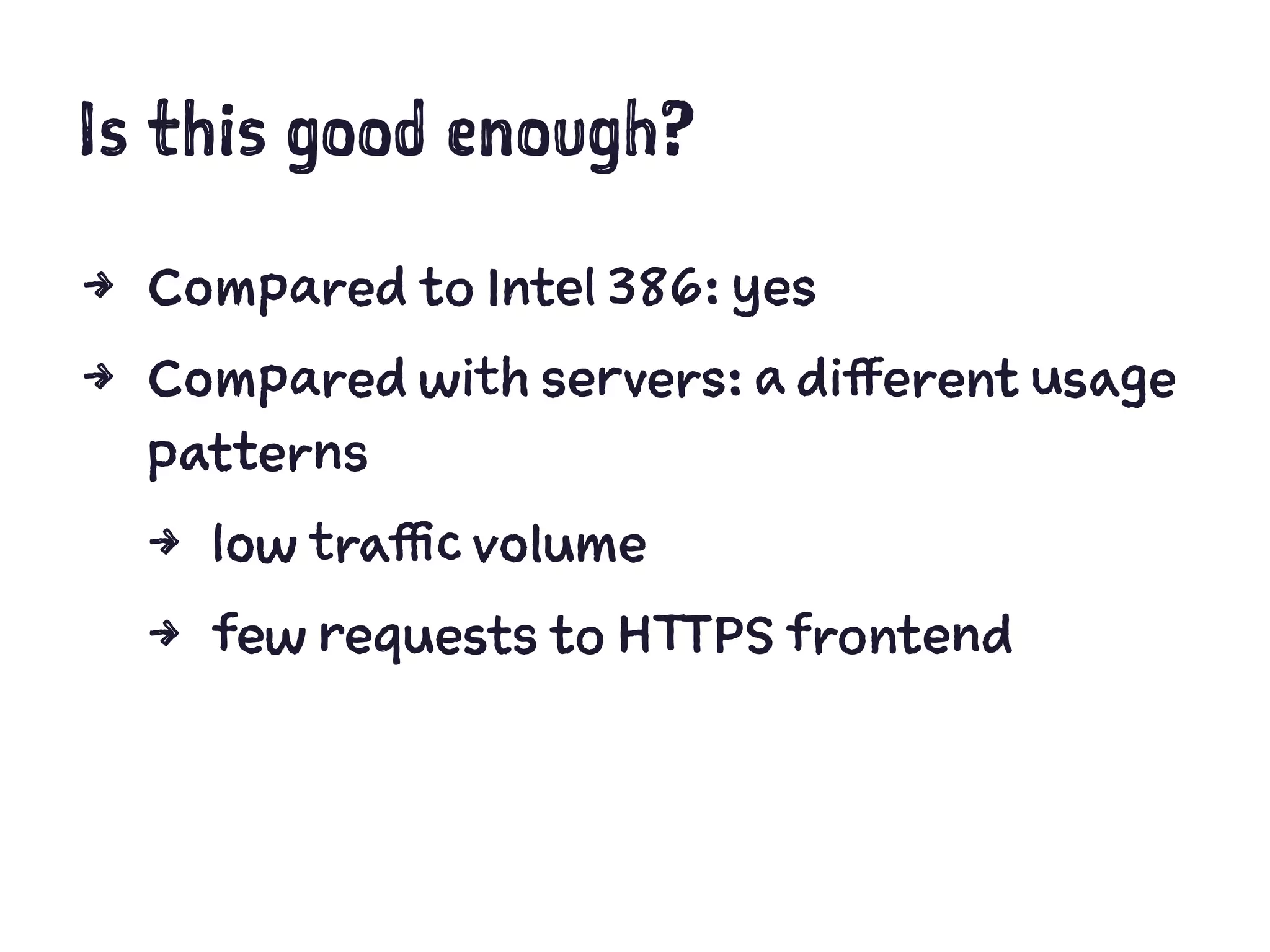
Is this good enough?
4 Compared to Intel 386: yes
4 Compared with servers: a different usage
patterns
4 low traffic volume
4 few requests to HTTPS frontend
Herding cats
Existing projects
4 nginx/dovecot: HTTP + IMAP servers (C)
4 GnuPG: PGP encryption (C)
4 imapsync: IMAP synchronization
(Python)
4 bonjour, monit (C)
4 OpenSSH: tunnelling (C/ruby)
4 roundcube webmail: Webmail (PHP)
+ not so secret sauce
4 imapsync patch (Python)
4 configuration frontend (Ruby)
4 smtp server + client (Go)
4 installer (Ruby+Shell)
4 gluing code: (Ruby, Shell, C, Flex)
Why Ruby?
4 greatest language in the world
4 good network libraries
4 platform independent, kind of
4 Sinatra rocks
Why not Ruby?
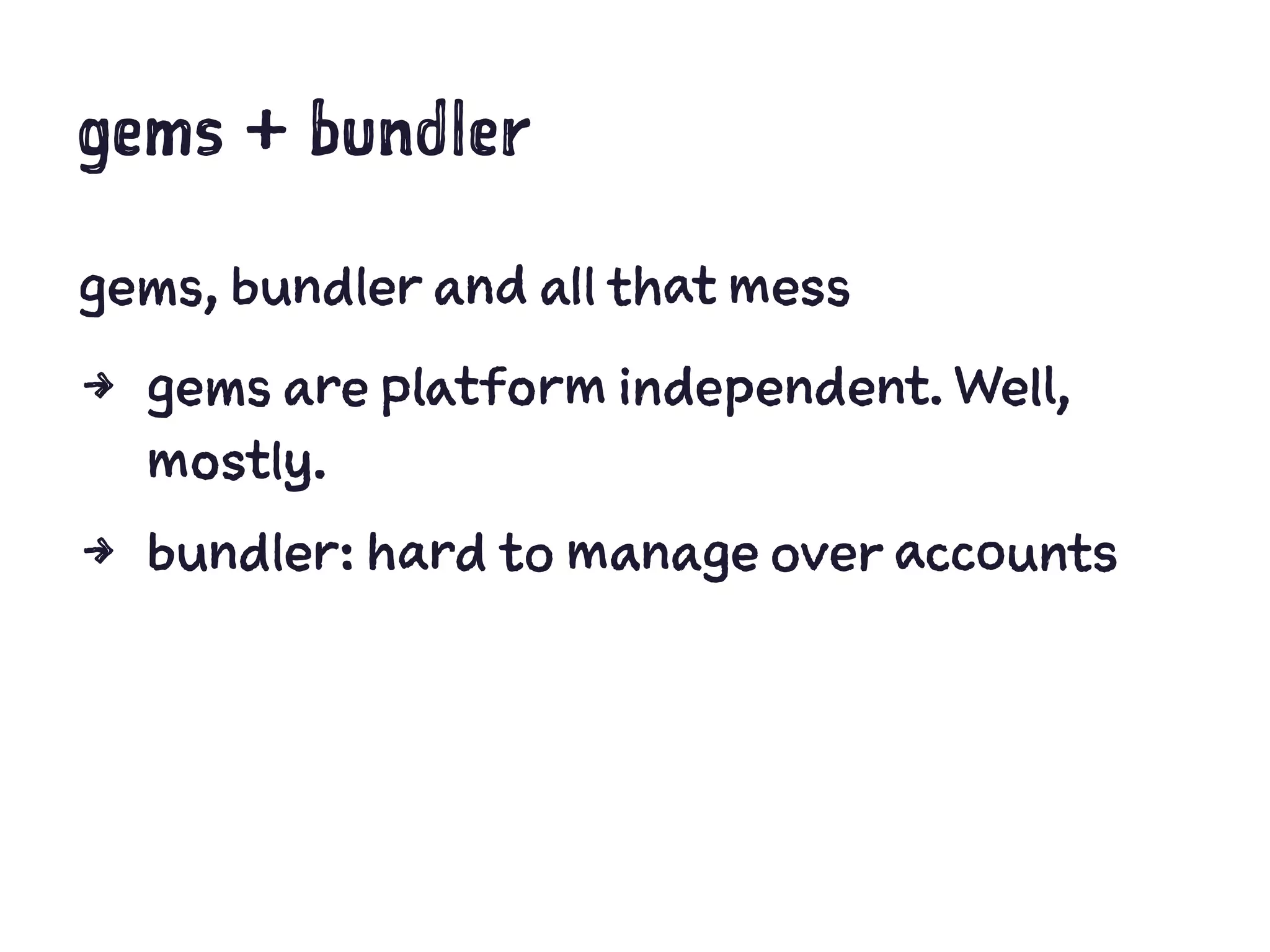
gems + bundler
gems, bundler and all that mess
4 gems are platform independent. Well,
mostly.
4 bundler: hard to manage over accounts
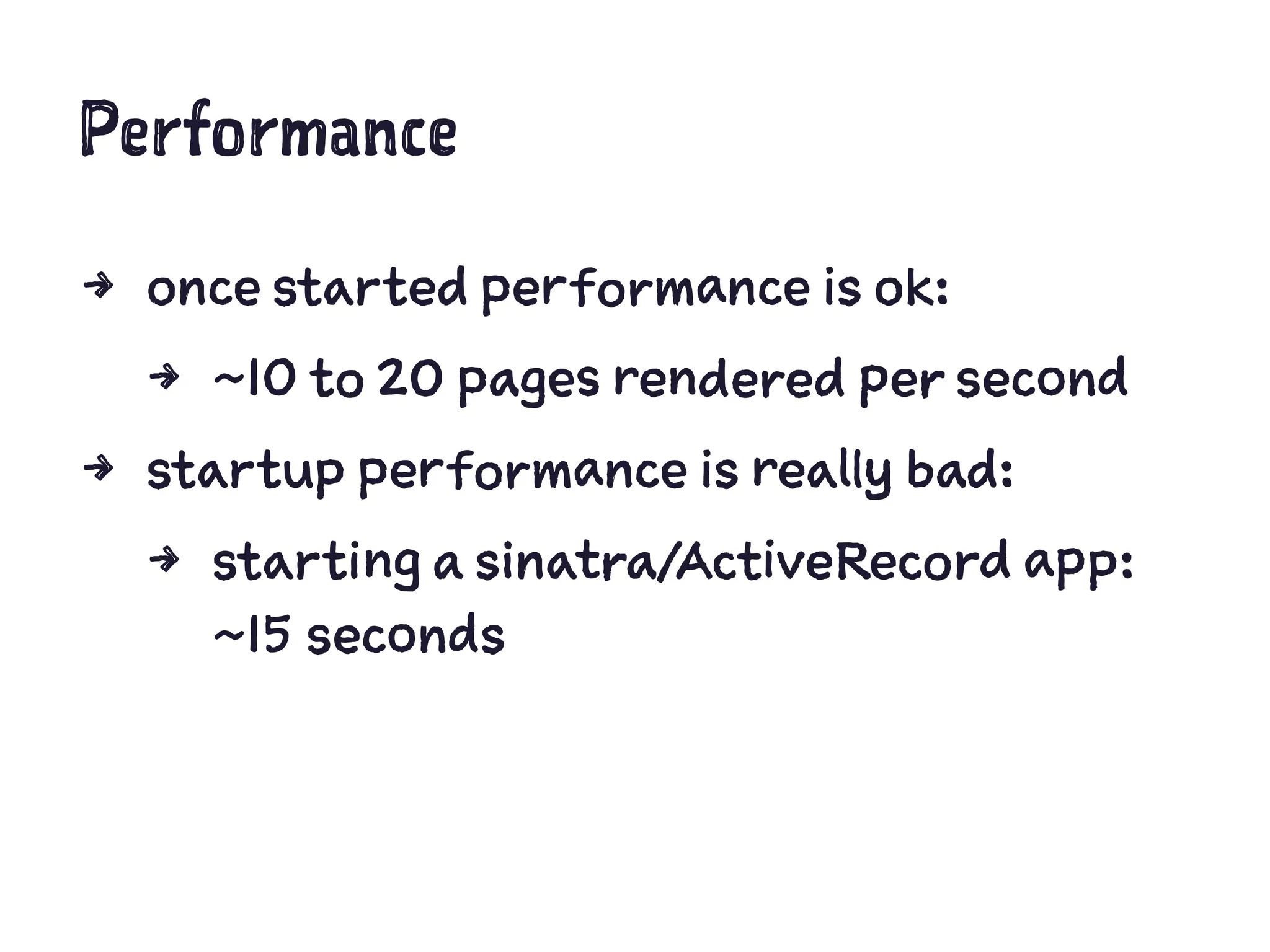
Performance
4 once started performance is ok:
4 ~10 to 20 pages rendered per second
4 startup performance is really bad:
4 starting a sinatra/ActiveRecord app:
~15 seconds
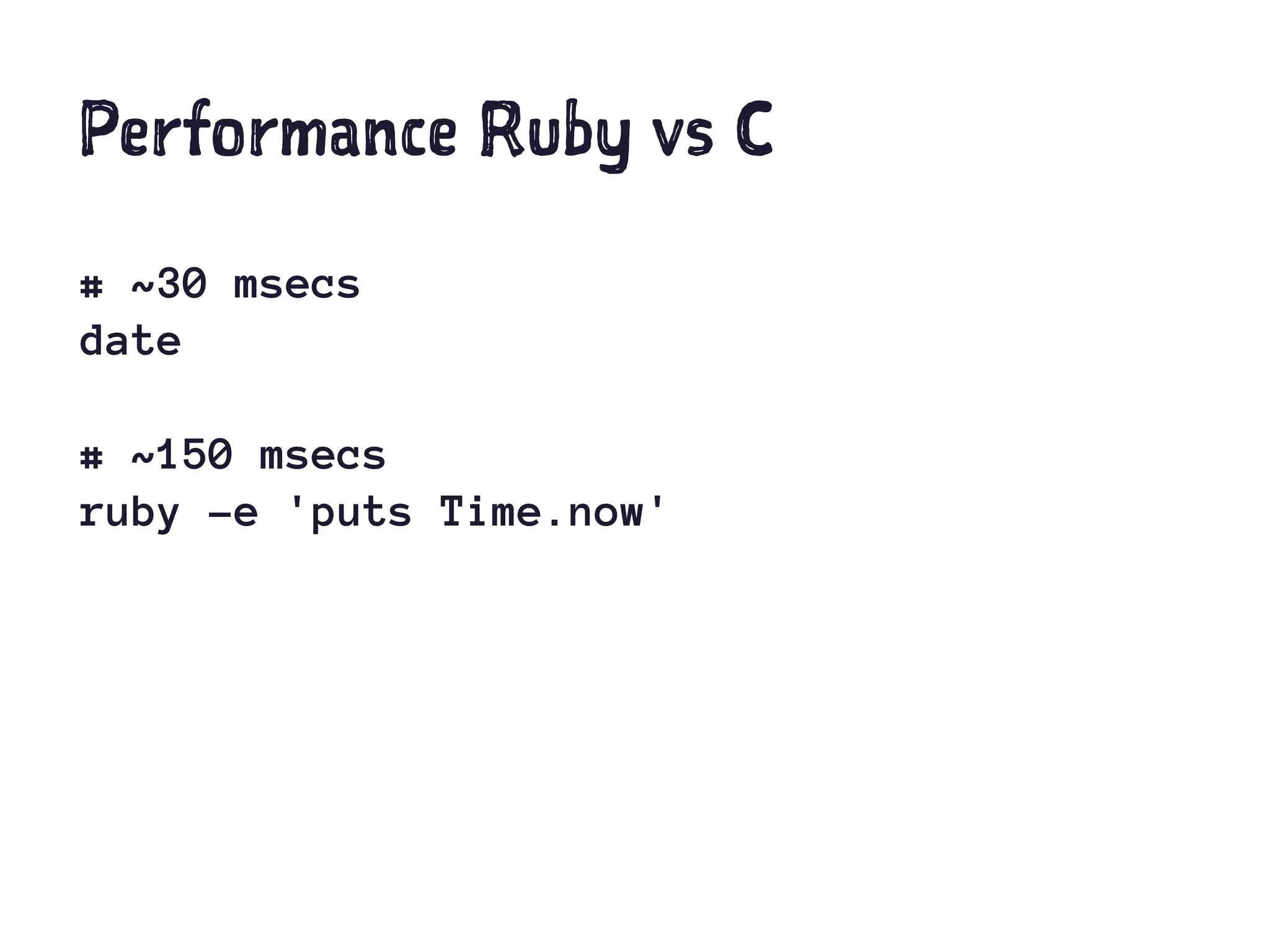
Performance Ruby vs C
# ~30 msecs
date
# ~150 msecs
ruby -e 'puts Time.now'
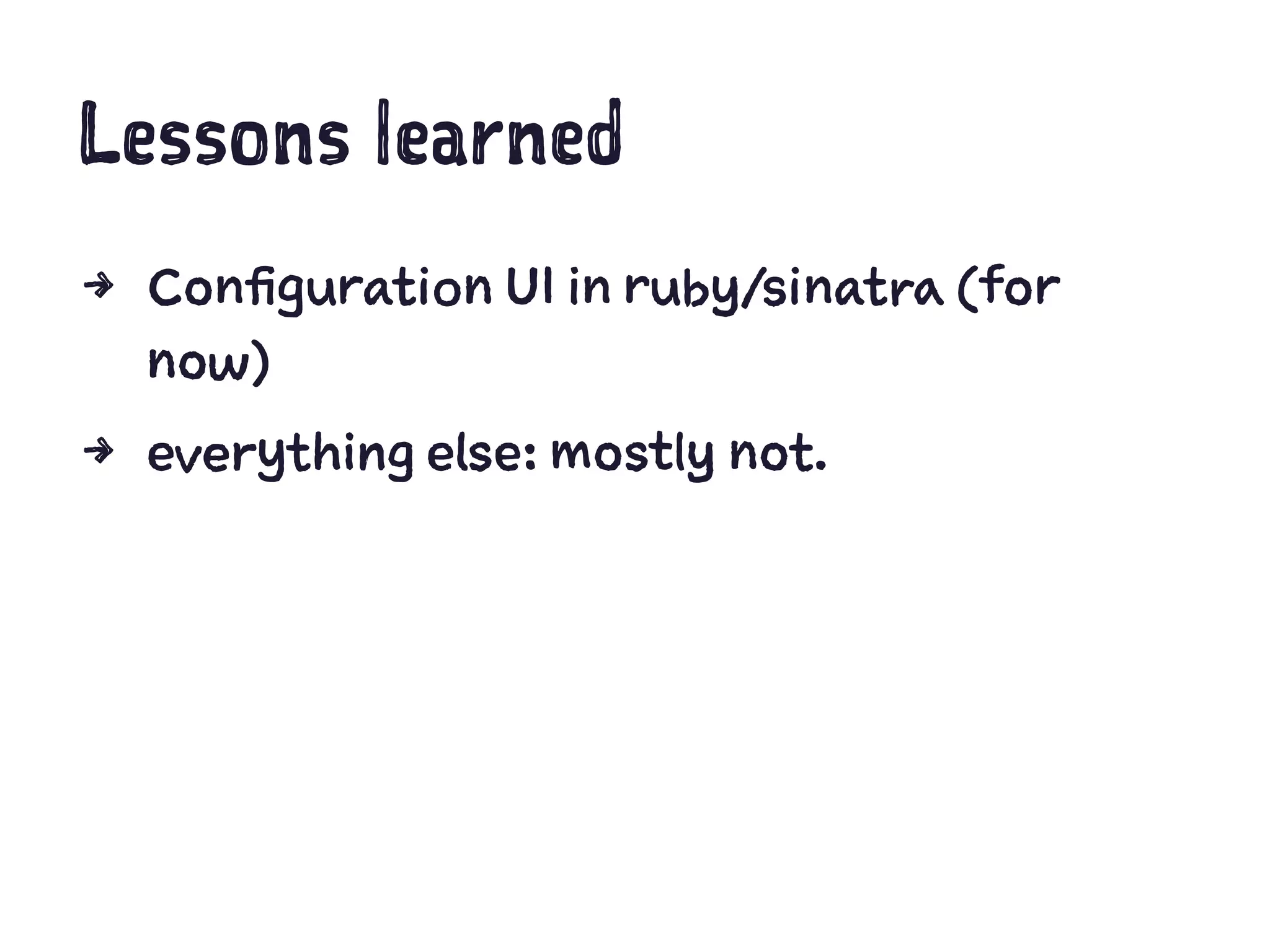
Lessons learned
4 Configuration UI in ruby/sinatra (for
now)
4 everything else: mostly not.
Tipps & Tricks
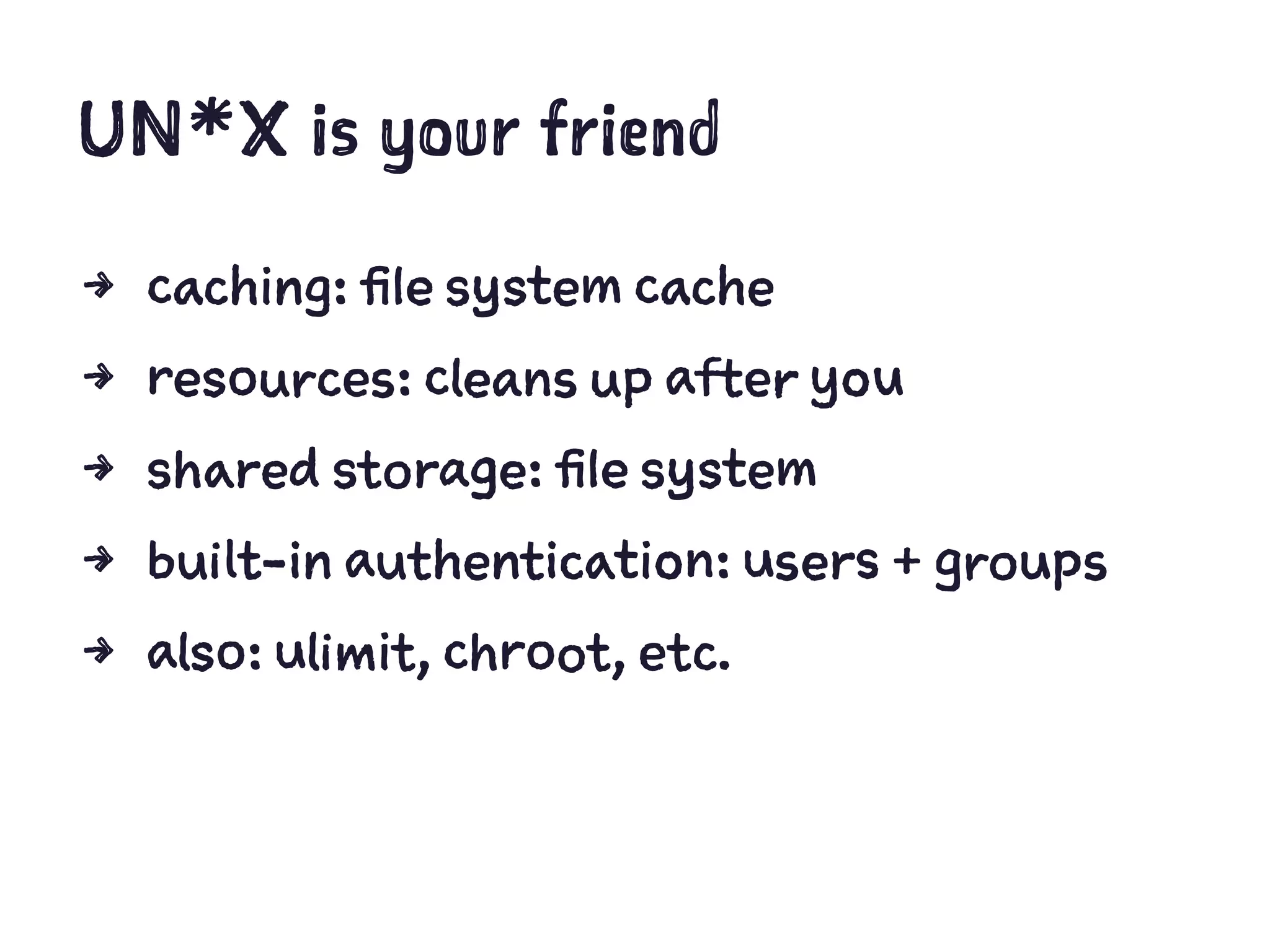
1. UN*X is your friend
UN*X is your friend
4 caching: file system cache
4 resources: cleans up after you
4 shared storage: file system
4 built-in authentication: users + groups
4 also: ulimit, chroot, etc.
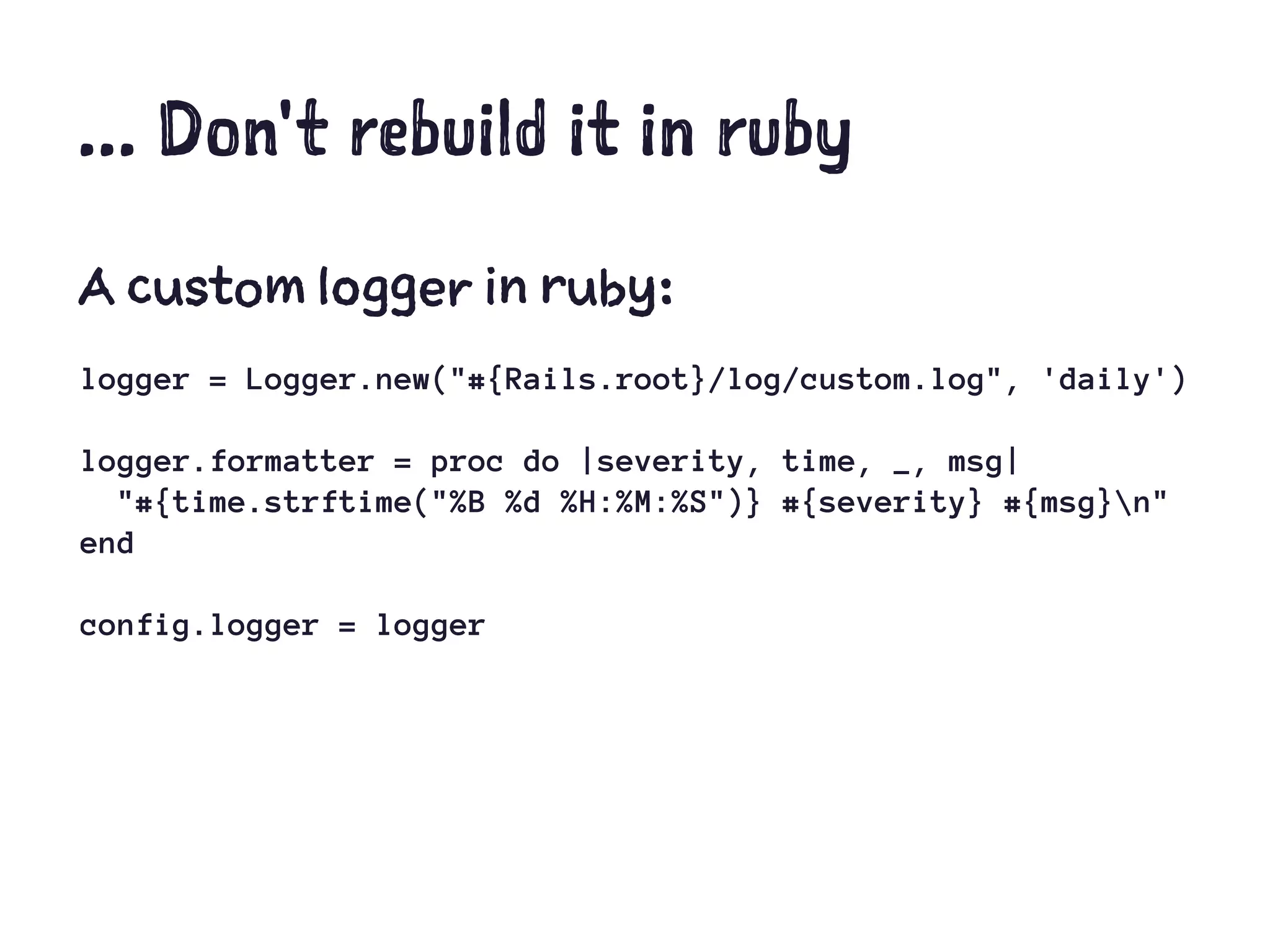
... Don't rebuild it in ruby
A custom logger in ruby:
logger = Logger.new("#{Rails.root}/log/custom.log", 'daily')
logger.formatter = proc do |severity, time, _, msg|
"#{time.strftime("%B %d %H:%M:%S")} #{severity} #{msg}n"
end
config.logger = logger
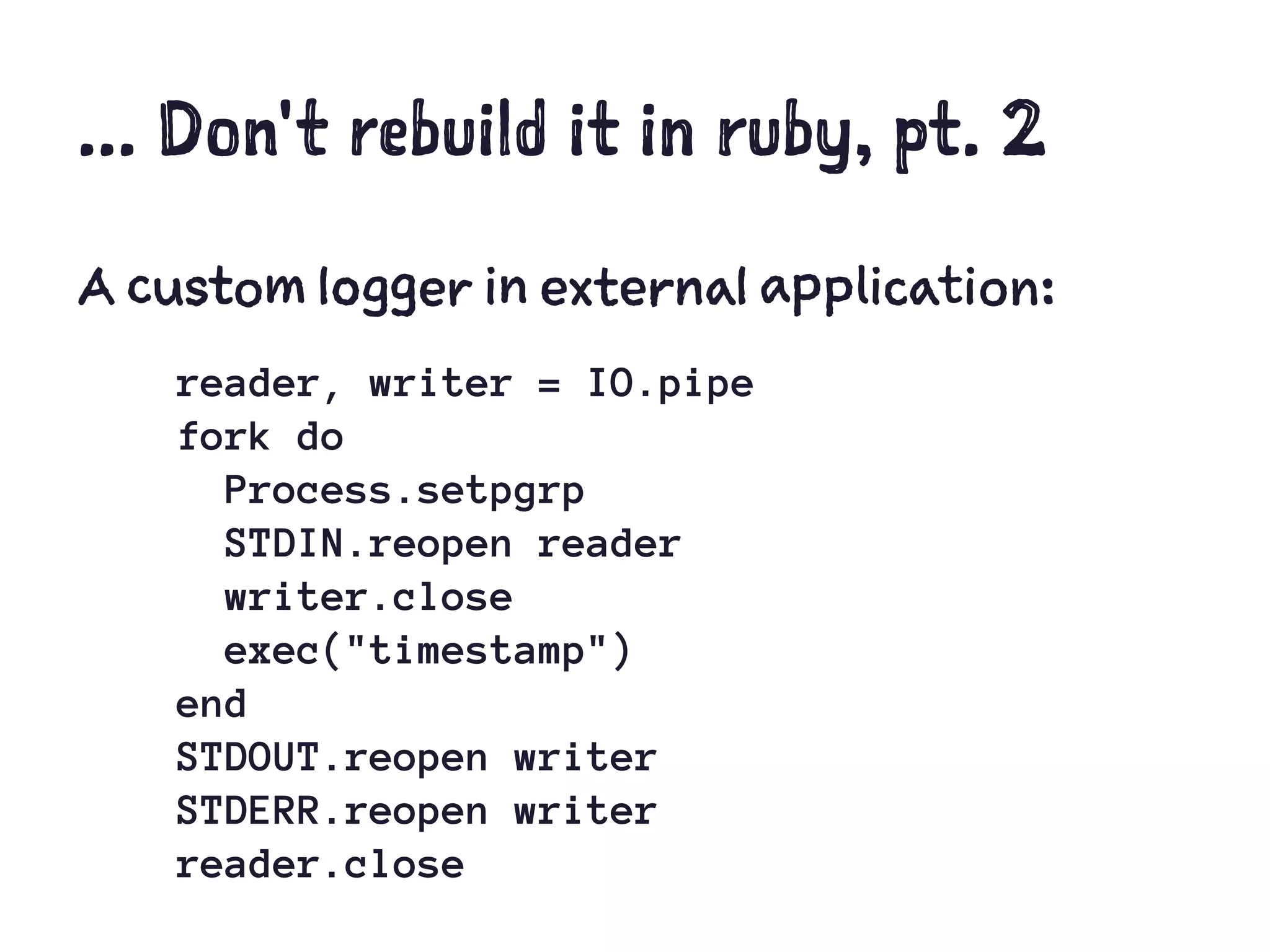
... Don't rebuild it in ruby, pt. 2
A custom logger in external application:
reader, writer = IO.pipe
fork do
Process.setpgrp
STDIN.reopen reader
writer.close
exec("timestamp")
end
STDOUT.reopen writer
STDERR.reopen writer
reader.close
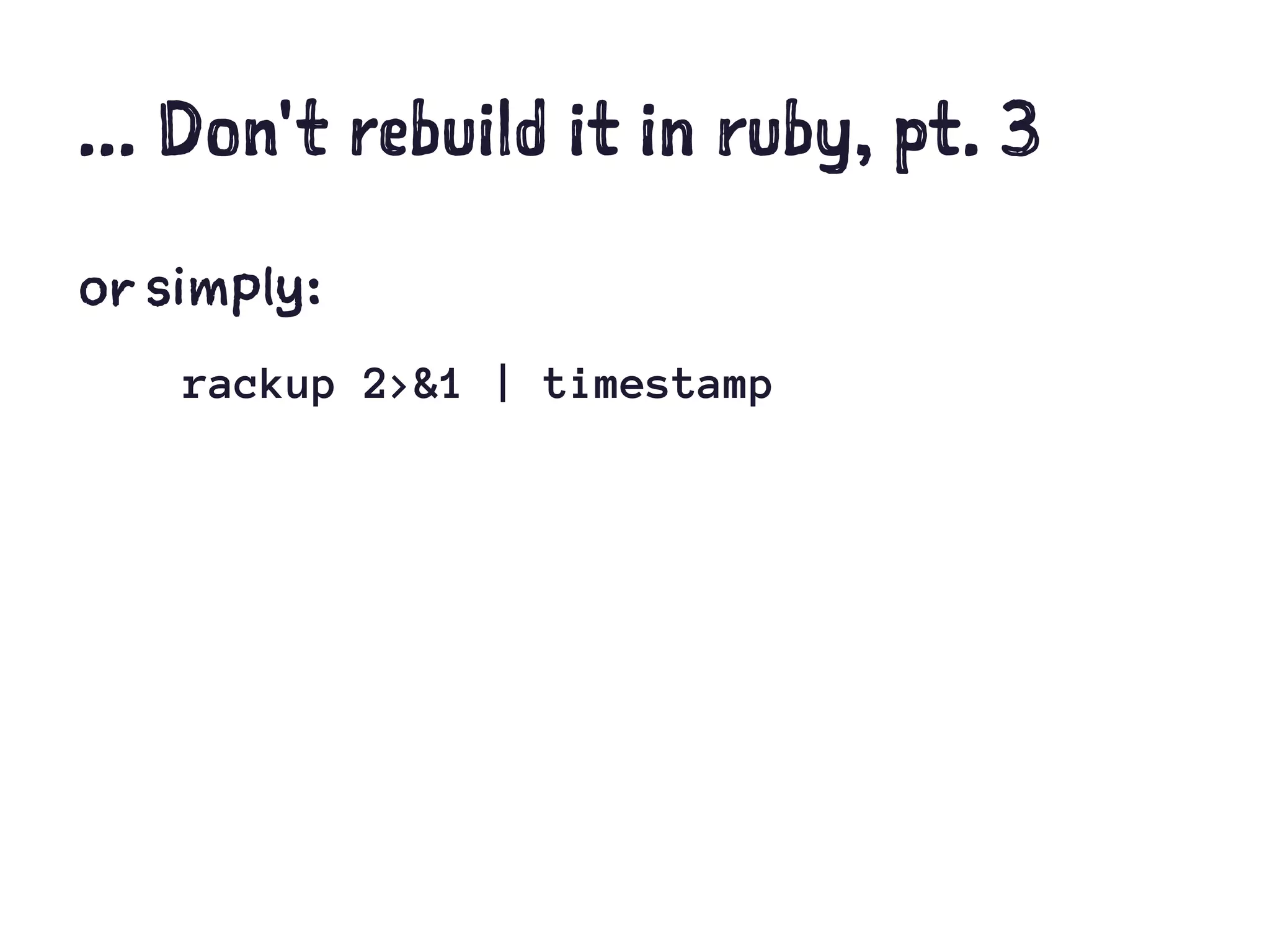
... Don't rebuild it in ruby, pt. 3
or simply:
rackup 2>&1 | timestamp
... Don't rebuild it
ditto:
4 daemons
4 process management
4 etc.
(Hello devops!)
2. Alternative Languages
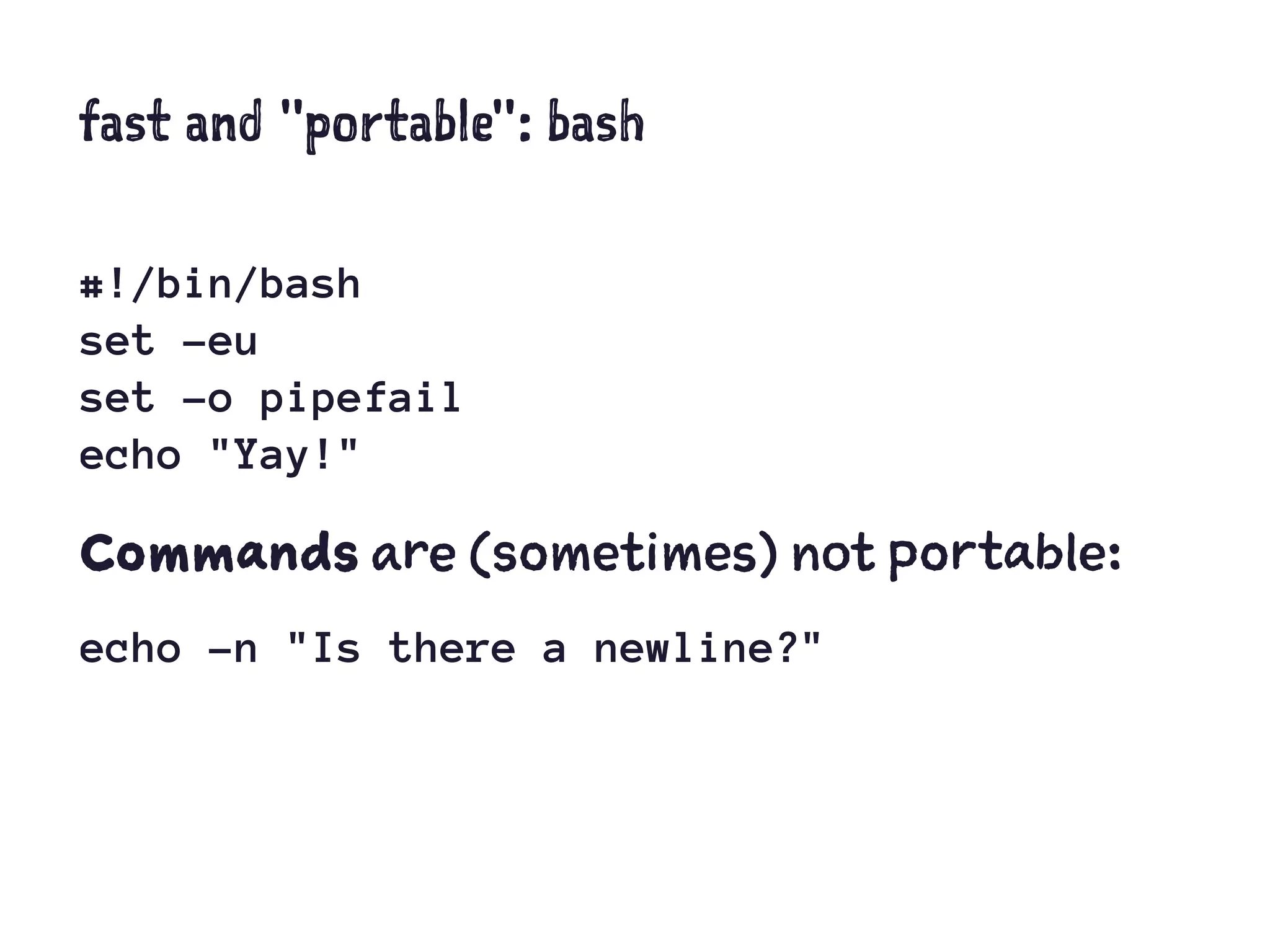
fast and "portable": bash
#!/bin/bash
set -eu
set -o pipefail
echo "Yay!"
Commands are (sometimes) not portable:
echo -n "Is there a newline?"
small & fast: C
POSIX at your fingertips.
4 fast
4 small
4 source: somewhat portable; '#ifdef
linux' FTW!
Pattern matching: flex
Pattern matching done quickly; in portable
source code.
/* Replaces ${{NAME}} from the environment */
${{[a-zA-Z0-9_]+}} {
yytext[yyleng-2] = 0;
const char* env = yytext+3;
const char* value = getenv(env);
printf("%s", value ? value : "");
}
networking: Go
Go, the environment
4 fast, portable source
4 good networking + email libraries (even
SSH!)
4 crosscompiling: easy
Go, the language
4 terrible.
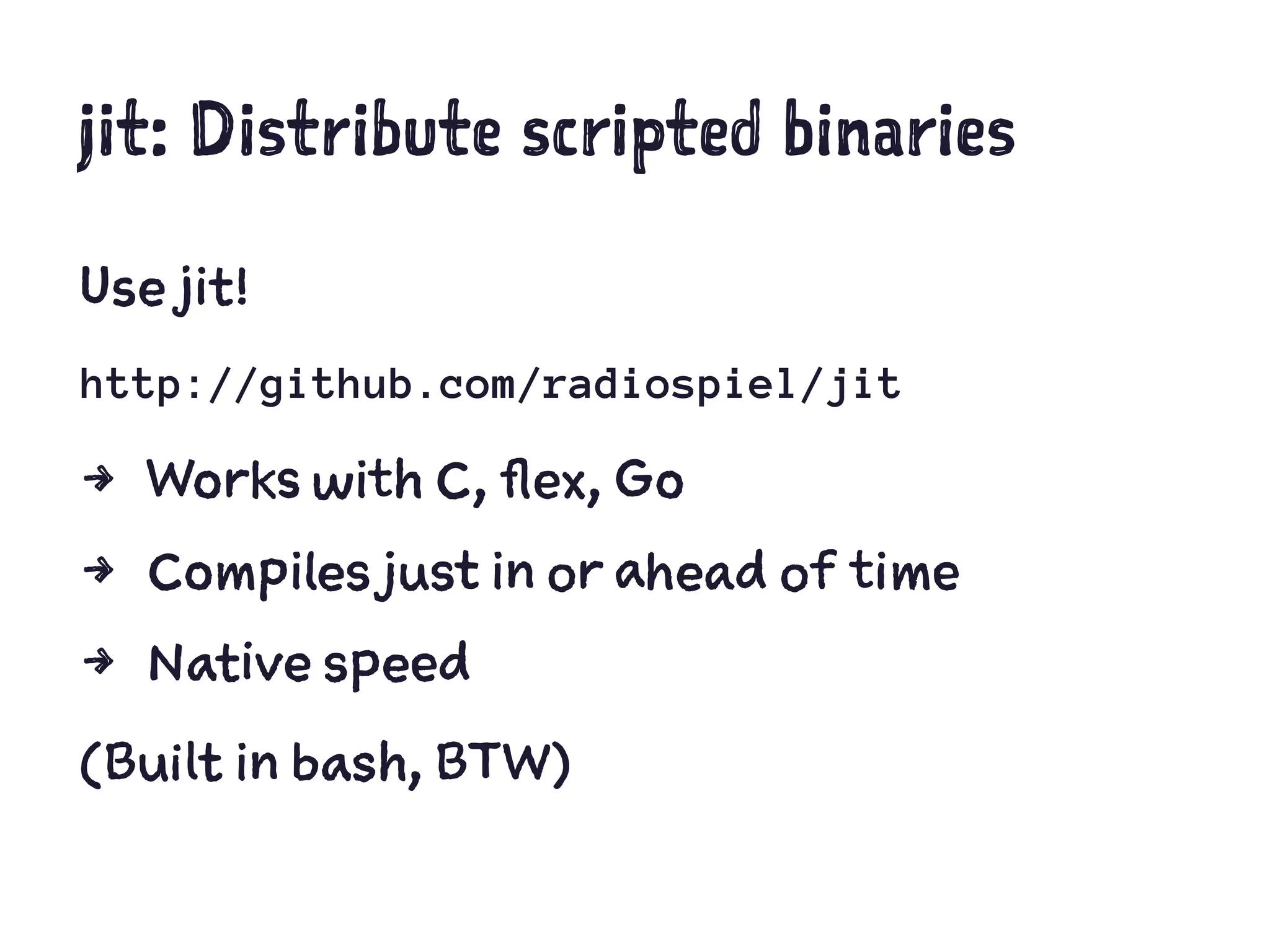
jit: Distribute scripted binaries
Use jit!
http://github.com/radiospiel/jit
4 Works with C, flex, Go
4 Compiles just in or ahead of time
4 Native speed
(Built in bash, BTW)
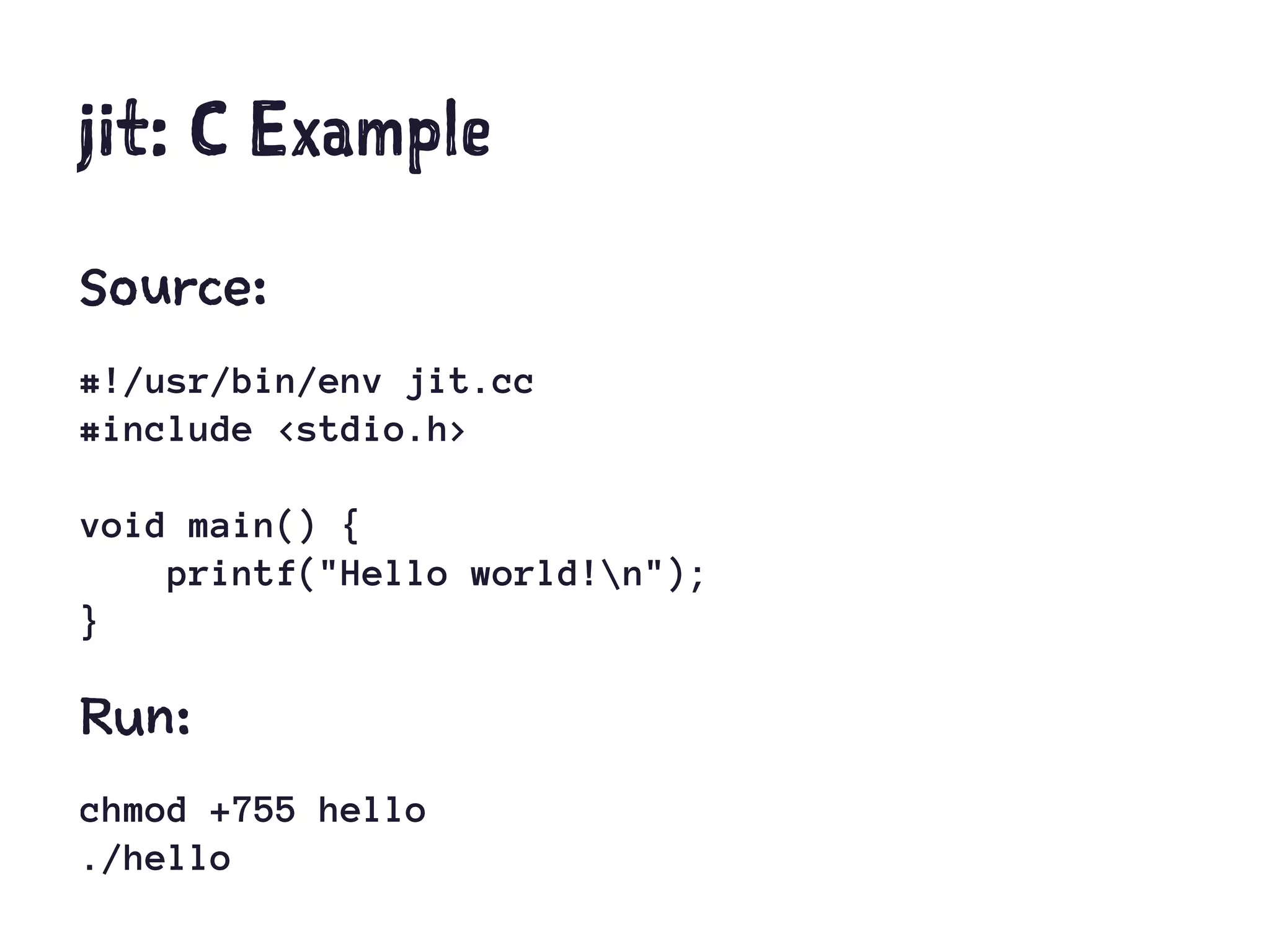
jit: C Example
Source:
#!/usr/bin/env jit.cc
#include <stdio.h>
void main() {
printf("Hello world!n");
}
Run:
chmod +755 hello
./hello
Links
4 flex: http://flex.sourceforge.net/
4 jit: http://github.com/radiospiel/jit
We are crowdfunding.
https://getkinko.com
Ruby on embedded devices rug::b Aug 2014

Ruby on embedded devices rug::b Aug 2014

  • 1.
  • 3.
    What is kinko.me 4PGP-based email encryption 4 for your desktop and your mobiles 4 with your current email address Also 4 comes on a dedicated device
  • 4.
    ssshhh... as of thisafternoon we are crowdfunding. Feel invited to check https://getkinko.com
  • 5.
    Hardware 4 A10 1GHzCortex-A8 ARMv7 CPU, VFPv3, NEON, Mali 400 GPU, CedarX VPU 4 512MB DDR3 RAM memory 4 SD storage
  • 6.
    Compared to modernmachines 4 CPU: 10x 4 IO throughput: ~50x (RAM is ok, though)
  • 7.
    Is this goodenough? 4 Compared to Intel 386: yes 4 Compared with servers: a different usage patterns 4 low traffic volume 4 few requests to HTTPS frontend
  • 8.
  • 9.
    Existing projects 4 nginx/dovecot:HTTP + IMAP servers (C) 4 GnuPG: PGP encryption (C) 4 imapsync: IMAP synchronization (Python) 4 bonjour, monit (C) 4 OpenSSH: tunnelling (C/ruby) 4 roundcube webmail: Webmail (PHP)
  • 10.
    + not sosecret sauce 4 imapsync patch (Python) 4 configuration frontend (Ruby) 4 smtp server + client (Go) 4 installer (Ruby+Shell) 4 gluing code: (Ruby, Shell, C, Flex)
  • 11.
  • 12.
    4 greatest languagein the world 4 good network libraries 4 platform independent, kind of 4 Sinatra rocks
  • 13.
  • 14.
    gems + bundler gems,bundler and all that mess 4 gems are platform independent. Well, mostly. 4 bundler: hard to manage over accounts
  • 15.
    Performance 4 once startedperformance is ok: 4 ~10 to 20 pages rendered per second 4 startup performance is really bad: 4 starting a sinatra/ActiveRecord app: ~15 seconds
  • 16.
    Performance Ruby vsC # ~30 msecs date # ~150 msecs ruby -e 'puts Time.now'
  • 17.
    Lessons learned 4 ConfigurationUI in ruby/sinatra (for now) 4 everything else: mostly not.
  • 18.
  • 19.
    1. UN*X isyour friend
  • 20.
    UN*X is yourfriend 4 caching: file system cache 4 resources: cleans up after you 4 shared storage: file system 4 built-in authentication: users + groups 4 also: ulimit, chroot, etc.
  • 21.
    ... Don't rebuildit in ruby A custom logger in ruby: logger = Logger.new("#{Rails.root}/log/custom.log", 'daily') logger.formatter = proc do |severity, time, _, msg| "#{time.strftime("%B %d %H:%M:%S")} #{severity} #{msg}n" end config.logger = logger
  • 22.
    ... Don't rebuildit in ruby, pt. 2 A custom logger in external application: reader, writer = IO.pipe fork do Process.setpgrp STDIN.reopen reader writer.close exec("timestamp") end STDOUT.reopen writer STDERR.reopen writer reader.close
  • 23.
    ... Don't rebuildit in ruby, pt. 3 or simply: rackup 2>&1 | timestamp
  • 24.
    ... Don't rebuildit ditto: 4 daemons 4 process management 4 etc. (Hello devops!)
  • 25.
  • 26.
    fast and "portable":bash #!/bin/bash set -eu set -o pipefail echo "Yay!" Commands are (sometimes) not portable: echo -n "Is there a newline?"
  • 27.
    small & fast:C POSIX at your fingertips. 4 fast 4 small 4 source: somewhat portable; '#ifdef linux' FTW!
  • 28.
    Pattern matching: flex Patternmatching done quickly; in portable source code. /* Replaces ${{NAME}} from the environment */ ${{[a-zA-Z0-9_]+}} { yytext[yyleng-2] = 0; const char* env = yytext+3; const char* value = getenv(env); printf("%s", value ? value : ""); }
  • 29.
    networking: Go Go, theenvironment 4 fast, portable source 4 good networking + email libraries (even SSH!) 4 crosscompiling: easy Go, the language 4 terrible.
  • 30.
    jit: Distribute scriptedbinaries Use jit! http://github.com/radiospiel/jit 4 Works with C, flex, Go 4 Compiles just in or ahead of time 4 Native speed (Built in bash, BTW)
  • 31.
    jit: C Example Source: #!/usr/bin/envjit.cc #include <stdio.h> void main() { printf("Hello world!n"); } Run: chmod +755 hello ./hello
  • 32.
    Links 4 flex: http://flex.sourceforge.net/ 4jit: http://github.com/radiospiel/jit
  • 33.