| 27march 2015  workspan
©iStockphoto.com/MingLokFung;TuomasKujansuu
By Cord Himelstein, Michael C. Fina
Did you know that 21 percent of full-time workers wanted
to change jobs in 2014? That’s the largest percentage
since 2008; it’s up from 17 percent in 2013, according
to a survey from CareerBuilder.com and Harris Interac-
tive. This has resulted in employees being more likely
to look for other career opportunities. How can your
company retain and engage employees for the long term?
To go beyond simply mitigating turnover all the way
to increasing efficiency and company loyalty, employers
need to take a closer look at their recognition strategy.
Current Use of Recognition Falls Short
Formal employee recognition — beyond the traditional
gifts and points doled out for showing up to work day in
and day out — is a leading driver of employee engagement.
Employers who show appreciation for employees through
a balanced mix of tangible and intangible rewards and
demonstrate a genuine respect for an employee’s work
go a long way toward developing a strong bond. In fact,
according to a survey conducted by Bersin & Associates,
“The State of Employee Recognition in 2012,” organiza-
tions with recognition programs that enable employee
Thoughtful and meaningful recognition
can make a difference in retention.
The Recipe for
Recognition
Success
© 2015 WorldatWork. All Rights Reserved. For information about reprints/re-use, email copyright@worldatwork.org | www.worldatwork.org | 877-951-9191
03|2015
®
The Magazine of WorldatWork©
28  | workspan  march 2015
engagement had lower voluntary turnover than organizations
with ineffective recognition programs.
Unfortunately, the majority of organizations — 91 percent,
according to research firm Accelir — use reward and recogni-
tion programs simply to honor employees for tenure and only
12 percent include an early recognition element during the
first five years of employment. However, 67 percent of those
respondents reported that employees should be recognized for
their first year of service at a company, so it’s clear that there is
a perceived importance in recognizing employees early. So what
does a successful recognition and engagement plan look like?
The Ingredients for a Successful
Recognition Program
Four critical steps will encourage new employees become
engaged and productive from the get-go, which helps ensure
they’ll stick around for a long time.
Give Kudos Early On
Providing a form of meaningful service recognition early,
at the one-year or three-year mark, perhaps acclimates
employees to the recognition culture quickly. The early
show of appreciation demonstrates to the employee that the
organization is committed to his/her professional growth
and overall well-being. This is an especially important
motivator for Millennials.
For one top building products company, early recognition
has been a hallmark of its employee engagement strategy.
The company begins recognizing employees on their one-
year anniversary, followed by their three-year and five-year
milestones, and then every five years. With a relationship-
oriented corporate culture, the three-year mark can be a critical
turning point in employees’ careers. Offering certificates in
addition to a choice of gift helps promote a sense of cama-
raderie within the company, as well as long-term loyalty and
long-lasting relationships, according to company leaders.
Go Beyond Tangible Rewards
For employees, positive verbal or written words of
appreciation for reaching a goal or service anniversary
often resonate the most. Tangible rewards are helpful but
employees also need to know that their work is respected
through regular formal and informal verbal feedback. This
type of communication can easily be added to an overall
program without raising the scope of the program’s budget.
An achievement-based system, where managers can
instantly nominate all employees, including new hires, for
rewards in order to bolster early accomplishments can be
helpful for encouraging employees to continue meeting
corporate goals and objectives.
When employees feel a deep employee-to-employer connec-
tion, they are more likely to be productive, happy on the
job and stay with the organization long-term. This type of
culture is optimal for the growth of an organization and
meeting overall business objectives.
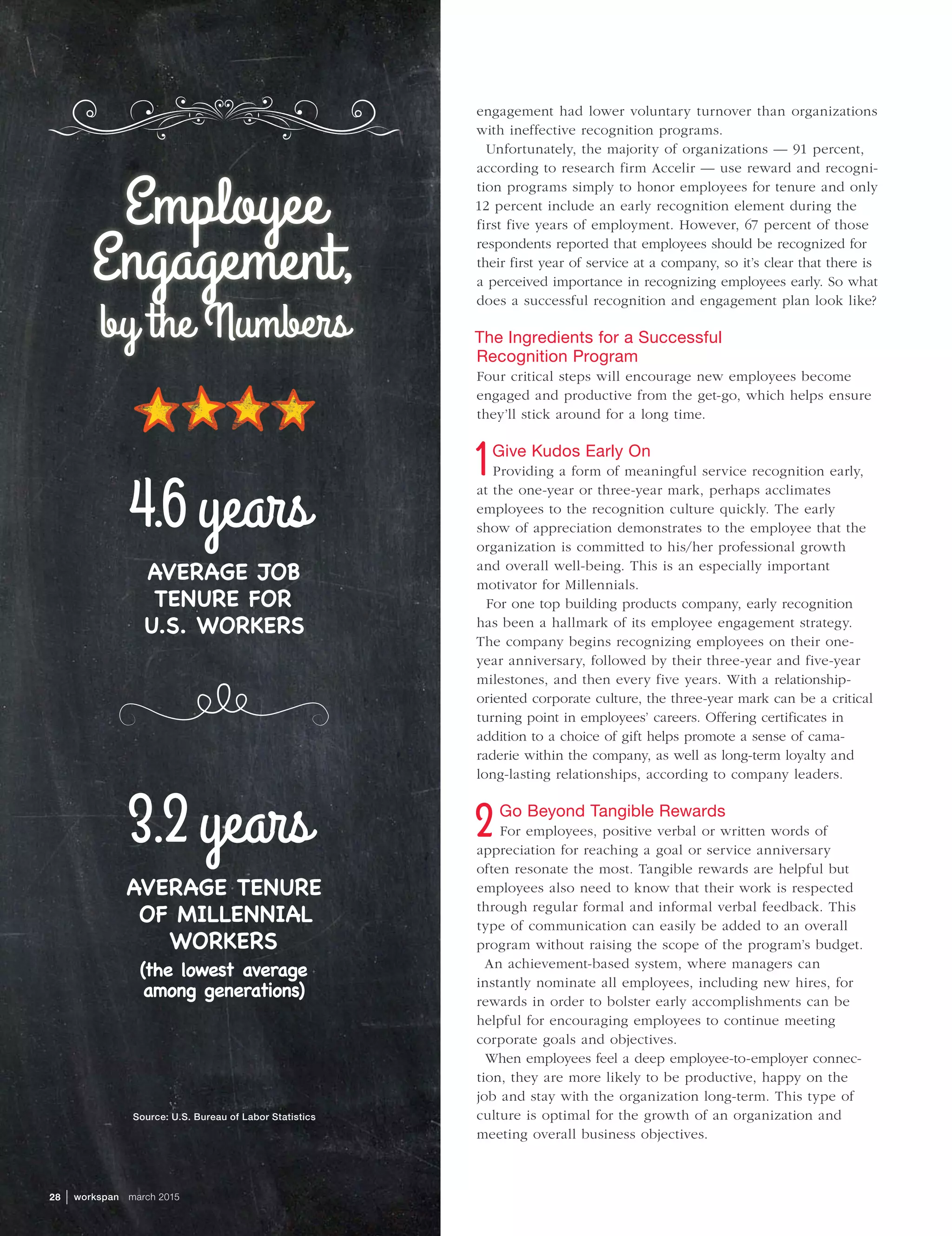
AVERAGE JOB
TENURE FOR
U.S. WORKERS
4.6years
AVERAGE TENURE
OF MILLENNIAL
WORKERS
(the lowest average
among generations)
3.2years
Employee
Engagement,
by the Numbers
Source: U.S. Bureau of Labor Statistics
Employee
Engagement,
by the Numbers
30  | workspan  march 2015
Involve Senior Leaders and Train Managers
Recognition programs are most successful at organiza-
tions that have senior leaders who believe in the initiatives
and the recognition culture, and who are willing to step in
and be a mouthpiece for communicating the importance of
the program. When senior leaders act to recognize early and
often, other managers and personnel are likely to do the
same, fostering the program’s overall objectives and creating
a trickle-down effect throughout the organization.
Managers also need to be on board with the recognition
program and invested in the early recognition philosophy.
A big misconception in recognition is that managers are
automatically qualified to give recognition by virtue of being
managers, but this isn’t always the case. The American
Society for Training and Development reports that 28 percent
of managers say they feel unprepared for their roles, and
58 percent report not receiving any training at all.
When employees are promoted to a managerial level, they
should receive training and instruction on how to commu-
nicate and engage with employees. This includes a proper
introduction to existing recognition program initiatives.
Throughout the course of the program, managers should
understand how to offer ongoing verbal feedback and praise.
Short emails to welcome new hires are especially important,
as well as status check ups, which are valuable for engaging
on a meaningful and personal level from Day One.
Recognition Must Be Meaningful
In the end, recognition is effective when it’s meaningful,
engages employees on a personal level and ties back to an
employer’s core values and culture. In today’s competitive talent
market, companies must take a closer look at how early recog-
nition can further boost employee engagement and nurture
relationships in order to retain employees. A deep level of
personalization should be taken into account when designing
and implementing recognition programs so initiatives are
successful in building long-lasting connections with employees.
Conclusion
While many companies are currently falling short with their
recognition efforts, your company doesn’t have to be one of
them. By providing rewards early in employment, giving verbal
praise in addition to tangible rewards, involving senior leaders
and training managers, and making sure all recognition efforts
are meaningful, your company can become a success story. 
Cord Himelstein  is vice president of marketing and communication
for employee recognition company Michael C. Fina. He can be reached
at chimelstein@mcfina.com.
resources plus
For more information, books and education related to this topic, log
on to www.worldatwork.org and use any or all of these keywords:
❙❙ Recognition
❙❙ Employee Engagement
❙❙ Employee Recognition.
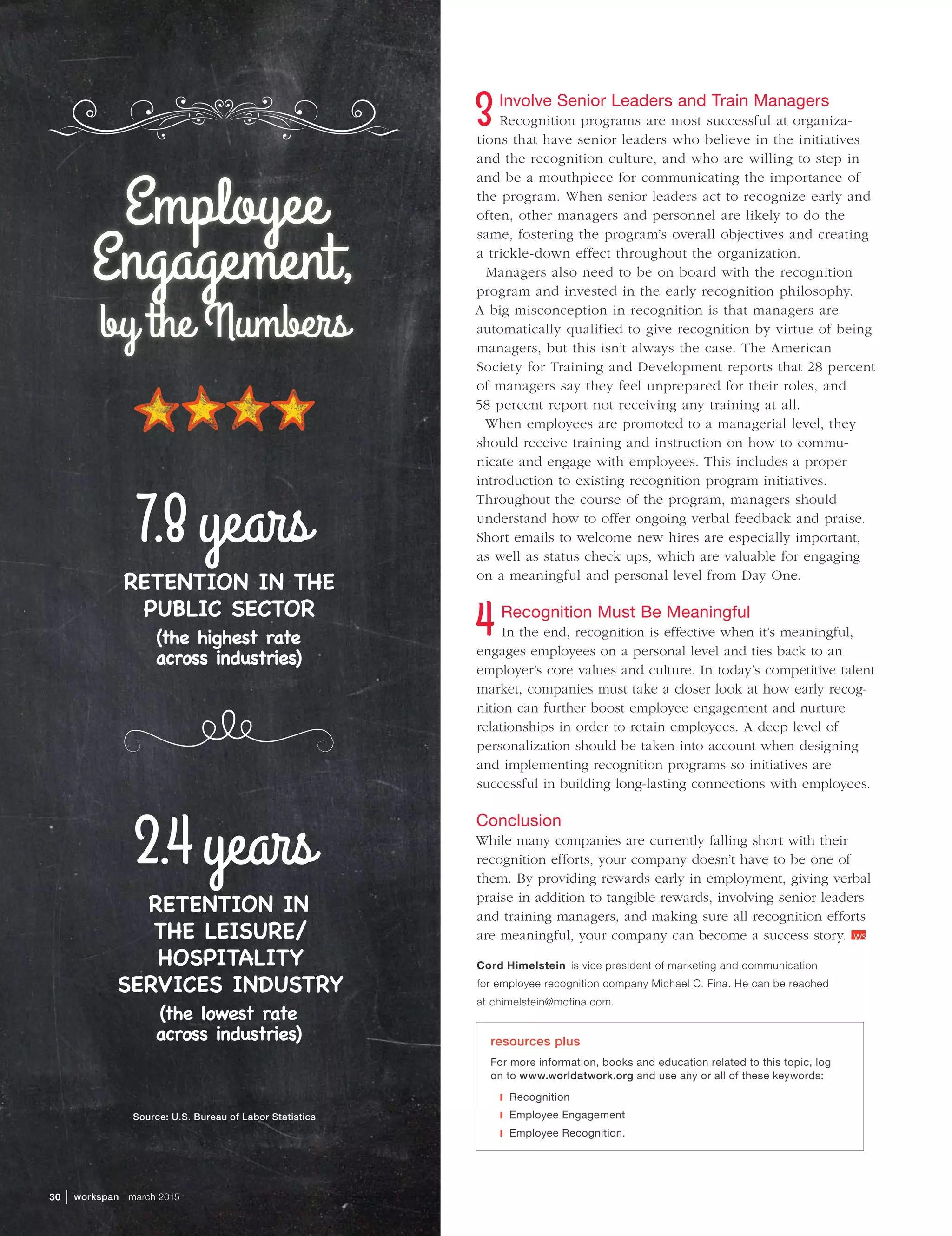
7.8years
RETENTION IN THE
PUBLIC SECTOR
(the highest rate
across industries)
RETENTION IN
THE LEISURE/
HOSPITALITY
SERVICES INDUSTRY
(the lowest rate
across industries)
2.4years

Recipe for Recognition Success

  • 2.
    | 27march 2015  workspan ©iStockphoto.com/MingLokFung;TuomasKujansuu ByCord Himelstein, Michael C. Fina Did you know that 21 percent of full-time workers wanted to change jobs in 2014? That’s the largest percentage since 2008; it’s up from 17 percent in 2013, according to a survey from CareerBuilder.com and Harris Interac- tive. This has resulted in employees being more likely to look for other career opportunities. How can your company retain and engage employees for the long term? To go beyond simply mitigating turnover all the way to increasing efficiency and company loyalty, employers need to take a closer look at their recognition strategy. Current Use of Recognition Falls Short Formal employee recognition — beyond the traditional gifts and points doled out for showing up to work day in and day out — is a leading driver of employee engagement. Employers who show appreciation for employees through a balanced mix of tangible and intangible rewards and demonstrate a genuine respect for an employee’s work go a long way toward developing a strong bond. In fact, according to a survey conducted by Bersin & Associates, “The State of Employee Recognition in 2012,” organiza- tions with recognition programs that enable employee Thoughtful and meaningful recognition can make a difference in retention. The Recipe for Recognition Success © 2015 WorldatWork. All Rights Reserved. For information about reprints/re-use, email copyright@worldatwork.org | www.worldatwork.org | 877-951-9191 03|2015 ® The Magazine of WorldatWork©
  • 3.
    28  | workspan march 2015 engagement had lower voluntary turnover than organizations with ineffective recognition programs. Unfortunately, the majority of organizations — 91 percent, according to research firm Accelir — use reward and recogni- tion programs simply to honor employees for tenure and only 12 percent include an early recognition element during the first five years of employment. However, 67 percent of those respondents reported that employees should be recognized for their first year of service at a company, so it’s clear that there is a perceived importance in recognizing employees early. So what does a successful recognition and engagement plan look like? The Ingredients for a Successful Recognition Program Four critical steps will encourage new employees become engaged and productive from the get-go, which helps ensure they’ll stick around for a long time. Give Kudos Early On Providing a form of meaningful service recognition early, at the one-year or three-year mark, perhaps acclimates employees to the recognition culture quickly. The early show of appreciation demonstrates to the employee that the organization is committed to his/her professional growth and overall well-being. This is an especially important motivator for Millennials. For one top building products company, early recognition has been a hallmark of its employee engagement strategy. The company begins recognizing employees on their one- year anniversary, followed by their three-year and five-year milestones, and then every five years. With a relationship- oriented corporate culture, the three-year mark can be a critical turning point in employees’ careers. Offering certificates in addition to a choice of gift helps promote a sense of cama- raderie within the company, as well as long-term loyalty and long-lasting relationships, according to company leaders. Go Beyond Tangible Rewards For employees, positive verbal or written words of appreciation for reaching a goal or service anniversary often resonate the most. Tangible rewards are helpful but employees also need to know that their work is respected through regular formal and informal verbal feedback. This type of communication can easily be added to an overall program without raising the scope of the program’s budget. An achievement-based system, where managers can instantly nominate all employees, including new hires, for rewards in order to bolster early accomplishments can be helpful for encouraging employees to continue meeting corporate goals and objectives. When employees feel a deep employee-to-employer connec- tion, they are more likely to be productive, happy on the job and stay with the organization long-term. This type of culture is optimal for the growth of an organization and meeting overall business objectives. AVERAGE JOB TENURE FOR U.S. WORKERS 4.6years AVERAGE TENURE OF MILLENNIAL WORKERS (the lowest average among generations) 3.2years Employee Engagement, by the Numbers Source: U.S. Bureau of Labor Statistics
  • 4.
    Source: U.S. Bureauof Labor Statistics Employee Engagement, by the Numbers 30  | workspan  march 2015 Involve Senior Leaders and Train Managers Recognition programs are most successful at organiza- tions that have senior leaders who believe in the initiatives and the recognition culture, and who are willing to step in and be a mouthpiece for communicating the importance of the program. When senior leaders act to recognize early and often, other managers and personnel are likely to do the same, fostering the program’s overall objectives and creating a trickle-down effect throughout the organization. Managers also need to be on board with the recognition program and invested in the early recognition philosophy. A big misconception in recognition is that managers are automatically qualified to give recognition by virtue of being managers, but this isn’t always the case. The American Society for Training and Development reports that 28 percent of managers say they feel unprepared for their roles, and 58 percent report not receiving any training at all. When employees are promoted to a managerial level, they should receive training and instruction on how to commu- nicate and engage with employees. This includes a proper introduction to existing recognition program initiatives. Throughout the course of the program, managers should understand how to offer ongoing verbal feedback and praise. Short emails to welcome new hires are especially important, as well as status check ups, which are valuable for engaging on a meaningful and personal level from Day One. Recognition Must Be Meaningful In the end, recognition is effective when it’s meaningful, engages employees on a personal level and ties back to an employer’s core values and culture. In today’s competitive talent market, companies must take a closer look at how early recog- nition can further boost employee engagement and nurture relationships in order to retain employees. A deep level of personalization should be taken into account when designing and implementing recognition programs so initiatives are successful in building long-lasting connections with employees. Conclusion While many companies are currently falling short with their recognition efforts, your company doesn’t have to be one of them. By providing rewards early in employment, giving verbal praise in addition to tangible rewards, involving senior leaders and training managers, and making sure all recognition efforts are meaningful, your company can become a success story.  Cord Himelstein  is vice president of marketing and communication for employee recognition company Michael C. Fina. He can be reached at chimelstein@mcfina.com. resources plus For more information, books and education related to this topic, log on to www.worldatwork.org and use any or all of these keywords: ❙❙ Recognition ❙❙ Employee Engagement ❙❙ Employee Recognition. 7.8years RETENTION IN THE PUBLIC SECTOR (the highest rate across industries) RETENTION IN THE LEISURE/ HOSPITALITY SERVICES INDUSTRY (the lowest rate across industries) 2.4years