Institute of Computer Science (ICS)
Foundation for Research and Technology – Hellas (FORTH)
 Manolis Marazakis (maraz@ics.forth.gr)
QEMU: Architecture and Internals
Lecture for the Embedded Systems Course
CSD, University of Crete (May 6, 2014)
Quick EMUlator (QEMU)
 Machine emulator + Virtualizer
 Modes:
 User-mode emulation: allows a (Linux) process built for one CPU
to be executed on another
 QEMU as a “Process VM”
 System-mode emulation: allows emulation of a full system,
including processor and assorted peripherals
 QEMU as a “System VM”
 Popular uses:
 For cross-compilation development environments
 Virtualization, esp. device emulation, for xen and kvm
 Android Emulator (part of SDK)
QEMU Architecture and Internals
2
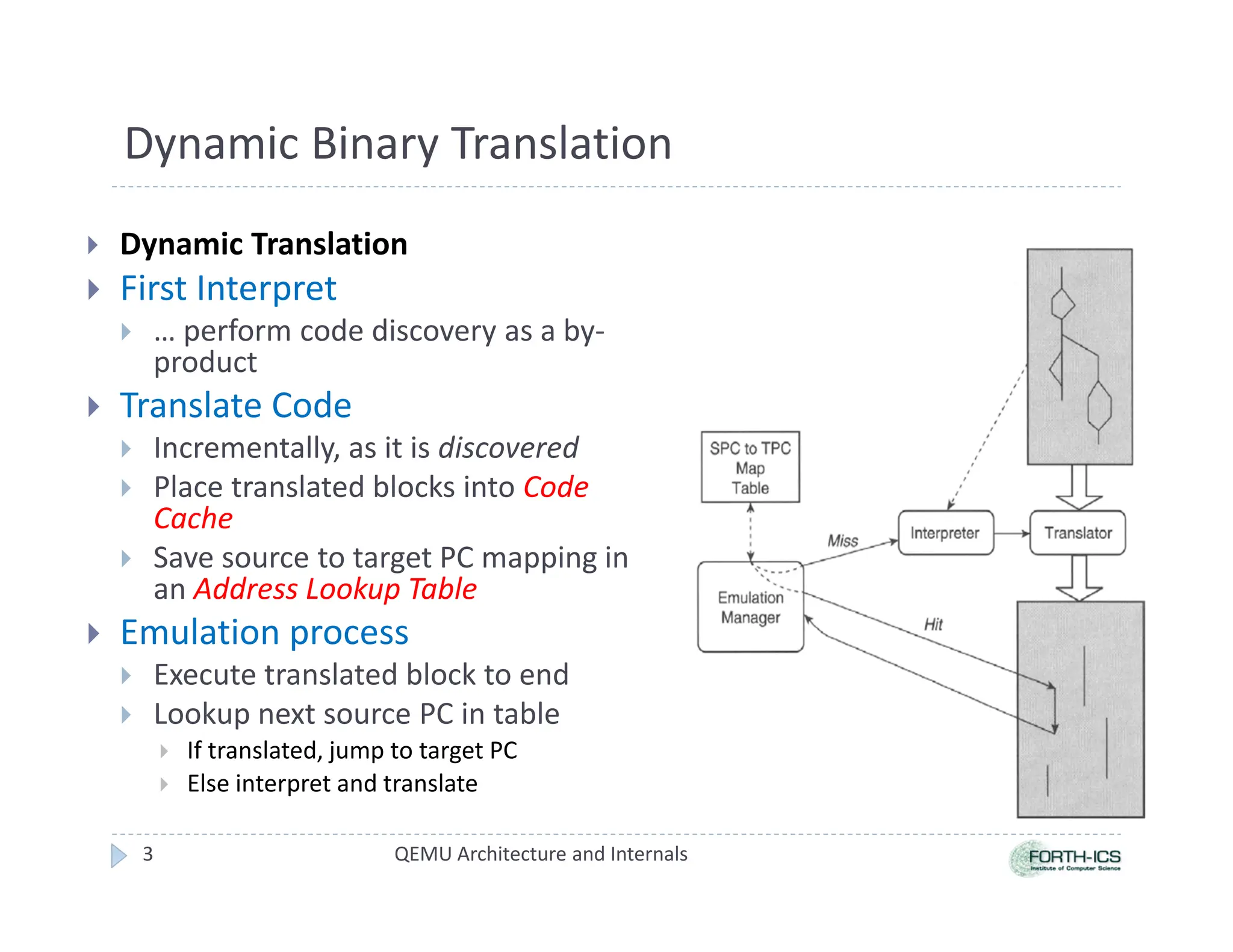
Dynamic Binary Translation
 Dynamic Translation
 First Interpret
 … perform code discovery as a by-
product
 Translate Code
 Incrementally, as it is discovered
 Place translated blocks into Code
Cache
 Save source to target PC mapping in
an Address Lookup Table
 Emulation process
 Execute translated block to end
 Lookup next source PC in table
 If translated, jump to target PC
 Else interpret and translate
QEMU Architecture and Internals
3
Dynamic Binary Translation (1/2)
 Works like a JIT compiler, but doesn't include an interpreter
 All guest code undergoes binary translation
 Guest code is split into translation blocks“
 A translation block is similar to a basic block in that the block is
always executed as a whole (ie. no jumps in the middle of a
block).
 Translation blocks are translated into a single sequence of
host instructions and cached into a translation cache.
 Cached blocks are indexed using their guest virtual address (ie.
PC count), so they can be found easily.
 Translation cache size can vary (32 MB by default)
 Once the cache runs out of space, the whole cache is purged
QEMU Architecture and Internals
4
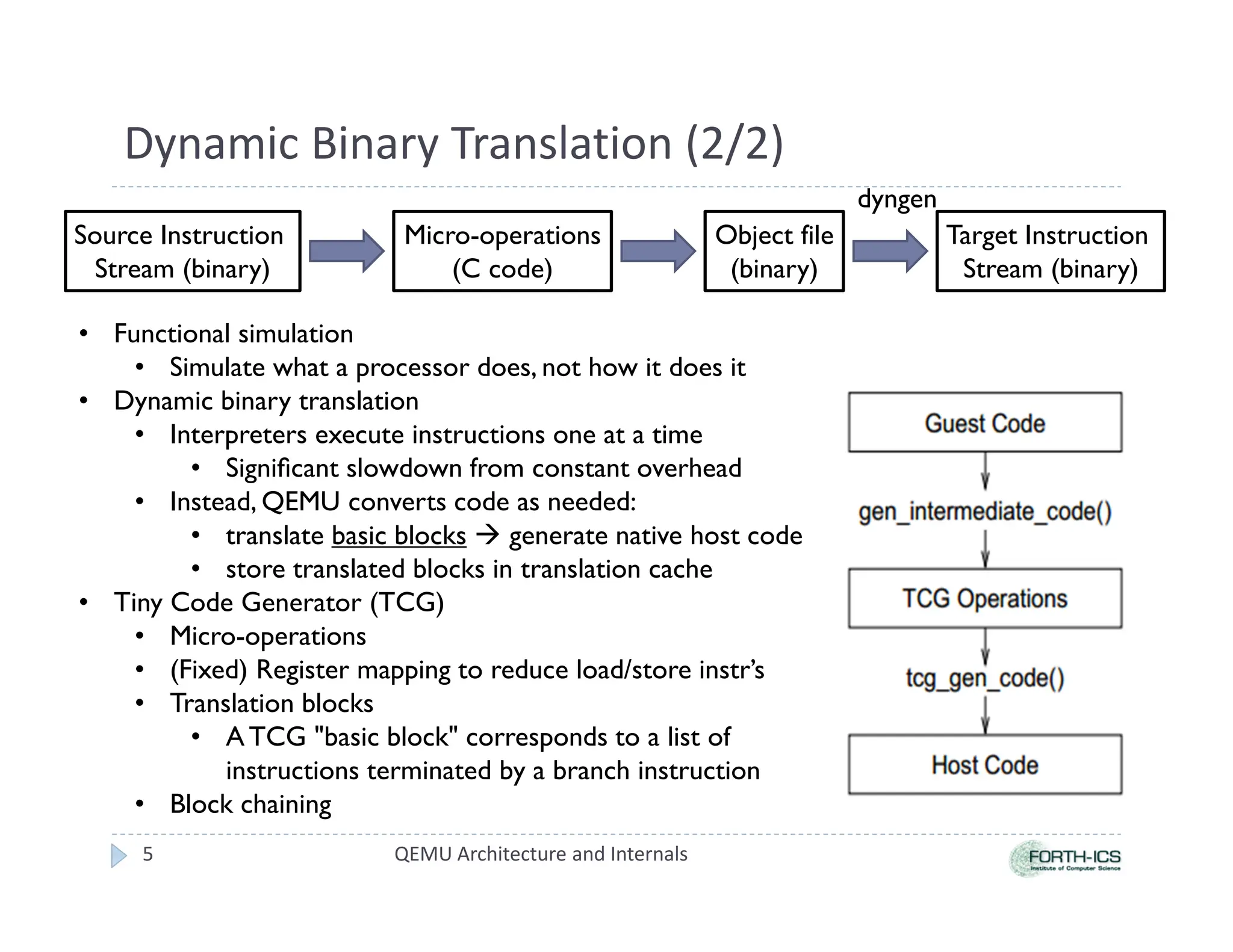
Dynamic Binary Translation (2/2)
Source Instruction
Stream (binary)
Object file
(binary)
Micro-operations
(C code)
Target Instruction
Stream (binary)
dyngen
• Functional simulation
• Simulate what a processor does, not how it does it
• Dynamic binary translation
• Interpreters execute instructions one at a time
• Significant slowdown from constant overhead
• Instead, QEMU converts code as needed:
• translate basic blocks  generate native host code
• store translated blocks in translation cache
• Tiny Code Generator (TCG)
• Micro-operations
• (Fixed) Register mapping to reduce load/store instr’s
• Translation blocks
• A TCG basic block corresponds to a list of
instructions terminated by a branch instruction
• Block chaining
QEMU Architecture and Internals
5
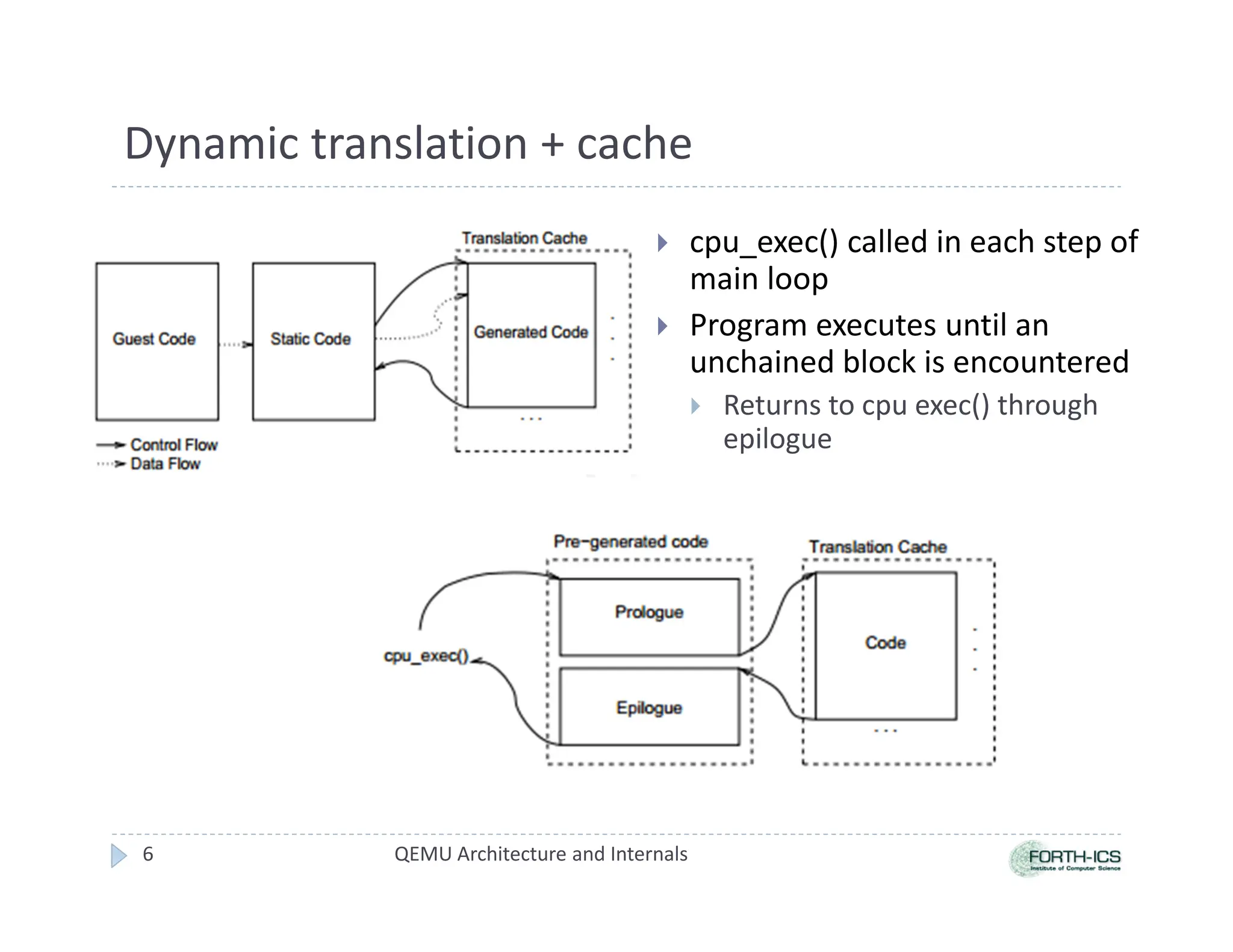
Dynamic translation + cache
 cpu_exec() called in each step of
main loop
 Program executes until an
unchained block is encountered
 Returns to cpu exec() through
epilogue
QEMU Architecture and Internals
6
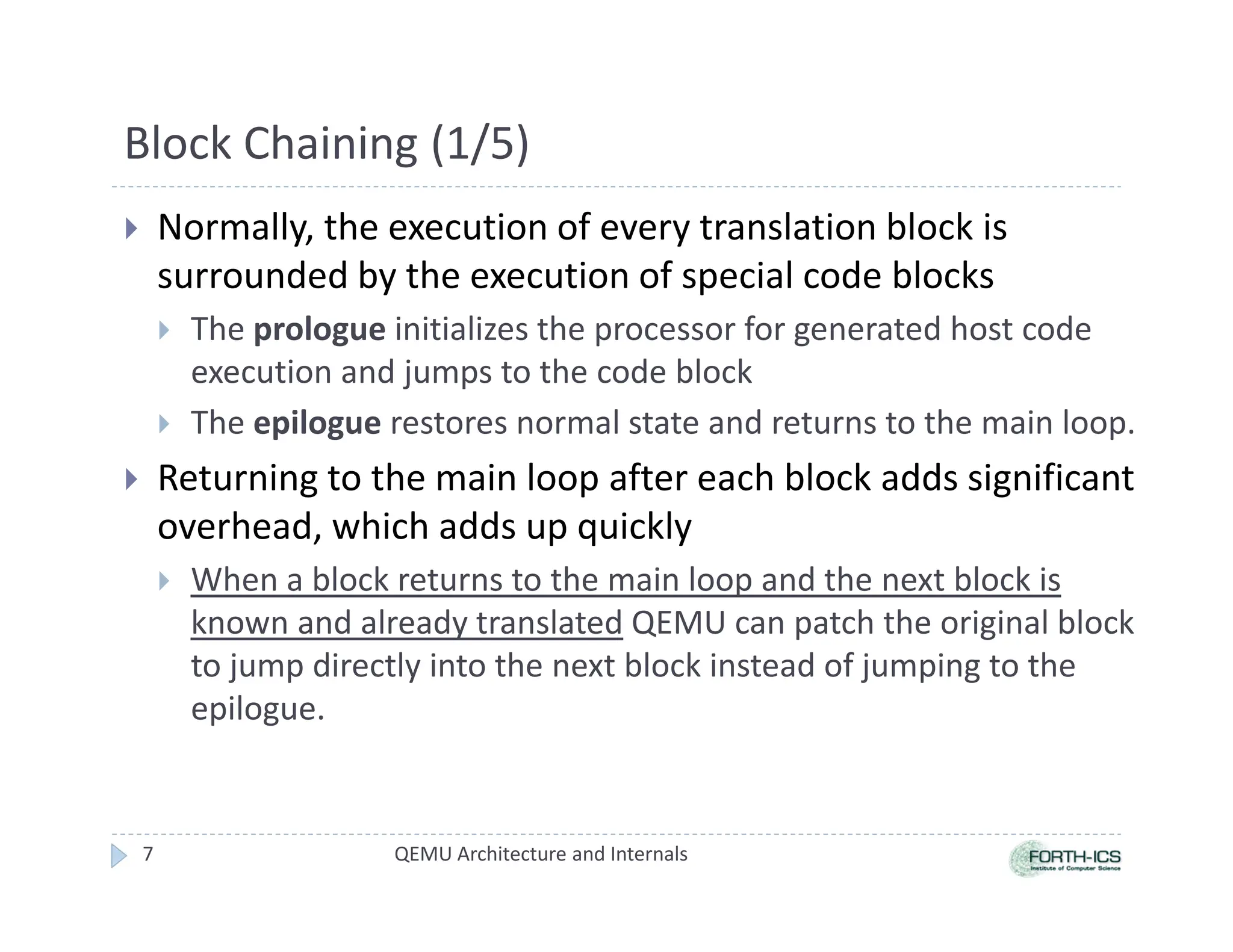
Block Chaining (1/5)
 Normally, the execution of every translation block is
surrounded by the execution of special code blocks
 The prologue initializes the processor for generated host code
execution and jumps to the code block
 The epilogue restores normal state and returns to the main loop.
 Returning to the main loop after each block adds significant
overhead, which adds up quickly
 When a block returns to the main loop and the next block is
known and already translated QEMU can patch the original block
to jump directly into the next block instead of jumping to the
epilogue.
QEMU Architecture and Internals
7
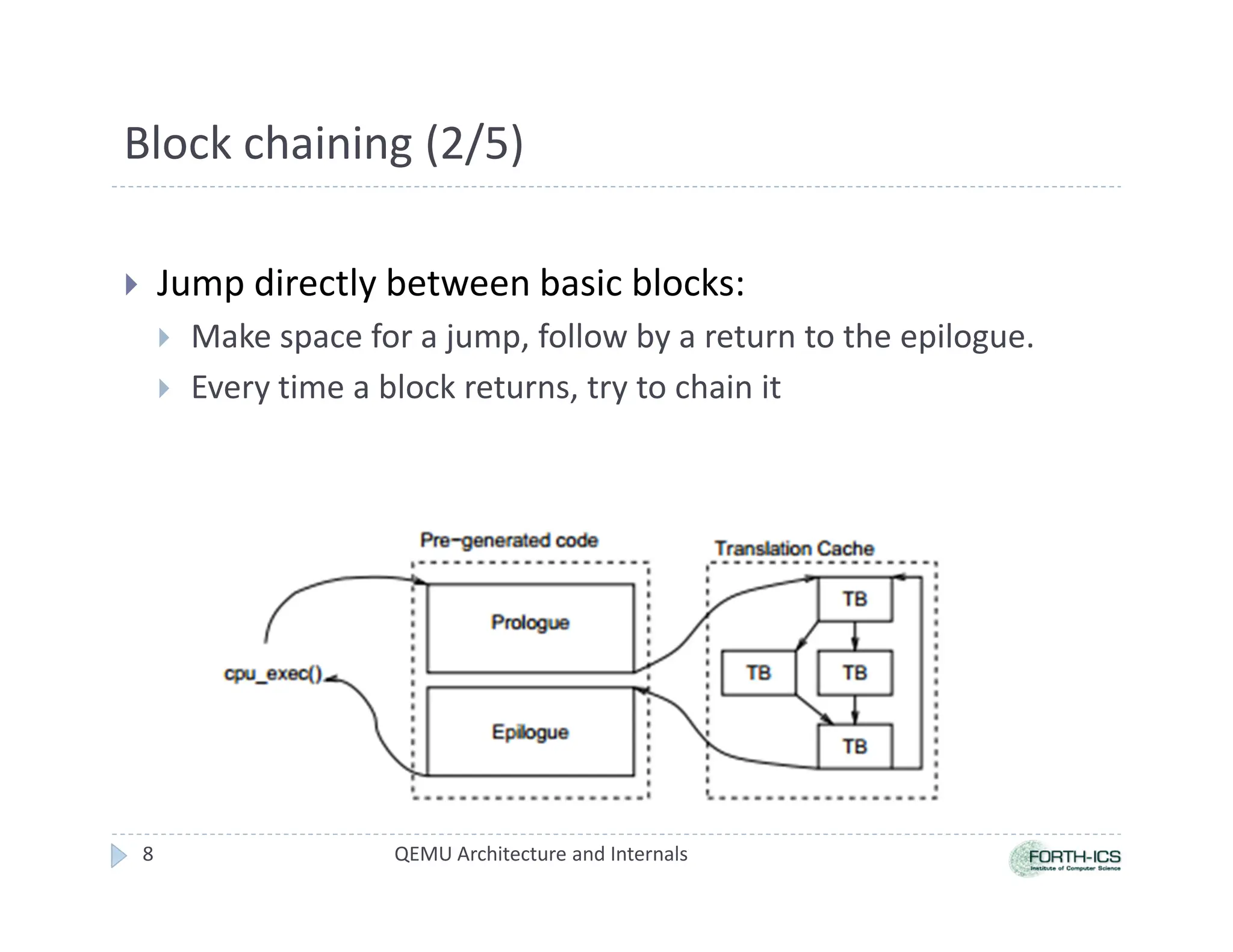
Block chaining (2/5)
 Jump directly between basic blocks:
 Make space for a jump, follow by a return to the epilogue.
 Every time a block returns, try to chain it
QEMU Architecture and Internals
8
Block Chaining (3/5)
 When this is done on several consecutive blocks, the blocks will
form chains and loops.
 This allows QEMU to emulate tight loops without running any
extra code in between.
 In the case of a loop, this also means that the control will not
return to QEMU unless an untranslated or otherwise un-
chainable block is executed.
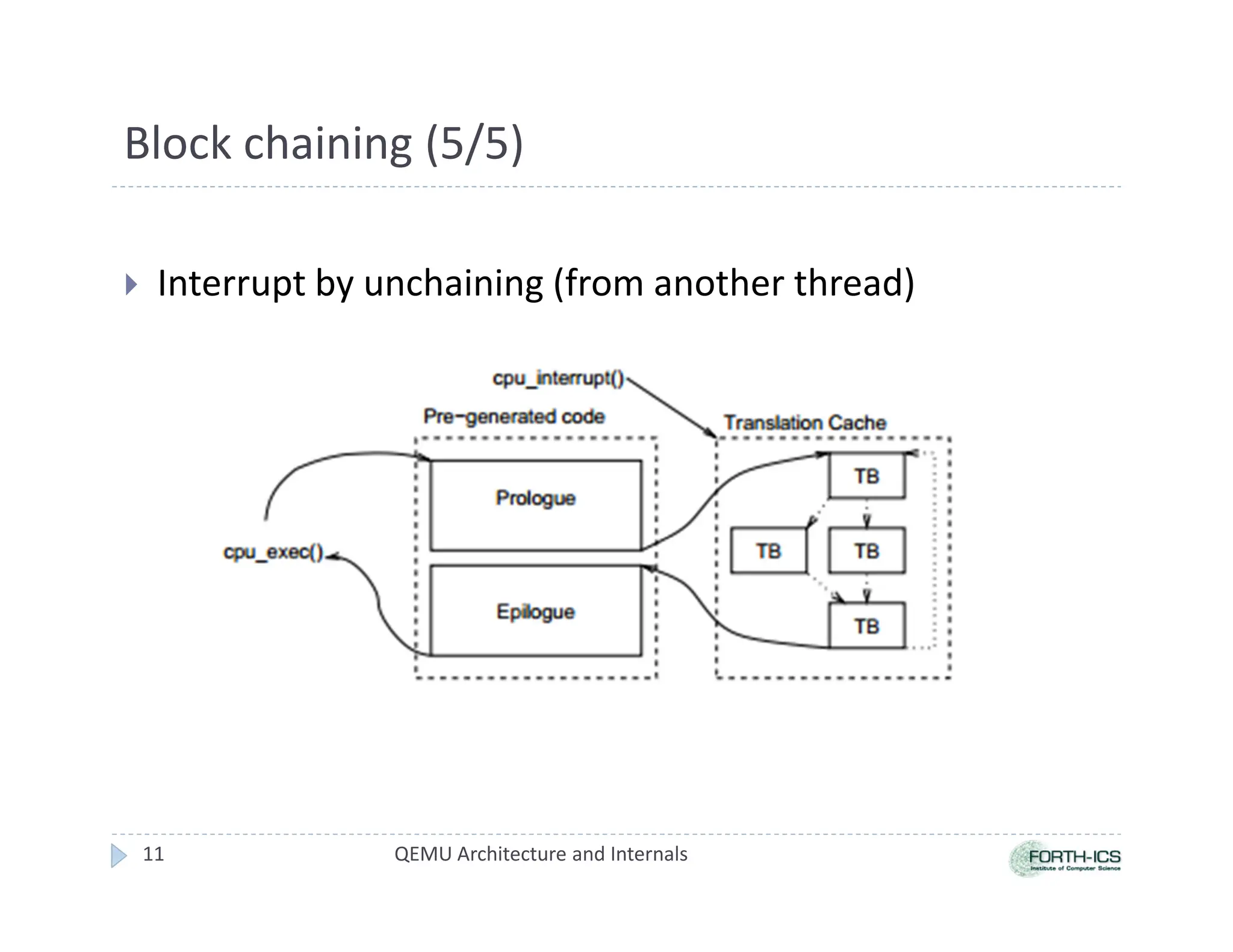
 Asynchronous interrupts:
 QEMU does not check at every basic block if an hardware
interrupt is pending. Instead, the user must asynchronously call a
specific function to tell that an interrupt is pending.
 This function resets the chaining of the currently executing basic
block  return of control to main loop of CPU emulator
QEMU Architecture and Internals
9
Block chaining (4/5)
[1]
[2]
[3]
[4]
[5]
QEMU Architecture and Internals
10
Block chaining (5/5)
 Interrupt by unchaining (from another thread)
QEMU Architecture and Internals
11
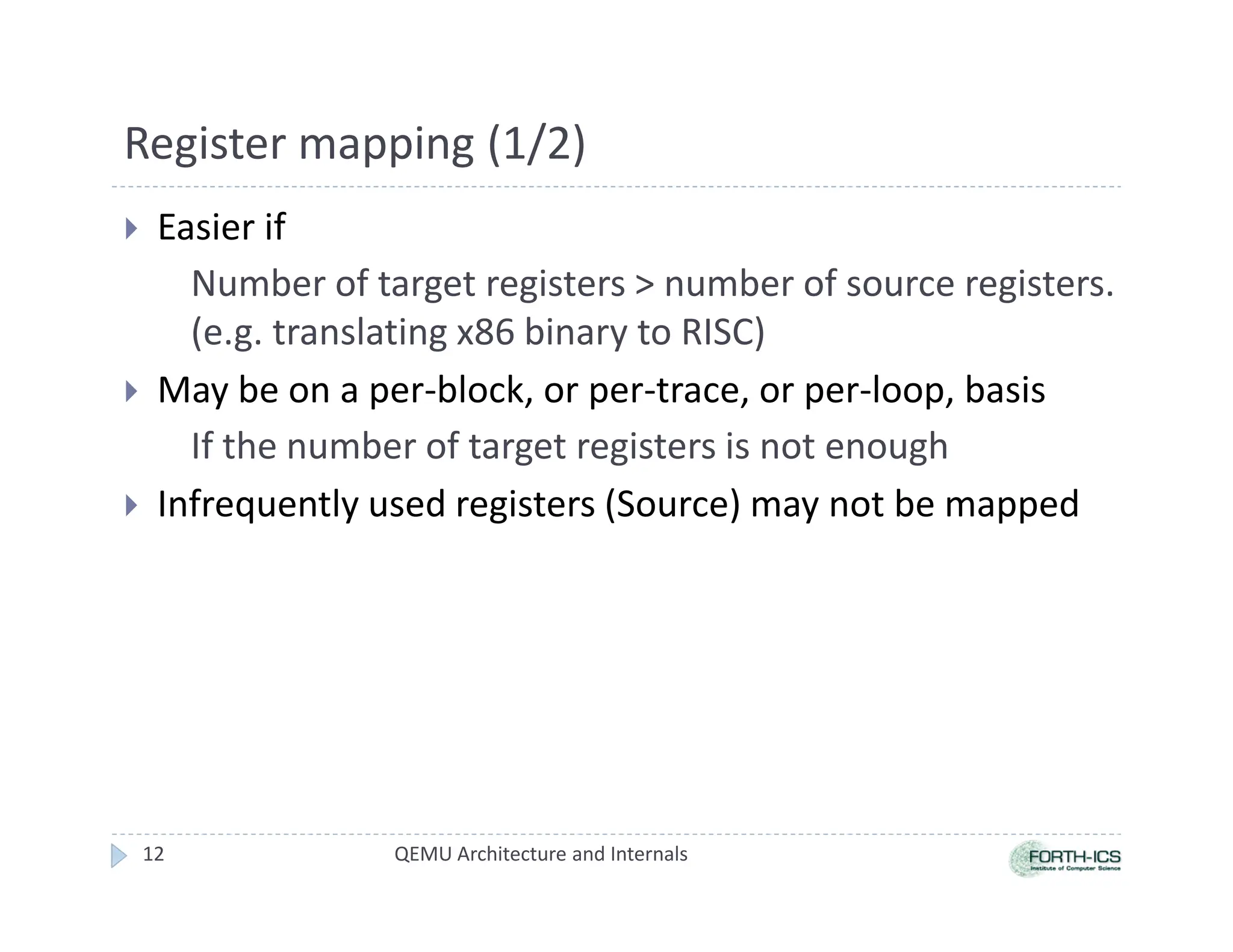
Register mapping (1/2)
 Easier if
Number of target registers  number of source registers.
(e.g. translating x86 binary to RISC)
 May be on a per-block, or per-trace, or per-loop, basis
If the number of target registers is not enough
 Infrequently used registers (Source) may not be mapped
QEMU Architecture and Internals
12
Register mapping (2/2)
 How to handle the Program Counter ?
 TPC (Target PC) is different from SPC (Source PC)
 For indirect branches, the registers hold source PCs 
must provide a way to map SPCs to TPCs !
 The translation system needs to track SPC at all times
QEMU Architecture and Internals
13
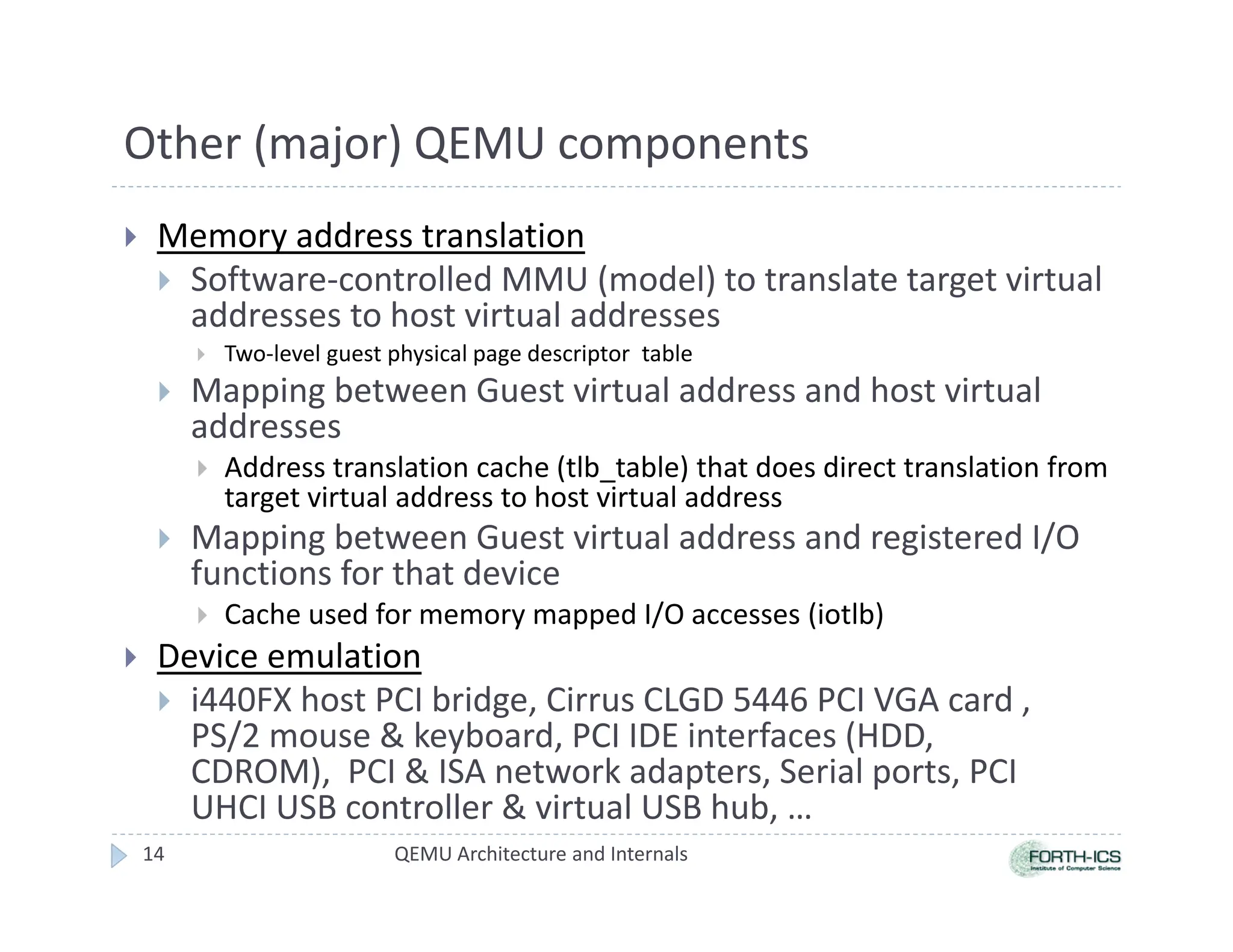
Other (major) QEMU components
 Memory address translation
 Software-controlled MMU (model) to translate target virtual
addresses to host virtual addresses
 Two-level guest physical page descriptor table
 Mapping between Guest virtual address and host virtual
addresses
 Address translation cache (tlb_table) that does direct translation from
target virtual address to host virtual address
 Mapping between Guest virtual address and registered I/O
functions for that device
 Cache used for memory mapped I/O accesses (iotlb)
 Device emulation
 i440FX host PCI bridge, Cirrus CLGD 5446 PCI VGA card ,
PS/2 mouse  keyboard, PCI IDE interfaces (HDD,
CDROM), PCI  ISA network adapters, Serial ports, PCI
UHCI USB controller  virtual USB hub, …
QEMU Architecture and Internals
14
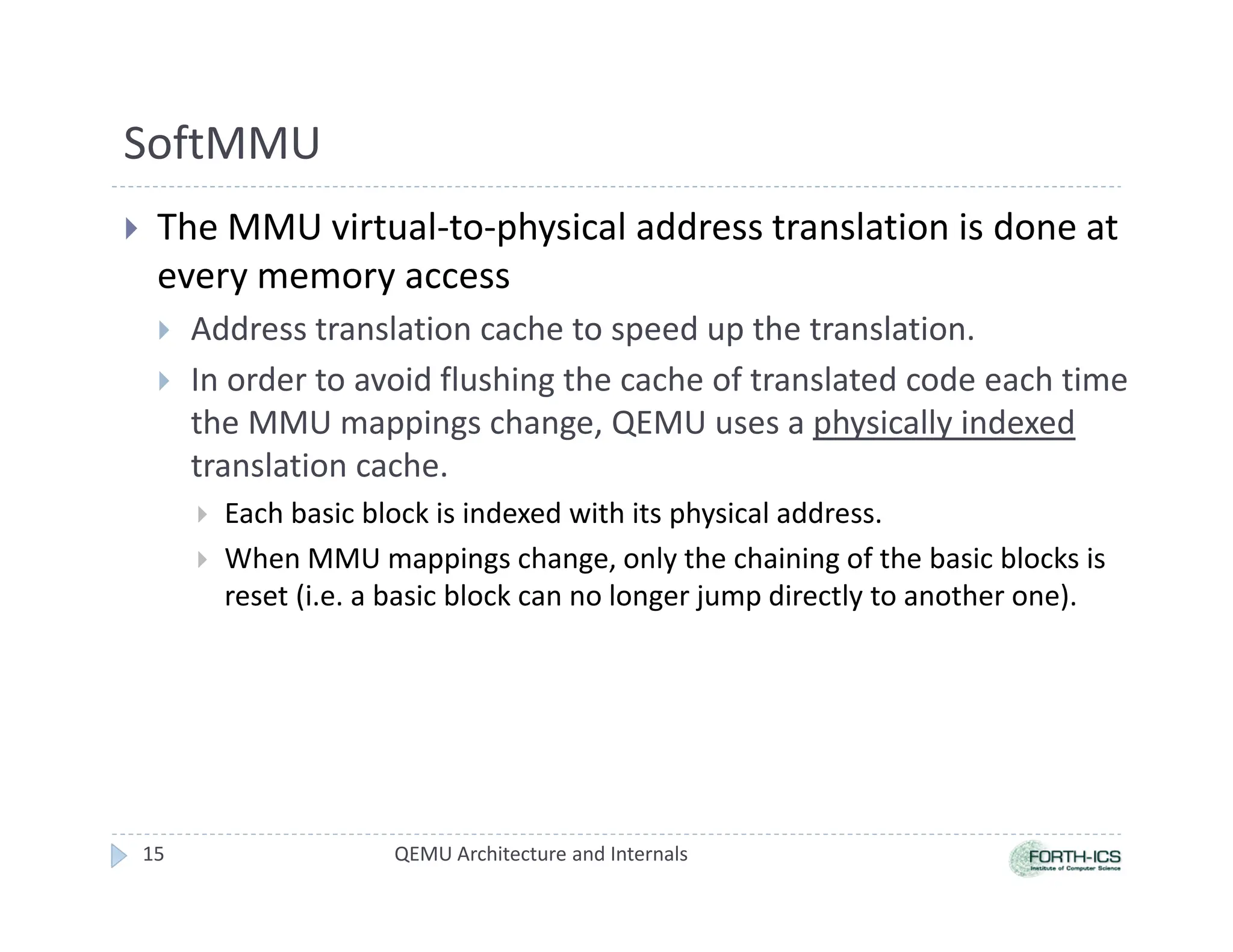
SoftMMU
 The MMU virtual-to-physical address translation is done at
every memory access
 Address translation cache to speed up the translation.
 In order to avoid flushing the cache of translated code each time
the MMU mappings change, QEMU uses a physically indexed
translation cache.
 Each basic block is indexed with its physical address.
 When MMU mappings change, only the chaining of the basic blocks is
reset (i.e. a basic block can no longer jump directly to another one).
15 QEMU Architecture and Internals
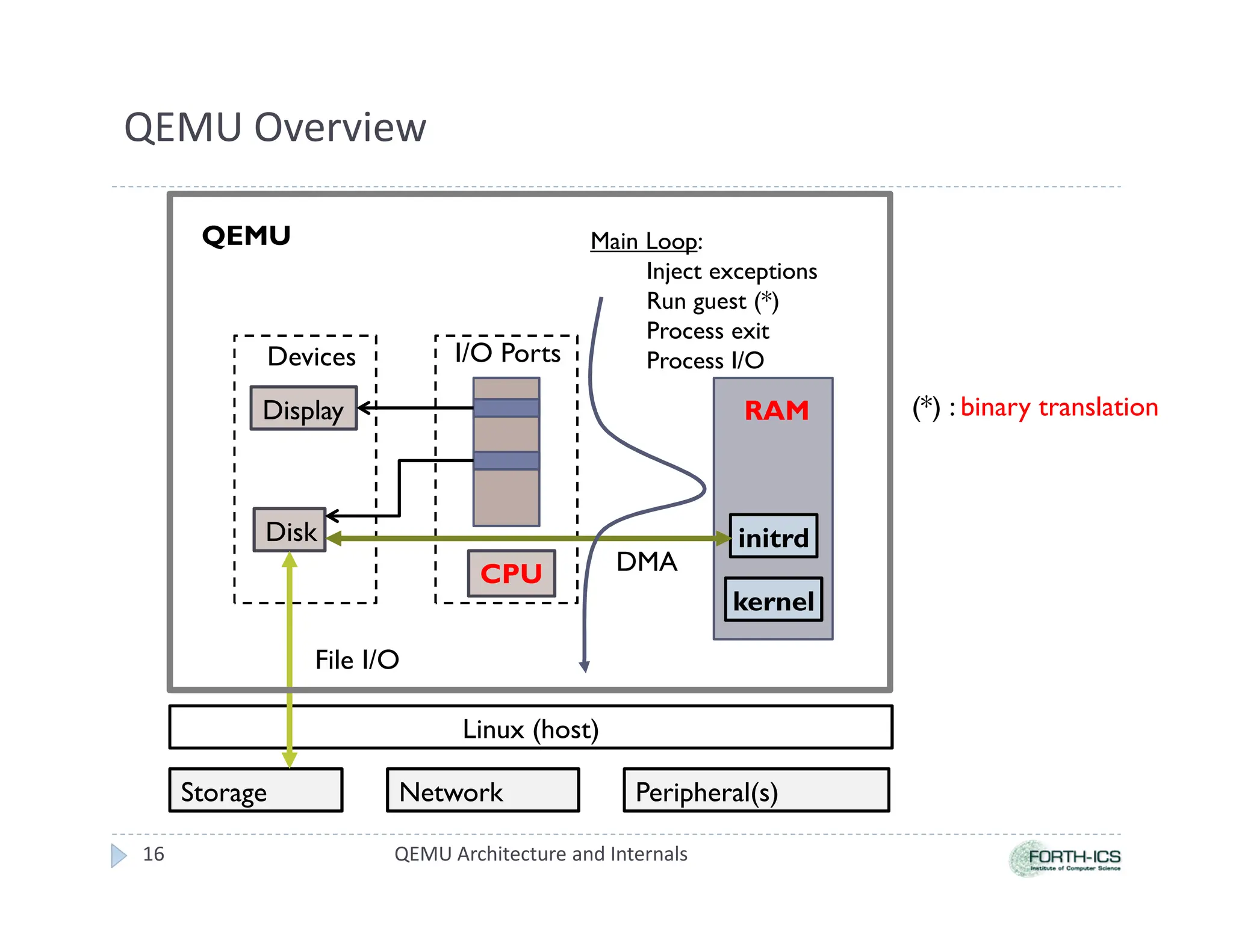
QEMU Overview
Storage Network Peripheral(s)
Linux (host)
Display
Disk
I/O Ports
CPU DMA
File I/O
RAM
initrd
kernel
Main Loop:
Inject exceptions
Run guest (*)
Process exit
Process I/O
Devices
QEMU
(*) : binary translation
QEMU Architecture and Internals
16
QEMU Storage Stack
17 QEMU Architecture and Internals
[ source: Stefan Hajnoczi, - IBM LinuxTechnology Center, 2011]
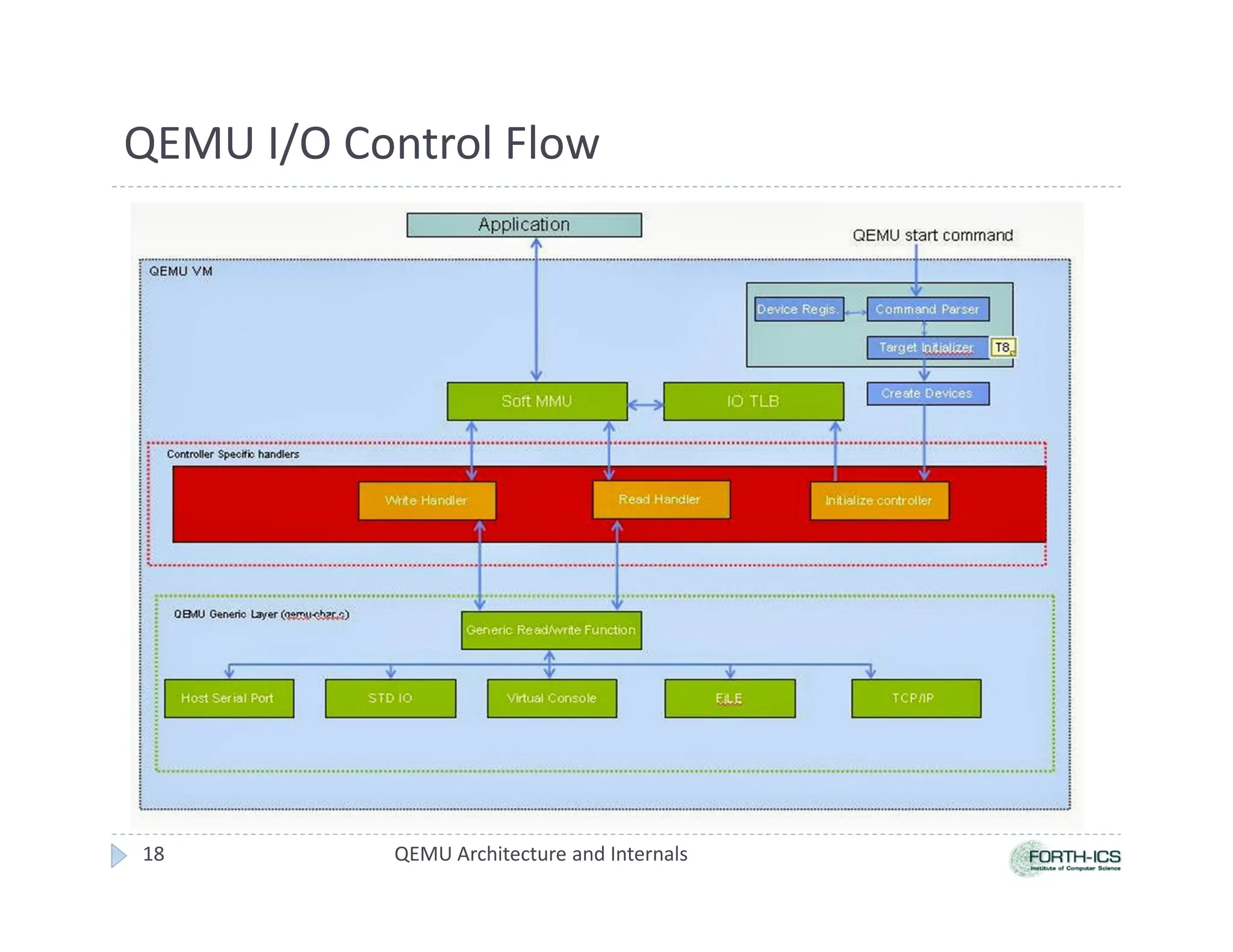
QEMU I/O Control Flow
QEMU Architecture and Internals
18
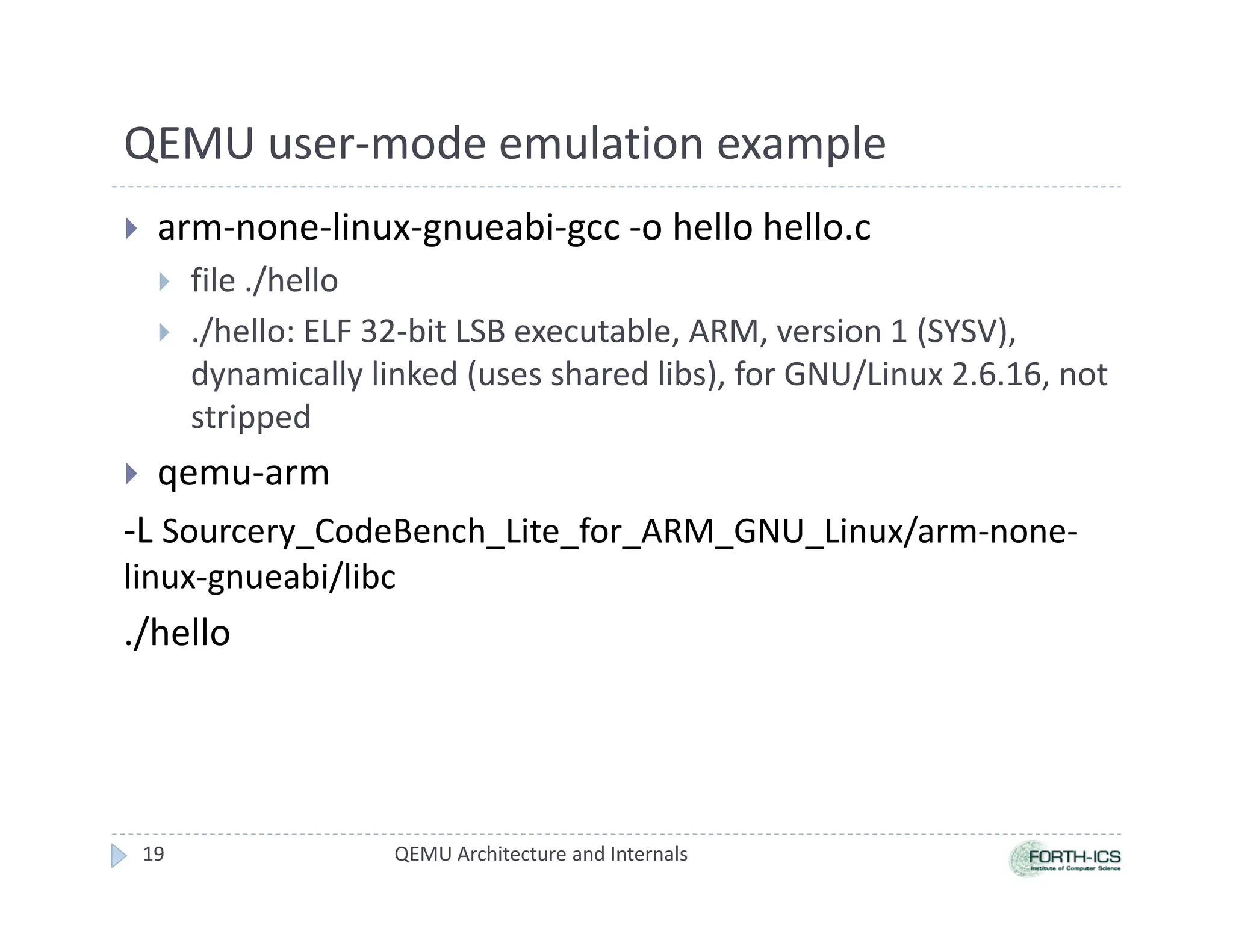
QEMU user-mode emulation example
 arm-none-linux-gnueabi-gcc -o hello hello.c
 file ./hello
 ./hello: ELF 32-bit LSB executable, ARM, version 1 (SYSV),
dynamically linked (uses shared libs), for GNU/Linux 2.6.16, not
stripped
 qemu-arm
-L Sourcery_CodeBench_Lite_for_ARM_GNU_Linux/arm-none-
linux-gnueabi/libc
./hello
19 QEMU Architecture and Internals
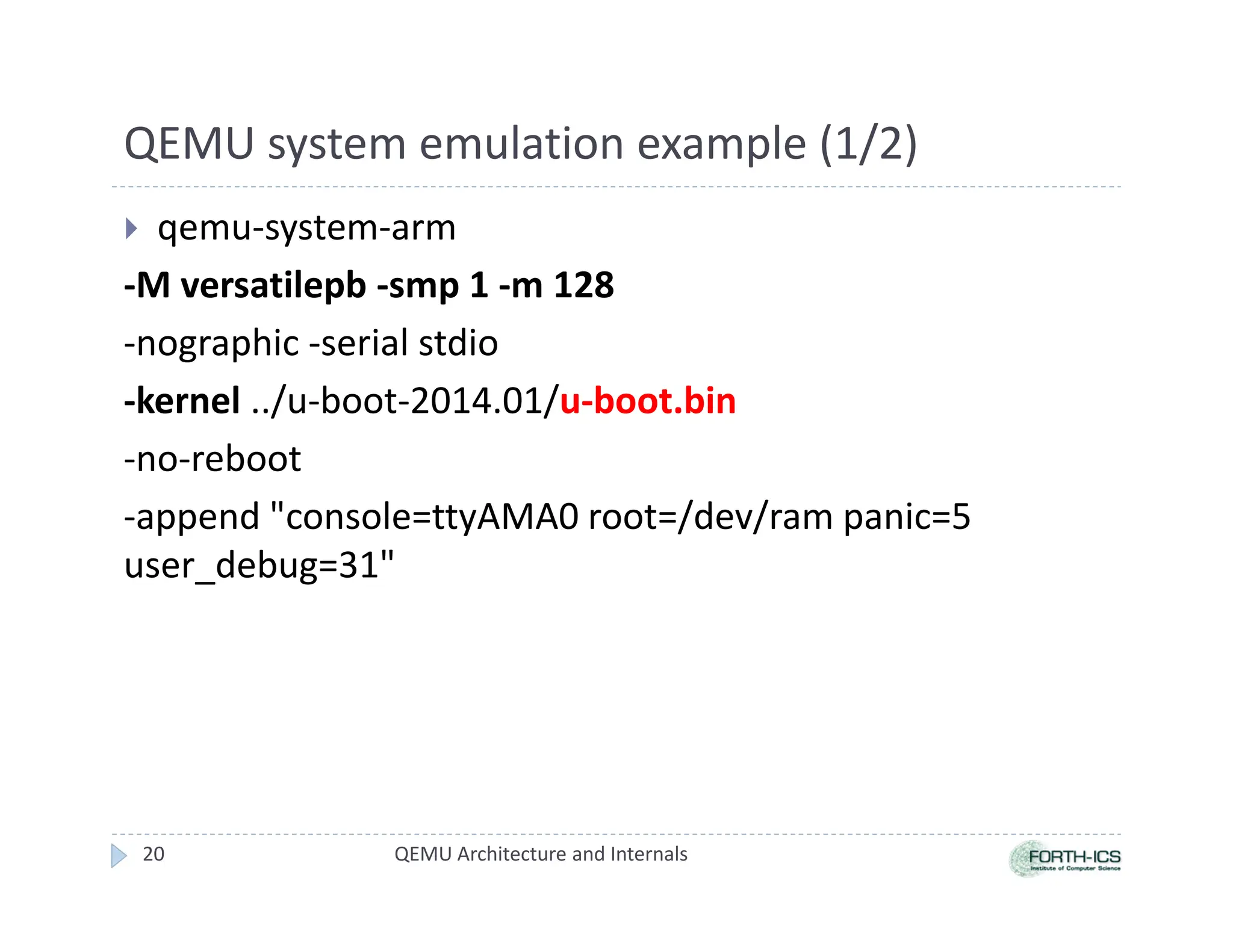
QEMU system emulation example (1/2)
 qemu-system-arm
-M versatilepb -smp 1 -m 128
-nographic -serial stdio
-kernel ../u-boot-2014.01/u-boot.bin
-no-reboot
-append console=ttyAMA0 root=/dev/ram panic=5
user_debug=31
20 QEMU Architecture and Internals
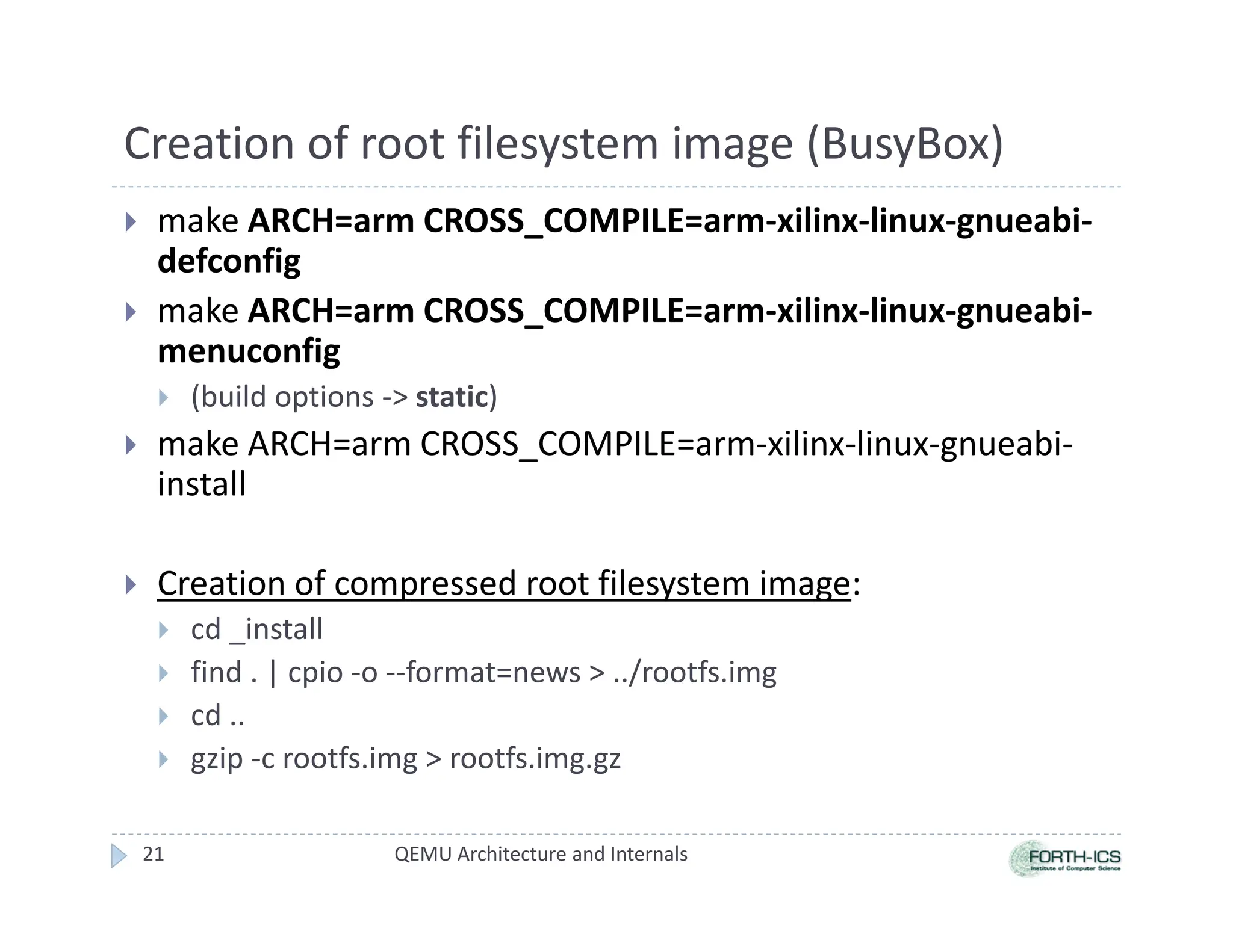
Creation of root filesystem image (BusyBox)
 make ARCH=arm CROSS_COMPILE=arm-xilinx-linux-gnueabi-
defconfig
 make ARCH=arm CROSS_COMPILE=arm-xilinx-linux-gnueabi-
menuconfig
 (build options - static)
 make ARCH=arm CROSS_COMPILE=arm-xilinx-linux-gnueabi-
install
 Creation of compressed root filesystem image:
 cd _install
 find . | cpio -o --format=news  ../rootfs.img
 cd ..
 gzip -c rootfs.img  rootfs.img.gz
21 QEMU Architecture and Internals
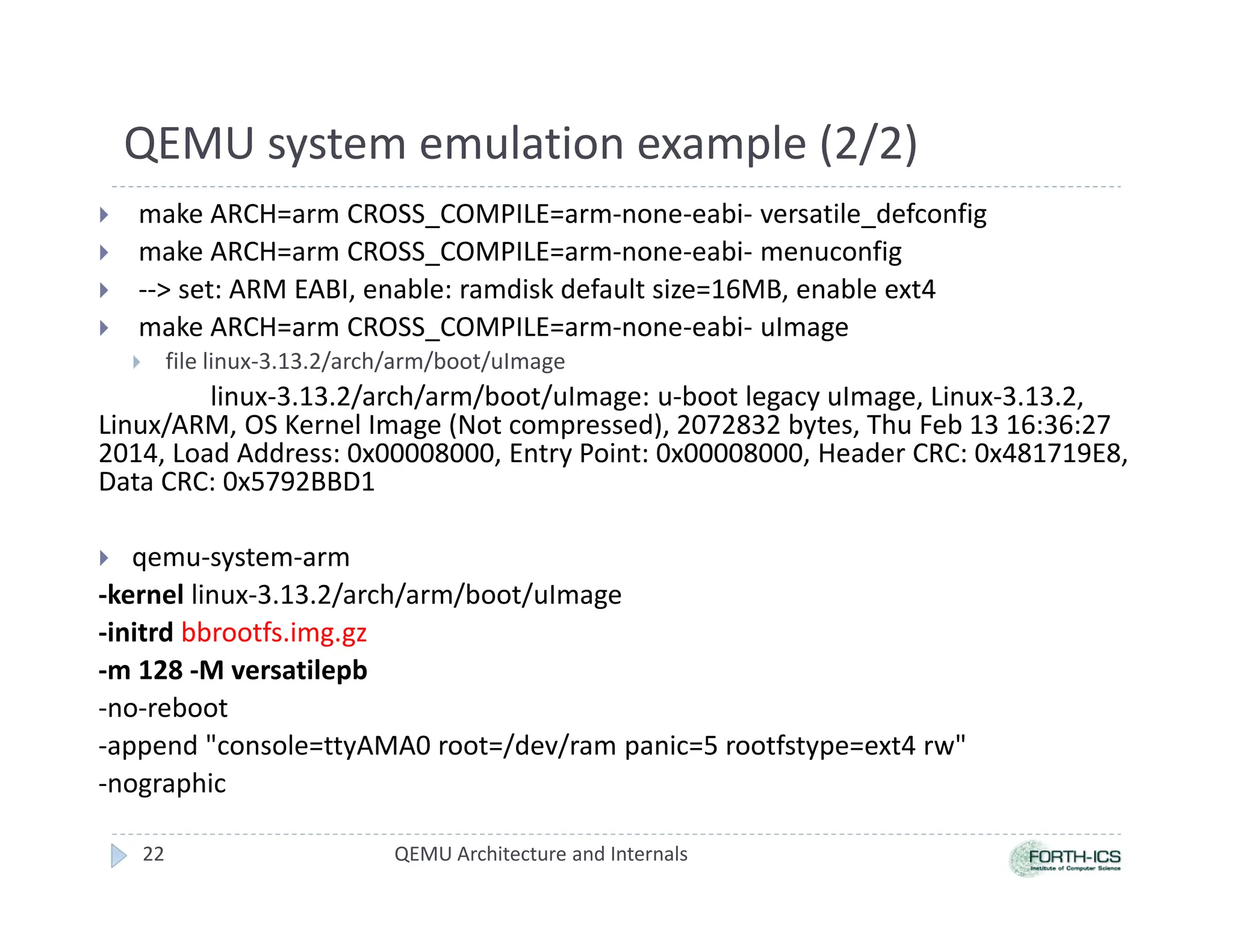
QEMU system emulation example (2/2)
 make ARCH=arm CROSS_COMPILE=arm-none-eabi- versatile_defconfig
 make ARCH=arm CROSS_COMPILE=arm-none-eabi- menuconfig
 -- set: ARM EABI, enable: ramdisk default size=16MB, enable ext4
 make ARCH=arm CROSS_COMPILE=arm-none-eabi- uImage
 file linux-3.13.2/arch/arm/boot/uImage
linux-3.13.2/arch/arm/boot/uImage: u-boot legacy uImage, Linux-3.13.2,
Linux/ARM, OS Kernel Image (Not compressed), 2072832 bytes, Thu Feb 13 16:36:27
2014, Load Address: 0x00008000, Entry Point: 0x00008000, Header CRC: 0x481719E8,
Data CRC: 0x5792BBD1
 qemu-system-arm
-kernel linux-3.13.2/arch/arm/boot/uImage
-initrd bbrootfs.img.gz
-m 128 -M versatilepb
-no-reboot
-append console=ttyAMA0 root=/dev/ram panic=5 rootfstype=ext4 rw
-nographic
22 QEMU Architecture and Internals
Sources
 Fabrice Bellard, QEMU: A Fast and Portable Dynamic
Translator, USENIX Freenix 2005,
http://www.usenix.org/event/usenix05/tech/freenix/full_
papers/bellard/bellard.pdf
 Chad D. Kersey, QEMU internals,
http://lugatgt.org/content/qemu_internals/downloads/sli
des.pdf
 M. Tim Jones, System emulation with QEMU,
http://www.ibm.com/developerworks/linux/library/l-
qemu/
QEMU Architecture and Internals
23

qemu architecture and internals - How it works

  • 1.
    Institute of ComputerScience (ICS) Foundation for Research and Technology – Hellas (FORTH) Manolis Marazakis (maraz@ics.forth.gr) QEMU: Architecture and Internals Lecture for the Embedded Systems Course CSD, University of Crete (May 6, 2014)
  • 2.
    Quick EMUlator (QEMU) Machine emulator + Virtualizer Modes: User-mode emulation: allows a (Linux) process built for one CPU to be executed on another QEMU as a “Process VM” System-mode emulation: allows emulation of a full system, including processor and assorted peripherals QEMU as a “System VM” Popular uses: For cross-compilation development environments Virtualization, esp. device emulation, for xen and kvm Android Emulator (part of SDK) QEMU Architecture and Internals 2
  • 3.
    Dynamic Binary Translation Dynamic Translation First Interpret … perform code discovery as a by- product Translate Code Incrementally, as it is discovered Place translated blocks into Code Cache Save source to target PC mapping in an Address Lookup Table Emulation process Execute translated block to end Lookup next source PC in table If translated, jump to target PC Else interpret and translate QEMU Architecture and Internals 3
  • 4.
    Dynamic Binary Translation(1/2) Works like a JIT compiler, but doesn't include an interpreter All guest code undergoes binary translation Guest code is split into translation blocks“ A translation block is similar to a basic block in that the block is always executed as a whole (ie. no jumps in the middle of a block). Translation blocks are translated into a single sequence of host instructions and cached into a translation cache. Cached blocks are indexed using their guest virtual address (ie. PC count), so they can be found easily. Translation cache size can vary (32 MB by default) Once the cache runs out of space, the whole cache is purged QEMU Architecture and Internals 4
  • 5.
    Dynamic Binary Translation(2/2) Source Instruction Stream (binary) Object file (binary) Micro-operations (C code) Target Instruction Stream (binary) dyngen • Functional simulation • Simulate what a processor does, not how it does it • Dynamic binary translation • Interpreters execute instructions one at a time • Significant slowdown from constant overhead • Instead, QEMU converts code as needed: • translate basic blocks generate native host code • store translated blocks in translation cache • Tiny Code Generator (TCG) • Micro-operations • (Fixed) Register mapping to reduce load/store instr’s • Translation blocks • A TCG basic block corresponds to a list of instructions terminated by a branch instruction • Block chaining QEMU Architecture and Internals 5
  • 6.
    Dynamic translation +cache cpu_exec() called in each step of main loop Program executes until an unchained block is encountered Returns to cpu exec() through epilogue QEMU Architecture and Internals 6
  • 7.
    Block Chaining (1/5) Normally, the execution of every translation block is surrounded by the execution of special code blocks The prologue initializes the processor for generated host code execution and jumps to the code block The epilogue restores normal state and returns to the main loop. Returning to the main loop after each block adds significant overhead, which adds up quickly When a block returns to the main loop and the next block is known and already translated QEMU can patch the original block to jump directly into the next block instead of jumping to the epilogue. QEMU Architecture and Internals 7
  • 8.
    Block chaining (2/5) Jump directly between basic blocks: Make space for a jump, follow by a return to the epilogue. Every time a block returns, try to chain it QEMU Architecture and Internals 8
  • 9.
    Block Chaining (3/5) When this is done on several consecutive blocks, the blocks will form chains and loops. This allows QEMU to emulate tight loops without running any extra code in between. In the case of a loop, this also means that the control will not return to QEMU unless an untranslated or otherwise un- chainable block is executed. Asynchronous interrupts: QEMU does not check at every basic block if an hardware interrupt is pending. Instead, the user must asynchronously call a specific function to tell that an interrupt is pending. This function resets the chaining of the currently executing basic block return of control to main loop of CPU emulator QEMU Architecture and Internals 9
  • 10.
    Block chaining (4/5) [1] [2] [3] [4] [5] QEMUArchitecture and Internals 10
  • 11.
    Block chaining (5/5) Interrupt by unchaining (from another thread) QEMU Architecture and Internals 11
  • 12.
    Register mapping (1/2) Easier if Number of target registers number of source registers. (e.g. translating x86 binary to RISC) May be on a per-block, or per-trace, or per-loop, basis If the number of target registers is not enough Infrequently used registers (Source) may not be mapped QEMU Architecture and Internals 12
  • 13.
    Register mapping (2/2) How to handle the Program Counter ? TPC (Target PC) is different from SPC (Source PC) For indirect branches, the registers hold source PCs must provide a way to map SPCs to TPCs ! The translation system needs to track SPC at all times QEMU Architecture and Internals 13
  • 14.
    Other (major) QEMUcomponents Memory address translation Software-controlled MMU (model) to translate target virtual addresses to host virtual addresses Two-level guest physical page descriptor table Mapping between Guest virtual address and host virtual addresses Address translation cache (tlb_table) that does direct translation from target virtual address to host virtual address Mapping between Guest virtual address and registered I/O functions for that device Cache used for memory mapped I/O accesses (iotlb) Device emulation i440FX host PCI bridge, Cirrus CLGD 5446 PCI VGA card , PS/2 mouse keyboard, PCI IDE interfaces (HDD, CDROM), PCI ISA network adapters, Serial ports, PCI UHCI USB controller virtual USB hub, … QEMU Architecture and Internals 14
  • 15.
    SoftMMU The MMUvirtual-to-physical address translation is done at every memory access Address translation cache to speed up the translation. In order to avoid flushing the cache of translated code each time the MMU mappings change, QEMU uses a physically indexed translation cache. Each basic block is indexed with its physical address. When MMU mappings change, only the chaining of the basic blocks is reset (i.e. a basic block can no longer jump directly to another one). 15 QEMU Architecture and Internals
  • 16.
    QEMU Overview Storage NetworkPeripheral(s) Linux (host) Display Disk I/O Ports CPU DMA File I/O RAM initrd kernel Main Loop: Inject exceptions Run guest (*) Process exit Process I/O Devices QEMU (*) : binary translation QEMU Architecture and Internals 16
  • 17.
    QEMU Storage Stack 17QEMU Architecture and Internals [ source: Stefan Hajnoczi, - IBM LinuxTechnology Center, 2011]
  • 18.
    QEMU I/O ControlFlow QEMU Architecture and Internals 18
  • 19.
    QEMU user-mode emulationexample arm-none-linux-gnueabi-gcc -o hello hello.c file ./hello ./hello: ELF 32-bit LSB executable, ARM, version 1 (SYSV), dynamically linked (uses shared libs), for GNU/Linux 2.6.16, not stripped qemu-arm -L Sourcery_CodeBench_Lite_for_ARM_GNU_Linux/arm-none- linux-gnueabi/libc ./hello 19 QEMU Architecture and Internals
  • 20.
    QEMU system emulationexample (1/2) qemu-system-arm -M versatilepb -smp 1 -m 128 -nographic -serial stdio -kernel ../u-boot-2014.01/u-boot.bin -no-reboot -append console=ttyAMA0 root=/dev/ram panic=5 user_debug=31 20 QEMU Architecture and Internals
  • 21.
    Creation of rootfilesystem image (BusyBox) make ARCH=arm CROSS_COMPILE=arm-xilinx-linux-gnueabi- defconfig make ARCH=arm CROSS_COMPILE=arm-xilinx-linux-gnueabi- menuconfig (build options - static) make ARCH=arm CROSS_COMPILE=arm-xilinx-linux-gnueabi- install Creation of compressed root filesystem image: cd _install find . | cpio -o --format=news ../rootfs.img cd .. gzip -c rootfs.img rootfs.img.gz 21 QEMU Architecture and Internals
  • 22.
    QEMU system emulationexample (2/2) make ARCH=arm CROSS_COMPILE=arm-none-eabi- versatile_defconfig make ARCH=arm CROSS_COMPILE=arm-none-eabi- menuconfig -- set: ARM EABI, enable: ramdisk default size=16MB, enable ext4 make ARCH=arm CROSS_COMPILE=arm-none-eabi- uImage file linux-3.13.2/arch/arm/boot/uImage linux-3.13.2/arch/arm/boot/uImage: u-boot legacy uImage, Linux-3.13.2, Linux/ARM, OS Kernel Image (Not compressed), 2072832 bytes, Thu Feb 13 16:36:27 2014, Load Address: 0x00008000, Entry Point: 0x00008000, Header CRC: 0x481719E8, Data CRC: 0x5792BBD1 qemu-system-arm -kernel linux-3.13.2/arch/arm/boot/uImage -initrd bbrootfs.img.gz -m 128 -M versatilepb -no-reboot -append console=ttyAMA0 root=/dev/ram panic=5 rootfstype=ext4 rw -nographic 22 QEMU Architecture and Internals
  • 23.
    Sources Fabrice Bellard,QEMU: A Fast and Portable Dynamic Translator, USENIX Freenix 2005, http://www.usenix.org/event/usenix05/tech/freenix/full_ papers/bellard/bellard.pdf Chad D. Kersey, QEMU internals, http://lugatgt.org/content/qemu_internals/downloads/sli des.pdf M. Tim Jones, System emulation with QEMU, http://www.ibm.com/developerworks/linux/library/l- qemu/ QEMU Architecture and Internals 23