Bayu Aldi Yansyah
Data Scientist at Kumparan
github.com/pyk
PyTorch for Deep Learning
Practitioners
PyCon Indonesia
November 3-4, 2018
Kalbis Institute, Jakarta
x
Who?
Works
2014 - 2015 Google Student Ambassador South-East Asia
2015 - 2018 Data Scientist at Sale Stock
2018 - Data Scientist at Kumparan
Hobbies
Author of fastText.py (900+ stars on github)
And more github.com/pyk
Overview
The guide is divided into 2 main parts:
1. Theory: A brief introduction to PyTorch (concepts + code).
2. Practices: We will implement, train and deploy a basic feed-forward neural
networks.
We will back and forth between slide and jupyter lab.
THEORY
What is PyTorch?
It’s a Python-based scientific computing package that can be used for:
1. A replacement for NumPy to use the power of GPUs
2. An open source deep learning platform that provides a seamless path
from research prototyping to production deployment.
THEORY
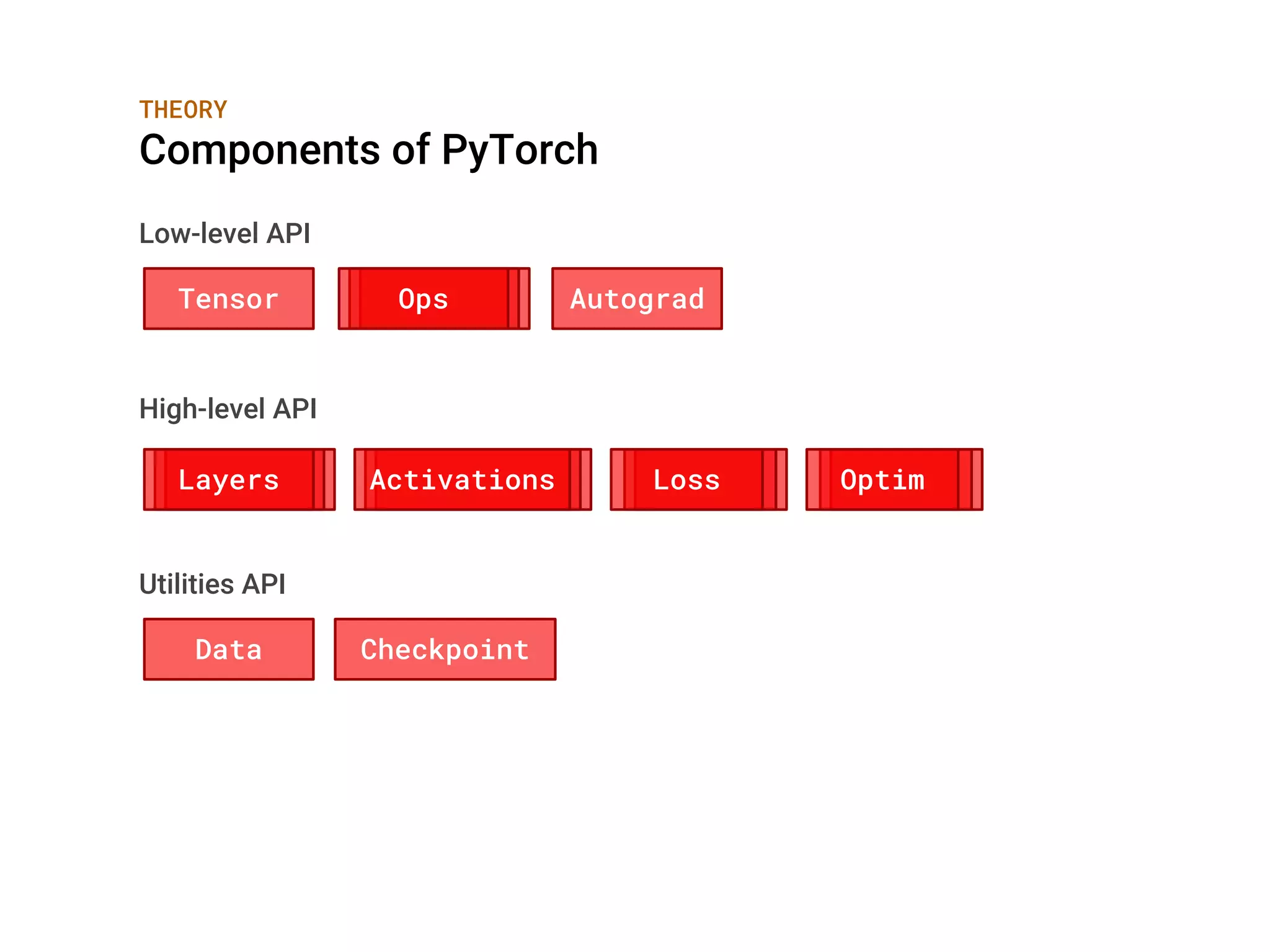
Components of PyTorch
Tensor Ops Autograd
Layers Activations Loss Optim
Low-level API
High-level API
Utilities API
Data Checkpoint
THEORY - LOW LEVEL API
Tensors
torch.Tensor are generalizations of a matrix that can be indexed in more
than 2 dimensions.
Creating a torch.Tensor
Tensors can be created from Python lists with the torch.Tensor() function.
import torch
vector_data = [0.0, 1.0, 0.0]
vector = torch.Tensor(vector)
matrix_data = [[1.0., 0.0, 0.0], [0.0, 1.0, 0.0]]
matrix = torch.Tensor(matrix_data)
Creating a torch.Tensor
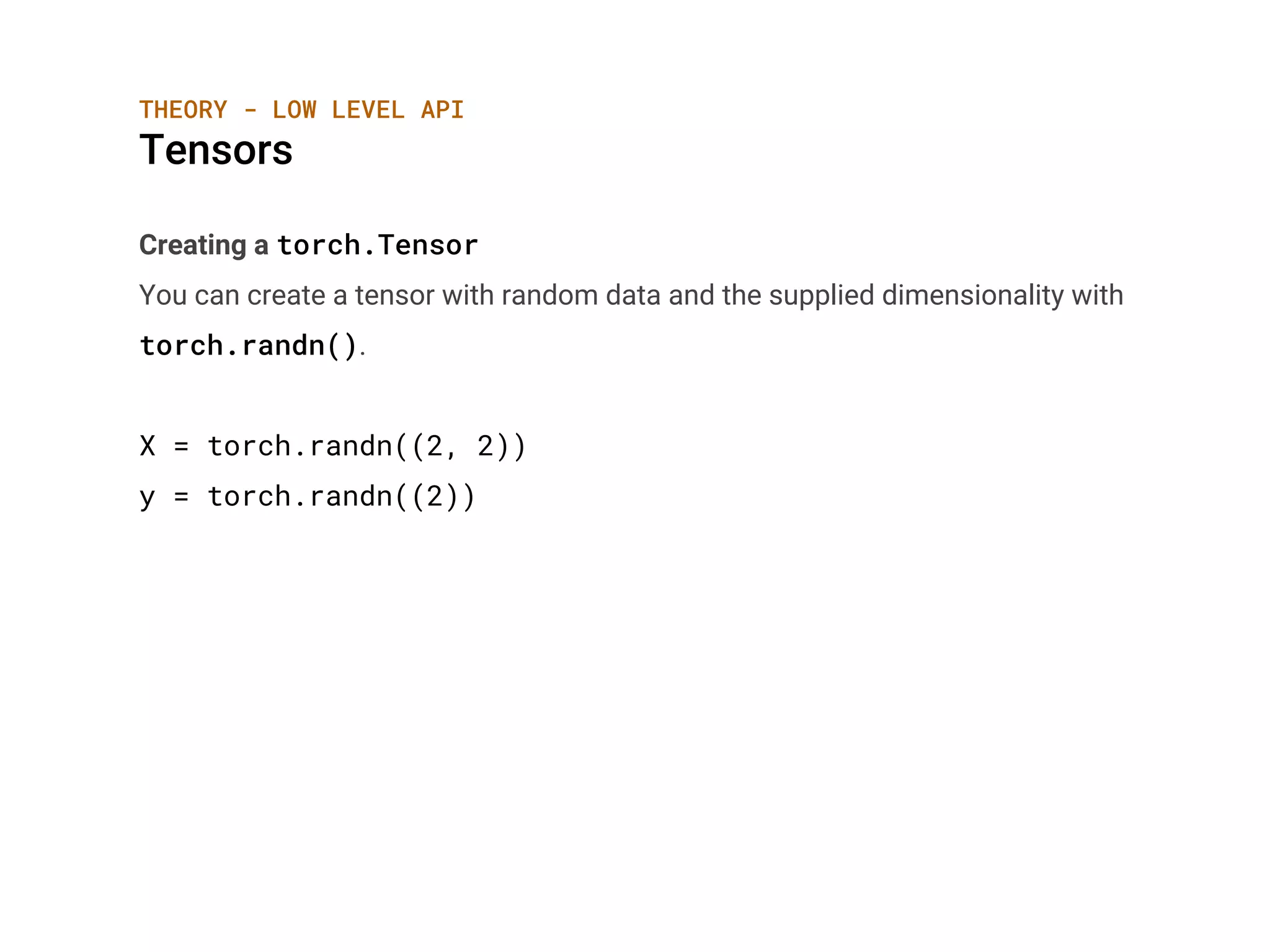
You can create a tensor with random data and the supplied dimensionality with
torch.randn().
X = torch.randn((2, 2))
y = torch.randn((2))
THEORY - LOW LEVEL API
Tensors
Creating a torch.Tensor
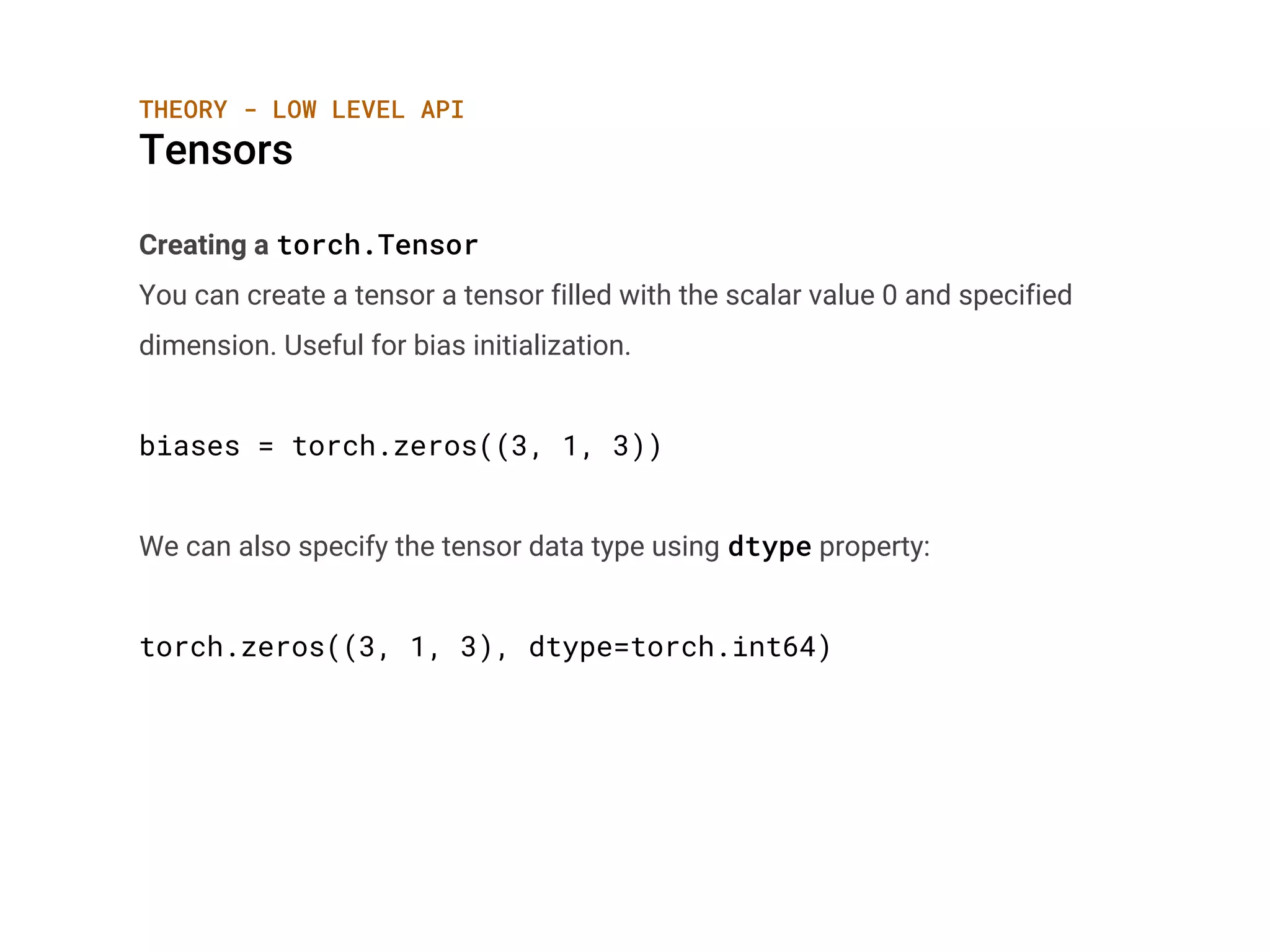
You can create a tensor a tensor filled with the scalar value 0 and specified
dimension. Useful for bias initialization.
biases = torch.zeros((3, 1, 3))
We can also specify the tensor data type using dtype property:
torch.zeros((3, 1, 3), dtype=torch.int64)
THEORY - LOW LEVEL API
Tensors
THEORY - LOW LEVEL API
Tensor Operations
Mathematical operations
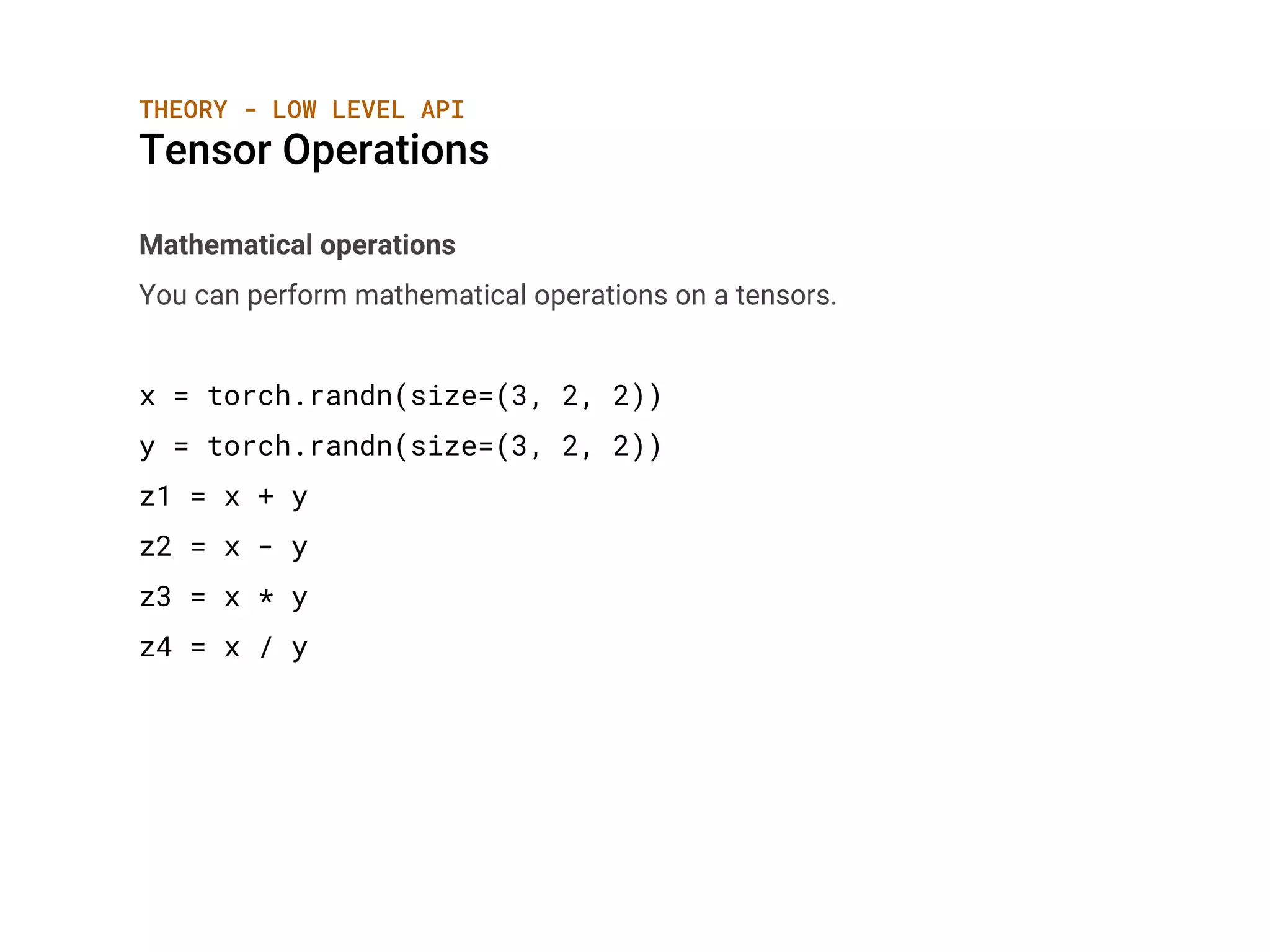
You can perform mathematical operations on a tensors.
x = torch.randn(size=(3, 2, 2))
y = torch.randn(size=(3, 2, 2))
z1 = x + y
z2 = x - y
z3 = x * y
z4 = x / y
THEORY - LOW LEVEL API
Tensor Operations
Beyond Mathematical operations
You can perform indexing, slicing, joining, mutating operations on a tensors.
For example:
# Indexing
x = torch.randn(size=(1, 3))
x[0]
# Joining (Concatenation)
xx = torch.cat((x, x))
See the documentation for a complete list of the massive number of operations
available to you.
THEORY - LOW LEVEL API
Autograd
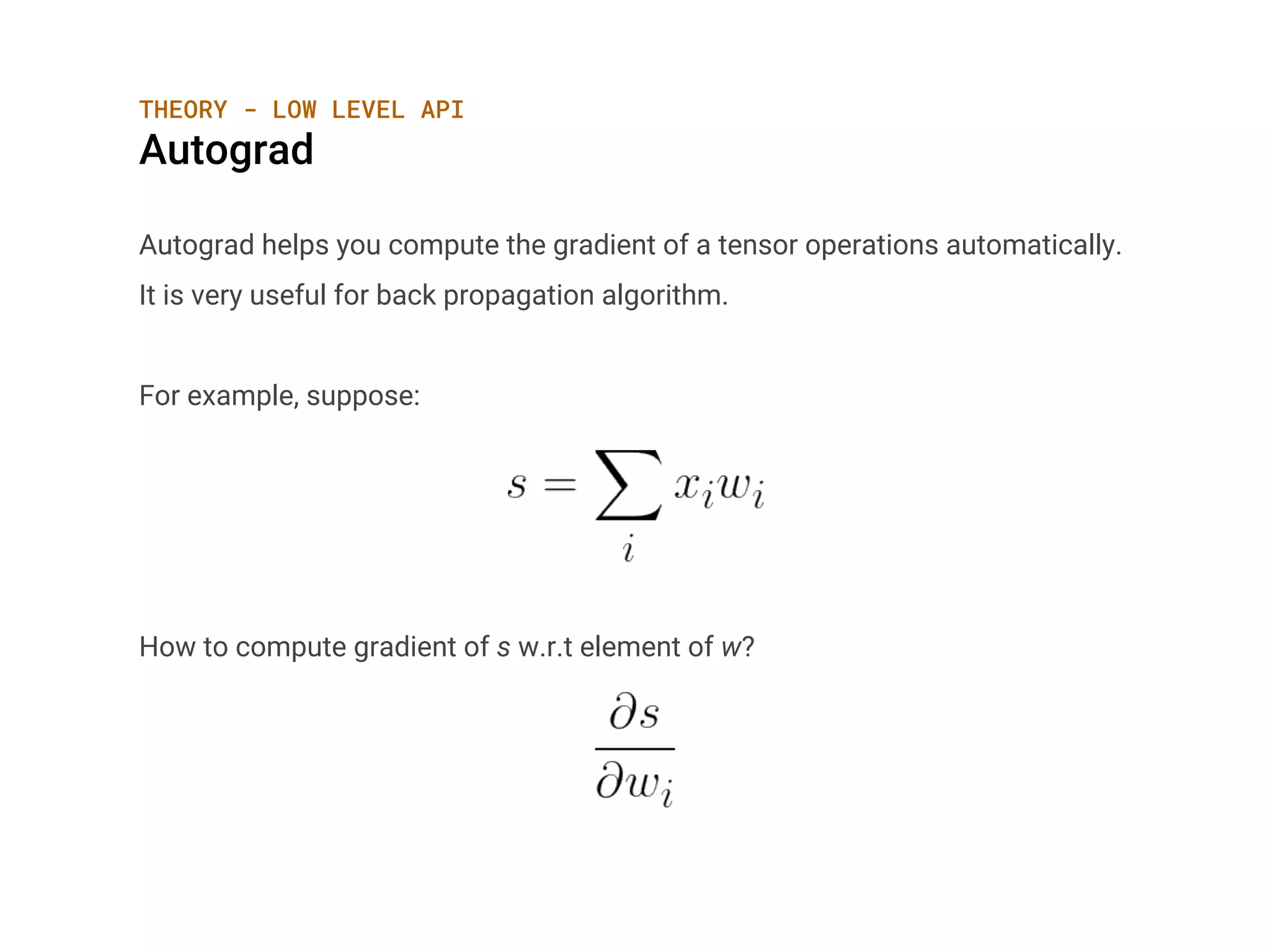
Autograd helps you compute the gradient of a tensor operations automatically.
It is very useful for back propagation algorithm.
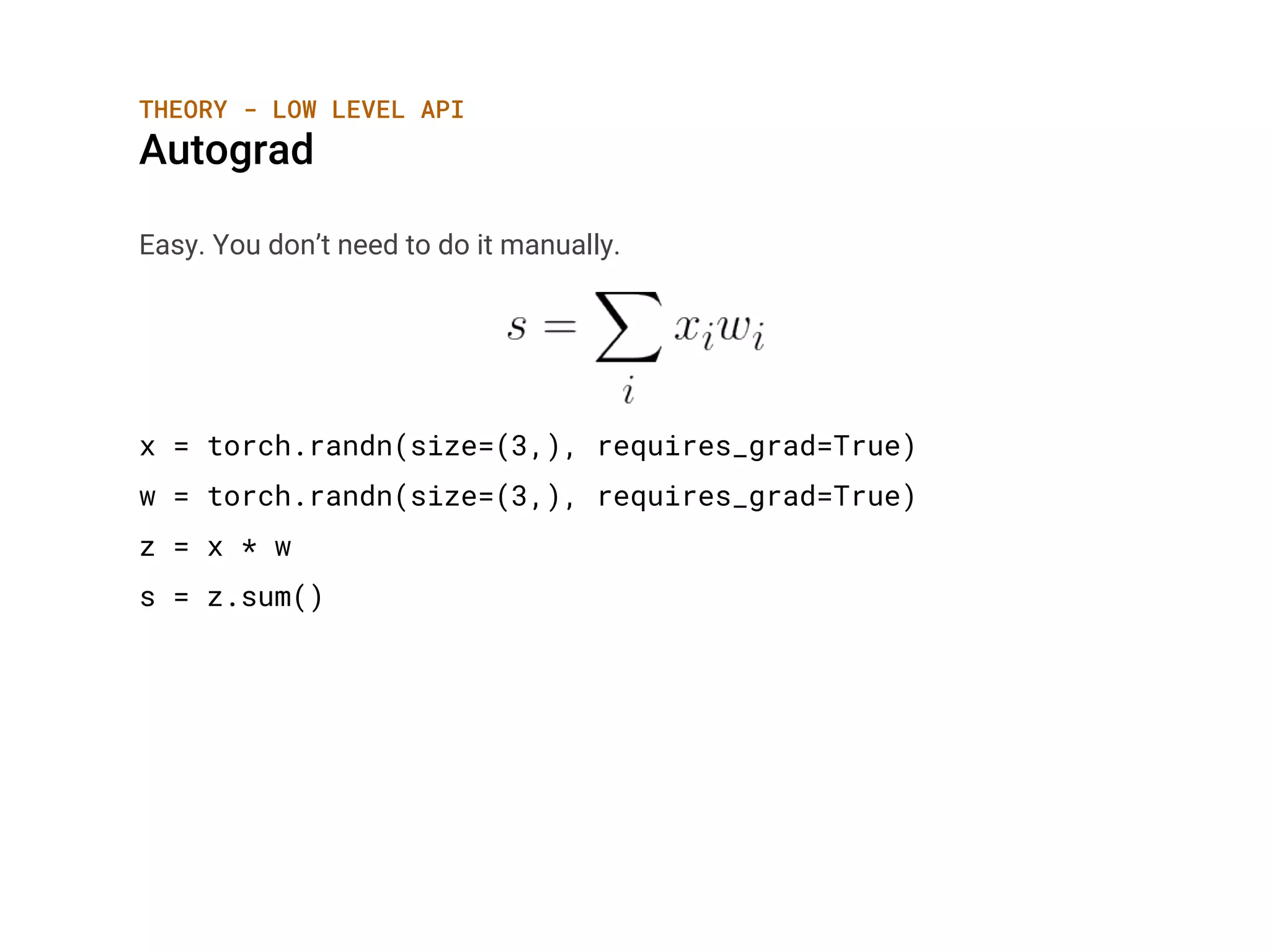
For example, suppose:
How to compute gradient of s w.r.t element of w?
THEORY - LOW LEVEL API
Autograd
Easy. You don’t need to do it manually.
x = torch.randn(size=(3,), requires_grad=True)
w = torch.randn(size=(3,), requires_grad=True)
z = x * w
s = z.sum()
THEORY - LOW LEVEL API
Autograd
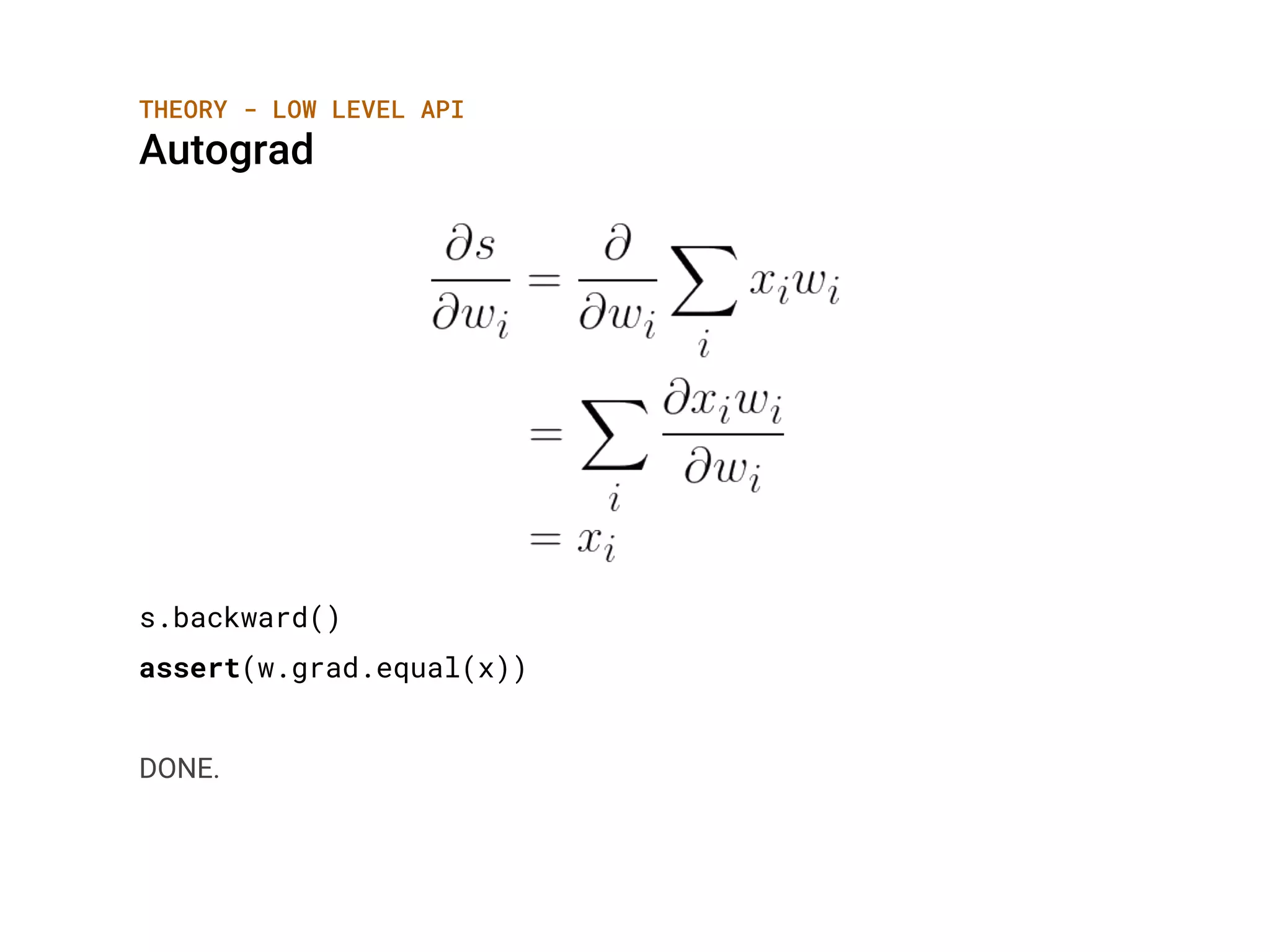
s.backward()
assert(w.grad.equal(x))
DONE.
THEORY - HIGH LEVEL API
Layers
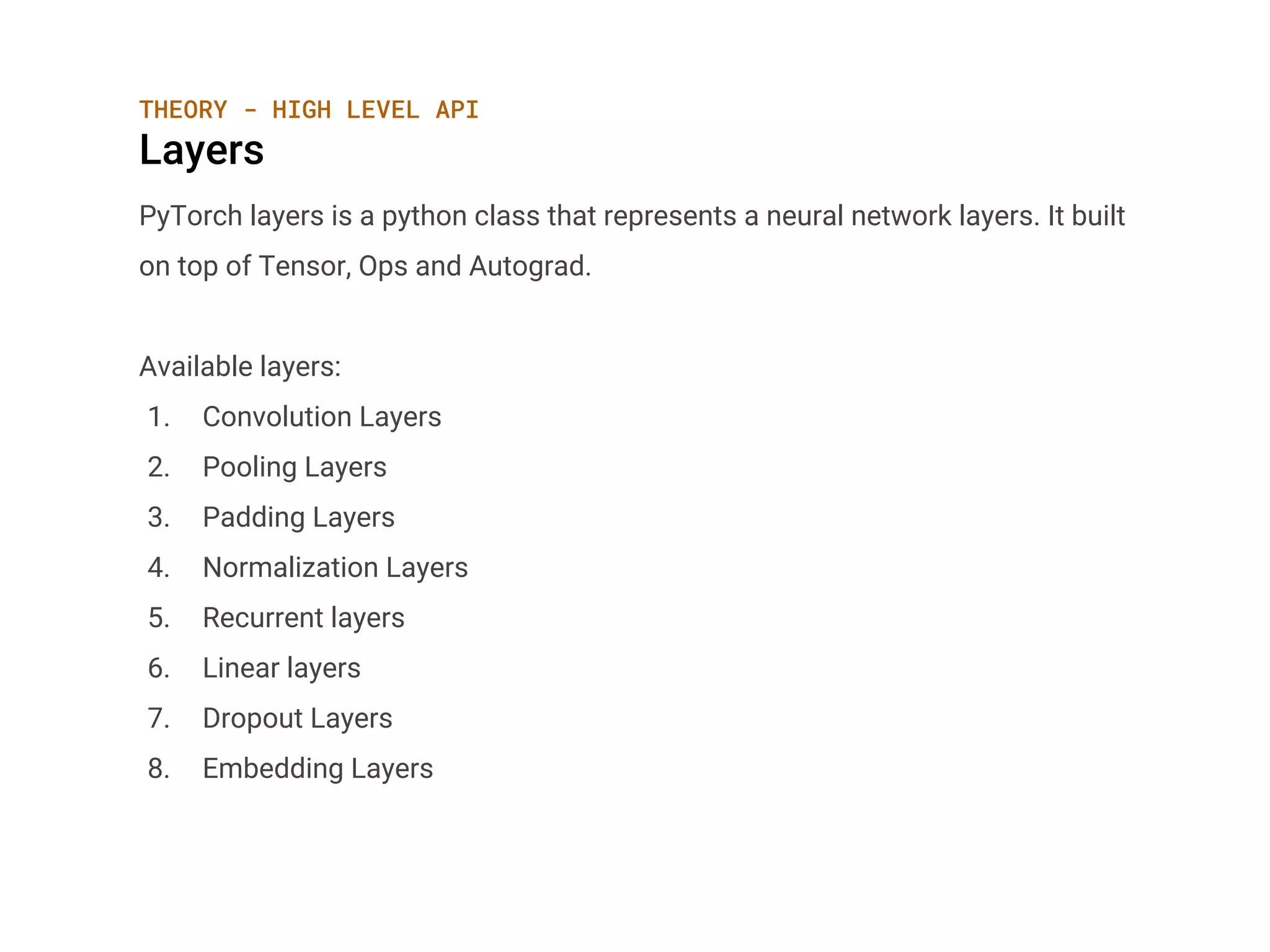
PyTorch layers is a python class that represents a neural network layers. It built
on top of Tensor, Ops and Autograd.
Available layers:
1. Convolution Layers
2. Pooling Layers
3. Padding Layers
4. Normalization Layers
5. Recurrent layers
6. Linear layers
7. Dropout Layers
8. Embedding Layers
THEORY - HIGH LEVEL API
Layers
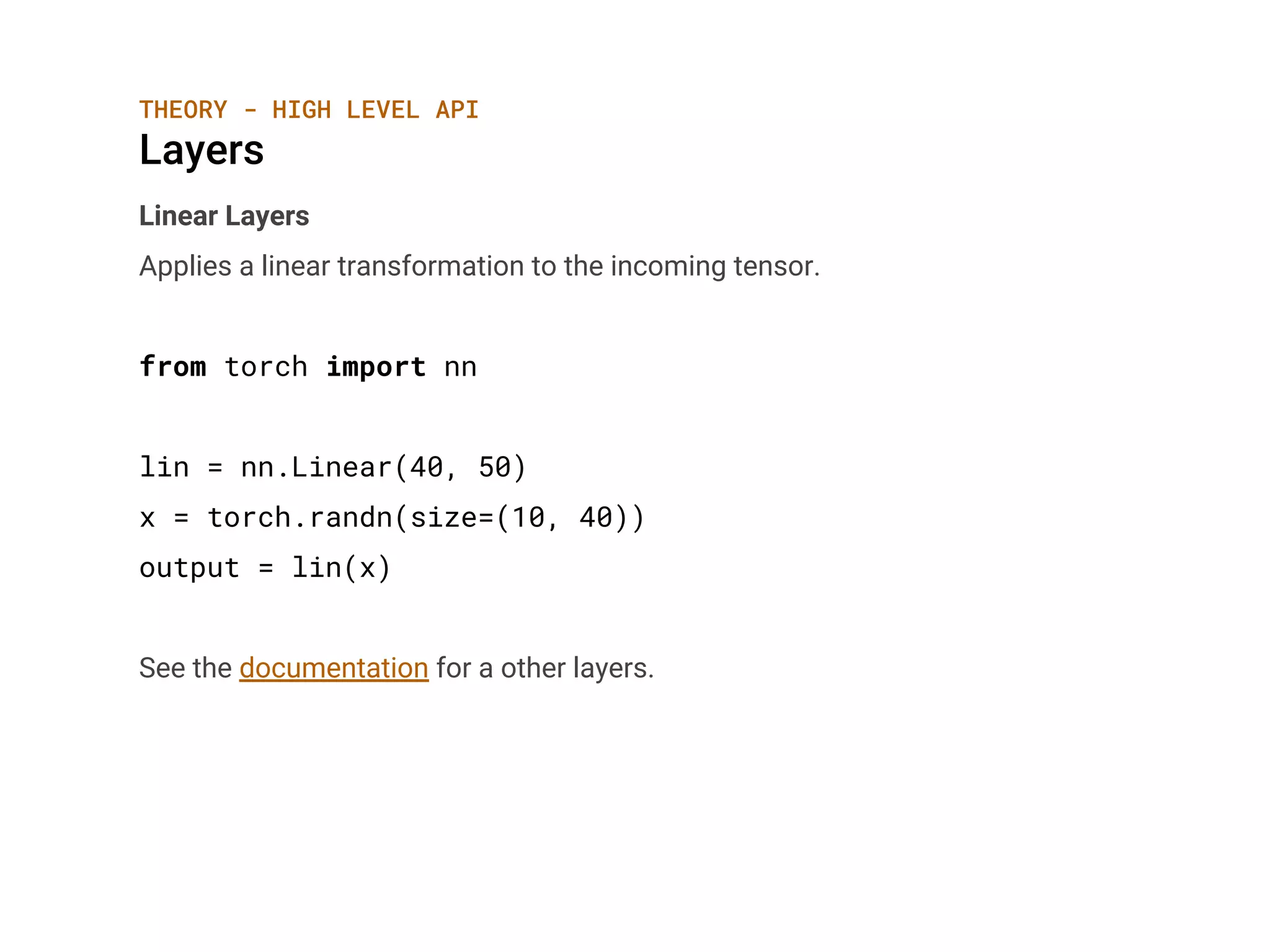
Linear Layers
Applies a linear transformation to the incoming tensor.
from torch import nn
lin = nn.Linear(40, 50)
x = torch.randn(size=(10, 40))
output = lin(x)
See the documentation for a other layers.
THEORY - HIGH LEVEL API
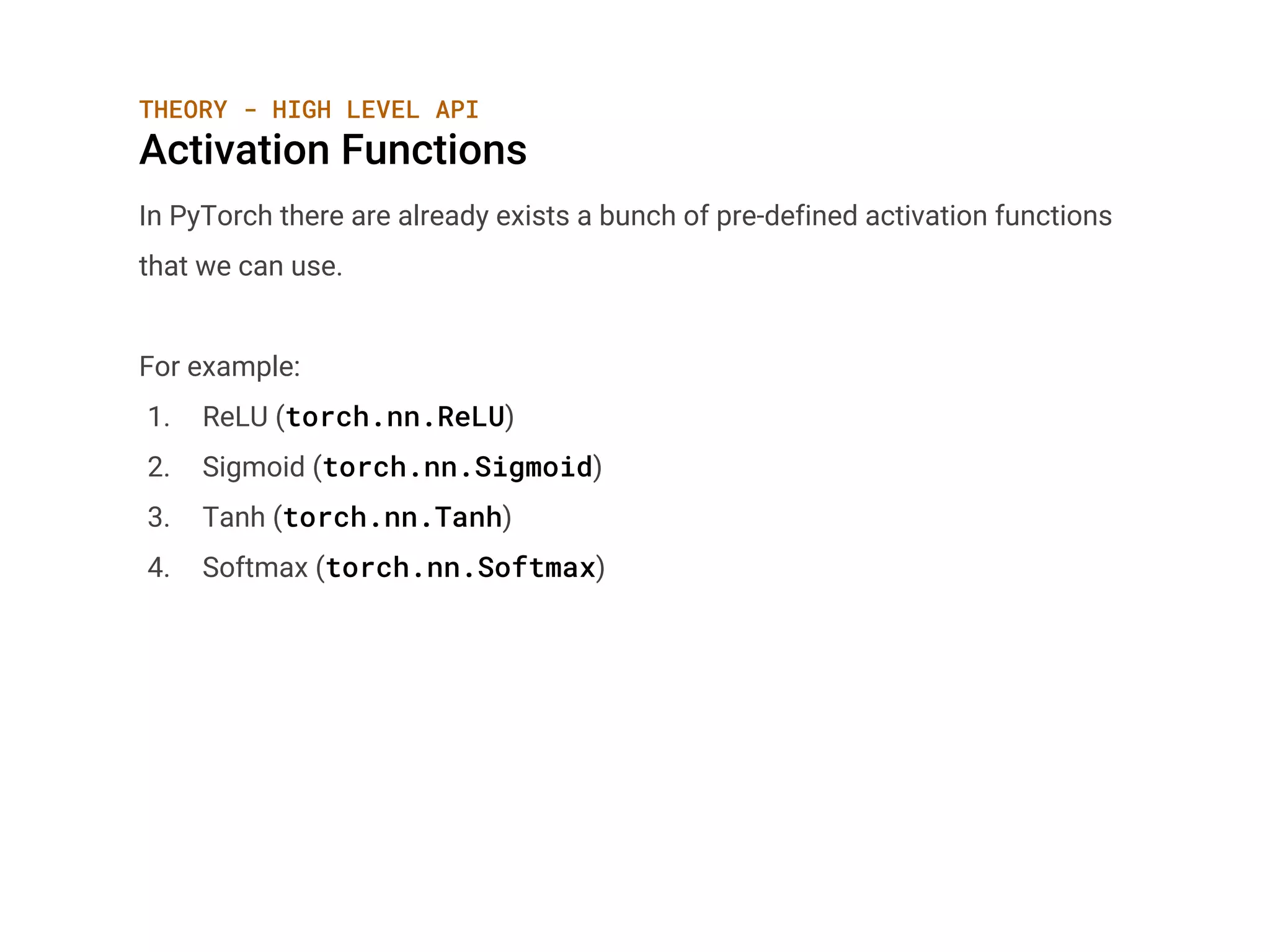
Activation Functions
In PyTorch there are already exists a bunch of pre-defined activation functions
that we can use.
For example:
1. ReLU (torch.nn.ReLU)
2. Sigmoid (torch.nn.Sigmoid)
3. Tanh (torch.nn.Tanh)
4. Softmax (torch.nn.Softmax)
THEORY - HIGH LEVEL API
Activation Functions
Softmax
Applies the Softmax function to an n-dimensional input Tensor rescaling them
so that the elements of the n-dimensional output Tensor lie in the range (0,1)
and sum to 1.
s = nn.Softmax(dim=2)
x = torch.Tensor([1, 2])
output = s(x)
See the documentation for a other layers.
THEORY - HIGH LEVEL API
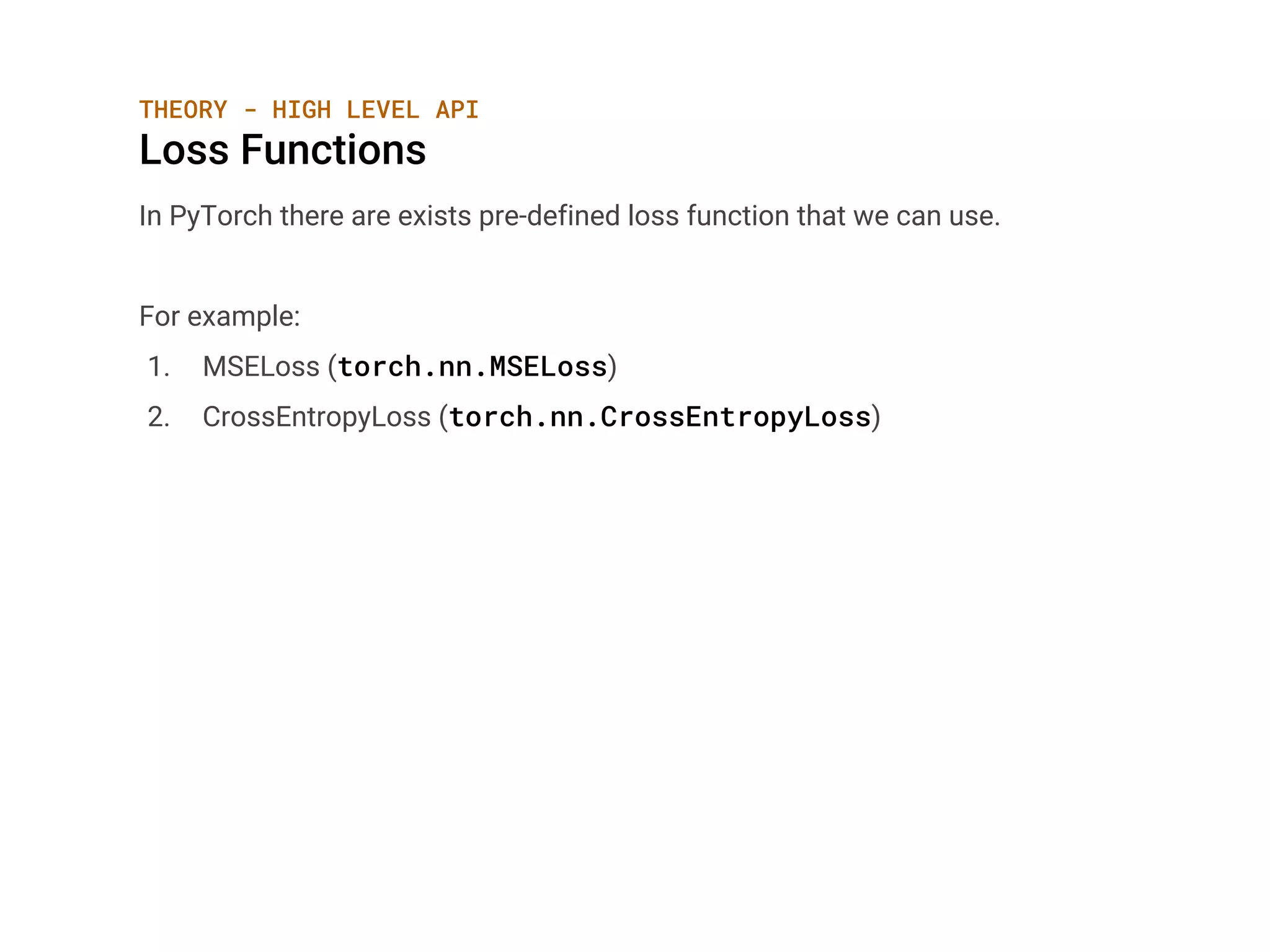
Loss Functions
In PyTorch there are exists pre-defined loss function that we can use.
For example:
1. MSELoss (torch.nn.MSELoss)
2. CrossEntropyLoss (torch.nn.CrossEntropyLoss)
THEORY - HIGH LEVEL API
Loss Functions
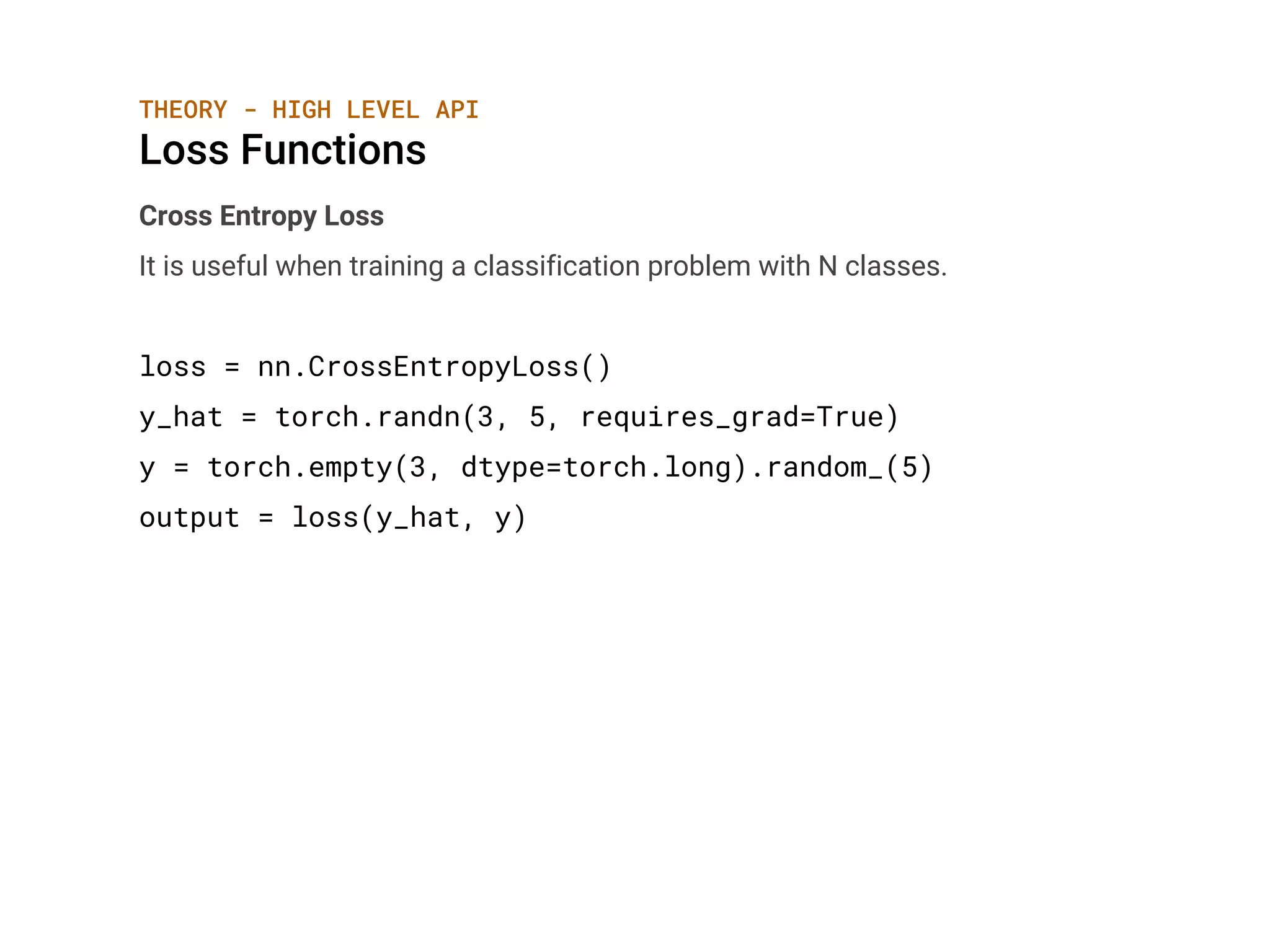
Cross Entropy Loss
It is useful when training a classification problem with N classes.
loss = nn.CrossEntropyLoss()
y_hat = torch.randn(3, 5, requires_grad=True)
y = torch.empty(3, dtype=torch.long).random_(5)
output = loss(y_hat, y)
PRACTICES
Implement, Train & Deploy a Model
Enough theories, let’s practice!
Key Takeaways
1. PyTorch is very intuitive to use.
2. There is no cognitive overhead, it just a plain python.
Bayu Aldi Yansyah
Data Scientist at Kumparan
github.com/pyk
PyCon Indonesia
November 3-4, 2018
Kalbis Institute, Jakarta
Questions?
Email me: bay@machinelearning.id

PyTorch for Deep Learning Practitioners

  • 1.
    Bayu Aldi Yansyah DataScientist at Kumparan github.com/pyk PyTorch for Deep Learning Practitioners PyCon Indonesia November 3-4, 2018 Kalbis Institute, Jakarta x
  • 2.
    Who? Works 2014 - 2015Google Student Ambassador South-East Asia 2015 - 2018 Data Scientist at Sale Stock 2018 - Data Scientist at Kumparan Hobbies Author of fastText.py (900+ stars on github) And more github.com/pyk
  • 3.
    Overview The guide isdivided into 2 main parts: 1. Theory: A brief introduction to PyTorch (concepts + code). 2. Practices: We will implement, train and deploy a basic feed-forward neural networks. We will back and forth between slide and jupyter lab.
  • 4.
    THEORY What is PyTorch? It’sa Python-based scientific computing package that can be used for: 1. A replacement for NumPy to use the power of GPUs 2. An open source deep learning platform that provides a seamless path from research prototyping to production deployment.
  • 5.
    THEORY Components of PyTorch TensorOps Autograd Layers Activations Loss Optim Low-level API High-level API Utilities API Data Checkpoint
  • 6.
    THEORY - LOWLEVEL API Tensors torch.Tensor are generalizations of a matrix that can be indexed in more than 2 dimensions. Creating a torch.Tensor Tensors can be created from Python lists with the torch.Tensor() function. import torch vector_data = [0.0, 1.0, 0.0] vector = torch.Tensor(vector) matrix_data = [[1.0., 0.0, 0.0], [0.0, 1.0, 0.0]] matrix = torch.Tensor(matrix_data)
  • 7.
    Creating a torch.Tensor Youcan create a tensor with random data and the supplied dimensionality with torch.randn(). X = torch.randn((2, 2)) y = torch.randn((2)) THEORY - LOW LEVEL API Tensors
  • 8.
    Creating a torch.Tensor Youcan create a tensor a tensor filled with the scalar value 0 and specified dimension. Useful for bias initialization. biases = torch.zeros((3, 1, 3)) We can also specify the tensor data type using dtype property: torch.zeros((3, 1, 3), dtype=torch.int64) THEORY - LOW LEVEL API Tensors
  • 9.
    THEORY - LOWLEVEL API Tensor Operations Mathematical operations You can perform mathematical operations on a tensors. x = torch.randn(size=(3, 2, 2)) y = torch.randn(size=(3, 2, 2)) z1 = x + y z2 = x - y z3 = x * y z4 = x / y
  • 10.
    THEORY - LOWLEVEL API Tensor Operations Beyond Mathematical operations You can perform indexing, slicing, joining, mutating operations on a tensors. For example: # Indexing x = torch.randn(size=(1, 3)) x[0] # Joining (Concatenation) xx = torch.cat((x, x)) See the documentation for a complete list of the massive number of operations available to you.
  • 11.
    THEORY - LOWLEVEL API Autograd Autograd helps you compute the gradient of a tensor operations automatically. It is very useful for back propagation algorithm. For example, suppose: How to compute gradient of s w.r.t element of w?
  • 12.
    THEORY - LOWLEVEL API Autograd Easy. You don’t need to do it manually. x = torch.randn(size=(3,), requires_grad=True) w = torch.randn(size=(3,), requires_grad=True) z = x * w s = z.sum()
  • 13.
    THEORY - LOWLEVEL API Autograd s.backward() assert(w.grad.equal(x)) DONE.
  • 14.
    THEORY - HIGHLEVEL API Layers PyTorch layers is a python class that represents a neural network layers. It built on top of Tensor, Ops and Autograd. Available layers: 1. Convolution Layers 2. Pooling Layers 3. Padding Layers 4. Normalization Layers 5. Recurrent layers 6. Linear layers 7. Dropout Layers 8. Embedding Layers
  • 15.
    THEORY - HIGHLEVEL API Layers Linear Layers Applies a linear transformation to the incoming tensor. from torch import nn lin = nn.Linear(40, 50) x = torch.randn(size=(10, 40)) output = lin(x) See the documentation for a other layers.
  • 16.
    THEORY - HIGHLEVEL API Activation Functions In PyTorch there are already exists a bunch of pre-defined activation functions that we can use. For example: 1. ReLU (torch.nn.ReLU) 2. Sigmoid (torch.nn.Sigmoid) 3. Tanh (torch.nn.Tanh) 4. Softmax (torch.nn.Softmax)
  • 17.
    THEORY - HIGHLEVEL API Activation Functions Softmax Applies the Softmax function to an n-dimensional input Tensor rescaling them so that the elements of the n-dimensional output Tensor lie in the range (0,1) and sum to 1. s = nn.Softmax(dim=2) x = torch.Tensor([1, 2]) output = s(x) See the documentation for a other layers.
  • 18.
    THEORY - HIGHLEVEL API Loss Functions In PyTorch there are exists pre-defined loss function that we can use. For example: 1. MSELoss (torch.nn.MSELoss) 2. CrossEntropyLoss (torch.nn.CrossEntropyLoss)
  • 19.
    THEORY - HIGHLEVEL API Loss Functions Cross Entropy Loss It is useful when training a classification problem with N classes. loss = nn.CrossEntropyLoss() y_hat = torch.randn(3, 5, requires_grad=True) y = torch.empty(3, dtype=torch.long).random_(5) output = loss(y_hat, y)
  • 20.
    PRACTICES Implement, Train &Deploy a Model Enough theories, let’s practice!
  • 21.
    Key Takeaways 1. PyTorchis very intuitive to use. 2. There is no cognitive overhead, it just a plain python.
  • 22.
    Bayu Aldi Yansyah DataScientist at Kumparan github.com/pyk PyCon Indonesia November 3-4, 2018 Kalbis Institute, Jakarta Questions? Email me: bay@machinelearning.id