Python’s
Dynamic Nature
An investigation of how Python’s dynamic nature
allows it to scale up from one-line scripts to massive
applications.
Kiran Jonnalagadda <jace@seacrow.com>
These are rough slides. The finals will make heavy use
of diagrams in place of text.
What Does
Interpreted Mean?
• Python is not line interpreted like shell
script.

• Python is byte-code compiled like Java,
but compilation is on-the-fly.

• However, Python in some ways behaves
like a line-interpreted language, making
the learning curve easy.
Loading a Module
• When a module (file) is loaded, it is first
compiled into byte-code.

• Python then executes all the code in the
module that is not in a function.

• This code can modify the module as it

loads, making for the line-interpreted feel.

• Code in functions is only executed on call.
Example of Loading
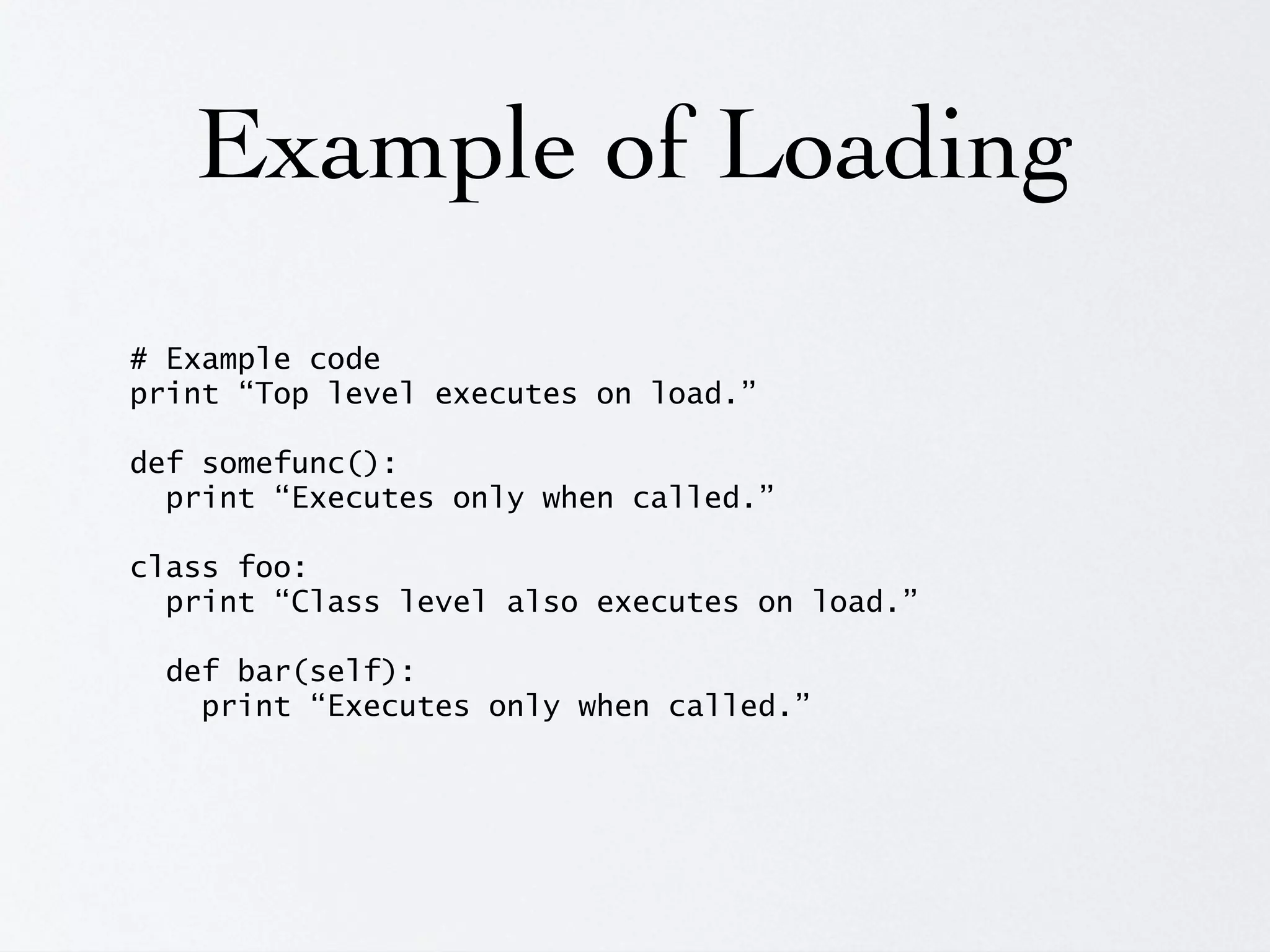
# Example code
print “Top level executes on load.”
def somefunc():
print “Executes only when called.”
class foo:
print “Class level also executes on load.”
def bar(self):
print “Executes only when called.”
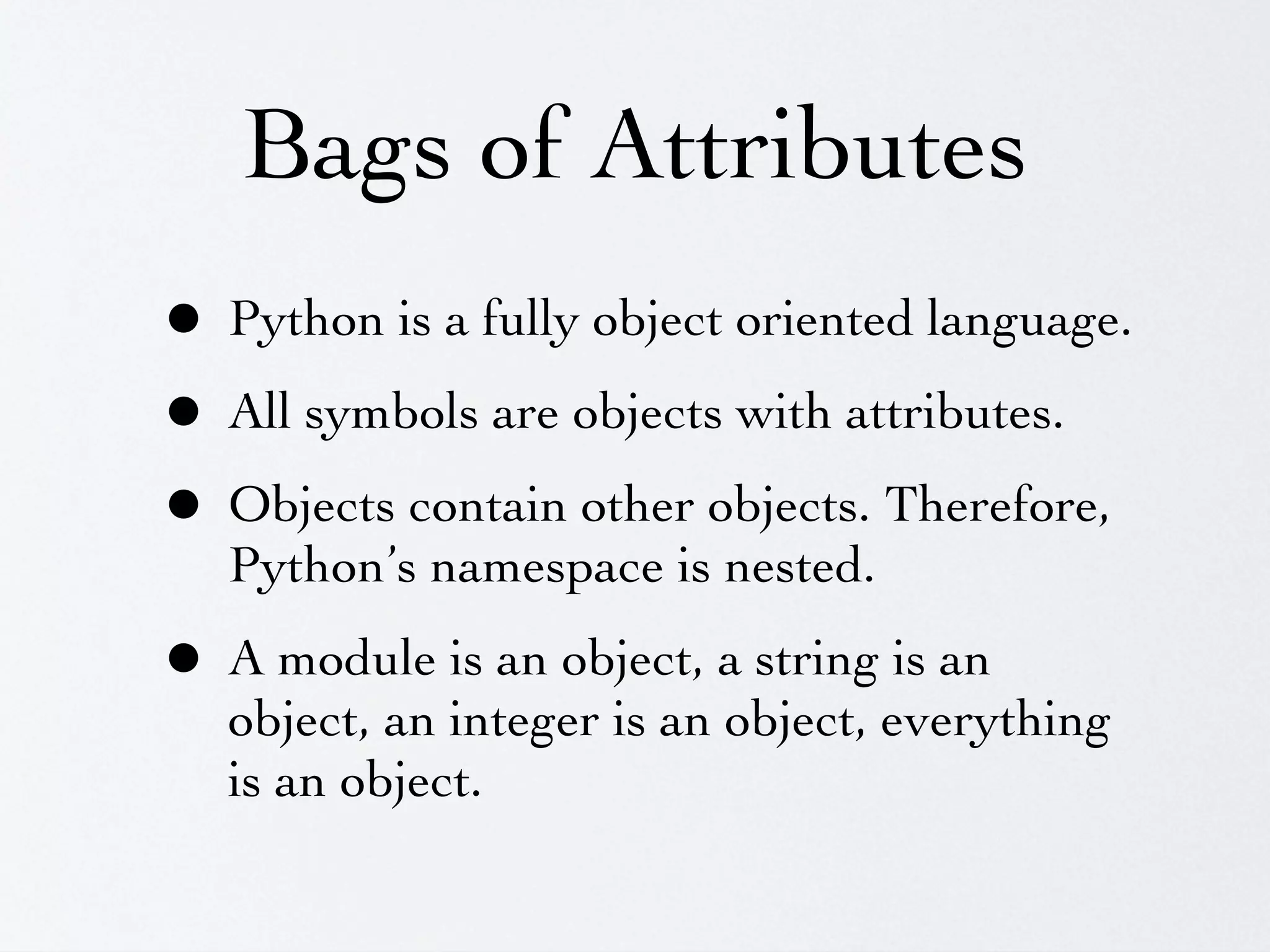
Bags of Attributes
• Python is a fully object oriented language.
• All symbols are objects with attributes.
• Objects contain other objects. Therefore,
Python’s namespace is nested.

• A module is an object, a string is an

object, an integer is an object, everything
is an object.
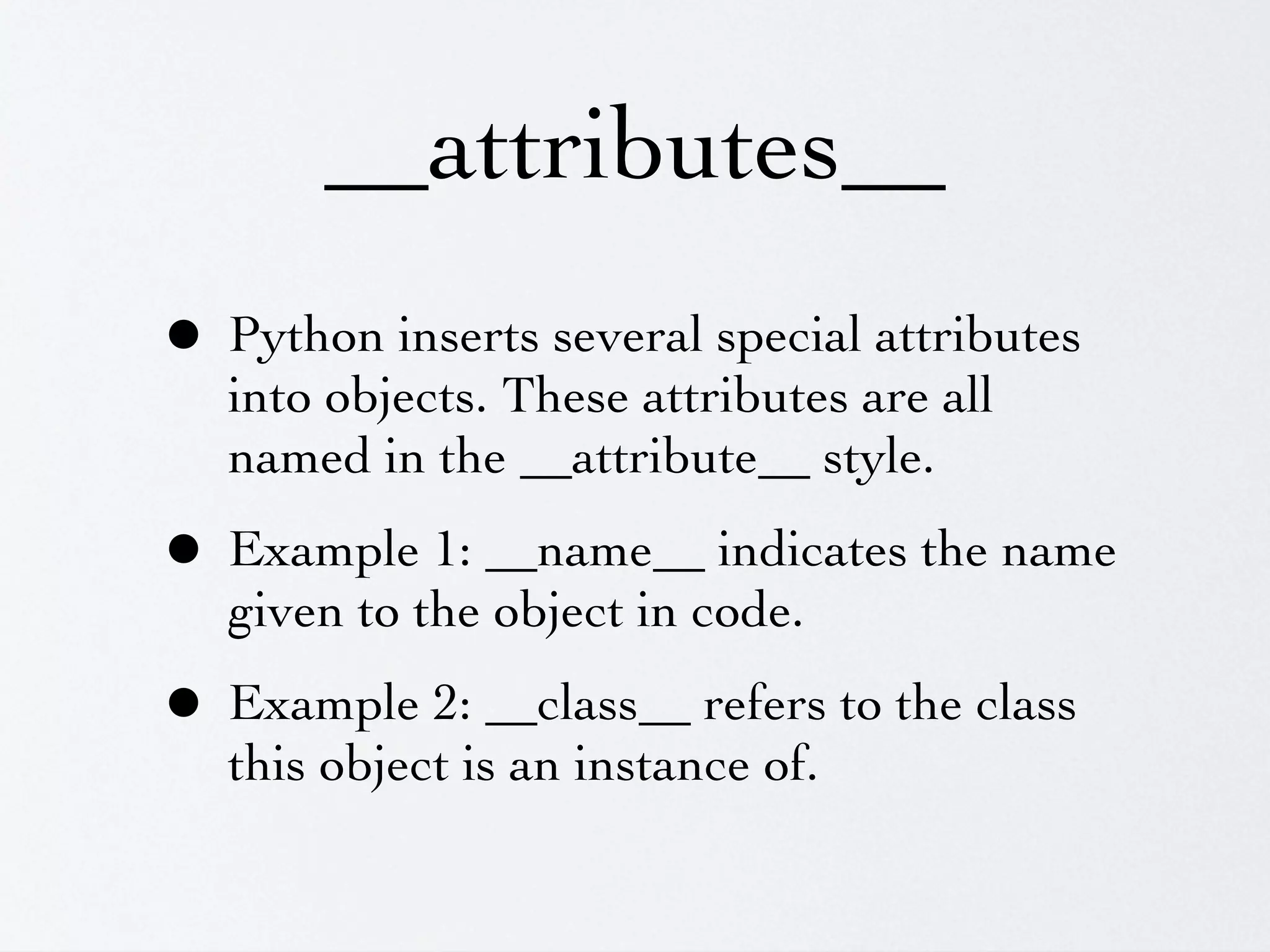
__attributes__
• Python inserts several special attributes
into objects. These attributes are all
named in the __attribute__ style.

• Example 1: __name__ indicates the name
given to the object in code.

• Example 2: __class__ refers to the class
this object is an instance of.
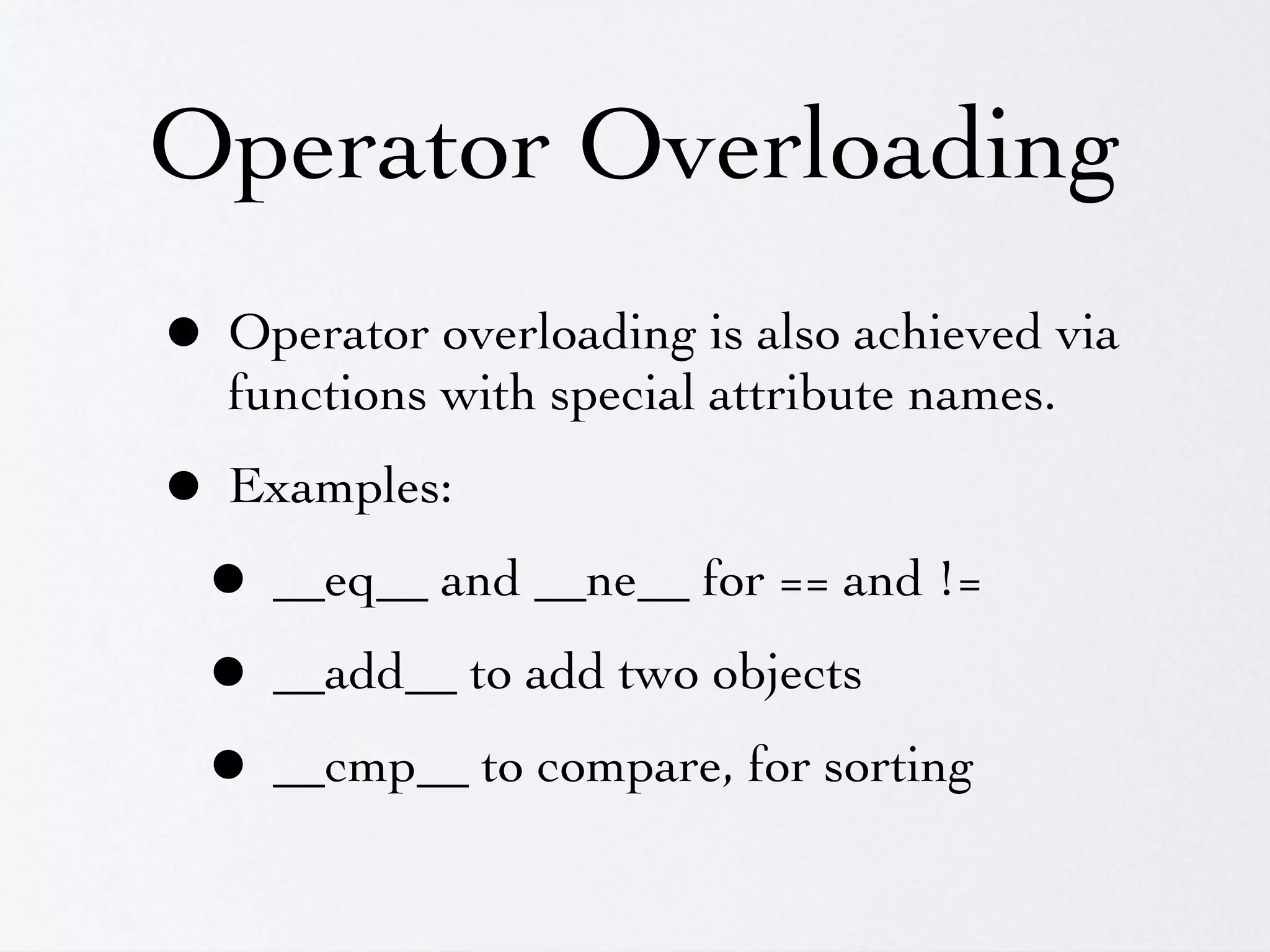
Operator Overloading
• Operator overloading is also achieved via
functions with special attribute names.

• Examples:
• __eq__ and __ne__ for == and !=
• __add__ to add two objects
• __cmp__ to compare, for sorting
Controlling Attribute
Access

• An object can take control of the way its
attributes are accessed.

• The __getitem__ function for list or

dictionary access. Example: object[‘foo’]

• The __getattr__ function for named

access. Example: using object.foo will call
object.__getattr__(‘foo’)

• __setitem__ and __setattr__ for editing.
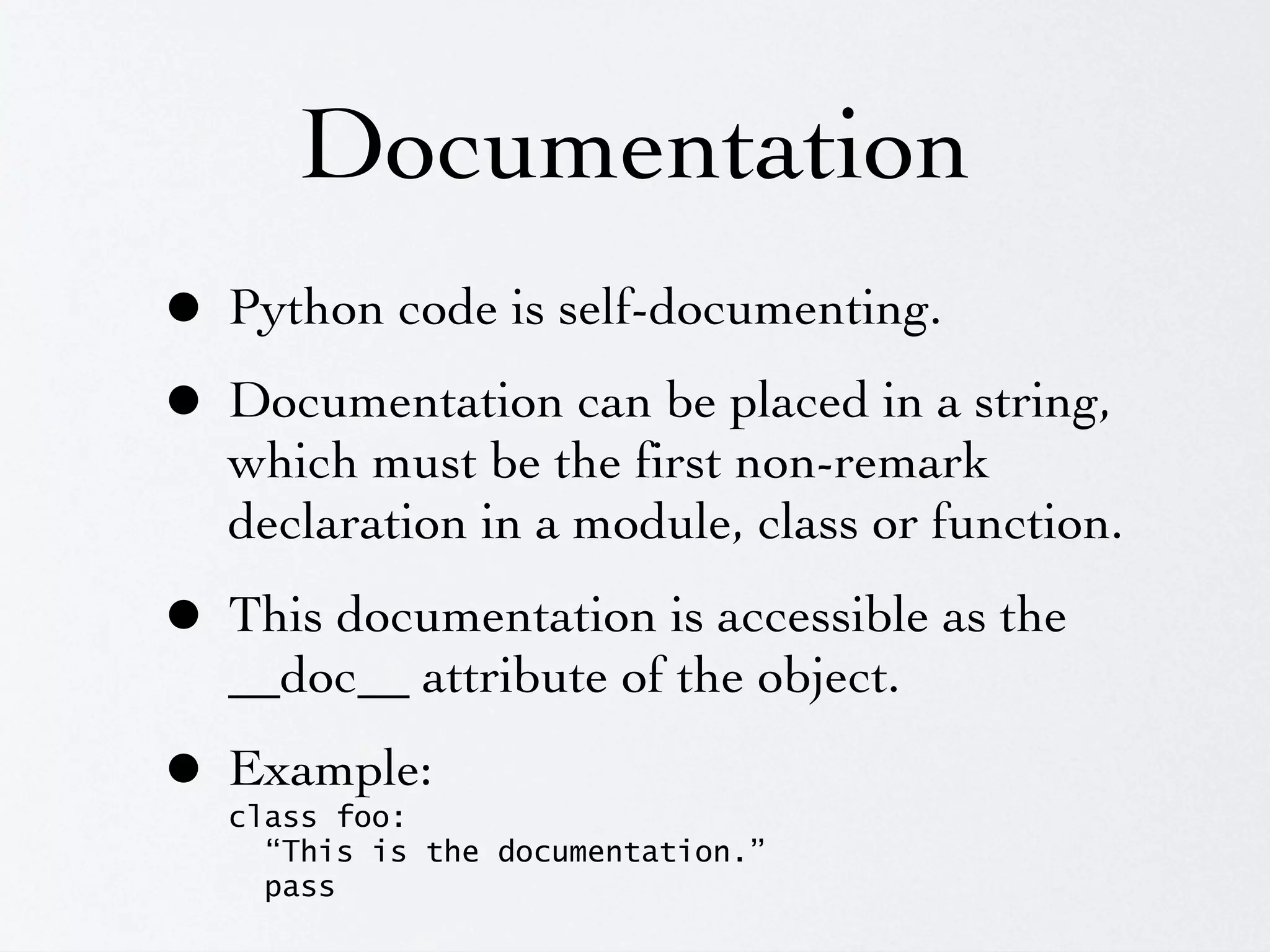
Documentation
• Python code is self-documenting.
• Documentation can be placed in a string,

which must be the first non-remark
declaration in a module, class or function.

• This documentation is accessible as the
__doc__ attribute of the object.

• Example:

class foo:
“This is the documentation.”
pass
Namespaces
• In Python, everything is contained within
something else.

• The top-level, invisible container is called
__builtins__. Contains internal functions.

• Top-level symbols not from __builtins__
are local symbols.

• Local symbols are not private. They can
be accessed via the namespace.
Namespaces #2
• The top-level namespace is not crowded;

an app can have several modules with
conflicting names and not have a conflict.

• “module1.cname” is different from
“module2.cname”

• Using “name = module1.cname” makes

“name” a local alias for “module1.cname”
Symbols and Objects
• Symbols are not the same as objects.
• Symbols are only references to objects.
• An object can have multiple references.
• Objects are garbage collected when they

have zero references. GC algorithms used
are both reference counting and markand-sweep.
Multiple References
• An module can consist of nothing but

references to symbols in other modules.

• Hence the term, “bags of attributes.”
• This allows a large package to have a

single API module that links to the rest of
the package internally.
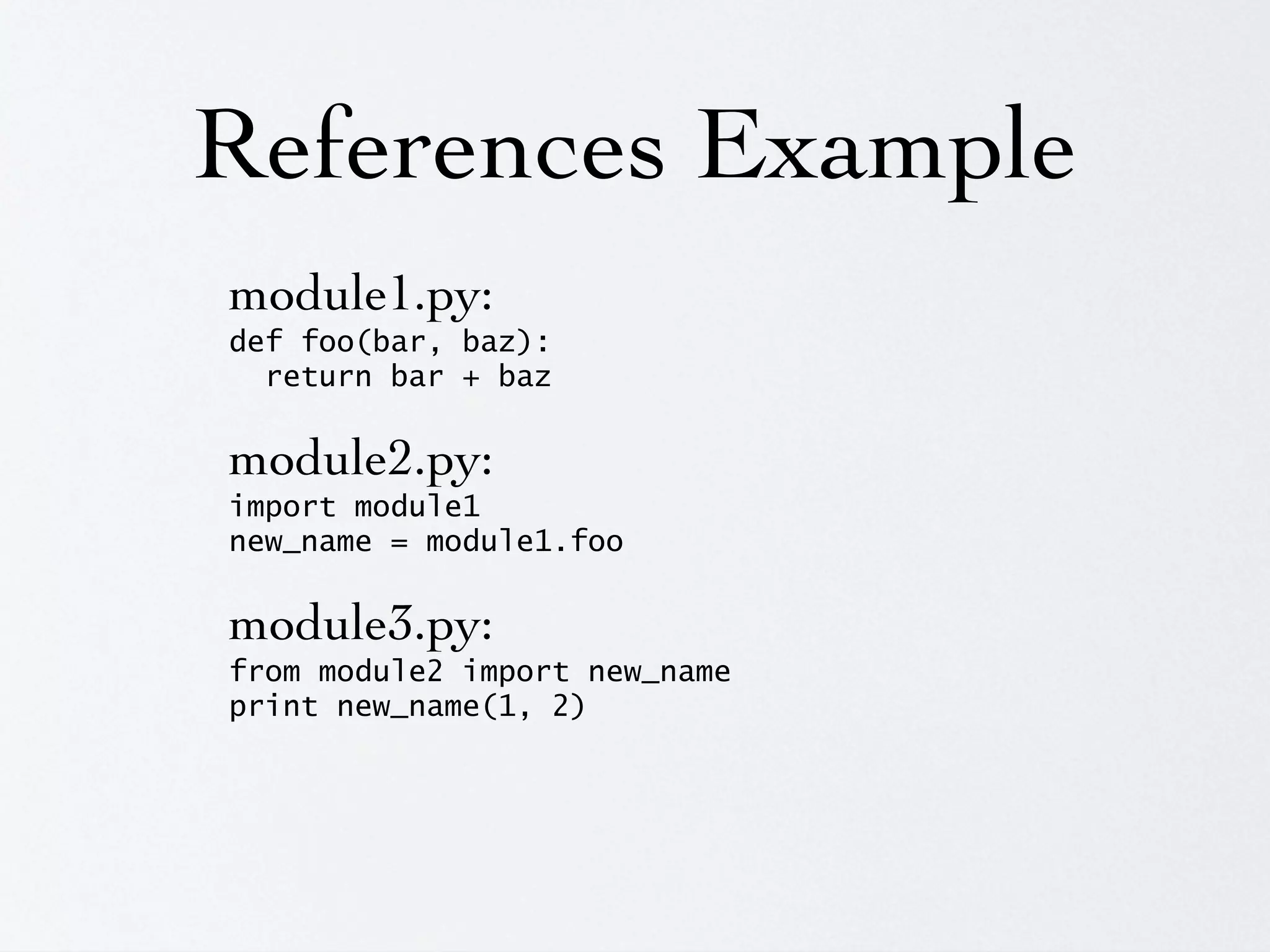
References Example
module1.py:
def foo(bar, baz):
return bar + baz

module2.py:
import module1
new_name = module1.foo

module3.py:
from module2 import new_name
print new_name(1, 2)
Runtime Editing
• Python code can edit itself at run-time.
• The only way to define variables in a class
is by editing the instance at runtime.

• Editing involves simply changing the
object a symbol refers to.

• This only works when all code refers to
the object via the symbol, which is the
case almost all the time.
How Classes Work
• {To insert code examples and diagram

here, showing a complex class definition
and how it works when different parts are
accessed. This will be across several
slides.}
Scalability
• Because of the clear namespace

separation, a Python application can
contain thousands of modules without
conflicts.

• Advanced class definition ability helps
avoid repetitive code.

• This makes Python code easy to maintain
and scale, while still remaining simple.
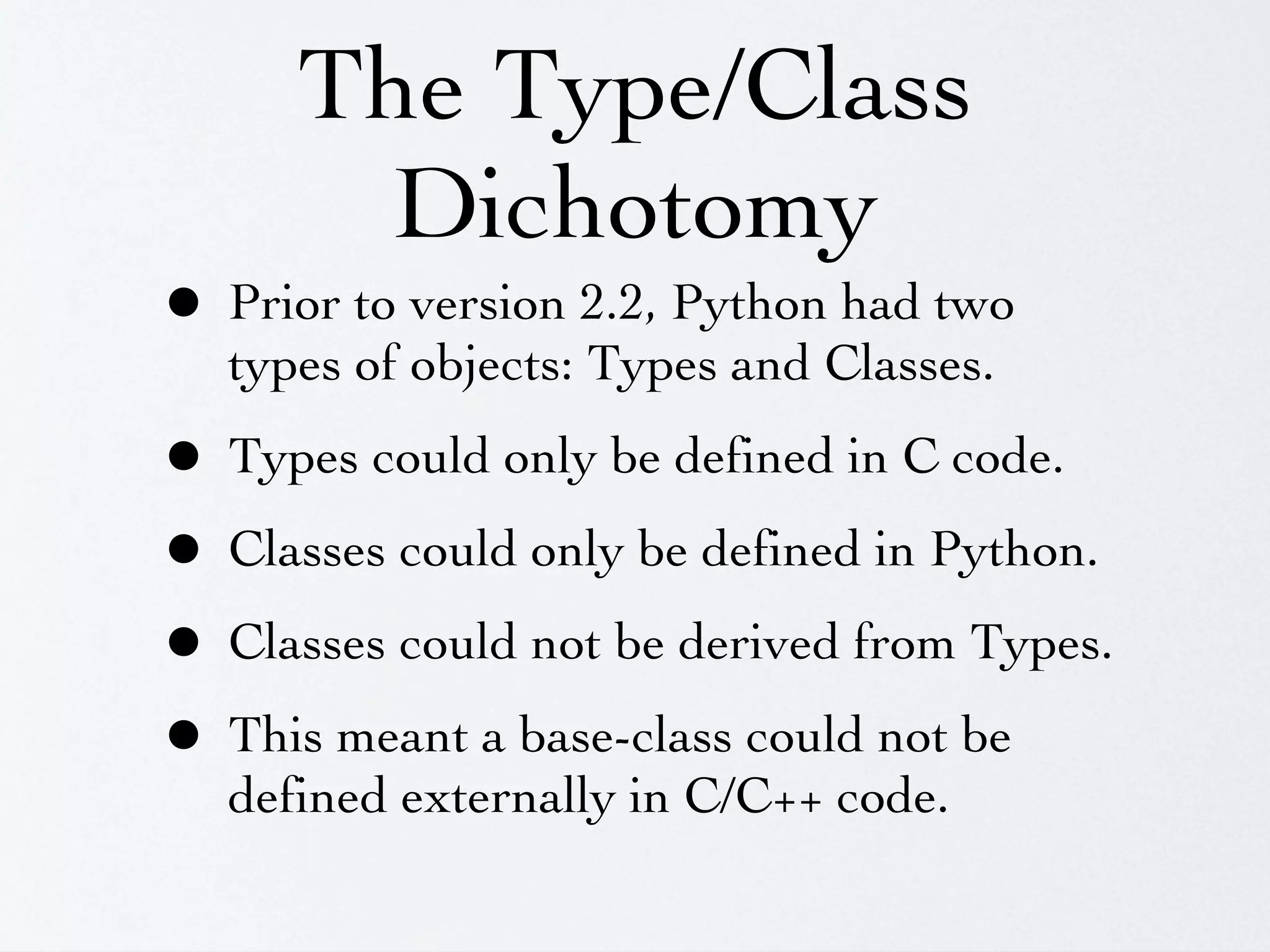
The Type/Class
Dichotomy

• Prior to version 2.2, Python had two
types of objects: Types and Classes.

• Types could only be defined in C code.
• Classes could only be defined in Python.
• Classes could not be derived from Types.
• This meant a base-class could not be
defined externally in C/C++ code.
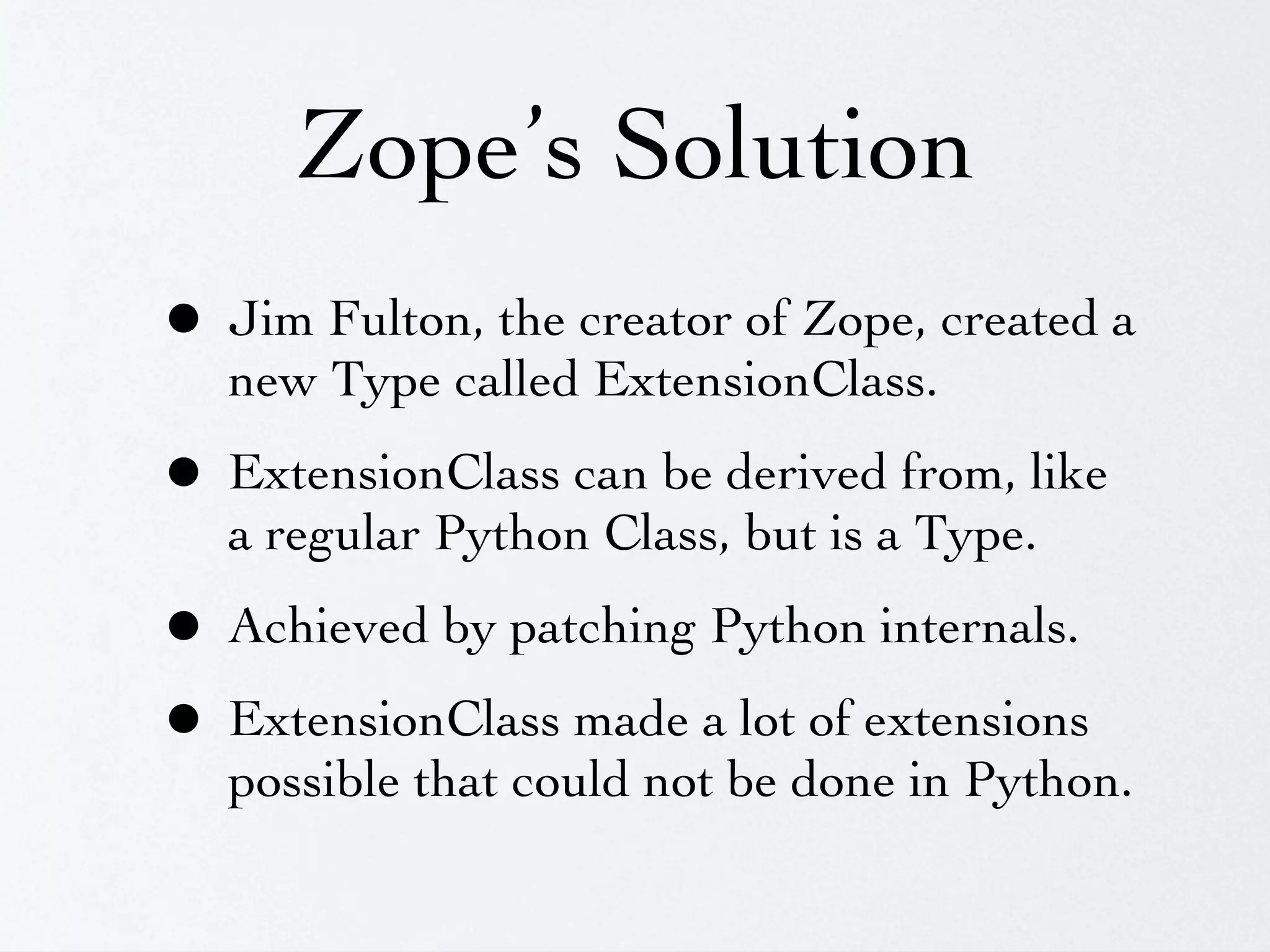
Zope’s Solution
• Jim Fulton, the creator of Zope, created a
new Type called ExtensionClass.

• ExtensionClass can be derived from, like
a regular Python Class, but is a Type.

• Achieved by patching Python internals.
• ExtensionClass made a lot of extensions

possible that could not be done in Python.
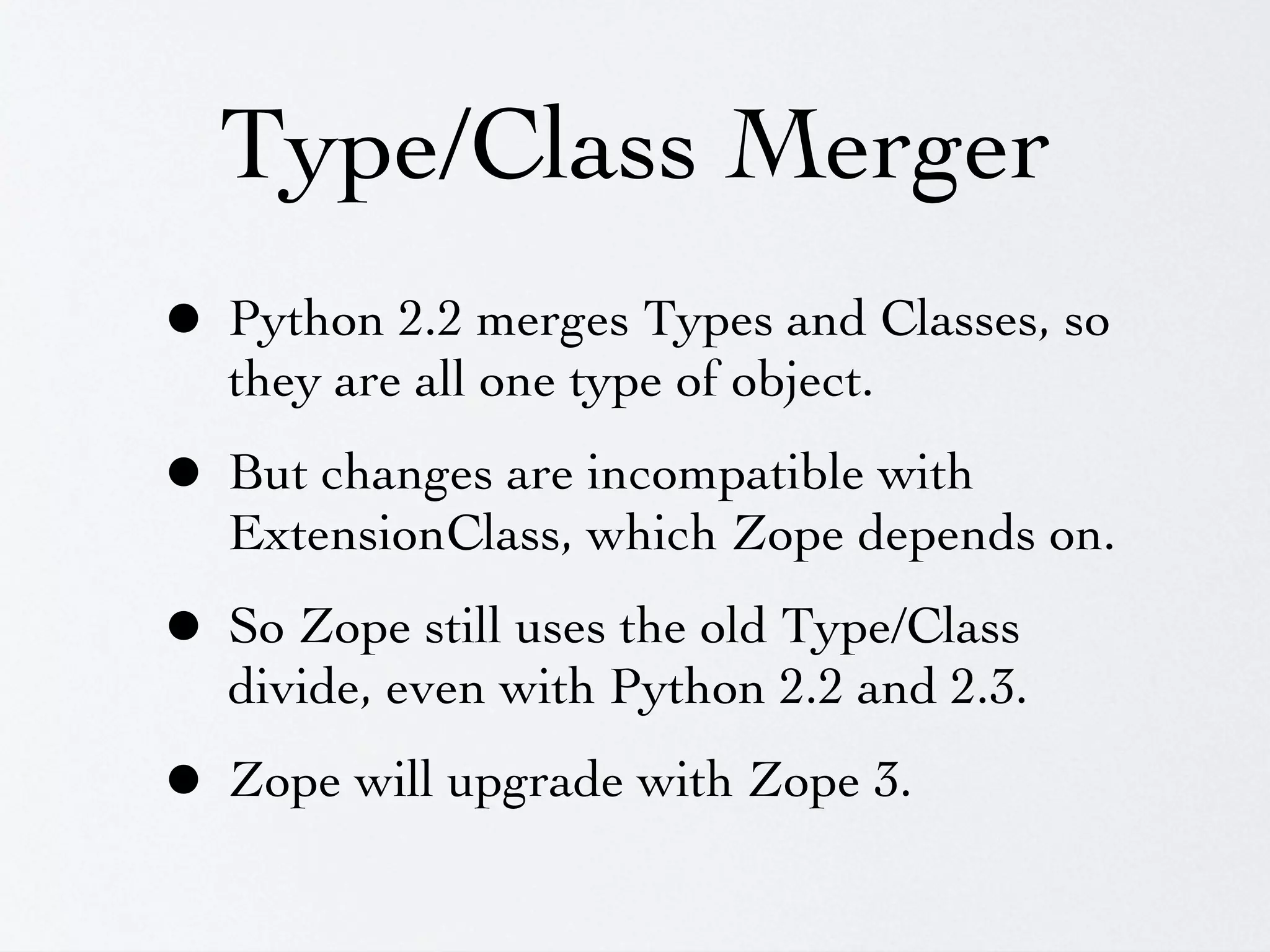
Type/Class Merger
• Python 2.2 merges Types and Classes, so
they are all one type of object.

• But changes are incompatible with

ExtensionClass, which Zope depends on.

• So Zope still uses the old Type/Class

divide, even with Python 2.2 and 2.3.

• Zope will upgrade with Zope 3.

Python's dynamic nature (rough slides, November 2004)

  • 1.
    Python’s Dynamic Nature An investigationof how Python’s dynamic nature allows it to scale up from one-line scripts to massive applications. Kiran Jonnalagadda <jace@seacrow.com> These are rough slides. The finals will make heavy use of diagrams in place of text.
  • 2.
    What Does Interpreted Mean? •Python is not line interpreted like shell script. • Python is byte-code compiled like Java, but compilation is on-the-fly. • However, Python in some ways behaves like a line-interpreted language, making the learning curve easy.
  • 3.
    Loading a Module •When a module (file) is loaded, it is first compiled into byte-code. • Python then executes all the code in the module that is not in a function. • This code can modify the module as it loads, making for the line-interpreted feel. • Code in functions is only executed on call.
  • 4.
    Example of Loading #Example code print “Top level executes on load.” def somefunc(): print “Executes only when called.” class foo: print “Class level also executes on load.” def bar(self): print “Executes only when called.”
  • 5.
    Bags of Attributes •Python is a fully object oriented language. • All symbols are objects with attributes. • Objects contain other objects. Therefore, Python’s namespace is nested. • A module is an object, a string is an object, an integer is an object, everything is an object.
  • 6.
    __attributes__ • Python insertsseveral special attributes into objects. These attributes are all named in the __attribute__ style. • Example 1: __name__ indicates the name given to the object in code. • Example 2: __class__ refers to the class this object is an instance of.
  • 7.
    Operator Overloading • Operatoroverloading is also achieved via functions with special attribute names. • Examples: • __eq__ and __ne__ for == and != • __add__ to add two objects • __cmp__ to compare, for sorting
  • 8.
    Controlling Attribute Access • Anobject can take control of the way its attributes are accessed. • The __getitem__ function for list or dictionary access. Example: object[‘foo’] • The __getattr__ function for named access. Example: using object.foo will call object.__getattr__(‘foo’) • __setitem__ and __setattr__ for editing.
  • 9.
    Documentation • Python codeis self-documenting. • Documentation can be placed in a string, which must be the first non-remark declaration in a module, class or function. • This documentation is accessible as the __doc__ attribute of the object. • Example: class foo: “This is the documentation.” pass
  • 10.
    Namespaces • In Python,everything is contained within something else. • The top-level, invisible container is called __builtins__. Contains internal functions. • Top-level symbols not from __builtins__ are local symbols. • Local symbols are not private. They can be accessed via the namespace.
  • 11.
    Namespaces #2 • Thetop-level namespace is not crowded; an app can have several modules with conflicting names and not have a conflict. • “module1.cname” is different from “module2.cname” • Using “name = module1.cname” makes “name” a local alias for “module1.cname”
  • 12.
    Symbols and Objects •Symbols are not the same as objects. • Symbols are only references to objects. • An object can have multiple references. • Objects are garbage collected when they have zero references. GC algorithms used are both reference counting and markand-sweep.
  • 13.
    Multiple References • Anmodule can consist of nothing but references to symbols in other modules. • Hence the term, “bags of attributes.” • This allows a large package to have a single API module that links to the rest of the package internally.
  • 14.
    References Example module1.py: def foo(bar,baz): return bar + baz module2.py: import module1 new_name = module1.foo module3.py: from module2 import new_name print new_name(1, 2)
  • 15.
    Runtime Editing • Pythoncode can edit itself at run-time. • The only way to define variables in a class is by editing the instance at runtime. • Editing involves simply changing the object a symbol refers to. • This only works when all code refers to the object via the symbol, which is the case almost all the time.
  • 16.
    How Classes Work •{To insert code examples and diagram here, showing a complex class definition and how it works when different parts are accessed. This will be across several slides.}
  • 17.
    Scalability • Because ofthe clear namespace separation, a Python application can contain thousands of modules without conflicts. • Advanced class definition ability helps avoid repetitive code. • This makes Python code easy to maintain and scale, while still remaining simple.
  • 18.
    The Type/Class Dichotomy • Priorto version 2.2, Python had two types of objects: Types and Classes. • Types could only be defined in C code. • Classes could only be defined in Python. • Classes could not be derived from Types. • This meant a base-class could not be defined externally in C/C++ code.
  • 19.
    Zope’s Solution • JimFulton, the creator of Zope, created a new Type called ExtensionClass. • ExtensionClass can be derived from, like a regular Python Class, but is a Type. • Achieved by patching Python internals. • ExtensionClass made a lot of extensions possible that could not be done in Python.
  • 20.
    Type/Class Merger • Python2.2 merges Types and Classes, so they are all one type of object. • But changes are incompatible with ExtensionClass, which Zope depends on. • So Zope still uses the old Type/Class divide, even with Python 2.2 and 2.3. • Zope will upgrade with Zope 3.