Welcome to Python
Programming
•In this course, you'll learn Python from basics to
advanced topics like OOP, file handling, and more.
• Let's get started!
2.
What is Python?
•Python is a high-level, interpreted programming
language.
• It is widely used in web development, data science,
AI, automation, and more.
3.
Why Learn Python?
•- Easy to read and write
• - Large community and library support
• - Used by companies like Google, Netflix, and NASA
4.
Installing Python
• Downloadfrom: https://python.org
• Use IDEs like VS Code, PyCharm, or Jupyter
Notebook for writing Python code.
5.
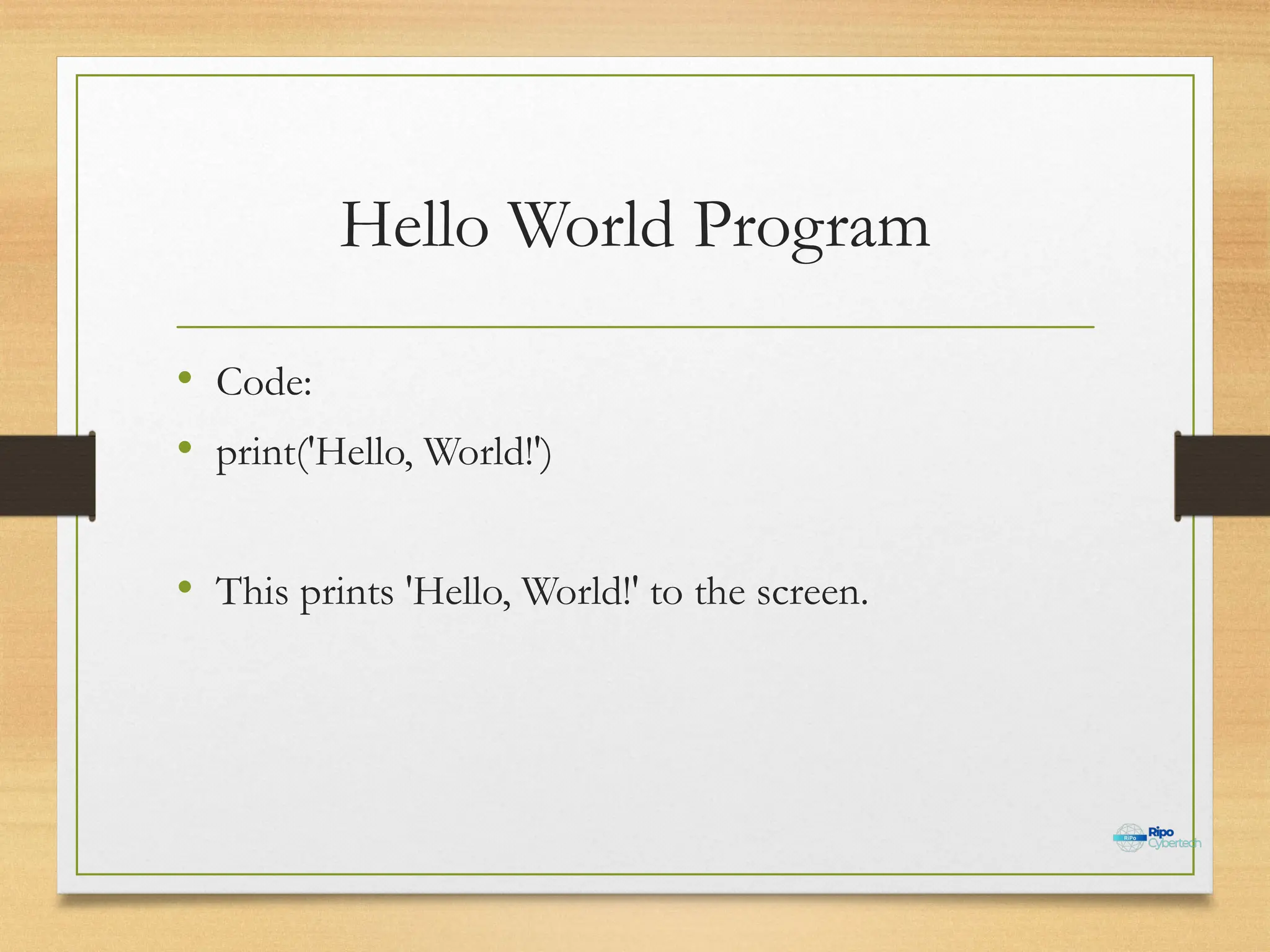
Hello World Program
•Code:
• print('Hello, World!')
• This prints 'Hello, World!' to the screen.
6.
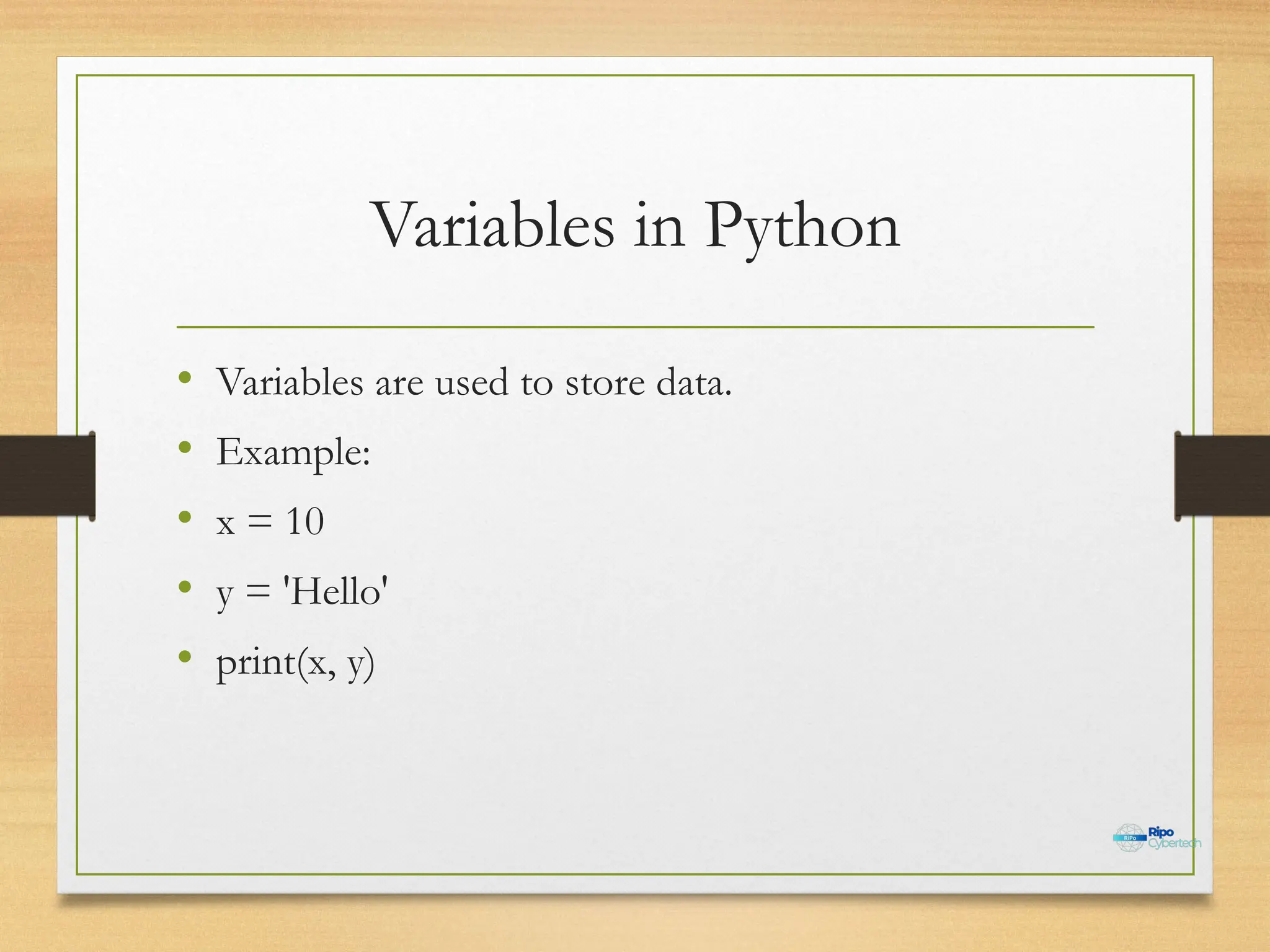
Variables in Python
•Variables are used to store data.
• Example:
• x = 10
• y = 'Hello'
• print(x, y)
7.
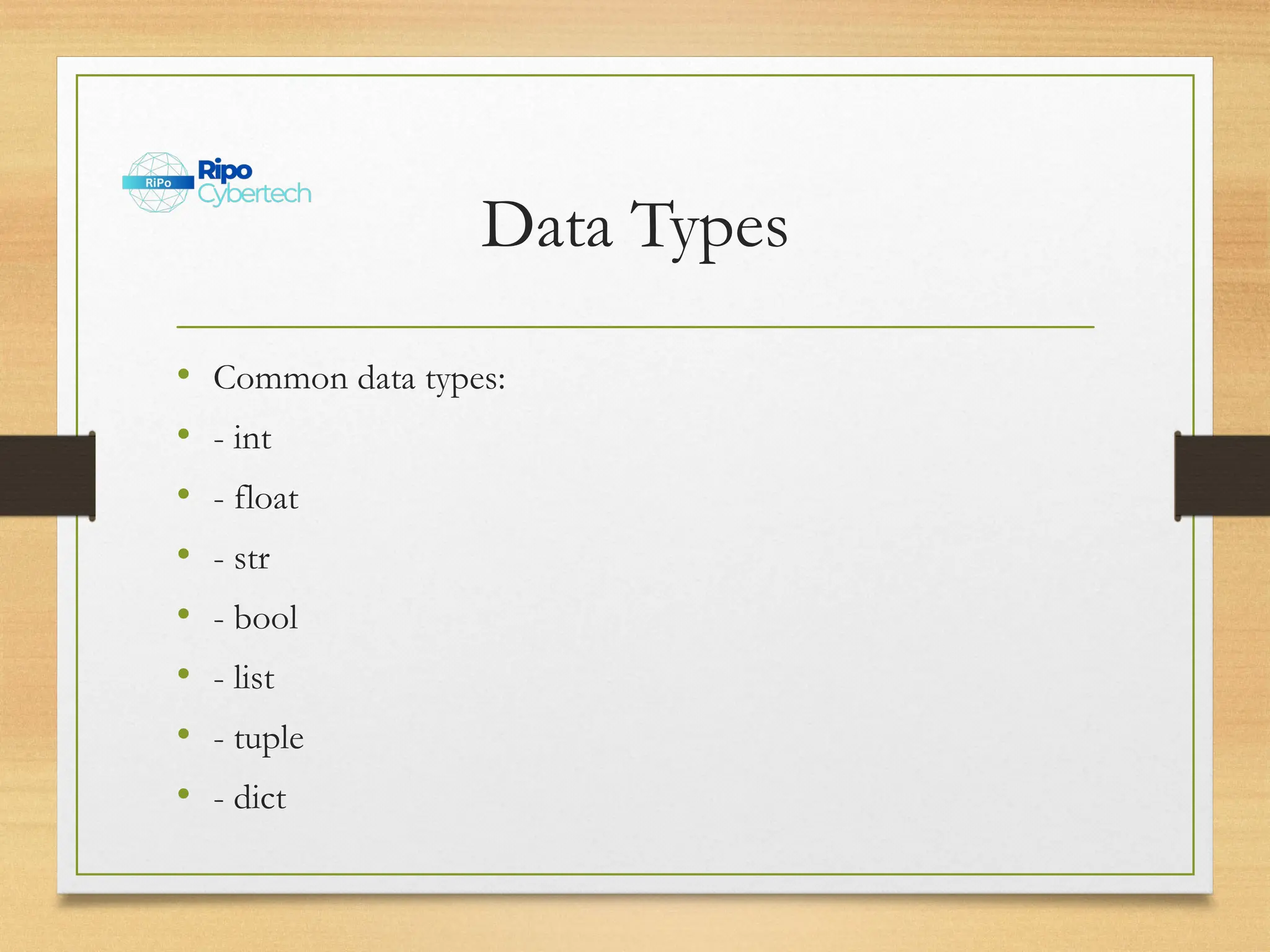
Data Types
• Commondata types:
• - int
• - float
• - str
• - bool
• - list
• - tuple
• - dict
8.
Type Conversion
• Usefunctions like int(), str(), float(), list() to convert
between types.
9.
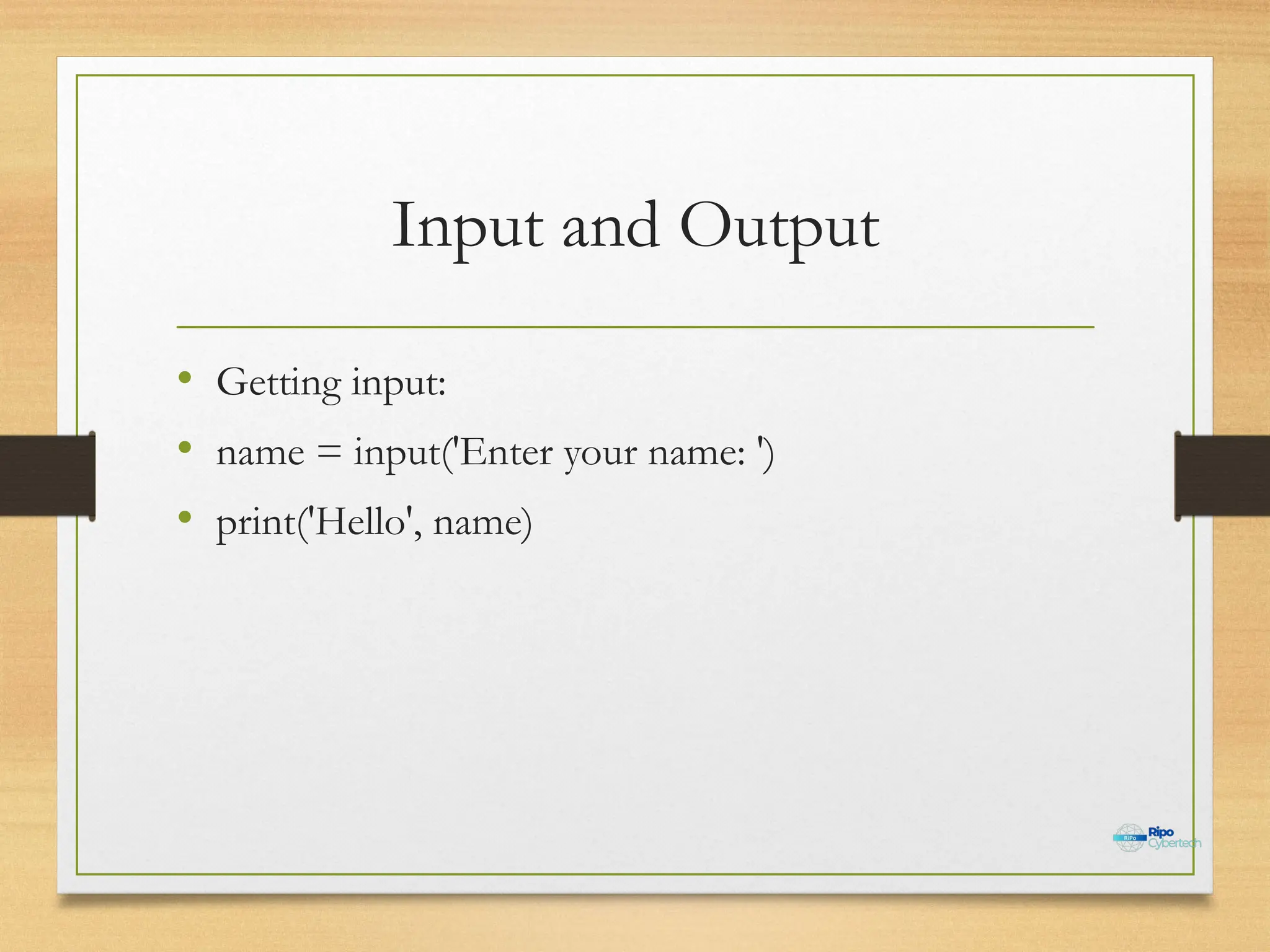
Input and Output
•Getting input:
• name = input('Enter your name: ')
• print('Hello', name)
![Lists
• fruits = ['apple', 'banana']
• print(fruits[0])](https://image.slidesharecdn.com/pythonnoteswithripologo-250918011446-967f6dfc/75/Python_Notes_practical_With_ripocybertech-pptx-19-2048.jpg)
![Tuples
• Immutable lists
• t = (1, 2, 3)
• print(t[0])](https://image.slidesharecdn.com/pythonnoteswithripologo-250918011446-967f6dfc/75/Python_Notes_practical_With_ripocybertech-pptx-21-2048.jpg)
![Dictionaries
• key-value pairs
• d = {'name': 'Alice', 'age': 25}
• print(d['name'])](https://image.slidesharecdn.com/pythonnoteswithripologo-250918011446-967f6dfc/75/Python_Notes_practical_With_ripocybertech-pptx-22-2048.jpg)
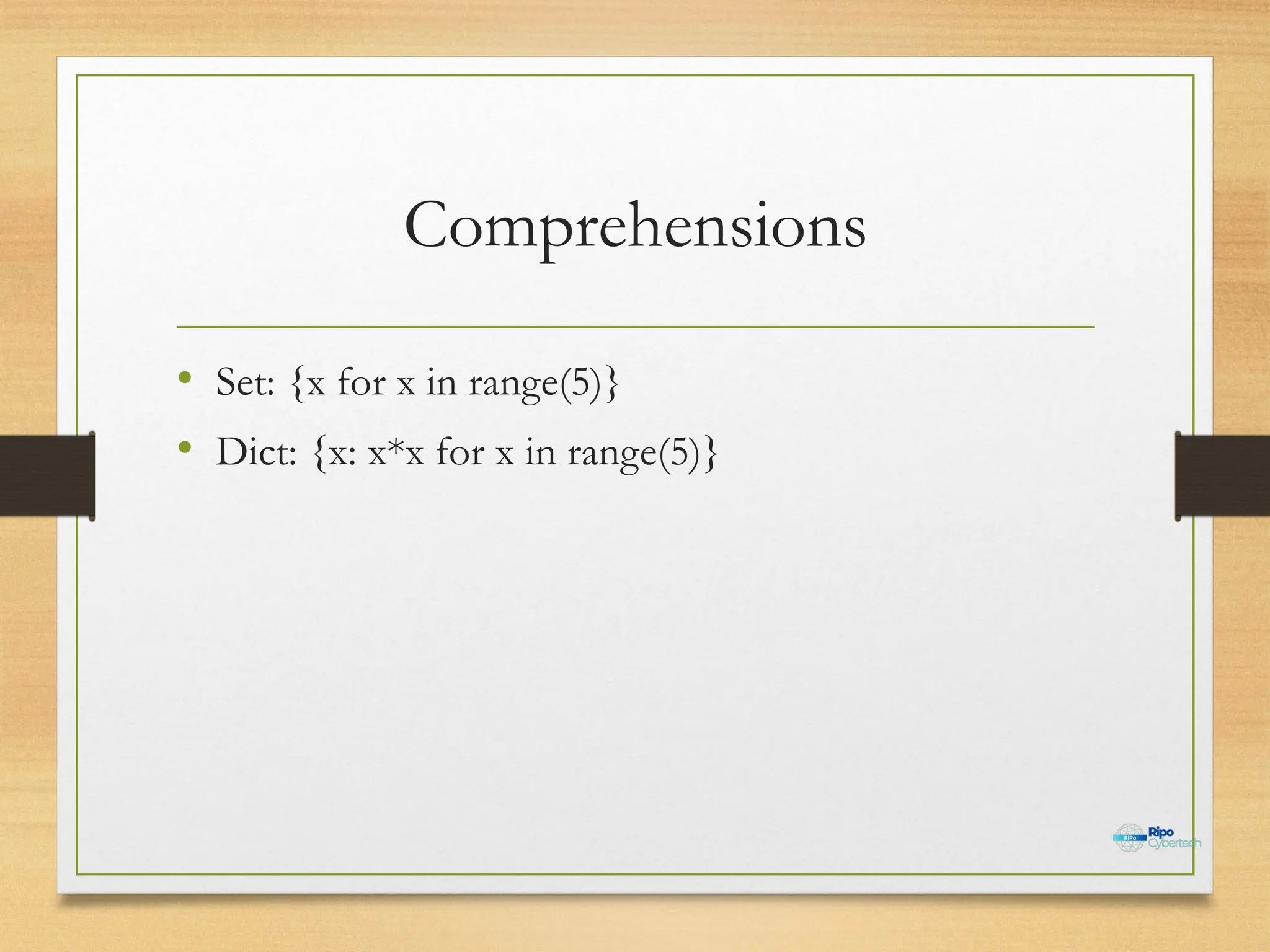
![List Comprehensions
• [x for x in range(10) if x % 2 == 0]](https://image.slidesharecdn.com/pythonnoteswithripologo-250918011446-967f6dfc/75/Python_Notes_practical_With_ripocybertech-pptx-27-2048.jpg)
![Map and Filter
• list(map(lambda x: x*2, [1, 2, 3]))](https://image.slidesharecdn.com/pythonnoteswithripologo-250918011446-967f6dfc/75/Python_Notes_practical_With_ripocybertech-pptx-39-2048.jpg)



![[DSC Europe 25] Branko Urosevic -Rethinking Financial Talent: Integrating Cod...](https://cdn.slidesharecdn.com/ss_thumbnails/8jjrus8ttko6qj64f58f-3-251212103250-642c6374-thumbnail.jpg?width=640&height=640&fit=bounds)
![[DSC Europe 25] Branko Dzakula - From Defense to Attack: How AI Redefines Cyb...](https://cdn.slidesharecdn.com/ss_thumbnails/80bdzdxpr3ky2g0qvyk9-8-251211083048-ce5fc1ee-thumbnail.jpg?width=640&height=640&fit=bounds)


![[DSC Europe 25] Debmalya Biswas - Agentification: the art of transforming man...](https://cdn.slidesharecdn.com/ss_thumbnails/r5azlggvtqiaiiusrqdr-4-251212103249-5a12c89b-thumbnail.jpg?width=640&height=640&fit=bounds)
![[DSC Europe 25] Miodrag Pesovic & Vladislav Radonjic - Federated Data Archite...](https://cdn.slidesharecdn.com/ss_thumbnails/gsbe3y5it5uhndi4e08e-1-251212103249-f1008e0c-thumbnail.jpg?width=640&height=640&fit=bounds)

![[DSC Europe 25] Jovan Bogicevic - Legacy to AI-Driven Defense: Transforming D...](https://cdn.slidesharecdn.com/ss_thumbnails/rsarluadt563hntyfc8q-3-251211083849-3e7bc4c0-thumbnail.jpg?width=640&height=640&fit=bounds)
![[DSC Europe 25] Katherine Forrest - AI NOW: Understanding the Velocity of Cha...](https://cdn.slidesharecdn.com/ss_thumbnails/wvvbruqfrci0sfq9xwgb-4-251212104007-e5ad1987-thumbnail.jpg?width=640&height=640&fit=bounds)
![[DSC Europe 25] Danica Soc - The Science Behind Marketing: Experimentation me...](https://cdn.slidesharecdn.com/ss_thumbnails/c0nofsggs9gw5ucmallr-3-251216103155-56bd64d1-thumbnail.jpg?width=640&height=640&fit=bounds)

![[DSC Europe 25] Dusan Nesic - Securing Tomorrow’s Infrastructure: Why Cyber-P...](https://cdn.slidesharecdn.com/ss_thumbnails/qikbszfftyowjm2q6duw-1-251211083848-8f2ead6b-thumbnail.jpg?width=640&height=640&fit=bounds)


![[DSC Europe 25] Uros Pesic - The Reality of AI in Marketing.pdf](https://cdn.slidesharecdn.com/ss_thumbnails/rtkodnmtycovsllvzsyn-9-251215095918-b0c6bfe3-thumbnail.jpg?width=640&height=640&fit=bounds)
![[DSC Europe 25] Jon Dajci - Bridging TradFi and DeFi: Building the Future of ...](https://cdn.slidesharecdn.com/ss_thumbnails/fqmhfvlbqhkihjvqvhmu-7-251211083849-6af7e325-thumbnail.jpg?width=640&height=640&fit=bounds)