


Async I/O in Python
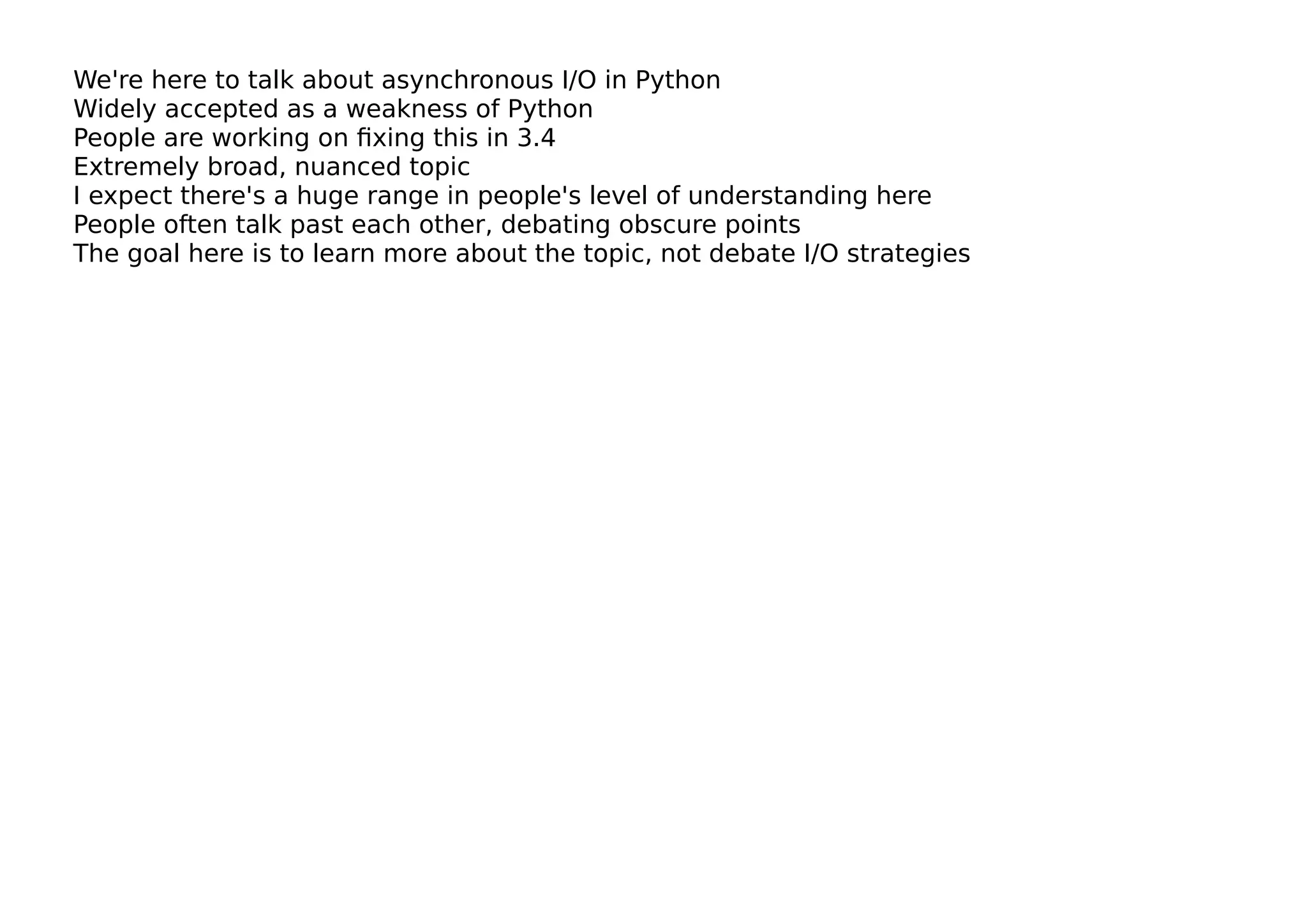
We're here to talk about asynchronous I/O in Python
Widely accepted as a weakness of Python
People are working on fixing this in 3.4
Extremely broad, nuanced topic
I expect there's a huge range in people's level of understanding here
People often talk past each other, debating obscure points
The goal here is to learn more about the topic, not debate I/O strategies
Waiting
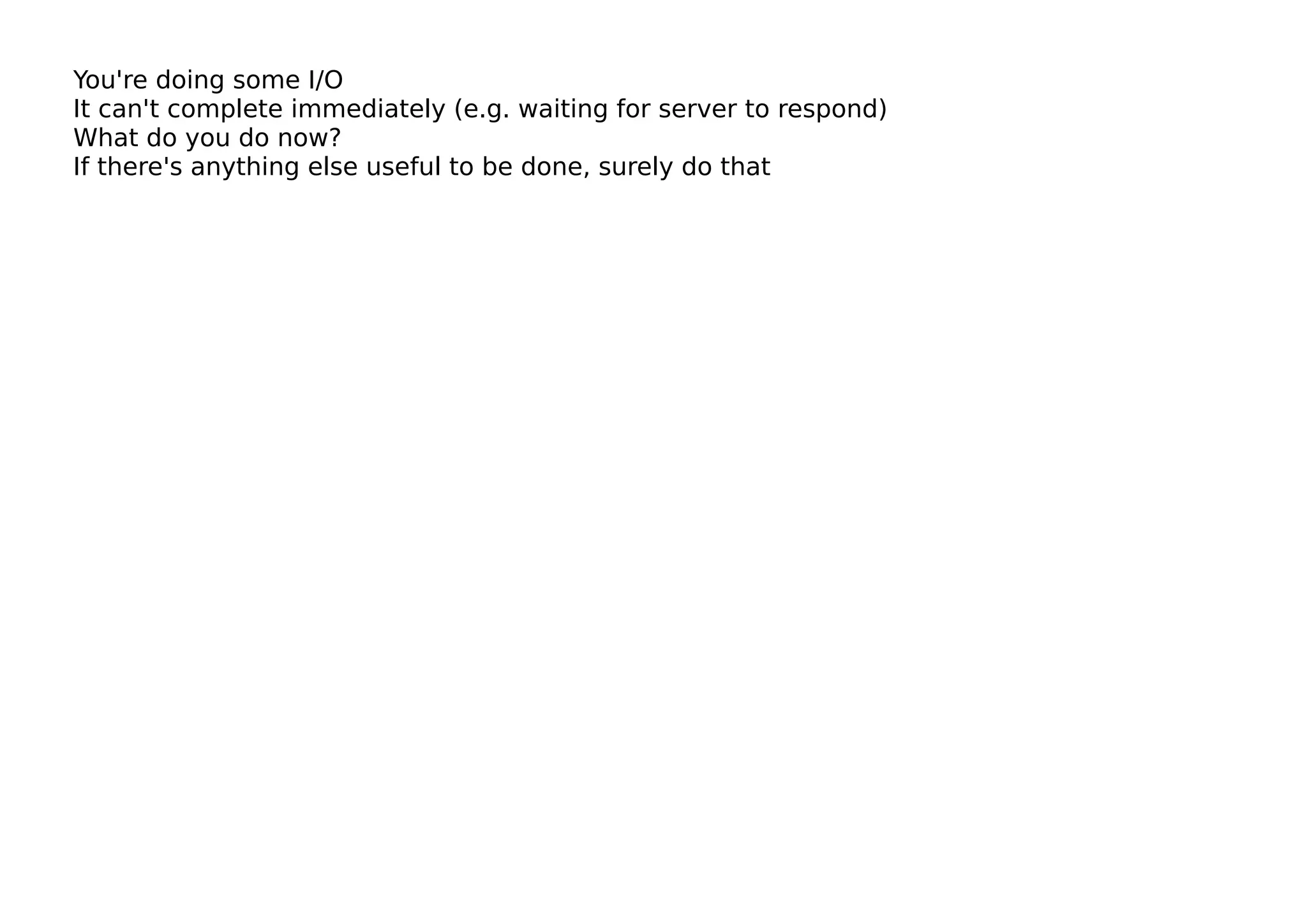
You're doing some I/O
It can't complete immediately (e.g. waiting for server to respond)
What do you do now?
If there's anything else useful to be done, surely do that
Async Strategies
Multiple processes
Multiple threads
Single thread, non-blocking I/O
A combination of all three might make sense
We're here to talk about frameworks for the latter
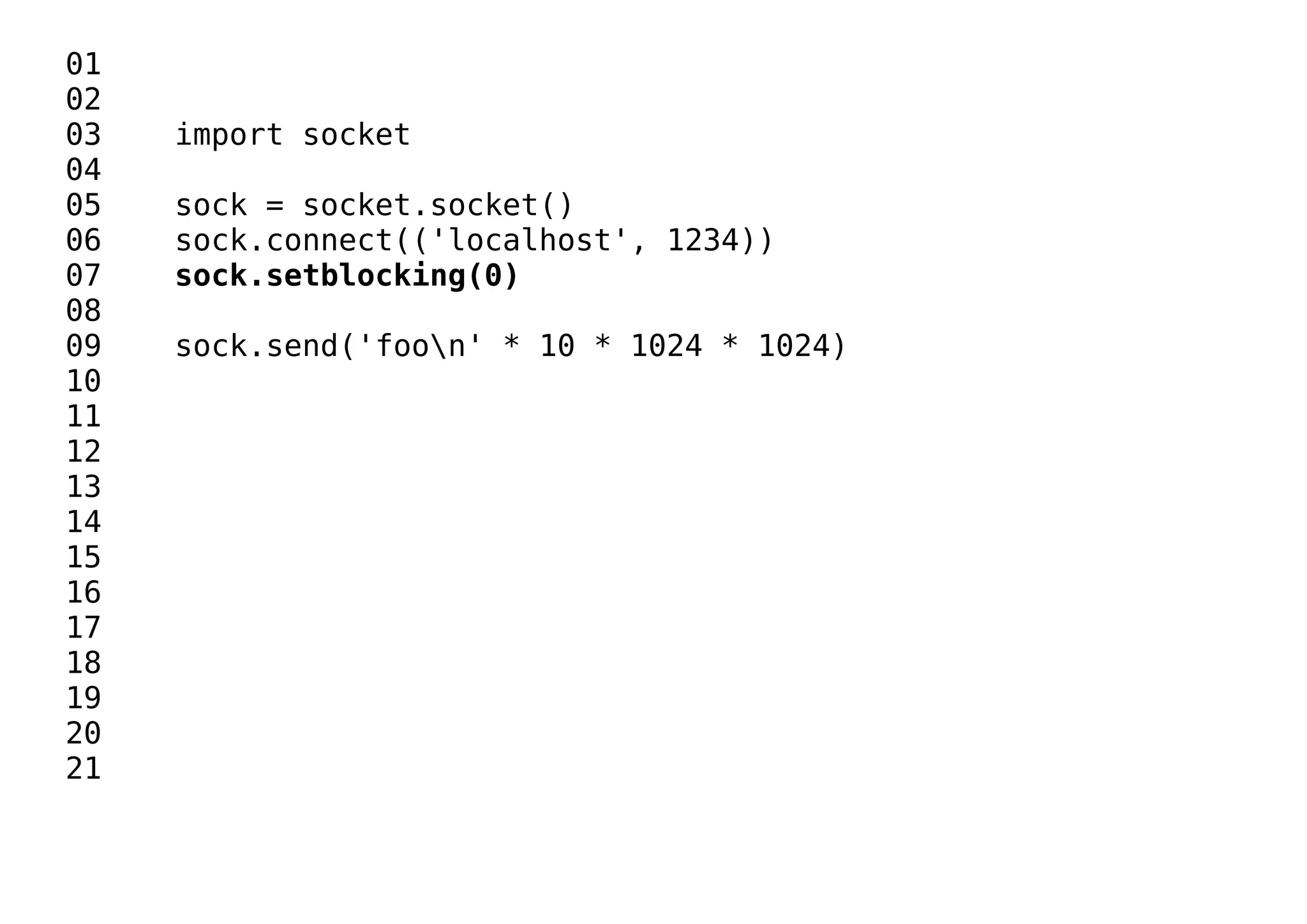
Non-blocking I/O
Usually, if an I/O operation (read/write/etc.) can't complete, you block
Blocking means that the kernel puts you too sleep
If you're sleeping, you don't have the opportunity to do other useful work
Instead, use non-blocking I/O operations
Kernel returns immediately if it can't complete the I/O
You end up with a bunch of in-progress I/O operations
You use select() to have the kernel tell you when one of them can progress
01
02
03 import socket
04
05 sock = socket.socket()
06 sock.connect(('localhost', 1234))
07
08
09 sock.send('foon' * 10 * 1024 * 1024)
10
11
12
13
14
15
16
17
18
19
20
21
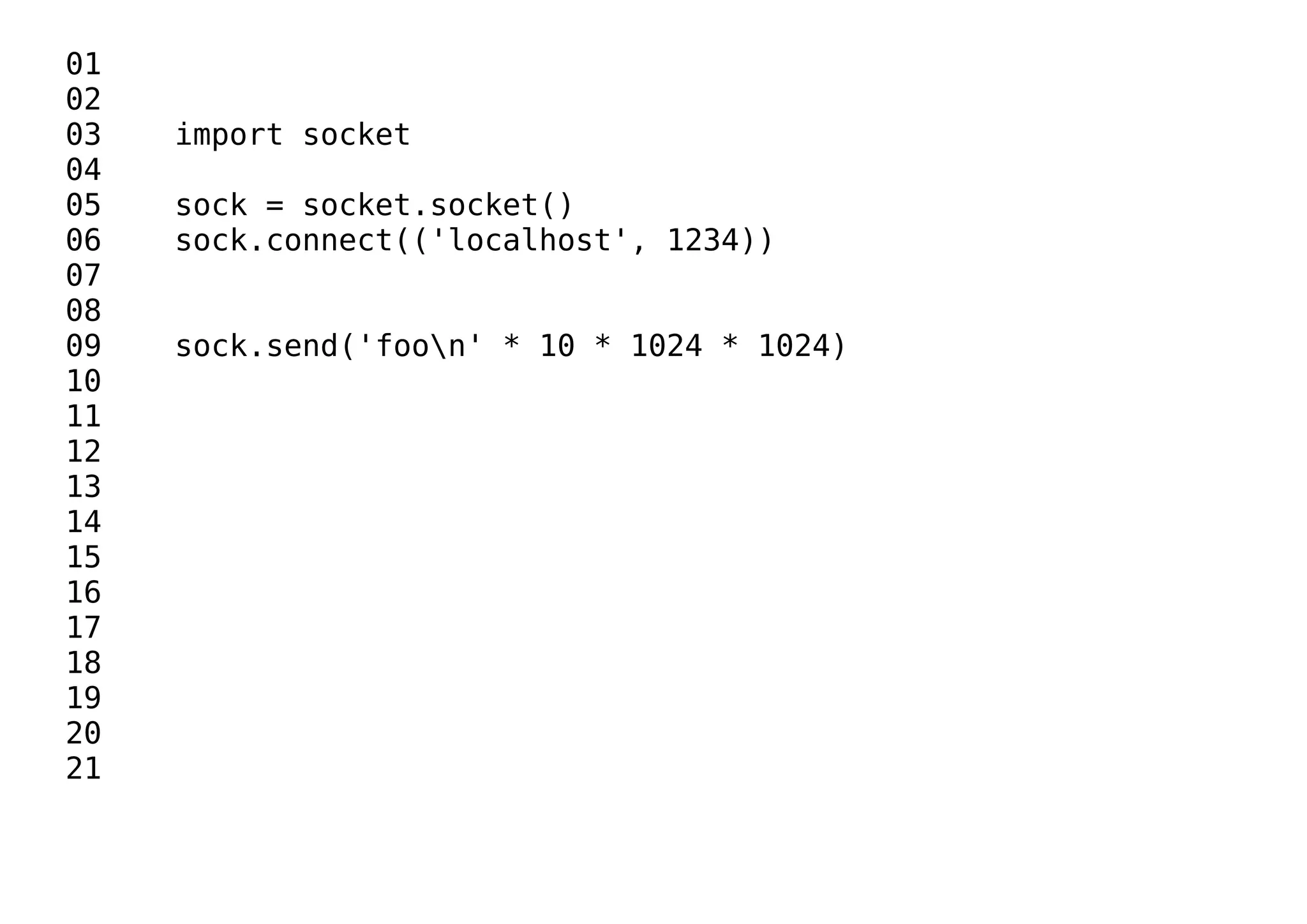
Simple example, connect to a server on port 1234, write a bunch of stuff
This send() function won't finish until all the data is written
While you're waiting for the I/O to complete, you can't do anything else
If you're not familiar with berkley sockets ...
socket() creates a socket ... it's just a data structure
connect() initiates the TCP connection with the server
Some handshake packets will go back and forth before this completes
send() takes the data buffer, splits up and sends as TCP packets
01
02
03 import socket
04
05 sock = socket.socket()
06 sock.connect(('localhost', 1234))
07 sock.setblocking(0)
08
09 sock.send('foon' * 10 * 1024 * 1024)
10
11
12
13
14
15
16
17
18
19
20
21
01
02
03 import socket
04
05 sock = socket.socket()
06 sock.connect(('localhost', 1234))
07 sock.setblocking(0)
08
09 buf = buffer('foon' * 10 * 1024 * 1024)
10 while len(buf):
11 buf = buf[sock.send(buf):]
12
13
14
15
16
17
18
19
20
21
01 import errno
02 import select
03 import socket
04
05 sock = socket.socket()
06 sock.connect(('localhost', 1234))
07 sock.setblocking(0)
08
09 buf = buffer('foon' * 10 * 1024 * 1024)
10 while len(buf):
11 try:
12 buf = buf[sock.send(buf):]
13 except socket.error, e:
14 if e.errno != errno.EAGAIN:
15 raise e
16
17
18
19
20
21
01 import errno
02 import select
03 import socket
04
05 sock = socket.socket()
06 sock.connect(('localhost', 1234))
07 sock.setblocking(0)
08
09 buf = buffer('foon' * 10 * 1024 * 1024)
10 while len(buf):
11 try:
12 buf = buf[sock.send(buf):]
13 except socket.error, e:
14 if e.errno != errno.EAGAIN:
15 raise e
16
17
18
19
20
21 select.select([], [sock], [])
01 import errno
02 import select
03 import socket
04
05 sock = socket.socket()
06 sock.connect(('localhost', 1234))
07 sock.setblocking(0)
08
09 buf = buffer('foon' * 10 * 1024 * 1024)
10 while len(buf):
11 try:
12 buf = buf[sock.send(buf):]
13 except socket.error, e:
14 if e.errno != errno.EAGAIN:
15 raise e
16
17 i = 0
18 while i < 5000000:
19 i += 1
20
21 select.select([], [sock], [])
Eventlet
Eventlet is one of several async I/O frameworks for Python
It's magic, to its detriment IMHO
Co-operative co-routine scheduling
Eventlet coroutines are called green threads (from Java)
green threads != threads
Many greenthreads in one OS thread
They are very cheap
We call them coroutines because they cooperatively yield to one another
greenlet allows you to save a stack and switch to another stack
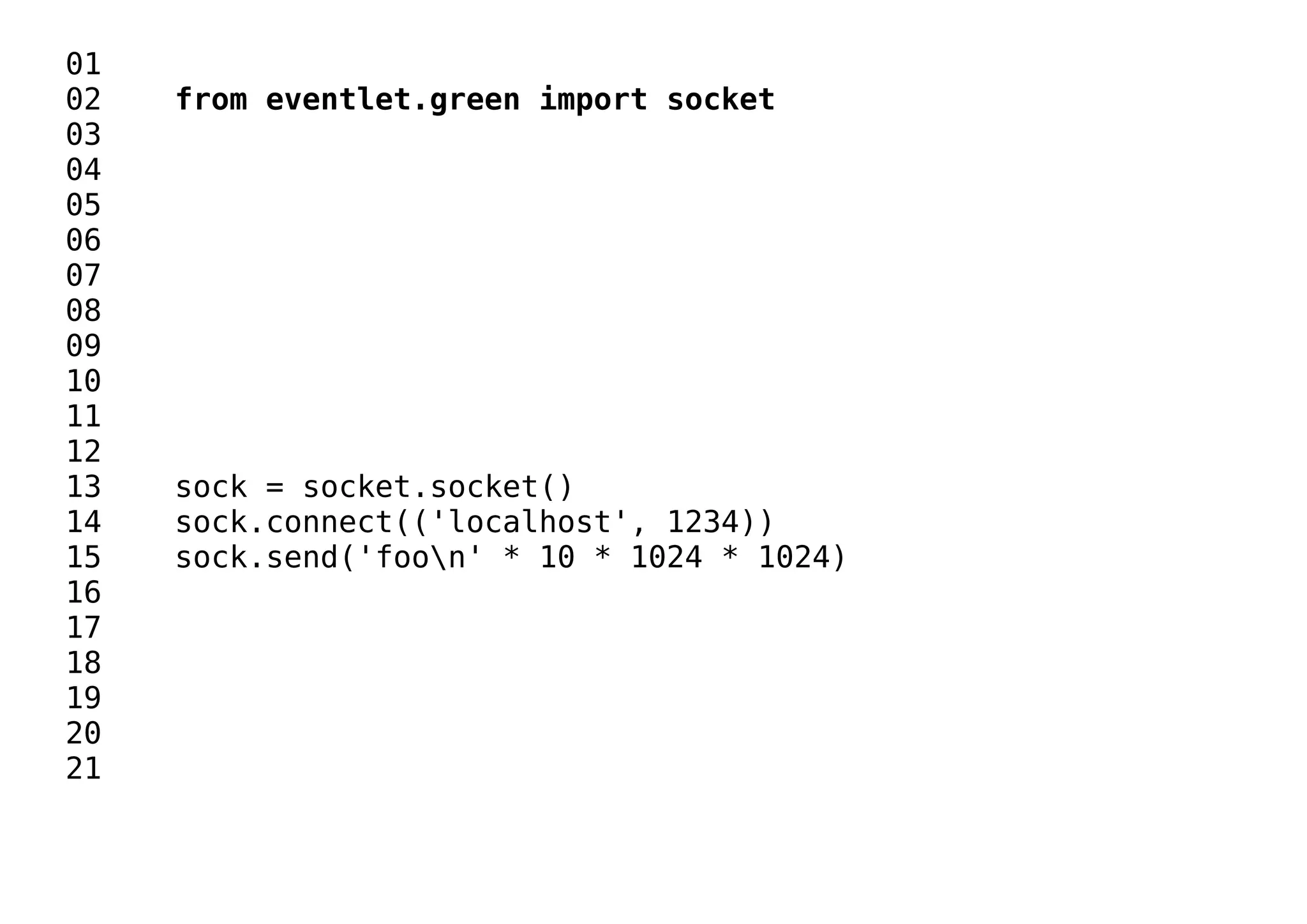
01
02 from eventlet.green import socket
03
04
05
06
07
08
09
10
11
12
13 sock = socket.socket()
14 sock.connect(('localhost', 1234))
15 sock.send('foon' * 10 * 1024 * 1024)
16
17
18
19
20
21
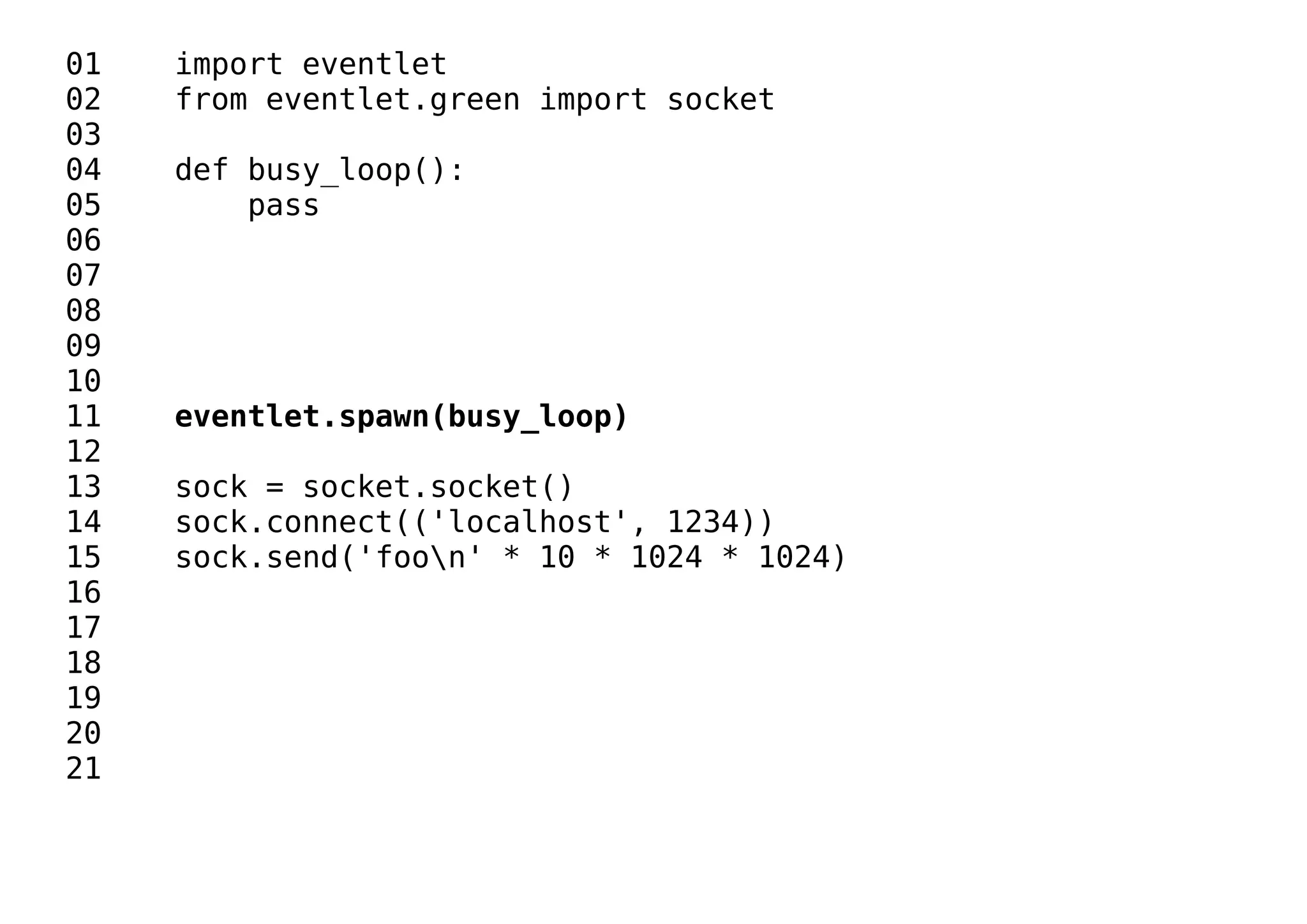
01 import eventlet
02 from eventlet.green import socket
03
04 def busy_loop():
05 pass
06
07
08
09
10
11 eventlet.spawn(busy_loop)
12
13 sock = socket.socket()
14 sock.connect(('localhost', 1234))
15 sock.send('foon' * 10 * 1024 * 1024)
16
17
18
19
20
21
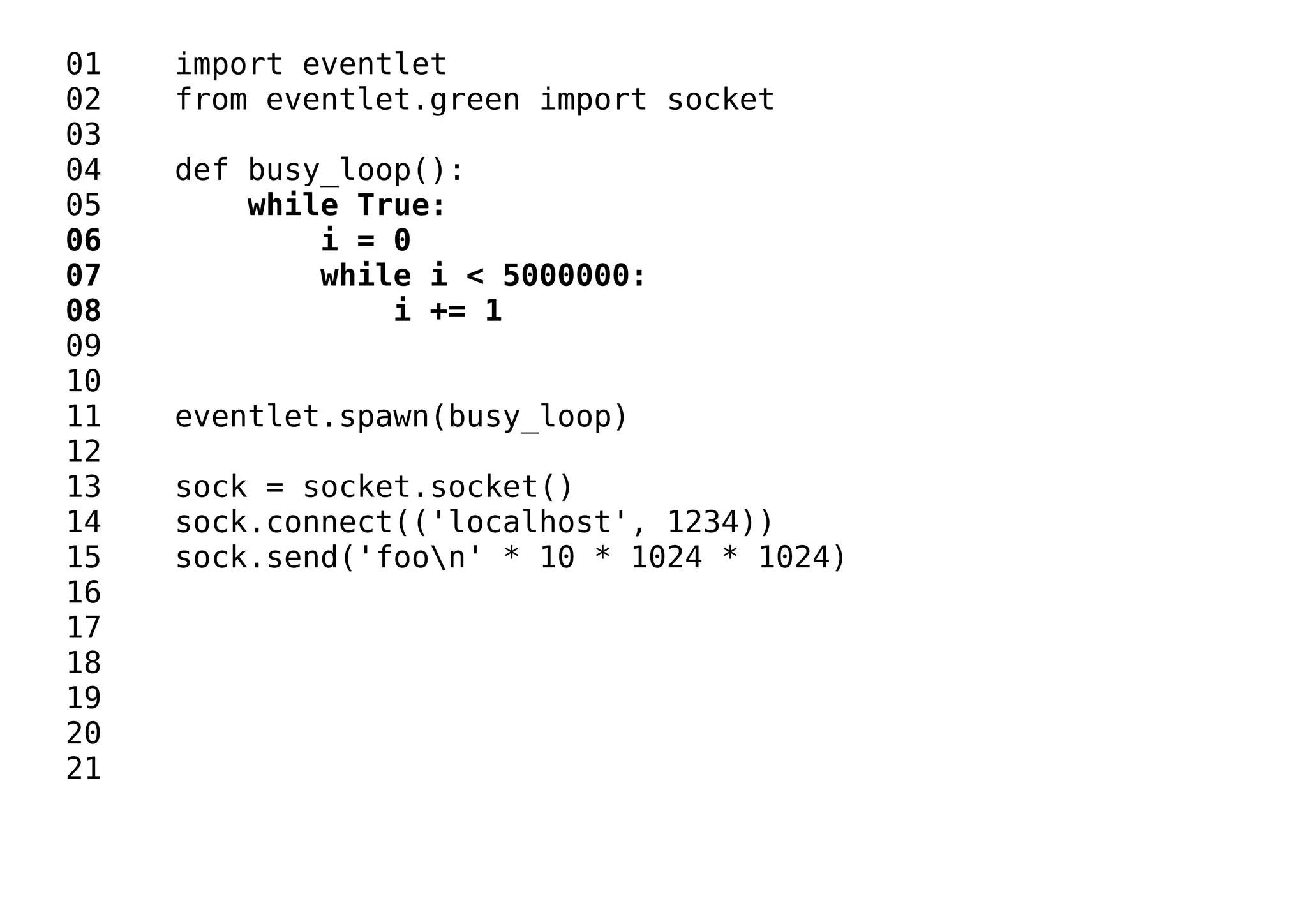
01 import eventlet
02 from eventlet.green import socket
03
04 def busy_loop():
05 while True:
06 i = 0
07 while i < 5000000:
08 i += 1
09
10
11 eventlet.spawn(busy_loop)
12
13 sock = socket.socket()
14 sock.connect(('localhost', 1234))
15 sock.send('foon' * 10 * 1024 * 1024)
16
17
18
19
20
21
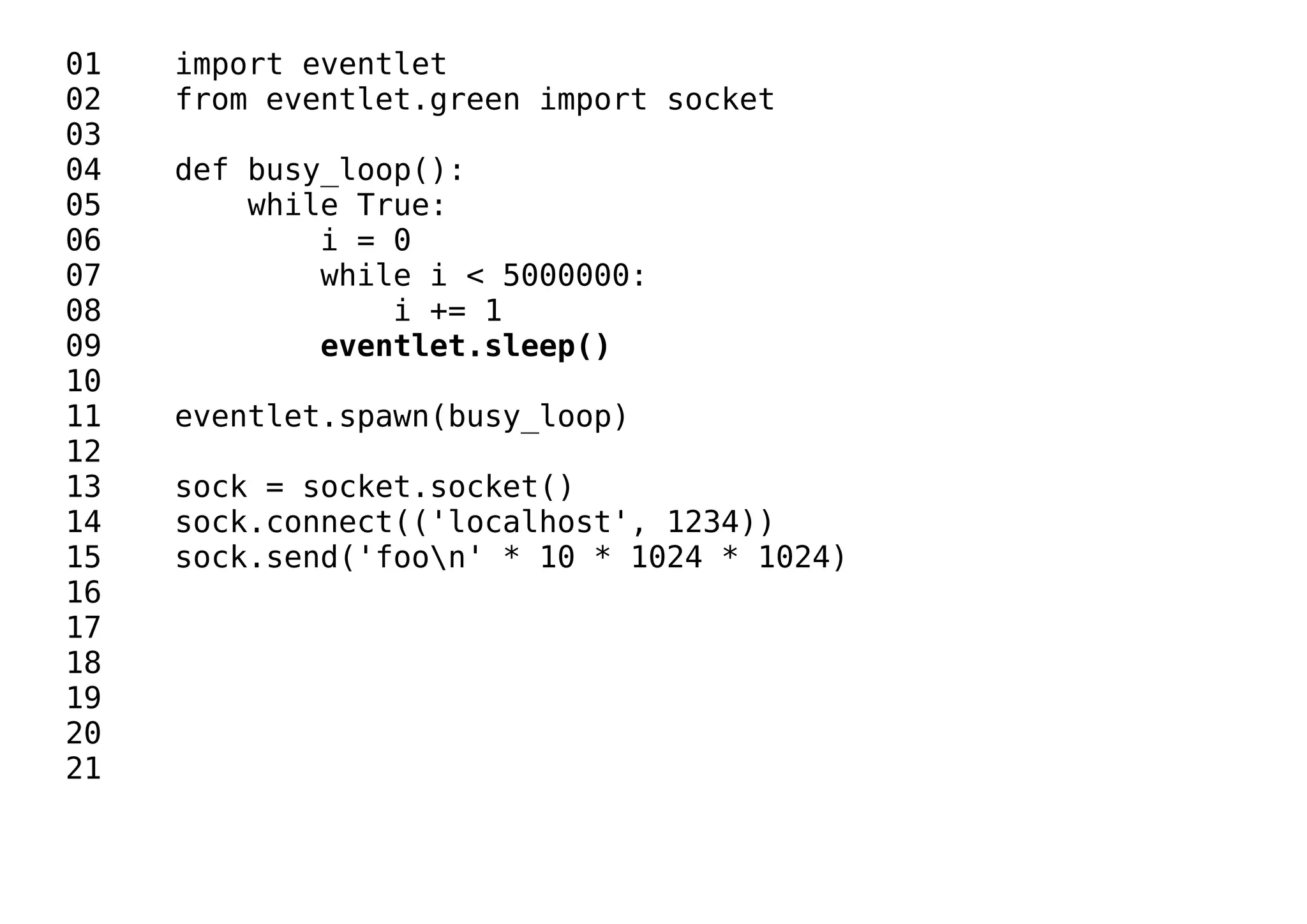
01 import eventlet
02 from eventlet.green import socket
03
04 def busy_loop():
05 while True:
06 i = 0
07 while i < 5000000:
08 i += 1
09 eventlet.sleep()
10
11 eventlet.spawn(busy_loop)
12
13 sock = socket.socket()
14 sock.connect(('localhost', 1234))
15 sock.send('foon' * 10 * 1024 * 1024)
16
17
18
19
20
21
Twisted
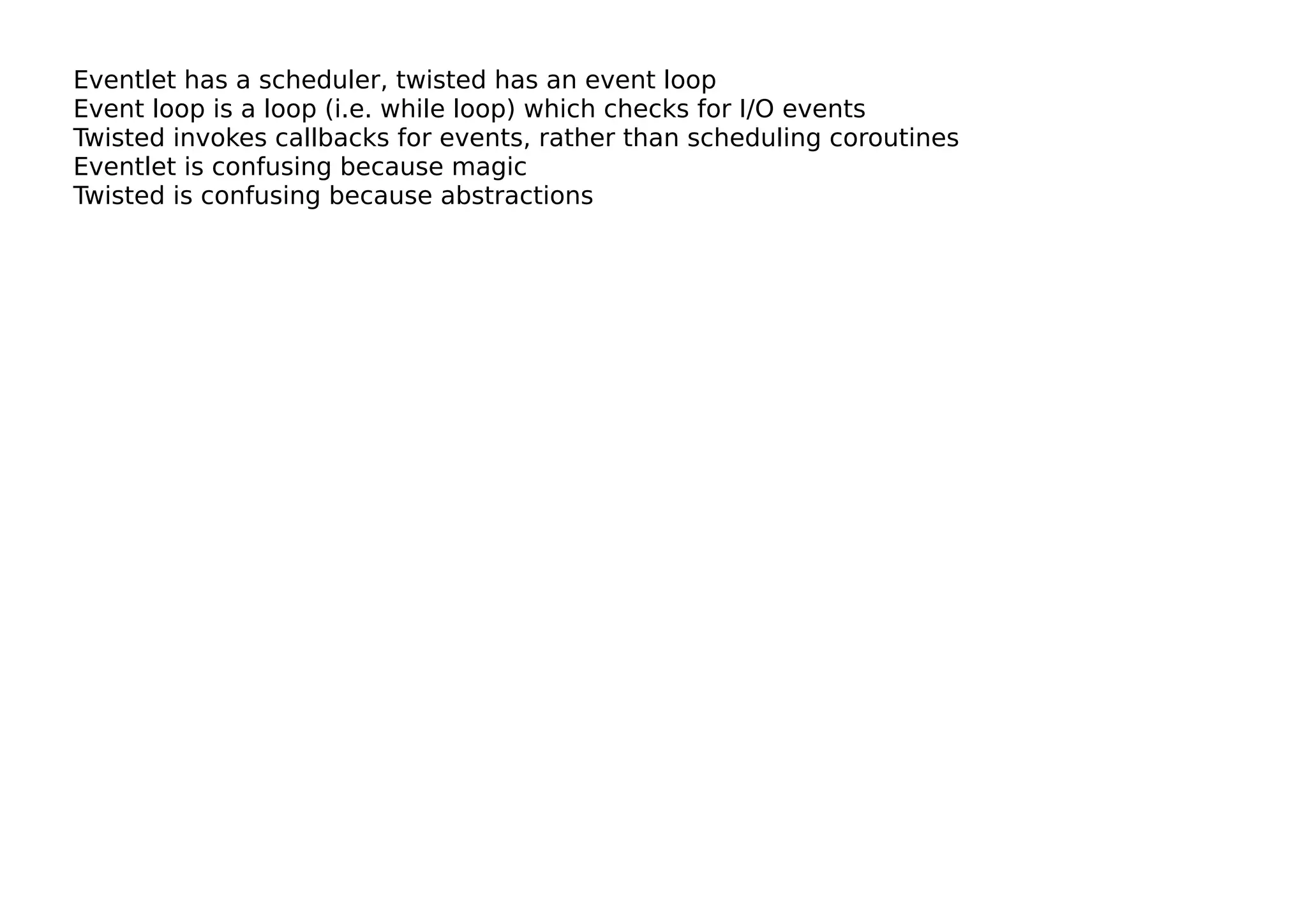
Eventlet has a scheduler, twisted has an event loop
Event loop is a loop (i.e. while loop) which checks for I/O events
Twisted invokes callbacks for events, rather than scheduling coroutines
Eventlet is confusing because magic
Twisted is confusing because abstractions
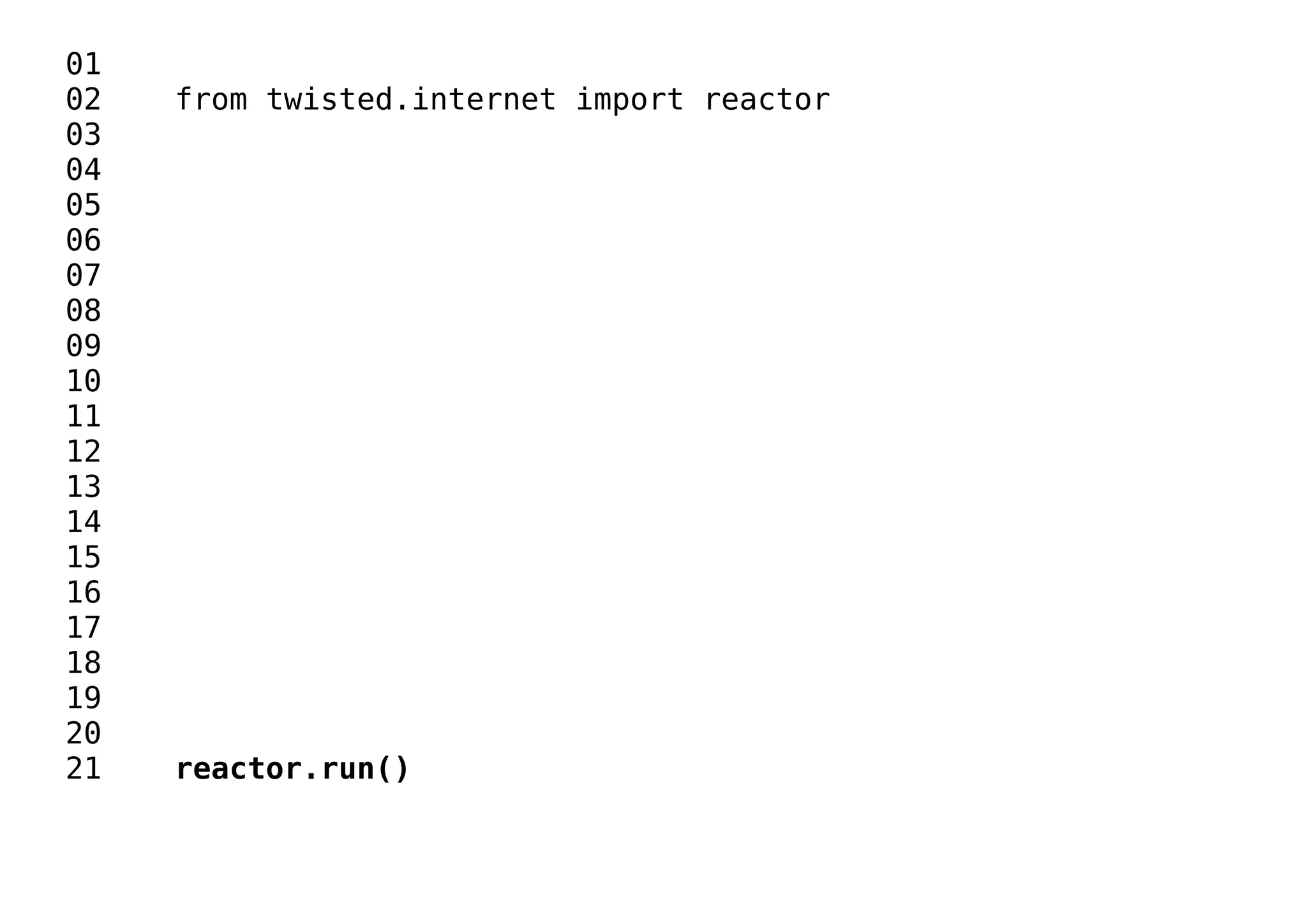
01
02 from twisted.internet import reactor
03
04
05
06
07
08
09
10
11
12
13
14
15
16
17
18
19
20
21 reactor.run()
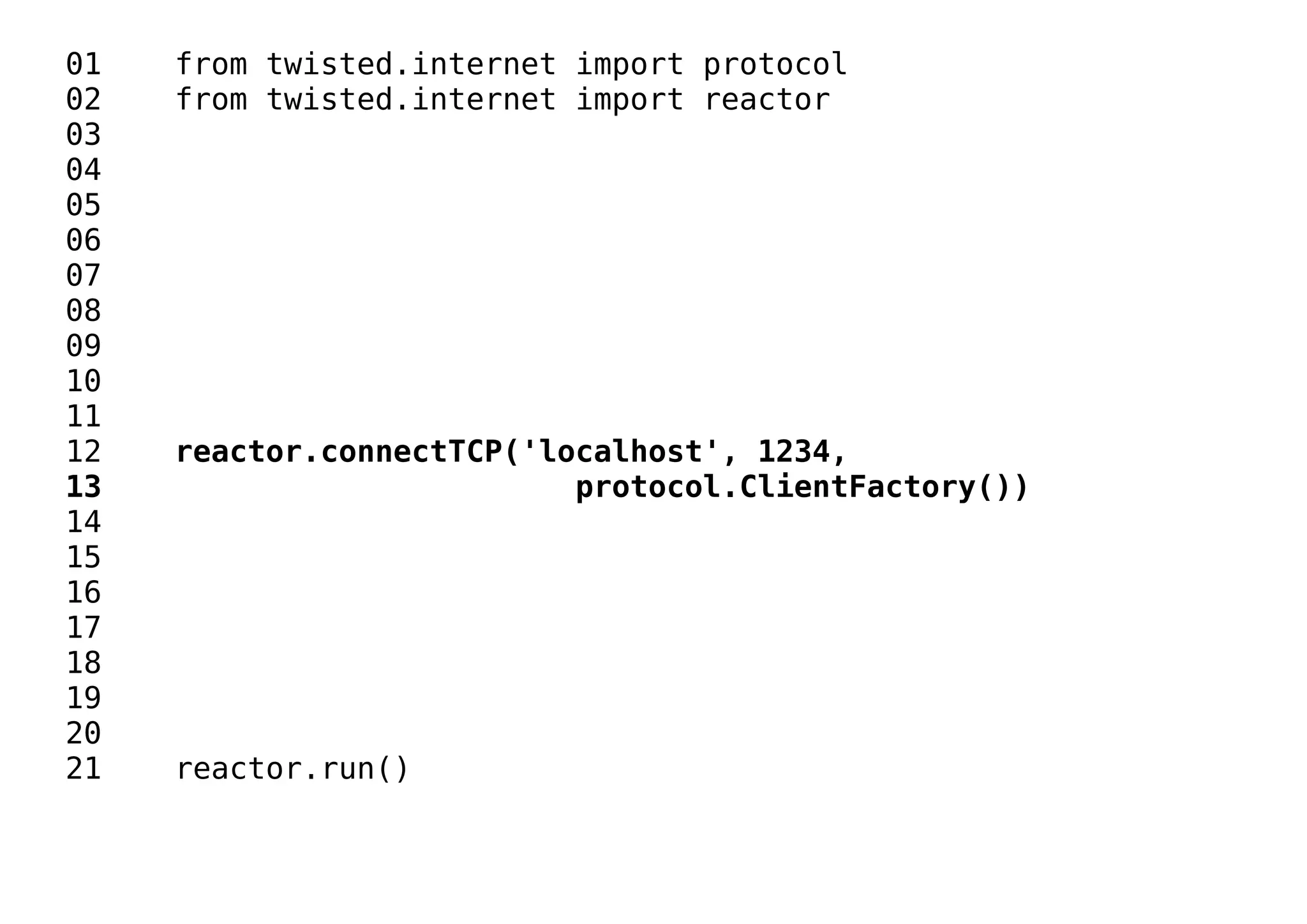
01 from twisted.internet import protocol
02 from twisted.internet import reactor
03
04
05
06
07
08
09
10
11
12 reactor.connectTCP('localhost', 1234,
13 protocol.ClientFactory())
14
15
16
17
18
19
20
21 reactor.run()
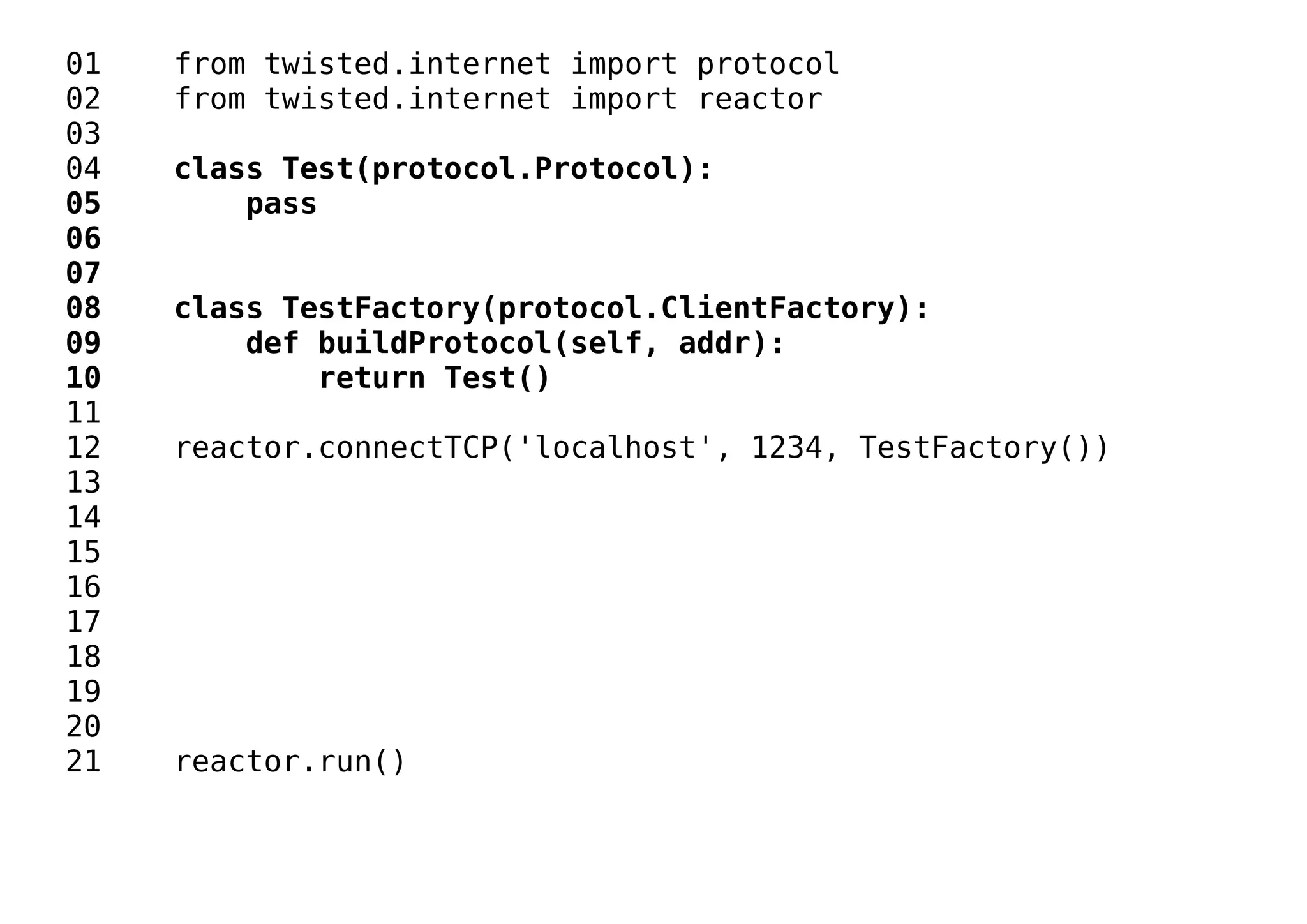
01 from twisted.internet import protocol
02 from twisted.internet import reactor
03
04 class Test(protocol.Protocol):
05 pass
06
07
08 class TestFactory(protocol.ClientFactory):
09 def buildProtocol(self, addr):
10 return Test()
11
12 reactor.connectTCP('localhost', 1234, TestFactory())
13
14
15
16
17
18
19
20
21 reactor.run()
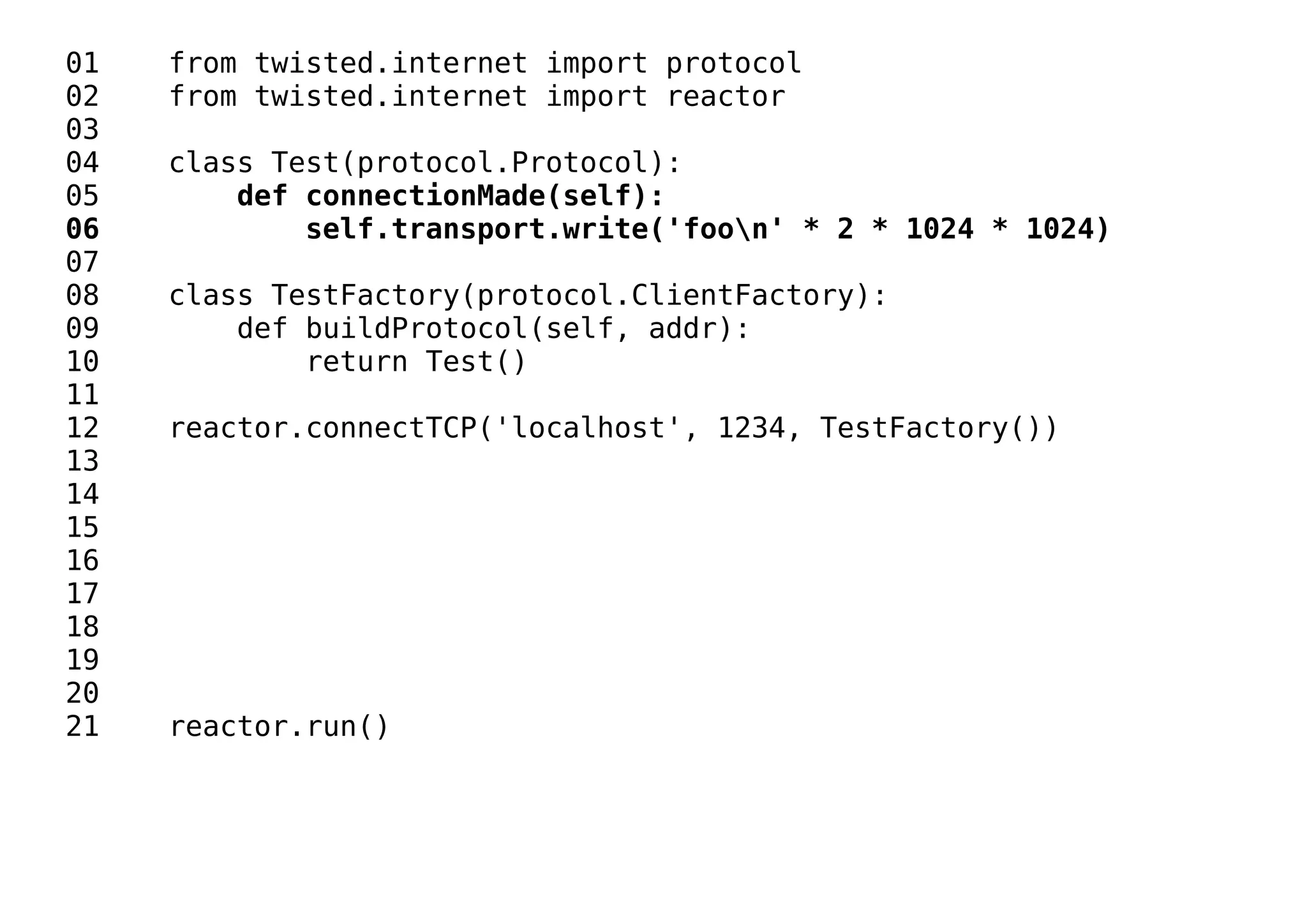
01 from twisted.internet import protocol
02 from twisted.internet import reactor
03
04 class Test(protocol.Protocol):
05 def connectionMade(self):
06 self.transport.write('foon' * 2 * 1024 * 1024)
07
08 class TestFactory(protocol.ClientFactory):
09 def buildProtocol(self, addr):
10 return Test()
11
12 reactor.connectTCP('localhost', 1234, TestFactory())
13
14
15
16
17
18
19
20
21 reactor.run()
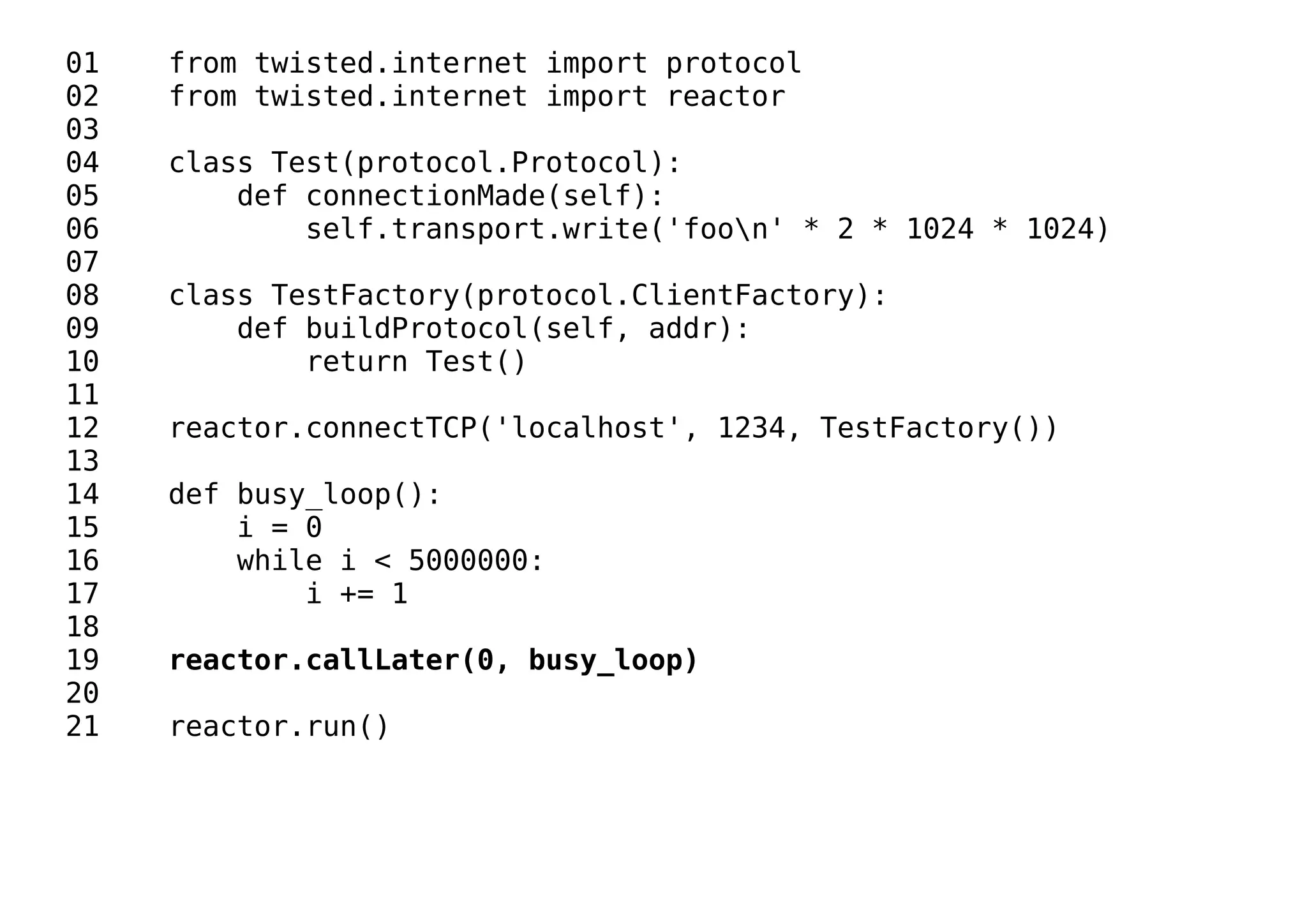
01 from twisted.internet import protocol
02 from twisted.internet import reactor
03
04 class Test(protocol.Protocol):
05 def connectionMade(self):
06 self.transport.write('foon' * 2 * 1024 * 1024)
07
08 class TestFactory(protocol.ClientFactory):
09 def buildProtocol(self, addr):
10 return Test()
11
12 reactor.connectTCP('localhost', 1234, TestFactory())
13
14 def busy_loop():
15 i = 0
16 while i < 5000000:
17 i += 1
18
19 reactor.callLater(0, busy_loop)
20
21 reactor.run()
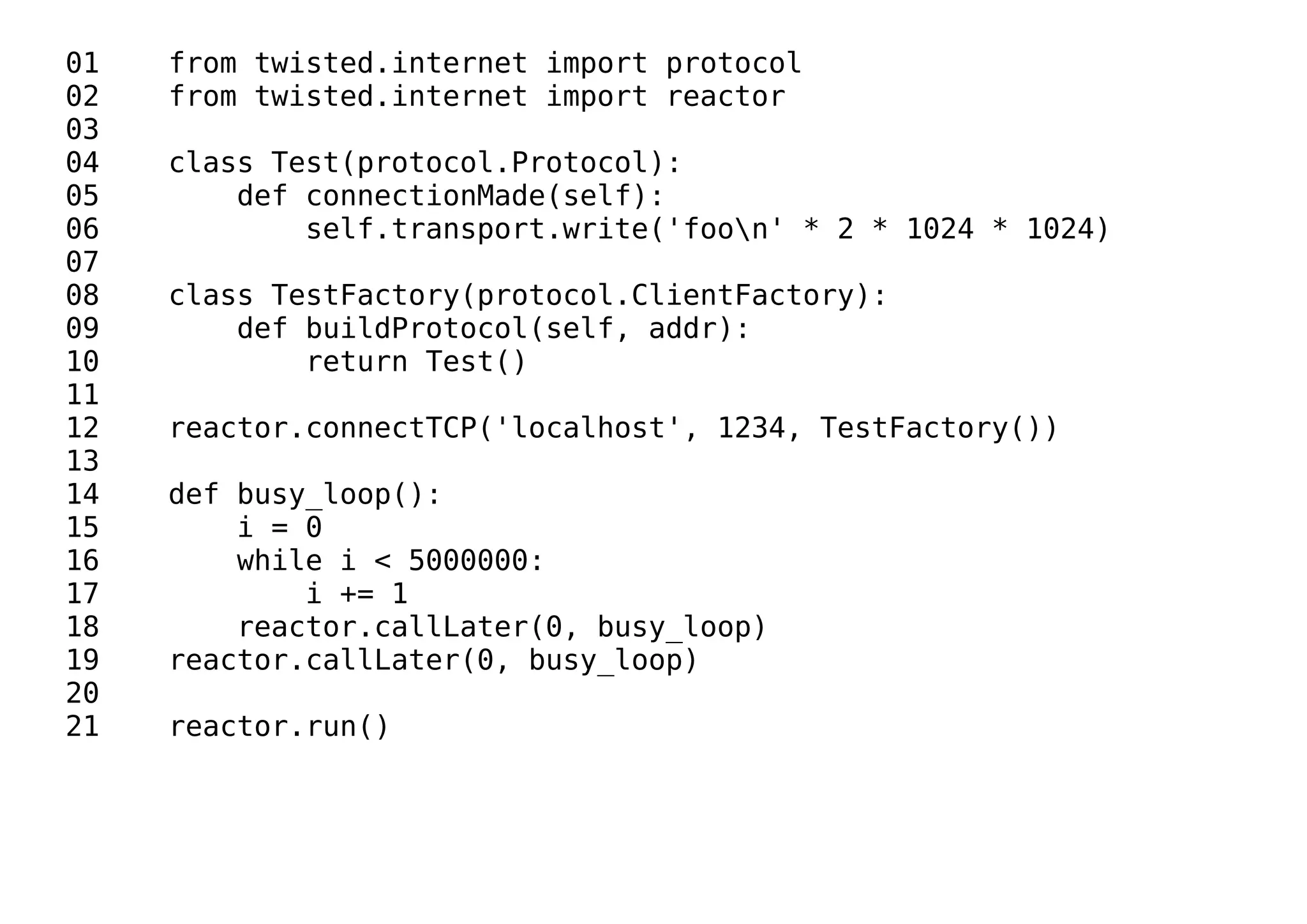
01 from twisted.internet import protocol
02 from twisted.internet import reactor
03
04 class Test(protocol.Protocol):
05 def connectionMade(self):
06 self.transport.write('foon' * 2 * 1024 * 1024)
07
08 class TestFactory(protocol.ClientFactory):
09 def buildProtocol(self, addr):
10 return Test()
11
12 reactor.connectTCP('localhost', 1234, TestFactory())
13
14 def busy_loop():
15 i = 0
16 while i < 5000000:
17 i += 1
18 reactor.callLater(0, busy_loop)
19 reactor.callLater(0, busy_loop)
20
21 reactor.run()
Tulip
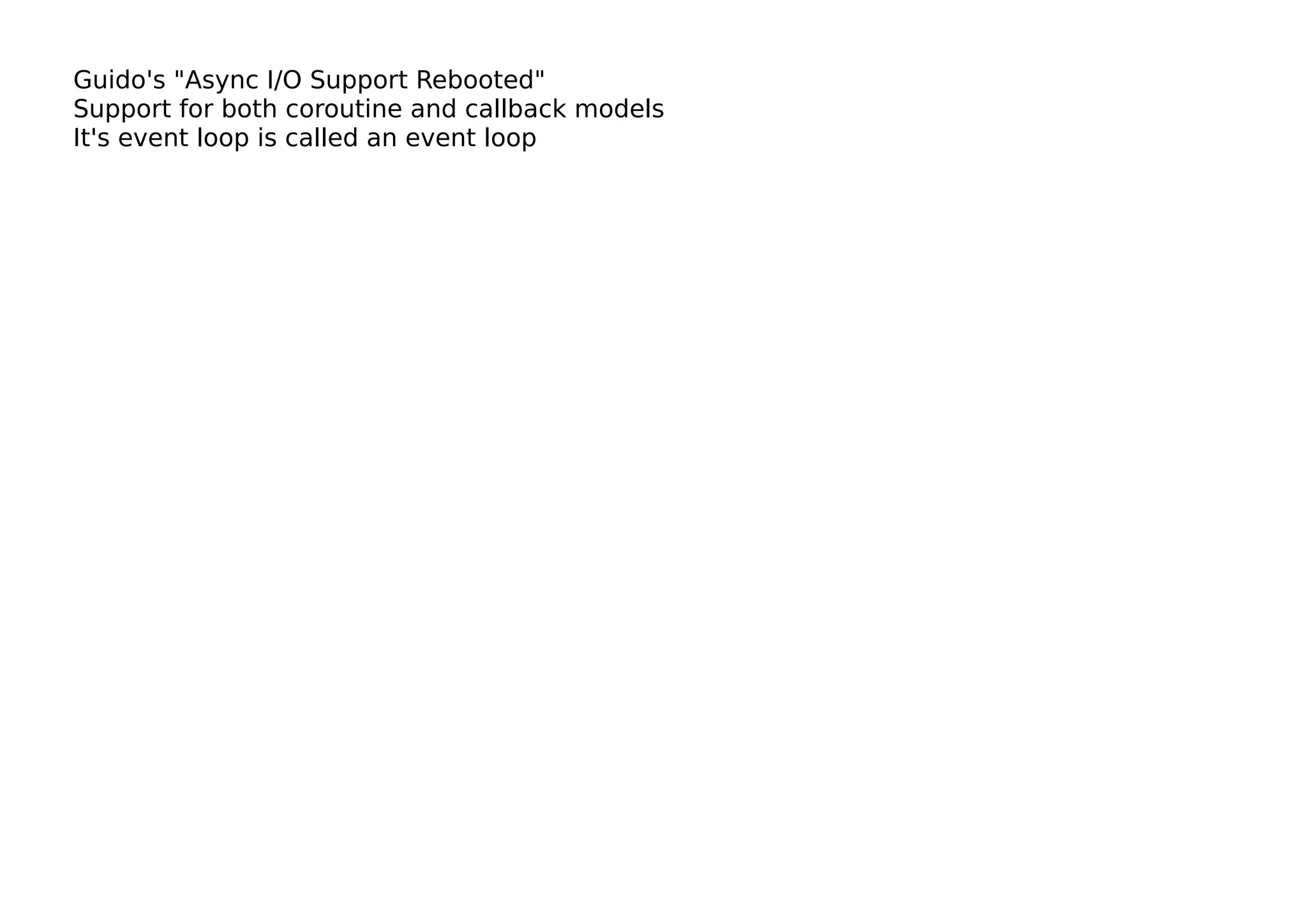
Guido's "Async I/O Support Rebooted"
Support for both coroutine and callback models
It's event loop is called an event loop
01
02
03
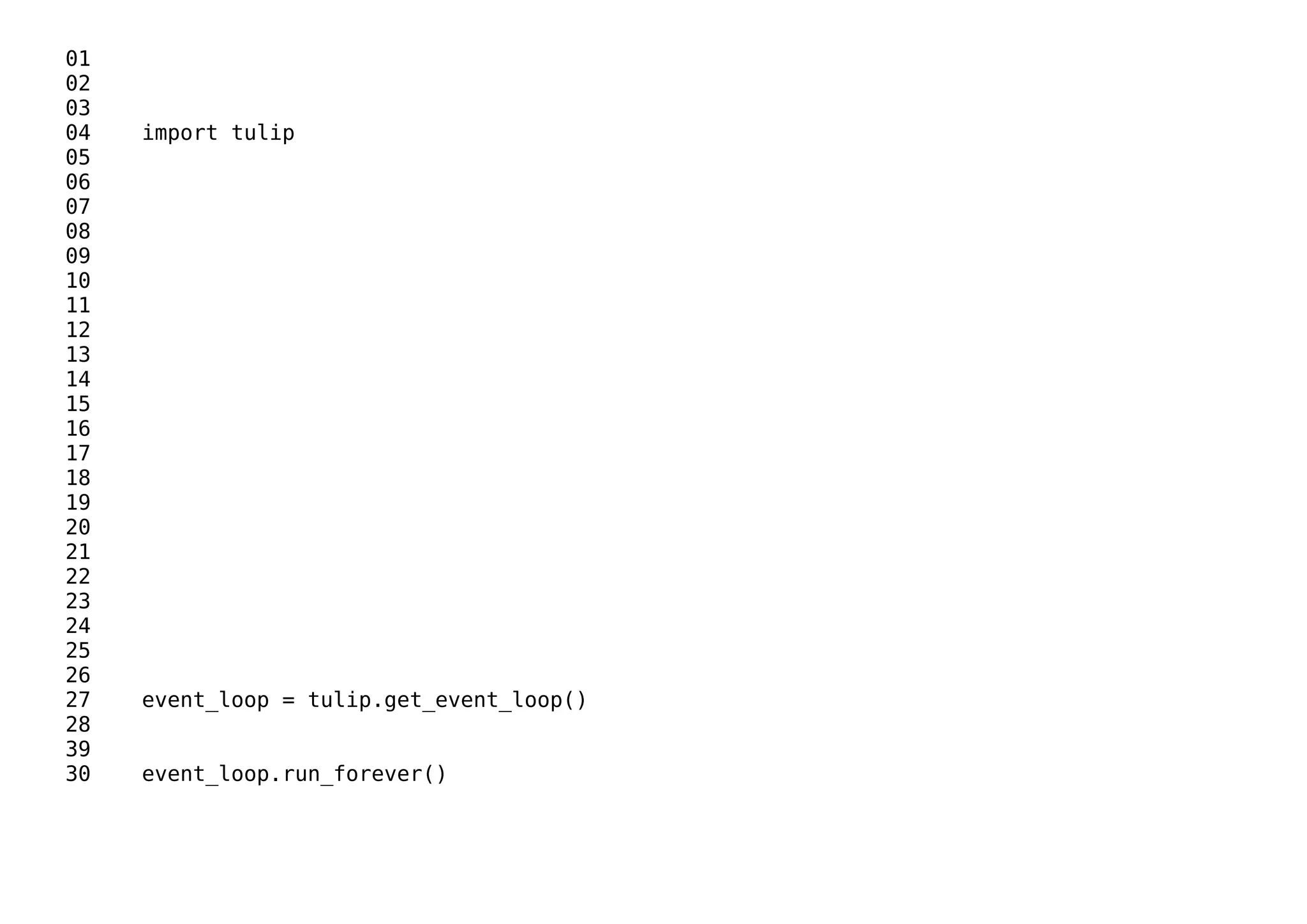
04 import tulip
05
06
07
08
09
10
11
12
13
14
15
16
17
18
19
20
21
22
23
24
25
26
27 event_loop = tulip.get_event_loop()
28
39
30 event_loop.run_forever()
01
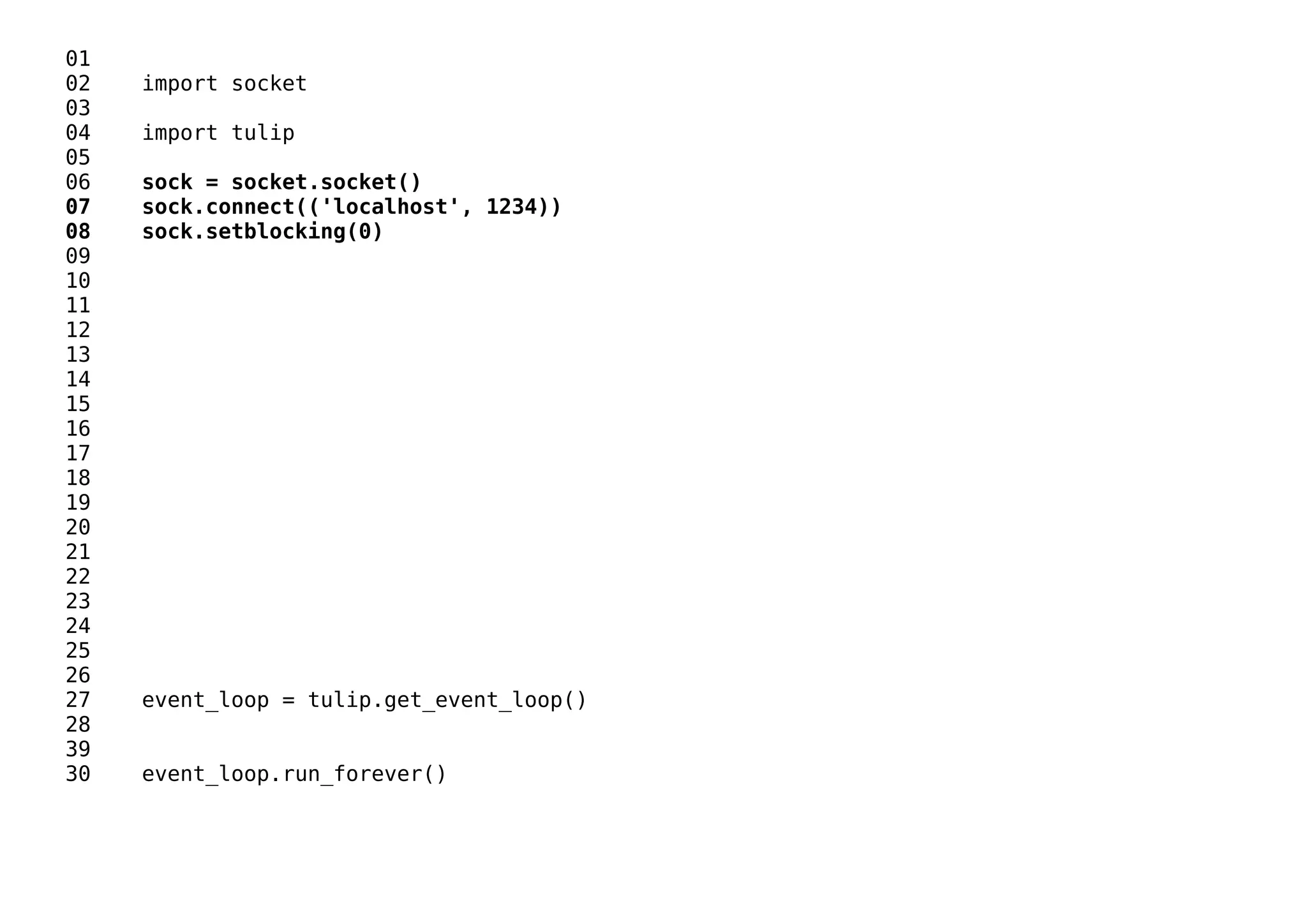
02 import socket
03
04 import tulip
05
06 sock = socket.socket()
07 sock.connect(('localhost', 1234))
08 sock.setblocking(0)
09
10
11
12
13
14
15
16
17
18
19
20
21
22
23
24
25
26
27 event_loop = tulip.get_event_loop()
28
39
30 event_loop.run_forever()
01 import errno
02 import socket
03
04 import tulip
05
06 sock = socket.socket()
07 sock.connect(('localhost', 1234))
08 sock.setblocking(0)
09
10 buf = memoryview(str.encode('foon' * 2 * 1024 * 1024))
11 def do_write():
12 global buf
13 while True:
14 try:
15 buf = buf[sock.send(buf):]
16 except socket.error as e:
17 if e.errno != errno.EAGAIN:
18 raise e
19 return
20
21
22
23
24
25
26
27 event_loop = tulip.get_event_loop()
28 event_loop.add_writer(sock, do_write)
39
30 event_loop.run_forever()
01 import errno
02 import socket
03
04 import tulip
05
06 sock = socket.socket()
07 sock.connect(('localhost', 1234))
08 sock.setblocking(0)
09
10 buf = memoryview(str.encode('foon' * 2 * 1024 * 1024))
11 def do_write():
12 global buf
13 while True:
14 try:
15 buf = buf[sock.send(buf):]
16 except socket.error as e:
17 if e.errno != errno.EAGAIN:
18 raise e
19 return
20
21 def busy_loop():
22 i = 0
23 while i < 5000000:
24 i += 1
25 event_loop.call_soon(busy_loop)
26
27 event_loop = tulip.get_event_loop()
28 event_loop.add_writer(sock, do_write)
39 event_loop.call_soon(busy_loop)
30 event_loop.run_forever()
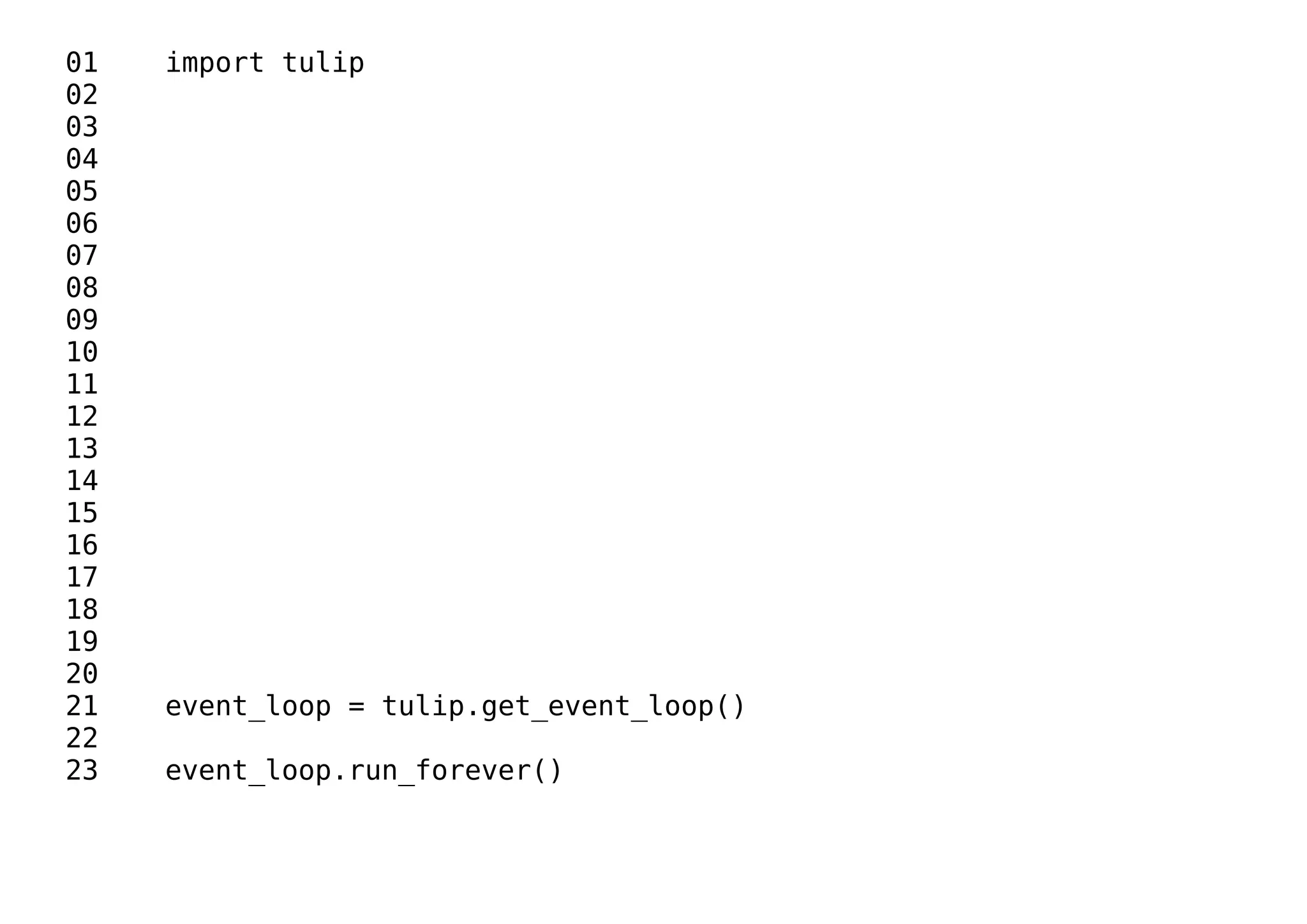
01 import tulip
02
03
04
05
06
07
08
09
10
11
12
13
14
15
16
17
18
19
20
21 event_loop = tulip.get_event_loop()
22
23 event_loop.run_forever()
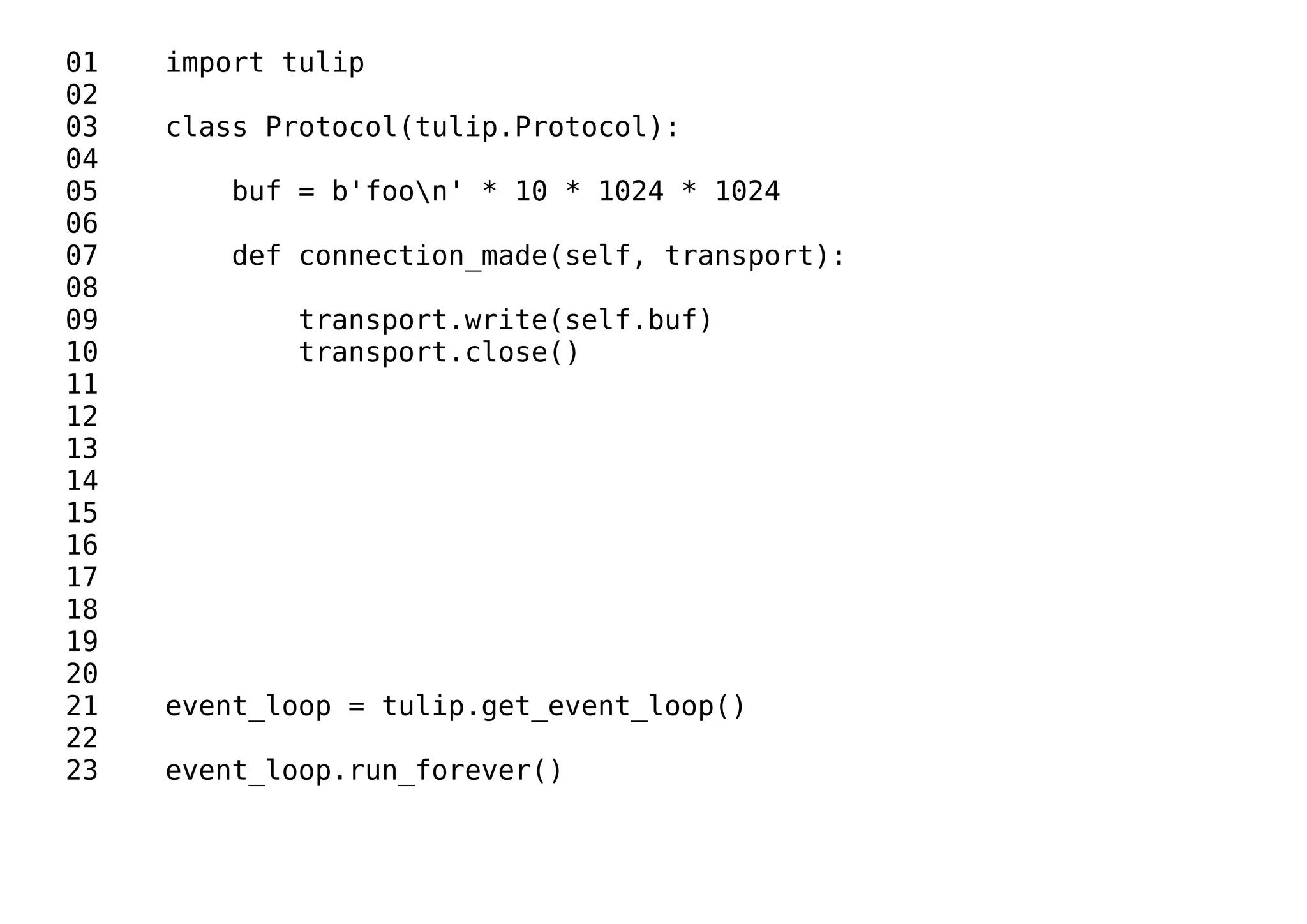
01 import tulip
02
03 class Protocol(tulip.Protocol):
04
05 buf = b'foon' * 10 * 1024 * 1024
06
07 def connection_made(self, transport):
08
09 transport.write(self.buf)
10 transport.close()
11
12
13
14
15
16
17
18
19
20
21 event_loop = tulip.get_event_loop()
22
23 event_loop.run_forever()
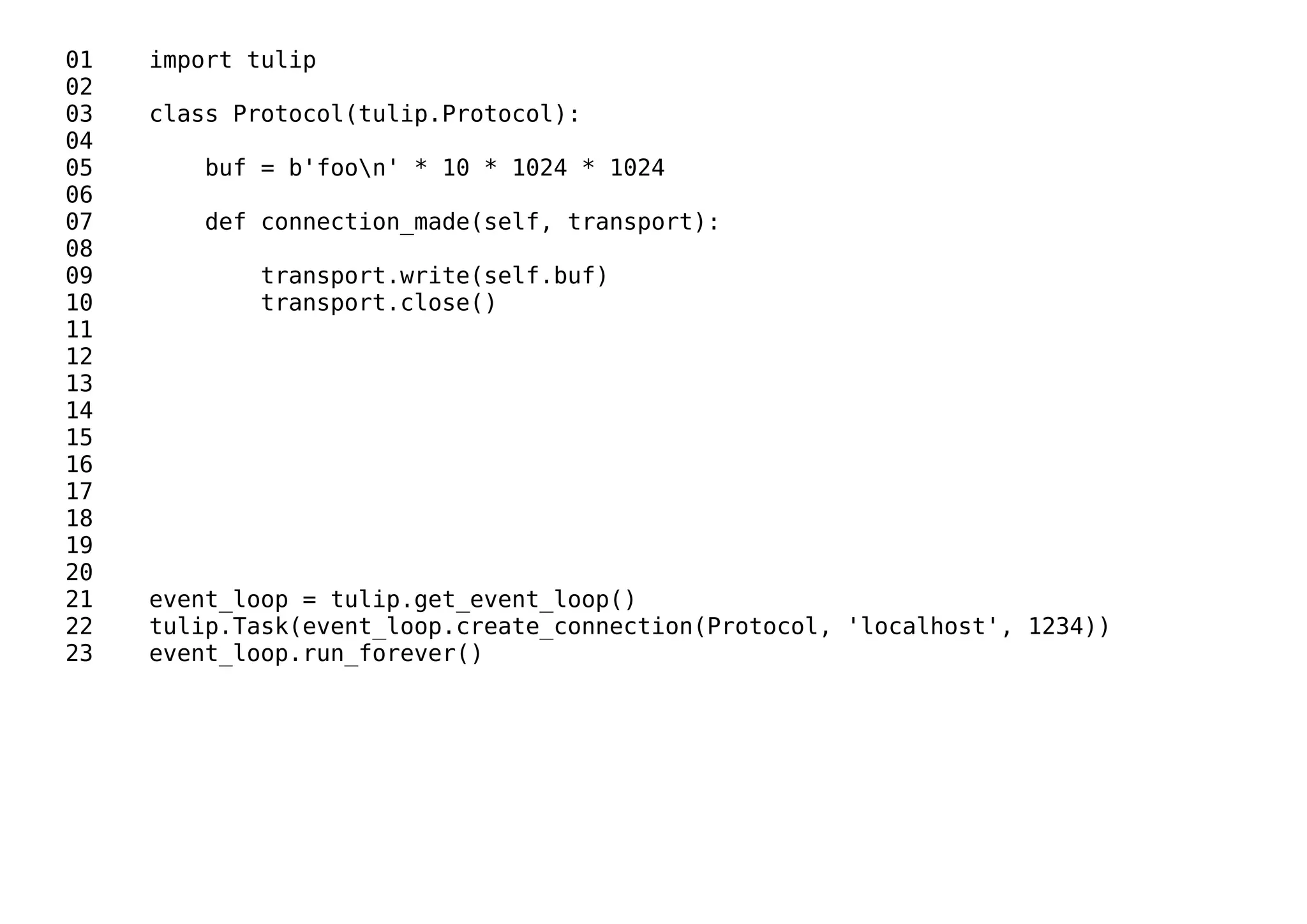
01 import tulip
02
03 class Protocol(tulip.Protocol):
04
05 buf = b'foon' * 10 * 1024 * 1024
06
07 def connection_made(self, transport):
08
09 transport.write(self.buf)
10 transport.close()
11
12
13
14
15
16
17
18
19
20
21 event_loop = tulip.get_event_loop()
22 tulip.Task(event_loop.create_connection(Protocol, 'localhost', 1234))
23 event_loop.run_forever()
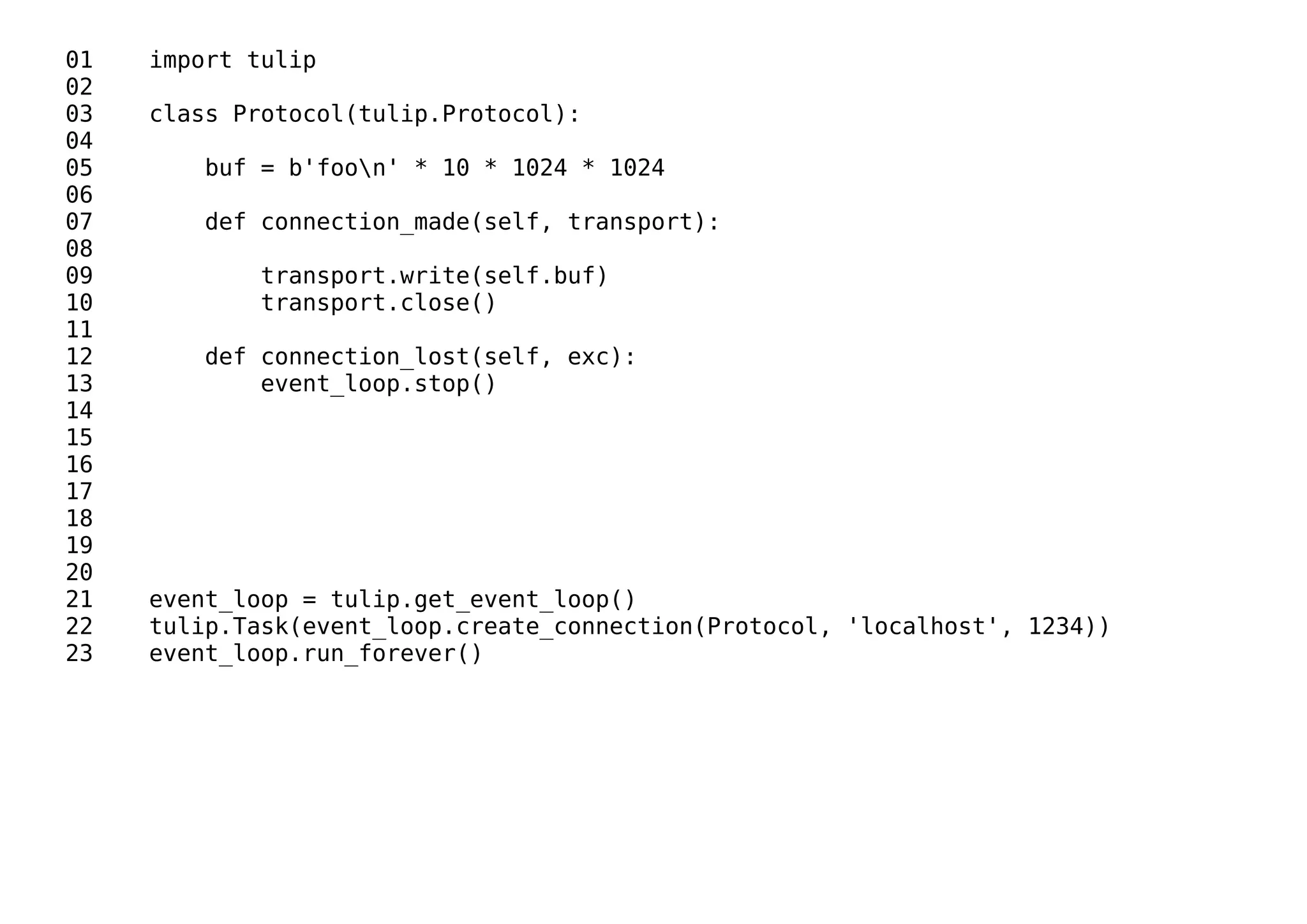
01 import tulip
02
03 class Protocol(tulip.Protocol):
04
05 buf = b'foon' * 10 * 1024 * 1024
06
07 def connection_made(self, transport):
08
09 transport.write(self.buf)
10 transport.close()
11
12 def connection_lost(self, exc):
13 event_loop.stop()
14
15
16
17
18
19
20
21 event_loop = tulip.get_event_loop()
22 tulip.Task(event_loop.create_connection(Protocol, 'localhost', 1234))
23 event_loop.run_forever()
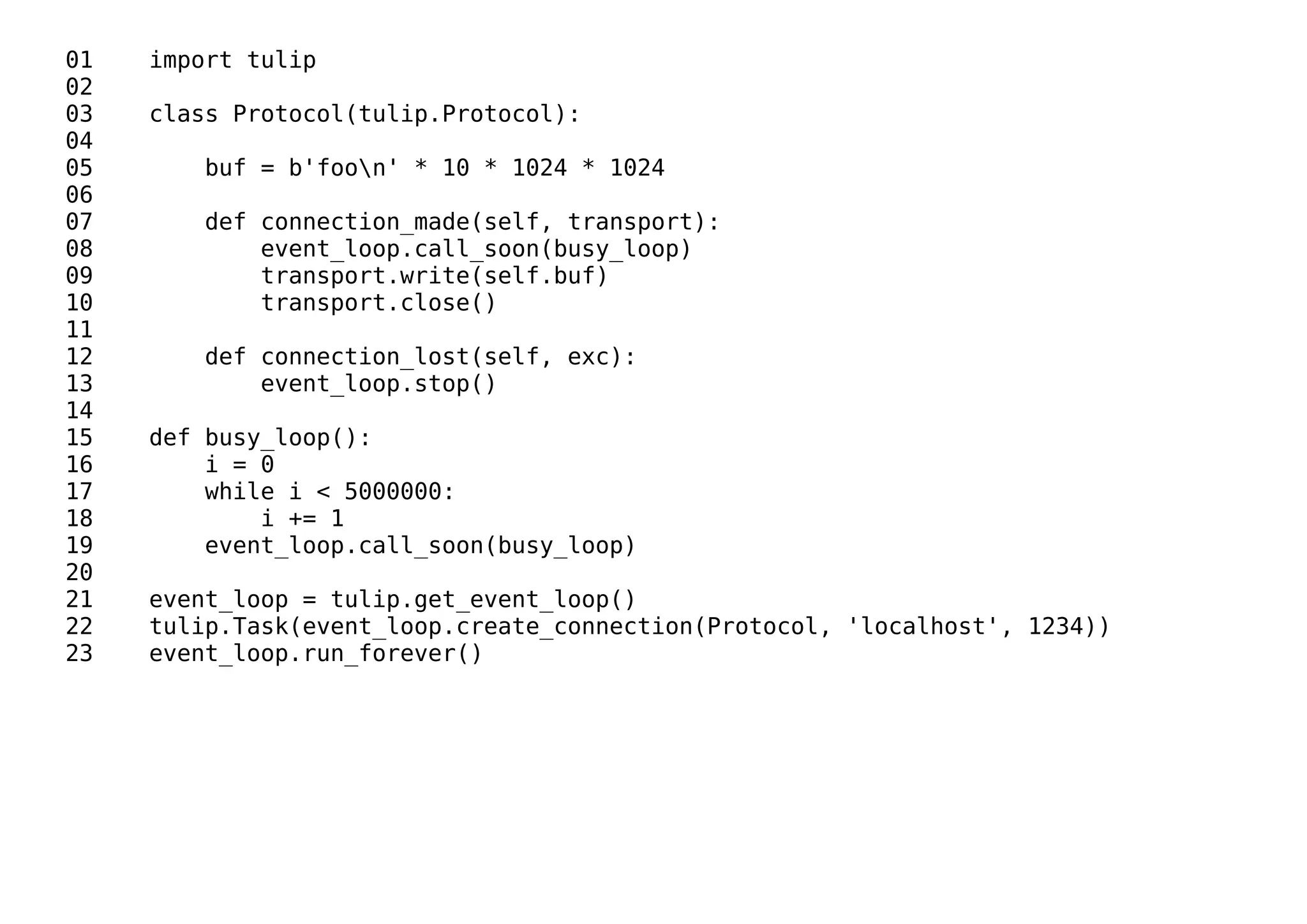
01 import tulip
02
03 class Protocol(tulip.Protocol):
04
05 buf = b'foon' * 10 * 1024 * 1024
06
07 def connection_made(self, transport):
08 event_loop.call_soon(busy_loop)
09 transport.write(self.buf)
10 transport.close()
11
12 def connection_lost(self, exc):
13 event_loop.stop()
14
15 def busy_loop():
16 i = 0
17 while i < 5000000:
18 i += 1
19 event_loop.call_soon(busy_loop)
20
21 event_loop = tulip.get_event_loop()
22 tulip.Task(event_loop.create_connection(Protocol, 'localhost', 1234))
23 event_loop.run_forever()
Generators as Coroutines
01 import os
02
03 def contents_of_files(dir):
04 ret = []
05 for f in os.listdir(dir):
06 path = os.path.join(dir, f)
07 ret.append((path, file(path).read()))
08 return ret
09
10 for path, contents in contents_of_files(dir):
11 if search_for in contents:
12 print("found", search_for, "in", path)
13 break
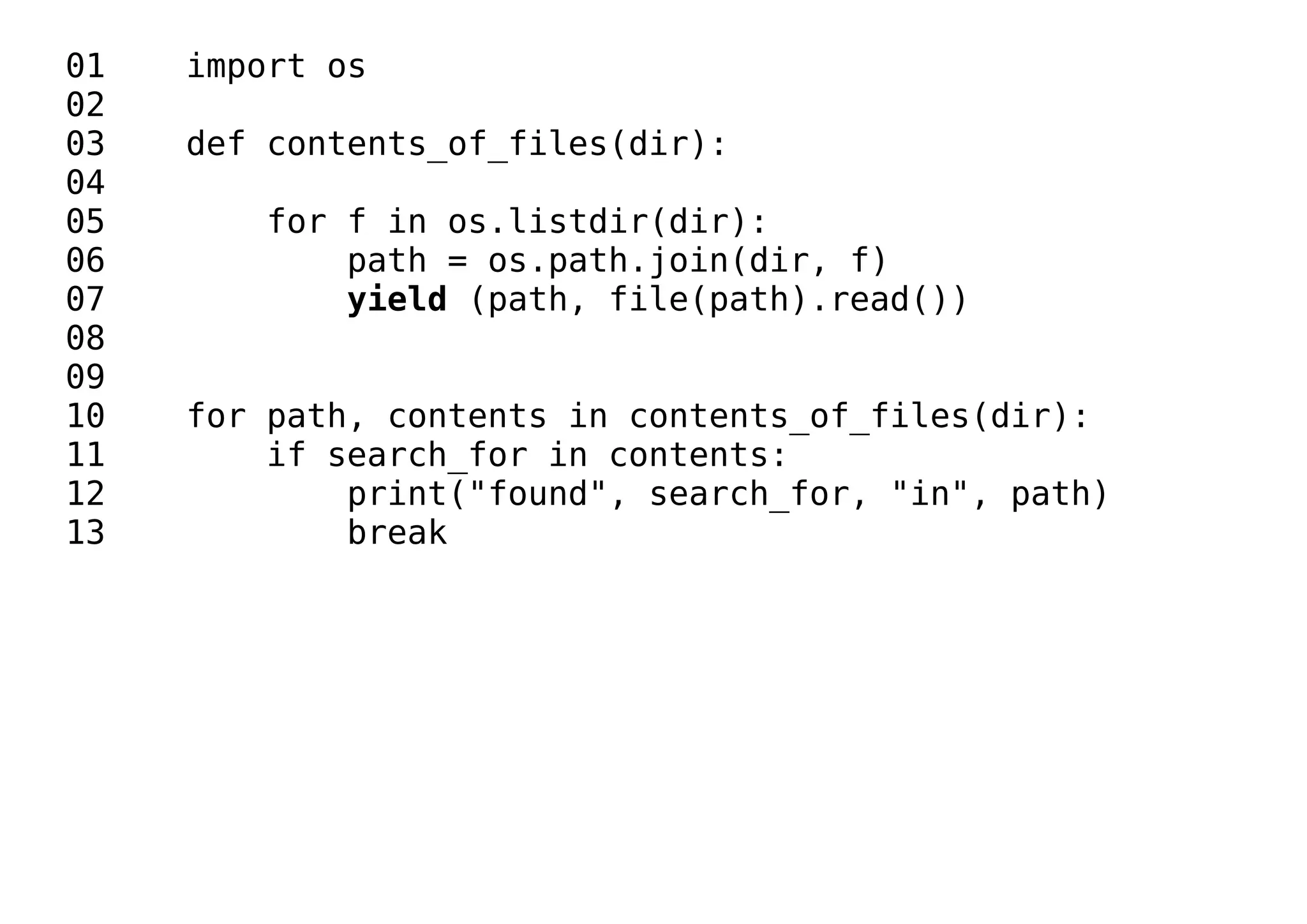
01 import os
02
03 def contents_of_files(dir):
04
05 for f in os.listdir(dir):
06 path = os.path.join(dir, f)
07 yield (path, file(path).read())
08
09
10 for path, contents in contents_of_files(dir):
11 if search_for in contents:
12 print("found", search_for, "in", path)
13 break
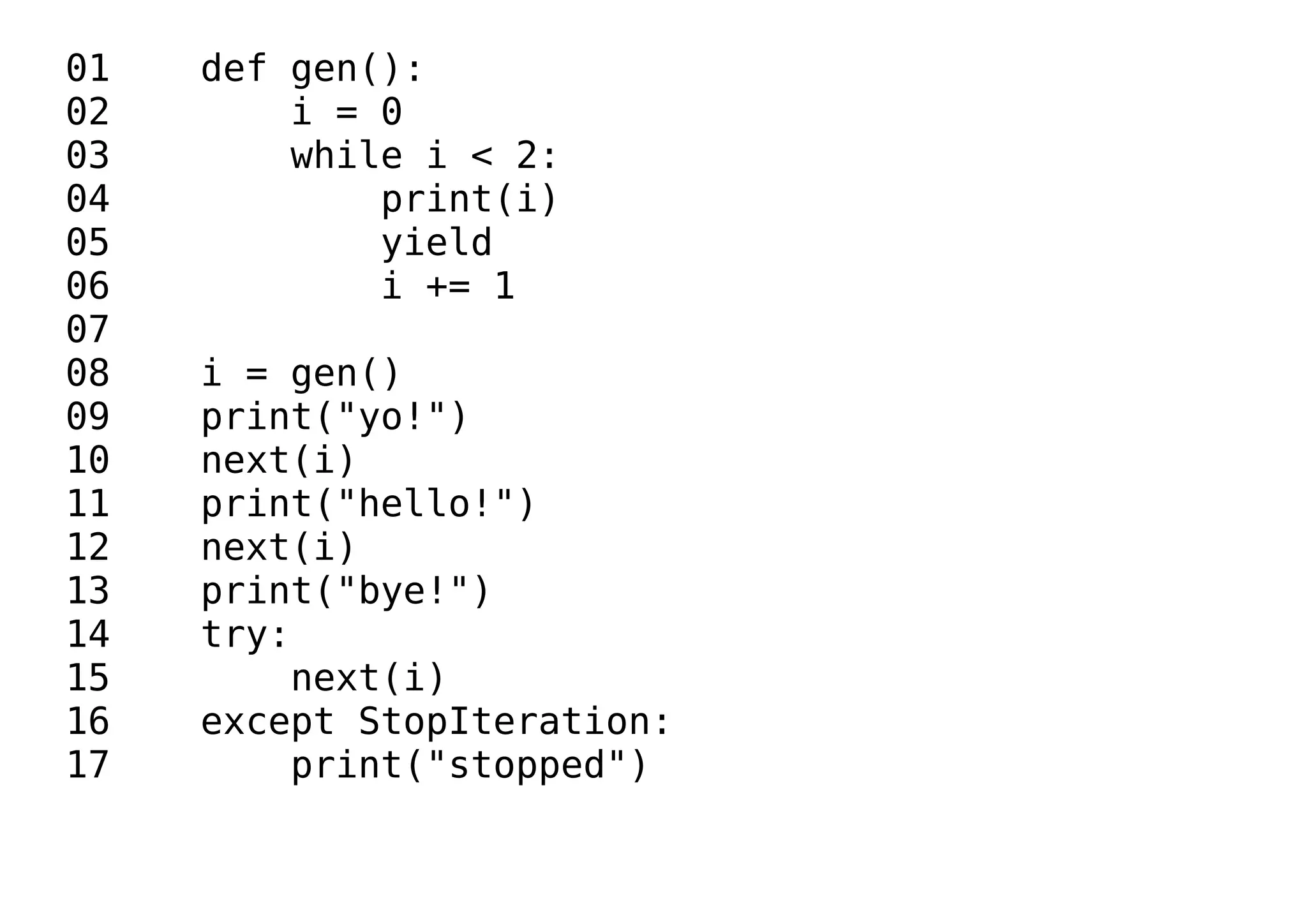
01 def gen():
02 i = 0
03 while i < 2:
04 print(i)
05 yield
06 i += 1
07
08 i = gen()
09 print("yo!")
10 next(i)
11 print("hello!")
12 next(i)
13 print("bye!")
14 try:
15 next(i)
16 except StopIteration:
17 print("stopped")
01 Task = collections.namedtuple('Task', ['generator', 'wfd', 'idle'])
02
03 running = True
04
05 def quit():
06 global running
07 running = False
08
09 while running:
10 finished = []
11 for n, t in enumerate(tasks):
12 try:
13 next(t.generator)
14 except StopIteration:
15 finished.append(n)
16 map(tasks.pop, finished)
17
18 wfds = [t.wfd for t in tasks if t.wfd]
19 timeout = 0 if [t for t in tasks if t.idle] else None
20
21 select.select([], wfds, [], timeout)
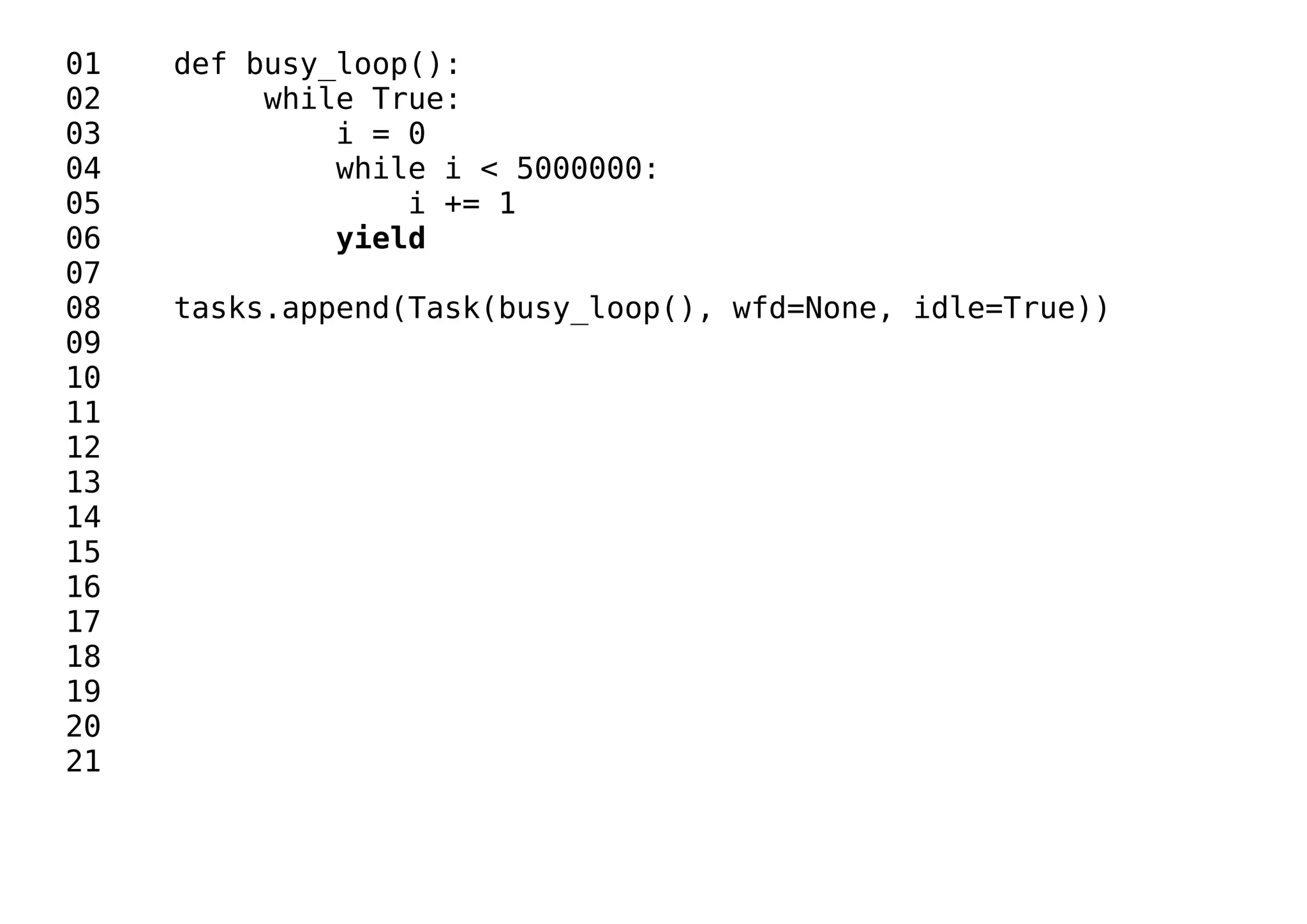
01 def busy_loop():
02 while True:
03 i = 0
04 while i < 5000000:
05 i += 1
06 yield
07
08 tasks.append(Task(busy_loop(), wfd=None, idle=True))
09
10
11
12
13
14
15
16
17
18
19
20
21
01 sock = socket.socket()
02 sock.connect(('localhost', 1234))
03 sock.setblocking(0)
04
05 def write(data):
06 buf = memoryview(data)
07 while len(buf):
08 try:
09 buf = buf[sock.send(buf):]
10 except socket.error as e:
11 if e.errno != errno.EAGAIN:
12 raise e
13 yield
14
15 def write_stuff():
16 yield from write(b'foon' * 2 * 1024 * 1024)
17 yield from write(b'barn' * 2 * 1024 * 1024)
18 quit()
19
20 tasks.append(Task(write_stuff(), wfd=sock, idle=False))
21
References
• My blog - http://blogs.gnome.org/markmc/2013/06/04/async-io-and-python
• Eventlet - http://eventlet.net
• Twisted - http://twistedmatrix.com
• Tulip - http://www.python.org/dev/peps/pep-3156
• yield from - http://www.python.org/dev/peps/pep-0380

Async I/O in Python

  • 2.
  • 3.
    We're here totalk about asynchronous I/O in Python Widely accepted as a weakness of Python People are working on fixing this in 3.4 Extremely broad, nuanced topic I expect there's a huge range in people's level of understanding here People often talk past each other, debating obscure points The goal here is to learn more about the topic, not debate I/O strategies
  • 4.
  • 5.
    You're doing someI/O It can't complete immediately (e.g. waiting for server to respond) What do you do now? If there's anything else useful to be done, surely do that
  • 6.
  • 7.
    Multiple processes Multiple threads Singlethread, non-blocking I/O A combination of all three might make sense We're here to talk about frameworks for the latter
  • 8.
  • 9.
    Usually, if anI/O operation (read/write/etc.) can't complete, you block Blocking means that the kernel puts you too sleep If you're sleeping, you don't have the opportunity to do other useful work Instead, use non-blocking I/O operations Kernel returns immediately if it can't complete the I/O You end up with a bunch of in-progress I/O operations You use select() to have the kernel tell you when one of them can progress
  • 10.
    01 02 03 import socket 04 05sock = socket.socket() 06 sock.connect(('localhost', 1234)) 07 08 09 sock.send('foon' * 10 * 1024 * 1024) 10 11 12 13 14 15 16 17 18 19 20 21
  • 11.
    Simple example, connectto a server on port 1234, write a bunch of stuff This send() function won't finish until all the data is written While you're waiting for the I/O to complete, you can't do anything else If you're not familiar with berkley sockets ... socket() creates a socket ... it's just a data structure connect() initiates the TCP connection with the server Some handshake packets will go back and forth before this completes send() takes the data buffer, splits up and sends as TCP packets
  • 12.
    01 02 03 import socket 04 05sock = socket.socket() 06 sock.connect(('localhost', 1234)) 07 sock.setblocking(0) 08 09 sock.send('foon' * 10 * 1024 * 1024) 10 11 12 13 14 15 16 17 18 19 20 21
  • 13.
    01 02 03 import socket 04 05sock = socket.socket() 06 sock.connect(('localhost', 1234)) 07 sock.setblocking(0) 08 09 buf = buffer('foon' * 10 * 1024 * 1024) 10 while len(buf): 11 buf = buf[sock.send(buf):] 12 13 14 15 16 17 18 19 20 21
  • 14.
    01 import errno 02import select 03 import socket 04 05 sock = socket.socket() 06 sock.connect(('localhost', 1234)) 07 sock.setblocking(0) 08 09 buf = buffer('foon' * 10 * 1024 * 1024) 10 while len(buf): 11 try: 12 buf = buf[sock.send(buf):] 13 except socket.error, e: 14 if e.errno != errno.EAGAIN: 15 raise e 16 17 18 19 20 21
  • 15.
    01 import errno 02import select 03 import socket 04 05 sock = socket.socket() 06 sock.connect(('localhost', 1234)) 07 sock.setblocking(0) 08 09 buf = buffer('foon' * 10 * 1024 * 1024) 10 while len(buf): 11 try: 12 buf = buf[sock.send(buf):] 13 except socket.error, e: 14 if e.errno != errno.EAGAIN: 15 raise e 16 17 18 19 20 21 select.select([], [sock], [])
  • 16.
    01 import errno 02import select 03 import socket 04 05 sock = socket.socket() 06 sock.connect(('localhost', 1234)) 07 sock.setblocking(0) 08 09 buf = buffer('foon' * 10 * 1024 * 1024) 10 while len(buf): 11 try: 12 buf = buf[sock.send(buf):] 13 except socket.error, e: 14 if e.errno != errno.EAGAIN: 15 raise e 16 17 i = 0 18 while i < 5000000: 19 i += 1 20 21 select.select([], [sock], [])
  • 17.
  • 18.
    Eventlet is oneof several async I/O frameworks for Python It's magic, to its detriment IMHO Co-operative co-routine scheduling Eventlet coroutines are called green threads (from Java) green threads != threads Many greenthreads in one OS thread They are very cheap We call them coroutines because they cooperatively yield to one another greenlet allows you to save a stack and switch to another stack
  • 19.
    01 02 from eventlet.greenimport socket 03 04 05 06 07 08 09 10 11 12 13 sock = socket.socket() 14 sock.connect(('localhost', 1234)) 15 sock.send('foon' * 10 * 1024 * 1024) 16 17 18 19 20 21
  • 20.
    01 import eventlet 02from eventlet.green import socket 03 04 def busy_loop(): 05 pass 06 07 08 09 10 11 eventlet.spawn(busy_loop) 12 13 sock = socket.socket() 14 sock.connect(('localhost', 1234)) 15 sock.send('foon' * 10 * 1024 * 1024) 16 17 18 19 20 21
  • 21.
    01 import eventlet 02from eventlet.green import socket 03 04 def busy_loop(): 05 while True: 06 i = 0 07 while i < 5000000: 08 i += 1 09 10 11 eventlet.spawn(busy_loop) 12 13 sock = socket.socket() 14 sock.connect(('localhost', 1234)) 15 sock.send('foon' * 10 * 1024 * 1024) 16 17 18 19 20 21
  • 22.
    01 import eventlet 02from eventlet.green import socket 03 04 def busy_loop(): 05 while True: 06 i = 0 07 while i < 5000000: 08 i += 1 09 eventlet.sleep() 10 11 eventlet.spawn(busy_loop) 12 13 sock = socket.socket() 14 sock.connect(('localhost', 1234)) 15 sock.send('foon' * 10 * 1024 * 1024) 16 17 18 19 20 21
  • 23.
  • 24.
    Eventlet has ascheduler, twisted has an event loop Event loop is a loop (i.e. while loop) which checks for I/O events Twisted invokes callbacks for events, rather than scheduling coroutines Eventlet is confusing because magic Twisted is confusing because abstractions
  • 25.
    01 02 from twisted.internetimport reactor 03 04 05 06 07 08 09 10 11 12 13 14 15 16 17 18 19 20 21 reactor.run()
  • 26.
    01 from twisted.internetimport protocol 02 from twisted.internet import reactor 03 04 05 06 07 08 09 10 11 12 reactor.connectTCP('localhost', 1234, 13 protocol.ClientFactory()) 14 15 16 17 18 19 20 21 reactor.run()
  • 27.
    01 from twisted.internetimport protocol 02 from twisted.internet import reactor 03 04 class Test(protocol.Protocol): 05 pass 06 07 08 class TestFactory(protocol.ClientFactory): 09 def buildProtocol(self, addr): 10 return Test() 11 12 reactor.connectTCP('localhost', 1234, TestFactory()) 13 14 15 16 17 18 19 20 21 reactor.run()
  • 28.
    01 from twisted.internetimport protocol 02 from twisted.internet import reactor 03 04 class Test(protocol.Protocol): 05 def connectionMade(self): 06 self.transport.write('foon' * 2 * 1024 * 1024) 07 08 class TestFactory(protocol.ClientFactory): 09 def buildProtocol(self, addr): 10 return Test() 11 12 reactor.connectTCP('localhost', 1234, TestFactory()) 13 14 15 16 17 18 19 20 21 reactor.run()
  • 29.
    01 from twisted.internetimport protocol 02 from twisted.internet import reactor 03 04 class Test(protocol.Protocol): 05 def connectionMade(self): 06 self.transport.write('foon' * 2 * 1024 * 1024) 07 08 class TestFactory(protocol.ClientFactory): 09 def buildProtocol(self, addr): 10 return Test() 11 12 reactor.connectTCP('localhost', 1234, TestFactory()) 13 14 def busy_loop(): 15 i = 0 16 while i < 5000000: 17 i += 1 18 19 reactor.callLater(0, busy_loop) 20 21 reactor.run()
  • 30.
    01 from twisted.internetimport protocol 02 from twisted.internet import reactor 03 04 class Test(protocol.Protocol): 05 def connectionMade(self): 06 self.transport.write('foon' * 2 * 1024 * 1024) 07 08 class TestFactory(protocol.ClientFactory): 09 def buildProtocol(self, addr): 10 return Test() 11 12 reactor.connectTCP('localhost', 1234, TestFactory()) 13 14 def busy_loop(): 15 i = 0 16 while i < 5000000: 17 i += 1 18 reactor.callLater(0, busy_loop) 19 reactor.callLater(0, busy_loop) 20 21 reactor.run()
  • 31.
  • 32.
    Guido's "Async I/OSupport Rebooted" Support for both coroutine and callback models It's event loop is called an event loop
  • 33.
    01 02 03 04 import tulip 05 06 07 08 09 10 11 12 13 14 15 16 17 18 19 20 21 22 23 24 25 26 27event_loop = tulip.get_event_loop() 28 39 30 event_loop.run_forever()
  • 34.
    01 02 import socket 03 04import tulip 05 06 sock = socket.socket() 07 sock.connect(('localhost', 1234)) 08 sock.setblocking(0) 09 10 11 12 13 14 15 16 17 18 19 20 21 22 23 24 25 26 27 event_loop = tulip.get_event_loop() 28 39 30 event_loop.run_forever()
  • 35.
    01 import errno 02import socket 03 04 import tulip 05 06 sock = socket.socket() 07 sock.connect(('localhost', 1234)) 08 sock.setblocking(0) 09 10 buf = memoryview(str.encode('foon' * 2 * 1024 * 1024)) 11 def do_write(): 12 global buf 13 while True: 14 try: 15 buf = buf[sock.send(buf):] 16 except socket.error as e: 17 if e.errno != errno.EAGAIN: 18 raise e 19 return 20 21 22 23 24 25 26 27 event_loop = tulip.get_event_loop() 28 event_loop.add_writer(sock, do_write) 39 30 event_loop.run_forever()
  • 36.
    01 import errno 02import socket 03 04 import tulip 05 06 sock = socket.socket() 07 sock.connect(('localhost', 1234)) 08 sock.setblocking(0) 09 10 buf = memoryview(str.encode('foon' * 2 * 1024 * 1024)) 11 def do_write(): 12 global buf 13 while True: 14 try: 15 buf = buf[sock.send(buf):] 16 except socket.error as e: 17 if e.errno != errno.EAGAIN: 18 raise e 19 return 20 21 def busy_loop(): 22 i = 0 23 while i < 5000000: 24 i += 1 25 event_loop.call_soon(busy_loop) 26 27 event_loop = tulip.get_event_loop() 28 event_loop.add_writer(sock, do_write) 39 event_loop.call_soon(busy_loop) 30 event_loop.run_forever()
  • 37.
    01 import tulip 02 03 04 05 06 07 08 09 10 11 12 13 14 15 16 17 18 19 20 21event_loop = tulip.get_event_loop() 22 23 event_loop.run_forever()
  • 38.
    01 import tulip 02 03class Protocol(tulip.Protocol): 04 05 buf = b'foon' * 10 * 1024 * 1024 06 07 def connection_made(self, transport): 08 09 transport.write(self.buf) 10 transport.close() 11 12 13 14 15 16 17 18 19 20 21 event_loop = tulip.get_event_loop() 22 23 event_loop.run_forever()
  • 39.
    01 import tulip 02 03class Protocol(tulip.Protocol): 04 05 buf = b'foon' * 10 * 1024 * 1024 06 07 def connection_made(self, transport): 08 09 transport.write(self.buf) 10 transport.close() 11 12 13 14 15 16 17 18 19 20 21 event_loop = tulip.get_event_loop() 22 tulip.Task(event_loop.create_connection(Protocol, 'localhost', 1234)) 23 event_loop.run_forever()
  • 40.
    01 import tulip 02 03class Protocol(tulip.Protocol): 04 05 buf = b'foon' * 10 * 1024 * 1024 06 07 def connection_made(self, transport): 08 09 transport.write(self.buf) 10 transport.close() 11 12 def connection_lost(self, exc): 13 event_loop.stop() 14 15 16 17 18 19 20 21 event_loop = tulip.get_event_loop() 22 tulip.Task(event_loop.create_connection(Protocol, 'localhost', 1234)) 23 event_loop.run_forever()
  • 41.
    01 import tulip 02 03class Protocol(tulip.Protocol): 04 05 buf = b'foon' * 10 * 1024 * 1024 06 07 def connection_made(self, transport): 08 event_loop.call_soon(busy_loop) 09 transport.write(self.buf) 10 transport.close() 11 12 def connection_lost(self, exc): 13 event_loop.stop() 14 15 def busy_loop(): 16 i = 0 17 while i < 5000000: 18 i += 1 19 event_loop.call_soon(busy_loop) 20 21 event_loop = tulip.get_event_loop() 22 tulip.Task(event_loop.create_connection(Protocol, 'localhost', 1234)) 23 event_loop.run_forever()
  • 42.
  • 43.
    01 import os 02 03def contents_of_files(dir): 04 ret = [] 05 for f in os.listdir(dir): 06 path = os.path.join(dir, f) 07 ret.append((path, file(path).read())) 08 return ret 09 10 for path, contents in contents_of_files(dir): 11 if search_for in contents: 12 print("found", search_for, "in", path) 13 break
  • 44.
    01 import os 02 03def contents_of_files(dir): 04 05 for f in os.listdir(dir): 06 path = os.path.join(dir, f) 07 yield (path, file(path).read()) 08 09 10 for path, contents in contents_of_files(dir): 11 if search_for in contents: 12 print("found", search_for, "in", path) 13 break
  • 45.
    01 def gen(): 02i = 0 03 while i < 2: 04 print(i) 05 yield 06 i += 1 07 08 i = gen() 09 print("yo!") 10 next(i) 11 print("hello!") 12 next(i) 13 print("bye!") 14 try: 15 next(i) 16 except StopIteration: 17 print("stopped")
  • 46.
    01 Task =collections.namedtuple('Task', ['generator', 'wfd', 'idle']) 02 03 running = True 04 05 def quit(): 06 global running 07 running = False 08 09 while running: 10 finished = [] 11 for n, t in enumerate(tasks): 12 try: 13 next(t.generator) 14 except StopIteration: 15 finished.append(n) 16 map(tasks.pop, finished) 17 18 wfds = [t.wfd for t in tasks if t.wfd] 19 timeout = 0 if [t for t in tasks if t.idle] else None 20 21 select.select([], wfds, [], timeout)
  • 47.
    01 def busy_loop(): 02while True: 03 i = 0 04 while i < 5000000: 05 i += 1 06 yield 07 08 tasks.append(Task(busy_loop(), wfd=None, idle=True)) 09 10 11 12 13 14 15 16 17 18 19 20 21
  • 48.
    01 sock =socket.socket() 02 sock.connect(('localhost', 1234)) 03 sock.setblocking(0) 04 05 def write(data): 06 buf = memoryview(data) 07 while len(buf): 08 try: 09 buf = buf[sock.send(buf):] 10 except socket.error as e: 11 if e.errno != errno.EAGAIN: 12 raise e 13 yield 14 15 def write_stuff(): 16 yield from write(b'foon' * 2 * 1024 * 1024) 17 yield from write(b'barn' * 2 * 1024 * 1024) 18 quit() 19 20 tasks.append(Task(write_stuff(), wfd=sock, idle=False)) 21
  • 49.
    References • My blog- http://blogs.gnome.org/markmc/2013/06/04/async-io-and-python • Eventlet - http://eventlet.net • Twisted - http://twistedmatrix.com • Tulip - http://www.python.org/dev/peps/pep-3156 • yield from - http://www.python.org/dev/peps/pep-0380