Stefano Alberto Russo- @stefanoarusso - sarusso.github.io
● Part I: Object Oriented Programming
○ What is OOP?
○ Logical Example
○ Attributes and methods
○ Why to use objects
○ Defining objects
● Part II: Improving your code
○ Extending objects
○ Lambdas
○ Comprehensions
○ Iterables
○ Properties
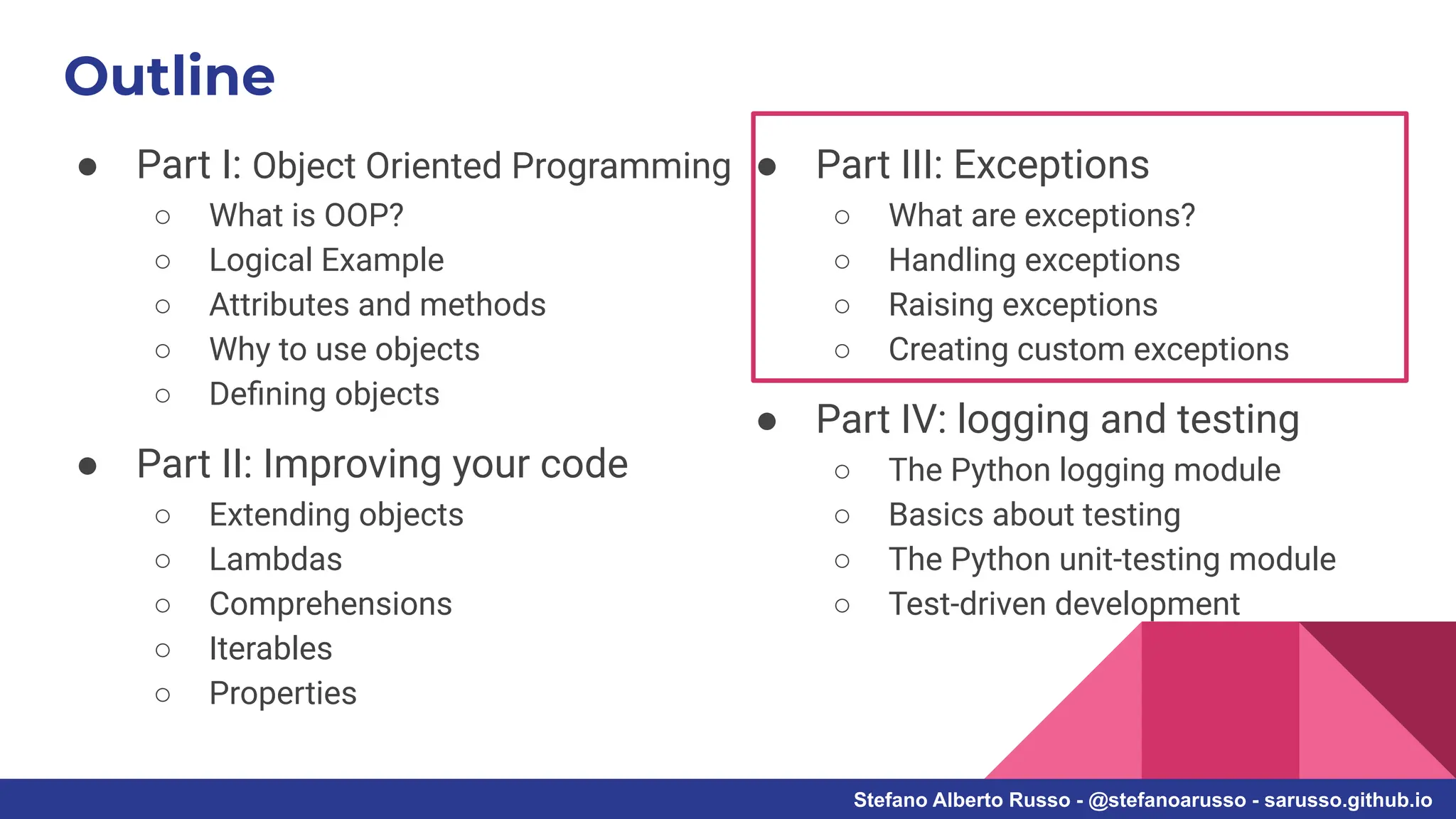
Outline
● Part III: Exceptions
○ What are exceptions?
○ Handling exceptions
○ Raising exceptions
○ Creating custom exceptions
● Part IV: logging and testing
○ The Python logging module
○ Basics about testing
○ The Python unit-testing module
○ Test-driven development
3.
Stefano Alberto Russo- @stefanoarusso - sarusso.github.io
Exceptions
→ What are “exceptions”?
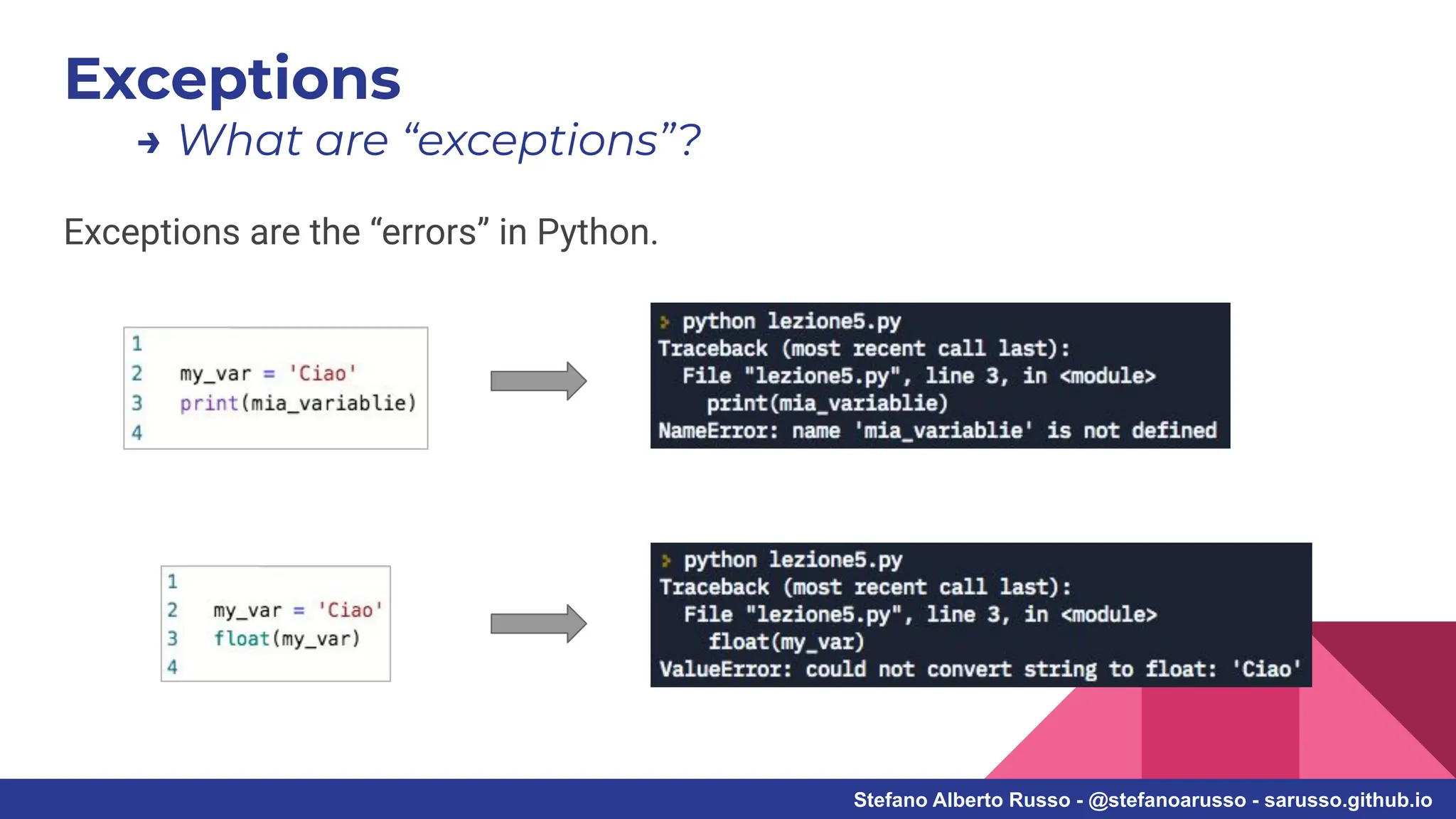
Exceptions are the “errors” in Python.
4.
Stefano Alberto Russo- @stefanoarusso - sarusso.github.io
Exceptions
→ What are “exceptions”?
Exceptions are the “errors” in Python.
5.
Stefano Alberto Russo- @stefanoarusso - sarusso.github.io
Exceptions
→ What are “exceptions”?
Exceptions are the “errors” in Python.
And they are…
6.
Stefano Alberto Russo- @stefanoarusso - sarusso.github.io
Exceptions
→ What are “exceptions”?
Exceptions are the “errors” in Python.
And they are… objects
7.
Stefano Alberto Russo- @stefanoarusso - sarusso.github.io
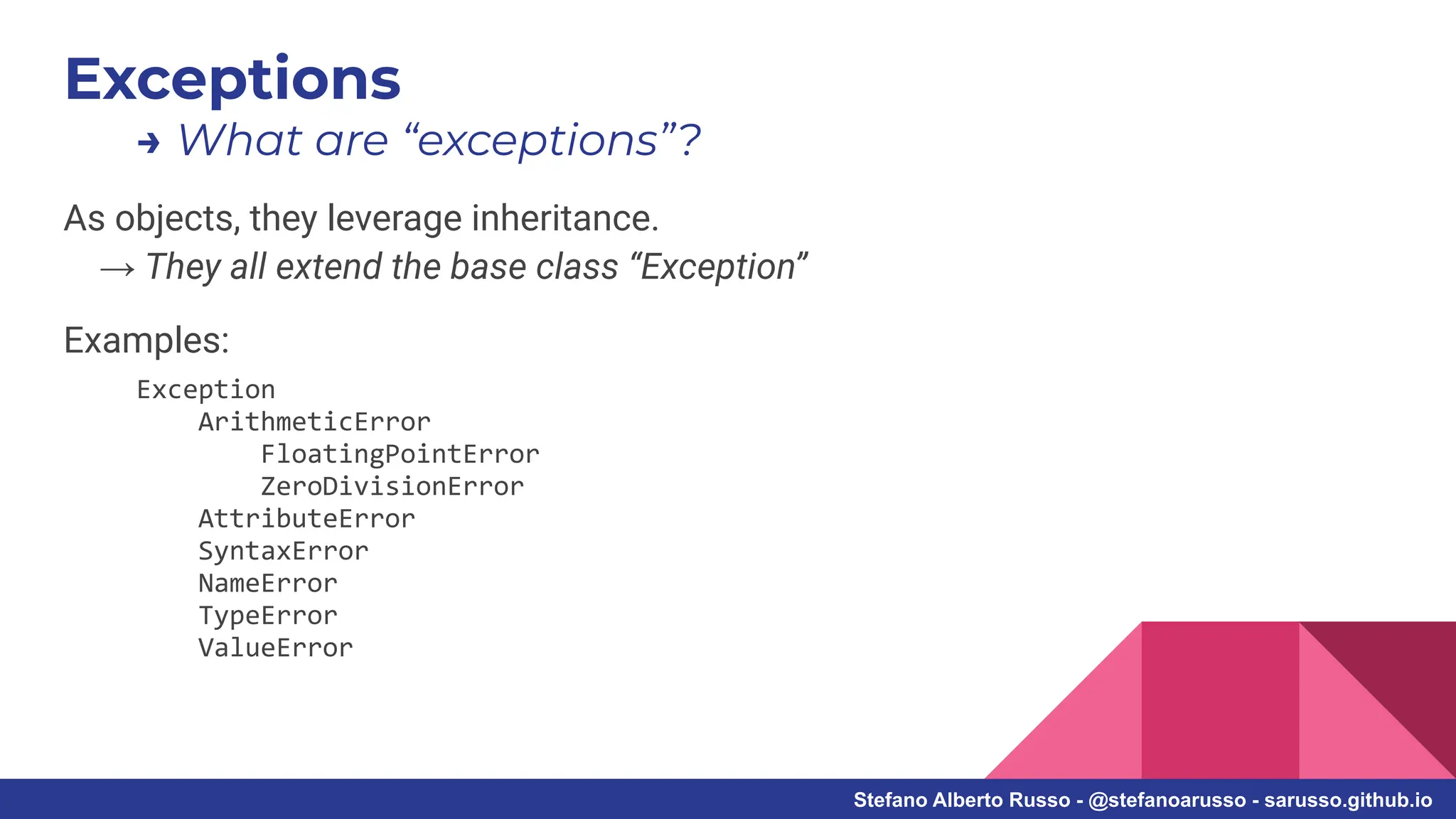
As objects, they leverage inheritance.
→ They all extend the base class “Exception”
Examples:
Exception
ArithmeticError
FloatingPointError
ZeroDivisionError
AttributeError
SyntaxError
NameError
TypeError
ValueError
Exceptions
→ What are “exceptions”?
8.
Stefano Alberto Russo- @stefanoarusso - sarusso.github.io
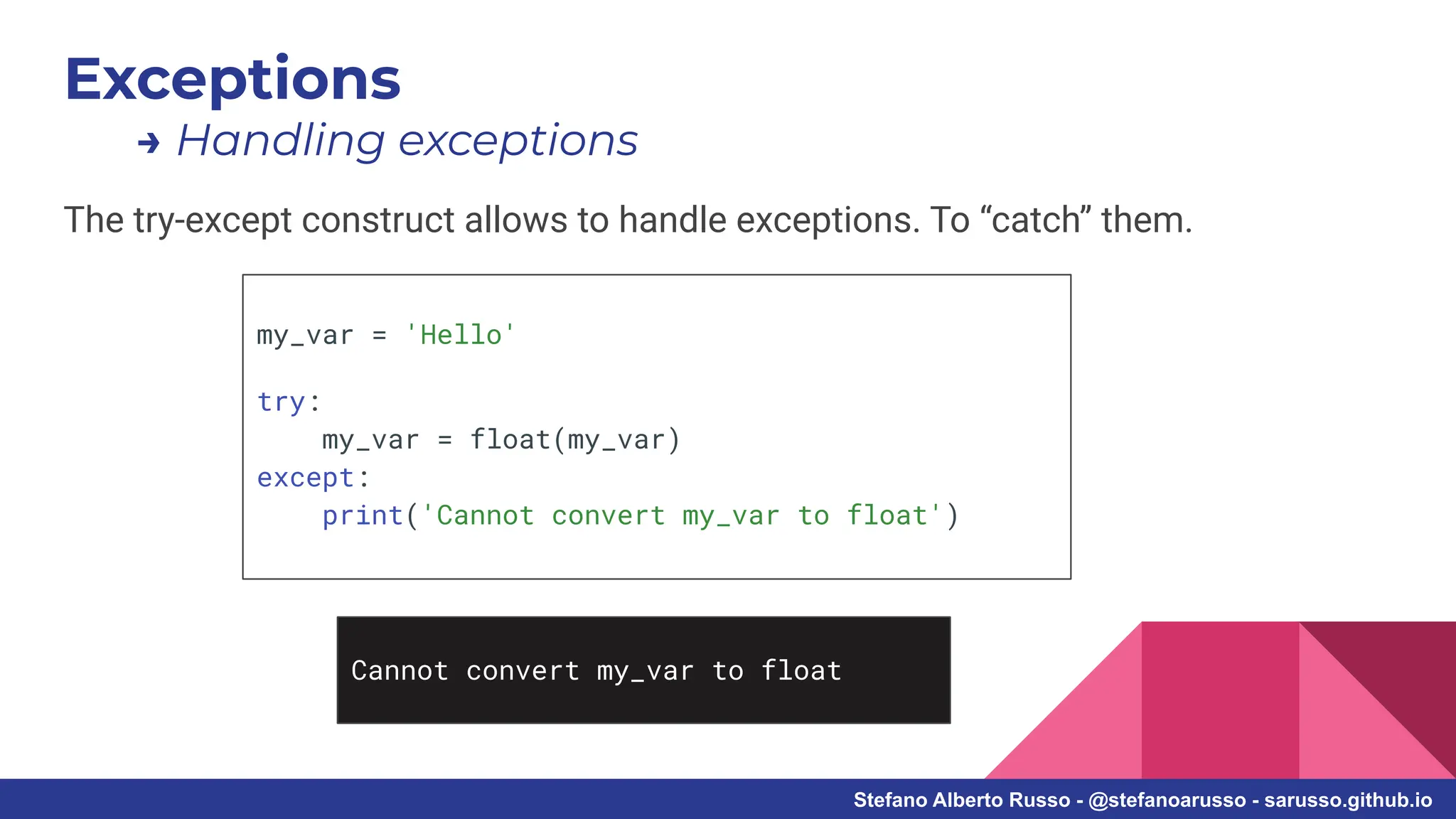
The try-except construct allows to handle exceptions. To “catch” them.
Exceptions
→ Handling exceptions
9.
Stefano Alberto Russo- @stefanoarusso - sarusso.github.io
The try-except construct allows to handle exceptions. To “catch” them.
Exceptions
→ Handling exceptions
Cannot convert my_var to float
my_var = 'Hello'
try:
my_var = float(my_var)
except:
print('Cannot convert my_var to float')
10.
Stefano Alberto Russo- @stefanoarusso - sarusso.github.io
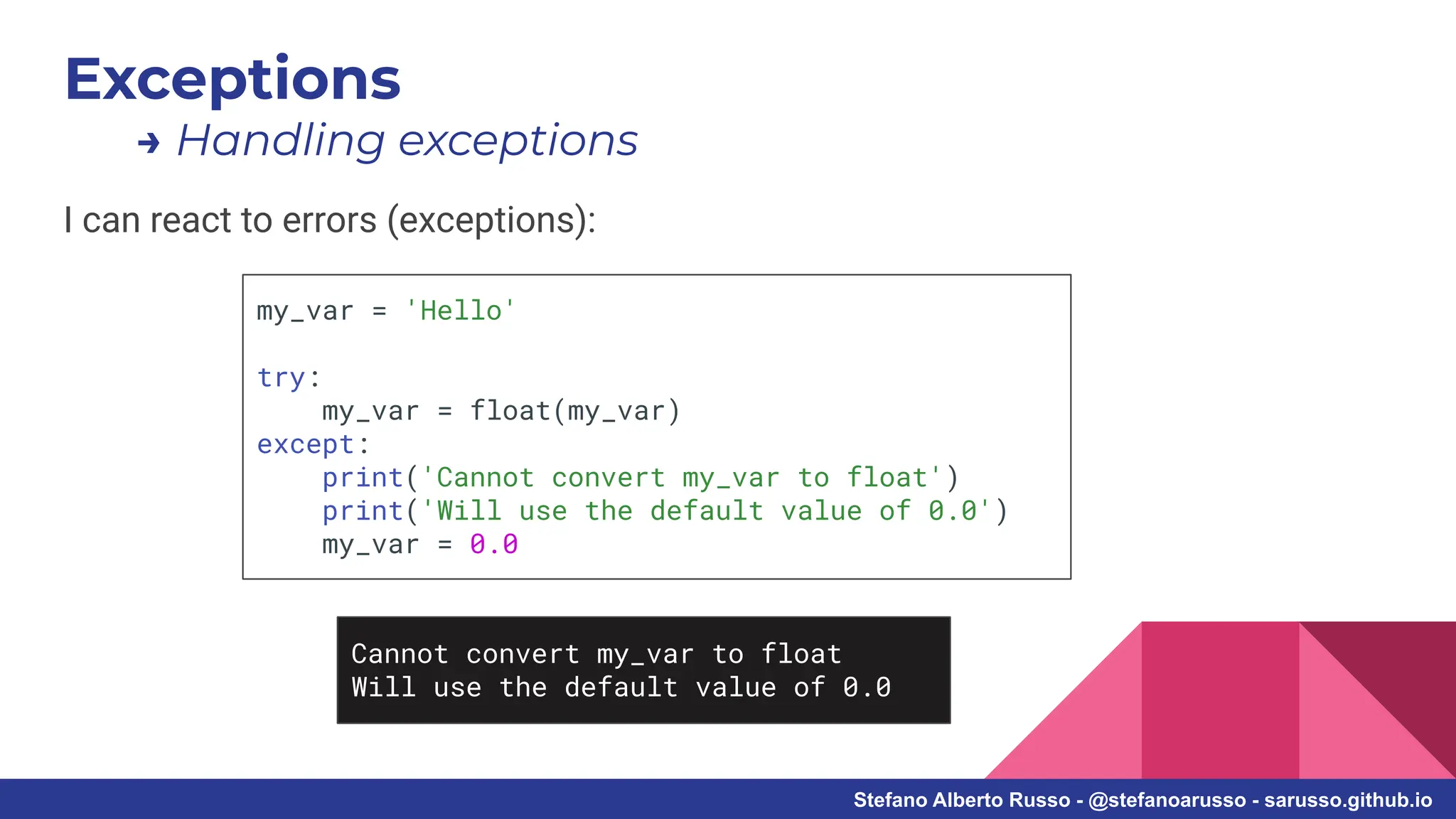
I can react to errors (exceptions):
Exceptions
→ Handling exceptions
Cannot convert my_var to float
Will use the default value of 0.0
my_var = 'Hello'
try:
my_var = float(my_var)
except:
print('Cannot convert my_var to float')
print('Will use the default value of 0.0')
my_var = 0.0
11.
Stefano Alberto Russo- @stefanoarusso - sarusso.github.io
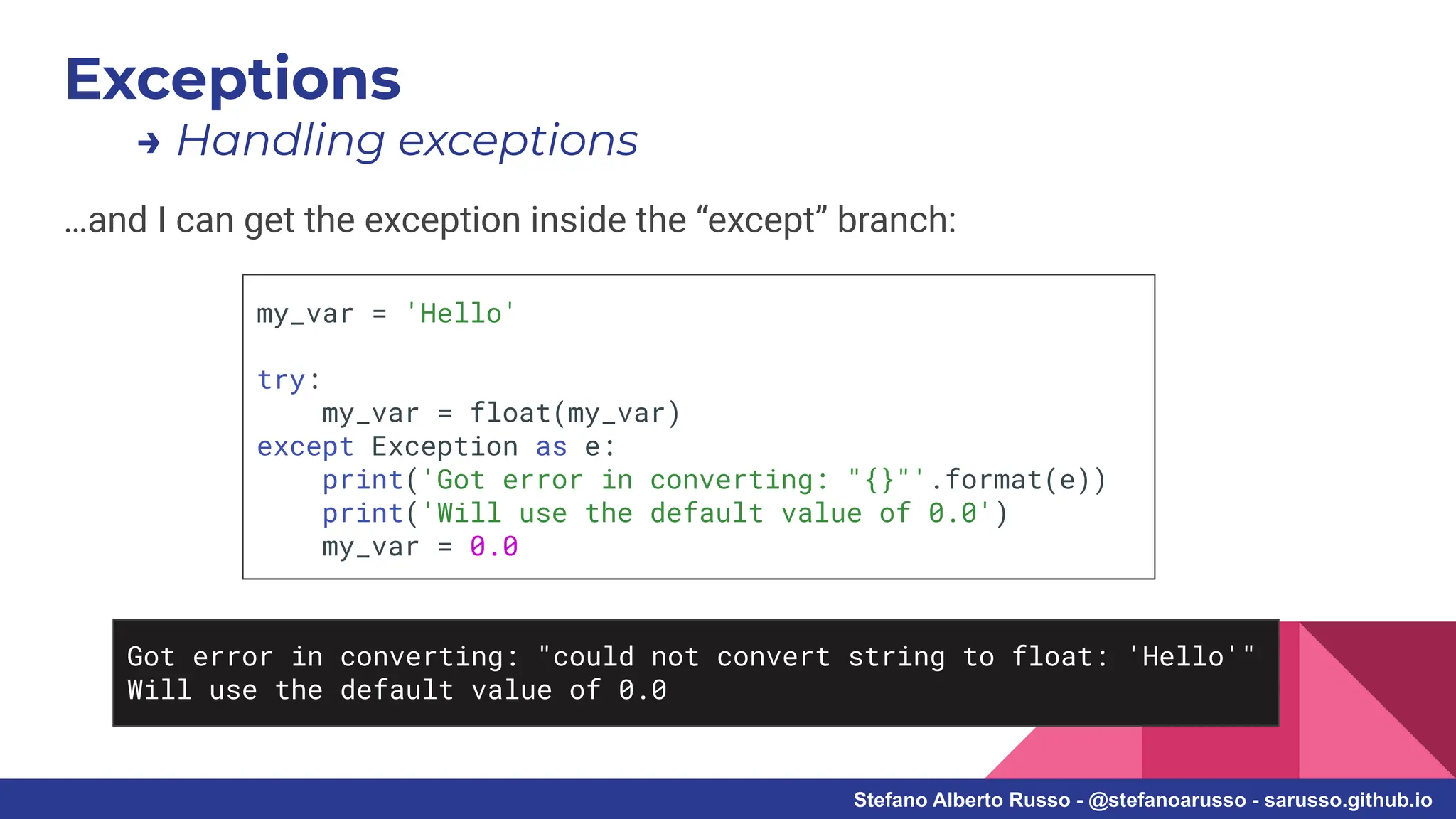
…and I can get the exception inside the “except” branch:
Exceptions
→ Handling exceptions
Got error in converting: "could not convert string to float: 'Hello'"
Will use the default value of 0.0
my_var = 'Hello'
try:
my_var = float(my_var)
except Exception as e:
print('Got error in converting: "{}"'.format(e))
print('Will use the default value of 0.0')
my_var = 0.0
12.
Stefano Alberto Russo- @stefanoarusso - sarusso.github.io
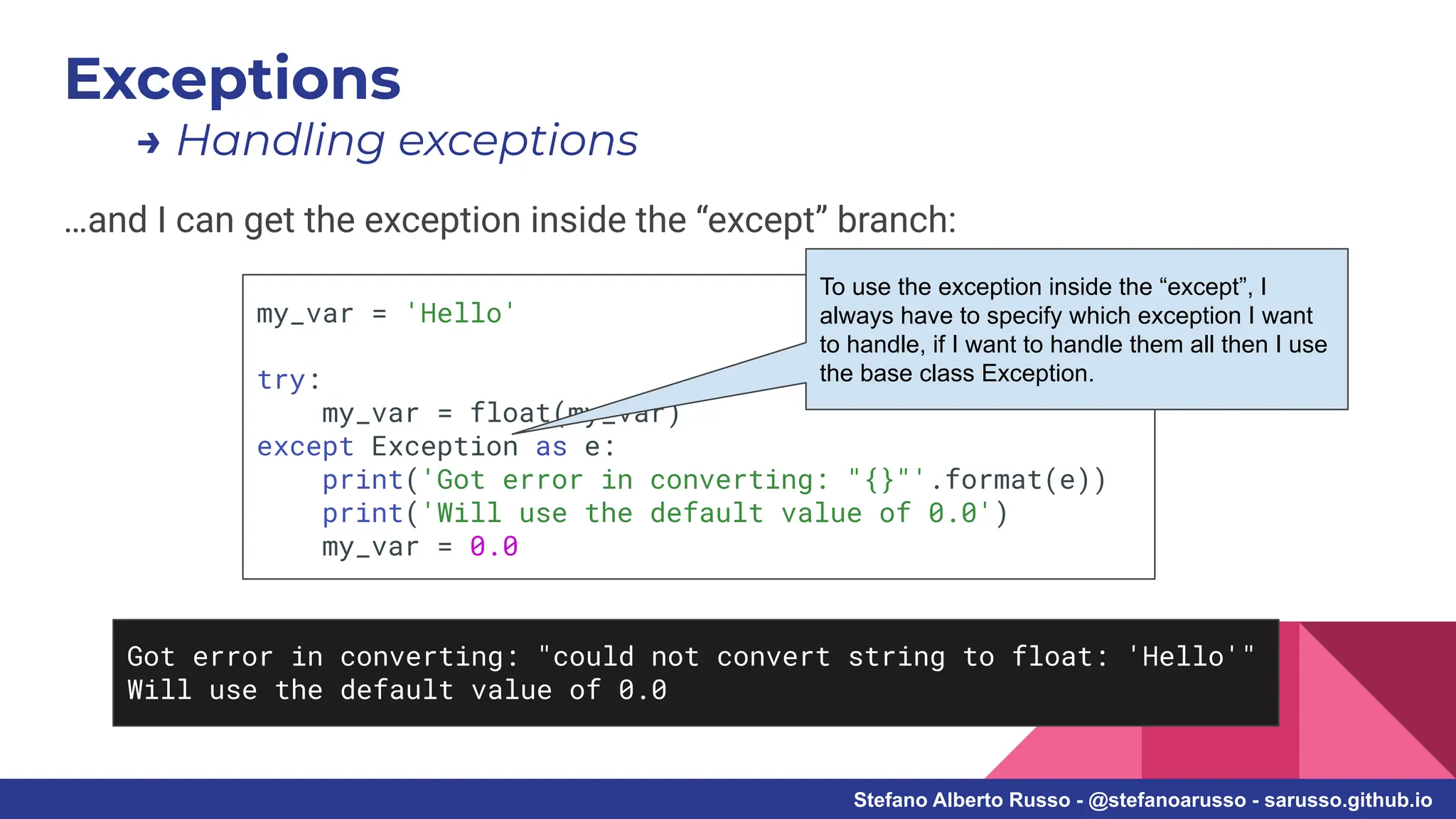
…and I can get the exception inside the “except” branch:
Exceptions
→ Handling exceptions
Got error in converting: "could not convert string to float: 'Hello'"
Will use the default value of 0.0
my_var = 'Hello'
try:
my_var = float(my_var)
except Exception as e:
print('Got error in converting: "{}"'.format(e))
print('Will use the default value of 0.0')
my_var = 0.0
To use the exception inside the “except”, I
always have to specify which exception I want
to handle, if I want to handle them all then I use
the base class Exception.
13.
Stefano Alberto Russo- @stefanoarusso - sarusso.github.io
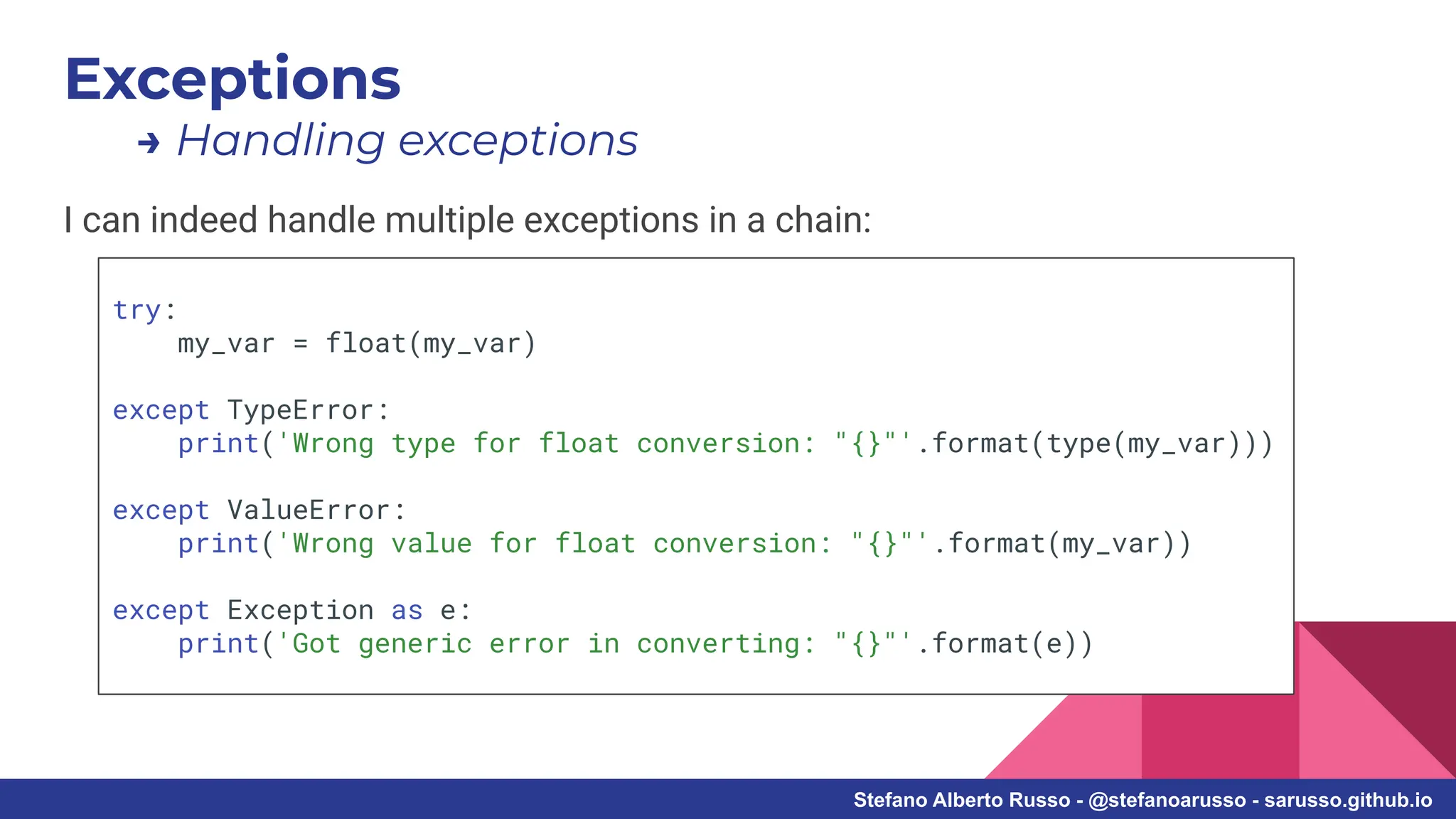
I can indeed handle multiple exceptions in a chain:
Exceptions
→ Handling exceptions
try:
my_var = float(my_var)
except TypeError:
print('Wrong type for float conversion: "{}"'.format(type(my_var)))
except ValueError:
print('Wrong value for float conversion: "{}"'.format(my_var))
except Exception as e:
print('Got generic error in converting: "{}"'.format(e))
14.
Stefano Alberto Russo- @stefanoarusso - sarusso.github.io
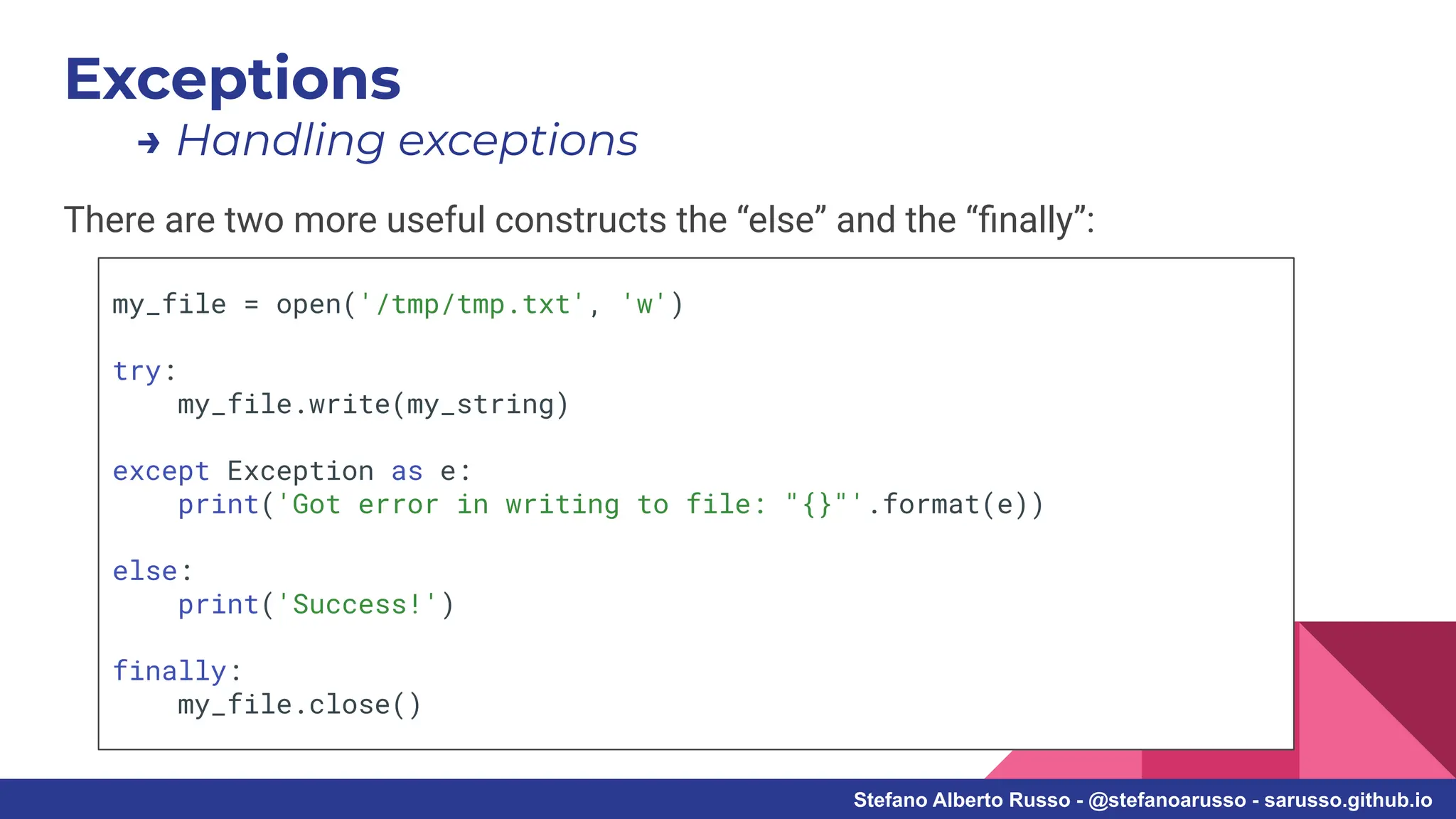
There are two more useful constructs the “else” and the “finally”:
Exceptions
→ Handling exceptions
my_file = open('/tmp/tmp.txt', 'w')
try:
my_file.write(my_string)
except Exception as e:
print('Got error in writing to file: "{}"'.format(e))
else:
print('Success!')
finally:
my_file.close()
15.
Stefano Alberto Russo- @stefanoarusso - sarusso.github.io
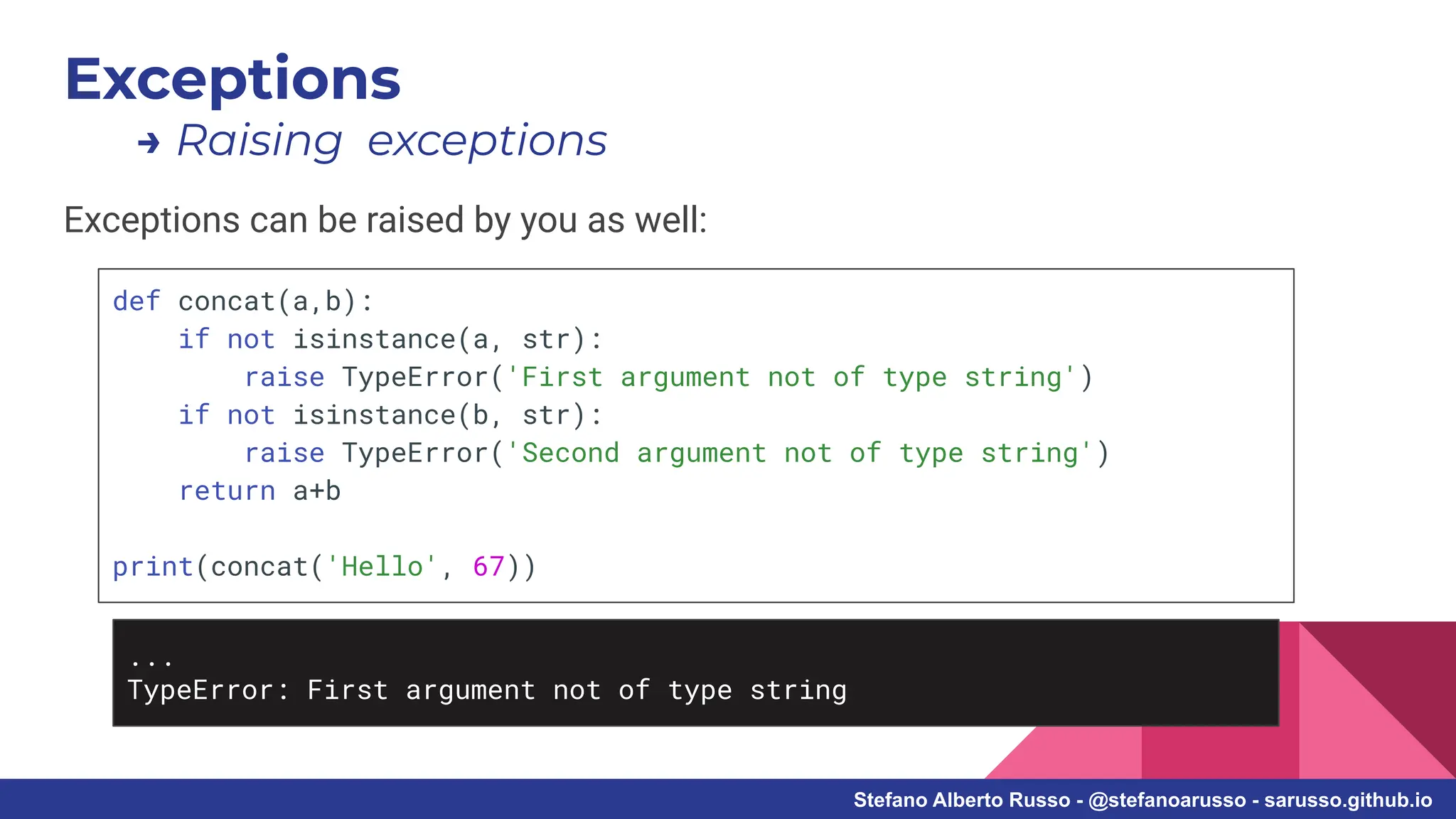
Exceptions can be raised by you as well:
Exceptions
→ Raising exceptions
def concat(a,b):
if not isinstance(a, str):
raise TypeError('First argument not of type string')
if not isinstance(b, str):
raise TypeError('Second argument not of type string')
return a+b
print(concat('Hello', 67))
...
TypeError: First argument not of type string
16.
Stefano Alberto Russo- @stefanoarusso - sarusso.github.io
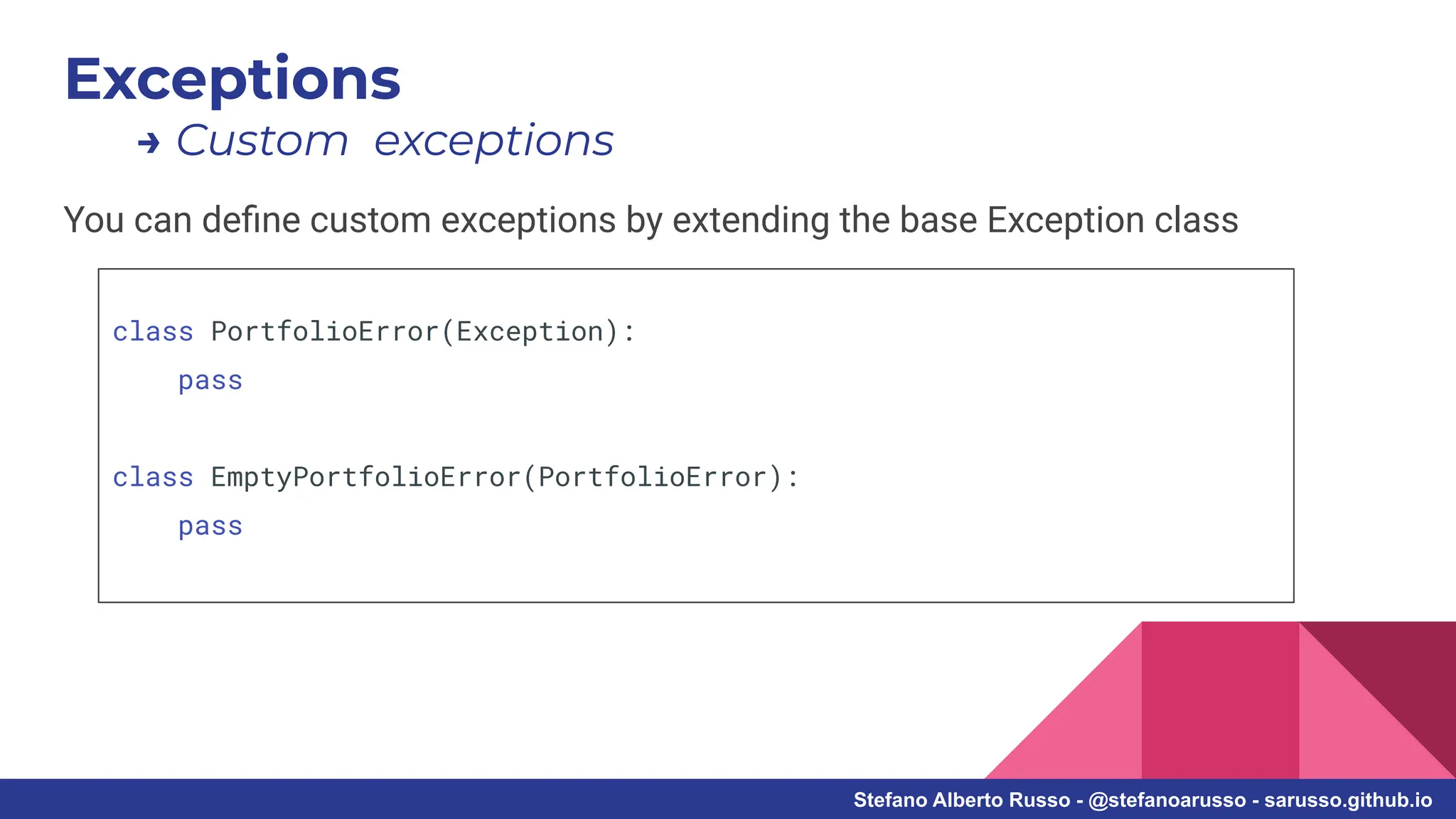
You can define custom exceptions by extending the base Exception class
Exceptions
→ Custom exceptions
class PortfolioError(Exception):
pass
class EmptyPortfolioError(PortfolioError):
pass
17.
Stefano Alberto Russo- @stefanoarusso - sarusso.github.io
Exceptions
→ Raising exceptions
def do_stuff(portfolio):
try:
first_portfolio_item = portfolio[0]
except IndexError:
raise EmptyPortfolioError('Portfolio is empty') from None
do_stuff([])
...
__main__.EmptyPortfolioError: Portfolio is empty
And you can also catch and re-raise
18.
Stefano Alberto Russo- @stefanoarusso - sarusso.github.io
End of part III
→ Questions?
Next: exercise 3
19.
Stefano Alberto Russo- @stefanoarusso - sarusso.github.io
Exercise 3
Add proper exception handling and raising to the IncrementModel
and FitIncrementModel.
Try to score up in the autograding!
![Stefano Alberto Russo - @stefanoarusso - sarusso.github.io
Exceptions
→ Raising exceptions
def do_stuff(portfolio):
try:
first_portfolio_item = portfolio[0]
except IndexError:
raise EmptyPortfolioError('Portfolio is empty') from None
do_stuff([])
...
__main__.EmptyPortfolioError: Portfolio is empty
And you can also catch and re-raise](https://image.slidesharecdn.com/pythonadvancedcourse-partiii-250504025103-9a579438/75/Python-Advanced-Course-part-III-pdf-for-Python-17-2048.jpg)