Download as PDF, PPTX
![Since this talk is an interactive notebook, no code will be hidden. Here are the required
packages:
In [1]:
Not on SWAN: cython, cppyy
SWIG is also needed but not a python module
Using Anaconda recommended for users not using SWAN
!pip install --user cffi pybind11 numba
# Other requirements: cython cppyy (SWIG is also needed but not a python module)
# Using Anaconda recommended for users not using SWAN
Requirement already satisfied: cffi in /eos/user/h/hschrein/.local/lib/pytho
n3.6/site-packages
Requirement already satisfied: pybind11 in /eos/user/h/hschrein/.local/lib/p
ython3.6/site-packages
Requirement already satisfied: numba in /cvmfs/sft-nightlies.cern.ch/lcg/vie
ws/dev3python3/Wed/x86_64-slc6-gcc62-opt/lib/python3.6/site-packages
Requirement already satisfied: pycparser in /eos/user/h/hschrein/.local/lib/
python3.6/site-packages (from cffi)
Requirement already satisfied: llvmlite in /eos/user/h/hschrein/.local/lib/p
ython3.6/site-packages (from numba)
Requirement already satisfied: numpy in /cvmfs/sft-nightlies.cern.ch/lcg/vie
ws/dev3python3/Wed/x86_64-slc6-gcc62-opt/lib/python3.6/site-packages (from n
umba)
You are using pip version 9.0.3, however version 10.0.1 is available.
You should consider upgrading via the 'pip install --upgrade pip' command.](https://image.slidesharecdn.com/pyheptalks-181130124602/75/PyHEP-2018-Tools-to-bind-to-Python-6-2048.jpg)
![And, here are the standard imports. We will also add two variables to help with compiling:
In [2]: from __future__ import print_function
import os
import sys
from pybind11 import get_include
inc = '-I ' + get_include(user=True) + ' -I ' + get_include(user=False)
plat = '-undefined dynamic_lookup' if 'darwin' in sys.platform else '-fPIC'
print('inc:', inc)
print('plat:', plat)
inc: -I /eos/user/h/hschrein/.local/include/python3.6m -I /cvmfs/sft-nightli
es.cern.ch/lcg/nightlies/dev3python3/Wed/Python/3.6.5/x86_64-slc6-gcc62-opt/
include/python3.6m
plat: -fPIC](https://image.slidesharecdn.com/pyheptalks-181130124602/75/PyHEP-2018-Tools-to-bind-to-Python-7-2048.jpg)
![What is meant by bindings?
Bindings allow a function(alitiy) in a library to be accessed from Python.
We will start with this example:
In [3]:
Desired usage in Python:
%%writefile simple.c
float square(float x) {
return x*x;
}
y = square(x)
Overwriting simple.c](https://image.slidesharecdn.com/pyheptalks-181130124602/75/PyHEP-2018-Tools-to-bind-to-Python-8-2048.jpg)
![C bindings are very easy. Just compile into a shared library, then open it in python with the
built in module:
In [4]:
In [5]:
This may be all you need! Example:
Python interface.
In for iOS, we can even use
ctypes to access Apple's public APIs!
ctypes
(https://docs.python.org/3.7/library/ctypes.html)
ctypes (https://docs.python.org/3.7/library/ctypes.html)
!cc simple.c -shared -o simple.so
from ctypes import cdll, c_float
lib = cdll.LoadLibrary('./simple.so')
lib.square.argtypes = (c_float,)
lib.square.restype = c_float
lib.square(2.0)
AmpGen
(https://gitlab.cern.ch/lhcb/Gauss/blob/LHCBGAUSS-
1058.AmpGenDev/Gen/AmpGen/options/ampgen.py)
Pythonista (http://omz-software.com/pythonista/)
Out[5]: 4.0](https://image.slidesharecdn.com/pyheptalks-181130124602/75/PyHEP-2018-Tools-to-bind-to-Python-9-2048.jpg)
![The C Foreign Function Interface for Python
Still C only
Developed for PyPy, but available in CPython too
The same example as before:
In [6]:
CFFI
(http://cffi.readthedocs.io/en/latest/overview.html)
from cffi import FFI
ffi = FFI()
ffi.cdef("float square(float);")
C = ffi.dlopen('./simple.so')
C.square(2.0)
Out[6]: 4.0](https://image.slidesharecdn.com/pyheptalks-181130124602/75/PyHEP-2018-Tools-to-bind-to-Python-10-2048.jpg)
![In [7]: %%writefile pysimple.c
#include <Python.h>
float square(float x) {return x*x; }
static PyObject* square_wrapper(PyObject* self, PyObject* args) {
float input, result;
if (!PyArg_ParseTuple(args, "f", &input)) {return NULL;}
result = square(input);
return PyFloat_FromDouble(result);}
static PyMethodDef pysimple_methods[] = {
{ "square", square_wrapper, METH_VARARGS, "Square function" },
{ NULL, NULL, 0, NULL } };
#if PY_MAJOR_VERSION >= 3
static struct PyModuleDef pysimple_module = {
PyModuleDef_HEAD_INIT, "pysimple", NULL, -1, pysimple_methods};
PyMODINIT_FUNC PyInit_pysimple(void) {
return PyModule_Create(&pysimple_module); }
#else
DL_EXPORT(void) initpysimple(void) {
Py_InitModule("pysimple", pysimple_methods); }
#endif
Overwriting pysimple.c](https://image.slidesharecdn.com/pyheptalks-181130124602/75/PyHEP-2018-Tools-to-bind-to-Python-12-2048.jpg)
![Build:
In [8]:
Run:
In [9]:
!cc {inc} -shared -o pysimple.so pysimple.c {plat}
import pysimple
pysimple.square(2.0)
Out[9]: 4.0](https://image.slidesharecdn.com/pyheptalks-181130124602/75/PyHEP-2018-Tools-to-bind-to-Python-13-2048.jpg)
![This is our C++ example:
In [10]: %%writefile SimpleClass.hpp
#pragma once
class Simple {
int x;
public:
Simple(int x): x(x) {}
int get() const {return x;}
};
Overwriting SimpleClass.hpp](https://image.slidesharecdn.com/pyheptalks-181130124602/75/PyHEP-2018-Tools-to-bind-to-Python-15-2048.jpg)
![In [11]:
In [12]:
%%writefile SimpleSWIG.i
%module simpleswig
%{
/* Includes the header in the wrapper code */
#include "SimpleClass.hpp"
%}
/* Parse the header file to generate wrappers */
%include "SimpleClass.hpp"
!swig -swiglib
Overwriting SimpleSWIG.i
/build/jenkins/workspace/install/swig/3.0.12/x86_64-slc6-gcc62-opt/share/swi
g/3.0.12](https://image.slidesharecdn.com/pyheptalks-181130124602/75/PyHEP-2018-Tools-to-bind-to-Python-17-2048.jpg)
![SWAN/LxPlus only:
We need to fix the SWIG_LIB path if we are using LCG's version of SWIG (such as on
SWAN)
In [13]: if 'LCG_VIEW' in os.environ:
swiglibold = !swig -swiglib
swigloc = swiglibold[0].split('/')[-3:]
swiglib = os.path.join(os.environ['LCG_VIEW'], *swigloc)
os.environ['SWIG_LIB'] = swiglib](https://image.slidesharecdn.com/pyheptalks-181130124602/75/PyHEP-2018-Tools-to-bind-to-Python-18-2048.jpg)
![In [14]:
In [15]:
In [16]:
!swig -python -c++ SimpleSWIG.i
!c++ -shared SimpleSWIG_wrap.cxx {inc} -o _simpleswig.so {plat}
import simpleswig
x = simpleswig.Simple(2)
x.get()
Out[16]: 2](https://image.slidesharecdn.com/pyheptalks-181130124602/75/PyHEP-2018-Tools-to-bind-to-Python-19-2048.jpg)
![Aside: Speed comparison Python, Cython,
In [17]:
In [18]:
Numba
(https://numba.pydata.org)
def f(x):
for _ in range(100000000):
x=x+1
return x
%%time
f(1)
Out[18]:
CPU times: user 6.88 s, sys: 0 ns, total: 6.88 s
Wall time: 6.88 s
100000001](https://image.slidesharecdn.com/pyheptalks-181130124602/75/PyHEP-2018-Tools-to-bind-to-Python-21-2048.jpg)
![In [19]:
In [20]:
In [21]:
%load_ext Cython
%%cython
def f(int x):
for _ in range(10000000):
x=x+1
return x
%%timeit
f(23)
69.7 ns ± 9.78 ns per loop (mean ± std. dev. of 7 runs, 10000000 loops each)](https://image.slidesharecdn.com/pyheptalks-181130124602/75/PyHEP-2018-Tools-to-bind-to-Python-22-2048.jpg)
![In [22]:
In [23]:
In [24]:
import numba
@numba.jit
def f(x):
for _ in range(10000000):
x=x+1
return x
%time
f(41)
%%timeit
f(41)
Out[23]:
CPU times: user 0 ns, sys: 11 µs, total: 11 µs
Wall time: 56.3 µs
10000041
268 ns ± 12.9 ns per loop (mean ± std. dev. of 7 runs, 1000000 loops each)](https://image.slidesharecdn.com/pyheptalks-181130124602/75/PyHEP-2018-Tools-to-bind-to-Python-23-2048.jpg)
![Binding with
In [25]:
Cython (https://cython.org)
%%writefile simpleclass.pxd
# distutils: language = c++
cdef extern from "SimpleClass.hpp":
cdef cppclass Simple:
Simple(int x)
int get()
Overwriting simpleclass.pxd](https://image.slidesharecdn.com/pyheptalks-181130124602/75/PyHEP-2018-Tools-to-bind-to-Python-24-2048.jpg)
![In [26]: %%writefile cythonclass.pyx
# distutils: language = c++
from simpleclass cimport Simple as cSimple
cdef class Simple:
cdef cSimple *cself
def __cinit__(self, int x):
self.cself = new cSimple(x)
def get(self):
return self.cself.get()
def __dealloc__(self):
del self.cself
Overwriting cythonclass.pyx](https://image.slidesharecdn.com/pyheptalks-181130124602/75/PyHEP-2018-Tools-to-bind-to-Python-25-2048.jpg)
![In [27]:
In [28]:
In [29]:
!cythonize cythonclass.pyx
!g++ cythonclass.cpp -shared {inc} -o cythonclass.so {plat}
import cythonclass
x = cythonclass.Simple(3)
x.get()
Compiling /eos/user/h/hschrein/SWAN_projects/pybindings_cc/cythonclass.pyx b
ecause it changed.
[1/1] Cythonizing /eos/user/h/hschrein/SWAN_projects/pybindings_cc/cythoncla
ss.pyx
Out[29]: 3](https://image.slidesharecdn.com/pyheptalks-181130124602/75/PyHEP-2018-Tools-to-bind-to-Python-26-2048.jpg)
![Similar to Boost::Python, but easier to build
Pure C++11 (no new language required), no dependencies
Builds remain simple and don't require preprocessing
Easy to customize result
Great Gitter community
Used in for CUDA too
Downsides:
(http://pybind11.readthedocs.io/en/stable/)
GooFit 2.1+ (https://goofit.github.io) [CHEP talk]
(https://indico.cern.ch/event/587955/contributions/2938087/)](https://image.slidesharecdn.com/pyheptalks-181130124602/75/PyHEP-2018-Tools-to-bind-to-Python-27-2048.jpg)
![In [30]: %%writefile pybindclass.cpp
#include <pybind11/pybind11.h>
#include "SimpleClass.hpp"
namespace py = pybind11;
PYBIND11_MODULE(pybindclass, m) {
py::class_<Simple>(m, "Simple")
.def(py::init<int>())
.def("get", &Simple::get)
;
}
Overwriting pybindclass.cpp](https://image.slidesharecdn.com/pyheptalks-181130124602/75/PyHEP-2018-Tools-to-bind-to-Python-28-2048.jpg)
![In [31]:
In [32]:
!c++ -std=c++11 pybindclass.cpp -shared {inc} -o pybindclass.so {plat}
import pybindclass
x = pybindclass.Simple(4)
x.get()
Out[32]: 4](https://image.slidesharecdn.com/pyheptalks-181130124602/75/PyHEP-2018-Tools-to-bind-to-Python-29-2048.jpg)
![Born from ROOT bindings
Built on top of Cling
JIT, so can handle templates
See Enric's talk for more
Downsides:
Header code runs in Cling
Heavy user requirements (Cling)
ROOT vs. pip version
Broken on SWAN (so will not show working example here)
CPPYY (http://cppyy.readthedocs.io/en/latest/)
In [1]: import cppyy](https://image.slidesharecdn.com/pyheptalks-181130124602/75/PyHEP-2018-Tools-to-bind-to-Python-30-2048.jpg)
![In [2]: cppyy.include('SimpleClass.hpp')
x = cppyy.gbl.Simple(5)
x.get()
---------------------------------------------------------------------------
AttributeError Traceback (most recent call last)
<ipython-input-2-d0b91c309081> in <module>()
----> 1 cppyy.include('SimpleClass.hpp')
2 x = cppyy.gbl.Simple(5)
3 x.get()
AttributeError: module 'cppyy' has no attribute 'include'](https://image.slidesharecdn.com/pyheptalks-181130124602/75/PyHEP-2018-Tools-to-bind-to-Python-31-2048.jpg)
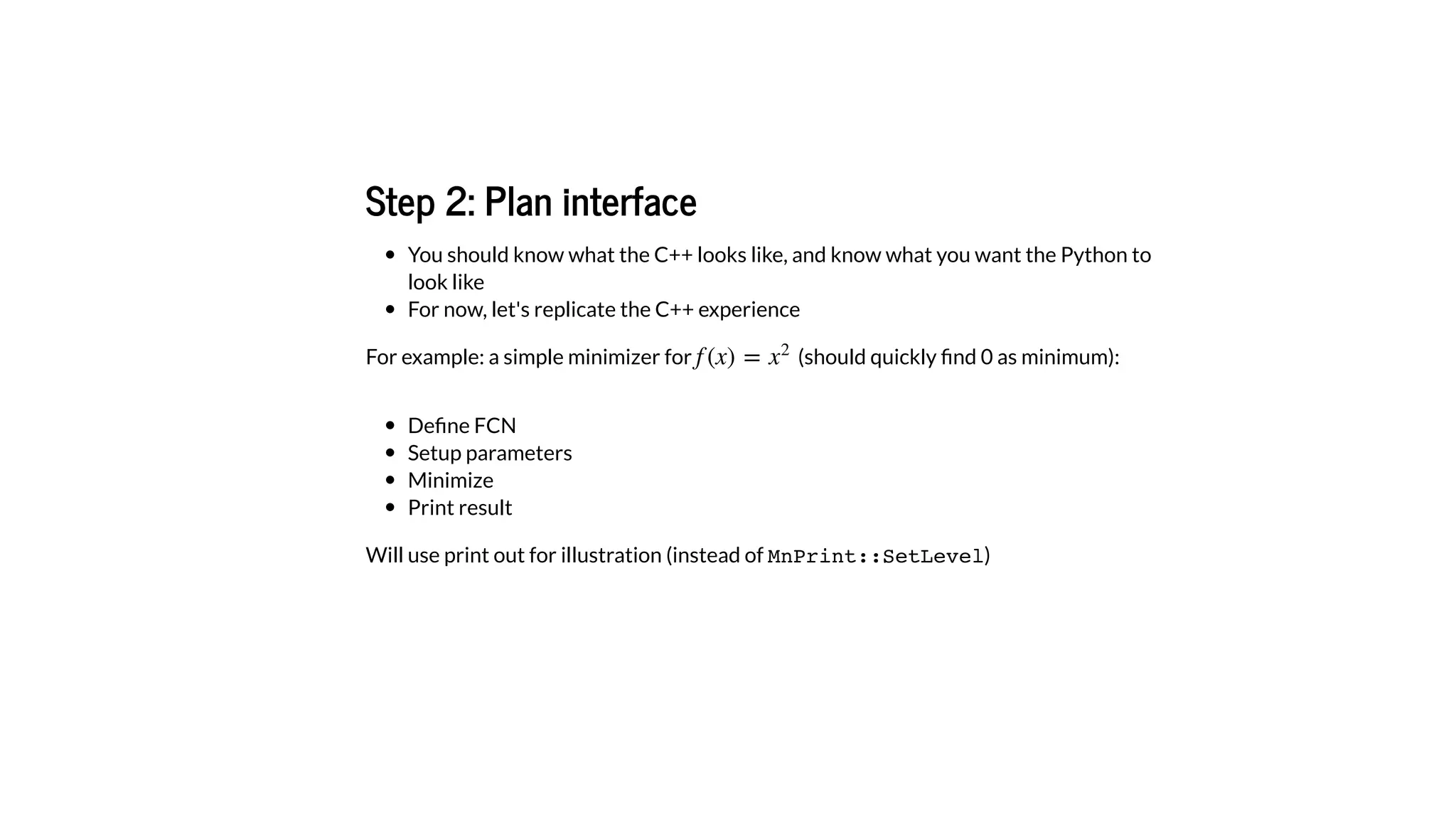
![In [1]: %%writefile SimpleFCN.h
#pragma once
#include <Minuit2/FCNBase.h>
#include <Minuit2/FunctionMinimum.h>
#include <Minuit2/MnPrint.h>
#include <Minuit2/MnMigrad.h>
using namespace ROOT::Minuit2;
class SimpleFCN : public FCNBase {
double Up() const override {return 0.5;}
double operator()(const std::vector<double> &v) const override {
std::cout << "val = " << v.at(0) << std::endl;
return v.at(0)*v.at(0);
}
};
Overwriting SimpleFCN.h](https://image.slidesharecdn.com/pyheptalks-181130124602/75/PyHEP-2018-Tools-to-bind-to-Python-36-2048.jpg)
![In [2]: %%writefile simpleminuit.cpp
#include "SimpleFCN.h"
int main() {
SimpleFCN fcn;
MnUserParameters upar;
upar.Add("x", 1., 0.1);
MnMigrad migrad(fcn, upar);
FunctionMinimum min = migrad();
std::cout << min << std::endl;
}
Overwriting simpleminuit.cpp](https://image.slidesharecdn.com/pyheptalks-181130124602/75/PyHEP-2018-Tools-to-bind-to-Python-37-2048.jpg)
![In [3]: %%writefile CMakeLists.txt
cmake_minimum_required(VERSION 3.4)
project(Minuit2SimpleExamle LANGUAGES CXX)
add_subdirectory(minuit2src)
add_executable(simpleminuit simpleminuit.cpp SimpleFCN.h)
target_link_libraries(simpleminuit PRIVATE Minuit2::Minuit2)
Overwriting CMakeLists.txt](https://image.slidesharecdn.com/pyheptalks-181130124602/75/PyHEP-2018-Tools-to-bind-to-Python-38-2048.jpg)
![Standard CMake configure and build (using Ninja instead of Make for speed)
In [4]: !cmake -GNinja .
!cmake --build .
-- Configuring done
-- Generating done
-- Build files have been written to: /eos/user/h/hschrein/SWAN_projects/pybi
ndings_cc
[2/2] Linking CXX executable simpleminuitinuit.dir/simpleminuit.cpp.o](https://image.slidesharecdn.com/pyheptalks-181130124602/75/PyHEP-2018-Tools-to-bind-to-Python-39-2048.jpg)
![In [5]: !./simpleminuit
val = 1
val = 1.001
val = 0.999
val = 1.0006
val = 0.999402
val = -8.23008e-11
val = 0.000345267
val = -0.000345267
val = -8.23008e-11
val = 0.000345267
val = -0.000345267
val = 6.90533e-05
val = -6.90535e-05
Minuit did successfully converge.
# of function calls: 13
minimum function Value: 6.773427082119e-21
minimum edm: 6.773427081817e-21
minimum internal state vector: LAVector parameters:
-8.230083281546e-11
minimum internal covariance matrix: LASymMatrix parameters:
1
# ext. || Name || type || Value || Error +/-
0 || x || free || -8.230083281546e-11 ||0.7071067811865](https://image.slidesharecdn.com/pyheptalks-181130124602/75/PyHEP-2018-Tools-to-bind-to-Python-40-2048.jpg)
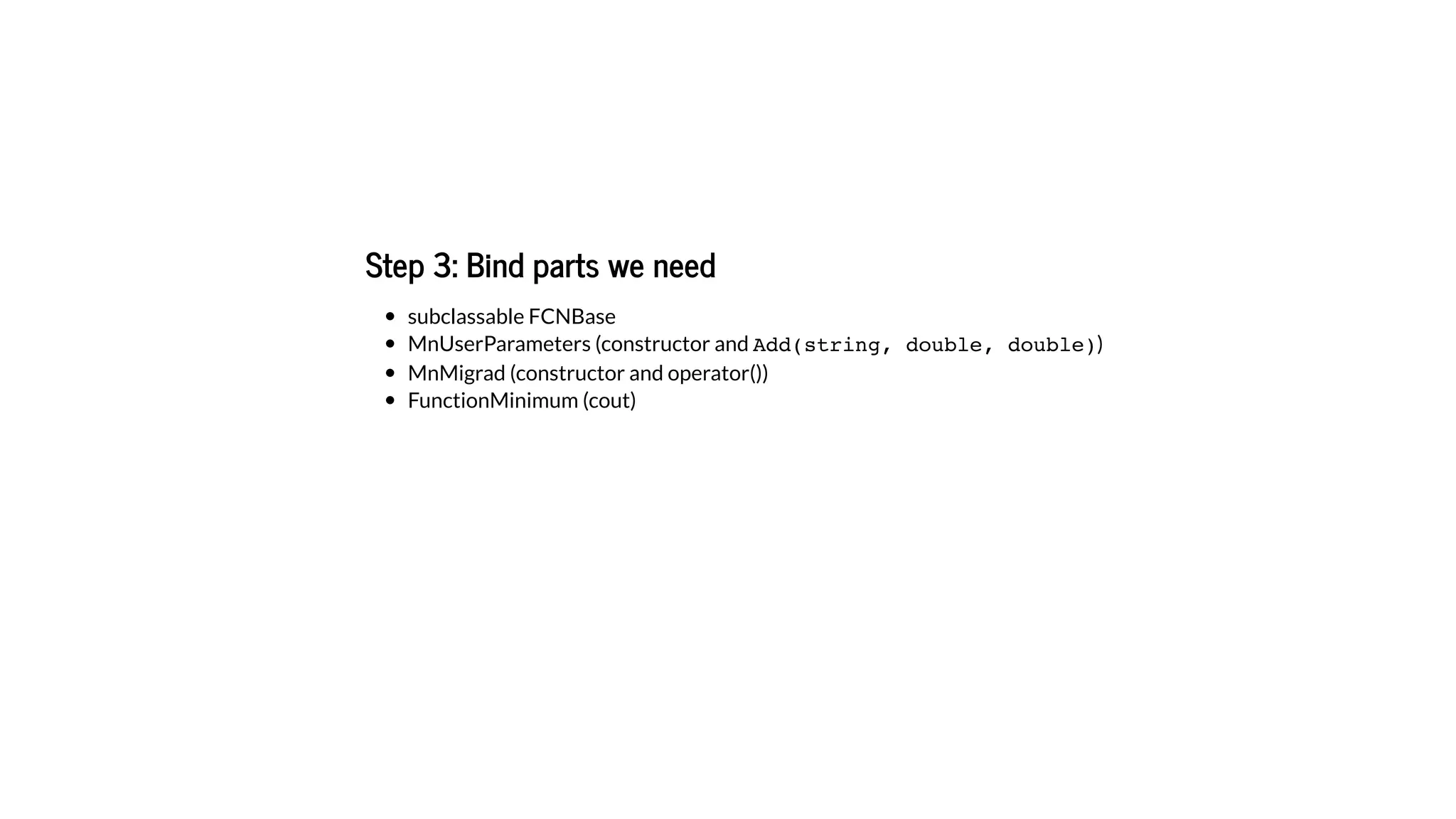
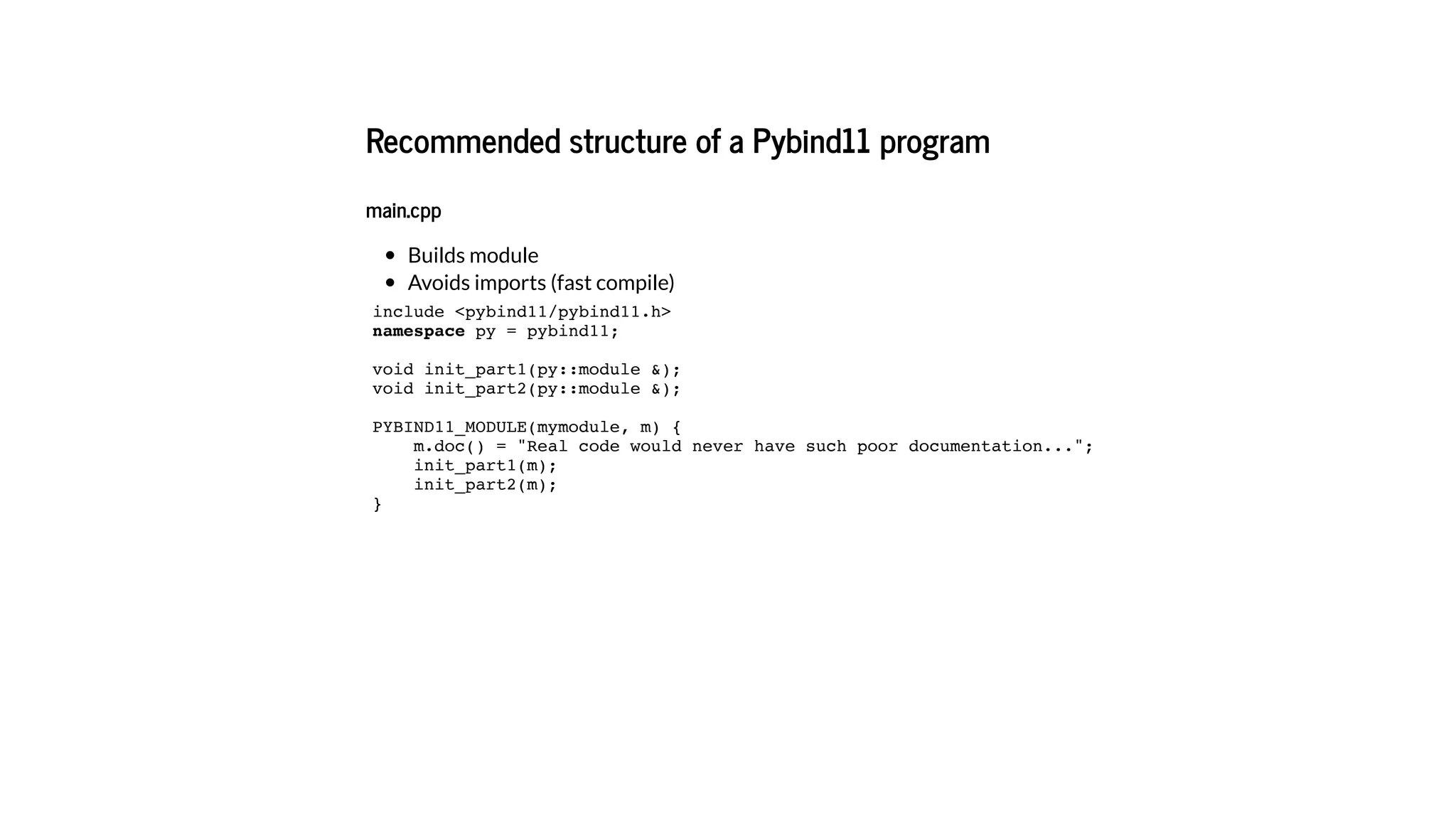
![In [6]:
In [7]:
mkdir -p pyminuit2
%%writefile pyminuit2/pyminuit2.cpp
#include <pybind11/pybind11.h>
namespace py = pybind11;
void init_FCNBase(py::module &);
void init_MnUserParameters(py::module &);
void init_MnMigrad(py::module &);
void init_FunctionMinimum(py::module &);
PYBIND11_MODULE(minuit2, m) {
init_FCNBase(m);
init_MnUserParameters(m);
init_MnMigrad(m);
init_FunctionMinimum(m);
}
Overwriting pyminuit2/pyminuit2.cpp](https://image.slidesharecdn.com/pyheptalks-181130124602/75/PyHEP-2018-Tools-to-bind-to-Python-43-2048.jpg)
![We will put all headers in a collective header (not a good idea unless you are trying to show
files one per slide).
In [8]: %%writefile pyminuit2/PyHeader.h
#pragma once
#include <pybind11/pybind11.h>
#include <pybind11/functional.h>
#include <pybind11/numpy.h>
#include <pybind11/stl.h>
#include <Minuit2/FCNBase.h>
#include <Minuit2/MnMigrad.h>
#include <Minuit2/MnApplication.h>
#include <Minuit2/MnUserParameters.h>
#include <Minuit2/FunctionMinimum.h>
namespace py = pybind11;
using namespace pybind11::literals;
using namespace ROOT::Minuit2;
Overwriting pyminuit2/PyHeader.h](https://image.slidesharecdn.com/pyheptalks-181130124602/75/PyHEP-2018-Tools-to-bind-to-Python-44-2048.jpg)
![Overloads
Pure virtual methods cannot be instantiated in C++
Have to provide "Trampoline class" to provide Python class
In [9]: %%writefile pyminuit2/FCNBase.cpp
#include "PyHeader.h"
class PyFCNBase : public FCNBase {
public:
using FCNBase::FCNBase;
double operator()(const std::vector<double> &v) const override {
PYBIND11_OVERLOAD_PURE_NAME(
double, FCNBase, "__call__", operator(), v);}
double Up() const override {
PYBIND11_OVERLOAD_PURE(double, FCNBase, Up, );}
};
void init_FCNBase(py::module &m) {
py::class_<FCNBase, PyFCNBase>(m, "FCNBase")
.def(py::init<>())
.def("__call__", &FCNBase::operator())
.def("Up", &FCNBase::Up);
}
Overwriting pyminuit2/FCNBase.cpp](https://image.slidesharecdn.com/pyheptalks-181130124602/75/PyHEP-2018-Tools-to-bind-to-Python-45-2048.jpg)
![Overloaded function signatures:
C++11 syntax: (bool (MnUserParameters::*)(const std::string
&, double)) &MnUserParameters::Add
C++14 syntax: py::overload_cast<const std::string &, double>
(&MnUserParameters::Add)
In [10]: %%writefile pyminuit2/MnUserParameters.cpp
#include "PyHeader.h"
void init_MnUserParameters(py::module &m) {
py::class_<MnUserParameters>(m, "MnUserParameters")
.def(py::init<>())
.def("Add", (bool (MnUserParameters::*)(const std::string &, double)) &M
nUserParameters::Add)
.def("Add", (bool (MnUserParameters::*)(const std::string &, double, dou
ble)) &MnUserParameters::Add)
;
}
Overwriting pyminuit2/MnUserParameters.cpp](https://image.slidesharecdn.com/pyheptalks-181130124602/75/PyHEP-2018-Tools-to-bind-to-Python-46-2048.jpg)
![Adding default arguments (and named arguments)
Using ""_a literal, names and even defaults can be added
In [11]: %%writefile pyminuit2/MnMigrad.cpp
#include "PyHeader.h"
void init_MnMigrad(py::module &m) {
py::class_<MnApplication>(m, "MnApplication")
.def("__call__",
&MnApplication::operator(),
"Minimize the function, returns a function minimum",
"maxfcn"_a = 0,
"tolerance"_a = 0.1);
py::class_<MnMigrad, MnApplication>(m, "MnMigrad")
.def(py::init<const FCNBase &, const MnUserParameters &, unsigned int>()
,
"fcn"_a, "par"_a, "stra"_a = 1)
;
}
Overwriting pyminuit2/MnMigrad.cpp](https://image.slidesharecdn.com/pyheptalks-181130124602/75/PyHEP-2018-Tools-to-bind-to-Python-47-2048.jpg)
![Lambda functions
Pybind11 accepts lambda functions, as well
In [12]: %%writefile pyminuit2/FunctionMinimum.cpp
#include "PyHeader.h"
#include <sstream>
#include <Minuit2/MnPrint.h>
void init_FunctionMinimum(py::module &m) {
py::class_<FunctionMinimum>(m, "FunctionMinimum")
.def("__str__", [](const FunctionMinimum &self) {
std::stringstream os;
os << self;
return os.str();
})
;
}
Overwriting pyminuit2/FunctionMinimum.cpp](https://image.slidesharecdn.com/pyheptalks-181130124602/75/PyHEP-2018-Tools-to-bind-to-Python-48-2048.jpg)
![In [13]: %%writefile CMakeLists.txt
cmake_minimum_required(VERSION 3.4)
project(Minuit2SimpleExamle LANGUAGES CXX)
set(CMAKE_POSITION_INDEPENDENT_CODE ON)
add_subdirectory(minuit2src)
add_executable(simpleminuit simpleminuit.cpp SimpleFCN.h)
target_link_libraries(simpleminuit PRIVATE Minuit2::Minuit2)
add_subdirectory(pybind11)
file(GLOB OUTPUT pyminuit2/*.cpp)
pybind11_add_module(minuit2 ${OUTPUT})
target_link_libraries(minuit2 PUBLIC Minuit2::Minuit2)
Overwriting CMakeLists.txt](https://image.slidesharecdn.com/pyheptalks-181130124602/75/PyHEP-2018-Tools-to-bind-to-Python-49-2048.jpg)
![In [14]: !cmake .
!cmake --build .
-- pybind11 v2.2.3
-- Configuring done
-- Generating done
-- Build files have been written to: /eos/user/h/hschrein/SWAN_projects/pybi
ndings_cc
[85/85] Linking CXX shared module minuit2.cpython-36m-x86_64-linux-gnu.so[Ko](https://image.slidesharecdn.com/pyheptalks-181130124602/75/PyHEP-2018-Tools-to-bind-to-Python-50-2048.jpg)
![Usage
We can now use our module! (Built in the current directory by CMake)
In [15]:
In [16]:
import sys
if '.' not in sys.path:
sys.path.append('.')
import minuit2
class SimpleFCN (minuit2.FCNBase):
def Up(self):
return 0.5
def __call__(self, v):
print("val =", v[0])
return v[0]**2;](https://image.slidesharecdn.com/pyheptalks-181130124602/75/PyHEP-2018-Tools-to-bind-to-Python-51-2048.jpg)
![In [17]: fcn = SimpleFCN()
upar = minuit2.MnUserParameters()
upar.Add("x", 1., 0.1)
migrad = minuit2.MnMigrad(fcn, upar)
min = migrad()
val = 1.0
val = 1.001
val = 0.999
val = 1.0005980198587356
val = 0.9994019801412644
val = -8.230083281546285e-11
val = 0.00034526688527999595
val = -0.0003452670498816616
val = -8.230083281546285e-11
val = 0.00034526688527999595
val = -0.0003452670498816616
val = 6.905331121533294e-05
val = -6.905347581699857e-05](https://image.slidesharecdn.com/pyheptalks-181130124602/75/PyHEP-2018-Tools-to-bind-to-Python-52-2048.jpg)
![In [18]: print(min)
Minuit did successfully converge.
# of function calls: 13
minimum function Value: 6.773427082119e-21
minimum edm: 6.773427081817e-21
minimum internal state vector: LAVector parameters:
-8.230083281546e-11
minimum internal covariance matrix: LASymMatrix parameters:
1
# ext. || Name || type || Value || Error +/-
0 || x || free || -8.230083281546e-11 ||0.7071067811865](https://image.slidesharecdn.com/pyheptalks-181130124602/75/PyHEP-2018-Tools-to-bind-to-Python-53-2048.jpg)
![Backup:
This is the setup.py file for the Miniut2 bindings. With this, you can use the standard
Python tools to build! (but slower and more verbose than CMake)
In [19]: %%writefile setup.py
from setuptools import setup, Extension
from setuptools.command.build_ext import build_ext
import sys
import setuptools
from pathlib import Path # Python 3 or Python 2 backport: pathlib2
import pybind11 # Real code should defer this import](https://image.slidesharecdn.com/pyheptalks-181130124602/75/PyHEP-2018-Tools-to-bind-to-Python-55-2048.jpg)
![sources = set(str(p) for p in Path('Minuit2-6.14.0-Source/src').glob('**/*.cxx')
)
sources.remove('Minuit2-6.14.0-Source/src/TMinuit2TraceObject.cxx')
## Add your sources to `sources`
sources |= set(str(p) for p in Path('pyminuit2').glob('*.cpp'))
ext_modules = [
Extension(
'minuit2',
list(sources),
include_dirs=[
pybind11.get_include(False),
pybind11.get_include(True),
'Minuit2-6.14.0-Source/inc',
],
language='c++',
define_macros=[('WARNINGMSG', None),
('MATH_NO_PLUGIN_MANAGER', None),
('ROOT_Math_VecTypes', None)
],
),
]
class BuildExt(build_ext):
"""A custom build extension for adding compiler-specific options."""
c_opts = {
'msvc': ['/EHsc'],
'unix': [],
}
if sys.platform == 'darwin':
c_opts['unix'] += ['-stdlib=libc++', '-mmacosx-version-min=10.7']
def build_extensions(self):
ct = self.compiler.compiler_type
opts = self.c_opts.get(ct, [])
if ct == 'unix':](https://image.slidesharecdn.com/pyheptalks-181130124602/75/PyHEP-2018-Tools-to-bind-to-Python-56-2048.jpg)
![opts.append('-DVERSION_INFO="%s"' % self.distribution.get_version())
opts.append('-std=c++14')
opts.append('-fvisibility=hidden')
elif ct == 'msvc':
opts.append('/DVERSION_INFO="%s"' % self.distribution.get_versio
n())
for ext in self.extensions:
ext.extra_compile_args = opts
build_ext.build_extensions(self)
setup(
name='minuit2',
version='6.14.0',
author='Henry Schriener',
author_email='hschrein@cern.ch',
url='https://github.com/GooFit/Minuit2',
description='A Pybind11 Minuit2 binding',
long_description='',
ext_modules=ext_modules,
install_requires=['pybind11>=2.2', 'numpy>=1.10'],
cmdclass={'build_ext': BuildExt},
zip_safe=False,
)
Overwriting setup.py](https://image.slidesharecdn.com/pyheptalks-181130124602/75/PyHEP-2018-Tools-to-bind-to-Python-57-2048.jpg)
![In [20]: #!python setup.py build_ext](https://image.slidesharecdn.com/pyheptalks-181130124602/75/PyHEP-2018-Tools-to-bind-to-Python-58-2048.jpg)

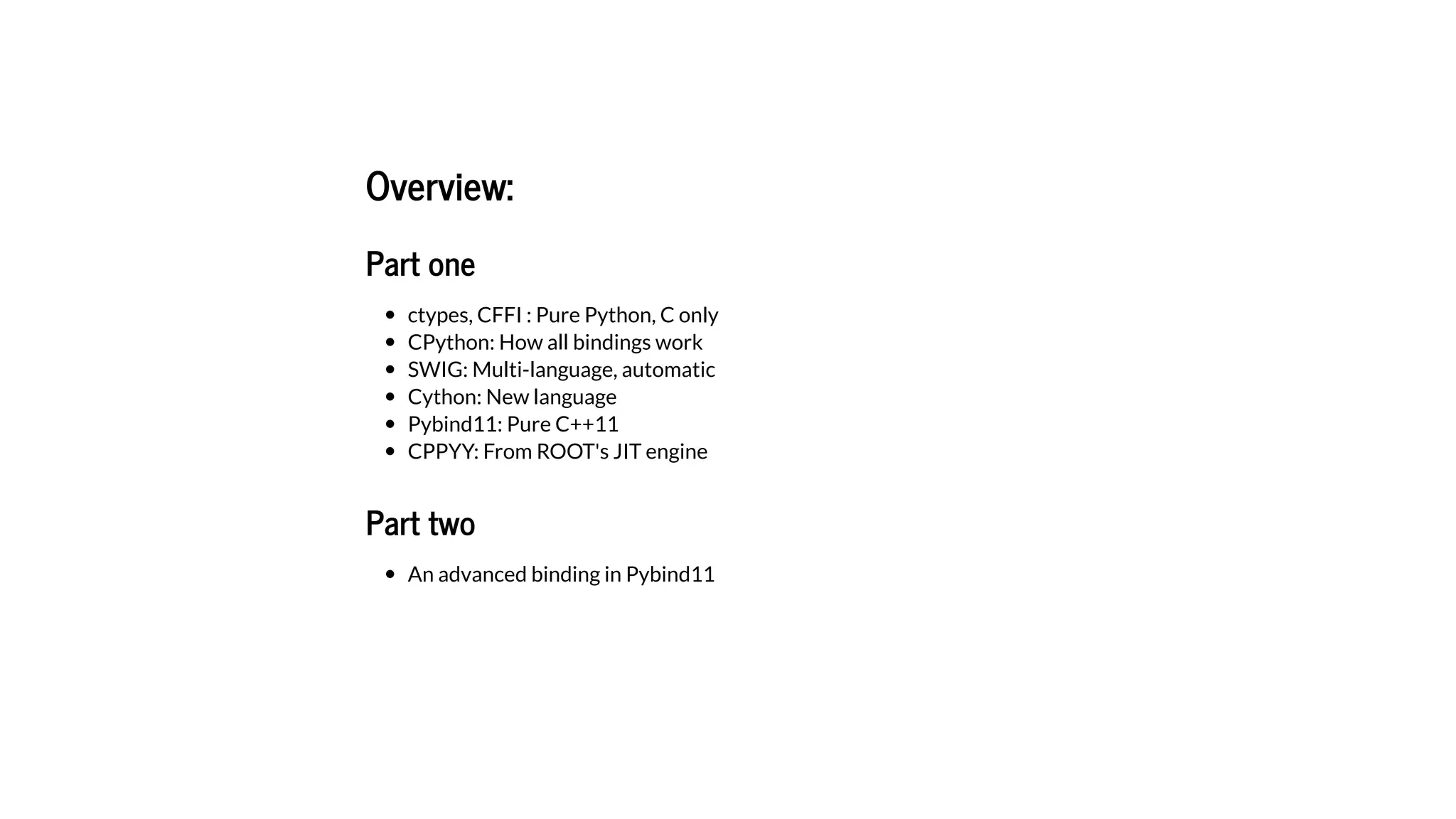
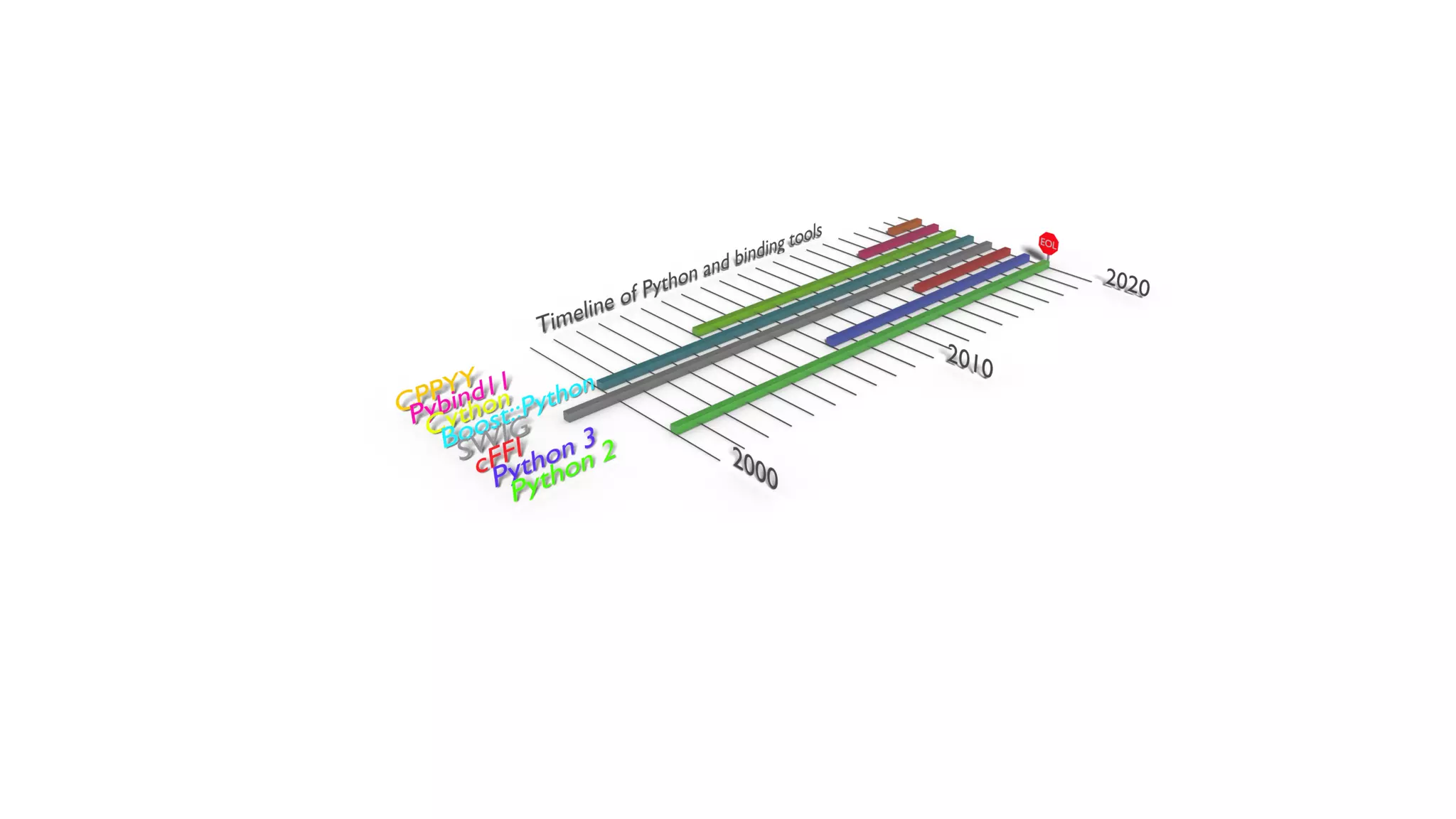
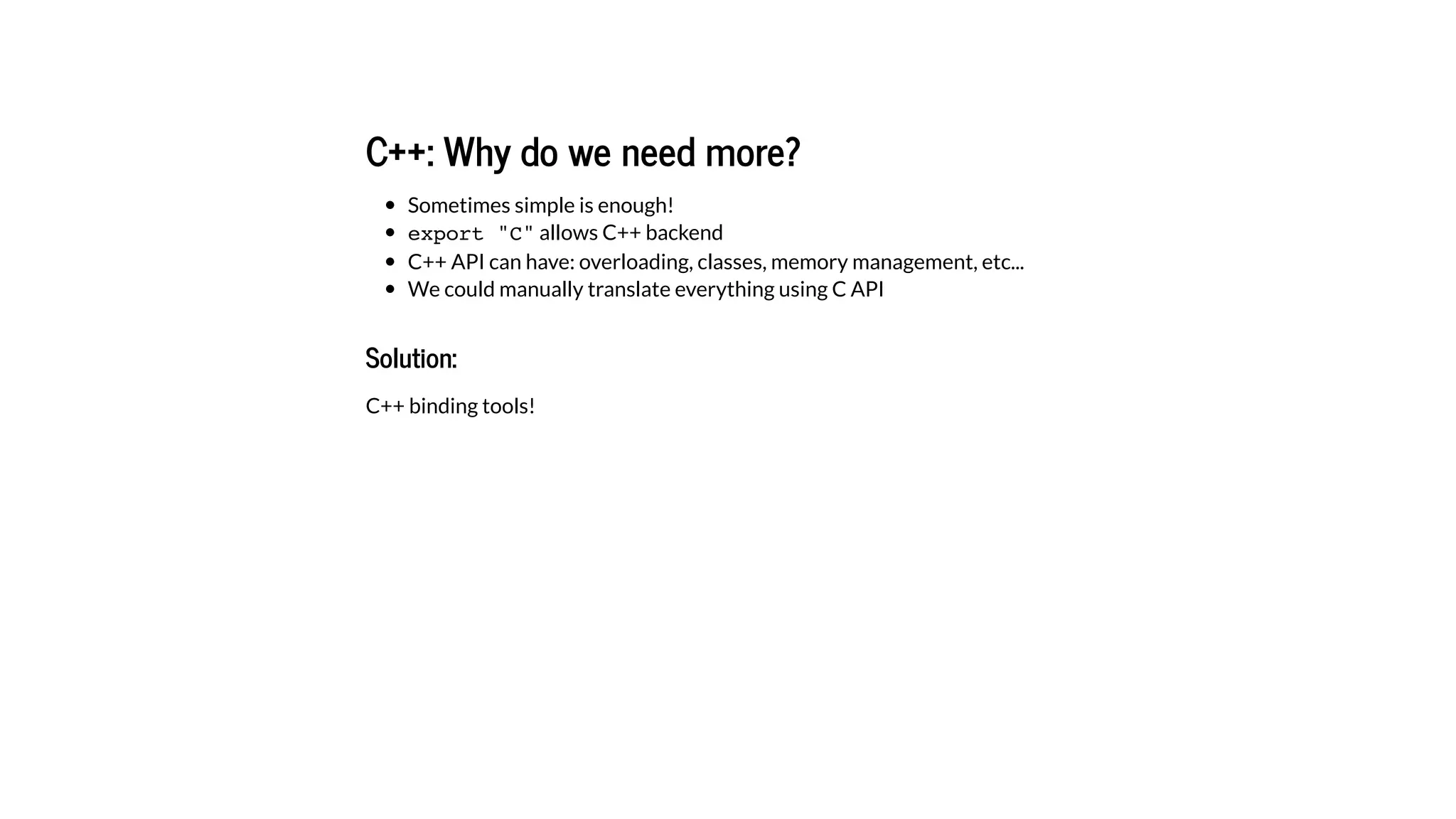
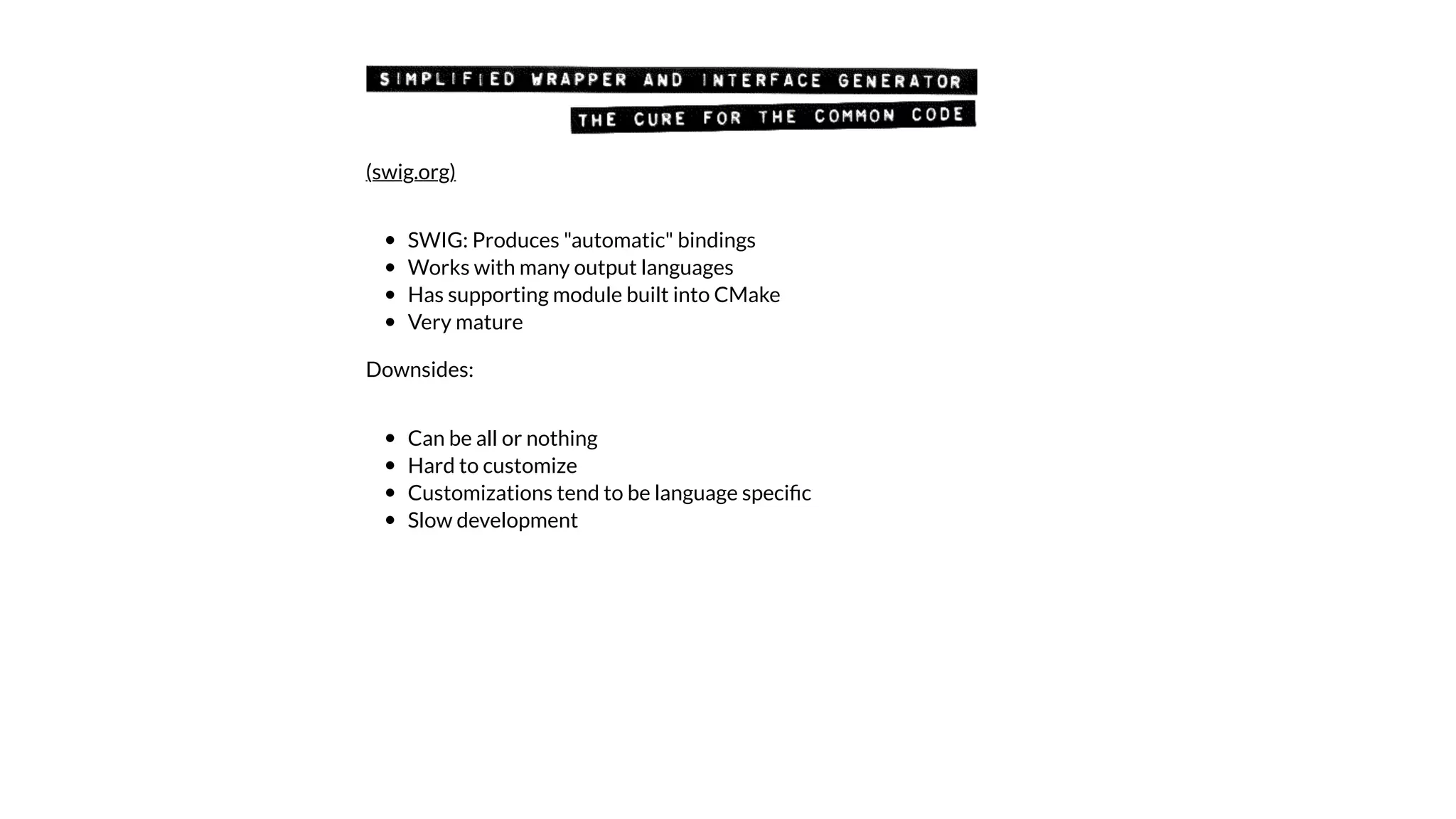
This document discusses tools for binding C/C++ code to Python. It begins with an overview of ctypes and CFFI for pure C bindings, and how CPython implements bindings internally. It then covers popular binding tools like SWIG, Cython, and Pybind11. For SWIG, a simple example is shown generating bindings for a C++ class. Later, a more detailed example is demonstrated using Pybind11 to bind the Minuit2 optimization library to Python.


