Student
Empowerment
Program
5units in
150minutes
series…
SYLLABUS
• Unit 1: Introduction to C++; Tokens, Keywords, Identifiers, Variables, Operators,
Manipulators, Expressions and Control Structures in C++; Pointers - Functions in C++ - Main
Function - Function Prototyping - Parameters Passing in Functions - Values Return by
Functions - Inline Functions - Friend and Virtual Functions
• Unit-2: Classes and Objects; Constructors and Destructors; and Operator Overloading and
Type Conversions - Type of Constructors - Function overloading. Inheritance: Single
Inheritance - Multilevel Inheritance - Multiple Inheritance - Hierarchical Inheritance - Hybrid
Inheritance. Pointers, Virtual Functions and Polymorphism; Managing Console I/O
operations.
• Unit 3: Working with Files: Classes for File Stream Operations - Opening and Closing a
File - End-of-File Deduction - File Pointers - Updating a File - Error Handling during File
Operations - Command-line Arguments. Data Structures: Definition of a Data
structure - primitive and composite Data Types, Asymptotic notations, Arrays, Operations on
Arrays, Order lists.
• Unit-4: Stacks - Applications of Stack - Infix to Postfix Conversion, Recursion, Maze Problems
- Queues - Operations on Queues, Queue Applications, Circular Queue. Singly Linked
List - Operations, Application - Representation of a Polynomial, Polynomial Addition; Doubly
Linked List - Operations, Applications.
• Unit-5 : Trees and Graphs: Binary Trees - Conversion of Forest to Binary Tree,
Operations - Tree Traversals; Graph - Definition, Types of Graphs, Hashing Tables and Hashing
Functions, Traversal - Shortest Path; Dijkstra's Algorithm.
Introduction to OOPs
clear modular structure, it easy to maintain and modify
existing code, a good framework for code libraries
– OOP’s
– OOP Vs Procedural
programming
– OOP’s Concepts
– Object-oriented
programming paradigm
– Merits of OOP’s
Methodology
– Limitations of OOP’s
Methodology
– Application
– Approach to Object
Oriented Design
– Object Oriented Languages
Introduction to CPP
it is often used to develop game engines, games, and desktop
apps. Many AAA title video games are built with C++
– C++ Character Set
– Tokens
– Keywords
– Identifiers
– Data Types
– Variables
– Constants (or) Literals
– Structure of a C++ Program
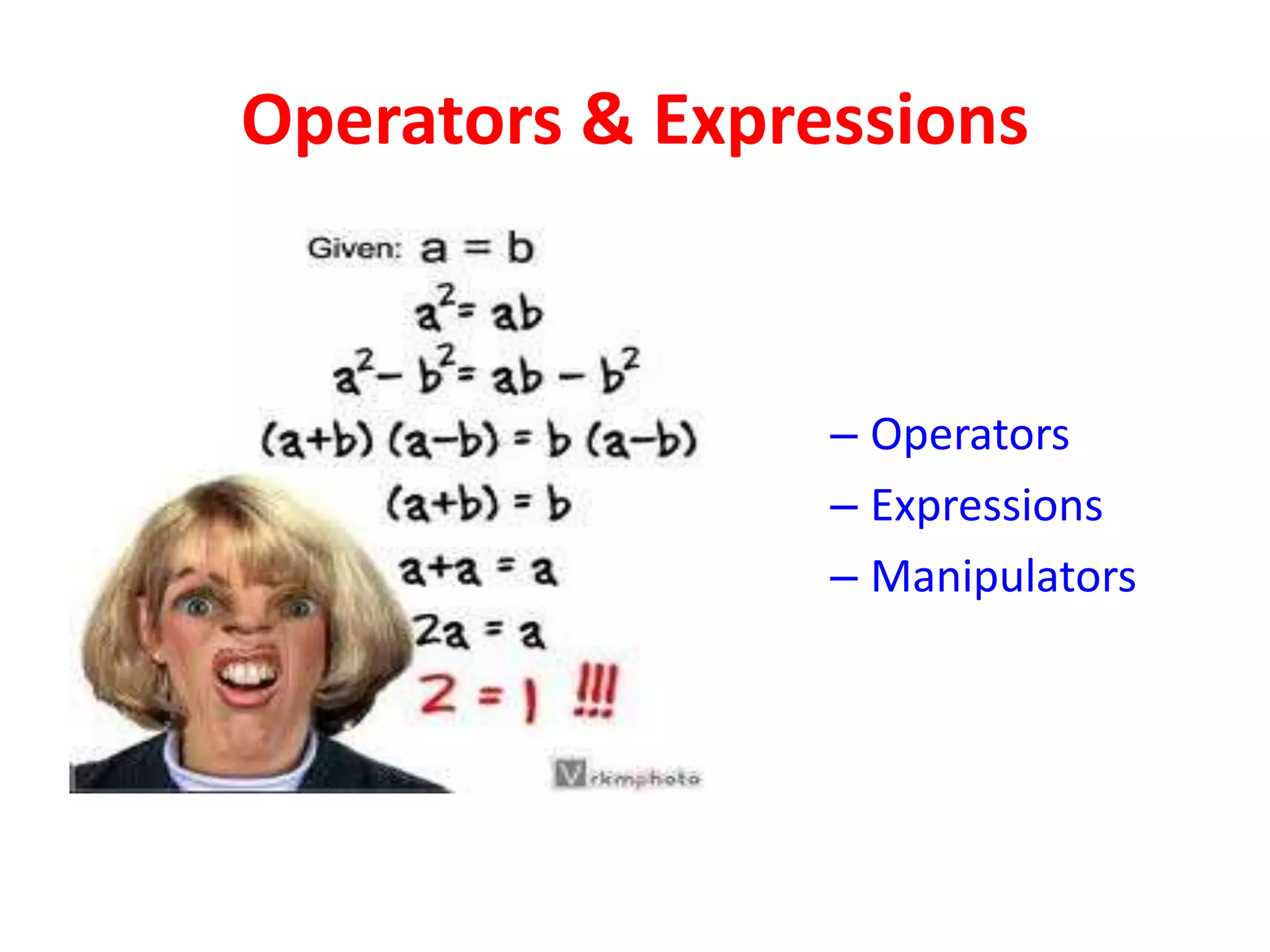
Operators & Expressions
– Operators
– Expressions
– Manipulators
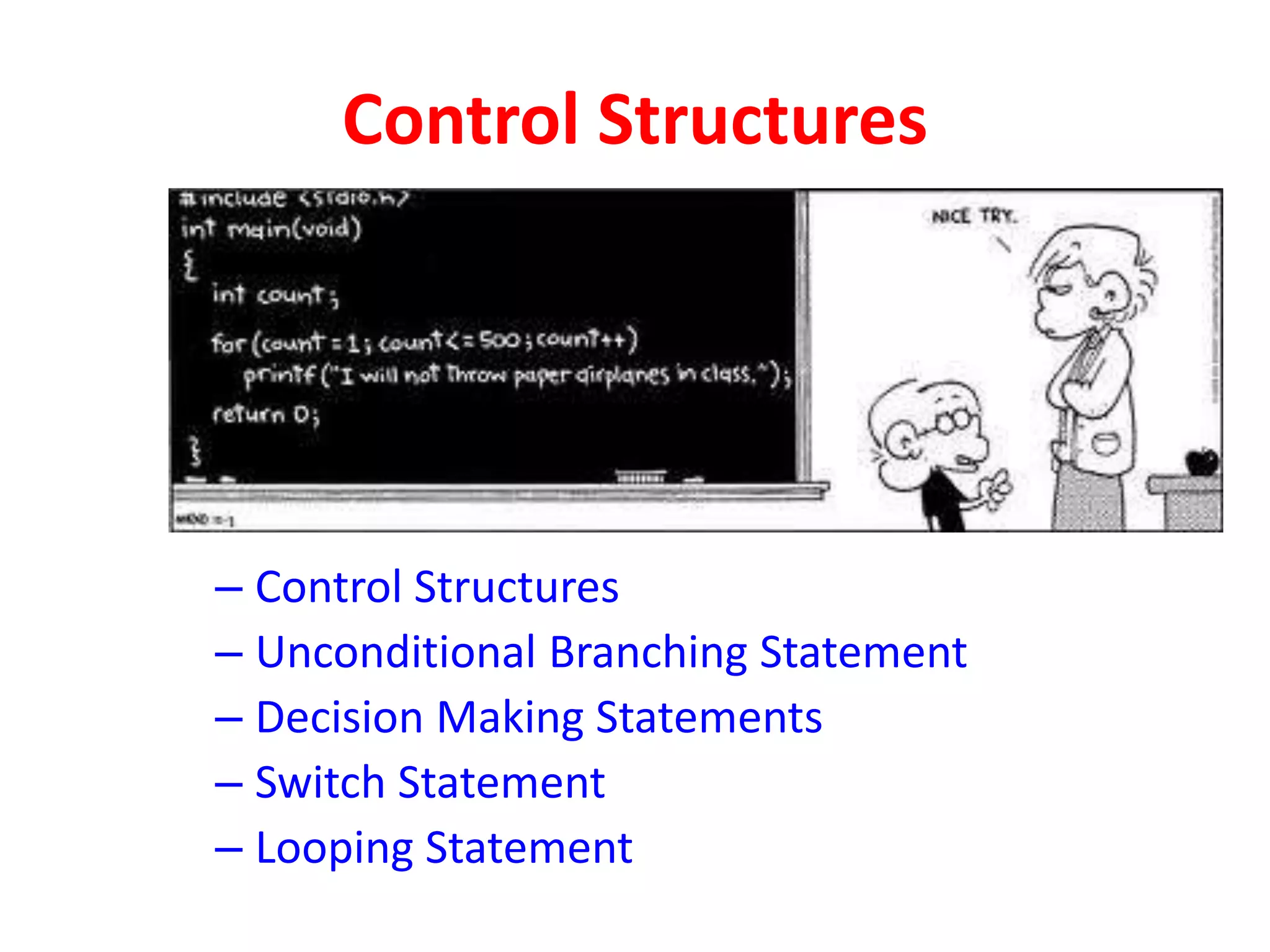
Control Structures
– Control Structures
– Unconditional Branching Statement
– Decision Making Statements
– Switch Statement
– Looping Statement
Arrays and Structures
– Need for Arrays
– One-Dimensional Arrays
– Strings
– Two-Dimensional Arrays
– Structure
Functions and Pointers
it can save memory and run faster
– Function
– Function Prototyping
– Parameters Passing in Functions
– Recursive Functions
– Values Return by Functions
– Inline Functions
– Scope Rules of Variables
– Storage Class Specifies
– Pointers
Classes and Objects
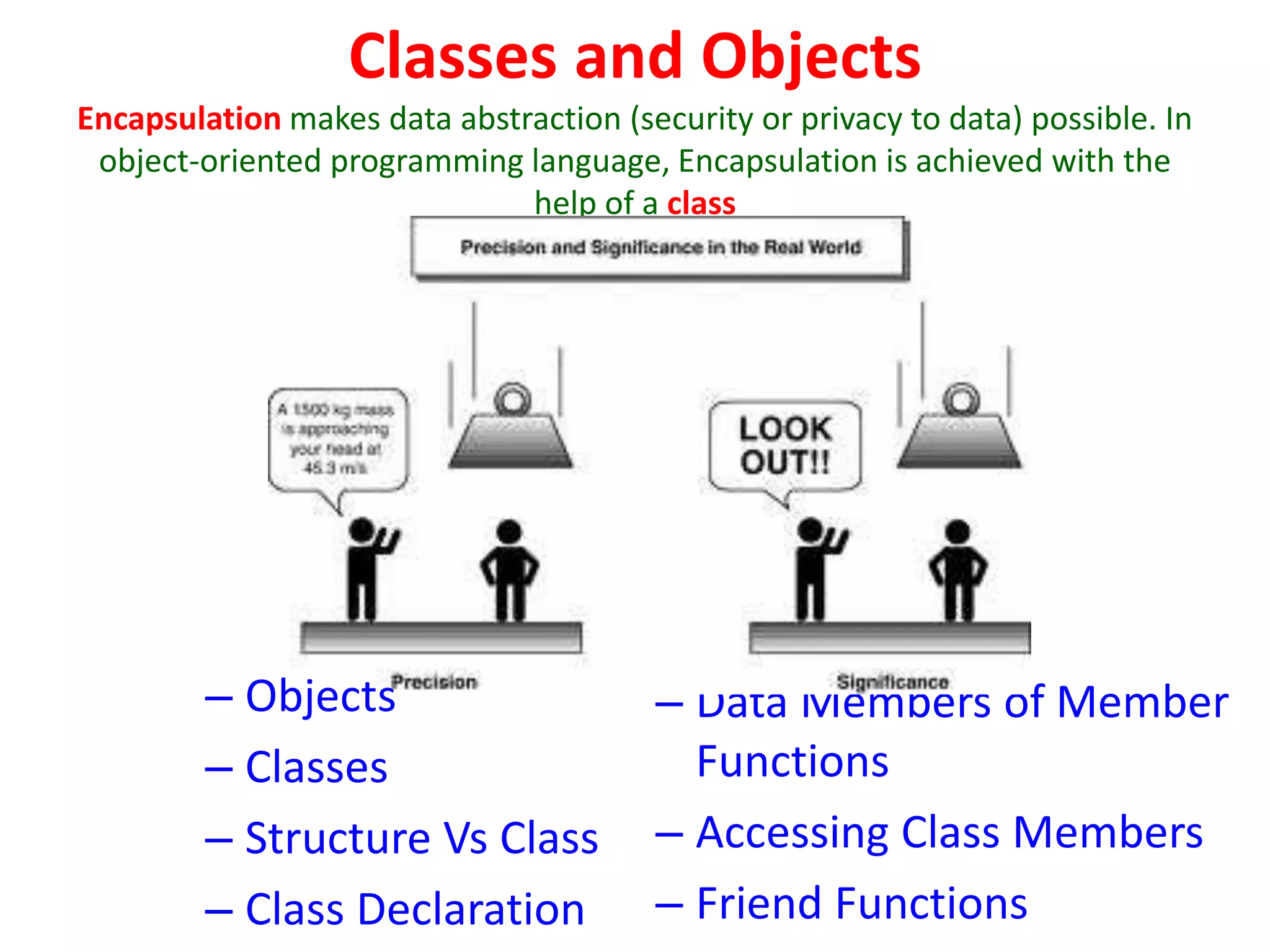
Encapsulation makes data abstraction (security or privacy to data) possible. In
object-oriented programming language, Encapsulation is achieved with the
help of a class
– Data Members of Member
Functions
– Accessing Class Members
– Friend Functions
– Objects
– Classes
– Structure Vs Class
– Class Declaration
Constructors and Destructors
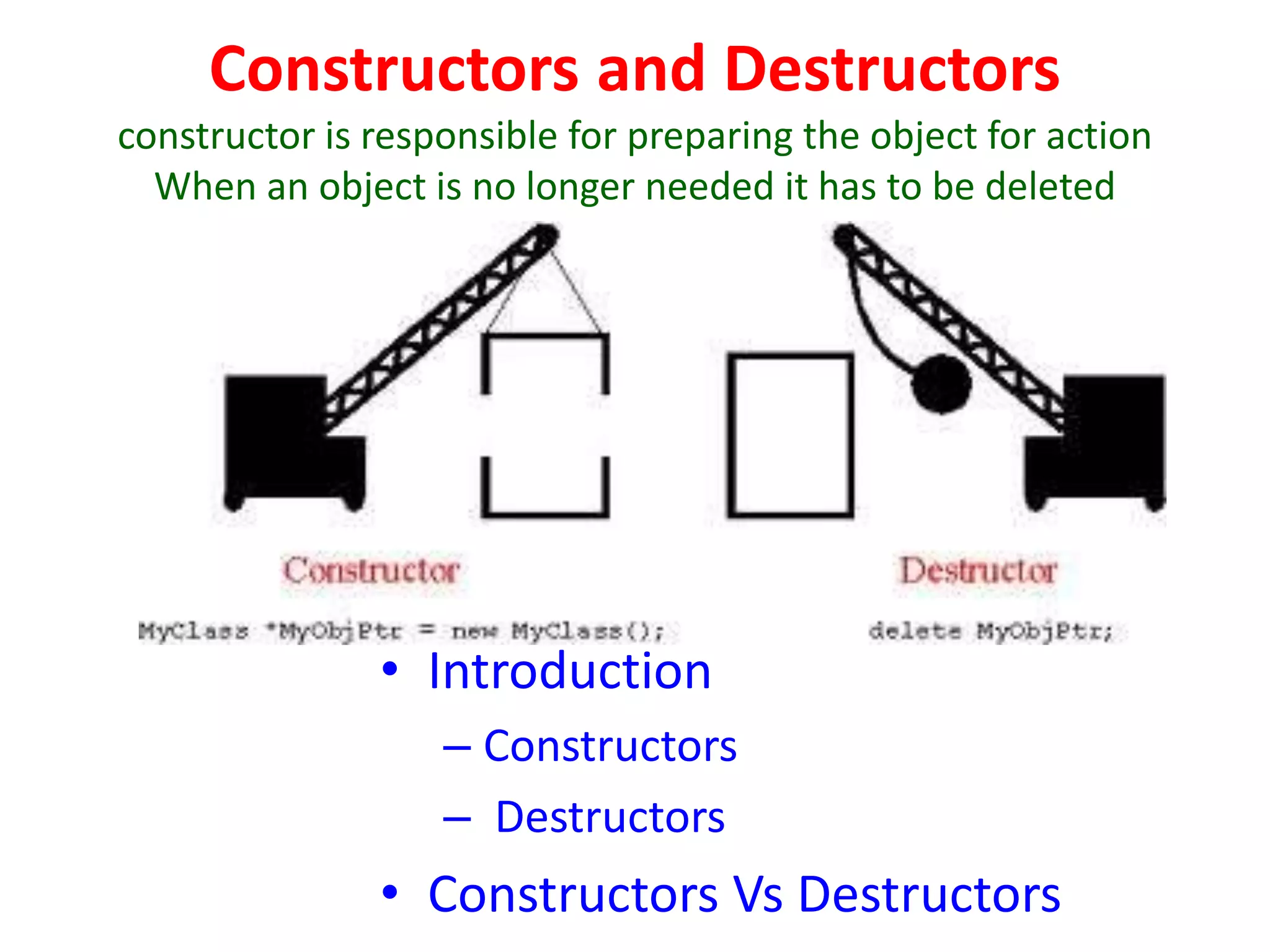
constructor is responsible for preparing the object for action
When an object is no longer needed it has to be deleted
• Introduction
– Constructors
– Destructors
• Constructors Vs Destructors
Overloading
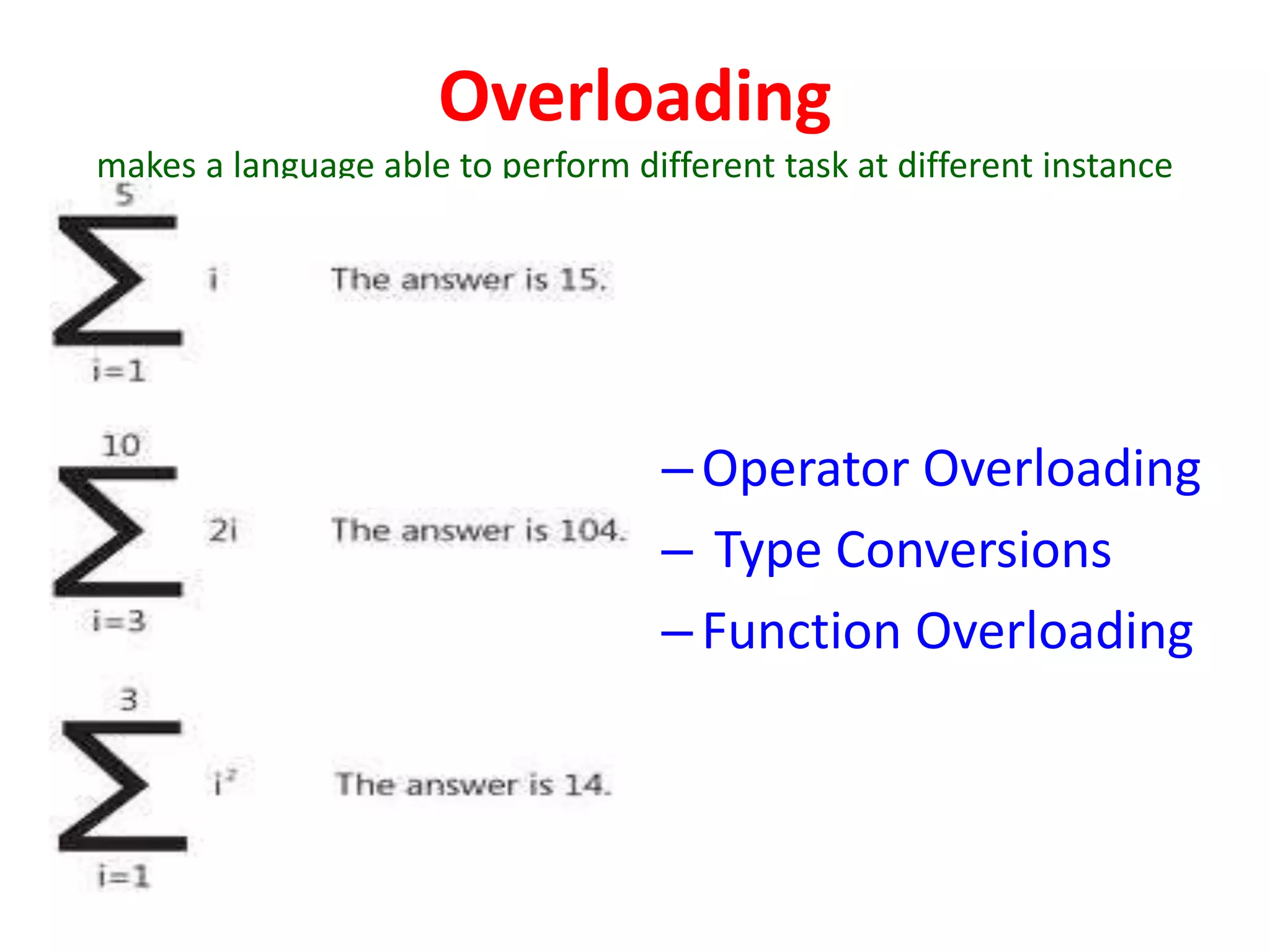
makes a language able to perform different task at different instance
–Operator Overloading
– Type Conversions
–Function Overloading
Inheritance
is used to provide the concept of code-reusability
– Inheritance
– Single Inheritance
– Multilevel Inheritance
– Multiple Inheritance
– Hierarchical Inheritance
– Hybrid Inheritance
– Pointers
– Virtual Functions
– Polymorphism
– Managing Console I/O Operations
Working with FILES
File Handling concept is used for store a data permanently in
secondary storage
– Classes for File Stream
Operations
– Opening and Closing a File
– End-of-File Deduction
– File Pointers
– Updating a File
– Error Handing during File
Operations
– Command-line Arguments
Introduction to Data Structure
is a art of storing and organizing information in memory hence
it can be retrieved and used efficiently
– Data Structure
– Classifications of Data
Structures
– Primitive and Composite Data
Types
– Asymptotic Notations
– Arrays
– Operations on Arrays
– Order Lists
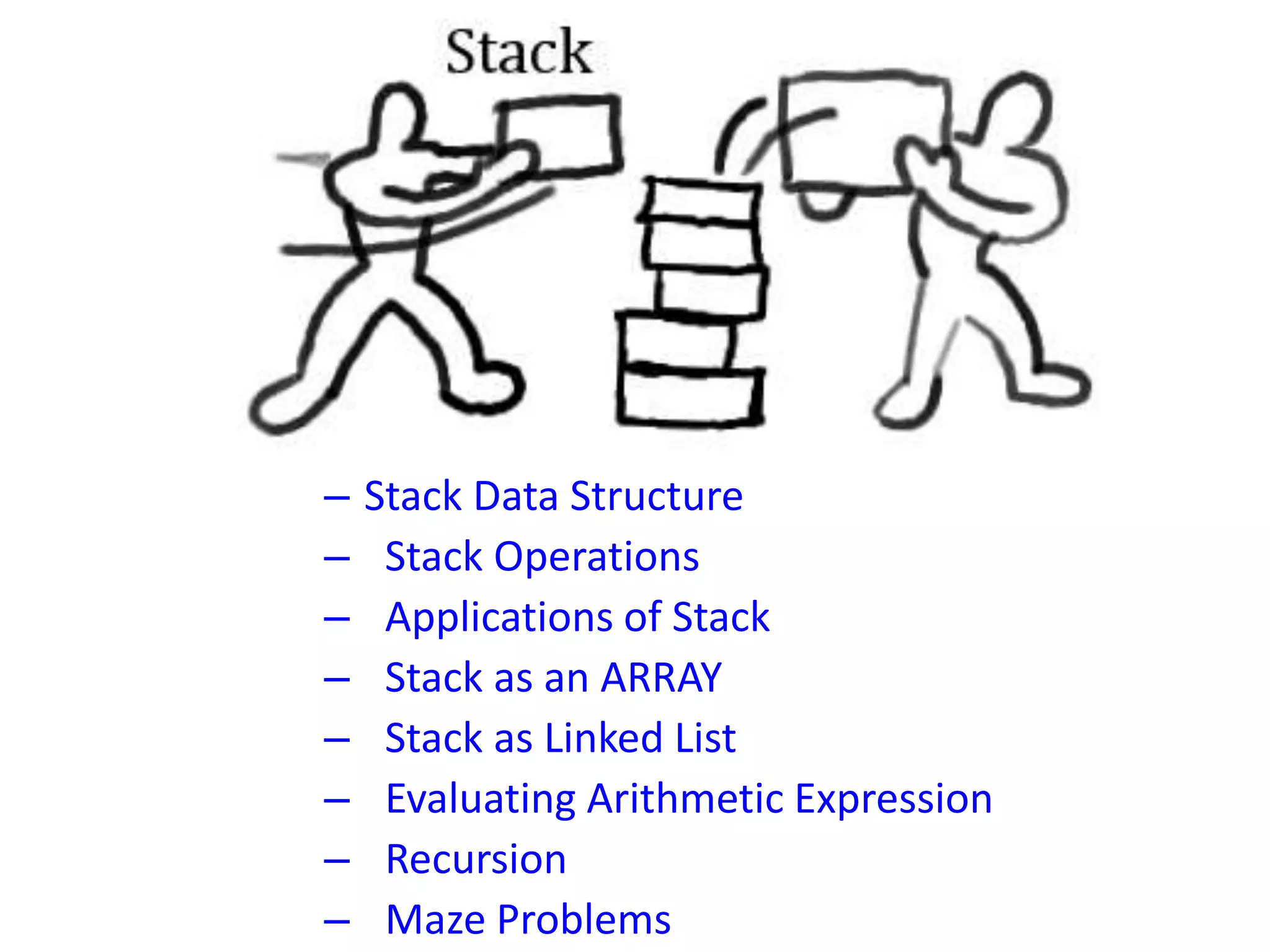
Stack
– Stack Data Structure
– Stack Operations
– Applications of Stack
– Stack as an ARRAY
– Stack as Linked List
– Evaluating Arithmetic Expression
– Recursion
– Maze Problems
Queue
– Queue Data Structure
– Operations on Queues
– Queue Implementation
– Queue Applications
– Circular Queue
Linked List
It can grow and shrink during run time
– Linked List Vs Arrays
– Singly Linked List - Operations
– Singly Linked List - Application
– Representation of a Polynomial
– Polynomial Addition
– Doubly Linked List – Operations
– Doubly Linked List - Applications
Trees
it is used in many interesting applications include machine
learning and Artificial intelligence
– Tree
– Binary Trees
– Conversion of Forest to Binary Tree
– Operations
– Tree Traversals
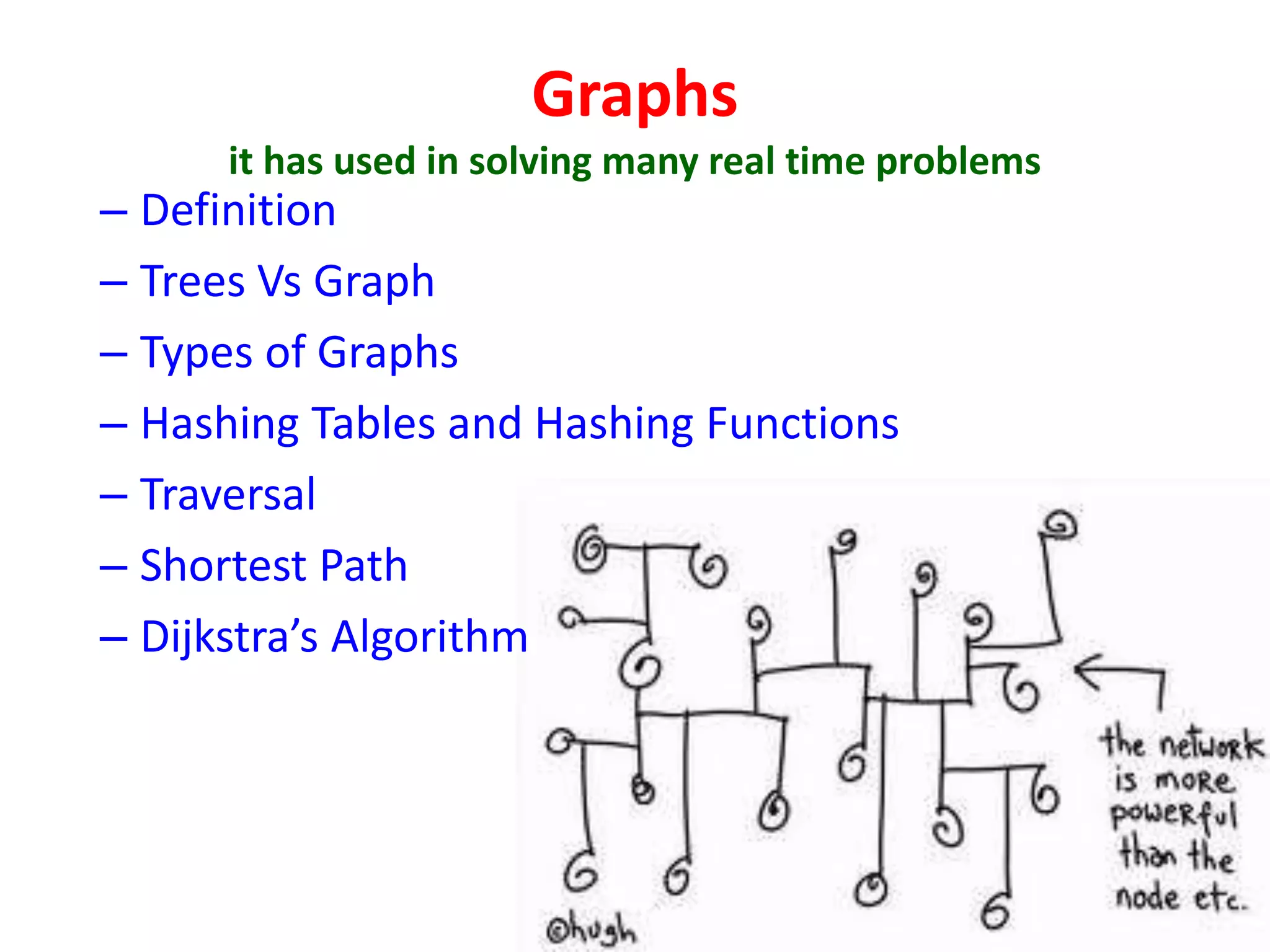
Graphs
it has used in solving many real time problems
– Definition
– Trees Vs Graph
– Types of Graphs
– Hashing Tables and Hashing Functions
– Traversal
– Shortest Path
– Dijkstra’s Algorithm
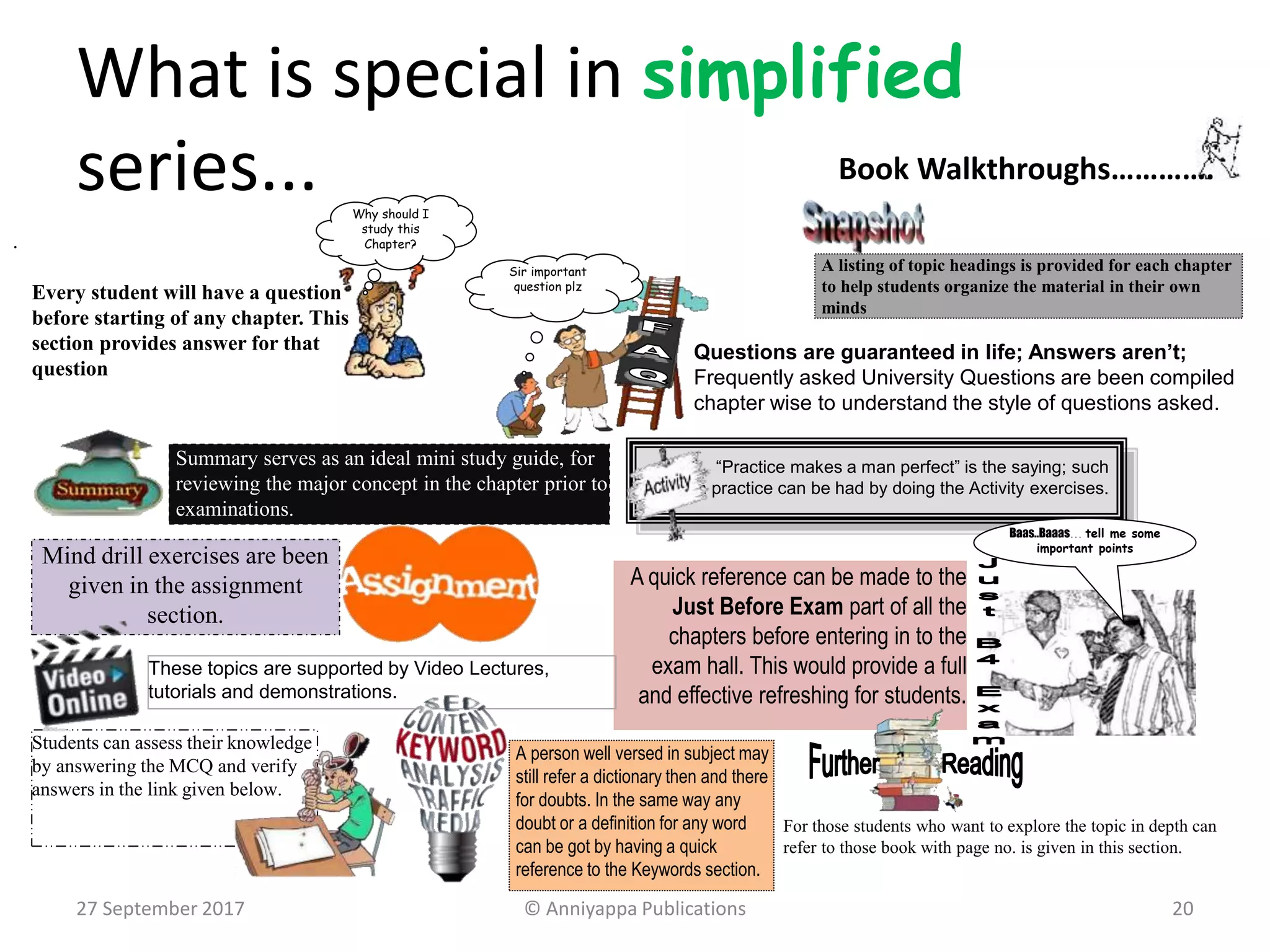
What is special in simplified
series...
27 September 2017 © Anniyappa Publications 20
A listing of topic headings is provided for each chapter
to help students organize the material in their own
minds
Summary serves as an ideal mini study guide, for
reviewing the major concept in the chapter prior to
examinations.
Questions are guaranteed in life; Answers aren’t;
Frequently asked University Questions are been compiled
chapter wise to understand the style of questions asked.
Students can assess their knowledge
by answering the MCQ and verify
answers in the link given below.
A quick reference can be made to the
Just Before Exam part of all the
chapters before entering in to the
exam hall. This would provide a full
and effective refreshing for students.
Mind drill exercises are been
given in the assignment
section.
For those students who want to explore the topic in depth can
refer to those book with page no. is given in this section.
A person well versed in subject may
still refer a dictionary then and there
for doubts. In the same way any
doubt or a definition for any word
can be got by having a quick
reference to the Keywords section.
Every student will have a question
before starting of any chapter. This
section provides answer for that
question
These topics are supported by Video Lectures,
tutorials and demonstrations.
“Practice makes a man perfect” is the saying; such
a practice can be had by doing the Activity exercises.
Baas..Baaas… tell me some
important points
Why should I
study this
Chapter?
Sir important
question plz
Book Walkthroughs………….
.

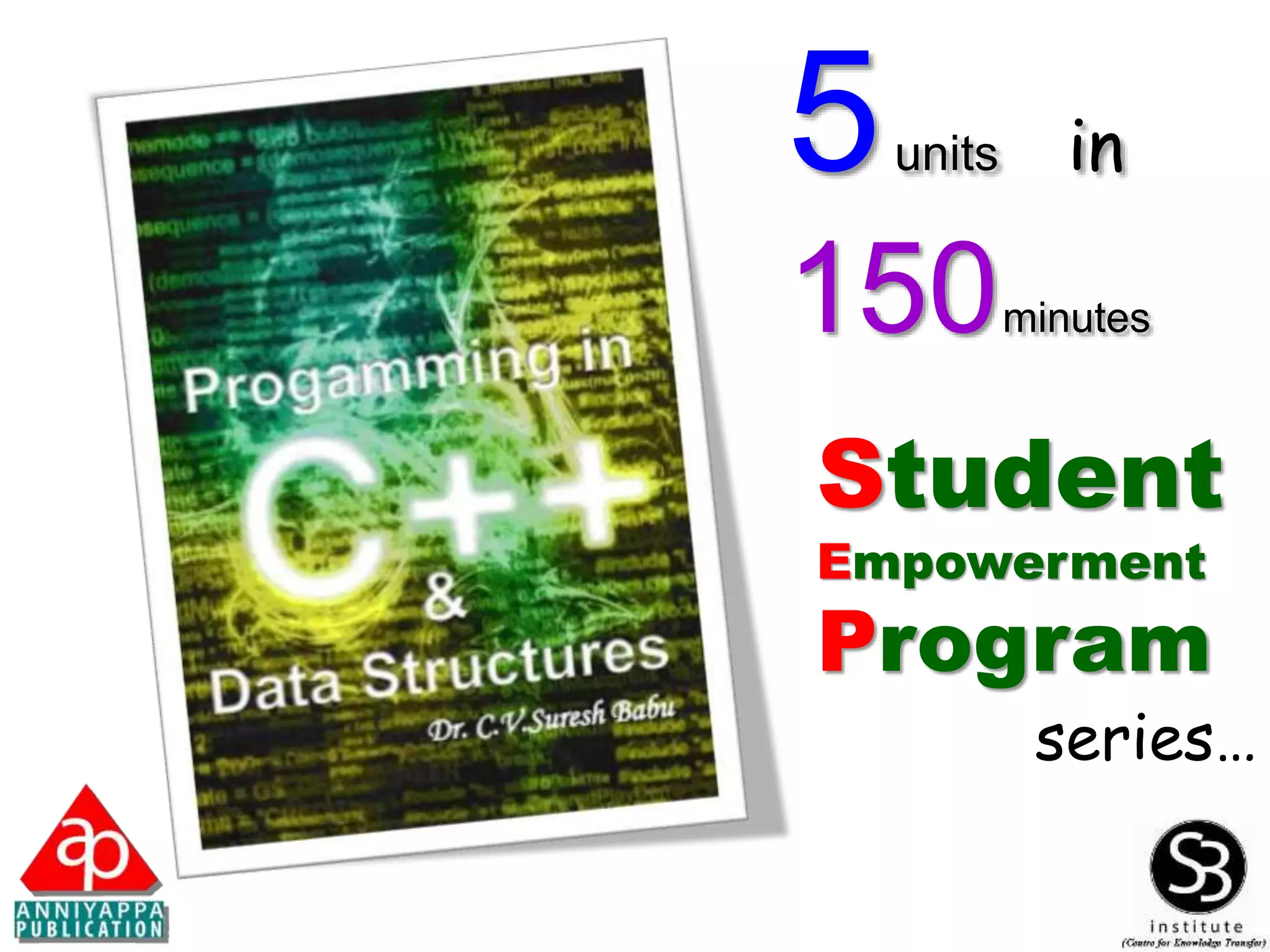
Programming in C++ and Data Strucutres

  • 1.
  • 2.
    SYLLABUS • Unit 1:Introduction to C++; Tokens, Keywords, Identifiers, Variables, Operators, Manipulators, Expressions and Control Structures in C++; Pointers - Functions in C++ - Main Function - Function Prototyping - Parameters Passing in Functions - Values Return by Functions - Inline Functions - Friend and Virtual Functions • Unit-2: Classes and Objects; Constructors and Destructors; and Operator Overloading and Type Conversions - Type of Constructors - Function overloading. Inheritance: Single Inheritance - Multilevel Inheritance - Multiple Inheritance - Hierarchical Inheritance - Hybrid Inheritance. Pointers, Virtual Functions and Polymorphism; Managing Console I/O operations. • Unit 3: Working with Files: Classes for File Stream Operations - Opening and Closing a File - End-of-File Deduction - File Pointers - Updating a File - Error Handling during File Operations - Command-line Arguments. Data Structures: Definition of a Data structure - primitive and composite Data Types, Asymptotic notations, Arrays, Operations on Arrays, Order lists. • Unit-4: Stacks - Applications of Stack - Infix to Postfix Conversion, Recursion, Maze Problems - Queues - Operations on Queues, Queue Applications, Circular Queue. Singly Linked List - Operations, Application - Representation of a Polynomial, Polynomial Addition; Doubly Linked List - Operations, Applications. • Unit-5 : Trees and Graphs: Binary Trees - Conversion of Forest to Binary Tree, Operations - Tree Traversals; Graph - Definition, Types of Graphs, Hashing Tables and Hashing Functions, Traversal - Shortest Path; Dijkstra's Algorithm.
  • 3.
    Introduction to OOPs clearmodular structure, it easy to maintain and modify existing code, a good framework for code libraries – OOP’s – OOP Vs Procedural programming – OOP’s Concepts – Object-oriented programming paradigm – Merits of OOP’s Methodology – Limitations of OOP’s Methodology – Application – Approach to Object Oriented Design – Object Oriented Languages
  • 4.
    Introduction to CPP itis often used to develop game engines, games, and desktop apps. Many AAA title video games are built with C++ – C++ Character Set – Tokens – Keywords – Identifiers – Data Types – Variables – Constants (or) Literals – Structure of a C++ Program
  • 5.
    Operators & Expressions –Operators – Expressions – Manipulators
  • 6.
    Control Structures – ControlStructures – Unconditional Branching Statement – Decision Making Statements – Switch Statement – Looping Statement
  • 7.
    Arrays and Structures –Need for Arrays – One-Dimensional Arrays – Strings – Two-Dimensional Arrays – Structure
  • 8.
    Functions and Pointers itcan save memory and run faster – Function – Function Prototyping – Parameters Passing in Functions – Recursive Functions – Values Return by Functions – Inline Functions – Scope Rules of Variables – Storage Class Specifies – Pointers
  • 9.
    Classes and Objects Encapsulationmakes data abstraction (security or privacy to data) possible. In object-oriented programming language, Encapsulation is achieved with the help of a class – Data Members of Member Functions – Accessing Class Members – Friend Functions – Objects – Classes – Structure Vs Class – Class Declaration
  • 10.
    Constructors and Destructors constructoris responsible for preparing the object for action When an object is no longer needed it has to be deleted • Introduction – Constructors – Destructors • Constructors Vs Destructors
  • 11.
    Overloading makes a languageable to perform different task at different instance –Operator Overloading – Type Conversions –Function Overloading
  • 12.
    Inheritance is used toprovide the concept of code-reusability – Inheritance – Single Inheritance – Multilevel Inheritance – Multiple Inheritance – Hierarchical Inheritance – Hybrid Inheritance – Pointers – Virtual Functions – Polymorphism – Managing Console I/O Operations
  • 13.
    Working with FILES FileHandling concept is used for store a data permanently in secondary storage – Classes for File Stream Operations – Opening and Closing a File – End-of-File Deduction – File Pointers – Updating a File – Error Handing during File Operations – Command-line Arguments
  • 14.
    Introduction to DataStructure is a art of storing and organizing information in memory hence it can be retrieved and used efficiently – Data Structure – Classifications of Data Structures – Primitive and Composite Data Types – Asymptotic Notations – Arrays – Operations on Arrays – Order Lists
  • 15.
    Stack – Stack DataStructure – Stack Operations – Applications of Stack – Stack as an ARRAY – Stack as Linked List – Evaluating Arithmetic Expression – Recursion – Maze Problems
  • 16.
    Queue – Queue DataStructure – Operations on Queues – Queue Implementation – Queue Applications – Circular Queue
  • 17.
    Linked List It cangrow and shrink during run time – Linked List Vs Arrays – Singly Linked List - Operations – Singly Linked List - Application – Representation of a Polynomial – Polynomial Addition – Doubly Linked List – Operations – Doubly Linked List - Applications
  • 18.
    Trees it is usedin many interesting applications include machine learning and Artificial intelligence – Tree – Binary Trees – Conversion of Forest to Binary Tree – Operations – Tree Traversals
  • 19.
    Graphs it has usedin solving many real time problems – Definition – Trees Vs Graph – Types of Graphs – Hashing Tables and Hashing Functions – Traversal – Shortest Path – Dijkstra’s Algorithm
  • 20.
    What is specialin simplified series... 27 September 2017 © Anniyappa Publications 20 A listing of topic headings is provided for each chapter to help students organize the material in their own minds Summary serves as an ideal mini study guide, for reviewing the major concept in the chapter prior to examinations. Questions are guaranteed in life; Answers aren’t; Frequently asked University Questions are been compiled chapter wise to understand the style of questions asked. Students can assess their knowledge by answering the MCQ and verify answers in the link given below. A quick reference can be made to the Just Before Exam part of all the chapters before entering in to the exam hall. This would provide a full and effective refreshing for students. Mind drill exercises are been given in the assignment section. For those students who want to explore the topic in depth can refer to those book with page no. is given in this section. A person well versed in subject may still refer a dictionary then and there for doubts. In the same way any doubt or a definition for any word can be got by having a quick reference to the Keywords section. Every student will have a question before starting of any chapter. This section provides answer for that question These topics are supported by Video Lectures, tutorials and demonstrations. “Practice makes a man perfect” is the saying; such a practice can be had by doing the Activity exercises. Baas..Baaas… tell me some important points Why should I study this Chapter? Sir important question plz Book Walkthroughs…………. .