1A Concise and Practical Introduction to Programming Algorithms in Java © 2009 Frank Nielsen
Frank NIELSEN
nielsen@lix.polytechnique.fr
A Concise and
Practical
Introduction to
Programming
Algorithms in Java
Chapter 6: Searching and sorting
2A Concise and Practical Introduction to Programming Algorithms in Java © 2009 Frank Nielsen
Agenda
● Answering a few questions
● Searching (sequential, bisection)
● Sorting for faster searching
● Recursive sort
● Hashing
3A Concise and Practical Introduction to Programming Algorithms in Java © 2009 Frank Nielsen
Swapping
Java is pass-by-value only.
Arrays and objects: pass-by-reference (=memory `value')
0 y
Memory for
main
class FunctionCallSample
{
public static void f(double x)
{
x=1;
System.out.println(x);//1
return;
}
public static void main(String[] args)
{
int y=0;
f(y);
System.out.println(y);//y is still 0
}}
Memory for
f
x1
4A Concise and Practical Introduction to Programming Algorithms in Java © 2009 Frank Nielsen
Swapping & Strings
public static void Swap(String p, String q)
{ String tmp;
tmp=p;
p=q;
q=tmp;}
public static void Swap(String [] t, int i, int j)
{ String tmp;
tmp=t[i];
t[i]=t[j];
t[j]=tmp;}
String s1="toto";
String s2="titi";
String [] s=new String[2];
s[0]=new String("toto");
s[1]=new String("titi");
System.out.println(s1+" "+s2);
Swap(s1,s2);
System.out.println(s1+" "+s2);
Swap(s,0,1);
System.out.println(s[0]+" "+s[1]);
Result
5A Concise and Practical Introduction to Programming Algorithms in Java © 2009 Frank Nielsen
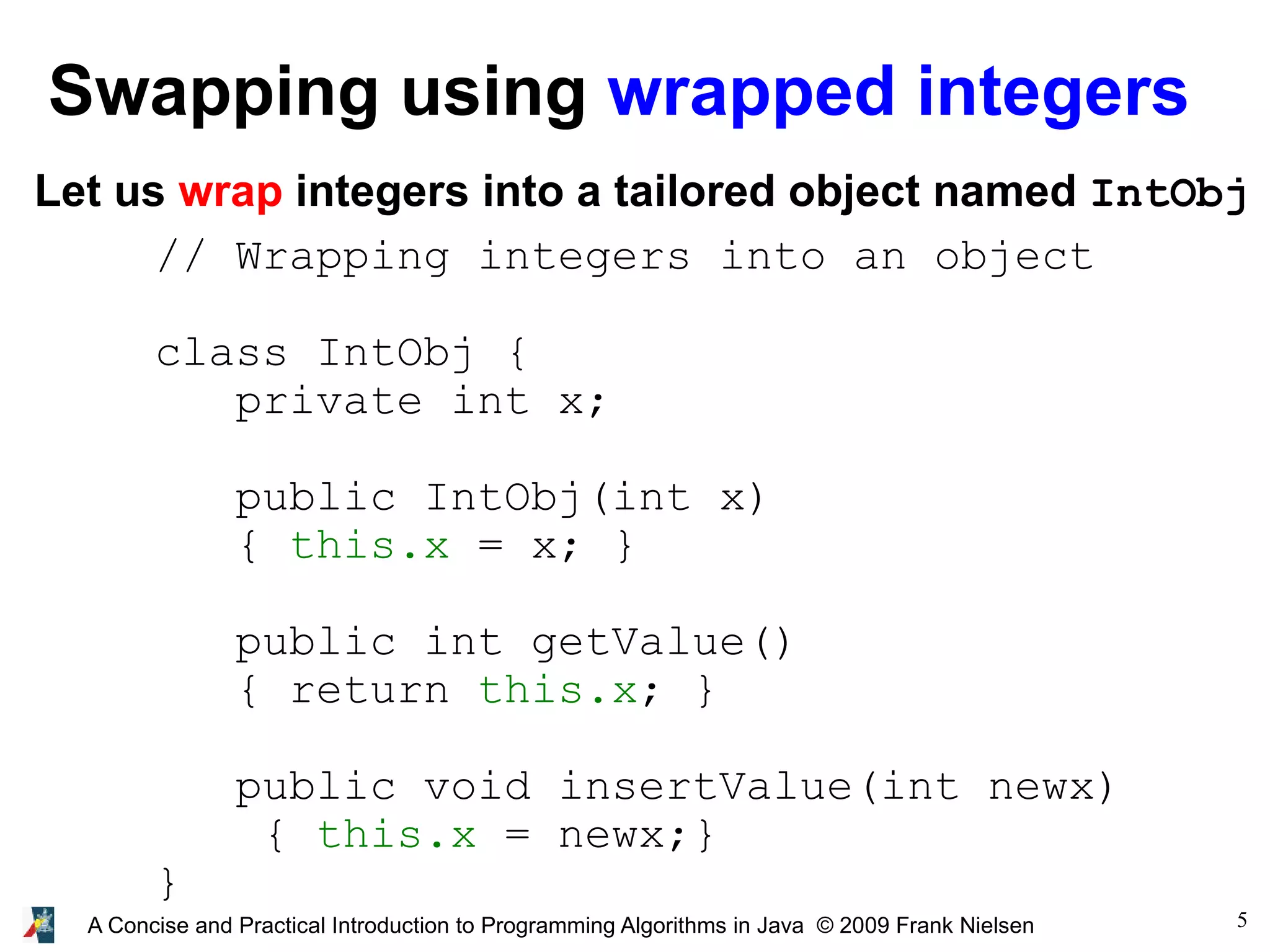
Swapping using wrapped integers
// Wrapping integers into an object
class IntObj {
private int x;
public IntObj(int x)
{ this.x = x; }
public int getValue()
{ return this.x; }
public void insertValue(int newx)
{ this.x = newx;}
}
Let us wrap integers into a tailored object named IntObj
6A Concise and Practical Introduction to Programming Algorithms in Java © 2009 Frank Nielsen
public class SwapInt {
// Pass-by-value (= pass-by-reference for objects)
static void swap(IntObj p, IntObj q)
{
// interchange values inside objects
int t = p.getValue();
p.insertValue(q.getValue());
q.insertValue(t);
}
public static void main(String[] args) {
int a = 23, b = 12;
System.out.println("Before| a:" + a + ", b: " + b);
IntObj aObj = new IntObj(a);
IntObj bObj = new IntObj(b);
swap(aObj, bObj);
a = aObj.getValue();
b = bObj.getValue();
System.out.println("After| a:" + a + ", b: " + b);
}
} Java wrapper class for int is Integer BUT
it doesn't allow you to alter the data field inside.
7A Concise and Practical Introduction to Programming Algorithms in Java © 2009 Frank Nielsen
class SwapInteger
{
public static void main(String args[])
{
Integer a, b;
a = new Integer(10);
b = new Integer(50);
System.out.println("before swap...");
System.out.println("a is " + a);
System.out.println("b is " + b);
swap(a, b); // References did not change (PASS-BY-VALUE)
System.out.println("after swap...");
System.out.println("a is " + a);
System.out.println("b is " + b);
}
public static void swap(Integer a, Integer b)
{
Integer temp = a;
a = b;
b = temp;
}
}
8A Concise and Practical Introduction to Programming Algorithms in Java © 2009 Frank Nielsen
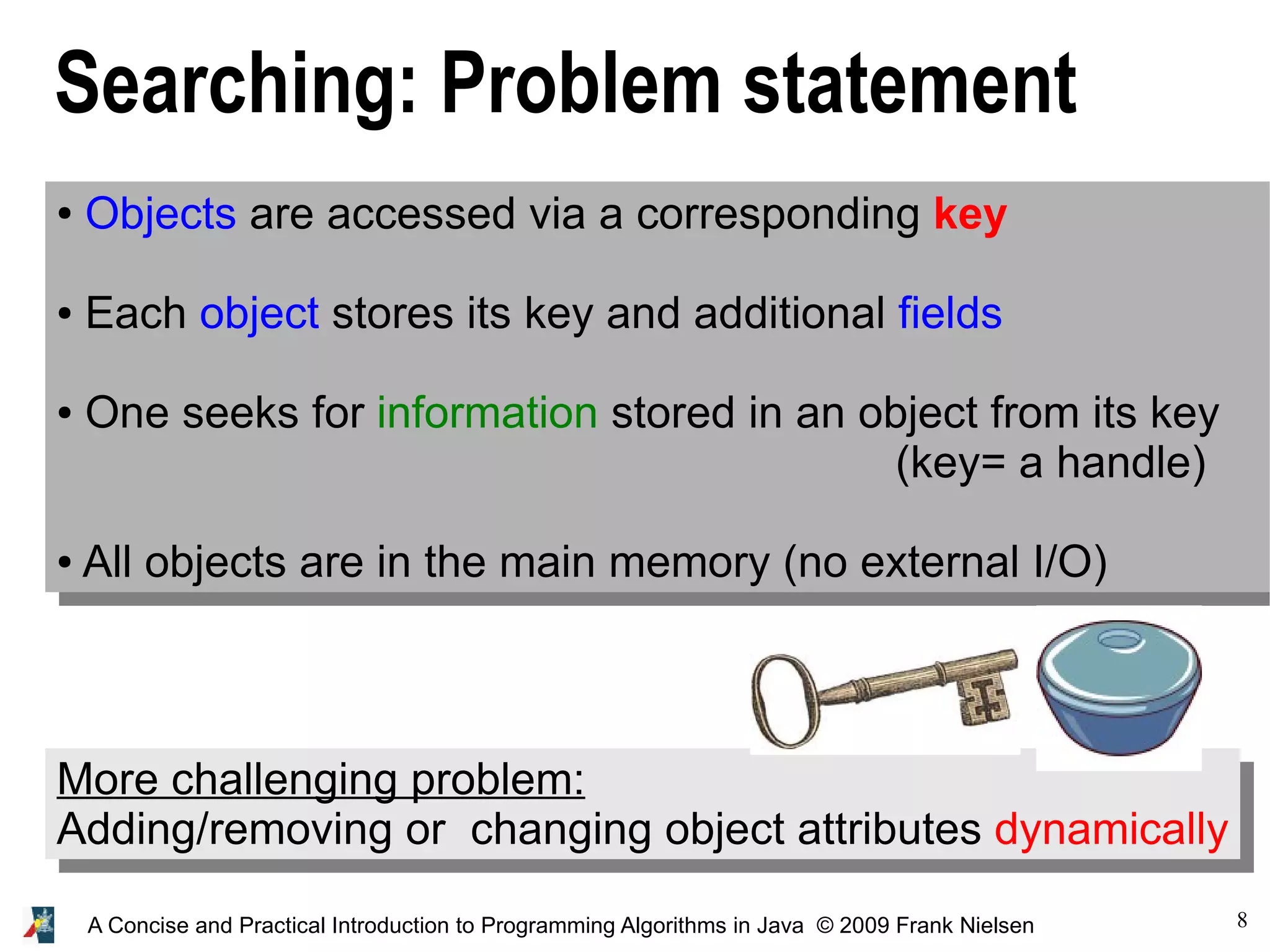
Searching: Problem statement
● Objects are accessed via a corresponding key
● Each object stores its key and additional fields
● One seeks for information stored in an object from its key
(key= a handle)
● All objects are in the main memory (no external I/O)
More challenging problem:
Adding/removing or changing object attributes dynamically
9A Concise and Practical Introduction to Programming Algorithms in Java © 2009 Frank Nielsen
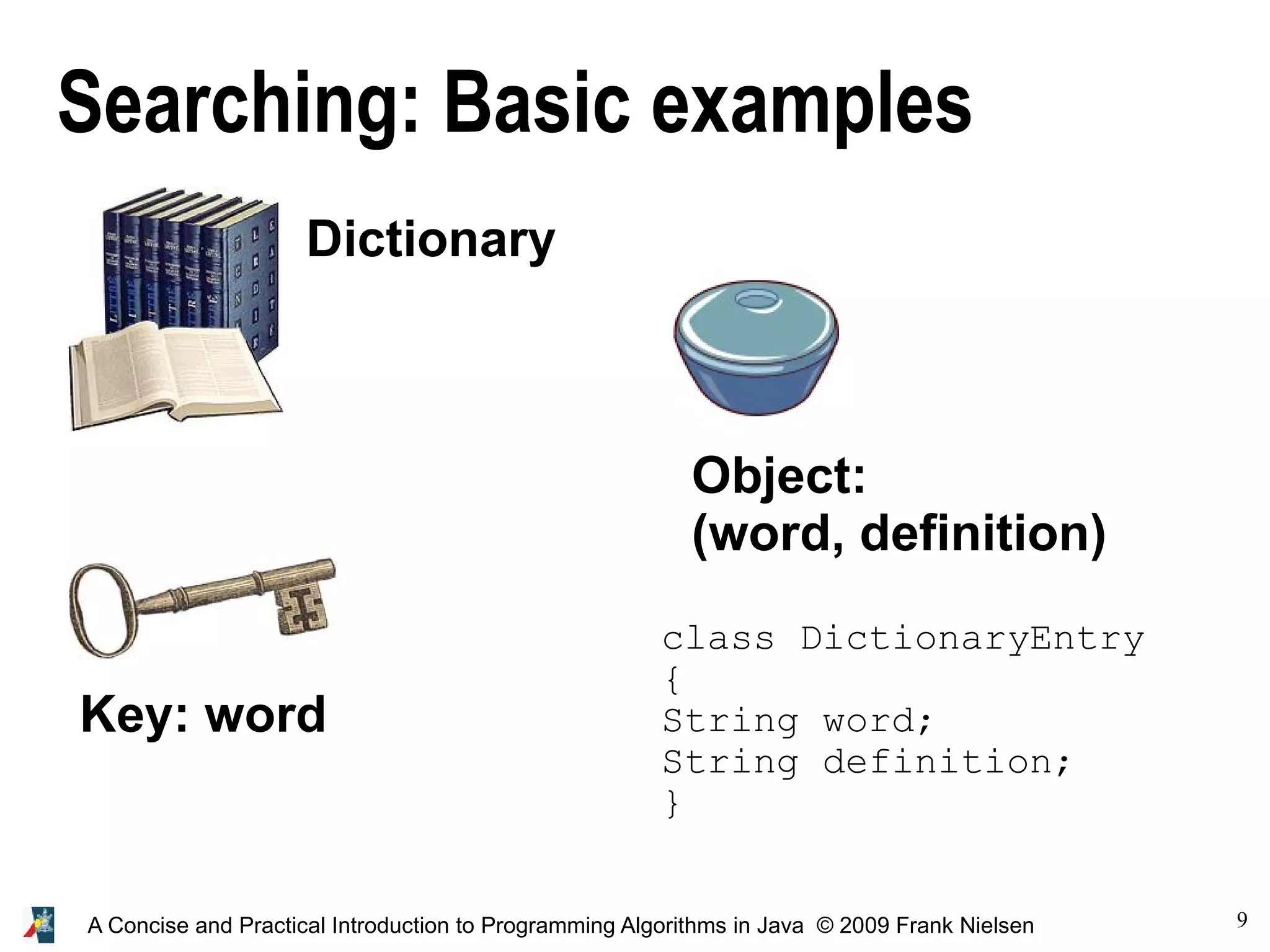
Searching: Basic examplesSearching: Basic examplesSearching: Basic examples
Dictionary
Key: word
Object:
(word, definition)
class DictionaryEntry
{
String word;
String definition;
}
10A Concise and Practical Introduction to Programming Algorithms in Java © 2009 Frank Nielsen
Dictionary
class DictionaryEntry
{
String word;
String definition;
DictionaryEntry(String w, String def)
{
this.word=new String(w); // Clone the strings
this.definition=new String(def);
}
}
class TestMyDictionary
{public static void main(String[] args){
DictionaryEntry [] Dico =new DictionaryEntry[10];
Dico[0]=new DictionaryEntry("INF311","Cours d'informatique");
Dico[1]=new DictionaryEntry("ECO311","Cours d'economie");
}
}
11A Concise and Practical Introduction to Programming Algorithms in Java © 2009 Frank Nielsen
Searching: Basic examples
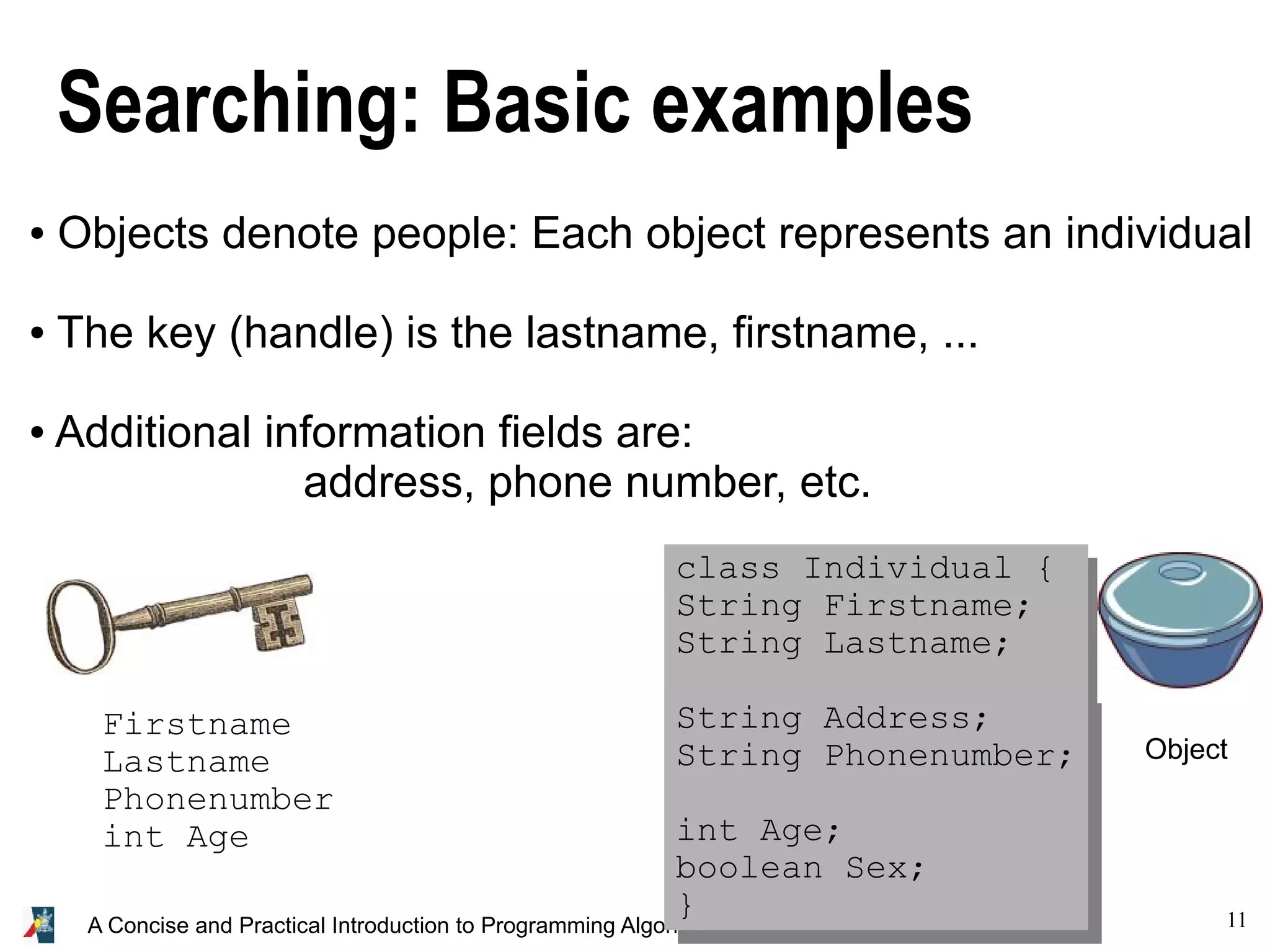
● Objects denote people: Each object represents an individual
● The key (handle) is the lastname, firstname, ...
● Additional information fields are:
address, phone number, etc.
class Individual {
String Firstname;
String Lastname;
String Address;
String Phonenumber;
int Age;
boolean Sex;
}
Object
Firstname
Lastname
Phonenumber
int Age
12A Concise and Practical Introduction to Programming Algorithms in Java © 2009 Frank Nielsen
Searching: Basic examples
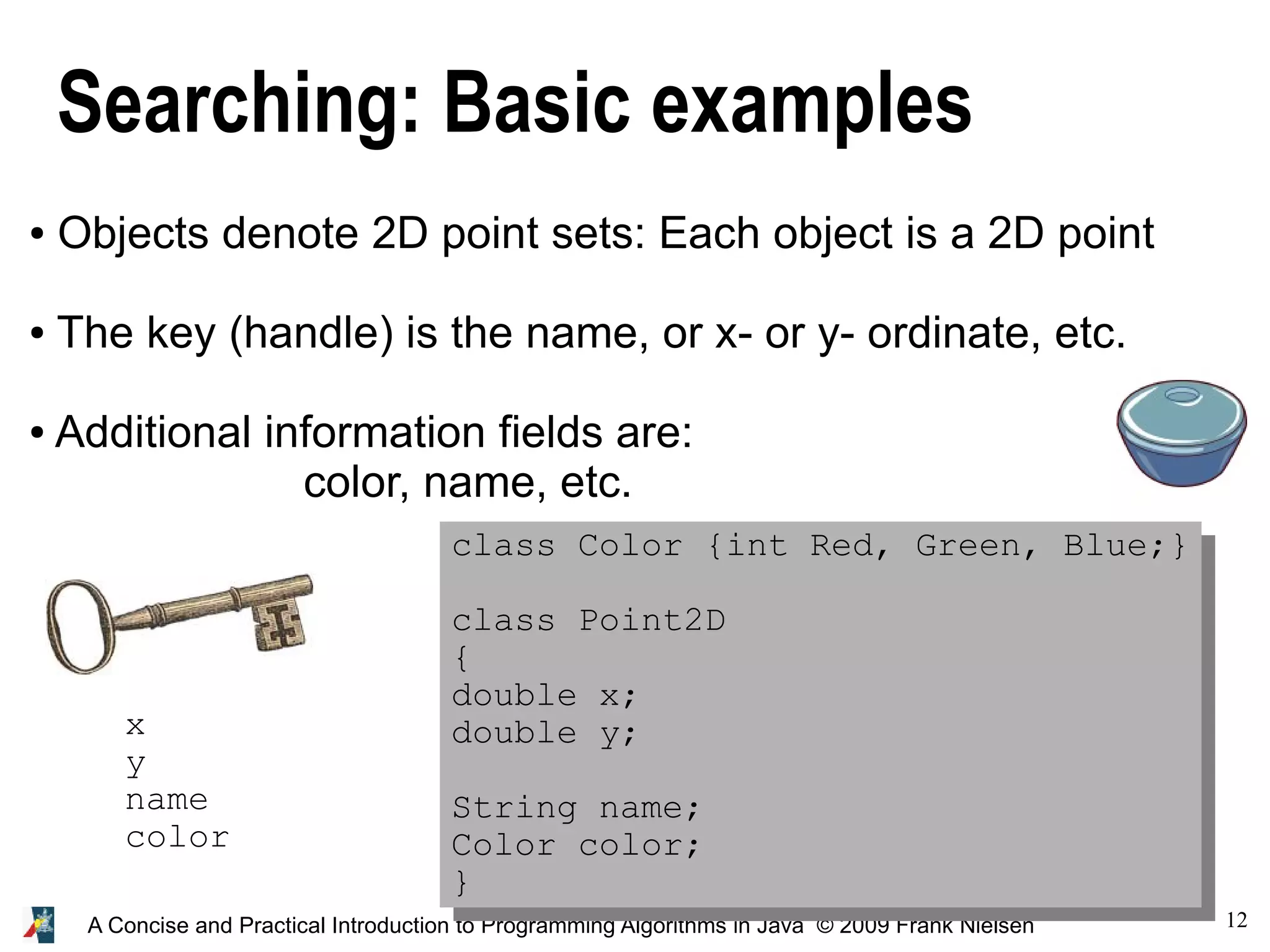
● Objects denote 2D point sets: Each object is a 2D point
● The key (handle) is the name, or x- or y- ordinate, etc.
● Additional information fields are:
color, name, etc.
class Color {int Red, Green, Blue;}
class Point2D
{
double x;
double y;
String name;
Color color;
}
x
y
name
color
13A Concise and Practical Introduction to Programming Algorithms in Java © 2009 Frank Nielsen
Sequential (linear) search
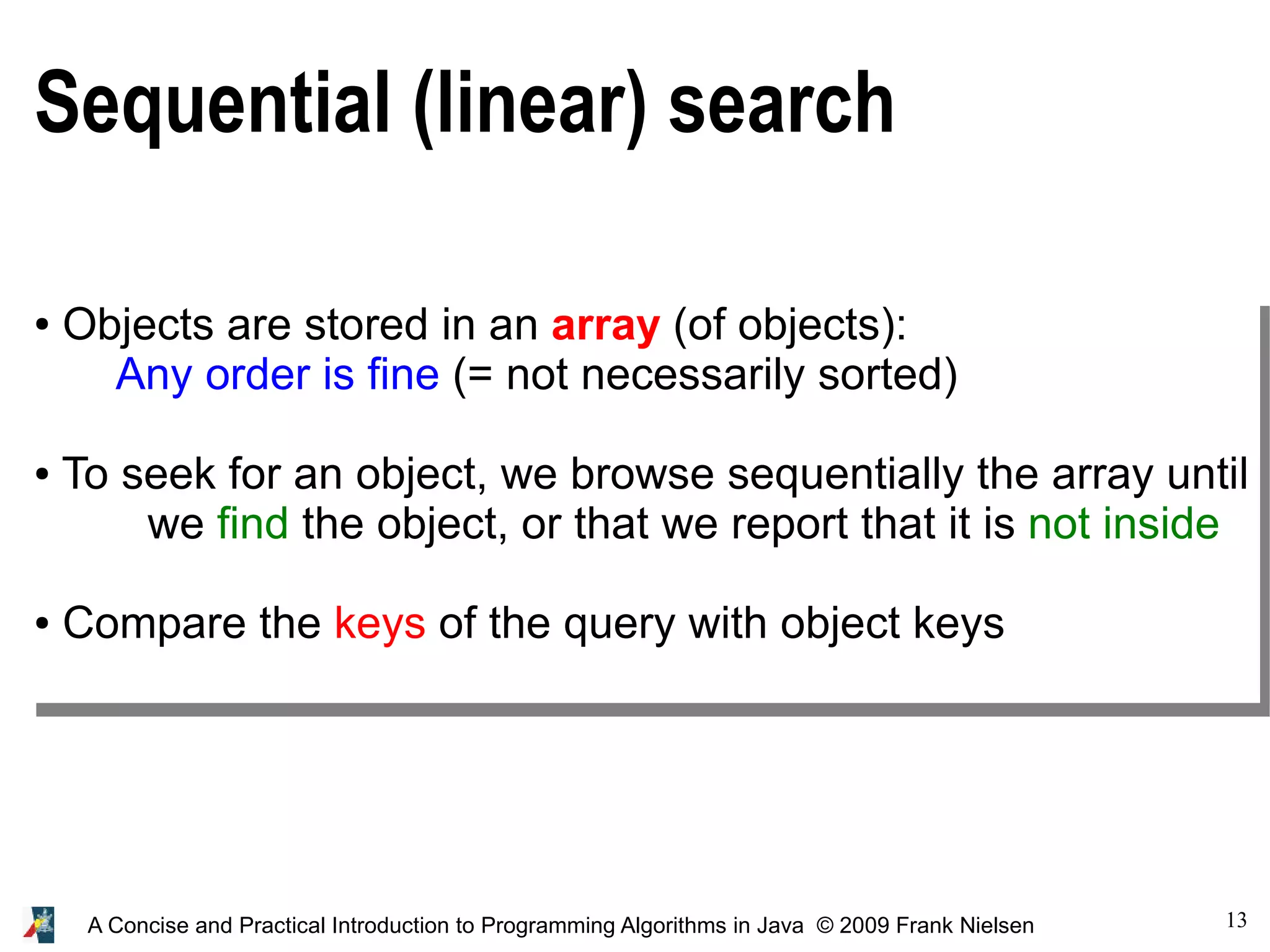
● Objects are stored in an array (of objects):
Any order is fine (= not necessarily sorted)
● To seek for an object, we browse sequentially the array until
we find the object, or that we report that it is not inside
● Compare the keys of the query with object keys
14A Concise and Practical Introduction to Programming Algorithms in Java © 2009 Frank Nielsen
class Person{
String firstname, lastname; // key for searching
String phone; // additional fields go here
// Constructor
Person(String l, String f, String p)
{firstname=f; lastname=l; phone=p;}
};
static Person[] array=new Person[5];
static String LinearSearch(String lastname, String firstname)
{
for(int i=0;i<array.length;i++)
{
if ((lastname.equals(array[i].lastname) &&
(firstname.equals(array[i].firstname))))
{return array[i].phone;}
}
return "Not found in my dictionary";
}
15A Concise and Practical Introduction to Programming Algorithms in Java © 2009 Frank Nielsen
class LinearSearch{
static Person[] array=new Person[5];
static String LinearSearch(String lastname, String firstname)
{...}
public static void main (String [] args)
{
array[0]=new Person("Nielsen","Frank","0169364089");
array[1]=new Person("Nelson","Franck","04227745221");
array[2]=new Person("Durand","Paul","0381846245");
array[3]=new Person("Dupond","Jean","0256234512");
array[4]=new Person("Tanaka","Ken","+81 3 1234 4567");
System.out.println(LinearSearch("Durand","Paul"));
System.out.println(LinearSearch("Tanaka","Ken"));
System.out.println(LinearSearch("Durand","Jean"));
}
}
Array is class variable, here
16A Concise and Practical Introduction to Programming Algorithms in Java © 2009 Frank Nielsen
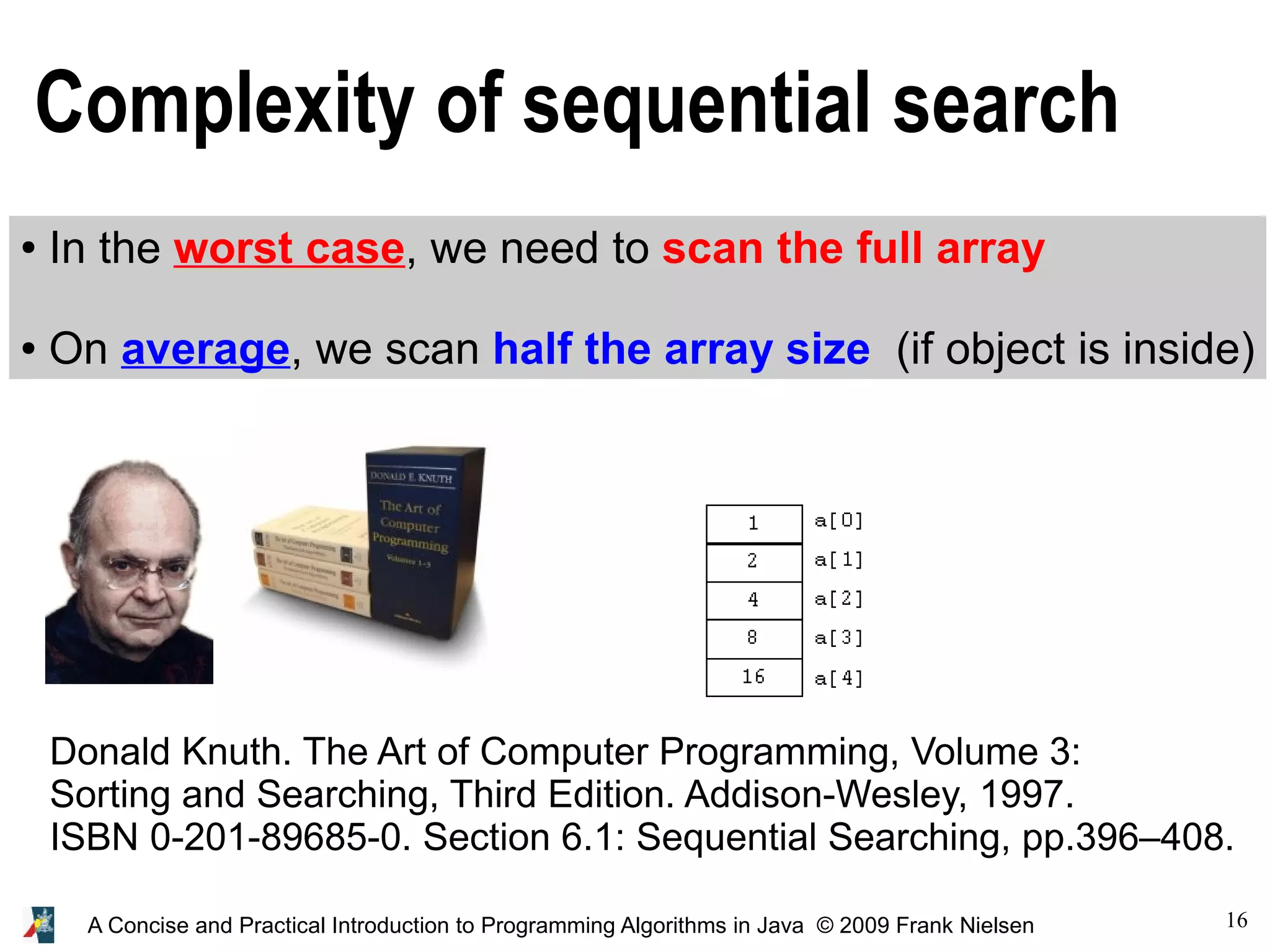
● In the worst case, we need to scan the full array
● On average, we scan half the array size (if object is inside)
Donald Knuth. The Art of Computer Programming, Volume 3:
Sorting and Searching, Third Edition. Addison-Wesley, 1997.
ISBN 0-201-89685-0. Section 6.1: Sequential Searching, pp.396–408.
Complexity of sequential search
17A Concise and Practical Introduction to Programming Algorithms in Java © 2009 Frank Nielsen
Adding an element (object)
● To add dynamically an element, we first build a bigger array
● Then we use an index for storing the position of the
last stored element
● When added an element, we increment the position of the
'end of array'
● Of course, we should check whether the array there is
overflow or not
● Notice that it is difficult to erase elements...
18A Concise and Practical Introduction to Programming Algorithms in Java © 2009 Frank Nielsen
Adding an element to the corpus
public static final int MAX_ELEMENTS=100;
static int nbelements=0;
static Person[] array=new Person[MAX_ELEMENTS];
static String LinearSearch(String lastname, String firstname)
{
for(int i=0;i<nbelements;i++)
{
if ((lastname.equals(array[i].lastname) &&
(firstname.equals(array[i].firstname))))
return array[i].phone;
}
return "Not found in my dictionary";
}
static void AddElement(Person obj)
{if (nbelements<MAX_ELEMENTS)
array[nbelements++]=obj; // At most MAX_ELEMENTS-1 here
// nbelements is at most equal to MAX_ELEMENTS now
}
19A Concise and Practical Introduction to Programming Algorithms in Java © 2009 Frank Nielsen
Adding elements to the corpus
public static void main (String [] args)
{
AddElement(new Person("Nielsen","Frank","0169334089"));
AddElement(new Person("Nelson","Franck","04227745221"));
AddElement(new Person("Durand","Paul","0381846245"));
AddElement(new Person("Dupond","Jean","0256234512"));
AddElement(new Person("Tanaka","Ken","+81 3 1234 4567"));
System.out.println(LinearSearch("Durand","Paul"));
System.out.println(LinearSearch("Tanaka","Ken"));
System.out.println(LinearSearch("Durand","Jean"));
AddElement(new Person("Durand", "Jean","0199989796"));
System.out.println(LinearSearch("Durand","Jean"));
}
Check if a person already belongs to the array before adding it
Under or oversaturated memory
(not convenient for non-predictable array sizes)
20A Concise and Practical Introduction to Programming Algorithms in Java © 2009 Frank Nielsen
Dichotomic search (in sorted arrays)
● Assume all elements (keys) are totally sorted in the array
● For example, in increasing order
array[0] < array[1] < ... <
(any lexicographic order would do)
● To find information, use a dichotomic search on the key
● Compare the key of the middle element with the query key:
● If identical, we are done since we found it
● If the key is greater, we search in the rightmost array part
● If the key is less, we search in the leftmost array part
● If the range [left,right] is <=1 and element not inside then...
.....conclude it is not inside the array
21A Concise and Practical Introduction to Programming Algorithms in Java © 2009 Frank Nielsen
Dichotomic search/Bisection search
Think recursion!
static int Dichotomy(int [] array, int left, int right, int key)
{
if (left>right) return -1;
int m=(left+right)/2; // !!! Euclidean division !!!
if (array[m]==key) return m;
else
{
if (array[m]<key) return Dichotomy(array,m+1, right, key);
else return Dichotomy(array,left,m-1, key);
}
}
static int DichotomicSearch(int [] array, int key)
{
return Dichotomy(array,0,array.length-1, key);
}
Result is the index of the element position
Does it always terminate? Why?
22A Concise and Practical Introduction to Programming Algorithms in Java © 2009 Frank Nielsen
Dichotomic search/Bisection search
public static void main (String[] args)
{
int [] v={1, 6, 9, 12 , 45, 67, 76, 80, 95};
System.out.println("Seeking for element 6: Position "+DichotomicSearch(v,6));
System.out.println("Seeking for element 80: Position "+DichotomicSearch(v,80));
System.out.println("Seeking for element 33: Position "+DichotomicSearch(v,33));
}
1, 6, 9, 12 , 45, 67, 76, 80, 95
9 elements [0,8] m=4 6<45
1, 6, 9, 12
4 elements [0,3] m=1 6=6 Found it return 1
23A Concise and Practical Introduction to Programming Algorithms in Java © 2009 Frank Nielsen
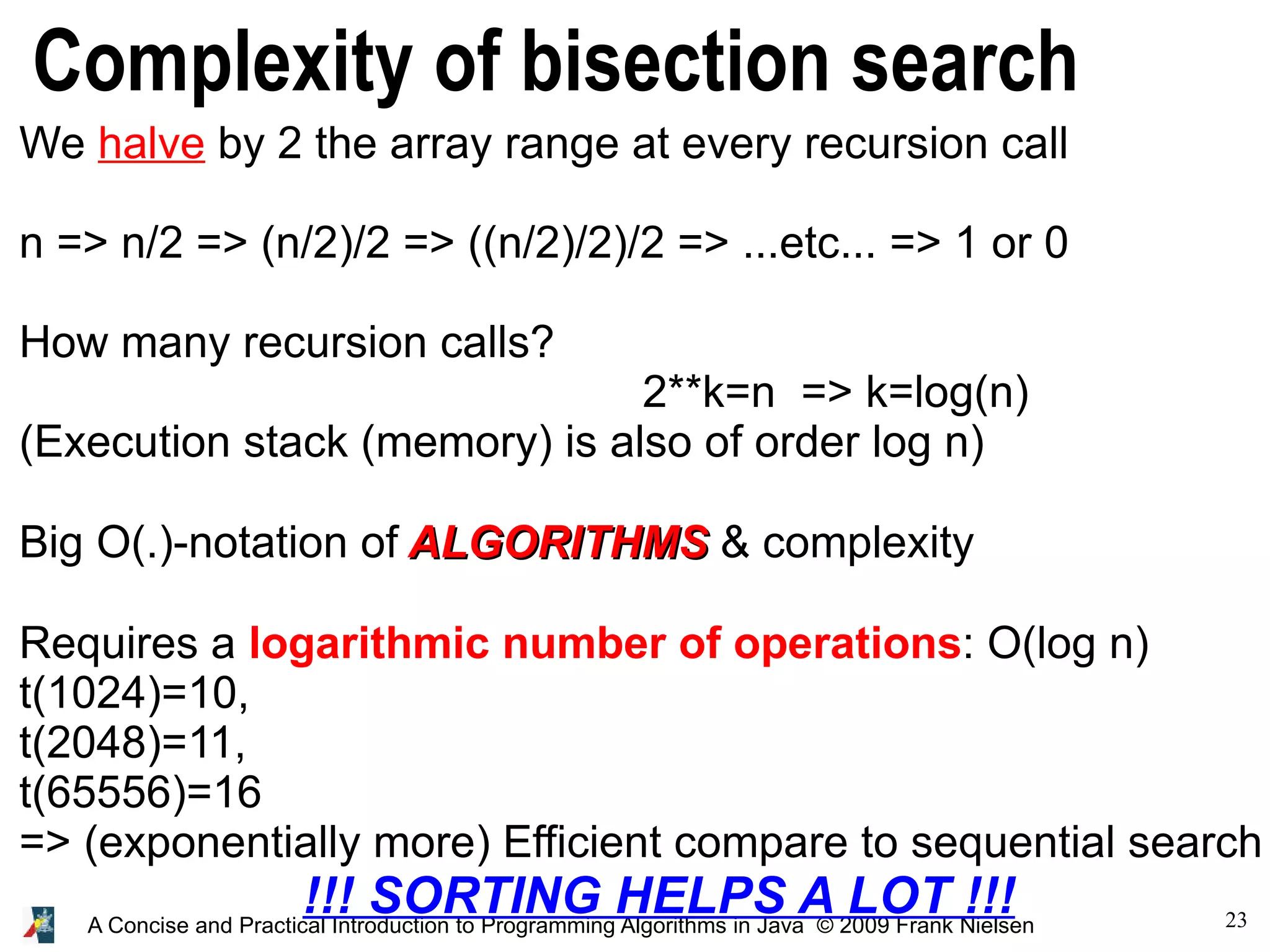
We halve by 2 the array range at every recursion call
n => n/2 => (n/2)/2 => ((n/2)/2)/2 => ...etc... => 1 or 0
How many recursion calls?
2**k=n => k=log(n)
(Execution stack (memory) is also of order log n)
Big O(.)-notation of ALGORITHMSALGORITHMS & complexity
Requires a logarithmic number of operations: O(log n)
t(1024)=10,
t(2048)=11,
t(65556)=16
=> (exponentially more) Efficient compare to sequential search
!!! SORTING HELPS A LOT !!!
Complexity of bisection search
24A Concise and Practical Introduction to Programming Algorithms in Java © 2009 Frank Nielsen
static int Dichotomy(int [] array, int left, int right, int key)
{
if (left>right)
{throw new RuntimeException("Terminal state reached");
//return -1;
}
int m=(left+right)/2;
if (array[m]==key)
{throw new RuntimeException("Terminal state reached");
//return m;
}
else
{
if (array[m]<key) return Dichotomy(array,m+1, right, key);
else return Dichotomy(array,left,m-1, key);
}
}
25A Concise and Practical Introduction to Programming Algorithms in Java © 2009 Frank Nielsen
Sorting: A fundamental procedure
● Given an (unsorted) array of elements
● We are asked to get a sorted array in, say increasing order
● The only primitive operations (basic operations) are
● comparisons and
● element swappings
static boolean GreaterThan(int a, int b)
{return (a>b);}
static void swap (int [] array, int i, int j)
{
int tmp=array[i];
array[i]=array[j];
array[j]=tmp;
}
26A Concise and Practical Introduction to Programming Algorithms in Java © 2009 Frank Nielsen
Sorting: Sorting by selectionselection
Many different sorting techniques (endless world)
● First, seek for the smallest element of the array
(=SELECTION)
● Put it at the front (using a swapping operation)
● Iterate for the remaining part:
array[1], ..., array[n-1]
=> we seek for the smallest elements for all (sub)arrays
array[j], array[j+1], ..., array[n-1]
27A Concise and Practical Introduction to Programming Algorithms in Java © 2009 Frank Nielsen
for i ← 0 to n-2 do
min ← i
for j ← (i + 1) to n-1 do
if A[j] < A[min]
min ← j
swap A[i] and A[min]
Sorting by selectionselection
Pseudo-code: 2 NESTED LOOPS
28A Concise and Practical Introduction to Programming Algorithms in Java © 2009 Frank Nielsen
for i ← 0 to n-2 do
min ← i
for j ← (i + 1) to n-1 do
if A[j] < A[min]
min ← j
swap A[i] and A[min]
The inner loop (i=0)
for i ← 0 to n-2 do
min ← i
for j ← (i + 1) to n-1 do
if A[j] < A[min]
min ← j
swap A[i] and A[min]
The inner loop (i=0)
22 is my first min
29A Concise and Practical Introduction to Programming Algorithms in Java © 2009 Frank Nielsen
for i ← 0 to n-2 do
min ← i
for j ← (i + 1) to n-1 do
if A[j] < A[min]
min ← j
swap A[i] and A[min]
The inner loop (i=1)
35 is my first min
30A Concise and Practical Introduction to Programming Algorithms in Java © 2009 Frank Nielsen
for i ← 0 to n-2 do
min ← i
for j ← (i + 1) to n-1 do
if A[j] < A[min]
min ← j
swap A[i] and A[min]
The outer loop:
min of respective subarrays
31A Concise and Practical Introduction to Programming Algorithms in Java © 2009 Frank Nielsen
Sorting by selection
Two nested loops:
● Select and put the smallest element in front of the array (inner loop)
● Repeat for all subarrays (at the right)
static boolean GreaterThan(int a, int b)
{return (a>b);}
static void swap (int [] array, int i, int j)
{int tmp=array[i];array[i]=array[j];array[j]=tmp;}
static void SelectionSort(int [] array)
{
int n=array.length;
for(int i=0;i<n-1;i++){
for(int j=i+1;j<n;j++){
if (GreaterThan(array[i],array[j]))
swap(array,i,j);}
}
}
32A Concise and Practical Introduction to Programming Algorithms in Java © 2009 Frank Nielsen
public static void main(String[] args)
{
int [] array={22,35,19,26,20,13,42,37,11,24};
SelectionSort(array);
for(int i=0;i<array.length;i++)
System.out.print(array[i]+" ");
System.out.println("");
}
Sorting by selection
33A Concise and Practical Introduction to Programming Algorithms in Java © 2009 Frank Nielsen
From sorting integers to objects
● Array array contains objects of the same type
● Define a predicate that returns whether an object
is greater than another one or not
● Adjust the swap procedure
In Java 1.5, there are generics, beyond the scope of this course
Generic algorithms for sorting any kind (=type) of elementsGeneric algorithms for sorting any kind (=type) of elements
34A Concise and Practical Introduction to Programming Algorithms in Java © 2009 Frank Nielsen
For example, sorting events
class EventObject
{
int year, month, day;
EventObject(int y, int m, int d)
{year=y; month=m; day=d;}
static void Display(EventObject obj)
{System.out.println(obj.year+"/"+obj.month+"/"+obj.day);}
}
static boolean GreaterThan(EventObject a, EventObject b)
{return (( a.year>b.year) ||
( (a.year==b.year) && (a.month>b.month)) ||
((a.year==b.year) && (a.month==b.month) && (a.day>b.day)) ) ;}
static void swap (EventObject [] array, int i, int j)
{
EventObject tmp=array[i];
array[i]=array[j];
array[j]=tmp;
}
35A Concise and Practical Introduction to Programming Algorithms in Java © 2009 Frank Nielsen
sorting events
static void SelectionSort(EventObject [] array)
{
int n=array.length;
for(int i=0;i<n-1;i++)
for(int j=i+1;j<n;j++)
if (GreaterThan(array[i],array[j]))
swap(array,i,j);
}
public static void main(String[] args)
{
EventObject [] array=new EventObject[5];
array[0]=new EventObject(2008,06,01);
array[1]=new EventObject(2005,04,03);
array[2]=new EventObject(2005,05,27);
array[3]=new EventObject(2005,04,01);
array[4]=new EventObject(2005,04,15);
SelectionSort(array);
for(int i=0;i<array.length;i++)
EventObject.Display(array[i]);
System.out.println("");
}
2005/4/1
2005/4/3
2005/4/15
2005/5/27
2008/6/1
36A Concise and Practical Introduction to Programming Algorithms in Java © 2009 Frank Nielsen
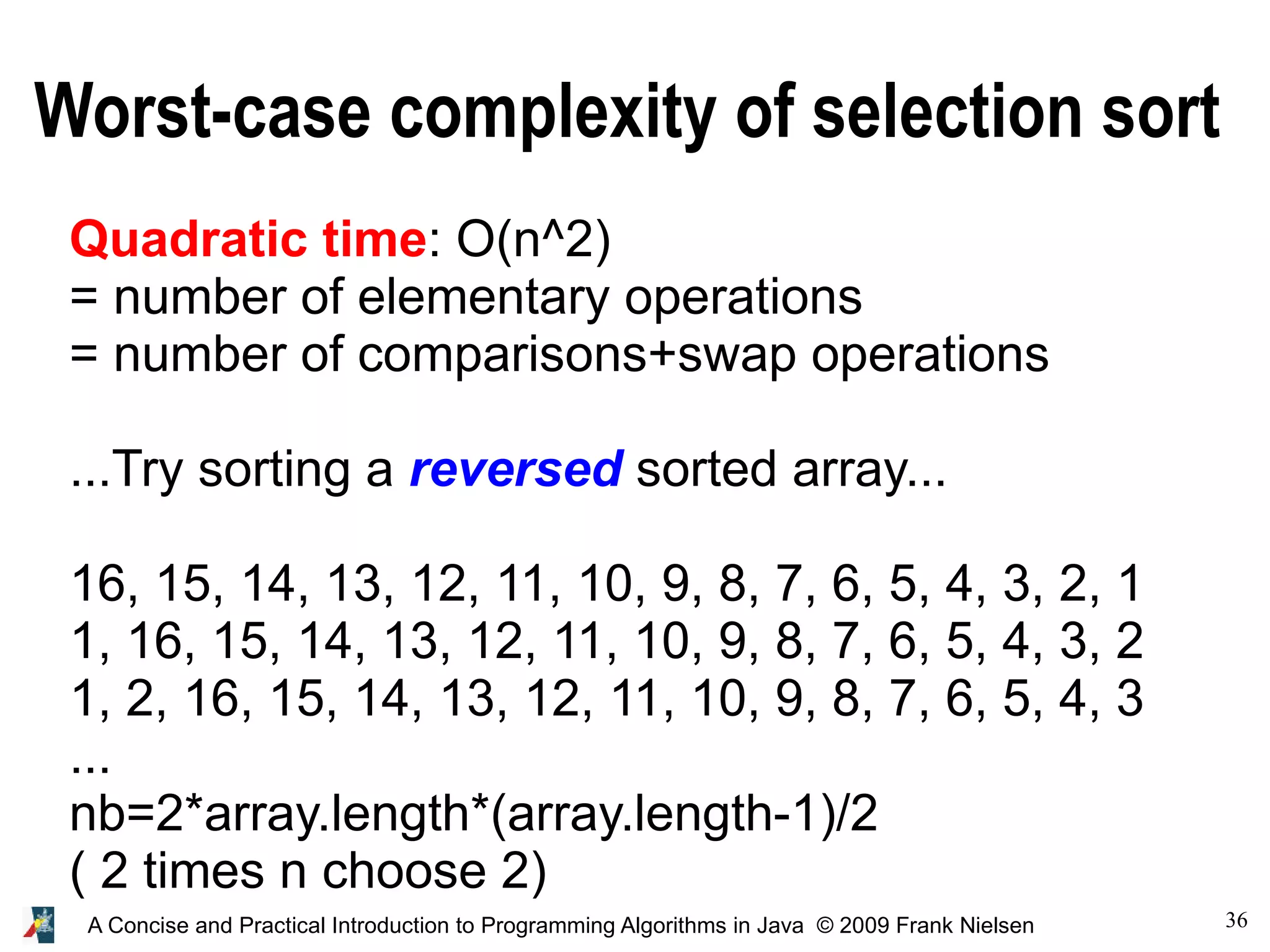
Worst-case complexity of selection sort
Quadratic time: O(n^2)
= number of elementary operations
= number of comparisons+swap operations
...Try sorting a reversed sorted array...
16, 15, 14, 13, 12, 11, 10, 9, 8, 7, 6, 5, 4, 3, 2, 1
1, 16, 15, 14, 13, 12, 11, 10, 9, 8, 7, 6, 5, 4, 3, 2
1, 2, 16, 15, 14, 13, 12, 11, 10, 9, 8, 7, 6, 5, 4, 3
...
nb=2*array.length*(array.length-1)/2
( 2 times n choose 2)
37A Concise and Practical Introduction to Programming Algorithms in Java © 2009 Frank Nielsen
class SelectionSort
{
static int nboperations;
static boolean GreaterThan(int a, int b)
{nboperations++; return (a>b);}
static void swap (int [] array, int i, int j)
{
nboperations++;
int tmp=array[i];array[i]=array[j];array[j]=tmp;}
public static void main(String[] args)
{
int [] array={16,15,14,13,12,11,10,9,8,7,6,5,4,3,2,1};
nboperations=0;
SelectionSort(array);
System.out.println("Number of operations:"+nboperations);
int nb=2*array.length*(array.length-1)/2;
System.out.println("Number of operations:"+nb);
}
38A Concise and Practical Introduction to Programming Algorithms in Java © 2009 Frank Nielsen
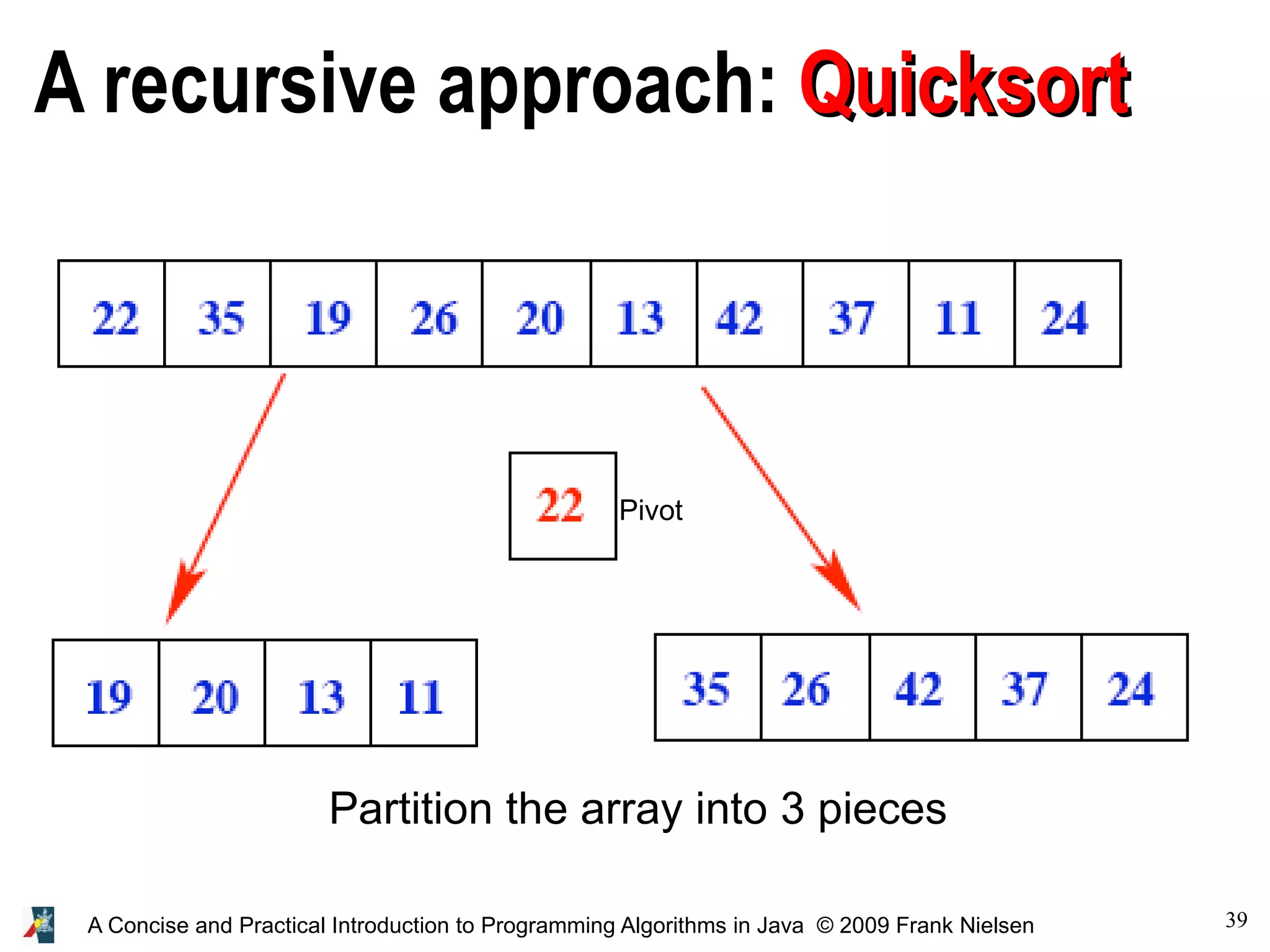
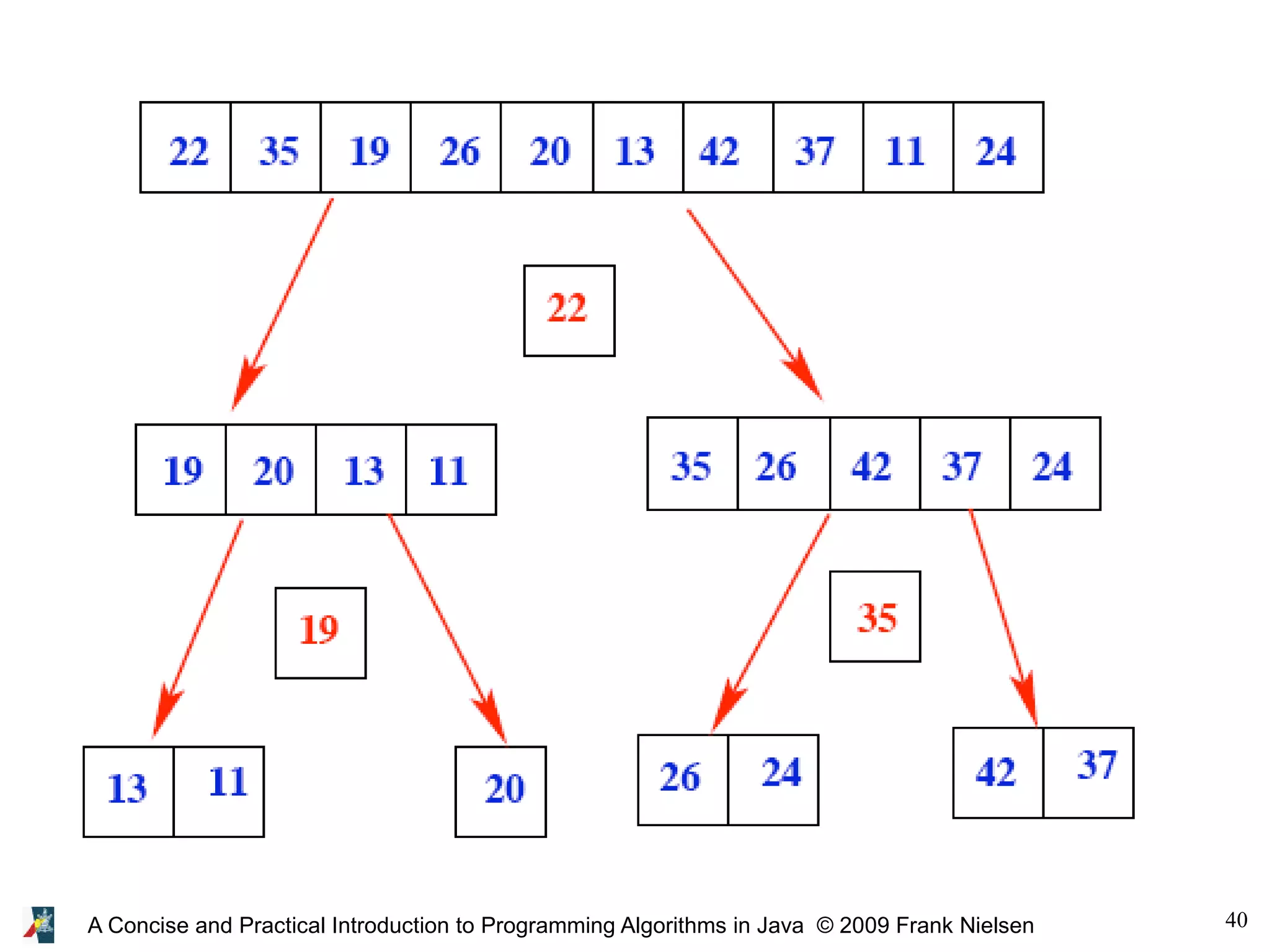
● Classify the elements according to array[0] (the pivot):
- those smaller than the pivot: arrayleft
- those greater than the pivot: arrayright
- those equal to the pivot (in case of ties): arraypivot
● Solve recursively the sorting in arrayleft / arrayright,
and recompose as
arrayleft arraypivot arrayright
● Note that a single element is sorted (=terminal case)
39A Concise and Practical Introduction to Programming Algorithms in Java © 2009 Frank Nielsen
Pivot
A recursive approach: QuicksortQuicksort
Partition the array into 3 pieces
40A Concise and Practical Introduction to Programming Algorithms in Java © 2009 Frank Nielsen
41A Concise and Practical Introduction to Programming Algorithms in Java © 2009 Frank Nielsen
static int partition(int [] array, int left, int right)
{
int m=left;// pivot
for(int i=left+1; i<=right;i++)
{
if (GreaterThan(array[left],array[i]))
{
swap(array,i,m+1);
m++;// we extend left side array
}
}
// place pivot now
swap(array,left,m);
return m;
}
Sorting is in-place
(require no extre memory storage)
Pivot
42A Concise and Practical Introduction to Programming Algorithms in Java © 2009 Frank Nielsen
static void quicksort(int [] array, int left, int right)
{
if (right>left)
{
int pivot=partition(array,left,right);
quicksort(array,left,pivot-1);
quicksort(array,pivot+1,right);
}
}
static void QuickSort(int [] array)
{
quicksort(array,0, array.length-1);
}
43A Concise and Practical Introduction to Programming Algorithms in Java © 2009 Frank Nielsen
Quicksort: Analyzing the running time
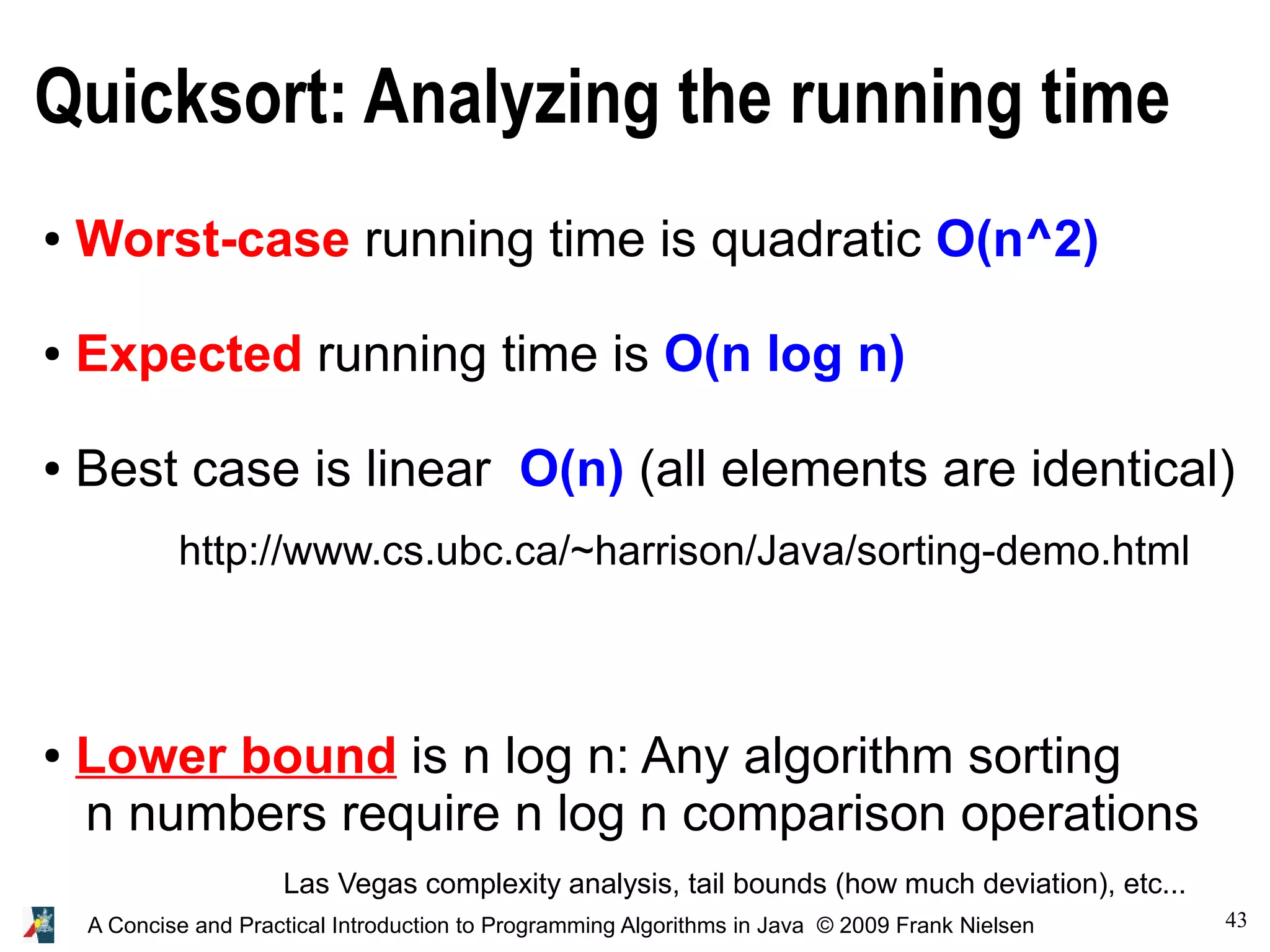
● Worst-case running time is quadratic O(n^2)
● Expected running time is O(n log n)
● Best case is linear O(n) (all elements are identical)
● Lower bound is n log n: Any algorithm sorting
n numbers require n log n comparison operations
Las Vegas complexity analysis, tail bounds (how much deviation), etc...
http://www.cs.ubc.ca/~harrison/Java/sorting-demo.html
44A Concise and Practical Introduction to Programming Algorithms in Java © 2009 Frank Nielsen
Hashing: Principle and techniques
● Hashing: fundamental technique in computer science
(see INF 421.a')
● Store object x in position h(x) (int) in an array
● Problem occurs if two objects x and y
are stored on the same cell: Collision.
● Finding good hashing functions that minimize collisions, and
adopting a good search policy in case of collisions are
key problems of hashing.
int i;
array[i]
Object Obj=new Object();
int i;
i=h(Obj);// hashing function
array[i]
45A Concise and Practical Introduction to Programming Algorithms in Java © 2009 Frank Nielsen
Hashing functions
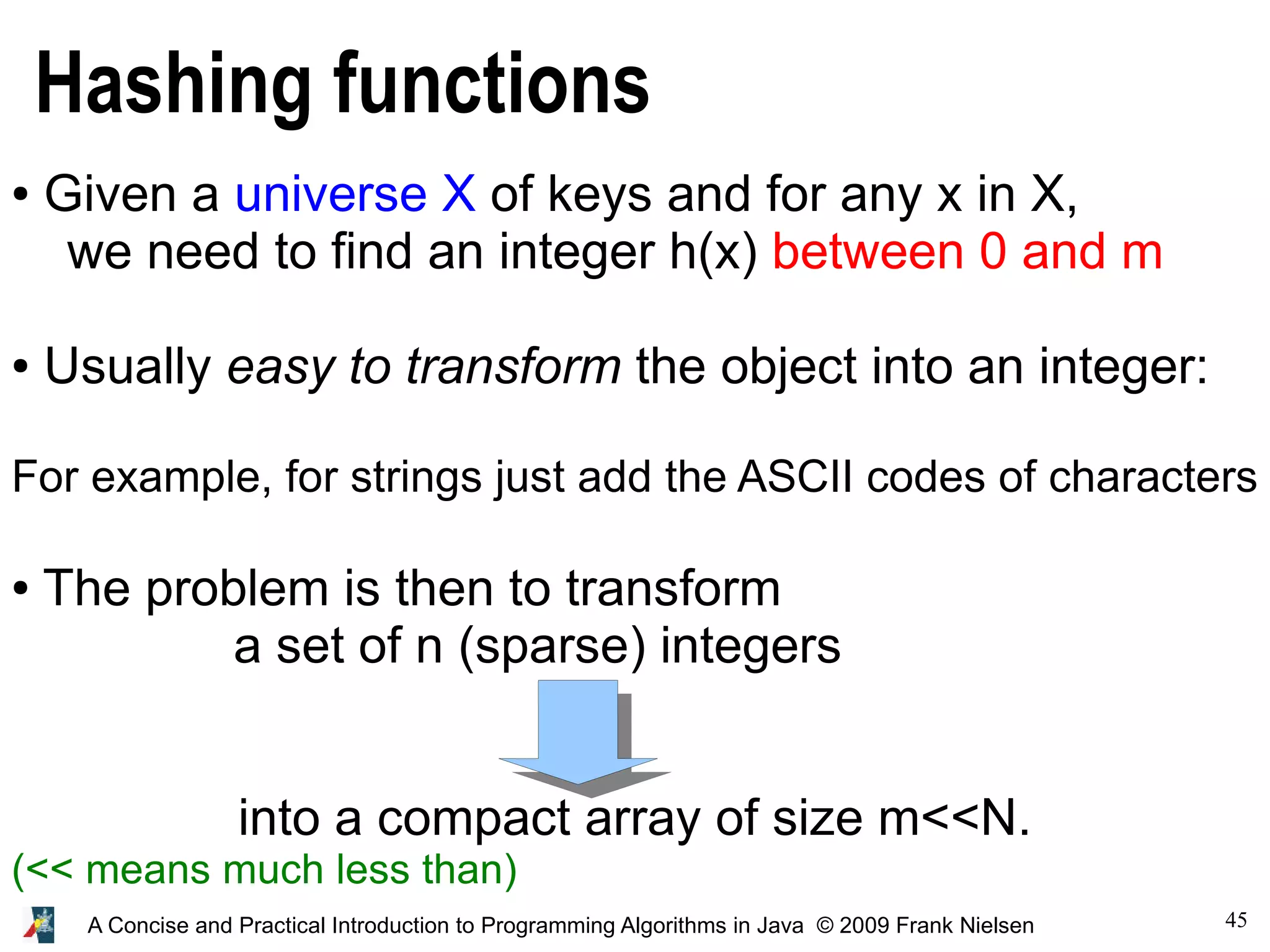
● Given a universe X of keys and for any x in X,
we need to find an integer h(x) between 0 and m
● Usually easy to transform the object into an integer:
For example, for strings just add the ASCII codes of characters
● The problem is then to transform
a set of n (sparse) integers
into a compact array of size m<<N.
(<< means much less than)
46A Concise and Practical Introduction to Programming Algorithms in Java © 2009 Frank Nielsen
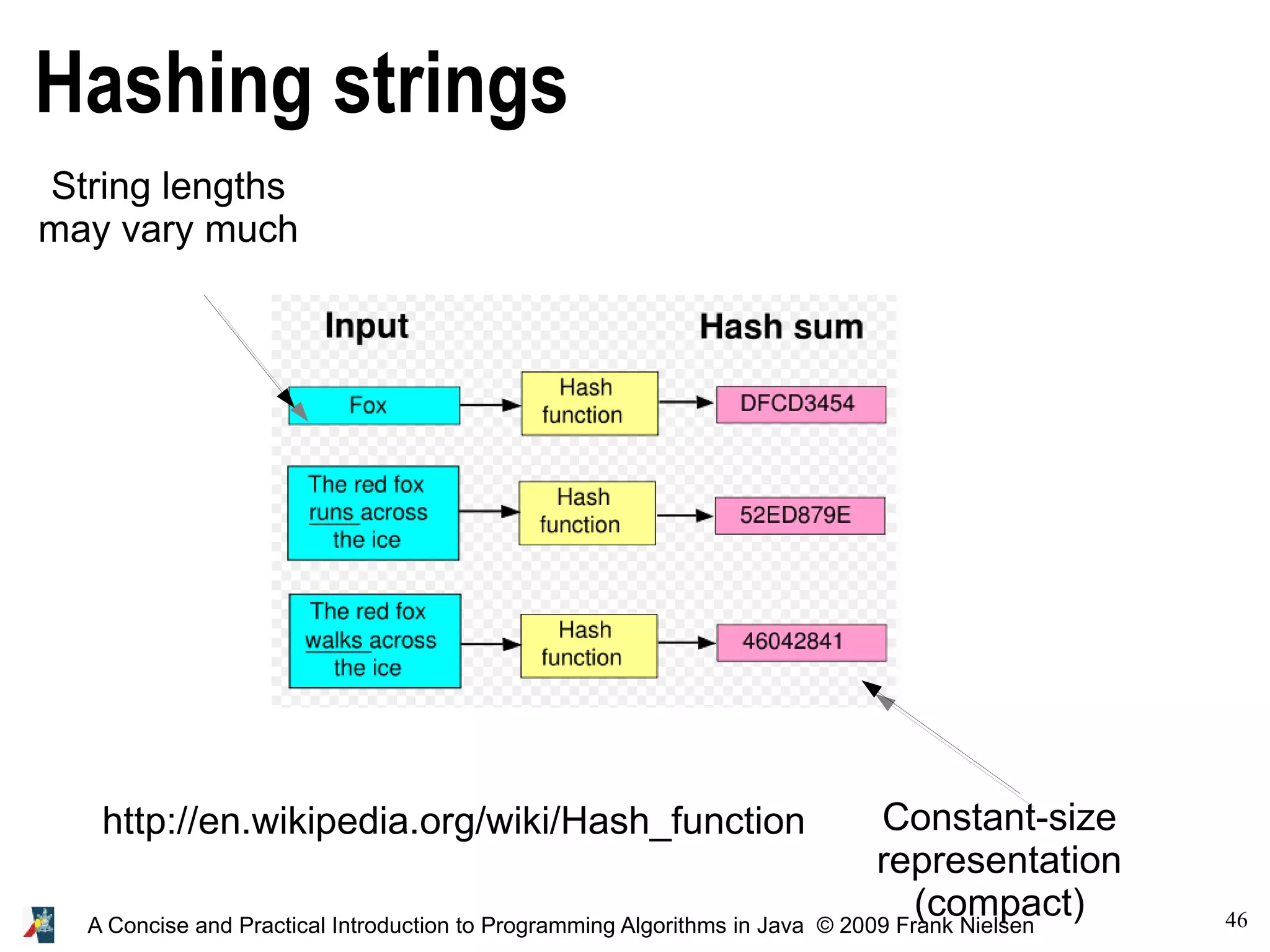
http://en.wikipedia.org/wiki/Hash_function
Hashing strings
Constant-size
representation
(compact)
String lengths
may vary much
47A Concise and Practical Introduction to Programming Algorithms in Java © 2009 Frank Nielsen
Hashing functions
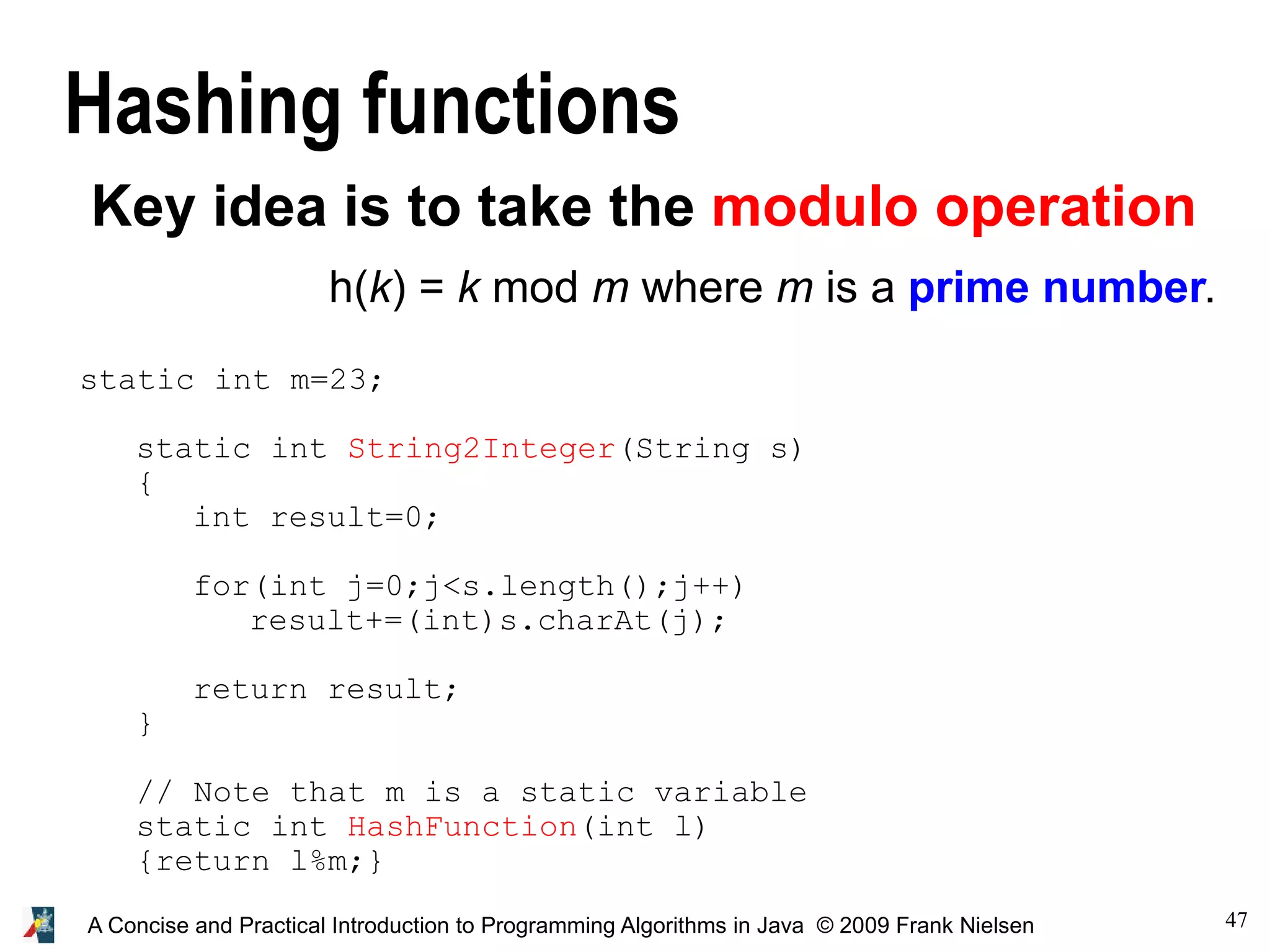
Key idea is to take the modulo operation
h(k) = k mod m where m is a prime number.
static int m=23;
static int String2Integer(String s)
{
int result=0;
for(int j=0;j<s.length();j++)
result+=(int)s.charAt(j);
return result;
}
// Note that m is a static variable
static int HashFunction(int l)
{return l%m;}
48A Concise and Practical Introduction to Programming Algorithms in Java © 2009 Frank Nielsen
public static void main (String[] args)
{
String [] animals={"cat","dog","parrot","horse","fish",
"shark","pelican","tortoise", "whale", "lion",
"flamingo", "cow", "snake", "spider", "bee", "peacock",
"elephant", "butterfly"};
int i;
String [] HashTable=new String[m];
for(i=0;i<m;i++)
HashTable[i]=new String("-->");
for(i=0;i<animals.length;i++)
{int pos=HashFunction(String2Integer(animals[i]));
HashTable[pos]+=(" "+animals[i]);
}
for(i=0;i<m;i++)
System.out.println("Position "+i+"t"+HashTable[i]);
}
49A Concise and Practical Introduction to Programming Algorithms in Java © 2009 Frank Nielsen
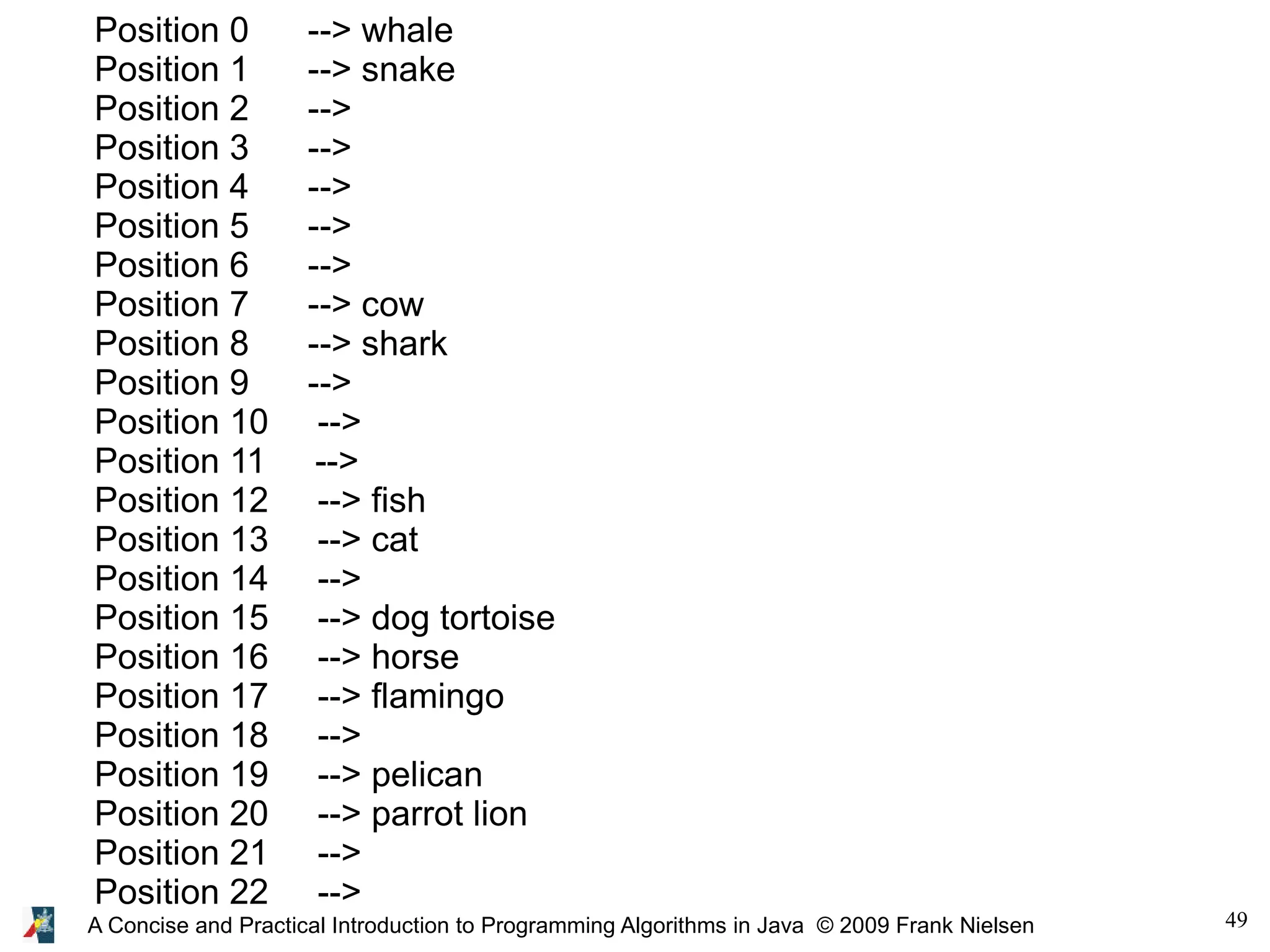
Position 0 --> whale
Position 1 --> snake
Position 2 -->
Position 3 -->
Position 4 -->
Position 5 -->
Position 6 -->
Position 7 --> cow
Position 8 --> shark
Position 9 -->
Position 10 -->
Position 11 -->
Position 12 --> fish
Position 13 --> cat
Position 14 -->
Position 15 --> dog tortoise
Position 16 --> horse
Position 17 --> flamingo
Position 18 -->
Position 19 --> pelican
Position 20 --> parrot lion
Position 21 -->
Position 22 -->
50A Concise and Practical Introduction to Programming Algorithms in Java © 2009 Frank Nielsen

(chapter 6) A Concise and Practical Introduction to Programming Algorithms in Java

  • 1.
    1A Concise andPractical Introduction to Programming Algorithms in Java © 2009 Frank Nielsen Frank NIELSEN nielsen@lix.polytechnique.fr A Concise and Practical Introduction to Programming Algorithms in Java Chapter 6: Searching and sorting
  • 2.
    2A Concise andPractical Introduction to Programming Algorithms in Java © 2009 Frank Nielsen Agenda ● Answering a few questions ● Searching (sequential, bisection) ● Sorting for faster searching ● Recursive sort ● Hashing
  • 3.
    3A Concise andPractical Introduction to Programming Algorithms in Java © 2009 Frank Nielsen Swapping Java is pass-by-value only. Arrays and objects: pass-by-reference (=memory `value') 0 y Memory for main class FunctionCallSample { public static void f(double x) { x=1; System.out.println(x);//1 return; } public static void main(String[] args) { int y=0; f(y); System.out.println(y);//y is still 0 }} Memory for f x1
  • 4.
    4A Concise andPractical Introduction to Programming Algorithms in Java © 2009 Frank Nielsen Swapping & Strings public static void Swap(String p, String q) { String tmp; tmp=p; p=q; q=tmp;} public static void Swap(String [] t, int i, int j) { String tmp; tmp=t[i]; t[i]=t[j]; t[j]=tmp;} String s1="toto"; String s2="titi"; String [] s=new String[2]; s[0]=new String("toto"); s[1]=new String("titi"); System.out.println(s1+" "+s2); Swap(s1,s2); System.out.println(s1+" "+s2); Swap(s,0,1); System.out.println(s[0]+" "+s[1]); Result
  • 5.
    5A Concise andPractical Introduction to Programming Algorithms in Java © 2009 Frank Nielsen Swapping using wrapped integers // Wrapping integers into an object class IntObj { private int x; public IntObj(int x) { this.x = x; } public int getValue() { return this.x; } public void insertValue(int newx) { this.x = newx;} } Let us wrap integers into a tailored object named IntObj
  • 6.
    6A Concise andPractical Introduction to Programming Algorithms in Java © 2009 Frank Nielsen public class SwapInt { // Pass-by-value (= pass-by-reference for objects) static void swap(IntObj p, IntObj q) { // interchange values inside objects int t = p.getValue(); p.insertValue(q.getValue()); q.insertValue(t); } public static void main(String[] args) { int a = 23, b = 12; System.out.println("Before| a:" + a + ", b: " + b); IntObj aObj = new IntObj(a); IntObj bObj = new IntObj(b); swap(aObj, bObj); a = aObj.getValue(); b = bObj.getValue(); System.out.println("After| a:" + a + ", b: " + b); } } Java wrapper class for int is Integer BUT it doesn't allow you to alter the data field inside.
  • 7.
    7A Concise andPractical Introduction to Programming Algorithms in Java © 2009 Frank Nielsen class SwapInteger { public static void main(String args[]) { Integer a, b; a = new Integer(10); b = new Integer(50); System.out.println("before swap..."); System.out.println("a is " + a); System.out.println("b is " + b); swap(a, b); // References did not change (PASS-BY-VALUE) System.out.println("after swap..."); System.out.println("a is " + a); System.out.println("b is " + b); } public static void swap(Integer a, Integer b) { Integer temp = a; a = b; b = temp; } }
  • 8.
    8A Concise andPractical Introduction to Programming Algorithms in Java © 2009 Frank Nielsen Searching: Problem statement ● Objects are accessed via a corresponding key ● Each object stores its key and additional fields ● One seeks for information stored in an object from its key (key= a handle) ● All objects are in the main memory (no external I/O) More challenging problem: Adding/removing or changing object attributes dynamically
  • 9.
    9A Concise andPractical Introduction to Programming Algorithms in Java © 2009 Frank Nielsen Searching: Basic examplesSearching: Basic examplesSearching: Basic examples Dictionary Key: word Object: (word, definition) class DictionaryEntry { String word; String definition; }
  • 10.
    10A Concise andPractical Introduction to Programming Algorithms in Java © 2009 Frank Nielsen Dictionary class DictionaryEntry { String word; String definition; DictionaryEntry(String w, String def) { this.word=new String(w); // Clone the strings this.definition=new String(def); } } class TestMyDictionary {public static void main(String[] args){ DictionaryEntry [] Dico =new DictionaryEntry[10]; Dico[0]=new DictionaryEntry("INF311","Cours d'informatique"); Dico[1]=new DictionaryEntry("ECO311","Cours d'economie"); } }
  • 11.
    11A Concise andPractical Introduction to Programming Algorithms in Java © 2009 Frank Nielsen Searching: Basic examples ● Objects denote people: Each object represents an individual ● The key (handle) is the lastname, firstname, ... ● Additional information fields are: address, phone number, etc. class Individual { String Firstname; String Lastname; String Address; String Phonenumber; int Age; boolean Sex; } Object Firstname Lastname Phonenumber int Age
  • 12.
    12A Concise andPractical Introduction to Programming Algorithms in Java © 2009 Frank Nielsen Searching: Basic examples ● Objects denote 2D point sets: Each object is a 2D point ● The key (handle) is the name, or x- or y- ordinate, etc. ● Additional information fields are: color, name, etc. class Color {int Red, Green, Blue;} class Point2D { double x; double y; String name; Color color; } x y name color
  • 13.
    13A Concise andPractical Introduction to Programming Algorithms in Java © 2009 Frank Nielsen Sequential (linear) search ● Objects are stored in an array (of objects): Any order is fine (= not necessarily sorted) ● To seek for an object, we browse sequentially the array until we find the object, or that we report that it is not inside ● Compare the keys of the query with object keys
  • 14.
    14A Concise andPractical Introduction to Programming Algorithms in Java © 2009 Frank Nielsen class Person{ String firstname, lastname; // key for searching String phone; // additional fields go here // Constructor Person(String l, String f, String p) {firstname=f; lastname=l; phone=p;} }; static Person[] array=new Person[5]; static String LinearSearch(String lastname, String firstname) { for(int i=0;i<array.length;i++) { if ((lastname.equals(array[i].lastname) && (firstname.equals(array[i].firstname)))) {return array[i].phone;} } return "Not found in my dictionary"; }
  • 15.
    15A Concise andPractical Introduction to Programming Algorithms in Java © 2009 Frank Nielsen class LinearSearch{ static Person[] array=new Person[5]; static String LinearSearch(String lastname, String firstname) {...} public static void main (String [] args) { array[0]=new Person("Nielsen","Frank","0169364089"); array[1]=new Person("Nelson","Franck","04227745221"); array[2]=new Person("Durand","Paul","0381846245"); array[3]=new Person("Dupond","Jean","0256234512"); array[4]=new Person("Tanaka","Ken","+81 3 1234 4567"); System.out.println(LinearSearch("Durand","Paul")); System.out.println(LinearSearch("Tanaka","Ken")); System.out.println(LinearSearch("Durand","Jean")); } } Array is class variable, here
  • 16.
    16A Concise andPractical Introduction to Programming Algorithms in Java © 2009 Frank Nielsen ● In the worst case, we need to scan the full array ● On average, we scan half the array size (if object is inside) Donald Knuth. The Art of Computer Programming, Volume 3: Sorting and Searching, Third Edition. Addison-Wesley, 1997. ISBN 0-201-89685-0. Section 6.1: Sequential Searching, pp.396–408. Complexity of sequential search
  • 17.
    17A Concise andPractical Introduction to Programming Algorithms in Java © 2009 Frank Nielsen Adding an element (object) ● To add dynamically an element, we first build a bigger array ● Then we use an index for storing the position of the last stored element ● When added an element, we increment the position of the 'end of array' ● Of course, we should check whether the array there is overflow or not ● Notice that it is difficult to erase elements...
  • 18.
    18A Concise andPractical Introduction to Programming Algorithms in Java © 2009 Frank Nielsen Adding an element to the corpus public static final int MAX_ELEMENTS=100; static int nbelements=0; static Person[] array=new Person[MAX_ELEMENTS]; static String LinearSearch(String lastname, String firstname) { for(int i=0;i<nbelements;i++) { if ((lastname.equals(array[i].lastname) && (firstname.equals(array[i].firstname)))) return array[i].phone; } return "Not found in my dictionary"; } static void AddElement(Person obj) {if (nbelements<MAX_ELEMENTS) array[nbelements++]=obj; // At most MAX_ELEMENTS-1 here // nbelements is at most equal to MAX_ELEMENTS now }
  • 19.
    19A Concise andPractical Introduction to Programming Algorithms in Java © 2009 Frank Nielsen Adding elements to the corpus public static void main (String [] args) { AddElement(new Person("Nielsen","Frank","0169334089")); AddElement(new Person("Nelson","Franck","04227745221")); AddElement(new Person("Durand","Paul","0381846245")); AddElement(new Person("Dupond","Jean","0256234512")); AddElement(new Person("Tanaka","Ken","+81 3 1234 4567")); System.out.println(LinearSearch("Durand","Paul")); System.out.println(LinearSearch("Tanaka","Ken")); System.out.println(LinearSearch("Durand","Jean")); AddElement(new Person("Durand", "Jean","0199989796")); System.out.println(LinearSearch("Durand","Jean")); } Check if a person already belongs to the array before adding it Under or oversaturated memory (not convenient for non-predictable array sizes)
  • 20.
    20A Concise andPractical Introduction to Programming Algorithms in Java © 2009 Frank Nielsen Dichotomic search (in sorted arrays) ● Assume all elements (keys) are totally sorted in the array ● For example, in increasing order array[0] < array[1] < ... < (any lexicographic order would do) ● To find information, use a dichotomic search on the key ● Compare the key of the middle element with the query key: ● If identical, we are done since we found it ● If the key is greater, we search in the rightmost array part ● If the key is less, we search in the leftmost array part ● If the range [left,right] is <=1 and element not inside then... .....conclude it is not inside the array
  • 21.
    21A Concise andPractical Introduction to Programming Algorithms in Java © 2009 Frank Nielsen Dichotomic search/Bisection search Think recursion! static int Dichotomy(int [] array, int left, int right, int key) { if (left>right) return -1; int m=(left+right)/2; // !!! Euclidean division !!! if (array[m]==key) return m; else { if (array[m]<key) return Dichotomy(array,m+1, right, key); else return Dichotomy(array,left,m-1, key); } } static int DichotomicSearch(int [] array, int key) { return Dichotomy(array,0,array.length-1, key); } Result is the index of the element position Does it always terminate? Why?
  • 22.
    22A Concise andPractical Introduction to Programming Algorithms in Java © 2009 Frank Nielsen Dichotomic search/Bisection search public static void main (String[] args) { int [] v={1, 6, 9, 12 , 45, 67, 76, 80, 95}; System.out.println("Seeking for element 6: Position "+DichotomicSearch(v,6)); System.out.println("Seeking for element 80: Position "+DichotomicSearch(v,80)); System.out.println("Seeking for element 33: Position "+DichotomicSearch(v,33)); } 1, 6, 9, 12 , 45, 67, 76, 80, 95 9 elements [0,8] m=4 6<45 1, 6, 9, 12 4 elements [0,3] m=1 6=6 Found it return 1
  • 23.
    23A Concise andPractical Introduction to Programming Algorithms in Java © 2009 Frank Nielsen We halve by 2 the array range at every recursion call n => n/2 => (n/2)/2 => ((n/2)/2)/2 => ...etc... => 1 or 0 How many recursion calls? 2**k=n => k=log(n) (Execution stack (memory) is also of order log n) Big O(.)-notation of ALGORITHMSALGORITHMS & complexity Requires a logarithmic number of operations: O(log n) t(1024)=10, t(2048)=11, t(65556)=16 => (exponentially more) Efficient compare to sequential search !!! SORTING HELPS A LOT !!! Complexity of bisection search
  • 24.
    24A Concise andPractical Introduction to Programming Algorithms in Java © 2009 Frank Nielsen static int Dichotomy(int [] array, int left, int right, int key) { if (left>right) {throw new RuntimeException("Terminal state reached"); //return -1; } int m=(left+right)/2; if (array[m]==key) {throw new RuntimeException("Terminal state reached"); //return m; } else { if (array[m]<key) return Dichotomy(array,m+1, right, key); else return Dichotomy(array,left,m-1, key); } }
  • 25.
    25A Concise andPractical Introduction to Programming Algorithms in Java © 2009 Frank Nielsen Sorting: A fundamental procedure ● Given an (unsorted) array of elements ● We are asked to get a sorted array in, say increasing order ● The only primitive operations (basic operations) are ● comparisons and ● element swappings static boolean GreaterThan(int a, int b) {return (a>b);} static void swap (int [] array, int i, int j) { int tmp=array[i]; array[i]=array[j]; array[j]=tmp; }
  • 26.
    26A Concise andPractical Introduction to Programming Algorithms in Java © 2009 Frank Nielsen Sorting: Sorting by selectionselection Many different sorting techniques (endless world) ● First, seek for the smallest element of the array (=SELECTION) ● Put it at the front (using a swapping operation) ● Iterate for the remaining part: array[1], ..., array[n-1] => we seek for the smallest elements for all (sub)arrays array[j], array[j+1], ..., array[n-1]
  • 27.
    27A Concise andPractical Introduction to Programming Algorithms in Java © 2009 Frank Nielsen for i ← 0 to n-2 do min ← i for j ← (i + 1) to n-1 do if A[j] < A[min] min ← j swap A[i] and A[min] Sorting by selectionselection Pseudo-code: 2 NESTED LOOPS
  • 28.
    28A Concise andPractical Introduction to Programming Algorithms in Java © 2009 Frank Nielsen for i ← 0 to n-2 do min ← i for j ← (i + 1) to n-1 do if A[j] < A[min] min ← j swap A[i] and A[min] The inner loop (i=0) for i ← 0 to n-2 do min ← i for j ← (i + 1) to n-1 do if A[j] < A[min] min ← j swap A[i] and A[min] The inner loop (i=0) 22 is my first min
  • 29.
    29A Concise andPractical Introduction to Programming Algorithms in Java © 2009 Frank Nielsen for i ← 0 to n-2 do min ← i for j ← (i + 1) to n-1 do if A[j] < A[min] min ← j swap A[i] and A[min] The inner loop (i=1) 35 is my first min
  • 30.
    30A Concise andPractical Introduction to Programming Algorithms in Java © 2009 Frank Nielsen for i ← 0 to n-2 do min ← i for j ← (i + 1) to n-1 do if A[j] < A[min] min ← j swap A[i] and A[min] The outer loop: min of respective subarrays
  • 31.
    31A Concise andPractical Introduction to Programming Algorithms in Java © 2009 Frank Nielsen Sorting by selection Two nested loops: ● Select and put the smallest element in front of the array (inner loop) ● Repeat for all subarrays (at the right) static boolean GreaterThan(int a, int b) {return (a>b);} static void swap (int [] array, int i, int j) {int tmp=array[i];array[i]=array[j];array[j]=tmp;} static void SelectionSort(int [] array) { int n=array.length; for(int i=0;i<n-1;i++){ for(int j=i+1;j<n;j++){ if (GreaterThan(array[i],array[j])) swap(array,i,j);} } }
  • 32.
    32A Concise andPractical Introduction to Programming Algorithms in Java © 2009 Frank Nielsen public static void main(String[] args) { int [] array={22,35,19,26,20,13,42,37,11,24}; SelectionSort(array); for(int i=0;i<array.length;i++) System.out.print(array[i]+" "); System.out.println(""); } Sorting by selection
  • 33.
    33A Concise andPractical Introduction to Programming Algorithms in Java © 2009 Frank Nielsen From sorting integers to objects ● Array array contains objects of the same type ● Define a predicate that returns whether an object is greater than another one or not ● Adjust the swap procedure In Java 1.5, there are generics, beyond the scope of this course Generic algorithms for sorting any kind (=type) of elementsGeneric algorithms for sorting any kind (=type) of elements
  • 34.
    34A Concise andPractical Introduction to Programming Algorithms in Java © 2009 Frank Nielsen For example, sorting events class EventObject { int year, month, day; EventObject(int y, int m, int d) {year=y; month=m; day=d;} static void Display(EventObject obj) {System.out.println(obj.year+"/"+obj.month+"/"+obj.day);} } static boolean GreaterThan(EventObject a, EventObject b) {return (( a.year>b.year) || ( (a.year==b.year) && (a.month>b.month)) || ((a.year==b.year) && (a.month==b.month) && (a.day>b.day)) ) ;} static void swap (EventObject [] array, int i, int j) { EventObject tmp=array[i]; array[i]=array[j]; array[j]=tmp; }
  • 35.
    35A Concise andPractical Introduction to Programming Algorithms in Java © 2009 Frank Nielsen sorting events static void SelectionSort(EventObject [] array) { int n=array.length; for(int i=0;i<n-1;i++) for(int j=i+1;j<n;j++) if (GreaterThan(array[i],array[j])) swap(array,i,j); } public static void main(String[] args) { EventObject [] array=new EventObject[5]; array[0]=new EventObject(2008,06,01); array[1]=new EventObject(2005,04,03); array[2]=new EventObject(2005,05,27); array[3]=new EventObject(2005,04,01); array[4]=new EventObject(2005,04,15); SelectionSort(array); for(int i=0;i<array.length;i++) EventObject.Display(array[i]); System.out.println(""); } 2005/4/1 2005/4/3 2005/4/15 2005/5/27 2008/6/1
  • 36.
    36A Concise andPractical Introduction to Programming Algorithms in Java © 2009 Frank Nielsen Worst-case complexity of selection sort Quadratic time: O(n^2) = number of elementary operations = number of comparisons+swap operations ...Try sorting a reversed sorted array... 16, 15, 14, 13, 12, 11, 10, 9, 8, 7, 6, 5, 4, 3, 2, 1 1, 16, 15, 14, 13, 12, 11, 10, 9, 8, 7, 6, 5, 4, 3, 2 1, 2, 16, 15, 14, 13, 12, 11, 10, 9, 8, 7, 6, 5, 4, 3 ... nb=2*array.length*(array.length-1)/2 ( 2 times n choose 2)
  • 37.
    37A Concise andPractical Introduction to Programming Algorithms in Java © 2009 Frank Nielsen class SelectionSort { static int nboperations; static boolean GreaterThan(int a, int b) {nboperations++; return (a>b);} static void swap (int [] array, int i, int j) { nboperations++; int tmp=array[i];array[i]=array[j];array[j]=tmp;} public static void main(String[] args) { int [] array={16,15,14,13,12,11,10,9,8,7,6,5,4,3,2,1}; nboperations=0; SelectionSort(array); System.out.println("Number of operations:"+nboperations); int nb=2*array.length*(array.length-1)/2; System.out.println("Number of operations:"+nb); }
  • 38.
    38A Concise andPractical Introduction to Programming Algorithms in Java © 2009 Frank Nielsen ● Classify the elements according to array[0] (the pivot): - those smaller than the pivot: arrayleft - those greater than the pivot: arrayright - those equal to the pivot (in case of ties): arraypivot ● Solve recursively the sorting in arrayleft / arrayright, and recompose as arrayleft arraypivot arrayright ● Note that a single element is sorted (=terminal case)
  • 39.
    39A Concise andPractical Introduction to Programming Algorithms in Java © 2009 Frank Nielsen Pivot A recursive approach: QuicksortQuicksort Partition the array into 3 pieces
  • 40.
    40A Concise andPractical Introduction to Programming Algorithms in Java © 2009 Frank Nielsen
  • 41.
    41A Concise andPractical Introduction to Programming Algorithms in Java © 2009 Frank Nielsen static int partition(int [] array, int left, int right) { int m=left;// pivot for(int i=left+1; i<=right;i++) { if (GreaterThan(array[left],array[i])) { swap(array,i,m+1); m++;// we extend left side array } } // place pivot now swap(array,left,m); return m; } Sorting is in-place (require no extre memory storage) Pivot
  • 42.
    42A Concise andPractical Introduction to Programming Algorithms in Java © 2009 Frank Nielsen static void quicksort(int [] array, int left, int right) { if (right>left) { int pivot=partition(array,left,right); quicksort(array,left,pivot-1); quicksort(array,pivot+1,right); } } static void QuickSort(int [] array) { quicksort(array,0, array.length-1); }
  • 43.
    43A Concise andPractical Introduction to Programming Algorithms in Java © 2009 Frank Nielsen Quicksort: Analyzing the running time ● Worst-case running time is quadratic O(n^2) ● Expected running time is O(n log n) ● Best case is linear O(n) (all elements are identical) ● Lower bound is n log n: Any algorithm sorting n numbers require n log n comparison operations Las Vegas complexity analysis, tail bounds (how much deviation), etc... http://www.cs.ubc.ca/~harrison/Java/sorting-demo.html
  • 44.
    44A Concise andPractical Introduction to Programming Algorithms in Java © 2009 Frank Nielsen Hashing: Principle and techniques ● Hashing: fundamental technique in computer science (see INF 421.a') ● Store object x in position h(x) (int) in an array ● Problem occurs if two objects x and y are stored on the same cell: Collision. ● Finding good hashing functions that minimize collisions, and adopting a good search policy in case of collisions are key problems of hashing. int i; array[i] Object Obj=new Object(); int i; i=h(Obj);// hashing function array[i]
  • 45.
    45A Concise andPractical Introduction to Programming Algorithms in Java © 2009 Frank Nielsen Hashing functions ● Given a universe X of keys and for any x in X, we need to find an integer h(x) between 0 and m ● Usually easy to transform the object into an integer: For example, for strings just add the ASCII codes of characters ● The problem is then to transform a set of n (sparse) integers into a compact array of size m<<N. (<< means much less than)
  • 46.
    46A Concise andPractical Introduction to Programming Algorithms in Java © 2009 Frank Nielsen http://en.wikipedia.org/wiki/Hash_function Hashing strings Constant-size representation (compact) String lengths may vary much
  • 47.
    47A Concise andPractical Introduction to Programming Algorithms in Java © 2009 Frank Nielsen Hashing functions Key idea is to take the modulo operation h(k) = k mod m where m is a prime number. static int m=23; static int String2Integer(String s) { int result=0; for(int j=0;j<s.length();j++) result+=(int)s.charAt(j); return result; } // Note that m is a static variable static int HashFunction(int l) {return l%m;}
  • 48.
    48A Concise andPractical Introduction to Programming Algorithms in Java © 2009 Frank Nielsen public static void main (String[] args) { String [] animals={"cat","dog","parrot","horse","fish", "shark","pelican","tortoise", "whale", "lion", "flamingo", "cow", "snake", "spider", "bee", "peacock", "elephant", "butterfly"}; int i; String [] HashTable=new String[m]; for(i=0;i<m;i++) HashTable[i]=new String("-->"); for(i=0;i<animals.length;i++) {int pos=HashFunction(String2Integer(animals[i])); HashTable[pos]+=(" "+animals[i]); } for(i=0;i<m;i++) System.out.println("Position "+i+"t"+HashTable[i]); }
  • 49.
    49A Concise andPractical Introduction to Programming Algorithms in Java © 2009 Frank Nielsen Position 0 --> whale Position 1 --> snake Position 2 --> Position 3 --> Position 4 --> Position 5 --> Position 6 --> Position 7 --> cow Position 8 --> shark Position 9 --> Position 10 --> Position 11 --> Position 12 --> fish Position 13 --> cat Position 14 --> Position 15 --> dog tortoise Position 16 --> horse Position 17 --> flamingo Position 18 --> Position 19 --> pelican Position 20 --> parrot lion Position 21 --> Position 22 -->
  • 50.
    50A Concise andPractical Introduction to Programming Algorithms in Java © 2009 Frank Nielsen