


tech talk @ ferret
Andrii Gakhov
PROBABILISTIC DATA STRUCTURES
ALL YOU WANTED TO KNOW BUT WERE AFRAID TO ASK
PART 2: CARDINALITY
CARDINALITY
Agenda:
▸ Linear Counting
▸ LogLog, SuperLogLog, HyperLogLog, HyperLogLog++
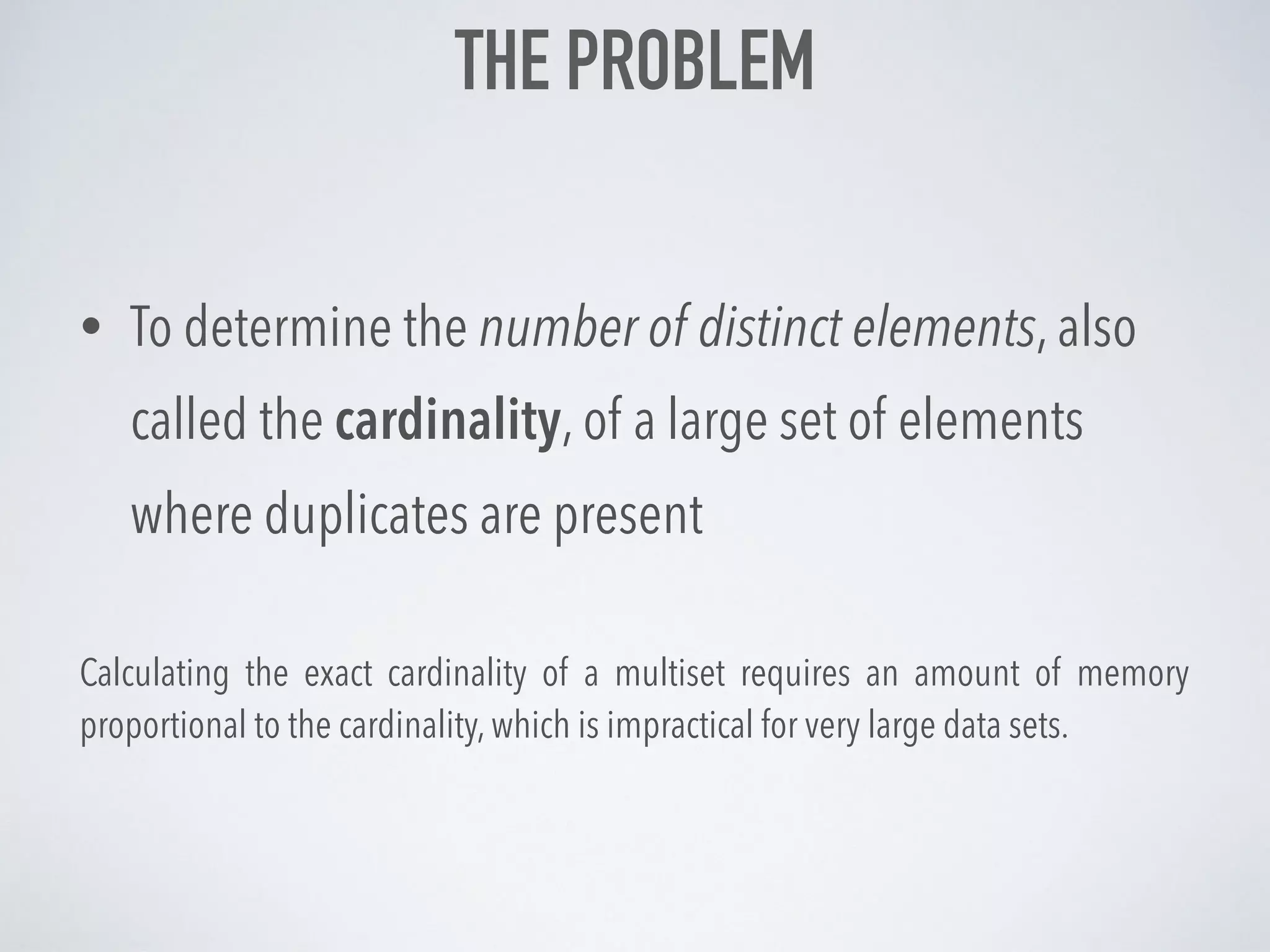
• To determine the number of distinct elements, also
called the cardinality, of a large set of elements
where duplicates are present
Calculating the exact cardinality of a multiset requires an amount of memory
proportional to the cardinality, which is impractical for very large data sets.
THE PROBLEM
LINEAR COUNTING
LINEAR COUNTING: ALGORITHM
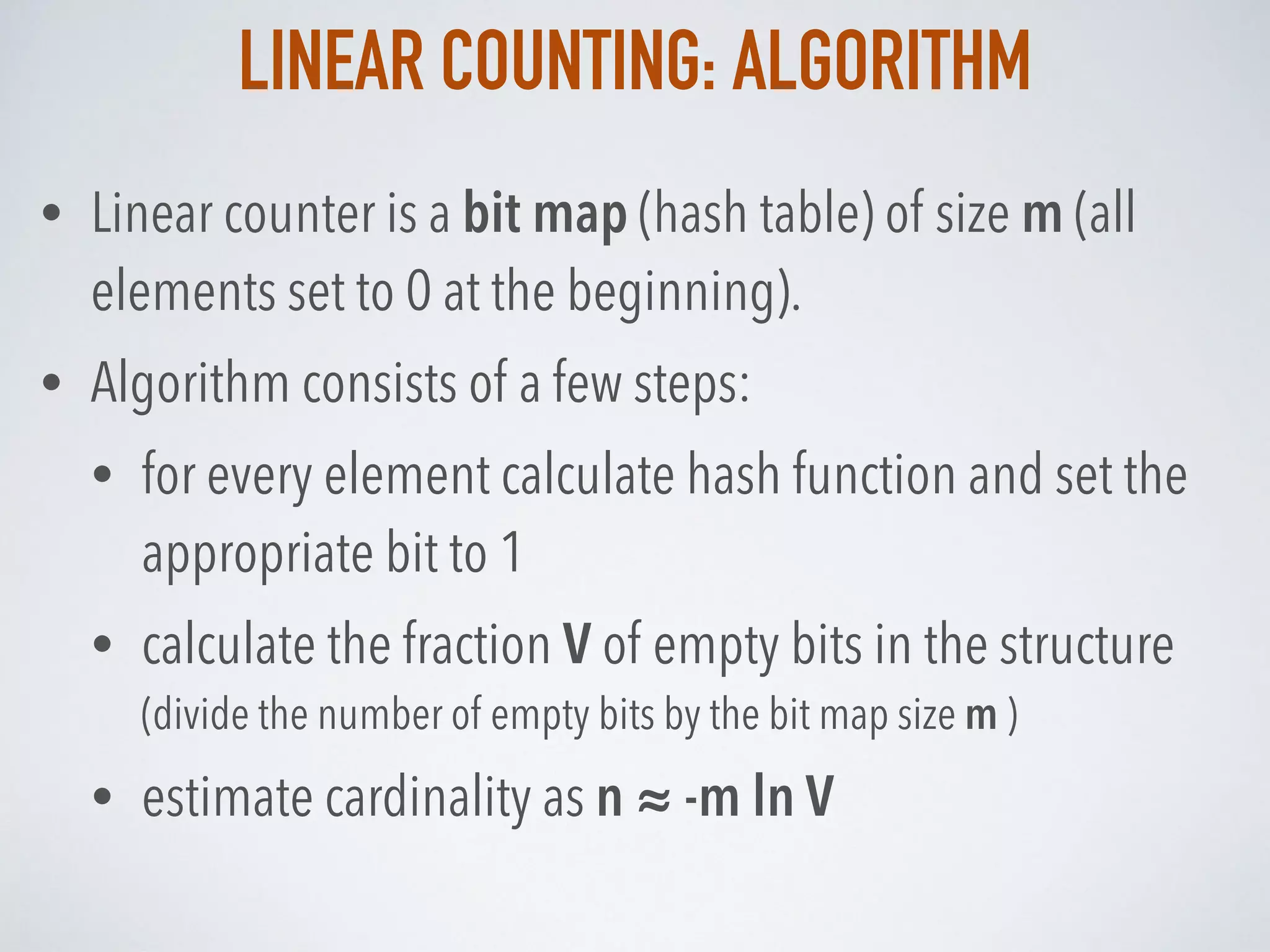
• Linear counter is a bit map (hash table) of size m (all
elements set to 0 at the beginning).
• Algorithm consists of a few steps:
• for every element calculate hash function and set the
appropriate bit to 1
• calculate the fraction V of empty bits in the structure 

(divide the number of empty bits by the bit map size m )
• estimate cardinality as n ≈ -m ln V
LINEAR COUNTING: EXAMPLE
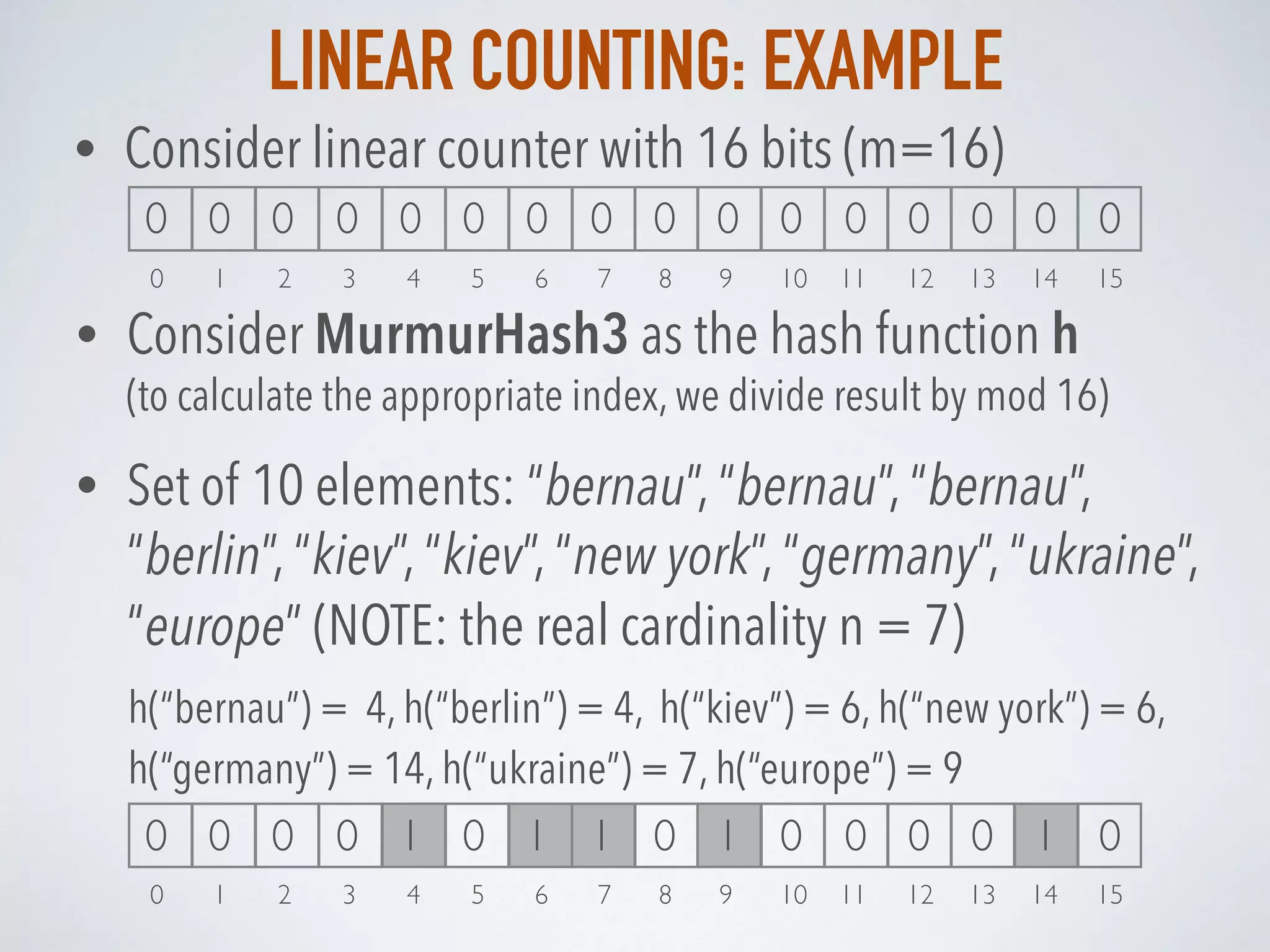
0 1 2 3 4 5 6 7 8 9 10 11 12 13 14 15
0 0 0 0 0 0 0 0 0 0 0 0 0 0 0 0
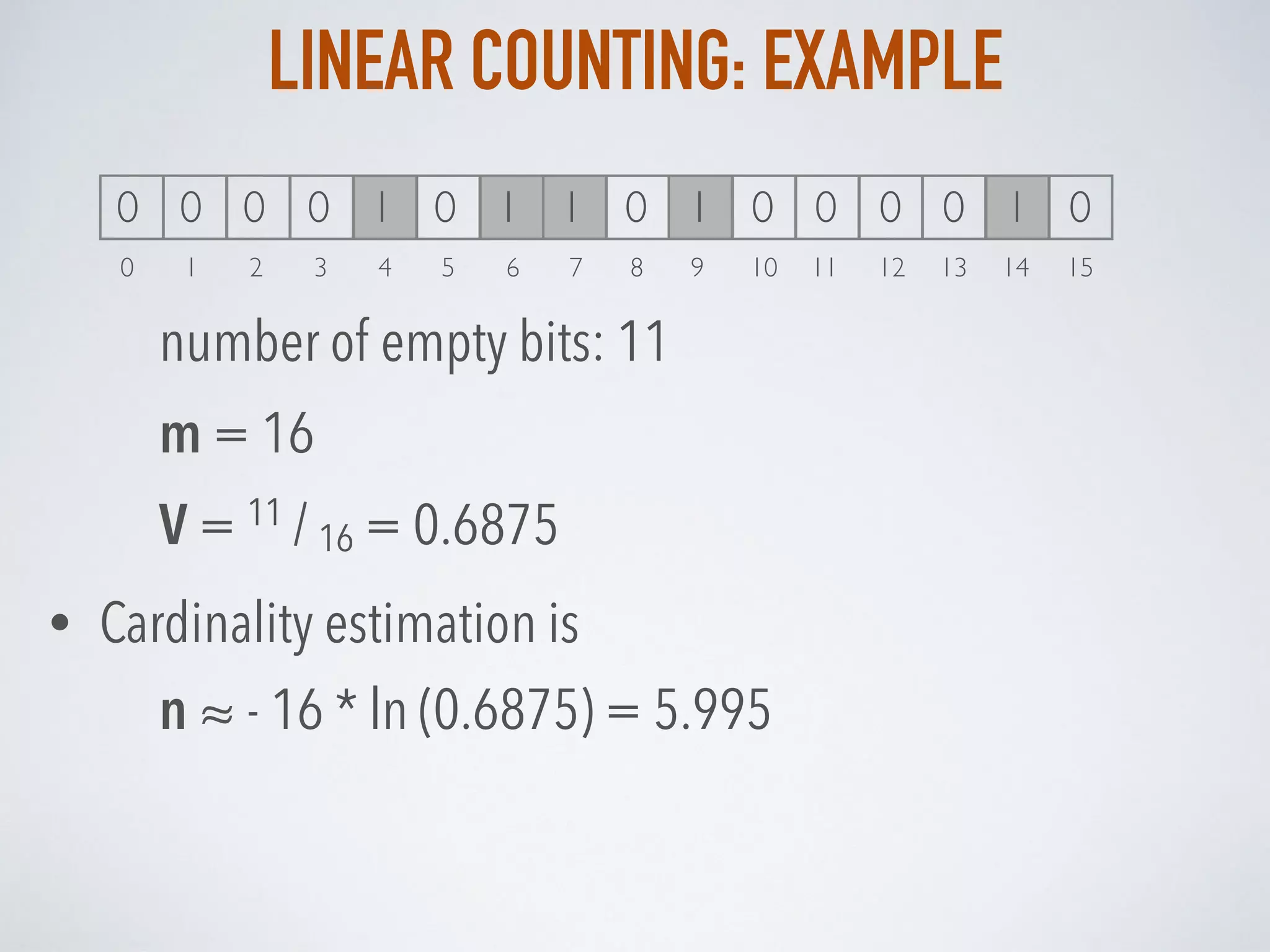
• Consider linear counter with 16 bits (m=16)
• Consider MurmurHash3 as the hash function h

(to calculate the appropriate index, we divide result by mod 16)
• Set of 10 elements: “bernau”, “bernau”, “bernau”,
“berlin”, “kiev”, “kiev”, “new york”, “germany”, “ukraine”,
“europe” (NOTE: the real cardinality n = 7)
h(“bernau”) = 4, h(“berlin”) = 4, h(“kiev”) = 6, h(“new york”) = 6,
h(“germany”) = 14, h(“ukraine”) = 7, h(“europe”) = 9
0 1 2 3 4 5 6 7 8 9 10 11 12 13 14 15
0 0 0 0 1 0 1 1 0 1 0 0 0 0 1 0
LINEAR COUNTING: EXAMPLE
number of empty bits: 11
m = 16
V = 11 / 16 = 0.6875
0 1 2 3 4 5 6 7 8 9 10 11 12 13 14 15
0 0 0 0 1 0 1 1 0 1 0 0 0 0 1 0
• Cardinality estimation is
n ≈ - 16 * ln (0.6875) = 5.995
LINEAR COUNTING: READ MORE
• http://dblab.kaist.ac.kr/Prof/pdf/Whang1990(linear).pdf
• http://www.codeproject.com/Articles/569718/
CardinalityplusEstimationplusinplusLinearplusTimep
HYPERLOGLOG
HYPERLOGLOG: INTUITION
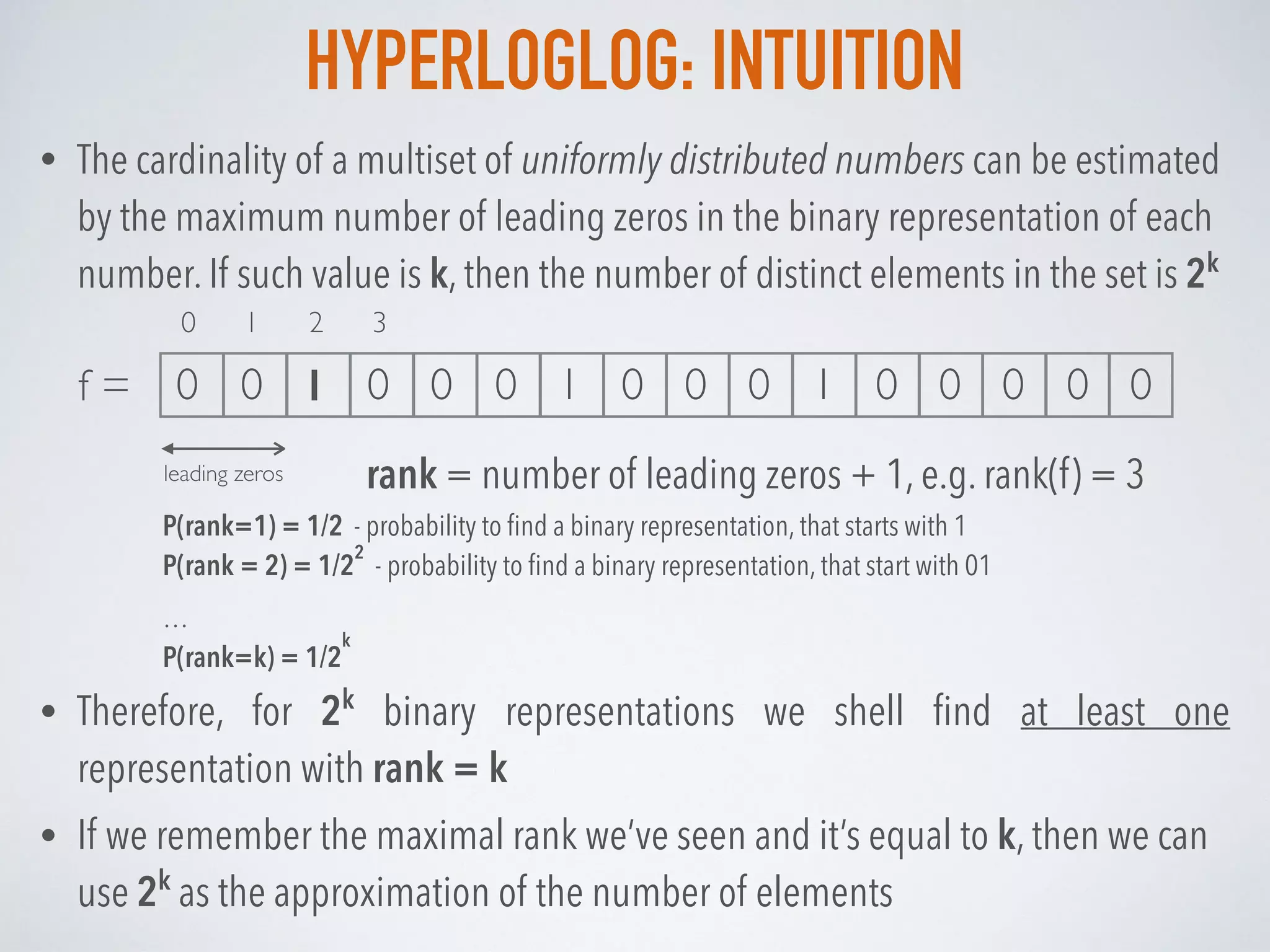
• The cardinality of a multiset of uniformly distributed numbers can be estimated
by the maximum number of leading zeros in the binary representation of each
number. If such value is k, then the number of distinct elements in the set is 2k
P(rank=1) = 1/2 - probability to find a binary representation, that starts with 1
P(rank = 2) = 1/2
2
- probability to find a binary representation, that start with 01
…
P(rank=k) = 1/2
k
rank = number of leading zeros + 1, e.g. rank(f) = 3
0 0 1 0 0 0 1 0 0 0 1 0 0 0 0 0
0 1 2
leading zeros
3
f =
• Therefore, for 2k
binary representations we shell find at least one
representation with rank = k
• If we remember the maximal rank we’ve seen and it’s equal to k, then we can
use 2k
as the approximation of the number of elements
HYPERLOGLOG
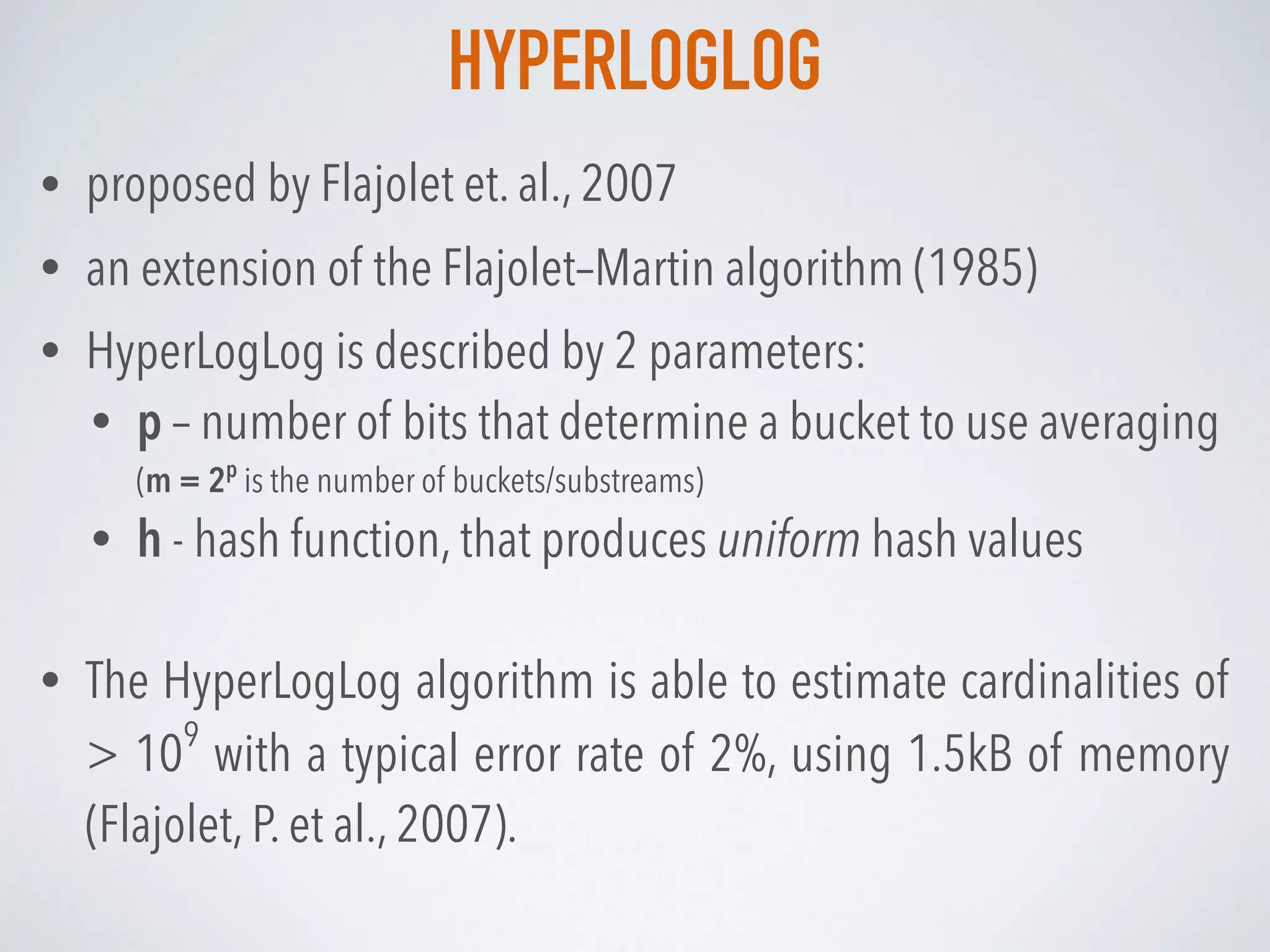
• proposed by Flajolet et. al., 2007
• an extension of the Flajolet–Martin algorithm (1985)
• HyperLogLog is described by 2 parameters:
• p – number of bits that determine a bucket to use averaging

(m = 2p
is the number of buckets/substreams)
• h - hash function, that produces uniform hash values
• The HyperLogLog algorithm is able to estimate cardinalities of
> 109
with a typical error rate of 2%, using 1.5kB of memory
(Flajolet, P. et al., 2007).
HYPERLOGLOG: ALGORITHM
• HyperLogLog uses randomization to approximate the
cardinality of a multiset.This randomization is achieved by
using hash function h
• Observe the maximum number of leading zeros that for all
hash values:
• If the bit pattern 0L−1 1 is observed at the beginning of a
hash value (so, rank = L), then a good estimation of the size
of the multiset is 2L.
HYPERLOGLOG: ALGORITHM
• Stochastic averaging is used to reduce the large variability:
• The input stream of data elements S is divided into m substreams Si using
the first p bits of the hash values (m = 2p)
.
• In each substream, the rank (after the initial p bits that are used for
substreaming) is measured independently.
• These numbers are kept in an array of registers M, where M[i] stores the
maximum rank it seen for the substream with index i.
• The cardinality estimation is calculated computes as the normalized bias
corrected harmonic mean of the estimations on the substreams
DVHLL = const(m)⋅m2
⋅ 2
−M j
j=1
m
∑
⎛
⎝⎜
⎞
⎠⎟
−1
HYPERLOGLOG: EXAMPLE
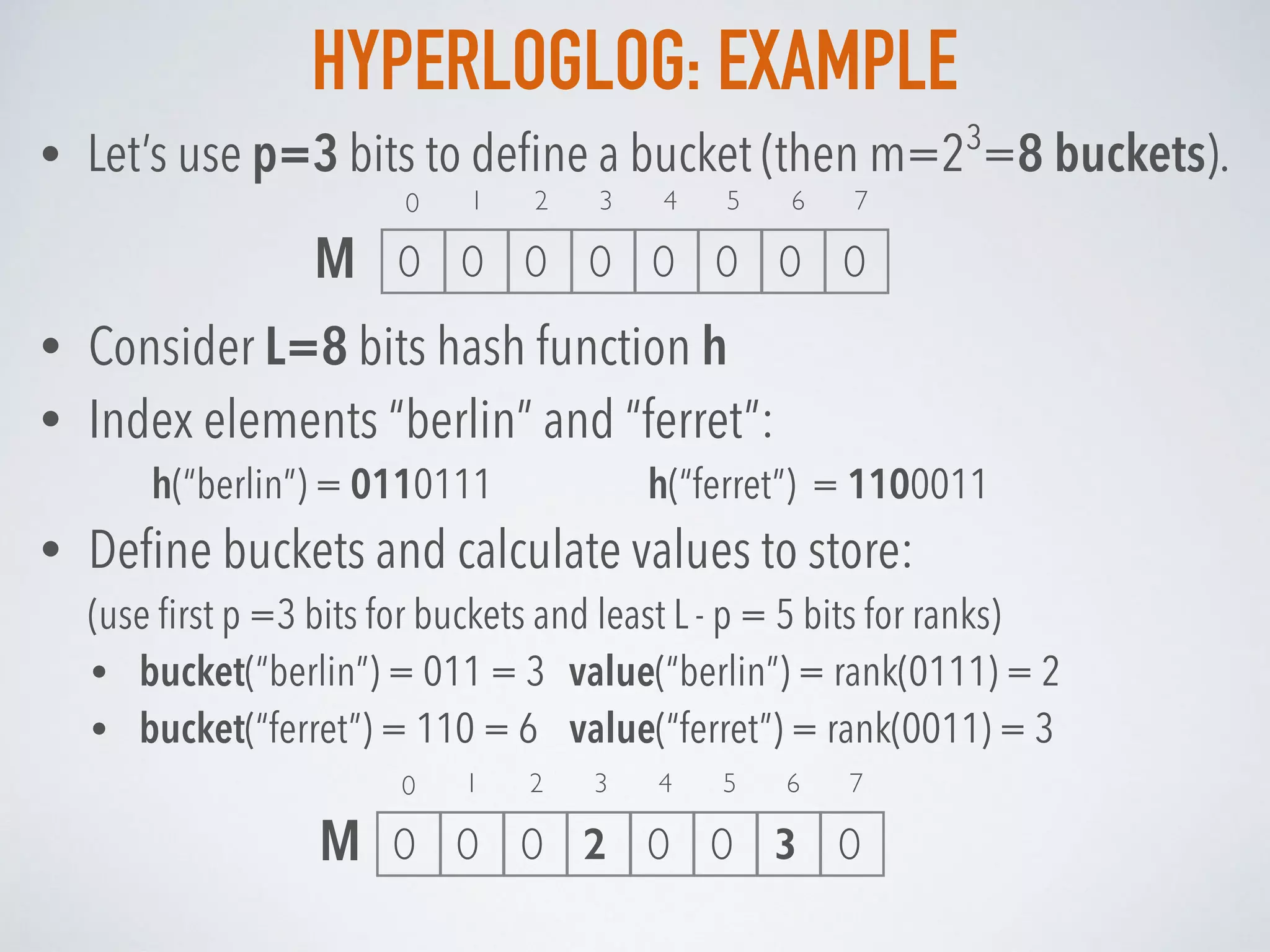
• Consider L=8 bits hash function h
• Index elements “berlin” and “ferret”:
h(“berlin”) = 0110111 h(“ferret”) = 1100011
• Define buckets and calculate values to store:

(use first p =3 bits for buckets and least L - p = 5 bits for ranks)
• bucket(“berlin”) = 011 = 3 value(“berlin”) = rank(0111) = 2
• bucket(“ferret”) = 110 = 6 value(“ferret”) = rank(0011) = 3
• Let’s use p=3 bits to define a bucket (then m=23
=8 buckets).
1 2 3 4 5 6 7
0 0 0 0 0 0 0 0
0
M
1 2 3 4 5 6 7
0 0 0 2 0 0 3 0
0
M
HYPERLOGLOG: EXAMPLE
• Estimate the cardinality be the HLL formula (C ≈ 0.66):
DVHLL ≈ 0.66 * 82
/ (2-2
+ 2-4
) = 0.66 * 204.8 ≈ 135≠3
• Index element “kharkov”:
• h(“kharkov”) = 1100001
• bucket(“kharkov”) = 110 = 6 value(“kharkov”) = rank(0001) = 4
• M[6] = max(M[6], 4) = max(3, 4) = 4
1 2 3 4 5 6 7
0 0 0 2 0 0 4 0
0
M
NOTE: For small cardinalities HLL has a strong bias!!!
HYPERLOGLOG: PROPERTIES
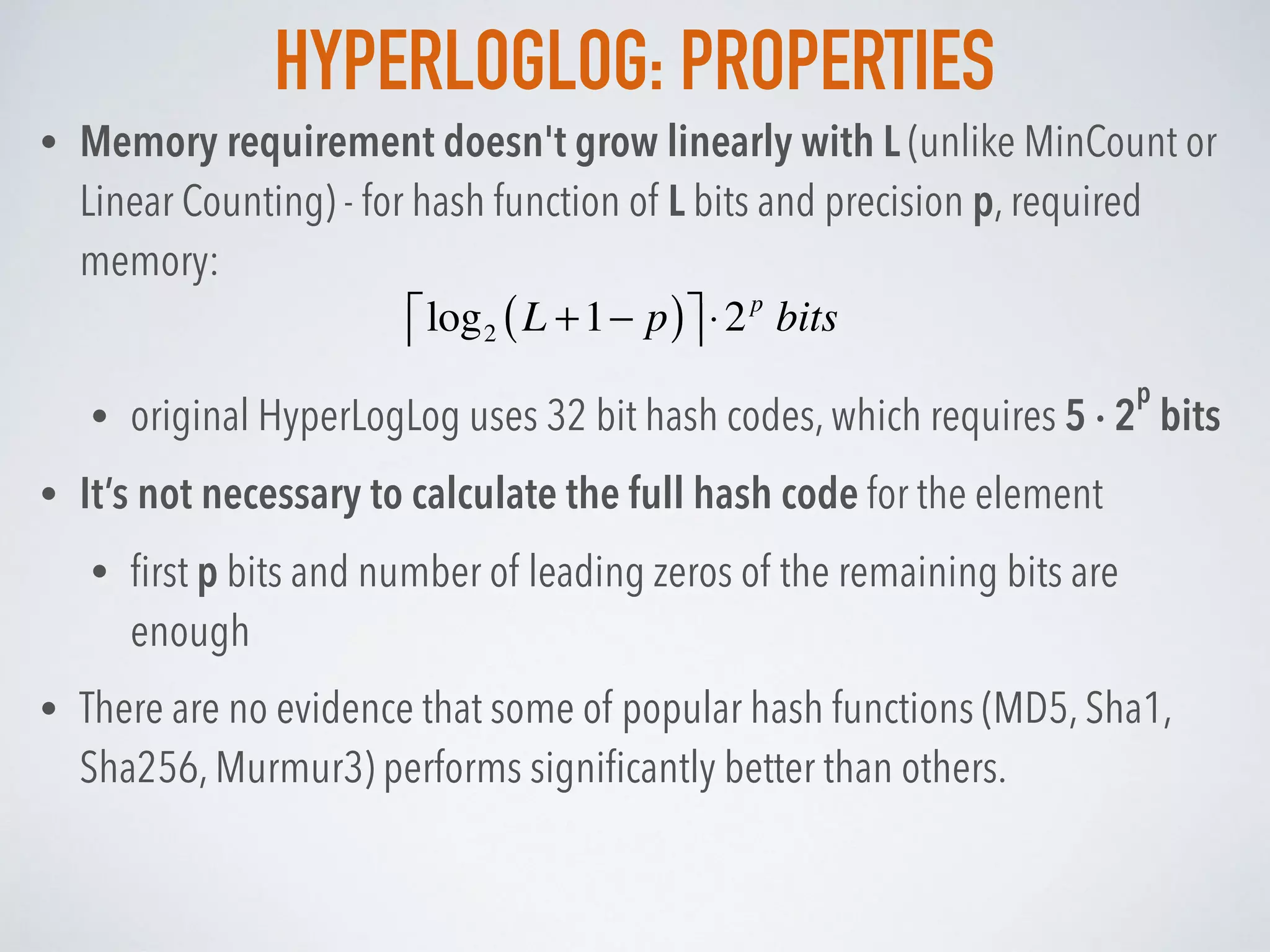
• Memory requirement doesn't grow linearly with L (unlike MinCount or
Linear Counting) - for hash function of L bits and precision p, required
memory:
• original HyperLogLog uses 32 bit hash codes, which requires 5 · 2
p
bits
• It’s not necessary to calculate the full hash code for the element
• first p bits and number of leading zeros of the remaining bits are
enough
• There are no evidence that some of popular hash functions (MD5, Sha1,
Sha256, Murmur3) performs significantly better than others.
log2 L +1− p( )⎡⎢ ⎤⎥⋅2p
bits
HYPERLOGLOG: PROPERTIES
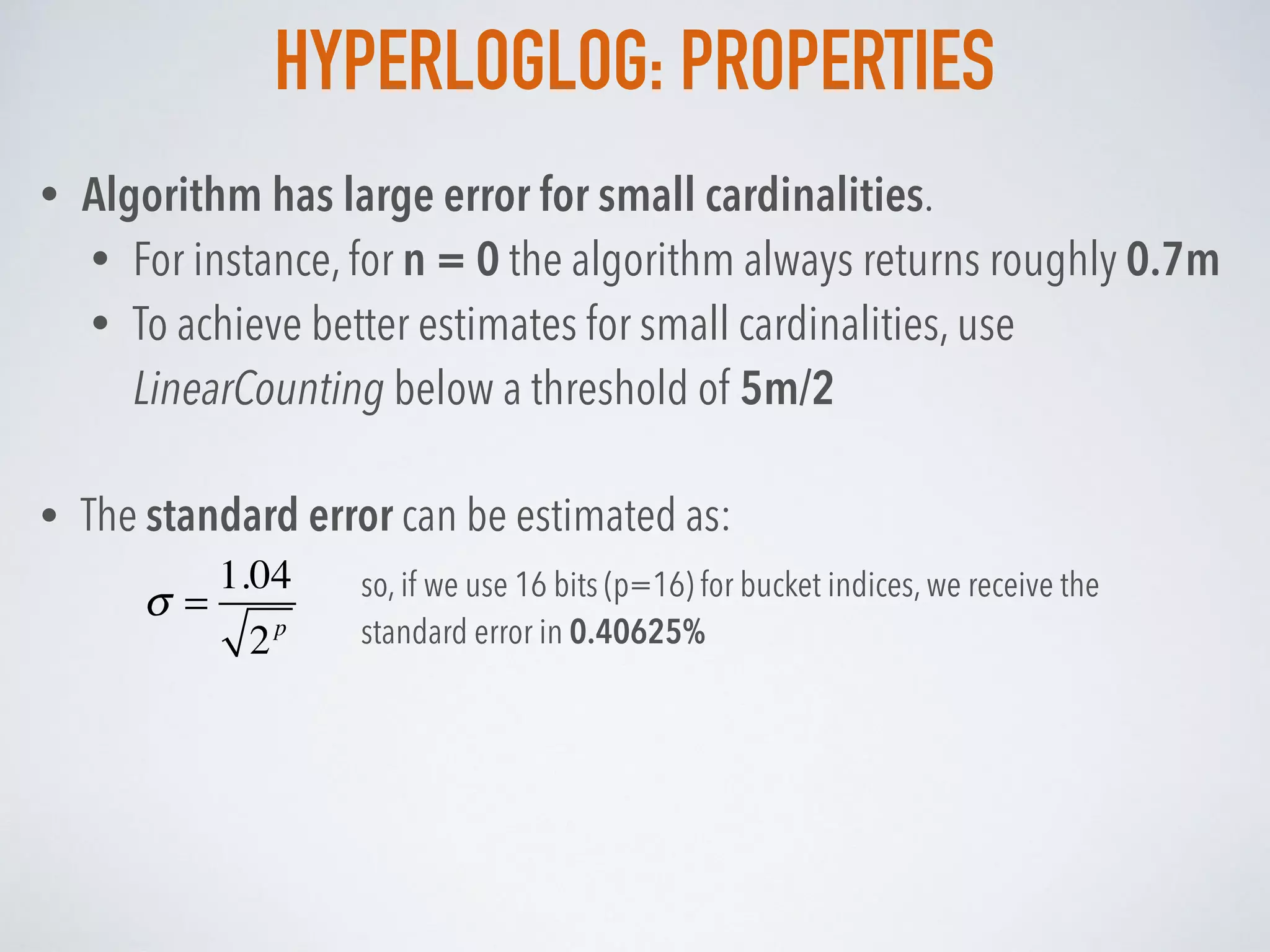
• The standard error can be estimated as:
σ =
1.04
2p
so, if we use 16 bits (p=16) for bucket indices, we receive the
standard error in 0.40625%
• Algorithm has large error for small cardinalities.
• For instance, for n = 0 the algorithm always returns roughly 0.7m
• To achieve better estimates for small cardinalities, use
LinearCounting below a threshold of 5m/2
HYPERLOGLOG: APPLICATIONS
• PFCOUNT in Redis returns the approximated cardinality
computed by the HyperLogLog data structure 

(http://antirez.com/news/75)
• Redis implementation uses 12Kb per key to count with a standard
error of 0.81%, and there is no limit to the number of items you can
count, unless you approach 264 items
HYPERLOGLOG: READ MORE
• http://algo.inria.fr/flajolet/Publications/DuFl03-LNCS.pdf
• http://algo.inria.fr/flajolet/Publications/FlFuGaMe07.pdf
• https://stefanheule.com/papers/edbt13-hyperloglog.pdf
• https://highlyscalable.wordpress.com/2012/05/01/
probabilistic-structures-web-analytics-data-mining/
• https://hal.archives-ouvertes.fr/file/index/docid/465313/
filename/sliding_HyperLogLog.pdf
• http://stackoverflow.com/questions/12327004/how-does-
the-hyperloglog-algorithm-work
HYPERLOGLOG++
HYPERLOGLOG++
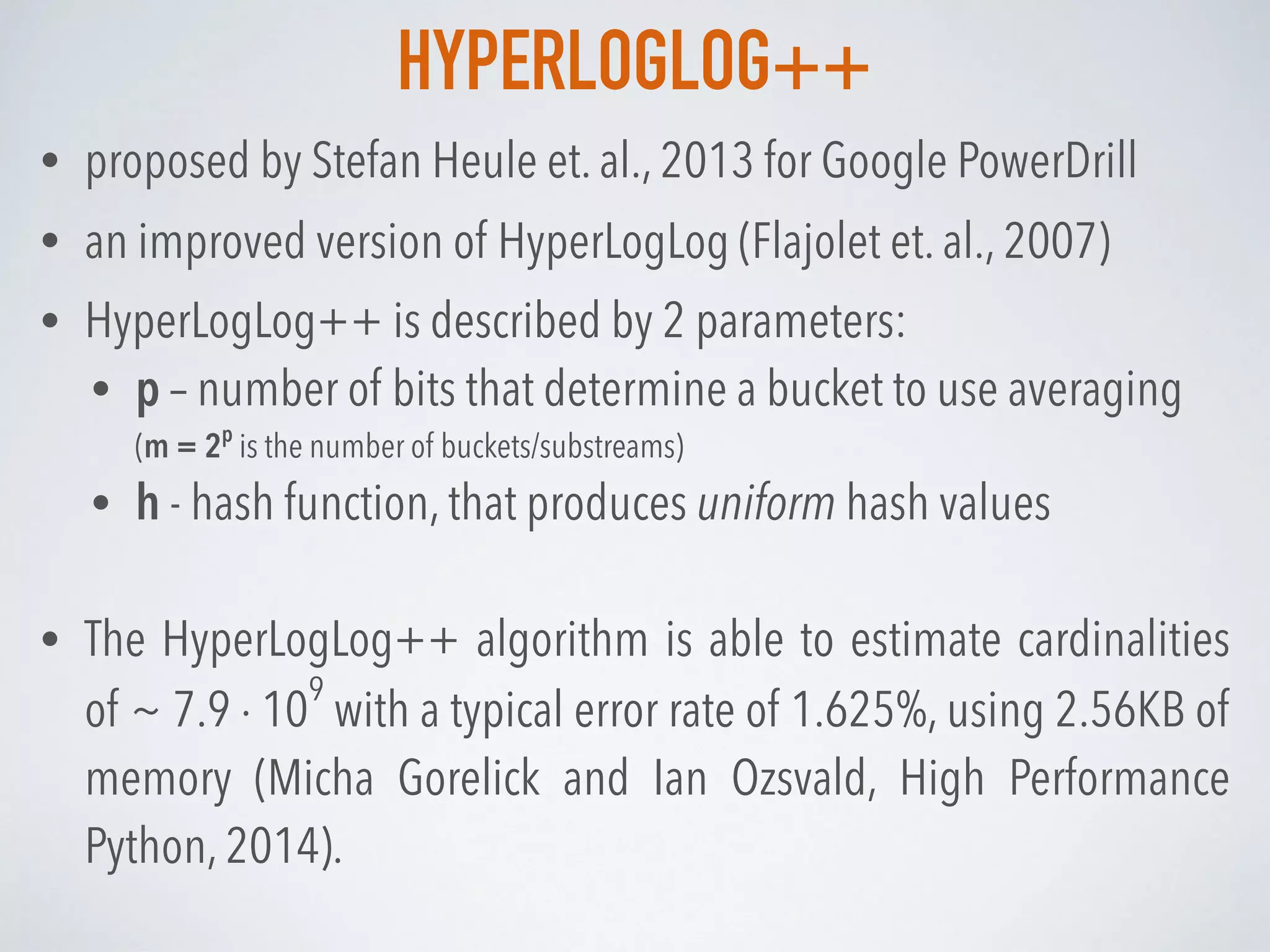
• proposed by Stefan Heule et. al., 2013 for Google PowerDrill
• an improved version of HyperLogLog (Flajolet et. al., 2007)
• HyperLogLog++ is described by 2 parameters:
• p – number of bits that determine a bucket to use averaging

(m = 2p
is the number of buckets/substreams)
• h - hash function, that produces uniform hash values
• The HyperLogLog++ algorithm is able to estimate cardinalities
of ~ 7.9 · 10
9
with a typical error rate of 1.625%, using 2.56KB of
memory (Micha Gorelick and Ian Ozsvald, High Performance
Python, 2014).
HYPERLOGLOG++: IMPROVEMENTS
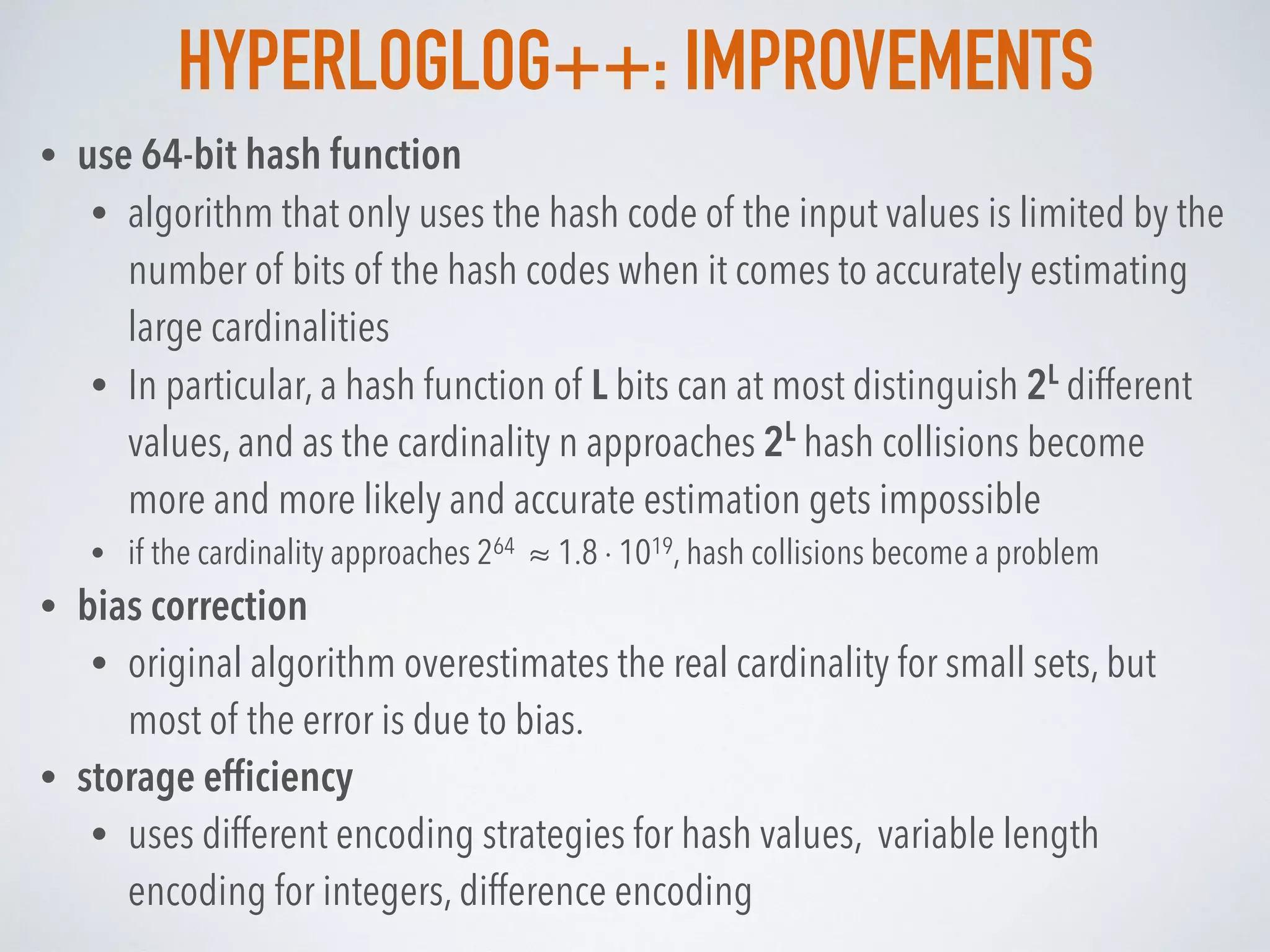
• use 64-bit hash function
• algorithm that only uses the hash code of the input values is limited by the
number of bits of the hash codes when it comes to accurately estimating
large cardinalities
• In particular, a hash function of L bits can at most distinguish 2L
different
values, and as the cardinality n approaches 2L
hash collisions become
more and more likely and accurate estimation gets impossible
• if the cardinality approaches 264 ≈ 1.8 · 1019, hash collisions become a problem
• bias correction
• original algorithm overestimates the real cardinality for small sets, but
most of the error is due to bias.
• storage efficiency
• uses different encoding strategies for hash values, variable length
encoding for integers, difference encoding
HYPERLOGLOG++ VS HYPERLOGLOG
• accuracy is significantly better for large range of cardinalities
and equally good on the rest
• sparse representation allows for a more adaptive use of memory
• if the cardinality n is much smaller then m, then HyperLogLog++
requires significantly less memory
• For cardinalities between 12000 and 61000, the bias correction
allows for a lower error and avoids a spike in the error when
switching between sub-algorithms.
• 64 bit hash codes allow the algorithm to estimate cardinalities well
beyond 1 billion
HYPERLOGLOG++: APPLICATIONS
• cardinality metric in Elasticsearch is based on the
HyperLogLog++ algorithm for big cardinalities (adaptive
counting)
• Apache DataFu, collection of libraries for working with
large-scale data in Hadoop, has an implementation of
HyperLogLog++ algorithm
HYPERLOGLOG++: READ MORE
• http://static.googleusercontent.com/media/
research.google.com/en//pubs/archive/40671.pdf
• https://research.neustar.biz/2013/01/24/hyperloglog-
googles-take-on-engineering-hll/
▸ @gakhov
▸ linkedin.com/in/gakhov
▸ www.datacrucis.com
THANK YOU

Probabilistic data structures. Part 2. Cardinality

  • 1.
    tech talk @ferret Andrii Gakhov PROBABILISTIC DATA STRUCTURES ALL YOU WANTED TO KNOW BUT WERE AFRAID TO ASK PART 2: CARDINALITY
  • 2.
    CARDINALITY Agenda: ▸ Linear Counting ▸LogLog, SuperLogLog, HyperLogLog, HyperLogLog++
  • 3.
    • To determinethe number of distinct elements, also called the cardinality, of a large set of elements where duplicates are present Calculating the exact cardinality of a multiset requires an amount of memory proportional to the cardinality, which is impractical for very large data sets. THE PROBLEM
  • 4.
  • 5.
    LINEAR COUNTING: ALGORITHM •Linear counter is a bit map (hash table) of size m (all elements set to 0 at the beginning). • Algorithm consists of a few steps: • for every element calculate hash function and set the appropriate bit to 1 • calculate the fraction V of empty bits in the structure 
 (divide the number of empty bits by the bit map size m ) • estimate cardinality as n ≈ -m ln V
  • 6.
    LINEAR COUNTING: EXAMPLE 01 2 3 4 5 6 7 8 9 10 11 12 13 14 15 0 0 0 0 0 0 0 0 0 0 0 0 0 0 0 0 • Consider linear counter with 16 bits (m=16) • Consider MurmurHash3 as the hash function h
 (to calculate the appropriate index, we divide result by mod 16) • Set of 10 elements: “bernau”, “bernau”, “bernau”, “berlin”, “kiev”, “kiev”, “new york”, “germany”, “ukraine”, “europe” (NOTE: the real cardinality n = 7) h(“bernau”) = 4, h(“berlin”) = 4, h(“kiev”) = 6, h(“new york”) = 6, h(“germany”) = 14, h(“ukraine”) = 7, h(“europe”) = 9 0 1 2 3 4 5 6 7 8 9 10 11 12 13 14 15 0 0 0 0 1 0 1 1 0 1 0 0 0 0 1 0
  • 7.
    LINEAR COUNTING: EXAMPLE numberof empty bits: 11 m = 16 V = 11 / 16 = 0.6875 0 1 2 3 4 5 6 7 8 9 10 11 12 13 14 15 0 0 0 0 1 0 1 1 0 1 0 0 0 0 1 0 • Cardinality estimation is n ≈ - 16 * ln (0.6875) = 5.995
  • 8.
    LINEAR COUNTING: READMORE • http://dblab.kaist.ac.kr/Prof/pdf/Whang1990(linear).pdf • http://www.codeproject.com/Articles/569718/ CardinalityplusEstimationplusinplusLinearplusTimep
  • 9.
  • 10.
    HYPERLOGLOG: INTUITION • Thecardinality of a multiset of uniformly distributed numbers can be estimated by the maximum number of leading zeros in the binary representation of each number. If such value is k, then the number of distinct elements in the set is 2k P(rank=1) = 1/2 - probability to find a binary representation, that starts with 1 P(rank = 2) = 1/2 2 - probability to find a binary representation, that start with 01 … P(rank=k) = 1/2 k rank = number of leading zeros + 1, e.g. rank(f) = 3 0 0 1 0 0 0 1 0 0 0 1 0 0 0 0 0 0 1 2 leading zeros 3 f = • Therefore, for 2k binary representations we shell find at least one representation with rank = k • If we remember the maximal rank we’ve seen and it’s equal to k, then we can use 2k as the approximation of the number of elements
  • 11.
    HYPERLOGLOG • proposed byFlajolet et. al., 2007 • an extension of the Flajolet–Martin algorithm (1985) • HyperLogLog is described by 2 parameters: • p – number of bits that determine a bucket to use averaging
 (m = 2p is the number of buckets/substreams) • h - hash function, that produces uniform hash values • The HyperLogLog algorithm is able to estimate cardinalities of > 109 with a typical error rate of 2%, using 1.5kB of memory (Flajolet, P. et al., 2007).
  • 12.
    HYPERLOGLOG: ALGORITHM • HyperLogLoguses randomization to approximate the cardinality of a multiset.This randomization is achieved by using hash function h • Observe the maximum number of leading zeros that for all hash values: • If the bit pattern 0L−1 1 is observed at the beginning of a hash value (so, rank = L), then a good estimation of the size of the multiset is 2L.
  • 13.
    HYPERLOGLOG: ALGORITHM • Stochasticaveraging is used to reduce the large variability: • The input stream of data elements S is divided into m substreams Si using the first p bits of the hash values (m = 2p) . • In each substream, the rank (after the initial p bits that are used for substreaming) is measured independently. • These numbers are kept in an array of registers M, where M[i] stores the maximum rank it seen for the substream with index i. • The cardinality estimation is calculated computes as the normalized bias corrected harmonic mean of the estimations on the substreams DVHLL = const(m)⋅m2 ⋅ 2 −M j j=1 m ∑ ⎛ ⎝⎜ ⎞ ⎠⎟ −1
  • 14.
    HYPERLOGLOG: EXAMPLE • ConsiderL=8 bits hash function h • Index elements “berlin” and “ferret”: h(“berlin”) = 0110111 h(“ferret”) = 1100011 • Define buckets and calculate values to store:
 (use first p =3 bits for buckets and least L - p = 5 bits for ranks) • bucket(“berlin”) = 011 = 3 value(“berlin”) = rank(0111) = 2 • bucket(“ferret”) = 110 = 6 value(“ferret”) = rank(0011) = 3 • Let’s use p=3 bits to define a bucket (then m=23 =8 buckets). 1 2 3 4 5 6 7 0 0 0 0 0 0 0 0 0 M 1 2 3 4 5 6 7 0 0 0 2 0 0 3 0 0 M
  • 15.
    HYPERLOGLOG: EXAMPLE • Estimatethe cardinality be the HLL formula (C ≈ 0.66): DVHLL ≈ 0.66 * 82 / (2-2 + 2-4 ) = 0.66 * 204.8 ≈ 135≠3 • Index element “kharkov”: • h(“kharkov”) = 1100001 • bucket(“kharkov”) = 110 = 6 value(“kharkov”) = rank(0001) = 4 • M[6] = max(M[6], 4) = max(3, 4) = 4 1 2 3 4 5 6 7 0 0 0 2 0 0 4 0 0 M NOTE: For small cardinalities HLL has a strong bias!!!
  • 16.
    HYPERLOGLOG: PROPERTIES • Memoryrequirement doesn't grow linearly with L (unlike MinCount or Linear Counting) - for hash function of L bits and precision p, required memory: • original HyperLogLog uses 32 bit hash codes, which requires 5 · 2 p bits • It’s not necessary to calculate the full hash code for the element • first p bits and number of leading zeros of the remaining bits are enough • There are no evidence that some of popular hash functions (MD5, Sha1, Sha256, Murmur3) performs significantly better than others. log2 L +1− p( )⎡⎢ ⎤⎥⋅2p bits
  • 17.
    HYPERLOGLOG: PROPERTIES • Thestandard error can be estimated as: σ = 1.04 2p so, if we use 16 bits (p=16) for bucket indices, we receive the standard error in 0.40625% • Algorithm has large error for small cardinalities. • For instance, for n = 0 the algorithm always returns roughly 0.7m • To achieve better estimates for small cardinalities, use LinearCounting below a threshold of 5m/2
  • 18.
    HYPERLOGLOG: APPLICATIONS • PFCOUNTin Redis returns the approximated cardinality computed by the HyperLogLog data structure 
 (http://antirez.com/news/75) • Redis implementation uses 12Kb per key to count with a standard error of 0.81%, and there is no limit to the number of items you can count, unless you approach 264 items
  • 19.
    HYPERLOGLOG: READ MORE •http://algo.inria.fr/flajolet/Publications/DuFl03-LNCS.pdf • http://algo.inria.fr/flajolet/Publications/FlFuGaMe07.pdf • https://stefanheule.com/papers/edbt13-hyperloglog.pdf • https://highlyscalable.wordpress.com/2012/05/01/ probabilistic-structures-web-analytics-data-mining/ • https://hal.archives-ouvertes.fr/file/index/docid/465313/ filename/sliding_HyperLogLog.pdf • http://stackoverflow.com/questions/12327004/how-does- the-hyperloglog-algorithm-work
  • 20.
  • 21.
    HYPERLOGLOG++ • proposed byStefan Heule et. al., 2013 for Google PowerDrill • an improved version of HyperLogLog (Flajolet et. al., 2007) • HyperLogLog++ is described by 2 parameters: • p – number of bits that determine a bucket to use averaging
 (m = 2p is the number of buckets/substreams) • h - hash function, that produces uniform hash values • The HyperLogLog++ algorithm is able to estimate cardinalities of ~ 7.9 · 10 9 with a typical error rate of 1.625%, using 2.56KB of memory (Micha Gorelick and Ian Ozsvald, High Performance Python, 2014).
  • 22.
    HYPERLOGLOG++: IMPROVEMENTS • use64-bit hash function • algorithm that only uses the hash code of the input values is limited by the number of bits of the hash codes when it comes to accurately estimating large cardinalities • In particular, a hash function of L bits can at most distinguish 2L different values, and as the cardinality n approaches 2L hash collisions become more and more likely and accurate estimation gets impossible • if the cardinality approaches 264 ≈ 1.8 · 1019, hash collisions become a problem • bias correction • original algorithm overestimates the real cardinality for small sets, but most of the error is due to bias. • storage efficiency • uses different encoding strategies for hash values, variable length encoding for integers, difference encoding
  • 23.
    HYPERLOGLOG++ VS HYPERLOGLOG •accuracy is significantly better for large range of cardinalities and equally good on the rest • sparse representation allows for a more adaptive use of memory • if the cardinality n is much smaller then m, then HyperLogLog++ requires significantly less memory • For cardinalities between 12000 and 61000, the bias correction allows for a lower error and avoids a spike in the error when switching between sub-algorithms. • 64 bit hash codes allow the algorithm to estimate cardinalities well beyond 1 billion
  • 24.
    HYPERLOGLOG++: APPLICATIONS • cardinalitymetric in Elasticsearch is based on the HyperLogLog++ algorithm for big cardinalities (adaptive counting) • Apache DataFu, collection of libraries for working with large-scale data in Hadoop, has an implementation of HyperLogLog++ algorithm
  • 25.
    HYPERLOGLOG++: READ MORE •http://static.googleusercontent.com/media/ research.google.com/en//pubs/archive/40671.pdf • https://research.neustar.biz/2013/01/24/hyperloglog- googles-take-on-engineering-hll/
  • 26.
    ▸ @gakhov ▸ linkedin.com/in/gakhov ▸www.datacrucis.com THANK YOU