Principles of Functional
Progrmming in Scala
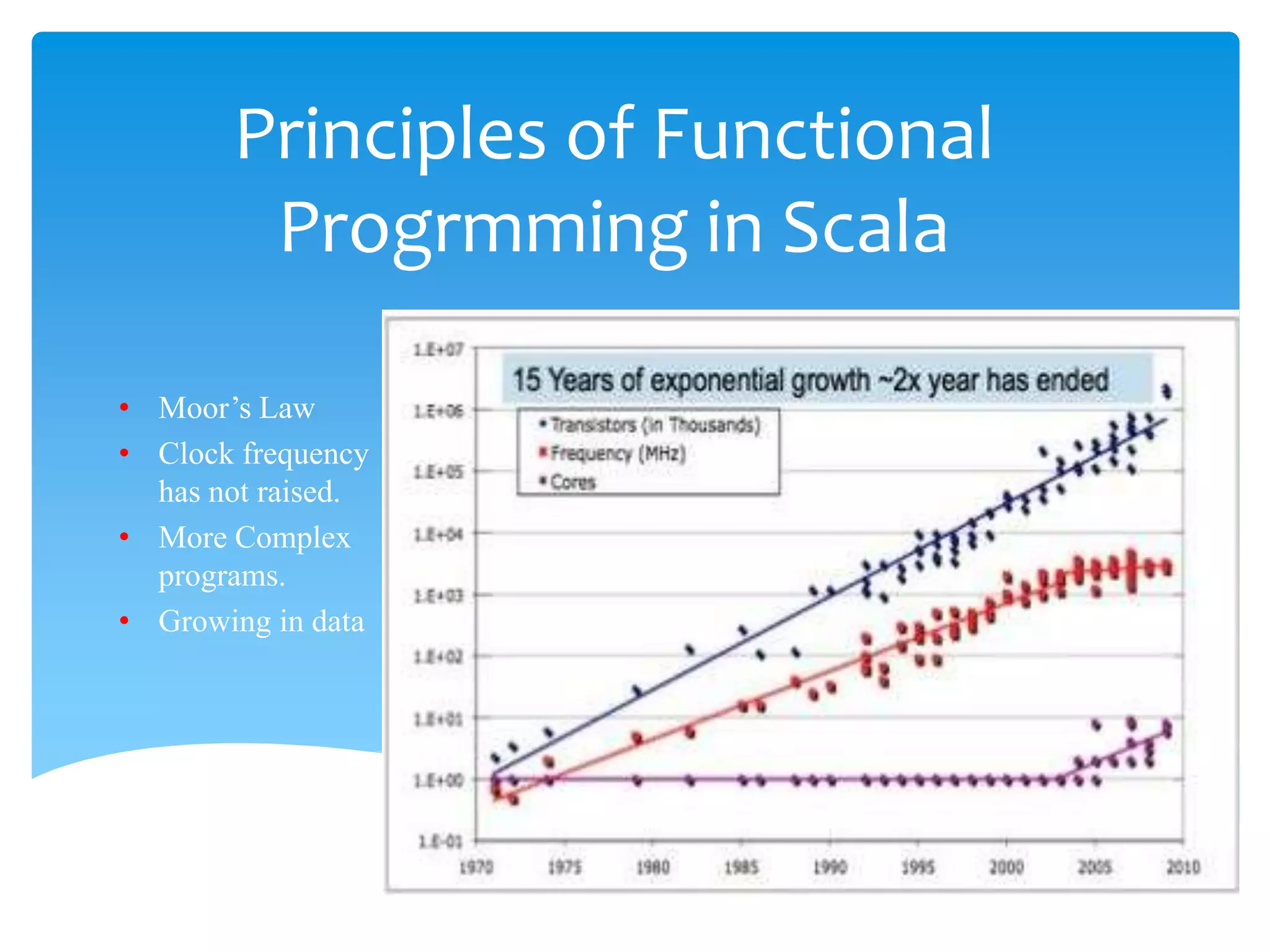
• Moor’s Law
• Clock frequency
has not raised.
• More Complex
programs.
• Growing in data
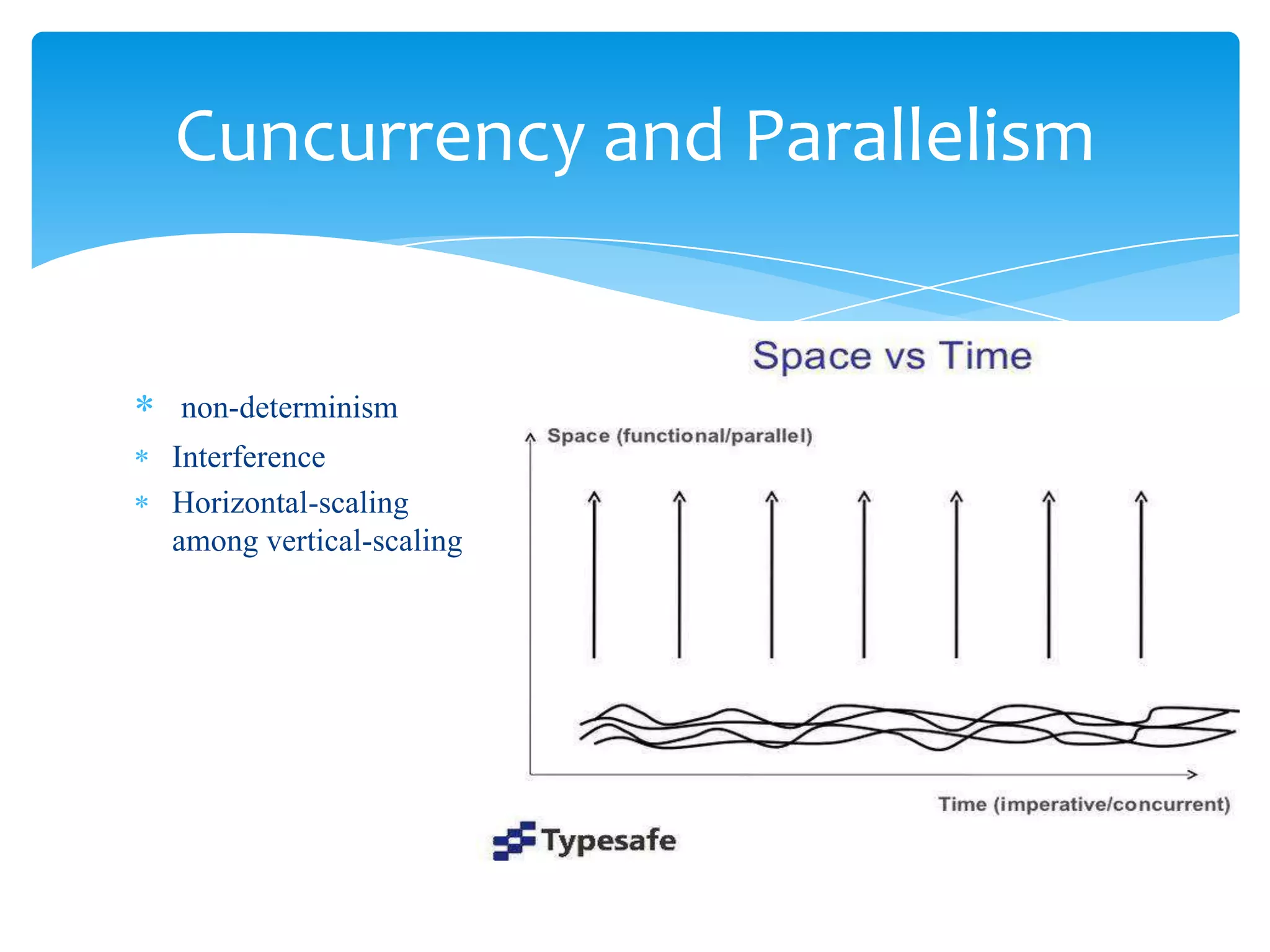
Cuncurrency and Parallelism

non-determinism
Interference
Horizontal-scaling
among vertical-scaling
Example

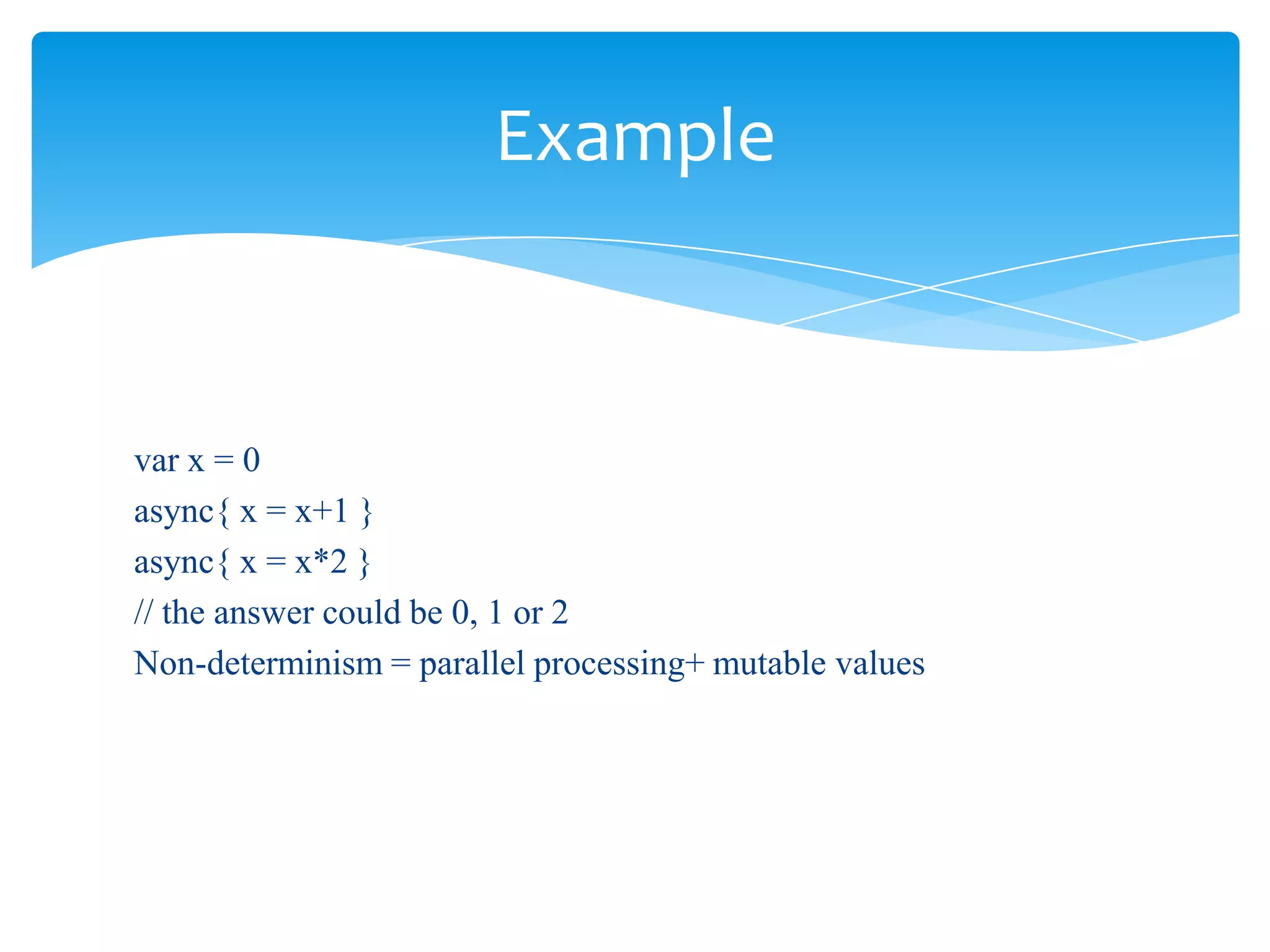
var x = 0
async{ x = x+1 }
async{ x = x*2 }
// the answer could be 0, 1 or 2
Non-determinism = parallel processing+ mutable values
Paradigm

In science, a paradigm describes distinct concepts or
thought patterns in some scientific discipline.
Main programming paradigms:
imperative programming
functional programming
logic programming
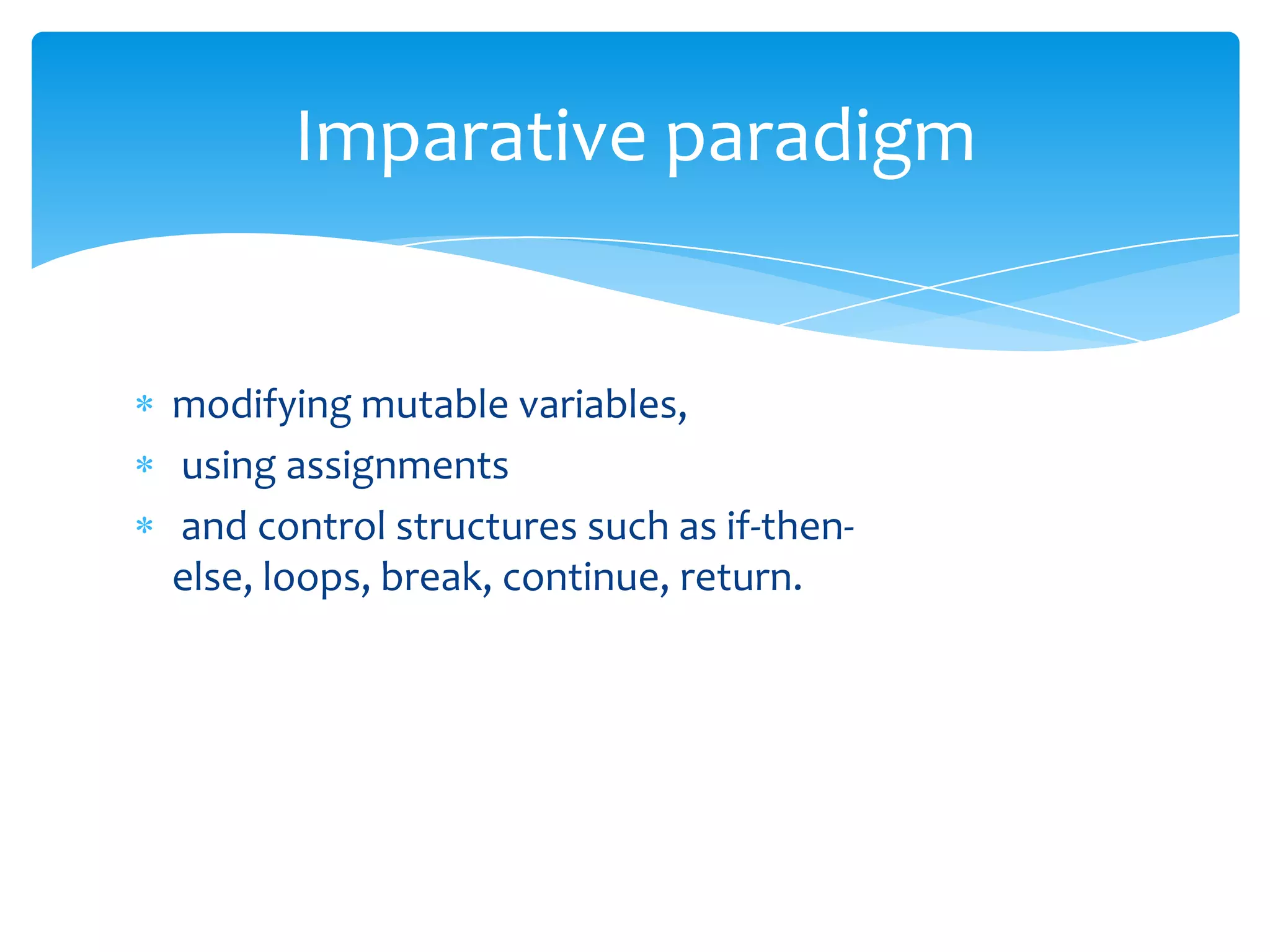
Imparative paradigm

modifying mutable variables,
using assignments
and control structures such as if-thenelse, loops, break, continue, return.
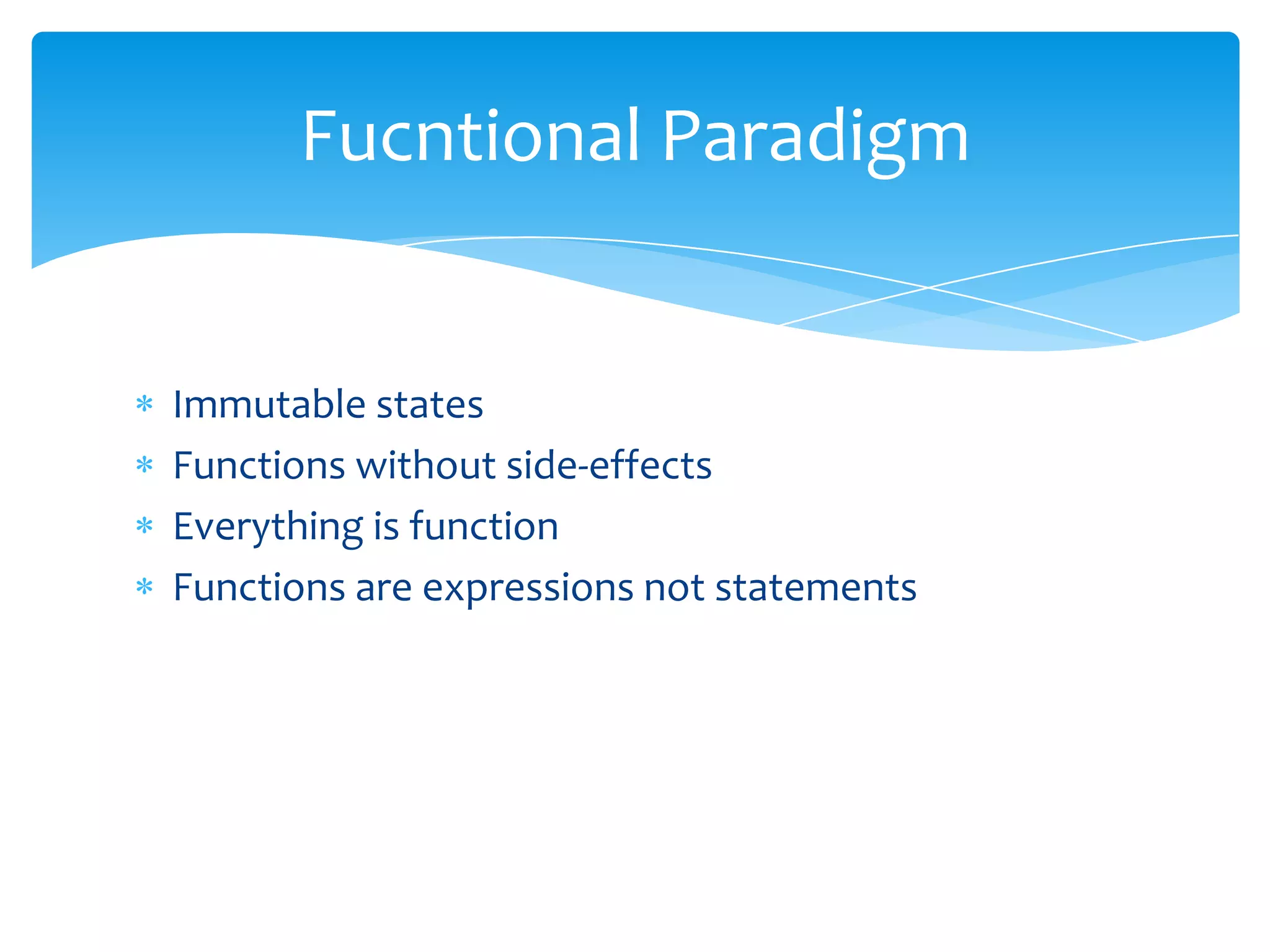
Fucntional Paradigm

Immutable states
Functions without side-effects
Everything is function
Functions are expressions not statements
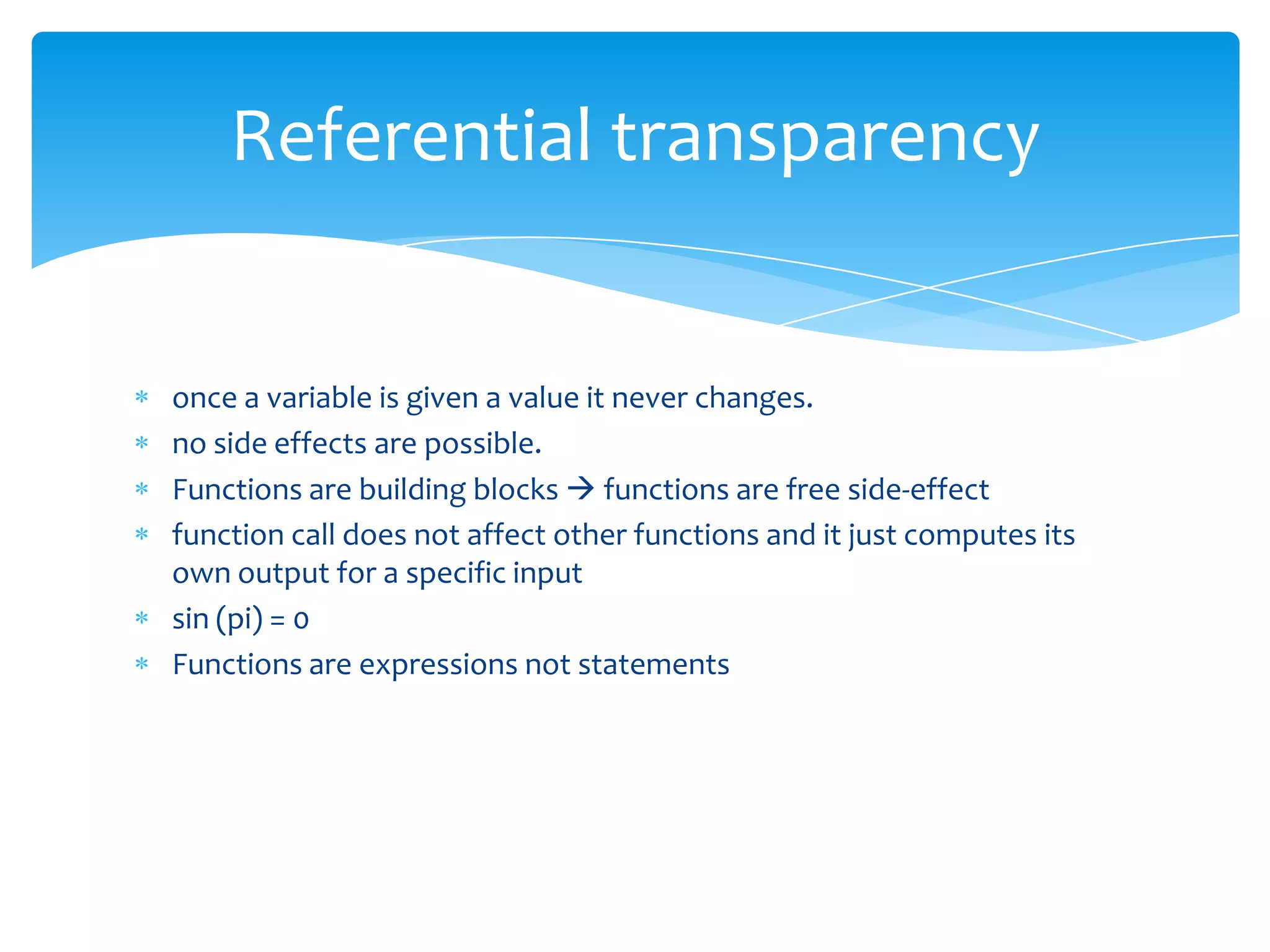
Referential transparency

once a variable is given a value it never changes.
no side effects are possible.
Functions are building blocks  functions are free side-effect
function call does not affect other functions and it just computes its
own output for a specific input
sin (pi) = 0
Functions are expressions not statements
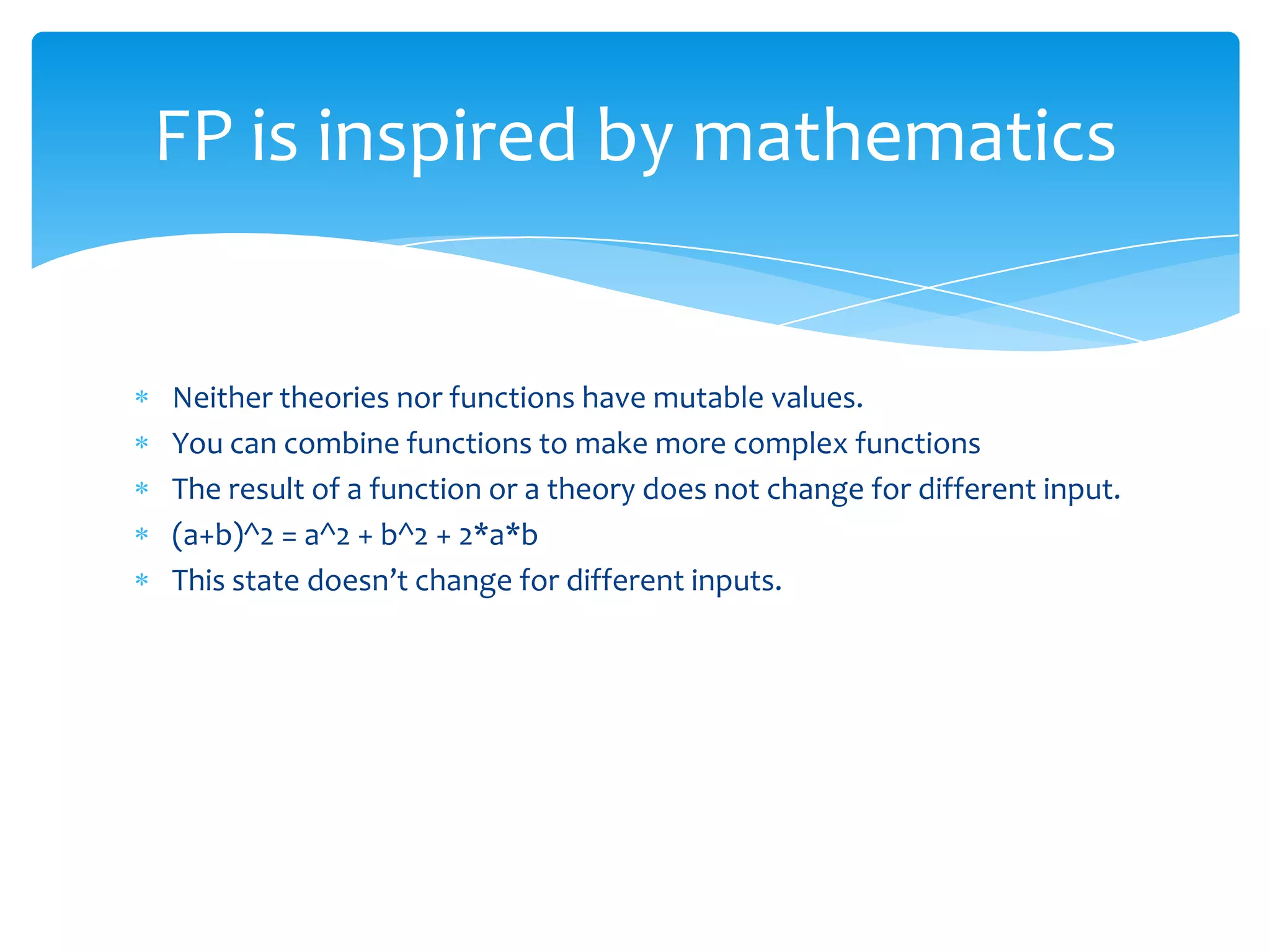
FP is inspired by mathematics

Neither theories nor functions have mutable values.
You can combine functions to make more complex functions
The result of a function or a theory does not change for different input.
(a+b)^2 = a^2 + b^2 + 2*a*b
This state doesn’t change for different inputs.
Functional Languages

Pure(restricted) Functional languages ( no imperative structure)
like: Pure Lisp, XSLT, XPath, XQuery, FP,Haskell (without I/O Monad or
UnsafePerformIO)
Wider sense : Lisp, Scheme, Racket, Clojure
SML, Ocaml, F# , Haskell (full language) , Scala , Smalltalk, Ruby
What is scala?

Scala is a statically typed JVM language that has
transparent interoperability with Java.
Both object oriented and functional language
Why Scala?

Lightweight syntax
Combines functional and object-oriented approaches
Advanced type system: everything has a type
Strong type inference
Performance comparable to Java
Fully interoperable with Java
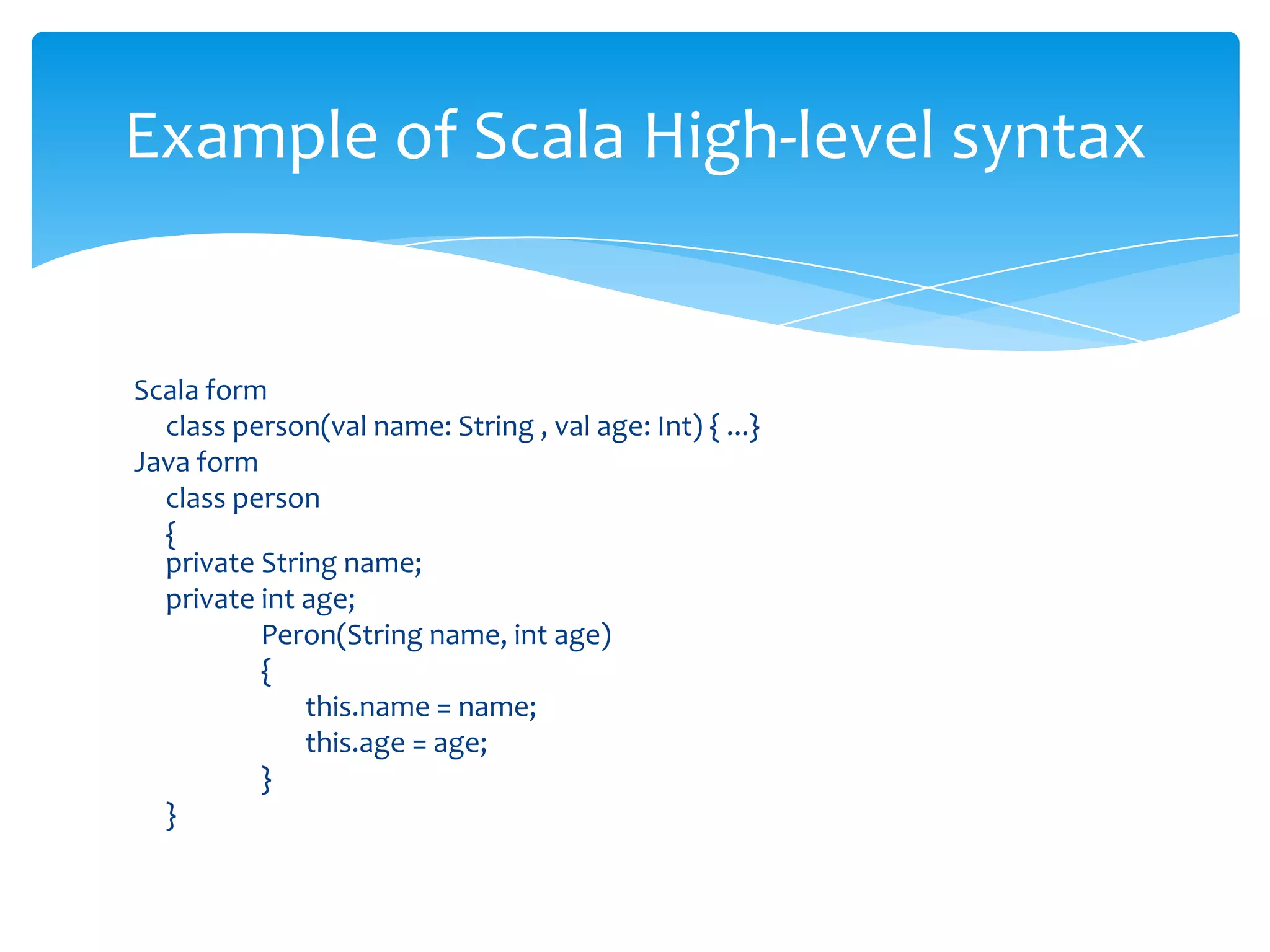
Example of Scala High-level syntax

Scala form
class person(val name: String , val age: Int) { ...}
Java form
class person
{
private String name;
private int age;
Peron(String name, int age)
{
this.name = name;
this.age = age;
}
}
continue
val list = List(2,5,4)
val newList = (list map(x => x*x)) sortWith(_ > _)
//newList = list(4,16,25)
Java form ???
val people: Array[Person]
val (minors,adults) = people partition (_.age < 18)
Java form ???
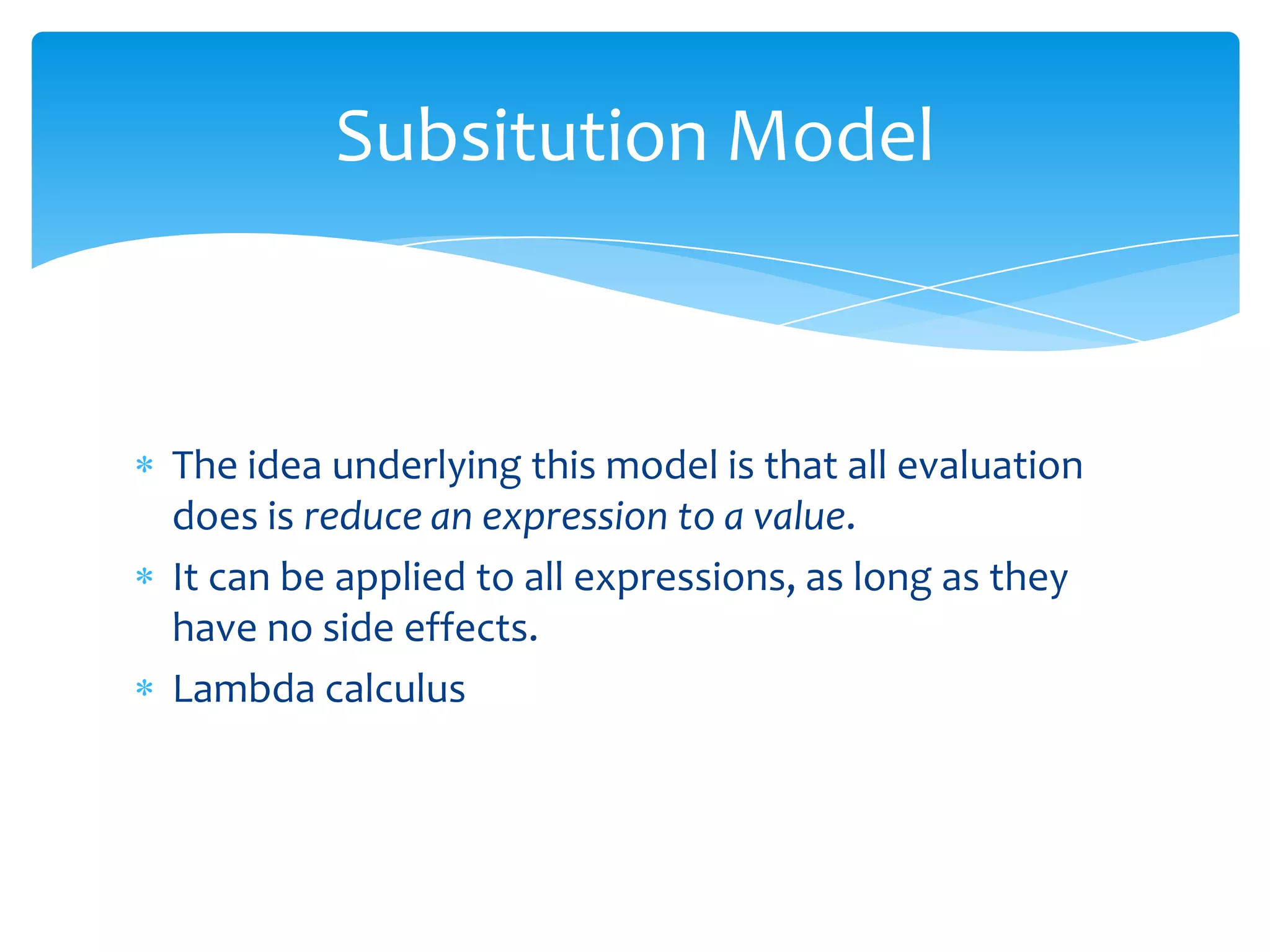
Subsitution Model

The idea underlying this model is that all evaluation
does is reduce an expression to a value.
It can be applied to all expressions, as long as they
have no side effects.
Lambda calculus
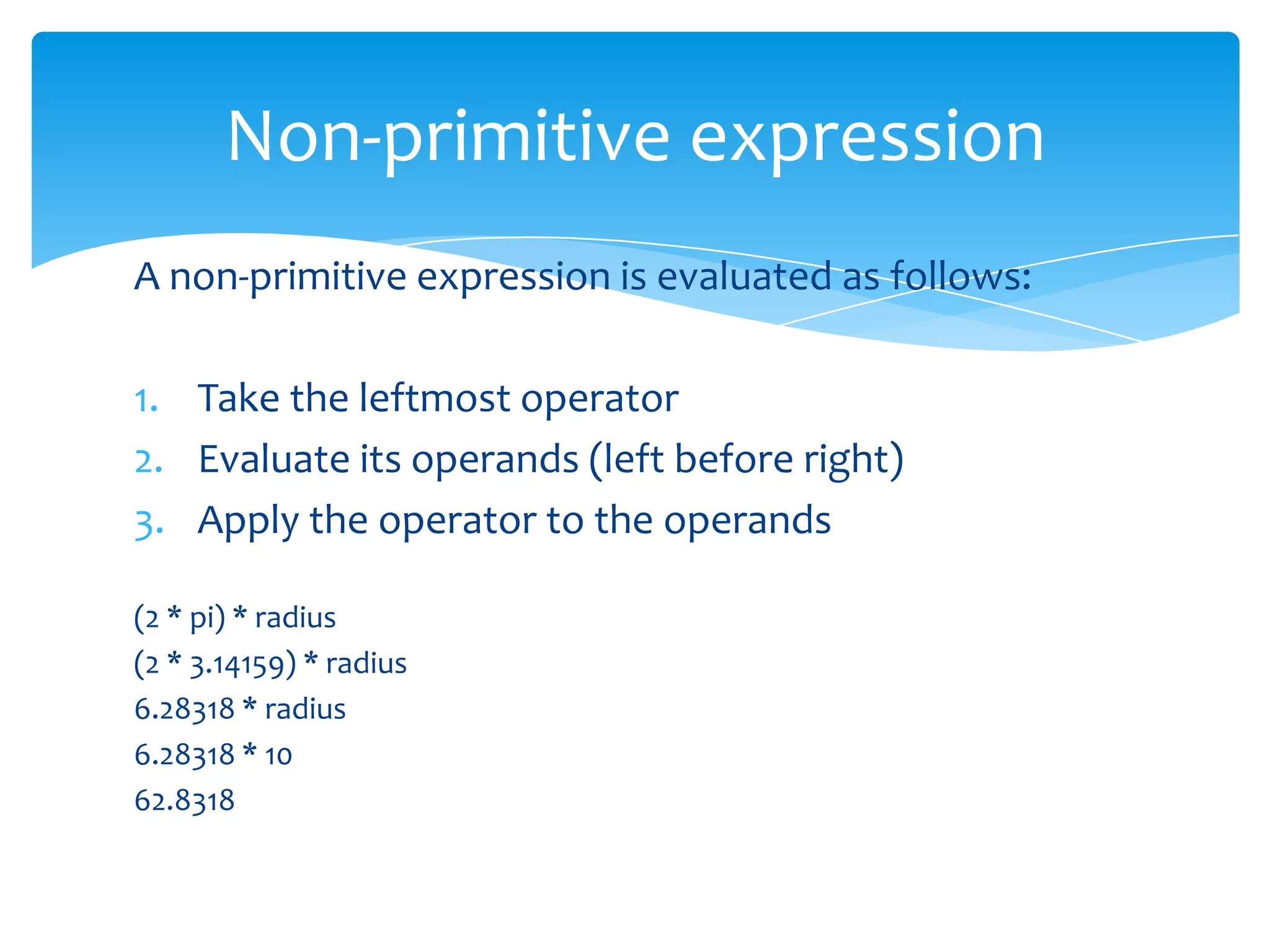
Non-primitive expression
A non-primitive expression is evaluated as follows:
1. Take the leftmost operator
2. Evaluate its operands (left before right)
3. Apply the operator to the operands
(2 * pi) * radius
(2 * 3.14159) * radius
6.28318 * radius
6.28318 * 10
62.8318
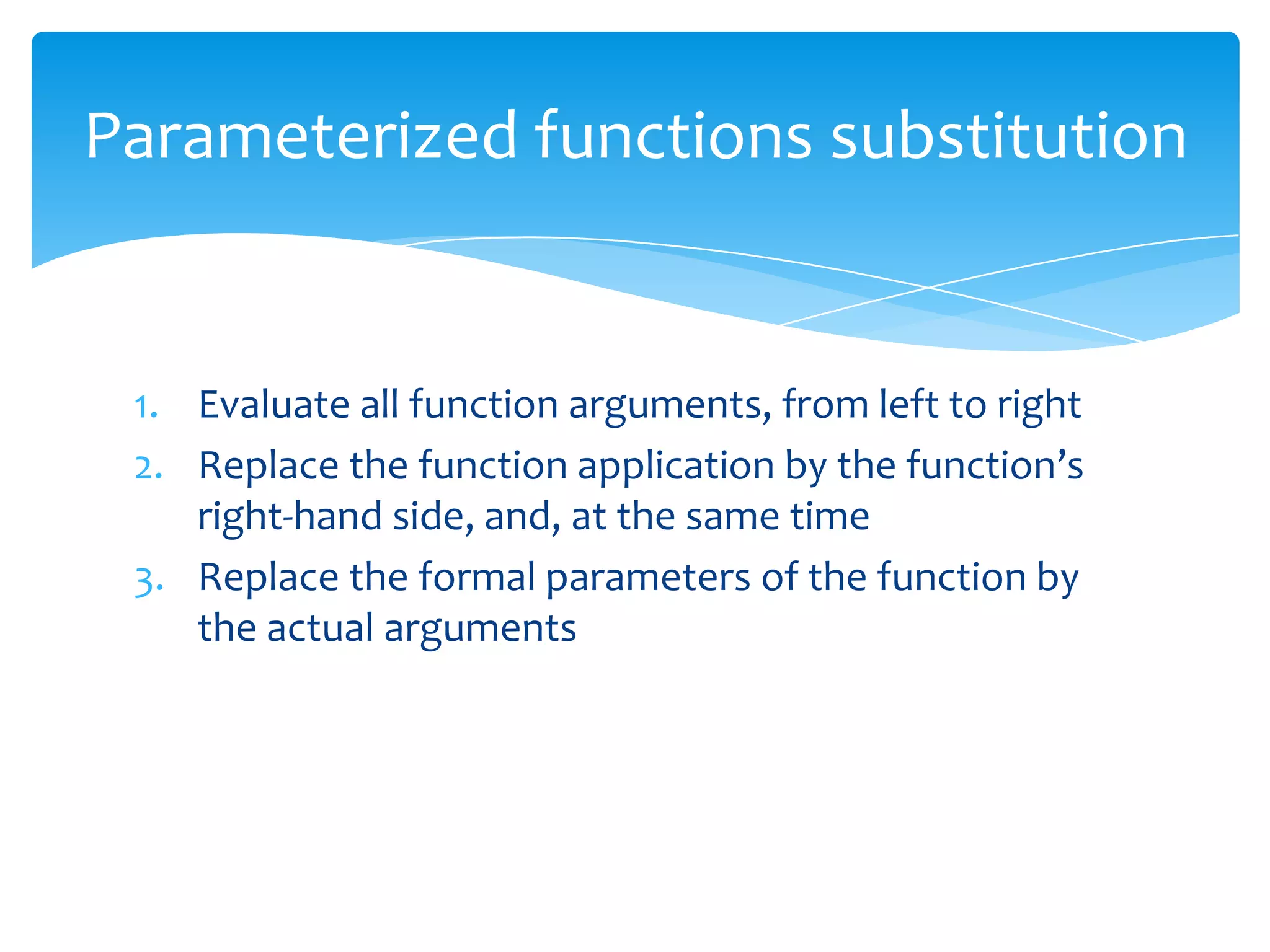
Parameterized functions substitution

1. Evaluate all function arguments, from left to right
2. Replace the function application by the function’s
right-hand side, and, at the same time
3. Replace the formal parameters of the function by
the actual arguments
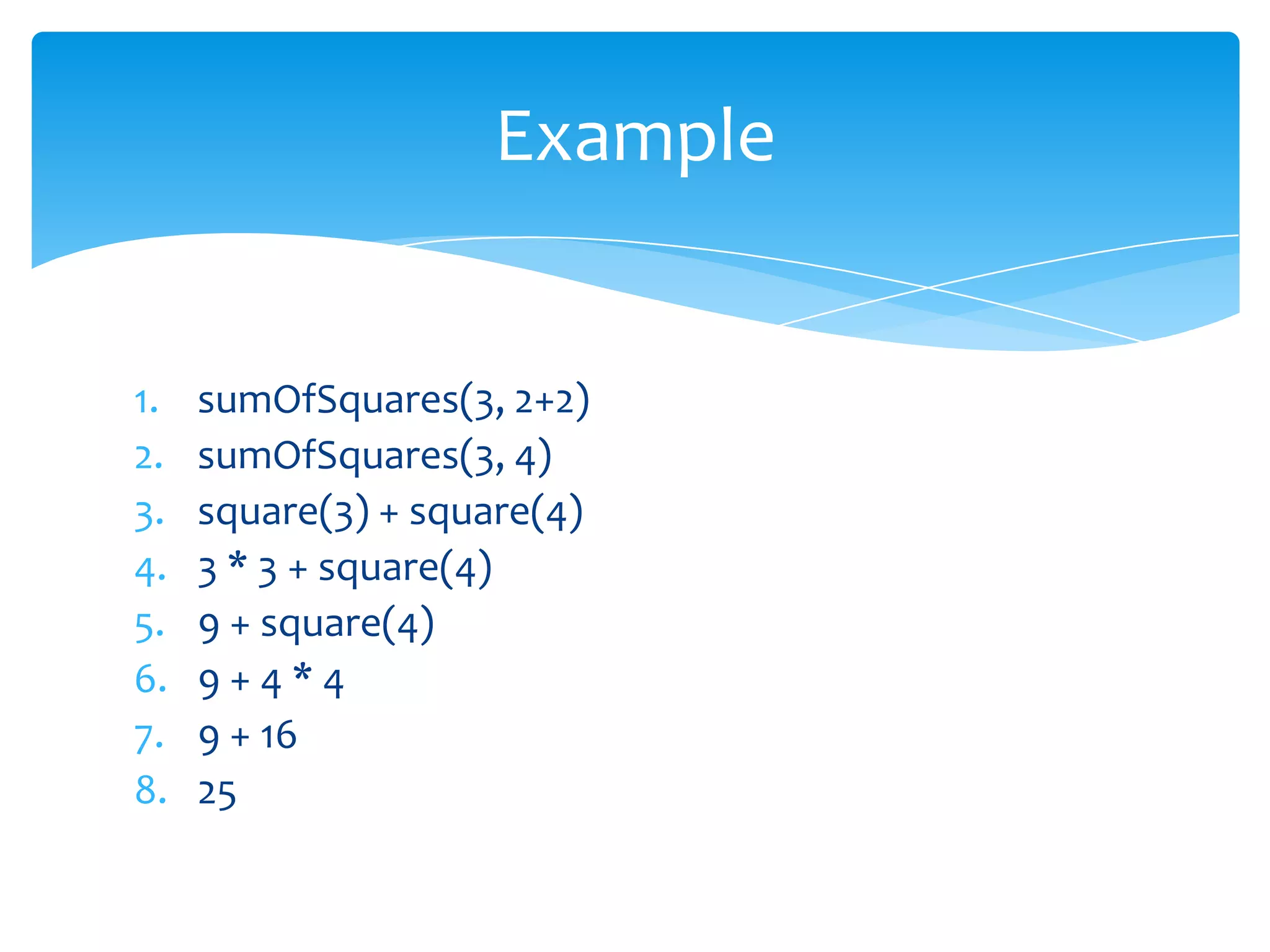
Example

1.
2.
3.
4.
5.
6.
7.
8.

sumOfSquares(3, 2+2)
sumOfSquares(3, 4)
square(3) + square(4)
3 * 3 + square(4)
9 + square(4)
9+4*4
9 + 16
25
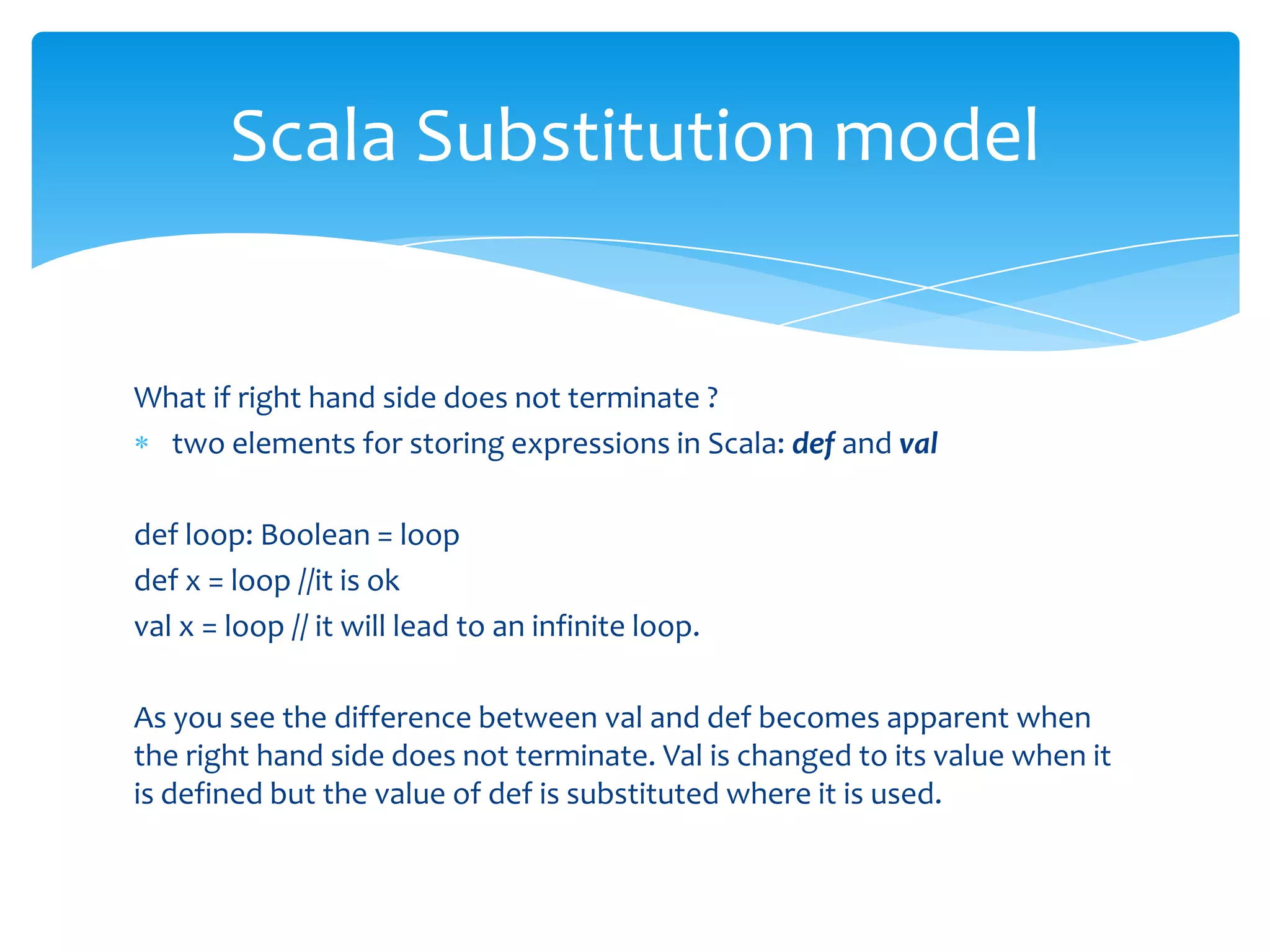
Scala Substitution model

What if right hand side does not terminate ?
two elements for storing expressions in Scala: def and val
def loop: Boolean = loop
def x = loop //it is ok
val x = loop // it will lead to an infinite loop.
As you see the difference between val and def becomes apparent when
the right hand side does not terminate. Val is changed to its value when it
is defined but the value of def is substituted where it is used.
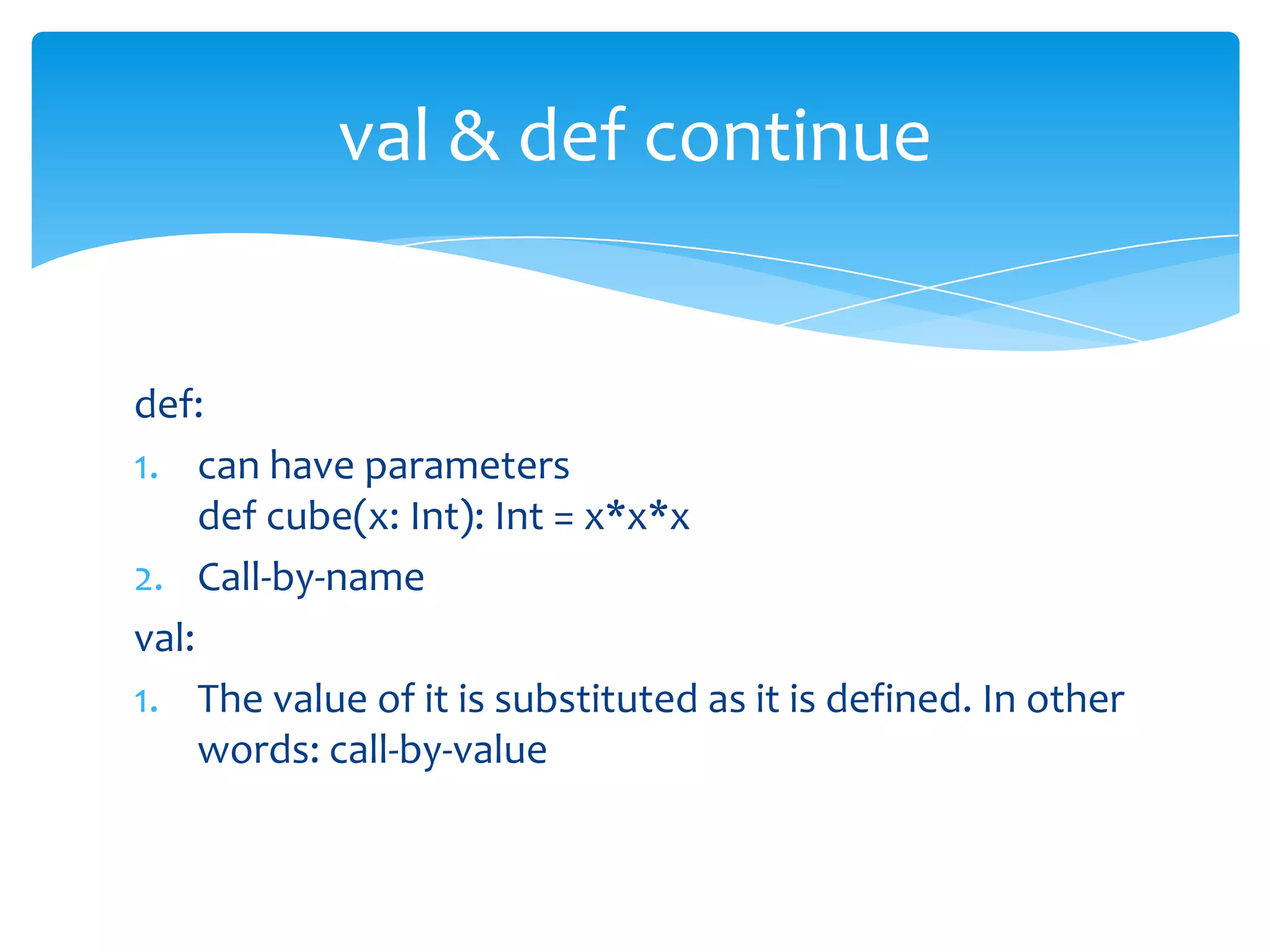
val & def continue

def:
1. can have parameters
def cube(x: Int): Int = x*x*x
2. Call-by-name
val:
1. The value of it is substituted as it is defined. In other
words: call-by-value
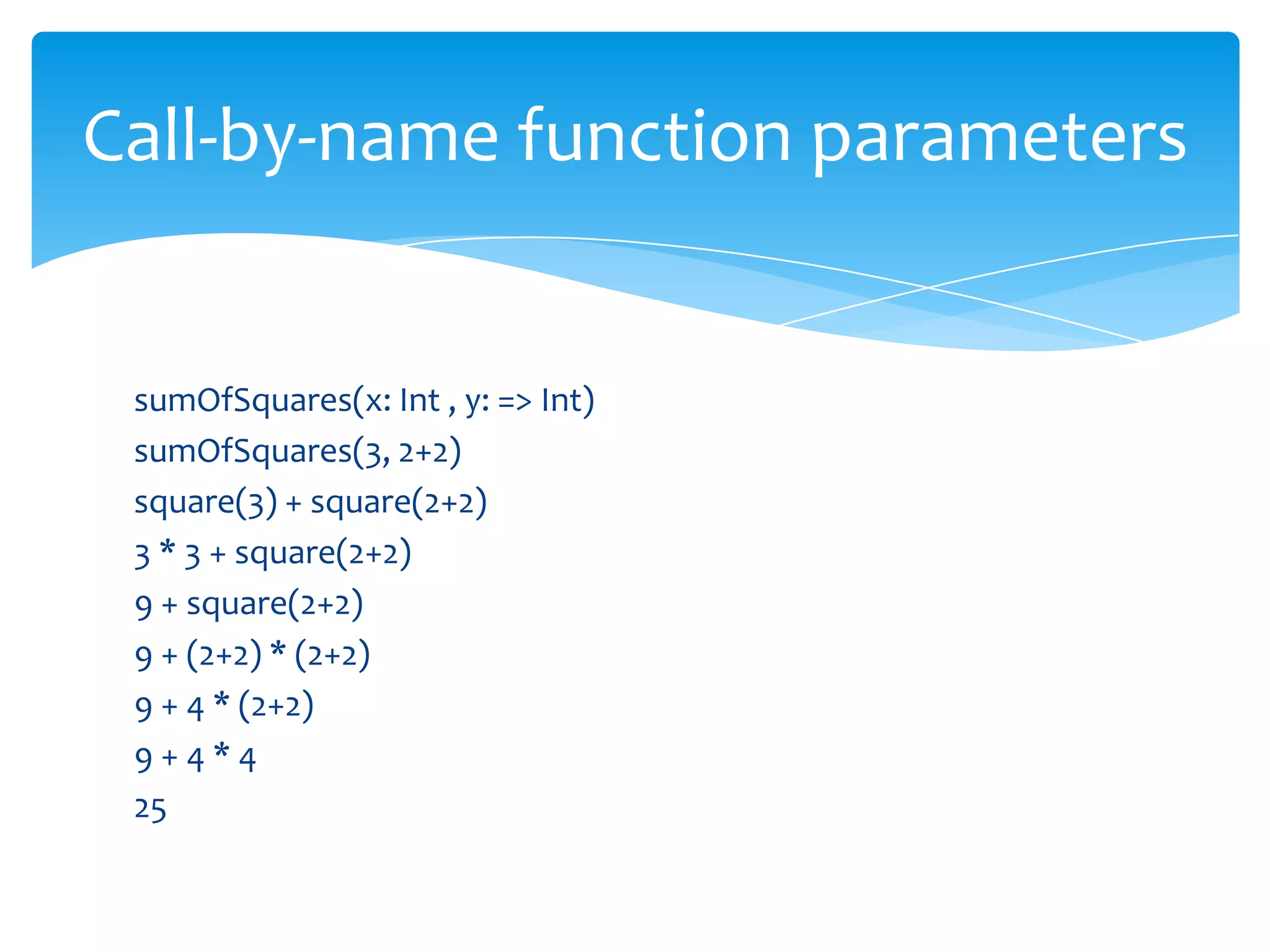
Call-by-name function parameters

sumOfSquares(x: Int , y: => Int)
sumOfSquares(3, 2+2)
square(3) + square(2+2)
3 * 3 + square(2+2)
9 + square(2+2)
9 + (2+2) * (2+2)
9 + 4 * (2+2)
9+4*4
25
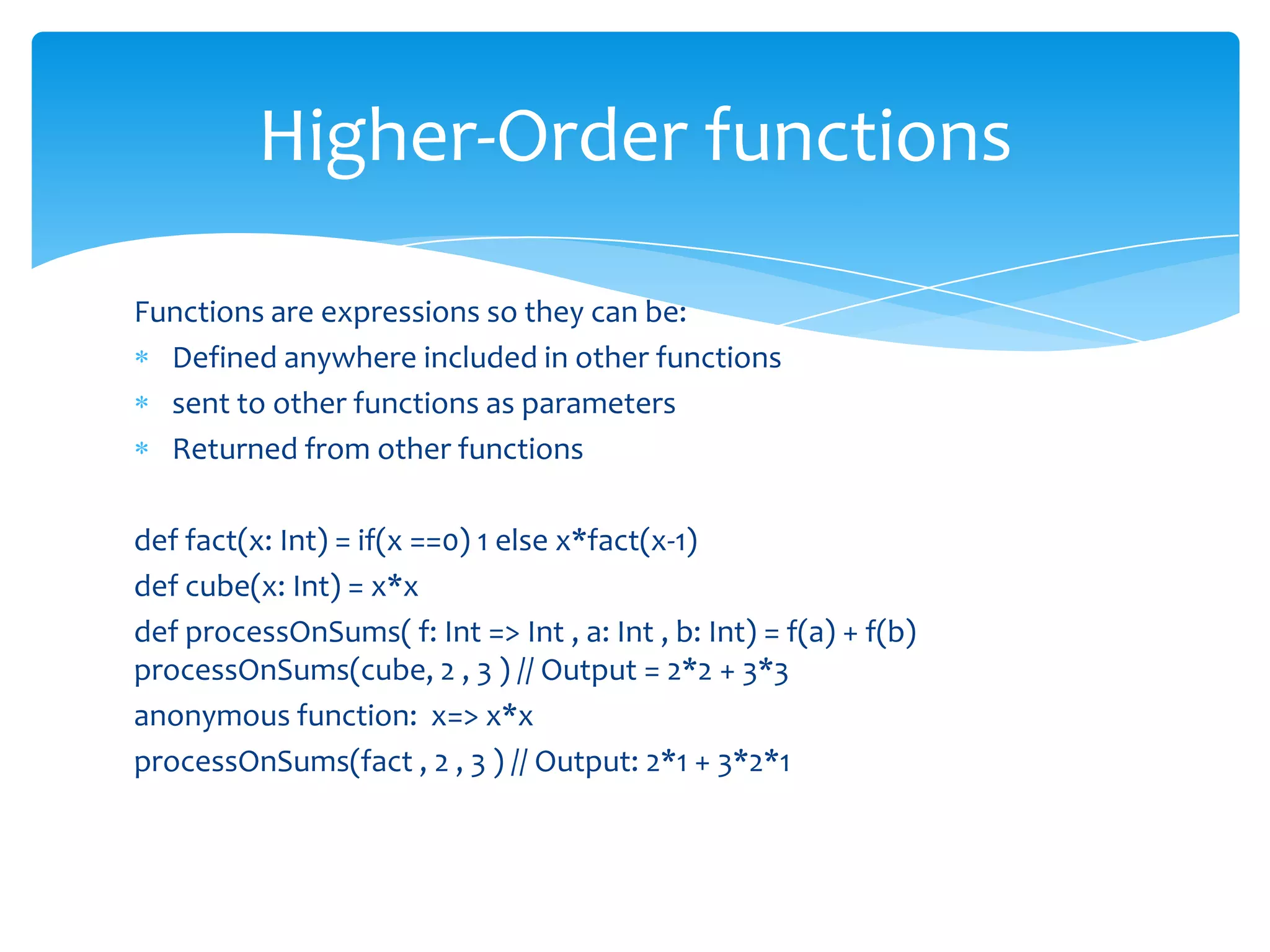
Higher-Order functions
Functions are expressions so they can be:
Defined anywhere included in other functions
sent to other functions as parameters
Returned from other functions
def fact(x: Int) = if(x ==0) 1 else x*fact(x-1)
def cube(x: Int) = x*x
def processOnSums( f: Int => Int , a: Int , b: Int) = f(a) + f(b)
processOnSums(cube, 2 , 3 ) // Output = 2*2 + 3*3
anonymous function: x=> x*x
processOnSums(fact , 2 , 3 ) // Output: 2*1 + 3*2*1
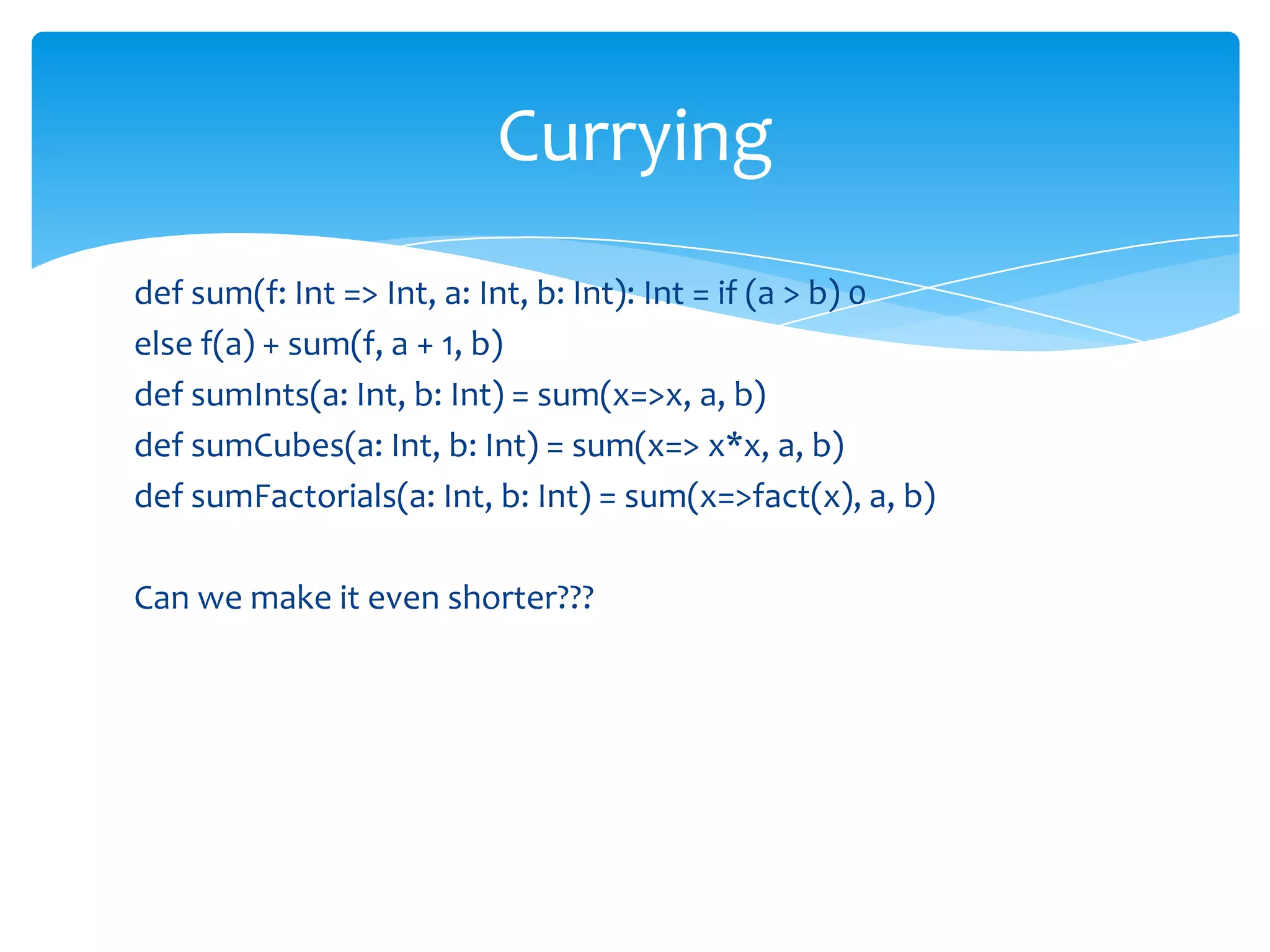
Currying
def sum(f: Int => Int, a: Int, b: Int): Int = if (a > b) 0
else f(a) + sum(f, a + 1, b)
def sumInts(a: Int, b: Int) = sum(x=>x, a, b)
def sumCubes(a: Int, b: Int) = sum(x=> x*x, a, b)
def sumFactorials(a: Int, b: Int) = sum(x=>fact(x), a, b)
Can we make it even shorter???
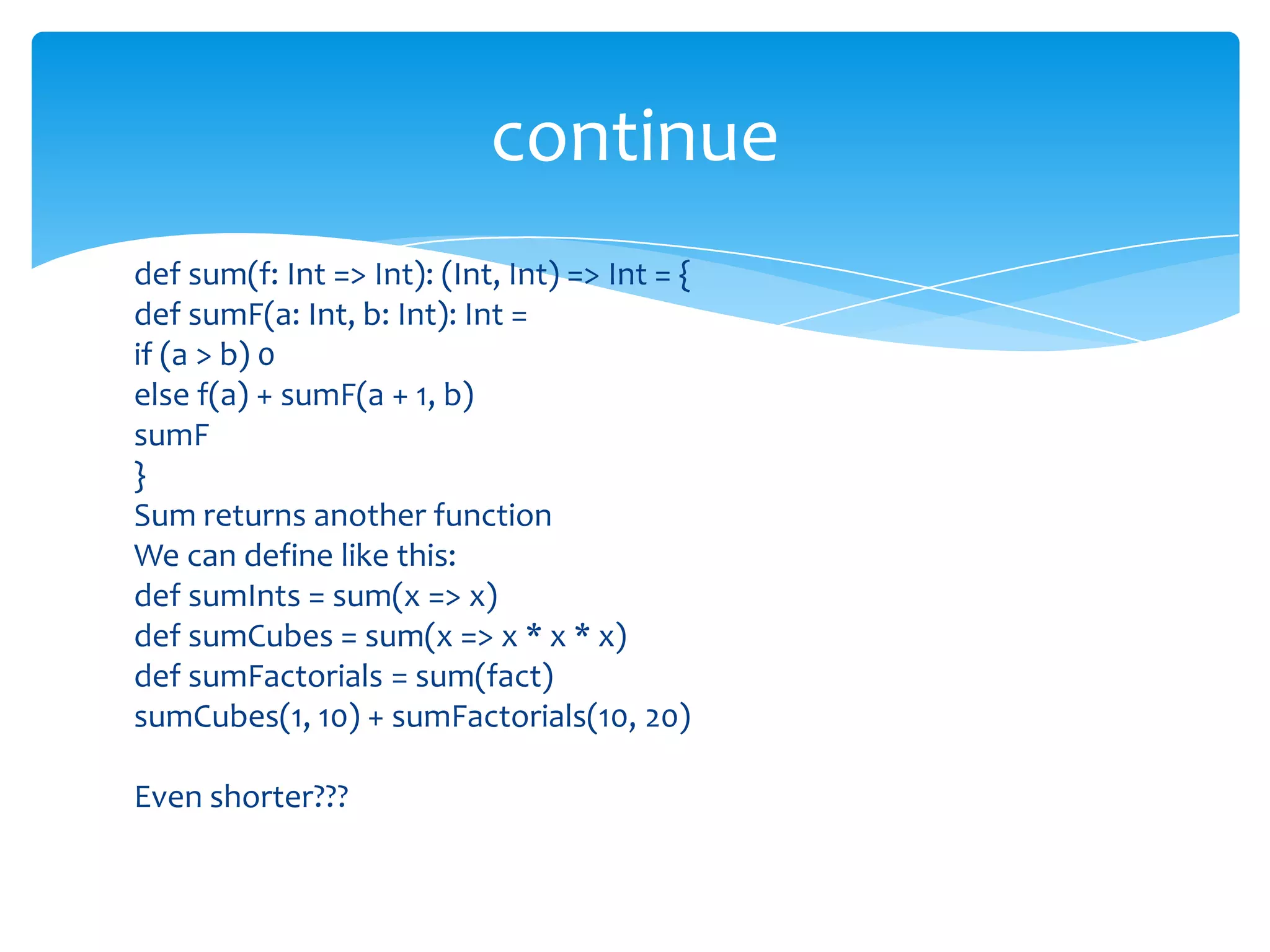
continue
def sum(f: Int => Int): (Int, Int) => Int = {
def sumF(a: Int, b: Int): Int =
if (a > b) 0
else f(a) + sumF(a + 1, b)
sumF
}
Sum returns another function
We can define like this:
def sumInts = sum(x => x)
def sumCubes = sum(x => x * x * x)
def sumFactorials = sum(fact)
sumCubes(1, 10) + sumFactorials(10, 20)
Even shorter???
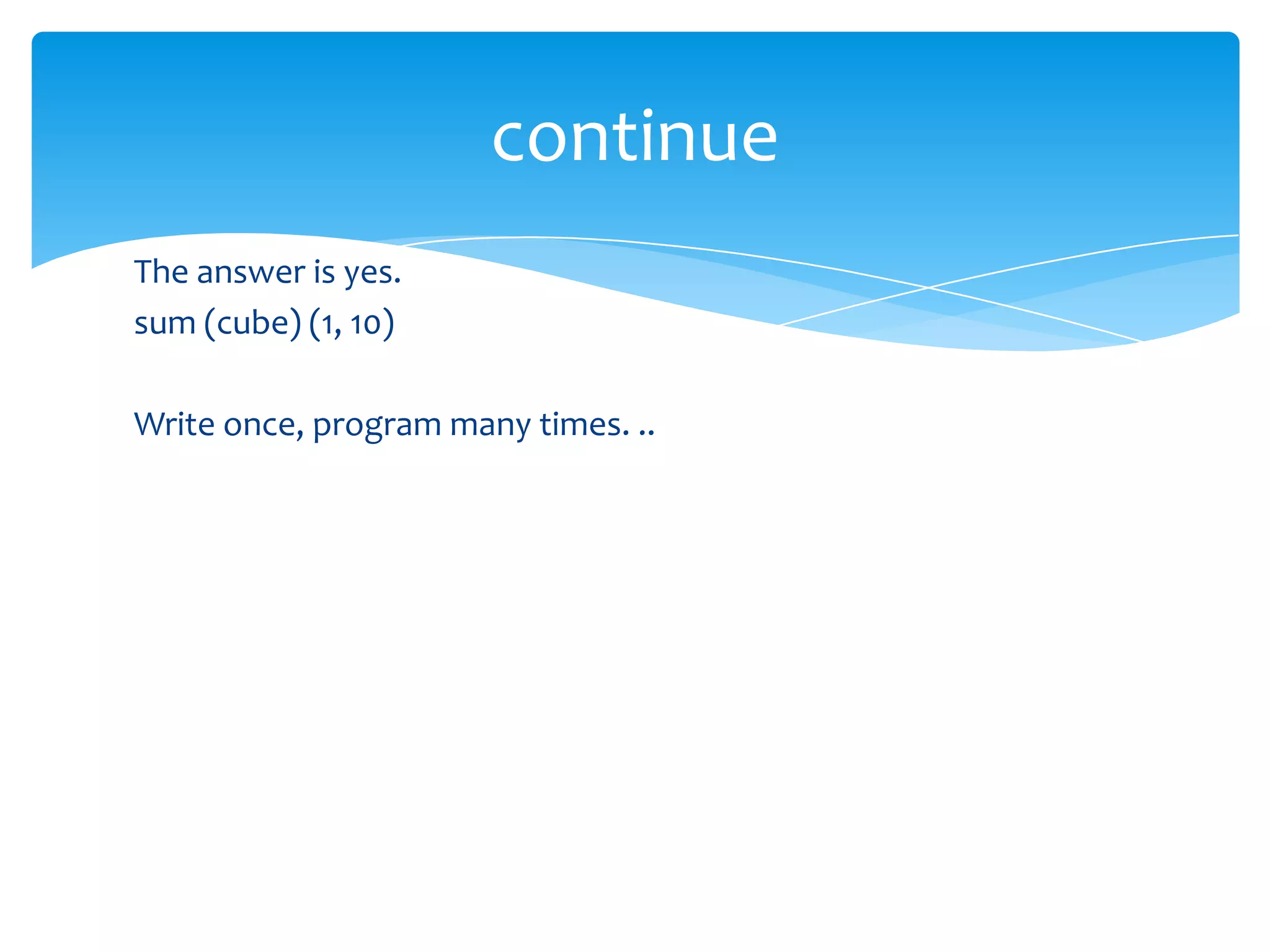
continue
The answer is yes.
sum (cube) (1, 10)
Write once, program many times. ..
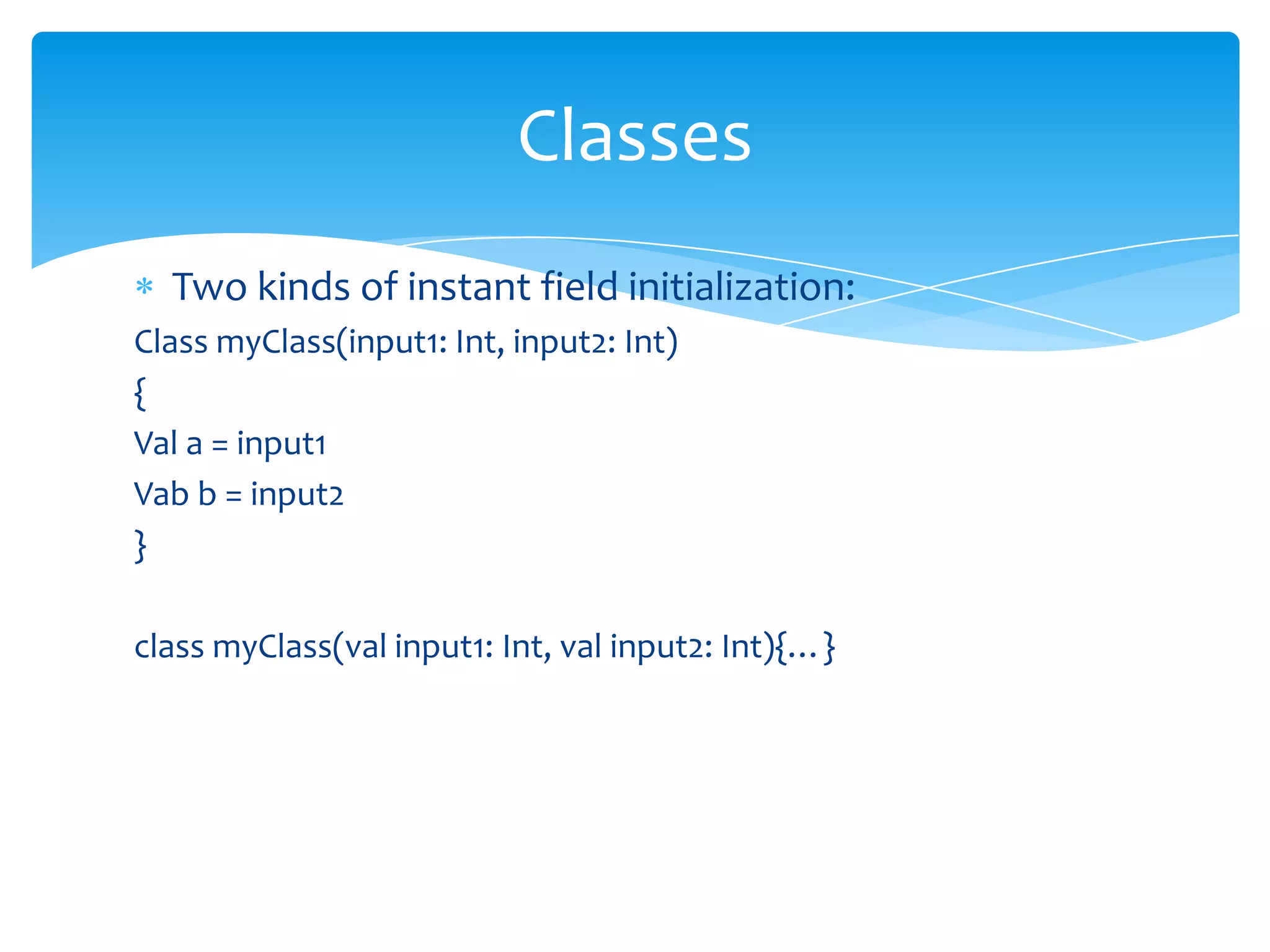
Classes
Two kinds of instant field initialization:
Class myClass(input1: Int, input2: Int)
{
Val a = input1
Vab b = input2
}
class myClass(val input1: Int, val input2: Int){…}
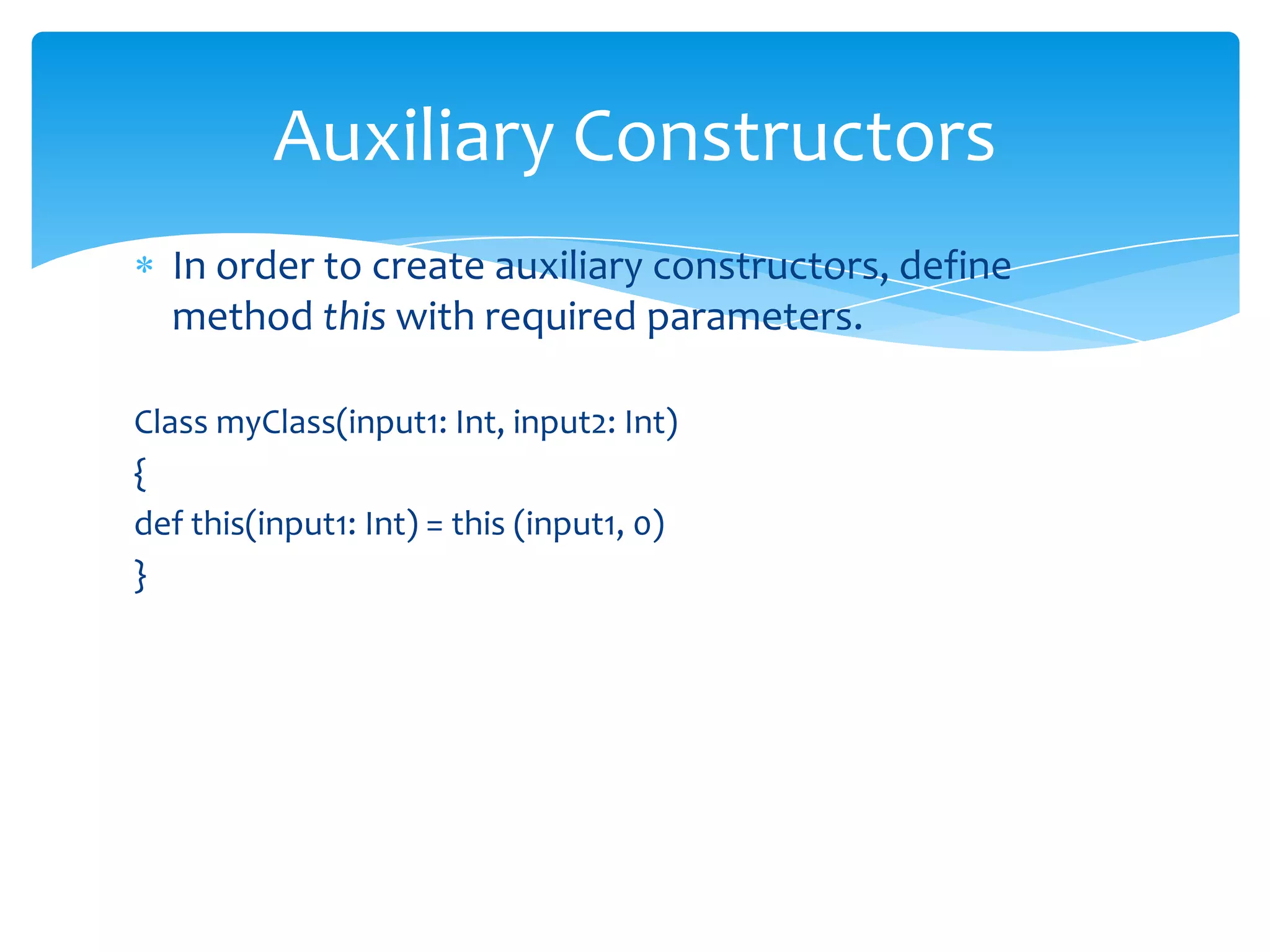
Auxiliary Constructors
In order to create auxiliary constructors, define
method this with required parameters.
Class myClass(input1: Int, input2: Int)
{
def this(input1: Int) = this (input1, 0)
}
Inheritance

Inheritance rules so similar to java
Traits are alternative for interfaces
Why do we need a new structure ?
In java classes can have only one super class, but what if
a class need to inherit from several supertypes ???
This is why scala introduces traits.
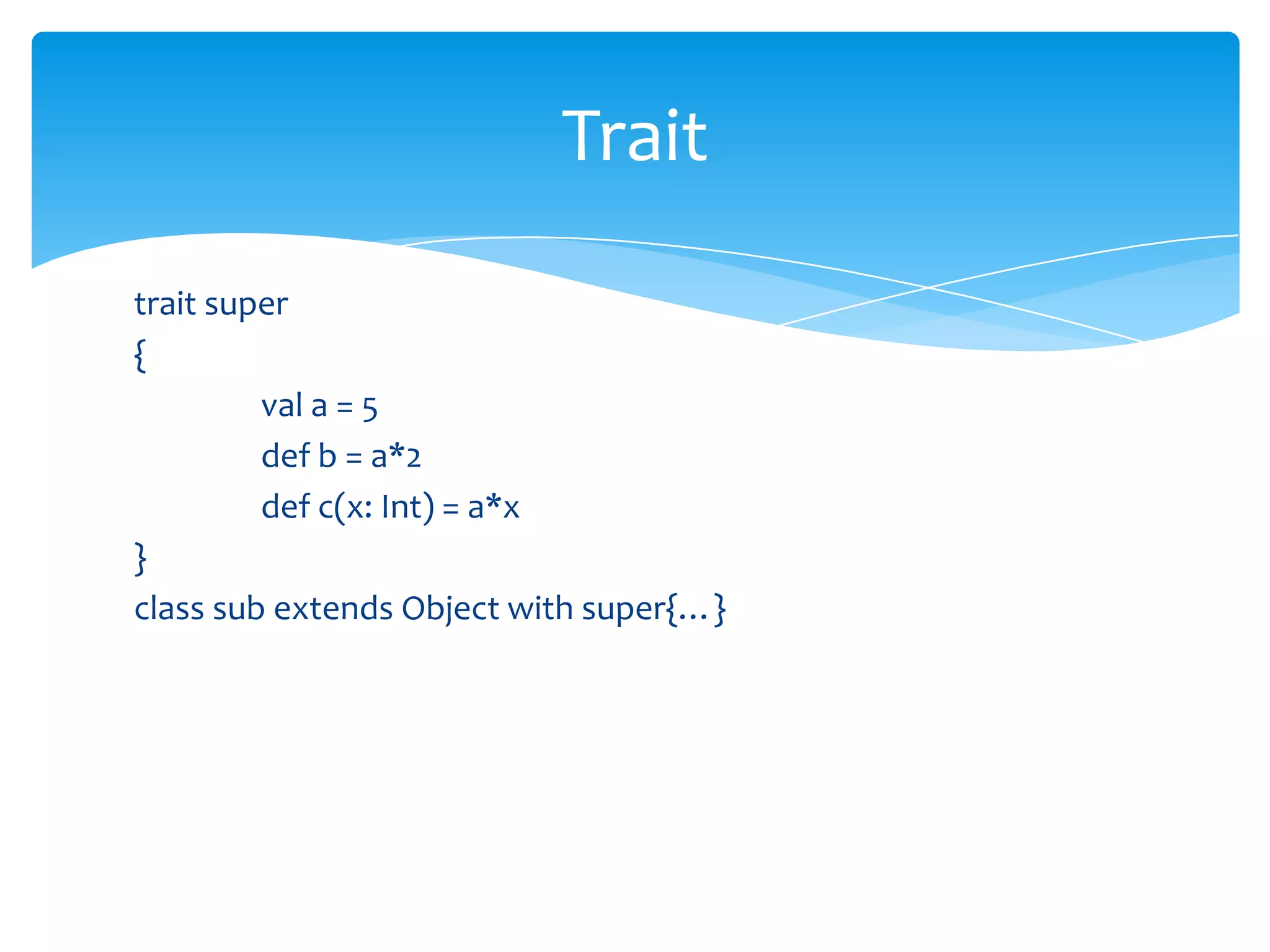
Trait
trait super
{
val a = 5
def b = a*2
def c(x: Int) = a*x
}
class sub extends Object with super{…}
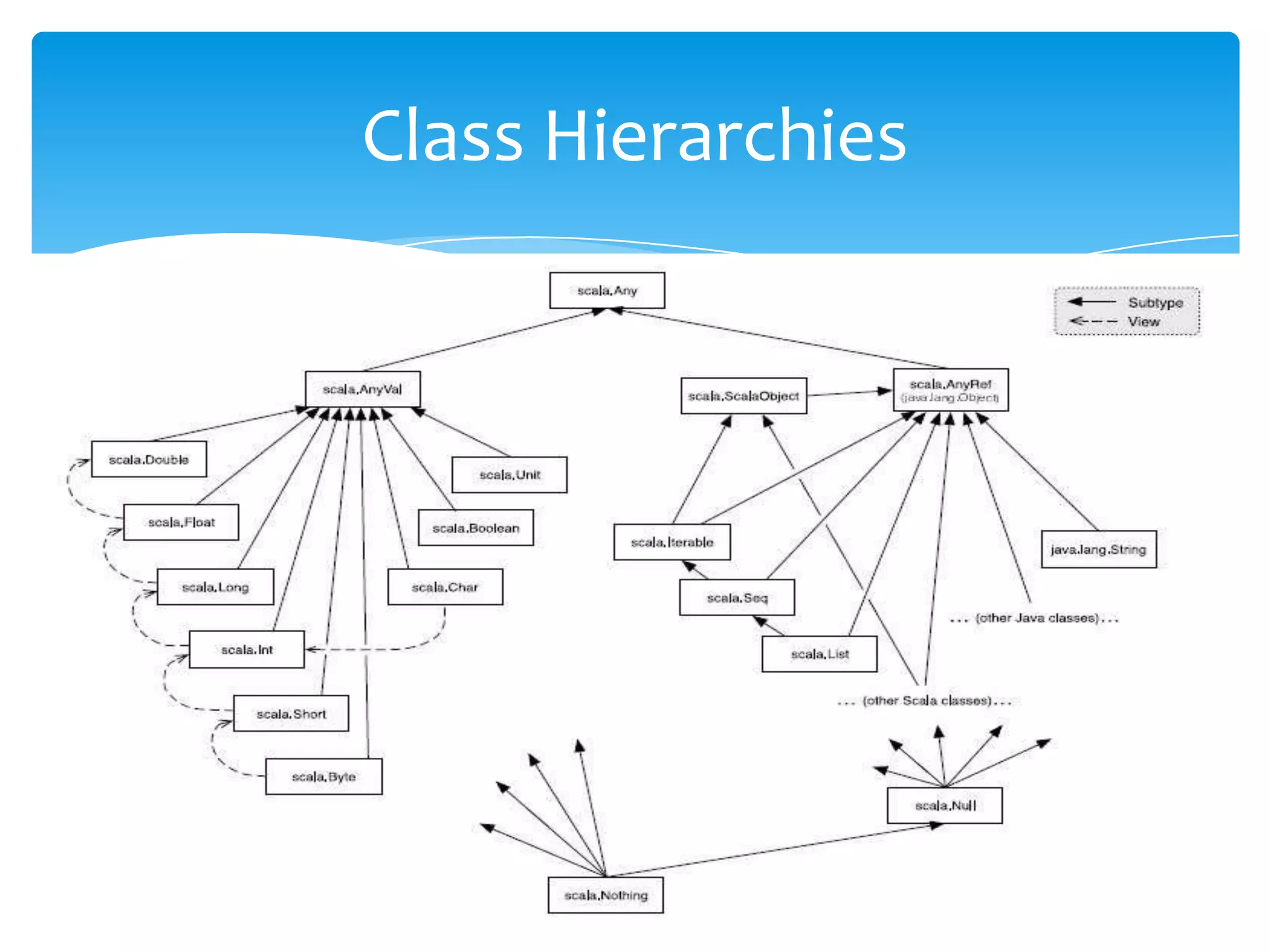
Class Hierarchies
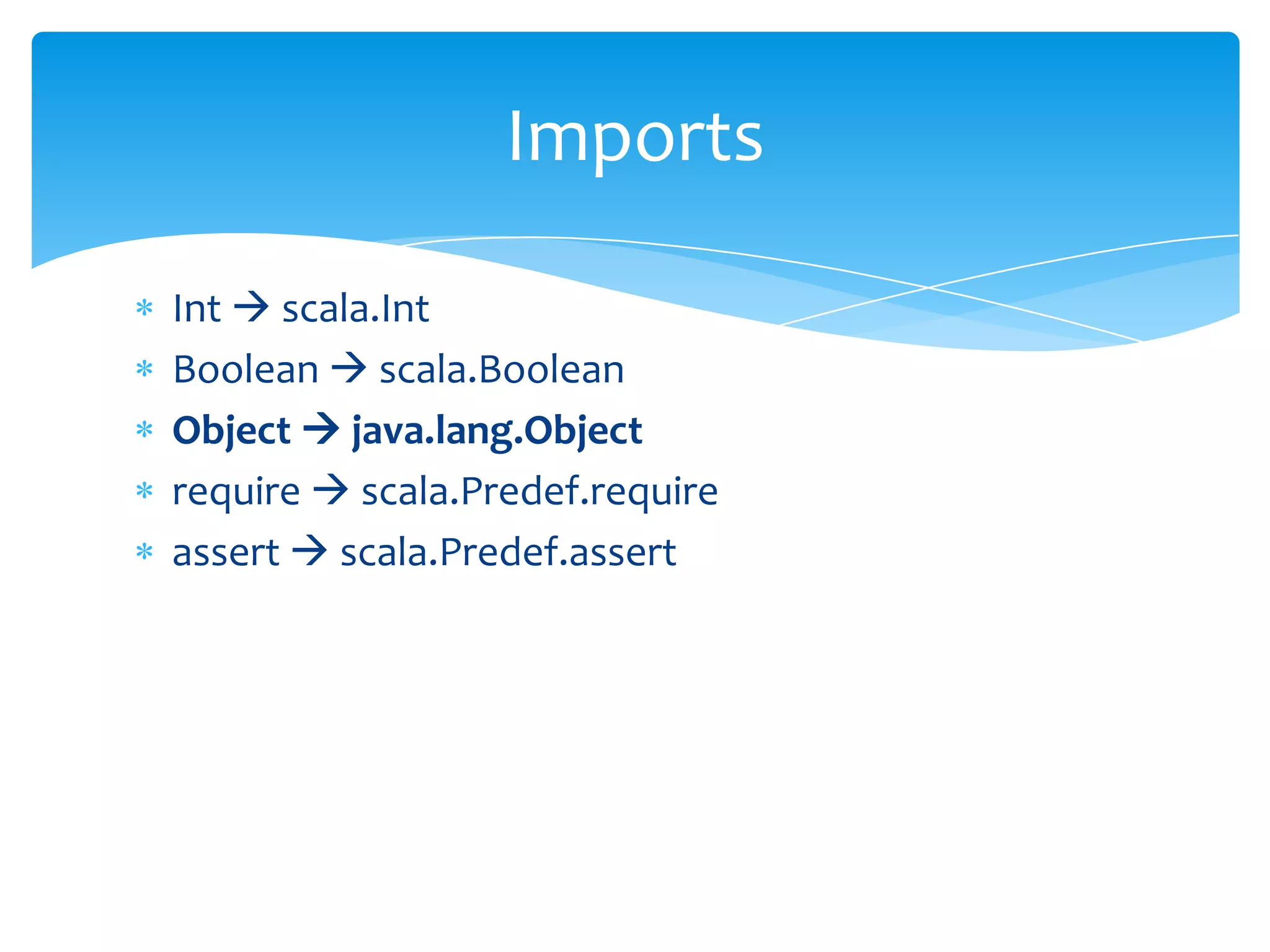
Imports
Int  scala.Int
Boolean  scala.Boolean
Object  java.lang.Object
require  scala.Predef.require
assert  scala.Predef.assert
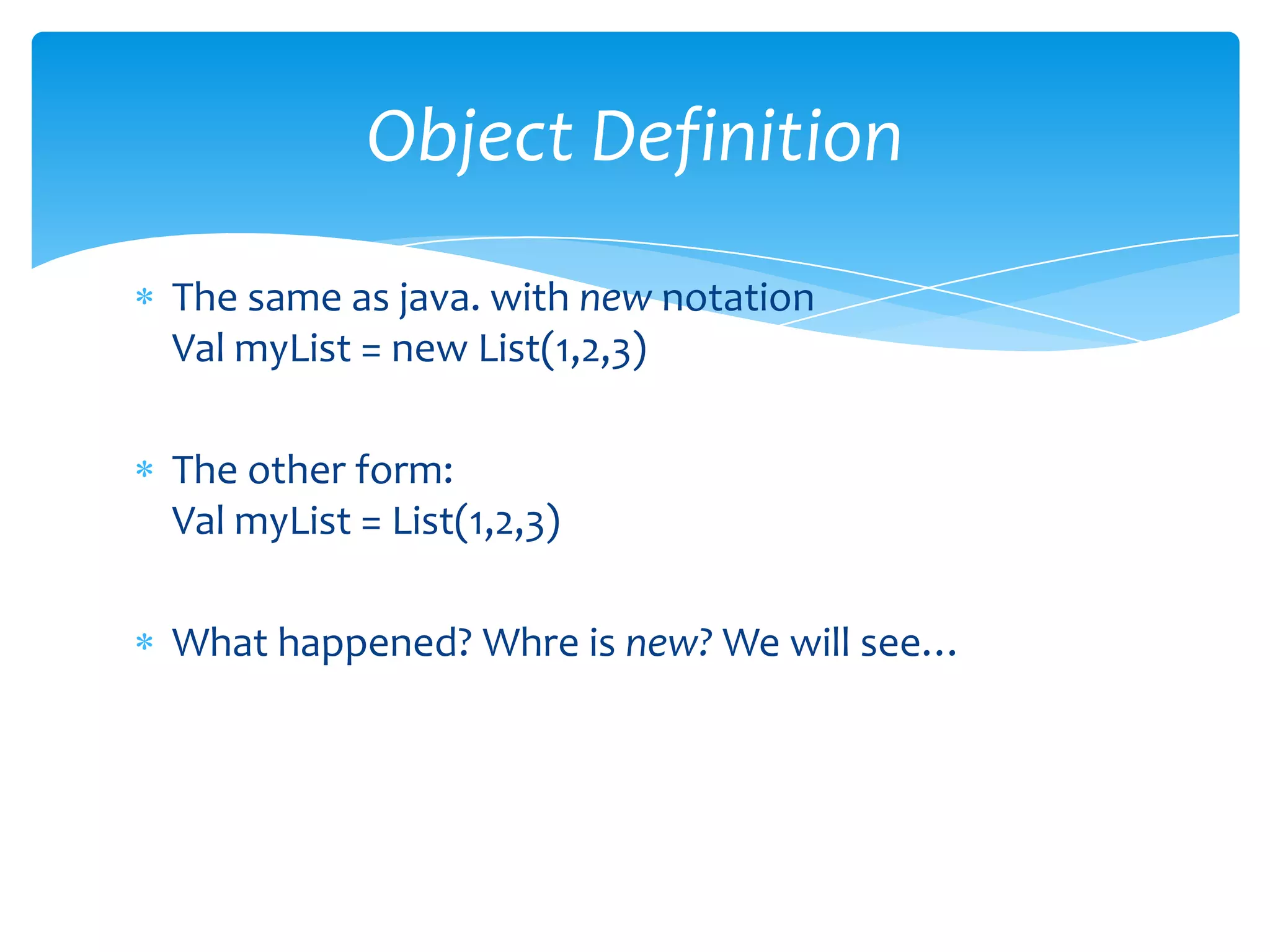
Object Definition
The same as java. with new notation
Val myList = new List(1,2,3)
The other form:
Val myList = List(1,2,3)
What happened? Whre is new? We will see…
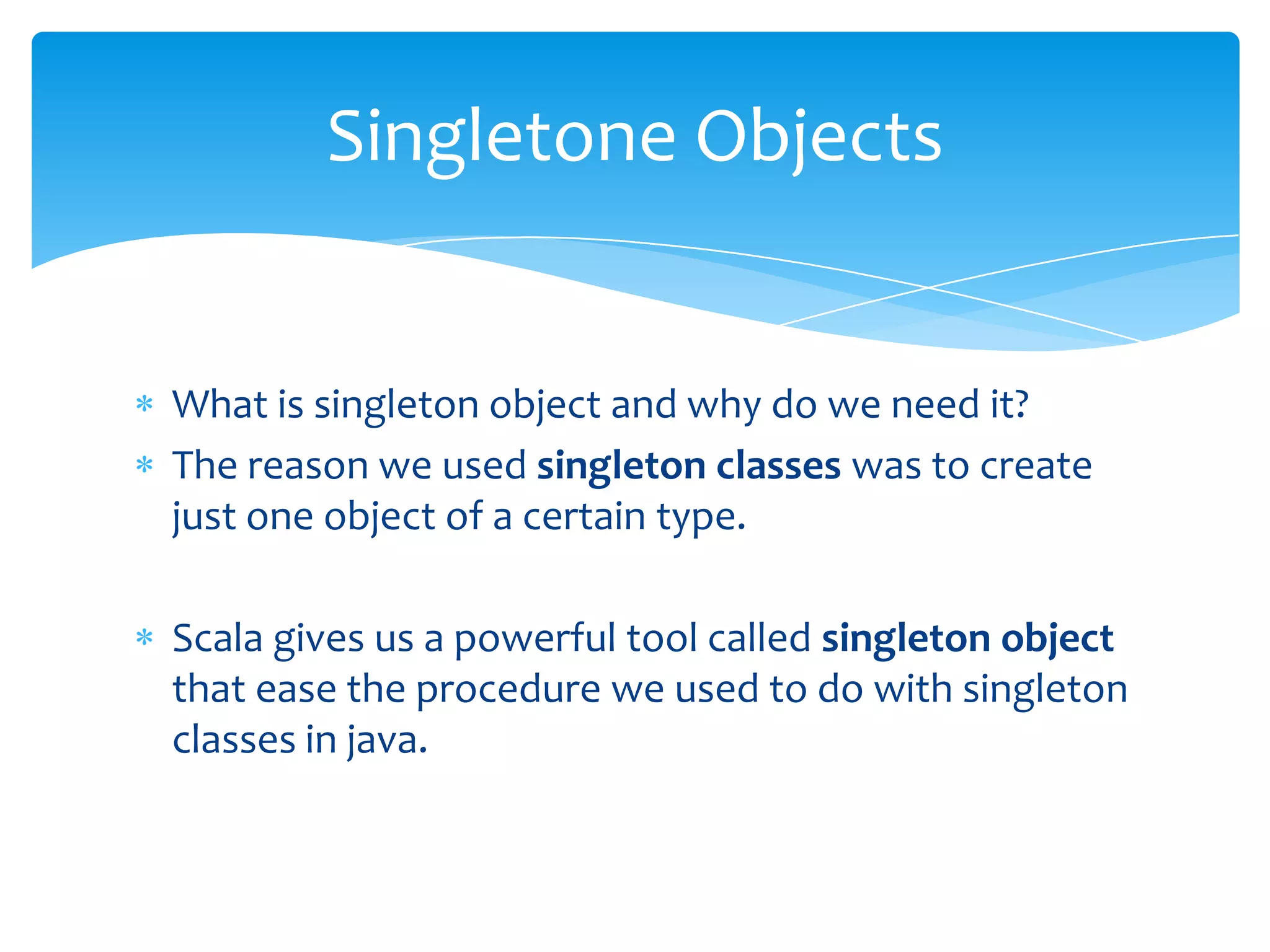
Singletone Objects

What is singleton object and why do we need it?
The reason we used singleton classes was to create
just one object of a certain type.
Scala gives us a powerful tool called singleton object
that ease the procedure we used to do with singleton
classes in java.
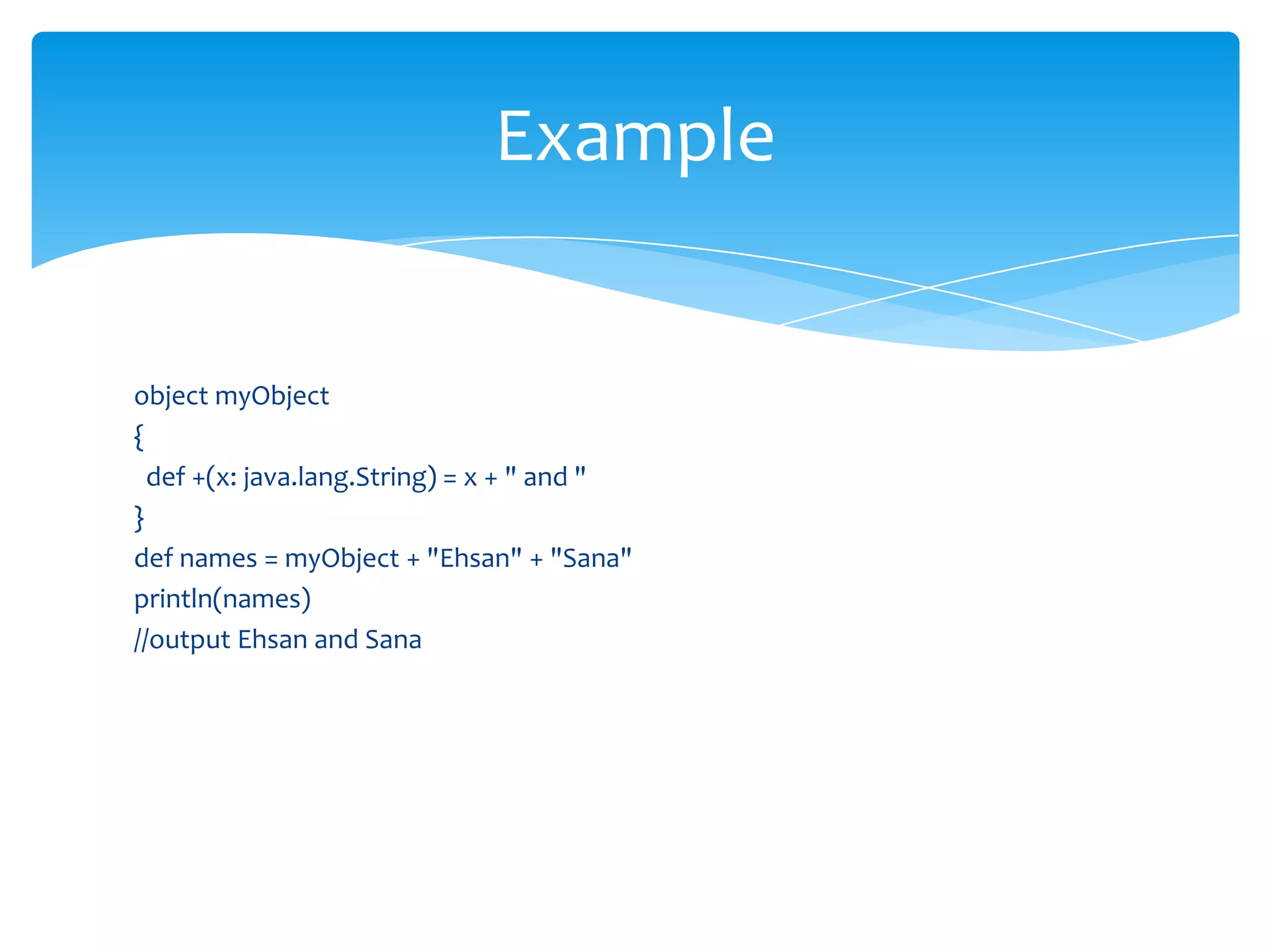
Example

object myObject
{
def +(x: java.lang.String) = x + " and "
}
def names = myObject + "Ehsan" + "Sana"
println(names)
//output Ehsan and Sana
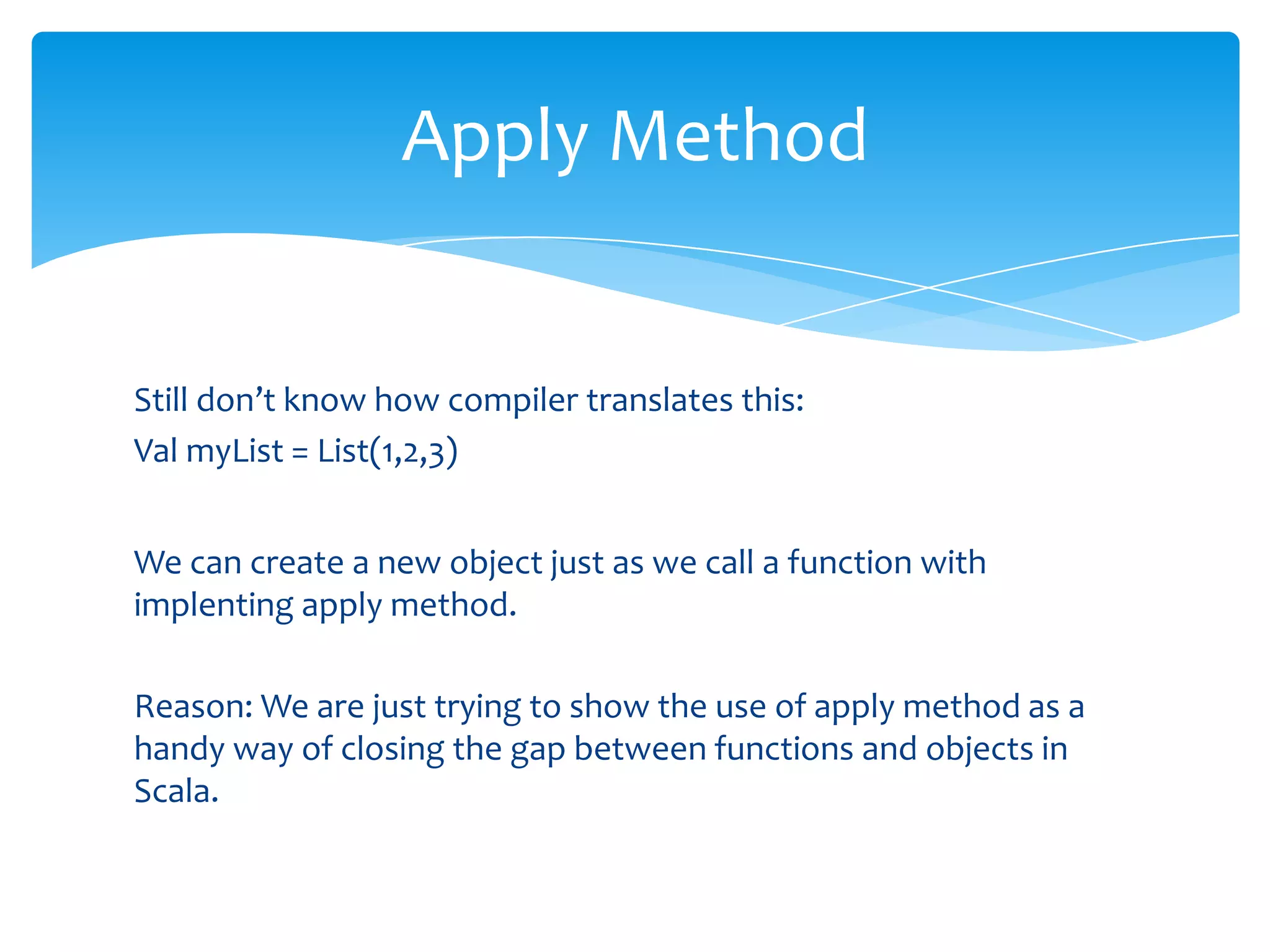
Apply Method

Still don’t know how compiler translates this:
Val myList = List(1,2,3)
We can create a new object just as we call a function with
implenting apply method.
Reason: We are just trying to show the use of apply method as a
handy way of closing the gap between functions and objects in
Scala.
Implementation of Apply Method for
List
object List extends List
{
def apply[A](xs: A*): List[A]
//Creates a list with the specified elements.
}
Immutable Collections

Lists
Maps
a fundamental structure in many functional languages
is the immutable linked list.
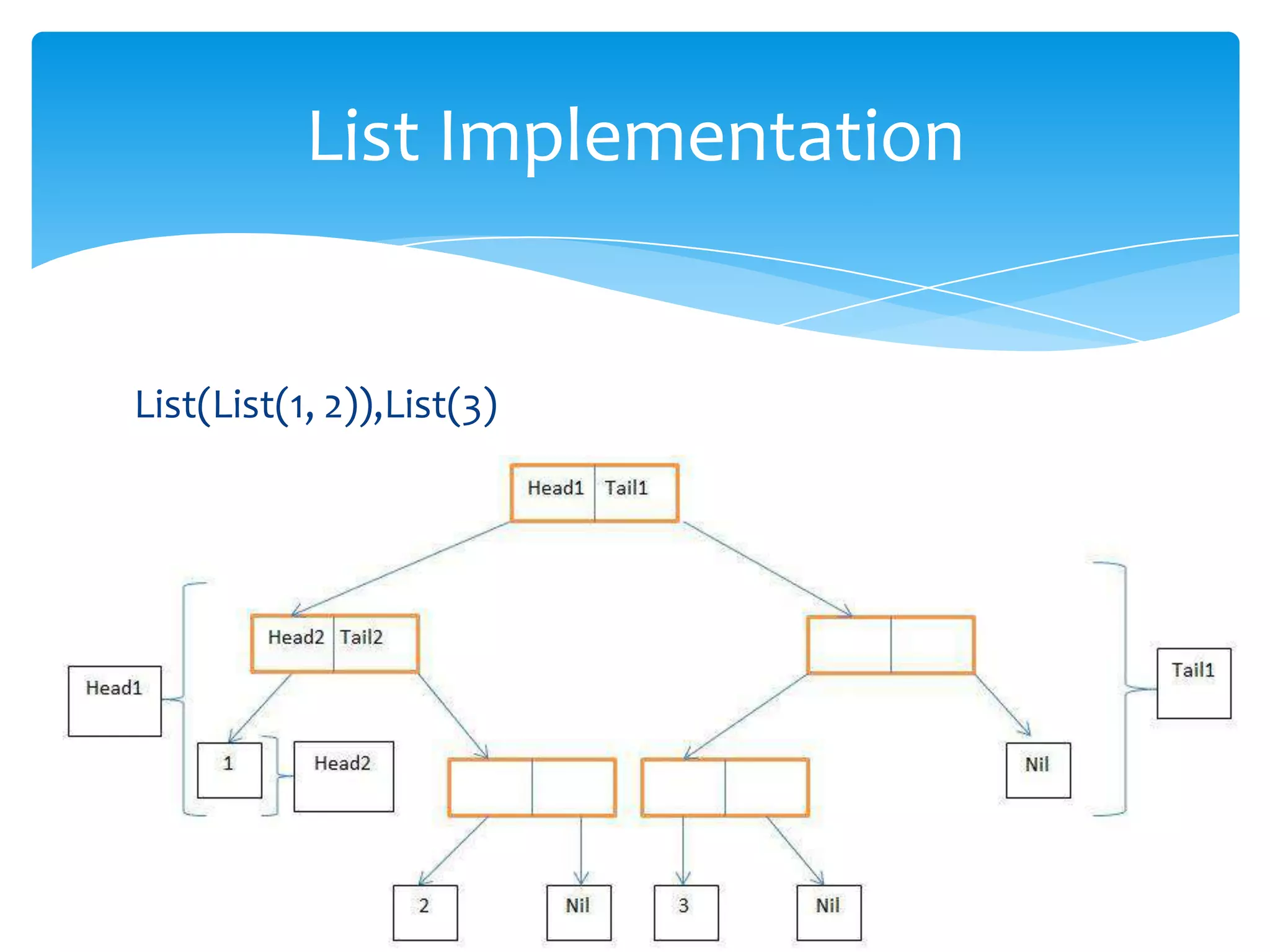
List Implementation

List(List(1, 2)),List(3)
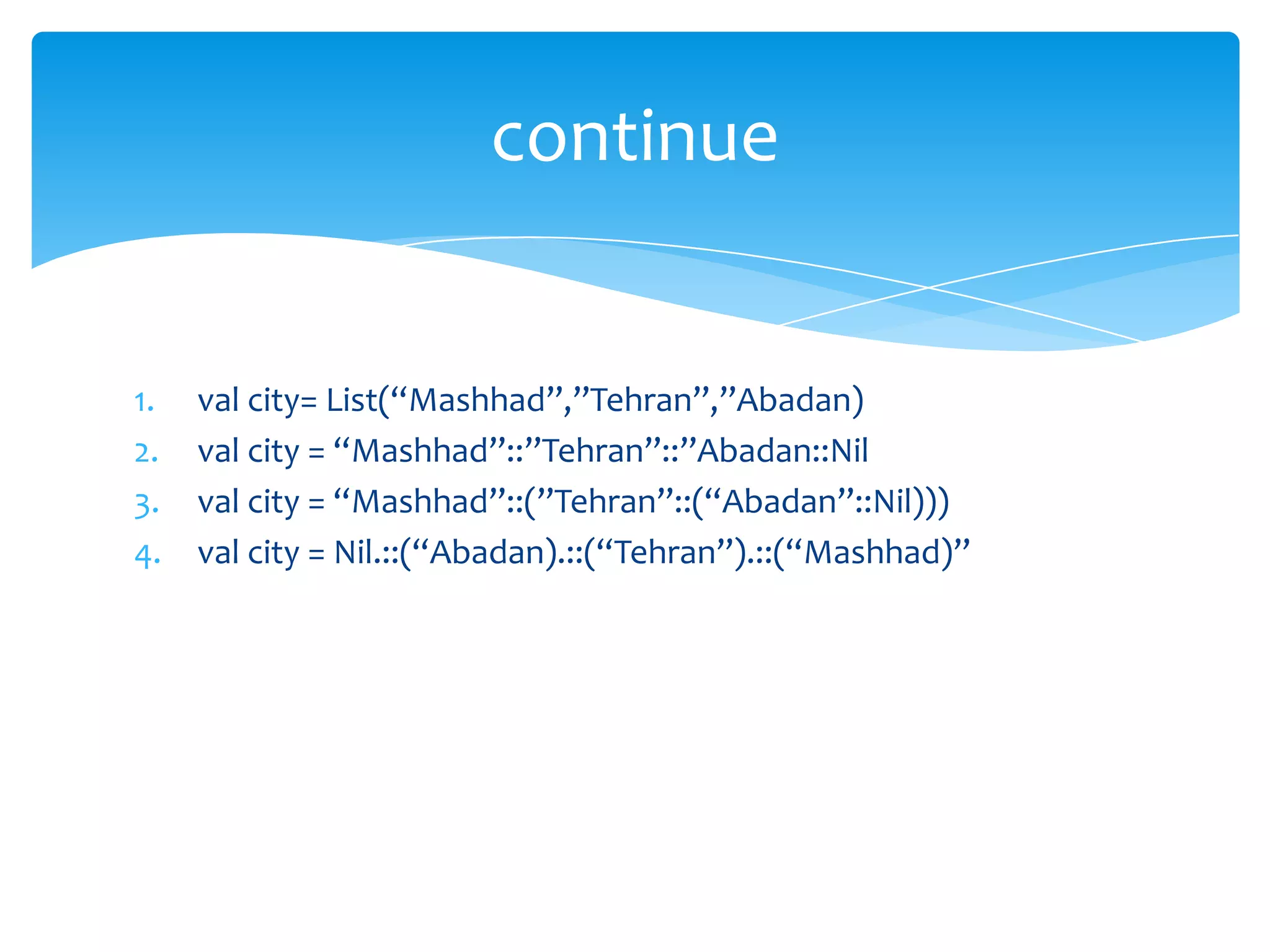
continue

1.
2.
3.
4.

val city= List(“Mashhad”,”Tehran”,”Abadan)
val city = “Mashhad”::”Tehran”::”Abadan::Nil
val city = “Mashhad”::(”Tehran”::(“Abadan”::Nil)))
val city = Nil.::(“Abadan).::(“Tehran”).::(“Mashhad)”
Example

def sum(xs: List[Int]): Int = if (xs.isEmpty) 0
else xs.head + sum(xs.tail)
Sums the elements of the list
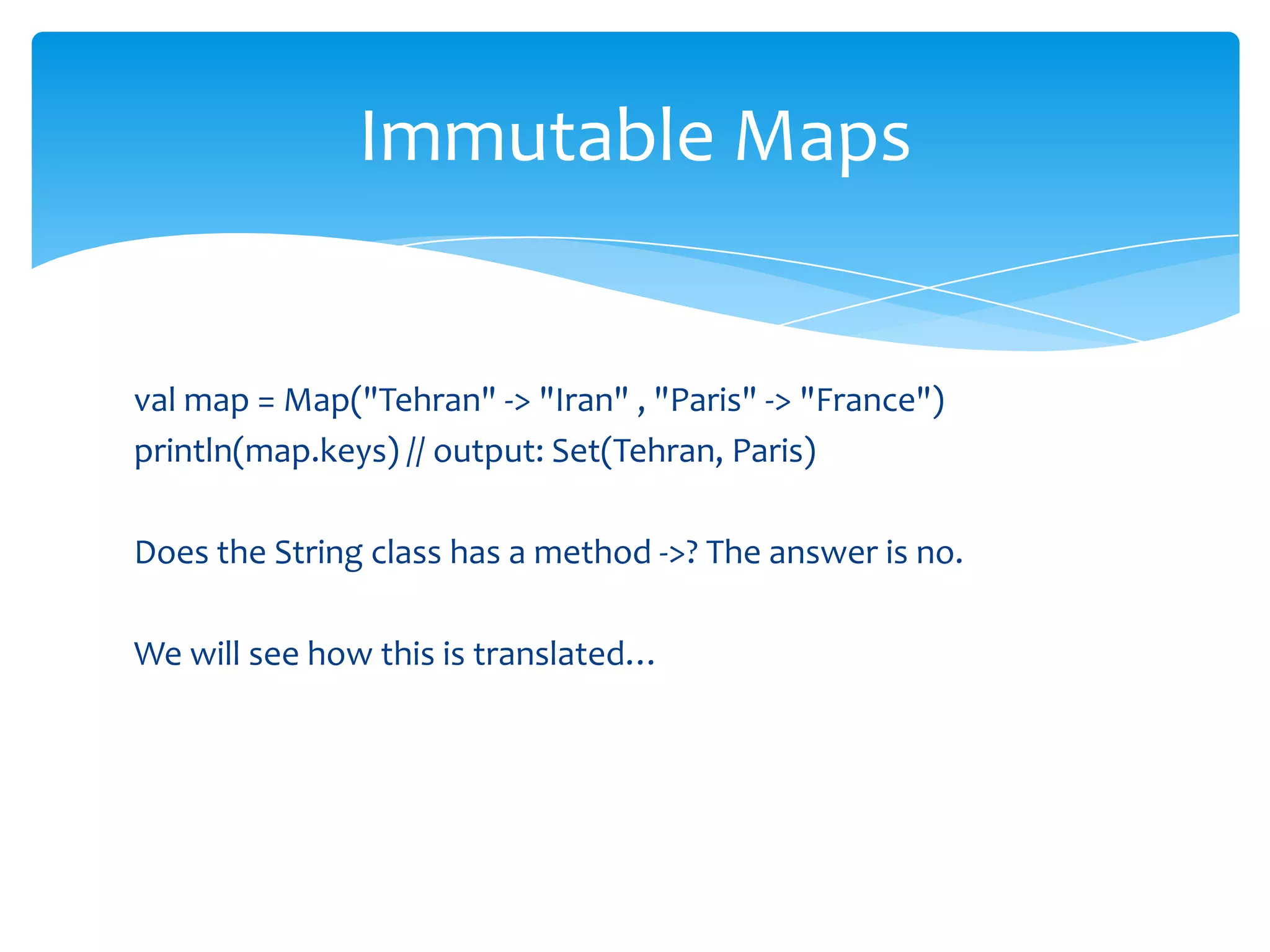
Immutable Maps

val map = Map("Tehran" -> "Iran" , "Paris" -> "France")
println(map.keys) // output: Set(Tehran, Paris)
Does the String class has a method ->? The answer is no.
We will see how this is translated…
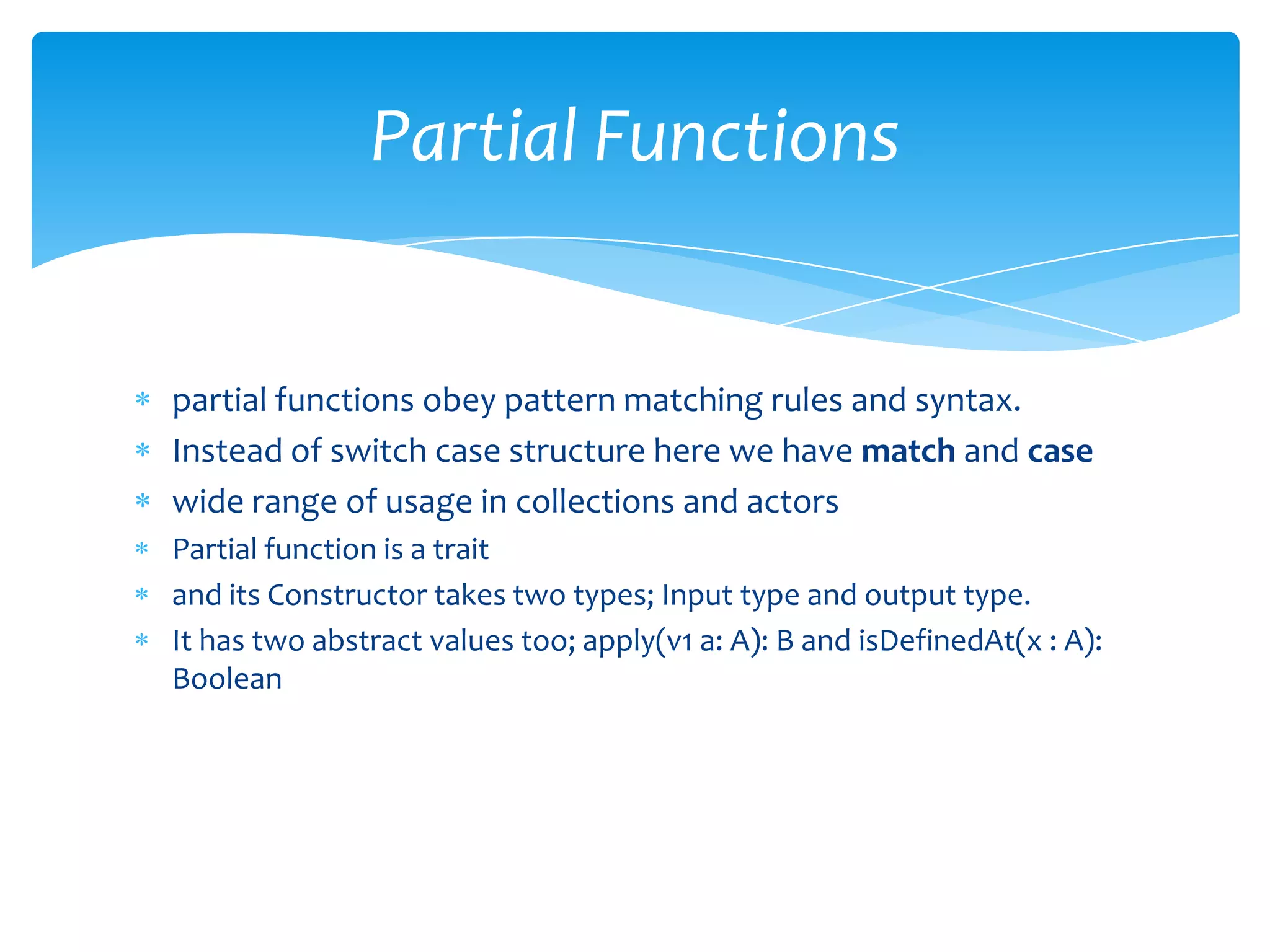
Partial Functions

partial functions obey pattern matching rules and syntax.
Instead of switch case structure here we have match and case
wide range of usage in collections and actors
Partial function is a trait
and its Constructor takes two types; Input type and output type.
It has two abstract values too; apply(v1 a: A): B and isDefinedAt(x : A):
Boolean
Example

val p = new PartialFunction[Int, Any] {
def apply(xs: Int) = xs match {
case xs => 1/xs.doubleValue()
case _ => 1/xs
}
def isDefinedAt(xs: Int) = xs match {
case 0 => false
case _ => true
}
}
println(p(2)) //output: 0.5
println(p(0))// output: Infinity No exception is thrown
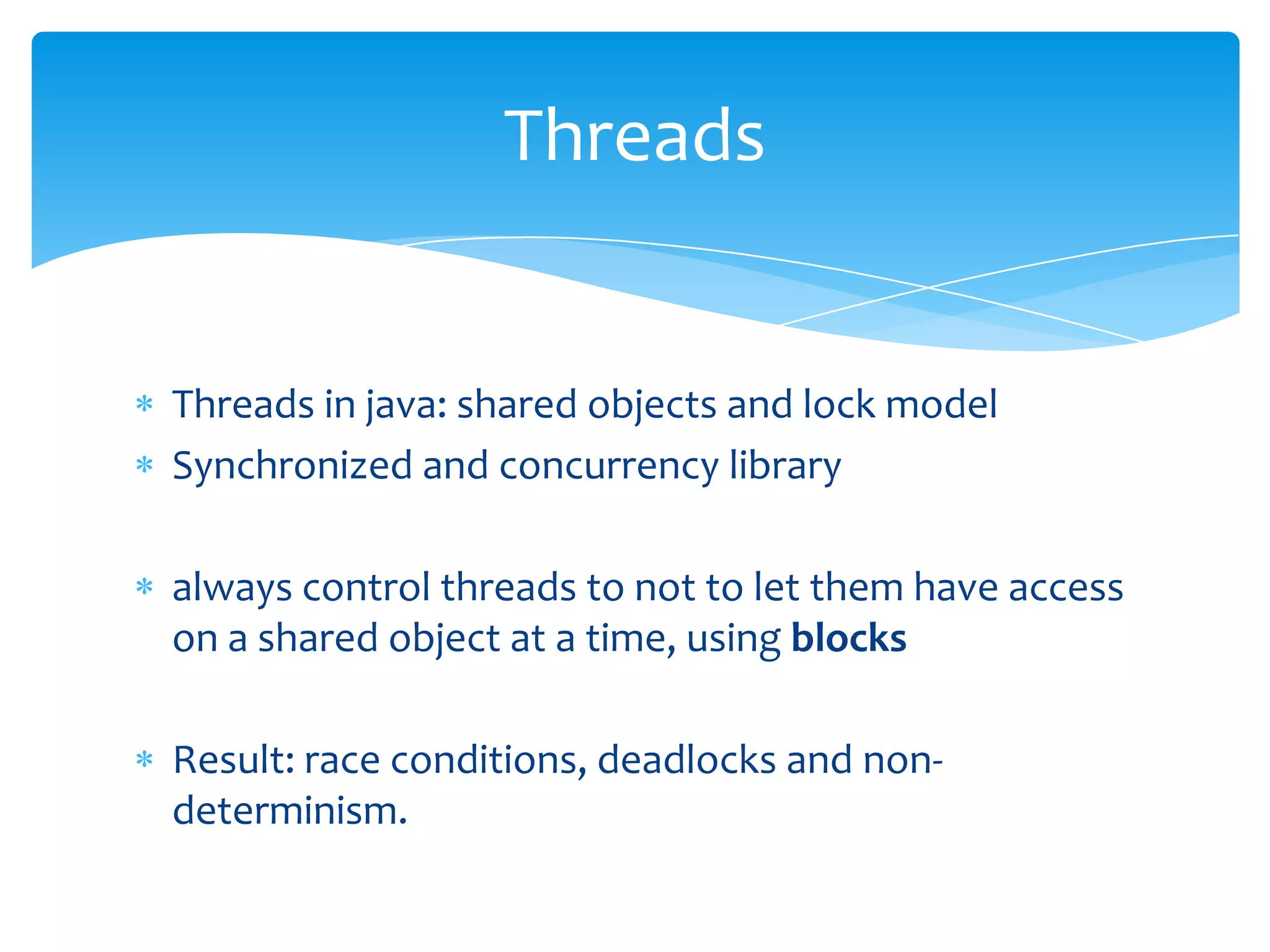
Threads

Threads in java: shared objects and lock model
Synchronized and concurrency library

always control threads to not to let them have access
on a shared object at a time, using blocks
Result: race conditions, deadlocks and nondeterminism.
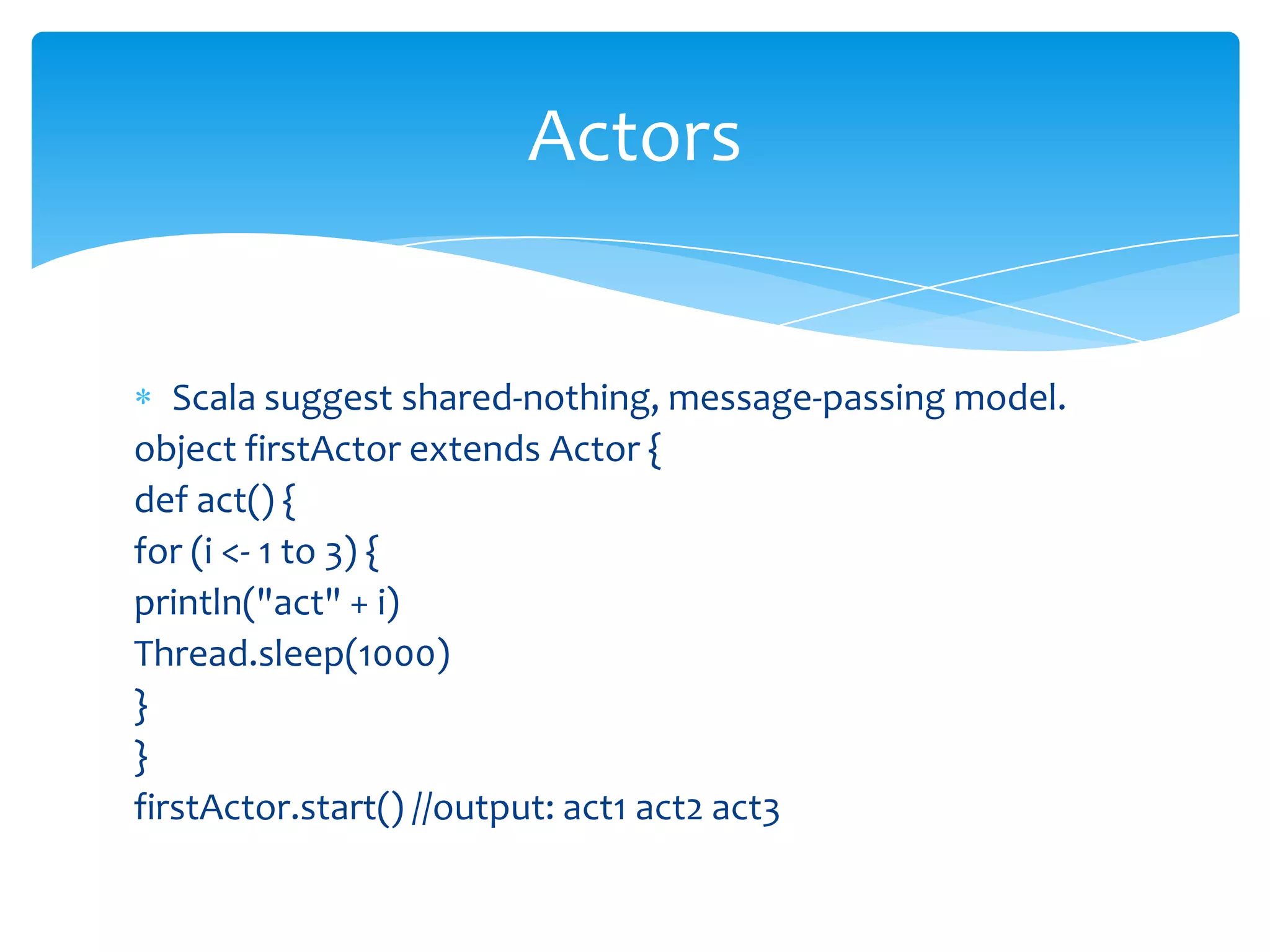
Actors

Scala suggest shared-nothing, message-passing model.
object firstActor extends Actor {
def act() {
for (i <- 1 to 3) {
println("act" + i)
Thread.sleep(1000)
}
}
firstActor.start() //output: act1 act2 act3
Problem

If actors do not have shared objects how do they
connect each other???
So simple: sending message…
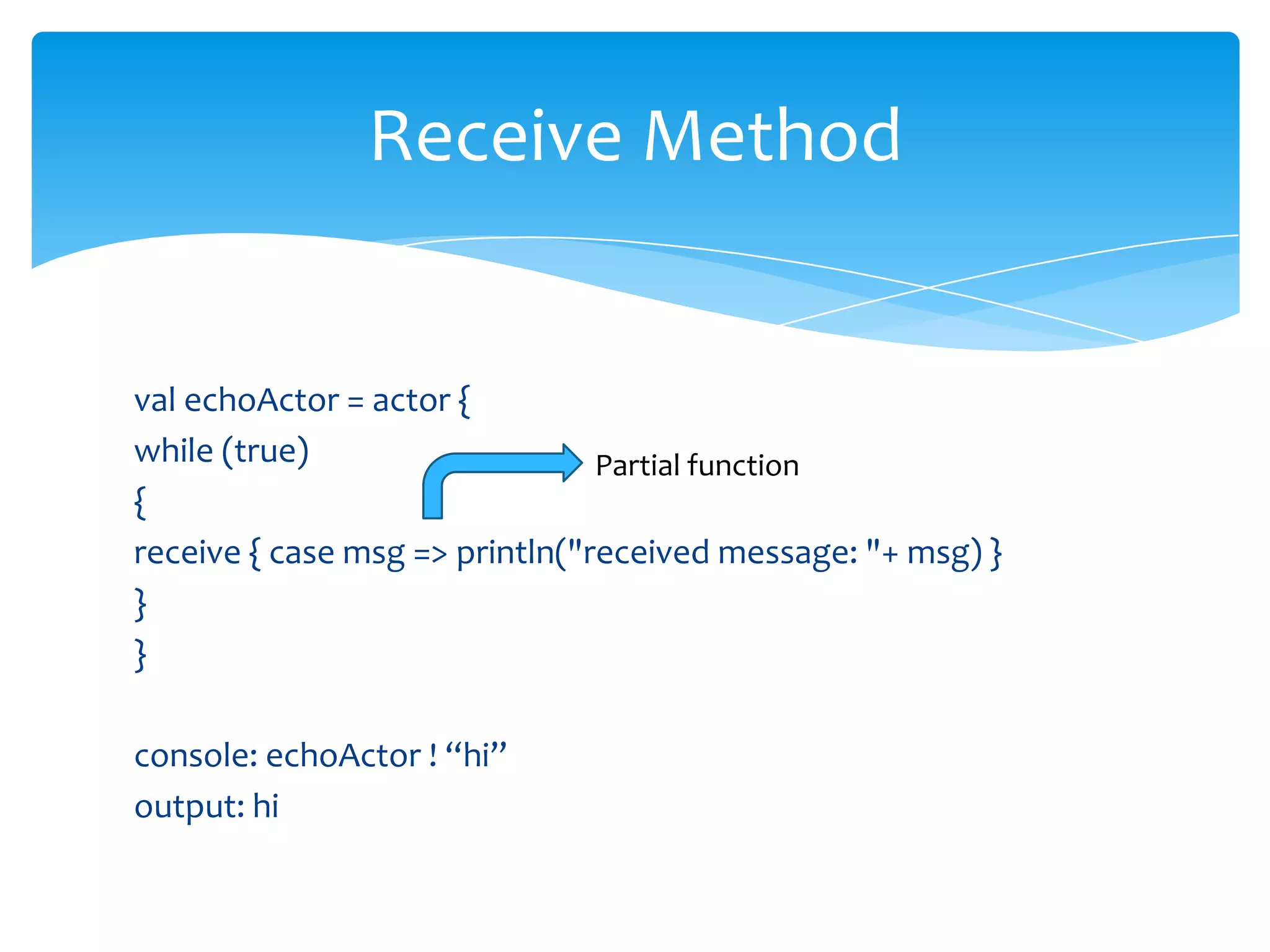
Receive Method

val echoActor = actor {
while (true)
Partial function
{
receive { case msg => println("received message: "+ msg) }
}
}
console: echoActor ! “hi”
output: hi
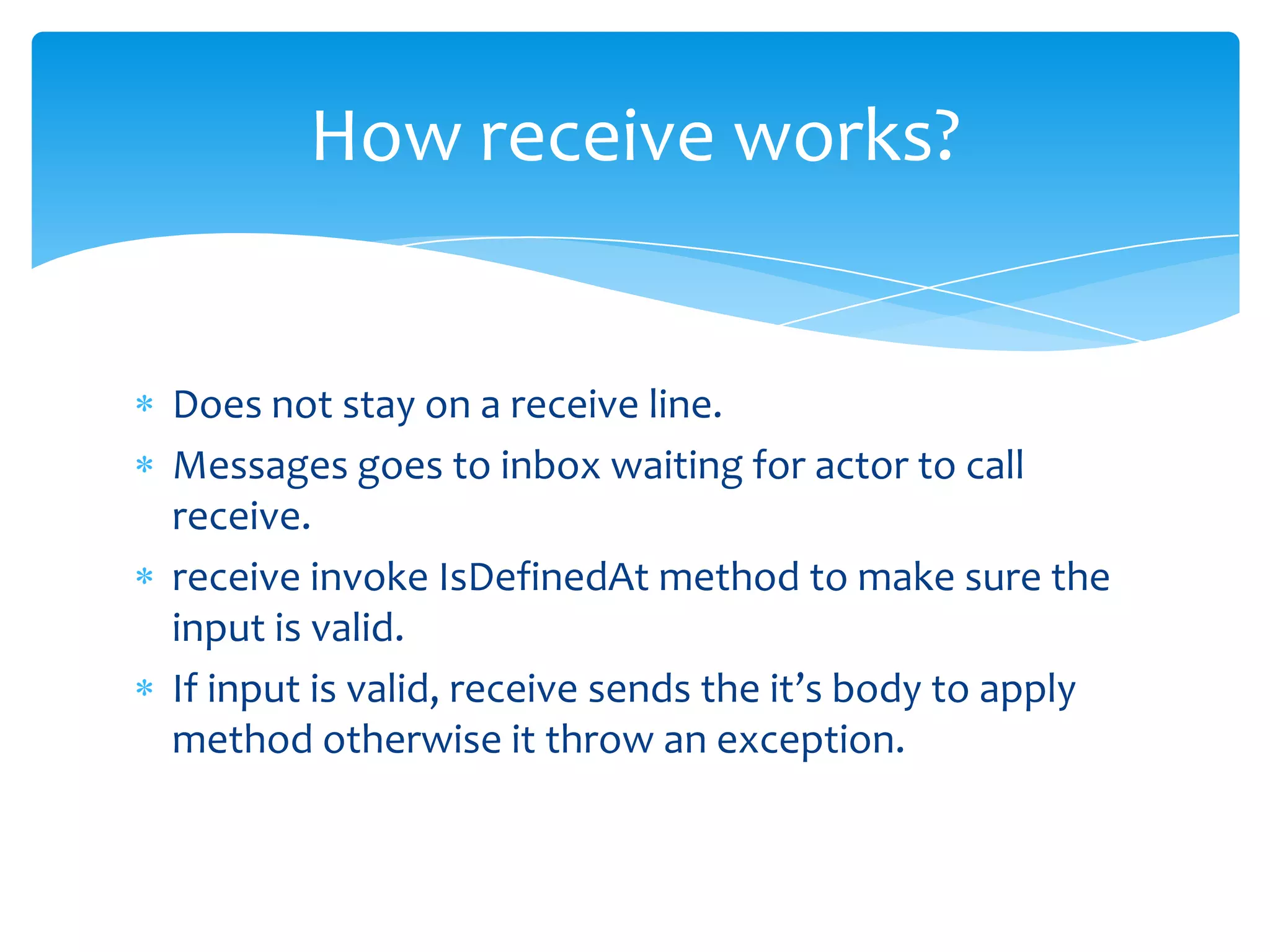
How receive works?

Does not stay on a receive line.
Messages goes to inbox waiting for actor to call
receive.
receive invoke IsDefinedAt method to make sure the
input is valid.
If input is valid, receive sends the it’s body to apply
method otherwise it throw an exception.
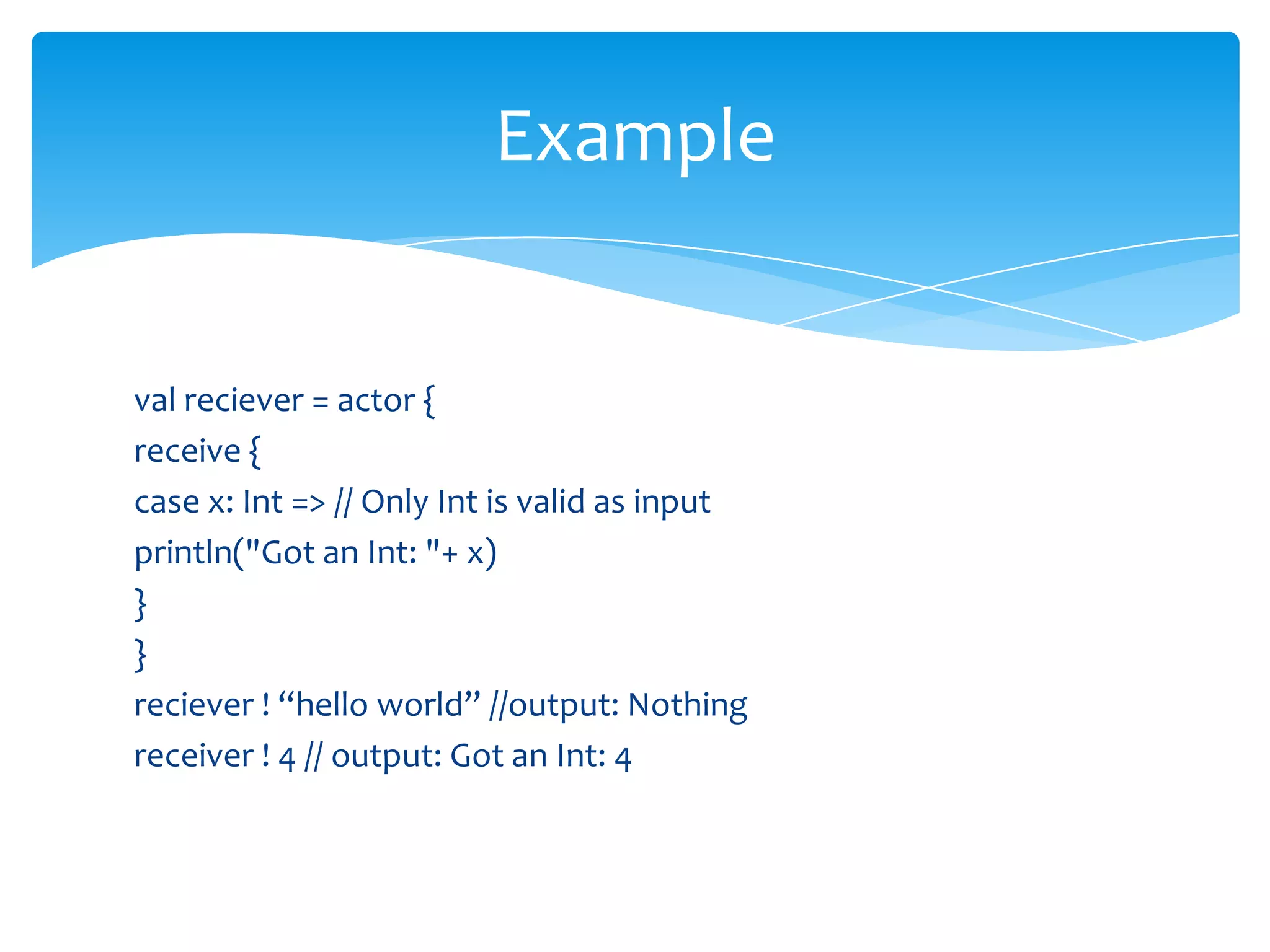
Example

val reciever = actor {
receive {
case x: Int => // Only Int is valid as input
println("Got an Int: "+ x)
}
}
reciever ! “hello world” //output: Nothing
receiver ! 4 // output: Got an Int: 4
Disadvantage

Low performance implementation of imperative
structures compared to java.

Principles of functional progrmming in scala

  • 1.
    Principles of Functional Progrmmingin Scala • Moor’s Law • Clock frequency has not raised. • More Complex programs. • Growing in data
  • 2.
  • 3.
    Example var x =0 async{ x = x+1 } async{ x = x*2 } // the answer could be 0, 1 or 2 Non-determinism = parallel processing+ mutable values
  • 4.
    Paradigm In science, aparadigm describes distinct concepts or thought patterns in some scientific discipline. Main programming paradigms: imperative programming functional programming logic programming
  • 5.
    Imparative paradigm modifying mutablevariables, using assignments and control structures such as if-thenelse, loops, break, continue, return.
  • 6.
    Fucntional Paradigm Immutable states Functionswithout side-effects Everything is function Functions are expressions not statements
  • 7.
    Referential transparency once avariable is given a value it never changes. no side effects are possible. Functions are building blocks  functions are free side-effect function call does not affect other functions and it just computes its own output for a specific input sin (pi) = 0 Functions are expressions not statements
  • 8.
    FP is inspiredby mathematics Neither theories nor functions have mutable values. You can combine functions to make more complex functions The result of a function or a theory does not change for different input. (a+b)^2 = a^2 + b^2 + 2*a*b This state doesn’t change for different inputs.
  • 9.
    Functional Languages Pure(restricted) Functionallanguages ( no imperative structure) like: Pure Lisp, XSLT, XPath, XQuery, FP,Haskell (without I/O Monad or UnsafePerformIO) Wider sense : Lisp, Scheme, Racket, Clojure SML, Ocaml, F# , Haskell (full language) , Scala , Smalltalk, Ruby
  • 10.
    What is scala? Scalais a statically typed JVM language that has transparent interoperability with Java. Both object oriented and functional language
  • 11.
    Why Scala? Lightweight syntax Combinesfunctional and object-oriented approaches Advanced type system: everything has a type Strong type inference Performance comparable to Java Fully interoperable with Java
  • 12.
    Example of ScalaHigh-level syntax Scala form class person(val name: String , val age: Int) { ...} Java form class person { private String name; private int age; Peron(String name, int age) { this.name = name; this.age = age; } }
  • 13.
    continue val list =List(2,5,4) val newList = (list map(x => x*x)) sortWith(_ > _) //newList = list(4,16,25) Java form ??? val people: Array[Person] val (minors,adults) = people partition (_.age < 18) Java form ???
  • 14.
    Subsitution Model The ideaunderlying this model is that all evaluation does is reduce an expression to a value. It can be applied to all expressions, as long as they have no side effects. Lambda calculus
  • 15.
    Non-primitive expression A non-primitiveexpression is evaluated as follows: 1. Take the leftmost operator 2. Evaluate its operands (left before right) 3. Apply the operator to the operands (2 * pi) * radius (2 * 3.14159) * radius 6.28318 * radius 6.28318 * 10 62.8318
  • 16.
    Parameterized functions substitution 1.Evaluate all function arguments, from left to right 2. Replace the function application by the function’s right-hand side, and, at the same time 3. Replace the formal parameters of the function by the actual arguments
  • 17.
    Example 1. 2. 3. 4. 5. 6. 7. 8. sumOfSquares(3, 2+2) sumOfSquares(3, 4) square(3)+ square(4) 3 * 3 + square(4) 9 + square(4) 9+4*4 9 + 16 25
  • 18.
    Scala Substitution model Whatif right hand side does not terminate ? two elements for storing expressions in Scala: def and val def loop: Boolean = loop def x = loop //it is ok val x = loop // it will lead to an infinite loop. As you see the difference between val and def becomes apparent when the right hand side does not terminate. Val is changed to its value when it is defined but the value of def is substituted where it is used.
  • 19.
    val & defcontinue def: 1. can have parameters def cube(x: Int): Int = x*x*x 2. Call-by-name val: 1. The value of it is substituted as it is defined. In other words: call-by-value
  • 20.
    Call-by-name function parameters sumOfSquares(x:Int , y: => Int) sumOfSquares(3, 2+2) square(3) + square(2+2) 3 * 3 + square(2+2) 9 + square(2+2) 9 + (2+2) * (2+2) 9 + 4 * (2+2) 9+4*4 25
  • 21.
    Higher-Order functions Functions areexpressions so they can be: Defined anywhere included in other functions sent to other functions as parameters Returned from other functions def fact(x: Int) = if(x ==0) 1 else x*fact(x-1) def cube(x: Int) = x*x def processOnSums( f: Int => Int , a: Int , b: Int) = f(a) + f(b) processOnSums(cube, 2 , 3 ) // Output = 2*2 + 3*3 anonymous function: x=> x*x processOnSums(fact , 2 , 3 ) // Output: 2*1 + 3*2*1
  • 22.
    Currying def sum(f: Int=> Int, a: Int, b: Int): Int = if (a > b) 0 else f(a) + sum(f, a + 1, b) def sumInts(a: Int, b: Int) = sum(x=>x, a, b) def sumCubes(a: Int, b: Int) = sum(x=> x*x, a, b) def sumFactorials(a: Int, b: Int) = sum(x=>fact(x), a, b) Can we make it even shorter???
  • 23.
    continue def sum(f: Int=> Int): (Int, Int) => Int = { def sumF(a: Int, b: Int): Int = if (a > b) 0 else f(a) + sumF(a + 1, b) sumF } Sum returns another function We can define like this: def sumInts = sum(x => x) def sumCubes = sum(x => x * x * x) def sumFactorials = sum(fact) sumCubes(1, 10) + sumFactorials(10, 20) Even shorter???
  • 24.
    continue The answer isyes. sum (cube) (1, 10) Write once, program many times. ..
  • 25.
    Classes Two kinds ofinstant field initialization: Class myClass(input1: Int, input2: Int) { Val a = input1 Vab b = input2 } class myClass(val input1: Int, val input2: Int){…}
  • 26.
    Auxiliary Constructors In orderto create auxiliary constructors, define method this with required parameters. Class myClass(input1: Int, input2: Int) { def this(input1: Int) = this (input1, 0) }
  • 27.
    Inheritance Inheritance rules sosimilar to java Traits are alternative for interfaces Why do we need a new structure ? In java classes can have only one super class, but what if a class need to inherit from several supertypes ??? This is why scala introduces traits.
  • 28.
    Trait trait super { val a= 5 def b = a*2 def c(x: Int) = a*x } class sub extends Object with super{…}
  • 29.
  • 30.
    Imports Int  scala.Int Boolean scala.Boolean Object  java.lang.Object require  scala.Predef.require assert  scala.Predef.assert
  • 31.
    Object Definition The sameas java. with new notation Val myList = new List(1,2,3) The other form: Val myList = List(1,2,3) What happened? Whre is new? We will see…
  • 32.
    Singletone Objects What issingleton object and why do we need it? The reason we used singleton classes was to create just one object of a certain type. Scala gives us a powerful tool called singleton object that ease the procedure we used to do with singleton classes in java.
  • 33.
    Example object myObject { def +(x:java.lang.String) = x + " and " } def names = myObject + "Ehsan" + "Sana" println(names) //output Ehsan and Sana
  • 34.
    Apply Method Still don’tknow how compiler translates this: Val myList = List(1,2,3) We can create a new object just as we call a function with implenting apply method. Reason: We are just trying to show the use of apply method as a handy way of closing the gap between functions and objects in Scala.
  • 35.
    Implementation of ApplyMethod for List object List extends List { def apply[A](xs: A*): List[A] //Creates a list with the specified elements. }
  • 36.
    Immutable Collections Lists Maps a fundamentalstructure in many functional languages is the immutable linked list.
  • 37.
  • 38.
    continue 1. 2. 3. 4. val city= List(“Mashhad”,”Tehran”,”Abadan) valcity = “Mashhad”::”Tehran”::”Abadan::Nil val city = “Mashhad”::(”Tehran”::(“Abadan”::Nil))) val city = Nil.::(“Abadan).::(“Tehran”).::(“Mashhad)”
  • 39.
    Example def sum(xs: List[Int]):Int = if (xs.isEmpty) 0 else xs.head + sum(xs.tail) Sums the elements of the list
  • 40.
    Immutable Maps val map= Map("Tehran" -> "Iran" , "Paris" -> "France") println(map.keys) // output: Set(Tehran, Paris) Does the String class has a method ->? The answer is no. We will see how this is translated…
  • 41.
    Partial Functions partial functionsobey pattern matching rules and syntax. Instead of switch case structure here we have match and case wide range of usage in collections and actors Partial function is a trait and its Constructor takes two types; Input type and output type. It has two abstract values too; apply(v1 a: A): B and isDefinedAt(x : A): Boolean
  • 42.
    Example val p =new PartialFunction[Int, Any] { def apply(xs: Int) = xs match { case xs => 1/xs.doubleValue() case _ => 1/xs } def isDefinedAt(xs: Int) = xs match { case 0 => false case _ => true } } println(p(2)) //output: 0.5 println(p(0))// output: Infinity No exception is thrown
  • 43.
    Threads Threads in java:shared objects and lock model Synchronized and concurrency library always control threads to not to let them have access on a shared object at a time, using blocks Result: race conditions, deadlocks and nondeterminism.
  • 44.
    Actors Scala suggest shared-nothing,message-passing model. object firstActor extends Actor { def act() { for (i <- 1 to 3) { println("act" + i) Thread.sleep(1000) } } firstActor.start() //output: act1 act2 act3
  • 45.
    Problem If actors donot have shared objects how do they connect each other??? So simple: sending message…
  • 46.
    Receive Method val echoActor= actor { while (true) Partial function { receive { case msg => println("received message: "+ msg) } } } console: echoActor ! “hi” output: hi
  • 47.
    How receive works? Doesnot stay on a receive line. Messages goes to inbox waiting for actor to call receive. receive invoke IsDefinedAt method to make sure the input is valid. If input is valid, receive sends the it’s body to apply method otherwise it throw an exception.
  • 48.
    Example val reciever =actor { receive { case x: Int => // Only Int is valid as input println("Got an Int: "+ x) } } reciever ! “hello world” //output: Nothing receiver ! 4 // output: Got an Int: 4
  • 49.
    Disadvantage Low performance implementationof imperative structures compared to java.