Hello!I am Arsalan Qureshi (D-16-TE-09)
I am here because I love to give presentations.
You can find me at arsalanq17994@gmail.com
presentation
Skills
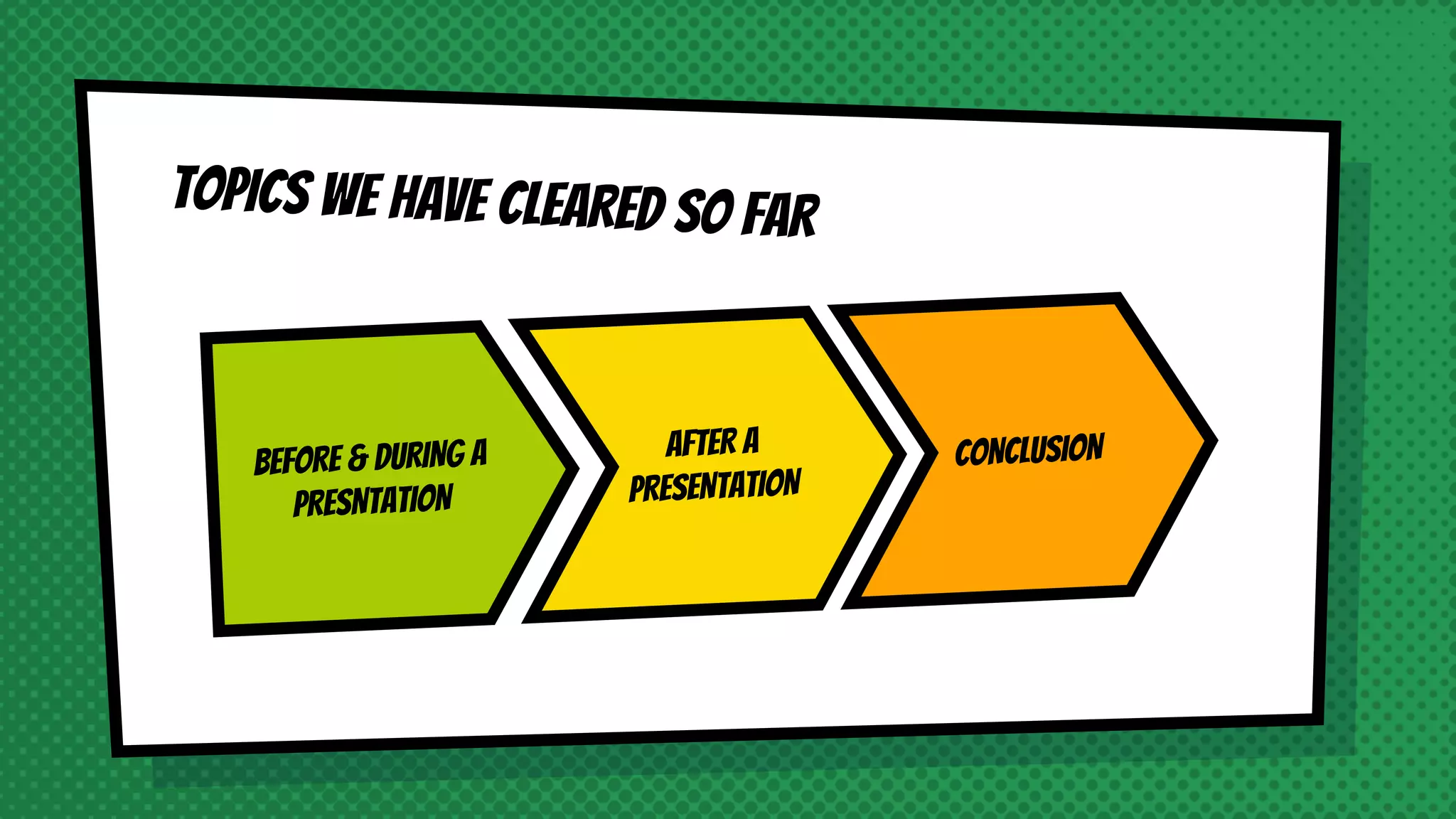
×Before a Presentation.
×During a Presentation.
×After a Presentation.
×Conclusion.
1.
BEFORE A PRESENTATION
Let’s start
“The Success Of A Good
Presentation Lies In The
Preparation. Believe Me Take
Time To Think About It”
×THE AUDIENCE – who are they, how many & what do they already
know?
×THE OCCASION – is it formal of informal? A lecture, a debate, a
speech?
×THE POINT – what is the purpose of the talk?
×THE ENVIRONMENT – what is the size & layout of the room, and
what facilities will be available?
Once This Has Been
Considered, Its Time To
GATHER, SELECT & STRUCTURE
Your Material.
×GATHERING : There are many sources of information available to you, make sure you utilize them
and assess the authority (who wrote it?), time currency (how up-to-date is it?) & accuracy of a
source before you rely on it to support a point in your presentation.
×SELECTING : Often when you asked to give a talk you will need to distil a large amount of information
into a short time period. You need to be ruthless in the way that you prioritize information. Too much
information can confuse an audience.
×What is centrally relevant?
×What can be left out?
×What is supporting information?
×Will handouts help?
×STRUCTURING : A clear structure to your presentation will not only provide
you with a clear path to follow, but also help your audience. Think about:
×What are your main points?
×In what order do they need to be discussed?
×What secondary information should come under each of your headings?
DURING A
When the day finally arrives & your turn has come, don’t be in rush to start and get it
over and done with. Take your time to “set out your stall”, ensure your notes are in
order, your visual aids in place and that environment is as you want it to give you
confidence during the presentation. Give some thought to your audience, your voice,
your body and the time.
×YOUR AUDIENCE : Remembering that the audience are a group of real people, who are
on your side (not the enemy), and with a genuine interest in what you have to say,
goes a long way to helping you communicate with them effectively. It also helps
alleviate nerves.
1. Trust and like the audience, do not fear and confront them.
2. Look at them.
3. Smile.
× YOUR VOICE : These are estimates that the words we use count for only 7% of the message
we communicate. The remaining 93% comes from the tone of voice, facial expressions,
gestures and so on. When thinking about our voices we need to ensure they are:
× AUDIBLE – Keep your head up & speak slowly & clearly, aiming at the person at the back of
the room.
× INTERESTING – concentration spans are short so retain interest by varying the tone of your
voice. Asking a question naturally causes this to happen.
× APPROPRIATELY PACED – Research has shown that we don’t speak more quickly during
presentations, but the number of natural pauses in our speech decreases. It may feel artificial,
but insert enough pauses in your talk to allow the audience to take in all the information. One
trick is to add a couple of extra seconds of silence as you change slides.
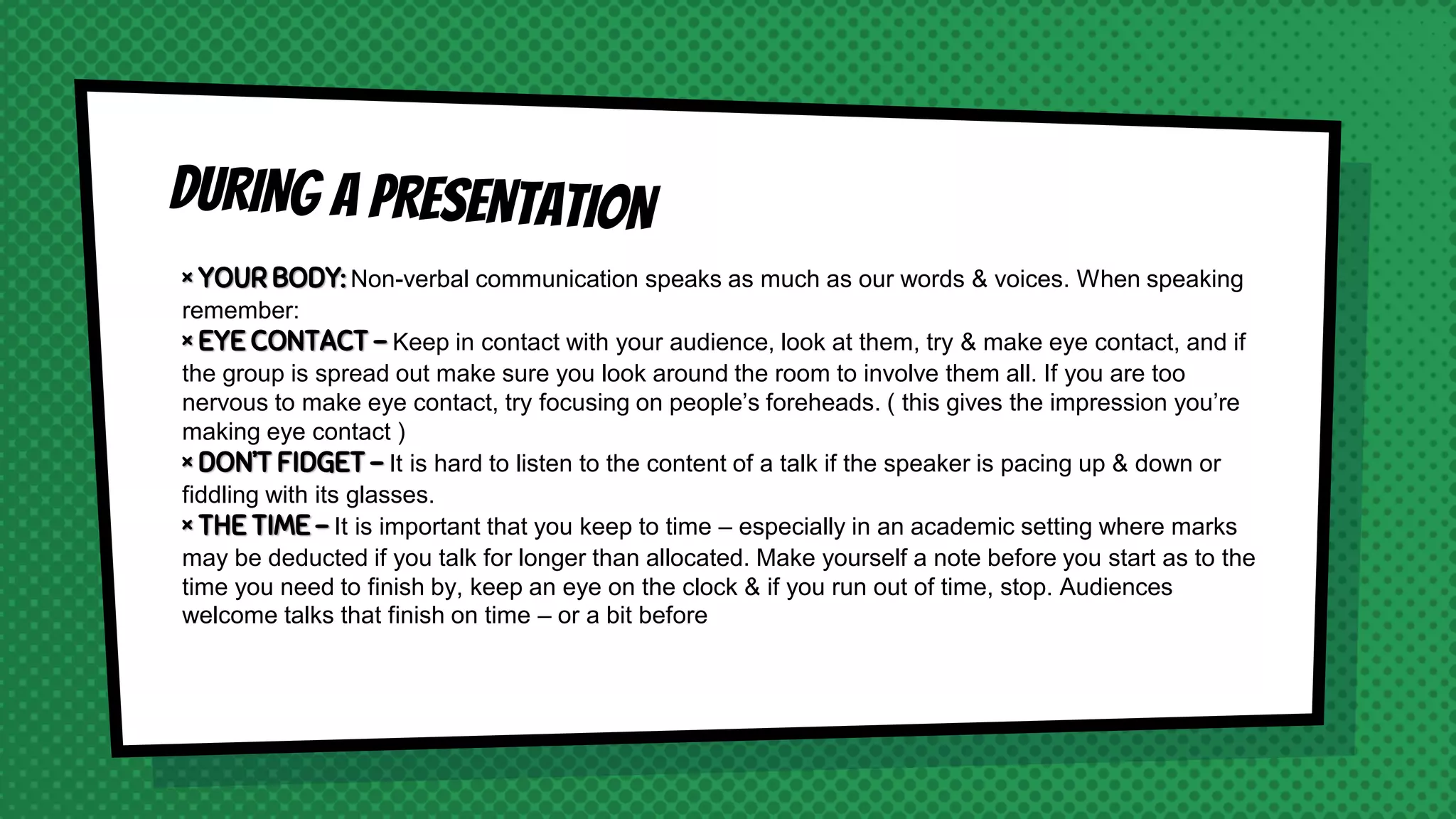
× YOUR BODY: Non-verbal communication speaks as much as our words & voices. When speaking
remember:
× EYE CONTACT – Keep in contact with your audience, look at them, try & make eye contact, and if
the group is spread out make sure you look around the room to involve them all. If you are too
nervous to make eye contact, try focusing on people’s foreheads. ( this gives the impression you’re
making eye contact )
× DON’T FIDGET – It is hard to listen to the content of a talk if the speaker is pacing up & down or
fiddling with its glasses.
× THE TIME – It is important that you keep to time – especially in an academic setting where marks
may be deducted if you talk for longer than allocated. Make yourself a note before you start as to the
time you need to finish by, keep an eye on the clock & if you run out of time, stop. Audiences
welcome talks that finish on time – or a bit before
AFTER A
PRESENTATION
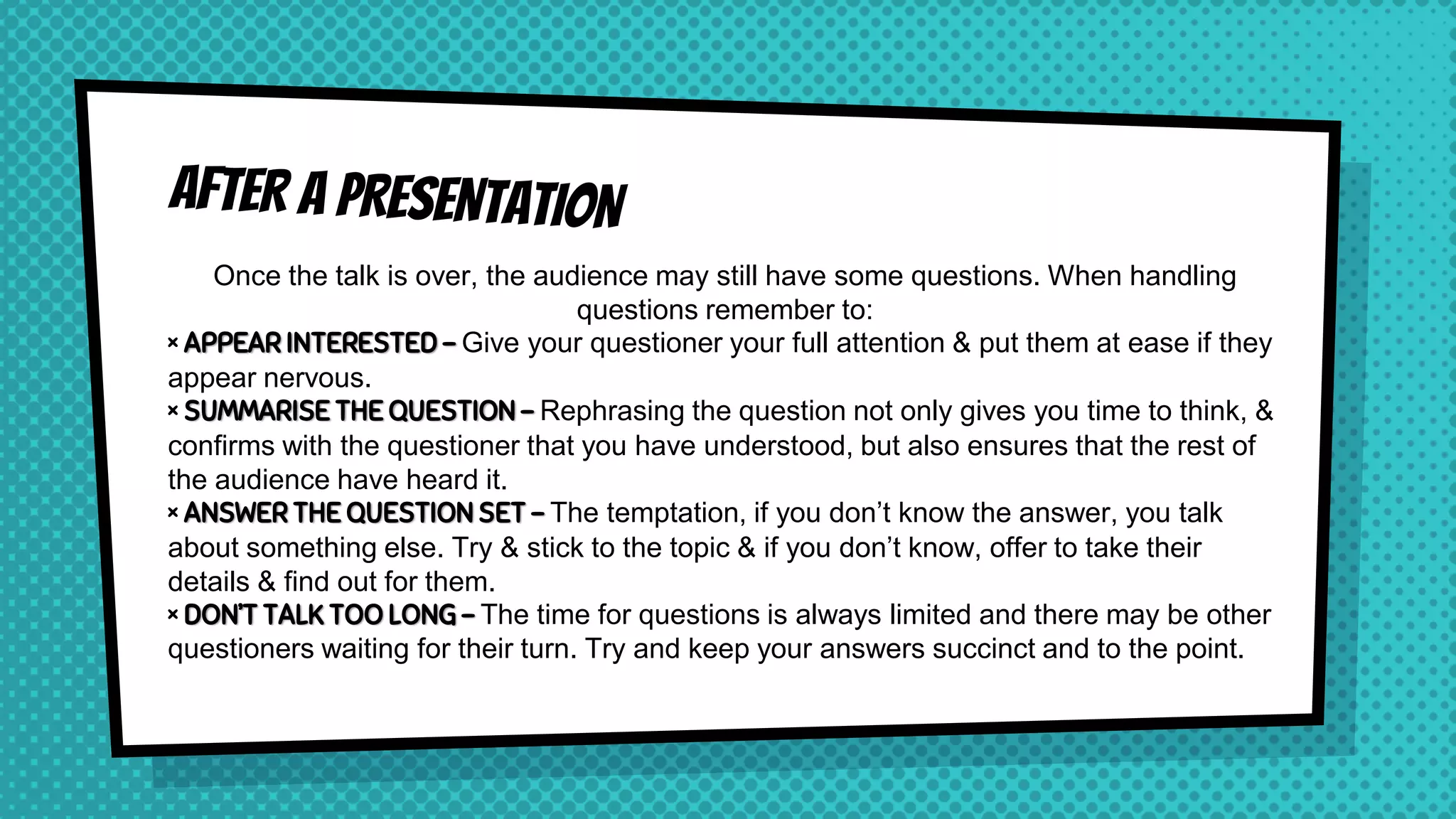
Once the talk is over, the audience may still have some questions. When handling
questions remember to:
× APPEAR INTERESTED – Give your questioner your full attention & put them at ease if they
appear nervous.
× SUMMARISE THE QUESTION – Rephrasing the question not only gives you time to think, &
confirms with the questioner that you have understood, but also ensures that the rest of
the audience have heard it.
× ANSWER THE QUESTION SET – The temptation, if you don’t know the answer, you talk
about something else. Try & stick to the topic & if you don’t know, offer to take their
details & find out for them.
× DON’T TALK TOO LONG – The time for questions is always limited and there may be other
questioners waiting for their turn. Try and keep your answers succinct and to the point.
CLUCON SION
This should summarize the main points of your presentation & perhaps introduce a final point
or question to linger in the minds of your audience.
x. NOTES – You’ll need to think about how you are going to deliver your presentation.
Some people memorize the whole talk, others read the entire thing from their notes. A
middle ground is probably the best way. Familiarize yourself with your material to the
point that you will only need structured notes to guide you. This saves you from
forgetting what you memorized, or losing your place in reams of text.
Want big impact?
Use big image .
After
looking at
last slide
you all be
like .
× VISUAL AIDS – are helpful both to you as the speaker, and to your audience. They can help illustrate
your points & avert the audience’s gaze which helps if you’re nervous. They also help to retain the
audience’s interest, giving them another means by which they can understand the point you are
making. No matter the form of visual aid, ensure they are visible to all, legible, and remember to
remove them when you’ve finished with them to avoid distraction.
× HANDOUTS – Providing handouts is another good way of reinforcing your message and providing
supplementary material that there may not be time to present.
× MANAGING NERVES – Nervousness is probably the biggest problem that most inexperienced
speakers face. Actually, it’s a good to feel a bit nervous, as this provides the adrenaline rush we need
to give a good performance. However, excessive nerves can have the opposite effect & no one enjoys
the physical or emotional symptoms of fear. So how can nerves be managed? Some tips for you
guys…
TIPS: Here are some valuable tips for all of you for giving a nice presentation.
× PRACTICE, PRACTICE, PRACTICE – Rehearse in front of the mirror, or with friends. Feeling
prepared goes a long way to alleviating your nerves.
× NAME YOUR FEARS – Write down exactly what it is you’re afraid of, then you can devise
strategies to cope.
× WHAT IS THE WORST CASE SCENARIO? – Even if the talk miserably, you will not die.
Thinking of the worst case scenario often puts things back in perspective.
× RELAXATION TECHNIQUES – Regular deep breathing gives your body the oxygen it
needs to burn off excess adrenaline, thus calming you down. A walk should have the
same effect.
“If you are over-nervous, it
does not mean you cannot
be a successful speaker, it
merely means you have more
work to do” – Turk
Christopher
THANKS!Any questions?
Once Again you can find me at arsalanq17994@gmail.com
Special thanks to my lovely classmates of
telecommunication batch 16 and Mam. Suneeta
Ramesh.

Presentation Skills By Arsalan Qureshi

  • 1.
    Hello!I am ArsalanQureshi (D-16-TE-09) I am here because I love to give presentations. You can find me at arsalanq17994@gmail.com
  • 2.
  • 3.
    ×Before a Presentation. ×Duringa Presentation. ×After a Presentation. ×Conclusion.
  • 4.
  • 5.
    “The Success OfA Good Presentation Lies In The Preparation. Believe Me Take Time To Think About It”
  • 6.
    ×THE AUDIENCE –who are they, how many & what do they already know? ×THE OCCASION – is it formal of informal? A lecture, a debate, a speech? ×THE POINT – what is the purpose of the talk? ×THE ENVIRONMENT – what is the size & layout of the room, and what facilities will be available?
  • 7.
    Once This HasBeen Considered, Its Time To GATHER, SELECT & STRUCTURE Your Material.
  • 8.
    ×GATHERING : Thereare many sources of information available to you, make sure you utilize them and assess the authority (who wrote it?), time currency (how up-to-date is it?) & accuracy of a source before you rely on it to support a point in your presentation. ×SELECTING : Often when you asked to give a talk you will need to distil a large amount of information into a short time period. You need to be ruthless in the way that you prioritize information. Too much information can confuse an audience. ×What is centrally relevant? ×What can be left out? ×What is supporting information? ×Will handouts help?
  • 9.
    ×STRUCTURING : Aclear structure to your presentation will not only provide you with a clear path to follow, but also help your audience. Think about: ×What are your main points? ×In what order do they need to be discussed? ×What secondary information should come under each of your headings?
  • 10.
  • 11.
    When the dayfinally arrives & your turn has come, don’t be in rush to start and get it over and done with. Take your time to “set out your stall”, ensure your notes are in order, your visual aids in place and that environment is as you want it to give you confidence during the presentation. Give some thought to your audience, your voice, your body and the time. ×YOUR AUDIENCE : Remembering that the audience are a group of real people, who are on your side (not the enemy), and with a genuine interest in what you have to say, goes a long way to helping you communicate with them effectively. It also helps alleviate nerves. 1. Trust and like the audience, do not fear and confront them. 2. Look at them. 3. Smile.
  • 12.
    × YOUR VOICE: These are estimates that the words we use count for only 7% of the message we communicate. The remaining 93% comes from the tone of voice, facial expressions, gestures and so on. When thinking about our voices we need to ensure they are: × AUDIBLE – Keep your head up & speak slowly & clearly, aiming at the person at the back of the room. × INTERESTING – concentration spans are short so retain interest by varying the tone of your voice. Asking a question naturally causes this to happen. × APPROPRIATELY PACED – Research has shown that we don’t speak more quickly during presentations, but the number of natural pauses in our speech decreases. It may feel artificial, but insert enough pauses in your talk to allow the audience to take in all the information. One trick is to add a couple of extra seconds of silence as you change slides.
  • 13.
    × YOUR BODY:Non-verbal communication speaks as much as our words & voices. When speaking remember: × EYE CONTACT – Keep in contact with your audience, look at them, try & make eye contact, and if the group is spread out make sure you look around the room to involve them all. If you are too nervous to make eye contact, try focusing on people’s foreheads. ( this gives the impression you’re making eye contact ) × DON’T FIDGET – It is hard to listen to the content of a talk if the speaker is pacing up & down or fiddling with its glasses. × THE TIME – It is important that you keep to time – especially in an academic setting where marks may be deducted if you talk for longer than allocated. Make yourself a note before you start as to the time you need to finish by, keep an eye on the clock & if you run out of time, stop. Audiences welcome talks that finish on time – or a bit before
  • 14.
  • 15.
    Once the talkis over, the audience may still have some questions. When handling questions remember to: × APPEAR INTERESTED – Give your questioner your full attention & put them at ease if they appear nervous. × SUMMARISE THE QUESTION – Rephrasing the question not only gives you time to think, & confirms with the questioner that you have understood, but also ensures that the rest of the audience have heard it. × ANSWER THE QUESTION SET – The temptation, if you don’t know the answer, you talk about something else. Try & stick to the topic & if you don’t know, offer to take their details & find out for them. × DON’T TALK TOO LONG – The time for questions is always limited and there may be other questioners waiting for their turn. Try and keep your answers succinct and to the point.
  • 16.
  • 17.
    This should summarizethe main points of your presentation & perhaps introduce a final point or question to linger in the minds of your audience. x. NOTES – You’ll need to think about how you are going to deliver your presentation. Some people memorize the whole talk, others read the entire thing from their notes. A middle ground is probably the best way. Familiarize yourself with your material to the point that you will only need structured notes to guide you. This saves you from forgetting what you memorized, or losing your place in reams of text.
  • 18.
  • 19.
  • 20.
    × VISUAL AIDS– are helpful both to you as the speaker, and to your audience. They can help illustrate your points & avert the audience’s gaze which helps if you’re nervous. They also help to retain the audience’s interest, giving them another means by which they can understand the point you are making. No matter the form of visual aid, ensure they are visible to all, legible, and remember to remove them when you’ve finished with them to avoid distraction. × HANDOUTS – Providing handouts is another good way of reinforcing your message and providing supplementary material that there may not be time to present. × MANAGING NERVES – Nervousness is probably the biggest problem that most inexperienced speakers face. Actually, it’s a good to feel a bit nervous, as this provides the adrenaline rush we need to give a good performance. However, excessive nerves can have the opposite effect & no one enjoys the physical or emotional symptoms of fear. So how can nerves be managed? Some tips for you guys…
  • 21.
    TIPS: Here aresome valuable tips for all of you for giving a nice presentation. × PRACTICE, PRACTICE, PRACTICE – Rehearse in front of the mirror, or with friends. Feeling prepared goes a long way to alleviating your nerves. × NAME YOUR FEARS – Write down exactly what it is you’re afraid of, then you can devise strategies to cope. × WHAT IS THE WORST CASE SCENARIO? – Even if the talk miserably, you will not die. Thinking of the worst case scenario often puts things back in perspective. × RELAXATION TECHNIQUES – Regular deep breathing gives your body the oxygen it needs to burn off excess adrenaline, thus calming you down. A walk should have the same effect.
  • 22.
    “If you areover-nervous, it does not mean you cannot be a successful speaker, it merely means you have more work to do” – Turk Christopher
  • 24.
    THANKS!Any questions? Once Againyou can find me at arsalanq17994@gmail.com
  • 25.
    Special thanks tomy lovely classmates of telecommunication batch 16 and Mam. Suneeta Ramesh.