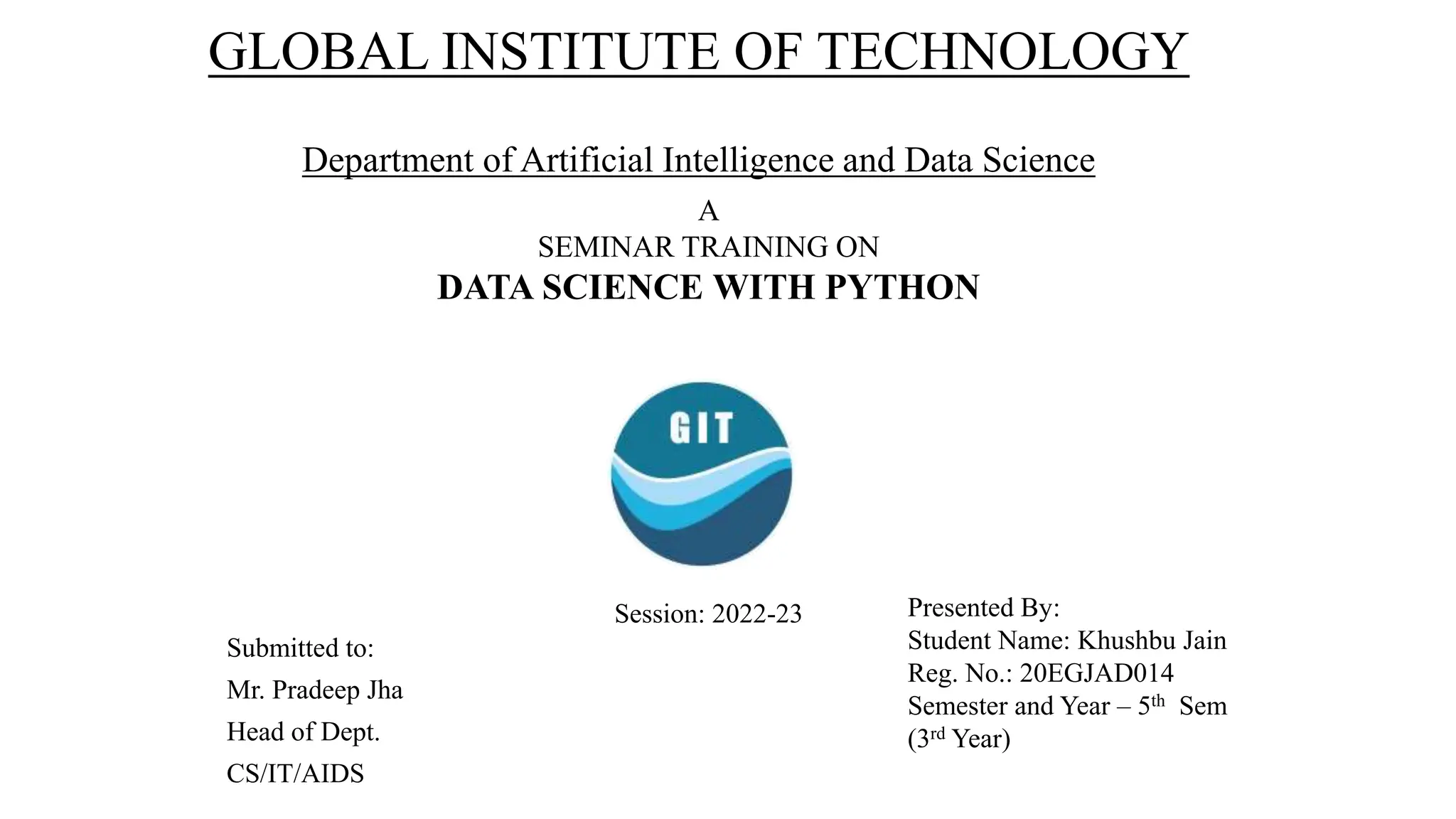
GLOBAL INSTITUTE OF TECHNOLOGY
Department of Artificial Intelligence and Data Science
A
SEMINAR TRAINING ON
DATA SCIENCE WITH PYTHON
Submitted to:
Mr. Pradeep Jha
Head of Dept.
CS/IT/AIDS
Presented By:
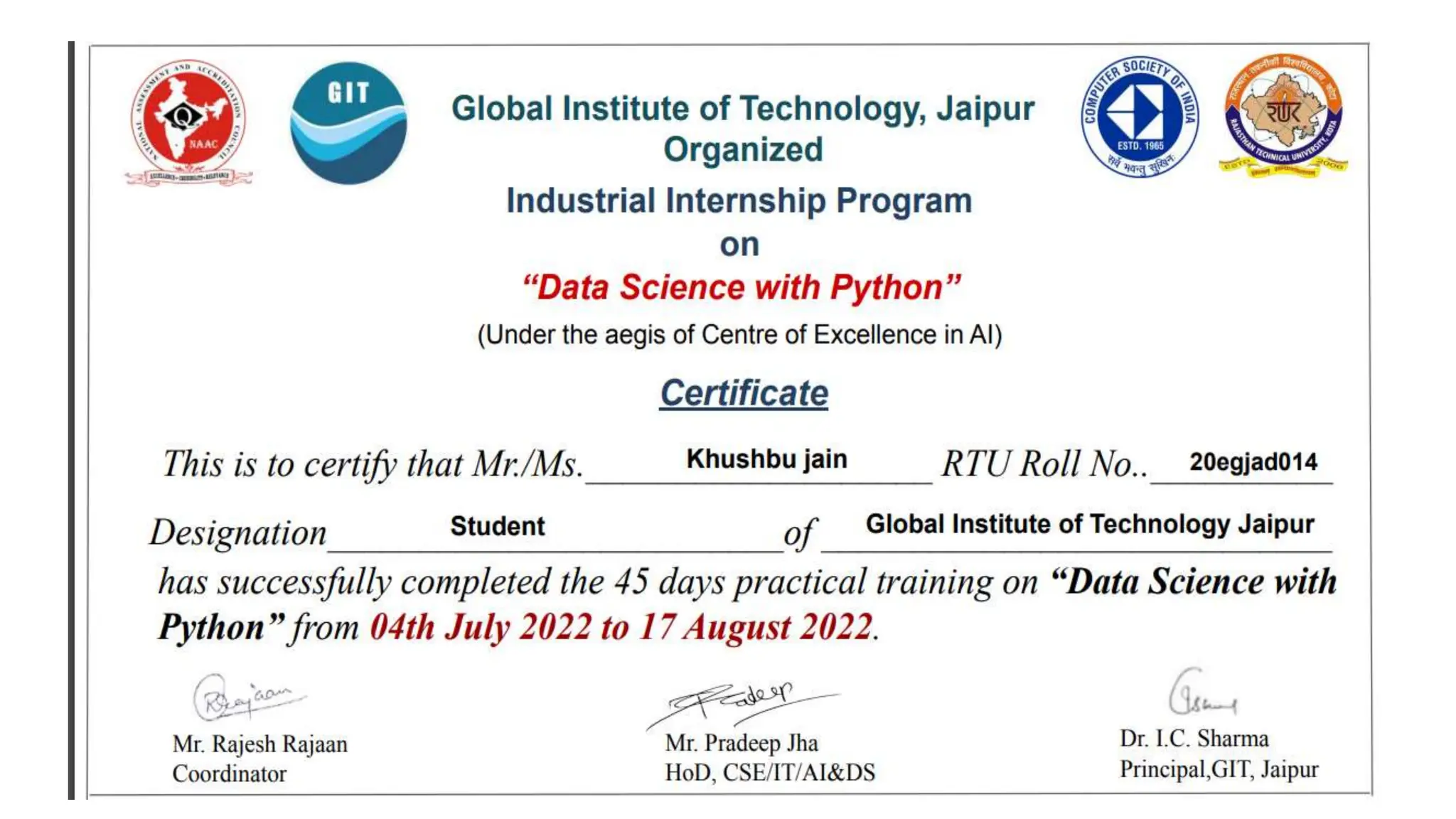
Student Name: Khushbu Jain
Reg. No.: 20EGJAD014
Semester and Year – 5th Sem
(3rd Year)
Session: 2022-23
TABLE OF CONTENT:
• WHAT IS DATA SCIENCE?
• WHAT IS PYTHON?
• WHY WE USE DATA SCIENCE WITH PYTHON?
• DATA TYPES IN PYTHON
• PYTHON BASICS : LOOPING
• PYTHON LIBRARY: NUMPY AND PANDAS
• APPLICATION OF DATA SCIENCE
• Data science is the process of finding
insights/trends/ intelligence that supports the
business leaders to make the better decision.
• Data science is a relatively new field and deeply
rooted to Statistics and Decision Support
System.
• It is a Multidisciplinary field ( Domain Knowledge,
Tools & technology, Mathematics & Statistics,
Problem Solving Skills).
What is Data Science ?
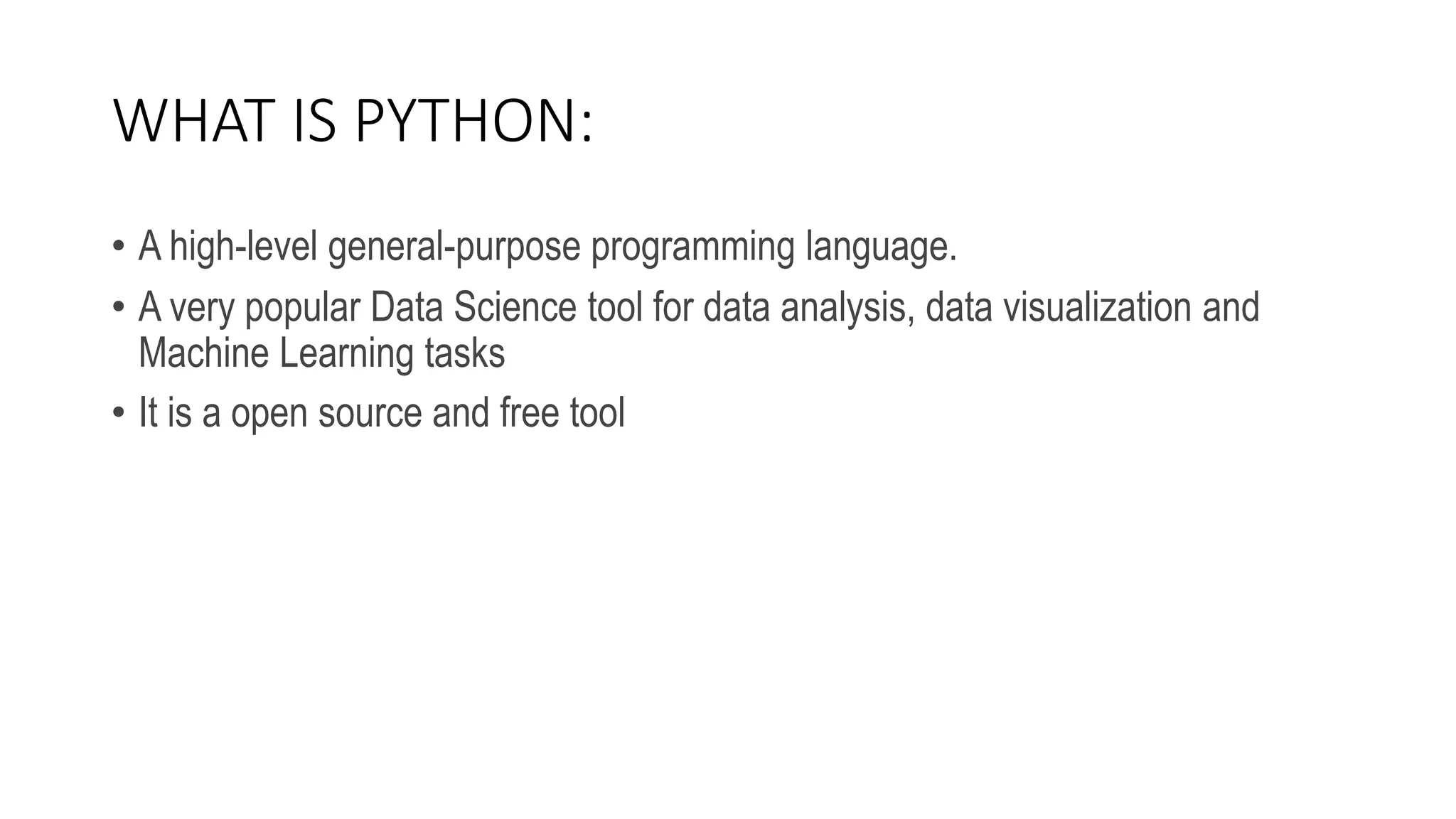
WHAT IS PYTHON:
• A high-level general-purpose programming language.
• A very popular Data Science tool for data analysis, data visualization and
Machine Learning tasks
• It is a open source and free tool
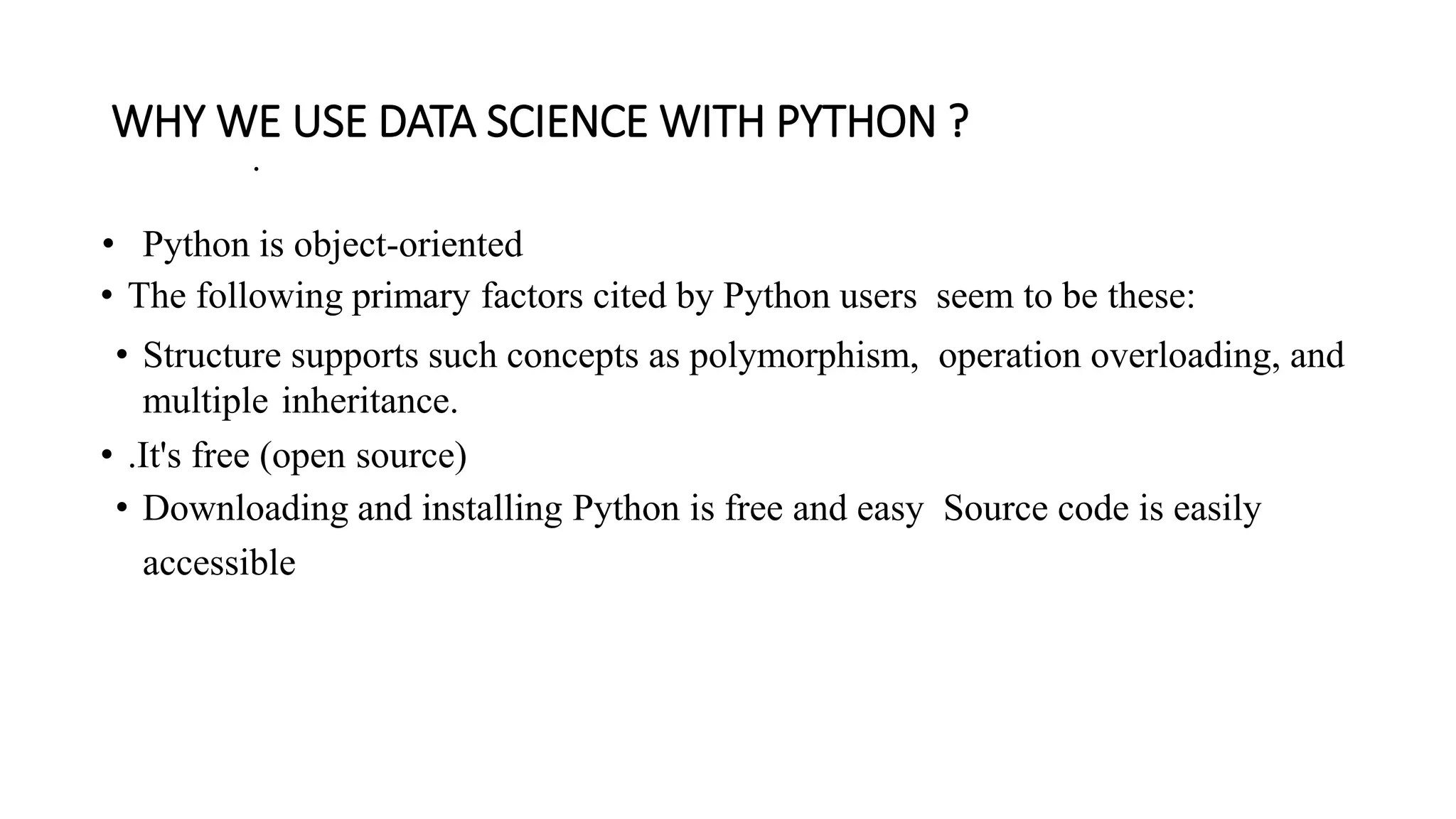
WHY WE USE DATA SCIENCE WITH PYTHON ?
• Python is object-oriented
• The following primary factors cited by Python users seem to be these:
• Structure supports such concepts as polymorphism, operation overloading, and
multiple inheritance.
• .It's free (open source)
• Downloading and installing Python is free and easy Source code is easily
accessible
.
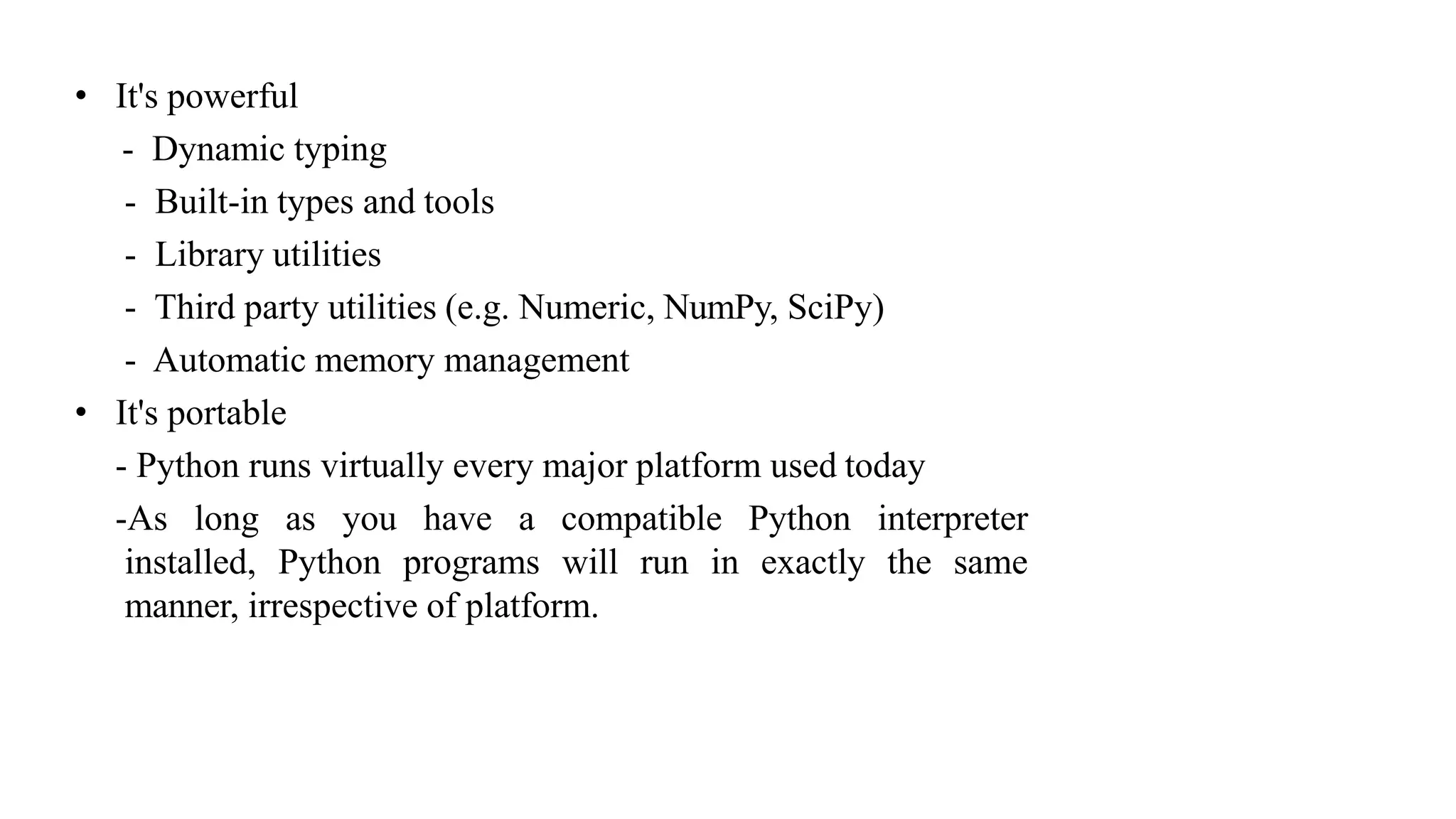
• It's powerful
- Dynamic typing
- Built-in types and tools
- Library utilities
- Third party utilities (e.g. Numeric, NumPy, SciPy)
- Automatic memory management
• It's portable
- Python runs virtually every major platform used today
-As long as you have a compatible Python interpreter
installed, Python programs will run in exactly the same
manner, irrespective of platform.
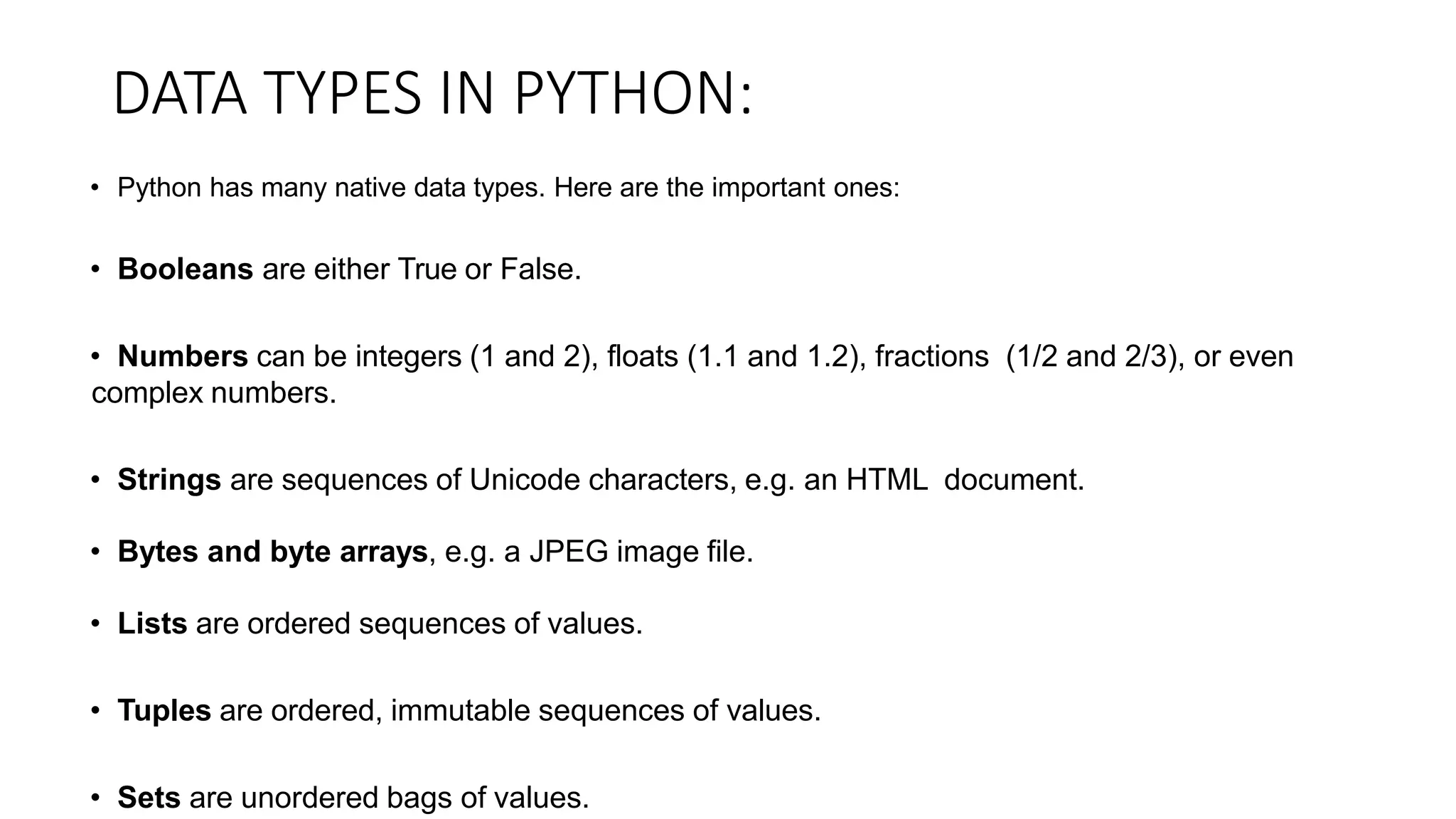
DATA TYPES IN PYTHON:
• Python has many native data types. Here are the important ones:
• Booleans are either True or False.
• Numbers can be integers (1 and 2), floats (1.1 and 1.2), fractions (1/2 and 2/3), or even
complex numbers.
• Strings are sequences of Unicode characters, e.g. an HTML document.
• Bytes and byte arrays, e.g. a JPEG image file.
• Lists are ordered sequences of values.
• Tuples are ordered, immutable sequences of values.
• Sets are unordered bags of values.
LIST
• Collection comma-separated values (items) between square brackets
• Contain same or different types
• Mutable behavior Values can add, remove, update/replace the value, slice and dice the members
Example:
list1 = ['physics', 'chemistry', 1997, 2000];
list2 = [1, 2, 3, 4, 5 ];
TUPLE
• A tuple is very similar to List A collection of items inside the parenthesis()
• Tuple is Immutable ( The value cannot be changed)
• Can slice and dice add elements and Delete the entire tuple
• Example:
• tup2 = (1, 2, 3, 4, 5 );
• tup3 = ("a", "b", "c", "d“);
• Accessing Values: print
"tup2[1:5]: “ Output:
• tup2[1:5]: [2, 3, 4, 5]
DICTIONARY:
• A collection of unordered data values
• A dictionary holds key value pairs of data
• The items are separated by commas, and the whole thing is enclosed in curly
braces
• Keys are immutable but the values are mutable - can add modify and Delete
values
• Example:
Dictionary. capitals = {"USA":"Washington D.C.", "France":"Paris",
"India":"New Delhi"}
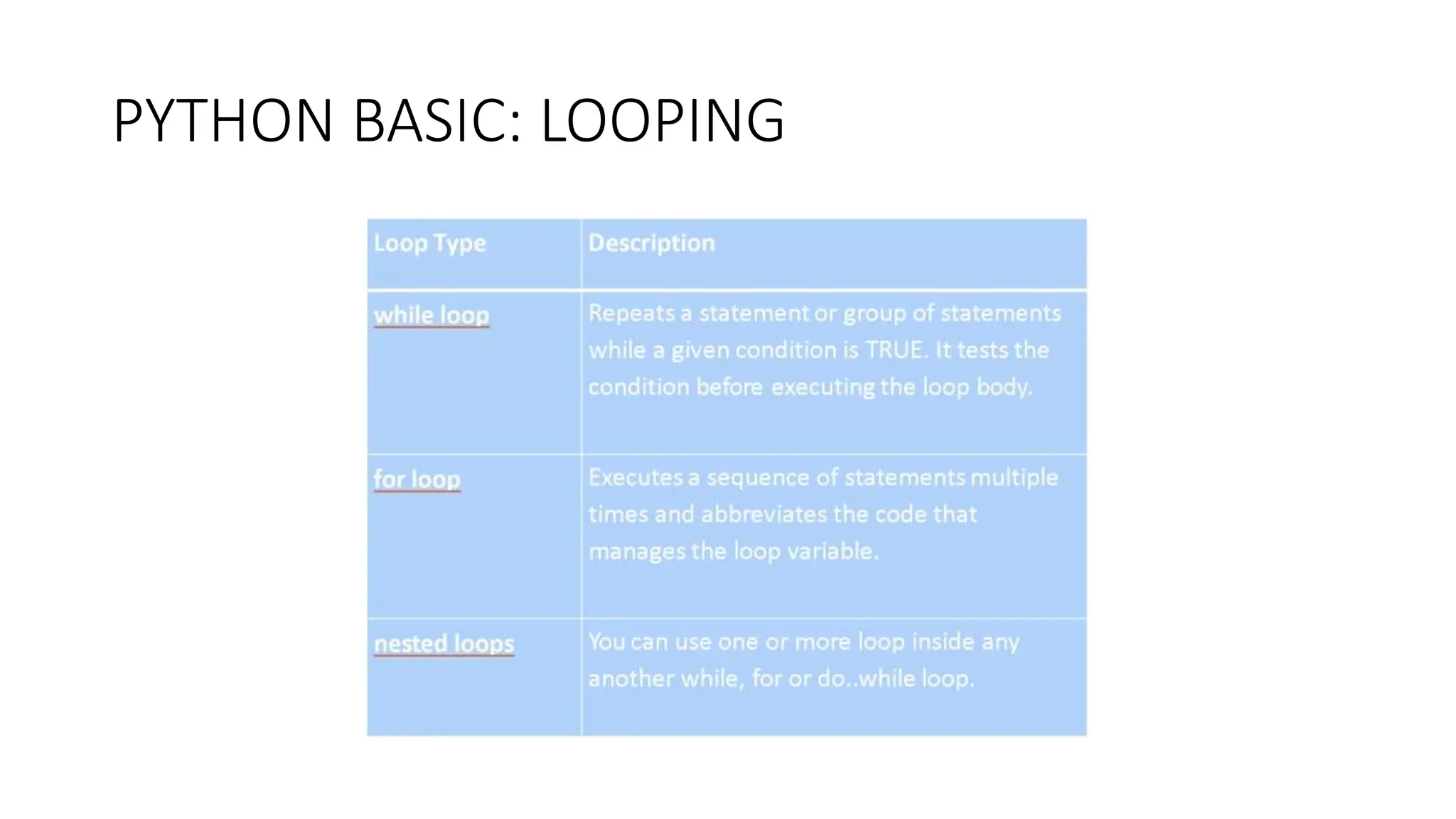
PYTHON BASIC: LOOPING
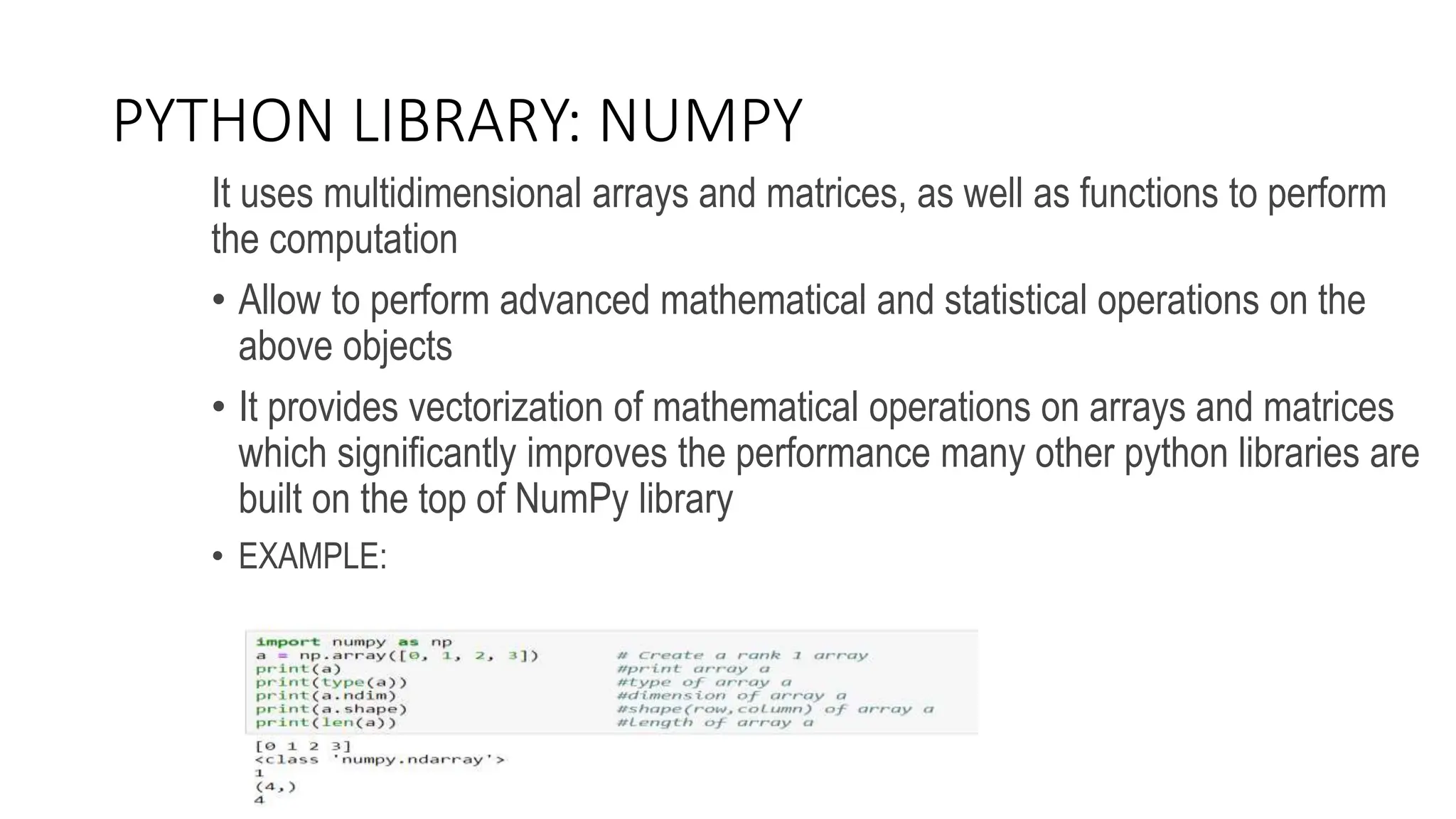
PYTHON LIBRARY: NUMPY
It uses multidimensional arrays and matrices, as well as functions to perform
the computation
• Allow to perform advanced mathematical and statistical operations on the
above objects
• It provides vectorization of mathematical operations on arrays and matrices
which significantly improves the performance many other python libraries are
built on the top of NumPy library
• EXAMPLE:
PYTHON LIBRARY : PANDAS
• It adds data structures and tools designed to work with table-like data (similar to table in SQL Server environment)
• It provides tools for data manipulation: selecting, reshaping, merging, sorting, slicing, aggregation etc.
• It also handles missing data
• EXAMPLE:
import numpy as np #importing numpy
import pandas as pd #importing pandas
arr=np.array([1,3,5,7,9]) #create arr array
s2=pd.Series(arr) #create pandas series s2
print(s2) #print s2
print(type(s2)) #print type of s2
Output:
0 1
1 3
2 5
3 7
4 9
dtype: int64
<class 'pandas.core.series.Series'>
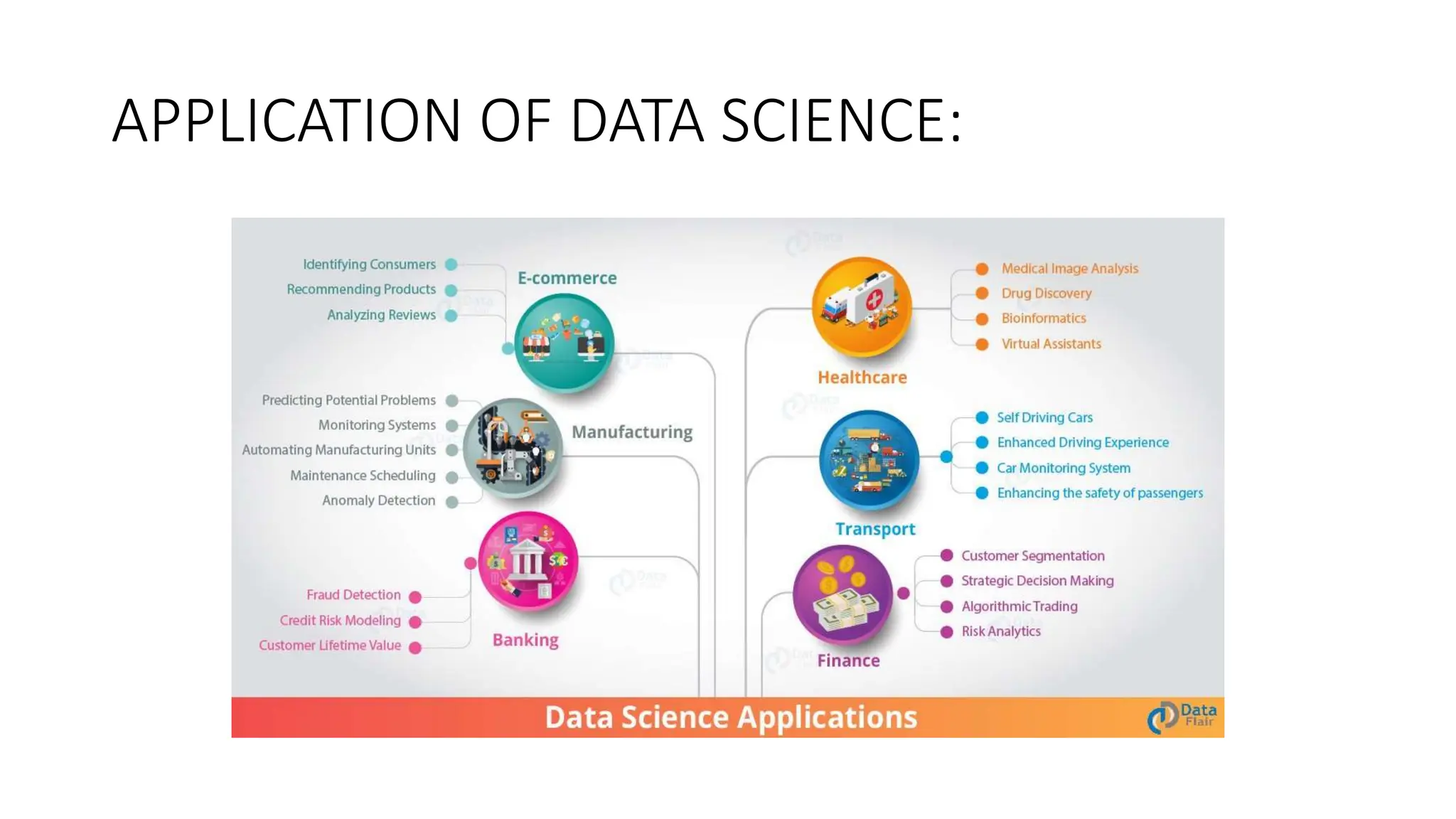
APPLICATION OF DATA SCIENCE:

presentation on data science with python

  • 1.
    GLOBAL INSTITUTE OFTECHNOLOGY Department of Artificial Intelligence and Data Science A SEMINAR TRAINING ON DATA SCIENCE WITH PYTHON Submitted to: Mr. Pradeep Jha Head of Dept. CS/IT/AIDS Presented By: Student Name: Khushbu Jain Reg. No.: 20EGJAD014 Semester and Year – 5th Sem (3rd Year) Session: 2022-23
  • 3.
    TABLE OF CONTENT: •WHAT IS DATA SCIENCE? • WHAT IS PYTHON? • WHY WE USE DATA SCIENCE WITH PYTHON? • DATA TYPES IN PYTHON • PYTHON BASICS : LOOPING • PYTHON LIBRARY: NUMPY AND PANDAS • APPLICATION OF DATA SCIENCE
  • 4.
    • Data scienceis the process of finding insights/trends/ intelligence that supports the business leaders to make the better decision. • Data science is a relatively new field and deeply rooted to Statistics and Decision Support System. • It is a Multidisciplinary field ( Domain Knowledge, Tools & technology, Mathematics & Statistics, Problem Solving Skills). What is Data Science ?
  • 5.
    WHAT IS PYTHON: •A high-level general-purpose programming language. • A very popular Data Science tool for data analysis, data visualization and Machine Learning tasks • It is a open source and free tool
  • 6.
    WHY WE USEDATA SCIENCE WITH PYTHON ? • Python is object-oriented • The following primary factors cited by Python users seem to be these: • Structure supports such concepts as polymorphism, operation overloading, and multiple inheritance. • .It's free (open source) • Downloading and installing Python is free and easy Source code is easily accessible .
  • 7.
    • It's powerful -Dynamic typing - Built-in types and tools - Library utilities - Third party utilities (e.g. Numeric, NumPy, SciPy) - Automatic memory management • It's portable - Python runs virtually every major platform used today -As long as you have a compatible Python interpreter installed, Python programs will run in exactly the same manner, irrespective of platform.
  • 8.
    DATA TYPES INPYTHON: • Python has many native data types. Here are the important ones: • Booleans are either True or False. • Numbers can be integers (1 and 2), floats (1.1 and 1.2), fractions (1/2 and 2/3), or even complex numbers. • Strings are sequences of Unicode characters, e.g. an HTML document. • Bytes and byte arrays, e.g. a JPEG image file. • Lists are ordered sequences of values. • Tuples are ordered, immutable sequences of values. • Sets are unordered bags of values.
  • 9.
    LIST • Collection comma-separatedvalues (items) between square brackets • Contain same or different types • Mutable behavior Values can add, remove, update/replace the value, slice and dice the members Example: list1 = ['physics', 'chemistry', 1997, 2000]; list2 = [1, 2, 3, 4, 5 ];
  • 10.
    TUPLE • A tupleis very similar to List A collection of items inside the parenthesis() • Tuple is Immutable ( The value cannot be changed) • Can slice and dice add elements and Delete the entire tuple • Example: • tup2 = (1, 2, 3, 4, 5 ); • tup3 = ("a", "b", "c", "d“); • Accessing Values: print "tup2[1:5]: “ Output: • tup2[1:5]: [2, 3, 4, 5]
  • 11.
    DICTIONARY: • A collectionof unordered data values • A dictionary holds key value pairs of data • The items are separated by commas, and the whole thing is enclosed in curly braces • Keys are immutable but the values are mutable - can add modify and Delete values • Example: Dictionary. capitals = {"USA":"Washington D.C.", "France":"Paris", "India":"New Delhi"}
  • 12.
  • 13.
    PYTHON LIBRARY: NUMPY Ituses multidimensional arrays and matrices, as well as functions to perform the computation • Allow to perform advanced mathematical and statistical operations on the above objects • It provides vectorization of mathematical operations on arrays and matrices which significantly improves the performance many other python libraries are built on the top of NumPy library • EXAMPLE:
  • 14.
    PYTHON LIBRARY :PANDAS • It adds data structures and tools designed to work with table-like data (similar to table in SQL Server environment) • It provides tools for data manipulation: selecting, reshaping, merging, sorting, slicing, aggregation etc. • It also handles missing data • EXAMPLE: import numpy as np #importing numpy import pandas as pd #importing pandas arr=np.array([1,3,5,7,9]) #create arr array s2=pd.Series(arr) #create pandas series s2 print(s2) #print s2 print(type(s2)) #print type of s2 Output: 0 1 1 3 2 5 3 7 4 9 dtype: int64 <class 'pandas.core.series.Series'>
  • 15.