

How to design a presentation that worksPart I: Slide Design
When I tell you you’re about to watch a PowerPoint presentation, what’s your initial reaction, and why?
February 1, 2003
February 1, 2003
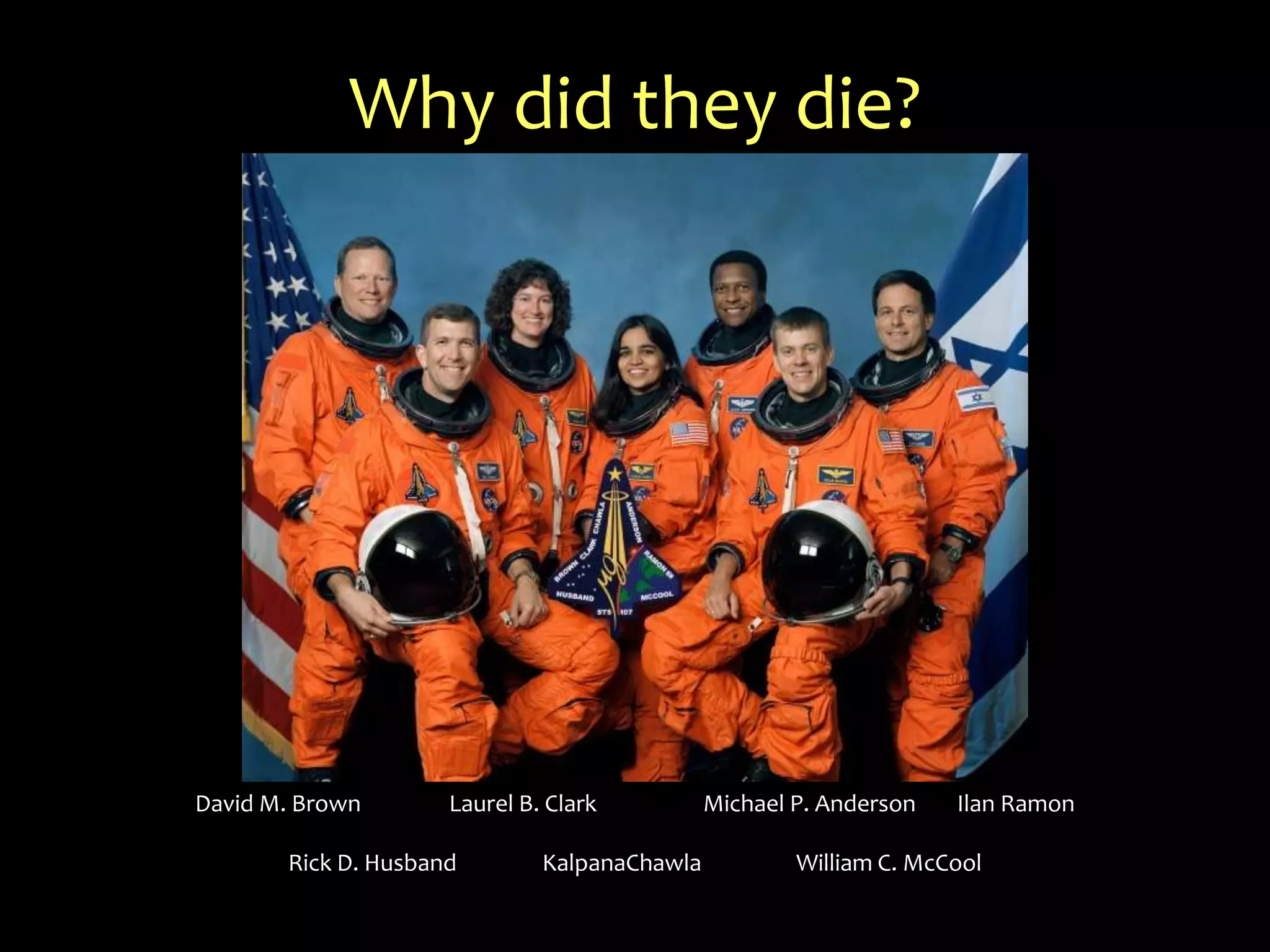
Why did they die?David M. Brown		Laurel B. Clark		Michael P. Anderson 	Ilan RamonRick D. Husband		KalpanaChawla		William C. McCool
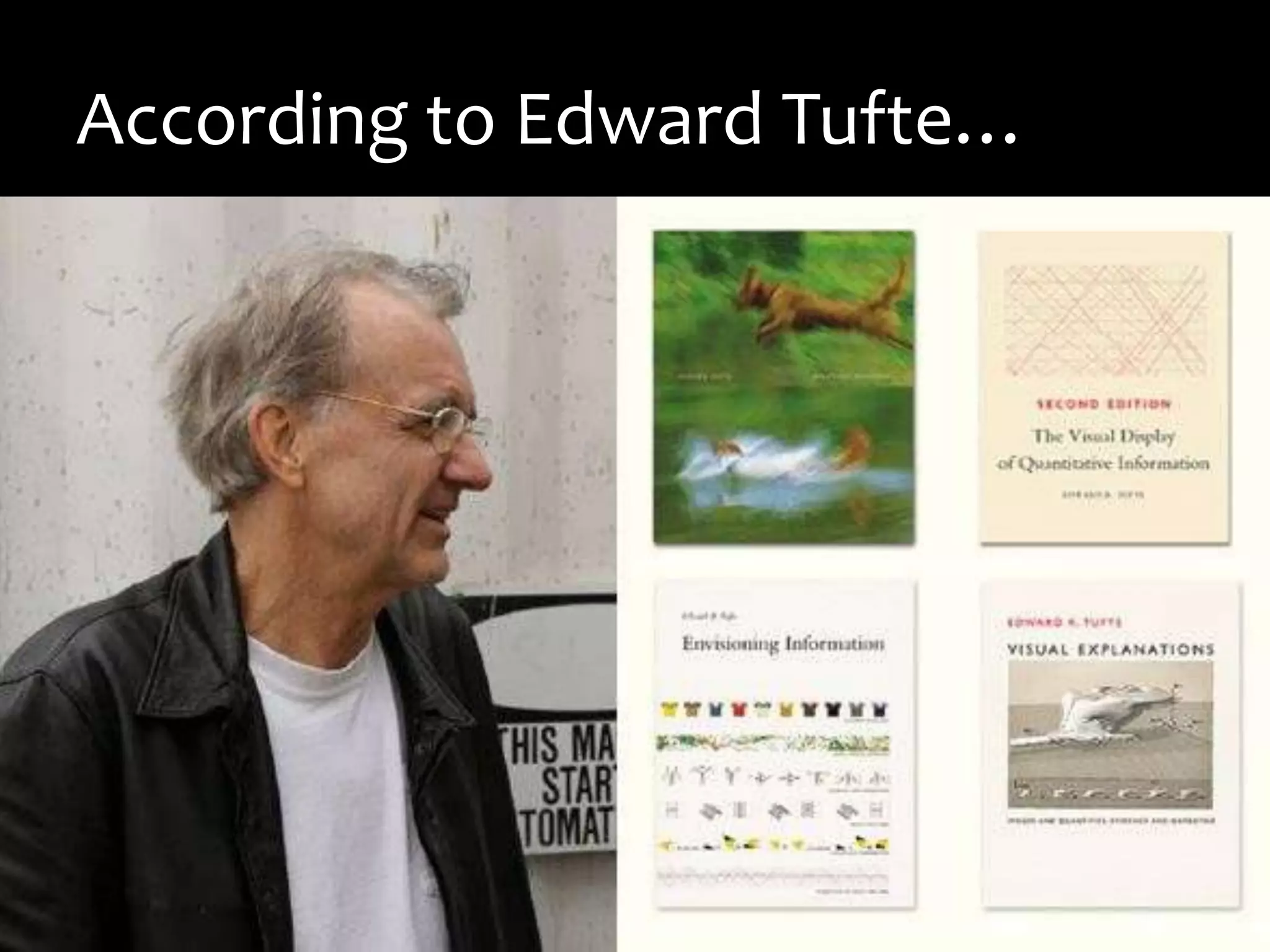
According to Edward Tufte…
PowerPoint.
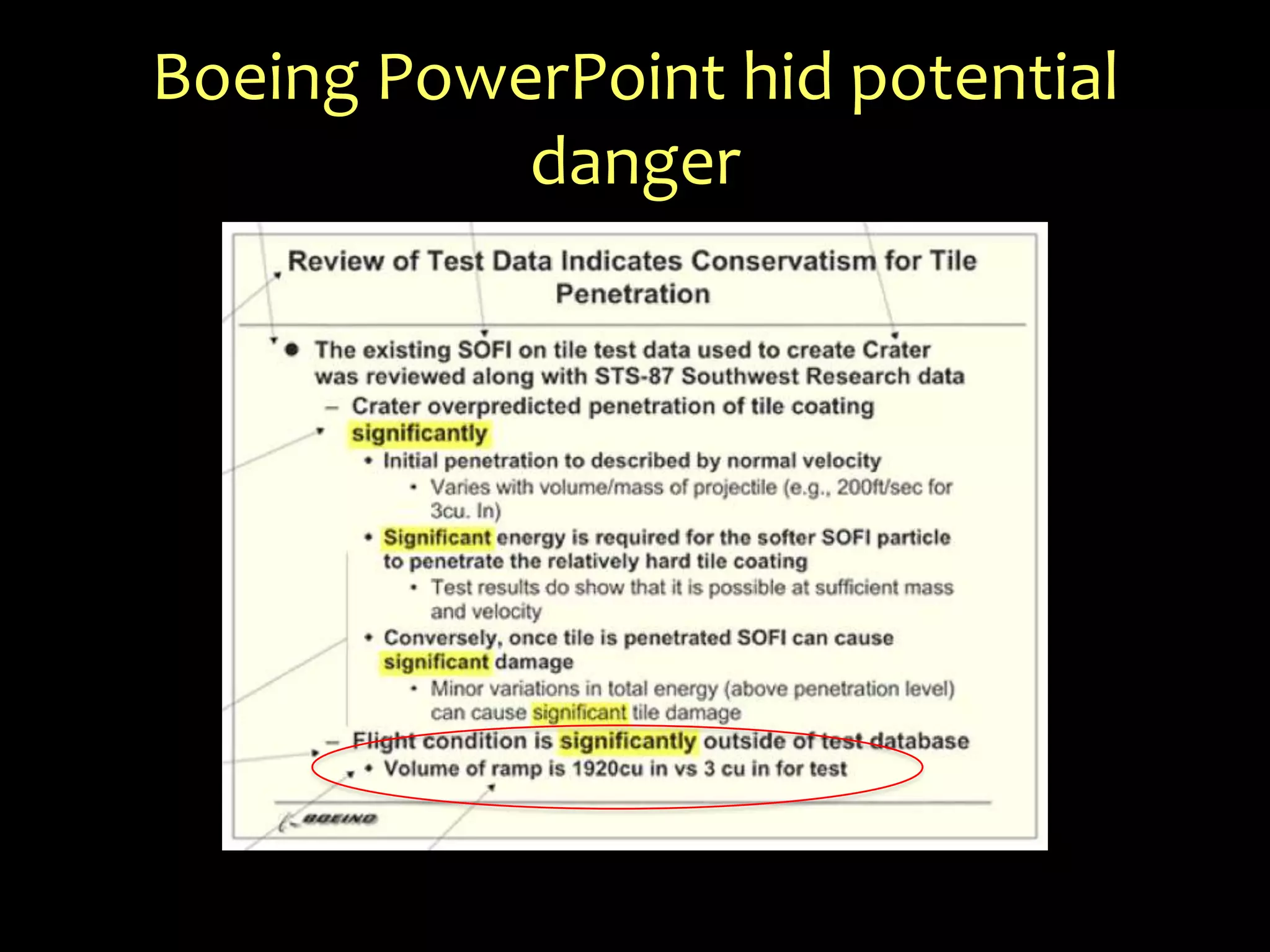
Boeing PowerPoint hid potential danger
So, is PowerPoint evil?
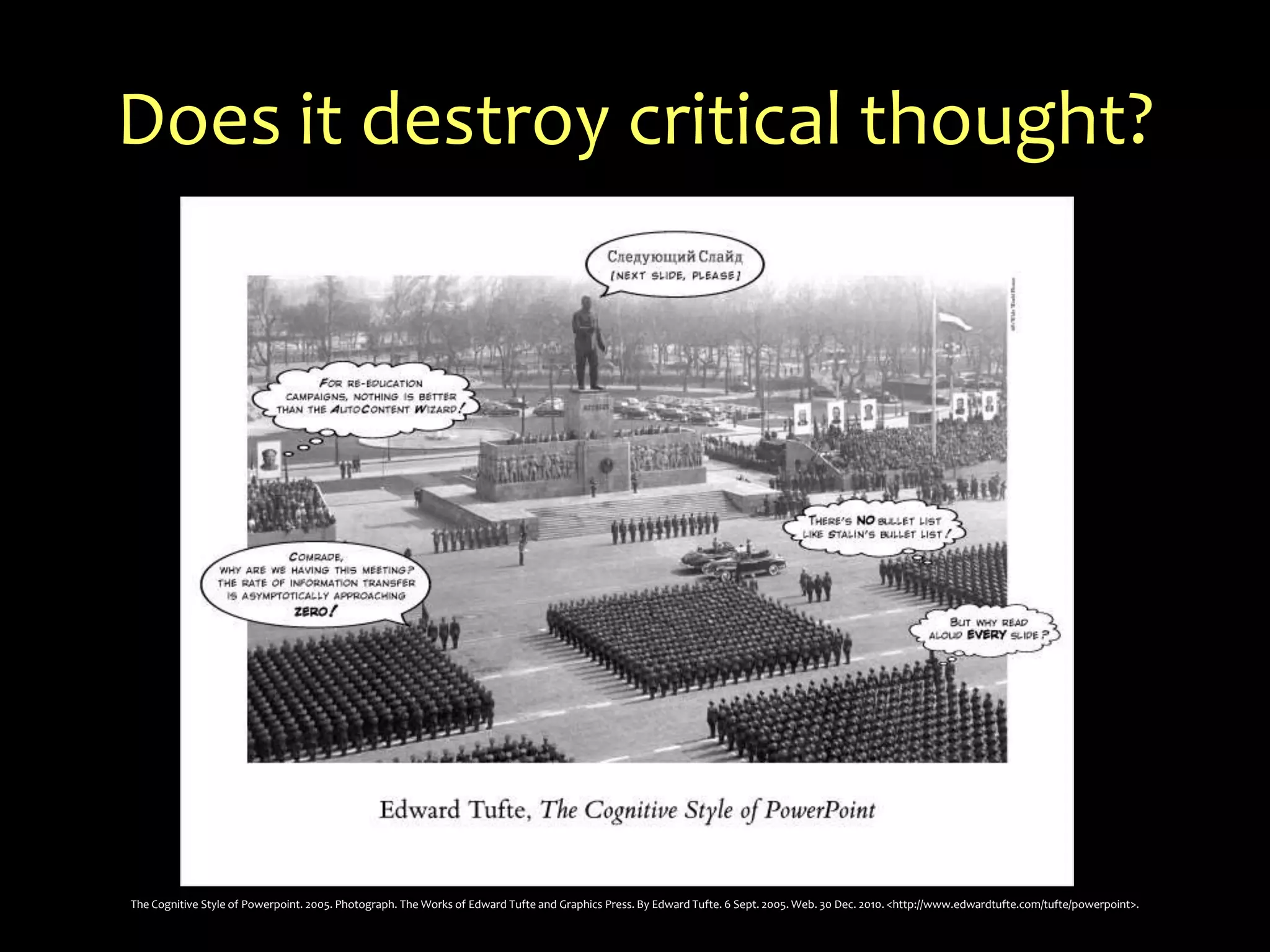
Does it destroy critical thought?The Cognitive Style of Powerpoint. 2005. Photograph. The Works of Edward Tufte and Graphics Press. By Edward Tufte. 6 Sept. 2005. Web. 30 Dec. 2010. <http://www.edwardtufte.com/tufte/powerpoint>.
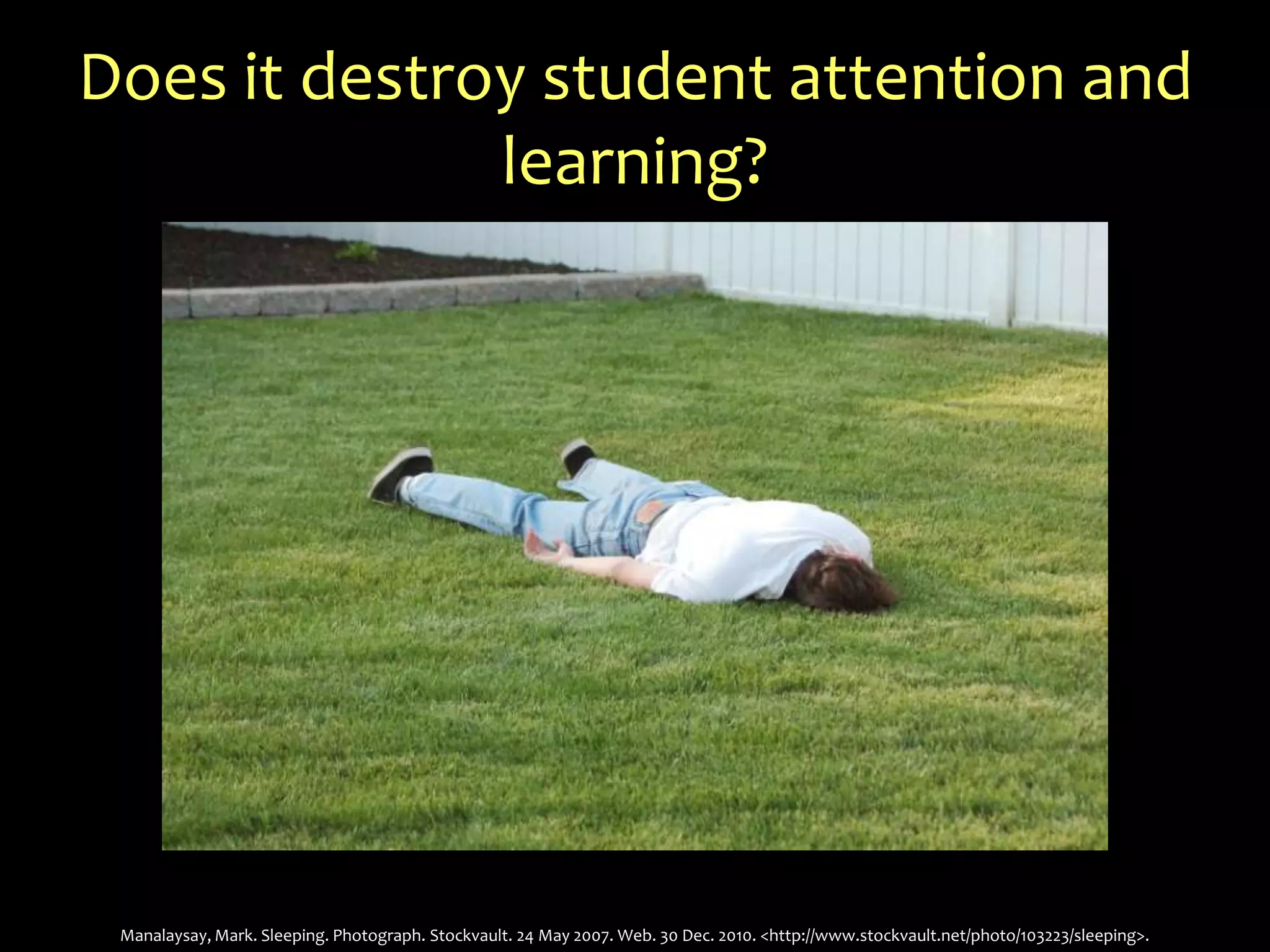
Does it destroy student attention and learning?Manalaysay, Mark. Sleeping. Photograph. Stockvault. 24 May 2007. Web. 30 Dec. 2010. <http://www.stockvault.net/photo/103223/sleeping>.
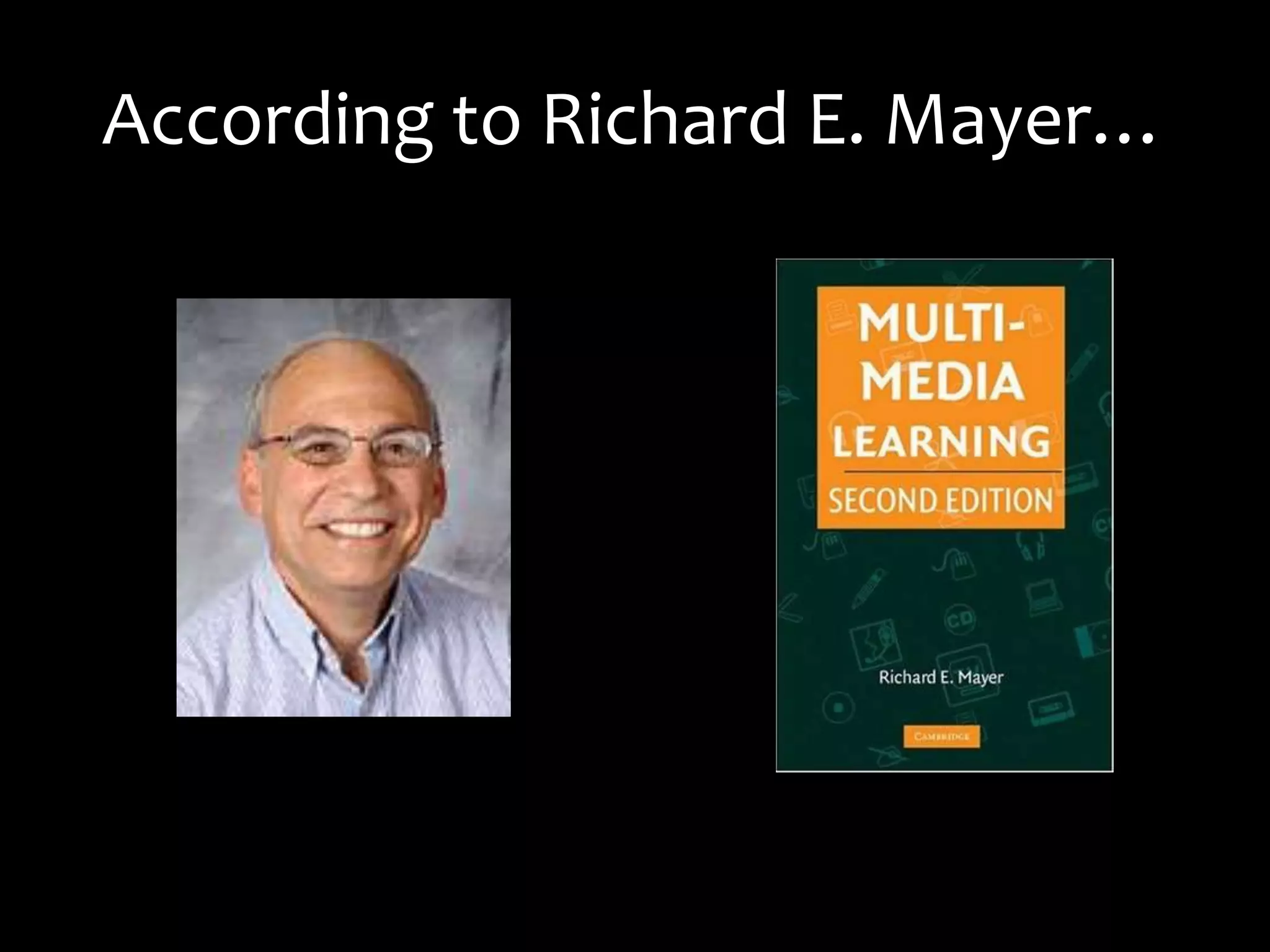
According to Richard E. Mayer…
No.
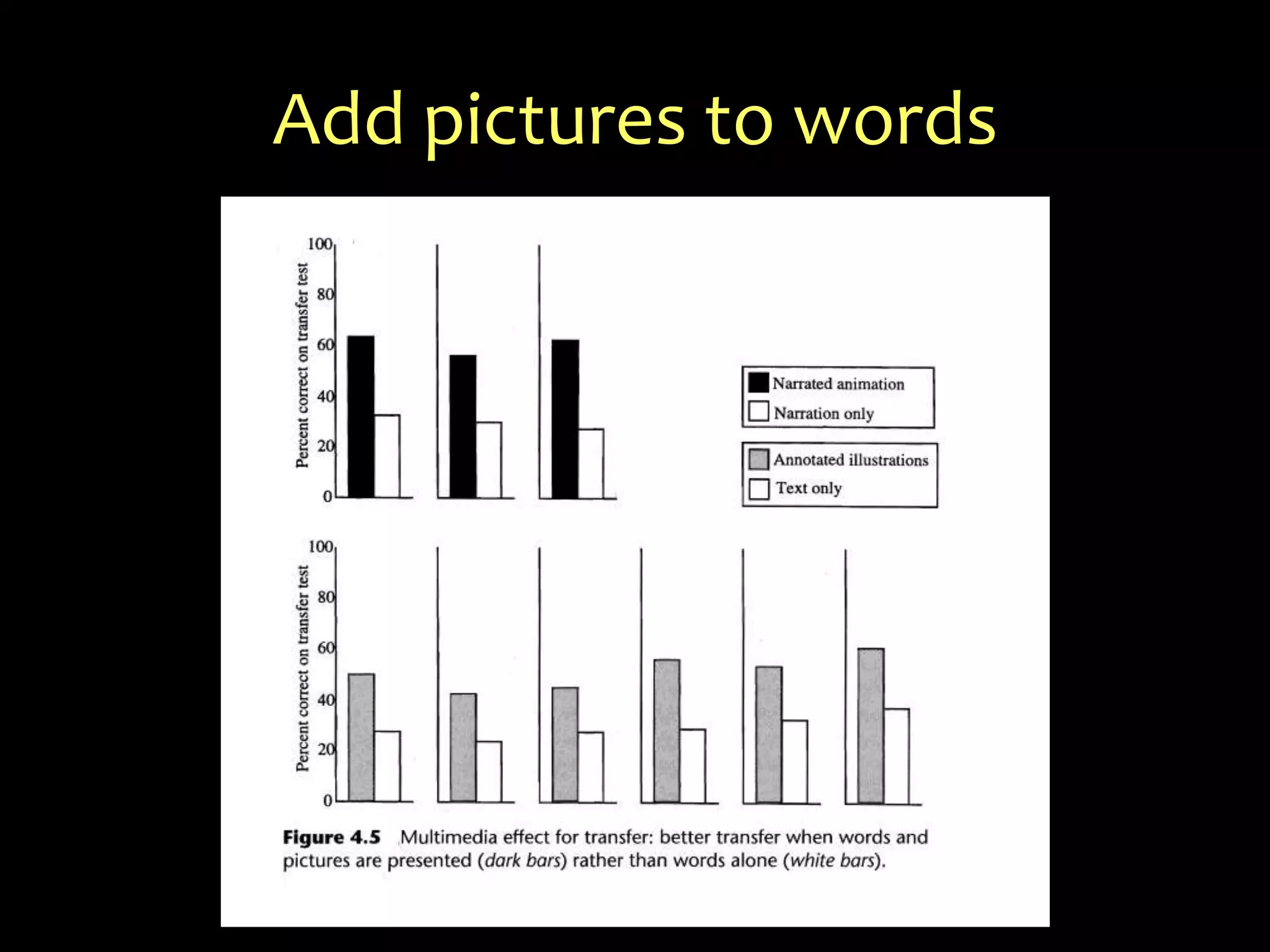
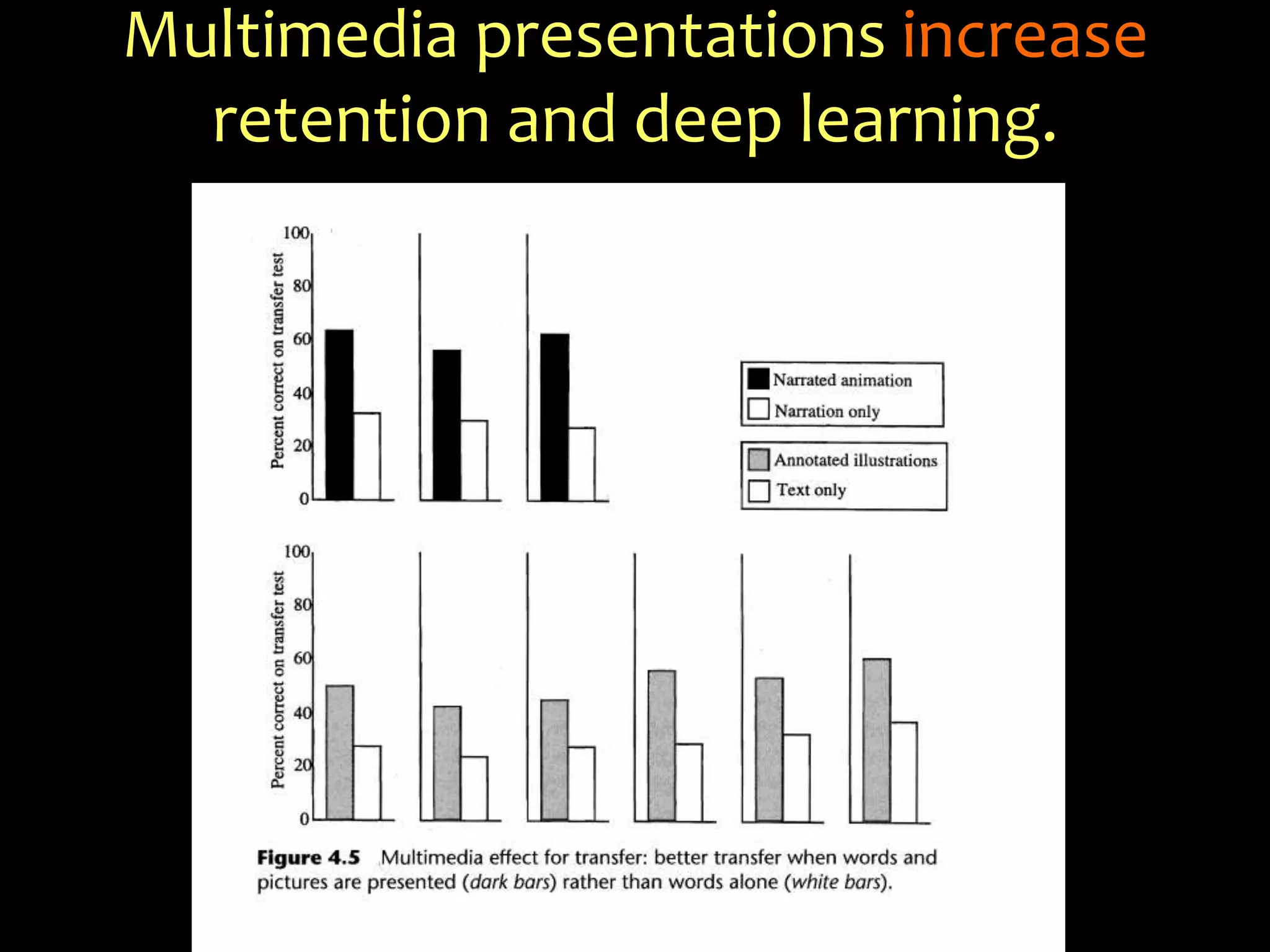
Multimedia presentations increase retention and deep learning.
PowerPoint is not evil.
But bad design is.Design matters.
Most of our instincts and intuitions are wrong.
Information-richTechnologically advancedAesthetically pleasingNone of these actually matter
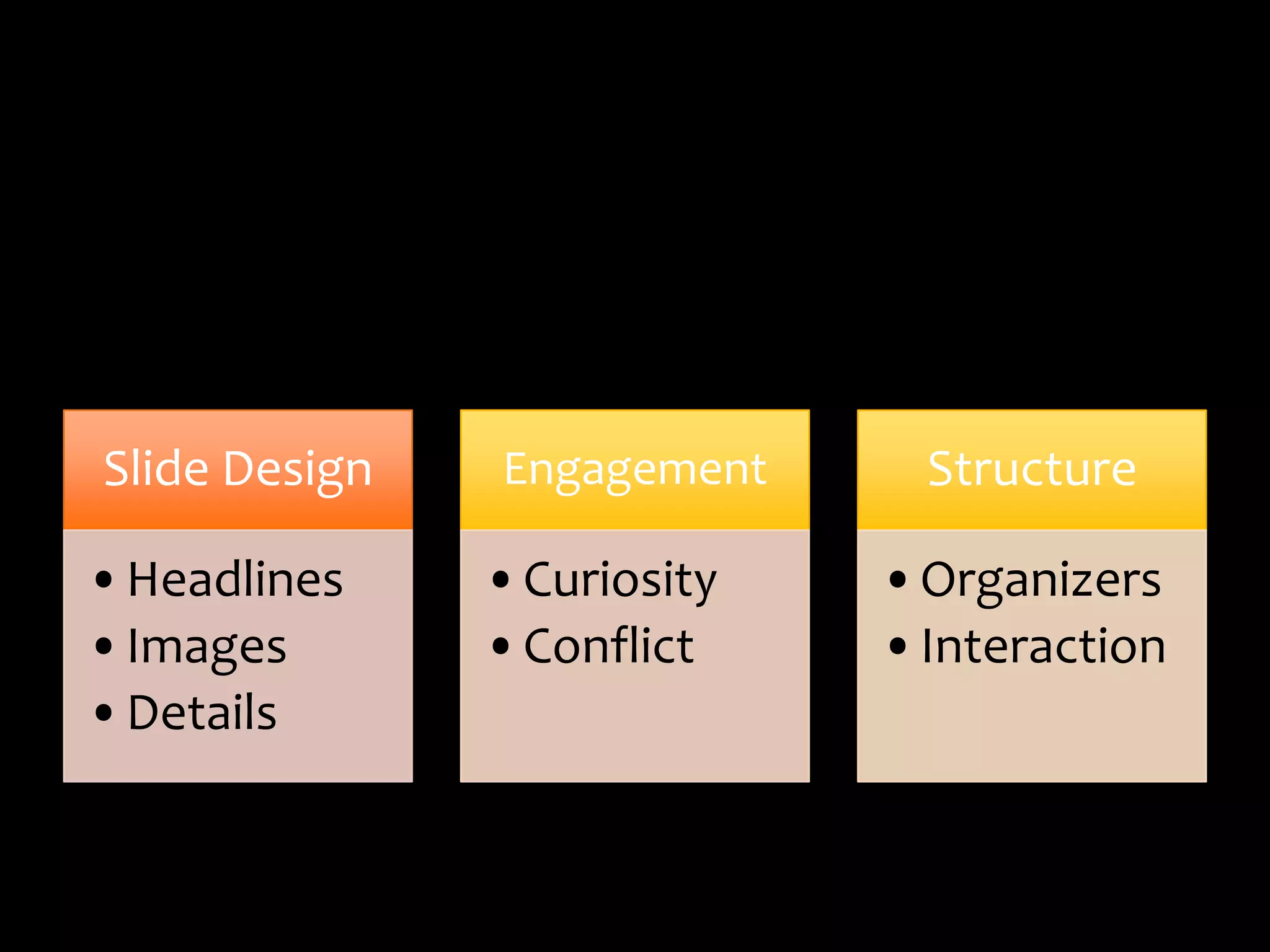
So, what does matter?
Slide DesignEngagementStructureHeadlines
Images
Details
Curiosity
Conflict
Organizers
InteractionCreate Clear HeadlinesSlide Design
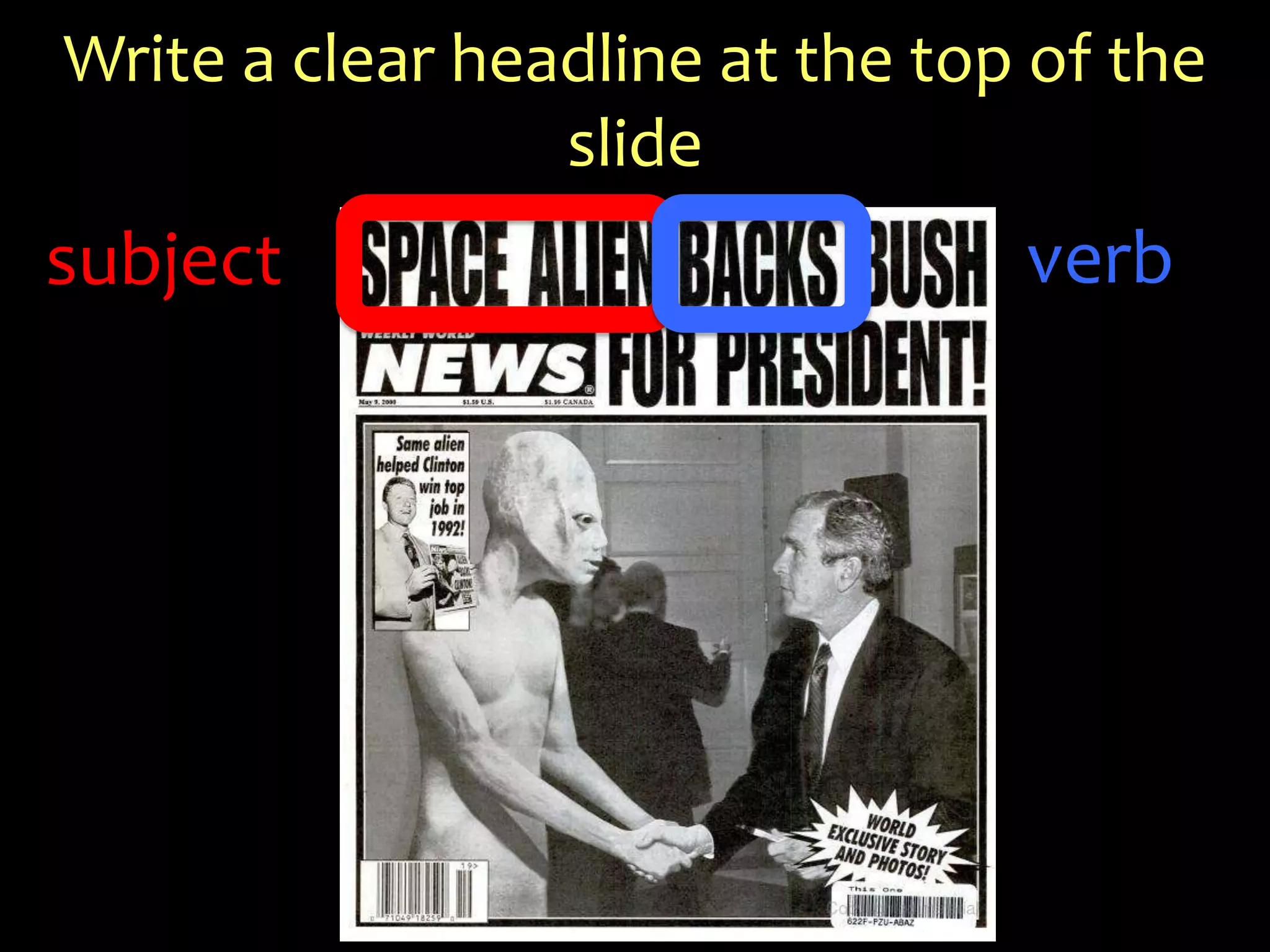
Write a clear headline at the top of the slideverbsubject
Headline = Main idea = A sentence
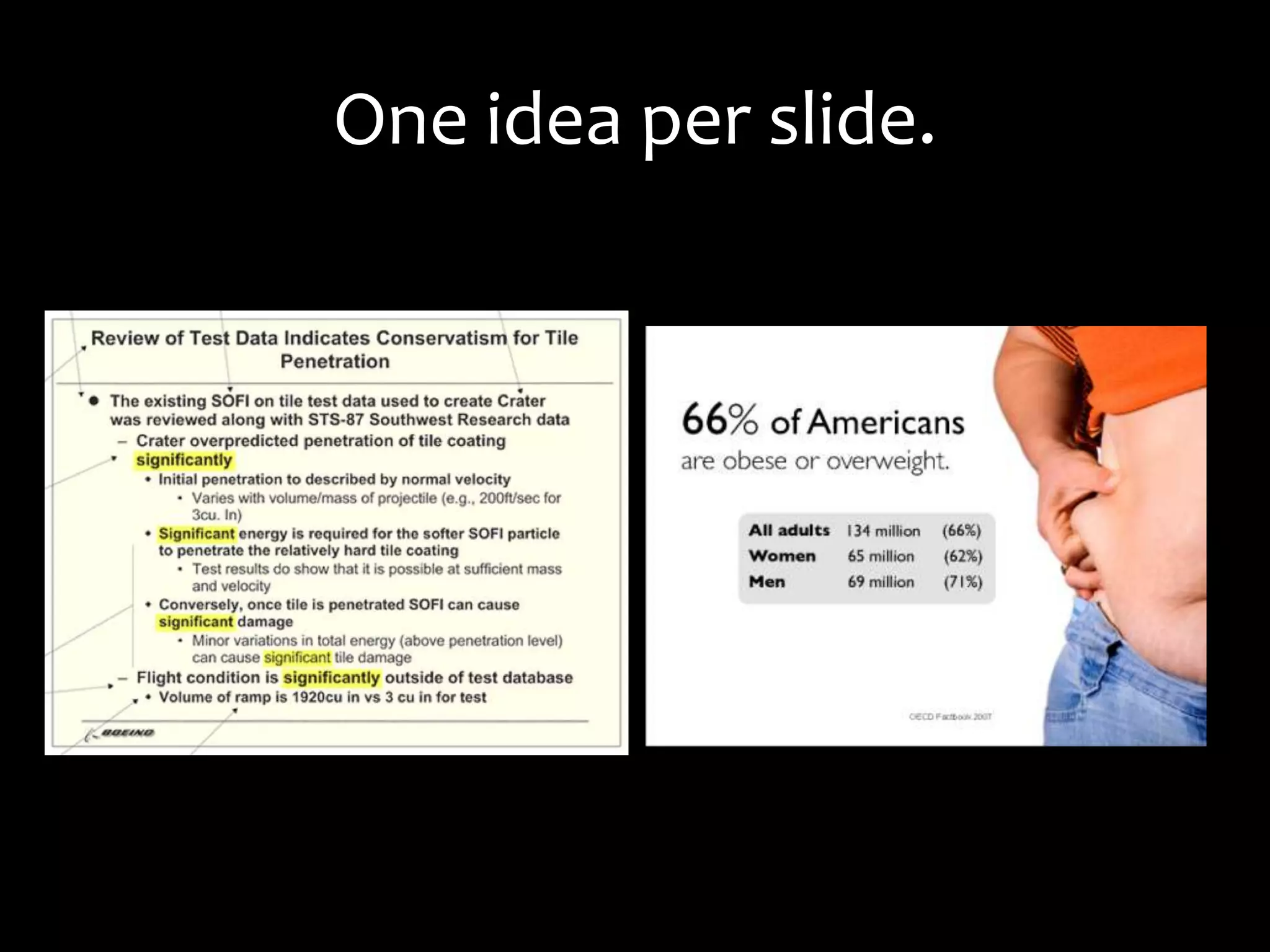
One idea per slide.
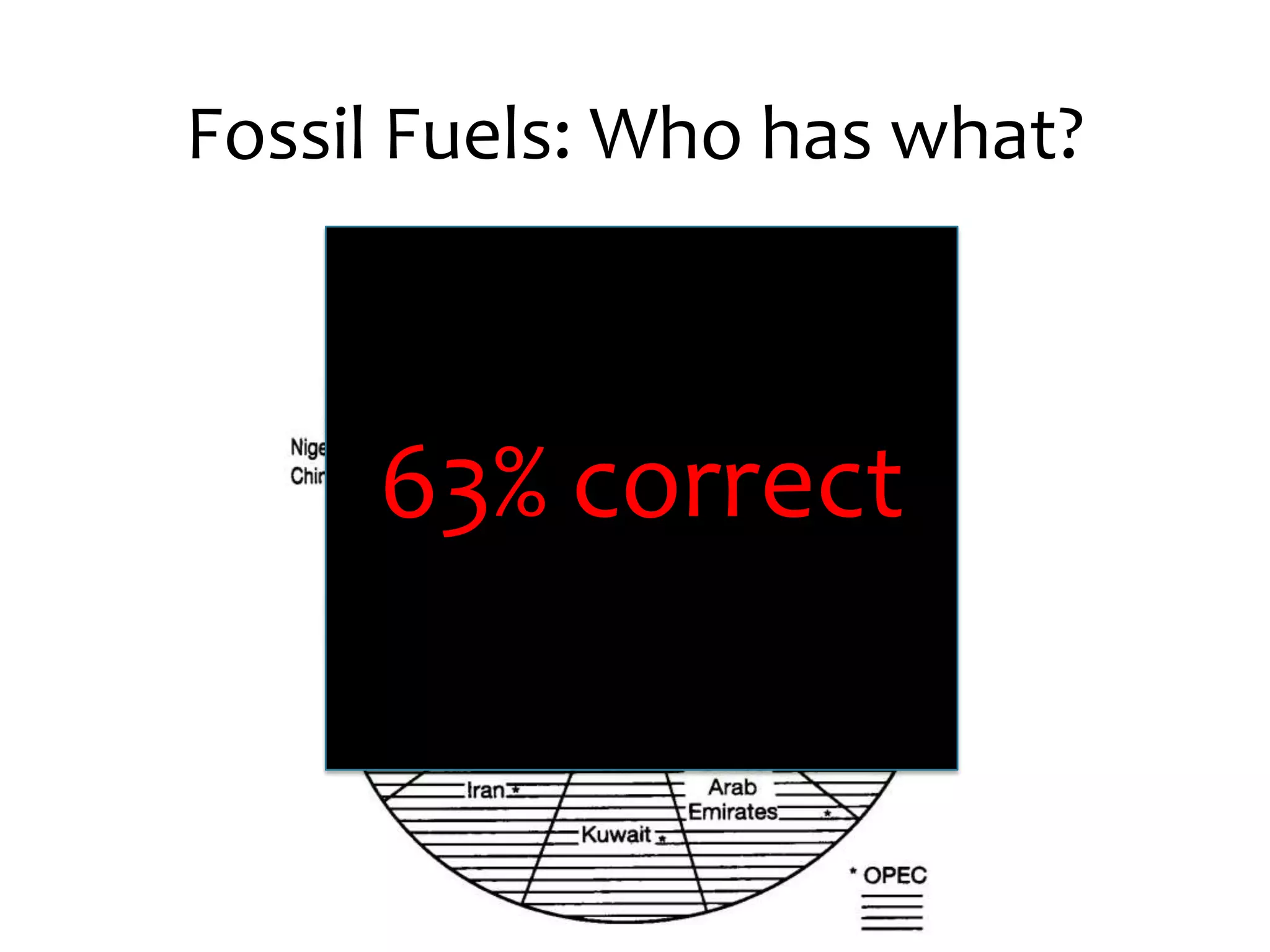
Fossil Fuels: Who has what?63% correctBefore
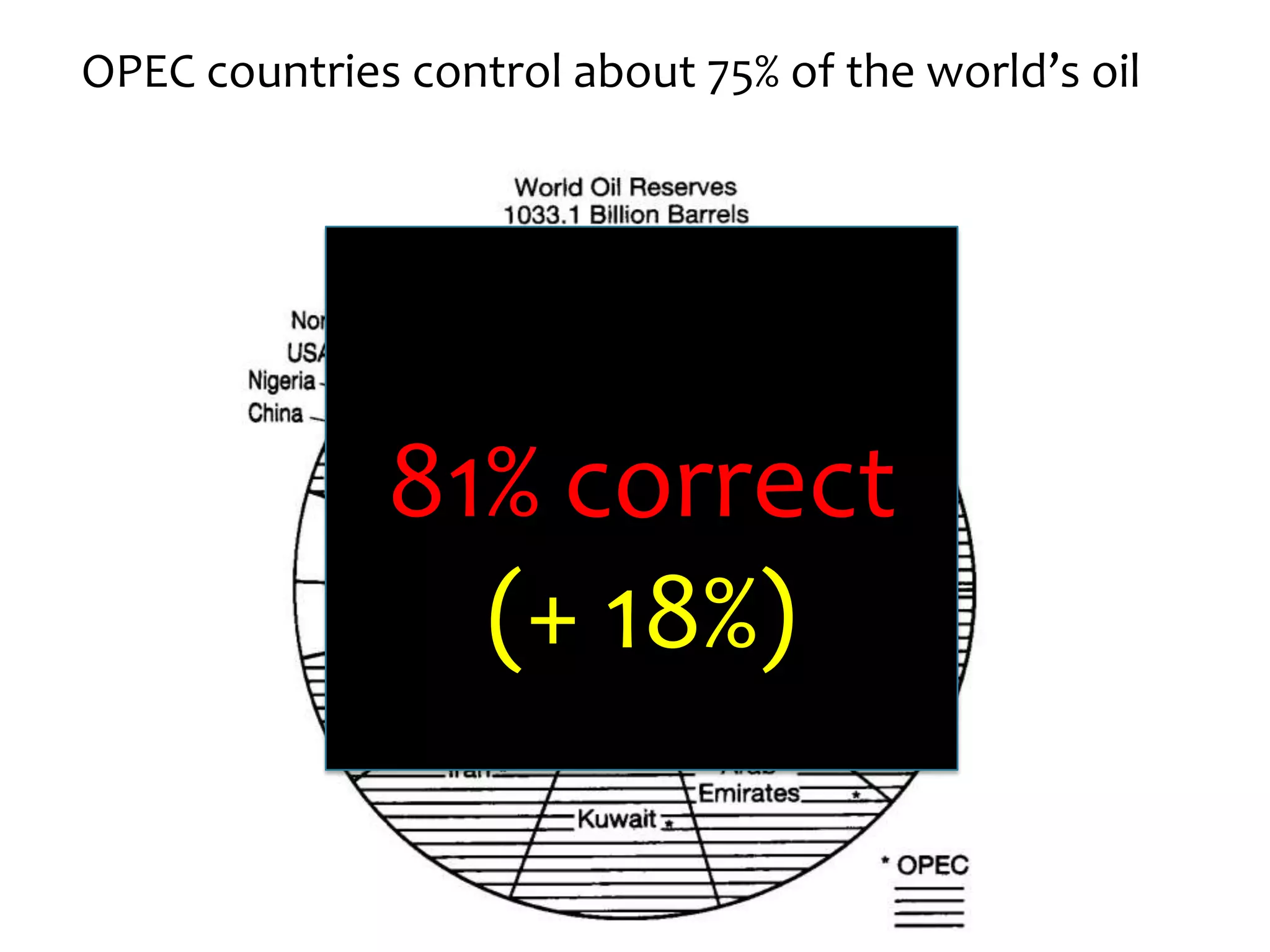
OPEC countries control about 75% of the world’s oil81% correct(+ 18%)
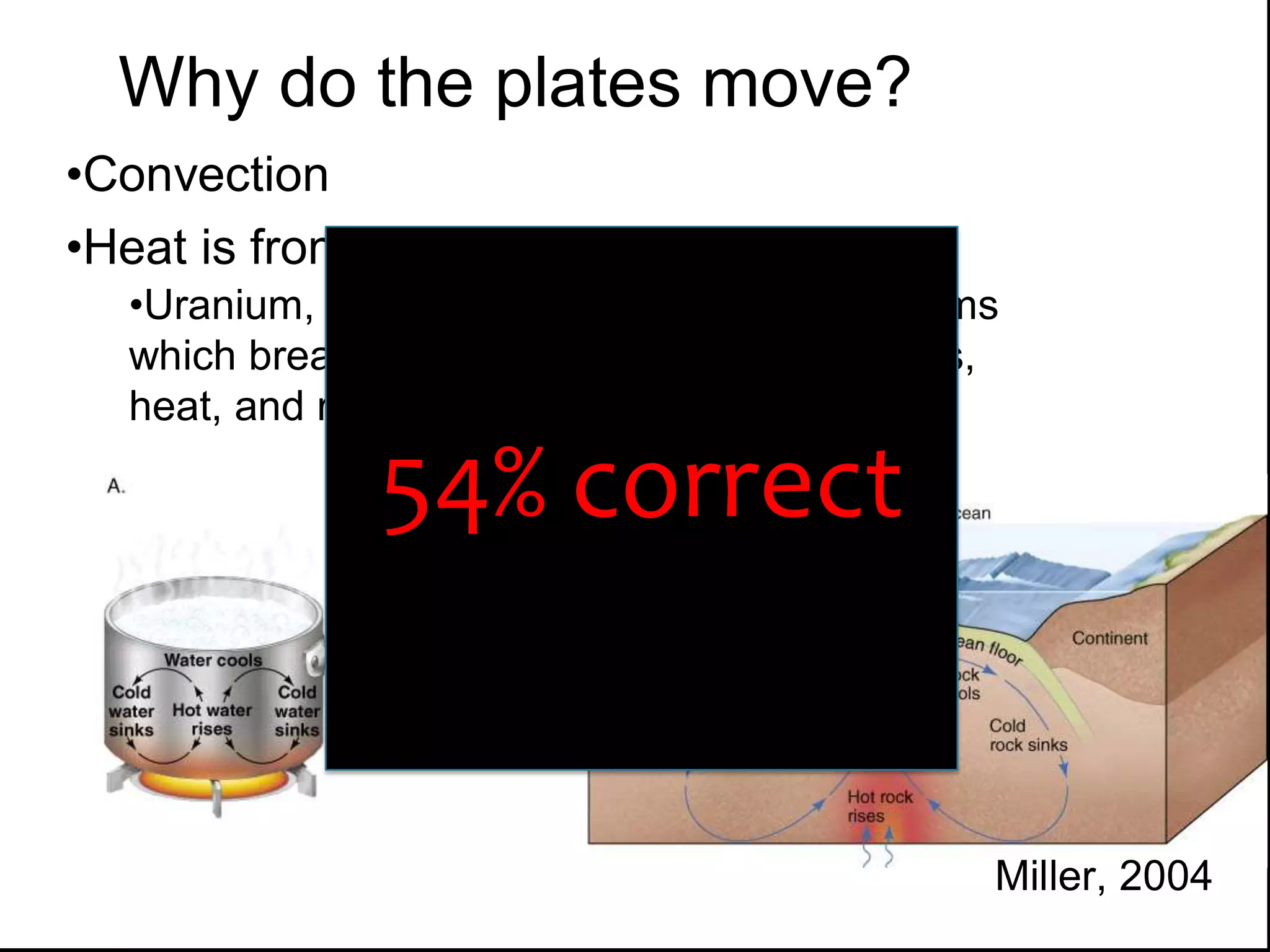
54% correctBefore
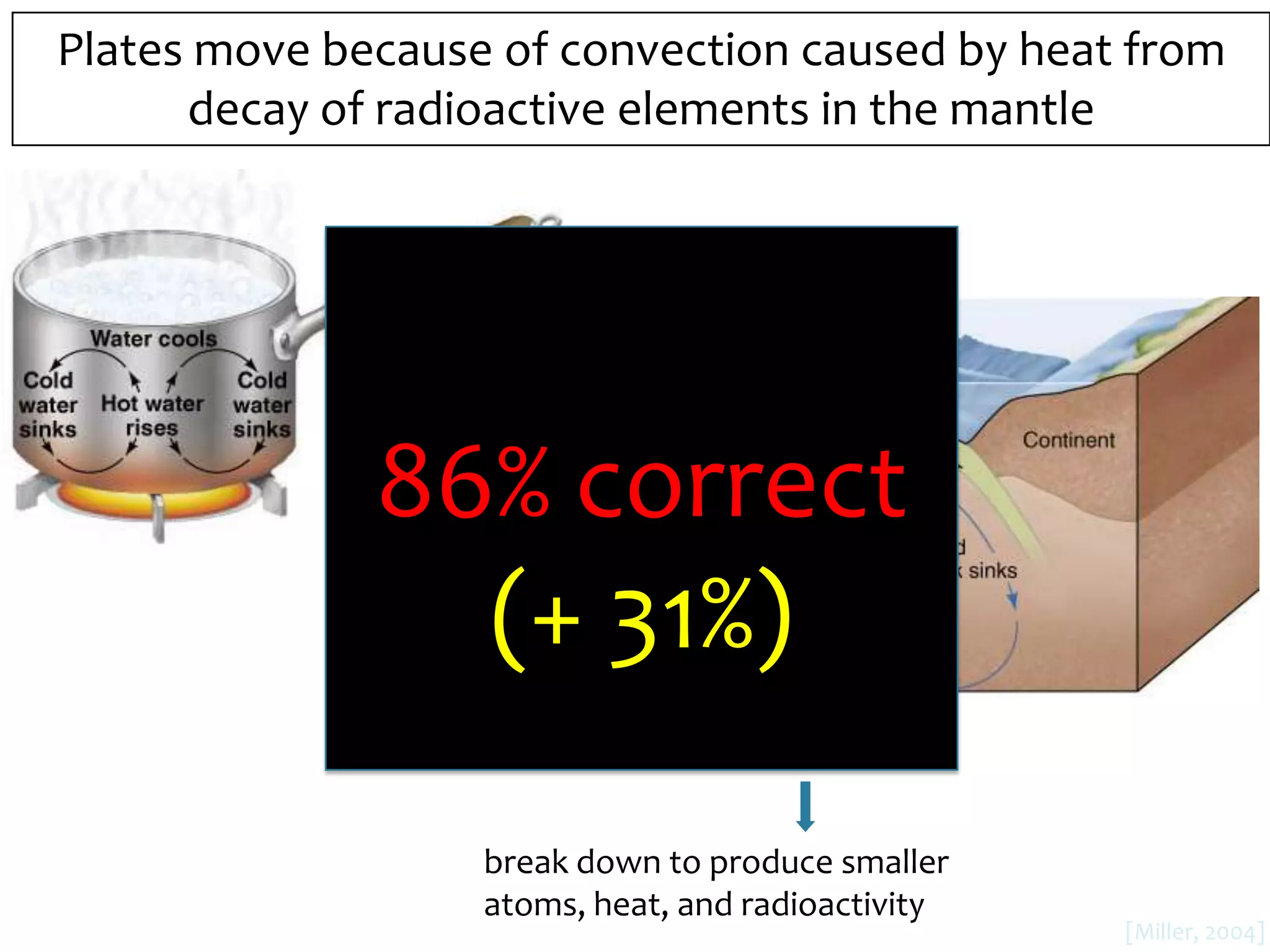
Uranium and Thorium are large “unstable” atomsbreak down to produce smaller atoms, heat, and radioactivityPlates move because of convection caused by heat from decay of radioactive elements in the mantle86% correct(+ 31%)Ocean[Miller, 2004]
Really, each slide is a paragraph.
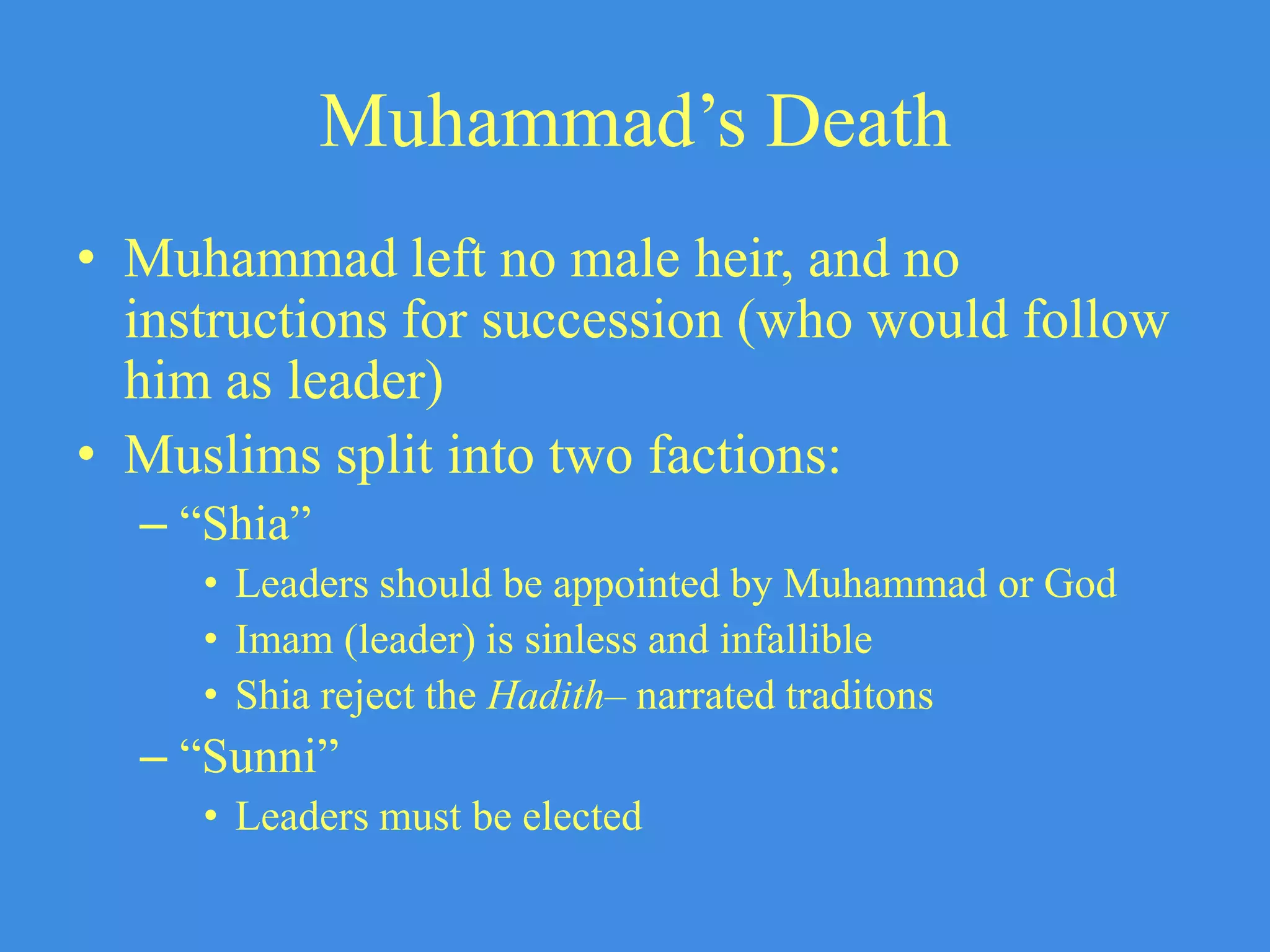
Muhammad’s DeathMuhammad left no male heir, and no instructions for succession (who would follow him as leader)Muslims split into two factions:“Shia”Leaders should be appointed by Muhammad or GodImam (leader) is sinless and infallibleShia reject the Hadith– narrated traditons“Sunni”Leaders must be elected
Muhammad’s death split Islam in two.
Create clear headlinesYour turn:Fold your paper in half (like a taco).
Pretend the top half is your new slide.
Writedown a clear headline – the single, driving MAIN IDEA of the slide.Create Clear HeadlinesAdd PicturesSlide Design
Add pictures to words
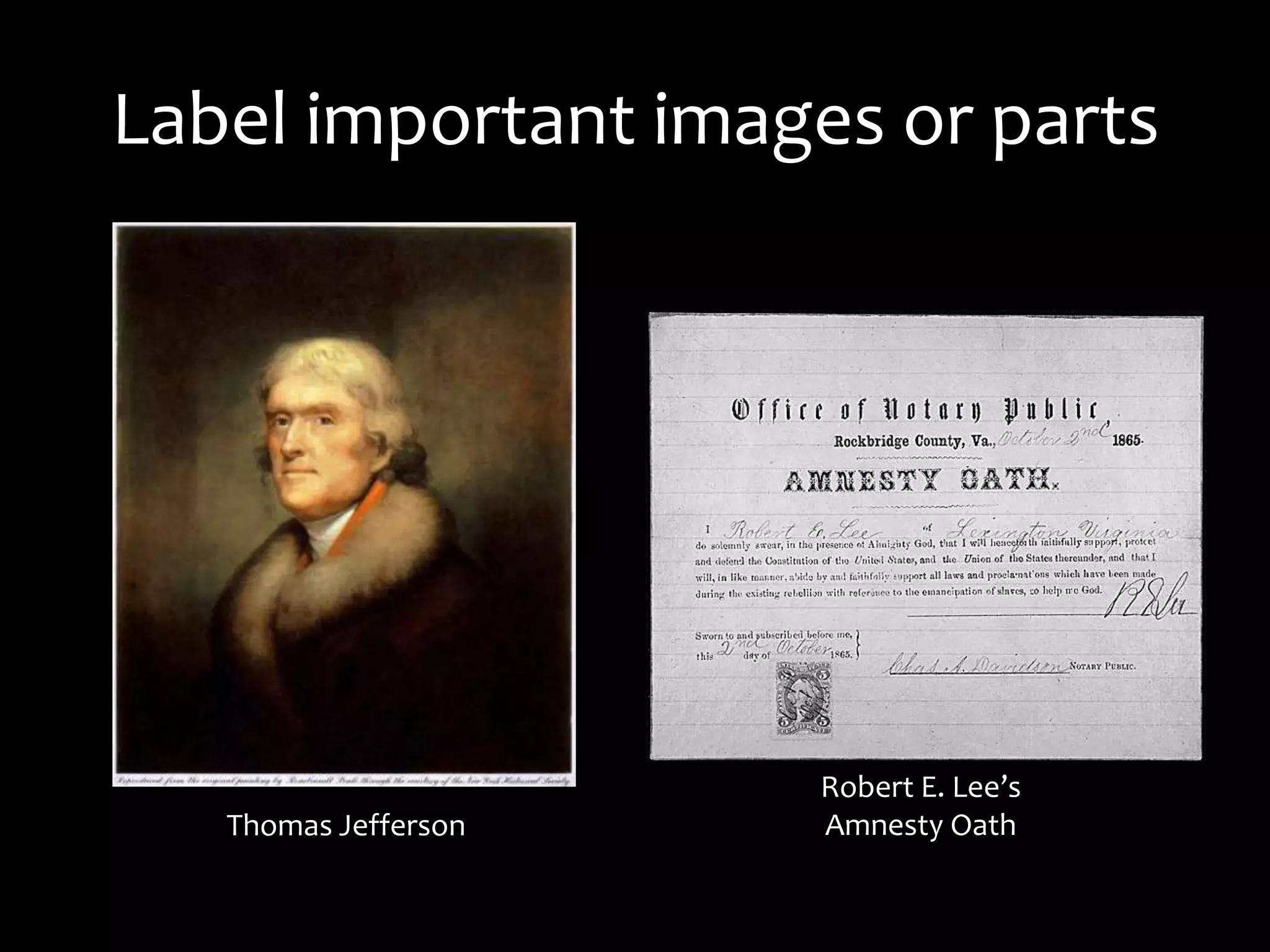
Label important images or partsRobert E. Lee’s Amnesty OathThomas Jefferson
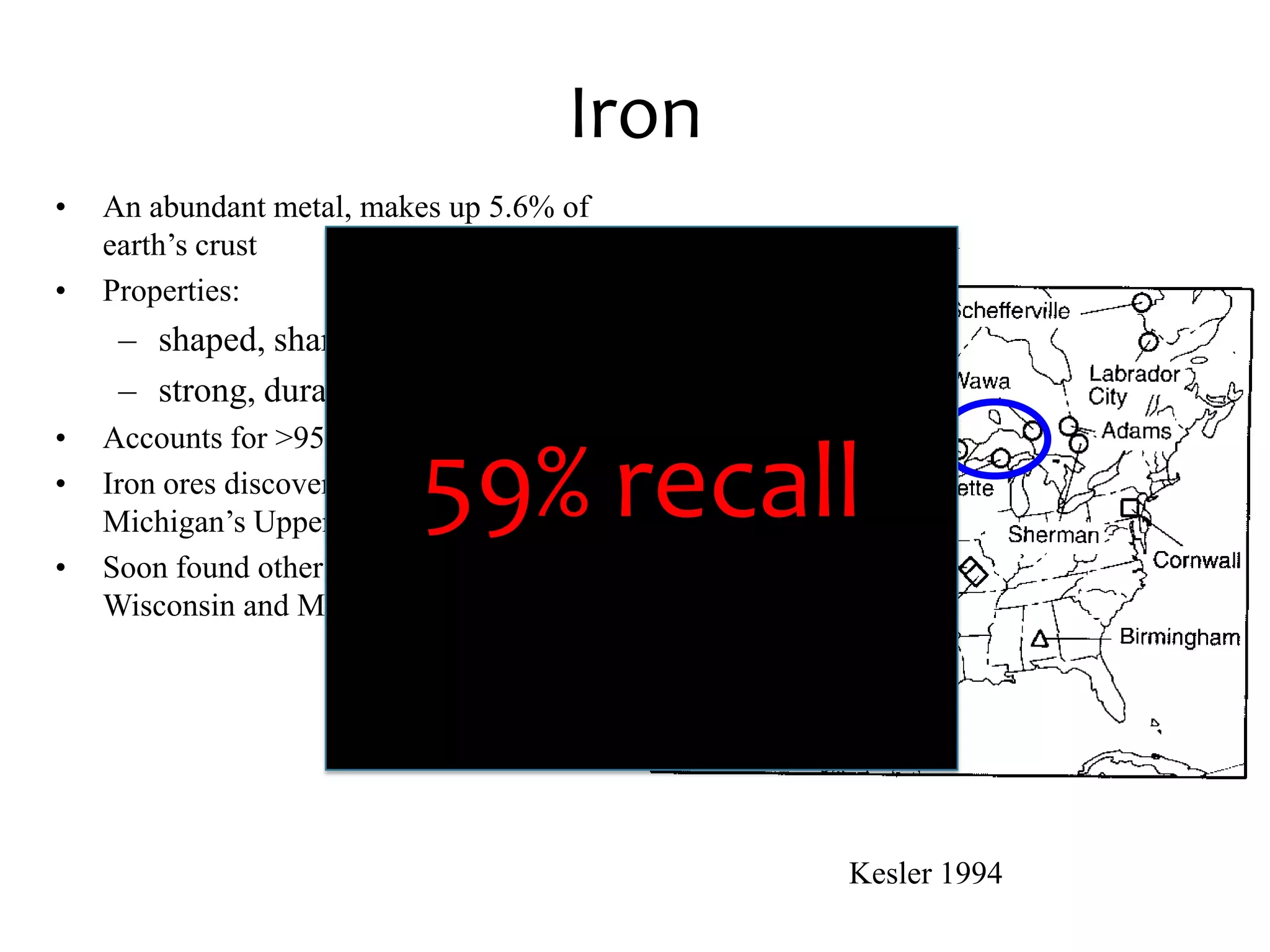
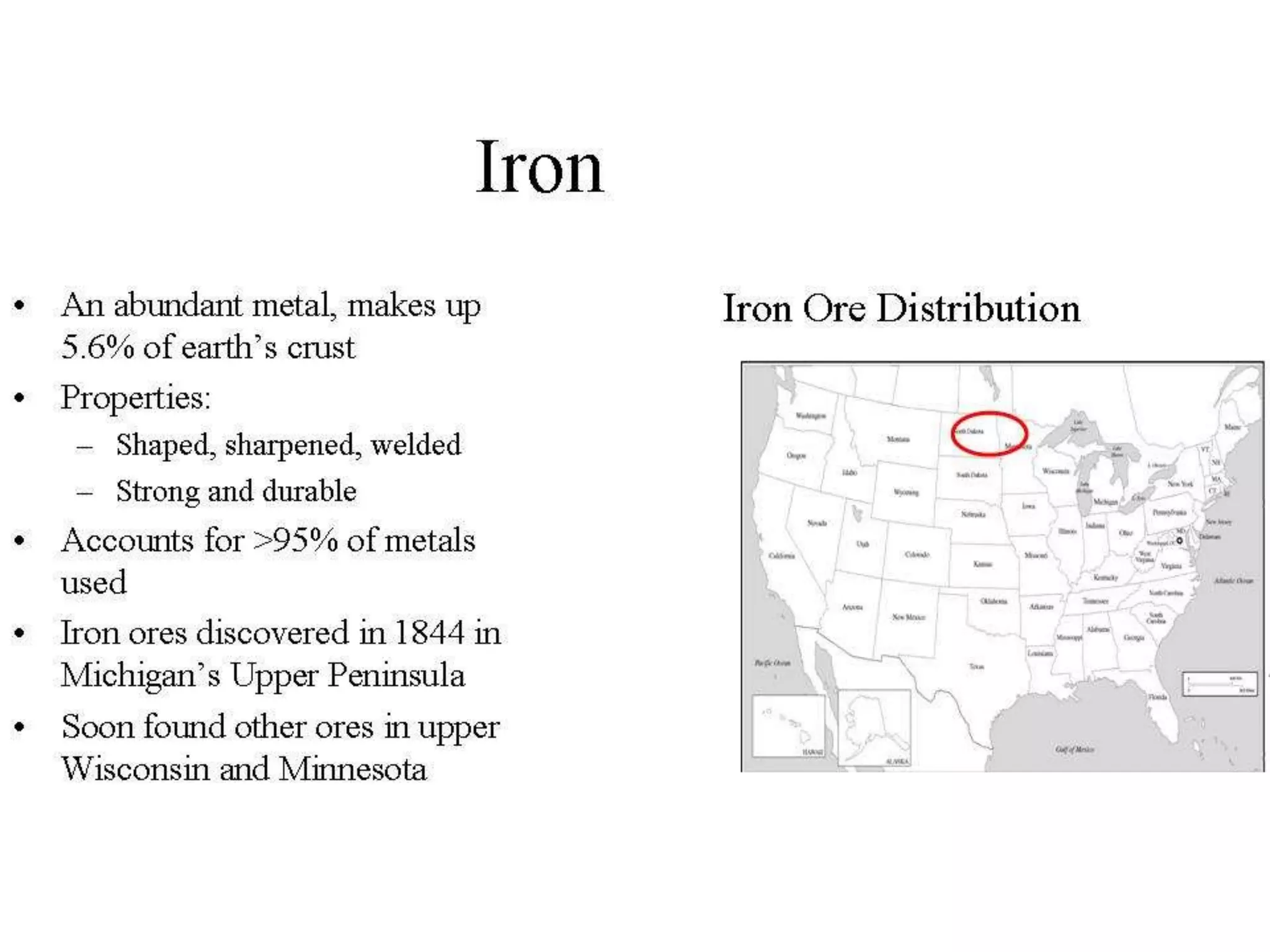
IronAn abundant metal, makes up 5.6% of earth’s crust
Properties:
shaped, sharpened, welded
strong, durable
Accounts for >95% of metals used
Iron ores discovered in 1844 in Michigan’s Upper Peninsula
Soon found other ores in upper Wisconsin and MinnesotaIron Ore Distribution59% recallBeforeKesler 1994
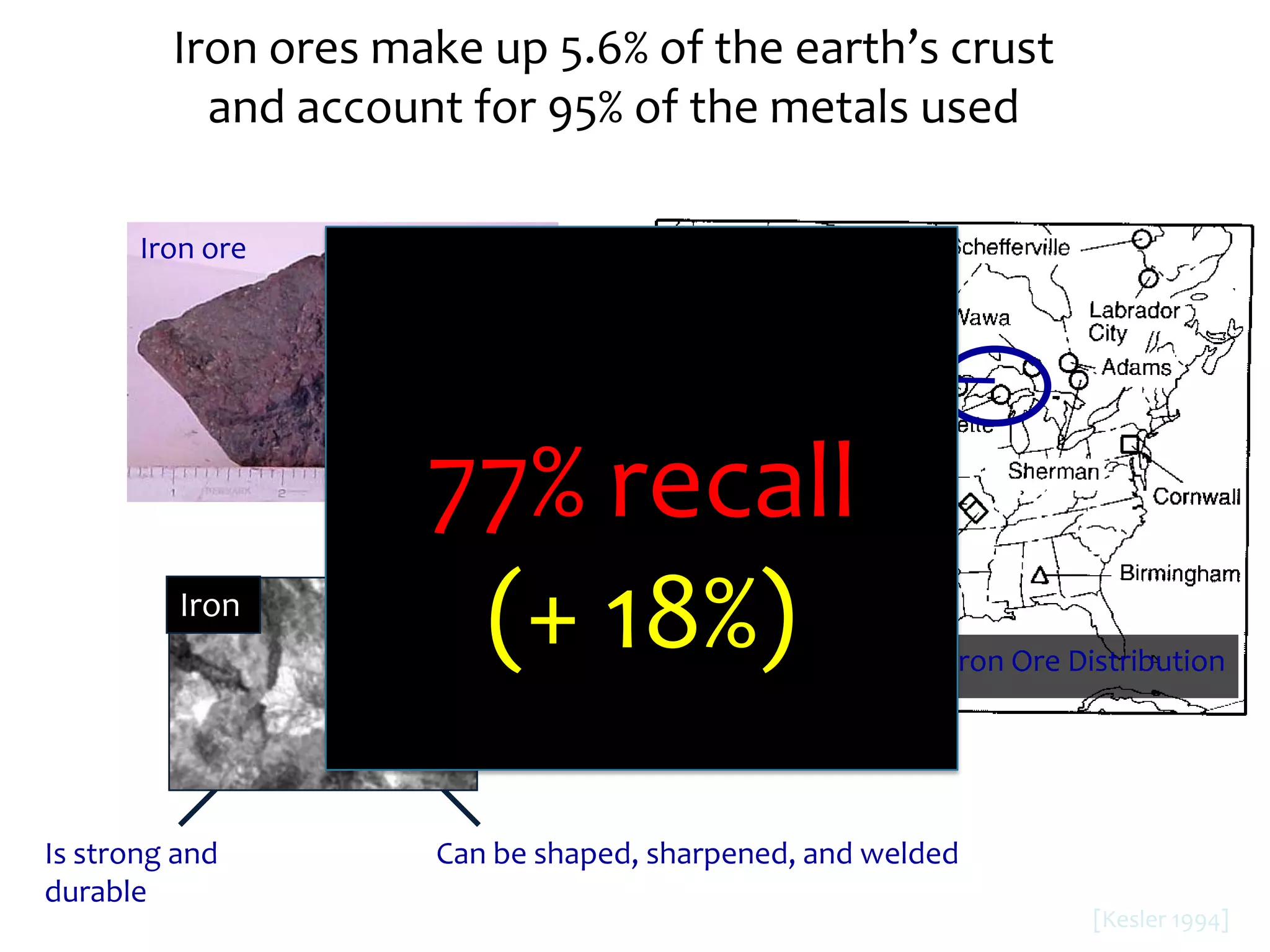
IronCan be shaped, sharpened, and weldedIs strong and durableIron ores make up 5.6% of the earth’s crustand account for 95% of the metals usedIron ore77% recall(+ 18%)[www.star-bits.com]Iron Ore Distribution[Kesler 1994]
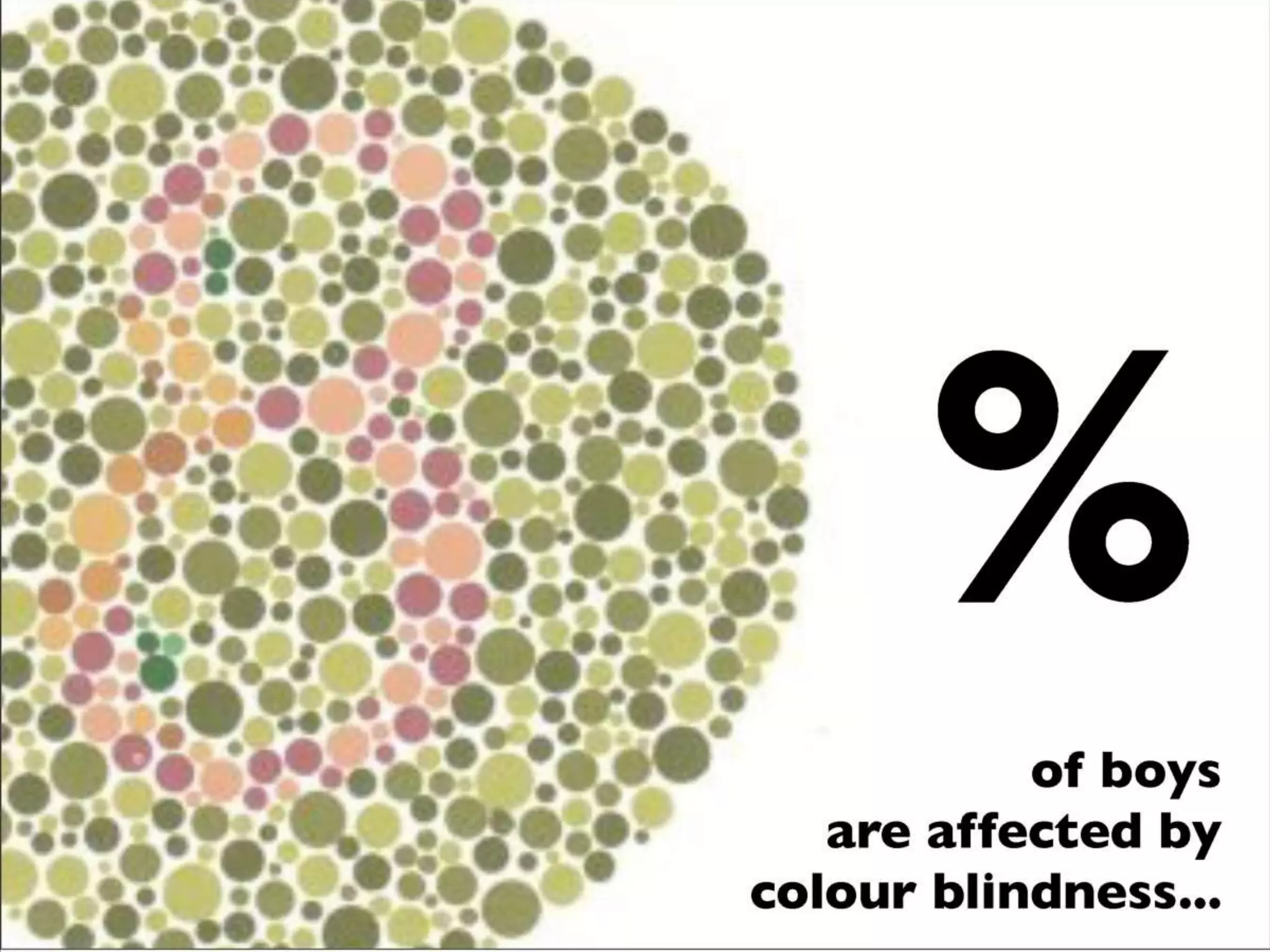
Use clearly contrasting colors
Fill the page.
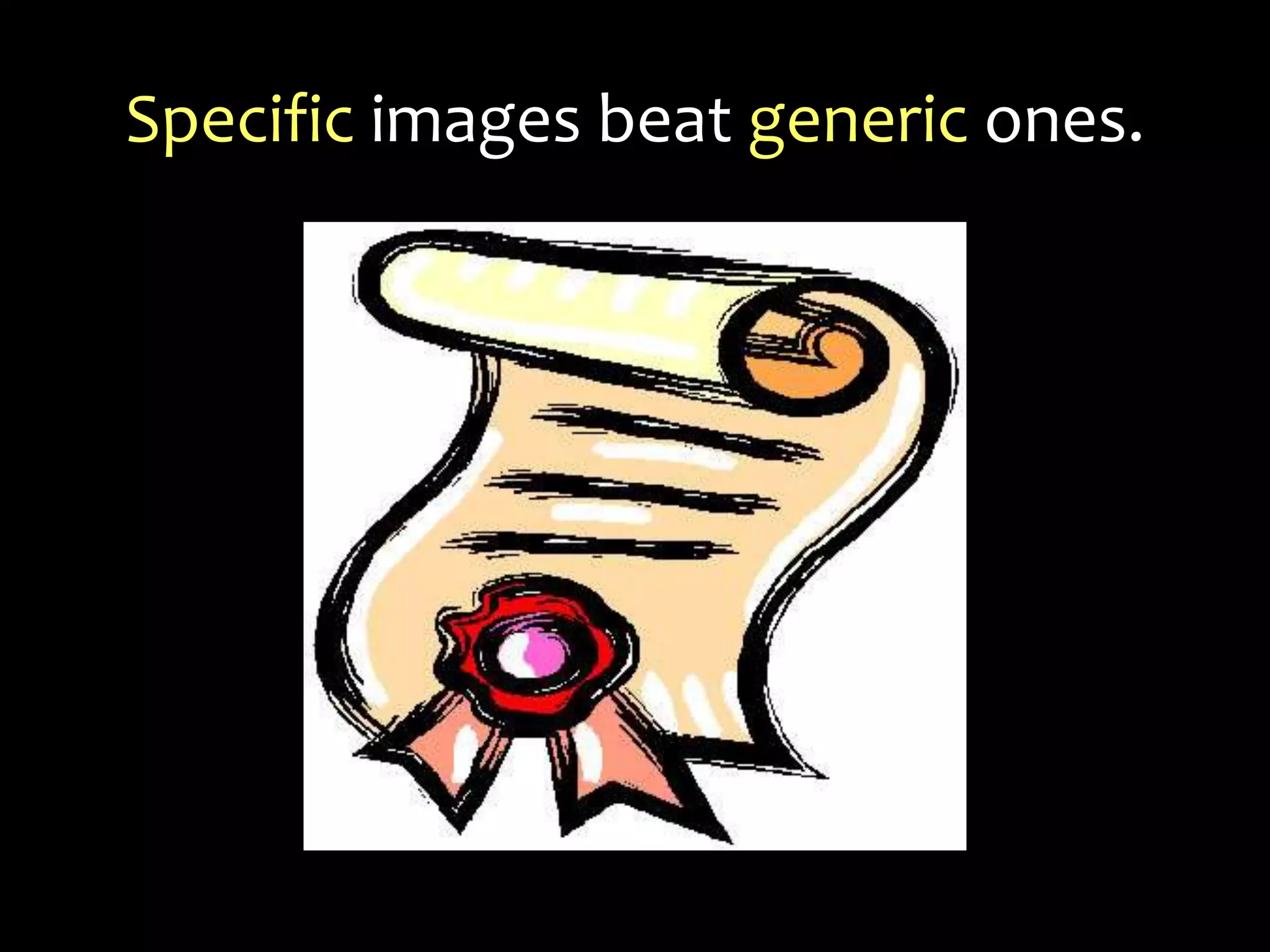
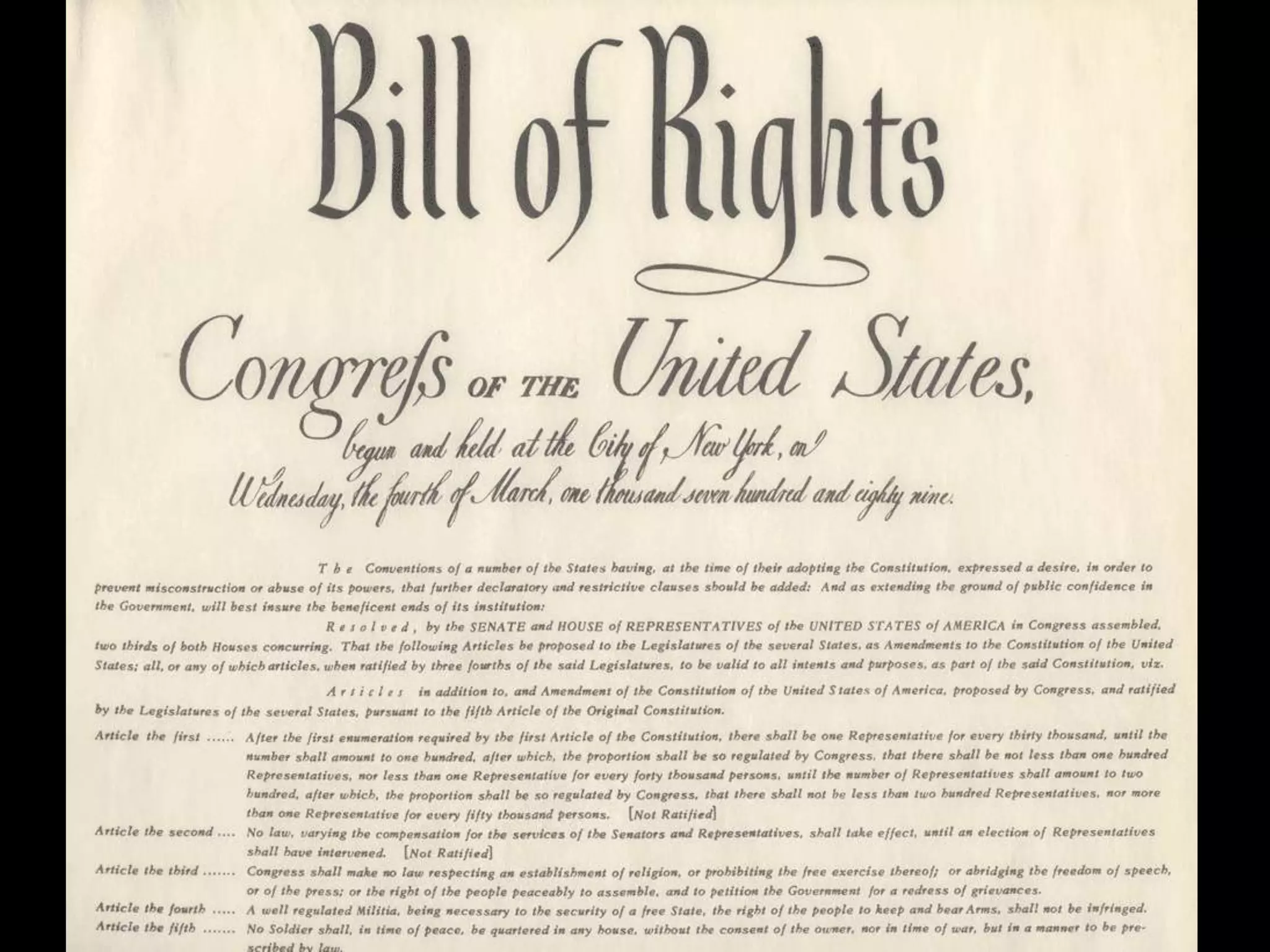
Specific images beat generic ones.
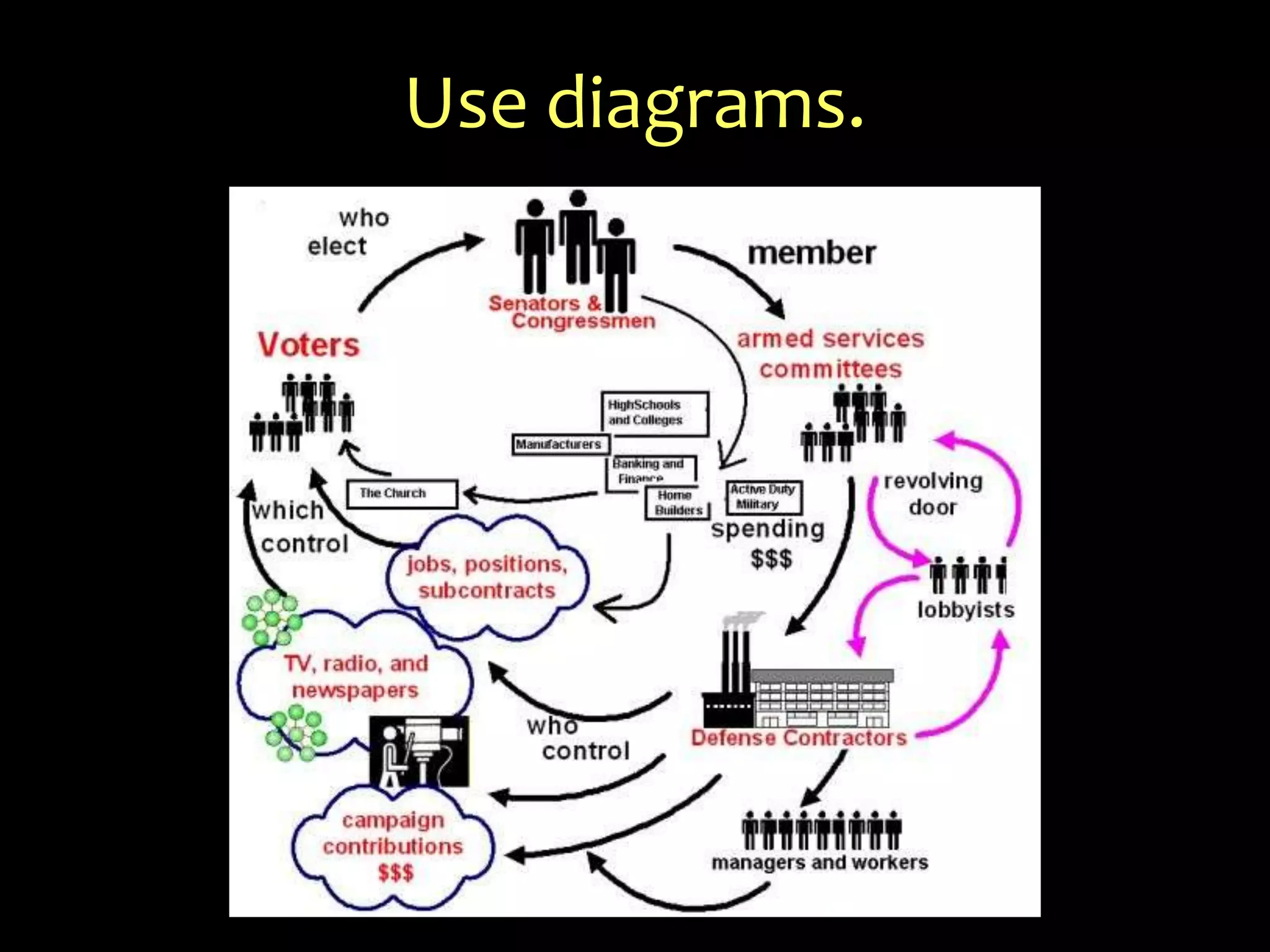
Use diagrams.
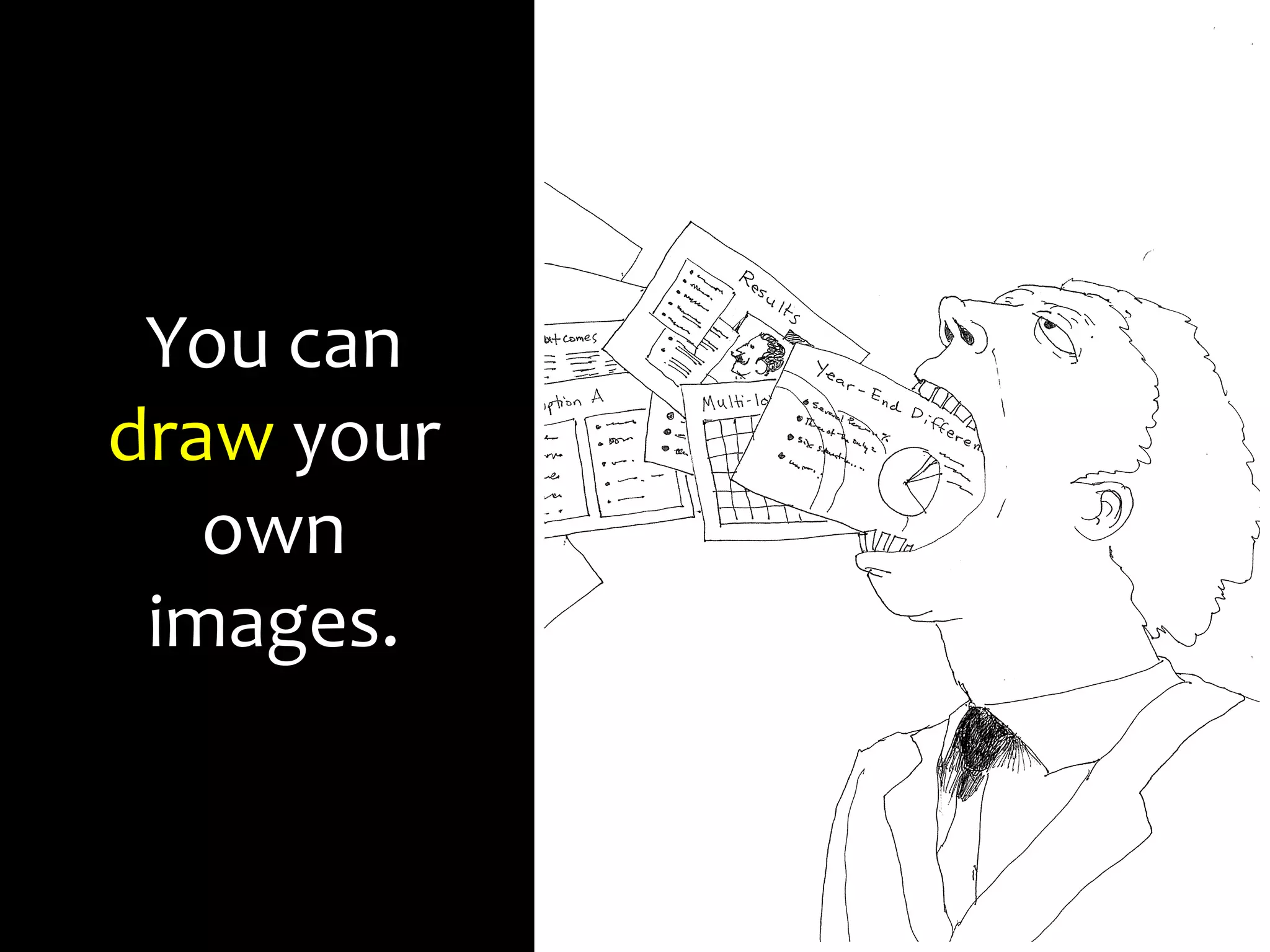
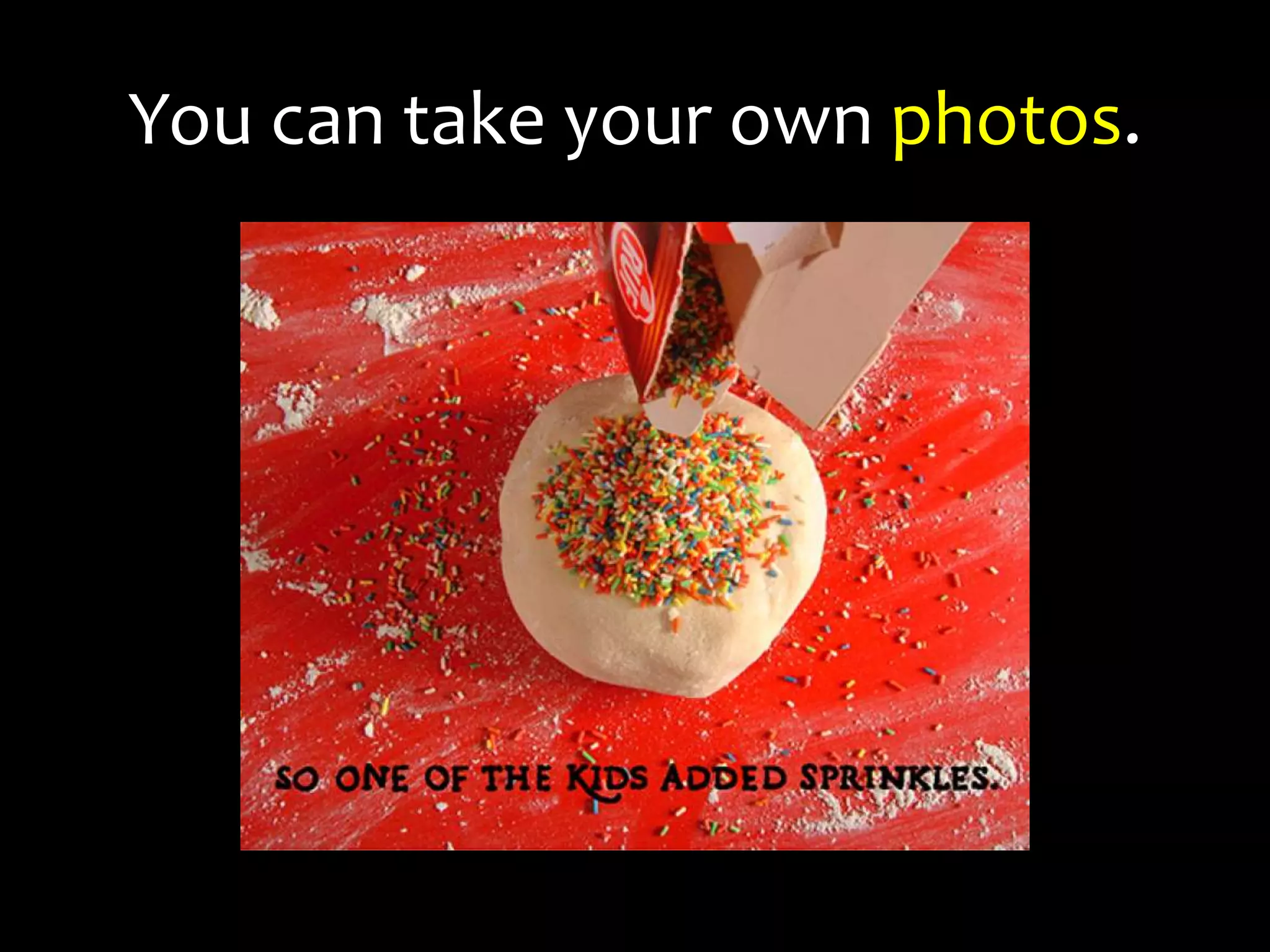
You can draw your own images.
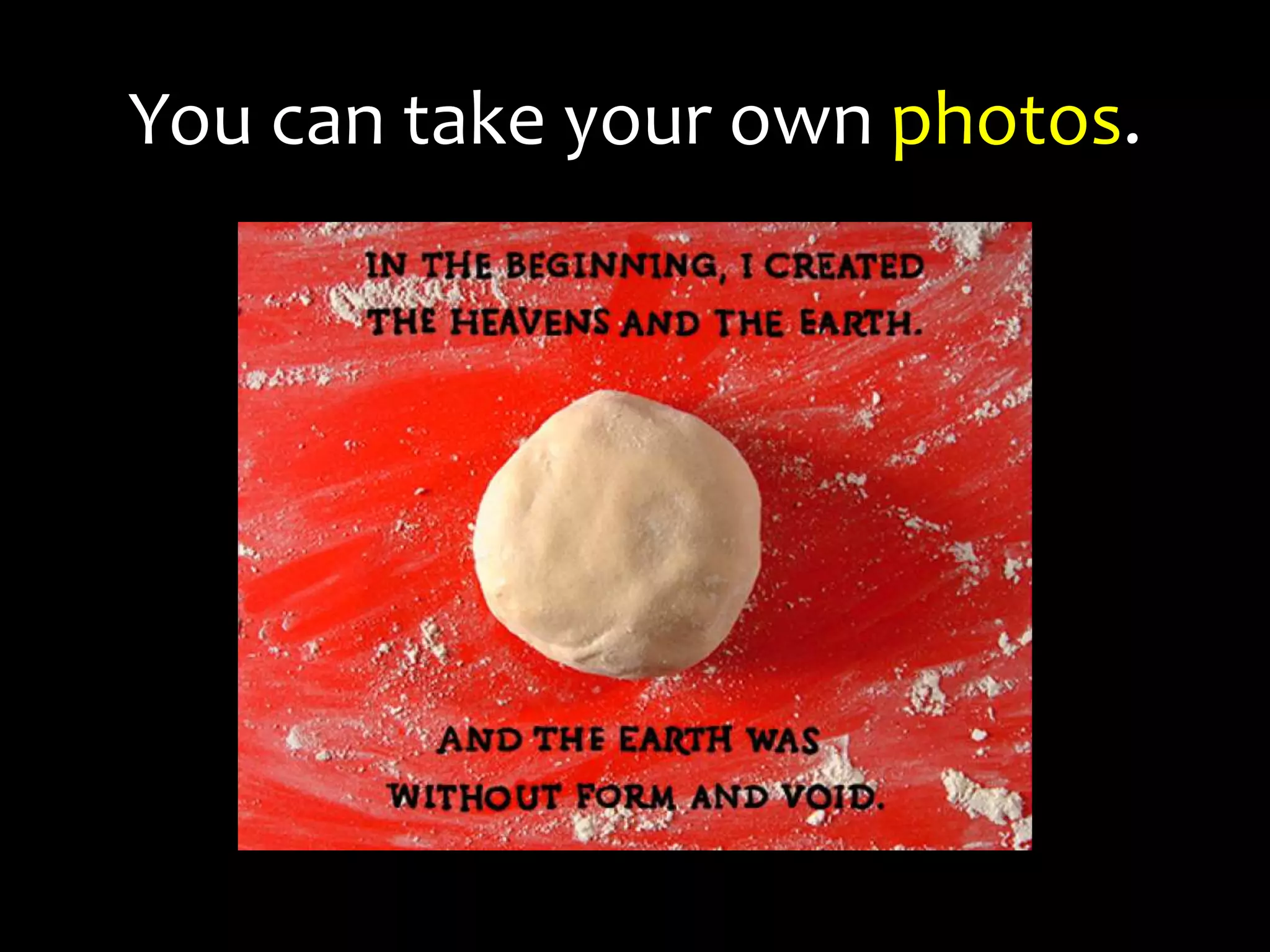
You can take your own photos.
Muhammad’s DeathMuhammad left no male heir, and no instructions for succession (who would follow him as leader)Muslims split into two factions:“Shia”Leaders should be appointed by Muhammad or GodImam (leader) is sinless and infallibleShia reject the Hadith– narrated traditons“Sunni”Leaders must be elected
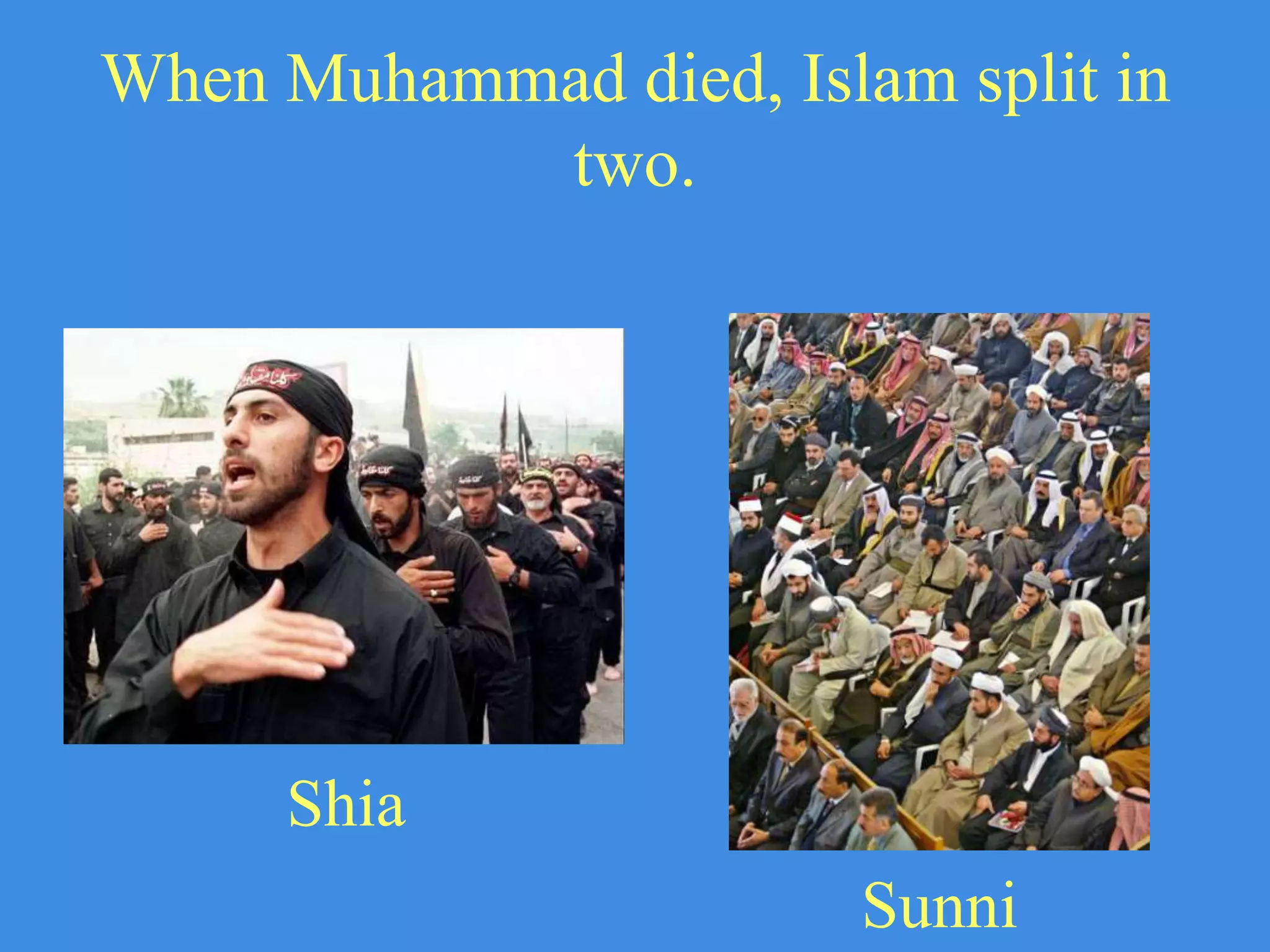
When Muhammad died, Islam split in two.ShiaSunni
Your turn:On your piece of paper, draw what you think might be the best possible image or images you could find, and label them (if that is sensible).Add pictures
So, what do you do with all the other information?
Hide it.Speak it.
Create Clear HeadlinesAdd PicturesHide DetailsSlide Design
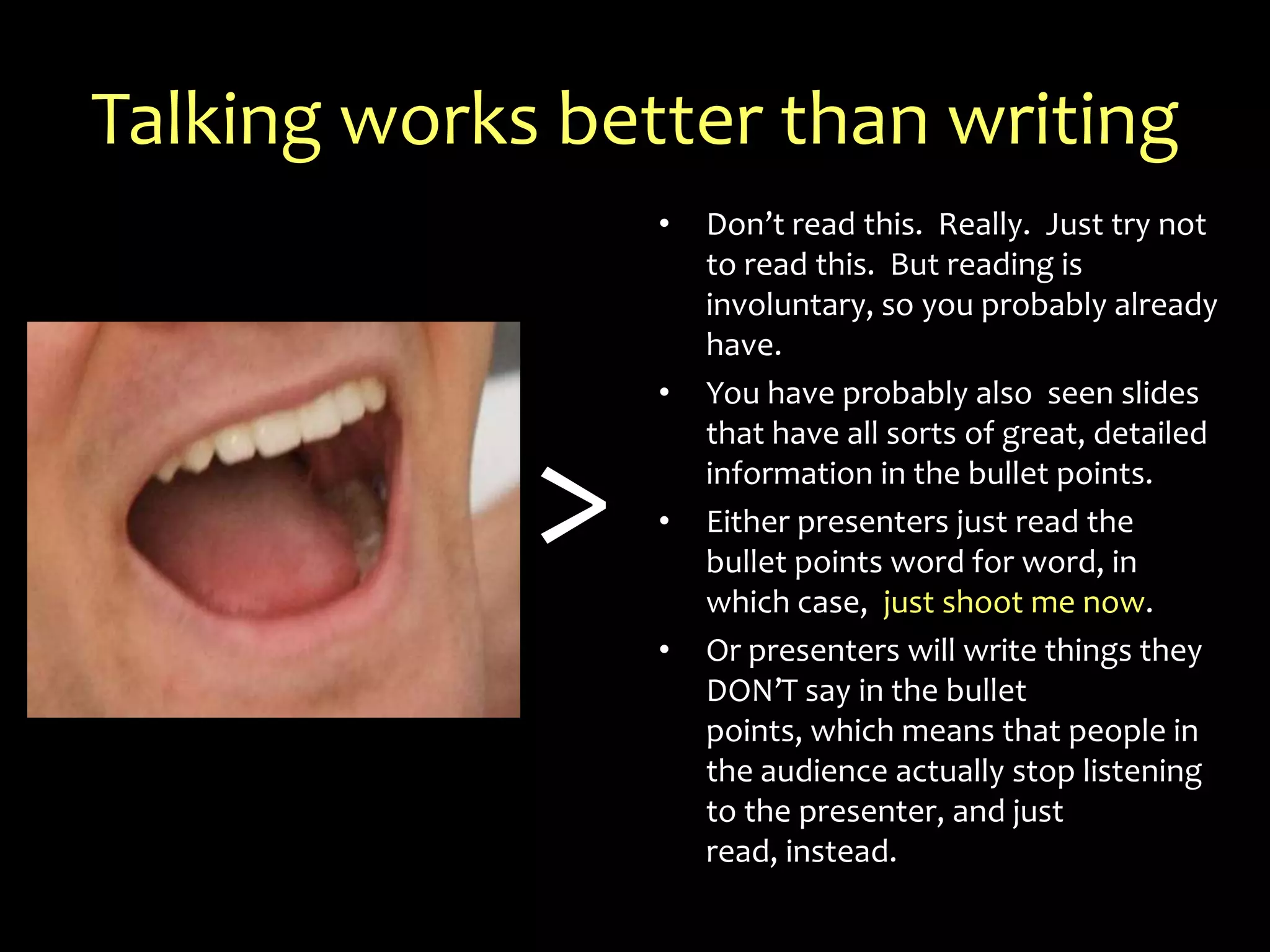
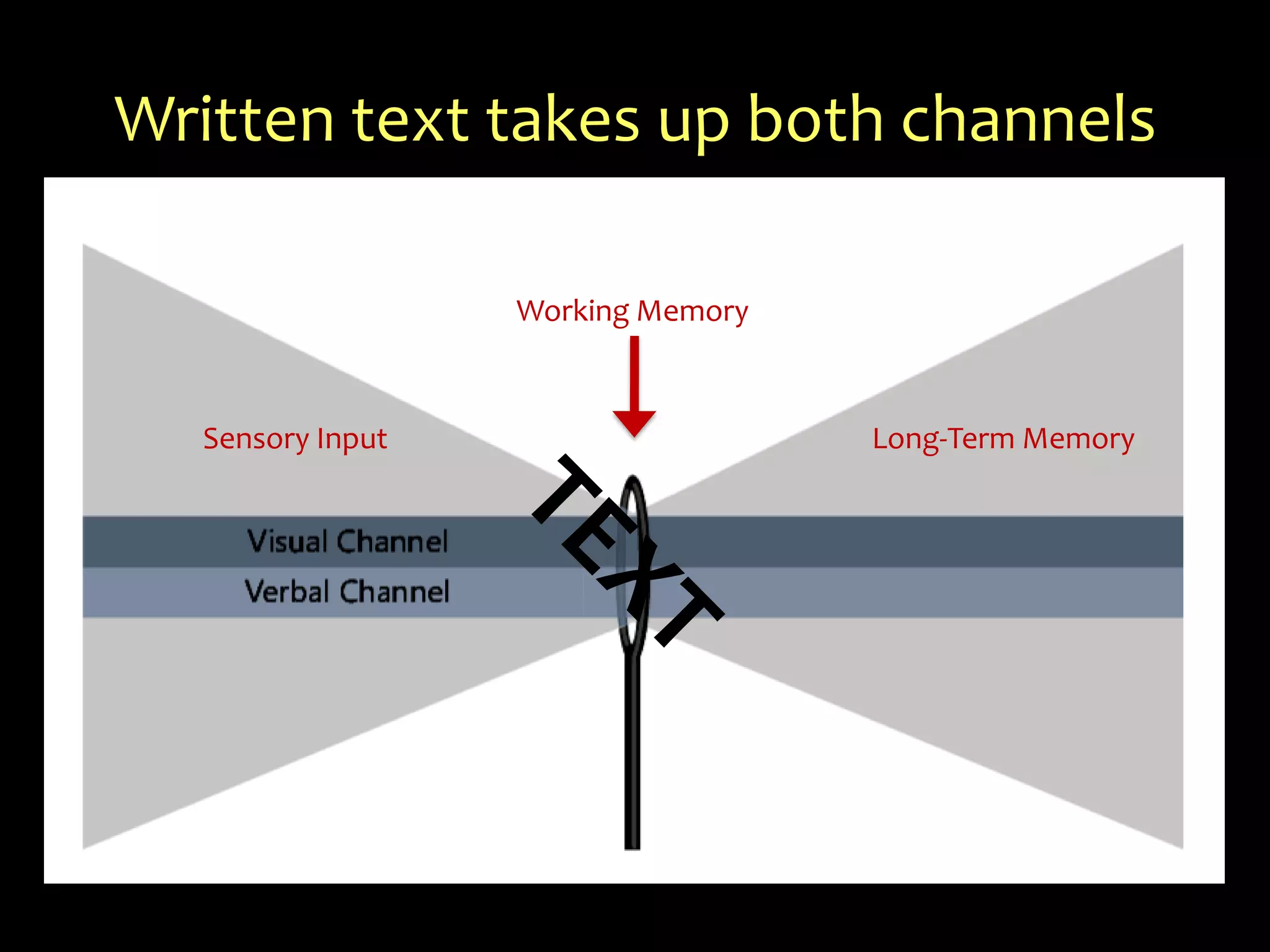
Talking works better than writingDon’t read this.  Really.  Just try not to read this.  But reading is involuntary, so you probably already have.You have probably also  seen slides that have all sorts of great, detailed information in the bullet points.Either presenters just read the bullet points word for word, in which case,  just shoot me now.Or presenters will write things they  DON’T say in the bullet points, which means that people in the audience actually stop listening to the presenter, and just read, instead.>
Why?
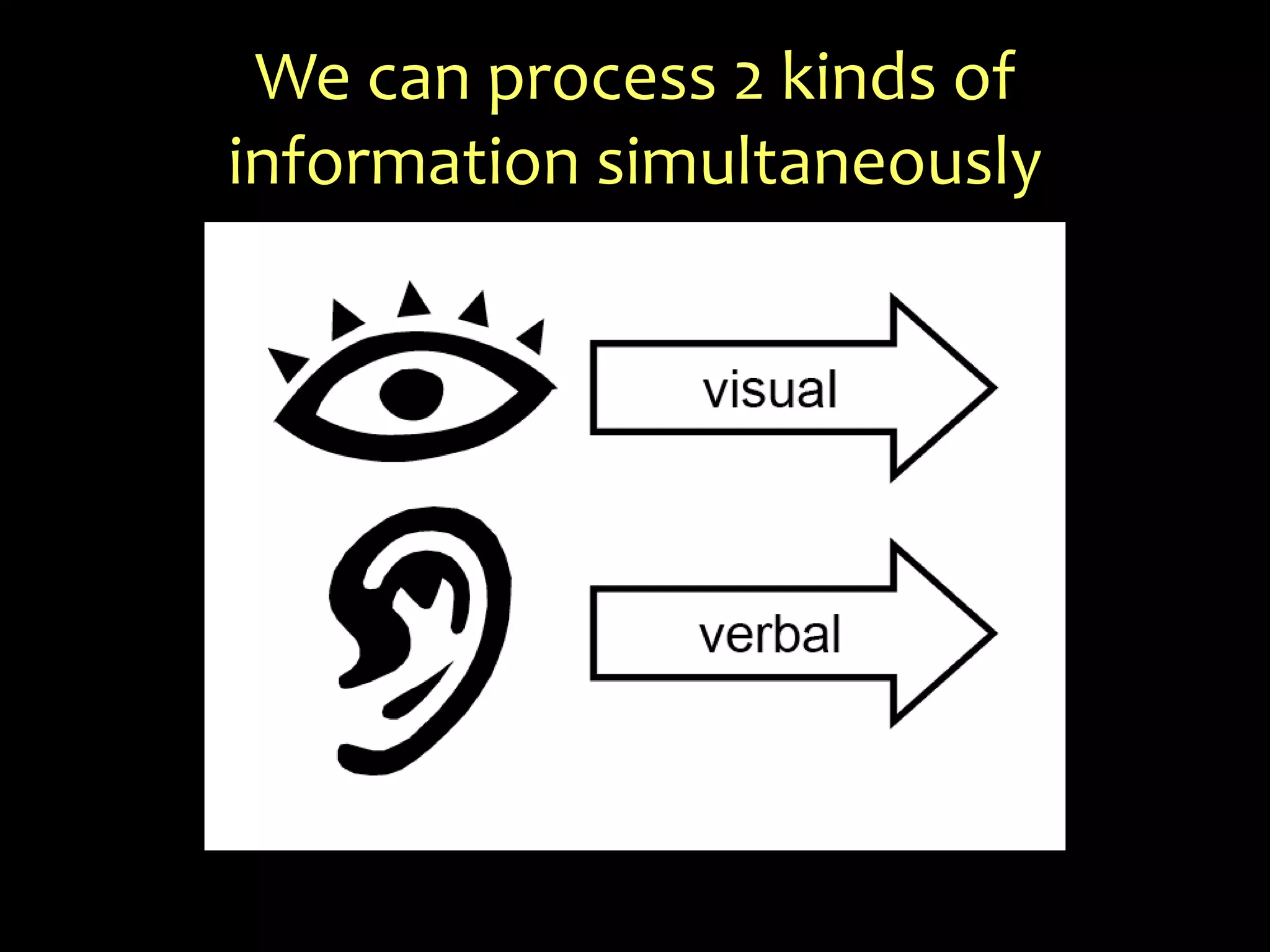
We can process 2 kinds of information simultaneously
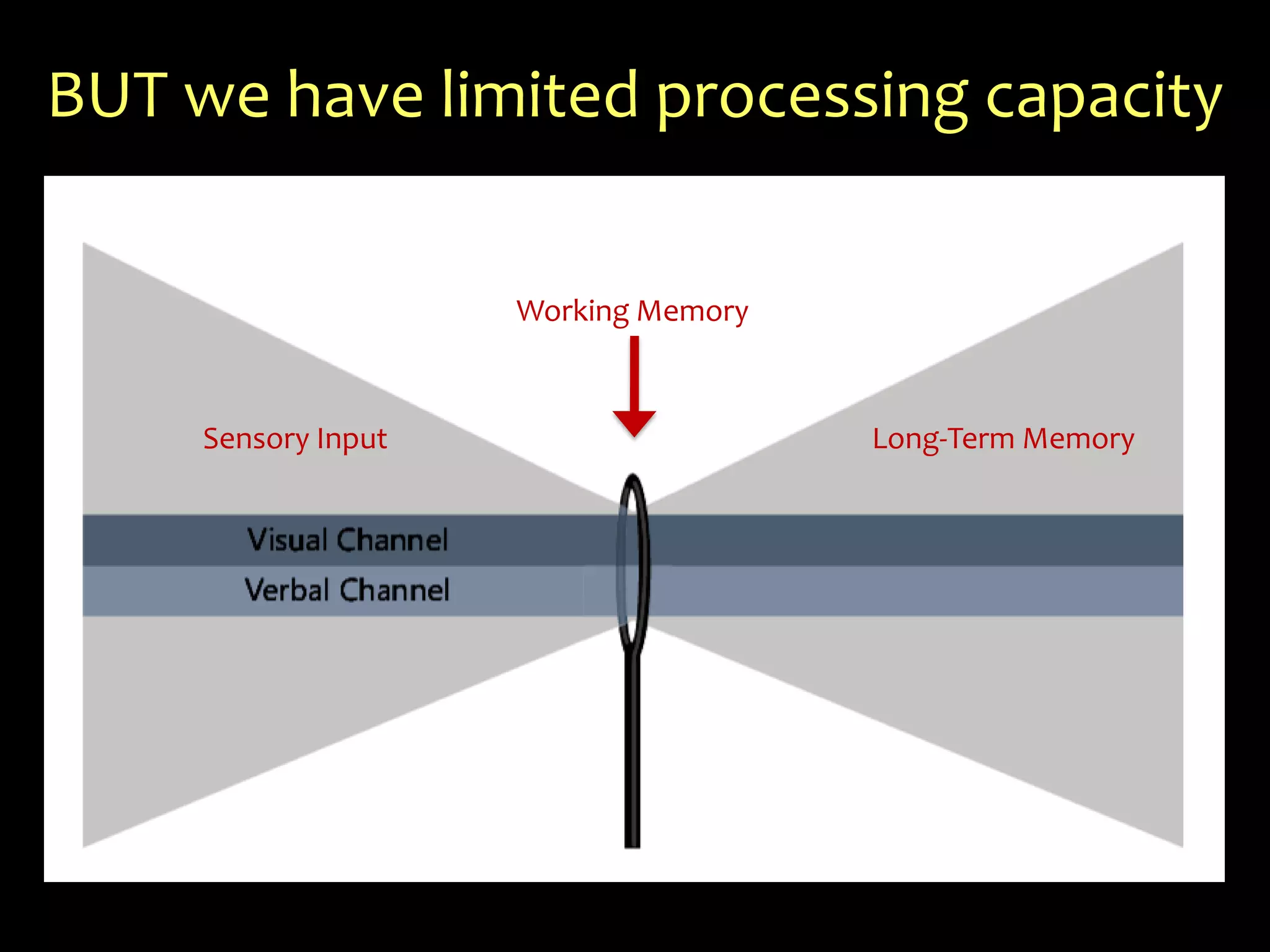
BUT we have limited processing capacityWorking MemorySensory InputLong-Term Memory
Written text takes up both channelsWorking MemorySensory InputLong-Term MemoryTEXT
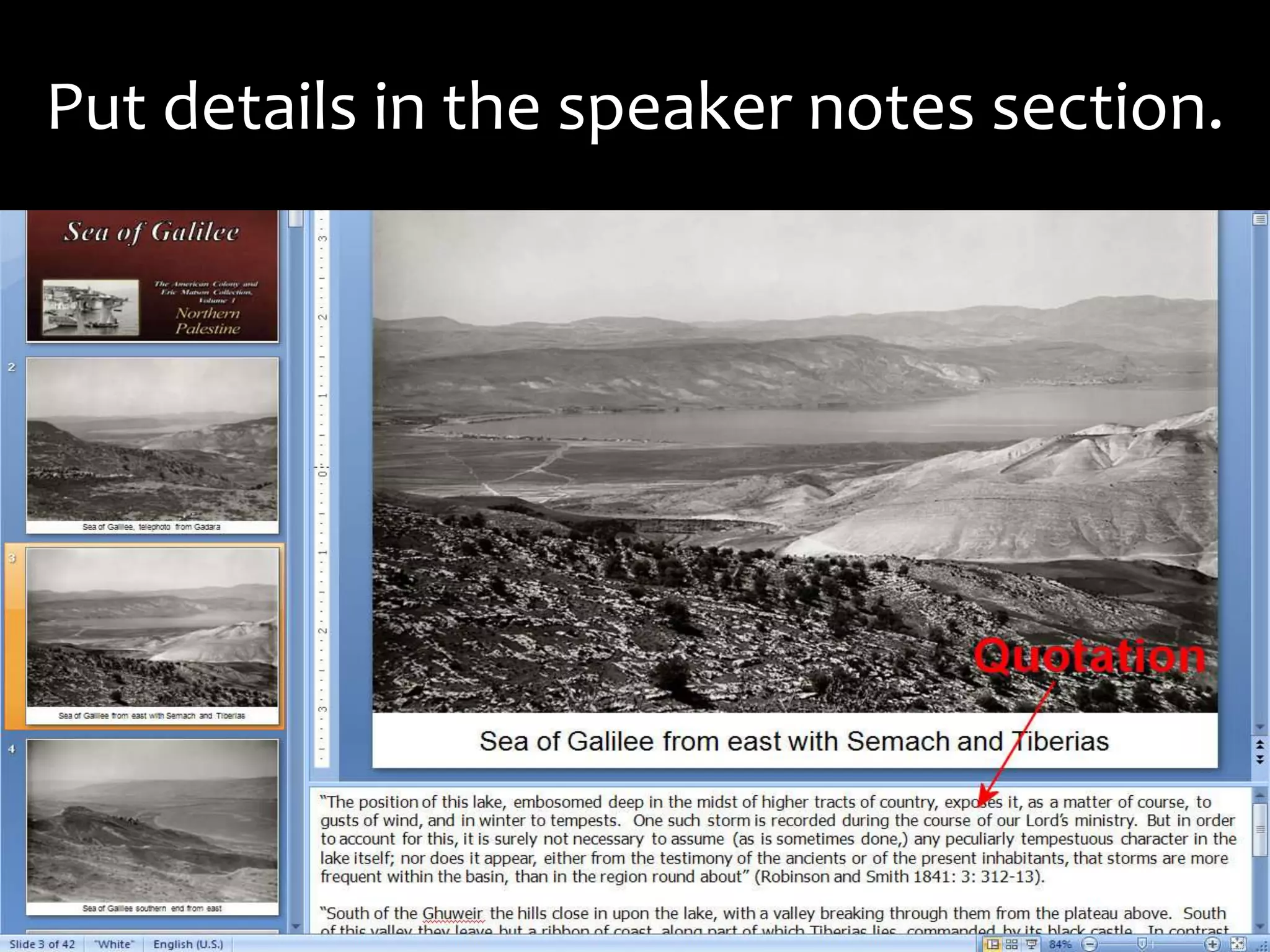
Put details in the speaker notes section.
You can post your presentation online or print it out.
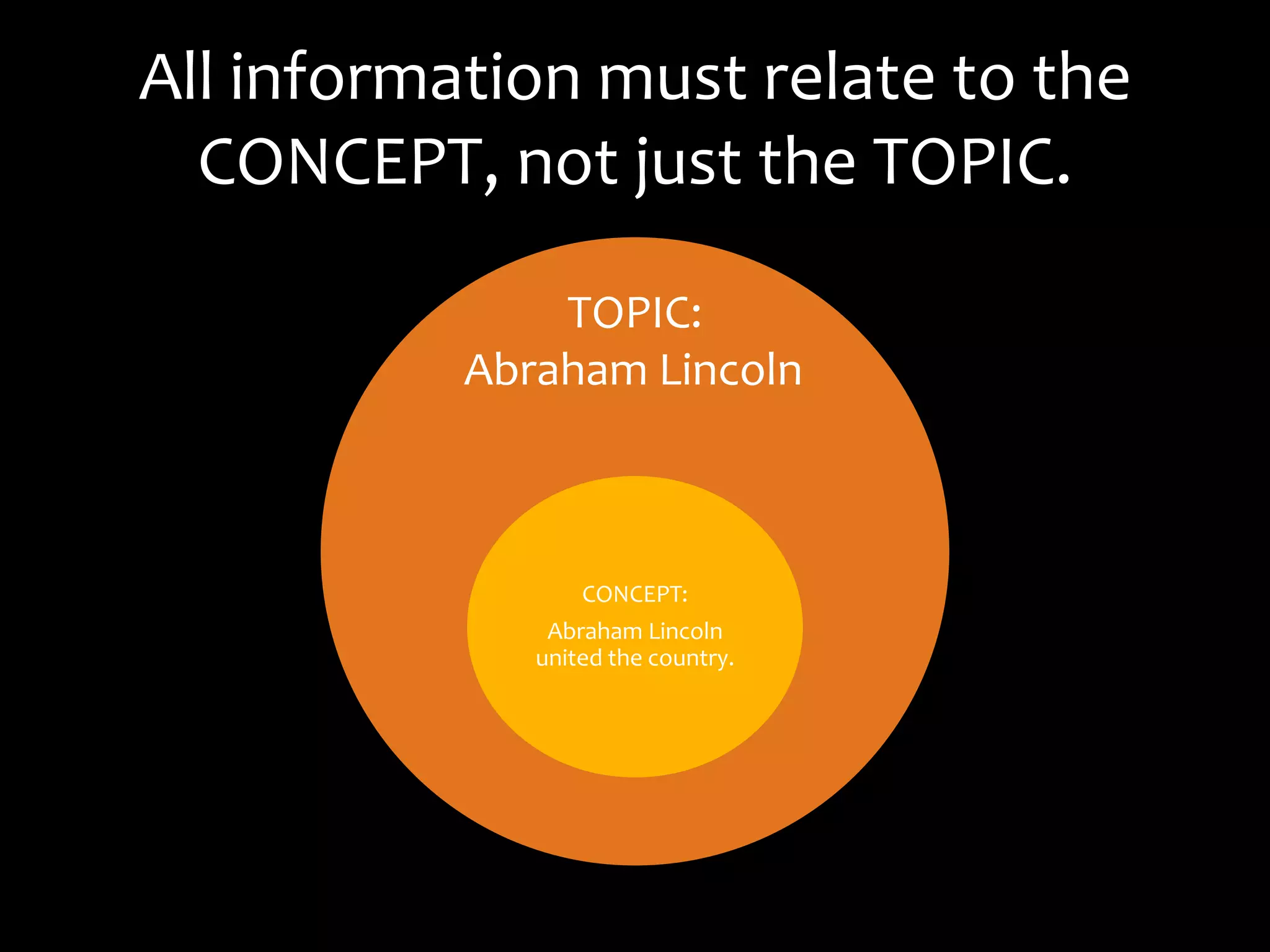
Do notadd interesting pictures and words…Lincoln unified the country.
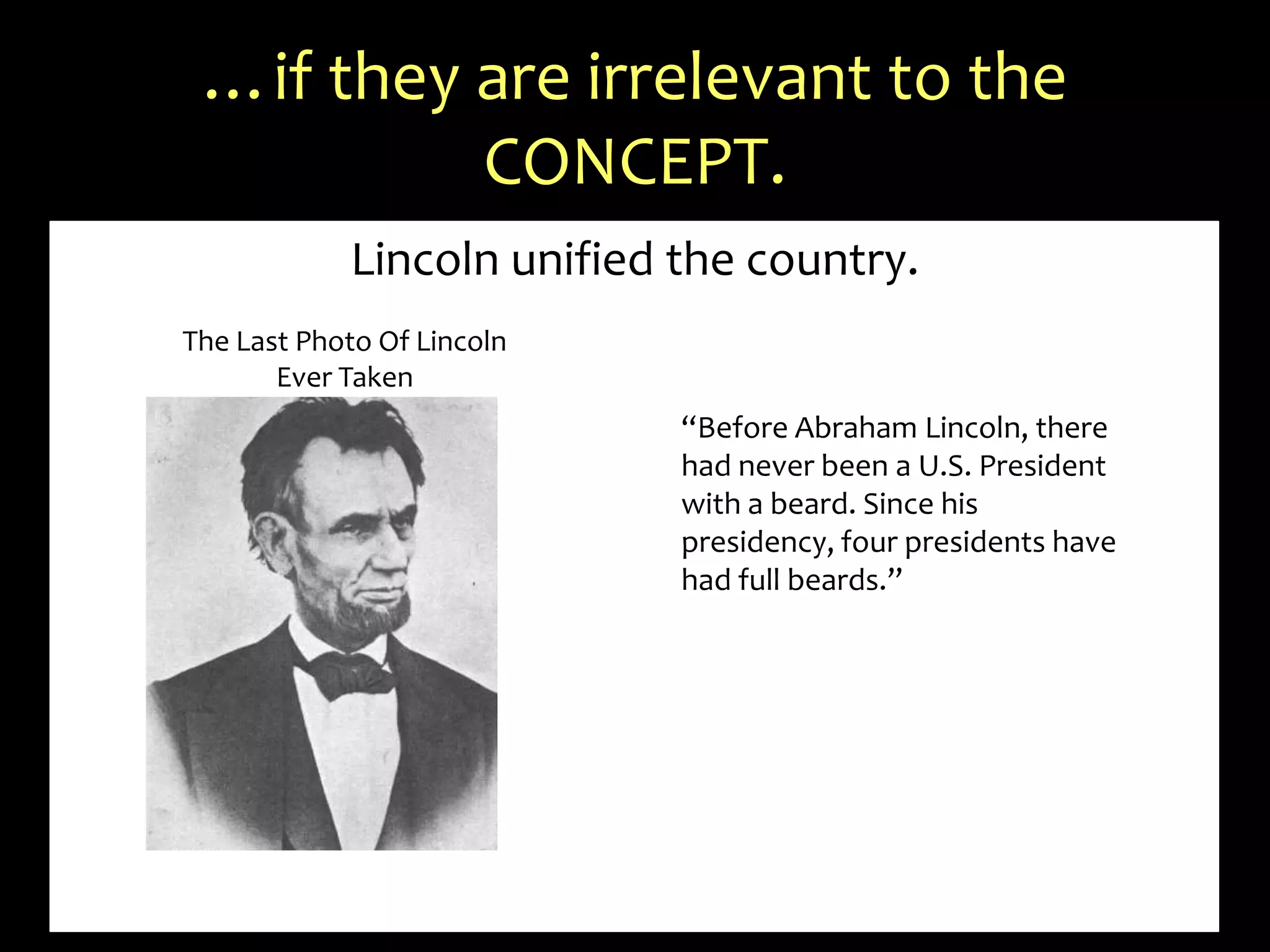
…if they are irrelevant to the CONCEPT.Lincoln unified the country.The Last Photo Of Lincoln Ever Taken“Before Abraham Lincoln, there had never been a U.S. President with a beard. Since his presidency, four presidents have had full beards.”
Anything that doesn’t relate to the main idea destroys learning.SoundsPicturesWordsWordsWordsMotions

Presentation Design Part 1: Slide Design

Editor's Notes

  • #4 I’d like to start by telling you a story.
  • #5 On a clear February morning, the space shuttle Columbia re-entered the atmosphere at 8:44, slowing down from 17,000 miles an hour (Wikipedia contributors).Four minutes later, the leading edge of the left wing reached 2600° Fahrenheit (Wikipedia contributors).The wing, damaged during launch by a piece of foam, heated up to a temperature of almost 3000 degrees Fahrenheit, and the Columbia disintegrated over Tyler, Texas. Pieces of debris and wreckage were strewn across hundreds of miles of the U.S. (Wikipedia contributors).This video was caught by Dan McNew.Information:Wikipedia contributors. &quot;Space Shuttle Columbia disaster.&quot; Wikipedia, The Free Encyclopedia. Wikipedia, The Free Encyclopedia, 4 Jan. 2011. Web. 7 Jan. 2011. Video:McNew, Dan. &quot;Space Shuttle Columbia Disaster Over Texas.&quot; 03 June 2008. Online video clip. YouTube. 6 Jan 2011. &lt;http://www.youtube.com/watch?v=clseDHnTx08&gt;.
  • #6 These seven men and women lost their lives.Seated in front are astronauts Rick D. Husband (left), mission commander; KalpanaChawla, mission specialist; and William C. McCool, pilot. Standing are (from the left) astronauts David M. Brown, Laurel B. Clark, and Michael P. Anderson, all mission specialists; and Ilan Ramon, payload specialist representing the Israeli Space Agency. So, the question is: why did they die? The engineers monitoring the flight had known for two weeks that the wing sustained damage during the launch. Why weren’t the members of the crew more aware of the danger and potential risks?Image:STS107-S-002. 2001. Photograph. Human Space Flight. NASA, Oct. 2001. Web. 30 Dec. 2010.
  • #7 Edward Tufte, American statistician and professor emeritus of political science, statistics, and computer science at Yale University
  • #9 Tufte analyzed the information presented to the NASA officials in charge, and argues that the information that the mission was at risk existed, but was buried in the long PowerPoint presentations used by the Boeing engineers to present their findings.Tufte goes on to argue that this is not merely a fault of the engineers, but of PowerPoint itself, because of the way it induces people to structure their thought and communication. Text:Tufte, Edward R. The Cognitive Style of PowerPoint. Cheshire, CT: Graphics, 2003. Print.Image:Boeing Powerpoint For NASA. Digital image. The Work Of Edward Tufte And Graphics Press. Graphics Press, 2006. Web. 6 Jan. 2011. &lt;http://www.edwardtufte.com/bboard/q-and-a-fetch-msg?msg_id=0001yB&amp;topic_id=1&gt;.
  • #11 This is an image created by Tufte for the cover of his essay – he likens the effect of PowerPoint (humorously) to the oppression of thought and opinion in Communist Russia under Stalin.Image:The Cognitive Style Of PowerPoint. Digital image. The Work Of Edward Tufte And Graphics Press. Graphics Press, 2006. Web. 6 Jan. 2011. &lt;http://www.edwardtufte.com/tufte/powerpoint&gt;.
  • #12 We’ve all seen this, just in desks in our room.
  • #13 However, according to Richard Mayer, who actually carried out 10 years of research on the effect of multimedia presentations on learning, the answer is...Image: Mayer, Richard E. Multimedia Learning. Cambridge: Cambridge UP, 2003. Print.
  • #15 In fact, according to Mayer, multimedia presentations can significantly enhance how people remember and understand content at a deep level.(This is what Mayer calls the “multimedia principle.”)Image: Mayer, Richard E. Multimedia Learning. Cambridge: Cambridge UP, 2003. Print.
  • #16 So, PowerPoint in itself is not evil. But clearly, Tufte had a point. Who is the villain?
  • #19 Now that we’ve been at this for a while, everyone knows that we really need to work to create presentations that are:Information-richTechnologically advancedAesthetically pleasingBut there’s a problem with this: none of these things actually matter.
  • #21 That’s what we’re here to talk about. In this part, we’ll cover slide design. Next, if you find it worthwhile, we’ll take a look at how to design the whole presentation --- how to incorporate structure so students understand more deeply, and using elements of a story to engage and sustain attention.
  • #23 Image:Foster, Mike. &quot;Space Alien Backs Bush For President.&quot; World Weekly News [Lantana, FL] 9 May 2000: 1. Print.
  • #24 A headline is an idea, which really is a sentence. To be an idea, and not just a topic, you must have a subject and a verb. (Newspapers sometimes use implied verbs.)
  • #25 One significant problem with the slide in the Columbia presentation is that the important idea was buried on a page with 5 other ideas. It is possible, if each of these ideas had its own page, the idea that the test results were wildly insufficient may have been much more clear.On the other hand, this slide about obesity is clear (and matched with a photo that causes a clear, visceral reaction). It makes a single point, and makes it well.Images:Boeing Powerpoint For NASA. Digital image. The Work Of Edward Tufte And Graphics Press. Graphics Press, 2006. Web. 6 Jan. 2011. &lt;http://www.edwardtufte.com/bboard/q-and-a-fetch-msg?msg_id=0001yB&amp;topic_id=1&gt;.Jones, Simon. “Presentation Skills for Geography Teachers 2.0.” Slideshare.net. PowerPoint. 2008. 7 Jan. 2011. &lt;http://geographyjones.posterous.com&gt;.
  • #31 Here is a slide from a PowerPoint that I actually inflicted on students. So, the challenge is: what is the main idea?
  • #32 Here is a possible revision of this slide. The details about Sunni and Shia could be in the notes section.If you have to formulate a main idea for every slide, it will also help clarify for you what the important information is for each slide, and the presentation as a whole. If you don’t know, the students won’t either.
  • #35 Remember, one of Mayer’s most significant findings is that retention and transfer (deep learning) occurs best when images and words are placed together. Image and text: Mayer, Richard E. Multimedia Learning. Cambridge: Cambridge UP, 2003. Print.
  • #36 For your case, it would be useful even to include pictures of people, documents, or events – if they were immortalized in painting, or caught on film.But for images and words to work best together, however, they need to be together, in space and time. So, if it makes sense with your particular slide, label or put captions on pictures right next to the picture itself. And show each image with its corresponding text at the same time.(This is based on Mayer’s spatial contiguity and temporal contiguity principles.)Text: Mayer, Richard E. Multimedia Learning. Cambridge: Cambridge UP, 2003. Print.Image:Reproduction of the 1805 Rembrandt Peale Painting of Thomas Jefferson New York Historical Society. Digital image. Wikimedia Commons, 17 May 2005. Web. 6 Jan. 2011. &lt;http://commons.wikimedia.org/wiki/File:Reproduction-of-the-1805-Rembrandt-Peale-painting-of-Thomas-Jefferson-New-York-Historical-Society_1.jpg&gt;.Robert E. Lee&apos;s Amnesty Oath. Digital image. Archival Research Catalog. The National Archives, 2 Oct. 1865. Web. 7 Jan. 2011. &lt;http://arcweb.archives.gov&gt;.
  • #40 Image:Jones, Simon. “Presentation Skills for Geography Teachers 2.0.” Slideshare.net. PowerPoint. 2008. 7 Jan. 2011. &lt;http://geographyjones.posterous.com&gt;.
  • #41 Image:Jones, Simon. “Presentation Skills for Geography Teachers 2.0.” Slideshare.net. PowerPoint. 2008. 7 Jan. 2011. &lt;http://geographyjones.posterous.com&gt;.
  • #43 Image:Jones, Simon. “Presentation Skills for Geography Teachers 2.0.” Slideshare.net. PowerPoint. 2008. 7 Jan. 2011. &lt;http://geographyjones.posterous.com&gt;.
  • #44 Because specific images always have more information than generic ones.Images:Document. Digital image. Teacher Clipart. 2009. Web. 11 Feb 2011.
  • #45 Because specific images always have more information than generic ones.Images:Bill of Rights.
  • #46 The Military Industrial Complex. Digital image. Tumeke! 17 January 2011. Web. 22 Mar. 2011.
  • #47 Rubin-Toles, Mark. Staff Meeting Drawing. 2010. Paper and ink. CFHS Library.
  • #48 From the post: &quot;Let It Dough!&quot; Abstract City Blog. The New York Times. 16 Dec. 2010. Web. 11 Feb. 2011. &lt;http://niemann.blogs.nytimes.com/2010/12/16/let-it-dough/&gt;.
  • #49 From the post: &quot;Let It Dough!&quot; Abstract City Blog. The New York Times. 16 Dec. 2010. Web. 11 Feb. 2011. &lt;http://niemann.blogs.nytimes.com/2010/12/16/let-it-dough/&gt;.
  • #50 Here is a slide from a PowerPoint that I actually inflicted on students. So, the challenge is: what is the main idea?
  • #51 Here is a possible revision of this slide. The details about Sunni and Shia could be in the notes section.If you have to formulate a main idea for every slide, it will also help clarify for you what the important information is for each slide, and the presentation as a whole. If you don’t know, the students won’t either.Images:Shiite Muslims. Digital image. Shiites in Lebanon Mark Ashoura with Anti-Israeli Slogans. World News, 16 Dec. 2010. Web. 6 Jan. 2011. &lt;http://article.wn.com/view/2010/12/16/Shiites_in_Lebanon_mark_Ashoura_with_antiIsraeli_slogans_Rou/&gt;.Sunni Clerics Meet On Elections. Digital image. End The Wars In Afghanistan And Iraq. 4 Jan. 2005. Web. 6 Jan. 2011. &lt;http://www.texansforpeace.org/endthewar/olderIraqis2_01.htm&gt;.
  • #56 This is counterintuitive. We are writing creatures, and we imagine that people will understand and remember things better if they see it AND read it. But actually, if they see it AND read it, they remember less, and understand more superficially.(This is what Mayer calls the “redundancy principle.”)Text: Mayer, Richard E. Multimedia Learning. Cambridge: Cambridge UP, 2003. Print.Image:Northern Grace Youth Camp. Mouth. 2008. Photograph. Flickr. July-Aug. 2008. Web. 3 Jan. 2011. &lt;http://www.flickr.com/photos/ngyc/4188047886/&gt;.
  • #58 Text: Mayer, Richard E. Multimedia Learning. Cambridge: Cambridge UP, 2003. Print.Image:Atkinson, Cliff, and Richard E. Mayer. “Five Ways To Reduce PowerPoint Overload.” Sociablemedia.com. PowerPoint. 23 April 2004.
  • #59 Image:Atkinson, Cliff. Beyond Bullet Points : Using Microsoft Office PowerPoint 2007 to Create Presentations That Inform, Motivate, and Inspire. Redmond: Microsoft, 2008. Print.
  • #60 Image: Atkinson, Cliff. Beyond Bullet Points : Using Microsoft Office PowerPoint 2007 to Create Presentations That Inform, Motivate, and Inspire. Redmond: Microsoft, 2008. Print.
  • #61 Image:PowerPoint Screenshot. Digital image. Annotations. BiblePlaces.com. Web. 6 Jan. 2011. &lt;http://www.bibleplaces.com/annotations.htm&gt;.
  • #62 Citation:Employment And Career Development Division. PowerPoint Handout + Notes. Digital image. Worksource. Employment Security Departmnet, Washington State, 2010. Web. 7 Jan. 2011. &lt;http://www.wa.gov/esd/training/quickguides/xp_pptwordprint.htm&gt;.
  • #63 The final step is to go through your slides and ruthlessly eliminate anything interesting…
  • #64 …that does not fit the concept that you are trying to teach – that is, your main idea. This is especially true of interesting material – Mayer actually called these ‘seductive details.’ We all know the lecture we gave about the Maya, and the only detail the students remember later is the grisly thing they did with their tongues and the barbed strip of leather.This does not mean that you should not include interesting details --- just make sure they relate to the central concepts you want to get across. You may also put all of the ‘merely interesting’ stuff together somewhere else – or incorporate it into a story that you use to create a vivid picture of a person or way of life – to set the scene before you teach a concept.Text:&quot;Fun Facts About Abraham Lincoln.&quot; 2020 Site. Love To Know Corp., 2009. Web. 30 Dec. 2010. &lt;http://www.2020site.org/fun-facts/Fun-Facts-About-Abraham-Lincoln.html&gt;.Image:Henry, Warren J. The last photo of Abraham Lincoln, taken March 6, 1865. Digital image. 10 Fascinating Last Pictures Taken. Listverse, 13 Nov. 2008. Web. 3 Jan. 2011. &lt;http://listverse.com/2008/11/13/10-fascinating-last-pictures-taken/&gt;.
  • #65 Image:Landscape Photo. Digital image. Tools To Inspire Imagination. Akvis. Web. 6 Jan. 2011. &lt;http://akvis.com/en/sketch-tutorial/examples/photo-on-sketch.php&gt;.
  • #66 Image:Landscape Photo. Digital image. Tools To Inspire Imagination. Akvis. Web. 6 Jan. 2011. &lt;http://akvis.com/en/sketch-tutorial/examples/photo-on-sketch.php&gt;.
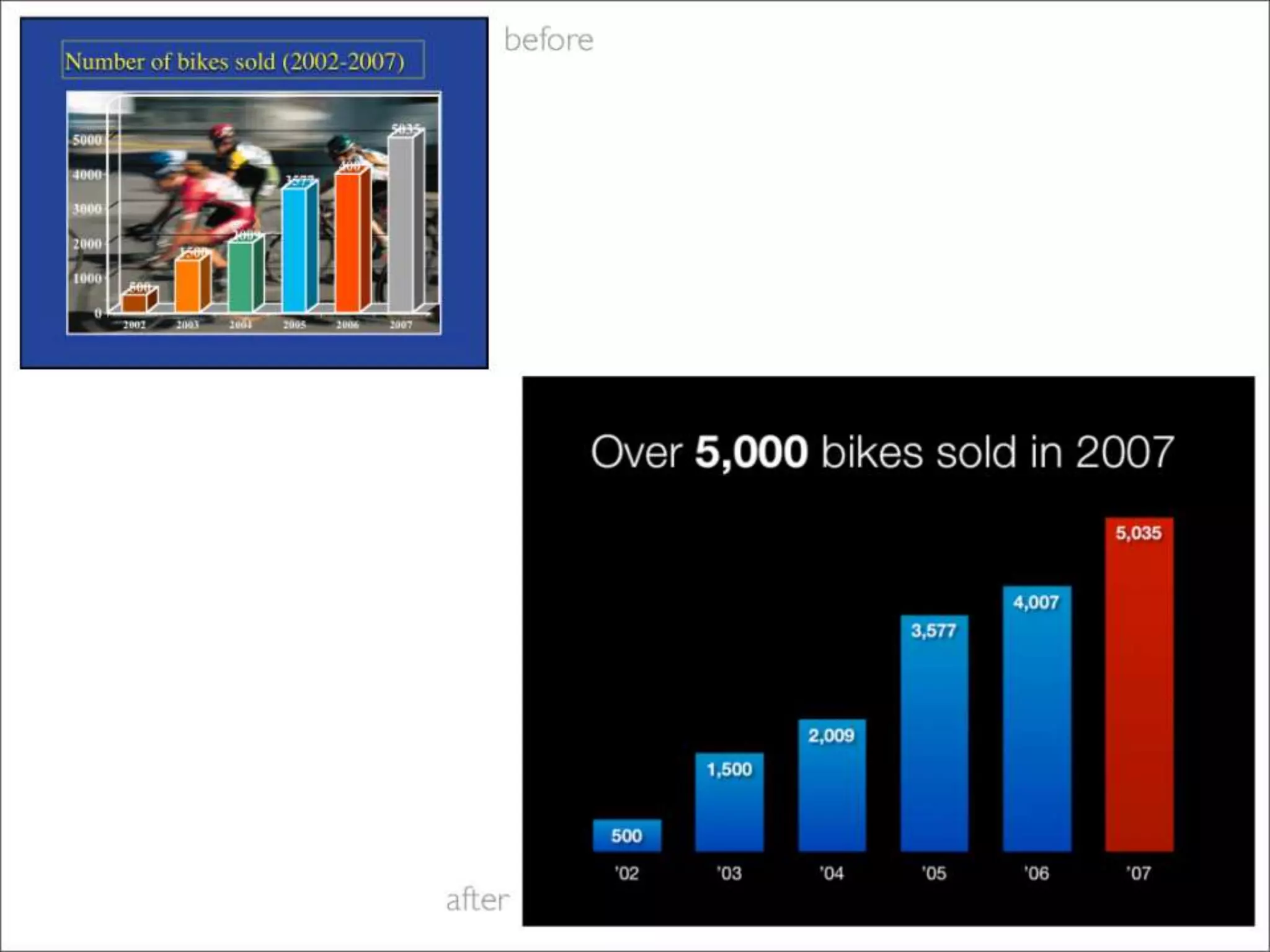
  • #68 Here’s an example of a slide with a lot of distracting information removed – a before and after shot.Image:Jones, Simon. “Presentation Skills for Geography Teachers 2.0.” Slideshare.net. PowerPoint. 2008. 7 Jan. 2011. &lt;http://geographyjones.posterous.com&gt;.
  • #72 Gessaman, Adam. Week 5 Slide 20. Digital image. Flickr. 17 Jan. 2008. Web. 3 Jan. 2011. &lt;http://www.flickr.com/photos/idlyadam/2201244646/in/photostream/lightbox/#/photos/idlyadam/2201244646/in/photostream/&gt;.
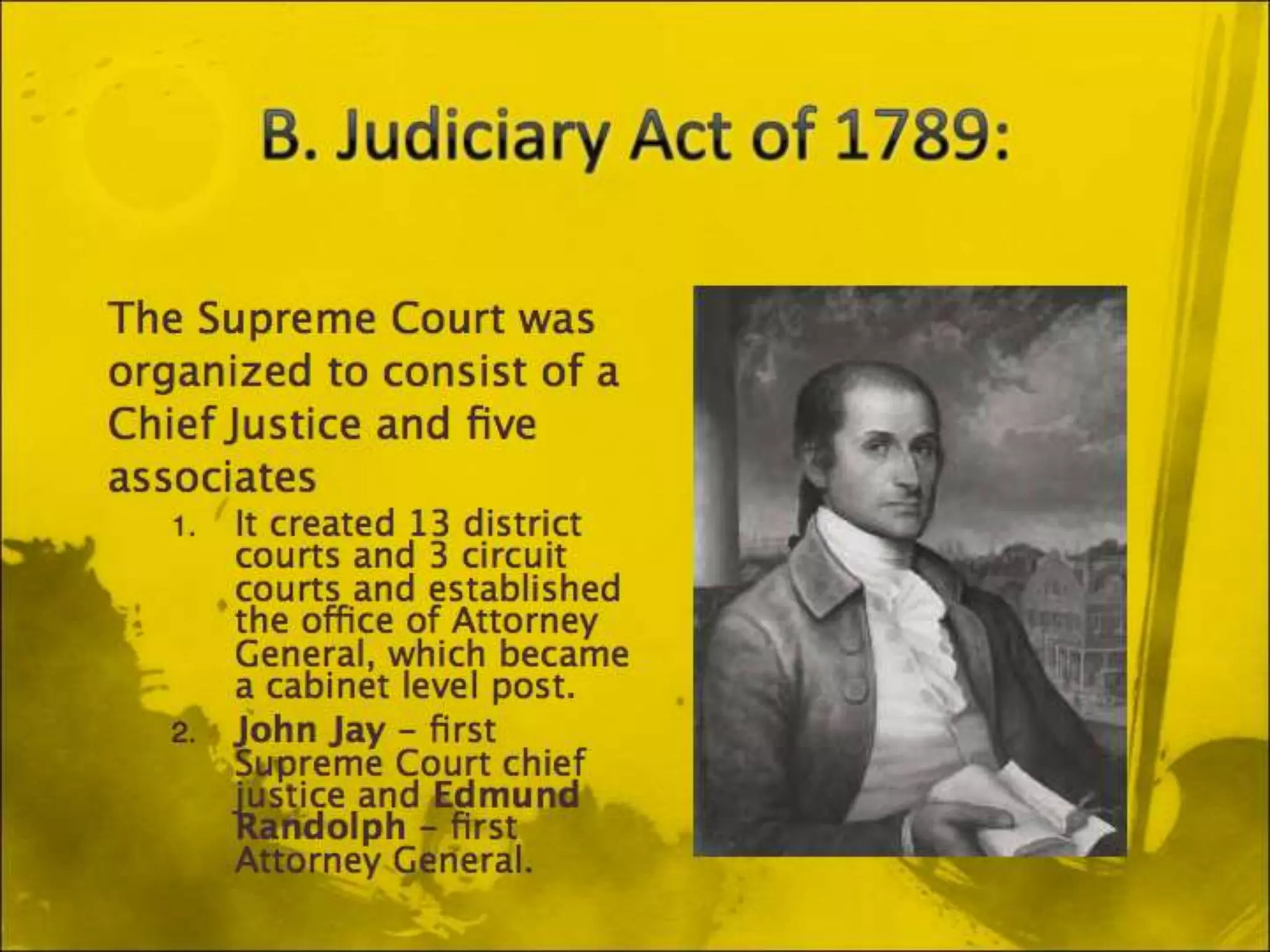
  • #73 (This slide may be used by the teacher in conjunction with a Smartboard to illustrate a revised version of the previous slide, as suggested by members of the class.)
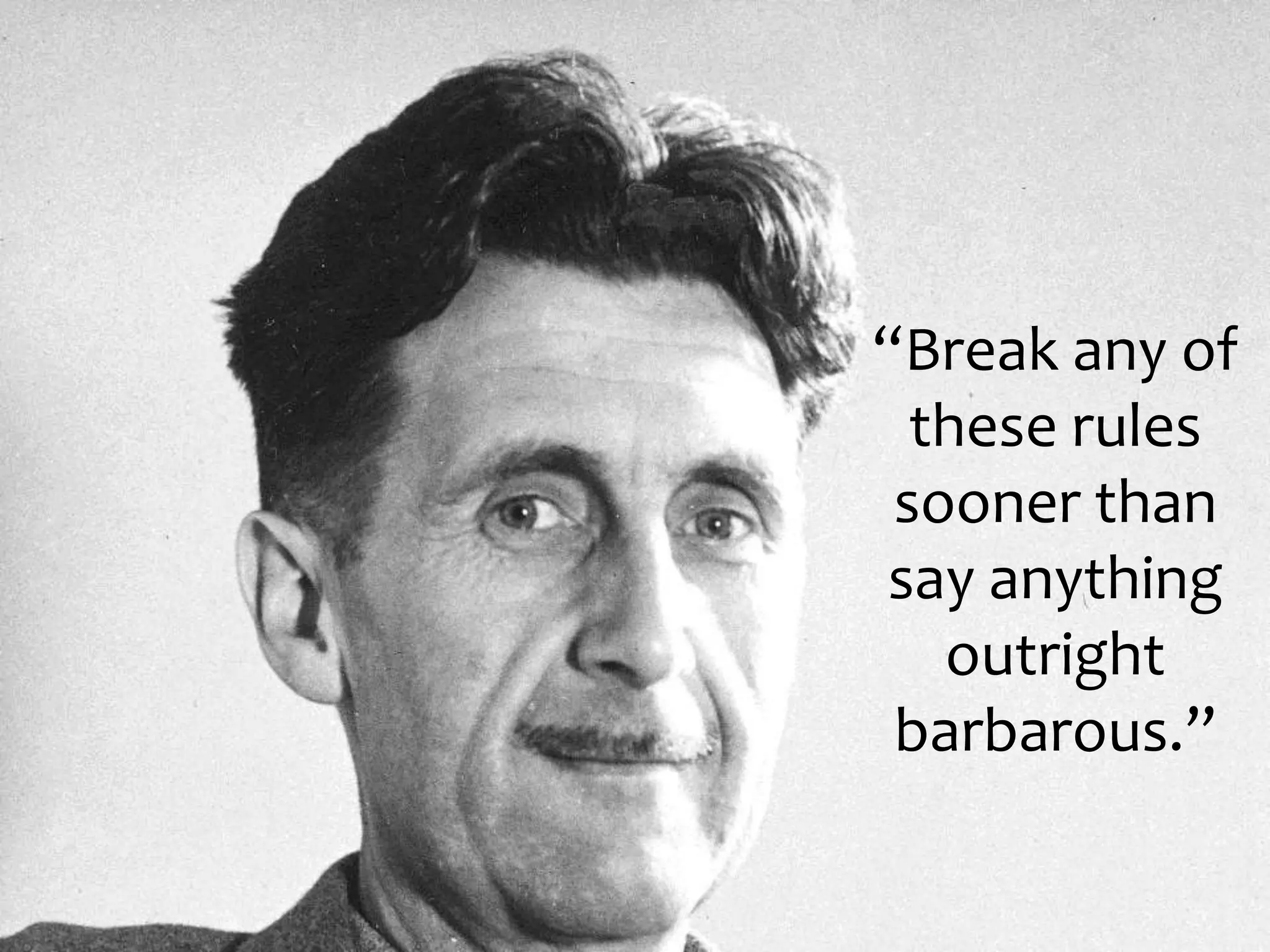
  • #74 Text:Orwell, George. Politics and the English Language: An Essay. New York, 1947. Print.Image:AP. George Orwell. Digital image. Writers Born This Day. Syracuse.com, 25 June 2008. Web. 6 Jan. 2011. &lt;http://blog.syracuse.com/shelflife/2008/06/writers_born_this_day_orwell.html&gt;.
  • #77 This slide may be used as an alternate slide to revise, in place of the image on slide 70.